This paper on GIFs and screen-based compulsion is a very extended follow-up to a short, but widely disseminated, piece I wrote in 2011: On the Doctrine of the Similar (GIF GIF GIF).
It is presented here as a draft, since I never published this paper officially. I hope it is useful/interesting for GIF lovers everywhere.
Rather than designate high resolutions and white-knuckle optical speeds as representative of 21st Century cultural immersion, I consider animated GIFs a more contemporary medium. From their origins in the early 90s as simple linguistic stand-ins animated GIFs have diversified along with the web that birthed them. They correspond quickly and directly, and lend themselves to constant mutation and (re)assemblage at the hands of their producers and consumers; blurring the distinction between these identities along the way. Their poor visual fidelity is made up for by their propensity to repeat and cycle in lieu of the actions and expressions they harbour. By allowing us to wallow in their remixed repetitions animated GIFs feed on the human susceptibility to resemblance and recognition, even as their surface affect remains distanced from any particular media origin. As Sally Mckay describes, “GIFs are simultaneously ‘in your face’ and in your mind, their affects continuous with the immersive experience of daily internet use.” [1] This status enables GIFs as a metaphor for contemporary techno-culture itself, framing our distributed, multimedial space-time in staged, repeatable, and digestible patterns.
 In its early days, cinema was considered capable of immobilising the world for the purposes of human appreciation and enchantment. Eadweard Muybridge sought to isolate the gallop of the horse from its particular being in time and space, so that it was forever framed for our experience. Today a million versions of Muybridge’s horse careen around the web as animated GIFs of questionable quality, flashing fleetingly, but often. In turn pictures, depictions and imitations have given way to motions, evocations and impressions, mixing the shared memory of our collective experiences at ever greater speeds, distances and – most importantly – correspondences than ever before. As Daniel Rubinstein points out the content of an animated GIF “can be figurative or abstract, lyrical or macabre, but… the primary materials that the GIF artist uses are rhythm and repetition…” [2] An aesthetics not necessarily of surface reception, but of delivery, temporality and the patterns of configuration. A patterning that calls to mind the work of Walter Benjamin, who argued that metre, rhythm and other heterogeneous impressions had a significant impact on human modes of intuition and experience. [3]
It is fascinating to consider Benjamin’s early essays, especially his The Doctrine of the Similar from 1933, in relation to his more widely read work on film. Having established the process by which humans became ensconced in what Susan Buck-Morss calls a “new nature… of matter as it has been transformed by” technology, [4] Benjamin went on in The Work of Art (1936) [5] to explore the significance this technologised environment has on the human “mimetic faculty.” [6] In two 1933 essays Benjamin argues that ‘primitive’ language emerged in magical correspondence with the world. From the surface of the starry sky, or the intestines of a sacrificed animal, early humans “read what was never written,” [7] deriving mystical revelations from the constellations and signatures perceived there. [8] Configurations between patterns were what determined legibility, not just because they carried an intended meaning – being ‘written’ there by the Gods, for instance – but because similarities ‘flash up’ speculatively in the human mind:
So speed, the swiftness in reading or writing which can scarcely be separated from this process, would then become… the effort or gift of letting the mind participate in that measure of time in which similarities flash up fleetingly out of the stream of things only in order to become immediately engulfed again. [9]
“Nature creates similarities,” and as such, humans being of nature, are driven by a mimetic compulsion “to become and behave like something else,” [10] projecting that same compulsion into the world around them. This compulsion manifested itself in group dances, as song and spoken language, and later, as writing, eventually flattening the speculative space of mimetic experience into inscriptions on stone, vellum, or paper. As Howard Caygill observes:
Configuration is thus transformed into inscription, reducing the speculative reading of the similarity between patterns into the transcendental reading of graphically inscribed marks upon an infinite but bounded surface. [11]
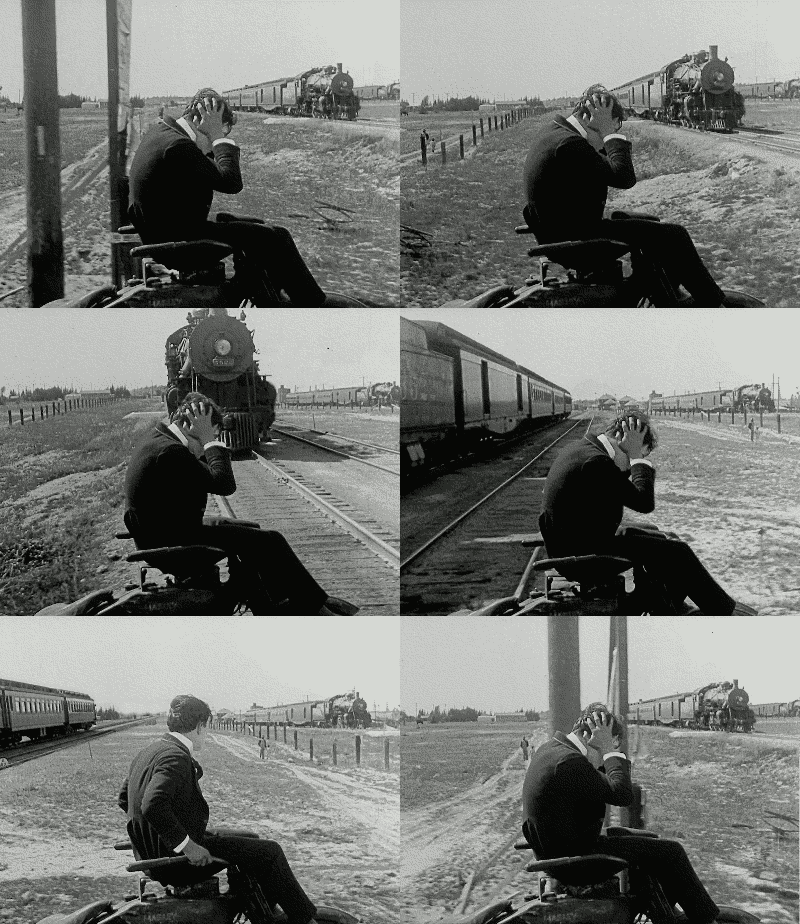 Like the writing that Benjamin believed ‘captured’ human beings and their mimetic faculty, animated GIFs point to a new type of inscription, born of, and infinitely responsive to itself. We enter into this whether or not we wish too, each time we navigate a browser window, or slide our fingers across a smartphone screen. We are as malleable as our nature. A physiological suspense beckoning from the screen that animated GIFs turn around and loop – indefinitely – as a reminder of their own attention. In creating and sharing GIFs we add depth to the flat surfaces through which the internet is received. We may be ensconced in this space, and pulled along by it, but it is a space whose apparent distribution across screens, browser windows, and multiple devices too readily gestures to our bodies and selves as being fully individuated, rather than to the whole assemblage of which both our bodies, devices, and the images that play between them, are a part.
Benjamin believed that, rather than allowing us to attain mastery over nature, technologies such as film give us an awareness over our relationship with nature through the processes of “material complexification.” [12] For Benjamin this training was akin to the relationship between factory workers and the production line, where the ratchet of the gears and conveyors program the workers’ bodies, fusing them together into a larger assemblage. The successive frames of film, made to spool through the mechanism one after the other at imperceptible speed, create an illusion of temporal and spatial fluidity that shock us into an awareness of the complex relation between our psychic and physiological realities. As R.L Rutsky lucidly explains, “this scattered, interrupted filmic reception becomes part of the human sensorium or body… a body that is no longer distanced from—or entirely separate from—the images and shocks that it comes into contact with.” [13]
 Constituted by what Anne Friedberg describes as a “mobilized and virtual gaze,” [14] filmic subjectivity has often been considered to correspond to the supposed sovereignty of the consumer, predicated on the promise of an enhanced mobility and freedom of choice across a dizzying array of goods and spectacles. Time and space themselves became filmic, opening up onto new mimetic correspondences discoverable in everything from the high-speed montage of flowers in bloom, to the slowed down and isolated gallop of Muybridge’s horse. Cinema goers attain all the nobility of flâneurs exploring endless arcades of experience without ever having to leave their seats. As R.L. Rutsky argues, the audience ‘becomes’ through this collective “state of distraction,” defined by “its ability to ‘take up’ these images in much the same way that the film apparatus does.” [15] And so the mimetic faculty itself achieves a kind of mechanisation in the mass spectacle of moving images, able to reveal correspondences at speeds and densities hitherto impossible to conceive. In the words of Mark Hansen:
Despite the vast acceleration of image circulation in the historical interval separating Benjamin’s moment from ours, his effort to grapple with the material impact of… autonomous images remains exemplary: it comprises an indispensable model that can guide us in our efforts to forge connections with our alienating, postimaginary material world. [16]
Whereas the mimetic faculty had originally come to correspond with nature through theological ritual or script, with this second nature – of what Mark Hansen calls “the mechanosphere” [17] – the correspondence is material, and sensuous. Our receptivity is physiological, our bodies are shared, and our memories – now dependent on the “alien rhythms” [18] of montage – have become intricately woven into the machine as images. In turn, as noted by Arthur Kroker, “the image machine is haunted by memories of the body,” [19] bodies that depend on the fidelity, malleability and repeatability of film, videotape, and more recently, digital forms of media for their existence.
 As with its filmic ancestors, animated GIFs often frame fragmented images of time in snippets of montage, giving what Gilles Deleuze termed “common standard of measurement to things which do not have one,” framing “long shots of countryside and close-ups of the face, an astronomical system and a single drop of water” [20] within a single perceptual apparatus. The train whips by on the silver screen, but the instant of each image impacting us is lost as the play of further images moves onwards through experience. As Steven Shaviro has insisted, we “have already been touched by and altered by these sensations, even before [we] have had the chance to become conscious of them.” [21] But unlike filmic time, made to reel at 24 frames per second, the GIF’s loading mechanism introduces a more awkward temporal component into perception: that of bandwidth. Standardized in 1987 by CompuServe, the GIF’s early popularity was based, in part, on their ability to load in time with its download. In the days of dial-up connections this meant that at least part of a GIF image would appear before the user’s connection froze, or – more significantly – the user could see enough of the image for it to mean something. In 1989 Compuserve updated GIFs to use this ‘partial loading’ mechanism to encode animations within a single GIF file. In essence, the hacky update transformed a two dimensional spatial loading mechanism into a three dimensional temporal one. A file format designed to harness correspondences within each single image had become about correspondences between and across images. According to Jason Eppink in 1995 Netscape Navigator, an early popular web browser, “took advantage of [this mechanism] to enable looping, making the GIF viable for animation online over dial-up speeds.” [22]
 Small in size and made up of few frames, this is where animated GIFs entered their ‘classic’ [23] phase. Corresponding to single phrases or concepts such as ‘Under Construction’, ‘Area 51’ or ‘flying pink unicorn’, the era of personal web pages saturated with spinning hamsters is one anybody born after 1990 will little remember, but its influence on the contemporary ‘folk’ attitude of the web has not abated. As the 2000s came into view, animated GIFs became freed up by an increase in bandwidth and storage capacity to show more complex assemblages, and it was at this stage that the format achieved its common contemporary use as a vehicle for moments framed from cinema, television and – increasingly – video websites like YouTube. Frame grab or video capture GIFs often pay homage to isolated moments in pop culture, but as the ‘craft’ of animated GIFs has grown, so the frame capture form has begun to correspond well outside the filmic and televisual contexts from which they were first appropriated. This leap is, for me, the first point at which GIFs begin to co-ordinate their own realm of mimetic correspondence. An ocean of viral videos turned into a self-serving visual vernacular, looping back on itself ad infinitum.
 Brought on by their obsolescence, animated GIFs are among the most contradictory of images, able to resist the rigid taxonomies of the burgeoning algorithmic economy, even as they are turned into ‘clickbait’ by sites like BuzzFeed, [24] who rely on them to flash on screens kept in motion by the compulsive scroll of a mouse, or – increasingly – a finger or thumb. From our vantage point, subsumed by the impact of a high-bandwidth internet culture, animated GIFs [25] seem quaint, clumsy, even remedial in their capacity to transmit information. GIFs are easy to share and edit, but difficult for search engines to classify and catalogue. They are usually small in size, but their popularity exerts a significant load on the web servers that host them. As internet speeds have increased, and screen resolutions soared in depth, GIFs have remained; flickering endlessly as visual reminders of the ubiquitous mess the internet has become. Users of sites like Tumblr, 4chan, and Reddit revel in the capacity of GIFs to quickly correspond to the world, capturing token moments of experience or expression that signal well beyond their original context. Images can be made to correspond with increasing immediacy; can be cut, copied, stretched, collected and forced to clash in violent juxtaposition through Photoshopping, embedding, and multiple recompressions, using software interfaces that themselves are infinitely malleable. As Sarah Kember and Joanna Zylinska argue in Life After New Media, one of the principle ways in which we create meaning through matter is by cutting:
Cutting reality into smaller pieces – with our eyes, our bodily and cognitive apparatus, our language, our memory, and our technologies – we enact separation and relationality as the two dominant aspects of material locatedness in time. [26]
The affect of a GIF is not just felt, but copied and pasted elsewhere; separated and related in never before seen patterns and expressions. GIFs can be broken into their constituent frames, compressed and corrupted on purpose and made to act as archives for viral ‘memetic’ events travelling the web. It is possible to track the cultural development of some of these correspondences. Often though, the source of the cultural moment they hail from becomes completely lost in the play of images. Finding meaning in the semiotic sludge of these GIFs often requires a sensitivity to similitude bordering on the magical, even if their visceral impact is beyond question.
 Net artists and archaeologists, Olia Lialina and Dragan Espenschied, have long been fascinated by a GIF known as ‘Real_Dancing_Girl’. Indeed, Lialina cites the GIF as a defining impetus in her desire to become a net artist in the first place. [27] Small in size and given to a multitude of purposes and meanings, Real_Dancing_Girl.GIF found her way onto many thousands of personal web pages during the early ‘classic’ GIF era, made to dance alongside a cast of similar pixelated characters. If you blow Real_Dancing_Girl up to a size well beyond the means of a mid-90s desktop monitor to display, it is easy to see a single aberrant pixel that flashes each time she swings her hips to her left. [28] Throughout Real_Dancing_Girl’s 20 something years of propagation around the web this pixel remained, apparently unnoticed, or at least aesthetically accepted by those who added the GIF to their webpages. The pixel in Real_Dancing_Girl indicates the difficulty the network has in determining what communicates and what doesn’t. Its significance may be slight – a punctum to prick the attention of those enraptured by the image – but the aberrant pixel signals how the mimetic faculty tends to shift inwards. In recent homages to the GIF nameless web artists have incorporated the anomalous pixel in their higher resolution remakes, mimicking the movements of Real_Dancing_Girl as their digitised bodies recoil. A playground of correspondences that at first mimicked language and the wider world now mimics itself. As Graig Uhlin notes, narrative correspondence is not the guiding principle of the GIF, rather “the viewer is caught up in the GIF’s temporal suspension: to view is to be captivated.” [29]
A 2015 BuzzFeed article entitled Can You Get Through These 17 GIFs Of Massive Zits Being Popped Without Shielding Your Eyes? [30] poses a challenge to the audience that promises bodily affect, relying on the GIF as its primary vehicle. As BuzzFeed is wont to do the article encourages the ‘reader’ to scroll through each animated GIF for no other reason than for the experience it will deliver. The GIFs are knowingly visceral, their careful ‘listicle’ [31] arrangement down the length of the page no less meticulous than the framing of each individual animated GIF on the spectacle of a zit being burst asunder. Here bodies are vast surfaces closed off by each GIF, so that even though the moment of each zit’s (and therefore each body’s) eruption is reduced to its purest semblance, the affect of bodies in their entirety is alluded to and made significant. Each GIF has its own title that celebrates the compulsion of this activity, and the sense of release and relief they represent for the bodies subjected to by each GIF and, in turn, the body of the viewer suspended among them:
Doesn’t this make you feel relaxed?
Just imagine how gratifying this must feel…
How is it possible to feel such disgust and satisfaction at the same time?
Yeah, it’s kind of gross to watch…
…but there’s no denying there’s something beautiful about these gifs. [32]
 The audience is encouraged to excerpt their mimetic faculty, to revel in the correspondences between GIFs and eruptions; to find ‘beauty’ in these captivating physiological rhythms. Indeed, the ‘loop’ of each individual zit and its eruption is enhanced by the further repetition of awareness and reception as the tirade of grotesque releases continues. In the zit article we find a paradigm of the click/scroll/repeat reverie that BuzzFeed has become synonymous with. A compulsion to derive affect, and physiological release, in the navigation of lists of what BuzzFeed founder Jonah Peretti calls “upbeat, even childlike content.” [33]
In an April 2015 article for Vox Dylan Matthews reflects [34] on the success of BuzzFeed by looking over an academic paper written by Jonah Peretti a decade before the launch of the website. [35] Published in theory journal Negations in 1996 [36] Peretti’s paper uses Frederic Jameson’s Postmodernism and Consumer Society, and Gilles Deleuze and Felix Guattari’s Anti-Oedipus: Capitalism and Schizophrenia to offer a definition of the distributed identities of contemporary consumers. Deleuze, Guattari and Jameson use the figure of the ‘schizophrenic’ [37] to refer to an individual without a defined ego or identity. Jameson saw “the rapid fire succession of signifiers in MTV style media” [38] of the 1980s as serving “to confuse viewers, harm[ing] their ability to use culture to build identities.” [39] Peretti fuses this view with Deleuze and Guattari’s more ‘emancipatory’ take on the egoless schizophrenic: a figure able to resist the pre-packaged identities being offered them by capitalism, and act – effectively – on their own desires. [40] For Dylan Matthews, Peretti’s fused rendering of the schizophrenic offers an insight into the principles behind BuzzFeed. As Peretti himself wrote in his 1996 paper:
Capitalism needs schizophrenia, but it also needs egos… The contradiction is resolved through the acceleration of the temporal rhythm of late capitalist visual culture. This type of acceleration encourages weak egos that are easily formed, and fade away just as easily. [41]
The zit article exemplifies the plethora of visual identifications that BuzzFeed accelerates through social-media echo chambers. Its skill is to create lists and headlines that everyone and anyone can relate to, and will click and scroll through. “23 Euphoric Moments Literally Everyone Has Experienced”; “23 Times Tumblr Went Way Too Fucking Far”; “19 Euphoric Experiences For Book Lovers”; “21 Things Everyone Who Went To Primary School In Wales Remembers.” Once again the GIF becomes not only the vehicle, but the metaphor of identity destruction and rebirth. A bearer of postimaginary perception, through which – to hijack Walter Benjamin’s insights – “like a flash, similarity appears” [42] only to “become immediately engulfed again.” [43] BuzzFeed is far from the only factory to exploit the qualities of digital media to arrest our attentions, but its success at offering its users new identities that appear to merge and interrelate in an endless, mutating mass is unrivalled. Perhaps its most devastating trick was to recognise compulsion as one of the primary driving forces behind internet navigation, reception and – in conjunction – identity formation. Like the unseen bodies of those zit owning GIF subjects, the listicle format reveals just enough of the shared body of human culture – of Benjamin’s “postimaginary material world” – to produce an affective response in its receivers/users/consumers. An ever expanding multiverse of tiny framed portions of experience cut from context so that they can be shared, digested, and repeated indefinitely.
 Whether viewed in their original format, or as streamed equivalent, the visceral impact of GIFs is beyond question, extending beyond the browser, altering pop culture, our tastes, and even our aesthetic acuity. The different timescales of media production and reception clash in the animated GIF as in no other medium. It is no coincidence that animated GIFs became the web’s primary mode of packaging and delivering visual humour. Just as a joke is the vehicle for the impact of a punchline, so a GIF encapsulates the potential of the having and sharing of its experience. Not only does the animated GIF allow us to wallow in its repetitions, actuating the moving image event in a conscious awareness of one’s awareness, GIFs also enact two modes of experience in their temporal structures. Firstly, GIFs that load in time with bandwidth build frame by frame the structure of the soon to be experienced experience – outside of cinematic and ‘real’ time, at a changeable pace we could call ‘bandwidth-time’. Secondly, the GIF as a mode of display and redisplay tends towards a perceptual sweet spot in its loops and repetitions. The loop of GIFs counteracts some of the uncontainable immediacy of cinema, enclosing the ‘perfect’ amount of time for “the expression of experience by experience” [44] in the cycle of repeated views. Even as bandwidth has increased to alleviate the limitations of the GIF’s short timespan, rather than lengthen animated GIFs, the web community has responded by increasing the resolution and dimensions of GIFs, allowing their visceral impact to expand, even if the perceptive loop has not. Because of this, GIFs still stand as one of the best indications of bandwidth-time. Through the GIF’s jilting appearance on laptop monitors or smartphone screens, viewers are entered into physiological communion with server banks, optical cables, WiFi signals, and 4G mobile phone masts talking in zeroes and ones via invisible protocols.
Whilst digital substrates have increased in their capacity to store, distribute and display information, they have also edged towards invisibility. [45] What matters is that media content is received, and that that reception is smooth and immediate. Whether an animated GIF is composed of a seamless loop or a series of incompatible frames made to jolt against one another, the anchor point at which the GIF repeats has a heightened significance upon its first viewing. The browser window opens onto a single frame, that slips to a few more frames incongruently, until the entire GIF file has been buffered by the computer, at which point the loop begins in earnest. This quality of GIFs reminds us of their origins, even as each nudge towards a seamless loop makes us aware how clunky and clumsy our network architecture still is. Throughout the 2010s the Graphical Interchange Format formalised by Compuserve and Netscape has undergone a series of violent transformations into other, apparently related forms. When a GIF is uploaded to microblogging service Twitter or popular image sharing site imgur, for instance, it is automatically transcoded into MP4 or GIFV video format. The resultant GIF/video hybrid retains the frequency of the original looping animation, but the file can now be started and stopped at will, alleviating part of the strain on the servers given the responsibility of delivering it. These hybrids are still colloquially referred to as ‘GIFs’, even though they retain none of the original coding mechanisms of Compuserve’s format. What’s more, these formats are designed to buffer before they stream, separating us once again from the stutters of bandwidth-time.
 As Mark Nunes reminds us, Internet traffic is predicated on a logic of unimpeded flow. The network demands maximum throughput, with a minimum of noise, a “free flowing system ultimately [dependant] upon a control logic in which everything that circulates communicates… or is cast aside as abject.” [46] For the network it is beneficial to deny bandwidth-time entirely, casting Internet users aloft in the experience of ‘stream-time’; a control logic more suited to arresting our attentions, in which the future image we are about to receive has always already been determined and buffered by the network. We may then wish to read the anchor point of the GIF loop as a cohort of Roland Barthes’ ‘punctum’ – an off-centre compositional “accident which pricks” [47] our attention. The GIF punctum is one frame piled off-kilter with the rest of the sequence; the frame that lingers in awareness just a moment longer as cinematic and bandwidth-time catch up with one another.
Whilst the violent subjugation of the GIF to streamable formats allows the content of the GIF to continue in its loops and correspondences, its potential to mutate is cut short by its transcoding to video. In their ‘original’ format animated GIFs retain each of their frames as if it was a separate file among its partners, so that importing the file into a software editing suite retains the quality and malleability of the whole loop across each individual frame. This means that each copied and pasted GIF carries within itself an unspoken promise of its next adaptation. Although the cut/edit/remix culture of the web does not rely solely on animated GIFs for its expression – one need only browse YouTube for a few moments to find a video that has been bent to several wills before its reception – the GIF’s blunt democratic immediacy is less prevalent across other file formats and modes of viewing. As noted by Giampaolo Bianconni in a 2012 article entitled, GIFability:
Dan Harmon, who was… the executive producer of the television sitcom Community, [said] that he tried, “many times a season” to put star Alison Brie “in a situation… that I know is going to end up as an animated GIF file!” [48]
What in televisual terms is a few moments of particularly well-crafted action, or an acutely framed humorous facial expression, achieves far greater ubiquity and visibility as an animated GIF overlaid with kitschy text, or other hastily layered editorial additions. The acts of recuperation and appropriation carried out by viewers is now considered an integral component of cultural capital. What matters for images is that they are seen, and the mode of their contemporary reception, increasingly, is in appropriated, poor copies, cut out of context – into GIFs or otherwise. The rise of what Hito Steyerl has termed, the Poor Image, is dependent on two, seemingly contradictory, demands:
The networks in which poor images circulate thus constitute both a platform for a fragile new common interest and a battleground for commercial and national agendas… While it enables the users’ active participation in the creation and distribution of content, it also drafts them into production. Users become the editors, critics, translators, and (co-)authors of poor images. [49]
 For a director like Harmon “poor images” of his work are commercially, and arguably artistically beneficial to its reception. What Bianconi calls the ‘GIF-able’ moment is one that harnesses the flash of mimetic acuity in a viewer and drafts them into a productive mode. Harmon’s decision to give his shots a GIF fidelity calls to mind Walter Benjamin’s conclusions in The Work of Art. And yet instead of filmic images training us in new modes of apperception, it has become the images we see daily on our computer screens, flickering in time with new perceptual proficiencies across screens that scroll in multiple dimensions. Now that images can be exchanged, transmitted, copied and edited at frantic light speeds it becomes commercially important for producers of established media forms, such as television and cinema, to maintain the movement and mutation of their images online. In turn, as users and viewers we should tend to concern ourselves with modes of pro-sumption [50] that wrestle a degree of control back from the media machine.
In an article published in July 2015, journalist Cleo Stiller explores the phenomena of ‘microporn GIFs’, ostensibly created by and for women: [51]
While GIFs may seem like a flash in the pan—really, how can four seconds turn you on?—the nature of the loop… give[s] the viewer time to notice the caress of a hand floating from neck to shoulder to forearm, the tensing of an abdomen, the arching of a back, and the reflex of a thigh. [52]
Each microporn GIF teeters on the verge of something happening, gesturing to the possibility of the sexual event; of eventfulness. And the loop gives these moments an infinite capacity to repeat and thus expand experientially, even if they do not expand narratively. The suspense of the GIF is erotic regardless of its content; each loop is a charged instant of imminence. As evinced by Helen Hester, Bethan Jones, and Sarah Taylor-Harman in their paper on microporn, Giffing a fuck, these tensions – and thus affective pleasures – are not reliant on clumsy narrative arcs for their delivery. The illusion of narrative coherence within and across pornography lends itself to easy categorisation. Pornography then tends to be catalogued with simplistic labels such as ‘threesome’, ‘anal’, or ‘blowjob’ by the websites and services that deliver it, reducing the plethora of erotic acts, human behaviours and experiences to a database of homogeneous and heteronormative search terms. [53] For Hester, Jones, and Taylor-Harman the community of microporn GIF creators represents a line of resistance…
…against dominant representations of heterosexual acts, and potentially counters the commercial nature of pornography and its narrative linearity. Here lies the possibility for pornographic consumers to critique and deconstruct such dominant paradigms, choosing for themselves instead the bodies and fragmented sexual inter/activities they desire to see presented. [54]
 Here the GIF’s tight spatial and temporal framing, coupled with its capacity to travel, mutate and multiply, is empowering. If a desire, a feeling, an expression is GIF-able, then it has the potential to create further desires, feelings, and expressions. Fragmentation then becomes a means to disassemble normative narratives and reconstruct them into a shared techno-body that enables and celebrates the diversity of its components and their correspondences. The resulting loops are interrelational in a way not easily captured by the logic of the database and the search term. According to Sally McKay:
Brian Massumi describes affective intensity as a “state of suspense, potentially of disruption. It is like a temporal sink, a hole in time…” [55] This is a moment of incipience, before action is taken, before emotions qualify and retroactively determine the affect. [56]
Each GIF evokes an affect not just because of its content, but because its loop winds that content tight like a spring. A GIF is always poised in lieu of a release. This promise to spring back, to evoke and disrupt makes GIFs – microporn or otherwise – one of the web’s most enduring forces. The erotic charge of each GIF unites its creator, sharer and viewers in a non-linguistic discourse. Action is inevitable, reaction is desired, and disruption is to be expected.
]]>
References & Notes
[1] Sally McKay, “The Affect of Animated GIFs (Tom Moody, Petra Cortright, Lorna Mills),” Art & Education, 2005, https://www.artandeducation.net/paper/the-affect-of-animated-gifs-tom-moody-petra-cortright-lorna-mills/.
[2] Daniel Rubinstein, “GIF Today,” The Photographer’s Gallery: Born in 1987 Exhibition, June 2012.
[3] Howard Caygill, Walter Benjamin: The Colour of Experience (Routledge, 1997), 5.
[4] Susan Buck-Morss, The Dialectics of Seeing: Walter Benjamin and the Arcades Project (MIT Press, 1991), 70.
[5] Walter Benjamin, “The work of art in the age of its technological reproducibility (1936),” in The work of art in the age of its technological reproducibility, and other writings on media, ed. Michael William Jennings et al. (Cambridge, Mass.: Belknap Press of Harvard University Press, 2008), 19–55.
[6] Walter Benjamin, “On the Mimetic Faculty (1933),” in Reflections: Essays, Aphorisms, Autobiographical Writings, 1st Schocken edition edition (New York: Random House USA Inc, 1995), 333–36.
[7] Ibid.
[8] Anson Rabinbach, “Introduction to Walter Benjamin’s ‘Doctrine of the Similar,’” New German Critique, no. 17 (April 1, 1979): 62, doi:10.2307/488009.
[9] Walter Benjamin, “Doctrine of the Similar (1933),” trans. Knut Tarnowski, New German Critique Spring, 1979, no. 17 (April 1, 1979): 65–69, doi:10.2307/488009.
[10] Benjamin, “On the Mimetic Faculty (1933).”
[11] Caygill, Walter Benjamin, 5.
[12] Mark B. N. Hansen, Embodying Technesis: Technology beyond Writing, Studies in Literature and Science (Ann Arbor: University of Michigan Press, 2000), 234.
[13] R. L Rutsky, “Allegories of Emergence: The Generative Matrix of Walter Benjamin” (Constructions of the Future, Heidelberg, 2011), 16.
[14] Anne Friedberg, “The Mobilized and Virtual Gaze in Modernity: Flaneur/Flaneuse,” in The Visual Culture Reader, ed. Nicholas Mirzoeff, 2. ed, repr (London: Routledge, 2001), 395–404.
[15] R. L Rutsky, “Walter Benjamin and the Dispersion of Cinema,” Symploke 15, no. 1–2 (2008): 18, doi:10.1353/sym.0.0017.
[16] Hansen, Embodying Technesis, 248.
[17] Ibid., 262.
[18] Ibid., 266.
[19] Arthur Kroker, Body Drift: Butler, Hayles, Haraway (U of Minnesota Press, 2012), 1.
[20] Gilles Deleuze, Cinema 1 (Continuum, 2005), 16.
[21] Steven Shaviro, The Cinematic Body (Minneapolis: University of Minnesota Press, 1993), 46.
[22] J. Eppink, “A Brief History of the GIF (so Far),” Journal of Visual Culture 13, no. 3 (December 1, 2014): 299, doi:10.1177/1470412914553365.
[23] For a further breakdown of GIF ‘types’ see: Daniel Rourke, “The Doctrine of the Similar (GIF GIF GIF),” Dandelion 3, no. 1 (January 19, 2012).
[24] At its most extreme, ‘clickbait’ is any link that draws a user’s attention with a tempting claim or open question in its headline, only to confront them with vacuous or even misleading content once the sought-after click is granted. Although BuzzFeed’s editor in chief Ben Smith claimed in 2014 that the site “doesn’t do clickbait,” (Ben Smith, “Why BuzzFeed Doesn’t Do Clickbait,” 2014) a compelling argument can be made that BuzzFeed does at the very least rely on what journalist James Hamblin calls “curiosity gaps” (James Hamblin, “It’s Everywhere, the Clickbait,” 2014) in order to elicit the necessary click from internet users.
[25] GIF is the file extension and acronym for ‘Graphical Interchange Format’, a subtype of bitmap image encoding.
[26] Sarah Kember and Joanna Zylinska, Life After New Media: Mediation as a Vital Process (Cambridge, Mass: MIT Press, 2012), 75.
[27] Olia Lialina, “In Memory of Chuck Poynter, User and GIF Maker,” One Terabyte of Kilobyte Age, March 22, 2011, https://blog.geocities.institute/archives/2466.
[28] “Real_Dancing_Girl: Who_am_I?,” Tumblr Blog, Real_Dancing_Girl, accessed January 1, 2016, https://realdancingirl.tumblr.com/WHOAMI.
[29] Graig Uhlin, “Playing in the Gif(t) Economy,” Games and Culture 9, no. 6 (November 1, 2014): 520, doi:10.1177/1555412014549805.
[30] Jamie Jones, “Can You Get Through These 17 GIFs Of Spots Being Popped Without…,” BuzzFeed, July 19, 2015, https://www.buzzfeed.com/jamiejones/gifs-of-cysts-being-popped.
[31] The word ‘listicle’ is a portmanteau combination of ‘list’ and ‘article’. See: Jo Christy, “What Is A Listicle?,” Stir Up Media, March 7, 2015, https://web.archive.org/web/20150307191311/https://stirupmedia.co.uk/what-is-a-listicle/.
[32] Jones, “Can You Get Through These 17 GIFs Of Spots Being Popped Without…”
[33] Andrew Rice and 2013, “Does BuzzFeed Know the Secret?,” NYMag.com, accessed July 21, 2015, https://nymag.com/news/features/buzzfeed-2013-4/#.
[34] Dylan Matthews, “BuzzFeed’s Founder Used to Write Marxist Theory and It Explains BuzzFeed Perfectly,” Vox, April 2, 2015, https://www.vox.com/2014/5/20/5730762/buzzfeeds-founder-used-to-write-marxist-theory-and-it-explains.
[35] Dylan Matthews builds on a preliminary reading of the paper by Eugene Wolters, “From Deleuze to LOLCats, the Story of the BuzzFeed Guy,” Critical-Theory, April 8, 2013, https://www.critical-theory.com/from-deleuze-to-lolcats-the-story-of-the-buzzfeed-guy/.
[36] Jonah Peretti, “Capitalism and Schizophrenia: Contemporary Visual Culture and the Acceleration of Identity Formation/Dissolution,” Winter 1996, https://negations.icaap.org/issues/96w/96w_peretti.html.
[37] Much has been written on the inappropriate adoption of the label ‘schizophrenic’ by the likes of Deleuze, Guattari, Jameson and others. It is used here to refer to their definition, rather than the actual illness of schizophrenia as defined by the Diagnostic and Statistical Manual of Mental Disorders.
[38] Peretti, “Capitalism and Schizophrenia: Contemporary Visual Culture and the Acceleration of Identity Formation/Dissolution.”
[39] Matthews, “BuzzFeed’s Founder Used to Write Marxist Theory and It Explains BuzzFeed Perfectly.”
[40] Ibid.
[41] Peretti, “Capitalism and Schizophrenia: Contemporary Visual Culture and the Acceleration of Identity Formation/Dissolution.”
[42] Benjamin, “On the Mimetic Faculty (1933).”
[43] Benjamin, “Doctrine of the Similar (1933).”
[44] Vivian Carol Sobchack, The Address of the Eye: A Phenomenology of Film Experience (Princeton, N.J.: Princeton University Press, 1992), 305.
[45] R. L Rutsky, High Technē: Art and Technology from the Machine Aesthetic to the Posthuman (Minneapolis, MN: University of Minnesota Press, 1999), 15.
[46] Mark Nunes, Error Glitch, Noise, and Jam in New Media Cultures (New York: Continuum, 2011), 5, https://public.eblib.com/EBLPublic/PublicView.do?ptiID=655513.
[47] Roland Barthes, Camera Lucida: Reflections on Photography (New York: Hill and Wang, 1981), 27.
[48] Giampaolo Bianconi, “GIFABILITY,” Rhizome.org, November 20, 2012, https://rhizome.org/editorial/2012/nov/20/gifability/.
[49] Hito Steyerl, “Hito Steyerl, In Defense of the Poor Image / Journal / E-Flux,” E-Flux, no. 11 (November 2009), https://www.e-flux.com/journal/view/94.
[50] A portmanteau of ‘producer’ and ‘consumer’, the prosumer, according to George Ritzer and Nathan Jurgenson, represents, “a trend toward unpaid rather than paid labor and toward offering products at no cost… [a] system marked by a new abundance where scarcity once predominated.” G. Ritzer and N. Jurgenson, “Production, Consumption, Prosumption: The Nature of Capitalism in the Age of the Digital ‘Prosumer,’” Journal of Consumer Culture 10, no. 1 (March 1, 2010): 14, doi:10.1177/1469540509354673.
[51] Although Stiller concentrates on female microporn creators, it is perhaps more productive to suggest who the community is not made up of i.e. cis-males. This seems to be a much more inclusive take on a category of user created content aligned with resistance to heteronormative classification. This resonates more closely with the assessment of Hester, Jones, and Taylor-Harman in the paper referenced below.
[52] Cleo Stiller, “Why Some Women Prefer Their Porn in GIFs,” Fusion, accessed June 16, 2015, https://fusion.net/story/165548/why-women-love-porn-gifs/.
[53] Helen Hester, Bethan Jones, and Sarah Taylor-Harman, “Giffing a Fuck: Non-Narrative Pleasures in Participatory Porn Cultures and Female Fandom,” Porn Studies 2, no. 4 (October 2, 2015): 356–66, doi:10.1080/23268743.2015.1083883.
[54] Ibid., 361.
[55] Brian Massumi, Parables for the Virtual: Movement, Affect, Sensation (Duke University Press, 2002), 26.
[56] McKay, “The Affect of Animated GIFs (Tom Moody, Petra Cortright, Lorna Mills).”


 (1).JPG?fit=350%2C238&ssl=1)


 (1).JPG?fit=350%2C236&ssl=1)


