<?xml version="1.0" encoding="utf-8"?>

<feed xmlns="http://www.w3.org/2005/Atom">
<title>*fil pro</title>
<generator uri="http://tt-rss.org/">Tiny Tiny RSS/20.09-de22464ea</generator>
<updated>2019-05-15T11:24:21+00:00</updated>
<id>https://rss.g3l.org/public.php?op=rss&amp;id=418&amp;key=sd4k815c6ff37005103</id>
<link href="https://rss.g3l.org/public.php?op=rss&amp;id=418&amp;key=sd4k815c6ff37005103" rel="self"/>

<link href="https://rss.g3l.org" rel="alternate"/>

<entry>
	<id>tag:rss.g3l.org,2021-02-19:/6298416</id>
	<link href="https://elabe.fr/barometre-territoires-france-morceaux/" rel="alternate" type="text/html"/>
	<title type="html">« LA FRANCE EN MORCEAUX » - Baromètre des Territoires 2019</title>
	<summary type="html"><![CDATA[]]></summary>
	<content type="html"><![CDATA[]]></content>
	<updated>2019-02-26T10:12:54+00:00</updated>
	<author><name></name></author>
	<source>
		<id>https://rss.g3l.org</id>
		<link rel="self" href="https://rss.g3l.org"/>
		<updated>2019-02-26T10:12:54+00:00</updated>
		<title>-aménagement</title></source>


</entry>

<entry>
	<id>tag:rss.g3l.org,2020-05-26:/2430384</id>
	<link href="https://www.insee.fr/fr/statistiques/2385835" rel="alternate" type="text/html"/>
	<title type="html">Accès et utilisation de l'internet dans l'Union européenne</title>
	<summary type="html"><![CDATA[]]></summary>
	<content type="html"><![CDATA[]]></content>
	<updated>2020-05-20T15:00:05+00:00</updated>
	<author><name></name></author>
	<source>
		<id>https://rss.g3l.org</id>
		<link rel="self" href="https://rss.g3l.org"/>
		<updated>2020-05-20T15:00:05+00:00</updated>
		<title>-études</title></source>


</entry>

<entry>
	<id>tag:rss.g3l.org,2020-05-26:/2430383</id>
	<link href="https://www.banquedesterritoires.fr/gestion-du-trait-de-cote-un-think-tank-veut-refonder-lentente-etat-collectivites" rel="alternate" type="text/html"/>
	<title type="html">Gestion du trait de côte : un think tank veut refonder l’entente Etat-collectivités</title>
	<summary type="html"><![CDATA[<p>Retrouver un positionnement op&eacute;rationnel clair de l&rsquo;Etat sur la planification littorale...</p>]]></summary>
	<content type="html"><![CDATA[<p>Retrouver un positionnement op&eacute;rationnel clair de l&rsquo;Etat sur la planification littorale. C&rsquo;est l&rsquo;une des propositions qui ressort le plus nettement des travaux sur l&rsquo;adaptation au changement climatique, d&eacute;voil&eacute;s ce 18 mai par le think tank&nbsp;La Fabrique &Eacute;cologique.</p>]]></content>
	<updated>2020-05-20T08:36:38+00:00</updated>
	<author><name></name></author>
	<source>
		<id>https://rss.g3l.org</id>
		<link rel="self" href="https://rss.g3l.org"/>
		<updated>2020-05-20T08:36:38+00:00</updated>
		<title>-aménagement</title></source>


</entry>

<entry>
	<id>tag:rss.g3l.org,2020-05-14:/2364548</id>
	<link href="https://www.insee.fr/fr/statistiques/4483583" rel="alternate" type="text/html"/>
	<title type="html">18 200 Normands font partie des très hauts revenus en 2017</title>
	<summary type="html"><![CDATA[<p>En 2017, la Normandie compte 18&nbsp;200 personnes &agrave; tr&egrave;s hauts revenus, faisant parti...</p>]]></summary>
	<content type="html"><![CDATA[<p>En 2017, la Normandie compte 18&nbsp;200 personnes &agrave; tr&egrave;s hauts revenus, faisant partie des 1&nbsp;% des personnes les plus riches de France. Leur revenu initial est 6,4 fois plus &eacute;lev&eacute; que celui de la moyenne des Normands et leurs sources de revenus sont plus diversifi&eacute;es. Ils per&ccedil;oivent 4,0&nbsp;% de la masse totale des revenus mais acquittent 8,5&nbsp;% des imp&ocirc;ts r&eacute;gionaux. Concentr&eacute;s notamment sur le littoral et autour des plus grosses communes, ils sont g&eacute;n&eacute;ralement plus &acirc;g&eacute;s que les autres m&eacute;nages normands et vivent plus souvent en couple, sans enfant.</p>]]></content>
	<updated>2020-05-12T10:00:00+00:00</updated>
	<author><name></name></author>
	<source>
		<id>https://rss.g3l.org</id>
		<link rel="self" href="https://rss.g3l.org"/>
		<updated>2020-05-12T10:00:00+00:00</updated>
		<title>-études</title></source>


</entry>

<entry>
	<id>tag:rss.g3l.org,2020-05-14:/2364549</id>
	<link href="https://www.strategie.gouv.fr/actualites/covid-19-un-apres-soutenable-sept-questions-preparer-demain" rel="alternate" type="text/html"/>
	<title type="html">Covid-19 : pour un « après » soutenable ; sept questions pour préparer demain</title>
	<summary type="html"><![CDATA[<p>La pand&eacute;mie de Covid-19 frappe aujourd&rsquo;hui le monde entier et la France n&rsquo;y &amp;eacu...</p>]]></summary>
	<content type="html"><![CDATA[<div><div><div><!-- scald=22861:sdl_editor_representation --><div><img typeof="foaf:Image" src="https://www.strategie.gouv.fr/sites/strategie.gouv.fr/files/thumbnails/image/covid-19_pour_un_apres_soutenable_sept_questions_pour_preparer_demain.png" alt="Covid-19 : pour un &laquo; apr&egrave;s &raquo; soutenable ; sept questions pour pr&eacute;parer demain" title="Covid-19 : pour un &laquo; apr&egrave;s &raquo; soutenable ; sept questions pour pr&eacute;parer demain" referrerpolicy="no-referrer" loading="lazy"></div><!-- END scald=22861 --></div></div></div><div><div><div>La pand&eacute;mie de Covid-19 frappe aujourd&rsquo;hui le monde entier et la France n&rsquo;y &eacute;chappe pas. Nous ne savons pas encore, &agrave; l&rsquo;heure actuelle, ni &agrave; quelle vitesse nous sortirons de la crise sanitaire, ni comment l&rsquo;&eacute;conomie red&eacute;marrera. Mais nous savons d&eacute;j&agrave; que ce choc va mettre rudement &agrave; l&rsquo;&eacute;preuve nos soci&eacute;t&eacute;s, nos institutions, nos politiques publiques. Comment devront-elles y faire face et &eacute;voluer pour en tirer les le&ccedil;ons </div></div></div>]]></content>
	<updated>2020-05-11T12:06:39+00:00</updated>
	<author><name>fcausse</name></author>
	<source>
		<id>https://rss.g3l.org</id>
		<link rel="self" href="https://rss.g3l.org"/>
		<updated>2020-05-11T12:06:39+00:00</updated>
		<title>-futurs</title></source>


</entry>

<entry>
	<id>tag:rss.g3l.org,2020-04-25:/2250077</id>
	<link href="http://feedproxy.google.com/~r/blogspot/MKuf/~3/7rz4yyyxjrI/" rel="alternate" type="text/html"/>
	<title type="html">The science of why remote meetings don't feel the same</title>
	<summary type="html"><![CDATA[<p>As COVID-19 has pushed more teams to work remotely, many of us are turning to video calls. And if yo...</p>]]></summary>
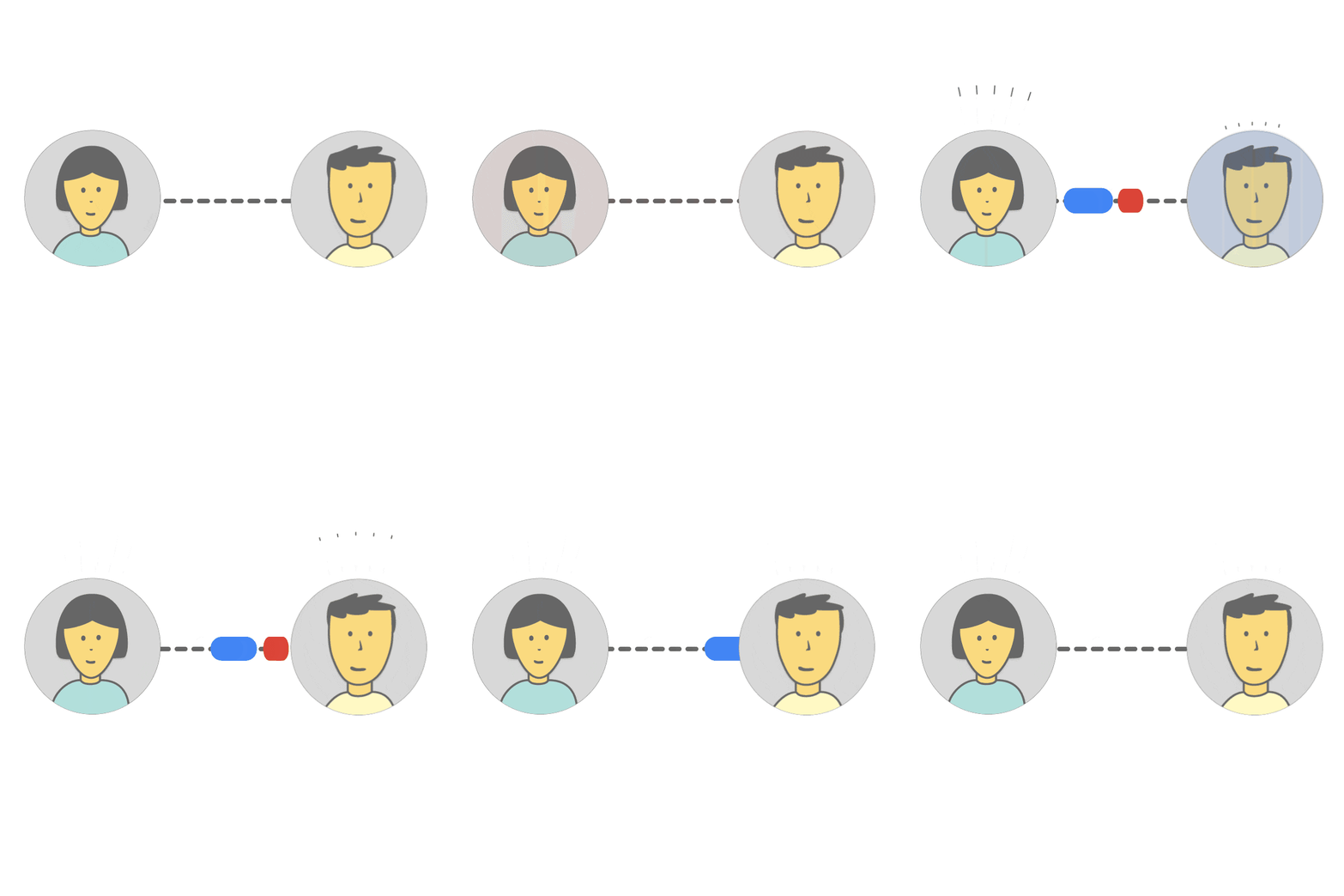
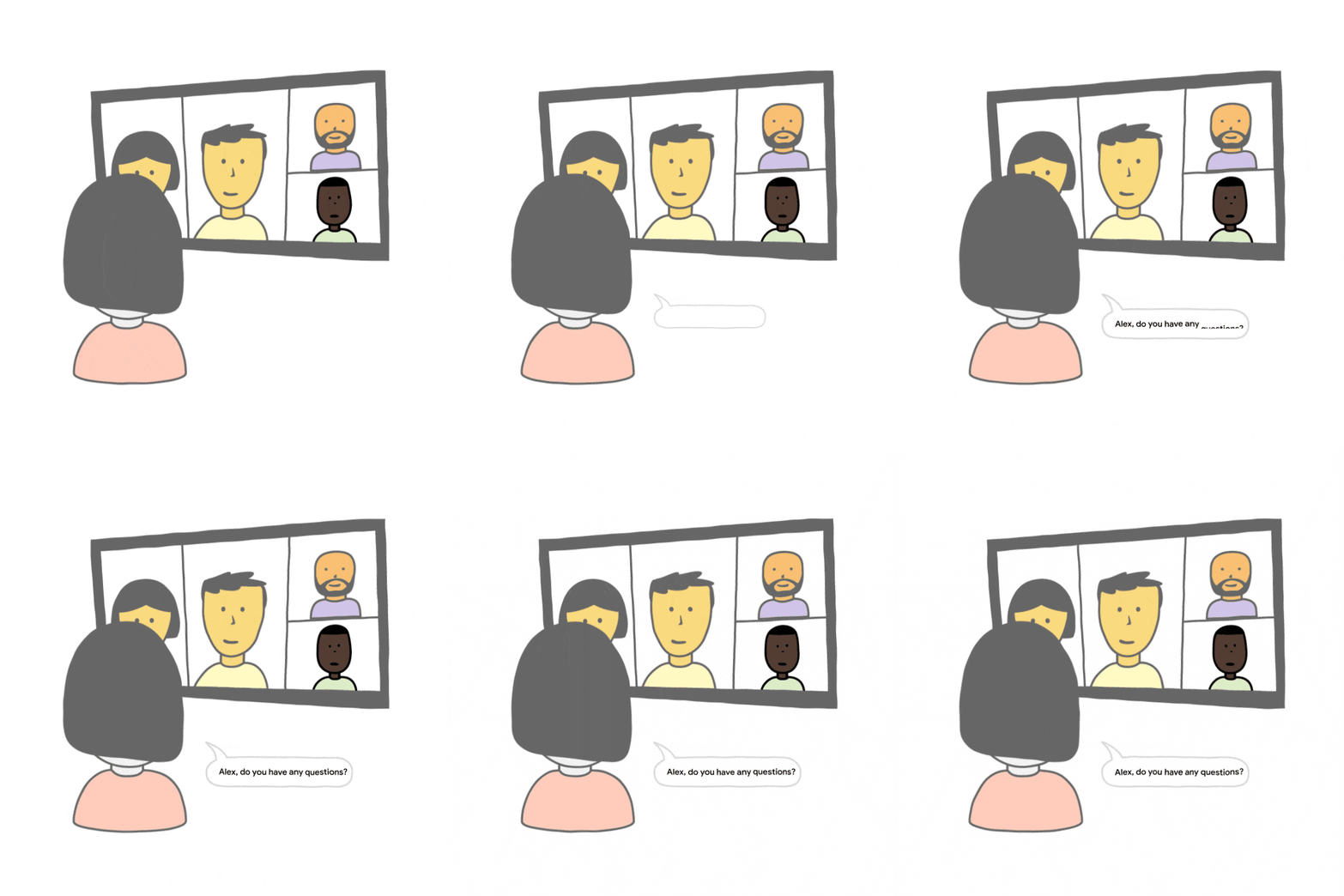
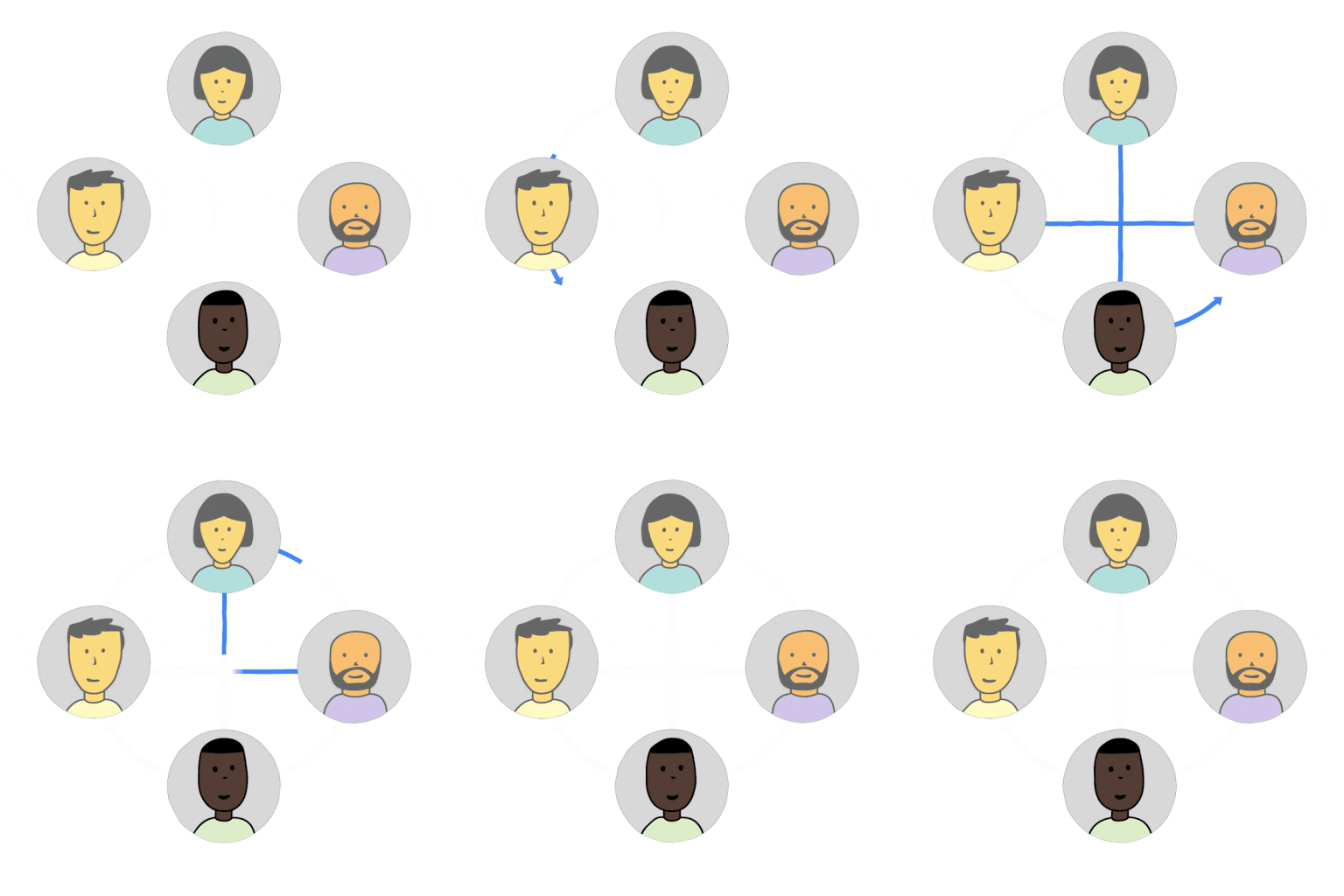
	<content type="html"><![CDATA[<div><div><p>As COVID-19 has pushed more teams to work remotely, many of us are turning to video calls. And if you&rsquo;ve ever been on a video call and wondered why it doesn&rsquo;t feel quite the same as an in-person conversation, we have something in common. As a researcher at Google, it&rsquo;s my job to dig into the science behind remote communication. Here are a few things I&rsquo;ve discovered along the way.&nbsp;<br></p><br><h3>#1: Milliseconds matter.&nbsp;</h3><br></div></div><div><div><div><figure><img alt="slide_7.gif" src="https://storage.googleapis.com/gweb-uniblog-publish-prod/original_images/slide_7.gif" referrerpolicy="no-referrer" loading="lazy"></figure></div></div></div><div><div><p>As a species, we&rsquo;re <a href="https://mitpress.mit.edu/books/honest-signals" rel="noopener noreferrer" target="_blank">hardwired</a> for the fast-paced exchange of in-person conversation. Humans have spent about <a href="https://www.ynharari.com/book/sapiens/" rel="noopener noreferrer" target="_blank">70,000 years</a> learning to communicate face-to-face, but video conferencing is only about 100 years old. When the sound from someone&rsquo;s mouth doesn&rsquo;t reach your ears until a half second later, you <a href="https://www.itu.int/rec/T-REC-G.114" rel="noopener noreferrer" target="_blank">notice</a>. That&rsquo;s because we&rsquo;re <a href="https://www.sciencedirect.com/science/article/abs/pii/S1364661315002764" rel="noopener noreferrer" target="_blank">ingrained to avoid</a> talking at the same time while minimizing silence between turns. A delay of five-tenths of a second (500 ms)&mdash;whether from laggy audio or fumbling for the unmute button&mdash;is more than double what we&rsquo;re used to in-person. These delays mess with the fundamental turn-taking mechanics of our conversations.&nbsp;</p><p><i>On your next video conference, pump the brakes on your speaking speed to avoid unintended interruptions. If it&rsquo;s a smaller group, try staying unmuted to provide little bits of verbal feedback (&ldquo;mmhmm,&rdquo; &ldquo;okay&rdquo;) to show you&rsquo;re actively listening.&nbsp;<br></i><br></p><h3>#2: Virtual hallway conversations boost group performance.&nbsp;</h3><br><p>At the office, my meetings usually start with some impromptu, informal small talk. We share personal tidbits that build rapport and empathy. Making time for personal connections in remote meetings not only feels good, it helps you work better together. <a href="https://psycnet.apa.org/record/2002-17012-013" rel="noopener noreferrer" target="_blank">Science shows</a> that teams who periodically share personal information perform better than teams who don&rsquo;t. And when leaders model this, it can boost team performance even more.&nbsp;</p><p><i>Carve out time at the start of a meeting to catch up and set aside time to connect with colleagues over virtual coffee or lunch breaks.<br></i><br></p><h3>#3: Visual cues make conversations smoother.</h3><br></div></div><div><div><div><figure><img alt="slide_8.gif" src="https://storage.googleapis.com/gweb-uniblog-publish-prod/original_images/slide_8.gif" referrerpolicy="no-referrer" loading="lazy"></figure></div></div></div><div><div><p>If you&rsquo;re <a href="https://www.ics.uci.edu/~corps/phaseii/OlsonOlson-DistanceMatters-HCIJ.pdf" rel="noopener noreferrer" target="_blank">face-to-face</a> with someone, you might notice they&rsquo;ve leaned forward and invite them to jump into the conversation. Or, you might pick up on a sidelong glance in the audience while you&rsquo;re giving a presentation, and pause to address a colleague&rsquo;s confusion or skepticism. Research shows that on video calls where social cues are harder to see, we take <a href="https://www.researchgate.net/publication/2921433_Effects_of_Gaze_on_Multiparty_Mediated_Communication" rel="noopener noreferrer" target="_blank">25 percent fewer</a> speaking turns.&nbsp;</p><p>But video calls have something email doesn&rsquo;t: eye contact. We feel more comfortable talking when our listeners&rsquo; eyes are visible because we can read their emotions and attitudes. This is especially important when we need <a href="http://citeseerx.ist.psu.edu/viewdoc/download?doi=10.1.1.16.4486&amp;rep=rep1&amp;type=pdf" rel="noopener noreferrer" target="_blank">more certainty</a>&mdash;like when we meet a new team member or listen to a complex idea.</p><p><i>Resist browser tabs competing for your attention.&nbsp;</i></p><h3><br>#4: Distance can amplify team trust issues.</h3><br><p>When things go wrong, remote teams are more likely to blame individuals rather than examining the situation, which hurts <a href="https://psycnet.apa.org/record/2002-17012-008" rel="noopener noreferrer" target="_blank">cohesion and performance</a>. Different ways of working can be frustrating, but they&rsquo;re important. Biological Anthropologist Helen Fisher has shown that we can harness the <a href="https://hbr.org/2017/03/the-new-science-of-team-chemistry" rel="noopener noreferrer" target="_blank">&ldquo;productive friction&rdquo;</a> of diverse work styles today similar to how hunter-gatherers did 50,000 years ago to determine if a newly discovered plant was poisonous, medicinal or delicious.</p><p><i>Have an open conversation with your remote teammates about your preferred working styles and how you might complement each other.&nbsp;</i></p><h3><br>#5: Passing the talking stick makes remote teams smarter.</h3><p><br></p></div></div><div><div><div><figure><img alt="talking stick.gif" src="https://storage.googleapis.com/gweb-uniblog-publish-prod/original_images/talking_stick.gif" referrerpolicy="no-referrer" loading="lazy"></figure></div></div></div><div><div><p>Conversations on calls are less dynamic, and the proverbial &ldquo;talking stick&rdquo; gets passed less often. That&rsquo;s a big deal for remote teams because sharing the floor more equally is a significant factor in what makes one group smarter than another. Computational social scientists like Alex &lsquo;Sandy&rsquo; Pentland and Anita Woolley have shown that <a href="https://science.sciencemag.org/content/330/6004/686" rel="noopener noreferrer" target="_blank">higher performing</a> groups aren&rsquo;t made up of individuals with higher IQs but instead people who are <a href="http://socialintelligence.labinthewild.org/mite/" rel="noopener noreferrer" target="_blank">more sensitive</a>&nbsp;to emotions and share the floor more equally.</p><p></p><p><i>Identify calls where conversational dynamics could be better. Encourage more balanced conversation, help some get their voice heard and remind others to pass the talking stick.</i></p><p>If you&rsquo;re interested in learning more about any of this science, you can check out&nbsp;<a href="https://rss.g3l.org/documents/67/Citation_Appendix___The_science_behind_why_remote_meetings_dont_feel_the_same_1.pdf" rel="noopener noreferrer" target="_blank">my sources here</a>.</p><p><br></p></div></div>]]></content>
	<updated>2020-04-24T17:00:00+00:00</updated>
	<author><name>Zachary Yorke</name></author>
	<source>
		<id>https://rss.g3l.org</id>
		<link rel="self" href="https://rss.g3l.org"/>
		<updated>2020-04-24T17:00:00+00:00</updated>
		<title>-fil pro</title></source>

	<category term="covid-19"/>

	<category term="working at google"/>


	<link rel="enclosure" 
		type="" 
		length="1"
		href="https://storage.googleapis.com/gweb-uniblog-publish-prod/original_images/hero_2.gif"/>

</entry>

<entry>
	<id>tag:rss.g3l.org,2020-04-25:/2250076</id>
	<link href="http://www.cgedd.developpement-durable.gouv.fr/graphiques-immobiliers-sur-longue-periode-avril-a2278.html" rel="alternate" type="text/html"/>
	<title type="html">Graphiques immobiliers sur longue période / Avril 2020</title>
	<summary type="html"><![CDATA[<p>L'analyse et les graphiques de Jacques Friggit, sur le prix de l'immobilier d'habitation sur le long...</p>]]></summary>
	<content type="html"><![CDATA[<p>L'analyse et les graphiques de Jacques Friggit, sur le prix de l'immobilier d'habitation sur le long terme ont &eacute;t&eacute; actualis&eacute;s : &eacute;volution des prix, volumes des ventes, taux d'int&eacute;r&ecirc;t immobiliers, indice Insee des loyers, transactions dans l'ancien comme dans le neuf, les mises en chantier de logements, la dette immobili&egrave;re des m&eacute;nages (...)</p>]]></content>
	<updated>2020-04-14T15:14:17+00:00</updated>
	<author><name>REMY Claire / Administrateur CGEDD - BC</name></author>
	<source>
		<id>https://rss.g3l.org</id>
		<link rel="self" href="https://rss.g3l.org"/>
		<updated>2020-04-14T15:14:17+00:00</updated>
		<title>-économie</title></source>


</entry>

<entry>
	<id>tag:rss.g3l.org,2020-03-06:/1991371</id>
	<link href="https://www.actu-environnement.com/ae/news/banque-territoires-comparaison-consommation-energetique-patrimoine-35089.php4#xtor=RSS-6" rel="alternate" type="text/html"/>
	<title type="html">Banque des Territoires : les communes peuvent comparer la consommation énergétique de leur patrimoine</title>
	<summary type="html"><![CDATA[<p>La Banque des Territoires, filiale de la Caisse des D&eacute;p&ocirc;ts, lance &laquo;&nbsp;Mon Comp...</p>]]></summary>
	<content type="html"><![CDATA[<p>La Banque des Territoires, filiale de la Caisse des D&eacute;p&ocirc;ts, lance &laquo;&nbsp;Mon Comparateur &eacute;nerg&eacute;tique &raquo;. Ce nouveau service en ligne permet &agrave; toute commune fran&ccedil;aise de comparer la consommation &eacute;nerg&eacute;tique de l'ensemble de son patrimoine public ou d'un ...</p>]]></content>
	<updated>2020-03-04T11:15:12+00:00</updated>
	<author><name>Rachida Boughriet / Actu-Environnement</name></author>
	<source>
		<id>https://rss.g3l.org</id>
		<link rel="self" href="https://rss.g3l.org"/>
		<updated>2020-03-04T11:15:12+00:00</updated>
		<title>-environnement</title></source>

	<category term="bâtiment"/>


</entry>

<entry>
	<id>tag:rss.g3l.org,2019-07-06:/1312899</id>
	<link href="http://www.cerema.fr/fr/actualites/lancement-observatoire-national-artificialisation-sols" rel="alternate" type="text/html"/>
	<title type="html">Lancement de l’observatoire national de l’artificialisation des sols</title>
	<summary type="html"><![CDATA[<p>[Actualit&eacute;] Publi&eacute; le Mardi 9 juillet 2019
L&rsquo;&Eacute;tat a demand&eacute; &amp;agrav...</p>]]></summary>
	<content type="html"><![CDATA[<div>[Actualit&eacute;] <em>Publi&eacute; le Mardi 9 juillet 2019</em></div>
<p>L&rsquo;&Eacute;tat a demand&eacute; &agrave; trois &eacute;tablissements publics, Cerema, IGN et IRSTEA, de travailler en synergie &agrave; la mise en &oelig;uvre de cet observatoire qui permettra d&rsquo;&eacute;tablir des orientations op&eacute;rationnelles efficaces pour contraindre l&rsquo;artificialisation des (&hellip;)</p>
<div><a href="http://www.cerema.fr/fr/actualites/lancement-observatoire-national-artificialisation-sols" rel="noopener noreferrer" target="_blank">Lire la suite</a></div>]]></content>
	<updated>2019-07-09T07:50:26+00:00</updated>
	<author><name>Cerema</name></author>
	<source>
		<id>https://rss.g3l.org</id>
		<link rel="self" href="https://rss.g3l.org"/>
		<updated>2019-07-09T07:50:26+00:00</updated>
		<title>-aménagement</title></source>


</entry>

<entry>
	<id>tag:rss.g3l.org,2019-06-28:/1290466</id>
	<link href="https://www.geekjunior.fr/qwant-maps-alternative-google-maps-disponible-30158/" rel="alternate" type="text/html"/>
	<title type="html">Qwant Maps, l’alternative à Google Maps, est disponible</title>
	<summary type="html"><![CDATA[<p>Apr&egrave;s un lancement discret en version Alpha, le moteur de recherche Qwant lance Qwant Maps. U...</p>]]></summary>
	<content type="html"><![CDATA[<p><strong>Apr&egrave;s un lancement discret en version Alpha, le moteur de recherche Qwant lance <a href="https://www.qwant.com/maps" rel="noopener noreferrer" target="_blank">Qwant Maps</a>. Une alternative bienvenue &agrave; Google Maps.</strong></p>
<p>Google Maps est un excellent service de cartographie avec une multitude de possibilit&eacute;s. Mais, c&rsquo;est aussi une solution <strong>bien curieuse avec tes donn&eacute;es</strong> personnelles. D&egrave;s lors, on attendait depuis longtemps une alternative qui offre l&rsquo;assurance de ne pas utiliser tes recherches cartographiques et ta localisation &agrave; des fins publicitaires. C&rsquo;est chose faite avec l&rsquo;arriv&eacute;e de <strong>Qwant Maps</strong>.</p>
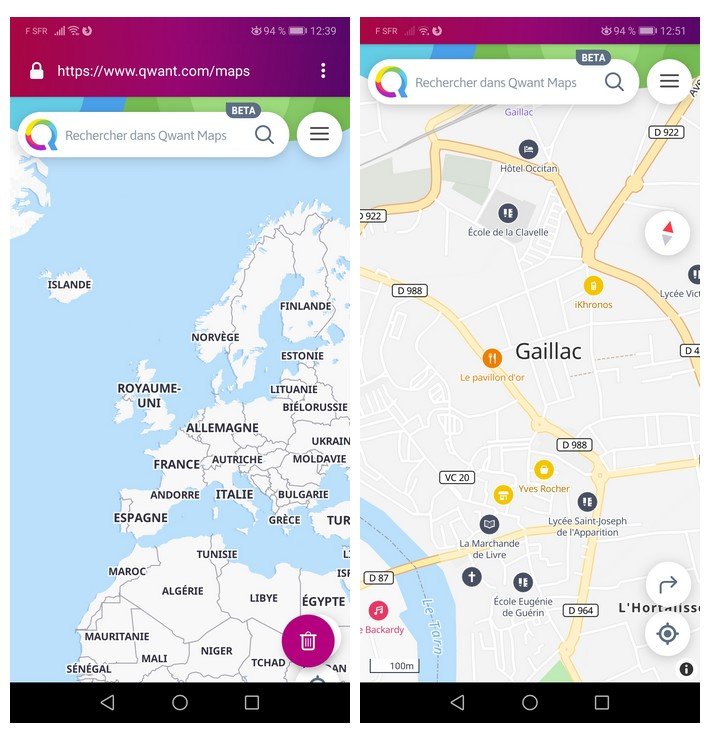
<p>Qwant est un <strong><a href="https://www.qwant.com" rel="noopener noreferrer" target="_blank">moteur de recherche</a></strong> europ&eacute;en qui refuse tout dispositif de tra&ccedil;age : aucun cookie sur les navigateurs, pas de collecte de l&rsquo;historique des recherches, pas d&rsquo;exploitation ou de revente des donn&eacute;es personnelles&hellip; Apr&egrave;s des d&eacute;clinaisons comme <a href="https://www.geekjunior.fr/qwant-junior-sort-son-application-mobile-iphone-ipad-android-20576/" rel="noopener noreferrer" target="_blank">Qwant Junior</a>, <a href="https://www.geekjunior.fr/qwant-music-musique-moteur-de-recherche-8018/" rel="noopener noreferrer" target="_blank">Qwant Music</a> et <a href="https://www.geekjunior.fr/qwant-cause-surfer-web-aider-associations-29314/" rel="noopener noreferrer" target="_blank">Qwant Cause</a>, on attendait, avec un peu d&rsquo;impatience il faut le dire, un service de cartographie. Qwant Maps s&rsquo;affiche en version Beta mais offre d&eacute;j&agrave; l&rsquo;essentiel de ce qu&rsquo;on attend de lui  : localisation des commerces et des monuments, favoris, itin&eacute;raire&hellip;</p>
<p>Bien s&ucirc;r, il manque encore certains services additionnels &agrave; Qwant Maps comme la vue satellite. Mais, pour la grande majorit&eacute; des requ&ecirc;tes, la solution offerte par Qwant est &eacute;quivalente &agrave; celle de Google, sauf qu&rsquo;aucune donn&eacute;e de tracking n&rsquo;est utilis&eacute;e et que les r&eacute;sultats ne donnent pas l&rsquo;impression d&rsquo;&ecirc;tre face &agrave; un barnum commercial.</p>
<p>Qwant Maps est disponible &agrave; partir de <strong><a href="https://www.qwant.com/maps" rel="noopener noreferrer" target="_blank">n&rsquo;importe quel navigateur</a></strong>. Aucune application mobile n&rsquo;est pour l&rsquo;instant disponible mais il suffit de cr&eacute;er un raccourci depuis le navigateur mobile sur l&rsquo;&eacute;cran d&rsquo;accueil pour l&rsquo;utiliser facilement. </p>
<p><img src="https://www.geekjunior.fr/wp-content/uploads/2019/06/qwant-maps-mobile.jpg" alt="Qwant Maps en version mobile" srcset="https://www.geekjunior.fr/wp-content/uploads/2019/06/qwant-maps-mobile.jpg 710w,https://www.geekjunior.fr/wp-content/uploads/2019/06/qwant-maps-mobile-287x300.jpg 287w,https://www.geekjunior.fr/wp-content/uploads/2019/06/qwant-maps-mobile.jpg 710w,https://www.geekjunior.fr/wp-content/uploads/2019/06/qwant-maps-mobile-287x300.jpg 287w,https://www.geekjunior.fr/wp-content/uploads/2019/06/qwant-maps-mobile.jpg 710w,https://www.geekjunior.fr/wp-content/uploads/2019/06/qwant-maps-mobile-287x300.jpg 287w,https://www.geekjunior.fr/wp-content/uploads/2019/06/qwant-maps-mobile.jpg 710w,https://www.geekjunior.fr/wp-content/uploads/2019/06/qwant-maps-mobile-287x300.jpg 287w" sizes="(max-width: 710px) 100vw, 710px" referrerpolicy="no-referrer" loading="lazy"></p>
<p>The post <a rel="noopener noreferrer" href="https://www.geekjunior.fr/qwant-maps-alternative-google-maps-disponible-30158/" target="_blank">Qwant Maps, l&rsquo;alternative &agrave; Google Maps, est disponible</a> appeared first on <a rel="noopener noreferrer" href="https://www.geekjunior.fr" target="_blank">Geek Junior -</a>.</p>]]></content>
	<updated>2019-06-27T15:54:08+00:00</updated>
	<author><name>Christophe Coquis</name></author>
	<source>
		<id>https://rss.g3l.org</id>
		<link rel="self" href="https://rss.g3l.org"/>
		<updated>2019-06-27T15:54:08+00:00</updated>
		<title>-études</title></source>

	<category term="actualités"/>

	<category term="applications"/>

	<category term="cartographie"/>

	<category term="google maps"/>

	<category term="maps"/>

	<category term="qwant maps"/>


</entry>

<entry>
	<id>tag:rss.g3l.org,2019-05-21:/1155040</id>
	<link href="https://www.notre-planete.info/actualites/2861-artificialisation-impermeabilisation-sols" rel="alternate" type="text/html"/>
	<title type="html">L'imperméabilisation des sols progresse inexorablement en Europe</title>
	<summary type="html"><![CDATA[<p>L'imperm&eacute;abilisation des sols continue son inexorable progression partout dans le monde et no...</p>]]></summary>
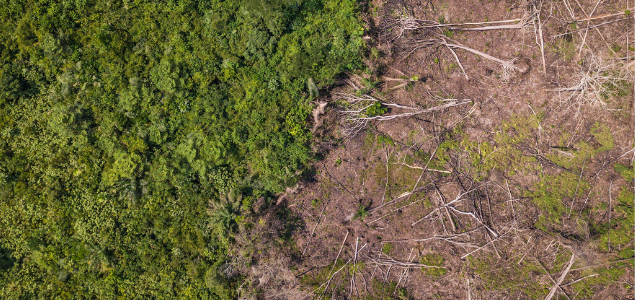
	<content type="html"><![CDATA[<p>L'imperm&eacute;abilisation des sols continue son inexorable progression partout dans le monde et notamment dans l'Union Europ&eacute;enne, entra&icirc;nant la disparition de milieux ouverts et compromettant de mani&egrave;re irr&eacute;versible la fourniture de services &eacute;cosyst&eacute;miques indispensables.</p>]]></content>
	<updated>2019-05-15T11:24:21+00:00</updated>
	<author><name></name></author>
	<source>
		<id>https://rss.g3l.org</id>
		<link rel="self" href="https://rss.g3l.org"/>
		<updated>2019-05-15T11:24:21+00:00</updated>
		<title>-aménagement</title></source>


	<link rel="enclosure" 
		type="image/xyz" 
		length="10000"
		href="http://www.notre-planete.info/actualites/images/infrastructures/minis/chantier-construction-maisons.jpg"/>

</entry>


</feed>
<!-- vim:ft=xml
	  -->