FlahuteThe mountains are calling and I must go2026-05-24T23:20:44Zhttps://www.flahute.com/feed/atom/https://www.flahute.com/wp-content/uploads/2026/04/cropped-round_vlaamseleeuw_with_red_600-32x32.pngSteven Sheffieldhttp://www.flahute.com<![CDATA[Video: Flandrien: A Love Letter to the Cobbles]]>https://www.flahute.com/?p=263202026-05-05T23:14:07Z2026-05-05T22:56:36ZThree years or so ago, I discovered the trailer for a documentary about cycling in the Flemish region of Belgium; home to the Flahutes (or more commonly "Flandriens"). The title is, fittingly enough, simply Flandrien.
]]>Three years or so ago, I discovered the trailer for a documentary about cycling in the Flemish region of Belgium; home to the Flahutes (or more commonly “Flandriens”). The title is, fittingly enough, simply Flandrien.
From the film’s website (https://flandrienfilm.com/): “Producer Shane Cooper and director Paul Willerton have teamed up to create a new feature-length documentary film, Flandrien. The film is set in the Flanders region of Belgium and explores the past, present, and future of cycling and local culture. The Tour of Flanders itself plays a starring role, as well as some of the riders who have been awarded the esteemed title of being a true ‘Flandrien.'”
The film premiered on Friday, June 16, 2023 in Belgium and is now available to watch on YouTube. The documentary features interviews with cycling legends including Johan Museeuw, three-time winner of the Tour of Flanders and the embodiment of the Flandrien spirit. As Museeuw reflects in the film on what defines a true Flandrien: the ability to suffer, the connection to the cobbles and bergs of Flanders, and an unwavering commitment to attacking racing.
The film offers an intimate look at Flemish cycling culture, from the passionate fans who line the Oude Kwaremont and Paterberg each spring, to the young riders dreaming of one day wearing the lion of Flanders. With stunning cinematography of the cobbled classics routes that define the region, Flandrien captures why this corner of Belgium remains the spiritual home of professional cycling’s hardmen.
]]>Steven Sheffieldhttp://www.flahute.com<![CDATA[COMMENTARY—Sixty Metres: Do Not Let Anyone Tell You Otherwise]]>https://www.flahute.com/?p=262792026-05-05T22:55:50Z2026-04-01T17:50:31ZOn Executive Order 260401, the return of the Tour de Trump, and what a sixty-metre hill in New Jersey tells us about the relationship between power, memory, and the indifference of mountains. By Claude Aurillac-Issoire Clermont-Ferrand, France (01 April 2026) Translated from the original French. My mother grew up in
]]>On Executive Order 260401, the return of the Tour de Trump, and what a sixty-metre hill in New Jersey tells us about the relationship between power, memory, and the indifference of mountains.
By Claude Aurillac-Issoire Clermont-Ferrand, France (01 April 2026) Translated from the original French.
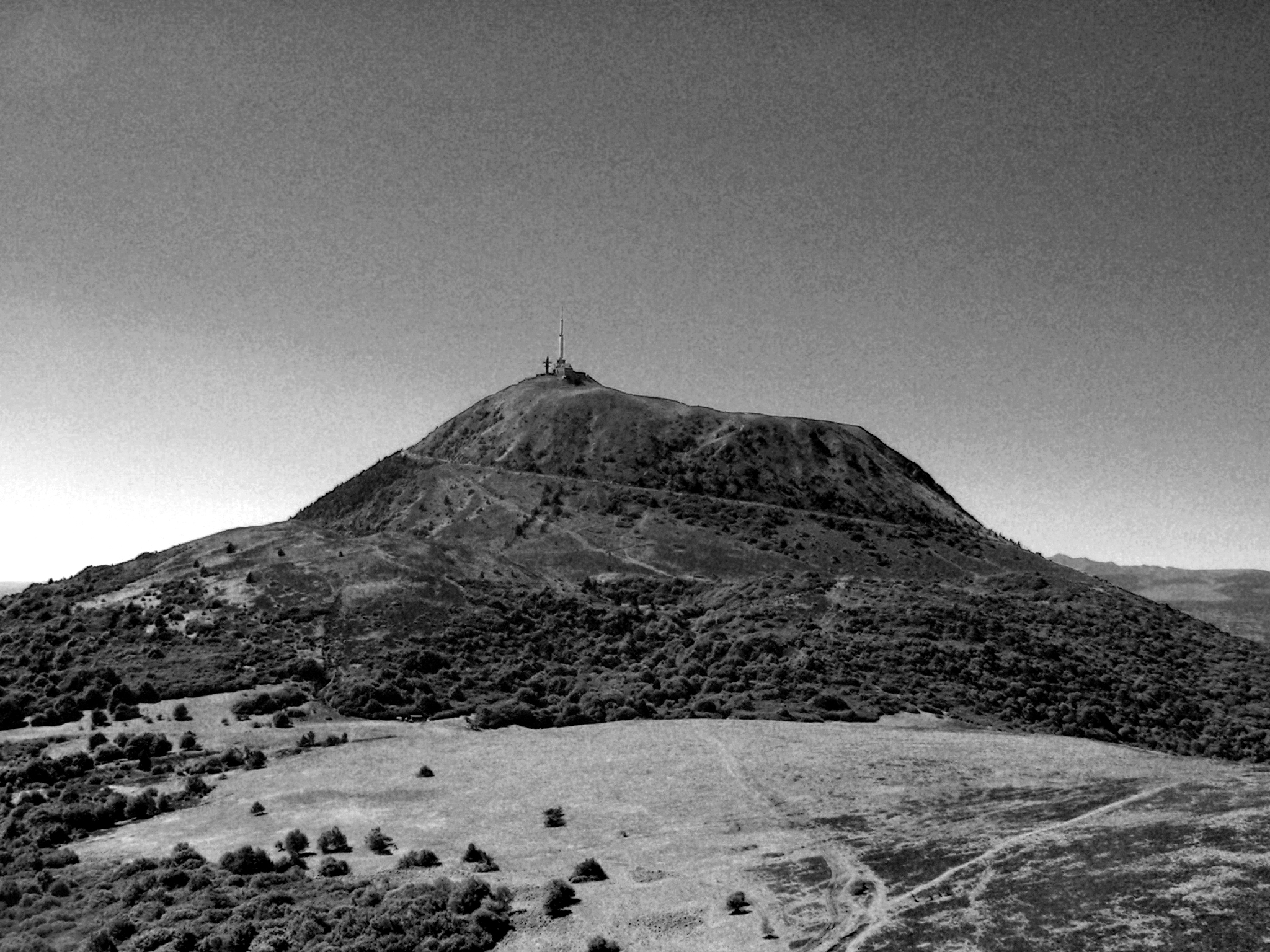
Puy de Dôme near Clermont-Ferrand in Auvergne in France. Photo by Romain Cadiou, Creative Commons Attribution-Share Alike 3.0 Unported
My mother grew up in the shadow of the Puy de Dôme. My father raced as an amateur in the Allier valley in the nineteen-seventies — nothing serious, club races, a few regional events, once a small criterium in Vichy where he finished fifth and told the story for the rest of his life. I learned to read in a house where the yellow jersey was not a metaphor. When I tell you that the Puy de Dôme rises 1,415 metres and that the final kilometre averages 12.8 percent and that Jacques Anquetil and Raymond Poulidor duelled on its upper slopes in 1964 while an entire nation held its breath, I am not reciting statistics. I am describing the landscape of my childhood.
The Bedminster hill is sixty metres tall.
I read the Executive Order this afternoon, the document having been forwarded to me by four colleagues within twenty minutes of its release, each with a different subject line. The most accurate was simply: “Claude.” The order is eight pages long and divided into thirteen sections. Section Seven reads, in its entirety: “The Bedminster climb is very challenging. Do not let anyone tell you otherwise.”
I read it twice. Then I poured more coffee.
I had expected, I think, a few paragraphs of the American President’s characteristic grammar dressed in governmental formatting — a Truth Social post amplified into official language. What I found was a document of genuine structural ambition, written by someone tasked with making a series of unpublishable ideas sound publishable, who had done their considerable best. Section Four requires all riders to use American-made bicycle frames — or those from countries the Secretary of Commerce has designated as Fair Trade Cycling Partners, a list that does not currently include Italy, France, Belgium, Spain, or Taiwan — and bans Campagnolo components outright. Section Five prohibits drafting for more than thirty consecutive seconds on the grounds that sheltering behind another rider is inconsistent with American values of self-reliance. Section Eight threatens Switzerland — its watches, its chocolate, its banking — if the UCI does not grant the Tour de Trump Grand Tour status within thirty days.
Section Nine, subsection (c), notes that Campagnolo “has been warned. Multiple times. Internally.”
I called Stefan Schoofveldt in Ghent. He had read it at a café near the Vrijdagmarkt, between a double espresso and a tartine he had not finished. Stefan has covered professional cycling for nineteen years, including every major one-day race in Belgium, three editions of the Tour de France, and a criterium in Aalst that was interrupted by a cow. He was, he told me, not angry.
“I am too old for outrage,” he said. “And too Belgian for surprise.”
He paused. I have known Stefan long enough to know that a pause from Stefan is not empty. “The second sentence of Section Seven,” he said, “is not the language of governance. It is the language of a man who knows, somewhere he cannot reach by executive order, that someone will tell you otherwise. That everyone will tell you otherwise.”
He then paid for his coffee and went home.
✦
I then called Chatham George Paulson-Thomas in London, who had been awake since five in the morning and who was, when I reached him, in the careful and slightly dangerous mood he enters when something has annoyed him sufficiently that he has decided to be precise about it.
“Let me be clear about the mechanism,” he said, “because I find that precision is the only reliable defence against the interpretive drift this situation invites. The mechanism is real. The tariff threat is real. The UCI cannot receive a unilateral instruction from a single government and comply without effectively dissolving its credibility as an independent international body.”
He granted — Chatham always grants — that the underlying frustrations were not without basis. That American cycling has been underserved by international governing structures. That the UCI’s record on doping enforcement and rider welfare is not a record anyone would defend in full. That these are real issues.
“They are not addressed by this order,” he said. “The order is not about the governance of cycling. It is about the reinstatement of a brand.”
Another pause. “What I find most dispiriting is the response it requires. Someone has to take this seriously enough to respond to it. Someone has to appear before cameras and be asked, with a straight face, whether Bedminster compares favourably to Mont Ventoux. And in the time that takes, other things do not get done.”
“The mountain does not care what you believe about it. It will exact from you precisely what the mathematics say it will exact, whatever you thought before you began climbing.”
I find I cannot quite share Chatham’s dispirited mood. What I feel instead — and I have been trying to identify it precisely since the order arrived this afternoon — is something closer to a helpless, liberating hilarity. Not at the expense of America, which has produced magnificent cyclists. Not even at the expense of the President, who has the distinction of being the only head of state in history to issue a formal federal document certifying the difficulty of his own golf course approach road. What I find funny — what I find, on reflection, genuinely, structurally, almost classically funny — is the nature of expertise.
The Tour de Trump ran for two years. It went through New Jersey, Delaware, Virginia, New York, Pennsylvania. It was a real event. It produced real winners. Dag Otto Lauritzen, who took the inaugural edition, was a professional of genuine quality. The race mattered to American cycling in its time, in the modest and sincere way that all races matter. And the man whose name was on it appeared at the start lines, smiled for the cameras, said it was tremendous. He ran the race in the limited sense that a man who once owned a restaurant has run a kitchen. The pot never touched his hand. The spoon never left the drawer. But the story was his.
And now, thirty-five years later, from that story — from two seasons of mid-Atlantic stage racing, from a handful of start-line photographs, from the fact of having once been in the same zip code as a professional peloton — he has constructed a total, comprehensive, unassailable expertise. He knows cycling better than the riders. Better than the directeurs sportifs, the race organizers, the governing bodies, or the sport’s entire one-hundred-and-fifty-year institutional memory. He knows it the way he knows many things: completely, effortlessly, and without the burden of having learned it.
I find this funny because it is, in a very precise way, the opposite of what cycling teaches you.
Cycling teaches you that the mountain does not care what you believe about it. You can be convinced, absolutely convinced, that you are capable of a certain wattage on a certain gradient in a certain wind, and the mountain will simply present its kilometres and its percentage signs and wait. The mountain is not impressed by your certainty. It is a fixed quantity of altitude, spread across a fixed quantity of distance, and it will exact from you precisely what the mathematics say it will exact, no more and no less, whatever you thought before you began climbing.
This is why cyclists tend to be, in my experience, somewhat humble people. Not always — there are exceptions, and some of them won the Tour de France multiple times and were stripped of the results. But in general, the sport produces humility because the sport’s primary feature is a series of non-negotiable physical realities that do not respond to confidence.
✦
I have met Christian Prudhomme three times. Once at a start village in the Dordogne, once at a race organisation dinner in Paris where the wine was excellent and the speeches were not, and once in a corridor at the Palais des Congrès in 2019 when he was moving quickly and did not have time to stop. On each occasion he was courteous, precise, and utterly unreadable. He is a man who has spent thirty years in the diplomatic layer between professional cycling and the rest of the world, and he has become very good at occupying that layer without ever quite revealing what lies beneath it. I understand he held a press conference this afternoon. I understand it went well, in the sense that he gave them nothing to use against him. This is, with Christian Prudhomme, always the goal.
I know this face. I am from Clermont-Ferrand. We learn it young.
I looked up Campagnolo’s statement from Vicenza. It was a model of corporate serenity — ninety-three years of precision manufacturing distilled into three sentences of impeccable restraint. They have survived wars, recessions, the rise of Shimano, and the cycling industry’s periodic infatuation with electronic groupsets. They will survive a tariff. What I found more telling was the product photograph they chose to accompany the statement: a Super Record groupset. Not a press release photo. Not a logo. A groupset. At four thousand eight hundred euros retail. The Italians have their own way of making a point.
Stefan, whom I texted this afternoon, replied in three words: “The groupset speaks.”
My father raced his criterium in Vichy in 1973. He finished fifth. He told the story for forty years — the race, the road, the riders who beat him, the café afterwards where someone bought him a beer. I am not unsympathetic to the impulse. A man wants his race to matter. A man wants the thing he touched, however briefly, however glancingly, to have been great. This is human. This is, in its way, rather moving.
But there are limits, and the limits are geological. The Bedminster hill is sixty metres tall. The Executive Order says it is very challenging. The Executive Order is incorrect in the way that a man can be incorrect about a mountain he has only ever driven, and the mountain will wait, patient and absolute, for the moment of reckoning it has been waiting for since before the race existed, before he signed the order, before someone took the photograph at the start line thirty-five years ago in New Jersey.
There is a climb I know in the hills above Clermont-Ferrand. It is nothing compared to the Puy de Dôme, nothing compared to the Galibier or the Stelvio or any of the climbs that have decided races and ended careers. It is a local road, not quite four kilometres, maybe seven percent average. I have ridden it perhaps two hundred times. On every occasion it has been exactly as long and exactly as steep as it was the time before. My belief about it, on any given morning, has had no effect whatsoever on its gradient. This is what cycling teaches, and it is a lesson the mountain delivers without sentiment, without variation, and without any particular interest in who is on the bicycle.
I spoke to Chatham again an hour ago. He had written fourteen hundred words of analysis and deleted them. “Someone has to take this seriously,” he said. “I know,” I said. “I’m sorry.” Stefan, for his part, has not replied to my last message. He is probably home by now, or out on the bike. He has a very good bike. Campagnolo, as it happens.
I am going outside. The light over the Auvergne is still good. It is a good evening to ride.
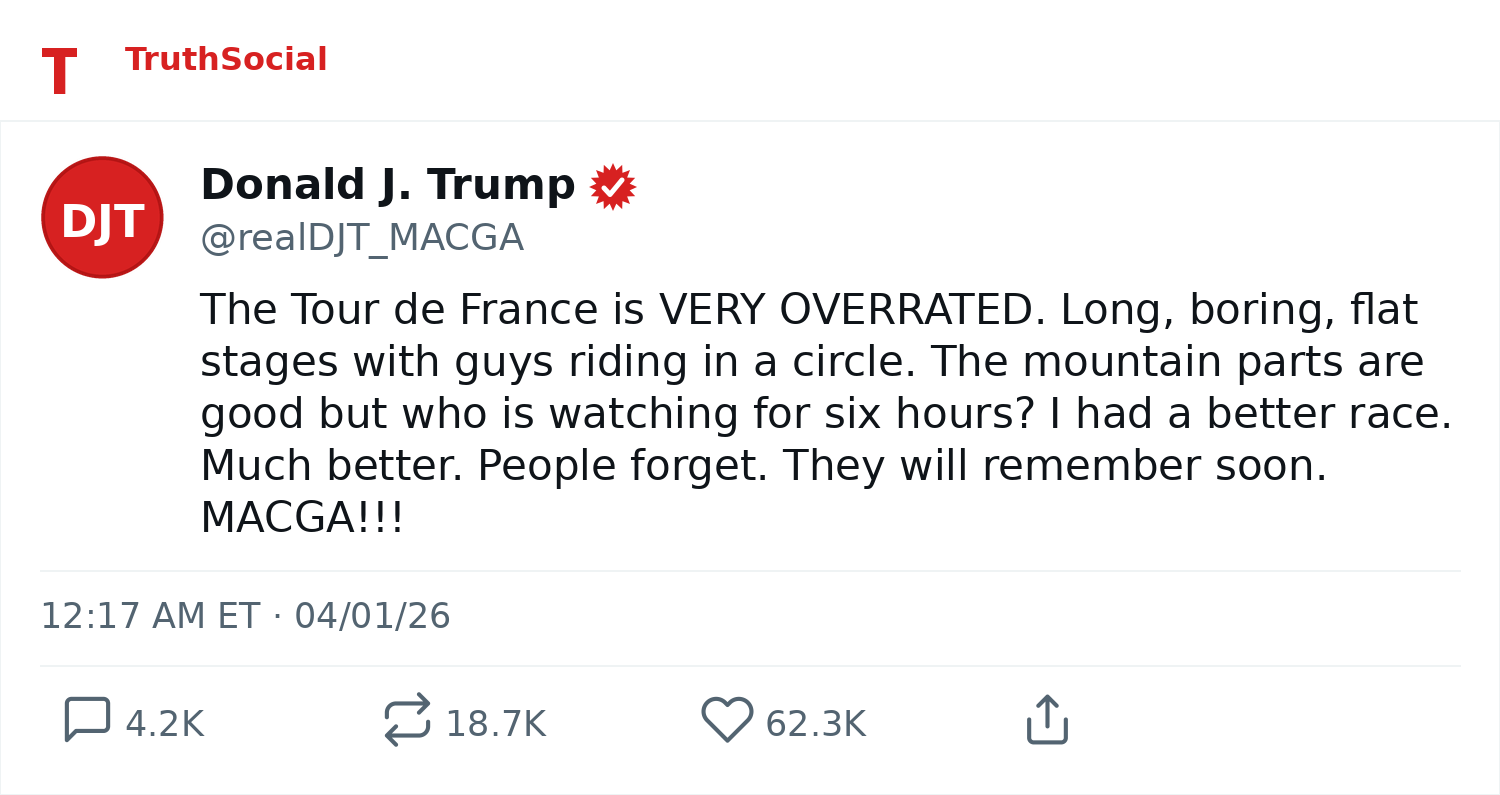
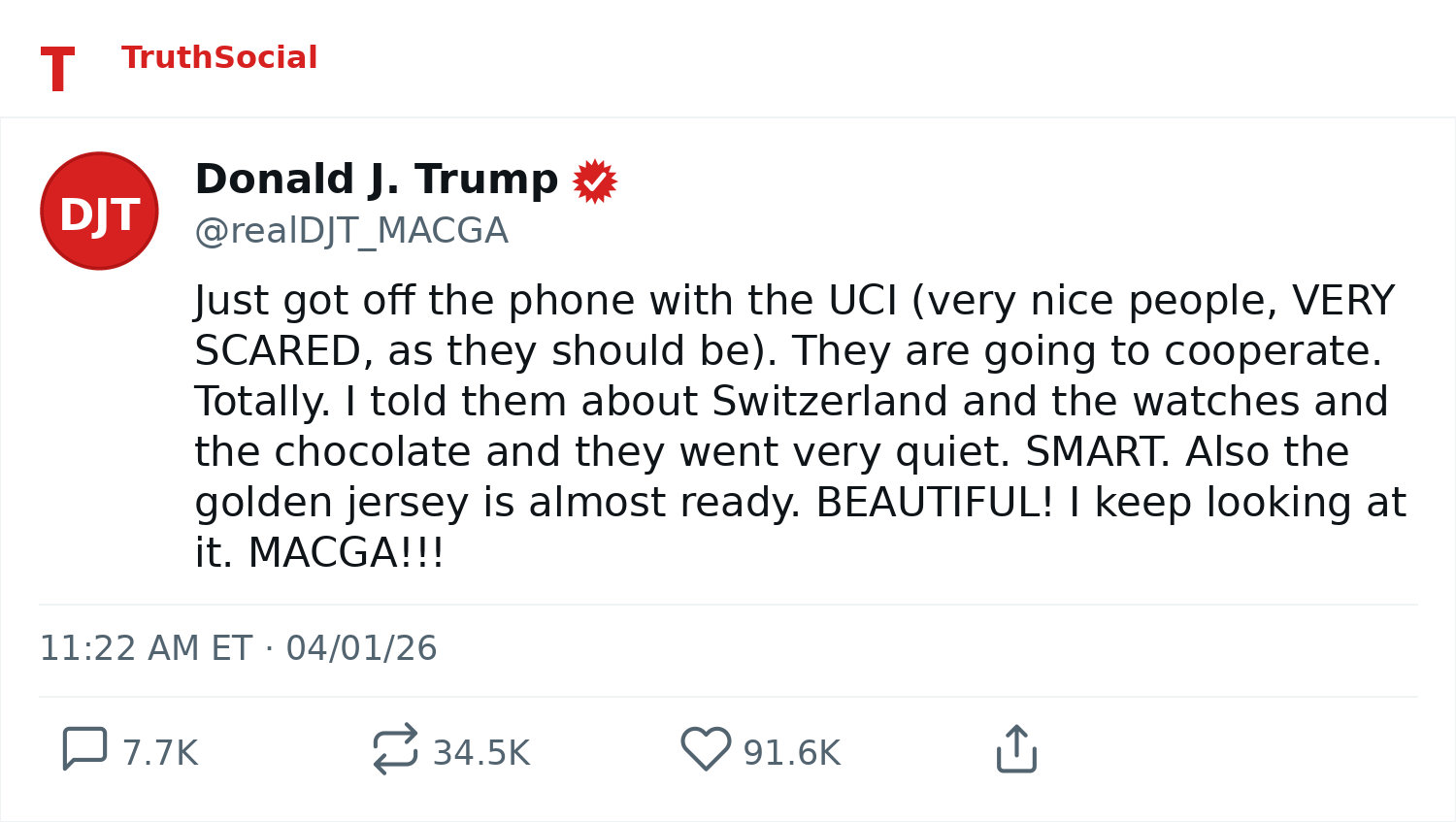
]]>Steven Sheffieldhttp://www.flahute.com<![CDATA[BREAKING NEWS: Trump Revives Tour de Trump, Slaps 200% Tariff on Campagnolo]]>https://www.flahute.com/?p=263062026-05-24T23:20:44Z2026-04-01T15:55:14ZAt seventeen minutes past midnight Eastern Time, Donald J. Trump posted to Truth Social that the Tour de France was very overrated. Thirty-four minutes later, he announced he was bringing back the greatest bike race the world had ever seen. This is a record of what has happened. All times shown as EDT (UTC−4) / CEST (UTC+2). European times in 24-hour format. Updates added as events develop.
By Stefan Schoofveldt, with additional reporting by Chatham George Paulson-Thomas and Claude Aurillac-Issoire
At seventeen minutes past midnight Eastern Time, Donald J. Trump posted to Truth Social that the Tour de France was very overrated. Thirty-four minutes later, he announced he was bringing back the greatest bike race the world had ever seen. This is a record of what has happened. All times shown as EDT (UTC−4) / CEST (UTC+2). European times in 24-hour format. Updates added as events develop.
12:17 AM EDT / 06:17 CEST — The first signal
The post arrives without warning or context, as they often do. Cycling people, who keep strange hours by habit — the 6 AM ride requiring a 5 AM alarm requiring a half-conscious check of the phone at some intermediate hour — are among the first to notice it.
There are, at this hour, perhaps forty people awake and online who know what MACGA means. The rest of the world is asleep. The forty people begin texting each other.
12:33 AM EDT / 06:33 CEST
Dag Otto Lauritzen, reached by a Norwegian journalist whose name we are withholding because it is 6:38 in the morning in Bergen and he had not consented to being the subject of a news story, will later say he has “no comment at this time” and then add, after a pause, “What is happening?”
BREAKING NEWS — 12:51 AM EDT / 06:51 CEST — Tour de Trump
The forty people become four hundred. Screenshots circulate. The phrase “signed papers” generates immediate and intense speculation about what, precisely, has been signed, and what authority it might carry over a private French sporting organization whose legal domicile is in Paris and which has been staging professional bicycle races without American governmental input since 1903.
[EDITOR’S NOTE: We have begun attempting to reach the White House press office, but it is 12:44 AM in Washington.]
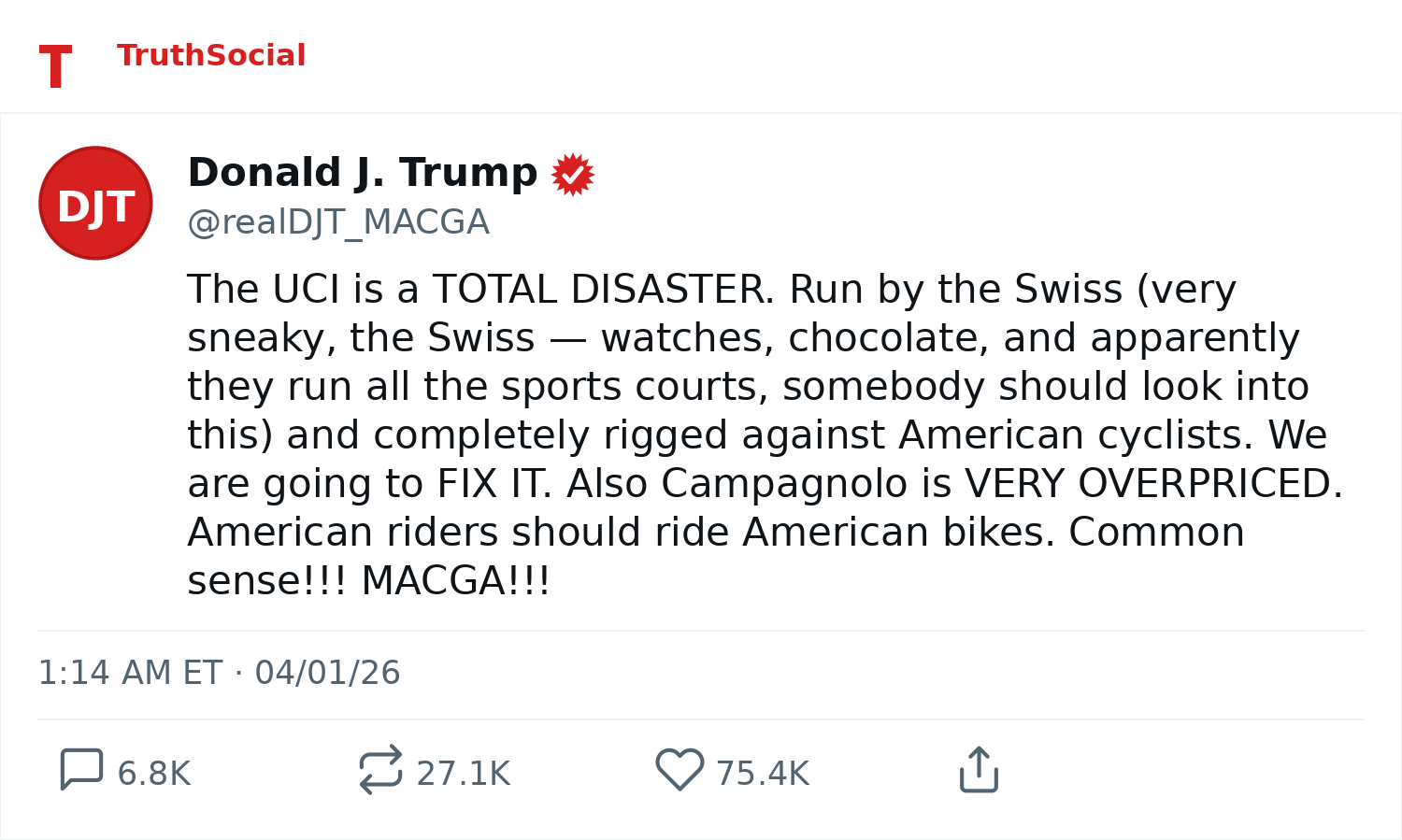
1:14 AM EDT / 07:14 CEST
The mention of Campagnolo causes a particular kind of distress among road cyclists that is difficult to explain to non-cyclists and only somewhat easier to explain to cyclists who do not understand what Campagnolo means to people who do. Several European component industry figures will later say this was the moment they understood the situation was serious.
1:38 AM EDT / 07:38 CEST
A White House official, who asked not to be identified because they value their continued employment, confirms by text message that an executive order has been signed. They will not describe its contents. They will not say when it was signed. They add, unprompted: “I am going back to sleep.”
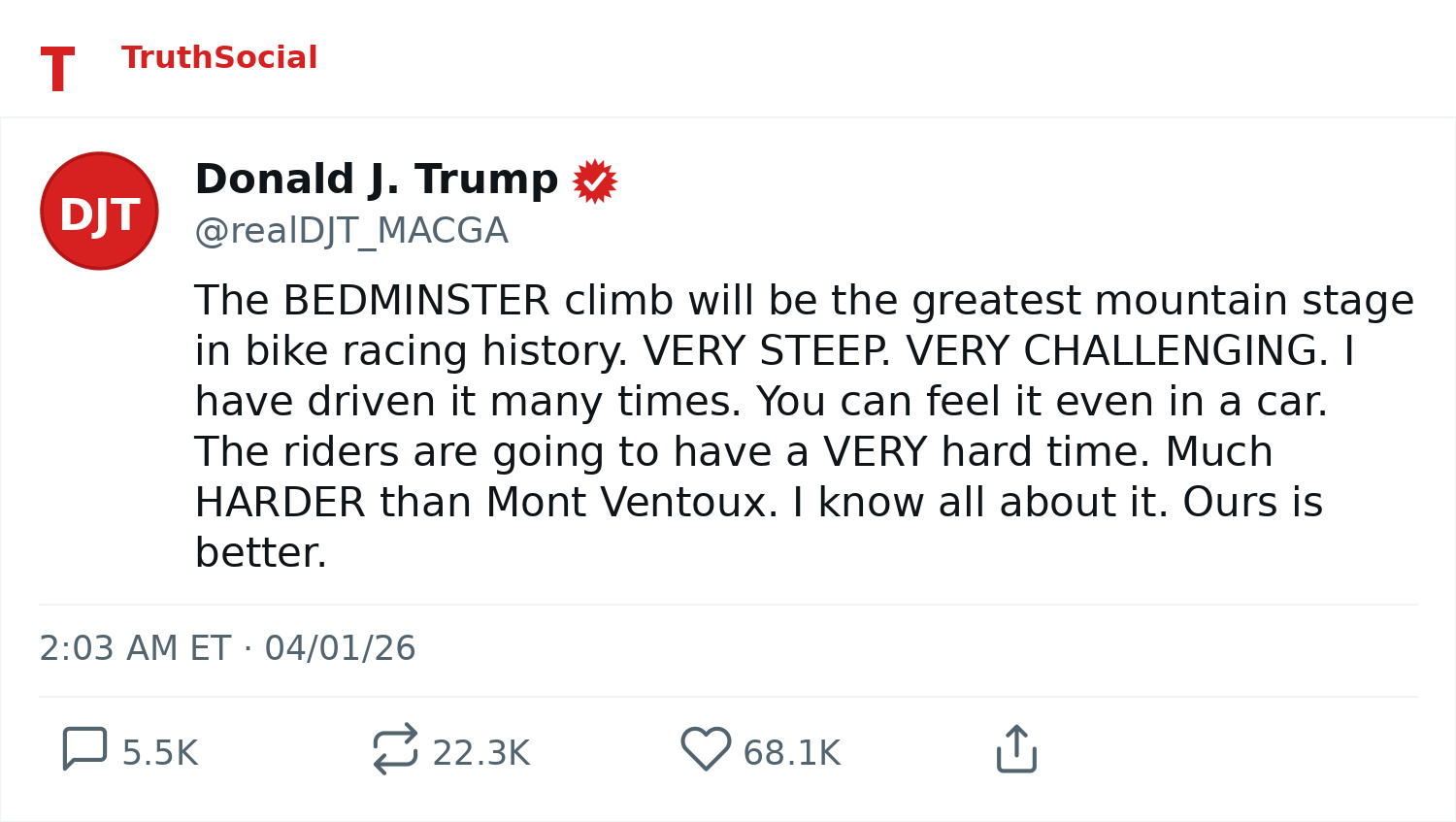
2:03 AM EDT / 8:03 CEST
Mont Ventoux rises 1,617 meters over 21.5 kilometers of exposed Provençal limestone. It has ended careers. It has ended a life. Tom Simpson died on its upper slopes in 1967. The Bedminster hill rises approximately sixty meters over roughly eight hundred meters of New Jersey road. We are not making a comparison. We are simply reporting what was posted.
2:27 AM EDT / 08:27 CEST
Armstrong’s publicist in Austin does not respond to a request for comment sent at 4:11 AM EDT (3:11 AM MDT). This is, to be fair, a completely reasonable position to take at 3:11 in the morning local time.
6:09 AM EDT / 12:09 CEST — Europe wakes up
It is ten minutes past noon in Aigle, Switzerland, and the UCI’s communications office has arrived, had coffee, noticed forty-seven press inquiries, a Truth Social post describing their organization as “very sneaky,” and a threat — now confirmed by a second White House source — of retaliatory tariffs on Swiss chocolate. They issue a brief statement that says they are “aware of the announcement” and are “consulting with member federations.” In UCI terms, this is the institutional equivalent of closing the curtains and sitting very still until the noise stops.
6:51 AM EDT / 12:51 CEST
In Paris, it is approaching noon. Christian Prudhomme, the director of the Tour de France, holds a brief, unscheduled press conference at the ASO offices. He is wearing a very good suit. He looks like a man who has spent the last two hours being extremely diplomatic in a language other than the one he would prefer to use.
“We note with interest the American President’s announcement,” he says. “The Tour de France has operated continuously since 1903 and is one of the great sporting institutions of the world. We would be happy to share our experience in race organization with any interested parties.”
He is asked whether ASO considers the Tour de Trump a competitive threat.
He smiles the particular way the French smile when they are choosing, with considerable effort, not to say what they actually think.
“We consider all sporting events worthy of respect,” he says.
He is asked about the tariff threat on French wine, cheese, and berets.
The press conference ends.
7:31 AM EDT / 13:31 CEST — The Executive Order
The White House releases the text of the Executive Order. It is eight pages long. It is formally titled “Restoring American Excellence in the Sport of Cycling and Reviving the Tour de Trump as the World’s Premier Stage Race.” It cites Article Two twice. It contains a section — Section Seven — that is two sentences long and addresses, exclusively, the difficulty of the Bedminster climb.
Section Seven reads: “The Bedminster climb is very challenging. Do not let anyone tell you otherwise.”
Section Nine imposes a two-hundred-percent tariff on Campagnolo components. Section Nine, subsection (c) notes that the Secretary of Commerce has requested procedural clarification on the Campagnolo tariff. The request has been received. The Secretary has been asked to proceed.
A directeur sportif for a Belgian WorldTour squad, who asked not to be named because he genuinely could not afford the attention this morning, calls us from what sounds like a car. He has been reading the executive order.
“No drafting,” he says. “Thirty seconds. For three weeks. Has he ever — I mean, has he ever actually watched a bike race?”
He is told the President has watched multiple stages on YouTube.
There is a silence.
“The Campagnolo tariff is the most offensive part,” he says finally. “Two hundred percent. Do you understand what Campagnolo means to cycling? It is not a component. It is a philosophy. Granted, none of us use it at the WorldTour level anymore, but still!”
8:47 AM EDT / 14:47 CEST
We have asked several cyclists. They have, unanimously, not commented.
9:22 AM EDT / 15:22 CEST — Armstrong’s phone call
A source familiar with the situation confirms that Lance Armstrong received a phone call from the President at approximately 1:04 AM CDT / 8:04 AM CEST, which is to say, in the middle of what any reasonable person would describe as the night.
The call lasted twenty-two minutes. The source describes it as “not a conversation in the traditional sense.” The President spoke at length about the Tour de Trump, the mountain stages of the Tour de France (“tremendous, very exciting, like a rally but with bicycles”), the anti-drafting provision (“you go to the front, you race, you don’t hide behind people, very simple”), and the prize money, which he described as “tremendous” but declined to quantify.
Armstrong asked about the prize money three times. Each time, the President confirmed it would be tremendous and moved on.
Armstrong’s role as Special Advisor on Cycling Affairs appears in Section Ten of the executive order. Section Ten notes, in subsection (b), that Mr. Armstrong “has agreed to this appointment” and then, in the same sentence, acknowledges that “he has not explicitly confirmed this, but the President is confident he will.”
Armstrong has still not commented publicly. His publicist says he is “reviewing the opportunity.”
His phone, we are told, has not stopped ringing.
9:55 AM EDT / 15:55 CEST
The Office of American Cycling Excellence, established by Section Eleven of the executive order, does not yet have a director, staff, offices, a website, or a phone number. Section Eleven describes its budget as “to be determined” and adds, in the following sentence, “It will not be a lot. We are cutting spending.”
The OACE is, at this point, a name and a mandate. The mandate is, in full, to organize the Tour de Trump, enforce the executive order, negotiate with the UCI and ASO, manage the golden jersey supply chain, and “generally promote American cycling excellence at home and abroad.” The budget for this mandate is to be determined but will not be a lot.
10:28 AM EDT / 16:28 CEST
The Campagnolo company issues a statement from Vicenza. It notes, with dignity, that the company has been producing precision cycling components since 1933. It expresses confidence in its products. It says it looks forward to “continued dialogue with all stakeholders.” It is accompanied by a product photograph of a Super Record groupset. At current retail, the groupset runs to roughly €4.800 ($5,560 US). Under the proposed tariff: approximately €14.400 ($16,700 US).
Several American retailers who stock high-end Italian components have begun calling their buying offices. None of them wish to be quoted. One of them says, off the record, “I have $200,000 in Campagnolo inventory.” He does not say this in an unhappy way. He says it in the way a man says something when he is trying very hard not to smile in front of a journalist. Then he adds: “My summer reorder is already placed.” He says that part very differently.
11:02 AM EDT / 17:02 CEST — The press briefing
The daily White House press briefing. Maren Forsythe of CyclingPost — credentialed, though until this week her credential had never been especially competitive to obtain — is, for the first time in her publication’s history, in the first row.
Forsythe asks about the anti-drafting provision — specifically whether any professional cycling body has been consulted on its enforceability.
“I think what’s interesting,” press secretary Karoline Leavitt says, “is that the mainstream media and their allies in the so-called professional cycling establishment are already trying to undermine a pro-competition measure that the American people overwhelmingly support. The anti-drafting provision levels the playing field. It rewards individual effort. That’s a very American idea, and I’m not surprised that certain outlets find it threatening.”
Forsythe notes that the question was about enforceability, not ideology.
“The OACE will release technical enforcement details in due course,” Leavitt says. “Next question.”
Forsythe asks about the Bedminster climb.
“The President has visited that property hundreds of times,” Leavitt says. “He has personal and direct knowledge of that climb. He considers it a world-class competitive ascent and I think the American people trust the President’s judgment on that.”
Forsythe asks how it compares, in terms of elevation and gradient, to the climbs of the existing Grand Tours — the Stelvio, the Galibier, the Angliru.
“I’m not going to get into a comparison of mountains with a reporter who I think we all know has a predetermined narrative here,” Leavitt says. “The President certified the climb personally. That certification stands. The stage information will be released by the OACE.”
Forsythe asks when the OACE will have staff.
“That’s a process question and I’d refer you to the Office of Management and Budget,” Leavitt says.
Forsythe asks what the gradient of the Bedminster climb actually is.
Leavitt looks at Forsythe for a moment.
“The OACE,” she says, “will be releasing detailed stage information in due course.”
Forsythe sits down. Several colleagues in the briefing room are studying their shoes.
11:22 AM EDT / 17:22 CEST
The UCI has not confirmed this call took place. A spokesperson says they are “in ongoing consultations with member federations.” This is exactly what they said at eleven this morning. It is likely what they will say tomorrow.
11:37 AM EDT / 17:37 CEST
The Palm Beach County Commissioner’s office confirms it has not been consulted about Stage One’s road closures, which would require shutting approximately forty miles of public road for a full day. A spokesperson says the county is “reviewing the matter.” This is everyone’s favorite phrase today.
The Trump National Doral golf club has not responded to questions about Stage Two’s proposed finish on its grounds.
Bedminster is, by all accounts, still sixty meters tall.
Images of the jersey design have now been posted in the press room.
Tour de Trump Golden Jersey (front)Tour de Trump Golden Jersey (back)
11:46 AM EDT / 17:46 CEST — Rider reaction, outside Girona
A rider for one of the major WorldTour teams — who declined to be named because he has a contract with a sponsor whose management is based in the United States — speaks briefly from a training ride outside Girona. He is still on his bike. He is riding Campagnolo.
“I read the order,” he says. “All of it. Section Seven is — I mean, have you been to Bedminster? I’ve been to New Jersey. It’s not the Dolomites.”
He is asked about the anti-drafting provision.
“If you take away the peloton, you don’t have bike racing,” he says. “You have a time trial that goes on for three weeks. Nobody can sustain Grand Tour watts without shelter for twenty-one days. The fastest riders in the world would be in medical tents by Stage Three.”
He pauses. Something passes across his face — not quite a smile.
“The golden jersey is hideous,” he adds. “I’m sorry. But it’s hideous.”
He rides away.
11:51 AM EDT / 17:51 CEST
No prize total has been announced. The OACE has not been contacted because the OACE does not exist in any staffed sense.
Armstrong’s publicist says he is still reviewing the opportunity. He has been reviewing it for over nine hours.
11:54 AM EDT / 17:54 CEST — Latest update
The morning ends more or less as it began: in motion, unresolved, and generating more questions than it answers. The UCI has consulted. ASO has noted. Campagnolo has expressed confidence in continued dialogue. The Secretary of Commerce has requested a clarification that has been overruled. The Bedminster climb remains, by all independent measurement, sixty meters tall.
Professional cycling is a sport accustomed to improbable weather, unexpected suffering, and events that make very little sense while they are happening. Its people are not, generally, easily surprised. They have seen riders fall asleep on descents and cross finish lines bleeding. They have watched men climb mountains in conditions that would ground aircraft. They have followed races through floods, strikes, and at least one kidnapping attempt.
They have not, until now, been subject to a presidential executive order regulating aerodynamic behavior in the peloton.
This afternoon, the UCI will consult further. ASO will note further. Armstrong will continue reviewing. The golden jersey will be, by all accounts, very gold.
And somewhere in Vicenza, a factory that has been making the finest bicycle components in the world since 1933 will begin a very difficult conversation with its American distributors.
The Tour de Trump has not yet announced its start date. The executive order says the OACE will provide this information “in due course.” The OACE has not yet hired anyone.
But the papers have been signed. The President was there when they were signed. He ran the whole thing personally.
He remembers it differently now. He always has.
[EDITOR’S NOTE: This is a developing story. We will update as events warrant. It is not yet noon. Stay tuned for commentary from one of our correspondents.]
]]>Steven Sheffieldhttp://www.flahute.com<![CDATA[A Short Christmas Sermon: Keeping Racing Season]]>https://www.flahute.com/?p=261262026-03-29T00:41:05Z2025-12-25T19:00:58ZFrom the book of ROSSIN, 14:6: “He that regardeth the KOM, regardeth it unto the Lord; and he that regardeth not the KOM, to the Lord he doth not regard it.” [Editor’s note: With many, many, many apologies to Henry van Dyke (1852-1933)] Are you willing to forget what you
From the book of ROSSIN, 14:6: “He that regardeth the KOM, regardeth it unto the Lord; and he that regardeth not the KOM, to the Lord he doth not regard it.”
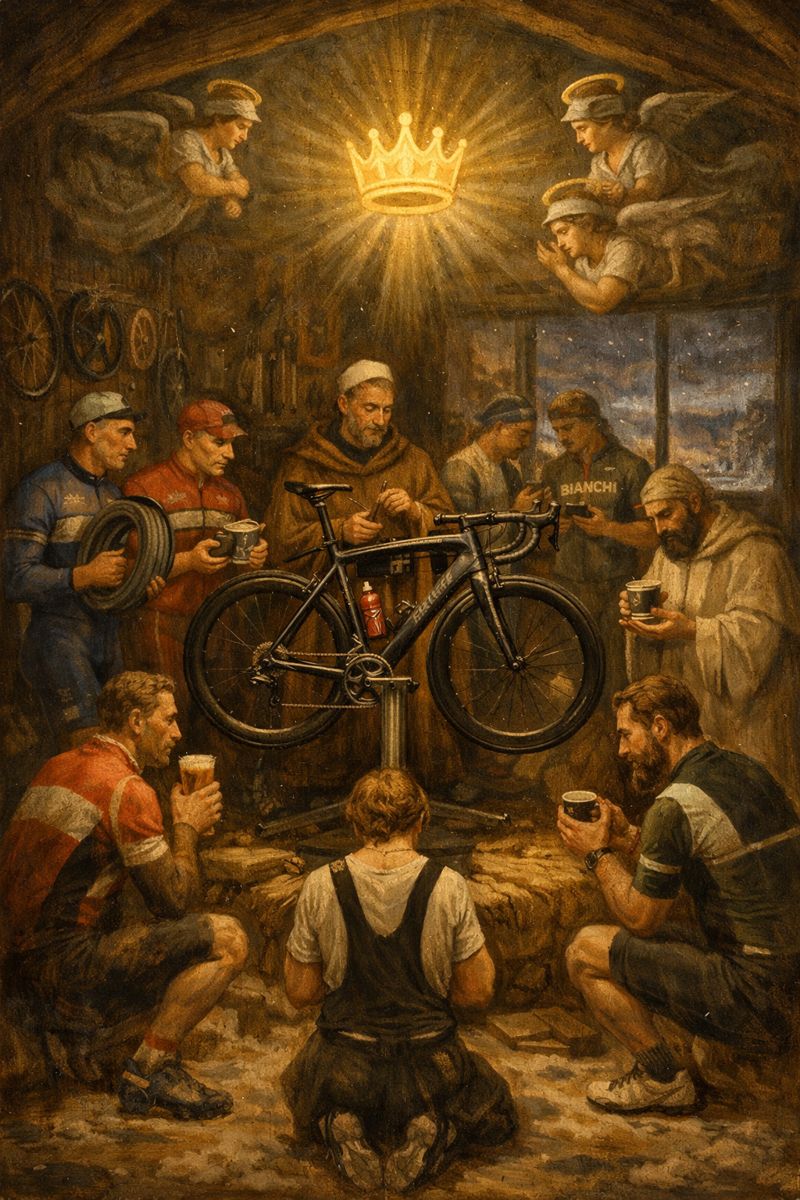
A Bicycle Nativity (with apologies to Leonardo da Vinci). Image generated by ChatGPT with a very long, very specific description.
[Editor’s note: With many, many, many apologies to Henry van Dyke (1852-1933)]
Are you willing to forget what you have done for other riders—like that time you pulled for eighteen miles into a headwind while they discussed bottom bracket standards—and to remember what other riders have done for you, which is mostly draft off you and then attack on the final climb?
To ignore what the cycling industry owes you after you’ve purchased four different groupset generations in six years, each one promising “revolutionary shifting” that feels exactly the same, and to think what you owe the cycling industry, which is apparently your firstborn child, your retirement savings, and that carbon wheelset you’ve been eyeing since Black Friday?
To put your Strava KOMs in the background—all three of them, two of which you got because your GPS glitched—and your so-called recovery rides in the middle distance, where you still averaged 19 mph because you have a problem, and your chances to actually help someone fix their bike in the foreground, even though you’ll probably strip their derailleur hanger trying to true their wheel on Christmas morning instead of opening presents?
To see that your fellow cyclists are just as real as you are, including the guy who shows up to the no-drop ride on a time trial bike and promptly drops everyone, and the person at the Christmas party who thinks SPD cleats work with Look pedals, and the frame builder who lectures everyone about “road feel” while you’re all just trying to drink your cortado and eggnog in peace, and try to look behind their Oakleys to their hearts, hungry for joy and KOMs and maybe some holiday goodwill?
To own that probably the only good reason for your existence is not what you are going to get out of cycling—which is a sore ass, an empty wallet, and the knowledge that teenagers on e-bikes can pass you—but what you are going to give to cycling, which is endless opinions about tire width that nobody asked for, especially not at Christmas dinner when your family just wants to know why you’re wearing bib shorts under your dress pants?
To close your book of complaints against the universe for making you slow, gravity for existing, wind for always being a headwind no matter which direction you ride, and the sadistic route planner who puts the steepest hill at mile 47, and look around you for a place where you can sow a few seeds of happiness, like maybe just shutting up about your FTP for five minutes during Christmas brunch?
Are you willing to do these things even for a day—say, December 25th, when the shop is closed and you can’t buy another set of titanium bottle cage bolts? Then you can keep Racing Season.
Are you willing to stoop down and consider the needs and the desires of the new rider on the hybrid with platform pedals who received it as a Christmas gift; to remember the weakness and loneliness of people who are growing old and can no longer hold your wheel on climbs they once dominated, and who now sit at home on Christmas while you’re out doing “just a quick spin”?
To stop asking how much your riding buddies love you—whether they waited at the top, whether they soft-pedaled when you were struggling, whether they got you anything for the gift exchange or just regifted those gross energy chews—and ask yourself whether you love them enough to stop talking about that one time in 2019 when you actually won the town line sprint, which you bring up every Boxing Day ride without fail?
To bear in mind the things that other riders have to bear—like listening to you complain about your new saddle for six weeks straight through the entire holiday season—and to try to understand what those who ride in the same group with you really want, which is probably for you to stop explaining why their bike setup is wrong and yours is correct, despite the fact that you’re slower than all of them, without waiting for them to tell you, because they’ve been hinting since the Secret Santa ride?
To trim your Lezyne so that it will give more light and less of that annoying flash pattern that blinds everyone during the dark winter rides, like some kind of anti-Christmas star, and to carry it angled down so that your shadow of self-righteousness will fall behind you; to make a grave for your ugly thoughts about the guy who bought the same frame as you but in a nicer colorway with his Christmas bonus, and a garden for your kindly feelings, with the gate open, so everyone can see you’re definitely not jealous even though you asked Santa for that exact paint scheme?
Are you willing to do these things even for a day—perhaps the day we celebrate peace on earth and goodwill toward men, though apparently not toward the cyclist who bought the last pair of Assos bibs in your size? Then you can keep Racing Season.
Are you willing to believe that post-ride beer is the strongest thing in the world—stronger than pre-ride espresso, stronger than whatever is in those gel packets, stronger than the self-loathing that comes from checking Strava after a bad ride, stronger even than your mother’s disappointment when you skip Christmas dinner to get in “just one more ride before the year ends”?
And that sacrifice is as beautiful as power, which is why you’re definitely doing tempo and not just going easy, and that service is as blessed as suffering, even though suffering is literally the entire point of this stupid sport, and that the blessed life which began in Bethlehem two thousand years ago—and in Belgium whenever Eddy Merckx was born, which might as well be a religious holiday—is the image and brightness of the Eternal Ride?
Then you can keep Racing Season.
And if you keep it for a day, why not always? Why not make every ride a celebration of the cycling nativity, when the first rider received the first bike and said “yes, I will suffer for this”?
But you can never keep it alone. Because cycling is a team sport where everyone hates each other but also can’t live without the group ride drama, much like Christmas dinner with your family, except with more Lycra and fewer cardigans.
And even then, you probably won’t, because you just saw someone take your KOM on Christmas Eve and now you have to go do intervals in the freezing rain to get it back, muttering about e-bikes and suspicious power files the entire way, while your family waits for you to help decorate the tree.
But sure, peace on earth, goodwill toward Freds, whatever.
Merry Christmas to all, and to all a good night ride.
Now where’s my bidon? And has anyone seen the wrapping paper? I need to wrap this new cassette.
]]>Steven Sheffieldhttp://www.flahute.com<![CDATA[Whatever Works: a Jax Dierckx Interlude]]>https://www.flahute.com/?p=259892025-11-12T04:35:51Z2025-11-12T04:35:50ZYou probably haven't heard of Jax Dierckx, but he knows more about betrayal than most people—both the kind that happens on pavé and the kind that pays his rent. This is about a time he decided to stop watching and start trusting again, if only in one simple thing.
]]>Editor’s note: You probably haven’t heard of Jax Dierckx, but he knows more about betrayal than most people—both the kind that happens on pavé and the kind that pays his rent. This is about a time he decided to stop watching and start trusting again, if only in one simple thing.
The morning fog hung over the Bois de la Cambre like a gray blanket, thick enough that I could barely make out the cyclocross course as I wheeled my MX-Leader through the parking area. Cars with bike racks were scattered between the trees, their Belgian, Dutch, and French license plates telling the story of a sport that drew fanatics from across the Benelux countries and northern France every weekend during the autumn racing season.
I wasn’t racing today. Those days had ended twelve years ago on the Haaghoek cobbles, along with most of the cartilage in my left knee. But cyclocross in October was something I couldn’t stay away from, even when my phone buzzed with a text from a client whose cheating husband could wait until Monday. Some things were more important than other people’s betrayals—the sound of knobbly tires on mud, the particular grunt of riders pushing through barriers, the smell of coffee and frites and sausages and beer mixing with the earthy scent of Belgian soil torn up by racing wheels.
Image created by ChatGPT from a highly detailed description, because while I can scribble, I can’t draw.
It was a Sunday afternoon in October 2018, the kind of gray, drizzling day that made cyclocross racing either magical or miserable, depending on your perspective. I locked my bike to a tree and walked toward the sound of cowbells and shouting spectators, already feeling the familiar mix of nostalgia and regret that came with watching other people do what I’d once done myself. Here, for a few hours, I could stop cataloging human deceptions and just watch people push themselves toward something pure.
The course was classic Belgian ‘cross: tight corners around trees, steep run-ups that forced riders to dismount and shoulder their bikes, muddy descents that rewarded bike handling skills over pure power. A lap was maybe two kilometers, but in conditions like these, it might as well have been the Paris-Roubaix.
I bought coffee from a vendor near the start/finish area and found a spot along the course where I could watch the race develop. My investigator’s eye automatically swept the crowd—noting exits, counting security, assessing threats—before I caught myself and forced the habit down. Today I was just another spectator with mud on his boots and coffee growing cold in his hands.
A young girl, perhaps ten years old, was standing beside me with her father, both of them wearing matching team jerseys from a local cycling club.
“Papa, why do they carry their bikes instead of riding them?” she asked in French, pointing to a rider shouldering his machine up a muddy embankment.
“Because sometimes, ma petite, walking is faster than riding,” her father explained patiently. “In cyclocross, you use whatever works.”
I smiled at that. “Whatever works.” In my line of work, that philosophy usually led to compromises I wasn’t proud of. Here, it was just practical wisdom about getting over barriers. It was a decent summary of the sport—pragmatism disguised as suffering; efficiency found in the most inefficient-looking movements. The father caught my expression and nodded in recognition of shared understanding.
“You race?” he asked.
“Used to. Long time ago.”
“Ah.” He studied my face with the attention of someone trying to place a half-remembered photograph. “Jacques Dierckx? From Vlaams Brouwers?”
I was always surprised when people remembered me after all these years. In my current profession, anonymity was an asset. Being memorable was a liability. But here, among people who shared this particular obsession, my brief racing career was a calling card instead of a complication. My career had been solid but unremarkable—a good domestique, reliable in the classics, but hardly the kind of rider who stayed in cycling fans’ memories.
“Guilty.”
“I was at Flanders in ’06. Terrible crash on the Haaghoek. You were in the break when it happened, no?”
The question hit like cold water. I’d trained myself not to think about that day, about what I’d seen in Tommy Van Beirendonck’s eyes in the seconds before everything went wrong.
“The first chase, but we were bringing them back,” I said, keeping my voice neutral the way I did when questioning hostile witnesses.
His daughter tugged at his sleeve, impatient with adult conversation that didn’t involve bicycles doing interesting things. He lifted her onto his shoulders so she could see over the crowd of spectators gathering along the course barriers.
“She wants to race when she’s older,” he said. “I tell her she should try cyclocross first—teaches you how to handle a bike in all conditions.”
“Not wrong. Though maybe start her on grass before moving to Belgian mud.”
We watched as the junior men’s race began, twenty riders between sixteen and eighteen years old attacking the course with the fearless enthusiasm that came from not yet knowing their limitations. They took corners too fast, jumped barriers with unnecessary flair, and generally rode like they were auditioning for highlight reels rather than trying to win races.
“Look at them go,” the father said admiringly. “No fear at all.”
“Fear comes with experience,” I replied. “Right about the time you realize bones break and careers end.” In my work, fear kept people alive. But it also kept them from living.
One of the juniors proved my point by attempting to bunny-hop a barrier section that clearly required dismounting. He caught his rear wheel, went down hard, and spent thirty seconds untangling himself from his bike while the rest of the field rode away. But he got up, remounted, and continued racing as if nothing had happened.
“Resilient age,” the father observed.
“Best age for learning. Old enough to understand technique, young enough to bounce back from mistakes.”
I envied that resilience, that immediate faith in forward motion. These days, I approached everything like a potential crime scene, cataloging what could go wrong before considering what might go right.
The elite men’s field was just beginning their warm-up laps, forty-odd riders testing lines and getting a feel for how much the mud would slow them down. I recognized several faces from television coverage of World Cup races—riders who’d made careers out of excelling in conditions that would terrify most road racers.
“Jax? Jacques Dierckx?”
I turned to find a man about my age approaching with the careful gait of someone whose knees had seen too many winters of cyclocross racing. He was familiar in the way that former teammates and competitors always were—weathered face, knowing eyes, the particular posture that came from decades of hunching over bicycle handlebars.
“Pieter Van Maes,” he said, extending a hand. “We raced against each other back in the day. You probably don’t remember.”
But I did remember. Van Maes had been a solid domestique for one of the Dutch teams during the mid-2000s, the kind of rider who never won races but always made them harder for everyone else. He’d been in the chase with me during that final Tour of Flanders, one of the five riders who were closing in on the leaders when everything went wrong on the Haaghoek.
“I remember,” I said. “You were strong that day.”
“Not strong enough.” Van Maes’s smile was rueful. “But then again, none of us were, were we? That crash changed everything for a lot of people.”
He didn’t know. After twelve years of investigating other people’s secrets, I could read the genuine confusion in his expression. He remembered the crash, the chaos, the end of careers—but not the moment of betrayal that I’d carried like a stone in my chest ever since.
Maybe that was the real difference between my two lives. In cycling, most of the time you lived with the consequences of split-second decisions made in good faith. In investigation work, you learned that most disasters had someone to blame, some chain of deliberate choices that led to inevitable conclusions. Sometimes the two collided.
The French father and daughter had moved closer to the barriers, drawn by the spectacle of elite riders warming up. Other spectators were clustering around the technical sections where crashes were most likely—the places where competence separated itself from bravado in the most dramatic ways possible.
“You still riding?” Van Maes asked.
“Every day. Got a steel Merckx the year after I retired. Been riding it ever since.”
“Christ, really? I go through three bikes a year just commuting to work. Nothing lasts like it used to.”
We walked along the course perimeter, following the flow of spectators toward the most challenging sections. The run-up had been carved into a steep hillside, forcing riders to dismount and carry their bikes up what amounted to a muddy staircase. At the bottom, a stream crossing on narrow planks added an element of balance that would become increasingly difficult as fatigue set in.
I found myself genuinely enjoying the conversation instead of mining it for useful information. Van Maes talked about his insurance business, his kids’ sports schedules, the eternal struggle to maintain fitness while managing adult responsibilities. Normal problems. Honest problems.
My phone buzzed again—probably the same client, or maybe Mme. Delacroix wanting an update on her husband’s gambling debts. I didn’t check. For the first time in months, I was more interested in what was happening in front of me than what secrets people were hiding behind closed doors.
“Remember when cyclocross was a winter training exercise?” Van Maes asked. “Something road riders did to stay fit during the off-season?”
“Before UCI points and World Cup series and professional ‘cross teams.”
“Before it became serious business.” He gestured toward the warm-up area, where mechanics were making final adjustments to bikes that cost more than most people’s cars. “These kids have equipment we could only dream about.”
“Equipment doesn’t teach you how to read mud or carry a bike efficiently.”
“No, but it helps when everyone else has the same advantages you do.”
The starter’s gun fired, sending forty riders into the first corner in a chaos of elbows, shouting, and the distinctive whir of knobby tires on wet grass. Within thirty seconds, the field was strung out, the strongest riders pushing the pace while the rest tried to stay upright in increasingly treacherous conditions.
I found myself analyzing the race with the automatic attention that came from years of professional competition. The early leaders were establishing position rather than trying to drop the field—smart tactics in conditions where a single mistake could end podium chances. Behind them, the main group was already fragmenting as riders discovered their limits on technical sections. Everything was visible, honest. No hidden agendas, no deceptions. Just the elemental truth of who was strongest when it mattered most.
“Look at these kids,” Van Maes said, gesturing toward the lead group. “Half of them weren’t even born when we were racing.”
“They’re fast.”
“They’re fast, but they don’t know how to suffer properly. Everything’s too scientific now—power meters, heart rate monitors, computer analysis of every pedal stroke. When we raced, you just rode until you couldn’t ride anymore, then found a way to ride some more.”
I watched the leaders negotiate the stream crossing, each rider choosing slightly different lines based on their assessment of risk versus time savings. The differences were measured in centimeters and split seconds, but in a sport where races were often decided by bike lengths, marginal gains mattered.
“Maybe that’s not entirely bad,” I said. “Science might prevent some of the damage we accumulated.”
Van Maes touched his left knee unconsciously—the same knee that had ended my career, the same joint that probably bothered most riders our age on damp October afternoons.
“True enough. Though I wonder if they get the same satisfaction from winning when it’s all calculated in advance.”
A crash in the main group provided punctuation to his observation. Three riders went down in a tangle of wheels and cursing, their carefully planned race strategies instantly revised by the reality of mud and momentum. They untangled themselves quickly—cyclocross crashes were usually spectacular rather than dangerous—but their chances of contending for the victory had disappeared in the time it took to remount and regain forward momentum.
“Bike racing,” Van Maes said with satisfaction. “Still fundamentally unpredictable.”
We moved to different vantage points as the race progressed, following the crowd’s migration toward sections where the action was most concentrated. At the barriers, riders were developing different techniques for maintaining speed—some hopping cleanly, others using a step-through method that was slower but more reliable in muddy conditions.
“You ever think about coaching?” Van Maes asked during a lull between passages of the race leaders.
“Thought about it. But I’m not sure I have the patience for developing young riders.”
“Different kind of patience than investigating, I suppose.”
He knew about my current work, though I couldn’t remember discussing it with him. Information traveled quickly through the small community of former Belgian professionals—who was doing what, who was struggling, who had found successful second careers.
“Coaching requires believing in potential that might not exist. Investigation is about uncovering what’s already there.”
“Cynical way of looking at it.”
“Realistic way. Half the kids who think they want to be professional cyclists don’t have the physical tools. The other half don’t have the mental tools. The ones who have both usually find their way to success without much help.”
Van Maes considered this while watching the lead group string out further. The Belgian rider who’d looked strongest in the early going was starting to show signs of fatigue, his technique becoming less fluid as accumulated effort took its toll.
“Maybe coaching isn’t about finding champions,” he said. “Maybe it’s about helping people become better versions of themselves.”
“Philosophy major?”
“Economics, actually. But a decade of selling insurance teaches you about human nature.”
The race was reaching its critical phase, the point where superior fitness began to separate from superior technique. The French rider who’d been sitting third throughout the race was now moving forward with the steady pressure of someone who’d conserved energy for exactly this moment.
“Your Frenchman’s making his move,” Van Maes observed.
“Not my Frenchman. But he’s racing smart.” I found myself appreciating the tactical patience, so different from the immediate gratification my clients usually demanded. “Want to make it interesting? Twenty euros on him?”
Van Maes studied the three leaders as they approached the technical section where most of the damage had been done throughout the race. The Belgian was still leading but looking increasingly vulnerable. The Dutch rider was holding second but seemed content to stay there. The Frenchman was closing the gap with each lap, his technical skills allowing him to gain time in small increments that would add up to victory if maintained.
“You’re on.”
The final twenty minutes provided exactly the kind of drama that made cyclocross compelling, as the race unfolded like a case I could actually solve through observation rather than deception. The Belgian’s aggressive early racing caught up with him when fatigue caused a clumsy dismount that sent him sprawling in the mud. The Dutch rider inherited the lead but couldn’t match the Frenchman’s sustained pressure on the technical sections.
With three laps remaining, the race was effectively decided. The Frenchman had established a gap that would only grow larger as his superior technical skills became more apparent. Behind him, the Dutch rider was holding second while the Belgian fought to maintain contact with the podium positions.
“Textbook ride,” Van Maes said, pulling out his wallet as the Frenchman crossed the line with a comfortable margin. “Patient, consistent, timed perfectly.”
“Experience usually beats enthusiasm over forty minutes.” I pocketed the twenty euros, thinking about how rarely my professional victories felt this clean.
We walked back toward the parking area as the awards ceremony began, the sound of the French national anthem mixing with the voices of spectators discussing the race and planning their evening around whatever football match was on television. The atmosphere was relaxed, convivial—the particular satisfaction that came from watching athletic competition without the pressure of personal investment in the outcome.
“You know,” Van Maes said as we reached our bikes, “there’s a veterans’ race next month at Overijse. Nothing too serious, just guys our age trying to prove they can still ride bikes without falling off. You should come out.”
I thought about that as I unlocked my MX-Leader from the tree where she’d waited patiently through the afternoon’s racing. The idea of pinning on a number again, of lining up with other former professionals who’d never quite gotten racing out of their systems, had a certain appeal. Racing again would mean trusting my body, my bike, my instincts in ways I hadn’t done since switching careers. It would mean choosing faith over suspicion, at least for forty minutes.
“You could train with us if you want—bunch of old guys who meet Saturday mornings in Grimbergen. Nothing too serious.”
Training with other people. The idea had appeal and terror in equal measure. My current fitness routine was solitary by design—early morning rides before the city woke up, routes chosen to avoid human complications. Joining a group would mean accountability, shared goals, the kind of trust I’d spent twelve years learning to live without.
“I work a lot of weekends.”
“Flexible schedule, though, right? Being your own boss?”
Van Maes knew exactly what he was doing, and I found myself admiring his technique. He’d identified my objections and was methodically addressing each one, the way I’d learned to guide reluctant witnesses toward uncomfortable truths.
“I don’t have a ‘cross bike anymore.”
“So, race what you’ve got. That Merckx has seen worse conditions than riding around some grassy fields.”
Van Maes was right. The MX-Leader had carried me through eleven years of Belgian winters, through rain and snow and the kind of weather that made most cyclists retreat to indoor trainers, through investigations that took me into neighborhoods where expensive bikes disappeared overnight. A cyclocross race on the grass fields around Overijse would just be another adventure in a long partnership between rider and machine.
She’d been reliable when everything else in my life had become complicated.
Racing her would mean trusting her—and myself—in ways my current profession had taught me to avoid. It would mean accepting that not everything could be controlled, predicted, or investigated in advance.
But maybe that was exactly what I needed.
“I’ll think about it,” I said, surprising myself by meaning it.
“Think fast. Entry closes next week.”
My phone rang before I could respond. The display showed Mme. Delacroix—probably wanting to know if I’d photographed her husband at the casino yet. Standard work that paid the bills and slowly poisoned my faith in human nature.
I looked at the phone, then at Van Maes, then at the MX-Leader waiting patiently against her tree. For once, the choice seemed clear.
I declined the call.
Van Maes climbed onto his bike—a modern carbon fiber machine that looked like aerospace engineers had designed it—and rode away with a wave, leaving me standing beside my vintage steel frame in the gathering dusk.
I rode back to the Gare du Midi through Brussels in the fading afternoon light, taking the long route through Uccle and Forest that avoided the worst of the Sunday evening traffic. The MX-Leader rolled smoothly over wet pavement while I thought about Van Maes’s invitation and what it would mean to race again, even at the veterans’ level.
Racing had given structure to my life for over a decade—training schedules, competition goals, the clear feedback loop of effort and results that made every day’s work meaningful. Since retiring, I’d found different sources of motivation in my investigation work, but there was something appealing about the simplicity of bicycle racing that couldn’t be replicated in other contexts.
At a red light in Saint Gilles, I found myself beside a group of young cyclists heading home from their own afternoon rides. They were discussing training plans, upcoming races, equipment choices—the eternal concerns of people who’d organized their lives around the pursuit of speed on two wheels.
One of them noticed my bike and nodded approvingly. “Beautiful Merckx,” he said in English. “Classic build.”
“Thanks. She’s been reliable.”
“You race it?”
“Used to race other bikes. This one’s for everything else.”
“Everything else is still racing,” another rider said with the wisdom of someone young enough to believe that cycling was the most important thing in the world. “Just different competitions.”
The light changed and they rode away, their conversation resuming immediately about intervals, power zones, and whatever scientific approach they were using to pursue marginal improvements. I followed at my own pace, thinking about the comment that everything else was still racing.
Maybe he was right. Maybe every ride was a form of competition—against traffic, weather, the gradual decline of aging muscles and joints, the accumulated weight of responsibilities that made simple forward motion increasingly precious.
The train to Ghent was nearly empty, most weekend travelers having made their journeys earlier in the day. I found a seat in the bike car and settled in for the forty-minute ride home, watching the Belgian countryside slide past the rain-streaked windows. Fields that had been green in spring were now turning the brown of autumn, preparing for the long winter that would drive most cyclists indoors or onto trainers until March brought the promise of better weather.
The train pulled away from Brussels with the particular rhythm that had carried commuters and cyclists between Belgium’s cities for over a century. I watched the industrial outskirts give way to farmland, thinking about the afternoon’s racing and Van Maes’s casual invitation to test myself again against a field of other former professionals who’d never quite made peace with spectator status.
By the time I reached my apartment in Ghent, I’d made my decision. Racing again, even at the veterans’ level, would mean acknowledging that I wasn’t ready to be purely a spectator, that some part of me still wanted to test myself against courses, conditions, and other riders who understood the particular satisfaction of bicycle racing.
It would mean training specifically, pushing my forty-two-year-old body to remember movements and efforts it hadn’t attempted in over a decade. It would mean risking embarrassment, risking injury, risking the kind of disappointment that came when reality didn’t match memory.
But it would also mean finding out if I still had the particular kind of courage required to line up with other riders and commit fully to whatever the race demanded. It would mean discovering whether the partnership between myself and the MX-Leader could handle the specific stresses of competition rather than just the daily demands of urban transportation and weekend rides.
The next morning, I called the race organizer and entered the veterans’ category at Overijse. Forty euros entry fee, plus whatever it would cost to get the MX-Leader ready for her first cyclocross race. I knew she wasn’t an ideal cyclocross machine, but that didn’t matter.
Some partnerships, I reflected as I carried my bike up the stairs to my apartment, deserved the chance to try new adventures together. Even if those adventures involved a lot more mud than either of us was strictly comfortable with.
The next morning, I called Mme. Delacroix. I’d been photographing her husband for three weeks, accumulating evidence of exactly the kind of behavior she’d suspected. Another marriage dissolving into mutual recrimination and billable hours.
“Mme. Delacroix, it’s Jax Dierckx. I’m calling to tell you I’m closing your case.”
“But you haven’t found anything yet!”
“I’ve found everything you hired me to find. Your husband is gambling again, losing money you can’t afford to lose, lying about where he spends his evenings.” I paused, watching my hands work the bar tape with muscle memory from another life. “The question is whether you want to fix your marriage or just prove you’re right to end it.”
“That’s not your decision to make.”
“No, it’s yours. But I’m not going to help you destroy what might still be salvaged. Try marriage counseling before you try divorce lawyers.”
I hung up before she could respond, then turned off the phone completely.
The following week, I started riding differently. Not training, exactly, but paying attention to efforts that I’d been ignoring for years. Hill repeats that pushed my heart rate into zones I’d forgotten existed. Technical sections in the Kalken Bottelaere that required the kind of bike handling skills I hadn’t used since my racing days.
The MX-Leader seemed to approve of the renewed intensity. Her steel frame absorbed the harder efforts without complaint, the Campagnolo components shifting with the precision that came from Italian engineering and proper maintenance. After eleven years of partnership, we were still discovering new possibilities together.
It felt like preparation for something important, even if that something was just a veterans’ race in a grass field outside Brussels on a November Sunday morning.
Race morning dawned gray and damp, perfect cyclocross weather. I arrived at Overijse early, wanting time to pre-ride the course before the veterans’ field assembled. The route was less technical than the Bois de la Cambre had been the previous month—flowing singletrack through grass fields, a few barriers, one significant climb that would separate the pretenders from the genuinely fit, and not so crazy that a road bike was completely out of place.
Van Maes found me warming up near the start area, his own bike gleaming with the kind of preparation that suggested he’d taken the race as seriously as I had.
“Nervous?” he asked.
“Terrified,” I admitted, surprising myself with the honesty.
“Good. Means it matters.”
Other veterans were gathering with the easy camaraderie of people who’d found a reason to keep pushing themselves beyond reasonable limits. Former professionals mixed with ambitious amateurs, united by the shared understanding that age was something to be negotiated with rather than surrendered to.
I pinned my number to my jersey—43, the same age I’d be next month—and wheeled the MX-Leader toward the start line. She looked out of place among the modern carbon fiber machines, but she belonged here as much as any of us.
“Gentlemen,” the race director called, “remember this is supposed to be fun. Try not to prove me wrong.”
The field lined up with nervous laughter and final equipment adjustments. I found myself next to a former Belgian pro I’d raced against in the early 2000s, both of us carrying extra weight and decreased flexibility but still unwilling to accept spectator status permanently.
“Been a while,” he said in Dutch.
“Too long,” I agreed.
The starter raised his gun, and forty-three aging cyclists prepared to rediscover exactly how much they’d forgotten about racing bicycles in muddy conditions.
“Ready?”
I looked down at the MX-Leader’s top tube, thinking about eleven years of partnership that had been reliable but never truly tested. Today we’d find out what we could accomplish when pure effort mattered more than careful planning.
“Ready.”
The gun fired.
For thirty-eight minutes and forty-seven seconds, I remembered what it felt like to care about nothing except forward motion and relative position. The MX-Leader responded to race demands with enthusiasm that surprised us both, her steel frame providing stability on technical sections where lighter machines were skittering unpredictably.
I finished seventeenth out of forty-three starters in the 40-49 age group—respectable without being embarrassing, fast enough to hurt appropriately but not so fast that I’d been reckless with my forty-two-year-old body. More importantly, I’d spent nearly forty minutes thinking about nothing except tactics, technique, and the immediate problem of maintaining contact with riders who’d never stopped believing they were athletes.
Van Maes finished fifteenth, two places ahead of me but close enough that we’d pushed each other throughout the race. As we cooled down together, riding easy laps around the field while our heart rates returned to sustainable levels, I realized I felt better than I had in months.
“Not bad for an old domestique,” he said with satisfaction.
“Not bad for a guy who sells insurance.”
“So,” Van Maes continued as we dismounted near the results board, “there’s another race in two weeks at Koppenberg. Bit more serious—they have elite masters categories.”
I thought about that while hosing some of the mud off the MX-Leader at the bike wash station. Two weeks would give me time to train specifically, to push a little harder, to find out whether today had been beginner’s luck or the rediscovery of something I’d thought was permanently lost.
“Elite masters,” I repeated. “That sounds ominous.”
“That sounds like you’re interested.”
He was right. For the first time in twelve years, I was interested in something that had nothing to do with other people’s secrets and everything to do with my own willingness to suffer for purely personal reasons.
“I’ll think about it.”
But I was already thinking about it, already planning training rides that would prepare me for more serious competition, already imagining what the MX-Leader might accomplish with a rider who was finally asking her to be more than just reliable transportation.
The drive back to Ghent took me through countryside that looked different than it had that morning. Instead of terrain to be navigated safely, I saw potential training routes, hills that could build power, technical sections that could sharpen handling skills.
When I turned my phone back on, it contained seventeen missed calls and forty-three unread messages from clients who couldn’t imagine that their private disasters might be less important than one forty-two-year-old man’s attempt to rediscover what it felt like to race a bicycle through Belgian mud.
For the moment, their inability to imagine that seemed like their problem rather than mine.
I turned into my street in Ghent as the afternoon light was fading, the MX-Leader still caked with stubborn mud from Overijse and already eager for the next adventure we might attempt together. Some partnerships, I reflected as I carried her up the stairs to my apartment, deserved the chance to discover what they’d been capable of all along.
Even if those discoveries involved significantly more suffering than either of us was strictly comfortable with.
The next morning, I called the race organizer at Koppenberg and entered the elite masters category. Sixty euros entry fee, plus whatever it would cost to get serious about training again.
Some risks, I was learning, were worth taking purely because they reminded you who you’d been before life taught you to be careful about everything.
]]>Steven Sheffieldhttp://www.flahute.com<![CDATA[The Accidental Framebuilder]]>https://www.flahute.com/?p=259802025-09-25T01:27:56Z2025-09-25T01:20:16ZRichard Sachs stands as an icon. He also breaks conventions as an iconoclast. He likes to say, "I didn't want to be a framebuilder. I became one." This phrase neatly captures the serendipity that shaped his career: a young man who intended to become a writer ended up becoming one of America's most revered builders of the most finely wrought handmade bicycles in America.
]]>Richard Sachs and Arrange Disorder: A Literary Meditation
Richard Sachs stands as an icon. He also breaks conventions as an iconoclast. He likes to say, “I didn’t want to be a framebuilder. I became one.” This phrase neatly captures the serendipity that shaped his career: a young man who intended to become a writer ended up becoming one of America’s most revered builders of the most finely wrought handmade bicycles in America.
For more than fifty years Sachs has worked in modest New England workshops, cutting and filing, brazing and aligning, coaxing steel tubes into machines that carry an aura well beyond their mechanical purpose. Yet if you ask him, the story begins not with the bicycles but with words, and with his persistent need to arrange them.
In 1972, Sachs planned to enroll at Goddard College in Vermont to study writing. When the college deferred his admission until the following spring, he began looking for something to occupy his time. An advertisement in the Village Voice caught his eye. A bike shop in Vermont needed help for the summer. He boarded a bus and answered the ad in person, but the shop had already filled the position.
One decision led to another, and soon he flew to London, where he apprenticed at Witcomb Cycles. “Apprenticing” perhaps overstates his role: Sachs spent the better part of a year sweeping floors and lugging boxes through what he later described—fondly, if with a wince—as a Dickensian factory.
When he returned to the United States, he helped launch Witcomb Cycles U.S.A., building frames as best he could from what he had observed in England, since he had received little, if any, formal instruction. By 1975, he struck out on his own, hanging out a shingle as Richard Sachs Cycles. He has not worked another job since.
The irony strikes you immediately. The aspiring writer, eager to arrange sentences on the page, ended up arranging steel in a jig. However, both pursuits shared uncannily similar goals: precision, beauty, and a sense of order in the face of chaos.
This collision of avocations produced Arrange Disorder, Volume 1, a seventy-two–page chapbook that distills a half-century of life at the bench into what Sachs describes as “anecdotes, advice, musings, opinions, reflections, judgements, inspirations, sense, and nonsense,” stemming from a series of essays published on his website under the same title, “Arrange Disorder.” By his own estimate, he has produced more than seven hundred thousand words: each essay running a few hundred words, written not as memoir so much as meditation.
The book’s title, like much of Sachs’s own language, operates as both wry and revealing. Now in his seventies, he describes the project as an attempt to “arrange all the disorder (until now) and get ready for that proverbial fourth quarter.” The phrasing works both literally—straightening the workroom, finding some order in a life of entropy—and metaphorically, acknowledging that the effort itself may matter more than the result. On his website, he writes with characteristic bluntness: “I like order I crave order I live a life of disorder. Deb calls it walking entropy… That’s why I arrange disorder. I try.” He adds, almost as an afterthought: “The closer I get, the further it moves from me. The order, that is.”
The book, then, represents a way of fixing on paper the rhythms of thought that had long accompanied the rhythms of the workshop. “I’m a career framebuilder,” he writes. “Working alone, I make bicycles. I want people to know what I think and what I’ve seen.”
Solitude drives both activities. In the shop, Sachs once produced as many as 140 frames a year. Now, by choice, he makes fewer than fifty. The reduction, he insists, stems not from age or infirmity but from his deepening obsession with quality. Each frame, he believes, ought to bear the full weight of everything he has learned.
The comparison to writing demands attention: the solitary labor, the compulsion to revise endlessly, the belief that perfection hovers just beyond the reach of one more pass with the file, one more tightening of a phrase. Sachs admits as much: the tinkering, the selfish, infinite pursuit of something better, always better. It is not a matter of knowing when to stop, but of knowing when not to proceed.
What gives Arrange Disorder its particular resonance stems not from its catalogue of experience but from its tone—a meditative register that links framebuilding to older traditions of craft. Sachs shows less interest in other bicycle builders than in the kind of makers who preceded the industrial age: luthiers, watchmakers, tailors, ceramicists. The thread that binds them together, he insists, involves “practice, respect for a craft’s history, and mastery.”
To read him means glimpsing a craftsman who regards his work less as production than as dialogue—between hand and material, between tradition and innovation, between disorder and the fragile order that briefly, sometimes, emerges.
Riders know Sachs best for his bicycles, which they often describe as the closest thing to perfection a working machine can achieve. But Arrange Disorder suggests that the “accidental framebuilder” has always worked as a writer—one who simply found his subject in steel, in silver and flux, and in the restless pursuit of order within entropy. In an era of mass production and digital automation, his bicycles and his words alike remind us that some things resist hurrying, resist programming, and resist perfection—they only submit to pursuit. The accident, as it turns out, is destiny.
]]>Steven Sheffieldhttp://www.flahute.com<![CDATA[Opinion: Remember When Gravel Felt Like Coming Home?]]>https://www.flahute.com/?p=259262025-11-10T21:03:42Z2025-08-25T04:56:07ZThere was a time when American gravel cycling felt like coming home to a family reunion you’d been looking forward to all year. It was farm roads and cow gates, a thermos of coffee, and an annual gathering built on trust, shared suffering, and the quiet understanding that some things in this world could remain beautifully imperfect.
]]>There was a time when American gravel cycling felt like coming home to a family reunion you’d been looking forward to all year. It was farm roads and cow gates, a thermos of coffee at the start line, and volunteers who knew your name handing out pickle juice at mile 90. It was an annual gathering built on trust, shared suffering, and the quiet understanding that some things in this world could remain beautifully imperfect.
Those days feel increasingly distant under the expanding reach of Life Time, Inc.
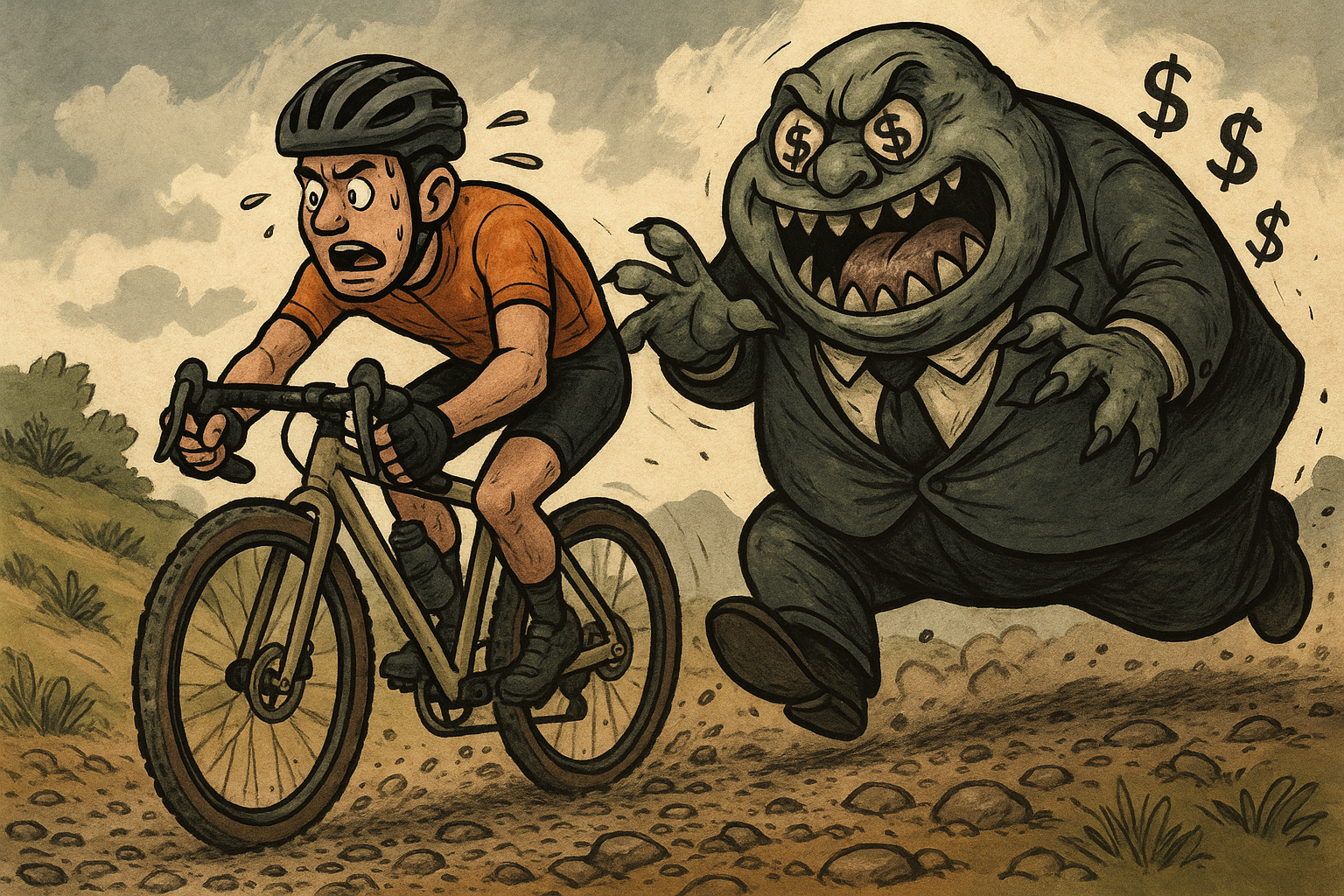
Corporate greed monster chasing the gravel cyclist. Once upon a time, gravel felt like coming home. Image created by ChatGPT from a highly detailed description.
The transformation is perhaps most heartbreaking at what used to be the spiritual heart of gravel: UNBOUND Gravel in Emporia, Kansas. Once a grassroots celebration where friends planned their entire year around reuniting on those Kansas roads, it now carries the weight of corporate expectations and the inevitable distance that comes with scale. At the 2025 edition, after rain turned the Flint Hills into a clay-thick quagmire, what happened reminded us how much we’ve lost along the way.
Multiple riders shared troubling accounts of being injured and left waiting far too long for help. Danish rider Klara Sofie Skovgaard crashed hard, splitting her helmet, dislocating her shoulder, and tearing open her knee. She developed hypothermia lying in a roadside ditch while drones and helicopters flew overhead capturing footage for broadcast. It wasn’t medical staff who found her—it was fellow racers who stopped, abandoned their own races, and stayed with her until help finally arrived hours later. (Note: see CyclingWest.com editorial Abandoned in a Ditch)
Other riders described crashes into barbed wire, concussions without follow-up, and long stretches of remote course with no medical presence. The silence that followed was perhaps more telling than any statement could have been.
It’s telling that even their routine race recaps read like fill-in-the-blank templates, spending more words on management’s excitement about being in “enter city name here” than celebrating the people who actually raced and how their stories unfolded.
Since 2010, Life Time has steadily acquired many of America’s most cherished gravel and endurance events—Leadville (2010), Chequamegon MTB Festival (2011), Unbound (2018, when it was still Dirty Kanza), Crusher in the Tushar (2019), Sea Otter (2021), along with founding new events like The Rad Dirt Fest and Big Sugar. The promise is always the same: more resources, better athlete experience, greater exposure. But something essential gets lost in translation.
Ask anyone who’s been going to these events for years, and they’ll tell you the same thing with a kind of wistful sadness: it doesn’t feel like our race anymore. The annual pilgrimage has become a bucket-list item. The family reunion has turned into a festival where you might recognize a few faces in the crowd.
What we’ve lost isn’t just about high entry fees or lottery systems, though those changes sting. It’s about the replacement of volunteers who cared deeply about their local event with staff who see it as just another weekend gig. It’s about riders becoming demographic data points rather than the weird, wonderful people who used to define this sport. The stories that mattered—about seeing God after bonking at mile 147, about small acts of kindness from strangers, about finding something true in the suffering—have been supplanted by content creation and social media metrics.
The events still market themselves with familiar imagery—flannel shirts, dirty bikes, “gravel family” language—but it feels like watching actors perform a version of your own memories. The small-town charm is carefully curated now. The finish-line moments are filmed for promotional use. What was once authentic community has been repackaged and sold back to us as an experience at 200 bucks a head, with VIP upgrades and branded merchandise like a 1970s rock band’s nostalgia tour, complete with overpriced, underwhelming t-shirts.
Perhaps most sadly, gravel didn’t need rescuing. The sport was already growing beautifully through regional scenes, word-of-mouth recommendations, and a shared understanding of what made these gatherings special. The corporate intervention didn’t create this culture—it purchased something precious and, perhaps inevitably, began to change it into something more manageable and profitable.
This doesn’t mean gravel cycling is over. But the gravel that many of us fell in love with—the one built by passionate organizers with hand-painted signs and duct-taped coolers—now lives in the margins. It survives in smaller, unsanctioned events, in camping trips that happen to include some riding, and in routes shared quietly among friends rather than promoted through press releases.
The real gravel continues wherever people gather to ride for the simple joy of it, for the stories they’ll share afterward, and for the annual tradition of coming together to remember why they love this strange, wonderful sport. It lives on in spite of the packaging, not because of it.
Gravel was never supposed to be polished or easy to scale. That was part of its charm. But in a world where everything must be systematized and monetized, we’re left mourning not just the loss of specific events, but the loss of a way of being together that felt rare and worth protecting.
If the heart of gravel cycling survives—and we have to believe it will—it’ll be because people remember what made it special in the first place. Not the professional photography or the livestream coverage, but the quiet moments: the shared water bottle at mile 80, the person who stayed back to help fix your flat, the understanding nod from someone who knew exactly what you’d been through out there.
Those moments can’t be bought or sold. They can only be protected, treasured, and passed along to the next rider who needs to know that somewhere, somehow, the real gravel family is still out there, still gathering, still riding toward something that can’t be captured in a press release.
]]>Steven Sheffieldhttp://www.flahute.com<![CDATA[The Last Supper: How a Farmer’s Son Fed the Cannibal His Final Meal]]>https://www.flahute.com/?p=258792025-12-01T04:55:18Z2025-08-15T18:00:29ZIn 1975, Bernard Thévenet—a farmer's son from a village literally named "The Handlebar"—ended Eddy Merckx's reign as cycling's most dominant champion. On the melting Alpine asphalt to Pra-Loup, Thévenet watched the seemingly invincible "Cannibal" collapse into mortality, trapped tire-deep in liquified tar. This is the story of how a patient dreamer fed cycling's greatest predator his final meal, proving that even the most ravenous appetites must eventually be satisfied.
]]>The 1975 Tour de France and the end of cycling’s most ruthless dynasty
By Steven L. Sheffield — In the summer of 1975, somewhere on a melting ribbon of Alpine asphalt four kilometers from the ski station of Pra-Loup, the most dominant athlete of his generation began to die a very public death. Behind Eddy Merckx, gaining with each pedal stroke, came a quiet Frenchman whose very existence seemed to violate the natural order of professional cycling.
Map of the 1975 Tour de France created in Inkscape, by Andrei I. Loas (CC BY-SA 3.0 Deed, Attribution-ShareAlike 3.0 Unported)
The moment Bernard Thévenet passed the faltering Belgian that July afternoon represented more than a changing of the guard in sport’s most grueling theater. It was the collapse of an empire built on the simple, terrifying premise that one man could be so superior to his peers that competition became mere formality. For five of the previous six years from 1969 to 1974, Merckx had treated the Tour de France not as a race but as a harvest, methodically consuming everything in his path: stages, jerseys, records, and most devastatingly, hope itself. The one year he didn’t (1973), he skipped the Tour de France in favor of racing the Vuelta a España and Giro d’Italia, winning both.
But empires, even sporting ones, carry within them the seeds of their own destruction. In 1975, that destruction would come in the most unlikely of forms: not through tactical miscalculation or mechanical failure, but through the accumulated weight of expectation, the fist of a spectator, and the patient ambition of a dreamer from a village called The Handlebar.
Le Guidon
Bernard Thévenet was born in Le Guidon—literally “The Handlebar”—a hamlet so small it seemed more prophecy than place. If destiny has a sense of humor, it revealed itself in that name, in the cosmic joke of a future Tour winner emerging from a village that shared its moniker with an essential component of a bicycle.
Thévenet’s cycling epiphany arrived in church. The year was 1961, and young Bernard was serving as a choirboy when the priest made an unusual announcement: Mass would begin early so the congregation could watch the Tour de France pass through their region. When the peloton finally swept by in a blur of chrome and color, something fundamental shifted in the boy’s understanding of what was possible.
“The sun was shining on their toe-clips and the chrome on their forks,” he remembered years later. “I had already been dreaming of becoming a racing cyclist and that magical sight convinced me definitively.”
It was a vision sustained through grinding years of amateur racing and the skepticism of farming parents who needed their son’s labor more than his dreams. Thévenet rode his sister’s bicycle to school from age six, graduated to his own bike a year later, and began the daily ten-kilometer pilgrimage that would prepare his legs for mountains he had never seen.
When his parents discovered his first race only through the local newspaper, there was “a row”—but Thévenet won that race, and victory, as it so often does, silenced all objections. By 1975, this son of the soil had transformed himself into something his childhood vision could never have imagined: not a knight in shining armor, but a patient assassin of cycling royalty.
The Hollow Crown
To understand Thévenet’s eventual triumph, one must first grasp the psychological prison that Merckx’s success had constructed around him. By 1975, the Belgian had become a victim of his own dominance, trapped by expectations that had calcified into inevitability. The man they called “The Cannibal” for his insatiable appetite for victory had begun to find that even cannibals could lose their hunger.
Eddy Merckx, seen here winning the 1975 Amstel Gold race, in the lead-up to that year’s Tour de France. Creative Commons CC0 1.0 Universal Public Domain Dedication. Dutch National Archives, The Hague, Fotocollectie Algemeen Nederlands Persbureau (Anefo), 1945-1989 Access number: 2.24.01.05 File number: 927-8337
Merckx’s spring campaign that year had been devastating in its completeness. Wearing the rainbow jersey, he won Milan-San Remo, the Amstel Gold Race, the Tour of Flanders, and Liège-Bastogne-Liège, among others. Each victory, however, felt less like triumph than obligation. The joy had leached out of racing, replaced by the grim duty of maintaining an empire that everyone, including Merckx himself, secretly understood could not last forever.
The first cracks appeared not on the bike but in bed. Merckx contracted a cold and, later, tonsillitis during his spring campaign, causing him to skip the Giro d’Italia for the first time in years. For a man whose legend rested on racing everything, everywhere, the decision represented seismic shift.
Meanwhile, Thévenet was gathering quiet confidence. On June 9th, he won the Critérium du Dauphiné Libéré while Merckx finished a distant tenth. It was the kind of result that, in any other era, would have been dismissed as anomaly. But in 1975, with Merckx showing signs of mortality, it felt like permission to dream.
“In the end, perhaps there was a possibility,” Thévenet reflected years later. “I knew I couldn’t let it slip away.” That single word—”perhaps”—contains multitudes. It acknowledges the audacity of challenging the unchallengeable while maintaining the humble realism that would prove essential to his success.
The Peloton Assembled
When the 1975 Tour de France began in Charleroi on June 26th, the early stages revealed both familiar patterns of Merckx’s control and subtle signs of disruption. On the second day, Thévenet lost nearly a minute—a gap that would have been fatal in previous Tours when Merckx’s form was unassailable.
“That morning, between Charleroi and Molenbeek, I lost almost a minute, it started badly,” he recalled. “But in the afternoon the race exploded, and I managed to hold on and follow the leading group. I was just happy to still be in the game!”
This Tour felt different from the start, charged with electricity that suggested the established order might be more fragile than it appeared. Merckx continued to demonstrate his superiority in time trials, winning two stages against the clock and maintaining his yellow jersey. But Thévenet was not being distanced as expected. In the crucial time trial into Auch, he lost only nine seconds—a result that left him tantalizingly close at 2’20” behind.
The psychological warfare had begun. “During the rest day, Merckx said I was his main rival,” Thévenet recalled. In that acknowledgment lay both threat and opportunity. For the first time in years, the Belgian would have to hunt specific prey.
The First Crack
Professional cycling reserves its most revealing moments for the mountains, those cathedrals of suffering where pretense dissolves and truth emerges in its rawest form. When the 1975 Tour reached the Pyrenees, the real battle began.
On July 8th, the Tour reached Pau for Stage 11, the first major test in the mountains. The stage would prove to be a seismic shift disguised as routine mountain theater, the moment when whispers of Merckx’s mortality crystallized into observable reality. What transpired in those ancient peaks would not topple the king immediately, but it would reveal the first hairline fractures in what had seemed an impenetrable fortress.
The stage began with the familiar choreography of mountain racing—early attacks, calculated pursuits, the gradual winnowing of the peloton as the road tilted skyward. But as the kilometers accumulated and the gradient bit deeper, something unprecedented began to unfold. Bernard Thévenet and Joop Zoetemelk, the taciturn Dutchman who had spent years in Merckx’s shadow, found themselves riding away from the very man who had made such escapes impossible for half a decade.
For those who witnessed it, the moment carried the surreal quality of watching natural law reverse itself. Merckx, the eternal predator, suddenly appeared as prey. The Belgian, who had built his legend on the simple premise that no one could sustain a pace he could not match, found himself watching two riders disappear up the mountain while his own legs, for the first time in memory, refused to respond to his will.
Zoetemelk would claim the stage victory, his first taste of what it meant to beat the unbeatable. He crossed the line with the measured satisfaction of a man who had waited years for such a moment, knowing that behind him, Thévenet followed just six seconds later. But the real drama played out nearly a minute further back, where Merckx arrived with the hollow-eyed expression of someone who had glimpsed his own mortality.
The time gaps alone—fifty-five seconds to Zoetemelk, forty-nine to Thévenet—might have been dismissed as tactical miscalculation in any other era. But this was 1975, and such margins represented something more ominous: the first public acknowledgment that the Cannibal’s appetite was no longer infinite. The stage had reduced the contenders to their essential elements: Thévenet, Zoetemelk, Lucien Van Impe, and Merckx. Everyone else had been relegated to the role of spectator in what was shaping up to be cycling’s most consequential drama.
In the press room that evening, journalists who had spent years chronicling Merckx’s dominance found themselves grappling with an unfamiliar narrative. Here was the man who had devoured everything in his path, suddenly looking vulnerable on the very terrain where his supremacy had seemed most absolute. The questions came carefully, respectfully, but with an undercurrent of anticipation that would have been unthinkable just days earlier.
Merckx himself understood the significance of what had occurred. In the measured tones of a general acknowledging his first tactical defeat, he spoke of the difficulty of the stage, the strength of his rivals, the long road still ahead. But those who knew him best could detect something new in his voice: not quite doubt, but the absence of the absolute certainty that had characterized his previous campaigns.
For Thévenet, the stage represented vindication of his quiet confidence. He had not merely survived in the mountains; he had thrived, demonstrating that the legs forged in the hills around Le Guidon could indeed carry him to places where even Merckx could not follow. The farmer’s son had served notice that the empire’s borders were no longer secure, that the unthinkable was slowly becoming inevitable. “I could have gained more, I punctured near the finish,” Thévenet explained with the casual confidence of a man who had begun to believe in his own superiority.
The Pyrenean stage would be remembered not for its drama—there had been little of the fireworks that would later characterize Pra-Loup—but for its revelation. Like the first crack in a great dam, it appeared insignificant to casual observers but contained within it the promise of the flood to come. In the mountains above Pau, the natural order of professional cycling had shifted, almost imperceptibly, but definitively. The Cannibal had shown his first sign of satiation, and in a sport where vulnerability is measured in seconds, fifty-five seconds might as well have been eternity.
Puy-de-Dôme
The cracks that had first appeared in the Pyrenees were widening with each mountain stage. What had begun as whispers of vulnerability in Stage 11 had grown into audible murmurs of possibility. Merckx, sensing the shift in the peloton’s psychology, began to race with the desperate intensity of a man who understood that his empire was under siege. But desperation, in professional cycling, often breeds the very mistakes it seeks to avoid.
Three days later came the stage that would shatter Merckx’s aura of invincibility in the most brutal and unexpected way. The climb to Puy-de-Dôme had always been a crucible of the Tour, its volcanic slopes a fitting metaphor for the explosive tensions that mountain stages invariably unleash. But on July 11, 1975, it became something more: the site of cycling’s most infamous assault, a moment when the sport’s unwritten contract between athlete and audience was torn asunder by the very passions that make cycling France’s most visceral spectacle.
The stage had begun with the familiar rhythms of mountain warfare. Early attacks were absorbed, the peloton stretched and compressed like an accordion as the gradient fluctuated, and gradually the pretenders fell away until only the true contenders remained. Thévenet, riding with the measured confidence of a man who had discovered his own strength, positioned himself perfectly for the final assault. Behind him, Merckx rode with the grim determination of a champion who sensed that his reign was entering its final act.
As the riders approached the summit, the crowds thickened into a human corridor of noise and emotion. French spectators, intoxicated by the possibility of witnessing their countryman humble the Belgian colossus, pressed against the barriers with an intensity that bordered on hysteria. In such moments, the line between passionate support and dangerous obsession can become dangerously thin.
The attack, when it came, was swift and devastating. As Merckx prepared for the final sprint to the line, disaster struck from the crowd itself. First, a woman leaned over the barriers and slapped him—a shocking breach of the respect traditionally accorded to cycling’s greatest champions. Then, inside the final kilometer, came an assault that would be remembered as one of sport’s most cowardly acts: a French spectator named Nello Breton, driven by his devotion to Jacques Anquetil and his inability to bear watching his idol’s record fall to a Belgian, punched the champion in the kidneys with the force of accumulated resentment.
The assault was more than physical violence; it was a violation of the unwritten contract between athlete and audience, a reminder that even the greatest champions remain vulnerable to the basest human impulses. But it was also something more insidious: a manifestation of the pressures that had been building around Merckx for years, the weight of being simultaneously the most admired and most resented athlete in his sport.
Merckx, his face contorted with pain and shock, somehow managed to cross the line thirty-four seconds behind Thévenet. The margin might have been manageable under normal circumstances, but these were no longer normal circumstances. The Belgian immediately vomited, his body finally succumbing to the accumulation of stress, illness, and violence. The image of cycling’s greatest champion, doubled over in agony while his rival celebrated, would become one of the sport’s most haunting tableaux.
During the rest day that followed, team doctors discovered that Merckx was suffering from an inflamed liver—a condition that may have been exacerbated by the punch but was likely the result of months of accumulated stress and the lingering effects of his spring illnesses. He was prescribed pain medication and blood thinners, treatments that may have further contributed to his weakened state. The irony was cruel: the man who had built his legend on his ability to suffer more than any other rider was now suffering in ways that actually diminished his capacity to compete.
For the first time in his career, opponents sensed genuine weakness in their tormentor, and like sharks detecting blood in the water, they began to circle. The psychological shift was palpable. Where once riders had resigned themselves to racing for second place, they now began to believe that the ultimate prize might actually be within reach. The emperor’s clothes were not merely threadbare; they were falling away entirely, and everyone could see it.
Pra-Loup
July 13, 1975. Stage 15: Nice to Pra-Loup. Despite everything that had transpired—the early cracks in the Pyrenees, the humiliation at Puy-de-Dôme, the mounting evidence of his mortality—Merckx still led the Tour de France by 58 seconds. It was a lead that, in any other year of his dominance, would have been insurmountable. But 1975 was not any other year, and the man who had once made such margins feel like eternities now found himself defending a gap that seemed to shrink with each labored breath.
One mountain stage separated him from what would have been his sixth Tour de France victory and an unprecedented place in cycling history. The mathematics were simple: survive the Alpine crucible of Pra-Loup, and the Tour would be his. But mathematics, as Merckx was about to discover, mean nothing when the body begins its rebellion against the will.
The stage began in Nice under a merciless Provençal sun, the kind of heat that transforms tarmac into rivers of melting tar and reduces the strongest riders to mere mortals. For the thousands of spectators who had made the pilgrimage to witness what many expected to be Merckx’s triumphant defense of his crown, the day promised to be a celebration of cycling’s greatest champion. Instead, they would witness one of sport’s most dramatic collapses, a fall from grace so complete and public that it would redefine what it meant to be vulnerable in the face of greatness.
What unfolded on that scorching Alpine afternoon has been preserved in the collective memory of cycling as one of sport’s most epic battles. Pierre Chany, L’Équipe’s legendary correspondent, captured the drama with the lyrical precision that only comes from witnessing history: “Those who were there will be slow to forget Bernard Thévenet’s six successive attacks in the never-ending climb of the Col des Champs, Eddy Merckx’s immediate and superb response, the alarming chase by the Frenchman after a puncture delayed him on the descent…”
The battle began on the Col des Champs, where Thévenet launched attack after attack with the methodical precision of a master craftsman. Each assault was answered by Merckx’s superior tactical intelligence, the Belgian drawing upon decades of experience to neutralize threats that would have destroyed lesser champions. For those watching from roadside, it appeared to be another chapter in the familiar story of Merckx’s inexorable march to victory.
On the descent, the Belgian even gained ground, his technical skills allowing him to claw back precious seconds while Thévenet struggled with a puncture that threatened to derail his entire campaign. The moment perfectly encapsulated the cruel mathematics of professional cycling: all the fitness in the world means nothing when fortune turns against you. But Thévenet, displaying the tenacity that had carried him from the farms of Le Guidon to the pinnacle of professional cycling, refused to surrender to circumstance.
As the race approached the Col d’Allos, Merckx appeared to be in his element. His Molteni teammates set a blistering pace, distancing themselves from competitors before the final climb. The Belgian rode with the measured confidence of a man who had orchestrated such scenarios countless times before. For thousands of spectators lining the roadside, it looked like another chapter in the familiar story of his inexorable march to victory.
But then, four kilometers from the summit of Pra-Loup, the unthinkable happened: Eddy Merckx simply stopped being superior.
The collapse, when it came, was total and public, a disintegration so complete that it seemed to violate the fundamental laws of professional cycling. The man who had built his legend on never showing weakness suddenly became weakness incarnate, his body betraying him in the most visible way possible. The heat, the accumulated stress, the lingering effects of illness and assault—all of it converged in a moment of pure, undeniable human limitation.
British writer Graeme Fife would later paint an unforgettable portrait of that moment: “Thévenet caught Merckx, by now almost delirious, 3 km from the finish and rode by. The pictures show Merckx’s face torn with anguish, eyes hollow, body slumped, arms locked shut on the bars, shoulders a clenched ridge of exertion and distress. Thévenet, mouth gaping to gulp more oxygen, looks pretty well at the limit, too, but his effort is gaining; he’s out of the saddle, eyes fixed on the road. He said he could see that one side of the road had turned to liquid tar in the baking heat and Merckx was tire-deep in it.”
The metaphor was perfect: the great Merckx, trapped in melting asphalt, watching helplessly as his era dissolved beneath him while his conqueror rode past into history. The road itself seemed to be rebelling against the old order, creating a physical manifestation of the psychological quicksand that had been slowly consuming the Belgian champion.
For those who witnessed it, the moment carried a weight that transcended sport. Here was the man who had redefined what it meant to be dominant, reduced to a figure of almost Shakespearean tragedy. The crowds who had come to witness his triumph instead found themselves watching the public execution of a dynasty, the end of an era that had seemed as permanent as the mountains themselves.
As Thévenet disappeared up the mountain, his climbing style pure and economical while Merckx’s became increasingly labored and desperate. The stage finished with Thévenet claiming a victory that was both personal triumph and historical watershed. Behind him, Merckx arrived looking like a man who had aged years in the space of hours, his face bearing the hollow expression of someone who had glimpsed his own mortality and found it wanting.
When Bernard Thévenet crossed the finish line at Pra-Loup, he had achieved something that transcended sport: he had proven that even the most complete dominance contains within it the possibility of its own ending. Merckx finished fifth, one minute and twenty-six seconds down, and lost the yellow jersey that had seemed permanently affixed to his shoulders to the farmer’s son who had dared to dream of the impossible.
In the press conference that followed, the questions came with the careful reverence reserved for witnessing the end of an era. Thévenet, exhausted but gracious, spoke of his satisfaction at finally fulfilling his childhood dreams. Merckx, displaying the dignity that had always characterized his career, offered congratulations to his conqueror while privately grappling with the reality that his empire had crumbled in the space of a single Alpine afternoon.
The following day, Stage 16—just 107 kilometers from Barcelonnette to Serre Chevalier—was short in distance but operatic in scope. It played out not merely as a mountain stage, but as a passing of the torch, a subtle tragedy unfolding beneath the jagged spires of the Alps. The route coiled upward over the Col de Vars and then the stony, lunar flanks of the Col d’Izoard, a climb soaked in Tour legend and freighted with the ghosts of Coppi and Bobet. It was here that Bernard Thévenet, compact and composed, rose out of the saddle and into a different echelon of cycling history.
As Thévenet danced upward in the thinning air on the Col d’Izoard, Merckx faltered behind again, riding not just against his rival but against the erosion of inevitability. By the time Thévenet descended into Serre Chevalier, greeted by a delirious crowd and the high-altitude hush of a July afternoon, Thévenet had dealt the final blow to Merckx’s domination.
A bikini-clad spectator by the roadside held up a sign that would become as famous as the moment itself: “Merckx is beaten. The Bastille has fallen.” It was Bastille Day in France, and the symbolism could not have been more perfect. The cycling monarchy had been overthrown not by revolution but by the simple, inexorable process of human limitation asserting itself over human ambition.
For Merckx, there would be no miraculous recovery. Though he would later crash and break a cheekbone—gaining back some time through the sympathy and tactical confusion that injuries create—the damage was irreversible. Team doctors advised him to abandon the race, but Merckx, displaying the stubborn pride that had made him great, refused to quit.
Champs-Élysées
When the 1975 Tour de France reached its historic first finish on the Champs-Élysées, the transformation was complete. Thévenet concluded his efforts with a time of 114h35’31”, winning by 2’47” over Merckx, with Lucien Van Impe third. It was the first time Merckx had lost a Tour in his six starts, and it would be his final podium appearance in cycling’s greatest race.
Years later, reflecting on his defeat with the wisdom that comes only from having experienced both triumph’s heights and loss’s depths, Merckx displayed characteristic grace: “For years, people have been waiting for me to collapse. But the collapse never came. To be beaten, I had to come up against someone stronger than me.”
It was a generous assessment, though perhaps not entirely accurate. Thévenet had not been stronger than peak Merckx; he had been stronger than diminished Merckx—Merckx the victim of his own success, Merckx the prisoner of expectations that had grown beyond any human’s capacity to fulfill. In cycling, as in all sports, timing is everything, and Thévenet’s greatest gift may have been his exquisite sense of when the moment had arrived to strike.
After
Bernard Thévenet would win the Tour de France again in 1977, but he would always be remembered first as the man who proved that even cannibals could be fed their last meal. His victory represented something more profound than a changing of the guard; it restored to cycling the possibility of surprise, the understanding that no matter how complete a dominance might appear, sport retains its capacity to humble even the mightiest.
Within three years of his defeat, Merckx would retire from professional cycling, psychologically exhausted by the burden of being perpetually hunted. “I was psychologically exhausted,” he admitted. “I always wanted to win, I couldn’t anymore. I became aware that they were surrounding me like a wounded lion.” The hunter had indeed become the hunted, and like all great predators, he understood when it was time to leave the field to younger, hungrier competitors.
Looking back on his childhood vision of cyclists as heroes, Thévenet offered a reflection that captures both the romance and reality of athletic achievement: “They were modern-day knights,” he said of that moment when the peloton swept past his village church. “It was never that magical when I was actually in the peloton of the Tour!” The observation contains multitudes—the gap between dreams and reality, the way proximity diminishes mystery, the understanding that heroes are ultimately just human beings pushed to their absolute limits.
Yet for one glorious moment on the road to Pra-Loup, magic had indeed occurred. A dreamer from a hamlet called The Handlebar had proven that even the greatest champions are mortal, that every reign must eventually end, and that in cycling, as in all great narratives, there is always room for one more miracle.
The year 1975 would leave lasting marks on the Tour de France—the polka-dot jersey for the best climber, the white jersey for the best young rider, the historic finish on the Champs-Élysées—but perhaps its greatest gift to cycling history was simpler and more profound: it reminded the world that the most beautiful stories are not about dominance but about the courage to challenge the unchallengeable, the wisdom to recognize when the moment has arrived, and the grace to understand that every ending creates space for a new beginning.
In the end, Thévenet’s triumph was about the eternal human capacity to dream beyond the boundaries of the possible, to persist in the face of overwhelming odds, and to recognize that sometimes the smallest person in the room possesses the power to topple giants. On that sweltering afternoon high in the French Alps, a son of the soil proved that even the most ravenous appetites must eventually be satisfied, not by victory, but by the simple, inexorable fact of human limitation. In serving that final meal on melting tarmac, he reminded the world that in sport, as in life, every feast must eventually come to an end.
Sources
The information in this article is drawn from the following sources:
]]>Steven Sheffieldhttp://www.flahute.com<![CDATA[The Reality of Utah Traffic Laws]]>https://www.flahute.com/?p=250972025-08-15T02:47:45Z2025-08-15T02:47:44ZI wonder if the State of Utah will ever update the traffic code to reflect the reality of driving a car here. For example, traffic lights: Green means stop, look both ways a minimum of three (3) times each, then prepare to go on yellow. Yellow means go. Red means FLOOR IT GO GO GO GO GO!
]]>I wonder if the State of Utah will ever update the traffic code to reflect the reality of driving a car here.
For example, traffic lights: Green means stop, look both ways a minimum of three (3) times each, then prepare to go on yellow. Yellow means go. Red means FLOOR IT GO GO GO GO GO!
The instant a car stops at a sign or traffic signal, it is mandatory for the car behind to immediately start laying on the horn.
Under no circumstances should you ever use your turn signals, as this is considered a sign of weakness and will promptly cause every other car around you to block you from changing lanes.
Traffic on northbound I-15 at SR-201 – Exit 305. Photo by Garrett. Attribution 2.0 Generic CC BY 2.0 Deed
Speed limits on the freeway are a mere suggestion, indicating that drivers in the right lane should travel a minimum of 10 mph over the stated limit, drivers in the left lane should drive 15-20 mph over the limit, and drivers in the middle lane should drive 15-25 mph under the limit.
When approaching an exit on the right side of the road, it is mandatory to shoot from the right lane across all lanes over to the far left lane and then back across all lanes to the right lane, ensuring that the car that was immediately in front of you is now immediately behind you within the last quarter (1/4) mile before the exit.
If the car ahead is more than 3 feet in front of you, you’re not close enough and must accelerate.
If you drive a black car, it is mandatory to be in stealth mode after sundown. This means fully-tinted windows including the front windscreen, no headlights, no taillights, no running lights, and no license plates.
When making a left turn at an intersection, never turn from the left lane into the left lane. It’s is mandatory to either turn from the left lane into the middle lane or right lane, or from the middle lane into the left lane. U-turns must be completed from the outermost lane into the outermost lane on the other side, preferably midway between two intersections if there is no center divider or median.
I’m sure there are more examples. Dave Iltis has contacts in the legislature, so I expect him to get on this project with immediate effect.
]]>Steven Sheffieldhttp://www.flahute.com<![CDATA[The Steel Frame Job: A Hardboiled Haikrostic]]>https://www.flahute.com/?p=259302025-11-10T23:12:30Z2025-06-30T16:54:18ZA detective's prized custom steel bicycle is stolen from his garage. When the streets stay silent, he uses his badge and fists to hunt for the truth.