What I was trying to do back then – and there must be something wrong with my calendar because that was apparently eight years ago – was to understand the nature of prediction within the domain of education technology. I wasn’t the only one – the legendary Audrey Watters was on a similar tip, and I am as indebted to her work now as I was at the time. There’s been a few other notable entries in this microgenre of “histories of the future of education”: Martin Weller’s “25 years of edtech” is an actual real book you can buy and everything, and was developed in response to ALTs 25th anniversary.
On the surface looking at old predictions is one of the cornerstones of clickbait culture. We look at old predictions for lulz, basically – we like to point and laugh at how stupid (or optimistic, or prejudiced, or lol-random) people used to be, and compare that to our semi-automatic premium-economy air-conditioned capitalist utopia that they could never have possibly envisaged with their stupid past-brains.
On the other hand, new predictions are a very Serious Business – robust operations usually performed by very Serious Men (and it is always men…) who can demand that we regulate AI before we see civilisation collapse, or that we are sure to buy just the right NFTs. Or that we all climb aboard the MOOC train before it leaves the station. Or whatever.
New predictions are equally as funny as old ones. Happily Gartner’s Hype Cycle appears to have vanished off the cliff of obsolescence – I used it heavily in 2015 but it apparently disappeared from our collective frame of reference in the years since. And, interestingly, since 2020 the former NMC horizon scan has moved away from explicit prediction (with the time scales and everything) all together.
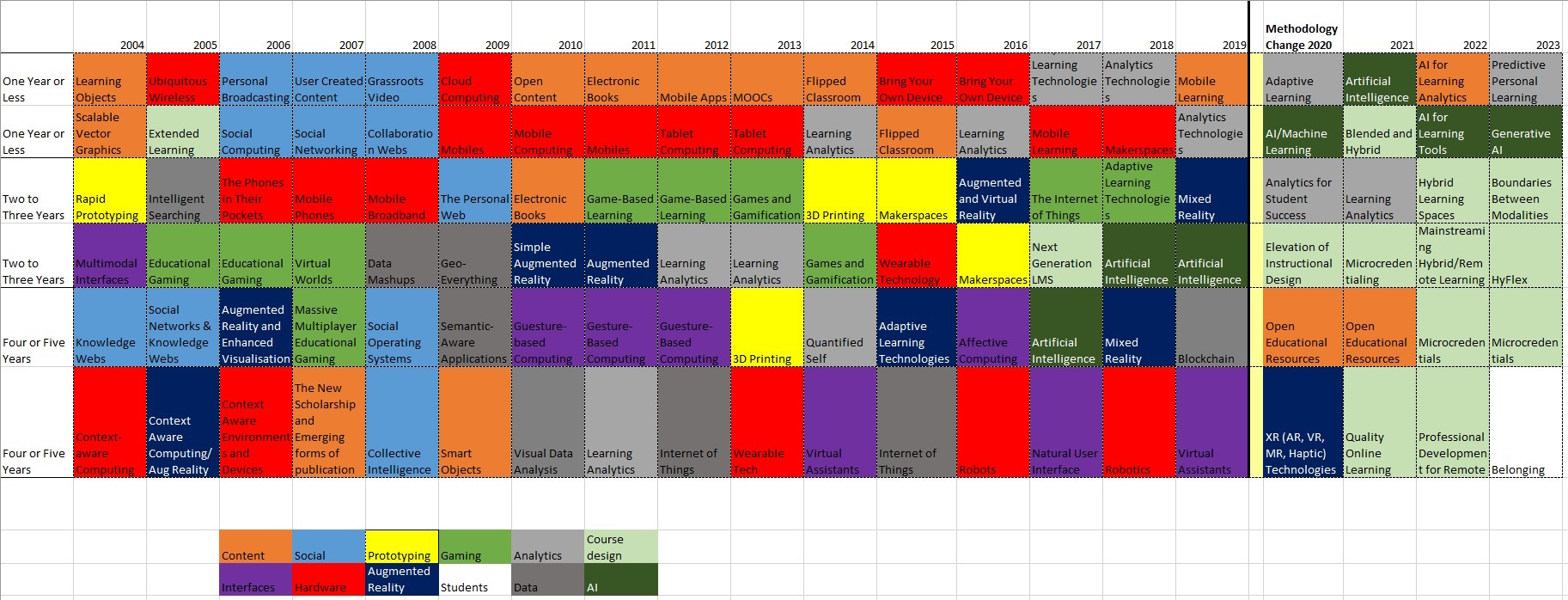
But there’s always an edge to predictions. Purely disinterested ones are rare. Back in 2015 I developed a typology that I want to briefly revisit:
- Flying car predictions are predictions that are really based on nothing other than “wouldn’t it be cool if…”. Flying car predictions are unlikely to happen, and most likely wouldn’t work if they did. The classical idea of a “moonshot” plan comes from this line of thinking, though moonshot-style ideas are seldom both successful and transformational. Flying car predictions are most likely to be commercial in scope – claiming something might be cool often goes hand in hand with selling goods or services that would make this otherwise unevidenced need fulfillable.
- Extrapolation predictions are based on an expectation that things will continue to progress in the way they are currently progressing. For the bulk of the modern era, predictions of this sort have been useful if not always accurate – increasingly these kind of predictions can be and are automated (and yes, we’ll get into that). “Black swan” events – rare but likely – most recently the 2008 banking crisis, the 2016 collapse of liberal society, the 2020 pandemic, and arguably the growth of the internet since the 90s, are the major disruption in this form of prediction.
Importantly, not all extrapolation predictions will agree with each other. The selection and interpretation of data may mean that an “extrapolation” prediction tends towards the “flying car” or “Swedenborgian” end of the spectrum
- Swedenborgian predictions (yep that’s a reference to the c18th Christian mystic, Dominic Cummings has nothing on me…) are similar to flying car predictions in that they represent wish-fulfilment, but are based a desire to be proven ideologically correct rather than a general desire for coolness. These are usually in opposition to prevailing trends, using conceptual language based around apocalyptic ideas (“the death of X”, “X is broken”….), but forecast a resurgence and prevalence of an alternative mindset closer to that favoured by the predictor.
It is possible to argue that “flying car” and “extrapolation” predictions are also “Swedenborgian” as they are predicated on the maintenance of our dominant ideology to at least some level. However, for the purposes of this presentation I have chosen to use this category only for insurgent ideology that is in opposition to the mainstream.
Each of these can either be an “expert” prediction – drawing on an established body of expertise that is distinct from information available from the market, or a “lay” prediction where information from the market is used in a way that does not require a specific domain expertise.
What I was doing in 2015 was to come up with and approach that would lead to a lay extrapolation prediction for education technology – using the public data that is what is presented at ALT-C to make an analysis of what might be now and next in edtech, and proving this by looking at how well the historic themes I identified mesh with other approaches (like the NMC Horizon scan) and our own fallible memories of the time.
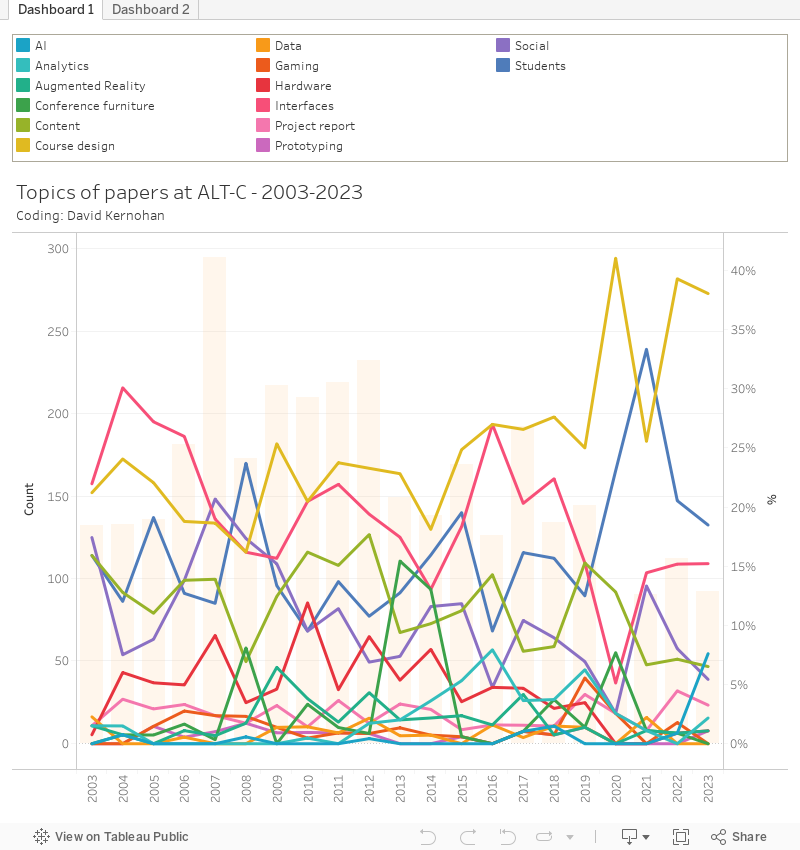
What I’ve done this time is to identify and code sessions from every iteration of ALT-C between 2002 and 2023. Here’s a chart:
And here’s a title explorer:
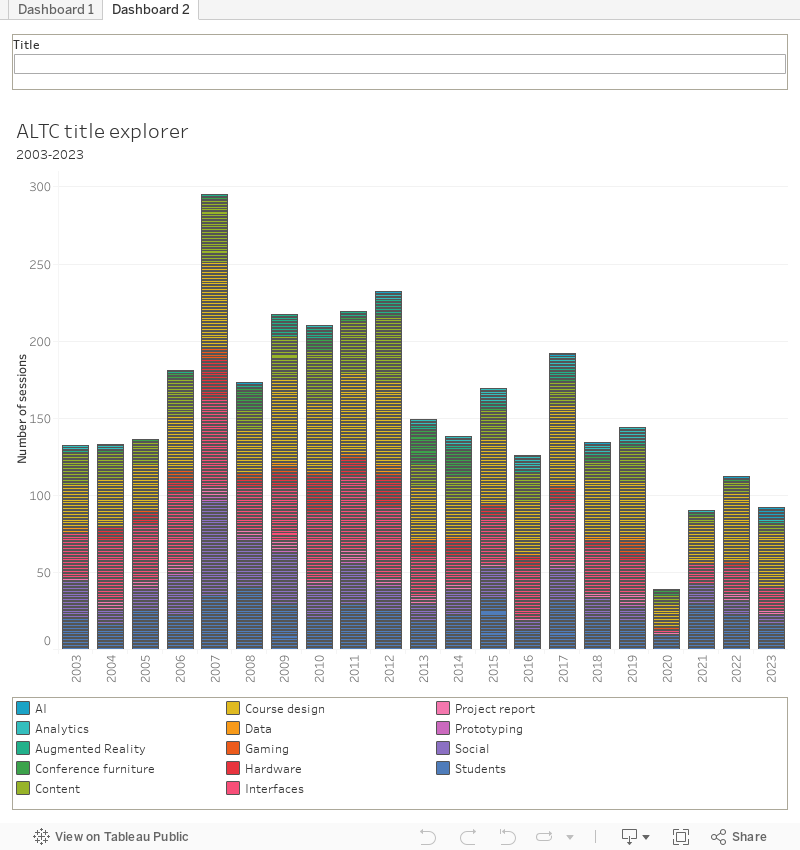
To show this working – note that nearly 20 per cent of all papers presented at ALT-C 2007 concerned social media approaches in some form, and nearly every entry on the NMC roster had a similar focus. We know that this was around (or slightly before) the peak of what we now think of as the Web 2.0 movement – folksonomies, PLEs, and all – and the fertile ground from which the cMOOCs grew.
It was a good time – for those of us who were there (I think it may have been my first ALT-C). But a lot of what we then thought, about the power and adaptability of social media approaches, has been shown to have major flaws. As Scott Leslie had it, “love doesn’t scale”.
To take another ALT-C perennial, virtual worlds (from augmented reality through the behemoth that was second life) there are three smaller peaks – 2009, 2012, and 2017. This doesn’t really mesh with NMC predictions, or with google trends. Have virtual worlds ever had their moment? Will they ever? On the evidence we’d have (logged on to the metaverse recently?), we need to predict that it will remain a background concern into the immediate future.
And with analytics – the use of what is administrative and management data to plot and predict student achievement and engagement – we see peaks of ALT interest in 2016 and 2019, but the idea has been bubbling under at NMC since 2014. Martin Weller, with the benefit of hindsight, pegs the peak at 2017.
As an extreme example, most of the sessions concerned with learning during a pandemic happened – as you might expect – since 2020. Apart from one – in 2010 Jane Mooney, Pete Driscoll, and Lee Griffiths presented “Pandemic planning – from paper to pixels”. The abstract tells us (and abstracts for anything at ALT are few and far between at this point) about a means to support problem based learning in public health planning using a Nintendo Wii and a projector.
In conducting a thematic analysis of the discussions that take place at ALT-C (an annual academic conference concerned with education technology) I’m very likely to get bogged down in methodological questions as much as I am the history of edtech (such as it is possible to speak about such a thing).
Every experience of ALT-C, or the wider conversation around education technology, is a subjective one – though I can talk about what might have been on offer across the whole conference I can only offer my interpretation about what was discussed. We all do this – we have this ability to scan a programme and decide what is of interest to us and what is not. We can do it in a variety of ways, and filtering by topic is just one of them.
Likewise, any assessment of the wider sphere of edtech at a given point in time can only be that of the people who are doing the assessment. If you look at something like the NMCs Horizon Scan (or even something as ostensibly organic as google trends) you see the interpretations of the loudest, or the keenest – or even those with most to sell.
We can’t ignore the surrounding context either. From the early 00s through to around 2012, large numbers of ALT-C presentations exist because Jisc funded projects that needed a dissemination strategy – so in ALT presentations we are getting a round up of what Jisc was funding in the years previous to each conference. Some 30 per cent of presentations at ALTC 2004 were about what I’ve loosely called interfaces – ways to use computers to introduce students to content and assess their performance – because in the early 00s Jisc was funding experimentation around the MLE/VLE/LMS under the aegis of the IMS interoperability standards portfolio.
What of it? Well, the MLE we dreamed of is not the MLE we got, but looking back through the titles the concerns are the same. How do we drive engagement online? How do we make these approaches accessible to groups of students with specific needs?
So, in looking through these records there is a circularity in concerns that tells us something else – either that some problems are never going to be solved, or that as a community we need to get better at learning from our predecessors. And we could be forgiven for the latter on the grounds that even finding out what was presented at a previous ALT-C is not easy.
In pulling together the data that underpins this visualisation, it was comparatively late in the day that I found any documentary proof that ALT-C 2008 ever happened. Which is bizarre, as I was there. The combination of a collapsing “web 2.0 for conferences” start-up and the vagaries of web archives meant there was no list of papers at ALT for that year available anywhere. In the end I had to ask Maren to scan the single available hard copy in for me.
The data I have (and will release) openly is of varying quality. There’s an inconsistency in the type of information I have been able to find – as timetabled, as presented, even as submitted. I’ve not had the capacity to clean (or in some cases transcribe) the data as well as I might have liked (and I want to thank Learning Technologist of the Year 2008 Vivien Rolfe for her help there). I stopped at 2003 because I only have data for one day of ALT-C 2002 – there’s nothing for 1996 or 1998 at all.
And the purpose and format of ALT-C has changed over the years too. The first ALT-C, in 1996 happened in Hull – and had the overall theme of “Enabling Active Learning”. The aim, as expressed in the conference brochure, was to identify WINNING SOLUTIONS – “from corporate strategy to courseware design, from supporting students in the use of technology in learning to the inspired use of tools and techniques”.
Being a “learning technologist” back then wasn’t really a job – more a part-time vocation for enthusiasts (and those supported by a range of funding available from HEFCE to explore such questions). ALT itself came from the HEFCE funded Computers in Teaching Initiative (CTI) as an interest group for mutual support more than a means of dissemination. CTI of course, is one of the main roots of what became (eventually) Advance HE – much of what is now the independent system of quality enhancement and teaching innovation began as funded interventions at a time when the improvement of teaching quality in higher (and further education) was seen as a national priority.
So that’s a lot of words to say that all this is, like, just my opinion, man – and you might wonder why I bother, given that subjectivity is hardly a novel or complex idea. On the other hand, I am – by profession – an observer and interpreter of Things. In other words, a journalist. And though I’ve held various roles at the intersection of education technology, education research, and public policy it is not hard to conclude that I’ve basically always been a journalist and thus a professional observer of things. They say, after all, that journalism is the first draft of history (and I said, once, that blogging is the notes you make before you start writing). What I am getting at here is that you might chose to trust my interpretation because I do a lot of this kind of thing – but you shouldn’t take everything as an accurate description of the moment.
The lifespan of ALT – as Martin Weller notes is the lifespan of the internet. Sure, there’s been edtech before that, and there will be edtech after the internet too. The early 90s marked the end of what Eric Hobsbawm called “the short twentieth century”, characterised infamously by Francis Fukyama (in a book more cited than read these days) “the end of history”. It was clearly the end of something and the start of something else – and if that something else was the internet it feels like things are drawing rapidly to a close once again.
ALT has primarily focused on connected technology as a force for good – in education, and by extension, in culture. This has been alongside rather than against the dominant narrative of the time – we’ve seen a push to get students onto the internet change into a need to protect them from it, and a policy presumption about the radical reform of higher education on digital lines shift towards protectionism based on an (imagined) pre-lapsarian age.
We can’t really see education technology per-se outside these trends – the surveillance state and the quantified self both have more than a little to do with analytics. The skills agenda is at least partially an unskills agenda – replacing expensive undergraduate degrees with bite-size modules.
The days of “internet as force for good” may be passing – the days of “social media as force for good” have long since gone – but there are further days ahead in the grand story that is using technology in higher education. And ALT will be there for it.
[Data] (.xlsx)
]]>You’ve probably got one in your pocket.
Open your phone, type these words into a text message and press the middle option. Predictive text just guesses the next word rather than the next phrase, but the principles are similar to the way that the current wave of “generative AI” works.
There’s a thread that goes back to the dawn of computing – Colossus (at Bletchley Park) was pretty great at guessing the next value in a series of encrypted messages despite having less processing power than your oven (albeit the two probably have similar heating power) .
What’s next?
Pattern matching is something that computers do really well. Given a large amount of data, it is trivial to come up with a statistically likely response to any given stimulus. It’s also not that hard to frame this response as a part of a conversation – Joseph Weizenbaum’s Eliza used a simple set of rules to impersonate a psychotherapist back in the 1960s. And if you are impressed with the ability of a computer to parse natural language, may I direct you to Ask Jeeves?
Again, the more data and the more processing power you can throw at stuff like this, the better the response is going to get. Having, as a planetary culture, spent the last 25 years creating a machine-readable repository of text and other creative outputs – and having followed Moore’s law to the point of physical constraint – the conditions for tools that can use data to return a statistically likely human-like response are better than they have ever been.
As with much in life, you have to keep thinking about the data rather than the output. Emily Bender’s famous characterisation of the most recent wave of tools as “stochastic parrots”:
haphazardly stitching together sequences of linguistic forms it has observed in its vast training data, according to probabilistic information about how they combine, but without any reference to meaning
reminds the reader that any semblance of insight and intelligence you see in a ChatGPT response comes from you. A chatbot doesn’t care about being right – it is designed to give you an output that looks plausible.
Norwegian blue
Our predictive text example is of a system that is designed to come up with a plausible next word. If you kept pressing the middle button your sentence would have drifted away into a nonsense – the system is not designed to come up with a plausible next phrase or sentence. Chatbots are designed to come up with a plausible response overall – for example, when you ask for “250 words” it will give you around 250 words because most successful responses to prompts that include the phrase “250 words” do that. If you ask it for a working computer programme it will do that, because that is the most likely response to a request for a working computer programme.
What if you asked it for a first class university assignment? Or gave it the rubric and asked for something that meets every response?
It’s here that we have to take pause and think about data again. What dataset could it plausibly have to help it do this? I don’t know for sure, but my guess is there are a lot of undergraduate essays and undergraduate style essays online (and even more in certain commercial databases that the sector has been quietly feeding for more than a decade), and some of them may have grades attached. So we can assume it will give you an assignment that is statistically similar to ones deemed to be “first class”.
Exam board
“Plausible” and “similar” are impressive, but they are a long way from “good”. We don’t really have enough data to know whether systems like this are able to reliably write good essays – we know that they have written some good ones and some terrible ones, and we know that academics (and commentators) have made their own assessments of these.
But the point is that it is fairly easy for a computer to test if it has written 250 words – it can count them (computers are great at counting). It is also fairly easy for it to test whether it has written a working computer programme (computers excel at running computer programmes).
Despite arguments to the contrary it is not easy for a computer to grade an essay in anything more than a very functional rubric-informed way. If your rubric says a first class answer must quote critically from sources your chat bot will do that – but as we have found it doesn’t really care if those quotations or sources are accurate or meaningful. It can judge if a response is under the world limit, or if it deals with the issues it is supposed to deal with. It can’t judge if the argument is well made or if the writing is convincing and original because it doesn’t know what those things are.
We could of course give it rules covering how to do that. These are questions that linguists and philosophers have grappled with for centuries – but should they ever finish this work (spoiler: they won’t) that would be an option.
Group test
So let’s look at a competing technology – academics. Academics may not be great at counting, but they have computers to do that for them. They’re not always fantastic at storing and retrieving information, but they do have access to libraries and search engines. But they are really, really good at this intangible and difficult to describe work that computers struggle with. Academics are spectacularly good, for example, at identifying bullshit.
As the current generation of large language model chatbots are designed to produce bullshit (and do an excellent job, kind of like a digital Boris Johnson). If you’ve read James Ball and Andrew Greenway’s Bluffocracy you are probably already thinking about Oxford’s PPE course – but, contrary to that fairly cynical reading, you need a lot more than just plausible nonsense to get through a PPE tutorial.
For some this is a dark pattern in academic life – the Potter Stewart formulation (“I know it when I see it”) for is for some a castigation of everything that is arbitrary about the judgement of the professoriate. You can’t take an “academic judgement” case to the Office of the Independent Adjudicator precisely because there is no way of testing it. There’s no real way of distinguishing an essay with a mark of 57 per cent and one of 56 per cent – this is why we use multiple markers and moderation boards.
If you think, in other words, that ChatGPT poses a clear and present danger for the validity and sanctity of the higher education process there is both good and bad news for you. The way that higher education works means that the risk is not as great as you think, but the sausage machine is a very messy (but effective) way of making sausages.
A matter of semantics
I want to close my argument by thinking about the other major strand of artificial intelligence – an associative model that starts (in the modern era) with Vannevar Bush and ends with, well, Google search. The idea of a self-generating set of semantic links – enabling a machine to understand how concepts interrelate – is probably closer to the popular idea of artificial intelligence than toys like ChatGPT.
Research in this field continues, but at a much lower ebb than the historic boom of the 1960s and 1970s. In UK higher education the 1973 Lighthill Report led to the dismantling of work like this (and the linked, but even more far-fetched, approach of directly modelling the way human brains work) on the grounds of a vanishingly low likelihood of success. It led (along with similar decisions in the US and elsewhere) to what has been described as an AI Winter – where much of the field, and the fanciful projections that drove interest in it, were abandoned.
Clearly, the work continued (hence, frankly, Google – and who remembers the 00s moral panic about higher education in a world of instant information retrieval?) but it was focused on solving problems rather than the general goal of a recognisable artificial intelligence. For me (and I’m a serial technology pessimist) the longer term benefits of chatbots and related technologies will be focused on optimal discrete use cases in a similar way.
]]>It was a cold grey day, a cold soft rain. Michael Barber was in his office, trying to maintain the golden years – which are still to come. Just sitting at his desk, writing all alone.
Then he put his consultation on the internet, it’s all about the mission of the OfS. See a site full of files (some needed a tweak), the main one ended up being two or three.
No fee link for the TEF – he can’t believe they blew this. So he made it a requirement and they all had to do this. The sector started reading and they said “what’s up? – what’s the deal with these metrics?”. Michael said “I’m stuck”
“Since there’s no fee link they might give TEF a swerve. But I’ll hide it in these docs and I’ll keep my nerve. I need to think of better things than NSS metrics, and put some lead indicators in the mix”
So the register’s a fact, and he wrote it himself. With a registration fee so he can share some wealth. No money for the DBs, no cash – no cheques. Doug Blackstock stepped back and thought “damn, what’s next?”
They’ve got the sector hemmed up and they’re all around, and there’s none of them expect the OfS will come round. If the finance gets irregular they start to clown, they’ve got powers of entry so the institutions go down.”
There’s reportable events and they make Michael seethe. He can’t believe they’re happening without his leave. If he had data he could check, but then he thinks “yes”, he spots the crew from the OfS.
“Six negative flags and their balance has a hole, auditors about to make this uni go cold. Now they’re writing to the Times but it’s a tad bit late – OfS has the power to regulate.”
“They shut the uni down and let the place explode, then they switched their minds back to monitoring mode. If you want ratings sit back and admire, there’s four other places going to go to the wire.”
“Now we’ve got the data, and that’s a known fact. Primarily for those on the Approved track. Back up, back up, because it’s on – OfS and me – the Michael to the B.”
Just like we thought, they were in the same spot – in need of some desperate help. OfS and the B-child were in need of financial health.
One of them unis was dodgy as hell, and said “ooh, recruitment rises – but my processes are broken and the drop-out rates are high, but please don’t come inside””
We’ve got a sector full of students and it’s going real swell. Next stop is the Russell Hotel.
We’re checking – for your data errors. Submit to HESA late – we dare you. Metrics – don’t tell us to shove it. “QA is the base and the TEF is above it”
Approved – fee cap – Tier 4 – we brings – Clarity.
OfS – we’ll even regulate you as a charity.
Background: people kept saying “Regulators – mount up!” round about the time the OfS was being set up. I wrote this and it was shared around Wonkhe, and now the time has come for you all to share the joy.
]]>I was meant to write one and didn’t – more than any other year the list of unconnected events and strands from previous decades reaching an unsatisfying conclusion refused to coalesce into a satisfying (in a purely literary sense, which is the best we can hope for) story.
We end the year almost as we started it – a declaration that Brexit is “done” belies years of hard, technical, negotiation ahead of us. Not even Boris Johnson has the balls to claim the pandemic is “done” – though the emergence of vaccines is hopeful the continuing mismanagement of measures to contain the virus (always too little, always too late) has already seen one homegrown mutation put the UK at higher risk. We are blessed with a government that sees getting to the end of a news cycle unscathed as a major achievement – the cabinet simply does not have the range to look further ahead.
But here I am, rattling on about 2020 having already offered myself the caveat that a summary of the year is impossible. We learned a new phrase in the last 12 months: “reasonable worst case scenario”, when uttered by or near Michael Gove it proved the best guide as to what was likely to come next. For 2021 I present an “unreasonable worst case scenario”. This is stuff that could happen, but probably won’t. Hopefully it will offer a little catharsis – things surely cannot be this bad. Can they?
Happy new year.
January
With the wheels coming off the shiny new EU/UK trade deal at speed – fishermen, farmers, and financiers are just the first among many groups to feel the pain. Emergency legislation allows for the recognition of overseas qualifications for health care, engineering, and veterinary science – forestalling three major crises, but every day brings a new issue.
For the man and woman in the street one “brexit bonus” is a rise in price and a drop first in quality and then in availability of fresh fruit and vegetables. The first articles about the possibility of rationing appear in the ever-war-obsessed Mail, leading to noisy rebuttals from the government.
In the US the Georgia run off elections are tightly contested – one Democrat and one Republican join the Senate, just in time to see Vice President Mike Pence refuse to count electoral college votes from “disputed states” and attempts to declare Donald Trump president. Constitutional scholars settle in for another painful year – it is clear that Biden will become President eventually, but the path is complex. There are violent demonstrations in major cities.
The pandemic rages on in the UK – England enters “Tier 5” en mass, with schools and universities mostly (there are many exceptions) teaching online. Those academic and teacher trade unions that have not already balloted for industrial action do so. The vaccination process is in chaos as it emerges incomplete instructions (incredibly, the last page of a pdf was corrupted) have led to many doses of the Pfizer vaccine being lost, and production at scale of the Oxford/AstraZeneca vaccine is delayed due to slow development of UK chemical safety regulations following a decision by the Science Minister to diverge from European REACH standard and a huge backlog of freight at UK ports.
One bright point sees Boris Johnson resign on 31 January. Citing continued health problems (rumoured to be long Covid) his speech in a blizzard outside Downing Street sees him luxuriate in having delivered a brexit deal and “beaten” the virus – he announces an end to Tier 5 next month.
The sunlit uplands are just over the next brow. But I am not the one to lead you there. The work has been done, now a new leader will help us reap the rewards.
February
Joe Biden formally becomes the 47th President of the United States, in a delayed, indoor, small scale inauguration (the first in history) following a Supreme Court ruling and a change to the 20th Amendment. Trump has not gone quietly, taking to YouTube to share increasingly bizarre conspiracy theories as Twitter finally ban his account. A sizable minority of the US population respond to his invective about the size of Biden’s crowd and his “ratings” taking to the streets as the combination of several new strains of Covid-19 and a severe winter storm make the streets a very dangerous place to be.
Storms (in particular Storm Gavin) bedevil the launch of the Conservative leadership contest too. The field is missing some notable big names – Liz Truss and Priti Patel have been “encouraged” not to stand, as rumours suggest very negative stories (eye-wateringly so in Truss’ case) are set to emerge. Sajid Javid declines to stand for “personal reasons”. Michael Gove and Rishi Sunak are the early favourites, but eyebrows are raised as Liz Truss and Esther McVey endorse the unlikely candidacy of Gavin Williamson.
There are reports of significant food shortages in some less accessible areas of Britain – the Scottish Government signs what is almost immediately described by UK caretaker PM Michael Gove as an “illegal deal” with the EU to fly produce directly to Thurso and Inverness.
Schools and universities are still online for most learners – and there’s concern at the Department for Education as a group of undergraduate performing arts students call for a judicial review of a recent refusal to countenance fee refunds in the light of an inability to perform. Gavin Williamson is on typically combative form:
If universities cannot provide high quality education to students then they should refund their fees. This is not a matter for government
March
It emerges that Michael Gove’s first conversation with Joe Biden went excruciatingly badly. The US ambassador confirms that there is “no appetite” for a deal with the UK, and encourages the UK to rejoin the EU and join negotiations for an “unprecedented” EU-US deal. In a speech, Biden describes the UK as an example of the fractious and divisive politics the US needs to move away from. Gove withdraws from the leadership contest.
Most of the UK is focused on the perilous state of the NHS. Covid cases keep rising, and the vaccine appears to be of only limited use against several new strains in circulation. On the eve of the Budget, it emerges that a lack of available staff has caused two large hospitals to close their doors to new patients.
Once again faced with placing spending plans on hold to deal with a new crisis, Rishi Sunak opts for radicalism, and introduces a £25 “covid charge” for GP and hospital visits, time limited for three months. The ensuing uproar nearly topples the government, and Sunak immediately withdraws the plan and stands down from the leadership contest.
Announced alongside the Budget, the government response to the Augar Report sees tuition fees reduced to £7,500 for most courses, but government support unavailable for many subjects deemed “inessential”. UCU immediately begin a strike, and thousands of students join them. Gavin Williamson’s response is typically dismissive – he introduces the Universities (Free Speech and Academic Freedom) Bill, winning positive reviews from the conservative-leaning press as he enters the members vote for the leadership in competition with Foreign Secretary Dominic Raab.
Manchester and Liverpool join Scotland in securing supplies of fresh food via a deal with the EU. As most of the EU, and indeed most of the world, is seeing Covid case numbers fall, there are concerns in the European Parliament about the safety of those making the deliveries. The increasingly embattled Michael Gove declares these deals a breach of international law, and crashes the remaining Brexit negotiations out of spite, three days before the deadline. This particularly hits the logistics industry, who were hoping for an end to complex additional customs declarations made via a government IT system that is manifestly not fit for purpose.
Nissan, Airbus, BMW, and many others close UK factories.
April
Just two months away from his centenary, Prince Philip passes away peacefully in his sleep. The Queen is devastated – there is a national outpouring of grief and sympathy. A subdued state funeral sees one unlikely shot of the stoic and unflappable queen alongside a clearly emotional and gesticulating Gavin Williamson go viral – the internet wag who added the caption “Ooh Betty” faces death threats. “Some Mothers Do Ave Em” is quickly removed from BritBox but becomes an unlikely international hit.
This new found fame and “meme value” sees Williamson win the leadership election, and take office as Prime Minister. There is no large reshuffle – the new PM claims “Britain expects me to get on with the job.”, but Esther McVey becomes Secretary of State for Education, and Gove returns to the back benches.
Williamson’s first acts are divisive and petty – he warns the EU that future “illegal” imports will be met by military force, and sets up a “Commission on British Values” (led by the newly enobled Toby Young – Lord Young of Greater Bristols) in response to what he describes as the “out of control” liberal media, though it is widely seen as a response to the continued proliferation of Frank Spencer memes. These acts particularly inflame the devolved nations of the UK, with Nicola Sturgeon seizing the initiative ahead of May’s elections.
A dark day for Britain sees the total number of deaths with Covid passing 200,000 – with much of the recent peak attributed to the almost total collapse of the NHS. Staff are exhausted and – in many cases – seriously ill. Vaccines are effective against some, but not all, currently circulating strains – the urgent need for new vaccines is noted abroad, but at home staff at Oxford join university colleagues for a symbolic single day of the ongoing strike.
All this is eclipsed as the long-over due eruption of Mount Vesuvius sees a major international humanitarian effort as millions living in central Italy are displaced – the plume of ash grounds all flights in Europe and food and medicines are transported by sea, road, and rail. Due to the continued high level of Covid-19 infections in the UK, aid volunteered is rejected.
Those grounded flights include the “illegal” flights carrying food to parts of the UK. Some areas of Scotland, Wales, and the North of England are now facing severe food shortages – riots break out in smaller towns.
May
There have been calls to postpone the elections in Scotland and Wales – but the anger in both countries ensures that both continue, albeit using online voting. The results are astonishing – the huge SNP victory cements Scotland as almost a single party state, and unprecedented gains by Plaid Cymru sees them hold the balance of power in Wales. Both devolved governments seek permission to hold a referendum on independence, as does Northern Ireland – which has grown closer to the Republic of Ireland as the latter has provided food and financial support. Prime Minister Williamson angrily refuses on all three counts.
The Government is wiped out in local elections in England – Labour retains London, but the big news is the swing to Nigel Farage’s “Reform UK” party. Promising an end to lockdown restrictions, the party now controls many local authorities. It refuses to co-operate with current and future national government anti-Covid measures, citing research shared on a local Facebook group.
With flights still grounded across Europe as the Vesuvius ash cloud persists, the food situation in the UK is becoming perilous. The French decision to close the border in the light of a continued growth in Covid cases makes the UK a genuine “island nation” – Williamson, in the face of worsening food riots, introduces rationing and mobilises the Army. Currency speculation forces a devaluation of the pound – many choose to keep their savings in Euros. Matt Hancock resigns as health secretary, before disappearing in mysterious circumstances. Rishi Sunak resigns as Chancellor of the Exchequer and from parliament – he takes a job in Frankfurt.
The Eurovision Song contest is cancelled.
June
With the school year nearly over, year 11 and year 13 students are still expected to sit final exams despite being taught online for the entirety of 2021. McVey, backed by Williamson, postpones GCSE and A level exams until August and declares all university offers null and void until final results are known. The UKs teachers take action short of a strike and refuse to administer the exams.
In the US, an explosion in Richmond, VA during a Presidential visit is initially attributed to “Continuity Trump” forces. It is the only such event in what is widely seen as a successful first six months of the Biden administration- Covid-19 cases in the US are falling after a successful vaccination programme and the economy is finally beginning to stabilise. However it emerges that the bomb was a part of an assassination plot funded by the government of North Korea, prompting global condemnation. There is no statement from North Korea.
Though the delayed Euro2020 has now been cancelled, Europe is beginning to return to normal and flights resume – restablishing food deliveries to the areas that have signed a deal with the EU. Williamson again warns that such deliveries are illegal, but as rationing continues other international agencies (such as UNICEF, the Red Cross and the World Bank) join the scheme – delivering sorely needed food and aid to most parts of the UK.
It emerges that French President Emmanuel Macron recently described Britain as a “failed state” at a European Council meeting – this language is leapt on by pro-independence campaigners in Wales, Scotland, and Northern Ireland. Each nation has opted to conduct a “non-binding advisory” referendum, to be held online on the same day in September 2020. Dominic Cummings re-emerges from a basement in Durham to lead the “stronger together” campaign.
July
The world is shaken as Russian President Vladimir Putin is assassinated in Novosibirsk. Again, initial assumptions that internal opposition was to blame are shattered as once again all signs point to North Korean state activity. This time North Korea does respond, angrily dismissing the charges and asking for clemency and support following the recent death of Kim Jong-Un. A power vacuum at the top of both Russia and North Korea sees Joe Biden put US forces on a state of high readiness.
The UK armed forces are still busy managing food rationing and emergency medical treatment – Covid-19 cases at last seem to be subsiding as a late summer finally sets in. The huge economic damage the extended pandemic, coupled with brexit, has wrought becomes painfully apparent, and Prime Minister Williamson seeks an emergency loan with the IMF. The terms of this loan require the full-scale privatisation of education and health provision – two systems that are now almost completely non-functional in the UK. In parallel, the EU offers an aid package including financing without such stringent conditions should the UK choose to rejoin the EU.
Williamson loses the key vote on the IMF package in the Commons, but an SNP motion on rejoining the EU also fails to pass. Dominic Cummings resigns from “Stronger together”, posting an 8,000 word blog post that describes Williamson as a “gangling ignoramous”, and quotes Vannever Bush, Eric Raymond, and General Otto von Bismark, before announcing Cummings’ attention to move to Russia.
Britain is refused permission to compete in the 2021 Tokyo Olympics – the prevalence of Covid-19 is deemed too high and the risk of infection too great. It is noted that the impact of rationing and poor health care on elite athletes would render the team uncompetitive anyway, but after a bleak six months it is seen as an exemplar of how low Britain has fallen.
As was widely predicted, A levels and GCSEs have been cancelled in England for 2020-21, but with teachers still on strike, there are no alternative measures that can be used for college and university admissions.
August
Eight months after Brexit and Europe looks very different. A widespread pride at the way the Vesuvius eruption was handled has driven the public mood away from the dalliances with populism seen in 2019. Continued problems in Britain has seen Frankfurt establish itself as a global financial centre. But, although both Switzerland and Norway are now applying for membership, there is concern to the east.
No clear leadership has emerged in Russia following the death of Putin. There are several regional groupings seeking independence, and the situation appears to be changing almost daily. The US has moved armed forces into both Eastern Europe and North Korea, the latter secretive state having turned uncharacteristically quiet.
In the UK Secretary of State for Education Esther McVey has declared her intention to “reset” the 2020-21 academic year. The idea is that learners at all levels (from primary to university levels) should simply retake their current year of study starting in September. No additional funding is offered for this. The university and school staff industrial action, scheduled to come to an end later this month, is extended indefinitely.
The revised Oxford/AstraZeneca vaccine is being distributed through the UK population by the Army. Case numbers are dropping, but deaths are still rising due to poor nutrition as rationing continues and the impact of long Covid. Farmers across Europe report that the spring Vesuvius ash cloud has caused “substantial” damage to the 2021 crop, and another poor harvest is forecast. The EU indicates it will be forced to cut back on food aid to the UK. It will be a hungry winter everywhere.
September
The Young Report (the “Commission on British Values”), timed to be released before the referenda in the devolved nations, calls for a list of “protected cultural symbols” to be defended in law. The proposals see the works of Roald Dahl, JK Rowling, Enid Blyton and the collected writings of Jeremy Clarkson given a special protected status, along with the Robinson’s Golliwog, school Nativity plays, the postcards of Donald McGill, Irn Bru, daffodils, bowler hats, and Carry On films. Disparaging them is to be met by fines or a prison sentence. An annex suggests that Student Unions will be required to host five speakers from an “approved list” in order to maintain charitable designation. Given the current state of basic services in the UK, the report is met with global hilarity.
Scotland and Northern Ireland vote overwhelmingly for independence in advisory referenda. Leave also wins, though less convincingly, in Wales. The three nations join together to seek negotiations with the Williamson administration, and when rebuffed each unilaterally declares independence. Northern Ireland announces it is to seek an “ever-closer union” with the Republic of Ireland, Scotland and Wales apply to a specially created “fast track” to join the EU, and adopt the Euro as currency.
England has been blindsided by what Gavin Williamson describes as a “constitutional coup”. His arguments about the referenda being “advisory” and “non-binding” fail to convince even his own backbenchers. The 1922 committee chair receives more letters than he can count, and Williamson is forced to stand down. A tearful valedictory speech sees him propose to return to his true calling in fireplace sales.
The second leadership election in a year sees few names go forward. Esther McVey is an early frontrunner, as is a surprise bid from Jacob Rees Mogg. All of this is too much for Queen Elizabeth II, who announces her intention to abdicate in favour of her son, Charles.
Amid all this, the announcement that Covid-19 restrictions will end passes almost without comment. Around 60 per cent of the UK is estimated to be vaccinated or to have antibodies against the dominant UK strain of Covid.
Disturbing rumours suggest that Dominic Cummings is pulling strings behind an ongoing Kremlin power battle that shows no signs of subsiding.
October
A private space mission run to resupply the international space station sees an unmanned cargo rocket explode over Siberia. Terrifying at the best of times, the disaster sees US and European military placed on the highest level of alert, and covert operations conducted in both Russia and North Korea.
The latter finds a starving and impoverished population suffering from a new variant of avian flu – shocking pictures show corpses literally lining the streets. International concern yields a statement from new “supreme leader” Kim Yo-jong, who blamed internal dissidents for the deliberate spread of a biological weapon.
Dominic Cummings is declared “interim administrator” of Russia and announces an intention to restore the house of Romanov. The California-dwelling heir to the throne of Russia, 98 year old Prince Andrew Romanov, preemptively accepts the title Emperor.
In the UK industrial action has ended, and schools and universities are beginning to return – teaching the 2020-21 academic year for the second time. Funding for this is provided by a further devaluation of the pound by interim prime minister Sajid Javid – most people in the UK now have savings in Euros or US dollars and many international agencies are expressing concerns about UK finances.
After his coronation, King George VII, indicates his acceptance of the independence of Scotland, Wales, and Northern Ireland. It is seen as a constitutional novelty, but – in the absence of a fully functioning Westminster government – a necessary one. Wales and Scotland join the EU, Northern Ireland becomes an “autonomous region” of the Republic of Ireland. Aid and food flows into the nations, who end rationing. Restrictions remain in England, and the NHS has largely reopened – though it is running very low on medicines and supplies.
Jacob Rees Mogg is set to become the first High Treasurer of England since the sixteenth century, after King George’s permission removes the bar on practicing Catholics holding political power. The Church of England sees disestablishment.
November
The UN Climate Change conference takes place in Glasgow, in a newly independent Scotland. Rees Mogg pointedly refuses to attend. A poorly maintained oil storage facility – which saw routine maintenance delayed during the extended UK pandemic -situated off the North East of Scotland develops a catastrophic leak, endangering the coastline and marine life.
This provokes international condemnation, which lasts all of three days when it emerges that an RBMK reactor near St Petersburg appears to have developed a critical fault. Interim Administrator of Russia Dominic Cummings insists that the situation at the obsolete reactor is under control, but a plume of radioactive waste is spread by the first of the major winter storms (Storm Wilson) and contaminates the majority of arable land in north-west Europe. Thankfully a major explosion is avoided, but Russia admits that the remaining RBMK reactors should be shut down immediately.
This increases Russian reliance on gas powered generation, pausing the established trade in natural gas and plunging parts of Europe into darkness. This in turn causes the EU to end the agreement allowing the use of the IFA, BritNed and Moyle interconnectors to bring power into England- and additional hydroelectric power capacity from Wales and Scotland is diverted to the continent. A series of rolling blackouts begins in England, which now faces a severe lack in generation capacity. Most remaining factories start a three-day week.
Worrying reports of a highly infectious strain of avian flu emerge from garrisons in South Korea. Analysis finds that this is the same strain found in North Korea, and is natural in origin – not a biological weapon. The strain spreads quickly to other parts of the far east.
December
The year ends in darkness in England, as power supplies dwindle and food rationing intensifies. High Chancellor Rees-Mogg calls on the English people to display their customary resolve and pluck – the English people burn effigies of him and begin food raids over the Welsh and Scottish borders. King George calls for peace and tolerance – the governments of Wales and Scotland agree at his urging to send what little food aid they can to England. With the 2021 European harvest ruined rationing of some items also begins in the EU.
Borders are closed quickly as the new strain of avian flu spreads fast, but the first case reaches England (a smuggler from Spain) early in the month. The infection rips through a weakened and starving English population, with the NHS quickly unable to cope.
US astronomers spot a previously unidentified comet passing through the orbit of Mars – the shape and trajectory hid the object from most telescopes. On YouTube former President Trump describes it as “fake news”. It is estimated that there is only a 15 per cent chance that it will pass near enough to the Earth to be cause for alarm. The new avian flu pandemic hinders international action, and it is decided via a Zoom call to which England is not invited that there is no meaningful countermeasures that can be taken. It is all up to luck.
High Chancellor Rees-Mogg releases the Pearce Review of the Teaching Excellence and Student Outcomes Framework. Nobody cares.
]]>I’m not ashamed to admit to being a ds106 radio lifer, and the station has beautifully sprung back into life over these past weeks. At worst, you’re going to hear WFMU (no bad thing!) and at best it will be new and old radio friends turning up to share music and news.
I’ve heard vinylcasts, looper pedal casts, dj sets, and loads of general music and chat from all over the world. Not bad, but how do I join in?
Now station kingpin Jim Groom is an internet millionaire, he uses one of them fancy-pants Apple Macs to broadcast – his documentation covers all the Ladiocast and Soundflower info you might need to run a show from your own room if you own a hosting company and/or a stupidly overpriced laptop with funny software.
For us regular working folks, who might enjoy windows computing and the odd shotgun, the process is different. You’ll need to put a banana in your butt.
A what now?
That’s right.
Have a banana…
Voicemeeter Banana is a spiffy donationware mixer that grabs various bits of audio from your Windows PC and allows them to send them where you need to. It’s an install that involves a restart, but ends up giving you a lot more power over the noises your machine makes. You’ll want to pin it to your task bar as you refine your set up to include your working life alongside your secret DJ side.

Click on the hardware inputs at the top (there are three if you need them) and assign your microphones. Assign a hardware out (usually A1) to whatever makes your headphones/speakers make noise. If you’ve got spare sound outputs, assign them to A2 and A3.
To get other noises in to the mixer, set your default computer output to VoiceMeeter Input. Click on A1 next to the fader so you can hear it in your headphones. If you are feeling flashy you have an Aux input you can assign something like Skype to. For some programmes you may need to manually set the output to VoiceMeeter Input. Test this first, you should see the lights move up and down on the mixer.
Flying your Banana is largely done using the buttons next to the fader on each channel. A1-A3 send your signal to one or more physical outputs, B1 and B2 send to your virtual outputs. It’s these you need to broadcast.
What what in my butt?
BUTT stands for “Broadcast Using This Tool”. This is the magical piece of software that grabs audio from your PC and hurls it up onto the radio! There’s no clear license, but if you find yourself using it a lot do donate to the developer.
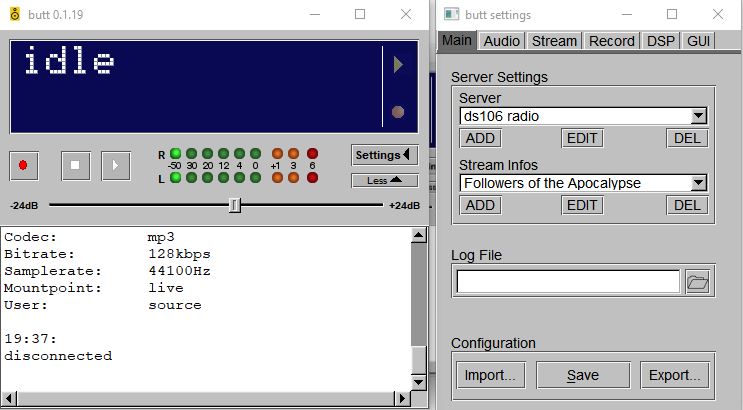
Open up your butt and click on settings. Now we will gently insert your banana into your butt by clicking on the Audio tab and selecting VoiceMeeter Output (which corresponds to B1) on your banana.
For DS106 radio broadcast, you’ll need to set your codec to MP3 and choose a bit rate. I tend to use 128k but anything up to 192k should work – do be mindful of the quality of your internet connection and that other people may be using it!
Now click on the “Main” tab and “Add” a server. For ds106 radio the settings are as follows:
- Name: ds106 radio
- Type: Icecast
- address: ds106rad.io
- port: 8010
- IceCast mountpoint: live
Ask me, Jim, or another DS106 radio-head on twitter for the username and password.
Save when you are done.
To broadcast first check the #ds106radio tag is clear. Send some sample audio – your voice into a mic, some music from anywhere – to B1 on banana and check that the little lights on butt go up and down. Then press play, and as soon as you see “Connected” you are live.
Butt will broadcast anything you send to “B1” on Banana, so turn the buttons on or off for each channel as you need. For example, imagine you are doing music and voice… you will have a mic on input 1 and your music coming in to the first virtual input. Toggle B1 on hardware input 1 when you need to speak, and have the first virtual input set on B1 to broadcast and on A1 to hear through your headphones.
Troubleshooting
Can’t connect: Check nobody else is on the radio (PROTOCOL). Check wherever you are hasn’t blocked port 8010 (some universities do because of security)
People saying they can’t hear you: Check whatever noise you are making is being sent by banana into your butt. Is the channel where the noise (mic? music?) is coming in set to send to B1?
I can’t hear my music: Are you sending your virtual input to A1 so you can hear it on your headphones? Are your headphones working? Is your source sending into VoiceMeeter Input (or Aux), or some other place? Is your butt set to listen to the right banana output.
]]>I’m comparing this to two abnormal decades – the 90s and 00s – that saw technology change pretty much every aspect of western, well-to-do life. The platforms and concepts built during this period still exist now, of course – but are either in stasis or in decline depending on your point of view.
I was 18 in 1996. Here’s a quick list of technologies that have changed my life between then and 2010.
- Ubiquitous mobile telephony (1995-2001)
- Ubiquitous internet access. (1997-2000)
- The (usable) laptop (2000)
- Home broadband. (2000-2003)
- Ubiquitous wireless (2005)
- The rise and fall of magnetic data storage (1995-2005)
- The rise and fall of optical data storage (2000-2010)
- The rise and fall of portable, handheld, data storage (2005-2015)
- The smartphone – constant internet access, multifunction personal computing (2007)
- Web 2.0, interactivity and social media (2002)
- Search engine and electronic indexing technology (1998)
- e-Commerce/online shopping (1998)
- Using online tools for personal administration (civic interaction/banking/etc) (2000-04)
- Ubiquitous satellite navigation (2005-2010)
- The MP3 player (1998-2008)
- Subscription music services (2008)
These are all things that were either impossible or impossibly expensive when I was 18 and are within reach of my desk in 2020. The internet, clearly, is the big trend-starter – the platform for change if you will.
I’m trying to come up with a similar list for the years between 2010 and 2020, and I’m failing. Electric cars are a far more advanced version of the milkfloats I remember from the 80s – and hybrid technology has to be a contender. But the ipad is just a big smartphone (or a small laptop). The Large Hadron Collider is pretty awesome, but has yet to have an impact on my life. LED lighting is about as close as I can get, but LEDs date back to the early 60s so I’d be arguing for Cerium doped Phosphor LEDs, which feels a bit niche. Someone genuinely suggested Pokemon Go – I was rather taken aback.
But for a decade where tech hype – big data! AI! Chatbots! Personal genetic sequencing! Sodding blockchain! Everything Audrey Watters writes about! – has been everywhere I’m struck by how similar the technological world is to 2005 (though the cultural and political world is very, very different). What have I missed?
Rules are:
- Reached widespread use between 2010 and 2020
- A person from 2005 would be genuinely taken aback by it.
- Has a clear day-to-day impact on our lives.
Carry on…
]]>The trails of Trump and Brexit both appear to lead back to Russia -findings confirmed multiple times in the mountains of opinion, research, conjecture, and official statements that we have amassed over two-and-a-bit years of hand-wringing. None of this has made the blindest bit of difference to anyone other than the small number of low-level functionaries in the UK and US who have been found guilty of breaking an actual law.
Meanwhile – from poison in Salisbury to drones in Crawley – the UK feels less safe and less orderly, a sensation that can be only be heightened by careful viewing of goings on at Westminster. If I did a book of the year prize it would have to be Erskine May – never has parliamentary procedure been more newsworthy. Procedure is also a great substitute for activity – most government time this year has been spent in interminable debates on broad-brush topics. Speeches in the Commons are now made with at least half an eye on how they can be edited for sharing on Facebook.
The leader of the opposition is stage-managed to a degree that would make Peter Mandelson blush. But Blair never had a cadre of fans determined to paint his every act as strategically designed to further the cause of whatever socialism now is. It’s as if, having seen how Theresa May used a tone-deaf, core vote strategy to narrowly win an election in 2017, Labour are intent on copying her. So, in flitting between nearly taking a strong line on actual issues and (again Blairish) schools-and-hospitals style crowd pleasing, nothing has changed.
Meanwhile on the other side, the grand strategy appears to be that we’ll eventually feel sorry for Theresa May because of how useless she is. This of course means that we forget the cold nastiness of her Home Office days, and mistake her arrogant refusal to ever admit she was wrong on anything as some kind of inner strength. Government resignations (including – a personal highlight – the two most recent Higher Education minsters) from every possible ideological persuasion have done nothing to staunch the inevitability of a shambolic disorderly exit from the EU – and with the 1922 committee card played and lost, the rest of the party seems out of ideas.
This legislative inertia points the way to a disorderly Brexit – the deal on the table being an uncomfortable reminder that red lines don’t allow for a blue sky. It is indeed the best and only deal in that it is the only deal Theresa May could accept – with her increasingly childish parlaying of “laws, money, and borders” into an end to the kind of international cooperation that we spent so long trying to convince the former Eastern Bloc to adopt in the 1990s.
So much of the thin gruel on offer can be traced back to a bizarre hatred for the European Court of Justice. A tale of one woman against the very idea of international law. The checks and balances that have prevented a world war have never looked so vulnerable.
There are any numbers of awful stories about people disadvantaged by this retreat from the global stage – and the numbers hurt by stupidly implemented UK policy have grown too. Universal Credit – in normal times – would be seen as a totemic failure of project management. Ministers would have resigned over it. But in 2018 it’s been mood music.
The man who literally wrote the book about the science of project delivery in government now spends his days trying to prove how tough a universities regulator he can be. But if 2018 has had a theme, I’d go for the weakness of project delivery (with maybe our collective rediscovery of the unicorn as a counterpoint).
Agile project management – invented by software developers so they could ignore specifications and avoid writing project reports – is an essentially reactive structure. One leaps from bad idea to other bad idea, hamstrung by the need to “ship” something, anything, and get through to the next scrum. If you wanted a case study as to the dreck this process can produce then you really couldn’t do better than the Home Office Settled Status mobile app. Notoriously unreliable, compatible with a small enough handful of android mobile phones that law firms and universities have been resorting to just buying some that they know will work – it’s a metaphor for how badly we’ve prepared for everything.
Brexit – I sometimes believe – has been an Agile project. It kicked off far too early, and the first iterations were riddled with basic logical errors. The instinct has been to polish presentation rather than build core functionality – where work has been done it has been on aspects that are meant impress users.
Meanwhile Trump starts from a blank page each morning, and often manages to upset or offend just about everyone by the end of the day. Yet he still has around 40% of the US population agreeing with him. Expecting him to deliver anything would be so basic a category error that the mere idea seems laughable. As I write he’s shut down his government to build a wall – a wryly apt season finale for the scripted reality that is US politics.
Or maybe that’s too generous. Scripted reality was what the Trump campaign felt like, or the early red-white-and-blue Brexit days. Remember the Brexit dividend? If there’s a script now you need to be a conspiracy theorist to discern it – but there again isn’t everyone a conspiracy theorist now?
And shall we talk about how Putin seems to sit at the centre of everything? A modern day Rasputin using magic to control the world? Democracy as a plaything in the world’s first genuinely post-democratic state? Are we perhaps projecting here a little? If we find a villain does that mean we are absolved of our own villainy?
I’ve been thinking a lot about three other periods of history this year. Have these as three ghosts of Christmas past if you will.
- The first is the early 90s – the “End of History” days where we all felt that liberal democracy was the cut-scene at the end of the final level… that the Generation X idealist cynicism was the future of progressive protest. We felt like we could leave the strife of the past behind us even as we invaded oil rich countries. Shorn of our own significance, we replayed the prime mover moments of our history, until two buildings fell and the age of fear began.
- The second is the end of the First World War. Years of pointless deaths ended in the least military way that could be imagined – a far left uprising. We entered into international relations but retained the caution and lust for vengeance. Meanwhile, capital began to collapse everywhere – reality didn’t agree with capitalism so we broke the links to reality. But in the midst of this the golden age of civic responsibility continued, and we still believed that progress was possible
- The third is the middle of the fifteenth century. New media gave a voice to the unheard – the elite didn’t like what they said so we overthrew them. Religion and direct experience won out over scholarship, history, and reason – but only because the latter was in the service of corruption and funding. The upheaval lasted only a decade, but the scars shape the world we live in.
We are in the same place that we were twelve months ago – the only change is that matters that were once pressing have become urgent. The dwindling pro-Brexit (or pro-Trump) rump are the “snowflakes” we hear so much about, painfully sensitive to the idea that anyone can hold opinions that disagree with their own received thinking. We’re carving out safe spaces in the conversation about our future for those who cling to old, discredited, ideas based on fear, hatred, and wishful thinking. Sometime soon we need to face this down – agree that freedom of speech does not guarantee a respectful hearing.
But I don’t think 2019 will be that year. 2019 is another placeholder.
]]>So it turns out, culturally, we’re actually OK with experts – especially experts in the humanities and computer sciences domain.
The nerd wish-fulfillment that is Ready Player One – both the Spielberg film and the (slightly #problematic) Ernest Cline novel can both be read, with a following wind, as a validation of properly old-fashioned academic shibboleths like the idea of a Canon, citation practice, contested scholarship, librarianship and – for the post-modernists – bricolage as creative project. I’ll admit to blanching a little when people get dates with manic pixie dream girls via a viva, but for the most part RP1 as academic hero’s quest seems to hold up.
Wade Watts doesn’t really work as a hero in any other way. All the other members of the “high five” have practical skills – Daito’s martial arts, Aech’s self-sufficiency, Shoto’s magnificent eleven-ness. Art3mis is actually a more traditional hero in that she actually does stuff, organises things, takes risks and has a proper story arc with an explicit motivation.
But (filmic) Wade is useless – he hasn’t really done anything apart from sit in his room, gather facts, and make connections. He’s utterly unused to, and largely amblivient to, the real world with the jarringly real problems of social collapse and fuel poverty. Until people actually come along and connect him to the real world, you don’t really get the sense that the Egg quest is anything but metatextual play for him.
Our “real world” is an abandoned, liminal space. It is heavily implied that people have turned to Baudrillardian simulacra in the most crushingly obvious way – a retreat into a fantasy constructed from the detrius of an Eighties childhood. Damn, RP1 needs theoretical sociologists – but Wade is concerned with the text(s) rather than the context.
Until he gets sucked into something approaching a grand narrative by a scholar (and creator) of a previous generation. Again this narrative is textual rather than para-textual – we get hints that Wade’s pure concern with the text itself is a strength in that he is beyond the more worldly interest in the implications of the prize.
Sure, he’s against the idea of IOI owning the Oasis dreamworld – but only, really, because it would obstruct the purity of the text. There are huge issues of inequality (the film goes for a convertability between real and virtual currency absent in the book) within the fantasy itself, but these are of no concern to Wade – neither is the poverty of in-world creativity (with the usual future-culture gap – why were no popular culture stories released between now and 2045?) – as for many a good postmodernist it is all about the intertextual play.
But the quest for historico-cultural connections, and indeed the very idea of an “Easter egg” – something that has never been found, discovered via novel and deep research – that, to me, is an academic project.
However Wade’s prize is five hundered trillion dollars and ownership of a large MMORPG, rather than the chance to compete for an ajunct teaching-only role. I suppose this is research selectivity taken to a logical conclusion.
So this is mainly for my own entertainment at this point, but is there anything we can actually learn from all this?
Well, the purity of the academic project is maybe one part. With two classic unworldly scholars running around – one awarding the prize, the other winning it – we could maybe draw a lesson that academia holds itself to seperate standards beyond the s(a)ecular world.
We could maybe say something about the value of humanities research – fundamentally Wade is into the field of late c20th popular culture, and the life of an old programmer, because it is damn interesting. The narrative arc is useful, yes, but to other people rather than him.
His eventual re-connection with the “real world” (and his subsequent decision to limit access to simulacra!) is quite a peculiar end point. You get the sense he’d have been less happy than he was at the start of the film (the love story between him and Samantha/Art3mis does not in any way convince, let’s be honest) and his decision to pull the ladder up after himself – you know, has he become some kind of a Vice-Chancellor here? – is out of character.
Yes people need to focus on the real world. But just occasionally, people don’t. Again, this isn’t a feature of the novel – there Wade will turn the virtual world off, but some day in the future – after he’s finished this next level, watched this next film, written this next paper…
I sometimes feel like academia and scholarship are beginning to shear away from the “real world” – the fact that the latter can occasionally tip a hat to the former (even when disguised as nerd culture) is consoling. But the other way round, that’s a leap not taken but perhaps with good reason.
Also – big love for the cross-media cataloging effort that is the Halliday Archive. Maybe the real hero is an unnamed metadata architect…
]]>
We love to tell ourselves stories – we love to situate our actions and our emotions within an overall narrative with a start, middle and end. Progress towards a goal, a conclusion, a brighter future. We all do it – the post-doc juggling two temporary teaching contracts in two subjects related to her research interest, the new father promising himself the new responsibilities will change who he is, the voter helping to plot a course towards opportunity, security or honesty.
Brexit – what is it but another one of these great cinematic stories? The plucky island nation, rich in history and passion, seizing the chance to determine for itself a bright future. Seeking freedom from international regulations and rules, the chance to trade on advantageous terms, to make the laws and decisions it needs. Brexit is the hope of a country once again seeking to drive the narrative forward. To make stuff happen, not to have stuff happen to it.
The job of the contemporary academic is to destroy hope. Not just destroy – atomise. Disintegrate. De-construct. The early enlightenment sought to build the ultimate human and holy narrative – connecting for ourselves the cogs in the blind watchmaker’s finely wrought machine. The flowering complexity of late modernism, itself a further reaction to what seemed to be the last gasp of backward-looking romanticism, saw this narrative teeter at the limit of human comprehension. And then it fell – Einstein, Schrodinger, Wolstencraft, Wittgenstein. Two brutal, pointless, and bloody wars. Foucault, Derrida, Butler, Lyotard, Kristeva, Hall.
The life of the mind took on a new complexion – turned on the connected, ever-growing progress plotted far into the future. It turned on itself, critiquing and unmasking the leaps of logic and the unexpected constants. The expediencies that allowed us to continue to point to the future with hope.
When Donald Fagen sung “What a beautiful world this could be – what a glorious time to be free” – he sang with irony, with disillusionment, and with a certain wistful longing. For us this is amplified, academic life means a surrender of the absolute, a destruction of a human faith in outcomes to be replaced by a practitioners faith in process.
The new critical study of the history of thought brought new tools to play on old solid assumptions. Morality returned to science, a shock that still reverberates and perplexes.
But outside our collegiate walls the world didn’t change. Socialism promised equality, fascism promised purity, capitalism promised wealth – but life, for most, remained brutal, difficult and painful. Dreams and hopes of a better world kept people alive, and kept them looking for the magic that would repair everything. Sometimes these even seemed to work, for a while, until the next crisis and the next time a swathe of honest hard-working lives were destroyed by the whims of global finance. A button was sought – today the button is Brexit.
The fact that it won’t work and can’t work is immaterial. People want to believe that something will, and Brexit – whatever else it is – is something. Scaffolded by lazy political finger-pointing, populist opportunism and expert equivocation – it’s the event of the season. A fashion – an idea that will reek of the late teens like SuperDry, Elephant’s Breath, Superorganism and the SUV.
Who are academics to take away hope? To ruin the story? The friend you once shared a film with, banished after pointing out plot holes and discontinuities. The woman in the office who read Game of Thrones rather than watched the series. The guy in the pub with the score on his phone when you wanted to watch the highlights.
Brexit – spoilers. Of course they hate it. Of course they hate us. A glimmer of hope occluded by fact. A dream spoiled by a morning alarm. How could they not?
The newspapers and politicians that argued for a dumb deal don’t want us to see how dumb it was. Not just yet. There’s more power, more influence, to wield. Whoever ran all that faked social media has a plan. So any chink in the dream armour must be repaired – anyone who peeps behind the walls of Oz must be silenced.
Because true self-determination, true understanding, in a cold, random uncaring world – is truly terrifying. Universities take young people and help them to deal with the darkest truth of all – that nothing matters, nothing works, and no-one has a clue what will happen next.
]]>So – as I’ve failed to engage with the Twitter “pinned post” thing, I’ve just left a pun at the top of my stream to entertain myself.
Huge if true. pic.twitter.com/CZxUpgBRk8
— David Kernohan (@dkernohan) January 6, 2017
LOL – right?
That’s sat there for a few months, and then suddenly I think to look at the replies it has been getting. A nice comment from (ds106) Roland, and … this image.

This response, from the totally-a-real-account Maxim32583813 shows my OER11 name badge resplendent on a zebraskin sheet, in a room I’m not sure I recognise. Maxim32583813 has only three tweets to their name, this image and two in Russian, copied from a bot that appears to post bad generic status updates.
(I know what you are thinking – you old rogue, Kernohan. Hot Manchester Conference Centre loving. But seriously, nope. Not my style, and apart from anything else I was married at the time. My memory of OER11 is that I presented a really nice thing about guitar tabulature, went to the CUBE gallery, and had a beer with Phil Barker in the Lass O’Gowrie.)
Fair enough, I think to myself. I’m sure it’s just some sophisticated algorithm that has picked up an image related to me to pique my interest. But I want to know what the context of the image was so I do a reverse image search.
Nothing. Nada.
The image does not exist on the internet, other than in that one tweet. I have no context (twitter strips the exif data too). Neither TinEye nor Google Images returns anything.
So what to make of it? I don’t think I know anyone that would go to this level of obscurity to troll me. And I know Pat Lockley, so that’s saying something.
It was the first tweet from that account. There have been two since, none since June and nothing of what I would call “content” other than that image.
The account doesn’t follow anyone I know, no-one I know follows it. (in fact, no-one at all follows it).
So clearly, the internet is a far stranger place than we give it credit for
]]>