<?xml version="1.0" encoding="utf-8"?>
<feed xmlns="http://www.w3.org/2005/Atom">
    <title>The Gozer is In</title>
    <link rel="alternate" type="text/html" href="http://gozer.ectoplasm.org/blog/" />
    <link rel="self" type="application/atom+xml" href="http://gozer.ectoplasm.org/blog/atom.xml" />
    <id>tag:gozer.ectoplasm.org,2008-05-28:/blog//2</id>
    <updated>2010-08-11T20:36:54Z</updated>
    <subtitle>Various Ramblings of an Internet Janitor</subtitle>
    <generator uri="http://www.sixapart.com/movabletype/">Movable Type 4.2-en</generator>

<entry>
    <title>Thunderbird gets a new, shiny Try Server!</title>
    <link rel="alternate" type="text/html" href="http://gozer.ectoplasm.org/blog/archive/2010/08/thunderbird-gets-a-new-shiny-try.html" />
    <id>tag:gozer.ectoplasm.org,2010:/blog//2.164</id>

    <published>2010-08-11T18:00:28Z</published>
    <updated>2010-08-11T20:36:54Z</updated>

    <summary>A long time ago, when the Mozilla Try Server was almost brand new, we took it, applied a generous amount of duct tape to it, and called it the Thunderbird Try Server. It worked, but barely. Since then, the Mozilla...</summary>
    <author>
        <name>gozer</name>
        <uri>http://gozer.ectoplasm.org/</uri>
    </author>
    
        <category term="Build" scheme="http://www.sixapart.com/ns/types#category" />
    
        <category term="Infrastructure" scheme="http://www.sixapart.com/ns/types#category" />
    
        <category term="Mozilla" scheme="http://www.sixapart.com/ns/types#category" />
    
        <category term="Thunderbird" scheme="http://www.sixapart.com/ns/types#category" />
    
    
    <content type="html" xml:lang="en" xml:base="http://gozer.ectoplasm.org/blog/">
        <![CDATA[<p>A long time ago, when the Mozilla Try Server was almost brand new, we took it, applied a generous amount of duct tape to it, and called it the Thunderbird Try Server.</p>

<p>It worked, but barely. Since then, the Mozilla #build folks did an amazing job adding new features to theirs, fixing bugs, and making it more awesome in general.  Unfortunately, the Thunderbird Try Server stayed behind, the way it was. Bugs against it were piling up, especially from folks using both try servers and noticing all the missing features compared to the Mozilla Try Server.</p>

<p>All this is about to change! The Mozilla Messaging Build team has worked on recreating a try server with all the new features (and codebase) that runs the Mozilla Try Server.</p>

<p>On Thursday, we'll be switching over to the new try server. What does this mean?</p>

<ul>
        <li>push to try (try-comm-central)</li>
	<li>e-mail notification of build completion</li>
        <li>try builds for any comm-* branch</li>
        <li>packaged mozmill tests</li>
        <li>double the builders</li>
        <li>and much more...</li>
</ul>

<p>By just doing:<br />
 <br />
 <code>$> hg push -f ssh://hg.mozilla.org/try-comm-central/</code></p>

<p>from a comm-* checkout, you'll be able to trigger try builds. It's that easy!</p>

<p>For more detailled instructions, you can just refer to the <a href="https://wiki.mozilla.org/Build:TryServerAsBranch">Mozilla Try Server</a> documentation, just use /try-comm-central/ where it says /try/, that's the only difference. Also check the <a href="https://wiki.mozilla.org/Thunderbird/Infrastructure/TryServer">Mozilla Messaging Try Server</a> wiki page, for documentation specifically about our try server (<strong>not updated yet</strong>)</p>

<p>Right now, we will only be running regular builds and mozmill runs, as the other type of builds are all waiting on the libxul work to complete before they can be made to work easily. Also, there are various features that we want to see in our try server that will not be done, but they will be tackled one by one over the upcoming weeks.</p>

<p>There are 2 important thing to note. The first one is that we'll be turning off the web interface for our try server that allowed for arbitrary patches to be submitted. It was a mess of code, and would simply not work right in this new push-to-try way of doing things.</p>

<p>I know the Mozilla #build folks are working on a new, shinier web interface to their try server, and once they do, we'll just port it over as well.</p>

<p>The second thing (and I suspect many will be happy about that) is that since push-to-try works via hg.mozilla.org, there is not going to be a need for a special certificate to gain access to it. Anybody who already has hg.mozilla.org access gets automatic access to our try server!</p>

<p>As before, you will be able to follow the status of builds on the <a href="http://tinderbox.mozilla.org/ThunderbirdTry/">ThunderbirdTry</a> tinderbox tree.</p>

<p>For bugs specific to our try server, you can file bugs under <a href="https://bugzilla.mozilla.org/buglist.cgi?query_format=advanced&bug_status=UNCONFIRMED&bug_status=NEW&bug_status=ASSIGNED&bug_status=REOPENED&component=Try%20Server&product=Mozilla%20Messaging">Mozilla Messaging > Try Server</a></p>]]>
        
    </content>
</entry>

<entry>
    <title>Thunderbird 2.0.0.21 is out, I think</title>
    <link rel="alternate" type="text/html" href="http://gozer.ectoplasm.org/blog/archive/2009/03/thunderbird-20021-is-out-i-think.html" />
    <id>tag:gozer.ectoplasm.org,2009:/blog//2.161</id>

    <published>2009-03-20T14:57:46Z</published>
    <updated>2009-03-20T15:04:24Z</updated>

    <summary> Thunderbird 2.0.0.21 is out, I think Originally uploaded by gozer Thunderbird 2.0.0.21 was recently released by the Mozilla Release Engineering team. The difference this time, well, all content, including the /start/ page is now hosted on mozillamessaging.com. Makes quite...</summary>
    <author>
        <name>gozer</name>
        <uri>http://gozer.ectoplasm.org/</uri>
    </author>
    
        <category term="Infrastructure" scheme="http://www.sixapart.com/ns/types#category" />
    
        <category term="Mozilla" scheme="http://www.sixapart.com/ns/types#category" />
    
        <category term="Thunderbird" scheme="http://www.sixapart.com/ns/types#category" />
    
    
    <content type="html" xml:lang="en" xml:base="http://gozer.ectoplasm.org/blog/">
        <![CDATA[<div style="float: right; margin-left: 10px; margin-bottom: 10px;">
<a href="http://www.flickr.com/photos/gozer/3370646096/" title="photo sharing"><img src="http://farm4.static.flickr.com/3625/3370646096_a5a2efc357_m.jpg" alt="" style="border: solid 2px #000000;" /></a>
<br />
<span style="font-size: 0.9em; margin-top: 0px;">
<a href="http://www.flickr.com/photos/gozer/3370646096/">Thunderbird 2.0.0.21 is out, I think</a>
<br />
Originally uploaded by <a href="http://www.flickr.com/people/gozer/">gozer</a>
</span>
</div>
<a href="http://www.mozillamessaging.com/thunderbird/">Thunderbird 2.0.0.21</a> was recently released by the Mozilla Release Engineering team. The difference this time, well, all content, including the <a href="http://www.mozillamessaging.com/thunderbird/2.0.0.21/start/">/start/</a> page is now hosted on <a href="http://www.mozillamessaging.com/">mozillamessaging.com</a>. Makes quite a large difference in our bandwitdh consumption, don't you think ?
<br clear="all" />
The only problems I've been dealing with because of this is simply the amount of logs generated by this increase in traffic. Everything is fine now, but for a little while there, the rapid growth in traffic caught me a little off-guard. I was expecting more traffic, yes, but not quite that much more. It's actually a good thing, really, because except for a little disk space annoyance, the infrastructure behind mozillamessaging.com has handled a 20x increase in traffic without breaking a sweat. Good!]]>
        
    </content>
</entry>

<entry>
    <title>mozilla.com, are you sending us traffic yet ?</title>
    <link rel="alternate" type="text/html" href="http://gozer.ectoplasm.org/blog/archive/2009/03/mozillacom-are-you-sending-us-tr.html" />
    <id>tag:gozer.ectoplasm.org,2009:/blog//2.160</id>

    <published>2009-03-05T02:24:00Z</published>
    <updated>2009-03-05T02:26:40Z</updated>

    <summary> mozilla.com, are you sending us traffic yet ? Originally uploaded by active_gozer Since Friday, Feb 27th, mozilla.com thunderbird content is redirecting to mozillamessaging.com, see if you can tell when that is on that graph? I am still crunching the...</summary>
    <author>
        <name>gozer</name>
        <uri>http://gozer.ectoplasm.org/</uri>
    </author>
    
        <category term="Infrastructure" scheme="http://www.sixapart.com/ns/types#category" />
    
        <category term="Mozilla" scheme="http://www.sixapart.com/ns/types#category" />
    
        <category term="Thunderbird" scheme="http://www.sixapart.com/ns/types#category" />
    
    
    <content type="html" xml:lang="en" xml:base="http://gozer.ectoplasm.org/blog/">
        <![CDATA[<p><br />
<div style="float: right; margin-left: 10px; margin-bottom: 10px;"><br />
<a href="http://www.flickr.com/photos/gozer/3329142995/" title="photo sharing"><img src="http://farm4.static.flickr.com/3609/3329142995_4c06c6bc9e_m.jpg" alt="" style="border: solid 2px #000000;" /></a><br />
<br /><br />
<span style="font-size: 0.9em; margin-top: 0px;"><br />
<a href="http://www.flickr.com/photos/gozer/3329142995/">mozilla.com, are you sending us traffic yet ?</a><br />
<br /><br />
Originally uploaded by <a href="http://www.flickr.com/people/gozer/">active_gozer</a><br />
</span><br />
</div><br />
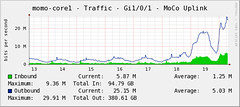
Since Friday, Feb 27th, <a href="http://www.mozilla.com/en-US/thunderbird/">mozilla.com</a> thunderbird content is redirecting to <a href="http://www.mozillamessaging.com/en-US/thunderbird/">mozillamessaging.com</a>, see if you can tell when that is on that graph?<br /><br />
<br /><br />
I am still crunching the numbers from <a href="http://www.mozillamessaging.com/en-US/thunderbird/3.0b2/">Thunderbird 3 Beta 2</a>'s launch, but this one was easy and I just had to share.<br /><br />
<br /><br />
There.<br />
<br clear="all" /></p>]]>
        
    </content>
</entry>

<entry>
    <title>Markus Stange&apos;s tinderboxpushlog</title>
    <link rel="alternate" type="text/html" href="http://gozer.ectoplasm.org/blog/archive/2009/02/markus-stanges-tinderboxpushlog.html" />
    <id>tag:gozer.ectoplasm.org,2009:/blog//2.156</id>

    <published>2009-02-03T03:16:34Z</published>
    <updated>2009-02-03T03:38:59Z</updated>

    <summary>I was just recently pointed at How Markus Made the World Better Today by davida in #maildev today, and I just couldn&apos;t help myself. Thankfully, it&apos;s a pure-javascript webapp, with no dependency on anything but itself. So, I just grabbed...</summary>
    <author>
        <name>gozer</name>
        <uri>http://gozer.ectoplasm.org/</uri>
    </author>
    
        <category term="Build" scheme="http://www.sixapart.com/ns/types#category" />
    
        <category term="Mozilla" scheme="http://www.sixapart.com/ns/types#category" />
    
    
    <content type="html" xml:lang="en" xml:base="http://gozer.ectoplasm.org/blog/">
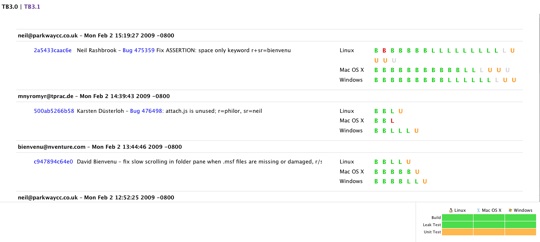
        <![CDATA[<p>I was just recently pointed at <a href="http://blog.johnath.com/2009/02/02/how-markus-made-the-world-better-today/">How Markus Made the World Better Today</a> by <a href="http://ascher.ca/">davida</a> in <a href="irc://irc.mozilla.org/maildev">#maildev</a> today, and I just couldn't help myself.</p>

<p>Thankfully, it's a pure-javascript webapp, with no dependency on anything but itself. So, I just grabbed the html/js/css files and I had something up in no time. Of course, it didn't work at all, but that was a small detail.</p>

<p>A few fixups later, I had it working and taught it about the 2 Thunderbird trees, and Sunbird, while I was at it.</p>

<p>Originally, it used a PHP script to proxy/massage stuff back to tinderbox.mozilla.org and hg.mozilla.org, but since my PHP-foo is weak, and I didn't have the source code to actual PHP, I did without. A few <code>httpd.conf</code> changes later, and it was all working.</p>

<p>It's a really nice alternate way to look at the status of a tree. Have a look for yourself!</p>

<p><span class="mt-enclosure mt-enclosure-image" style="display: inline;"><a href="http://build.mozillamessaging.com/tinderboxpushlog/"><img alt="tinderboxpushlog.jpg" src="http://gozer.ectoplasm.org/blog/mozilla/pushlog.jpg" width="540" height="242" class="mt-image-none" style="" /></a></span></p>

<p>The original one is here: <a href="http://tests.themasta.com/tinderboxpushlog/">http://tests.themasta.com/tinderboxpushlog/</a><br />
The Thunderbird one is here: <a href="http://build.mozillamessaging.com/tinderboxpushlog/">http://build.mozillamessaging.com/tinderboxpushlog/</a></p>

<p>I've cloned <a href="http://markusstange.wordpress.com/">Markus Stange</a>'s <a href="http://hg.mozilla.org/users/mstange_themasta.com/tinderboxpushlog/">original </a> mercurial repository.  You can find my clone at <a href="http://hg.mozilla.org/users/gozer_mozillamessaging.com/tinderboxpushlog/">hg.mozilla.org</a> too.</p>

<p><em>Note</em>: Yes, the whole code was in Mercurial to begin with, I just didn't even look for it until after I had it all working, dhu!</p>]]>
        
    </content>
</entry>

<entry>
    <title>Blip: Can you see Thunderbird 3 Beta 1 in there?</title>
    <link rel="alternate" type="text/html" href="http://gozer.ectoplasm.org/blog/archive/2008/12/blip-can-you-see-thunderbird-3-b.html" />
    <id>tag:gozer.ectoplasm.org,2008:/blog//2.155</id>

    <published>2008-12-15T17:13:03Z</published>
    <updated>2008-12-15T17:23:40Z</updated>

    <summary> Blip: Thunderbird 3 Beta 1 Released Originally uploaded by active_gozer Thanks to Gary for having made me notice this was blog worthy. We&apos;ve recently released Thunderbird 3 Beta 1, and afterwards, I had a look at our traffic graphs...</summary>
    <author>
        <name>gozer</name>
        <uri>http://gozer.ectoplasm.org/</uri>
    </author>
    
        <category term="Build" scheme="http://www.sixapart.com/ns/types#category" />
    
        <category term="Mozilla" scheme="http://www.sixapart.com/ns/types#category" />
    
        <category term="Thunderbird" scheme="http://www.sixapart.com/ns/types#category" />
    
    
    <content type="html" xml:lang="en" xml:base="http://gozer.ectoplasm.org/blog/">
        <![CDATA[<div style="float: right; margin-left: 10px; margin-bottom: 10px;">
<a href="http://www.flickr.com/photos/gozer/3111087330/" title="photo sharing"><img src="http://farm4.static.flickr.com/3123/3111087330_22d5230d3e_m.jpg" alt="" style="border: solid 2px #000000;" /></a>
<br />
<span style="font-size: 0.9em; margin-top: 0px;">
<a href="http://www.flickr.com/photos/gozer/3111087330/">Blip: Thunderbird 3 Beta 1 Released</a>
<br />
Originally uploaded by <a href="http://www.flickr.com/people/gozer/">active_gozer</a>
</span>
</div>

<p>Thanks to <a href="http://www.rumblingedge.com/">Gary</a> for having made me notice this was blog worthy.</p>

<p>We've recently released <a href="http://www.mozillamessaging.com/en-US/news/stories/2008-12-09-01">Thunderbird 3 Beta 1</a>, and afterwards, I had a look at our traffic graphs for the <a href="http://www.mozillamessaging.com/">Mozilla Messaging</a> website during that period.</p>

<p>See for yourself, can you see when we released Beta 1?</p>
]]>
        
    </content>
</entry>

<entry>
    <title>Gozer&apos;s got a wordle!</title>
    <link rel="alternate" type="text/html" href="http://gozer.ectoplasm.org/blog/archive/2008/12/gozer.html" />
    <id>tag:gozer.ectoplasm.org,2008:/blog//2.154</id>

    <published>2008-12-12T21:09:56Z</published>
    <updated>2008-12-12T21:21:51Z</updated>

    <summary>... just like everybody else. Looks like everybody is doing it, so here is my wordle...</summary>
    <author>
        <name>gozer</name>
        <uri>http://gozer.ectoplasm.org/</uri>
    </author>
    
        <category term="Apache" scheme="http://www.sixapart.com/ns/types#category" />
    
        <category term="Mozilla" scheme="http://www.sixapart.com/ns/types#category" />
    
    
    <content type="html" xml:lang="en" xml:base="http://gozer.ectoplasm.org/blog/">
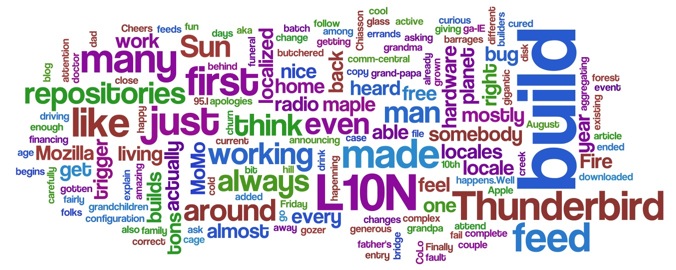
        <![CDATA[<p>... just like everybody else. Looks like everybody is doing it, so here is my <a href="http://www.wordle.net/">wordle</a></p>

<p><span class="mt-enclosure mt-enclosure-image" style="display: inline;"><a href="http://gozer.ectoplasm.org/blog/gozer-wordle.jpg/blog.jpg"><img alt="Gozer's Wordle" src="http://gozer.ectoplasm.org/blog/assets_c/2008/12/blog-thumb-676x270.jpg" width="676" height="270" class="mt-image-right" style="float: right; margin: 0 0 20px 20px;" /></a></span></p>]]>
        
    </content>
</entry>

<entry>
    <title>MoMo CoLo</title>
    <link rel="alternate" type="text/html" href="http://gozer.ectoplasm.org/blog/archive/2008/11/momo-colo.html" />
    <id>tag:gozer.ectoplasm.org,2008:/blog//2.153</id>

    <published>2008-11-13T22:58:36Z</published>
    <updated>2008-11-13T23:00:00Z</updated>

    <summary> MoMo CoLo Originally uploaded by active_gozer Finally gotten around to visiting the cage where the MoMo hardware is living. Couldn&apos;t resist snapping a few pictures, so here it is. For the curious, here is what they are, from the...</summary>
    <author>
        <name>gozer</name>
        <uri>http://gozer.ectoplasm.org/</uri>
    </author>
    
        <category term="Infrastructure" scheme="http://www.sixapart.com/ns/types#category" />
    
        <category term="Mozilla" scheme="http://www.sixapart.com/ns/types#category" />
    
    
    <content type="html" xml:lang="en" xml:base="http://gozer.ectoplasm.org/blog/">
        <![CDATA[<div style="float: right; margin-left: 10px; margin-bottom: 10px;">
<a href="http://www.flickr.com/photos/gozer/3028596470/" title="photo sharing"><img src="http://farm4.static.flickr.com/3011/3028596470_d3eaeefbb7_m.jpg" alt="" style="border: solid 2px #000000;" /></a>
<br />
<span style="font-size: 0.9em; margin-top: 0px;">
<a href="http://www.flickr.com/photos/gozer/3028596470/">MoMo CoLo</a>
<br />
Originally uploaded by <a href="http://www.flickr.com/people/gozer/">active_gozer</a>
</span>
</div>
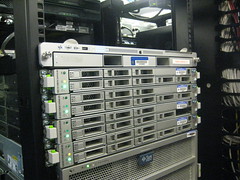
Finally gotten around to visiting the cage where the MoMo hardware is living. Couldn't resist snapping a few pictures, so here it is.<br />
<br />
For the curious, here is what they are, from the top:<br />
 - Apple X-Serve<br />
 - Sun Fire 4150 x 4<br />
 - Sun Thumper (aka Sun Fire X5400) 18 Terrabytes of disk space<br />
<br />
What's missing from the picture is the networking hardware.
<br clear="all" />]]>
        
    </content>
</entry>

<entry>
    <title>We have a planet!</title>
    <link rel="alternate" type="text/html" href="http://gozer.ectoplasm.org/blog/archive/2008/11/we-have-a-planet.html" />
    <id>tag:gozer.ectoplasm.org,2008:/blog//2.152</id>

    <published>2008-11-12T18:19:25Z</published>
    <updated>2008-11-12T18:40:13Z</updated>

    <summary>It&apos;s actually been a couple of days, but I am just getting around to announcing it. Mozilla Messaging now has it&apos;s own planet, planet.mozillamessaging.com, aggregating blog feeds from various Thunderbird sources. It&apos;s a complete ripoff copy of Planet Mozilla, just...</summary>
    <author>
        <name>gozer</name>
        <uri>http://gozer.ectoplasm.org/</uri>
    </author>
    
        <category term="Infrastructure" scheme="http://www.sixapart.com/ns/types#category" />
    
        <category term="Mozilla" scheme="http://www.sixapart.com/ns/types#category" />
    
        <category term="Thunderbird" scheme="http://www.sixapart.com/ns/types#category" />
    
    
    <content type="html" xml:lang="en" xml:base="http://gozer.ectoplasm.org/blog/">
        <![CDATA[<p>It's actually been a couple of days, but I am just getting around to announcing it.</p>

<p>Mozilla Messaging now has it's own planet, <a href="http://planet.mozillamessaging.com/">planet.mozillamessaging.com</a>, aggregating blog feeds from various Thunderbird sources. It's a complete <strike>ripoff</strike> copy of <a href="http://planet.mozilla.org/">Planet Mozilla</a>, just with different feed configuration.</p>

<p>It should get redesigned at the same time as the next incarnation of our main web site, so pay little attention to what it actually looks like, and just subscribe to the feed already.</p>

<p>Cheers.</p>

<p><i>P.S. If you feel like your feed (or a feed you like) should be on there, file a bug asking for it to be added</i></p>]]>
        
    </content>
</entry>

<entry>
    <title>toirneach éan</title>
    <link rel="alternate" type="text/html" href="http://gozer.ectoplasm.org/blog/archive/2008/09/toirneach-ean.html" />
    <id>tag:gozer.ectoplasm.org,2008:/blog//2.151</id>

    <published>2008-09-04T20:54:03Z</published>
    <updated>2008-09-04T20:13:11Z</updated>

    <summary>I&apos;ve been recently working on bug 449202: Get Thunderbird L10N builds working on comm-central. It&apos;s been mostly about using KaiRo&apos;s existing work for SeaMonkey and s/SeaMonkey/Thunderbird/g in the right places.Ran into a few more problems, mostly my fault, and some...</summary>
    <author>
        <name>gozer</name>
        <uri>http://gozer.ectoplasm.org/</uri>
    </author>
    
        <category term="Build" scheme="http://www.sixapart.com/ns/types#category" />
    
        <category term="Mozilla" scheme="http://www.sixapart.com/ns/types#category" />
    
        <category term="Thunderbird" scheme="http://www.sixapart.com/ns/types#category" />
    
    <category term="iega" label="ie-GA" scheme="http://www.sixapart.com/ns/types#tag" />
    
    <content type="html" xml:lang="en" xml:base="http://gozer.ectoplasm.org/blog/">
        <![CDATA[<span class="mt-enclosure mt-enclosure-image" style="display: inline;"><a href="http://ftp.mozilla.org/pub/mozilla.org/thunderbird/nightly/latest-comm-central/thunderbird-3.0b1pre.ga-IE.win32.installer.exe"><img src="http://gozer.ectoplasm.org/blog/assets_c/2008/09/toirneach%20ean-thumb-250x195.jpg" alt="toirneach ean" class="mt-image-left" style="margin: 0pt 20px 20px 0pt; float: left;" height="195" width="250" /></a></span><p>I've been recently working on bug <a href="https://bugzilla.mozilla.org/show_bug.cgi?id=449202">449202</a>:
     <span style="display: inline;" id="summary_alias_container" class="bz_default_hidden"> 
      <span id="short_desc_nonedit_display">Get Thunderbird L10N builds working on comm-central</span>. It's been mostly about using <a href="http://home.kairo.at/blog/">KaiRo</a>'s existing work for SeaMonkey and <i>s/SeaMonkey/Thunderbird/g</i> in the right places.</span><br /></p><p>Ran into a few more problems, mostly my fault, and some having to do with the way the MoCo build network is setup.</p><p>Turns out it's also fairly complex to test this stuff, as the current setup relies on notifiers kicking on changes to the l10n repositories, so triggering a l10n build on purpose is a bit tricky. Instead, it was simpler to just wait for somebody to change something in one of the many l10n repositories and see what happens.</p><p>Well, I am happy to report that the first localized build of Thunderbird since the move to Mercurial has been produced and can be downloaded. It's only a single build, and for Windows, but more will follow as the normal churn in l10n repositories will trigger some more.</p><p>Then, the fun begins tonight, as the nightly builders should trigger a build of all of Thunderbird supported locales in one go. So, by tomorrow morning, we should have tons (<a href="http://hg.mozilla.org/comm-central/file/4a1534519151/mail/locales/all-locales">43</a> locales per platform, to be precise) of new localized builds waiting for us, sweet!</p><p>Oh, and in case you had been wondering, the first successfull build is <span style="display: inline;" id="summary_alias_container" class="bz_default_hidden"></span><a href="http://ftp.mozilla.org/pub/mozilla.org/thunderbird/nightly/latest-comm-central/thunderbird-3.0b1pre.ga-IE.win32.installer.exe">here</a>. I think it's pretty cool that the first locale that successfully build turned out to be ga-IE, so that will explain the topic of this post. Hopefully, somebody from that locale will understand the title (and apologies if I butchered your language, feel free to correct me please)<br /></p>]]>
        
    </content>
</entry>

<entry>
    <title>eLOM is dead, long live iLOM!</title>
    <link rel="alternate" type="text/html" href="http://gozer.ectoplasm.org/blog/archive/2008/08/elom-is-dead-long-live-ilom.html" />
    <id>tag:gozer.ectoplasm.org,2008:/blog//2.149</id>

    <published>2008-08-18T03:10:44Z</published>
    <updated>2008-08-18T03:20:39Z</updated>

    <summary>From the great c0t0d0s0 blog comes the news that Sun is working on an amazing upgrade to eLOM based systems, like the Sun X4150 we are using. Soon I&apos;ll be able to upgrade them to a real Lights-out-manager solution: iLOM.iLOM...</summary>
    <author>
        <name>gozer</name>
        <uri>http://gozer.ectoplasm.org/</uri>
    </author>
    
        <category term="Infrastructure" scheme="http://www.sixapart.com/ns/types#category" />
    
        <category term="Mozilla" scheme="http://www.sixapart.com/ns/types#category" />
    
    <category term="elom" label="eLOM" scheme="http://www.sixapart.com/ns/types#tag" />
    <category term="ilom" label="iLOM" scheme="http://www.sixapart.com/ns/types#tag" />
    <category term="sun" label="Sun" scheme="http://www.sixapart.com/ns/types#tag" />
    
    <content type="html" xml:lang="en" xml:base="http://gozer.ectoplasm.org/blog/">
        <![CDATA[<p>From the great <a href="http://www.c0t0d0s0.org/archives/4710-eLOM-to-iLOM.html">c0t0d0s0 blog</a> comes the news that <a href="http://www.sun.com/">Sun</a> is working on an <a href="http://docs.sun.com/source/820-4930-10/">amazing upgrade</a> to eLOM based systems, like the <a href="http://www.sun.com/x4150">Sun X4150</a> we are using. Soon I'll be able to upgrade them to a real Lights-out-manager solution: iLOM.</p><p>iLOM is what's running on their Opteron-based systems, like the<a href="http://www.sun.com/x4500"> Sun 4500</a> (aka Thumper), and it's miles ahead of eLOM. Can't wait to have iLOM everywhere, instead of the current mixture of eLOM and iLOM.</p><p>Unfortunately, to perform the upgrade, you need to take the servers down... Can't have it all, I guess. Fortunately, since we are already fully redundant, it shouldn't cause visible downtime at all. All our build machines will just pause for a few seconds, and reappear on a different VM Host. Stay tuned, I'll blog about how the upgrade actually goes when it's finally available.<br /></p>]]>
        
    </content>
</entry>

<entry>
    <title>Thunderbird code size shrinks by 1.66Gb!</title>
    <link rel="alternate" type="text/html" href="http://gozer.ectoplasm.org/blog/archive/2008/08/thunderbird-code-size-shrinks-by-166gb.html" />
    <id>tag:gozer.ectoplasm.org,2008:/blog//2.148</id>

    <published>2008-08-14T14:13:56Z</published>
    <updated>2008-08-14T16:14:38Z</updated>

    <summary> First, that&apos;s only on OS X, sorry for folks running it on a different platform. Second, it&apos;s a bit of a lie, as I am talking about bug 448003. Since we switched over to building from Mercurial, the code...</summary>
    <author>
        <name>gozer</name>
        <uri>http://gozer.ectoplasm.org/</uri>
    </author>
    
        <category term="Mozilla" scheme="http://www.sixapart.com/ns/types#category" />
    
        <category term="Thunderbird" scheme="http://www.sixapart.com/ns/types#category" />
    
    
    <content type="html" xml:lang="en" xml:base="http://gozer.ectoplasm.org/blog/">
        <![CDATA[<span class="mt-enclosure mt-enclosure-image" style="display: inline;"><a href="http://tinderbox.mozilla.org/Thunderbird/"><img alt="Tinderbox-Thunderbird-osx-mZdiff" src="http://gozer.ectoplasm.org/blog/mozilla/Thunderbird.png" class="mt-image-left" style="margin: 0pt 20px 20px 0pt; float: left;" height="148" width="164" /></a></span>

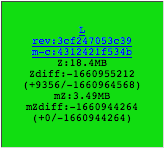
<p>First, that's only on OS X, sorry for folks running it on a different platform. Second, it's a bit of a lie, as I am talking about bug <a href="https://bugzilla.mozilla.org/show_bug.cgi?id=448003">448003</a>.</p>


<p>Since we switched over to building from Mercurial, the code size tests we run were somewhat off on OS X. These tests basically measure the size of the code included in the product. For instance, right now, on Linux, it's reported at 15.7MB.</p><p>However, on OS X, they had been reporting <b>1.56GB!</b> Obviously, this was a bug somewhere in the computation of this number, not the <b>actual</b> code size, so that's why the subject of this post is appropriately misleading.</p>

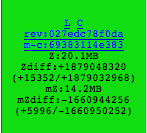
<span class="mt-enclosure mt-enclosure-image" style="display: inline;"><a href="http://tinderbox.mozilla.org/SeaMonkey/"><img alt="Tinderbox-SeaMonkey-osx-mZdiff" src="http://gozer.ectoplasm.org/blog/mozilla/seamonkey.png" class="mt-image-right" style="margin: 0pt 0pt 20px 20px; float: right;" height="133" width="147" /></a>

</span><p>Various hypothesis were put forward, including the fact it looked like it was off by precisely 100, so possibly a unit conversion problem, or something similar.</p><p>I've finally gotten around to it, and after some investigation, turns out it's more interesting than that. On OS X, we don't directly build universal binaries, but instead build once for i386 and once for ppc, then <a href="http://developer.apple.com/documentation/Darwin/Reference/ManPages/man1/lipo.1.html">lipo</a> the 2 builds together to form the final product.</p><p>To determine code size in this case, it would be misleading to count <b>both</b> architectures, so instead we pick one and size up that one. In our case, for historical reasons, that's the ppc version, even though our build boxes are Intel by now. Determining code size is done by parsing the output of <i>/usr/bin/nm</i>, an object dumping tool that nicely dumps the symbols list out of libraries and executables. Unfortunately, it dumps positions in the code, not size. So, to determine code size for a given function, just make sure addresses are sorted, then subtract the address of the previous function to the address of the current function, and you'll get the number of bytes that it takes up in the object file. Simple, right ?</p><p>Well, for some reason, not yet explained, on ppc, there is a strange symbol called <i>trampoline_size</i> that exists first in the list of symbols and sits at address '0'. However, right after it is the next symbol, strangely sitting at the address 0x20000000. That's 536870912 bytes further, if we believe what this is telling us. Of course, this is bogus. I am not entirely certain what this about, but if I could venture a guess, I'd have to say it has to do with the ppc executable format, OS X, and their ability to transparently run ppc binaries on Intel. Anybody that knows OS X/PPC better than me, feel free to correct me on this.</p>

<code>
libnspr4.dylib: 00000028 a trampoline_size<br />
libnspr4.dylib: 20000000 t __mh_dylib_header<br />
libnspr4.dylib: 20001a7c t dyld_stub_binding_helper<br /><br />
</code>

<p>Now that the problem is somewhat understood, it was a simple matter of teaching the code size stuff to ignore symbols like that on OSX/ppc and start at the next one. As you can see from the Tinderbox boxes, it was still pretty impressive to see such a large code size decrease! Oh, and SeaMonkey got the same drop in size, for the same reason.</p>]]>
        
    </content>
</entry>

<entry>
    <title>Pretty graphs, data and what to do with it?</title>
    <link rel="alternate" type="text/html" href="http://gozer.ectoplasm.org/blog/archive/2008/08/pretty-graphs-data-and-what-to-d.html" />
    <id>tag:gozer.ectoplasm.org,2008:/blog//2.147</id>

    <published>2008-08-13T19:01:31Z</published>
    <updated>2008-08-13T19:43:23Z</updated>

    <summary> Recently, we started receiving nightly logs of the Thunderbird start page hits. It now comes to us nightly, and I also got some historical data back to June 2008.For the time being, I&apos;ve just been feeding them all to...</summary>
    <author>
        <name>gozer</name>
        <uri>http://gozer.ectoplasm.org/</uri>
    </author>
    
        <category term="Mozilla" scheme="http://www.sixapart.com/ns/types#category" />
    
        <category term="Thunderbird" scheme="http://www.sixapart.com/ns/types#category" />
    
    
    <content type="html" xml:lang="en" xml:base="http://gozer.ectoplasm.org/blog/">
        <![CDATA[<span class="mt-enclosure mt-enclosure-image" style="display: inline;"><a href="http://gozer.ectoplasm.org/blog/mozilla/hourly_usage_200806.html" onclick="window.open('http://gozer.ectoplasm.org/blog/mozilla/hourly_usage_200806.html','popup','width=512,height=256,scrollbars=no,resizable=no,toolbar=no,directories=no,location=no,menubar=no,status=no,left=0,top=0'); return false"><img src="http://gozer.ectoplasm.org/blog/mozilla/hourly_usage_200806-thumb-256x128.png" alt="hourly_usage_200806.png" class="mt-image-left" style="margin: 0pt 20px 20px 0pt; float: left;" height="128" width="256" /></a></span>

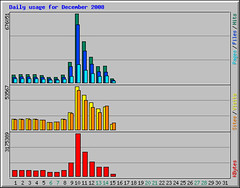
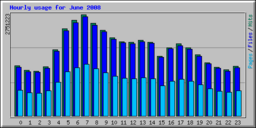
<p>Recently, we started receiving nightly logs of the <a href="http://www.mozillamessaging.com/en-US/thunderbird/">Thunderbird</a> start page hits. It now comes to us nightly, and I also got some historical data back to June 2008.</p><br /><p>For the time being, I've just been feeding them all to <a href="http://www.webalizer.org/">webalizer</a>, for lack of a better idea. There is not yet a complete plan as to what to do with all that data. Right now, it goes straight to <a href="http://www.sun.com/servers/x64/x4500/">infinite storage</a> every evening. There is a lot of it, averaging at around 8 million hits a day, The included graph is the average traffic per hour of the day. That's in the <font size="-1"><b>300k-500k</b> hits per hour!</font> I am glad that this traffic is being served by the <a href="http://www.mozilla.org/">mozilla.org</a> hardware.<br /></p><br /><p>I know folks have already started to think of ways we could mine that data to learn useful things about <a href="http://www.mozillamessaging.com/en-US/thunderbird/">Thunderbird</a> and its user base, but it's only beginning. So, for the time being, I'd like to hear from anybody who can think of a questions that could be answered by all that data. Of course, respecting our users privacy is important, so I don't want anybody to know anything about specific individuals, just about trends. Are Russians users checking e-mails more often than us Canadians, for instance? <i>(Not so sure that's a very useful thing to know)<br /></i></p><br /><p>Got a cool idea ? Have something you'd like to know ? Please, let me know.<br /></p><br /><p>&lt;gozer <b>at </b>mozillamessaging <b>dot </b>com&gt;<br /></p><p><br /></p>]]>
        
    </content>
</entry>

<entry>
    <title>Want your buildbot to talk IRC?</title>
    <link rel="alternate" type="text/html" href="http://gozer.ectoplasm.org/blog/archive/2008/06/buildbot-irc-bot.html" />
    <id>tag:gozer.ectoplasm.org,2008:/blog//2.144</id>

    <published>2008-06-20T19:55:19Z</published>
    <updated>2008-06-21T05:21:04Z</updated>

    <summary>In setting up a buildbot master, and, reading some documentation, noticed that it has tons of status plugins, one of which is an IRC bot. Before anything else, you need TwistedWords, an instant-messaging library. So I had to go ahead,...</summary>
    <author>
        <name>gozer</name>
        <uri>http://gozer.ectoplasm.org/</uri>
    </author>
    
        <category term="Mozilla" scheme="http://www.sixapart.com/ns/types#category" />
    
        <category term="Thunderbird" scheme="http://www.sixapart.com/ns/types#category" />
    
    
    <content type="html" xml:lang="en" xml:base="http://gozer.ectoplasm.org/blog/">
        <![CDATA[<p>In setting up a <a href="http://buildbot.net/">buildbot</a> master, and, reading some documentation, noticed that it has tons of status plugins, one of which is an IRC bot.</p>

<p>Before anything else, you need <a href="http://twistedmatrix.com/trac/wiki/TwistedWords">TwistedWords</a>, an instant-messaging library. So I had to go ahead, <a href="http://twistedmatrix.com/trac/wiki/Downloads">download</a> and install it.</p>

<p><code><br />
cd tmp<br />
lftpget -c http://tmrc.mit.edu/mirror/twisted/Words/8.1/TwistedWords-8.1.0.tar.bz2<br />
tar jxvf TwistedWords-8.1.0.tar.bz2<br />
cd TwistedWords-8.1.0<br />
python setup.py install<br />
</code></p>

<p>Once installed, all I had to do is to make a 2-line change to the buildbot master's <i>master.cfg</i> config file</p>

<p><code><br />
from buildbot.status import words<br />
c['status'].append(words.IRC('irc.mozilla.org', 'thunderbot', ['maildev']))<br />
</code></p>

<p>Next thing you know, you've got an IRC bot announcing builds, and you can even ask for new builds straight from an irc /msg, cool.<br />
</p>]]>
        
    </content>
</entry>

<entry>
    <title>Lights On!</title>
    <link rel="alternate" type="text/html" href="http://gozer.ectoplasm.org/blog/archive/2008/06/lights-on.html" />
    <id>tag:gozer.ectoplasm.org,2008:/blog//2.140</id>

    <published>2008-06-13T15:17:50Z</published>
    <updated>2008-06-16T15:34:01Z</updated>

    <summary>It&apos;s been a long little while, but things are finally reaching the point where I feel sufficiently satisfied to talk about it. (Plus, I&apos;ve got time available now to do just that). Life started with a rack full of brand-new...</summary>
    <author>
        <name>gozer</name>
        <uri>http://gozer.ectoplasm.org/</uri>
    </author>
    
        <category term="Mozilla" scheme="http://www.sixapart.com/ns/types#category" />
    
    
    <content type="html" xml:lang="en" xml:base="http://gozer.ectoplasm.org/blog/">
        <![CDATA[<p>It's been a long little while, but things are finally reaching the point where I feel sufficiently satisfied to talk about it. (Plus, I've got time available now to do just that).</p>

<p>Life started with a rack full of brand-new <a href="http://www.sun.com/">Sun</a> hardware, all wired in, mostly powered off. Thanks to <a href="http://blog.mozilla.com/mrz/">mrz</a> and <a href="http://blog.mozilla.com/justin/">Justin</a> for all the heavy lifting!</p>

<p>When I was handed the 'keys', <em>(actually, I handed my own ssh key) </em>one of the <a href="http://www.sun.com/servers/x64/x4150/">Sun 4150</a>s was pre-installed with <a href="http://www.centos.org/">CentOS</a>. I was in!</p>

<p>I'll skip over an interesting learning experience with fancy <a href="http://www.cisco.com/">Cisco</a> switches and firewalls, maybe I'll talk about it some other time.</p>

<p>The first step was getting things to the point where they could boot and do something usefull. It's always possible to use remote management tools to trick the BIOS into booting from some disk image over the network, but it's very non-standard and usually requires unscriptable Java based tools, yuck.</p>

<p>This is where <a href="http://cobbler.et.redhat.com/">Cobbler</a> comes in and saves the day. In short, it's an amazing tool, out of Redhat"s labs, that allows for the easy building and managment of a complete remote boot and installation solution. With it, you can easily configure systems by <a href="http://en.wikipedia.org/wiki/MAC_Address">MAC addresses</a>, pick what distribution you want to install on it, and you are done. Once setup, you just need to turn on the server you need, and within minutes, you have a freshly installed server, with all the specific installation instructions you wanted. The best with this is that it's 100% reproducible. You need 10 machines installed all the same, easy, just cut-n-paste their <a href="http://en.wikipedia.org/wiki/MAC_Address">MAC addresses</a>, turn them all on, go get a cofee, and you've got 10 identical machines. You want to re-install a system for a reason or another? Same thing. Configure it for a reinstall in cobbler and reboot the system.</p>

<p>It's very handy, and once you put all it's configuration in source-control, your entire server farm is easily reproductible.</p>

<p>Of course, having a bunch of servers all running a pristine Linux distribution isn't that usefull. You need to get them configured in various ways to actually get them to do the work you need them to do. In my particular case, first I needed basic configuration (networking/access control/logging/etc) and second, more importantly, I needed some virtual machines running to host some needed test services.</p>

<p>It's always possible to just login to servers and start installing packages, editing configuration files, starting services, etc. But it's such a bad idea. Even if you are a documentation fanatic, you'll always miss a step or two, and rebuilding a system <strong>exactly</strong> the way it was becomes impossible. </p>

<p>That's what tools like <a href="http://reductivelabs.com/projects/puppet/">Puppet</a> are for. They are an automated way to describe what you want on a system and perform the necessary tasks to get the system there. So, instead of installing the ntpd package, hand-editing <em>/etc/ntp.conf</em> and starting the ntp service yourself, you let Puppet do it for you.</p>

<p>Of course, it's also all in source-control, so every single change also gets tracked. The tricky part about systems like Puppet is that they are declarative. So, in the example above, you describe things much differently. You say, /etc/ntpd.conf needs to exist and needs this content. The package ntpd needs to be installed. The service ntpd : needs the ntpd package, the /etc/ntpd.conf file, and needs to be running.</p>

<p>Then Puppet figures what to do, in what order, and also will know that the running state of the ntpd service depends on the content of the /etc/ntpd.conf file, so if that changes, the service needs to be restarted.</p>

<p>There are many such systems out there, like <a href="http://www.cfengine.org/">cfengine</a> and <a href="http://trac.mcs.anl.gov/projects/bcfg2">bcfg2</a>. I've picked Puppet because it's very actively developped right now, plus supports Linux, Solaris & Mac OSX. The only downside to me is that it's all written in Ruby, and my Ruby-foo is pretty weak. Not a very big deal, because for most normal stuff, you deal with a configuration language, not the actual Ruby language.</p>

<p>At the end of last week, I had all the pieces in place, and I was finally able to directly help out Thunderbird development.</p>

<p>Somebody on #maildev needed access to some live IMAP servers that understood the CONDSTORE extension to test some stuff. With all these great tools already in place and working, it took very little time to get a new virtual machine configured, booted, installed and running some brand-new IMAP servers with support for CONDSTORE.</p>

<p>It's a small step, but it's really nice to finally get to directly contribute (even if in a small way) to the continuing success of Tunderbird.</p>

<p>There is still a lot of work to get done, things are not as automated as I would want them, and I've got some important missing pieces still dangling. For instance, there is no monitoring in place yet, so let's hope nothing goes down when I am not looking.</p>

<p>This coming week, the objective is to get a new mini-build-farm up and running, building Thunderbid continuously on Linux, Windows & OS X. While that's going on, I'll continue laying the missing bricks to the infrastructure itself.</p>

<p>That's enough for now.</p>]]>
        
    </content>
</entry>

<entry>
    <title>ThreadVis: Arc Threads for Thunderbird</title>
    <link rel="alternate" type="text/html" href="http://gozer.ectoplasm.org/blog/archive/2008/06/threadvis-arc-threads-for-thunde.html" />
    <id>tag:gozer.ectoplasm.org,2008:/blog//2.139</id>

    <published>2008-06-09T18:21:47Z</published>
    <updated>2008-06-09T18:24:10Z</updated>

    <summary>Today, I ran into a very cool Thunderbird plugin, via David Ascher : ThreadVis I remember having read the original IBM paper on this idea by Bernard J. Kerr a while ago, and it was a very interesting take on...</summary>
    <author>
        <name>gozer</name>
        <uri>http://gozer.ectoplasm.org/</uri>
    </author>
    
        <category term="Mozilla" scheme="http://www.sixapart.com/ns/types#category" />
    
        <category term="Thunderbird" scheme="http://www.sixapart.com/ns/types#category" />
    
    <category term="threadvis" label="threadvis" scheme="http://www.sixapart.com/ns/types#tag" />
    <category term="thunderbird" label="thunderbird" scheme="http://www.sixapart.com/ns/types#tag" />
    <category term="xpi" label="xpi" scheme="http://www.sixapart.com/ns/types#tag" />
    
    <content type="html" xml:lang="en" xml:base="http://gozer.ectoplasm.org/blog/">
        <![CDATA[<p>Today, I ran into a very cool Thunderbird plugin, via <a href="http://david.ascher.ca/">David Ascher</a> : <a href="http://www.student.tugraz.at/ahubmann/threadvis/en/start.html">ThreadVis</a><br />
<span class="mt-enclosure mt-enclosure-image" style="display: inline;"><img alt="arcthreads.png" src="http://gozer.ectoplasm.org/blog/uploaded/arcthread.png" width="206" height="91" class="mt-image-left" style="float: left; margin: 0 20px 20px 0;" /></span><br />
I remember having read <a href="http://domino.watson.ibm.com/library/cyberdig.nsf/1e4115aea78b6e7c85256b360066f0d4/7a30ed0aac59bf5d85256d79006f272f?OpenDocument">the original IBM paper</a> on this idea by Bernard J. Kerr <br />
 a while ago, and it was a very interesting take on thread visualization. I remember thinking at the time, bummer, I wish there was a Thunderbird plugin for this. Well, it took a little while, but it's finally here.</p>

<p>The idea is to use arcs to represent the relationship between the components of the thread. Why are most email threads displayed as trees, I am not sure. Looking at actual threads in my inbox with this addon confirmed to me that the idea has some merit. I especially love the fact that in this implementation, the arc length is relative to the time between 2 replies.</p>

<p>It's part of it's author's Master Thesis, so the extension also includes anonymized usage data extraction, to help him analyze how this is working out. It's optional, disabled by default, but do trun it on to help him out (I did). </p>

<p>If interested, install it <a href="https://addons.mozilla.org/en-US/thunderbird/addon/6533">directly</a> from the official Mozilla Add-Ons site.<br />
</p>]]>
        
    </content>
</entry>

</feed>