<?xml version="1.0" encoding="utf-8" standalone="no"?><feed xmlns="http://www.w3.org/2005/Atom">
    <title>Conscientious Extended</title>
    <link href="http://jmcolberg.com/weblog/extended/" rel="alternate" type="text/html"/>
    <link href="http://jmcolberg.com/weblog/extended/index.xml" rel="self" type="application/atom+xml"/>
    <id>tag:jmcolberg.com,2009-09-30:/weblog/extended//5</id>
    <updated>2013-05-23T17:13:50Z</updated>
    <subtitle>Longer articles and interviews about contemporary fine-art photography. Part of Joerg Colberg's Conscientious.&#13;
</subtitle>
    <generator uri="http://www.sixapart.com/movabletype/">Movable Type 4.32-en</generator>
	
	<entry>
		<title>RSS feeds shut down</title>
		<link href="http://jmcolberg.com/weblog/" rel="alternate" type="text/html"/>
		<id>tag:jmcolberg.com,2013:/weblog//4.6525</id>
		<published>2013-05-23T17:13:50Z</published>
		<updated>2013-05-23T17:13:50Z</updated>
		<author>
			<name>Joerg Colberg</name>
		</author>
		
		<content type="html" xml:base="http://jmcolberg.com/weblog/" xml:lang="en">
			<![CDATA[<p>This RSS feed for Conscientious Extended is no longer being published. Please update your feed reader to point to one of the feeds at the new home of Conscientious at http://cphmag.com/ New Atom feed: http://cphmag.com/feed-atom/ or new RSS feed: http://cphmag.com/feed-rss/</p>]]>
		</content>
	</entry>

	<entry>
		<title>The Ethics of Street Photography</title>
		<link href="http://jmcolberg.com/weblog/extended/archives/the_ethics_of_street_photography/" rel="alternate" type="text/html"/>
		<id>tag:jmcolberg.com,2013:/weblog/extended//5.6490</id>
		<published>2013-04-03T14:49:40Z</published>
		<updated>2013-04-03T15:07:21Z</updated>
		<author>
			<name>Joerg Colberg</name>
			<uri>http://jmcolberg.com/weblog/extended/authors/joerg_colberg/</uri>
		</author>
		
		<content type="html" xml:base="http://jmcolberg.com/weblog/extended/" xml:lang="en">
			<![CDATA[<p><img alt="EthicsStreet.gif" src="http://jmcolberg.com/weblog/extended/archives/EthicsStreet.gif" width="545" height="374" /></p>

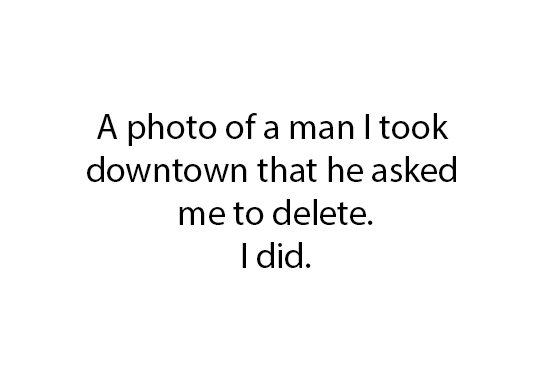
<p>"[Garry] Winogrand was famous for never asking people permission before taking their photographs;" <a href="http://www.google.com/url?sa=t&rct=j&q=&esrc=s&source=web&cd=1&ved=0CDsQFjAA&url=http%3A%2F%2Fwww.sfchronicle.com%2Fart%2Farticle%2FGarry-Winogrand-s-uneasy-eye-4377685.php&ei=gF5YUeicHovE4AOOr4DwCA&usg=AFQjCNE6y9mcJuPcZwCStqBpxGUbFCv2TQ&sig2=WuS_vbscfP5iq0CJw1pAuw&bvm=bv.44442042,d.dmg&cad=rja" target="_blank">writes Caille Millner in a review of the photographer's current retrospective at SFMoMA</a>, "a whole generation of male photographers idolized him for shooting however he wanted, whenever he wanted." It's not hard to imagine what the legions of Winogrand fans will have made of Millner's review, which continues "No one seems to recognize that Winogrand's beliefs are shared most seriously by the kinds of men who haunt Reddit subforums like 'Creepshots.' On those forums, the chorus is 'Rape her.' Thanks to his superior sense of aesthetics, Winogrand's moments of lechery show up at SFMOMA, where the chorus is that he's a visionary." <a href="http://jmcolberg.com/weblog/extended/archives/the_ethics_of_street_photography/" target="_blank"><em>(more)</em></a></p>]]>
			<![CDATA[<p>Winogrand aside<sup>1</sup>, there is a serious issue here, namely the issue of permission or consent. If you take a photograph of someone and that person confronts you about it, how do you react? The most common response from photographers appears to be that provided you're in a public space you can take any picture you want. That's true, at least in a legal sense. But it does not really address the issue at hand at all: If someone does not want their photograph taken do you, as a photographer, just go ahead and do so anyway, because you can? I actually do not think that's such a good idea.</p>

<p><a href="http://jmcolberg.com/weblog/extended/archives/meditations_on_photographs_a_terrified_young_woman_surrounded_by_a_group_of_male_photographers_by_an/" target="_blank">I wrote about the ethics (or actually total lack of ethics) surrounding paparazzi a little while ago</a>. There, sadly our culture has embraced the idea that celebrities somehow deserve to be treated in ways that we would reject for ourselves, that celebrities in effect are fair game for our societal bullying. After I published the piece, I found quite a few references to street photography, many comments centering on something like "If we enforce restrictions then street photography is in danger." (paraphrased and from memory)</p>

<p>I've long been critical of the macho culture of the Winogrand era street photographers, and I also do not like the idea that you can do whatever you want with your camera in a public space. Photographers need to be aware of the ethics of their endeavour. But I have to be more precise. Street photographers for the most part agree amongst themselves that what they're doing is fine. But that's actually irrelevant. The main question is whether the public is fine with it. </p>

<p>Over the past few years, the public's understanding of photography appears to have changed considerably in various aspects. In particular, people appear to have become much more wary of being photographed without being asked. Of course, this would appear to be ironic given that there are surveillance cameras everywhere. But I think one needs to understand that there is a difference between these two. If you enter a store that you know has surveillance cameras you implicitly give your consent to being filmed or photographed. If someone takes your picture in the street that consent is absent. (I don't want to get into too many details here, but it has something to do with what I think of as active and passive privacy)</p>

<p>Given that large parts of the public have become much more wary of photographers and their cameras I do think the photographic community has to start thinking about what this means. I can think of two consequences right away. </p>

<p>First, given that many people just don't want to be photographed without their consent, photographers should be more careful about this. In other words, it might be perfectly legal to photograph someone in a public space, but something being legal doesn't mean it's ethical as well (it was perfectly legal for banks to sell "shitty" loans to their customers pre-2008 financial crisis [and it still is] but that does not make it ethical). If that means that street photography is in some sort of trouble then, well, so be it. Street photography might be a type of photography with a rich history. But just because something was widely accepted in the past does not mean that it will always be widely accepted. I could list all kinds of previously widely accepted practices that we now reject.</p>

<p>That said, and second, it's the photographic community's task to educate the public about what they're doing. In other words, instead of posturing about what they can do, street photographers better tell the public how what they're doing is not only mindful of the public's concerns, but also constitutes an important and valuable artistic practice that enriches not just the practitioners' but everybody else's lives.</p>

<p>The onus is on photographers and not on the public. Art photography occupies a tiny niche in this very large world, and we cannot expect the general public to have the same kind of knowledge and/or understanding of photography the members of this tiny niche have. </p>

<p>I personally do not find street photography unethical per se. But I am very concerned about street photographers brushing aside concerns voiced by the public. If a large number of people do not want to have their photograph taken in the street, then that poses a serious ethical problem, a problem that cannot and must not be solved by photographers' fiat. </p>

<p>In actuality, it would be impractical to ask every person in the frame whether they're OK with a picture. That said, if someone clearly does not want to be photographed or if they are for their photo to be deleted after the fact, then I do think those wishes have to be respected. </p>

<p>Mind you, street photography is not the only type of photography that has to deal with rubbing against the public's perceptions. Just think of the various photographers who have found themselves in hot water over pictures of their nude children. Think of photojournalists who were accused of photographing, yet not helping. The list goes on and on. In each of these cases, the onus has always been on the photographers. </p>

<p>In a certain way, having this kind of explaining to do might not be such a bad thing at all. I don't mean to say that I want photographers to have problems. But running against resistance means having to think about what one is doing, having to explore it more deeply, having to explain to a lot of non-specialists what is going on. We all gain from that. </p>

<p>And the ethics of photography, the way how its possible applications or uses might clash with our ideas what's right and wrong is a very important topic, especially given the fact that cameras are everywhere now. </p>

<p>Thus the public's wariness of having photographs in public spaces taken without permission poses a challenge for photography as much as an opportunity, an opportunity to talk about what photographs - street and otherwise - do and how they do it. </p>

<p><small><sup>1</sup> Given I have not seen the Winogrand show or looked at the book I am in no position to comment on whether or not the work portrays women in a very unflattering light. For what it's worth, I spoke with a couple of friends who met the photographer as students, and they both seemed to agree with Millner's assessment. </small></p>]]>
		</content>
	</entry>
	
	<entry>
		<title>Meditations on Photographs: Riverfront by Curran Hatleberg</title>
		<link href="http://jmcolberg.com/weblog/extended/archives/meditations_on_photographs_riverfront_by_curran_hatleberg/" rel="alternate" type="text/html"/>
		<id>tag:jmcolberg.com,2013:/weblog/extended//5.6477</id>
		<published>2013-03-18T18:03:02Z</published>
		<updated>2013-03-18T19:52:36Z</updated>
		<author>
			<name>Joerg Colberg</name>
			<uri>http://jmcolberg.com/weblog/extended/authors/joerg_colberg/</uri>
		</author>
		
		<content type="html" xml:base="http://jmcolberg.com/weblog/extended/" xml:lang="en">
			<![CDATA[<p><a href="http://jmcolberg.com/weblog/extended/assets_c/2013/03/curran.hatleberg_riverfront-3280.php" onclick="window.open('http://jmcolberg.com/weblog/extended/assets_c/2013/03/curran.hatleberg_riverfront-3280.php','popup','width=1000,height=800,scrollbars=no,resizable=no,toolbar=no,directories=no,location=no,menubar=no,status=no,left=0,top=0'); return false"><img alt="curran.hatleberg_riverfront_sm.jpg" src="http://jmcolberg.com/weblog/extended/archives/curran.hatleberg_riverfront_sm.jpg" width="545" height="436" /></a></p>

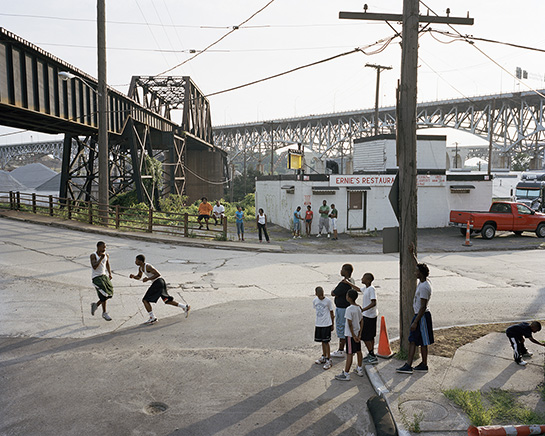
<p>For the past couple of weeks, I have come to this photography, <em>Riverfront</em>, by <a href="http://curranhatleberg.com/" target="_blank">Curran Hatleberg</a> (if you click on the image you'll see a larger version). I've been trying to find out what actually intrigued me about it. Most likely, it's a combination of factors. For a start, <em>Riverfront</em> is one of those photographs that is very smartly constructed. It's complex without it being complex for complexity's sake. It's smart, without it being self-consciously smart (like, for example, so much of that "new formalism"/"triangle art" photography: I can't escape the feeling it's too satisfied with its own cleverness). It's a contemporary photograph that, at the same time, feels like a classic; or maybe I should say it references the medium's history without being nostalgic. <a href="http://jmcolberg.com/weblog/extended/archives/meditations_on_photographs_riverfront_by_curran_hatleberg/" target="_blank"><em>(more)</em></a></p>]]>
			<![CDATA[<p>The old ideas of form and content are particularly relevant in this case, I think. So let's see how this works. Well, first of all, the image plane appears to consist of two parts, the foreground and the background. The road that runs from the right to the left (or vice versa) separates the two. I view the foreground as a bit of a stage, with the various actors, two or three groups, depending on how you want to count them. </p>

<p>There are the two men on the left who are engaged in what looks like a mock fight of sorts. They're caught mid-motion, one is about a foot off the ground. The second group consists of five young men/children watching the former, on the right. There also is a child at the very right of the frame who is looking at something completely different - you can think of this as a third "group." Whatever that child is looking at is outside of the frame - thus reminding the viewer of the fact that photography captures a part of the world, and we have no way of knowing what lies beyond. </p>

<p>In the background, there is a group of young women and men watching the scene. You could split them up into groups of four on the left and four on the right, even though it's unclear to me what one would gain from that. And there's the world in the background, Ernie's Restaurant, a red truck, a bigger truck in the back, plus the bridges. </p>

<p>There are two bridges, a grey one running from the left to the right (or vice versa), plus a black one running from somewhere to the viewer's immediate left towards a point we can't see in the background. The grey bridge really just constitutes part of the background, whereas the black one visually connects the background with the foreground, meaning both the stage upon which the action is happening <em>and</em> where we, the viewers, find ourselves.</p>

<p>The stage, in other words, might be a stage, but it really looks like a stage because of this photograph. Had we been there, we would have been a part of it, just as we are part of the world at any given moment. In any case, the viewer is located on a little stretch of road that runs into the road that divides the foreground and background. </p>

<p>Now, whether or not you've found my way of describing the photograph successful or not, I do think it's obvious that this photograph's elements come together very successfully, both concerning the pictorial planes and the placement and interaction of the various proponents. </p>

<p>The infrastructure dissects the image in all kinds of directions, connecting us to what we see, while at the same time reminding us how roads or trails usually tend to do just that: To go into all kinds of directions. The placement of the various actors allows the eye to remain in place, while going back and forth between the different groups. Crucially, the group in the back is doing exactly what we're doing - watching the scene. </p>

<p>The world is there to be watched, to be seen; and a good photographer will visually organize its content into pictures that make us see what we could but usually don't see. And crucially, one can try to take apart a good photograph and figure out how it operates, but it will still work afterwards. In fact, one probably appreciates it even more. This is certainly what happened for me in the case of <em>Riverfront</em>. </p>

<p>I will add this: Whether or not this photograph was staged or found (street-photography style) doesn't matter for me at all. I suspect many people will disagree with me. The street-photo crowd will want this to be an example of their beloved games - as will the staging crowd. It's too bad that both often are too dogmatic about how their images are made to realize how rich photographs can be when they're made in a different way. </p>

<p>Photographs that are "found" are not necessarily deeper than images that are made or constructed. To pretend the world is a richer place than what we could imagine makes the assumption that we are not of this world, that we are imperfect beings somewhat separate from it. </p>

<p>We might be imperfect, but we're part of the world. We are of this world, living in this world. The role of the photographer is to pretend that that's not the case, while, at the same time, reminding us how futile that idea really is. <em>Riverfront</em> by Curran Hatleberg does this most successfully.</p>

<p><small><em>Image: Riverfront, 2012, (c) by Curran Hatleberg; kindly provided by the artist - thank you!</em></small></p>]]>
		</content>
	</entry>
	
	<entry>
		<title>On Process</title>
		<link href="http://jmcolberg.com/weblog/extended/archives/on_process/" rel="alternate" type="text/html"/>
		<id>tag:jmcolberg.com,2013:/weblog/extended//5.6470</id>
		<published>2013-03-13T20:32:29Z</published>
		<updated>2013-03-15T14:47:41Z</updated>
		<author>
			<name>Joerg Colberg</name>
			<uri>http://jmcolberg.com/weblog/extended/authors/joerg_colberg/</uri>
		</author>
		
		<content type="html" xml:base="http://jmcolberg.com/weblog/extended/" xml:lang="en">
			<![CDATA[<p><img alt="Smidgen_FakeTinType.jpg" src="http://jmcolberg.com/weblog/extended/archives/Smidgen_FakeTinType.jpg" width="545" height="545" /></p>

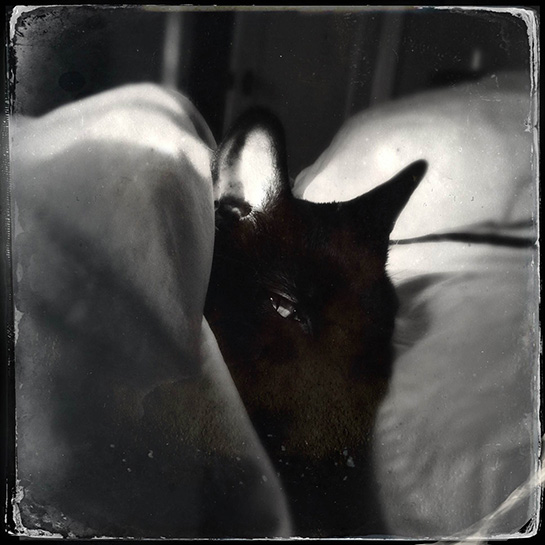
<p>This photographs looks like an image made using the wet-plate process, but it's merely a simulation if you will. I took this picture with my minipad, using the <a href="http://hipstamatic.com/" target="_blank">Hipstamatic</a> <a href="http://gear.hipstamatic.com/snappaks/pak_tintype" target="_blank">Tintype package</a>. It's fairly safe to assume that tor a sizable part of photoland, a digital image that looks like a wet-plate image cannot be judged the same way as a an actual wet-plate one. In the following, I will try to explain why that is a pretty severe mistake. <a href="http://jmcolberg.com/weblog/extended/archives/on_process/" target="_blank"><em>(more; updated)</em></a><br />
</p>]]>
			<![CDATA[<p>The internet being the internet, there will be those who will point out that a Hipstamatic Tintype photo does not really look like an actual wet-plate one. As a matter of fact, tintypes are different beasts than wet plates. I know all that. We could have discussions whether Hipstamatic tintypes look more like actual tintypes or like wet-plate images. I'm not particularly interested in that. </p>

<p>So then: What's the deal with photoland's obsession with process? </p>

<p>Digital technologies have enabled us to produce photographs that look like they were made with some process, when in fact they were not. One might wonder how process would matter if there was no way of knowing from the image which process was used. The "but that's not the same!" argument ceases to make much sense when the only reason why you know about the process is because you were told.</p>

<p>People have had these kinds of discussions even before digital technologies. Just think about "straight" photographs versus staged one. If you can't tell from the picture why would it matter whether it's staged? There's only one area where it matters: the news. But I've had people tell me that even in the context of art photography, getting or finding a photograph is so much better than staging it. That makes no sense to me whatsoever, especially not if you can't tell from the photograph.</p>

<p>Back to process. You can say whatever you want about Hipstamatic or Instagram, but it has done me - as a teacher and writer - a huge favour: Now, many people think of process as a "filter," something applied after the actual photograph was taken. Of course, that's not how most processes work - a wet-plate image is not an image with a wet plate applied on top. But thinking of process as a "filter," as something somehow separate from the photograph helps evaluating the role of process. </p>

<p>For me, process alone almost never makes a good or interesting photograph. Process is not enough. Sure, it might take you months and months mastering it, sure, getting your photograph might involve all kinds of tricky aspects. But at the end of the day, I look at photographs as, well, photographs. </p>

<p>A good photograph is a good photograph in such a way that the process itself might be an integral part of it, but it's not the focal point. In other words, the moment you can almost separate out the image from the process - just like you'd think about Hipstamatic as picture plus filter - you're in trouble: Suddenly, the process itself becomes part of what is being evaluated. But who cares whether it took you three days to make a picture or whether you got that great picture seeing something and then snapping it very quickly?</p>

<p>In photoland, the cult of process is tied to the cult of work. It's almost as if the more physical and technical effort you put into a photograph, the better it is, or rather: the more we have to admire it. But why would we? </p>

<p>All photographs are produced using some process, but we do not treat all processes as equal. A few years back, at the height of the 8x10 craze, I used to receive press releases that often focused on the fact that an 8x10 camera was used. Who cares? These days, taking images from Google Street View is all the rage - a very different process - but again: Who cares? In both cases, the only thing that should concern us whether the work in question has anything to say: Is this (whatever we're looking at) any good?</p>

<p>The fact that you're lugging around an 8x10 camera or that you photographing your computer screen is pretty much irrelevant for the evaluation of your work. Unless, of course, we want to treat photography like a craft. But I don't think that's so interesting.</p>

<p>Of course, the process itself might become a very essential part of what you're working on. In that case, you basically find yourself in the neighbourhood conceptual photographers live and work in. I don't have a problem with that approach, but, again, at the end of the day, we still need to ask: Is this any good? </p>

<p>So regardless of whether we're dealing with Hipstamatic or Instagram, with 8x10, with digital appropriation, with wet-plate photography or whatever other process you might be using: Do not rely on the process as that which solely determines the quality of the work. If your process is prominent use its strengths. But at the same time push against the process itself, so that the end result is a good photograph - and not some photograph produced with some process. </p>

<p>Coming back to the "filter" idea: Make photographs that do not easily separate into image plus filter. The more prominent your process, the harder this will be. That seems to be the real struggle of any process: Not to master it, but to make it become an integral part of the work.</p>

<p><strong>Update (15 Mar 2013)</strong>: Since several people brought up the role of the object it might be worthwhile to add a few words. In photography, unlike in painting, say, there is no strict correspondence between the image and the object per se. Some processes are directly tied to an object, others are not. A tintype, just like a photogram, is the direct - and initially only - result of a process, much like a painting is. In contrast, a print might or might not be tied to the process; or it might be the result of what we could consider a second (occasionally secondary) process.</p>

<p>I've found that processes that are tied to objects almost inevitably run the risk of being valued more than all others. By "run the risk" I here mean just that: here, we have a situation where I think we need to be careful not to necessarily value the object over the image itself. A bad image that looks like a tintype is a bad image, regardless of whether it's created digitally or whether it's an actual tintype.</p>

<p>So note I am not arguing against process and/or object per se. I'm arguing against having process and/or object cloud our judgments.</p>

<p>Of course, the market values objects over images, because it's much easier to sell objects. And selling unique objects is ideal. But monetary value is not the same as artistic value, all that incessant babble about art fairs and auctions notwithstanding.</p>

<p>Two examples might serve well to make it a bit clearer (I hope) to see where I'm coming from. For me, Sally Mann's project around her husband, <a href="http://jmcolberg.com/weblog/2009/08/sally_mann_proud_flesh/" target="_blank"><em>Proud Flesh</em></a>, is very successful. Unlike in some (but not all) of her other work involving the wet-plate process, the process itself does not feel like an unnecessary artifice. The fragility of the photographic emulsion serves as a metaphor for the fragility of the flesh. So here, at least for me, process and project go hand in hand. In fact, I am temped to think that the same images taken with "just" an 8x10 camera and film would not be as good.</p>

<p>In contrast, I've always been incredibly bored by the artistic blandness of Ansel Adams' landscapes. His photographs were masterfully done, the prints can be amazing. But at the end of the day, they don't offer much, if anything, beyond being decorative. There is nothing wrong with decorative, of course (someone needs to take photographs for calendars or posters), but that's not necessarily what I'm looking for in art. For me, there has to be more.</p>

<p>Using process alone would dictate that I would value Mann's and Adams' work equally highly. But I don't do that. And I don't think that a focus on process alone or in such a way that artistic merit gets ignored serves photography well. </p>

<p>Needless to say, this will become an ever more pressing issue as we see more and more photographs online. Many photographs do not even exist as objects any longer. I am tempted to think that the focus on process and/or on the object is what has so many professional photographers and critics dismiss of the photographs out there, especially the ones taken with cell phones. But being dismissive is a grave mistake, I think. And it certainly doesn't help that this dismissiveness also comes across as elitism.</p>

<p><small><em>Image: JMC - Smidgen, 2012; photographed with the Hipstamatic Tintype package, a strategically placed flashlight, and a cat who was too comfortable to move.</em></small></p>]]>
		</content>
	</entry>
	
	<entry>
		<title>A Conversation with CPC 2012 Winner Karen Miranda Rivadeneira</title>
		<link href="http://jmcolberg.com/weblog/extended/archives/a_conversation_with_karen_miranda_rivadeneira/" rel="alternate" type="text/html"/>
		<id>tag:jmcolberg.com,2013:/weblog/extended//5.6461</id>
		<published>2013-03-04T14:47:41Z</published>
		<updated>2013-03-04T15:10:45Z</updated>
		<author>
			<name>Joerg Colberg</name>
			<uri>http://jmcolberg.com/weblog/extended/authors/joerg_colberg/</uri>
		</author>
		
		<content type="html" xml:base="http://jmcolberg.com/weblog/extended/" xml:lang="en">
			<![CDATA[<p><img alt="KarenMiranda.jpg" src="http://jmcolberg.com/weblog/archives/KarenMiranda.jpg" width="545" height="594" /></p>

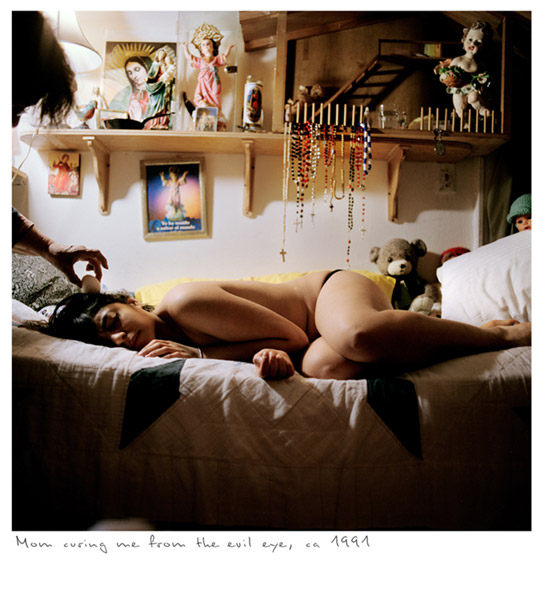
<p>Juror Michel Millard picked <a href="http://www.karenmiranda.com/" target="_blank">Karen Miranda Rivadeneira</a>'s <em>Other Stories/Historias Bravas</em> as a winner of the Conscientious Portfolio Competition 2012, writing <em>The images which have touched me and attracted me the most are Karen Miranda Rivadeneira's. I found this series of images very interesting as they are a touching mix of reportage meets fiction meets mise en scene. They are very human as they deal with big general themes such as life, childhood, adolescence, motherhood, death, and at the same time with details and particularities. They are exotic and very personal. I like that the photographic approach is not overstated, it is precise but very simple. Every frame is filled with humanity. I'd like to see many more of them.</em> In the following conversation, I spoke with the photographer about her work. <a href="http://jmcolberg.com/weblog/extended/archives/a_conversation_with_karen_miranda_rivadeneira/" target="_blank"><em>(more)</em></a></p>]]>
			<![CDATA[<p><strong>J&ouml;rg Colberg: Let's start with a very simple question first - what makes a good photograph?</strong></p>

<p>Karen Miranda Rivadeneira: A good photograph? When it leaves me with no words or not even a desire to understand or wonder what the photographer wants to say, when instead of rising my curiosity it leaves me in complete awe. </p>

<p><strong>JC: You write that <em>Other Stories</em> investigates "the role of photography and its relationship to memory." Later, you speak of truthfulness. Given that memories are notoriously unreliable, at the end of the day when you create photographs aren't you creating memories?</strong></p>

<p>KMR: In <em>Other Stories</em>, I was interested in searching my mind for the events that really seemed significant to me. But how could I find those events? Since memory changes every time we "remember," my conclusion was that in order to find these events I must search in the areas of my mind not even I had access to. So I decided to get some help and talk to my relatives. That is how <em>Other Stories</em> began. In the end, we don't need a photograph to create a memory, we do that all the time, night and day. My intention with <em>Other Stories</em> was to freeze a personal story as accurately as I could in one shot. That way, we relived the emotion, so it ends up been a picture of an experience and how the experience shaped my understanding of life.</p>

<p><strong>JC: I'm curious about the process that goes into making these photographs, in particular since they involve your family. How do you go about making a photograph? Do you tell your family members exactly what to do?</strong></p>

<p><img alt="KMR_1.jpg" src="http://jmcolberg.com/weblog/extended/archives/KMR_1.jpg" width="545" height="592" /></p>

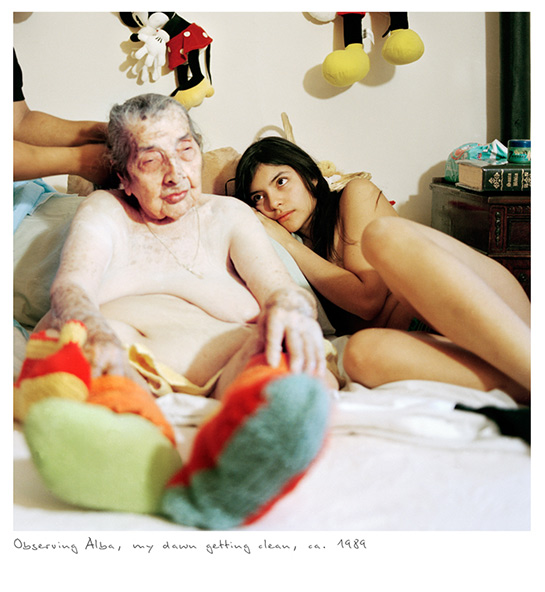
<p>KMR: In the beginning, I thought of doing some type of auto-hypnosis in order to go to my earliest memory. However, this did not work. Neither did thinking a chronological order. My family, in particular my mother, aunt and grandma, had a better idea of the events I wanted to bring back. So we talked about them. For example, with <em>Evil Eye</em>, I remembered my mother cleansing me with an egg once. But in fact, as we were talking about the experience she told me she would cleanse me quite often. This changed things. I thought of a mother that would "try out" a ritual, but now I know of a mother that comes from a lineage of women who do and belief in this ritual. Every image was sketched before it was set up. So I did not really tell them what to do. Right from the beginning it became a collaborative project. I could have never done it this way if it wasn't for their input and observations.</p>

<p><strong>JC: Given you had help from your relatives, do you view the images as your memories or more like collective memories - collective memories that, in effect, are cultural memories, stretching back in time through tradition?</strong></p>

<p>KMR: In the act of sharing a memory, the memory becomes part of someone else's (collective) memory; we unconsciously live the story, and what is even more interesting we go through our "data" of memories and try to find events that resemble the one we just heard or saw. This is what we do all the time. For me, <em>Other Stories</em> is personal but is also very collective.</p>

<p><strong>JC: Your photographs come with captions that explain the photographs or talk about what can be seen in them. I'm curious about the reasons for the captions - would the photographs not work without?</strong></p>

<p><img alt="KMR_2.jpg" src="http://jmcolberg.com/weblog/extended/archives/KMR_2.jpg" width="545" height="598" /></p>

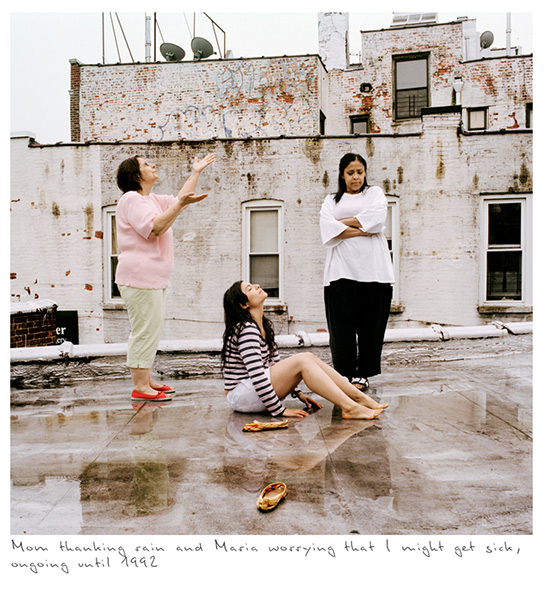
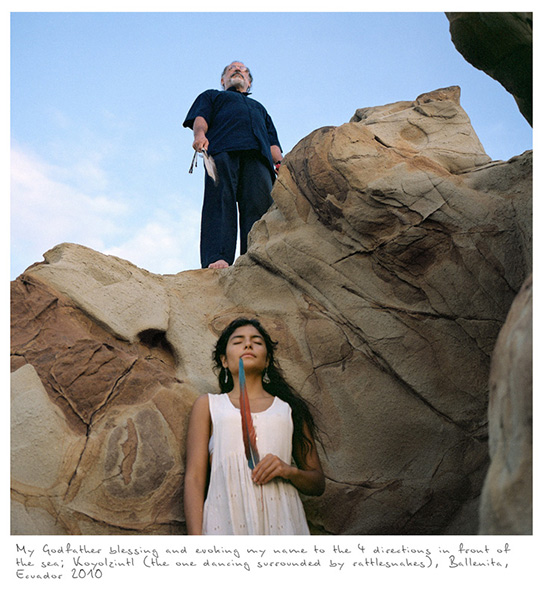
<p>KMR: A lot of people wonder about the captions. I'll tell you. The captions work like Polaroids in a family album, where there is always a short text at the bottom of a picture. It makes sense to the people involve in the image, and I wanted this work to have that personal-story structure. I never wanted to be too specific, neither too poetic. I wanted the captions just to say what is happening in an objective and subjective way, a bit like directing the attention of the viewer to what the memory is about and from there they can work their way around.</p>

<p><strong>JC: ... as if to make sure the photograph "shows" exactly what you want it to show?</strong></p>

<p>KMR: More a way of narrowing down the possibilities of what the photograph could be about.</p>

<p><strong>JC: You mention your bi-cultural upbringing. Can you talk about the influences this has had on your photography?</strong></p>

<p>KMR: Growing up, my dad traveled a lot through Ecuador, Peru and Colombia. We traveled by land. I was often crossing borders and seeing different ways of living. There is a huge divide in how the indigenous people of the mountains live in contrast with the people at the coast. I have always felt that people seemed very marginalized even from themselves. But at the same time there was something that was common in everyone, everywhere we went.</p>

<p>A lot of times life is about relating to the experiences of others. Later, I traveled to the US and realized it was the same scenario. We all look for points of connection. The trick is to find where they are and what they connect.</p>

<p><img alt="KMR_3.jpg" src="http://jmcolberg.com/weblog/extended/archives/KMR_3.jpg" width="545" height="598" /></p>

<p><strong>JC: In different countries, we might have different ways of connecting or relating to other people, which offers opportunities for artists as well as risks: As an artist, one can hope to expand people's idea of what it means to connect to people, while, at the same time, there are much more chances for misunderstandings. What is your approach to this complex?</strong></p>

<p>KMR: It seems that when I get the most intimate with my photography, somehow it becomes even more universal. I think the secret is to share from a place deeper than culture, background, ideology - share from sheer emotions and experiences that we all have, and then we can all (somehow) empathize. </p>]]>
		</content>
	</entry>
	
	<entry>
		<title>An Extended Conversation with Francis Hodgson</title>
		<link href="http://jmcolberg.com/weblog/extended/archives/an_extended_conversation_with_francis_hodgson/" rel="alternate" type="text/html"/>
		<id>tag:jmcolberg.com,2013:/weblog/extended//5.6455</id>
		<published>2013-02-25T15:59:35Z</published>
		<updated>2013-02-25T15:45:14Z</updated>
		<author>
			<name>Joerg Colberg</name>
			<uri>http://jmcolberg.com/weblog/extended/authors/joerg_colberg/</uri>
		</author>
		
		<content type="html" xml:base="http://jmcolberg.com/weblog/extended/" xml:lang="en">
			<![CDATA[<p><img alt="GoogleArtPhotography_sm.jpg" src="http://jmcolberg.com/weblog/extended/archives/GoogleArtPhotography_sm.jpg" width="545" height="278" /></p>

<p><em>Not long ago, two writers on photography found themselves in broad agreement when each approached some pretty fundamental questions at the core of photography in curiously similar terms. One wrote (and posted <a href="http://www.youtube.com/watch?feature=player_embedded&v=3dj3Wq-I7tc" target="_blank">a short video</a>) on <a href="http://francishodgson.com/2013/01/25/on-the-strange-business-of-mattering/" target="_blank">how it was worth trying to bear in mind that some things patently 'matter' in photography and others equally do not</a>. The other wrote that <a href="http://jmcolberg.com/weblog/extended/archives/what_is_at_stake/" target="_blank">identifying what was 'at stake' in a photographic project was a useful way of ascribing value to some things and withholding it from others</a>. At that stage they acted separately. But since writing on subjects like these is all about engaging others in conversation, one invited the other to get in touch, and they have exchanged a number of e-mails batting ideas around.</em> <a href="http://jmcolberg.com/weblog/extended/archives/an_extended_conversation_with_francis_hodgson/" target="_blank">(more)</a><br />
</p>]]>
			<![CDATA[<p><em>What follows is a conversation. It is rough and ready, and it is closer to a collection of notes than to finished writing. At the centre of it lies the shared conviction that it is high time that we sought certain standards whereby to discriminate between photography as digital junk and photography as the most powerful and engaging means of communication that we have. The former sometimes poses as the latter, and more often the latter is mistakenly dismissed for not being properly distinguished from the former.</em></p>

<p><strong><a href="http://francishodgson.com/" target="_blank">Francis Hodgson</a>: There is an intrinsic problem built into the surface of photographs. Because the surface (of most, of the "standard" one...) is slippery, the eye tends to skid off it.</p>

<p>This is not what happens in other imaging systems.  In painting, or when looking at engravings or most other media, there are (at the microscopic level) little ridges and troughs which trap light or reflect it in varying intensities, little pools and walls of dark and light.  These hold the eye and make a natural passageway across the surface of the picture.  Physiologically, your eye literally moves around within a painting from one resting-place to another. A good or great painter varies his brushstrokes partly deliberately to alter the structure of these ridges and pools, specifically to increase the control over the viewer's eye. So there's composition at the level of the picture, but also composition at the level of the physiology of the eye. Together, they mean that in a painting there is built-in a 'time-taken-to-view'. This gives the artist more time in contact with the viewer, and therefore more time to get his or her ideas across.</p>

<p>Not so in a photograph. In a photograph, the eye finds nowhere to rest, and so skids or slides or bounces off the surface. That is why photographs are consumed at such a terrible speed.</p>

<p>Then, particularly at the standard sizes (say, post-card reproduction, or less-than-full-page magazine reproduction) we are further persuaded that the picture is <em><u>a single gobbet</u></em> of information. All of our instincts lead us to scan a picture (in one glance), reduce it to a 'thought', and pass on. And the thought, of course, is always framed in words, for the plain reason that we find words easier internally to codify, file, retain in memory... than pictures. In other words, we are all trained to turn a picture into a mental caption, file the caption, and never look at the picture again. </p>

<p>This is emphatically not what happens in painting or engraving, nor of course in those arts where time is built into the act of receiving the art ( film, video... but also sculpture, architecture, music, literature...).</p>

<p>Phrase this another way, and photography is almost unique in having immediacy built in. This is both a huge advantage, and a huge disadvantage.</p>

<p>These two facts, the slipperiness (can we even go so far as to think of it as a degree of repellence?) of photographs and the 'single frameful' of information, kid us that a photograph is something to be 'got' instinctively or immediately.</p>

<p>I emphatically believe that a photograph is much more than that.  If I can put down a double 'credo' here, it would be that:<br />
Photography is a perfectly ordinary cultural activity.<br />
Which means that photographs must respond to analysis like any other kind of communication and specifically, photographs are good or bad for understandable and explicable reasons.</p>

<p>But the slippery surface and the notion that photographs contain single gobbets of information have conspired to persuade us they are beyond analysis,  and that therefore they do not come from an ordinary cultural activity. </p>

<p>Second movement.<br />
All good photographers have struggled to find ways to hold the viewer longer on the picture. This is either by such effects as Hockney's joiners, collage, embroidery on or making holes in the picture... anything, in fact, to break up that slick surface and keep the eye held there a fraction longer. Keep the eye there long enough, and it turns out that photography is not trivial at all. It is just as capable of carrying sophisticated thoughts as any other medium: in photography you can do allusion, irony, parody, thesis and antithesis, satire... But you can't do anything at all if the viewer isn't there anymore. Much of the effort that goes into composing photographs properly is for that reason. Good composition leads the eye around the picture, hopefully in an order, and (sort of) at a speed directed by the photographer. A photographer who can't be bothered at least to try and do this doesn't understand the basic difficulty of his own medium, and therefore can automatically be dismissed. Nothing he has to say can be of any interest except by chance (photographs are often interesting by chance, but that's another story...).</p>

<p>The business of signifying that the story being told <em><u>matters</u></em> begins by respecting the relationship the viewer has with the photograph.</p>

<p>Third movement:<br />
The digital phase of photography has made all of this infinitely worse. Because<br />
A) digital printing has not yet produced any surfaces of great beauty. In spite of the lies put out by manufacturers, even the fanciest digital surface has nothing like the interest of an old silver print, a Polaroid, a cheap colour shot from a Fujica half-frame &c &c. Digital is a technology that wherever it is found tends to reduce the differences between media. This is as true in sound as in pictures. Digital is about the image, not the object. And pictures were at one time more likeable through their physical presence as objects even than through the images they held and transmitted. Hold a copy of Arbeiter Illustrierte Zeitung or Pesti Napló and they are appealing surfaces even though the printing was cheap. Digital has not countered that. Blurb books, iPhones, modern colour magazines... none of them have any tactile appeal at all. So the picture stops being object and image, and becomes just image. It's less.</p>

<p>And B), remember that the vast majority of pictures are now seen disembodied, anyway. We view backlit, on screens, things that have no physical presence of their own. </p>

<p>NB. That the vast majority - perhaps 99 percent of photography - is still snobbed and unregarded. This is the stuff that is made and used by surveyors, grandmothers, dentists, cheap advertisers (often via picture libraries), various kinds of social scientists and so on. The boom is emphatically NOT just in art photography. We are all literate in photography. It is, whatever people may say, our shared culture, now.</p>

<p>Finally, we are all photographers, too, now. (Camera phone &c). Therefore to distinguish themselves, those who wish to be taken seriously must do things that are not available to Everyman. For a long time, this just meant printing things very large. If your print cost £200 or £300, you were at the very least making a claim that you were not just a snapshooter. It was nonsense, of course (and I for one have always been very intrigued by small prints). I think that tide is ebbing, now, a bit, and about time, too. But Diasec, mounting on aluminium &c (both of which, incidentally are techniques originally found in the signmaking industry - just a thought) are really just ways of saying "I am so serious I spend money on making the object itself. Because the image - I acknowledge privately ­- is indistinguishable from the image that Everyman produces". </p>

<p>In other words, as that aspect of the photograph which is embodied in its objective presence (which is always the one appealing to connoisseurs) has diminished, the self-regarding among photographers have had to replace it by inventing a new category of objectifications. These give seeming importance, and are often mistaken for the content within the images <u>mattering</u>.</strong></p>

<p>J&ouml;rg Colberg: Let me think how to address what you brought up. Let's start with the surface, because that's a very interesting concept. I've never really approached it from the angle of the actual, literal surface. Might the fact that photographs don't have a real surface be the reason why photographers (meaning here: Everybody really, "serious" photographers and "amateurs" alike) have been so eager to embrace photographic processes that - even just seemingly - embrace a breaking of the surface? There's a wet-plate renaissance, for example, a company is working on bringing back Polaroid film, and smart-phone apps like Instagram or Hipstamatic have become wildly popular. None of those processes truly break up the surface, add what you could consider crackles in that slick surface (or their equivalent). Photographs are produced by machines, so there's almost no way to get real crackles. But it would seem that photographers have been trying to introduce the crackles into the process, not the image. </p>

<p>And with digital media, there isn't even a slick surface any longer. You can hold a print, and there is a surface, however slippery it might be. But a photograph that I view on my iPad - that's not even there. The surface, that's the surface of my iPad. That surface it has to be slippery, so the machine actually works, and I can scroll pages etc. </p>

<p>As for photographs being seemingly a single gobbet of information, I wonder whether we would all really think that if we were unable to take photographs. We know <em>how</em> a photograph is made, and that has always been there (Kodak: "Press the shutter, we do the rest"). So of course, we have been tempted to think that it has got to be that single gobbet of information, because when taking a photo, for the most part <em>that</em> is exactly what we do, 99.9% of the time: Very intentionally freeze a single gobbet of information into the photo frame. </p>

<p>I question, though, whether it's really true that that is why we stick so much to captions. For what it's worth, I certainly don't. I have possibly thousands of photographs in my head, without remembering a single title or caption. I've always thought of captions as cheating: No photograph really holds that single gobbet of information. But we <em>want</em> it to do that. What better way to do that than to literally say it, by means of using a caption?</p>

<p>And most photographs never get a real caption or title. They'll remain DFC4275.jpg, don't they? Who has time to caption all those digital photographs they're taking?</p>

<p>It got quite interesting for me when you talked about how we fool ourselves into believing "that a photograph is something to be 'got' instinctively or immediately." It is, though, isn't it? Because we do get photography instantly, even though what we get is not necessarily what the photograph actually shows! But we certainly get something, and we do it very quickly. How else could we survive in this world where there are so many photographs that are trying to sell us something? </p>

<p>That brings me to one of my pet peeves, namely that when talking about photographs, most discussions don't move beyond that, which you can truly immediately get - usually just a small fraction of what else there is that can be had. This, essentially, is why I have been wondering for a while now how we can move talking about all those many photographs that are online into a different, higher, sphere. We need to talk about what photographs actually say and how they do that. This would then allow us to withstand the avalanche of photographs better because - and this might be too naïve - once you understand how to look at photographs, you will become better separating between those that are really just single gobbets of information (the photograph of my breakfast) and those that offer a bit, possibly quite a bit more. </p>

<p>Analyzing photographs seems particularly important given that the internet for the most part is a visual medium. And with so many photographs out there we have to talk about what is good and what is bad, because otherwise, we'll lose our minds. A mindless flood of photographs might entertain some people, but for most people it ceases to make any sense.</p>

<p>I'd actually argue one of your points about how we treat photographs works exactly the other way around: Since we don't understand photographs well enough, all we do is to slide on the usually too slippery surface.</p>

<p>This brings me to the relationship between the viewer and the photograph. I agree with you. We need to talk about that. Talking about that has to mean that we not only engage the viewer more, by bringing her/him closer to the photographs, teaching her/him essentially how photographs can be approached beyond the quick consumption that is so common now, but we also need to talk about to what extend the viewer brings meaning to the photographs. What I find odd is that we still talk about photographs as if the photographer were the only person who mattered. S/he is not. I wouldn't proclaim the "death of the author" - I think that idea doesn't really fully apply to photography; but the photographic author seems vastly overrated. The cult of the photographer needs to be broken for all of us to get closer to what that photographer is actually producing - and that is true both for the "serious" photographers and for the "amateurs."</p>

<p>Once you introduce the digital world, there are all kinds of additional aspects, a very important one being that digital also means cheaper. Of course, a Blurb book doesn't feel like anything, because no effort went into its making. Somebody dropped some photographs on the computer into some template, and then the cheapest possible printing and binding produced... well, a cheap-looking and -feeling book. I do think that the idea of cheapness, of photographs not costing any longer, has had an effect on how we think about photographs. Cheapness and a lack of effort. It's too easy to make photographs now! To refer to my "What's at Stake?" piece, there isn't anything at stake in terms of taking a photo any longer. You can take as many as your memory card will allow you to. You don't run out of film. There is no real cost to making a photograph. Nothing to rub against. That then translates into the pictures. That's why there is so much bad photography out there: There literally was nothing at stake. How can such photography then not lack a surface, lack something to rub against? </p>

<p>How do we get us out of the mess? How do we re-introduce a preciousness into photography that has in many ways disappeared? I do believe, after all, that even in the presence of billions and billions of photographs, some (possibly many) can be precious. But we need to understand what we can do (have to do?) to get there, to be able to get a grip on that: What is precious, what is not?</p>

<p>Once you deal with the art market (which has totally spiraled out of control) how can you persuade a wealthy individual to pay a lot of money for a photograph (especially if it usually costs so little to make it)? There's got to be something incredibly special about it. If it's not scarcity, it's at least got to be size, right? Get your bang for the buck as the American saying goes. Following that - and your thought - we've recently come to pretend there is a correlation between auction values or prints' prices and artistic merit, whereas in reality, there often is none. Just because some Russian oligarch pays a million dollars for a print doesn't mean it's a good photograph. It just means it's a photo someone wants to pay that much money for. </p>

<p>There we get the mattering again, because auction prices can't be what we take as yard sticks for what matters. OK, we can, but then we'll get an incredibly shallow culture. That's just piling surface upon surface. And that brings us back to the main point, namely that we need to determine what matters and what not, by talking about photographs and by making distinctions, by introducing a yard stick (or possibly more than one) by which photographs can be measured. If we do this well, we'll kill two birds with one stone: We'll understand photographs better (aka more deeply), and we'll be able to separate the wheat from the chaff.</p>

<p><strong>FH: I also want to try to add one extra bit of thinking to add in to the mix, which is about</p>

<p>Taking Responsibility: --</p>

<p>Photographers expect their viewers to use all the resources of their visual culture to unravel a picture. We are expected, for example, to recognise small parts of well-known buildings without having to see the facade to be sure. We are expected to pick up quite small clues from flora and fauna to identify place, and quite restricted clues from e.g. clothing to identify social class or the relevant generation. We are expected to understand that a long lens compresses distance, so that e.g. the truck down the road is not necessarily immediately going to crush the unfortunate child in the pushchair.</p>

<p>BUT very few photographers use the same cultural resources fully themselves in making the image. There is a peculiar way in which [(bad)] photographers are quite routinely illiterate in their own art-form.</p>

<p>So: no writer in his/her right mind would try to make a novel about London without having read Our Mutual Friend, because the readers would obviously be looking for references (or relevant divergences) at every turn. Yet it is absolutely standard for you and I (in e.g. portfolio review sessions) to meet photographers who are working in some field with just as obvious a photographic precursor of whom they remain blissfully unaware. I have quite literally only recently met a photographer working on plump (i.e. non-model-shaped) nudes who had no idea that Irving Penn had ever done such things , and had not heard of Jenny Savile. I do not believe that this happens very often in other media. TV people, in my experience, are obsessed with TV and think (with some reason) that their audience is, too. Pop music is entirely referential, and works by reminding people of previous stuff and then proving a variation. Classical music was sometimes about stretching the envelope ever so slightly , until eventually something like sonata form just broke (Beethoven 111, I suppose). The theatre is written for people who know theatre, by people brought up in it. Only a very contemptuous photographer would think photography any different.</p>

<p>The reason is bound in, I think, with what we were tackling before. If you suppose photography to work 'instinctively', to transmit its messages immediately, then the normal rich history of a culture is irrelevant. But I don't believe that. I believe that for photographers to keep on claiming (or pretending) to reinvent the wheel is a huge loss of heat and light. Musicians, as I say, build on what they heard when they were little. They assume that there are certain things you just know, without having to have the point laboured. Certain other things can be parodied only once we are reminded of them &c. There is an assumption of shared culture between maker and user. Not in photography, and it's almost entirely the 'fault' of the photographers. Photography has long been tagged as 'marginal' or (in British terms) 'not quite proper'. This stems originally from Victorian distrust that anything made by a machine could contain artistry or expression. But that's been obsolete for years. Nobody now wastes much breath on whether photography is or is not 'art'. But photographers still think of themselves as embattled and misunderstood creatives, labouring desperately against insensitive opposition to have their creations taken seriously. It's laughable, really.</p>

<p>In my view, a photographer is responsible for the reading of every detail of a photograph. Because - although very few viewers can actually put into words - what we actually do when we view a photograph is to look through it for clues as to what it means. If we start to find that those clues are pulling in the same direction, and that they add up to something coherent, interesting, moving, informative, sexually arousing (or whatever it is), we keep looking. But the moment we find that they contradict themselves, we're gone. No second chances with photography. Keep the viewer engaged fully, or lose him altogether. For a good example of my thinking on this, see <a href="http://on.ft.com/Z75khQ" target="_blank">a recent piece I did for the Financial Times on a Robert Doisneau picture</a>, apparently just a cheerful humanist street view about music, but in reality a complex meditation on the act of looking. </p>

<p>It is the photographer's responsibility to make sense to a reasonably alert reader. Of course I understand that I may see a picture which reminds me irresistibly of my late mother, and that it may move me for that reason without that being the fault or the intention of the photographer, or even predictable by him. Nevertheless, the core of a photograph must be capable of a fair analysis as intended by the photographer. It is then the viewer's responsibility to look well enough and hard enough at that photograph to test whether it does in fact bear analysis. If it does, the viewer is 'in', engaged in that picture, and the photograph can transmit to him ideas of just as great complexity as he could receive in any other medium. If it isn't, he's quite rightly away and gone and the photograph has failed and should not have been circulated. </p>

<p>There are far, far too many photographs in the world. We are drowning in oceans of dreadful photographs. Many are destined (thank heavens) never to be printed, but to languish on hard drives or in the matrix of servers called the cloud until eventually their software becomes obsolete and no-one can read them as photographs (at least without a huge effort of recovery). Thank heavens, too, the older ones were made normally on fragile supports like paper and they got damp or creased or burned and also vanished. </p>

<p>Too many photographs. I have often made a distinction between pictures OF something as against pictures ABOUT something. Far, far, too many photographers routinely mistake the ease whereby we make pictures OF x or y with the rigorous intellectual and cultural difficulty of making pictures coherently ABOUT anything. If you want to be called a photographer, it is incumbent upon you to take full responsibility for the cultural legibility of your work. Your messages need to be understandable. If they are not, you may be a supremely competent camera operator, but you are not a photographer. </p>

<p>This presupposes, by the way, that the messages are worth saying in the first place. Photography is the most gloriously complete messaging system that we have. It is transnational, to some extent transcultural. It is immediate, works well on many different supports, including on backlit screens. It is more portable than paperback books, more reproducible even than them. It is capable of butcher's accounts and of Atget's Paris: everything is photographable, and no field of human activity has been unchanged by photography. But photographers must always bear in mind the Mark Twainism: " If you have nothing to say, say nothing." Far too many photographers don't even realise that they might be expected to have anything to say. Yet if they expect us, their viewers, to use the full resources of our visual culture to 'get' their pictures, it behoves them to know pretty well what messages they hope we might get out of the damn things. The moment it becomes clear that they haven't taken responsibility even for that, they lose any right to be scrutinised with intelligence and patience. There's an old British military acronym which you can apply to any photograph which is not proving coherently to say what it purports to say: FIDO. Fuck it, drive on.</strong></p>

<p>JC: That's a very interesting point you're making about photographers. I've long been baffled by so many photographers seemingly having no interest whatsoever to look into their own art form more deeply. How can this be? How can you not look at a lot of photographs, just like writers, let's say, typically read a lot (to then spend most of their time being utterly devastated about the fact that so many other writers are so much better)? How is this possible? The often complete lack of knowledge of obvious references pains me! You've just got to know who and what came before you so you, too, can stand on the shoulders of giants! </p>

<p>I've often thought that this disconnect from the past is tied to the lack of imagination I see in so much photography: If you're not curious enough about the world, you can still make plenty of photographs. Of course, you won't bother to look at what came before you, and of course those photographs will then at best be one liners (that someone else might have done a whole lot better).</p>

<p>It's a bit like trying to learn a language by learning parts of the grammar and some words, but never looking at how that all can be used before having a go at it. Sadly, our culture, at least out photographic culture, truly buys into that, in all kinds of ways. For example, there is that cult of the young photographer. I don't mean to say that young photographers cannot produce wonderful photography. But just like in any art form, being able to say something is contingent on having lived a life, experienced things. None of that stuff comes easy!  </p>

<p>Add to that the obsession that everything has been new, and you're truly in trouble. I have had students who told me they didn't want to photograph something any longer, because someone else had already done it. How can that be? Why are there so many people writing about love - now that has been done before as well, hasn't it? The moment you're in photoland, the absurd idea that something is done when someone else has done it before is widely accepted. </p>

<p>This brings me to photographers still having that weird relationship to the world of art you mentioned. Of course, that debate is mostly closed. The art world might still not truly understand how photography works, but many photographers don't, either. But place yourself into the shoes of someone in the art world: How can you take an art form seriously where so many practitioners worry about so much irrelevant nonsense? Where so many practitioners do not look much beyond their own navel, whether it's looking at who came before them or whether it's looking at other art forms? Everybody has been able to read and write for ages, yet writers don't fret over how we're all writers now. But in photoland, that currently is taken as the grand realization: We're all photographers now! Woe us "serious" photographers! What are we doing? When you think about it, it's almost absurd! </p>

<p>We might all be photographers and writers now. But the only thing that really matters is what people bring to the table. That means injecting a photographs with all those additional things that then can unfold so richly - provided a viewer will spend the time. The Doisneau you talked about is a good example. The art of photography is not taking pictures, it's making very good pictures, with rich layers of meaning - usually a painful process, requiring a lot of work, certainly before and after that shutter button is pressed. </p>

<p>It is true, in a somewhat superficial sense, the tool to do that is now in everybody's hands (just like people have been able to read and write for a while now). But just like I don't treat the shopping list I write in the same way as the writing I do about photography, I refuse to take someone's casual photograph of their breakfast in the same way as that same person's more serious photography (whatever that might be). </p>

<p>And that is a crucial distinction, which, I believe, most people understand very easily - except the people who make up photoland. We all know that different photographs serve different purposes, and we all assign different values, meanings, and levels of importance upon them. To pretend that that is not the case strikes me as absurd. Sure, there are billions of photographs now - but just like their makers usually don't treat every image exactly the same way why should we? </p>

<p>If you take a photograph, say, to sell something on Ebay you do it in a very functional way. It's unlikely you will frame it and hang it on the wall, next to the photo of your children or pets. Of course, we can investigate the aesthetic of Ebay photographs, but that can only go so far. Such an Ebay photograph holds a different value for their maker. It's functional. In a different way, a photograph of your breakfast might be entirely social: You take it to share it (again, you probably won't print it and frame it). </p>

<p>I want to talk about another responsibility. The one you talked about is supremely important. In addition to that, I do think it's an artist's responsibility to talk about their work, and to do it in ways that can be understood by as large an audience as possible. I'm so tired of photographers claiming they can't talk or write about their work, because it's a visual art form. Seriously, if you can't talk or write about your photographs, you don't know what you're doing. I know this will get me in trouble, because people won't like to read it. Still: If you can't express the longing or desire or whatever else went into the making in some way, however clumsily, then I will conclude that there was no longing or desire. I will conclude that it's just a life style. </p>

<p>Let's face it, one of the problems that seems unique to photography is that being a photographer can be a life style. No other art form will allow you to do this that easily. Poetry maybe. Photography and poetry seem to have such low barriers of entry (push the button, write some short phrases in a few lines) that, boom!, you're a photographer or poet. Ask someone why they photograph, and you'll often be surprised that they don't have an answer.  </p>

<p>That might be, in part, why there are so many photographs. Of course, there are all those people - me included - who photograph seemingly irrelevant stuff with their smart phones (I have way too many photographs of the same cats). But that's not what I'm talking about. There are too many art photographers. Nobody wants to say this in public, but I hear it all the time, usually when I have dinner or a drink with someone. </p>

<p>Make no mistake, I do think that everybody should have a chance to be a photographer. BUT then you have to bring something to the table: Look at the history, look at references, read books, dive in deeply. If you don't dive in, you stay at the surface. Yet again, that surface...</p>

<p>As you said, your message needs to be understandable. First: You actually need to have a message! Why should I care about your work if there's no message? I can create my own messages all day long, and I do. But people look at art not for its lack of messages. Have a message, dare to have an opinion, and then make sure you communicate that clearly, whatever that might mean in the context of what you're doing. That is <em>way</em> beyond aiming your camera at what I call The Thing and then pressing the shutter. </p>

<p>In other words, tell me something I don't know. I don't care about what I know already. I'm hungry for different perspectives. If I want to find out what I know already, I'll sit down and think about it a little. I don't need any writers or photographers of film makers for that. </p>

<p>Of course, now we've been tooting the same horn. But it still surprises me how many photographers  will say that they don't want to take sides, that they want to look at things from all angles. Well, you call it being open to all sides, I call it being wishy washy. </p>

<p>And we have to make that a criterion how to approach photograph, how to determine what matters and what not: Does this actually say something? If it says something is that something that might have a lasting value? It might be cool to see all those, let's say, secret places in your photographs, but what happens after you've seen them? Merely showing something, however well it is done photographically,  is art-editorial photography: photography conforming to art-photography criteria, but operating like editorial photography, illustrating something. You look at it, you go "Oh, that's what that place looks like. Son of a gun!" and then you move on. Why look again? It's going to look exactly the same way. </p>

<p>You can find such examples in the best art museums. It's a problem that's not just confined to the internet. We have to ask: What does this tell us?</p>

<p>Anticipating some of the reactions this might cause: Whatever activity we're engaged in in our lives, we always try to make sense of things. We have to make decisions, for all kinds of reasons. For example, we prefer some authors over others. Or we prefer fiction over non-fiction. Or we prefer short stories over novels. How do we find something new to read? We might ask friends for recommendations, or we read reviews. That is how we deal with the plentitude of options, whether it's selecting a new book to buy, a wine to drink, a movie to watch etc. In part this approach is what we need to bring to our approach to photographs as well. The common retort to a call for more curation or editing is that finally, photography has become democratic so why should something be picked over something else. The answer is simple: Because that's what we need to do, so we can make sense of things. </p>

<p>The flood of photographs online has resulted in photographs barely making sense any longer (as is obvious from all the confused writing about it - we talked about it earlier). It's time we started making sense again. This has nothing to do with taking the idea of democratic out of photography. On the contrary, it means making a meaningful access to photography more democratic, by giving everybody the same tools to approach photography. This is what critics will do: Point at something and discuss its merits. There is no obligation to agree with that critic, but at least there is an opening for a discussion.</p>

<p><em>Between us we have a prodigious experience of photography. We have each known of (and respected) the other's writing a long time, but we work in different places, and find different ways to put the freelance bits of our lives together. The authors write separately and by no means agree automatically.  We have come together here in an informal way for something approaching a two-man conversation.  We have enjoyed the process and are perhaps looking for ways to push ahead with something similar. We do not particularly just want to blow hot air about photographs, though, without some sense that some of what we are saying reaches out to people who themselves are doing some serious thinking about photography.  For the truth is this:  there is already a lot of excellent thinking about photographs and their places in the world.  But photography has suffered from a peculiar failure of trickle-down whereby that thinking hardly reaches the practitioners or the people who hire them, and even less the people who use photographs, all day every day.  We don't claim that all of our thinking is new, any more than we claim that all of it is right.  But we would like to contribute to the trickle-down.  We hope that after reading these lines, photographs will not be quite so easy to make, distribute, and consume unthinkingly.  Because whatever else they have proved, photographs have proved that they repay thought a thousandfold.</em></p>

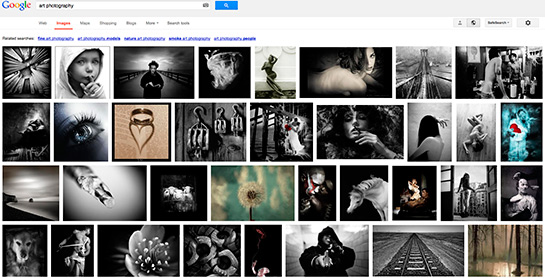
<p><small><em>Image: The top results provided by Google Image Search, looking for "art photography."</em></small></p>]]>
		</content>
	</entry>
	
	<entry>
		<title>A Conversation with CPC 2012 Winner Lisa Fairstein</title>
		<link href="http://jmcolberg.com/weblog/extended/archives/a_conversation_with_cpc_2012_winner_lisa_fairstein/" rel="alternate" type="text/html"/>
		<id>tag:jmcolberg.com,2013:/weblog/extended//5.6449</id>
		<published>2013-02-18T16:06:29Z</published>
		<updated>2013-02-19T15:09:20Z</updated>
		<author>
			<name>Joerg Colberg</name>
			<uri>http://jmcolberg.com/weblog/extended/authors/joerg_colberg/</uri>
		</author>
		
		<content type="html" xml:base="http://jmcolberg.com/weblog/extended/" xml:lang="en">
			<![CDATA[<p><img alt="LisaFairstein.jpg" src="http://jmcolberg.com/weblog/archives/LisaFairstein.jpg" width="545" height="363" /></p>

<p>Photography has finally come full circle so that it can investigate itself and its uses, the latter of course being the aspect where things get interesting. <a href="http://www.lisafairstein.com/" target="_blank">Lisa Fairstein</a>'s <em>Ultra-Static</em> throws the viewer right into a seemingly absurd world, which, however, feels oddly familiar (because it is). Pulling together references from different areas of photography the resulting images offer no relief in the form of advertizing or magazine copy, which would allow us to filter the imagery. Instead, we are left with photography's artifice, with all that photography is so good at, and bad at. Find a conversation with the photographer below. <a href="http://jmcolberg.com/weblog/extended/archives/a_conversation_with_cpc_2012_winner_lisa_fairstein/" target="_blank"><em>(more)</em></a><br />
</p>]]>
			<![CDATA[<p><strong>J&ouml;rg Colberg: What makes a good photograph?</strong></p>

<p>Lisa Fairstein: I'm interested in the various modes photography uses for expression, with images made by any number of personalities, agendas, viewpoints, contexts. Not what is photographed so much as why and how - how images work and how we work them distinctively. And this doesn't only pertain to images consciously made with this foundation in mind, but to various kinds of photographs across the board. So it's not about a "good" photograph, per se, but for me what is good in the consideration of photographs. A good photograph is mainly one that shows me an intriguing perspective.</p>

<p><strong>JC: I'd love to hear more about that. What is "an intriguing perspective" for you? Can you be a bit more concrete?</strong></p>

<p>LF: What I mean is that with so many people photographing and projecting any number of motivations for photographing (some more native to them than others), what fascinates me about looking at images is to consider the viewpoints of these people, and what inspires them to make pictures. I appreciate that these viewpoints exist - from incredibly contrived and well-thought commercial work, to "naive" amateur work, to very self-conscious fine art work - the breadth of motivations for photographic representation interests me, and so I find "good photographs" in all kinds of places, based on a curiosity for what is being expressed. Within that, there are some people who make great photographs, from very unique and unusual perspectives, both amateur and more considered, and, I think, that is always very exciting to find.</p>

<p><strong>JC: There is a lot of talk (possibly too much) about photography having some sort of identity crisis, given our exposure to so much of it and given the fact that we seem to believe more in some photographs than in others. With <em>Ultra-Static</em> you seem to be acknowledging some of those discussions, playing with imagery seemingly taken out of different contexts. Could you talk a little about how you came up with the ideas that led to the project?</strong></p>

<p>LF: Photography has always had an identity crisis. That is part of what fascinates me about it. And yes, we do believe in some photographs more than others. I wanted to find a way of working that addressed the different ways I had come to think about image making. This involved sort of zooming out and looking at beliefs surrounding photography and the activity of photographing and editing, breaking the "program of the camera" as the philosopher Vilém Flusser framed it, to create a space in which to work. I'm interested in photography because of the way it functions in the world as an extension of our activity. I wanted to deliver something that spoke to people both in terms of its familiarity, and also for its ability to deliver jarring expression of thought and life.</p>

<p>The work isn't just about an analysis of photography's functioning, that questioning is part of it, but I also wanted to deliver something generative along with that. Maybe instead of being a deconstruction it's more of a reconstruction in its offering of a variation on experience. And that offering takes on what has been discussed as a contemporary sentiment in art-making today - embracing a skepticism and a sense of irony along with an earnest kind of enthusiasm. The starting place was an interest in the process of image-making, which engaged, more specifically, seductive imagery, and that could then be reconstituted into something new that would approach a different set of goals. </p>

<p>To execute the images I wanted to work within a set of rules that were similar to say the "rules" of commercial production - the recipe that commercial photography has developed to communicate visually - and disrupt that, formulating my own set of rules to create by. I wanted to offer a variation on imaged experience, for all that that can deliver. And I played with the actual construction of the images as well, in both analogue and digital terms, blending these modes at times to point to the construct. I was interested in incorporating the simplicity and directness of stock photography, for example, with a new type of expression, offering new meaning within the claustrophobic space of the uncannily familiar, to emphasize the space between reality and fantasy. Also, photographic representation, especially as fabricated in my images, renders the subjects and objects as existing in a similar and precarious existential space - somewhere between being and object - and I wanted to emphasize this as a way of calling attention to questions about their existence as well. </p>

<p><strong>JC: When you say "the claustrophobic space of the uncannily familiar, to emphasize the space between reality and fantasy" - what do you mean by that? Could you expand on that a little?</strong> </p>

<p>LF: When something is familiar, but uncomfortably so, I associate it with a claustrophobic feeling. In my pictures, because of the simplicity and familiarity of the style, and how these are mixed with some unusual or unexpected situations or implied emotions, such a feeling is created. And the sense of constructed space in the images, along with the physical edges of the photograph itself, exaggerate this further. This claustrophobic feeling makes me question what I am looking at and how it makes me feel, and, in that, it might lead to a consideration of the images and subjects in terms of what is "real", or not.</p>

<p><strong>JC: Furthermore, I'd be curious how you'd explain things to someone who might not have the same art background you have. Let's say you go to a diner and you end up chatting to someone sitting next to you at the counter, also having a cup of coffee. How would you talk about the "photographic representation [...] renders the subjects and objects as existing in a similar and  precarious existential space - somewhere between being and object"? The reason I'm asking is because I do think there is a need for photographs and how they operate to be talked about in a wider context, outside of the art world. But I am very worried that art-world jargon runs the risk of making such discussions inaccessible for a non-art audience.</strong></p>

<p>LF: When explaining my work to people without art backgrounds I usually start out by saying that what interests me, and what partially motivates the work I make, is the how and why of taking pictures - how we can all have similar technology, and get very different results from it, partly because we are motivated to take pictures for very different reasons. People get that. Some of the aspects of the work might be lost on them, but I think there is a feeling of someone trying to express in a way they can relate to, and instantly and effectively, even without a thorough understanding of everything that might go into making the work. </p>

<p>As for the "precarious existential space" I was talking about, it does sound... precarious. But what motivated my thinking there is the play with the sense of belief in the representation of people and things in images. People are reduced to printouts (or digital transmissions) and exist in images side-by-side with objects that end up holding the same status. So when I was editing my images I would select images that were at once active and which also had a stillness to them - but in the images where cutouts of people are re-photographed as still lifes alongside objects - they were somehow even more still, and this thought especially stood out. That is something recognizable in the work, even without having the formal language to describe it.</p>

<p>We can't all be specialists. As much I was motivated by a variety of things in the making of this work, I am happy that the images stand on their own. Even if all of my thinking isn't evident to someone viewing the work, it clearly is work that is trying to communicate to the viewer, and in a way they are unaccustomed to. People can engage that in the experience of viewing it.</p>

<p><strong>JC: Your approach to photographs appears to extend into their titles. I'm curious about your ideas behind the titles.</strong></p>

<p>LF: The individual titles point to... the whimsy and the absurdity of the images (<em>Bananas</em>), or to the conventions in the images that are "off" (<em>Ear</em>), or to the conventions that are staid (The Beach), to conventions of art production, such as monochromes (<em>Rolling Monochrome, Static Monochrome</em>), to conventions of photography itself, as in the behavior of repetition in photographic imagery (<em>Shadeeka Stutter #2</em>), or to the implicit fact that they are all constructs (<em>Chromatic Composite</em>).</p>

<p>The overall title for the series, <em>Ultra-Static</em>, suggests how the results of the works demonstrate an unclear narrative, and toy with the conventions of photography, and with commercial photography, such that the images are stuck in their activities by virtue of not demonstrating a clear and prescribed read. They are somehow more still than we might be accustomed to seeing in photography. Static monochrome and Rolling Monochrome become the two most successful and important images of the series for me, partially for this reason.</p>

<p><strong>JC: [Devil's Advocate] The moment a medium becomes interested in itself it might in fact be having some problems. Photography seems to have come full circle now, arriving back at where it started - trying to find out what can be done, except that now instead of looking at the world, it is looking at itself. What do you think?</strong></p>

<p>LF: Photography is not just looking at itself now, but looking at itself doubly. If by "problems" you mean a signaling of some kind of an end to photography, I would say that I don't think reassessing the use of language (and photography could be said to be a language) leads to an end. Languages continue to develop and change as people change. We will continue to find new uses for the same medium, even if that means the same uses take on new meaning. People who claim the death of a medium might be unwilling to consider this. As we change, our approach to expression will change, and this applies to both traditional media and those to come.</p>

<p>We might have to redefine the activity of photographic image-making. Not just photographs, but photography as a whole is losing its traditional context. I think it's important to consider that the line drawn around what makes a photograph, or a photographer, or a photographic practice, is sort of arbitrary. And so photography has the possibility to grow, perhaps beyond pre-defined criteria, and artists working with photography will grow along with it. I continue to find work that interests me, that engages photographic concerns in a variety of expressions. I don't see an end to that. And maybe the lines delineating photographic work eventually won't be as defined, and maybe it won't continue to be such a topic of discussion.<br />
</p>]]>
		</content>
	</entry>
	
	<entry>
		<title>What is at stake?</title>
		<link href="http://jmcolberg.com/weblog/extended/archives/what_is_at_stake/" rel="alternate" type="text/html"/>
		<id>tag:jmcolberg.com,2013:/weblog/extended//5.6443</id>
		<published>2013-02-11T20:29:41Z</published>
		<updated>2013-02-12T14:55:54Z</updated>
		<author>
			<name>Joerg Colberg</name>
			<uri>http://jmcolberg.com/weblog/extended/authors/joerg_colberg/</uri>
		</author>
		
		<content type="html" xml:base="http://jmcolberg.com/weblog/extended/" xml:lang="en">
			<![CDATA[<p><img alt="NoStake.jpg" src="http://jmcolberg.com/weblog/extended/NoStake.jpg" width="545" height="409" /></p>

<p>Let's face it, the tedium of seeing the sheer endless stream of photographs on Tumblr, images that might or might not be properly attributed, is just depressing. We might be all photographers now, but does that mean that we all have to be mindless consumers as well? Of course, our late-capitalist culture is based on just that, on people turning into consumers without questioning what is going on. But what do we actually gain from applying that model to photography? <a href="http://jmcolberg.com/weblog/extended/archives/what_is_at_stake/" target="_blank"><em>(more)</em></a><br />
</p>]]>
			<![CDATA[<p>Another angle to approach this problem would be to acknowledge that while we're all photographers now, only very few of us will see their photographs on the walls of galleries or museums, very few will make a book that sells a single copy, very few will produce a photograph that "goes viral" on the internet. In fact, very few of us will be remembered as photographers in one hundred years. There are selection processes in place already, selection processes aimed at serving their purposes. Gallerists want to make money, museum curators want to stage shows that attract many visitors while bolstering their art-historical credentials, and people will just be people, buying books they like, for whatever reason. And then there are connections, and there is luck (the only real equalizer left in this world).</p>

<p>Thus it would seem natural, in fact it would seem more urgent than ever to move beyond the rituals of writing about our oh-so-democratic art form, to instead (yes, instead) find ways how we can make sense of what we are photographing. To be more precise: To make sense of that flow of images, to extract those that potentially have lasting value, while putting aside that don't. That activity of selection on the surface appears to be "undemocratic" or "elitist." But populist sentiments won't get us beyond the state we're in right now: One image after the other, one "Oh wow!" or "OMG!" after another, an endless, shallow steady trickle of imagery, with each image having an expiration date of less than a day - however long (or actually short) our attention spans have become as we feverishly check our Facebook and/or Twitter feeds, trying not to miss the latest blip on our collective radar screens.</p>

<p>Seriously: Enough! </p>

<p>We need a strategy, a new strategy! </p>

<p>We need a new way to approach the avalanche of photographs! </p>

<p>We need to start making sense of all of this! </p>

<p>We need to realize that whatever we want to call this activity - selecting, editing, curating - it needs to be at a core of something that will take us - and photography itself - to a new level, a level beyond the shallow, mindless consumption of photographs that the representation of the medium on the internet has turned into! </p>

<p>Photography deserves better!</p>

<p>We are not forced to adopt any of the mechanisms that were in place in the past to do that (even though it might serve as well to look at them, to extract whatever worth they might carry). We are not forced to adopt whatever mechanisms gallerists, museum curators, or photo editors use. We are free to discover our own, a mechanism that might steal shamelessly all that is good about, let's say, "mirrors and windows" while discarding those elements unmasked as primitive by postmodernism, a mechanism that might then steal equally shamelessly from postmodernism, while realizing that postmodernism has run its course, in part proven to be a dead end by the very internet we now have to tame. </p>

<p>Whatever it is, we need a strategy, a new strategy to deal with the deluge of photography. In all likelihood, this strategy will probably contain more than one mechanism. I don not think we can expect for one method, one approach to work. I know we have come to embrace simple solutions and ideas in our lives. But photography is not simple, so we cannot deal with it in a simple way. </p>

<p>Actually we have, so far, dealt with it in the simplest way on the internet, and it's time we got a little smarter, to dig us out of the mess we got ourselves in.</p>

<p>How to proceed? I don't want to pretend I have <em>the answer</em>. There is no such thing as <em>the answer</em>. Instead, I want to propose one answer, one approach to evaluating photographing, because that is what we have to do: We have to evaluate photography, make a decision about what deserves to be seen more widely and, crucially, what does not deserve to be seen more widely.</p>

<p>One of the criteria I often employ when looking at photography is to ask: What is at stake here? What is at stake for the photographer, what is at stake for the viewer?</p>

<p>Before I proceed I need to point out that asking about what is at stake is not a good approach to all types of photography. The photography we see in a news context operates under different rules than the one we see in the fine-art context. In the following, I will only focus on the fine-art context. This is not because I think it's better or more relevant than other contexts (OK, it beats fashion photography by a mile, but that's just me). It's simply because for the most part this is the context I operate in.</p>

<p>As it turns out, asking what is at stake can be quite a sobering experience. To realize there is nothing at stake for either the maker or the viewer peels quite a bit of the paint off a photograph. </p>

<p>Let's take photographs taken from Google Street View as an example. If you sit in your office, quite comfortably so, "driving around," let's say, poor neighbourhoods on your computer screen, it's pretty obvious there is nothing at stake for you, at least not initially. You will have to make an effort, of some sorts, to introduce something being at stake. </p>

<p>In much the same way, there is nothing at stake for the viewers of your appropriated imagery of poor neighbourhoods, in particular since those viewers will probably from the same comfortable middle class you're from (after all these years of artists appropriating, there's nothing at stake doing that, either). At the end, your project about poor neighbourhoods, culled from Google Street View, might be a wonderful exercise for yourself and your viewers to tell yourself/yourselves how much you care. But the reality is that finding images everybody expects to see anyway contains no trace of something being at stake. </p>

<p>A different way to phrase this would be to say that the only people for whom something is at stake are the people in your photographs, the people that roam the streets of their poor or unfortunate neighbourhoods, trying to get by. </p>

<p>Make no mistake, we cannot and should not judge every photograph based on the idea that there needs to be something at stake. How would we evaluate still lifes, say? But it might seem fair to say that when an artist claims to make a statement about poverty, say, or when an artist attempts to find a new way to document one of the ills in the word, then we should be allowed to ask that question: What's at stake here?</p>

<p>What's at stake here? </p>

<p>Does the artist risk something with this work? </p>

<p>When, for example, some photography essentially is little more than a feel-good exercise, showing us what we want to see, giving us a chance to feel good (just like, in the cinematic context, Spielberg's hagiographic <em>Lincoln</em>), then there is nothing at stake. I call part of this photography "art-editorial photography": Fine-art photography that illustrates well-known and widely-accepted concepts and ideas. </p>

<p>There are many ways how something could be at stake: You photograph something that makes you really uncomfortable. You challenge your assumptions to produce photographs. You photographs something to show that it is not what everybody thinks it is. The list goes on and on and on.  </p>

<p>For the viewer, if there was something at stake for the artist, there is a good chance there might be something at stake for them as well. The end result will be an exchange, where both the photographer and the artist will end up as different people. It's not always straightforward to describe or quantify this, and I do not intend to give prescriptions for how to do so. But everybody knows what that means if there's something at stake. Everybody knows what it means not to be or feel completely safe. </p>

<p>Make no mistake, this does not mean that art should always make us feel uncomfortable. It does mean, though, that art should not leave us unaffected. Art needs to move is! If you don't want to be moved, if you want to be comfortable, then don't deal with art! And let me be clear: By "moved" I don't mean moved to tears over something you expected to see that way after all. I mean genuinely moved, moved in ways that are beyond your control. </p>

<p>To ask what is at stake is by no means the only strategy one can use to make sense of the flood of photographs. There are many more. But I've recently come to appreciate asking what is at stake. Just like Occam's Razor, it cuts through a lot of stuff easily.</p>

<p><small><em>Image: A photograph I took the other day during a snow storm. It's a moderately interesting photograph, but obviously there is nothing at stake for anyone in it. I ran the risk of getting slightly wet. The photograph is moderately decorative. It's certainly not interesting art.</em></small></p>]]>
		</content>
	</entry>
	
	<entry>
		<title>Meditations on Photographs: A Terrified Young Woman Surrounded by A Group of Male Photographers by an unknown paparazzo</title>
		<link href="http://jmcolberg.com/weblog/extended/archives/meditations_on_photographs_a_terrified_young_woman_surrounded_by_a_group_of_male_photographers_by_an/" rel="alternate" type="text/html"/>
		<id>tag:jmcolberg.com,2013:/weblog/extended//5.6434</id>
		<published>2013-02-04T15:37:35Z</published>
		<updated>2013-02-04T14:40:49Z</updated>
		<author>
			<name>Joerg Colberg</name>
			<uri>http://jmcolberg.com/weblog/extended/authors/joerg_colberg/</uri>
		</author>
		
		<content type="html" xml:base="http://jmcolberg.com/weblog/extended/" xml:lang="en">
			<![CDATA[<p><img alt="Papa.jpg" src="http://jmcolberg.com/weblog/extended/Papa.jpg" width="545" height="400" /></p>

<p>I am not going to actually show the photograph I am going to write about. I realize this is most unusual. But I hope that my reasons will become obvious in the following. The photograph I am going to talk about shows a young woman in the center of the frame who is surrounded by six male figures (there is a seventh in the background who does not appear to be part of what is going on). Of these six males, five are photographers. They're photographers we call paparazzi. The young woman - actress Sienna Miller - is caught "mid-action": Her posture looks defensive, her arms are raised, in particular her right one, as if to defend herself from the paparazzo at the left edge of the frame whose gaze is centered on her. The man at the right edge of the frame does not appear to be a photographer, he is looking at the paparazzo at the left edge. We might add that there must have been at least one other photographer present, the one who took the photograph in question. <a href="http://jmcolberg.com/weblog/extended/archives/meditations_on_photographs_a_terrified_young_woman_surrounded_by_a_group_of_male_photographers_by_an/" target="_blank"><em>(more)</em></a><br />
</p>]]>
			<![CDATA[<p>The activities that produce photographs like the one I am talking about here are widely accepted. Paparazzi have become part of our cultural life, and we are familiar with images like this one, and the countless other ones, produced and then printed in gossip magazines and on gossip websites regularly. </p>

<p>If you did not know anything about paparazzi your impression might be very different: A young woman surrounded by young men, in a very defensive posture, looking terrified - that's imagery we usually attribute to assault, to the presence of physical or emotional violence. </p>

<p>Here is Sienna Miller talking about her experiences (quote found in <a href="http://www.bbc.co.uk/news/in-pictures-16282985" target="_blank">this article</a>): <blockquote><em>"For a number of years I was relentlessly pursued by 10 to 15 men, almost daily... Spat at, verbally abused... I would often find myself, at the age of 21, at midnight, running down a dark street on my own with 10 men chasing me. And the fact they had cameras in their hands made that legal."</em></blockquote> I do not condone these kinds of actions. And I also believe that showing the photograph that I am talking about here (which, let's face it, could be any other paparazzi picture of a young female actress unwilling to be photographed) would contribute to violating Sienna Miller's rights. </p>

<p>Back to that quote. What kind of culture have we created where it is acceptable for men to chase down young women at night so there will be photographs for gossips magazines? How can we justify that? How can we, who are active in the photographic community, in whatever form, justify that? My personal answer is clear: We can't. </p>

<p>There is a(n in)famous photograph of <a href="http://tumblr.austinkleon.com/post/356786325" target="_blank">actor Marlon Brando followed by paparazzo Ron Galella wearing a camera and a football helmet</a>. Earlier, Brando had physically assaulted the photographer. I have always been disturbed by the reception of that photograph. It is as if the violence that actually happened - in physical and psychological form - are somehow to be celebrated; and the anticipation of further violence that one can't help noticing in many viewers makes for another part of the thrill here. But at the end of the day, we're talking about violence here, violence, in psychological form, to get a picture, and violence, in physical form, as a defense mechanism. </p>

<p>How can we, as a society, justify a gossip industry that is engaged in what we can think of as societal bullying? How can we, as a society, but also as ourselves, as individuals, justify thinking that being a celebrity simply comes with this kind of bullying, that once you make movies (that we all watch) or once you record music (that we all listen to), then you deserve to be the object of ridicule?</p>

<p>How can we justify being excited over a photograph that shows violence whose sole <em>raison d'être</em> is the photograph itself? And even if we accepted a logic right out of American football (a sport rooted in violence), applying it to a large man who can defend himself alright might be one thing, but how about applying that same logic to a young woman? Mind you, I'm firmly against applying the logic of violence for any case.</p>

<p>When I worked on preparing a class on visual literacy that I taught last year, I realized that three seemingly unconnected photographic topics actually are peas in the same pod: The Other, hunting-trophy photography, and paparazzo photography. The Other - that means using photography to exclude someone (or a group) from our group, to whatever end (at the very least to denigrate the person or group: the bullied celebrity). Photographs of hunters proudly displaying the animals they killed is a variant of this: Animals are "clearly" inferior, in fact they are so inferior that we can just kill them willy-nilly, for our own amusement. In the case of the Other, it is photography that is used to create divisions, with whatever might come next excluded from the frame. Hunting-trophy photography just shows the end result (some of the <a href="www.guardian.co.uk/gall/0,8542,1211872,00.html" target="_blank">Abu Ghraib photographs</a> combine the two, driving my point home very forcefully).</p>

<p>And then there are paparazzi photographs, where the photo is the trophy, where the hunt is such an essential part of the process, and where someone is turned into something we can ogle at, someone who has just lost their right to be shown in a respectful, dignified way, just because we demand so. </p>

<p>Paparazzi turn human beings into trophies.</p>

<p>We might want to re-introduce the idea of photography and ethics (see, again, <a href="http://www.bbc.co.uk/news/in-pictures-16282985" target="_blank">this article</a>). It might be perfectly legal for paparazzi to do whatever they do. In the United States, the First Amendment offers legal protection. But argue as you may over it, the First Amendment is a legal construct, an abstract principle. It's very hard to see why we should allow other humans to be abused and maltreated just because we want to endorse the most extreme interpretation of an abstract principle. There is no ethics in that. </p>

<p>The First Amendment might give photographers the right to act as bullies, but that doesn't mean we have to buy the photographs to use them in our magazines or on our websites. And it also doesn't mean we have to buy those magazines or frequent those websites. </p>

<p>Photographs like the one I am not showing here - I'm sure you can find it easily online - can, no: <em>should</em> offer us reason to pause. Is this how we want young women to be treated? Is this how we want anyone to be treated? Peel away the First-Amendment arguments, and you will find a large amount of macho posturing. Do we want to base our decision on what is acceptable photography on macho posturing, on the idea that physical and psychological might make photographic right?</p>

<p>Does our right to make or take any photograph really trump people's right to live dignified lives?</p>

<p>At the end of my class I showed my students a photograph of Jackie Onassis running away from a paparazzo, using a screenshot of <a href="http://www.moma.org/collection/browse_results.php?criteria=O%3AAD%3AE%3A32885&page_number=3&template_id=1&sort_order=1" target="_blank">a MoMA web page</a>. "Why is this part of MoMA?" one of my students, a young woman, asked. I'm afraid I didn't have a very convincing answer for her.<br />
 </p>]]>
		</content>
	</entry>
	
	<entry>
		<title>A Conversation with CPC 2012 Winner Hye-Ryoung Min</title>
		<link href="http://jmcolberg.com/weblog/extended/archives/a_conversation_with_cpc_2012_winner_hye-ryoung_min/" rel="alternate" type="text/html"/>
		<id>tag:jmcolberg.com,2013:/weblog/extended//5.6430</id>
		<published>2013-01-28T16:08:08Z</published>
		<updated>2013-01-28T16:34:24Z</updated>
		<author>
			<name>Joerg Colberg</name>
			<uri>http://jmcolberg.com/weblog/extended/authors/joerg_colberg/</uri>
		</author>
		
		<content type="html" xml:base="http://jmcolberg.com/weblog/extended/" xml:lang="en">
			<![CDATA[<p><img src="http://jmcolberg.com/weblog/extended/archives/galleries/2013/Channel247_Hye-RyoungMin_12sm.jpg" width="545" height="363" alt="Channel247_Hye-RyoungMin_12sm.jpg"/></p>

<p><a href="http://www.hyeryoungmin.com/" target="_blank">Hye-Ryoung Min</a>'s <em>Channel 247</em> was picked by <a href="http://www.robertlyonsphoto.com/" target="_blank">Robert Lyons</a> as one of the winners of the Conscientious Portfolio Competition 2012. He wrote <em>"I first got it down to five different portfolios. But I kept coming back to Hye-Ryoung Min's, whose work struck me the first time I looked at it, and it has only grown since. The images really suggest time beyond the moment of the picture. They are well composed, and each image suggests an interesting situation. The formal aspects seem to hold the group together. Although at first one feels as if these are 'surveillance' images - at least by the framing, and by things that obscure the images - one quickly is able to see how they are much more."</em> I spoke with Hye-Ryoung Min about the work. Find our conversation below. <a href="http://jmcolberg.com/weblog/extended/archives/a_conversation_with_cpc_2012_winner_hye-ryoung_min/" target="_blank"><em>(more)</em></a><br />
</p>]]>
			<![CDATA[<p><strong>J&ouml;rg Colberg: Let's start with a very simple question first - what makes a good photograph?</strong></p>

<p>Hye-Ryoung Min: Communication or interaction between the photographer and the subject. By this I don't necessary mean actual communication between two human beings. What your subject is doesn't really matter. It could be landscape, a model, a family, or a stranger. This invisible or inaudible communication can take many forms: passion, love, curiosity, admiration, sympathy. In other cases discomfort and unfamiliarity could work better and result in making original and fresh images.</p>

<p>No matter what type of photography, I can tell if the photographer shared any thoughts or emotion when she/he clicked the shutter. On the other hand, if the photographer just photographed because the landscape was beautiful or somewhat different than others, then the images won't move anybody deeply or be long remembered.</p>

<p><strong>JC: There are elements of curiosity, voyeurism and surveillance in <em>Channel 247</em>, which makes for an interesting mix. I suspect different people will probably come to different conclusions about the relative mix. I'm curious about your own personal mix.</strong></p>

<p>HRM: My mix contains all the elements that you listed. It started with a simple curiosity of mind, kept on going with voyeurism, and the way I made this project is certainly a form of surveillance.</p>

<p><em>Channel 247</em> began with just looking outside of my windows, which were situated directly opposite our dining table. I treated the windows as my TV. The three windows in the living room had the most interesting and varied shows and actors, since they give out on the main boulevard with its constant flow of people and situations. However, I also enjoyed the daily shows from the windows in the bedroom, which looked out onto the backyard and featured a more regular cast of actors and private moments. Before I knew it, I was completely addicted and tuned into <em>Channel 247</em> day by day and for several months. I got curious about what was going to happen next day and wanted to know about the neighbors just by looking at them from the distance. Although for the most part, it was all silent film and the story lines were pretty much repetitive, I started noticing subtle nuances and differences from one day to another. Repetition helped me understand the basic characters in the neighborhood while nuance and difference offered me clues into their hidden stories. </p>

<p>Sometimes the channel had special seasonal broadcasts such as J'Ouvert, the West Indian American Day Parade at 4 o'clock in the morning, Mister Softy's ice-cream truck during the summer, or middle-of-the-night backyard parties where illegal tattoo services were offered to ex-convicts who were full of confidence, laughter and loud cursing. On that occasion, I had to be more careful not to be caught as I stood near the window.</p>

<p>The reason that I chose to photograph when people were not aware of the camera was to avoid affecting their behavior. There are moments when people are oblivious of others, or simply don't want to be mindful of anybody other than themselves. These moments happen between things, such as when we are rushing out to work in the morning, taking out the garbage, coming back from the deli with ready-made food, or maybe just sitting on a stoop daydreaming. Since I started watching people that I didn't know anything about - name, sentimental relationships, occupation, age, personal history - I have noticed that those moments can be more revealing of their personalities than when they are trying to make a good impression on others. This interesting journey that started with pure curiosity ended with great discovery for me. </p>

<p>I thought you might be interested in the story that I wrote in my artist statements: In my teens, I couldn't help but think that somebody was watching me all the time so I had to act as a main actress in some kind of movie which made me feel self-conscious wherever I went. This might be typical of many other teenagers and it might even play a part in how one creates a sense of self.  I remember when the movie <em>The Truman Show</em> came out in 1998. It opens with the question: "What if you were watched every moment of your life?" It completely matched my imagination. The movie went on to show how Truman would really feel after he realized the truth of his condition. <em>The Truman Show</em> brought to an end my life on an imaginary movie set. Which leads me to ask: how different is our behavior when we are conscious of others around us? And what do involuntary actions tell or reveal about us?</p>

<p><strong>JC: There is that question of surveillance, though. When surveillance cameras are used by the government, say, many people get upset. They mind being watched. It's one thing to see someone from your window, but it seems another thing to photograph them - without their knowledge and consent. How do you deal with this aspect of the work?</strong></p>

<p>HRM: On the one hand, as an outsider, I was naturally curious to observe my neighbors.  For various reasons, I was not in a position to interact with them more directly. In an effort to get to know them better, I found myself looking at them as they went about their daily routines.</p>

<p>On the other, I had a legitimate reason for engaging in what might properly be described as surveillance.  The ex-convicts who hosted parties in the back lots adjacent to our apartment gave me reason for concern.  They were notorious troublemakers on our street and even the police was reluctant to intervene in their activities.  This was a darker side of life in my neighborhood and opens other avenues in which to consider the meaning of the images.</p>

<p><strong>JC: Besides its content, <em>Channel 247</em> centers on photographic framing and it carries various references from the history of photography. Can you tell me a little bit how you approached photographing what almost looks like the stage of life outside your window? Did you wait for things to happen, possibly with your camera in hand, sitting next to the window?</strong></p>

<p>HRM: As I mentioned I had a dinning table facing the windows. I always love looking out windows in cafes, airplanes, home or the studio and remain a third person as I observe the world outside. For me that is a lot more exciting and attractive than any TV shows. It allows me infinite freedom of imagination and the ability to conjure up whole new worlds regardless of what may or may not be the truth of things. </p>

<p>For this project I always had my camera on the table with telephoto lens on. I came out to my studio space where the table was in the morning and started the day with breakfast as well as photographing. During the day if anything happened, the camera was right there -always ready- and if I saw or heard something interesting outside, I could just grab my camera, walk around and photograph. However, there were many things which happened routinely, on every single morning and this gave me a chance to reshoot or try a different approach.  So I would wait and wait for these reruns.</p>

<p>The challenging part of this project was that I was the one who actually had a set of limitations to work with: transforming a scene from daily life into an aesthetic photograph. I sometimes had to move around from the first window to the third window and used the window frames to eliminate the elements in the landscape which I didn't need and make it feel more like looking at a TV screen. But once my subject slips out of the frame, the show is over.    </p>

<p><strong>JC: As a photographer, you juggle commercial and fine-art photography. How do you go about that? Do you find it difficult keeping things apart? (or maybe you don't even want to keep them apart?)</strong></p>

<p>HRM: It is certainly not easy, and there are conflicts between them. I treat them both as my work -that is they both require many of the same things from me such as creativity, ideas, hard work- but they have different cycles, goals, and approaches. One of the big differences is that commercial work is a result of team work and fine art is a struggle with myself. For my own projects, I ask myself and I have to find an answer. It comes from me, it affects me, it changes me, it comes back to me, and it is me.    </p>

<p>I am an artist, and my priority is fine art. However, when I do commercial work I can take a break from being by myself. It helps support me financially and teaches me how to communicate and work with other talented people. I love when things work out very well with many people coming together as a team. It almost feels like a magic. On the other hand, I can always go back to the tiny room that only fits myself and do my own work. In a way, I am lucky that I can go in and out of the two worlds as I choose.   </p>]]>
		</content>
	</entry>
	
	<entry>
		<title>Meditations on Photographs: Lightness of Being by Chris Levine</title>
		<link href="http://jmcolberg.com/weblog/extended/archives/meditations_on_photographs_lightness_of_being_by_chris_levine/" rel="alternate" type="text/html"/>
		<id>tag:jmcolberg.com,2013:/weblog/extended//5.6421</id>
		<published>2013-01-21T18:12:22Z</published>
		<updated>2013-01-21T16:36:29Z</updated>
		<author>
			<name>Joerg Colberg</name>
			<uri>http://jmcolberg.com/weblog/extended/authors/joerg_colberg/</uri>
		</author>
		
		<content type="html" xml:base="http://jmcolberg.com/weblog/extended/" xml:lang="en">
			<![CDATA[<p><img src="http://jmcolberg.com/weblog/extended/archives/galleries/2013/ChrisLevine_LightnessofBeing_sm.jpg" width="545" height="374" alt="ChrisLevine_LightnessofBeing_sm.jpg"/></p>

<p>This photograph by <a href="http://chrislevine.com/" target="_blank">Chris Levine</a>, <em>Lightness of Being</em>, is extraordinary for a variety of reasons, the most important one possibly being that it utterly confounds our expectations<small><sup>1</sup></small>. We live in a day and age where usually the opposite is true: Photographs of public figures are made to show us what we expect, ideally in the most glorious form. We could call this our cultural sublime: Getting awed in exactly the way we expect to get awed. In the strictest sense, this type of sublime is at least 50% fake, because what we're ultimately really in awe of is our own (imagined) sense of good taste. <a href="http://jmcolberg.com/weblog/extended/archives/meditations_on_photographs_lightness_of_being_by_chris_levine/" target="_blank"><em>(more)</em></a></p>]]>
			<![CDATA[<p>Our public visual culture thus reflects our underlying narcissism. We are glorious, and we expect to see that when we see depictions of the people that serve as our leaders, regardless of whether they're elected or not. This state of affairs is not profoundly different from how the visual culture in non-democratic states is produced, laugh as we may about the - seemingly - absurd results<small><sup>2</sup></small>.</p>

<p>When photographs of public figures such as the heads of states are made for reasons other than having to sell a magazine things shift a little. There are things that we (still) agree on that must not be sold, and that includes the function of the office the person in question holds. Whatever one might think of some particular person holding an office, the power of that office itself contributes massively to the cohesion of the state, as it reflects the power that holds everything together. </p>

<p>This is another part of the sublime I mentioned earlier, a kind of political sublime, which, I think, cannot be strictly or at least easily be separated from the cultural one: This person has a lot of power, a lot of which is accorded to her or him simply by the fact that s/he is the head of state.</p>

<p>A photograph of a head of state needs to convey this as well. But since here there is no space for narcissism, the conventions are somewhat different. Official portraits of heads of state usually are not very interesting or exciting photographs. US President Obama might look like a Marvel superhero <a href="http://www.nydailynews.com/news/politics/president-obama-time-person-year-article-1.1223413" target="_blank">on the cover of Time Magazine</a>, but <a href="http://change.gov/newsroom/entry/new_official_portrait_released/" target="_blank">the official portrait</a> is quite different: It could have been taken by a moderately skilled employee of a Sears portrait studio. </p>

<p>Levine's <em>Lightness of Being</em> is extraordinary because first of all, it's none of the above (btw, if you click on the small image on the left-hand side, you'll see a much larger version). The photographs skirts the heroic magazine portrait just as much as it circumvents the conventions of the official photograph. In fact, it acknowledges the rules of both, while subverting them in equal measure. There is no way, I suppose, to work around the conventions simply because heads of state are so well known, especially if they have been around for as long as Queen Elizabeth. </p>

<p><em>Lightness of Being</em> is also extraordinary because it engages the viewer in such a direct way, using the subject's apparent refusal to do so as its tool: The Queen's eyes are closed, she appears to be in some sort of trance. How could this be? Or as one of my students once asked: Is this for real? Of course, this photograph could simply be a clever manipulation, but it isn't. And even if it were - would that change anything? </p>

<p>We've become accustomed to question the veracity of photographs, maybe to an extent where we've become blind to understanding how photographs actually work. The news context aside, possibly the only context where the veracity of photographs truly matters, we have essentially established a discussion about technique as a way of dealing with photographs that confound our expectations: I see something that I did not expect - somebody must be manipulating something here. </p>

<p>Of course, all photographs are manipulated and manipulate something, and the very best photographs do it most successfully. The best way to deal with this would be to expect that and, possibly, only that - instead of working the other way around: Show me something I already know. <em>Lightness of Being</em> pokes right at our expectations: What you really want to or at least expect to see is a dignified, somewhat official-looking portrait of the Queen. Well, you actually do get that, but things are a bit off. The colours are somewhat out of whack<small><sup>3</sup></small>, and the Queen's eyes are closed. That aside, everything else is perfectly in place; as a matter of fact, there is absolutely no reason for anyone to complain<small><sup>4</sup></small>.</p>

<p>But everything about this photographs <em>feels</em> so strangely out of this world. Well, at least it seems the Queen is, right here. Her apparent refusal to engage with the camera and thus, by extension, with our own gaze<small><sup>5</sup></small>, is somewhat unsettling. But it would feel strange to be upset about this, since it's the Queen, and who are we to tell the Queen what to do? So what is she doing here? How can we wrap our heads around this?</p>

<p>Good photographs ask questions. Good photographs engage us, by making us think, feel something, by changing us into slightly different people. Good photographs are scary. Good photographs ask of us to be secure enough about ourselves to withstand the scrutiny we might be facing. </p>

<p>If anyone would scrutinize people, might it not be the Queen? Isn't this then maybe the kind of photograph that just <em>had to be made</em>, finally putting the Queen back in charge - while otherwise, in photographs as well as in paintings, she has been reduced to a face well known?</p>

<p><em>image: Chris Levine, Lightness of Being, 2004 - kindly provided by the artist; thank you!</em></p>

<p><small><sup>1</sup> So that we get this out of the way right away: Follow <a href="http://www.dailymail.co.uk/femail/article-2130943/Behind-scenes-Queen-Candid-photos-reveal-intimate-moments-Her-Majesty.html" target="_blank">this link</a> to get the background of the image.</small> <br />
<small><sup>2</sup> How/why exactly is <a href="http://kimjongillookingatthings.tumblr.com/" target="_blank">Kim-Jong Il looking at things</a> more absurd and/or funnier than, say, photographs of US politicians hugging babies when on the campaign trail?</small><br />
<small><sup>3</sup> Annie Leibovitz's portrait, which makes the Queen look as if she were part of an advertizing campaign for American Express easily falls into the "colours out of whack" category as well. But since we're used to this kind of look-and-feel of photographs, we don't notice it any longer.</small><br />
<small><sup>4</sup> Hardcore monarchy fans might possibly disagree.</small><br />
<small><sup>5</sup> We might deny this, but deep down, we still believe that people in portraits look back at us.</small></p>]]>
		</content>
	</entry>
	
</feed>