<?xml version="1.0" encoding="UTF-8"?><feed
  xmlns="http://www.w3.org/2005/Atom"
  xmlns:thr="http://purl.org/syndication/thread/1.0"
  xml:lang="en"
  xml:base="http://blog.amber.org/wp-atom.php"
   >
	<title type="text">Mimeographs from the Future</title>
	<subtitle type="text">Random musings from a particularly random brain.</subtitle>

	<updated>2011-03-26T02:12:53Z</updated>

	<link rel="alternate" type="text/html" href="http://blog.amber.org" />
	<id>http://blog.amber.org/feed/atom/</id>
	<link rel="self" type="application/atom+xml" href="http://blog.amber.org/feed/atom/" />

	<generator uri="http://wordpress.org/" version="3.1.3">WordPress</generator>
		<entry>
		<author>
			<name>petrilli</name>
						<uri>http://mimeo.amber.org/</uri>
					</author>
		<title type="html"><![CDATA[So begins a new phase]]></title>
		<link rel="alternate" type="text/html" href="http://blog.amber.org/2011/03/so-begins-a-new-phase/" />
		<id>http://blog.amber.org/?p=413</id>
		<updated>2011-03-26T02:12:53Z</updated>
		<published>2011-03-26T02:12:53Z</published>
		<category scheme="http://blog.amber.org" term="personal" /><category scheme="http://blog.amber.org" term="financial" /><category scheme="http://blog.amber.org" term="house" /><category scheme="http://blog.amber.org" term="realestate" />		<summary type="html"><![CDATA[Today begins a new phase of my life. After a decade long bout of dithering about whether I was going to buy a house or not, I’ve finally signed over my life for 30 years to a mortgage company. I’ve watched the market go up, down, up down, and then spin around. I’ve watched friends [...]]]></summary>
		<content type="html" xml:base="http://blog.amber.org/2011/03/so-begins-a-new-phase/"><![CDATA[<p><a href="http://assets.amber.org/wp-content/uploads/2011/03/IMG_0997.jpg"><img src="http://assets.amber.org/wp-content/uploads/2011/03/IMG_0997.jpg" alt="Me putting the key in the lock" title="Key in the lock" width="320" height="428" class="alignright size-full wp-image-414" /></a>Today begins a new phase of my life. After a decade long bout of dithering about whether I was going to buy a house or not, I’ve finally signed over my life for 30 years to a mortgage company. I’ve watched the market go up, down, up down, and then spin around. I’ve watched friends buy and sell houses, and yet never been able to quite commit myself. The reality is, I was never sure I’d found the “right place,” or at least the “right now place”.</p>
<p>I’m not sure what to make of the whole thing, but it’s a feel of exhausting right now. While everyone involved–my friends, realtor, banker, loan officer, etc.–has made things as easy as one can possibly imagine, it’s been a stressful experience for me. Giving up six-figures of financial freedom for a tiny chunk of land, and a building in which to shove more money, feels me with a sense of dread. At the same time, it’s nice to have a place to truly call mine.</p>
<p>At least in another 30 years.</p>
]]></content>
		<link rel="replies" type="text/html" href="http://blog.amber.org/2011/03/so-begins-a-new-phase/#comments" thr:count="0"/>
		<link rel="replies" type="application/atom+xml" href="http://blog.amber.org/2011/03/so-begins-a-new-phase/feed/atom/" thr:count="0"/>
		<thr:total>0</thr:total>
	</entry>
		<entry>
		<author>
			<name>petrilli</name>
						<uri>http://mimeo.amber.org/</uri>
					</author>
		<title type="html"><![CDATA[The illusion of decisiveness]]></title>
		<link rel="alternate" type="text/html" href="http://blog.amber.org/2011/02/the-illusion-of-decisiveness/" />
		<id>http://blog.amber.org/?p=410</id>
		<updated>2011-02-15T17:53:51Z</updated>
		<published>2011-02-15T17:53:51Z</published>
		<category scheme="http://blog.amber.org" term="personal" /><category scheme="http://blog.amber.org" term="decision" /><category scheme="http://blog.amber.org" term="psychology" /><category scheme="http://blog.amber.org" term="realestate" />		<summary type="html"><![CDATA[Many people have commented to me that I seem very “decisive” — which, come to think of it, is entirely too close to being the decider, so I’ll try not to be offended — but the illusion is quite thin if you know me well. Take, for example, the recent house purchase. From a distance, [...]]]></summary>
		<content type="html" xml:base="http://blog.amber.org/2011/02/the-illusion-of-decisiveness/"><![CDATA[<p>Many people have commented to me that I seem very “decisive” — which, come to think of it, is entirely too close to being <a href="http://www.slate.com/id/2140228/">the decider</a>, so I’ll try not to be offended — but the illusion is quite thin if you know me well. Take, for example, the recent house purchase. <a href="http://en.wikipedia.org/wiki/From_a_Distance">From a distance</a>, it appears as though I made a snap decision and stuck with it, but that hides a near decade-long turmoil inside about things that influence what and whether to buy.</p>
<p>Before I could make that decision, I had to figure out first whether actually intended to stay in the DC area for another 5–10 years. Having been here for over 16 years now, and having talked about moving for the better part of a decade, I came to the conclusion that while the idea of moving was intriguing, I actually had developed a pretty decent life for myself here: good friends, a decent job, and more importantly, familiarity. If I were actually going to make a move, I would have done it long ago. The truth is more mundane than that; I simply like complaining. Having made that decision, I had to dig through my own fears of losing my job, being homeless and a multitude of other semi and completely irrational thoughts that have kept me paralyzed for so long on this front.</p>
<p>Finally, there was the conundrum of whether to buy something older — fifties or sixties — and “fix it up”, or go for something newer that was more ready for me. For a long time, I’ve toyed with both, but mostly the former. The trick is, and this is where my own craziness plays into the situation, I know that I have a surplus of ideas, and less motivation than required to complete them. I also discovered that if I wanted to have a place in a <a href="http://www.nytimes.com/2009/06/28/magazine/28FOB-onlanguage-t.html">location</a> that kept my commute within a manageable time, I was going to spend 95% of my budget just buying the place, and it would be a long time before I’d be able to do any kind of substantial renovations that I imagined. That, combined with “will this neighborhood ever really support a house like that” made it clear that as great a fantasy as that was, I needed to ground my ambitions more reasonably.</p>
<p>So, after years of mulling, stewing and other culinary metaphors, I finally decided. It looked easy, but it wasn’t. Then again, it seems my friends warned my realtor of my traits. Thanks, guys/gals.</p>
]]></content>
		<link rel="replies" type="text/html" href="http://blog.amber.org/2011/02/the-illusion-of-decisiveness/#comments" thr:count="0"/>
		<link rel="replies" type="application/atom+xml" href="http://blog.amber.org/2011/02/the-illusion-of-decisiveness/feed/atom/" thr:count="0"/>
		<thr:total>0</thr:total>
	</entry>
		<entry>
		<author>
			<name>petrilli</name>
						<uri>http://mimeo.amber.org/</uri>
					</author>
		<title type="html"><![CDATA[Taking the plunge]]></title>
		<link rel="alternate" type="text/html" href="http://blog.amber.org/2011/02/taking-the-plunge/" />
		<id>http://blog.amber.org/?p=408</id>
		<updated>2011-02-14T21:05:52Z</updated>
		<published>2011-02-14T21:05:52Z</published>
		<category scheme="http://blog.amber.org" term="personal" /><category scheme="http://blog.amber.org" term="finances" /><category scheme="http://blog.amber.org" term="house" /><category scheme="http://blog.amber.org" term="realestate" />		<summary type="html"><![CDATA[Two days ago, I took the plunge and made the formal decision to buy a house. I signed a contract on a new place committing to close before the end of March. I’m not sure if I’m numb, terrified, happy, sad, excited or all of the above.]]></summary>
		<content type="html" xml:base="http://blog.amber.org/2011/02/taking-the-plunge/"><![CDATA[<p>Two days ago, I took the plunge and made the formal decision to buy a house. I signed a contract on a new place committing to close before the end of March. I’m not sure if I’m numb, terrified, happy, sad, excited or all of the above.</p>
]]></content>
		<link rel="replies" type="text/html" href="http://blog.amber.org/2011/02/taking-the-plunge/#comments" thr:count="0"/>
		<link rel="replies" type="application/atom+xml" href="http://blog.amber.org/2011/02/taking-the-plunge/feed/atom/" thr:count="0"/>
		<thr:total>0</thr:total>
	</entry>
		<entry>
		<author>
			<name>petrilli</name>
						<uri>http://mimeo.amber.org/</uri>
					</author>
		<title type="html"><![CDATA[The unbearable heaviness of drivers]]></title>
		<link rel="alternate" type="text/html" href="http://blog.amber.org/2011/02/the-unbearable-heaviness-of-drivers/" />
		<id>http://blog.amber.org/?p=402</id>
		<updated>2011-02-05T04:23:39Z</updated>
		<published>2011-02-05T04:23:09Z</published>
		<category scheme="http://blog.amber.org" term="technology" /><category scheme="http://blog.amber.org" term="mac" /><category scheme="http://blog.amber.org" term="macosx" /><category scheme="http://blog.amber.org" term="postscript" /><category scheme="http://blog.amber.org" term="ppd" /><category scheme="http://blog.amber.org" term="printer" /><category scheme="http://blog.amber.org" term="rant" /><category scheme="http://blog.amber.org" term="samsung" />		<summary type="html"><![CDATA[It doesn’t seem like much to ask. A tiny little thing. All I wanted was to get a copy of the PPD for my Samsung ML-2151N that has been my trusty laser printer for many years. I had misplaced it somehow, and couldn’t find the driver disk anywhere. So, naturally, I went to the Samsung [...]]]></summary>
		<content type="html" xml:base="http://blog.amber.org/2011/02/the-unbearable-heaviness-of-drivers/"><![CDATA[<p><a href="http://assets.amber.org/wp-content/uploads/2011/02/413RWBD6FVL.jpg"><img src="http://assets.amber.org/wp-content/uploads/2011/02/413RWBD6FVL.jpg" alt="" title="Samsung ML-2150 Printer" width="250" height="204" class="alignleft size-full wp-image-403" /></a>It doesn’t seem like much to ask. A tiny little thing. All I wanted was to get a copy of the <a href="http://en.wikipedia.org/wiki/PostScript_Printer_Description">PPD</a> for my Samsung ML-2151N that has been my trusty laser printer for many years. I had misplaced it somehow, and couldn’t find the driver disk anywhere. So, naturally, I went to the Samsung website looking for it. What I found for a Mac was a PowerPC-only driver packaged in a StuffIt Installer package. To even <em>run</em> it, I would have to install <a href="http://en.wikipedia.org/wiki/Rosetta_(software)">Rosetta</a>, and that seemed a bit excessive just to install a driver. Never mind that it was a 20MB file. A PPD is normally 5-10KB of text. Compressed, it’s perhaps 3KB.</p>
<p>Well, after digging around, I discovered that burried inside a horrible Linux installer — which put Intel-only pieces in a “noarch” folder, and set permissions on directories to bizarre options — a PPD that would work! So, I’ve retained a copy that anyone else can have. This is no doubt copyright Samsung, and I claim no ownership, interest, blame, or beers, in the actual creation or updating it. Mostly, I just wanted people to have something if they needed it. It should work on any of the ML-2150 series (ML-2150, ML-2151N and ML-2152W).</p>
<p>You can <a href="http://assets.amber.org/mirror/Samsung%20ML-2150%20Series%20PS.ppd.gz">download it here</a> (4KB). To use it, all you need to do is install it in the following location on Mac OS X, at least as of 10.6:</p>
<pre>/Library/Printers/PPDs/Contents/Resources/</pre>
<p>Good luck.</p>
]]></content>
		<link rel="replies" type="text/html" href="http://blog.amber.org/2011/02/the-unbearable-heaviness-of-drivers/#comments" thr:count="2"/>
		<link rel="replies" type="application/atom+xml" href="http://blog.amber.org/2011/02/the-unbearable-heaviness-of-drivers/feed/atom/" thr:count="2"/>
		<thr:total>2</thr:total>
	</entry>
		<entry>
		<author>
			<name>petrilli</name>
						<uri>http://mimeo.amber.org/</uri>
					</author>
		<title type="html"><![CDATA[Entropic programming]]></title>
		<link rel="alternate" type="text/html" href="http://blog.amber.org/2011/02/entropic-programming/" />
		<id>http://blog.amber.org/?p=396</id>
		<updated>2011-02-03T23:37:34Z</updated>
		<published>2011-02-03T23:32:41Z</published>
		<category scheme="http://blog.amber.org" term="programming" /><category scheme="http://blog.amber.org" term="crypto" /><category scheme="http://blog.amber.org" term="cryptography" /><category scheme="http://blog.amber.org" term="entropy" /><category scheme="http://blog.amber.org" term="mac" /><category scheme="http://blog.amber.org" term="osx" /><category scheme="http://blog.amber.org" term="randomness" />		<summary type="html"><![CDATA[We all have weird obsessions that we deal with. Mine is random numbers. Don’t ask. Anyway, I’ve also been playing with some simulations and crypto work and needed a better source of entropy. So, after a bunch of research, I decided to buy an Entropy Key from Simtec Electronics in the UK. They were the [...]]]></summary>
		<content type="html" xml:base="http://blog.amber.org/2011/02/entropic-programming/"><![CDATA[<p><a href="http://assets.amber.org/wp-content/uploads/2011/02/IMG_0668.jpg"><img src="http://assets.amber.org/wp-content/uploads/2011/02/IMG_0668.jpg" alt="Photo of Simtec Entropy Key" title="Simtec Entropy Key" width="320" height="240" class="alignright size-full wp-image-397" /></a>We all have weird obsessions that we deal with. Mine is random numbers. Don’t ask. Anyway, I’ve also been playing with some simulations and crypto work and needed a better source of <a href="http://en.wikipedia.org/wiki/Entropy">entropy</a>. So, after a bunch of research, I decided to buy an <a href="http://www.entropykey.co.uk/">Entropy Key</a> from <a href="http://www.simtec.co.uk/">Simtec Electronics</a> in the UK. They were the only ones who had a nice USB-based solution that wasn’t outrageously expensive. In fact, it was downright cheap. Yesterday, I got it in the mail, and it works lovely on Linux, but I really want to dig into it on my main machine, which is a Mac.</p>
<p>So, I’ve started down the road of porting their code — generously provided under MIT license — to the Mac. Mostly, I think it’ll not be too bad, but that depends on if I want to take advantage of all the <a href="http://developer.apple.com/library/mac/#documentation/DeviceDrivers/Conceptual/IOKitFundamentals/Introduction/Introduction.html">IOKit</a> goodness, or just the “basics” of function. So the question is, how much of the <a href="http://en.wiktionary.org/wiki/yak_shaving">yak gets shaved</a>? Whatever I do, it will be under the same license. Unfortunately, the last time I wrote stuff the low-level was when <a href="http://en.wikipedia.org/wiki/NEC_V20">V20s</a> roamed free on the Earth.</p>
<p>Just a note that so far, the protocol documentation is brilliant. It’s clear, concise, and best of all … a text file. Huzzah!</p>
]]></content>
		<link rel="replies" type="text/html" href="http://blog.amber.org/2011/02/entropic-programming/#comments" thr:count="1"/>
		<link rel="replies" type="application/atom+xml" href="http://blog.amber.org/2011/02/entropic-programming/feed/atom/" thr:count="1"/>
		<thr:total>1</thr:total>
	</entry>
		<entry>
		<author>
			<name>petrilli</name>
						<uri>http://mimeo.amber.org/</uri>
					</author>
		<title type="html"><![CDATA[Rethinking Scala]]></title>
		<link rel="alternate" type="text/html" href="http://blog.amber.org/2011/01/rethinking-scala/" />
		<id>http://blog.amber.org/?p=392</id>
		<updated>2011-02-01T01:30:37Z</updated>
		<published>2011-02-01T01:26:45Z</published>
		<category scheme="http://blog.amber.org" term="programming" /><category scheme="http://blog.amber.org" term="book" /><category scheme="http://blog.amber.org" term="clojure" /><category scheme="http://blog.amber.org" term="functional" /><category scheme="http://blog.amber.org" term="scala" />		<summary type="html"><![CDATA[After several people I respect questioned my rush-to-judgement with Scala after my first exposure about a year ago, I’ve decided to dive back in and see if I can push through some initial squeamishness. I had picked up Programming in Scala by Martin Odersky, et. al. I had gotten around 50 pages into the book [...]]]></summary>
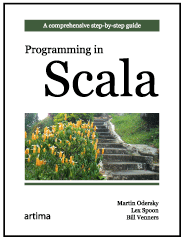
		<content type="html" xml:base="http://blog.amber.org/2011/01/rethinking-scala/"><![CDATA[<p><a href="http://www.artima.com/shop/programming_in_scala"><img alt="Book cover" src="http://www.artima.com/images/PinSCover240x185.gif" title="Programming in Scala" class="alignleft" width="185" height="240" /></a>After several people I respect questioned my rush-to-judgement with <a href="http://scala-lang.org">Scala</a> after my first exposure about a year ago, I’ve decided to dive back in and see if I can push through some initial squeamishness. I had picked up <a href="http://www.artima.com/shop/programming_in_scala">Programming in Scala</a> by Martin Odersky, et. al. I had gotten around 50 pages into the book — out of 700+ — and run into something that just annoyed me to no end. Most languages are base-0 for indexing into arrays, etc., although some are base-1. Scala, however, is base-0 for arrays and lists, but base-1 for tuples. This inconsistency just annoyed me. It even required a 1/3 page explanation of why it was thus. While <a href="http://www.futurama-madhouse.com.ar/scripts/2acv11.shtml">technically correct</a> it left a bad taste in my mouth, and I put the book down.</p>
<p>Last week, with a sprained ankle, I picked the book back up. Now, having gotten through the first 14 chapters, and 260+ pages, I’ve changed my mind, though I’m still not sure of my overall feeling. There’s a lot of interesting ideas, and the type system is the least annoying one I’ve ever seen.  They quote one of my heros, and the creator of Smalltalk, Alan Kay:</p>
<blockquote><p>I’m not against types, but I don’t know of any type systems that aren’t a complete pain, so I still like dynamic typing.</p></blockquote>
<p>Well, Scala is definitely not Smalltalk, but it does have a relatively unobtrusive type system, at least so far. A mature type-inferencing engine ensures that you don’t type things more than you absolutely have to. In fact, Scala does solve some of the symmetrical issues that many languages besides Smalltalk have. Since everything, so far, seems to be a method invokation, many things are possible in ways that Java, etc., can never immagine, and more like what I’m used to in the Smalltalk world.</p>
<p>No final opinion yet, but it’s giving me some ideas, and generally anything that stimulates ideas is worth learning. I still think that <a href="">Clojure</a> has a more elegant syntax, but it’s compiler is not yet as optimized as Scala. Yet. Version 1.3, which is now seeing the light-of-day, promises to get a lot closer.</p>
]]></content>
		<link rel="replies" type="text/html" href="http://blog.amber.org/2011/01/rethinking-scala/#comments" thr:count="1"/>
		<link rel="replies" type="application/atom+xml" href="http://blog.amber.org/2011/01/rethinking-scala/feed/atom/" thr:count="1"/>
		<thr:total>1</thr:total>
	</entry>
		<entry>
		<author>
			<name>petrilli</name>
						<uri>http://mimeo.amber.org/</uri>
					</author>
		<title type="html"><![CDATA[It was bound to happen eventually]]></title>
		<link rel="alternate" type="text/html" href="http://blog.amber.org/2011/01/it-was-bound-to-happen-eventually/" />
		<id>http://blog.amber.org/?p=390</id>
		<updated>2011-01-23T21:00:50Z</updated>
		<published>2011-01-23T21:00:50Z</published>
		<category scheme="http://blog.amber.org" term="technology" /><category scheme="http://blog.amber.org" term="fraud" /><category scheme="http://blog.amber.org" term="malware" /><category scheme="http://blog.amber.org" term="security" />		<summary type="html"><![CDATA[Twenty plus years online, and it was eventually doomed to happen. Someone has decided to hijack my identity — or at least part of it — in order to commit a crime. Cleaning this mess up is going to be some kind of fun, but not sure it’s the kind I enjoy any more. The [...]]]></summary>
		<content type="html" xml:base="http://blog.amber.org/2011/01/it-was-bound-to-happen-eventually/"><![CDATA[<p>Twenty plus years online, and it was eventually doomed to happen. Someone has decided to hijack my identity — or at least part of it — in order to commit a crime. Cleaning this mess up is going to be some kind of fun, but not sure it’s the kind I enjoy any more.</p>
<p>The website that was registered was protectep.com, and it appears to have been registered through a Chinese registrar (bizcn.com), who as far as I can tell has none of the normal email addresses available (hostmaster, etc.), so I’m left with trying to figure out how to get the domain revoked and more importantly, my name taken off it. They got enough of the information right that it “could” be me, but enough wrong that it’s obvious they aren’t me.  Cleaning this up is going to suck.</p>
<p><b>Please don’t go to the site</b> as it contains malware. I repeat <b>do not go to the site</b>.</p>
]]></content>
		<link rel="replies" type="text/html" href="http://blog.amber.org/2011/01/it-was-bound-to-happen-eventually/#comments" thr:count="2"/>
		<link rel="replies" type="application/atom+xml" href="http://blog.amber.org/2011/01/it-was-bound-to-happen-eventually/feed/atom/" thr:count="2"/>
		<thr:total>2</thr:total>
	</entry>
		<entry>
		<author>
			<name>petrilli</name>
						<uri>http://mimeo.amber.org/</uri>
					</author>
		<title type="html"><![CDATA[Hope and change; disillusionment and despair]]></title>
		<link rel="alternate" type="text/html" href="http://blog.amber.org/2011/01/hope-and-change-disillusionment-and-dispair/" />
		<id>http://blog.amber.org/?p=321</id>
		<updated>2011-01-13T03:07:47Z</updated>
		<published>2011-01-13T03:05:52Z</published>
		<category scheme="http://blog.amber.org" term="social" /><category scheme="http://blog.amber.org" term="democrats" /><category scheme="http://blog.amber.org" term="government" /><category scheme="http://blog.amber.org" term="liberalism" /><category scheme="http://blog.amber.org" term="obama" /><category scheme="http://blog.amber.org" term="politics" />		<summary type="html"><![CDATA[N.B. I began this post about a month ago, but I never really could find a way to finish it. Rather than allow it to linger, I’ve decided to publish it. In Where Do We Go From Here: Chaos or Community?, Martin Luther King Jr. writes: Unfortunately, when hope diminishes, the hate is often turned [...]]]></summary>
		<content type="html" xml:base="http://blog.amber.org/2011/01/hope-and-change-disillusionment-and-dispair/"><![CDATA[<p>N.B. I began this post about a month ago, but I never really could find a way to finish it. Rather than allow it to linger, I’ve decided to publish it.</p>
<p>In <a href="http://www.saf.org/pub/rkba/general/MLKing.htm">Where Do We Go From Here: Chaos or Community?</a>, Martin Luther King Jr. writes:</p>
<blockquote><p>Unfortunately, when hope diminishes, the hate is often turned most bitterly toward those who originally built up the hope. In all the speaking that I have done in the United States before varied audiences, including some hostile whites, the only time that I have been booed was one night in a Chicago mass meeting by some young members of the Black Power movement. I went home that night with an ugly feeling. Selfishly I thought of my sufferings and sacrifices over the last twelve years. Why would they boo one so close to them? But as I lay awake thinking, I finally came to myself, and I could not for the life of me have less than patience and understanding for those young people.</p>
<p>For twelve years I, and others like me, had held out radiant promises of progress. I had preached to them about my dream. I had lectured to them about the not too distant day when they would have freedom, “all, here and now.” I had urged them to have faith in America and in white society. Their hopes had soared. They were now booing because they felt that we were unable to deliver on our promises. They were booing because we had urged them to have faith in people who had too often proved to be unfaithful. They were now hostile because they were watching the dream that they had so readily accepted turn into a frustrating nightmare.</p>
</blockquote>
<p>At the start of December 2010, I <a href="http://blog.amber.org/2010/12/im-sorry/">wrote about my disillusionment</a> with Obama and the Democratic party, but also the unraveling of the <i>demos</i> in democracy itself. Having had some time to ruminate, I find myself in a different place: Not how did Obama disappoint us, but how did we disappoint ourselves?</p>
<p>These thoughts are little more than a collection of ideas for my own consideration and I do not have answers, nor do I believe that there is <em>a</em> answer, but instead, a collection of them as unique as the people who ask them.</p>
<p><em>Did we imbue Obama with the pent up hopes and dreams of the liberals?</em> After eight years of Dubya, eight years of Republicanism-light and the “third way”, and 12 years of Reagan-Bush, the true liberals of the United States had taken a beating at the poles, and so when along came someone who seemed so very <em>different</em> than everything before him, did we just assume that he held beliefs that found no support in his own words?</p>
<p><em>Because he was black, did we see him as “like us”, rather than seeing him for the moderate and conciliatory Senator that he was?</em> One can not ignore the idea of “liberal white guilt” that permeates and flows through much conversation. Did we make what amounts to a racist decision — though more positive than most — to lump Obama in with our perceived notions of African-Americans? Just because someone votes for the same party as you doesn’t mean they believe as you do. This is the most difficult question to consider. I was raised to be as “color blind” as is feasible, and to judge people on their merits, not their physical attributes, and yet we all harbor generalizations, resentments, assumptions and concerns that we know we are wrong to feel, and so we pretend we don’t.</p>
<p><em>Was it sexism against Hillary Clinton? Was it Clinton-fatigue?</em> The sexism is hard to know, and for myself I can only say “no”, as I grew up with a brilliant and strong mother, and knew that any woman could lead as well, or better, than a man. I did, however, hold tight my concerns that Hillary would bring back the animosity of the Clinton era, and that the insane hatred of her by the right would rekindle all the strife I hoped to leave behind. I was naïve.</p>
<p>So, even after all that, and all my disappointment, I return to the fact that given the choices in the general election, there was no choice for me. McCain represented more of the same, but with an arguably more incendiary temper, and accompanied by someone who represented one of the most terrifying prospects as a potential successor as I had ever seen. No, there was no choice, only the decision not to just stay home.</p>
<p>And with all of that, I leave with the <a href="http://www.jfklibrary.org/Historical+Resources/Archives/Reference+Desk/Speeches/RFK/138RFK3SEN21SPEECHES_68APR05.htm">words of Bobby Kennedy</a> after the death of Martin Luther King, Jr., which ring as true today as they did near 43 years ago:</p>
<blockquote><p>No wrongs have ever been righted by riots and civil disorders. A sniper is only a coward, not a hero; and an uncontrolled, uncontrollable mob is only the voice of madness, not the voice of the people.</p>
<p>Whenever any American’s life is taken by another American unnecessarily — whether it is done in the name of the law or in the defiance of law, by one man or a gang, in cold blood or in passion, in an attack of violence or in response to violence — whenever we tear at the fabric of life which another man has painfully and clumsily woven for himself and his children, the whole nation is degraded.</p>
<p>“Among free men,” said Abraham Lincoln, “there can be no successful appeal from the ballot to the bullet; and those who take such appeal are sure to lose their cause and pay the costs.”</p>
<p>Yet we seemingly tolerate a rising level of violence that ignores our common humanity and our claims to civilization alike. We calmly accept newspaper reports of civilian slaughter in far off lands. We glorify killing on movie and television screens and call it entertainment. We make it easy for men of all shades of sanity to acquire weapons and ammunition they desire.<br />
Too often we honor swagger and bluster and the wielders of force; too often we excuse those who are willing to build their own lives on the shattered dreams of others. Some Americans who preach nonviolence abroad fail to practice it here at home. Some who accuse others of inciting riots have by their own conduct invited them.</p>
<p>Some looks for scapegoats, others look for conspiracies, but this much is clear; violence breeds violence, repression brings retaliation, and only a cleaning of our whole society can remove this sickness from our soul.</p>
<p>For there is another kind of violence, slower but just as deadly, destructive as the shot or the bomb in the night. This is the violence of institutions; indifference and inaction and slow decay. This is the violence that afflicts the poor, that poisons relations between men because their skin has different colors. This is a slow destruction of a child by hunger, and schools without books and homes without heat in the winter.</p>
</blockquote>
<p>The most powerful thing the President has is not the economy. It is not the stroke of the veto pen. It is not the bombs that fall in the night. The true power of the President lies upon the bully pulpit.</p>
]]></content>
		<link rel="replies" type="text/html" href="http://blog.amber.org/2011/01/hope-and-change-disillusionment-and-dispair/#comments" thr:count="0"/>
		<link rel="replies" type="application/atom+xml" href="http://blog.amber.org/2011/01/hope-and-change-disillusionment-and-dispair/feed/atom/" thr:count="0"/>
		<thr:total>0</thr:total>
	</entry>
		<entry>
		<author>
			<name>petrilli</name>
						<uri>http://mimeo.amber.org/</uri>
					</author>
		<title type="html"><![CDATA[Is it warm in here?]]></title>
		<link rel="alternate" type="text/html" href="http://blog.amber.org/2011/01/is-it-warm-in-here/" />
		<id>http://blog.amber.org/?p=368</id>
		<updated>2011-01-11T16:36:23Z</updated>
		<published>2011-01-11T16:33:50Z</published>
		<category scheme="http://blog.amber.org" term="technology" /><category scheme="http://blog.amber.org" term="design" /><category scheme="http://blog.amber.org" term="embedded" /><category scheme="http://blog.amber.org" term="hardware" /><category scheme="http://blog.amber.org" term="temperature" />		<summary type="html"><![CDATA[The Register, which has never billed itself as much more than a tabloid for technology has an article up about how, horror of horrors, Apple refused to repair an iPhone 4 that was operated at –12C. Apple quotes the operating temperature range as 0-35C, which means the phone was 1/3 of it’s temperature range below [...]]]></summary>
		<content type="html" xml:base="http://blog.amber.org/2011/01/is-it-warm-in-here/"><![CDATA[<p>The Register, which has never billed itself as much more than a tabloid for technology has <a href="http://www.theregister.co.uk/2011/01/11/frozen_iphone/">an article</a> up about how, horror of horrors, Apple refused to repair an iPhone 4 that was operated at –12C. Apple quotes the operating temperature range as 0-35C, which means the phone was 1/3 of it’s temperature range below the bottom. Not exactly “design tolerance”. The commenters, of course, are livid that electronics actually have temperature ranges they work in.</p>
<p>Here’s the truth of the matter. Electronic components generally come in 3 temperature ranges: commercial, industrial and military/extended. For passive components, like resistors, the ranges typically break down as:</p>
<table align="center" border="0" cellspacing="5" cellpadding="5">
<tr>
<th> </th>
<th align="right">Temperature — C</th>
<th align="right">Temperature — F</th>
</tr>
<tr>
<td>Commercial</td>
<td align="right">0 — 70</td>
<td align="right">32 — 158</td>
</tr>
<tr>
<td>Industrial</td>
<td align="right">–25 — 85</td>
<td align="right">–13 — 185</td>
</tr>
<tr>
<td>Military</td>
<td align="right">–55 — 125</td>
<td align="right">–67 — 257</td>
</tr>
</table>
<p>“Hold up now!” you’re saying. Apple says 0-35C for operating — we’ll ignore non-operating temperature as it has other factors associated — not the 0-70C that the passive parts say. That’s absolutely correct, however what Apple is quoting is the “environment”, not the part. The delta between the two is allocated to air flow, heat dissipation, etc. In a tiny little phone that’s packed full of high technology, there’s a lot of concerns around both of those things. This is why the phone <em>physically</em> gets hot. The entire phone is a heat sink in some ways.</p>
<p> I even left out another tier above military that’s not commonly seen: radiation hardened. You can figure that one out. So why doesn’t Apple just use industrial parts? Two reasons:</p>
<ul>
<li>They cost a huge amount more, often double or more</li>
<li>Often “bleeding edge” components aren’t available</li>
</ul>
<p>Do you see the trade-off here? Let’s say a thin-film surface mount resistor of typical characteristics costs 10 cents in production quantities (10,000+), an industrial version of the same resistor might cost 18–25 cents. It doesn’t sound like much, but it adds up. It’s not as simple as people think, but then it rarely is.</p>
<p>The thing is, even more than operating temperature is the idea of humidity. For example, when you walk in out of the cold outdoors in winter into a warm house, often your glasses fog. This is condensation out of the air. Simple enough. Now, what do you think happens when this happens inside electronics … because it does. This is why the humidity is speced as “noncondensing”. You can deal with 95% humidity — think New Orleans in the summer — if it’s not going to condense due to temperature deltas, but even low humidity — think Phoenix in the winter — can condense if there’s enough of a temperature difference. Even using recirculate on a car A/C can substantially increase the humidity. This is why your windows can fog up fast in winter.</p>
<p>These are the trade-offs that exist in the world of hardware design. You could make a phone that can deal with all sorts of conditions — even being underwater — but nobody would want it because it’d cost a fortune and be the size of a brick, and likely weigh as much. Some vendors might quote different numbers, but I’m 99.93% certain they all use the same basic grade of parts. What they are doing is playing the odds based on their testing. Not ever manufacturer accepts the same odds.</p>
<p>As for the case of this iPhone, it’s likely the damage was done by condensing water, not the temperature itself. The temperature was only a catalyst.</p>
]]></content>
		<link rel="replies" type="text/html" href="http://blog.amber.org/2011/01/is-it-warm-in-here/#comments" thr:count="0"/>
		<link rel="replies" type="application/atom+xml" href="http://blog.amber.org/2011/01/is-it-warm-in-here/feed/atom/" thr:count="0"/>
		<thr:total>0</thr:total>
	</entry>
		<entry>
		<author>
			<name>petrilli</name>
						<uri>http://mimeo.amber.org/</uri>
					</author>
		<title type="html"><![CDATA[My God, what have we done?]]></title>
		<link rel="alternate" type="text/html" href="http://blog.amber.org/2011/01/my-god-what-have-we-done/" />
		<id>http://blog.amber.org/?p=358</id>
		<updated>2011-01-10T15:28:19Z</updated>
		<published>2011-01-09T19:54:18Z</published>
		<category scheme="http://blog.amber.org" term="social" /><category scheme="http://blog.amber.org" term="arizona" /><category scheme="http://blog.amber.org" term="fear" /><category scheme="http://blog.amber.org" term="hate" /><category scheme="http://blog.amber.org" term="media" /><category scheme="http://blog.amber.org" term="news" /><category scheme="http://blog.amber.org" term="politics" /><category scheme="http://blog.amber.org" term="shame" />		<summary type="html"><![CDATA[Where to begin in thinking about the tragedy in Tucson yesterday? It must be called, first, what it is: an assassination attempt intended to cause fear in others. It must be called a true act of terror in a time when the word has been diluted to mean any crime for which the government doesn’t [...]]]></summary>
		<content type="html" xml:base="http://blog.amber.org/2011/01/my-god-what-have-we-done/"><![CDATA[<p>Where to begin in thinking about the <a href="http://www.npr.org/series/132783213/arizona-shooting-rampage-congresswoman-others-shot">tragedy in Tucson</a> yesterday? It must be called, first, what it is: an assassination attempt intended to cause fear in others. It must be called a true act of terror in a time when the word has been diluted to mean any crime for which the government doesn’t wish to develop an actual case. It does not, however, exist in a vacuum.</p>
<p>As atrocious as the event is, it is the years of vitriolic hate that created the cesspool of politics and the near total collapse of social interaction which terrify me more. No longer do people of differing opinions come together to break bread; instead, they demonized each other as traitors and worse. No longer do people look for common ground; instead, they covet the differences as a wedge to divide and conquer their opponents.</p>
<p>I will not play fair and balanced with my opinions, for they are not. Fair and balanced is what drove this situation. Fair and balanced is what legitimized sociopathic comments as being equal to sane, thereby robbing our public discourse of its most moderating characteristic: shame.</p>
<p>Too many people step forth onto the public stage and make outlandish and outrageous claims and comments, ascribing to their opponent the most nefarious of intents, while the entire time the <a href="http://en.wikipedia.org/wiki/Fourth_estate">fourth estate</a> sits idly by, validating the insanity with their silence and false equivalence.  No longer are people willing to say “I was wrong”, instead we receive the slimy “I misspoke”. No longer are blatant fabrications called the premeditated lies that they are, instead it’s just an opinion.</p>
<blockquote><p>
  Everyone is entitled to his own opinion, but not his own facts.<br />
  — Daniel Patrick Moynihan
</p></blockquote>
<p>For the last 20 years, in my view, we have absolved ourselves from the need to speak truth, or even pretend that there is such a thing as truth. Facts are provable, and not subject to perception. Opinions are little more than interpretation and perception of reality. Only one is worth of being used in governance, and the other is simply bunk. We must strive to be honest and truthful in our governance if we are to survive as a people; perhaps, as a species.</p>
<p>With all this, I am reminded of an exchange between Joseph N Welch and the notorious Senator Joseph McCarthy on June 9, 1954:</p>
<blockquote>
<p>Until this moment, Senator, I think I have never really gauged your cruelty or your recklessness. Fred Fisher is a young man who went to the Harvard Law School and came into my firm and is starting what looks to be a brilliant career with us. Little did I dream you could be so reckless and so cruel as to do an injury to that lad. It is true that he will continue to be with Hale and Dorr. It is, I regret to say, equally true that I fear he shall always bear a scar needlessly inflicted by you. If it were in my power to forgive you for your reckless cruelty I would do so. I like to think that I am a gentle man but your forgiveness will have to come from someone other than me.</p>
<p>Senator, may we not drop this? We know he belonged to the Lawyers Guild. Let us not assassinate this lad further, Senator. You’ve done enough. Have you no sense of decency, sir? At long last, have you left no sense of decency?</p>
</blockquote>
<p>What we have witnessed these last few decades is the McCarthyization of America, with a <a href="http://en.wikipedia.org/wiki/Jon_Stewart">satirist</a> standing in as our generation’s Joseph Welch. The vitriol from the right seems substantively more angry than that from the left, and certainly more caustic and spouted with more hate, but it comes from both sides none the less. It poisons the well of democracy, and in doing so eliminates the ability to govern. Perhaps that is the goal after all.</p>
<p>A little over 45-years ago, on August 6, 1945, Commander Robert Lewis wrote 6 words in his log: “My God, what have we done?” What <em>he</em> had just done was destroy the entire city of Hiroshima with the first use of an atomic weapon against a people. J Robert Oppenheimer was more introspective in his thoughts after the first test at Trinity: “Now I am become death, the destroyer of worlds.” Is anyone who engages in these verbal weapons of mass destruction so introspective to what they have brought forth into the world?</p>
]]></content>
		<link rel="replies" type="text/html" href="http://blog.amber.org/2011/01/my-god-what-have-we-done/#comments" thr:count="4"/>
		<link rel="replies" type="application/atom+xml" href="http://blog.amber.org/2011/01/my-god-what-have-we-done/feed/atom/" thr:count="4"/>
		<thr:total>4</thr:total>
	</entry>
	</feed>