The Progress & Freedom Foundation Blog2010-09-08T17:55:59Ztag:blog.pff.org,2017://2Movable TypeCopyright (c) 2010, adammarcus"Rogue Archivist" Carl Malamud On How to Fix Gov2.02010-09-08T17:55:59Z2010-09-08T17:54:59Ztag:blog.pff.org,2010://2.61492010-09-08T17:54:59ZAdam Marcushttp://www.pff.orgamarcus@pff.orge-Government & Transparency
At yesterday's Gov2.0 Summit conference, "rogue archivist" Carl Malamud gave a great speech about what's wrong with government IT and what should be done about it.]]>
"If our government is to do the jobs with which we have entrusted it, ... the machinery of our government must first be made to work properly."
Malamud describes a government IT landscape that is a "vast wasteland of contracts that lie fallow inside this beltway" because of agency capture by special interests and proposes three steps to fix government IT:
Finish the opengov revolution - create and enforce bulk data standards, release more government data using those standards, and update the Freedom of Information Act for the Internet age to require that any data released in response to a FOIA request is also posted online for anyone to access (others have already taken up this cause)
Create a National Scanning Initiative - Spend at least $250 million per year (a third of what the Smithsonian currently receives from the Federal government) for a decade to put all of the works housed at the Smithsonian, the National Archives, the Library of Congress, the National Library of Medicine, and the Government Printing Office online
Create a Computer Commission with authority to conduct agency-by-agency reviews and change projects from relying on over-designed custom systems to ones based on open-source building blocks and judicious use of commercial off-the-shelf components
O'Reilly's Jim Stogdillbelieves that Malamud's speech is an implicit recognition that Federal IT projects are just too big for the typical top-down IT development process and the better approach is "structuring incentives, policies, and ecosystems to encourage the complex to emerge from the simple." This approach is basically the Unix philosophy, which is best summarized as "Design programs to do only a single thing, but to do it well, and to work together well with other programs."
One big problem with most government software projects is that they're developed without any thought of having those systems interact with other systems. As a result, data files are typically proprietary and importing and exporting data is impossible. But if federal IT projects were developed more in line with the Unix philosophy, as smaller, modular, interoperable systems, they would be more manageable and problems with a specific component would not jeopardize other systems.
And as Stogdill points out, there are only a few companies able to deal with the complexity of the Federal Aquisition Rules and the scale typical of most government projects. Breaking things into smaller components and open-sourcing the code developed on all new projects will enable many more companies to compete for these contracts.
The Obama administration is the first presidency to have a Chief Information Officer. I only hope he was listening to Malamud's speech.
]]>
The Broadband Investment Leviathan2010-08-27T19:51:20Z2010-08-24T18:03:11Ztag:blog.pff.org,2010://2.61432010-08-24T18:03:11ZAdam Marcushttp://www.pff.orgamarcus@pff.orgCommunications
The August 5th issue of The Economist had a compelling cover story entitled "Leviathan, Inc." in which the author notes "[p]oliticians are reviving the notion that intervening in individual industries and companies can drive growth and create jobs." But direct, long-term government management of companies, corporations or, worst yet, entire industries has proven time and again not to be successful.
Simply put, the head of a company makes decisions to maximize the outcome for that company and its owners or shareholders. Any government employee—even one in a role as acting head of a private company—is legally required to make decisions under a far stricter set of guidelines. Guidelines which force the decisions to be made for what is best not for the business they are charged with operating, but for the country as a whole. This is the case even if the decision made by the bureaucrat will result in a 'net negative' to the company and its owners/shareholders.
The article's anonymous author suggests that instead of "pick[ing] winners and coddl[ing] losers," government should improve the environment for all business by reducing regulations, investing in infrastructure, and "encourage winners to emerge by themselves, for example through the sort of incentive prizes that are growing increasingly popular."
]]>
The article's anonymous author suggests that instead of "pick[ing] winners and coddl[ing] losers," government should improve the environment for all business by reducing regulations, investing in infrastructure, and "encourage winners to emerge by themselves, for example through the sort of incentive prizes that are growing increasingly popular."
I wholeheartedly agree with the first and third points. In fact, former PFF Summer Koch Fellow Jeff Levy, in just the latest PFF piece on the subject, wrote a PFF Blog entry on incentive prizes. But I'm concerned with the unqualified suggestion of investing in infrastructure.
The Economist article states that "governments should invest in the infrastructure that supports innovation, from modernised electricity grids (a smarter way to help green energy) to basic research and university education." Yet the article itself points to Spain's subsidization of its solar power industry as an example of a government that was "seduced by the hype of voguish high-tech sectors." Government investments in high tech sectorscan have the same unintended consequences as directly picking winners in a fast-moving global market. As the article explains, "[t]hanks to globalisation and the rise of the information economy, new ideas move to market faster than ever before" and no bureaucrat is able to accurately predict which products and industries will be successful. The result is often a stifling of innovation and a waste of taxpayer money.
The Obama administration's infatuation with increasing broadband deployment is unfortunately about to become another example. The American Recovery and Reinvestment Act directs $7.2 billion in one-time support for broadband initiatives across the United States. The goal of the program is to accelerate broadband deployment in "unserved" areas and improve access in "underserved" areas. But because the Act leaves these terms undefined, it is certain that funds will be used to overbuild in areas that are already served by competing providers, which will likely harm competition.
"Underserved" is a bureaucratic term utilized by several different federal agencies, each with a different definition. Even within agencies, conflicting definitions of "underserved" occur. Sadly, many of these definitions aren't based on measurable economic, racial, or social data but simply overly-broad attempts to overcompensate for a perceived but unproven problem. When the "maps" of the Treasury Department's definition of "underserved" are compared with the FCC's current definition, the Department of Agriculture's definition, or any of the many other Federal definitions, the differences are dramatic.
And it is not clear that Federal funds should be spent on expanding broadband service in "underserved" areas (which at the least means there is one existing provider) in the first place. An investigation of the Department of Agriculture's Rural Utilities Service ("RUS") broadband expansion program, which is similar to the broadband stimulus provisions in the Recovery Act, found that 42% of communities receiving funding through the program were already served by competing providers.
As the Department of Agriculture's Inspector General wrote,
"[c]an the sparsely populated rural areas for which these loans are intended reasonably support multiple broadband service providers," or are the loans being made to systems that are doomed to fail?
"What is the government's responsibility if, due to subsidized competition, a preexisting, unsubsidized broadband provider goes out of business?"
as an equitable matter, "why should the government subsidize some providers in a given market and not others?"
There are many that subscribe to the "If you build it, they will come" philosophy when it comes to broadband investment: The belief that the secondary benefits of broadband are so immense, that it is worth building at any cost. But as the Economist article puts it, "In an age of austerity [governments] can ill afford to lavish money on extravagant industrial projects." At a cost of $350 billion, is the FCC's "100 Squared" initiative—a plan to connect 100 million households at 100Mbps—really a wise allocation of limited funds, compared to focusing on truly unserved areas? Or will it merely be a repetition of the RUS's bottomless pit of funding for special projects?
And as the FCC's official definition of what constitutes "broadband" increases in speed, small ISPs (especially Wireless ISPs), which are ready to expand their service to truly unserved areas, may no longer quality for Recovery Act funds. The government's attempt to invest in innovation and infrastructure would then serve only to kill off what, in many places, are the only businesses offering any sort of Internet access in truly underserved rural areas as well as creating a higher barrier to new entrants and competition.
]]>
MPAA Ratings Are Better Than the Alternative2010-08-20T14:05:06Z2010-08-20T14:04:00Ztag:blog.pff.org,2010://2.61382010-08-20T14:04:00ZBack in March, the Motion Picture Association of America re-launched its film-rating website, filmratings.com. While this may be old news to some, I just learned about it from a post on BoingBoing which makes fun of the rationales given for...Adam Marcushttp://www.pff.orgamarcus@pff.orgMass Media
Back in March, the Motion Picture Association of America re-launched its film-rating website, filmratings.com. While this may be old news to some, I just learned about it from a post on BoingBoing which makes fun of the rationales given for the ratings, which are available on the new website. Example: The movie "3 Ninjas Knuckle Up" was "rated PG-13 for non-stop ninja action."
]]>
It's fine to joke about particular ratings, but we shouldn't forget that the MPAA's rating system was created to avoid government censorship, which was a real possibility after the 1915 U.S. Supreme Court case Mutual Film Corporation v. Industrial Commission of Ohio, which ruled that "the exhibition of moving pictures is a business, pure and simple, originated and conducted for profit ... not to be regarded, nor intended to be regarded by the Ohio Constitution, we think, as part of the press of the country, or as organs of public opinion." By a unanimous vote, the Supreme Court ruled that the First Amendment did not apply to motion pictures because "they may be used for evil." (There was also an issue of whether the First Amendment applied to state actions, but because the state constitution at issue was substantially similar to the U.S. Constitution, that was not a factor in the opinion).
After a number of Hollywood scandals and public outcry over the immorality of Hollywood in the 1920s, the Motion Pictures Producers and Distributors Association (the precursor to the MPAA), adopted the Motion Pictures Production Code (known as the "Hays Code" after the first MPAA president) in 1930. The code required that "No picture shall be produced that will lower the moral standards of those who see it. Hence the sympathy of the audience should never be thrown to the side of crime, wrongdoing, evil or sin."
This self-regulation led to the dissolution of many state and city censorship boards.
The 1952 case Joseph Burstyn, Inc v. Wilson directly overturned the earlier decision, but by that time the Hays Code was already well-established.
Under the Code, films were simply approved or disapproved based on whether they were considered "moral" or "immoral." Two years after Jack Valenti became president of the MPAA in 1966, he replaced the Hays Code with what is essentially the rating system we have today.
In summary, the MPAA's ratings may sometimes be off the mark, but what would really be silly is suggesting that they stop rating films or that the government take over.
]]>
"Jailbreaking" Won't Land You In Jail2010-07-29T18:02:19Z2010-07-29T17:55:30Ztag:blog.pff.org,2010://2.61272010-07-29T17:55:30ZThe Digital Millenium Copyright Act makes it a crime to circumvent digital rights management technologies but allows the Librarian of Congress to exempt certain classes of works from this prohibition. The Copyright Office just released a new rulemaking on this...Adam Marcushttp://www.pff.orgamarcus@pff.orgIPThe Digital Millenium Copyright Act makes it a crime to circumvent digital rights management technologies but allows the Librarian of Congress to exempt certain classes of works from this prohibition.
The Copyright Office just released a new rulemaking on this issue in which it allows people to "unlock" their cell phones so they can be used on other networks and "jailbreak" closed mobile phone operating systems like the iOS operating system on Apple's iPhones so that they will run unapproved third-party software.
This is arguably good news for consumers: Those willing to void their warranties so they can teach their phone some newtricks no longer have to fear having their phone confiscated, being sued, or being imprisoned. (The civil and criminal penalties are described in 17 USC 1203 and 17 USC 1204.) Although the new exemption does not protect those who distribute unlocking and/or jailbreaking software (which would be classified under 17 USC 1201(b), and thus outside the exemption of 17 USC 1201(a)), the cases discussed below could mean that jailbreaking phones simply falls outside of the scope of all of the DMCA's anti-circumvention provisions.
Apple opposed this idea when it was initially proposed by the Electronic Frontier Foundation, arguing that legalizing jailbreaking constituted a forced restructuring of its business model that would result in "significant functional problems" for consumers that could include "security holes and malware, as well as possible physical damage." But who beyond a small number of geeks brave enough to give up their warranties and risk bricking their devices, is really going to attempt jailbreaking? One survey found that only 10% of iPhone users have jailbroken their phones, and the majority are in China, where the iPhone was not available legally until recently. Is it really likely that giving the tinkering minority the legal right to void their product warranties would cause any harm to the non-tinkering majority that will likely choose to instead remain within a manufacturer's "walled garden"? I don't think so. If, as a result of this ruling, large numbers of consumers jailbreak their phones and install pirated software, the Copyright Office can easily reconsider the exemption in its next Triennial Rulemaking.
]]>
While the ruling is heartening, it is not surprising. In Chamberlain Group, Inc. v. Skylink Techs., Inc., the United States Court of Appeals for the Federal Circuit held that trafficking in a circumvention device violates Section 1201(a)(2) only if the circumvention enables access that "infringes or facilitates infringing a right protected by the Copyright Act." The Chamberlain case involved unlicensed third-party garage door opener remotes. The Sixth Circuit came to a similar decision in Lexmark International, Inc. v. Static Control Components, Inc., a case involving a software "handshake" between Lexmark printers and Lexmark-branded toner cartridges meant to keep third-party replacement toner cartridges off the market. The Copyright Office's ruling is just another example of policymakers recognizing that Copyright law exists only to protect copyrighted works, not business models based on excluding access.
But self-help is a two-way street: Companies are, and should be, free to continue using their own "self-help" technical protection measures to prevent (or merely discourage) customers from reverse-engineering their products. This highlights what Larry Lessig describes as the distinction between East Coast Code (laws) and West Coast Code (software). It makes perfect sense for companies to avail themselves of all possible methods (software *and* laws) to protect their revenue streams, but lawbreakers, by definition, don't respect laws. Although most technical protection measures have been woefully inadequate to date (see, e.g., 1, 2, 3, 4, 5, to name a few), cryptographically-secure code is much more likely to be effective in the long-term than laws.
While this decision probably doesn't matter much for the average, non-tinkering consumer, tinkerers will be comforted by the fact that their hobby is no longer a crime, and without the threat of criminal sanctions, there should be more publicization of what the new mobile phones are really capable of. That, in turn, should put additional pressure on phone manufacturers to take off the training wheels and be a bit more open about what apps they allow on their devices.
While Apple is correct in pointing out that some users with jailbroken phones still call Apple's technical support lines, it is quite impossible to accidentally jailbreak your phone and all of the websites with instructions on how to do so have extensive disclaimers warning about the possible consequences. At some point, consumers should be responsible for their own actions. The Librarian of Congress is willing to give them that responsibility. And whether they want to or not, phone manufacturers will to.
]]>
<![CDATA[Privacy Solutions Part 8: The Best Anonymizer Available: Tor, the TorButton & TorBrowser]]>2009-11-10T21:20:46Z2009-11-10T21:15:40Ztag:blog.pff.org,2009://2.57832009-11-10T21:15:40ZBy Eric Beach and Adam Marcus In the previous entry in the Privacy Solutions Series, we described how privacy-sensitive users can use proxy servers to anonymize their web browsing experience, noting that one anonymizer stood out above all others: Tor,...Adam Marcushttp://www.pff.orgamarcus@pff.orgCyber-SecurityBy Eric Beach and Adam Marcus
In the previous entry in the Privacy Solutions Series, we described how privacy-sensitive users can use proxy servers to anonymize their web browsing experience, noting that one anonymizer stood out above all others: Tor, a sophisticated anonymizer system developed by the Tor Project, a 501(c)(3) U.S. non-profit venture supported by industry, privacy advocates and foundations, whose mission is to "allow you to protect your Internet traffic from analysis." The Torbutton plug-in for Firefox makes it particularly easy to use Tor and has been downloaded over three million times. The TorBrowser Bundle is a pre-configured "portable" package of Tor and Firefox that can run off a USB flash drive and does not require anything to be installed on the computer on which it is used. Like most tools in the Privacy Solutions series, Tor has its downsides and isn't for everyone. But it does offer a powerful tool to privacy-sensitive users in achieving a degree of privacy that no regulation could provide.
]]>
Why Use Tor?
The Tor Project identifies its users as parents, militaries, journalists, law enforcement offers, activists, whistleblowers, and others. But on a high level, Tor addresses essentially four problems:
(1) Outbound blocking of internet traffic by IP or domain name. Countries, businesses, and Internet service providers may block web-users from accessing certain IPs associated with domain names that are deemed inappropriate. For example, access to certain domain names from inside some United Stated Federal government computer networks is restricted, some companies block pornography and some governments may censor access to some websites.
(2) Blocking of Internet traffic based upon content analysis. Rather than simply relying on website blacklists, many countries use content-based filtering to prevent individuals from seeking out information deemed undesirable. For example, the Chinese government censors searches for "falun gong" through packet inspection and analysis.
(3) ISP traffic logging. With the increased use of deep packet inspection, some privacy-sensitive Internet users worry that Internet service providers may be capable of logging the online activity of millions of Americans, and providing that information to governments or other third parties (lawfully or otherwise).
(4) Government monitoring. With the United States government's pervasive surveillance of the electronic activities of Americans, some citizens understandably desire to protect their First Amendment right to anonymously send and receive information-i.e., without the government being able to determine their identity.
How Tor Works
The general web data flow online looks something like this:
As we mentioned in our piece about anonymizers, a sophisticated anonymizer can obscure the identity of any one web user by pooling requests from large numbers of users across a "daisy chain" of proxy servers-thus effectively anonymizing the user's identity, like so:
Tor works somewhat differently: Rather than simply trying to achieve "anonymity in a crowd" (of other web users using the network), Tor's "client software" (e.g., TorButton) picks a random path through a network of other "Tor nodes" (users of Tor) for every request sent from the user's computer. As the Tor Project explains:
Tor helps to reduce the risks of both simple and sophisticated traffic analysis by distributing your transactions over several places on the Internet, so no single point can link you to your destination. The idea is similar to using a twisty, hard-to-follow route in order to throw off somebody who is following you - and then periodically erasing your footprints. Instead of taking a direct route from source to destination, data packets on the Tor network take a random pathway through several relays that cover your tracks so no observer at any single point can tell where the data came from or where it's going.
The following chart from the Tor Project's more extensive explanation conveys the basics:
How to Install Tor
As mentioned above, Firefox users can install the TorButton plug-in, which will allow users to turn Tor on or off as desired.
The Tor Project also offers TorBrowser, an all-in-one bundle of the portable edition of Firefox (which can be carried along with all its settings on a USB stick or CD) pre-configured with the Tor plug-in. There is also a version of TorBrowser that includes the Pidgin instant messaging client, for those who also want to protect their instant messaging. Set-up takes less than three minutes and is just the thing for those trying to stay "one step ahead of The Man." For more help on how to install the TorBrowser, click here or here.
Downsides/Risks of Tor
Speed. The biggest downside of using Tor is its slowness, which occurs for three reasons:
Tor transports data among many intermediary nodes. Just as it takes considerably longer to drive from Los Angles to San Francisco if you travel though Phoenix, Dallas, and Denver, so it takes considerably longer to go from the end-user to the final destination if the data packets must transfer through four or five intermediaries.
Tor encrypts the data between the intermediary nodes.
Some intermediary nodes do not have high-bandwidth connections.
The following examples from an informal survey illustrate just how much Tor can slow down web browsing:
Domain
Time for Direct Access
Time for Tor Access
cnn.com
28.1 seconds
188 seconds
baidu.com
2.2 seconds
9.34 seconds
google.de
1.89 seconds
7.5 seconds
pff.org
15.87 seconds
74 seconds
Note: The results of the speed test depend heavily upon the specific Tor route used. Stopping Tor and then re-enabling it would likely produce a materially different result since the speed of the intermediary and exit-nodes would likely be different.
While Tor is slow, it can be improved mildly by changing a number of default configuration options. See here, here, here and here.
Increased Vulnerability. The second major downside is that the exit-node could record your data or perform a number of malicious attacks, as explained by Ars Technica and SecurityFocus.com. As the Berkman Center's 2007 Circumvention Report noted, "Tor provides strong anonymity only if the user is careful to submit data to HTTPS protected servers." If you plan to use Tor, you should consult the following Tor security warnings:
REMARK(S) ABOUT USING CONFIDENTIAL DATA ON (INSECURE) NON-HTTPS/SSL-CONNECTIONS: If you're planning to visit password protected sites on non-encrypted connections, keep in mind that some exit-nodes record the passwords and possibly use them for abuse. Also all other transferred data is possibly recorded and misused.
REMARK(S) ABOUT ACCESSING ELECTRONIC BANKING AND OTHER SENSITIVE SITES VIA TOR: Most banks and similar institutions (PayPal for example) are using extended fraud countermeasures, like IP-origin plausibility checks and anonymous server blacklistings. Therefore you risk getting your bank account locked for security reasons by using the Tor-network.
REMARK(S) ABOUT (SECURE) HTTPS/SSL-CONNECTIONS TO FRAUD CRITICAL SITES: If you're planning to visit fraud critical HTTPS/SSL-secured sites (Banks for example) and that specific site is querying you unexpectedly about accepting a new SSL-Certificate, be highly alert. Check the Certificate data or try another EXIT-node first. There are some rumors around, that some EXIT-nodes are trying to fake/highjack such HTTPS/SSL-connections.
]]>
Against Browser Ballot Mandates: EC Now Designing Software?2009-11-10T18:43:38Z2009-11-10T18:40:48Ztag:blog.pff.org,2009://2.57812009-11-10T18:40:48ZAdam Marcushttp://www.pff.orgamarcus@pff.orgAntitrust & Competition Policy
The European Commission is now designing software. And that software is Microsoft Windows...
Comments of Adam Marcus & Berin Szoka to the European Commission on the Matter of Microsoft's Browser Ballot Proposal, COMP/C-3/39.530 -- Microsoft (Tying)*
We applaud the Commission for not repeating its earlier approach to concerns about tie-ins to Microsoft Windows by ordering Microsoft to cripple the functionality of its operating system-- such as occurred with the Windows Media Player. While a "browser ballot" is certainly a less restrictive approach, we remain unconvinced that mandating such a ballot is necessary in this case, and concerned about the precedent that government intervention may set here for the future of the highly dynamic and innovative software sector. If, however, a ballot is to be required, we encourage the Commission to accept Microsoft's ballot as proposed.
A Browser Ballot Mandate Is Not Necessary
The European Community's Discussion Paper on exclusionary abuses recognizes that bundled discounts infringe Article 82 only when the discount is so large that "efficient competitors offering only some but not all of the components, cannot compete against the discounted bundle."[1] In this case, a number of alternative browser producers have successfully competed against Internet Explorer in the past--despite it being bundled with Microsoft's Windows operating system.
]]>
Consumers in Europe and elsewhere have more browser choices today than ever before--as indicated by the fact that Microsoft's proposed browser ballot would include provide users a choice among twelve different Web browsers.[2] While Microsoft's Internet Explorer remains the most popular browser in Europe, its market share is slipping rapidly.[3] Indeed, in at least two European countries (Hungary and Slovakia), Firefox appears to have supplanted Internet Explorer as the leading Web browser.[4] No matter which statistics are used, Internet Explorer's share of the Web browser marketplace has been steadily declining since at least 2001.[5]
The fact that Internet Explorer still holds a majority market share is not, ipso facto, evidence that Microsoft is abusing its position in the operating system market. Microsoft does not prevent or hinder users from downloading, installing, and using other Web browsers on their computer if they choose to. While Firefox may well be the popular choice of the digerati, many users may prefer Internet Explorer because of its greater simplicity (perceived or otherwise). For example, some users may not want to tinker with plug-ins, and may even be turned off by the windows that regularly appear upon startup of Firefox asking the user to update the browser or plug-ins.[6]
Search engines make finding an alternative to Internet Explorer incredibly easy. Indeed, the top five Google search results for the word "browser" include links to the four most popular alternatives to Internet Explorer (Mozilla Firefox, Opera, Google Chrome, and Apple Safari). The fifth link is to a Wikipedia page explaining what a Web browser is. Internet Explorer appears only on page two of Google search results.
There are many ways of promoting alternative browsers. Any browser developer can use search engine marketing (paid search ads) or search engine optimization (strategies to cause their websites appear higher in search results for relevant keywords). Just as importantly, Google and Apple both have the opportunity to promote their browsers in their wildly popular consumer products. Google has included links to its Chrome browser from its search engine, while Apple has bundled its Safari browser with iTunes and QuickTime, such that users who update the latter are encouraged to download the former. These are all legitimate ways to promote browsers and indicate that the operating system is not the only point of access to consumer's attention regarding browser choices.
Mandating a Browser Ballot Sets a Dangerous Precedent of Government intervention
The European Commission believes that "PC users should have an effective and unbiased choice between Internet Explorer and competing web browsers."[7] But users already have a choice and, as explained above, many are exercising it. Furthermore, nearly all Web browsers for the PC are available for free and users don't have to choose just one--they can install, and use simultaneously, as many as they want. The current controversy is no different than previous controversies over whether, for example, buyers of new automobiles should be allowed to purchase an automobile without the factory-installed radio or tires.[8]
There is little question that a Web browser is a required application for any Internet-connected computer. It is thus not surprising that Microsoft would bundle a Web browser with its operating system--and why wouldn't Microsoft bundle its own Web browser? The user can, of course, use that browser to easily find and download another browser.
Should other manufacturers that pre-install their own browsers in their products be required to offer a similar browser ballot? Apple bundles its own Safari browser in its desktop and iPhone operating systems. Research In Motion bundles its own browser in its Blackberry mobile phones. Even most distributions of Linux include a bundled Web browser. The CTO of Opera, the company that initiated the current controversy, thinks it would be a "good idea" for other operating systems to include a browser ballot.[9] Where will this "Browser Neutrality" thinking end?[10]
Such mandates could easily extend to require ballots for choosing one's default search engine, media player, instant messaging client, email provider, and so on. While a ballot may indeed be a reasonable way for a company to offer meaningful choice and allay legitimate concern about any "market power" it might be alleged to possess, government should tread cautiously in such matters, and avoid injecting political decision-making into the software design process. The threat of regulation already appears to be "chilling" Microsoft's design decisions. Most notably, the company excluded a number of applications from Windows 7: Outlook Express, Windows Mail, Windows Calendar, Windows Address Book, Windows Messenger, Windows Movie Maker, and Windows Photo Gallery.[11] Windows Movie Maker had been included in every version of Windows since Windows Me was released in 2000.[12] "Regime uncertainty" about how antitrust regulators might view the bundling of such applications or what kind of "choice mechanism" might be mandated simply does not benefit consumers if it discourages companies like Microsoft from including useful tools in its software--or encourages them to cripple the functionality of those tools, if included, such as making Internet Explorer harder to access.
Microsoft's Proposed Browser Ballot
Microsoft's proposal suggests a number of technical issues that may result in confusion for users and additional work for network administrators:
Microsoft plans to roll out the update as an "Important" or "High Priority" update,[13] which will mean that the update will be installed automatically and the ballot screen will appear without warning. This may confuse unsophisticated users who may believe the new pop-up window is attempting to install a virus.
The fact that the browser ballot update removes the Internet Explorer icon from the Windows taskbar means that if the user does not select Internet Explorer (which will presumably restore the Internet Explorer icon) when the ballot first appears, they may be left not knowing how to access Internet Explorer.
Without an easy way for network administrators to prevent the browser ballot from appearing in enterprise environments, the technical support burden the browser ballot will be shifted to network administrators who will have to explain to their users how to respond to the ballot--which could particularly burden small enterprises with limited administrative resources. Microsoft will also need to be careful to ensure that in environments where users are prevented from installing additional software, the browser ballot does not subvert that policy.
If the standard user account control (UAC) warnings are bypassed, as Opera has suggested, this could open a security hole that could then be exploited by malicious software.[14]
While such questions should make the commission think very carefully about the necessity of requiring a browser ballot at all, the Commission should, at the very least, leave such technical matters to the experts at Microsoft so long as the company fairly presents the choices of browsers available to consumers, as it has done in its proposal. While it might be possible to somewhat increase the "fairness" of the ballot by, for example, randomizing the order in which browser choices appear, Microsoft's proposal presents consumers multiple options in a manner that is fair enough. Recognizing the value in consistency of user experience and the fact that it is Microsoft that will have to deal with the technical support burden (and negative reputational effects) the browser ballot is likely to cause, the Commission should defer to Microsoft's design choices and avoid descending down the slippery slope of micromanaging user interface design. Annoying menus and pop-ups were widely blamed for the unpopularity of Windows Vista and did real harm to Microsoft's reputation for usability-- which the company is now working hard to overcome with Windows 7. Simply put, "Too many cooks spoil the stew."
Conclusion
Properly understood, "Antitrust law protects competition, not competitors."[15] With so many browser choices and evidence that consumers are fully capable of finding new browsers on their own, it remains unclear that any browser ballot need be mandated to "ensur[e] genuine consumer choice."[16] But if such a ballot is in fact necessary, Microsoft's proposal should be approved by the Commission.
* Adam Marcus is Research Fellow and Senior Technologist at The Progress & Freedom Foundation. Berin Szoka is Director of the Center for Digital Media Freedom at The Progress & Freedom Foundation. The views expressed in these comments are their own, and are not necessarily the views of the PFF board, fellows or staff.
[1] Directorate-General for Competition, Eur. Comm'n, Discussion Paper on the Application of Article 82 of the Treaty to Exclusionary Abuses (Dec. 2005) ¶ 189, available at http://ec.europa.eu/comm/competition/antitrust/art82/discpaper2005.pdf. The Discussion Paper is a consultation document, prepared by the staff of the DG Competition. It has not been published at the Official Journal of the European Communities and therefore does not produce any legal effect.
[8] See, e.g, Automatic Radio Mfg. Co. v. Ford Motor Co., 272 F.Supp. 744 (D. Mass, 1967), aff'd, 390 F.2d 113 (1st Cir. 1968).
[9] NetworkWorld, "EC decision expected to force IE to better support standards," July 24, 2009, http://www.networkworld.com/community/node/43851 ("Q: In your opinion, should Apple also be expected to offer a ballot box for its competitors? Should Ubuntu? A: ... it may be a good idea.").
[15] Thomas Barnett, head of the Department of Justice's Antitrust division, "Interoperability Between Antitrust and Intellectual Property," Presentation to the George Mason University School of Law Symposium, Managing Antitrust Issues in a Global Marketplace, Washington, DC, Sept. 13, 2006, available at http://www.justice.gov/atr/public/speeches/218316.htm, citing Brooke Group Ltd. v. Brown & Williamson Tobacco Corp., 509 U.S. 209, 224 (1993) ("It is axiomatic that the antitrust laws were passed for 'the protection of competition, not competitors.'" (quoting Brown Shoe Co. v. United States, 370 U.S. 294, 320 (1962))).
]]>
Privacy Solutions Part 7: How Anonymizers Can Empower Privacy-Sensitive Users2009-11-06T19:34:54Z2009-11-06T16:34:09Ztag:blog.pff.org,2009://2.57802009-11-06T16:34:09ZBy Eric Beach & Adam Marcus Among Internet users, there are a variety of concerns about privacy, security and the ability to access content. Some of these concerns are quite serious, while others may be more debatable. Regardless, the goal...Adam Marcushttp://www.pff.orgamarcus@pff.orgPrivacy SolutionsBy Eric Beach & Adam Marcus
Among Internet users, there are a variety of concerns about privacy, security and the ability to access content. Some of these concerns are quite serious, while others may be more debatable. Regardless, the goal of this ongoing series is to detail the tools available to users to implement their own subjective preferences. Anonymizers allow privacy-sensitive users to protect themselves from the following potential privacy intrusions:
Advertisers Profiling Users. Many online advertising networks build profiles of likely interests associated with a unique cookie ID and/or IP address. Whether this assembling of a "digital dossier" causes any harm to the user is debatable, but users concerned about such profiles can use an anonymizer to make it difficult to build such profiles, particularly by changing their IP address regularly.
Compilation and Disclosure of Search Histories. Some privacy advocates such as EFF and CDT have expressed legitimate concern at the trend of governments subpoenaing records of the Internet activity of citizens. By causing thousands of users' activity to be pooled together under a single IP address, anonymizers make it difficult for search engines and other websites--and, therefore, governments--to distinguish the web activities of individual users.
Government Censorship. Some governments prevent their citizens from accessing certain websites by blocking requests to specific IP addresses. But an anonymizer located outside the censoring country can serve as an intermediary, enabling the end-user to circumvent censorship and access the restricted content.
Reverse IP Hacking. Some Internet users may fear that the disclosure of their IP address to a website could increase their risk of being hacked. They can use an anonymizer as an intermediary between themselves and the website, thus preventing disclosure of their IP address to the website.
Traffic Filtering. Some ISPs and access points allocate their Internet bandwidth depending on which websites users are accessing. For example, bandwidth for information from educational websites may be prioritized over Voice-over-IP bandwidth. Under certain circumstances, an anonymizer can obscure the final destination of the end-user's request, thereby preventing network operators or other intermediaries from shaping traffic in this manner. (Note, though, that to prevent deep packet inspection, an anonymizer must also encrypt data).
]]>
How Anonymizers Work
A Simple Anonymizer
An anonymizer is an intermediary server between the end-user and the website that acts as a proxy for the user, effectively accessing websites on the end-user's behalf, thereby hiding the end-user's IP address (and perhaps other information).
A Real-World Analogy: Let's say I want to order pizza from the local pizza shop, but I do not want them to have my phone number, which they could get from caller ID if I called them directly. Instead of calling them myself, I could call a friend and ask him to call them on my behalf, place my order, and then let me know how much it will cost and the estimated delivery time.
A Somewhat More Complicated Anonymizer Setup
A more sophisticated (and more realistic) anonymizer setup pools hundreds or even thousands of end-users through one or more anonymizing intermediaries. Consequently, web servers receive requests that originated from hundreds of end-users through a single IP address (that of the anonymizer). As a result, the web server is unable to distinguish and personally identify the IP addresses of any users.
An Even More Complicated Anonymizer Setup
The above setup provides a layer of privacy beyond the traditional setup of direct end-user-to-website communication. But even so, if the anonymizer's logs are compromised, so too is the privacy of the end-user -because it will likely be possible to associate specific requests with individual users.
A much greater degree of privacy protection is obtained by "daisy-chaining" together multiple anonymizers, but every additional hop slows down the browsing experience and leaves additional traces of the end-user's traffic.
How Do I Set Up an Anonymizer?
A variety of anonymizer services exist. Due to considerable variations in how each is installed, it is impossible to provide universal step-by-step details for installing one. But perhaps the two most trustworthy (free) options are Tor and Privoxy. While both services have experienced occasional vulnerabilities and hiccups, they are the best established among anonymizers. Other providers include: CGIProxy, AlchemyPoint, Nginx, SafeSquid, Squid, and yProxy. Since each anonymizer works differently and comes with its own set of pros, cons, and risks, it is extremely important to see whether a specific anonymizer meets your specific needs.
What Are the Downsides and Risks of an Anonymizer?
While an anonymizer offers considerable benefit to end-users concerned about the risks mentioned above, it is not a "silver bullet" or a "privacy panacea." To start, an anonymizer is primarily a privacy tool, not a security tool (except insofar as sharing your IP address may increase your vulnerability to some cyber-attacks). In other words, an anonymizer does nothing to protect the integrity of your data as it is sent to and from the web server. Moreover, using an anonymizer may increase your vulnerability to a cross-site request forgery, cookie stealing, and, in particular, simple packet sniffing. Beyond the security risks to your data, anonymizers may increase a number of other potential privacy risks:
(1) Anonymizer Recordkeeping. If an anonymizing intermediary server is located within a country that requires ISPs and other service providers to keep records of traffic, your browsing habits are not invisible. The government or an authorized third party could subpoena or seize the history of your browsing activity from the anonymizer.
(2) Man in the Middle Attacks. By routing your traffic through intermediaries, you increase your exposure to man-in-the-middle attacks.
(3) Selling Browsing Records. An anonymizer could sell or provide unauthorized access to your browsing history. If you transmit sensitive unencrypted data through an anonymizer, you are taking a considerable security risk.
(4) Login-Based Records. Some web services such as Google's Web History record a significant amount of end-user behavior based upon voluntary user login. In other words, when logged in to your Google account, your Google search behavior (among other things) will be personally identifiable by Google-even if you are using an anonymizer.
(5) TCP Only. When most end-users access the Internet, they utilize many different services (e.g., email, Internet, teleconferencing) and these differing services often require different network protocols. "Packet sniffer" tools such as WireShark will let you examine the protocols and packets sent and received by your computer. Because many anonymizers do not handle non-TCP traffic, they would not anonymize other online activities such as Voice-over-IP phone calls.
]]>
Announcing PFF's Taxonomy of Online Security & Privacy Threats2009-10-30T17:28:24Z2009-10-30T17:28:06Ztag:blog.pff.org,2009://2.57722009-10-30T17:28:06ZPFF summer fellow Eric Beach and I have been working on what we hope is a comprehensive taxonomy of all the threats to online security and privacy. In our continuing Privacy Solutions Series, we have discussed and will continue to...Adam Marcushttp://www.pff.orgamarcus@pff.orgCyber-Security
PFF summer fellow Eric Beach and I have been working on what we hope is a comprehensive taxonomy of all the threats to online security and privacy. In our continuing Privacy Solutions Series, we have discussed and will continue to discuss specific threats in more detail and offer tools and methods you can use to protect yourself.
The taxonomy of 21 different threats is organized as a table that indicates the "threat vector" and goal(s) of attackers using each threat. Following the table is a glossary defining each threat and providing links to more information.Threats can come from websites, intermediaries such as an ISP, or from users themselves (e.g. using an easy-to-guess password). The goals range from simply monitoring which (or what type of) websites you access to executing malicious code on your computer.
Please share any comments, criticisms, or suggestions as to other threats or self-help privacy/security management tools that should be added by posting a comment below.
]]>
The Quid Pro Quo In Practice2009-09-09T18:53:42Z2009-09-09T18:52:48Ztag:blog.pff.org,2009://2.56702009-09-09T18:52:48ZAdam Marcushttp://www.pff.orgamarcus@pff.orgAdvertising & Marketing
My
colleagues Berin Szoka and Adam Thierer have written manytimes about the quid pro quo by which advertising
supports free online content and services: somebody
must pay for all the supposedly "free" content on the Internet. There is no free lunch!
Here
are two two recent examples I came across of the quid pro quo being made very
apparent to users.
Hulu. Traditionally, broadcast media has been a
"two-sided" market: Broadcasters give away content to attract audiences, and
broadcasters "sell" that audience to advertisers. The same is true
for Internet video. But watching Hulu over the weekend, I
noticed something interesting: Adblock Plus blocked the occasional
Hulu ad but every time it did so, I was treated to 30 seconds of a black screen
(instead of the normal 15 second ad) showing a message from Hulu reminding me
that "Hulu's advertising partners allow [them] to provide a free viewing
experience" and suggesting that I "Confirm all ad-blocking software
has been fully disabled."
Although
I use AdBlock on many newspaper websites (because I just can't focus on the
articles with flashing ads next to the text), I would much rather watch a
15-second ad than wait 30 seconds for my show to resume. I think most users would feel the same way. We
get annoyed by TV ads because they take up so much of our time. If Wikipedia is
to be believed, there's now an average of 9 minutes of
advertisements per half-hour of television. That's double the amount of advertising that was shown in the 1960s.
But
online services such as Hulu show an average of just 37 seconds of
advertising
per episode. Amazingly, some shows garner ad rates 2-3 times higher than on prime-time
television.
Why might ad rates for online shows be higher? Because:
]]>
When a show has only 15 seconds of ads, you're less likely to turn away from the screen to do something else;
Advertisers are more certain that viewers are watching their ads (as opposed to changing the channel or skipping over it with a DVR); and
Online viewers are twice as likely to remember a
commercial they've seen on Hulu as one they've seen on television-at least in part because of factors 1 and 2, and perhaps because Internet video ads might
be more effective in other ways.
As
for me, I've reconfigured Adblock Plus to not
block ads on Hulu. But even if users
like me don't block video ads on sites like Hulu, they may not be able to generate
enough revenue to survive. Traditional
media providers might be willing to cross-subsidize experiments in online video
distribution for a while from offline revenue streams, but at some point,
either online video will have to produce comparable revenue or the quality of
content will deteriorate notably in the gradual shift to online
distribution.
The
problem is that, even if online video services can sell ad time for 3 times as
much as broadcasters, because there is almost 15 times as much ad time on broadcast
television than online services, the online service will still earn only 1/5 as
much revenue as a traditional broadcaster.
This is why online video is expected to drive adoption
of personalized (or "behaviorally
targeted") advertising: If online video programmers can target advertising to
the individual user's likely interest, rather than to a crude profile of their
likely audience, they can generate much
higher revenue per ad because advertisers won't be wasting their ad budgets showing users ads for things they aren't
interested in! The increased revenue for online content providers made possible
by targeted advertising is the "mother's milk" that many
websites need to survive.
Google Maps. On 8/25, Google announced that it had
updated Google Maps for mobile to periodically report the user's location
(based on the GPS chip in their device) back to Google. But before you reach
for your tinfoil hats and start shouting about conspiracy theories, let me
explain why this "tracking" is actually fantastic news for users:
Google uses the reported location (and speed) information to assess traffic conditions in real-time. This traffic information
is then shared with other Google Maps users in near-real-time-everyone
benefits! If only a few people participated, the data would not be very
helpful. But when lots of people participate, the data is more accurate and
available for more roads than would otherwise be possible.
It's completely optional and users are fully informed of what the software is doing.
People who do not want their location tracked can opt-out at no cost-and they get to
keep using Google Maps for free.
Conclusion
In
the Hulu example, the basic quid pro quo for getting all that free video
programming is watching a few ads. It's possible for people to block the ads,
but then they'll waste even more time looking at a black screen. That basic
quid pro quo might prove insufficient to support the quality and quantity of
video programming users want online, but without at least the basic quid pro
quo of not blocking ads, video programming won't get past stage one.
In
the Google Maps example, the quid pro quo for getting traffic data is sharing
your location with Google. Users can still get the traffic data without sharing
their location, but if everyone did that, there would be no traffic data. This
highlights the problem of free-riding created by the no-cost opt-out: It's still possible to
be a freeloader with both services, but if everyone did that, these services
simply wouldn't survive.
]]>
Privacy Solutions Series: Part 6 - Overview, Encryption & Anonymization2009-08-07T14:26:53Z2009-08-06T19:28:46Ztag:blog.pff.org,2009://2.56272009-08-06T19:28:46ZIn the first entry of the Privacy Solution Series, Berin Szoka and Adam Thierer noted that the goal of the series is "to detail the many 'technologies of evasion' (i.e., empowerment or user 'self-help' tools) that allow web surfers to better protect their privacy online." Before outlining a few more such tools, we wanted to step back and provide a brief overview of the need for, goals of, and future scope of this series.Adam Marcushttp://www.pff.orgamarcus@pff.orgRegulationBy Eric Beach, Adam Marcus & Berin Szoka
In the first entry of the Privacy Solution Series, Berin Szoka and Adam Thierer noted that the goal of the series is "to detail the many 'technologies of evasion' (i.e., empowerment or user 'self-help' tools) that allow web surfers to better protect their privacy online." Before outlining a few more such tools, we wanted to step back and provide a brief overview of the need for, goals of, and future scope of this series.
We started this series because, to paraphrase Smokey the Bear, "Only you can protect your privacy online!" While the law can play a vital role in giving full effect to the Fourth Amendment's restraint on government surveillance, privacy is not something that cannot simply be created or enforced by regulation because, as Cato scholar Jim Harper explains, privacy is "the subjective condition that people experience when they have power to control information about themselves." Thus, when the appropriate technological tools and methods exist and users "exercise that power consistent with their interests and values, government regulation in the name of privacy is based only on politicians' and bureaucrats' guesses about what 'privacy' should look like." As Berin has put it:
Debates about online privacy often seem to assume relatively homogeneous privacy preferences among Internet users. But the reality is that users vary widely, with many people demonstrating that they just don't care who sees what they do, post or say online. Attitudes vary from application to application, of course, but that's precisely the point: While many reflexively talk about the 'importance of privacy' as if a monolith of users held a single opinion, no clear consensus exists for all users, all applications and all situations.
Moreover, privacy and security are both dynamic: The ongoing evolution of the Internet, shifting expectations about online interaction, and the constant revelations of new security vulnerabilities all make it impossible to simply freeze the Internet in place. Instead, users must be actively engaged in the ongoing process of protecting their privacy and security online according to their own preferences.
Our goal is to educate users about the tools that make this task easier. Together, user education and empowerment form a powerful alternative to regulation. That alternative is "less restrictive" because regulatory mandates come with unintended consequences and can never reflect the preferences of all users.
]]>
Many forthcoming Privacy Solution Series entries will describe tools that fit into two broad categories:
Encryption (protecting communications): The scrambling of content to protect against unauthorized viewing.
Anonymization (protecting identity): Paradoxically, the Internet offers an unprecedented degree of both anonymity and transparency/track-ability. While most behavior online does leave a plethora of tracks in the form of ISP records, server logs, and cookie IDs, users can achieve a significantly greater degree of privacy online by blocking data collection mechanisms like cookies or routing traffic through a non-monitored server.
For some, one category is more important than the other. For example, some believe that public message boards are more civil when users are prohibited from posting anonymously and posts are signed with the user's real name instead of a made-up "handle." But these same people may feel very strongly that the content of emails should be protected (i.e., encrypted) so that only the intended recipient can view them.
In other situations and/or for other people, the exact opposite may be true. A user might not care that Gmail scans their email to provide targeted advertising as long as Google does not associate that information with their actual identity.
Regulatory solutions inevitably fail to recognize such complexity and even inconsistency of user preferences. By contrast, user empowerment offers diverse solutions for a diverse citizenry.
Additional information about encryption, anonymity & other technologies of evasion
Bruce Schneier's Applied Cryptography (available online in part in an older version online), is considered one of the definitive works about encryption for the layman.
Access Denied: the Practice and Policy of Global Internet Filtering, published in 2008 by Harvard's Berkman Center, discusses encryption and technologies of evasion, while also describing current filtering and censoring efforts in many countries. You can view much of the book at the OpenNet initiative or preview the book at Google Books. Berkman's 2007 Circumvention Landscape Report outlines technologies of censorship and technologies of evasion in an applied context.
]]>
Privacy Solutions Series: Part 4 - Firefox Privacy Features2009-03-22T20:10:09Z2009-03-16T16:31:00Ztag:blog.pff.org,2009://2.54902009-03-16T16:31:00ZBy Adam Marcus As noted in the first installment of our "Privacy Solution Series," we are outlining various user-empowerment or user "self-help" tools that allow Internet users to better protect their privacy online-and especially to defeat tracking for online behavioral...Adam Marcushttp://www.pff.orgamarcus@pff.orgPrivacy SolutionsBy Adam Marcus
As noted in the first installment of our "Privacy Solution Series,"
we are outlining various user-empowerment or user "self-help" tools
that allow Internet users to better protect their privacy online-and
especially to defeat tracking for online behavioral advertising
purposes. These tools and methods form an important part of a layered approach that we believe offers an effective alternative to government-mandated regulation of online privacy.
In the last installment, we covered the privacy features embedded in
Microsoft's Internet Explorer (IE) 8. This installment explores the
privacy features in the Mozilla Foundation's Firefox 3, both the
current 3.0.7 version and the second beta for the next release, 3.5
(NOTE - The name for the next version of Firefox was just changed from
3.1 to 3.5 to reflect the large number of changes, but the beta is
still named 3.1 Beta 2). We'll make it clear which features are new to
3.1/3.5 and those which are shared with 3.0.7. Future installments will
cover Google's Chrome 1.0, Apple's Safari 4, and some of the more
useful privacy plug-ins for browsers . The availability and popularity
of privacy plug-ins for Firefox such as AdBlock (which we discussed
here), NoScript and Tor significantly augments the privacy management
capabilities of Firefox beyond the capability currently baked into the
browser. In evaluating the Web browsers, we examine:
(1) cookie management;
(2) private browsing; and
(3) other privacy features
]]>
History of Firefox
Firefox descends from the very first graphical web browser, NCSA
Mosaic. Mosaic was developed at the National Center for Supercomputing
Applications in 1992. The co-author of Mosaic, Marc Andreessen,
co-founded Netscape Communications and was the lead developer of
Netscape Navigator, which was first released in 1994 and based in part
on NCSA Mosaic code. In 1998, Netscape publicly released the source
code for the latest version of its browser and created the Mozilla
Organization to coordinate its development. AOL acquired Netscape
Communications later that year, and when AOL scaled back its
involvement with the Mozilla Organization in 2003, the Mozilla
Foundation was launched to ensure the browser could survive without
Netscape or AOL. The Mozilla Foundation released Firefox 1.0 on
November 9, 2004. According to Net Applications, Firefox is currently the second-most popular Web browser after Internet Explorer, with 21.72% of the market in Q1 2009.
Cookie Management
To access Firefox's basic cookie management and privacy settings,
open the "Tools" menu, click "Options," and then click on the "Privacy"
tab to display the following options:
Instead of using a slider, as Internet Explorer does, Firefox gives
more direct control over cookies. Users can choose to refuse all
cookies, refuse all third-party cookies (see the previous post in this
series for an explanation of the difference between first-party cookies
and third-party cookies), and/or control when cookies expire. The "keep
until" box gives three options:
(1) "they expire" - Cookies determine their own expiration date.
(2) "I close Firefox" - Cookies are deleted when you close the browser.
(3) "ask me every time" - Every time a cookie is sent to the
user's computer, the user is asked if they want to "Allow" the cookie
(accept it and let the cookie determine its own expiration date),
"Allow for Session" (equivalent to the "I close Firefox" setting), or
"Deny." Firefox can also optionally save the user's preference for all
future cookies received from that website. The "Show Details" button
allows true power users to view the contents of each cookie before
making a decision, as seen here:
By clicking the "Show Cookies" button in the Privacy tab of the
Options dialog box, users can view all of the cookies already saved on
their computer and delete individual cookies or all cookies at once.
Finally, by clicking the "Exceptions" button in the Privacy tab of
the Options dialog box, users can specify which websites are always or
never allowed to set cookies.
In addition to having the option of deleting all cookies whenever
the browser is closed, users can clear other types of private data when
the browser is closed. The following dialog box is displayed when a
user clicks on the "Settings" button in the Privacy tab of the Options
dialog box.
Private Browsing
Similar to Internet Explorer 8's "InPrivate Browsing" feature (see the previous post
in this series for more information) and Chrome's Incognito, Firefox
3.5 will include a new "Private Browsing Mode" that protects so-called
"over the shoulder" privacy. To enable Private Browsing Mode, select
"Private Browsing" from the Tools menu. To disable Private Browsing
Mode and reload all tabs that appeared when you enabled Private
Browsing Mode, just uncheck the same "Private Browsing" menu item in
the Tools menu. There is a hidden way to make Firefox 3.1 Beta 2 always
start in Private Browsing Mode and a plan
to possibly provide an easier way to do this in the final 3.5 release,
but the only obvious use for this would be on public computers (e.g., at a library or coffee shop) where it can't be guaranteed that each user will close the browser before leaving.
Other Privacy Features
Master Password - As more and more can be done online and more and
more sites require user accounts (and passwords), having all those
passwords stored in your web browser can be a security problem unto
itself. Firefox allows you to view saved passwords, but it also allows
you to protect all of your site-specific saved passwords with a single
master password. Your saved passwords cannot be used to automatically
log into websites and other individuals with access to your computer
cannot view your saved passwords unless the master password is entered.
Firefox also has a password quality meter to show you how secure your
master password is from cracking attempts.
Instant Web Site ID - For all websites with an Extended Validation SSL Certificate,
this feature displays the website owner's name to the left of the URL
in the address bar. Clicking on the "favicon" on the left side of the
address bar displays additional information about the certificate
(whether an Extended Validation Certificate or regular SSL certificate)
and whether the connection is SSL-encrypted. A second click displays
the Page Info dialog box which reports whether you've previously
visited the website and how many times, whether the website is storing
cookies on your computer (which you can view with another click), and
if there are saved passwords for the website on your computer (which
you can also view with another click). From the Page Info dialog box
you can also view all of the media embedded in the webpage, all of the
meta tags in the HTML source code for the page, any RSS feeds on the
page, and the permissions in effect for the page.
Optional automatic phishing and malware protection - Two options
in the "Security" tab of the Options dialog box, "Tell me if the site
I'm visiting is a suspected attack site" and "Tell me if the site I'm
visiting is a suspected forgery," allow Firefox to automatically
protect users from malware (attack sites) and phishing scams (forgery
sites). When either of these options is enabled, Firefox automatically
checks the URL of the page you're visiting against a list of reported
phishing and/or malware sites that it downloads in the background every
30 minutes. If you navigate to a page on one of these lists, Firefox
will double-check that the URL is on the list by sending a cookie to
google.com, who maintains the lists
of identified malware and phishing sites used by Firefox. The
anti-phishing site aspect of this feature is equivalent to Internet
Explorer's SmartScreen Filter.
Conclusion
In terms of privacy, what makes Firefox
unique compared to the other popular browsers is the extensive number
of add-ons (also called "plug-ins" or "extensions") designed to protect
users' privacy. Google's Chrome browser does not currently support
third-party add-ons but plans to do so in an upcoming release. Microsoft's Internet Explorer does support extensions, and Microsoft has a website devoted to cataloging those extensions, but offers nothing like the variety and complexity of the add-ons available for Firefox.
The two most popular Firefox add-ons (in terms of total downloads;
currently second and fourth most popular in terms of weekly downloads)
are specifically related to privacy. Adblock Plus
(ABP) uses dynamically-updated "subscriptions" to maintain a list of
unwanted third-party content and automatically block that content from
being displayed or run by Firefox. ABP can block Flash code, images,
external scripts, stylesheets, frames, tracking cookies, webbugs, html
elements, text ads, backgrounds, and any class, id, and any other HTML
or CSS tag. By default, ABP allows all such elements unless they are
blocked by a filter. NoScript,
by contrast, blocks all Java, JavaScript, Flash, and other plugins
unless you explicitly allow them on a particular website either (i)
temporarily for your current session (until you close the browser);
(ii) or permanently for all future sessions. Thus, with these two
add-ons, Firefox offers security-conscious users a much more secure
(and thus private) browsing environment than currently available in
other browsers. We already covered Adblock Plus in a previous installment of our Privacy Solutions Series. We plan to cover NoScript and other popular Firefox add-ons such as TorButton and FoxyProxy in future installments.
]]>
Privacy Solutions Series: Part 3 - Internet Explorer Privacy Features2009-03-17T14:03:07Z2009-03-06T14:50:00Ztag:blog.pff.org,2009://2.54862009-03-06T14:50:00ZIn this installment of our Privacy Solutions Series, we'll be taking a look at the privacy-related features in the most popular browser in use today, Microsoft's Internet Explorer. Specifically, we'll be examining the most recent version of the browser, IE 8, Release Candidate 1.Adam Marcushttp://www.pff.orgamarcus@pff.orgInternetBy Adam Thierer, Berin Szoka, & Adam Marcus
As noted in the first installment of our "Privacy Solution Series," we are outlining various user-empowerment or user "self-help" tools that allow Internet users to better protect their privacy online-and especially to defeat tracking for online behavioral advertising purposes. These tools and methods form an important part of a layered approach that we believe offers an effective alternative to government-mandated regulation of online privacy.
In some of the upcoming installments we will be exploring the privacy controls embedded in the major web browsers consumers use today: Microsoft's Internet Explorer (IE) 8, the Mozilla Foundation's Firefox 3, Google's Chrome 1.0, and Apple's Safari 4. In evaluating these browsers, we will examine two types of privacy features:
]]>
We will first be focusing on the default features and functions embedded in the browsers. We plan to do subsequent installments on the various downloadable "add-ons" available for browsers, as we already did for AdBlock Plus in the second installment of this series.
In this installment, we'll be taking a look at the privacy-related features in the most popular browser in use today, Microsoft's Internet Explorer. Specifically, we'll be examining the most recent version of the browser, IE 8, Release Candidate 1. We'll make it clear which features are new to IE 8 and those which are shared with IE 7.
Basic Background
Microsoft's Internet Explorer browser was launched in 1995 and quickly became America's most popular web browser, displacing Netscape's Navigator browser. In recent years, IE has faced new challenges from the Mozilla Foundation's "Firefox" browser, Apple's "Safari", the "Opera" browser, and others. (For an excellent history / timeline of web browsers, click here.) Despite these new challenges, IE still commands over 70% of the browser market. Like most other web browsers, Internet Explorer is free. So too are the features we are describing here.
Before we get further in the discussion of privacy controls, it's important for readers to understand the difference between "first-party" and "third-party" content on webpages. Many webpages today contain a combination of content from many different websites, which enables powerful "Web 2.0" functionality like an interactive Google map displayed along with an address or a "Digg This" link in a blog post. Third-party content can also be used to track users across websites and to serve up advertising. All content loaded from the same domain as is displayed in the Address bar is first-party content. All content loaded from other domains is third-party content. Internet Explorer has a "Privacy Report" function that can show you the source for all the different content elements in the current webpage. To access it, select Webpage Privacy Policy from IE7's Page menu or IE8's View menu.
Basic Cookie Management Controls
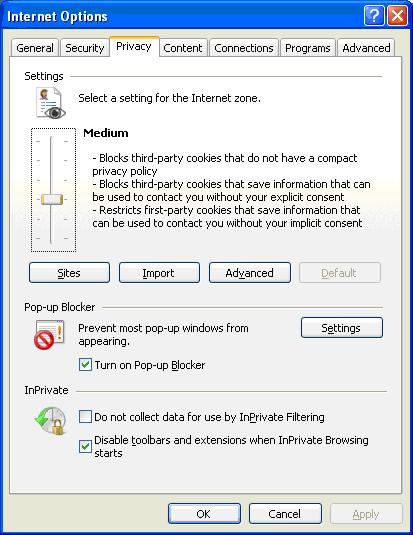
To access Internet Explorer's basic cookie management and privacy settings, open the "Tools" menu, click "Internet Options," and then click on the "Privacy" tab to display the following options:
Users can configure the slider on the upper left-hand side of the window to establish their preferred level of cookie privacy. There are 6 options on the sliding scale from which to choose. Starting from the top of the slider bar:
(1) "Block all cookies" -- Blocks IE from receiving any new cookies and blocks websites from reading any existing cookies on your computer. (Of course, that would greatly inconvenience users that regularly access websites that require information from the user, such as a Web-based email site that requires users to log in every time they access the website.)
(2) "High" -- Blocks all cookies from websites that do not have a P3P compact privacy policy or that have a compact privacy policy which specifies that personally-identifiable information is used without your explicit consent. Cookies already on your computer can only be read by the site that created them.
(3) "Medium High" -- "Blocks third-party cookies that do not have a compact privacy policy," "Blocks third-party cookies that save information that can be used to contact you without explicit consent," and "Blocks first-party cookies that save information that can be used to contact you without your implicit consent."
(4) "Medium" -- This setting "Blocks third-party cookies that do not have a compact privacy policy," "Blocks third-party cookies that save information that can be used to contact you without your explicit consent," and "Restricts first-party cookies that save information that can be used to contact you without your implicit consent."
(5) "Low" -- This setting "Blocks third-party cookies that do not have a compact privacy policy" and "Restricts third-party cookies that save information that can be used to contact you without implicit consent."
(6) "Allow all cookies" -- This setting allows all cookies from any website.
A P3P compact privacy policy is a machine-readable summary of the full P3P specification, which is a standardized method for explaining a website's privacy policy. So when IE states that it will "block[] third-party cookies that save information that can be used to contact you without your explicit consent," it means that the cookie will be blocked unless the site has a P3P compact privacy policy that either indicates that only non-identifiable (NOI) information is collected, or that for every data collection PURPOSE and every type of RECIPIENT that the website shares collected data with, the site's policy is that the user must opt in ("explicitly consent") to the practice.
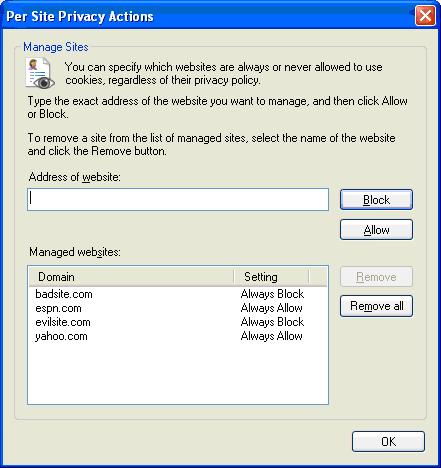
When the slider bar is set anywhere other than the "High" and "Low" levels, users can also click the "Sites" button and then specify different cookie security levels for individual websites. The advantage of this approach is that it lets users create their own personal "white lists" and "black lists" of sites for which they either never want cookies blocked, or for which they always want cookies blocked. This increases the privacy-configurability of the browsing experience. For example, the following screen shows two sites that have been whitelisted and two hypothetical sites that have been blacklisted.
In addition, if the user wishes to manually delete their cookies, web browsing history, form data, personal passwords, or other stored information, they can do so on the "General" tab under the "Browsing History" section. Or, in the new IE 8, they can do so under the new "Safety" drop-down menu (in the Command toolbar) under the first option, "Delete Browser History." They can also configure IE 8 so that all of this data is deleted each time the browser is closed (essentially converting "persistent cookies" into "session cookies," concepts Adam Marcus has explained previously). The following screen shows how this user is choosing to delete just their temporary Internet files, cookies, and browsing history. Favorite websites are websites the user has bookmarked.
Using these controls, a particularly privacy-sensitive user who only trusted two or three sites-say, their bank and their employer's website-could allow cookies for only those sites and block cookies for all other websites. Again, this assumes that they do not mind the potential hassles associated with logging-in to many other sites each time they visit or losing custom preferences that would otherwise be stored in a cookie.
Advanced Private Browsing Features
"InPrivate Browsing": Privacy from Other Users of Your Computer
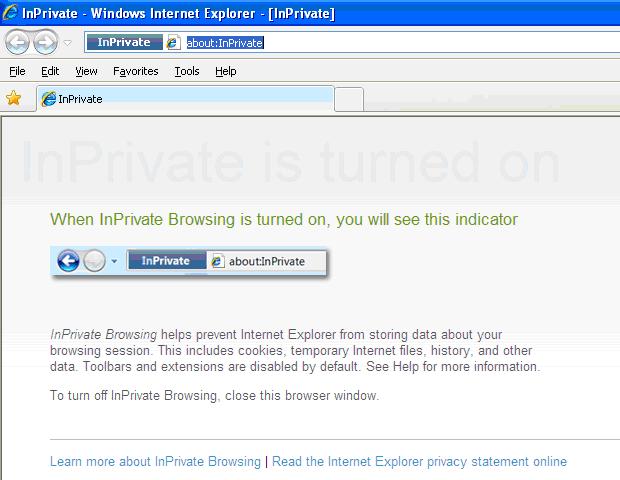
Internet Explorer 8 also offers some new privacy-related features. One of them is called InPrivate Browsing mode (akin to "Incognito" mode in Chrome), which protects so-called "over the shoulder" privacy, although that's a somewhat misleading term. By not saving any record of your web browsing while InPrivate Browsing mode is turned on, this feature ensures that others with access to your computer will not know what websites you have accessed. Some people like being able to refer to their browser history and don't want to delete all of their cookies, but want to hide all traces of some of their browsing activities-such as shopping online for a surprise gift, searching for information about a medical condition you don't want to disclose and, most obviously, enjoying pornography).
When the InPrivate Browsing mode is enabled, none of the varieties of "browsing history" data is saved-but none of your previous history is deleted, either. This comes in handy because, if someone with direct access to your computer is monitoring your browser history to see what you've been up to, deleting all of your browsing history would suggest that you've been doing something you wanted to hide. But InPrivate Browsing mode allows you to surf anonymously when desired-without making it obvious that you're doing so. Parents who are concerned about their kids using the InPrivate Browsing mode can use the parental controls in Windows Vista to disable it. But there does not appear to be a way to disable InPrivate Browsing on Windows XP.
Below is a screenshot of the InPrivate Browsing mode-which, again, can be enabled by clicking on the new "Safety" drop-down menu in IE 8 and selecting "InPrivate Browsing."
While InPrivate Browsing is active, the following takes place:
Microsoft explains its InPrivate Filtering feature as follows:
Today websites increasingly pull content in from multiple sources, providing tremendous value to consumer and sites alike. Users are often not aware that some content, images, ads and analytics are being provided from third party websites or that these websites have the ability to potentially track their behavior across multiple websites. InPrivate Filtering provides users an added level of control and choice about the information that third party websites can potentially use to track browsing activity.
InPrivate Filtering is off by default and must be enabled on a per-session basis. To use this feature, select InPrivate Filtering from the Safety menu.
In "Automatically Block" mode, InPrivate Filtering will automatically block a site if IE finds that site's content embedded in more than a user-specified number of other sites (the default is 10) visited by the user. You can also manually control which sites are blocked, and import and export your list of white/blacklisted sites to share that list with others.
The beta version of IE8 included a subscriptions feature that would have allowed users to automatically receive updated white or blacklists from others-much like the subscription feature in AdBlock Plus that we discussed previously. However, this functionality was removed in the "Release Candidate 1" version of IE8 (released Jan. 26, 2009) for unspecified reasons. While we recognize that not every beta feature makes it into final releases because of challenges in implementation, we very much hope Microsoft will ultimately add the subscription feature to Internet Explorer 8. InPrivate Filtering goes a long way in empowering truly privacy-sensitive users to take more granular control over their own privacy, but a subscription feature would allow less sophisticated users to rely on groups or other individuals they trust to help them avoid specific sites according to their concerns about privacy or security. Indeed, we hope that other browser manufacturers consider incorporating such tools into their browsers. Perhaps the privacy advocates who currently focus on inventing one-size-fits-all regulatory or legislative solutions could channel their enthusiasm about user privacy into actually developing whitelists and blacklists.
Other Privacy Features
SmartScreen Filter - Called "Phishing filter" in IE 7, this feature monitors and blocks links to malicious downloads. In IE 8, it also monitors links distributed via email and instant messaging (assuming IE is the default Web browser).
Cross Site Scripting (XSS) filter - Cross-site scripting attacks allow hackers to "inject" malicious scripts into trusted websites, which can then steal the account credentials of users who access these websites. XSS attacks are dangerous because everything looks fine to users and the attackers can gain almost complete access to users' computers. The XSS filter in IE constantly scans the data received from websites to determine if there is a likely XSS attack and re-writes the data to neutralize the attack.
ActiveX Opt-In - By default, ActiveX Opt-In disables most ActiveX controls. When a Web page tries to run an ActiveX control, the following text is displayed in an Information Bar: "This website wants to run the following add-on 'ABC Control' from 'XYZ Publisher.' If you trust the website and the add-on and want to allow it to run, click here ..." The user can then choose whether or not to run the ActiveX control.
Per-Site ActiveX - If a website tries to access an installed ActiveX control that is not permitted to run on the website, this new feature in IE 8 gives the user the option of blocking the attempt, allowing the ActiveX control for the current site, or to allow all websites to access the ActiveX control.
Domain Highlighting - The domain name of the site you're viewing is highlighted in the address bar. By making it clearer to the user which website they're accessing, this feature serves to protect users against phishing attacks from domain names that look like trusted domain names (e.g., www.paypal.com.hax0r.net, which is not PayPal's actual website).
]]>
Nuts & Bolts: A User's Guide to ISP Network Management2009-02-24T15:18:51Z2009-02-24T15:19:08Ztag:blog.pff.org,2009://2.54722009-02-24T15:19:08ZThere has been lots of talk on blogs recently about Cox Communications' network management trial. Some see this as another nail in Network Neutrality's coffin, while many users are just hoping for anything that will make their network connection faster.Adam Marcushttp://www.pff.orgamarcus@pff.orgNet Neutrality
This is the third in a series of articles about Internet technologies. The first article was about web cookies. The second article explained the network neutrality debate. This article explains network management systems. The goal of this series is to provide a solid technical foundation for the policy debates that new technologies often trigger. No prior knowledge of the technologies involved is assumed.
There has been lots of talk on blogs recently about Cox Communications' network management trial. Some see this as another nail in Network Neutrality's coffin, while many users are just hoping for anything that will make their network connection faster.
As I explained previously, the Network Neutrality debate is best understood as a debate about how to best manage traffic on the Internet.
Those who advocate for network neutrality are actually advocating for legislation that would set strict rules for how ISPs manage traffic. They essentially want to re-classify ISPs as common carriers. Those on the other side of the debate believe that the government is unable to set rules for something that changes as rapidly as the Internet. They want ISPs to have complete freedom to experiment with different business models and believe that anything that approaches real discrimination will be swiftly dealt with by market forces.
But what both sides seem to ignore is that traffic must be managed. Even if every connection and router on the Internet is built to carry ten times the expected capacity, there will be occasional outages. It is foolish to believe that routers will never become overburdened-they already do. Current routers already have a system for prioritizing packets when they get overburdened; they just drop all packets received after their buffers are full. This system is fair, but it's not optimized.
]]>
The network neutrality debate needs to shift to a debate on what should be prioritized and how. One way packets can be prioritized is by the type of data they're carrying. Applications that require low latency would be prioritized and those that don't require low latency would not be prioritized.
Cox's Internet service, like most Cable internet services, was built on top of its cable TV service, which was designed to share TV signals in only one direction to households in a relatively small geographic area. Cable companies segment their networks into neighborhoods or "nodes," with each node connected to a Cable Modem Termination System (CMTS). The size of each node can vary from a few thousand households to a few hundred thousand households. All cable Internet customers connected to a single node share the available bandwidth.
Here's a simple analogy: Imagine you buy a house with your new spouse. The house has a tankless water heater that can provide an unlimited supply of hot water at a rate of 2-5 gallons per minute, which is adequate for the two of you. When you have houseguests, you manage the limited flow rate by having some people shower in the morning and some people shower in the evening. Then you have kids. As your kids grow up, you all need to shower around the same time in the morning and you experience hot water outages more and more often. You're faced with two options: Continue to restrict how many people can shower at any one time, or buy a larger-capacity water heater. Substitute broadband for hot water and you've got the situation that ISPs are in.
As cable companies add more cable Internet subscribers and individual households use more bandwidth, the cable companies have essentially three options:
Segment their networks so each node is serving fewer users; or
Deploy new technology to increase the bandwidth of their CMTSes (e.g. DOCSIS 3.0);
Use the existing bandwidth more "efficiently."
Using a network more efficiently means deploying some sort of "network management" system. Even though tankless water heaters can supply an endless amount of hot water, if you connect too many sinks and showers to a single heater and turn them all on at once, you will have a (temporary) hot water shortage. That's why it's usually not a good idea to run the dishwasher or washing machine when you're taking a shower. Similarly, bandwidth on the Internet is only limited by the electricity needed to keep the routers running, but when everyone tries to use high-bandwidth applications (like streaming video) simultaneously, the network gets congested and slows down.
When thinking of hot water systems, washing machines and dishwashers can be thought of as non-time-sensitive uses of hot water because it's usually not important when they're done, as long as they're done within a few hours of your preferred time. On the other hand, when you go to wash your hands, you want hot water immediately. This would be an extremely time-sensitive use. Showers probably fall somewhere in the middle. The same variety of time-sensitivity also applies to Internet applications.
When done right, network management is nothing to fear. It allows ISPs to provide better service to more customers at a lower cost. Hopefully, those customers will be happier because their time-sensitive applications will have enough bandwidth. And the lower costs to the ISP may result in lower prices to customers. For customers who want/need more bandwidth than average, ISPs can and do offer different levels of service.
Even in areas where the incumbent broadband ISP does not face any serious competition, network management is good for users: Without network management, it may be completely impossible on an overloaded network to make a VoIP call, remotely connect to your office network, or play online multi-player games.
Cox's network management policy seems eminently reasonable. First, it only affects "upstream" traffic (i.e. traffic sent from users' computers). The new system classifies all traffic as either "time-sensitive" (prioritized) or "less time-sensitive" (unprioritized). Unprioritized traffic includes FTP uploads, peer-to-peer file sharing, and Usenet posts. Most importantly, "Any traffic that is not specifically classified will be treated as time-sensitive." Thus, the policy will not affect new Internet applications and anyone who encrypts their traffic (because using encryption prevents your ISP from being able to determine which application you're using).
If you've noticed your Internet connection has suddenly slowed, your ISP's new network management policy is probably not the cause. It may simply be that there are more households sharing the same last-mile connection and those households are using it more. What is needed are new metrics to compare broadband offerings. Heavy users of peer-to-peer file transfer applications may indeed see faster speeds by switching to an ISP that doesn't use network management. But if all such users in a particular area switch to that ISP, the ISP's network will likely quickly become overloaded and have to implement network management practices themselves. Just as insurance companies and financial institutions must avoid setting policies that attract the sickest or least-credit-worthy customers, ISPs may face the same problem of "adverse selection" by attracting the most bandwidth-intensive users if they do not either impose some form of network management or charge a premium for not limiting bandwidth.
New Metrics
Choosing an ISP based only on price and downstream rate is simply not enough anymore. The old adage that "you get what you pay for" still applies. The first thing bandwidth shoppers that have a choice between cable Internet service and some other form of Internet service like DSL or fiber need to realize is that only cable Internet services share the last-mile connection among multiple households. DSL and fiber services do not. Next, you need to understand that the quoted transfer rate is not guaranteed; it's simply the fastest speed you can expect to obtain under ideal conditions--which may only occur when all your neighbors have their computers turned off). Beyond that, the following are some terms that should help you decide between ISPs and the different packages offered by each.
To return to the water heater analogy, if you move into an apartment building with a central tankless water heater, knowing the water heater's flow rate is meaningless if you don't know how many other people are living in the building and sharing the same water heater. Of course some people take longer showers than others. If how much hot water you get for your morning shower is really important to you, you may be better off finding an apartment with your own private water heater. But for those that will have to share a water heater with others, you'll want to know the capacity of the water heater and the number of people it will be shared with.
Bandwidth - Bandwidth measurements are exactly like the flow rate measurement for tankless water heaters: It's a measure of how much of some quantity (water or data) the system can deliver over a fixed period of time. Tankless water heaters are measured in gallons per minute. Bandwidth is measured in megabits per second. NOTE: Most telecommunications equipment measures quantities in bits (and multiples of bits such as kilobits, megabits, and gigabits) but most storage devices measure quantities in bytes (and kilobytes, megabytes, and gigabytes). When abbreviated, MB means megabyte and Mb means megabit. There are 8 bits in a byte, so a high-quality photo from a 6 megapixel camera (approximately 2.2 megabytes in size) would take about 3 seconds to transfer across an otherwise unused 6 megabit per second (Mbps) connection. For more about bandwidth and how it relates to latency, which is a truer measure of actual speed, refer to my earlier article in this series, "Some basic about edge caching, network management, & Net neutrality."
Powerboost - This technology, now used by a number of ISPs, gives a speed boost to the first few megabytes of each upload and download. This is great for casual web surfing, but for large files the boost isn't all that significant. With one ISP's package, the speed boost is from 6Mbps to 15Mbps for only the first 10Mb of each download. This saves a maximum of 8 seconds per download regardless of how big the file is. When comparing packages, be sure to compare the actual download speeds as well as the boosted download speeds. In some cases, the actual download speeds are not reported in the ISPs advertising and you need to call to find them out.
Contention Ratio - This is the ratio of the total bandwidth promised to all users (based on their service plan) to the actual bandwidth available on the connection. If there are 2000 households, each with a 10Mbps plan, sharing a last-mile connection with a total capacity of 1Gbps, the contention ratio would be 20:1. To go back to water heaters: If each of 20 apartments in a single building is promised hot water at a flow rate of 3 gallons per minute, the building would need a heater with a flow rate of 60 gallons per minute to meet the demand if everyone takes a shower at the same time. That would result in a contention ration of 1:1. But if the building tries to save money by installing a cheaper heater with a flow rate of only 30 gallons per minute, the contention ratio would drop to 2:1. ISPs in the U.S. do not normally disclose contention ratios, but the practice is common in the U.K, where leading ISP BT has guidelines requiring a ratio between 20:1 and 50:1. There's no way to determine your own contention ratio, but it might be worth asking the next time you're shopping around for broadband service, if for no other reason than to raise awareness of this important metric.
In conclusion, there are a number of potential causes for a slow Internet connection and a number of possible solutions--but the deployment of network management systems by ISPs is probably not to blame. If anything, most users on such ISPs should notice their connections become faster for most applications. If you've ever had no hot water to wash your hands because someone was running the dishwasher, you'll understand why network management is important. As long as an ISP isn't using its network management system to favor one application over a competitor (e.g. prioritizing its own voice-over-IP (VoIP) service but not prioritizing other VoIP services), network neutrality advocates should have no cause for alarm. As explained above, Cox's new system meets this test.
Nuts and Bolts: Network neutrality and edge caching2008-12-17T19:10:50Z2008-12-17T07:00:00Ztag:blog.pff.org,2008://2.54062008-12-17T07:00:00Z This is the second in a series of articles about Internet technologies. The first article was about web cookies. This article explains the network neutrality debate. The goal of this series is to provide a solid technical foundation for...Adam Marcushttp://www.pff.orgamarcus@pff.orgNet Neutrality
This is the second in a series of articles about Internet technologies. The first article was about web cookies. This article explains the network neutrality debate. The goal of this series is to provide a solid technical foundation for the policy debates that new technologies often trigger. No prior knowledge of the technologies involved is assumed.
]]>
To understand the network neutrality debate, you must first understand bandwidth and latency. There are lots of analogies equating the Internet to roadways, but it's because the analogies are quite instructive. For example, if one or two people need to travel across town, a fast sports car is probably the fastest method. But if 50 people need to travel across town, it may require 25 trips in a single sports car. So a bus which can transport all 50 people in a single trip may be "faster" overall. The sports car is faster, but the bus has more capacity. Bandwidth is a measure of capacity, of how much data can be transmitted in a fixed period of time. It is usually measured in Megabits per second (Mbps). Latency is a measure of speed, of the time it takes a single packet data to travel between two points. It is usually measured in milliseconds. The "speeds" that ISPs advertise have nothing to do with latency; they're actually referring to bandwidth. ISPs don't advertise latency because its different for each different site you're trying to reach.
The Internet consists of devices and wires connecting those devices. The speed of data along the wires is fixed--there are no fast lanes and slow lanes. The only way to increase speeds is to either travel a shorter path or to get priority at the routers, the virtual traffic lights of the Internet. ISPs advertise bandwidth because with more bandwidth, more data can get to you in fewer trips, making your broadband connection seem much faster than a dial-up connection.
Sometimes latency and bandwidth are important and sometimes they're not that important. The typical response time between any two points on the Internet is 1/5th of one second, so the difference between a relatively fast and relatively slow connection isn't much. If you're sending an email (without any attachments) or chatting with someone using an Instant Messaging program, you're not using much bandwidth and if your messages are delayed by a second it's probably not a problem. Or when Microsoft Windows is downloading system updates in the background, whether the download completes in a few minutes or an hour really doesn't matter--as long as it completes. The emails and IMs are low-bandwidth and the system updates are usually high-bandwidth, but in both of these examples, latency is not that important. But if you're playing a real-time online multiplayer game, making a VoIP phone call, videoconferencing, or remotely connecting to another computer using pcAnywhere, GoToMyPC, or Remote Desktop Services, both bandwidth and latency are important. Without a high-bandwidth low-latency connection, you'll experience drop-outs and lag. NOTE - Latency is a measure of time, so the lower the latency the better.
Latency is most affected by the Internet equivalent to traffic lights: routers. Data transmitted over the Internet is sent in packets which contain a header that specifies, among a few other things, the IP address of the intended destination computer. Between every connection sits a router. For every packet that arrives at every router, the router must look at its header to determine where to send it, and then forward the packet out along the proper connection. Normally, routers inspect and forward packets with almost no delay. But when there are too many packets for a router to handle or the tubes get filled, the packets are temporarily queued in the router's memory. This queuing imposes some delay. If the memory becomes full, the router drops (deletes) some of the packets and tries to keep going. If the sending computer doesn't get a response in a certain amount of time, it assumes the packet has been dropped and sends it again, resulting in even more delay. On average, about 6% of packets are lost.
One way to deal with overloaded routers is to simply install more and bigger routers. Another method is to build more connections so packets don't have to travel through as many routers. But both of these options are costly and it's not clear whether simply increasing capacity will be enough to keep pace with increasing demand. A third option is to prioritize the packets. Prioritizing packets is kind of like the Mobile InfraRed Transmitter (MIRT) system that allows emergency response vehicles (e.g. fire, police, and EMS) to immediately turn specially-equipped traffic lights green. Most people would probably agree that this form of traffic priortization is a good idea. But when referring to the Internet, talk of traffic prioritization starts arguments.
The Network Neutrality Debate: What's It All About
The network neutrality debate is a debate about the best method to manage traffic on the Internet. Those who advocate for network neutrality are actually advocating for legislation that would set strict rules for how ISPs manage traffic. They essentially want to re-classify ISPs as common carriers. Those on the other side of the debate believe that the government is unable to set rules for something that changes as rapidly as the Internet. They want ISPs to have complete freedom to experiment with different business models and believe that anything that approaches real discrimination will be swiftly dealt with by market forces.
But what both sides seem to ignore is that traffic must be managed. Even if every connection and router on the Internet is built to carry ten times the expected capacity, there will be occassional outages. It is foolish to believe that routers will never become overburdened--they already do. Current routers already have a system for prioritizing packets when they get overburdened; they just drop all packets received after their buffers are full. This system is fair, but it's not optimized.
The network neutrality debate needs to shift to a debate on what should be prioritized and how. One way packets can be prioritized is by the type of data they're carrying. Applications that require low latency would be prioritized and those that don't require low latency would not be prioritized. But who makes the determinations? What happens if someone hacks their computer to prioritize packets that shouldn't be? Another method is for ISPs to offer prioritization for a fee. ISPs could determine who should get prioritization based on the source or destination IP address in the packet header, or content providers could pay ISPs to prioritize only packets they tag with a special marker.
Opponents of network neutrality mandates argue that it's simply not feasible to increase capacity to the extend that would be necessary without prioritization. They believe that with prioritization, they will be able charge more for faster access to those willing to pay, and the increased revenue will provide the funding necessary to upgrade the networks, which will benefit everyone. As the saying goes, a rising tide lifts all boats. Network neutrality advocates fear that if ISPs are allowed to charge for prioritization, they will have no incentive to increase speeds for those who don't pay for prioritization. While that may be true, price discrimination is very different from other forms of discrimination. It would be a real shame if the net neutrality debate over latency hampered efforts to increase bandwidth. Even common carriers were not restricted from setting different prices for different classes of service, they simply had to offer the same rates to all comers. If those who claim the Internet should be a completely level playing field applied the same logic to the phone system, toll-free numbers wouldn't be allowed.
Edge Caching: What It Is and Isn't
Monday's Wall Street Journal ran an article suggesting that Google is abandoning its stance as an advocate for Network Neutrality because of a plan to set up edge caching servers. Edge caching is just a way to more efficiently balance the costs of storage space and bandwidth in an attempt to decrease latency. It a way to move content "closer" to the end-users that view it to avoid the latency that occurs as packets traverse longer distances across the network.
To continue the roadways analogy, imagine the Internet arranged like a city. The end-users are all in the suburbs and the data they want to access is downtown in the network's "core." With this model, every request from a user needs to "commute" from the suburbs to the core, and the requested data needs to then travel from the core all the way back to the suburbs. Just like companies realized that setting up satellite offices nearer to its workers would decrease commuting times and increase productivity, content providers have realized that setting up edge caching servers at major ISPs decreases latency and saves on bandwidth costs.
Edge caching doesn't work for all types of Internet content. If the content changes rapidly, edge caching doesn't save much bandwidth because you're constantly pushing new content to the edge servers. But for popular YouTube videos, edge caching is a great way for Google to save on bandwidth costs. Before Google bought YouTube, YouTube outsourced the hosting of its videos to edge caching provider LimeLight. So its no surprise that Google is now looking to do the same with its own edge caching servers.
The fact that Google can afford to set up edge caching servers around the network does give it a bit of an advantage. But the advantage is mostly a savings in bandwidth costs for the content provider. The use of edge servers is meant to be almost unperceptable to users. Accessing content from edge servers may be a bit faster for users, but nobody is being discriminated against and most content on the Internet is not latency-sensitive. In the example of Internet video, the difference between playing a video hosted on an edge caching server versus playing video from a server located far away may be just a matter of a few seconds delay before the video begins playing.
Some, like the Wall Street Journal, argue that even edge caching violates the net neutrality principle of the Internet being a level playing field. I would suggest that only discriminatory practices, such as an ISP offering packet prioritization to only some companies, should be considered a violation of net neutrality principles.
As Google points out, other companies are free to set up their own edge caching servers or use one of the many companies that offer edge caching services. There have been economies of scale in other industries for generations. The fact that edge caching provides economies of scale for Internet content providers is not a game changer. On the Internet, just as in other media industries, it's not who can get their goods to market the fastest, it's whose content best satisfies their audiences.
]]>
Of Holiday Gift Guides and New Media Business Models2008-12-12T17:12:19Z2008-12-10T15:48:06Ztag:blog.pff.org,2008://2.53992008-12-10T15:48:06ZThis week's Wall Street Journal featured a special Journal Report entitled "The Way We'll Watch" on new movie technologies that will be available soon, some in time for this holiday season. It got me thinking about some of the business plans that have already been tried in the content industry in the past few years.Adam Marcushttp://www.pff.orgamarcus@pff.orgCapitalism
This week's Wall Street Journal featured a special Journal Report entitled "The Way We'll Watch" on new movie technologies that will be available soon, some in time for this holiday season. It got me thinking about some of the business plans that have already been tried in the content industry in the past few years.
The content industry is at the tail end of a transition from distributing media on physical goods (CDs and DVDs) to digital downloads and streaming content. Distributing physical goods, whatever the container happens to be (wax cylinders, LPs, 8-track tapes, cassette tapes, DAT tapes, CDs, minidiscs, SACDs, DVD-Audio, and now flash memory) is a well-established business model that the content industry is very comfortable with. But most consumers are tired of lugging around their libraries with each album or movie on a separate piece of media that can be too easily lost or destroyed. Freeing the media from the container it arrives on (or distributing it via computer network without a physical container) allows the media to be easily time-shifted, space-shifted, format-shifted, and re-purposed (e.g. sampling). But the content industry is wary about giving up their old market and is terrified of piracy. So as it slowly warms to digital distribution, the content industry is trying to provide a taste of those conveniences in the old physical goods model. As a result we have the following interesting but ultimately short-term business models:
]]>
Self-destructing DVDs - A company called Flexplay makes DVDs that "expire" 48 hours after you open the air-tight packaging. They're sold at airport kiosks, which is about the only place this makes sense. Because if you will be playing the movie from a laptop (versus a portable DVD player), you'll get much better battery life playing from the hard drive instead of the DVD. But since lots of people don't bother filling their laptop hard drives with media before they fly, this gives them one more thing to do after they get through security and are waiting for their flight.
Selling music on memory cards - SanDisk recently announced that it had signed deals with the four major music labels to sell music on microSD memory cards under its new SlotMusic iniative. These memory cards are indeed smaller than CDs, and once purchased the memory cards can be filled with anything you like. But the cards used by SanDisk are so small (they're 0.4" by 0.6", about a quarter of the size of a postage stamp) they're actually hard to pick up and use. But while a smaller container does make transporting a large library easier, I can't imagine anyone that will actually swap these cards every time they want to listen to a different album. It's certainly gratifying to see the major labels sell DRM-free music, but the only group I see this appealing to are people who are not very computer savvy but are savvy enough to figure out how to load and use a SlotMusic card on their music-capable phone. And the format is still burdened by the realities of physical goods: Consumers are still limited to the selection in stock at their local retailers and retailers will have to deal with returning unsold merchandise. Like the the Flexplay DVDs, this may just be something sold at airport kiosks.
Speaking of kiosks, one "future" innovation mentioned in the Wall Street Journal article was kiosks at retail locations that burn movies while you wait. The idea of selling content via kiosk has actually been around for a long time. In the late 1980s, a company called Personics placed kiosks in music stores that made personalized cassette tapes. And since 2002, Redbox has had kiosks renting DVDs for $1/day, although these kiosks weren't burning the DVDs on demand. There has also been at least one attempt to allow consumers to legally download and burn DVDs at home, although that system was shrunk the size of their music and DVD departments. But renting movies still requires consumers to make a second trip back to the store to return the movie and kiosks don't have drive-through drop-off boxes). The kiosks discussed in the WSJ article, which sell the movies and have Internet connections, seem to be a better option, but if consumers are forced into using a screen and keyboard to buy their media, they'll likely just do it from their home computer.
Albums as digital downloads but sold at retail - I was in a Best Buy store over the weekend and I noticed some Sony Music Pass cards. The idea is that you purchase a plastic card with a scratch-off number on the back, and when you get home you use that number to authorize your download of the album. This concept just completely baffles me. Why would anyone pay for an album at a store if they don't actually get the album until they go home and download it? Even more crazy is the fact that Sony is selling mix albums this way (e.g. this and this). Why would I want to buy a pre-selected mix album when almost every digital download website lets me pick and choose only the tracks I like? And if I need to download the songs, why involve buying something at a store at all? There's really only one explanation: Christmas.
CDs and DVDs have been given as gifts since these formats were introduced. The options discussed above all allow digitally-challenged parents and grandparents to buy something for their iPod-toting relatives that the kids may actually appreciate. But a better choice is to get them a gift card that lets them choose the media they want. These types of gift cards are available for Apple iTunes, eMusic, Napster, Microsoft Zune, and Best Buy's own digital music store. Most of these provide music in DRM-free MP3 format which should play on just about all digital music players.
Digital distribution of music and movies (and TV) is here and it will only become more common. iTunes is already the top music retailer in the U.S. Because of the much higher bandwidth requirements of High-Definition video, it will take a bit longer before digital downloads are the top means of obtaining video content. But it's fast approaching. More than half of America already has broadband connections at home. Netflix and Hulu already offer HD content, and Netflix is accessible from a number of devices besides a computer.
If you're still confused about what to get your favorite geek this holiday season, I suggest the gift that won't go obsolete, won't expire, and that's guaranteed compatible with everything: Cash.
 The Digital Millenium Copyright Act makes it a crime to circumvent digital rights management technologies but allows the Librarian of Congress to exempt certain classes of works from this prohibition.

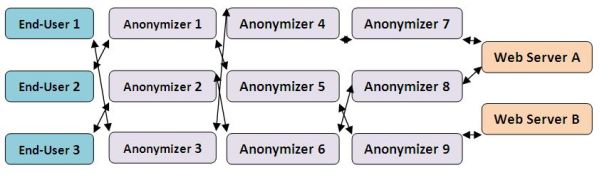
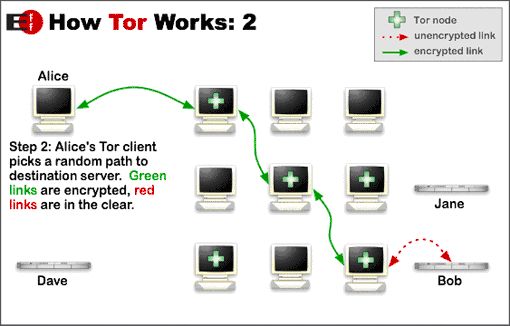

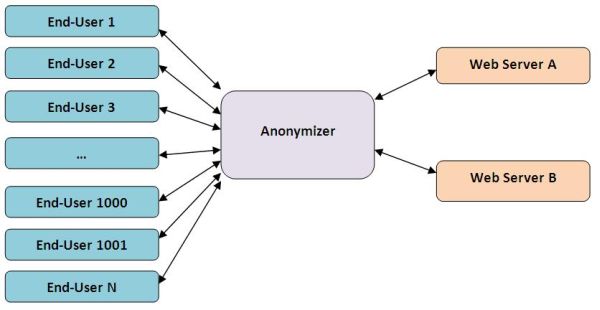
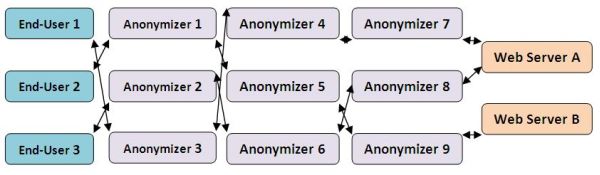

 We started this series because, to paraphrase Smokey the Bear, "Only you can protect your privacy online!" While the law can play a vital role in giving full effect to the Fourth Amendment's restraint on government surveillance, privacy is not something that cannot simply be created or enforced by regulation because, as Cato scholar Jim Harper
  As noted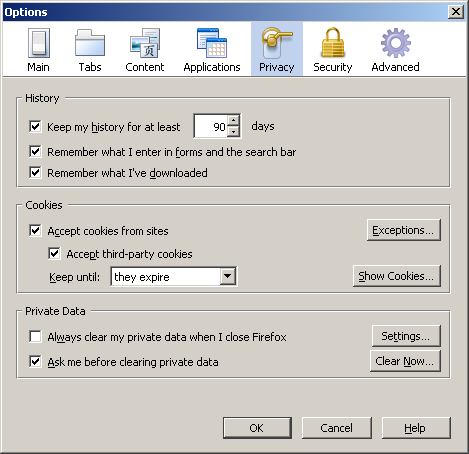
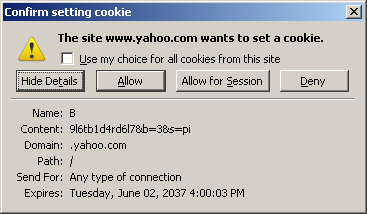
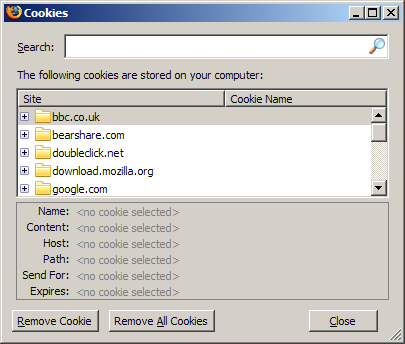
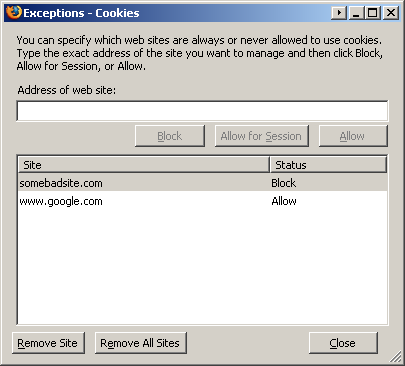
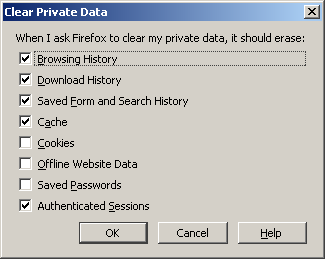
 Similar to Internet Explorer 8's "InPrivate Browsing" feature (see the