<?xml version="1.0" encoding="UTF-8"?>
<?xml-stylesheet type="text/xsl" media="screen" href="/~d/styles/atomfull.xsl"?><?xml-stylesheet type="text/css" media="screen" href="http://feeds.feedburner.com/~d/styles/itemcontent.css"?><feed xmlns="http://purl.org/atom/ns#" xmlns:dc="http://purl.org/dc/elements/1.1/" xmlns:feedburner="http://rssnamespace.org/feedburner/ext/1.0" version="0.3" xml:lang="en">
<title>The Progress &amp; Freedom Foundation Blog</title>
<link rel="alternate" type="text/html" href="http://blog.pff.org/" />
<modified>2010-08-12T14:21:45Z</modified>
<tagline />
<id>tag:blog.pff.org,2012://2</id>
<generator url="http://www.movabletype.org/" version="4.32-en">Movable Type</generator>
<copyright>Copyright (c) 2010, berinszoka</copyright>

<link rel="start" type="application/atom+xml" href="http://feeds.feedburner.com/pff/szoka" /><feedburner:info uri="pff/szoka" /><atom10:link xmlns:atom10="http://www.w3.org/2005/Atom" rel="hub" href="http://pubsubhubbub.appspot.com/" /><feedburner:feedFlare href="http://add.my.yahoo.com/rss?url=http%3A%2F%2Ffeeds.feedburner.com%2Fpff%2Fszoka" src="http://us.i1.yimg.com/us.yimg.com/i/us/my/addtomyyahoo4.gif">Subscribe with My Yahoo!</feedburner:feedFlare><feedburner:feedFlare href="http://www.newsgator.com/ngs/subscriber/subext.aspx?url=http%3A%2F%2Ffeeds.feedburner.com%2Fpff%2Fszoka" src="http://www.newsgator.com/images/ngsub1.gif">Subscribe with NewsGator</feedburner:feedFlare><feedburner:feedFlare href="http://feeds.my.aol.com/add.jsp?url=http%3A%2F%2Ffeeds.feedburner.com%2Fpff%2Fszoka" src="http://o.aolcdn.com/favorites.my.aol.com/webmaster/ffclient/webroot/locale/en-US/images/myAOLButtonSmall.gif">Subscribe with My AOL</feedburner:feedFlare><feedburner:feedFlare href="http://www.bloglines.com/sub/http://feeds.feedburner.com/pff/szoka" src="http://www.bloglines.com/images/sub_modern11.gif">Subscribe with Bloglines</feedburner:feedFlare><feedburner:feedFlare href="http://www.netvibes.com/subscribe.php?url=http%3A%2F%2Ffeeds.feedburner.com%2Fpff%2Fszoka" src="http://www.netvibes.com/img/add2netvibes.gif">Subscribe with Netvibes</feedburner:feedFlare><feedburner:feedFlare href="http://fusion.google.com/add?feedurl=http%3A%2F%2Ffeeds.feedburner.com%2Fpff%2Fszoka" src="http://buttons.googlesyndication.com/fusion/add.gif">Subscribe with Google</feedburner:feedFlare><feedburner:feedFlare href="http://www.pageflakes.com/subscribe.aspx?url=http%3A%2F%2Ffeeds.feedburner.com%2Fpff%2Fszoka" src="http://www.pageflakes.com/ImageFile.ashx?instanceId=Static_4&amp;fileName=ATP_blu_91x17.gif">Subscribe with Pageflakes</feedburner:feedFlare><feedburner:feedFlare href="http://www.plusmo.com/add?url=http%3A%2F%2Ffeeds.feedburner.com%2Fpff%2Fszoka" src="http://plusmo.com/res/graphics/fbplusmo.gif">Subscribe with Plusmo</feedburner:feedFlare><feedburner:feedFlare href="http://www.thefreedictionary.com/_/hp/AddRSS.aspx?http%3A%2F%2Ffeeds.feedburner.com%2Fpff%2Fszoka" src="http://img.tfd.com/hp/addToTheFreeDictionary.gif">Subscribe with The Free Dictionary</feedburner:feedFlare><feedburner:feedFlare href="http://www.bitty.com/manual/?contenttype=rssfeed&amp;contentvalue=http%3A%2F%2Ffeeds.feedburner.com%2Fpff%2Fszoka" src="http://www.bitty.com/img/bittychicklet_91x17.gif">Subscribe with Bitty Browser</feedburner:feedFlare><feedburner:feedFlare href="http://www.newsalloy.com/?rss=http%3A%2F%2Ffeeds.feedburner.com%2Fpff%2Fszoka" src="http://www.newsalloy.com/subrss3.gif">Subscribe with NewsAlloy</feedburner:feedFlare><feedburner:feedFlare href="http://www.live.com/?add=http%3A%2F%2Ffeeds.feedburner.com%2Fpff%2Fszoka" src="http://tkfiles.storage.msn.com/x1piYkpqHC_35nIp1gLE68-wvzLZO8iXl_JMledmJQXP-XTBOLfmQv4zhj4MhcWEJh_GtoBIiAl1Mjh-ndp9k47If7hTaFno0mxW9_i3p_5qQw">Subscribe with Live.com</feedburner:feedFlare><feedburner:feedFlare href="http://mix.excite.eu/add?feedurl=http%3A%2F%2Ffeeds.feedburner.com%2Fpff%2Fszoka" src="http://image.excite.co.uk/mix/addtomix.gif">Subscribe with Excite MIX</feedburner:feedFlare><feedburner:feedFlare href="http://download.attensa.com/app/get_attensa.html?feedurl=http%3A%2F%2Ffeeds.feedburner.com%2Fpff%2Fszoka" src="http://www.attensa.com/blogs/attensa/WindowsLiveWriter/BadgeredintoBadges_10C02/attensa_feed_button5.gif">Subscribe with Attensa for Outlook</feedburner:feedFlare><feedburner:feedFlare href="http://www.webwag.com/wwgthis.php?url=http%3A%2F%2Ffeeds.feedburner.com%2Fpff%2Fszoka" src="http://www.webwag.com/images/wwgthis.gif">Subscribe with Webwag</feedburner:feedFlare><feedburner:feedFlare href="http://www.podcastready.com/oneclick_bookmark.php?url=http%3A%2F%2Ffeeds.feedburner.com%2Fpff%2Fszoka" src="http://www.podcastready.com/images/podcastready_button.gif">Subscribe with Podcast Ready</feedburner:feedFlare><feedburner:feedFlare href="http://www.flurry.com/pushRssFeed.do?r=fb&amp;url=http%3A%2F%2Ffeeds.feedburner.com%2Fpff%2Fszoka" src="http://www.flurry.com/images/flurry_rss_logo2.gif">Subscribe with Flurry</feedburner:feedFlare><feedburner:feedFlare href="http://www.wikio.com/subscribe?url=http%3A%2F%2Ffeeds.feedburner.com%2Fpff%2Fszoka" src="http://www.wikio.com/shared/img/add2wikio.gif">Subscribe with Wikio</feedburner:feedFlare><feedburner:feedFlare href="http://www.dailyrotation.com/index.php?feed=http%3A%2F%2Ffeeds.feedburner.com%2Fpff%2Fszoka" src="http://www.dailyrotation.com/rss-dr2.gif">Subscribe with Daily Rotation</feedburner:feedFlare><entry>
<title>Our CNET Column: "Just say no to Ma Bell-era Net neutrality regulation"</title>
<link rel="alternate" type="text/html" href="http://feedproxy.google.com/~r/pff/szoka/~3/fakxHA9bZNw/our_cnet_column_just_say_no_to_ma_bell-era_net_neu.html" />
<modified>2010-08-12T14:21:45Z</modified>
<issued>2010-08-12T14:21:05Z</issued>
<id>tag:blog.pff.org,2010://2.6135</id>
<created>2010-08-12T14:21:05Z</created>
<summary type="text/plain">CNET has just run the guest column, "Just say no to Ma Bell-era Net neutrality regulation," Adam Thierer and I wrote in response to "Just say no to fake Net neutrality" by Derek Turner (of Free Press), which decried the win-win-win compromise...</summary>
<author>
<name>Berin Szoka</name>
<url>http://blog.pff.org/archives/author/berin_szoka/</url>
<email>bszoka@pff.org</email>
</author>
<dc:subject>Broadband</dc:subject>
<content type="text/html" mode="escaped" xml:lang="en" xml:base="http://blog.pff.org/">
&lt;p&gt;CNET has just run the guest column, "&lt;a href="http://news.cnet.com/8301-13578_3-20013262-38.html"&gt;Just say no to Ma Bell-era Net neutrality regulation&lt;/a&gt;," Adam Thierer and I wrote in response to "&lt;a href="http://news.cnet.com/8301-13578_3-20011565-38.html"&gt;Just say no to fake Net neutrality&lt;/a&gt;" by Derek Turner (of Free Press), which decried the &lt;a href="http://news.cnet.com/8301-13578_3-20011284-38.html?tag=mncol;txt"&gt;win-win-win compromise&lt;/a&gt; suggested by Amazon's Paul Misener, just as Free Press has more recently &lt;a href="http://www.freepress.net/press-release/2010/8/9/google-verizon-pact-worse-feared"&gt;denounced&lt;/a&gt; the &lt;a href="http://news.cnet.com/8301-13578_3-20013212-38.html"&gt;compromise&lt;/a&gt; proposed by Google and Verizon.&lt;/p&gt;

&lt;p&gt;We make a few key points:&lt;br /&gt;
&lt;ol&gt;&lt;br /&gt;
	&lt;li&gt;History demonstrates the dangers of regulatory capture, and the costs to consumers of regulation from lost investment and innovation.&lt;/li&gt;&lt;br /&gt;
	&lt;li&gt;These dangers and costs far outweigh the purported benefits of regulation (in addressing a non-existent harm).&lt;/li&gt;&lt;br /&gt;
	&lt;li&gt;Broadband markets are competitive &lt;em&gt;enough&lt;/em&gt; to prevent the kinds of abuses advocates of net neutrality regulation fret about.&lt;/li&gt;&lt;br /&gt;
	&lt;li&gt;Government could foster more broadband competition by deregulating spectrum and local wireline franchising.&lt;/li&gt;&lt;br /&gt;
&lt;/ol&gt;&lt;br /&gt;
I've been having a lively debate with the commenters on the piece, so feel free to join in! Unfortunately, we don't seem to be getting much substantive engagement with our argument--just the usual mix of "These guys are just corporate whores!" and "Can't you see the sky is falling?"&lt;/p&gt;

&lt;img src="http://feeds.feedburner.com/~r/pff/szoka/~4/fakxHA9bZNw" height="1" width="1"/&gt;</content>
<feedburner:origLink>http://blog.pff.org/archives/2010/08/our_cnet_column_just_say_no_to_ma_bell-era_net_neu.html</feedburner:origLink></entry>

<entry>
<title>Join Us for pii2010 "Privacy Identity Innovation 2010" Conference in Seattle 8/17-19!</title>
<link rel="alternate" type="text/html" href="http://feedproxy.google.com/~r/pff/szoka/~3/5KlP5ETah1E/join_us_for_pii2010_privacy_identity_innovation_20.html" />
<modified>2010-08-06T13:41:09Z</modified>
<issued>2010-08-06T13:38:22Z</issued>
<id>tag:blog.pff.org,2010://2.6132</id>
<created>2010-08-06T13:38:22Z</created>
<summary type="text/plain">If you're as fascinated as I am by the interplay of privacy, identity and innovation, I hope to see you at the pii2010 conference in Seattle, August 17-19! Organized by the folks who've put on the top-notch Tech Policy Summit since 2003, and...</summary>
<author>
<name>Berin Szoka</name>
<url>http://blog.pff.org/archives/author/berin_szoka/</url>
<email>bszoka@pff.org</email>
</author>
<dc:subject>Privacy</dc:subject>
<content type="text/html" mode="escaped" xml:lang="en" xml:base="http://blog.pff.org/">
&lt;p&gt;&lt;a rel="attachment wp-att-30924" href="http://techliberation.com/?attachment_id=30924"&gt;&lt;img class="alignright size-full wp-image-30924" align="right" title="pii2010" src="http://techliberation.com/wp-content/uploads/2010/08/pii2010.jpg" alt="" width="97" height="69" /&gt;&lt;/a&gt;If you're as fascinated as I am by the interplay of privacy, identity and innovation, I hope to see you at the &lt;a href="http://pii2010.com/"&gt;pii2010 conference&lt;/a&gt; in Seattle, August 17-19! Organized by the folks who've put on the top-notch &lt;a href="http://www.techpolicycentral.com/"&gt;Tech Policy Summit&lt;/a&gt; since 2003, and co-sponsored by &lt;a href="http://pff.org"&gt;The Progress &amp;amp; Freedom Foundation&lt;/a&gt; (among others), this event offers a truly unique perspective on privacy--not just another policy food fight, but a true roll-up-our-sleeves, in-depth seminar on what to &lt;em&gt;do&lt;/em&gt; about privacy, especially through technological innovation.&lt;/p&gt;

&lt;p&gt;I'll be on the "pii &amp;amp; Digital Advertising: Navigating the Regulatory Landscape" panel on the 18th at 10am, giving my usual talk about the need to be careful about the &lt;a href="http://techliberation.com/2009/11/11/privacy-trade-offs-pff-comments-on-december-7-ftc-privacy-workshop/"&gt;trade-offs inherent in privacy regulation&lt;/a&gt;. Check out the detailed agenda &lt;a href="http://pii2010.com/#/schedule/4539113017"&gt;here&lt;/a&gt;.&lt;/p&gt;

&lt;p&gt;TLFers Larry Downes and Carl Gipson will also be attending, so we're planning a long-overdue "Alcohol Liberation Front" happy hour after the conference on August 18--details to be announced soon.&lt;/p&gt;

&lt;p&gt;Check out the &lt;a href="http://twitter.com/#search?q=%23pii2010"&gt;discussion&lt;/a&gt; around the #pii2010 hashtag on Twitter. And &lt;a href="http://pii2010.com/#/register/4539093067"&gt;register&lt;/a&gt; today! Mid-August is supposed to be paradise in Seattle, and the week of the conference also happens to be Seattle &lt;a href="http://seattlegeekweek.com/"&gt;GeekWeek&lt;/a&gt;, so there are a bunch of other &lt;a href="http://seattlegeekweek.com/calendar/"&gt;events&lt;/a&gt; worth checking out in town before and after the pii2010 conference.&lt;/p&gt;

&lt;img src="http://feeds.feedburner.com/~r/pff/szoka/~4/5KlP5ETah1E" height="1" width="1"/&gt;</content>
<feedburner:origLink>http://blog.pff.org/archives/2010/08/join_us_for_pii2010_privacy_identity_innovation_20.html</feedburner:origLink></entry>

<entry>
<title>Livetweeting Another Senate Online Privacy Hearing Today (2pm EST)</title>
<link rel="alternate" type="text/html" href="http://feedproxy.google.com/~r/pff/szoka/~3/63XTBpEErLQ/livetweeting_another_senate_online_privacy_hearing.html" />
<modified>2010-07-27T17:40:01Z</modified>
<issued>2010-07-27T17:39:20Z</issued>
<id>tag:blog.pff.org,2010://2.6125</id>
<created>2010-07-27T17:39:20Z</created>
<summary type="text/plain">The Senate Commerce Committee will hold yet another hearing today (7/27/10) at 2pm Eastern with two panels: Witness Panel 1 FTC Chairman Jon Leibowitz FCC Chairman Julius Genachowski Witness Panel 2 Guy "Bud" Tribble, Apple's VP for Software Technology Bret Taylor, Facebook CTO Alma...</summary>
<author>
<name>Berin Szoka</name>
<url>http://blog.pff.org/archives/author/berin_szoka/</url>
<email>bszoka@pff.org</email>
</author>
<dc:subject>Privacy</dc:subject>
<content type="text/html" mode="escaped" xml:lang="en" xml:base="http://blog.pff.org/">
&lt;p&gt;The Senate Commerce Committee will hold &lt;a href="http://commerce.senate.gov/public/index.cfm?p=Hearings&amp;amp;ContentRecord_id=0bfb9dfc-bbd7-40d6-8467-3b3344c72235&amp;amp;ContentType_id=14f995b9-dfa5-407a-9d35-56cc7152a7ed&amp;amp;Group_id=b06c39af-e033-4cba-9221-de668ca1978a"&gt;yet another hearing&lt;/a&gt; today (7/27/10) at 2pm Eastern with two panels:&lt;br /&gt;
&lt;ul&gt;&lt;br /&gt;
	&lt;li&gt;Witness Panel 1&lt;br /&gt;
&lt;ul&gt;&lt;br /&gt;
	&lt;li&gt;FTC Chairman &lt;strong&gt;Jon Leibowitz&lt;/strong&gt;&lt;/li&gt;&lt;br /&gt;
	&lt;li&gt;FCC Chairman &lt;strong&gt;Julius Genachowski&lt;/strong&gt;&lt;/li&gt;&lt;br /&gt;
&lt;/ul&gt;&lt;br /&gt;
&lt;/li&gt;&lt;br /&gt;
	&lt;li&gt;Witness Panel 2&lt;br /&gt;
&lt;ul&gt;&lt;br /&gt;
	&lt;li&gt;&lt;strong&gt;Guy "Bud" Tribble&lt;/strong&gt;, Apple's VP for Software Technology&lt;/li&gt;&lt;br /&gt;
	&lt;li&gt;&lt;strong&gt;Bret Taylor&lt;/strong&gt;, Facebook CTO&lt;/li&gt;&lt;br /&gt;
	&lt;li&gt;&lt;strong&gt;Alma Whitten&lt;/strong&gt;, Google's Privacy Engineering Lead&lt;/li&gt;&lt;br /&gt;
	&lt;li&gt;&lt;strong&gt;Jim Harper&lt;/strong&gt;, Cato Institute&lt;/li&gt;&lt;br /&gt;
	&lt;li&gt;&lt;strong&gt;Dorothy Atwood&lt;/strong&gt;, AT&amp;amp;T's Senior Vice President, Public Policy &amp;amp; Chief Privacy Officer&lt;/li&gt;&lt;br /&gt;
	&lt;li&gt;&lt;strong&gt;Prof. Joe Turow&lt;/strong&gt;, University of Pennsylvania&lt;/li&gt;&lt;br /&gt;
&lt;/ul&gt;&lt;br /&gt;
&lt;/li&gt;&lt;br /&gt;
&lt;/ul&gt;&lt;br /&gt;
Join me to watch the livecast. I'll be livetweeting &lt;a href="http://twitter.com/#search?q=%23Privacy"&gt;on the #Privacy hashtag&lt;/a&gt;.&lt;/p&gt;

&lt;p&gt;I summed up most of my thoughts on the online privacy issue in my &lt;a href="http://techliberation.com/2009/11/11/privacy-trade-offs-pff-comments-on-december-7-ftc-privacy-workshop/"&gt;written testimony&lt;/a&gt; to the FTC's privacy roundtable last fall. Also check out my paper &lt;a href="http://techliberation.com/2009/10/08/privacy-polls-v-real-world-trade-offs/"&gt;Privacy Polls v. Real-World Trade-Offs&lt;/a&gt;, which explains why Prof. Turow's polls can't really show us what choices consumers would make if actually presented with the trade-off between locking down on the use of their data and the content and services supported by advertising that relies on that data for its value.&lt;/p&gt;

&lt;img src="http://feeds.feedburner.com/~r/pff/szoka/~4/63XTBpEErLQ" height="1" width="1"/&gt;</content>
<feedburner:origLink>http://blog.pff.org/archives/2010/07/livetweeting_another_senate_online_privacy_hearing.html</feedburner:origLink></entry>

<entry>
<title>NRO Op/Ed: Government v. Google: Why Free Marketeers Should Rally Against Search Neutrality</title>
<link rel="alternate" type="text/html" href="http://feedproxy.google.com/~r/pff/szoka/~3/8YlIemyI4xM/nro_oped_government_v_google_why_free_marketeers_s.html" />
<modified>2010-07-24T16:07:03Z</modified>
<issued>2010-07-23T17:24:11Z</issued>
<id>tag:blog.pff.org,2010://2.6120</id>
<created>2010-07-23T17:24:11Z</created>
<summary type="text/plain">"Government's view of the economy could be summed up in a few short phrases: If it moves, tax it. If it keeps moving, regulate it. And if it stops moving, subsidize it." Thus did Ronald Reagan capture the essence of...</summary>
<author>
<name>Berin Szoka</name>
<url>http://blog.pff.org/archives/author/berin_szoka/</url>
<email>bszoka@pff.org</email>
</author>
<dc:subject>Neutrality</dc:subject>
<content type="text/html" mode="escaped" xml:lang="en" xml:base="http://blog.pff.org/">
&lt;p&gt;"Government's view of the economy could be summed up in a few short phrases: If it moves, tax it. If it keeps moving, regulate it. And if it stops moving, subsidize it." Thus did Ronald Reagan capture the essence of big government. The two biggest challenges facing defenders of free markets in technology policy lie in Reagan's second point:&lt;br /&gt;
&lt;ul&gt;&lt;br /&gt;
	&lt;li&gt;Telling the "Good News Story" about how "it" (human ingenuity--what the great economist Julian Simon called our "Ultimate Resource") keeps "moving" (by inventing new hardware, software, services, etc.)&lt;/li&gt;&lt;br /&gt;
	&lt;li&gt;Holding the line against efforts to extend the regulatory regimes of the past over new technologies, and chipping away at those regimes as best we can&lt;/li&gt;&lt;br /&gt;
&lt;/ul&gt;&lt;br /&gt;
So one might think that believers in limited government would celebrate a company like Google as a great American success story: A university research program launched by two smart kids (one of whom &lt;a href="http://en.wikipedia.org/wiki/Sergey_Brin#Childhood_in_the_Soviet_Union"&gt;fled Communist oppression&lt;/a&gt;) that grew from a garage start-up into a global tech titan whose wide-ranging innovations are revolutionizing more and more of the economy. Surely free marketeers would rally to the defense of such a company when, say, the&lt;em&gt; New York Times&lt;/em&gt;--that if-it-moves-regulate-it bastion--calls for bringing "into the regulatory fold," right?&lt;/p&gt;

&lt;p&gt;Unfortunately, all too many free marketeers seem willing to hang Google out to dry, or at least stay silent because they resent the pro-regulatory policy positions taken by the company or the political leanings of its employees and leadership. The company has hardly been a champion of digital capitalism in Washington, allying itself with a number tax/regulate/subsidize groups, pushing for net neutrality regulation, and using antitrust as a sword against its rivals (some of whom seem willing to return the favor). But the principles at stake are too important for free marketeers to gloat, as Adam Thierer argued in an op/ed for National Review Online earlier this week: &lt;a href="http://article.nationalreview.com/438269/government-vs-google/berin-szoka-adam-thierer"&gt;Government vs. Google: Why Free Marketeers Should Rally Against "Search Neutrality&lt;/a&gt;."&lt;/p&gt;
&lt;p&gt;&lt;br /&gt;
Adam and I have been writing about this issue on the TLF for a long time. Here are a few pieces about the dangers inherent in the seductive idea of search neutrality:&lt;br /&gt;
&lt;ul&gt;&lt;br /&gt;
	&lt;li&gt;&lt;a href="http://techliberation.com/2009/06/04/first-amendment-protection-of-search-algorithms-as-editorial-discretion/"&gt;First Amendment Protection of Search Algorithms as Editorial Discretion&lt;/a&gt; - by Berin Szoka&lt;/li&gt;&lt;br /&gt;
	&lt;li&gt;&lt;a href="http://techliberation.com/2009/10/23/net-neutrality-slippery-slopes-high-tech-mutually-assured-destruction/"&gt;Net Neutrality, Slippery Slopes &amp;amp; High-Tech Mutually Assured Destruction&lt;/a&gt; - by Berin Szoka &amp;amp; Adam Thierer&lt;/li&gt;&lt;br /&gt;
	&lt;li&gt;&lt;a href="http://techliberation.com/2009/09/22/the-day-real-internet-freedom-died-our-forbes-op-ed-on-net-neutrality-regulation/"&gt;The Day Real Internet Freedom Died&lt;/a&gt; - by Berin Szoka &amp;amp; Adam Thierer&lt;/li&gt;&lt;br /&gt;
	&lt;li&gt;&lt;a href="http://techliberation.com/2009/11/12/odlyzko-on-net-neutrality-price-discrimination-privacyfail-search-cloud-neutrality/"&gt;Odlyzko on Net Neutrality, Price Discrimination, PrivacyFail, Search &amp;amp; Cloud Neutrality&lt;/a&gt; - by Berin Szoka&lt;/li&gt;&lt;br /&gt;
	&lt;li&gt;&lt;a href="http://techliberation.com/2009/09/26/google-voice-the-slippery-slope-of-net-neutrality-regulation/"&gt;Google Voice &amp;amp; the Slippery Slope of Net Neutrality Regulation&lt;/a&gt; - by Adam Thierer&lt;/li&gt;&lt;br /&gt;
	&lt;li&gt;&lt;a href="http://techliberation.com/2009/11/19/is-the-fcc-becoming-the-federal-cloud-commission/"&gt;Is the FCC Becoming the Federal &lt;em&gt;Cloud&lt;/em&gt; Commission&lt;/a&gt;? - by Adam Thierer&lt;/li&gt;&lt;br /&gt;
	&lt;li&gt;&lt;a href="http://techliberation.com/2009/10/08/my-net-neutrality-debate-with-public-knowledge/"&gt;My Net Neutrality Debate with Public Knowledge&lt;/a&gt; - by Berin Szoka&lt;/li&gt;&lt;br /&gt;
&lt;/ul&gt;&lt;/p&gt;
&lt;img src="http://feeds.feedburner.com/~r/pff/szoka/~4/8YlIemyI4xM" height="1" width="1"/&gt;</content>
<feedburner:origLink>http://blog.pff.org/archives/2010/07/nro_oped_government_v_google_why_free_marketeers_s.html</feedburner:origLink></entry>

<entry>
<title>Livetweeting Space Frontier Foundation's NewSpace 2010 Conference: Watch Livecast Now!</title>
<link rel="alternate" type="text/html" href="http://feedproxy.google.com/~r/pff/szoka/~3/SaW2xNht-TA/livetweeting_space_frontier_foundations_newspace_2.html" />
<modified>2010-07-23T19:13:37Z</modified>
<issued>2010-07-23T17:20:38Z</issued>
<id>tag:blog.pff.org,2010://2.6119</id>
<created>2010-07-23T17:20:38Z</created>
<summary type="text/plain">I'm in the Valley today livetweeting the Space Frontier Foundation's NewSpace 2010 conference. Check out the exciting agenda or join the discussion on Twitter (#NewSpace2010). The conference runs all weekend, 8:30-5:30 Pacific time. As readers may know, I've been involved...</summary>
<author>
<name>Berin Szoka</name>
<url>http://blog.pff.org/archives/author/berin_szoka/</url>
<email>bszoka@pff.org</email>
</author>
<dc:subject>Space</dc:subject>
<content type="text/html" mode="escaped" xml:lang="en" xml:base="http://blog.pff.org/">
&lt;p&gt;I'm in the Valley today livetweeting the &lt;a href="http://spacefrontier.org"&gt;Space Frontier Foundation&lt;/a&gt;'s &lt;a href="http://newspace2010.spacefrontier.org/index.php"&gt;NewSpace 2010 conference&lt;/a&gt;. Check out the exciting &lt;a href="http://newspace2010.spacefrontier.org/agenda.php"&gt;agenda&lt;/a&gt; or join the discussion on Twitter (&lt;a href="http://twitter.com/#search?q=%23newspace2010"&gt;#NewSpace2010&lt;/a&gt;). &lt;/p&gt;

&lt;p&gt;The conference runs all weekend, 8:30-5:30 Pacific time. As readers may know, I've been involved with the Foundation since 2005,  was chairman 2008-2009 and was just re-elected to its Board of  Directors. Here's the &lt;a href="http://spacefrontier.org/who-we-are/credo/"&gt;Foundation's credo&lt;/a&gt;:&lt;/p&gt;&lt;/p&gt;

&lt;blockquote&gt;&lt;em&gt;The Space Frontier Foundation  is an organization of people dedicated to opening the Space Frontier to  human settlement as rapidly as possible.&lt;/em&gt;

&lt;p&gt;&lt;em&gt;Our goals include protecting  the Earth's fragile biosphere and creating a freer and more prosperous  life for each generation by using the unlimited energy and material  resources of space.&lt;/em&gt;&lt;/p&gt;

&lt;p&gt;&lt;em&gt;Our purpose is to unleash the power of free enterprise and lead a united humanity permanently into the Solar System.&lt;/em&gt;&lt;/blockquote&gt;&lt;/p&gt;

&lt;p&gt;The livecast video follows below:&lt;/p&gt;
&lt;p style="text-align: center;"&gt;&lt;code&gt;&lt;object id="utv221394" classid="clsid:d27cdb6e-ae6d-11cf-96b8-444553540000" width="600" height="361" codebase="http://download.macromedia.com/pub/shockwave/cabs/flash/swflash.cab#version=6,0,40,0"&gt;&lt;param name="flashvars" value="autoplay=true&amp;amp;brand=embed&amp;amp;cid=114136" /&gt;&lt;param name="allowfullscreen" value="true" /&gt;&lt;param name="allowscriptaccess" value="always" /&gt;&lt;param name="src" value="http://www.ustream.tv/flash/live/1/114136" /&gt;&lt;param name="name" value="utv_n_10304" /&gt;&lt;embed id="utv221394" type="application/x-shockwave-flash" width="600" height="361" src="http://www.ustream.tv/flash/live/1/114136" name="utv_n_10304" allowscriptaccess="always" allowfullscreen="true" flashvars="autoplay=true&amp;amp;brand=embed&amp;amp;cid=114136"&gt; &lt;/embed&gt;&lt;/object&gt;&lt;/code&gt;
&lt;p style="text-align: left;"&gt;
&lt;img src="http://feeds.feedburner.com/~r/pff/szoka/~4/SaW2xNht-TA" height="1" width="1"/&gt;</content>
<feedburner:origLink>http://blog.pff.org/archives/2010/07/livetweeting_space_frontier_foundations_newspace_2.html</feedburner:origLink></entry>

<entry>
<title>We Need "New York Times Neutrality"--NOT!</title>
<link rel="alternate" type="text/html" href="http://feedproxy.google.com/~r/pff/szoka/~3/CPb9dRWzs_c/we_need_new_york_times_neutrality--not.html" />
<modified>2010-07-15T21:40:05Z</modified>
<issued>2010-07-15T21:37:38Z</issued>
<id>tag:blog.pff.org,2010://2.6115</id>
<created>2010-07-15T21:37:38Z</created>
<summary type="text/plain">I've long been a fan of Danny Sullivan, who edits Search Engine Land, and probably knows more about search engines than anyone outside the companies that actually run them. But my respect for his wit, eloquence and perspective  has reached...</summary>
<author>
<name>Berin Szoka</name>
<url>http://blog.pff.org/archives/author/berin_szoka/</url>
<email>bszoka@pff.org</email>
</author>
<dc:subject>Antitrust &amp; Competition Policy</dc:subject>
<content type="text/html" mode="escaped" xml:lang="en" xml:base="http://blog.pff.org/">
&lt;p&gt;I've long been a fan of Danny Sullivan, who edits &lt;em&gt;Search Engine Land&lt;/em&gt;, and probably knows more about search engines than anyone outside the companies that actually run them. But my respect for his wit, eloquence and perspective  has reached new heights with his latest piece:  &lt;a href="http://searchengineland.com/regulating-the-new-york-times-46521"&gt;The New York Times Algorithm &amp;amp; Why It Needs Government Regulation&lt;/a&gt;, a lampoon of the NYT's &lt;a href="http://www.nytimes.com/2010/07/15/opinion/15thu3.html"&gt;foolish call for search neutrality&lt;/a&gt; in an editorial yesterday, turning the Times' arguments right back at them, and pointing out the hypocrisy by which the established press often tries to deny First Amendment protection to newcomers to the speech business. Danny's post is truly a masterpiece of satire, worthy of Jonathan Swift. But one section deserves special attention:&lt;br /&gt;
&lt;blockquote&gt;I've been covering the search space closely for nearly 15 years, from before Google itself even existed, so I have seen these types of claims far longer and examined them in far more depth than what went into that New York Times editorial.&lt;/p&gt;

&lt;p&gt;My guess is that the editorial staff (the staff that writes the newspaper's editorials, which are opinion pieces, which is confusing when the newspaper also has an editorial staff that writes "editorial" stories elsewhere that are supposed to be unbiased) spent about an hour or so discussing recent Google news, then someone was probably assigned to write the editorial and invested all of about three hours on it.&lt;/p&gt;

&lt;p&gt;That's not much time or care for a major and well-respected newspaper (in many quarters) to decide the government should evaluate "fairness" when it comes to making editorial judgments in search results, be they from Google or any other search engine.&lt;/blockquote&gt;&lt;br /&gt;
I'm afraid Danny's right. What a shameful day for the "Grey Lady." Anyway, here are a few of the pieces Adam and I have written about the dangers inherent in the seductive idea of search neutrality:&lt;/p&gt;
&lt;ul&gt;
	&lt;li&gt;&lt;a href="http://techliberation.com/2009/06/04/first-amendment-protection-of-search-algorithms-as-editorial-discretion/"&gt;First Amendment Protection of Search Algorithms as Editorial Discretion&lt;/a&gt; - by Berin Szoka&lt;/li&gt;
	&lt;li&gt;&lt;a href="http://techliberation.com/2009/10/23/net-neutrality-slippery-slopes-high-tech-mutually-assured-destruction/"&gt;Net Neutrality, Slippery Slopes &amp;amp; High-Tech Mutually Assured Destruction&lt;/a&gt; - by Berin Szoka &amp;amp; Adam Thierer&lt;/li&gt;
	&lt;li&gt;&lt;a href="http://techliberation.com/2009/09/22/the-day-real-internet-freedom-died-our-forbes-op-ed-on-net-neutrality-regulation/"&gt;The Day Real Internet Freedom Died&lt;/a&gt; - by Adam Thierer &amp;amp; Adam Thierer&lt;/li&gt;
	&lt;li&gt;&lt;a href="http://techliberation.com/2009/11/12/odlyzko-on-net-neutrality-price-discrimination-privacyfail-search-cloud-neutrality/"&gt;Odlyzko on Net Neutrality, Price Discrimination, PrivacyFail, Search &amp;amp; Cloud Neutrality&lt;/a&gt; - by Berin Szoka&lt;/li&gt;
	&lt;li&gt;&lt;a href="http://techliberation.com/2009/09/26/google-voice-the-slippery-slope-of-net-neutrality-regulation/"&gt;Google Voice &amp;amp; the Slippery Slope of Net Neutrality Regulation&lt;/a&gt; - by Adam Thierer&lt;/li&gt;
	&lt;li&gt;&lt;a href="http://techliberation.com/2009/11/19/is-the-fcc-becoming-the-federal-cloud-commission/"&gt;Is the FCC Becoming the Federal &lt;em&gt;Cloud&lt;/em&gt; Commission&lt;/a&gt;? - by Adam Thierer&lt;/li&gt;
	&lt;li&gt;&lt;a href="http://techliberation.com/2009/10/08/my-net-neutrality-debate-with-public-knowledge/"&gt;My Net Neutrality Debate with Public Knowledge&lt;/a&gt; - by Berin Szoka&lt;/li&gt;
&lt;/ul&gt;
&lt;img src="http://feeds.feedburner.com/~r/pff/szoka/~4/CPb9dRWzs_c" height="1" width="1"/&gt;</content>
<feedburner:origLink>http://blog.pff.org/archives/2010/07/we_need_new_york_times_neutrality--not.html</feedburner:origLink></entry>

<entry>
<title>Sen. Klobuchar Stirs Up Facebook Child Safety Technopanic</title>
<link rel="alternate" type="text/html" href="http://feedproxy.google.com/~r/pff/szoka/~3/yq2bUFHaOig/sen_klobuchar_stirs_up_facebook_child_safety_techn.html" />
<modified>2010-07-15T20:48:55Z</modified>
<issued>2010-07-15T20:46:21Z</issued>
<id>tag:blog.pff.org,2010://2.6114</id>
<created>2010-07-15T20:46:21Z</created>
<summary type="text/plain">Sen. Amy Klobuchar just released a letter to Facebook demanding the site require "a prominent safety button or link on the profile pages of users under the age of 18"--akin to the so-called "panic button" app launched earlier this week by...</summary>
<author>
<name>Berin Szoka</name>
<url>http://blog.pff.org/archives/author/berin_szoka/</url>
<email>bszoka@pff.org</email>
</author>
<dc:subject>Online Safety &amp; Parental Controls</dc:subject>
<content type="text/html" mode="escaped" xml:lang="en" xml:base="http://blog.pff.org/">
&lt;p&gt;Sen. Amy Klobuchar just released a &lt;a href="http://www.hometownsource.com/index.php?option=com_content&amp;amp;view=article&amp;amp;id=14352:klobuchar-presses-facebook-for-way-to-report-online-predators&amp;amp;catid=13:capitol-news&amp;amp;Itemid=29"&gt;letter&lt;/a&gt; to Facebook demanding the site require "a prominent safety button or link on the profile pages of users under the age of 18"--akin to the so-called "panic button" &lt;a href="http://apps.facebook.com/clickceop/"&gt;app&lt;/a&gt; launched earlier this week by the UK's Child Exploitation &amp;amp; Online Protection Centre (CEOP). She doesn't seem to realize that this app is available to &lt;em&gt;all&lt;/em&gt; Facebook users, not just those in the UK. But her focus on empowerment tools and education is admirable, and it's certainly a fair question to ask what sites like Facebook and MySpace are doing in these areas.&lt;/p&gt;

&lt;p&gt;Unfortunately, Klobuchar's letter also engages in blatant fear-mongering:&lt;br /&gt;
&lt;blockquote&gt;Recent research has shown that &lt;strong&gt;one in four American teenagers have been victims of a cyber predator&lt;/strong&gt;.  And when teens experience abusive behavior online, &lt;strong&gt;only ten percent discuss it&lt;/strong&gt; with their parents and even fewer report the misconduct to law enforcement.  It's clear that teenagers need to know how to respond to a cyber attack and I believe we need stronger reporting mechanisms to keep our kids safe.&lt;/blockquote&gt;&lt;br /&gt;
Klobuchar doesn't actually &lt;em&gt;cite&lt;/em&gt; anything, so it's not clear what research she's relying on. The 25% statistic is particularly incendiary, suggesting a nationwide cyber-predation crisis--perhaps leading the public to believe 8 or 9 million teens have been lured into sexual encounters offline. Perhaps the Senator considers every cyber-bully a cyber &lt;em&gt;predator--&lt;/em&gt;which &lt;em&gt;might&lt;/em&gt; get to the 25% number. But there are two serious problem with that moral equivalence.&lt;/p&gt;

&lt;p&gt;First, to equate child predation with peer bullying is to engage in a dangerous game of defining deviancy down. Predation and bullying are &lt;em&gt;radically&lt;/em&gt; different things. The first (sexual abuse) is a clear and heinous crime that can lead to long-term psychological damage. The second might be a crime in certain circumstances, but generally not.  And it is even less likely to be a crime when it occurs among young peers, which research shows constitutes the vast majority of cases. As Adam Thierer and I noted in our &lt;a href="http://www.pff.org/issues-pubs/testimony/2009/093009-szoka-thierer-testimony-cyberbullying-online-child-safety.pdf"&gt;Congressional testimony&lt;/a&gt; last year, there &lt;em&gt;are&lt;/em&gt; legitimate concerns about cyberbullying, but it's something best dealt with by parents and schools rather than prosecutors (like Klobuchar in her pre-Senate career).&lt;/p&gt;

&lt;p&gt;Second, a series of official taskforces have concluded that the &lt;a href="http://techliberation.com/2009/07/15/against-techno-panics/"&gt;cyberpredator technopanic&lt;/a&gt; is vastly overblown. &lt;/p&gt;
&lt;p&gt;NTIA's Online Safety and Technology Working Group &lt;a href="http://www.ntia.doc.gov/reports/2010/OSTWG_Final_Report_060410.pdf"&gt;final 2010 report&lt;/a&gt; concluded that "several studies, including some funded by the U.S. Department of Justice, have shown that the statistical probability of a young person being physically harmed by an adult who they first met online is &lt;strong&gt;&lt;em&gt;extremely low&lt;/em&gt;&lt;/strong&gt;," (OSTWG Report at 10-11). Harvard's 2009 Berkman Center &lt;a href="http://cyber.law.harvard.edu/pubrelease/isttf/)"&gt;Internet Safety Technical Task Force report&lt;/a&gt; concluded:&lt;br /&gt;
&lt;blockquote&gt;cases [of adult to child sexual encounters on social networks] typically involved post-pubescent youth who were aware that they were meeting an adult male for the purpose of engaging in sexual activity.... the risk profile for the use of different genres of social media depends on the type of risk, common uses by minors, and the psychosocial makeup of minors who use them.... Youth identify most sexual solicitors as being other adolescents (48%; 43%) or young adults between the ages of 18 and 21 (20%; 30%) and that youth typically ignore or deflect solicitations without experiencing distress.&lt;/blockquote&gt;&lt;br /&gt;
A number of other task force reports &lt;a href="http://www.pff.org/issues-pubs/pops/2009/pop16.13-five-online-safety-task-forces-agree.pdf"&gt;have reached similar conclusions&lt;/a&gt;, all agreeing that education and empowerment are the answer. In particular, a 2008 study found that use of popular social networking sites such as MySpace and Facebook &lt;a href="http://www.unh.edu/news/cj_nr/2008/feb/lw18internet.cfm"&gt;does not appear&lt;/a&gt; to increase their risk of being victimized by online predators. In particular, the &lt;a href="http://unh.edu/ccrc/pdf/Am%20Psy%202-08.pdf"&gt;study&lt;/a&gt; noted that the 500 arrests made nation-wide for Internet-initiated sex crimes &lt;a href="http://unh.edu/ccrc/pdf/Am%20Psy%202-08.pdf"&gt;accounted&lt;/a&gt; for just 7% of all statutory rapes"--&lt;em&gt;i.e.&lt;/em&gt;, for adult-on minor sex.&lt;/p&gt;

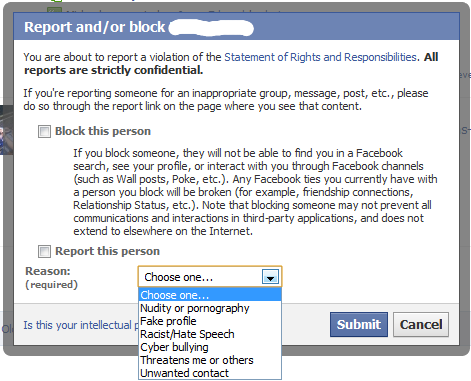
&lt;p&gt;The letter goes on to ask about Facebook's Internet safety page (she could have just Googled "Facebook Safety" and &lt;a href="http://lmgtfy.com/?q=facebook+safety"&gt;found it&lt;/a&gt; and its wealth of resources) and whether Facebook has a report abuse system--see the "Report Abuse" button at the bottom of any profile, page or group, which produces this dialogue box for user profiles:&lt;/p&gt;

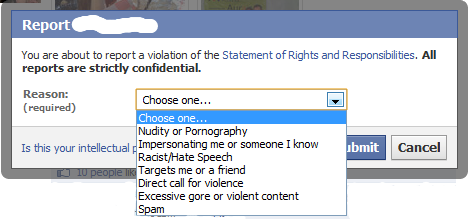
&lt;p&gt;&lt;a rel="attachment wp-att-30475" href="http://techliberation.com/2010/07/15/sen-klobuchar-stirs-up-facebook-child-safety-technopanic/facebook-report-abuse/"&gt;&lt;img class="aligncenter size-full wp-image-30475" title="Facebook Report Abuse" src="http://techliberation.com/wp-content/uploads/2010/07/Facebook-Report-Abuse.png" alt="" width="471" height="381" /&gt;&lt;/a&gt;And this box for pages:&lt;/p&gt;

&lt;p&gt;&lt;a rel="attachment wp-att-30483" href="http://techliberation.com/2010/07/15/sen-klobuchar-stirs-up-facebook-child-safety-technopanic/facebook-report-abuse-page/"&gt;&lt;img class="aligncenter size-full wp-image-30483" title="Facebook Report Abuse Page" src="http://techliberation.com/wp-content/uploads/2010/07/Facebook-Report-Abuse-Page.png" alt="" width="470" height="219" /&gt;&lt;/a&gt;MySpace has similar &lt;a href="http://www.ehow.com/how_2031021_report-abuse-myspace.html"&gt;reporting mechanisms&lt;/a&gt; (and &lt;a href="http://www.myspace.com/index.cfm?fuseaction=help.reportabuse"&gt;this form&lt;/a&gt;) and &lt;a href="http://collect.myspace.com/misc/tipsForParents.html"&gt;resources&lt;/a&gt; for kids &amp;amp; parents. Both sites employ hundreds of people to respond to such requests, decide when to take down content, and when to bring in law enforcement--which is a pretty big commitment from sites that don't charge users a penny.&lt;/p&gt;

&lt;p&gt;If the good Senator or her staff had had Googled (or Binged) "Facebook safety advisory board," she would have found a number of &lt;a href="http://www.prnewswire.com/news-releases/facebook-to-enhance-user-safety-through-formation-of-global-advisory-board-78656592.html"&gt;press releases&lt;/a&gt; about the group, which Facebook launched last December to interface with child safety experts.&lt;/p&gt;

&lt;p&gt;Again, it's a fair question whether Facebook could do even more than it's already done. For example, the "report abuse" link could probably be moved to a more prominent location on the page. But with its incendiary rhetoric and easily answered questions, Klobuchar's letter seems intended more to make headlines and score political points than to really move the ball forward on her stated objective, which we should all share: enhancing education and empowerment solutions. Playing fast and loose with the facts--and throwing more fuel on the fire of a technopanic in the process--is unwise and unconstructive.&lt;/p&gt;
&lt;img src="http://feeds.feedburner.com/~r/pff/szoka/~4/yq2bUFHaOig" height="1" width="1"/&gt;</content>
<feedburner:origLink>http://blog.pff.org/archives/2010/07/sen_klobuchar_stirs_up_facebook_child_safety_techn.html</feedburner:origLink></entry>

<entry>
<title>FTC Enforcement of Corporate Promises &amp; the Path of Privacy Law</title>
<link rel="alternate" type="text/html" href="http://feedproxy.google.com/~r/pff/szoka/~3/1DAN68fvw7k/ftc_enforcement_of_corporate_promises_the_path_of.html" />
<modified>2010-07-14T15:08:11Z</modified>
<issued>2010-07-14T14:51:43Z</issued>
<id>tag:blog.pff.org,2010://2.6112</id>
<created>2010-07-14T14:51:43Z</created>
<summary type="text/plain">Adam and I have been pretty hard on the FTC's current leadership for pushing to dramatically expand regulation of online data use with little thought to the impact on ad-supported media, while in the next breath opening the door to dramatic...</summary>
<author>
<name>Berin Szoka</name>
<url>http://blog.pff.org/archives/author/berin_szoka/</url>
<email>bszoka@pff.org</email>
</author>
<dc:subject>Privacy</dc:subject>
<content type="text/html" mode="escaped" xml:lang="en" xml:base="http://blog.pff.org/">
&lt;p&gt;Adam and I have been pretty hard on the FTC's current leadership for &lt;a href="http://techliberation.com/2010/01/13/chairman-leibowitz%E2%80%99s-disconnect-on-privacy-regulation-the-future-of-news/"&gt;pushing to dramatically expand regulation of online data use&lt;/a&gt; with little thought to the impact on ad-supported media, while in the next breath &lt;a href="http://techliberation.com/2010/06/09/growing-opposition-to-ftc-saving-journalism-media-takeover-blueprint/"&gt;opening the door&lt;/a&gt; to dramatic expansion of direct government support of media, and all the while &lt;a href="http://techliberation.com/2010/03/17/how-financial-overhaul-could-put-the-ftc-on-steroids-transform-internet-regulation-overnight/"&gt;seeking sweeping new regulatory powers&lt;/a&gt; from Congress.&lt;/p&gt;
&lt;p&gt;After all that complaining (and bashing their &lt;a href="http://www.ftc.gov/ftc/hq_building.shtm"&gt;Soviet Realist-style statue&lt;/a&gt;, "Man Controlling Trade"), you might think we had it in for the agency. But as I've said repeatedly, we're actually big fans of the FTC's core consumer protection mission: &lt;em&gt;holding companies to their promises&lt;/em&gt;. (Indeed, we want to make sure they stay focused on that mission, and have the staff, resources and technological tools to pursue it effectively--which might mean, as I've &lt;a href="http://techliberation.com/2010/03/17/how-financial-overhaul-could-put-the-ftc-on-steroids-transform-internet-regulation-overnight/"&gt;pointed out&lt;/a&gt;, increased funding rather than increased &lt;em&gt;powers.&lt;/em&gt;) We've also repeatedly praised the FTC's efforts to educate kids, parents, and Internet users in general about things like online privacy, advertising, spyware, user empowerment tools, online scams, &lt;em&gt;etc&lt;/em&gt;.&lt;/p&gt;
&lt;p&gt;But I don't want to be accused of being only a fair-weather friend of the agency. So I wanted to point out a particularly good concrete example of the FTC doing what we talk about in the abstract: holding companies to their promises.  Grant Gross &lt;a href="http://www.pcworld.com/businesscenter/article/200942/ftc_warns_gay_youth_site_about_sale_of_personal_data.html"&gt;notes&lt;/a&gt; that the FTC sent a &lt;a href="http://www.ftc.gov/os/closings/100712xy.pdf"&gt;stern letter&lt;/a&gt; earlier this month to the company that is seeking to buy the subscriber info and photos and other assets of the now-defunct &lt;em&gt;XY Magazine&lt;/em&gt;, which served primarily gay U.S. teens, warning them that the FTC would hold them to the terms of the privacy policy under which XY collected information from its subscribers.&lt;/p&gt;
&lt;p&gt;This is a great example of how the FTC can effectively use its existing authority to protect consumers against clear harms involved in the disclosure of truly sensitive data, sometimes even prophylactically--in this case, outing around 100,000 gay youths and young adults--collected by companies that make unambiguous promises to protect users' data. This incident also illustrates how privacy law can evolve in an organic fashion from a growing body of such well-justified preemptive warnings, enforcement actions brought against truly bad actors, and ultimately court decisions that decide whether the FTC has properly weighed the interests at stake. In other words, just because we don't have a privacy code enforced by a Data Protection Authority as in Europe doesn't mean our legal system doesn't protect privacy!&lt;/p&gt;
&lt;p&gt;As Oliver Wendell Holmes Jr., famously described the Common Law in his 1897 article &lt;em&gt;&lt;a href="http://www.constitution.org/lrev/owh/path_law.htm"&gt;The Path of the Law&lt;/a&gt;&lt;/em&gt;:&lt;/p&gt;
&lt;blockquote&gt;&lt;p&gt;&lt;em&gt;&lt;strong&gt;The life of the law has not been logic; it has been experience&lt;/strong&gt;&lt;/em&gt;. The felt necessities of the time, the prevalent moral and political theories, intuitions of public policy, avowed or unconscious, even the prejudices which judges share with their fellow men, have had a good deal more to do than the syllogism in determining the rules by which men should be governed. The law embodies the story of a nation's development through many centuries, and it cannot be dealt with as if it contained only the axioms and corollaries of a book of mathematics.&lt;/p&gt;&lt;/blockquote&gt;
&lt;p&gt;F.A. Hayek &lt;a href="http://books.google.com/books?id=UunDsFD25fYC&amp;amp;pg=PA83&amp;amp;lpg=PA83&amp;amp;dq=%22common+law%22+hayek+made+found+sacrilegious&amp;amp;source=bl&amp;amp;ots=kG7gADvjUO&amp;amp;sig=ghaxcEIfnQfMeNv2uL41yGdvZRM&amp;amp;hl=en&amp;amp;ei=LB89TNOhKMP48AamstmnBg&amp;amp;sa=X&amp;amp;oi=book_result&amp;amp;ct=result&amp;amp;resnum=5&amp;amp;ved=0CCoQ6AEwBA#v=onepage&amp;amp;q&amp;amp;f=false"&gt;said&lt;/a&gt; something very similar:&lt;/p&gt;
&lt;blockquote&gt;&lt;p&gt;Until the discovery of Aristotle's Politics in the thirteenth century and the reception of Justinian's code in the fifteenth... WesternEurope passed through... [an] epoch of nearly a thousand yearswhen law was... regarded as something given independently of human will, &lt;strong&gt;&lt;em&gt;something to be discovered, not made&lt;/em&gt;&lt;/strong&gt;, and when the conception that law could be deliberately made or altered seemed almost sacrilegious.&lt;/p&gt;&lt;/blockquote&gt;
&lt;p&gt;I'd &lt;em&gt;much&lt;/em&gt; rather see the FTC work to &lt;em&gt;find&lt;/em&gt; the law of privacy over time in an iterative, case-by-case process than attempt to &lt;em&gt;make&lt;/em&gt; such law in the form of, say, "comprehensive baseline privacy legislation." The &lt;em&gt;XY Magazine&lt;/em&gt; case is a great example of what, academic theory aside, the "path of privacy law" (to paraphrase Holmes) really looks like.  The FTC may over- or under- enforce in any particular case, but as long as they stick to that noble path, I'll cheer them on from the sidelines--for I know how tedious the path can seem, and how seductive must be the promise of "axioms and corollaries" of privacy law reduced to mathematical precision.&lt;/p&gt;

&lt;img src="http://feeds.feedburner.com/~r/pff/szoka/~4/1DAN68fvw7k" height="1" width="1"/&gt;</content>
<feedburner:origLink>http://blog.pff.org/archives/2010/07/ftc_enforcement_of_corporate_promises_the_path_of.html</feedburner:origLink></entry>

<entry>
<title>Second Circuit: Pacifica Is Outdated, All Media Deserve Full First Amendment Protection</title>
<link rel="alternate" type="text/html" href="http://feedproxy.google.com/~r/pff/szoka/~3/hjOnYuHjKFQ/second_circuit_pacifica_is_outdated_all_media_dese.html" />
<modified>2010-07-14T14:50:13Z</modified>
<issued>2010-07-14T14:48:36Z</issued>
<id>tag:blog.pff.org,2010://2.6111</id>
<created>2010-07-14T14:48:36Z</created>
<summary type="text/plain">The Second Circuit just threw out the FCC's broadcast indecency rules--which had led to heavy fines for "fleeting expletives"--as "unconstitutionally vague, creating a chilling effect that goes far beyond the fleeting expletives at issue here." What's ultimately most important about this...</summary>
<author>
<name>Berin Szoka</name>
<url>http://blog.pff.org/archives/author/berin_szoka/</url>
<email>bszoka@pff.org</email>
</author>
<dc:subject>Free Speech</dc:subject>
<content type="text/html" mode="escaped" xml:lang="en" xml:base="http://blog.pff.org/">
&lt;p&gt;The Second Circuit &lt;a href="http://online.wsj.com/article/BT-CO-20100713-711282.html"&gt;just threw out&lt;/a&gt; the FCC's broadcast indecency rules--which had led to heavy fines for "fleeting expletives"--as "unconstitutionally vague, creating a chilling effect that goes far beyond the fleeting expletives at issue here." What's ultimately most important about &lt;a href="http://www.ca2.uscourts.gov/decisions/isysquery/3c69eb90-e36b-4ff8-9658-53d6cd36c060/1/doc/06-1760-ag_opn2.pdf#xml=http://www.ca2.uscourts.gov/decisions/isysquery/3c69eb90-e36b-4ff8-9658-53d6cd36c060/1/hilite/"&gt;this decision&lt;/a&gt; is not what the court &lt;em&gt;did&lt;/em&gt;, but what it &lt;em&gt;said&lt;/em&gt;: The Constitutional framework that has allowed broadcast censorship has been rendered obsolete by the rise of the Internet and parental empowerment tools for new and old media.&lt;/p&gt;

&lt;p&gt;In short, the court utterly rejected the Supreme Court's &lt;a href="http://techliberation.com/2008/06/26/pacifica-anniversary-week-part-1-general-overview/"&gt;1978 &lt;/a&gt;&lt;a href="http://techliberation.com/2008/06/26/pacifica-anniversary-week-part-1-general-overview/"&gt;&lt;em&gt;Pacifica&lt;/em&gt; decision&lt;/a&gt;&lt;em&gt;--&lt;/em&gt;which gave the FCC great discretion in regulating indecency on broadcast radio and television in order to protect children who might be in the audience during daytime and early evening hours, citing the unique "pervasiveness" and "invasiveness" of broadcasting into the home.  The court fully embraced what we've been saying for years--neither rationale holds true anymore:&lt;br /&gt;
&lt;blockquote&gt;we face a media landscape that would have been almost unrecognizable in 1978. Cable television was still in its infancy. The Internet was a project run out of the Department of Defense with several hundred users. Not only did Youtube, Facebook,and Twitter not exist, but their founders were either still in diapers or not yet conceived. In this environment, broadcast television undoubtedly possessed a "uniquely pervasive presence in thelives of all Americans."&lt;/p&gt;

&lt;p&gt;The same cannot be said today. The past thirty years has seen an explosion of media sources, and broadcast television has become only one voice in the chorus. Cable television is almost as pervasive as broadcast....  The internet, too, has become omnipresent, offering access to everything from viral videos to feature films and, yes, even broadcast television programs.... Moreover, technological changes have given parents the ability to decide which programs they will permit their children to watch. (15-16)&lt;/blockquote&gt;&lt;br /&gt;
Thus, the Second Circuit all but begged the Supreme Court to throw out &lt;em&gt;Pacifica&lt;/em&gt; completely, but quickly noted that it is "bound by Supreme Court precedent, regardless of whether it reflects today's realities" (17). Fortunately, the court was able to reach the same result on vagueness grounds. It's worth reading this key passage to see what a consistent approach to the First Amendment would look like:&lt;/p&gt;
&lt;blockquote&gt;Every television, 13 inches or larger, sold in the UnitedStates since January 2000 contains a V-chip, which allows parents to block programs based on a standardized rating system. 47 U.S.C. § 303(x). Moreover, since June 11, 2009, when theUnited States made the transition to digital television, anyone using a digital converter box alsohas access to a V-chip. CSVA Report, 24 F.C.C. Rcd. 11413, at ¶ 11. In short, there now exists a way to block programs that contain indecent speech in a way that was not possible in 1978. Infact, the existence of technology that allowed for household-by-household blocking of "unwanted" cable channels was one of the principle distinctions between cable television andbroadcast media drawn by the Supreme Court in [its 2000 decision striking down cable filtering mandates, &lt;em&gt;U.S. v. Playboy&lt;/em&gt;]. The Court explained:
&lt;p style="padding-left: 30px;"&gt;The option to block reduces the likelihood, so concerning to the Court in &lt;em&gt;Pacifica&lt;/em&gt;,that traditional First Amendment scrutiny would deprive the Government of allauthority to address this sort of problem. The corollary, of course, is that targeted blocking enables the Government to support parental authority without affectingthe First Amendment interests of speakers and willing listeners - listeners forwhom, if the speech is unpopular or indecent, the privacy of their own homes maybe the optimal place of receipt.&lt;/p&gt;
Playboy, 529 U.S. at 815 (internal citation omitted). We can think of no reason why thisrationale for applying strict scrutiny in the case of cable television would not apply with equalforce to broadcast television in light of the V-chip technology that is now available. (16-17).&lt;/blockquote&gt;
&lt;em&gt;Amen! &lt;/em&gt;

&lt;p&gt;It's pretty remarkable for a court to come out so strong against a longstanding precedent when they can resolve a case without doing so. Indeed, courts generally follow a strict canon of interpretation that says they should skip right to simpler issues that can resolve a case--vagueness, in this case. The fact that the Second Circuit felt it necessary to spend nearly three pages debunking &lt;em&gt;Pacifica&lt;/em&gt; is the clearest statement yet that it's time for us to apply the First Amendment consistently across all media.&lt;/p&gt;

&lt;p&gt;I only hope the FCC is brash enough to appeal (knowing it might well lose the farm, to to speak), and that the Supreme Court is brave and principled enough to say what the Second Circuit has said so beautifully: &lt;em&gt;There's no justification for treating broadcasters as second class speakers. The First Amendment should apply equally across media&lt;/em&gt;!&lt;/p&gt;
&lt;img src="http://feeds.feedburner.com/~r/pff/szoka/~4/hjOnYuHjKFQ" height="1" width="1"/&gt;</content>
<feedburner:origLink>http://blog.pff.org/archives/2010/07/second_circuit_pacifica_is_outdated_all_media_dese.html</feedburner:origLink></entry>

<entry>
<title>Google Street View/Wi-Fi Privacy Technopanic Continues but Real Cybersecurity Begins at Home</title>
<link rel="alternate" type="text/html" href="http://feedproxy.google.com/~r/pff/szoka/~3/ipXYlilQluE/google_street_viewwi-fi_privacy_technopanic_contin.html" />
<modified>2010-07-09T12:44:51Z</modified>
<issued>2010-07-09T12:42:02Z</issued>
<id>tag:blog.pff.org,2010://2.6105</id>
<created>2010-07-09T12:42:02Z</created>
<summary type="text/plain">Congressmen working on national intelligence and homeland security either don't know how to secure their own home Wi-Fi networks (it's easy!) or don't understand why they should bother. If you live outside the Beltway, you might think the response to...</summary>
<author>
<name>Berin Szoka</name>
<url>http://blog.pff.org/archives/author/berin_szoka/</url>
<email>bszoka@pff.org</email>
</author>
<dc:subject>Privacy</dc:subject>
<content type="text/html" mode="escaped" xml:lang="en" xml:base="http://blog.pff.org/">
&lt;p&gt;Congressmen working on national intelligence and homeland security either don't know how to secure their own home Wi-Fi networks (&lt;a href="http://www.pcworld.com/article/130330/how_to_secure_your_wireless_network.html"&gt;it's easy!&lt;/a&gt;) or don't understand why they should bother. If you live outside the Beltway, you might think the response to this problem would be to redouble efforts to educate everyone about the importance of personal responsibility for data security, starting with Congressmen and their staffs. But of course those who live inside the Beltway know that the solution isn't education or self-help but... you guessed it... to excoriate Google for spying on members of Congress (and bigger government, of course)!&lt;/p&gt;

&lt;p&gt;Consumer Watchdog (which doesn't actually claim any consumers as members) held a press conference this morning about their latest anti-Google stunt, &lt;a href="http://insidegoogle.com/2010/07/wispying-hit-congress-national-security-data-could-have-been-gathered/"&gt;announced last night&lt;/a&gt; on their "Inside Google" blog: CWD drove by five Congressmen's houses  in the DC area last week looking for unencrypted Wi-Fi networks. At Jane Harman's (D-CA) home, they &lt;a href="http://insidegoogle.com/wp-content/uploads/2010/07/Driving-Report-v2.pdf"&gt;found two unencrypted networks &lt;/a&gt;named "Harmanmbr" and "harmantheater" that suggest the networks are Harman's.  So they sent Harman a &lt;a href="http://insidegoogle.com/wp-content/uploads/2010/07/Harman_Jane-7-7-10.pdf"&gt;letter&lt;/a&gt; demanding that she hold hearings on Google's collection of Wi-Fi data, charging Google with "WiSpying." This is a &lt;a href="http://techliberation.com/2009/07/15/against-techno-panics"&gt;classic technopanic&lt;/a&gt; and the most craven, cynical kind of tech politics--dressed in the "consumer" mantle.&lt;br /&gt;
&lt;h1&gt;The Wi-Fi/Street View Controversy&lt;/h1&gt;&lt;br /&gt;
Rewind to mid-May, when Google voluntarily disclosed that the cars it used to build a photographic library of what's visible from public streets for Google Maps Street View had been unintentionally collecting small amounts of information from unencrypted Wi-Fi hotspots like Harman's. These hotspots can be accessed by anyone who might drive or walk by with a Wi-Fi device--thus potentially exposing data sent over those networks between, say, a laptop in the kitchen, and the wireless router plugged into the cable modem.&lt;/p&gt;

&lt;p&gt;&lt;a href="http://maps.google.com/help/maps/streetview/"&gt;Google's Street View&lt;/a&gt; allows you  to virtually walk down any public street and check out the neighborhood&lt;/p&gt;
&lt;p&gt;--making it easier to navigate to your intended destination, explore a neighborhood you might be thinking of moving to from out of town, point out potential maintenance or streetscape problems to your city, and any number of other wonderfully useful, totally benign things &lt;em&gt;that you could do anyway if you just walked down the street with a camera or a notepad&lt;/em&gt;! CWD's letter tries to outrage Harman by telling her: "Your home is on display for the entire Internet with just a few clicks of a computer mouse." So what? It's on display to anyone walking or driving down the street, too! If you don't like that, put up a fence or landscaping to block the view--or move out of the suburbs to a more remote location!&lt;/p&gt;

&lt;p&gt;The Street View cars that take these photos from cameras on their roofs were also equipped with Wi-Fi devices that, much like any Wi-Fi device, look for Wi-Fi hotspots within range. (Just look for "available networks" the next time you're at a laptop and you'll see what I mean). This isn't part of some evil Google conspiracy to "track consumers in their homes," as CWD alleges. Rather, building a map of wireless hotspots allows any consumer using, say, Google Maps to determine their location more accurately and quickly than would otherwise be possible: If my phone sees 6 hotspots nearby and Google can correlate that data with the pre-existing map of Wi-Fi networks generated by Street View cars, this helps Google Maps pinpoint my location--which make directions and other location-based services work better for me in the future.&lt;/p&gt;

&lt;p&gt;But the Street View Wi-Fi software was &lt;a href="http://googlepublicpolicy.blogspot.com/2010/05/wifi-data-collection-update.html"&gt;accidentally misconfigured&lt;/a&gt; to capture &lt;em&gt;all&lt;/em&gt; wireless data packets (chunks of data) they picked up as Street View cars drove by hotspots, regardless of whether those packets are data packets (potentially containing data sent by users over their home networks) or "beacon" packets that simply announce the presence of a network, and regardless of whether the packets were sent from an unsecured or secured network. The software was designed to discard any data packets from encrypted networks, but not from unsecured networks. Google claims this was &lt;a href=" http://online.wsj.com/article/SB10001424052748703460404575244763621501220.html?mod=WSJ_hpp_MIDDLETopStories"&gt;an accident&lt;/a&gt;, and some security experts &lt;a href="http://erratasec.blogspot.com/2010/05/technical-details-of-street-view-wifi.html"&gt;agree&lt;/a&gt;. Google has promised dispose of all of the data accidentally collected (beyond SSID names).&lt;/p&gt;

&lt;p&gt;In early June, Google commissioned an &lt;a href="http://static.googleusercontent.com/external_content/untrusted_dlcp/www.google.com/en/us/googleblogs/pdfs/friedberg_sourcecode_analysis_060910.pdf"&gt;independent analysis&lt;/a&gt;, which confirmed that the Wi-Fi software "does not analyze or parse the body of Data frames, which contain user content" and that such data frame bodies would be stored only if sent over an unencrypted wireless network but discarded if sent over an encrypted network. &lt;strong&gt;Translation&lt;/strong&gt;: Google didn't use any of the packet data it collected.&lt;/p&gt;

&lt;p&gt;Some have suggested that Google  should have collected only the network naems ("SSIDs") from the beacon packets, or perhaps no Wi-Fi data at all. But as cyber-security consultant Robert Graham &lt;a href="http://erratasec.blogspot.com/2010/05/technical-details-of-street-view-wifi.html"&gt;explained in detail&lt;/a&gt; shortly after this story first broke, building an accurate network map with fast-moving vehicles requires collecting as many packets as possible. Again, the better the map, the greater the accuracy of Google's location-based services for consumers.&lt;/p&gt;

&lt;p&gt;&lt;strong&gt;Bottom line&lt;/strong&gt;: Google made a mistake in failing to discard user data after collection but otherwise had good pro-consumer reasons for what it was doing. But why let the facts get in the way of a good PR hit-job? CWD just did essentially the same thing Google's Street View cars did, driving by Harman's house to look for unencrypted hotspots. But they went a step further, &lt;a href="http://insidegoogle.com/wp-content/uploads/2010/07/Harman_Jane-7-7-10.pdf"&gt;actually publishing&lt;/a&gt; the names of two networks at Harman's home. If any company had published network names tied to street addresses, privacy advocates would have thrown a fit. But when Consumer Watchdog actually publishes such information... hey, it's an expose!&lt;/p&gt;

&lt;p&gt;And if you were wondering where Rep. Harman lives, you could start by looking her up in publicly available databases, like the &lt;a href="http://fundrace.huffingtonpost.com/neighbors.php?type=name&amp;amp;lname=Harman&amp;amp;fname=jane&amp;amp;search=Search"&gt;Huffington Post's campaign finance donation database&lt;/a&gt; (she's not in the white pages, that other Orwellian data set few seem to care about). It's all fine and well for the government to put our name, address and employer online every time we make a donation to a political candidate (along with the donation recipient and amount) because that's "Transparency." (Never mind the &lt;a href="http://en.wikipedia.org/wiki/National_Association_for_the_Advancement_of_Colored_People_v._Alabama"&gt;constitutionally protected right&lt;/a&gt; of non-profits like CWD to keep &lt;em&gt;their&lt;/em&gt; donor lists private, while other groups like my own think tank &lt;a href="http://www.pff.org/about/supporters.html"&gt;voluntarily disclose such info&lt;/a&gt;.) But if Google puts up photos of what anyone can see from the street or attempts to map wireless networks to help us all get better, faster &lt;em&gt;&lt;strong&gt;free&lt;/strong&gt;&lt;/em&gt; location-based services with our mobile devices... well, &lt;em&gt;that&lt;/em&gt;'s an outrage!&lt;br /&gt;
&lt;h1&gt;Cyber-Security Begins at Home&lt;/h1&gt;&lt;br /&gt;
Even more galling is that the Senate is &lt;a href="http://www.opencongress.org/articles/view/1937-Lieberman-s-Cybersecurity-Bill-Moves-Out-of-Committee"&gt;rushing to pass&lt;/a&gt; legislation giving government &lt;a href="http://www.pff.org/issues-pubs/ps/2010/ps6.11-cyberspace_protection_bill.html"&gt;sweeping new powers&lt;/a&gt; to protect our "national assets" in cyberspace. But cyber-security truly begins at home--with taking a few minutes to secure our own Wi-Fi networks, and then dealing with the hassle of having to remember the password every time we want to authorize a new device. If members of Congress can't be expected to take responsibility for that, why should we trust them with responsibility over cyber-security on a national level?&lt;/p&gt;

&lt;p&gt;This controversy should highlight the need for consumers--especially Congressmen and other government employees--to secure their home Wi-Fi hotspots. While most people who log onto unsecure Wi-Fi networks are &lt;a href="http://www.nytimes.com/2006/03/16/opinion/16lee.html"&gt;perfectly harmless&lt;/a&gt;, failing to secure your network &lt;em&gt;could &lt;/em&gt;lead to real harms like identity theft--or perhaps even the theft of sensitive data. But those problems aren't caused by, or even made worse by, Google's efforts to map Wi-Fi networks. So haranguing Google won't fix the problem.&lt;/p&gt;

&lt;p&gt;But was national security compromised, as CWD claims? Ms. Harman and other Congressmen &lt;em&gt;do&lt;/em&gt; have to follow established security procedures, like using encrypted data cards, before accessing sensitive--and, certainly, classified--information. So it seems pretty unlikely that Google could actually have gotten access to any sensitive data even if they had wanted to. Again, their cars were driving by houses, picking up only very small amounts of data from unencrypted networks (unlike the dedicated hacker who might park out front and log data for hours). But if truly sensitive information can be picked up that easily, the Federal government really needs to get its own house--and its telecommuting employee's houses--in order! If that means sending out a nerd who can set up secure Wi-Fi networks in the Congresswoman's home (or just follow &lt;a href="http://www.pcworld.com/article/130330/how_to_secure_your_wireless_network.html"&gt;these simple instructions&lt;/a&gt;), that's probably a smart expenditure of tax dollars.&lt;/p&gt;

&lt;p&gt;But that's the kind of serious discussion we &lt;em&gt;should &lt;/em&gt;be having--instead continually looking to breathe new life into a contrived controversy with further innuendo and fear-mongering.&lt;/p&gt;
&lt;img src="http://feeds.feedburner.com/~r/pff/szoka/~4/ipXYlilQluE" height="1" width="1"/&gt;</content>
<feedburner:origLink>http://blog.pff.org/archives/2010/07/google_street_viewwi-fi_privacy_technopanic_contin.html</feedburner:origLink></entry>

<entry>
<title>Privacy MythBusters: No, Facebook Doesn't Give Advertisers Your Data!</title>
<link rel="alternate" type="text/html" href="http://feedproxy.google.com/~r/pff/szoka/~3/s7F0PxV3Qc4/privacy_mythbusters_no_facebook_doesnt_give_advert.html" />
<modified>2010-07-07T13:00:37Z</modified>
<issued>2010-07-07T12:56:41Z</issued>
<id>tag:blog.pff.org,2010://2.6104</id>
<created>2010-07-07T12:56:41Z</created>
<summary type="text/plain">Working in any field of public policy is a bit like living in a haunted house: You spend most of your day dodging bogeymen, ghosts, phantasms, phantoms and specters of imagined harms, frauds, invasions and various conspiracies supposedly perpetrated by...</summary>
<author>
<name>Berin Szoka</name>
<url>http://blog.pff.org/archives/author/berin_szoka/</url>
<email>bszoka@pff.org</email>
</author>
<dc:subject>Advertising &amp; Marketing</dc:subject>
<content type="text/html" mode="escaped" xml:lang="en" xml:base="http://blog.pff.org/">
&lt;p&gt;Working in any field of public policy is a bit like living in a haunted house: You spend most of your day dodging bogeymen, ghosts, phantasms, phantoms and specters of imagined harms, frauds, invasions and various conspiracies supposedly perpetrated by evil companies against helpless consumers, justice, God, Gaia, small woodland creatures and every sort of underserved, disadvantaged and/or underprivileged group of man, animal, vegetable and mineral imaginable.&lt;/p&gt;

&lt;p&gt;But Internet policy--particularly online privacy--tends to be haunted by such groundless imaginings far more than most other areas of policy, largely because it manifests itself in ways that are far more real and immediate to ordinary users. For example, as outraged as any of us might feel about the Gulf oil spill, how many of us have the slightest clue what's really involved (beyond what we've learned watching TV anchors stumble through a vocabulary they don't understand)?&lt;/p&gt;

&lt;p&gt;By contrast, huge numbers of Americans have daily interaction with web services like those provided by Google, Microsoft, Yahoo, Twitter and Facebook. That doesn't mean we necessarily &lt;em&gt;understand&lt;/em&gt; how these technologies work. Indeed, quite the contrary! As Arthur C. Clark &lt;a href="http://en.wikipedia.org/wiki/Clarke%E2%80%99s_three_laws"&gt;said&lt;/a&gt;, "Any sufficiently advanced technology is indistinguishable from magic." But we often &lt;em&gt;think &lt;/em&gt;we know how these technological marvels work, and certainly &lt;em&gt;sound&lt;/em&gt; much more informed when we spout off (pun intended) about these things than, say, "top kills" on the bottom of the ocean floor. In short, we know just enough web services to be dangerous when we ground strong policy positions in our unsophisticated understanding of how things really work online.&lt;/p&gt;

&lt;p&gt;There are few better examples of this than the constantly repeated bugaboo that "Facebook sells your data to advertisers!" Or "Facebook only wants you to share more information with more people for advertising purposes!" These myths bear no relation to how advertising on social networking sites actually works, as Facebook CEO Sheryl Sandberg &lt;a href="http://blog.facebook.com/blog.php?post=403570307130"&gt;explains beautifully&lt;/a&gt; in a short tutorial video. Here's the key portion:&lt;/p&gt;
&lt;blockquote&gt;We also protect your privacy by virtue of the way our advertising system works. Because our system chooses which ads to show you, we don't need to share any of your personal information with advertisers in order to show you relevant ads. In order to advertise on Facebook, advertisers give us an ad they want us to display and tell us the kinds of people they want to reach. We deliver the ad to people who fit those criteria without revealing any personal information to the advertiser.

&lt;p&gt;The only information we provide to advertisers is aggregate and anonymous data, so they can know how many people viewed their ad and general categories of information about them. Ultimately, this helps advertisers better understand how well their ads work so they can show better ads.&lt;/blockquote&gt;&lt;br /&gt;
And here's the &lt;a href="http://www.facebook.com/video/video.php?v=10150228703690484"&gt;video&lt;/a&gt;:&lt;/p&gt;

&lt;p style="text-align: center;"&gt;&lt;object classid="clsid:d27cdb6e-ae6d-11cf-96b8-444553540000" width="550" height="308" codebase="http://download.macromedia.com/pub/shockwave/cabs/flash/swflash.cab#version=6,0,40,0"&gt;&lt;param name="allowfullscreen" value="true" /&gt;&lt;param name="allowscriptaccess" value="always" /&gt;&lt;param name="src" value="http://www.facebook.com/v/10150228703690484" /&gt;&lt;embed type="application/x-shockwave-flash" width="550" height="308" src="http://www.facebook.com/v/10150228703690484" allowscriptaccess="always" allowfullscreen="true"&gt;&lt;/embed&gt;&lt;/object&gt;

&lt;p&gt;You can't blame average users for not understanding how Facebook's ad system works. That doesn't make them &lt;a href="http://techliberation.com/2010/07/06/stupid-people-stupid-lawsuits-stupid-warning-labels-the-coming-digital-tort-reform-fight/"&gt;stupid&lt;/a&gt;! They may be ignorant, but their ignorance is &lt;a href="http://en.wikipedia.org/wiki/Rational_ignorance"&gt;perfectly rational&lt;/a&gt;. Ultimately, it's up to companies like Facebook to try to overcome the perception-of-technology-as-magic problem--lest consumers assume it must be &lt;em&gt;black&lt;/em&gt; magic. Still, I'm sure we'll keep hearing this myth repeated in the future, as similar myths have been in other areas of the privacy debate. I only wish more companies would prepare similarly concise videos that explain how their systems work to dispel some of this &lt;a href="http://techliberation.com/2009/07/15/against-techno-panics/"&gt;technopanic&lt;/a&gt; hysteria. Here are two particularly good examples of effective tutorials:&lt;br /&gt;
&lt;ul&gt;&lt;br /&gt;
	&lt;li&gt;How &lt;a href="http://www.google.com/privacy_ads.html"&gt;Google&lt;/a&gt; delivers ads and uses user data and &lt;a href="http://www.google.com/privacy.html"&gt;uses data in its other products&lt;/a&gt;&lt;/li&gt;&lt;br /&gt;
	&lt;li&gt;How &lt;a href="http://www.phorm.com/technology/technology_knowledge_lab.html"&gt;Phorm&lt;/a&gt; delivers ads tailored to users preferences based on observing their browsing activity at the ISP level (based on the scary-sounding "packet inspection") &lt;em&gt;without&lt;/em&gt; retaining a list of websites visited by a computer or even sharing the profile of generic interests associated with a particular&lt;/li&gt;&lt;br /&gt;
&lt;/ul&gt;&lt;br /&gt;
Oh, and on the myth I noted above, I'll just reiterate what I've &lt;a href="http://techliberation.com/2010/05/26/three-cheers-for-facebooks-privacy-management-upgrade/"&gt;said before&lt;/a&gt;:&lt;br /&gt;
&lt;blockquote&gt;It's a myth that Facebook is hell-bent on getting users to share more information more widely for the sake of of advertisers. In fact, advertising on Facebook doesn't involve sharing information about users with advertisers. In fact, advertisers buy ads that Facebook shows to users &lt;em&gt;Facebook&lt;/em&gt; (or rather, its algorithms) thinks might be interested. If anything, sharing more information can actually help Facebook's competitors if users take advantage of Facebook Connect's data portability to port their data over to competing platforms. So the widely perceived conflict of interest between Facebook's economic interests and users' privacy just doesn't exist. The site gains from having more users spend more time on the site, not from tricking users into "giving up their privacy."&lt;/blockquote&gt;&lt;/p&gt;
&lt;img src="http://feeds.feedburner.com/~r/pff/szoka/~4/s7F0PxV3Qc4" height="1" width="1"/&gt;</content>
<feedburner:origLink>http://blog.pff.org/archives/2010/07/privacy_mythbusters_no_facebook_doesnt_give_advert.html</feedburner:origLink></entry>

<entry>
<title>Stupid People, Stupid Lawsuits, Stupid Warning Labels &amp; the Coming Digital Tort Reform Fight</title>
<link rel="alternate" type="text/html" href="http://feedproxy.google.com/~r/pff/szoka/~3/8BBuLLeUq3A/stupid_people_stupid_lawsuits_stupid_warning_label.html" />
<modified>2010-07-06T21:25:47Z</modified>
<issued>2010-07-06T21:24:41Z</issued>
<id>tag:blog.pff.org,2010://2.6103</id>
<created>2010-07-06T21:24:41Z</created>
<summary type="text/plain">I spend a lot of my time as an Internet policy analyst railing against elitist suggestions that "ordinary" users are just too dumb to take care of themselves online, no matter how effectively technology empowers them to make decisions for...</summary>
<author>
<name>Berin Szoka</name>
<url>http://blog.pff.org/archives/author/berin_szoka/</url>
<email>bszoka@pff.org</email>
</author>
<dc:subject>Intermediary Deputization &amp; Section 230</dc:subject>
<content type="text/html" mode="escaped" xml:lang="en" xml:base="http://blog.pff.org/">
&lt;p&gt;I spend a lot of my time as an Internet policy analyst railing against elitist suggestions that "ordinary" users are just too dumb to take care of themselves online, no matter how effectively technology empowers them to make decisions for themselves about the content they and their children consume, what data they allow to be shared about themselves on social networking sites or while browsing, etc. Indeed, Adam Thierer and I wrote a lengthy paper about &lt;a href="http://www.pff.org/issues-pubs/pops/2009/pop16.19-unites-speech-and-privacy-reg-advocates.pdf"&gt;What Unites Advocates of Speech Controls &amp;amp; Privacy Regulation?&lt;/a&gt; attacking such elitism when enforced by paternalist laws that assume everyone has the same values and that only the wise philosopher-kings of technology policy can possibly protect us all from our own stupidity.&lt;/p&gt;

&lt;p&gt;But of course there &lt;em&gt;are&lt;/em&gt; plenty of stupid people in the world, and they often do very stupid things--like walking on the side of a highway with just a few feet between a noise barrier and passing cars just because "Google Maps told you to do so!" That's essentially what Lauren Rosenberg claims in her very stupid lawsuit against Google, after she was hit by a passing car following directions from the &lt;em&gt;&lt;strong&gt;beta&lt;span style="font-style: normal;"&gt;&lt;span style="font-weight: normal;"&gt; walking directions tool in Google Maps--and despite the warning Google provided.&lt;/span&gt;&lt;/span&gt;&lt;/strong&gt;&lt;/em&gt; Danny Sullivan tells the &lt;a href="http://searchengineland.com/woman-follows-google-maps-walking-directions-gets-hit-sues-43212"&gt;full story&lt;/a&gt; at SearchEngine Land, complete with photos that should have caused any reasonably prudent person to think, "Hey, what a minute, maybe that warning label I saw telling me the suggested route might lack sidewalks or pedestrian paths was actually there for a reason!"&lt;/p&gt;

&lt;p&gt;Rosenberg &lt;a href="http://www.scribd.com/doc/32136379/Rosenberg-v-Harwood-Google"&gt;seeks&lt;/a&gt; several hundred thousand dollars in damages from Harwood (the driver who hit her) and Google, asserting Google was negligent and failed to adequately warn her. The key policy issue this case raises is the same as in many, many aspects of Internet policy: How much disclosure is enough? As clearly shown by the photos in Danny's post, Google &lt;em&gt;did&lt;/em&gt; warn Rosenberg; so the real danger in this case is that the courts (or lawmakers in the future) could set ever-higher standards for increasingly obnoxious warning labels on websites than they would provide on their own. This reminds me of my all-time favorite warning label (on a collapsible baby stroller): "REMOVE BABY BEFORE FOLDING!" (A contest for similarly inane real-life warnings can be found &lt;a href="http://commongood.org/society-45.html"&gt;here&lt;/a&gt;.)&lt;/p&gt;
&lt;p&gt;We laugh about such warning labels in the offline world as examples of a tort system gone awry. It's costly for manufacturers to label everything and consumers ultimately bear that economic cost, as well as the cost of having to peel/cut extra labels off new products. But on the Internet, unnecessary and gratuitously large or obnoxiously visible (bright, flashing, etc.) labels are far more pernicious because they interfere directly with our use of the product, as they consume a certain percentage of the space available on web pages. This trade-off is particularly acute in the mobile environment.&lt;/p&gt;

&lt;p&gt;So I'm going to go out on a limb and predict that, within the next, say, five years, as more and more of our activities are based on information we receive online (like choosing a walking path based on Google Maps directions), we're going to see lots more of this kind of stupid lawsuit. And with that growing pressure for remove-baby-before-folding-type labels, we'll hear more of the same outcry for a revival of common sense, but also pressure from the Internet service crowd for some kind of "digital tort reform" to ensure that stupid lawsuits settled in plaintiff-friendly jurisdictions don't end up driving especially smaller Internet site and service operators out of business with outrageous tort settlements--or equally burdensome warning label requirements.&lt;/p&gt;

&lt;p&gt;Remember the infamous $2.86 million judgment awarded to woman who made the very stupid decision to put a copy of freshly brewed coffee between her legs in a car seat in the 1994 case of &lt;em&gt;&lt;a href="http://en.wikipedia.org/wiki/Liebeck_v._McDonald's_Restaurants"&gt;Liebeck v. McDonald's Restaurants&lt;/a&gt;&lt;span style="font-style: normal;"&gt;?&lt;/span&gt;&lt;span style="font-style: normal;"&gt; Yes, it's true that some people may forget that coffee is &lt;strong&gt;HOT!&lt;/strong&gt; but we don't expect every person serving coffee to repeat the same 5-minute warning about the dangers of hot liquid to pelvic regions &lt;/span&gt;&lt;/em&gt;every time a cup'a joe is served. Nor do we replace all plastic-lidded paper coffee mugs with spill-resistent, gyroscopically-stabilized (think Segway) insulated &lt;a href="http://www.flickr.com/photos/thesoftlanding/4078349642/"&gt;&lt;img class="alignright size-medium wp-image-30093" title="Sippy Cup" src="http://techliberation.com/wp-content/uploads/2010/07/Sippy-Cup-200x200.jpg" alt="" width="200" height="200" /&gt;&lt;/a&gt;sippy cups--despite the theoretical possibility that such unspillable cups could be designed and prevent all coffee spills, thus sparing Americans the agony of that many groinburns.&lt;/p&gt;

&lt;p&gt;No, instead of infantilizing Americans by mandating sippy-cups, we expect people to act like adults and make smart decisions for themselves--even though they sometimes make astonishingly stupid decisions.&lt;em&gt; No amount&lt;/em&gt; of precaution will ever prevent all injuries. At some point, consumers have to be expected to make smart decisions for themselves.&lt;/p&gt;

&lt;p&gt;One might think that the tort system will, despite occasionally silly suits like this one, play a positive role in reminding Internet service providers to--as Google actually did in this case--label their products appropriately, and that in the long-term the right balance will be struck between degrading the user experience and the legitimate need to warn users about real risks so they have the information they need to make smart decisions (especially when the dangers are less obvious than the highway Rosenberg chose to walk on). After all, when was the last time a warning label in &lt;a href="http://en.wikipedia.org/wiki/Meatspace"&gt;Meatspace&lt;/a&gt; actually seriously interfered with your use of a product?&lt;/p&gt;

&lt;p&gt;Even though Microsoft clearly overshot the mark in the warning label/UI balance with Windows Vista, which drove many users nuts with constant pop-ups,  Windows 7 has struck a much better balance. Cause for optimism on warning labels? Actually, if that example proves anything, it's that software makers will sometimes err but generally iterate towards better outcomes &lt;em&gt;in the absence of legal pressure&lt;/em&gt;. The problem is that, when government gets involved, either through the courts, or regulation, or through theatrical grandstanding by policymakers from their bully pulpit, that healthy dynamic of innovation driven by user demands and reputational forces goes right out the window. That's particularly likely to happen given the tendency towards &lt;a href="http://techliberation.com/2009/07/15/against-techno-panics/"&gt;techno-panics&lt;/a&gt; concerning use of new technologies, especially online.&lt;/p&gt;

&lt;p&gt;So, instead, I fear we're likely to see a growing tendency to stupid warning labels driven by stupid lawsuits and the stupid hysteria they create. That tendency, driven by the tort system, will only be amplified by federal and state policymakers' newfound &lt;em&gt;&lt;a href="http://techliberation.com/2008/04/07/sunsteins-libertarian-paternalism-is-really-just-paternalism/"&gt;nudgeiness&lt;/a&gt;&lt;/em&gt;--the desire to get us all to make the "right" decisions through subtle governmental tinkering to the "choice architecture" of our daily lives. As &lt;em&gt;Seinfeld&lt;/em&gt;'s Frank Costanza would say: "&lt;em&gt;&lt;a href="http://en.wikipedia.org/wiki/The_Serenity_Now"&gt;Serenity now!&lt;/a&gt;&lt;/em&gt;"&lt;/p&gt;
&lt;img src="http://feeds.feedburner.com/~r/pff/szoka/~4/8BBuLLeUq3A" height="1" width="1"/&gt;</content>
<feedburner:origLink>http://blog.pff.org/archives/2010/07/stupid_people_stupid_lawsuits_stupid_warning_label.html</feedburner:origLink></entry>

<entry>
<title>Don't Like Apple's "Censorship" of Apps Content? Use Your iPhone or iPad Browser!</title>
<link rel="alternate" type="text/html" href="http://feedproxy.google.com/~r/pff/szoka/~3/oChJXsEHPCM/dont_like_apples_censorship_of_apps_content_use_yo.html" />
<modified>2010-07-06T21:24:50Z</modified>
<issued>2010-07-06T21:23:28Z</issued>
<id>tag:blog.pff.org,2010://2.6102</id>
<created>2010-07-06T21:23:28Z</created>
<summary type="text/plain">NY venture capitalist Fred Wilson notes eight advantages of using the iPhone's Safari browser over iPhone apps to access content. Fred's arguments seem pretty sound to me and help to illustrate the point I was trying to make a few...</summary>
<author>
<name>Berin Szoka</name>
<url>http://blog.pff.org/archives/author/berin_szoka/</url>
<email>bszoka@pff.org</email>
</author>
<dc:subject>Free Speech</dc:subject>
<content type="text/html" mode="escaped" xml:lang="en" xml:base="http://blog.pff.org/">
&lt;p&gt;NY venture capitalist Fred Wilson notes &lt;a href="http://www.avc.com/a_vc/2010/05/i-prefer-safari-to-content-apps-on-the-ipad.html"&gt;eight advantages &lt;/a&gt; of using the iPhone's Safari browser over iPhone apps to access content. Fred's arguments seem pretty sound to me and help to illustrate the point I was trying to make a few months ago in a heated exchange over Adam's post on &lt;a href="http://techliberation.com/2010/02/20/apples-app-store-porn-censorship/comment-page-1/"&gt;Apple's App Store, Porn &amp;amp; "Censorship"&lt;/a&gt;: Although Apple restricts pornographic apps, it does &lt;em&gt;not&lt;/em&gt; restrict what iPhone (or iPad or iTouch) users can access on their  browsers. (And it's not censorship, anyway, because &lt;a href="http://techliberation.com/2009/11/25/mistaken-moral-equivalency/"&gt;that's what governments do&lt;/a&gt;!)&lt;/p&gt;

&lt;p&gt;As I noted in that exchange, the main practical advantage of apps right now over the browser seems to be the ability to play videos from websites that require Flash--which is especially useful for porn! Apple has rejected using Flash on the iPhone on technical grounds, in favor of &lt;a href="http://en.wikipedia.org/wiki/HTML5"&gt;HTML5&lt;/a&gt;, which will allow websites to display video without Flash--including on mobile devices. But once HTML5 is implemented (large scale adoption &lt;a href="http://www.webmonkey.com/2008/09/html_5_won_t_be_ready_until_2022dot_yes__2022dot/"&gt;expected in 2012&lt;/a&gt;), this primary advantage of apps over mobile Safari will disappear: Users will be able to view porn on their browsers without needing to rely on apps--and Apple's control over apps based on their content will no longer matter so much, if at all.&lt;/p&gt;

&lt;p&gt;Of course, it may take several more years for HTML5 to really become &lt;em&gt;the&lt;/em&gt; standard, but what matters is that all Apple products, including mobile Safari, &lt;a href="http://www.apple.com/html5/"&gt;already support HTML5&lt;/a&gt;. So it's just a question of when porn sites move from Flash to HTML5. That seems already to be happening, with major porn publishers &lt;a href="http://www.conceivablytech.com/1553/business/an-unexpected-apple-ally-porn-industry-to-drop-flash/"&gt;already starting the transition&lt;/a&gt;. The main stumbling block seems to be HTML5 support from the &lt;em&gt;other&lt;/em&gt; browser makers. But Internet Explorer 9 &lt;a href="http://gizmodo.com/5494574/internet-explorer-9-a-fresh-start-with-html5"&gt;supports HTML5&lt;/a&gt;, and is expected out early in 2011 with a beta version &lt;a href="http://www.zdnet.com/blog/bott/ie9-adds-key-html5-features-in-new-preview-release/2250"&gt;due out this August&lt;/a&gt;. Mozilla's Firefox 4.0 (formerly 3.7) &lt;a href="http://en.wikipedia.org/wiki/History_of_Mozilla_Firefox#Version_4.0"&gt;also promises HTML5 support&lt;/a&gt; and is &lt;a href="http://en.wikipedia.org/wiki/History_of_Mozilla_Firefox#Version_4.0"&gt;due out this November&lt;/a&gt;. Since porn publishers have always been on the cutting edge of implementing new web technologies, I'd bet we'll start seeing many porn sites move to HTML5 by this Christmas. And by Christmas 2011, as we all sit around the fire with Grandma sipping eggnog and enjoying our favorite adult websites on our overpriced-but-elegant Apple products loading in HTML5 in the Safari browser, we'll all look back and wonder why anyone made such a big deal about Apple restricting porn apps.&lt;/p&gt;

&lt;p&gt;Oh, and if you get tired of waiting, &lt;em&gt;get an Android phone! &lt;/em&gt;Anyway, here are my comments on Adam's February post:&lt;/p&gt;
&lt;blockquote&gt;I do understand why, as a practical matter, it's a real inconvenience for a porn-lover not to be able to get a porn app on the iPhone. I think we can have a legitimate debate about what Apple needs to do to make this limitation transparent to its customers. But, as I noted above, users now have lots of choices for other platforms that either allow apps stores with porn (e.g., Google's Android) or simply those that support Mobile Flash. Again, the practical importance of the apps store from a user interface perspective will diminish significantly when mobile Flash comes out this year for the various mobile OSes (except Apple, sadly) because users will be able to watch porn video through their mobile browser without needing a porn-specific app. (Of course, it's still possible that an app might handle scrolling through photos better.)&lt;/blockquote&gt;
And:
&lt;blockquote&gt;Now, as a practical matter, it's not easy to view porn on mobile browsers, especially since they don't currently support Flash, so video playing is limited to videos you either (i) download or (ii) stream from the web in a special app, such as for YouTube. Since Flash is used by the vast majority of video streaming sites, including for porn, this means that the abundance of online porn isn't particularly accessible on a mobile phone. Scrolling through images, pornographic or otherwise, isn't terribly easy either, especially since even fast data networks suffer from much greater latency than fixed broadband services.

&lt;p&gt;But Adobe &lt;a rel="nofollow" href="http://www.adobe.com/aboutadobe/pressroom/pressreleases/201002/021510FlashPlayerMWC.html"&gt;recently announced&lt;/a&gt; that &lt;a rel="nofollow" href="http://labs.adobe.com/technologies/flashplayer10/"&gt;Flash 10.1&lt;/a&gt; would be coming to Android, Blackberry, Windows Mobile 7, Nokia S60/Symbian and Palm WebOS. While it appears that Microsoft won't be rolling out Flash for Windows Mobile 7 anytime soon, it does appear to be planning to do so at some point in the near future, and Google is already hard at work on rolling out Flash for Android sometime soon. Once these platforms roll out Flash, the Apps stores will no longer have any meaningful "gatekeeper" control over easily accessing video content, since users will be able to view or stream whatever they like in the browser.&lt;/p&gt;

&lt;p&gt;But today, the historical moment when restrictions on Apple's app store had anything like the censorious effect claimed by Apple's critics has passed (even assuming one believed "private censorhip" isn't a contradiction in terms). Specifically, I'd say it passed sometime in the last year, when Android became a more viable option and, even more specifically, on this issue of mobile access to porn, on November 30, 2009, when MiKandi launched. Sure, it's true, that Android users can't access &lt;em&gt;all&lt;/em&gt; their favorite porn sites, and MiKandi app offerings are limited, but more are coming--so to speak! And when Android phone gets Flash this year, this important distinction between mobile Internet browsing and desktop Internet browsing will largely disappear.&lt;/p&gt;

&lt;p&gt;(I only hope the wireless data networks are prepares for the upsurge in video streaming on their networks that will, to be sure, be driven largely by mobile-browsing porn sites.)&lt;/p&gt;

&lt;p&gt;So... who really cares what Apple does with their app store? Yes, I understand some app users with long-term contracts may be itching for porn right now, and don't to pay an early termination fee to jump to Android but, well, too damn bad! You may have a right to access porn if you want to, but that certainly doesn't give you a right to force Apple to offer it to you in the most convenient way possible.&lt;/p&gt;

&lt;p&gt;Finally, it's worth noting here that Apple has &lt;em&gt;not&lt;/em&gt; removed sexually-oriented social networking apps, such as&lt;a rel="nofollow" href="http://www.xtra.ca/blog/national/post/2010/02/19/Report-Apple-purges-sexy-apps3b-Grindr-safe-for-now.aspx"&gt;Grindr&lt;/a&gt;, a mobile gay-cruising app from the iPhone store. I'd be a little more concerned about Apple removing such apps, whose functionality is harder to replicate from the browser, than simply removing apps for viewing pornography.&lt;/blockquote&gt;&lt;br /&gt;
Thoughts?&lt;/p&gt;
&lt;img src="http://feeds.feedburner.com/~r/pff/szoka/~4/oChJXsEHPCM" height="1" width="1"/&gt;</content>
<feedburner:origLink>http://blog.pff.org/archives/2010/07/dont_like_apples_censorship_of_apps_content_use_yo.html</feedburner:origLink></entry>

<entry>
<title>Joint CDT-PFF-EFF Comments on FTC's COPPA Review &amp; the Dangers of COPPA Expansion</title>
<link rel="alternate" type="text/html" href="http://feedproxy.google.com/~r/pff/szoka/~3/NbTCGxGqpno/joint_cdt-pff-eff_comments_on_ftcs_coppa_review_th.html" />
<modified>2010-07-01T19:24:33Z</modified>
<issued>2010-07-01T19:23:32Z</issued>
<id>tag:blog.pff.org,2010://2.6097</id>
<created>2010-07-01T19:23:32Z</created>
<summary type="text/plain"><![CDATA["Don't turn COPPA into a sweeping age verification mandate for the Internet!" That was essentially the core message of joint comments (below) Adam Thierer and I today filed with the Center for Democracy &amp; Technology and the Electronic Frontier Foundation on the...]]></summary>
<author>
<name>Berin Szoka</name>
<url>http://blog.pff.org/archives/author/berin_szoka/</url>
<email>bszoka@pff.org</email>
</author>
<dc:subject>Advertising &amp; Marketing</dc:subject>
<content type="text/html" mode="escaped" xml:lang="en" xml:base="http://blog.pff.org/">
&lt;p&gt;"Don't turn COPPA into a sweeping age verification mandate for the Internet!" That was essentially the core message of &lt;a href="http://www.pff.org/issues-pubs/filings/2010/2010-06-30-CDT-PFF-EFF%20Joint%20Comments%20on%20Online%20Child%20Privacy.pdf"&gt;joint comments&lt;/a&gt; (below) Adam Thierer and I today filed with the Center for Democracy &amp;amp; Technology and the Electronic Frontier Foundation on the FTC's &lt;a href="http://www.ftc.gov/os/fedreg/2010/april/P104503coppa-rule.pdf"&gt;Implementation Review&lt;/a&gt; of the &lt;a href="http://www.access.gpo.gov/nara/cfr/waisidx_10/16cfr312_10.html"&gt;rules&lt;/a&gt; that implement the &lt;a href="http://www.coppa.org/coppa.htm"&gt;Children's Online Privacy Protection Act of 1998&lt;/a&gt; (which requires verifiable parental consent for kids under 13 to use most interactive sites and services if those sites are "directed to" them or if the site has "actual knowledge" it might be collecting personal information from such kids or allowing them to share such information through the site).&lt;/p&gt;

&lt;p&gt;Specifically, we counsel the Commission against expanding COPPA beyond its original, limited purposes and scope, or calling on Congress to enact an expansion. In a techno-functional sense, COPPA is already "expansive," since it is essentially device- and technology- neutral--essentially applying to any site or service that uses the Internet. That flexibility should allow the FTC to apply the statute in a changing landscape without further legislative changes. But we explain why COPPA is necessarily narrow in its age scope and the "directed to" and "actual knowledge" concepts that actually trigger COPPA's requirements--and why changing any one of these three critical parts would inevitably lead to unconstitutional restrictions on the speech rights of adults, minors, and site operators, while actually &lt;em&gt;reducing&lt;/em&gt; online privacy but &lt;em&gt;without&lt;/em&gt; enhancing the online safety of children.&lt;/p&gt;

&lt;p&gt;We call instead for the agency (i) to use the breadth and flexibility already given to it by Congress in the COPPA statute to enforce the statute in a manner consistent with the rapidly changing technical landscape and (ii) to supplement enforcement of that existing law with increased educational efforts and promotion of parental empowerment solutions.&lt;/p&gt;

&lt;p&gt;Adam and I certainly have our differences with CDT and EFF on some issues, but this is not one of them! I'm deeply proud to join with these organizations in pointing out the unintended consequences of expanding regulation in an area where all too many people stop thinking carefully about the effects of regulation because, they seem to think, "We can never do enough &lt;em&gt;for the children!" &lt;/em&gt;As we point out in our comments, the trade-offs here aren't just between "The Children" and anyone's narrow economic interests, but run far, far deeper. Adam &amp;amp; I did our best to succinctly capture the true, complex cluster of issues at stake with the title of the paper we released last summer about COPPA expansion: "&lt;a href="http://www.pff.org/issues-pubs/pops/2009/pop16.11-COPPA-and-age-verification.pdf"&gt;COPPA 2.0: The New Battle over Privacy, Age Verification, Online Safety &amp;amp; Free Speech&lt;/a&gt;."&lt;/p&gt;

&lt;p&gt;The stakes here for our digital future could hardly be higher, yet more subtle. &lt;/p&gt;
&lt;p&gt;Everyone understands the "Internet Kill Switch" concept in cybersecurity debates, for example, but few really stop to think about what it means to require websites to treat children differently given the fundamental technological reality that site operators don't know who children are (except for sites "directed to" children and in cases of actual knowledge--just as COPPA already requires), and must therefore attempt first to identify everyone before they can even begin to apply any child-specific requirements. If you want to read more on this subject, check out my &lt;a href="http://www.pff.org/issues-pubs/testimony/2010/2010-04-29-Szoka_Written_COPPA_Testimony.pdf"&gt;recent testimony&lt;/a&gt; to the Senate Commerce Committee on COPPA and &lt;a href="http://www.pff.org/issues-pubs/testimony/2010/2010-06-01-Szoka_Responses_to_COPPA_Hearing_Questions.pdf"&gt;follow-up questions for the record&lt;/a&gt;, or my &lt;a href="http://techliberation.com/2010/03/24/ftc-announces-broad-coppa-review-for-childrens-online-privacy/"&gt;initial thoughts&lt;/a&gt; on the COPPA review.&lt;/p&gt;

&lt;p&gt;&lt;a style="margin: 12px auto 6px auto; font-family: Helvetica,Arial,Sans-serif; font-style: normal; font-variant: normal; font-weight: normal; font-size: 14px; line-height: normal; font-size-adjust: none; font-stretch: normal; -x-system-font: none; display: block; text-decoration: underline;" title="View CDT-PFF-EFF Joint Comments in Matter No. P104503 on Scribd" href="http://www.scribd.com/doc/33762569/CDT-PFF-EFF-Joint-Comments-in-Matter-No-P104503"&gt;CDT-PFF-EFF Joint Comments in Matter No. P104503&lt;/a&gt;&lt;/p&gt;

&lt;p&gt;&lt;object id="doc_424331344471492" style="outline: none;" classid="clsid:d27cdb6e-ae6d-11cf-96b8-444553540000" width="100%" height="600" codebase="http://download.macromedia.com/pub/shockwave/cabs/flash/swflash.cab#version=6,0,40,0"&gt;&lt;param name="name" value="doc_424331344471492" /&gt;&lt;param name="data" value="http://d1.scribdassets.com/ScribdViewer.swf" /&gt;&lt;param name="wmode" value="opaque" /&gt;&lt;param name="bgcolor" value="#ffffff" /&gt;&lt;param name="allowFullScreen" value="true" /&gt;&lt;param name="allowScriptAccess" value="always" /&gt;&lt;param name="FlashVars" value="document_id=33762569&amp;amp;access_key=key-nu3mbg54d5cghuh8ucj&amp;amp;page=1&amp;amp;viewMode=list" /&gt;&lt;param name="src" value="http://d1.scribdassets.com/ScribdViewer.swf" /&gt;&lt;param name="allowfullscreen" value="true" /&gt;&lt;param name="flashvars" value="document_id=33762569&amp;amp;access_key=key-nu3mbg54d5cghuh8ucj&amp;amp;page=1&amp;amp;viewMode=list" /&gt;&lt;embed id="doc_424331344471492" style="outline: none;" type="application/x-shockwave-flash" width="100%" height="600" src="http://d1.scribdassets.com/ScribdViewer.swf" flashvars="document_id=33762569&amp;amp;access_key=key-nu3mbg54d5cghuh8ucj&amp;amp;page=1&amp;amp;viewMode=list" allowscriptaccess="always" allowfullscreen="true" bgcolor="#ffffff" wmode="opaque" data="http://d1.scribdassets.com/ScribdViewer.swf" name="doc_424331344471492"&gt;&lt;/embed&gt;&lt;/object&gt;&lt;/p&gt;
&lt;img src="http://feeds.feedburner.com/~r/pff/szoka/~4/NbTCGxGqpno" height="1" width="1"/&gt;</content>
<feedburner:origLink>http://blog.pff.org/archives/2010/07/joint_cdt-pff-eff_comments_on_ftcs_coppa_review_th.html</feedburner:origLink></entry>

<entry>
<title>What the Oil Spill Really Says About Net Neutrality: Regulatory Capture v. the Nirvana Fallacy</title>
<link rel="alternate" type="text/html" href="http://feedproxy.google.com/~r/pff/szoka/~3/H-j-Z2pTG2g/what_the_oil_spill_really_says_about_net_neutralit.html" />
<modified>2010-06-11T01:28:29Z</modified>
<issued>2010-06-11T01:22:47Z</issued>
<id>tag:blog.pff.org,2010://2.6079</id>
<created>2010-06-11T01:22:47Z</created>
<summary type="text/plain">A diverse group of technology companies including broadband, video and wireless providers as well as Google, Microsoft and hardware giants like Intel and Cisco today launched the Broadband Internet Technical Advisory Group (BITAG or TAG) to provide exactly the kind...</summary>
<author>
<name>Berin Szoka</name>
<url>http://blog.pff.org/archives/author/berin_szoka/</url>
<email>bszoka@pff.org</email>
</author>
<dc:subject>Neutrality</dc:subject>
<content type="text/html" mode="escaped" xml:lang="en" xml:base="http://blog.pff.org/">
&lt;p&gt;A diverse group of technology companies including broadband, video and wireless providers as well as Google, Microsoft and hardware giants like Intel and Cisco &lt;a href="http://techliberation.com/2010/06/09/three-cheers-for-new-broadband-internet-technical-advisory-group/"&gt;today launched&lt;/a&gt; the  Broadband Internet Technical Advisory Group (BITAG or TAG) to provide exactly the kind of self-regulatory forum for dealing with concerns about network management practices that we at PFF have long called for--most recently in Adam Thierer and Mike Wendy's recent paper, "&lt;a href="http://www.pff.org/issues-pubs/pops/2010/pop17.9-constructive_alternative.pdf"&gt;The  Constructive Alternative to Net Neutrality Regulation and Title II  Reclassification Wars.&lt;/a&gt;" But rather than applauding BITAG, the regulatory radicals at Free Press insisted that:&lt;br /&gt;
&lt;blockquote&gt;this or any other voluntary effort is not a substitute for the government setting basic rules of the road for the Internet.&lt;/p&gt;

&lt;p&gt;&lt;a href="http://www.flickr.com/photos/19378856@N04/2037098785/"&gt;&lt;img class="size-medium wp-image-29610" title="Oil Spill" src="http://techliberation.com/wp-content/uploads/2010/06/Oil-Spill-200x150.jpg" alt="" width="200" height="150" /&gt;&lt;/a&gt;&lt;/p&gt;

&lt;p&gt;There must be a separate FCC rulemaking process, which can take the recommendations of this or any other voluntary advisory group into account, but rubber-stamping those recommendations would ignore the agency's mandate to create public policy in the public interest. &lt;em&gt;&lt;strong&gt;Allowing industry to set its own rules is like allowing BP to regulate its drilling&lt;/strong&gt;&lt;/em&gt;. The Comcast BitTorrent case shows that without government oversight, Internet Service Providers will engage in what are already deemed by engineers to be bad practices&lt;/blockquote&gt;&lt;br /&gt;
Free Press certainly wouldn't have the influence they do if they weren't so good at picking metaphors. But what does the oil spill really teach us about regulation? The &lt;em&gt;Wall Street Journal&lt;/em&gt; &lt;a href="http://online.wsj.com/article/SB10001424052748703302604575295051484827946.html?KEYWORDS=%22public+choice%22"&gt;notes&lt;/a&gt; the growing outrage on the political Left against president Obama from those who are "furious and frustrated that the President hasn't demanded the heads of BP executives on pikes." But the Journal points out the central irony of the situation:&lt;br /&gt;
&lt;blockquote&gt;The [so-called] liberals' fury at the President is almost as astounding as their outrage over the discovery that oil companies and their regulators might have grown too cozy. In economic literature, this behavior is known as "regulatory capture," and the current political irony is that this is a long-time &lt;em&gt;conservative&lt;/em&gt; critique of the regulatory state....&lt;/p&gt;

&lt;p&gt;In the better economic textbooks, regulatory capture is described as a "government failure," as opposed to a market failure. It refers to the fact that individuals or companies with the highest interest or stake in a policy outcome will be able to focus their energies on politicians and bureaucracies to get the outcome they prefer.&lt;/blockquote&gt;&lt;/p&gt;
&lt;p&gt;Our friends at EFF have a soft spot for "net neutrality," but are also &lt;a href="http://www.eff.org/deeplinks/2009/09/net-neutrality-fcc-perils-and-promise"&gt;savvy enough to realize&lt;/a&gt; the dangers of giving the FCC that kind of power, largely because "Experience shows that the FCC is particularly vulnerable to &lt;a href="http://www.eff.org/deeplinks/2008/08/fcc-and-regulatory-capture"&gt;regulatory capture&lt;/a&gt;." The master historians of regulation &lt;a href="http://en.wikipedia.org/wiki/Alfred_E._Kahn"&gt;Alfred E. Kahn&lt;/a&gt;, himself a "progressive" Democrat explains why:&lt;br /&gt;
&lt;blockquote&gt;When a commission is responsible for the performance of an industry, it is under never completely escapable pressure to protect the health of the companies it regulates, to assure a desirable performance by relying on those monopolistic chosen instruments and its own controls rather than on the unplanned and unplannable forces of competition. [...] Responsible for the continued provision and improvement of service, [the regulatory commission] comes increasingly and understandably to identify the interest of the public with that of the existing companies on whom it must rely to deliver goods.&lt;/blockquote&gt;&lt;br /&gt;
This is true both for the much-vilified Minerals Management Service and the Federal Communications Commission. So when Free Press dismisses BITAG for falling short of their ideal of the omniscient, omnipotent and yet incorruptible regulator who will, like Solomon, pass judgment on the sins of "digital Israel" (online intermediaries), separating the wheat ("beneficial" network management) from the chaff ("harmful" network management) without playing favorites or reducing the bounty of future harvests (the cornucopia of innovative services and content delivered to Internet users), they are committing the classic "&lt;a href="http://en.wikipedia.org/wiki/Nirvana_fallacy"&gt;Nirvana fallacy&lt;/a&gt;," which the great economist &lt;a title="Harold Demsetz" href="/wiki/Harold_Demsetz"&gt;Harold Demsetz&lt;/a&gt; first named in 1969:&lt;br /&gt;
&lt;blockquote&gt;The view that now pervades much public policy economics implicitly presents the relevant choice as between an ideal norm and an existing 'imperfect' institutional arrangement. This &lt;em&gt;nirvana&lt;/em&gt; approach differs considerably from a &lt;em&gt;comparative institution&lt;/em&gt; approach in which the relevant choice is between alternative real institutional arrangements.&lt;/blockquote&gt;&lt;br /&gt;
In other words, given the reality of regulatory capture, especially at  the FCC, the choice is not between the regulatory paradise  imagined by  Free Press--a land where the digital "milk and honey" runs freely and  investment never dries up no matter how heavy the burdens of--and a  digital dystopia in which companies collude with each other to thwart  consumer choice.&lt;/p&gt;

&lt;p&gt;&lt;a href="http://en.wikipedia.org/wiki/The_Garden_of_Earthly_Delights"&gt;&lt;img class="size-large wp-image-29611" title="800px-The_Garden_of_Earthly_Delights_by_Bosch_High_Resolution" src="http://techliberation.com/wp-content/uploads/2010/06/800px-The_Garden_of_Earthly_Delights_by_Bosch_High_Resolution-550x311.jpg" alt="" width="550" height="311" /&gt;&lt;/a&gt;&lt;br /&gt;
&lt;p style="text-align: left;"&gt;No, the real choice is between:&lt;/p&gt;&lt;/p&gt;

&lt;ul&gt;
	&lt;li&gt;The "&lt;a href="http://techliberation.com/2009/10/23/net-neutrality-slippery-slopes-high-tech-mutually-assured-destruction/"&gt;mutually assured destruction&lt;/a&gt;" made inevitable by the sweeping, prophylactic neutrality regulations Free Press demands, because tech giants &lt;em&gt;will &lt;/em&gt;use their political sway over the FCC to turn even the best-intention regulations to weapons against their competitors. (Think: "You the FCC want to regulate my network? I'll get the Chairman to regulate your [search engine, API, social neworking site]!" &lt;a href="http://en.wikipedia.org/wiki/How_do_you_like_them_apples"&gt;&lt;em&gt;How do you like them apples?&lt;/em&gt;&lt;/a&gt;") OR&lt;/li&gt;
	&lt;li&gt;An evolving "institutional arrangement" in which companies with very different interests try to work out difficult questions of network management in a way that makes rational use of scarce resources, promotes investment and encourages innovation at the "core" of networks &lt;em&gt;without &lt;/em&gt;stifling innovation at the &lt;em&gt;edge &lt;/em&gt;of networks among the content and service providers so cherished by Internet users.&lt;/li&gt;
&lt;/ul&gt;
The former is essentially what happens when regulatory fantasies meet the real world of lobbyists and the limits and incentives inherent in any bureaucracy, as Tim Lee explained in his classic 2008 Cato paper &lt;a href="http://www.cato.org/pub_display.php?pub_id=9775"&gt;The Durable Internet: Preserving Network Neutrality without Regulation&lt;/a&gt;. The latter is essentially what BITAG represents--not a perfect solution to all disputes about network management, but a giant step in an ongoing process of self-policing. If given the chance, BITAG cold evolve over time into a sophisticated system for the private production of "law" governing disputes between online operators whose great virtue would be the flexibility and nimbleness necessary to keep up with a rapidly changing technological landscape.

&lt;p&gt;But not if Free Press has their way! No, we must trust in the Solomons of the FCC, who will be protected from corrupting corporate influences by ever-higher walls of ethical rules and would whose purest of motives would never allow even a moment's consideration of so basically concern as the number of windows in their office, the size of their staff, or the extent of their powers. (Never mind the FCC's &lt;a href="http://techliberation.com/2010/02/10/fccs-genachowski-promises-hes-not-out-to-regulate-net-new-media/"&gt;recent regulatory frenzy&lt;/a&gt;!) After "Change" has transformed all the land, and caused the lobbyist lion to lay down with the consumerist lamb, and we have fully "&lt;a href="http://en.wikipedia.org/wiki/Immanentize_the_eschaton"&gt;immanentized the eschaton&lt;/a&gt;," regulatory capture will become a thing of the past--along with, no doubt, greed, ugliness, and even those annoying headaches you get from eating ice cream too fast! As Free Press has willed it, so let it be done! And 1000 generations of curses unto anyone who questions whether this Neutrality Nirvana is actually possible!&lt;/p&gt;

&lt;p&gt;Such is the view of  what Adam Smith called the "man of systems," who is:&lt;br /&gt;
&lt;blockquote&gt;apt to be very wise in his own conceit, and is so often enamoured with the supposed beauty of his own ideal plan of government, that he cannot suffer the smallest deviation from any part of it. He goes on to establish it completely and in all its parts, without any regard either to the great interests or to the strong prejudices which may oppose it: he seems to imagine that he can arrange the different members of a great society with as much ease as the hand arranges the different pieces upon a chess-board; he does not consider that the pieces upon the chess-board have no other principle of motion besides that which the hand impresses upon them; but that, in the great chess-board of human society, every single piece has a principle of motion of its own, altogether different from that which the legislature might choose to impress upon it.&lt;/blockquote&gt;&lt;br /&gt;
&lt;a href="http://en.wikipedia.org/wiki/Adam_Smith"&gt;&lt;img class="size-full wp-image-29612" title="200px-AdamSmith" src="http://techliberation.com/wp-content/uploads/2010/06/200px-AdamSmith.jpg" alt="" width="180" height="268" /&gt;&lt;/a&gt;&lt;/p&gt;

&lt;p&gt;Smith was hardly naive about the potential abuses of business, famously remarking: "People of the same trade seldom meet together even for merriment and diversion, but the conversation ends in a conspiracy against the public or some contrivance to raise prices." But that's essentially the point of regulatory capture: It's just how things work, so the best we can do is to allow evolution of Demsetz's "institutional arrangements" that do a &lt;em&gt;better&lt;/em&gt; job than government would at dealing with problems. (And BITAG's members are hardly "of the same trade" anyway, including companies on opposite side of the net neutrality wars who can hardly stand each other.) If Smith were still alive today--telecommuting from a coffee shop in Glasgow on his iPad, no doubt--I'm sure he would be the first to applaud BITAG and what it means for the future digital "Wealth of Nations."&lt;/p&gt;
&lt;img src="http://feeds.feedburner.com/~r/pff/szoka/~4/H-j-Z2pTG2g" height="1" width="1"/&gt;</content>
<feedburner:origLink>http://blog.pff.org/archives/2010/06/what_the_oil_spill_really_says_about_net_neutralit.html</feedburner:origLink></entry>

</feed>