<?xml version="1.0" encoding="utf-8"?>
<feed xmlns="http://www.w3.org/2005/Atom">

  <title><![CDATA[Playing with Data]]></title>
  <link href="http://www.pmarshwx.com/atom.xml" rel="self"/>
  <link href="http://www.pmarshwx.com/"/>
  <updated>2013-10-23T16:45:38-05:00</updated>
  <id>http://www.pmarshwx.com/</id>
  <author>
    <name><![CDATA[pmarshwx]]></name>
    
  </author>
  <generator uri="http://octopress.org/">Octopress</generator>

  
  <entry>
    <title type="html"><![CDATA[POLL: Understanding Probabilistic Forecasting]]></title>
    <link href="http://www.pmarshwx.com/blog/2013/09/10/poll-understanding-probabilistic-forecasting/"/>
    <updated>2013-09-10T21:46:00-05:00</updated>
    <id>http://www.pmarshwx.com/blog/2013/09/10/poll-understanding-probabilistic-forecasting</id>
    <content type="html"><![CDATA[<div style="text-align: center; padding: 25px 0px 25px 0px;">
  <h3>
    "If you were completely unsure as to whether it would rain tomorrow, what probability of precipitation should you forecast?"
  </h3>
</div>

<p>The answers to this question are something to which I&#39;ve long been interested.
I would appreciate it if you would register your answer below.
I&#39;ll leave the poll up for a few days, after which I&#39;ll write a new post with the results and the correct answer.</p>

<p>Please share this poll with your friends and colleagues.
However, if you do share this poll, please do not &quot;explain&quot; your answer.
I would like to try and get people&#39;s personal thoughts on this question; not necessarily the correct answer.
For this reason, and this reason alone, I have turned off comments for this particular post.</p>

<p><strong>Please note that this poll is informal and anonymous.</strong>
<strong>No personal information is being collected!</strong>
<strong>Lastly, when clicking either the &quot;vote&quot; or &quot;view&quot; buttons, you will be taken to the poll hosting company&#39;s website.</strong>
<strong>You can use the back button to return to this page.</strong></p>

<form method="post" action="http://poll.pollcode.com/4vgfr"><table border="0" width="100%" bgcolor="EEEEEE" cellspacing="2" cellpadding="0"><tr><td colspan="2"><font face="Verdana" size="3" color="000000"><center><b>If you were completely unsure as to whether it would rain tomorrow,<br />what probability of precipitation should you forecast?<br /></b></center></font></td></tr><tr><td width="5"><input type="radio" name="answer" value="1" id="4vgfranswer1"></td><td><font face="Verdana" size="3" color="000000"><label for="4vgfranswer1">0%</label></font></td></tr><tr><td width="5"><input type="radio" name="answer" value="2" id="4vgfranswer2"></td><td><font face="Verdana" size="3" color="000000"><label for="4vgfranswer2">10%</label></font></td></tr><tr><td width="5"><input type="radio" name="answer" value="3" id="4vgfranswer3"></td><td><font face="Verdana" size="3" color="000000"><label for="4vgfranswer3">50%</label></font></td></tr><tr><td width="5"><input type="radio" name="answer" value="4" id="4vgfranswer4"></td><td><font face="Verdana" size="3" color="000000"><label for="4vgfranswer4">100%</label></font></td></tr><tr><td width="5"><input type="radio" name="answer" value="5" id="4vgfranswer5"></td><td><font face="Verdana" size="3" color="000000"><label for="4vgfranswer5">Climatology</label></font></td></tr><tr><td colspan=2><center><input type="submit" value=" Vote ">&nbsp;&nbsp;<input type="submit" name="view" value=" View "></center></td></tr><tr><td colspan=2 align=right><font face="Verdana" size="1" color="000000">pollcode.com <a href="http://pollcode.com/"><font face="Verdana" size="1" color="000000">free polls</font></a>&nbsp;</font></td></tr></table></form>
]]></content>
  </entry>
  
  <entry>
    <title type="html"><![CDATA[SPC Outlooks and the Traditional School Year]]></title>
    <link href="http://www.pmarshwx.com/blog/2013/08/25/spc-outlooks-and-the-traditional-school-year/"/>
    <updated>2013-08-25T14:58:00-05:00</updated>
    <id>http://www.pmarshwx.com/blog/2013/08/25/spc-outlooks-and-the-traditional-school-year</id>
    <content type="html"><![CDATA[<p>A couple of days ago I <a href="http://www.pmarshwx.com/blog/2013/08/20/oklahoma-school-year-and-severe-weather/">wrote about the Oklahoma School Year and Severe Weather</a>.
I had several requests to expand that analysis to additional areas.
This is a fairly trivial task for determining the mean annual number of <a href="http://www.spc.noaa.gov" title="NOAA Storm Prediction Center">NOAA Storm Prediction Center</a> Slight/Moderate/High Risks during the &quot;Traditional School Year&quot; as these products are valid for &quot;days&quot;.
(Note: I define the &quot;Traditional School Year&quot; as being from 01 August - 31 May, inclusive. This means weekends and holidays are included.)
It is much more difficult dealing with the watches as this is dependent upon things such as time zones, which makes preprocessing the data a bit more difficult.
As such, this post addresses half of the request I had received: the NOAA Storm Prediction Center&#39;s Severe Weather Outlooks per county during the &quot;traditional&quot; school year using data from 2000 through the end of 2012.</p>

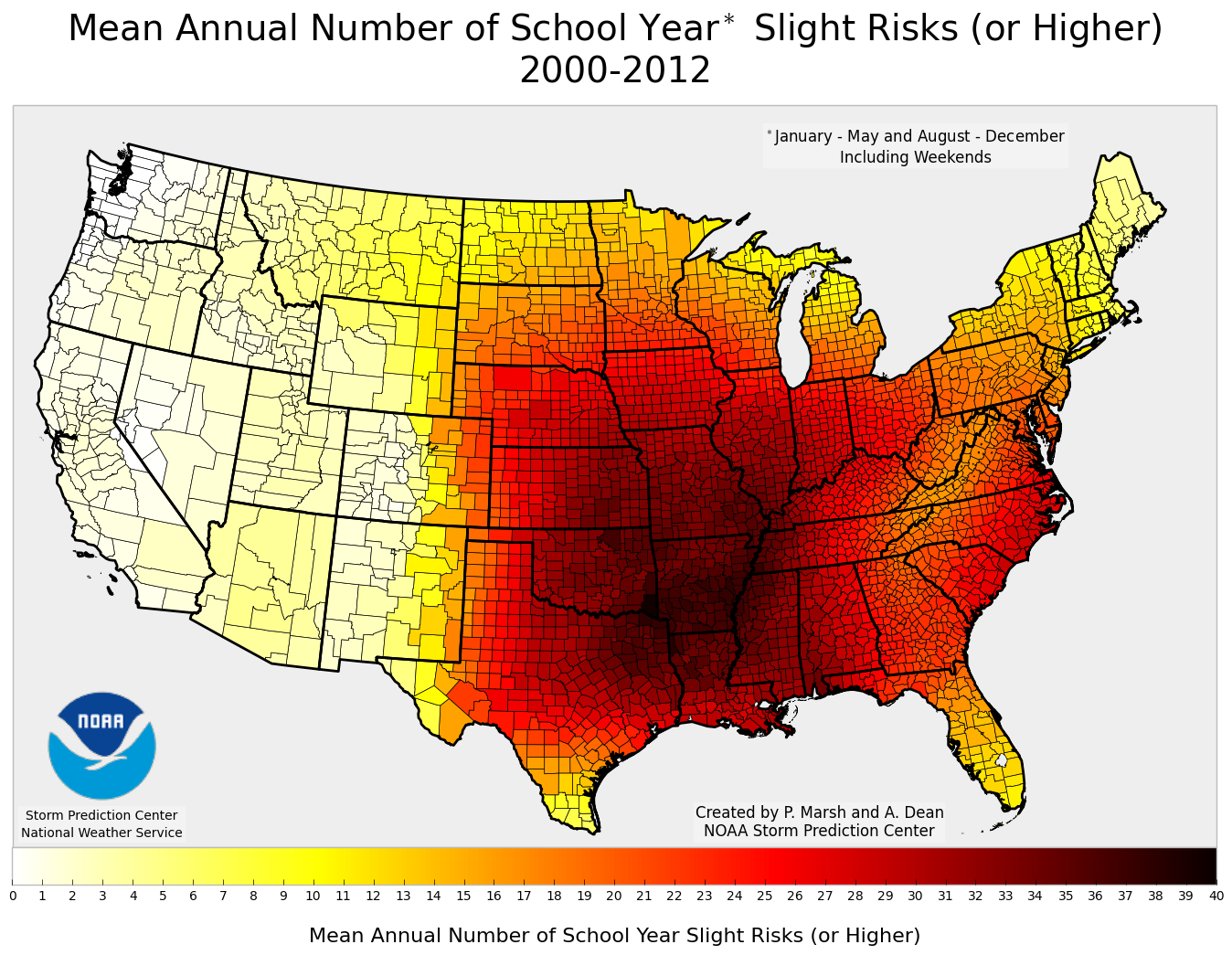
<p>Below is the mean number of slight risk (or higher) outlooks for the traditional school year. As you can see, most areas east of the Rocky Mountains experience at least 1 slight risk (or higher) per school year. The maximum (nearly 37 days) is in southeast Oklahoma, and the centroid appearing to be in north-central Arkansas.</p>

<p><a href="http://www.pmarshwx.com/imgs/2013/mean_annual_number_of_school_year_slight_risks_or_higher.png" title="Mean Annual Number of School Year Slight Risks (or Higher)"><img class="center" src="http://www.pmarshwx.com/imgs/2013/mean_annual_number_of_school_year_slight_risks_or_higher.png" width="400" title="Mean Annual Number of School Year Slight Risks (or Higher)" ></a></p>

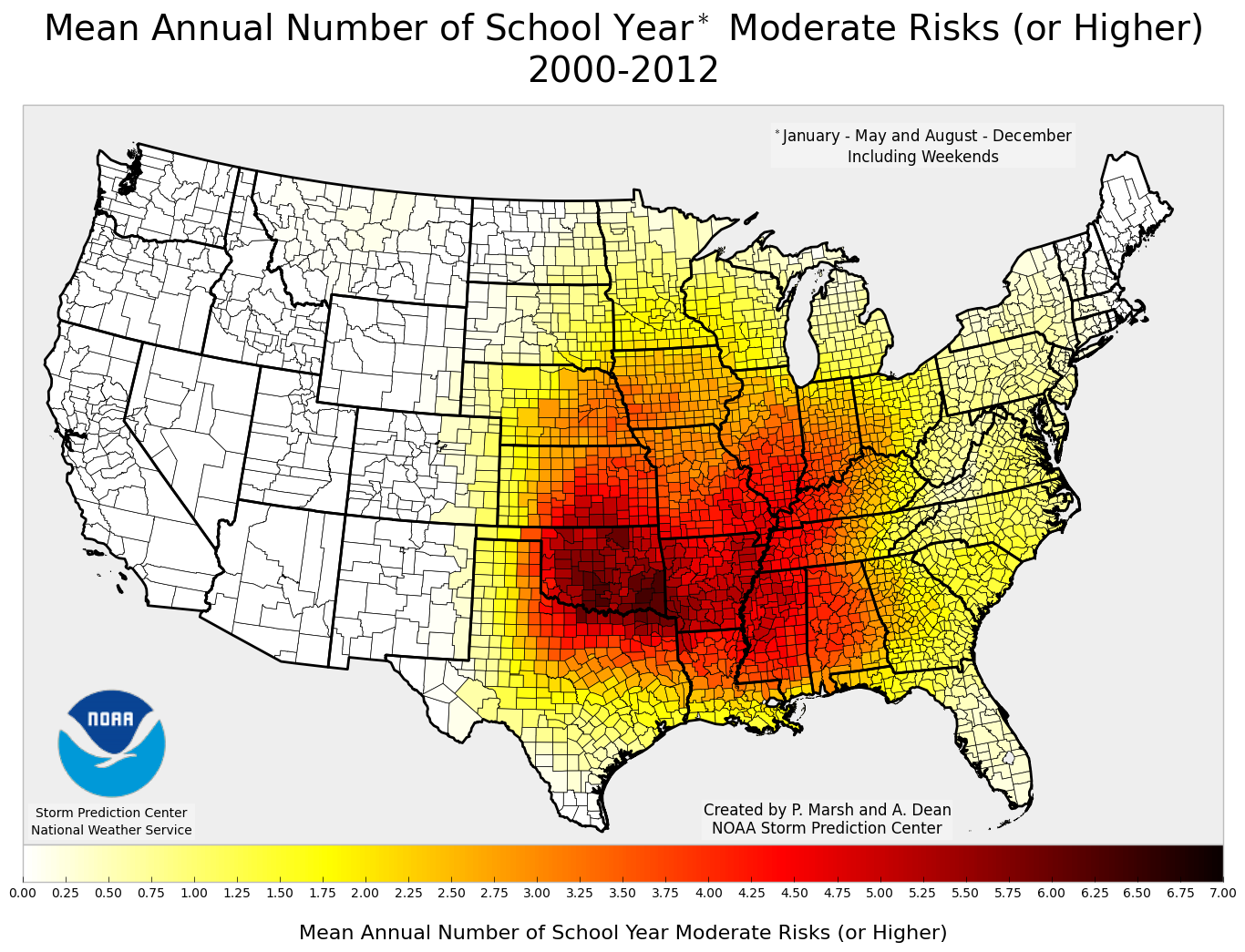
<p>Below is the mean number of moderate risk (or higher) outlooks for the traditional school year. As you can see, once again, most areas east of the Rocky Mountains experience at least 1 moderate risk (or higher) per school year. The maximum (nearly 7 days) is located across much of Oklahoma, and the centroid appears to once again be located in the vicinity of Arkansas.</p>

<p><a href="http://www.pmarshwx.com/imgs/2013/mean_annual_number_of_school_year_moderate_risks_or_higher.png" title="Mean Annual Number of School Year Moderate Risks (or Higher)"><img class="center" src="http://www.pmarshwx.com/imgs/2013/mean_annual_number_of_school_year_moderate_risks_or_higher.png" width="400" title="Mean Annual Number of School Year Moderate Risks (or Higher)" ></a></p>

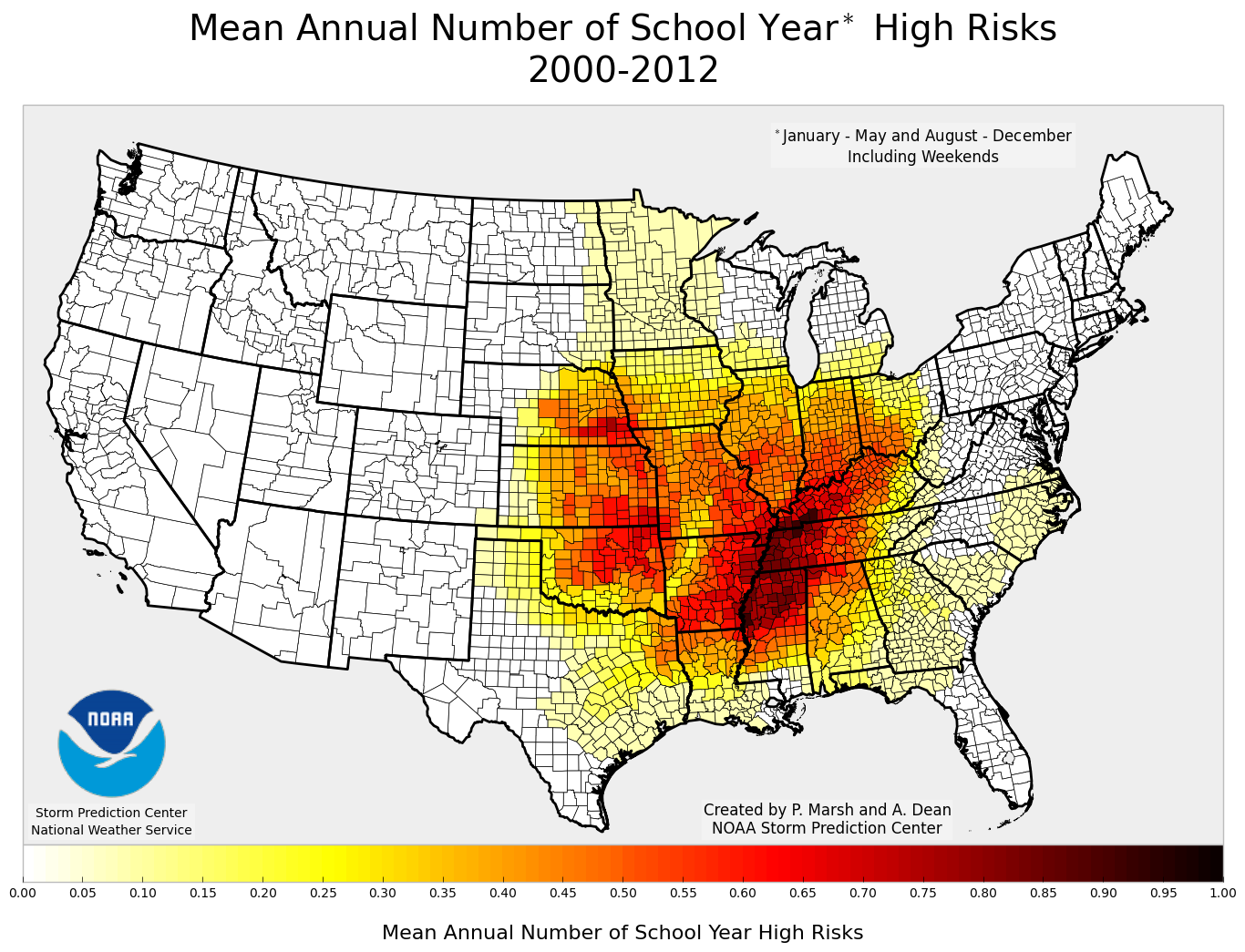
<p>Below is the mean number of high risk outlooks for the traditional school year. Here, there appears to be two separate areas of high risk occurrences: one over the plains, and another in the Mississippi Valley. In fact, there is a relative minimum in occurrence across western Arkansas that serves as some sort of delineation between these two regimes. No area experiences at least 1 high risk day (on average), but the maximum (which is nearly 1) is located from northern Mississippi into southwestern Kentucky. The maximum in the plains appears to be located from northern Oklahoma [mainly the northeastern portion] northward into extreme southeastern Nebraska.</p>

<p><a href="http://www.pmarshwx.com/imgs/2013/mean_annual_number_of_school_year_high_risks.png" title="Mean Annual Number of School Year High Risks"><img class="center" src="http://www.pmarshwx.com/imgs/2013/mean_annual_number_of_school_year_high_risks.png" width="400" title="Mean Annual Number of School Year High Risks" ></a></p>
]]></content>
  </entry>
  
  <entry>
    <title type="html"><![CDATA[Oklahoma School Year and Severe Weather]]></title>
    <link href="http://www.pmarshwx.com/blog/2013/08/20/oklahoma-school-year-and-severe-weather/"/>
    <updated>2013-08-20T13:00:00-05:00</updated>
    <id>http://www.pmarshwx.com/blog/2013/08/20/oklahoma-school-year-and-severe-weather</id>
    <content type="html"><![CDATA[<p>With the school year either already begun, or about to begin, for much of Oklahoma, I thought I&#39;d write a post about the Oklahoma School Year and severe weather.
For these results, I&#39;ve identified the school year as every day between the months of January through (and including) May as well as August through (and including) December.
(Note, this means that I am including weekend days in this calculation.)
Additionally, I am using the Storm Prediction Center&#39;s outlook data from January 2000 through the end of 2012.</p>

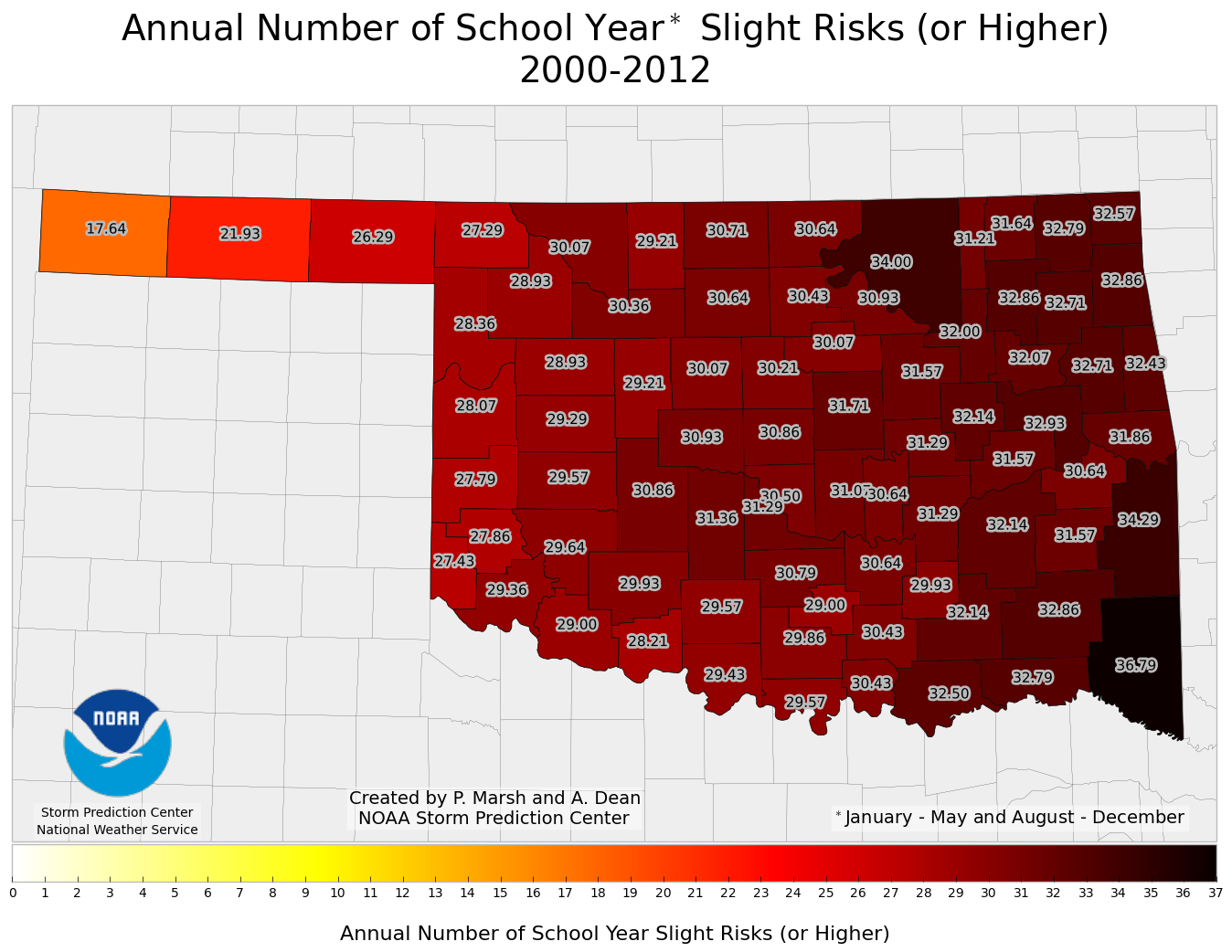
<p>Below is plot of the average annual number of school days (including weekends) in which each Oklahoma county was placed in a Storm Prediction Center Slight Risk (or a higher risk category).
As you can see, this ranges anywhere from 17 days in the far western Oklahoma Panhandle to around 37 days in southeastern Oklahoma.</p>

<p><a href="http://www.pmarshwx.com/imgs/2013/annual_number_of_school_year_slight_risks_or_higher.png" title="Annual Number of School Year Slight Risks (or Higher)"><img class="center" src="http://www.pmarshwx.com/imgs/2013/annual_number_of_school_year_slight_risks_or_higher.png" width="400" title="Annual Number of School Year Slight Risks (or Higher)" ></a></p>

<p>Next is a plot of the average annual number of school days (including weekends) in which each Oklahoma county was placed in a Storm Prediction Center Moderate Risk (or a higher risk category).
As you can see, this ranges anywhere from about 1 day in the far western Oklahoma Panhandle to around 6 days in southeastern Oklahoma.</p>

<p><a href="http://www.pmarshwx.com/imgs/2013/annual_number_of_school_year_moderate_risks_or_higher.png" title="Annual Number of School Year Moderate Risks (or Higher)"><img class="center" src="http://www.pmarshwx.com/imgs/2013/annual_number_of_school_year_moderate_risks_or_higher.png" width="400" title="Annual Number of School Year Moderate Risks (or Higher)" ></a></p>

<p>Next is a plot of the average annual number of school days (including weekends) in which each Oklahoma county was placed in a Storm Prediction Center High Risk.
As you can see, this ranges anywhere from almost never in the far western Oklahoma Panhandle to around once every 2 years in northeastern Oklahoma.</p>

<p><a href="http://www.pmarshwx.com/imgs/2013/annual_number_of_school_year_high_risks.png" title="Annual Number of School Year High Risks"><img class="center" src="http://www.pmarshwx.com/imgs/2013/annual_number_of_school_year_high_risks.png" width="400" title="Annual Number of School Year High Risks" ></a></p>

<p>Most of the spatial pattern comes from the <a href="http://www.spc.noaa.gov/new/SVRclimo/climo.php?parm=anySvr" title="Severe Weather Climatologies">annual cycle of the climatological probabilities of severe weather occurrence</a>.
What I mean by this is that during the &quot;cool season&quot; (late fall through early spring), the higher climatological probabilities of severe weather occurrence are in the southeastern United States.
As spring begins, the climatological peak values begin to expand and increase into the southern plains.
This means that southeast Oklahoma spends more time in the climatological peak during its school year, because the rest of Oklahoma spends time in its climatological peak when the school year has ended.
This is especially true with the Oklahoma Panhandle, which doesn&#39;t see it&#39;s climatological peaks until very late May into late June.</p>

<p>Of note is that it is actually northeast Oklahoma that has a higher likelihood of experiencing a High Risk during the school year than anywhere else in the state.
Based on my previous explanation, one might have thought that southeast Oklahoma would be the expectant maximum of High Risks.
My guess is that this is due to the fact that High Risks are rare, and require a rare combination of ingredients coming together, as is evident by the relatively few times they are issued.
One of these ingredients is an extremely strong, dynamical storm.
When this is the case, for reasons I won&#39;t get into here (partly because I don&#39;t think meteorologists are completely sure), these storm systems tend to track a little bit farther north.
This results in northern preference for high risks.
Additionally, a lot of moisture is needed to help produce large amounts of instability.
Given that the Gulf of Mexico is slightly east of our longitude, it&#39;s easier for moisture to return to eastern Oklahoma than western Oklahoma.</p>

<p>The previous charts might make it seem like Oklahoma school children are exposed to a lot of severe weather during the school day.
However, this isn&#39;t necessarily the case.
The outlooks cover time periods that extend past the bounds of the school day (7AM to 4PM for my purposes).
Thus, it is possible that the severe weather might have occurred after school let out, or even before the school day began.
To begin looking at that possibility, below are some maps of the number of watches issued during the school day, during the school year.
This time I will be using SPC watches from January 2000 - the end of May 2013.
(Once again, note that weekends are included in the analysis.)</p>

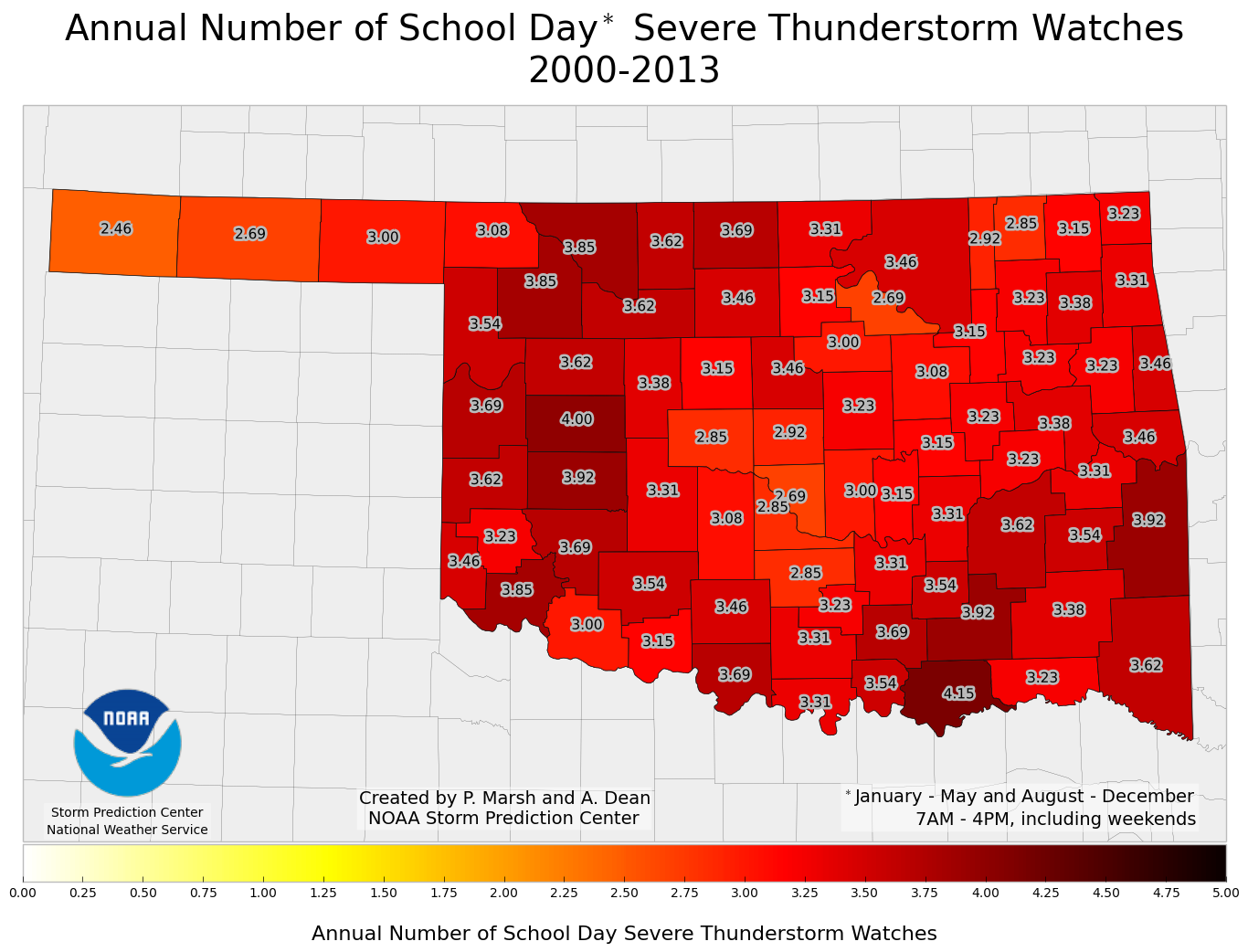
<p>Below is a plot of the average annual number of SPC Severe Thunderstorm Watches issued between 7AM and 4PM during the school year (weekends included).
As you can see, this ranges from around 2.5 in the far western Oklahoma Panhandle to slightly more than 4 in southeast Oklahoma.</p>

<p><a href="http://www.pmarshwx.com/imgs/2013/annual_number_of_school_day_severe_thunderstorm_watches.png" title="Annual Number of School Day Severe Thunderstorm Watches"><img class="center" src="http://www.pmarshwx.com/imgs/2013/annual_number_of_school_day_severe_thunderstorm_watches.png" width="400" title="Annual Number of School Day Severe Thunderstorm Watches" ></a></p>

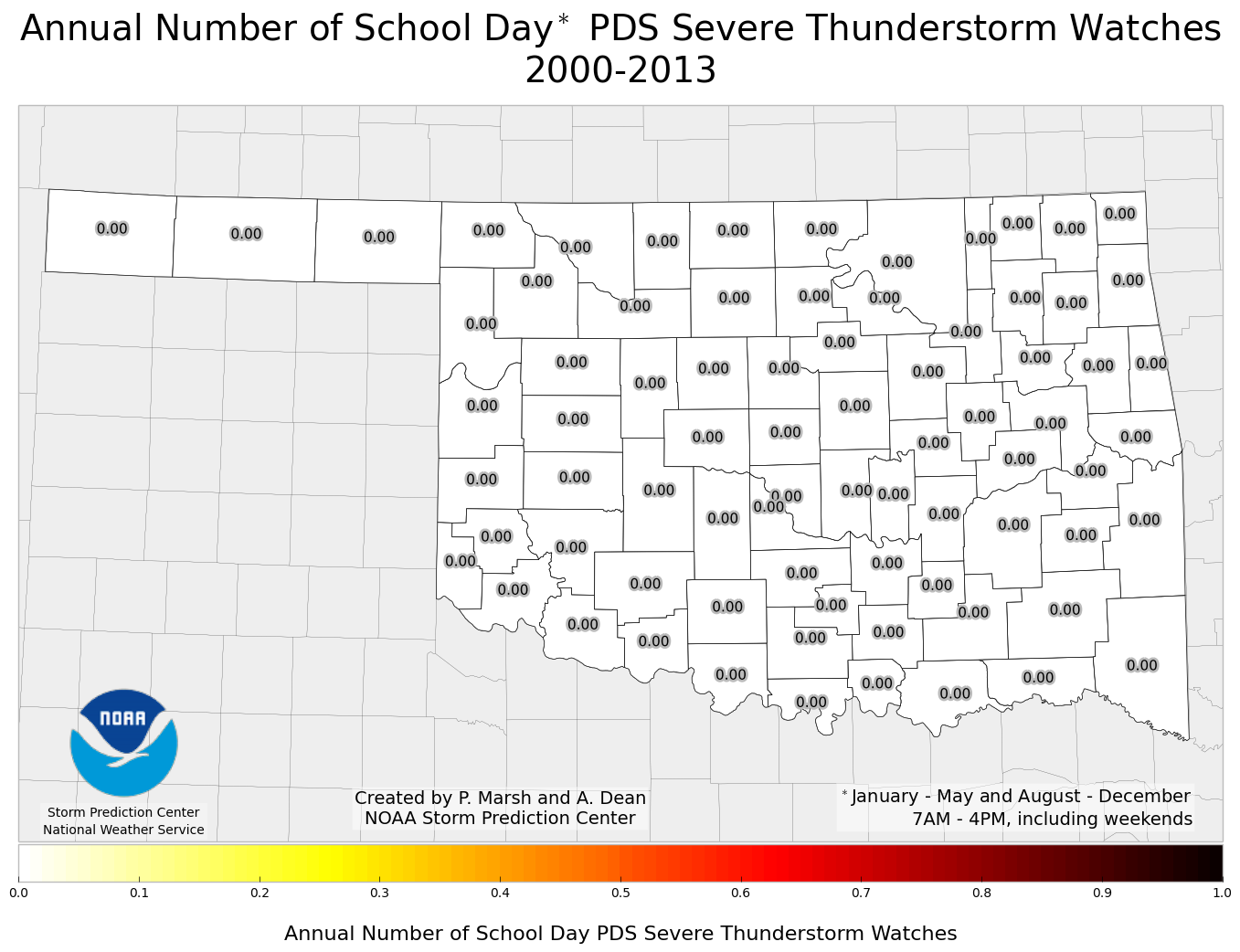
<p>Below is a plot of the average annual number of SPC Particularly Dangerous Situation (PDS) Severe Thunderstorm Watches issued between 7AM and 4PM during the school year (weekends included).
As you can see, this has not happened since 2000.</p>

<p><a href="http://www.pmarshwx.com/imgs/2013/annual_number_of_school_day_pds_severe_thunderstorm_watches.png" title="Annual Number of School Day PDS Severe Thunderstorm Watches"><img class="center" src="http://www.pmarshwx.com/imgs/2013/annual_number_of_school_day_pds_severe_thunderstorm_watches.png" width="400" title="Annual Number of School Day PDS Severe Thunderstorm Watches" ></a></p>

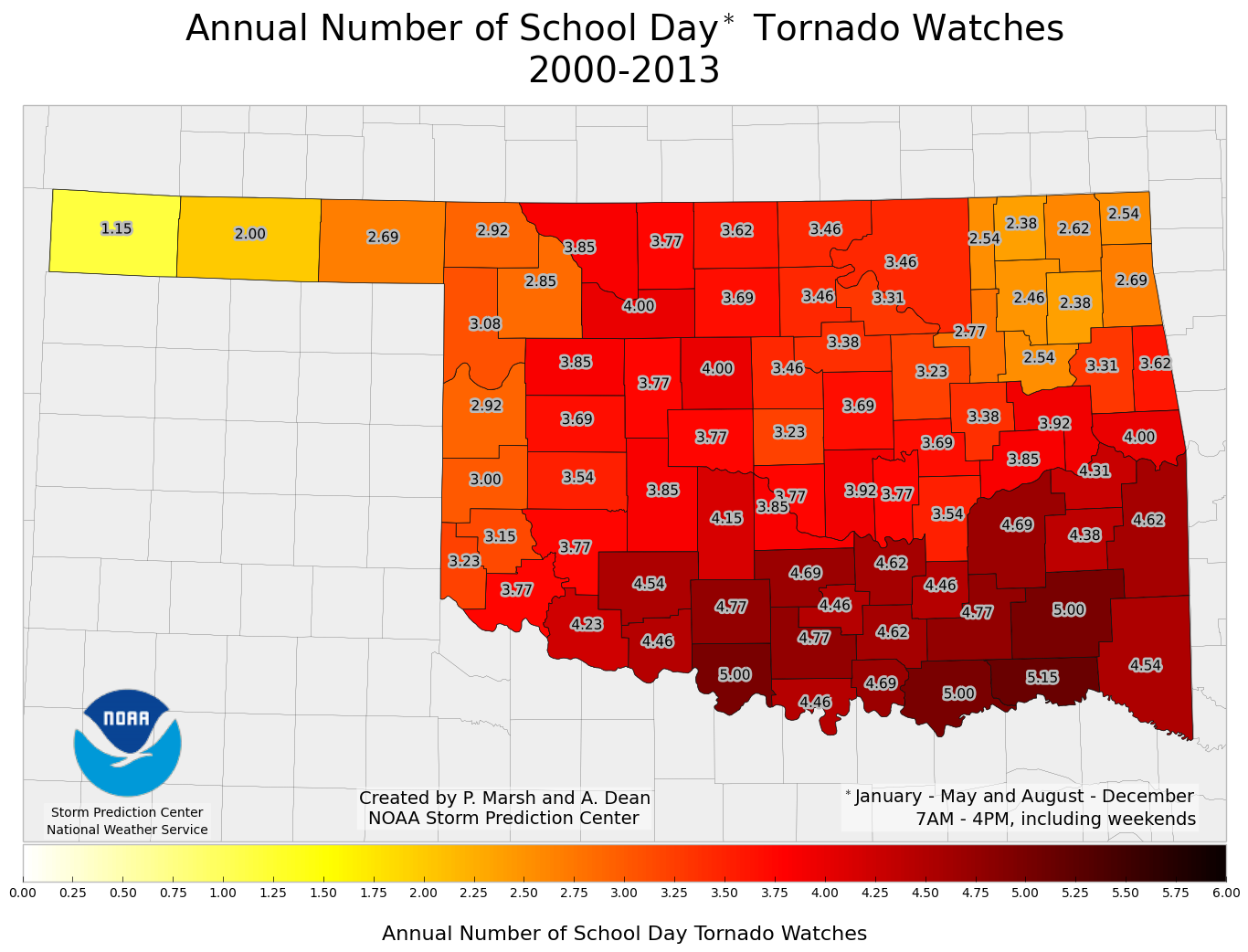
<p>Below is a plot of the average annual number of SPC Tornado Watches issued between 7AM and 4PM during the school year (weekends included).
As you can see, this ranges from around 1 in the far western Oklahoma Panhandle to slightly more than 5 in southeast Oklahoma.</p>

<p><a href="http://www.pmarshwx.com/imgs/2013/annual_number_of_school_day_tornado_watches.png" title="Annual Number of School Day Tornado Watches"><img class="center" src="http://www.pmarshwx.com/imgs/2013/annual_number_of_school_day_tornado_watches.png" width="400" title="Annual Number of School Day Tornado Watches" ></a></p>

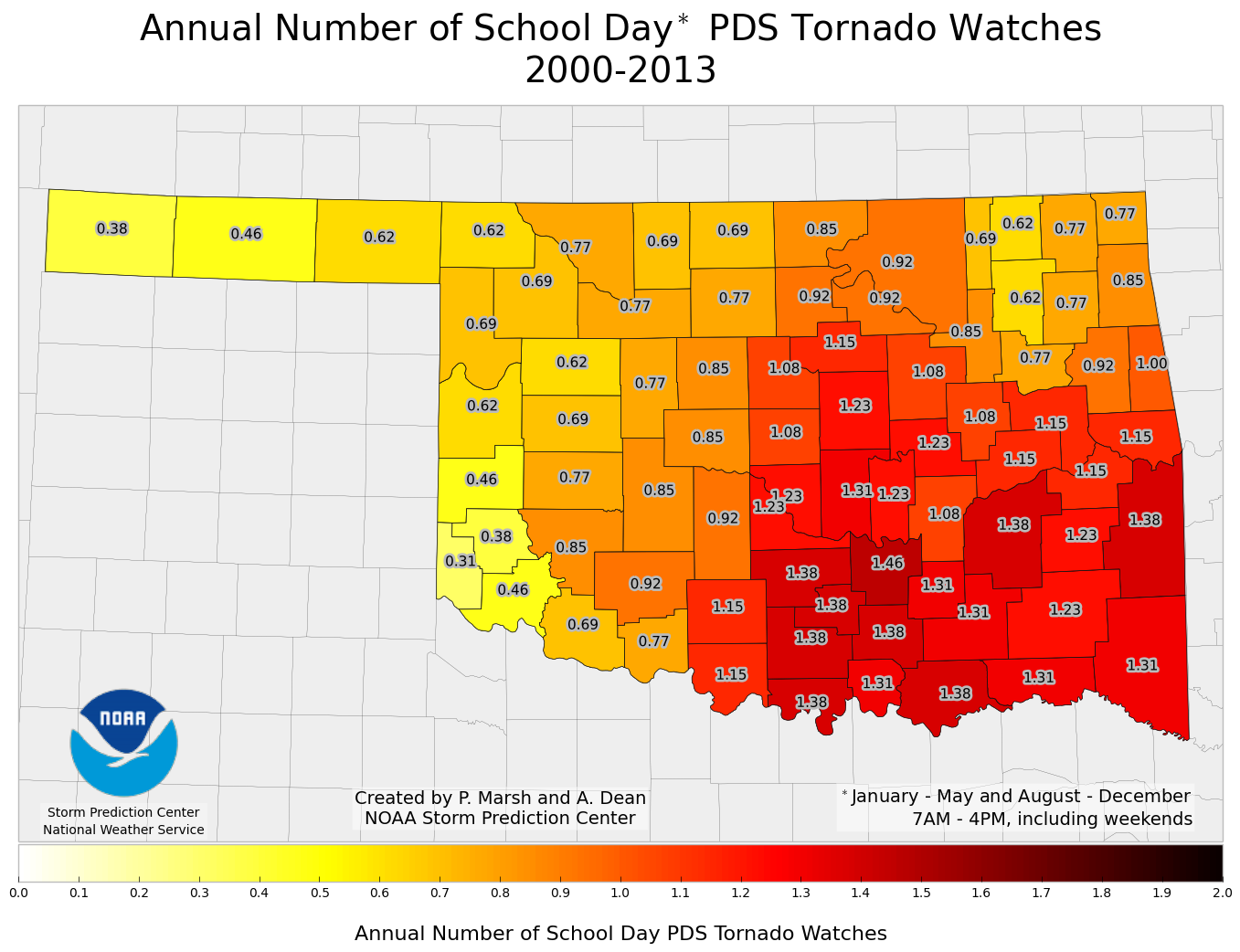
<p>Below is a plot of the average annual number of SPC Particularly Dangerous Situation (PDS) Tornado Watches issued between 7AM and 4PM during the school year (weekends included).
As you can see, this ranges from around 0.3 (or once every three years) in the far western Oklahoma Panhandle to around 1.3 in southeast Oklahoma.</p>

<p><a href="http://www.pmarshwx.com/imgs/2013/annual_number_of_school_day_pds_tornado_watches.png" title="Annual Number of School Day PDS Tornado Watches"><img class="center" src="http://www.pmarshwx.com/imgs/2013/annual_number_of_school_day_pds_tornado_watches.png" width="400" title="Annual Number of School Day PDS Tornado Watches" ></a></p>

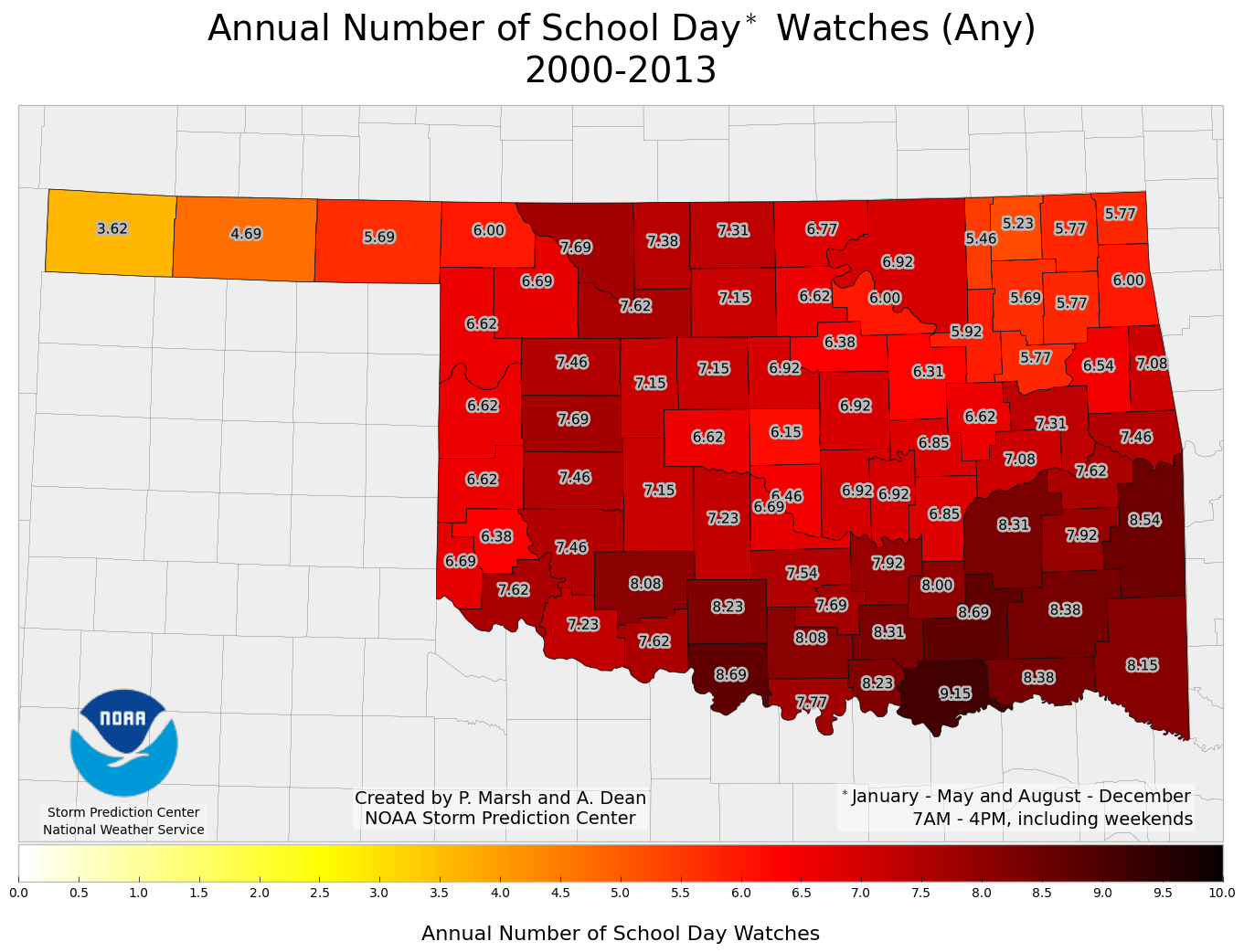
<p>Taking a look in aggregate, below is a plot of the average annual number of SPC Watches of any kind issued between 7AM and 4PM during the school year (weekends included).
As you can see, this ranges from around 3.5 in the far western Oklahoma Panhandle to slightly more than 9 in southeast Oklahoma.</p>

<p><a href="http://www.pmarshwx.com/imgs/2013/annual_number_of_school_day_watches.png" title="Annual Number of School Day Watches (Any)"><img class="center" src="http://www.pmarshwx.com/imgs/2013/annual_number_of_school_day_watches.png" width="400" title="Annual Number of School Day Watches (Any)" ></a></p>

<p>Thus, even though the a large part of the state experiences on average around 30-40 days of severe weather during the school year, less than 10 of those events (on average) occur during the school day itself.
With that said, it only takes one event to completely ruin a school year...and a community.
The 20 May 2013 Moore, OK tornado is a pointed reminder of this fact.</p>
]]></content>
  </entry>
  
  <entry>
    <title type="html"><![CDATA[Why Should I Continue As An AMS Member?]]></title>
    <link href="http://www.pmarshwx.com/blog/2013/08/12/why-should-i-continue-as-an-ams-member/"/>
    <updated>2013-08-12T12:54:00-05:00</updated>
    <id>http://www.pmarshwx.com/blog/2013/08/12/why-should-i-continue-as-an-ams-member</id>
    <content type="html"><![CDATA[<div style="padding: 10px 40px 40px 40px; font-weight: bold; text-align: left; font-size: 10pt;">
    Author Update: AMS has now added an editor's note/disclaimer on the blog post.<br />
</div>

<p>Earlier today on the <a href="http://www.ametsoc.org" title="American Meteorological Society">American Meteorological Society</a> (AMS; of which I am a member) blog, a post was published that advocated for the <a href="http://blog.ametsoc.org/columnists/boosting-the-vitality-of-the-u-s-weather-and-climate-enterprise/" title="Boosting the Vitality of the US Weather and Climate Enterprise">privitization of weather forecasts</a>.
In a nutshell, the blog post suggested that the US government, and more specifically the National Weather Service, is inefficient in its generation of forecasts and therefore should stick to the mission of generating and providing raw data and discontinue the creation of weather forecasts.
The blog post goes on to state that the US government could/should purchase forecasts from private companies for citizens that cannot afford to purchase their own forecasts.
Although as an American citizen I find this arrangement unacceptable, and yet another attempt at privitizing profits (removing the government forecasts) and socializing losses (the generation/collection of the data), I will leave that discussion for another time and place.</p>

<p><strong>My real issue is not so much the fact that a private weather company is advocating for this arrangement, it is that the AMS allowed such a post to be featured on their blog without opposing viewpoints.</strong>
Whether or not the AMS agrees, their blog is a reflection of the AMS and its positions.
By allowing such a post to be published publicly, without differing views, the AMS is implicitly endorsing this position.
The AMS has implicitly chosen a side --- especially when no disclaimer saying otherwise can be found on the website!
(I understand that the particular position being advocated in this blog post is not the official position of the AMS. However, the simple fact is that an overwhelming majority of people will not take the time to delve into the nitty-gritty details and jargon of AMS position statements.)
Why on earth would the AMS think that featuring/allowing a blog post, <strong><em>on the organization&#39;s website</em></strong>, that attacks a portion of the AMS&#39;s constituency, without allowing that constituency&#39;s view to be shared, would be a good idea?
If the AMS membership wants to have this discussion, I&#39;m all for it.
Positions and views should always be debated and discussed openly and freely.
However, we should have this dicussion amongst the membership, and then share the discussion/consensus, rather than have the opening salvo feature one side of the discussion.
The fact that this post is featured on the website the week before the AMS Community Meeting is to be held leads credence to this <em>appearing</em> as an official AMS position.</p>

<p>Ironically, this morning I received my yearly email from AMS reminding me that it is time to renew my membership for the upcoming year.
Based on the <em>apparent</em> AMS position on government meteorologists/forecasters, I seriously wonder why a government meteorologist/forecaster would want to be a member of the AMS?
Fortunately, there are alternatives to the AMS for a professional society.
One in particular is the <a href="http://www.nwas.org" title="National Weather Association">National Weather Association (NWA)</a>, of which I&#39;m also a member.
Maybe if enough government meteorologists left the AMS and became more active in the NWA, the AMS would re-evaluate their policies that allow members to promote positions that alienate a significant portion of its contiuency.
Maybe this is a sign to leave the AMS (and the committees I&#39;m currently on) and focus solely on the NWA?
Without an apology/correction/disclaimer from the AMS --- and soon --- my tendency would be toward leaving.
Fortunately, I have a few months to see what the AMS does...</p>
]]></content>
  </entry>
  
  <entry>
    <title type="html"><![CDATA[Updated Tornado Count Model]]></title>
    <link href="http://www.pmarshwx.com/blog/2013/05/08/updated-tornado-count-model/"/>
    <updated>2013-05-08T01:30:00-05:00</updated>
    <id>http://www.pmarshwx.com/blog/2013/05/08/updated-tornado-count-model</id>
    <content type="html"><![CDATA[<p>Yesterday I <a href="http://www.pmarshwx.com/blog/2013/05/07/which-is-more-rare-the-current-tornado-drought-or-the-2011-2012-tornado-surplus/">published a post</a> that attempted to model tornado counts in a manner that would allow insights into just how rare the current &quot;tornado drought&quot; and recent &quot;tornado surplus&quot; actually are.
There are numerous limitations to these simple models, but two that really stand out are:</p>

<ul>
<li>2010, 2011, and 2012 all contribute tornado counts to either the record minimum or record maximum tornado counts.</li>
<li>The simple models used only generate &quot;years&quot; that begin with January and run through December. This excludes the possibility for the inter-year 12-month counts, such as what comprises the current record minimum and maximum.</li>
</ul>

<p>In an attempt to address the first bullet, I have removed the years 2010, 2011, and 2012 from the input data.
In an attempt to address the second bullet, I created 12-month running totals from the 1 million years.
Thus, the modeled distribution includes 12-month periods of January through December; April through March (of the following year); November through October (of the following year); etc.</p>

<p>Removing 2010, 2011, and 2012 --- in particular 2011 --- the right-tail of the distribution is significantly altered.
The maximum 12-month tornado counts are actually fewer than they were in the previous models.
This was expected as 2011 was such an anomalous year in terms of the number of tornadoes (as the residents of the Southeast can attest to).
The thought is that by removing the influence of 2011 the modeled distribution would more closely resemble &quot;truth&quot;.</p>

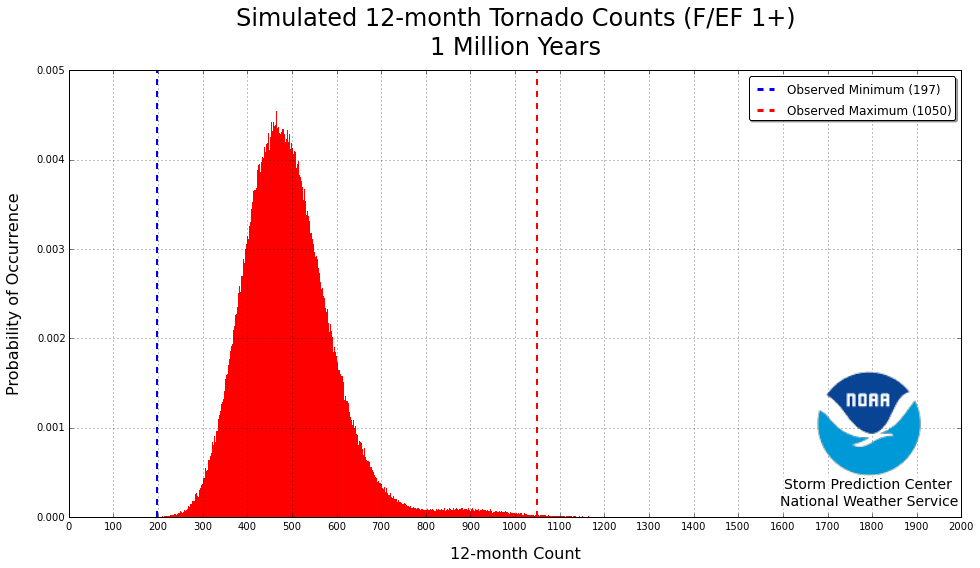
<p>The new distribution is shown below.</p>

<p><a href="http://www.pmarshwx.com/imgs/2013/yearly_tornado_count_model_3.png" title="Modeled Distribution of Yearly Tornado Counts"><img class="center" src="http://www.pmarshwx.com/imgs/2013/yearly_tornado_count_model_3.png" width="400" title="Modeled Distribution of Yearly Tornado Counts" ></a></p>

<p>In the new model, the minimum number of 12-month tornadoes was 160, with 1143 the maximum.
The maximum number of tornadoes from this new model is quite a few less than the even simpler models <a href="http://www.pmarshwx.com/blog/2013/05/07/which-is-more-rare-the-current-tornado-drought-or-the-2011-2012-tornado-surplus/">previously used</a>.
This results in a significant change in the rarity of the 2010-2011 record 12-month maximum.
As is shown below, it is actually substantially more rare of an event than the current tornado drought.</p>

<ul>
<li>  <strong>Simulated Minimum (160) (Probability:</strong> ~0</li>
<li>  <strong>Observed Minimum (197) Probability:</strong> 0.0000223333538056</li>
<li>  <strong>Observed Maximum (1050) Probability:</strong> 0.999998666665 (0.0000013333)</li>
<li>  <strong>Simulated Maximum (1143) Probability:</strong> ~1.0 (~0)</li>
<li>  <strong>Return Period for Observed Minimum:</strong> 44776.0783582 months (3731.33986318 years).</li>
<li>  <strong>Return Period for Observed Maximum:</strong> 749999.313258 months (62499.9427715 years).</li>
</ul>

<p>By removing the influence of 2011, the return period for the maximum record (1050 tornadoes) between June 2010 and May 2011 is 749,999 months, or 62,500 years.
By removing the influence of 2012, the return period for the minimum record (197) tornadoes between May 2012 and April 2013 is 44,776 months, or 3731 years.
Thus, when removing the years contributing to the most and fewest tornado counts, the rarity is almost opposite as to what the previous, simpler models found.</p>

<p>Lastly, just a reminder that even though these models are somewhat complex in (some of) their logic, they are relatively simple models in the grand scheme of things.
Anytime one tries to understand/predict things about extreme events the slightest changes to the underlying assumptions can have a profound impact in the results, as is illustrated by the switching of the rarity between this model and <a href="http://www.pmarshwx.com/blog/2013/05/07/which-is-more-rare-the-current-tornado-drought-or-the-2011-2012-tornado-surplus/">those used yesterday</a>.</p>
]]></content>
  </entry>
  
  <entry>
    <title type="html"><![CDATA[Which is More Rare? The Current Tornado Drought or the 2011-2012 Tornado Surplus]]></title>
    <link href="http://www.pmarshwx.com/blog/2013/05/07/which-is-more-rare-the-current-tornado-drought-or-the-2011-2012-tornado-surplus/"/>
    <updated>2013-05-07T15:28:00-05:00</updated>
    <id>http://www.pmarshwx.com/blog/2013/05/07/which-is-more-rare-the-current-tornado-drought-or-the-2011-2012-tornado-surplus</id>
    <content type="html"><![CDATA[<p>Anyone who is interested in severe convective weather is probably aware of the current <a href="http://www.norman.noaa.gov/2013/05/low-tornado-numbers-and-low-tornado-deaths-may-2012-april-2013/" title="U.S. Severe Weather Blog">tornado drought</a>.
For those who are unaware, this refers to the 12-months from May 2012 through April 2013 having the fewest number of (preliminary) F/EF-1 or stronger tornado reports of any 12-month period in the official tornado record.
This follows on the heels of the 12-month period of June 2010 through May 2011 as having the most number of F/EF-1 or stronger tornado reports of any 12-month period.
The question I wanted to know was, how rare of an event are each of those?</p>

<p>To determine the answer I conducted a little data experiment.
I calculated the number of tornadoes of strength F/EF-1 or stronger that occurred in each month of the year for the years 1954 through 2012.
(No 2013 data are used in the following calculations.)
Thus, I had 59 January counts, 59 February counts, ..., 59 December counts.
For each month I randomly selected a count from that month&#39;s distribution.
I then summed each of those twelve randomly determined counts to create a randomly generated yearly count.
Note, each month only contributed to the year once.
I then repeated this process for a total of 1 million randomly generated yearly tornado counts.
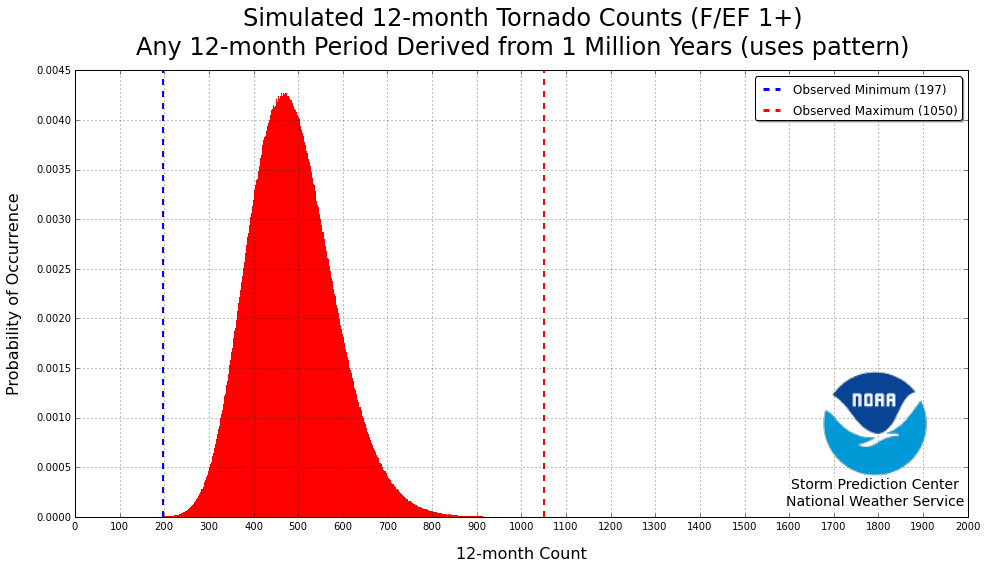
The minimum number of yearly tornadoes was 149, with 1332 the maximum.
The distribution of these 1 million yearly tornado counts is shown below:</p>

<p><a href="http://www.pmarshwx.com/imgs/2013/yearly_tornado_count_model_1.png" title="Modeled Distribution of Yearly Tornado Counts"><img class="center" src="http://www.pmarshwx.com/imgs/2013/yearly_tornado_count_model_1.png" width="400" title="Modeled Distribution of Yearly Tornado Counts" ></a></p>

<p>The distribution is plotted in color-filled red.
Additionally, the current tornado &quot;drought&quot; is shown via the blue dashed line (197 F/EF-1 or stronger tornadoes) and the previous tornado &quot;surplus&quot; is shown via the red dashed line (1050 F/EF-1 or stronger tornadoes).
Using the distribution above, we can determine the empirical probability of a given yearly tornado count.</p>

<ul>
<li>  <strong>Simulated Minimum (149) Probability:</strong> ~0.0</li>
<li>  <strong>Observed Minimum (197) Probability:</strong> 0.000018</li>
<li>  <strong>Observed Maximum (1050) Probability:</strong> 0.999141 (0.000858999999999)</li>
<li>  <strong>Simulated Maximum (1332) Probability:</strong> ~1.0 (~0.0)</li>
<li>  <strong>Return Period for Observed Minimum:</strong> 55555.5555556 years.</li>
<li>  <strong>Return Period for Observed Maximum:</strong> 1164.1443539 years.</li>
</ul>

<p>As you can see, both the recent drought and the recent surplus are quite anomalous.
A yearly tornado drought like the current one would occur once every 55,556 years.
A yearly tornado surplus like 2010-2011 would occur once every 1164 years.
As you can see the current 12-month tornado drought is a much rarer occurrence.</p>

<p>The model above, however, is rather simple.
It does not take into considerations anything along the lines of &quot;being locked in a pattern&quot;.
What I mean by this is that often times when you are in a below normal tornado month, the next month tends to be below normal as well.
In other words, when the pattern gets good or bad, it tends to favor staying good or bad, at least in the short term.
At the suggestion of Dr. Harold Brooks of the National Severe Storms Laboratory, I decided to update the model to see if I could include the monthly dependency.</p>

<p>Using the median tornado count for each month as &quot;normal&quot;, I determined if a given month&#39;s tornado count was above/below/equal normal.
I then compared to see if the following month was above/below/equal normal.
It turns out that about 52% of the time, the &quot;pattern&quot; remains the same in subsequent months.
About 41% of the time the pattern &quot;flips&quot; to the other extreme, and about 7% of the time the pattern either remains or transitions to &quot;normal&quot;.</p>

<ul>
<li>  <strong>Number of month transitions:</strong> 707.0</li>
<li>  <strong>Flip Pattern:</strong> 292 (0.413012729844)</li>
<li>  <strong>Persist Pattern:</strong> 367 (0.51909476662)</li>
<li>  <strong>Median:</strong> 48 (0.0678925035361)</li>
</ul>

<p>Using this information, I updated how I randomly generated the yearly counts so that subsequent month&#39;s counts were somewhat related to the current month&#39;s count.
This was done by determining if the current month was above/below/equal to &quot;normal&quot;.
Then, based on the pattern change information listed above, I used a weight resampling approach to determine if the following month would be above/below/equal to &quot;normal&quot;.
If the month was &quot;forecast&quot; to be above normal, I randomly chose a monthly count from that month&#39;s above median counts.
If the month was &quot;forecast&quot; to be below normal, I randomly chose a monthly count from that month&#39;s below median counts.
If the month was &quot;forecast&quot; to be normal, I randomly chose a monthly count from that month&#39;s entire distribution.
Again, this is still a simple model, but it does at least attempt to capture inter-monthly dependencies.
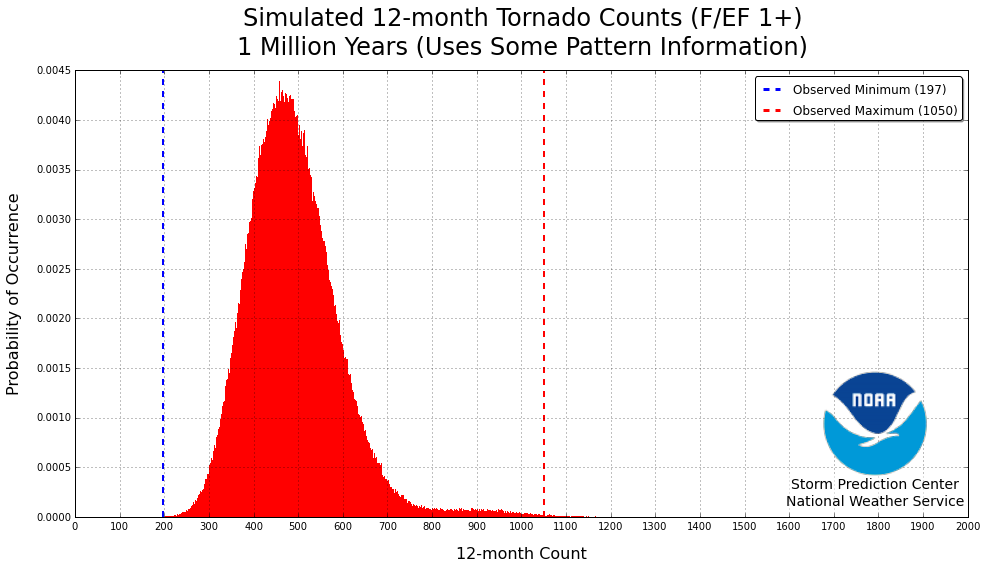
The minimum number of yearly tornadoes in this updated model was 161, with 1325 the maximum.
The updated model distribution is shown below.
Although it&#39;s extremely hard to differentiate from the previous distribution is <em>is</em> different!</p>

<p><a href="http://www.pmarshwx.com/imgs/2013/yearly_tornado_count_model_2.png" title="Updated Modeled Distribution of Yearly Tornado Counts"><img class="center" src="http://www.pmarshwx.com/imgs/2013/yearly_tornado_count_model_2.png" width="400" title="Updated Modeled Distribution of Yearly Tornado Counts" ></a></p>

<ul>
<li>  <strong>Simulated Minimum (161) (Probability:</strong> ~0</li>
<li>  <strong>Observed Minimum (197) Probability:</strong> 0.000035</li>
<li>  <strong>Observed Maximum (1050) Probability:</strong> 0.999062 (0.000937999999999)</li>
<li>  <strong>Simulated Maximum (1325) Probability:</strong> ~1.0 (~0)</li>
<li>  <strong>Return Period for Observed Minimum:</strong> 28571.4285714 years.</li>
<li>  <strong>Return Period for Observed Maximum:</strong> 1066.09808102 years.</li>
</ul>

<p>As you can see, both the recent drought and the recent surplus are still quite anomalous, although not nearly as much.
A yearly tornado drought like the current one would occur once every 28, 571 years.
A yearly tornado surplus like 2010-2011 would occur once every 1066 years.
As you can see the current 12-month tornado drought is still a much rarer occurrence.</p>

<p>Anyway you look at it, the recent tornado &quot;surplus&quot; and the current tornado &quot;drought&quot; is extremely rare.
The fact that we had both of them in the span of a few years is even more so!</p>
]]></content>
  </entry>
  
  <entry>
    <title type="html"><![CDATA[Acknowledgements]]></title>
    <link href="http://www.pmarshwx.com/blog/2013/05/05/acknowledgements/"/>
    <updated>2013-05-05T17:05:00-05:00</updated>
    <id>http://www.pmarshwx.com/blog/2013/05/05/acknowledgements</id>
    <content type="html"><![CDATA[<p>Below is the acknowledgements section of my dissertation...which is scheduled to be deposited tomorrow afternoon at 1PM. The journey is coming to a close...</p>

<hr>

<div style="padding: 50px 50px 20px 50px; font-style: italic; text-align: center;">
  ``We are like dwarfs sitting on the shoulders of giants.
  We see more, and things that are more distant, than they did, not because our sight is superior or because we are taller than they, but because they raise us up, and by their great stature add to ours.''
  <br /><br />
  --- John of Salisbury, Metalogicon (1159)
</div>

<p>You do not simply write a dissertation overnight.
It takes many years, or in my case, a lifetime, of people pouring themselves into you.
People who give selflessly of their time and energy to ensure that you achieve your goal(s).
So when it comes time to finish that endeavor, how do you recognize everyone that has played a role in helping you get to the point of writing a dissertation?
How can a few typed words convey the lifetime of appreciation and thanks that everyone so rightly deserves?
I know that words can never fully convey the appreciation I have for everyone who has helped me along my journey, but I offer them up as an attempt.</p>

<p>First and foremost I must thank my main advisor, Dr. John (Jack) Kain for taking a chance on a graduate student he barely knew.
Without his willingness to rescue me from myself, I would not be writing a dissertation, nor would I be currently employed at the Storm Prediction Center.
Furthermore without his guidance and patience, and not to mention willingness to let me explore scientific endeavors not directly related to my dissertation research, I would not be poised on the threshold of entering the community of scholars.
I am forever indebted to him.
Along the same lines, thanks must be given to my co-advisor, Dr. Kevin Kloesel, for his willingness to serve on and chair my dissertation committee.
Additionally, it was the many meetings, particularly the off-site and unorthodox meetings at various baseball stadiums, that gave me just enough of a distraction to keep me (somewhat) sane.
Lastly, thanks must be given to my dissertation committee for their guidance and insights they offered me.
In particular, the guidance offered by Drs. Michael Richman and S. Lakshmivarahan went above and beyond what could reasonably be expected of a dissertation committee.</p>

<p>As I alluded to previously, I would not be finishing this dissertation if I had not been rescued from myself.
In addition to Dr. Kain, Drs. Michael Coniglio, David Stensrud, Harold Brooks, and Louis Wicker all played a role in creating a graduate student position for me at the National Severe Storms Laboratory.
More importantly, these scholars convinced me to undertake a dissertation project about which I was passionate, even if it was without (initially) stable funding, rather than stay in my comfort zone and pursue a dissertation project that had funding, but about which I was only tangentially interested.
It is only with the knowledge and hindsight that comes with being on the completion side of a dissertation that I realize how difficult, if not impossible, it would be to complete a dissertation on a topic about which I was less than completely passionate.</p>

<p>A dissertation in meteorology typically begins in childhood, when one begins to notice the beauty and power of our atmosphere.
This was certainly the case for me.
I was fortunate to have been blessed by many in my life who encouraged my pursuit of knowledge of the atmosphere.
I must thank Mr. Jay Hilgartner, Mr. Austen Onek, Mr. Ken Rank, and Mr. Garrett Lewis for encouraging me as a child to pursue meteorology; not to mention the countless hours each spent answering my questions.
Thanks are owed to the National Weather Service Forecast Office in Tulsa, Oklahoma for their continual indulgence of a wide-eyed youth from Fort Smith, Arkansas.
In particular, the willingness of Mr. Lans Rothfusz to give a father and son an impromptu private tour of the Tulsa forecast office on a Saturday afternoon and the friendship and counsel afforded me by Mr. Steven Piltz can never be repaid.</p>

<p>As is typically the case with most in life, my journey has been profoundly shaped by many educators along the way.
Thank you to Ms. Robin Bryan, Mr. James Moody, Mr. Charles Besancon, Mr. Larry Jones, and Dr. Barry Owen for their encouragement through my secondary education.
Thanks and gratitude must also be offered to Drs. John and Gay Stewart, my undergraduate advisors, for refusing the let me give up and for helping me reach my potential.</p>

<p>Friendships are important in completing a dissertation and I offer thanks to all of my friends for their friendship, of which there are too many to enumerate here.
Without your friendships I never would have remained grounded and focused on finishing my dissertation.
The friendships of three individuals in particular are most crucial in setting me on the path that has culminated with this dissertation: Mr. David Whiteis, Mr. Wayne Johnson, and Mr. Forrest Johns.
I met Mr. Whiteis at a SKYWARN Spotter training class in the spring of 1997.
The spotter class was cut short due to severe convective weather, and Mr. Whiteis offered to take me to the Fort Smith Airport to meet the local SKYWARN Spotter Network Controller, Mr. Johnson, and the local National Weather Service meteorologist, Mr. Johns.
In hindsight I often wonder what my parents were thinking to let met take a ride with a stranger to an airport to meet a bunch of other adults.
But if not for this occurrence I would have delayed, or missed out entirely on, meeting three of most influential people in my life.
Mr. Johnson, Mr. Whiteis, and Mr. Johns treated me like a son.
They nurtured my passion for severe convective weather and helped keep me on a solid foundation through my formative teenage years when I was ``too smart&#39;&#39; to listen to my parents.
All I can offer these three is my thanks and a promise to pay it forward.</p>

<p>For those unaware, hobbies that stem from science are often expensive.
I am very grateful to my family, especially my parents, Mr. Thomas Marsh and Mrs. Letitia Marsh, for their sacrifices in order to encourage my interest in the atmosphere; my passion for meteorology would have easily been extinguished if not for them.
For the many trips to the local television station to meet with Mr. Hilgartner and Mr. Onek, to the willingness to take me storm chasing to observe the atmosphere first hand, to the purchasing me countless weather instruments and books, to the plastic weather station we installed in the backyard, I cannot thank you enough.
This dissertation is as much a testament to your sacrifices, love and encouragement as it is a testament of my perseverance and work ethic --- which I learned by watching you when you did not notice.
Thank you to my brothers and sisters , aunts, uncles, and grandparents for putting up with my incessant need to talk about the weather, and all the wonderful weather gifts they have given me through the years.</p>

<p>Thanks must be given to my wife&#39;s family and her extended family.
Their patience with me as I completed graduate school, their prayers, and their affirmation helped sustain me through the difficult times.</p>

<p>And lastly, I must offer my most heartfelt and sincerest thanks to my loving wife, Sarah.
Without her love, patience, and support the dream of finishing my dissertation would have died a long time ago.
Thank you for all you did these past years, most of which I am sure I failed to recognize and appreciate.
Words can never express how much I love you.</p>
]]></content>
  </entry>
  
  <entry>
    <title type="html"><![CDATA[A Fork In the Road]]></title>
    <link href="http://www.pmarshwx.com/blog/2013/03/01/a-fork-in-the-road/"/>
    <updated>2013-03-01T02:18:00-06:00</updated>
    <id>http://www.pmarshwx.com/blog/2013/03/01/a-fork-in-the-road</id>
    <content type="html"><![CDATA[<div style="text-align: center; padding-bottom: 3em;">
Another turning point, a fork stuck in the road<br />
Time grabs you by the wrist, directs you where to go<br />
So make the best of this test, and don't ask why<br />
It's not a question, but a lesson learned in time<br />
It's something unpredictable, but in the end is right,<br />
I hope you had the time of your life.<br />
<br />
---- Green Day's "Good Riddance"
</div>

<p>Today I accepted a &quot;Techniques Development Meteorologist&quot; position with the Storm Prediction Center in Norman, Oklahoma. For all practical purposes this is an ideal job for someone like me. I get to develop cool stuff for use in Storm Prediction Center operations, I get to play around with data (!), and I&#39;ll occasionally get to work forecast shifts alongside some of the best meteorologists in the world. As you can imagine, I&#39;m pretty excited right now. As excited as I am, I still like to remember how I got to where I am. In some ways this keeps me grounded in reality, or as close to reality as my life seems to allow. I&#39;ll spare you the stories of all the people who took me under their wing and invested in me. But in full disclosure it is these people --- and I hope they know who they are --- and their investments that have put me on the course I travel. Without them, each and every single one of them, who knows where I would be.</p>

<p>Instead, I want to tell the story of a fateful day back in May of 2009. I was downstairs in the National Weather Center having lunch when my current advisor came in. He had previously left the University and so our communications were fairly limited. This is important because I had not told him that I had agreed to work on the VORTEX2 project in the VORTEX2 Operations Center. See, my research at the time was on climate and climate change related things and not directly tied to a field experiment dedicated to observing and documenting tornadoes. My advisor at the time was paying me out of his own research funds, not through a dedicated grant, and if I wasn&#39;t helping and advancing his research needs he was essentially losing money on the deal. As such he informed me that he could not justify funding me for the summer if I was going to work with VORTEX2, and not on the project(s) I was supposed to --- which is totally understandable.</p>

<p>I felt I could not back out of working with VORTEX2 as the project started in days, and so I thought I would be without funding for the summer. Fortunately for me, Lou Wicker (NSSL) and Mike Biggerstaff (OU) came through and found money in their grants to fund me for the summer. This allowed me to work on VORTEX2 and still be able to pay the bills. At the end of the summer I had to decide what I wanted to do. I could either chart a new course for my dissertation or return to working with my old advisor and promise to give up the other activities. Since I had not found any funding other funding, I felt I had to go back and work for my old advisor on topics that only interested me in passing, which was less than idea for both of us. Shortly before I was to have my decision to my old advisor, Jack Kain (NSSL), whom I had only met in passing, suggested that before I agree to go back that I first have a meeting with some people from NSSL and discuss with them some ways forward. He felt that if I wasn&#39;t passionate about what I was doing that I would not finish. I agreed to have this meeting.</p>

<p>This meeting consisted of Mike Coniglio (NSSL), Lou Wicker, Harold Brooks (NSSL), and Jack Kain. (There may have been others, and if I left someone out, I sincerely apologize!) At this meeting it was decided that I should spend the fall trying to figure out what I wanted to do and to secure funding for that project. In the meantime, Harold had some money set aside for emergencies and was willing to fund me for the semester.</p>

<p>When December rolled around I still had not found a project I was interested in that had funding. I was running out of options and had no idea what was going to happen. It was mid-month that I was told that Jack Kain, whom I still only knew in passing, had been working with Mike Coniglio and David Stensrud (NSSL) to create a Liaison position for the Hazardous Weather Testbed. They thought that I had a skill set that would be very valuable for the HWT and since I spent all my time in their anyways, by tying the two together I might actually be motivated to finish my PhD. The funding for this position came through in early January --- ironically it was held up for a few weeks as the result of continuing resolution budget issues --- and the rest is sort of history.</p>

<p>Later I asked Jack why he was willing to work so hard for someone he didn&#39;t really know and had no real ties to. He told me that he was impressed with my passion for working with the operational community and had generally heard good things about what I was capable of. He didn&#39;t want someone he believed could do good things to fall through the cracks if he could do something to help. He also pointed out that it wasn&#39;t just him, that it was actually a collection of people who were willing to take a chance on me and that I should be very thankful --- which I am.</p>

<p>On this side of things I can look back and recognize that day in May of 2009 as a huge fork in the road of my life. If my former advisor had not pulled my funding --- something he had every right to do and ultimately had a responsiblity to do!!! --- I most likely am not accepting the position with the Storm Prediction Center today. For you see, the opportunity I have today is a direct result of the skills I developed in the HWT over the last 3 years.</p>

<p>Life is full of these painful moments that seem unfair and don&#39;t make any sense at the time. Times in which you have to make painful choices, to take chances, and you never know if you made the right decision. It&#39;s times like these I think back to the advice of my departed Grandfather. &quot;No matter what decision you make, after you make one, it becomes the right one.&quot; The advice here: Don&#39;t look back; Don&#39;t second guess; Don&#39;t fall into the what-if trap.</p>

<p>You never know the opportunities that await you...until you get there.</p>
]]></content>
  </entry>
  
  <entry>
    <title type="html"><![CDATA[Population Affected by Tornadoes and Tornado Warnings]]></title>
    <link href="http://www.pmarshwx.com/blog/2013/02/19/population-affected-by-tornadoes-and-tornado-warnings/"/>
    <updated>2013-02-19T19:08:00-06:00</updated>
    <id>http://www.pmarshwx.com/blog/2013/02/19/population-affected-by-tornadoes-and-tornado-warnings</id>
    <content type="html"><![CDATA[<p>I have been curious as to the number of people warned for tornado warnings during the Storm Based Warning Era for awhile. Today I needed a mental break from my dissertation so I spent 20 minutes and calculated the numbers. Then, as it typically happens, I started to ask additional questions, such as &quot;What&#39;s the number of people <em>impacted</em>?&quot; I decided to do that as well. Below are the results.</p>

<p>To compute the total population that was warned, I took each warning, gridded it on to the 5-km population grid I have, and then counted the number of people inside that polygon. The population grid is taken from the 2010 census, so the number of people warned is an approximation and is also normalized to 2010 numbers. To calculate the number of people impacted, I gridded each tornado track, using the data from the <a href="http://www.spc.noaa.gov" title="Storm Prediction Center">Storm Prediction Center&#39;s</a> <a href="http://www.spc.noaa.gov/wcm/#data" title="Storm Prediction Center WCM Data Page">WCM Data Page</a>, onto the population grid. This resulted in a tornado track that was 5-km wide. Assuming a tornado width of 1km (which is a large tornado!) this gives me the number of people who were approximately within 2-km of the tornado track. I repeated the process with 3 grid point line-width (+/- 7-km) and with a 5 grid point line width (+/- 12-km). I then summed the population totals for each of these scenarios. Lastly, I calculated the percentage of people warned that were impacted for each of the radii thresholds (+/- 2-km, +/- 7-km, +/- 12-km). This is presented in the tables below as the percentage in parentheses.</p>

<p><strong>CAVEATS</strong></p>

<p>Please note these are approximations. The population counts are based on census data and are only as good as the census data. It does not account for transients (i.e., people who were just passing through the area). Furthermore, if an area was warned twice, those people were counted twice. The number of people warned (presented here) is not the same as the number of unique people warned.</p>

<p><strong><em>One last, important caveat. A tornado that occurred, but was not warned, will still count toward the population impacted. The population impacted by tornadoes is exactly what it says it is. It is not a conditional count requiring a warning to have been issued.</em></strong></p>

<p>In any event, here&#39;s the results. I&#39;m interested in what you guys think. Feel free to leave suggestions as well, but just know that I&#39;m headed back to working on my dissertation so it might be a week or so before I can act on any of these suggestions!</p>

<div class="box" style="margin: auto; width: 67%;">
  <h3><strong>
    Number of People Warned For<br />
    Tornado Warnings
  </strong></h3>
  <ul>
    <li><strong>2008:</strong> 134,180,576</li>
    <li><strong>2009:</strong> 99,676,144</li>
    <li><strong>2010:</strong> 133,951,616</li>
    <li><strong>2011:</strong> 144,896,400</li>
    <li><strong>2012:</strong> 90,455,328</li>
  </ul>
</div>

<div style="padding: 1em;"></div>

<div class="box" style="margin: auto; width: 67%;">
  <h3><strong>
    Number of People Impacted By<br />
    Tornadoes (+/- 2 kilometers)
  </strong></h3>
  <ul>
    <li><strong>2008:</strong> 5,772,576 (4.3 %)</li>
    <li><strong>2009:</strong> 3,120,432 (3.1 %)</li>
    <li><strong>2010:</strong> 4,935,376 (3.6 %)</li>
    <li><strong>2011:</strong> 7,068,976 (4.8 %)</li>
    <li><strong>2012:</strong> <em>Official Tornado Data Unavailable At This Time</em></li>
  </ul>
</div>

<div style="padding: 1em;"></div>

<div class="box" style="margin: auto; width: 67%;">
  <h3><strong>
    Number of People Impacted By<br />
    Tornadoes (+/- 7 kilometers)
  </strong></h3>
  <ul>
    <li><strong>2008:</strong> 15,949,392 (11.8 %)</li>
    <li><strong>2009:</strong> 8,370,304 (8.3 %)</li>
    <li><strong>2010:</strong> 15,872,896 (11.8 %)</li>
    <li><strong>2011:</strong> 22,155,984 (15.2 %)</li>
    <li><strong>2012:</strong> <em>Official Tornado Data Unavailable At This Time</em></li>
  <ul>
</div>

<div style="padding: 1em;"></div>

<div class="box" style="margin: auto; width: 67%;">
  <h3><strong>
    Number of People Impacted By<br />
    Tornadoes (+/- 12 kilometers)
  </strong></h3>
  <ul>
    <li><strong>2008:</strong> 23,074,960 (17.2 %)</li>
    <li><strong>2009:</strong> 12,152,944 (12.2 %)</li>
    <li><strong>2010:</strong> 22,187,520 (16.5 %)</li>
    <li><strong>2011:</strong> 33,982,416 (23.5 %)</li>
    <li><strong>2012:</strong> <em>Official Tornado Data Unavailable At This Time</em></li>
  <ul>
</div>
]]></content>
  </entry>
  
  <entry>
    <title type="html"><![CDATA[Radar Animation of A Heavy Snow Band]]></title>
    <link href="http://www.pmarshwx.com/blog/2013/02/11/radar-animation-of-a-heavy-snow-band/"/>
    <updated>2013-02-11T16:22:00-06:00</updated>
    <id>http://www.pmarshwx.com/blog/2013/02/11/radar-animation-of-a-heavy-snow-band</id>
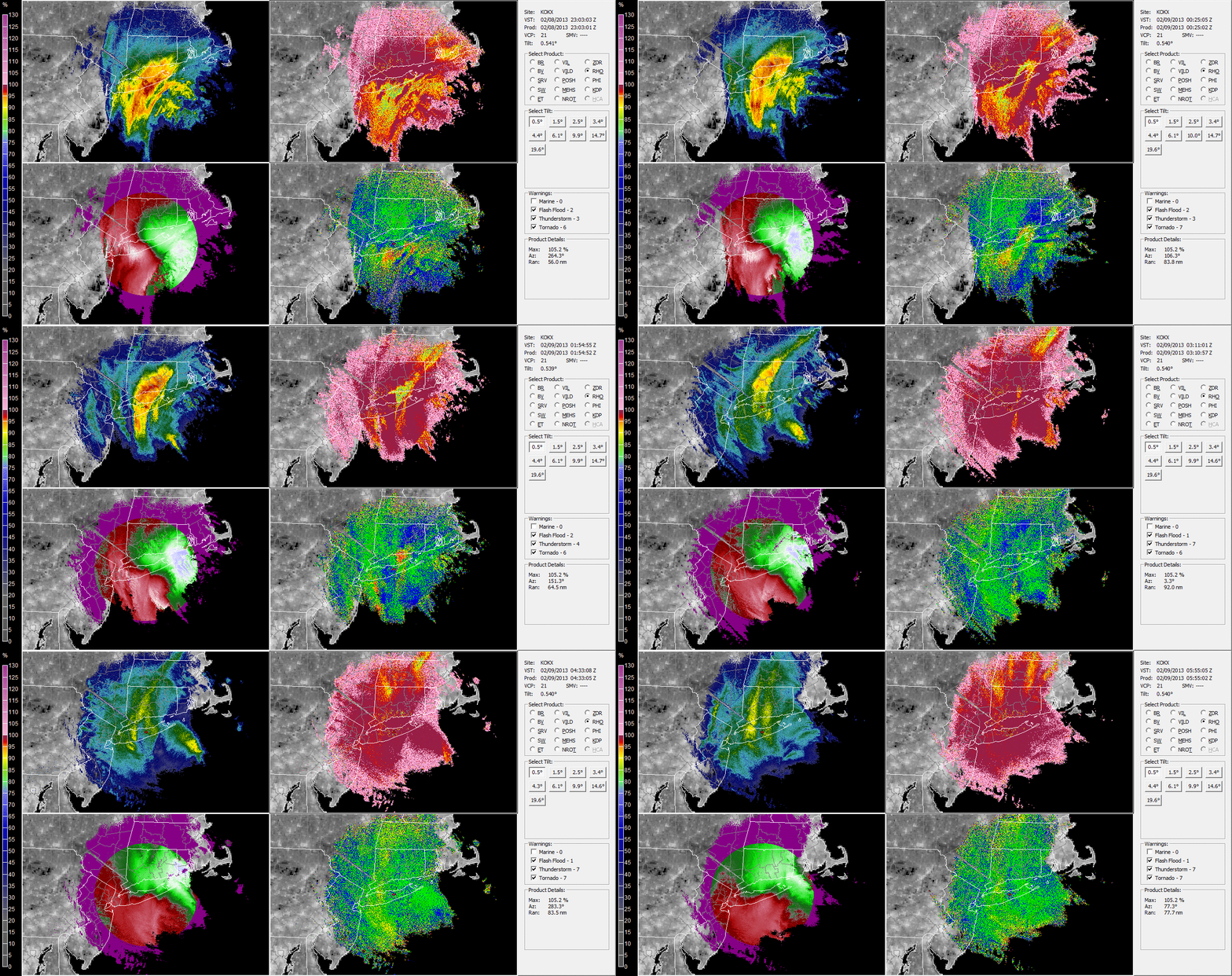
    <content type="html"><![CDATA[<p>Anyone who looked at radar animation of this past weekend&#39;s nor&#39;easter would have quickly noticed an intense precipitation band that stretched from Long Island northward into Connecticut. This band, at times, had dBZ values that were higher than 55 dBZ, and predominantly produced snow. (There are some reports that in southern Connecticut sleet or maybe small hail were also reported.) Beneath this band snowfall accumulations were upwards of 6&quot; per hour!</p>

<p>For those who did not witness this band in person, I have put together an animated gif depicting the evolution of this band. The animation begins near 23 UTC on 08 Feburary 2013 and ends 06 UTC on 09 Feburary 2013. The four panels are:</p>

<ul>
<li>  <strong>Upper Left:</strong> Lowest Tilt Base Reflectivity</li>
<li>  <strong>Upper Right:</strong> Lowest Tilt Correlation Coefficient</li>
<li>  <strong>Lower Left:</strong> Lowest Tilt Base Velocity</li>
<li>  <strong>Lower Right:</strong> Lowest Tilt ZDR</li>
</ul>

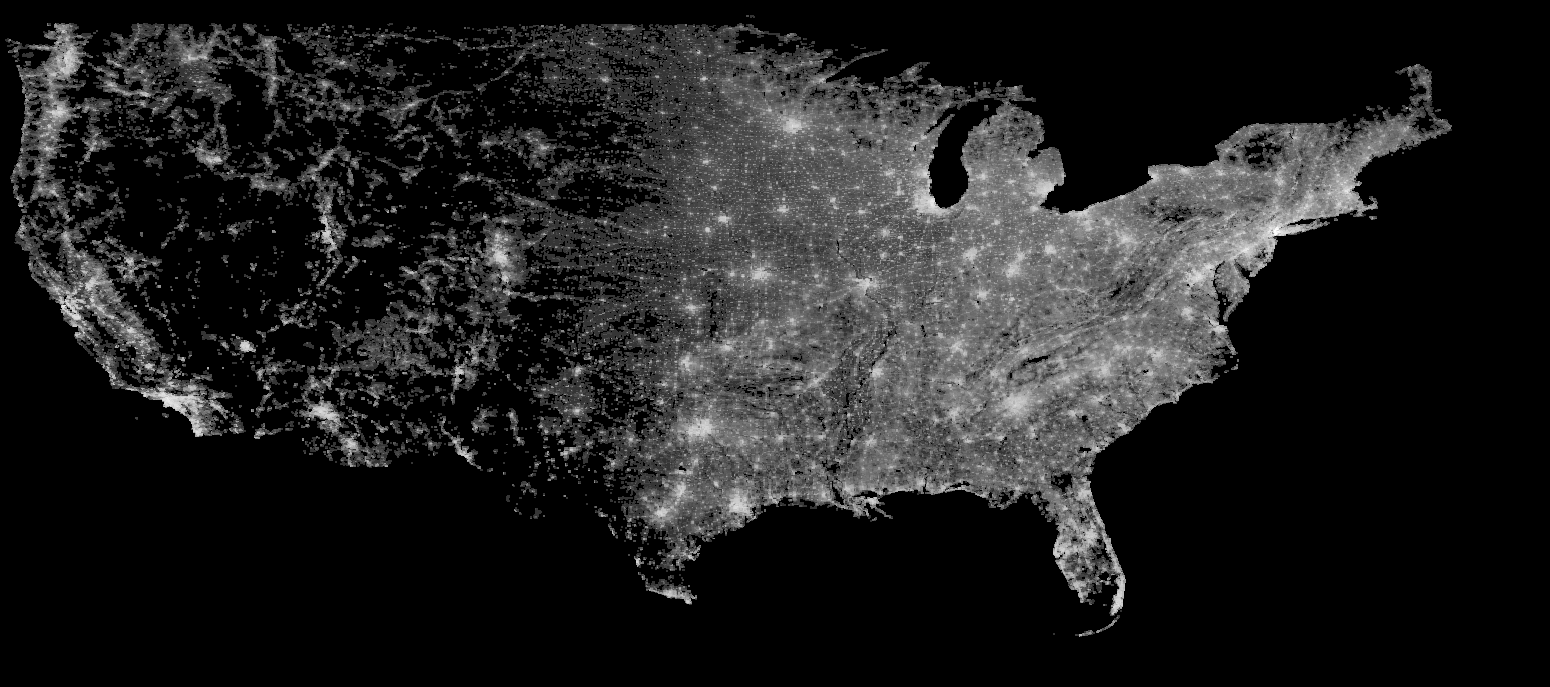
<p>You may recognize the background. It&#39;s the black and white version of the GRx Population Backgrounds, which were announced in <a href="http://www.pmarshwx.com/blog/2013/01/12/population-density-background-maps-for-grx-radar-viewers/">this post</a>.</p>

<p><a href="http://www.pmarshwx.com/imgs/2013/20130208_blizzard.gif" title="Radar Animation of the 08-09 Feburary 2013 Nor&#39;easter"><img class="center" src="http://www.pmarshwx.com/imgs/2013/20130208_blizzard_small.gif" width="400" title="Radar Animation of the 08-09 Feburary 2013 Nor'easter" ></a></p>

<p>For a larger image animation, click on the image above to get the full resolution. Warning, it&#39;s about a 22MB animation!</p>
]]></content>
  </entry>
  
  <entry>
    <title type="html"><![CDATA[Population Density Background Maps for GRx Radar Viewers]]></title>
    <link href="http://www.pmarshwx.com/blog/2013/01/12/population-density-background-maps-for-grx-radar-viewers/"/>
    <updated>2013-01-12T00:00:00-06:00</updated>
    <id>http://www.pmarshwx.com/blog/2013/01/12/population-density-background-maps-for-grx-radar-viewers</id>
    <content type="html"><![CDATA[<p>Tonight I created a couple of Gibson Ridge Radar Viewer backgrounds that display the 2010 population data on a 5km grid. You can see a color and black and white version below. Since the background images are actually displaying interesting data, I’ve also provided a colorbar for both of these images. The color curve is logarithmic.</p>

<p><a href="http://www.pmarshwx.com/imgs/2013/colorpop.png"><img class="center" src="http://www.pmarshwx.com/imgs/2013/colorpop.png" width="400" title="GRx Background Population Density Map (color)" ></a>
<a href="http://www.pmarshwx.com/imgs/2013/colorcbar.png"><img class="center" src="http://www.pmarshwx.com/imgs/2013/colorcbar.png" width="400" title="GRx Background Population Density Map Colorbar (color)" ></a></p>

<p>and</p>

<p><a href="http://www.pmarshwx.com/imgs/2013/bwpop.png"><img class="center" src="http://www.pmarshwx.com/imgs/2013/bwpop.png" width="400" title="GRx Background Population Density Map (black and white)" ></a>
<a href="http://www.pmarshwx.com/imgs/2013/bwcbar.png"><img class="center" src="http://www.pmarshwx.com/imgs/2013/bwcbar.png" width="400" title="GRx Background Population Density Map Colorbar (black and white)" ></a></p>

<p>You can see what they look like in GR by looking at <a href="https://twitpic.com/show/iphone/buovtn">this</a> and <a href="https://twitpic.com/show/iphone/buoxs9">this</a>. If you would like to download these background images, you can get the <a href="http://grx.forwarn.org/backgrounds/color_popdensity.zip" title="Color Population Background">color version here</a> and the <a href="http://grx.forwarn.org/backgrounds/bw_popdensity.zip" title="Black and White Population Background">black and white version here</a>.</p>

<p>To install, you will need to:</p>

<ol>
<li> Start GR</li>
<li> Click on “GIS” in the menu across the top</li>
<li> Click on “Setting” in the resulting drop-down menu</li>
<li> Click on “Backgrounds…” in the resulting drop-down menu</li>
<li> Select the file you downloaded. (You will need to unzip the zip file if you haven’t already.)</li>
<li> Enter the longitude and latitude values for the various corners. These are:

<ul>
<li><strong>Left Lon:</strong> -125.</li>
<li><strong>Right Lon:</strong> -63.</li>
<li><strong>Bottom Lat:</strong> 22.5</li>
<li><strong>Top Lat:</strong> 50.</li>
</ul></li>
<li> Select “OK”</li>
</ol>

<p>If you like these, please let me know!</p>
]]></content>
  </entry>
  
  <entry>
    <title type="html"><![CDATA[Climatological Estimates and Evolution of Local Daily Severe Weather Probabilities: Part 3]]></title>
    <link href="http://www.pmarshwx.com/blog/2012/11/30/climatological-estimates-and-evolution-of-local-daily-severe-weather-probabilities-part-3/"/>
    <updated>2012-11-30T00:00:00-06:00</updated>
    <id>http://www.pmarshwx.com/blog/2012/11/30/climatological-estimates-and-evolution-of-local-daily-severe-weather-probabilities-part-3</id>
    <content type="html"><![CDATA[<p>For the final post (at least for now) in this sequence of estimating the climatological probability of an occurrence of some sort of severe weather phenomena, I turn my attention to day 1 severe weather outlooks from the Storm Prediction Center.</p>

<p>I used a similar method as with the previous graphics, however, because the severe weather outlooks are larger in size than severe weather reports, I used a smaller spatial smoother. (In fact, you can do the analysis without using a spatial smoother, but the probability edges are jagged.) The spatial smoother is 80km, and affects the resulting probability magnitudes by less than 1% for slight risks.</p>

<p>For more animations, check out the <a href="http://www.pmarshwx.com/blog/2012/09/15/understanding-tornado-risk/">original post</a>, the <a href="http://www.pmarshwx.com/blog/2012/11/29/climatological-estimates-and-evolution-of-local-daily-severe-weather-probabilities-part-1/">“non-significant” severe</a> first post in this series, or the <a href="http://www.pmarshwx.com/blog/2012/11/29/climatological-estimates-and-evolution-of-local-daily-severe-weather-probabilities-part-2/">&quot;significant severe&quot;</a> second post! As with the previous graphics, the raw images should become available on the <a href="http://www.spc.noaa.gov" title="Storm Prediction Center">Storm Prediction Center’s website</a> in the coming weeks.</p>

<p>Because the image quality is a bit degraded in the animations, the color scales for each animation are listed below.</p>

<div style='text-align: center;'>
  <div class="embed-video-container"><iframe src="http://www.youtube.com/embed/ZeyMySucADA "></iframe></div>
  <strong>Slight Risk (or greater):</strong> 5%, 10%, 15%, 20%, 25%, 30%, 35%, 40+%

  <div class="embed-video-container"><iframe src="http://www.youtube.com/embed/0jpL9cyYdsE "></iframe></div>
  <strong>Moderate Risk (or greater):</strong> 1.00%, 2.00%, 3.00%, 4.00%, 5.00%, 6.00%, 7.00%, 8.00+%

  <div class="embed-video-container"><iframe src="http://www.youtube.com/embed/zLGkOdsNr1w "></iframe></div>
  <strong>High Risk:</strong> 0.05%, 0.1%, 0.25%, 0.40%, 0.55%, 0.70%, 0.85%, 1.00+%
</div>
]]></content>
  </entry>
  
  <entry>
    <title type="html"><![CDATA[Climatological Estimates and Evolution of Local Daily Severe Weather Probabilities: Part 2]]></title>
    <link href="http://www.pmarshwx.com/blog/2012/11/29/climatological-estimates-and-evolution-of-local-daily-severe-weather-probabilities-part-2/"/>
    <updated>2012-11-29T00:00:00-06:00</updated>
    <id>http://www.pmarshwx.com/blog/2012/11/29/climatological-estimates-and-evolution-of-local-daily-severe-weather-probabilities-part-2</id>
    <content type="html"><![CDATA[<p>I’ve now uploaded the animations of estimates climatological probabilities of F/EF-1 or greater tornadoes, Hail 1″ or greater, and significant severe weather. The probabilities are estimated from the 30 year period of 1982-2011. Probability animations exist for tornadoes, hail, wind, and any severe. For more information check out the <a href="http://www.pmarshwx.com/blog/2012/09/15/understanding-tornado-risk/">original post</a> or the post on the <a href="http://www.pmarshwx.com/blog/2012/11/29/climatological-estimates-and-evolution-of-local-daily-severe-weather-probabilities-part-1/">“non-significant” severe</a>! The raw images should become available on the <a href="http://www.spc.noaa.gov" title="Storm Prediction Center">Storm Prediction Center’s website</a> in the coming weeks.</p>

<p>Because the image quality is a bit degraded in the animations, the color scales for each animation are listed below.</p>

<div style="text-align: center;">
  <div class="embed-video-container"><iframe src="http://www.youtube.com/embed/EpzUZM39-Kw "></iframe></div>
  <strong>Any Significant Severe:</strong> 0.10%, 0.25%, 0.50%, 0.75%, 1.00%, 1.25%, 1.50%, 1.75+%

  <div class="embed-video-container"><iframe src="http://www.youtube.com/embed/pCdR9kpQyuA "></iframe></div>
  <strong>F/EF-1+ Tornado:</strong> 0.02%, 0.10%, 0.20%, 0.30%, 0.40%, 0.50%, 0.60%, 0.70+%

  <div class="embed-video-container"><iframe src="http://www.youtube.com/embed/QNiK5JXc_Kc "></iframe></div>
  <strong>Significant (F/EF-2+) Tornado:</strong> 0.01%, 0.05%, 0.10%, 0.15%, 0.20%, 0.25%, 0.30%, 0.35+%

  <div class="embed-video-container"><iframe src="http://www.youtube.com/embed/IFNUcx0gZWA "></iframe></div>
  <strong>Significant (64kt+) Wind:</strong> 0.05%, 0.10%, 0.20%, 0.30%, 0.40%, 0.50%, 0.60%, 0.70+%

  <div class="embed-video-container"><iframe src="http://www.youtube.com/embed/KADX6Pvq8OU "></iframe></div>
  <strong>1″+ Hail:</strong> 0.10%, 0.50%, 0.75%, 1.00%, 2.00%, 3.00%, 4.00%, 5.00+%

  <div class="embed-video-container"><iframe src="http://www.youtube.com/embed/ViQwXM6lLOM "></iframe></div>
  <strong>Significant (2″+) Hail:</strong> 0.05%, 0.10%, 0.20%, 0.40%, 0.60%, 0.80%, 1.00%, 1.20+%
</div>
]]></content>
  </entry>
  
  <entry>
    <title type="html"><![CDATA[Climatological Estimates and Evolution of Local Daily Severe Weather Probabilities: Part 1]]></title>
    <link href="http://www.pmarshwx.com/blog/2012/11/29/climatological-estimates-and-evolution-of-local-daily-severe-weather-probabilities-part-1/"/>
    <updated>2012-11-29T00:00:00-06:00</updated>
    <id>http://www.pmarshwx.com/blog/2012/11/29/climatological-estimates-and-evolution-of-local-daily-severe-weather-probabilities-part-1</id>
    <content type="html"><![CDATA[<p>I’ve cleaned up and finally uploaded the animations of estimates climatological probabilities of severe weather. The probabilities are estimated from the 30 year period of 1982-2011. Probability animations exist for tornadoes, hail, wind, and any severe. For more information check out the <a href="http://www.pmarshwx.com/blog/2012/09/15/understanding-tornado-risk/">original post</a>! The raw images should become available on the <a href="http://www.spc.noaa.gov" title="Storm Prediction Center">Storm Prediction Center’s website</a> in the coming weeks.</p>

<p>Because the image quality is a bit degraded in the animations, the color scales for each animation are listed below.</p>

<div style="text-align: center;">
  <div class="embed-video-container"><iframe src="http://www.youtube.com/embed/f27ALl0CbCU "></iframe></div>
  <strong>Any Severe:</strong> 0.25%, 1.00%, 2.00%, 3.00%, 4.00%, 5.00%, 6.00%, 7.00%, 8.00+%

  <div class="embed-video-container"><iframe src="http://www.youtube.com/embed/rwcQgXjjTbA "></iframe></div>
  <strong>Tornado:</strong> 0.10%, 0.20%, 0.40%, 0.60%, 0.80%, 1.00%, 1.20%, 1.40+%

  <div class="embed-video-container"><iframe src="http://www.youtube.com/embed/MMNji-sswm8 "></iframe></div>
  <strong>Wind:</strong> 0.25%, 1.00%, 2.00%, 3.00%, 4.00%, 5.00%, 6.00%, 7.00+%

  <div class="embed-video-container"><iframe src="http://www.youtube.com/embed/WSQzOTtlKy8 "></iframe></div>
  <strong>Hail:</strong> 0.25%, 1.00%, 2.00%, 3.00%, 4.00%, 5.00%, 6.00%, 7.00+%
</div>
]]></content>
  </entry>
  
  <entry>
    <title type="html"><![CDATA[Playing with Data]]></title>
    <link href="http://www.pmarshwx.com/blog/2012/10/11/playing-with-data/"/>
    <updated>2012-10-11T00:00:00-05:00</updated>
    <id>http://www.pmarshwx.com/blog/2012/10/11/playing-with-data</id>
    <content type="html"><![CDATA[<p>The past few months I’ve called my blog “Fighting Hyperbole with Data”. This was a nod toward the reputation I cultivated of “poking the bear with a stick”. Admittedly, that reputation was a bit of hyperbole in and of itself, an irony that was not lost on me. I went ahead and left the title as it was because I liked the idea of being someone who remained above the hype and focused solely on the data. I <a href="http://www.pmarshwx.com/blog/2012/04/22/attempts-at-assessing-chaser-contributions-to-the-warning-process/">didn’t always adhere to these principles</a>, but when I veered off track, or made a mistake, I always tried to be open, honest, and <a href="http://www.pmarshwx.com/blog/2012/04/26/comments-on-attempts-at-assessing-chaser-contributions-to-the-warning-process/">admit/correct the mistake.</a> That’s the way blogs work; they are built on trust between the author and the reader. Readers implicitly trust authors that what they are reading is factual; authors trust that readers will appreciate their work, share the information with friends when something is of interest, and refrain from passing off the work as someone else’s.</p>

<p>To this end, I’ve decided to rename the blog to simply “<strong>Playing with Data</strong>“. It’s a better description of what I do and, more importantly, what I want this blog to be. I like data. I play with data. I enjoy data. Data are everywhere and offer insights into a world of chaos. All it takes is time to learn the tools necessary to peel back the layers of obfuscation. Our world is full of information just waiting to be discovered or put into context. This is my underlying motivation for becoming a scientist. A fundamental curiosity of what I don’t know or don’t understand.</p>

<p>Readers may have noticed that some of my more recent work (figures) have my name and a link to the website embedded in them. This is in response to a alarming increase in the number of instances of seeing my work used without permission and without attribution. I’ve wrestled with this a lot of late. I don’t mind people sharing my work as long as I get credit for the work I put into it. sharing interesting and sometimes exciting discoveries with all who care to learn and protecting my work. I try to be protective of my work because I put a lot of effort into it. I typically work 60-80 hours a week on “science”. To date, nothing to my knowledge posted on this blog is what I’m paid to do as a graduate research assistance. This means none of this work helps me get closer to graduating and that all of it is done “on the side”. Yes, I do love it, but at the same time I am working to develop my skill set in hopes maximizing my chances of future employment. I’m still a student. A student who is graduating in the next 6 months. A student who is on the job market. I post things to this blog in an effort to share information, but also to highlight my work in hopes of attracting interest from those in positions to offer me jobs (consulting or full-time). I naively thought that “branding” my work wasn’t necessary, and even presumptuous. Apparently, I’m not very good at marketing.</p>

<p>Admittedly, this has impacted my posting frequency of late. I’m much more hesitant to post things here that may be of benefit to me down the road. As a strong advocate of the <a href="http://en.wikipedia.org/wiki/Open_source" title="Open Source Model">open-source model</a> this hesitance to share work results in an internal struggle to balance sharing and protecting. I don’t suspect this struggle won’t go away any time soon, but I want to reaffirm my commitment to keeping the trust of those who read this blog. I know I don’t always perfectly adhere to my ideals; I’m learning to respond professionally when others don’t. I’ve got a ways to go, but hopefully you’ll stick around as I continue to grow as a scientist. I’m sure we’ll learn some really cool things along the way.</p>
]]></content>
  </entry>
  
  <entry>
    <title type="html"><![CDATA[Radar Analysis of a (Possible) Developing Tornado]]></title>
    <link href="http://www.pmarshwx.com/blog/2012/09/30/radar-analysis-of-a-possible-developing-tornado/"/>
    <updated>2012-09-30T00:00:00-05:00</updated>
    <id>http://www.pmarshwx.com/blog/2012/09/30/radar-analysis-of-a-possible-developing-tornado</id>
    <content type="html"><![CDATA[<p>This afternoon a thunderstorm over southern Mississippi underwent an evolution that is often associated with tornado occurrence in thunderstorms. Whether or not a tornado developed remains to be seen, but the radar evolution was fairly classic. What do I mean?</p>

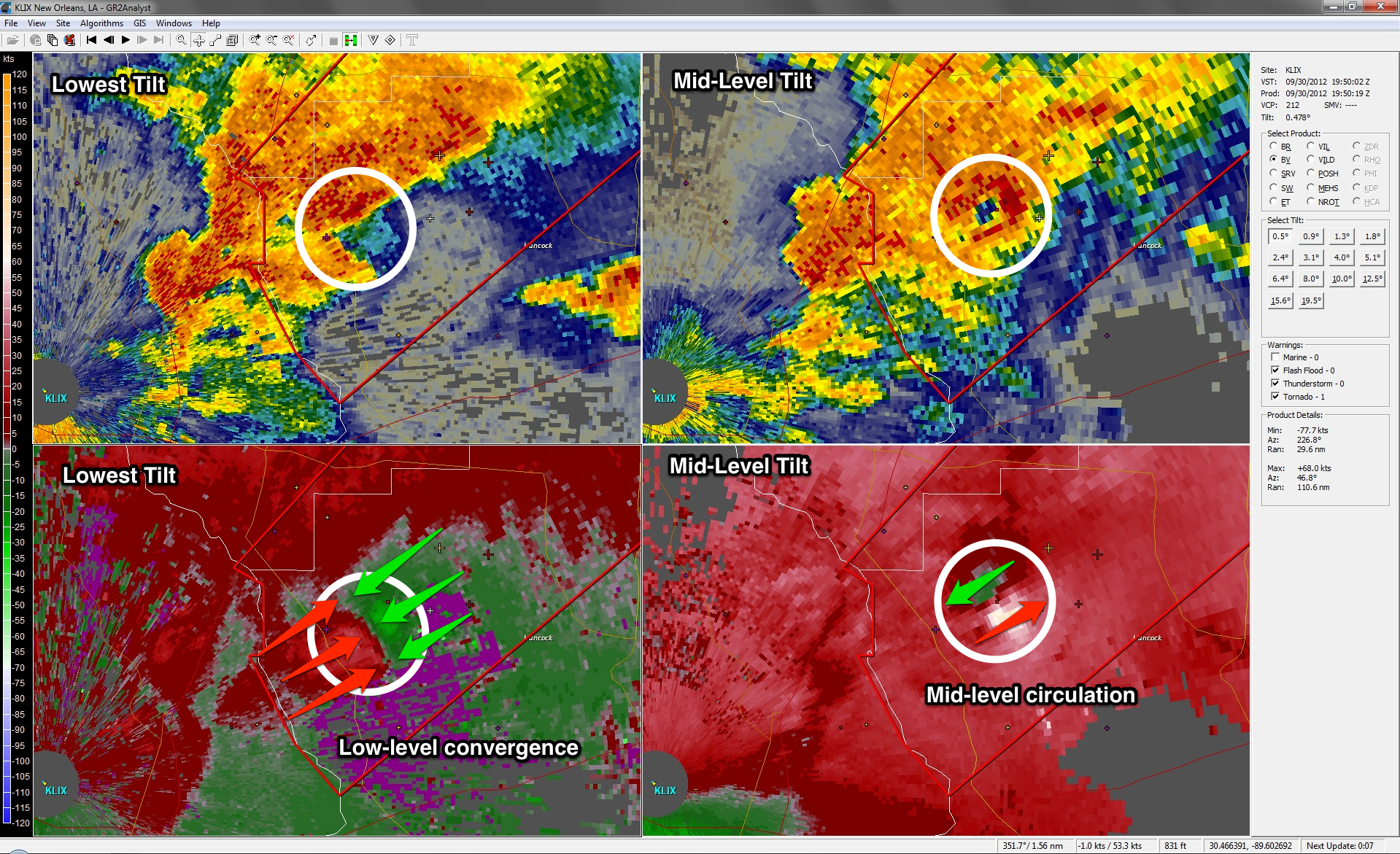
<p><a href="http://www.pmarshwx.com/imgs/2012/developing_tornado.png" title="Developing Tornado"><img class="center" src="http://www.pmarshwx.com/imgs/2012/developing_tornado.png" width="400" title="Developing Tornado" ></a></p>

<p>Consider the image above. The left panels are from the radar’s lowest tilt and the panels on the right are from a mid-level tilt. The top panels are radar reflectivity (which is what you typically see on television) and the bottom panels are of the doppler velocity (i.e., the wind speed and direction in a radial sense [towards or away from the radar]). [For orientation purposes, the radar site is located in the bottom left of the image, green values (in the velocity panels) are toward the radar, and red values (in the velocity panels) are away from the radar.] The mid-level pattern is similar to what one might conceptually think about with respect to identifying possible tornadoes on radar, meaning that a rotation signature is present. However, examining the lower-level tilts, we fail to find a rotational signature. Does this mean there is no tornado? Well, not-exactly…</p>

<p>Before continuing, let’s remind ourselves that a tornado is an extension of a thunderstorm’s updraft. By definition, an updraft is a area where air is ascending. Furthermore, the mass continuity equation dictates that if air is rising, there must be convergence at the base of the updraft. This means that in the presence of a developing tornado, you may not find a rotational couplet; instead you might find a convergent signature, which is exactly what we see in the radar image above.</p>

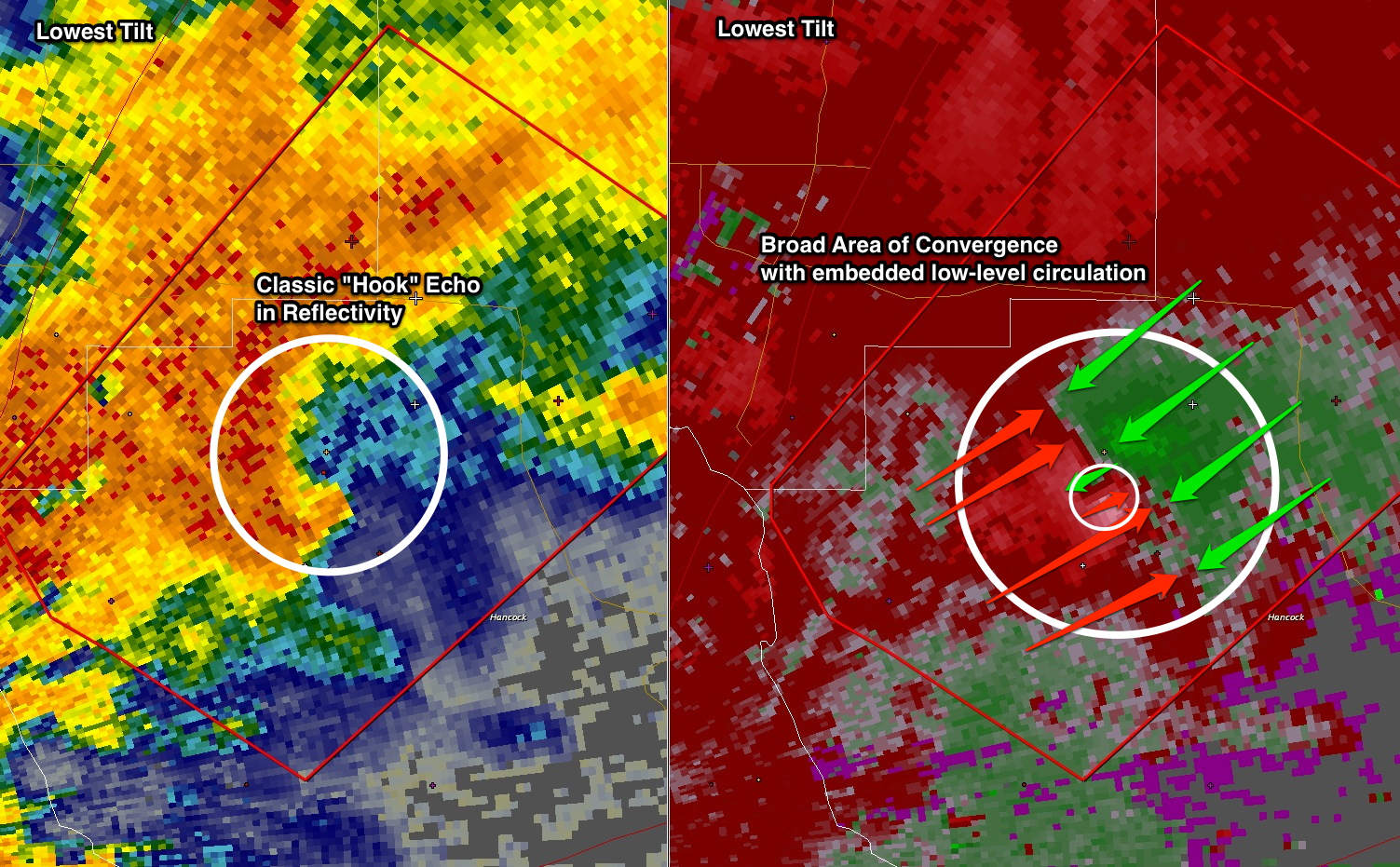
<p>In the next radar scan (shown below), as the (possible) tornado continues to develop (and move farther away from the radar site), we notice that the broad, low-level convergence still persists. However, in this scan, one can notice the addition of a rotational couplet in the midst of the broad low-level convergence. If one were to continue to follow the evolution of this (possible) tornado, one would find that the low-level rotation signature persists for several more volume scans…all in the vicinity of the broader, low-level convergence.</p>

<p><a href="http://www.pmarshwx.com/imgs/2012/tornado.png" title="Tornado"><img class="center" src="http://www.pmarshwx.com/imgs/2012/tornado.png" width="400" title="Tornado" ></a></p>

<p>So, what does this mean? <strong>When looking at radar data, it is important to examine the entire radar volume — not just the lowest tilts!</strong> Thunderstorms are very complex. What happens at low-levels typically plays a role in what happens in the upper-levels, and what happens in the upper-levels impacts what happens in the lower-levels.</p>
]]></content>
  </entry>
  
  <entry>
    <title type="html"><![CDATA[Understanding Tornado Risk]]></title>
    <link href="http://www.pmarshwx.com/blog/2012/09/15/understanding-tornado-risk/"/>
    <updated>2012-09-15T00:00:00-05:00</updated>
    <id>http://www.pmarshwx.com/blog/2012/09/15/understanding-tornado-risk</id>
    <content type="html"><![CDATA[<p>It’s been a while since I’ve written on the blog. First there was the <a href="http://hwt.nssl.noaa.gov/Spring_2012/" title="2012 Hazardous Weather Testbed Spring Forecast Experiment">2012 Hazardous Weather Testbed Spring Forecast Experiment</a> in May and June. Next. I was an invited participant at the <a href="http://www.essl.org/index.php?option=com_content&amp;view=article&amp;id=90" title="2012 European Severe Storms Laboratory Forecast Testbed">2012 European Severe Storms Laboratory Forecast Testbed</a> in mid June. To end June I spent 2 weeks as a forecaster/nowcaster in Salina, KS for the <a href="http://www.eol.ucar.edu/projects/dc3/" title="DC3 Field Experiment">DC3 Field Experiment</a>. In July I went to the <a href="http://conference.scipy.org/scipy2012/" title="2012 SciPy Conference">2012 SciPY Conference</a>, and in August I <a href="http://blogs.wsj.com/dispatch/2012/08/31/storm-researcher-describes-his-time-in-the-eye-of-the-storm/" title="OU SMART-R Isaac Deployment">deployed with the OU SMART-Rs</a> to collect data on the landfall of hurricane Isaac. As you can see, there wasn’t much time left for blogging.</p>

<p>Anyways, I’m pretty sure you aren’t here to read about why I haven’t posted.</p>

<p>For reasons too numerous to list here, I have been interested in understanding risks associated with high-impact weather. One particular interest of late is the debate between weather enthusiasts regarding the risk posed by tornadoes in the plains to the risk posed by tornadoes in the southeast United States. Typical arguments of risk revolve around who has the greatest number of tornadoes, which would seem relatively unambiguous. However, because of the relative rarity of tornadoes, even this is rife with controversy. Additionally, people tend to associate tornado risk/exposure based upon the ill-defined “tornado season” of the even more nebulous “Tornado Alley”.</p>

<p>Previously, Dr. Harold Brooks of the National Severe Storms Laboratory, put together time series of the annual cycles of tornado, wind, and hail probability. These time series were constructed using data from 1980-1999 and provided insight into the yearly cycle of severe convective hazards at individual locations. This allowed for assessing the risk/exposure to various convective hazards based on the actual climatology of a given area, rather than relying on the gross statistics of “Tornado Alley”. Unfortunately, Dr. Brooks’ data had not been updated to account for the additional decade of tornado data and thus was removed from the NSSL website. Updating this information has long been on my wish list; this week I decided to cross it off my wish list.</p>

<p>(Note: Dr. Brooks has since informed me that the data were removed, not because they had not been updated, but because the software broke.)</p>

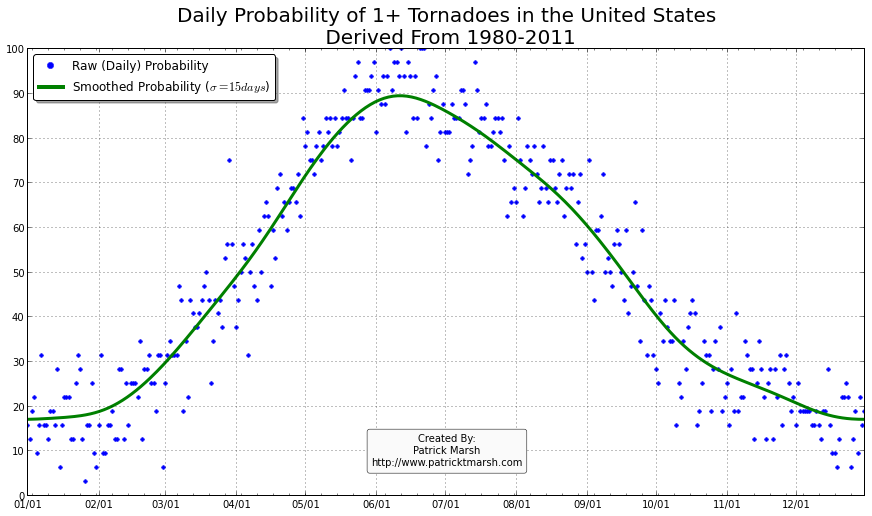
<p><a href="http://www.pmarshwx.com/imgs/tornado-probs/us-probs.png" title="United States Daily Tornado Probabilities"><img class="center" src="http://www.pmarshwx.com/imgs/tornado-probs/us-probs.png" width="400" title="US Daily Tornado Probabilities" ></a></p>

<p>The annual cycle of at least one tornado occurring the United States shows a pronounced peak in the summer months. It is my guess that “tornado season” refers to this significant uptick in US tornado probabilities, meaning we can define “tornado season” as the time period of relatively enhanced tornado probabilities. I suspect that a vast majority of people throughout the United States assume that their individual risk follows a somewhat similar distribution, albeit with smaller probabilities. Unfortunately, this is not the case. Here are the annual cycles of the probability of a tornado developing within 25 miles of a point for a smattering of locations throughout the United States that all have roughly the same overall tornado exposure:</p>

<p><strong>Plains Locations</strong></p>

<ul>
<li>  <a href="http://www.pmarshwx.com/imgs/tornado-probs/dfw-probs.png" title="DFW: Dallas-Fort Worth, TX">DFW: Dallas-Fort Worth, TX</a></li>
<li>  <a href="http://www.pmarshwx.com/imgs/tornado-probs/oun-probs.png" title="OUN: Norman, OK">OUN: Norman, OK</a></li>
<li>  <a href="http://www.pmarshwx.com/imgs/tornado-probs/ict-probs.png" title="ICT: Wichita, KS">ICT: Wichita, KS</a></li>
<li>  <a href="http://www.pmarshwx.com/imgs/tornado-probs/oma-probs.png" title="OMA: Omaha, NE">OMA: Omaha, NE</a></li>
<li>  <a href="http://www.pmarshwx.com/imgs/tornado-probs/lbb-probs.png" title="LBB: Lubbock, TX">LBB: Lubbock, TX</a></li>
<li>  <a href="http://www.pmarshwx.com/imgs/tornado-probs/ama-probs.png" title="AMA: Amarillo, TX">AMA: Amarillo, TX</a></li>
</ul>

<p><strong>Southeast Locations</strong></p>

<ul>
<li>  <a href="http://www.pmarshwx.com/imgs/tornado-probs/lzk-probs.png" title="LZK: Little Rock, AR">LZK: Little Rock, AR</a></li>
<li>  <a href="http://www.pmarshwx.com/imgs/tornado-probs/mem-probs.png" title="MEM: Memphis, TN">MEM: Memphis, TN</a></li>
<li>  <a href="http://www.pmarshwx.com/imgs/tornado-probs/jan-probs.png" title="JAN: Jackson, MS">JAN: Jackson, MS</a></li>
<li>  <a href="http://www.pmarshwx.com/imgs/tornado-probs/bmx-probs.png" title="BMX: Birmingham, AL">BMX: Birmingham, AL</a></li>
<li>  <a href="http://www.pmarshwx.com/imgs/tornado-probs/hsv-probs.png" title="HSV: Huntsville, AL">HSV: Huntsville, AL</a></li>
<li>  <a href="http://www.pmarshwx.com/imgs/tornado-probs/bna-probs.png" title="BNA: Nashville, TN">BNA: Nashville, TN</a></li>
<li>  <a href="http://www.pmarshwx.com/imgs/tornado-probs/atl-probs.png" title="ATL: Atlanta, GA">ATL: Atlanta, GA</a></li>
<li>  <a href="http://www.pmarshwx.com/imgs/tornado-probs/rdu-probs.png" title="RDU: Raleigh, NC">RDU: Raleigh, NC</a></li>
</ul>

<p>As you can see, not every location has a single peak probability in the late spring into early summer. So called “tornado season” varies from location to location, even though the yearly risk/exposure (area under the green curve) are similar. The annual cycles are sorted into two groups to illustrate that the annual cycles for locations in the plains are different from those in the southeast. In the plains, the annual cycles have one predominant peak probability (which roughly corresponds with the US peak probability), indicating a well-defined “tornado season”. In the southeast there are multiple peaks — albeit each one smaller than those seen in the plains — but the off-peak probabilities are typically greater than the off-peak probabilities in the plains.</p>

<p>So what does this all mean? <strong>One’s climatological exposure to tornadoes is geographically-dependent.</strong> Another way to say this: <strong>“Tornado season” in the southeast US is fundamentally different than “tornado season” in the plains.</strong> Persons located in the plains have a greater risk of a tornado developing within 25 miles of their location in the spring than they do any other time of the year. Persons located in the southeast have a relative small increase in probability in the spring/summer, but must be on guard all year as the climatological probability of a tornado never really approaches 0.</p>

<div style="padding-top:50px">
  <strong>Update 2: Here is a video of the daily probabilities for the entire US. Please note that the standard resolution video is a bit degraded. For more clarity, please switch to the HD version.</strong>
</div>

<div class="embed-video-container"><iframe src="http://www.youtube.com/embed/rwcQgXjjTbA "></iframe></div>
]]></content>
  </entry>
  
  <entry>
    <title type="html"><![CDATA[NWS Verification: A Lesson in Gaming the System]]></title>
    <link href="http://www.pmarshwx.com/blog/2012/07/02/nws-verification-a-lesson-in-gaming-the-system/"/>
    <updated>2012-07-02T00:00:00-05:00</updated>
    <id>http://www.pmarshwx.com/blog/2012/07/02/nws-verification-a-lesson-in-gaming-the-system</id>
    <content type="html"><![CDATA[<p>As I write this quick post, a <a href="https://twitpic.com/a39ks6/full" title="Bow Echo">strong bow-echo</a> is racing across northern Minnesota and northern Wisconsin. The National Weather Service Forecast Office in Duluth, MN issued several large warnings (<a href="http://mesonet.agron.iastate.edu/vtec/#2012-O-NEW-KDLH-SV-W-0085/USCOMP-N0Q-201207030125" title="3rd largest NWS warning">3rd largest NWS warning</a> and <a href="http://mesonet.agron.iastate.edu/vtec/#2012-O-NEW-KDLH-SV-W-0087/USCOMP-N0Q-201207030210" title="9th largest NWS warning">9th largest NWS warning</a>) for the areas along and ahead of the approaching bow echo. I’ll leave the debate over whether issuing such large warnings are good for service to a later date.</p>

<p>Instead, I want to take a quick moment to highlight what I perceive to be a deficiency in how the NWS does it’s verification. This deficiency actually rewards forecasters for issuing larger warnings, such as those issued tonight by NWS Duluth. Consider the three warnings below, all which were valid at the same time.</p>

<p><a href="http://www.pmarshwx.com/imgs/2012/hypo_verif.png" title="Hypothetical Verification"><img class="center" src="http://www.pmarshwx.com/imgs/2012/hypo_verif.png" width="400" title="Hypothetical Verification" ></a></p>

<p>First, let’s assume that a severe weather report occurs in the domain shown at the time this image was taken. Next, let’s assume that a severe weather report occurs at any of the areas denoted with a “1″. In this case the single storm report verifies the single warning that contains the report. However, if a severe weather report occurs at any of the areas denoted with a “2″, that single report verifies both warnings that contain the report. Thus, a single report verifies two warnings! Now, consider the scenario in which a single severe weather report occurrs at location identified with a “3″. In this case, the single report would verify all three warnings that contains that single report!</p>

<p>So, what does this mean? The larger a warning, the more area in which a report can occur to verify the entire warning. Furthermore, if warnings overlap each other, a single report can verify multiple warnings. Thus, in terms of determining the NWS’s/office’s/forecaster’s verification scores, each are actually rewarded for engaging in this practice. <strong>Now, I’m not a NWS forecaster, nor have I ever been. I cannot say (and highly doubt) that gaming the verification system is consciously thought of in the heat of the warning process.</strong> However, it highlights what I consider a short-coming of the NWS’ verification process; one that rewards larger warnings in a time in which <a href="http://www.nws.noaa.gov/sbwarnings/" title="Storm Based Warnings">storm-based warnings were designed to promote smaller warnings</a>.</p>
]]></content>
  </entry>
  
  <entry>
    <title type="html"><![CDATA[Comments on "Attempts at Assessing Chaser Contributions to the Warning Process"]]></title>
    <link href="http://www.pmarshwx.com/blog/2012/04/26/comments-on-attempts-at-assessing-chaser-contributions-to-the-warning-process/"/>
    <updated>2012-04-26T00:00:00-05:00</updated>
    <id>http://www.pmarshwx.com/blog/2012/04/26/comments-on-attempts-at-assessing-chaser-contributions-to-the-warning-process</id>
    <content type="html"><![CDATA[<p>If you’ve visited this website in the past week, chances are you were here to read and/or comment on the blog post <a href="http://www.pmarshwx.com/blog/2012/04/22/attempts-at-assessing-chaser-contributions-to-the-warning-process/">Attempts at Assessing Chaser Contributions to the Warning Process</a>. Wow. Talk about a passionate response — on all sides! That entry has prompted the biggest response, in terms of comments, in quite some time. I have read every comment posted, but am too busy preparing for the Hazardous Weather Testbed’s Experimental Forecast Program to post a long response to every one. Instead I thought I would act as my own <a href="http://en.wikipedia.org/wiki/Ombudsman" title="Ombudsman">ombudsman</a> and address some of the reoccurring themes that keep appearing in the aforementioned post’s comments.</p>

<p>When reading below, one may ask themselves why I haven’t removed the offending post. The reason is multi-faceted. First, as soon as I do that I subject myself to (in my opinion) a more severe criticism of writing somewhat of a hit piece and then taking it down when I didn’t like the response. I personally do not think that is right and so in that regard, the post must stay. If I’m going to write something that I know is going to be controversial, I must be prepared to accept the negative comments that result. My philosophy is that as long as a comment is not spam, not profane, nor attacking myself or others personally, I’ll never remove it. No matter how much I may disagree, it is only in hearing all sides of an issue that I can expand my horizons. Secondly, there have been some good discussions that have resulted from the post, both for my position and against it. As long as these conversations refrain from snarks, I see no reason why they should not be allowed to be seen.</p>

<p>Now, for my thoughts on the post…</p>

<p>Let me begin by saying that this certainly was not my best post in terms of scientific content. I made a fundamental flaw in the post that quite a few commenters picked up on, and I’ll admit that I did it. <strong>No matter what these data presented suggest, they cannot prove one way or another the intention of a person.</strong> At best, with better data than presented, one might be able to assess chaser impact, but not motives. I tried to be cognizant of this fact in some aspects of the blog post (such as not titling the post some variant on “Are Chasers Chasing to Save Lives”), but failed miserably in others (using the data shown to justify the line “Please don’t insult my intelligence by claiming to chase to ‘save lives’.”). This is something I must make sure I do not do again, and if I do, I trust you will hold me accountable.</p>

<p>Next, some commenters accused me of doing “bad science”. In response to at least one of these comments I responded that I never claimed to be doing science. However, after a couple days of thinking about this issue I believe that the original comment and my response both miss the point. This isn’t “bad science”, nor is it “not science”. It’s “unfinished science”. If I left things as is, said that the matter was closed, and closed my mind to differing points of view, then it most certainly would be “bad science”. Instead, I tried to go out of my way to imply that my view points were far from definitive. I wrote things such as “circumstantial evidence”, “Attempts at Assessing”, and “To summarize, I believe…”. I posted these ideas on a blog website, not a scientific journal for a reason, they are initial ideas and certainly would not hold up in a court of law nor a scientific journal.</p>

<p>What the post tried to do, and admittedly failed miserably at doing, was <em>attempt</em> to objectively assess the contributions chasers have to the warning process. I put forth an idea, people attacked it and poked holes in it. If I am to act like the scientist I would like to think I am, I should not take these criticisms personally, but rather use them to continue to evaluate my idea(s), refine the idea(s), and try again. <strong>This is how science is supposed to work!</strong> At the end of the process the final idea(s) will be stronger and more refined than anything initially proposed.</p>

<p>Assessing chaser impact on the warning process is an extremely complex problem as there are many variables and many signals. As several commenters suggest, I did allow myself to fall into the “confirmation bias” trap — I saw what I wanted from irrelevant and/or inconclusive data. But, by putting my thoughts out in the open, people were quick to point out the idea’s flaws, which will allow me (in time) to do better analyses with differing datasets and strengthen my position. Again, this is how I believe science should work. Putting this data and ideas on the website wasn’t the mistake, but intertwining my personal opinions so strongly was. And for that, I do have regrets; I’ll be better about that moving forward.</p>

<p>However, removing my personal beliefs, this is the first attempt, to my knowledge, that tries to objectively assess the contributions chasers have on the warning process. Due to the complex nature of the problem, and the fact I did this as sort of a “back-of-the-envelope” calculation, I merely looked at aggregate measures using simple NWS performance metrics. Possible ideas that could be done were suggested in the comments, and when I have time, I’ll certainly try and investigate some of these. (Aside, if a reader would like to do this, I’m more than happy to share my datasets.) There are a lot of other potential impacts, both negative and positive, that need to be assessed as well. As it stands now, a lot of anecdotal stories are offered by those on either side of this issue, but do we really have any idea what the actual impact is? From a chaser point of view, being able to demonstrate a positive impact in the warning process could help counter the negative perceptions current circulating in several news outlets and improve interactions with emergency response officials. From an emergency response official perspective, knowing chaser impacts might lead to a new respect for chasers, or more clout in trying to regulate them. But then again, maybe both sides would rather not know…</p>

<p>None of the comments have changed my underlying assumptions that <strong>most</strong> chasers chase for personal reasons, not the noble reasons of saving lives and doing it for the NWS often offered by chasers when interviewed by the media. However, we are (I am?) a long ways off from being able to assess this objectively. My previous post was a first attempt at this. I’m sure it won’t be my last. And I’m sure that there will always be someone out there challenging my views. That’s the way it is supposed to be.</p>
]]></content>
  </entry>
  
  <entry>
    <title type="html"><![CDATA[Tornado Warning Seminar]]></title>
    <link href="http://www.pmarshwx.com/blog/2012/04/24/tornado-warning-seminar/"/>
    <updated>2012-04-24T00:00:00-05:00</updated>
    <id>http://www.pmarshwx.com/blog/2012/04/24/tornado-warning-seminar</id>
    <content type="html"><![CDATA[<p><a href="http://www.pmarshwx.com/imgs/2012/tor_poly.png" title="Yearly Mean Gridded Tornado Warnings (2002-2011)"><img class="center" src="http://www.pmarshwx.com/imgs/2012/tor_poly.png" width="400" title="Gridded Tornado Warnings" ></a></p>

<div style="padding:5px 20px 35px 20px; text-align:justify; font-size: 9pt;">
  FIG 1: Yearly Mean Tornado Warnings on a 1KM grid derived from the 10-year period 2002 through 2011. Only polygon coordinates were used. (Note: This figure is not shown in the presentation. The figures shown in the presentation are divided based on the Storm-Based Warning switch date: 01 October 2007.)
</div>

<p>Today I gave a version of my presentation on Tornado Warnings. This presentation was originally given <a href="http://www.pmarshwx.com/2012/03/weather-ready-nation-my-conversation/" title="Weather Ready Nation: My Conversation">earlier this month</a> at the University of Alabama at Huntsville. We recorded today’s presentation so that others could see it, but I will warn you that my delivering the presentation this time did not go as smoothly as it did in Huntsville. (I stumbled over my words a couple of times and missed a few points I wanted to make.) But as a good sport, and someone who wants to see the conversation continue, I’m posting the link to the recording so that others may watch it and contribute feedback on what they thought.</p>

<p>When watching the presentation, a couple of questions I would love for you to keep in mind:</p>

<ul>
<li>  <strong>I am not an operational forecaster. No matter what I may say; no matter what I may think, I have never been in the position of actually having to issue a warning. Until I am in that position, everything I say should be considered my opinion. This seminar is in no way an attack on operational forecasters. They do a tremendous job under extremely stressful situations. This seminar is aimed at fostering a discussion on policy, not on specific actions a forecaster should or should not take.</strong></li>
<li>  Current Tornado Warning metrics center around Probability of Detection, False Alarm Ratio, and other contingency table measures. However, not every detection and not every false alarm are created equal. Are there better metrics that could be used to measure tornado warning performance? If so, what would they look like?</li>
<li>  As mentioned above, not all false alarms are created equal. Furthermore, issues such as areas within the warning not being impacted by a severe event and broadcast meteorologists interrupting regular programming to cover warnings within demographic areas all give rise to the notion of perceived false alarm ratio. How can we adequately measure this, and maybe more importantly, is there anything we as a community can do to address issues arising from this?</li>
<li>  Warning philosophies (severe and tornado) vary from office to office, leading to the sometimes asked question, “Do we have a single National Weather Service or 122 Local Weather Services?” Are these differing warning philosophies a good thing or a bad thing? If it is a good thing, how can we better communicate the different philosophies to users, or is that even necessary? If it is a bad thing, how do determine which philosophy(ies) do we standardize around? Or, is there a third option here that we’re (I’m) missing?</li>
<li>  Should warnings be meteorology centric or people centric? Although population centers appear to show up in the datasets, is this a reflection of being people centric or merely a reflection that radar locations tend to be co-located with population centers and our understanding of thunderstorm phenomena are inherently tied to radars?</li>
<li>  Instead of moving toward an <a href="http://www.crh.noaa.gov/images/crh/briefings/pdfs/2012ImpactBasedExperimentalProductCRH3.pdf" title="Impact Based Warning">Impact Based Warning</a> paradigm, or a tiered warning paradigm, is it time to consider including probabilities or other means of communicating certainty/uncertainty information into the warning process? If so, how do we go about doing this in a manner that does not leave the users of these products behind? In other words, how do we move toward an uncertainty paradigm in which average citizens can understand?</li>
</ul>

<p>I firmly believe that the warning system in place has undoubtedly saved thousands of lives throughout it’s history. However, I do believe that it has problems and stands to be improved. However, I cannot put into words what the problem(s) is(are). I believe that it will require community efforts to address these problems. This includes all of the severe weather community: research meteorologists, operational meteorologist, NWS management, emergency managers, broadcast meteorologists, and, maybe the most overlooked piece, social scientists.</p>

<p>Lastly, I must apologize to Greg Blumberg for coming across much harsher than I intended to when addressing a comment he made during the presentation. My response was intended in jest since I know Greg, but that didn’t come across to everyone in the audience, which tells me I shouldn’t have said it. Greg, my sincerest apologies, and I hope you understand that my response was entirely in jest.</p>

<p>With that said, I hope you enjoy the presentation, and I look forward to hearing your ideas!</p>

<div style="padding:20px 0px 20px 0px; text-align: center; font-size: 18pt;">
  <a title="Tornado Warnings: Past, Present, Future" href="http://stream1.nwc.ou.edu:8080/ess/echo/presentation/f3954a05-8675-4e67-a874-ad0958495825">Tornado Warnings: Past, Present, Future</a>
</div>

<div style="padding:20px 0px 20px 0px; text-align: center; font-size: 14pt;">
  <a title="Tornado Warnings: Past, Present, Future" href="http://www.pmarshwx.com/research/pubs/presentations/20120424.nwcseminar.pdf" title="Tornado Warnings: Past, Present, Future">Tornado Warnings: Past, Present, Future (actual PDF copy of talk)</a>
</div>
]]></content>
  </entry>
  
</feed>