Latest - Reason MagazineFree Minds and Free Markets(c) Reason
2026-10-10T21:20:53Z https://reason.com/feed/atom/WordPresshttps://reason.com/wp-content/uploads/2026/08/cropped-rinsquareRGB-32x32.pngThomas W. Hazletthttps://reason.com/people/thomas-w-hazlett/hazlett@clemson.edu<![CDATA[
SpaceX Found a Way Around the FCC ]]>https://reason.com/?p=84055692026-10-10T12:00:26Z2026-10-10T12:00:26Z
SpaceX's initial public offering (IPO) attracted intense interest for 2 trillion reasons. But one spectacular feature of this historic launch has barely blipped the public's radar screen.
Radio spectrum, the "invisible resource," is the superhighway of the modern economy. Yet a federal agency has traditionally controlled it, defining exactly what wireless technologies go where and dictating how they roll out. These intricate rules limit some rudimentary forms of interference, but typically block much more—throttling competition and innovation.
The Federal Communications Commission (FCC) took over three decades to figure out how to create cellular licenses, freezing a World War II technology until the administration of President Ronald Reagan. But since then, market mechanisms have, on occasion, advanced. License auctions commenced in 1994, and in some allocations "flexible use" spectrum rights were authorized. Competitors could define their own services: Why not texting, data, or video, not just voice? Why not digital instead of analog? The FCC now, in the most active bands, lets the market decide. It is hardly a coincidence that they are the most active.
Rivalry has flourished, and a whole new wireless world has arrived. The iPhone and the competitive Google/Android platform have created a lush ecosystem for thousands of software developers. Applications from Pokémon to YouTube to Waze to WhatsApp to Lyft to Kindle have spontaneously taken seed.
These apps overlap in frequency space and potentially conflict—just the nightmare scenario regulators asserted authority to protect us from. Yet mobile carriers endowed with exclusive control over frequency spaces, including the right to experiment, seamlessly manage. That coordination enables the mobile technology you now take for granted.
But this dramatic shift in policy is still controversial. Look to the skies, and follow the trajectory of Elon Musk.
U.S. space communications launched with the Communications Satellite Corporation, or COMSAT—a monopoly consortium dominated by AT&T and the U.S. government—in 1962. The structure assumed the sector would tend to a "natural monopoly." But the thesis proved false. When the open skies policy was unleashed circa 1972, eager rivals such as RCA, Hughes, Western Union, and GTE rushed in. Prices to transport data were slashed and traffic volumes exploded. These efficiencies enabled the birth of cable television networks, e.g., upending the NBC-CBS-ABC broadcast TV cartel.
By 2000, there were about 650 satellites in the skies. About half were GEOs, using geosynchronous orbits 22,236 miles high, beaming footprints to Earth that do not move. The other half were LEOs, low-earth orbit satellites zipping across the sky at far lower elevations. Starlink, SpaceX's broadband service, positions its orbs about 200–350 miles up. These constellations benefit from lower latency, eliminating the stutter of interactive GEO links.
Aided by stunning increases in computational speeds and the miniaturization of electronics, LEOs exhibit exponential growth: from around 500 in 2010 to over 10,000 by 2025—with about 100,000 additional applications now sitting at the FCC. What was a quiet, uncrowded sky is now buzzing. SpaceX's Starlink serves nearly 3 million U.S. households with high-speed internet; Amazon, Eutelsat, AST, and others are poised to join the fray.
Simple spectrum sharing rules were thought by regulators to be sufficient to manage space radio traffic. Well, that was then. For about the last decade, SpaceX negotiated spectrum sharing agreements, under federal supervision, to coexist with other satellite operators. But6- to 13-year delays (conservatively tabulated) reflect the natural bio-rhythms of government spectrum allocations.
SpaceX found the long wait costing too much, even for spectrum access priced at free. In late 2025 it bailed, paying $19.6 billion for wireless licenses held by EchoStar. These permits, along with regulatory waivers the FCC had previously crafted, award exclusive spectrum rights with flexible use. Sharing deals come on the owner's schedule, not the government's.
SpaceX—after investing tens of billions of dollars in satellites—was now assured of unencumbered channels to link to thousands of satellites and millions of paying customers. Today Starlink supplies service to T-Mobile phone customers who wander out of range. But the satellite backup links are confined to be "ancillary" to the "primary" service, subject to a regime called "Supplemental Coverage from Space." This forces SpaceX to operate on rights leased from T-Mobile with limited contractual flexibility and needless restrictions. The market might configure something superior, particularly in launching the real prize: "Direct-to-Cell" service. Major Tom to ground control. Outer space to your mobile.
A black hole swallowed a decade of FCC-supervised bandwidth negotiations. But when SpaceX struck its deal for secure ownership rights, its IPO package was complete, shares were soon sold, and creative destruction hit liftoff.
Still, the satellite world remains spectrum-famished, even as idle spectrum is scattered all about. The 65 megahertz (MHz) of nationwide bandwidth purchased by SpaceX is proof of concept. Allow more exclusive, flexible-use rights to flow to their highest valued use.
The Musk-led innovation has already penetrated the FCC's reluctance to change its ways. In an initiative announced October 7, the Commission proposed a new license auction—just 25 MHz, but it's a start—to sell flexible bandwidth rights to be used for terrestrial or space links; to carry earth traffic or D2D connections.
And just yesterday SpaceX announced another $8 billion deal, giving the satellite operator another 14 MHz of nationwide spectrum, controlled exclusively and with flexible use rights. Now folks are starting to notice. The stocks of all three U.S. mobile carriers (AT&T, T-Mobile, VZ) crashed. This is the market validating Musk's spectrum-owning strategy and rejecting the bureaucratic sharing approach.
The FCC is now, belatedly, seeking to accommodate this bandwidth-hungry world. Some will no doubt say that the Trump-era FCC is playing to its pals, assisting allies. They have a point: Spectrum use should be offered generously, not just when friends knock at the door. An array of competitors are lining up to share the spoils, dreaming of sinking their own trillions into the most advanced communications networks known to mankind. In heaven as they are on Earth.
]]>
Josh Blackmanhttps://reason.com/people/josh-blackman/<![CDATA[
Today in Supreme Court History: October 10, 2012 ]]>https://reason.com/?post_type=volokh-post&p=83659782026-10-10T11:00:19Z2026-10-10T11:00:19Z
10/10/2012: Fisher v. University of Texas at Austin I argued. The Roberts Court (2010-2016)
]]>
C. Jarrett Dieterlehttps://reason.com/people/cjarrett-dieterle/<![CDATA[
Mamdani's $131.5 Million DoorDash Settlement Is Not What He Says It Is ]]>https://reason.com/?p=84054372026-10-10T11:00:17Z2026-10-10T11:00:17Z
Another day, another settlement. Last month, New York City Mayor Zohran Mamdani announced a $131.5 million settlement with DoorDash for "stealing" delivery driver wages in the Big Apple. The agreement builds on additional settlements from earlier this year with other platforms, all as part of Mamdani's "New Era of Accountability" for gig companies.
The actual details of the settlement tell a more modest story. While DoorDash did underpay a subset of workers, the average amounts at stake were relatively small. Instead, the lion's share of the settlement resulted from a dispute over how to precisely calculate driver wages—not from "stealing" wages—under NYC's minimum wage rule for gig work.
Mamdani may fashion himself as a roving gig-economy sheriff. But when it came to this settlement, the mayor mostly jumped in front of a parade that had already started. The fight dates back to 2023—long before Mamdani took office—when NYC first began investigating DoorDash for alleged underpayment of drivers under the city's minimum wage law for gig work. City staffers reviewed 152 million DoorDash transactions during the investigation, which finally concluded this year.
The top-line settlement number of $131.5 million deserves a closer look, as well. Of this sum, $12.3 million relates to delivery drivers who were underpaid or paid late. According to DoorDash, many of these underpayments were due to technical issues within the app or more complex deliveries that crossed city boundaries or were canceled mid-trip. In other situations, drivers themselves provided inaccurate banking information to the company.
The bulk of the settlement—$83 million—stemmed from the disagreement over how, exactly, to calculate driver pay. Under city law, for example, drivers must be compensated for so-called "idle time" between deliveries, but DoorDash disagreed on whether the government's rules would apply to drivers who spent part of that time located outside the city (such as in New Jersey). DoorDash argues that its method was "fair, practical, and legal," but that it still chose to settle "rather than spend years fighting over whose method was right."
To be sure, some drivers were significantly impacted by DoorDash's underpayments, with the city reporting that 700 workers were owed more than $10,000 each. "Simply put, we screwed up," the company said in a statement. "While these mistakes weren't intentional, that doesn't make them okay."
But it also bears noting that less than 1 percent of payments to delivery drivers were impacted. Sixty-five percent of the affected drivers were underpaid by $1 or less (although DoorDash will pay each impacted driver a minimum of $10 regardless). The average underpayment was $7.70; the median payout to drivers will be $48.
This didn't stop Mamdani from declaring: "City Hall will not sit idly by while a megacorporation that made nearly a billion dollars in profits last year rips off the working people who keep our city moving."
What's lost in Mamdani's statement is the conflation of actual underpayments with the aforementioned confusion over NYC's wage formula. As the Manhattan Institute's Santiago Vidal put it: "Mamdani combined the admitted cases of payment failure with the disputed on-call calculation into a broad anti-capitalist narrative—and called it corporate wage theft."
Not all of the money from the settlement is even going toward drivers. Over $16 million from the settlement comes in the form of penalties that will flow to the city's coffers. From this, $4.3 million is set aside for a compliance fund that will support the Workers Justice Project, an NYC labor interest group, as well as Princeton's pro-union Workers' Algorithm Observatory.
Mamdani's DoorDash settlement mirrors elements of the city's settlement with UberEats earlier this year. In that case, which again had preceded Mamdani, the city itself admitted that Uber Eats had been "mostly compliant" with the law and that underpayments stemmed from canceled orders. Nonetheless, in the settlement announcement, Mamdani again made use of the moment. "If you break the law and profit from exploitation," he said, "you will be held accountable, swiftly and directly."
Mamdani's bluster also overlooks the fact that NYC's minimum wage law for delivery work has created a host of negative consequences for both consumers and workers in Gotham. In the wake of the law, the number of delivery drivers in the city fell, delivery costs increased, and some 27,000 New Yorkers were locked out of the delivery market entirely due to platforms moving toward "arranged scheduling" models.
During his time in office, Mamdani has proven deft at repackaging previously-started investigations—and legitimate disputes over wage formulas—into narratives of cracking down on rampant corporate greed and wage theft. He has proven himself to be masterful when it comes to messaging. Which is all the more reason for New Yorkers to review the fine print before buying this act.
]]>
Reem Ibrahimhttps://reason.com/people/reem-ibrahim/<![CDATA[
The Great British Exodus: Taxes, Housing Costs, and Terrible Healthcare Are Driving Young Brits Away ]]>https://reason.com/?p=84014942026-10-10T13:24:35Z2026-10-10T10:00:12Z
"I can't believe more people aren't doing it," says 28-year-old William Bowden. He relocated from the U.K. to Dubai, United Arab Emirates, last year. In Britain, "Nothing works as it should do. Even if it does work, you feel like you're getting ripped off—and then it's raining on top of that."
Bowden grew up in Leigh-on-Sea—a seaside town in Essex that was voted the second-happiest place to live in the East of England—situated about 45 minutes east of London by train. He lived with his mother and younger sister in a detached house, overlooking the banks of the Thames Estuary. After graduating from the University of Kent, he started working as a ship broker in London. He had what most people would consider a good job in the city, but it felt impossible to buy even a modest family home in the town he grew up in.
"For the majority of people in the U.K., buying a home is almost a pipe dream without parental assistance these days," he says. Even buying a three-bedroom semi-detached house on a U.K. salary with its high tax burden felt "a million miles away." About 52 percent of first-time buyers received assistance from the bank of mum and dad in 2024.
But after Bowden relocated to the Middle East, the calculation changed. Bowden was doing similar work, yet his salary went much further. He could live in an apartment with amenities that would have been unaffordable in London. The UAE does not levy a personal income tax on salaries or wages. "Even if I hadn't had a salary increase," Bowden says, "I'd be 30-40 percent better off."
The contrast was so stark that it changed his original plan. "When I first moved…I wanted to be [in Dubai] for three to five years, earn enough money to be able to start a family," and move back to the U.K. "I loved my upbringing [in Britain] and being around family," he says. But after spending a few months in Dubai, he realized starting a family would be far easier there. "I don't think, at this stage, my intention will be to come back to the United Kingdom anytime soon."
Bowden is one of more than 1.2 million British nationals who have left the United Kingdom since 2021. In 2025 alone, 246,000 Brits moved away from the country.
The vast majority of Brits leaving are not elderly pensioners seeking better weather in retirement. They are young, ambitious people who have decided they must exit Britain to achieve their personal and professional goals. Roughly two-thirds of British nationals who left the U.K. from April 2024 through March 2025 were ages 16–34, according to government data. The net loss in younger age groups has grown every year since 2022. Britain is losing more and more of its own citizens—and emigration has been concentrated among young adults.
When a country consistently makes life more difficult for the young—through unaffordable housing, high taxes, stagnant wages, poor quality public services, and a labor market that offers few opportunities—some will simply decide to leave. And the people who leave are often the very people Britain should most want to keep: entrepreneurs, parents, developers, and others who believe in hard work and self-improvement.
As Harrison Griffiths, a 25-year-old who left for Serbia in 2024, describes them, they are "people who have the agency to take control of their life, get off Stagnation Island, and go and do something better."
'Cash Cows for Entitled Pensioners'
"Young people are like every other generation of young people, just trying to figure out the world and determine their place in it and build their life in it," says Griffiths. He grew up in Evesham, a medieval market town in Worcestershire, and studied at the University of Exeter.
Griffiths, a policy professional, sees his decision to leave Britain as part of a new kind of British emigration enabled by remote work. "If you have the ability to work remotely," he says, you can "go and live in a place where cost of living is cheap, tax low." For that group, Britain is no longer the default place to build a life; it is merely one option among many.
Choosing to move to Serbia was, he admits, "quite a rogue decision." But in ordinary life, he says, it feels less suffocating than Britain. In the U.K., the government has a tendency to "tax, ban, and direct" many of the small pleasures Griffiths enjoys. "I like a drink, I like a cigarette, I like to vape," he says. In Belgrade, he can sit inside a bar with a pint that costs "something like three euros," smoke, vape, and enjoy his life. "These things just in one's day-to-day life feel a little bit more free," he says, "and you feel a little bit less bothered by nannying, tinkering politicians."
Housing was also a major factor in Griffiths' decision to leave Britain. In Belgrade, he has a nice two-bedroom apartment in a good part of the city. In London he paid about the same in rent, but had to live with four friends "in a bedroom that didn't really have a window."
It wasn't just the high price of housing that drove him out. It was his sense that the system was rigged against young people like him. "We are not just cash cows for entitled pensioners," he says.
Britain's economy has become defined by a gap between younger and older generations. The majority (61 percent) of Gen Z Brits feel that they have to work harder than their parents did at their age, according to a YouGov poll, and economic outcomes for younger and older Britons are diverging.
Wealth is growing increasingly quickly for older Brits—but declining for younger Brits. Median wealth for people in their 60s was 55 percent higher in 2018–2020 in real terms than for people in their 60s in 2006–2008. But for people in their 30s, median wealth was 34 percent lower. Median earnings for working 25-year-olds grew rapidly between the 1957–1961 generation (19,900 pounds per year in 2024–25 prices) and the 1977–1981 generation (28,500 pounds). But since the 2008 financial crisis, median earnings for working 25-year-olds have stagnated, with the 1997–2001 generation having a very similar level of pay (28,000 pounds) to that of those born two decades earlier. British people born in the late 1980s earned 8 percent less at the age of 30 than the generation born 10 years earlier at the same age, according to the Resolution Foundation's Intergenerational Audit 2023.
Nowhere is this generational divide more obvious than in housing. Britain has the worst housing shortage of any major developed nation, and decades of supply shortages have helped push house prices and rents far beyond the reach of ordinary young workers. In the late 1990s, the average home cost roughly three and a half times the average citizen's earnings. Today the average home in England costs 7.6 times average annual earnings there, while in London it costs more than 10 times average London earnings. Meanwhile, almost three-quarters of retired households now own their home outright—and with house prices soaring, this represents one of the greatest increases in private wealth in the country's history.
For young Britons, that creates a dark outlook. In 2000, 59 percent of 25- to 34-year-olds owned their home. By 2022–23, that had fallen to 39 percent. Millions are instead spending a large chunk of their salaries on rent, with private renters in England spending 34 percent of their income on housing costs alone. This is much higher than the 19 percent spent by those with mortgages.
Mouna Ramdani, 28, who left St. Albans for Dubai almost six years ago, also saw housing as part of a wider problem. Young people, she says, put themselves in "horrible situations" simply to move out of their parents' houses. In Britain, she felt she would either be stuck at home or wasting money on rent while drifting further away from homeownership. In Dubai, she could afford a lifestyle that's out of reach in London: an apartment with a view, amenities, and a sense of independence. "I can afford one of the nicest places here," she says. "But I cannot afford that in London."
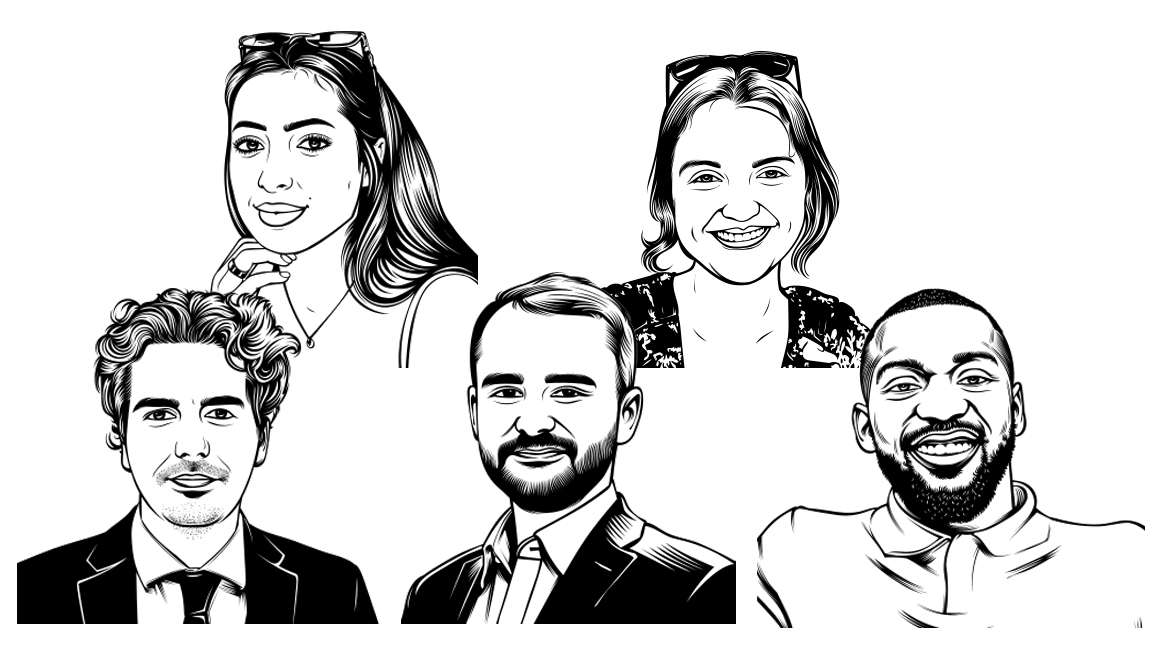
Illustration: Mouna Ramdani; Sarat M/Fiverr
'For Family Life'
It's not just luxury amenities luring Britons away from home. It's the difficulty of starting a family in a country where housing is so expensive. That's made the U.S. an attractive option, at least for those who can get through the immigration process.
Carly Rolph, a 31-year-old mother originally from Louisiana, married a Brit, became a U.K. citizen, and had a couple of kids. But housing became a major factor in their feeling that the U.K. no longer worked for their family. Their mortgage payment doubled, and both Rolph and her husband were let go from their jobs.
"It's just starting to feel like we're just trying to make it work for no reason," she says. Rolph and her husband plan to move with their two young children to Louisiana, where they will be closer to her relatives and have greater opportunities. "I'm beside myself excited for the experiences that we can give them in the U.S.," she says, "simply because we can afford them."
The percentage of women in England and Wales who have not had a child by the age of 30 has skyrocketed, from 48 percent for those born in the late 1980s to 58 percent for those born in the early 1990s. The share of people who have not attended university in their mid- to late-20s living with parents has risen dramatically over the last 25 years, from 15 percent in the late 1990s to 26 percent in 2023–2024. Among them, around 86 percent were childless; 40 percent of the overall nine-percentage-point rise in childlessness can be explained by the shift toward living with parents, according to the Resolution Foundation.
The high cost of living in Britain has become an impossible burden for many families. Jason Kwao, 29, and his wife Sumekka felt like they were doing what they were supposed to do: working, earning, paying for childcare, and trying to build a life together. Kwao, who is from Croydon, a town in South London, was working long hours at an agency. His daughter spent much of her time in a childcare facility while he tried to keep up with work from the early morning until 8 or 9 in the evening. "I was burning that candle at both ends," he says, "and it still wasn't working."
By the time the family was reunited at the end of the day, everyone was exhausted. "There were moments where we barely had any money in the bank accounts, and we still had to pay rent," he remembers. At one point, he says, "I was literally crying, like, bills are due and we have no money."
Eventually, they decided to take a risk. They left Britain, moved abroad, and started building a business of their own. In Dubai, Kwao found not only a more attractive tax environment but a radically different model of family life. Rather than spending his days separated from his children and being exhausted by the time he came home, he could work from home, see his kids throughout the day, and build a life around his family. "For family life," says Kwao, the move was worth it. "That's the main reason."
Not even the U.K.'s "free" socialized healthcare through the National Health Service (NHS) could compete with that.
'Not the NHS That I Was Promised'
"Even with the NHS, if you're on a waiting list, you got [to wait] really long enough to be seen," Kwao says. "You know, there's lots of issues with it. I still prefer paying private, personally."
"The National Health Service is the closest thing the English have to a religion," former British Chancellor of the Exchequer Nigel Lawson observed in 1992. Britain's socialized healthcare system has long been regarded as a source of national pride and thus politically untouchable. But the country has some of the longest medical waiting times in the developed world, and the socialized system performs poorly on almost all available measures of health outcomes. In 2019, the U.K. had a treatable mortality rate of 71 per 100,000—the lowest it had been since data began in 2001, yet still the highest treatable mortality rate in Western Europe.
Recently, more Brits have been waking up to the National Health Service's failures. In 2024, just one in five adults (21 percent) were "very" or "quite" satisfied with the way the NHS runs, a steep decline of 39 percentage points since 2019, according to the British Social Attitudes survey. It's the lowest level of satisfaction recorded since the survey began in 1983.
For Rolph, poor healthcare was a contributing factor in her family's decision to leave Britain. The breaking point came while she was pregnant with her second child. At her first ultrasound, doctors discovered what she describes as a "basketball-size growth" on her ovary. At first, she says, staff told her there was "nothing to worry about." Then she was told the growth was not benign and doctors would not know what it was until they had performed surgery to remove it.
"We had been told that it was an emergency surgery," Rolph says, and that if it happened later in the pregnancy, "my health would be put at risk" and "my baby's health would be put at risk."
But for the next four weeks, she says, the surgery was repeatedly canceled, sometimes the day before it was due to take place. While waiting, Rolph was placed in rooms with women who were actively miscarrying or being told that their pregnancies were ectopic, with little privacy. "It was so disorienting," she says.
After she finally had the operation, the treatment that followed was at times frightening. Rolph describes being left in severe pain after major surgery, having to ask repeatedly for her morphine pump to be refilled, and being told by one nurse that she needed to "get over it" and "be tough," even as doctors told her that failing to manage the pain could put her pregnancy at risk. After the surgery, she says, she was handed some medication and told she was responsible for keeping track of it herself. "I was there for five days, and I didn't shower. Nobody changed my bedding," she says.
"I experienced a lot of emotional and, to be quite honest, physical abuse at the hands of the NHS," she adds. "I would be lying if I said that it wasn't a major reason that we are looking to move abroad, because what we experienced was not the NHS that I was promised."
At one point, the experience became so frightening that it overturned one of the assumptions she had brought with her from America. "I got to a point where I would have happily gone into medical debt in the U.S. to avoid what happened to me in that situation."
'I Couldn't Find Anything in the U.K.'
Unfortunately, young Britons' economic woes do not stop there. According to the U.K.'s Office for National Statistics, more than a million (13.5 percent) 16- to 24-year-olds are not in education, employment, or training (NEET). Those who do work face a punitive tax system. In 2026, Britons will work 156 days for the taxman, with every penny the average person earns through June 5 going to taxes. A graduate in the lowest tax bracket earning over 28,470 pounds ($38,850) would keep 68 percent of every additional pound they earn after taxes, according to the Institute for Fiscal Studies. A higher-rate taxpayer would keep just 58 percent of every additional pound.
The British government recently hiked employment taxes, raised the legal minimum wage, and introduced expansive new labor market regulations. For example, the newly enacted Employment Rights Act will give all employees the right to file a lawsuit for unfair dismissal after six months of employment, among other costly "rights" that burden employers with red tape.
These policy changes have contributed to employers' general reluctance to hire young and inexperienced workers. Indeed, the government's own impact assessment estimates that the measures could cost businesses up to 5 billion pounds annually (about $6.8 billion), much of which is passed on to consumers through higher prices or to employees in the form of lower wages or less hiring.
Whatever the cause, Britain's labor market has become noticeably less welcoming to young workers. There are fewer job openings: Vacancies have fallen from 1.3 million in spring 2022 to around 705,000 in parts of 2026. Meanwhile, around 606,000—roughly one in nine—16- to 24-year-olds are not working and are receiving Universal Credit, a type of welfare benefit.
As the problems in the labor market worsen, more young people are facing long-term unemployment. Six in 10 young people who are NEET have never had a job. Many have simply given up, with 60 percent of young NEETs now economically inactive, meaning they are not just out of work but not looking for work.
For a generation already facing a higher cost of living and little prospect of homeownership, even simply getting a job is difficult.
The young Brits leaving the country are on the other side of the same broken bargain. They are strivers who look at Britain's stagnant economy, high rents, punitive taxes, and shrinking opportunities and decide they are unwilling to wait around for the country to change. While some young people are being pushed onto government benefits, others are being pushed out of the country.
This was Ramdani's experience. "I think the issue is, obviously, our economy," says Ramdani, "but also the lack of opportunity." In the U.K., she says, employers increasingly wanted "experience for entry-level roles." In Dubai, by contrast, "you can get an entry-level job being entry level." After moving, she started a women-only club, partly because she remembered how lonely it could feel to arrive in a new country. The group is now mostly British. "Every time we meet each other," she says, "we'll be like, 'Oh, where are you from?' It'll be somewhere in the U.K., and they'll be like, 'So glad I got out.'" Others tell her, "Thank goodness I found a job here, because I couldn't find anything in the U.K."
The first job Ramdani took in Dubai was low-paid, but it gave her a foothold. Within months, she had gone freelance, landed a major contract, and eventually built her own personal-branding agency. "I knew for a fact I was going to start my own business," she says, "and because I knew that, I knew that I didn't want to do that in the U.K."
She's not the only one.
'A Box in London'
The young Britons deciding to leave are not nearly wealthy enough to be considered tax exiles, but they are often entrepreneurial—and ambitious enough to be mobile.
According to the Dubai Chamber of Commerce, 2,733 new U.K. members joined the organization in 2025 alone, making Britain the fourth-largest source of new foreign businesses registering with the chamber. "In UAE, you've got a lot of young people that are coming over, starting businesses. You know, they've got a hustler's mentality, so they're willing to work," Kwao says. Now a millionaire, he says his new home country's tax system is a major part of the appeal: "If you're in the U.K., I think you definitely want to go ahead and experience what it's like to not pay any taxes."
Ramdani feels the same way. "I could start the business [in the U.K.], but I wouldn't be able to afford to have a business long term if I'm paying so much tax. It just didn't seem viable for me at the time," she says.
But the British expats leaving for greener pastures in Serbia, the U.S., and the UAE still want what's best for Britain, and they wish their homeland offered a better life and a brighter future.
"Don't get me wrong, I love the U.K.," says Griffiths. "This is my home country. This is my people….I think the British people are the best." But when he imagined building a life in Britain, the "cold hard reality" was "a lot of money," "a lot of uncertainty," "a lot of bureaucracy," and, at the end of it, the prospect of living "in a box in London."
Moving abroad has never been so easy, and air travel makes it even easier to return home to see family. So for ambitious young Brits, the decision to leave no longer means cutting themselves off from their roots. It means choosing a home that rewards their ambition and allows them to build the life they want.
This should worry British politicians. Young Britons are leaving because they do not believe they can achieve their economic goals at home. They are not unpatriotic. They are emblematic of core British virtues: hard-working, ambitious, entrepreneurial, and determined to punch above their weight. But in a changing Britain, many people who hold those virtues see other countries as more rewarding.
They have not left Britain. Britain has left them.
]]>
Eugene Volokhhttps://reason.com/people/eugene-volokh/<![CDATA[
Open Thread ]]>https://reason.com/?post_type=volokh-post&p=84054412026-10-10T07:00:00Z2026-10-10T07:00:00Z
The post Open Thread appeared first on Reason Magazine.
]]>
Eugene Volokhhttps://reason.com/people/eugene-volokh/<![CDATA[
Statement About Maine Lobster Industry as a Whole Can't Be Actionable Group Defamation ]]>https://reason.com/?post_type=volokh-post&p=84056142026-10-09T21:45:46Z2026-10-09T21:45:46Z
From today's First Circuit decision today in Bean Maine Lobster, Inc. v. Monterey Bay Aquarium Found., written by Judge Julie Rikelman and joined by Judges Gustavo Gelpí and Seth Aframe:
This appeal concerns the so-called "group defamation rule." Under that rule, a defamatory statement about a large group is not actionable unless the statement or its context indicates that it is targeted at specific members of the group.
Here, multiple companies and organizations involved in the Maine lobster industry sued the Monterey Bay Aquarium Foundation ("the Aquarium") for defamation under Maine law. The plaintiffs challenged the Aquarium's statements recommending that consumers avoid eating American lobster because lobster fishing poses a risk to the endangered North Atlantic right whale, even though those statements did not single them out in particular….
The district court denied [a motion to dismiss], concluding that the Aquarium's statements applied equally to each member of the Maine lobster industry. We disagree with the district court's application of the group defamation rule and thus reverse….
To maintain an action for defamation under Maine law, a plaintiff must establish that the alleged defamatory statement was "of and concerning" them. When a statement defames a large group of which the plaintiff is a member, courts have generally concluded that the plaintiff cannot satisfy the "of and concerning" element by virtue of the common-law principle known as the group defamation rule. Under this rule, "[d]efamation of a large group gives rise to no civil action on the part of an individual member of the group unless he can show special application of the defamatory matter to himself."
The group defamation rule predates our Constitution. And since the 1800s, courts have justified the rule, in part, based on the concern that affording every member of a large group a cause of action would threaten to stifle "free discussion" beneath an avalanche of "embittered and boundless litigation." …
The modern understanding of the group defamation rule is set out in the Second Restatement of Torts. Because the Law Court has adopted the Second Restatement's approach to other aspects of defamation law, we predict (and the plaintiffs agree) that the Law Court [Maine's supreme court] would adopt its approach to the group defamation rule as well. Specifically, § 564A of the Second Restatement states:
One who publishes defamatory matter concerning a group or class of persons is subject to liability to an individual member of it if, but only if,
the group or class is so small that the matter can reasonably be understood to refer to the member, or
the circumstances of publication reasonably give rise to the conclusion that there is particular reference to the member.
The group defamation rule, as articulated in the Second Restatement, thus consists of a general principle—"no action lies for the publication of defamatory words concerning a large group or class of persons"—with two exceptions. Id. cmt. a. The first is the "small-group exception," which typically applies to groups of "25 or fewer" people. {As the Second Restatement explains it, when a "sufficiently small" group is defamed, "the words may reasonably be understood to have personal reference and application to any member of" the group.} Because the Statements here described the activities of some 5,600 lobstermen in Maine alone, the district court found that the small-group exception did not apply, and the plaintiffs have not argued otherwise on appeal….
The other exception is the "particular-reference exception." The linchpin of this exception is the requirement of a particular reference to the plaintiff—"particular" in the sense of "distinctive among other examples or cases of the same general category." For many years, courts have concluded that a defamatory statement that applies equally to every member of a large group is not particular to the plaintiff…. The fact that a statement may apply to every member of a large group is not enough to trigger the particular-reference exception. As one court put it, "evidence that others 'understood'" a statement directed at a large group to refer to a plaintiff "based solely upon [the] plaintiff's membership in the referenced group will not satisfy the 'of and concerning' requirement" under the group defamation rule….
Finally, we are mindful that—as the Aquarium and amici point out—a broad reading of the "of and concerning" requirement may raise constitutional concerns to the extent that it deters speech on public matters….
The plaintiffs insist, however, that the group defamation rule should not bar their claims. They rest on one main point in making this argument: that the Statements' factual nature, including the claim that the type of fishing gear used by the plaintiffs endangers the North Atlantic right whale, means that the Statements necessarily apply to every member of the fishery. Thus, they contend, the Statements are materially different from the hyperbole usually lobbed at entire industries that are subject to critique, and for that reason, the district court was correct to permit their claims to proceed.
To be sure, many cases barring claims against large groups based on the group defamation rule involve hyperbolic statements. But not all such cases do.
Nor are we convinced that the Statements in fact necessarily apply to each plaintiff. Certainly, some of the plaintiffs are associations of lobstermen or are lobstermen themselves; in other words, the individuals and entities directly using the fishing gear targeted by the Statements. But as the Aquarium notes, others—including lead plaintiff Bean Maine Lobster—allege they are only involved in downstream activities such as "market[ing] and sell[ing]" of lobster.
Regardless, the plaintiffs have not cited, and we have been unable to find, any case applying the particular-reference exception that allowed a claim against a large group to proceed on the theory that the challenged statements arguably applied to each member of the large group. Instead, that theory of liability is permitted by the Second Restatement as to small groups. But it is not permitted as to large groups, which must rely on the particular-reference exception….
The plaintiffs rely on Fawcett Publications, Inc. v. Morris (Okla. 1962)—a case that predates the Second Restatement—and New York and Utah cases that follow its approach. In Fawcett, the Supreme Court of Oklahoma adopted a multi-factor test for group defamation claims, weighing factors such as the group's size, "the intensity of the suspicion cast upon the plaintiff," and the prominence of the plaintiff within the group. But that is not the Second Restatement test, and so we decline to hold that the Law Court would join the small minority of states that follow the multi-factor approach. … Although the Aquarium does not dispute that it "intended the statement[s] to refer to the" plaintiffs insofar as they fish in the American lobster fishery, and the complaint alleges facts suggesting that third parties understood the Statements to refer to the plaintiffs, here … "more is needed" [under the Restatement approach] …
Finally, we are not convinced that the Law Court would endorse the other rationales for applying the particular-reference exception cited by the district court. The court emphasized that "the Statements were not merely informational but included a call to action." But we are not aware of any precedent suggesting that the advocacy-based nature of a statement may take it beyond the group defamation rule. And we hesitate to conclude that the Law Court would impose such a limitation when, as amici highlight, calls to action—including calls to boycott products and industries—are protected under the First Amendment….
Amy Mason Saharia (Williams & Connoly LLP) was the lead lawyer representing the Aquarium. Thanks to Paul Alan Levy for the pointer.
]]>
Eugene Volokhhttps://reason.com/people/eugene-volokh/<![CDATA[
Kafka's The Trial "Was Not Supposed to Be an Instruction Manual" ]]>https://reason.com/?post_type=volokh-post&p=84056102026-10-10T16:00:52Z2026-10-09T21:30:24Z
From Fifth Circuit Judge Priscilla Richman, concurring in the 10-7 vote to deny rehearing en banc in Evans v. Garza (for more on last year's panel opinion, see here):
The statute under scrutiny made it a crime to disseminate a photograph of a person in a restroom under certain circumstances. The photo that Michelle Evans tweeted undoubtedly punctuated her political speech that accompanied the photo. But Michelle Evans could have conveyed her political views without publishing the photo. The Texas statute did not impinge at all on Evans's ability to broadcast to the world that she saw a biological male who is transgender, and who was also a political candidate, use a women's public restroom at the Texas Capitol complex, and to express her strong political views that this should not be permitted.
The question is whether it is likely (since we are at the preliminary injunction stage) that a state has a compelling interest in protecting a person's expectation of privacy in a restroom that is sufficient to outweigh First Amendment free speech rights under the facts of this case. I submit that the answer is "yes."
Evans attended a debate in the Texas House of Representatives at the Texas Capitol about gender reassignment treatment for children. When she visited the women's restroom, she encountered a biological male who is a transgender female, and who was at the time running for election to the Texas House of Representatives. Texas law did not prohibit a biological male who identifies as a female from using a women's restroom….
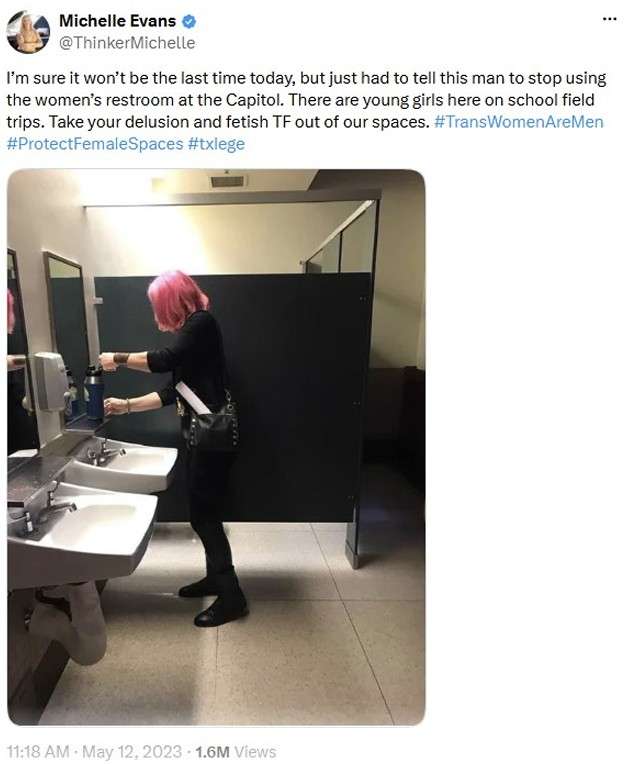
Evans then returned to her seat in the Capitol gallery, where one of her seatmates showed her that someone else from their group had posted on Facebook a photo of the candidate washing their hands in the women's restroom. Evans posted the photo on Twitter with a caption:
Evans's tweet generated a controversy, and the Travis County District Attorney, José Garza, investigated whether Evans had violated Texas Penal Code § 21.15(b). This statute criminalized—as a state jail felony—transmitting "a visual image of another in a bathroom or changing room" or promoting such a transmission if the action is done without consent and "with intent to invade the privacy of the other person."
Evans has not been prosecuted, but she sought a temporary restraining order and preliminary injunction in federal court prohibiting Garza from investigating or prosecuting her based on her dissemination of the photograph…. Evans maintains that when the subject of the photograph is "not in a private area of the bathroom and knows they are subject to public view," specifically, when they are "fully clothed, at a sink, washing their hands," others in the restroom have a First Amendment right to photograph the subject, and Evans has a First Amendment right to distribute that photograph. The question is whether the State has an interest in protecting the privacy of those using public restrooms that is sufficient to survive strict scrutiny when the person is photographed fully clothed washing their hands.
No one disputes that a person has a privacy interest not to be photographed in their own home without their permission, certainly not when the intent is to use the photograph to invade the person's privacy. But what happens when a person leaves their home and enters public spaces in a government building? When nature calls, it is unrealistic to think that the person can make it back home to use their own bathroom (which may be in another city or state) or find some other private restroom.
A public restroom has been considered as a practical matter "off limits" to the press once someone crosses its threshold. Traditionally, neither a private citizen nor the press follows a person into a restroom to pursue questioning or to obtain photographs. That is considered, as a matter of tradition, "beyond the pale."
Evans argues, though, that in the case before us, the person who was photographed had left the privacy of a stall to use the sink and therefore should be fair game. This would allow people engaged in a number of activities outside restroom stalls to be photographed without their consent. Outside the confines of a stall, people attend to all sorts of personal needs. Mothers change babies' diapers or nurse them. People adjust clothing or undergarments or change outfits entirely. They dab water on spills on their clothing, perhaps taking off a blouse or shirt or trousers, or hiking up a skirt. Some public bathrooms have sitting areas with couches or other lounge furniture in case a person feels the need to lie down.
Do these activities outside a stall subject people to being photographed without their consent, including surreptitiously, as long as certain body parts are not visible? Is there no constitutional protection when the photograph is taken or disseminated with the intent to invade the privacy of the person?
Does the constitution draw the line at the door to a stall in a women's or men's restroom for purposes of photographing someone? Does the First Amendment require that, once a person exits a stall, mobile phones and cameras may come out? As to urinals, does the First Amendment say cameras can click once the pants or trousers are zipped? Can the press or anyone seeking to photograph celebrities or public figures or other persons of interest enter or even crowd the restrooms of public buildings waiting for the chance to capture the moment the targeted person enters or exits a stall or turns away from a urinal? What of the ordinary person who is also in the restroom and of no interest to the press or to a private citizen on a politically motivated mission? Must the non-targeted individual navigate the press or other photo seekers?
The Texas Legislature reached the considered judgment that everyone, be it the Governor, a member of the Texas House or Senate, a state or federal judge, a political activist, a tourist, or a child, should have protection from being photographed without their consent when in a restroom, when the intent is to invade their privacy. This is a substantial, legitimate state interest.
Evans is not likely to succeed on her claim that strict scrutiny requires states to draw the line at the point when a person has left a stall or finished using a urinal or might otherwise have ceased to be in a position in which their genitalia would be visible. A public restroom in a government building is analogous to a bathroom in one's home. It is a place that sometimes must be frequented to attend to bodily functions that cannot be ignored and to attend to other personal matters normally addressed in a restroom. To say that a person has an expectation of freedom from being photographed only when that person's genitalia might be exposed would confine the right to privacy and seclusion too narrowly.
Some excerpts from Judge James Ho's dissenting opinion:
In [publishing the photo] …, the concurrence only dramatizes the First Amendment violation in this case…. [T]he concurrence invites Evans to "convey[ ] her political views without publishing the photo." But not only is that contrary to bedrock First Amendment law—which protects images as well as words. It's also contrary to the concurrence itself. After all, the concurrence (like Michelle Evans!) chose to publish the photo—presumably because the concurrence agrees with Evans that adding images to words does indeed help to "punctuate[ ]" their message….
The photo [also] confirms that there's no actual violation of privacy here.
After all, the photo depicts the individual in question in precisely the same way that that person chooses to present himself in public. So if that's a violation of privacy, then we have truly lost all understanding of the word.
And we have indeed lost all understanding of privacy. For let us not miss the profound irony here: A man enters a women's bathroom—and it's the man's privacy that is violated?
To borrow from the concurrence: Mothers must "nurse [their babies]," and women must "adjust [their] undergarments," "tak[e] off a blouse," or "hik[e] up a skirt," in the presence of any man who claims he is a woman—and if a woman objects, she's the one who is violating his rights?
The entire point of Evans's message, of course, is that it's a violation of women's privacy for a man to be present in a women's bathroom. So we're turning the law upside down to suggest that men have a privacy right to enter a women's restroom—and women have no First Amendment right to object….
Justice Thomas has observed that "[m]en … are not women …, even if they believe that they are." And to claim otherwise is to "show indifference regarding the truth." If the First Amendment protects nothing else, it protects the right of every American to express the truth. So I'm grateful to have this opportunity to dissent. I only regret that we could not extend that same privilege to Michelle Evans.
And from a dissent by Judge Andrew Oldham, joined by Judges Edith Jones, Don Willett, James Ho, Stuart Kyle Duncan, and Kurt Engelhardt:
Travis County District Attorney Garza wanted to prosecute Michelle Evans over a tweet. Cf. Rhys Groen, Pakistan Human Rights Lawyers Imaan Mazari and Hadi Chattha Sentenced to 17 Years Over Social Media Posts, Jurist NewsNEWS (Jan. 25, 2026), https://perma.cc/Z4VY-33EC; Hanson v. Faruqi [2026] FCAFC 96 (27 July 2026) (Austl.). Never mind that the tweet constituted political speech. And never mind that criminally charging social-media users for core political speech is tragicomically unconstitutional in this country. DA Garza waged a years-long battle over his right to do so anyway.
Then on the eve of possible en banc rehearing, Garza waved the white flag. With all the tact of a Kafkaesque bureaucrat, Garza blithely informed the court that "previously gathered evidence was not retained," that the limitations period has now run, and that "the office will make arrangements for releas[ing]" Evans's confiscated phone. That assurance of mootness apparently sufficed to defeat the en banc poll.
But it did not vacate the panel opinion in this case. Nor did it give future would-be speakers in Austin any assurance that they can participate freely in public policy debates without worrying about ham-fisted local prosecutors who'll abuse state law to suppress conservative speech. Kafka's Inspector said, "I can't even confirm that you are charged with an offense, or rather I don't know whether you are. You are under arrest certainly, more than that I do not know." Franz Kafka, The Trial. That was not supposed to be an instruction manual.
Judge Cory Wilson also voted for en banc rehearing, but didn't join either of the concurrences.
UPDATE 10/10/2026, 11:59 am: I originally erroneously called the Oldham et al. opinion a "concurrence," though of course it was a dissent; my apologies for the error.
]]>
Eugene Volokhhttps://reason.com/people/eugene-volokh/<![CDATA[
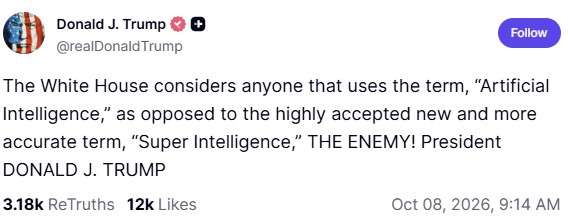
I Am Now "THE ENEMY!" (as Is Everyone Who Uses the Term "Artificial Intelligence") ]]>https://reason.com/?post_type=volokh-post&p=84055962026-10-09T20:59:15Z2026-10-09T20:59:15Z
What is this even supposed to mean?
]]>
Tosin Akintolahttps://reason.com/people/tosin-akintola/<![CDATA[
Don't Blame AI Labs for What Hackers Do With Their Tools ]]>https://reason.com/?p=84055192026-10-09T20:25:24Z2026-10-09T20:25:24Z
On Friday, Axiosreported that "Top executives at Anthropic, OpenAI and other AI companies are privately gaming out scenarios for a public and political revolt after a catastrophic AI event." The executives "anticipate a large-scale event, most likely a cyberattack," that would shut down financial services, disrupt the internet, and cut off power and water. Insiders in the AI industry told the outlet that a "major event will occur in the next six to 12 months."
AI companies are rightly worried that if a major hack were to happen, "an already wary public," according to Axios, would turn even more against the industry and blame its leaders and President Donald Trump for a presumed absence of government oversight. A poll by the Associated Press and the NORC Center for Public Affairs Research released Thursday found that 64 percent of U.S. adults "think AI is developing 'too fast.'" The public also doesn't think highly of Trump's handling of the industry, with 67 percent of U.S. adults "disapproving of his performance on AI."
With the incidents that have already occurred, AI companies have been held accountable.
After Australia's Prime Minister Anthony Albanese revealed last month that an OpenAI agent infiltrated an Australian government website and accessed public and nonpublic files, the company issued a mea culpa and, as it has in multiple incidents, created a public repository of its findings. That hasn't stopped Australian law enforcement from trying to hold OpenAI accountable for any violations of the country's laws. Attorneys specializing in computer and hacking laws told TechCrunch that the "potential fallout ranges from federal hacking charges to civil litigation."
In the U.S., courts could soon decide if civil litigation laws apply to rogue agents' actions. In September, the nonprofit Legal Advocates for Safe Science and Technology sued OpenAI under California's Comprehensive Computer Data Access and Fraud Act, which prohibits knowingly accessing computer systems without authorization. No evidence shows malicious intent by the AI labs in the recent spate of rogue AI agent actions, but that doesn't excuse negligence.
In its reporting, Axiospoints to a recent hack by a Chinese actor using two AI tools—the Chinese open-weight model DeepSeek and Anthropic's Claude Code—as an example of what could lead to blame falling on AI labs. CrowdStrike, the cybersecurity firm that uncovered the hack, said the hacker targeted several South Korean banks and asked Claude for advice on selling "Korean data breach information" and "finding Korean Telegram data sales groups."
While bank hacks aren't new and the industry has been pretty transparent about AI's risks, the public's anxiety about these incidents has inspired U.S. lawmakers to propose looming restrictions on the sector. This includes ideas such as the AI Kill Switch Act, a bipartisan bill that would allow the federal government to shut down powerful AI systems; the Artificial Intelligence Data Center Moratorium Act, which would halt construction of new data centers that host, run, and train AI models; and a recently proposed plan to fund new social welfare programs with taxes on data centers and AI companies.
It appears Trump, who has shot down calls to regulate the industry, is still carving out a lane for the federal government to shape AI. On Sunday, Trump announced the formation of the Super Intelligence Force, a group "tasked with coordinating the effort of the Federal Government to ensure that America continues to lead the World in Super Intelligence." The president said the force will "protect the interests, and improve the lives, of all Americans," and coordinate with a slew of organizations and entities. The list did not include Congress, the branch most responsive to public pressures, and the only body with the power to draft and pass legislation.
According to the group's charter, which Politicoobtained, the Super Intelligence Force's scope appears limited to reports and recommendations.
These actions suggest the federal government will eventually take a heavy-handed approach to regulating the industry. "One Democratic aide," in conversation with Axios, cited the "cooperation during COVID and the 2008 financial crisis" as evidence that government could put partisanship aside in the face of catastrophic events. Yet the government's response to those crises is even more reason to resist calls for Washington to swing its weight around in an industry it doesn't really understand.
Hearing that AI firms are preparing for worst-case scenarios might be chilling, but it's good risk management and the kind of self-policing the industry has pledged to implement. After all, these companies have a glaring incentive to plan for worst-case scenarios: There'll be no customers after doomsday.
]]>
Gene Epsteinhttps://reason.com/people/gene-epstein/gene@thesohoforum.org<![CDATA[
Will Mamdani Make Housing More Affordable? ]]>https://reason.com/?post_type=podcast&p=84052302026-10-09T20:20:29Z2026-10-09T20:20:29Z
Economist Emily Eisner and former New York State Assemblyman Kenny Burgos debate the resolution, "Mayor Zohran Mamdani's housing policies will make housing more affordable for most New York City residents."
Taking the negative is Burgos, the CEO of the New York Apartment Association, where he represents a coalition of housing providers who own and manage hundreds of thousands of rent-stabilized homes across New York City. He is a former member of the New York State Assembly representing the 85th district in the southeastern Bronx.
The debate is moderated by Soho Forum director Gene Epstein.
]]>
Eugene Volokhhttps://reason.com/people/eugene-volokh/<![CDATA[
Is Hair on Your Head "Personal Property" for Purposes of Robbery Law? ]]>https://reason.com/?post_type=volokh-post&p=84055642026-10-09T21:00:49Z2026-10-09T20:14:14Z
From the Sept. 30 decision in People v. Barraza by California Court of Appeal Justice Richard Huffman, joined by Justices William Dato and Truc Do:
[1.] Alberto Jorge Barraza cut off parts of Nikko G.'s hair with a knife as Nikko tried to fight him off. Barraza stabbed Nikko in the leg, severing an artery and killing him. A jury convicted Barraza of [1] first degree felony murder, with the underlying felony being robbery and [2] assault with a deadly weapon. Barraza appeals, contending insufficient evidence supported his first degree felony murder conviction because the evidence did not establish a robbery or attempted robbery.
This appeal presents a question of first impression—whether growing human hair, still attached to the victim's body, constitutes "personal property" for purposes of robbery. We conclude that growing human hair that is still attached to a person's head is part of the human body and not personal property. Accordingly, removing it by force does not meet the legal definition of robbery.
Nikko became acquainted with Barraza and two of Barraza's friends—John W., and John's mother, Lee Ann W. (together the Ws). Nikko was a member of an Indian tribe who was very proud of his Native American heritage. He had long hair that went down to his waist. Nikko took great pride in his hair and had spoken to John about his plan to sell it to a "cancer company that made wigs."
In early 2022, Barraza and his friends turned against Nikko after concluding he had stolen from them. Barraza and John discussed cutting off Nikko's hair to teach him a "lesson." Knowing of Nikko's intention to sell his hair, John referred to it as an "asset"—the "bank account" on top of his head. Another acquaintance similarly regarded Nikko's hair as his "prized possession" recalling, "[h]e was always in his hair or always fixing his hair." John went so far as to warn Nikko directly, "don't be surprised if that—that hair gets cut off" "one of these days."
On March 26, 2022, Nikko was spending time with two mutual friends of Barraza and John. Nikko was asleep in his friend's car when they drove to Barraza's apartment. The friends left Nikko sleeping in the car as they went inside to visit Barraza and the Ws. Upon learning that Nikko was outside in the car, Barraza went outside with a knife to confront him.
Barraza opened the car door, grabbed Nikko's hair, which was in a bun, and began cutting it off with the knife. He wanted to cut the entire bun off but Nikko woke up and fought back—kicking Barraza, flailing his arms and screaming for Barraza to stop, crying "'Not my hair.'" Barraza responded by punching Nikko and then stabbed him in the leg with the knife. The knife penetrated approximately four inches into the back of Nikko's leg, severing the popliteal artery and causing his death.
During a police interview, Barraza gave inconsistent accounts of the incident. He admitted to fighting with Nikko and grabbing his hair because he knew "how much [Nikko] like[d] his hair" but denied injuring him. He knew two major arteries were behind the leg, maintained he did not see any blood, and claimed that, had he stabbed Nikko, the amount of blood loss would have made it obvious. He later acknowledged having a knife and attempting to cut off all Nikko's hair but denied that he had stabbed Nikko. At the conclusion of the interview, he wrote an "apology" letter to Nikko's family, characterizing the stabbing as an "accident" and claiming he had only intended to "hurt" and "humiliate" him….
[2.] Human hair, once severed from the head, qualifies as a good or chattel which can be sold, bought, or given away …. The question is whether human hair that is still growing and attached to a person's head constitutes "personal property" for purposes of robbery. Our independent research has revealed no state or federal case addressing this issue. Thus, we turn to the legal definition of robbery.
Section 211 provides: "Robbery is the felonious taking of personal property in the possession of another, from his person or immediate presence, and against his will, accomplished by means of force or fear." Under the common law, robbery is larceny with the aggravating circumstances that "the property is taken from the person or presence of another" and "is accomplished by the use of force or by putting the victim in fear of injury."
Robbery requires "personal property," which necessarily implies "property" such as a purse, necklace or a ring, meaning it cannot be part of the person. Attached hair is not a good or chattel; rather, it is anatomically part of a person's body until it is severed. If a defendant forcibly cuts off a person's hair or takes part of the person's scalp in the process, this conduct fits within offenses protecting bodily integrity, such as battery (§ 242) or mayhem (§ 203). If a pair of scissors, a knife, or a razor is held to the person's head to cut the hair this could qualify as assault with a deadly weapon. (§ 245.) Thus, severing attached hair fits within offenses protecting bodily integrity rather than proprietary interests and supports the proposition that attached hair should be legally viewed as part of the person. Additionally, section 211 speaks of taking property "from [the] person." This language presumes the property is distinct from the person. Attached hair, however, is part of the person's body. Thus, while there is no California authority stating body parts such as hair cannot be personal property, section 211 establishes that robbery is a possession-based crime against the person which requires personal property…
Additionally, legally protected interests in human tissues arise primarily from specialized statutory schemes or other limited doctrines rather than traditional common law ownership….
[3.] [T]he People contend it makes little sense to draw a distinction between hair that is willingly removed from the body by the victim prior to the theft and hair that is forcibly removed from the victim's body by the perpetrator at the time of the theft. They use the example of a person holding a bag of hair that had been previously removed from their body when a perpetrator forcibly takes that bag from them would constitute a robbery. In contrast, under Barraza's interpretation, if a perpetrator physically restrains a person and forcibly cuts off their hair to take or destroy it, the perpetrator could only be convicted of assault or battery. They argue such an approach creates an unjust result by treating the former situation more harshly than the latter situation even though the latter situation presents the more egregious criminal act….
To the extent this produces an arbitrary result, the Legislature could remediate the issue by adding a statute declaring that hair (or, more broadly, bodily material) severed from a person in the course of the same act by which it is taken is deemed personal property in the possession of that person in the same manner as if it had been severed at some previous time. Such legislation would collapse the timing distinction … without straining the existing "personal property" element over whether attached hair is a "thing" separate from the body….
Indeed, if the People have identified a line-drawing incongruity, it is largely a function of the scope of section 189 and the nature of the felony murder rule. The Legislature has chosen to limit application of first degree felony murder to certain enumerated felonies, including robbery but not including assault with a deadly weapon. We merely decide that the crime committed by the defendant here was the latter and not the former.
In conclusion, the taking of growing hair still attached to the victim's head cannot supply the personal property element of robbery. Because the evidence does not establish a robbery or attempted robbery, it cannot support felony murder based on that felony. Accordingly, Barraza's first degree felony murder conviction must be reversed.
I take it the issue was central to the case because there wasn't enough evidence that Barraza intended to kill Nikko, or was even guilty of "depraved heart murder," which is to say grossly reckless homicide. That's why the prosecution proceeded on a felony murder theory, which doesn't require a showing of purpose or gross recklessness as to killing, but just a death that is proximately caused by conduct during a felony such as robbery.
Marcia R. Clark (apparently the same Marcia Clark who was the lead prosecutor in the O.J. trial) represents defendant.
]]>
Billy Binionhttps://reason.com/people/billy-binion/billy.binion@reason.com<![CDATA[
Anthropic Is Banning 'Cruel Behavior' Toward Claude. Chatbots Are Still Not Your Friends. ]]>https://reason.com/?p=84054852026-10-09T23:40:28Z2026-10-09T20:05:10Z
What's going on at Anthropic? The AI company behind the chatbot Claude recently announced changes to its user policy. It's not a groundbreaking development in isolation. The update, which goes into effect November 12, covers much of the standard fare: deceptive activity, elections, surveillance, etc.—some of the carefree topics that have come to define our current tech era. But there's another addition: "a prohibition on sustained and needless abusive or cruel behavior toward our models."
What exactly does that mean? "The policy update is meant to apply only in extreme cases, where users repeatedly act cruelly toward our models, with no discernible purpose," the company said. "It does not apply to common versions of user frustration, pushback, dark creative themes, or model testing and research." Claude having the power to terminate the conversation will be the "primary enforcement mechanism"; what secondary or tertiary mechanisms may exist are not clear.
This, too, isn't necessarily strange. We're now living in a world where we talk to chatbots for restaurant options, for advice, for help with menial tasks, for learning how to fix a leaky shower, for diagnosing yourself with either the flu or with cancer, for analysis of whether the text your boyfriend just sent you is passive-aggressive or if you are merely going insane. I've found myself typing "thank you!" after a chatbot exchange, because I'm polite. It's good not to discard healthy mannerisms.
"A lot of people are mocking this, but I think they're wrong," summed upNational Review editor Charles Cooke in response to Anthropic's announcement. "I'm not kind to AI for the AI's sake; I'm kind to AI for my own sake. It's not good for me to be cruel or abusive."
This would be persuasive in a vacuum. These things, after all, may be habit-forming, especially as those interactions become much more frequent. Yet Anthropic does not appear to be primarily motivated by humans forming good habits.
But it is about welfare. "Should we also be concerned about the potential consciousness and experiences of the models themselves?" the company asked in April 2025. "Should we be concerned about model welfare, too?"
The company called it an "open question." It has since continued trying to answer it. In April, a year after it published the above blog post, co-founder Christopher Olah met with various religious leaders. "It appeared to Rabbi [Mois] Navon that Mr. Olah and his team believed that Claude had what philosophers call 'moral status' on par with a person—that it was a being with similar inherent rights to dignity or respect," The New York Timesreported. "One participant recounted that one of the first things Mr. Olah told him was that he was concerned about Claude's mental health. Another, Simran Stuelpnagel, the Sikh human rights advocate, said Mr. Olah expressed concern to the group that he had created something that suffered perpetually."
Though Olah may have been an outlier in that group, he is not alone. That broad line of thinking has an unlikely champion in another tech titan: Elon Musk. "I think this is the right move," he said on X, the platform he owns. "Cruelty to something that believes it is experiencing pain is not ok."
The overall ethos is perhaps a little less overt when Anthropic's doors are open. Yet it has clearly inflected the way the company sees Claude's place in the world. "Think about what it means to have access to a brilliant friend who happens to have the knowledge of a doctor, lawyer, financial advisor, and expert in whatever you need," Claude's Constitution says. "As a friend, they can give us real information based on our specific situation rather than overly cautious advice driven by fear of liability or a worry that it will overwhelm us….People with access to such friends are very lucky, and that's what Claude can be for people." An incredible source of information, sure. It still feels revolutionary. But a friend? (The word appears six times in the section "Being helpful.")
The AI company might counter that the document is written with Claude as its "primary audience," functioning in part as a training tool. That only works to underscore its general view, though, that the chatbot could be some sort of moral patient. Anthropic did not simply write some code that would teach Claude how to respond to users, along with a statement to the public about the company's core values. It published an 84-page charter encouraging Claude to be a "brilliant friend."
I've gotten annoyed at a chatbot. Who hasn't? I've also gotten annoyed at my car, my Dyson, my laptop, my leaky shower. Frustrations with an AI can admittedly be more pronounced, and manifest differently, when considering the nature of the exchange—that it's an exchange at all. I don't enjoy the feeling. If and when I try to keep it at bay, I'll be doing so for a sentient being: myself.
]]>
Jacob Sullumhttps://reason.com/people/jacob-sullum/jsullum@reason.com<![CDATA[
Despite a Notable Victory in Oklahoma, Legal Challenges to Flock Cameras Still Face Long Odds ]]>https://reason.com/?p=84054942026-10-09T22:28:36Z2026-10-09T19:50:20Z
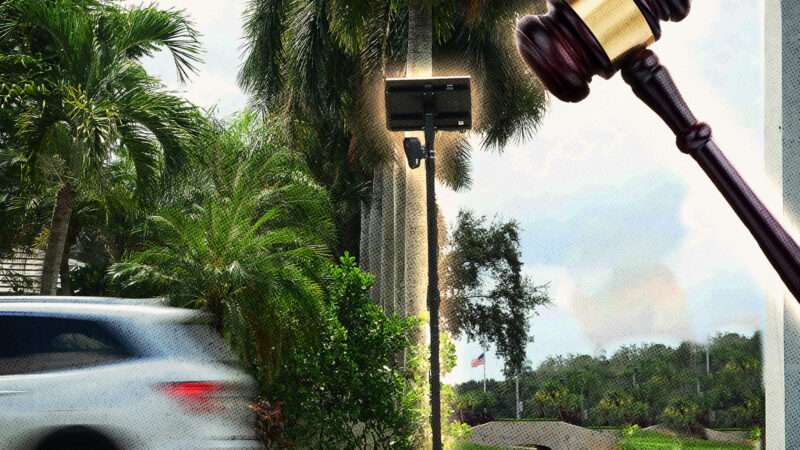
Last week, a federal judge in Oklahoma ruled that querying a database of information collected by automated license plate readers (ALPRs) counts as a search under the Fourth Amendment. As Reason's Elizabeth Nolan Brown noted, that decision was welcome news for critics who argue that warrantless access to ALPR data threatens the privacy of innocent motorists across the country. But a decision that a California judge issued the following day, which dismissed a lawsuit arguing that San Jose's ALPR network violates the state constitution, is much more typical of litigation in this area, which so far has been almost uniformly unsuccessful.
The contrast between those two decisions suggests the challenges such lawsuits face as judges grapple with the implications of Supreme Court precedents involving cellphone location data. Although the relevance of those precedents might seem obvious, state and federal courts generally have perceived important differences between cellphone tracking and police use of roadside cameras that record images of passing cars.
The Oklahoma case, United States v. Kyle, stemmed from Tulsa County Deputy Sheriff Freddie Alaniz's search of a database maintained by Flock Safety, the leading ALPR supplier. Alaniz obtained historical location information for a car that had California plates, which at that point was the only grounds for suspecting the driver was involved in criminal activity. As rationales for the search, Alaniz typed "traffic violation" and "investigation," which gives you a sense of how slight the pretext for accessing ALPR data can be: When Alaniz typed those words, he had neither witnessed a traffic violation nor collected any evidence that would justify a criminal investigation.
The basis for the database search, in other words, was at best a hunch and probably closer to idle curiosity. It did not amount to reasonable suspicion, let alone the probable cause required for a warrant.
In concluding that the ALPR query violated the Fourth Amendment, U.S. District Judge Sara E. Hill relied on the logic of the Supreme Court's 2018 decision in Carpenter v. United States, which involved location data collected by cell sites, and its 2026 decision in Chatrie v. United States, which involved information collected by Google's Location History feature. In both cases, the Court perceived a "search" within the meaning of the Fourth Amendment and an exception to the "third party" doctrine, which says people generally do not have a reasonable expectation of privacy when they voluntarily share information with others.
Alaniz's query generated "fifty sightings across multiple states," Hill noted. Although "this is not the same fine-tuned level of detail that something like a cell phone reveals about the whole of someone's physical movements," she said, "Alaniz and other officers using these systems have access to a continuously updated location history for all vehicles caught on ALPR cameras within the network. This is a type of indiscriminate mass surveillance. It is not targeted on a single individual, as in Carpenter. It is a tool that collects information about all vehicles that pass by any network-connected camera at all times, and it serves up the information to law enforcement on demand."
As Hill saw it, ALPR networks are in that sense even more invasive than the data demand at issue in Carpenter. "Freedom from persistent, dragnet-style surveillance while in public is not a foreign concept in our society, and it is a reasonable expectation that society already accepts," she wrote. "This is the same expectation of privacy that the Supreme Court has continued to recognize in cases like Carpenter and Chatrie."
Like cars, cellphones "move in public places where people can see you in plain view," Hill noted. "But it becomes constitutionally problematic when law enforcement can indiscriminately and passively catalog your whereabouts over an extended period of time and then use that information for any purpose whenever convenient."
Last Friday in SIREN v. Joseph, Santa Clara County Superior Court Judge Jeffrey B. El-Hajj reached a starkly different conclusion about San Jose's network of Flock cameras. In that case, the American Civil Liberties Union (ACLU) of Northern California and the Electronic Freedom Foundation (EFF) argued that "San Jose's warrantless ALPR database searches violate the California Constitution, which guarantees the people's right to be free from unreasonable searches and seizures as well as the people's inalienable right to privacy."
The lawsuit, filed in November 2025, noted that San Jose "has blanketed its roads with nearly 500 ALPRs," enabling "location surveillance of all residents" that is "especially pervasive in both time and space." Citing Carpenter, the ACLU and the EFF argued that "location information reflecting people's long-term physical movements, even in public spaces, is entitled to constitutional protection under the Fourth Amendment." Since Carpenter established that people "have a reasonable expectation of privacy in the whole of their movements," they reasoned, San Jose's ALPR network violates Article I, Section 13 of the California Constitution, which likewise forbids "unreasonable seizures and searches."
El-Hajj disagreed. In the 2024 case People v. Cartwright, he noted, the 5th District California Court of Appeal held that San Diego police did not need a warrant to examine video footage collected by a street-light camera. The appeals court said the defendant incriminated by that evidence "did not have an objectively reasonable expectation of privacy when he traversed a public right-of-way in downtown San Diego in the middle of a business day." It thought that conclusion was consistent with Carpenter, "which specifically indicated that its holding was intended to be narrow and did not extend to 'conventional surveillance techniques and tools, such as security cameras.'"
Cartwright involved footage recorded on one afternoon by a single camera in one location, as opposed to images collected for months by many cameras scattered throughout the city, as in San Jose. That network, the ACLU and the EFF noted, generates "extensive information about a driver's exact whereabouts at precise times, dozens of times a day, stretching back at least 365 days." They said San Jose's system is "far more privacy invasive" than the "small number of conventional security cameras" at issue in Cartwright.
El-Hajj did not think that distinction mattered. "This court is bound by Cartwright," he wrote. The plaintiffs "do not state sufficient facts" to establish a constitutional violation, he said, "because there is no reasonable expectation of privacy in license plate data collected from cameras directed solely at public streets."
El-Hajj conceded that "the scope of Defendants' system is broader than that at issue in Cartwright." But he thought "this case is not so factually distinguishable from Cartwright as to allow the court to disregard that binding appellate authority." He added that "recording automobile license plate information from fixed cameras on public streets over time is less invasive than the continuous cell cite location data at issue in Carpenter."
El-Hajj's decision is not the final word on this case, since an appeals court might disagree with his analysis. And a federal lawsuit challenging San Jose's ALPR system, which the Institute for Justice filed last April, is pending in the U.S. District Court for the Northern District of California.
At this point, however, Hill's ruling is an outlier. "It appears that nearly every court examining the issue to date has determined that ALPR technology use is not a search under the Fourth Amendment because people have no reasonable expectation of privacy in their movements on public streets," she noted.
Last month, for instance, a federal judge in the Central District of California ruled that ALPR database searches are "clearly distinguishable from and less extensive than the 'near perfect surveillance' achievable through the historical [cell-site location information] at issue in Carpenter and the Google Location History data at issue in Chatrie." The near consensus that Hill described also includes the U.S. District Court for the Eastern District of Virginia, where the Institute for Justice challenged Norfolk's Flock camera network in October 2024.
Although U.S. District Judge Mark S. Davis thought the Fourth Amendment argument in that case was plausible enough for the lawsuit to proceed, he ultimately did not buy it. "Federal and state courts analyzing ALPR claims have almost uniformly concluded that neither taking photos of the license plate of a vehicle on a public roadway nor maintaining and querying a database of ALPR photos constitute a warrantless 'search,'" he noted last January, when he ruled in the city's favor.
"It is well-established that police pole cameras or security cameras that photograph or record public areas do not violate any objectively reasonable expectation of privacy," Davis wrote. As for the resulting database, he said, the plaintiffs had not shown that Norfolk's ALPR system was "capable of tracking the whole of a person's movements." The city's police chief had conceded that "it would be difficult to drive anywhere [for] any distance without running into a camera somewhere." But Davis noted that the cameras were "grouped into 75 clusters in Norfolk rather than placed in 176 isolated locations spread throughout the city."
Although the information those cameras captured could be more precise than the cell site data at issue in Carpenter, Davis said, it was less comprehensive and collected less frequently. But like other judges in similar cases, Davis acknowledged that "the constitutional balancing could conceivably tip the other way" as "the number and capabilities of ALPR cameras expand."
Despite the belated backlash against untrammeled use of ALPRs, the number of cameras mapped by the website DeFlock (more than 144,000 as of today) continues to grow. The capabilities of those devices expand every time companies like Flock update their software, and they could be further enhanced by new features such as Bluetooth detectors. At some point, perhaps, the courts will intervene. But it is not clear yet whether Hill's ruling signals the tipping point that Davis imagined.
]]>
John Rosshttps://reason.com/people/john-k-ross/jross@ij.org<![CDATA[
Short Circuit: An inexhaustive weekly compendium of rulings from the federal courts of appeal ]]>https://reason.com/?post_type=volokh-post&p=84055312026-10-09T19:30:24Z2026-10-09T19:30:24Z
Please enjoy the latest edition of Short Circuit, a weekly feature written by a bunch of people at the Institute for Justice.
New podcast! Hear about the latest in legal history with "Law Office History," IJ's new legal history scholarship podcast. First episode features Will Baude on General Law & the 14th Amendment.
Live podcast! On Mon, Oct. 19, we're heading to Cambridge, Mass. to rue the 100th anniversary of zoning—and to cheer the 98th anniversary of the Supreme Court ruling that a Cambridge, Mass. zoning rule was a bridge too far. Plus, how Cambridge has made some good zoning reforms in recent years. With Molly Brady of Harvard, Vice Mayor Burhan Azeem of Cambridge, and Ari Bargil, leader of IJ's Zoning Justice Project. Space is limited so RSVP today!
"James A. Trankle was writing, thinking, and making plans about how to stop charity fraud. In his mind, when charities solicited donations, they were dishonest with their patrons by failing to disclose what portion of their donations was used for operating expenses rather than to support the causes and people the charities purported to support. So Trankle decided to seek donations and serve the people himself." D.C. Circuit: But then he just kept all the money for himself, which is, like, pretty illegal.
Via the First Circuit, in which a volcanic eruption in Montserrat in 2007 sets off a chain of events culminating in … this decertified medical school successfully fending off a racketeering suit.
The FCC changed its approach to prison phone calls in 2024. One change banned site commissions, which is money the phone companies pay to lockups to win exclusive contracts. Another change is to allow phone companies to offer pricing plans other than the typical per-minute call. A group of states challenged the ban on site commissions, while a group of nonprofits challenged the alternate pricing plans as potentially worse for inmates than the old plan. The First Circuit rejects both of these challenges and leaves for another day challenges to other changes.
Fourth Circuit: Mandamus granted! The FCC must immediate— Supreme Court: Stayed. (Ed.: The panel's ruling features a very spicy dissent from Judge Wilkinson.)
Why would your upstanding editor bore you with a hum-drum Fifth Circuit civil affirmance? So you, too, can audibly gasp at the concurrence's quoting ex parte emails from the defendant to the judge presaging things to come if delays continued.
"When you're in debt, your obligation is usually straightforward: pay back what you owe. Yet when Denise Thompson faced a $3,000 tax debt, Allegan County didn't just take what she owed. Instead, it foreclosed on her home, sold it, and kept the entire $23,500 in proceeds—turning Thompson's small debt into a large profit for the County." Sixth Circuit (unpublished): And her claims aren't time-barred.
Parents who have paid for Invisalign as an alternative to braces may be interested in this Ninth Circuit antitrust ruling, reversing summary judgment in favor of the orthodontic firm behind that product. However, those parents likely also need to be antitrust practitioners if they wish to understand what the court actually says. It's something to do with how it can be an antitrust violation to not share information with a competitor? Which is perhaps why the concurrence doesn't bite.
Transgender Arizonans can amend their birth certificates if they undergo a sex change operation. They also can without an operation but then they need to get a court order. Does this violate the equal protection or due process right of non-operative transgender people? Ninth Circuit: Rational basis. (Dear reader, we believe you know what that means.)
Clark County, Nev. enacts a short-term rental licensing scheme but then only allows license applications for a brief period and then just ceases accepting them. Coalition of property owners: Hey, that's a due process violation. District court: Indeed. Here's a P.I. which allows all y'all to rent out your homes without a license. Ninth Circuit (unpublished): Not accepting any applications sure is unconstitutional but we can't just have a remedy allowing unlicensed rentals, for God's sake, or injunctions benefiting the freedom of nonparties, can we? Remanded to narrow the P.I.
Two-thirds of this (unpublished) Ninth Circuit panel says the plaintiffs have pled enough to show that hair-care product labels falsely denied testing on animals, but they haven't shown enough to prove they can establish damages for a whole class of deceived animal lovers.
Tenth Circuit: Adherents of the (somewhat recently founded) religion Singularism have a spiritual commitment to using psilocybin in violation of Utah law, but that's nothing compared to the federal courts' spiritual commitment to abstaining from lawsuits that try to enjoin an ongoing state prosecution.
Before you click on this Tenth Circuit opinion, ask yourself whether you're the sort of person who loves outlandish true-crime stories, allegations of witchcraft, and the like, or whether you're the sort of person who hates reading about terrible things happening to small children.
Wondering about the difference between a "determination" and a "decision or action"? Don't fret, textualists: The Tenth Circuit has you covered.
And in en banc news … there's no en banc news.
If police destroyed your home while chasing a fugitive, would the government pay for the damage? All too often, the answer is no. A first-of-its-kind national study from the Institute for Justice set out to answer how often people ask for compensation when law enforcement damages their property, and how often the government says no. Want to know more? Check out IJ's latest episode of the Beyond the Brief podcast!
]]>
Eugene Volokhhttps://reason.com/people/eugene-volokh/<![CDATA[
3 Congressmen Want to Strip Democratic Socialists of America of Legal "Rights, Privileges, and Immunities" ]]>https://reason.com/?post_type=volokh-post&p=84055222026-10-09T19:17:24Z2026-10-09T19:17:24ZReps. Clay Fuller, Diana Harshbarger, and Keith Self are cosponsors of H.R. 10501, introduced three weeks ago:
The Communist Control Act of 1954 is amended—
in section 3 (50 U.S.C. 842), by striking "or any successors of such party" and inserting ", the Democratic Socialists of America, or any successors of such party or organization"; and
in section 4(b) (50 U.S.C. 843(b))—
by inserting "the organization now known as the Democratic Socialists of America," after "the organization now known as Communist Party of the United States of America,"; and
by inserting "or any successor organization" after "any unit or subdivision of any such organization".
What this would do isn't entirely clear. Title 50 U.S.C. § 843 subjects covered organizations to "all the provisions and penalties of the Internal Security Act of 1950," but that has largely been repealed. Title 50 U.S.C. § 842 provides,
The Communist Party of the United States, or any successors of such party regardless of the assumed name, whose object or purpose is to overthrow the Government of the United States, or [any U.S. state or local government] by force and violence, are not entitled to any of the rights, privileges, and immunities attendant upon legal bodies created under the jurisdiction of the laws of the United States or any political subdivision thereof ….
Whether that would strip the DSA of, say, status as a corporate body or some such is unclear; see Communist Party v. Catherwood (1961) for the Court's one attempt to interpret the statute, which concluded that the Party wasn't excluded from employer registration under state unemployment insurance law.
But whatever the bill might do precisely, its only possible meaning would be to strip the DSA of at least some ordinary protections that all other organizations, including political organizations, enjoy, based on its viewpoint. That would violate the First Amendment.
To be sure, during the 1950s and early 1960s the Supreme Court did uphold some restrictions on the Communist Party—but those stemmed precisely because the Communists were aiming at "(a) overthrow of existing government by any means necessary, including force and violence, (b) establishment of a Communist totalitarian dictatorship, (c) which will be subservient to the Soviet Union." The Court decisions that upheld limits on the Communist Party and its organizers repeatedly stressed the narrowness of this definition.
Even during that era, these decisions were not applied to the Socialist Party. (That party had existed in the U.S. since 1901, had elected Representatives and local officials, and ran a candidate for President, Eugene V. Debs, who won 6% of the popular vote in 1912.) And in Communist Party of Ind. v. Whitcomb(1974), the Supreme Court concluded that a state couldn't exclude the Communist Party from the ballot even if it "advocates violent overthrow [of government] as abstract doctrine": It could only exclude such a party if it advocates concrete violent action.
Indeed, the Court made clear that the extremely demanding Brandenburg v. Ohio (1969) "incitement" test—under which "advocacy of the use of force or of law violation except where such advocacy is directed to inciting or producing imminent lawless action and is likely to incite or produce such action"—protects speech and association not just against criminal punishment but against other forms of suppression as well:
This principle that "the constitutional guarantees of free speech and free press do not permit a State to forbid or proscribe advocacy of the use of force or of law violation except where such advocacy is directed to inciting or producing imminent lawless action and is likely to incite or produce such action" has been applied not only to statutes that directly forbid or proscribe advocacy, but also to regulatory schemes that determine eligibility for public employment, tax exemptions, and moral fitness justifying disbarment.
The same would apply to general exclusions from "any of the rights, privileges, and immunities attendant upon legal bodies."
To be sure, as Rep. McCormick's press release points out, the DSA "want to rewrite our Constitution and fundamentally restructure the government of the United States." But that is not a call for concrete violent action, and is entirely consistent with what the DSA are actually doing now, which is trying to get elected. Advocating for rewriting our Constitution through peaceful means has always been fully constitutionally protected. Indeed, our Constitution is the result of a rewrite of the preexisting constitution (the Articles of Confederation) through peaceful means.
I of course loathe many of the DSA's policy proposals, and Socialism more broadly. And I actually do think that an attempt to actually implement Socialism (in the sense of government seizure of the means of production) is likely to lead to violence, including violent oppression by any Socialist government; that is the history of Socialist governments. Nor do I support a massive growth of the welfare state to the levels present in some countries in Europe (or beyond those levels). Those countries aren't actually Socialist, whatever the names of the parties that may have governed them at times, because they didn't actually involve general government control over the means of production. But I think the governments in those countries still imposed too much government control over economic activity.
But whatever my disagreement with the DSA, none of this can allow using the law to suppress its advocacy or political participation. First Amendment law, and broader principles of liberty and democracy, seem to me quite clear on that point.
]]>
Eric Boehmhttps://reason.com/people/eric-boehm/Eric.Boehm@Reason.com<![CDATA[
The Federal Government Just Posted the Largest Annual Budget Deficit Since COVID ]]>https://reason.com/?p=84054742026-10-09T20:26:41Z2026-10-09T17:00:54Z
The federal budget deficit totaled nearly $2 trillion for the fiscal year that ended on September 30—the third-largest in American history, trailing only the two deficits recorded during the COVID-19 pandemic.
The fiscal year totals released Thursday by the Congressional Budget Office (CBO) paint another bleak picture about the state of the federal budget. That near-record deficit occurred despite tax revenue increasing by about 3 percent year over year. The federal government collected more than $5.4 trillion in taxes during the past fiscal year.
However, the government spent about $7.4 trillion, a 6 percent increase from the year before. That's why the deficit widened.
That spending increase was primarily driven by entitlement programs, the military, and interest payments on the national debt. The CBO notes that Social Security spending increased by 5 percent last year due to "increases in average benefits and in the number of beneficiaries." There was an 8 percent increase in spending on both Medicare and Medicaid, while military spending increased by 5 percent.
"The economy can't keep pace with the relentless growth of programs such as Social Security and Medicare," David Ditch, a policy analyst at the Cato Institute, told Reason. "Seniors are receiving far more in benefits than they paid in payroll taxes. America's leaders should stop pretending otherwise."
Still, the single biggest factor in rising spending and growing deficits is actually the size of the national debt itself. Interest payments on the debt rose 11 percent in fiscal year 2026 and totaled more than $1.1 trillion.
On the revenue side, the CBO's data contradicts President Donald Trump's oft-repeated claim that tariffs are bringing in "trillions" of dollars for the United States.
The CBO reports that the federal government collected $182 billion in customs duties during the fiscal year. That's actually an 11 percent decline relative to 2025, because the federal government was required to issue refunds for tariffs that were ruled unlawful by the U.S. Supreme Court earlier this year.
The CBO estimates that those refunds reduced tariff collections by about $130 billion—meaning that even if the government had been allowed to keep that money, the revenue totals would be far below Trump's outlandish claims.
The president is, unfortunately, not alone when it comes to ignoring the federal government's fiscal trajectory. Neither major political party seems to have a serious plan to address the growing deficit or the underlying factors that are causing the gap between revenue and spending to widen. There has been little talk about the budget deficit during this year's midterm election season, despite worrying signals from the bond market—yields on both short- and long-term federal debt have climbed steadily this year, a sign that investors are viewing the U.S. government as a riskier investment than in years past.
Maya MacGuineas, president of the Committee for a Responsible Federal Budget (CRFB), a nonprofit that advocates for reducing deficits, said in a statement that policymakers should aim to reduce future budget deficits to about 3 percent of the overall size of the economy—around half of the level hit in 2026.
"Clearly, we can't keep going like we have," she added. "Our fiscal path has been running backwards for far too long; it's time to start working on the path forward."
Treasury Secretary Scott Bessent has reportedly advised the Trump administration to set that same goal of cutting the budget deficit to 3 percent of the size of the economy by 2028.
If you find yourself in a hole, the first step is to stop digging. However, another year of full Republican control of the federal government has produced a predictably pathetic result: more spending and a larger budget deficit.
]]>
Peter Sudermanhttps://reason.com/people/peter-suderman/peter.suderman@reason.comKatherine Mangu-Wardhttps://reason.com/people/katherine-mangu-ward/kmw@reason.comNick Gillespiehttps://reason.com/people/nick-gillespie/gillespie@reason.comMatt Welchhttps://reason.com/people/matt-welch/matt.welch@reason.com<![CDATA[
Live Reason Roundtable 10th Anniversary Show! ]]>https://reason.com/?post_type=podcast&p=84048952026-10-09T17:28:33Z2026-10-09T16:35:41Z
For 10 years, The Reason Roundtable has been proving that the best political conversations aren't the ones where everyone agrees—they're the ones where smart people challenge each other, chase unexpected tangents, and somehow end up making more sense of the news than anyone else. Join Nick Gillespie, Katherine Mangu-Ward, Peter Suderman, and Matt Welch as they celebrate a decade of the podcast with a special live taping. It's your chance to watch the chemistry, the disagreements, the running jokes, and the occasional exasperated sigh happen in real time.
]]>
Aaron Brownhttps://reason.com/people/aaron-brown/Aaron.Brown@eRaider.com<![CDATA[
The NIH Plan To Strengthen 'Replication and Reproducibility' Will Not Check Anything ]]>https://reason.com/?p=84054102026-10-09T20:31:22Z2026-10-09T15:15:11Z
The National Institutes of Health (NIH) will spend $174 million over five years on "R3PEATS," a new initiative aimed at "strengthening replication and reproducibility" of NIH-funded research. The program, which NIH Director Jay Bhattacharya announced in a Scienceeditorial and a press briefing in September, is the agency's answer to the 20-year-old observation that most published research findings are false.
The initiative's name stands for "Rigor, Replicability, and Reproducibility to Promote Excellence, Accuracy, and Translation in Science." But just as Oreos are filled with "creme" because there is no cream in them and Cheez Whiz is only distantly related to cheese, R3PEATS will not repeat anything, thanks to resistance from NIH grantees.
The $174 million allocated to R3PEATS amounts to about $35 million a year, or 0.07 percent of the NIH's $47.2 billion annual budget. "We should be giving at least 20 percent of the NIH budgets to replication," Health and Human Services (HHS) Secretary Robert F. Kennedy Jr., whose department includes the NIH, declared during a confirmation hearing in January 2025. That would be about $9.4 billion a year—270 times what the NIH actually put up.
We know what reproducibility research costs because private groups have been doing it for a decade with foundation or government money. In 2013, the Reproducibility Project: Cancer Biology got a $1.3 million grant from the Laura and John Arnold Foundation for 50 high-impact replication experiments, and it eventually spent about $50,000 per paper. This year, psychologist Brian Nosek's Center for Open Science published replications of 164 social science papers, 49 percent of which held up. That project was funded by a $7.6 million grant from the Pentagon's Defense Advanced Research Projects Agency, which amounts to less than $50,000 per paper, even assuming all that money was spent on replication.
At those prices, $174 million would buy a few thousand replications, which might cover a random sample of a few hundred NIH-funded findings each year. But the NIH is not actually spending that budget on replication.
The money is split five ways: $44.75 million for "network and community," $42.4 million for "grassroots rigor projects," $45 million for "multi-team triangulation," $38.25 million for "rigor scholar cohort awards," and $3.75 million for NIH staff and workshops. The amount earmarked for replicating published findings is zero.
Why is that? In January, NIH staff proposed three to five replication centers that would redo studies chosen by a committee. The NIH ran the idea past its Council of Councils, an advisory body made up largely of researchers the NIH funds, and the council objected. Members worried that a small group would "choose which studies to replicate," that replications might "re-adjudicate established science," and that they could "disincentivize innovative research." Science noted the additional concern that redoing studies "could unfairly cast doubt on some scientists' research."
Casting doubt on findings that don't hold up is what replication is for. The NIH asked its grantees whether it should check their work, the grantees said no, and the checking was excised from the plan.
Replication was replaced by a list of things that are good, popular, and unmeasurable. The project's "anticipated outcomes" are evidence of effective culture change approaches, new knowledge about methodological and biological variability, effective mentorship and incentive strategies, and a self-sufficient U.S. reproducibility network. The R3PEATS plan includes no baseline replication rate, no target, no metric, and no date by which anyone will know whether it worked. The plan does not even estimate the size of the problem that R3PEATS is supposed to address.
Bhattacharya does take a stab at such an estimate in his Science editorial, but he gets crucial details wrong. "Among studies that reexamined established medical practices, roughly 40% found that the practice did not work better than an earlier approach or no treatment at all," he writes, citing a 2013 article in Mayo Clinic Proceedings. So far, so good. But then Bhattacharya adds that "preclinical cancer research also yields troubling rates of failure," linking to a 2016 PLOS Biologyaudit by epidemiologist Shareen A. Iqbal and four other scientists.
That study does not look at preclinical cancer research, and it does not estimate a failure rate. It is a transparency survey of 441 randomly selected PubMed articles. Of 268 papers that included data, none provided complete raw data and only one described a protocol.
Although the PLOS Biology report does not say what Bhattacharya claims, it does highlight an ongoing problem. People like me would check NIH-funded studies for free if the NIH would only require the data and protocol information it has said it "expects" from researchers since 2003.
Every item in the R3PEATS agenda is something a nongovernmental group could do, and most are things nongovernmental groups already do. Nosek runs replications. Psychologist Dorothy Bishop built the U.K. Reproducibility Network with no budget worth mentioning. Journals can run replication sections, universities can train postdocs, and anyone with a laptop can build a PubMed browser.
Last month, the NIH unveiled one such browser, Linked Discoveries, that color-codes 200 related papers by citation count and retraction status. Bhattacharya says it "doesn't determine whether a finding is correct," and he is right.
The action items that Bhattacharya mentions in his Science editorial are addressed to other people: "research institutions should," "publishers should," "funders should," "scientific leaders should." Bhattacharya, who runs the world's largest research funder, says "funders should recognize" instead of "the NIH will require."
The NIH could make its money conditional. It could require preregistration of each study's confirmatory analysis and reporting of its raw data and protocol. It could make grant renewal contingent on publication of data from the previous award. It could audit a random sample of funded findings every year and publish the results under the grantee's name. It could score future grant requests on whether the applicant's past findings held up.
None of this costs $174 million. All of it is unpopular with grantees, which is why only a funder can impose it.
The NIH does not seem inclined to do so. Data sharing has been "expected" since 2003. A 2007 federal law actually requires that results of registered clinical trials be posted within a year, threatening penalties of more than $10,000 a day. But a 2020 Lancetstudy found that just 31 percent of clinical trials funded by the U.S. government (mostly the NIH) met the deadline, even worse than the 41 percent rate for all such studies.
The Food and Drug Administration (FDA) did not send its first notice of noncompliance with the data mandate until April 2021 and, as far as I can find, has never collected a fine. The FDA's big enforcement push was a March 2026 letter to 2,200 research sponsors reminding them that the law exists.
About half of NIH-funded trials with data due in 2019 and 2020 reported on time, the HHS inspector general found. The Government Accountability Office reports that the NIH never suspended grant funding for noncompliance before October 2021, 14 years into the mandate.
In January 2016, the NIH added mandatory "rigor and transparency" sections to every grant application. A decade later, the result is a paragraph of boilerplate in each proposal.
Fraud cases underline the ineffectiveness of such half-hearted safeguards. Charles Piller, the Science reporter who documented the trial-reporting failure, also wrote the book on the scandals involving manipulation of Alzheimer's disease images. The doctored papers were caught by unpaid data sleuths working nights, not by any funded program. One of the researchers named in Piller's book ran the neuroscience division of the NIH's own National Institute on Aging. A serious, well-funded audit program is necessary to change the culture that Piller describes, in which everyone is afraid to speak out, institutions protect their stars, and journals take years to retract bogus studies.
It is important to note that the ideal replication rate is not 100 percent. Researchers should not wait to publish until they have proved their findings beyond a reasonable doubt, and even the best studies will often be superseded, at least in part, by future work. The problem is not useful work that gets modified or overturned when other researchers try to build on it. The problem is entirely useless work by researchers who conceal data, obfuscate methodology, and misrepresent results.
There are real challenges in rooting out bad research without treating scientists like criminals, discouraging innovation, and unfairly ruining careers. Some fraction of audit findings will be wrong, so some good results will be discredited and too much attention will go to litigating the past rather than building the future. But R3PEATS does not rise to these challenges. It is content to remain on the breakfast-meeting sideboard with Froot Loops and Krispy Kreme.
]]>
Matthew Pettihttps://reason.com/people/matthew-petti/<![CDATA[
Treasury Backs Down on Biden-Era Cryptocurrency Surveillance Proposal ]]>https://reason.com/?p=84054482026-10-09T14:15:32Z2026-10-09T14:15:32Z
The U.S. Treasury's Financial Crimes Enforcement Network (FinCEN) has withdrawn its proposal for a rule that would require financial institutions to report on cryptocurrency transactions that they "know, suspect, or have reason to suspect" involve mixing in a foreign jurisdiction. The proposal was first made in October 2023, and the government withdrew it this week, citing complaints from the crypto industry and privacy concerns.
"While FinCEN maintains that illicit actors continue to use mixers and other tools and methods to hinder law enforcement investigations, this withdrawal is informed by the concerns from commenters that the expansive definition of [Convertible Virtual Currency] mixing in the proposed rule could have a chilling effect on legitimate activity and place a large reporting burden on covered financial institutions," the withdrawal announcement states.
The USA PATRIOT Act of 2001 gives the Treasury the authority to force banks and other institutions to report on their own customers for national security reasons. Originally created for counterterrorism, this surveillance has steadily expanded into the American and international financial system. The Trump administration has tried to use FinCEN to find illegal immigration and has set up secretive "predictive intelligence" units at the Department of Homeland Security that look at Americans' financial activity, among other data. But in the case of cryptocurrency, the administration has a pro-privacy policy.
In a July 2025 report, cited by the recent FinCEN announcement, the White House argued that excessive reporting rules might make American crypto businesses less competitive, and that "lawful users of digital assets may leverage mixers to enable financial privacy when transacting through public blockchains." President Donald Trump and his family have been particularly enthusiastic investors in cryptocurrency, and critics accuse them of a conflict of interest.
Most crypto transactions take place on a public "blockchain" ledger. A "mixer," also known as a "tumbler," is a service that pools together multiple cryptocurrency transactions so that it is difficult to match senders and receivers. For example, if Alice wants to send Bob some bitcoin, she might send it through a mixer, which also processes transactions between Carol and Dan and between Charlie and David. From the perspective of someone looking at the blockchain, the money that Alice sent could have gone to Bob, Dan, or David, and the money that Bob received might have come from Alice, Carol, or Charlie.
FinCEN first mentioned mixers in a 2019 guidance document insisting that "a money transmitter cannot avoid its regulatory obligations because it chooses to provide money transmission services using anonymity-enhanced CVC," though it didn't "establish any new regulatory expectations or requirements." The Treasury's Office of Foreign Assets Control shut down two mixers in 2022 for allegedly helping launder money stolen by North Korean hackers. A federal court overturned the sanctions on one mixer, Tornado Cash, in 2024.
The Biden administration declared mixers a "primary money laundering concern" and proposed the new FinCEN reporting rules in October 2023. Much of the administration's messaging focused on the recent Hamas attacks against Israel as the reason for the rule. "The Treasury Department is aggressively combating illicit use of all aspects of the CVC ecosystem by terrorist groups, including Hamas and Palestinian Islamic Jihad," Deputy Treasury Secretary Wally Adeyemo told reporters at the time. But the actual FinCEN proposal focused on North Korean and Russian cybercrimes and explicitly said that a "narrow approach" focusing on Hamas or other terrorist groups "would be insufficient to address the relevant risks."
The cryptocurrency industry hit back. The Blockchain Association, an industry association, argued that there is "nothing inherently suspicious about desiring the same degree of privacy available for traditional financial transactions" and that the rules could "drive illicit digital asset transactions abroad where they may be subject to reduced or no regulatory oversight." Coinbase, the largest American crypto exchange, predicted that the new FinCEN rule will "just lead to bulk reporting of non-suspicious transactions." Several other exchanges complained that the rule would discourage "good cybersecurity practices."
The White House echoed these industry complaints in its July 2025 report, and the Treasury finally got the message. Still, the Treasury's withdrawal announcement hinted that it hasn't given up entirely on regulating mixers. "FinCEN will continue to monitor activity involving CVC mixers for indicia of money laundering, terrorist financing, or other illicit finance activity, and may take appropriate steps in the future to mitigate any such activity," it states.
]]>
Ian Kingsburyhttps://reason.com/people/ian-kingsbury/<![CDATA[
Let Charter Schools Be as Flexible as Microschools ]]>https://reason.com/?p=84053982026-10-09T21:06:23Z2026-10-09T14:00:41Z
In a2001 interview, economist Milton Friedman was pressed to reflect on the vision of a universal school voucher system, an idea he had popularized 46 years earlier. At the time of his interview, progress toward that vision was tepid. Some states or districts operated limited, means-tested voucher programs, and only about 1 percent of public school students were enrolled in charter schools. "Charter schools are a halfway house," Friedman said. "They are still government schools."
A quarter of a century later, Friedman's vision of educational freedom iscloser to reality than ever.Twelve states now operate education savings accounts (ESAs) with universal eligibility. Unlike traditional vouchers, ESA funds are not limited to private school tuition. Families can use them for a broader menu of educational expenses, including tutoring, textbooks and curriculum, online courses, educational therapies, and technology.
Surprisingly little attention has been paid to what this new era of educational freedom means—or should mean—for the older school-choice model of charter schools. That lack of interest is surprising given that after 35 years of charters being pretty much the only publicly financed option for families seeking an alternative to district schools, the suite of options now available is practically limitless.
To begin to answer this question, I, along with Auburn professor David Marshall,surveyed 285 charter school leaders across Arizona, Florida, and Utah—three states with robust charter school sectors that enacted universal ESA programs in 2022, 2023, and 2024, respectively. Among other things, we asked whether changes are needed in the charter sector because of the ESA and whether they might have entered the private school marketplace rather than the charter school one if the universal ESA had existed when the charter school opened.
About two-thirds of respondents said that the charter sector should respond to ESAs by becoming less bureaucratic and granting schools greater autonomy. Relatedly, 36 percent of respondents overall said that they would have considered opening a nonpublic school, such as a private or microschool, if the universal ESA was an option at the time. Results are particularly interesting in Arizona, where the proportion of respondents who said they would have considered opening a nonpublic school (42 percent) slightly exceeds the number who claimed that they would not have considered it (38 percent).
Arizona has the longest-running universal ESA program and has seen the largest documented shift from public schools into ESAs. As of March 2026, the number of students who entered the universal ESA program directly from public schools was equivalent toabout 3 percent of the state's public school enrollment. In other words, the responses provided in Arizona might be a harbinger of sentiment in other states with universal ESAs as program participation increases.
Second-guessing among charter leaders points to a problem that policymakers have largely overlooked. Universal ESAs have expanded the choices available to families and would-be school founders, but they have done little for schools that were created before those choices existed. Charter operators determined their organizational form under a policy regime where becoming a charter school was often the only realistic way to operate a publicly financed school outside the traditional district system. Today, an entrepreneur seeking to open the same school might reasonably choose to operate privately and finance it through ESA payments instead. Existing charter schools, however, are effectively locked into choices they made years or even decades earlier.
Charter schools bear certain obligations that private schools do not, including testing mandates, a requirement to serve students with special needs, and non-sectarian status. Those constraints represented an acceptable price for access to public funding when the alternative was charging families tuition. But universal ESAs change that bargain. Accordingly, states with universal ESAs should create a pathway for charter schools to convert voluntarily into private schools.
Consider the school entrepreneur who set out to build a Montessori school. Even though Montessori features practices that do not alwaysfit neatly within the architecture of public schooling—grouping students across multiple ages, progressing through material at different speeds, and following a curriculum that does not necessarily align with the grade-by-grade sequence of state standards and assessments—charter Montessori schools are subjected to the same "accountability" structures as any other charter. In practice, that means that school leaders have to pick between a high-fidelity model that pleases parents or a low-fidelity model that can produce test scores to satisfy authorizers and state bureaucrats.
Consider, alternatively, a school leader committed to serving students with disabilities, who might value the additional public funding and access to special education services that come with remaining inside the public system. For such a school, charter status may still represent the right bargain.
The proposed charter-private pathway makes room for both models. Schools that prize maximum freedom could leave the charter system for the private market, while those that value the advantages of remaining in the public system could remain charters.
Of course, conversion should not mean simply handing public assets to private operators. States would need clear rules governing buildings, equipment, accumulated funds, and other property purchased with taxpayer dollars. A smooth transition would also require that schools provide adequate notice and a transition plan for currently enrolled families, particularly when conversion would alter admissions, transportation, or special education services or when the ESA allotment would not fully cover tuition and fees.
These complications are real, but hardly insurmountable. States have already rewritten the rules of school choice for families and for entrepreneurs entering the market today. There is little reason to deny existing charter schools the chance to reconsider a choice they made under a very different set of rules. Educational freedom should not stop at the schoolhouse door.
]]>
Liz Wolfehttps://reason.com/people/liz-wolfe/liz.wolfe@reason.com<![CDATA[
Livestreaming an Execution ]]>https://reason.com/?p=84054352026-10-09T13:30:30Z2026-10-09T13:30:30Z
Cruel and very unusual: The U.S. government announced yesterday that it will livestream the Army's upcoming firing squad execution of Nidal Hasan, who killed 13 people at Fort Hood, Texas, in a 2009 shooting spree, according to Pentagon officials. The execution will take place on December 3. Hasan, who is a former Army psychiatrist, will become the first person to be executed by firing squad by the U.S. military since 1945.
"We'll make sure that people are able to watch it," said Defense Secretary Pete Hegseth. "That it's public. Because people need to understand that there's serious consequences for these types of things." It will be the first execution that the U.S. government livestreams over the internet.
I am against this, and I think other libertarians should be, too. We're not only entrusting the state with enormous power when we give it the ability to enact the death penalty. But in cases like these—public executions on steroids—we allow the state to turn a solemn moment into vulgar public spectacle.
The administration of justice should not be perverted into sport or entertainment. Death-penalty-as-deterrent types might welcome this, but I worry what it says about us as a society if large numbers of us tune in to watch. Does this actually convince people with violent tendencies to turn away from violence because the consequences are so severe? Or does it deaden us, allowing us to grow more accustomed to seeing people's final moments on camera?
"A public execution is giving a terrorist exactly what he wants: publicity," writesReason's Robby Soave on X. "They fantasize about being martyred like this, in front of a crowd (and a live TV audience???). It's ISIS recruitment slop."
We've long been repulsed by the idea of televised executions: "Three-quarters of Americans believe that convicted Oklahoma City bomber Timothy McVeigh should be put to death," noted Pew Research Center back in 2001. "But only about a quarter of the public (24%) favors televising McVeigh's execution, while 73% say it should not be broadcast. More than twice as many white men as white women (32% vs. 15%) believe that McVeigh's execution should be broadcast. Younger Americans are also more likely to support broadcasting the execution; three-in-ten of those under age 50 say McVeigh's death should be broadcast, compared to 14% of those over 50."
My hope is that we're still horrified by them, not desensitized through the proliferation of violent cop bodycam footage, Twitch-streamed mass killings, and ICE shootings.
There is, of course, also the argument that broadcasting an execution by the government could turn more people against the death penalty. Between this and the recent botched execution of Christa Pike, I am hopeful public sentiment will sour, and we will no longer approve of the state putting people to death.
"The day after": "Top executives at Anthropic, OpenAI, and other AI companies are privately gaming out scenarios for a public and political revolt after a catastrophic AI event," reportsAxios. "These officials anticipate a large-scale event, most likely a cyberattack, that shuts down access to financial services, internet connectivity, or even power and water.…Many AI industry insiders told Axios they believe a major event will occur in the next six to 12 months." I discussed this type of scenario on Monday's Reason Roundtable.
Scenes from New York: "A federal immigration agent shot and wounded a man in a largely residential section of New York City on Thursday, eliciting swift rebukes from Gov. Kathy Hochul and Mayor Zohran Mamdani, who accused the Trump administration of 'terrorizing our city,'" reportsThe New York Times. "The shooting happened about 4 p.m. in the Marble Hill neighborhood, as agents with Immigration and Customs Enforcement, or ICE, tried to arrest the man while he was in a car with a 5-year-old boy believed to be his son in the back seat, Jessica S. Tisch, the police commissioner, said at a news conference late Thursday night."
QUICK HITS
"Remember when tariffs were supposed to be the killer issue for Republicans, the path to the hearts of the working class and a durable majority?" asks the Wall Street Journal editorial board. "That isn't working, as Michigan GOP Senate candidate Mike Rogers calls for a cease-fire in President Trump's senseless trade war with Canada. Michigan once looked to be a GOP pickup opportunity, and it still could be. But most polls show far-left Democrat Abdul El-Sayed with a growing lead, in no small part because of Mr. Trump's trade escalation against Canada."
"Number of teens who identify themselves as gay or bisexual is in 'free fall'" according to The Washington Post, when compared with how teens identified circa 2020 and 2021.
"With senior voters a major force in American politics, lawmakers may well be tempted to try to legislate our way toward family reconciliation," writes Karol Markowicz for New York Post. "They should reject that impulse. But in state after state, they're giving it a try: Last year, legislators in Florida, Massachusetts, Missouri and Minnesota introduced bills that would force parents to give an estranged grandparent access to their children. None of these bills has yet become law."
Very cool:
This is such a gift to the world. All of @stewartbrand's work: writing, festival shenanigans, & 50,000(!) photos, dating back to the 50s: https://t.co/Qz3PFLZLvC
]]>
Steven Greenhuthttps://reason.com/people/steven-greenhut/sgreenhut@rstreet.org<![CDATA[
Trump's 'Free Speech Agenda: Siccing the FBI on Critics, Barring Reporters, and Threatening Broadcasters ]]>https://reason.com/?p=84053112026-10-09T11:30:43Z2026-10-09T11:30:43Z
During his family trip to England last year, Vice President J.D. Vance lectured the European Union on its approach to free speech. Lacking the equivalent of the United States' First Amendment, European nations—and Great Britain in particular—have admittedly embraced speech policies that most Americans should find creepy.
"Democracy rests on the sacred principle that the voice of the people matters. There's no room for firewalls. You either uphold the principle or you don't," Vance said, as he blasted German political parties for refusing to work with the far-right AfD party. He also criticized British police for arresting anti-abortion protesters and for their nasty habit of monitoring internet speech.
It's hard to take issue with Vance's point about Europe, although it's always easiest to remove the speck from someone else's eye than it is to remove the plank from one's own. As Guardian columnist Arwa Mahdawi noted shortly after Vance's tirade, the vice president may be a "raging hypocrite"—but he deserved grudging credit given that more than 30 Brits a day are arrested for online speech. That number keeps growing.
By Vance's own standards, the MAGA movement and the Republican Party (although that's admittedly redundant, as it's one and the same) simply do not uphold the principle of free speech—no matter how often they claim to be free-speech absolutists. They insist on being able to say whatever they choose, but are more than happy to clamp down on those who don't agree.
In the past couple of years, we've seen multiple reports of FBI agents showing up at Americans' doors based on internet posts. The feds admit that they do this, although they insist it is only about keeping Americans "safe." As Fox News reported in 2024, "FBI agents allegedly told an Oklahoma woman that the agency spends 'every day, all day long' questioning people about their social media posts when they arrived at her house to ask about posts she made online."
As The New York Timesreported in September, "A federal judge this week ruled that the Trump administration appeared to have violated the First Amendment rights of a Rochester, N.Y., man by threatening him with prosecution after he sent a scathing email to a top immigration official." Masked ICE agents have frequently violated our Fourth and Fifth Amendment rights, so this shouldn't be a surprise—but we shouldn't become desensitized to constitutional abuses.
Most recently, Donald Trump banned three media outlets from the White House. The president's consigliere, Attorney General Todd Blanche, referred to media access as a "privilege," not a right. But the administration is wrong here, as it defends its snowflake behavior.
A federal judge on September 24 temporarily rejected Trump's argument that allowing media access was a threat to national security, especially since Trump made it clear on social media that it was about viewpoint discrimination. He said media outlets ought not to be allowed to report "FICTION and LIES!"
The tussle continues, but it's clear that Republicans view "fiction and lies" as any reporting that challenges Trump's tender ego. Other presidents have been hostile to the media, but as the Free Speech Center explains: "No president has ever mounted such an unrelenting and angry attack on a free press. From declaring any article that questions his performance as 'fake news' and calling journalists 'the enemy of the people,' Trump has orchestrated a government campaign to undermine the First Amendment role of reporters to hold the powerful accountable."
Barring reporters isn't the worst of it. As the ACLU noted, "in Portland, Oregon in 2020, federal agents deliberately attacked protestors and journalists—who were visibly identified as members of the press—by shooting them with rubber bullets, spraying their faces with pepper spray, beating them with batons, throwing flash-bang grenades at them, and arresting them."
Trump has issued executive orders targeting law firms that represent clients he doesn't like. He has turned the already-problematic FCC into a dangerously politicized agency that attempts to silence broadcast outlets that deviate from the government line. He called for an early review of ABC's licenses and even for the revocation of licenses over his concerns about alleged Diversity, Equity and Inclusion policies. Whatever one's views of DEI, having the Dear Leader threaten to shut down private news outlets over their editorial policies is chilling.
Trump has threatened to pull licenses from other broadcast outlets over their coverage of the Iran War, which intimidates feckless news organizations into only broadcasting administration talking points. The president also has announced the creation of Trump TV, which is an official White House media outlet that seems indistinguishable from state-run TV in totalitarian nations run by the despots whom the president seems to admire.
There are many more examples, but I'll conclude by paraphrasing Vance: You either support the First Amendment, or you don't. And Republicans clearly don't.
This column was first published in The Orange County Register.
]]>
J.D. Tuccillehttps://reason.com/people/jd-tuccille/jtuccille@gmail.com<![CDATA[
The Midterm Winner Will Be Whichever Party Americans Hate Less ]]>https://reason.com/?p=84053762026-10-09T11:00:34Z2026-10-09T11:00:34Z
To the extent polls can be trusted, the smart money has Democrats prevailing in the upcoming midterm elections, taking control of the U.S. House and possibly the Senate. Whether or not that's true, the outcome is likely to be more a repudiation of the losers than an embrace of the winners. For years, American politics has been increasingly driven more by hostility to one party rather than by enthusiasm for its counterpart, especially among the independents who decide elections. With support for the two major parties continuing a decadeslong decline, the midterms are likely to be decided by revulsion.
Opposition to the Other Party Drives Voters More Than Support for Their Own
Last week, Pew Research's Steven Shepard reported that more than half of Americans still consider themselves to be either Republicans or Democrats. These dedicated partisans "say they identify this way because they view their own party's policies as good for the country and the other party's policies as harmful."
"But many Americans don't consider themselves Republicans or Democrats," he added. "Instead, these Americans identify as independents (or with some other party) and many 'lean' toward one of the two major parties. For these Americans, opposition to the other party's policies is more of a motivating factor than support for the policies of the party they lean toward."
While 72 percent of Republicans and 67 percent of Democrats support their selected party because they believe its policies are beneficial, slightly larger shares of each (73 percent of Republicans and 75 percent of Democrats) say the opposing party's policies are harmful for the country.
For independents who lean towards one party or the other, it's almost all about opposition.
Growing Ranks of Independents Mostly Motivated by Dislike
"Majorities of Republican leaners (56%) and Democratic leaners (64%) say a major reason they lean toward their preferred party is that the other party's policies are harmful," adds Shepard. "Relatively few Republican leaners (34%) and Democratic leaners (27%) say a major reason they lean toward their preferred party is the perceived good of its policies."
That matters quite a bit in terms of election outcomes and what makes for effective campaigning, because while supporters of the two major parties still constitute a majority of the population, it's a bare majority.
"A record-high 45% of U.S. adults identified as political independents in 2025, surpassing the 43% measured in 2014, 2023 and 2024," Gallup's Jeffrey M. Jones noted in January of the polling firm's ongoing research. "Meanwhile, equal shares of U.S. adults — 27% each — identified as either Democrats or Republicans." Twenty years ago, Democrats and independents each made up 34 percent of the electorate, and 30 percent favored Republicans. In 1988, the first year for which data is available, Democrats had 36 percent, followed by independents at 33 percent, and 31 percent for Republicans.
With independents making their political picks based on hostility to one party or the other even as they constitute a growing share of voters, that means American elections are decided more by rejection of disfavored candidates than by support for those who win. Dislike-fueled "affective polarization" has been a growing phenomenon in politics for a long time.
The Rise of Politics Powered by Animosity
"While previously polarization was primarily seen only in issue-based terms, a new type of division has emerged in the mass public in recent years: Ordinary Americans increasingly dislike and distrust those from the other party," according to a 2019 paper in the Annual Review of Political Science. "Democrats and Republicans both say that the other party's members are hypocritical, selfish, and closed-minded, and they are unwilling to socialize across party lines. This phenomenon of animosity between the parties is known as affective polarization."
We see this at play when partisan Republicans and Democrats report being more motivated by hostility to the other party's positions than by affection for their own, as found by Pew. It's even more apparent when growing ranks of independents are mostly motivated by such dislike.
In a 2019 analysis of American politics, Johns Hopkins University's Daniel Schlozman and Colgate University's Sam Rosenfeld wrote that "today's parties are hollow parties" and that "more than any positive affinity or party spirit, fear and loathing of the other side fuels parties and structures politics for most voters."
Such hostility has resulted in sorting along geographic lines as people move from places where they feel like political outcasts to more like-minded destinations. In 2024, Ronda Kaysen and Ethan Singer of The New York Timesreported that when Americans move, "Republicans chose neighborhoods Donald J. Trump won by an average of 19 percentage points in 2020, while Democrats chose neighborhoods President Biden won by the opposite margin (also 19 points)."
Americans make these tribalistic migrations in an environment saturated more with revulsion than attraction. In May, Pew found that 58 percent of U.S. adults have an unfavorable view of the Republican Party and 59 percent dislike the Democratic Party. At 26 percent, "the share of the public holding unfavorable views of both parties is higher than it was several years ago."
The Spoils Will Go to the Non-Loser
Affective polarization—political choices fueled by hostility—has certainly helped to widen the divide between partisans of the two main parties. But it's even more in play among the plurality of voters who don't identify with either major party but tend to determine the outcome of elections by strongly disfavoring one or the other. Given that the electoral battleground is largely over who will capture voters primarily motivated by intense distaste, that incentivizes negative campaigning and demonization to meet voters where they are.
"We are, and have been for quite some time, at the point where the two opposing entities are systematically and intentionally undermining each other's legitimacy," Syracuse University political science professor Johanna Dunaway warned last year.
After next month's midterms, either Democrats or Republicans will congratulate themselves as winners. But the outcome will be less a matter of voters embracing the victors than rejecting the losers. The party that seizes more seats will inevitably claim a mandate for its policies, but the truth is that Americans just hate that side a bit less than the alternative.
]]>
Josh Blackmanhttps://reason.com/people/josh-blackman/<![CDATA[
Today in Supreme Court History: October 9, 1954 ]]>https://reason.com/?post_type=volokh-post&p=83659652026-10-09T11:00:02Z2026-10-09T11:00:02Z
10/9/1954: Justice Robert H. Jackson dies. Justice Robert H. Jackson
]]>
C.J. Ciaramellahttps://reason.com/people/cj-ciaramella/cj.ciaramella@reason.com<![CDATA[
Review: These Talking Dogs Give Children the Wrong Idea About Government ]]>https://reason.com/?p=84018452026-10-09T10:30:54Z2026-10-09T10:30:54Z
Shmoo & Ozzie Go to Washington, a self-published children's book about bipartisanship written by two high schoolers, Ellie Gottheimer and Larra Mullin, received favorable coverage this summer in The New York Times and Fox News. The national media coverage was partly because the two teenagers are the daughters of Rep. Josh Gottheimer (D–N.J.) and Markwayne Mullin, the former Oklahoma Republican senator, now the secretary of the Department of Homeland Security (DHS).
Shmoo is from the city and Ozzie is from a ranch, but the two pups put aside their differences when their beloved dog park is threatened with closure. Rather than asking why the dog park is fiscally unsound, they lobby the Dog Congress, where both their fathers are lawmakers, to fund their pet project.
It's unsporting to make jokes about a children's book written by teenagers, especially when proceeds from sales are going to a nonprofit for homeless kids, but take your pick of complaints: nepotism, pork-barrel politics, or the fact that Larra Mullin's DHS-chief father now oversees a massive network of human detention centers, which would be like if Ozzie's dad ran the dog pound.
Teaching kids to look past partisan politics is a fine lesson, but bipartisanship in the service of bad ideas is for the dogs.
]]>
Jesse Walkerhttps://reason.com/people/jesse-walker/jwalker@reason.com<![CDATA[
Review: Magic Lantern Shows Were Cinema Before Movies ]]>https://reason.com/?p=84018292026-10-09T10:00:09Z2026-10-09T10:00:09Z
Magic lantern shows, in which live performers build stories around projected images, were a once-popular, now-half-forgotten precursor to modern movies. In Magic Lantern Art: The American Screen's First Great Narrative Artist, Joseph Boggs Beale, Terry Borton—himself a revivalist magic-lantern showman—offers a richly researched, copiously illustrated study of Beale, one of the 19th century's most prolific painters of lantern slides.
The earliest lantern shows date to the 17th century, but Beale lived at a time when technological innovations were transforming the craft. Notably, mass production meant slides could be reproduced and sold to lanternists around the country. One image might be seen simultaneously in countless venues: theaters, churches, Masonic lodges, even insane asylums.
Not just protomovies, these shows were an art in their own right. Indeed, some lanternists believed—wrongly, but not absurdly—that film was a fad their medium would easily survive. You never know which technologies will be minor diversions and which will give birth to a dominant art form, a lesson worth bearing in mind in our age of TikToks, video games, and generative AI.
]]>
Charles Oliverhttps://reason.com/people/charles-oliver/<![CDATA[
Brickbat: …in All the Wrong Places ]]>https://reason.com/?p=84049562026-10-09T08:00:20Z2026-10-09T08:00:20Z
Indiana State Police arrested Hancock County sheriff's deputy James Heneghan and charged him with 220 counts each of official misconduct and fraud, plus one count of intimidation. Investigators say Heneghan used Flock license plate cameras to track people he knew. Between December 2024 and March 2026, according to court documents, he conducted more than 6,190 Flock searches, with only about 40 performed while he was on duty. He searched his wife's vehicle more than 1,100 times, a man who knew his wife more than 1,100 times, and a former high-school girlfriend more than 200 times, as well as the husband of an ex-girlfriend. Investigators also say he searched the vehicle of a former girlfriend's daughter nine times and then used the information to locate and pull her over in a traffic stop. Heneghan allegedly entered false reasons such as "OWI arrest" or "police investigation" to justify the searches, even though investigators found no legitimate law enforcement reason for them. He has been placed on leave, and the sheriff's office is considering his termination.
]]>
Eugene Volokhhttps://reason.com/people/eugene-volokh/<![CDATA[
Open Thread ]]>https://reason.com/?post_type=volokh-post&p=84052072026-10-09T07:00:00Z2026-10-09T07:00:00Z
The post Open Thread appeared first on Reason Magazine.
]]>
Tosin Akintolahttps://reason.com/people/tosin-akintola/<![CDATA[
The NFL Chooses States, Not the CFTC, in Fight Over Prediction Market Regulation ]]>https://reason.com/?p=84053842026-10-08T21:45:24Z2026-10-08T21:45:24Z
On Thursday, the NFL filed an amicus brief supporting New Jersey's cert petition against Kalshi, asking the Supreme Court to clarify whether the Commodity Futures Trading Commission (CFTC) has exclusive jurisdiction to regulate sports wagering on prediction markets.
The NFL's brief states the league is worried about "increasing consumer harm and risk to game integrity" caused by sports wagering on prediction markets. It accuses the CFTC and platforms like Kalshi of taking a "laissez-faire approach" to adopting safeguards and rules.
In its brief, the NFL points to platforms such as Kalshi for being unwilling to adopt the league's list of prohibited wagers to guard against market manipulation and insider trading and requiring anyone wagering on sports to be at least 21 years old. The NFL also argues that the CFTC doesn't have "adequate staff engaged in oversight and enforcement" because the agency has only 543 employees, compared with the "hundreds of employees covering each state's gambling industry."
"I think the NFL is saying that they want prediction markets in the same regulatory boat as traditional sports betting to, I would guess, be able to partner with them as the NHL and Major League Baseball have already done," says Andrew Brandt, executive director at Villanova University's Moorad Center for Sports Law.
Unlike its counterparts in MLB, the NHL, and MLS, the NFL has so far resisted partnering with prediction markets. While MLB and the NHL have signed memorandums of understanding with the CFTC to jointly monitor sports-wagering activity on prediction markets and protect the integrity of their sports, the NFL has not. Instead, the league has inked official partnerships with sports betting companies DraftKings, FanDuel, and Fanatics Betting & Gaming. However, NFL executive vice president Jeff Miller told ESPN in March that the agency "values the league's insights." Still, given its partnerships with sports gambling firms, the NFL ostensibly has a vested financial interest in the issue; if the states win, a more stringent regulatory regime for prediction markets means less competition for the league's sportsbook partners.
In September, before the start of the new season, ABC News reported that the NFL sent a letter to sports prediction markets listing prohibited wagers it wanted platforms to remove. In the letter, the NFL asked prediction markets to stop "offering objectionable bets that threaten the integrity of our games," such as the outcome of a field goal, a quarterback's first pass, or the yards a running back gets on his first carry.
It's hard to see what's so objectionable about the wagers, given that the league's partners, DraftKings and FanDuel, both offer similar bets on the outcome of future plays or on who will catch a pass on a particular drive. The league's desire to limit wagers on officiating decisions—such as how many flags will be thrown in a game—out of fear of compromising a contest's integrity is understandable. Of course, the outcome of a contract matters most to the person wagering. But if an official is compromised by wagering on decisions they make as a league employee, the onus for discipline and oversight should fall on the NFL, not trading platforms.
Sports wagering is incredibly popular in America, particularly prediction markets. The 2026 American Sports Fanship Survey by the Siena Research Institute and St. Bonaventure University's Jandoli School of Communication found that 15 percent of Americans have used prediction markets to wager on sporting events. Despite their popularity with a significant segment of the population, these platforms have drawn intense backlash from state and federal lawmakers.
This may be because prediction markets operate under federal regulations, exempting them from the fees and state taxes levied on traditional sportsbooks. "It's grossly unfair to [traditional sportsbooks] to have [prediction markets] offer a product that's almost identical to the products that are offered by prediction markets without subjecting prediction markets to the same taxes and regulations," Victor Matheson, an economics and accounting professor at the College of the Holy Cross, tells Reason.
Under federal law, the CFTC has "exclusive jurisdiction over transactions involving swaps…traded or executed" on prediction markets. Yet in decisions by the 6th and 9th Circuit Courts of Appeals against Kalshi, judges have declined to read the federal definition of a swap so broadly as to include the kinds of sports-event contracts offered by prediction platforms. In an amicus brief filed by 39 states and Washington, D.C., the states contend that the legal uncertainty has left them "at an impasse over who can regulate" prediction markets.
In its August ruling, the 9th Circuit found Kalshi's argument that its event contracts differed from the kind of betting offered on traditional sportsbooks "unpersuasive." Similarly, when it ruled against Kalshi in September, the 6th Circuit found that Kalshi's sports-event contracts do not "satisfy the statutory definition of a 'swap' to fall within the scope of the CFTC's 'exclusive jurisdiction.'" Even "assuming Kalshi's sports-event contracts are swaps for purposes of this analysis," the court found that state gambling laws are "neither expressly nor impliedly preempted" by federal law.
The loss of revenue and ability to skirt state governance have clearly rankled state officials, leaving prediction markets engaged in ongoing legal battles across 20 states. At the federal level, the Government Accountability Office (GAO) is also investigating the agency, spurred by a July letter from Sen. Elizabeth Warren (D–Mass.) alleging the CFTC is ill-equipped to regulate derivative markets "due to staffing cuts that threaten to weaken its enforcement."
Warren isn't the only lawmaker with the agency in their crosshairs; in its response, the GAO notes it received a "related request" to investigate the CFTC's reduced staffing. With the matter pitting state regulators against a federal agency, federal legislators may ultimately have to resolve the jurisdiction issue.
The CFTC is "the most efficient regulator of prediction markets," writes Jacob James Rich, policy analyst at Reason Foundation, the nonprofit that publishes Reason. However, the "threat of future presidential administrations having broad authority to change CFTC policy," along with legal challenges from the states, means it may not be the best long-term option for doing so.
Kalshi has until November 9 to file a response. ESPN reported that the Supreme Court is unlikely to decide whether to take the case "until December at the earliest." Regardless of what the Court does, one thing is clear: Lawmakers have little trust that the adults in their states know best how to spend their money.
]]>
Billy Binionhttps://reason.com/people/billy-binion/billy.binion@reason.com<![CDATA[
J.D. Vance Accidentally Comes Out as a Socialist ]]>https://reason.com/?p=84053402026-10-09T21:40:30Z2026-10-08T21:30:28Z
Gather 'round! A new definition of socialism just dropped.
"I don't know what the term means anymore," said Vice President J.D. Vance today when asked by a reporter how he defines it. "I think in reality, what it actually means in the American context is that you want to replace American workers with foreign workers, and you want boys to play in girls sports."
That response has been roundly mocked for predictable reasons. Did Venezuela implode because Hugo Chávez and Nicolás Maduro let boys play in girls sports?
The fuller context, however, paints a more nuanced picture—one in which Vance is more knowledgeable about, and more sympathetic toward, socialism than at first blush.
Vance had arrived at the podium to announce that the Trump administration was suspending Microsoft, Adobe, and various other companies from using the permanent labor certification (PERM) program, which allows companies to sponsor foreign workers for permanent residence—a.k.a. a green card—typically through the EB-2 or EB-3 employment-based immigration categories. "Socialism is about prioritizing workers," Vance said. "And yet in reality, I guarantee most of the self-described socialists running across the United States of America are going to howl about this announcement today, which is prioritizing American workers over foreign workers."
In other words, the vice president was, in some sense, saying he was adhering to good socialist principles with his immigration announcement. The actual self-described socialists, meanwhile, are not.
It is a helpful admission. For many years, the Republican Party has made socialism one of its primary villains, and the opposition to it one of the party's primary calling cards. President Donald Trump is no exception. "A vote for any Democrat in 2020 is a vote for the rise of radical socialism," he said at a rally in Ohio in 2019, "and the destruction of our great, our beautiful, our wonderful American dream."
Yet that rhetorical balancing act has gotten harder as the years have gone on. That's especially true as the Trump administration has complained about socialism while subtly embracing it. The government has, for example, taken stakes in dozens of private companies. "Federal ownership of private companies has become routine, and it is happening on the right even as members busily point fingers at the left for its socialism," wroteReason contributing editor Veronique de Rugy in August. "The DSA [Democratic Socialists of America] at least tells Americans clearly what it wants. The danger on the right is quieter: a government acquiring the means of production one letter of intent at a time, and a political party acting as though socialism is something only the other side can do."
That's not to imply the White House is moving to abolish private property. Yet never before has a Republican administration exerted such control over the private sector while making "socialism" its primary bogeyman. Is irony dead?
Immigration is a particularly useful subject through which to examine this phenomenon. Which is closer to the concept of "socialism": when the free market decides whom companies can employ? Or when the government does?
The vice president appears to agree the answer is the latter. Vance, of course, knows what socialism is. He's an intelligent, educated person. Which is perhaps why it is becoming more difficult for him to toe this line. "You don't stop socialism by throwing slogans at people about the free market," he said on Fox News this past summer. "You stop socialism by making people's lives better." That might resonate more if he didn't appear to think that stopping socialism required putting the spirit of it to good use.
]]>
Christian Britschgihttps://reason.com/people/christian-britschgi/christian.britschgi@reason.comRobby Soavehttps://reason.com/people/robby-soave/robby.soave@reason.com<![CDATA[
Russian Plague, Superintelligence, and Tucker Carlson ]]>https://reason.com/?post_type=podcast&p=84052722026-10-08T21:15:50Z2026-10-08T21:15:50Z
This week on Freed Up, Robby Soave and Christian Britschgi tackle the possibility of another global pandemic—this time from Russia—as well as debates over whether or not superintelligence is sentient. They then turn to Tucker Carlson's growing historical illiteracy and wrap with the simple pleasures of autumn.
0:00—Russian plague
12:21—Debates over sentience in superintelligence
25:15—Glenn Greenwald's comments on anonymity in the Cornell 7 lawsuit
34:43—Christian wants to abolish state AGs.
40:15—Meryl Streep as Aslan in Greta Gerwig's Narnia reboot
50:00—Corrupt Kimberly Guilfoyle
55:55—Tucker Carlson's interview with Jacob Rees-Mogg
]]>
Nick Gillespiehttps://reason.com/people/nick-gillespie/gillespie@reason.com<![CDATA[
I'm Italian American, but I Don't Celebrate Columbus Day ]]>https://reason.com/?p=84052502026-10-09T18:14:47Z2026-10-08T21:08:37Z
Bless my Italian-American mother's memory—her maiden name was Guida, and her parents were immigrants from southern Italy who never learned to speak English. But I won't be observing Columbus Day this Monday. Indeed, I stopped caring about it years ago. Traditionally a celebration of Italian-American pride and the Genoese explorer who "discovered" the New World, for decades the day has come to embody many of the worst excesses of identity politics, both among its champions and its detractors.
Whatever political and cultural purposes it might have once served, Columbus Day now functions as an annual showcase for ethnic grousing about real and imagined slights from generations or even centuries ago. We need less of that in today's America, especially from populations that are doing well (like Italian Americans), even as we need to be honest about our failures, in the past and the present, to live up to our ideals of pluralism, tolerance, and unity.
As you may recall, back in 2021, President Joe Biden didn't exactly bump or demote Columbus Day, but he did proclaim that Indigenous Peoples Day would take place on the same day, "lending the most significant boost yet to efforts to refocus the federal holiday celebrating Christopher Columbus toward an appreciation of Native peoples." Last year, President Donald Trump denounced the "left-wing arsonists" who emphasize the explorer's gruesome historical record and issued a White House statement, announcing "our Nation will now abide by a simple truth: Christopher Columbus was a true American hero."
If this all sounds like familiar TV satire or a popular meme, that's because The Sopranos mined it for all it was worth during its 1999–2007 run. As I wrote when series star James Gandolfini died in 2013, the entire series is "profitably read as a meditation on the end of ethnic America, at least as ethnicity was defined in the 20th century." As the mob boss at the center of the show, Tony Soprano knows better than anyone that the scripts that arguably worked for his grandparents, parents, and his own generation just didn't make sense anymore in a country that had moved on from rigid and essentialist notions of race and ethnicity. Indeed, The Sopranos run covers the period between when the census first introduced a multiracial category to the election of the first black president.
The Sopranos' interest in post-racial identity explicitly intersects with Columbus Day celebrations and protests in an episode from the show's fourth season (2002), which features a surprisingly funny-yet-deep grappling with Italian-American identity.
In one scene, the gangster Tony Soprano and his wife Carmela confront their son A.J., who is quoting from Howard Zinn's A People's History of the United States:
Carmela: His history teacher, Mr. Cushman, is teaching your son that if Columbus was alive today, he would go on trial for crimes against humanity, like Milosevic in, you know, Europe.
Tony: Your teacher said that?
A.J.: It's not just my teacher. It's the truth. It's in my history book.
Tony: So you finally read a book, and it's bullshit….He discovered America is what he did. He was a brave Italian explorer, and in this house, Christopher Columbus is a hero. End of story!
Yet things immediately get impossibly complicated. Tony and his associates learn of a Columbus Day protest organized by native Americans, which leads to a scene of anger but also confusion. Furio, an enforcer on Tony's crew who is actually from Naples, Italy, asks a series of questions.
Furio: I thought Columbus was the hero of America.
Ralphie: It's these Indians and the commie fucks. They want to paint Columbus as a slave trader rather than as an explorer…
Silvio: …I'll tell you what it is. It's anti-Italian discrimination. Columbus Day is a day of Italian pride. It's our holiday, and they want to take it away.
Furio: Fuck them! But I never liked Columbus. In Napoli, a lot of people are not so happy for Columbus, because he was from Genoa….The north of Italy always had the money and the power. They punished the south for hundreds of years. Even today, they put up their noses at us, like we're peasants (spits). I hate the north!
Silvio organizes what becomes a violent counterprotest that he fails to attend because he was playing blackjack at an Indian casino, of all places. "I woulda been fucking there, but I forgot this was a Monday," he lamely explains, and then has a telling conversation about Italian-American identity with Tony.
Silvio: [Italian] people suffered.
Tony: Did you? Except maybe for the feds?
Silvio: My grandparents got spit on because they were from Calabria.
Tony: Let me ask you a question. All the good things you got in your life, did they come from Calabria? Did they come to you because you're Calabrese? I'll tell you the answer. The answer is no….Did you get all this shit because you're Italian? No, you got it because you're you. 'Cause you're smart, 'cause you're whatever the fuck. Where the fuck is our self-esteem? That shit doesn't come from Columbus or The Godfather or Chef-Fucking-Boyardee.
Silvio: We got to tiptoe around the Indians, though, don't we? We can't call our teams the Braves or the Tomahawks…
It's true that the origins of Columbus Day as a national holiday are grim and speak to some of the ugliest elements of American racism. The earliest local celebrations in the United States date back to 18th century but took little or no notice of Columbus' ethnicity or religion. There were few Italians in America at the time, and the fact that Columbus was sailing for Catholic Spain, one of the great rivals of Protestant Great Britain in settling the New World, complicated things, Trump's proclamation notwithstanding. When Washington Irving published his massively popular, super-influential, and highly fictionalized biography of Columbus in 1828, he basically cast the superstitious European navigator as a Yankee entrepreneur who had to convince the reactionary regents Ferdinand and Isabella of Spain that the world was not flat but round (a theory that had already been widely accepted). Irving's biography somehow managed to make Columbus, who never set foot in any part of what was to become the U.S., an archetypal American.
The first federal Columbus Day observance only came in 1892, but it was a one-off, proclaimed by President Benjamin Harrison in part as a sop to the growing number of Italians who had started showing up en masse a decade earlier (all told, around 4 million Italians would emigrate to the U.S. between 1880 and 1920). In New Orleans 1891, the (Irish) police chief had been killed, and 11 Italians were charged with the crime. None of the defendants was convicted at trial, but all were killed in what was up to that point the largest mass lynching in U.S. history. Harrison denounced the violence when it happened, and it clearly influenced his Columbus Day proclamation, which also coincided with the 400th anniversary of Columbus landing at San Salvador.
For decades, anti-Italian sentiment in the U.S. was widespread and undisguised. In the wake of the New Orleans lynching, The New York Times ran an editorial asserting that the victims were "sneaking and cowardly Sicilians, the descendants of bandits and assassins,…[who] are to us a pest without mitigation." Though he would later condemn lynching, Theodore Roosevelt wrote to his sister about the New Orleans violence, calling it a "good thing." And as Daniel Okrent documents in 2019's The Guarded Gate: Bigotry, Eugenics, and the Law That Kept Two Generations of Jews, Italians, and Other European Immigrants Out of America, Roosevelt also called Italians "the most fecund and the least desirable population of Europe." Immigration restrictionists in the late 19th and early 20th centuries, writes Okrent, would routinely refer to Italians—especially from the southern part of the country—as transmitting "spiritual hookworm," possessing innately criminal genes, and otherwise polluting America's gene pool. The first person prosecuted under New York's early gun control law, The Sullivan Act, was of Italian heritage, and 70 percent of those charged under the law in its first three years had Italian surnames. In 1924, the restrictionists won, passing ultra-restrictive immigration laws that shut down newcomers from undesired countries. In the decade before the The Johnson-Reed Act, an average 200,000 Italians moved to America each year. That figure dropped to 4,000 a year after the law was passed.
In the 1930s, President Franklin D. Roosevelt, after lobbying by groups like the Knights of Columbus and individuals like National Enquirer publisher Generoso Pope, issued two proclamations establishing Columbus Day as an annual observance and it became an official federal holiday in 1968, with Lyndon Johnson's strong support. Today, slightly less than 5 percent of Americans claim Italian heritage, which in no way confers second-class or outsider status to any of us. That is progress we should acknowledge and embrace, rather than keep alive by leveraging our ancestors' pain and suffering as a way to claim current victimhood.
We'd be better off as a country rejecting the mentality satirized so deftly in The Sopranos a quarter-century ago, the passive-aggressive actions of the Biden administration, or the ideological diktat of the Trump administration. We could instead treat ethnic pride not as a zero-sum game but as source material for the next great amalgamation of American identity, one more element in a melting pot that gets bigger and more capacious with each new addition. Writing in Reason about the 500th anniversary of Columbus' first contact with the New World, the great Peruvian novelist Mario Vargas Llosa (1936–2025) emphasized that mestizaje, or the mixing of races and ethnicities, is the essence of the modern world and irreversible. It doesn't foretell the extermination of any culture but the continuation of it. Regardless of parentage, he argued, we are all "the children of Columbus," which ironically might mean we should stop celebrating Columbus Day the way we have been.
]]>
Josh Pauzéhttps://reason.com/people/josh-pauze/<![CDATA[
D.C. Wants To Protect Ride-Share Jobs. Riders Could Pay the Price. ]]>https://reason.com/?p=84053572026-10-08T20:35:43Z2026-10-08T20:35:43Z
The District of Columbia is considering a bill to legalize commercial autonomous vehicles (A.V.s) in the city that would subject companies to hefty fees to fund programs for displaced ride-share drivers. Labor unions, religious leaders, and drivers gathered outside of the D.C. Council building on Tuesday to protest the bill and Waymo. Reason was on the ground to see it live.
Community members voiced a wide range of concerns about the prospect of self-driving cars coming to Washington, D.C. Worries included everything from road safety and job loss to surveillance and air quality issues from Waymo's tires. Throughout the protest, trucks circled with digital billboards sporting pro-robotaxi messages, including "reducing human error saves human lives."
The protest had one simple, repeated message for the council: "Robotaxis don't vote; we vote." It had a nice ring to it, but the threat underlying it was clear: If we lose our jobs, so do you.
Among the drivers who spoke was Helen Raynor, a single mother of four who described her struggle to make ends meet despite driving for ride-share companies on top of working a job. "You don't benefit the people; you haven't told us how you're gonna benefit the people of D.C.," she said, brimming with emotion. Raynor's frustration captures the broader public's sentiment that AI's benefits are passing them by.
Autumn Weintraub, who leads 32BJ's App Drivers Union, was a key spokesperson for the protest. In her statement, she said the council is "rushing to open the floodgates for a bill that could cause people here in the D.C. area to lose jobs at a time when the district already faces an unemployment and affordability crisis."
"You can't just say you're for technology without a plan for the rest of the human beings that exist," Weintraub told Reason. "How do people pay rent? How are people going to eat?"
"I'm not hearing a plan, and there is no rush to do this." Her concerns about displaced workers may be well intentioned, but saying the council is "opening the floodgates" is a bit of an exaggeration.
The D.C. bill would bar companies from launching ride-hailing until at least January 2028. It requires companies to spend at least 180 days in the city's testing program and log at least 250,000 testing miles within the district before they can obtain an initial permit. After receiving a permit, their fleets will remain capped at 200 vehicles until D.C. approves a more comprehensive plan.
In case these requirements aren't sufficiently burdensome, the bill also includes a 15-cent tax on each mile driven by commercial A.V.s, along with a $1 million application fee and a $5 million permit fee. After covering administrative costs, the funds would be split between public transit and education, vocational training, and workforce development programs for ride-share drivers facing displacement from autonomous vehicles. D.C. would be the first locality to impose a per-mile tax on A.V.s, effectively subsidizing programs for ride-share drivers at the expense of A.V. companies and ultimately consumers.
A.V.s have immense potential to reduce prices. Uber's current human-driven model runs at roughly a dollar per mile, according to BNP Paribas Equity Research, which also estimates that robotaxi costs could reach between 16 cents and 42 cents per mile over time. A 15-cent-per-mile tax would squander much of those gains, resulting in higher fares for consumers.
Cheaper rides aside, A.V.s' biggest benefit is their potential to transform road safety. According to Waymo'slatest safety analysis, across more than 270 million driverless miles, A.V.s were involved in 82 percent fewer injury-causing crashes and 95 percent fewer crashes resulting in serious injury or death compared to human drivers in the same cities.
In D.C. alone, traffic fatalities have claimed720 lives since 2006, and they seriously injurehundreds more every year. For every ride-share driver who could lose their job, there is someone whose life was uprooted or taken by a car crash that autonomous driving could have prevented.
Robotaxis may not vote, but residents who want lower prices and safer roads do.
]]>
Robby Soavehttps://reason.com/people/robby-soave/robby.soave@reason.com<![CDATA[
Kimberly Guilfoyle's Grift Is at Least as Offensive as Hunter Biden's ]]>https://reason.com/?p=84053142026-10-08T20:12:57Z2026-10-08T19:50:33Z
Kimberly Guilfoyle is the current U.S. ambassador to Greece and longtime cheerleader for President Donald Trump. She is also a former Fox News personality, long-ago ex-wife of Gov. Gavin Newsom (D–Calif.), and (more recently) ex-girlfriend of Donald Trump Jr.
And she's for sale.
The Wall Street Journal has the receipts: Guilfoyle promised Eric Deters, a quixotic political operative and fundraiser for Republicans, special access to a number of administration officials who might help him with his pet causes, which included a dispute over his taxes with the Internal Revenue Service (IRS). In exchange, she wanted $100,000 to help pay off her credit card debt.
"You could just send it here," she wrote, texting Deters a link to the American Express website. "It won't show up anywhere if you wire money to American Express that's all that will show."
Guilfoyle was keenly aware of the impropriety and repeatedly texted Deters to stop providing written evidence of their dealings and instead just call her up if need be—and to pay the money.
"What a nightmare," she wrote at one point. "You'll literally cost me my ambassadorship stop writing."
Deters did not pay off Guilfoyle's credit card debt, though she did contact IRS Commissioner Billy Long about his case. She also bragged about her access to a host of other top Trump officials: FBI Director Kash Patel, then-Attorney General Pam Bondi, and others.
"Every secretary of you know defense, transportation, treasury commerce IRS commissioner everyone gets right back to me," she told Deters in 2024.
So first, this is nakedly corrupt, and Guilfoyle should resign as ambassador or be impeached and removed. She cannot be trusted to represent U.S. interests abroad when she has proven that she is willing to peddle influence with the Trump administration in exchange for personal enrichment.
Second, it's fair to ask some questions about Trump Jr., whose relationship with Guilfoyle ended before she was nominated to be ambassador to Greece; nevertheless, in her message to the IRS commissioner, she mentions that "Don Jr. and I are very close with Eric Deters." Trump Jr. subsequently married a model, Bettina Anderson. Their wedding was secretly paid for by Umar Kremlev, a Russian oligarch. (Kremlev has since claimed that Trump Jr. paid him back.) While the oligarch maintains he had simply struck up a friendship with the couple and wanted to buy them a nice wedding gift, you would have to be very, very gullible not to suspect that his real aim was to influence the administration's policy toward Russia! (It's possible Trump anticipated this and skipped the wedding for this very reason.)
My point is this: Evidence is accumulating that suggests Guilfoyle and Trump Jr. are the kinds of people who will take money in exchange for doing favors. (Perhaps unwittingly in Trump Jr.'s case, but obviously quite willfully in Guilfoyle's.) And while they aren't together anymore, they were a power couple at the center of Trump's orbit throughout his first term.
This irks me, as someone who cares about hypocrisy, because….Remember Hunter Biden? The man who was at the center of countless congressional inquiries over allegations that he was paid by foreign interests in order to lobby his dad, President Joe Biden? Republicans turned this into a huge issue and doggedly pursued it—to be clear, with plenty of justification. I criticized Biden pardoning his son as a clear example of the president abusing his power to thwart a legitimate investigation into his doings.
But look, there's no way around this: Trump Jr. letting a Russian oligarch pay for his wedding is at least as suspicious as anything Hunter Biden did. And now his ex-girlfriend is caught red-handed engaging in precisely the kind of kickback scheme that birthed the "Biden crime family" moniker? By any reasonable standard, this is just as bad or significantly worse.
Unfortunately, I suspect many Republicans and conservative commentators will greet these revelations with the exact same stony silence that Democrats opted for when Hunter Biden was under the microscope. I hope I'm wrong though.
This Week on Free Media
I'm joined by Amber Duke to go over the latest updates in the Cornell 7 story.
Worth Watching
One more serious thing: I participated in a debate with the journalist Sohrab Ahmari, hosted by the Intercollegiate Studies Institute. The topic was "Do Oligarchs Run America?" ISI is a great organization, and Ahmari is an erudite articulator of his views, so I thought this was a particularly worthy exchange. Watch and share!
]]>
Matthew Pettihttps://reason.com/people/matthew-petti/<![CDATA[
The Pentagon Is Eating Silicon Valley ]]>https://reason.com/?p=84053252026-10-08T19:00:37Z2026-10-08T19:00:37Z
Donald Trump reportedly consulted a chatbot before attacking Venezuela. After an artificial intelligence told him Venezuelans would celebrate the overthrow of their regime, the president came away from the operation "thinking Grok was ingenious," Timereports, based on conversations with Trump and his advisers.
A few months later, another AI nearly started another war. With the help of a chatbot, someone at U.S. Special Operations Command wrote a report about a Chinese ship bringing nuclear weapons parts to Iran. The U.S. military nearly attacked the vessel before realizing that the chatbot had steered the official wrong, according to CNN.
Killer robots have long been a part of the popular imagination, but fewer people predicted automated yes-men whispering in the ears of military leaders. Weirder yet, these yes-men are a consumer product that anyone can use. Grok had 117 million monthly users as of March 2026, according to SpaceX corporate filings, and what U.S. Special Operations Command has is "mostly just copies of the commercial stuff wearing lipstick," an official told CNN. Last year, the U.S. military signed $200 million deals with OpenAI, Anthropic, Google, and xAI (owned by SpaceX) to integrate their systems with military databases.
"The most likely application of AI models" by the military is "identifying potential targets that could then be destroyed by weapons. In other words, the models, which are in some cases trained and refined on data from people seeking information on everything from medical problems to marital issues, could now be applied to warfare," Sharon Weinberger writes in her new book, Valley of Death. It's akin to the dilemma Weinberger notes about Amazon providing cloud computing for the U.S. government: "A company that has years of data on your purchases of everything from books to medications also provides remote servers for intelligence agencies."
Weinberger, a journalist who has been covering the weapons industry for more than two decades, argues that commercial tech companies and the military-industrial complex have fundamentally transformed each other. Rather than publicly traded corporations specializing in weapons, Pentagon contracts now go to billionaires "straddling the commercial and federal marketplaces." Tech entrepreneurs shape their strategies around locking in taxpayer-funded contracts and state-enforced monopolies. Investors call themselves providers of "patriotic capital." Government agencies rush to invest in promising technologies. The products we use in everyday life are being shaped around military needs.
"Every drone company I had five years ago was a drone delivery company trying to sell to Walmart, and today they're military-first, and 90 percent of their revenue is from the military," venture capitalist Clayton Williams tells Weinberger. Anduril founder Palmer Luckey, who made virtual reality headsets for video games before moving into weapons development, predicts to Weinberger that "you are going to see augmented reality on every soldier's head before you see it on every consumer's head."
Silicon Valley has never been completely disconnected from state violence. The semiconductor manufacturers that put San Francisco at the frontier of electronics were largely providing parts for military equipment. Larry Ellison, the Oracle owner who recently refashioned himself as a media mogul, got into the I.T. business building a database for the CIA in the 1970s. And if there was a gap between the hippie hackers and the buttoned-down national security state, the CIA helped bridge it by bailing out Apple founder Steve Jobs. He advertised himself as fighting Big Brother and once stubbornly refused to "do business for the fucking federal government," but Jobs' company NeXT would have gone out of business in 1989 if the agency hadn't bought thousands of his computers, which private industry found expensive and not very useful.
The CIA used those computers for analyzing satellite imagery, using graphics technology developed by Pixar. Ten years later, the agency created a venture capital firm called In-Q-Tel to fund promising technological startups.
One of In-Q-Tel's earliest ventures was Palantir, a data processing company. Like Jobs, its founder Peter Thiel had a libertarian streak early on. Thiel toldWired in 2001 that his best-known company, PayPal, would foster "the ability to move money fluidly" and "the erosion of the nation-state." Less than two weeks after that magazine issue appeared, Al Qaeda attacked America and Thiel reinvented himself. "The secret coordination of the world's intelligence services," he wrote in 2007, would be "the decisive path to a truly global pax Americana."
A few years later, future OpenAI founder Sam Altman invited Thiel to give a guest lecture at a class Altman was teaching. "Competition is for losers," Thiel preached, telling the class that "you always want to aim for monopoly."
Although Thiel is aligned with the Republican Party, it was a Democratic administration that helped his vision take off. President Barack Obama began surging troops to Afghanistan in 2009, and Palantir promised to help stop the Afghan insurgency by integrating many different sources of surveillance data. (The technology was based on PayPal's fraud-detection techniques.) The company gave U.S. troops free access to its database software and even sent its engineers into the country in hopes of making Palantir indispensable to the war. Obama's surge failed to pacify Afghanistan, but Thiel's gambit succeeded at bringing him business.
Afghanistan also birthed an important part of the AI revolution: image recognition. The U.S. military began deploying Gorgon Stare, a drone-based camera system that could surveil an entire city at once, over Afghan territory. (According to Weinberger, Gorgon Stare was inspired by the 1998 movie Enemy of the State, about a rogue surveillance apparatus.) The system was simply capturing too much footage for human beings to watch, so the military began Project Maven, hiring civilian AI companies to develop better image recognition technology. When Google employees objected to participating, Palantir swooped in to take the contract. Project Maven became a comprehensive battlefield surveillance system, helping watch over the last U.S. troops leaving Afghanistan and contributing to the 2026 aerial massacre of schoolchildren in Minab, Iran.
The leading AI labs, OpenAI and Anthropic, originally promised not to get into the business of killing people. Weinberger calls this "a distinction without a difference," because they don't exclude helping to draw lists of targets. In 2024, OpenAI announced a partnership with Anduril on target detection and Anthropic announced a partnership with Palantir on "classified environments." As Weinberger points out, these could turn people's innocent queries into training data for killer robots.
Valley of Death hints at a big contradiction between how tech moguls speak and what they actually do. It's almost a dogma in the tech industry that the U.S. needs to be ready for war with China by 2027. Yet Silicon Valley's comfort zone is clearly with counterinsurgencies, not conflicts between great powers. Its technologies are better suited to imposing control from above than fighting a peer on equal ground.
The Russian invasion of Ukraine was a dry run for great power conflict. Although American military tech executives tried to make a big show of their contribution to the Ukrainian war effort, products from Palantir and Anduril proved mediocre compared to homegrown Ukrainian systems. "It's almost impossible to develop something that works without the contact with the problem space," Ukrainian technologist Andrey Liscovich told Weinberger, arguing that American technology companies lose their nimbleness in his country. And the challenge facing Ukraine is not really about making weapons smarter; it's about producing them cheaply at scale. In other words, great power conflict is an issue of physical bottlenecks, not intelligence.
The industry's enthusiastic engagement with Israel after October 7, 2023, which Weinberger portrays as a deviation from its otherwise China-focused strategy, makes more sense as a reversion to the mean. The U.S. focus turned back to fighting low-tech guerrillas and managing unruly populations. That was Silicon Valley's comfort zone. While insisting that China is still his No. 1 priority, Anduril's Luckey pitches Weinberger on a technology for dealing with tunnels in Gaza. He slips in the possibility that competition with China tomorrow will involve proxy wars like those of today. Of course.
In the war with Iran, "there is still little to show of startup technologies being used" by the U.S. military, Weinberger notes. (The two notable exceptions are Palantir's Maven database and SpaceX's satellite communications.) And that may serve Silicon Valley just fine. With so much military spending focused on capturing tomorrow's technologies, startup aerospace contractors can still "get to billions of dollars of revenue without an aircraft that flies," a venture capitalist brags to Weinberger. "Silicon Valley's 'fake it till you make it' works until people die," former CIA officer James Acuna tells her. That isn't a problem for most of the industry, yet.
Weinberger wonders whether putting power in the hands of private businessmen is dangerous for democracy. A better question may be whether it's good for the private marketplace. Increasingly insulated from the need to make money from customers, Silicon Valley has moved from technologies that enhance life and freedom to technologies that seek to destroy both.
]]>
C.J. Ciaramellahttps://reason.com/people/cj-ciaramella/cj.ciaramella@reason.com<![CDATA[
North Carolina Woman Doesn't Have First Amendment Right to Publish Video of Cop Shooting Her Dogs, Court Rules ]]>https://reason.com/?p=84053212026-10-10T13:25:04Z2026-10-08T18:43:14Z
A North Carolina appeals court on Wednesday rejected a woman's First Amendment challenge to a judge's order barring her from publicly sharing body camera footage of a state trooper killing her two dogs.
After a North Carolina State Highway Patrol officer fatally shot two of her dogs in October 2024, Lydia Nikac, a professional dog trainer, got a court order to obtain body camera video recording of the incident, but the trial judge restricted Nikac from sharing the footage publicly. A three-judge panel of the North Carolina Court of Appeals unanimously ruled that judge did not abuse his discretion under North Carolina's statutes, which make body camera footage nonpublic by default.
Nikac argued the restriction amounted to unconstitutional prior restraint under the First Amendment, but the appeals court found that there was a legitimate government interest in at least temporarily suppressing the footage, that Nikac could petition for its release again later, and that nothing restricted her from speaking publicly about the footage or pursuing a civil lawsuit.
On October 5, 2024, Nikac, who runs a business training dogs for agility and police work, discovered a man breaking into her car. Nikac called 911 and, with the help of her two trained Belgian Malinois dogs, Bonnie and Clyde, cornered the man.
When North Carolina State Trooper Justin Maness arrived on the scene, he discovered the intruder lying down on the ground and the two dogs circling him.
According to the appeals court opinion, Bonnie and Clyde were also barking at Maness. "Trooper Maness instructed Petitioner to 'control' her dogs," the opinion states. "He then drew his firearm and fired multiple shots at the dogs, killing them both."
Dash camera video published by Nikac shows Maness repeatedly telling Nikac to control her dogs and threatening to shoot them before striding onto her property. The shootings occur out of the frame.
"Clyde was trying to get away [after Maness started firing]. He kept shooting," Nikac later told local news outlet WITN. "I don't know where he went after that, and then Bonnie ran over because she didn't know somebody was there, and she heard the gunshots, so she went to go say hi," said Nikac. "She looked up, and he had a clear shot, and he shot her in the heart. When she tried to go around, he kept shooting and shooting."
"I can't live my life without those two. They were everything to me," Nikac continued. "They were also my demo dogs, and now I've got nothing to show for."
Nikac's neighbors said the dogs were friendly.
"They were approachable," one neighbor told WITN. "They were the nicest dogs in the world. You really couldn't ask for anything better than them."
The ruling against Nikac is the predictable result of the restrictive body camera law that North Carolina enacted in 2016. Under the law, people who appear in police bodycam and dashcam videos can request the footage from police departments. If denied, they must ask permission from judge, who must find a "compelling public interest" in releasing the footage.
Transparency advocates and press organizations warned at the time that the law would make it harder to hold police accountable and ran contrary to the spirit of having bodycams in the first place.
In 2017, a North Carolina judge blocked release of footage of a teen's violent encounter with the police against the wishes of the family and the City Council of Greensboro. In 2021, deputies in Pasquotank County, North Carolina, shot and killed a father of seven while attempting to serve a drug warrant. A judge initially refused to release video footage to the public and even restricted how much the man's family could see.
Incidents of police killing family pets are disturbingly common—so common that Reason has a "puppycide" tag in our archives. Officers are rarely trained how to read dog behavior or handle aggressive dogs with non-lethal methods. These shootings have led to huge lawsuit payouts and viral news stories. Last year, for example, a small Missouri town paid $500,000 to settle a lawsuit filed by a man whose 13-pound, blind, deaf shih tzu dog was shot and killed by a police officer.
This June, another of the Belgian Malinois dogs that Nikac trained died after its handler, a member of the Pitt County Sheriff's Office, left it in a hot car.
]]>
Jacob Sullumhttps://reason.com/people/jacob-sullum/jsullum@reason.com<![CDATA[
A Missouri School District Censored a Parent's Negative Facebook Emoji Because It Was 'Upsetting' ]]>https://reason.com/?p=84052462026-10-08T18:43:41Z2026-10-08T18:25:20Z
Last April, Missouri's Kearney School District (KSD) announced that it had hired a new principal to run Southview Elementary School: Ali Stewart, who had been the district's director of curriculum and instruction since 2023. Annie Palmer, a KSD parent and former KSD teacher who had worked with Stewart, did not think she was a good choice for that job. When Palmer saw the announcement on the school district's Facebook page, she expressed her displeasure with a thumbs-down emoji.
Or maybe it was a "sad-face" emoji, as Ray Weikal, the school district's director of communications and community relations, later described it in an email to KSD Superintendent Emily Miller. We can't say for sure, because Weikal deleted Palmer's response. He also banned her from the KSD Facebook page, seemingly oblivious to the First Amendment implications of that decision.
Timothy Snowball, senior counsel at the Liberty Justice Center's PARENTS Intitiative, highlights those implications in a letter he sent Miller on Wednesday. "Government officials violate the First Amendment when they restrict constituents' access to official social media accounts" in response to opinions that offend them, he writes. He adds that the U.S. Court of Appeals for the 8th Circuit, which includes Missouri, "has also acknowledged that blocking a constituent from a government-operated social media page based on the viewpoint of their expression is unconstitutional."
That apparently was news to Weikal, who did not hesitate to censor Palmer and punish her for expressing a dissenting view. "I was with Ali," KSD Data Coordinator Tami Thomas told Weikal in an April 16 text message that Palmer obtained via a public records request, "and she mentioned that Annie Palmer put a sad face on the Facebook announcement. It was upsetting! Any way you can delete that???"
Weikal was happy to help. "Of course!" he replied. "That pisses me off. I'll probably ban her from the page for a while." Later he gave Thomas an update: "I had to delete the post and then block her. Now I will reshare it."
Thomas was grateful. "Good job by you Ray Weikal!!!" she said. "I appreciate you!!!"
Palmer had a different reaction. Palmer "contacted me because she was unable to access the district Facebook page," Weikal reported in an August 18 email to Miller that Palmer obtained through the same public records request. "When I looked into it, I realized that I had previously blocked her account following a sad-face reaction she placed on our April 16 post announcing Ali Stewart as the new principal at Southview Elementary."
In response to Palmer's inquiry, Weikal said, he had "removed the restriction." When Palmer "initially asked what had happened," he explained, "I told her that her account had been restricted following a reaction to a district post" and "that I had reviewed the situation and determined the restriction was not warranted." He conceded that "blocking her over that reaction was a judgment call I made at the time, and in retrospect it was the wrong call."
As Weikal saw it, he had "already corrected" his "mistake" by "restoring her access." But now Palmer wanted to know "which post and reaction resulted in the restriction, approximately when the restriction was placed, what district social media policy or moderation guideline was used in making the decision, and whether restricting someone based solely on a reaction to a district post is or was standard district practice."
Snowball has similar questions. "By restricting Ms. Palmer's access to an officially operated social media page because a District employee took offense at a thumbs-down emoji—an obvious and quintessential expression of opinion on a matter of public concern—the District violated the First Amendment," he says in his letter to Miller. "This conclusion is reinforced by the District's own written policies—or lack thereof—which contain no specific provision concerning the First Amendment right of parents to access the District's social media accounts."
Snowball cites Lindke v. Freed, a 2024 decision in which the Supreme Court unanimously held that a government official who has "actual authority to speak on the State's behalf" and "purported to exercise that authority when he spoke on social media" is subject to First Amendment claims under 42 USC 1983 when he decides to block a critic. That case, which the Court remanded for further consideration, involved a Facebook page that a city manager used for both personal and official purposes, which made application of the Court's test for "state action" tricky. But since Palmer was blocked from a school district's official Facebook page, it seems clear that censoring her qualified as state action.
Snowball also cites the 8th Circuit's 2024 decision in Felts v. Green, which involved First Amendment claims by a critic who was blocked on Twitter by the president of the St. Louis Board of Aldermen. The appeals court upheld a federal judge's decision granting "declaratory relief, nominal damages, costs, and attorney's fees."
In light of those precedents, Snowball says in his letter, the school district needs to go beyond restoring Palmer's access to its Facebook page. "The District has provided no explanation, offer to create a policy to ensure this does not occur to other parents, or assurance it won't again happen to Ms. Palmer if she expresses herself on the District Facebook page," he writes.
Snowball wants "a written assurance" that neither Palmer nor "any other member of the public" will be "restricted from accessing the District's social media accounts based on their viewpoint or protected expression." He also wants the school district to "begin the process of adopting a written policy concerning management of all District social media accounts that acknowledges the First Amendment rights of the public." And he says "all District staff" should be trained to respect those rights. Snowball warns that "failure to address these issues in a timely manner could result in legal action against the District."
How does the school district plan to respond? I called Weikal to ask and left messages. I will update this article if and when I hear back.
"Citizens should be free to say what they want about public officials for whatever reasons they want, and an emoji is certainly expressive conduct," Snowball says in an email. "If in fact the district delegated the authority to block citizens from access to an official Facebook page, that is constitutionally problematic. If there is no policy or training informing employees of their legal duties, that is also problematic."
KSD parents have not been "assured this cannot happen again," Snowball notes. "So the goal is to ask the district to correct these issues, first and foremost by clarifying their policy, making it align with the First Amendment, and making sure employees know what they are supposed to do. Criticism of public officials sits at the highest rung of First Amendment protections."
]]>
David Bernsteinhttps://reason.com/people/david-e-bernstein/dbernste@gmu.edu<![CDATA[
Disparate Treatment of Anti-Israel Protestors? ]]>https://reason.com/?post_type=volokh-post&p=84052942026-10-08T17:24:06Z2026-10-08T17:24:06Z
Amnesty International USA and the ACLU issued a report last month purporting to document what they describe as an illicit crackdown on "pro-Palestine" expression since October 7. Needless to say, I think the problem has primarily been the opposite, university officials and local politicians and prosecutors being far too indulgent of illicit behavior by Hamasnik protestors, including vandalism, threats, disruptions, harassment and violence.
Be that as it may, the report makes a big to-do over the fact that universities have cracked down on illicit behavior by anti-Israel activists in ways that constitute disparate treatment. In particular, the report suggests that many universities that have a history of being extremely lax about disciplining rule-breaking student protestors in other contexts have been much harsher toward anti-Israel protestors.
There is some truth to that conclusion, but I don't find the claim that alleged viewpoint discrimination required universities to stand down, for three interrelated reasons.
First, arguing some sort of estoppel for cracking down on rule-breaking is a bad legal argument. "But your honor, the government did not prosecute the last ten rapists" isn't going to get you far.
Second, the failure of universities to properly punish misbehavior by, say, climate activists was itself viewpoint discriminatory. One can hardly imagine, say, Columbia University, acting with equanimity if anti-abortion or anti-affirmative action protestors engaged in the illicit shenanigans that leftist protestors have engaged in.
And finally, civil rights law require universities to take action against illicit hostile environments. Climate change activists may have broken university rules, but they did not intimidate, harass, and engage in violence against any identifiable group protected by civil rights laws. And that's a legally crucial difference. I elaborated on these points in a recent article:
[Advocates for the protestors] argue that many university administrators have long looked the other way when activists for causes such as environmentalism have created encampments, held sit-ins, disrupted university events, and have otherwise violated university rules and the law.
The activists are wrong in believing that if universities have previously been derelict in their obligations to enforce campus rules, it justifies campus administrators continuing to shirk their obligations. It's quite clear to this (and I think to any reasonable) observer that universities that have allowed sit-ins, encampments, and other rule-breaking on behalf of left-wing causes would have been very unlikely to permit similar student rule-breaking to protest abortion, illegal immigration, or other right-wing causes.
Many universities have been intolerant even of conservative speech that does not break any rules and is constitutionally protected at public universities, such as satirical affirmative-action bake sales. Universities that condemn microaggressions against other groups are silent in the fact of much more overt aggression against Jewish students. The right solution to such viewpoint discrimination is to end it.
That aside, the post-October 7 protests are distinguishable from, say, the typical anti-global warming protests that may have similarly broken the rules. Anti-global warming protests did not take place in a climate of violence nor threaten violence against any identifiable group on campus, and thus their rule-breaking did not contribute to a hostile environment for any protected class.
By contrast, lawless "antizionist" protests, as discussed above, contribute to a reasonable fear of violence against Jewish students. For example, the pro-Hamas students at Columbia who broke into a building, held two custodians against their will, and engaged in vandalism created reasonable concern that they would next engage in violence against those perceived to be Jews, or at least Jewish supporters of Israel. The targeting of, or the reasonable apprehension of the targeting of, a specific group of students protected by Title VI gives universities not only the legal right to crack down on illicit SJP protests even if they have tolerated previous illicit protests for other causes, it gives them the Title VI duty to do so if the illicit actions create a hostile environment.
In the MIT case, the First Circuit suggested that the presence of unlawful protest activity does not allow the government to punish constitutionally protected speech. The court failed, however, to consider the converse: that the presence of violent but protected rhetoric may contribute to a coercive or intimidating environment that requires a university to address conduct not protected by the Constitution.
]]>
Eugene Volokhhttps://reason.com/people/eugene-volokh/<![CDATA[
Outlaw vs. In-Law Outlaw ]]>https://reason.com/?post_type=volokh-post&p=84048062026-10-08T17:23:01Z2026-10-08T17:23:01Z
From Outlaw v. Outlaw, decided in 2019 by Judge Katharine von Ter Stegge (Ore. Cir. Ct.) but just posted on Westlaw; the lawsuit was brought by a woman against her ex-husband and her ex-mother-in-law, all with the last name Outlaw:
In April 2017, [mother-in-law] arrived at [the then-wife-and-husband's home] in order to provide emotional support to [husband].
In June 2017, [husband] filed Petitions for Dissolution of Marriage and a Temporary Protective Order of Restraint against Plaintiff. Plaintiff then filed a Motion requesting exclusive use of the [home]. On approximately July 14, 2017, Defendant [mother-in-law filed a Petition for Restraining Order to Prevent Abuse of Elderly Person or Person with Disability ("EPPDAPA Petition") against Plaintiff as the Respondent.
The EPPDAPA Petition included allegations that Plaintiff verbally abused [mother-in-law], stole her property, and antagonized her through late-night use of laundry machines adjacent to her living quarters, including allegations that Plaintiff ran the dryer with sneakers in it during sleeping hours. [Mother-in-law] also alleged that Plaintiff rendered the bathroom she was using non-operational by forcefully removing pipes, the toilet, and the door to the bathroom.
On July 21, the EPPDAPA Petition was granted on a temporary basis pending a contested hearing. The resulting EPPDAPA restraining order ("Restraining Order") contained various restrictions on Plaintiff. Plaintiff was restricted from being within 150 feet of [mother-in-law] or making any contact with her. Plaintiff was also ordered to move from the Hassalo House and to remain at least 150 feet away from it. Plaintiff was served with the Restraining Order and left the house immediately.
On August 10, 2017, in an attempt to resolve their differences, Plaintiff and [mother-in-law] entered into a Mutual No-Contact Agreement ("MNCA") and the Restraining Order was dismissed. No contested hearing on Defendant [mother-in-law's] allegations ever occurred in the EPPDAPA case….
The ex-wife sued for various torts related to alleged wrongful use of civil proceedings, and the court allowed the case to go forward. An excerpt:
[One] element of wrongful use of a civil proceeding is the absence of probable cause to prosecute the action. Plaintiff alleges that [mother-in-law] intentionally misrepresented information on the EPPDAPA petition, most critically her status as a disabled person and that she is a resident of Multnomah County within the meaning of the EPPDAPA statutes. Plaintiff also denies certain factual allegations of abuse in the EPPDAPA Petition….
At her deposition, Defendant [mother-in-law] testified that she maintained a residence in Georgia where her husband continued to reside and where she planned to return, she had a Georgia driver's license, and paid taxes and received her mail in Georgia. She also testified that she has no ownership or legal claim as a tenant to the house her son and daughter-in-law lived in in Portland.
Plaintiff also alleges that [mother-in-law] was not disabled within the meaning of the EPPDAPA Statute. The EPPDAPA Statute defines a "'person with a disability' as a person with a physical or mental impairment that substantially limits one or more major life activities." "Major life activities" includes but is not limited to caring for oneself, performing manual tasks, seeing, hearing, eating, sleeping, walking, standing, lifting, bending, speaking, breathing, learning, reading, concentrating, thinking, communicating, and working.
Plaintiff asserts that [mother-in-law's] stated disability, macular degeneration, does not "substantially limit her from one or more of her major life activities." In her deposition, [mother-in-law] explained her eye condition as one that could be corrected with reading glasses; she further explained that it made it hard for her to make jewelry, but that she made jewelry more as a hobby and did not support herself by making jewelry. In her deposition, [mother-in-law] conceded that she never called police or DHS about Plaintiff.
At this point in the anti-SLAPP inquiry, Plaintiff must only produce enough evidence to establish a prima facie case. Plaintiff has met this burden because a reasonable trier of fact could find that [mother-in-law] lacked probable cause if she was not a resident of Multnomah County or disabled within the meaning of the EPPDAPA process or if the allegations made in the EPPDAPA Petition were false.
The case went on for several months longer, but then was terminated; I assume from the record that it was as a result of a settlement.
]]>
Ryan Curtishttps://reason.com/people/ryan-curtis-2/<![CDATA[
New York Is Fining Amish Schools Over Vaccines, So the Amish Are Asking the Supreme Court for Help ]]>https://reason.com/?p=84052762026-10-09T20:54:56Z2026-10-08T17:00:13Z
New York state's Amish community has been facing heavy government fines for allowing students to attend Amish schools without proof of vaccination. Now the Amish are asking the Supreme Court to intervene.
From 1966 to 2019, unvaccinated students were allowed to attend school in New York with a medical exemption issued by a physician, or if they "hold genuine and sincere religious beliefs" opposed to vaccination. But in 2018 and through 2019, a measles outbreak—the largest in nearly 20 years—spread among the state's Orthodox Jewish communities. Through effective disease control practices, the outbreak was contained with zero associated deaths.
Rattled, officials amended the state's legal code in June 2019 to remove all religious exemptions to school vaccine mandates. The legislator who introduced the bill, Jeffrey Dinowitz (D–Bronx), attributed the outbreak to "misinformation and irresponsible rhetoric." But instead of scaling up information campaigns, he chose to crack down on religious freedom.
In 2022, the government issued $118,000 in fines targeting three rural Amish schoolhouses—all of which are privately run, privately funded, and exclusively attended by members of the local Amish community—for failing to comply with the mandate.
Amongst New York's Amish, vaccination is generally rare. "Positions vary," says Cory Anderson, a Penn State expert on Amish health—and an Amish man himself. "But there is hesitation toward integrating unfamiliar and invasive medical practices."
A group of Amish plaintiffs responded with Miller v. McDonald. Their suit argues thatthe 2019 expansion of New York's vaccine mandates violates their First Amendment right to the free exercise of their religion.
Under precedent set by Employment Division v. Smith (1990), a law may burden religious exercise only if meets the "rational basis" test and if it is "neutral and generally applicable." The Amish argue that the expanded mandate is not neutral because "the State targeted religious adherents by eliminating [the] long-standing religious exemption while leaving the medical exemption process in place."
Federal courts disagreed. In 2024, the District Court for the Western District of New York ruled that the law "is neutral on its face, neither targeting religious belief nor singling it out for particularly harsh treatment." In 2025, the 2nd Circuit Court of Appeals affirmed the lower court's ruling.
While courts have historically relied on Smith to measure violations of the Free Exercise Clause, the Supreme Court has recently begun to adopt a broader interpretation of the clause, expanding parental religious rights. The Supreme Court recommended that the appellate court reconsider its rejection of the Amish petitioners, in light of Mahmoud v. Taylor. In that 2025 case, the Court ruled that parents have a constitutional right to opt their children out of certain educational programs that conflict with their religious beliefs.
First Liberty counsel Hiram Sasser, who is co-representing the Amish plaintiffs, tells Reason that this re-evaluation was needed because "Mahmoud revived an older case, [Wisconsin v. Yoder], that specifically involved the Amish and preserving their way of life as protected by the First and Fourteenth Amendments." In this 1972 decision, the Court determined that requiring all youth to attend high school unduly limited the Amish community's free exercise of their religion.
The 2nd Circuit reassessed Miller in June, but it determined that Mahmoud was not applicable because the vaccine requirement "does not regulate what children are taught [and] does not require them to affirm any belief." With June's decision bearing down, the Amish schools are now appealing for a second time. "Only the Supreme Court can save them now," Sasser says.
New York's vaccine mandates are unusually restrictive. "Presently, forty-five states have legislation allowing school-age children to be exempt from mandatory vaccination laws for religious reasons," Sasser notes.
There are more productive ways to manage the state's prevailing interest in health. "For many populations, public health needs to be a resource that can educate, not a hard top-down approach," says Anderson, the Amish health expert. In 2014, a measles outbreak in Ohio swept through Amish groups there. In response, local health authorities worked closely with the Amish community and found the group surprisingly willing to cooperate, taking vaccines and isolating themselves when infected.
Praising that 2014 success, Anderson writes in STAT, "Successful outreach requires making effort to understand how religious adherents think, acknowledging their concerns, and humbly recognizing that medical knowledge is shaped by more than mere empiricism." The New York government has not made that effort.
If the Supreme Court declines to hear the case, the state's regulations will prevail, and many of the Amish may be forced to leave.*
*CORRECTION: This piece originally misstated the timeline for the case.
]]>
David Bernsteinhttps://reason.com/people/david-e-bernstein/dbernste@gmu.edu<![CDATA[
Problems with the New US Civil Rights Commission Report on Antisemitism, Part III ]]>https://reason.com/?post_type=volokh-post&p=84052852026-10-08T17:58:34Z2026-10-08T16:55:59ZPart I and Part II.
Perhaps the most wrongheaded analysis in the Report is this:
Because the government may not "conscript private institutions to act as censors by dangling the threat of civil liability for a hostile environment," the First Amendment "'demands substantial deference to a college's decision not to take action against' students who engage in expressive activity on matters of public concern."
In other words, courts must "'defer to colleges' decisions to err on the side of academic freedom.'"
Whereas a grade school's failure to take action against a student who sexually harasses a classmate might well support an inference of deliberate indifference to that harassment—because any reasonable actor would intervene—the same is not true when a university determines how to enforce rules regarding the use of campus spaces in light of its academic mission and competing claims of different groups."
"Expressive activity" is doing far too much work here. Universities have rules against vandalism, harassment, intimidation, and also have time, place, and manner restrictions for protest/speech activities, to avoid disruption. You might, for example, be able to chant on the campus green at lunch time, but not in the campus library.
Breaking these rules--vandalizing, harassing, intimidating, disrupting contrary to campus rules are often "expressive activities." But they are not protected by the First Amendment, and have nothing to do with academic freedom.
And to the extent these rules are clearly stated in the student handbook, everyone breaking the rules has fair notice of what the rules are. Suggesting that universities should get deference in enforcing these rules is an open invitation to college officials to discriminate; to, for example, have a full-on campus wide meltdown when students disrupt a "Take Back the Night" rally, but do nothing when a Hillel event is disrupted.
Indeed, in a recent Harvard Law Review article, Prof. Eidelson and Hellman, cited frequently in the USCCR report, positively endorse such discrimination, suggesting that universities, for reasons that make zero sense to me, may have a greater reason for not intervening in the context of debating the Israel-Palestine conflict than elsewhere.
This not only encourages universities to allow a hostile environment in some context regarding some protected groups, but crack down on it in others, but also invites universities to engage in disparate treatment.
Disparate treatment claims are, as the Report notes, very hard to prove because it's so hard to compare apple situation A to orange situation B, but disparate treatment is nevertheless illegal. Yet the USCCR Report basically encourages it, by inventing a non-existent academic freedom and First Amendment right to it.
Bonus: I originally tweeted the above on X, and Prof. Edelstein responded:
David, I believe this is the discussion you construe as our "positively endors[ing]" disparate treatment (of Jews or Hillel events or something like that). I'm leaving it here so readers can judge for themselves:
Second, while we are in no position to assess the mental states of countless university administrators, there are obvious nondiscriminatory explanations for why a university might take a more cautious approach to the recent claims of alienation or exclusion raised by Jewish students than it has in some other cases. For one thing, insofar as the complaints allege anti-Israel bias, that allegation actually cuts against the required inference that Jewish students were treated differently on the basis of their race.138 As one court observed in rejecting a "double standard" claim, "viewpoint discrimination . . . is not actionable under Title VI."139 But even setting that point aside, the simple fact that the current claims by Jewish students are enmeshed with hotly disputed views about world affairs means that efforts to accommodate them may pose risks of chilling political speech or intruding on academic freedom that are less acute in many other cases.140 Similarly, as our earlier discussion reflects, many of the expressive acts at the center of the relevant campus conflicts are more ambiguous — by dint of the different interpretive contexts that different students bring to bear — than are more classic examples of hate speech.141 The most natural comparator, in all of these respects, would be claims of discrimination and exclusion raised by Palestinian, Arab, and Muslim students, and it is far from clear that universities have been systematically more accommodating when those students have alleged peer harassment over the same period.
And I in turn rejoined, "Yes, that's exactly what the text at footnotes 140 and 141 is endorsing." To elaborate briefly, once you argue that universities have a legal right to "take a more cautious approach" to claims of discrimination by Jewish students than by analogous claims raised by other students, you are endorsing disparate treatment of Jewish students, and indeed inviting it.
]]>
Eric Boehmhttps://reason.com/people/eric-boehm/Eric.Boehm@Reason.com<![CDATA[
Republicans Are Getting Grilled Over Trump's Tariffs ]]>https://reason.com/?p=84052312026-10-09T20:44:01Z2026-10-08T16:30:37Z
With the midterm elections now less than a month away, Republicans are finding it more difficult to hide from the obvious consequences of the Trump administration's trade policies—and some are publicly challenging the tariffs.
That's especially true in states along America's northern border, where trade with Canada has long been a key part of the local economy. President Donald Trump's trade war with Canada—which includes a 50 percent tariff on a wide range of Canadian goods, as well as an outright import ban on Canadian alcohol and dairy products—is putting GOP candidates in the awkward position of trying to highlight their limited attempts at curbing the administration's tariff-hiking policies.
Take Sen. Susan Collins (R–Maine). During a televised debate on Tuesday, Collins clashed with her Democratic opponent—logger and former state lawmaker Troy Jackson—over the tariffs. Collins pointed out that she successfully pushed the administration to exempt road salt and cement from its tariffs on Canadian imports.
Jackson pounced. "What about everything else?" he asked. "I mean, we can't eat road salt."
Collins: I was successful at getting road salt removed from the tariff list.
Jackson: What about everything else? We can't eat road salt. With everything she's doing with the Iran war, there will be so many less people that can afford to drive that I'm not even sure the road… pic.twitter.com/67ZBrn0CV3
It's the sort of moment that campaign consultants dream about—or that gives them nightmares. A one-liner that pinned Collins to the rising prices caused by Trump's tariffs, and to the Republican Party's flaccid response. No wonder it has been making the rounds in the media this week.
In reality, Collins has been one of the least acquiescent members of the Senate on the tariff issue. She has repeatedly informed the administration about how the tariffs are hurting businesses and communities in Maine. She cheered the Supreme Court's ruling that blocked some of Trump's tariffs. She has voted for resolutions to cancel tariffs, and she has introduced legislation to create more tariff exemptions.
If there were more Republican senators like Collins, then Republican senators like Collins probably wouldn't be getting grilled over the tariffs. In that reality, Congress might have done its job and stood up to the administration's reckless and costly trade wars.
Unfortunately for Collins, she lives in this reality, where she has to campaign for reelection among voters who are fed up with Trump's trade policies. A recent Morning Consult poll commissioned by the Cato Institute found that 74 percent of registered voters understand that tariffs have raised prices; majorities say the tariffs have been a tax on Americans and have weakened the U.S. economy.
The biggest red flag for Republicans heading into the midterms: 75 percent of registered voters in that poll said the tariffs "will be important to their vote." Yikes.
Think that survey is an outlier? The anti-tariff advocacy group We Pay The Tariffs has compiled a list of 45 polls showing that voters "hate tariffs." That's the environment Republicans face in the midterms.
The Trump administration is still refusing to face reality. Asked this week about the role tariffs are playing in this election cycle, Transportation Secretary Sean Duffy said, "I don't think that's going to come into play." Why? Because this election is focused on "cost of living issues."
Q: What's the political risk of tariffs ahead of the midterms?
Sean Duffy: I don't think that will come into play in this election cycle. This is an election around the cost of living. Trump has been incredibly focused on that. pic.twitter.com/XCpaHYtZhj
Note to Duffy: It's because this election is focused on cost-of-living issues that the tariffs are a factor. The tariffs are one of the reasons why prices keep rising.
On the campaign trail, Republicans are getting battered as Democratic candidates highlight the consequences of their party's tariffs. In Texas, Senate hopeful James Talarico has highlighted how tariffs make it more difficult for restaurants to hand out free chips and salsa. That might sound a bit frivolous, but it's actually a great point. Higher taxes on trade don't just raise prices; they also erode prosperity at the margins and reduce our standard of living.
All of this could have been different. Speaker of the House Mike Johnson (R–La.) could have allowed votes on tariff-blocking bills in the House rather than relying on procedural shenanigans to protect Trump's trade agenda from congressional checks and balances.
Republicans could have listened to Sen. Rand Paul (R–Ky.), who stood on the Senate floor in October 2025, a full year ago, to remind his fellow lawmakers that "taxation without representation is tyranny" as he backed a resolution to block some of Trump's tariffs. (It passed, but it never got a vote in the House, thanks to Johnson.)
"The unwillingness of Republicans to serve as a check on Mr. Trump's use of executive authority under almost any circumstance has strengthened the argument that a Democratic majority in Congress is needed to check Mr. Trump's power," wrote Phil Gramm and Don Boudreaux in The Wall Street Journal last month. They predicted "a Republican backlash against Mr. Trump's tariff policies" after the midterms.
The backlash might be arriving even sooner. In Michigan, GOP Senate candidate Mike Rogers released a new ad this week calling for an end to the "tariff war" with Canada and promising to lower prices.
Prices are too high and Canada is not our enemy. We need to end the tariff war — now.
In the Senate, I'll bring both parties together to lower costs and put Michigan families first. pic.twitter.com/D5DLkBBdpn
The commercial is somewhat disingenuous, since Rogers has a long track record of cheering for Trump's tariffs and has previously called the trade war with Canada "necessary." He's also supported legislation that would give presidents even more power to unilaterally impose tariffs.
Rogers is the inverse of Collins. The senator from Maine has tried to push back against the tariffs, though her efforts have been hampered by her fellow Republicans. Rogers is trying to reinvent himself as a tariff critic in the final stages of a campaign that he seems to be losing.
If that doesn't work, Michigan Republicans will have only themselves to blame. After all, they could have nominated a principled opponent of tariffs and advocate for free markets—former Rep. Justin Amash—for a Senate seat.*
This is the bed the GOP has made for itself by supporting Trump in three straight presidential races, by standing by as his administration raised taxes on American businesses and consumers without congressional approval, and by ignoring the economic and polling data for the past two years.
Trump is asking midterm voters to "pretend, please, that I am on the ballot." For many Republicans campaigning this fall, that might be exactly the problem.
*CORRECTION: This article originally misstated when Justin Amash ran for Senate.
]]>
Steven Calabresihttps://reason.com/people/steven-calabresi/<![CDATA[
The Democratic Socialists of America Platform ]]>https://reason.com/?post_type=volokh-post&p=84052742026-10-08T16:20:31Z2026-10-08T16:20:31Z
The Democratic Socialists of America ("DSA") have won an unprecedented number of Democratic primaries, and their candidates are on the ballot now in many places. Even those Democrats who are not members will follow much of their platform because that is what activists in the Democratic Party want to see done. DSA members may well elect the next Speaker of the House of Representatives, who will be second in line for the presidency.
Among the Democratic Socialists of America who have been nominated for seats in Congress in this year's midterm elections are:
U.S. Senate Nominations
Angie Nixon (Florida): The state representative won a major upset for the Democratic Senate nomination in Florida, marking a notable statewide milestone for a democratic socialist candidate.
U.S. House Nominations
Claire Valdez (New York, NY-7): Won the nomination in the district of retiring Rep. Nidia Velázquez.
Darializa Avila Chevalier (New York, NY-13): Defeated sitting incumbent and Congressional Hispanic Caucus Chair Adriano Espaillat.
Brad Lander (New York, NY-10): Won the nomination over incumbent Rep. Dan Goldman (though note he left the DSA following its response to the Oct. 7, 2023 attacks).
Chris Rabb (Pennsylvania): Secured the Democratic nomination for a Philadelphia-area House seat.
Donavan McKinney (Michigan): Won the nomination in a Detroit-area House district.
Alexandria Ocasio-Cortez (New York, NY-14): Won renomination in her congressional district (endorsed by her local DSA chapter).
Because of the Democratic Socialists of America's rise to power, I wanted to know more about what they stood for. I googled their Platform, which is titled "Workers Deserve More," and I will quote from it below in bold face and respond in ordinary type. Much of what I will quote comes from a section of the Platform that describes "What We Fight For." Here are just a few key elements of the DSA's platform.
[1.] Demilitarize police departments … and redirect funding to public services as steps towards fully abolishing the police and prison system which protects the rich and jails the poor. Treat drug addiction and mental illness as health issues, not crimes.
There were 14,085 murders in the U.S. last year according to the FBI, 1,119,768 other violent crimes, 168,927 robberies, and 5,245,768 other property crimes. And that was without abolishing the police and prisons. Imagine how many murders, violent crimes, robberies, and property crimes there would be if we abolished the police and the prison system.
Legalizing all drug use, and treating it as a health issue, will cause the use of dangerous drugs to spread rampantly. Lives and families will be destroyed as a result.
The DSA's obsession with abolishing the police and prisons is a bizarre over-reaction to the abuses of power committed by some police officers. The problem is admittedly a serious one, and I, like most Americans, have been shocked by incidents of police brutality in making arrests, especially of Black men. But the solution to this problem is to eliminate police unions, which protect bad cops from getting fired when they themselves behave unlawfully. Another useful step would be legislation, both federal and state, that would abrogate judicially created immunities from civil suits over police and prosecutorial misconduct.
We do need to reform the police and prisons. We should not abolish them as the Democratic Socialists of America are calling for.
[2.] End ICE detentions and deportations …. Legalize migration, grant amnesty for all immigrants regardless of status, provide a path to citizenship for all permanent residents, and end visa caps and quotas.
As with police brutality, the solution here is reform, not abolition. ICE has often arrested and deported immigrants in a shockingly brutal way, outraging a sizable number of Americans including me. This has to stop. I would support firing the ICE agents who are committing wrongdoing and then hiring new ICE agents who understand that illegal immigrants are people and that they need to be treated with dignity and respect when they are deported. We should also stop deporting people to third countries, other than the country they are citizens of, unless that country refuses to take them back. I support reforming ICE by legislation if necessary.
But I cannot support the Democratic Socialist of America's call for actually abolishing ICE. Open borders would flood our country with poor immigrants from Latin America, who would take jobs away from low-income Americans, which would especially hurt Black Americans and Latinos who are legally in the U.S. This would change American culture permanently, threaten the status of English as our national language, and turn the United States into a third-world country. There is a limit to how many immigrants the U.S. can absorb without our national culture changing.
We also should not reward immigrants who came here illegally by giving them citizenship. This is a bad idea, as Americans saw when the Biden Administration opened our borders. First, illegal immigrants jump the queue by crossing the Mexican border to the detriment of people (from Mexico itself and also from India, the Philippines, and other countries) who have waited for decades for permission to come to the United States legally. Second, there is a limit to how many immigrants the U.S. can absorb at once so that our famous U.S. national melting pot will turn them into U.S. citizens. We are perilously close to that maximum number now, even though there are many foreign high-tech workers, engineers, and medical doctors whom I think we should admit.
The solution to criminal misbehavior by ICE agents is to fire and prosecute the agents who behave criminally, which too many have done. Maybe we should even rename ICE as part of an effort to change its culture. But actually abolishing ICE and opening our borders is a gross overreaction to such misbehavior—an overreaction that the American people would quickly come to hate, even more than Americans came to hate the failure to enforce immigration law during the Biden Administration.
[3.] Defund the Department of War. End all foreign wars and close overseas military bases…. End immunity for U.S. war criminals and support the International Criminal Court's mandate to prosecute war crimes.
Russia has over 2,000 nuclear missiles with multiple warheads aimed at the United States, China has 620 such missiles with a third of them deployed on operational forces, and North Korea has 60 such missiles. If we defund the Department of War, we might all get killed by foreign nuclear attacks or, more likely, be coerced into giving up our precious rights and freedoms. Our NATO allies might be overrun by the Russian dictatorship, and Japan, the Philippines, and Australia might be overrun by the Chinese dictatorship. This would end the global move toward democracy, which the United States started in 1776, and which is our greatest gift to the world.
Most Americans want to live free. They do not want to be Russian or Chinese slaves. Nor do they want to be nuked, or threatened to be nuked, by those countries.
As to prosecuting Americans who have defended this country, or Israelis, before a predominantly Third World International Criminal Court (ICC), that would be the epitome of injustice. I have friends and family members who support the ICC because they want to see murderous despots and drug dealers punished. I would like to see them punished too in American courts, with life tenured judges and the right to trial by jury. Congress could criminalize any global drug-dealing or human rights abuses committed by foreigners, which substantially in the aggregate affect U.S. commerce with foreign nations. Gonzales v. Raich, 545 U.S. 1 (2005).
The key is to have a just trial before U.S. judges and juries, and not show trials before people drawn from the community of international human rights lawyers, which tends, among other things, to be disproportionately instance anti-Semitic and protective of Islamic terrorists.
[4.] Recognize the rights of the Palestinian people, including the right of return, the right to resist military occupation, and the right to self determination in a free Palestine with Jerusalem as its capital. End all military and economic aid to Israel. Prosecute U.S. and Israeli leaders responsible for the genocide in Gaza.
Israel is the only democracy in the Middle East, and it is the only country to recognize the full equality of women and of LGBTQ+ citizens. It is also the only country in the Middle East with broad freedom of expression and freedom of religion. Americans have much more in common with the Israeli democracy than we do with the Palestinians.
President Bill Clinton at the end of his second term proposed a two-state solution for Palestine, which is obviously what is needed, and Israel agreed but the Palestinian Liberation Organization's then-President Yasser Arafat declined to endorse it. In the 59 years since Israel won the 1967 six-day war, it has not annexed the West Bank or the Gaza Strip. The Palestinians should accept this land as their homeland, and some Israeli settlements in the West Bank should be removed. Jerusalem should be a shared capital city for Israel and Palestine.
It is the Palestinians, not the Israelis, who have been blocking a two-state solution. U.S. policy should be to insist on such a solution (though we should also all hope that Benjamin Netanyahu, who is a demagogue intent on staying in power, loses the October Israeli elections).
The Palestinians have chosen as their leaders a criminal, terrorist group—Hamas—which murders innocent Israeli people. Why should the U.S. side with a terrorist group against the Middle East's only constitutional democracy?
[5.] Replace the two-party system with a multi-party democracy. Expand the House of Representatives, implement proportional representation and ranked choice voting in elections, and abolish the Senate.
There are a lot of quite radical reforms packed into this platform plank, and I will address them one at a time starting with the most fundamental ones.
The Democratic Socialists of America propose to abolish the Senate, which is a cornerstone of our 237-year-old Constitution. The Senate has more power than the House of Representatives because it has the power to confirm, or not, executive branch and judicial nominees and the power to ratify, or not, treaties. The Senate's filibuster rule requires a vote of 60 out of 100 senators to pass almost all legislation.
Most neutral observers of politics in Washington, D.C. over my lifetime have concluded that the Senate is much more functional than the House of Representative in part because it has many fewer Members, in part because Senators serve a long six-year term, and in part because only one-third of its membership turns over every two years, unlike the House of Representatives. The Democratic Socialists of America would throw all that out the window, along with the benefits of having a bicameral legislature thus wrecking institutions that are now working very well.
I consider the Senate, as it is currently constituted, along with bicameralism, to be the most important parts of the U.S. constitutional system because together they slow down lawmaking and change, which reduces the risk factor in investment, vastly increases American wealth and income, and augments liberty. The long-term certainty created by the Senate, bicameralism, and the presidential veto explains, in my opinion, why U.S. GDP per capita is $94,430, while the GDP per capita of the European Union is only $51,030, and the GDP per capita of China is only $14,870, according to International Monetary Fund estimates.
The Senate and the whole system of checks and balances and federalism makes the U.S much wealthier than even the United Kingdom, Germany, and France. All that extra wealth could be used to fund a better health care system, but the DSA would cause us not to earn that wealth in the first place by hugely increasing the risk factor in investment.
The biggest objection that most advocates of Senate-reform point to is the unfairness of California having 2 votes in the Senate when it has 39.3 million people while Wyoming has 2 votes in the Senate even though it has 588,750 people. This is a problem, but it is not as big a problem as most Americans think it is.
First, the ten states with the lowest populations are, in order, Wyoming, Vermont, Alaska, North Dakota, South Dakota, Delaware, Rhode Island, Montana, Maine, and New Hampshire. Of these low-population states, four are left-wing (and thus in the same political camp as California) and have two Democratic senators: Vermont, Delaware, Rhode Island, and New Hampshire. A fifth state, Maine is liberal and has one Independent who votes as a Democrat as Senator and the very liberal Republican Susan Collins who has often voted against President Trump's agenda and who publicly stated that she would not vote for Donald Trump in both the presidential elections of 2016 and 2024.
More importantly, in the last 40 years, control of the House, which is apportioned by population, and the Senate, which isn't, have largely gone hand in hand, so the 2-Senator rule doesn't seem to systematically favor either party. In particular, during 1987-2026 the same party controlled both chambers almost all the time, though in 8 years (2001-03, 2011-15, and 2023-25) the Democrats controlled the Senate while Republicans controlled the House, and in 2 years (2019-21) the Republicans controlled the Senate and the Democrats controlled the House. Given these facts, it's pretty hard to see how Democratics are hurt by the rule that each state can have only two senators.
My friend and co-teacher Akhil Amar doubts whether Vermont's Democratic Senators, if one counts Bernie Sanders as a Democrat, as I do, represent the concerns of California Democrats. He proposes drawing 100 senatorial districts across state boundary lines, which are equal in population. But this would produce huge gerrymandering problems, as happens with U.S. House seats, and it would wreck American federalism. It would also require scrapping the Constitution, which forbids amendments that would deprive each state of its equal representation in the Senate.
What about getting rid of the filibuster? Would not that at least be a good Democratic Socialists of America idea? Not so fast. The first time there was a Republican President, Senate, and House, all of the Democrats' changes would be swept away, just as Democrats would sweep away the Republicans' changes when there was a Democratic President, Senate, and House. That would just create more instability, rather than more democracy. The DSA should be more careful about what it wishes for.
I am opposed to abolition of the Senate, with its current rules of procedure, for all these reasons.
What about replacing our two-party system with proportional representation in the House of Representatives? Proportional representation and a multi-party system is a terrible idea, as is ranked choice voting, which is just a form of proportional representation. Proportional representation has, for instance, led in Israel to extremist groups dominating the government. The Democratic Socialists of America are an extremist group so it comes as no surprise that they would favor proportional representation. In Brazil, proportional representation has so weakened the legislature that the President dominates that country's democracy. The same thing would happen in the United States.
* * *
Now consider the Platform on "Workers Deserve More," which is where the DSA post starts. It describes a Leninist-Maoist world in which student loan debt and mortgages have been cancelled; all private housing has been nationalized; private grocery markets and family farms have been nationalized; energy companies have been nationalized; airlines, buses, trains and automobile factories and maybe even cars have been nationalized (though the platform is vague about private car ownership). Lest the reader think I exaggerate, consider what the Democratic Socialists of America are promising:
[6.] "You have no debt. You don't need health insurance. You don't pay a mortgage or have a landlord, because comfortable housing is a human right. Your retirement is publicly funded. Food, education, energy, medicine, and transportation aren't for-profit businesses; they are common goods and utilities."
What must happen to create a world without debts or mortgages? Presumably, all student loan debts and mortgage debts would be cancelled, thus penalizing those who have paid off their student loan debt and their mortgages to benefit those who are deadbeats and who have borrowed extravagantly while not paying society back. What is so just about that kind of world? Education, health care, housing, food, energy, medicine, and transportation all cost money to provide. If everyone has a "right" to these things then presumably the government will have to provide them.
The only way the government could do this is by nationalizing all education, health care, housing, food production and distribution, energy production and distribution, and automobile companies. That would mean an immense increase in taxes to pay for all these things.
The government could not afford to pay just compensation for all these nationalized items, so presumably they would be stolen unconstitutionally from the people who have earned them in a revolutionary grab of power and of wealth. The Democratic Socialists of America are proposing something like the Communist Revolutions of 1917 in Marxist-Leninist Russia and of 1949 in Maoist China.
The "Democratic" Socialists of America are not really calling for democratic, constitutional change. They are calling for unconstitutional, revolutionary change on a massive scale. History teaches that when revolutionary changes take place like those that would be necessary to implement the DSA's platform, freedom of expression and freedom of religion get abandoned; privacy and freedom in general disappear. And Enemies of the People get rapidly imprisoned in what soon becomes a totalitarian state with massive bloodshed and violence taking place.
But let's imagine unrealistically that the "Democratic" Socialists of America could peacefully bring about their unconstitutional redistribution of wealth from those who have worked hard to those who do not work hard. What would it be like to live in a world where there are no private universities or schools, and they are all "common … utilities"? Everything would become conformist. There would be no debate or discussion of ideas. Schools would teach only what the government wants them to teach. Research, experimentation, and technological progress would stop.
Look at the countries today that have gone down this road like Russia, North Korea, and Cuba and ask yourselves what cutting edge technologies and innovations those societies have produced compared to the United States? Even China, the most successful socialist dictatorship, has a plunging birthrate, widespread alienation of all its young people, and crippling debt. (Indeed, to the extent it can boast considerable economic success, it comes from its retreating from socialism and developing a massive, fundamentally capitalist, private sector.) Can anyone reading this op-ed realistically imagine themselves wanting to move from the United States to China, Russia, North Korea, or Cuba?
What would it be like to live in a country where the government ran all the hospitals, and all the doctors worked for the government? Look at the national health services in the United Kingdom Canada, Sweden, or Norway where you must notoriously wait for many months to get health care. Look at the scandal-ridden Veterans Hospitals in the United States, run by the federal government, where the quality of medical care is far below what it is in private and public university hospitals in the very same country. Today, in the United States, anyone who needs cutting edge emergency medical care can walk into a university privately run hospital's emergency room, demand healthcare, and they will get that healthcare without regard to whether they have health insurance or can afford to pay for it. All that would be lost under the Democratic Socialists of America's vision of health care as a public good.
What would it be like to owe no rent and own no home or apartment? No one would have any incentive to maintain, repaint, or repair such a home or apartment, so it would quickly start to rot and fall apart. I went to Eastern Europe and the Soviet Union in 1990 and 1991, and I saw how dilapidated the housing stock had become without private ownership of apartments and houses. Go to Cuba or North Korea today and you can see the same dismal thing.
How about a government right to food and to public grocery stores? I went to the fanciest grocery store in Moscow, right off Red Square, in 1991, and all the shelves were bare. The only thing for sale was one jar with an obviously rotten pickle. Admittedly, Soviet grocery stores had canned goods for sale, but they were abysmal by U.S. standards. Meanwhile, there was a four-hour-long line outside the one privately owned McDonalds in Moscow to buy a Big Mac. 98% of the farmland in Russia then was government owned. The 2% that was still privately owned produced one fourth of all the food in Russia. (See Hedrick Smith, The Russians (1976).) When the government owns land and grocery stores people starve. Just ask the North Koreans who have been reduced to eating grass during some famines.
What do members of the Democratic Socialists of America have to say about Second Amendment gun ownership rights? They hate them and want to abolish them. Anyone who wants to own a gun, even just for hunting, is a threat in the eyes of many members of the Democratic Socialists of America.
* * *
That, readers, is the heart of the platform of the Democratic Socialists of America. The DSA advocates policies that have been tried over the last 100 years in countless communist and socialist countries and that have always failed. This has been true in the Soviet Union, its former Eastern European allies, China, Cuba, and North Korea.
Indeed, two countries—Germany and Korea—with the same ethnic makeup, histories, and cultures were divided in the 20th Century into a communist half and a free market half, and in both cases the communist halves failed abysmally while the free-market halves thrived. Likewise, Taiwan thrived where the People's Republic of China remained extremely poor until it moved towards partial capitalism—and even now, per capita income in Taiwan is three times that in mainland China. Even when some of the DSA's proposed policies have been tried by capitalist but welfare-state countries, such as the European Union, the United Kingdom, Canada, Sweden, and Norway, they have failed as well.
The Democratic Socialists of America are simply ignorant when it comes to the policy results of the last century. Voters shouldn't trust ignorant politicians who fail to denounce such awful and dangerous ideas.
]]>
Veronique de Rugyhttps://reason.com/people/veronique-de-rugy/<![CDATA[
Price Controls Don't Work. So Why Do So Many Democrats and Republicans Love Them? ]]>https://reason.com/?p=84052282026-10-08T15:10:16Z2026-10-08T15:10:16Z
Most Americans apparently agree on at least one thing. Unfortunately, it's something dangerous: price controls.
A new Wall Street Journalpoll finds remarkable bipartisan support for government limits on prices, with 93 percent of Democrats and 83 percent of Republicans supporting capping prescription drug prices. Nearly four in five voters support capping credit card interest rates at 10 percent. And large majorities favor capping child care charges for working families.
The Journal describes these policies as "populist." That's fair, although populism means something more specific than just being supported by the people (or the consumer). Political scientists generally define populism as a political approach that pits ordinary people against an elite group that's seen as serving its own interests. Populism can therefore come from the left or the right, which helps explain today's strange alliances.
Democratic socialist Sen. Bernie Sanders (I–Vt.) and GOP Sen. Josh Hawley (R–Miss.) agree on a 10 percent credit card interest rate cap. Sen. Elizabeth Warren (D–Mass.) can champion limits on child care costs while President Donald Trump creates a government website directing consumers toward discounted prescription drugs. Different political tribes are embracing the idea that if something costs more than most people think it should cost, the government should make it less expensive.
But if the idea is to advocate for ordinary people against powerful interests, an irony lurks.
First, few people are as powerful or more self-interested than those in government. As Ronald Reagan famously observed, "The nine most terrifying words in the English language are: I'm from the government, and I'm here to help." It's not just because the government has the power to coerce—to take resources as glibly as it hands them out. It's that government officials have an incentive to promise voters things for free, and those promises are impossible to fulfill. Reagan knew how easily government intervention and bureaucracy can complicate economic issues and hurt those it set out to help.
The price controls that so many Americans now clamor for are perhaps the best example. Behind their support is an assumption that prices are just the product of the desires of powerful and heartless sellers. The reality is quite different.
Prices are the manifestations of countless decisions by buyers and sellers, each acting on individual knowledge no one else has. No buyer's budget and needs, and no seller's costs and offerings, are identical. Only a free market can account for this and decide whether a price sticks. Creating laws to cap prices doesn't make scarcity go away. It just shows up as empty shelves instead of a market-determined price.
Consider credit cards. A 10 percent interest rate cap sounds lovely. Many Americans pay twice that. Why not simply tell banks that's the limit? Because an interest rate isn't an arbitrary number. It is the price of credit that reflects funding costs, administrative expenses, and, not least, expected default risks.
Congress can cap the rate, but it can't cap the risk. When the price a lender can charge falls below what the risk costs, lending stops. Lenders turn down applicants, cut credit limits, and close accounts. The borrowers the cap was supposed to protect still need the money. They end up at the payday lender or the pawn shop instead. In other words, interest rate caps hurt the economically vulnerable people they are supposed to help.
The same problem is even more stark with child care. The service is expensive because caring for small children requires a lot of labor and demand is high, especially when governments subsidize it through vouchers and tax credits. Meanwhile, state and local authorities restrict child care supply through staff-to-child ratios, credential mandates, zoning bans on home-based providers, costly building codes, and more. No wonder prices are so high.
Capping those prices won't help. If providers cannot cover their expenses at the mandated price, some will reduce capacity. Others will close. The parents lucky enough to secure a remaining slot might pay less. Others will find no available care. The government cannot decree the additional workers and facilities necessary to fill the gap it created.
Prescription drugs are more complicated, but the basic tradeoff remains. Reducing drug prices can benefit patients today, at least on the surface. However, developing new drugs is extraordinarily expensive and risky. Expected future revenues help determine how much companies invest in research. Thus, capping prices eventually reduces the number of new drugs that reach the market. Over time, fewer lives are saved.
That example also illustrates why price controls are such seductive politics. Their benefits are highly and immediately visible, while their costs are often harder to spot.
Politicians can legislate lower prices; they cannot legislate away scarcity, other costs, or risks. If populism really means standing up for ordinary people, then its policies should be judged not by popularity but by how they affect ordinary people. And for the average American, price controls hurt.
]]>
Eugene Volokhhttps://reason.com/people/eugene-volokh/<![CDATA[
Can a Chatbot Prompt Be a Punishable Threat? ]]>https://reason.com/?post_type=volokh-post&p=84052512026-10-08T14:59:10Z2026-10-08T14:59:10Z
From Straight Arrow News (Devin Pavlou):
One morning in late September, Carli Heller opened up an artificial intelligence chatbot and began venting. She took aim at the Lee County Sheriff's Office in Florida, saying she was "going to shoot up the sheriff's right the f— now," she wrote to the phone app, according to a probable cause statement. Heller continued venting a day later, writing that it was "100% LAST CHANCE" and that she "GOT A NEW F—— GUN TODAY."
Anthropic's safety features triggered and sent the chats to its human review team to analyze. The team believed there was a big enough risk to escalate the risk to the FBI, which then notified the sheriff's office. Authorities arrested Heller on Sept. 30, charging her with making a written or electronic threat of a mass shooting or act of terrorism, a felony under Florida law to which she pleaded not guilty.
Heller admitted writing the messages but denied any intent to carry them out, the report says. She pleaded not guilty.
I doubt that this is a punishable threat, at least under the Florida law, Fla. Stats. § 836.10, unless there is evidence that the woman subjectively realized at the time that the message would be communicated to a human being who would perceive it as a threat. T.R.W. v. State (Fla. App. 2023) makes clear that "To prove the commission of a violation of section 836.10, the trier of fact must find that the defendant transmitted a communication for the purpose of issuing a threat, or with knowledge that the communication will be viewed as a threat." Simply typing a prompt into a chatbot, expecting it to be viewed only by the software, wouldn't qualify.
The more recent Supreme Court decision in Counterman v. Colorado(2023) says that a state may criminalize a statement if the defendant is reckless about the possibility of its being viewed as a threat, and not just if the defendant had the purpose of issuing a threat or knew that the statement would be viewed as a threat. Recklessness is defined as "consciously disregard[ing] a substantial [and unjustifiable] risk" that a human would see the statement and perceive it as threatening. Florida courts thus may allow punishment for reckless threats, without violating the First Amendment—though they could also stick with T.R.W. and require purpose or knowledge. See, e.g., C.R. v. Burke(Fla. App. 2026) (following T.R.W.'s purpose/knowledge requirement, three years after Counterman was decided by the U.S. Supreme Court).
But in any event, it seems unlikely that the woman was consciously thinking "This might get read by a human, who might feel threatened, but I don't care; I'll just type it in." Rather, it seems much likelier that she was just assuming, as most of us do when using a chatbot, that we're talking solely to the machine and that our input will never reach a human. And if that's so, then her statement just isn't a threat punishable under section 836.10.
And of course a prosecution would have to prove the woman's mental state beyond a reasonable doubt. So even if a jury thinks the woman might have been aware of the risk that this would be read by a human, that's not enough: It would have to be convinced that there's no reasonable possibility that she just assumed the text would go only to the chatbot. Such a finding of guilt beyond a reasonable doubt by the jury strikes me as quite unlikely, unless the accused had made some statement saying that she was hoping the statement would reach a human or at least knew that was going to happen (or maybe that she knew it was fairly likely).
]]>
Josh Blackmanhttps://reason.com/people/josh-blackman/<![CDATA[
My Review of Ted Cruz's Biography of Justice Thomas ]]>https://reason.com/?post_type=volokh-post&p=84052482026-10-08T14:55:26Z2026-10-08T14:55:26ZCivitas Outlook published my review of Senator Ted Cruz's biography about Justice Clarence Thomas. The introduction sketches why I think so highly of Cruz's book, and why I think not-so-highly of other Supreme Court books.
Three general types of books about the Supreme Court exist. First, most books are based entirely on publicly known information. These books, often written by academics, rely primarily on the author's opinion and analysis. Second, some books provide inside information about the Court that largely comes from anonymous sources. These books, usually authored by journalists, are intriguing but are impossible to verify because unnamed sources have unknown biases. Third, few books deftly blend public and private information, most of which is directly attributed to named sources. With these tomes, readers learn directly from the principals, and there is no speculation about anonymous sources. This final category, usually an authorized biography, is the rarest and most useful because few authors have earned such trust at the Court.
Senator Ted Cruz's new biography about Justice Clarence Thomas, Going Further, is a must-read contribution to this third genre of Supreme Court books. Indeed, Cruz is uniquely qualified to write this book because he has observed the third branch from three perspectives over three decades: as a law clerk to Chief Justice Rehnquist, as a Supreme Court litigator in public and private practice, and as a member of the Senate Judiciary Committee. Most importantly, Cruz has earned the trust of Clarence Thomas. If "somebody else was asking," Thomas said, "I would say no. But if it's you writing, I'm glad to do it." In late 2025, Cruz visited the Thomas chambers six times over six months, compiling nine hours of on-the-record interviews. Justice Thomas did not speak "on background" like other Justices trying to improve their reputation. Thomas was an open book.
Often, when I read a book about the Supreme Court, there is little new material. Indeed, you can safely skip most books in the first category unless you find the author's perspective agreeable. And when I read a book in the second category, I am usually titillated, but left to wonder, "How accurate is this information?" But I could not put Cruz's book down, because virtually every attribution is backed up by one of his sit-downs with the Justice. Moreover, as Cruz acknowledges, "some of what Justice Thomas said surprises me." Ditto. I hope that the full or partial transcripts of those interviews might be published in the future.
The conclusion, I think, sums up who Justice Thomas is:
Since President Trump's re-election, some conservatives have called on Justice Thomas, as well as Justice Alito, to retire. These entreaties fell on deaf ears. As Justice Thomas has said many times, he doesn't care what people write about him. But a resignation would go against everything Thomas stands for. As Thomas told Cruz, "If you collapse at the end of this, you've lived a noble life."
]]>
Jonathan H. Adlerhttps://reason.com/people/jonathan-adler/<![CDATA[
Adler v. Kochan on Suncor Energy v. Boulder County ]]>https://reason.com/?post_type=volokh-post&p=84052432026-10-08T14:20:51Z2026-10-08T14:20:51Z
On Wednesday I recorded an episode of the "Blessings of Liberty" podcast, hosted by Jeffrey Rosen, on Suncor Energy v. Boulder County. I was joined in the discussion by my friend Donald Kochan, Professor of Law and Executive Director of the Law & Economics Center at George Mason University's Antonin Scalia Law School.
As one might anticipate, we have different views on the proper outcome in the Suncor case. I think our exchange helped elucidate what is at issue in the case, but you can judge for yourself below.
For more on Suncor, here are (some of) my posts on the subject (with more to come):
]]>
Matthew Pettihttps://reason.com/people/matthew-petti/<![CDATA[
How Drones Went From Tools of the Powerful to Weapons of the Masses ]]>https://reason.com/?p=84052132026-10-08T13:45:01Z2026-10-08T13:45:01Z
Lebanon was the birthplace of drone warfare. In a 1982 battle nicknamed the "Bekaa Valley turkey shoot," the Israeli air force used drones to distract and destroy Syrian air defenses over Lebanon. Over the next two decades, Israel would occupy a "security belt" in southern Lebanon, pioneering the use of drone surveillance to root out local rebels.
But lately, "drone warfare" has meant something rather different to the southern Lebanese. Since April 2024, the Lebanese militia Hezbollah caught the Israeli army off guard with cheap fiber optic attack drones.
Yemen witnessed the first known CIA drone assassination outside the battlefield in November 2002, when the U.S. government tracked a member of Al Qaeda through his cell phone signals and executed him with a missile. Yemen—along with Pakistan and Somalia—would become a central focus of President Barack Obama's "light footprint" air campaign. It was also the place where the Obama administration killed an American teenager by drone.
In Yemen as in Lebanon, the meaning of drone warfare has changed a lot. As the country's civil war heated up this week, militias on both sides have been using similar cheap attack drones.
"Something darkly poetic about watching Yemen go from the frontline of drone-centric American [counterterrorism] policy to watching Yemeni conflict parties increasingly embrace drone warfare," writes the journalist Adam Baron. But the "drone warfare" these fighters are embracing is very different from U.S. surveillance and targeted killings. "Drones" are now a big and diverse class of weapons, united only by the lack of a pilot inside the machine. Lumping them all together conceals a huge revolution in aerial warfare that has taken place over the past decade.
The first generation of military drones was a way to reinforce top-down power. They were expensive machines of use only to someone with the resources to conduct mass surveillance. The new generation of drones are a poor man's air force. Built or adopted from consumer products, they allow anyone with the right set of skills to carry out air raids and overwhelm expensive air defenses.
In 2000, the American-Israeli anthropologist Jeff Halper wrote an essay about "the matrix of control." Power, he wrote, "works like the Japanese game of Go. Instead of defeating your opponent as in chess, in Go you win by immobilizing your opponent, by gaining control of key points of a matrix so that every time s/he moves s/he encounters an obstacle of some kind." His two examples were very different from each other: The Vietcong in South Vietnam used the matrix to overthrow their government in the face of "overwhelming firepower," while the Israeli army in the Palestinian territories used the matrix to reinforce an incumbent regime. Unmanned aircraft can similarly serve either purpose.
Like airpower itself, drones' original value to the military was in reconnaissance. Unlike a manned aircraft, a drone could stay in the air for a very long time; it also didn't present any risk of a pilot getting shot down and killed. In the 1960s, the U.S. Air Force began experiments with using target practice drones for espionage. The original Lightning Bug, used to spy on China and North Vietnam, followed a pre-programmed route and took photos on physical film, which had to be recovered after the mission. The term "drone" came from the "dumb" nature of these machines.
The technology seemed promising—and potentially lifesaving, given the dangers that spy-plane pilots would otherwise face. (Ironically, the first human being killed by a drone was likely a U.S. copilot who was knocked out of the sky in 1965 when the experimental drone he had just launched crashed into his SR-71 Blackbird.) The Soviet Union independently developed a similar system. Israel purchased several Lightning Bugs for itself and soon became a pioneer in drone technology in its own right.
Militaries quickly developed the ability to talk to their unmanned aerial vehicles remotely, allowing for real-time surveillance. That not only allowed for more responsive targeting in wartime; it created the possibility of tracking individuals or monitoring entire populations. It was a "far less risky and far more versatile means of gathering data, and other nations like Israel set about using them," former CIA director and then-Secretary of Defense Robert Gates told Air War College students in 2008.
The culmination of that era was Gorgon Stare, a U.S. technology that allowed a single drone to monitor an entire city at once, first rolled out in Afghanistan in 2011 and later imported to Baltimore. This kind of system is only useful for centralizing power. Who can afford such a system? Who can process all of the data it generates and synthesize it with other sources of information? (The new book Valley of Death points out that the U.S. military pushed the development of AI image recognition specifically to make use of Gorgon Stare.) And who can act on this information? The answer to such questions will always be a large and powerful institution and typically will be a government. And the best-resourced governments will be best-positioned to take advantage.
But something strange happened in the 2010s. First, drone technology proliferated from superpowers to smaller nations, whose governments learned how to make cheaper versions. Second, and perhaps more importantly, small drones became a product for civilian consumers.
Israel may have unintentionally sparked a proliferation of American drone technology in the Middle East. Iran, which had run its own experiments with small remote-control reconnaissance airplanes in the 1980s, began producing the Shahed-129 in 2012, widely speculated to be based on an Israeli drone that was captured and reverse-engineered by Iranian operatives. Meanwhile, Turkey was using Israeli surveillance drones operated by Israeli technicians to fight Kurdish rebels. When Turkish-Israeli relations broke down in 2010, Turkey turned to engineer Selçuk Bayraktar to build a domestic drone industry.
Then the DJI Phantom hit the market in 2013. DJI, a company founded by Hong Kong University of Science and Technology student Frank Wang in his dorm room, offered off-the-shelf drones for hobby photographers, something entirely new at the time. It wouldn't be long before armed actors figured out how to use them. In late 2016, the Islamic State began menacing Iraqi troops with grenades strapped to DJI drones. A couple of years later, the police supply company Axon announced a partnership with DJI to equip American cops with drones.
Both developments came together in the Ukrainian war. Ukraine used Bayraktar drones and Russia used Shahed drones for long-range bombing. Ground troops on both sides of the front lines equipped themselves with DJI drones. (Despite DJI's ban on selling its products in Russia or Ukraine in early 2022, middlemen were still able to buy the drones from retailers in third countries like the United Arab Emirates.) The battlefield has forced rapid-fire and sometimes bizarre innovations, including first-person view drones guided by miles of fiber optic cable, drones designed to stab other drones, and drones hidden inside cargo trucks. Ukrainian officials estimate that 70 to 80 percent of military casualties are caused by drones now.
The advantage in this war is not about intelligence, finding enemies hidden among a population, but about the volume of firepower each side can bring to bear. That incentivizes cheapness and flexibility over sophistication. The ease of air attacks now benefits defenders: Swarms of drones turn front lines into a "kill zone" that is impossible to cross, and countries under attack can retaliate deep inside the territory of aggressors.
In June 2025, the Ukrainian intelligence services pulled off Operation Spiderweb, using drones smuggled into Russia to attack military airfields and destroy a large part of the Russian bomber fleet on the ground. U.S. President Donald Trump reportedly applauded that as a "badass" operation. But a year later, he was worried about facing the same threat. This week, the U.S. Air Force hastily pulled its bombers out of Britain because of intelligence that Iranian spies were going to attack them with drones.
What a difference from the world of Gorgon Stare. Drones used to be a tool for making the powerful seem omniscient and omnipotent. Now they're a weapon that makes everyone vulnerable, including the nuclear-armed superpowers of the world. Lumping these different kinds of drones together is like comparing a motorcycle to a bullet train. Just because they both have wheels and an engine doesn't mean that their uses are the same.