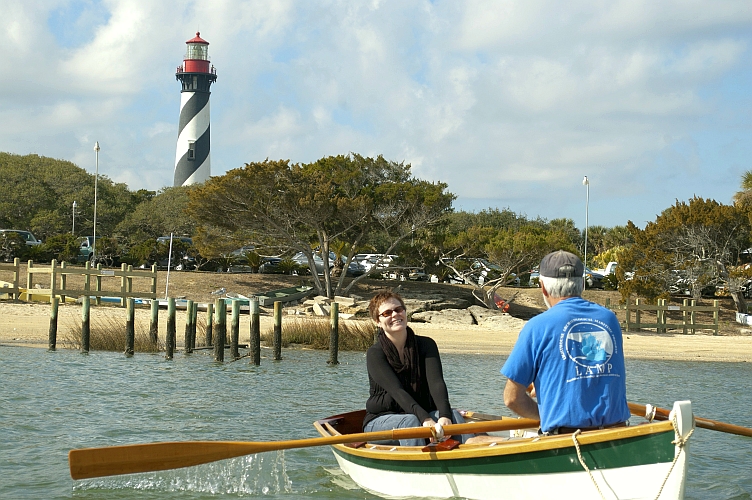
The Keeper's Blogtag:www.staugustinelighthouse.com,2011:/blog//12011-05-12T16:27:34ZMovable Type 3.33Jacksonville Magazine May 2011tag:www.staugustinelighthouse.com,2011:/blog//1.3442011-05-12T15:35:27Z2011-05-12T16:27:34ZBeau Phillipshttp://www.staugustinelighthouse.com/
]]>
]]>
LAMP's Search for Shipwrecks Highlighted in Jacksonville Magazinetag:www.staugustinelighthouse.com,2011:/blog//1.3432011-05-12T04:48:34Z2011-05-12T05:30:02Z A great story recently appeared in Jacksonville Magazine thanks to writer Alison Trinidad, who interviewed LAMP staff and our colleague at the Center for Historical Archaeology Dr. John De Bry. The article focuses on the 1565 loss of Ribault's...Chuck Meidehttp://www.staugustinelighthouse.com/lamp.php
A great story recently appeared in Jacksonville Magazine thanks to writer Alison Trinidad, who interviewed LAMP staff and our colleague at the Center for Historical Archaeology Dr. John De Bry. The article focuses on the 1565 loss of Ribault's French fleet, which had made the initial attempt to colonize the First Coast. The destruction of Ribault's ships by hurricane paved the way for Pedro Menendez' successful and permanent settlement at St. Augustine. These shipwrecks thus played a pivotal role in American history, and as we approach the 450th anniversary of their loss, their discovery would be the holy grail of maritime archaeology in Northeast Florida:
"This is an event that changed the course of history," says John de Bry, an Indialantic-based historian and archaeologist working on the search. If the Spanish had not successfully colonized, we might be living in a different Florida."
"Its a timely topic," adds Chuck Meide, director of the Lighthouse's research arm, known as LAMP. "We know that the fleet was scattered south of St. Augustine to as far as Cape Canaveral. That's a huge area to cover. It would take years and years to search, but it would be nice to by 2015."
LAMP, or Lighthouse Archaeological Maritime Program, routinely conducts shipwreck surveys near and around the nation's oldest port, but the search for Ribault's sunken fleet would take them into uncharted waters. "All our work here has been done and focused in St. Augustine," Meide says. "We're used to day trips. Logistically, its quite different for us."
]]>
To prepare for longer spans at sea on a live-aboard vessel, Meide is heading a couple of surveys in the Mayport and Matanzas Inlet areas in July. They don't expect to find Ribault's ships on these research trips, but wrecks dating to the 1800s are possible, Meide says. A crew of four or five will live for weeks at a time on Roper, a 36-foot steel-hulled trawler on loan from the Institute of Maritime History in Maryland. Using sonar and metal detecting equipment, the crew will scan the seafloor for artifacts that can be unearthed, preserved and studied. It'll be a leap forward for the team, which spent most of 2010 excavating a Revolutionary War-era wreck discovered in late 2009. "One season of diving can mean ten years of work in the lab," Meide says. "There's plenty of work to keep us busy."
Read the full article here.
]]>
LAMP Boatworks at the Florida Gulf Coast Small Craft Festivaltag:www.staugustinelighthouse.com,2011:/blog//1.3422011-04-21T14:34:17Z2011-04-21T18:29:03Z The late afternoon waterfront was still and flesh-warm. Only broken by the splash of a jumping mullet or the sudden outburst from a seagull, the glassy waterscape seeped Old Florida. Wooden docks askew from storms and time kept silent...Brendan Burkehttp://www.staugustinelighthouse.com/lamp.php
The late afternoon waterfront was still and flesh-warm. Only broken by the splash of a jumping mullet or the sudden outburst from a seagull, the glassy waterscape seeped Old Florida. Wooden docks askew from storms and time kept silent fishing boats bowing slowly to their slack moorings. This was, and is, the fishing village of Cortez, Florida. I stood with Matt Hanks on an old floating dock looking out over the panorama and letting the tension of a four and a half hour drive ease away. We were there to bring the good news of our lighthouse boatbuilding program to the Gulf coast, to learn about what other programs are doing, and to show off the William A. Harn, the first boat built by LAMP Boatworks. Follow along to learn more about LAMP Boatworks and the Florida Gulf Coast Small Craft Festival!
]]>
Florida Maritime Museum in Cortez is a centerpiece for this unique past. The museum, like the St. Augustine Lighthouse & Museum, also has a boatbuilding program. Theirs, unlike ours, supports full time boatbuilders, and their program has launched a number of wonderful craft as well as performing restoration work. Combined with their local chapter of the Traditional Small Craft Association, each year they host the Small Craft Festival to gather traditional craft from all over the state and the nation. The TSCA has been an active advocate for builders and restorers of traditional boats. Unlike many modern designs, traditional watercraft are often the boats that attract our eyes to their appealing lines and painstaking craftsmanship. It can be said with certainty that traditional craft carry with them not only an aesthetic that we love to caretake, but a history that is vital for us to steward. Without them, how would Columbus (or Pedro Menendez, for that matter!) have stepped ashore from his ship? How would John Smith have mapped the Chesapeake Bay, the world’s greatest estuary and cradle for English colonization, without his shallop? How too, would indigenous populations of the Americas and Pacific islands, accomplished to much to explore and populate remote regions and isles? And so the small watercraft, often relegated to Sunday picnicking, takes on a much more weighty historic burden. But, I meander from Cortez.
As those of you who have been participating, listening, and reading know, LAMP Boatworks has been busy over the past four years. Not only have we grown a boatbuilding program from nothing, but LAMP Boatworks has achieved Coast Guard builder’s certification and is now completing its eighth hull. For a program that is solely volunteer-run and operates for three half-days each week, LAMP Boatworks has been busy and productive. Once only a seed in the mind of Dr. Sam Turner, LAMP Director of Archaeology, LAMP Boatworks is now involved in no less than two in-house building projects, two tallship-related projects spanning two continents, has built two boats for other museums, and continues historical research to keep alive the story of our maritime past. And so, with this in mind, Matt and I ventured forth to take our show on the road.
After arriving and registering at the old general store, we surveyed the town on Friday night, taking in the dock scene and enjoying some seafood at the infamous Cortez Kitchen. Saturday morning began early and we arrived not long after sunup to launch the Harn and set up our display. Using a small tidal creek, we picked up the boat and slid it down the grassy bank into the water. After loading the boat with its rig, Matt and I slogged the skiff up the creek until we had enough water to float the boat fully loaded. We hopped in and poled our way through a sun-filtered cathedral of a black mangrove. The branches met over the stream, making a tunnel of leaves and branches. Egrets and herons were profuse and voiced their guttural squawks of displeasure over having to share their arboretum. The clear water around us, growing in width and depth as we neared the mouth of the freshet, revealed schools of minnows and other small fish with a clarity rarely seen on the First Coast.
Hauling the skiff down the creek to the docks.A newly launched skipjack at the docks, a jewel of the show.
Matt and I emerged onto the small embayment of Cortez’s working waterfront. Docking the boat, we set up the mast and began the process of rigging her for action. Bending the sail on the mast, we secured it snugly as a fresh wind began to blow out of the west. We used to boom like a sprit to hold the LAMP Boatworks banner and a full size US Light Service pennant. The big pennant luffed and snapped in the breeze like a runaway sail and attracted attention to our little display. Many other boats surrounded us and varied greatly in color, style, and rig. From beautiful melon seed’s to a replica of Col. Munroe’s schooner rigged sharpie Egret, the boats offered quite a beautiful vista. A series of floating docks were rigged around, and over a shallow sandbar so that the boats on anchor out from the dock could be reached, even at high tide, by wading shin-deep out to them. This arrangement was ingenious and plenty of conversations were held throughout the day knee-deep on the bar, surrounded by anchored craft.
The best sort of work meeting.The festival dock.
Matt and I, wearing our LAMP polo shirts, stood out a little from the crowd and were asked plenty of questions throughout the day. As I suspected, many people had no idea that the St. Augustine Lighthouse & Museum has a boatworks, moreover a maritime archaeology program! After the regatta was over and the events of the day began to wane a little, we down-rigged the display banner and unfurled the sail. It was time for the Harn to stretch its legs. We clawed our way out the little channel and into the bay, dropped the daggerboard, and let the sail fill. For the next hour or so, we tacked and wore around Cortez and let the boat work a little. Boats, wooden boats in particular, need working. A boat just sitting on exhibit can deteriorate in ways that you will never know unless you put it in the water and row it, sail it, or motor it. Repairs can then be effected in order to ‘keep alive’ the craft and ensure its longevity. A simple Newtonian principle, ‘An object in motion tends to stay in motion.’
Matt Hanks, LAMP Intern, a quick study at the helm and now a proficient sailor.
Saturday evening Matt and I attended the banquet and annual TSCA national meeting. Enjoying fresh local grouper, we sat with Ryan Murphy, the director of the Florida Maritime Museum and a slew of other wonderful enthusiasts, master builders, and preservationists. I wish I could relate all of their names and backgrounds but if you were there and read this let me know and I’ll properly cite our table roster! Having a later evening engagement over in Ana Maria Island at a concert, Matt and I departed after the meeting. Sunday morning we returned to the docks, where we had left our boat with the rest securely tied up overnight and re-rigged to sail. The day’s schedule was simple: take your boat our, or borrow someone else’s, and sail. We did just that and Matt, not having ever been on a sailboat before, became quite a proficient sailor. Enjoying the cerulean waters of the Gulf Coast and the warm weather, we put several miles under the keel before returning to downrig and depart. Later that afternoon, with a belly full of fresh fish and fried okra, we poled back up the little creek and hauled the boat out. Five hours later we were back in St. Augustine, happy but sunburned!
Brendan with the William A. Harn.A beautiful rendition of Egret, Col. Munroe's sharpie from the early 20th century.
I encourage you all to attend events like the Florida Gulf Coast Small Craft Festival. Not only do they support museums and organizations that keep the traditions alive, but small craft gatherings are just plain fun. We felt too that, it was time for LAMP Boatworks to get its name out and about and talk with other builders about their boatworks as well as showing off a little of what we’re doing here. The William Harn may be a kit boat, and not the most complex or aesthetically pleasing watercraft but she’s ours, our number one hull, and a heck of a fine skiff for sailing, rowing, and showing. I want to thank the Florida Maritime Museum in Cortez for hosting this event as well as the Florida Gulf Coast chapter of the Traditional Small Craft Association, Ryan Murphy, Bob Pitt, Ted Adams, Roger Allen, and many, many more folks who made the event successful and fun!
Look at that clear water!!Nice to see a real working waterfront.Stone crab pots stacked under a net shed.Sunday morning at the festival.]]>
"What is it???" Wednesday: Maritime Editiontag:www.staugustinelighthouse.com,2011:/blog//1.3412011-04-20T15:40:22Z2011-04-20T15:50:30ZIf you haven't ever seen it, the "What is it???" Wednesday is a great weekly posting on The Dirt on Public Archaeology blog maintained by our regional FPAN center. FPAN stands for the Florida Public Archaeology Network, and they are...Chuck Meidehttp://www.staugustinelighthouse.com/lamp.php
The Dirt on Public Archaeology blog maintained by our regional FPAN center. FPAN stands for the Florida Public Archaeology Network, and they are great partners of ours here in Northeast Florida. An artifact recovered by LAMP from the Storm Wreck is highlighted in this week's feature, check it out here!
Maybe you will be the one to answer the age-old question: "What is it???" (and win an FPAN t-shirt!)
]]>
Pier 17 Benefit for Lighthouse and LAMP!tag:www.staugustinelighthouse.com,2011:/blog//1.3402011-03-31T14:56:15Z2011-03-31T15:23:32Z Pier 17 Marine, Inc. has been supplying boaters in Jacksonville and the south for many decades. Their community service and neighborliness has been a mark of their service to the area and as everyone who has shopped there knows,...Brendan Burkehttp://www.staugustinelighthouse.com/lamp.phpPier 17 Marine, Inc. has been supplying boaters in Jacksonville and the south for many decades. Their community service and neighborliness has been a mark of their service to the area and as everyone who has shopped there knows, friendliness and good customer service is their trademark. Boaters also know too, that if they have an obscure part that needs replacing and have exhausted all other resources, Pier 17 will have it. Cynthia Seagrave, owner of Pier 17 has an annual sale, ranging from 48%-84% discounts throughout the store. The sale starts on April 4th and runs through the 8th. A nautical flea market is hosted on Saturday and is in the parking lot for Pier 17 Marine, so be sure to go and see good deals, both old and new!
Each year, Pier 17 Marine selects a nonprofit to support for each day of the sale. This year, the St. Augustine Lighthouse and Museum/LAMP has been selected as the sponsored nonprofit for Saturday!! We are very excited, and grateful to have been gifted such a nice opportunity. Thank you Pier 17 Marine!! We will have a display table set up for the event as well as the Susan skiff on display, our most recently completed LAMP Boatworks boat. Be sure to get your tickets to take a chance in our drawing to win this handsome little wooden boat.
Pier 17 Marine is located at 4619 Roosevelt Blvd, Jacksonville. It is right beside the Rt. 17 Ortega River Bridge, and adjacent to Sadler Point Marina. See you there!]]>
It was Very Cool! 19th Annual Lighthouse Festivaltag:www.staugustinelighthouse.com,2011:/blog//1.3392011-03-25T19:25:58Z2011-03-25T19:29:33Z Join us on facebook or Twitter...Beau Phillipshttp://www.staugustinelighthouse.com/
Join us on facebook
or Twitter]]>
19th Annual Lighthouse Festival and JSL 5Ktag:www.staugustinelighthouse.com,2011:/blog//1.3342011-03-18T06:00:05Z2011-03-18T18:02:04Z Date: March 19 Time: 11-6 Admission: FREE Parking: paid parking at the site free parking and shuttle from the Elk's Lodge Sponsors: Tourist Development Council, Bank of St. Augustine, Picolata Farms Join thousands when the St. Augustine Lighthouse &...Beau Phillipshttp://www.staugustinelighthouse.com/Date: March 19
Time: 11-6
Admission: FREE
Parking: paid parking at the site
free parking and shuttle from the Elk's Lodge
Sponsors: Tourist Development Council, Bank of St. Augustine, Picolata Farms
Join thousands when the St. Augustine Lighthouse & Museum opens it's doors during this annual tradition celebrating our maritime history. Children must be 44" Tall to climb the tower and children under 12 year-old must be accompanied by an adult.
What to doJunior Service League 5K (must register)
Climb the Tower
Explore the Museum
Bouncy House & Slide (Requires tickets)
Build & Float Sailboat (Requires tickets)
Pony Rides (Requires tickets)
Facebook Photo Booth (NEW & FREE)
2nd Annual Wooden Boat Show
Children's Crafts
]]>
Entertainment
11-11:45 RB Hunt: Island Recorder and D.R.U.M
12:00-12:30 North Florida Martial Arts
12:45-1:45 – Showtime
2:00-2:15 – Baton Twirling
2:30-3:00 – Island Gymnastics
3:15-4:15 - Billy Buchanan &Free Avenue
4:30-5:00- Josh Dyer
Who Will Be ThereLighthouse Archaeological Maritime Program (operated by: First Light Maritime Society)
Jacksonville Maritime Museum
Florida Public Archaeology Network (FPAN)
St. Augustine Archaeological Association (SAAA)
United States Coast Guard
SPARS
Humane Society
This event organized and funded by the First Light Maritime Society
]]>
6/6-7/1/2011: 2011 LAMP Underwater Archaeology Field Schooltag:www.staugustinelighthouse.com,2010:/blog//1.3252011-03-02T14:26:51Z2011-03-16T20:42:32Z The Lighthouse Archaeological Maritime Program (LAMP) is pleased to announce our Summer 2011 Field School. This year the field school will be held from June 6 - July 1, 2011 at the St. Augustine Lighthouse & Museum, St. Augustine,...Brendan Burkehttp://www.staugustinelighthouse.com/lamp.php
The Lighthouse Archaeological Maritime Program (LAMP) is pleased to announce our Summer 2011 Field School. This year the field school will be held from June 6 - July 1, 2011 at the St. Augustine Lighthouse & Museum, St. Augustine, Florida. This comprehensive 4-week practicum will focus on the continued excavation of an 18th century shipwreck. Discovered in 2009, excavations began on this wreck site began during the summer of 2010. Artifacts recovered from this site indicate that is is a late 18th century wreck of unknown origin. Recent discoveries include hardware and rigging components, navigational and carpentry tools, a series of cast-iron and copper cauldrons, a small flintlock pistol, four cannons, and the ship's bell. This summer’s activities will include mapping, recording, and excavating an area adjacent to the 2010 excavation units. Students will work alongside instructors to record and recover artifacts associated with this wreck, including the planned raising of at least one cannon.]]>
Field school diver recording a large cauldron during the 2010 field school.
Students will be instructed in scientific diving procedures, archaeological recording and excavation, the use of hydraulic probes and induction dredges, marine remote sensing survey and analysis (magnetometer & side scan sonar), artifact collection and documentation, and basic conservation laboratory methodology. The field school will also host an evening lecture series with field school instructors and visiting professionals from various public, private, and academic institutions throughout Florida.
Short video with footage taken during the 2010 Field School, including comments from some of last year's students: "What to expect? Expect early mornings, lots of hard work, but a ton of fun, and something you'll never, ever forget."Requirements:
• Students must be scuba-certified and qualify as a scientific diver through AAUS (American Academy of Underwater Sciences) or a similar institution, or else qualify as a scientific-diver-in-training through LAMP’s scientific diver program. These requirements include a specific medical exam to be completed prior to field school, and a swim test to be conducted upon arrival. More information and downloads of the medical exam form and other required paperwork are available here.
• Please download and read this note on our diving conditions and requirements
• Students must have DAN diving accident insurance or an equivalent policy.
• Students must hold current CPR and First Aid certifications.
Sponsors
This field practicum is supported by Plymouth State University, Plymouth, New Hampshire which will offer academic credit for those who wish to receive it at their standard rates for graduate or undergraduate tuition (see below).
Additional partnering institutions:
Florida Public Archaeology Network (FPAN)The Institute of Maritime History (IMH)The 36' IMH research vessel Roper will be the primary work platform for the 2011 Field School.Housing
LAMP maintains a Field House on five acres of rural property just outside St. Augustine. Expect dormitory-type conditions though the house is furnished with air conditioning, two bathrooms, and a fully-operational kitchen. Students should provide their own bedding (sheets, pillow, blanket, etc). If students wish to camp on the land around the field house they should bring their own tent/gear.
Meals will be communal and prepared each day by the field school participants on a rotating basis. Each student will be assigned to a weekly KP roster. The budget for purchasing food is derived from the field school fee charged to all students. Students are responsible for their own food on weekends.
_______________________________________________________________________________________
Online Application Forms and FeesDownload the application package by clicking here
The fee for the field school is $2,200 for students seeking academic credit and $2,500 for students not seeking credit. This fee is payable to LAMP, and a $250 deposit is due upon acceptance to the Field School, with the remainder due the first day of class. This fee includes housing, food (except on weekends when you are responsible for your own food), all diving gear (other than mask, fins, snorkels, & booties), air fills, and the use of LAMP’s research vessels, dive locker, classroom, and laboratory facilities. The deposit and remaining balance may be paid with check or credit card. Graduate or undergraduate credit is available through Plymouth State University, or through your own institution if you make these arrangements, at additional expense paid directly to the school for tuition. Plymouth State University tuition costs are as follows:
Undergraduate In-state (New Hampshire): $320 per credit hour
Undergraduate Out-of-state: $350 per credit hour
Graduate In-state: $493 per credit hour
Graduate Out-of-state: $539 per credit hour
Students may receive four credit hours for the four full weeks of field school. Tuition must be paid separately through PSU or the university issuing credit, and the tuition cost is separate from the Field School fee payable to LAMP.
Students must provide their own transportation to and from St. Augustine, Florida. Students must also be responsible for the required diving insurance, diving medical exam, and CPR/First Aid before the start of the course, as outlined below.
Please download the application package, which consists of three one-page forms in a single Microsoft Word document. You may complete the forms digitally or else print them out and complete by hand. When finished, please send to Dr. Sam Turner by email or fax or regular mail:
Dr. Sam Turner
Director of Archaeology, LAMP
81 Lighthouse Avenue
St. Augustine, Florida 32080 USA
Fax: 904-808-1248 Phone: 904-829-0745
Participation in the Field School can be competitive depending on the numbers of applicants, which have been increasing each year. While not required, if you have a resume or vita, please include it with your application, and you may also have a letter of reference sent to us by email from a professor or employer.
If you have any other questions, please call or email Dr. Turner at sturner@staugustinelighthouse.com.
_______________________________________________________________________________________
Click here visit our Field School blog! Scroll down to see postings from 2010 and previous year's Field Schools!
_______________________________________________________________________________________
Our primary Field School research vessels include LAMP's newly acquired RV Desmond Valdes, and the Institute of Maritime History's RV Roper, pictured below:Work carried out during the 2010 LAMP Field School.
]]>
3/19/2011: Boat Show 2011!tag:www.staugustinelighthouse.com,2011:/blog//1.3352011-02-24T14:38:13Z2011-03-18T15:39:15Z Click the poster to make it bigger. We are pleased to announce the 2011 LAMP Boatworks Boat Show, to be held on Saturday, March 19th. This is part of the annual St. Augustine Lighthouse & Museum Lighthouse Festival. Last...Brendan Burkehttp://www.staugustinelighthouse.com/lamp.phpClick the poster to make it bigger.
We are pleased to announce the 2011 LAMP Boatworks Boat Show, to be held on Saturday, March 19th. This is part of the annual St. Augustine Lighthouse & Museum Lighthouse Festival. Last year we had a very nice collection of traditional watercraft show up from all over Florida. This year is our second year including a boat show as part of the Lighthouse Festival and we are looking forward to it! Boats we seek include traditional watercraft powered by sail, oar, or engine. This includes wooden boats built using traditional plans, methods, and/or materials. This is a fun event and if you have not visited our museum, it is open to the public for free on Festival day and we routinely host 5,000 or more visitors every year.]]>
HERE.
If you would like to show a boat, please contact bburke@staugustinelighthouse.org and include the following:
-type of boat
-name of boat
-year of manufacture
-place of manufacture
-builder's name
-owner's name
-powered by (engine type, # of oars, sail plan, etc.)
-where homeported
-length overall
-beam
-draught
-any other particulars you wish to have on a display placard
The details of the show:
Location: St. Augustine Lighthouse and Museum (81 Lighthouse Avenue, St. Augustine, FL 32080)
When: Saturday March 19th, 10:00-6:00 (please arrive no later than 9:30 to be placed)
Cost: none
Registration: So we can plan for spacing and displaying the boats, we ask that you please let us know that you will be bringing a boat. Thanks!
*Since this is a Lighthouse event, we do not allow non-lighthouse sales at Festival, including boat sales.*]]>
LAMP Divers Discover Four Cannon and the Ship's Belltag:www.staugustinelighthouse.com,2011:/blog//1.3332011-02-14T23:40:01Z2011-02-15T03:21:18Z LAMP diver inspecting the ship's bell on the day of its discovery, 17 December 2010. It was recovered later that same day. It was meant to be a routine monitoring dive on a site months after summer excavations had...Chuck Meidehttp://www.staugustinelighthouse.com/lamp.phpLAMP diver inspecting the ship's bell on the day of its discovery, 17 December 2010. It was recovered later that same day.
It was meant to be a routine monitoring dive on a site months after summer excavations had come to a close. We expected black visibility and perhaps some challenging work searching for a buried wreck site, and untangling submerged lines, and if we had time digging up some dredge hose and mooring anchors we had left on site to be buried by accumulating sand. The only thing out of the ordinary was that we had several new volunteers with us out on a dive for the first time, and the fact that it was a cold day, with water temperatures around 54 degrees F.
But as it turned out, December 17, 2010 was a day nothing short of extraordinary. It was the day of LAMP's greatest discovery to date.]]>
Our team assembled at the dock at sunrise. LAMP's boat, the RV Desmond Valdes, was joined by a state law enforcement vessel captained by Officer Corey of the Fish and Wildlife Commission. Corey is not a diver but was joining us along with his fellow officer, Mike Chapman of the St. Johns County Sheriff's Dive Team.
I rode along in the FWC boat with Mike and Corey, while the rest of the LAMP team, consisting of LAMP archaeologists Brendan Burke and Dr. Sam Turner, along with LAMP volunteer Craig Rio, followed in the Desi. It was great to have several volunteers with us, as Craig (a non-diver) has been putting in a lot of time in the laboratory working with artifacts, and Mike has been interested in participating in a dive with us for some time now. Its also great to have a cooperative partnership with local law enforcement officers, which means there will be a lot more alert eyes on this site. As with all shipwrecks in state waters, the Storm Wreck is protected by state law, and anyone caught disturbing the site or removing artifacts from it will be prosecuted to the fullest extent of the law.
Leading the first dive was Dr. Sam Turner, LAMP's Director of Archaeology.
Here is Mike just before he entered the water. It was a cold day, with water temperature in the 50s, so he is decked out in his vulcanized rubber drysuit, under which he can wear layers of insulation to keep warm. Sam is also garbed in a drysuit, and though his is of a different material (laminated layers of nylon and rubber), it will keep him just as dry. Sam likes to wear multiple woolen sweaters under his drysuit, which keeps him nice and toasty even in this frigid water, though the air trapped in the wool does require significant amounts of extra lead weights. The divers were given a briefing, assigned the mission of locating the site by circular searches and assessing its current condition, and were told to expect zero visibility. The divers were additionally told that the entire shipwreck site was likely to be buried in sand, and that the only features protruding from the seafloor would likely be submerged lines left in place by the summer excavation team.
The first thing the divers noted was that visibility was actually good. In fact, by our standards, it was great--at least six to eight feet, perhaps even more! As the divers began a standard circle search, Sam's eyes made out a large, amorphous shape looming ahead of him in the haze. Seconds later, his heart raced as he realized it was a cannon! Then he saw there were more than one cannon, at least three or four! And then his racing heart skipped a beat as he made out, very clearly, the shape of a large bell, nestled between the cluster of guns!
The bell was large, about a foot across at its base, and appeared to have its hanging apparatus intact. That means it was definitely a ship's bell, once attached to the fabric of the vessel, as opposed to a cargo item, such as a bell intended for a church. In the forefront of this image, almost touching the base of the bell, is the breech end of an iron cannon.
Sam could see that the bell was covered in a light layer of concretion (encrustation or corrosion product), a little of which had chipped away to reveal that the bell was made of bronze.
Here is another view of the bell. On the left side is the cascabel or breech end of the cannon, while in between the bell and the cannon is a single brick of fired clay. Several bricks were found scattered around this newly exposed area of the site. For whatever reason, shifting sands have left this small pocket of the site scoured free and exposed. During the summer divers had swam over this exact spot hundreds of times, without ever realizing what treasures lay hidden beneath the sand. While we know this area features a dynamic and often changing underwater landscape, due to the actions of storms, swells, currents, and tide, we were surprised that this newly discovered area was exposed, while the rest of the site remained buried.
In addition to the bell, the cannons, and the scatter of bricks, divers also observed an iron cauldron (bringing to total found so far to five), at least two copper cauldrons, and a number of unidentified concretions (corroded iron objects). Pictured above is a flat-bottomed cauldron fashioned from copper sheeting, probably riveted together. While the sides are covered in a light layer of concretion, the bottom of the cauldron displays its original metal. It has either been scoured clean by sand movement, or just did not form a layer of encrustation as did the vessel's sides.
Here is the cascabel of another cannon, and in the background is the copper cauldron from the previous picture. The cascabel or button is pierced by a hole, which we believe to be a threaded aperture designed to fit an elevating screw, which would have been used by the gun crew to raise or lower the breech end of the gun when aiming.
These cannons are very short, this one measuring just over a meter, and we believe that they are a type known as carronades. This is a preliminary field sketch completed by Dr. Turner of the carronade in the photograph above. Carronades, short and stubby, were considerably lighter than traditional long guns, and they fired a much heavier ball than a long cannon of the same weight. Therefore a ship armed with a battery of carronades could pack a much more powerful broadside for the amount of weight that could be safely carried on its deck. The drawback was that carronades had a shorter range than long guns. But as lightweight guns requiring smaller gun crews, they were quickly adapted by British merchant ships during the Revolutionary War, due to their effectiveness at warding off enemy privateers. They were so powerful that they soon became nicknamed "smashers."
Here are three photographs mosaicked together to show the full length of one of our guns. The muzzle (firing end) is on the left side, while the breech is on the right. In the center of the gun is a peg-like projection known as the trunnion. The gun sat on its trunnions on a carraige, allowing it to swivel up or down. As this gun and at least one other featured trunnions, they may be considered gunnades, a variant of the carronade. Most carronades were mounted by means of an iron lug mounted on the bottom of the gun, rather than the more tradtional trunnions as seen here.
Here is a photograph of a carronade on the deck of the replica War of 1812 privateer schooner Lynx, who spent part of the winter here in St. Augustine. This gun does not have trunnions but the more traditional bottom lug. The presence of carronades on the Storm Wreck helps us further define its date, as carronades did not come into use until the 1770s.
Here is a historic schematic of a carronade mounted for use (courtesy of Wikipedia). It does not feature trunnions, like at least two of the guns on our wreck, but it does show the elevation turnscrew at the cascabel, as at least one of our guns would have used. Because we have at least one gun with an elevation screw aperture and one without, it appears we have a mix of gun forms on our wreck, which is interesting (and suggests the identity of a merchantman or possibly a privateer rather than a naval vessel).
This brief video clip shows underwater footage of the bell, cannons, and other artifacts in place on the seafloor as discovered by the LAMP team.
With the exciting discovery of this newly exposed section of the shipwreck site, our first priority became to record the ship's bell in place, so that we could safely recover it knowing that its exact location and position was thoroughly documented. As archaeologists felt the relatively lightweight bell was vulnerable in its exposed situation on the seafloor, recovery was deemed an immediate need, but not before being drawn in place. Here LAMP Director Chuck Meide is working on his 1:5 scale drawing of the bell and the objects immediately surrounding it.
Here is the drawing I made underwater, digitized by our volunteer Tim Jackson. It took an hour and a half of dive time to complete this scaled drawing, and in that cold water, even with hood, gloves, and drysuit, I was freezing when I finally returned to world of light and sound.
After being fully recorded, the bell was ready for lifting. Sam Turner lead the next dive team, carefully lifting by hand the bell up and into a lifting crate. This large plastic bin was lined with window screen so that even tiny artifacts that might fall from the bell would not be lost. He then rigged the crate with a lift bag, which when filled with air provides 100 lbs of positive buoyancy. Here is Sam carefully guiding the bell to the surface.
The lifting bag at the surface, with its precious cargo dangling just below . . .
Hauling the bell in its crate up and into the boat . . .
And, finally, once safe on the boat, the bell is moved from the lifting crate into a waiting vat of water. It is critically important to keep the bell wet until it has been fully stabilized in the laboratory, a process that can take well over a year.
The look on Sam's face, even after a cold and strenuous dive, says it all. The discoverer of the bell!!!!
The bell recovery team back on the dock. L to R: LAMP Archaeologist/Logistical Coordinator Brendan Burke, LAMP Director Chuck Meide, LAMP Archaeological Conservator Starr Cox, LAMP Director of Archaeology Sam Turner, LAMP Volunteer Craig Rio. Not pictured is Mike Chapmann, co-discoverer of the bell, who had to leave earlier in the day.
Here is a picture of the bell taken that same day, back in the laboratory.
Another picture, from a different angle, taken a few days later. For a while we kept the existence of this bell a secret, to protect it until we could get it to a secure, undisclosed location. We also wished to announce the discovery of the bell, and unveil it, at a public event. In the end we decided to unveil the bell, and clean it, at the same event, which took place in late January.
Here is a short video of the Bell Unveiling Event at the museum, which we held a few weeks after its safe recovery, and where LAMP conservator and interns carefully cleaned the encrustation from the bell before a crowd of around 100 excited guests. So far there is no sign of a name, year, or maker's mark, though about 25% of the bell's outer surface remains obscured by heavy iron concretion. Stay tuned to find out if we can solve the mystery of this shipwreck. Regardless, this bell is perhaps the most exciting and evocative artifact ever recovered from St. Augustine waters, and as far as we know only the second bell discovered by archaeologists from any shipwreck in Florida. A truly special and unique find, which will make a fabulous museum exhibit!
]]>
LAMP Boatworks Plays Hookeytag:www.staugustinelighthouse.com,2011:/blog//1.3322011-01-28T17:37:39Z2011-01-31T14:56:29Z LAMP Boatworks, enjoying a day sail. Volunteer boatbuilders from the LAMP Boatworks enjoyed a 'thank you' cruise aboard Privateer Lynx this past Thursday, the 28th of January. The Lynx Eduational Foundation offered space on the cruise for our Boatworks...Brendan Burkehttp://www.staugustinelighthouse.com/lamp.phpLAMP Boatworks, enjoying a day sail.
Volunteer boatbuilders from the LAMP Boatworks enjoyed a 'thank you' cruise aboard Privateer Lynx this past Thursday, the 28th of January. The Lynx Eduational Foundation offered space on the cruise for our Boatworks volunteers as an act of appreciation for their efforts to revitalize the ship's stern boat. Lynx has now departed St. Augustine and will be reopening for tours in downtown Jacksonville on February 15. We wish her well!]]>
Sweating a halyard into place.Steve McMullen, Lynx's smallboat project manager, helping to raise the staysail along with Lynx's Tyson Miller.LAMP Director Chuck Meide showing off sliding bar shot, a type used to take out rigging on opposing ships.]]>
LAMP Boatworks Celebrates a New Launch!tag:www.staugustinelighthouse.com,2011:/blog//1.3312011-01-20T21:35:52Z2011-01-21T18:52:37Z For the past several months volunteers at the LAMP Boatworks have been diligently working on the building of our eight hull, a boat type called the ‘Susan’. Designed by Robert M. Steward in the 1950s, this classic little boat...Brendan Burkehttp://www.staugustinelighthouse.com/lamp.php
For the past several months volunteers at the LAMP Boatworks have been diligently working on the building of our eight hull, a boat type called the ‘Susan’. Designed by Robert M. Steward in the 1950s, this classic little boat got her feet wet this morning at the hands of the lead builders, Richard Sexauer and Steve McMullen .
]]>
The launching crew.
At eleven feet long, the Susan skiff is rowed through the water very easily from either of the two rowing stations and handles two people in a comfortable and stable manner. Even in the wake thrown by passing boats the skiff rode high and dry. The ‘Susan’ name only denotes the type of hull and for now, this skiff will go unnamed. During the coming year, LAMP Boatworks will hold a drawing for one lucky person to win this boat. The boat is light, very sturdy and well constructed. LAMP Boatworks deviated from the original plans calling for crossplanking (boards fastened athwartships for the bottom, as opposed to longitudinally placed) and used epoxy soaked marine plywood. The durability and stability of this material allows the boat to handle and act like a wood boat but with less maintenance and chances for rot. Similarly, her planking is from epoxy-saturated plywood strakes. After a professional paint job, you cannot tell the difference betwixt the two. The transom is honduras mahogany and her seats, breasthook, and quarterknees are made from sapele, a tropical hardwood that is one of the finest and most figured marine-grade woods. Frames and stempost are of white oak. Oarlocks and oarlock sockets are cast and polished silicon bronze and the oars are made from cypress with hand-stitched leather lock guards. The transom, breasthook, quarterknees, inwhale, thwarts, and oarlock pads are all left bright and finished with multiple coats of Epifanes varnish. Copper and silicone bronze fasteners were used througout the boat. All together, a smart little package!
Craftsmanship afloat!
href="http://www.staugustinelighthouse.com/blog/launch.jpg">LAMP Archaeologist Brendan Burke holds the skiff while LAMP Boatbuilder Richard Sexauer prepares to get underway. This is her first time in the water!
Since this project skiff has come to a close, the volunteer builders at our boatworks are currently working on repairs to the Privateer Lynx’s sternboat, continuing the build of the 1760s pattern ship’s yawl, and refining plans for our next build. The LAMP Boatworks is operated as part of the Lighthouse Archaeological Maritime Program, the maritime research arm of the St. Augustine Lighthouse & Museum. Our program is volunteer run and operates primarily on a Tuesday-Thursday schedule just about every week of the year. LAMP Boatworks is a Coast Guard inspected builder of traditional watercraft. Join us as we continue the art of boatbuilding in the Nation’s Oldest Port!
LAMP and the St. Augustine Lighthouse & Museum would like to take this opportunity to thank our volunteer boatbuilders for their time, effort, and skill. Without them, the Boatworks could not exist. Thank you!
For more information, call 904-829-0745, or visit us online at www.LAMPmaritime.org
Lighthouse Educator, Susan Graffweg gets a birthday ride on our new skiff. Two Susans on their birthdays!]]>
01/20/2011 Lecture: Shipwreck Archaeology off the Nation's Oldest Port (Juno Beach, FL)tag:www.staugustinelighthouse.com,2011:/blog//1.3302011-01-20T14:31:08Z2011-02-01T23:38:45Z What: Lecture, part of the LRHS History Lecture Series Who: Chuck Meide, Director of LAMP When: Thursday, January 20th, 6:00 am to 7:00 pm Where: Juno Beach Town Center Council Chambers, 340 Ocean Drive, Juno Beach, FL Sponsored by:...Chuck Meidehttp://www.staugustinelighthouse.com/lamp.phpWhat: Lecture, part of the LRHS History Lecture Series
Who: Chuck Meide, Director of LAMP
When: Thursday, January 20th, 6:00 am to 7:00 pm
Where: Juno Beach Town Center Council Chambers, 340 Ocean Drive, Juno Beach, FL
Sponsored by: Jupiter Inlet Lighthouse & Museum, Town of Juno Beach, Florida Humanities Council
Free and open to the public, please RSVP by calling 561-747-8380 x101.]]>
LRHS History Lecture Series
Jan. 20, 6-7pm
Speaker: Mr. Chuck Meide, Director
Lighthouse Archaeological Maritime Program
St. Augustine Lighthouse & Museum
Sponsored by the Florida Humanities Council, The State Program of the National Endowment for the Humanities.
Lectures are free and are held at the Juno Beach Town Center, 340 Ocean Drive, Juno Beach, and are sponsored in part by the Town of Juno Beach. Please rsvp by calling 561-747-8380 x101.
Visit the Jupiter Inlet Lighthouse & Museum website for more information
]]>
FOR EDUCATORS: Smithsonian Early Enrichment Center Executive Director Presents: "Teaching and Learning with Objects"tag:www.staugustinelighthouse.com,2011:/blog//1.3292011-01-07T20:49:09Z2011-01-07T21:23:12ZThe St. Augustine Lighthouse & Museum, a Smithsonian Affiliate, will host Dr. Sharon Shaffer, Executive Director of the Smithsonian Early Enrichment Center, for a two day educator training seminar entitled “Teaching and Learning with Objects” on January 25 & 26....Beau Phillipshttp://www.staugustinelighthouse.com/
]]>
Teaching & Learning with Objects
The St. Augustine Lighthouse and Museum, a Smithsonian Affiliate,
Welcomes Smithsonian Educator, Dr. Sharon Shaffer
For a One of a Kind Educator Training Opportunity
About the Seminar
This seminar will actively engage participants in educational techniques that reflect a museum-based approach to teaching and learning. Participants will explore strategies that extend learning beyond the textbook and heighten students’ sense of excitement and personal connection to learning. Personal experiences in the classroom and application of strategies in the galleries of St. Augustine Lighthouse & Museum will help participants develop skills for teaching with objects and understand how this approach mirrors real-world strategies employed by scientists and historians. This seminar offers insight for object- based learning in the classroom or at the museum.
About the Facilitator
Dr. Sharon Shaffer is the Executive Director for the Smithsonian Early Enrichment Center (SEEC). As the founding Director for SEEC in 1988, she was given the challenge of developing a program for young children that utilized the rich resources of the Smithsonian Institution and the surrounding museums. The Smithsonian’s model is built on the most current research in early childhood education and museum practice, leading the field in arts-based education for young children.
Dr. Shaffer oversees the SEEC program, which includes a child development center, preschool, and kindergarten, and provides leadership for educational outreach. She is responsible for designing seminars for training early childhood educators and museum professionals in object-based learning and arts-centered curriculum, consulting with schools and museums, and presenting at conferences and seminars nationally and internationally. She has been a guest lecturer for the graduate program in Museum Leadership at Bank Street College, George Washington University, Gallaudet University, and the University of Virginia. In addition to her
work at SEEC, Dr. Shaffer is teaching as an adjunct professor at the University of Virginia.
Dates and Times
Place: The St. Augustine Lighthouse and Museum, 81 Lighthouse Avenue
Dates: January 25, 2011 - Early childhood to elementary-aged based learning
January 26, 2011- Middle school to high school-aged based learning
9:00 am-4:00 pm. Mornings will focus on concepts of teaching with objects
Afternoons will focus on using objects in a museum’s collections.
Cost: Members are Free, $40.00 for non-members, $20.00 for students
A confirmation letter will be sent to each participant. Space is limited.
Contact Brenna Ryan at 904-829-0745 ext. 208 or visit staugustinelighthouse.org for more information.
Download Registration Form
]]>
Nation's Oldest Port Summer Camp 2011tag:www.staugustinelighthouse.com,2011:/blog//1.3372011-01-04T21:26:32Z2011-03-29T21:50:45ZNation’s Oldest Port Summer Camp 2011 Age focused! Each session will be devoted to only one age group for a more focused and enriching experience. 6 Weeks - 3 Different Camps! 9am-3 pm Daily In Search of. . . Secrets...Beau Phillipshttp://www.staugustinelighthouse.com/
Nation’s Oldest Port
Summer Camp 2011
Age focused!
Each session will be devoted to only
one age group for a more focused and
enriching experience.
6 Weeks - 3 Different Camps!
9am-3 pm Daily
In Search of. . .
Secrets of Underwater Archaeology
Tales From the Deep
In Search of. . .
Explore the watery world of ships and why they wreck. From stars to charts, campers will learn what it takes to navigate waterways – but look out for the sandbar!
Secrets of Underwater Archaeology
What’s it like to be an underwater archaeologist? Campers will learn the process of finding shipwrecks and artifacts, and what happens after they’re found!
Tales from the Deep
Discover the science behind the story. . . Learn about artifact preservation and conservation, and how archaeologists and museums work together to tell the tale! Campers will create their own exhibit to show what they have learned!
Sign Up as A Member for Discounts!
A $50 family membership will save
you $25 per camp plus free admission
to the museum and invitations to
special events for an entire year.
All camping sessions include arts and crafts, creative writing, science and technology, an offsite excursion, games, lunch, snacks, and of course,
climbing the Lighthouse.
Limited before and after care is available.
Member registration starts April 18, 2011
Open registration starts April 25, 2011
To register contact:
St. Augustine Lighthouse & Museum Education Dept.
904-829-0745
Ask us how to qualify for scholarships made available
through the Steve Senecal Scholarship Fund,
in partnership with Sertoma of St. Augustine
and other partners.
Download Brochure and Registration Form
APPLY FOR A SCHOLARSHIPDownload the Scholarship Application
]]>
 The late afternoon waterfront was still and flesh-warm. Only broken by the splash of a jumping mullet or the sudden outburst from a seagull, the glassy waterscape seeped Old Florida. Wooden docks askew from storms and time kept silent fishing boats bowing slowly to their slack moorings. This was, and is, the fishing village of Cortez, Florida. I stood with Matt Hanks on an old floating dock looking out over the panorama and letting the tension of a four and a half hour drive ease away. We were there to bring the good news of our lighthouse boatbuilding program to the Gulf coast, to learn about what other programs are doing, and to show off the William A. Harn, the first boat built by LAMP Boatworks. Follow along to learn more about LAMP Boatworks and the Florida Gulf Coast Small Craft Festival!
]]>
Florida Maritime Museum in Cortez is a centerpiece for this unique past. The museum, like the St. Augustine Lighthouse & Museum, also has a boatbuilding program. Theirs, unlike ours, supports full time boatbuilders, and their program has launched a number of wonderful craft as well as performing restoration work. Combined with their local chapter of the Traditional Small Craft Association, each year they host the Small Craft Festival to gather traditional craft from all over the state and the nation. The TSCA has been an active advocate for builders and restorers of traditional boats. Unlike many modern designs, traditional watercraft are often the boats that attract our eyes to their appealing lines and painstaking craftsmanship. It can be said with certainty that traditional craft carry with them not only an aesthetic that we love to caretake, but a history that is vital for us to steward. Without them, how would Columbus (or Pedro Menendez, for that matter!) have stepped ashore from his ship? How would John Smith have mapped the Chesapeake Bay, the world’s greatest estuary and cradle for English colonization, without his shallop? How too, would indigenous populations of the Americas and Pacific islands, accomplished to much to explore and populate remote regions and isles? And so the small watercraft, often relegated to Sunday picnicking, takes on a much more weighty historic burden. But, I meander from Cortez.
As those of you who have been participating, listening, and reading know, LAMP Boatworks has been busy over the past four years. Not only have we grown a boatbuilding program from nothing, but LAMP Boatworks has achieved Coast Guard builder’s certification and is now completing its eighth hull. For a program that is solely volunteer-run and operates for three half-days each week, LAMP Boatworks has been busy and productive. Once only a seed in the mind of Dr. Sam Turner, LAMP Director of Archaeology, LAMP Boatworks is now involved in no less than two in-house building projects, two tallship-related projects spanning two continents, has built two boats for other museums, and continues historical research to keep alive the story of our maritime past. And so, with this in mind, Matt and I ventured forth to take our show on the road.
After arriving and registering at the old general store, we surveyed the town on Friday night, taking in the dock scene and enjoying some seafood at the infamous Cortez Kitchen. Saturday morning began early and we arrived not long after sunup to launch the Harn and set up our display. Using a small tidal creek, we picked up the boat and slid it down the grassy bank into the water. After loading the boat with its rig, Matt and I slogged the skiff up the creek until we had enough water to float the boat fully loaded. We hopped in and poled our way through a sun-filtered cathedral of a black mangrove. The branches met over the stream, making a tunnel of leaves and branches. Egrets and herons were profuse and voiced their guttural squawks of displeasure over having to share their arboretum. The clear water around us, growing in width and depth as we neared the mouth of the freshet, revealed schools of minnows and other small fish with a clarity rarely seen on the First Coast.
The late afternoon waterfront was still and flesh-warm. Only broken by the splash of a jumping mullet or the sudden outburst from a seagull, the glassy waterscape seeped Old Florida. Wooden docks askew from storms and time kept silent fishing boats bowing slowly to their slack moorings. This was, and is, the fishing village of Cortez, Florida. I stood with Matt Hanks on an old floating dock looking out over the panorama and letting the tension of a four and a half hour drive ease away. We were there to bring the good news of our lighthouse boatbuilding program to the Gulf coast, to learn about what other programs are doing, and to show off the William A. Harn, the first boat built by LAMP Boatworks. Follow along to learn more about LAMP Boatworks and the Florida Gulf Coast Small Craft Festival!
]]>
Florida Maritime Museum in Cortez is a centerpiece for this unique past. The museum, like the St. Augustine Lighthouse & Museum, also has a boatbuilding program. Theirs, unlike ours, supports full time boatbuilders, and their program has launched a number of wonderful craft as well as performing restoration work. Combined with their local chapter of the Traditional Small Craft Association, each year they host the Small Craft Festival to gather traditional craft from all over the state and the nation. The TSCA has been an active advocate for builders and restorers of traditional boats. Unlike many modern designs, traditional watercraft are often the boats that attract our eyes to their appealing lines and painstaking craftsmanship. It can be said with certainty that traditional craft carry with them not only an aesthetic that we love to caretake, but a history that is vital for us to steward. Without them, how would Columbus (or Pedro Menendez, for that matter!) have stepped ashore from his ship? How would John Smith have mapped the Chesapeake Bay, the world’s greatest estuary and cradle for English colonization, without his shallop? How too, would indigenous populations of the Americas and Pacific islands, accomplished to much to explore and populate remote regions and isles? And so the small watercraft, often relegated to Sunday picnicking, takes on a much more weighty historic burden. But, I meander from Cortez.
As those of you who have been participating, listening, and reading know, LAMP Boatworks has been busy over the past four years. Not only have we grown a boatbuilding program from nothing, but LAMP Boatworks has achieved Coast Guard builder’s certification and is now completing its eighth hull. For a program that is solely volunteer-run and operates for three half-days each week, LAMP Boatworks has been busy and productive. Once only a seed in the mind of Dr. Sam Turner, LAMP Director of Archaeology, LAMP Boatworks is now involved in no less than two in-house building projects, two tallship-related projects spanning two continents, has built two boats for other museums, and continues historical research to keep alive the story of our maritime past. And so, with this in mind, Matt and I ventured forth to take our show on the road.
After arriving and registering at the old general store, we surveyed the town on Friday night, taking in the dock scene and enjoying some seafood at the infamous Cortez Kitchen. Saturday morning began early and we arrived not long after sunup to launch the Harn and set up our display. Using a small tidal creek, we picked up the boat and slid it down the grassy bank into the water. After loading the boat with its rig, Matt and I slogged the skiff up the creek until we had enough water to float the boat fully loaded. We hopped in and poled our way through a sun-filtered cathedral of a black mangrove. The branches met over the stream, making a tunnel of leaves and branches. Egrets and herons were profuse and voiced their guttural squawks of displeasure over having to share their arboretum. The clear water around us, growing in width and depth as we neared the mouth of the freshet, revealed schools of minnows and other small fish with a clarity rarely seen on the First Coast.
 Hauling the skiff down the creek to the docks.
 A newly launched skipjack at the docks, a jewel of the show.
Matt and I emerged onto the small embayment of Cortez’s working waterfront. Docking the boat, we set up the mast and began the process of rigging her for action. Bending the sail on the mast, we secured it snugly as a fresh wind began to blow out of the west. We used to boom like a sprit to hold the LAMP Boatworks banner and a full size US Light Service pennant. The big pennant luffed and snapped in the breeze like a runaway sail and attracted attention to our little display. Many other boats surrounded us and varied greatly in color, style, and rig. From beautiful melon seed’s to a replica of Col. Munroe’s schooner rigged sharpie Egret, the boats offered quite a beautiful vista. A series of floating docks were rigged around, and over a shallow sandbar so that the boats on anchor out from the dock could be reached, even at high tide, by wading shin-deep out to them. This arrangement was ingenious and plenty of conversations were held throughout the day knee-deep on the bar, surrounded by anchored craft.
A newly launched skipjack at the docks, a jewel of the show.
Matt and I emerged onto the small embayment of Cortez’s working waterfront. Docking the boat, we set up the mast and began the process of rigging her for action. Bending the sail on the mast, we secured it snugly as a fresh wind began to blow out of the west. We used to boom like a sprit to hold the LAMP Boatworks banner and a full size US Light Service pennant. The big pennant luffed and snapped in the breeze like a runaway sail and attracted attention to our little display. Many other boats surrounded us and varied greatly in color, style, and rig. From beautiful melon seed’s to a replica of Col. Munroe’s schooner rigged sharpie Egret, the boats offered quite a beautiful vista. A series of floating docks were rigged around, and over a shallow sandbar so that the boats on anchor out from the dock could be reached, even at high tide, by wading shin-deep out to them. This arrangement was ingenious and plenty of conversations were held throughout the day knee-deep on the bar, surrounded by anchored craft.
 The best sort of work meeting.
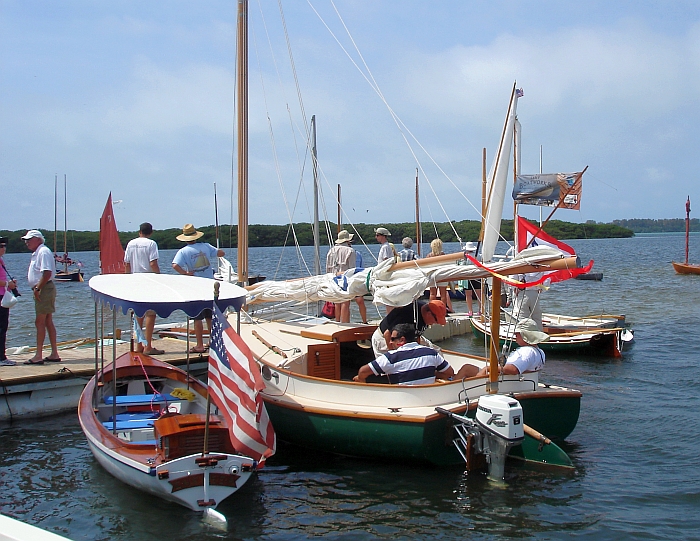 The festival dock.
Matt and I, wearing our LAMP polo shirts, stood out a little from the crowd and were asked plenty of questions throughout the day. As I suspected, many people had no idea that the St. Augustine Lighthouse & Museum has a boatworks, moreover a maritime archaeology program! After the regatta was over and the events of the day began to wane a little, we down-rigged the display banner and unfurled the sail. It was time for the Harn to stretch its legs. We clawed our way out the little channel and into the bay, dropped the daggerboard, and let the sail fill. For the next hour or so, we tacked and wore around Cortez and let the boat work a little. Boats, wooden boats in particular, need working. A boat just sitting on exhibit can deteriorate in ways that you will never know unless you put it in the water and row it, sail it, or motor it. Repairs can then be effected in order to ‘keep alive’ the craft and ensure its longevity. A simple Newtonian principle, ‘An object in motion tends to stay in motion.’
The festival dock.
Matt and I, wearing our LAMP polo shirts, stood out a little from the crowd and were asked plenty of questions throughout the day. As I suspected, many people had no idea that the St. Augustine Lighthouse & Museum has a boatworks, moreover a maritime archaeology program! After the regatta was over and the events of the day began to wane a little, we down-rigged the display banner and unfurled the sail. It was time for the Harn to stretch its legs. We clawed our way out the little channel and into the bay, dropped the daggerboard, and let the sail fill. For the next hour or so, we tacked and wore around Cortez and let the boat work a little. Boats, wooden boats in particular, need working. A boat just sitting on exhibit can deteriorate in ways that you will never know unless you put it in the water and row it, sail it, or motor it. Repairs can then be effected in order to ‘keep alive’ the craft and ensure its longevity. A simple Newtonian principle, ‘An object in motion tends to stay in motion.’
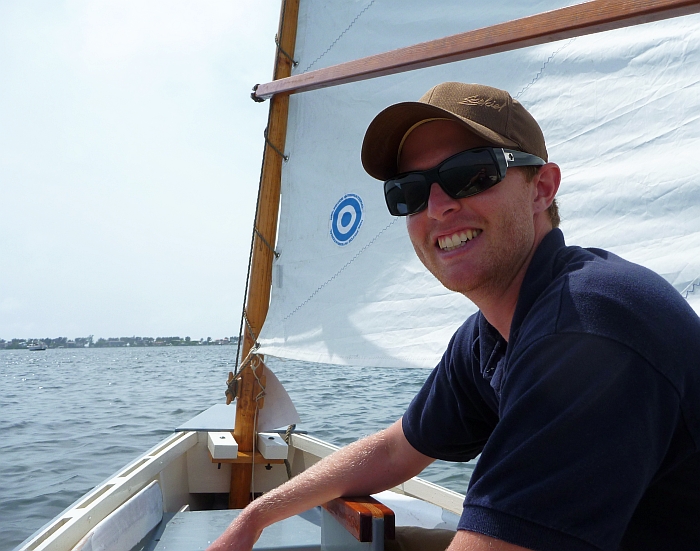 Matt Hanks, LAMP Intern, a quick study at the helm and now a proficient sailor.
Saturday evening Matt and I attended the banquet and annual TSCA national meeting. Enjoying fresh local grouper, we sat with Ryan Murphy, the director of the Florida Maritime Museum and a slew of other wonderful enthusiasts, master builders, and preservationists. I wish I could relate all of their names and backgrounds but if you were there and read this let me know and I’ll properly cite our table roster! Having a later evening engagement over in Ana Maria Island at a concert, Matt and I departed after the meeting. Sunday morning we returned to the docks, where we had left our boat with the rest securely tied up overnight and re-rigged to sail. The day’s schedule was simple: take your boat our, or borrow someone else’s, and sail. We did just that and Matt, not having ever been on a sailboat before, became quite a proficient sailor. Enjoying the cerulean waters of the Gulf Coast and the warm weather, we put several miles under the keel before returning to downrig and depart. Later that afternoon, with a belly full of fresh fish and fried okra, we poled back up the little creek and hauled the boat out. Five hours later we were back in St. Augustine, happy but sunburned!
Matt Hanks, LAMP Intern, a quick study at the helm and now a proficient sailor.
Saturday evening Matt and I attended the banquet and annual TSCA national meeting. Enjoying fresh local grouper, we sat with Ryan Murphy, the director of the Florida Maritime Museum and a slew of other wonderful enthusiasts, master builders, and preservationists. I wish I could relate all of their names and backgrounds but if you were there and read this let me know and I’ll properly cite our table roster! Having a later evening engagement over in Ana Maria Island at a concert, Matt and I departed after the meeting. Sunday morning we returned to the docks, where we had left our boat with the rest securely tied up overnight and re-rigged to sail. The day’s schedule was simple: take your boat our, or borrow someone else’s, and sail. We did just that and Matt, not having ever been on a sailboat before, became quite a proficient sailor. Enjoying the cerulean waters of the Gulf Coast and the warm weather, we put several miles under the keel before returning to downrig and depart. Later that afternoon, with a belly full of fresh fish and fried okra, we poled back up the little creek and hauled the boat out. Five hours later we were back in St. Augustine, happy but sunburned!
 Brendan with the William A. Harn.
 A beautiful rendition of Egret, Col. Munroe's sharpie from the early 20th century.
I encourage you all to attend events like the Florida Gulf Coast Small Craft Festival. Not only do they support museums and organizations that keep the traditions alive, but small craft gatherings are just plain fun. We felt too that, it was time for LAMP Boatworks to get its name out and about and talk with other builders about their boatworks as well as showing off a little of what we’re doing here. The William Harn may be a kit boat, and not the most complex or aesthetically pleasing watercraft but she’s ours, our number one hull, and a heck of a fine skiff for sailing, rowing, and showing. I want to thank the Florida Maritime Museum in Cortez for hosting this event as well as the Florida Gulf Coast chapter of the Traditional Small Craft Association, Ryan Murphy, Bob Pitt, Ted Adams, Roger Allen, and many, many more folks who made the event successful and fun!
A beautiful rendition of Egret, Col. Munroe's sharpie from the early 20th century.
I encourage you all to attend events like the Florida Gulf Coast Small Craft Festival. Not only do they support museums and organizations that keep the traditions alive, but small craft gatherings are just plain fun. We felt too that, it was time for LAMP Boatworks to get its name out and about and talk with other builders about their boatworks as well as showing off a little of what we’re doing here. The William Harn may be a kit boat, and not the most complex or aesthetically pleasing watercraft but she’s ours, our number one hull, and a heck of a fine skiff for sailing, rowing, and showing. I want to thank the Florida Maritime Museum in Cortez for hosting this event as well as the Florida Gulf Coast chapter of the Traditional Small Craft Association, Ryan Murphy, Bob Pitt, Ted Adams, Roger Allen, and many, many more folks who made the event successful and fun!
 Look at that clear water!!
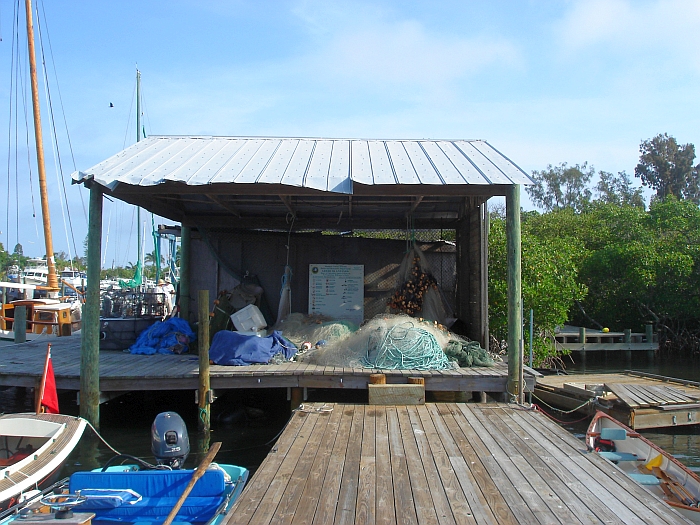 Nice to see a real working waterfront.
 Stone crab pots stacked under a net shed.
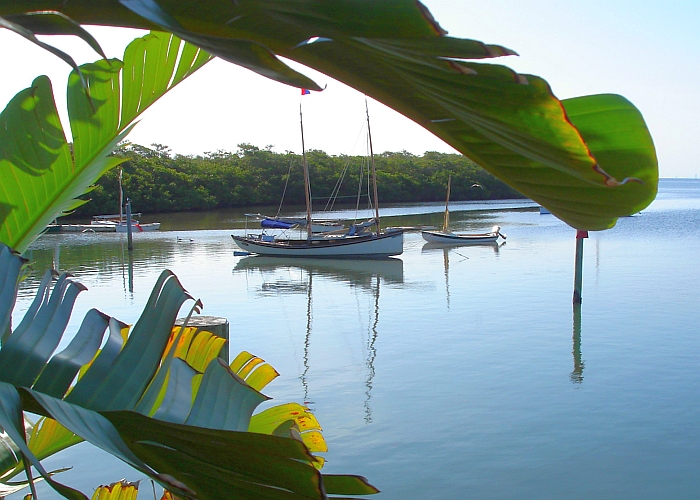 Sunday morning at the festival.]]>

 The Lighthouse Archaeological Maritime Program (LAMP) is pleased to announce our Summer 2011 Field School. This year the field school will be held from June 6 - July 1, 2011 at the St. Augustine Lighthouse & Museum, St. Augustine, Florida. This comprehensive 4-week practicum will focus on the continued excavation of an 18th century shipwreck. Discovered in 2009, excavations began on this wreck site began during the summer of 2010. Artifacts recovered from this site indicate that is is a late 18th century wreck of unknown origin. Recent discoveries include hardware and rigging components, navigational and carpentry tools, a series of cast-iron and copper cauldrons, a small flintlock pistol, four cannons, and the ship's bell. This summer’s activities will include mapping, recording, and excavating an area adjacent to the 2010 excavation units. Students will work alongside instructors to record and recover artifacts associated with this wreck, including the planned raising of at least one cannon.]]>
 Field school diver recording a large cauldron during the 2010 field school.
Students will be instructed in scientific diving procedures, archaeological recording and excavation, the use of hydraulic probes and induction dredges, marine remote sensing survey and analysis (magnetometer & side scan sonar), artifact collection and documentation, and basic conservation laboratory methodology. The field school will also host an evening lecture series with field school instructors and visiting professionals from various public, private, and academic institutions throughout Florida.
Short video with footage taken during the 2010 Field School, including comments from some of last year's students: "What to expect? Expect early mornings, lots of hard work, but a ton of fun, and something you'll never, ever forget."
Requirements:
• Students must be scuba-certified and qualify as a scientific diver through AAUS (American Academy of Underwater Sciences) or a similar institution, or else qualify as a scientific-diver-in-training through LAMP’s scientific diver program. These requirements include a specific medical exam to be completed prior to field school, and a swim test to be conducted upon arrival. More information and downloads of the medical exam form and other required paperwork are available here.
• Please download and read this note on our diving conditions and requirements
• Students must have DAN diving accident insurance or an equivalent policy.
• Students must hold current CPR and First Aid certifications.
Sponsors
This field practicum is supported by Plymouth State University, Plymouth, New Hampshire which will offer academic credit for those who wish to receive it at their standard rates for graduate or undergraduate tuition (see below).
Additional partnering institutions:
Florida Public Archaeology Network (FPAN)
The Institute of Maritime History (IMH)
Field school diver recording a large cauldron during the 2010 field school.
Students will be instructed in scientific diving procedures, archaeological recording and excavation, the use of hydraulic probes and induction dredges, marine remote sensing survey and analysis (magnetometer & side scan sonar), artifact collection and documentation, and basic conservation laboratory methodology. The field school will also host an evening lecture series with field school instructors and visiting professionals from various public, private, and academic institutions throughout Florida.
Short video with footage taken during the 2010 Field School, including comments from some of last year's students: "What to expect? Expect early mornings, lots of hard work, but a ton of fun, and something you'll never, ever forget."
Requirements:
• Students must be scuba-certified and qualify as a scientific diver through AAUS (American Academy of Underwater Sciences) or a similar institution, or else qualify as a scientific-diver-in-training through LAMP’s scientific diver program. These requirements include a specific medical exam to be completed prior to field school, and a swim test to be conducted upon arrival. More information and downloads of the medical exam form and other required paperwork are available here.
• Please download and read this note on our diving conditions and requirements
• Students must have DAN diving accident insurance or an equivalent policy.
• Students must hold current CPR and First Aid certifications.
Sponsors
This field practicum is supported by Plymouth State University, Plymouth, New Hampshire which will offer academic credit for those who wish to receive it at their standard rates for graduate or undergraduate tuition (see below).
Additional partnering institutions:
Florida Public Archaeology Network (FPAN)
The Institute of Maritime History (IMH)
 The 36' IMH research vessel Roper will be the primary work platform for the 2011 Field School.
Housing
LAMP maintains a Field House on five acres of rural property just outside St. Augustine. Expect dormitory-type conditions though the house is furnished with air conditioning, two bathrooms, and a fully-operational kitchen. Students should provide their own bedding (sheets, pillow, blanket, etc). If students wish to camp on the land around the field house they should bring their own tent/gear.
Meals will be communal and prepared each day by the field school participants on a rotating basis. Each student will be assigned to a weekly KP roster. The budget for purchasing food is derived from the field school fee charged to all students. Students are responsible for their own food on weekends.
_______________________________________________________________________________________
Online Application Forms and Fees
Download the application package by clicking here
The fee for the field school is $2,200 for students seeking academic credit and $2,500 for students not seeking credit. This fee is payable to LAMP, and a $250 deposit is due upon acceptance to the Field School, with the remainder due the first day of class. This fee includes housing, food (except on weekends when you are responsible for your own food), all diving gear (other than mask, fins, snorkels, & booties), air fills, and the use of LAMP’s research vessels, dive locker, classroom, and laboratory facilities. The deposit and remaining balance may be paid with check or credit card. Graduate or undergraduate credit is available through Plymouth State University, or through your own institution if you make these arrangements, at additional expense paid directly to the school for tuition. Plymouth State University tuition costs are as follows:
Undergraduate In-state (New Hampshire): $320 per credit hour
Undergraduate Out-of-state: $350 per credit hour
Graduate In-state: $493 per credit hour
Graduate Out-of-state: $539 per credit hour
Students may receive four credit hours for the four full weeks of field school. Tuition must be paid separately through PSU or the university issuing credit, and the tuition cost is separate from the Field School fee payable to LAMP.
Students must provide their own transportation to and from St. Augustine, Florida. Students must also be responsible for the required diving insurance, diving medical exam, and CPR/First Aid before the start of the course, as outlined below.
Please download the application package, which consists of three one-page forms in a single Microsoft Word document. You may complete the forms digitally or else print them out and complete by hand. When finished, please send to Dr. Sam Turner by email or fax or regular mail:
Dr. Sam Turner
Director of Archaeology, LAMP
81 Lighthouse Avenue
St. Augustine, Florida 32080 USA
Fax: 904-808-1248 Phone: 904-829-0745
Participation in the Field School can be competitive depending on the numbers of applicants, which have been increasing each year. While not required, if you have a resume or vita, please include it with your application, and you may also have a letter of reference sent to us by email from a professor or employer.
If you have any other questions, please call or email Dr. Turner at sturner@staugustinelighthouse.com.
_______________________________________________________________________________________
Click here visit our Field School blog! Scroll down to see postings from 2010 and previous year's Field Schools!
_______________________________________________________________________________________
Our primary Field School research vessels include LAMP's newly acquired RV Desmond Valdes, and the Institute of Maritime History's RV Roper, pictured below:
The 36' IMH research vessel Roper will be the primary work platform for the 2011 Field School.
Housing
LAMP maintains a Field House on five acres of rural property just outside St. Augustine. Expect dormitory-type conditions though the house is furnished with air conditioning, two bathrooms, and a fully-operational kitchen. Students should provide their own bedding (sheets, pillow, blanket, etc). If students wish to camp on the land around the field house they should bring their own tent/gear.
Meals will be communal and prepared each day by the field school participants on a rotating basis. Each student will be assigned to a weekly KP roster. The budget for purchasing food is derived from the field school fee charged to all students. Students are responsible for their own food on weekends.
_______________________________________________________________________________________
Online Application Forms and Fees
Download the application package by clicking here
The fee for the field school is $2,200 for students seeking academic credit and $2,500 for students not seeking credit. This fee is payable to LAMP, and a $250 deposit is due upon acceptance to the Field School, with the remainder due the first day of class. This fee includes housing, food (except on weekends when you are responsible for your own food), all diving gear (other than mask, fins, snorkels, & booties), air fills, and the use of LAMP’s research vessels, dive locker, classroom, and laboratory facilities. The deposit and remaining balance may be paid with check or credit card. Graduate or undergraduate credit is available through Plymouth State University, or through your own institution if you make these arrangements, at additional expense paid directly to the school for tuition. Plymouth State University tuition costs are as follows:
Undergraduate In-state (New Hampshire): $320 per credit hour
Undergraduate Out-of-state: $350 per credit hour
Graduate In-state: $493 per credit hour
Graduate Out-of-state: $539 per credit hour
Students may receive four credit hours for the four full weeks of field school. Tuition must be paid separately through PSU or the university issuing credit, and the tuition cost is separate from the Field School fee payable to LAMP.
Students must provide their own transportation to and from St. Augustine, Florida. Students must also be responsible for the required diving insurance, diving medical exam, and CPR/First Aid before the start of the course, as outlined below.
Please download the application package, which consists of three one-page forms in a single Microsoft Word document. You may complete the forms digitally or else print them out and complete by hand. When finished, please send to Dr. Sam Turner by email or fax or regular mail:
Dr. Sam Turner
Director of Archaeology, LAMP
81 Lighthouse Avenue
St. Augustine, Florida 32080 USA
Fax: 904-808-1248 Phone: 904-829-0745
Participation in the Field School can be competitive depending on the numbers of applicants, which have been increasing each year. While not required, if you have a resume or vita, please include it with your application, and you may also have a letter of reference sent to us by email from a professor or employer.
If you have any other questions, please call or email Dr. Turner at sturner@staugustinelighthouse.com.
_______________________________________________________________________________________
Click here visit our Field School blog! Scroll down to see postings from 2010 and previous year's Field Schools!
_______________________________________________________________________________________
Our primary Field School research vessels include LAMP's newly acquired RV Desmond Valdes, and the Institute of Maritime History's RV Roper, pictured below:
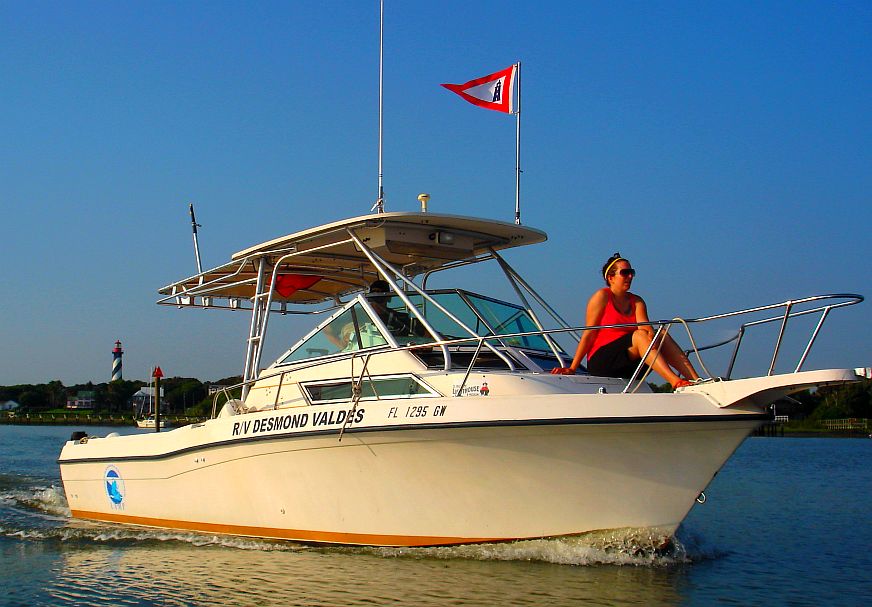
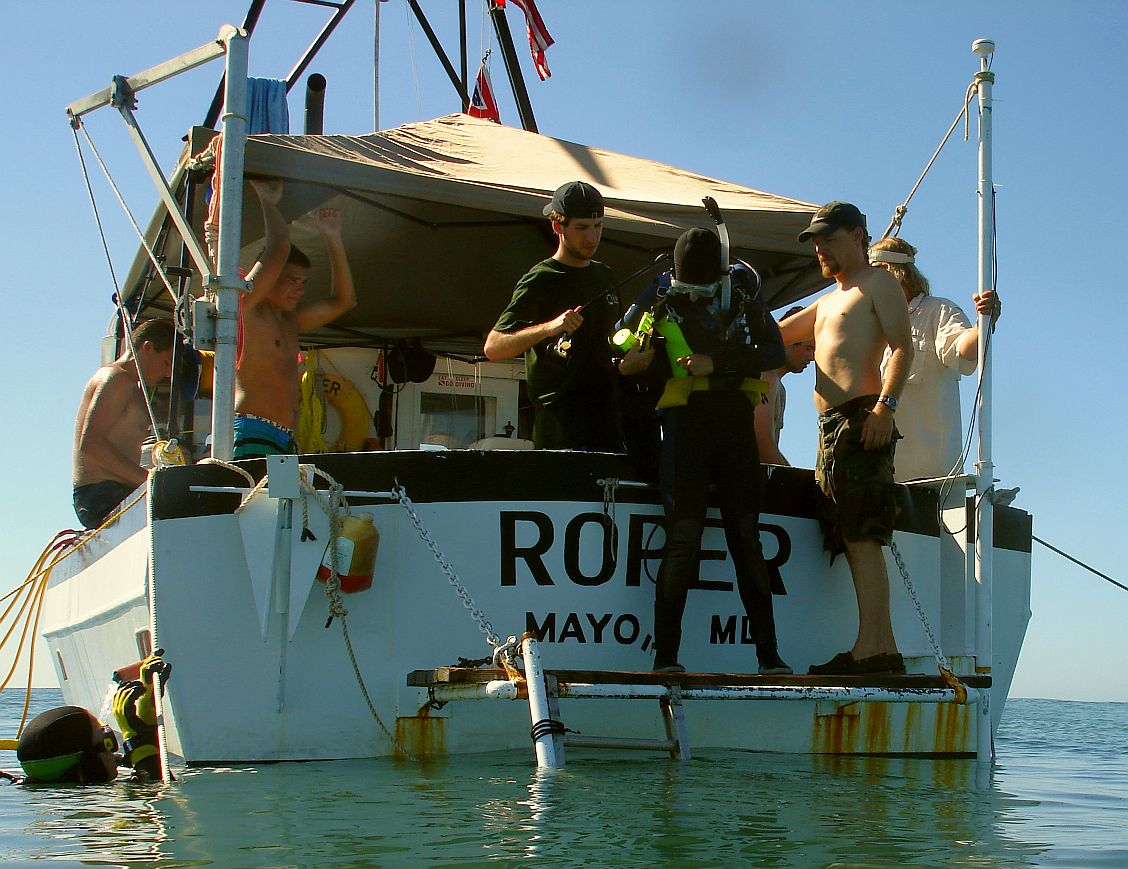
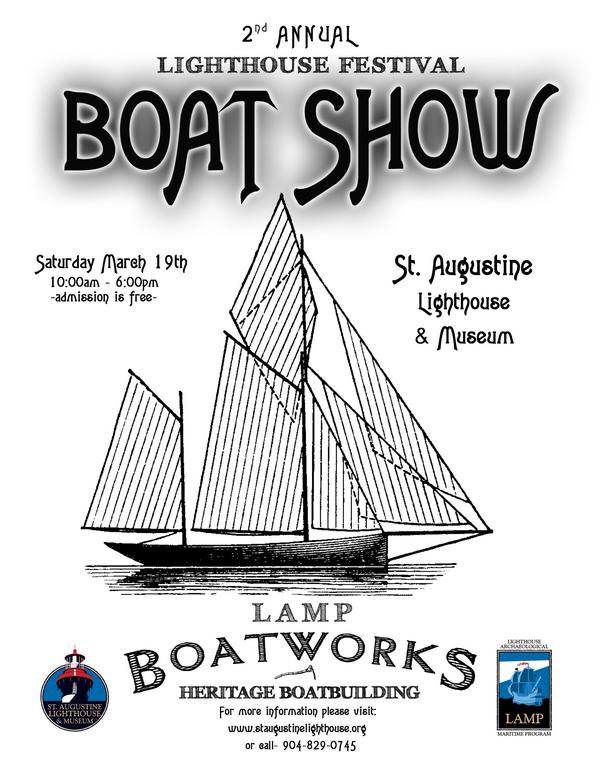 Click the poster to make it bigger.
We are pleased to announce the 2011 LAMP Boatworks Boat Show, to be held on Saturday, March 19th. This is part of the annual St. Augustine Lighthouse & Museum Lighthouse Festival. Last year we had a very nice collection of traditional watercraft show up from all over Florida. This year is our second year including a boat show as part of the Lighthouse Festival and we are looking forward to it! Boats we seek include traditional watercraft powered by sail, oar, or engine. This includes wooden boats built using traditional plans, methods, and/or materials. This is a fun event and if you have not visited our museum, it is open to the public for free on Festival day and we routinely host 5,000 or more visitors every year.]]>
HERE.
If you would like to show a boat, please contact bburke@staugustinelighthouse.org and include the following:
-type of boat
-name of boat
-year of manufacture
-place of manufacture
-builder's name
-owner's name
-powered by (engine type, # of oars, sail plan, etc.)
-where homeported
-length overall
-beam
-draught
-any other particulars you wish to have on a display placard
The details of the show:
Location: St. Augustine Lighthouse and Museum (81 Lighthouse Avenue, St. Augustine, FL 32080)
When: Saturday March 19th, 10:00-6:00 (please arrive no later than 9:30 to be placed)
Cost: none
Registration: So we can plan for spacing and displaying the boats, we ask that you please let us know that you will be bringing a boat. Thanks!
*Since this is a Lighthouse event, we do not allow non-lighthouse sales at Festival, including boat sales.*]]>
Click the poster to make it bigger.
We are pleased to announce the 2011 LAMP Boatworks Boat Show, to be held on Saturday, March 19th. This is part of the annual St. Augustine Lighthouse & Museum Lighthouse Festival. Last year we had a very nice collection of traditional watercraft show up from all over Florida. This year is our second year including a boat show as part of the Lighthouse Festival and we are looking forward to it! Boats we seek include traditional watercraft powered by sail, oar, or engine. This includes wooden boats built using traditional plans, methods, and/or materials. This is a fun event and if you have not visited our museum, it is open to the public for free on Festival day and we routinely host 5,000 or more visitors every year.]]>
HERE.
If you would like to show a boat, please contact bburke@staugustinelighthouse.org and include the following:
-type of boat
-name of boat
-year of manufacture
-place of manufacture
-builder's name
-owner's name
-powered by (engine type, # of oars, sail plan, etc.)
-where homeported
-length overall
-beam
-draught
-any other particulars you wish to have on a display placard
The details of the show:
Location: St. Augustine Lighthouse and Museum (81 Lighthouse Avenue, St. Augustine, FL 32080)
When: Saturday March 19th, 10:00-6:00 (please arrive no later than 9:30 to be placed)
Cost: none
Registration: So we can plan for spacing and displaying the boats, we ask that you please let us know that you will be bringing a boat. Thanks!
*Since this is a Lighthouse event, we do not allow non-lighthouse sales at Festival, including boat sales.*]]>
 I rode along in the FWC boat with Mike and Corey, while the rest of the LAMP team, consisting of LAMP archaeologists Brendan Burke and Dr. Sam Turner, along with LAMP volunteer Craig Rio, followed in the Desi. It was great to have several volunteers with us, as Craig (a non-diver) has been putting in a lot of time in the laboratory working with artifacts, and Mike has been interested in participating in a dive with us for some time now. Its also great to have a cooperative partnership with local law enforcement officers, which means there will be a lot more alert eyes on this site. As with all shipwrecks in state waters, the Storm Wreck is protected by state law, and anyone caught disturbing the site or removing artifacts from it will be prosecuted to the fullest extent of the law.
 Leading the first dive was Dr. Sam Turner, LAMP's Director of Archaeology.
 Here is Mike just before he entered the water. It was a cold day, with water temperature in the 50s, so he is decked out in his vulcanized rubber drysuit, under which he can wear layers of insulation to keep warm. Sam is also garbed in a drysuit, and though his is of a different material (laminated layers of nylon and rubber), it will keep him just as dry. Sam likes to wear multiple woolen sweaters under his drysuit, which keeps him nice and toasty even in this frigid water, though the air trapped in the wool does require significant amounts of extra lead weights. The divers were given a briefing, assigned the mission of locating the site by circular searches and assessing its current condition, and were told to expect zero visibility. The divers were additionally told that the entire shipwreck site was likely to be buried in sand, and that the only features protruding from the seafloor would likely be submerged lines left in place by the summer excavation team.
 The first thing the divers noted was that visibility was actually good. In fact, by our standards, it was great--at least six to eight feet, perhaps even more! As the divers began a standard circle search, Sam's eyes made out a large, amorphous shape looming ahead of him in the haze. Seconds later, his heart raced as he realized it was a cannon! Then he saw there were more than one cannon, at least three or four! And then his racing heart skipped a beat as he made out, very clearly, the shape of a large bell, nestled between the cluster of guns!
 The bell was large, about a foot across at its base, and appeared to have its hanging apparatus intact. That means it was definitely a ship's bell, once attached to the fabric of the vessel, as opposed to a cargo item, such as a bell intended for a church. In the forefront of this image, almost touching the base of the bell, is the breech end of an iron cannon.
 Sam could see that the bell was covered in a light layer of concretion (encrustation or corrosion product), a little of which had chipped away to reveal that the bell was made of bronze.
 Here is another view of the bell. On the left side is the cascabel or breech end of the cannon, while in between the bell and the cannon is a single brick of fired clay. Several bricks were found scattered around this newly exposed area of the site. For whatever reason, shifting sands have left this small pocket of the site scoured free and exposed. During the summer divers had swam over this exact spot hundreds of times, without ever realizing what treasures lay hidden beneath the sand. While we know this area features a dynamic and often changing underwater landscape, due to the actions of storms, swells, currents, and tide, we were surprised that this newly discovered area was exposed, while the rest of the site remained buried.
 In addition to the bell, the cannons, and the scatter of bricks, divers also observed an iron cauldron (bringing to total found so far to five), at least two copper cauldrons, and a number of unidentified concretions (corroded iron objects). Pictured above is a flat-bottomed cauldron fashioned from copper sheeting, probably riveted together. While the sides are covered in a light layer of concretion, the bottom of the cauldron displays its original metal. It has either been scoured clean by sand movement, or just did not form a layer of encrustation as did the vessel's sides.
 Here is the cascabel of another cannon, and in the background is the copper cauldron from the previous picture. The cascabel or button is pierced by a hole, which we believe to be a threaded aperture designed to fit an elevating screw, which would have been used by the gun crew to raise or lower the breech end of the gun when aiming.
 These cannons are very short, this one measuring just over a meter, and we believe that they are a type known as carronades. This is a preliminary field sketch completed by Dr. Turner of the carronade in the photograph above. Carronades, short and stubby, were considerably lighter than traditional long guns, and they fired a much heavier ball than a long cannon of the same weight. Therefore a ship armed with a battery of carronades could pack a much more powerful broadside for the amount of weight that could be safely carried on its deck. The drawback was that carronades had a shorter range than long guns. But as lightweight guns requiring smaller gun crews, they were quickly adapted by British merchant ships during the Revolutionary War, due to their effectiveness at warding off enemy privateers. They were so powerful that they soon became nicknamed "smashers."
 Here are three photographs mosaicked together to show the full length of one of our guns. The muzzle (firing end) is on the left side, while the breech is on the right. In the center of the gun is a peg-like projection known as the trunnion. The gun sat on its trunnions on a carraige, allowing it to swivel up or down. As this gun and at least one other featured trunnions, they may be considered gunnades, a variant of the carronade. Most carronades were mounted by means of an iron lug mounted on the bottom of the gun, rather than the more tradtional trunnions as seen here.
 Here is a photograph of a carronade on the deck of the replica War of 1812 privateer schooner Lynx, who spent part of the winter here in St. Augustine. This gun does not have trunnions but the more traditional bottom lug. The presence of carronades on the Storm Wreck helps us further define its date, as carronades did not come into use until the 1770s.
 Here is a historic schematic of a carronade mounted for use (courtesy of Wikipedia). It does not feature trunnions, like at least two of the guns on our wreck, but it does show the elevation turnscrew at the cascabel, as at least one of our guns would have used. Because we have at least one gun with an elevation screw aperture and one without, it appears we have a mix of gun forms on our wreck, which is interesting (and suggests the identity of a merchantman or possibly a privateer rather than a naval vessel).
This brief video clip shows underwater footage of the bell, cannons, and other artifacts in place on the seafloor as discovered by the LAMP team.
Here is a historic schematic of a carronade mounted for use (courtesy of Wikipedia). It does not feature trunnions, like at least two of the guns on our wreck, but it does show the elevation turnscrew at the cascabel, as at least one of our guns would have used. Because we have at least one gun with an elevation screw aperture and one without, it appears we have a mix of gun forms on our wreck, which is interesting (and suggests the identity of a merchantman or possibly a privateer rather than a naval vessel).
This brief video clip shows underwater footage of the bell, cannons, and other artifacts in place on the seafloor as discovered by the LAMP team.
 With the exciting discovery of this newly exposed section of the shipwreck site, our first priority became to record the ship's bell in place, so that we could safely recover it knowing that its exact location and position was thoroughly documented. As archaeologists felt the relatively lightweight bell was vulnerable in its exposed situation on the seafloor, recovery was deemed an immediate need, but not before being drawn in place. Here LAMP Director Chuck Meide is working on his 1:5 scale drawing of the bell and the objects immediately surrounding it.
 Here is the drawing I made underwater, digitized by our volunteer Tim Jackson. It took an hour and a half of dive time to complete this scaled drawing, and in that cold water, even with hood, gloves, and drysuit, I was freezing when I finally returned to world of light and sound.
 After being fully recorded, the bell was ready for lifting. Sam Turner lead the next dive team, carefully lifting by hand the bell up and into a lifting crate. This large plastic bin was lined with window screen so that even tiny artifacts that might fall from the bell would not be lost. He then rigged the crate with a lift bag, which when filled with air provides 100 lbs of positive buoyancy. Here is Sam carefully guiding the bell to the surface.
 The lifting bag at the surface, with its precious cargo dangling just below . . .
 Hauling the bell in its crate up and into the boat . . .
 And, finally, once safe on the boat, the bell is moved from the lifting crate into a waiting vat of water. It is critically important to keep the bell wet until it has been fully stabilized in the laboratory, a process that can take well over a year.
 The look on Sam's face, even after a cold and strenuous dive, says it all. The discoverer of the bell!!!!
 The bell recovery team back on the dock. L to R: LAMP Archaeologist/Logistical Coordinator Brendan Burke, LAMP Director Chuck Meide, LAMP Archaeological Conservator Starr Cox, LAMP Director of Archaeology Sam Turner, LAMP Volunteer Craig Rio. Not pictured is Mike Chapmann, co-discoverer of the bell, who had to leave earlier in the day.
 Here is a picture of the bell taken that same day, back in the laboratory.
 Another picture, from a different angle, taken a few days later. For a while we kept the existence of this bell a secret, to protect it until we could get it to a secure, undisclosed location. We also wished to announce the discovery of the bell, and unveil it, at a public event. In the end we decided to unveil the bell, and clean it, at the same event, which took place in late January.
Here is a short video of the Bell Unveiling Event at the museum, which we held a few weeks after its safe recovery, and where LAMP conservator and interns carefully cleaned the encrustation from the bell before a crowd of around 100 excited guests. So far there is no sign of a name, year, or maker's mark, though about 25% of the bell's outer surface remains obscured by heavy iron concretion. Stay tuned to find out if we can solve the mystery of this shipwreck. Regardless, this bell is perhaps the most exciting and evocative artifact ever recovered from St. Augustine waters, and as far as we know only the second bell discovered by archaeologists from any shipwreck in Florida. A truly special and unique find, which will make a fabulous museum exhibit!
]]>
Another picture, from a different angle, taken a few days later. For a while we kept the existence of this bell a secret, to protect it until we could get it to a secure, undisclosed location. We also wished to announce the discovery of the bell, and unveil it, at a public event. In the end we decided to unveil the bell, and clean it, at the same event, which took place in late January.
Here is a short video of the Bell Unveiling Event at the museum, which we held a few weeks after its safe recovery, and where LAMP conservator and interns carefully cleaned the encrustation from the bell before a crowd of around 100 excited guests. So far there is no sign of a name, year, or maker's mark, though about 25% of the bell's outer surface remains obscured by heavy iron concretion. Stay tuned to find out if we can solve the mystery of this shipwreck. Regardless, this bell is perhaps the most exciting and evocative artifact ever recovered from St. Augustine waters, and as far as we know only the second bell discovered by archaeologists from any shipwreck in Florida. A truly special and unique find, which will make a fabulous museum exhibit!
]]>
 LAMP Boatworks, enjoying a day sail.
Volunteer boatbuilders from the LAMP Boatworks enjoyed a 'thank you' cruise aboard Privateer Lynx this past Thursday, the 28th of January. The Lynx Eduational Foundation offered space on the cruise for our Boatworks volunteers as an act of appreciation for their efforts to revitalize the ship's stern boat. Lynx has now departed St. Augustine and will be reopening for tours in downtown Jacksonville on February 15. We wish her well!]]>
LAMP Boatworks, enjoying a day sail.
Volunteer boatbuilders from the LAMP Boatworks enjoyed a 'thank you' cruise aboard Privateer Lynx this past Thursday, the 28th of January. The Lynx Eduational Foundation offered space on the cruise for our Boatworks volunteers as an act of appreciation for their efforts to revitalize the ship's stern boat. Lynx has now departed St. Augustine and will be reopening for tours in downtown Jacksonville on February 15. We wish her well!]]>
 Sweating a halyard into place.
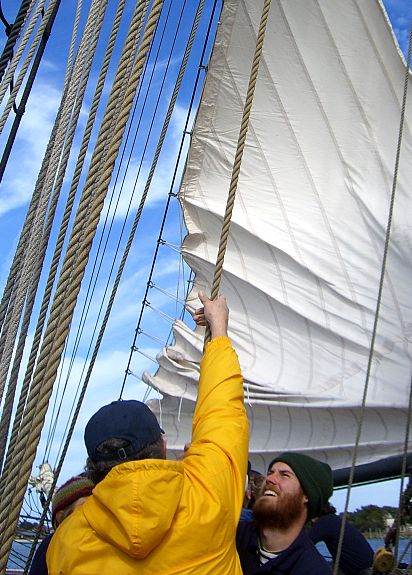
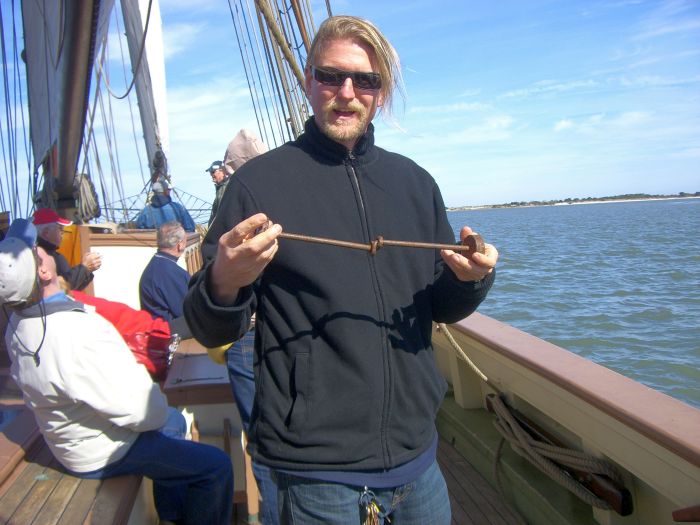
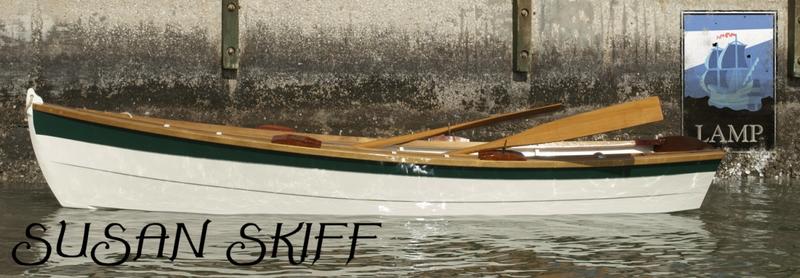 For the past several months volunteers at the LAMP Boatworks have been diligently working on the building of our eight hull, a boat type called the ‘Susan’. Designed by Robert M. Steward in the 1950s, this classic little boat got her feet wet this morning at the hands of the lead builders, Richard Sexauer and Steve McMullen .
]]>
For the past several months volunteers at the LAMP Boatworks have been diligently working on the building of our eight hull, a boat type called the ‘Susan’. Designed by Robert M. Steward in the 1950s, this classic little boat got her feet wet this morning at the hands of the lead builders, Richard Sexauer and Steve McMullen .
]]>
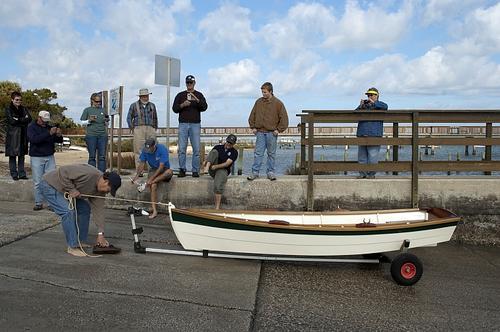 The launching crew.
At eleven feet long, the Susan skiff is rowed through the water very easily from either of the two rowing stations and handles two people in a comfortable and stable manner. Even in the wake thrown by passing boats the skiff rode high and dry. The ‘Susan’ name only denotes the type of hull and for now, this skiff will go unnamed. During the coming year, LAMP Boatworks will hold a drawing for one lucky person to win this boat. The boat is light, very sturdy and well constructed. LAMP Boatworks deviated from the original plans calling for crossplanking (boards fastened athwartships for the bottom, as opposed to longitudinally placed) and used epoxy soaked marine plywood. The durability and stability of this material allows the boat to handle and act like a wood boat but with less maintenance and chances for rot. Similarly, her planking is from epoxy-saturated plywood strakes. After a professional paint job, you cannot tell the difference betwixt the two. The transom is honduras mahogany and her seats, breasthook, and quarterknees are made from sapele, a tropical hardwood that is one of the finest and most figured marine-grade woods. Frames and stempost are of white oak. Oarlocks and oarlock sockets are cast and polished silicon bronze and the oars are made from cypress with hand-stitched leather lock guards. The transom, breasthook, quarterknees, inwhale, thwarts, and oarlock pads are all left bright and finished with multiple coats of Epifanes varnish. Copper and silicone bronze fasteners were used througout the boat. All together, a smart little package!
The launching crew.
At eleven feet long, the Susan skiff is rowed through the water very easily from either of the two rowing stations and handles two people in a comfortable and stable manner. Even in the wake thrown by passing boats the skiff rode high and dry. The ‘Susan’ name only denotes the type of hull and for now, this skiff will go unnamed. During the coming year, LAMP Boatworks will hold a drawing for one lucky person to win this boat. The boat is light, very sturdy and well constructed. LAMP Boatworks deviated from the original plans calling for crossplanking (boards fastened athwartships for the bottom, as opposed to longitudinally placed) and used epoxy soaked marine plywood. The durability and stability of this material allows the boat to handle and act like a wood boat but with less maintenance and chances for rot. Similarly, her planking is from epoxy-saturated plywood strakes. After a professional paint job, you cannot tell the difference betwixt the two. The transom is honduras mahogany and her seats, breasthook, and quarterknees are made from sapele, a tropical hardwood that is one of the finest and most figured marine-grade woods. Frames and stempost are of white oak. Oarlocks and oarlock sockets are cast and polished silicon bronze and the oars are made from cypress with hand-stitched leather lock guards. The transom, breasthook, quarterknees, inwhale, thwarts, and oarlock pads are all left bright and finished with multiple coats of Epifanes varnish. Copper and silicone bronze fasteners were used througout the boat. All together, a smart little package!
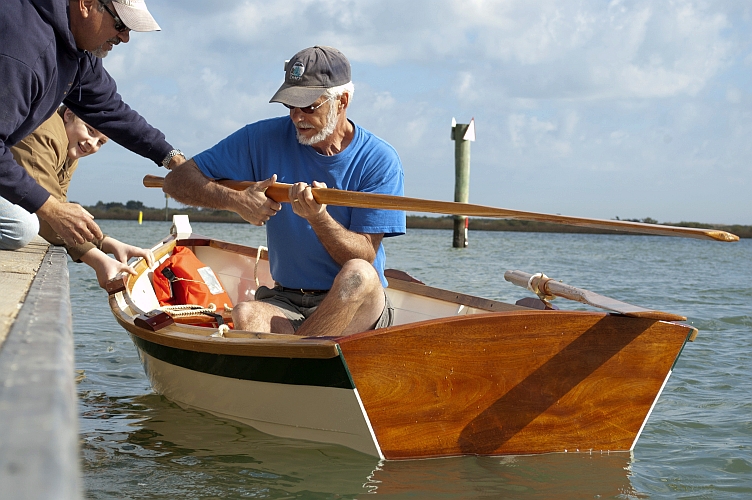
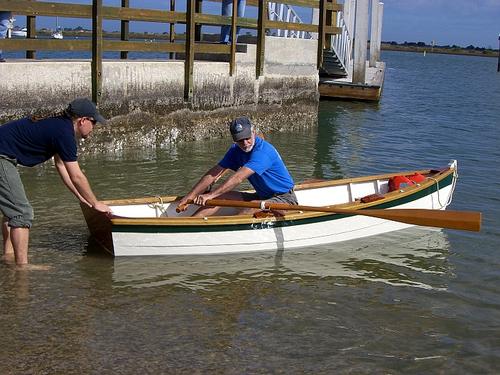 LAMP Archaeologist Brendan Burke holds the skiff while LAMP Boatbuilder Richard Sexauer prepares to get underway. This is her first time in the water!
Since this project skiff has come to a close, the volunteer builders at our boatworks are currently working on repairs to the Privateer Lynx’s sternboat, continuing the build of the 1760s pattern ship’s yawl, and refining plans for our next build. The LAMP Boatworks is operated as part of the Lighthouse Archaeological Maritime Program, the maritime research arm of the St. Augustine Lighthouse & Museum. Our program is volunteer run and operates primarily on a Tuesday-Thursday schedule just about every week of the year. LAMP Boatworks is a Coast Guard inspected builder of traditional watercraft. Join us as we continue the art of boatbuilding in the Nation’s Oldest Port!
LAMP and the St. Augustine Lighthouse & Museum would like to take this opportunity to thank our volunteer boatbuilders for their time, effort, and skill. Without them, the Boatworks could not exist. Thank you!
For more information, call 904-829-0745, or visit us online at www.LAMPmaritime.org
LAMP Archaeologist Brendan Burke holds the skiff while LAMP Boatbuilder Richard Sexauer prepares to get underway. This is her first time in the water!
Since this project skiff has come to a close, the volunteer builders at our boatworks are currently working on repairs to the Privateer Lynx’s sternboat, continuing the build of the 1760s pattern ship’s yawl, and refining plans for our next build. The LAMP Boatworks is operated as part of the Lighthouse Archaeological Maritime Program, the maritime research arm of the St. Augustine Lighthouse & Museum. Our program is volunteer run and operates primarily on a Tuesday-Thursday schedule just about every week of the year. LAMP Boatworks is a Coast Guard inspected builder of traditional watercraft. Join us as we continue the art of boatbuilding in the Nation’s Oldest Port!
LAMP and the St. Augustine Lighthouse & Museum would like to take this opportunity to thank our volunteer boatbuilders for their time, effort, and skill. Without them, the Boatworks could not exist. Thank you!
For more information, call 904-829-0745, or visit us online at www.LAMPmaritime.org