<?xml version="1.0" encoding="UTF-8"?>
<feed xml:lang="en" xmlns="http://www.w3.org/2005/Atom" xmlns:opensearch="http://a9.com/-/spec/opensearch/1.1/" xmlns:s="http://jadedpixel.com/-/spec/shopify">
  <id>https://www.symbolika.com/blogs/made-in-trance.atom</id>
  <link rel="alternate" type="text/html" href="https://www.symbolika.com/blogs/made-in-trance"/>
  <link rel="self" type="application/atom+xml" href="https://www.symbolika.com/blogs/made-in-trance.atom"/>
  <title>symbolika - Psychedelic Art with Meaning</title>
  <updated>2026-07-06T12:01:20+02:00</updated>
  <author>
    <name>symbolika</name>
  </author>
  <entry>
    <id>https://www.symbolika.com/blogs/made-in-trance/aya-the-pairing-of-two-plants</id>
    <published>2026-07-06T12:01:20+02:00</published>
    <updated>2026-07-06T23:22:16+02:00</updated>
    <link rel="alternate" type="text/html" href="https://www.symbolika.com/blogs/made-in-trance/aya-the-pairing-of-two-plants"/>
    <title>Aya - the pairing of two plants</title>
    <author>
      <name>Symbolika</name>
    </author>
    <content type="html">
      <![CDATA[<h1>Aya - the pairing of two plants</h1>
<p class="sb-lede">Amazonian <a href="https://en.wikipedia.org/wiki/Curandero" target="_blank" rel="noopener">curanderos</a> say — aya arrives as abuelita, grandmother. She forms between the vine and the leaf when they're cooked together long enough that the water darkens and starts to hold its own gravity. The face at the center of the picture is calm because she's already here.</p>
<figure class="sb-image-embed sb-image-embed--full"><img src="https://cdn.shopify.com/s/files/1/0097/2922/products/artwork-men-t-shirt-aya-2_0e554a59-213e-4469-a66a-c8930d242ebd.jpg?v=1768666449" alt="" loading="lazy"></figure>
<h2>The pot and the pairing</h2>
<p>Nothing in either plant alone does the work. Chakruna carries <a href="https://pmc.ncbi.nlm.nih.gov/articles/PMC6088236/" target="_blank" rel="noopener">dimethyltryptamine</a> — DMT, the molecule that hits the visual cortex like a struck bell — but eat the leaf and your gut enzymes shred the compound before it reaches the brain. The <a href="https://www.nature.com/articles/s41598-017-05407-9" target="_blank" rel="noopener">ayahuasca</a> vine holds no DMT at all. What the vine holds is a class of <a href="https://www.frontiersin.org/journals/pharmacology/articles/10.3389/fphar.2022.886408/full" target="_blank" rel="noopener">beta-carbolines</a> that inhibit the exact enzyme that would otherwise destroy the leaf's payload. Boil the two together for hours and you get a drink where the vine escorts the leaf's chemistry across the <a href="https://pmc.ncbi.nlm.nih.gov/articles/PMC4292164/" target="_blank" rel="noopener">blood-brain barrier</a> intact.</p>
<figure class="sb-image-embed sb-image-embed--full"><img src="https://cdn.shopify.com/s/files/1/0097/2922/products/artwork-men-t-shirt-aya-6_2c7050f0-ed0b-4f10-ba73-d0496170c800.jpg?v=1768666509" alt="" loading="lazy"></figure>
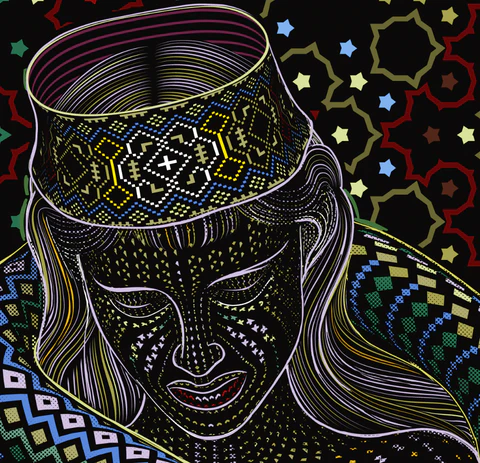
<p>In the picture the plants sit on opposite sides of the face, mirrored the way the recipe describes them: partners. The vine coils and doubles back on itself, thick with pod-like segments. The chakruna branches in pairs of broad veined leaves, interspersed with clusters of small berries. Between them the face waits, palms turned inward, holding its own head steady. The medicine is what happens when those two flanks meet in a pot and then in a body. Abuelita is a chemical event with a personality.</p>
<figure class="sb-image-embed sb-image-embed--full"><img src="https://cdn.shopify.com/s/files/1/0097/2922/products/artwork-men-t-shirt-aya-5_ec034d50-907f-4080-bab4-f1d388966ab3.jpg?v=1768666509" alt="" loading="lazy"></figure>
<h2>The puzzle pharmacology can't quite close</h2>
<p>How the pairing was found is the part the discipline hasn't been able to explain. The ethnobotanist <a href="https://en.wikipedia.org/wiki/Dennis_McKenna" target="_blank" rel="noopener">Dennis McKenna</a> has called ayahuasca's two-plant discovery one of the great unsolved puzzles in pharmacology, and he's spent decades staring at it from the inside. The Amazon holds around 80,000 plant species. Finding the exact liana whose beta-carbolines inhibit the exact enzyme that would otherwise digest the exact tryptamine in an unrelated shrub — then working out that you must boil the two together for hours, not minutes, not raw — trial and error shouldn't get you there.</p>
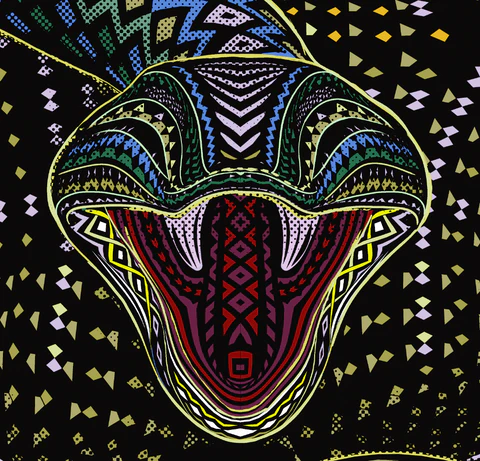
<p>Ask the traditional practitioners how the recipe was arrived at and the answer comes back consistent and awkward for the discipline. The plants told us. The vine sang the song of the leaf. Abuelita gave her own recipe. In the visionary tradition the <a href="https://chacruna.net/ayahuasca-gift-seeing-serpent-eyes/" target="_blank" rel="noopener">anaconda</a> coiled around the head in symbolika-art-work-aya is that claim made visible. The great serpent is the vine's intelligence at scale — the presence the drinkers report meeting, the presence that supposedly did the teaching. The recipe came from the vine because the vine had someone to send.</p>
<figure class="sb-image-embed sb-image-embed--full"><img src="https://cdn.shopify.com/s/files/1/0097/2922/products/artwork-men-t-shirt-aya-3_7468d417-a87c-4982-9ae2-8d4f110693fa.jpg?v=1768666449" alt="" loading="lazy"></figure>
<h2>One continuous weave</h2>
<p>Look at the surface work. Skin, scales, leaves, the veins on the hands, the beadwork edging the mesh — every plane in the picture is drawn in the same micro-language of dots and diamonds and dashed rows. The anaconda's markings rhyme with the leaf venation. The face's honeycomb rhymes with both. Ayahuasca art keeps arriving at this vocabulary because under the medicine the boundaries that keep body separate from animal separate from plant thin out. The visionary state renders continuity where waking life renders edges.</p>
<p>The hands cupping the face without touching it are the tell. That's the drinker holding on, steadying her own head so the weave can happen — so the border between her and the vine and the serpent and the leaves can go permeable without her scattering. The flower-of-life disc grounding the base is the cosmology reminder. What the vision shows is one geometry expressed at different scales, and the person having the vision is a scale of it.</p>
<h2>What she is</h2>
<p>Abuelita is the relation. She's the vine and the leaf held long enough in one pot to come out the other side as a single person with something to say. She's the serpent whose logic was hidden inside a liana until a fire and some patience made it audible. She's the calm face at the center that isn't asking to be looked at because she's already looking back.</p>
<div class="sb-section-marker" data-section-type="carousel"></div>
<h2>About the Artwork</h2>
<p>Aya - The grandmother arrives as a presence between the two plants. The face at center holds itself steady, while the vine on one side and the leaf on the other close the distance. Above, the anaconda crowns the head like the vine's intelligence made visible. Every surface shares one geometry: snake markings rhyme with leaf veins, mesh reads as both skin and mandala. The image performs what ayahuasca brings — when the border between body, plant and serpent dissolves — you meet her.</p>
]]>
    </content>
  </entry>
  <entry>
    <id>https://www.symbolika.com/blogs/made-in-trance/two-words-for-one-body</id>
    <published>2026-06-30T10:30:15+02:00</published>
    <updated>2026-07-05T10:36:24+02:00</updated>
    <link rel="alternate" type="text/html" href="https://www.symbolika.com/blogs/made-in-trance/two-words-for-one-body"/>
    <title>Two words for one body</title>
    <author>
      <name>Symbolika</name>
    </author>
    <content type="html">
      <![CDATA[<h1>Two words for one body</h1>
<p class="sb-lede">A woman hums under her breath. The hum has a shpae — small right-angle turns where the breath changes direction. Her hand moves across the cloth and the corners land as stitches, then as a labyrinth of stepped channels, then as wings, antennae, a body. The song has become a butterfly.</p>
<p>That is the sequence here. The butterfly is assembled entirely from the linework Shipibo-Conibo people call <a href="https://en.wikipedia.org/wiki/Ken%C3%A9" target="_blank" rel="noopener">kené</a> — the same right-angle network that runs through their ceramics, their cloth, the tarí robes worn for ceremony, and across the skin of a face being readied for rite. The wings carry no anatomy underneath. The creature is the pattern, top to bottom.</p>
<figure class="sb-image-embed sb-image-embed--full"><img src="https://cdn.shopify.com/s/files/1/0097/2922/files/PsyT-ShirtMenShipiboButterflycloseupuv.jpg?v=1770900569" alt="" loading="lazy"></figure>
<h2>Song and Cloth</h2>
<p>The pattern running the wings is the pattern running an <a href="https://en.wikipedia.org/wiki/Icaro" target="_blank" rel="noopener">icaro</a>. Among the Shipibo-Conibo, the healing chant and the textile design are understood as two presentations of one underlying form. A trained woman can be shown a length of cloth and hum the song coiled inside it. She can be sung an icaro and draw what she has just heard. The shipibo art pattern is the same object in two senses: heard, then seen.</p>
<p>The Swiss anthropologist Gerhard Baer spent stretches of the 1970s and 1980s living with Shipibo families, sitting in on the long nights when songs are sung over the sick. What he documented was a single claim, repeated: the song and the design are one form in two sensory keys. The melody has a geometry. The geometry can be sung. Whether a kené appears on a clay pot, a robe, or a woman's chin, it keeps its energetic charge. Move it between media and nothing falls away.</p>
<figure class="sb-image-embed sb-image-embed--full"><img src="https://cdn.shopify.com/s/files/1/0097/2922/products/ARTWORK-BLACK-_0059_SBU01_d5321b25-629c-4b5a-b26a-a8973e1b1de3.jpg?v=1651255402" alt="" loading="lazy"></figure>
<h2>Symmetry as Returning Phrase</h2>
<p>The patterning runs <a href="https://en.wikipedia.org/wiki/Reflection_symmetry" target="_blank" rel="noopener">mirror symmetry</a> along a vertical axis, the way a song obeys a returning phrase. Each motif on the right answers a motif on the left. Stepped frames open onto more stepped frames. Cross glyphs and small diamonds sit at the nodes, like the breath-marks in a chant where the singer turns the line.</p>
<p>Two Channels, One Knowledge</p>
<p>Among Shipibo-Conibo, two channels carry kené knowledge through the generations. One is <a href="https://www.anthroencyclopedia.com/entry/matriliny" target="_blank" rel="noopener">matrilineal</a>: mothers and grandmothers transmit the patterns to daughters across the long apprenticeship of textile work. The other is visionary, opened by <a href="https://www.sapiens.org/biology/peruvian-health-care/" target="_blank" rel="noopener">plant medicine</a>, where designs are perceived directly and brought back into the waking world. Women's hands and men's healing songs end up encoding the same forms — different practices, identical knowledge. The <a href="https://en.wikipedia.org/wiki/Panoan_languages" target="_blank" rel="noopener">Pano-speaking peoples</a> have held the two channels together for as long as anyone has been writing about them.</p>
<p><a href="https://www.sapiens.org/culture/the-cosmic-serpent/" target="_blank" rel="noopener">Jeremy Narby</a>'s 1990s work pressed this further, lining up the serpent imagery of Amazonian visions with the helical structure of DNA and asking whether the patterns are a perception of something real at the cellular floor of life. The conclusion is debatable; the premise sits inside the tradition already. These designs are received from elsewhere and brought into form.</p>
<figure class="sb-image-embed sb-image-embed--full"><img src="https://cdn.shopify.com/s/files/1/0097/2922/products/ARTWORK-_0019_SBU02_309a8f9b-d491-48f0-9866-bea6617c122e.jpg?v=1628003446" alt="" loading="lazy"></figure>
<h2>A Living Vocabulary</h2>
<p>The picture is called Shipibo Butterfly. Two words for one body. <a href="https://awarewomenartists.com/en/magazine/une-couronne-invisible-la-voix-dolinda-reshinjabe-silvano/" target="_blank" rel="noopener">Olinda Silvano</a>, the Shipibo artist whose murals now travel from Lima to international biennials, has spoken about kené as a language her grandmothers gave her. She paints walls the size of city blocks in the same vocabulary that fills the butterfly here. A wing, a wall, a robe, a clay rim, a sung verse — kené keeps its charge across all of them.</p>
<p>That charge sits inside the butterfly. The butterfly is the traditional figure of transformation, and it has been built from a network that is itself a transformation device: song into thread, thread into ceramic, ceramic into chant, vision into hand and back into vision. Stationary on the surface, the creature is moving through registers. Heraldic above, dissolving downward into the descending marks, intact at every level.</p>
<div class="sb-section-marker" data-section-type="carousel"></div>
<h2>About the Artwork</h2>
<p>The picture is called Shipibo Butterfly. Two words for one body. The wings are entirely Shipibo kené — right-angle linework that translates between song and cloth. No anatomy beneath: the creature is the pattern, top to bottom. Perfect mirror symmetry governs the composition, each motif on the right answering the left like a returning phrase in a chant. The patterns Shipibo-Conibo specialists have always said embody order arriving from somewhere else — the butterfly is the moment that arrival becomes visible.</p>
]]>
    </content>
  </entry>
  <entry>
    <id>https://www.symbolika.com/blogs/made-in-trance/the-butterfly-effect</id>
    <published>2026-06-28T16:23:08+02:00</published>
    <updated>2026-06-28T16:23:16+02:00</updated>
    <link rel="alternate" type="text/html" href="https://www.symbolika.com/blogs/made-in-trance/the-butterfly-effect"/>
    <title>The Butterfly Effect</title>
    <author>
      <name>Symbolika</name>
    </author>
    <content type="html">
      <![CDATA[<h1>The Butterfly Effect</h1>
<p class="sb-lede">In 1972, <a href="https://news.mit.edu/2008/obit-lorenz-0416" target="_blank" rel="noopener">Edward Lorenz</a> titled a conference talk with a question: does a butterfly flapping its wings in Brazil set off a tornado in Texas? He'd stumbled on the idea years earlier, when a rounding error in a weather model spiraled into an entirely different forecast. A tiny perturbation, magnified by the system, becomes a whole new sky. The picture sits inside that same physics. A small shift in the geometry at the top, repeated, multiplied, carried down through the bands, becomes a wing.</p>
<p>The upper bands are all right angles. Hexagonal cells laced with T-shapes, crosses, bracket marks — the stepped vocabulary of kené, mirrored and tiled. The <a href="https://www.xapiriground.org/indigenous-heritage/shipibo-konibo" target="_blank" rel="noopener">Shipibo-Conibo</a> people of the Peruvian Amazon have been laying these patterns for generations on cloth, on skin, on ceramic. The marks come in pairs, in rows, always in some form of repetition that holds the surface together. Look at any band up top and something is already straining against the right angles — a hint of curve, an axis ready to spread. The geometry is the first frame of the morph, and the morph has already started.</p>
<figure class="sb-image-embed sb-image-embed--full"><img src="https://cdn.shopify.com/s/files/1/0097/2922/files/PsyT-ShirtMenbuttrflymorphcloseupfrontuv.jpg?v=1768665492" alt="" loading="lazy"></figure>
<p>Then the cells begin to soften. The edges curve. What were rigid polygons bow into shapes that suggest wings before the eye fully admits it. The interior glyphs migrate too: stepped marks lengthen into vein lines, T-shapes lean and split into antennae. By the lower bands the butterflies are fully articulated — slender bodies, wings open in dorsal view, each outline locked into its neighbor with no gaps, no overlaps. That edge-to-edge fit is <a href="https://mathworld.wolfram.com/Tessellation.html" target="_blank" rel="noopener">tessellation</a> in its strictest sense, and <a href="https://mcescher.com/gallery/symmetry/" target="_blank" rel="noopener">M.C. Escher</a> spent years through the 1940s and 1950s trying to get living forms to obey it. He filled notebooks working out how a butterfly's wing-tips could become the gap-fillers for the next butterfly over, how asymmetry could still tile a plane without leaving a single seam unfilled. The picture inherits his solution. The wing fits the wing fits the wing, all the way down.</p>
<figure class="sb-image-embed sb-image-embed--full"><img src="https://cdn.shopify.com/s/files/1/0097/2922/products/ARTWORK-BLACK-_0056_BUTO1_03520d8c-8984-4fb0-b9e1-b8db9af65505.jpg?v=1651075440" alt="" loading="lazy"></figure>
<h2>A pattern larger than itself</h2>
<p>The deeper grammar of the title "Butterfly Morph" sits in this: the geometry up top is already the butterfly, held in latent form. The Shipibo cells hold the wing inside their right angles, waiting. Painters in the kené tradition have long opened the patterning into figurative passages — <a href="https://en.wikipedia.org/wiki/Shipibo-Conibo" target="_blank" rel="noopener">Blas Arevalo</a>, working through the 1990s and 2000s, made ceremonial textiles where stepped marks gave onto animals, plants, long sequences of transformation, and the patterning carried through unbroken. Grid and creature, one continuous mark. The morph here works the same way: same logic, unfolding band by band, no rupture between the polygon and the wing.</p>
<p>In 1976, the Canadian zoologist <a href="https://magazine.utoronto.ca/campus/history/where-do-you-go-my-lovelies-norah-and-fred-urquhart-monarch-butterfly-migration/" target="_blank" rel="noopener">Fred Urquhart</a> published the answer to a question he'd been chasing since boyhood: where do the <a href="https://www.nationalgeographic.com/travel/article/how-see-mexico-monarch-butterfly-migration" target="_blank" rel="noopener">monarch butterflies</a> of eastern North America go for the winter? He'd been tagging wings with tiny paper labels for decades, recruiting volunteers across the continent, waiting for one to turn up somewhere unexpected. The trail ended in the oyamel fir forests of Michoacán, where millions of monarchs clustered on the same handful of trees, generation after generation, arriving in a place none of them had ever flown to before. Each butterfly was carrying a pattern larger than itself. The picture sits inside that fact too. A single butterfly at the bottom band is one frame of a much larger grammar, and the grammar is the thing.</p>
<div class="sb-section-marker" data-section-type="parallax"></div>
<h2>About the Artwork</h2>
<p>Butterfly Morph stages a metamorphosis you can watch unfold. At the top, angular cells carry the stepped marks of Shipibo kené — geometry locked in right angles. As your eye descends, those polygons soften into wings and interior marks lengthen into veining. By the bottom, the butterflies arrive fully formed, locked edge-to-edge in Escher's tessellation. The transformation is continuous, band by band, each frame holding the next in latent form. You're not watching two systems collide; you're watching one grammar open from structure into flight, the same line that drew the polygon now drawing the antenna. The butterfly in full effect.</p>
]]>
    </content>
  </entry>
  <entry>
    <id>https://www.symbolika.com/blogs/made-in-trance/the-singer-who-becomes-the-song</id>
    <published>2026-06-25T17:49:42+02:00</published>
    <updated>2026-06-26T00:26:49+02:00</updated>
    <link rel="alternate" type="text/html" href="https://www.symbolika.com/blogs/made-in-trance/the-singer-who-becomes-the-song"/>
    <title>The Singer Who Becomes the Song</title>
    <author>
      <name>Symbolika</name>
    </author>
    <content type="html">
      <![CDATA[<h1>The Singer Who Becomes the Song</h1>
<p class="sb-lede">A Curandero in the upper <a href="https://en.wikipedia.org/wiki/Ucayali_River" target="_blank" rel="noopener">Ucayali</a> sits across from a patient and starts to whistle. Barely audible — more breath than tone. This is silbando, the near-silent delivery, and at that volume the icaro does its strongest work. The whisper carries the medicine.</p>
<p>The portrait holds a singer mid-ceremony, the moment the whisper becomes visible. A face surfaces in him, but the lines do not stop at the brow or the jaw. The same labyrinthine geometry that flows across the <a href="https://collection.internationalfolkart.org/objects/89569/maiti-crown" target="_blank" rel="noopener">maiti</a> headband runs unbroken across his skin, his ornaments, and the lattice around his head. The face surfaces through subtle shifts in line direction. The body is absorbed into <a href="https://en.wikipedia.org/wiki/Ken%C3%A9" target="_blank" rel="noopener">kené</a>, the <a href="https://ehrafworldcultures.yale.edu/cultures/se26/documents/025" target="_blank" rel="noopener">Shipibo</a> visual language that transcribes song into pattern.</p>
<figure class="sb-image-embed sb-image-embed--full"><img src="https://cdn.shopify.com/s/files/1/0097/2922/products/IMG_8928.jpg?v=1768666030" alt="" loading="lazy"></figure>
<p>Kené operates as a script. Shipibo artisans paint it onto pottery, embroider it into textiles, lay it across the body, and carve it into ceremony benches, and in each location it carries the same correspondence — geometry standing in for melody. Late 20th century anthropologists working in the Ucayali documented this link as stable and consistent across communities: a singer can sing a textile, and a maker can paint a song. A shaman reading a cloth listens to the lines. The portrait shows what listening looks like from the inside.</p>
<figure class="sb-image-embed sb-image-embed--full"><img src="https://hub.symbolika.com/static/uploads/media/symbolika/125/original.webp" alt="" loading="lazy"></figure>
<p>Around the head, stepped crosses and right-angled maze paths hang like a textile pulled across the upper field. This is what an icaro becomes when it has been called into the room and held in place. The lattice is <a href="https://templeofthewayoflight.org/resources/shipibo-energy-healing/" target="_blank" rel="noopener">arkana</a> — protective pattern thrown like armor around the singer and the one being sung to. The shaman has become part of what the textile is made of.</p>
<p><a href="https://en.wikipedia.org/wiki/Pablo_Amaringo" target="_blank" rel="noopener">Pablo César Amaringo Shuna</a> spent decades after he left <a href="https://en.wikipedia.org/wiki/Curandero" target="_blank" rel="noopener">curandero</a> practice painting the visionary field he had moved through during ceremony. His canvases from Pucallpa are dense with cosmologies — spirits, vines, animal beings, geometric arkanas hung across the upper register. In his paintings the luminous patterns and the <a href="https://en.wikipedia.org/wiki/Icaro" target="_blank" rel="noopener">icaros</a> are the same substance, one heard and one seen. The portrait belongs to that lineage, pulled in close — Amaringo gave the entire world, and here a single face dissolves into it.</p>
<figure class="sb-image-embed sb-image-embed--full"><img src="https://hub.symbolika.com/static/uploads/media/symbolika/124/original.webp" alt="" loading="lazy"></figure>
<p>The vine called <a href="https://pmc.ncbi.nlm.nih.gov/articles/PMC11234496/" target="_blank" rel="noopener">Banisteriopsis caapi</a> carries the songs. The chakruna leaf — <a href="https://pmc.ncbi.nlm.nih.gov/articles/PMC9586082/" target="_blank" rel="noopener">Psychotria viridis</a> — carries the visions. The two are drunk together, and the icaros learned in ceremony are said to belong to those plants, with the singer carrying them only after they have been given. Onaya learn melody first. The tune arrives, sometimes for years, before the words come down. The chakruna leaves uncoil from behind the medallions at jaw and chest, feathered and elongated, the only soft edges in the piece. They belong to the singer the same way the arkana around his head belongs to him — flesh and song and plant continuous with one another.</p>
<figure class="sb-image-embed sb-image-embed--full"><img src="https://cdn.shopify.com/s/files/1/0097/2922/products/IMG_3728.jpg?v=1768666030" alt="" loading="lazy"></figure>
<p>A trained onaya carries hundreds of icaros in memory. Healing songs. Diagnostic songs. Songs to call particular plants. Osanti — the laughing songs — sung from the point of view of non-human beings, jaguars and forest spirits and small animals who find something amusing about humans that humans cannot see themselves. Bewa, besho, the various Shipibo names for the medicine song. To carry hundreds of these is to carry hundreds of geometric patterns, each one folded into a melody. The lattice over the head is one of them, called into shape and held there for as long as the breath holds.</p>
<figure class="sb-image-embed sb-image-embed--full"><img src="https://cdn.shopify.com/s/files/1/0097/2922/products/IMG_3733.jpg?v=1768666030" alt="" loading="lazy"></figure>
<p>There is a Shipibo concept of <a href="https://en.wikipedia.org/wiki/Yachay" target="_blank" rel="noopener">mariri</a> — a magical phlegm stored in the chest of the curandero, materialized shamanic knowledge that thickens with years of practice. The mariri allows the singer to draw a sickness out of a patient and hold it without being harmed. The portrait places two large circular medallions at jaw and chest. Inside each, kené geometry concentrates into a focal disk, a mandala folded tight. The chest medallion sits where the song is held; the pectoral hanging below it, woven and fringed, marks the same spot the singer would tap to call up what's stored there.</p>
<p>The symbolika art work shamanico renders the singer as a symbol of his own song. Eyes open, looking out, head and shoulders squared, no body action — meditative because the song is what moves while the singer stays still. The arkana fills the field around him because the icaro is traveling outward. The medallions glow because that is the origin.</p>
<p>The strangeness of the practice is that the patient sees none of this. The patient lies in the dark, sometimes drinks the brew, sometimes does not. The shaman sits a few feet away and whistles. The kené arrives as sound and lands on the patient's body as pattern — that is the claim made by every onaya who has explained the work to outsiders. The geometry travels by voice. The portrait holds the moment that travel becomes visible, when singer and song and lattice are no longer separable.</p>
<p>The figure stops being a figure the longer the eyes rest on it. The gaze still meets yours, but the boundary between what is him and what surrounds him gives way. The singer is inside the song he is singing. The song has a shape. The shape has a body. The body is him.</p>
<div class="sb-section-marker" data-section-type="carousel"></div>
<h2>About the Artwork</h2>
<p>A face surfaces and dissolves back into itself. The lines that build the features never stop — they run unbroken across skin, ornament, and the geometric lattice haloing the head, so the eyes meet yours but the boundary keeps giving way. You are watching someone become the song he is singing. The stepped crosses and maze-paths hang like protective textile above, and the longer you look the less you can separate the singer from the pattern surrounding him. The symbolika art work shamanico makes dissolution visible, the moment a body and the ceremony it is holding become continuous.</p>
]]>
    </content>
  </entry>
  <entry>
    <id>https://www.symbolika.com/blogs/made-in-trance/where-the-four-directions-meet</id>
    <published>2026-06-17T11:37:05+02:00</published>
    <updated>2026-07-05T11:46:38+02:00</updated>
    <link rel="alternate" type="text/html" href="https://www.symbolika.com/blogs/made-in-trance/where-the-four-directions-meet"/>
    <title>Where the Four Directions Meet</title>
    <author>
      <name>Symbolika</name>
    </author>
    <content type="html">
      <![CDATA[<h1>Where the Four Directions Meet</h1>
<p class="sb-lede">The smoke inhaled and the information comes in from every side at once. Something you've never seen but somehow already know is looking at you from the north, the south, the east and the west, and all four are the same face, and the face is patterned to the last millimeter, and you're the small bright point where the four gazes cross.</p>
<figure class="sb-image-embed sb-image-embed--full"><img src="https://cdn.shopify.com/s/files/1/0097/2922/products/artwork-women-loose-t-shirt-chango-2.jpg?v=1776671225" alt="" loading="lazy"></figure>
<p>Chango Meeting The <a href="https://link.springer.com/article/10.1007/s00018-024-05353-6" target="_blank" rel="noopener">Dmt</a> Blend: four heads, each rendered frontally from its own cardinal side, tilt inward toward a coin-sized diamond mandala at the exact center. Their eyes are closed or downcast. Their cheeks and lips carve out of <a href="https://www.livescience.com/50027-tessellation-tiling.html" target="_blank" rel="noopener">tessellated</a> triangles and chevrons rather than sit inside an outline. Serpentine cords slip between the faces and thread toward the middle, four points wound into a single organism.</p>
<h2>The Blend That Slows It Down</h2>
<p>Pure DMT smoked on its own runs 5 to 15 minutes. Changa) runs 15 to 30. That extra window is the difference between being flung and being carried. The vapor form of the naked alkaloid arrives like a slap; the blend eases in, the onset smoother, the body carrying weight, the imagery navigable.</p>
<figure class="sb-image-embed sb-image-embed--full"><img src="https://cdn.shopify.com/s/files/1/0097/2922/products/ARTWORK-_0123_CHA02_bb0773f8-8b5a-4b15-a4fe-1f324f740a00.jpg?v=1627998933" alt="" loading="lazy"></figure>
<h2>The Vine That Threads It</h2>
<p>The serpentine cords weaving between the faces trace the same role that Banisteriopsis caapi, the <a href="https://pmc.ncbi.nlm.nih.gov/articles/PMC11114307/" target="_blank" rel="noopener">ayahuasca</a> vine, plays in the blend itself. The harmala alkaloids in the vine leaf are why changa lasts as long as it does — an <a href="https://www.ncbi.nlm.nih.gov/books/NBK539848/" target="_blank" rel="noopener">MAOI</a> that slows the DMT metabolism enough for the visual field to stay coherent. <a href="https://en.wikipedia.org/wiki/Chacruna" target="_blank" rel="noopener">Chacruna</a>, the Quechua name for Psychotria viridis, translates as mixture or blend, and it sits inside the ayahuasca brew as the DMT-bearing plant. Changa lifts that same architecture out of the brew and lays it onto a dried herbal carrier.</p>
<p><a href="https://en.wikipedia.org/wiki/Julian_Palmer" target="_blank" rel="noopener">Julian Palmer</a>'s original recipe was 30 percent caapi leaf and vine, 20 percent mullein, 20 percent passionflower, 20 percent peppermint, 5 percent calendula, 5 percent blue lotus, with DMT extract loaded onto the mix at anywhere from a fifth to half the total weight. On the east coast of Australia the extract most often comes out of <a href="https://en.wikipedia.org/wiki/Acacia_obtusifolia" target="_blank" rel="noopener">Acacia obtusifolia</a> bark, prized underground for its yields. Four plants, one alkaloid, one vine, gathered into the fourfold grip the picture builds around its center.</p>
<h2>A Word From a Ceremony</h2>
<p>Palmer, an Australian ethnobotanist, put the blend together in 2003 and 2004. The word 'changa' came to him during an ayahuasca ceremony — an etymology that reads like a joke and a lineage at once, Australian slang crossed with a Spanish word the OED noted in 1899 as 'odd job' or 'short work.' A smokable ayahuasca that lasts a few minutes and does a piece of work. Others in the underground called it 'aussiewaska,' the term Tramacchi and Gearin used for their chapter title in the 2017 Routledge volume.</p>
<p>Palmer introduced the blend publicly in 2010 under the handle 'chocobeastie' on the DMT-Nexus forum and let it travel from there. The central diamond in the picture, small enough to cover with a coin, is where every one of those threads lands. A tight little pattern all four faces have oriented themselves around, the same fourfold geometry the <a href="https://en.wikipedia.org/wiki/Sri_Yantra" target="_blank" rel="noopener">Sri Yantra</a> tradition compresses into concentric triangle clusters — echoed here in the banded rings of every head.</p>
<div class="sb-section-marker" data-section-type="carousel"></div>
<h2>About the Artwork</h2>
<p>You're being looked at from all four directions at once, and the four gazes converge on the exact point where you are. <a href="https://www.nature.com/articles/s41380-024-02632-3" target="_blank" rel="noopener">Closed-eye visuals</a> bring lattices, mandalas and forms surfacing out of repeating pattern. The Changa blend organises that . Four gazes on the same diamond, a compressed echo of the geometry building the faces, the same face repeating four times around a single quiet center.</p>
]]>
    </content>
  </entry>
  <entry>
    <id>https://www.symbolika.com/blogs/made-in-trance/ganescher</id>
    <published>2026-06-05T12:32:25+02:00</published>
    <updated>2026-06-05T12:33:44+02:00</updated>
    <link rel="alternate" type="text/html" href="https://www.symbolika.com/blogs/made-in-trance/ganescher"/>
    <title>Ganescher</title>
    <author>
      <name>Symbolika</name>
    </author>
    <content type="html">
      <![CDATA[<h1>Ganescher</h1>
<p class="sb-lede">A single toe carries the whole weight. The elephant-headed figure stands balanced on it, the other leg folded across the body, arms held out wide with a crystal bowl resting in each palm. From the bowls, rings of overlapping circles bloom outward — the <a href="https://en.wikipedia.org/wiki/Flower_of_Life" target="_blank" rel="noopener">flower of life</a> opening into the seed of life, repeating in stacked medallions down each side of the figure. He's holding the whole thing together.</p>
<p>Look longer and the architecture starts to flicker. The diamond lattice of small isometric cubes that frames and supports him never settles — the cubes push outward, then inward, then outward again, flipping under the eye's pressure. That's the Escher pull in the title. Ganescher folds Ganesha into M.C. Escher, and the geometry carries the figure.</p>
<figure class="sb-image-embed sb-image-embed--full"><img src="https://cdn.shopify.com/s/files/1/0097/2922/products/artwork-men-tank-top-ganescher-3_605f0b37-80fb-4518-9d31-5ecbcb86a764.jpg?v=1604600216" alt="" loading="lazy"></figure>
<h2>Tessellation as devotion</h2>
<p>Escher called his life's central project the <a href="https://www.britannica.com/topic/Regular-Division-of-the-Plane" target="_blank" rel="noopener">regular division of the plane</a>. Tessellation, in plainer language, though he meant something more devotional than the word usually suggests. In 1977 the mathematician <a href="https://mathshistory.st-andrews.ac.uk/Biographies/Schattschneider/" target="_blank" rel="noopener">Doris Schattschneider</a> catalogued every one of his 137 periodic drawings — the worksheets where he tried out fish becoming birds, lizards locking into lizards, every interlocking unit fitted to its neighbour with no empty space left over. The plane could be made to fill itself.</p>
<p>The skin of the deity here does the same thing. Head, ears, torso, folded leg — all of it is covered in interlocking cross- and key-like motifs that look like woven tile.</p>
<figure class="sb-image-embed sb-image-embed--full"><img src="https://cdn.shopify.com/s/files/1/0097/2922/products/artwork-men-tank-top-ganescher-5_20cf8883-3fde-484e-97a8-fad17aee0bd8.jpg?v=1604600216" alt="" loading="lazy"></figure>
<h2>The throne is a diagram</h2>
<p>Ganesha iconography didn't always look like this. It was standardized between the 7th and 10th centuries under the Pallava and Chola dynasties, the great temple-building powers of southern India, who fixed the elephant head, the curving trunk, the broken tusk that earned him the epithet Ekadanta — the one-tusked. The trunk on this figure, and the single intact tusk, are in that lineage.</p>
<p>What's different is the throne. <a href="https://mapacademy.io/article/stella-kramrisch/" target="_blank" rel="noopener">Stella Kramrisch</a> spent decades inside the Hindu temple, mapping how its proportions were generated, and she showed that those geometries were themselves derivations of <a href="https://en.wikipedia.org/wiki/Vastu_shastra" target="_blank" rel="noopener">Vastu Shastra</a> — the architectural science that lays out a building as a diagram of the cosmos. The diamond lattice here is built that way. The same diagram, rendered as a seat.</p>
<figure class="sb-image-embed sb-image-embed--full"><img src="https://cdn.shopify.com/s/files/1/0097/2922/products/artwork-men-tank-top-ganescher-2_129ecae5-cb2b-4602-b177-35e30557eac7.jpg?v=1604600216" alt="" loading="lazy"></figure>
<p>The flower of life that emanates from his palms makes a small case of its own. The pattern appears, independently, in Hindu temple ceilings and in the geometric notebooks Leonardo kept in the 1490s — overlapping circles in a hexagonal array, the same construction arrived at by separate hands looking for the same thing. The bowls in his palms generate what he's already made of.</p>
<h2>The point that holds</h2>
<p>Hindu geometry has a word for the place a figure begins. Bindu — Sanskrit for point, the focal centre of a <a href="https://en.wikipedia.org/wiki/Yantra" target="_blank" rel="noopener">yantra</a>, the seed of the whole construction. Everything in a yantra is generated outward from that one location. Here the bindu has become a toe, and the toe is touching down on a cube whose orientation won't hold still.</p>
<figure class="sb-image-embed sb-image-embed--full"><img src="https://cdn.shopify.com/s/files/1/0097/2922/products/artwork-men-tank-top-ganescher-4_9faa30f9-cb52-41c2-b6ae-212c215815be.jpg?v=1604600216" alt="" loading="lazy"></figure>
<p>Ganesh art has loved its symmetry across a long history, and the image is strictly bilateral — left mirrors right, the six-petaled rosette caps the head, the supporting toe locks a vertical axis from rosette through trunk down to plinth. <a href="https://www.britannica.com/biography/Ananda-Kentish-Coomaraswamy" target="_blank" rel="noopener">Ananda Coomaraswamy</a>, writing The Dance of Shiva in 1918, argued that Hindu iconography had always used form to undo the line between the figure and the space the figure occupies. That undoing is the operation underway here. The skin of the deity is the surface of the architecture, and the architecture is built outward from the figure he makes.</p>
<h2>Vighnaharta</h2>
<p>He's called Vighnaharta, remover of obstacles, the one you call on before any beginning. He's iconographically tied to the muladhara chakra at the base of the spine — the root, the ground a body stands on. The single toe meeting the plinth is the figure's root, his point of contact, the place from which all the upward axis is generated.</p>
<p><a href="https://www.moma.org/artists/6109-victor-vasarely" target="_blank" rel="noopener">Victor Vasarely</a> founded the Op Art movement in the 1960s on the proof that flat geometry could destabilise vision — make a printed cube refuse to settle, make a plane swell and contract. The same destabilising is at work in the lattice that supports the deity, turned toward something older than Op Art. The obstacle being removed is the eye's certainty about where the figure ends and where the building begins.</p>
<div class="sb-section-marker" data-section-type="carousel"></div>
<p>He stands on a toe. The cubes around him keep flipping. The bowls keep opening into more circles. And he is, somehow, still poised — the only thing in the picture that has finished arriving.</p>
<figure class="sb-image-embed sb-image-embed--full"><img src="https://cdn.shopify.com/s/files/1/0097/2922/products/GANESCHERgifweb_b7152137-4dda-4542-ab89-ac7339ab684a.gif?v=1604600216" alt="" loading="lazy"></figure>
<h2>About the Artwork</h2>
<p>He holds the architecture together from a single point. Ganescher — Ganesha folded into Escher — stands balanced on one toe at the center of a lattice that flips under your gaze, cubes pushing inward then outward, never settling. From the bowls in his palms, overlapping circles bloom outward, the flower of life opening into more of itself. His skin carries the same interlocking geometry as the throne, so figure and architecture become continuous. He's the remover of obstacles, and what's being removed is the line between deity and space. One point of contact, everything radiating upward from it.</p>
]]>
    </content>
  </entry>
  <entry>
    <id>https://www.symbolika.com/blogs/made-in-trance/song-pulled-into-form</id>
    <published>2026-06-04T22:50:47+02:00</published>
    <updated>2026-06-04T22:50:57+02:00</updated>
    <link rel="alternate" type="text/html" href="https://www.symbolika.com/blogs/made-in-trance/song-pulled-into-form"/>
    <title>Song pulled into form</title>
    <author>
      <name>Symbolika</name>
    </author>
    <content type="html">
      <![CDATA[<h1>Song pulled into form</h1>
<p class="sb-lede">She sits with eyes lowered, head bowed slightly, and from her solar plexus a fine line draws outward into the air. The line is also a serpent. The serpent's tail is also a small <a href="https://www.britannica.com/plant/charuna" target="_blank" rel="noopener">chacruna</a> sprig. Thread, snake, leaf — a single continuous form, pulled from her chest as if song were being spun into fiber.</p>
<p>The serpent's open mouth rests at her sternum. Its tongue points where the line begins. Her shoulders stay loose, her breath quiet. She lets the creature wrapped around her ribs speak through her hands. Receiving the Song</p>
<figure class="sb-image-embed sb-image-embed--full"><img src="https://hub.symbolika.com/static/uploads/media/symbolika/123/original.webp" alt="" loading="lazy"></figure>
<p>In <a href="https://www.britannica.com/topic/Shipibo" target="_blank" rel="noopener">Shipibo</a> practice the song is given. The word for it is <a href="https://en.wikipedia.org/wiki/Icaro" target="_blank" rel="noopener">icaro</a>, and the word for the giver is rao — the spirit of a plant, communicating through visions and through a melody that the human throat then has to carry into the room. The singer is a conduit.</p>
<figure class="sb-image-embed sb-image-embed--full"><img src="https://cdn.shopify.com/s/files/1/0097/2922/files/tapestrypsychedelicprint-symbolika-songweaving-uv.jpg?v=1768666030" alt="" loading="lazy"></figure>
<h2>A Pattern That Is a Voice</h2>
<p>The chacruna leaf at the end of the line is doing real chemical work. Chacruna carries <a href="https://pubmed.ncbi.nlm.nih.gov/30127713/" target="_blank" rel="noopener">N,N-dimethyltryptamine</a>, a visionary compound the gut breaks down before it ever reaches the brain. Brewed together with a vine carrying <a href="https://www.ncbi.nlm.nih.gov/books/NBK539848/" target="_blank" rel="noopener">monoamine oxidase inhibitors</a>, the chemistry holds together long enough for the compound to cross. The plant in her hand is the second half of that equation, and the vision that follows is what becomes the geometry around her.</p>
<figure class="sb-image-embed sb-image-embed--full"><img src="https://hub.symbolika.com/static/uploads/media/symbolika/125/original.webp" alt="" loading="lazy"></figure>
<p><a href="https://en.wikipedia.org/wiki/Guillermo_Ar%C3%A9valo" target="_blank" rel="noopener">Guillermo Arévalo</a>, a Shipibo healer who has spent decades teaching this material to outsiders, puts it plainly: the patterns come from elsewhere. The geometric language called <a href="https://en.wikipedia.org/wiki/Ken%C3%A9" target="_blank" rel="noopener">kené</a> — the dense lattice of lines, diamonds, and rosettes covering Shipibo textiles, ceramics, and skin — comes from the plant spirits. The healer sees the pattern during ceremony. The hand reproduces it afterward, in thread or in clay or along the cheek. The source is what the rao showed.</p>
<figure class="sb-image-embed sb-image-embed--full"><img src="https://hub.symbolika.com/static/uploads/media/symbolika/124/original.webp" alt="" loading="lazy"></figure>
<p>That's why kené keeps the same vocabulary across centuries. The pattern is being copied.</p>
<h2>The Cloth and the Ground Are the Same Cloth</h2>
<p>The patterning travels everywhere. It covers her skin. It covers the serpent's scales. It covers her garment. It covers the blanket spread across her lap. The blanket doesn't stop at her knees — its lines flow down and forward and become the rippling ground she sits on. The same lines fan outward into the surrounding aureole of stars and small rosettes.</p>
<p>What she's weaving is the floor and the sky.</p>
<p>Shipibo cosmology has a name for the original weaver. The <a href="https://en.wikipedia.org/wiki/Anaconda" target="_blank" rel="noopener">anaconda</a> — the great river snake — is the source of kené. Every pattern in the world is a fragment of the design on its body. To weave kené is to copy a section of the anaconda's skin into the human plane. The serpent coiled around her shoulders is provenance — the design handed to her scale by scale, her hands forwarding it into the cloth, the cloth forwarding it into the ground, the ground forwarding it into the stars.</p>
<p>This is the vision the title Song Weaving names. The song is the design. The design is the cloth. The cloth is the world.</p>
<div class="sb-section-marker" data-section-type="carousel"></div>
<h2>What the Eye Could Hear</h2>
<p>In the 1980s the anthropologist Angelika Gebhart-Sayer spent long stretches with Shipibo healers and came back with a finding still reprinted in every serious survey of the culture: the geometric designs and the healing songs are the same thing in 2 media. A healer could look at a patterned textile and hum the song that matched it. A healer could listen to a song and draw the pattern. Sight and sound were translations of a single underlying score.</p>
<figure class="sb-image-embed sb-image-embed--full"><img src="https://hub.symbolika.com/static/uploads/media/symbolika/126/original.webp" alt="" loading="lazy"></figure>
<p>That gives the picture its inner mechanism. The line coming out of her chest is the literal claim of the cosmology — a song, sung correctly, leaves a visible track. The track is geometry. The geometry can be sewn. The sewing is the song made permanent.</p>
<p>With that mechanism taken seriously, the stars and rosettes ringing her stop looking like decoration. They are the latest stitches. The song is still going. The world is still being added to.</p>
<h2>About the Artwork</h2>
<p>She sits in trance and draws a line from her chest that is also a serpent, also a chakruna plant — song pulled into form. The pattern covering her skin flows without break into the creature coiled around her, into the cloth across her lap, into the ground beneath, into the stars beyond. What she receives as melody leaves a visible track. Song Weaving names the union: when the singer becomes the stitch, when the thread in her hand and the floor beneath turn out to be the same cloth, still being sung.</p>
]]>
    </content>
  </entry>
  <entry>
    <id>https://www.symbolika.com/blogs/made-in-trance/scanned-by-the-visions</id>
    <published>2026-05-31T22:53:15+02:00</published>
    <updated>2026-05-31T22:58:46+02:00</updated>
    <link rel="alternate" type="text/html" href="https://www.symbolika.com/blogs/made-in-trance/scanned-by-the-visions"/>
    <title>Scanned by the Visions</title>
    <author>
      <name>Symbolika</name>
    </author>
    <content type="html">
      <![CDATA[<h1>Scanned by the Visions</h1>
<p class="sb-lede">You take the long pull, hold it, and lie back. By the time your shoulders touch the floor the visions are already inside you, running up the body in clean bright lines, scanning. You scan them back. They are in your head and in your chest and outside you at once, looking in and looking out, moving with what feels like purpose. The artwork's title — Dmt Hd High Definition — is exact. Both the crispness of the rendering and what the perception itself does to detail. Resolution goes up. Edges sharpen. The grain of things gets finer than ordinary sight allows</p>
<p>The man in the picture has surrendered to the visit. He lies on his back, soles to the viewer, arms reaching outward along the ground, his hands drawn long into sinuous forms that find the edges of the frame. His head stays upright at the center, gaze lifted. Out of that gaze rises a vast ornamented dome — interlocking panels, repeating cross-and-ring motifs at the center, tessellated geometric fields fanning outward. The same dense ornament runs through his torso, his limbs, those long hands. It is one continuous current, entering the body and exiting through the crown into a sphere that has become his second, larger head.</p>
<figure class="sb-image-embed sb-image-embed--full"><img src="https://cdn.shopify.com/s/files/1/0097/2922/products/artwork-men-t-shirt-dmt-hd-3.jpg?v=1768666509" alt="" loading="lazy"></figure>
<p>This is the <a href="https://journals.sagepub.com/doi/abs/10.1177/0269881117736919" target="_blank" rel="noopener">pineal gland</a> hypothesis rendered visually. The proposal — that the small gland between the hemispheres produces an endogenous form of <a href="https://www.frontiersin.org/journals/neuroscience/articles/10.3389/fnins.2018.00536/full" target="_blank" rel="noopener">dimethyltryptamine</a> during extreme physiological states, and that this is what stitches together the deepest visionary experiences — has never been clinically proven. It does not need to be here. The illustration is what the gland would build if you could watch it work. A second mind, externalized, vaster than the one inside the skull, made of the same patterning that runs through the nervous system below it.</p>
<p>Four Faces, One Perceiver</p>
<p>Set into the dome are four faces, each oriented to a cardinal direction, and each is the reclining man's own face magnified. The lowest of the four bends down to meet his eyes. He is being looked at by himself from four sides at once. Volunteers in the first FDA-approved human study of the molecule, run by <a href="https://www.rickstrassman.com/publications/the-spirit-molecule/" target="_blank" rel="noopener">Rick Strassman</a> at the University of New Mexico between 1990 and 1995, reported something close to this with stubborn frequency. They spoke of autonomous presences — what later phenomenology has called <a href="https://journals.sagepub.com/doi/10.1177/0269881120916143" target="_blank" rel="noopener">entity contact</a> — beings that seemed to greet them, examine them, communicate.</p>
<p>In the picture, those presences wear the perceiver's own face. The encounter is the mind meeting itself across the cardinal directions, recognizing itself as both observer and observed. The only word the experience reaches for, afterward, is contact. Whether the entities are the brain's interpretation of an internal state or something the molecule grants brief access to, the phenomenology stays the same. You are seen by something that knows you in a resolution you did not know about yourself.</p>
<figure class="sb-image-embed sb-image-embed--full"><img src="https://cdn.shopify.com/s/files/1/0097/2922/products/artwork-men-t-shirt-dmt-hd-1_d30eec61-78af-41cc-8091-b7cb4d0a652b.jpg?v=1768666390" alt="" loading="lazy"></figure>
<h2>Two <a href="https://www.britannica.com/science/methyl-group" target="_blank" rel="noopener">Methyl Groups</a> From Yourself</h2>
<p>Hold the molecule itself up to the light and the strangeness sharpens. Dimethyltryptamine differs from <a href="https://www.ncbi.nlm.nih.gov/books/NBK560856/" target="_blank" rel="noopener">serotonin</a> by exactly two methyl groups attached to the terminal amine. Two small carbons, four hydrogens. The neurotransmitter that meters mood, sleep, appetite, the everyday weather of consciousness, sits a few atoms away from a compound that can produce, at a breakthrough dose of roughly 30 to 50 milligrams vaporized, complete perceptual immersion in a world like the one above.</p>
<p><a href="https://www.ncbi.nlm.nih.gov/pmc/articles/PMC8674227/" target="_blank" rel="noopener">Stephen Szara</a>, a Hungarian chemist, established this experimentally in 1956 — synthesizing the compound, then trying it on himself, and documenting what came back. His notes opened the modern chemical record of the experience. Decades later <a href="https://cen.acs.org/articles/92/i33/Alexander-T-Sasha-Shulgin.html" target="_blank" rel="noopener">Alexander Shulgin</a> would map several synthesis pathways for the molecule in <a href="https://synergeticpress.com/catalog/tihkal-the-continuation/" target="_blank" rel="noopener">TiHKAL</a>, published in 1997, with the same patient chemist's attention. The DMT meaning that emerges across these lineages is structural. A two-methyl adjustment to a molecule already inside you opens onto the dome.</p>
<figure class="sb-image-embed sb-image-embed--full"><img src="https://cdn.shopify.com/s/files/1/0097/2922/products/artwork-men-t-shirt-dmt-hd-4_6f0c03dd-9c70-42e5-a451-fbfb55646744.jpg?v=1604681001" alt="" loading="lazy"></figure>
<h2>The Resolution Is the Point</h2>
<p>The cross-and-circle motifs that build the sphere flicker, the longer you look, as cellular or compound-eye structures — facets of an arthropod's vision tiled into the curve of an externalized brain. The sphere becomes the apparatus by which the mind sees itself in high definition from every angle at once. The reach of the long arms below balances the upward swell. The body has spread to make room for what is rising from its crown.</p>
<p>What's left after a session like the one shown is the simple, difficult content of the state. The visions move through you and you move with them. You are inside them and they are inside you and the looking goes both ways without interruption, scanning and being scanned, in one continuous resolution. The world the molecule opens is the same one as this, rendered at the resolution it was always at, finally visible.</p>
<div class="sb-section-marker" data-section-type="carousel"></div>
<h2>About the Artwork</h2>
<p>He surrenders and the vision builds from his crown, a vast ornamental sphere rising from the same current moving through his body. Four faces look down from the dome, all his own, meeting him from every direction. This is perception scanning itself at higher resolution — Dmt Hd High Definition promising both the rendering's crispness and the visionary state's clarity. The small body lies below. The immense second mind floats above. They meet eye to eye, inner vision made external, consciousness recognizing itself across cardinal points in a resolution it didn't know it had.</p>
]]>
    </content>
  </entry>
  <entry>
    <id>https://www.symbolika.com/blogs/made-in-trance/the-smoke-that-wears-a-face</id>
    <published>2026-05-18T14:01:09+02:00</published>
    <updated>2026-06-04T23:22:16+02:00</updated>
    <link rel="alternate" type="text/html" href="https://www.symbolika.com/blogs/made-in-trance/the-smoke-that-wears-a-face"/>
    <title>The Smoke That Wears a Face</title>
    <author>
      <name>Symbolika</name>
    </author>
    <content type="html">
      <![CDATA[<h1>The Smoke That Wears a Face</h1>
<p class="sb-lede">The <a href="https://www.rickstrassman.com/publications/the-spirit-molecule/" target="_blank" rel="noopener">spirit molecule</a> refers to the smoke of <a href="https://www.nature.com/articles/s41598-019-45812-w" target="_blank" rel="noopener">DMT</a> in the onset of the journey, that 90 second window where the room dissolves and something organized takes its place. Travelers describe geometry that breathes. Patterns that watch back. Dymitry built the visual record of that window into a single radial bloom , where the structure of the compound itself becomes the structure of the vision.</p>
<p>Stare at the bloom for 5 seconds and faces begin to surface. Some of them were drawn there. The rest were drawn by your visual cortex, which performs <a href="https://www.nature.com/articles/s41467-020-18325-8" target="_blank" rel="noopener">pareidolia</a> constantly, the wiring that finds eyes and a mouth in 2 dots and a curve. Toast, clouds, electrical outlets, the front of a car. The brain runs the face-finding routine on everything that holds still long enough.</p>
<h2>The Hexagon at the Core</h2>
<p>The 20th century gave chemistry a graphic language for invisible things. A central atom, bonds radiating outward, the geometry of a compound mapped flat onto the page. <a href="https://www.britannica.com/biography/August-Kekule-von-Stradonitz" target="_blank" rel="noopener">August Kekulé</a> arrived at the benzene ring/15:_Benzene_and_Aromatic_Compounds/15.02:_The_Structure_of_Benzene) in 1865 after a daydream of a snake biting its tail, a six-fold loop of carbon that still sits inside every chemistry textbook.</p>
<p>Those six-fold rings are everywhere DMT lives. The molecule carries a fused indole, a benzene ring stitched to a pyrrole ring, and that small hexagon is the engine of the compound's psychoactive shape. Draw it accurately and you have drawn a rosette. Draw it as a vision and you have Dymitry's centerpiece.</p>
<p>The hexagon is decorative before anyone decorates it.</p>
<h2>Faces Drawn by Evolution</h2>
<p>Ornamental traditions worked this out long before psychology named it. Islamic tilework, <a href="https://en.wikipedia.org/wiki/Celtic_art" target="_blank" rel="noopener">Celtic knotwork</a>, Polynesian tapa, Tibetan thangka borders. The artisans understood that paired curves placed in proximity will read as a face whether the artist intends it or not, so they composed with that knowledge, hiding presences inside the weave. The viewer keeps finding new ones. The pattern keeps giving.</p>
<p>Evolution preferred over-reporting. The hominid who saw a leopard in the shadows 100 times and was wrong 99 lived longer than the one who waited for proof. False positives cost a startle. False negatives cost a life. The face-detection circuit got tuned hot, and it never cooled down. We see watchers in driftwood, prophets in rust stains, a grilled cheese sandwich that sold for 28,000 dollars on eBay in 2004 because someone saw the Virgin Mary in the scorch marks.</p>
<p>A molecular diagram has rotational symmetry baked into it. The atoms balance around a center because the electron orbitals demand it. Benzene's six-fold logic runs the same way a Persian rug organizes its central medallion, the same way the rose windows at Chartres lay out their tracery, the same way snowflakes settle when water crystallizes around dust.</p>
<p>Wilson Bentley photographed more than 5,000 snowflakes between 1885 and his death in 1931 and reported he never found 2 alike, though every one of them obeyed a 6-fold rule because the hydrogen bonds in ice lock into hexagonal lattices. The crystal and the benzene ring share an organizing principle. Geometry from chemistry, beauty as a side effect.</p>
<figure class="sb-image-embed sb-image-embed--full"><img src="https://cdn.shopify.com/s/files/1/0097/2922/products/ARTWORK-_0018_DYM02_296449e4-3769-4d00-98c0-c1b79377faaa.jpg?v=1614337214" alt="" loading="lazy"></figure>
<p>Decorative pattern and molecular drawing follow the same method for different reasons. Both put a center down and let the rest cascade outward in equal weights. A mandala does it for meditation. A diagram does it for accuracy. The eye treats them the same way, drawn first to the middle, then unspooling toward the edges. Dymitry's piece sits on that overlap.</p>
<p>Celtic knotwork and Renaissance scrollwork built whole vocabularies out of paired curves that catch the face-finding circuit at angle after angle. A trefoil resolves into a triple gaze. A scroll terminating in a coil reads as a closed eye. The <a href="https://www.tcd.ie/library/old-library/" target="_blank" rel="noopener">Book of Kells</a> hides hundreds of these in its initial letters, a thousand-year game played between the scribe and the slow reader.</p>
<p>What D.M. Turner Saw</p>
<p><a href="https://en.wikipedia.org/wiki/D._M._Turner" target="_blank" rel="noopener">D. M. Turner</a> published The Essential Psychedelic Guide in 1994, an early attempt to describe DMT visions with the precision of a field naturalist. He logged the geometry, the entities, the time signatures, the recurring architecture. Turner drowned in 1996 at the age of 34 during a ketamine experience in his bathtub in San Francisco. His book remained in print. The geometry he reported keeps showing up in the accounts of travelers who never read him, which is either a comment on suggestion or a comment on the molecule.</p>
<p>Dymitry's bloom belongs to that lineage of reporters. Faces in the curl, the hexagon at the core, the spiral racing outward and looping back. The smoke holds its shape for the length of a breath, and then it doesn't.</p>
<div class="sb-section-marker" data-section-type="carousel"></div>
<h2>About the Artwork</h2>
<p>A radial smoke thread, illustrates what travelers report in the first ninety seconds after DMT vapor fills the room: geometry that organizes itself, patterns dense enough to hold faces. The composition builds from a hexagonal core outward in spiraling curls, the same rotational logic that structures the molecule. Stare for five seconds and the face-finding circuit lights up. Some were drawn there. The rest your visual cortex supplies, performing pareidolia the way it always does when symmetry sits still long enough. The smoke holds its shape for the length of a breath.</p>
]]>
    </content>
  </entry>
  <entry>
    <id>https://www.symbolika.com/blogs/made-in-trance/the-wheel</id>
    <published>2026-05-17T06:04:10+02:00</published>
    <updated>2026-05-18T06:59:39+02:00</updated>
    <link rel="alternate" type="text/html" href="https://www.symbolika.com/blogs/made-in-trance/the-wheel"/>
    <title>The wheel of Yoga and Bhogha</title>
    <author>
      <name>Symbolika</name>
    </author>
    <content type="html">
      <![CDATA[<h1>The wheel of Yoga and Bhogha</h1>
<p class="sb-lede">You wake up and the argument starts before your feet hit the floor. The body wants more sleep, the calendar wants discipline. You want the silence of an empty hour. You want the second coffee. You want to renounce. You want to enjoy. Same person, opposite directions, 6 a.m.</p>
<p>Sanskrit had words for this fight long before the fight had a name in any language you speak. Yoga), the path of yoking, of pulling the senses inward toward something steady. <a href="https://en.wikipedia.org/wiki/Bhoga" target="_blank" rel="noopener">Bhoga</a>, the path of enjoyment, of taste, of sinking into the world's textures. The monk and the merchant. The fasting saint and the feasting king. Most spiritual traditions ask you to pick one and stay picked.</p>
<figure class="sb-image-embed sb-image-embed--full"><img src="https://cdn.shopify.com/s/files/1/0097/2922/products/IMG_3515.jpg?v=1768666029" alt="" loading="lazy"></figure>
<p>Indian philosophy spent centuries on the argument. The <a href="https://www.britannica.com/topic/Charvaka" target="_blank" rel="noopener">Charvaka</a> materialists made the case for bhoga: eat, drink, live, the body is the whole story. The forest renunciates made the case for yoga: starve the senses until what remains is signal. <a href="https://iep.utm.edu/bhartrihari/" target="_blank" rel="noopener">Bhartrihari</a>, a 5th century king and poet, reportedly cycled between the two paths 7 times, walking out of his palace to become a monk, then walking back to become a king. He wrote his most famous verses about both states, treating his own indecision as the material.</p>
<h2>The figure who answered differently</h2>
<p>The deity at the center of this image answered the question by becoming the question. The same figure mirrored outward, duplicated on every side. The body composed of fire patterns and water patterns at the same time, the two elements running through one another instead of holding separate corners. The face splits down the middle: one half placid, one half blazing. Same head, two states.</p>
<p>This is the <a href="https://www.shambhala.com/snowlion_articles/the-wheel-of-time-sand-mandala/" target="_blank" rel="noopener">Kalachakra</a> stance. Kala means time, chakra means wheel. In Tibetan Buddhist tradition, Kalachakra teachings sit among the most elaborate in the entire canon, running across initiations that take weeks to transmit and texts that read like cosmic engineering manuals. The core idea is direct even when the ritual surface is dense. Reality holds opposites at the same time. Practice means learning to stand inside that simultaneity without flinching.</p>
<figure class="sb-image-embed sb-image-embed--full"><img src="https://cdn.shopify.com/s/files/1/0097/2922/products/IMG_3530.jpg?v=1768666030" alt="" loading="lazy"></figure>
<p>The stitching together of yoga and bhoga has a name: <a href="https://www.britannica.com/topic/Tantra-religious-texts" target="_blank" rel="noopener">Tantra</a>. The Tantric traditions that flourished across India and Tibet from roughly the 6th century onward argued that the body, the senses, and the world were themselves the vehicles to liberation, the raw material of awakening. The deity in front of you is what that argument looks like when it stops being theory and takes a body.</p>
<p>Most deities ask you to become something. This one asks you to stop splitting.</p>
<figure class="sb-image-embed sb-image-embed--full"><img src="https://cdn.shopify.com/s/files/1/0097/2922/files/tapestrypsychedelicprint-symbolika-yogabhoga-uv.jpg?v=1768666029" alt="" loading="lazy"></figure>
<h2>The wheel</h2>
<p>The wheel in the figure's hands works as an infinite mirror. Turn it one way and you see desire. Turn it again and you see discipline. Both views hold their force. Both views keep being true at the same time. Yoga bhoga becomes a single position: both paths held in one body, both faces showing at once.</p>
<p>Kalachakra teachings describe 3 wheels turning at once. The outer wheel of the cosmos, planets and seasons and time itself. The inner wheel of the body, breath and blood and the channels they run through. The alternate wheel of practice, the one you can actually touch. Each turn of one moves the others. The figure in the image holds all 3 in the same hand.</p>
<div class="sb-section-marker" data-section-type="carousel"></div>
<p>The elements around the figure carry the same message in a different register. The lotus at the base is earth. The curling tendrils are fire. The wave forms are water. The clouds in the upper bands come from Himalayan <a href="https://rubinmuseum.org/the-making-of-a-thangka-painting/" target="_blank" rel="noopener">tangka painting</a>, where they mark the threshold between the visible world and what moves behind it. Together they form a <a href="https://en.wikipedia.org/wiki/Cosmogram" target="_blank" rel="noopener">cosmogram</a>, a working map of how the elements move through each other rather than at each other.</p>
<p>The skull pendants are a Tantric signature. In Hindu and Buddhist tantra, the skull is the reminder that nothing escapes the wheel. The king eats. The ascetic fasts. Both end up inside the same skull. The wheel keeps turning, indifferent to your strategy.</p>
<p>The wheel maps every duality you carry. Pleasure and restraint. Action and stillness. The part of you that wants to break a fast and the part that scheduled it. Each rotation shows you a face of yourself you would rather skip. The practice is to keep turning anyway.</p>
<p>The deity already knows you will lose half the arguments you have with yourself. The deity already knows you will be a renunciate on Tuesday and a hedonist on Saturday. The Kalachakra position skips the promise of resolution. It says the contradiction itself is the territory, and the wheel is how you walk it.</p>
<div class="sb-section-marker" data-section-type="parallax"></div>
<h2>About the Artwork</h2>
<p>The same deity reflected infinitely, the same image returning on every duplication. A single face split down the center into dual expressions, fierce and placid sharing one head, arms flung into cosmological rings flanked by sun and moon. This is Kalachakra, the deity who holds both paths in the same body: discipline and pleasure, withdrawal and feast. Yoga and bhoga — union and enjoyment — carried in one breath. The wheel turns without resolving. The contradiction is the resolution. YogaBhogha.</p>
]]>
    </content>
  </entry>
</feed>