<![CDATA[The Code Whisperer]]>2016-01-07T22:01:11-05:00http://blog.thecodewhisperer.com/Octopress<![CDATA[Clearing Up the Integrated Tests Scam]]>2015-12-08T07:30:00-05:00http://blog.thecodewhisperer.com/2015/12/08/clearing-up-the-integrated-tests-scamNo matter what one writes, no matter how carefully one tries to articulate it, a non-trivial segment of the readership will interpret it differently from what one intended. So it has gone with “Integrated Tests are a Scam”. I’d like to address some common differences of interpretation.
“Integrated”, not “Integration”
This point might seem small, but it matters. Word matters. Meaning matters. In 2009 I presented “Integration Tests are a Scam” to an audience at the Agile (North America) conference in Chicago. At the time, I was still formulating the key ideas and fumbling around in the dark, confident that (what I called at the time) “integration tests” were creating more problems than they were solving. Either at that conference or shortly thereafter, I spoke with several people who told me that they disagreed with my use of the term “integration tests”, because they’d used the term to refer to what I was calling “collaboration tests”.
It hit me like a ton of bricks. Of course! I’d got that wrong. An integration test checks the integration between parts or layers of the system. I was telling people the equivalent of “collaboration tests are a scam, so use collaboration and contract tests instead”, which, when I write it this way, is obviously nonsense. It couldn’t possibly be what I meant.
(You’d be surprised how many people seriously think that this is what I meant. I wish they would take the time to interpret more generously. This is another article.)
This explains why I began calling them integrated tests, even making sure to distinguish the two terms when I presented “Les tests intégrés sont une arnaque!” at Agile Grenoble in 2011. There, at least one audience member seemed to understand the difference.
Je précise que Joe fait une différence entre tests d’intégration et tests intégrés qui sont pour lui des tests dont la réussite ou l’échec dépend de plusieurs parties intéressantes du système.
I mean that Joe distinguishes between integration tests and integrated tests, the latter of which are, for him, tests whose success or failure depends on several interesting parts of the system.
Knowing the confusion that I could have been causing, I made sure to change all my old articles—as many as I had the authority to change—and to start drawing attention to the fact that I had made a mistake saying “integration tests” when I meant “integrated tests”. Unfortunately, infoq.com posted video from the Agile 2009 presentation and many people just don’t take the time to think about the difference between the two terms, perpetuating the confusion.
Even today, in late 2015, I woke up to a tweet claiming that I believe integration tests to be a scam. It has become a runaway train and I can’t stop it.
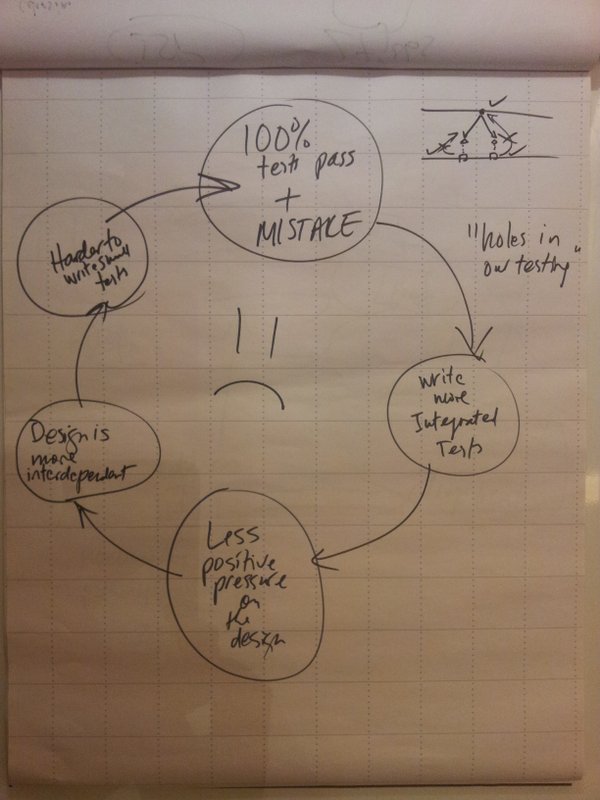
So let me state it clearly integrated tests, and not integration tests, are the scam. They act like aspirin that makes the headache worse. The scam goes like this:
We have 100% passing tests, but we still have bugs.
I know! Our “unit tests” don’t check how the system “hangs together”, so we need integrated tests to make sure that the “real things” work when we put them together!
We write more integrated tests, which are bigger and don’t criticize our design as harshly as microtests do.
Our tests don’t give us as quick nor strong feedback about our design as they could, and we’re humans, so we design things less carefully than we could. We design more sloppily both because we can get away with it and because we don’t notice as easily that it’s happening.
Our designs become more interdependent, tangled, and generally impenetrable.
The more interdependent our designs become, the harder it becomes to write good microtests.
We write fewer microtests.
The probability of 100% passing tests, but we still have bugs, increases.
Repeat until project heat death. (This is the point where starting over is cheaper than continuing with this code base.)
You can yell “straw man” all you want. I see it happen.
Strong integration tests, consisting of collaboration tests (clients using test doubles in place of collaborating services) and contract tests (showing that service implementations correctly behave the way clients expect) can provide the same level of confidence as integrated tests at a lower total cost of maintenance.
This last paragraph is the key point. I’ve stated it as concisely as I can. I hope this becomes the new sound bite that people repeat to their friends, colleagues, and family. Please.
Only Programmer Tests
When I talk about the integrated tests scam, I refer to a very specific practice of using integrated tests to “fill the gaps in our unit testing”. Unfortunately, since I usually find myself very deep in this context, I forget to mention that I’m referring only to programmer tests when I write or talk about the scam. This point really, really matters!
I receive the occasional email—including one today—from people who tell me that they use integrated tests to verify that their features work the way their customers (or stakeholders or product owners…) expect. They are surprised that I would be telling them that they’re doing it wrong. I’m not. Well… I am and I’m not.
When I refer to the integrated tests scam, I mean that we shouldn’t use integrated tests to check the basic correctness of our code. I’m talking only about programmer tests: tests designed to give the programmers confidence that their code does what they think they asked it to do. Some people call these “technical-facing tests” or “developer tests” or even “unit tests” (I never use “unit tests”, because that term causes its own confusion, but that’s another article). Whatever you call them, I mean the tests that only the programmers care about that help them feel confident that their code behaves the way they expect. There, I write as few integrated tests as possible.
When working with customer tests, such as the kind we write as part of BDD or ATDD or STDD or just generally exploring features with customers, I’m not using those tests to check the correctness of the system, nor the health of the design; I’m using those tests to give the customer confidence that the features they’ve asked for are present in the system. I don’t expect design feedback from these tests, so I don’t worry about the integrated tests scam here. If your customer tests run from end to end, I don’t mind; although you should remember that not all customer tests need to run from end to end. James Shore once told me about “customer unit tests”, which I’ve also used, but that’s another article.
So, let me clarify again: the integrated tests scam happens when we use integrated tests for feedback about the basic correctness of our system, and write them in place of microtests that would give us better feedback about our design. Don’t do this.
Yes, I Need A Few Integrated Tests
Even with all the foregoing, I still write a small number—very small—of integrated tests. Specifically, I follow the advice don’t mock types you don’t own—at least most of the time. You’ve seen interfaces that violate the Interface Segregation Principle in the worst possible ways—my canonical example is Java’s ResultSet—and mocking those interfaces is a sure path towards madness. Even when third-party frameworks and libraries give us interfaces, they are often quite terrible, especially when different methods on the interface duplicate each other’s behavior. (Think of getParameter() and getParameterMap() on an HTTP request interface.) When this happens, we face a Morton’s Fork:
Mock all the related methods consistently to avoid contradictions (size() returns 0, but isEmpty() returns false), in order to retain the freedom to refactor implementation details, even though that means mocking methods you won’t need.
Mock only the methods you invoke, leading to brittle tests that fail because you’ve refactored what seems like a completely free implementation detail choice.
Some people interpret this as a failing of mock objects. No. I interpret it as a failing of the design. Again—another article. I prefer instead to emphasize the point that I do still write some integrated tests. I do, however, write almost none, and my code tends to flow in the direction of not needing them, and many of the ones I write I end up replacing over time with microtests.
I have a wonderful explanation of this point, but it takes several minutes or hundreds of words, and this article has already grown quite long. I have put it on my backlog to write another article with an example of how I do this. Patience.
I typically don’t mock types that I don’t own. I just integrate with them, write integrated tests, and be done with it. Of course, this creates little Adapters that export third-party behavior as Services to the rest of my system, which I hide behind interfaces that I call a “Patterns of Usage API”. I then mock those interfaces so that the rest of the system neither knows nor cares about the details of integrating with that horrible gelatinous blob. In many cases, those tests are learning tests for the third-party system, rather than tests for “my code”. They become acceptance tests in the classic sense of the term. They become tests for the third-party system, and I run them only when either I need to upgrade or I need to start using some hitherto-unused part of it.
So yes, I write some integrated tests, but many, many fewer than you, for a specific purpose, and I design in a way to intentionally make them obsolete over time. I write them in a way that avoids the scam. And I certainly don’t use them to check that “the system hangs together”. That way lies the scam.
So… Are We Good?
So… I’ve clarified some key differences of understanding regarding the integrated tests scam. Now I can get on with my life, right? Wrong. People will still read the old articles and not the new ones. Other people will perpetuate my mistake from 2009 whether they intend to do it or not. Others still will listen to the sound bites, switch off the brain, and often understand the exact opposite of what I meant. I have made peace with all these things. Even so, I hope that some thoughtful, mindful readers will have more clearly understood the nature of the integrated tests scam, how I use integrated tests effectively, and especially how sorry I am for ever calling them “integration tests” in the first place.
Not just Canadian sorry. Sorry sorry.
]]><![CDATA[Designing the Entry Point]]>2015-12-02T07:58:00-05:00http://blog.thecodewhisperer.com/2015/12/02/designing-the-entry-pointThe entry point. Sometimes it’s main(). Sometimes it’s an extension point in some complicated framework. Most importantly, it is the border where Their Stuff runs Your Stuff. When I see entry points in other applications, I don’t see a lot of evidence of having thought about the design much. It becomes a kind of junk drawer for code. This happens especially when programmers are working in environments they don’t feel particularly comfortable in. (I don’t know where to put things, so I’ll put them here, since that seems to work.)
I use the entry point of an application (or a component, but it’s the same) as the place to wire up my graph of modules (these days, usually objects) and connect my request handlers to the incoming pipeline of requests.
That sounds fancy, but in the case of a command-line interface, the incoming pipeline of requests is simply text over standard input, and in the case of a web application, the incoming pipeline of requests is however the framework presents incoming HTTP requests to my code: somewhere between raw requests and nice little bundles of data, neatly structured and sometimes already well-parsed into meaningful data types!
But really, that’s it. Nothing else happens in the entry point in my designs. I connect my request handlers (often there’s only one, but sometimes many) to the “inbox” of requests, so that I can handle requests. In order to do this, I need to “assemble” my application by connecting all the concrete modules to each other. In object-oriented programming terms, that means instantiating all the services and connecting them together. My entry points do nothing more complicated than that. (That’s plenty complicated as it is.)
An Example
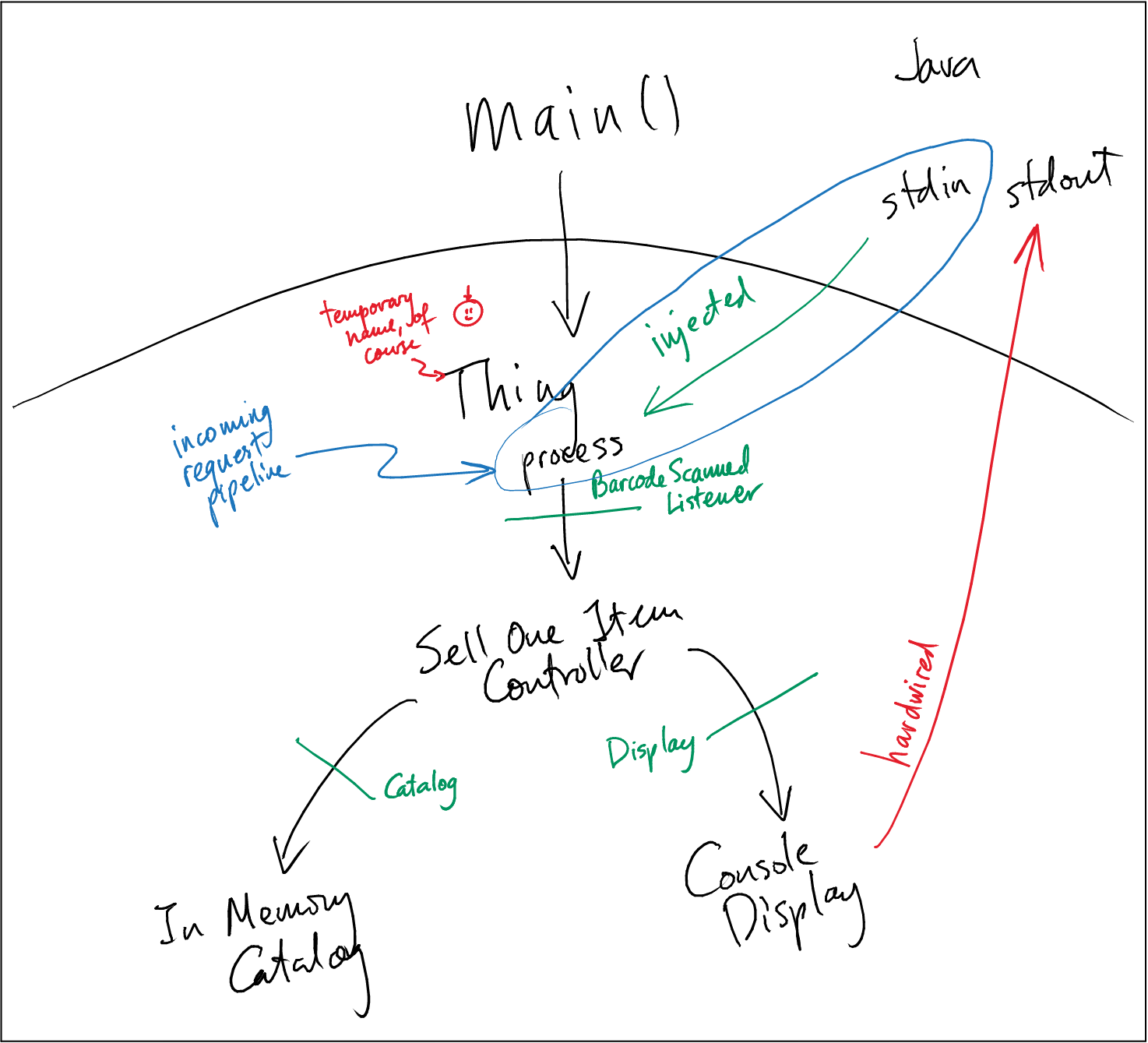
I recently taught the World’s Best Introduction to Test-Driven Development “live and in person”. (I still do that, but my online training is a great option for people who don’t want to wait for me to get on a plane and visit them.) You can see the code for the entry point of the “Virtual Point of Sale Terminal” by clicking here. Here’s a diagram to show the structure.
The entry point only wires all these objects together, then “presses go” (invokes `process()`)
Once we extract the anonymous implementation of Display into the production class ConsoleDisplay, we see that main() does nothing except wire up the objects and connect Thing to System.in. In my opinion, as it should be.
What’s in your entry point that probably doesn’t need to be exactly there? Remember: if it’s in the entry point, then you need to run the whole application (and maybe even redeploy it) in order to check it!
]]><![CDATA[Injecting Dependencies, Partially Applying Functions, and It Really Doesn't Matter]]>2015-12-30T17:36:00-05:00http://blog.thecodewhisperer.com/2015/11/13/injecting-dependenciesYou might have noticed dependency injection gaining popularity in recent years. You might also have noticed some notable figures (I’m thinking of Kevlin Henney) who appear to be bad-mouthing dependency injection, when really they are simply taking away what they feel is a veneer of mystery from the term.1 I must say that I appreciate their doing so without pretentious use of the annoying word “demystifying”. (Simply ignore my own “demystifying” article by most certainly not clicking here). While on a three-hour-long car trip it occurred to me—some would say much too late—that injecting dependencies, particularly through the constructor, acts precisely like partially applying functions. This leads to a couple of potentially useful conclusions:
This explains why practising TDD has seemed to be pushing my object-oriented designs in the direction of what appears to be a functional programming design style.
When test-driving, I see no good reason to rush to label a parameter as a collaborator, so I can defer the decision as long as I want.
In other words, when practising TDD, if I ever have a moment of doubt as to whether a parameter belongs with the object’s constructor or the function/method itself, I stop thinking, put the parameter on the method, and just keep going. No worry, no penalty, no problem.
The Tests Don’t Care
I write microtests2, meaning really small tests. I design my microtests to be independent of one another, so that the side-effects of one test don’t affect the results of running another test in the same test run.3 This encourages me to design my production code to make it easy to pass in any useful details (“inject” them), like collaborating services, configuration information, and, of course, request data. Don’t be fooled by my use of request data: I just mean parameters that vary from request to request, such as the 49 in a call to sqrt(49).
Aha! Since every test lives in its own little world, and sets everything up before running and tears everything down after running, then every parameter in a test is request data!
A typical application runs for some non-trivial amount of time. Let’s say “days”, just to make it more concrete. While the application is running for days, certain details about the application don’t change much: connections to databases, web services, the file system. These details might change from run to run, but while the application is running, often just as a performance optimization, we don’t change these details. Accordingly, we consider these application-level details quite stable and probably configure them at the very top of our application, just once, and then use those objects in the rest of our system without changing their state. (Worse, we probably scatter these details all over the damn application, putting them directly into code through hideous anti-patterns like the so-called “Service Locator”.)
A typical user interacts with our application for some non-trivial amount of time. Let’s say “minutes”, just to make it more concrete. While the user is interacting with our system, certain details about that interaction don’t change much: the user’s authentication credentials, their permissions to perform various actions, their user profile information. Accordingly, we consider these session-level details relatively stable and probably store them in some object attached to the user, changing their state rarely. (Worse, we probably use the session as a dumping-ground for data that we have to pass between ill-designed, overly-interdependent transaction scripts.)
This leaves the details of each individual micro-interaction that the user has with our application. Each time the user presses a button or selects an item from a list or issues of command from our handy command-line interface. These details change wildly from request to request. Accordingly, we treat them as precious snowflakes, accept them as parameters, put them lovingly on the stack, and then throw them away when we’ve crafted our response and sent it, with care, to the user.
The tests don’t need any of this, because each test acts like a separate run of the entire application.
Do not, under any circumstances, interpret this to mean that each test runs the entire application from end to end. No. NO. Integrated tests are a scam, remember?!
I mean this: when I write a microtest, which means that it involves a very small part of the application, I can treat each test as a separate run of that part of the application, and the distinctions between request data, session data, and application data have no value for me at all. The “application”, such as it is, runs for such a small amount of time, that these distinctions literally have no meaning in the context of the test. On the contrary, promoting parameters to the session or application level—which mostly amounts to caching their values—becomes a performance optimization that has value to the application as a whole, but not to the tests. (Moreover, they make the tests harder to understand in most cases.)
In fact, when I try to tease apart highly-interdependent legacy code, I spend a lot of energy moving changing details to their “proper” scope. This is why “extract pure functions” works so well: it reduces every detail to a request-scope parameter, then I can use patterns of duplication to figure out how to repackage them more sensibly.
To A Test, Everything Is Request Data
This means that, when we write a test, everything is request data. Everything can be a function parameter and the test doesn’t mind.
Great news! This means that, especially when test-driving, we can freely pass every salient detail to the object we’re testing as a method parameter if that’s convenient, then decide later, once the tests pass and we feel all warm and tingly, which parameters to promote to the constructor of some object. Some of those objects have session-oriented lifecycles (like a Shopping Cart or a Locale) and some have application-oriented lifecycles (like an Authentication Service or an Order History).
But in the tests—oh, boy!—we can just list all the salient details, make them all parameters, invoke the function that interests us, then go on our merry way checking whatever we need to check.
So, Stop Worrying… And Arguing!
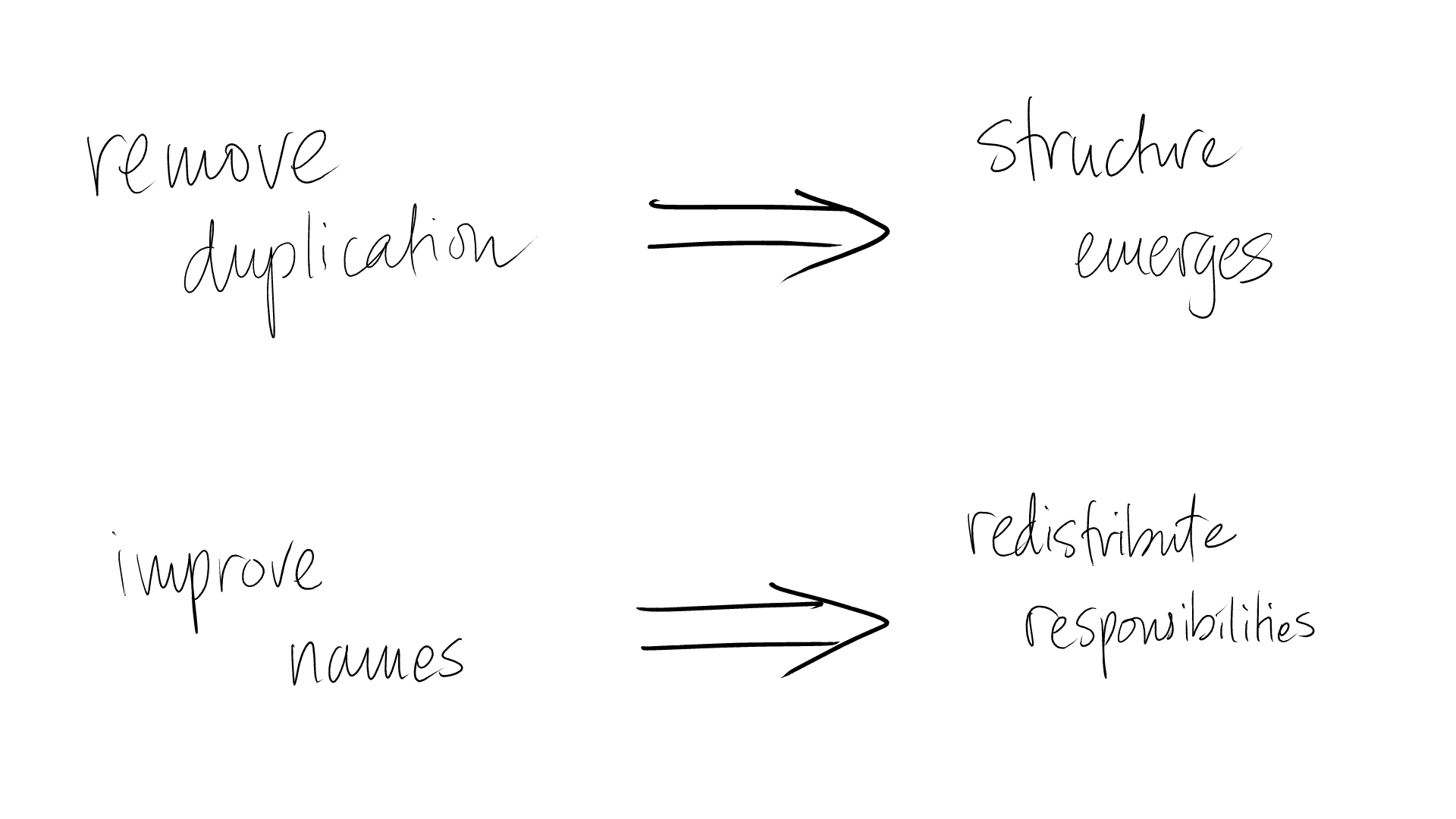
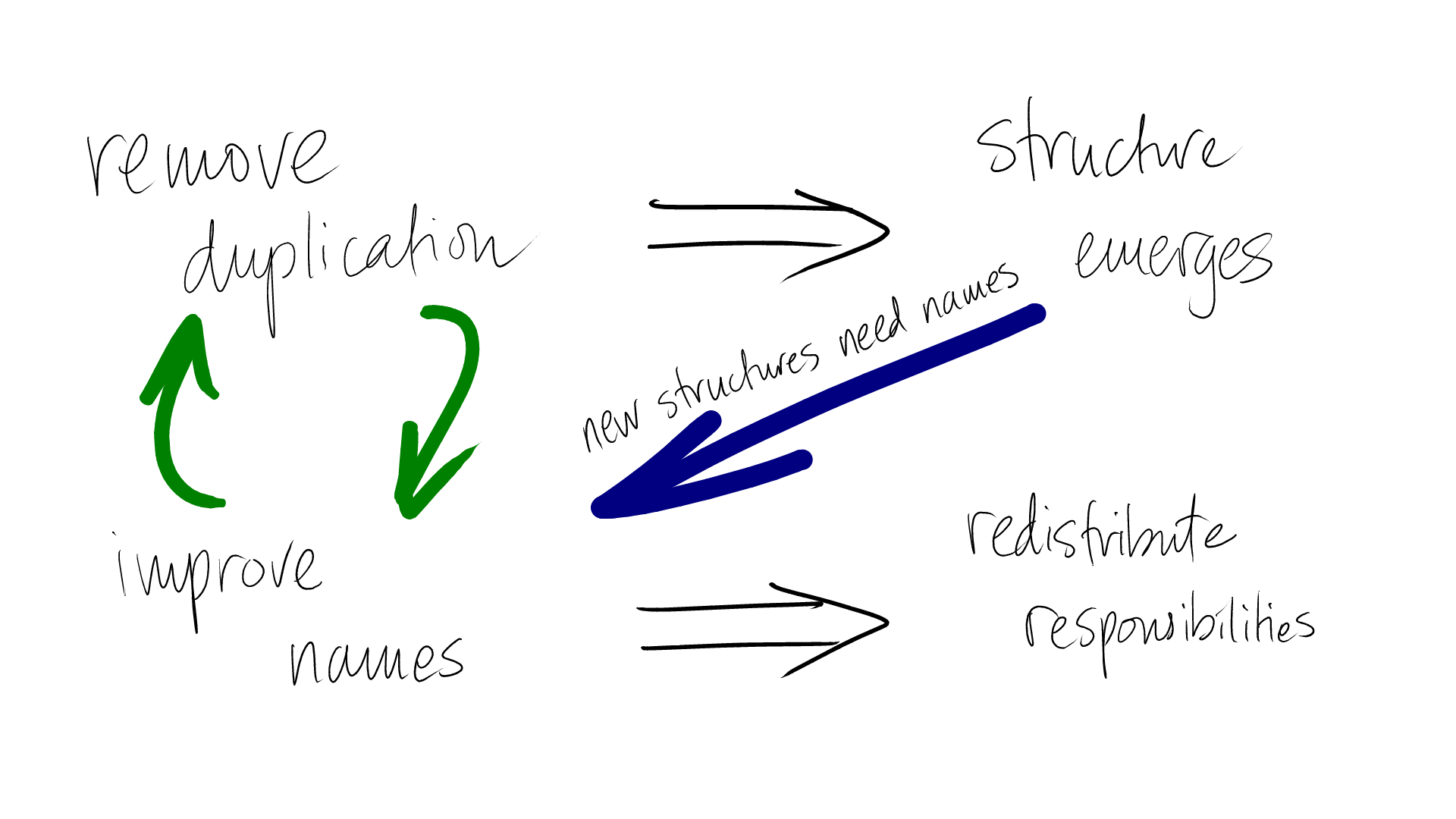
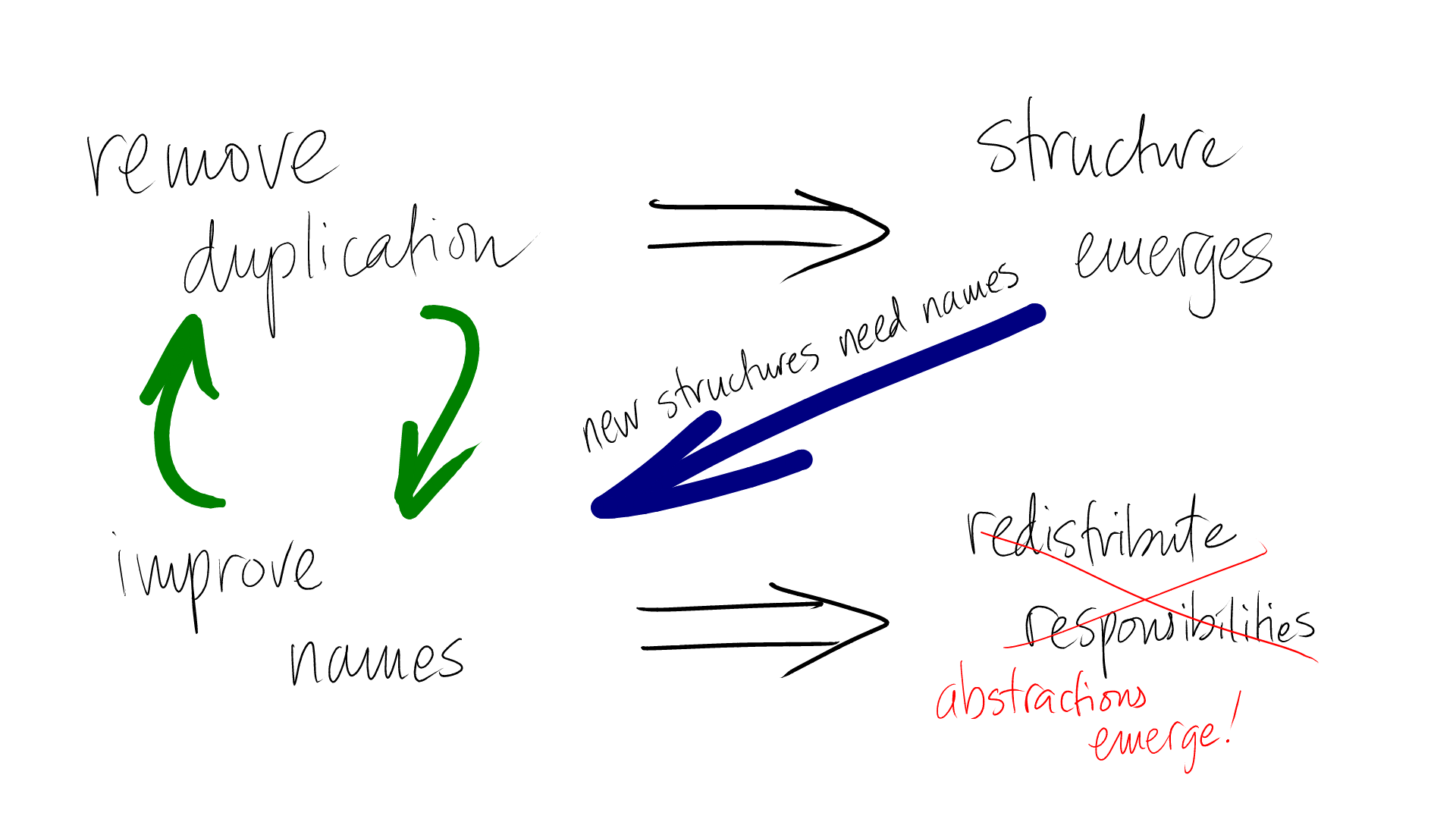
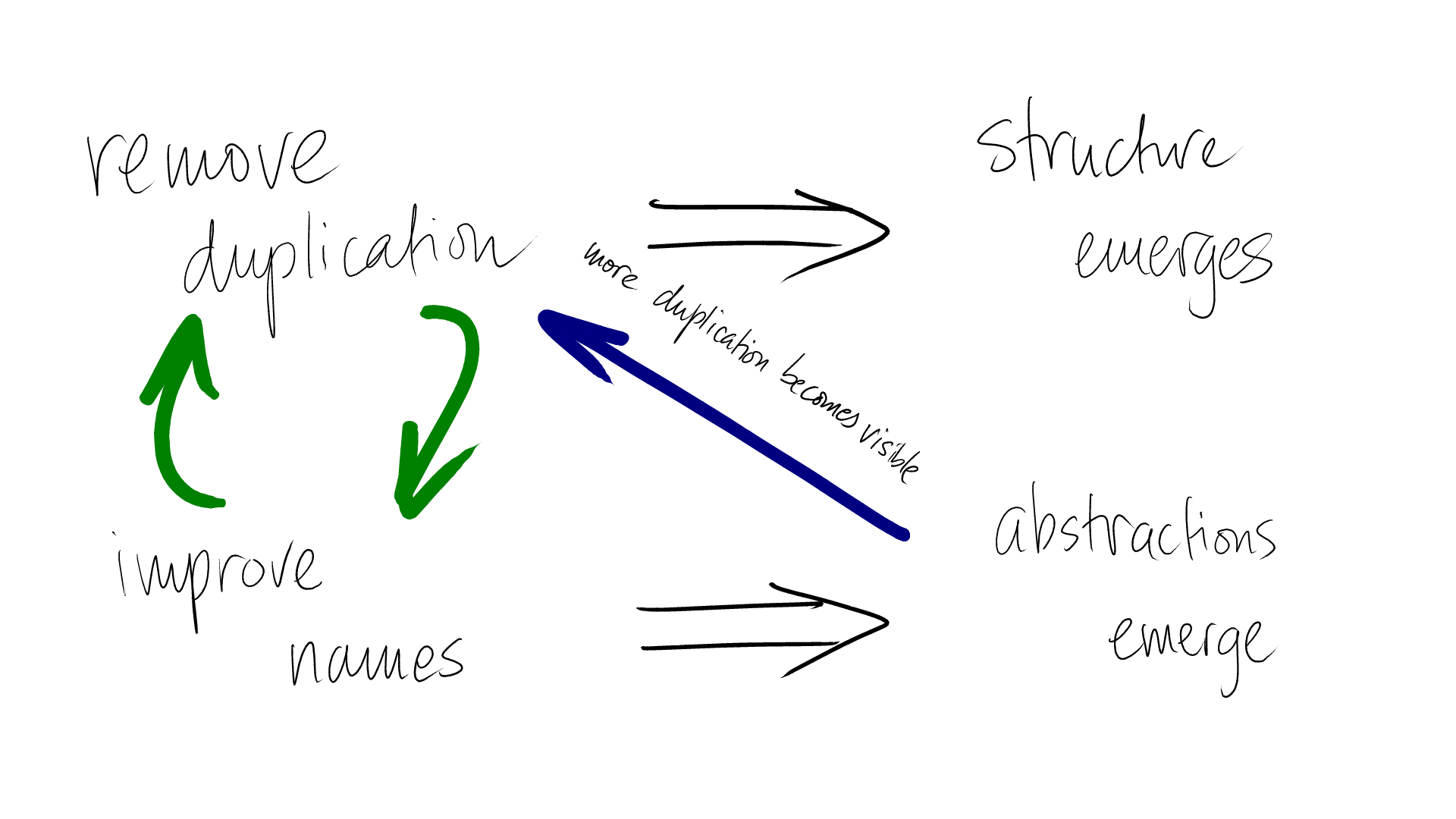
If you test-drive, then you can literally start by making everything a function parameter to start, then remove duplication and improve names to help identify which parameters you should promote to the constructor. You would end up with a design in which details change at their proper rates. It would totally work. I might even try it.
Mostly importantly, if you find yourself working with someone who cares deeply about getting this point right, then you can either (1) let the parameter stay on the function until duplication makes it clear that it’s time to promote it to the constructor or (2) let the parameter go to the constructor, secure in the knowledge that it is a purely mechanical refactoring to demote it to the function when it becomes clear that that’s warranted. No arguments. It’ll be fine.
Uh… Partially-Applied Functions?!
Oh, yes. And, it so happens, this is exactly what partial application helps with in functional programming languages. We can design functions to take 20 parameters, if we want, but if 18 of them change infrequently (but at the same rate), then we can apply f20 to those 18 parameters, making function f2 that takes only the last two parameters that change most often. I will prefer to invoke f20 in tests for the sake of explicit links between inputs and expected outputs, but I will prefer to invoke f2 in the application for the sake of avoiding duplication, and probably as a performance optimization. (I don’t know: do compilers like the one for Haskell have enough magic to optimize this for me? Probably not, but how cool would that be?!)
I guess this explains why I’ve had this feeling for several years that practising TDD has nudged my OO designs in the direction of FP-style design. I’ve been partially applying functions, and I even knew that I was—an object is, after all, a cohesive (we hope) collection of partially-applied functions—but I didn’t understand this particular aspect of the significance of those facts until I had a few hours riding in a car for it to occur to me.
Kent Beck, Test Driven Development: By Example. This remains the classic text on the topic, complete with examples of the tiny steps that help me keep the cost of mistakes low.
Chris Oldwood, “Terminology Overdose”. Don’t let a new term get in the way of understanding an old idea.
Kris Jenkins, “What Is Functional Programming?”. Another article that argues both sides of implicit dependencies, describing functional programming as designing side effects with care. (I’d call this “programming”, myself.)
I consider it categorically unfair to interpret what Kevlin writes or Chris Oldwood writes as “bad-mouthing” the concept of dependency injection, but unfortunately, a careless reading of their work might suggest that in the mind of the careless reader. They mostly object to coining a new term for an old idea, with which I agree. Even so, dependency injection remains known as a term of art, so I just want to roll with it.↩
I learned the term from Michael Hill, who uses it in part to avoid the whole “what is a unit?” navel-gazing exhibition.↩
I learned this principle from Kent Beck’s “daily bug reports” story, which I think I first read in one of the early XPbooks.↩
]]><![CDATA[How To Recover From the Integrated Tests Scam]]>2015-11-07T16:00:00-05:00http://blog.thecodewhisperer.com/2015/11/07/how-to-recover-from-the-integrated-tests-scamA Twitter follower asked me how to recover from feeling overwhelmed by too many integrated tests, calling it “a common struggle of mine”.
If you haven’t seen this video (64 minutes), then you might not quite know what I mean by “integrated tests”.
If a test passes or fails based on the behavior of many “interesting” bits of behavior, then I call it an integrated test. (Not an integration test—those check the integration between layers of a system.)
Integrated tests tend to be big, because they run multiple layers of the system together. They tend to cause trouble because either they check too many things and confuse the programmer or they check only one thing and waste a lot of time doing it. I prefer, instead, to write as many isolated or microtests as possible, which run one thing and check that one thing and that’s that.
Nevertheless, most groups that practise TDD seriously eventually fall into the integrated tests scam to some degree.
The integrated tests scam
When it happens for long enough, more of the system becomes tightly interdependent, it becomes harder to test anything (whether with integrated tests or with microtests), and then they’re stuck in the mud: can’t dig out, can’t move forward.
Well… not can’t. It does, however, seem daunting. Even if you know that you ought to start teasing things apart, it goes slowly. You feel pain. Little victories seem like very hard work and significant progress seems impossible. This leads to the feeling of being overwhelmed.
The Best Time To Start…
The old joke advice goes like this:
The best time to start was five years ago. The next-best time to start is now.
As a consultant, I often have to give this kind of “dissatisfying but true” advice. To deal with legacy code and crawl out of the integrated tests scam, you just have to start. You have to start trying to add tests, trying to tease code slowly apart, trying to improve the design just a little every day. Eventually, these improvements compound and, months from now, over a weekend, suddenly the improvements mean something. Then you gain confidence. Then you feel better. Then you celebrate.
Where Do I Start?
One of the most common questions people ask me about refactoring, is Where do I start? I even turned this question into a popular conference talk about a decade ago. The bad news with this situation is that there’s no good place to start. The good news is that there’s no bad place to start, either. Just start. Anywhere. Really.
I intend this advice to feel liberating, but most people find it disheartening. Great! It doesn’t matter where we start! It’s hopeless! No. I offer you this:
Great! It doesn’t matter where we start! We can start wherever we want!!
Yes, you can. Even if there is an optimal place to start rescuing your design, nobody can see it right now. It lies buried under the rubble of a thousand compromises. Even the greatest tools will only help you a little. Picking a place to start by random chance will give you a roughly equally good chance of a reasonable return on your investment.
Good news, everyone!
No matter where you start adding tests or teasing apart code, it’ll feel slow, annoying, and painful. It’ll make you laugh, cry, throw things against the wall. It’ll make you sweat. It’ll take months, even years, to get better.
So get started.
While I Have You…
You probably already know about my online training school at online-training.jbrains.ca. I’m planning the next course, and I’d like your help. It’ll take 30 seconds, depending on the speed of your internet connection. It’s a one-question survey. Please answer it by clicking here. Thanks.
]]><![CDATA[Null: Design Tool]]>2015-05-29T06:00:00-04:00http://blog.thecodewhisperer.com/2015/05/29/null-design-toolThis article describes an evolutionary design microtechnique. Specifically, it describes a weak signal that I use to guide myself towards more modular designs. I find it both simple and surprising: simple because it involves using a single value, but surprising because it involves a value that programmers largely recommend against using. I refer to the humble null.
Yes: I have found a way to use null that doesn’t lead to heartache.
Even if you don’t program with objects, you’ll probably find this useful. Keep reading.
I start with injecting collaborators through the constructor. (I won’t justify this technique in this article. I’ve done that elsewhere for over a decade.) For example, when using the Web flavor of the MVC pattern—admittedly the weaker flavor of MVC, but not my immediate concern here—I typically inject the Model and View into the Controller.
1234567
class SellOneItemController:
  # catalog and display are protocols
  # or interfaces
  # or abstract type descriptors
  constructor(catalog, display):
    self.catalog = catalog
    self.display = display
Apparently we have a point of sale terminal and a controller responsible for selling a single Item to a Shopper. (I’ll capitalise the domain concepts so that they stand out a little.) Selling an Item involves scanning a barcode, then seeing its price on the display that typically faces the Shopper (as opposed to the one that the Cashier can see, which might have more details). Of course, we can only see the price if our Catalog contains a listing for the scanned barcode. If the Catalog doesn’t recognise the barcode, then the controller asks the display to display a message that both the Cashier and the Shopper can understand. You can probably picture the resulting code.
1234567
class SellOneItemController:
  on_barcode(barcode):
    price = catalog.find_price(barcode)
    if price:
      display.display_price(price)
    else:
      display.display_product_not_found_message(barcode)
More importantly, you can probably picture the corresponding tests. I stub the query and expect the action, following the sensible maxim “Stub Queries; Expect Actions”.
123456789101112131415161718
SellOneItemControllerTests:
  # .cents() builds a Price value
  product_found:
    # a totally made-up test double API
    catalog, display = double("a Catalog"), double("a Display")

    stub(catalog).find_price("12345").and_return(795.cents)
    expect(display).display_price(795.cents)

    SellOneItemController(catalog, display).on_barcode("12345")

  product_not_found:
    catalog, display = double("a Catalog"), double("a Display")

    stub(catalog).find_price("12345").and_return(null)
    expect(display).display_product_not_found_message("12345")

    SellOneItemController(catalog, display).on_barcode("12345")
To read these tests in English:
Pretend that the Catalog has barcode “12345” with price $7.95 (or 7.95€, if you prefer). In that case, when the controller receives barcode “12345”, something must display the price $7.95 (7.95€).
Pretend that the Catalog doesn’t have a price for barcode “12345”. In that case, when the controller receives barcode “12345”, something must display a message that somehow conveys “product not found” for the barcode “12345”.
So far, so good. As a programmer with some testing skill, I imagine some special boundary values for barcode that might cause trouble, such as our friend the empty string (""). Sure enough, I can imagine that a text-based display might create problems for the Shopper and the Cashier if we happen to scan an empty barcode. We might see a message like this:
Product not found for
We programmers can see the empty string at the end of that message, but a Shopper or Cashier might think that something is broken, and rightly so. I’d prefer to do something less likely to create problems. Of course, I start with a test.
Wait a moment… what about stubbing the Catalog? We don’t need to. Therein lies a clue.
Choices…
If we leave things as they are, then what happens next depends on the test double library I use. If I use JMock, then my production code may not invoke anything on the catalog on pain of making the test fail. If I use Mockito, then my production code may send messages to the catalog, and nobody will care. Some libraries refer to these as “strict” and “lenient” modes, respectively. For this test, either behavior will do, because I don’t intend to use the catalog in this branch of the production code; instead, I’ll end up with something like what follows.
1234567891011
class SellOneItemController:
  on_barcode(barcode):
    if barcode.empty?:
      display.display_scanned_empty_barcode_message()
      return

    price = catalog.find_price(barcode)
    if price:
      display.display_price(price)
    else:
      display.display_product_not_found_message(barcode)
I don’t intend to discuss the Guard Clause here, beyond saying that I prefer it to the alternatives that I know about. If you want to suggest something better, then click here.
The Key Observation
I notice two things:
on_barcode() has a code path that doesn’t invoke the catalog at all.
SellOneItemControllerTests.empty_barcode doesn’t need to stub any behavior on the catalog.
Of course, these two things relate to each other, both signaling the same underlying risk: we have a code path inside SellOneItemController that ignores one of its collaborators. I call this a risk, because it doesn’t necessarily signal a problem, but rather a potential problem in the future. Moreover, I can make this risk even more explicit with my simple trick.
The Trick!
If we don’t need a collaborator, then let’s really say so.
123456789
SellOneItemControllerTests:
  # blah blah blah...
  empty_barcode:
    display = double("a Display")

    expect(display).display_scanned_empty_barcode_message()

    # The Trick! I don't need a catalog at all.
    SellOneItemController(null, display).on_barcode("")
If I can pass null as the value for a collaborator, then I do. This signals something potentially interesting to me: a code path through the subject under test ignores that collaborator. On its own, a single path like this matters not at all. A few paths like this, however, signal that perhaps the subject under test has too many responsibilities.
You might think that I’ve gone mad. You might think that I’ve started over-engineering by suggesting that on_barcode() has too many responsibilities. Look at how small it is! For that reason, I called this a weak signal pointing to a risk. I can’t say that this causes a problem just yet, but I prefer to think about these issues earlier, when addressing the problem generally costs less.
When a kitten scratches you, it hurts. When a lion scratches you, you die. I like to consider design problems as kittens, rather than waiting until they become lions. Or spirit-crushing legacy code.
The Evidence (?)
Once again, when I have only one code path that ignores a collaborator, then I can’t justify concluding definitively that I should split the module (or class) into pieces just yet; however, I can absolutely justify taking a few moments to consider it. More importantly, I can justify wondering what test (or feature) I’d have to write to force myself to confront the issue more seriously—how might I gather evidence that I should split this behavior from the rest of the module (or class)? If I can think of this in a few seconds, and if that behavior is on the immediate list to implement, then I favor choosing that test sooner; and if not, then I don’t.
In this case, I don’t encounter this issue again until I implement more of the system: notably when I connect the hardware. If you want the details, then you’ll have to sign up for my online TDD training, but I can give you a preview here.
Why does on_barcode() need to even worry about the empty string? Because the language doesn’t easily let us declare the barcode parameter in a way that rejects the empty string.
How do we even get an empty string at all? It depends on how we implement the UI. With some barcode scanner hardware, it can’t happen, but with a computer keyboard, I could just hit ENTER without entering a barcode.
Who bears responsibility for rejecting the empty string as a barcode? Ideally, only one part of the code base. It really depends on the consequences of processing an empty string, and that becomes an accident of implementation. In our case, so far, the controller simply wouldn’t find a price for the barcode, and would display a confusing message to the Shopper and Cashier. Tolerating that or not becomes a business decision.
When we connect the hardware, we eventually build the thing—you know, the thing—that listens to stdin and hands lines of text over to something that interprets them as barcodes or other kinds of commands. This thing—call it a Text Command Consumer—also has to decide how to process empty commands. It can blithely ask the interpreter to interpret them, or it can helpfully (?) reject them as uninterpretable. This becomes a design decision. What we do here determines what we do in SellOneItemController.
On the one hand, we could tell the controller not to worry: we could make its clients filter empty barcodes out. We could also tell the controller that it has to defend itself against an attack that it should blame on the programming language in question. (In another language, we could define a data type that excludes the empty string. In Java, we could make on_barcode() take a Barcode that can’t be empty. We have ways.)
I find it comforting to know that, by passing null as the catalog collaborator, I had to consider all this; otherwise, this detail could go unconsidered, leading to a classic “You were supposed to handle that!” problem weeks or months from now.
So there you have it: null doesn’t always have to suck. Enjoy.
Tony Hoare, “Null References: The Billion-Dollar Mistake”. If you made a mistake that cost an entire industry billions of dollars over the length of your career, would you have the courage to admit it publicly?
J. B. Rainsberger, “Injecting Testability Into Your Design”. (Originally published in Better Software, April 2005.) In this article I describe how and why, including walking the reader through an example.
Steve Freeman and Nat Pryce, Growing Object-Oriented Software, Guided by Tests. This fantastic book includes such gems as “Stub Queries; Expect Actions”. Run, don’t walk, to your local large multinational conglomerate and buy a copy today!
Tom DeMarco and Tim Lister, Waltzing with Bears. My favorite manual for managing risk on software projects. It includes the definitions of risk as a potential problem and problem as a realised risk.
]]><![CDATA[What Good is Subclass to Test, Anyway?]]>2015-04-07T02:30:00-04:00http://blog.thecodewhisperer.com/2015/04/07/what-good-is-subclass-to-test
We recently ran a legacy code retreat based on your format. People were questioning the value of subclass-to-test in a real world scenario. The best reason I could come up with for myself was that it’s a smaller step to separating out responsibilities from a class.
How would you frame the value of subclass-to-test, and in which contexts would you use it?
I view Subclass to Test as an intermediate step towards other refactorings like Replace Inheritance with Delegation, Introduce Named Constructors, and especially Separate Lifecycle Management from Lifecycle Behavior. I see Subclass to Test has a highly mechanical way to start identifying how to split things apart. (I just follow the steps and don’t have to know where the design is going yet.) It’s easy to say “we need to split things apart”, but Subclass to Test helps me see specific patterns, for example, in the difference between setting up state and doing something interesting. Referring to the Legacy Code Retreat code, does your test check addPlayer() or roll()? Do you only call addPlayer() so that you have players who can roll()? What if you could call roll() on an object with the necessary players without worrying about how to make that happen? What if you could call roll() on an object that doesn’t care about players?! If we separated the Board from the Rules from the Players, then it would be easier to add things like save/restart, which would make playing the game online more robust…. By only committing up front to Subclass to Test, I remain open to options without over-committing to one, specific, narrow refactoring.
So I see two main benefits to Subclass to Test:
I don’t know where the design needs to go, so I can start with Subclass to Test, look for patterns in the subclasses, then decide later.
I think I know where the design needs to go, but I don’t feel comfortable going there safely in one big step, so I can start with Subclass to Test, do those steps safely and correctly, then continue with the design improvements that I had in mind. (Sometimes here I realise that I was wrong, and I have a chance to change direction without undoing all my good work.)
]]><![CDATA[Your Tests Are Dragging You Down]]>2015-03-28T02:30:00-04:00http://blog.thecodewhisperer.com/2015/03/28/your-tests-are-dragging-you-downI’ve written in the past that integrated tests are a scam, but that’s not what I mean here.
Even if you’re not a programmer, read on. There’s something in this for you, too, and you’ll probably want to share it with the programmers around you. I promise.
Dear programmers, your tests are probably dragging you down. Here we have another delightful irony of agile software development, this time related to test-driven development. I give you The Fundamental Irony of Test-Driven Development.
If you practise test-driven development, then depending on how you manage your short-term tasks, you run the risk of increasing your stress levels compared to not doing test-driven development at all.
Strange, isn’t it? Here’s how it works:
Practising TDD encourages you to break your work down into microtasks: in many cases, individual tests. This clarifies what you intend to do, by breaking it down into more, small tasks.
You’re used to keeping the salient details of your current work in your mind’s short-term memory, even when you work for a few hours at a time.
Now, you have even more details to try to keep in your head while you work. Congratulations!
It reminds me of some companies who adopt Scrum, switch from weekly status meetings to monthly sprint reviews, and the flow of information about the progress of the project actually goes down. Great, no?
This bears repeating.
Practising TDD while keeping everything in your head:
decreases focus
hurts productivity
wastes precious energy
increases stress
You didn’t see that coming, did you? Maybe you did.
It doesn’t happen right away, mind you. You probably found TDD a relief when you first started practising it. The constant sense of completion. The continuous positive feedback. The orderly progress towards working, solid code. It feels fantastic… but maybe you’ve noticed a few unexpected side effects.
Tasks drag on: often when you think you’re done you notice one more test that you’d forgot to write.
Thinking about all those error cases and side effects up front makes every feature feel like so much work.
In the planning meeting it seems like you need half a day, but once you get going it feels like it’s never going to end.
When you get near the end of a task, you can’t shake this feeling that you’ve forgot something important.
In your weakest moments, it might encourage you to long for the days when you didn’t think about your work quite so systematically and carefully. It’s like writing your second book: once you see how much work it takes to write one, many authors can’t stomach going through it again.
Kent Beck To the Rescue!
Naturally, Kent Beck had good advice for us way back in his seminal book Test-Driven Development: By Example. He encouraged us to start a programming session by writing a test list: literally a list of the tests that we think we’ll need to write. As we make tests pass, we cross them off the list; as we think of more tests to write, we add them to the list. When we’ve crossed the last item off the list, we’re done! Simple.
As you might expect, this advice can help anyone, and not just programmers. It just so happened that Kent aimed the advice at programmers writing tests. The more generic version of this advice can help everyone:
When you sit down to work, start by getting things out of your head!
A Few Basic Rules
If you’re a programmer, then the moment you hear about a programming problem, you probably start solving it in your head. That enthusiasm will drag you down if you don’t do something about all those ideas buzzing around your mind. Thinking in terms of tests helps organise your thoughts, but if you keep them all inside, they’ll crush you. Try this the next time you sit down to program:
Get yourself something to write with and something to write on.
Sit comfortably. (So many people overlook this one.)
Take all the ideas buzzing around your mind and write them down.
Draw some high-level design diagrams
List the tests that have leapt to mind
List any refactorings that you already know you might need to do
Once your mind feels quiet, pick a test and start test-driving.
As ideas pop into your head, quickly write them down.
Add some tests or refactorings to your list.
If unrelated work pops in your head (“I need to prepare for that damn meeting tomorrow morning…”), write that anywhere else: on another page, in a notebook, wherever.
As you make tests pass, cross them off the list.
As you perform the refactorings you had in mind, cross them off the list.
Repeat until you can’t think of anything more to do to complete your task.
OK: more than a few rules, but only because I want to leave less room for differences of understanding or interpretation.
A few things to keep in mind:
Just because you write the test or refactoring on your list, that doesn’t mean that you have to do it. If you don’t need it, then don’t do it.
When first getting things out of your head, don’t try to list all the tests that you might need. Focus on listing all the tests that immediately come to mind. First, unburden yourself, then you’ll find it easier to notice that you’ve missed something.
I write tests from the top of the card or page and refactorings from the bottom. I guess that’s just personal style.
When you finish your programming task, if you have other work left over, then put it wherever it needs to go in order for you to follow up: email, calendar, to do list, whatever system you use.1
Not only that, but I like the satisfaction of crossing things off and ripping up cards when I’m done with them. What can I say? Little things like that amuse me. Whatever works.
So don’t let your tests drag you down. Lighten the load by getting them out of your head. Try it now! I’ll wait.
References
Kent Beck, Test-Driven Development: By Example. When you reach a certain point in studying a field, you long you read the classics. If you’ve reached that point, then read this classic.
David Allen, Getting Things Done. When I first read Getting Things Done, with its emphasis on getting things out of your head, I immediately recalled Kent’s “Test List” trick. As much as Test Lists helped me with programming tasks, getting everything out of my head has helped with the rest of my work. You can’t imagine the difference until you try it. David’s trademark: Your mind is for having ideas, not holding them. Kinda cultish, but true.
J. B. Rainsberger, “Getting Started with Getting Things Done”. If you’re not eager to read 200 pages of productivity advice, then start with a handful. I give you enough detail to try the basics of the system for a few days and decide whether you want to learn more. How agile of me!
If you don’t have a system, then you’ll need one, but let’s solve one problem at a time.↩
]]><![CDATA[Your Constructors are Completely Irrational]]>2015-03-23T02:30:00-04:00http://blog.thecodewhisperer.com/2015/03/23/your-constructors-are-completely-irrationalWhen clients ask me to help them with legacy code it generally takes less than 30 minutes for me to run into a debilitating constructor—a term I use to describe a constructor that does too much. You might think me melodramatic for calling it “debilitating”, but these constructors not only slow us down when we try to understand the code, but block our every effort to improve it. These constructors often hardwire a dependency either to some horrifying external resource (a database or a web service end point) or into a framework (even something as “simple” as threads or a lifecycle manager). These constructors also often grow to dozens, and in some extreme cases hundreds, of lines. These constructors kill code bases and, by extension, suck the life out of programmers.
Do not underestimate the power of the debilitating constructor. If you need convincing, then take ten minutes now and click here to read a more in-depth description of the damage these constructors do.
Let Me Tell You What I’m Looking For in a Fucking Constructor…
If you don’t recognise this reference, then you don’t know the comedy of Ron White, then shame on you. Go find some now and listen to it. I’ll wait.
A constructor has one job: build objects. You can see that right in the name. I want constructors to build objects.
An Anti-Pattern, While I’m In the Neighborhood
Every so often I stumble across a test that looks like this:
When I see this, I have the typical alpha programmer impulse to belittle the programmer who wrote this test. I take a few deep breaths to let that feeling pass. True, in Java, the language specification guarantees that every constructor either return a non-null reference or throw an exception; however, in languages that let you do whatever you want with new (like C++), you can’t make that assumption. Moreover, after you’ve seen enough debilitating constructors, you assume that every constructor you touch wants to kill you. Rightly so. This makes assertNotNull(new X()) almost look reasonable. (It still isn’t reasonable in Java, so please just stop doing this in Java. You have bigger problems.)
Constructors Can’t Reveal Intent
I limit constructors to building objects (as opposed to connecting to databases) in part because constructors in many languages can’t reveal intent. In Java, C#, C++ and its cousins, you must name the constructor after the class to which it belongs. You may not change the name. Those languages expressly forbid constructors from expressing their intent to do anything more complicated. As a defence mechanism, I limit constructors to very specific behavior, so that I never have to guess what a constructor will do.
What Should Constructors Do, Then?
I expect to constructors to initialise new instances to a “rational” state.
When I encounter a constructor that doesn’t do this, I end up having to grope around in the dark looking for the magic sequence of method invocations that allows me to put the object in a suitable state so that I have even a modicum of confidence that I can safely invoke the method that I really need to invoke. Taking a cue from the Pragmatic Programmers, I too call this programming by coincidence—although sometimes I call it programming by accident.
Programmers routinely and drastically underestimate the time, effort, and energy wasted by dealing with constructors that leave new instances in some half-initialised, irrational state.
Initialising instances to a rational state means assigning values to enough fields to avoid spurious runtime errors like null pointers/references or illegal/unexpected states. If you’ve initialised an instance to a rational state, then I feel confident that I can invoke any method on the object without fear of it belching red smoke in my face. I find this expectation entirely reasonable, don’t you?
I also expect constructors to only initialise new instances to a rational state.
Erik Dietrich covered this case particularly well in his article, so I won’t repeat all that detail here. We can agree that a constructor always needs to initialise new instances, and we might even agree by now that a constructor always needs initialise instances completely. Everything else a constructor might do remains subject to change. As soon as you think that you’ll never want to change it, your employer will acquire another company, turn it into a new division that supplies your project with software, and you’ll need to change it. To change a constructor, you have to change code: you can’t subclass, you can’t plug in a different implementation of an interface, you can’t override a method, you can’t even invoke a different method. You have to change existing code. Remember that we’re talking about legacy code here: profitable code that you’re afraid to change. So don’t make design decisions that force you to change code that you’re afraid to change. Really.
Fine! What Do I Do Now?
You can start by introducing named constructors, which are class-level (static) functions that instantiate objects.
Please stop calling these things factories. This causes confusion. A Factory creates objects while hiding the exact class it has instantiated.1 This means, for example, that it chooses an implementation to instantiate, but returns the object through a reference to the interface type. If you know exactly which class it’s returning, then please call it a creation method or a named constructor.
You can introduce a named constructor quite easily. Many refactoring browsers do this automatically. (IntelliJ IDEA frustratingly calls this refactoring “Replace Constructor with Factory Method…”, while Eclipse also frustratingly calls it “Introduce Factory…”.) Even if you don’t use an automated refactoring, you’ll find it relatively easy.
I’ll start with this debilitating constructor.
123456789101112131415
public Game() {
    gameReport = new GameReport() {
        @Override
        public void report(String message) {
            System.out.println(message);
        }
    };

    for (int i = 0; i < 50; i++) {
        popQuestions.addLast("Pop Question " + i);
        scienceQuestions.addLast(("Science Question " + i));
        sportsQuestions.addLast(("Sports Question " + i));
        rockQuestions.addLast(createRockQuestion(i));
    }
}
It looks harmless, but give it a few months. Moreover, I didn’t want to scare you off. I follow these steps:
Copy all the code into a new class-level function on the same class. Temporarily make fields more visible if you need to.
Migrate clients to use the new named constructor.
Add each assigned field to the constructor as a parameter.
After Step 1
This new code duplicates the constructor, so don’t stop here. I don’t yet know what this named constructor actually does, so I’ve given it the mechanical name newGame. I don’t like this name, but I expect to rename it soon.
12345678910111213141516171819
public static Game newGame() {
    Game game = new Game();

    game.gameReport = new GameReport() {
        @Override
        public void report(String message) {
            System.out.println(message);
        }
    };

    for (int i = 0; i < 50; i++) {
        game.popQuestions.addLast("Pop Question " + i);
        game.scienceQuestions.addLast(("Science Question " + i));
        game.sportsQuestions.addLast(("Sports Question " + i));
        game.rockQuestions.addLast(createRockQuestion(i));
    }

    return game;
}
In order to write this code, I had to change createRockQuestion() to be class-level (static). Unexpectedly, only the Game constructor used this method, so I had no obstacles to making this method class-level.
After Step 2
Well, you can imagine. I don’t have to show you all the instances of new Game() turned into Game.newGame().
After Step 3
I did this in a few microsteps. My strategy involves moving new Game() down to the bottom of the named constructor. Most named constructors do all the interesting work, assign the results to the new instance through its conventional constructor.
1234567891011121314151617181920212223
public Game(GameReport gameReport) {
    this.gameReport = gameReport;
}

public static Game newGame() {
    GameReport gameReport = new GameReport() {
        @Override
        public void report(String message) {
            System.out.println(message);
        }
    };

    Game game = new Game(gameReport);

    for (int i = 0; i < 50; i++) {
        game.popQuestions.addLast("Pop Question " + i);
        game.scienceQuestions.addLast(("Science Question " + i));
        game.sportsQuestions.addLast(("Sports Question " + i));
        game.rockQuestions.addLast(createRockQuestion(i));
    }

    return game;
}
Next, I build up the first list of questions, then assign it through the constructor. I can foresee having to do the same thing four times, so I use my usual strategy: do the first one, then do the second one, then do the rest.
12345678910111213141516171819202122232425262728
public Game(GameReport gameReport, LinkedList<String> popQuestions) {
    this.gameReport = gameReport;
    this.popQuestions = popQuestions;
}

public static Game newGame() {
    GameReport gameReport = new GameReport() {
        @Override
        public void report(String message) {
            System.out.println(message);
        }
    };

    LinkedList<String> popQuestions = new LinkedList<String>();
    for (int i = 0; i < 50; i++) {
        popQuestions.addLast("Pop Question " + i);
    }

    Game game = new Game(gameReport, popQuestions);

    for (int i = 0; i < 50; i++) {
        game.scienceQuestions.addLast(("Science Question " + i));
        game.sportsQuestions.addLast(("Sports Question " + i));
        game.rockQuestions.addLast(createRockQuestion(i));
    }

    return game;
}
public Game(GameReport gameReport, LinkedList<String> popQuestions, LinkedList<String> scienceQuestions) {
    this.gameReport = gameReport;
    this.popQuestions = popQuestions;
    this.scienceQuestions = scienceQuestions;
}

public static Game newGame() {
    GameReport gameReport = new GameReport() {
        @Override
        public void report(String message) {
            System.out.println(message);
        }
    };

    LinkedList<String> popQuestions = new LinkedList<String>();
    LinkedList<String> scienceQuestions = new LinkedList<String>();
    for (int i = 0; i < 50; i++) {
        popQuestions.addLast("Pop Question " + i);
        scienceQuestions.addLast(("Science Question " + i));
    }

    Game game = new Game(gameReport, popQuestions, scienceQuestions);

    for (int i = 0; i < 50; i++) {
        game.sportsQuestions.addLast(("Sports Question " + i));
        game.rockQuestions.addLast(createRockQuestion(i));
    }

    return game;
}
…and by now I feel confident enough to change the rest.
1234567891011121314151617181920212223242526272829
public Game(GameReport gameReport, LinkedList<String> popQuestions, LinkedList<String> scienceQuestions, LinkedList<String> sportsQuestions, LinkedList<String> rockQuestions) {
    this.gameReport = gameReport;
    this.popQuestions = popQuestions;
    this.scienceQuestions = scienceQuestions;
    this.sportsQuestions = sportsQuestions;
    this.rockQuestions = rockQuestions;
}

public static Game newGame() {
    GameReport gameReport = new GameReport() {
        @Override
        public void report(String message) {
            System.out.println(message);
        }
    };

    LinkedList<String> popQuestions = new LinkedList<String>();
    LinkedList<String> scienceQuestions = new LinkedList<String>();
    LinkedList<String> sportsQuestions = new LinkedList<String>();
    LinkedList<String> rockQuestions = new LinkedList<String>();
    for (int i = 0; i < 50; i++) {
        popQuestions.addLast("Pop Question " + i);
        scienceQuestions.addLast(("Science Question " + i));
        sportsQuestions.addLast(("Sports Question " + i));
        rockQuestions.addLast(createRockQuestion(i));
    }

    return new Game(gameReport, popQuestions, scienceQuestions, sportsQuestions, rockQuestions);
}
By now I think I understand what this named constructor is doing. I can rename it from newGame (accurate but vague) to newConsoleReportingDummyGame, because, let’s face it, those questions look like placeholders just for testing.
Hey! The questions look like placeholders just for testing, but the GameReporter seems intended for production use. We should probably just split that behavior apart.
And now we can.
And that’s the point.
By the way… we should probably introduce a Parameter Object for the four sets of questions. That would leave a simple, clear constructor Game(GameReporter, QuestionDeck). The resulting constructor might even reveal its own intent well enough that we can get rid of our named constructor.
The Underlying Design Principle
Introducing a named constructor has highlighted a dependency problem: the constructor knew too much about where its data was coming from. This bound the Game object to a single context, and so for example, if we had to track down a bug related to asking the tenth question, then we would be forced to play a game that moved turn by turn to the tenth question in an arbitrary category. Click. Click. Click. This seems risky and invites failure.
The constructor violated the Dependency Inversion Principle, and introducing a named constructor moved details up the call stack towards the client, leaving behind parameters that we can easily change in order to more easily explore Game’s behavior. Now if we have a problem asking the tenth question, we can pass in a deck with a single question and figure out what happens.
This doesn’t solve every design problem in Game, but I can only take one step at a time.
A Quick Summary
I want constructors only to initialise new instances to a “rational” state, so I move more interesting code into named constructors.
Now that I have to give this construction behavior a name, cohesion and dependency problems become explicit and obvious.
Now that I have identified explicit, obvious design problems, I can decide how and when to improve the design.
As a pleasant side effect, testing the affected code becomes much easier. If you care about that kind of thing.
One More Thing
If you’d like one simple rule of thumb to follow:
Don’t let a constructor invoke an instance method on the instance that it’s in the process of creating.
If you found yourself wanting to do this, then you have two responsibilities in the same place. (Why? Think about it.)
References
Erik Dietrich, Beware the Bloated Constructor. Erik’s article triggered my writing this one. He summarises neatly the toll that a debilitating constructor takes.
Andrew Hunt and Dave Thomas, The Pragmatic Programmer. Item 31 in this classic book is Programming By Coincidence, in which the authors paint a beautiful picture of just how slowly and deliberately the programmer has to work when encountering code such as debilitating constructors.
Erich Gemma and others, Design Patterns. The first book I ever bought as hypertext, and a book truly designed for it. It explains what makes a factory a factory. Please don’t just look at the class diagrams. Please read the “Drawbacks and Alternatives” sections.
The Wikipedia entry about the factory method pattern summarises the pattern quite well—or it least it did as of this writing.↩
]]><![CDATA[A Real-Life Contract Test]]>2015-03-05T03:00:00-05:00http://blog.thecodewhisperer.com/2015/03/05/a-real-life-contract-testFor years I’ve written about contract tests, and most notably have never had any clear examples of them to share with you. I’d like to change that today.
I’m sharing this with you as a rough cut, meaning that I haven’t yet taken the time to seriously edit this, nor add much explanation. I feel tired just now, so I want to stop, but at the same time, my loyal readers deserve to see a real example.
I’ve spent the last few days messing around with the Atom text editor, writing a package for it that calculates some basic text document statistics. I started with https://github.com/cjoh/status-stats, but noticed that this had fallen rather seriously out of date, and… well, I’ll spare you the story. I’m here now.
Get To The Point!
The text statistics library that @cjoh used doesn’ count words correctly. (I’m working in CoffeeScript.)
12345678
TextStatistics = require("text-statistics")

describe "The textStatistics API", ->
  describe "happy path example", ->
    it "sure as hell doesn't count words", ->
      textStatistics = new TextStatistics("What the fuck")
      expect(textStatistics.text).toBe("What the fuck.") # Works for me...
      expect(textStatistics.wordCount()).toBe(4) # I don't even...
Whatever.
I decided to look for a library that counts words correctly. I found one called words.js. (I could tell you a whole story here, but I won’t.) It seems to count words correctly.
12345678910111213141516171819202122
require("words.js")

describe "The Words API", ->
  describe "counting words", ->
    # CONTRACT
    # Words.count always answers a valid Number, even
    # when it encounters invalid input.
    # When the input is text, then .count appears to
    # answer the correct count of the words.
    # When the input is not text, then .count returns
    # an arbitrary Number, often 0.
    countWords = (text) ->
      new Words(text).count

    it "counts words, maybe", ->
      expect(countWords("There are four words!")).toBe(4)

    it "counts the empty string!!!111!1!1!", ->
      expect(countWords("")).toBe(0)

    it "gracefully handles null", ->
      expect(countWords(null)).toBe(0)
I wrote more, but you get the idea. When I felt confident that words.js counts words correctly, I decided to jump to the key question: What contract does my package need with the thing that counts words? I decided on this:
countWords turns text into a number
countWords’ return value represents the number of words in its input text, as long as the input consists of text
if the input is not text, then countWords can return any number it likes, as long as it returns a number, and nothing else, and doesn’t throw an error
This contract implies two things:
The invoker can’t tell whether countWords has returned an accurate count of words, because countWords doesn’t signal invalid input; therefore
The invoker shouldn’t send countWords invalid input.
Fortunately as long as my package uses Atom correctly, this won’t cause a problem. More importantly, my package will never cause Atom to blow up. In the worst case, it shows strange results on the status bar.
# countWords :: text -> number
theContractForCountingWords = (countWords) ->
  describe "The contract for Counting Words", ->
    describe "counting words accurately for valid input", ->
      it "counts words for a simple text", ->
        expect(countWords("A very simple text.")).toBe(4)

      it "counts words for a multiline text", ->
        expect(countWords("""
  Lorem ipsum dolor sit amet, consectetur adipiscing elit.
  Nullam eros urna, dictum quis magna a, bibendum porttitor
  ipsum. Donec ullamcorper ante ac eros auctor commodo.
  Pellentesque eu nulla in est congue porttitor. Phasellus
  quis pretium eros, eu sagittis nisi. Quisque at scelerisque
  metus. Etiam mollis velit nec mi malesuada rutrum. Maecenas
  in nibh et est suscipit bibendum quis et ligula. Sed
  scelerisque luctus justo. Integer eget eros aliquam, ultrices
  lorem ut, ornare metus. Duis vel varius felis.
  """)).toBe(77)

      it "handles the empty string", ->
        expect(countWords("")).toBe(0)

      it "handles non-empty whitespace", ->
        expect(countWords("\t\n\r \t\n \n\n\r")).toBe(0)

    describe "error paths, where it must not blow up", ->
      @specialCases =
        "null": null
        "NaN": NaN
        "an empty object": {}
        "an empty array": []
        "a non-empty object": {a: 1, b: 2, c: "hello" }
        "a non-empty array": [1, 2, 3, "hello"]

      @checks = (name, inputValue) ->
        it "does not throw an error when its input is #{name}", ->
          expect( ->
            countWords(inputValue)
          ).not.toThrow()

        it "returns a number when its input is #{name}", ->
          expect(typeof countWords(inputValue)).toBe("number")

      @checks(name, inputValue) for name, inputValue of @specialCases
We can implement the count words interface correctly (passing the contract tests) by simply delegating to words.js.
1234567
require("words.js")

countWordsWithWordsJs = (text) ->
  new Words(text).count

describe "Counting Words with Words.js", ->
  theContractForCountingWords(countWordsWithWordsJs)
I can freely use words.js in any object that exposes countWords, then show that that object respects the contract of countWords.
12345678
require("words.js")

class CountWordsWithWordsJs
  countWords = (text) ->
    new Words(text).count

describe "Counting Words with Words.js", ->
  theContractForCountingWords(new CountWordsWithWordsJs().countWords)
My next step involves exploring and clarifying the contract for two more little microfeatures before putting the whole thing together and shipping it.
Shout Out
I would like to thank Kevin Sawicki for treating me so nicely as I made my first few microcontributions to Atom. Kevin, you have made me feel very welcome in your community.
References
J. B. Rainsberger, “Integrated Tests are a Scam”. An hour-long talk, so save it for when you have the time. It presents how contract tests fit into my practice as a programmer.
c2.com Wiki Community, “Abstract Test Cases” When we first discussed contract tests, we called them “Abstract Test Cases”, because we name things like programmers. I remember writing my example sometime in 2000. Of note: “This kind of test case ensures that concrete classes do not violate the contracts of their superclasses.”
J. B. Rainsberger, JUnit Recipes Recipe 2.6 “Test an interface” shows an early example of a contract test for Java’s Iterator interface.
J. B. Rainsberger, “In Brief: Contract Tests” The first time I can remember referring to them as “contract tests”.
J. B. Rainsberger, “Who Tests the Contract Tests?” How to keep contract tests in correspondence with implementation details tests.
]]><![CDATA[You Have To Know When To Stop]]>2015-02-15T10:00:00-05:00http://blog.thecodewhisperer.com/2015/02/15/you-have-to-know-when-to-stopAfter one of the mob programming sessions I did with RubySteps last year, a viewer singled out this as a valuable piece of advice:
One of the most important things that a programmer must learn how to do is to stop when they get to the end.
I remember the first time I encountered this issue: in Steve McConnell’s excellent book Rapid Development, which I remember reading in 1997. (Wow! I should read it again.) He referred to “gold-plating” as one of his Classic Development Mistakes. You might immediately think, Uh… stop it!, but until then I hadn’t realised just how pervasively programmers in particular tended to do this. They would continue working on something, even though they’d solved the underlying problem. This sounded utterly insane to me. Suddenly, I saw it everywhere. I noticed when others did it. (They loved that.) I noticed when I did it. I didn’t really understand why.
When I started practising test-first programming (and later test-driven development), this problem slowly disappeared—at least for a while. (Read on; you’ll see why.) For years, one of my IBM office mates challenged me to justify writing the tests first. He argued that as long as he wrote his tests and production code in tiny cycles, it didn’t much matter which he wrote first. For years, I never had a good answer for him. Of course, now that I do, I have no idea where to find him.
Write Until You Get To The End, Then Stop
Among the microbenefits of writing tests first: knowing when to stop. I approach test-driven development roughly like this:
Write a failing test that describes a very small bit of new behavior.
Run the tests to watch the new test fail.
Write just enough production code to make the tests pass.
Run the tests to watch all the tests pass.
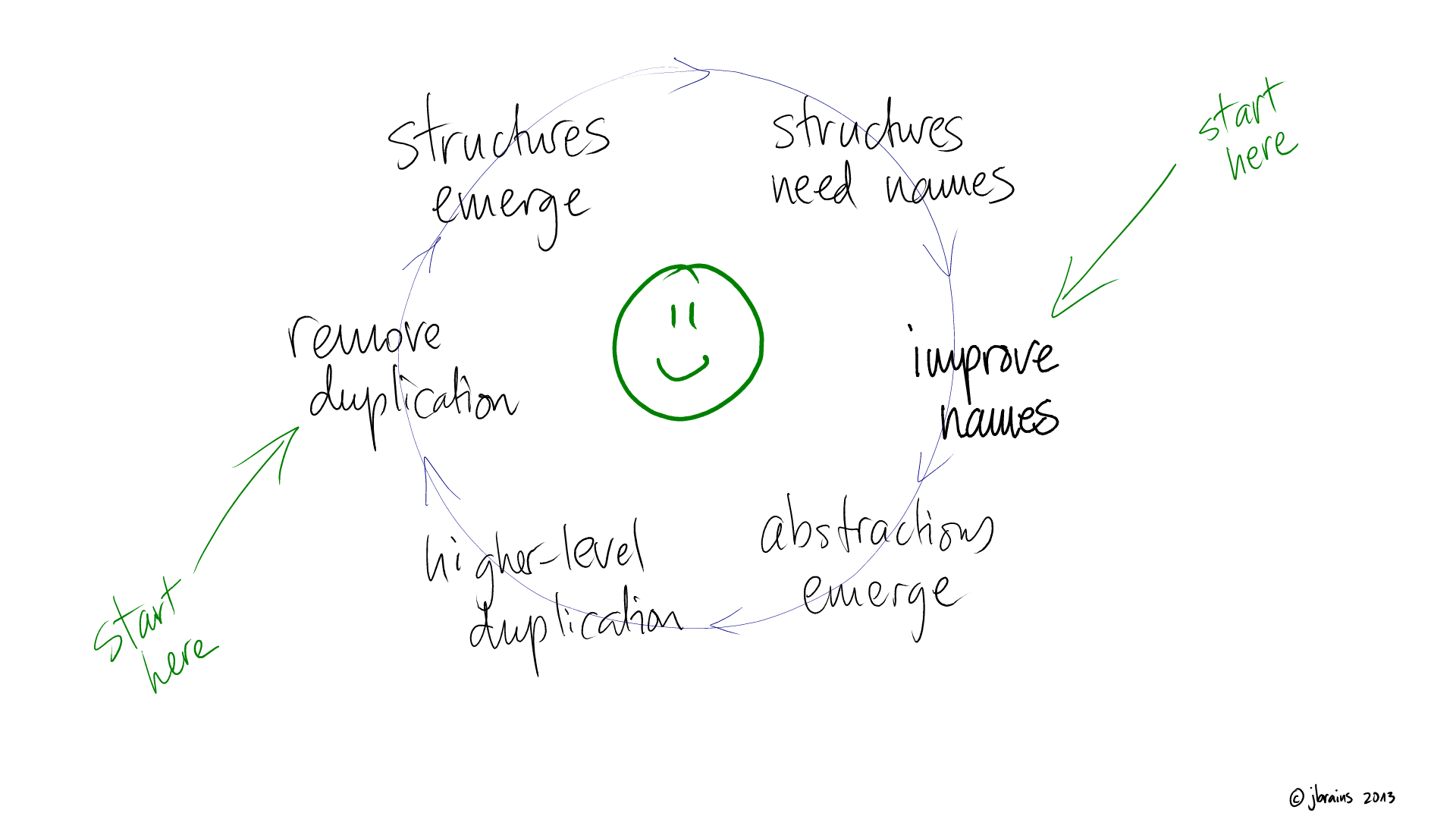
Now that I have a solid pool of change detectors, try to improve the design, usually following the Simple Design Dynamo.
All these steps help me write better code, but I want to focus on just two of these steps.
First, we have the act of writing a failing list, which describes when to stop. You can’t know when to stop if you haven’t thought about when you should stop. I imagine that programmers gold-plate in part because they don’t really understand the goal behind their task. They might not even know the goal behind a microtask on the way to completing their larger task, even though they themselves have divided their task into microtasks. Amazing, isn’t it? They might have a vague idea of the steps, but writing tests encourages the programmer to articulate very clearly the goal of the next step. By doing this, one can’t help but know exactly what “there” looks like, so as to stop when arriving “there”.
In addition to knowing where to stop, we need to know when we’ve got “there”. For this purpose, the step “write just enough production code” matters most. When I write tests first, I find it much easier to judge when I’ve written just enough production code, because the new tests now passes and I haven’t broken anything that used to work. When I see the green bar, I know I’ve arrived “there”. Doing this brings more benefits than only that:
I know when to stop writing code right now related to the current task/feature/behavior.
I train myself in general to stop writing code once I’ve written enough.
I train myself to think about what it would mean to have written enough code, so that I get better at spotting it when it happens.
It might seem like overkill to you, but remember: programmers famously tend to gold-plate, and so any technique that helps a programmer ingrain the habit of stopping will probably help. Test-first programming fits the bill.
Imagine that you had on your computer a red flashing light that signaled that’s enough as you wrote code. When you saw it flash, you could stop, then go on to the next microtask. Wouldn’t that help you finish your work sooner? Wouldn’t that help you question whether you need to do what you have in mind next? Wouldn’t that help you avoid unnecessary work in the first place? It sounds great to me! Writing tests first gives me exactly that, so I do it even to this day, lest I fall back to gold-plating.
Danger: Gold-Plating the Design
The Universe, however, in its desire to respect the Law of Conservation of Irony, intervenes. Although I write the tests first in order to tell me when to stop writing code, the refactoring step gives me a new opportunity to flex my gold-plating muscles. I love refactoring because I never have to stop. I can always find something more to improve. I can go around the Simple Design Dynamo again and again and again… try to stop me!
Now you see why I pointed out more benefits than simply “I know when to stop writing code for the current microtask”. Knowing that the programmer mindset tends to lean towards gold-plating in general, I continue to write tests first in order to train myself to remain aware of my own tendency towards gold-plating. As a result, I do it less often, and in a variety of situations.
I learn to refactor just enough to keep new features flowing without turning modularity into a means unto itself. I don’t want to turn clean code into a fetish.1
I learn to build just enough features to keep new customers flowing, rather than trying to deliver the perfect product.
I learn to edit just enough in order to convey my ideas clearly, rather than trying to turn my work into literature.
I could probably find more, but that will do for now. What do you do in order to counter your own tendency towards gold-plating? It might have nothing to do with code. I’d love to learn your secrets either at tell.jbrains.ca or in the comments.
References
J. B. Rainsberger, “Putting an Age-Old Battle to Rest”. The article that turns the four elements of simple design into the Simple Design Dynamo.
Steve McConnell, Rapid Development. One of the pre-agile books that had a significant impact on how I thought about professional software development.
I only refactor in order to reduce volatility in the marginal cost of features. Don’t you?↩
]]><![CDATA[Learning Tests for POSTing Email from Mailgun]]>2014-10-26T20:26:00-04:00http://blog.thecodewhisperer.com/2014/10/26/learning-tests-for-posting-email-from-mailgunI had intended to write a nice article showing a concrete example of learning tests in action, then something wonderful happened: all the code disappeared.
The Situation
I love Typeform, especially because it integrates with Stripe for processing payments. Sadly, Typeform does not allow my customer to pay-what-e-thinks-it-was-worth1 unless I anchor em by presenting a handful of price options, similar to what you see here.
Not the way I want to let my customers choose the amount they wish to pay. How many buttons should I give them?
The Plan of Attack
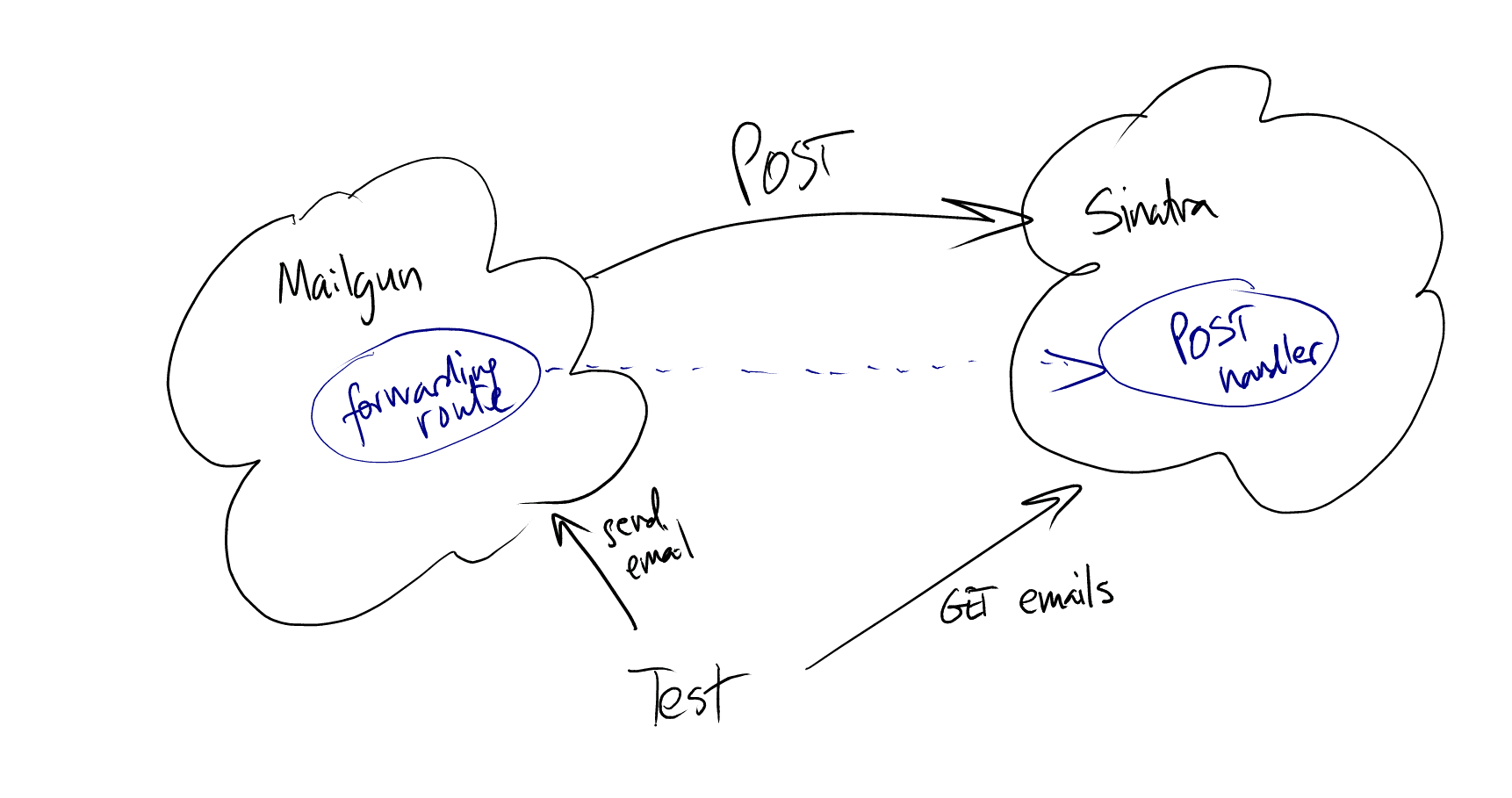
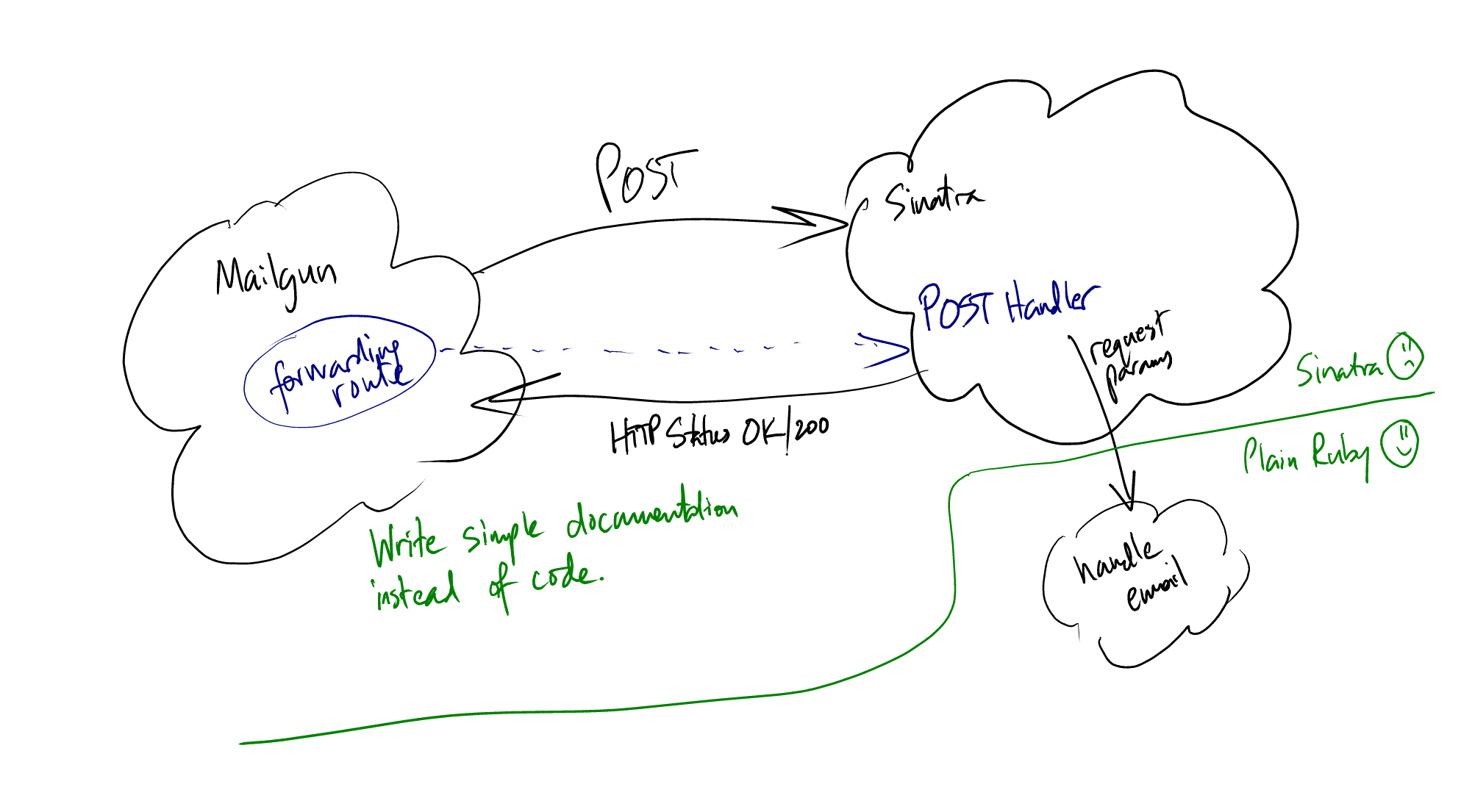
After reviewing my options, I settled on letting a customer enter the amount e wants to pay in a Typeform form, which will send an email to a custom application that responds with a link to a Stripe checkout form for the amount e chose. It feels a little convoluted, but it will work. I know how to create the Stripe checkout and I know how to create the Typeform form, but I have not handled incoming email with Ruby and Sinatra and Heroku before, so I need to learn that.
The Architecture Diagram
An Hour of Pointless Coding Later…
After writing code (and documenting what I did so that I could publish it for you to read), I found out that I didn’t need to do any of it. Instead, I could use existing tools to learn what I needed to know. Specifically, I needed to know the format of what Mailgun will forward to my Sinatra application’s POST handler.
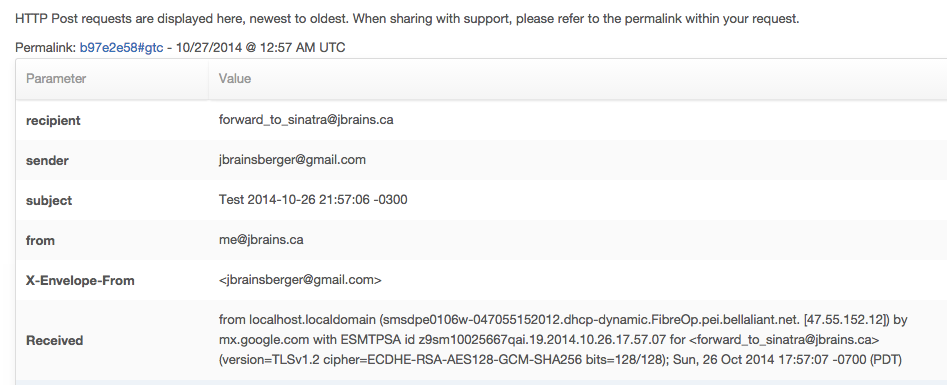
In reading Mailgun’s REST API documentation, I discovered a wonderful tool: http://bin.mailgun.net/.2 When you visit bin.mailgun.net, you receive a URL to which you can send requests and see the results all nicely formatted for you.
Pretty, no?
With this, I have documentation of one half of the contract between Mailgun and my Sinatra application, namely the contents of the POST request representing the incoming email, but what about the contract of the response? I found this in the documentation.
For Route POSTs, Mailgun listens for the following codes from your server and reacts accordingly:
If Mailgun receives a 200 (Success) code it will determine the webhook POST is successful and not retry.
If Mailgun receives a 406 (Not Acceptable) code, Mailgun will determine the POST is rejected and not retry.
For any other code, Mailgun will retry POSTing according to the schedule below for Webhooks other than the delivery notification.
If your application is unable to process the webhook request but you do not return a 406 error code, Mailgun will retry (other than for delivery notification) during 8 hours at the following intervals before stop trying: 10 minutes, 10 minutes, 15 minutes, 30 minutes, 1 hour, 2 hour and 4 hours.
Excellent. I have enough information about the contract between Mailgun and a POST handler that I can design my Sinatra application. I can even test-drive it! (Don’t mind the diagram. I promise that I’ll return the appropriate HTTP status code when things go wrong.)
I loves me some Plain Ruby!
Uh… Where Are the Learning Tests?
I ran them manually. I suppose I could have automated them, but I don’t see the value. If I notice behavior that seems not to conform to the contract I’ve discovered here today, then I’ll fire up RSpec; for now, this will do.
]]><![CDATA[IDEA Crashes on Launch on Yosemite]]>2014-10-19T08:35:00-04:00http://blog.thecodewhisperer.com/2014/10/19/idea-crashes-on-launch-on-yosemiteI upgraded to Mac OS 10.10 Yosemite and something strange happened with my installations of IntelliJ IDEA. They just disappeared. I still don’t know what happened to them. When I tried to reinstall IDEA 13 Community Edition, it crashed on launch.
Evidently, IDEA normally gracefully handles not finding a JRE with which to launch itself; but it didn’t for me, and I still don’t know why. After fixing the situation, IDEA now indeed handles a missing JRE gracefully. My Java SE 6 installation must have found itself in an irrational state.
Fortunately, my Twitter community came to my rescue. I’m sharing my experience here, just to make it easier for those who upgrade after me. I found two solutions.
A Risky Solution
When I reinstalled Java SE 6 and made it my system Java virtual machine, IDEA 13 (and IEA 14 beta) launched successfully. I followed these steps.
Add export JAVA_HOME=/usr/libexec/java_home -v "1.6.0" to your login shell initialisation script which, for me, was .zshrc.
This, of course, provides a system-wide solution. It works, but it perpetuates an annoying dependency between IDEA and the state of my operating system. As with any reliance on global variables, it carries certain risk. It made me happy, then, that my Twitter community pointed me towards a more localised solution.
A Less Risky Solution
Thanks to this tweet, I have managed to solve the problem in a less risky fashion.
@adymitruk@jbrains You just need to update the Info.plist to use 1.7 or 1.8.
]]><![CDATA[Gaining Confidence in Code that Generates HTML]]>2014-10-12T12:18:00-04:00http://blog.thecodewhisperer.com/2014/10/12/gaining-confidence-in-code-that-generates-htmlHow do I gain confidence in code that generates HTML, such as tag libraries or view templates?
Well, it depends on what I’m trying to do.
Am I learning how an existing tag library works? If so, then I create a bare project, install the tag library, use it to generate some HTML, then use something like HTMLUnit1 (any HTML parser will do) to check the results. This way, I can explore all the features that the tag library has without mixing those tests up with the tests for my project’s core behavior. I can use what I learn from these Learning Tests2, meaning the contract of the tag library features that matter to me, to write tests for my core behavior that make safe—well, safer—assumptions about what the tag libraries do.
Am I creating my own tag library? I typically create custom tags by extracting duplication from HTML, so whatever tests I already have for HTML indirectly test my custom tags. Once I extract enough behavior into a little group of custom tags, then I begin to feel like I have a proper, reusable library3, and then I treat it exactly like I do any existing tag library, so this reduces to my answer above.
Am I testing other view code that generates HTML, meaning not a tag library? In this case, I make sure to separate that code from the rest of the system. In particular, I don’t want to have click-click-click in order to get to the right page so that I can check the resulting HTML. If I have to click-click-click, then I’ve clearly violated the Dependency Inversion Principle, since the view depends on its invoker, the controller.
Please note that automating this click-click-click with something like Selenium doesn’t make this problem go away; it merely makes it easier to tolerate the problem… for a while.
This means finding a way to render my HTML template directly without invoking the rest of the application. How to do this varies from framework to framework, or from library to library. It’s one of the reasons that, way back in the 2000s, I preferred using an HTML template engine like Apache Velocity over using JSP. I never did figure out how to reliably render a JSP without involving the rest of the web container and its nonsense. Are there any standalone JSP engines now? I don’t know.
I know that RSpec does this well for Rails. I can simply render a view template with whatever data I desire, and I never have to invoke a controller nor run the rest of the system. Now how RSpec-Rails does this amounts to killing kittens, but that’s mostly because Rails likes coupling everything to everything else and expects you to like it, too. I try to ignore the mewling of dying kittens as I run my view specs.
The Two Key Points
To check the HTML that X generates, run X without running the things that invoke X. (Dependency Inversion Principle.) This is true for X = JSP processor; X = HTML template engine; X = whatever. Write a test like this:
123
htmlAsString = render(template, dictionaryOfDynamicDataToDisplayOnTemplate)
htmlDocument = htmlParser.parse(htmlAsString)
assert whatever you like about htmlDocument
As you do this, you describe the contract of the view. You can use this information to check that the controller puts the right data in the right view template variables without having to run the controller and view together.
For example, if you know that your view expects the scripting variable customers with a collection of Customer objects, then your controller tests can check that it puts a valid (non-null) collection of Customer objects wherever the view rendering engine will look for the scripting variable customers. In the Spring WebMVC world—and I realise I’m old—this meant the customers key in the model Map inside the ModelAndView object that the controller returns from its handleRequest() implementation.
Don’t test a tag library by testing your application. If you want to test the tag library, then test it in isolation. This also applies to learning about the tag library by writing Learning Tests for it.
When you want to use a tag library, you think about which features of it you want to use and how you expect those features to behave. You can probably explore those more thoroughly by not limiting yourself to the exact context in which you plan to use that tag library feature right now. You’ll probably learn more than simply trying to get the current thing working that you want to get working. This helps you better understand which part of the tag library’s contract your application will depend on. You will find this useful, I promise.
Notice that, in what I’ve just written here, you can substitute “tag library” for other generic services like “database driver”.
References
J. B. Rainsberger and Scott Stirling, JUnit Recipes. In particular, chapter 12, “Testing Web Components” covers a lot of this ground. Even if you don’t use JUnit, the principles apply.
Michael Feathers, Working Effectively with Legacy Code. Still the classic text on legacy code, in which he discusses characterisation tests. Some modern libraries make it easier to write these kinds of tests, like TextTest or ApprovalTests.
I know that I’m showing my age here, but I was there when HTMLUnit was born, so I like to mention it every now and then.↩
Tests that I write to document how a library behaves. When they pass, then I understand what the library does; when they fail, I don’t. Michael Feathers also refers to characterisation tests, which characterise what the code does, rather than specify what we want the code to do.↩
]]><![CDATA[Clean Up Those Nasty Junk Drawers]]>2014-10-04T03:13:00-04:00http://blog.thecodewhisperer.com/2014/10/04/clean-up-those-nasty-junk-drawersAlmost everyone starts organising their tests according to the module (or class or object) that they’re testing. If they have a class called Customer, then they have a test case class called CustomerTest and put all the tests for Customer into this one bundle (module, class, describe block, whatever you call it).
Don’t stop here.
If you continue to add all your Customer tests to CustomerTest, then you’ll certainly judge it as “too big” after a while. Even if you don’t, you’ll notice some patterns inthe names of the tests themselves.
If you work with libraries like Spock or RSpec that let you name tests with arbitrary text, then you might not notice these patterns as easily, or the duplication might seem “more natural” in natural language. Don’t let that fool you into thinking that you haven’t duplicated concepts in your code!
You’ve almost certainly noticed a pattern in the names of some of your tests.
testAdd_EmptyList
testAdd_NonemptyList
testAdd_ListAtCapacity
testAdd_DuplicateItem
testContains_ItemFound
testContains_ItemNotFound
testContains_DuplicateItem
testSize_EmptyList
testSize_NonEmptyList
testIsEmpty_EmptyList
testIsEmpty_NonEmptyList
testIndexOf_ItemFound
testIndexOf_ItemNotFound
testTrimToCapacity_TrimmingNeeded
testTrimToCapacity_TrimmingNotNeeded
I don’t endorse this pattern for naming tests in general, but this reflects common practice. In a real-life version of this example, I’d be writing Learning Tests to help me understand how ArrayList works in Java. In such a situation I often write tests oriented around each method and the various special cases, because I’m trying to document the API as designed. When designing new behavior in new modules or classes, I prefer not to name my tests for any particular method, function, or even class, so as not to couple—even in my own mind—the tests unnecessarily to an initial implementation.
I can imagine finding this set of tests—and more—in a test called ArrayListTest.1 You can already see two things:
There are a lot of tests here.
There is a fair amount of duplication here.
You can also see that we can’t remove that duplication with just a single refactoring: the various tests fall into different groups, and so need us to organise them slightly differently.
Remove Duplication
I don’t seem to have any problem understanding the names of these tests—I wrote them, so I guess that shouldn’t surprise me—which means that I will turn my attention to removing duplication.
The Simple Design DynamoTM
In this case, duplication in the names of the tests will suggest different ways of reorganising the tests than would a simple refactoring of the duplicate code. Even though I haven’t written these tests out in code, I’ve seen them a number of times. Especially when a programmer writes all these tests in one test case class, e2 typically arrives at only one line of setup code shared by all the tests:
12
@Before
public void setUp() { theList = new ArrayList<String>(); }
Removing this duplication helps a little, but we can do much better. For example, looking at the tests for the “non-empty list” cases, I imagine I’ll find copied-and-pasted lists of “pre-populated” items.
12345678
@Test
public void testSize_NonEmptyList() {
    theList.add("jbrains is awesome");
    theList.add("jbrains is awesomer");
    theList.add("jbrains is even awesomer than that");

    Assert.assertEquals(3, theList.size());
}
@Test
public void testIsEmpty_NonEmptyList() {
    theList.add("jbrains is awesome");
    theList.add("jbrains is awesomer");
    theList.add("jbrains is even awesomer than that");

    Assert.assertFalse(theList.isEmpty());
}
When I look at the “isEmpty(), non-empty case” test, I get the idea that although I might want to check the “3” case for size(), I might prefer to check the boundary case for isEmpty(), meaning a list of one single item. Quite often, however, I see programmers merrily copy and paste lists of items to new tests because, well, we find that easier.
Now that I say this, perhaps I should add a test for testIsEmpty_BarelyNonEmptyList in order to distinguish the cases. I’ll add that to the to-do list I have by my computer.4
Group Tests by Fixture
Long ago, in a book far, far away, I wrote about grouping tests by fixture. I recommended that you “test behavior, not methods” (section 1.3.2) and “move special cases to their own fixture” (recipe 3.7). I gave some examples. It was fine. I encouraged the reader to remove duplication in the setup (now called @Before) code. More than anything else, however, don’t let tests twiddle the fixture. If a handful of tests want to share a fixture, then I prefer that they all share the very same fixture, meaning the same objects in the same state. This becomes especially important when you start trying to reuse fixture objects using inheritance. (I used to do this; I tend not to do it any more. The cure always eventually hurts more than the disease.)
Junk Drawer
You probably have a junk drawer in your house. You throw junk into it. Some of that junk you need, so you root around in it to find something specific, like a pen or a paperclip. Eventually, you find that you need a paperclip unusually often—usually to press a recessed reset button on some electronic thing—and so you decide to put the paperclip somewhere to make it easier to find. If you put it in its own little compartment, then you’ll find it, but if you then start putting some other, not-so-related items in with the paperclip, then before long you find yourself with a second junk drawer.5 Then a third. Then you just have junk everywhere. It doesn’t work.
So it goes when you try to organise fixture objects into a setup function. This works great until the first time a test wants to change the fixture just a little for its own purposes. For the first test, you don’t worry so much: you put it in the same test class, twiddle the fixture—what harm can one extra line of setup do?—then go along your merry way. The very next special case wants to twiddle the fixture in precisely the same way. Then a third. Now is the time to move these three tests into their own test class with their own fixture, as I recommended in JUnit Recipes. If you don’t do this now, then before you know it, there’s graffiti everywhere. Almost every test twiddles the fixture in some unexpected way. You find some of that fixture up in superclasses, and you become lost in a maze of super() calls that you need to make at just the right time, otherwise your tests vomit NullPointerExceptions all over the place.
Ewww. You should have moved those tests to their own fixture when you had the chance.
Organise By Fixture or By Action?
When you find a group of tests inside a larger test class, you can either extract those tests by fixture or by action.6 I used to think that choosing between these options amounted to black magic, “skill”, or wisdom. Now I think I have a rule suitable for an advanced beginner (on the Dreyfus model) to use.
If you name your tests using a convention like test<action>_<special case>—for example, testIsEmpty_NonEmptyList—then examine the test names for patterns. First look for multiple groupings of the same set of special case words, then group those tests into a test class by fixture. Then look for multiple grounds of the same set of action words, then group those tests into a test class by action.
I think this works because the special case names generally correspond to similar fixtures. If you have a bunch of tests that need to operate on a “non-empty list”, then you’ll probably copy and paste the same three items into each list object in those tests. (I don’t claim to call this a good thing, but we do it.) Moreover, if you try to organise the special case groupings by action instead, then you’ll move those tests away from each other into separate test classes, even though they have similar setup code. This creates a cohesion problem7 solved by reorganising those tests by similar fixture.
Group Tests First By Special Cases, Then By Actions
Returning to our tests for ArrayList, we have
testAdd_EmptyList
testAdd_NonemptyList
testAdd_ListAtCapacity
testAdd_DuplicateItem
testContains_ItemFound
testContains_ItemNotFound
testContains_DuplicateItem
testSize_EmptyList
testSize_NonEmptyList
testIsEmpty_EmptyList
testIsEmpty_NonEmptyList
testIndexOf_ItemFound
testIndexOf_ItemNotFound
testTrimToCapacity_TrimmingNeeded
testTrimToCapacity_TrimmingNotNeeded
Following my proposed rule, I would end up first with these tests grouped by fixture:
EmptyListTest
testAdd
testSize
testIsEmpty
NonEmptyListTest
testAdd
testSize
testIsEmpty
BarelyNonEmptyListTest
testIsEmpty
MatchingItemsTest
testContains
testIndexOf
NotMatchingItemsTest
testContains
testIndexOf
DuplicateMatchingItemsTest
testContains
testIndexOf
Also these tests grouped by function—the junk drawers:
AddItemToListTest
testListAtCapacity
testListNotYetAtCapacity
testItemAlreadyInList
TrimArrayListToCapacityTest
testNeedsTrimming
testDoesNotNeedTrimming
Of course, this doesn’t constitute an exhaustive test for ArrayList, but you get the idea. You’ll notice that I’ve renamed some of the tests and added a few. By reorganising the tests this way, a few ideas popped into my head, such as “adding an item when the list is not yet at capacity”. When I first wrote this list of tests, I thought of “not yet at capacity” as an unstated default assumption. Since Java creates an ArrayList with a capacity of 10 items by default, I could think of testAdd_EmptyList as implicitly checking the “not yet at capacity” case. This kind of implicit checking can lead to “holes in our tests”, which can lead to the dreaded “green bar, but there’s a bug” problem that brings us back to my old favorite: integrated tests are a scam. I don’t want to go there just now.
Instead, let me close by proposing that you try grouping tests first by repeated special cases (which correspond to similar fixtures), then by actions. I think you’ll like the results.
“If I Group Tests Like This…
…then I won’t be able to find anything!” Srsly, this is 2014. Don’t you use ag or ack or grep or something? Can’t you search your project for uses of the function add(), or at worst, the regular expression /\.add(/?!
References
J. B. Rainsberger, JUnit Recipes: Practical Methods for Programmer Testing. I wrote ten years ago about the benefits of organising tests by fixture, rather than by function. I never felt truly comfortable with how easily the reader could apply that advice. This article attempts to assuage my guilt at giving such questionable advice.
J. B. Rainsberger, “Integrated Tests are a Scam”. The talk as I performed it at DevConFu in Jurmala, Latvia in December 2013. Don’t watch the Agile 2009 conference version any more.
J. B. Rainsberger, “Integrated Tests are a Scam”. The series of articles. Start with the oldest ones and work your way towards the present.
J. B. Rainsberger and friends, Understanding Coupling and Cohesion. 57 minutes of video. I invited some of my friends to discuss the nebulous concepts of coupling and cohesion in software design. How do we think about these topics? How do we understand the terms? How do we use that in our work as programmers? How do we teach it to others? How much does any of it even matter? Our invited guests: Corey Haines, Curtis Cooley, Dale Emery, J. B. Rainsberger, Jim Weirich, Kent Beck, Nat Pryce, Ron Jeffries.
Yes, I’m assuming Java here. Don’t let that fool you: I see exactly the same patterns in Ruby/PHP/Python as I do in Java/C#/C++/C.↩
…we see little Father Down… Wait. Not a Benny Hill fan?↩
I intend eventually to replace this sentence with a link to an article that discusses in more depth how to avoid feeling distracted while programming. If you can read this after December 2014, then tell me to write this article now.↩
This phenomenon relates to the Broken Windows Theory in which once we decide not to repair the first broken window in a neighborhood, vandalism and further damage follows soon thereafter.↩
Do you remember the “Three A’s” of arrange, act, and assert? By action I mean the function that you intend to test with that test.↩
Although we don’t generally agree on how to define cohesion, I find it useful to move similar things closer together and keep dissimilar things farther apart. This leads me towards higher (better) cohesion.↩
]]><![CDATA[Surviving Legacy Code with Golden Master and Sampling]]>2014-09-28T08:09:00-04:00http://blog.thecodewhisperer.com/2014/09/28/surviving-legacy-code-with-golden-master-and-sampling
You have inherited some code. Congratulations. Now you need to change it.
There, there.
Michael Feathers once wrote that legacy code is “code without unit tests”. I use a slightly more general definition.
Legacy code is valuable code that we feel afraid to change.
I think that both parts matter. You probably accepted the “afraid to change” part without any need for convincing. (If not, then this article probably won’t interest you.) Moreover, if the code doesn’t generate significant value, then I don’t see much risk in changing it. If the cost of “getting it wrong” doesn’t significantly outweigh the profit we derive from “getting it right”, then who cares? Probably not I.
I treat valuable code with considerable respect. It provides food for families. I treat difficult-to-change code also with consider respect, although this comes more from fear than admiration. If we put these two things together, then, quite simply, one false move and I might destroy an order of magnitude more profit than the yearly cost to keep me around.
This brings me to Rule Number Zero of Surviving Legacy Code:
Maximise safety.
We find ourselves in the typical chicken-and-egg problem: we want to write tests in order to refactor more safely, but then we remember that integrated tests are a scam℠1 and decide that we’d rather break things apart a little in order to write less-costly-to-maintain tests. So which do we do first?
In a situation like this, I like to go back to my guiding principles.
Integrated tests are a scam℠ in part because they don’t put enough positive pressure on my designs and thereby don’t give me enough useful design feedback. Right now, I don’t care about this. I already know that the design needs significant work. I also know that I can’t handle the torrent of feedback that microtests would give me about the design.23 If I want to use this principle to guide my behavior, then I need to find another justification.
Integrated tests remain a scam℠ in part because of the combinatoric explosion in the number of tests I need to achieve a strong level of coverage, which in this case correlates to confidence. I might have to write millions of tests to achieve high coverage. I probably only have time to write hundreds of tests, in which case I have to gamble about the level of coverage. Perchance, could I not care about coverage in this situation?
Test coverage—however one measures or defines it—links directly to safety in changing code. I want to use those tests as change detectors. I want the red light that flashes the moment I make a mistake. Microtests, especially if I write them first, give me that. They help me find mistakes immediately. They help drive down the cost of making a mistake, an essential technique for managing risk.4 If I can’t write microtests cost-effectively, then what can I do?
What if, instead of a red light that flashes the moment I make (almost) any mistake, I had a pink light that flashes when I make a really obvious mistake? I can’t have what I want, but I can afford this; will it do? It will help more than doing nothing. I will simply buy as much of this confidence as I can afford. To do this, I combine two simple ideas: Golden Master and sampling.
Golden Master
I use Golden Master to help me detect changes in the behavior of a system when I can’t justify writing the typical kind of assertion that you’ve grown used to seeing in tests. I use this trick, for example, when I find it difficult to articulate the expected result of a test. Imagine a function whose output consists of an image. It happens quite often that a binary comparison between actual and expected result yields a hyperactive assertion—one which frequently fails even when a human would judge that the test had passed. I suppose some people know tricks to make it easier to articulate “looks similar enough” for images, but I don’t know how to do that, and that leaves me to choose either a hyperactive bit-by-bit comparison or ongoing, manual inspection. Rather than revert to the Guru Checks Output antipattern5, however, I take a snapshot of the last-known acceptable output—I call that the golden master—and save it for future use. When I run the test again, I compare the output to the golden master, and if they match, then the test passes; if they don’t match, then the test fails. This doesn’t make the code wrong, but it means that I need to check the result and decide whether the code needs fixing or the golden master needs replacing.
You can use Golden Master wherever you already have some output to check, even if you find the form of that output particularly challenging. With this technique, you simply diff the output and inspect the situation only when you find differences between the current test run and the golden master. If your system already sends text to an output stream that you can capture, then you have the tools to use this technique.
I warn you, however, not to give in to the temptation to start scraping your output for specific information to check. Unless you have no other alternative, you will probably find it more cost-effective to carefully extract that information from the code and check it directly using good, old-fashioned assertEquals(). Don’t build a parser for an arbitrary, unplanned, probably context-sensitive grammar. That way lies madness. (Of course, if a context-free grammar happens to describe the format, then go for it. You’ve always wanted to learn lexx and yacc, haven’t you?)
Sampling
I find one glaring problem with the Golden Master technique: if the output describes a long-running algorithm, process, or path through the system, then the golden master itself might describe only one of a thousand, million, or even billion potentially-interesting possible outputs. Welcome back to the combinatoric explosion problem that makes integrated tests such a scam℠. How do we proceed when we can’t possibly check the variety of paths through the system that we need to check?
Ideally, we refactor! I know that if I can break my system into many smaller, composable pieces, then I turn products into sums: instead of checking combinations of paths through multiple parts of the system at once, I can check the handful of pairwise connexions between parts of the system in relative isolation. I could turn millions of tests into hundreds. Unfortunately, in our current situation, I don’t feel comfortable refactoring, so that means that I have to sample the inputs and hope for the best.
You can find more sophisticated sampling systems out there among blogs written by experienced testers, but they all amount to sampling: if I can’t try every combination of inputs, then I try some combinations of some of the inputs and aim for the best coverage that I can.
This shouldn’t surprise you. You’ve done this before. You’ve written a function that operates on an integer, and you knew enough about the algorithm to identify boundary cases at, for example, -1, 0, and 1, as well as around 100 and 1000, so you check on the order of ten inputs and feel satisfied that the algorithm will work for the remaining few billion inputs. You were sampling.
In the case of legacy code, however, sometimes we can’t sample quite so intentionally. Sometimes even when we limit our scope to characteristic inputs, we have so many combinations of those inputs that we still can’t afford to write and run all those tests. In some cases, we don’t even know how to identify the characteristic inputs. In other cases, the algorithm itself has a random element, defeating our goal of writing nice, deterministic, repeatable tests. Random sampling to the rescue.
If you can use the random number generator to generate a stream of inputs to your system, then you can use this generate a collection of output files, and that collection can act as your golden master. You only need to control the random number generator by seeding it with the same stream of seeds every time. I use a simple linear generating function like m + p * i where m and p represent arbitrarily-chosen numbers and i represents a loop index. Now I simply have to decide how big a sample to take. Generally speaking, a larger sample gives me more confidence in the sensitivity of the pink flashing light that signals danger.
I adjust the size of the sample depending on how long it takes to execute a test run, and how much significantly that affects my flow while programming. I also adjust the size of the sample to match my fear level: the more worried I feel about getting something wrong, the larger sample I take while working, and I accept the cost of slowing down. I’d usually rather go a little too slow than a little too fast, because I know that the cost of making a mistake would likely dominate the savings from going more quickly.
The Techniques in Action
You can see an example of this technique in action by reading this code. If you’d like to see how I added this behavior to some legacy code, then start at this commit and follow the process step by step.
Although these techniques do not, on their own, guarantee success, when I combine Golden Master and Sampling, I can usually find a way to proceed safely. When I combine these with microcommitting6, I can proceed at an even quicker pace. They help me avoid the Catch-22 problem that arises from needing to refactor dangerously unsafely in order to be able to refactor safely and sensibly. Where might you use Golden Master and Sampling to help get your arms (at least a little) around your legacy code?
Click the logo if you’d like to learn more about surviving legacy code!
David Allen, Getting Things Done. I use it. Not all of it, and not all the time, but I use its core principles quite significantly in managing my work and home lives. No cult, I promise.
J. B. Rainsberger, “A Proven Path to Effectiveness”. A “method” that combines Getting Things Done and Test-Driven Development aimed specifically at the beleaguered programmer.
texttest.org. A library to help you write text-based tests, such as I would use to provide golden masters. Do not download this tool until you have written your own golden master at least once. That is an order. After that, use TextTest, because it really helps.
When diving into legacy code, I find it more important than ever to keep stuff out of my head. During the two hours it takes to safely refactor some large function, I’m probably going to spot 14 potentially-useful refactorings. I can’t chase every bunny, no matter how cute they are. I need to write those ideas down, get them out of my head, and get back to the tricky surgery at hand.↩
I see little point in spending energy generating a backlog knowing full well that I will never get around to doing about 80% of it. Who would volunteer to do that? (Ask your project manager if value-driven product development is right for em.)↩
I claim that “the agile approach” to risk management complements the typical approach to risk management of limiting the probability of failure in order to limit exposure. “The agile way”, if you will permit me to use this shorthand, involves limiting the cost of failure instead. Eventually I will replace this sentence with a link to an article that goes into this topic in more detail.↩
Marcia, the guru, looks at the output, pauses for a moment, then says, “Yep. That’s it.” If you want to re-run the test, then you need Marcia. That doesn’t seem to scale particularly well.↩
Really frequent committing, like after changing a single line of code. No, really. Eventually I will replace this sentence with a reference to an article that explores this topic in more detail.↩
]]><![CDATA["I Like Mocks, But I Distrust Spies"]]>2014-09-15T04:13:00-04:00http://blog.thecodewhisperer.com/2014/09/15/i-like-mocksSome time ago a client asked me some questions about spies and mocks. I wanted to share what we discussed with you.
So here’s the issue my mind has been toiling over…
The project I’m on is using Jasmine for BDD. Technically though, I think most people aren’t actually executing real TDD/BDD. As in, they’re not letting the tests guide their design, but instead are sticking on unit tests at the end, after writing most of the code… this is what their tests suggest, at least.
I see, in their tests, a lot of spies and mocks. This tends to worry me,… especially the spies.
I see a lot of it as unnecessary, and even damaging. They appear to be reducing the module that they’re testing to nothing more than a series of spies and mocks. The thing they’re testing seems to bear little resemblance to the real run-time module.
From my perspective, mocking is very good and even essential in the cases of module dependencies that:
Would add too many extraneous variables to the testing environment
Add lag to the tests
Are not semantically tied to the thing we’re testing
Examples I like are database mocks, ajax mocks etc.
But spies…. I’m very unsure of the value of spies.
The tests I’m reading are creating a series of spies… in fact, every method of the module is spied.. even private methods. The tests will call some public method (fir example initiatePriceFeed()), and then assert success by ensuring that certain spied methods have been called. This just seems to be testing the implementation… not the actual exposed behavior, which is what I thought BDD/TDD was all about.
So finally, I have a few questions:
What is the best way to decide whether a spy is necessary?
Is it ever acceptable to test the implementation, instead of exposed behavior? (for example spying on private methods)
How do you decide what to mock and what not to?
I am sorry for the length of this email. There seem to be so many things I’d like to say and ask about TDD.
Note! In the Javascript world, it’s common to talk about “spies” rather than “stubs”. A spy and a stub do the same thing. They only differ in intent. In what follows, you can treat “spy” and “stub” as synonyms with, I think, no risk of confusion.
That sounds common. I started doing test-first programming, rather than test-driven development. I probably spent two years focusing on tests as tests before I felt comfortable letting my tests guide my design.
I think the people writing all these spies and mocks do this because it “seems right”. People they respect do it. They need to spend some time practising the technique, so they do it at every opportunity. This corresponds to the Novice/Advanced Beginner stages of the Dreyfus Model: either they just want to practise the technique (Novice), or they feel comfortable using spies/expectations1, and treat every opportunity as an equally (Advanced Beginner) appropriate time to use them. Good news: this is a natural part of learning.
Where to go next? Find one example where a module would benefit from depending on data, rather than another module. I go back to the difference between Virtual Clock (spy on the clock so that you can make it return hardcoded times) and Instantaneous Request (pass timestamps directly, rather than the clock, pushing the clock up one level in the call stack). Perhaps this will help people start to question where they could change their approach.
IMPORTANT! Instantaneous Request isn’t necessarily always better than Virtual Clock. Which you choose is less important than the discussions and thoughts that lead you to the choice. Also: starting to use Instantaneous Request over Virtual Clock means that the programmer is evolving, not the code. What matters is not “use fewer spies”, but rather “don’t let spies become a Golden Hammer”. Spies still help, I use them frequently, and I wouldn’t give them up.
Regarding the value of spies, I don’t consider spies and expectations much different from one another. A spy is merely an expectation that doesn’t verify which methods were called—instead it waits for you to do that. In some tests, it’s not important to verify what happened, but rather to provide a hardcoded answer for any method our Subject uses. One rule of thumb: spies for queries, but expectations for actions. This works because we tend to want more flexibility in our queries, but more precision in the actions we invoke. Think of the difference between findAllOverdueBalances() and findAllBalances().selectBy("overdue")—it doesn’t matter how I find all the overdue balances. Spies simply make it easier to hardcode 0, 1, a few, or a large number of overdue balances, as each test needs.
So: spies for queries, but expectations for actions.
Spy, then Spy, then Spy…
I understand your concern about series of spies, but let me check that I understand what you mean. When you say a series of spies, do you mean spying on A.getB() to return a spy B, whose B.getC() returns a spy C so that you can spy on C.theMethodIFindReallyInteresting()?
As for ensuring that spied methods have been called, those “spies” become expectations, and it can feel like those tests only check the implementation. That’s OK. If the implementation is so simple that we can check it with a simple test, then that’s good! It’s like double-entry book-keeping in accounting. If the tests are complicated and only check implementation, then that usually points to a missing abstraction, or at least, obsession with unnecessary details (could be a missing abstraction or could just be an unnecessarily complicated API). This last point is an example of not listening to what the tests are trying to tell you.
Programmers generally have this feeling eventually that expectations mean “I’m just checking the implementation”. I had the same feeling once, so I asked myself, “assuming that this actually makes sense, what am I missing?” Well, if the interactions between objects were simpler, then this “checking the implementation” issue wouldn’t cause any real problems, would it? In fact, it would only clarify what we’re trying to do. Maybe, then, when checking the implementation feels weird, we could ask about potential underlying design problems, and if those problems disappeared, then we’d feel less weird. This is one of those cases.
Go to a few tests where you feel weird in this particular way, and look for duplication between the examples. You might be surprised!
When Is A Spy “Necessary”?
You ask about “the best way” to decide whether a spy is necessary (maybe appropriate). I don’t know of One Best Way. I use them, then let duplication drive changes. I especially look for duplicating unnecessary details in the test. If I have to duplicate details in a handful of tests, just to be able to check some other part of the system, then perhaps I have two things in one place, and when I separate them, the corresponding spies become much simpler, and sometimes I can replace a spy with data (from Virtual Clock to Instantaneous Request).
Is It Ever Acceptable…?
You also ask whether it is ever acceptable to test the implementation instead of the behavior. “Is it ever acceptable…?” questions almost always have the answer “yes”, because we can always find a situation in which somewhat becomes acceptable. On the other hand, I don’t typically spy on private methods. If I need to know that level of detail in a test, then the test is trying to tell me that A cares too much about the internals of B. First, I try to remove unnecessary details from A’s tests. Next, I look for duplication in A’s tests. Especially if I spy on the same functions in the same sequence, that duplication points to a missing abstraction C.
So When to Mock?
I have two answers to this question. First, when do I use spies/expectations compared to simply using “the real thing”? I like to program to interfaces (or protocols, dependingon the language) and I like to clarify the contracts of those interfaces, something that expectations help me do effectively. To learn more about this, read the articles I list at the end related to contract tests. Especially read “When Is It Safe to Introduce Test Doubles?”.
Finally, when I’m not sure whether to use a spy or an expectation, I go back to the rule of thumb: spy on queries, but expect (mock) actions.
References
Wikipedia, “Dreyfus model of skill acquisition”. Not everyone likes this model of how people develop skills. I find it useful and refer to it frequently in my work.
c2.com, “Virtual Clock”. An overview of the Virtual Clock testing pattern, with further links.
J. B. Rainsberger, “Beyond Mock Objects”. I use test doubles (mock objects) extensively in my designs and they help me clarify the contracts between components. Even so, using test doubles mindlessly can interfere with seeing further simplifications in our design.
I apologise again for not having collected my thoughts about collaboration and contract tests into a single work. I need to find the time and energy (simultaneously) to do that. In the meantime, I have a few articles on the topic:
In order to avoid confusion with the generic concepts of “mock objects” (better called “test doubles”), I use the term expectations to refer to what many people consider a mock: function foo() should be called with arguments 1, 2, 3.↩
]]><![CDATA[Let Code Flow Towards Better Design]]>2014-08-22T12:18:00-04:00http://blog.thecodewhisperer.com/2014/08/22/let-code-flow-towards-encapsulationI think that programmers worry far too much about design.
No, I don’t mean that they should care less about design. I think that programmers worry so much about design that they forget to just program. As they try to learn more about how to design software well, they become more reluctant to write code, fearing that “it won’t be right”. I think that we contribute to this reclutance by writing articles with a tone that implies don’t write code unless you write it my way. I don’t think we mean to do this, but we do it nonetheless.
What if we thought about design a slightly different way? Let’s not think about design principles as constraints for how we write code, but rather as suggestions for how code wants to flow. Focus your energy first on writing correct code, then use the principles of design that you’ve learned to guide the flow of code from where you’ve written it to where it seems to belong. If you prefer a more direct metaphor, then imagine you’re writing prose. Rather than obsessing over the rules of grammar on your first draft, use them to guide how you edit. Let yourself more freely write your first draft without fear of “getting it wrong”, then use your editing passes to fix grammar errors, improve clarity and elevate style.
Now you’ve probably heard this before. “Make it work, then make it right, then make it fast.” This constitutes the same advice. So why repeat it? You probably also know that sometimes we need to hear the same advice in a variety of forms before we feel comfortable using it. I’ve been talking in my training classes about “code flow” for a few years, and it seems to help some people feel more comfortable adopting an evolutionary design approach. In particular it helps some programmers avoid feeling overwhelmed by design principles to the point of not wanting to write any code at all, for fear of “doing it wrong”. After all, the more we say that “code is a liability”, the more people will tend to think of writing code as an evil act. That sounds extreme, but so does some of our rhetoric!
When I teach software design—usually through test-driven development—one or two people in the class commonly ask me questions like “Can I use set methods?” or “Can I write a second constructor?” which convey to me a feeling of reluctance to “break the rules”. I really don’t want my course participants to feel like I want to stop them from writing code; on the contrary, I want them to feel more comfortable writing code precisely because they can apply their newly-learned design pricniples to improve their designs easily and quickly over time. I expect them to feel less fear as their design skills improve, because no matter what crap they write in the morning, they can mold it into something beautiful in the afternoon. I have to remind myself to approach code this way, rather than worrying too much about “getting in right the first time”.
An Example
Consider this article on the topic of encapsulation. I like it. I think it explains a few key points about encapsulation quite well. Unfortunately, it includes a line that, out of its context, contributes to this fear-based mindset that I’ve seen so often:
If you ever use a setter or define an attribute of a component from the outside, you’re breaking encapsulation.
I remember myself as an inexperienced programmer trying to improve at my craft. That version of me would have read this sentence and thought I must not use setters any more. This would invariably lead me to a situation where I would refuse to write a setter method, even when I have no other option. (Sometimes tools get in the way.) This way lies design paralysis. When I’ve written over the years about design principles, I’ve certainly not wanted to make it harder for you to write code.
What Should I Do, Then?
Later in the same article, the author writes this:
It’s common in Rails projects to use patterns such as User.where("something = something_else") from controllers or service classes. How do you know the internal of the database to be able to pass that SQL parameters? What happens if you ever change the database? Or User? Instead, User.some_method is the way to go.
I agree to the principle and the example. I would, however, like to highlight a different way to interpret this passage. Rather than thinking, “I should never write User.where("something = something_else")”, think of it this way instead:
I’ll write User.where("something = something_else)" for now, just because I know it should work, but I probably shouldn’t leave it like that once it’s working.
Don’t let design guidelines (like improve encapsulation) stop you from writing the code you need to write in the moment (as a first draft), but rather use them to guide the next steps (your editing). Don’t let design guidelines stop you from getting things working, but rather use them to stop you from leaving freshly-written legacy code behind.
So What’s This About Code Flow?!
Many programmers offer suggestions (for varying meanings of “suggest”) for where to put code. Some programmers write frameworks to try to constrain where you put code, lest you make (what they consider) silly mistakes. This eventually leads even experienced programmers into situations where they feel like they’re stuck in some Brazilesque bureaucracy preventing them from writing the one line of code they need to make something work. (You need a controller, a model, a DTO, a database client object, …) Instead of thinking of “the right place to put things”, I prefer to offer suggestions about how to move code closer to “where it belongs”.
Going back to the previous example from that encapsulation article, I would certainly have no problem writing User.where("role = 'admin'") directly in a controller just to get things working, but I just know that if I leave the design at that, then I will have set a ticking time bomb for myself to explode a some unforeseen and, almost uncertainly, inopportune time. As a result, once I get my tests passing with this poorly-encapsulated code, then I can take a moment to look at that code, ask what does this mean?, realise that it means “the user is an admin”, then extract the function User.admin?. In the process, the details in this code will have flowed from the controller into the model, where they seem to belong.
I have found this pattern repeating itself in all the major application frameworks I’ve ever used: while learning the framework I put code directly into the controller/transaction script/extension point, and after I’ve written several of these and found them difficult to test or change, the details flow into more suitable components, often representing a model or view (or a little bit of each). By understanding my design principles in terms of where code ought to flow, I get the benefits of better design without the paralysing fear that I might “get it wrong”.
So if you need to break encapsulation, just for now, just to get something working, then do it. Just don’t leave it like that.
References
Alexandre de Oliveira, “Complexity in Software 2: Honor Thy Encapsulation”. In this article, Alexandre talks about “real” and “perceived” complexity in software design, which seem to me to relate to Fred Brooks’ concepts of “essential” and “accidental” complexity. He also includes a definition for encapsulation that I hadn’t read before, and that I quite like. Enjoy the article.
]]><![CDATA[Abstraction: The Goal of Modular Design]]>2014-08-01T12:16:00-04:00http://blog.thecodewhisperer.com/2014/08/01/abstraction-the-goal-of-modular-design
I don’t intend to argue Alistair’s contention one way or the other, but I invite you to set aside some time to read David Parnas’ paper “On the Criteria To Be Used in Decomposing Systems into Modules”, which I have embedded in this article. Do not let yourself be put off by the quaint-sounding title. If you prefer, think of it as titled “The Essence of Modularity”.
I care about this paper because I strive for modularity in designing software systems and I find that programmers routinely lose sight of both the what modularity offers them and what it means. I value modularity as a way to drive down the cost of changing software. I value that because most of what we do as programmers consists of changing software, and so it strikes me as a sensible place to economise.
If you can’t take the time to read the whole paper now, then let me direct you to a particularly salient part of the conclusion.
We have tried to demonstrate by these examples that it is almost always incorrect to begin the decomposition of a system into modules on the basis of a flowchart. We propose instead that one begins with a list of difficult design decisions or design decisions which are likely to change. Each module is then designed to hide such a decision from the others.
Enjoy the paper. In case the embedded viewer doesn’t work for you: click here.
]]><![CDATA[Refactoring CSS: Not Impossible]]>2014-05-30T13:27:00-04:00http://blog.thecodewhisperer.com/2014/05/30/refactoring-css-not-impossibleI wanted to change some of the styling at jbrains.ca, but I have a legacy Wordpress template, so I needed a way to start making incremental changes with something remotely approximating tests. I knew that I didn’t want to have to crawl every page to check that every pixel remained in the same place, in part because that would kill me, and in part because I don’t need every pixel to remain in the same place. I needed another way.
How to Refactor CSS/SCSS
I chose to replace the raw CSS with SCSS using the WP-SCSS Wordpress plugin. Since I had all this legacy CSS lying around in imported files and I had fiddled with some of it before I knew how the original authors had organised it, I needed to consolidate the CSS rules as soon as possible so that I can change them without accidentally breaking them.
First, I created one big CSS file (the “entry point”) that imports all the other CSS files. Then, in order to use WP-SCSS effectively, I needed to move the importants into a subdirectory css/, so that I could generate CSS from only the SCSS located in scss/. This meant changing some @import statements that loaded images using a relative path. I fixed those with some simple manual checks that the images load correctly before and after the change. (Naturally, I discovered the problem by accident, then fixed it.) At this point I had one big CSS entry point that imported a bunch of other CSS files in from css/. I committed this to version control and treated it as the Golden Master1.
Next, I copied all the CSS “partials” into genuine SCSS partials and changed the entry point to import a single generated CSS file. I created an SCSS entry point that imports all the SCSS partials. This should generate the same CSS entry point, but get rid of all the little generated CSS “partials”. It did. I committed this to version control.
Now I can freely change my SCSS, generate the CSS, and check the git index for changes. As long as only the SCSS changes and the generated CSS doesn’t change, I definitely haven’t broken the CSS. If the generated CSS changes, then I check the affected web pages by hand and either undo the change or commit the generated CSS as the new golden master.
I hope this helps you deal with your own legacy CSS. You know you have some.
This refers to the Golden Master technique where we check the result once by hand, then compare future versions automatically to the hand-checked “golden master” to detect changes. It’s like testing.↩
]]><![CDATA[How TDD Affects My Designs]]>2014-05-22T13:34:00-04:00http://blog.thecodewhisperer.com/2014/05/22/how-tdd-affects-my-designsI havewrittenelsewhere that people, not rules, do things. I have written this in exasperation over some people claiming that TDD has ruined their lives in all manner of ways. Enough!
People, not rules, design software systems. People decide which rules to follow and when. The (human) system certainly influences them, but ultimately, the people decide. In particular, people, not TDD, decide how to design software systems. James Shore has recently written “How Does TDD Affect Design?” to offer his opinion, in which he leads with this.
I’ve heard people say TDD automatically creates good designs. More recently, I’ve heard David Hansson say it creates design damage. Who’s right?
Neither. TDD doesn’t create design. You do.
I agree. Keith Braithwaite responded in a comment with this.
TDD does not by itself create good or bad designs, but I have evidence (see “Complexity and Test-First 0”) suggesting that it does create different designs.
Keith’s comment triggered me to think about how practising TDD has affected the way I design software systems, of which this article represents a summary. I might add more to this list over time. If you’ve noticed an interesting pattern in your designs that you attribute to your practice of TDD, then please share that in the comments.
More value objects, meaning objects with value-equality over identity-equality. I do this more because I want to use assertEquals() a lot in my tests. This also leads to smaller functions that return a value object. This also leads specifically to more functions that return a value object signifying the result of the function, where I might not have cared about the result before. Sometimes this leads to unnecessary code, and when it does, I usually find that I improve the design by introducing a missing abstraction, such as an event.
More fire-and-forget events. I do this more because I want to keep irrelevant details out of my tests. Suppose that function X should cause side-effect Y. If I check for side-effect Y, then I have to know the details of how to product side-effect Y, which usually leads to excessive, duplicate setup code in both X’s tests and Y’s tests. Not only that, but when X’s tests fail, I have to investigate to learn whether I have a problem in X or Y or both. Whether I approach this mechanically (remove duplication in the tests) or intuitively (remove irrelevant details from the tests), I end up introducing event Z and recasting my expectations of X to “X should fire event Z”. This kind of thing gives many programmers the impression of “testing the implementation”, whereas I interpret this as “defining the essential interaction between X and the rest of the system”. The decision to make function X fire event Z respects the Open/Closed Principle: inevitably I want X to cause new side-effects A, B, and C. By designing function X as a source for event Z, I can add side-effects A, B, and C as listeners for event Z without changing anything about function X. This leads me to see the recent (as of 2014) trend towards Event Sourcing as a TDD-friendly trend.
More interfaces in languages that have interface types. In the old days, we had to introduce interfaces (in Java/C#) in order to use the cool, new dynamic/proxy-based mocking libraries, like EasyMock and JMock. Since the advent of bytecode generators like cglib, we no longer need to do this, but my habit persists of introducing interfaces liberally. Many programmers complain about having only one implementation per interface, although I still haven’t understood what makes that a problem. If the language forces me to declare an interface type in order to derive the full benefits of abstraction, then I do it. At least it encourages me to organise and document essential interactions between modules in a way that looser languages like Ruby/Python/PHP don’t. (Yes, we can implement interfaces in the duck-typing languages, but Java and C# force us to make them a separate type if we want to use them.) Moreover, the test doubles themselves act as additional implementations of the interfaces, which most detractors fail to notice. They might argue that I overuse interfaces, but I argue that they underuse them. Interfaces provide an essential service: they constrain and clarify the client’s interaction with the rest of the system. Most software flaws that I encounter amount to muddled interactions—usually misunderstood contracts—between modules. I like the way that the interfaces remind me to define and refine the contracts between modules.
Immutability. As functional programming languages have become more popular, I’ve noticed more talk about mutability of state, with an obvious leaning towards immutability. In particular, not only do I find myself wanting functions more often to return value objects, but specifically immutable value objects. Moreover, thinking about tests encourages me to consider the pathological consequences of mutability. This happened recently when I wrote “The Curious Case of Tautological TDD”. Someone responded to the code I’d written pointing out a problem in the case of a mutable Cars class. I had so long ago decided to treat all value objects as immutable that I’d even forgot that the language doesn’t naturally enforce that immutability. I’ve valued immutability for so long that, for me, it goes without saying. I reached this point after writing too many tests that only failed when devious programmers take advantage of unintended mutability, such as when a function returns a Java Collection object. I went through a phase of ensuring that I always returned an unmodifiable view of any Collection, but after a while, I simply decided to treat every return value as immutable, for the sake of my sanity. Functional languages push the programmer towards more enforced immutability, and even the eradication of state altogether. I feel like my experience practising TDD in languages like Java and Ruby have prepared me for this shift, so it already feels quite natural to me; on the contrary, it annoys me when I have to work in a language that doesn’t enforce immutability for me.
How has TDD affected the way you design? or, perhaps more importantly, what about the way TDD might affect your designs makes you uneasy about trying it? I might have some useful advice for you.
]]><![CDATA[The Curious Case of Tautological TDD]]>2014-05-14T14:38:00-04:00http://blog.thecodewhisperer.com/2014/05/14/the-curious-case-of-tautological-tddI’m publishing this as a “rough cut”, so I apologise to everyone annoyed by having to download a PDF to read this article. I have my reasons. Some of the links in the document don’t work; the links to external web sites, however, should. A handful of people have already suggested improvements and reported problems, which I appreciate, particularly the cordial and civil manner in which they’ve done it. (Hint.)
(In response to complaints, I have removed the embedded PDF viewer. It was an experiment. Thank you for your consideration.)
]]><![CDATA[Musings on Refactoring as Waste]]>2014-04-22T11:39:00-04:00http://blog.thecodewhisperer.com/2014/04/22/musings-on-refactoring-as-wasteRecently Bob Marshall opined that refactoring code is waste. This reminds me of passionate discussions from a decade ago about testing: should we classify testing as a value-added activity or as an unavoidable waste? I’d like to change the question a little, but first, allow me to play the ball where it lies.
If you haven’t read Bob’s article yet, then do so now. You’ll find it quite short; I read it in a few minutes. I composed this as a comment to Bob’s article, but it expanded to the point where I chose to promote it to a short article. You might say that I refactored my writing. With that segue manufactured…
Is editing waste for a writer? Why don’t writers simply write the right words/articles/books/sentences the first time? So I think it goes for programmers. I think of refactoring as editing for programmers. Since I plan to refactor, I don’t have to program like Mozart and “get it right” in my head before writing it down. This helps me, because often I don’t see trouble with code until I’ve written it down, even though sometimes drawing its structure helps me enough to spot trouble.
Sometimes problems don’t emerge until long after I’ve written it down and the situation changes, putting pressure on an old choice or negating an old assumption. Absolutely/permanently right-first-time seems to require clairvoyance. Writing any code entails risk.
Even so, I agree that we programmers don’t need to deny our own experience just to fit some arbitrary goal of taking tiny steps and refactoring towards abstractions. (This has got me in trouble with some people who declare what I do “not TDD”. As they wish.) Sometimes I can see the abstractions, so I go there sooner. Sometimes that doesn’t work out, so I refactor towards different abstractions. Often it works out and I’ve skipped a handful of tedious intermediary steps. One could measure my “expertise” in design by measuring the additional profit I can squeeze out of these trade-offs compared to others. (No, I don’t know how to measure that directly.) I think we broadly call that “judgment”.
A Question of Intent
I find refactoring wasteful when I do it out of habit, rather than with a purpose. Nevertheless, I don’t know how to have developed the judgment to know the difference without making a habit of refactoring. (Of course, I like to think that I do everything always with a purpose.) I encourage novices (in the Dreyfus Model sense) to force code into existence primarily through refactoring with the purpose of developing that judgment and calling into question their assumptions about design. That reasoning sounds circular, but I have written and said elsewhere how refactoring helps programmers smooth out the cost of maintaining a system over time. I can only assert that I produce more maintainable software this way, compared to what I used to do, and that refactoring plays a role. I really wish I knew how much of that improvement to attribute to refactoring. Refactoring still saves my ass from time to time, so it must pull some of its own weight.
I would classify refactoring as waste in the same way that I’d classify verification-style testing as waste: since we don’t work perfectly, we need feedback on the fitness of our work. Not only that, but I refactor to support not having to future-proof my designs, because of the waste of building structures now that we don’t intend to exploit until later. Which waste costs more? I find that open question quite interesting.
References
Bob Marshall, “Code Refactoring”. In his article, Bob surmises that programmers can’t quite “get it right” in their heads, and highlights refactoring as potentially a self-fulfilling waste: if we assume that we have to live with it, then we will choose to live with it. I leave the parallel with #NoEstimates as an exercise for the reader.
Gemma Cameron, “Is Refactoring Waste?”. I noticed Gemma’s article on Twitter and it led me to read Bob’s. She mentions that she plans to experiment with a TDD microtechnique that I use often: noticing while ‘on red’ that a little refactoring would make it easier to pass the test, and so ignoring (or deleting) the test to get back to ‘green’ in order to refactor safely. I don’t always do this, but I consider it part of the discipline of TDD and teach it in my training courses.
“The Dreyfus Model of Skill Acquisition”. Wikipedia’s introduction to the topic. All models are wrong; some models are useful. I find this one helpful in explaining to people the various microtechniques that I teach, when I follow them and when I don’t.
]]><![CDATA[Google Spreadsheet as a Test-First Demo Environment]]>2014-03-25T09:01:00-04:00http://blog.thecodewhisperer.com/2014/03/25/google-spreadsheet-as-a-test-first-demo-environmentIf you like to teach test-first/test-driven techniques, then you have probably stumbled over configuration problems in your programming environment. This happens to every presenter at least once. We have a variety of ways to handle the problem, and today I’d like to share another one with you.
Google Spreadsheet can run Javascript, which means that we now have a ready-to-go approximation of Fit. It took me only a few minutes to figure out how to write a Javascript function that operates on the value in a spreadsheet cell. After that, I recorded ten minutes of video demonstrating the environment.
Yes, I wrote the code test-first, but not test-driven. Please hold your cards and letters. I wanted to demonstrate a testing environment and not TDD. Even so, with ATDD or BDD, we programmers often receive a batch of customer tests and make them pass one by one, and sometimes we don’t need additional programmer tests to have confidence that we’ve built things well. Looking at the final design for this solution, I don’t think that a strict test-driven approach would have improved anything. If you disagree, then please share your approach with us!
]]><![CDATA[Putting An Age-Old Battle To Rest]]>2013-12-07T02:50:00-05:00http://blog.thecodewhisperer.com/2013/12/07/putting-an-age-old-battle-to-restSo maybe not an epic, age-old battle, but a battle nonetheless. The battle over the correct ordering of the Four Elements of Simple Design. A battle that I’ve always known I’d won, but until recently, could never justify to others. I can finally declare victory and bestow upon you the One True Sequence.
Calm down; I’m joking.
Seriously: it has always bothered me (a little) that I say it this way and Corey Haines says it that way, and somehow we both have it “right”. I never quite understood how that could happen… until now.
I learned these “rules” of simple design—guidelines, really—from the work of Kent Beck. He suggested the following guidelines as a definition of “simple”.1 He calls code “simple” if it:
passes its tests
minimises duplication
reveals its intent
has fewer classes/modules/packages…
He mentioned that passing tests matters more than low duplication, that low duplication matters more than revealing intent, and that revealing intent matters more than having fewer classes, modules, and packages.
I grew up (as a programmer) with these rules, and they have guided me well. My friend and colleague, Corey Haines, however, obstinately insists on reversing the order of “remove duplication” and “reveal intent”. He presents the four elements of simple design this way:
pass the tests
reveal intent
don’t repeat yourself
fewer classes
Corey hasn’t cornered the market on interpreting Beck’s rules in this order. If you search the web, you’ll find a surprising number of articles about the four elements of simple design advocating either sequence of rules. Some articles probably even argue quite loudly in support of ordering the rules one way or the other.
I have finally figured out why this happens. At least, I think I have. And I have good news: we all have it wrong.
I don’t think it matters whether you focus first on removing duplication or on revealing intent/increasing clarity, because these two guidelines very quickly form a rapid, tight feedback cycle. By the time the guidelines guide you to any useful results, you’ll have probably used them both. Therefore, order the rules however you like, because you’ll get to the same place either way.
Nice, isn’t it?
What I Think Happens
I have noticed over the years that when I try to focus on removing duplication, new, useful structures emerge. I like to say that if the solution wants to be structured a certain way, then removing duplication helps that structure to emerge.2 I have also noticed that when I try to focus on improving names, Feature Envy and its friends become more apparent, and code makes it clearer that it wants to move somewhere else. Similar concepts scattered throughout the system start calling out to each other, hoping for the programmer to unite them in a single module. Crowded, unrelated concepts struggle to get away from one another. Responsibilities gradually move to a more sensible part of the code base. Both of these contribute to higher cohesion.
How rules 2 and 3 improve cohesion
But wait; there’s more.
Whenever we create new structures in code—extracting methods, functions, classes, modules—we have to give these new structures names. We never really like these names, so we always seek to improve them.
Structures need names, which we need to improve
As the names improve, cohesion improves, so that similar things move closer together and different things move farther apart. Removing duplication creates buckets and improving names redistributes the things among the buckets. Over time, the rest of the system—the clients of these buckets—treat the buckets more like single things rather than collections of things. We call this abstraction.
Better names lead to bigger abstractions
But, of course, at this higher level of abstraction, we get away from those details and start seeing new patterns in bigger things. That means more duplication.
Bigger abstractions help us see more, bigger duplication
We see duplication, then we remove it. We need to give these new structures names. We want to improve those names. In the process, more details slip away and more abstractions emerge. We raise the level of abstraction again.
And again.
And again.
This describes a way to organise code into helpful layers with beneficial abstractions, rather than leaky indirection. When we remove duplication, we create buckets; when we improve names, we create more cohesive, more easily-abstracted buckets. We need them both and we just keep going. I don’t see a big difference when I start by removing duplication, compared to when I start by improving names.
The Simple Design DynamoTM
The Four Elements of Simple Design Revisited
I have been teaching for years about how to reduce the four elements of simple design to two: after several months, I don’t think about writing tests any more—I simply call that “programming”—and I’ve never seen a well-factored code base that had an order of magniture too many elements. With these two points out of the way, I guide my design with two basic rules: remove duplication and improve names. I’ve started thinking about these guidelines a little differently.
Now, I think of them as a single guideline: remove duplication and improve names in small cycles. When I do this, I produce a higher proportion of well-factored code compared to all the code I write. I use tests to clarify the goal of my code and to put strict limits on how much code I write.
Tests help me limit the amount of code that I write. Removing duplication and improving names helps me reduce the liability (cost) of the code that I write. Together, they help me reduce both the total cost and the volatility of the cost of the features I deliver.
I think this suffices as a working definition of “writing the code right”, which complements the need to “write the right code”. I have a whole bag of tricks to help do this well, which I call Product Sashimi.
Reactions
Of course, just as I use Corey as the poster child for “getting it wrong”, he makes me look like a sore winner.
@jbrains Yup! I try to emphasize to people that rules 2 and 3 build on each other and you need to iterate. Doesn't matter which is first.
I use “simple” as shorthand for “lowers the cost of future features”. For more, watch “The Economics of Software Development” or, if you prefer to read, I plan to write more about this at jbrains.ca.↩
Thus, “your code is trying to tell you something”.↩
]]><![CDATA[Beyond Mock Objects]]>2013-11-29T07:29:00-05:00http://blog.thecodewhisperer.com/2013/11/23/beyond-mock-objectsI have improved the code samples to make them closer to valid, working Python.—jbrains
At some point, you know I had to write this article. Let me state something clearly from the beginning.
In spite of the title, I use mocks freely and happily.
I do not intend with this article to join those who either shun mocks or appear to shun mocks only to praise them. I plan to share a simple example of using mocks as a stepping stone towards a potentially more suitable design, but you must not interpret this as a message against mock objects.
There. I feel better now. I trust you to carry my message the way I intended it. Do not betray that trust.
First, let’s assume that you agree to the general principle that increasing testability tends to improve design, and in particular, helps us deliver features less expensively and with more predictable cost. If you don’t believe that, then what follows will likely not interest you.1 Now that we agree on that basic principle, I tend to get better results by writing repeatable tests, meaning that running the same test several times without any code changes gives the same result (pass or fail). This repeatability property helps me trust my tests more, and also helps me trust my production code more, as I have fewer unexpected, nasty surprises. This leads me to follow the simple guideline:
Write more repeatable tests. (Tests with more repeatability and more of them.)
Threats to Repeatability
Certain design decisions threaten the repeatability of tests. Depending on configuration data, databases, web services, the location of certain files with certain content—even the layout of the file system (Windows or Unix). All these external dependencies threaten to change the results of a test run even though the underlying production code has not changed. These choices make it more difficult to reason about the code, to find the source of a mistake, or to assess the impact of a change, because the behavior of the system can change without warning. While implicit dependencies hurt, implicit dependencies on unstable resources hurt more. In order to write more repeatable tests, I limit the amount of code that depends on unstable resources.
Unstable dependencies threaten repeatability. Implicit dependencies threaten our reasoning about the code. Unstable, implicit dependencies threaten our sanity.
Our Favorite Unstable Dependency
We work quite frequently with one common unstable dependency: the system clock. We do this whenever we write code that depends on a timestamp or on a random-number generator.2 Even when our code depends only a single timestamp, it probably does so by invoking the now() function, whatever you call it in your language of choice. I can remember writing Transaction Scripts in web applications that retrieve, for example, all the customers with orders placed in the preceding seven days, a straightforward version of which looks like the following Python-like code. (Not intended to be working nor optimised code, but lovingly improved with the help of George Paci.)
A straight-forward implementation; you’ve probably also written this before
1234567
classCustomersWithRecentOpenOrdersController:defhandle_request(self,request,response):now=Date()seven_days_ago=now-7*24*60*60*1000recent_open_orders=self.orders_repository.find_all_open_orders("created_at >= date(%d) and created_at <= date(%d)"%(seven_days_ago,now))response.attributes["customers_with_recent_open_orders"]=recent_open_orders.map(lambdaorder:order.customer).uniqresponse.view="RecentOpenOrdersReport"
As soon as this code invokes Date() it not only obscures the way to compute now, but it also creates a direct, hardwired dependency on an unstable, global resource: the system clock. We can almost never run this code twice and get the same result, at least not without considerable effort. (I’m waiting for the day that someone includes “set the time to 14:30” in their puppet instructions.)
“No problem!”, you shout with delight. Dependency Injection to the rescue! We shall use the Virtual Clock pattern! Yes, we absolutely can, and I still think fondly of Paolo Perrotta’s delightful article on the topic—an article which appears to have disappeared from the web in the intervening years. What a shame! Let me summarise the Virtual Clock pattern for you.
The Virtual Clock
In order to more easily test code that depends on the system clock, inject an interface Clock that allows your code to work with either a “frozen” clock or the system clock. By “frozen” clock, we mean a clock whose time never changes, and whose time you can set from your test. It sounds simple enough, and if we do this, then our code changes to something like the following.
Using the Virtual Clock
1234567891011
classCustomersWithRecentOpenOrdersController:def__init__(orders_repository,clock):self.orders_repository=orders_repositoryself.clock=clockorSystemClock.new# in case clock is Nonedefhandle_request(self,request,response):now=self.clock.now()seven_days_ago=now-7*24*60*60*1000recent_open_orders=self.orders_repository.find_all_open_orders("created_at >= %d and created_at <= %d"%(seven_days_ago,now))response.attributes["customers_with_recent_open_orders"]=recent_open_orders.map(lambdaorder:order.customer).uniqresponse.view="RecentOpenOrdersReport"
Here we introduce an interface (or protocol, in the case of languages without explicit interfaces, like Python) representing a clock with the appropriate methods.
The Clock protocol
12345678910111213
classFrozenClock:def__init__(current_time_millis):self.current_time_millis=current_time_millisdefnow(self):Date(self.current_time_millis)classSystemClock:def__init__():pass# I'll just talk to the system clock directly as a global resource, if you don't minddefnow(self):Date()
With this new protocol, we can easily freeze the clock to any time that our various tests find convenient. You could stub the Clock interface with your favorite test double library, if you prefer. The Virtual Clock solves the repeatability problem.
Something Smells
In spite of this, something feels wrong about the design. The code has become more flexible, but also more complicated, and I don’t feel3 particularly good about the dependency that we’ve introduced. We’ve made an implicit dependency more explicit, and I value that a lot, but Clock somehow feels like indirection without abstraction. By this I mean that we’ve introduced a seam4 to improve testability, but that the resulting code exposes details rather than hiding them, and abstractions, by definition, hide details. This looks like the kind of indirection that makes experienced designers look at testability nuts like us with suspicion. Rightly so, I have begun to conclude.
I used to think that “they” had it wrong. I even felt really confident about that. Now I see their point better.
If we want to introduce indirection, then we ought to introduce the smallest indirection possible. And we absolutely must introduce proper abstraction.
Indirection costs: it adds code, it adds cognitive load, it adds complications, and complications kill. I prefer to keep those costs low. In this example, Clock feels to me like an artificial “abstraction”, and as a result, I’d rather do something else.
Imagine that I want to hand you my keys. Imagine that you stand only a half-meter from me. Imagine now that I walk across a ten-meter-wide room, put my keys on the table, walk back, then tell you, “You’ll find my keys over there.” How happy will that make you? But we do exactly this when we introduce Clock. Instead of giving you now, I’m giving you the instructions on how to find now. Sometimes we need that. This does not feel like one of those times.
Wait a second… this dude has written about dependency injection in the past. We know that he’s a TDD nut. He can’t possibly be telling us to defactor and write integrated tests!
Indeed no. Instead, I want you to consider another alternative.
Don’t Inject What You Can Avoid
You’ve probably heard this before: don’t automate what you can eliminate. Similarly:
Don’t inject what you can avoid
Why inject Clock? We really only want now. We could take a page from our functional programming friends and inject, you know, a function.
Don’t send a protocol to do a function’s job
1234567891011
classCustomersWithRecentOpenOrdersController:def__init__(orders_repository,now=lambda:Date()):self.orders_repository=orders_repositoryself.now=nowdefhandle_request(self,request,response):now=self.now()seven_days_ago=now-7*24*60*60*1000recent_open_orders=self.orders_repository.find_all_open_orders("created_at >= date(%d) and created_at <= date(%d)"%(seven_days_ago,now))response.attributes["customers_with_recent_open_orders"]=recent_open_orders.map(lambdaorder:order.customer).uniqresponse.view="RecentOpenOrdersReport"
Now our test can create the controller with lambda: Date(whatever_timestamp_we_want). If you program in C# then you already had to control your laughter at seeing a one-method interface where obviously a delegate would do the job. If you program in Java 8, then you just knew that this code needed a lambda all along. Even so, we can do even better.
A Minor Problem
This code respects the Interface Segregation Principle better, but it still suffers from a serious design problem that could trip you up during a heated, future refactoring session. Imagine what happens if you try to inline the temporary variable now.
That’s a mistake
12345678910
classCustomersWithRecentOpenOrdersController:def__init__(orders_repository,now=lambda:Date()):self.orders_repository=orders_repositoryself.now=nowdefhandle_request(self,request,response):seven_days_ago=self.now()-7*24*60*60*1000recent_open_orders=self.orders_repository.find_all_open_orders("created_at >= date(%d) and created_at <= date(%d)"%(seven_days_ago,self.now()))response.attributes["customers_with_recent_open_orders"]=recent_open_orders.map(lambdaorder:order.customer).uniqresponse.view="RecentOpenOrdersReport"
Before you label this an artificial problem, consider how frequently we extract and inline code when we refactor, and that because we do this so often, we sometimes forget that inlining a temporary variable introduces mistakes when the operation that we assign to that variable doesn’t behave with referential transparency5. This particular code will almost always work correctly, but as soon as those two invocations of self.now() straddle midnight, we risk having eight days of orders rather than seven. We don’t know that this represents a bug, but it definitely represents an issue.6 Even if the risk remains low, we don’t need to have introduced this risk at all. We can do better.
Don’t Inject What You Can Avoid Redux
Why inject a function returning 12 when we can inject 12? Yes, in the future, we might need to inject something that computes 12, but for now, we just need the 12, so we owe it to ourselves to try injecting 12 and seeing how that changes our perception of the design.
12. (Annoyed yet?)
I’ll defactor this code just a little more and you’ll probably find it strange.
Don’t send a function to do a value’s job
12345678910
classCustomersWithRecentOpenOrdersController:def__init__(orders_repository,now):self.orders_repository=orders_repositoryself.now=noworDate()# in case now is Nonedefhandle_request(self,request,response):seven_days_ago=self.now-7*24*60*60*1000recent_open_orders=self.orders_repository.find_all_open_orders("created_at >= date(%d) and created_at <= date(%d)"%(seven_days_ago,self.now))response.attributes["customers_with_recent_open_orders"]=recent_open_orders.map(lambdaorder:order.customer).uniqresponse.view="RecentOpenOrdersReport"
I find it strange, too. I’ve simplified the dependency in one respect, and complicated it in another: clients have to instantiate a new controller on each request, or said differently, the controller has request scope. This sounds wrong.
Moreover, one typically doesn’t talk about “injecting” values; one simply passes them as parameters.7 It should pose no problem, then, to reduce the scope of now to the method… except that we live in a framework—didn’t I mention that?—where we have to implement the method handle_request(self, request, response) in order to register our controller to receive requests for the URI /customers/recent_orders. This limitation creates tension: I want now as a parameter to the request handler, but the framework doesn’t want to (and couldn’t possibly) know this domain-level detail. (Or could it? Think about it.) This encourages me to extract a new method as a compromise.
123456789101112
classCustomersWithRecentOpenOrdersController:def__init__(orders_repository):self.orders_repository=orders_repositorydefhandle_request(self,request,response):returnhandle_request_as_of(self,request,response,Date())defhandle_request_as_of(self,request,response,now):seven_days_ago=now-7*24*60*60*1000recent_open_orders=self.orders_repository.find_all_open_orders("created_at >= date(%d) and created_at <= date(%d)"%(seven_days_ago,now))response.attributes["customers_with_recent_open_orders"]=recent_open_orders.map(lambdaorder:order.customer).uniqresponse.view="RecentOpenOrdersReport"
Now steel yourself for a shock: I don’t intend to test handle_request(). Don’t panic. I will test handle_request_as_of() with great care and attention and trust that I typed Date() correctly. This improves the design in one obvious way: I can test handle_request_as_of() quite easily, by passing a variety of values for now. Moreover, we can reconsider the name now, replacing it with something less context dependent, and call it instant (my current favorite default name for a timestamp).
We can name this parameter with an eye towards reuse
123456789101112
classCustomersWithRecentOpenOrdersController:def__init__(orders_repository):self.orders_repository=orders_repositorydefhandle_request(self,request,response):returnhandle_request_as_of(self,request,response,Date())defhandle_request_as_of(self,request,response,instant):seven_days_ago=instant-7*24*60*60*1000recent_open_orders=self.orders_repository.find_all_open_orders("created_at >= date(%d) and created_at <= date(%d)"%(seven_days_ago,instant))response.attributes["customers_with_recent_open_orders"]=recent_open_orders.map(lambdaorder:order.customer).uniqresponse.view="RecentOpenOrdersReport"
I choose to ignore for the moment the issue with assuming that instant is a number representing time in milliseconds. If you and I paired on this for a real client, we’d have fixed that by now, so that the code could read something more like instant.minus(Days(7)).
I like that this new method now finds “customers with recent open orders, relative to any date you choose”, rather than specifically relative to now. Come to think of it, “recent” now feels a little out of place, but I don’t want to go too far down that rabbit hole, so write down that we should consider improving the name of “recent” and we’ll come back to that.
The Instantaneous Request
We have given birth to a new abstraction in our web application framework: the instantaneous request. This object represents a request that we handle by pretending that it happens all at once (instantaneously). We will probably find this abstraction useful in other parts of the system. We might even extract it into a request handler decoration that we can use. Of course, we will probably wait until we have three requests before we bother extracting the duplication. When we do, we’ll have something like this:
123456789101112131415161718
# Reuse me anywhereclassInstantaneousRequestController:def__init__(instantaneous_request):self.instantaneous_request=instantaneous_requestdefhandle_request(self,request,response):self.instantaneous_request.handle_request_as_of(self,request,response,Date())# I belong to the domainclassCustomersWithOpenOrdersAsOfInstantController:def__init__(orders_repository):self.orders_repository=orders_repositorydefhandle_request_as_of(self,request,response,instant):seven_days_ago=instant-7*24*60*60*1000recent_open_orders=self.orders_repository.find_all_open_orders("created_at >= date(%d) and created_at <= date(%d)"%(seven_days_ago,instant))response.attributes["customers_with_recent_open_orders"]=recent_open_orders.map(lambdaorder:order.customer).uniqresponse.view="RecentOpenOrdersReport"
When it comes time to register this controller to respond to the appropriate request URI, register this:
Did you notice the comment Reuse me anywhere? Did you notice the key word in there?
Reuse.
When we build modules (functions, objects, whatever) with less knowledge of their surroundings, we naturally build modules more fit for reuse. No more excuses. If you want more reuse, you have to make it happen, and building modules with context independence in mind achieves that aim. We got there by noticing indirection without abstraction, then inverting the dependency (which happened to remove a mock object), then spotting duplication, then extracting that duplication into a context-independent, reusable module.
We did that. No magic. “Objects” didn’t even matter here. We could have done the same thing in Haskell with functions.
So please stop telling me that object-oriented programming hasn’t fulfilled its promise of increasing code reuse. Programmers haven’t fulfilled their promise of increasing code reuse.
Write code more independent of its context. I find this code easier to test, easier to understand, easier to maintain, more stable, and easier to reuse.
Try it!
References
Martin Fowler, “Transaction Script”. I often implement my controllers as Transaction Scripts, then as I notice duplication, I start to separate application logic from business logic, moving the application logic up the call stack into “filters” and moving the business logic down the call stack into a Domain Model.
I assume that pseudo-random number generators still usually depend on the system clock to generate a seed. If that has changed, then please point me to an article or two on the topic. I’m getting old.↩
I learned the term seam from Michael Feathers’ work on legacy code. A seam provides a place to plug alternative implementations of functions that initially make testing more convenient, but almost always end up improving the design of the system, too.↩
We call an operation referentially transparent if it evaluates to the same value every time. Functionally-minded programmers make a big deal out of this for good reason, as it contributes to repeatability.↩
My good friend Michael Bolton defines “bug” as “something that bugs someone” and “issue” as “something that threatens the value of the system”.↩
This illustrates why some people pompously label dependency injection as an overblown consultant-driven marketing phrase. “Real programmers just pass parameters”, they say. Indeed, but I find some value in differentiating passing values to a function and passing collaborating services to a service. I pass values, but I inject collaborators. I don’t see the problem.↩
]]><![CDATA[Losing time to Faraday]]>2013-11-17T13:40:00-05:00http://blog.thecodewhisperer.com/2013/11/17/losing-time-to-faradayI just wanted an HTTP client.
I asked my Twitter community which HTTP client to use. Certainly not HTTParty, because cool people don’t use HTTParty anymore. One takes these risks when one falls out of the loop with the latest and greatest tools.
“Use Faraday”, they said. “It’s the best”, they said.
Everything went fine until I needed to follow a redirect. What happened from that point forward could form the basis of a solid one-act play. I’ll spare you the horror and send you directly to the punch line.
connection.adapter Faraday.default_adapter
When Is A Default Not Really A Default?
When you use middleware with Faraday. Specifically when you use FaradayMiddleware::FollowRedirects to follow redirects with Faraday.
I tried to read the documentation. Honestly. I read Stack Overflow. I read the Faraday Middleware wiki. I even read the source. Nothing seemed to warn me about this “default adapter” business, and given the name “default”, shouldn’t it—you know—be the default?!
I looked through Faraday Middleware’s issues and found evidence that other people had successfully followed redirects with FaradayMiddleware::FollowRedirects, and so I concluded that I’d done something wrong. I looked for any issue that related to redirects for a clue. I ended up reading an issue that suggested the possibility of following redirects depending on more details in the original request: follow redirects for this path info, but not that path info, for example.
Something caught my eye.
Consider the following code slightly adapted from the readme:
1234
connection = Faraday.new 'http://example.com/api' do |conn|
  conn.use FaradayMiddleware::FollowRedirects, limit: 5
  conn.adapter Faraday.default_adapter
end
Every request will follow redirects based on the configuration above.
In that issue, Mislav Marohnić helpfully points the problem out and suggests following an issue that no longer exists to receive notification when this curious behavior changes. Fortunately, I could easily track down the issue he means, as the project has since moved. He means this issue. I’ve started following it, and now so can you, in case you want to know when you can safely ignore the dreaded default_adapter.
What Does This All Mean?!
It means that if you have this:
123
def http_get(base, uri)
  Faraday.get(base + uri)
end
and you want to refactor it to add middleware, you absolutely positively must write this:
123456
def http_get(base, uri)
  Faraday.new(base) { | connection |
    # IMPORTANT Without this line, nothing will happen.
    connection.adapter Faraday.default_adapter
  }.get(uri)
end
If you forget to specify the adapter, then you have not refactored. I hope this helps.
But Wait! There’s More!
I really loved The Pragmatic Programmer, and will probably always remember its section on “programming by coincidence” or, as I like to call it, programming by accident. One brand of programming by accident involves moving statements around until they work. This relates to temporal coupling, the extent to which statements depend not just on each other, but on the sequence in which they occur. Some temporal coupling makes perfect sense:
123
list = []
list << "hello"
list.empty? => false
Rearrange these statements and they say something fundamentally different. This temporal coupling seems quite reasonable to me.
Accidental2 temporal coupling, however, creates problems for everyone, except possibly the programmer who created the accidental temporal coupling. Of course, I had to find out whether this code exhibits accidental temporal coupling. It does.
123456
def http_get(base, uri)
  Faraday.new(base) { | connection |
    # IMPORTANT Without this line AT THE END OF THIS BLOCK, nothing will happen.
    connection.adapter Faraday.default_adapter
  }.get(uri)
end
It behooves me, the programmer, to introduce this:
12345678
def faraday_with_default_adapter(base, &block)
  Faraday.new(base) { | connection |
    yield connection

    # IMPORTANT Without this line, nothing will happen.
    connection.adapter Faraday.default_adapter
  }
end
As in Fred Brooks and his distinction between essential complication and accidental complication in his classic essay, “No Silver Bullet”. Read more about this distinction in “The Eternal Struggle Between Business and Programmers”.↩
]]><![CDATA[The Eternal Struggle Between Business and Programmers]]>2013-11-11T01:00:00-05:00http://blog.thecodewhisperer.com/2013/11/11/the-eternal-struggle-between-business-and-programmersAt Øredev 2013, I asked managers to tell me what makes their job difficult. I spoke to one manager who told me an all-too-common story about facing immense pressure from the board of directors to deliver more features more often and similar pressure from the programmers to give them more time to refactor. More important than the details of this situation, I’ve heard dozens of stories like these over the years, and while one single piece of advice can’t possibly address every significant aspect of these situations, I have found that most of the people who tell me these stories identify with what I’d like to share with you.
Warning. You almost certainly have more to deal with in your exact situation than this advice can cover. You might need some more direct help. I can offer that to you, but for now, read on.
I call it the eternal struggle between the Business and Programmers. Specifically programmers, because I almost always hear the specific complaint coming from them. It goes like this.
Business: More features! Now!
Programmers: More refactoring! Now!
It usually involves more colorful language, more intense emotions, and repeats a few times, but in the interest of time, I’ve distilled it to its essence. I notice a few things about this particular exchange.
First, the Business can easily justify their position: they need profit, and profit comes from sales, and sales come from features, and features come from, among other people, the Programmers. Without more profit, nobody keeps a job.1 Clearly, the Business has this one right.
Next, the Programmers can easily justify their position: they need to deliver more features, and they can’t deliver features if they don’t understand the code, and almost nobody writes code clearly the first time, so the Programmers need to edit their work, and they call that editing “refactoring”. Without refactoring, features don’t flow, the Business has nothing to sell, we can’t generate profit, and nobody keeps a job. Clearly, the Programmers have this one right.
Unfortunately, the Business only sees that the Programmers used to deliver features more quickly, and now they want to slow down. This creates obvious tension. This tension slowly pervades every aspect of the relationship between the Business and the Programmers. It obscures something important. I’ll come back to that.
So the Business needs features to sell, but the Programmers want to slow down. The Business needs to feed a market that expects more features sooner, but the Programmers need to feed a design that demands cleanliness as a condition for admitting new features as a steady pace. Thus, the eternal struggle, because it has always been thus.
The Programmers plead: “If only you’d let us refactor! We have a sick design; it actively prevents us from adding features sensibly. It encourages us to do the wrong things. It encourages us to duplicate code, which makes mistakes seem inevitable. It has code that nobody understands any more, and so when we have to change it, we need weeks to read, to research, to gain confidence that changing it won’t anger our existing customers. If you’d let us refactor, then we could spot design improvements that would unblock new features, that could reduce the cost of new features by 20%, 30%, 40%, and more! Why don’t you let us refactor?!” They appear to have a point.
The Business pleads: “If only you’d stop with this refactoring nonsense! The economy has to grow. We have to grow. The board of directors yells at the vice presidents, who yell at the third-line managers, who yell at the second-line managers, who yell at us. More features! More features! They only want more features! Not only can they not afford for you Programmers to slow down, but they need you to speed up! I need you to speed up! What do you go faster?!” I don’t envy their situation.
If you’re a Programmer, then imagine yourself in the position of the Business. The Business relies completely on Programmers (among other people) for its survival. I imagine the Business finds this imbalance uncomfortable, even threatening. Without the Programmers, the Business has nothing to sell. Worse, at the source of this tension we find a haphazard, slow stream of half-working, not-quite-what-we-wanted features. It doesn’t matter that the Programmers can easily justify their behavior, because the Market doesn’t like the results, and as soon as the Market has an alternative, it disappears, and nobody keeps a job.
What can we do?
Refactoring reduces the volatility of the cost of new features! It smooths out the design, distributing the problems more evenly. It helps the Programmers make many small easy-to-clean-when-needed messes, rather than several small-to-large we-have-to-stop-the-line-to-go-any-further messes. It also helps the Programmers identify game-changing structural improvements that they might not otherwise see—the kind that reduce the cost of future features by 20%, 30%, 40% and more. Refactoring even helps eliminate many classes of annoyingly, costly mistakes. (You might call them “bugs”.) This short talk describes how refactoring and the cost of features relate to each other:
(If you prefer to read a transcript of this talk, click here.)
Seven minutes 26 seconds.
Fred Brooks, Mythical Man-Month, No Silver
Bullet. How many of you read it?
Not enough.

Accidental complication and essential complication.

Not complexity, because complexity implies emergence. And
I'm just talking about complication. No such thing as an
order of magnitude improvement in performance in part
because of accidental complication.

Essential complication because the problem is hard. The
problem is hard so the system is complicated. You want to
audit a tax return? Have you read the tax code in Canada?
It's this thick. Essential complication.

Accidental complication... we're not so good at our jobs.

Accidental complication because we cut corners, we feel
pressure, we don't have to worry about it this time, we
don't have to re-factor so much, we have to get it out the
door.

Accidental complication. Essential complication.

The cost of a feature is a function of the cost coming from
the essential complication because the problem is hard and
the cost of accidental complication because we suck at our
jobs. Roughly speaking we can add these things together. How
do you estimate, if you estimate?

Don't estimate.

But if you estimate how do you estimate? This thing is kind
of hard. This thing is kind of the same kind of hard. This
thing took two weeks. This thing, two weeks.

Here's the problem: Friday afternoon meeting, "Don't worry,
boss. Three days." Monday morning, "Oh shit. Make that three
months." Why?

Accidental complication.

Most people most of the time the cost of a feature is
dominated,
dominated,
dominated
by the cost from accidental complication. That means that
the cost of your feature has almost nothing to do with how
hard it is and almost everything to do with how much your
design sucks.

What can we do? Test driven development to the rescue. (Of
course he was going to say that.)

Well, what the hell do you mean?

Test driven development step one: think. (Everyone forgets
that step.) Step two: write a test. Step three: stand back
and ask, "How much does this test suck? Is it too long? Does
it have irrelevant details? Can I make the test smaller,
simpler?" Congratulations, you're removing accidental
complication.

Step three: run the test and watch it fail. You'd be
surprised how often it doesn't actually fail. Why doesn't it
fail? Well, I'm running the wrong tests. No, that's not the
problem. I forgot to check something. No, I'm responsible. I
write the assertion first. That's not the problem. I wrote
too much code last time and it already passes the test. I
should stop doing that.

Accidental complication.

Step four: write just enough code to make it pass.
Just enough code to make it pass.
Just enough code to make it pass.
Not the line of code you know you have to write. Just enough
code to make it pass. Return 12. If input is 7, return 12,
else return 13. Weird. Good enough. If every product in our
shop is either 12 or 13 dollars, we're done.

Another if statement: now it's a lookup table. Let's move
the lookup table here, then here, then here. Now we have
MVC. Accidental complication. We have to figure out how to
remove it. And so after we write just enough code to make
the test pass the next thing we do is we clean the kitchen.
We refactor a bit now. We have made a little mess to add
some behavior and now we smooth that little mess out.
Because if we don't clean the kitchen then we have to clean
the garage. Cleaning the garage is a bigger job. We always
put it off. We hate it when we have to do it. The only time
we clean the garage is when there's no more room for the
car. Clean the kitchen.

Cleaning the kitchen, reducing accidental complication.

So far: think, write the test, watch it fail, write just
enough code to make the test pass...

(give your computer caffeine so that you can see the timer,
mistype your password because you're trying to go too
quickly.)

Reduce accidental complication.

So write a test, limit the amount of code you're trying to
write at once. Reduce accidental complication.

Ask yourself, "Does the test suck?" Remove accidental
complication.

Finally, make the test pass. Refactor, clean the kitchen.
Reduce the accidental complication that gets in because you
didn't do a good job of avoiding it in the first place.
You're getting better.

Every few minutes.
Every few minutes.
Every few minutes.

At the top of the circle, avoid accidental complication. At
the bottom of the circle, squeeze out the accidental
complication that got in while you weren't looking. Why?
Because if the cost of a feature is the cost of the
essential complication plus the cost of the accidental
complication and if we compare estimates based on essential
complication - how hard is the problem if it's roughly as
hard as that thing that took two weeks it should take two
weeks.

But if the cost from accidental complication dominates the
cost of the feature, then you arrive at the fundamental
theorem of agile software development.

Not enough of you are leaning in.

The fundamental theorem of agile software development says
this: If you want to estimate little things you have to
refactor because refactoring is how you reduce accidental
complication and only by driving accidental complication
down as far as you possibly can will your relative estimates
have any meaning.

Here's the proof: f(essential complication, accidental
complication) = g(essential complication) + h(accidental
complication). f is supposed to be proportional to g.

But you have h.

h either has to be a perfect multiple of g (how many times
have you worked in a code base where the shit was uniformly
distributed throughout the code?) or h has to be - say it
with me - zero. Because if h is anything bigger than zero
and h is not a multiple of g, then f will not be
proportional to g and
your
relative
estimates
will
be
to-
tal
bull-
shit.

Therefore, if you're going to estimate, you'd better
refactor which means Scrum cannot work without XP. This has
been seven minutes and 26 seconds.

Questions?
Over time, the Business has coerced the Programmers into stealing future capacity by pressuring them to not cultivate a healthy design. They have probably done this for a long time. Don’t blame the Business for this: the Industry has largely taught them to do it. On the other hand, the Programmers haven’t used a particularly meaningful defence: they’ve appealed to arguments based on some abstraction notion of craftsmanship. Some Businesses want to buy craftsmanship; others need features now!2
Now, we can realize something significant: The Business and the Programmers want the same thing. They want the same thing: to deliver a more predictable stream of important features that will make the market happy—or, at least, knowing the fickle market, that will risk disappointing them the least.
This. Is. Glorious.
The Business and the Programmers needs to agree on two things, each conceding a key point to the other. The Business needs to agree that the Programmers have heretofore gone more quickly than they really can, that they cannot sustain this pace, and that to do so merely hastens the ultimate decline of the entire product line, and perhaps the company. The Programmers need to agree that the Business has a legitimate need to deliver more features, that everyone’s livelihood depends on this, and that trying to ask for more than the Programmers can deliver forms part of the Business’s “job”, as it were. The market compels them to do this. In this equation, the Programmers have the responsibility to do whatever they can to maximize their ongoing delivery speed, and that includes regular, aggressive refactoring.
Finally, both the Business and the Programmers have to agree that they have wasted too much time arguing about this and need to move forward. They want the same thing! They can have it!
Thus, I propose a kind of detente. The Business agrees to remember that the Programmers always try their best to go at a fast-but-sustainable pace. The Programmers agree to remember that the Business also feels threateningly strong pressure to perform, and that they don’t feel comfortable relying so much on the Programmers for their success. Each group needs the other desperately, and together they all want the same thing.
…and let’s not forget the Testers and Operations and other departments. If we simply listen to each other, we’ll realize that we all want the same things, and together, we can make things so much better.
Good programmers with great habits will help your project succeed, but even the greatest programmers with the greatest habits can’t guarantee the results you need. You need help with your tough questions. You need somewhere to go to ask whether you’re on the right track, making the right decision, solving the right problem. It’s hard to tell the good advisers from the bad. If you like what I have to say, then you’d probably enjoy having me on your team.
You could hire me for on-site coaching, but that’s expensive and you might not feel ready to make that kind of investment. You might not even need that much of me! Now you can get the advice you need from a trusted source at a very reasonable price. Visit The jbrains Experience and get started for less than it costs to get your team together for a 30-minute meeting.
I’ll leave aside the question of “enough” profit for another time.↩
Let me be very, very clear: I support the software craftsmanship movement, because it takes a pragmatic view of craftsmanship. Just because they call it “craft” doesn’t give them licence to take all the time in the world, and a competent, caring software craftsperson will not do this. Even so, a typical Business reaction to the notion of “craft” is “artisan”, a Greek word meaning “slow and expensive”.↩
]]><![CDATA[The Pain of Implicit Dependencies]]>2013-11-13T18:01:00-05:00http://blog.thecodewhisperer.com/2013/10/14/the-pain-of-implicit-dependenciesLegacy code imposes an unbounded, inexact tax on the cost of all future features. This explains why I run events like Legacy Code Retreat and why I write about improving the design of software systems. This further explains why I’m willing to accept the risk of people labeling me as an “over-engineerer”. What they label “over-engineering”, I consider managing risk. As part of managing risk, I like to test-drive changes to legacy code, and implicit dependencies almost always get in the way of starting. I’m going through this right now, working with Octopress, the blogging software that I use here.
Let me state this clearly: I really like Octopress. If you intend to interpret what follows as me attacking Octopress, then stop reading and go away. Thank you.
The Task
Some time ago, gists started looking bad on this blog. I apologise for that. Gists looked (or still look, depending on when you read this) like this:
After a few hours of looking around for solutions, I decided that Github’s gist stylesheet had caused me the most misery, so I decided to sidestep it, which means no longer embedded the gists using Javascript. This concidentally solved some other problems, so I went with it. After some more time exploring how to do this, I settled on a simple-sounding approach: create a new Octopress tag that downloads the raw gist and displays it using the codeblock tag, which Octopress already ships.
How hard could this possibly be?
Here’s How Hard This Could Possibly Be
In order to test-drive my changes, I need to move as quickly as possible outside Octopress’s runtime environment, because otherwise my tests will forever remain big, brittle, and a ticking time bomb. I need to understand more about the contract of CodeBlock so that I can invoke it correctly from my custom Liquid::Block implementation. In the process of running some end-to-end tests—these help me discover the boundaries between “my stuff” and “their stuff”—I find what looks like a mistake in CodeBlock: when I specify only the URL for a code block (not a title nor link text), CodeBlock interprets the URL as a filename and tries to extract a file type for syntax highlighting, and so it thinks that the link’s top-level domain is the type of the code block. Oops. Naturally I want to verify that this class doesn’t intend to behave this way, and so I try writing some tests, since that will force me to think about this issue more deeply and, if I have things wrong, notice my own mistake.
Is This Thing On?
I try writing a dead-simple test that instantiates the class I want to check. I’ve learned to get this running before I try to do anything more complicated, because legacy environments often surprise me.
A simple test
1234567
require"rspec"describe"Parsing parameters for codeblock"doexample"Am I requiring everything correctly?"doJekyll::CodeBlock.newendend
Predictably, this fails with uninitialized constant Jekyll. Of course, I need to require the production code I want to check, so I do that.
Tests need production code
12345678
require"rspec"require"./plugins/code_block"describe"Parsing parameters for codeblock"doexample"Am I requiring everything correctly?"doJekyll::CodeBlock.newendend
I hate the relative require path, because that encodes knowledge of where I’ve put my spec directory, and that creates context dependence. Quickly, I change the require path and when I run my specs, I run them with -I . so that ruby finds the production code.
I moved the decision up the call stack! Instead of the ruby code saying “look for require files in the current working directory”, I’ve moved that decision up to its immediate caller: the shell command that launches the ruby code. This illustrates what I meant in “Move Implementation Choices Up the Call Stack”
Of course, I don’t want to forget this important detail, and it seems like the kind of thing I will forget easily, so I capture it in a script, which I can eventually take into a rake task.
I don’t care where to find production code
12345678
require"rspec"require"plugins/code_block"describe"Parsing parameters for codeblock"doexample"Am I requiring everything correctly?"doJekyll::CodeBlock.newendend
Remembering how to run the specs $ROOT/run_plugin_specs.sh
12345
#!/bin/bash## I don't know how better to specify "the root of this project"PLUGIN_PRODUCTION_CODE_ROOT="."bundle exec rspec -I $PLUGIN_PRODUCTION_CODE_ROOT spec
Now I believe that my tests require the right things, but when I run them, I see that the legacy environment has thrown me a curveball.
I can’t run my tests just yet
12345
/Users/jbrains/Workspaces/octopress/plugins/raw.rb:22:in `<module:Jekyll>': uninitialized constant Jekyll::Liquid (NameError)
	from /Users/jbrains/Workspaces/octopress/plugins/raw.rb:21:in `<top (required)>'
	from /Users/jbrains/Workspaces/octopress/plugins/code_block.rb:45:in `require'
	from /Users/jbrains/Workspaces/octopress/plugins/code_block.rb:45:in `<top (required)>'
	from /Users/jbrains/Workspaces/octopress/spec/learn_code_block_spec.rb:2:in `require'
My tests require files correctly, but the production code does not. Yet more context dependence, because CodeBlock needs Jekyll, but doesn’t require it. Now I might simply not know about some standard ruby idiom for requiring files, but my simple, first-principles analysis of the situation tells me that files that require other files should just require those files. I suppose I would prefer it if plugins/code_block.rb could require only the small parts of Jekyll that it needs, but at a minimum, it ought not to force every client to require the parts of Jekyll that it needs. It ought not even to force clients to know which parts of Jekyll it needs. This sounds like a job for Reg’s article on defactoring.
What about injecting dependencies and moving collaborators up the call stack? Didn’t I make a big freaking deal about that recently? Why yes, I did. As Reg points out in his article, when we need flexibility we factor, and when we don’t, we defactor. When I test-drive tiny pieces of a system, I want maximum flexibility in connecting those pieces together, so I factor, which in that case involves moving collaborators up the call stack. When I package those pieces together as a ready-made system for you to use, I introduce something at the root of all my little pieces that puts them together in a cohesive manner that solves a specific problem, which you might interpret as defactoring, but which I interpret as mere politeness: giving you a bicycle, rather than an enterprise-caliber personal locomotion device toolkit. Therefore:
If your code needs something, then either provide it yourself (defactor) or make it clear to me that I need to provide it (factor explicitly). When we introduce implicit dependencies, we don’t factor, we create legacy code.
Of course, I don’t want to mess with CodeBlock yet, because I don’t understand enough about how it works, and I certainly don’t intend to tell all those Octopress plugin authors that “they’re doing it wrong”, so I require what I need along with a SMELL comment to remind me that I don’t want to have to do this.
Compensating for the production code’s context dependence
1234567891011
# SMELL Production code needs Jekyll, but doesn't require it, so this file has to.require"jekyll"require"rspec"require"plugins/code_block"describe"Parsing parameters for codeblock"doexample"Am I requiring everything correctly?"doJekyll::CodeBlock.newendend
At least now, when I run my tests, I see a coding error, rather than an environment error.
Time to fix the test
123456789
Failures:

  1) Parsing parameters for codeblock Am I requiring everything correctly?
     Failure/Error: Jekyll::CodeBlock.new
     ArgumentError:
       wrong number of arguments (0 for 3)
     # ./plugins/code_block.rb:54:in `initialize'
     # ./spec/learn_code_block_spec.rb:9:in `new'
     # ./spec/learn_code_block_spec.rb:9:in `block (2 levels) in <top (required)>'
Enough Legacy Environment; Now Legacy Code
I can now start writing tests for what I truly want to check: what happens when I specify a URL, but neither a title nor link text. Although I normally start my tests with the assertion, when working with legacy code, I prefer to run the action first, because that will probably introduce more hurdles to overcome. Unsurprisingly, that happened this time, too.
I just want to make a code block
12345678910111213141516
# SMELL Production code needs Jekyll, but doesn't require it, so this file has to.require"jekyll"require"rspec"require"plugins/code_block"describe"Parsing parameters for codeblock"dodefcode_block_with_url(url)irrelevant_tokens=[]Jekyll::CodeBlock.new("irrelevant tag name","https://gist.github.com/1234",irrelevant_tokens)endexample"only a URL"docode_block_with_url("https://gist.github.com/1234")endend
Here’s what I get for my trouble
12345678910
Failures:

  1) Parsing parameters for codeblock only a URL
     Failure/Error: Jekyll::CodeBlock.new("irrelevant tag name", "https://gist.github.com/1234", irrelevant_tokens)
     Liquid::SyntaxError:
       irrelevant tag name tag was never closed
     # ./plugins/code_block.rb:73:in `initialize'
     # ./spec/learn_code_block_spec.rb:10:in `new'
     # ./spec/learn_code_block_spec.rb:10:in `code_block_with_url'
     # ./spec/learn_code_block_spec.rb:14:in `block (2 levels) in <top (required)>'
I don’t care about closing tags; I only care about parsing text. Yet more context dependence. In this case, CodeBlock’s constructor invokes super, which invokes the Liquid framework. This defeats the purpose of a framework. This particular example typifies two problems: a framework extension point invoking the framework directly and inheriting implementation. I prefer not to do either.
Framework invokes you; you invoke libraries. Never invoke a framework directly.
Inheriting implementation (subclassing) hardwires you to depend on potentially untested and untrusted code, so inherit interface (protocol) instead.
How do I escape the annoying context of Liquid with minimal change to the production code? I use a trick that I teach in Legacy Code Retreat: I extract a pure function that parses the parameters. I have to do this carefully, because I don’t have tests to shield me from my own mistakes. I hate doing this kind of surgery, but I can’t think of a better way to do this. I perform these steps:
Copy the parsing code to a new function. (Never cut; always copy, then fix, then delete.)
Add the input parameters that the function needs.
Return a Hash containing the values of the fields that the function sets.
Change the fields to local variables.
This last step stops the function from writing to its surrounding context, but the function still reads from its surrounding context: it uses two constants. I won’t let that stop me from my next step, but I do need to remember to fix that.
I have not yet changed the constructor to use this newly-extracted function out of a desire to do this safely.
Now, at least, I can greatly simplify the test.
An action that gets to the point
1234567891011
# SMELL Production code needs Jekyll, but doesn't require it, so this file has to.require"jekyll"require"rspec"require"plugins/code_block"describe"Parsing parameters for codeblock"doexample"only a URL"doJekyll::CodeBlock.parse_tag_parameters("https://gist.github.com/1234")endend
I can even run this test and it does nothing. With legacy code, this represents progress.
How about we check something now?
Now to the actual mistake—or at least what seems like a mistake. When I don’t provide any clue about the “type” of the code snippet—whether to interpret it as Java code, Ruby code, or something else—then perhaps the filetype should be nil. At a minimum, it shouldn’t be what it is now.
A test that, you know, checks something
123456
describe "Parsing parameters for codeblock" do
  example "only a URL" do
    results = Jekyll::CodeBlock.parse_tag_parameters("https://gist.github.com/1234")
    results[:filetype].should be_nil
  end
end
An unexpected result
12345
1) Parsing parameters for codeblock only a URL
     Failure/Error: results[:filetype].should be_nil
       expected: nil
            got: "com"
     # ./spec/learn_code_block_spec.rb:10:in `block (2 levels) in <top (required)>'
My code snippet certainly doesn’t contain code of type “com”, whatever that means, so I interpret this as a mistake and change my test accordingly.
Wake me when someone fixes the mistake
12345678
describe"Parsing parameters for codeblock"doexample"only a URL"doresults=Jekyll::CodeBlock.parse_tag_parameters("https://gist.github.com/1234")pending("Filetype appears to be interpreted incorrectly")doresults[:filetype].shouldbe_nilendendend
Now I should remove the duplication in CodeBlock to avoid future mistakes. This involves wiring its constructor, very carefully to the code I’ve just extracted.
CodeBlock’s constructor uses the new parsing function
Some rudimentary manual checking convinced me that this change hasn’t broken anything. With legacy code, sometimes we can’t do any better than that, which explains why I go to such pains to avoid writing more of it.
Of course, now I see some silly-looking duplication in the constructor, so I remove it. I also see some possibly-obsolete code, so I mark it as such. I’ll need to explore more whether I can safely delete that code.
A clearer and simpler constructor for CodeBlock
1234567891011121314151617
moduleJekyllclassCodeBlock<Liquid::Blockdefinitialize(tag_name,markup,tokens)# SMELL This appears to be completely unused.@title=nil@highlight=trueparsed_tag_parameters=self.class.parse_tag_parameters(markup)@filetype=parsed_tag_parameters[:filetype]# SMELL This appears to be completely unused.@file=parsed_tag_parameters[:file]@caption=parsed_tag_parameters[:caption]superendendend
What now?
Now I can explore more fully and more safely the behavior of parsing the CodeBlock’s tag parameters, and I won’t bore you with the details. I can do all this with tests that depend only on the existence of the module Jekyll, but on none of its behavior. Not perfect, but much better. I don’t yet need to factor out the parse_tag_parameters() behavior any more, but I feel much more comfortable doing that when the time comes, because I know it will cost me much less than it cost me to get to this point.
The lesson?
Don’t depend on your clients. If you have to depend on your clients, depend on as little as possible, and remove that dependency as soon as you can.
All legacy code started with “I’ll just cut this little corner, and it won’t be so bad….”
An annoying epilogue
By the way, in the process of exploring how to contribute these changes back to Octopress, I discovered that a new major release is coming and everything will have changed. No good deed goes unpunished.
]]><![CDATA[Listening to your code does not mean conducting a seance]]>2013-06-27T11:28:00-04:00http://blog.thecodewhisperer.com/2013/06/27/listening-to-your-code-does-not-mean-conducting-a-seanceI love having tricky conversations on Twitter. I know a lot of you don’t, because you can’t express yourself clearly in 140 characters or less, but I love it for precisely that reason. The constraint makes it easy to voice objections, which makes assumptions visible and encourages us to challenge them. You’d be amazed at the things that people object to – issues that you thought were settled a long time ago, which you take for granted, at least within certain of your social circles.
This Twitter conversation reminded me of one of my own, long-standing assumptions… the one upon which I based the name of this website.
@ecomba@jbrains The more I hear this notion expressed in summary, the harder it is for me to keep liking it.
You owe it to yourself to read the entire conversation, so click on the Tweet’s timestamp and read further. Allow me to summarise: Letting your code tell you where it wants to go does not mean conducting a seance, speaking to the dead.
This is not in my design toolbox
In case that conversation link has long-since died, let me state very clearly that when I write code, it might look like I use a Ouija board, except that I know that I’m controlling it. I’m looking for signals in my code to indicate design problems, then I decide which problems to address right now, then decide what to do about them. Some signals hit me more strongly than others. Over time I have developed an awareness of and a sensitivity to an ever-growing number of different signals that indicate potential design problems.
I just find it more fun to say that my code tells me where it wants to go. Please don’t interpret this too literally.
]]><![CDATA[Primitive Obsession Obsession]]>2013-03-04T12:18:00-05:00http://blog.thecodewhisperer.com/2013/03/04/primitive-obsession-obsessionA Twitter conversation about Primitive Obsession caught my eye today. That conversation began with this tweet:
Re. “primitive obsession,” I say this poker-scoring program wouldn’t be bettered avoiding integers for rank and suit. jsoftware.com/jwiki/TracyHar…
I can’t read J, so I can’t decide much about the quality of the code Tracy wrote, but I do notice one thing:
There aren’t many functions that operate on the primitive data (card rank, card suit, hand classification), they’re close by each other, and they’re all quite short.
Regarding this one example, then, Primitive Obsession doesn’t pose much of a problem yet. Using primitives to represent values with special constraints can lead to low cohesion and high duplication. The low cohesion consists of scattering related ideas throughout the code base, where programmers have a hard time finding them. Such scattering can lead to duplicating special processing logic, and worse, duplicating it inaccurately. That leads to mistakes. This makes me ask a question:
When does Primitive Obsession not smell?
I suppose it doesn’t smell when we use other means to keep cohesion high and duplication low. We can use primitives safely when we keep the special processing logic for those primitive values close together and use willpower (effectively) to avoid duplicating it.
I still can’t account for Tracy’s observation that Primitive Obsession doesn’t figure prominently in array programming, where it ought to run rampant and create serious problems. Some guesses:
Teams of programmers working in these languages don’t create large, low-cohesion systems, like they do in Java/C#/C++.
Teams of programmers working in these languages name things better in general, and so create fewer opportunities for misunderstanding.
Teams of programmers working in these languages work together more closely in general, and so smooth over their misunderstandings more easily and more promptly.
Ward Cunningham, “The CHECKS Pattern Language of Information Integrity”. This article includes a section on Whole Value, which counters the effects of Primitive Obsession. Whole Values should become attractive code when you introduce them into a system.
James Shore, “Primitive Obsession”. I recommend this article to my students to learn more about Primitive Obsession.
Corey Haines and J. B. Rainsberger, “Primitive Obsession”. Corey and I discussed Primitive Obsession while in Bucharest in early 2010. This article includes a 14-minute video of the two of us chatting about the topic.
Code Retreat. We very commonly use the “no primitives” constraint at Code Retreat to encourage programmers to practise introducing Whole Values very early. I don’t always design this way, but I believe that programmers should understand more deeply the differences between design with and without promitives, so I encourage them to practise.
I routinely work with programmers who feel uncomfortable with tiny methods and tiny classes, in spite of all the benefits of tiny methods and tiny classes:
easier to test
easier to read
easier to understand
easier to build correctly
easier to compose into working systems
The programmers who don’t like them cite these problems most often:
“I can’t find stuff!”
“I have to click too much to see what’s happening!”
This article by Kevin Rutherford reminded me of this issue. While Kevin extols the virtues of tiny methods, he doesn’t address this phenomenon, although he admits to running into it himself. I wanted to share what I do with him, but it doesn’t fit well into a comment. When I hear programmers complain about these things, I offer the following two responses to them.
You appear to be navigating. Would you like help with that?
I have paired, albeit mostly briefly, with hundreds of programmers by now. Most of them, to my surprise, navigate their code bases to find things. By this, I mean that they open up folders in a navigator view in their IDE, or navigate the file system, in order to locate a file containing the code that they want to read or change. Not wanting to make pair programming suck, I hold my tongue until I’ve built up more trust with the person. If I think they trust me, then I stop them and suggest:
Don’t navigate when you can search.
I just don’t care where to find things any more. Just knowing that “they’re somewhere in this room”1 suffices. Only when searching fails do I resort to navigating.
The classic book The Pragmatic Programmer teaches us to learn one editor well, which I try to do. As part of classroom training and mentoring hundreds of programmers, I find myself working in unfamiliar environments quite often. When I work in a new one, I spend some time learning how to search for things. In Eclipse, I use “Open Type” and “Open Resource” extensively. Before I knew anything useful about vim, I knew to press / to find text in a file. Before I knew anything useful about Unix, I could clumsily use grep, and more recently I’ve learned about ack and even ag. I don’t use Emacs any more, but I love its incremental search feature. I see this as an extension of the maxim that humans ought to delegate mechanical tasks to the computer, such as searching text for a pattern.
I still see programmers scan web pages with their eyes to find text, rather than use the “search” feature of their browser. I just don’t understand why they do this. I prefer to work in environments where I don’t even know that it stores my code in files!2
This brings me to my other response.
Modularity. Details. Pick One.
If you ask programmers whether they want modularity, they usually claim that they do. It sounds like something they ought to want, books on design tell them to want it, and so I imagine that some programmers claim to want it in order to look good among their peers. Unfortunately, many such programmers don’t appear to understand that modularity comes from abstraction, and that abstraction literally means hiding details, and that doesn’t mesh with their clinging to details. To them, I suggest repeating a little mantra all day today:
I don’t care. I don’t need to know. I don’t want to know.
Giving up details won’t lead you directly to writing modular code, but clinging to details will keep you from it. The more your code knows about its neighbors, the less you can change or replace those neighbors. Changes ripple out to the rest of the system. When you do this, you’re writing more legacy code.
Modularity needs abstraction. Abstraction means hiding details. If you cling to details, then you won’t create abstractions, and you won’t achieve modularity. Modularity begins with your refusal to let others burden you with unnecessary detail.
I noticed that my designs improved once I began stubbornly refusing to know any more than I needed to achieve my current goal. Try starting there. “I don’t care. I don’t need to know. I don’t want to know.”
Look at the SOLID principles and how they relate to not wanting to know details.
Single Responsibility: I don’t want to know about any other behavior in this system right now.
Open/Closed: I don’t want to know how things work in order to extend them.
Liskov Substitution: I don’t want to know which implementation of each interface this code uses.
Interface Segregation: I don’t want to know anything more than the minimum I need to do my job.
Dependency Inversion: I don’t want to know how the rest of the system uses me.
I don’t think I can make it any plainer than that.
Of course, I’ve assumed in this article that we want modular systems. You might not. I don’t want to argue the merits of modularity here. Instead, I want to make one thing clear:
Modularity and obsession with details exclude one another. If you want one, then you can’t have the other, so pick one.
Find and watch this film. Don’t be put off by the inclusion of Kirstie Alley.↩
I would really have loved Visual Age for Java if it didn’t corrupt the workspace so frequently.↩
]]><![CDATA[Demystifying the Dependency Inversion Principle]]>2013-01-29T16:55:00-05:00http://blog.thecodewhisperer.com/2013/01/29/consequences-of-dependency-inversion-principleAnother “demystifying” article. Great! I know… bear with me.
Of the SOLID principles, the Dependency Inversion Principle remains somewhat misunderstood. I’d like to help with that. I hope you’ll ask questions and challenge these ideas, so that I can improve this little article.
I learned the Dependency Inversion Principle from Bob Martin’s article, the salient part of which states:
High level modules should not depend upon low level modules. Both should depend upon abstractions.
or
Abstractions should not depend upon details. Details should depend upon abstractions.
I’ve noticed that I spend the vast majority of my time introducing abstractions and inverting dependencies (abstractions that use concrete things) when rescuing legacy code or adding behavior to legacy systems. Sometimes I feel like I don’t know any other useful trick than invert this dependency. One could make a drinking game out of it.
Even so, not enough people understand and apply DIP. Perhaps if I share a few examples or equivalent formulations, they will.
Move Specificity Towards the Tests
Moving details from production code towards tests clarifies the tests. In particular, I find it easier to relate the inputs to the expected outputs. It eliminates duplication between tests and production code. It highlights opportunities for abstraction and reuse. Corey Haines interviewed me about this in summer 2009.
(If you can’t watch the embedded video, then click here.)
Move Implementation Choices Up the Call Stack
Dependency injection confuses and annoys people, partly because some people miss the point. Injecting a dependency makes testing easier, by letting us substitute implementations in our tests that make those tests easier to write and understand. Don’t stop there. When in doubt, push new up the call stack. In particular, don’t instantiate a service if you can get your caller to do that. Keep pushing, even more than you think you should. Let all the choices of implementation of each service interface bubble up the call stack until they collect in your application’s or component’s entry point. This shines a huge floodlight on otherwise obscure duplication. It also paves the way for sane use of a dependency injection container, even though you don’t need a container to inject dependencies well. This movement of new up the call stack leaves in its wake a loosely-coupled network of abstractions talking to each other over well-defined interfaces with well-understood contracts. Using this technique helps me remove duplication, which decreases errors, particularly of the “I forgot to change that one” type. Using this technique also encourages me to write code that depends on narrower interfaces, which slowly become more generic interfaces, which makes the code depend less on its context and more suitable to use in other contexts.
Abstraction in Code; Details in Metadata
I first learned this principle from the book The Pragmatic Programmer. You’ll find it as “tip 38”. I encourage you to buy the book and the read the tip yourself. The authors state among the benefits:
a more robust program
a more flexible program
opportunity to reuse the “engine” with different metadata
opportunity to express metadata in the language of the domain
opportunity to customise code without rebuilding it
Who could argue with all that?
Quick Summary
If you agree with the specific principles I’ve cited here, then you also agree with the Dependency Inversion Principle. Said differently:
Push details up towards the client and push generic patterns down towards the server.
This principle, applied everywhere, makes testing easier, promotes reuse, both of which reduce the incidence of errors and the cost of development.
So tell me:
If you already felt you understood the DIP well, how faithfully did I represent it here?
If you didn’t quite understand the DIP well before, how much has this article helped or hindered your understanding?
If you explain the DIP to others, how do you do it?
If you still think the DIP is a load of nonsense, how do you justify that? I’d like the chance to help you as well as fix holes in my own understanding and reasoning.
One More Thing
In what follows, I refer to the Spring framework’s dependency injection container, not the Rails Spring application preloader. I didn’t even know that the latter existed until a commenter and I confused each other by using the same words to mean different things. (If you have a spare 50 minutes, you can watch a video in which I discuss this and other tricks to improve how we programmers communicate with the world.)
If you hate Spring’s dependency injection container, then I know why: you have code that depends on the container.
Don’t do that.
Dependency injection is related to the Inversion of Control principle, also known as the Hollywood Principle:
Don’t call us; we’ll call you.
Spring’s dependency injection container calls you; you never call it. Never.
Fine: you call it only from a smoke test that verifies that you’ve wired up your dependencies correctly, but you never call your dependency injection container from production code.
]]><![CDATA[The Liskov Substitution Principle Demystified]]>2013-01-08T14:03:00-05:00http://blog.thecodewhisperer.com/2013/01/08/liskov-substitution-principle-demystifiedI apologise for the pompous title; I wrote it just for fun. If this “demystifies” anything, I’ll consider that a coincidence.
Of the SOLID principles, the most pompous-sounding is the one named for a person: Barbara Liskov. I don’t label her pompous – I never knew her – but of those five principles, only LSP has a common formulation that looks like the kind of mathematics so many programmers like to avoid, while others flock to.
Let q(x) be a property provable about objects x of type T. Then q(y) should be provable for objects y of type S where S is a subtype of T.
Or, if you prefer:
Subtypes must not change any supertype’s significant behavior. Here, “significant behavior” means behavior upon which clients of those objects expressly depend.
If you like the language of contracts, then you might prefer this formulation:
> Subtypes must respect the contracts of their supertypes.
If, like me, you like to check contract compliance with contract tests, then you might prefer this formulation:
Subtypes must pass the same set of contract tests that their supertypes pass.
Remember that subtype here means any implementation of an interface or subclass of a class.
So, what does it look like when we violate the Liskov Substitution Principle? Usually like this:
1
// This should never happen
You can’t trace all such problems to a violation of LSP. Sometimes you have a simpler disagreement between a client and its collaborator. Even so, subtyping without careful attention to the type’s contract opens the door wide to breaking the contract, which creates disagreement between a client and a collaborator whose type we sometimes only know at runtime. You’ve experienced this if you’ve ever ended a 2-hour-long debugging session by yelling “You idiot! How did you expect that ever to work?!” You’ve discovered a fundamental contract disagreement.
While the LSP doesn’t receive the same attention as the Single Responsibility Principle, breaking the LSP leads to painful, costly mistakes. Understanding LSP, clarifying and respecting contracts helps you avoid this frustration.
I hope this helps.
]]><![CDATA[Inquisition By Contract]]>2013-01-03T14:47:00-05:00http://blog.thecodewhisperer.com/2013/01/03/inquisition-by-contractJust a fun link today.
I read about Design by Contract first, didn’t understand it, then read about Test-Driven Development and began to think of TDD as a kind of DbC by example. Accordingly, I have respect for both practices and have even combined them on projects. Moreover, “Integrated Tests are a Scam” amounts to little more than Isolating Layers by Contract.
When a Vigil program is executed, Vigil itself will monitor all oaths (implorations and swears) that have been made. If an oath is broken, the offending function (the caller in the case of implore and the callee in the case of swear) will be duly punished.
I know for sure I’ll try Vigil at the next Code Retreat.
]]><![CDATA[Publish posts later with Jekyll/Octopress]]>2014-10-15T16:49:00-04:00http://blog.thecodewhisperer.com/2012/12/06/publish-posts-later-with-jekyll-slash-octopress
span.keep-together { white-space: nowrap; }
I really like Octopress, which is built on Jekyll. You can read a lot of articles about the advantages and disadvantages of pre-baked blogs, so I won’t bore you with those details. Instead, I’ll bore you on the subject of the one feature I miss with pre-baked blogs: scheduling posts for later publication.
When I switched to a pre-baked blogging tool like Octopress, I gave up the ability to upload a post, but publish it later. Well, I didn’t really give it up entirely, but pre-baking my blog means thinking of my blog as a static web site, rather than a dynamic one, which implies having to re-deploy every time I wanted to change its content. This makes scheduling posts in the future a bit more tricky.
Using Heroku and its read-only file system make it even trickier, since I can’t regenerate the blog in production.
I just wanted to share my solution with you, in case it interests you.
First, I added to Octopress the ability to generate the blog without future-dated posts. This looked difficult, especially with Octopress’s existing “preview mode” feature, but I discovered that Jekyll supports omitting future-dated posts directly with jekyll --no-future, so I augmented Octopress to use this feature. If you’d like to explore the details, click here.1
Next, I needed a way to republish my Octopress site regularly in order to include new posts as their publication instant arrives. I asked my tweeps for ideas, and we agreed that we couldn’t get around having a machine Out There Somewhere that’s always on that would poll a git repository for changes, then regenerate and publish to Heroku. I settled on the following architecture.
I followed these basic steps:
Added an SSH public key from “Monitor/Staging” to “Production”, so that the former could push to the latter.
Installed a script into “Monitor/Staging” to, well, monitor, stage, then push.
Cloned my local git repository to “Integration” so that it will always be available to “Monitor/Staging”.
Complicated, sure, but–and you’ll tell me if you disagree–just barely sufficiently complicated, and no worse. I can handle that.
My workflow hasn’t changed much. I compose posts, preview, and push to “Integration” when I finish. “Monitor/Staging” runs the following script every 10 minutes.
#! /bin/bashpushd$HOME/Workspaces/blog.thecodewhisperer.com
# I have to do this by hand, apparently.. .rvmrc
# I can't assume that I'm on the right branchgit checkout -q master
git pull -q origin master
git checkout -q publish
git merge -q master
# Check the diff /before/ regenerating, to avoid spurious# timestamp differencesDIFF="$(git diff --stat publish heroku/master)"NOW=`date`if[ -n "$DIFF"]; thenecho"Publishing $NOW..." bundle exec rake generate
git add -A && git commit -m "Published $NOW"&& git push heroku publish:master
elseecho"No need to publish at $NOW.";
fipopd
I write posts to the branch master, and “Monitor/Staging” merges them to the branch publish, then deploys them to “Production”’s branch master.
Of course, I will monitor this closely over the next few days, looking for anomalies. In particular, I worry a little about what happens when “Monitor/Staging” can’t merge master to publish automatically. I suppose in that case I’ll have something to worry about, and in the worst case, no changes will publish to production, which could cause annoyance, but sounds like safe default behavior.
If you see any problems with this setup, please don’t keep them to yourself!
There’s More!
In 2014 Jason Fox of neverstopbuilding.com wrote about how he used Heroku to run a little blog updating application that wakes up on a schedule and tries to publish queued-up posts. He used this article as a jumping-off point. Finally, after two years of looking, I found Jason’s article and adapted his approach for myself, rather than needing to run own custom process on a custom server somewhere. I plan to replace this sentence with details on how I did it and a link to a repository you can use as the starting point for solving this problem for yourself. If I haven’t done this by December 1, 2014, then tell me that I haven’t done it yet. Be sure to link to this article.
I’ve submitted a pull request for this, but I think Octopress’s maintainer has other, more important stuff to do these days.↩
]]><![CDATA[Announcing a New Book]]>2012-12-03T14:03:00-05:00http://blog.thecodewhisperer.com/2012/12/03/announcing-a-new-bookI’m pleased to announce that I have started writing a new book, entitled Responsible Design for Android. I really envision this as a series of short books, not wanting to repeat the 750-page behemoth that was JUnit Recipes.
In Part 1, Dancing with the Android SDK, I explore a sensible architecture for the basic Android app, emphasising context independence to avoid letting the Android framework swallow my app whole. I use tactics that have worked to great effect in working with older frameworks such as Servlets and EJB.
I toyed with the idea of writing an Android app in Ruby using Rhodes, but decided to return to my roots and Java, so if you’re writing Android apps in Java, and have run into maintenance or extensibility problems, then I’m writing this book for you.
I say “I’m writing”, because I’ve decided to use LeanPub to compose and publish the book. This means that you can read the book as I write it, and your feedback and questions could help direct its contents. As of this writing, I’ve published three versions of the book, and plan to publish a new version approximately twice per week until I’ve written enough.
The sooner you purchase the book, the less you pay, and once you purchase the book, you receive all future updates free of charge. I have already raised the minimum price of the book once, as I have published more content.
If you’d like to take a look, click here to download a sample chapter, then click here to buy the book.
]]><![CDATA[A new twist on an old pattern]]>2012-11-19T00:00:00-05:00http://blog.thecodewhisperer.com/2012/11/19/a-new-twist-on-an-old-patternI’m coding like it’s 2000, meaning in Java. I thought I’d never see anything new regarding writing a test that expects to catch a specific exception. I saw something new, and I wonder who else has independently discovered it.
@TestpublicvoidioFailure()throwsException{finalIOExceptionioFailure=newIOException("Simulating a failure writing to the file.");try{newWriteTextToFileActionImpl(){@OverrideprotectedFileWriterfileWriterOn(Filepath)throwsIOException{returnnewFileWriter(path){@Overridepublicvoidwrite(Stringstr,intoff,intlen)throwsIOException{throwioFailure;}};}}.writeTextToFile("::text::",newFile("anyWritableFile.txt"));fail("How did you survive the I/O failure?!");}catch(IOExceptionsuccess){if(success!=ioFailure)throwsuccess;}}
(If you can’t see the code snippet inline, then click here.)
]]><![CDATA[10 Ways to Kill Your Design]]>2012-02-19T00:00:00-05:00http://blog.thecodewhisperer.com/2012/02/19/ten-ways-to-kill-your-designI wish that I could take credit for this article, but I can’t. Instead, I have to credit two people: Lasse Koskela and Miško Hevery. I credit Lasse for writing the manuscript that led me to Miško’s article. Look for Lasse’s upcoming book Unit Testing in Javaat Manning Publications’ site. Let me summarise Miško’s article here, then you can read the details at his blog.
Why would I simply summarise someone else’s article on this site? Isn’t that dishonest? Not in this case: Miško wrote essentially the same thing that I say over and over again in my own articles and in my training classes. I consider it unfortunate that he and I have never met nor worked together. We really should. You should read his stuff.
]]><![CDATA[From dependent tests to independent tests to independent assertions]]>2011-12-20T00:00:00-05:00http://blog.thecodewhisperer.com/2011/12/20/from-dependent-tests-to-independent-tests-to-independent-assertions
[We might choose to] write tests so that a failure in a predecessor test causes dependent tests not to execute. In object tests, we do this by writing a test method with multiple assertions. – Dale Emery
When multiple assertions check very tightly related things, I don’t mind them, but when they check relatively loosely related things, they act as integrated tests for multiple behaviors that we should consider separating. This is even subtler than the simpler idea of “one action per test”.
If you’d like a Novice algorithm to follow:
Look for any test with multiple assertions.
Move those assertions to the bottom of the test. (If they aren’t already at the bottom, then you might have more than one action per test; this refactoring will help you discover that.)
Extract all the assertions together into a single method.
Now look at the new method. How many different objects does the method use?
If it’s more than one, then you almost certainly have unrelated assertions in the same place, so consider splitting the unrelated assertions into separate methods, then split the test into two so that each test invokes one of the two new separated assertion methods.
If your new assertion method uses only one object, then it might not be so clear whether those assertions are related. You can try this simple test: put all the values you’re checking in your assertions into a single object. Can you think of a good name for it? If yes, then perhaps you’ve just identified a missing abstraction in your system; and if not, then perhaps the assertions have too little to do with each other, in which case, try the trick in the preceding paragraph.
I apologise for not having a good example of this right now. If you point me to one, I’ll analyse it in this space.
]]><![CDATA[Stop. Write a Learning Test.]]>2013-10-28http://blog.thecodewhisperer.com/2011/12/14/when-to-write-learning-testsThe 30-second version
When you try to learn a new library at the same time as explore the behavior and design of your application, you slow down more than you think.
When you can’t figure out how to make the new library work for this thing you want to build, you might spend hours fighting, debugging, swearing.
Stop. Write a Learning Test.
Start a new test suite, test class, spec file, whatever you want to call it.
Write a test that checks the things you tried to check earlier with debug statements.
Write a test that has nothing to do with your application and its domain.
Remove unnecessary details from your test.
When this test passes, then you understand what that part of the library does. If it behaves strangely, then you have the perfect test to send to the maintainers of the library.1
The Details
I just did this on a project using the context-free grammar parser treetop. Of course, I hadn’t used treetop before, so I had to learn it at the same time as design the grammar for the language I wanted to parse. I reached the point where I couldn’t write a grammar rule correctly, and spent probably an hour trying to figure out get it to work.2 Fortunately, at that moment, my laptop ran out of power, so I left the coffee shop3 and did the usual thing: I explained the problem to my wife so that I could hear myself doing that. After about 15 minutes away from the problem, I decided to write some Learning Tests.
Summary of what I did
I wrote a Learning Test for a simple case that I thought I already understood well.
I wrote a Learning Test similar to the problem I had to deal with, to make sure I understood that well.
I wrote a Learning Test for the exact case that behaved unexpectedly.
The whole thing took an hour, and I understood the problem well enough to explain it to my wife. She understood it and agreed that it sounded like a mistake in the library.4 I used this Learning Test to open an issue at github. Now I can proceed without pulling my own hair out.
Do you want to see the Learning Tests?
The case I already understood well (single_simple_rule_spec.rb)download
require'treetop'describe"Grammar with a simple rule"dolet(:subject){Treetop.load_from_string(<<GRAMMARgrammar SimpleRule rule word [A-Za-z]+ endendGRAMMAR)}let(:parser){subject.new}it"doesn't match empty string"doparser.parse("").shouldbe_falseendcontext"matching single letter, the match result"dolet(:result){parser.parse("a")}it{result.shouldbe_true}it{result.text_value.should=="a"}it{result.to_s.should_not=="a"}it{result.should_notrespond_to(:word)}endcontext"matching many letters, the match result"dolet(:result){parser.parse("aBcDeF")}it{result.shouldbe_true}it{result.text_value.should=="aBcDeF"}it{result.to_s.should_not=="aBcDeF"}it{result.should_notrespond_to(:word)}endend
The cases I wasn’t sure I understood (single_rule_using_labels_spec.rb)download
require'treetop'describe"Grammar with a simple rule that uses a label"docontext"Labeled subexpression followed by another expression"dolet(:subject){Treetop.load_from_string(<<GRAMMARgrammar SimpleRuleWithLabel rule word letters:[A-Za-z]+ [A-Za-z]* endendGRAMMAR)}let(:parser){subject.new}context"matching many letters, the match result"dolet(:result){parser.parse("aBcDeF")}it{result.shouldrespond_to(:letters)}it{result.letters.text_value.should=="aBcDeF"}endendcontext"Labeled subexpression without another expression"doit"does not represent a valid grammar, even though I think it should"dolambda{Treetop.load_from_string(<<GRAMMARgrammar SimpleRuleWithLabel rule word letters:[A-Za-z]+ endendGRAMMAR)}.shouldraise_error(RuntimeError,/Expected \#/)endit"really should let me refer to the expression as #letters"dopending"https://github.com/nathansobo/treetop/issues/21"endendend
Remember, we don’t call them bugs anymore: we call them “mistakes”. In this case, we can’t call it a “mistake” yet, because we might simply have a difference of opinion or mindset.↩
Note the wording: I already assuming that I have it right and they have it wrong. Bad programmer.↩
They have a Second Cup in Romania. Canadians get why I’d find that weird.↩
]]><![CDATA[Refactor Your Way to a Dependency Injection Container]]>2015-07-06T11:18:00-04:00http://blog.thecodewhisperer.com/2011/12/07/refactor-your-way-to-a-dependency-injection-containerThe 30-second version
Invert the dependency on a Service, moving the new statement up one level in the call stack.1
Repeat for all dependencies on Services until the corresponding new statements arrive at your application’s entry point. The entry point now creates a large object graph of all your Services in its initialise function.
Remove duplication in EntryPoint.initialise():
Instantiate common objects only once, passing them into the necessary constructors, replacing any Singletons with plain objects.
Extract the choice of implementation for each Service interface into a lookup table mapping interface type to implementation type.
Externalise the lookup table to a file, if you like.
Now you have a customised Dependency Injection Container for your application. To go a little farther:
Remove duplication in EntryPoint.initialise() among three applications.
Now you have a generic Dependency Injection Container that probably provides 80% or more of the features you’ll ever need.
I recommend trying this incrementally. Think of the new statements flowing up the call stack, into the entry point, then changing from code into data. Nice, no?
The Details
I don’t have much to add.
I hope this helps to demystify dependency injection containers. To read about the technique of injecting dependencies, I refer you to one of my articles and then a trusty web search.
This technique applies the Dependency Inversion Principle repeatedly to move the choice of implementation for an interface up the call stack. This way, concrete things depend on abstract things.
Removing duplication in the entry point respects the principle Abstractions in Code, Details in Data, but it does rely on reflection, which can cause some problems. All the better not to scatter this reflection throughout the code causing a serious cohesion problem. Using reflection like this, all in one place, helps balance using a powerful technique with a design that everyone can understand.
Loose Couplings, “Dependency Injection != using a DI Container”. A handy overview of using dependency injection containers, notably a reminder that the container ought to enchance your use of dependency injection, and not interfere with it.
]]><![CDATA[Rescuing Legacy Code by Extracting Pure Functions]]>2011-11-27T00:00:00-05:00http://blog.thecodewhisperer.com/2011/11/27/rescuing-legacy-code-by-extracting-pure-functionsAfter running a handful of Legacy Code Retreats I’ve had the chance to try a number of exercises related to rescuing legacy code. I’d like to share one that has met with very positive reactions from people: extracting pure functions. I use the term pure function to describe a function that only operates on local variables and parameters, but does not touch any state outside the function. No object fields, no global data. I have very little experience in functional programming, so I hope I use the term in a standard way.
No doubt you already know about the Composed Method design pattern, which we commonly use to help understand code as we read it. Most commonly you encounter a block of code with a comment that describes what that code does. You then extract that block of code into a method whose name matches the comment. I’ve used this technique for well on a decade to raise the level of abstraction in code, help code document itself, and eliminate misleading comments. While introducing these methods helps me read the code, it sometimes hides the tangle of dependencies that makes separating responsibilities so difficult. For this reason, I recommend trying to extract pure functions instead.
To introduce a pure function, start with a block of code and extract a method for it. Now look at all the fields and global variables that the method reads and introduce each one as a parameter to the method. Now look at all the fields and global variables that the method writes to and turn these into return values. Where the old code invokes the new function, assign each new return value to the corresponding field or global variable. You know you’ve done this correctly if, of course, the overall behhavior of the program hasn’t changed and you can mark the new function as static or whatever your language calls a class-level function.
In some languages, like Java, you’ll have to introduce a new little class to allow you to return multiple values from the new function. If you don’t want to do that right away, then return a Map of return values. Once you see that you need to return similar Maps from different functions, consider replacing those Maps with a new class. Perhaps that new class will attract some code!
When I’ve used this technique, two key things have happened: either I’ve noticed duplication in the parameter lists of the new functions or introducing a parameter has changed the behavior of the system. In the first case, I introduce Parameter Objects for the duplicated parameters, which then probably attract code and become useful domain objects. In the second case, I’ve detected temporal coupling, which requires me to separate the function into two smaller ones so that some output from the first becomes input to the second. This helps me uncover cohesion problems, usually of the type of different things written too close together.
I realise that an example would help right about now, but I would rather create some screencasts than write out examples in code, but I don’t know when exactly I intend to do that. I wanted to share this idea with you without waiting for the energy to put together a suitable screencast.
I invite you to try introducing pure functions into some legacy code and practising the technique as a kata. Get used to the various maneuvers, like introducing Parameter Objects or Return Value Objects or solving temporal coupling by splitting the function in two. It sounds crazy, but I’d like to try a Legacy Code Retreat where we practise only this technique all day. I don’t know whether anyone else would find it valuable enough to try it together for an entire day, over and over and over.
Would you? Add your comments below.
]]><![CDATA[Detecting Changes in Third-Party Code]]>2011-11-26T00:00:00-05:00http://blog.thecodewhisperer.com/2011/11/26/detecting-changes-in-third-party-codeOne of the people who watched the 2009 version of Integrated Tests Are A Scam recently asked me: I wonder how you deal with updates of third-party libraries. How do you detect subtle API or behaviour changes? At the moment, I write state-based integration tests for these cases and I wonder whether this isn’t a sensible use of integration tests.
I write Learning Tests to discover how a third-party library works. I isolate myself from the third-party library through a layer of interfaces and adapter classes that evolve from the common ways I use the third-party library. I call this the “Pattern of Usage API”, as it represents the way my application uses that third-party library. Now my application uses the third-party library through a layer of interfaces, which means that I can introduce Contract Tests on those interfaces. These Contract Tests effectively describe the subset of the third-party library’s behavior on which I depend.
Now when I upgrade the third-party library, I run the Contract Tests against my adapters to that library. Test failures usually indicate a backwards incompatible change in the third-party library. (Sometimes they indicate a trivial difference in the API which requires a trivial fix, such as an API call having been renamed or something.)
Of course, this only helps me detect behavior changes related to computing answers, and not related to responsiveness, reliability, scalability, and so on. For that, I’ll always need system tests.
The Contract Tests are almost always state-based integration tests. I simply limit these to the implementation of Pattern of Usage API and don’t let it leak farther up the call stack. At some point you have to integrated with the Outside World. I simply teach people to look to make that integration thinner.
]]><![CDATA[When should I remove duplication?]]>2011-09-29T00:00:00-04:00http://blog.thecodewhisperer.com/2011/09/29/when-should-i-remove-duplicationAs I learn to become a better programmer, I continue to follow the four elements of simple design. Of these, I have observed that “remove duplication” helps me discover an appropriate structure for the thing I want to build. In my classes, we practise removing duplication a lot, in part because most people understand the rule “remove duplication” well enough to find it useful. After the first few weeks of practice, however, programmers following this rule observe varying results: sometimes removing the duplication makes the design much clearer, and sometimes it muddies the water. At this stage, she usually looks for more detailed rules to help decide when to remove duplication and when to leave it alone. I offer some simple rules and guidelines for this situation.
When I can’t decide whether to remove a certain bit of duplication I’ve found, I fall back on two rules:
Remove duplication only after you see three copies.
If you don’t know how to remove this particular kind of duplication, then write more tests. Either you need more examples to see the pattern, or more examples will show a different, better pattern.
I also remember two guidelines:
Don’t be afraid to remove duplication by introducing a method or class or interface with a stupid name. Remember that you can always improve the name later.
If you sense duplication, but don’t really see it, or can’t explain it to others, then make the surrounding names more precise; then maybe you will see the duplication.
]]><![CDATA[Writing Contract Tests in Java differently]]>2011-07-17T00:00:00-04:00http://blog.thecodewhisperer.com/2011/07/17/writing-contract-tests-in-java-differentlyI just wanted to know whether anyone has tried nesting the concrete tests inside the abstract test like this, and if you have, then how do/did you like it?
]]><![CDATA[Contract Tests: An Example]]>2011-07-07T00:00:00-04:00http://blog.thecodewhisperer.com/2011/07/07/contract-tests-an-exampleI found an example of contract tests in Arlo Belshee’s series of articles about mock-free testing. I must strongly, strongly point out that Arlo uses the term “mock” narrowly to refer to runtime- or bytecode-generated proxies that intercept interface method invocations and provide the ability to set method expectations, in the way that JMock and NMock do. He does not mean the generic term “mock”, where he uses the term “test double” instead. I thank him for that.
If you click here you’ll see an almost textbook example of a contract test: that is, a test class that can run the same set of tests for two different implementations of the same interface. I would change only one thing: I’d extract the tests into an abstract superclass—something I otherwise hate to do—and pull the declaration of the method MakeTestSubject() up there, leaving two subclasses, one for the real file system and one for the simulated one. “YAGNI,” you say, and I agree, but I prefer the symmetry of the abstract superclass design to the asymmetry of having one class inherit from the other. I find it easier to grok quickly.
Either way, I feel good seeing contract tests out in the wild. I’m not so crazy after all.
]]><![CDATA[Adding behavior with confidence]]>2011-06-22T00:00:00-04:00http://blog.thecodewhisperer.com/2011/06/22/adding-behavior-with-confidenceThe 30-second version
Adding behavior confidently involves having fewer parts to change (low duplication), knowing which ones to change (high cohesion), ease of changing just the part you want to change (low coupling), and understanding how you’ve changed it (strong tests).
Adding behavior requires breaking an existing assumption.
In a well-factored design, we can easily find the one place we have made that assumption. (Otherwise, why bother refactoring?)
First, make room for the new code, then add it.
To make room for the new code, extract the existing code into a method whose name describes the generalisation we want to make, or the idea we want to introduce.
By making room for the new code, we make that code easier to reuse by reducing its dependence on its surrounding context.
We all want to add behavior to a system confidently, and I have observed that my confidence in adding behavior depends on two factors:
I know where to add code.
I understand the behavior of the code I am adding.
I use test-driven development as the main technique for handling the second of these two factors, but what about the first? I have uncovered a technique that I both use and teach, and I’d like to share that with you. I call this “making room for the new code”, naming it for a phrase I vaguely remember reading in one of the Grand Old XP books. (Did Kent Beck or Ron Jeffries write it? I can’t remember.) This technique helps me quickly find a reasonable first-draft place in the code base to put new code. After I have put the new code in place, and I feel confident that it does what I expect, I then use the Four Elements of Simple Design to guide me in refactoring to improve the design.
A premise
I start with the premise that adding behavior means breaking an assumption. By this I mean that whenever we add code to a system in order to extend its behavior, we have to falsify at least one assumption we’ve previously made. For example:
In a payroll system, in order to support a second cheque printer, we likely have to break the assumption that there is only one cheque format.
In a point of sale system, in order to support separate cash and card payment reports, we likely have to break the assumption that all “we made a sale” events look the same.
In a mobile phone monitoring system, in order to support billing by the second, we likely have to break the assumption that we only have to count the number of minutes a call lasted.
Some of these seem obvious, and others less so, and it bears emphasising that the specific assumption or assumptions we break depends heavily on what we’ve built so far and the way we articulate the soon-to-be-added behavior. Even so, I conjecture that for every behavior we want to add to a system, we can identify a non-empty list of assumptions that we need to break.
The technique
Identify an assumption that the new behavior needs to break.
Find the code that implements that assumption.
Extract that code into a method whose name represents the generalisation you’re about to make.
Enhance the extracted method to include the generalisation.
The less duplication you have in the system, the better this works, because duplicate code makes it difficult to find all the code that implements the assumption in question. Similarly, the more appropriate the names in your system, the better this works, because unsuitable names make it difficult to know which code implements the assumption in question, as opposed to something unrelated. You’ll notice that these points relate both to the Four Elements of Simple Design and to the core concepts of Coupling and Cohesion.
Yes, yes…
An example
We are building a point of sale system, and we’ve just decided to implement sales tax. I live in PEI, Canada, where not only do we exclude sales tax from the price, we have two sales taxes, and we charge the second one on top of the first one. For example:
A $125 item that attracts both GST (the “Goods and Services” tax) and PST (provincial sales tax) costs a total of $144.38. GST at 5% costs $6.25, then PST at 10% of $131.25 (= $125 + $6.25) costs $13.13. The total is $125 + $6.25 + $13.13 = $144.38.
Notice that this example implies that GST or PST might or might not apply to a given product, so even before we identify the old assumption to break, we need to note the new assumption we’ll make: we assume that all products attract both GST and PST. Our customers won’t like it, but the tax authorities will love it, and only they have the power to treat us guilty until proven innocent.
Our code has a class like this in it.
What do we assume now that we can’t allow ourselves to assume any longer? The sale total should increment by the (net) price of the item we sell. By net price here, I refer to the pre-tax price, because of course, until now, our system has no notion of “tax”. Fortunately, because we’ve ruthlessly removed duplication so far, computing the running total of the sale requires only this line of code. We can pretty safely apply the technique of this article right here. To do this, we extract the assumption into a new method whose name represents the generalisation we’re about to make. In this case, we don’t want to increase the sale total by the product’s price, but rather by its cost, which includes any additional charges beyond net price. So, we introduce a method for accumulating the scanned product’s cost.
This creates space for the new code. We test-drive the new code, and end up with this delightful monstrosity.
It looks ugly, but it works. In addition to looking ugly, this method has Feature Envy. Specifically, the calculation part of #accumulate_cost only talks to product, and so it can move onto the class Product, leaving only the accumulating left behind. You could also say that this method had two responsibilities, so I separated them, then notice the feature envy in one of them, then moved it. I can almost always take smaller steps.
Notice the context independence we’ve achieved with the method Product#cost. We can now refine the notion of “cost” freely without worrying about how someone will use that information. We have an easy-to-find, easy-to-extend part of the system where we can add behavior for determining which products attract which taxes, supporting multiple tax calculation policies, and even including shipping, handling and restocking fees. Now we can really add future behavior with confidence.
]]><![CDATA[A model for improving names]]>2011-06-15T00:00:00-04:00http://blog.thecodewhisperer.com/2011/06/15/a-model-for-improving-names
A model for improving the names of variables, fields, interfaces, classes and namespaces in a system. Practise this and more in my course, Agile Design: Beyond the Basics.
(Updated August 23, 2013)
Here is a great example of a structurally accurate name:
You can find the original comic (and more) at Geek and Poke.
The classic name for this kind of class ends in Util. Smalltalk browsers label these classes as a code smell. I have used the intention-revealing name JunkDrawer for classes like these. Once, while working with a team near Philadelphia, we had an Eclipse project like this, which we first called “Dumping Ground”, but which we eventually renamed to “New Jersey”.
(Updated August 29, 2013)
It seems that Geek and Poke have tapped directly into my brain. I will have to use this name in my projects.
You can find the original comic (and more) at Geek and Poke.
]]><![CDATA[The Continuum of Names: an example]]>2011-05-27T00:00:00-04:00http://blog.thecodewhisperer.com/2011/05/27/the-continuum-of-names-an-exampleI found someone trying to work on improving names in their code, and gave them a little advice. It gives a reasonable example of some of the things I think about when naming.
]]><![CDATA[The Continuum of Names: A quick summary]]>2011-05-26T00:00:00-04:00http://blog.thecodewhisperer.com/2011/05/26/the-continuum-of-names-a-quick-summaryEmma López (@hell03610) shared with the world her notes from my XP2011 session, “A Simple Approach to Modular Design”. In it, she summarises a model I teach about how to improve names in code. I do plan to write about this in more detail this summer.