Wildbit (en-US)https://wildbit.com/blog/feed.atom2024-11-23T10:26:54-05:00https://wildbit.com/images/favicon.ico?20150716People-First Jobs has a new homehttps://wildbit.com/blog/people-first-jobs-has-a-new-home2022-08-31T09:00:00-04:002022-08-31T12:08:38-04:00Natalie Nagelenatalie@wildbit.comI’ve got some news to share: People-First Jobs has a new home. Our friend and previous Wildbit team member Bettina Specht will lead PFJ going forward — and I couldn’t picture a more perfect fit.
We started People-First Jobs back in 2019 because we were tired of watching growth-at-all-cost companies get all the attention (and admiration) in the job market. We knew that more and more people were searching for a work environment where they could do fulfilling work at a reasonable pace, with a team that cares deeply about their success and craft—and we wanted to help them find fantastic companies that do just that: Cultivate a people-first workplace.
It’s been incredible to see how far we’ve come since then. People-First Jobs has grown into a community of close to a hundred companies that are committed to the people-first approach. We’ve helped countless job seekers find fulfilling roles with teams that know that prioritizing their people will deliver the best results. Today, PFJ is among the top job boards for companies and candidates who have a high bar when it comes to defining a great workplace.
So when Chris and I sold Postmark and decided that it is time for us to take a break, we knew we wanted to find someone who can continue to take good care of PFJ—ideally a Wildbit team member who knows the product and shares our vision of what it means to be people first. Someone like Bettina.
Bettina is the ideal blend of passion, heart, and business sense to run People-First Jobs moving forward. She has worked at agencies, big companies and small ones, funded businesses as well as bootstrapped ones, in the US and in Germany, both on-site and remote—and while she always worked in marketing roles, her true superpower is her sixth sense for understanding people, and getting to the heart of what motivates humans at work.
At Wildbit, Bettina led Product Marketing for Postmark, and she also took the lead in helping us tell Wildbit’s story of adopting the 4-day workweek. Wildbit introduced the 4-day week back in 2017, but to be honest, not that many people knew about it. We just didn’t do a great job talking about it. When Bettina joined the team in 2020, that changed. From blog posts and webinars to securing press coverage, she helped us turn our experience into valuable, actionable resources for every team that’s curious about more efficient ways of working.
Bettina played a pivotal role in raising awareness for the Wildbit brand, and the impact of that work was felt across products like Postmark, DMARC Digests, and PFJ. That's one of the many reasons why we knew she was a perfect fit. She has the skills, experience, and dedication to help people-first companies tell their story and attract values-aligned talent to their teams.
Bettina will continue to work with Chris Bowler, another former Wildbit team member who has supported People-First Jobs from day one—and I know they’ve got lots of ideas for how to make PFJ even better, for job seekers and member companies alike.
It’s so great to know that People-First Jobs is in great hands, and we can’t wait to see what’s next. We’ll be cheering from the sidelines.
]]>Postmark has been acquired by ActiveCampaignhttps://wildbit.com/blog/postmark-has-been-acquired-by-activecampaign2022-05-03T07:00:00-04:002022-05-03T08:09:17-04:00Chris and Natalieinfo@wildbit.comOn May 3rd, we shared that we sold Postmark and DMARC Digests to ActiveCampaign. For some of you reading, this will come as quite the surprise. As you can imagine, this decision was incredibly important and personal, taking nearly a year of soul searching and questioning.
First, a few important points:
The entire team at Wildbit was offered a position with ActiveCampaign, regardless of whether they worked directly on Postmark or DMARC Digests. And every person (with the exception of Lisa Hebert, our incredible EA) has joined ActiveCampaign.
Postmark and DMARC Digests will remain available as standalone products, and the team will continue to support them as they did pre-acquisition.
Beanstalk will remain with Wildbit and continue to run under the leadership of Ilya Sabanin, who built Beanstalk from the ground up 14 years ago!
People-First Jobs is in need of a plan. We’re working internally to decide how to ensure that it lives on, though long-term not within Wildbit.
Together, Wildbit (Chris and Natalie) and ActiveCampaign are committed to demonstrating an acquisition that intentionally considers the impact it has on all people involved.
Why now?
There are so many reasons that brought us to this decision, but they boil down to a painful yet ultimately liberating realization: we are both ready to move on—and we can’t faithfully support our team’s fulfillment and our customers’ needs if our heart is no longer in it.
It’s a wild moment when you realize that the business you’ve built and run for over 21 years isn’t your passion anymore. It took us, separately and together, nearly a year of deep introspection to find our way to the truth.
For both of us, Wildbit has defined who we are for our entire adult lives. Chris started the company when he was 19, and Natalie joined shortly after we first met fresh out of high school. When you do something for this long, it’s hard to imagine doing anything else. The team knows we’ve always joked about opening a hotel one day. But that, like any other wild ideas, always felt like a distant fantasy. Over the last year, we realized that we’re ready to explore a world outside of software. We’re ready to slow down a bit, be more present with our kids, and discover ourselves again.
Meanwhile, Wildbit and our products have seen incredible growth over the last couple of years. Postmark, the primary revenue driver, has continued to evolve into the best of the best in our space. It’s beloved by customers, and it’s growing faster than any Wildbit product has ever grown. DMARC Digests, our newest product, has also seen tremendous growth.
And the humans behind these products are the best in the business. They support and drive all the incredible successes we’ve seen. This team cares deeply about the customers and are passionate about building the best tools to deliver emails reliably and solve authentication issues. They have shared and advocated a vision for the products and a team that is unstoppable.
And so we realized it was time. We can no longer provide what our customers and our team needs. We don’t have the drive in us to scale the product or the team in the ways the products now require. We’ve realized that we’re holding back the people we work so hard to support, and that’s not very people first.
Why ActiveCampaign?
In the spring of 2021, ActiveCampaign reached out to our team to discuss a possible integration with Postmark. ActiveCampaign is focused on giving small businesses the email marketing, marketing automation, and CRM tools they need to create incredible customer experiences. While the product is extremely robust, their customers were asking for functionality to send transactional email. Our team was excited to think through how we could partner with ActiveCampaign.
While an integration would be awesome, the ActiveCampaign team really wanted to bring the two products tightly together. So they asked if we’d be willing to sell. Over the years we’ve been asked to sell Postmark quite a lot, and we’ve always politely declined. This was, at first, a similar story. But this conversation aligned around the same time that both of us had begun to explore our own motivations. So we decided to take an exploratory call with the ActiveCampaign team.
What we discovered, through countless conversations, debates, and discoveries, was a team with great empathy and values, and a true desire to make this an acquisition that served all the human constituents as best as possible.
They’re committed to keeping Postmark and DMARC Digests as standalone products, and nothing will change for our existing customers. There is deep respect for the customers, and an understanding that our audiences overlap but are also different. Over the coming months, an integration between Postmark and ActiveCampaign will give the small businesses who need transactional messaging, marketing automation, CRM, and sales engagement a powerful platform to build relationships with their customers.
The team
But what ultimately sold us on ActiveCampaign was their commitment to supporting our team. Once we decided we were ready for something new, we immediately transitioned to figuring out how you could exit a business without hurting the team that supported building it all along.
We spent the majority of our time in discussions with ActiveCampaign focused on understanding how their company would integrate our team. The good thing is that their leadership team already knew Wildbit and our culture, and addressed that issue from the very beginning. It can’t be a people-first transaction if the team isn’t at the forefront.
In the end, the team at ActiveCampaign really showed up. The majority of our team will continue 4-day work weeks through the end of the year. They gave our leadership team a single champion to report to, ensuring that they can continue to work independently within ActiveCampaign. They are determined to preserve what made the Wildbit culture special, and learn from our commitment to deep, focused work.
Sure, it’s not Wildbit, but that doesn’t make it worse—it’s just different. In a lot of ways, we see it as better for the team. There are more robust employee benefits, like coaching and 401(k) matches for the US-based team. They have more resources to support the Wildbit team in doing work that is fulfilling, from hiring more people to spread the workload to providing access to functional experts and specialized roles. The team will be able to do more of what they want to do. And as a larger organization, ActiveCampaign will have career opportunities that would not be available at Wildbit, both lateral moves and opportunities to grow into management roles.
We’re both fully aware that this was a decision we were making for ourselves, and one that would result in a significant change for the team. We have a deep respect and care for each person, so before we committed to this decision we spent a lot of time thinking about acquisitions in general, and how they can impact the team both positively and negatively. One key theme really stood out that mimics how we’ve always run Wildbit: How can a business be used as a tool to support human beings?
As a private, bootstrapped company, we’ve never had stock options or any kind of employee ownership. Yet at the same time we’ve been privileged to work with people who have committed their careers and their lives to us and Wildbit. In selling Postmark and DMARC Digests, we found a way to share that success together and to do something financially that would not be possible without a transaction like an acquisition. So as part of the transaction we are sharing 10% of the proceeds with the whole team, divided by tenure and contribution. We hope it provides folks with their own chance to have a life-changing moment and maybe even help facilitate taking a break in the future.
What’s the future hold?
We’re thinking of this as the first step in figuring out what’s next. In the immediate future, we’ll both be around to support the Wildbit folks and the ActiveCampaign leadership team to make this acquisition a success story.
And then we’re going to take a real break. We’ll take a bit of time to regroup and figure out what excites us. We’re not sure if that will be in this industry. We’re not sure if that would even be starting another product business. The uncertainty feels scary but invigorating. We’re going to do terrifying things like turning off the ringer on our cell phones at night, stopping checking email every day, and deleting Twitter.
It’s been an incredible 21+ years. We’re so honored to have worked with some of the best folks in this business, presently and in the past. For most of our career at Wildbit, we’d jump out of bed in the morning, energized to prove to the world that you can build a meaningful, profitable, super successful business while prioritizing people above all else. We can’t have asked for anything more in our careers to this point.
And we take all of it with us, as does the team. This is the end of a chapter, maybe the end of a volume, but the passion and commitment will always continue on. Every person that has had their Wildbit journey can share their experience more broadly. They can advocate for shorter work weeks, for more deep work, for compassion and patience and fulfillment. We both take with us those joys, and also the pains. That includes the poor decisions and the folks that didn’t have positive experiences at Wildbit. We take them all into the future as we decide what we do next to leave the campground better than we found it.
It’s often the most difficult, scary, and painful decisions that are the right ones. This is right for the two of us, right for Postmark’s customers, and right for our team. In 2011 Derek Sivers wrote a book called Anything You Want. And he shared an anecdote about when he realized the business wasn’t his passion anymore. That his heart wasn’t in it. And he got advice from Seth Godin that seems so simple, but so hard. “If you care, sell”. We care more about Postmark and our team than we can summon in words. We care so deeply, that despite the pain, we know it’s right.
With all of our love and tremendous gratitude,
Chris and Natalie
P.S. We wouldn’t have been able to get through this process without an amazing team of advisors behind us. Our investment bankers, Founders Advisors, supported us every step of the way. They prepared us, guided us, and made sure we never felt alone. They made this life-changing outcome possible. Alongside was our legal team at Growth Counsel. They were practical, dedicated, and always had our back. And they made sure that by the time we signed on the dotted line, everyone was still friends. Thank you to both teams.
]]>Leading during a crisis... again.https://wildbit.com/blog/newsletter-march-20222022-03-30T00:00:00-04:002022-03-30T12:42:55-04:00Natalie Nagelenatalie@wildbit.comThis piece was originally emailed to Wildbit’s mailing list on March 30, 2022.
Hello, friend.
At our March all-hands meeting a few weeks ago, the team talked about feeling like we’re right back where we were in 2020: in a moment of incredible anxiety and doomscrolling, with co-workers, families, and friends who are directly impacted by what’s going on, and none of us knowing what the world will look like next.
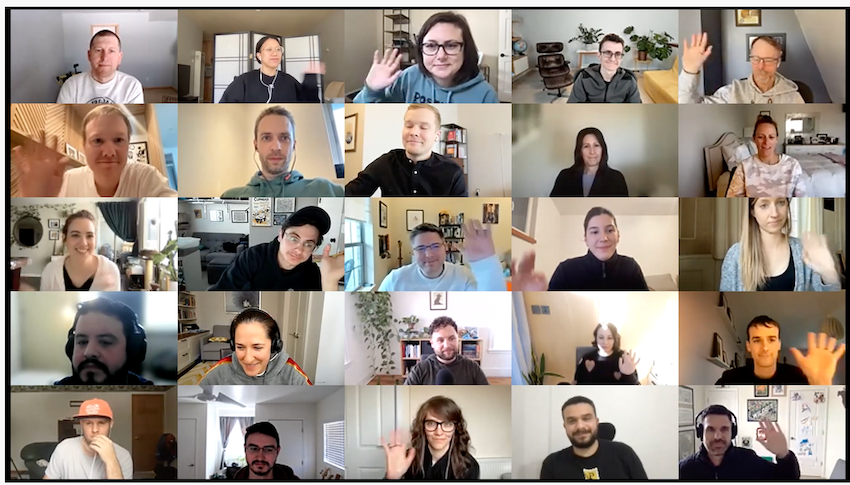
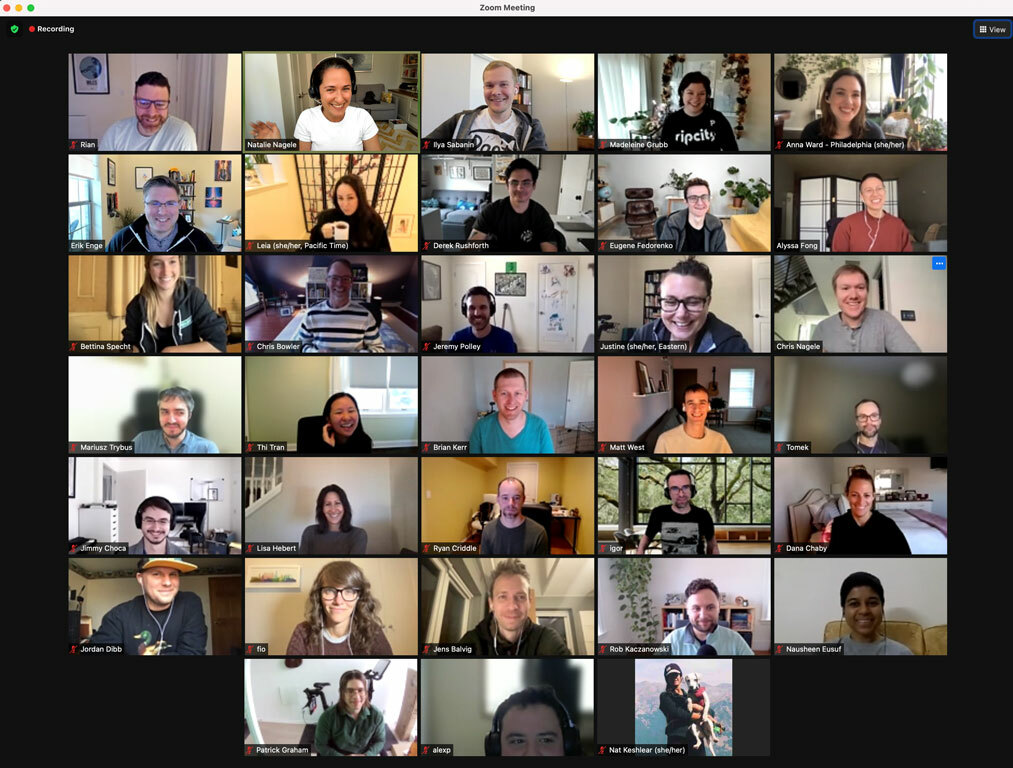
(some of) the Wildbit team at the meeting. If you’re new here, I’m in the fourth row from the top, second from the left.
As people-first leaders, it’s our job to guide our teams through moments of crisis, even when the situation feels helpless. If team members are affected by a current event, it’s our job to be mindful and care deeply. If team members express the desire to help, it’s our job to find organizations we can support, financially and otherwise.
And it’s also our job to lead by example and remind everyone to take it easy and be kind to others and themselves.
At the meeting, I shared how I’d argued with my therapist for ten minutes after she told me to stop doomscrolling. She eventually had to say “Enough!” for me to see the larger point: at times like these, we need to seek good news and find ways to share moments of happiness with one another.
For us, that happened as we celebrated two team members who are leaving (one of them after 14 years!) to fulfill their lifelong dreams outside of Wildbit. While it’s bittersweet to see them go, the joy of seeing two people we care about go out in the world to do something they love has been hard to contain.
Keep finding moments like this to celebrate with your team. Doing it feels very important, right now.
PS: 20+ years of people-first resources 📚
We’ve published a lot of things since starting Wildbit in 2000, and recently collected a selection of our best work in our new Wildbit library. If you are looking for help or inspiration, we hope you’ll find some of it useful.
With 💚 Natalie & the team at Wildbit
]]>Should we *really* aim for work-life balance?https://wildbit.com/blog/newsletter-february-20222022-02-22T00:00:00-05:002022-03-28T12:15:45-04:00Natalie Nagelenatalie@wildbit.comThis piece was originally emailed to Wildbit’s mailing list on February 22, 2022.
Hello, friends.
Building a people-first business requires us to be intentional about the choices we make, and that includes the language we use.
For example: companies often promote work-life balance, but I’ve been thinking of how the term creates really strict walls around both ‘work time’ and ‘life time’. It may mean that if you’re working 9-to-5 but it’s 4pm and you’re really drained, you’re still going to sit there for an hour and stare at your computer just because that’s your ‘work time’.
What people-first companies tend to do is create an environment for work-life integration instead. We recognize that each team member has hours that suit them best and we honor their individual needs: someone might want to work at 9pm if they’re excited about what they’re doing, while someone else might choose to put work away at 2pm and go for a bike ride with their kids. All of that is okay.
I shared this idea during a conversation with Rand Fishkin two weeks ago. We also talked about how, as company founders and leaders, we both achieved better decision making, better prioritization, and better results by focusing on deep work and not adhering to hustle culture. If you’d like to revisit some of the highlights and re-watch parts of the discussion, it’s all available on our blog.
PS: “spreading joy” as a team KPI
The team has done it again! We published another webcomic (the first one, Postmark Express, is from 2021) with a surprising and delightful narrator. Please check it out, and enjoy another way we measure the success of our work by bringing joy to others. 👏🎬
See you next month,
Natalie & the team at Wildbit
]]>The 4 Rs of people-first culturehttps://wildbit.com/blog/people-first-culture2022-02-17T01:08:00-05:002022-02-21T13:01:11-05:00Chris Bowlerchris.bowler@wildbit.comhttps://chrisbowler.comBuilding a people-first culture at work means being intentional about creating spaces where team members can feel supported and valued while doing fulfilling, meaningful work.
Our team at Wildbit believes that businesses exist to serve humans, which is why we strive to be profitable, team-centric, and sustainable instead of chasing growth at all costs. And we want to highlight other people-first companies and help job seekers connect with them, which is why we’ve been building a job board, People-First Jobs, where companies are carefully vetted using a list of criteria that we believe characterize people-first businesses.
These are companies that put people first by having reasonable hours, flexible schedules, and remote work options; that enable deep work through async communication; that value a diverse and inclusive team; and that focus on outcomes and professional development. They don’t have to check all the boxes on our list, though we look for as many as possible.
But these principles and criteria are still a bit abstract. How do they translate into the kind of workplace or work culture that puts people first, where people can thrive and do their best work? What does such a workplace look like in more concrete terms? How can companies create and cultivate a working environment where people feel empowered and fulfilled?
What makes a workplace people-first?
I’ve thought about these questions a lot while surveying and talking to job-seekers. Here are some of the things I’ve learned through my research and one-on-one conversations:
People want to work for companies that care for their employees, invest in their team, and support and empower team members to succeed.
They want balance and flexibility—a humane workload that allows enough personal and family time, and the ability to choose when and where to work.
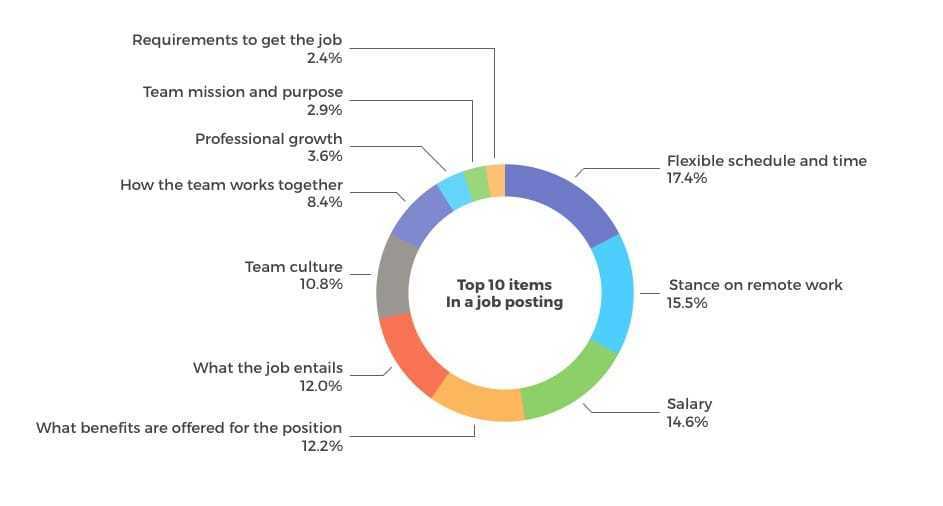
They want clarity and transparency—about job responsibilities and how success is measured; about salary and benefits; about the team culture and how the team works together; and about how decisions are made.
They want to do work that is important and meaningful, and be allowed the autonomy to take full ownership of the work they were hired to do.
PFJ survey: what job seekers look for in a job post
I’ve also reflected on my own experiences of having worked in various kinds of work environments, ranging from a large corporation to a bootstrapped SaaS company to running my own business. (In my early twenties, I even drove a truck!) Each of those workplaces had some positives and some negatives; in some work environments I felt energized, whereas in others I felt drained. But all of those experiences helped me come away with a better understanding of what makes a great workplace—one where you feel engaged, empowered, and fulfilled.
So, what makes a workplace people-first? I’ve identified a set of key characteristics based on my research for PFJ and my personal reflections. I’ve grouped these characteristics into four categories: respect, responsibility, relationships, and results.
The four Rs of a people-first workplace
1. Respect
A people-first workplace respects the value of people’s labor, the need for uninterrupted time to focus, and each team member’s desire to structure their work in a way that suits them. Respect is crucial for creating a work environment where people feel safe, supported, and valued, which in turn promotes job satisfaction and well-being, and enables people to perform at their best.
Fair wages and reasonable hours. A people-first company offers fair wages and sets reasonable hours, recognizing that more hours do not equal better results. When people are adequately compensated and have enough time for family and leisure pursuits, they can show up at work well rested, energized, and motivated.
Deep work. Creating the space to focus without interruption makes it possible for people to buckle down and do meaningful, productive work—or ‘deep work,’ as Cal Newport calls it. This means respecting people’s time and attention by minimizing meetings and other distractions.
“Deep work is the work we hire people to do; the specializations and expertise that define careers and help businesses grow. Deep work is what a writer does when they write or an artist does when they paint or, in the software world, what a developer does when they write code.”
Inclusive policies and processes. A people-first team works in a way that makes it possible for everyone to participate fully. This might mean flexible hours or remote work, or prioritizing asynchronous communication so that people can respond when it’s most convenient for them. It might mean having robust family leave policies, inclusive hiring practices, and so on.
Team members want to feel like their contribution matters, so they can take pride in accomplishing the work they are responsible for and entrusted with. Conversely, being micromanaged by someone else can be utterly demotivating. A people-centric team allows people the autonomy and independence to do what they were hired to do, take ownership of their projects, and then reflect on their work in order to improve over time.
Autonomy and independence. Letting people work independently means the company trusts them to do the work they were hired to do. It might mean giving them the freedom to choose their own hours, or work in whatever way makes sense to them—and trusting that they’ll get the work done.
Ownership of one’s work. People are more likely to feel excited and energized at work if they can take charge of a project, make decisions about it, and take pride in its execution. Being able to take ownership makes the work meaningful and fulfilling.
“In the company we aspire to build, managers should not have to be involved in every decision and become bottlenecks, and team members should feel confident in their own expertise and ownership to push the company forward.”
Time for reflection. A company that invests in its people should allow them the time and space to reflect on their work. This allows people to not just iterate and improve, but also to think about why and how they do the work they do, and what it means to them.
If a company puts people first, it follows that it values and cultivates strong relationships—which extends to all the people impacted by the company and its culture: not just the team, but also the customers and the larger community. A people-centric company cares deeply about the wellbeing of its team, the success of its customers, and the impact it has on the surrounding communities and the world at large.
A strong team culture. A people-first workplace works hard to cultivate a team culture that is diverse and inclusive, and prioritizes the needs of team members and their families. It provides the space and opportunity for people to interact and bond with teammates, and is transparent in its operations and decision-making.
“At Wildbit, we’ve found that people are happiest when they’re given a chance to do the work they love, on projects they believe in, with people they care about.”
Caring for your customers. A business depends on its customers in order to be profitable, but it should, in turn, be genuinely invested in their success rather than viewing them as a resource to be exploited. It’s a two-way relationship: the success of your customers will ensure the success of your business.
Caring for the community. From an ethical standpoint, it’s important to think about the impact a business has on the surrounding community, on society, and on the environment. Ideally, a company should strive to have a positive impact rather than a negative one.
“True impact is external. It happens in our families, in our communities, in the environment around us. We’ve found that having a positive, lasting impact requires a bigger-picture mentality that looks beyond the confines of Wildbit as a company and examines our place within these social structures.”
Any workplace rightly cares about the results they produce—but financial goals such as revenue and profit are only one piece of the puzzle. People-first companies recognize that how we work is just as important and meaningful as the work itself, so they go beyond traditional metrics and put emphasis on the process and how the work is done.
Regular reviews. A people-focused team helps team members define individual goals and takes the time to review progress and provide feedback in a way that is supportive and empowering. When goals are not met, team members work to understand why, and how things can improve.
Learning and development. Investing in the team means creating opportunities for people to hone their craft, learn new skills, and pursue opportunities for professional development so that they can be the best version of themselves.
Mentorship. A big part of helping people grow in their roles and meet their goals is providing mentorship. Team leaders and senior members can help their junior colleagues to better understand the industry and think about their career path.
“We put a lot of effort into our one-to-ones. We try to make them not about status, not about a project, [but] about who are you as a person. What do you value right now? Why are you here at work, like what is motivating you? What is challenging you?”
Anyone who has suffered through a toxic work culture can attest to the importance of a work environment where people can flourish and reach their full potential. But creating and cultivating a people-first culture in the workplace takes a lot of conscious effort: people-first leadership is a long-term commitment that requires openness, transparency, and a willingness to learn from one’s mistakes.
We want to support founders and leaders to build and grow people-first businesses, so if you want to learn more about our people-first principles or follow our journey, please sign up for our newsletter or get in touch. If you’re a people-first company, consider becoming a PFJ member so that our growing community of job-seekers can connect with you.
Let’s work together to build a more human and sustainable future of work.
PS: Special thanks to Nausheen Eusuf for her help researching and shaping this article.
]]>Deep work, chill work: a conversation with Rand Fishkinhttps://wildbit.com/blog/deep-work-chill-work2022-02-14T06:51:00-05:002022-02-17T15:40:06-05:00Fio Dossettofio@wildbit.comhttps://contentfolks.comBack in September 2021, Rand Fishkin (CEO and Founder at SparkToro) wrote an article about hustle culture vs. chill work that felt familiar to our team at Wildbit. Rand’s appreciation for “the fulfillment and rewards of high-quality work,” his belief that we "build our jobs to work around, fund, and enable our lives,” and his team’s "pride in [the] results, not the difficulty, quantity, or intensity of our labor,” is how we think about running a people-first company.
It all started from this Slack message...
After a few of us read the article, we thought it a good idea to invite Rand for a follow-up chat with our CEO and co-founder Natalie Nagele. We like to talk about the small details that build a big business, and we particularly like to do so in public, where our audience can ask questions that help us dig deeper.
Rand came over on February 9th. If you missed the conversation or would like to watch it again, click play below (the video is split into chapters if you want to skip to the bits you care about) ↓
Rand: “To me, hustle has always meant working hard for the sake of work; that it is respectable, and impressive, and important, and valuable to work many long hours because working long hours is a goal in and of itself. It is not the outcome that one is seeking, but rather the practice of it. [...] I absolutely shared those beliefs and followed, and worshiped, and was in awe of many of those people who wore their hard work and long hours as a badge of honor. I have slowly, over time, opened my eyes to the reality that maybe this is not true: and now in the last few years, I’ve come around to the idea that I think it’s a problematic at best, pernicious myth.”
Natalie: “With hustle culture, there’s no end. There’s no ‘done’. There’s no ‘enough’. In the context of focus work, hustle culture creates this perception that it’s never done, which also adds a lot of anxiety to our culture.”
2. Deep work is fulfilling but tiring work
Natalie: “To me, [doing] deep work and getting in a flow state is magical because you’re using your superpower, you’re able to accomplish something, and your mind wants that. It’s beautiful—but it should exhaust you, and it probably does. And usually, if you do 2 hours of really good deep work, you [then] need to take a break, take a walk. To me, that’s why it’s hard: it’s hard on your body, on your mind. It’s like you’ve used up a lot of energy, like powerful energy in your body and your mind.”
“Newport’s book [Deep Work] talks a lot about the capacity of your brain to do deep work; and the capacity taps out at about 4 hours a day […] versus the alternative, which is react[ing] to things all day long. We’re using a different part of our brain. We are probably exhausted, but it’s from distraction, it’s from multitasking, it’s from too many inputs that don’t align. And it’s not as fulfilling, because we didn’t actually do anything that used a flow state.”
3. Data can help convince managers of the value of deep work
Rand: “How do I embrace [deep work and chill work] practically myself, and then try and convince other people that I work with: my boss, team, client, et cetera? One of the best ways to do it is to present conversations like the one we’re having. There is an incredible amount of data out there that shows that you do your best work in this deep state of flow, that 4 hours a day is the maximum for that, that if you are well-rested and emotionally happy and feeling psychologically safe, the quality of your decision-making and the quality of your work goes up massively.”
Natalie: “In most cases, your boss cares about output. So if you can, change the narrative from ‘hours’ or ‘response times’ to what are we trying to accomplish here? There are conversations to be had. I think sometimes it’s really hard, especially in larger organizations, to try to change the entire culture of the organization; there’s some value in trying to find small iterations of that, to just start to show that deep work works, that being ’on’ all the time isn’t necessary.”
“Your boss would be really surprised when they found out how much time you don’t spend doing work that you’re getting paid for. Nobody hired you to check email—I don’t think any of us had a job description that says email checker. You’re hired because you’re a software developer, designer, a writer. That’s your unique ability. That’s what they’re paying you for. One of my favorite ways is to start recording your time: record your hours for two, three, four weeks, and hand that to your boss. When they start to see that it’s 70% meetings, 20% email checking, and 10% maybe getting the actual projects done, they can quantify that math really fast, and you’ve just became a really expensive robot. And they don’t want that.”
4. Focus is crucial to deep work and flow—especially in a remote-first setting
Rand: “I try and find a time, place, and position where I know that I do my best work—which is generally here in this office, which is out back in my house. I have my email not open, and I’m just in whatever state of flow I need to be in, and I concentrate on it. And in the first 15 minutes, if I can’t get into that state of flow, I will go do other work, clear out my backlog, and try to come back to that big project later.”
Natalie: “I schedule it, so it has to happen. Cal [Newport] talks about this a lot. There’s different ways to do it, but I’ll schedule deep work on my calendar; I know myself enough to know the hours of the day and the meeting that comes before and after, and what that means.”
Rand: “When you switch to a remote-first work environment and a distributed team approach in many time zones, you as the leadership team or the manager or the person who’s doing the work has to build a structure that does not require time-sensitive collaboration. Your job is to design projects that are useful and valuable to the business, that don’t require the same hours from people. And this also is a key to deep work—because you can almost never have multiple people deep-working, same time, same time zone. And that flexibility creates a lot more mental health opportunities for people who like to work out in the morning, or got to pick up kids from school early, and so on.”
5. Why we should talk about work-life integration
Natalie: “I’ve thought a lot about work-life integration, more than work-life balance. If you have fulfilling work, where work-life balance falls apart is that it tries to create really strict walls around work and really strict walls around life. And what that does [...] is it creates an artificial sense of rest, and then it forces a strict work period.”
“What we’ve tried to do instead is create an environment for fulfilling work—it may come at a point where it’s 8:00pm and you’re really inspired and got excited about something and want to work: that’s okay. And then come in later the next day, take a rest, pick up your kid from work, go do a two-hour bike ride [...]. It’s not forcing one versus the other.”
6. What makes a company people-first:
Rand: “I think this is when the leadership and the structure of the organization care more about the long-term health, and happiness, fulfillment, quality-of-work that the team does, than it does about raw financial or economic growth. And I think that weirdly enough [...] if you prioritize people, very often you end up doing better at the economic and financial growth. It’s kind of awesome because you can prioritize the thing that, if you are a human being who cares lots about other human beings and less about the quantity of capital in your bank account, you can do the right thing and also increase the quantity of capital in all the bank accounts. You can do both. That’s the important message. Both can be accomplished.”
]]>Asking deep questions about what ‘work’ ishttps://wildbit.com/blog/newsletter-january-20222022-01-26T12:18:00-05:002022-02-08T12:13:10-05:00Natalie Nagelenatalie@wildbit.comThis piece was originally emailed to Wildbit’s mailing list on January 26, 2022.
Hello friends,
Company founders and leaders have the power to create spaces where our people can do their best work. It’s our job to ask deep questions and think carefully about what ‘work’ is and how it should fit into the rest of our and our teams’ lives.
Back in 2017, when Wildbit decided to experiment with a 4-day workweek, we didn’t just cut a day from our schedule: we chose to fully shake up the way we thought about work. We’d learned that knowledge workers can only do about 4 hours of focused work per day, so we asked ourselves: if we buckled down and got some really thoughtful, meaningful work done, could we work less?
I know how this may sound. As a society, we are used to linking hard work to being virtuous and having a solid work ethic, whereas seeking to work less can be perceived as laziness. But we saw an opportunity to practice deep work and refocus on the quality of work we delivered rather than the number of hours we worked.
What started as a small experiment has now become a central part of who we are as a company. For us, deep work results in better decision making, better prioritization, and better results.
__________________________________
A few months ago, Rand Fishkin (CEO and Founder at SparkToro) wrote an article about hustle culture and chill work, which he defined as “an appreciation for the fulfillment and rewards of high-quality work, but never letting work intensity overwhelm the rest of life.”
Rand’s perspective felt familiar to Wildbit: it’s how we feel about deep work. So we decided to invite Rand over to have an open conversation about how we’re both using deep work and chill work to grow our respective companies—and we’d love for you to join us.
The date is February 9th, and the place is wherever you are.
Our respective definitions of deep work and chill work
What reasonable workloads & pace look like
Whether chill work and deep work can scale—and what their downsides may be
But we’ll also answer YOUR questions. You’ll find more info on the sign-up page.
We hope to see you there 💚 Natalie and the team @ Wildbit
]]>Implementing a 4-day workweek: insights from 4 companies that have done ithttps://wildbit.com/blog/how-to-implement-4-day-workweek2022-01-04T00:00:00-05:002022-02-21T09:45:41-05:00Justine Jordanjustine.jordan@wildbit.comhttp://www.justinej.comThe stress and fatigue of the pandemic have caused many people to rethink their relationship to work, with employees increasingly in favor of flexible work arrangements and better work-life balance. This year, we saw a growing interest in the four-day workweek as more and more companies, and even some governments, have been experimenting with a shorter workweek and documenting its benefits.
Here at Wildbit, we adopted a 4-day workweek in 2017, long before the pandemic. What started as a summer experiment ended up being so successful that we never stopped. In fact, we are passionate advocates for a shorter workweek as a people-first way of doing business.
We want to encourage more businesses to consider this way of working, so in September 2021, we brought together leaders from four companies for a conversation about how to implement a 4-day workweek. They shared why and how they switched to a 4-day week, how it’s been going, and what they’ve learned in the process. Below is the full video, plus the key insights that emerged from our discussion.
Panelist and company profiles
From left to right: Meghan, Nicole, Natalie, and Dawn
Meghan Keaney Anderson is CMO at The Wanderlust Group, an outdoor tech company connecting adventurers to destinations. They’re a remote-first company with 50 team members, and have been on a 4-day week since July 2020.
Nicole Miller is Senior People Ops Manager at Buffer, a social media management software company with 90 team members around the world. They’ve been working 4 days a week since May 2020.
Natalie Nagele is CEO at Wildbit, a people-first, product-agnostic software company with 36 team members across 10 countries, and working 4 days a week since 2017.
Dawn Quigg is Client Services Director at Awin, a global affiliate marketing network with 1000+ team members across the globe. They adopted a 4-day week in January 2021.
Motivations for the 4-day workweek experiment
For Wanderlust, Buffer, and Awin, the initial impetus for the four-day workweek experiment was the exhaustion and burnout caused by the pandemic. They wanted to alleviate stress and promote well-being, especially for parents and caregivers who were stretched thin trying to juggle work and family.
As a company that’s all about spending time outdoors, The Wanderlust Group thought the extra day off would give people more opportunities to spend time not just with family and friends, but also outside, close to nature. Buffer, a remote-first company with a keen interest in the future of work, wanted to give people “extra time for life” and to support employees who wished for “flexibility in time.” In Awin’s case, the pandemic made them think about how best to “offer something back to employees and improve their wellbeing.”
At Wildbit, however, the shift to the 4-day workweek happened in 2017. Our founders, Natalie and Chris Nagele, were deeply influenced by Cal Newport’s 2016 book, Deep Work: Rules for Focused Success in a Distracted World. Newport argues that our brains can only do focused, meaningful, productive work for about 4 hours per day; the rest of our time is taken up by unnecessary distractions and busywork.
We spend a lot of our days on shallow work. Things like meetings, emails, closing tickets and talking to each other. What if we all just buckled down and got some really thoughtful, meaningful work done, could we work less?
—Natalie Nagele, Wildbit (May 2017 blog post)
Natalie and Chris decided to try a 4-day workweek experiment to see if it’s possible to work more intentionally and efficiently by removing distractions. However, the flip side of doing deep, focused work is giving the brain enough time to rest and recharge—hence the 3-day weekend. The 4-day week requires both deep work and deep rest.
The results
1. Productivity either stayed the same or improved
When Buffer began its initial one-month trial of the 4-day workweek in May 2020, they fully expected a drop in productivity due to the decreased working hours in addition to the mental burden of the pandemic. The actual results surprised them:
We’d already seen the psychological toll of the pandemic and did not expect productivity to stay the same. We expected a huge dip—but that didn’t end up happening. In fact, the numbers really leveled off and stayed that way and felt pretty sustainable.
—Nicole Miller, Buffer
Those initial results led Buffer to conduct a six-month trial until the end of 2020. They found that the productivity numbers remained consistent, e.g., the amount of code written was about the same as a similar month in 2019. Seeing no change and no drop in productivity made them realize that the fifth workday was “a bit superfluous, since people were getting around the same amount done in four days.” At the end of the 6-month trial, Buffer reevaluated and made the 4-day week permanent.
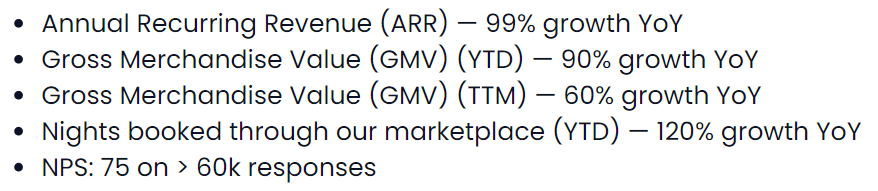
Maintaining the same output with one less workday is impressive enough, and this was Awin’s experience, too—but The Wanderlust Group even saw their numbers increase. During their initial trial, they had “the most productive six months ever,” so they made the shorter workweek company policy. After a year of working 4 days a week, their annual recurring revenue (ARR) had grown almost 100% year over year and their NPS stayed above 75.
The Wanderlust Group’s numbers after a year of working 4 days a week
The big takeaway is not that the four-day workweek somehow magically juiced our numbers. It’s that we were able to hit and exceed our numbers while having a four-day workweek.
—Meghan Keaney Anderson, The Wanderlust Group
Wildbit’s experience has been similar: a clear trajectory of growth despite working fewer hours, even through the pandemic.
We’ve seen the business grow more in the last three years than it has in its entire history. Not because we do a four-day workweek, but in spite of the four-day workweek.
—Natalie Nagele, Wildbit
2. Happier and more engaged employees
It should come as no surprise that the shorter workweek had a positive impact on employees: lower stress levels, improved work-life balance, greater job satisfaction, increased engagement, and more opportunities for personal and professional development.
A really direct, tangible benefit of the four-day workweek was our churn being almost zero from an employee standpoint. Morale went up. People were able to spend real time pursuing passion projects and then bring that energy and enthusiasm back to their work.
—Meghan Keaney Anderson, The Wanderlust Group
Amy Cohan from The Wanderlust Group kayaks on one of her Mondays off.
For instance, one Wanderlust employee used her extra day off to teach sailing to youth—and that passion and energy flowed back into her core job working with boaters and marinas. As an outdoor tech company that encourages people to spend time outdoors, this is exactly what The Wanderlust Group had hoped for when implementing the 4-day week.
Similarly, Dawn Quigg at Awin noticed “an improvement in our staff engagement,” which was measured continuously using an internal platform for staff feedback. Many employees were able to spend the fifth day with family, which they appreciated during the isolation of the pandemic, while others added to their skillsets, pursued further learning, or took up new hobbies.
At Buffer, they tracked metrics related to general work happiness, stress levels, and individual autonomy, and compared them at different benchmarks. The overall trend was positive—people were happy at work, felt less stressed, and experienced greater autonomy and flexibility.
Productivity stayed consistent while the self-reported sentiments of team happiness increased, and feeling that they have more balance with their family. It was a huge relief for parents in particular, especially those who were homeschooling or managing a lack of childcare or whatever situation with their kids. That’s been a really great thing.
—Nicole Miller, Buffer
3. More efficient processes and workflows
Making the shorter workweek successful means finding smarter and more efficient ways to work. At Wildbit, this meant reducing meetings and other noise to a minimum, so people could give their full attention to their most important work.
We didn’t just implement a four-day workweek. We then also had to implement different ways of working: removing meetings, removing distractions, really focusing on deep work. We had to be really intentional about how we work. It’s been a really exciting journey and it continues.
—Natalie Nagele, Wildbit
Similarly, the folks at Awin started to examine their existing ways of doing things, and began to innovate and experiment in order to improve and streamline their processes and workflows.
We’ve seen staff really challenge the way they work. For instance, looking at how the historic process has worked and challenging it, saying ‘Well, we can do that a little bit better’ or ‘There’s a smarter way of doing this particular process.’ It’s been great to see staff really challenge things and find smarter and more efficient ways to do things. That’s been fantastic, and it obviously helped staff get five days’ worth of work into four, if they find ways to be more efficient at the same time.
—Dawn Quigg, Awin
4. Attracting and retaining top talent
If the four-day workweek makes people happier and less stressed, it should be no surprise that it’s great for attracting and retaining top talent. Candidates have choices, so the flexibility and work-life balance offered by the shorter workweek and three-day weekend is a real selling point.
For a small company like The Wanderlust Group, working four days has enabled them to stand out, get more applications overall, and recruit excellent candidates who might have otherwise gone elsewhere.
It’s been phenomenal for recruiting. The tech space is very crowded and we face a lot of competition for top talent in the region we’re in. We’re a smaller company, so we don’t have the credence and reputation that larger companies have. The 4-day workweek can be a breakthrough in a conversation with a top-notch recruit. We really believe this has played a factor in closing a lot of people in roles that we really wanted.
—Meghan Keaney Anderson, The Wanderlust Group
Once those recruits have come on board, Awin’s experience shows that they’re also more likely to stay with the company thanks to this unique benefit.
Not only can you attract top talent, but you can retain them longer. We’ve definitely seen that churn has dropped amongst our staff and that’s fantastic. I think it’s two-fold: you’ve got a real USP for attracting new talent into the business, and you’ve got a benefit that many, many staff really value and appreciate.
—Dawn Quigg, Awin
Advice for implementing the 4-day workweek
The benefits of the 4-day workweek certainly make it worth considering—but it’s a major change, and various details need to be worked out to make it successful. During our live conversation, we got a lot of audience questions through Slido and through the Zoom chat, and asked our panelists to respond and share their advice based on what they’ve learned so far.
Be intentional about which day to take off
A popular question that came up was which day of the week do you take off, and how did you choose? A related question is: should it be the same day for everyone? Customer support teams often provide week-long coverage, so how does it work for them?
The Wanderlust Group ended up taking Mondays off because Fridays are typically a busy day for the marinas and campgrounds they work with, so they wanted to be available for them on Fridays. They also found that having Monday off allowed the team to plan and reflect on the week ahead—especially for parents of young children who may have busy weekends—and start their week strong on Tuesday.
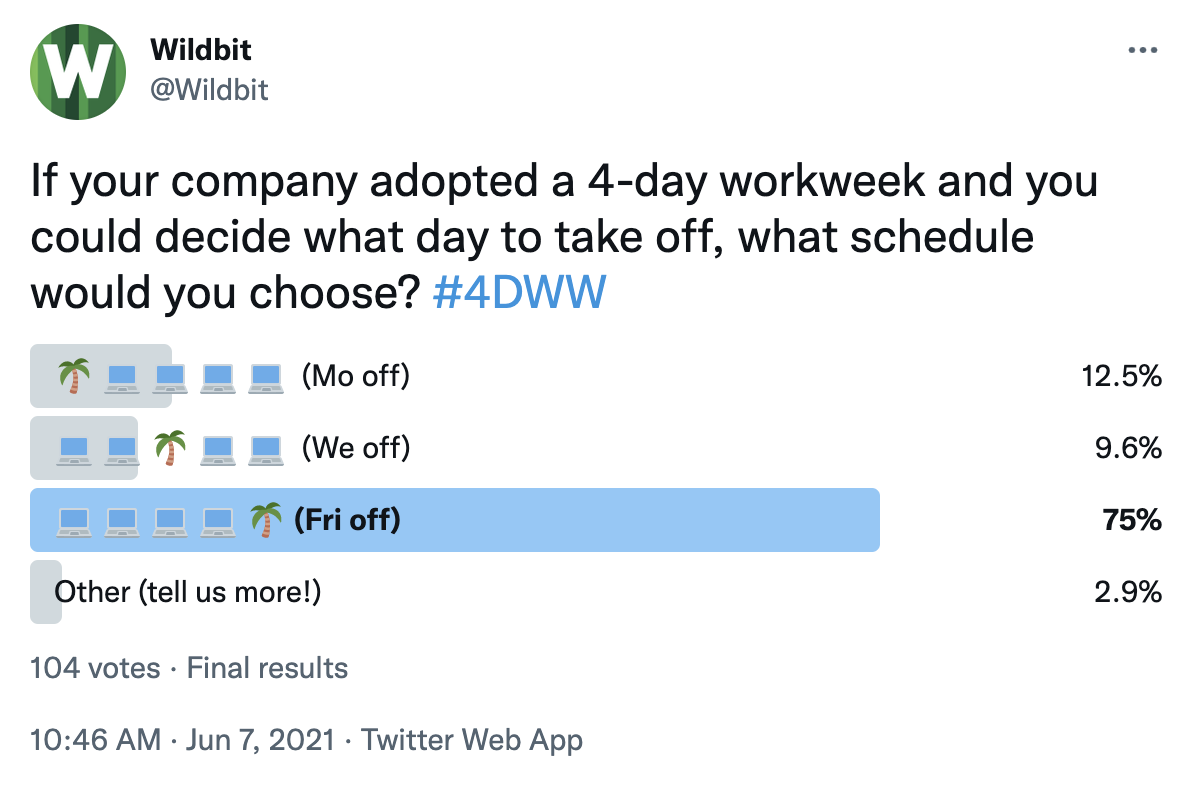
From our Twitter poll, it seems Friday is the clear favorite!
Buffer and Wildbit experimented with allowing people to choose their day off, but it became hard for teams to keep track of who was available when. So they eventually settled on Friday as the common day off, which allows for consistency and ease of collaboration, especially with team members spread across multiple time zones around the world.
Awin decided to give people the flexibility to choose which day they wanted to take off—as long as it’s clearly communicated to their manager. Each department or team works out a rotation system internally so that there’s always coverage for their client-facing work to continue uninterrupted. This rotation system has worked out well for them, but it does require planning and coordination (as a reminder: the company does employ 1000+ people!).
Customer support teams are a special case since they often need to provide coverage 5 days a week, or even 24/7. At Buffer, this is handled by rotating the days off to ensure week-long coverage while still working four days. Similarly, the folks on Wildbit’s customer support team work either Mon-Thu or Tue-Fri so that we have 5 days of coverage, but everyone still gets 3 consecutive days off.
Allow flexibility, but within limits
Another question we got was: what if somebody wants to work five days a week? It’s really a question about flexibility and being able to choose, since some people might prefer working 5 shorter days rather than 4 full days. Or there might be folks who do their best work in the evening. Or someone might feel inspired and want to get going on a project during the weekend.
Awin’s Dawn Quigg says it’s important to give people choice and flexibility rather than dictating how and when they should work. Similarly, Wanderlust’s CEO told the team they can choose their hours as long as they’re not emailing people or booking meetings at odd hours or off days. That way, one person’s choices don’t end up putting pressure on other people to be logged in outside of their working hours.
Here at Wildbit, Natalie used to feel strongly about people not working on Friday, but she received feedback that they wanted flexible hours. So now we have a 32-hour workweek with flexible hours. Ultimately, it’s not about tracking or policing the number of hours worked, but whether the work gets done.
Keep salaries the same, based on output not hours
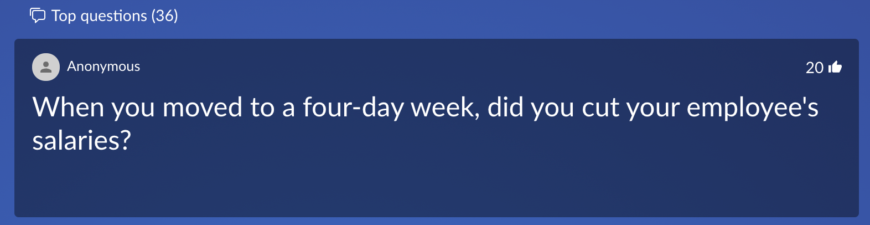
One audience question that got upvoted by a lot of attendees had to do with salaries. If people are working fewer days, should they get a pay cut? Also, does working 4 days mean four 10-hour days?
A lot of folks had this question!
The answer from our panelists was a clear and unanimous no. All four companies kept salaries the same because they’re paying for the output or the results, which have either stayed the same or improved. They also did not try to fit 40 hours into 4 days, but maintained an 8-hour day.
As Wanderlust’s Meghan Keaney Anderson puts it, “We still pay the same full-time salary that we paid before because we’re paying for output, not for hours in the chair.” Awin’s Dawn Quigg agrees: “We’ve very much tried to move away from the idea of how many hours you work in a day. Rather, what’s the output of your role and what deliverables are you working towards?” She says focusing on output rather than hours also enables people to get their work done efficiently within the four days.
Natalie, our CEO at Wildbit, says she’s often been asked whether a 4-day week means 40 hours crammed into four days. So she now describes it as a 32-hour week to clarify that it’s four 8-hour days. Salaries at Wildbit remained the same during our transition to the 4-day week in 2017. In addition, we recently rolled out location-agnostic pay, because if compensation is based on output, then where someone lives shouldn’t affect their salary either.
Review vacation and PTO policies, adjust if necessary
Another great audience question had to do with vacation and time-off policies. Technically, a shorter workweek means people are already getting more time off than before—but on the other hand, if they’re producing the same amount of output, then they’re still doing the same work. So what impact (if any) should the four-day week have on vacation and PTO?
The Wanderlust Group and Buffer decided to keep their vacation policies the same, since that fifth day should be properly considered part of the weekend, and not really a day off. Awin, on the other hand, felt that with bank holidays usually falling on a Monday and people typically taking Fridays off, there would often be 3-day weeks. So, after much debate, they decided that if someone wanted a day off during a week that already includes a bank holiday, they should request a vacation day.
At Wildbit, we used to have 25 PTO days, or 5 full weeks. After moving to the 4-day week, we ended up lowering the PTO to 20 days because that still translates to 5 full weeks. In other words, the number of full weeks off stayed consistent, while the number of PTO days changed because a ‘full week’ is now counted differently.
Clearly, there’s no one-size-fits-all answer to the vacation and PTO question, so each company has to decide what will work for them.
Model change from the top
Getting everyone on board with a new idea can be challenging, so it helps to model change from the top. When implementing the 4-day workweek at Buffer, it helped that their CEO was a champion and a pioneer. “It’s really important that he set the example and set the tone for the company as a whole,” says Nicole Miller. It also helped to frame the pilot as an experiment so that people felt invested in making the experiment a success.
The blog post where Buffer’s CEO announced the 4-day workweek
Dawn Quigg of Awin agrees that leadership and management have to buy into this new way of working first, so they can model it for the team: “When the management lives and breathes it, that sets a nice example for the rest of the staff. That’s what our CEO did—it was something he pioneered. It’s important that the vision comes from the top.” There might still be pushback at first since you’re asking people to change longstanding habits and ways of thinking. But it’s important to get everyone on board, since a rotational system (like they have at Awin) won’t work unless everyone is in it together.
Emphasize communication, documentation, and async work
Nicole Miller at Buffer emphasizes the importance of good communication and strong documentation practices in order to work efficiently within a four-day week. Especially for companies that are remote and distributed, you don’t want people to be stuck in their work because they’re missing a key piece of information or input from another person. Hence the vital importance of communicating clearly, documenting everything, and working asynchronously.
At Awin, for instance, they rely heavily on the project management tool Asana. People document their work in it so that someone else can pick up where they left off, and the tool acts as a knowledge bank and a repository of handovers or ways of doing a certain process. Having this central tool enables things to run smoothly even while different people are off on different days.
Similarly, at Wildbit, we enable each other to do deep work by defaulting to async as a remote work best practice. We use communication, project management, and documentation tools like Basecamp, Notion, and Dropbox Paper to collaborate effectively across time zones and avoid disrupting people’s schedules with unnecessary meetings or calls.
Be patient and set realistic expectations
Longstanding habits and workplace norms can’t be changed overnight. Getting used to a different way of working requires a mindset shift, so you have to give it enough time. It takes effort, practice, and careful planning.
Part of the mindset shift is to actually think in terms of fewer hours, and not try to cram 40 hours of work into four days. This means not just minimizing distractions and working more efficiently, but also being realistic about what can be reasonably accomplished in four days. If you adopt a four-day week but are demanding more than is possible in four days, then the work will start to creep into the fifth day or the weekend—which defeats the purpose.
If the projects are really big, if the deadlines are really tight, if the client’s expecting work in a certain way and you’re not stepping back to ask, ‘How long is this going to take?’ or even just reflecting on that, it’s kind of unfair. Because you’re asking folks to work fewer hours, but you’re not changing the way in which you work so that you can still accomplish what you want to accomplish in less time. That’s usually where failure happens when people experiment with four-day workweeks.
—Natalie Nagele, Wildbit
In other words, it’s not enough to simply tell people to work 4 days. You have to ensure that the structures, processes, and expectations are set in a way that sets people up for success in a four-day workweek.
At the end of the day, however, no amount of pre-planning will be enough. “There is only so much prep you can do before going into a four-day week. The biggest learnings come from being in it,” says Awin’s Dawn Quigg.
Measure progress
Another audience question had to do with measuring progress. How do you track or measure the success of a 4-day workweek?
There are various quantitative and qualitative ways to do it, including:
productivity metrics, e.g., the number of lines of code written, the number of tickets resolved, etc.
measures of subjective well-being, such as self-reported stress levels or autonomy at work
feedback forms or surveys to assess employee engagement or job satisfaction
metrics related to revenue, growth, customer satisfaction, etc.
The important thing is to be thoughtful and intentional about your goals and metrics. Dawn Quigg of Awin warns that it’s not enough to simply ask, “Do you enjoy a four-day workweek?” because no one is going to say no. Instead, you have to think deeply about what you’re trying to accomplish, identify the relevant goals and metrics, and then frame the questions in a way that allows you to gauge what’s actually important and relevant. Only then can you get data that’s useful and can help move things in the direction you want.
Some challenges of the 4-day workweek
Our overall discussion painted a pretty positive picture of a 4-day workweek, but an interesting audience question we got was: are there any drawbacks to the 4-day week? Our panelists responded that yes, it does come with some challenges.
Being efficient and productive in a shorter workweek means reducing meetings and other disruptions to a minimum: that’s what enables people to engage in deep work. However, the flip side of it is that there’s less social interaction than before. Everyone is working more efficiently, but there are fewer opportunities for social contact between people.
Part of the reason you can move to a 4-day week is because there's so much fluff in a standard 5-day week. There are so many standing meetings. There’s so much talking around the water cooler. To make the 4-day workweek possible, you have to very deliberately cut out that fluff. But there’s also some nice stuff in that fluff. There’s chatting with your friends and colleagues at the virtual or actual water cooler. You lose some of that.
—Meghan Keaney Anderson, The Wanderlust Group
Similarly, there’s less time and opportunities for team engagement or team bonding. Buffer’s Nicole Miller says it’s been a challenge to figure out how often to schedule team engagement activities or hangouts. They already cut back on those events due to the Zoom fatigue of the pandemic, but how do you facilitate team engagement without in-person retreats, without adding to Zoom fatigue, and without cutting into those 4 days of focused work? Buffer does have deep relationships being formed through pair calls and peer mastermind sessions, and of course there are all-hands and town halls, but just fewer of the big social events.
Here at Wildbit, Natalie agrees that a culture of deep work can create isolation, especially for a remote team. Sometimes, people might also feel pressure to get things done because they have fewer days available. And that also makes it hard to find time to connect with the rest of the team. She says it takes time and practice to “find space and say it’s okay to give up an hour to just connect.” Figuring out the right balance has been an ongoing process, but it’s also very necessary in order to make the 4-day workweek sustainable in the long term.
The Wildbit team during a monthly all-hands meeting
Continuing the conversation
Are you considering implementing a 4-day workweek at your company? If so, I encourage you to watch the full discussion here. In addition to the webinar recording, you’ll also find a list of useful links and resources.
If you’d like to follow Wildbit’s journey as a people-first company, you can do by signing up for our monthly newsletter. Or if you have questions or thoughts about the 4-day workweek, just send us a message. We look forward to continuing the conversation.
PS: Special thanks to Nausheen Eusuf for her help researching and creating this article.
]]>Rethinking our ideas means we’re growinghttps://wildbit.com/blog/newsletter-december-20212021-12-29T12:18:00-05:002022-01-25T13:58:15-05:00Natalie Nagelenatalie@wildbit.comThis piece was originally emailed to Wildbit’s mailing list on December 29, 2021.
Companies are an expression of the people they’re made up of; they re-shape themselves and evolve every time you bring someone new onboard.
In 2021, we added 12 people to our now 36-strong team. Having 33% new faces on a Zoom call has been challenging: it means the company we were in January is definitely not the company we are in December (and we don’t know what the Wildbit of next year will look like either).
2021 was also difficult because it was yet another year where we didn’t all get to meet one another in person. This definitely had an impact on our morale, motivation, and feeling of connection to each other—for both old and new team members alike.
Growth and change are hard to embrace. Some of Wildbit’s longest-tenured team members might even remember me saying “We are never growing past 15 people” a few years back—but plans change, businesses evolve, and we need to be able to rethink our ideas if we want to move forward. (If you have 15 minutes to spare, I recommend this talk ↓ about the importance of not getting stuck on a narrow path.)
Change also brings new energy and new ideas. Every new person brings with them their journey and merges with our collective one as a team; together, we feel inspired and challenged to continue our path of pursuing excellence.
Goodbye to a challenging yet formative 2021. And cheers to whatever new adventures 2022 brings on.
🎉 some highlights we’d like to share
Throughout 2021, the Wildbit team kept doing what we love with people we respect and like being around. Here are some highlights we thought you might enjoy:
People-First Jobs has been growing steadily: head over there if you’re looking to find (or hire for) a role in a people-first company next year.
The first-ever comic book about email deliverability brought readers a lot of joy and paw-some dog puns. Go take a look, cowpoke.
Accessible Palette was born from a designer’s frustration with how colors work online: this (free) tool can help make the web a little more accessible for all its users.
As people kept grappling with the ‘Great Resignation’, returning to work, and balancing remote vs. hybrid vs. in-person settings, we shared our experience as a remote-first company that runs a 4-day workweek (we even ended up on Good Morning America and CNN).
Thank you for being with us in 2021, and we’ll see you next year.
💚, Natalie and the team @ Wildbit
]]>Let’s have a conversation about people-first businesseshttps://wildbit.com/blog/newsletter-november-20212021-11-23T07:59:00-05:002022-01-25T13:57:27-05:00Natalie Nagelenatalie@wildbit.comThis piece was originally emailed to Wildbit’s mailing list on November 23, 2021.
Hello friends,
Last month, I asked you to share your questions and thoughts about building and growing a people-first business. You sent deep, kind, and powerful thoughts our way (thank you!) that reinforced our team’s desire to organize ‘something’ where we can all discuss the topic together.
Around the same time, I found myself at a conference with Sahil Lavingia (Founder at Gumroad), talking about how we run our respective companies. It was the first time in a really long time that I was sharing ideas and actual space with another founder.
After I talked about running Wildbit as a people-first company, Sahil joked that he runs Gumroad Sahil-first instead. It sounded like we couldn’t be further apart in our positions…
...but, as always, there is more nuance to the story.
Sahil and I decided to have a follow-up conversation and talk about the reality of building and growing a people-first company. We'll do it live, online, and with an open Q&A, so you can join and ask us the deep, difficult questions nobody else is asking.
The date is December 7th, and the place is wherever you are.