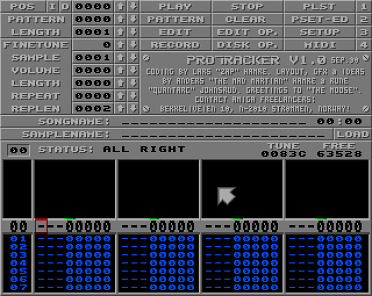
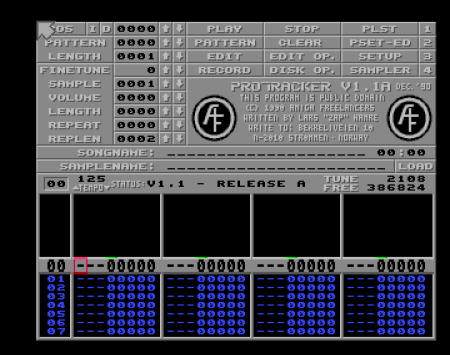
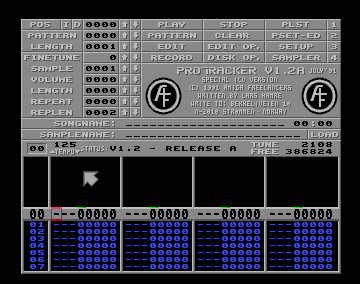
<?xml version="1.0" encoding="UTF-8"?><feed
	xmlns="http://www.w3.org/2005/Atom"
	xmlns:thr="http://purl.org/syndication/thread/1.0"
	xml:lang="fr-FR"
	>
	<title type="text">I Know You&#8230;</title>
	<subtitle type="text">Le weblog de Xavier Borderie</subtitle>

	<updated>2026-04-07T12:25:55Z</updated>

	<link rel="alternate" type="text/html" href="https://xavier.borderie.net/blog" />
	<id>https://xavier.borderie.net/blog/feed/atom/</id>
	<link rel="self" type="application/atom+xml" href="https://xavier.borderie.net/blog/feed/atom/" />

	<generator uri="https://wordpress.org/" version="7.0">WordPress</generator>
	<entry>
		<author>
			<name>Xavier</name>
							<uri>http://xavier.borderie.net</uri>
						</author>

		<title type="html"><![CDATA[Cyrano]]></title>
		<link rel="alternate" type="text/html" href="https://xavier.borderie.net/blog/2025/12/03/cyrano/" />

		<id>https://xavier.borderie.net/blog/?p=4014</id>
		<updated>2026-02-13T21:27:00Z</updated>
		<published>2025-12-03T09:48:42Z</published>
		<category scheme="https://xavier.borderie.net/blog" term="lectures" />
		<summary type="html"><![CDATA[J&#8217;ai publié ce toot, qui mérite d&#8217;être conservé ici je trouve car je n&#8217;en suis pas mécontent ma foi, dont acte. En cette fin d’année je relis « Cyrano de Bergerac » d&#8217;un trait, et comme à chaque foisje me mets à penser combien ce texte est beau, et combien j&#8217;aimerai parler ainsi, ma foi. Sortir des [&#8230;]]]></summary>

					<content type="html" xml:base="https://xavier.borderie.net/blog/2025/12/03/cyrano/"><![CDATA[<span class="span-reading-time rt-reading-time" style="display: block;"><span class="rt-label rt-prefix">Temps de lecture / Reading time : </span> <span class="rt-time"> &lt; 1</span> <span class="rt-label rt-postfix">minute.</span></span>
<p class="wp-block-paragraph"><em>J&rsquo;ai publié <a href="https://boitam.eu/@xibe/115643975970176009">ce toot</a>, qui mérite d&rsquo;être conservé ici je trouve car je n&rsquo;en suis pas mécontent ma foi, dont acte.</em></p>


<p class="wp-block-paragraph">En cette fin d’année je relis « Cyrano <br>de Bergerac » d&rsquo;un trait, et comme à chaque fois<br>je me mets à penser combien ce texte est beau, <br>et combien j&rsquo;aimerai parler ainsi, ma foi.</p>


<p class="wp-block-paragraph">Sortir des 12 pieds comme d&rsquo;autres un stylo ; <br>ne même pas penser, parler et puis yalla! <br>Retomber sur ses pieds en changeant juste un mot, <br>et ainsi continuer, construire pas à pas <br>des phrases alambiquées venues du ciboulot <br>qui seraient destinées à être lues (ou pas), <br>et amélioreraient par ce méli-mélo <br>l&rsquo;apport net de beauté dans ce monde aux abois.</p>


<p class="wp-block-paragraph">Peut-être qu&rsquo;il est vrai que ça fait intello, <br>que c&rsquo;est pour pavaner, lever le petit doigt ; <br>je pense que l&rsquo;on sait tous compter les yeux clos <br>et composer du beau, même juste une fois.</p>


<p class="wp-block-paragraph">Et bien donc s&rsquo;il vous plaît, enlevez-moi d&rsquo;un doute : <br>pourriez-vous m&rsquo;envoyer en réponse à ce toot <br>vos propres mots (ou laids, ou beaux, ou hésitants) <br>comme si vous étiez un héro de Rostand ?<br><br>Ca ne va rien prouver, c&rsquo;est pour faire plaisir, <br>afin de partager ce bien joli loisir.</p>
]]></content>
		
					<link rel="replies" type="text/html" href="https://xavier.borderie.net/blog/2025/12/03/cyrano/#comments" thr:count="2" />
			<link rel="replies" type="application/atom+xml" href="https://xavier.borderie.net/blog/2025/12/03/cyrano/feed/atom/" thr:count="2" />
			<thr:total>2</thr:total>
			</entry>
		<entry>
		<author>
			<name>Xavier</name>
							<uri>http://xavier.borderie.net</uri>
						</author>

		<title type="html"><![CDATA[Le tempo d&#8217;un succès]]></title>
		<link rel="alternate" type="text/html" href="https://xavier.borderie.net/blog/2025/11/03/tempo-d-un-succes/" />

		<id>https://xavier.borderie.net/blog/?p=2499</id>
		<updated>2026-04-07T12:25:55Z</updated>
		<published>2025-11-03T20:21:09Z</published>
		<category scheme="https://xavier.borderie.net/blog" term="Musique" />
		<summary type="html"><![CDATA[J&#8217;imagine que nous faisons tous attention aux motifs de nos vies, ces répétitions que l&#8217;on se croit seul-e-s à voir/entendre, jusqu&#8217;à se demander si elles ont un sens. Ok, donc ça c&#8217;était l&#8217;intro bidon (et sans LLM), passons au coeur du sujet : les chansons qui ont eu plus de succès une fois qu&#8217;elles ont [&#8230;]]]></summary>

					<content type="html" xml:base="https://xavier.borderie.net/blog/2025/11/03/tempo-d-un-succes/"><![CDATA[<span class="span-reading-time rt-reading-time" style="display: block;"><span class="rt-label rt-prefix">Temps de lecture / Reading time : </span> <span class="rt-time"> 9</span> <span class="rt-label rt-postfix">minutes.</span></span>
<p class="wp-block-paragraph">J&rsquo;imagine que nous faisons tous attention aux motifs de nos vies, ces répétitions que l&rsquo;on se croit seul-e-s à voir/entendre, jusqu&rsquo;à se demander si elles ont un sens.</p>


<p class="wp-block-paragraph">Ok, donc ça c&rsquo;était l&rsquo;intro bidon (et sans LLM), passons au coeur du sujet : les chansons qui ont eu plus de succès une fois qu&rsquo;elles ont été remixées &#8212; et moi de me demander si les artistes en sont tristes, ou satisfaits<sup class="modern-footnotes-footnote modern-footnotes-footnote--hover-on-desktop ">1</sup>&#8230; et surtout, donc, si un motif se détache parmi ces remix.</p>


<p class="wp-block-paragraph">Voici quelques exemples entendus ces dernières années. <br>Il y en a bien sûr moult autres, mais c&rsquo;est <em>mon </em>blog, oh.</p>


<h2 class="wp-block-heading">Asaf Avidan &amp; the Mojos<br>« Reckoning Song »</h2>


<div class="wp-block-columns is-layout-flex wp-container-core-columns-is-layout-8f761849 wp-block-columns-is-layout-flex">
<div class="wp-block-column is-layout-flow wp-block-column-is-layout-flow">
<figure class="wp-block-embed is-type-video is-provider-youtube wp-block-embed-youtube wp-embed-aspect-4-3 wp-has-aspect-ratio"><div class="wp-block-embed__wrapper">
<iframe title="Reckoning Song" width="580" height="435" src="https://www.youtube.com/embed/w0HHzYPu0_o?feature=oembed" frameborder="0" allow="accelerometer; autoplay; clipboard-write; encrypted-media; gyroscope; picture-in-picture; web-share" referrerpolicy="strict-origin-when-cross-origin" allowfullscreen></iframe>
</div><figcaption class="wp-element-caption">L&rsquo;original, en 2008.</figcaption></figure>
</div>


<div class="wp-block-column is-layout-flow wp-block-column-is-layout-flow">
<figure class="wp-block-embed is-type-video is-provider-youtube wp-block-embed-youtube wp-embed-aspect-16-9 wp-has-aspect-ratio"><div class="wp-block-embed__wrapper">
<iframe title="Asaf Avidan &amp; The Mojos - One Day / Reckoning Song (Wankelmut Remix)t" width="580" height="326" src="https://www.youtube.com/embed/KRAMNWzfjcg?feature=oembed" frameborder="0" allow="accelerometer; autoplay; clipboard-write; encrypted-media; gyroscope; picture-in-picture; web-share" referrerpolicy="strict-origin-when-cross-origin" allowfullscreen></iframe>
</div><figcaption class="wp-element-caption">Le remix par Wankelmut, en 2012.</figcaption></figure>
</div>
</div>


<p class="wp-block-paragraph">Reckoning Song est une chanson folk touchante créée par l&rsquo;artiste <a href="https://www.asafavidan.com/">Asaf Avidan</a> et son groupe The Mojos. La tessiture de voix d&rsquo;Avidan est très particulière&nbsp;: rauque, aiguë, comme arrachée à la gorge &#8212; un de mes collègues de l&rsquo;époque PrestaShop, cherchant à décrire son chant, m&rsquo;avait dit qu&rsquo;il chante « comme une vieille&nbsp;femme ». <br>Le single et l&rsquo;album se vendent bien dans leur Israël natale, et correctement en Europe. Ils sortent deux autres albums, puis le groupe se sépare en 2011, Avidan se lançant en solo.</p>


<p class="wp-block-paragraph">Le DJ allemand Wankelmut s&#8217;empare du titre (et change le <em>titre</em>, devenant « One Day » pour tout le monde), l&rsquo;accélère, rajoute une section rythmique (basse + batterie), quelques effets sur la voix&#8230; et c&rsquo;est le succès dans toute l&rsquo;Europe, en étant <a href="https://en.wikipedia.org/wiki/One_Day_/_Reckoning_Song#Chart_positions">numéro 1 des ventes</a> dans de nombreux pays.</p>


<h2 class="wp-block-heading">Phoebe Killdeer &amp;&nbsp;The&nbsp;Short&nbsp;Straws<br>« The Fade Out Line »</h2>


<div class="wp-block-columns is-layout-flex wp-container-core-columns-is-layout-8f761849 wp-block-columns-is-layout-flex">
<div class="wp-block-column is-layout-flow wp-block-column-is-layout-flow">
<figure class="wp-block-embed is-type-video is-provider-youtube wp-block-embed-youtube wp-embed-aspect-16-9 wp-has-aspect-ratio"><div class="wp-block-embed__wrapper">
<iframe title="The Fade Out Line - Phoebe Killdeer and The Short Straws (official video)" width="580" height="326" src="https://www.youtube.com/embed/5KG6sh0NB-U?feature=oembed" frameborder="0" allow="accelerometer; autoplay; clipboard-write; encrypted-media; gyroscope; picture-in-picture; web-share" referrerpolicy="strict-origin-when-cross-origin" allowfullscreen></iframe>
</div><figcaption class="wp-element-caption">L&rsquo;original, en 2011.</figcaption></figure>
</div>


<div class="wp-block-column is-layout-flow wp-block-column-is-layout-flow">
<figure class="wp-block-embed is-type-video is-provider-youtube wp-block-embed-youtube wp-embed-aspect-16-9 wp-has-aspect-ratio"><div class="wp-block-embed__wrapper">
<iframe loading="lazy" title="The Avener, Phoebe Killdeer - Fade Out Lines (Official Music Video)" width="580" height="326" src="https://www.youtube.com/embed/hqwU7nv3hTM?feature=oembed" frameborder="0" allow="accelerometer; autoplay; clipboard-write; encrypted-media; gyroscope; picture-in-picture; web-share" referrerpolicy="strict-origin-when-cross-origin" allowfullscreen></iframe>
</div><figcaption class="wp-element-caption">Le remix par The Avener, en 2013.</figcaption></figure>
</div>
</div>


<p class="wp-block-paragraph">The Fade Out Line est une chanson bluesy envoûtantes créée par l&rsquo;amie <a href="https://phoebekilldeer.com/">Phoebe Killdeer</a>, avec un riff parfait apporté par la guitare du français <a href="https://www.instagram.com/fuzzycedric/">Cédric Le Roux</a>, et un texte coécrit avec Craig Walker<sup class="modern-footnotes-footnote modern-footnotes-footnote--hover-on-desktop ">2</sup>.<br>Ce morceau est la pièce maîtresse du second album du groupe Phoebe Killdeer &amp; The Short Straws, intitulé <a href="https://www.discogs.com/fr/release/7916254-Phoebe-Killdeer-The-Short-Straws-Innerquake">Innerquake</a>, et en tout objectivité je vous le recommande si vous aimez le blues-punk sombre et enfumé.</p>


<p class="wp-block-paragraph">Le DJ français The Avener s&#8217;empare du titre (et change le <em>titre</em>, devenant « Fade Out Line<strong>s</strong> » pour tout le monde), l&rsquo;accélère, rajoute une section rythmique (basse + batterie), quelques effets sur la voix&#8230; et c&rsquo;est le succès dans toute l&rsquo;Europe, en étant <a href="https://en.wikipedia.org/wiki/Fade_Out_Lines#Charts">numéro 1 des ventes</a><sup class="modern-footnotes-footnote modern-footnotes-footnote--hover-on-desktop ">3</sup> dans certains pays.</p>


<p class="wp-block-paragraph">Je disais quoi déjà à propos des motifs ?</p>


<h2 class="wp-block-heading">Lilly Wood &amp; the Prick<br>« Prayer In C »</h2>


<div class="wp-block-columns is-layout-flex wp-container-core-columns-is-layout-8f761849 wp-block-columns-is-layout-flex">
<div class="wp-block-column is-layout-flow wp-block-column-is-layout-flow">
<figure class="wp-block-embed is-type-video is-provider-youtube wp-block-embed-youtube wp-embed-aspect-16-9 wp-has-aspect-ratio"><div class="wp-block-embed__wrapper">
<iframe loading="lazy" title="Lilly Wood And The Prick - Prayer In C (Original Version)" width="580" height="326" src="https://www.youtube.com/embed/wiXhLPhAIHo?feature=oembed" frameborder="0" allow="accelerometer; autoplay; clipboard-write; encrypted-media; gyroscope; picture-in-picture; web-share" referrerpolicy="strict-origin-when-cross-origin" allowfullscreen></iframe>
</div><figcaption class="wp-element-caption">L&rsquo;original, en 2010.</figcaption></figure>
</div>


<div class="wp-block-column is-layout-flow wp-block-column-is-layout-flow">
<figure class="wp-block-embed is-type-video is-provider-youtube wp-block-embed-youtube wp-embed-aspect-16-9 wp-has-aspect-ratio"><div class="wp-block-embed__wrapper">
<iframe loading="lazy" title="Lilly Wood &amp; The Prick - Prayer in C (Robin Schulz remix) [Clip officiel]" width="580" height="326" src="https://www.youtube.com/embed/JrlfFTS9kGU?feature=oembed" frameborder="0" allow="accelerometer; autoplay; clipboard-write; encrypted-media; gyroscope; picture-in-picture; web-share" referrerpolicy="strict-origin-when-cross-origin" allowfullscreen></iframe>
</div><figcaption class="wp-element-caption">Le remix par Robin Schulz, en 2014.</figcaption></figure>
</div>
</div>


<p class="wp-block-paragraph">Prayer in C est une complainte langoureuse du duo français <a href="https://lillywoodandtheprick.com/">Lilly Wood &amp; the Prick</a>, portée par la voix râpeuse de Nili Hadida et la guitare claire de Benjamin Cotto &#8212; et une flûte.</p>


<p class="wp-block-paragraph">Le DJ allemand Robin Schulz s&#8217;empare du titre (et ne change pas le titre, ouf), l&rsquo;accélère, rajoute une section rythmique (basse + batterie), quelques effets sur la voix&#8230; et c&rsquo;est le succès dans toute l&rsquo;Europe, en étant <a href="https://en.wikipedia.org/wiki/Prayer_in_C#Weekly_charts_2">numéro 1 des ventes</a> dans de nombreux pays.</p>


<p class="wp-block-paragraph">Je&#8230; Euh&#8230; Motifs !</p>


<h2 class="wp-block-heading">Isabelle Pierre<br>« Le Temps Est Bon »</h2>


<div class="wp-block-columns is-layout-flex wp-container-core-columns-is-layout-8f761849 wp-block-columns-is-layout-flex">
<div class="wp-block-column is-layout-flow wp-block-column-is-layout-flow">
<figure class="wp-block-embed is-type-video is-provider-youtube wp-block-embed-youtube wp-embed-aspect-4-3 wp-has-aspect-ratio"><div class="wp-block-embed__wrapper">
<iframe loading="lazy" title="Isabelle Pierre. Le temps est bon" width="580" height="435" src="https://www.youtube.com/embed/3t5xR80_hoQ?feature=oembed" frameborder="0" allow="accelerometer; autoplay; clipboard-write; encrypted-media; gyroscope; picture-in-picture; web-share" referrerpolicy="strict-origin-when-cross-origin" allowfullscreen></iframe>
</div><figcaption class="wp-element-caption">L&rsquo;original, en 1971.</figcaption></figure>
</div>


<div class="wp-block-column is-layout-flow wp-block-column-is-layout-flow">
<figure class="wp-block-embed is-type-video is-provider-youtube wp-block-embed-youtube wp-embed-aspect-16-9 wp-has-aspect-ratio"><div class="wp-block-embed__wrapper">
<iframe loading="lazy" title="Degiheugi - &quot;Le temps est bon&quot;" width="580" height="326" src="https://www.youtube.com/embed/Pw-OtIKonW8?feature=oembed" frameborder="0" allow="accelerometer; autoplay; clipboard-write; encrypted-media; gyroscope; picture-in-picture; web-share" referrerpolicy="strict-origin-when-cross-origin" allowfullscreen></iframe>
</div><figcaption class="wp-element-caption">Le remix par Degiheugi, en 2014.</figcaption></figure>
</div>


<div class="wp-block-column is-layout-flow wp-block-column-is-layout-flow">
<figure class="wp-block-embed is-type-video is-provider-youtube wp-block-embed-youtube wp-embed-aspect-16-9 wp-has-aspect-ratio"><div class="wp-block-embed__wrapper">
<iframe loading="lazy" title="Bon Entendeur vs Isabelle Pierre - Le Temps Est Bon (Clip Officiel)" width="580" height="326" src="https://www.youtube.com/embed/RMWBriHwVrI?feature=oembed" frameborder="0" allow="accelerometer; autoplay; clipboard-write; encrypted-media; gyroscope; picture-in-picture; web-share" referrerpolicy="strict-origin-when-cross-origin" allowfullscreen></iframe>
</div><figcaption class="wp-element-caption">Le remix par Bon Entendeur, en 2018.</figcaption></figure>
</div>
</div>


<p class="wp-block-paragraph">Le Temps Est Bon est une balade insouciante chantée par l&rsquo;artiste québécoise <a href="https://www.laboratoiredeshypotheses.info/?browse=isabelle%20pierre">Isabelle Pierre</a> et écrite par Stéphane Venne. Venue directement du post-<em>Summer of Love</em> <s>américain</s> canadien<sup class="modern-footnotes-footnote modern-footnotes-footnote--hover-on-desktop ">4</sup>, l&rsquo;original est aujourd&rsquo;hui une chouette chanson de début de soirée.</p>


<p class="wp-block-paragraph">Le DJ franç&#8230; non, ce serait trop simple <img src="https://s.w.org/images/core/emoji/17.0.2/72x72/1f642.png" alt="🙂" class="wp-smiley" style="height: 1em; max-height: 1em;" /> <br>Chanson québécoise sur le thème du trouple, elle a été « retrouvée » en 2010 pour le film de Xavier Dolan (québécois également), « Les Amours imaginaires »&#8230; lui-même sur le thème du trouple<sup class="modern-footnotes-footnote modern-footnotes-footnote--hover-on-desktop ">5</sup>.</p>


<p class="wp-block-paragraph">Deux ans plus tard, le DJ malouin<sup class="modern-footnotes-footnote modern-footnotes-footnote--hover-on-desktop ">6</sup> <a href="https://www.degiheugi.com/">Degiheugi</a><sup class="modern-footnotes-footnote modern-footnotes-footnote--hover-on-desktop ">7</sup> propose un remix créatif, reconstruisant notamment le fredonnement de l&rsquo;intro, en faisant de la chanson un tube des dancefloors. <br>Et ça cartonne pendant ses concerts, et sur les radios ! Degiheugi l&rsquo;ajoute donc à son album <a href="https://www.discogs.com/fr/release/7262842-Degiheugi-Dancing-Chords-And-Fireflies">Dancing Chords And Fireflies</a>, sorti en 2012.</p>


<p class="wp-block-paragraph">Sauf que.</p>


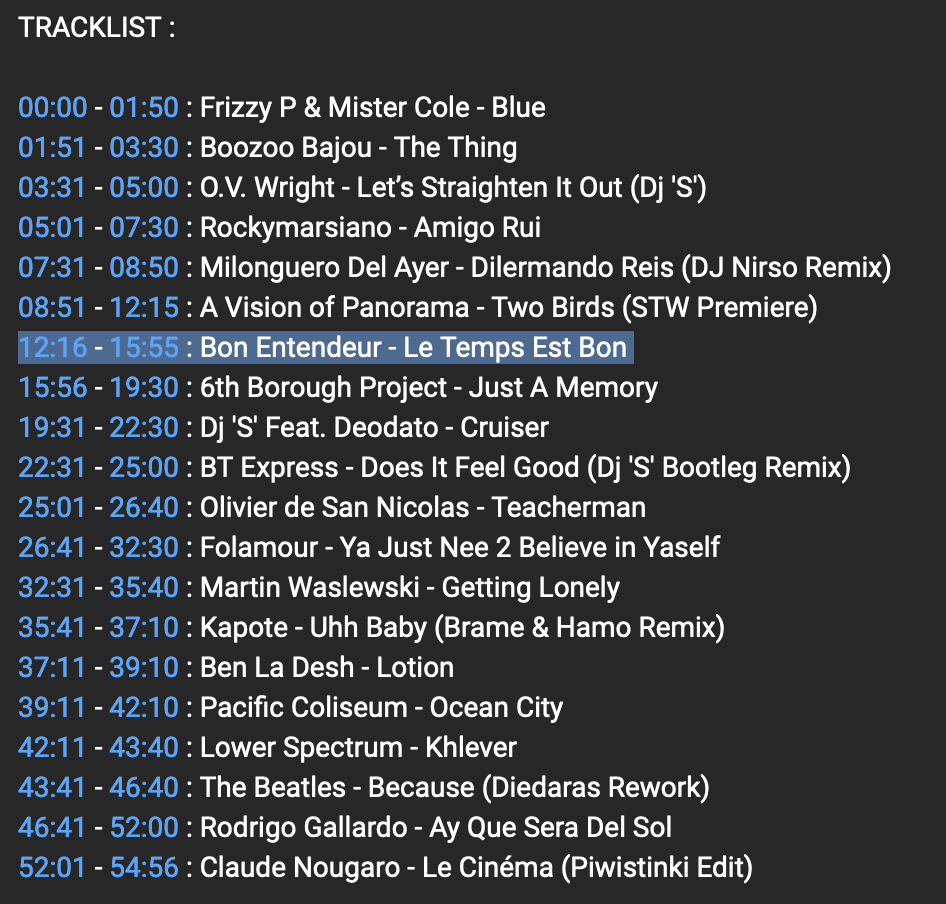
<p class="wp-block-paragraph">Sauf qu&rsquo;il n&rsquo;a pas les droits pour en faire un usage commercial. Et les p&rsquo;tits gars de <a href="https://bonentendeur.com/#decade-2000s">Bon Entendeur</a>, eux, ont fait les démarches pour les avoir, ces droits<sup class="modern-footnotes-footnote modern-footnotes-footnote--hover-on-desktop ">8</sup>. En effet, depuis janvier 2014, presque tous les mois, <a href="https://www.youtube.com/@BonEntendeurMusicFr/videos">le duo sort des mixtapes</a> avec une personnalité en « thème » principal<sup class="modern-footnotes-footnote modern-footnotes-footnote--hover-on-desktop ">9</sup> et c&rsquo;est sur la <a href="https://www.youtube.com/watch?v=xHermBQpx28">Summer Mixtape de 2017</a>, illustrée avec Omar Sy, que le public découvre Le Temps Est Bon, présentée comme « leur » chanson<sup class="modern-footnotes-footnote modern-footnotes-footnote--hover-on-desktop ">10</sup>.</p>


<p class="wp-block-paragraph">Leur remix est moins créatif que celui de Degiheugi côté sampling, mais propose une jolie réorchestration du titre, sorte de « mise à jour » de la chanson qui fonctionne moins pour le dancefloor et plus pour l&rsquo;apéro. </p>


<p class="wp-block-paragraph">Et la maison de disque de Bon Entendeur s&rsquo;assure de garantir les droits de diffusion : la <a href="https://www.discogs.com/fr/release/18544012-Degiheugi-Dancing-Chords-Fireflies">version « Remaster » de Dancing Chords &amp; Fireflies</a>, sortie en 2021, ne contient plus le remix, et l&rsquo;EP « <a href="https://www.discogs.com/release/10450375-Degiheugi-Le-Temps-Est-Bon-Remix-Ep">Le temps est bon – Remix</a> » est tout simplement supprimé des catalogues.</p>


<p class="wp-block-paragraph">Degiheugi est un peu dég&rsquo;<sup class="modern-footnotes-footnote modern-footnotes-footnote--hover-on-desktop ">11</sup> :</p>


<blockquote class="wp-block-quote is-layout-flow wp-block-quote-is-layout-flow">
<p class="wp-block-paragraph">Tout comme le single sorti en 2012, cet EP fut retiré de la vente lors de la sortie d’un remix d’un collectif de DJ et le rachat des droits du sample original par Sony, et une belle chasse au sorcière pour effacer toute trace de ce titre, et ainsi faire oublier qu’ils avaient bien piqué cette belle idée…</p>
<cite><a href="https://www.degiheugi.com/album/le-temps-est-bon-remix-e-p/">Site officiel de Degiheugi</a> (<a href="https://archive.ph/XQ9rj">archive</a>)</cite></blockquote>


<p class="wp-block-paragraph">On trouve en ligne des références à ce « pompage », soit <a href="https://leouestfranc.com/2019/01/12/1apres-avoir-plagie-le-temps-est-bon-de-degiheugi-bon-entendeur-lance-son-nouvel-album-intitule-les-meilleurs-remix-1non-declares-a-la-sacem/">sarcastiques</a> (<a href="https://archive.ph/LjrPT">archive</a>), soit <a href="https://www.20minutes.fr/arts-stars/culture/2565299-20190716-50-ans-apres-creation-comment-chanson-temps-bon-devenue-hymne">plus factuelles</a> (<a href="https://archive.ph/voy4e">archive</a> sans les vidéos). À chacun-e de choisir son camp&#8230;</p>


<p class="wp-block-paragraph">A priori pas de succès international ni même français cette fois, mais le titre reste près de 60 semaines dans le <a href="https://lescharts.com/showitem.asp?interpret=Bon+Entendeur+vs%2E+Isabelle+Pierre&amp;titel=Le+temps+est+bon&amp;cat=s">Top 200 français</a>, avec une pointe à la 58e place pendant l&rsquo;été 2019. <br>Et Bon Entendeur, comme de bien entendu<sup class="modern-footnotes-footnote modern-footnotes-footnote--hover-on-desktop ">12</sup>, de faire la tournée des festivals pendant les étés suivants &#8212; et de <a href="https://vimeo.com/502977571">revendre les droits</a> <a href="https://www.youtube.com/watch?v=4tAOMTxSQBk">pour des</a> <a href="https://www.youtube.com/watch?v=dvd2L6kL0fM">publicités TV</a>.</p>


<h2 class="wp-block-heading">Matt Simons<br>« Catch &amp; Release »</h2>


<div class="wp-block-columns is-layout-flex wp-container-core-columns-is-layout-8f761849 wp-block-columns-is-layout-flex">
<div class="wp-block-column is-layout-flow wp-block-column-is-layout-flow">
<figure class="wp-block-embed is-type-video is-provider-youtube wp-block-embed-youtube wp-embed-aspect-16-9 wp-has-aspect-ratio"><div class="wp-block-embed__wrapper">
<iframe loading="lazy" title="Matt Simons - Catch &amp; Release" width="580" height="326" src="https://www.youtube.com/embed/Mr1sqe_eZq4?feature=oembed" frameborder="0" allow="accelerometer; autoplay; clipboard-write; encrypted-media; gyroscope; picture-in-picture; web-share" referrerpolicy="strict-origin-when-cross-origin" allowfullscreen></iframe>
</div><figcaption class="wp-element-caption">L&rsquo;original, en 2014.</figcaption></figure>
</div>


<div class="wp-block-column is-layout-flow wp-block-column-is-layout-flow">
<figure class="wp-block-embed is-type-video is-provider-youtube wp-block-embed-youtube wp-embed-aspect-16-9 wp-has-aspect-ratio"><div class="wp-block-embed__wrapper">
<iframe loading="lazy" title="Matt Simons - Catch &amp; Release (Deepend remix) - Official Video" width="580" height="326" src="https://www.youtube.com/embed/Rip0bX2qrIs?feature=oembed" frameborder="0" allow="accelerometer; autoplay; clipboard-write; encrypted-media; gyroscope; picture-in-picture; web-share" referrerpolicy="strict-origin-when-cross-origin" allowfullscreen></iframe>
</div><figcaption class="wp-element-caption">Le remix par Deepend, en 2016.</figcaption></figure>
</div>
</div>


<p class="wp-block-paragraph">Revenons à l&rsquo;apaisement&#8230;</p>


<p class="wp-block-paragraph">Catch &amp; Release est une chanson méditative de l&rsquo;américain <a href="https://mattsimonsmusic.com/">Matt&nbsp;Simons</a>, sur le fait de prendre du recul sur les déboires de la vie, et trouver « son » endroit, là où l&rsquo;on peut être soi, en paix. Le refrain nous parle de laisser vivre les moments qui nous touchent au quotidien, <a href="https://en.wikipedia.org/wiki/Catch_and_release">à la manière de la pêche sportive</a><sup class="modern-footnotes-footnote modern-footnotes-footnote--hover-on-desktop ">13</sup>.<br>Accompagné d&rsquo;une rythmique chaloupée<sup class="modern-footnotes-footnote modern-footnotes-footnote--hover-on-desktop ">14</sup>, on se croirait déjà sur un bateau, voguant vers une île isolée<sup class="modern-footnotes-footnote modern-footnotes-footnote--hover-on-desktop ">15</sup>&#8230;</p>


<p class="wp-block-paragraph">Bon, vous connaissez la musique<sup class="modern-footnotes-footnote modern-footnotes-footnote--hover-on-desktop ">16</sup>: DJ qui passe par là, accélération, boum-tsi-boum, paf succès. <br>Cette fois, c&rsquo;est le duo de DJ néerlandais Deepend qui s&#8217;empare du titre (et ne change pas le titre, dingue), l&rsquo;accélère, change la section rythmique, met quelques effets&#8230; et c&rsquo;est le succès dans toute l&rsquo;Europe, en étant <a href="https://en.wikipedia.org/wiki/Catch_%26_Release_(song)#Charts">numéro 1 des ventes</a> dans de nombreux pays.</p>


<blockquote class="wp-block-quote is-layout-flow wp-block-quote-is-layout-flow">
<p class="wp-block-paragraph">Deepend&rsquo;s remix of Matt Simons&rsquo; « Catch &amp; Release » song has become the second most played song on Dutch radio in 2016.</p>
<cite><a href="https://en.wikipedia.org/wiki/Deepend">Page Wikipédia de Deepend</a>.</cite></blockquote>


<p class="wp-block-paragraph">Bien.</p>


<p class="wp-block-paragraph">Pour la bonne bouche, j&rsquo;ajoute une reprise, qui précède d&rsquo;ailleurs le succès international du remix de Deepend : en 2015, <a href="https://julienmueller.com/">Julien « Voicycle » Muller</a>, « <em>evercycling gypsy troubadour</em> » allemand installé à La Rochelle<sup class="modern-footnotes-footnote modern-footnotes-footnote--hover-on-desktop ">17</sup> reprend la chanson de Matt Simons à la guitare, en faisant de belles harmonies avec l&rsquo;allemande <a href="https://brockhoffmusic.com/">Lina&nbsp;Brockhoff</a>, au piano pour sa part<sup class="modern-footnotes-footnote modern-footnotes-footnote--hover-on-desktop ">18</sup>.</p>


<figure class="wp-block-embed is-type-video is-provider-youtube wp-block-embed-youtube wp-embed-aspect-16-9 wp-has-aspect-ratio"><div class="wp-block-embed__wrapper">
<iframe loading="lazy" title="Catch &amp; Release - Matt Simons [Cover] by Julien Mueller &amp; Lina" width="580" height="326" src="https://www.youtube.com/embed/MPLUllINDSY?feature=oembed" frameborder="0" allow="accelerometer; autoplay; clipboard-write; encrypted-media; gyroscope; picture-in-picture; web-share" referrerpolicy="strict-origin-when-cross-origin" allowfullscreen></iframe>
</div><figcaption class="wp-element-caption">La reprise par Julien Muller &amp; Lina Brockhoff, en 2015.</figcaption></figure>


<p class="wp-block-paragraph">Pour le coup la chanson est ralentie (71 BPM au lieu de 87), et les harmonies sont beaucoup plus jolies que sur l&rsquo;original, je trouve &#8212; notamment la note tenue sur « <em>&#8230;and find how faaaaaar to go&#8230;</em>« . <br>Pas de succès international pour eux deux hélas, mais leur version mérite largement d&rsquo;être écoutée et partagée. Dont acte.</p>


<hr class="wp-block-separator has-alpha-channel-opacity"/>


<p class="wp-block-paragraph">Bien sûr, je pourrai continuer sur plusieurs pages<sup class="modern-footnotes-footnote modern-footnotes-footnote--hover-on-desktop ">19</sup> <sup class="modern-footnotes-footnote modern-footnotes-footnote--hover-on-desktop ">20</sup>. Mais stoppons là notre étude.</p>


<p class="wp-block-paragraph">Les plus attentifs parmi vous n&rsquo;auront cependant pas manqué de noter l&rsquo;absence d&rsquo;un titre très précis. <br>Un titre dont tout le monde connaît le remix au point d&rsquo;avoir oublié même l&rsquo;existence de l&rsquo;original. <br><br><em>The Mother of All Success Remixes.</em> <br><br><img src="https://s.w.org/images/core/emoji/17.0.2/72x72/1f941.png" alt="🥁" class="wp-smiley" style="height: 1em; max-height: 1em;" /><img src="https://s.w.org/images/core/emoji/17.0.2/72x72/1f941.png" alt="🥁" class="wp-smiley" style="height: 1em; max-height: 1em;" /><img src="https://s.w.org/images/core/emoji/17.0.2/72x72/1f941.png" alt="🥁" class="wp-smiley" style="height: 1em; max-height: 1em;" /><br><br>Je parle bien sûr de « Missing », du groupe anglais <a href="https://ebtg.com/">Everything But The Girl</a>.<sup class="modern-footnotes-footnote modern-footnotes-footnote--hover-on-desktop ">21</sup></p>


<div class="wp-block-columns is-layout-flex wp-container-core-columns-is-layout-8f761849 wp-block-columns-is-layout-flex">
<div class="wp-block-column is-layout-flow wp-block-column-is-layout-flow">
<figure class="wp-block-embed is-type-video is-provider-youtube wp-block-embed-youtube wp-embed-aspect-4-3 wp-has-aspect-ratio"><div class="wp-block-embed__wrapper">
<iframe loading="lazy" title="Everything But The Girl - Missing (Official Music Video)" width="580" height="435" src="https://www.youtube.com/embed/U56Ns66Qrb8?feature=oembed" frameborder="0" allow="accelerometer; autoplay; clipboard-write; encrypted-media; gyroscope; picture-in-picture; web-share" referrerpolicy="strict-origin-when-cross-origin" allowfullscreen></iframe>
</div><figcaption class="wp-element-caption">L&rsquo;original, en 1994.</figcaption></figure>
</div>


<div class="wp-block-column is-layout-flow wp-block-column-is-layout-flow">
<figure class="wp-block-embed is-type-video is-provider-youtube wp-block-embed-youtube wp-embed-aspect-4-3 wp-has-aspect-ratio"><div class="wp-block-embed__wrapper">
<iframe loading="lazy" title="Everything But The Girl - Missing (Todd Terry Remix) [Official Music Video]" width="580" height="435" src="https://www.youtube.com/embed/IAkY5m00rpY?feature=oembed" frameborder="0" allow="accelerometer; autoplay; clipboard-write; encrypted-media; gyroscope; picture-in-picture; web-share" referrerpolicy="strict-origin-when-cross-origin" allowfullscreen></iframe>
</div><figcaption class="wp-element-caption">Le remix par Todd Terry, en 1995.</figcaption></figure>
</div>
</div>


<blockquote class="wp-block-quote is-layout-flow wp-block-quote-is-layout-flow">
<p class="wp-block-paragraph">It initially did not achieve much success until it was remixed by Todd Terry and re-released in 1995, resulting in worldwide success, peaking at or near the top of the charts in many countries.</p>
<cite><a href="https://en.wikipedia.org/wiki/Missing_(Everything_but_the_Girl_song)">Page Wikipedia de la chanson « Missing »</a></cite></blockquote>


<p class="wp-block-paragraph">Sauf que c&rsquo;est typiquement l&rsquo;exception qui infirme la règle que j&rsquo;ai mise en place pour cet article : le remix de Todd Terry a strictement le même tempo que l&rsquo;original, 123 BPM&#8230; au point qu&rsquo;ils ont même pu réutiliser le clip vidéo de l&rsquo;un pour illustrer l&rsquo;autre <img src="https://s.w.org/images/core/emoji/17.0.2/72x72/1f642.png" alt="🙂" class="wp-smiley" style="height: 1em; max-height: 1em;" /></p>


<p class="wp-block-paragraph">Donc, ne l&rsquo;incluons pas dans notre tableau. <br>Tableau ? Oui, car tableau il va y avoir. Lisez donc&#8230;</p>


<h2 class="wp-block-heading">Les conclusions <br>que l&rsquo;on peut en tirer</h2>


<p class="wp-block-paragraph">On notera que l&rsquo;un des points clefs des remix sus-cités, outre le boum-tsi-boum de bon aloi, est le tempo du remix : celui-ci a un BPM<sup class="modern-footnotes-footnote modern-footnotes-footnote--hover-on-desktop ">22</sup> plus rapide que l&rsquo;original.</p>


<p class="wp-block-paragraph">Faisons, donc, un tableau comparatif.</p>


<figure class="wp-block-table"><table><tbody><tr><td class="has-text-align-right" data-align="right"><strong>Titre</strong></td><td class="has-text-align-center" data-align="center"><strong>BPM de l&rsquo;original</strong></td><td class="has-text-align-center" data-align="center"><strong>BPM du&nbsp;remix</strong></td><td><strong>Différence de&nbsp;BPM</strong></td></tr><tr><td class="has-text-align-right" data-align="right">Reckoning Song /&nbsp;One&nbsp;Day</td><td class="has-text-align-center" data-align="center">104</td><td class="has-text-align-center" data-align="center">119</td><td>+14.42%</td></tr><tr><td class="has-text-align-right" data-align="right">The Fade Out Line /&nbsp;Fade&nbsp;Out Lines</td><td class="has-text-align-center" data-align="center">104</td><td class="has-text-align-center" data-align="center">119</td><td>+14.42%</td></tr><tr><td class="has-text-align-right" data-align="right">Prayer In C</td><td class="has-text-align-center" data-align="center">94</td><td class="has-text-align-center" data-align="center">123</td><td>+30.85%</td></tr><tr><td class="has-text-align-right" data-align="right">Le Temps Est Bon</td><td class="has-text-align-center" data-align="center">82</td><td class="has-text-align-center" data-align="center">98⨓</td><td>+19.51%</td></tr><tr><td class="has-text-align-right" data-align="right">Catch &amp; Release</td><td class="has-text-align-center" data-align="center">87</td><td class="has-text-align-center" data-align="center">105℘</td><td>+20.68%</td></tr><tr><td class="has-text-align-right" data-align="right"><em>Moyenne</em></td><td class="has-text-align-center" data-align="center"><em>94,2</em></td><td class="has-text-align-center" data-align="center"><em>112,8</em></td><td><em>+19.74%</em></td></tr></tbody></table><figcaption class="wp-element-caption">BPM tirés en majorité de la base <a href="https://songbpm.com/">SongBPM</a>.<br>⨓ : Le remix « officiel » de Bon Entendeur, pas le remix initial de Degiheugi.<br>℘ : Le remix de Deepend, pas la reprise de Julien Muller &amp; Lina Brockhoff.</figcaption></figure>


<p class="wp-block-paragraph">Deux remarques mineures :</p>


<ul class="wp-block-list">
<li>Égalité totale entre Reckoning Song et The Fade Out Line, j&rsquo;en suis le premier surpris. Les motifs, tout ça&#8230;</li>


<li>Prayer In C a été accéléré de plus de <em>30%</em> ! &lsquo;faut dire que la chansons originale est <em>vrrraiment</em> lente, et le remix est le plus rapide de notre liste.</li>
</ul>


<p class="wp-block-paragraph">Et une remarque majeure : partant de ce postulat, on peut stipuler qu&rsquo;en prenant n&rsquo;importe quel titre un peu folk/lent, en l&rsquo;accélérant et en ajoutant du boum-tsi-boum, on peut créer un tube national, voire international &#8212; et ce faisant, relancer la carrière d&rsquo;un groupe en quête de succès<sup class="modern-footnotes-footnote modern-footnotes-footnote--hover-on-desktop ">23</sup>.</p>


<p class="wp-block-paragraph">Mais il y a certainement une science de l&rsquo;accélération et du boum-tsi-boum&#8230; Fondamentalement, en changeant le tempo, <a href="https://learningmusic.ableton.com/fr/make-beats/tempo-and-genre.html">on change le genre musical</a>, le meilleur exemple étant sans doute la bossa nova, qui est « juste » de la samba <a href="https://www.youtube.com/watch?v=V-_hrGnuBoM">détendue</a><sup class="modern-footnotes-footnote modern-footnotes-footnote--hover-on-desktop ">24</sup>. <br>En l&rsquo;occurrence, pour avoir du succès et devenir un hit des dancefloors, il faut apparemment (selon notre tableau de mesures) monter au-dessus de 120 BPM, et donc que le remix tienne de la dance music, du disco ou de la house music.</p>


<blockquote class="wp-block-quote is-layout-flow wp-block-quote-is-layout-flow">
<p class="wp-block-paragraph">La house est un style musical au tempo relativement rapide. Les tempos standards de la dance moderne sont moins élevés, généralement entre 118 et 135 BPM — à peu près 10 BPM de moins que le disco.</p>
<cite><a href="https://fr.wikipedia.org/wiki/House_music">Page Wikipédia sur la House music</a></cite></blockquote>


<p class="wp-block-paragraph">On voit clairement que les artistes qui ont remixé Asaf&nbsp;Avidan &amp;&nbsp;the&nbsp;Mojos, Phoebe&nbsp;Killdeer &amp;&nbsp;the&nbsp;Short&nbsp;Straws et Lilly&nbsp;Wood &amp;&nbsp;the&nbsp;Prick visaient les dancefloors<sup class="modern-footnotes-footnote modern-footnotes-footnote--hover-on-desktop ">25</sup>, avec un BPM oscillant entre 119 et 123 &#8212; ce dernier étant accessoirement le même BPM que le titre « Missing » de Everything But The Girl, tant l&rsquo;original que le remix.<br>Ceux derrière Le Temps Est Bon et Catch &amp; Release, entre 98 et 105 BPM, visaient plutôt le début de soirée et le cocktail de mariage.</p>


<p class="wp-block-paragraph">Nous avons donc la recette d&rsquo;un succès <em>imparable</em> :</p>


<ol class="wp-block-list">
<li><strong>Dégotter une chanson</strong> peu connue voire oubliée<sup class="modern-footnotes-footnote modern-footnotes-footnote--hover-on-desktop ">26</sup>, avec une ligne vocale plutôt sympa et <a href="https://fr.wikipedia.org/wiki/Accroche_(musique)">accrocheuse</a> (un « <a href="https://en.wikipedia.org/wiki/Hook_(music)">hook</a>« )<sup class="modern-footnotes-footnote modern-footnotes-footnote--hover-on-desktop ">27</sup>.
<ul class="wp-block-list">
<li>Idéalement, il faut une chanson avec l&rsquo;orchestration la plus légère possible, histoire que l&rsquo;on puisse facilement l&rsquo;éliminer et la remplacer par la sienne propre. Donc, sans doute de la folk, un truc guitare-voix ou piano-voix un peu lancinant&#8230;</li>
</ul>
</li>


<li><strong>Accélérer son tempo</strong> jusqu&rsquo;à 100 voire 120 BPM, grosso modo et selon le bon sens de l&rsquo;oreille qui remixe.</li>


<li><strong>Rajouter le « boum-tsi-boum »</strong>, nécessaire motif (&#8230;) rythmique &#8212; bien calé sur le temps, en bon « <a href="https://en.wikipedia.org/wiki/Four_on_the_floor_(music)">four on the floor</a> » <sup class="modern-footnotes-footnote modern-footnotes-footnote--hover-on-desktop ">28</sup>. </li>


<li><strong>Mettre quelques effets</strong> à gauche à droite.</li>


<li>Et <em>voilà</em> !</li>
</ol>


<p class="wp-block-paragraph">Il y a d&rsquo;autres détails, mais je pense que nous avons là l&rsquo;essentiel.</p>


<h2 class="wp-block-heading">Poussons le bouchon<br>un peu trop loin</h2>


<p class="wp-block-paragraph">Dans une <a href="https://www.youtube.com/watch?v=_beZ07o91rg&amp;t=40s">vidéo récente</a><sup class="modern-footnotes-footnote modern-footnotes-footnote--hover-on-desktop ">29</sup>, j&rsquo;ai entendu la phrase suivante :</p>


<blockquote class="wp-block-quote is-layout-flow wp-block-quote-is-layout-flow">
<p class="wp-block-paragraph">Once you recognize patterns, you can repeat them. (&#8230;) <br>Pattern recognition is how we learn as humans.</p>
<cite><a href="https://bsky.app/profile/lambduhhh.bsky.social">Jordan Miller</a>, lors de sa conférence « How to Find the Write Rhythm for your Software Composition » pour <a href="https://2023.clojure-conj.org/">Clojure/conj 2023</a> (<a href="https://youtu.be/_beZ07o91rg?t=485">à 8&rsquo;05</a>).</cite></blockquote>


<p class="wp-block-paragraph">Supposément, donc, ayant reconnu ce motif de « je trouve un titre lent, je l&rsquo;accélère, je lui ajoute du boum-tsi-boum et quelques effets » pour parvenir à un tube, on devrrrrrrait pouvoir facilement avoir de l&rsquo;or en barres entre nos oreilles.</p>


<p class="wp-block-paragraph">&nbsp;&nbsp;&nbsp;</p>


<p class="wp-block-paragraph">Facile. Fingers in ze nose.</p>


<p class="wp-block-paragraph">&nbsp;&nbsp;&nbsp;</p>


<p class="wp-block-paragraph"><em>* soupir *</em></p>


<p class="wp-block-paragraph">&nbsp;&nbsp;&nbsp;</p>


<p class="wp-block-paragraph">Je vais donc tester pour vous.</p>


<p class="wp-block-paragraph">&nbsp;&nbsp;</p>


<p class="has-text-align-right wp-block-paragraph"><em>&#8230; dans une seconde partie à venir <img src="https://s.w.org/images/core/emoji/17.0.2/72x72/1f642.png" alt="🙂" class="wp-smiley" style="height: 1em; max-height: 1em;" /></em></p>


<p class="wp-block-paragraph"></p>
<div>1&nbsp;&nbsp;&nbsp;&nbsp;Bon, vu le chiffres de ventes/diffusions des remix, gageons que la satisfaction pécuniaire est là, ou du moins que la tristesse trouve sa compensation. Ah mince, je viens de répondre à ma question principale pour cet article ! Bon, mettons que vous n&rsquo;avez rien vu.</div><div>2&nbsp;&nbsp;&nbsp;&nbsp;Selon moi le meilleur chanteur d&rsquo;Archive, mais je digresse&#8230;</div><div>3&nbsp;&nbsp;&nbsp;&nbsp;Ça doit faire tout de même faire mal aux fesses quand Wikipédia parle de ta chanson en ouvrant d&rsquo;abord sur le mec qui l&rsquo;a remixée, et avec le mauvais titre&#8230;</div><div>4&nbsp;&nbsp;&nbsp;&nbsp;Elle a été écrite pour le film <a href="https://www.youtube.com/watch?v=kgknSm7eesg">Les mâles</a>, une comédie dans laquelle deux hommes qui ont fui la société décident de combler leur manque de présence féminine&#8230; en kidnappant une jolie infirmière du village voisin, par ailleurs fille du chef de police, provoquant recherches et rencontres de personnages hauts en couleur.</div><div>5&nbsp;&nbsp;&nbsp;&nbsp;<strong>trouple</strong> \tʁupl\ masculin <em>(Famille)</em> Couple à trois.</div><div>6&nbsp;&nbsp;&nbsp;&nbsp;« Ni Français, ni Breton, Malouin suis », <a href="https://fr.wikipedia.org/wiki/R%C3%A9publique_de_Saint-Malo">telle est leur devise</a> :)</div><div>7&nbsp;&nbsp;&nbsp;&nbsp;Jérôme Vildaer, dont l&rsquo;alias initial était DJ&nbsp;E-J. Maintenant vous arrivez mieux à prononcer son pseudo.</div><div>8&nbsp;&nbsp;&nbsp;&nbsp;On peut admirer l&rsquo;effort : « A l’été 2018, le manager du groupe fonce au Québec, y retrouve la piste de Stéphane Venne et surtout celle d’Isabelle Pierre (via l’annuaire !) aujourd’hui représentée par un ayant-droit. Un accord est alors trouvé entre les parties pour exploiter la chanson, caution financière à l’appui. » (<a href="https://www.20minutes.fr/arts-stars/culture/2565299-20190716-50-ans-apres-creation-comment-chanson-temps-bon-devenue-hymne">20 minutes</a>)</div><div>9&nbsp;&nbsp;&nbsp;&nbsp;Dont DSK, Chirac, Rhabi, Beigbeder, &#8230; Parfois une certaine vision de la France, quoi.</div><div>10&nbsp;&nbsp;&nbsp;&nbsp;<a href="https://xavier.borderie.net/blog/wp-content/uploads/2024/11/Youtube-BonEntendeur-Ensemble-Summer-2017-.png" data-type="attachment" data-id="3823">La setlist</a> indique « 12:16 &#8211; 15:55 : Bon Entendeur &#8211; Le Temps Est Bon ». Aucune mention d&rsquo;Isabelle Pierre ici, alors que toutes les autres chansons sont correctement attribuées. Y&rsquo;a sûrement une raison valable, hein.</div><div>11&nbsp;&nbsp;&nbsp;&nbsp;Pun intended.</div><div>12&nbsp;&nbsp;&nbsp;&nbsp;Hoho !</div><div>13&nbsp;&nbsp;&nbsp;&nbsp;Kamoulox.</div><div>14&nbsp;&nbsp;&nbsp;&nbsp;Vous aussi vous vous attendiez à entendre Laurent Voulzy au début ?</div><div>15&nbsp;&nbsp;&nbsp;&nbsp;C&rsquo;est d&rsquo;ailleurs l&rsquo;imagerie du clip, je ne suis pas allé chercher l&rsquo;idée bien loin.</div><div>16&nbsp;&nbsp;&nbsp;&nbsp;Hoho !</div><div>17&nbsp;&nbsp;&nbsp;&nbsp;Où il <a href="https://www.youtube.com/watch?v=56ThcX8x63g">joue sur le port</a> et <a href="https://www.instagram.com/reel/Cs0mpK2o3hx/">chante lors de mariages</a>, quand il ne parcourt pas l&rsquo;<a href="https://www.instagram.com/p/DBMPb1ytZwT/?img_index=1">Europe à vélo</a> ou <a href="https://julienmueller.com/release/a-minute-after-all/">produit ses propres chansons</a>.</div><div>18&nbsp;&nbsp;&nbsp;&nbsp;Peu visible sur la vidéo, mais le piano est bien là. Il est plus visible sur <a href="https://www.youtube.com/watch?v=0vNYH5Kxh_g">cette autre reprise</a> du duo.</div><div>19&nbsp;&nbsp;&nbsp;&nbsp;Au moins <s>trois</s> deux !</div><div>20&nbsp;&nbsp;&nbsp;&nbsp;Par exemple, « I Follow Rivers » de Lykke Li, « Tom&rsquo;s Diner » de Suzanne Vega, « I Took a Pill in Ibiza » de Mike Posner, « Lights » d&rsquo;Ellie Goulding, etc.</div><div>21&nbsp;&nbsp;&nbsp;&nbsp;Et non, désolé, pas « Professional Widow » de Tori Amos, sorti en 1996 et remixé la même année &#8212; avec l&rsquo;approbation d&rsquo;Amos &#8212; par Armand van Helden. Car, bon, je ne l&rsquo;ai jamais vu comme un remix, plutôt une création originale de van Helden sur laquelle il a collé des samples de Tori Amos pour remplir le contrat. Meh.</div><div>22&nbsp;&nbsp;&nbsp;&nbsp;Beats Per Minute, ou Battements Par Minute. Comme votre coeur, oui. N&rsquo;oubliez pas de dire à vos amis que vous avez trouvé cette info sur un blog culturel.</div><div>23&nbsp;&nbsp;&nbsp;&nbsp;Ou lui voler la reconnaissance qui lui est due, c&rsquo;est selon.</div><div>24&nbsp;&nbsp;&nbsp;&nbsp;J&rsquo;adore le fait que « Bossa Nova », « New Wave » et « Nouvelle Vague » sont un même nom pour des formes artistiques très différentes. C&rsquo;est d&rsquo;ailleurs toute la blague du groupe français Nouvelle Vague, qui initialement reprenait des morceaux de New Wave à la manière de chansons Bossa Nova, avec différentes chanteuses &#8212; dont la Phoebe Killdeer sus-nommée. Quel blog culturel, tout d&rsquo;même !</div><div>25&nbsp;&nbsp;&nbsp;&nbsp;Je n&rsquo;ai aucune assurance sur le fait que remixer un groupe avec « &amp; » dans son nom puisse forcément aboutir à un succès international, notez.</div><div>26&nbsp;&nbsp;&nbsp;&nbsp;C&rsquo;est plus facile pour obtenir les droits&#8230;</div><div>27&nbsp;&nbsp;&nbsp;&nbsp;Dixit WP&nbsp;: « Une accroche est un motif utilisé dans la musique populaire ». Motif ! On y revient&nbsp;: <em>it&rsquo;s <a href="https://en.wikipedia.org/wiki/Turtles_all_the_way_down">patterns all the way down</a></em>.</div><div>28&nbsp;&nbsp;&nbsp;&nbsp;Un blog culturel, je vous dis !</div><div>29&nbsp;&nbsp;&nbsp;&nbsp;Oui, je fais une veille sur la rédaction technique, et parfois je retiens des idées.</div>]]></content>
		
					<link rel="replies" type="text/html" href="https://xavier.borderie.net/blog/2025/11/03/tempo-d-un-succes/#comments" thr:count="2" />
			<link rel="replies" type="application/atom+xml" href="https://xavier.borderie.net/blog/2025/11/03/tempo-d-un-succes/feed/atom/" thr:count="2" />
			<thr:total>2</thr:total>
			</entry>
		<entry>
		<author>
			<name>Xavier</name>
							<uri>http://xavier.borderie.net</uri>
						</author>

		<title type="html"><![CDATA[Soundtracker Origins, interlude: The coders behind the Cambrian explosion]]></title>
		<link rel="alternate" type="text/html" href="https://xavier.borderie.net/blog/2024/03/19/soundtracker-origins-interlude-exploring-the-cambrian-explosion/" />

		<id>https://xavier.borderie.net/blog/?p=3275</id>
		<updated>2026-02-26T11:42:17Z</updated>
		<published>2024-03-19T22:30:32Z</published>
		<category scheme="https://xavier.borderie.net/blog" term="Musique" /><category scheme="https://xavier.borderie.net/blog" term="technologies" />
		<summary type="html"><![CDATA[Remember Part 31 of this series of articles on Soundtracker? Those were the days! I fondly remember writing the following, near the end of that article: Good times! Look at me, making sincere promises and everything: But where&#8217;s the fun in that? I say we go the usual ADHD route: stop at 80% completion, and [&#8230;]]]></summary>

					<content type="html" xml:base="https://xavier.borderie.net/blog/2024/03/19/soundtracker-origins-interlude-exploring-the-cambrian-explosion/"><![CDATA[<span class="span-reading-time rt-reading-time" style="display: block;"><span class="rt-label rt-prefix">Temps de lecture / Reading time : </span> <span class="rt-time"> 49</span> <span class="rt-label rt-postfix">minutes.</span></span>
<p class="wp-block-paragraph">Remember <a href="https://xavier.borderie.net/blog/2023/10/25/soundtracker-origins-part-3-facing-a-stone-mountain/" data-type="post" data-id="2820">Part 3</a><sup class="modern-footnotes-footnote modern-footnotes-footnote--hover-on-desktop ">1</sup> of this series of articles on Soundtracker? <br>Those were the <em>days</em>! </p>


<p class="wp-block-paragraph">I fondly remember writing the following, near the end of that article:</p>


<blockquote class="wp-block-quote is-layout-flow wp-block-quote-is-layout-flow">
<p class="wp-block-paragraph">The next parts will focus on each of the two parallel paths that I highlighted above:</p>


<ul class="wp-block-list">
<li>The Fairlight CMI path: finding out how they came up with the idea for their Page R sequencer.</li>


<li>The « Commodore » path, going down the JMS rabbit hole, and their Multitrack Composer.</li>
</ul>


<p class="wp-block-paragraph">Will there be more parts? Who knows? I sure don’t!</p>
<cite>Me, the hopeful pessimist.</cite></blockquote>


<p class="wp-block-paragraph">Good times! Look at me, making sincere promises and everything:</p>


<ul class="wp-block-list">
<li>Sure, I could easily write that Fairlight CMI article, mostly just by copy-pasting the content of email answers dating back from 2019. </li>


<li>And as for the Jellinghaus (JMS) article, along with a couple other ideas thrown in in order to tie it all together, well it&rsquo;s a quick road to publication, methinks.</li>
</ul>


<p class="wp-block-paragraph"><em>But where&rsquo;s the fun in that? </em></p>


<p class="wp-block-paragraph">I say we go the usual ADHD route: stop at 80% completion, and start something new altogether!<sup class="modern-footnotes-footnote modern-footnotes-footnote--hover-on-desktop ">2</sup></p>


<p class="wp-block-paragraph">Let me therefore add an interlude to this series of articles, in order to tell you a story. </p>


<p class="wp-block-paragraph">A story of pioneers, of sharing, of standing upon the shoulders of giants, of youth, of friendly competition, and of bad blood. <br>A story of humans making History without even knowing it.</p>


<p class="wp-block-paragraph">As with all good, heartwarming stories, it starts with&#8230;</p>


<span id="more-3275"></span>


<h2 class="wp-block-heading">A graph</h2>


<p class="wp-block-paragraph">Behold!</p>


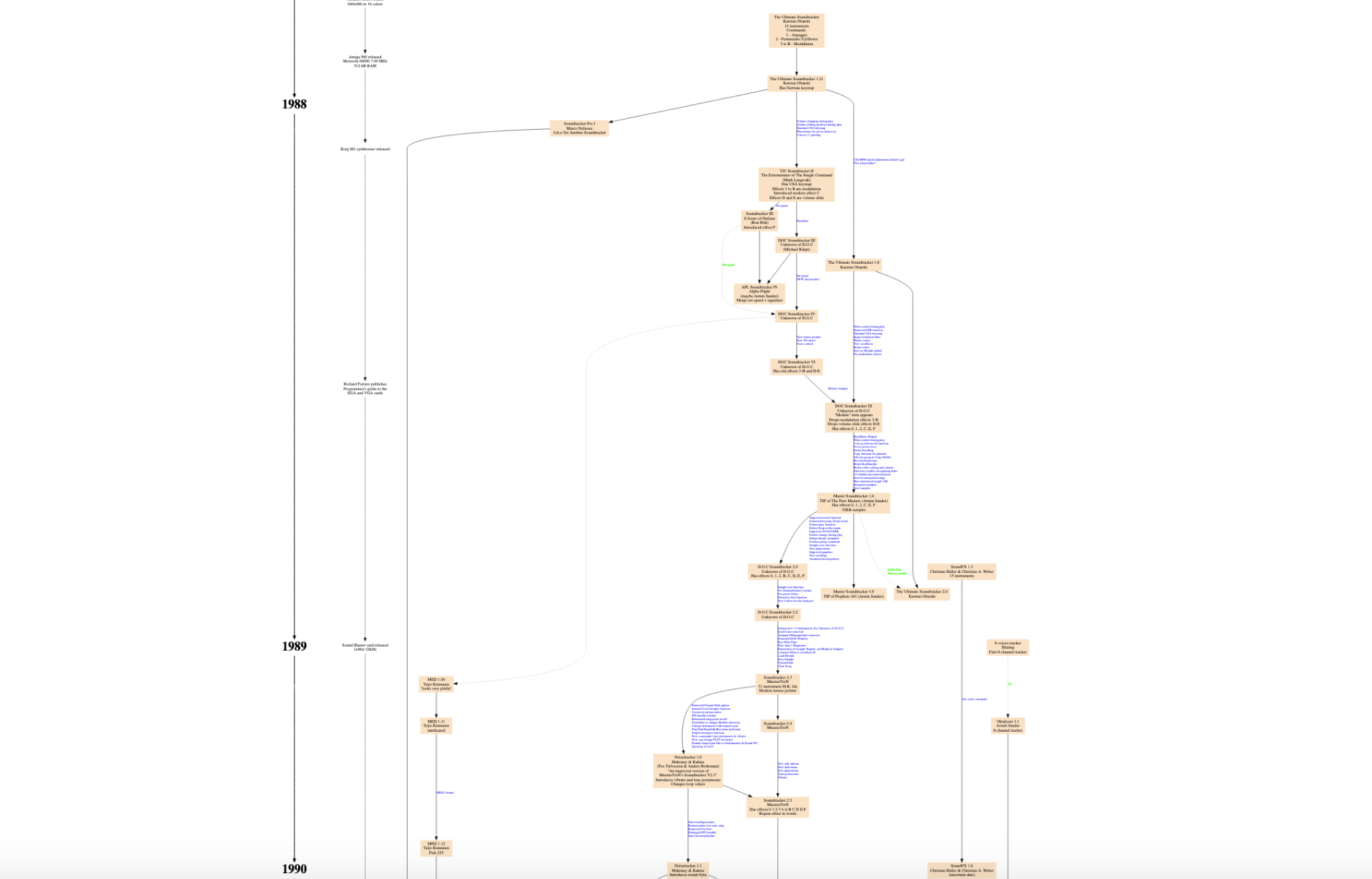
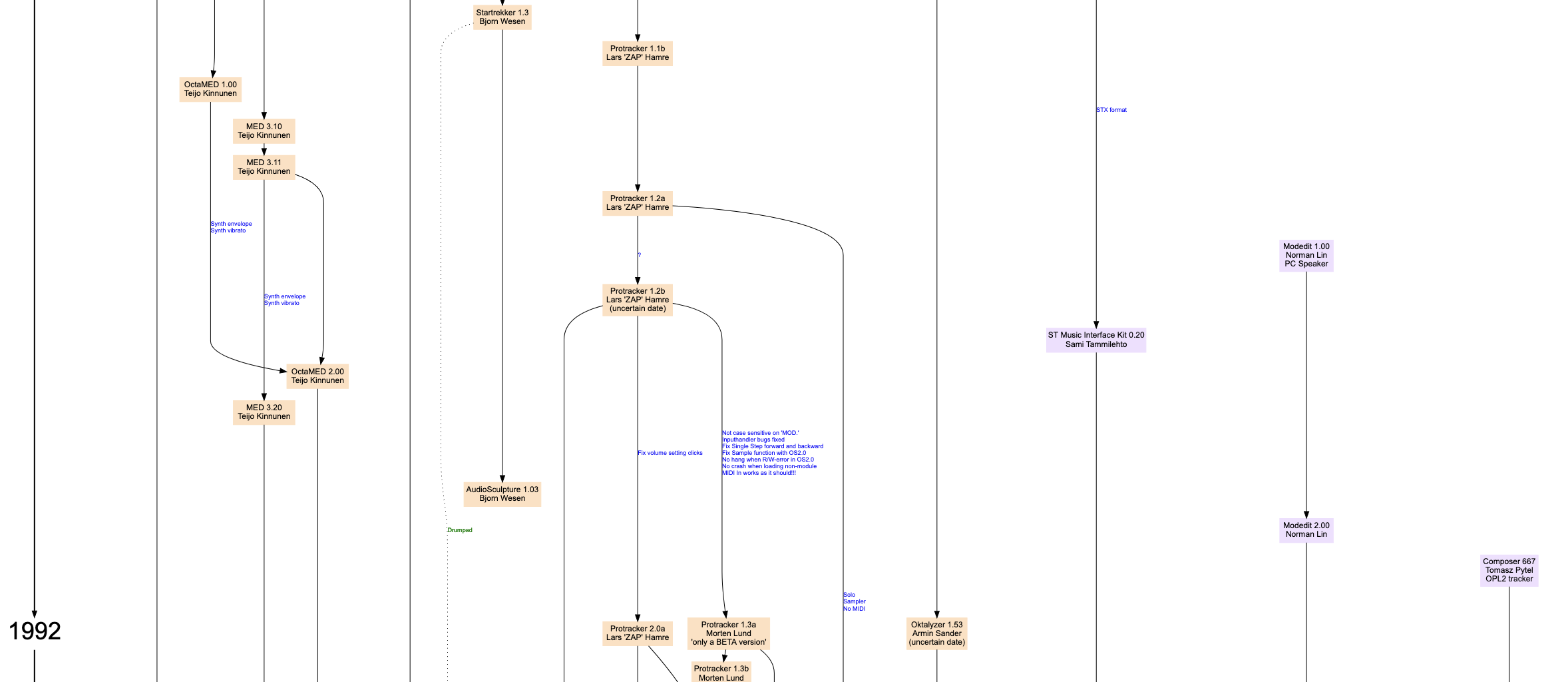
<figure class="wp-block-image alignwide size-full"><img loading="lazy" decoding="async" width="2560" height="481" src="https://xavier.borderie.net/blog/wp-content/uploads/2024/02/Trackers-historygraph-2012-01-scaled.jpg" alt="" class="wp-image-3371" srcset="https://xavier.borderie.net/blog/wp-content/uploads/2024/02/Trackers-historygraph-2012-01-scaled.jpg 2560w, https://xavier.borderie.net/blog/wp-content/uploads/2024/02/Trackers-historygraph-2012-01-200x38.jpg 200w, https://xavier.borderie.net/blog/wp-content/uploads/2024/02/Trackers-historygraph-2012-01-450x85.jpg 450w, https://xavier.borderie.net/blog/wp-content/uploads/2024/02/Trackers-historygraph-2012-01-768x144.jpg 768w, https://xavier.borderie.net/blog/wp-content/uploads/2024/02/Trackers-historygraph-2012-01-1536x289.jpg 1536w, https://xavier.borderie.net/blog/wp-content/uploads/2024/02/Trackers-historygraph-2012-01-2048x385.jpg 2048w, https://xavier.borderie.net/blog/wp-content/uploads/2024/02/Trackers-historygraph-2012-01-1200x226.jpg 1200w, https://xavier.borderie.net/blog/wp-content/uploads/2024/02/Trackers-historygraph-2012-01-1980x372.jpg 1980w" sizes="auto, (max-width: 2560px) 100vw, 2560px" /><figcaption class="wp-element-caption">Long graph is long. So long that this is actually rotated 90° so that you can enjoy its sheer magnitude. <br>In the image above, years are at the bottom, colored blocks represent each Soundtracker-like release, lines show the lineage between them, and blue text indicate new features between two releases.</figcaption></figure>


<p class="wp-block-paragraph">On November 4th, 2007, Claudio Matsuoka <a href="https://github.com/cmatsuoka/tracker-history/commit/d62421417306252241ae3f5908fd16cf44bf19cd">pushed the first commit</a> of a very useful<sup class="modern-footnotes-footnote modern-footnotes-footnote--hover-on-desktop ">3</sup>, techno-archeological project: the Tracker History Graphing Project. </p>


<p class="wp-block-paragraph">That graph above presents a « family tree » of all known trackers, from Karsten Obarski&rsquo;s original in 1987, to Olav « <a href="https://demozoo.org/sceners/69313/">8bitbubsy</a> » Sørensen&rsquo;s <a href="https://16-bits.org/">clones/ports of ProTracker v2.3D and Fasttracker II</a> started in 2019.</p>


<blockquote class="wp-block-quote is-layout-flow wp-block-quote-is-layout-flow">
<p class="wp-block-paragraph">Inspired by the <a href="https://web.archive.org/web/20110726144718/http://minnie.tuhs.org/Unix_History/index.html">UNIX History Graphing Project</a>, the objective is to collect release dates and dependencies of music trackers and produce a graph of the lineage of music trackers in different operating systems.</p>
<cite>From the <a href="https://web.archive.org/web/20110726144718/http://helllabs.org/tracker-history/">original homepage at helllabs.org</a>.</cite></blockquote>


<p class="wp-block-paragraph">For 12 years, until his <a href="https://github.com/cmatsuoka/tracker-history/commit/b9c07d3a745f49b6efdf767c983ddef24c9522c0">last commit in July 2019</a>, Claudio explored the insides of all Soundtracker-like tools that he could find, reading through their documentation or even their source code when available, in order to discover who did what first, and who got inspired by whom.</p>


<p class="wp-block-paragraph">Then he seemingly abandoned the project: There hasn&rsquo;t been any further commit since July 2019, and the helllabs.org domain that hosted it <a href="https://web.archive.org/web/20230921231658/http://helllabs.org/">has been down since 2023</a><sup class="modern-footnotes-footnote modern-footnotes-footnote--hover-on-desktop ">4</sup> <sup class="modern-footnotes-footnote modern-footnotes-footnote--hover-on-desktop ">5</sup> It could be because Claudio joined <a href="https://canonical.com/">Canonical</a> in January 2019<sup class="modern-footnotes-footnote modern-footnotes-footnote--hover-on-desktop ">6</sup>, or simply because, <a href="https://web.archive.org/web/20060417192641/http://diveintomark.org/archives/2004/10/18/exit">in the words of Mark Pilgrim</a>, it was time for him to find a new hobby<sup class="modern-footnotes-footnote modern-footnotes-footnote--hover-on-desktop ">7</sup>.</p>


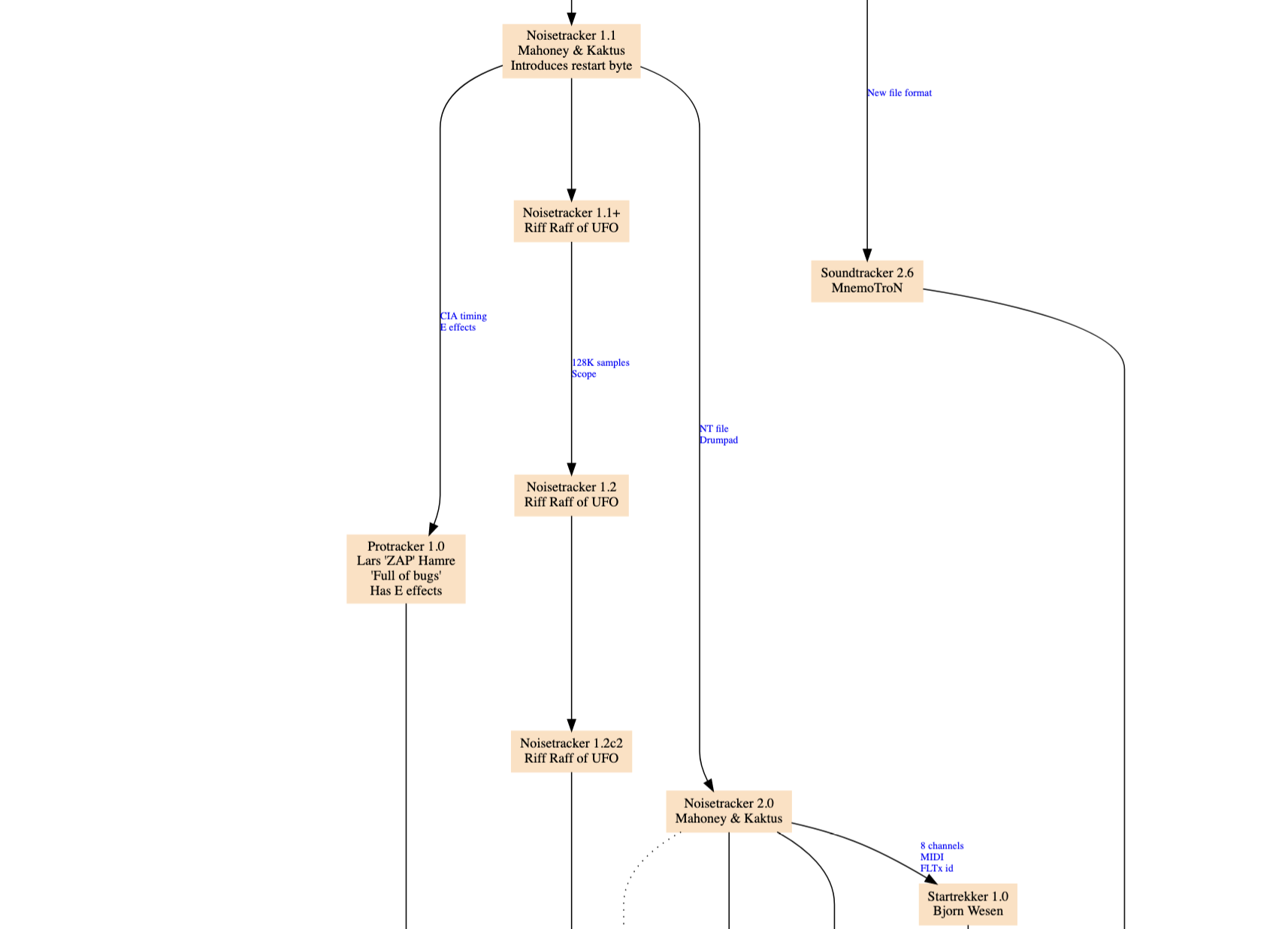
<p class="wp-block-paragraph">Still, through this graph we can see who « took inspiration » (<em>*coughs*</em>) from whom, and how we got to modern trackers. Neat! Thank you Claudio!</p>


<p class="wp-block-paragraph"><em>Note that for this article, I used <a href="https://web.archive.org/web/20230316093224/http://helllabs.org/tracker-history/trackers.svg">the latest available visual version</a>, preserved by the essential <a href="https://archive.org/">archive.org project</a> </em><img src="https://s.w.org/images/core/emoji/17.0.2/72x72/2764.png" alt="❤" class="wp-smiley" style="height: 1em; max-height: 1em;" /></p>


<h2 class="wp-block-heading">Cambrian explosion?</h2>


<p class="wp-block-paragraph">Of particular interest to me<sup class="modern-footnotes-footnote modern-footnotes-footnote--hover-on-desktop ">8</sup> is the top part of the graph, showing when and how it all started.</p>


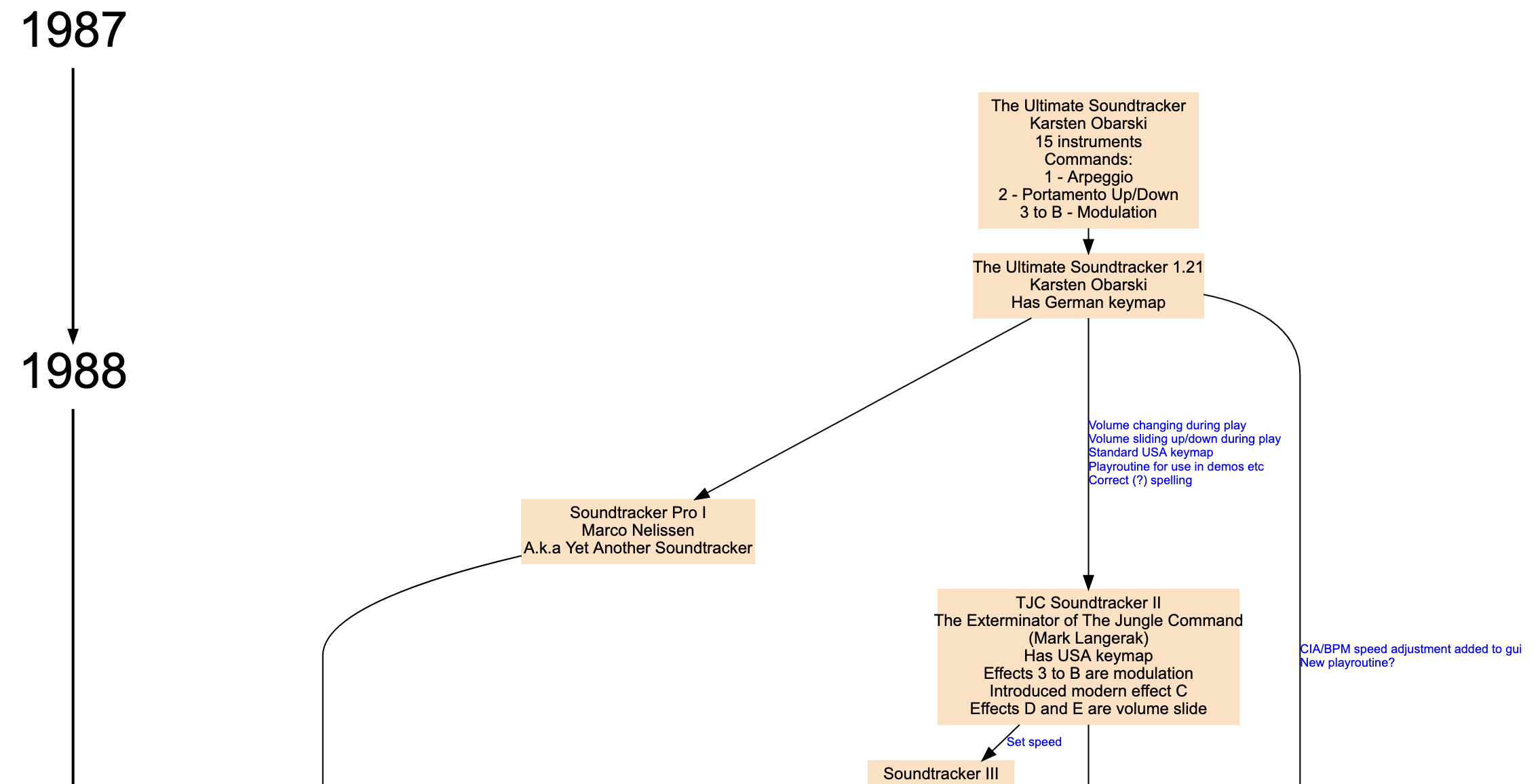
<p class="wp-block-paragraph">Let&rsquo;s zoom in on the years 1987 to 1989, shall we?</p>


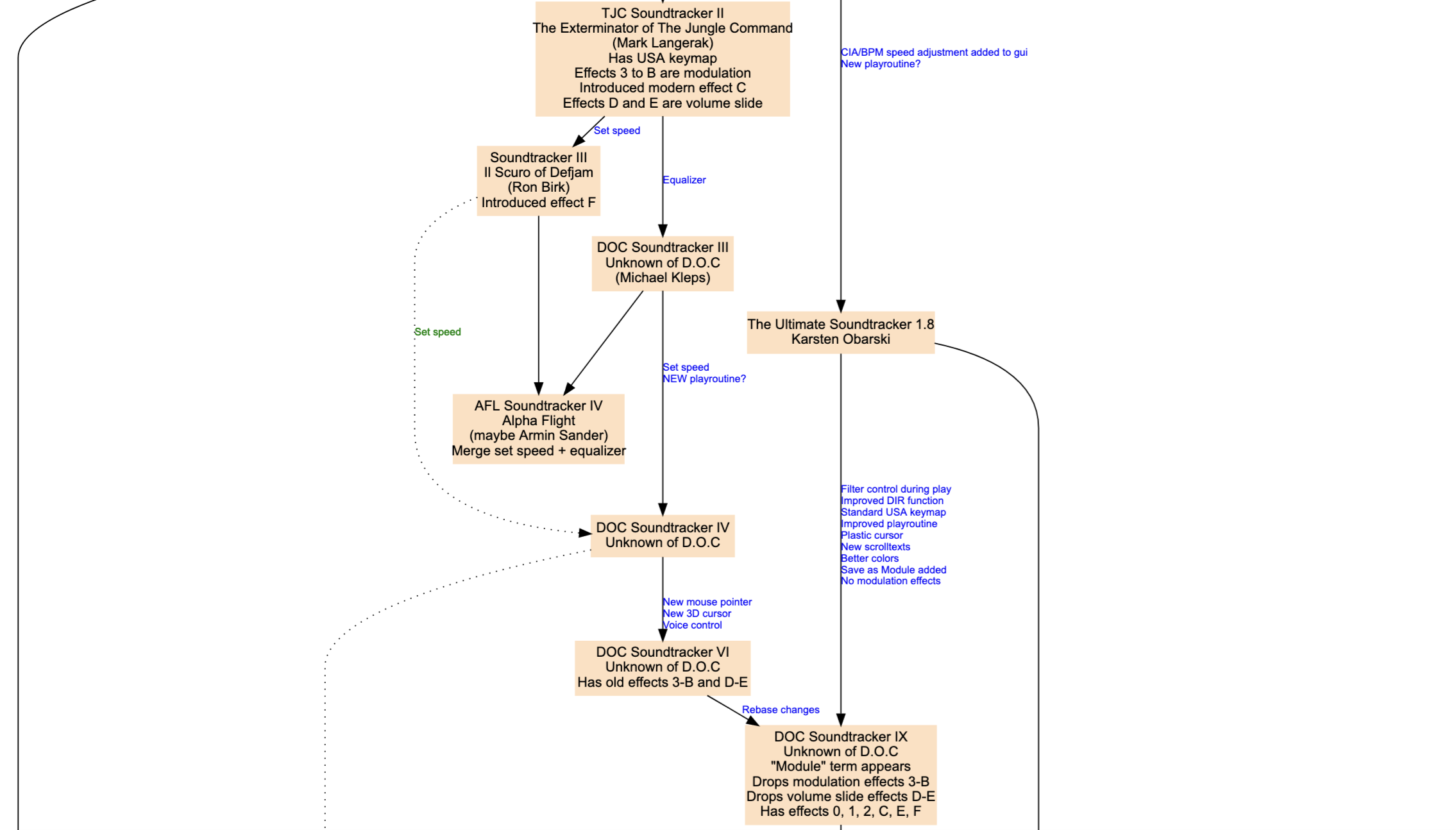
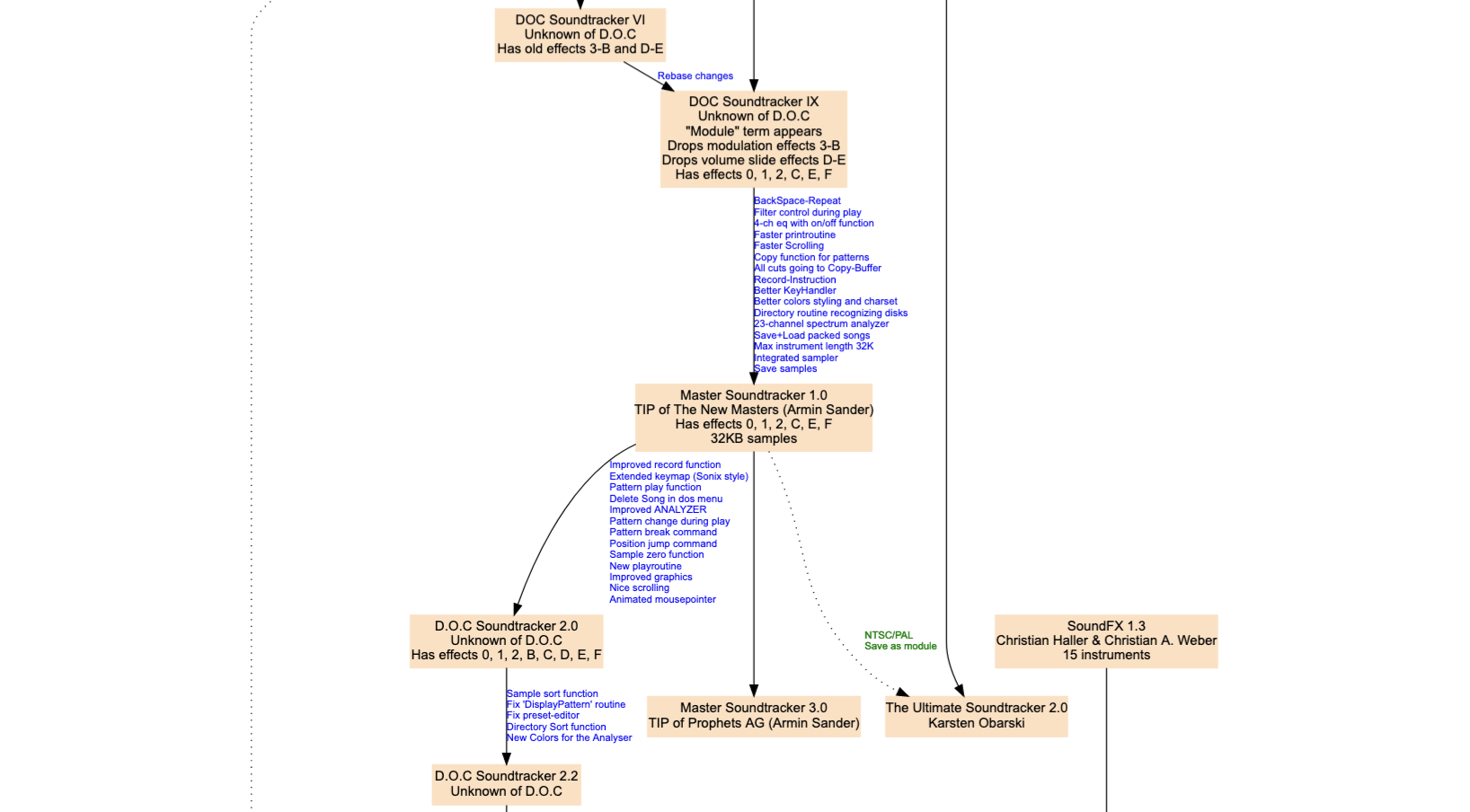
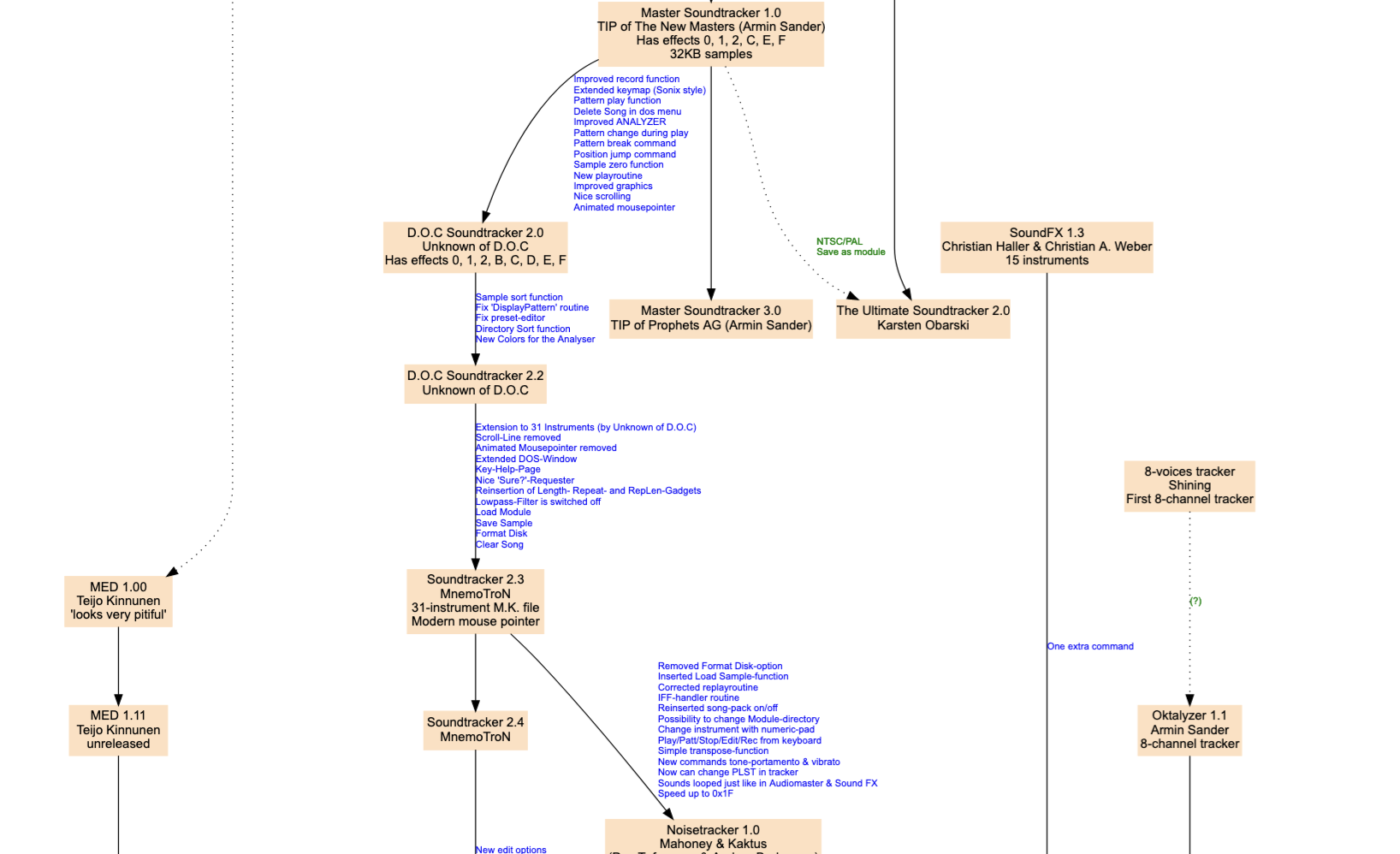
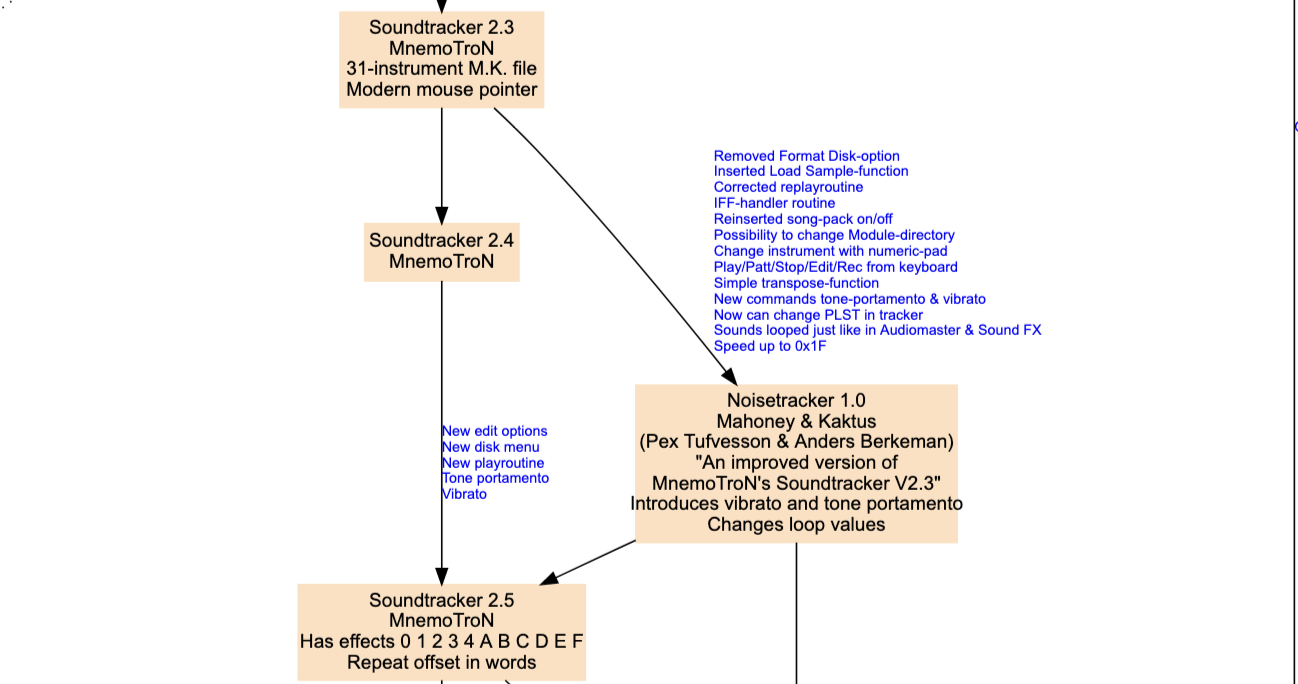
<figure class="wp-block-image alignwide size-full"><img loading="lazy" decoding="async" width="1882" height="1206" src="https://xavier.borderie.net/blog/wp-content/uploads/2024/01/image-1.png" alt="" class="wp-image-3321" srcset="https://xavier.borderie.net/blog/wp-content/uploads/2024/01/image-1.png 1882w, https://xavier.borderie.net/blog/wp-content/uploads/2024/01/image-1-200x128.png 200w, https://xavier.borderie.net/blog/wp-content/uploads/2024/01/image-1-450x288.png 450w, https://xavier.borderie.net/blog/wp-content/uploads/2024/01/image-1-768x492.png 768w, https://xavier.borderie.net/blog/wp-content/uploads/2024/01/image-1-1536x984.png 1536w, https://xavier.borderie.net/blog/wp-content/uploads/2024/01/image-1-1200x769.png 1200w" sizes="auto, (max-width: 1882px) 100vw, 1882px" /><figcaption class="wp-element-caption">Not rotated anymore! Still hard to read!<br>Also: busy years!</figcaption></figure>


<p class="wp-block-paragraph">It&rsquo;s not possible to read it this way, so I advise you to <a href="https://web.archive.org/web/20230316093224/http://helllabs.org/tracker-history/trackers.svg">open the SVG file in your browser</a> and wander around from version to version, the way you would zoom in and out in OpenStreetMaps. </p>


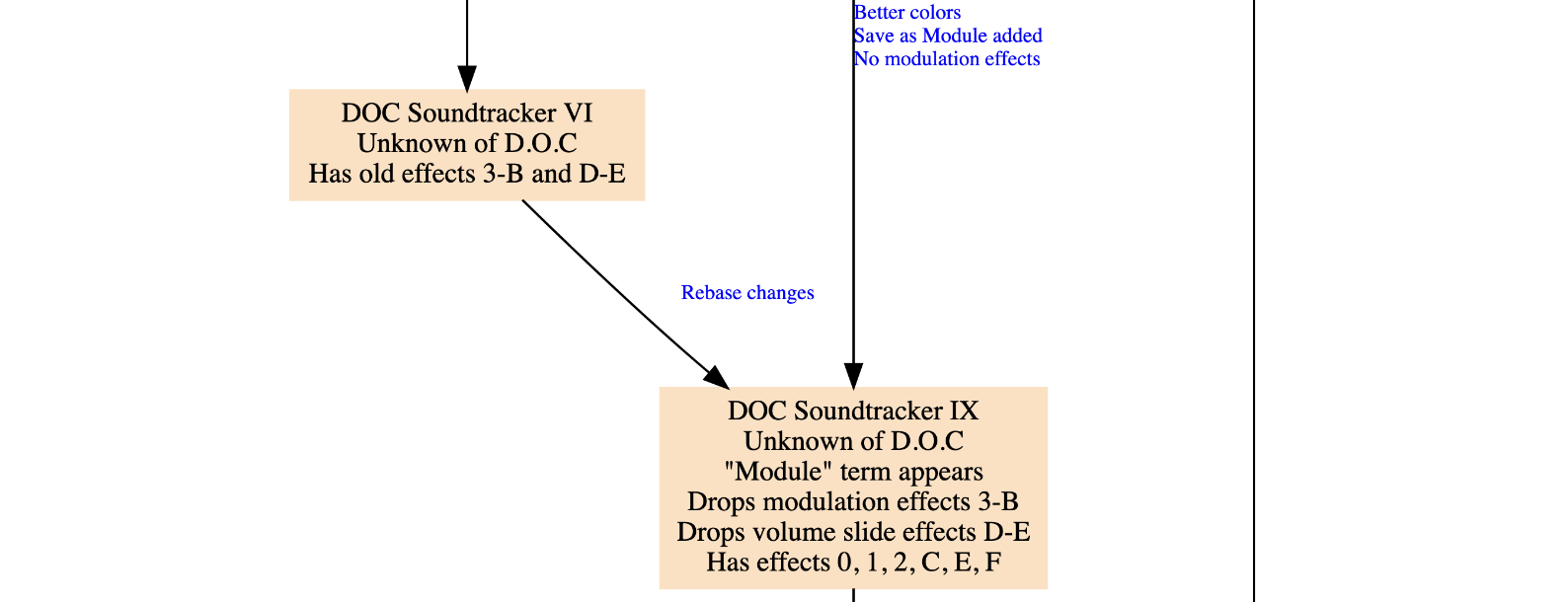
<p class="wp-block-paragraph">As you can see, while there were several parallel developments, it seems that the developers were (mostly) respectful of lineage: there is only one Soundtracker IV, it&rsquo;s AFL&rsquo;s; there is only one Soundtracker V, it&rsquo;s D.O.C&rsquo;s, etc. This seems to prove that new versions spread quite quickly &#8212; <a href="https://oldschoolgameblog.com/2017/01/15/amiga-demoscene-swapping-when-we-swapped-disks-through-snail-mail-worldwide/">through a network of swappers</a>, of course<sup class="modern-footnotes-footnote modern-footnotes-footnote--hover-on-desktop ">9</sup>.</p>


<p class="wp-block-paragraph">Just for the year 1988, 15 new versions (or variations thereof) of Soundtracker were released &#8212; 7 of which by Unknown/DOC alone. <br>All from a single seed: The Ultimate Soundtracker, planted by one Karsten Obarski in 1987.</p>


<p class="wp-block-paragraph">Hence, Cambrian explosion.</p>


<blockquote class="wp-block-quote is-layout-flow wp-block-quote-is-layout-flow">
<p class="wp-block-paragraph"><strong>Cambrian explosion</strong> (<em>plural</em> <strong>Cambrian explosions</strong>)</p>


<ol class="wp-block-list">
<li>(evolutionary biology) The relatively rapid appearance, during the Cambrian Period around 541 million years ago, of most major animal phyla, as demonstrated in the fossil record.</li>
</ol>


<p class="wp-block-paragraph">Synonym: biological big bang</p>
<cite><a href="https://en.wiktionary.org/wiki/Cambrian_explosion">Wiktionary</a></cite></blockquote>


<p class="wp-block-paragraph"><em>I like big words and I cannot lie.</em></p>


<figure class="wp-block-image alignwide size-full"><img loading="lazy" decoding="async" width="2356" height="1024" src="https://xavier.borderie.net/blog/wp-content/uploads/2024/02/image-26.png" alt="" class="wp-image-3496" srcset="https://xavier.borderie.net/blog/wp-content/uploads/2024/02/image-26.png 2356w, https://xavier.borderie.net/blog/wp-content/uploads/2024/02/image-26-200x87.png 200w, https://xavier.borderie.net/blog/wp-content/uploads/2024/02/image-26-450x196.png 450w, https://xavier.borderie.net/blog/wp-content/uploads/2024/02/image-26-768x334.png 768w, https://xavier.borderie.net/blog/wp-content/uploads/2024/02/image-26-1536x668.png 1536w, https://xavier.borderie.net/blog/wp-content/uploads/2024/02/image-26-2048x890.png 2048w, https://xavier.borderie.net/blog/wp-content/uploads/2024/02/image-26-1200x522.png 1200w, https://xavier.borderie.net/blog/wp-content/uploads/2024/02/image-26-1980x861.png 1980w" sizes="auto, (max-width: 2356px) 100vw, 2356px" /><figcaption class="wp-element-caption">Hi, Cambrian!</figcaption></figure>


<p class="wp-block-paragraph">How come there were so many versions? <br>Why such a frantic pace of improvements, one building upon the other? What made it so special?</p>


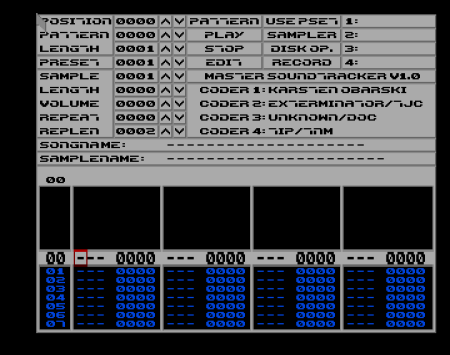
<p class="wp-block-paragraph">And most importantly, I was wondering <strong>who</strong> was the first to actually disassemble Karsten Obarski&rsquo;s Ultimate Soundtracker &#8212; because I was pretty sure that most « clones » were based on that first available source code.</p>


<p class="wp-block-paragraph">So what did I do? </p>


<p class="wp-block-paragraph">I did what any sane Internet-person would do: I picked the names of all those who created new Soundtracker versions in the first two years following Obarski&rsquo;s initial release, and promptly sent them a handful of questions.</p>


<p class="wp-block-paragraph">And guess what?</p>


<p class="wp-block-paragraph"><em>They all answered.</em></p>


<h2 class="wp-block-heading">Unusual suspects</h2>


<p class="wp-block-paragraph">This article is the result of email exchanges with some of the earliest developers of Soundtracker versions, as listed by Claudio&rsquo;s graph above: <a href="https://demozoo.org/sceners/28635/">Exterminator</a><sup class="modern-footnotes-footnote modern-footnotes-footnote--hover-on-desktop ">10</sup>, <a href="https://demozoo.org/sceners/651/">Unknown</a><sup class="modern-footnotes-footnote modern-footnotes-footnote--hover-on-desktop ">11</sup>, <a href="https://demozoo.org/sceners/108247/">Marco Nelissen</a><sup class="modern-footnotes-footnote modern-footnotes-footnote--hover-on-desktop ">12</sup>, <a href="https://demozoo.org/sceners/62985/">TIP</a><sup class="modern-footnotes-footnote modern-footnotes-footnote--hover-on-desktop ">13</sup>, <a href="https://demozoo.org/sceners/67808/">MnemoTroN</a><sup class="modern-footnotes-footnote modern-footnotes-footnote--hover-on-desktop ">14</sup>, <a href="https://demozoo.org/sceners/726/">Mahoney</a><sup class="modern-footnotes-footnote modern-footnotes-footnote--hover-on-desktop ">15</sup>&#8230; and, <em>because why not?</em>, I also contacted <a href="http://janeway.exotica.org.uk/author.php?id=5273">Lars Hamre</a><sup class="modern-footnotes-footnote modern-footnotes-footnote--hover-on-desktop ">16</sup>.</p>


<p class="wp-block-paragraph">As you can see by clicking each link, I didn&rsquo;t have to go far to discover their real-life names, as Demozoo lists them. Unlike the warez scene<sup class="modern-footnotes-footnote modern-footnotes-footnote--hover-on-desktop ">17</sup>, from which it was born, the demoscene was never about being anonymous, but rather <em>pseudonymous</em>: while having a scene handle was necessary when doing software piracy, for those creating demos it was just a cooler way to present oneself <img src="https://s.w.org/images/core/emoji/17.0.2/72x72/1f642.png" alt="🙂" class="wp-smiley" style="height: 1em; max-height: 1em;" /><br>From their real names listed in Demozoo, contacting them was easy: some have their own websites, others their own company, and the last ones&#8230; were contacted through LinkedIn <img src="https://s.w.org/images/core/emoji/17.0.2/72x72/1f605.png" alt="😅" class="wp-smiley" style="height: 1em; max-height: 1em;" /> </p>


<p class="wp-block-paragraph"><em>I need to point out here how incredibly useful are scene-related databases such as <a href="https://demozoo.org/">Demozoo</a>, <a href="https://www.pouet.net/">Pouët</a>, the <a href="http://www.exotica.org.uk/">Exotica</a> wiki and its <a href="http://janeway.exotica.org.uk/">Kestra Bitworld</a> sub-site. I was able to not only cross-reference information from the graph, but also to dig deeper thanks to community comments, <a href="https://www.pouet.net/prod.php?which=13607">such as in this page</a>. </em><br><em>As a bonus, they are happily cross-linking between themselves, showing the </em>camaraderie<sup class="modern-footnotes-footnote modern-footnotes-footnote--hover-on-desktop ">18</sup><em> of the demoscene community</em> <img src="https://s.w.org/images/core/emoji/17.0.2/72x72/2764.png" alt="❤" class="wp-smiley" style="height: 1em; max-height: 1em;" /> <br><em>All the screen captures on this article come from these websites.<br>The French Amiga-focused <a href="http://obligement.free.fr/articles_english.php">Obligement</a> webzine was also a great source.</em></p>


<h2 class="wp-block-heading">Who&rsquo;s on first?</h2>


<p class="wp-block-paragraph">Let&rsquo;s dive right in with the initial question: Who was the first to build upon Karsten Obarski&rsquo;s Ultimate Soundtracker?</p>


<p class="wp-block-paragraph">The graph here is helpful:</p>


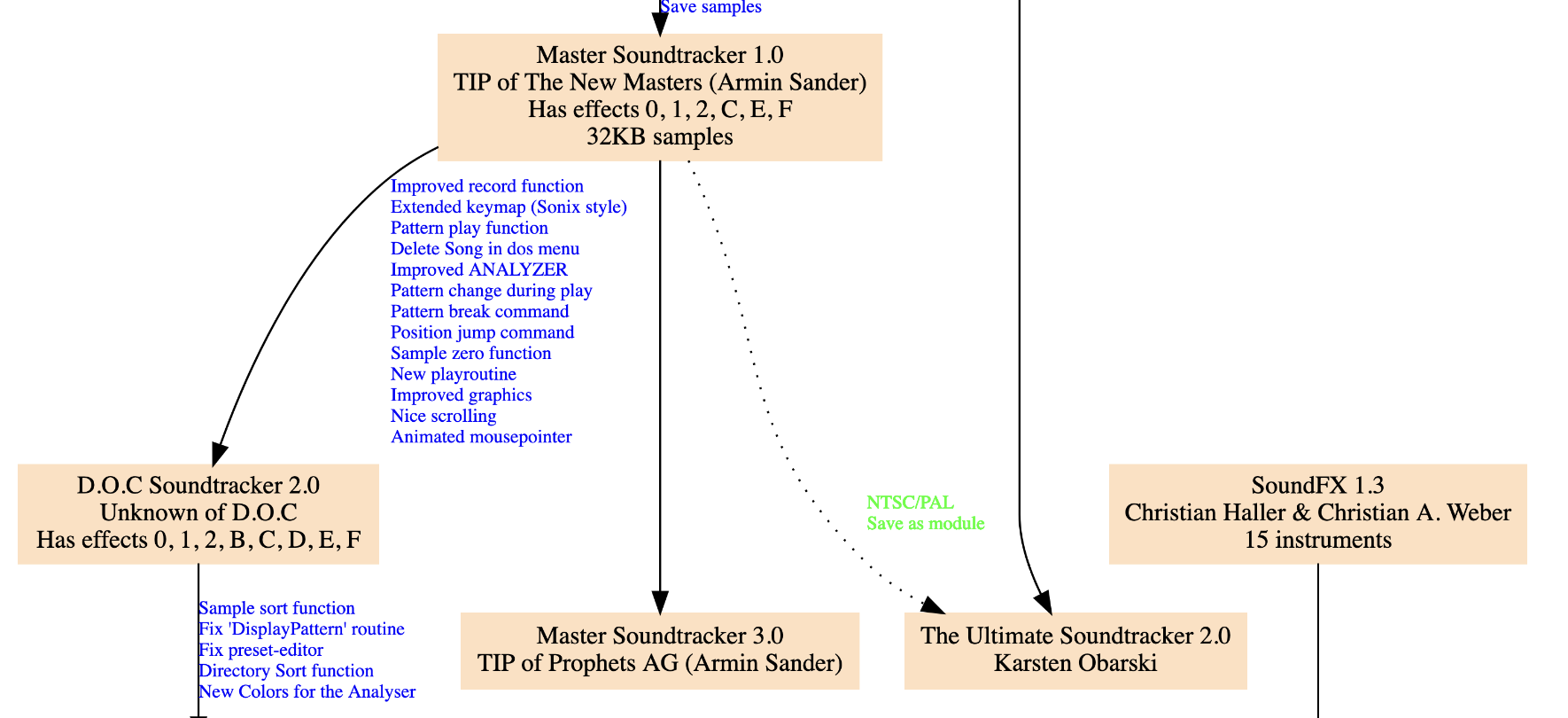
<figure class="wp-block-image size-full"><img loading="lazy" decoding="async" width="2270" height="1156" src="https://xavier.borderie.net/blog/wp-content/uploads/2024/02/image-1.png" alt="" class="wp-image-3388" srcset="https://xavier.borderie.net/blog/wp-content/uploads/2024/02/image-1.png 2270w, https://xavier.borderie.net/blog/wp-content/uploads/2024/02/image-1-200x102.png 200w, https://xavier.borderie.net/blog/wp-content/uploads/2024/02/image-1-450x229.png 450w, https://xavier.borderie.net/blog/wp-content/uploads/2024/02/image-1-768x391.png 768w, https://xavier.borderie.net/blog/wp-content/uploads/2024/02/image-1-1536x782.png 1536w, https://xavier.borderie.net/blog/wp-content/uploads/2024/02/image-1-2048x1043.png 2048w, https://xavier.borderie.net/blog/wp-content/uploads/2024/02/image-1-1200x611.png 1200w, https://xavier.borderie.net/blog/wp-content/uploads/2024/02/image-1-1980x1008.png 1980w" sizes="auto, (max-width: 2270px) 100vw, 2270px" /><figcaption class="wp-element-caption">Now slightly more readable!<br>We see two contenders for « First one to disassemble »: Marco Nelissen and The Exterminator!<br>The third arrow on the right points to an official version of Ultimate Soundtracker by Karsten Obarski.</figcaption></figure>


<div class="wp-block-image">
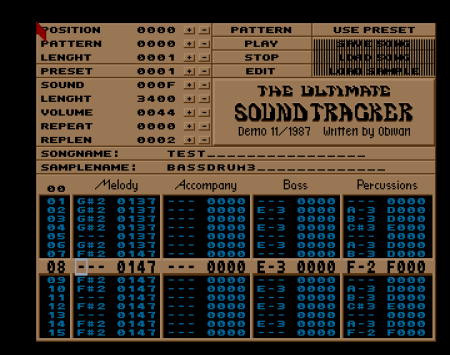
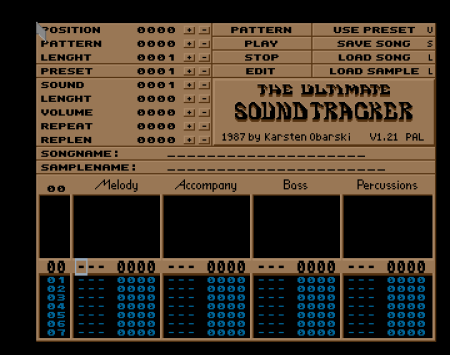
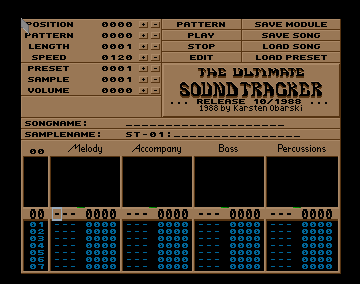
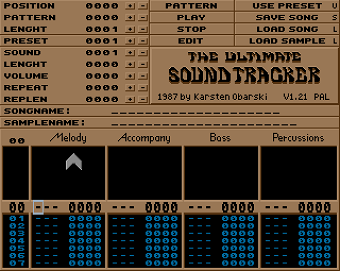
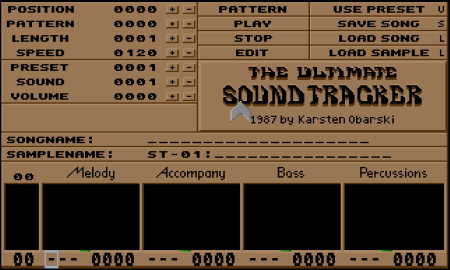
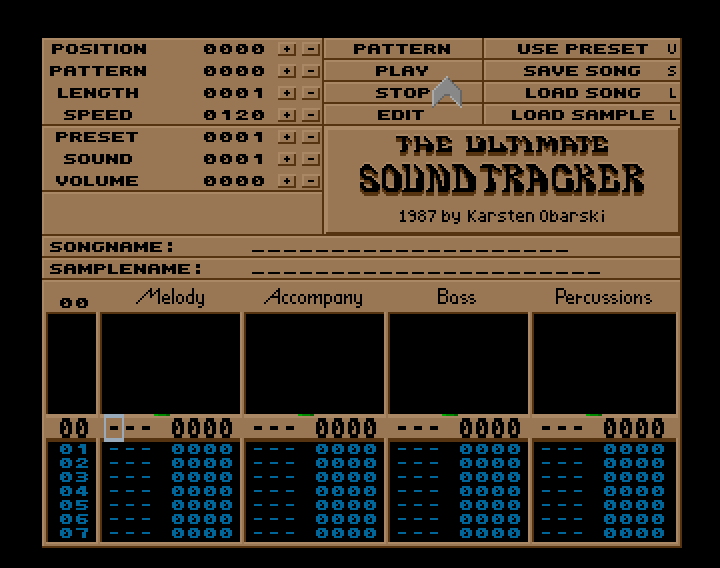
<figure class="alignright size-large"><img loading="lazy" decoding="async" width="450" height="355" src="https://xavier.borderie.net/blog/wp-content/uploads/2024/02/image-3-450x355.png" alt="" class="wp-image-3396" srcset="https://xavier.borderie.net/blog/wp-content/uploads/2024/02/image-3-450x355.png 450w, https://xavier.borderie.net/blog/wp-content/uploads/2024/02/image-3-200x158.png 200w, https://xavier.borderie.net/blog/wp-content/uploads/2024/02/image-3.png 720w" sizes="auto, (max-width: 450px) 100vw, 450px" /><figcaption class="wp-element-caption"><a href="https://demozoo.org/productions/270870/">The Ultimate Soundtracker Demo</a>, released in November 1987 by Karsten « Obiwan » Obarski.</figcaption></figure>
</div>


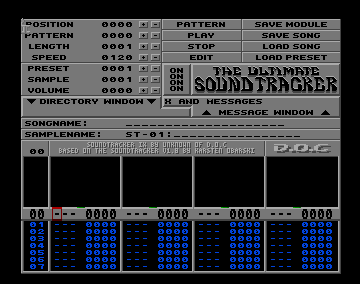
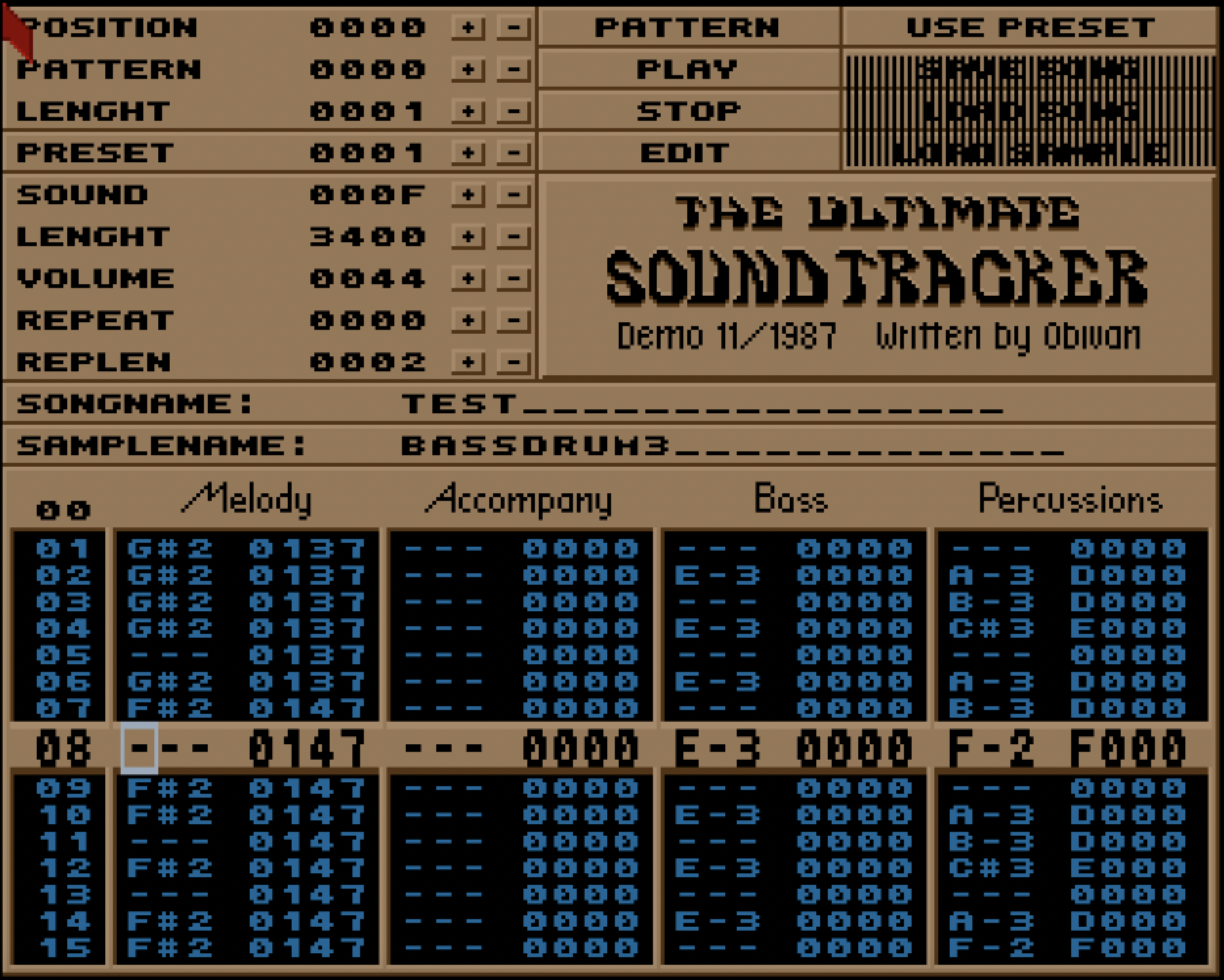
<p class="wp-block-paragraph">According to <a href="https://github.com/cmatsuoka/tracker-history/blob/master/soundtracker.txt#L10-L15">the graph&rsquo;s datasource</a>, the first version of Ultimate Soundtracker was released in August 1987, and Ultimate Soundtracker 1.21 was released in December 1987.<br><em>Now, there might be a mistake in the datasource since <a href="https://demozoo.org/productions/270870/">Demozoo shows a screencapture of a demo version</a> (displayed here on the right side), signed « <a href="https://demozoo.org/sceners/12167/">Obiwan</a>« , with a November 1987 release date. But we&rsquo;ll let this slip by for now&#8230; </em></p>


<figure class="wp-block-embed alignleft is-type-video is-provider-youtube wp-block-embed-youtube wp-embed-aspect-16-9 wp-has-aspect-ratio"><div class="wp-block-embed__wrapper">
<iframe loading="lazy" title="Amiga Music - Karsten Obarski Classic MODs - Amegas, Crystal Hammer, Telephone, Jack Dance, EndTheme" width="580" height="326" src="https://www.youtube.com/embed/61d9X0GW_7g?feature=oembed" frameborder="0" allow="accelerometer; autoplay; clipboard-write; encrypted-media; gyroscope; picture-in-picture; web-share" referrerpolicy="strict-origin-when-cross-origin" allowfullscreen></iframe>
</div><figcaption class="wp-element-caption">A video showing Protracker 1.1 playing 5 of the <a href="http://aminet.net/package/mods/sets/Firsties">first Soundtracker songs</a> by Karsten Obarski, of course, including « Amegas », the first Soundtracker song ever published (in <a href="https://en.wikipedia.org/wiki/Amegas">the 1987 eponymous game</a>). <br>You can recognize that very Amiga-ish sound, which is directly due to Karsten&rsquo;s own synthesizers at the time. He sampled them in order to provide some first samples to musicians who bought his tool.<br>You can see how many other songs were based on the samples used in Amegas thanks to the <a href="https://modsamplemaster.thegang.nu/module.php?sha1=79baf427f46f77163441a7dad9bae1d0108780f1">.mod Sample Master</a> (dotMSM) website, which makes statistics based on the hash of samples from available songs. Neat!</figcaption></figure>


<p class="wp-block-paragraph">The important indication from the graph datasource is that Soundtracker Pro I is listed as released by Marco Nelissen on January 20th, 1988. Just one month after the original&rsquo;s release date: That&rsquo;s some quick reworking! </p>


<p class="wp-block-paragraph">Congratulations for being the first one on the line, Marco!</p>


<blockquote class="wp-block-quote is-layout-flow wp-block-quote-is-layout-flow">
<p class="wp-block-paragraph"><strong>Marco Nelissen: </strong>I&rsquo;m pretty sure I wasn&rsquo;t the first one (and the name, « Yet another soundtracker », certainly seems to be saying that there were many soundtrackers available already at that time). <br><br>I suspect that the release date of 1988-01-20 is wrong. <br>January 1988&nbsp;is only 9 months after the release of the Amiga 500, and my first Amiga was a 500. I think I would have needed more than 9 months to buy one and get&nbsp;proficient enough with&nbsp;Amiga programming. <br><br>The release year of 1989 <a href="https://www.pouet.net/prod.php?which=48002">as listed on Pouët</a> seems more realistic. </p>
<cite>E-mail interview from January 2024<sup class="modern-footnotes-footnote modern-footnotes-footnote--hover-on-desktop ">19</sup>.</cite></blockquote>


<div class="wp-block-image">
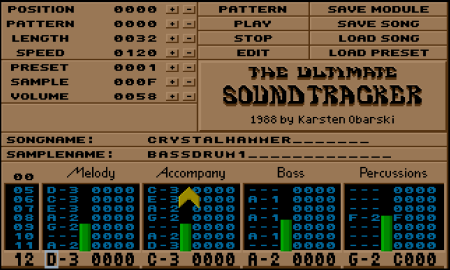
<figure class="alignright size-large"><img loading="lazy" decoding="async" width="450" height="355" src="https://xavier.borderie.net/blog/wp-content/uploads/2024/02/image-5-450x355.png" alt="" class="wp-image-3401" srcset="https://xavier.borderie.net/blog/wp-content/uploads/2024/02/image-5-450x355.png 450w, https://xavier.borderie.net/blog/wp-content/uploads/2024/02/image-5-200x158.png 200w, https://xavier.borderie.net/blog/wp-content/uploads/2024/02/image-5.png 720w" sizes="auto, (max-width: 450px) 100vw, 450px" /><figcaption class="wp-element-caption"><a href="https://demozoo.org/productions/172675/">The Ultimate SoundTracker 1.21</a>, released in December 1987 by Karsten Obarski.</figcaption></figure>
</div>


<p class="wp-block-paragraph">I&rsquo;m not sure that the « <strong>Yet Another </strong>Soundtracker » argument proves anything, since Karsten Obarski <em>did</em> name the <em>very first</em> Soundtracker as being « <strong>The Ultimate</strong> Soundtracker » &#8212; but, you know, teenagers <img src="https://s.w.org/images/core/emoji/17.0.2/72x72/1f642.png" alt="🙂" class="wp-smiley" style="height: 1em; max-height: 1em;" /> </p>


<p class="wp-block-paragraph">In any case, I agree that 9 months is short to buy a computer, learn to code well enough, obtain original software, disassemble it and rework it into something notable.<br>So the new date of 1989 would put Marco&rsquo;s version <em>after</em> many of the other trackers released in 1988, and therefore he cannot be the original disassembler of Obarski&rsquo;s <strong>UST</strong> (Ultimate SoundTracker, for the rest of this article). </p>


<p class="wp-block-paragraph">But the graph <em>does</em> connect his version directly to UST, so is that wrong too?</p>


<div class="wp-block-image">
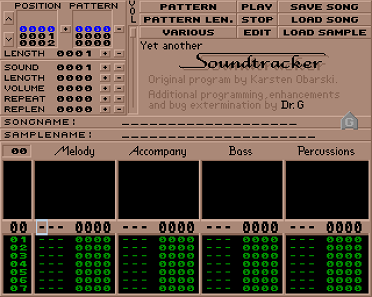
<figure class="alignright size-full"><img loading="lazy" decoding="async" width="372" height="297" src="https://xavier.borderie.net/blog/wp-content/uploads/2024/02/image-4.png" alt="" class="wp-image-3399" srcset="https://xavier.borderie.net/blog/wp-content/uploads/2024/02/image-4.png 372w, https://xavier.borderie.net/blog/wp-content/uploads/2024/02/image-4-200x160.png 200w" sizes="auto, (max-width: 372px) 100vw, 372px" /><figcaption class="wp-element-caption"><a href="https://www.pouet.net/prod.php?which=48002">SoundTracker Pro I</a>, released in 1989 by Marco Nelissen.</figcaption></figure>
</div>


<blockquote class="wp-block-quote is-layout-flow wp-block-quote-is-layout-flow">
<p class="wp-block-paragraph"><strong>Marco Nelissen: </strong>I&rsquo;m <em>fairly </em>certain I disassembled an existing tracker myself, and it was probably « the ultimate soundtracker » (though not sure which version), given that « yet another&nbsp;soundtracker » <a href="https://www.pouet.net/prod.php?which=48002">says it&rsquo;s based on the original by Karsten Obarski</a>.</p>


<p class="wp-block-paragraph">I&rsquo;m certain I was not the first though. There were many alternative trackers already available when I got involved, hence the « yet another » description in my version. </p>


<p class="wp-block-paragraph">So the graph you linked to earlier is probably wrong. While it&rsquo;s possible the branching itself is correct, the timeline is almost&nbsp;certainly incorrect. It seems much more likely that my « yet another soundtracker » came around somewhere in 1989,&nbsp;<em>after&nbsp;</em>many of the other variants.</p>
<cite>Ibid.</cite></blockquote>


<p class="wp-block-paragraph">Alright, so Marco is not The One. But still he did some original work, why didn&rsquo;t it inspire others in the demoscene? Why did they all build from TJC Soundtracker II?</p>


<blockquote class="wp-block-quote is-layout-flow wp-block-quote-is-layout-flow">
<p class="wp-block-paragraph"><strong>Marco Nelissen:</strong> TJC and other&nbsp;trackers I think came out of the crack/demo scene, so had wider reach because of that. I also&nbsp;didn&rsquo;t release a&nbsp;standalone player routine (except maybe towards the very end, I&rsquo;m not sure), so it was hard for people to use such mods in games or demos.</p>
<cite>Ibid.</cite></blockquote>


<div class="wp-block-image">
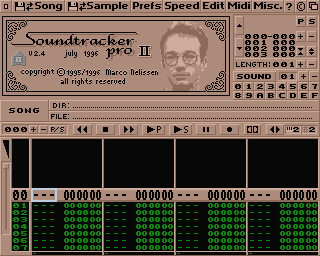
<figure class="alignright size-full"><img loading="lazy" decoding="async" width="320" height="256" src="https://xavier.borderie.net/blog/wp-content/uploads/2024/02/image-6.png" alt="" class="wp-image-3404" srcset="https://xavier.borderie.net/blog/wp-content/uploads/2024/02/image-6.png 320w, https://xavier.borderie.net/blog/wp-content/uploads/2024/02/image-6-200x160.png 200w" sizes="auto, (max-width: 320px) 100vw, 320px" /><figcaption class="wp-element-caption"><a href="https://demozoo.org/productions/272940/">SoundTracker Pro II 2.4</a>, released in July 1996 by Marco Nelissen.</figcaption></figure>
</div>


<p class="wp-block-paragraph">Thanks Marco!<br><em>Another possibility for Soundtracker Pro not being quite adopted by the scene, is the apparent fact that it extended the MOD file format (<a href="https://www.pouet.net/prod.php?which=34746#c976465">at least for ST Pro II</a>), making its saved file incompatible with other trackers and playroutines &#8212; the subject of <a href="https://wiki.multimedia.cx/index.php/Protracker_Module#File_Format">file format compatibility</a> was a hot topic in the tracker community, <a href="https://github.com/8bitbubsy/pt2-clone/issues/6">and still is</a>.</em></p>


<p class="wp-block-paragraph">Therefore, still according to Claudio&rsquo;s graph, that leaves us with:</p>


<figure class="wp-block-embed alignleft is-type-video is-provider-youtube wp-block-embed-youtube wp-embed-aspect-4-3 wp-has-aspect-ratio"><div class="wp-block-embed__wrapper">
<iframe loading="lazy" title="Oil Imperium - Action 1 (Karsten Obarski)" width="580" height="435" src="https://www.youtube.com/embed/vgr2OSdo558?feature=oembed" frameborder="0" allow="accelerometer; autoplay; clipboard-write; encrypted-media; gyroscope; picture-in-picture; web-share" referrerpolicy="strict-origin-when-cross-origin" allowfullscreen></iframe>
</div><figcaption class="wp-element-caption">Another early music by Karsten Obarski, this time « Action Theme 3 » from the game « <a href="https://en.wikipedia.org/wiki/Black_Gold_(video_game)">Oil Imperium</a> » (1989), here played using Protracker 3.62.</figcaption></figure>


<h2 class="wp-block-heading">The Exterminator/TJC</h2>


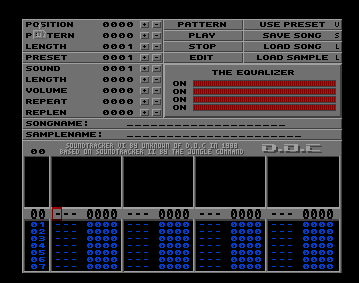
<p class="wp-block-paragraph">The first coder to release a « fixed » version of Soundtracker, The Exterminator, member of the group <a href="https://demozoo.org/groups/28634/">The Jungle Command</a>, lighted the necessary spark and showed that it was possible to improve on Obarski&rsquo;s game-changing music editor.</p>


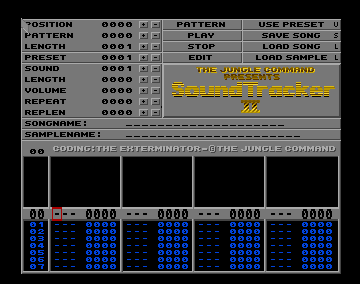
<p class="wp-block-paragraph">Exterminator was not a newcomer in the realm of sound editors, as he had already produced MegaTraxx for TJC, which <a href="http://janeway.exotica.org.uk/author.php?id=2459">was implemented into Soundtracker</a><sup class="modern-footnotes-footnote modern-footnotes-footnote--hover-on-desktop ">20</sup> in order to get TJC Soundtracker II<sup class="modern-footnotes-footnote modern-footnotes-footnote--hover-on-desktop ">21</sup>.</p>


<div class="wp-block-image">
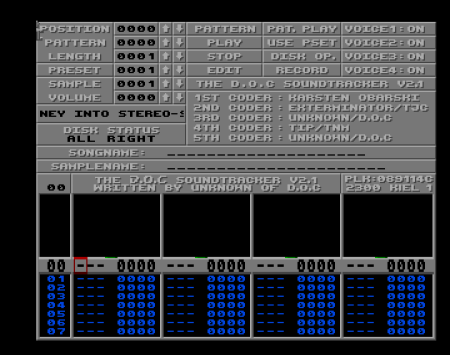
<figure class="alignright size-full is-resized"><img loading="lazy" decoding="async" width="360" height="284" src="https://xavier.borderie.net/blog/wp-content/uploads/2024/02/image-7.png" alt="" class="wp-image-3406" style="width:360px;height:auto" srcset="https://xavier.borderie.net/blog/wp-content/uploads/2024/02/image-7.png 360w, https://xavier.borderie.net/blog/wp-content/uploads/2024/02/image-7-200x158.png 200w" sizes="auto, (max-width: 360px) 100vw, 360px" /><figcaption class="wp-element-caption"><a href="https://demozoo.org/productions/221272/">TJC SoundTracker II</a>, released on March 1st, 1988 by The Exterminator/TJC.</figcaption></figure>
</div>


<p class="wp-block-paragraph">Mark Langerak, his real name, released only one version of TJC Soundtracker II, and soon moved on to other hobbies &#8212; namely, <a href="https://www.mobygames.com/person/10073/mark-langerak/credits/">creating video games</a>. <em>Indeed, the demoscene has always been a source of hiring talents for game companies, from programmers to musicians and graphic artists.</em></p>


<p class="wp-block-paragraph">He released his first game on the Amiga, <a href="https://www.mobygames.com/game/54233/the-plague/">The Plague</a>, in 1990. He worked solo on the code and the graphics.<br>35 years later, as of this writing, he is Principal Software Engineer at Microsoft, having worked notably on Gunship 2000, The Sims 2, Kinect Star Wars, and many more.</p>


<p class="wp-block-paragraph"><em>I&rsquo;m pretty sure he&rsquo;s not too fond of his handle from his Amiga days <img src="https://s.w.org/images/core/emoji/17.0.2/72x72/1f642.png" alt="🙂" class="wp-smiley" style="height: 1em; max-height: 1em;" /></em></p>


<p class="wp-block-paragraph">I used the most uncool way to contact him: I sent him a LinkedIn message <img src="https://s.w.org/images/core/emoji/17.0.2/72x72/1f605.png" alt="😅" class="wp-smiley" style="height: 1em; max-height: 1em;" /></p>


<p class="wp-block-paragraph">So, was he The One who first disassembled UST? <br>Or did he receive the source code from someone else?</p>


<blockquote class="wp-block-quote is-layout-flow wp-block-quote-is-layout-flow">
<p class="wp-block-paragraph"><strong>Mark Langerak: </strong>I think I was the first yes. I definitely did not get the source from anyone, I would have remembered that. </p>


<p class="wp-block-paragraph">But I don&rsquo;t actually remember how or if the original was actually disassembled (to source), I don&rsquo;t think there were any decent disassembler tools available at the time that would&rsquo;ve made that possible? <br>If I were to guess, the original Soundtracker would have remained in its original form as a binary blob, which would then have some strategic patch vectors poked in at the right places to extend it.</p>


<p class="wp-block-paragraph">That is something I recall doing even to my own code when developing on C64 because there was not enough memory to have both source + binary in memory at the same time &#8212; I had no money then to buy a separate development machine <img src="https://s.w.org/images/core/emoji/17.0.2/72x72/1f609.png" alt="😉" class="wp-smiley" style="height: 1em; max-height: 1em;" /></p>
<cite>LinkedIn interview from November 2023.</cite></blockquote>


<figure class="wp-block-embed alignleft is-type-video is-provider-youtube wp-block-embed-youtube wp-embed-aspect-16-9 wp-has-aspect-ratio"><div class="wp-block-embed__wrapper">
<iframe loading="lazy" title="PTC by Mad Monks and Sunriders (Amiga Intro) 1988" width="580" height="326" src="https://www.youtube.com/embed/W9IhN3WtTyA?feature=oembed" frameborder="0" allow="accelerometer; autoplay; clipboard-write; encrypted-media; gyroscope; picture-in-picture; web-share" referrerpolicy="strict-origin-when-cross-origin" allowfullscreen></iframe>
</div><figcaption class="wp-element-caption">The demoscene adopted Soundtracker rather quickly, even with ugly samples like here (<a href="http://janeway.exotica.org.uk/release.php?id=1711">March 1988</a>).</figcaption></figure>


<p class="wp-block-paragraph">Oh, that&rsquo;s clever! Even without the source code, it was possible to extend and rework a program by changing its representation in memory (then saving that representation to disk, I guess).</p>


<p class="wp-block-paragraph">But that means&#8230; The Exterminator is <em>not</em> the one who initially spread the source code for UST. <br>Still, he <em>is</em> the one that showed that it was possible to improve upon a commercial software that was, apparently, not quite stable yet. And THAT is an important step for the Soundtracker saga.</p>


<p class="wp-block-paragraph">Also, it was all meant to be fun!</p>


<blockquote class="wp-block-quote is-layout-flow wp-block-quote-is-layout-flow">
<p class="wp-block-paragraph"><strong>Mark Langerak: </strong>One little factoid I do remember &#8212; the playback routine for TJC tracker has a hidden Jungle Command easter-egg. </p>


<p class="wp-block-paragraph">The idea was that we wanted the fame of the playback routine getting used in other groups&rsquo; demos, and the way to show that the TJC tracker was used would be to invoke a magic mouse button + key combo when running a rival group&rsquo;s demo. <br>That would then trigger a piece of code hidden in the (fake) arpeggio table in the TJC playback routine. This piece of code was designed to take over the machine and display a Jungle Command related message. </p>


<p class="wp-block-paragraph">I completely forget how it was supposed to work, but it wasn&rsquo;t very reliable &#8212; I only managed to ever find one demo from another group where I was able to trigger it and bask in the glory <img src="https://s.w.org/images/core/emoji/17.0.2/72x72/1f600.png" alt="😀" class="wp-smiley" style="height: 1em; max-height: 1em;" /></p>
<cite>Ibid.</cite></blockquote>


<p class="wp-block-paragraph">See? All in good fun! <img src="https://s.w.org/images/core/emoji/17.0.2/72x72/1f642.png" alt="🙂" class="wp-smiley" style="height: 1em; max-height: 1em;" /> </p>


<p class="wp-block-paragraph">The TJC Soundtracker lineage didn&rsquo;t last long, though:</p>


<blockquote class="wp-block-quote is-layout-flow wp-block-quote-is-layout-flow">
<p class="wp-block-paragraph"><strong>Mark Langerak: </strong>TJC Soundtracker II was done in isolation as I remember. It was also very much a one and done kind of thing, we did not contemplate or feel any incentive to continue with trackers in general. From what I remember we were much more focused on the next demos and making our own games.</p>
<cite>Ibid.</cite></blockquote>


<p class="wp-block-paragraph">Alright, it&rsquo;s all fun and games<sup class="modern-footnotes-footnote modern-footnotes-footnote--hover-on-desktop ">22</sup>, but I need to continue my quest: <br>Who&rsquo;s The One behind the Soundtracker Cambrian explosion?</p>


<hr class="wp-block-separator has-alpha-channel-opacity"/>


<p class="wp-block-paragraph"><em>Added May 21st, 2024:</em><br>Reader <a href="https://limi.net/">Alex Limi</a> kindly pointed me to this comment that he archived from a YouTube video, written by <a href="https://www.youtube.com/@scb2scb2/featured">Daniel Ockeloen</a> (aka <a href="https://demozoo.org/sceners/42888/">MCS, co-founder of TJC</a>):</p>


<figure class="wp-block-image size-full"><img loading="lazy" decoding="async" width="1536" height="676" src="https://xavier.borderie.net/blog/wp-content/uploads/2024/05/image.png" alt="" class="wp-image-3781" srcset="https://xavier.borderie.net/blog/wp-content/uploads/2024/05/image.png 1536w, https://xavier.borderie.net/blog/wp-content/uploads/2024/05/image-200x88.png 200w, https://xavier.borderie.net/blog/wp-content/uploads/2024/05/image-450x198.png 450w, https://xavier.borderie.net/blog/wp-content/uploads/2024/05/image-768x338.png 768w, https://xavier.borderie.net/blog/wp-content/uploads/2024/05/image-1200x528.png 1200w" sizes="auto, (max-width: 1536px) 100vw, 1536px" /></figure>


<blockquote class="wp-block-quote is-layout-flow wp-block-quote-is-layout-flow">
<p class="wp-block-paragraph">We are getting old but it&rsquo;s nice to wonder in a old video and see my memory confirmed. </p>


<p class="wp-block-paragraph">Soundtracker 2.0 was indeed the first split. </p>


<p class="wp-block-paragraph">With a friend I started The Jungle Command, soon to be joined by Mark. We came from the C64 and needed audio routines; work was underway with MegaTraxx, but that had no GUI at all. <br><br>So Soundtracker came out and [with] some merging and fiddling, we had Soundtracker 2.0. A nice guru meditation hack was added and hidden in the source for much fun later :).</p>


<p class="wp-block-paragraph">It was a small step but combined with someone who did some great tunes (our member <a href="https://demozoo.org/sceners/16334/">Ron Klaren</a>) and a few music demo disks (« <a href="https://demozoo.org/productions/221265/">Music invasion</a> » was one series) it all got out of hand a little. </p>


<p class="wp-block-paragraph">It was never really done as an angry act against the orginal maker, we where just kids. Jungle Command was never really much in the cracking part, more the making part. </p>


<p class="wp-block-paragraph">Later we also had a second music routine for games like Battle Squadron which Ron also used to show his music skills and I still feel [his tunes] are among the best Amiga tracks of the time. </p>


<p class="wp-block-paragraph">It was a great time, thanks for reminding me and others of the fun we had now 37+ years ago…. <br><br>&#8212; daniel (mcs) from the jungle command. <br><br>edit: most groups knew who worked on it at first and communication was happening but indeed the MOD fileformat part by DOC was a massive step in making it a household name… <br><br>edit2: in my memory we had some communication with Karsten and he forgave our youthful sins. I hope I am not making that up and he also looks back with a smile on what his work did and how we can still enjoy some of these amazing tunes of the time.</p>
<cite>From a comment on <a href="https://www.youtube.com/watch?v=roBkg-iPrbw">an awesome Ahoy video on Tracker history</a>, edited for readability.</cite></blockquote>


<p class="wp-block-paragraph">This comment explains why I couldn&rsquo;t find any screencapture of Exterminator&rsquo;s MegaTraxx: it only ever existed as an early set of audio routines! <br>Instead of spending time programming the whole interface for MegaTraxx, Exterminator probably chose the easy path and adapted his playroutine into The Ultimate Soundtracker, thus creating TJC Sountracker II.</p>


<p class="wp-block-paragraph">And really, just comparing <a href="https://ftp.untergrund.net/users/hitchhikr/old/tools/Soundtracker_II.zip">the source code for MegaTraxx and the TJC Soundtracker II playroutine</a> confirms that: Apart from minor additions, removals and changes (and the whole Sample Info and Parts sections), <a href="https://www.diffchecker.com/7sjEI3Hv/">they are pretty much the same</a>.</p>


<p class="wp-block-paragraph">As I wrote in <a href="https://xavier.borderie.net/blog/2021/09/22/soundtracker-origins-part-1-where-in-the-world-is-karsten-obarski/">my article on Karsten Obarski</a> (Part I of this series):</p>


<blockquote class="wp-block-quote is-layout-flow wp-block-quote-is-layout-flow">
<p class="wp-block-paragraph">Exterminator had de-assembled the original program and released the resulting source code, along with its playroutine<sup><a href="javascript:void(0)"></a></sup>. This allowed anyone to not only create music in the tracker format (fine), but they could also freely (as in, illegally) use that format in their own productions (games and demos).</p>
<cite>Source: myself.</cite></blockquote>


<p class="wp-block-paragraph">Since the playroutine was a key part in selling The Ultimate Soundtracker rights (which is my guess on how usage worked at that time), well, once TJC Soundtracker II was released, Ultimate Soundtracker&rsquo;s commercial fate was pretty much sealed&#8230;</p>


<p class="wp-block-paragraph">Thank you Alex for this gem!</p>


<hr class="wp-block-separator has-alpha-channel-opacity"/>


<p class="wp-block-paragraph"><em>Added June 19th, 2024:</em><br>Well I had to contact Daniel Ockeloen, aka MCS, co-founder of <a href="https://demozoo.org/groups/28634/">The Jungle Command</a>, just to see if there was anything more in his memories that he could contribute to the topic <img src="https://s.w.org/images/core/emoji/17.0.2/72x72/1f642.png" alt="🙂" class="wp-smiley" style="height: 1em; max-height: 1em;" /></p>


<p class="wp-block-paragraph"><em>&#8230;and boy did he have.</em></p>


<blockquote class="wp-block-quote is-layout-flow wp-block-quote-is-layout-flow">
<p class="wp-block-paragraph">I&rsquo;m 100% sure that TJC Tracker was the first, but as Mark writes, he might have later started from the 1.0 version &#8212; this would also explain the <code>mt_</code> naming for a while in only one branch.</p>


<p class="wp-block-paragraph">The hint that the source of the player was the same was well-known at the time, there is a reason why much of it starts with <code>mt_</code> names.</p>
<cite>From a Facebook Messenger conversation, June 2024.</cite></blockquote>


<blockquote class="wp-block-quote is-layout-flow wp-block-quote-is-layout-flow">
<p class="wp-block-paragraph">The « let&rsquo;s use the [Ultimate Soundtracker] GUI and semi bolt MegaTraxx in » was because of the lack of a GUI &#8212; the only thing around at the start was Sonic [<a href="https://en.wikipedia.org/wiki/Aegis_Sonix">Sonix by Aegis</a>?]  <img loading="lazy" decoding="async" height="16" width="16" src="https://static.xx.fbcdn.net/images/emoji.php/v9/teb/2/16/1f642.png" alt="&#x1f642;">. </p>


<p class="wp-block-paragraph">Mark should know best but in my memory, it was just the easier way to merge the two.</p>
<cite>Ibid.</cite></blockquote>


<blockquote class="wp-block-quote is-layout-flow wp-block-quote-is-layout-flow">
<p class="wp-block-paragraph">I can also confirm that Il Scuro/DefJam made the first upgrade [with <a href="https://demozoo.org/productions/172678/">Sountracker III</a>], but the more important step was DOC. For the rest I think you are on track on what happened and why.</p>
<cite>Ibid.</cite></blockquote>


<blockquote class="wp-block-quote is-layout-flow wp-block-quote-is-layout-flow">
<p class="wp-block-paragraph">At the time, musicdisks where a thing, and many [sceners] sent us songs to put on one of our disks, kinda before megademos became a thing. So having a player routine we all could use and some GIU was handy.</p>


<p class="wp-block-paragraph">I remember that we as a group where kind of proud of [musician] <a href="https://demozoo.org/sceners/16334/">Ron Klaren</a>&lsquo;s work so we had an incentive to push the player idea, even if Mark was already moving on [to focus on his game].</p>
<cite>Ibid.</cite></blockquote>


<blockquote class="wp-block-quote is-layout-flow wp-block-quote-is-layout-flow">
<p class="wp-block-paragraph">I also strongly disagree with the [reliability] of his hack: many demos and even games had the &lsquo;Guru&rsquo; hack inside, even in later player releases. And John [van Dijk, aka <a href="https://demozoo.org/sceners/42889/">Boil</a>, co-founder of TJC] and I had fun testing new disks [to see] if they came in for it. </p>


<p class="wp-block-paragraph">But like Mark, I can&rsquo;t remember how to trigger it. I think it was space+mousebutton+joystick button. I tried to get it working on some things years ago, but failed &#8212; let&rsquo;s call it a missing easter egg ready to be rediscovered. </p>


<p class="wp-block-paragraph">I do clearly remember nobody found it until some English friends (Mic) found it and just changed the messages to say &lsquo;hi back&rsquo; in the message.</p>
<cite>Ibid.</cite></blockquote>


<blockquote class="wp-block-quote is-layout-flow wp-block-quote-is-layout-flow">
<p class="wp-block-paragraph">Keep in mind, you probably need to merge like 10 people&rsquo;s minds to get the truth &#8212; funny how memories work. Thanks for your great work on this!</p>
<cite>Ibid.</cite></blockquote>


<p class="wp-block-paragraph">Thank you for all these details, Daniel!</p>


<hr class="wp-block-separator has-alpha-channel-opacity"/>


<p class="wp-block-paragraph">Let&rsquo;s get back to our regular scheduling, and scroll down a bit on the graph:</p>


<figure class="wp-block-image size-full is-resized"><img loading="lazy" decoding="async" width="2270" height="1294" src="https://xavier.borderie.net/blog/wp-content/uploads/2024/02/image-2.png" alt="" class="wp-image-3389" style="width:610px;height:auto" srcset="https://xavier.borderie.net/blog/wp-content/uploads/2024/02/image-2.png 2270w, https://xavier.borderie.net/blog/wp-content/uploads/2024/02/image-2-200x114.png 200w, https://xavier.borderie.net/blog/wp-content/uploads/2024/02/image-2-450x257.png 450w, https://xavier.borderie.net/blog/wp-content/uploads/2024/02/image-2-768x438.png 768w, https://xavier.borderie.net/blog/wp-content/uploads/2024/02/image-2-1536x876.png 1536w, https://xavier.borderie.net/blog/wp-content/uploads/2024/02/image-2-2048x1167.png 2048w, https://xavier.borderie.net/blog/wp-content/uploads/2024/02/image-2-1200x684.png 1200w, https://xavier.borderie.net/blog/wp-content/uploads/2024/02/image-2-1980x1129.png 1980w" sizes="auto, (max-width: 2270px) 100vw, 2270px" /><figcaption class="wp-element-caption">If you can read this, you can throw your glasses away.<br>If you can&rsquo;t, <a href="https://web.archive.org/web/20230316093224/http://helllabs.org/tracker-history/trackers.svg">open the SVG in a new tab</a>!</figcaption></figure>


<p class="wp-block-paragraph">The TJC seed has been planted, and we get to explore the sprouts.</p>


<p class="wp-block-paragraph"><em>Note on the left-side arrow of the graph: </em><br><em>I wasn&rsquo;t able to contact Il Scuro/Dejfam (Ron Birk), but since, according to the graph, his Soundtracker III is a one-off version and it only inspired one tracker (Alpha Flight&rsquo;s Soundtracker IV), I think we can safely skip it for our quest.</em></p>


<p class="wp-block-paragraph">Thus, now begins the era of&#8230;</p>


<figure class="wp-block-embed alignleft is-type-video is-provider-youtube wp-block-embed-youtube wp-embed-aspect-16-9 wp-has-aspect-ratio"><div class="wp-block-embed__wrapper">
<iframe loading="lazy" title="D.O.C - Demons Are Forever -= Amiga 50fps =-" width="580" height="326" src="https://www.youtube.com/embed/3tSI8gw_yUQ?feature=oembed" frameborder="0" allow="accelerometer; autoplay; clipboard-write; encrypted-media; gyroscope; picture-in-picture; web-share" referrerpolicy="strict-origin-when-cross-origin" allowfullscreen></iframe>
</div><figcaption class="wp-element-caption">With this demo, incidentally released by DOC in May 1988, you can already see some kind of evolution in the quality of samples and the sonic inspiration. This one is <a href="https://www.pouet.net/prod.php?which=7066">considered a classic</a> today.</figcaption></figure>


<h3 class="wp-block-heading">Unknown/DOC</h3>


<div class="wp-block-image">
<figure class="alignright size-full"><img loading="lazy" decoding="async" width="359" height="283" src="https://xavier.borderie.net/blog/wp-content/uploads/2024/02/image-8.png" alt="" class="wp-image-3409" srcset="https://xavier.borderie.net/blog/wp-content/uploads/2024/02/image-8.png 359w, https://xavier.borderie.net/blog/wp-content/uploads/2024/02/image-8-200x158.png 200w" sizes="auto, (max-width: 359px) 100vw, 359px" /><figcaption class="wp-element-caption"><a href="https://demozoo.org/productions/172679/">DOC SoundTracker III</a>, released by Unknown/DOC on March 25th, 1988.</figcaption></figure>
</div>


<p class="wp-block-paragraph">In 1988 alone, Unknown of the demogroup Doctor Mabuse Orgasm Crackings<sup class="modern-footnotes-footnote modern-footnotes-footnote--hover-on-desktop ">23</sup> released 7 versions of Soundtracker: Soundtracker III, then IV, VI<sup class="modern-footnotes-footnote modern-footnotes-footnote--hover-on-desktop ">24</sup>, IX<sup class="modern-footnotes-footnote modern-footnotes-footnote--hover-on-desktop ">25</sup>, 2.0<sup class="modern-footnotes-footnote modern-footnotes-footnote--hover-on-desktop ">26</sup>, 2.1, and 2.2. <br>And he stopped there, leaving others to go further, and having added an incredible amount of features to Soundtracker, not the least of which being the celebrated <a href="https://en.wikipedia.org/wiki/MOD_(file_format)">MOD format</a>, which made it much easier to share music and include them in scene productions, be they demos or cracks. <br>And of course, as a proud marker of his contributions, he added « M.K. » to the headers of module files, for <strong>M</strong>ichael <strong>K</strong>leps, his name at the time. That marker<sup class="modern-footnotes-footnote modern-footnotes-footnote--hover-on-desktop ">27</sup> is still used today to recognize modules from back then, and to differentiate them from modules made by earlier or later Soundtracker-like tools.</p>


<div class="wp-block-image">
<figure class="alignright size-full"><img loading="lazy" decoding="async" width="359" height="283" src="https://xavier.borderie.net/blog/wp-content/uploads/2024/02/image-10.png" alt="" class="wp-image-3416" srcset="https://xavier.borderie.net/blog/wp-content/uploads/2024/02/image-10.png 359w, https://xavier.borderie.net/blog/wp-content/uploads/2024/02/image-10-200x158.png 200w" sizes="auto, (max-width: 359px) 100vw, 359px" /><figcaption class="wp-element-caption"><a href="https://demozoo.org/productions/172680/">DOC SoundTracker IV</a>, released by Unknown/DOC on April 12th, 1988.</figcaption></figure>
</div>


<p class="wp-block-paragraph">Unknown/DOC seemingly found his passion with music tools, because Michael Kleps (nowadays named Michael Hartmann, <a href="https://www.kvraudio.com/forum/viewtopic.php?p=7974249&amp;sid=65f66e78e86e80c12831844404a99216#p7974249">possibly after wedding his partner</a>) has since created the <a href="https://refx.com/">reFX</a> company, which has been producing virtual synthesizers for several years now. <a href="https://www.youtube.com/watch?v=uqF0bHTyTDg&amp;t=844s">See this YouTuber touring the reFX office and meeting Michael</a>.</p>


<p class="wp-block-paragraph"><em>Of note: Even today Michael remains a fan of oldskool computer music, as in 2001 he created the <a href="https://splice.com/plugins/4361-quadrasid-vst-au-by-refx">reFX QuadraSID VST plugin</a>, which brought the sound of the C64&rsquo;s SID chip to modern DAWs &#8212; a project for which he was interviewed in 2001 by the <a href="https://remix64.com/interviews/interview-michael-kleps-of-refx.html">Remix64</a> portal &#8212; and I learned that he was working on a Spotify-like SID player.</em></p>


<div class="wp-block-image">
<figure class="alignright size-full"><img loading="lazy" decoding="async" width="359" height="283" src="https://xavier.borderie.net/blog/wp-content/uploads/2024/02/image-11.png" alt="" class="wp-image-3418" srcset="https://xavier.borderie.net/blog/wp-content/uploads/2024/02/image-11.png 359w, https://xavier.borderie.net/blog/wp-content/uploads/2024/02/image-11-200x158.png 200w" sizes="auto, (max-width: 359px) 100vw, 359px" /><figcaption class="wp-element-caption"><a href="https://demozoo.org/productions/172691/">DOC SoundTracker VI</a>, released by Unknown/DOC on April 20th, 1988.</figcaption></figure>
</div>


<p class="wp-block-paragraph">True to his scene handle, it was very hard to get in direct contact with him, despite seeing he was <a href="https://github.com/reFX-Mike">active in his GitHub profile</a>: I couldn&rsquo;t find any working email address for him nor for reFX &#8212; you have to be a reFX customer in order to contact their support service.<br>BUT, after a lot of of poking around, I was able to contact him.</p>


<figure class="wp-block-embed alignleft is-type-video is-provider-youtube wp-block-embed-youtube wp-embed-aspect-4-3 wp-has-aspect-ratio"><div class="wp-block-embed__wrapper">
<iframe loading="lazy" title="Unit A - Interceptor" width="580" height="435" src="https://www.youtube.com/embed/h5GRh4HgsAE?feature=oembed" frameborder="0" allow="accelerometer; autoplay; clipboard-write; encrypted-media; gyroscope; picture-in-picture; web-share" referrerpolicy="strict-origin-when-cross-origin" allowfullscreen></iframe>
</div><figcaption class="wp-element-caption">This is just a 2 min cracktro, but the sample are starting to give a real <em>ambiance</em>. <a href="https://www.pouet.net/prod.php?which=9133">June 1988</a>.</figcaption></figure>


<p class="wp-block-paragraph">So, I wonder, as the most prolific author of Soundtracker versions, what inspired him to spend so much time on that tool?</p>


<blockquote class="wp-block-quote is-layout-flow wp-block-quote-is-layout-flow">
<p class="wp-block-paragraph"><strong>Michael « Unknown » Hartmann: </strong>I was always interested in music, and once the source code got to me from one of Dr. Mabuse&rsquo;s trading partners, I was super excited to play around with it and fix bugs or add features as I saw fit. </p>


<p class="wp-block-paragraph">We made so many versions because we discovered bugs, and Dr.&nbsp;Mabuse couldn&rsquo;t wait to add more ridiculous scroll texts to it.</p>


<p class="wp-block-paragraph">Nowadays, with the internet and all, these would be considered minor releases nobody would even mention. But back then, every little fix, every little change was immediately a new version to be traded with others, etc.</p>
<cite>E-mail interview from January 2024.</cite></blockquote>


<div class="wp-block-image">
<figure class="alignright size-full"><img loading="lazy" decoding="async" width="360" height="284" src="https://xavier.borderie.net/blog/wp-content/uploads/2024/02/image-12.png" alt="" class="wp-image-3419" srcset="https://xavier.borderie.net/blog/wp-content/uploads/2024/02/image-12.png 360w, https://xavier.borderie.net/blog/wp-content/uploads/2024/02/image-12-200x158.png 200w" sizes="auto, (max-width: 360px) 100vw, 360px" /><figcaption class="wp-element-caption"><a href="https://demozoo.org/productions/172692/">DOC SoundTracker IX</a>, released by Unknown/DOC in July 1988.</figcaption></figure>
</div>


<p class="wp-block-paragraph"><em>Indeed the <a href="http://janeway.exotica.org.uk/file.php?id=34833">scrolltexts</a> <a href="http://janeway.exotica.org.uk/file.php?id=167380">were</a> <a href="http://janeway.exotica.org.uk/file.php?id=168190">quite</a> <a href="http://janeway.exotica.org.uk/file.php?id=167378">silly</a> <img src="https://s.w.org/images/core/emoji/17.0.2/72x72/1f642.png" alt="🙂" class="wp-smiley" style="height: 1em; max-height: 1em;" /></em></p>


<p class="wp-block-paragraph">Wait, « once the source code got to me from one of Dr.&nbsp;Mabuse&rsquo;s trading partners », so he&rsquo;s not The One who disassembled it?</p>


<blockquote class="wp-block-quote is-layout-flow wp-block-quote-is-layout-flow">
<p class="wp-block-paragraph"><strong><strong>Michael « Unknown » Hartmann</strong>: </strong>No, I didn&rsquo;t disassemble it. I&rsquo;ve got the source code from Dr.&nbsp;Mabuse, who got it from someone else. I got it pretty early on, but I can&rsquo;t remember what exact version of what. </p>


<p class="wp-block-paragraph">Since I was into music, I was super curious about how it all worked. I refined it a lot, as a lot of variables and labels had very generic names (param1, param2, param3, loop1, loop2, loop3, etc.) instead of proper names like « volume », « pitch », etc. </p>


<p class="wp-block-paragraph">If somebody released a new tracker, I immediately tried to match the new features or even improve upon them. It was important for me not to fall behind and stay compatible.</p>
<cite>Ibid.</cite></blockquote>


<p class="wp-block-paragraph"><em>Holy guacamole, Batman!</em> </p>


<ul class="wp-block-list">
<li>Exterminator did not disassemble it, and</li>


<li>Unknown obtained the source code from someone else!</li>
</ul>


<p class="wp-block-paragraph">Does it mean there is a missing link between TJC Soundtracker II and DOC Soundtracker III‽‽‽</p>


<figure class="wp-block-embed alignleft is-type-video is-provider-youtube wp-block-embed-youtube wp-embed-aspect-4-3 wp-has-aspect-ratio"><div class="wp-block-embed__wrapper">
<iframe loading="lazy" title="FINNISH GOLD  1988 CONTEST-DEMO (C64)" width="580" height="435" src="https://www.youtube.com/embed/HgSaIHNU-pM?feature=oembed" frameborder="0" allow="accelerometer; autoplay; clipboard-write; encrypted-media; gyroscope; picture-in-picture; web-share" referrerpolicy="strict-origin-when-cross-origin" allowfullscreen></iframe>
</div><figcaption class="wp-element-caption">Meanwhile, the c64 scene was enjoying three-channels songs, such as in this demo <a href="https://www.pouet.net/prod.php?which=43088">from August 1988</a>. Done with Soundmonitor?</figcaption></figure>


<h2 class="wp-block-heading">Crossing the streams</h2>


<p class="wp-block-paragraph">Here I must take a quick step forward, and show you what (and who) comes next in the graph.</p>


<figure class="wp-block-image size-full"><img loading="lazy" decoding="async" width="1636" height="904" src="https://xavier.borderie.net/blog/wp-content/uploads/2024/02/image-9.png" alt="" class="wp-image-3410" srcset="https://xavier.borderie.net/blog/wp-content/uploads/2024/02/image-9.png 1636w, https://xavier.borderie.net/blog/wp-content/uploads/2024/02/image-9-200x111.png 200w, https://xavier.borderie.net/blog/wp-content/uploads/2024/02/image-9-450x249.png 450w, https://xavier.borderie.net/blog/wp-content/uploads/2024/02/image-9-768x424.png 768w, https://xavier.borderie.net/blog/wp-content/uploads/2024/02/image-9-1536x849.png 1536w, https://xavier.borderie.net/blog/wp-content/uploads/2024/02/image-9-1200x663.png 1200w" sizes="auto, (max-width: 1636px) 100vw, 1636px" /><figcaption class="wp-element-caption">A new player has entered the game!</figcaption></figure>


<p class="wp-block-paragraph">As those with good eyes (or <a href="https://web.archive.org/web/20230316093224/http://helllabs.org/tracker-history/trackers.svg">with the SVG file open</a>) can see, a strange thing happens: </p>


<ol class="wp-block-list">
<li>Unknown releases DOC Soundtracker IX, </li>


<li>&#8230; which serves as the direct inspiration for Master Soundtracker&nbsp;1.0, created by TIP/TNM&#8230; </li>


<li>&#8230;which, <em>in turn</em>, is the sole inspiration for DOC Soundtracker 2.0. <br>I repeat: DOC Soundtracker IX is <strong>not</strong> the direct inspiration for DOC Soundtracker&nbsp;2.0.</li>
</ol>


<div class="wp-block-image">
<figure class="alignright size-large"><img loading="lazy" decoding="async" width="450" height="355" src="https://xavier.borderie.net/blog/wp-content/uploads/2024/02/image-13-450x355.png" alt="" class="wp-image-3425" srcset="https://xavier.borderie.net/blog/wp-content/uploads/2024/02/image-13-450x355.png 450w, https://xavier.borderie.net/blog/wp-content/uploads/2024/02/image-13-200x158.png 200w, https://xavier.borderie.net/blog/wp-content/uploads/2024/02/image-13.png 720w" sizes="auto, (max-width: 450px) 100vw, 450px" /><figcaption class="wp-element-caption"><a href="https://demozoo.org/productions/262586/">Master SoundTracker 1.0</a>, released by TIP/TNM in July 1988.</figcaption></figure>
</div>


<p class="wp-block-paragraph">Who&rsquo;s this « TIP » guy, swooshing by with tons of ideas and features, to the point of inspiring Unknown?<br>TIP, short for <a href="https://demozoo.org/sceners/62985/">The Invisible Power</a>, is in fact <a href="https://www.replicator.org/">Armin Sander</a>, who later created <a href="https://www.robotplanet.dk/amiga/oktalyzer/">Oktalyzer</a>.</p>


<p class="wp-block-paragraph">But we&rsquo;ll dive further in his work later; for now, I&rsquo;d like to focus on a key part of <a href="http://obligement.free.fr/articles_traduction/itwsander_en.php">his Obligement interview</a>, by Guillaume Guittenit:</p>


<blockquote class="wp-block-quote is-layout-flow wp-block-quote-is-layout-flow">
<p class="wp-block-paragraph"><strong>Guillaume Guittenit: </strong>Why did you make Oktalyzer? Tell us the story behind this software.</p>


<p class="wp-block-paragraph"><strong>Armin « TIP » Sander: </strong>The story begins with me sitting in front of my Amiga and launching a new program called <a href="http://en.wikipedia.org/wiki/Ultimate_Soundtracker">Ultimate Soundtracker</a> for the first time and subconsciously realizing that this is the kind of software I wanted to develop.</p>


<p class="wp-block-paragraph">The release of Soundtracker was a small revolution in the Amiga scene, and some of the best hackers tried to reengineer and extend the program. Unknown/DOC was one of the first coders able to put some additional features in it, and when I saw that this was possible, I was excited by the challenge to do it as well.</p>


<p class="wp-block-paragraph">The first thing to do if you want to extend an existing program is to reassemble it, which is the process to create <a href="http://en.wikipedia.org/wiki/Assembly_language">assembler source</a> from the binary code of the program. I can&rsquo;t remember exactly which tools I used, and if <a href="http://amiga-dev.wikidot.com/tool:resource">Resource</a> was available to me, but shortly after that, I had created a fully functional source code of the original Soundtracker.</p>


<p class="wp-block-paragraph">Later I had a telephone call with Unknown/DOC during which he explained to me that he never actually had had the source code, instead he extended Soundtracker by patching the binary code at specific locations. In that telephone call I offered to give him _only him_ the assembler source. And if Unknown/DOC broke his promise, this source could very well become the basis of a number of future Soundtrackers released in the Amiga scene.</p>
<cite>Obligement interview, in April 2014.</cite></blockquote>


<div class="wp-block-image">
<figure class="alignright size-full"><img loading="lazy" decoding="async" width="359" height="283" src="https://xavier.borderie.net/blog/wp-content/uploads/2024/02/image-14.png" alt="" class="wp-image-3426" srcset="https://xavier.borderie.net/blog/wp-content/uploads/2024/02/image-14.png 359w, https://xavier.borderie.net/blog/wp-content/uploads/2024/02/image-14-200x158.png 200w" sizes="auto, (max-width: 359px) 100vw, 359px" /><figcaption class="wp-element-caption"><a href="https://demozoo.org/productions/241315/">DOC Soundtracker 2.0</a>, released by Unknown/DOC in August 1988.</figcaption></figure>
</div>


<figure class="wp-block-embed alignleft is-type-video is-provider-youtube wp-block-embed-youtube wp-embed-aspect-16-9 wp-has-aspect-ratio"><div class="wp-block-embed__wrapper">
<iframe loading="lazy" title="Amiga demo: Filled Vektors by IT" width="580" height="326" src="https://www.youtube.com/embed/n0VVb3oOek0?feature=oembed" frameborder="0" allow="accelerometer; autoplay; clipboard-write; encrypted-media; gyroscope; picture-in-picture; web-share" referrerpolicy="strict-origin-when-cross-origin" allowfullscreen></iframe>
</div><figcaption class="wp-element-caption">Things are getting technical in this <a href="https://www.pouet.net/prod.php?which=3594">May 1989</a> production from Norwegian demogroup <a href="https://demozoo.org/groups/705/">IT</a>, apparently the first demo to feature filled-vectors. Also, a nice tune from Walkman, soon-to-be author of classic module « Klisje Paa Klisje ».</figcaption></figure>


<p class="wp-block-paragraph">SAY WHAT??? <br>Wow, there&rsquo;s a lot to unpack in that last paragraph.</p>


<p class="wp-block-paragraph">It seems that the four « pre-TIP » versions of DOC Soundtracker (III, IV, VI and IX, for those keeping score) were <strong>not</strong> in fact created by improving some source code that was available, but by patching the software while it&rsquo;s in memory &#8212; the same way The Exterminator first improved UST to obtain his own TJC Soundtracker II.<br>That would mean that when Unknown told me that « the source code got to [him] from one of Dr. Mabuse&rsquo;s trading partners », either he was mistaken (which we can forgive, after <em>35 years</em>), or he was talking about DOC Soundtracker versions starting from 2.0 onward, and therefore TIP was actually that trading partner.</p>


<div class="wp-block-image">
<figure class="alignright size-large"><img loading="lazy" decoding="async" width="450" height="355" src="https://xavier.borderie.net/blog/wp-content/uploads/2024/02/image-16-450x355.png" alt="" class="wp-image-3432" srcset="https://xavier.borderie.net/blog/wp-content/uploads/2024/02/image-16-450x355.png 450w, https://xavier.borderie.net/blog/wp-content/uploads/2024/02/image-16-200x158.png 200w, https://xavier.borderie.net/blog/wp-content/uploads/2024/02/image-16.png 720w" sizes="auto, (max-width: 450px) 100vw, 450px" /><figcaption class="wp-element-caption"><a href="https://demozoo.org/productions/197688/">Master Soundtracker 3.0</a>, released by TIP/Prophets AG in September 1988.</figcaption></figure>
</div>


<p class="wp-block-paragraph">Armin further confirmed that he was The One by email:</p>


<blockquote class="wp-block-quote is-layout-flow wp-block-quote-is-layout-flow">
<p class="wp-block-paragraph"><strong>Armin « TIP » Sander: </strong>Actually I did a lot of reassembling [back then], I guess because I wasn&rsquo;t good or smart enough at cracking software or modifying binaries, even considered this as dreadful boring and hard work. </p>


<p class="wp-block-paragraph">As stated in the Obligement article, I can confirm that the SoundTrackers I&rsquo;ve released were built on fully reassembled version.</p>
<cite>E-mail interview in January 2024.</cite></blockquote>


<p class="wp-block-paragraph">Seeing the drastic changes in version number (from Roman numerals to « 2.x ») and layout/design between DOC Soundtracker IX and DOC Soundtracker 2.0, I&rsquo;m inclined to believe that Armin was indeed the source.</p>


<figure class="wp-block-gallery alignwide has-nested-images columns-default is-cropped wp-block-gallery-1 is-layout-flex wp-block-gallery-is-layout-flex">
<figure class="wp-block-image size-large"><img loading="lazy" decoding="async" width="360" height="284" data-id="3419" src="https://xavier.borderie.net/blog/wp-content/uploads/2024/02/image-12.png" alt="" class="wp-image-3419" srcset="https://xavier.borderie.net/blog/wp-content/uploads/2024/02/image-12.png 360w, https://xavier.borderie.net/blog/wp-content/uploads/2024/02/image-12-200x158.png 200w" sizes="auto, (max-width: 360px) 100vw, 360px" /><figcaption class="wp-element-caption">DOC Soundtracker IX</figcaption></figure>


<figure class="wp-block-image size-large"><img loading="lazy" decoding="async" width="450" height="355" data-id="3425" src="https://xavier.borderie.net/blog/wp-content/uploads/2024/02/image-13-450x355.png" alt="" class="wp-image-3425" srcset="https://xavier.borderie.net/blog/wp-content/uploads/2024/02/image-13-450x355.png 450w, https://xavier.borderie.net/blog/wp-content/uploads/2024/02/image-13-200x158.png 200w, https://xavier.borderie.net/blog/wp-content/uploads/2024/02/image-13.png 720w" sizes="auto, (max-width: 450px) 100vw, 450px" /><figcaption class="wp-element-caption">Master Soundtracker 1.0</figcaption></figure>


<figure class="wp-block-image size-large"><img loading="lazy" decoding="async" width="359" height="283" data-id="3426" src="https://xavier.borderie.net/blog/wp-content/uploads/2024/02/image-14.png" alt="" class="wp-image-3426" srcset="https://xavier.borderie.net/blog/wp-content/uploads/2024/02/image-14.png 359w, https://xavier.borderie.net/blog/wp-content/uploads/2024/02/image-14-200x158.png 200w" sizes="auto, (max-width: 359px) 100vw, 359px" /><figcaption class="wp-element-caption">DOC Soundtracker 2.0</figcaption></figure>
</figure>


<p class="wp-block-paragraph">Yep, DOC Soundtracker 2.0 does look like a rework of Master Soundtracker 1.0. </p>


<p class="wp-block-paragraph">Visually, Unknown used a cleaner font and added back the scrolltext for Dr. Mabuse&rsquo;s deliriums (seen here on the right screenshot, above the « Disk Status: All right » section), moved/renamed some buttons, and added himself as 5th coder in the credits for this version.<br>Backstage, Unknown <a href="https://github.com/cmatsuoka/tracker-history/blob/master/soundtracker.txt#L356-L378">made several changes</a> of his own, notably the addition of the « pattern break » and « position jump » commands.</p>


<p class="wp-block-paragraph">The fact remains: Armin is The One who first fully disassembled Ultimate Soundtracker<sup class="modern-footnotes-footnote modern-footnotes-footnote--hover-on-desktop ">28</sup>.</p>


<hr class="wp-block-separator has-alpha-channel-opacity"/>


<p class="wp-block-paragraph">But that certainly does not lessen the improvements brought by Unknown to Soundtracker &#8212; most notably one that came in DOC&nbsp;Soundtracker IX and has hugely boosted the popularity of the tool: the MOD format.</p>


<figure class="wp-block-embed alignleft is-type-video is-provider-youtube wp-block-embed-youtube wp-embed-aspect-4-3 wp-has-aspect-ratio"><div class="wp-block-embed__wrapper">
<iframe loading="lazy" title="Amiga Demo : Zappel / Zodiac (1989)" width="580" height="435" src="https://www.youtube.com/embed/K6mhPQuOqJM?feature=oembed" frameborder="0" allow="accelerometer; autoplay; clipboard-write; encrypted-media; gyroscope; picture-in-picture; web-share" referrerpolicy="strict-origin-when-cross-origin" allowfullscreen></iframe>
</div><figcaption class="wp-element-caption">Most of the demos back in 88/89 consisted of scrollers with some Obarski-inspired samples. This one, from <a href="https://www.pouet.net/prod.php?which=11106">April 1989</a>, is a nice change of pace, with actual effects and a module that sounds original, even if repetitive.</figcaption></figure>


<h2 class="wp-block-heading">The Module format</h2>


<p class="wp-block-paragraph"><em>Yes, I am adding an aside to this whole interlude&#8230;</em></p>


<p class="wp-block-paragraph">See, initially Soundtracker and its clones saved music in a basic song-file format (<code>.sng</code>), which was roughly the data table, and that&rsquo;s it. The song-file then pointed to sample files (raw audio data or IFF&nbsp;8SVX, as&nbsp;<code>.8svx</code><sup class="modern-footnotes-footnote modern-footnotes-footnote--hover-on-desktop ">29</sup>) with their absolute path, including the name of the sample disk (ST-01:, ST-02:, etc.). This allowed Soundtracker to load samples once the song file was fully loaded.<br>This means that when sharing a song with, say, a friend, you had to provide both the song file <em>and</em> all the sample files that were used &#8212; possibly even with the correctly-named sample disk! What if you didn&rsquo;t have the right sample disk, or if the sample file was misnamed, corrupted, impossible to read, or&#8230; ?<br>That early format was, to say the least, kinda cumbersome to share and use. It was a bit like providing the MIDI file of a song, along with all the attached samples, hoping for the best.</p>


<p class="wp-block-paragraph">Unknown/DOC is apparently the one who came up with the « module » format, which combined music data with sample data, making it possible to share it all in a single file. And therefore, something much easier to include in a demoscene production.</p>


<figure class="wp-block-image size-full"><img loading="lazy" decoding="async" width="1588" height="610" src="https://xavier.borderie.net/blog/wp-content/uploads/2024/03/image.png" alt="" class="wp-image-3503" srcset="https://xavier.borderie.net/blog/wp-content/uploads/2024/03/image.png 1588w, https://xavier.borderie.net/blog/wp-content/uploads/2024/03/image-200x77.png 200w, https://xavier.borderie.net/blog/wp-content/uploads/2024/03/image-450x173.png 450w, https://xavier.borderie.net/blog/wp-content/uploads/2024/03/image-768x295.png 768w, https://xavier.borderie.net/blog/wp-content/uploads/2024/03/image-1536x590.png 1536w, https://xavier.borderie.net/blog/wp-content/uploads/2024/03/image-1200x461.png 1200w" sizes="auto, (max-width: 1588px) 100vw, 1588px" /><figcaption class="wp-element-caption">In blue, « Save as Module added » between UST 1.8 and DOC ST IX.<br>In the box, « &lsquo;Module&rsquo; term appears ».</figcaption></figure>


<p class="wp-block-paragraph">This addition was so good that even Karsten Obarski included a « Save as Module » feature in his final UST 2.0.</p>


<figure class="wp-block-image size-full"><img loading="lazy" decoding="async" width="1770" height="810" src="https://xavier.borderie.net/blog/wp-content/uploads/2024/03/image-1.png" alt="" class="wp-image-3504" srcset="https://xavier.borderie.net/blog/wp-content/uploads/2024/03/image-1.png 1770w, https://xavier.borderie.net/blog/wp-content/uploads/2024/03/image-1-200x92.png 200w, https://xavier.borderie.net/blog/wp-content/uploads/2024/03/image-1-450x206.png 450w, https://xavier.borderie.net/blog/wp-content/uploads/2024/03/image-1-768x351.png 768w, https://xavier.borderie.net/blog/wp-content/uploads/2024/03/image-1-1536x703.png 1536w, https://xavier.borderie.net/blog/wp-content/uploads/2024/03/image-1-1200x549.png 1200w" sizes="auto, (max-width: 1770px) 100vw, 1770px" /><figcaption class="wp-element-caption">In green, « Save as module ».</figcaption></figure>


<p class="wp-block-paragraph">So, being in direct contact with Unknown, I had to ask: How did he think of working that out? <br>&#8230;and, why did he choose to <a href="http://aminet.net/package/mods/sets/Firsties">prefix module files with <code>mod.</code></a>, rather than suffix them with <code>.mod</code>, as is the usage? <img src="https://s.w.org/images/core/emoji/17.0.2/72x72/1f642.png" alt="🙂" class="wp-smiley" style="height: 1em; max-height: 1em;" /></p>


<blockquote class="wp-block-quote is-layout-flow wp-block-quote-is-layout-flow">
<p class="wp-block-paragraph"><strong><strong>Michael « Unknown » Hartmann</strong>: </strong>It&rsquo;s been such a long time that I am trying to remember how it came about. I must admit I&rsquo;m not 100% sure about that.</p>
<cite>E-mail interview from January 2024.</cite></blockquote>


<p class="wp-block-paragraph">Damn, so close. 35 years is a long time ago, sure, but I was hopeful to have a hint at the creative process behind it.</p>


<figure class="wp-block-embed alignleft is-type-video is-provider-youtube wp-block-embed-youtube wp-embed-aspect-4-3 wp-has-aspect-ratio"><div class="wp-block-embed__wrapper">
<iframe loading="lazy" title="vectorballs demo by tom soft for Amiga" width="580" height="435" src="https://www.youtube.com/embed/ZU5hXoEAFkM?feature=oembed" frameborder="0" allow="accelerometer; autoplay; clipboard-write; encrypted-media; gyroscope; picture-in-picture; web-share" referrerpolicy="strict-origin-when-cross-origin" allowfullscreen></iframe>
</div><figcaption class="wp-element-caption">This is « Vector-Balls Demo » by TomSoft, released sometimes in 1989. It&rsquo;s special because it uses the module called « Dear Rob » by Fred. <a href="https://amp.dascene.net/detail.php?view=3982&amp;detail=interview">In a rare interview</a>, Karsten Obarski said: « <em>The best Soundtracker mod I ever heard is « Hymn to Rob » [sic</em><sup class="modern-footnotes-footnote modern-footnotes-footnote--hover-on-desktop ">30</sup><em>] from a french guy named Fred. It is just the kind of music which I would compose too. I love it very much</em>. » Goes to show that he kept up with the demoscene for a while <img src="https://s.w.org/images/core/emoji/17.0.2/72x72/1f642.png" alt="🙂" class="wp-smiley" style="height: 1em; max-height: 1em;" /></figcaption></figure>


<p class="wp-block-paragraph">I have to rely on secondary sources, then. There are <a href="https://en.wikipedia.org/wiki/MOD_(file_format)">several</a> <a href="https://wiki.multimedia.cx/index.php/Protracker_Module">pages</a> <a href="https://en.wikipedia.org/wiki/Module_file">documenting</a> <a href="http://lclevy.free.fr/mo3/mod.txt">the</a> <a href="http://www.textfiles.com/programming/FORMATS/mod-form.txt">format</a> <a href="https://wiki.openmpt.org/Manual:_Module_formats">itself</a>, but none which seem to explain how it came about &#8212; and most attribute it to Karsten Obarski himself. They essentially take it for granted that module files have always existed, forgetting about the original songdata+samples mayhem of yore.</p>


<p class="wp-block-paragraph">But one like-minded individual<sup class="modern-footnotes-footnote modern-footnotes-footnote--hover-on-desktop ">31</sup> did dive into that part of Amiga history, and <a href="https://twitter.com/tschak/status/1606386730097119252">wrote a Twitter thread about it</a> (which I preserved <a href="https://xavier.borderie.net/blog/2022/12/23/the-origin-of-soundtrackers-mod-format/" data-type="post" data-id="3236">in that blogpost</a>). The author, retro-computing enthusiast <a href="https://irata.online/">Thomas Cherryhomes</a>, set things straight about the whole affair. Granted, there&rsquo;s little sourcing on this and it might be hearsay, but that&rsquo;s the best I have, so I&rsquo;ll take it.</p>


<p class="wp-block-paragraph">I&rsquo;ll summarize his thread and expand upon it<sup class="modern-footnotes-footnote modern-footnotes-footnote--hover-on-desktop ">32</sup> here:</p>


<ul class="wp-block-list">
<li>Karsten Obarski&rsquo;s Ultimate Soundtracker initially only saved songs (<code>.sng</code> files), with separate sample files (the first one coming from the <a href="https://modarchive.org/forums/index.php?topic=1577.0">ST-01</a> sample disk, <a href="https://aminet.net/package/mods/inst/st-01">and following</a>). This is because UST was at first an in-house tool for the <a href="https://en.wikipedia.org/wiki/ReLINE_Software">reLINE</a> game studio, Karsten&rsquo;s employer, until editor <a href="https://www.vgmpf.com/Wiki/index.php?title=EAS_Software">EAS Computertechnik</a> saw it as commercially viable.</li>


<li>Obarski expanded on the idea with the <a href="https://demozoo.org/productions/270886/">Preset-Ed</a> tool, making it easier to manage the list of samples. <a href="https://demozoo.org/productions/tagged/preset-editor/">It was promptly « improved » by others too</a> (<em>*coughs*</em>).</li>


<li>The idea of a self-contained file format was brought to life by Unknown/DOC with his « module » addition, introduced in DOC Soundtracker&nbsp;IX. But Unknown only coded the ability to save a module, so it was really a « last step before release » feature, like an « Export as PDF » option that we see today.</li>


<li>The « Load module » feature was introduced by either TIP/TNM (according to Thomas&rsquo; Twitter thread) or by MnemoTroN/SPT (according to Claudio&rsquo;s graph), finally making the format truly sustainable.<br>Now musicians could freely load and save modules, exchange them with other musicians without having to worry about a missing or corrupted sample file, include the module in a scene production, etc. The initial song+samples (<code>.sng</code>) format was all but forgotten.</li>


<li>Bringing it all full circle, Karsten Obarksi included the ability to save as a module in Ultimate Soundtracker 2.0.</li>
</ul>


<p class="wp-block-paragraph">Phew! What a ride.</p>


<p class="wp-block-paragraph">&nbsp;&nbsp;</p>


<p class="wp-block-paragraph"><em>Postscript to the aside of the interlude: </em><br>While finishing this article, I stumbled upon <a href="https://weaselaudiolib.sourceforge.net/demo1.html?LoadPlayList=WeaselJukeboxPlayList.json">this demo</a> of <a href="https://weaselaudiolib.sourceforge.net/#demo_1_-_jukebox">the Weasel Audio Library</a> that uses several early Soundtracker files<sup class="modern-footnotes-footnote modern-footnotes-footnote--hover-on-desktop ">33</sup>, among which those of Karsten Obarski.<br>And while some tracks do use <code>.mod</code> or <code>mod.</code>, most of the early songs use the <code>stk.</code> file prefix.</p>


<figure class="wp-block-image size-full"><img loading="lazy" decoding="async" width="1320" height="458" src="https://xavier.borderie.net/blog/wp-content/uploads/2024/03/image-8.png" alt="" class="wp-image-3658" srcset="https://xavier.borderie.net/blog/wp-content/uploads/2024/03/image-8.png 1320w, https://xavier.borderie.net/blog/wp-content/uploads/2024/03/image-8-200x69.png 200w, https://xavier.borderie.net/blog/wp-content/uploads/2024/03/image-8-450x156.png 450w, https://xavier.borderie.net/blog/wp-content/uploads/2024/03/image-8-768x266.png 768w, https://xavier.borderie.net/blog/wp-content/uploads/2024/03/image-8-1200x416.png 1200w" sizes="auto, (max-width: 1320px) 100vw, 1320px" /><figcaption class="wp-element-caption">Karsten Obarski&rsquo;s Big Top o&rsquo; Fun!</figcaption></figure>


<p class="wp-block-paragraph">So, could it be that it was Karsten Obarski himself who chose to prefix Soundtracker files with <code>stk.</code> rather than suffix them with <code>.stk</code>? <br>And therefore, when the time came to name the Module file format, Michael Hartmann just used <code>mod.</code> as the logical continuation of Obarski&rsquo;s naming scheme?</p>


<p class="wp-block-paragraph">I&rsquo;ll update this section once I find more clues&#8230;</p>


<hr class="wp-block-separator has-alpha-channel-opacity"/>


<figure class="wp-block-embed alignleft is-type-video is-provider-youtube wp-block-embed-youtube wp-embed-aspect-4-3 wp-has-aspect-ratio"><div class="wp-block-embed__wrapper">
<iframe loading="lazy" title="Megademo (Red Sector Inc, 1989, Amiga ECS) HQ" width="580" height="435" src="https://www.youtube.com/embed/jcnqcF0b2xw?feature=oembed" frameborder="0" allow="accelerometer; autoplay; clipboard-write; encrypted-media; gyroscope; picture-in-picture; web-share" referrerpolicy="strict-origin-when-cross-origin" allowfullscreen></iframe>
</div><figcaption class="wp-element-caption">Now this is a classic that I actually remember: Red Sector &amp; TCC&rsquo;s « Megademo », from <a href="https://www.pouet.net/prod.php?which=3119">January 1989</a>. It has voice samples and guitar samples!</figcaption></figure>


<h2 class="wp-block-heading">Sharing is caring</h2>


<p class="wp-block-paragraph">Now, how did the source code spread from Armin and Michael?</p>


<p class="wp-block-paragraph">Indeed, starting with Master Soundtracker 1.0 and DOC Soundtracker&nbsp;2.0, we had two coders working from the initial same disassembled codebase: TIP and Unknown.</p>


<p class="wp-block-paragraph"><em>And neither were supposed to share that source code.</em></p>


<p class="wp-block-paragraph">It seems that in the graph, each version&rsquo;s arrows should have gone on and on, and in parallel, but actually&#8230; not.</p>


<figure class="wp-block-image size-full"><img loading="lazy" decoding="async" width="1636" height="998" src="https://xavier.borderie.net/blog/wp-content/uploads/2024/02/image-15.png" alt="" class="wp-image-3430" srcset="https://xavier.borderie.net/blog/wp-content/uploads/2024/02/image-15.png 1636w, https://xavier.borderie.net/blog/wp-content/uploads/2024/02/image-15-200x122.png 200w, https://xavier.borderie.net/blog/wp-content/uploads/2024/02/image-15-450x275.png 450w, https://xavier.borderie.net/blog/wp-content/uploads/2024/02/image-15-768x468.png 768w, https://xavier.borderie.net/blog/wp-content/uploads/2024/02/image-15-1536x937.png 1536w, https://xavier.borderie.net/blog/wp-content/uploads/2024/02/image-15-1200x732.png 1200w" sizes="auto, (max-width: 1636px) 100vw, 1636px" /><figcaption class="wp-element-caption">Immanenitizing The MnemoTroN.</figcaption></figure>


<div class="wp-block-image">
<figure class="alignright size-large"><img loading="lazy" decoding="async" width="450" height="355" src="https://xavier.borderie.net/blog/wp-content/uploads/2024/02/image-17-450x355.png" alt="" class="wp-image-3434" srcset="https://xavier.borderie.net/blog/wp-content/uploads/2024/02/image-17-450x355.png 450w, https://xavier.borderie.net/blog/wp-content/uploads/2024/02/image-17-200x158.png 200w, https://xavier.borderie.net/blog/wp-content/uploads/2024/02/image-17.png 720w" sizes="auto, (max-width: 450px) 100vw, 450px" /><figcaption class="wp-element-caption"><a href="https://demozoo.org/productions/256468/">DOC SoundTracker V2.1</a>, released by Unknown/DOC in 1988.</figcaption></figure>
</div>


<p class="wp-block-paragraph">Three things happen in this part of the graph:</p>


<ul class="wp-block-list">
<li>Armin « TIP » Sander released a second and final version of his Master Soundtracker<sup class="modern-footnotes-footnote modern-footnotes-footnote--hover-on-desktop ">34</sup> in September 1988, then moved to a new project, the 8-channel Oktalyzer (seen here in the bottom right of the graph).</li>


<li>Michael « Unknown » Hartmann released two/three<sup class="modern-footnotes-footnote modern-footnotes-footnote--hover-on-desktop ">35</sup> final versions of DOC Soundtracker, the last one in December 1988, and then no more. </li>


<li>The next 2.x version after Unknown&rsquo;s 2.2 comes from a newcomer, MnemoTroN, in April 1989.</li>
</ul>


<div class="wp-block-image">
<figure class="alignright size-full"><img loading="lazy" decoding="async" width="360" height="284" src="https://xavier.borderie.net/blog/wp-content/uploads/2024/02/image-20.png" alt="" class="wp-image-3456" srcset="https://xavier.borderie.net/blog/wp-content/uploads/2024/02/image-20.png 360w, https://xavier.borderie.net/blog/wp-content/uploads/2024/02/image-20-200x158.png 200w" sizes="auto, (max-width: 360px) 100vw, 360px" /><figcaption class="wp-element-caption"><a href="https://demozoo.org/productions/248141/">The Ultimate Soundtracker 2.0</a>, released by Karsten Obarski in October 1988.</figcaption></figure>
</div>


<p class="wp-block-paragraph">Also, we see the very last version produced by Karsten Obarksi, The Ultimate Soundtracker 2.0, with no lineage following it. As the graph shows, UST 2.0 took inspiration from TIP&rsquo;s own Master Soundtracker 1.0 on some part<sup class="modern-footnotes-footnote modern-footnotes-footnote--hover-on-desktop ">36</sup>, and was released roughly at the same time as Master Soundtracker 2.0. </p>


<figure class="wp-block-embed alignleft is-type-video is-provider-youtube wp-block-embed-youtube wp-embed-aspect-4-3 wp-has-aspect-ratio"><div class="wp-block-embed__wrapper">
<iframe loading="lazy" title="Amiga demo - Seven sins by Scoopex - 1989" width="580" height="435" src="https://www.youtube.com/embed/8nkgwkOseAM?feature=oembed" frameborder="0" allow="accelerometer; autoplay; clipboard-write; encrypted-media; gyroscope; picture-in-picture; web-share" referrerpolicy="strict-origin-when-cross-origin" allowfullscreen></iframe>
</div><figcaption class="wp-element-caption">Love the tune by Uncle Tom in this <a href="https://www.pouet.net/prod.php?which=4632">October 1989</a> production!</figcaption></figure>


<p class="wp-block-paragraph">We can understand that, despite having created a new kind of musical software, Karsten wasn&rsquo;t able to keep up with the changes brought by other coders (and which were now expected as standards by the community), and decided to drop his commercially unsuccessful creation<sup class="modern-footnotes-footnote modern-footnotes-footnote--hover-on-desktop ">37</sup>. </p>


<p class="wp-block-paragraph">So long, Master Obarski, and thank you!</p>


<div class="wp-block-image">
<figure class="alignright size-full"><img loading="lazy" decoding="async" width="360" height="284" src="https://xavier.borderie.net/blog/wp-content/uploads/2024/02/image-18.png" alt="" class="wp-image-3435" srcset="https://xavier.borderie.net/blog/wp-content/uploads/2024/02/image-18.png 360w, https://xavier.borderie.net/blog/wp-content/uploads/2024/02/image-18-200x158.png 200w" sizes="auto, (max-width: 360px) 100vw, 360px" /><figcaption class="wp-element-caption"><a href="https://demozoo.org/productions/197689/">DOC Soundtracker 2.2</a>, released by Unknown/DOC in December 1988.</figcaption></figure>
</div>


<h2 class="wp-block-heading">MnemoTroN/SPT</h2>


<p class="wp-block-paragraph">A member of the <a href="https://demozoo.org/groups/3361/">Spreadpoint</a> group, <a href="http://www.mnemotron.de/">MnemoTroN</a> (a.k.a. Thomas<sup class="modern-footnotes-footnote modern-footnotes-footnote--hover-on-desktop ">38</sup>) was also quite prolific, with 4 Soundtracker releases to his name. </p>


<p class="wp-block-paragraph">What inspired him to spend so much time on that tool?</p>


<blockquote class="wp-block-quote is-layout-flow wp-block-quote-is-layout-flow">
<p class="wp-block-paragraph"><strong>Thomas « MnemoTroN »: </strong>The story behind my initial SoundTracker releases is as follows: At a CeBIT show in Hanover (must&rsquo;ve been in March 1989, because we released SoundTracker 2.3 in April 1989 according to Demozoo) I met Unknown. I can&rsquo;t remember if we were introduced or if it was a chance encounter. </p>


<p class="wp-block-paragraph">He gave me a disk with his SoundTracker source code, probably because I was a bit known in the scene by then due to some small intros and game cracks. </p>


<p class="wp-block-paragraph">The source was based on previous versions done by Exterminator and TIP, so obviously they exchanged sources before. I kept all that in the credits and the start screen, including Karsten&rsquo;s name. <img src="https://s.w.org/images/core/emoji/17.0.2/72x72/1f609.png" alt="😉" class="wp-smiley" style="height: 1em; max-height: 1em;" /></p>
<cite>E-mail interview from February 2024.</cite></blockquote>


<div class="wp-block-image">
<figure class="alignright size-large"><img loading="lazy" decoding="async" width="450" height="355" src="https://xavier.borderie.net/blog/wp-content/uploads/2024/02/image-21-450x355.png" alt="" class="wp-image-3482" srcset="https://xavier.borderie.net/blog/wp-content/uploads/2024/02/image-21-450x355.png 450w, https://xavier.borderie.net/blog/wp-content/uploads/2024/02/image-21-200x158.png 200w, https://xavier.borderie.net/blog/wp-content/uploads/2024/02/image-21.png 720w" sizes="auto, (max-width: 450px) 100vw, 450px" /><figcaption class="wp-element-caption"><a href="https://demozoo.org/productions/197690/">SoundTracker 2.3</a>, released by MnemoTroN/SPT in April 1989.</figcaption></figure>
</div>


<p class="wp-block-paragraph">Wow, Unknown literally handed the reins to the project to MnemoTroN, live in person! Well, of course not quite « handed the reins », but it&rsquo;s funny how things turn out.</p>


<p class="wp-block-paragraph"><em>Also funny is how I mentioned the CeBIT&rsquo;s importance <a href="https://xavier.borderie.net/blog/2023/10/25/soundtracker-origins-part-3-facing-a-stone-mountain/">in my previous article in this series</a>, talking about how Chris Hülsbeck could have been influenced by Steinberg <img src="https://s.w.org/images/core/emoji/17.0.2/72x72/1f642.png" alt="🙂" class="wp-smiley" style="height: 1em; max-height: 1em;" /> </em></p>


<p class="wp-block-paragraph">But still, it&rsquo;s weird that Unknown would just give the code away like that, since Armin « TIP » Sander specifically asked him not to &#8212; remember the Obligement interview? </p>


<p class="wp-block-paragraph">« <em>I offered to give him _only him_ the assembler source. And if Unknown/DOC broke his promise, this source could very well become the basis of a number of future Soundtrackers released in the Amiga scene.</em> » &#8212; TIP.</p>


<figure class="wp-block-embed alignleft is-type-video is-provider-youtube wp-block-embed-youtube wp-embed-aspect-4-3 wp-has-aspect-ratio"><div class="wp-block-embed__wrapper">
<iframe loading="lazy" title="CBM Amiga cracktro PARANOIMIA &quot;Super Cars&quot;" width="580" height="435" src="https://www.youtube.com/embed/zzTGz06-0PE?feature=oembed" frameborder="0" allow="accelerometer; autoplay; clipboard-write; encrypted-media; gyroscope; picture-in-picture; web-share" referrerpolicy="strict-origin-when-cross-origin" allowfullscreen></iframe>
</div><figcaption class="wp-element-caption">Aaaaaaah, that cracktro by Paranoimia! I would just pop in the disk and not play the game at all, just listen to the module while doing my homework <img src="https://s.w.org/images/core/emoji/17.0.2/72x72/1f642.png" alt="🙂" class="wp-smiley" style="height: 1em; max-height: 1em;" /> This one is from <a href="https://www.pouet.net/prod.php?which=9058">January 1989</a>, with a tune by Equalizer (not Jesper Kyd).<br>There&rsquo;s another <a href="https://www.youtube.com/watch?v=NijwAFZV2lE">classic Paranoimia cracktro here</a>.</figcaption></figure>


<p class="wp-block-paragraph">MnemoTroN remembers:</p>


<blockquote class="wp-block-quote is-layout-flow wp-block-quote-is-layout-flow">
<p class="wp-block-paragraph"><strong><strong>Thomas « MnemoTroN »</strong>: </strong>When I met Unknown again (probably at CeBIT 1990) he said that he gave me the source with the instruction not to release it further, but I really, really cannot remember him telling me that. Maybe it was too loud at the Commodore booth or I was a bit excited of all the dozens of people there (you cannot imagine how many people were there, it was insane). </p>


<p class="wp-block-paragraph">It was a bit awkward to hear that because I&rsquo;m very honest and wouldn&rsquo;t have released anything based on his source if I actually had heard or remembered that. </p>


<p class="wp-block-paragraph">Anyway, the deed was done already, the SoundTrackers were released and it was history. So, apologies to him again.</p>
<cite>Ibid.</cite></blockquote>


<div class="wp-block-image">
<figure class="alignright size-large"><img loading="lazy" decoding="async" width="450" height="355" src="https://xavier.borderie.net/blog/wp-content/uploads/2024/02/image-22-450x355.png" alt="" class="wp-image-3485" srcset="https://xavier.borderie.net/blog/wp-content/uploads/2024/02/image-22-450x355.png 450w, https://xavier.borderie.net/blog/wp-content/uploads/2024/02/image-22-200x158.png 200w, https://xavier.borderie.net/blog/wp-content/uploads/2024/02/image-22.png 720w" sizes="auto, (max-width: 450px) 100vw, 450px" /><figcaption class="wp-element-caption"><a href="https://demozoo.org/productions/154471/">SoundTracker 2.4</a>, released by MnemoTroN/SPT on July 29th, 1989.</figcaption></figure>
</div>


<p class="wp-block-paragraph">So TIP gave his source code to Unknown with the promise of not sharing it with anyone else; and Unknown, maybe out of pride, gave it to MnemoTroN with the same promise in mind &#8212; but maybe not in speech, or not loud enough at least.</p>


<p class="wp-block-paragraph">This might be a misunderstanding that dates back 35 years, for both TIP towards Unknown, and Unknown towards MnemoTroN. At a time when introspective people (well, geeks) couldn&rsquo;t rely on the Internet or even SMS to patch up misunderstandings without meeting face to face or, Zeus forbid, through a <em>phone call</em>, it was quite a blunder.</p>


<p class="wp-block-paragraph"><strong>UPDATE</strong><br>Right after publishing the article and sending it to the various interviewees, Unknown got back to me with these details:</p>


<blockquote class="wp-block-quote is-layout-flow wp-block-quote-is-layout-flow">
<p class="wp-block-paragraph"><strong><strong>Michael « Unknown » Hartmann</strong>: </strong>I&rsquo;ve just finished reading your article. (&#8230;) It all brought back a lot of memories, as well as the Cebit stuff. That was after I moved out and lost contact with Dr.&nbsp;Mabuse<sup class="modern-footnotes-footnote modern-footnotes-footnote--hover-on-desktop ">39</sup>, so I figured somebody else could benefit from it and handed it to Mnemotron.</p>
<cite>E-mail message from March 2024.</cite></blockquote>


<p class="wp-block-paragraph">More details about the source code itself:</p>


<blockquote class="wp-block-quote is-layout-flow wp-block-quote-is-layout-flow">
<p class="wp-block-paragraph"><strong><strong>Thomas « MnemoTroN »</strong>: </strong>The source code that Unknown gave to me in 1989 was the first one that changed the number of instruments in a SoundTracker song from 15 to 31. That version was unreleased and it seemed they wanted to keep it that way to keep ahead of the competition or something. That is also why he introduced the « M.K. » signature with his real name initials in the song data to distinguish the 15 and 31 instrument song data.</p>
<cite>E-mail interview from February 2024.</cite></blockquote>


<p class="wp-block-paragraph">Ah! Browsing Claudio&rsquo;s graph, I always found it weird that it would indicate MnemoTroN&rsquo;s version as being the one introducing Unknown&rsquo;s famous « M.K. » marker.</p>


<figure class="wp-block-image size-full"><img loading="lazy" decoding="async" width="1010" height="616" src="https://xavier.borderie.net/blog/wp-content/uploads/2024/02/image-19.png" alt="" class="wp-image-3449" srcset="https://xavier.borderie.net/blog/wp-content/uploads/2024/02/image-19.png 1010w, https://xavier.borderie.net/blog/wp-content/uploads/2024/02/image-19-200x122.png 200w, https://xavier.borderie.net/blog/wp-content/uploads/2024/02/image-19-450x274.png 450w, https://xavier.borderie.net/blog/wp-content/uploads/2024/02/image-19-768x468.png 768w" sizes="auto, (max-width: 1010px) 100vw, 1010px" /></figure>


<div class="wp-block-image">
<figure class="alignright size-large"><img loading="lazy" decoding="async" width="450" height="355" src="https://xavier.borderie.net/blog/wp-content/uploads/2024/02/image-23-450x355.png" alt="" class="wp-image-3487" srcset="https://xavier.borderie.net/blog/wp-content/uploads/2024/02/image-23-450x355.png 450w, https://xavier.borderie.net/blog/wp-content/uploads/2024/02/image-23-200x158.png 200w, https://xavier.borderie.net/blog/wp-content/uploads/2024/02/image-23.png 720w" sizes="auto, (max-width: 450px) 100vw, 450px" /><figcaption class="wp-element-caption"><a href="https://demozoo.org/productions/258979/">Soundtracker 2.5</a>, released by MnemoTroN/SPT on August 27th, 1989.</figcaption></figure>
</div>


<p class="wp-block-paragraph">Now that explains it: In working with Unknown&rsquo;s extension of TIP&rsquo;s source code<sup class="modern-footnotes-footnote modern-footnotes-footnote--hover-on-desktop ">40</sup>, MnemoTroN was key in spreading that famous marker. <br>Without him, the marker wouldn&rsquo;t have spread, since it seems Unknown stopped working on Soundtracker before he got a chance to release it himself.</p>


<figure class="wp-block-embed alignleft is-type-video is-provider-youtube wp-block-embed-youtube wp-embed-aspect-16-9 wp-has-aspect-ratio"><div class="wp-block-embed__wrapper">
<iframe loading="lazy" title="Crionics - Megademo - Amiga Demo (50 FPS)" width="580" height="326" src="https://www.youtube.com/embed/29PIfropjGM?feature=oembed" frameborder="0" allow="accelerometer; autoplay; clipboard-write; encrypted-media; gyroscope; picture-in-picture; web-share" referrerpolicy="strict-origin-when-cross-origin" allowfullscreen></iframe>
</div><figcaption class="wp-element-caption">Again, a megademo consisting of several parts, as was the custom at the time; some nice, some bad. This one by Crionics, from <a href="https://www.pouet.net/prod.php?which=16955">January 1990</a>, is rather cool.</figcaption></figure>


<p class="wp-block-paragraph">And, why did Unknown add that marker in the first place?</p>


<blockquote class="wp-block-quote is-layout-flow wp-block-quote-is-layout-flow">
<p class="wp-block-paragraph"><strong><strong>Michael « Unknown » Hartmann</strong>: </strong>One day, our musician Frog (Timm Engels) came to me and asked me for more than 15 instruments because he was making music for the game « Datastorm, » and he had already used all 15. </p>


<p class="wp-block-paragraph">I used a free bit (there were four bits free, but I was sure nobody would ever need 255 instruments), so he instantly had an additional 16 instruments. This change took only a few hours to make, but I had to detect during loading if this was 15 or 31 instruments, so I used the old type marker (can&rsquo;t remember what it said before) and replaced it with « M.K. » (My initials at the time). </p>


<p class="wp-block-paragraph">Once the new version was officially released and spread, I got upset when people attributed this 31-instrument format to « Mahoney and Kaktus ». This was the first I&rsquo;d heard of those guys. But again, this was before the internet, so I couldn&rsquo;t « correct » it or even really talk to people.</p>
<cite>E-mail interview from January 2024.</cite></blockquote>


<p class="wp-block-paragraph">In a world were scene handles are more well-known than real names, we can&rsquo;t really <a href="https://github.com/funkymed/online-modplayer/blob/master/docs/mod%20format.txt">blame</a> <a href="https://www.lim.di.unimi.it/IEEE/VROS/FAQ/CRAMIG2.HTM">sceners</a> for thinking « M.K. » was tied to the already-famous Mahoney &amp; Kaktus. But anyway, so the story goes&#8230;</p>


<p class="wp-block-paragraph"><em>Of note, his « I was sure nobody would ever need 255 instruments » rings a bit like Bill Gates&rsquo; <a href="https://www.computerworld.com/article/2534312/the--640k--quote-won-t-go-away----but-did-gates-really-say-it-.html">apocryphal</a> « 640K ought to be enough for anybody », since users of <a href="https://www.renoise.com/products/renoise/">Renoise</a>, <a href="https://openmpt.org/">OpenMPT</a>, or <a href="https://polyend.com/tracker/">Polyend</a>, the modern man&rsquo;s trackers, <a href="https://forum.renoise.com/t/support-more-than-255-instruments/43377">have</a> <a href="https://forum.renoise.com/t/more-than-256-instruments/58898">hit</a> <a href="https://forum.openmpt.org/index.php?topic=2826.0">this</a> <a href="https://backstage.polyend.com/t/is-the-255-samples-limit-a-hard-limit-or-could-that-change-via-firmware/6944">limit</a> already. Ah, to be young again <img src="https://s.w.org/images/core/emoji/17.0.2/72x72/1f642.png" alt="🙂" class="wp-smiley" style="height: 1em; max-height: 1em;" /></em></p>


<p class="wp-block-paragraph"><strong>UPDATE</strong><br>Right after publishing the article and sending it to the various interviewees, MnemoTroN got back to me with these details:</p>


<blockquote class="wp-block-quote is-layout-flow wp-block-quote-is-layout-flow">
<p class="wp-block-paragraph"><strong><strong>Thomas « MnemoTroN »</strong>: </strong>Regarding Unknown&rsquo;s quote that he changed the old signature to « M.K. »: <br>There was NO signature in the original 15-instrument Soundtracker songs. The whole format is quite a mess from an architectural view and also from a coder&rsquo;s view concerning the CPU time it needed on a stock Amiga with the original player code.</p>


<p class="wp-block-paragraph">When the format was changed to 31 instruments it would have been a really good time to streamline it, and maybe Unknown even thought about it, but [he] just wanted to get the extension to 31 instruments done and added his signature. The rest is history.</p>
<cite>E-mail message from March 2024.</cite></blockquote>


<hr class="wp-block-separator has-alpha-channel-opacity"/>


<h2 class="wp-block-heading">Let it go</h2>


<p class="wp-block-paragraph">Both Unknown and TIP stopped releasing new Soundtracker versions around the same time: We don&rsquo;t see any release from them in 1989 nor later. <br>As far as I can tell, it&rsquo;s not because Michael mistakenly spread Armin&rsquo;s source code through Thomas. </p>


<p class="wp-block-paragraph">For Armin, it&rsquo;s a story of focusing on more interesting technical issues:</p>


<blockquote class="wp-block-quote is-layout-flow wp-block-quote-is-layout-flow">
<p class="wp-block-paragraph"><strong><strong>Armin « TIP » Sander</strong>: </strong>(&#8230;) while I was working at extending the tracker, my motivation soon turned to solving a big problem the composers I knew had: the limitation of the four hardware audio channels.</p>


<p class="wp-block-paragraph">(&#8230;) The development of the playback engine took a few weeks, and the development of Oktalyzer itself took about six months.</p>
<cite><a href="http://obligement.free.fr/articles_traduction/itwsander_en.php">Obligement interview</a>.</cite></blockquote>


<p class="wp-block-paragraph">Armin has since moved on with <a href="https://www.replicator.org/">several other projects</a>, commercial or not, for the past 30 years. Contrary to this little writing project of mine, Armin is not the nostalgic kind, as his last answer to the Obligement interview will show you. I do invite you to read it; I&rsquo;ll only copy-paste a small, telling portion:</p>


<blockquote class="wp-block-quote is-layout-flow wp-block-quote-is-layout-flow">
<p class="wp-block-paragraph"><strong><strong>Armin « TIP » Sander</strong>: </strong>I realize that [my old Amiga 3000] strongly connects me to a time when I had a lot of fun making things and met a lot of interesting people. </p>


<p class="wp-block-paragraph">But even if my feelings make me wish to hold on and remind me of the past, I must also accept that this time is over and will never come back, and that the only thing that exists, is this very moment, which gives me a tiny opportunity to change the future for me and &#8211; if I am very lucky &#8211; also for others.</p>
<cite>Ibid.</cite></blockquote>


<p class="wp-block-paragraph"><em>(a pause)</em></p>


<p class="wp-block-paragraph">For Michael, it&rsquo;s a story of growing up:</p>


<blockquote class="wp-block-quote is-layout-flow wp-block-quote-is-layout-flow">
<p class="wp-block-paragraph"><strong><strong><strong>Michael « Unknown » Hartmann</strong></strong>: </strong>Dr. Mabuse got a girlfriend, so he rarely met up anymore [with the rest of the DOC crew], and he didn&rsquo;t trade as much anymore. </p>


<p class="wp-block-paragraph">A month later, I turned 18 and moved out of my parents&rsquo; house. So, instead of having no responsibilities (hanging out with friends all day and coding/gaming for fun), I now had a « real » life to take care of.</p>


<p class="wp-block-paragraph">Even if I had continued to refine our Soundtracker, I would have had no way of « getting it out there » since Dr. Mabuse had disbanded D.O.C by stopping to show up. </p>


<p class="wp-block-paragraph">Since my move in January 1989, I have only met him once more, when he was driving a taxi and dropped off some passengers in front of my apartment. He rang the doorbell, we talked for about 10 minutes, and then he had to go. That was the last I ever saw of him.</p>


<p class="wp-block-paragraph">We basically both aged out of the scene as our adult lives began.</p>
<cite>E-mail interview from January 2024.</cite></blockquote>


<p class="wp-block-paragraph">Bittersweet ending for two guys who had quite an impressive run in&nbsp;1988.</p>


<hr class="wp-block-separator has-alpha-channel-opacity"/>


<figure class="wp-block-embed alignleft is-type-video is-provider-youtube wp-block-embed-youtube wp-embed-aspect-4-3 wp-has-aspect-ratio"><div class="wp-block-embed__wrapper">
<iframe loading="lazy" title="Amiga demo - Cebit 90 by Red Sector Inc  - 1990" width="580" height="435" src="https://www.youtube.com/embed/Ych7zPsRWE8?feature=oembed" frameborder="0" allow="accelerometer; autoplay; clipboard-write; encrypted-media; gyroscope; picture-in-picture; web-share" referrerpolicy="strict-origin-when-cross-origin" allowfullscreen></iframe>
</div><figcaption class="wp-element-caption">Now you must give a listen to this demo from RSI in <a href="https://www.pouet.net/prod.php?which=3024">March 1990</a>. Not only is it nice graphically, but the music by Romeo Knight is a true change of pace; indeed, « Cream of the Earth » explores new territories with the uses of recent Soundtracker commands, notably the Axx command which applied a slight volume change, giving this very specific sound in the intro, that we would meet again, albeit faster, in Firefox and Tip&rsquo;s « Hyperbased » module, from the demo « Enigma » by Phenomena in 1991. « Cream of the Earth » is a true classic of Amiga modules, and well worthy of your time.</figcaption></figure>


<p class="wp-block-paragraph">Back to MnemoTroN.</p>


<blockquote class="wp-block-quote is-layout-flow wp-block-quote-is-layout-flow">
<p class="wp-block-paragraph"><strong><strong>Thomas « MnemoTroN »</strong>: </strong>It&rsquo;s a bit difficult to remember the details from about 35 years ago, but I know that I have spent some of the time coding at a friend&rsquo;s house where we were gathering (mostly on the weekends) and just looked at new Amiga demos and games our organizer received from his contacts.<br><br>Working on SoundTracker itself was just fun. I am no musician myself, but friends dabbled in creating their own songs and came up with some ideas how they would like to improve the tool. Since I was the front coder of the group, I tried to accommodate their ideas.</p>
<cite>E-mail interview from February 2024.</cite></blockquote>


<p class="wp-block-paragraph">One funny thing is that fixing Soundtracker wasn&rsquo;t just about fixing Karsten Obarski&rsquo;s code, but also fixing the code « improvements » from previous coders:</p>


<div class="wp-block-image">
<figure class="alignright size-large"><img loading="lazy" decoding="async" width="450" height="355" src="https://xavier.borderie.net/blog/wp-content/uploads/2024/02/image-24-450x355.png" alt="" class="wp-image-3489" srcset="https://xavier.borderie.net/blog/wp-content/uploads/2024/02/image-24-450x355.png 450w, https://xavier.borderie.net/blog/wp-content/uploads/2024/02/image-24-200x158.png 200w, https://xavier.borderie.net/blog/wp-content/uploads/2024/02/image-24.png 720w" sizes="auto, (max-width: 450px) 100vw, 450px" /><figcaption class="wp-element-caption"><a href="https://demozoo.org/productions/258989/">Soundtracker 2.6</a>, released by MnemoTroN/SPT on November 3rd, 1989.</figcaption></figure>
</div>


<blockquote class="wp-block-quote is-layout-flow wp-block-quote-is-layout-flow">
<p class="wp-block-paragraph"><strong><strong>Thomas « MnemoTroN »</strong>: </strong>I think one of the first changes was to replace the irritating animated mouse pointer from D.O.C. with the blocky design that survived so many updates and changes to the tool, even in its NoiseTracker and ProTracker variants. </p>
<cite>Ibid.</cite></blockquote>


<p class="wp-block-paragraph">Indeed, some coders started writing their own Soundtracker <em>in reaction</em> to the changes brought by DOC Soundtracker &#8212; mostly cosmetic ones&nbsp;<img src="https://s.w.org/images/core/emoji/17.0.2/72x72/1f642.png" alt="🙂" class="wp-smiley" style="height: 1em; max-height: 1em;" /></p>


<blockquote class="wp-block-quote is-layout-flow wp-block-quote-is-layout-flow">
<p class="wp-block-paragraph"><strong>Thomas « MnemoTroN »:</strong>The new mouse pointer was drawn by my friend <a href="https://demozoo.org/sceners/89075/">Tuca</a>. Tuca and me also created the needed updates to the SoundTracker graphics because the text in them was not printed by the program, but was drawn by hand in Deluxe Paint and then converted to the needed bitplane format of the Amiga.</p>
<cite>Ibid.</cite></blockquote>


<figure class="wp-block-embed alignleft is-type-video is-provider-youtube wp-block-embed-youtube wp-embed-aspect-16-9 wp-has-aspect-ratio"><div class="wp-block-embed__wrapper">
<iframe loading="lazy" title="Scoopex - Mental Hangover - Amiga Demo (HD 50fps)" width="580" height="326" src="https://www.youtube.com/embed/zR9a4vTuuoo?feature=oembed" frameborder="0" allow="accelerometer; autoplay; clipboard-write; encrypted-media; gyroscope; picture-in-picture; web-share" referrerpolicy="strict-origin-when-cross-origin" allowfullscreen></iframe>
</div><figcaption class="wp-element-caption">By <a href="https://www.pouet.net/prod.php?which=1472">April 1990</a>, we&rsquo;re entering the era of demos that you&rsquo;re not ashamed to show your friends and family <img src="https://s.w.org/images/core/emoji/17.0.2/72x72/1f642.png" alt="🙂" class="wp-smiley" style="height: 1em; max-height: 1em;" /> This demo by Scoopex is a gem, and again Uncle Tom gives us a module that is on par with the design.</figcaption></figure>


<p class="wp-block-paragraph">&#8230; but they also added some new ideas that I didn&rsquo;t know about:</p>


<blockquote class="wp-block-quote is-layout-flow wp-block-quote-is-layout-flow">
<p class="wp-block-paragraph"><strong>Reed/FLT: </strong>One of the more interesting features of Soundtracker 2.6 was the sub-patterns, an idea which didn&rsquo;t really catch fire in other trackers&#8230; quote from the documentation of Icetracker v1.1:<br><br><em>« Basically now a pattern, instead of being made up of 4 joined tracks (i.e.: Channels 1,2,3 and 4 were previously classed as one pattern) are now individual sub-patterns in themselves, that is that now it is possible to independently call up a single sub-pattern to repeat on a certain track (i.e.: the main beat, for example) without constantly copying it into every 4-track pattern as was previously required. »</em></p>


<p class="wp-block-paragraph"><strong>MnemoTroN/SPT: </strong>The sub-pattern stuff maybe was a bit too « advanced » and since there was no easily viewable step/pattern list it didn&rsquo;t catch on. People would just copy full patterns to the next and modify them instead.</p>
<cite>Selection of <a href="https://www.pouet.net/prod.php?which=13607">comments about Soundtracker 2.6</a> &#8212; containing an interesting exchange on Soundtracker history, and this comment from <a href="https://demozoo.org/sceners/10106/">hitchhikr</a>, which I took for myself: « for a couple of minutes i thought you were deeply interested by the exhumation of the early history of soundtracker » <img src="https://s.w.org/images/core/emoji/17.0.2/72x72/1f440.png" alt="👀" class="wp-smiley" style="height: 1em; max-height: 1em;" /></cite></blockquote>


<p class="wp-block-paragraph">Nifty!</p>


<hr class="wp-block-separator has-alpha-channel-opacity"/>


<p class="wp-block-paragraph">So now we know. </p>


<p class="wp-block-paragraph">From then on, I suppose the source code for each version was shared as openly and widely as the version itself, and anyone could pick it up in good faith and give it a twist.</p>


<p class="wp-block-paragraph">Our question is answered. <br>We have found The One &#8212; and The Ones After Him too.</p>


<p class="wp-block-paragraph">Our quest has ended. We are free, finally.</p>


<p class="wp-block-paragraph"><em>*pauses while looking at the sea*</em></p>


<p class="wp-block-paragraph"><em>*takes deep breaths*</em></p>


<hr class="wp-block-separator has-alpha-channel-opacity"/>


<p class="wp-block-paragraph">But let&rsquo;s not allow that to stop us from digging further!</p>


<div class="wp-block-image">
<figure class="aligncenter size-large"><img loading="lazy" decoding="async" width="450" height="460" src="https://xavier.borderie.net/blog/wp-content/uploads/2024/02/image-27-450x460.png" alt="" class="wp-image-3498" srcset="https://xavier.borderie.net/blog/wp-content/uploads/2024/02/image-27-450x460.png 450w, https://xavier.borderie.net/blog/wp-content/uploads/2024/02/image-27-200x204.png 200w, https://xavier.borderie.net/blog/wp-content/uploads/2024/02/image-27.png 700w" sizes="auto, (max-width: 450px) 100vw, 450px" /></figure>
</div>


<figure class="wp-block-embed alignleft is-type-video is-provider-youtube wp-block-embed-youtube wp-embed-aspect-16-9 wp-has-aspect-ratio"><div class="wp-block-embed__wrapper">
<iframe loading="lazy" title="The Silents - Guzzler Intro - Amiga Intro" width="580" height="326" src="https://www.youtube.com/embed/318ljbm-r98?feature=oembed" frameborder="0" allow="accelerometer; autoplay; clipboard-write; encrypted-media; gyroscope; picture-in-picture; web-share" referrerpolicy="strict-origin-when-cross-origin" allowfullscreen></iframe>
</div><figcaption class="wp-element-caption">Nice and simple, this <a href="https://www.pouet.net/prod.php?which=27203">June 1990</a> intro takes us a trip thanks to the music by <a href="https://www.jesperkyd.com/">Jesper Kyd</a> &#8212; who would grow up to become a renown game musician, working notably on the Assassin&rsquo;s Creed series.</figcaption></figure>


<p class="wp-block-paragraph"><a href="https://web.archive.org/web/20230316093224/http://helllabs.org/tracker-history/trackers.svg">Open the graph again</a>, zoom in to Soundtracker 2.3, and scroll down a bit lower. There! Can you see it?</p>


<figure class="wp-block-image size-full"><img loading="lazy" decoding="async" width="1298" height="684" src="https://xavier.borderie.net/blog/wp-content/uploads/2024/02/image-25.png" alt="" class="wp-image-3492" srcset="https://xavier.borderie.net/blog/wp-content/uploads/2024/02/image-25.png 1298w, https://xavier.borderie.net/blog/wp-content/uploads/2024/02/image-25-200x105.png 200w, https://xavier.borderie.net/blog/wp-content/uploads/2024/02/image-25-450x237.png 450w, https://xavier.borderie.net/blog/wp-content/uploads/2024/02/image-25-768x405.png 768w, https://xavier.borderie.net/blog/wp-content/uploads/2024/02/image-25-1200x632.png 1200w" sizes="auto, (max-width: 1298px) 100vw, 1298px" /><figcaption class="wp-element-caption">Is it a bird? Is it a plane? No, it&rsquo;s NoiseTracker!</figcaption></figure>


<p class="wp-block-paragraph">While MnemoTroN was enjoying himself producing a couple of Soundtracker releases, in comes the dynamic duo of <a href="https://www.pouet.net/groups.php?which=1836">Mahoney &amp; Kaktus</a>, with their own Noisetracker &#8212; those same Mahoney &amp; Kaktus that Unknown complained about for inadvertently stealing his « M.K. » meaning!</p>


<p class="wp-block-paragraph">And it seems that their clone of Soundtracker had fans: « <em>The most important tracker developed since the ultimate soundtracker (until protracker came along).</em> » &#8212; said the aforementioned Reed/FLT, in <a href="https://www.pouet.net/prod.php?which=13360#c128448">a 2004 comment on Pouët</a>.</p>


<div class="wp-block-image">
<figure class="alignright size-full"><img loading="lazy" decoding="async" width="360" height="284" src="https://xavier.borderie.net/blog/wp-content/uploads/2024/03/image-3.png" alt="" class="wp-image-3555" srcset="https://xavier.borderie.net/blog/wp-content/uploads/2024/03/image-3.png 360w, https://xavier.borderie.net/blog/wp-content/uploads/2024/03/image-3-200x158.png 200w" sizes="auto, (max-width: 360px) 100vw, 360px" /><figcaption class="wp-element-caption"><a href="https://demozoo.org/productions/252339/">NoiseTracker 1.0</a>, released by Mahoney &amp; Kaktus in August 1989.</figcaption></figure>
</div>


<h3 class="wp-block-heading">Mahoney &amp; NoiseTracker</h3>


<p class="wp-block-paragraph">In <a href="https://xavier.borderie.net/blog/2021/09/22/soundtracker-origins-part-1-where-in-the-world-is-karsten-obarski/" data-type="post" data-id="2497">the first article of this series, about Karsten Obarski</a>, I already mentioned Mahoney, through an interview of him that I found online:</p>


<blockquote class="wp-block-quote is-layout-flow wp-block-quote-is-layout-flow">
<p class="wp-block-paragraph">«&nbsp;The basic idea of ​​Soundtracker was delightful, but unfortunately there were some serious bugs and other shortcomings. I tried to contact Karsten Obarski with bug reports, but was told that he was not going to do anything about it and that Soundtracker was not a commercial success. Today it would be classed as abandonware, but at the time it was just frustrating.&nbsp;»</p>


<p class="wp-block-paragraph">Pex Tufvesson took matters into his own hands and disassembled the entire program. After much effort, he had the entire assembly code for Soundtracker on his desk. He fixed the bugs, increased the number of samples from 15 to 31, and released Noisetracker 1.0 on August 1, 1989. However, this first version also contained some bugs, so version 1.1 was released just a week later.</p>
<cite><a href="https://techworld.idg.se/2.2524/1.586076/noisetracker-fyller-25-ar">Techworld interview</a> (<a href="https://techworld-idg-se.translate.goog/2.2524/1.586076/noisetracker-fyller-25-ar?_x_tr_sl=auto&amp;_x_tr_tl=en&amp;_x_tr_hl=fr&amp;_x_tr_pto=wapp">automatic English translation</a>)</cite></blockquote>


<div class="wp-block-image">
<figure class="alignright size-full"><img loading="lazy" decoding="async" width="360" height="284" src="https://xavier.borderie.net/blog/wp-content/uploads/2024/03/image-4.png" alt="" class="wp-image-3556" srcset="https://xavier.borderie.net/blog/wp-content/uploads/2024/03/image-4.png 360w, https://xavier.borderie.net/blog/wp-content/uploads/2024/03/image-4-200x158.png 200w" sizes="auto, (max-width: 360px) 100vw, 360px" /><figcaption class="wp-element-caption"><a href="https://demozoo.org/productions/223619/">NoiseTracker 1.1</a>, released by Mahoney &amp; Kaktus in August 1989.</figcaption></figure>
</div>


<p class="wp-block-paragraph">Half of Mahoney &amp; Kaktus, a duo quite legendary through their quality/fun contributions to the demoscene, with not only NoiseTracker but also milestone releases such as the double-disk, 101-songs, 4-hours long <a href="https://www.youtube.com/watch?v=gm2b9vuRG3o">His Master&rsquo;s Noise</a> musicdisk, Pex « Mahoney » Tufvesson has remained quite involved in the demoscene to this day, <a href="https://livet.se/mahoney/index_timeline.php">documenting all of his contributions along the way</a>!</p>


<p class="wp-block-paragraph">I could explore how and why he (along with Kaktus) created NoiseTracker), but he was kind enough to do a talk just about that in 2017, at Datastorm<sup class="modern-footnotes-footnote modern-footnotes-footnote--hover-on-desktop ">41</sup>, an oldskool Amiga/C64 computer party in Gothenburg, Sweden.</p>


<figure class="wp-block-embed is-type-video is-provider-youtube wp-block-embed-youtube wp-embed-aspect-16-9 wp-has-aspect-ratio"><div class="wp-block-embed__wrapper">
<iframe loading="lazy" title="The Story of NoiseTracker by Pex Mahoney Tufvesson" width="580" height="326" src="https://www.youtube.com/embed/Z1SkQDhUBkQ?feature=oembed" frameborder="0" allow="accelerometer; autoplay; clipboard-write; encrypted-media; gyroscope; picture-in-picture; web-share" referrerpolicy="strict-origin-when-cross-origin" allowfullscreen></iframe>
</div></figure>


<div class="wp-block-image">
<figure class="alignright size-full"><img loading="lazy" decoding="async" width="360" height="284" src="https://xavier.borderie.net/blog/wp-content/uploads/2024/03/image-5.png" alt="" class="wp-image-3557" srcset="https://xavier.borderie.net/blog/wp-content/uploads/2024/03/image-5.png 360w, https://xavier.borderie.net/blog/wp-content/uploads/2024/03/image-5-200x158.png 200w" sizes="auto, (max-width: 360px) 100vw, 360px" /><figcaption class="wp-element-caption"><a href="https://demozoo.org/productions/131266/">NoiseTracker 2.0</a>, released by Mahoney &amp; Kaktus on June 30th, 1990.</figcaption></figure>
</div>


<p class="wp-block-paragraph">The talk is fun and shows the character of Pex and his willingness to share, but if you&rsquo;re in a hurry, jump at the 20-minutes mark, where he starts talking about NoiseTracker itself. </p>


<p class="wp-block-paragraph">I&rsquo;ll pick a few citations:</p>


<blockquote class="wp-block-quote is-layout-flow wp-block-quote-is-layout-flow">
<p class="wp-block-paragraph"><strong>Pex « Mahoney » Tufvesson: </strong>[The Ultimate Soundtracker] did things pretty well, but it didn&rsquo;t show much. (&#8230;) When you played a song, it didn&rsquo;t scroll the patterns, so it was quite frustrating.</p>
<cite>From the above video.</cite></blockquote>


<blockquote class="wp-block-quote is-layout-flow wp-block-quote-is-layout-flow">
<p class="wp-block-paragraph"><strong>Pex « Mahoney » Tufvesson: </strong>[The Ultimate Soundtracker] was not the only tracker; I&rsquo;m going to show you another one, which I was so disgusted of that I had to change it: The DOC Soundtracker.</p>


<p class="wp-block-paragraph">There are two things that I really didn&rsquo;t like about it, and this (<em>points to the scrolling text</em>) is the really really bad thing: when I&rsquo;m in the creative zone of making music, I don&rsquo;t wanna read a fucking scrolltext, that&rsquo;s a no-no.</p>


<p class="wp-block-paragraph">My solution at first was to put some tape on my monitor to hide the scroller. But I found a better way and decided to rewrite it.</p>


<p class="wp-block-paragraph">Also, you couldn&rsquo;t edit your own samples in that program. (&#8230;)</p>


<p class="wp-block-paragraph">So I took this program, disassembled it into some 1,400 lines of code, 200 kb of sourcecode, and made something like this (<em>loads NoiseTracker</em>).</p>
<cite>Ibid.</cite></blockquote>


<blockquote class="wp-block-quote is-layout-flow wp-block-quote-is-layout-flow">
<p class="wp-block-paragraph"><strong>Pex « Mahoney » Tufvesson: </strong>There&rsquo;s quite a lot of sceners and people that have grown up with NoiseTracker and used in as an experience platform to get to know music, and to get to know how to make music, [including Axwell of the <a href="https://en.wikipedia.org/wiki/Swedish_House_Mafia">Swedish House Mafia</a>].</p>
<cite>Ibid.</cite></blockquote>


<div class="wp-block-image">
<figure class="alignright size-full"><img loading="lazy" decoding="async" width="320" height="256" src="https://xavier.borderie.net/blog/wp-content/uploads/2024/03/image-6.png" alt="" class="wp-image-3559" srcset="https://xavier.borderie.net/blog/wp-content/uploads/2024/03/image-6.png 320w, https://xavier.borderie.net/blog/wp-content/uploads/2024/03/image-6-200x160.png 200w" sizes="auto, (max-width: 320px) 100vw, 320px" /><figcaption class="wp-element-caption"><a href="https://www.pouet.net/prod.php?which=52277">His Master&rsquo;s NoiseTracker</a> (or Smaksak-91), written by Mahoney &amp; Kaktus in 1991, to produce the small-sized songs of their His Master&rsquo;s Noise musicdisk, with a « top secret very special » song-format</figcaption></figure>
</div>


<blockquote class="wp-block-quote is-layout-flow wp-block-quote-is-layout-flow">
<p class="wp-block-paragraph"><strong>Pex « Mahoney » Tufvesson: </strong>NoiseTracker has sold 0 copies, it has earned 0 billions dollars, but what I got from NoiseTracker was a bunch of letters from people being happy with our music program.</p>
<cite>Ibid.</cite></blockquote>


<blockquote class="wp-block-quote is-layout-flow wp-block-quote-is-layout-flow">
<p class="wp-block-paragraph"><strong>Pex « Mahoney » Tufvesson: </strong>I&nbsp;still receive letters and messages from people who were introduced to NoiseTracker as young people, including a few weeks ago when someone wrote: « You and Karsten Obarski destroyed my youth but shaped my whole life, so that&rsquo;s ok mate! »&nbsp;That still puts a small golden edge on existence.</p>
<cite><a href="http://techworld.idg.se/2.2524/1.586076/noisetracker-fyller-25-ar">Techworld interview</a> (<a href="https://web.archive.org/web/20160113080124/http://techworld.idg.se/2.2524/1.586076/noisetracker-fyller-25-ar">English translation</a>).</cite></blockquote>


<figure class="wp-block-embed alignleft is-type-video is-provider-youtube wp-block-embed-youtube wp-embed-aspect-4-3 wp-has-aspect-ratio"><div class="wp-block-embed__wrapper">
<iframe loading="lazy" title="Anarchy &amp; Skid Row - Lemmings Cracktro (Amiga) PAL 50Hz - Full HD" width="580" height="435" src="https://www.youtube.com/embed/PbEUM4PQuzQ?feature=oembed" frameborder="0" allow="accelerometer; autoplay; clipboard-write; encrypted-media; gyroscope; picture-in-picture; web-share" referrerpolicy="strict-origin-when-cross-origin" allowfullscreen></iframe>
</div><figcaption class="wp-element-caption">Can&rsquo;t resist showing you one of the best chiptune<sup class="modern-footnotes-footnote modern-footnotes-footnote--hover-on-desktop ">42</sup> ever, « LFF » (or « <a href="https://www.stef.be/bassoontracker/?file=https%3A%2F%2Fapi.modarchive.org%2Fdownloads.php%3Fmoduleid%3D36874">chiptune</a>« ) by <a href="https://demozoo.org/sceners/1342/">4mat</a> in 1990, in the way that I discovered it: the cracktro for Lemmings <img src="https://s.w.org/images/core/emoji/17.0.2/72x72/1f600.png" alt="😀" class="wp-smiley" style="height: 1em; max-height: 1em;" /> <br>That specific cracktro is so appreciated that it has <a href="https://www.pouet.net/prod.php?which=4021">its own Pouët page</a> with many comments, and <a href="https://en.wikipedia.org/wiki/4mat#Demo_scene">its own line in 4mat&rsquo;s Wikipedia page</a>, even though the module was used <a href="https://demozoo.org/music/231841/">in several other prods</a> <img src="https://s.w.org/images/core/emoji/17.0.2/72x72/1f642.png" alt="🙂" class="wp-smiley" style="height: 1em; max-height: 1em;" /></figcaption></figure>


<p class="wp-block-paragraph">Coming back to the Techworld interview above, it has this to say about Pex: « <em>After much effort, he had the entire assembly code for Soundtracker on his desk. He fixed the bugs, increased the number of samples from 15 to 31, and released NoiseTracker 1.0</em>« .</p>


<p class="wp-block-paragraph">That seems to contradict all that I&rsquo;ve written so far. <em>Gasp! </em></p>


<p class="wp-block-paragraph">What&rsquo;s his take?</p>


<blockquote class="wp-block-quote is-layout-flow wp-block-quote-is-layout-flow">
<p class="wp-block-paragraph"><strong>Pex « Mahoney » Tufvesson: </strong>I did reverse engineer the whole program myself.</p>
<cite>Email interview from January 2024.</cite></blockquote>


<p class="wp-block-paragraph"><em>Double-gasp!</em></p>


<p class="wp-block-paragraph">&#8230; and which tracker did he work from? Was it DOC Soundtracker, according to his talk, or MnemoTroN&rsquo;s Soundtracker 2.3<sup class="modern-footnotes-footnote modern-footnotes-footnote--hover-on-desktop ">43</sup>, as the graph says?</p>


<blockquote class="wp-block-quote is-layout-flow wp-block-quote-is-layout-flow">
<p class="wp-block-paragraph"><strong>Pex « Mahoney » Tufvesson: </strong>My final word is that so much water has passed under my bridges since then that these kind of details are long forgotten.</p>


<p class="wp-block-paragraph">However, I did not extend the number of samples from 15 to 31, that was already done in the version I reverse engineered.<br>And, the magic word « M.K. » in the module file format « .mod » does not come from « Mahoney &amp; Kaktus ». It&rsquo;s the initials of the guy who actually did the 15-to-31 instrument change.</p>
<cite>Email interview from January 2024.</cite></blockquote>


<p class="wp-block-paragraph"><em>Coming from Mahoney himself, that remark about « M.K. » will certainly please Unknown/DOC <img src="https://s.w.org/images/core/emoji/17.0.2/72x72/1f642.png" alt="🙂" class="wp-smiley" style="height: 1em; max-height: 1em;" /> </em></p>


<p class="wp-block-paragraph">So, the 31-instrument extension thing is telling: NoiseTracker is indeed based on MnemoTroN&rsquo;s Soundtracker 2.3 at the earliest, which is the version that introduced the « M.K. » marker to the World.</p>


<p class="wp-block-paragraph">Mahoney &amp; Kaktus brought heaps of improvements and new features of their own, turning the tracker into a more streamlined music production tool.</p>


<blockquote class="wp-block-quote is-layout-flow wp-block-quote-is-layout-flow">
<p class="wp-block-paragraph">The really big improvements came with Noisetracker version 2.0, which was released in April 1990. In it, the user can sample his own instruments and manage his instrument collection better, including through direct editing. </p>


<p class="wp-block-paragraph">[Pex] wrote a real-time zooming tool so that the musician can more easily control the amplitude of the samples.</p>


<p class="wp-block-paragraph"><strong>Pex « Mahoney » Tufvesson: </strong>« I also added simple support for MIDI. »</p>


<p class="wp-block-paragraph">« That version of Noisetracker was roughly equivalent to the music program I myself wanted. »</p>
<cite><a href="http://techworld.idg.se/2.2524/1.586076/noisetracker-fyller-25-ar">Techworld interview</a> (<a href="https://web.archive.org/web/20160113080124/http://techworld.idg.se/2.2524/1.586076/noisetracker-fyller-25-ar">English translation</a>).</cite></blockquote>


<p class="wp-block-paragraph">&#8230; and it sure was what many people wanted!</p>


<hr class="wp-block-separator has-alpha-channel-opacity"/>


<p class="wp-block-paragraph">The last version of Obarski&rsquo;s Ultimate Soundtracker was released in October 1988, and NoiseTracker 1.1 was released in August 1989 &#8212; some 10 months later. <br>By this time, I suppose Karsten Obarski had given up on the project, because&#8230;</p>


<p class="wp-block-paragraph">(<em>drumroll</em>)</p>


<p class="wp-block-paragraph">&#8230; because EAS, the publisher of Ultimate Soundtracker, actually contacted Mahoney &amp; Kaktus in order to release NoiseTracker officially. You can even see a « (c) EAS » on the <a href="https://demozoo.org/productions/131266/">screencapture of NoiseTracker 2.0</a>, released in June 1990! <em>I suppose that makes NoiseTracker 2.0 the most legal clone of Ultimate Soundtracker. </em></p>


<p class="wp-block-paragraph">We&rsquo;ll talk more about the legal aspect later, because <em>here comes another contender</em>!</p>


<hr class="wp-block-separator has-alpha-channel-opacity"/>


<figure class="wp-block-embed alignleft is-type-video is-provider-youtube wp-block-embed-youtube wp-embed-aspect-16-9 wp-has-aspect-ratio"><div class="wp-block-embed__wrapper">
<iframe loading="lazy" title="Cryptoburners - The Hunt for 7th October - Amiga Demo" width="580" height="326" src="https://www.youtube.com/embed/gUcyg_m3Da8?feature=oembed" frameborder="0" allow="accelerometer; autoplay; clipboard-write; encrypted-media; gyroscope; picture-in-picture; web-share" referrerpolicy="strict-origin-when-cross-origin" allowfullscreen></iframe>
</div><figcaption class="wp-element-caption">Can&rsquo;t really talk about Amiga modules without mentioning (again) Walkman&rsquo;s magnificent and surprising « Klisje Paa Klisje », whose fame clearly overshadowed that of the demo it was written for, Cryptoburners&rsquo; « The Hunt for 7th October », released in <a href="https://www.pouet.net/prod.php?which=2993">October 1990</a>.<br>A multipart tune with piano, guitars, which sounds way different than anything that was being done at the time &#8212; it&rsquo;s no wonder History retained Walkman&rsquo;s name&#8230; and that <a href="https://modsamplemaster.thegang.nu/module.php?sha1=a7eb599b68c0e24a69c4567dc6432b9c27d6ad5b">so many later modules</a> used its samples <img src="https://s.w.org/images/core/emoji/17.0.2/72x72/1f642.png" alt="🙂" class="wp-smiley" style="height: 1em; max-height: 1em;" /></figcaption></figure>


<blockquote class="wp-block-quote is-layout-flow wp-block-quote-is-layout-flow">
<p class="wp-block-paragraph">Towards the end of 1990, more trackers began to appear, for example Protracker which took over when Tufvesson stopped further developing his program. Noisetracker slowly fell into oblivion as [Pex] took on new challenges himself. </p>
<cite><a href="http://techworld.idg.se/2.2524/1.586076/noisetracker-fyller-25-ar">Techworld interview</a> (<a href="https://web.archive.org/web/20160113080124/http://techworld.idg.se/2.2524/1.586076/noisetracker-fyller-25-ar">English translation</a>).</cite></blockquote>


<div class="wp-block-image">
<figure class="alignright size-full is-resized"><img loading="lazy" decoding="async" width="372" height="296" src="https://xavier.borderie.net/blog/wp-content/uploads/2024/03/image-9.png" alt="" class="wp-image-3706" style="width:372px;height:auto" srcset="https://xavier.borderie.net/blog/wp-content/uploads/2024/03/image-9.png 372w, https://xavier.borderie.net/blog/wp-content/uploads/2024/03/image-9-200x159.png 200w" sizes="auto, (max-width: 372px) 100vw, 372px" /><figcaption class="wp-element-caption"><a href="https://demozoo.org/productions/272945/">Protracker 1.0a</a>, released by Lars Hamre &amp; Anders Hamre in September 1990.</figcaption></figure>
</div>


<h2 class="wp-block-heading">Lars Hamre &amp; Protracker</h2>


<p class="wp-block-paragraph">We&rsquo;ll scroll one last time down the graph.</p>


<figure class="wp-block-image size-full"><img loading="lazy" decoding="async" width="1714" height="1236" src="https://xavier.borderie.net/blog/wp-content/uploads/2024/03/image-7.png" alt="" class="wp-image-3600" srcset="https://xavier.borderie.net/blog/wp-content/uploads/2024/03/image-7.png 1714w, https://xavier.borderie.net/blog/wp-content/uploads/2024/03/image-7-200x144.png 200w, https://xavier.borderie.net/blog/wp-content/uploads/2024/03/image-7-450x325.png 450w, https://xavier.borderie.net/blog/wp-content/uploads/2024/03/image-7-768x554.png 768w, https://xavier.borderie.net/blog/wp-content/uploads/2024/03/image-7-1536x1108.png 1536w, https://xavier.borderie.net/blog/wp-content/uploads/2024/03/image-7-1200x865.png 1200w" sizes="auto, (max-width: 1714px) 100vw, 1714px" /><figcaption class="wp-element-caption">Protracker enters stage left.</figcaption></figure>


<p class="wp-block-paragraph">Protracker might be the most well-known « old » tracker today &#8212; heck, even the MOD format is <a href="https://wiki.multimedia.cx/index.php/Protracker_Module">sometimes</a> <a href="https://wiki.openmpt.org/Manual:Module_formats#The_ProTracker_MOD_format.28.mod.29">referred</a> <a href="http://eljaco.se/SWAG/SOUND/0062.PAS.html">to as</a> « the Protracker module format ».</p>


<p class="wp-block-paragraph">Lars Hamre is the one behind Protracker, and just like Michael « Unknown/DOC » Hartmann, it seems that he kept on being on the tooling side of music: after being part of the <a href="https://old.ultrafunk.com/about/">Ultrafunk</a> collective, he&rsquo;s currently the lead developer in the <a href="https://newtone.no/r+d/about/">R&amp;D team</a> at <a href="https://newtone.no/">NewTone</a>, a creative workspace in Oslo, which provides a recording studio, a repair shop, and of course, a workshop where they build <a href="https://newtone.no/r+d/projects/">all sorts of prototypes for clients</a>, either software or hardware.</p>


<p class="wp-block-paragraph">Back in 1990, Lars was 21, and somehow he came out of nowhere to swoop the tracker crown: even after he left the scene, many would try to continue improving trackers through the Protracker « brand » &#8212;  so much that Protracker had its own little Cambrian explosion, with several developers wanting to build on it.<br>The Soundtracker « brand » was all but retired by the time Protracker came around.</p>


<div class="wp-block-image">
<figure class="alignright size-large"><img loading="lazy" decoding="async" width="450" height="355" src="https://xavier.borderie.net/blog/wp-content/uploads/2024/03/image-10-450x355.png" alt="" class="wp-image-3708" srcset="https://xavier.borderie.net/blog/wp-content/uploads/2024/03/image-10-450x355.png 450w, https://xavier.borderie.net/blog/wp-content/uploads/2024/03/image-10-200x158.png 200w, https://xavier.borderie.net/blog/wp-content/uploads/2024/03/image-10.png 720w" sizes="auto, (max-width: 450px) 100vw, 450px" /><figcaption class="wp-element-caption"><a href="https://demozoo.org/productions/179795/">Protracker 1.1a</a>, released by Lars Hamre in December 1990.</figcaption></figure>
</div>


<p class="wp-block-paragraph">So, why did Lars start Protracker? Let&rsquo;s ask him&#8230;</p>


<p class="wp-block-paragraph">« Hello Mr. Hamre! »</p>


<blockquote class="wp-block-quote is-layout-flow wp-block-quote-is-layout-flow">
<p class="wp-block-paragraph"><strong>Lars « ZAP » Hamre: </strong>Hello Xavier, and yes, you can call me that <img src="https://s.w.org/images/core/emoji/17.0.2/72x72/1f642.png" alt="🙂" class="wp-smiley" style="height: 1em; max-height: 1em;" /></p>
<cite>Email interview in January 2024.</cite></blockquote>


<p class="wp-block-paragraph">« &#8230; or shall I say, Zap/Amiga Freelancers ? <img src="https://s.w.org/images/core/emoji/17.0.2/72x72/1f642.png" alt="🙂" class="wp-smiley" style="height: 1em; max-height: 1em;" /> « </p>


<blockquote class="wp-block-quote is-layout-flow wp-block-quote-is-layout-flow">
<p class="wp-block-paragraph"><strong>Lars <s><sub>« ZAP »</sub></s> Hamre: </strong>Well, no thanks. It was a big mistake to even write « Zap » in the Protracker graphics. I didn&rsquo;t like it then and I don&rsquo;t like it now.</p>


<p class="wp-block-paragraph">It was never a nickname that anyone used to address me.</p>
<cite>Ibid.</cite></blockquote>


<p class="wp-block-paragraph">Alright, sure! <br>With Noisetracker taking the tracker crown at the times, what pushed him to create his versions of Soundtracker?&nbsp;<br>Did he find Noisetracker or Soundtracker too buggy, or did he have bigger plans?</p>


<blockquote class="wp-block-quote is-layout-flow wp-block-quote-is-layout-flow">
<p class="wp-block-paragraph"><strong>Lars Hamre: </strong>My brother pushed me. He was the one who wanted trackers to do slightly different things, so he acted as the managing part while I wrote the actual code to implement the changes, of course adding ideas of my own.</p>


<p class="wp-block-paragraph">It was never about being bothered by or wanting to fix other people&rsquo;s bugs. For the most part it was only about adding functionality and features. Getting to add whatever we felt was useful and desirable at the time.</p>
<cite>Ibid.</cite></blockquote>


<figure class="wp-block-embed alignleft is-type-video is-provider-youtube wp-block-embed-youtube wp-embed-aspect-4-3 wp-has-aspect-ratio"><div class="wp-block-embed__wrapper">
<iframe loading="lazy" title="Amiga 3D Scenedemo - Quo Vadis by Exit (Theatre&amp;Network 1990)" width="580" height="435" src="https://www.youtube.com/embed/AK996oYv3CY?feature=oembed" frameborder="0" allow="accelerometer; autoplay; clipboard-write; encrypted-media; gyroscope; picture-in-picture; web-share" referrerpolicy="strict-origin-when-cross-origin" allowfullscreen></iframe>
</div><figcaption class="wp-element-caption">An original demo idea for once: This one, from <a href="https://www.pouet.net/prod.php?which=17655">December 1990</a>, has « real » 3D &#8212; in that the 3D vectors on the screen where shown as 3D anaglyphs. Grab your red-and-blue glasses and have fun with that!<br>The module, composed by the coder of the demo, makes use of piano and drum samples already heard in « Klisje Paa Klisje », but is still a nice change a pace from the usual ST-01 stuff.</figcaption></figure>


<div class="wp-block-image">
<figure class="alignright size-full is-resized"><img loading="lazy" decoding="async" width="360" height="284" src="https://xavier.borderie.net/blog/wp-content/uploads/2024/03/image-11.png" alt="" class="wp-image-3709" style="width:360px;height:auto" srcset="https://xavier.borderie.net/blog/wp-content/uploads/2024/03/image-11.png 360w, https://xavier.borderie.net/blog/wp-content/uploads/2024/03/image-11-200x158.png 200w" sizes="auto, (max-width: 360px) 100vw, 360px" /><figcaption class="wp-element-caption"><a href="https://demozoo.org/productions/209492/">Protracker 1.2a</a>, released by Lars Hamre in July 1991.</figcaption></figure>
</div>


<p class="wp-block-paragraph">Was he in contact with other tracker authors? Did he feel there was a competition to make something better than the others?</p>


<blockquote class="wp-block-quote is-layout-flow wp-block-quote-is-layout-flow">
<p class="wp-block-paragraph"><strong>Lars Hamre: </strong>No, I don&rsquo;t think that I was ever in contact with any other tracker authors. I was not involved in any swapping of ideas or code with them or anything like that.</p>


<p class="wp-block-paragraph">There was no real competition going on either. The&nbsp;actual reality was more that we were a very small group of people who mainly did it for ourselves.</p>


<p class="wp-block-paragraph">Sure, we got useful input from others, and probably&nbsp;included some of that &#8211; not that I can remember specifics. People sent bug reports, help requests and so on. General « fan mail ».</p>
<cite>Ibid.</cite></blockquote>


<div class="wp-block-image">
<figure class="alignright size-large"><img loading="lazy" decoding="async" width="450" height="360" src="https://xavier.borderie.net/blog/wp-content/uploads/2024/03/image-13-450x360.png" alt="" class="wp-image-3712" srcset="https://xavier.borderie.net/blog/wp-content/uploads/2024/03/image-13-450x360.png 450w, https://xavier.borderie.net/blog/wp-content/uploads/2024/03/image-13-200x160.png 200w, https://xavier.borderie.net/blog/wp-content/uploads/2024/03/image-13.png 640w" sizes="auto, (max-width: 450px) 100vw, 450px" /><figcaption class="wp-element-caption"><a href="https://demozoo.org/productions/209492/">Protracker 2.0</a>, released by Lars Hamre in February 1991.</figcaption></figure>
</div>


<p class="wp-block-paragraph">It seems he stopped coding Protracker in 1992, and that the name was officially taken over by Peter « Crayon » Hanning. What made him stop?</p>


<blockquote class="wp-block-quote is-layout-flow wp-block-quote-is-layout-flow">
<p class="wp-block-paragraph"><strong>Lars Hamre: </strong>After having enjoyed playing with more proper music hardware than what the Amiga had to offer, the limitations of the Amiga were slowing things down.</p>


<p class="wp-block-paragraph">Other developers found ways to push it a little further, but it was too little and too late. Commodore itself gave up only a few years later.</p>


<p class="wp-block-paragraph">The PC was barely there as a replacement in &rsquo;92 but things would accelerate quickly from there on.</p>


<p class="wp-block-paragraph">There was also the realization that, « Damn, I helped create a tool that gave people who had no musical talent the ability to make some form of music anyway. »</p>


<p class="wp-block-paragraph">The source was uploaded somewhere, and after that I didn&rsquo;t really check in any detail who chose to develop it any further.</p>
<cite>Ibid.</cite></blockquote>


<div class="wp-block-image">
<figure class="alignright size-full"><img loading="lazy" decoding="async" width="360" height="284" src="https://xavier.borderie.net/blog/wp-content/uploads/2024/03/image-12.png" alt="" class="wp-image-3710" srcset="https://xavier.borderie.net/blog/wp-content/uploads/2024/03/image-12.png 360w, https://xavier.borderie.net/blog/wp-content/uploads/2024/03/image-12-200x158.png 200w" sizes="auto, (max-width: 360px) 100vw, 360px" /><figcaption class="wp-element-caption"><a href="https://demozoo.org/productions/209494/">Protracker 1.3b</a>, released by Lars Hamre in June 1991.</figcaption></figure>
</div>


<p class="wp-block-paragraph">Indeed, just like Armin Sander, Lars Hamre is not the nostalgic kind, as his AMP interview shows:</p>


<blockquote class="wp-block-quote is-layout-flow wp-block-quote-is-layout-flow">
<p class="wp-block-paragraph"><strong>Lars Hamre: </strong>After that I moved to PC and never looked back.<br>No more Amigas ever, and I&rsquo;m happy with that. I think it&rsquo;s utterly stupid to watch all the people who still try to keep the machine alive, making new hardware and os.. etc.. just got to laugh <img src="https://s.w.org/images/core/emoji/17.0.2/72x72/1f642.png" alt="🙂" class="wp-smiley" style="height: 1em; max-height: 1em;" /></p>


<p class="wp-block-paragraph">(&#8230;)</p>


<p class="wp-block-paragraph">It was fun while it lasted. I have lots of good memories from those years. But it&rsquo;s over now.. come on, say after me: it is over!!! no more, gone <img src="https://s.w.org/images/core/emoji/17.0.2/72x72/1f642.png" alt="🙂" class="wp-smiley" style="height: 1em; max-height: 1em;" /></p>
<cite>From <a href="https://amp.dascene.net/detail.php?view=4196&amp;detail=interview">his AMP interview</a>.</cite></blockquote>


<p class="wp-block-paragraph">Well, that&rsquo;s it for Lars Hamre then. After Protracker, he produced more musical/creative tools <a href="https://old.ultrafunk.com/">with Ultrafunk</a>, which was absorbed by Newtone as its R&amp;D unit. Cool moves!</p>


<p class="wp-block-paragraph">After Lars, there were more Protracker versions by several people, notably <a href="https://demozoo.org/groups/704/">Cryptoburners</a> which tried to push the enveloppe even further with the 3.xx branch, but that&rsquo;s not a story for this series of articles.</p>


<figure class="wp-block-image size-full"><img loading="lazy" decoding="async" width="720" height="568" src="https://xavier.borderie.net/blog/wp-content/uploads/2024/03/image-14.png" alt="" class="wp-image-3713" srcset="https://xavier.borderie.net/blog/wp-content/uploads/2024/03/image-14.png 720w, https://xavier.borderie.net/blog/wp-content/uploads/2024/03/image-14-200x158.png 200w, https://xavier.borderie.net/blog/wp-content/uploads/2024/03/image-14-450x355.png 450w" sizes="auto, (max-width: 720px) 100vw, 720px" /><figcaption class="wp-element-caption">An example of a later version: <a href="http://janeway.exotica.org.uk/release.php?id=104345">Protracker 3.53</a>, released by RD10 in May 1996, and based on Cryptoburner&rsquo;s <a href="http://janeway.exotica.org.uk/release.php?id=25300">Protracker 3.15</a> (June 1993). Yeah, the interface got a little more complex with the hi-res.</figcaption></figure>


<hr class="wp-block-separator has-alpha-channel-opacity"/>


<p class="wp-block-paragraph">Still, that&rsquo;s <a href="http://www.hajodick.com/amiga/index.php?id1=5&amp;id2=60&amp;id3=64">a lot of very similar trackers</a> by wildly different developers, all continuing on the tracks<sup class="modern-footnotes-footnote modern-footnotes-footnote--hover-on-desktop ">44</sup> of a single initial tool, isn&rsquo;t&nbsp;it?</p>


<figure class="wp-block-embed alignleft is-type-video is-provider-youtube wp-block-embed-youtube wp-embed-aspect-16-9 wp-has-aspect-ratio"><div class="wp-block-embed__wrapper">
<iframe loading="lazy" title="Phenomena - Enigma - Amiga Demo (HD 50fps)" width="580" height="326" src="https://www.youtube.com/embed/iGpU3DicbLQ?feature=oembed" frameborder="0" allow="accelerometer; autoplay; clipboard-write; encrypted-media; gyroscope; picture-in-picture; web-share" referrerpolicy="strict-origin-when-cross-origin" allowfullscreen></iframe>
</div><figcaption class="wp-element-caption">Now this is it. The Amiga demo scene could have stopped at this <a href="https://www.pouet.net/prod.php?which=394">March 1991</a> production, and it seems everyone would have been satisfied.<br>« Enigma » is a milestone, era-defining demo &#8212; helped in no small way by the most-excellent module by Firefox &amp; Tip (no, not TIP, another Tip). The style is still cool today, it&rsquo;s just the 3D world that looks a bit ridiculous.</figcaption></figure>


<h3 class="wp-block-heading">About forking software</h3>


<p class="wp-block-paragraph">Underlying <a href="http://janeway.exotica.org.uk/release.php?id=17706#connections">the whole expansion of the tracker concept</a><sup class="modern-footnotes-footnote modern-footnotes-footnote--hover-on-desktop ">45</sup>, from the original Ultimate Soundtracker by Karsten Obarski and the dozens of forks<sup class="modern-footnotes-footnote modern-footnotes-footnote--hover-on-desktop ">46</sup>(« Cambrian explosion » and all that), is the question of whether all of this was legal.</p>


<p class="wp-block-paragraph">We know that Ultimate Soundtracker wasn&rsquo;t a commercial success and was dropped pretty quickly from EAS&rsquo; catalogue. We also know that Karsten was less than happy with the competing trackers that took his work and got cheered on &#8212; hence why he didn&rsquo;t wish to work any more on it.</p>


<p class="wp-block-paragraph">It&rsquo;s difficult to say what would have happened to the Soundtracker concept without the huge contribution from other coders. <br>Many things are intertwined:</p>


<ul class="wp-block-list">
<li>Would Soundtracker have been commercially successful quickly enough despite its initial issues and shortcomings? </li>


<li>Wouldn&rsquo;t the demoscene, and its host of amateur musicians<sup class="modern-footnotes-footnote modern-footnotes-footnote--hover-on-desktop ">47</sup>, be a better target market than « real » musicians, who for their part were more keen on solfege and staff notation<sup class="modern-footnotes-footnote modern-footnotes-footnote--hover-on-desktop ">48</sup> rather than hexadecimal numbers?</li>


<li>Would Karsten have continued working on Soundtracker solo if it had been successful? For how long? Would he have had some help? </li>


<li>Would we still remember Soundtracker &amp; Kasten Obarski today if not for the demoscene, while other musical tools of the times have long been forgotten? Would I even <em>be</em> writing this series of articles?<sup class="modern-footnotes-footnote modern-footnotes-footnote--hover-on-desktop ">49</sup></li>


<li>Is success tied to money, or rather to recognition? As an aside, will it be possible, one day, to pay rent &amp; food with recognition?</li>
</ul>


<p class="wp-block-paragraph">What was the feeling of each coder about taking code and running with it? </p>


<p class="wp-block-paragraph">Of course most of them were kids in 1988/89, or at best young adults, so pirating games and software was pretty much the norm; but still, I&nbsp;wanted to address the elephant in the room with the adults that they all became since then.</p>


<blockquote class="wp-block-quote is-layout-flow wp-block-quote-is-layout-flow">
<p class="wp-block-paragraph"><strong>Mark Langerak: </strong>Well&#8230; I am not necessarily proud to admit that things like copyright and ownership were not at all a consideration for me at that time :-O </p>


<p class="wp-block-paragraph">Pretty much anything anywhere was pirated warez, be it games, assemblers, tools&#8230; So in that light I gave it not a second thought to take Karsten&rsquo;s work and do whatever with it, copyright legal or not. </p>


<p class="wp-block-paragraph">Of course, I was in some sense aware that Soundtracker was in fact not abandonware, but someone&rsquo;s (Karsten&rsquo;s) effort for generating income. However /everything/ was pirated in those days and so it went. </p>
<cite>LinkedIn interview from November 2023.</cite></blockquote>


<blockquote class="wp-block-quote is-layout-flow wp-block-quote-is-layout-flow">
<p class="wp-block-paragraph"><strong>Michael « Unknown » Hartmann: </strong>Back then, I thought the genie was out of the bottle (other trackers based on the disassembled source were already out), so I figured that having one more wouldn&rsquo;t do any additional harm. </p>


<p class="wp-block-paragraph">Nowadays, being older, having the benefit of hindsight, and running a business myself, I see this very differently, but back then, it was just « normal. »</p>
<cite>E-mail interview from January 2024.</cite></blockquote>


<blockquote class="wp-block-quote is-layout-flow wp-block-quote-is-layout-flow">
<p class="wp-block-paragraph"><strong>Armin « TIP » Sander: </strong>I did not think about that and &#8211; as I can remember &#8211; the topic never came up. The excitement and novelty was the salient north pole, and I guess it wasn&rsquo;t so different for the other authors.</p>
<cite>E-mail interview in January 2024.</cite></blockquote>


<blockquote class="wp-block-quote is-layout-flow wp-block-quote-is-layout-flow">
<p class="wp-block-paragraph"><strong>Thomas « MnemoTroN »: </strong>I don&rsquo;t think I thought much about copyrights back then. We all had our dozens copies of games and applications and since we were mostly in school at the time, no money to spend anyway. I received the source from Unknown and just started tinkering with it.</p>
<cite>E-mail interview from February 2024.</cite></blockquote>


<figure class="wp-block-embed alignleft is-type-video is-provider-youtube wp-block-embed-youtube wp-embed-aspect-4-3 wp-has-aspect-ratio"><div class="wp-block-embed__wrapper">
<iframe loading="lazy" title="Amiga Demo : Substance / Alliance Design of Quartex (1991)" width="580" height="435" src="https://www.youtube.com/embed/RDCJHBDXDzs?feature=oembed" frameborder="0" allow="accelerometer; autoplay; clipboard-write; encrypted-media; gyroscope; picture-in-picture; web-share" referrerpolicy="strict-origin-when-cross-origin" allowfullscreen></iframe>
</div><figcaption class="wp-element-caption">I have to mention a production by Moby (no, not the techno/dance one, the Amiga-rock one, now known as Elmobo), and I chose this <a href="https://www.pouet.net/prod.php?which=3017">April 1991</a> production even though I gave a lot more listens to More Than Music, from another <a href="https://www.pouet.net/prod.php?which=9578">April 1991</a> production (but a more visually boring one). Each time, a very long, multipart and rocking module from the French master himself. I do wonder where he has gone now: After doing <a href="https://elmobo.bandcamp.com/">game music</a> for several years, he hasn&rsquo;t shared much since his <a href="https://elmobo.bandcamp.com/track/the-prince-who-never-was">rejected Prince of Persia project</a>&#8230;</figcaption></figure>


<blockquote class="wp-block-quote is-layout-flow wp-block-quote-is-layout-flow">
<p class="wp-block-paragraph"><strong>Pex « Mahoney » Tufvesson:</strong> As the Ultimate Soundtracker was kind of « impossible to buy » where I lived in the South of Sweden, there was no other way to get hold of it other than getting it from a friend.</p>


<p class="wp-block-paragraph">This kind of music making tool was breaking new ground, and me trying to improve this rough diamond was more in the spirit of « helping myself and my friends to having a good time ». </p>


<p class="wp-block-paragraph">At that time, I did not have a feeling that this in any way could hurt anyone financially or breach any rights.<br>Being a 15-year-old boy, « rights and permissions » isn&rsquo;t a big part of your life.</p>
<cite>E-mail interview from January 2024.</cite></blockquote>


<blockquote class="wp-block-quote is-layout-flow wp-block-quote-is-layout-flow">
<p class="wp-block-paragraph"><strong>Lars Hamre:</strong> To be honest, we never really cared much about rights and permissions and fair use or anything like that. Standard procedure was that everyone&nbsp;we knew, including ourselves, freely made copies of anything that was available.</p>


<p class="wp-block-paragraph">It was never a commercial venture done to make money.</p>
<cite>E-mail interview from January 2024.</cite></blockquote>


<p class="wp-block-paragraph">Ah, those damned kids <img src="https://s.w.org/images/core/emoji/17.0.2/72x72/1f642.png" alt="🙂" class="wp-smiley" style="height: 1em; max-height: 1em;" /></p>


<p class="wp-block-paragraph">Did they try to contact Karsten about this?</p>


<blockquote class="wp-block-quote is-layout-flow wp-block-quote-is-layout-flow">
<p class="wp-block-paragraph" id="block-66d1ed25-9927-46f7-93d2-b539194bfd52"><strong>Mark Langerak: </strong>I never was in contact with Karsten myself, but I do have a vague memory that John van Dijk (<a href="https://demozoo.org/sceners/42889/">Boil</a>) heard through the grapevine that Karsten was (unsurprisingly) not happy that his Soundtracker was pirated and exploited. </p>


<p class="wp-block-paragraph" id="block-66d1ed25-9927-46f7-93d2-b539194bfd52">I remember thinking at the time « well, we made it better, so&#8230;? ». Which of course is a terrible take on what is, in truth, stealing someone else&rsquo;s work, but I was still young and naive then.</p>
<cite>LinkedIn interview from November 2023.</cite></blockquote>


<blockquote class="wp-block-quote is-layout-flow wp-block-quote-is-layout-flow">
<p class="wp-block-paragraph"><strong>Michael « Unknown » Hartmann: </strong>There was no way for me to reach Karsten Obarski.</p>
<cite>E-mail interview from January 2024.</cite></blockquote>


<blockquote class="wp-block-quote is-layout-flow wp-block-quote-is-layout-flow">
<p class="wp-block-paragraph"><strong>Armin « TIP » Sander: </strong>Yes, once, I dialed his telephone number and he picked up. I remember vaguely that my intention was to find out what he thinks about that the Amiga Scene improved on his works. I wasn&rsquo;t thinking about that we did something illegal, I only thought in terms of creative advancement and expected, quite naively, that he was proud and excited. </p>


<p class="wp-block-paragraph">I can&rsquo;t remember what he said, but the sentiment was that he did not care at all. It was an overall very detached, cold, and short conversation, as if SoundTracker was unimportant to him at that time. Perhaps I lost a hero back then.</p>
<cite>E-mail interview in January 2024.</cite></blockquote>


<blockquote class="wp-block-quote is-layout-flow wp-block-quote-is-layout-flow">
<p class="wp-block-paragraph"><strong>Thomas « MnemoTroN »: </strong>No, I never tried to contact Karsten. Although one or two of my friends knew people at reLINE in Hanover, which was also for whom Karsten initially started to create his music. </p>


<p class="wp-block-paragraph">I don&rsquo;t even know if I knew or realized that SoundTracker was a commercial piece of software back then. I think the original version of it « passed by », but since I&rsquo;m not into making music I only glanced at it and carried on. The potential wasn&rsquo;t clear at first.</p>
<cite>E-mail interview from February 2024.</cite></blockquote>


<blockquote class="wp-block-quote is-layout-flow wp-block-quote-is-layout-flow">
<p class="wp-block-paragraph"><strong>Pex « Mahoney » Tufvesson:</strong> Me and Anders « Kaktus » Berkeman got contacted by E.A.S., the software company selling the Ultimate Soundtracker, as they wanted to sell our version. However, they filed bankrupt just before Noisetracker 2.0 was released, and the story ends there. </p>


<p class="wp-block-paragraph">We never got hold of Karsten himself.</p>
<cite>E-mail interview from January 2024.</cite></blockquote>


<blockquote class="wp-block-quote is-layout-flow wp-block-quote-is-layout-flow">
<p class="wp-block-paragraph"><strong>Lars Hamre:</strong> Karsten Obarski was a name on the soundtracker screen. Not much further knowledge was available.</p>
<cite>E-mail interview from January 2024.</cite></blockquote>


<hr class="wp-block-separator has-alpha-channel-opacity"/>


<figure class="wp-block-embed alignleft is-type-video is-provider-youtube wp-block-embed-youtube wp-embed-aspect-16-9 wp-has-aspect-ratio"><div class="wp-block-embed__wrapper">
<iframe loading="lazy" title="Amiga demo: Vector All Times (Natural Movement) by Tristan Lorach" width="580" height="326" src="https://www.youtube.com/embed/Dz9VhRtik9k?feature=oembed" frameborder="0" allow="accelerometer; autoplay; clipboard-write; encrypted-media; gyroscope; picture-in-picture; web-share" referrerpolicy="strict-origin-when-cross-origin" allowfullscreen></iframe>
</div><figcaption class="wp-element-caption">Not a particularly great module in this <a href="https://www.pouet.net/prod.php?which=3401">August 1991</a> demo, but I wanted to make room for the poetic part of the demoscene&#8230;</figcaption></figure>


<p class="wp-block-paragraph">Yeah I know, that previous section sounded a bit like a collective « Sorry Karsten, we were just kids having fun! », all contrived and guilty.</p>


<p class="wp-block-paragraph">Meh.</p>


<p class="wp-block-paragraph">But I&rsquo;m keeping it, if Master Obarski ever browses by this page someday. Hi Karsten!</p>


<hr class="wp-block-separator has-alpha-channel-opacity"/>


<p class="wp-block-paragraph">Now let&rsquo;s bring back the <em>fun</em>!</p>


<p class="wp-block-paragraph">I&rsquo;ll try to finish this overly long article<sup class="modern-footnotes-footnote modern-footnotes-footnote--hover-on-desktop ">50</sup> by not only bringing it all full circle, but also by closing the Möbius strip altogether. </p>


<h2 class="wp-block-heading">Crossing the streams, again</h2>


<p class="wp-block-paragraph">At the same Datastorm 2017 event as the video above, Pex had the opportunity to interview Chris Hülsbeck &#8212; yes, the guy that you read about <a href="https://xavier.borderie.net/blog/2023/01/01/soundtracker-origins-part-2-welcome-to-turrican-aah-hahahaha/" data-type="post" data-id="2540">in Part&nbsp;2 of this series</a>! </p>


<p class="wp-block-paragraph"><em>Worlds colliding!</em></p>


<figure class="wp-block-embed is-type-video is-provider-youtube wp-block-embed-youtube wp-embed-aspect-16-9 wp-has-aspect-ratio"><div class="wp-block-embed__wrapper">
<iframe loading="lazy" title="Chris Hülsbeck interview by Pex Mahoney Tufvesson" width="580" height="326" src="https://www.youtube.com/embed/WS8-muaPE7I?feature=oembed" frameborder="0" allow="accelerometer; autoplay; clipboard-write; encrypted-media; gyroscope; picture-in-picture; web-share" referrerpolicy="strict-origin-when-cross-origin" allowfullscreen></iframe>
</div></figure>


<p class="wp-block-paragraph">Being an oldskool demoscene event, it&rsquo;s a deep dive into the early career of Chris Hülsbeck, with plenty of reference to non-demoscene productions and contemporary stuffs.</p>


<p class="wp-block-paragraph">As an illustration during that discussion, Pex made an animation built on Claudio&rsquo;s graph<sup class="modern-footnotes-footnote modern-footnotes-footnote--hover-on-desktop ">51</sup>, and added this box at the very top<sup class="modern-footnotes-footnote modern-footnotes-footnote--hover-on-desktop ">52</sup>:</p>


<figure class="wp-block-image size-full"><img loading="lazy" decoding="async" width="2180" height="1156" src="https://xavier.borderie.net/blog/wp-content/uploads/2024/03/image-2.png" alt="" class="wp-image-3553" srcset="https://xavier.borderie.net/blog/wp-content/uploads/2024/03/image-2.png 2180w, https://xavier.borderie.net/blog/wp-content/uploads/2024/03/image-2-200x106.png 200w, https://xavier.borderie.net/blog/wp-content/uploads/2024/03/image-2-450x239.png 450w, https://xavier.borderie.net/blog/wp-content/uploads/2024/03/image-2-768x407.png 768w, https://xavier.borderie.net/blog/wp-content/uploads/2024/03/image-2-1536x815.png 1536w, https://xavier.borderie.net/blog/wp-content/uploads/2024/03/image-2-2048x1086.png 2048w, https://xavier.borderie.net/blog/wp-content/uploads/2024/03/image-2-1200x636.png 1200w, https://xavier.borderie.net/blog/wp-content/uploads/2024/03/image-2-1980x1050.png 1980w" sizes="auto, (max-width: 2180px) 100vw, 2180px" /><figcaption class="wp-element-caption">Seen here, Pex and Chris are having a &lsquo;fireside&rsquo; chat, with Pex pointing to Soundmonitor, the C64 predecessor to Amiga&rsquo;s Ultimate Soundtracker.</figcaption></figure>


<blockquote class="wp-block-quote is-layout-flow wp-block-quote-is-layout-flow">
<p class="wp-block-paragraph"><strong>Pex</strong>: I want to rewrite history and say that Soundmonitor was the first tracker.</p>


<p class="wp-block-paragraph"><strong>Chris</strong>: (<em>laughs</em>) Oh wow, thank you.</p>


<p class="wp-block-paragraph"><strong>Pex</strong>: Do you agree on this version?</p>


<p class="wp-block-paragraph"><strong>Chris</strong>: Well, I think it could be called « the grandfather of trackers ». Because it&rsquo;s not exactly a tracker, but it has a lot of the concepts of a tracker already.</p>
<cite>From the above video.</cite></blockquote>


<p class="wp-block-paragraph"></p>


<p class="wp-block-paragraph"><em>I&rsquo;ll add another small « world colliding » anecdote here: Mahoney was a fan of the band Art of Noise</em><sup class="modern-footnotes-footnote modern-footnotes-footnote--hover-on-desktop ">53</sup><em>, which I understand is the reason behind the name NoiseTracker.<br>And for their part, Art of Noise <a href="https://en.wikipedia.org/wiki/Art_of_Noise#Beginnings">were among the early adopters of the Fairlight CMI</a> sampling station</em> <img src="https://s.w.org/images/core/emoji/17.0.2/72x72/1f642.png" alt="🙂" class="wp-smiley" style="height: 1em; max-height: 1em;" /><br><em>I really need to get to that article about the Fairlight CMI, and how it ties to the story of Soundtracker!</em></p>


<hr class="wp-block-separator has-alpha-channel-opacity"/>


<h3 class="wp-block-heading">Part(y)ing words</h3>


<figure class="wp-block-embed alignleft is-type-video is-provider-youtube wp-block-embed-youtube wp-embed-aspect-4-3 wp-has-aspect-ratio"><div class="wp-block-embed__wrapper">
<iframe loading="lazy" title="Nooon - Stars: Wonders of the World (1995) demoscene demo 2160p60 retro PC" width="580" height="435" src="https://www.youtube.com/embed/Z2gj_m_soUk?feature=oembed" frameborder="0" allow="accelerometer; autoplay; clipboard-write; encrypted-media; gyroscope; picture-in-picture; web-share" referrerpolicy="strict-origin-when-cross-origin" allowfullscreen></iframe>
</div><figcaption class="wp-element-caption">I just love Groo&rsquo;s music for this <a href="https://www.pouet.net/groups.php?which=138">August 1995</a> production on PC, by the group Nooon.</figcaption></figure>


<p class="wp-block-paragraph">How fun was it to be part of the Soundtracker saga in 1988-90, and of the demoscene in general in those early days?</p>


<blockquote class="wp-block-quote is-layout-flow wp-block-quote-is-layout-flow">
<p class="wp-block-paragraph"><strong>Mark Langerak: </strong>Being part of a demo scene was great fun <img src="https://s.w.org/images/core/emoji/17.0.2/72x72/1f642.png" alt="🙂" class="wp-smiley" style="height: 1em; max-height: 1em;" /> Lots of friends pushing each other in friendly competition to try and outdo each other to make the computer do things no one had done before. </p>


<p class="wp-block-paragraph">I hadn&rsquo;t thought much of those days or of Soundtracker until you contacted me. I wasn&rsquo;t really aware there was a whole subscene of Soundtracker development that came after Soundtracker/TJC Soundtracker II. </p>


<p class="wp-block-paragraph">I don&rsquo;t want to claim I started anything (someone else would&rsquo;ve if I hadn&rsquo;t) but it feels good to be at the top of that graph <img src="https://s.w.org/images/core/emoji/17.0.2/72x72/1f600.png" alt="😀" class="wp-smiley" style="height: 1em; max-height: 1em;" /> <br>It is like having the highscore at the local arcade <img src="https://s.w.org/images/core/emoji/17.0.2/72x72/1f600.png" alt="😀" class="wp-smiley" style="height: 1em; max-height: 1em;" /></p>
<cite>LinkedIn interview from February 2024.</cite></blockquote>


<blockquote class="wp-block-quote is-layout-flow wp-block-quote-is-layout-flow">
<p class="wp-block-paragraph"><strong>Michael « Unknown » Hartmann: </strong>We were all 16-17 at the time. We copied each other&rsquo;s ideas only after somebody released something new. Every [tracker] release was a competition with others. You created demos and trackers to build a reputation, to have something unique to trade, etc.</p>


<p class="wp-block-paragraph">(&#8230;)<br><br>Since we didn&rsquo;t know we were in the « golden days, » it felt like any other day. It was just our life. Nothing special.</p>
<cite>E-mail interview from January 2024.</cite></blockquote>


<blockquote class="wp-block-quote is-layout-flow wp-block-quote-is-layout-flow">
<p class="wp-block-paragraph"><strong>Armin « TIP » Sander: </strong>May be there was some competition [with other tracker developers], and of course being at the front lines of creative development is a great feeling. </p>


<p class="wp-block-paragraph">But for me &#8211; in retrospect &#8211; competition wasn&rsquo;t a primary motivator. I liked the impact it had on the musicians around me and the challenges that came with putting new cool features into code.</p>
<cite>E-mail interview in January 2024.</cite></blockquote>


<blockquote class="wp-block-quote is-layout-flow wp-block-quote-is-layout-flow">
<p class="wp-block-paragraph"><strong>Thomas « MnemoTroN »: </strong>It sure was fun. I never had the contacts to others in the scene, though, that was handled by the organizers. So I never really had feedback if others received or saw my productions. </p>


<p class="wp-block-paragraph">When the 2000&rsquo;s came and sites like Pouet started tracking all the productions from the scene I realized « Oh, wow, people actually saw the stuff and remember my handle ». That made me smile.</p>
<cite>E-mail interview from February 2024.</cite></blockquote>


<blockquote class="wp-block-quote is-layout-flow wp-block-quote-is-layout-flow">
<p class="wp-block-paragraph"><strong>Lars Hamre:</strong> It was a fun and youthful time.&nbsp;</p>
<cite>E-mail interview from January 2024.</cite></blockquote>


<p class="wp-block-paragraph">(grmbl, I forgot to ask that question to Marco and Pex, oh well&#8230;)</p>


<hr class="wp-block-separator has-alpha-channel-opacity"/>


<p class="wp-block-paragraph">And that&rsquo;s it!</p>


<p class="wp-block-paragraph">This closes what I thought would be a tiny interlude between two bigger articles in this series. But it turns out, when you send a handful of questions to a handful of people, you receive a LOT of content to use in a single article <img src="https://s.w.org/images/core/emoji/17.0.2/72x72/1f605.png" alt="😅" class="wp-smiley" style="height: 1em; max-height: 1em;" /></p>


<p class="wp-block-paragraph">Thanks to all these guys for still being there to tell the tale, 35 years later!</p>


<p class="wp-block-paragraph">Greetings go out to Mark Langerak, Marco Nelissen, Michael Hartmann, Armin Sander, Thomas X, Pex Tufvesson, and Lars Hamre.<br>Thank you all!</p>


<p class="wp-block-paragraph">And thank you, dear reader, if you are one of the <em>happy few</em> who read the entirety of this overly long article &#8212; including the many notes <img src="https://s.w.org/images/core/emoji/17.0.2/72x72/1f642.png" alt="🙂" class="wp-smiley" style="height: 1em; max-height: 1em;" /></p>


<p class="wp-block-paragraph"><em>Now, let&rsquo;s get some sun on that skin&#8230;</em></p>


<p class="wp-block-paragraph">  &nbsp;&nbsp;</p>


<p class="wp-block-paragraph">&nbsp;&nbsp;&nbsp;</p>


<p class="wp-block-paragraph">&nbsp;&nbsp;</p>


<p class="wp-block-paragraph">&#8230; <em>ah well, first let&rsquo;s listen to one more module.</em></p>


<figure class="wp-block-embed is-type-video is-provider-youtube wp-block-embed-youtube wp-embed-aspect-16-9 wp-has-aspect-ratio"><div class="wp-block-embed__wrapper">
<iframe loading="lazy" title="Amiga music: Firefox &amp; Tip - Hyperbased (Enigma demo theme)" width="580" height="326" src="https://www.youtube.com/embed/EcTPUoFUN3I?feature=oembed" frameborder="0" allow="accelerometer; autoplay; clipboard-write; encrypted-media; gyroscope; picture-in-picture; web-share" referrerpolicy="strict-origin-when-cross-origin" allowfullscreen></iframe>
</div></figure>


<hr class="wp-block-separator has-alpha-channel-opacity"/>


<h2 class="wp-block-heading">One last thing</h2>


<p class="wp-block-paragraph">This article was made possible by the awesomeness of <a href="https://scene.org/">scene.org</a>, who hosts <a href="https://www.pouet.net/">Pouët</a> and <a href="https://demozoo.org/">Demozoo</a>; and <a href="https://www.exotica.org.uk/wiki/Main_Page">exotica.org.uk</a>, who hosts <a href="http://janeway.exotica.org.uk/">Kestra Bitworld</a>. Those were my three main sources for tracking down the <em>what</em>, the <em>when</em> and the <em>who</em> of this saga.<br>Huge thanks to all staffers for these awesome online projects: you&rsquo;re the true l33t!</p>


<p class="wp-block-paragraph">Thanks also to <a href="http://obligement.free.fr/">Obligement</a> for the Armin Sander interview, and to other projects with great documentation, which stirred me in the right direction: <a href="https://ftp.modland.com/pub/documents/format_documentation/Ultimate%20Soundtracker%20(.mod).txt">modland</a>, <a href="https://weaselaudiolib.sourceforge.net/">Weasel Audio Lib</a>, and <a href="http://artscene.textfiles.com/music/information/karstenobarski.html">Text</a><a href="http://www.textfiles.com/programming/FORMATS/">files</a>.com.</p>


<hr class="wp-block-separator has-alpha-channel-opacity"/>


<p class="wp-block-paragraph">Other articles in this series:</p>


<ol class="wp-block-list">
<li><a href="https://xavier.borderie.net/blog/2021/07/11/soundtracking-sur-amiga-passion-explications-et-exemples/">Soundtracking sur Amiga : passion, explications et exemples</a> &#8212; The Twitter thread that started it all (in French).</li>


<li><a href="https://xavier.borderie.net/blog/2021/09/22/soundtracker-origins-part-1-where-in-the-world-is-karsten-obarski/">Soundtracker origins, part 1: Where in the World is Karsten Obarski?</a> &#8212; About Karsten Obarski, author of The Ultimate Soundtracker.</li>


<li><a href="https://xavier.borderie.net/blog/2022/12/23/the-origin-of-soundtrackers-mod-format/">The origin of Soundtracker’s MOD format</a> &#8212; When you see a Twitter thread with key information, it is your duty to preserve it.</li>


<li><a href="https://xavier.borderie.net/blog/2023/01/01/soundtracker-origins-part-2-welcome-to-turrican-aah-hahahaha/">Soundtracker origins, part 2: Welcome to Turrican, aah hahahaha</a> &#8212; About Chris Hülsbeck, author of Soundmonitor.</li>


<li><a href="https://xavier.borderie.net/blog/2023/10/25/soundtracker-origins-part-3-facing-a-stone-mountain/">Soundtracker origins, part 3: Facing a stone mountain</a> &#8212; About Karl Steinberg, author of MIDI Multitrack Sequencer.</li>


<li><strong>Soundtracker Origins, interlude: The coders behind the Cambrian explosion</strong> &#8212; Where I get to interview a few key people in the Soundtracker saga.</li>
</ol>
<div>1&nbsp;&nbsp;&nbsp;&nbsp;Wow, that previous part had an estimated 21-minute reading time, and back then I thought that was really too long for an article about my little nostalgic trip down memory lane. Well now, GUESS WHAT?</div><div>2&nbsp;&nbsp;&nbsp;&nbsp;But let&rsquo;s keep it in the same overall context, so as to not feel too much guilt. <a href="https://structuredprocrastination.com/">Structured procrastination</a>: 60% of the time, it works every time.</div><div>3&nbsp;&nbsp;&nbsp;&nbsp;To me and this silly project of mine, at least.</div><div>4&nbsp;&nbsp;&nbsp;&nbsp;I tried to contact him in October 2023 in order to at least have the <a href="https://commons.wikimedia.org/wiki/File:Trackers-historygraph-2012-01.svg">Wikipedia Commons version</a> updated with <a href="https://github.com/cmatsuoka/tracker-history">the file available on GitHub</a>, but didn&rsquo;t get an answer.</div><div>5&nbsp;&nbsp;&nbsp;&nbsp;UPDATE: Claudio answered me! In April 2025, he wrote: « Sorry for the late reply, the email got somehow lost in gmail&rsquo;s<br>multiple inboxes. The source data is still available at<br><a href="https://github.com/cmatsuoka/tracker-history,">https://github.com/cmatsuoka/tracker-history,</a> I&rsquo;m regenerating the svg<br>file and attaching it to this email. » But somehow I can&rsquo;t get the SVG to work&#8230; Can you help?</div><div>6&nbsp;&nbsp;&nbsp;&nbsp;As per his LinkedIn page.</div><div>7&nbsp;&nbsp;&nbsp;&nbsp;Of note: He is also the author of <a href="https://github.com/libxmp/libxmp">LibXMP</a> (for Extended Module Player Library), a project he launched in May 2009 and <a href="https://github.com/libxmp/libxmp/graphs/contributors">contributed to until January 2021</a> &#8212; so we can see he had a keen interest in having extensive knowledge on tracker formats. Moreover, the LibXMP project has <a href="https://github.com/libxmp/libxmp/tree/master/docs">a very interesting /docs folder</a> for Soundtracker geeks&#8230;</div><div>8&nbsp;&nbsp;&nbsp;&nbsp;As a Soundtracker <em>scholar</em>, obviously. *pulls deeply on his imaginary pipe*</div><div>9&nbsp;&nbsp;&nbsp;&nbsp;Stamps back!</div><div>10&nbsp;&nbsp;&nbsp;&nbsp;Apparently the first one to « update » Obarski&rsquo;s Ultimate Soundtracker, with TJC Soundtracker II.</div><div>11&nbsp;&nbsp;&nbsp;&nbsp;One of the most prolific coders here, adding several features, not the least being extending the format to 31 instruments instead of the initial 15, the creation of the « module » format (MOD), and allowing to save songs in that contained format. He released 7 versions in 1988.</div><div>12&nbsp;&nbsp;&nbsp;&nbsp;&#8230; who according to the graph was also an early disassembler of the original Soundtracker &#8212; but no one expanded on his version, curiously.</div><div>13&nbsp;&nbsp;&nbsp;&nbsp;&#8230; who went from upgrading Soundtracker, to creating his own, commercial <a href="https://demozoo.org/productions/262983/">Oktalyzer</a>, which supported eight channels &#8212; an impressive feat in itself, long before OctaMED and TFMX.</div><div>14&nbsp;&nbsp;&nbsp;&nbsp;Another very prolific author (4 versions in a year), bringing his own share of key features, notably the ability to load a module, thus closing the loop started by Unknown.</div><div>15&nbsp;&nbsp;&nbsp;&nbsp;Of « Mahoney &amp; Kaktus » fame; the first ones to depart from the « Soundtracker » name, creating NoiseTracker, one of the first « nice to use » trackers, and a key inspiration for the now-legendary Protracker. It was deemed nice to use because besides several bug fixes and cosmetic improvements, they added ways to use it with only a keyboard, instead of having to use the mouse for everything besides adding notes.</div><div>16&nbsp;&nbsp;&nbsp;&nbsp;The man behind the hugely successful Protracker. It&rsquo;s a later addition (1990), but one cannot talk about Soundtracker without mentioning Protracker, really.</div><div>17&nbsp;&nbsp;&nbsp;&nbsp;Y&rsquo;know, pirates, « You wouldn&rsquo;t steal a car », and all that shady stuff. <em>Arrr!</em></div><div>18&nbsp;&nbsp;&nbsp;&nbsp;*pulls even deeper on his imaginary pipe, nearly chokes*</div><div>19&nbsp;&nbsp;&nbsp;&nbsp;After contacting him through LinkedIn&#8230;</div><div>20&nbsp;&nbsp;&nbsp;&nbsp;« Then Exterminator (&#8230;) made for us a breakthru with soundtracker ii it was just megatraxx build into soundtracker. » (<a href="https://web.archive.org/web/20211016021147/http://janeway.exotica.org.uk/author.php?id=2459">archive.org link</a>)</div><div>21&nbsp;&nbsp;&nbsp;&nbsp;I can&rsquo;t for the life of me find any visual of MegaTraxx, only remains <a href="https://modland.com/pub/documents/nostalgia/code/">its source code here</a>, and <a href="http://janeway.exotica.org.uk/release.php?id=33126">a list of productions</a> (<a href="https://web.archive.org/web/20210908120156/http://janeway.exotica.org.uk/release.php?id=33126">archive.org</a>) that used one module contained in this early format. The best I can guess is that Exterminator implemented the MegaTraxx playroutine in Soundtracker &#8212; which might explain why the playroutine&rsquo;s functions <a href="https://github.com/cmatsuoka/tracker-history/blob/master/reference/amiga/soundtracker/Soundtracker_v1-v9/Soundtracker_v2.doc#L240-L241">have <code>mt_</code> prefixes</a>&#8230; and we keep seeing the <code>mt_init</code> function <a href="https://www.lim.di.unimi.it/IEEE/VROS/MOD.HTM">up to Protracker&rsquo;s playroutine</a> (<a href="https://web.archive.org/web/20240408085529/https://www.lim.di.unimi.it/IEEE/VROS/MOD.HTM">archive.org</a>), and probably later tracker replay routines.</div><div>22&nbsp;&nbsp;&nbsp;&nbsp;Hoho!</div><div>23&nbsp;&nbsp;&nbsp;&nbsp;Yeah, I know&#8230;</div><div>24&nbsp;&nbsp;&nbsp;&nbsp;Wait&#8230; Aaaaah, apparently <a href="http://janeway.exotica.org.uk/release.php?id=94606">someone released a v5.0</a> in 1988, which was just DOC&rsquo;s ST IV rebranded, as per <a href="http://janeway.exotica.org.uk/file.php?id=167380">the scroller here</a> (look for « fred »).</div><div>25&nbsp;&nbsp;&nbsp;&nbsp;What? We skipped VII and VIII too??</div><div>26&nbsp;&nbsp;&nbsp;&nbsp;Oh, back to more regular numbering&#8230;</div><div>27&nbsp;&nbsp;&nbsp;&nbsp;Or « <a href="https://en.wikipedia.org/wiki/File_format#Magic_number">Magic number</a>« . Which can be <a href="https://github.com/cdgriffith/puremagic/pull/58">quite tricky to recognize</a>.</div><div>28&nbsp;&nbsp;&nbsp;&nbsp;Which version? <a href="https://www.pouet.net/prod.php?which=92348#c955544">Possibly Obarski&rsquo;s UST 1.8</a>. Yup, I could have saved a LOT of research time by finding this Pouët comment&#8230;</div><div>29&nbsp;&nbsp;&nbsp;&nbsp;Or not, since the Amiga didn&rsquo;t enforce file extensions.</div><div>30&nbsp;&nbsp;&nbsp;&nbsp;I guess Karsten was mixing it up with his own module « <a href="https://demozoo.org/music/248134/">hymn to yezz</a>« .</div><div>31&nbsp;&nbsp;&nbsp;&nbsp;Y&rsquo;know, a sane internet person, like me!</div><div>32&nbsp;&nbsp;&nbsp;&nbsp;Because of course!</div><div>33&nbsp;&nbsp;&nbsp;&nbsp;Aptly named « Karsten Obarskis&rsquo; Ultimate Soundtracker sound module playing jukebox! » :)</div><div>34&nbsp;&nbsp;&nbsp;&nbsp;v3, possibly because of DOC Soundtracker v2&#8230;</div><div>35&nbsp;&nbsp;&nbsp;&nbsp;Depending on the source.</div><div>36&nbsp;&nbsp;&nbsp;&nbsp;Most importantly, it made official the module format introduced by Unknown in DOC Soundtracker IX.</div><div>37&nbsp;&nbsp;&nbsp;&nbsp;You can read more about Karsten&rsquo;s path in <a href="https://xavier.borderie.net/blog/2021/09/22/soundtracker-origins-part-1-where-in-the-world-is-karsten-obarski/" data-type="post" data-id="2497">this previous article</a> of this series.</div><div>38&nbsp;&nbsp;&nbsp;&nbsp;No last name, because « <em>I don&rsquo;t really want to share my real name, since after all I was not only doing Soundtrackers, but also did quite some cracking back then.</em> ;-) » </div><div>39&nbsp;&nbsp;&nbsp;&nbsp;See section « Let it go » below.</div><div>40&nbsp;&nbsp;&nbsp;&nbsp;Are you still following? 🤪</div><div>41&nbsp;&nbsp;&nbsp;&nbsp;Yes indeed, that same name as the game for which Unknown/DOC expanded Soundtracker from 15 to 31 instruments.</div><div>42&nbsp;&nbsp;&nbsp;&nbsp;= A module with synth-like samples only, to minimize diskspace.</div><div>43&nbsp;&nbsp;&nbsp;&nbsp;Which, as we saw, is based on the unreleased DOC Soundtracker codebase, so a mix up is of course possible.</div><div>44&nbsp;&nbsp;&nbsp;&nbsp;Pun intended 😎</div><div>45&nbsp;&nbsp;&nbsp;&nbsp;After clicking that link, scroll down to « Evolution tree ». Yup, there are a lot more clones/authors not mentionned in this small-<em>ish</em> article.</div><div>46&nbsp;&nbsp;&nbsp;&nbsp;« <strong>fork</strong> (<em>plural</em> forks) &#8212; <em>6.2 (<a href="https://en.wiktionary.org/wiki/fork#Noun">software</a>) The launch of one or more separate software development efforts based upon a modified copy of an existing project, especially in free and open-source software.</em> » </div><div>47&nbsp;&nbsp;&nbsp;&nbsp;And therefore, <a href="https://en.wikipedia.org/wiki/Shareware">a shareware model</a>.</div><div>48&nbsp;&nbsp;&nbsp;&nbsp;You know, 🎼.</div><div>49&nbsp;&nbsp;&nbsp;&nbsp;Which is the key factor <em>to me</em>, of course.</div><div>50&nbsp;&nbsp;&nbsp;&nbsp;Some stats as I write this: 51,998 characters, 9,098 words, 34 minutes reading time, equivalent to 43&nbsp;standard pages in LibreOffice. And I haven&rsquo;t even started writing down the part about Lars Hamre yet.</div><div>51&nbsp;&nbsp;&nbsp;&nbsp;🤯</div><div>52&nbsp;&nbsp;&nbsp;&nbsp;In his defense, Claudio <a href="https://github.com/cmatsuoka/tracker-history/blob/master/soundmonitor.txt">did add Soundmonitor</a> to his graph&rsquo;s datasource <a href="https://github.com/cmatsuoka/tracker-history/commit/d85c2f337f03770160ee833aeb736d158c4805a2">in 2012</a>, and linked Ultimate Soundtracker to it <a href="https://github.com/cmatsuoka/tracker-history/blob/master/soundtracker.txt#L15">as an « influence »</a>, but this somehow never made it to the visual representations available online.</div><div>53&nbsp;&nbsp;&nbsp;&nbsp;As I read <a href="http://janeway.exotica.org.uk/target.php?idp=5884&amp;idr=7879&amp;tgt=1">in this interview</a> from 1991.</div>]]></content>
		
					<link rel="replies" type="text/html" href="https://xavier.borderie.net/blog/2024/03/19/soundtracker-origins-interlude-exploring-the-cambrian-explosion/#comments" thr:count="11" />
			<link rel="replies" type="application/atom+xml" href="https://xavier.borderie.net/blog/2024/03/19/soundtracker-origins-interlude-exploring-the-cambrian-explosion/feed/atom/" thr:count="11" />
			<thr:total>11</thr:total>
			</entry>
		<entry>
		<author>
			<name>Xavier</name>
							<uri>http://xavier.borderie.net</uri>
						</author>

		<title type="html"><![CDATA[Soundtracker origins, part 3: Facing a stone mountain]]></title>
		<link rel="alternate" type="text/html" href="https://xavier.borderie.net/blog/2023/10/25/soundtracker-origins-part-3-facing-a-stone-mountain/" />

		<id>https://xavier.borderie.net/blog/?p=2820</id>
		<updated>2025-05-14T12:40:49Z</updated>
		<published>2023-10-25T20:59:23Z</published>
		<category scheme="https://xavier.borderie.net/blog" term="Musique" />
		<summary type="html"><![CDATA[So, the story so far1: And now, today. To remind you of the steps to cover, we&#8217;re trying to go from this to that. Steinberg, you say? In Part 2 of this series, Chris Hülsbeck told me that he remembers using Steinberg&#8217;s MIDI Multitrack Sequencer tool on the Commodore 64 computer, around the time he [&#8230;]]]></summary>

					<content type="html" xml:base="https://xavier.borderie.net/blog/2023/10/25/soundtracker-origins-part-3-facing-a-stone-mountain/"><![CDATA[<span class="span-reading-time rt-reading-time" style="display: block;"><span class="rt-label rt-prefix">Temps de lecture / Reading time : </span> <span class="rt-time"> 19</span> <span class="rt-label rt-postfix">minutes.</span></span>
<p class="wp-block-paragraph">So, the story so far<sup class="modern-footnotes-footnote modern-footnotes-footnote--hover-on-desktop ">1</sup>:</p>


<ul class="wp-block-list">
<li>In April 2019, I started a thread-based Twitter love letter to my years as an Amiga fan, back in the days when I didn&rsquo;t have to worry about bills, taxes, and dating apparently. This thread tried to give an overview of demos, modules (the musical kind), and music tools on the Amiga (especially ProTracker, and its inspiration: The Ultimate Soundtracker). <br>That thread lasted only three days<sup class="modern-footnotes-footnote modern-footnotes-footnote--hover-on-desktop ">2</sup>, but got me thinking: Where did the author of The Ultimate Soundtracker, Karsten Obarski, get the idea for his paradigm-shifting<sup class="modern-footnotes-footnote modern-footnotes-footnote--hover-on-desktop ">3</sup> tool?<br>That threw me down a rabbit hole of searches and deleted forum posts and date comparisons and emailing people left and right, trying to answer that one question: When did the « tracker » way of composing music (or, the music sequencer) made the jump from a hardware, physical product to a software product? <sup class="modern-footnotes-footnote modern-footnotes-footnote--hover-on-desktop ">4</sup></li>


<li>In July 2021, I turned my 3 love-letter threads <a href="https://xavier.borderie.net/blog/2021/07/11/soundtracking-sur-amiga-passion-explications-et-exemples/">into a proper blog post</a>, which quite innocently ended with a single<sup class="modern-footnotes-footnote modern-footnotes-footnote--hover-on-desktop ">5</sup> question, which I&rsquo;ll sum up as this: <br>« Did step-sequencing really made a single jump from the expensive, Australian-made Fairlight CMI II sampling workstation in 1982, to the cheap, German-made Soundtracker software in 1987, <a href="https://en.wikipedia.org/wiki/Music_tracker#1987:_origins_on_the_Amiga">as Wikipedia implies</a>? »<sup class="modern-footnotes-footnote modern-footnotes-footnote--hover-on-desktop ">6</sup> I already had the answer in several notes, links, and emails. I <em>just</em> needed to write that down. <sup class="modern-footnotes-footnote modern-footnotes-footnote--hover-on-desktop ">7</sup></li>


<li>In September 2021, <a href="https://xavier.borderie.net/blog/2021/09/22/soundtracker-origins-part-1-where-in-the-world-is-karsten-obarski/">I started this « Soundtracker origins » series</a>, where I presented the context of the creation of The Ultimate Soundtracker by Karsten Obarski, its demise as a commercial product, its rebirth in a thousand free clones, the vanishing of its creator, and his apparent inspiration: Chris Hülsbeck&rsquo;s SoundMonitor, in 1986. <em>Getting closer to 1982, woohoo!</em></li>


<li>On January 1st, 2023, <a href="https://xavier.borderie.net/blog/2023/01/01/soundtracker-origins-part-2-welcome-to-turrican-aah-hahahaha/">I published part 2</a> of my Soundtracker Origins series, where I explored the origins of SoundMonitor, got to interview Chris Hülsbeck himself, and learnt that <em>his</em> inspiration could be<sup class="modern-footnotes-footnote modern-footnotes-footnote--hover-on-desktop ">8</sup> Steinberg&rsquo;s MIDI Multitrack Sequencer.</li>
</ul>


<p class="wp-block-paragraph">And now, today.</p>


<p class="wp-block-paragraph">To remind you of the steps to cover, we&rsquo;re trying to go from <em>this</em> to <em>that</em>.</p>


<figure class="wp-block-gallery has-nested-images columns-default is-cropped wp-block-gallery-2 is-layout-flex wp-block-gallery-is-layout-flex">
<figure class="wp-block-image size-large is-style-default"><a href="https://xavier.borderie.net/blog/wp-content/uploads/2021/07/image.png"><img loading="lazy" decoding="async" width="244" height="206" data-id="2485" src="https://xavier.borderie.net/blog/wp-content/uploads/2021/07/image.png" alt="" class="wp-image-2485" srcset="https://xavier.borderie.net/blog/wp-content/uploads/2021/07/image.png 244w, https://xavier.borderie.net/blog/wp-content/uploads/2021/07/image-200x169.png 200w" sizes="auto, (max-width: 244px) 100vw, 244px" /></a></figure>


<figure class="wp-block-image size-large"><a href="https://xavier.borderie.net/blog/wp-content/uploads/2021/07/Soundtracker18zymoxs.png"><img loading="lazy" decoding="async" width="450" height="355" data-id="2486" src="https://xavier.borderie.net/blog/wp-content/uploads/2021/07/Soundtracker18zymoxs-450x355.png" alt="" class="wp-image-2486" srcset="https://xavier.borderie.net/blog/wp-content/uploads/2021/07/Soundtracker18zymoxs-450x355.png 450w, https://xavier.borderie.net/blog/wp-content/uploads/2021/07/Soundtracker18zymoxs-200x158.png 200w, https://xavier.borderie.net/blog/wp-content/uploads/2021/07/Soundtracker18zymoxs.png 720w" sizes="auto, (max-width: 450px) 100vw, 450px" /></a></figure>
<figcaption class="blocks-gallery-caption wp-element-caption">Side by side, the Fairlight CMI II sequencer, called Page R (1982), <br>and The Ultimate Soundtracker (1987).</figcaption></figure>


<h2 class="wp-block-heading" id="steinberg-you-say">Steinberg, you say?</h2>


<p class="wp-block-paragraph"><a href="https://xavier.borderie.net/blog/2023/01/01/soundtracker-origins-part-2-welcome-to-turrican-aah-hahahaha/">In Part 2 of this series</a>, Chris Hülsbeck told me that he remembers using Steinberg&rsquo;s MIDI Multitrack Sequencer tool on the Commodore 64 computer, around the time he wrote his own tool, Soundmonitor.</p>


<p class="wp-block-paragraph">Steinberg<sup class="modern-footnotes-footnote modern-footnotes-footnote--hover-on-desktop ">9</sup>? In 2023, they are one of the biggest musical software/hardware company, with industry-defining contributions such as Cubase of course, and the VST plugin interface, amongst other inventions.<br>In terms of well-known names for professional and amateur studio musicians, they&rsquo;re up there with Digidesign/Avid (makers of Pro Tools) and Ableton (makers of Ableton Live).</p>


<p class="wp-block-paragraph">But 40 years ago, in 1983, they were three, working from a living room in Hamburg: Karl « Charlie » Steinberg (31), Manfred « Manne » Rürup (32), and Nicole Rürup, Manfred&rsquo;s wife (age unknown).</p>


<span id="more-2820"></span>


<p class="wp-block-paragraph">At the time, Karl was a musician and audio engineer, and Manfred was a musician and a salesman at a music shop. In the early days of the Steinberg company<sup class="modern-footnotes-footnote modern-footnotes-footnote--hover-on-desktop ">10</sup>, Nicole took care of design and manuals<sup class="modern-footnotes-footnote modern-footnotes-footnote--hover-on-desktop ">11</sup>.</p>


<figure class="wp-block-image alignwide size-full"><img loading="lazy" decoding="async" width="1078" height="599" src="https://xavier.borderie.net/blog/wp-content/uploads/2023/09/image-6.png" alt="" class="wp-image-3085" srcset="https://xavier.borderie.net/blog/wp-content/uploads/2023/09/image-6.png 1078w, https://xavier.borderie.net/blog/wp-content/uploads/2023/09/image-6-200x111.png 200w, https://xavier.borderie.net/blog/wp-content/uploads/2023/09/image-6-450x250.png 450w, https://xavier.borderie.net/blog/wp-content/uploads/2023/09/image-6-768x427.png 768w" sizes="auto, (max-width: 1078px) 100vw, 1078px" /><figcaption class="wp-element-caption">A normal day at the office: Karl Steinberg in front of hardware, including a C64 keyboard. Photo from <a href="http://www.muzines.co.uk/articles/inside-views-steinberg-research/1623">a great Sound on Sound behind-the-scene article</a> in 1986.</figcaption></figure>


<p class="wp-block-paragraph">We&rsquo;re lucky to have several early interviews online.<br>Let&rsquo;s start with Manfred:</p>


<blockquote class="wp-block-quote is-layout-flow wp-block-quote-is-layout-flow">
<p class="wp-block-paragraph"><strong><em>Interviewer:</em> « In the 80s you formed a new wave project called Direktion and released ‘Jeder Tag Wunderbar’ in 1982.</strong>« </p>


<p class="wp-block-paragraph">(&#8230;) I went to a studio on the countryside, called Delta-Studio. The studio was willing to take the risk of producing my songs. So I went into the recording room to meet the engineer and there he was: Karl Steinberg. It was one of these moments where two souls meet for the first time. </p>


<p class="wp-block-paragraph">At that time, 1980, I was part time working in a keyboard shop, at Amptown in Hamburg which gave me access to the latest in keyboards and samplers and to the MIDI<sup class="modern-footnotes-footnote modern-footnotes-footnote--hover-on-desktop ">12</sup> protocol which was released in 1982 I think<sup class="modern-footnotes-footnote modern-footnotes-footnote--hover-on-desktop ">13</sup>.</p>
<cite>from the excellent <a href="https://www.psychedelicbabymag.com/2021/05/tomorrows-gift-release-music-orchestra-interview-with-manfred-rurup.html">It’s Psychedelic Baby magazine interview</a>, May 2021.</cite></blockquote>


<div class="wp-block-image">
<figure class="alignleft size-full"><img loading="lazy" decoding="async" width="333" height="400" src="https://xavier.borderie.net/blog/wp-content/uploads/2023/09/image-8.png" alt="" class="wp-image-3091" srcset="https://xavier.borderie.net/blog/wp-content/uploads/2023/09/image-8.png 333w, https://xavier.borderie.net/blog/wp-content/uploads/2023/09/image-8-200x240.png 200w" sizes="auto, (max-width: 333px) 100vw, 333px" /><figcaption class="wp-element-caption">Not to be outdone hairstyle-wise, Manfred Rürup is a talented pianist/organist who had a stint in several German bands &#8212; including psychedelic/progressive ones, such as <a href="https://www.youtube.com/watch?v=hFnLC5os51Q">Tomorrow&rsquo;s</a> <a href="https://jazzrocksoul.com/artists/tomorrows-gift/">Gift</a>. Check out <a href="https://rareprogpsych.com/product/tomorrows-gift/">that cool album cover</a>! (<a href="https://www.discogs.com/fr/master/399714-Tomorrows-Gift-Goodbye-Future/image/SW1hZ2U6ODY3MTI4NQ==">Picture is from their second album</a>, released in 1973)</figcaption></figure>
</div>


<p class="wp-block-paragraph">Says Karl:</p>


<blockquote class="wp-block-quote is-layout-flow wp-block-quote-is-layout-flow">
<p class="wp-block-paragraph">I was always interested in electronics; in 1976 I built an analogue sequencer with sliders, but you could also speed it up and use it as a waveform generator. However, my soldering was never too good. Then I became a studio engineer, and that&rsquo;s when I met Manfred Rürup. We soon discovered that we thought on the same wavelength, and because Manfred was working a lot with keyboards, we always had access to the latest gear.</p>


<p class="wp-block-paragraph">(&#8230;) </p>


<p class="wp-block-paragraph">One day [Manfred] gave me some sheets of paper which had MIDI data formats on them. As I had already been working with Sinclair computers &#8211; ZX81 etc. &#8211; I suggested to him that it would be very easy for me to write a MIDI program. So I used a Commodore 64 computer to develop it, which Manfred had at home, and then we just started to sell it to other people we knew.</p>


<p class="wp-block-paragraph">(&#8230;)</p>


<p class="wp-block-paragraph">I used to work at Manfred&rsquo;s home. That&rsquo;s where we started building the little MIDI interfaces which I developed and even soldered up all by myself. They were the very first things we did there.</p>
<cite>from the <a href="http://www.muzines.co.uk/articles/inside-views-steinberg-research/1623">Sound on Sound interview</a>, July 1986.</cite></blockquote>


<div class="wp-block-image">
<figure class="alignright size-full"><img loading="lazy" decoding="async" width="350" height="374" src="https://xavier.borderie.net/blog/wp-content/uploads/2023/09/image-7.png" alt="" class="wp-image-3087" srcset="https://xavier.borderie.net/blog/wp-content/uploads/2023/09/image-7.png 350w, https://xavier.borderie.net/blog/wp-content/uploads/2023/09/image-7-200x214.png 200w" sizes="auto, (max-width: 350px) 100vw, 350px" /><figcaption class="wp-element-caption">Manfred Rürup and Karl Steinberg in 1992. I guess the long hair had to go eventually.<br>Photo from the TOS Magazin interview (January 1992).</figcaption></figure>
</div>


<p class="wp-block-paragraph">Says Manfred<sup class="modern-footnotes-footnote modern-footnotes-footnote--hover-on-desktop ">14</sup>:</p>


<blockquote class="wp-block-quote is-layout-flow wp-block-quote-is-layout-flow">
<p class="wp-block-paragraph">At that time I played with <a href="https://en.wikipedia.org/wiki/Inga_Rumpf">Inga Rumpf</a> and thus had the opportunity to visit the music dealers in the morning with my portable SX64<sup class="modern-footnotes-footnote modern-footnotes-footnote--hover-on-desktop ">15</sup> and to present our system to them. However, the interest was not very great. But we were only a three-man company: Charly, my wife and I, and when you sell ten MIDI packages, that&rsquo;s « big business » (laughter).</p>
<cite><a href="https://www-stcarchiv-de.translate.goog/tos1992/01/steinberg-story?_x_tr_sl=de&amp;_x_tr_tl=en&amp;_x_tr_hl=fr&amp;_x_tr_pto=wapp">Google-translated</a> from the <a href="https://www.stcarchiv.de/tos1992/01/steinberg-story">TOS Magazin interview</a>, January 1992. <br>I&rsquo;m pretty sure I&rsquo;m missing on a LOT of interviews just because I don&rsquo;t know the right German keywords to search&#8230;</cite></blockquote>


<p class="wp-block-paragraph">Musicians writing software for musicians&#8230; Kinda reminds me of both Karsten Obarski (in <a href="https://xavier.borderie.net/blog/2021/09/22/soundtracker-origins-part-1-where-in-the-world-is-karsten-obarski/">part 1</a> of this series) and Chris Hülsbeck (in <a href="https://xavier.borderie.net/blog/2023/01/01/soundtracker-origins-part-2-welcome-to-turrican-aah-hahahaha/">part 2</a>), who each saw a personal need and successfully scratched an itch that, hitherto unbeknownst<sup class="modern-footnotes-footnote modern-footnotes-footnote--hover-on-desktop ">16</sup> to them, was common to all musicians.</p>


<p class="wp-block-paragraph">Not much remains online of their MIDI Multitrack Sequencer (1984), not even a screen capture<sup class="modern-footnotes-footnote modern-footnotes-footnote--hover-on-desktop ">17</sup>. But that&rsquo;s possibly because that tool was quickly surpassed by Steinberg&rsquo;s next creation, Pro-16, another MIDI sequencer which quickly gained quite a bit of success from the moment it was released in 1985. </p>


<div class="wp-block-image">
<figure class="alignleft size-full"><img loading="lazy" decoding="async" width="1280" height="853" src="https://xavier.borderie.net/blog/wp-content/uploads/2023/09/3418323819_377d6b9a47_o.jpg" alt="" class="wp-image-3116" srcset="https://xavier.borderie.net/blog/wp-content/uploads/2023/09/3418323819_377d6b9a47_o.jpg 1280w, https://xavier.borderie.net/blog/wp-content/uploads/2023/09/3418323819_377d6b9a47_o-200x133.jpg 200w, https://xavier.borderie.net/blog/wp-content/uploads/2023/09/3418323819_377d6b9a47_o-450x300.jpg 450w, https://xavier.borderie.net/blog/wp-content/uploads/2023/09/3418323819_377d6b9a47_o-768x512.jpg 768w, https://xavier.borderie.net/blog/wp-content/uploads/2023/09/3418323819_377d6b9a47_o-1200x800.jpg 1200w" sizes="auto, (max-width: 1280px) 100vw, 1280px" /><figcaption class="wp-element-caption">Karl Steinberg hugs Manfred Rürup after receiving the <a href="https://web.archive.org/web/20111017095217/http://www1.mipa-award.de/2009/award.htm">MIPA Lifetime Achievement Award</a> at Musikmesse 2009. <a href="https://www.flickr.com/photos/fr1zz/3418323819/in/photostream/">Photo by Flickr user Fr1zz</a>.</figcaption></figure>
</div>


<blockquote class="wp-block-quote is-layout-flow wp-block-quote-is-layout-flow">
<p class="wp-block-paragraph">There are many different software sequencers on the market for the CBM 64<sup class="modern-footnotes-footnote modern-footnotes-footnote--hover-on-desktop ">18</sup> and they all have something to offer, but none of them are as complete and easy to use as this one. Well done Steinberg: 10 out of 10!</p>
<cite>A review of Steinberg Pro16 MIDI Sequencer, aptly titled « <a href="http://www.muzines.co.uk/articles/the-professionals-choice/1401">The Professional&rsquo;s Choice</a>« , in Sound on Sound (April 1986).</cite></blockquote>


<p class="wp-block-paragraph">You can record the notes of a MIDI keyboard, track by track, and replay all tracks in parallel, up to 16 tracks, even with effects like the pitch wheel.</p>


<p class="wp-block-paragraph">To our 2023 eyes, it looks pretty basic and clunky, but at the times, it was an eye-opener on the possibilities offered to everyone, professionals and hobbyists alike.</p>


<figure class="wp-block-gallery has-nested-images columns-default is-cropped wp-block-gallery-3 is-layout-flex wp-block-gallery-is-layout-flex">
<figure class="wp-block-image size-large"><img loading="lazy" decoding="async" width="450" height="313" data-id="2831" src="https://xavier.borderie.net/blog/wp-content/uploads/2023/06/image-2-450x313.png" alt="" class="wp-image-2831" srcset="https://xavier.borderie.net/blog/wp-content/uploads/2023/06/image-2-450x313.png 450w, https://xavier.borderie.net/blog/wp-content/uploads/2023/06/image-2-200x139.png 200w, https://xavier.borderie.net/blog/wp-content/uploads/2023/06/image-2.png 500w" sizes="auto, (max-width: 450px) 100vw, 450px" /><figcaption class="wp-element-caption">Pro16 (v1?) as seen on a monochrome screen. Image from <a href="https://ranum.dk/steinberg-pro-16-sequencer-software/">Ranum.dk</a>.</figcaption></figure>


<figure class="wp-block-image size-large"><img loading="lazy" decoding="async" width="450" height="253" data-id="2832" src="https://xavier.borderie.net/blog/wp-content/uploads/2023/06/image-3-450x253.png" alt="" class="wp-image-2832" srcset="https://xavier.borderie.net/blog/wp-content/uploads/2023/06/image-3-450x253.png 450w, https://xavier.borderie.net/blog/wp-content/uploads/2023/06/image-3-200x113.png 200w, https://xavier.borderie.net/blog/wp-content/uploads/2023/06/image-3-768x432.png 768w, https://xavier.borderie.net/blog/wp-content/uploads/2023/06/image-3-1200x675.png 1200w, https://xavier.borderie.net/blog/wp-content/uploads/2023/06/image-3.png 1280w" sizes="auto, (max-width: 450px) 100vw, 450px" /><figcaption class="wp-element-caption">The original MIDI interface (?), upper left. <br>Image from an <a href="https://www.youtube.com/watch?v=ex9hSc1iolw">Espen Kraft video</a>.</figcaption></figure>
</figure>


<figure class="wp-block-gallery has-nested-images columns-default is-cropped wp-block-gallery-4 is-layout-flex wp-block-gallery-is-layout-flex">
<figure class="wp-block-image size-large"><img loading="lazy" decoding="async" width="450" height="336" data-id="2825" src="https://xavier.borderie.net/blog/wp-content/uploads/2023/06/image-450x336.png" alt="" class="wp-image-2825" srcset="https://xavier.borderie.net/blog/wp-content/uploads/2023/06/image-450x336.png 450w, https://xavier.borderie.net/blog/wp-content/uploads/2023/06/image-200x149.png 200w, https://xavier.borderie.net/blog/wp-content/uploads/2023/06/image.png 636w" sizes="auto, (max-width: 450px) 100vw, 450px" /><figcaption class="wp-element-caption">The main Pro-16 v2.1 interface, from the <a href="http://www.muzines.co.uk/articles/the-professional-s-choice/1401">Sound on Sound magazine review</a>, April 1986.</figcaption></figure>


<figure class="wp-block-image size-large"><img loading="lazy" decoding="async" width="450" height="350" data-id="2826" src="https://xavier.borderie.net/blog/wp-content/uploads/2023/06/image-1-450x350.png" alt="" class="wp-image-2826" srcset="https://xavier.borderie.net/blog/wp-content/uploads/2023/06/image-1-450x350.png 450w, https://xavier.borderie.net/blog/wp-content/uploads/2023/06/image-1-200x155.png 200w, https://xavier.borderie.net/blog/wp-content/uploads/2023/06/image-1.png 579w" sizes="auto, (max-width: 450px) 100vw, 450px" /><figcaption class="wp-element-caption">The 2.1 physical MIDI interface, <em>Ibid</em>.</figcaption></figure>
</figure>


<p class="wp-block-paragraph">Alright, I hear you, « Enough already with the History lesson! » </p>


<p class="wp-block-paragraph">Did I succeed in contacting them? </p>


<h2 class="wp-block-heading">My attempts at talking with « those who know »</h2>


<p class="wp-block-paragraph">I agree, this subtitle does <em>not</em> bode well&#8230;</p>


<p class="wp-block-paragraph">Well, I figured I would never be able to contact neither of the Steinberg co-founders directly, so I tried to go the official route:</p>


<figure class="wp-block-image size-full"><img loading="lazy" decoding="async" width="1104" height="318" src="https://xavier.borderie.net/blog/wp-content/uploads/2023/09/image.png" alt="" class="wp-image-3043" srcset="https://xavier.borderie.net/blog/wp-content/uploads/2023/09/image.png 1104w, https://xavier.borderie.net/blog/wp-content/uploads/2023/09/image-200x58.png 200w, https://xavier.borderie.net/blog/wp-content/uploads/2023/09/image-450x130.png 450w, https://xavier.borderie.net/blog/wp-content/uploads/2023/09/image-768x221.png 768w" sizes="auto, (max-width: 1104px) 100vw, 1104px" /></figure>


<p class="wp-block-paragraph">No answer. <em>Figures.</em></p>


<p class="wp-block-paragraph">Let&rsquo;s get personal, then! <br>Karl « Charlie » Steinberg has <a href="http://charliesteinberg.com/">an old-school online presence</a>, where he writes about current projects &#8212; ever since he sold Steinberg to Pinnacle in 2003, I suppose he has a lot more free time on his hands. The website doesn&rsquo;t look quite up-to-date, but he seems to enjoy being the keyboardist for the German band <a href="http://www.stierrocks.de/">Stier</a>.<br>Sadly, I cannot find a contact email on his website &#8212; I guess we can understand that he doesn&rsquo;t want to be too easy to contact. <br>Oh well&#8230;</p>


<p class="wp-block-paragraph">I couldn&rsquo;t find an online presence for Manfred Rürup, nor Nicole Rürup<sup class="modern-footnotes-footnote modern-footnotes-footnote--hover-on-desktop ">19</sup>. Damn. <br>Where to look?</p>


<div class="wp-block-image">
<figure class="alignright size-full"><img loading="lazy" decoding="async" width="991" height="1000" src="https://xavier.borderie.net/blog/wp-content/uploads/2023/09/image-13.png" alt="" class="wp-image-3153" srcset="https://xavier.borderie.net/blog/wp-content/uploads/2023/09/image-13.png 991w, https://xavier.borderie.net/blog/wp-content/uploads/2023/09/image-13-200x202.png 200w, https://xavier.borderie.net/blog/wp-content/uploads/2023/09/image-13-450x454.png 450w, https://xavier.borderie.net/blog/wp-content/uploads/2023/09/image-13-150x150.png 150w, https://xavier.borderie.net/blog/wp-content/uploads/2023/09/image-13-768x775.png 768w" sizes="auto, (max-width: 991px) 100vw, 991px" /><figcaption class="wp-element-caption"><em>Cool guys don&rsquo;t look at explosions.</em>..<br>Werner Kracht and Charlie Steinberg, as published in <a href="http://www.muzines.co.uk/articles/the-cubist/194?theme=1">this nice Music Technology interview</a>, in December 1989. <br><em>By the way, thanks a lot to <a href="http://www.muzines.co.uk/">mu:zines</a> for being such a treasure trove of articles and scans!</em></figcaption></figure>
</div>


<p class="has-normal-font-size wp-block-paragraph">With their early success and growing projects, Karl Steinberg and the Rürups started hiring employees, and were soon joined by musician and software developer Werner Kracht in 1985. <br>Mr. Kracht worked for Steinberg Research on a couple of educational products, then in 1986 he developed the successor to Pro-16, called Pro-24, for the Atari ST<sup class="modern-footnotes-footnote modern-footnotes-footnote--hover-on-desktop ">20</sup> <sup class="modern-footnotes-footnote modern-footnotes-footnote--hover-on-desktop ">21</sup>.<br>Herr Kracht wrote Pro-24 on the Atari ST pretty much on his own, because Herr Steinberg was very busy producing various OEM versions of Pro-16 for different hardware manufacturers &#8212; it was a real money-maker for them at the time. </p>


<figure class="wp-block-embed is-type-video is-provider-youtube wp-block-embed-youtube wp-embed-aspect-4-3 wp-has-aspect-ratio"><div class="wp-block-embed__wrapper">
<iframe loading="lazy" title="Steinberg Pro 24 demonstrated by its author" width="580" height="435" src="https://www.youtube.com/embed/cc8nSzYwcMM?feature=oembed" frameborder="0" allow="accelerometer; autoplay; clipboard-write; encrypted-media; gyroscope; picture-in-picture; web-share" referrerpolicy="strict-origin-when-cross-origin" allowfullscreen></iframe>
</div><figcaption class="wp-element-caption">Pro 24 demo by Werner Kracht demoes himself, in 2017!</figcaption></figure>


<p class="has-normal-font-size wp-block-paragraph">Pro-24 was the first music software written for the Atari. It had quite an impact on the industry as a whole.<br>That first step on the Atari ST market was key for the Steinberg business, as it would lead three years later to the creation of Cubase in 1989 &#8212; mostly created by Mr. Kracht and a small team, as I understand.</p>


<p class="wp-block-paragraph">Werner Kracht does have a <a href="https://www.wernerkracht.com/">nice online presence</a>, with extensive information about his musical whereabouts &#8212; and a <a href="https://www.wernerkracht.com/TextContent/Sequencer%20Story.htm">long, informative and ultimately bittersweet write-up</a> of his programming endeavors and his relationship with the Steinberg company as a contractor for 25 years (written in German; <a href="https://www-wernerkracht-com.translate.goog/TextContent/Sequencer%20Story.htm?_x_tr_sl=auto&amp;_x_tr_tl=fr&amp;_x_tr_hl=fr&amp;_x_tr_pto=wapp">Google Translate link</a>). <br>Of note, there is also <a href="https://www.youtube.com/watch?v=BgoLbmnfOXM">this recent in-depth video interview</a> (which, yes, I watched from beginning to end). He also published <a href="https://www.youtube.com/@wernerkracht9281/videos">several videos</a> from his early work at Steinberg.</p>


<p class="wp-block-paragraph">I found his email address on one of the pages on his website. <br>So let&rsquo;s contact Mr. Kracht! </p>


<figure class="wp-block-image size-full"><img loading="lazy" decoding="async" width="1812" height="550" src="https://xavier.borderie.net/blog/wp-content/uploads/2023/09/image-1.png" alt="" class="wp-image-3046" srcset="https://xavier.borderie.net/blog/wp-content/uploads/2023/09/image-1.png 1812w, https://xavier.borderie.net/blog/wp-content/uploads/2023/09/image-1-200x61.png 200w, https://xavier.borderie.net/blog/wp-content/uploads/2023/09/image-1-450x137.png 450w, https://xavier.borderie.net/blog/wp-content/uploads/2023/09/image-1-768x233.png 768w, https://xavier.borderie.net/blog/wp-content/uploads/2023/09/image-1-1536x466.png 1536w, https://xavier.borderie.net/blog/wp-content/uploads/2023/09/image-1-1200x364.png 1200w" sizes="auto, (max-width: 1812px) 100vw, 1812px" /></figure>


<p class="wp-block-paragraph">Well, that didn&rsquo;t pay off.<br>My Steinberg early-employees lead dries up&#8230; </p>


<p class="wp-block-paragraph">In order to get first-hand information, I need to contact Mr Steinberg himself, it seems. An impossible task, I suppose: <em>finding the direct contact address of the former CEO of one of the greatest music company there is</em>! </p>


<p class="wp-block-paragraph">Oh well&#8230;</p>


<hr class="wp-block-separator has-alpha-channel-opacity"/>


<p class="wp-block-paragraph">But.</p>


<p class="wp-block-paragraph"> &nbsp;&nbsp;</p>


<p class="wp-block-paragraph"> &nbsp;&nbsp;</p>


<p class="wp-block-paragraph">There&rsquo;s this one webpage. With an email address.</p>


<p class="wp-block-paragraph"> &nbsp;&nbsp;</p>


<p class="wp-block-paragraph"> &nbsp;&nbsp;</p>


<p class="wp-block-paragraph">Where&#8230; Maybe? It doesn&rsquo;t seem to be directly tied to&#8230; but we never know&#8230; doesn&rsquo;t hurt to try I guess?</p>


<figure class="wp-block-image size-full"><img loading="lazy" decoding="async" width="1652" height="1106" src="https://xavier.borderie.net/blog/wp-content/uploads/2023/09/image-2.png" alt="" class="wp-image-3050" srcset="https://xavier.borderie.net/blog/wp-content/uploads/2023/09/image-2.png 1652w, https://xavier.borderie.net/blog/wp-content/uploads/2023/09/image-2-200x134.png 200w, https://xavier.borderie.net/blog/wp-content/uploads/2023/09/image-2-450x301.png 450w, https://xavier.borderie.net/blog/wp-content/uploads/2023/09/image-2-768x514.png 768w, https://xavier.borderie.net/blog/wp-content/uploads/2023/09/image-2-1536x1028.png 1536w, https://xavier.borderie.net/blog/wp-content/uploads/2023/09/image-2-1200x803.png 1200w" sizes="auto, (max-width: 1652px) 100vw, 1652px" /></figure>


<p class="wp-block-paragraph">&#8230;and, what do you know, the very next day:</p>


<figure class="wp-block-image size-full"><img loading="lazy" decoding="async" width="1588" height="260" src="https://xavier.borderie.net/blog/wp-content/uploads/2023/09/image-3.png" alt="" class="wp-image-3051" srcset="https://xavier.borderie.net/blog/wp-content/uploads/2023/09/image-3.png 1588w, https://xavier.borderie.net/blog/wp-content/uploads/2023/09/image-3-200x33.png 200w, https://xavier.borderie.net/blog/wp-content/uploads/2023/09/image-3-450x74.png 450w, https://xavier.borderie.net/blog/wp-content/uploads/2023/09/image-3-768x126.png 768w, https://xavier.borderie.net/blog/wp-content/uploads/2023/09/image-3-1536x251.png 1536w, https://xavier.borderie.net/blog/wp-content/uploads/2023/09/image-3-1200x196.png 1200w" sizes="auto, (max-width: 1588px) 100vw, 1588px" /></figure>


<p class="wp-block-paragraph">My friends, two years after I started this on-and-off quest, I was in direct contact with Karl Steinberg.</p>


<p class="wp-block-paragraph"><em>Let&rsquo;s breathe a little.</em></p>


<hr class="wp-block-separator has-alpha-channel-opacity"/>


<h2 class="wp-block-heading">Interviewing Karl Steinberg</h2>


<p class="wp-block-paragraph">Mr Steinberg (I&rsquo;ll call him Karl from there on<sup class="modern-footnotes-footnote modern-footnotes-footnote--hover-on-desktop ">22</sup>) seemed genuinely interested in digging in his memories (and even his attic!) to retrieve memories, send me screenshots and pictures, and generally answer my questions.</p>


<figure class="wp-block-image size-full"><img loading="lazy" decoding="async" width="1290" height="652" src="https://xavier.borderie.net/blog/wp-content/uploads/2023/09/image-11.png" alt="" class="wp-image-3145" srcset="https://xavier.borderie.net/blog/wp-content/uploads/2023/09/image-11.png 1290w, https://xavier.borderie.net/blog/wp-content/uploads/2023/09/image-11-200x101.png 200w, https://xavier.borderie.net/blog/wp-content/uploads/2023/09/image-11-450x227.png 450w, https://xavier.borderie.net/blog/wp-content/uploads/2023/09/image-11-768x388.png 768w, https://xavier.borderie.net/blog/wp-content/uploads/2023/09/image-11-1200x607.png 1200w" sizes="auto, (max-width: 1290px) 100vw, 1290px" /><figcaption class="wp-element-caption">Karl Steinberg in his home-studio. Author and date unknown (<a href="https://eddiebacellar.wordpress.com/electro-kraftwerk/">found here</a>).</figcaption></figure>


<p class="wp-block-paragraph">So, let&rsquo;s copy-paste from those emails, shall we?</p>


<blockquote class="wp-block-quote is-layout-flow wp-block-quote-is-layout-flow">
<p class="wp-block-paragraph"><strong>XB:</strong> By email, Mr. Hülsbeck told me that his « inspiration for the note representation came from an early C64 midi sequencer by Steinberg, which didn&rsquo;t display notes as symbols, but as a list of single letter note name, an optional &lsquo;sharp&rsquo; symbol if needed and a number for the octave ». He later wrote that his inspiration was the « MIDI Multitrack Sequenzer » from Steinberg.<br><br><strong>KS:</strong> As nice as it sounds, I cannot confirm that.</p>


<p class="wp-block-paragraph">Our first C64 Program was indeed named « Midi Multitrack Sequencer », little known, and so it&rsquo;s hard to even find a picture (see below).</p>


<figure class="wp-block-image size-full"><img loading="lazy" decoding="async" width="534" height="467" src="https://xavier.borderie.net/blog/wp-content/uploads/2022/12/image-10.png" alt="" class="wp-image-2774" srcset="https://xavier.borderie.net/blog/wp-content/uploads/2022/12/image-10.png 534w, https://xavier.borderie.net/blog/wp-content/uploads/2022/12/image-10-200x175.png 200w, https://xavier.borderie.net/blog/wp-content/uploads/2022/12/image-10-450x394.png 450w" sizes="auto, (max-width: 534px) 100vw, 534px" /><figcaption class="wp-element-caption">The Steinberg MIDI Multitrack Sequencer v2.0, in all its C64 glory. <br>Yes, this image cannot be found anywhere else on the web. HA! <em>/me does the dance of exclusivity</em><sup class="modern-footnotes-footnote modern-footnotes-footnote--hover-on-desktop ">23</sup></figcaption></figure>


<p class="wp-block-paragraph">It already had the « Songtable » which was later continued in its successor, Pro 16.<br>But there was no MIDI editing with Midi Multitrack Sequencer. Pro 16 later featured a keyroll editor (quite remarkable for that time if I may say so). Midi Multitrack Sequencer had a quantize feature<sup class="modern-footnotes-footnote modern-footnotes-footnote--hover-on-desktop ">24</sup>, which would also allow for double- or half-speed playback, and transpose<sup class="modern-footnotes-footnote modern-footnotes-footnote--hover-on-desktop ">25</sup>; it also even featured sync (Roland) via a proprietary sync interface</p>


<p class="wp-block-paragraph">I assume you (or Chris) are referring to JMS (Jellinghaus Music Systems) Multitrack Composer (see picture). </p>


<figure class="wp-block-image size-full"><img loading="lazy" decoding="async" width="478" height="180" src="https://xavier.borderie.net/blog/wp-content/uploads/2023/09/image-4.png" alt="" class="wp-image-3066" srcset="https://xavier.borderie.net/blog/wp-content/uploads/2023/09/image-4.png 478w, https://xavier.borderie.net/blog/wp-content/uploads/2023/09/image-4-200x75.png 200w, https://xavier.borderie.net/blog/wp-content/uploads/2023/09/image-4-450x169.png 450w" sizes="auto, (max-width: 478px) 100vw, 478px" /><figcaption class="wp-element-caption">Indeed, we can clearly see « 3 C », « 5 F# » and other notes! Image taken from <a href="http://www.muzines.co.uk/articles/jellinghaus-music-systems/7933">this JMS review</a> in Electronics &amp; Music Maker, July 1984.</figcaption></figure>


<p class="wp-block-paragraph">Jellinghaus had a MIDI Interface first which was quite similar to ours (UART), and added that list-based sequencer software which is the first I can remember. Given that it was released around 1984, we were quite fast to create a sequencer with « UI » <img src="https://s.w.org/images/core/emoji/17.0.2/72x72/1f642.png" alt="🙂" class="wp-smiley" style="height: 1em; max-height: 1em;" /></p>
<cite>Private e-mail interview from April 2021<sup class="modern-footnotes-footnote modern-footnotes-footnote--hover-on-desktop ">26</sup>.</cite></blockquote>


<p class="wp-block-paragraph"><img src="https://s.w.org/images/core/emoji/17.0.2/72x72/1f6a8.png" alt="🚨" class="wp-smiley" style="height: 1em; max-height: 1em;" />Alert, alert, a new player has entered the game! <img src="https://s.w.org/images/core/emoji/17.0.2/72x72/1f6a8.png" alt="🚨" class="wp-smiley" style="height: 1em; max-height: 1em;" /><br>Karl here mentions Jellinghaus, a company I have never heard of before! And indeed, seeing from the picture he sent me, their tool does seem to include « text-based » notes that musicians will see again appear in Soundmonitor and, eventually, The Ultimate Soundtracker and all of its clones.</p>
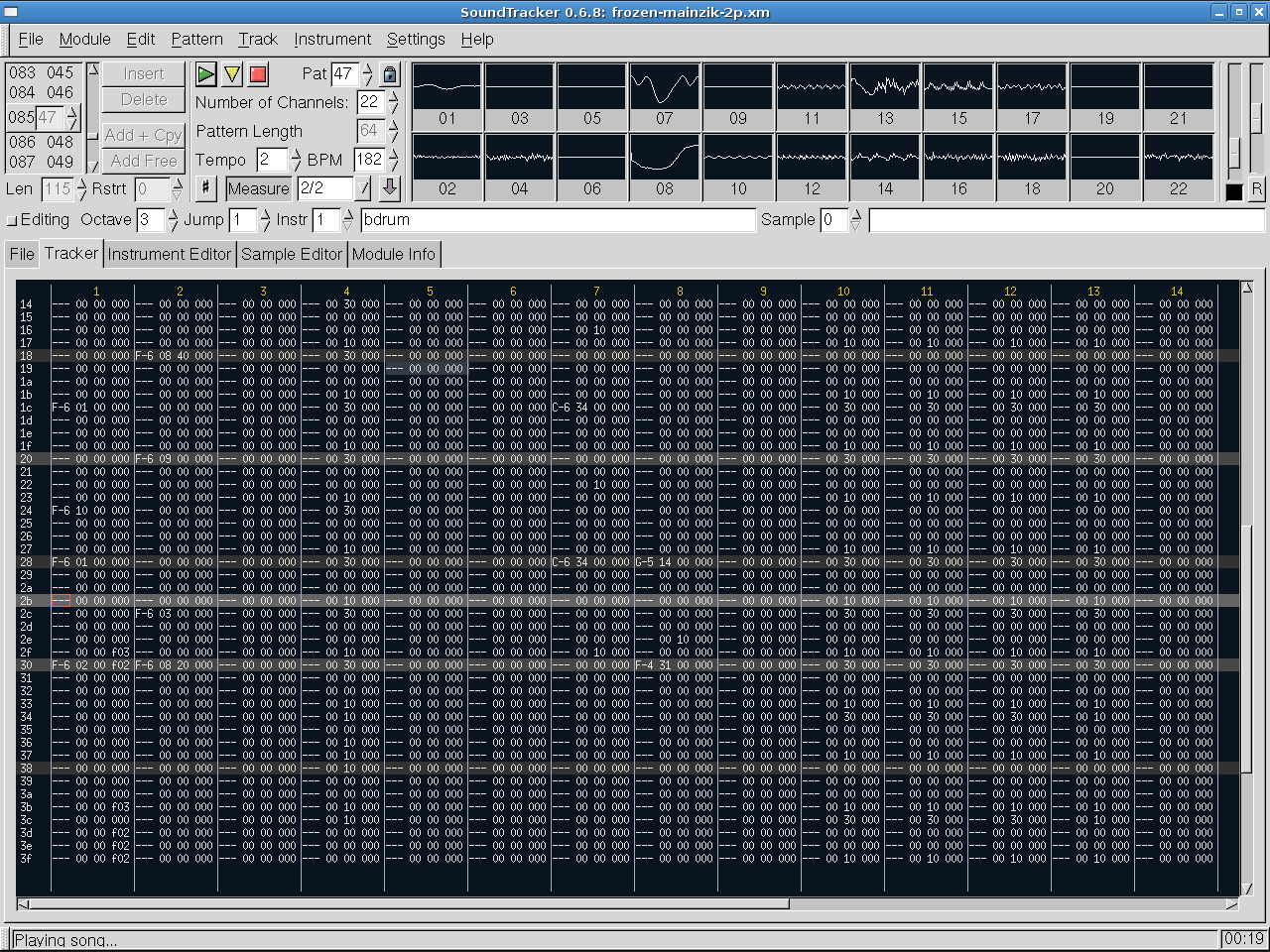


<p class="wp-block-paragraph">Looks like I&rsquo;m gonna have to dig up information about that Jellinghaus Music Systems!</p>


<p class="wp-block-paragraph"><em>However, Karl did send me this picture of Pro 16&rsquo;s Key Editor, which clearly features « textual » notes on the left column: F5, D5, E4, with a # for black keys. </em></p>


<div class="wp-block-image">
<figure class="aligncenter size-full"><img loading="lazy" decoding="async" width="384" height="288" src="https://xavier.borderie.net/blog/wp-content/uploads/2023/09/image-9.png" alt="" class="wp-image-3103" srcset="https://xavier.borderie.net/blog/wp-content/uploads/2023/09/image-9.png 384w, https://xavier.borderie.net/blog/wp-content/uploads/2023/09/image-9-200x150.png 200w" sizes="auto, (max-width: 384px) 100vw, 384px" /><figcaption class="wp-element-caption">Says Karl: « Pro 16 Key Editor (one of my favourites :-). One could insert notes in realtime either with the MIDI<br>keyboard or function keys while it would scroll (!),<br>or single-step. »</figcaption></figure>
</div>


<p class="wp-block-paragraph"><em>So, could Chris Hülsbeck really have been inspired by Steinberg&rsquo;s Pro 16 rather than their Midi Multitrack Sequencer &#8212; or even the Jellinghaus system?</em></p>


<p class="wp-block-paragraph"><em>I asked Chris directly, sending him the Jellinghaus and Pro-16 images above</em>:</p>


<blockquote class="wp-block-quote is-layout-flow wp-block-quote-is-layout-flow">
<p class="wp-block-paragraph"><em>I&rsquo;m pretty sure it was the MIDI Multitrack Sequencer, but there are no screenshots online from the pattern page and as far as I know the software doesn&rsquo;t run without the Steinberg Midi Interface hardware&#8230; so it may have been the Pro-16 too&#8230; it&rsquo;s been such a long time ago! <img src="https://s.w.org/images/core/emoji/17.0.2/72x72/1f609.png" alt="😉" class="wp-smiley" style="height: 1em; max-height: 1em;" /></em></p>
<cite><em>From private e-mail exchange from September 2023.</em></cite></blockquote>


<p class="wp-block-paragraph"><em>I further sent him the Multitrack Sequencer single screen that Karl sent me.</em></p>


<blockquote class="wp-block-quote is-layout-flow wp-block-quote-is-layout-flow">
<p class="wp-block-paragraph"><em>Yes, then the pattern page may have been from Pro-16&#8230;</em></p>


<p class="wp-block-paragraph"><em>Maybe I was also dreaming about a pattern edit page… maybe they did not even have one… the color scheme and blinking cursor definitely more resembles the Pro-16, but everything is so hazy at this point… <img src="https://s.w.org/images/core/emoji/17.0.2/72x72/1f609.png" alt="😉" class="wp-smiley" style="height: 1em; max-height: 1em;" /></em></p>
<cite><em>From private e-mail exchange from September 2023.</em></cite></blockquote>


<div class="wp-block-image">
<figure class="alignright size-large is-resized"><img loading="lazy" decoding="async" width="450" height="338" src="https://xavier.borderie.net/blog/wp-content/uploads/2023/10/pro16-keyeditor-450x338.jpg" alt="" class="wp-image-3193" style="aspect-ratio:1.331360946745562;width:450px;height:auto" srcset="https://xavier.borderie.net/blog/wp-content/uploads/2023/10/pro16-keyeditor-450x338.jpg 450w, https://xavier.borderie.net/blog/wp-content/uploads/2023/10/pro16-keyeditor-200x150.jpg 200w, https://xavier.borderie.net/blog/wp-content/uploads/2023/10/pro16-keyeditor-768x576.jpg 768w, https://xavier.borderie.net/blog/wp-content/uploads/2023/10/pro16-keyeditor-1536x1152.jpg 1536w, https://xavier.borderie.net/blog/wp-content/uploads/2023/10/pro16-keyeditor-1200x900.jpg 1200w, https://xavier.borderie.net/blog/wp-content/uploads/2023/10/pro16-keyeditor.jpg 1600w" sizes="auto, (max-width: 450px) 100vw, 450px" /><figcaption class="wp-element-caption">Nevertheless, the Pro-16 Key Editor, seen here with moving « notes », really gives a hint to what Soundmonitor and ultimately Soundtracker will bring to the world in terms of accessibility of music.<br>Image taken from a <a href="https://megazakaz.com/gb/ebay/product/266169837780">weird seemingly old Russian eBay UK listing</a> (?), which also contains several other interesting Pro16 images but a very lazy/dying webserver<sup class="modern-footnotes-footnote modern-footnotes-footnote--hover-on-desktop ">27</sup>, so <a href="https://imgur.com/gallery/jqWyC1X">I saved what I could on Imgur</a>.</figcaption></figure>
</div>


<p class="wp-block-paragraph"><em>So, not quite a definitive answer there. Since all of this happened some 40 years ago, I can understand the foggy memories <img src="https://s.w.org/images/core/emoji/17.0.2/72x72/1f642.png" alt="🙂" class="wp-smiley" style="height: 1em; max-height: 1em;" /> </em><br><em>But since Steinberg&rsquo;s Pro-16 was <a href="http://www.muzines.co.uk/articles/professional-conduct/9233">being reviewed by a UK magazine</a> in February 1986, and Chris Hülsbeck wrote his own Soundmonitor in the Summer of 1986, then it could definitely still be a match &#8212; although quite a tight one, I&rsquo;ll admit.</em></p>


<p class="wp-block-paragraph">Anyway, that Jellinghaus thing is an interesting story in itself, but that&rsquo;s for another article; let&rsquo;s continue talking with Karl Steinberg about the early Steinberg history.</p>


<blockquote class="wp-block-quote is-layout-flow wp-block-quote-is-layout-flow">
<p class="wp-block-paragraph"><strong>XB: </strong>[Were you] the sole developer of the C64 Multitrack Recorder and Pro-16? <br><br><strong>KS: </strong>Yes, I pretty much developed those two programs by myself. Then Pro 24 followed on the Amiga, which was mostly done by Mr. Werner Kracht, myself adding some « low-level » stuff. There was also a version of Pro 16 for the Mac II if I remember correctly, ported by somebody else whose name I forgot.</p>


<p class="wp-block-paragraph"><strong>XB:</strong> [What were your inspirations for these tools?]</p>


<p class="wp-block-paragraph"><strong>KS:</strong> My inspirations were just to see that it was possible; we only just had started to deal with computers. We (Manfred Ruerup, co-founder, and me) were busy in a decent studio (Delta Studios Wilster), Manfred sold keyboards at Amptown Hamburg and always brought in the latest gear, so there was a lot of inspiration from that end. Also I guess sequential drumtracks was inspiring quantize and pattern concepts.<br>(&#8230;)<br>Later we dealt with samplers, [Fairlight] CMI, [Sequential] Prophet, etc., triggered everything with everything via the studio patchbay and so forth.</p>
<cite>Adapted from private e-mail interview from April 2021.</cite></blockquote>


<p class="wp-block-paragraph"><img src="https://s.w.org/images/core/emoji/17.0.2/72x72/1f6a8.png" alt="🚨" class="wp-smiley" style="height: 1em; max-height: 1em;" />Alert, alert, we have inspiration! <img src="https://s.w.org/images/core/emoji/17.0.2/72x72/1f6a8.png" alt="🚨" class="wp-smiley" style="height: 1em; max-height: 1em;" /><br>Karl mentions « sequential drumtracks », which I assume means « drum machines » &#8212; but he could also be talking specifically about the DrumTraks drum machine, released in 1983 by the Sequential company (hence, Sequential DrumTraks, with proper capitalization!)&nbsp;&#8212; whose CEO, the late <a href="https://www.sequential.com/about-dave-smith/">Dave Smith</a> (<a href="https://archive.ph/IR0P4">archive</a>), co-authored in 1982 the MIDI specification itself.</p>


<p class="wp-block-paragraph">Again, a story for another article &#8212; but let&rsquo;s keep in mind that « sequences » and « patterns » were nothing new in the 1983 world of digital music<sup class="modern-footnotes-footnote modern-footnotes-footnote--hover-on-desktop ">28</sup>.</p>


<p class="wp-block-paragraph">Let&rsquo;s see his other answers.</p>


<blockquote class="wp-block-quote is-layout-flow wp-block-quote-is-layout-flow">
<p class="wp-block-paragraph"><strong>XB: </strong>I&rsquo;d like to find out whether [you] invented the whole « pattern of notes » representation, or if [you] got inspired from somewhere else, like a drum machine or the famous Fairlight CMI Series II.<br><br><strong>KS: </strong>See [my previous answer] <img src="https://s.w.org/images/core/emoji/17.0.2/72x72/1f642.png" alt="🙂" class="wp-smiley" style="height: 1em; max-height: 1em;" /><br>(&#8230;)<br>Not sure what you mean by « pattern of notes »; list-based sequencers like the JMS mentioned above, were probably the first to allow MIDI editing, and that was the obvious choice for computer-based systems as a first step.</p>


<p class="wp-block-paragraph">Not sure if there were piano-roll type MIDI editors before the Pro 16 addition &#8211; it also even featured a score editor later on.<br><br>(&#8230;)</p>


<p class="wp-block-paragraph">As for inspirations, I&rsquo;m certain that it was not only me who was inspired by drum machines. Those were based on patterns and « songtables » (chain of patterns) and featured MIDI, and were the first devices to combine this, so it was kinda obvious to start off from that ground.</p>


<p class="wp-block-paragraph">Trackers are more closely related to « list-based » sequencers which in turn were the obvious choice from a (pre-)80s computer point of view. There was practically no graphics until Apple, and then Commodore, and then Amiga and many others to follow, and until then you&rsquo;d have to use computers for music like a typewriter.</p>


<p class="wp-block-paragraph">(&#8230;)</p>


<p class="wp-block-paragraph">One more note…nothing I say here is proven truth; memories are often changing over time, and I&rsquo;m particularly bad at this <img src="https://s.w.org/images/core/emoji/17.0.2/72x72/1f642.png" alt="🙂" class="wp-smiley" style="height: 1em; max-height: 1em;" /></p>
<cite>Ibid.</cite></blockquote>


<p class="wp-block-paragraph">As I wrote to Karl, his answers brought me new clues and new directions to find when the « jump » of the sequencer idea from hardware to software happened.</p>


<p class="wp-block-paragraph">I&rsquo;m closing this interview with the following: a picture of the <a href="https://www.c64-wiki.com/wiki/CARD_32">Card 32</a>, the MIDI interface that Karl created along with Pro-16, followed by his very own comment on it:</p>


<figure class="wp-block-image size-full"><img loading="lazy" decoding="async" width="512" height="340" src="https://xavier.borderie.net/blog/wp-content/uploads/2023/10/IMG_2744-1.jpg" alt="" class="wp-image-3204" srcset="https://xavier.borderie.net/blog/wp-content/uploads/2023/10/IMG_2744-1.jpg 512w, https://xavier.borderie.net/blog/wp-content/uploads/2023/10/IMG_2744-1-200x133.jpg 200w, https://xavier.borderie.net/blog/wp-content/uploads/2023/10/IMG_2744-1-450x299.jpg 450w" sizes="auto, (max-width: 512px) 100vw, 512px" /><figcaption class="wp-element-caption">« The legendary Card32. Imagine that: plugged into the C 64&rsquo;s expansion port, not only gives 1 MIDI In and 3 MIDI out plus Tape Sync i/o, but also the Pro 16 with Key Editor and Score Editor, each on an Eprom: switch on the C 64, and after no more than 3 seconds, the sequencer display is up and running and ready to record. Wish i had that today… »</figcaption></figure>


<p class="wp-block-paragraph">As I understand, Pro-16 was not sold as a software on a floppy disk or cassette: it was sold <em>as part of the EPROM of the MIDI interface itself</em>, thus bypassing any other system request<sup class="modern-footnotes-footnote modern-footnotes-footnote--hover-on-desktop ">29</sup>! Incredible piece of equipment&#8230;</p>


<p class="wp-block-paragraph">Oh well, let&rsquo;s drop a couple more pics, just because I can <img src="https://s.w.org/images/core/emoji/17.0.2/72x72/1f642.png" alt="🙂" class="wp-smiley" style="height: 1em; max-height: 1em;" /></p>


<figure class="wp-block-image size-full"><img loading="lazy" decoding="async" width="512" height="340" src="https://xavier.borderie.net/blog/wp-content/uploads/2023/10/IMG_2746.jpg" alt="" class="wp-image-3205" srcset="https://xavier.borderie.net/blog/wp-content/uploads/2023/10/IMG_2746.jpg 512w, https://xavier.borderie.net/blog/wp-content/uploads/2023/10/IMG_2746-200x133.jpg 200w, https://xavier.borderie.net/blog/wp-content/uploads/2023/10/IMG_2746-450x299.jpg 450w" sizes="auto, (max-width: 512px) 100vw, 512px" /><figcaption class="wp-element-caption">« Prototype of the Card32. »</figcaption></figure>


<figure class="wp-block-image size-full"><img loading="lazy" decoding="async" width="512" height="340" src="https://xavier.borderie.net/blog/wp-content/uploads/2023/10/IMG_2748.jpg" alt="" class="wp-image-3206" srcset="https://xavier.borderie.net/blog/wp-content/uploads/2023/10/IMG_2748.jpg 512w, https://xavier.borderie.net/blog/wp-content/uploads/2023/10/IMG_2748-200x133.jpg 200w, https://xavier.borderie.net/blog/wp-content/uploads/2023/10/IMG_2748-450x299.jpg 450w" sizes="auto, (max-width: 512px) 100vw, 512px" /><figcaption class="wp-element-caption">« Same interface [for the Hitech 1020]. Here, the EPROM is selfmade; switching on the C64, some very sophisticated development tools were right up and running! Besides the Assembler, we had an extended Monitor, Basic Editor, and a cool feature which would allow to blend the application and development screens line by line (using the VIC, via NMI). »</figcaption></figure>


<figure class="wp-block-image size-full"><img loading="lazy" decoding="async" width="512" height="340" src="https://xavier.borderie.net/blog/wp-content/uploads/2023/10/IMG_2761.jpg" alt="" class="wp-image-3207" srcset="https://xavier.borderie.net/blog/wp-content/uploads/2023/10/IMG_2761.jpg 512w, https://xavier.borderie.net/blog/wp-content/uploads/2023/10/IMG_2761-200x133.jpg 200w, https://xavier.borderie.net/blog/wp-content/uploads/2023/10/IMG_2761-450x299.jpg 450w" sizes="auto, (max-width: 512px) 100vw, 512px" /><figcaption class="wp-element-caption">« The EPROM Programmer for the SMP-24. The 6502 code was developed on the PC and dumped via the parallel port to the EP which would be plugged to the EPROM socket of the SMP 24. »</figcaption></figure>


<figure class="wp-block-image size-full"><img loading="lazy" decoding="async" width="512" height="340" src="https://xavier.borderie.net/blog/wp-content/uploads/2023/10/IMG_2762.jpg" alt="" class="wp-image-3208" srcset="https://xavier.borderie.net/blog/wp-content/uploads/2023/10/IMG_2762.jpg 512w, https://xavier.borderie.net/blog/wp-content/uploads/2023/10/IMG_2762-200x133.jpg 200w, https://xavier.borderie.net/blog/wp-content/uploads/2023/10/IMG_2762-450x299.jpg 450w" sizes="auto, (max-width: 512px) 100vw, 512px" /><figcaption class="wp-element-caption">« The EPROM Programmer as it was used during devolopment, featuring the original, highly isolating 3M Floppy-Disk sleeve <img src="https://s.w.org/images/core/emoji/17.0.2/72x72/1f642.png" alt="🙂" class="wp-smiley" style="height: 1em; max-height: 1em;" /> « </figcaption></figure>


<p class="wp-block-paragraph">And now I can be satisfied in knowing I gave you everything I know <img src="https://s.w.org/images/core/emoji/17.0.2/72x72/1f642.png" alt="🙂" class="wp-smiley" style="height: 1em; max-height: 1em;" /></p>


<hr class="wp-block-separator has-alpha-channel-opacity"/>


<p class="wp-block-paragraph">It&rsquo;s interesting in that it seems to have walked parallel paths:</p>


<ul class="wp-block-list">
<li>The people behind the Fairlight CMI Series II&rsquo;s « Page R » feature where inspired by a drum machine<sup class="modern-footnotes-footnote modern-footnotes-footnote--hover-on-desktop ">30</sup> &#8212; but this was more about <a href="https://en.wikipedia.org/wiki/Music_sequencer#Step_sequencers">step sequencing</a>, so that did not directly inspire trackers such as the Amiga Soundtracker. </li>
</ul>


<div class="wp-block-image">
<figure class="alignright size-full"><img loading="lazy" decoding="async" width="540" height="405" src="https://xavier.borderie.net/blog/wp-content/uploads/2023/10/fb1.jpg" alt="" class="wp-image-3195" srcset="https://xavier.borderie.net/blog/wp-content/uploads/2023/10/fb1.jpg 540w, https://xavier.borderie.net/blog/wp-content/uploads/2023/10/fb1-200x150.jpg 200w, https://xavier.borderie.net/blog/wp-content/uploads/2023/10/fb1-450x338.jpg 450w" sizes="auto, (max-width: 540px) 100vw, 540px" /><figcaption class="wp-element-caption">How I suppose you see me at this point.</figcaption></figure>
</div>


<ul class="wp-block-list">
<li>And now, it seems the « Commodore line » follows this path: Jellinghaus&rsquo; Multitrack Composer <img src="https://s.w.org/images/core/emoji/17.0.2/72x72/27a1.png" alt="➡" class="wp-smiley" style="height: 1em; max-height: 1em;" /> Steinberg&rsquo;s MIDI Multitrack Sequencer <img src="https://s.w.org/images/core/emoji/17.0.2/72x72/27a1.png" alt="➡" class="wp-smiley" style="height: 1em; max-height: 1em;" /> Chris Hülsbeck&rsquo;s Soundmonitor <img src="https://s.w.org/images/core/emoji/17.0.2/72x72/27a1.png" alt="➡" class="wp-smiley" style="height: 1em; max-height: 1em;" /> Karsten Obarski&rsquo;s Ultimate Soundtracker &#8212; each taking inspiration from the previous one, and adding a significant progress to the initial idea. <br>Their common aspect: describing notes not as in a graphical representation, like the Fairlight CMI II&rsquo;s Page R did<sup class="modern-footnotes-footnote modern-footnotes-footnote--hover-on-desktop ">31</sup>, but as « text-based » sequences, such A-3, B-5, F#2<sup class="modern-footnotes-footnote modern-footnotes-footnote--hover-on-desktop ">32</sup>, etc.</li>
</ul>


<p class="wp-block-paragraph">Indeed, it looks like the pioneers at the time were quite fast in taking inspiration and improving upon each other&rsquo;s ideas! What a time it must have been to be in that field! </p>


<p class="wp-block-paragraph">Now, I have to find out the ones who created the JMS Multitrack Composer &#8212; and it seems I&rsquo;m getting close, as a quick search seems to indicate that they were hardware producers mainly.</p>


<hr class="wp-block-separator has-alpha-channel-opacity"/>


<p class="wp-block-paragraph">So, there ends an important milestone in my little quest! <img src="https://s.w.org/images/core/emoji/17.0.2/72x72/1f642.png" alt="🙂" class="wp-smiley" style="height: 1em; max-height: 1em;" /></p>


<p class="wp-block-paragraph">The next parts will focus on each of the two parallel paths that I highlighted above:</p>


<ul class="wp-block-list">
<li>The Fairlight CMI path: finding out how they came up with the idea for their Page R sequencer.</li>


<li>The « Commodore » path, going down the JMS rabbit hole, and their Multitrack Composer.</li>
</ul>


<p class="wp-block-paragraph">Will there be more parts? Who knows? I sure don&rsquo;t!</p>


<p class="wp-block-paragraph">Onwards!</p>


<hr class="wp-block-separator has-alpha-channel-opacity"/>


<p class="wp-block-paragraph">You thought it was over, right?</p>


<p class="wp-block-paragraph"> &nbsp;&nbsp;</p>


<p class="wp-block-paragraph">That would be too easy&#8230;</p>


<p class="wp-block-paragraph"> &nbsp;&nbsp; &nbsp;&nbsp;</p>


<p class="wp-block-paragraph">Get ready foooooor: an <img src="https://s.w.org/images/core/emoji/17.0.2/72x72/1f918.png" alt="🤘" class="wp-smiley" style="height: 1em; max-height: 1em;" />Á̸͈̣̉͆͊̈́̚͝Ḑ̵̧͕͙̀̅̽̎͊͂̿̏̀͒͛̽͘̕͠D̵̢̥̩̫͈̠̘̫̫͎̰̯͈̘̉͌Ḙ̵̱̖̺̜̼̬̰̟͒̐͒̇̿̌̂̔̊̕͘͘N̷̢̯̜̈́́̿̀̄̀̍͑͌̇͗̓̕̚D̶̹̪̈́̿͛̃̏̔̔͋͑́Ų̷̳̱̮͍̪̬͍̥͓̺̯͉͑͐̐M̵̨̢͈̐͠!!!<img src="https://s.w.org/images/core/emoji/17.0.2/72x72/1f918.png" alt="🤘" class="wp-smiley" style="height: 1em; max-height: 1em;" /></p>


<p class="wp-block-paragraph"> &nbsp;&nbsp; &nbsp;&nbsp;</p>


<h2 class="wp-block-heading">Addendum: Manfred Rürup&rsquo;s take</h2>


<p class="wp-block-paragraph">Since 2023 is definitely not like 2019<sup class="modern-footnotes-footnote modern-footnotes-footnote--hover-on-desktop ">33</sup>, I&rsquo;ve decided to approach Mr. Rürup, in order to have his own take on the whole thing, and possibly bring a different perspective.</p>


<div class="wp-block-image">
<figure class="alignright size-full"><img loading="lazy" decoding="async" width="280" height="186" src="https://xavier.borderie.net/blog/wp-content/uploads/2023/09/image-12.png" alt="" class="wp-image-3146" srcset="https://xavier.borderie.net/blog/wp-content/uploads/2023/09/image-12.png 280w, https://xavier.borderie.net/blog/wp-content/uploads/2023/09/image-12-200x133.png 200w" sizes="auto, (max-width: 280px) 100vw, 280px" /><figcaption class="wp-element-caption">Manfred Rürup on the keyboard. <br>Taken from <a href="https://www.soundonsound.com/music-business/steinberg-pinnacle-buyout">this Sound on Sound article</a>, March 2003.</figcaption></figure>
</div>


<p class="wp-block-paragraph">So here goes, a short interview!</p>


<blockquote class="wp-block-quote is-layout-flow wp-block-quote-is-layout-flow">
<p class="wp-block-paragraph"><strong>XB: </strong>Reading various early interviews (notably <a rel="noreferrer noopener" href="http://www.muzines.co.uk/articles/inside-views-steinberg-research/1623" target="_blank">this one from 1986</a> and <a rel="noreferrer noopener" href="https://www.stcarchiv.de/tos1992/01/steinberg-story" target="_blank">this one from 1992</a>), it sounds like that Nicole was the designer, Karl was the technician and you were the marketing/salesman. Was that as binary as that, or did you share duties?&nbsp; </p>


<p class="wp-block-paragraph"><strong>MR: </strong>That is correct. </p>


<p class="wp-block-paragraph">Nicole did not design UI or anything like that. She did all the print advertisements and the manuals.&nbsp;</p>
<cite>Private e-mail interview from September 2023.</cite></blockquote>


<p class="wp-block-paragraph">As a <a href="https://xavier.borderie.net/">technical writer myself</a>, I can tell you that just producing the documentation for this is no small taks &#8212; but it seems she did it « <em>with an electric typing machine, all the illustrations are ASCII art (!!!) and all the binding and transparent plastic cover are typical office stationary from the &rsquo;80s</em>« , <a href="https://www.ebay.co.uk/itm/144412546173">as per this eBay UK listing</a>, which I&rsquo;m taking the image below from.</p>


<figure class="wp-block-gallery has-nested-images columns-default is-cropped wp-block-gallery-5 is-layout-flex wp-block-gallery-is-layout-flex">
<figure class="wp-block-image size-large"><img loading="lazy" decoding="async" width="450" height="600" data-id="3201" src="https://xavier.borderie.net/blog/wp-content/uploads/2023/10/pro16manual01-450x600.jpg" alt="" class="wp-image-3201" srcset="https://xavier.borderie.net/blog/wp-content/uploads/2023/10/pro16manual01-450x600.jpg 450w, https://xavier.borderie.net/blog/wp-content/uploads/2023/10/pro16manual01-200x267.jpg 200w, https://xavier.borderie.net/blog/wp-content/uploads/2023/10/pro16manual01-768x1024.jpg 768w, https://xavier.borderie.net/blog/wp-content/uploads/2023/10/pro16manual01-1152x1536.jpg 1152w, https://xavier.borderie.net/blog/wp-content/uploads/2023/10/pro16manual01.jpg 1200w" sizes="auto, (max-width: 450px) 100vw, 450px" /></figure>


<figure class="wp-block-image size-large"><img loading="lazy" decoding="async" width="450" height="600" data-id="3202" src="https://xavier.borderie.net/blog/wp-content/uploads/2023/10/pro16manual02-450x600.jpg" alt="" class="wp-image-3202" srcset="https://xavier.borderie.net/blog/wp-content/uploads/2023/10/pro16manual02-450x600.jpg 450w, https://xavier.borderie.net/blog/wp-content/uploads/2023/10/pro16manual02-200x267.jpg 200w, https://xavier.borderie.net/blog/wp-content/uploads/2023/10/pro16manual02-768x1024.jpg 768w, https://xavier.borderie.net/blog/wp-content/uploads/2023/10/pro16manual02-1152x1536.jpg 1152w, https://xavier.borderie.net/blog/wp-content/uploads/2023/10/pro16manual02.jpg 1200w" sizes="auto, (max-width: 450px) 100vw, 450px" /></figure>


<figure class="wp-block-image size-large"><img loading="lazy" decoding="async" width="450" height="600" data-id="3203" src="https://xavier.borderie.net/blog/wp-content/uploads/2023/10/pro16manual03-450x600.jpg" alt="" class="wp-image-3203" srcset="https://xavier.borderie.net/blog/wp-content/uploads/2023/10/pro16manual03-450x600.jpg 450w, https://xavier.borderie.net/blog/wp-content/uploads/2023/10/pro16manual03-200x267.jpg 200w, https://xavier.borderie.net/blog/wp-content/uploads/2023/10/pro16manual03-768x1024.jpg 768w, https://xavier.borderie.net/blog/wp-content/uploads/2023/10/pro16manual03-1152x1536.jpg 1152w, https://xavier.borderie.net/blog/wp-content/uploads/2023/10/pro16manual03.jpg 1200w" sizes="auto, (max-width: 450px) 100vw, 450px" /></figure>
</figure>


<p class="wp-block-paragraph">So, yeah, quite a task in itself!</p>


<blockquote class="wp-block-quote is-layout-flow wp-block-quote-is-layout-flow">
<p class="wp-block-paragraph"><strong>XB: </strong>I mention Nicole, your wife, because she was part of the initial team, as I understand, but I hardly see her name in interviews &#8212; most of the time, she&rsquo;s there as « support », or as manual and adverts designer. How did her role grow with the success of the company? Or did she move to another line of work / company eventually? </p>


<p class="wp-block-paragraph"><strong>MR: </strong>She continued to do advertisements and graphics and the manuals. A lot to do, as the software became very complex and so the manuals [grew] bigger and bigger.</p>
<cite>Ibid.</cite></blockquote>


<blockquote class="wp-block-quote is-layout-flow wp-block-quote-is-layout-flow">
<p class="wp-block-paragraph"><strong>XB: </strong>It seems that Steinberg&rsquo;s very first product was the MIDI Multitrack Sequencer. Do you remember if it was influenced by an existing product, hardware or software? What were the competitors at the time in the MIDI market?&nbsp; </p>


<p class="wp-block-paragraph"><strong>MR: </strong>The MIDI Multitrack Sequencer was a single page product, because we preferred one page and no menus which lead to another page. I think it was pretty unique.&nbsp;</p>
<cite>Ibid.</cite></blockquote>


<blockquote class="wp-block-quote is-layout-flow wp-block-quote-is-layout-flow">
<p class="wp-block-paragraph"><strong>XB: </strong>How many copies do you think were sold before you moved on to bigger things? <a rel="noreferrer noopener" href="https://www.musicradar.com/tuition/tech/a-brief-history-of-steinberg-cubase-406132" target="_blank">This article</a> says « fewer than 50 copies », and <a rel="noreferrer noopener" href="https://www.stcarchiv.de/tos1992/01/steinberg-story" target="_blank">in this one</a> you are quoted as saying « when you sell ten MIDI packages, that’s «&nbsp;big business&nbsp;» (laughter) ». Is the real number in between?</p>


<p class="wp-block-paragraph"><strong>MR: </strong>The real number is probably around 50 copies.&nbsp;</p>
<cite>Ibid.</cite></blockquote>


<p class="wp-block-paragraph">Remember the quote from the interview earlier in this article? « When you sell ten MIDI packages, that&rsquo;s big business (laughter) ». Well, I suppose selling 5 times above your expectations is a sure sign that your little hobby is onto something, and you should push forward. I&rsquo;m glad they did!</p>


<blockquote class="wp-block-quote is-layout-flow wp-block-quote-is-layout-flow">
<p class="wp-block-paragraph"><strong>XB: </strong>Who did you mostly sell it to? Did it spread outside of Hamburg, to your knowledge? </p>


<p class="wp-block-paragraph"><strong>MR: </strong>I think all over Germany and Austria.&nbsp;</p>
<cite>Ibid.</cite></blockquote>


<p class="wp-block-paragraph">Chris Hüelsbeck was born in Kassel (300 km from Hamburg) and worked for Rainbow Arts in Gütersloh (267 km from Hamburg), so yeah, I suppose he could have found a copy a Steinberg&rsquo;s early tools at the time.</p>


<p class="wp-block-paragraph">Funny thing is: both roads from Kassel and Gütersloh to Hamburg pass through Hanover &#8212; which is where the <a href="https://en.wikipedia.org/wiki/CeBIT">CeBIT</a>, the « largest and most internationally representative computer expo » at the time, happened from 1970 to 2018. So information and ideas certainly spread around from this epicenter <img src="https://s.w.org/images/core/emoji/17.0.2/72x72/1f642.png" alt="🙂" class="wp-smiley" style="height: 1em; max-height: 1em;" /></p>


<blockquote class="wp-block-quote is-layout-flow wp-block-quote-is-layout-flow">
<p class="wp-block-paragraph"><strong>XB: </strong>Mr. Steinberg told me about the Jellinghaus Multitrack Composer. Do you have recollection of that tool, of the Jellinghaus company itself, or even of their C64 development team? </p>


<p class="wp-block-paragraph"><strong>MR: </strong>What do you mean by « recollection »? Never met them [then nor] since then.</p>
<cite>Ibid.</cite></blockquote>


<p class="wp-block-paragraph">I had to try&#8230;</p>


<blockquote class="wp-block-quote is-layout-flow wp-block-quote-is-layout-flow">
<p class="wp-block-paragraph"><strong>XB: </strong>My understanding is that, after the MIDI Multitrack Sequencer, there were a few OEM product and the Pro-16, made by Mr. Steinberg on C64, then Pro-24, made mainly by Mr. Kracht on Atari. Eventually it all lead to Cubase on the Atari, but who&rsquo;s was the main programmer of Cubit/Cubase 1.0, Mr. Steinberg or Mr. Kracht (or someone else)? </p>


<p class="wp-block-paragraph"><strong>MR: </strong>Cubit/Cubase was a team-work of Werner Kracht, Wolfgang Kundrus, Stefan Scheffler, Michael Michaelis and Charly Steinberg.&nbsp;</p>
<cite>Ibid.</cite></blockquote>


<p class="wp-block-paragraph">Many names, which I <em>could</em> interview, but really, it&rsquo;s time for this article to be released. </p>


<p class="wp-block-paragraph">For those interested, here is <a href="https://www.youtube.com/watch?v=JKCAYJuApro">an in-depth and recent video interview</a> of Wolfgang Kundrus; and Michael Michaelis has a lot of opinions and <a href="https://www.michael-michaelis.de/">shares them on his website</a> (en German). <br>Also, did he forget <a href="http://www.atarimania.com/utility-atari-st-cubase_23764.html">about Chris Mercer</a>?</p>


<blockquote class="wp-block-quote is-layout-flow wp-block-quote-is-layout-flow">
<p class="wp-block-paragraph"><strong>XB: </strong>It seems to me that Mr. Steinberg was mostly working on M-ROS and low-level stuff, while Kracht (and a team?) worked on the main interface. Is that right? </p>


<p class="wp-block-paragraph"><strong>MR: </strong>The architecture and UI idea came from Wolfgang Kundrus, Werner Kracht did the data-storage and handling, Charly Steinberg did M-ROS and other things, Michael Michaelis did work for the scoring and Stefan Scheffler did the integration of the User-Interface funktions.&nbsp;</p>
<cite>Ibid.</cite></blockquote>


<p class="wp-block-paragraph">I have to say a word about M-ROS, for the sake of completeness.</p>


<p class="wp-block-paragraph">The MIDI Real-time Operating System (M-ROS) was a very innovative alternative operating system, which worked on several platforms (Atari, Apple), and brought true multitasking to systems that weren&rsquo;t quite able to do that by themselves. Since MIDI meant having different tools working together in (hopefully) real time, M-ROS turned to be essential to the success of that protocol &#8212; provided that those tools were written for M-ROS.</p>


<p class="wp-block-paragraph">It eventually lead to the <a href="https://en.wikipedia.org/wiki/ReWire_(software_protocol)">ReWire protocol</a>, conceived by Propellerhead (makers of Reason) and Steinberg, which was very much used by most other DAWs from 1998 to 2020.</p>


<p class="wp-block-paragraph">So, no small feat for Karl to be so prescient and technical in 1989!</p>


<blockquote class="wp-block-quote is-layout-flow wp-block-quote-is-layout-flow">
<p class="wp-block-paragraph"><strong>XB: </strong>Did you yourself do any programming on the Steinberg tools? </p>


<p class="wp-block-paragraph"><strong>MR: </strong>No, not a single line.</p>
<cite>Ibid.</cite></blockquote>


<p class="wp-block-paragraph">I suppose Manfred is great with a piano keyboard, less so with a computer one <img src="https://s.w.org/images/core/emoji/17.0.2/72x72/1f642.png" alt="🙂" class="wp-smiley" style="height: 1em; max-height: 1em;" /> </p>


<hr class="wp-block-separator has-alpha-channel-opacity"/>


<p class="wp-block-paragraph">And that&rsquo;s it, my friends. </p>


<p class="wp-block-paragraph">Let&rsquo;s close this chapter about Steinberg by remembering that they were first and foremost musicians who were passionate about music and helping other musicians achieve their dream!</p>


<p class="wp-block-paragraph">Find a copy of <a href="https://www.discogs.com/release/6989557-Various-Headquarter-Blues-Steinberg">this home-made album</a> to convince yourself <img src="https://s.w.org/images/core/emoji/17.0.2/72x72/1f642.png" alt="🙂" class="wp-smiley" style="height: 1em; max-height: 1em;" /></p>


<figure class="wp-block-image size-full"><img loading="lazy" decoding="async" width="600" height="594" src="https://xavier.borderie.net/blog/wp-content/uploads/2023/09/image-10.png" alt="" class="wp-image-3143" srcset="https://xavier.borderie.net/blog/wp-content/uploads/2023/09/image-10.png 600w, https://xavier.borderie.net/blog/wp-content/uploads/2023/09/image-10-200x198.png 200w, https://xavier.borderie.net/blog/wp-content/uploads/2023/09/image-10-450x446.png 450w, https://xavier.borderie.net/blog/wp-content/uploads/2023/09/image-10-150x150.png 150w" sizes="auto, (max-width: 600px) 100vw, 600px" /></figure>


<hr class="wp-block-separator has-alpha-channel-opacity"/>


<p class="wp-block-paragraph">Other articles in this series:</p>


<ol class="wp-block-list">
<li><a href="https://xavier.borderie.net/blog/2021/07/11/soundtracking-sur-amiga-passion-explications-et-exemples/">Soundtracking sur Amiga : passion, explications et exemples</a> &#8212; The Twitter thread that started it all (in French).</li>


<li><a href="https://xavier.borderie.net/blog/2021/09/22/soundtracker-origins-part-1-where-in-the-world-is-karsten-obarski/">Soundtracker origins, part 1: Where in the World is Karsten Obarski?</a> &#8212; About Karsten Obarski, author of The Ultimate Soundtracker.</li>


<li><a href="https://xavier.borderie.net/blog/2022/12/23/the-origin-of-soundtrackers-mod-format/">The origin of Soundtracker’s MOD format</a> &#8212; When you see a Twitter thread with key information, it is your duty to preserve it.</li>


<li><a href="https://xavier.borderie.net/blog/2023/01/01/soundtracker-origins-part-2-welcome-to-turrican-aah-hahahaha/">Soundtracker origins, part 2: Welcome to Turrican, aah hahahaha</a> &#8212; About Chris Hülsbeck, author of Soundmonitor.</li>


<li><strong>Soundtracker origins, part 3: Facing a stone mountain</strong> &#8212; About Karl Steinberg, author of MIDI Multitrack Sequencer.</li>


<li><a href="https://xavier.borderie.net/blog/2024/03/19/soundtracker-origins-interlude-exploring-the-cambrian-explosion/">Soundtracker Origins, interlude: The coders behind the Cambrian explosion</a> &#8212; Where I get to interview a few key people in the Soundtracker saga.</li>
</ol>
<div>1&nbsp;&nbsp;&nbsp;&nbsp;Click to « <a href="#steinberg-you-say" data-type="internal" data-id="#steinberg-you-say">Steinberg, you say?</a> » if you&rsquo;ve already read the previous articles.</div><div>2&nbsp;&nbsp;&nbsp;&nbsp;And 25 or so tweets, <em>in 3 separate threads</em>. &lsquo;cos if it&rsquo;s easy it ain&rsquo;t fun.</div><div>3&nbsp;&nbsp;&nbsp;&nbsp;Important topics require important-sounding words, mate.</div><div>4&nbsp;&nbsp;&nbsp;&nbsp;Did I succeed in answering that question in the end? Read on&#8230;</div><div>5&nbsp;&nbsp;&nbsp;&nbsp;but very lengthy</div><div>6&nbsp;&nbsp;&nbsp;&nbsp;Told you it was lengthy.</div><div>7&nbsp;&nbsp;&nbsp;&nbsp;Welcome to today, four years after the initial threads and searches, where the present article is finally scratching the surface, yaaaay procrastination (and fatherhood)!</div><div>8&nbsp;&nbsp;&nbsp;&nbsp;His memory of 1985 is foggy, understandably. I don&rsquo;t even remember what I had for lunch yesterday, let alone 30 years ago. Probably Nutella crêpes, come to think of it.</div><div>9&nbsp;&nbsp;&nbsp;&nbsp;By the way, if you are germanophone, please excuse the sad pun in the title of this present article&#8230;</div><div>10&nbsp;&nbsp;&nbsp;&nbsp;Thus named because « Rürup » didn&rsquo;t sound international enough to them.</div><div>11&nbsp;&nbsp;&nbsp;&nbsp;« She&rsquo;s very good at graphics and so she did some of the company adverts and helped produce the manuals. We had this little Roland computer plotter and we did our first manuals with that. » (<a href="http://www.muzines.co.uk/articles/inside-views-steinberg-rese/1623">source</a>)</div><div>12&nbsp;&nbsp;&nbsp;&nbsp;The MIDI (<a href="https://en.wikipedia.org/wiki/MIDI">Musical Instrument Digital Interface</a>) protocol makes it easy to transmit musical data between digital devices like keyboards and computers. Instead of sending sound files, it transmits event messages such as pitch, velocity, and timing. Upon its release, it revolutionized the music industry by enabling seamless interaction between digital musical instruments and computers, profoundly influencing the creation, recording, and production of music.</div><div>13&nbsp;&nbsp;&nbsp;&nbsp;Ackchyually, <a href="https://en.wikipedia.org/wiki/MIDI#History">1983</a>. *tips fedora*.</div><div>14&nbsp;&nbsp;&nbsp;&nbsp;And no, no trace of an interview of Nicole online.</div><div>15&nbsp;&nbsp;&nbsp;&nbsp;The <a href="https://en.wikipedia.org/wiki/Commodore_SX-64">portable version</a> of the C64.</div><div>16&nbsp;&nbsp;&nbsp;&nbsp;I warned you there&rsquo;d be important-sounding words. So there.</div><div>17&nbsp;&nbsp;&nbsp;&nbsp;Unless you&rsquo;re like me and you went down that same rabbit hole as I did, and <a href="https://xavier.borderie.net/blog/wp-content/uploads/2022/12/image-10.png">came back with this</a>.</div><div>18&nbsp;&nbsp;&nbsp;&nbsp;Commodore Business Machine 64. That&rsquo;s a mouthful.</div><div>19&nbsp;&nbsp;&nbsp;&nbsp;Weeeeeellllll, that&rsquo;s not quite right. It&rsquo;s more « I couldn&rsquo;t find a <em>readily accessible</em> online presence », really. As a matter of fact, there <em>is</em> a « Manfred Rürup, Supervisory Board Member at Ableton » (yes, Ableton, not Steinberg) on LinkedIn who looks an awful lot like an older version of the hippie guy from above. But I couldn&rsquo;t message him directly because I had to be a LinkedIn Premium member to do so, and, well, I guess I decided not to bother him, when I started this research project back in 2019?</div><div>20&nbsp;&nbsp;&nbsp;&nbsp;A machine that comes with a built-in MIDI interface: no more custom dongle to bundle with the software! To this day, the Atari ST remains a very important machine for musicians, thanks to this hardware choice by Atari.</div><div>21&nbsp;&nbsp;&nbsp;&nbsp;But Amiga roulaize quand même, hein.</div><div>22&nbsp;&nbsp;&nbsp;&nbsp;&lsquo;cos after 5 emails I think it&rsquo;s fair of me to call him a friend.</div><div>23&nbsp;&nbsp;&nbsp;&nbsp;I figured out later that this is taken from <a href="ftp://ftp.steinberg.net/Download/General_Documents/c64d.wmv">a short video</a> hosted on a <a href="ftp://ftp.steinberg.net/Download/General_Documents/">public Steinberg FTP server</a>, and Karl simply extracted the images from it to provide them to me. Still, it&rsquo;s exciting!</div><div>24&nbsp;&nbsp;&nbsp;&nbsp;The ability to move notes around on the playing grid, in order to adjust timing or to correct imperfections.</div><div>25&nbsp;&nbsp;&nbsp;&nbsp;The ability to change the pitch of a note, to adjust melody or, again, to correct imperfections &#8212; a predecessor to Auto-Tune.</div><div>26&nbsp;&nbsp;&nbsp;&nbsp;Yes, again, I&rsquo;m <em>that late</em> in publishing this.</div><div>27&nbsp;&nbsp;&nbsp;&nbsp;Sometimes some images would load, sometimes others, sometimes none, sometimes thumbnails would not load but the actual image would&#8230; Let me know if you can get them all!</div><div>28&nbsp;&nbsp;&nbsp;&nbsp;Although the word « pattern » appears only once in the <a href="https://www.midi.org/component/edocman/m1-v4-2-1-midi-1-0-detailed-specification-96-1-4/fdocument?Itemid=9999">MIDI specification</a>. But they might be using synonyms?</div><div>29&nbsp;&nbsp;&nbsp;&nbsp;I hear it&rsquo;s called a <a href="https://www.c64-wiki.com/wiki/Fast_loader">fast loader</a>.</div><div>30&nbsp;&nbsp;&nbsp;&nbsp;More on that in the next part of the series!</div><div>31&nbsp;&nbsp;&nbsp;&nbsp;You know, with « ♪ » and « ♫ » and all that jazz.</div><div>32&nbsp;&nbsp;&nbsp;&nbsp;And no, « X Æ A-12 » doesn&rsquo;t mean that that poor child has an A at the 12th octave in his name.</div><div>33&nbsp;&nbsp;&nbsp;&nbsp;And I&rsquo;ve had to take a LinkedIn Premium account anyway, for training reasons.</div>]]></content>
		
					<link rel="replies" type="text/html" href="https://xavier.borderie.net/blog/2023/10/25/soundtracker-origins-part-3-facing-a-stone-mountain/#comments" thr:count="5" />
			<link rel="replies" type="application/atom+xml" href="https://xavier.borderie.net/blog/2023/10/25/soundtracker-origins-part-3-facing-a-stone-mountain/feed/atom/" thr:count="5" />
			<thr:total>5</thr:total>
			</entry>
		<entry>
		<author>
			<name>Xavier</name>
							<uri>http://xavier.borderie.net</uri>
						</author>

		<title type="html"><![CDATA[De la bonne prise en main d&#8217;une bouteille de lait]]></title>
		<link rel="alternate" type="text/html" href="https://xavier.borderie.net/blog/2023/08/26/de-la-bonne-prise-en-main-dune-bouteille-de-lait/" />

		<id>https://xavier.borderie.net/blog/?p=2816</id>
		<updated>2026-02-24T15:21:23Z</updated>
		<published>2023-08-26T20:04:50Z</published>
		<category scheme="https://xavier.borderie.net/blog" term="pas classé" />
		<summary type="html"><![CDATA[Préambule Je ne suis pas fou. Dramaticule Longtemps je me suis levé de pas si bonne heure, mon seul objectif restant, une fois les nuages dissipés, de me poser devant le téléviseur familial et de tremper l&#8217;une après l&#8217;autre mes deux tartines matinales dans mon mug de chocolat chaud (et matinal). Petit-déjeuner classique, certes, à [&#8230;]]]></summary>

					<content type="html" xml:base="https://xavier.borderie.net/blog/2023/08/26/de-la-bonne-prise-en-main-dune-bouteille-de-lait/"><![CDATA[<span class="span-reading-time rt-reading-time" style="display: block;"><span class="rt-label rt-prefix">Temps de lecture / Reading time : </span> <span class="rt-time"> 6</span> <span class="rt-label rt-postfix">minutes.</span></span>
<h2 class="wp-block-heading">Préambule</h2>


<p class="wp-block-paragraph">Je ne suis pas fou.</p>


<h2 class="wp-block-heading">Dramaticule</h2>


<p class="wp-block-paragraph">Longtemps je me suis levé de pas si bonne heure, mon seul objectif restant, une fois les nuages dissipés, de me poser devant le téléviseur familial et de tremper l&rsquo;une après l&rsquo;autre mes deux tartines matinales dans mon mug de chocolat chaud (et matinal). <br>Petit-déjeuner classique, certes, à cet âge, mais petit-déjeuner de champion quand même.</p>


<p class="wp-block-paragraph">Cette coutume m&rsquo;a suivi une fois le nid parental quitté et le CDI trouvé. Ce dernier a d&rsquo;ailleurs eu une forte influence sur mes matinées : je me devais d&rsquo;arriver à l&rsquo;heure au bureau malgré la distance en trains de banlieue, mais je ne voulais pas pour autant sacrifier mes heures de sommeil. <br>J&rsquo;ai donc choisi le sacrifice ultime : fi des tartines tartinées ; fi de la poudre de cacao lactée. Juste le lait, frais, dans un verre, siroté en regardant pensivement par la fenêtre.</p>


<p class="wp-block-paragraph">Toujours le même verre, bleu&nbsp;; toujours le même format de bouteille de lait, avec une poignée. <em>Consistency is key</em>. </p>


<p class="wp-block-paragraph">J&rsquo;avais à l&rsquo;époque cette curieuse compréhension, sans doute d&rsquo;influence familiale, qu&rsquo;il ne fallait pas retirer entièrement l&rsquo;opercule afin de mieux préserver le lait<sup class="modern-footnotes-footnote modern-footnotes-footnote--hover-on-desktop ">1</sup>. Je l&rsquo;ouvrais donc seulement à moitié, versais le blanc nectar, repliais l&rsquo;aluminium de l&rsquo;opercule pour recouvrir l&rsquo;orifice de la bouteille, et vissais le capuchon par-dessus l&rsquo;opercule replié avant de ranger le tout au frigo, bien à la verticale, jusqu&rsquo;au lendemain matin.</p>


<p class="wp-block-paragraph">Combien de bouteilles bues ? combien d&rsquo;opercules semi-ouverts ? je ne saurai l&rsquo;estimer&#8230;</p>


<p class="wp-block-paragraph"><em>&#8230; si ce n&rsquo;est pour cette courte période de ma vie où je les ais comptées.</em></p>


<span id="more-2816"></span>


<h2 class="wp-block-heading">Opercule</h2>


<p class="wp-block-paragraph">Comme l&rsquo;a rappelé Jeff Buckley en introduction de Night Flight, l&rsquo;une de ses reprises du Sin-é EP, « <em>If you do anything regularly for a while, sooner or later, the weirdoes will show up</em>« .</p>


<p class="wp-block-paragraph">Bon, là, seul dans ma cuisine avec ma bouteille de lait, il me revenait de jouer le rôle du weirdo. </p>


<p class="wp-block-paragraph">En l&rsquo;occurrence, cet opercule me questionnait. Surtout, le placement de la languette du-dit opercule, qui faisait que l&rsquo;on ouvrait icelui dans un sens ou dans un autre.</p>


<p class="wp-block-paragraph">À force d&rsquo;ouvrir moult opercules pour moult bouteilles à l&rsquo;aide de<sup class="modern-footnotes-footnote modern-footnotes-footnote--hover-on-desktop ">2</sup> moult languettes, j&rsquo;en suis venu à un questionnement fondamental, pendant le pensif sirotage matinal de lait devant la fenêtre :</p>


<blockquote class="wp-block-quote is-layout-flow wp-block-quote-is-layout-flow">
<p class="wp-block-paragraph">Les bouteilles de lait sont-elles majoritairement conçues pour les droitiers ou les gauchers ?</p>
<cite>Source : tkt frer</cite></blockquote>


<p class="wp-block-paragraph"><em>Bear with me for a minute, and you’ll see what I mean.</em></p>


<p class="wp-block-paragraph">Voyez-vous, la languette n&rsquo;est pas toujours placée exactement au même endroit sur l&rsquo;orifice. Résultat, si l&rsquo;on se repose systématiquement sur celle-ci pour ouvrir à moitié l&rsquo;opercule (en tirant sur la languette), on se retrouve avec un versement idéal du lait qui se fait tantôt vers la gauche, tantôt vers la droite de la poignée de la bouteille.</p>


<p class="wp-block-paragraph">Ainsi, certains matins tout va bien et l&rsquo;on peut verser le lait avec sa main dominante. Et certains autres matins, on ouvre l&rsquo;opercule pour se rendre compte que, pour les quelques verres à venir, on devra faire le versement à l&rsquo;aide de l&rsquo;<em>autre</em> main<sup class="modern-footnotes-footnote modern-footnotes-footnote--hover-on-desktop ">3</sup>. Ewww&#8230;</p>


<p class="wp-block-paragraph">Deux images valant deux mille mots, voici :</p>


<figure class="wp-block-gallery has-nested-images columns-default is-cropped wp-block-gallery-6 is-layout-flex wp-block-gallery-is-layout-flex">
<figure class="wp-block-image size-large"><img loading="lazy" decoding="async" width="450" height="338" data-id="3006" src="https://xavier.borderie.net/blog/wp-content/uploads/2023/08/P1310055-450x338.jpg" alt="" class="wp-image-3006" srcset="https://xavier.borderie.net/blog/wp-content/uploads/2023/08/P1310055-450x338.jpg 450w, https://xavier.borderie.net/blog/wp-content/uploads/2023/08/P1310055-200x150.jpg 200w, https://xavier.borderie.net/blog/wp-content/uploads/2023/08/P1310055-768x576.jpg 768w, https://xavier.borderie.net/blog/wp-content/uploads/2023/08/P1310055-1536x1152.jpg 1536w, https://xavier.borderie.net/blog/wp-content/uploads/2023/08/P1310055-1200x900.jpg 1200w, https://xavier.borderie.net/blog/wp-content/uploads/2023/08/P1310055-1980x1485.jpg 1980w, https://xavier.borderie.net/blog/wp-content/uploads/2023/08/P1310055.jpg 2048w" sizes="auto, (max-width: 450px) 100vw, 450px" /><figcaption class="wp-element-caption">Opercule favorisant les gauchers.</figcaption></figure>


<figure class="wp-block-image size-large"><img loading="lazy" decoding="async" width="450" height="338" data-id="3007" src="https://xavier.borderie.net/blog/wp-content/uploads/2023/08/P1310052-450x338.jpg" alt="" class="wp-image-3007" srcset="https://xavier.borderie.net/blog/wp-content/uploads/2023/08/P1310052-450x338.jpg 450w, https://xavier.borderie.net/blog/wp-content/uploads/2023/08/P1310052-200x150.jpg 200w, https://xavier.borderie.net/blog/wp-content/uploads/2023/08/P1310052-768x576.jpg 768w, https://xavier.borderie.net/blog/wp-content/uploads/2023/08/P1310052-1536x1152.jpg 1536w, https://xavier.borderie.net/blog/wp-content/uploads/2023/08/P1310052-1200x900.jpg 1200w, https://xavier.borderie.net/blog/wp-content/uploads/2023/08/P1310052-1980x1485.jpg 1980w, https://xavier.borderie.net/blog/wp-content/uploads/2023/08/P1310052.jpg 2048w" sizes="auto, (max-width: 450px) 100vw, 450px" /><figcaption class="wp-element-caption">Opercule favorisant les droitiers.</figcaption></figure>
</figure>


<p class="wp-block-paragraph">Comment savoir si la filière laitière de l&rsquo;industrie agroalimentaire mondiale ne fomente pas <em>en ce moment même</em> un complot visant l&rsquo;une ou l&rsquo;autre de nos chères préférences manuelles<sup class="modern-footnotes-footnote modern-footnotes-footnote--hover-on-desktop ">4</sup> ? </p>


<p class="wp-block-paragraph">Oui, vraiment, comment ? Qui pour nous défendre ? Quel chevalier blanc aura un destrier assez fier pour mener à bien ce combat pour les générations futures ?</p>


<p class="wp-block-paragraph">Oui, qui ?</p>


<p class="wp-block-paragraph"><em>*soupir*</em></p>


<h2 class="wp-block-heading">Notule</h2>


<p class="wp-block-paragraph">J&rsquo;ai donc commencé à garder les bouteilles que j&rsquo;ouvrais (et buvais), prenant soin de les nettoyer et surtout de les conserver avec leurs opercules encore attachés.</p>


<p class="wp-block-paragraph">Lorsque j&rsquo;ai décidé de mettre fin à mon inlassable collecte de données, j&rsquo;avais 73 bouteilles en stock, dans je ne sais combien de cartons &#8212; mais en tout cas, ça prenait de la place dans ma cave. </p>


<p class="wp-block-paragraph">Pourquoi les avoir stockées ? Pourquoi ne pas avoir, pour chaque bouteille ouverte par la languette de l&rsquo;opercule, simplement pris note du sens de la-dite ouverture, et puis jeté la bouteille une fois les notes terminées ?</p>


<figure class="wp-block-image size-full is-resized"><img loading="lazy" decoding="async" width="600" height="382" src="https://xavier.borderie.net/blog/wp-content/uploads/2023/06/image-4.png" alt="&quot;Remember kids, the only difference between screwing around and science is writing it down.&quot;" class="wp-image-2836" style="width:600px;height:382px" srcset="https://xavier.borderie.net/blog/wp-content/uploads/2023/06/image-4.png 600w, https://xavier.borderie.net/blog/wp-content/uploads/2023/06/image-4-200x127.png 200w, https://xavier.borderie.net/blog/wp-content/uploads/2023/06/image-4-450x287.png 450w" sizes="auto, (max-width: 600px) 100vw, 600px" /><figcaption class="wp-element-caption">Adam Savage, de l&rsquo;émission <a href="https://fr.wikipedia.org/wiki/MythBusters">MythBusters</a>, <a href="https://www.reddit.com/r/mythbusters/comments/3wgqgv/the_origin_of_the_remember_kids_the_only/">citant Alex Jason</a>.</figcaption></figure>


<p class="wp-block-paragraph">Parce qu&rsquo;il est facile de falsifier des preuves. Je voulais agir en bon scientifique, et pouvoir montrer des preuves de ce que j&rsquo;avançais. Cela supposait une photo finale, regroupant toutes les bouteilles.</p>


<p class="wp-block-paragraph">Cette photo, en somme :</p>


<figure class="wp-block-image size-full"><img loading="lazy" decoding="async" width="2048" height="1536" src="https://xavier.borderie.net/blog/wp-content/uploads/2023/08/P1310024.jpg" alt="" class="wp-image-3008" srcset="https://xavier.borderie.net/blog/wp-content/uploads/2023/08/P1310024.jpg 2048w, https://xavier.borderie.net/blog/wp-content/uploads/2023/08/P1310024-200x150.jpg 200w, https://xavier.borderie.net/blog/wp-content/uploads/2023/08/P1310024-450x338.jpg 450w, https://xavier.borderie.net/blog/wp-content/uploads/2023/08/P1310024-768x576.jpg 768w, https://xavier.borderie.net/blog/wp-content/uploads/2023/08/P1310024-1536x1152.jpg 1536w, https://xavier.borderie.net/blog/wp-content/uploads/2023/08/P1310024-1200x900.jpg 1200w, https://xavier.borderie.net/blog/wp-content/uploads/2023/08/P1310024-1980x1485.jpg 1980w" sizes="auto, (max-width: 2048px) 100vw, 2048px" /><figcaption class="wp-element-caption">C&rsquo;est le bon moment pour vous rappeler de lire le préambule de ce texte.</figcaption></figure>


<p class="wp-block-paragraph">Ou, pour la science, celle sans capuchons (attention les yeux) :</p>


<figure class="wp-block-image size-full"><img loading="lazy" decoding="async" width="2048" height="1536" src="https://xavier.borderie.net/blog/wp-content/uploads/2023/08/P1310030.jpg" alt="" class="wp-image-3009" srcset="https://xavier.borderie.net/blog/wp-content/uploads/2023/08/P1310030.jpg 2048w, https://xavier.borderie.net/blog/wp-content/uploads/2023/08/P1310030-200x150.jpg 200w, https://xavier.borderie.net/blog/wp-content/uploads/2023/08/P1310030-450x338.jpg 450w, https://xavier.borderie.net/blog/wp-content/uploads/2023/08/P1310030-768x576.jpg 768w, https://xavier.borderie.net/blog/wp-content/uploads/2023/08/P1310030-1536x1152.jpg 1536w, https://xavier.borderie.net/blog/wp-content/uploads/2023/08/P1310030-1200x900.jpg 1200w, https://xavier.borderie.net/blog/wp-content/uploads/2023/08/P1310030-1980x1485.jpg 1980w" sizes="auto, (max-width: 2048px) 100vw, 2048px" /><figcaption class="wp-element-caption">Point de crainte à avoir pour l&rsquo;odeur, toutes étaient nettoyées.</figcaption></figure>


<p class="wp-block-paragraph">Notez que toutes les poignées des bouteilles sont dans le même sens, <strong>mais pas les languettes</strong> ! #complot !</p>


<p class="wp-block-paragraph"><em>J&rsquo;ai bien d&rsquo;autres photos, que j&rsquo;enverrai à toute publication scientifique sérieuse qui voudra se faire l&rsquo;écho de cette étude sourcée. Haha.</em></p>


<figure class="wp-block-image size-full"><img loading="lazy" decoding="async" width="2534" height="1478" src="https://xavier.borderie.net/blog/wp-content/uploads/2023/08/image.png" alt="" class="wp-image-3022" srcset="https://xavier.borderie.net/blog/wp-content/uploads/2023/08/image.png 2534w, https://xavier.borderie.net/blog/wp-content/uploads/2023/08/image-200x117.png 200w, https://xavier.borderie.net/blog/wp-content/uploads/2023/08/image-450x262.png 450w, https://xavier.borderie.net/blog/wp-content/uploads/2023/08/image-768x448.png 768w, https://xavier.borderie.net/blog/wp-content/uploads/2023/08/image-1536x896.png 1536w, https://xavier.borderie.net/blog/wp-content/uploads/2023/08/image-2048x1195.png 2048w, https://xavier.borderie.net/blog/wp-content/uploads/2023/08/image-1200x700.png 1200w, https://xavier.borderie.net/blog/wp-content/uploads/2023/08/image-1980x1155.png 1980w" sizes="auto, (max-width: 2534px) 100vw, 2534px" /></figure>


<h2 class="wp-block-heading">Calcul</h2>


<p class="wp-block-paragraph">J&rsquo;avais donc plein de bouteilles en stock, mais pas de notes. Clairement, je faisais de la collectionnite en attendant la motivation pour La Science.</p>


<p class="wp-block-paragraph">Cette motivation est venue non pas au premier déménagement de mon charmant couple, mais juste avant le second, en 2017. Allais-je déménager à nouveau avec X cartons de bouteilles de lait vides<sup class="modern-footnotes-footnote modern-footnotes-footnote--hover-on-desktop ">5</sup> ? Non, non, soyons raisonnables<sup class="modern-footnotes-footnote modern-footnotes-footnote--hover-on-desktop ">6</sup>.</p>


<p class="wp-block-paragraph">J&rsquo;ai donc pris mon courage à deux mains une après-midi, tandis que nous commencions à mettre en carton nos affaires utiles, elles. </p>


<p class="wp-block-paragraph">J&rsquo;ai étalé les bouteilles sur notre table du salon, comme le montre si bien la photo ci-dessus, et j&rsquo;ai débouchonné avec ténacité, et j&rsquo;ai pris des photos, et surtout, pour reprendre la citation elle-même ci-dessus, j&rsquo;ai (enfin) pris des notes. <em>Science!</em></p>


<p class="wp-block-paragraph">Quelles notes prendre ?<br>On pourrait se limiter à la base : le sens de l&rsquo;ouverture, indiquant qui celle-ci favorisait. </p>


<p class="wp-block-paragraph">Cela nous donnerait les statistiques de favoritisme suivantes :</p>


<ul class="wp-block-list">
<li>D pour les droitiers, </li>


<li>G pour les gauchers, </li>


<li>A pour les ambidextres (meilleur scénario matinal), </li>


<li>et AA pour un opercule anti-ambidextre (pire scénario au réveil).</li>
</ul>


<p class="wp-block-paragraph">Mais la Science requiert la Vérité Totale. Alors j&rsquo;ai noté toutes les métadonnées que je pouvais trouver sur l&rsquo;étiquette ou le bouchon&nbsp;:</p>


<ul class="wp-block-list">
<li>Marque (toujours Candia)</li>


<li>Produit (toujours GrandLait)</li>


<li>Type (toujours demi-écrémé)</li>


<li>Contenance (majoritairement 1L, avec de rares 1,5L)</li>


<li>Code barre</li>


<li>Date DLC</li>


<li>Et d&rsquo;autres indications que je n&rsquo;ai pas su déchiffrer : F16, F21, D.12181.F, DE, T64, etc.</li>
</ul>


<p class="wp-block-paragraph"><a href="https://docs.google.com/spreadsheets/d/1A9l4X6BRq9Sb2_2c_30PWIUGxPiMB2GzY2l6NVpxlW8/edit#gid=0">Voici le fichier</a>.</p>


<p class="wp-block-paragraph">Par la puissance de Google Sheet<sup class="modern-footnotes-footnote modern-footnotes-footnote--hover-on-desktop ">7</sup>, voici le graphique qui révélera à vos yeux ébaubis toute la triste vérité :</p>


<figure class="wp-block-image size-full"><img loading="lazy" decoding="async" width="594" height="368" src="https://xavier.borderie.net/blog/wp-content/uploads/2023/08/Nombre-de-bouteilles-par-sens-de-lopercule.png" alt="" class="wp-image-3018" title="" srcset="https://xavier.borderie.net/blog/wp-content/uploads/2023/08/Nombre-de-bouteilles-par-sens-de-lopercule.png 594w, https://xavier.borderie.net/blog/wp-content/uploads/2023/08/Nombre-de-bouteilles-par-sens-de-lopercule-200x124.png 200w, https://xavier.borderie.net/blog/wp-content/uploads/2023/08/Nombre-de-bouteilles-par-sens-de-lopercule-450x279.png 450w" sizes="auto, (max-width: 594px) 100vw, 594px" /><figcaption class="wp-element-caption">« Nombre de bouteilles par sens de l&rsquo;opercule », Xavier Borderie, 2023, pixels sur GIF.</figcaption></figure>


<p class="wp-block-paragraph">Force est de constater qu&rsquo;il y a :</p>


<ul class="wp-block-list">
<li>presque autant de G que de D,</li>


<li>presque autant de A que de AA. </li>
</ul>


<p class="wp-block-paragraph">Il appert donc que le distribution de la languette permettant l&rsquo;ouverture sereine d&rsquo;une bouteille de lait GrandLait de Candia se fasse de manière tout a fait aléatoire. </p>


<p class="wp-block-paragraph">La triste vérité est donc que nous obtenons un résultat tristement normal.</p>


<p class="wp-block-paragraph">Mpff&#8230;</p>


<p class="wp-block-paragraph"><em>Ou alors</em>&#8230; Il y a 4 G de plus que de D&#8230; Serait-ce là la marque d&rsquo;un complot plus insidieux et subtil que je n&rsquo;osais l&rsquo;imaginer ? Les gauchers sont-ils <em>à très long terme</em> une menace pour les buveurs de lait droitiers ? </p>


<p class="wp-block-paragraph"><em>L&rsquo;enquête doit-elle vraiment s&rsquo;arrêter là ?</em></p>


<hr class="wp-block-separator has-alpha-channel-opacity"/>


<p class="wp-block-paragraph">Voilà, c&rsquo;est fait, toutes les données ont été saisies, je vais pouvoir vider quelques cartons et&#8230; remplir une poubelle verte.</p>


<figure class="wp-block-image size-full"><img loading="lazy" decoding="async" width="2048" height="1536" src="https://xavier.borderie.net/blog/wp-content/uploads/2023/08/P1310079.jpg" alt="" class="wp-image-3011" srcset="https://xavier.borderie.net/blog/wp-content/uploads/2023/08/P1310079.jpg 2048w, https://xavier.borderie.net/blog/wp-content/uploads/2023/08/P1310079-200x150.jpg 200w, https://xavier.borderie.net/blog/wp-content/uploads/2023/08/P1310079-450x338.jpg 450w, https://xavier.borderie.net/blog/wp-content/uploads/2023/08/P1310079-768x576.jpg 768w, https://xavier.borderie.net/blog/wp-content/uploads/2023/08/P1310079-1536x1152.jpg 1536w, https://xavier.borderie.net/blog/wp-content/uploads/2023/08/P1310079-1200x900.jpg 1200w, https://xavier.borderie.net/blog/wp-content/uploads/2023/08/P1310079-1980x1485.jpg 1980w" sizes="auto, (max-width: 2048px) 100vw, 2048px" /></figure>


<p class="wp-block-paragraph">Ceci étant fait, je m&#8217;empresse de finir mon déménagement, laissant promptement toute cette petite histoire se perdre dans les limbes du Pacifique&#8230;</p>


<h2 class="wp-block-heading">Pédoncule</h2>


<p class="wp-block-paragraph">Mangez des pommes.</p>


<h2 class="wp-block-heading">Postambule</h2>


<p class="wp-block-paragraph">2023.</p>


<p class="wp-block-paragraph">J&rsquo;ai depuis longtemps oublié ces relevés, ces bouteilles et ces opercules &#8212; ce malgré les litres de lait écoulés depuis pour l&rsquo;Enfant. Mais le lait est maintenant acheté en briques de carton, pour des questions de compression et de place dans la poubelle, et point d&rsquo;opercule en vue.</p>


<p class="wp-block-paragraph">&#8230; Jusqu&rsquo;à ce que j&rsquo;achète une <em>bouteille </em>de lait, par manque de brique cette semaine-là au magasin, j&rsquo;imagine. Candia GrandLait, très bien, ça fera l&rsquo;affaire.</p>


<p class="wp-block-paragraph">Un matin je sors la bouteille du stock afin de préparer le biberon du Saint Enfant. Je retire le capuchon et&#8230; je me retrouve face à l&rsquo;opercule, qui protège hermétiquement le contenu liquide. Et à nouveau, face à ce questionnement cosmique d&rsquo;antan.</p>


<p class="wp-block-paragraph">Je suis ramené à ce délire d&rsquo;il y a quelques années, je me demande où sont passées les photos<sup class="modern-footnotes-footnote modern-footnotes-footnote--hover-on-desktop ">8</sup>, je me rends compte que depuis j&rsquo;ai compris que l&rsquo;opercule doit être entièrement retiré<sup class="modern-footnotes-footnote modern-footnotes-footnote--hover-on-desktop ">9</sup>, je me souviens de toutes ces bouteilles qui occupaient plusieurs tiroirs<sup class="modern-footnotes-footnote modern-footnotes-footnote--hover-on-desktop ">10</sup> puis des cartons entiers<sup class="modern-footnotes-footnote modern-footnotes-footnote--hover-on-desktop ">11</sup>, cartons qui ont déménagé d&rsquo;un appartement à l&rsquo;autre avant que je ne me décide à les prendre en photo et jeter le tout<sup class="modern-footnotes-footnote modern-footnotes-footnote--hover-on-desktop ">12</sup>.</p>


<p class="wp-block-paragraph">Je retrouverai le soir-même sur mon GDrive le fichier GSheet des relevés. Il est daté du 14 mai 2017, presque 6 ans jour pour jour avant le début de la rédaction du présent article. Les relevés des données des bouteilles indiquent des dates limites de consommation allant de 2012 à 2014, soit 10 ans avant ma redécouverte de ce fichier (2023).<br>J&rsquo;ai donc conservé ces bouteilles pendant <em>3 à 5 ans</em> avant de prendre des notes, des photos, et de jeter le tout<sup class="modern-footnotes-footnote modern-footnotes-footnote--hover-on-desktop ">13</sup>.</p>


<p class="wp-block-paragraph">Et je me retrouve ce matin, par les hasards du Temps et du Destin, face à la 74e bouteille. <em>La dernière bouteille</em>.</p>


<p class="wp-block-paragraph">Peut-être est-ce là l&rsquo;occasion de l&rsquo;écrire, cet article trop long résumant tout ce projet ridicule ? Il me faudrait une chute.</p>


<p class="wp-block-paragraph">Allez, le petit réclame son petit-déjeuner.</p>


<p class="wp-block-paragraph">Je retire l&rsquo;opercule en commençant par la languette, et :</p>


<figure class="wp-block-image size-full"><img loading="lazy" decoding="async" width="2560" height="1920" src="https://xavier.borderie.net/blog/wp-content/uploads/2023/05/IMG_6207-scaled.jpg" alt="" class="wp-image-2817" srcset="https://xavier.borderie.net/blog/wp-content/uploads/2023/05/IMG_6207-scaled.jpg 2560w, https://xavier.borderie.net/blog/wp-content/uploads/2023/05/IMG_6207-200x150.jpg 200w, https://xavier.borderie.net/blog/wp-content/uploads/2023/05/IMG_6207-450x338.jpg 450w, https://xavier.borderie.net/blog/wp-content/uploads/2023/05/IMG_6207-768x576.jpg 768w, https://xavier.borderie.net/blog/wp-content/uploads/2023/05/IMG_6207-1536x1152.jpg 1536w, https://xavier.borderie.net/blog/wp-content/uploads/2023/05/IMG_6207-2048x1536.jpg 2048w, https://xavier.borderie.net/blog/wp-content/uploads/2023/05/IMG_6207-1200x900.jpg 1200w, https://xavier.borderie.net/blog/wp-content/uploads/2023/05/IMG_6207-1980x1485.jpg 1980w" sizes="auto, (max-width: 2560px) 100vw, 2560px" /></figure>
<div>1&nbsp;&nbsp;&nbsp;&nbsp;J&rsquo;en vois qui se moquent, mais selon un sondage auprès d&rsquo;une large population de pas moins de 38 personnes <a href="https://boitam.eu/@xibe/110933256562696367">sur Mastodon</a> et <a href="https://twitter.com/xibe/status/1693961918052983196">sur Twitter</a>, près de 42% de la population française l&rsquo;a fait (41,25%, pour être précis), voire plus, le fait encore.</div><div>2&nbsp;&nbsp;&nbsp;&nbsp;Vous l&rsquo;aurez deviné.</div><div>3&nbsp;&nbsp;&nbsp;&nbsp;Qui n&rsquo;a même pas de petit nom scientifique, semble-t-il.</div><div>4&nbsp;&nbsp;&nbsp;&nbsp;Venues de la petite enfance, rappelons-le. Ils s&rsquo;en prennent aux enfant !</div><div>5&nbsp;&nbsp;&nbsp;&nbsp;Et propres, j&rsquo;insiste.</div><div>6&nbsp;&nbsp;&nbsp;&nbsp;Le fait que l&rsquo;alors-futur appartement n&rsquo;ait pas de cave n&rsquo;a <em>aucunement </em>joué de rôle en faveur de l&rsquo;épée de Damoclès qui surplombait alors ce projet lunaire. Du tout.</div><div>7&nbsp;&nbsp;&nbsp;&nbsp;Et de StackOverflow, car je n&rsquo;y pifre rien aux formules Excel.</div><div>8&nbsp;&nbsp;&nbsp;&nbsp;Et si mon disque de backup fonctionne toujours.</div><div>9&nbsp;&nbsp;&nbsp;&nbsp;<a href="https://www.reddit.com/r/france/comments/vodm88/opercule_aluminium_sur_bouteille_de_lait/">D&rsquo;autres</a> se posent toujours la questions.</div><div>10&nbsp;&nbsp;&nbsp;&nbsp;J&rsquo;avais une cuisine démesurément grande.</div><div>11&nbsp;&nbsp;&nbsp;&nbsp;J&rsquo;avais une cave.</div><div>12&nbsp;&nbsp;&nbsp;&nbsp;Mon épouse peut être très patiente avec mes délires. Un temps.</div><div>13&nbsp;&nbsp;&nbsp;&nbsp;Trrrrrès patiente.</div>]]></content>
		
					<link rel="replies" type="text/html" href="https://xavier.borderie.net/blog/2023/08/26/de-la-bonne-prise-en-main-dune-bouteille-de-lait/#comments" thr:count="1" />
			<link rel="replies" type="application/atom+xml" href="https://xavier.borderie.net/blog/2023/08/26/de-la-bonne-prise-en-main-dune-bouteille-de-lait/feed/atom/" thr:count="1" />
			<thr:total>1</thr:total>
			</entry>
		<entry>
		<author>
			<name>Xavier</name>
							<uri>http://xavier.borderie.net</uri>
						</author>

		<title type="html"><![CDATA[Soundtracker origins, part 2: Welcome to Turrican, aah hahahaha]]></title>
		<link rel="alternate" type="text/html" href="https://xavier.borderie.net/blog/2023/01/01/soundtracker-origins-part-2-welcome-to-turrican-aah-hahahaha/" />

		<id>https://xavier.borderie.net/blog/?p=2540</id>
		<updated>2025-09-25T09:02:23Z</updated>
		<published>2023-01-01T22:51:22Z</published>
		<category scheme="https://xavier.borderie.net/blog" term="Musique" />
		<summary type="html"><![CDATA[It&#8217;s high time I write part two of this series of articles on the origins of Soundtracker, since the content itself has been lying in my inbox for well over two years now&#8230; As a reminder: I&#8217;ve been writing about my « quest » of looking for the missing link between what seems to be the first [&#8230;]]]></summary>

					<content type="html" xml:base="https://xavier.borderie.net/blog/2023/01/01/soundtracker-origins-part-2-welcome-to-turrican-aah-hahahaha/"><![CDATA[<span class="span-reading-time rt-reading-time" style="display: block;"><span class="rt-label rt-prefix">Temps de lecture / Reading time : </span> <span class="rt-time"> 17</span> <span class="rt-label rt-postfix">minutes.</span></span>
<p class="wp-block-paragraph"><em>It&rsquo;s high time I write part two of this series of articles on the origins of <em>Soundtracker</em>, since the content itself has been lying in my inbox for well over two years now&#8230;</em></p>


<p class="wp-block-paragraph">As a reminder: I&rsquo;ve been writing about my « quest » of looking for the missing link between what seems to be the first « tracker-like » interface<sup class="modern-footnotes-footnote modern-footnotes-footnote--hover-on-desktop ">1</sup> and Karsten Obarski&rsquo;s Ultimate Soundtracker tool, which introduced a cheap tracker interface<sup class="modern-footnotes-footnote modern-footnotes-footnote--hover-on-desktop ">2</sup> to Amiga musicians back in 1987.</p>


<hr class="wp-block-separator has-css-opacity"/>


<h2 class="wp-block-heading">So, where were we?</h2>


<p class="wp-block-paragraph"><a href="https://xavier.borderie.net/blog/2021/09/22/soundtracker-origins-part-1-where-in-the-world-is-karsten-obarski/">In part 1 of this series</a>, we learnt more about <a href="http://www.vgmpf.com/Wiki/index.php?title=Karsten_Obarski">Karsten Obarski</a>, who became the « Father of the Soundtracker » at age 22. Through existing interviews, we got to understand where he came from, how he came to create his Ultimate Soundtracker tool on Amiga in 1987, why he called it quits a few months afterwards&#8230; and where he probably took his inspiration for The Ultimate Soundtracker.</p>


<figure class="wp-block-image size-full is-resized"><img loading="lazy" decoding="async" width="340" height="271" src="https://xavier.borderie.net/blog/wp-content/uploads/2022/11/image.png" alt="" class="wp-image-2629" style="width:608px;height:485px" srcset="https://xavier.borderie.net/blog/wp-content/uploads/2022/11/image.png 340w, https://xavier.borderie.net/blog/wp-content/uploads/2022/11/image-200x159.png 200w" sizes="auto, (max-width: 340px) 100vw, 340px" /><figcaption class="wp-element-caption">Version 1.21, from December 1987.</figcaption></figure>


<p class="wp-block-paragraph">Said inspiration was, by all accounts, an earlier tool named Soundmonitor, which German developer &amp; musician <a href="https://chrishuelsbeck.bandcamp.com/">Chris Hülsbeck</a> wrote and released on Commodore 64 in 1986 &#8212; a year before Obarski&rsquo;s own Ultimate Soundtracker. Hülsbeck was 18.</p>


<figure class="wp-block-image is-resized"><img decoding="async" src="https://csdb.dk/gfx/releases/59000/59929.png" alt="Soundmonitor V1.0" style="width:609px;height:430px"/><figcaption class="wp-element-caption">Soundmonitor 1.0, released in October 1986. <br>I guess kids those days didn&rsquo;t really need a manual.</figcaption></figure>


<p class="wp-block-paragraph">Chris Hülsbeck went on to become world-famous by <a href="https://www.mobygames.com/developer/sheet/view/by_year/developerId,9245/">creating game music</a>, not the least being the Turrican series of games<sup class="modern-footnotes-footnote modern-footnotes-footnote--hover-on-desktop ">3</sup>. He nowadays creates <a href="https://www.patreon.com/chris_huelsbeck">royalty-free music</a>, and oversees <a href="https://www.turricansoundtrack.com/">orchestral renditions of the Turrican soundtrack</a>, amongst other things. Looking at <a href="https://chrishuelsbeck.bandcamp.com/">his Bandcamp page</a>, you could say he keeps himself busy. <a href="https://www.strictlylimitedgames.com/products/turrican-30th-anniversary-sound-collection-7-lps-preorder">Buy the vinyls</a>!</p>


<figure class="wp-block-embed is-type-video is-provider-youtube wp-block-embed-youtube wp-embed-aspect-4-3 wp-has-aspect-ratio"><div class="wp-block-embed__wrapper">
<iframe loading="lazy" title="A500 Turrican - Intro" width="580" height="435" src="https://www.youtube.com/embed/HGxMDxGJXuo?feature=oembed" frameborder="0" allow="accelerometer; autoplay; clipboard-write; encrypted-media; gyroscope; picture-in-picture; web-share" referrerpolicy="strict-origin-when-cross-origin" allowfullscreen></iframe>
</div><figcaption class="wp-element-caption">Now you know why I chose that title for this article.</figcaption></figure>


<p class="wp-block-paragraph">So that&rsquo;s the status of our quest: Soundmonitor seems to have been the original tracker. </p>


<p class="wp-block-paragraph">Or was it?</p>


<span id="more-2540"></span>


<hr class="wp-block-separator has-css-opacity"/>


<h2 class="wp-block-heading">Writing computer game music in the 80&rsquo;s</h2>


<p class="wp-block-paragraph">There&rsquo;s much to learn about Chris Hülsbeck&rsquo;s context at the time when he wrote Soundmonitor, back in 1986.</p>


<p class="wp-block-paragraph">The context is: there were no music tools for the general public &#8212; even for seasoned amateurs. The first tools were very expensive and inaccessible to most musicians &#8212; let alone people who wrote computer game music. <br>The Fairlight CMI that I mentioned above<sup class="modern-footnotes-footnote modern-footnotes-footnote--hover-on-desktop ">4</sup> was only used by a handful of people, for instance, and they were wealthy household names already: Peter Gabriel, Herbie Hancock<sup class="modern-footnotes-footnote modern-footnotes-footnote--hover-on-desktop ">5</sup>, Stevie Wonder, Kate Bush<sup class="modern-footnotes-footnote modern-footnotes-footnote--hover-on-desktop ">6</sup>, etc. <em>Anecdote: The Miami Vice theme was composed on that tool </em><sup class="modern-footnotes-footnote modern-footnotes-footnote--hover-on-desktop ">7</sup>.</p>


<p class="wp-block-paragraph">Before the arrival of affordable tracking software such as Soundmonitor and Ultimate Soundtracker, game musicians had to rely on their programming skills to write their music. Game musicians were, for what it&rsquo;s worth, <em>programmers</em> before anything else. <br>Eventually they did write their own music software, however crude and just for themselves, compiling their usual tricks into something easier to use on a regular basis, so as to be more productive. <br>But in the early days, they simply wrote their music in machine code, adding one hexadecimal value after the other in the code, in order to change volume, pitch<sup class="modern-footnotes-footnote modern-footnotes-footnote--hover-on-desktop ">8</sup>, or type of soundwave.</p>


<div class="wp-block-image">
<figure class="alignright size-large"><img decoding="async" src="https://csdb.dk/gfx/events/3000/3078.jpg" alt=""/><figcaption class="wp-element-caption">A successful Rob Hubbard. <br>I would totally trust this guy with my register. <em>Wink wink</em>.</figcaption></figure>
</div>


<p class="wp-block-paragraph">Let&rsquo;s take <a href="https://en.wikipedia.org/wiki/Rob_Hubbard">Rob Hubbard</a><sup class="modern-footnotes-footnote modern-footnotes-footnote--hover-on-desktop ">9</sup>, for instance. A professional studio musician by trade, he got interested in computers in the early 80&rsquo;s, at roughly 27. He learned to program in Assembly language<sup class="modern-footnotes-footnote modern-footnotes-footnote--hover-on-desktop ">10</sup>, wrote music tooling, got hired as a game musician, and within a handful of years <a href="https://c64audio.com/products/project-hubbard-9-disc-box-set">became of legend</a><sup class="modern-footnotes-footnote modern-footnotes-footnote--hover-on-desktop ">11</sup> of what is now known as « chiptune » music &#8212; music that exploits the sound chip included in computers at the time. Rob was a master at that.</p>


<p class="wp-block-paragraph">Here&rsquo;s an example of what great C64 game music sounded like in 1985:</p>


<figure class="wp-block-embed is-type-video is-provider-youtube wp-block-embed-youtube wp-embed-aspect-4-3 wp-has-aspect-ratio"><div class="wp-block-embed__wrapper">
<iframe loading="lazy" title="Rob Hubbard - Commando [C64]" width="580" height="435" src="https://www.youtube.com/embed/qrQuR1LHAVI?start=5&#038;feature=oembed" frameborder="0" allow="accelerometer; autoplay; clipboard-write; encrypted-media; gyroscope; picture-in-picture; web-share" referrerpolicy="strict-origin-when-cross-origin" allowfullscreen></iframe>
</div><figcaption class="wp-element-caption">You might want to lower your expectations of what « sound » means before clicking, just in case.</figcaption></figure>


<p class="wp-block-paragraph">He became a master because he knew about analogue synthesizers before he got into computer music, and thus he understood the possibilities offered by their sound chip &#8212; namely, the equally legendary <a href="https://www.c64-wiki.com/wiki/SID">SID chip</a>, whose sound is still very much appreciated today<sup class="modern-footnotes-footnote modern-footnotes-footnote--hover-on-desktop ">12</sup>. Hubbard knew he could program the chip&rsquo;s registers, <a href="https://www.youtube.com/watch?v=Mf09oRuF3Eg">and he did that aplenty</a>.</p>


<p class="wp-block-paragraph">Says the man himself <a href="https://www.youtube.com/watch?v=MvCuSGu_Adk">in this video interview from 2017</a>: </p>


<blockquote class="wp-block-quote is-layout-flow wp-block-quote-is-layout-flow">
<p class="wp-block-paragraph">« I knew all the chromatic pitches pretty much all by heart in hexadecimal. 30x would be a C, 3Cx would be the octave above that, 48x would be the octave above that&#8230; <br>I knew all the numbers: I could get a machine dump and recognize exactly what was going on. » <br><br>« I used to know the SID chip inside &amp; out. The filters were always different on the SID chip, you could never rely on them. »<br><br>« The Atari has an 8-bit register, so as you got higher in pitch, the resolution got less and less, it becomes very difficult to get certain notes in tune. You write your music around the fact that as you went higher, you could only rely on 3 or 4 pitches. »<br><br>« Three channels is basically all you had at your hand, so there was no choice. Later on I did manage to squeeze more out of it because I developed a digital channel as well. People were doing digital audio, using digital samples, and I was the first person who incorporated that into music, so that I could try to get a rock guitar in there with the SID chip, which was just unbelievable pain in the ass, because you&rsquo;re using four bit, so the volume register (&#8230;)</p>
</blockquote>


<p class="wp-block-paragraph">Sounds like a tedious way of writing music &#8212; but not that far off from the Soundmonitor screen you see at the top of this article, ain&rsquo;t it? And Soundmonitor was <em>easy</em> in comparison. Rob Hubbard, and the other genius composers of that golden era, wrote their music <em>right in the code</em>, in hexadecimal if need be.</p>


<p class="wp-block-paragraph">His <a href="https://www.c64-wiki.com/wiki/Rob_Hubbard">C64-Wiki page</a> even says so:</p>


<blockquote class="wp-block-quote is-layout-flow wp-block-quote-is-layout-flow">
<p class="wp-block-paragraph">He admits to having 3 ways of working: </p>


<ul class="wp-block-list">
<li>write directly with the C64 by poking bytes using a machine code monitor; </li>


<li>write using a pen and paper; </li>


<li>sit at the keyboard and play until the ideas come out.</li>
</ul>
</blockquote>


<p class="wp-block-paragraph">« Poking bytes using a machine code monitor ». Let that sink in. Now tracker programs look more visually pleasing, for sure. </p>


<p class="wp-block-paragraph">And, well, the man himself described the musical landscape of the times <a href="http://www.sidmusic.org/sid/rhubbard.html">in this interview</a>:</p>


<blockquote class="wp-block-quote is-layout-flow wp-block-quote-is-layout-flow">
<p class="wp-block-paragraph"><strong>Kenz</strong>: How did you go about composing your C64 tunes? Did you have a music editor that you used, as there were often rumours you used one you made yourself?<br><strong>Rob</strong>: No, I just used an assembler and edited the source code &#8211; most people in those days did the same. There really wasn&rsquo;t time to sit and write an editor, as there was so much work to do.</p>
<cite><strong>Commodore Zone</strong> interview.<br>We can also read in that page that he used <a href="https://github.com/wardog1uk/mikro">Mikro Assembler </a>by Andrew Trott, <a href="https://www.andytrott.co.uk/a-brief-history-of-me">whose current homepage&#8230; mentions his interest for the Fairlight CMI</a>. It&rsquo;s all tied up, I tell ya!</cite></blockquote>


<p class="wp-block-paragraph">And <a href="http://www.the-commodore-zone.com/articlelive/articles/20/3/Profile---The-Master-Of-Micro-Music/Page3.html">in another one</a>:</p>


<blockquote class="wp-block-quote is-layout-flow wp-block-quote-is-layout-flow">
<p class="wp-block-paragraph">Had you ever considered a music utility yourself?</p>


<p class="wp-block-paragraph">« No, because I can&rsquo;t think of any way to make my methods accessible enough to the average punter to make it worth while. »</p>
<cite>Another Commodore Zone interview.</cite></blockquote>


<p class="wp-block-paragraph">Music-making was thus confined to the programming elite. <br>Says Rob:</p>


<blockquote class="wp-block-quote is-layout-flow wp-block-quote-is-layout-flow">
<p class="wp-block-paragraph">« It&rsquo;s taken me [a] long while to develop my routines, and I&rsquo;m not about to give them away! » (Rob hinted that one company which had made free with one of his demo disks might shortly regret having lifted his routines!).</p>
<cite>Still that Commodore Zone interview.</cite></blockquote>


<p class="wp-block-paragraph">Trackers were a few years away, because Chris Hülsbeck had yet to release his paradigm-shifting tool.</p>


<p class="wp-block-paragraph">Let&rsquo;s get to that.</p>


<hr class="wp-block-separator has-alpha-channel-opacity"/>


<h2 class="wp-block-heading">The birth of Soundmonitor</h2>


<p class="wp-block-paragraph">Chris Hülsbeck was 18 when he « released »<sup class="modern-footnotes-footnote modern-footnotes-footnote--hover-on-desktop ">13</sup> his Soundmonitor tool, in 1986. <br>What does a teenage geek do in his spare time? Painstakingly type down type-ins from computer magazines of course!</p>


<p class="wp-block-paragraph">« <a href="https://en.wikipedia.org/wiki/Type-in_program">Type-ins</a>« ? Old farts like me remember buying magazines full of source code, hundreds of pages of them, that you would bring home and then type for hours on your computer, eventually compiling this code into a program or a small game &#8212; or a set of system-crashing errors if you typed something wrong. When it did work, that feeling of pride was immense: <em>You</em> had typed it; it was <em>your</em> work of art.<br>To many, this was the first introduction to programming &#8212; as well as English.</p>


<figure class="wp-block-image size-full"><img loading="lazy" decoding="async" width="2164" height="1406" src="https://xavier.borderie.net/blog/wp-content/uploads/2022/12/image-2.png" alt="" class="wp-image-2667" srcset="https://xavier.borderie.net/blog/wp-content/uploads/2022/12/image-2.png 2164w, https://xavier.borderie.net/blog/wp-content/uploads/2022/12/image-2-200x130.png 200w, https://xavier.borderie.net/blog/wp-content/uploads/2022/12/image-2-450x292.png 450w, https://xavier.borderie.net/blog/wp-content/uploads/2022/12/image-2-768x499.png 768w, https://xavier.borderie.net/blog/wp-content/uploads/2022/12/image-2-1536x998.png 1536w, https://xavier.borderie.net/blog/wp-content/uploads/2022/12/image-2-2048x1331.png 2048w, https://xavier.borderie.net/blog/wp-content/uploads/2022/12/image-2-1200x780.png 1200w, https://xavier.borderie.net/blog/wp-content/uploads/2022/12/image-2-1980x1286.png 1980w" sizes="auto, (max-width: 2164px) 100vw, 2164px" /><figcaption class="wp-element-caption">If you were lucky, the type-in used regular words<sup class="modern-footnotes-footnote modern-footnotes-footnote--hover-on-desktop ">14</sup>, making it easier to transcribe.<br>This one is from the French <a href="https://amstrad.eu/librairie/amstrad-magazine-01/">Amstrad Magazine n°01</a>, from July 1985.</figcaption></figure>


<p class="wp-block-paragraph">Of course the Internet existed since 1983 for some happy fews, and BBSs (bulletin board systems) were already a thing, but modems were still expensive in those days, and consumer-centric machines such as the C64, Atari ST or Amiga 500 weren&rsquo;t equipped for global communication out of the box. </p>


<p class="wp-block-paragraph">Magazines started to feature <a href="https://en.wikipedia.org/wiki/Covermount">covermounts</a><sup class="modern-footnotes-footnote modern-footnotes-footnote--hover-on-desktop ">15</sup> (a cover cassettes or floppy, eventually a cover CD-ROM) in the mid-80&rsquo;s. But still, type-ins were quite popular in the 8-bit era.<sup class="modern-footnotes-footnote modern-footnotes-footnote--hover-on-desktop ">16</sup></p>


<figure class="wp-block-image size-large is-resized"><img loading="lazy" decoding="async" width="450" height="260" src="https://xavier.borderie.net/blog/wp-content/uploads/2022/12/image-4-450x260.png" alt="" class="wp-image-2681" style="width:611px;height:353px" srcset="https://xavier.borderie.net/blog/wp-content/uploads/2022/12/image-4-450x260.png 450w, https://xavier.borderie.net/blog/wp-content/uploads/2022/12/image-4-200x115.png 200w, https://xavier.borderie.net/blog/wp-content/uploads/2022/12/image-4-768x443.png 768w, https://xavier.borderie.net/blog/wp-content/uploads/2022/12/image-4-1536x886.png 1536w, https://xavier.borderie.net/blog/wp-content/uploads/2022/12/image-4-1200x692.png 1200w, https://xavier.borderie.net/blog/wp-content/uploads/2022/12/image-4.png 1896w" sizes="auto, (max-width: 450px) 100vw, 450px" /><figcaption class="wp-element-caption">A blessing! A blessing from the Lord!</figcaption></figure>


<p class="wp-block-paragraph">Alright alright alright, why am I rambling on about type-ins, you ask? Because that&rsquo;s how Chris Hülsbeck got his start in the computer music world.</p>


<p class="wp-block-paragraph">See, in early 1986, <a href="https://de.wikipedia.org/wiki/64%E2%80%99er">German computer magazine « 64&rsquo;er »</a> launched a music competition. You guessed it, the winner was 18-year-old Christopher Hülsbeck, with this piece of music:</p>


<figure class="wp-block-embed is-type-video is-provider-youtube wp-block-embed-youtube wp-embed-aspect-16-9 wp-has-aspect-ratio"><div class="wp-block-embed__wrapper">
<iframe loading="lazy" title="Chris Huelsbeck - &quot;Shades&quot; (C64) [Oscilloscope View]" width="580" height="326" src="https://www.youtube.com/embed/WAwzPLl8fTE?feature=oembed" frameborder="0" allow="accelerometer; autoplay; clipboard-write; encrypted-media; gyroscope; picture-in-picture; web-share" referrerpolicy="strict-origin-when-cross-origin" allowfullscreen></iframe>
</div><figcaption class="wp-element-caption">Don&rsquo;t click unless you are ready to face History, my friends.</figcaption></figure>


<p class="wp-block-paragraph">If that doesn&rsquo;t sound like much to your 2022 ears, read what the jury had to say:</p>


<blockquote class="wp-block-quote is-layout-flow wp-block-quote-is-layout-flow">
<p class="wp-block-paragraph">It wasn&rsquo;t easy for us to decide which song was the best &#8211; until we heard « Shades » by Chris Hülsbeck. A short breathless moment of silence, a restart, another short listen and then it was clear to us: this is the winner!<br><br>The truly unique composition of « Shades » deserves a lot of credit. Comparisons with the creations of professionals like Jean-Michel Jarre, Eberhard Schöner and similar synthesizer jugglers are not even that far-fetched. <br>« Shades » also compares favourably with the creations of the well-known C64 music professionals Rob Hubard (he wrote the music for the game « Thing on a Spring », for example) and Martin Galway (« Comic Bakery »). <br><br>About the future of the young Chris Hülsbeck one can assume: He can become one of them.<br><br>(&#8230;)<br>One more point that needs to be said: When we presented « Shades » for the first time to the C64 fans at the CeBIT fair in Hanover, many thought that this piece of music had been « borrowed » from some professional game. But this is not the case.</p>
<cite><a href="https://archive.org/details/64er_1986_06/page/n171/mode/2up?view=theater">64&rsquo;er, June 1986</a>, translated. <br>If you&rsquo;re nostalgic for shoulder pads, <a href="https://youtu.be/QM1ThBSkJ_M?t=26">check out this 1986 CeBIT news report</a> <img src="https://s.w.org/images/core/emoji/17.0.2/72x72/1f642.png" alt="🙂" class="wp-smiley" style="height: 1em; max-height: 1em;" /></cite></blockquote>


<p class="wp-block-paragraph">The interesting part is that the whole piece of music was made available to the 64&rsquo;er readers, through a <a href="https://archive.org/details/64er_1986_06/page/n173/mode/2up?view=theater">3-pages, 8-columnes long type-in <em>fully in hexadecimal</em></a><sup class="modern-footnotes-footnote modern-footnotes-footnote--hover-on-desktop ">17</sup>.</p>


<figure class="wp-block-image size-full is-resized"><img loading="lazy" decoding="async" width="2408" height="1780" src="https://xavier.borderie.net/blog/wp-content/uploads/2022/12/image-3.png" alt="" class="wp-image-2671" style="width:609px;height:449px" srcset="https://xavier.borderie.net/blog/wp-content/uploads/2022/12/image-3.png 2408w, https://xavier.borderie.net/blog/wp-content/uploads/2022/12/image-3-200x148.png 200w, https://xavier.borderie.net/blog/wp-content/uploads/2022/12/image-3-450x333.png 450w, https://xavier.borderie.net/blog/wp-content/uploads/2022/12/image-3-768x568.png 768w, https://xavier.borderie.net/blog/wp-content/uploads/2022/12/image-3-1536x1135.png 1536w, https://xavier.borderie.net/blog/wp-content/uploads/2022/12/image-3-2048x1514.png 2048w, https://xavier.borderie.net/blog/wp-content/uploads/2022/12/image-3-1200x887.png 1200w, https://xavier.borderie.net/blog/wp-content/uploads/2022/12/image-3-1980x1464.png 1980w" sizes="auto, (max-width: 2408px) 100vw, 2408px" /><figcaption class="wp-element-caption">Ah! That Amstrad type-in above doesn&rsquo;t look so daunting after all, does it?</figcaption></figure>


<p class="wp-block-paragraph">Even more interesting to us, right in the article presenting the winner, the editorial staff wrote: « Chris Hülsbeck, der Programmierer des Musikstückes »Shades« arbeitet derzeit an einem Editorprogramm » (« Chris Hülsbeck, the programmer of the music piece « Shades » is currently working on an editor program. »)</p>


<p class="wp-block-paragraph">And, what do you know, five months later came this:</p>


<figure class="wp-block-image size-full"><img loading="lazy" decoding="async" width="1948" height="1384" src="https://xavier.borderie.net/blog/wp-content/uploads/2022/12/image-5.png" alt="" class="wp-image-2685" srcset="https://xavier.borderie.net/blog/wp-content/uploads/2022/12/image-5.png 1948w, https://xavier.borderie.net/blog/wp-content/uploads/2022/12/image-5-200x142.png 200w, https://xavier.borderie.net/blog/wp-content/uploads/2022/12/image-5-450x320.png 450w, https://xavier.borderie.net/blog/wp-content/uploads/2022/12/image-5-768x546.png 768w, https://xavier.borderie.net/blog/wp-content/uploads/2022/12/image-5-1536x1091.png 1536w, https://xavier.borderie.net/blog/wp-content/uploads/2022/12/image-5-1200x853.png 1200w" sizes="auto, (max-width: 1948px) 100vw, 1948px" /><figcaption class="wp-element-caption">« Music&#8230; like never before »<br><a href="https://archive.org/details/64er_1986_10/page/n49/mode/2up?view=theater">64&rsquo;er, October 1986</a>. By the way, thanks a lot to <a href="https://archive.org/">The Internet Archive</a> for hosting scans!</figcaption></figure>


<div class="wp-block-image">
<figure class="alignleft size-full"><img loading="lazy" decoding="async" width="928" height="1332" src="https://xavier.borderie.net/blog/wp-content/uploads/2022/12/image-7.png" alt="" class="wp-image-2706" srcset="https://xavier.borderie.net/blog/wp-content/uploads/2022/12/image-7.png 928w, https://xavier.borderie.net/blog/wp-content/uploads/2022/12/image-7-200x287.png 200w, https://xavier.borderie.net/blog/wp-content/uploads/2022/12/image-7-450x646.png 450w, https://xavier.borderie.net/blog/wp-content/uploads/2022/12/image-7-768x1102.png 768w" sizes="auto, (max-width: 928px) 100vw, 928px" /><figcaption class="wp-element-caption">Behold! A vintage Chris Hülsbeck, seen here in his natural habitat.</figcaption></figure>
</div>


<blockquote class="wp-block-quote is-layout-flow wp-block-quote-is-layout-flow">
<p class="wp-block-paragraph">When we started to evaluate our music competition a few months ago, the piece of music « Shades » by Chris Hülsbeck amazed us with some fantastic sounds. Until then, we were only used to something like this from professionals such as Rob Hubbard.</p>


<p class="wp-block-paragraph">On an enclosed note, Chris Hülsbeck asked if we would like to have the music routine for publication. At that time Chris was programming the routine in an uncomfortable way with a machine language monitor. On the phone, he promised to write an editor around the « music master » (as Chris christened the music routine).</p>


<p class="wp-block-paragraph">When the sound monitor was finished, we were so impressed that we wanted to make it available to other readers. It became the listing of the month.</p>
<cite><a href="https://archive.org/details/64er_1986_10/page/n49/mode/2up?view=theater">64&rsquo;er, October 1986</a>, translated.</cite></blockquote>


<p class="wp-block-paragraph">Follows a manual written by Hülsbeck himself, and then <strong>this</strong>, the type-in for the Soundmonitor program:</p>


<figure class="wp-block-image alignwide size-full"><img loading="lazy" decoding="async" width="1948" height="1384" src="https://xavier.borderie.net/blog/wp-content/uploads/2022/12/image-6.png" alt="" class="wp-image-2686" srcset="https://xavier.borderie.net/blog/wp-content/uploads/2022/12/image-6.png 1948w, https://xavier.borderie.net/blog/wp-content/uploads/2022/12/image-6-200x142.png 200w, https://xavier.borderie.net/blog/wp-content/uploads/2022/12/image-6-450x320.png 450w, https://xavier.borderie.net/blog/wp-content/uploads/2022/12/image-6-768x546.png 768w, https://xavier.borderie.net/blog/wp-content/uploads/2022/12/image-6-1536x1091.png 1536w, https://xavier.borderie.net/blog/wp-content/uploads/2022/12/image-6-1200x853.png 1200w" sizes="auto, (max-width: 1948px) 100vw, 1948px" /><figcaption class="wp-element-caption"><a href="https://archive.org/details/64er_1986_10/page/n57/mode/2up?view=theater">Five. Pages. Of. This.</a></figcaption></figure>


<p class="wp-block-paragraph">Fortunately, you could mail-order a cassette with the program on it. Phew. Enough type-ins already!</p>


<p class="wp-block-paragraph">Thus was first released Soundmonitor, true father of the trackers. Or is it?</p>


<p class="wp-block-paragraph">While I started my exploration thinking that Karsten Obarski came up with the tracker layout, it seems Ultimate Soundtracker mostly re-used the layout introduced by Soundmonitor, improving it thanks to the Amiga graphic abilities &#8212; and benefiting from the Paula chip, meaning 4 audio channels and the ability to use samples rather than synth sounds.</p>


<p class="wp-block-paragraph">Now, to find out whether Chris Hülsbeck, in turn, found inspiration elsewhere&#8230;</p>


<hr class="wp-block-separator has-alpha-channel-opacity"/>


<h2 class="wp-block-heading">More context setting<sup class="modern-footnotes-footnote modern-footnotes-footnote--hover-on-desktop ">18</sup></h2>


<p class="wp-block-paragraph">Chris&rsquo; « manual », published in the 64&rsquo;er magazine, offers some information of how Soundmonitor came to be, and how advanced it was at the time.</p>


<blockquote class="wp-block-quote is-layout-flow wp-block-quote-is-layout-flow">
<p class="wp-block-paragraph">The sound chip of the C64 offers considerable possibilities, but unfortunately the comfort of programming leaves a lot to be desired. <br>There are already several programmes that support the programming of the SID. Most of them are designed in such a way that you can place notes on the corresponding staves or play sounds via the keyboard. <br>Even complete music studios are simulated, but all known programmes have a decisive disadvantage: the composed music can only be played if the complete programme is in the memory. If you want to place a piece of music in a self-written basic game, for example, you are ill-served with these programs. <br><br>That&rsquo;s why a completely independent playback routine was programmed, which is called « Musicmaster ». With the appropriate data, results are achieved that can even surpass background music from professional games. <br>However, it would be extremely uncomfortable if the music data had to be entered with a normal machine language monitor, such as SMON. The piece of music « Shades » was composed in this way, which was time-consuming work. <br><br>For this reason, a « monitor » had to be developed that specifically supports the input of music data: the « sound monitor ». The programme differs from other sound editors in some essential features. <br>The main part of the programme, the playback routine, runs completely independently in interrupt. This means that the song can be listened to at any time, even during editing. This is an excellent control possibility, you can immediately hear what you are typing. <br>In addition, the sound monitor contains a « realtime-record » (recording of music while playing on the keyboard). </p>
<cite><a href="https://archive.org/details/64er_1986_10/page/n51/mode/2up?view=theater">64&rsquo;er, October 1986</a>, translated.</cite></blockquote>


<p class="wp-block-paragraph">Still, nothing about a possible predecessor, or an inspiration, or anything. Could it be that our quest ends here? That a passionate teenager simply came up with the tracker-format idea by himself, out of thin hair?</p>


<p class="wp-block-paragraph">How could we know for sure?</p>


<p class="wp-block-paragraph">  &nbsp;&nbsp;</p>


<p class="wp-block-paragraph"> &nbsp;&nbsp;</p>


<p class="wp-block-paragraph"> &nbsp;&nbsp;</p>


<p class="wp-block-paragraph">Hm.</p>


<p class="wp-block-paragraph"> &nbsp;&nbsp;</p>


<p class="wp-block-paragraph"> &nbsp;&nbsp;</p>


<p class="wp-block-paragraph"> &nbsp;&nbsp;</p>


<p class="wp-block-paragraph">Let&rsquo;s ask Chris Hülsbeck.</p>


<hr class="wp-block-separator has-alpha-channel-opacity"/>


<h2 class="wp-block-heading">Interviewing Chris Hülsbeck</h2>


<p class="wp-block-paragraph">Unlike Karsten Obarski, who vanished shortly after releasing his Ultimate Soundtracker, Chris Hülsbeck has remained very active online: he makes <a href="https://www.patreon.com/chris_huelsbeck">royalty-free music</a> through his Patreon, has all his music <a href="https://chrishuelsbeck.bandcamp.com/">available on Bandcamp</a>, maintains <a href="https://twitter.com/Chris_Huelsbeck">an active Twitter account</a>, has released <a href="http://www.turricansoundtrack.com/">orchestral version of his most-known work</a>, etc. You could say he keeps himself busy.</p>


<div class="wp-block-image">
<figure class="alignright size-full"><img loading="lazy" decoding="async" width="2500" height="1875" src="https://xavier.borderie.net/blog/wp-content/uploads/2023/09/image-5.png" alt="" class="wp-image-3078" srcset="https://xavier.borderie.net/blog/wp-content/uploads/2023/09/image-5.png 2500w, https://xavier.borderie.net/blog/wp-content/uploads/2023/09/image-5-200x150.png 200w, https://xavier.borderie.net/blog/wp-content/uploads/2023/09/image-5-450x338.png 450w, https://xavier.borderie.net/blog/wp-content/uploads/2023/09/image-5-768x576.png 768w, https://xavier.borderie.net/blog/wp-content/uploads/2023/09/image-5-1536x1152.png 1536w, https://xavier.borderie.net/blog/wp-content/uploads/2023/09/image-5-2048x1536.png 2048w, https://xavier.borderie.net/blog/wp-content/uploads/2023/09/image-5-1200x900.png 1200w, https://xavier.borderie.net/blog/wp-content/uploads/2023/09/image-5-1980x1485.png 1980w" sizes="auto, (max-width: 2500px) 100vw, 2500px" /><figcaption class="wp-element-caption">Chris Hülsbeck today, working <a href="http://thecruisincrew.com/the-rig/">from his motorhome</a> in the US.<br>Funnily enough, in this photo (<a href="https://www.huelsbeck.com/contact">taken from his website</a>), he displays two tools on the big screen: <a href="https://16-bits.org/pt2.php">ProTracker 2.3d</a>, and his very own TFMX editor (through the <a href="https://www.winuae.net/">WinUAE emulator</a>).</figcaption></figure>
</div>


<p class="wp-block-paragraph">As you could see at the bottom of the <a href="https://xavier.borderie.net/blog/2021/09/22/soundtracker-origins-part-1-where-in-the-world-is-karsten-obarski/">first part of this series of article</a>, I contacted Chris Hülsbeck back in 2019 through his website, not really expecting an answer &#8212; and getting one within 5 hours! Imagine being able to talk directly<sup class="modern-footnotes-footnote modern-footnotes-footnote--hover-on-desktop ">19</sup> to someone whose music filled quite a few hours of your teenage years!</p>


<p class="wp-block-paragraph">I&rsquo;ll skip the overly long intro and context-setting from my email, since, well, I&rsquo;ve already written that into this article <img src="https://s.w.org/images/core/emoji/17.0.2/72x72/1f605.png" alt="😅" class="wp-smiley" style="height: 1em; max-height: 1em;" /></p>


<p class="wp-block-paragraph">To the first question, then!</p>


<blockquote class="wp-block-quote is-layout-flow wp-block-quote-is-layout-flow">
<p class="wp-block-paragraph"><strong>XB: </strong>Did you come up with the tracker layout for Soundmonitor, or did you get inspiration from the Fairlight CMI (or any other tool)?<br>Were you in contact with Karsten Obarski, or any other « music-programmer » of the time?</p>


<p class="wp-block-paragraph"><strong>CH</strong>: Let me start a bit earlier &#8211; despite having had 2 years of piano lessons when I was 5 years old, I never got to properly learn or appreciate musical notation. <br>By the time I was starting to compose and « program » music on the C64 (around age 16), I had developed my own musical understanding and language, otherwise I would probably have tried to represent the notes in a graphical way just like other musical software at the time.</p>


<p class="wp-block-paragraph">I didn&rsquo;t know about the Fairlight sequencer page at the time, but the inspiration for the note representation came from an early C64 midi sequencer by Steinberg, which didn&rsquo;t display notes as symbols, but as a list of single letter note name, an optional « sharp » symbol if needed and a number for the octave. This made the most sense to me for computer music and the rest came together just by needing a simple layout for the song data and the patterns. </p>


<p class="wp-block-paragraph">I didn&rsquo;t meet other music software programmers until years later.</p>
<cite>Private e-mail interview from June 2019<sup class="modern-footnotes-footnote modern-footnotes-footnote--hover-on-desktop ">20</sup>.</cite></blockquote>


<p class="wp-block-paragraph"><img src="https://s.w.org/images/core/emoji/17.0.2/72x72/1f6a8.png" alt="🚨" class="wp-smiley" style="height: 1em; max-height: 1em;" />Alert, alert, we have an inspiration! <img src="https://s.w.org/images/core/emoji/17.0.2/72x72/1f6a8.png" alt="🚨" class="wp-smiley" style="height: 1em; max-height: 1em;" /><br>Chris used a tool by Steinberg, the editor of Cubase, the world-famous DAW<sup class="modern-footnotes-footnote modern-footnotes-footnote--hover-on-desktop ">21</sup>, and inventor of the <em>de facto</em> standard for digital audio plugins, VST<sup class="modern-footnotes-footnote modern-footnotes-footnote--hover-on-desktop ">22</sup>.</p>


<p class="wp-block-paragraph">Back in the 80&rsquo;s, <a href="https://www.steinberg.net/">Steinberg</a> wasn&rsquo;t the software superstar<sup class="modern-footnotes-footnote modern-footnotes-footnote--hover-on-desktop ">23</sup> that it is today. It was founded in 1984 by Karl Steinberg and Manfred Rürup, who were musicians and studio engineers, and their passion for the latest musical gear led them to write audio software, starting with the C64.</p>


<p class="wp-block-paragraph">Their first best-selling software was « <a href="http://www.muzines.co.uk/articles/professional-conduct/9233">Pro-16</a> » from 1986, a tool able to manager <a href="https://ranum.dk/steinberg-pro-16-sequencer-software/">up to 16 tracks</a> of MIDI instruments&#8230;</p>


<figure class="wp-block-image size-full"><img loading="lazy" decoding="async" width="500" height="348" src="https://xavier.borderie.net/blog/wp-content/uploads/2022/12/image-9.png" alt="" class="wp-image-2773" srcset="https://xavier.borderie.net/blog/wp-content/uploads/2022/12/image-9.png 500w, https://xavier.borderie.net/blog/wp-content/uploads/2022/12/image-9-200x139.png 200w, https://xavier.borderie.net/blog/wp-content/uploads/2022/12/image-9-450x313.png 450w" sizes="auto, (max-width: 500px) 100vw, 500px" /><figcaption class="wp-element-caption">Looks like a stepping system on the right, if I&rsquo;m not mistaken&#8230;</figcaption></figure>


<p class="wp-block-paragraph">&#8230; but their very fist tool was indeed named « Midi Multitrack Sequencer », and released in 1984<sup class="modern-footnotes-footnote modern-footnotes-footnote--hover-on-desktop ">24</sup>.</p>


<figure class="wp-block-image size-full"><img loading="lazy" decoding="async" width="534" height="467" src="https://xavier.borderie.net/blog/wp-content/uploads/2022/12/image-10.png" alt="" class="wp-image-2774" srcset="https://xavier.borderie.net/blog/wp-content/uploads/2022/12/image-10.png 534w, https://xavier.borderie.net/blog/wp-content/uploads/2022/12/image-10-200x175.png 200w, https://xavier.borderie.net/blog/wp-content/uploads/2022/12/image-10-450x394.png 450w" sizes="auto, (max-width: 534px) 100vw, 534px" /><figcaption class="wp-element-caption">Are we seeing some kind of sequencing here? Oh right, « sequencer » is even in the name, duh.</figcaption></figure>


<p class="wp-block-paragraph">So, any of these two tools could have been the inspiration for Soundmonitor, it seems, since they date from <em>before</em> 1986. <br>It&rsquo;s hard to find any resemblance with the tracker layout of Ultimate Soundtracker or even Soundmonitor, but the inspiration might as well come from the way those earlier tools operated.</p>


<p class="wp-block-paragraph">Let&rsquo;s try and get some details from Chris.</p>


<blockquote class="wp-block-quote is-layout-flow wp-block-quote-is-layout-flow">
<p class="wp-block-paragraph"><strong>XB:</strong> So I understand you came up with the tracker-like layout, inspired by « an early C64 midi sequencer by Steinberg ».<br>Do you remember the name of that sequencer? Was it Pro 16, Trackstar, or even an earlier tool?</p>


<p class="wp-block-paragraph"><strong>CH</strong>: I&rsquo;m actually not quite sure&#8230; maybe it was the « MIDI Multitrack Sequenzer ». I did also work with and loved the Pro-16, but I don&rsquo;t remember if I did before or after the Soundmonitor.</p>
<cite>Private e-mail interview from June 2019.</cite></blockquote>


<p class="wp-block-paragraph">So, MIDI Multitrack Sequencer is the next step in our quest, it seems. And it&rsquo;s not a small one, since Steinberg is a whole other kind of thing today. </p>


<p class="wp-block-paragraph">It&rsquo;s one thing to contact a music composer who is very much present online; it&rsquo;s a whole other thing to contact the co-founder and CEO of a company whose later tool, Cubase, is used by <a href="https://en.wikipedia.org/wiki/Steinberg_Cubase#Notable_users">a large portion</a> of professional and amateur musicians today.</p>


<p class="wp-block-paragraph">I&rsquo;ll try my luck anyway. But that will be a topic for another post here &#8212; I don&rsquo;t know if you noticed, but this article is quite long already <img src="https://s.w.org/images/core/emoji/17.0.2/72x72/1f642.png" alt="🙂" class="wp-smiley" style="height: 1em; max-height: 1em;" /> </p>


<hr class="wp-block-separator has-alpha-channel-opacity"/>


<h2 class="wp-block-heading">Continuing with the interview</h2>


<p class="wp-block-paragraph">Of course I had a few more questions I wanted to ask to the man whose music livened quite a few of my teenage gaming evenings, so here goes!</p>


<blockquote class="wp-block-quote is-layout-flow wp-block-quote-is-layout-flow">
<p class="wp-block-paragraph"><strong>XB</strong>: Your first tune, Shades, was as far as I understand, written directly in machine code &#8212; all for a music competition for the 64er magazine, which you won.<br>What was your journey between writing your own music, and writing your own editor?<br>And which came first, the song or the editor? <img src="https://s.w.org/images/core/emoji/17.0.2/72x72/1f642.png" alt="🙂" class="wp-smiley" style="height: 1em; max-height: 1em;" /><br><br><strong>CH</strong>: The creation of Shades was actually quite painful, because I had to edit the hexadecimal numbers representing the note data and everything else directly in the computer memory using a program called a « monitor ».<br><br>So my idea was to make a similar program, but tailored to sound data, hence the Soundmonitor was born. When I told the writer for the magazine who was responsible for the music contest about my plans he was very excited and suggested that I should submit it to the sister magazine Happy Computer for their « listing of the month » and it was accepted right away.</p>
</blockquote>


<blockquote class="wp-block-quote is-layout-flow wp-block-quote-is-layout-flow">
<p class="wp-block-paragraph"><strong>XB</strong>: In <a rel="noreferrer noopener" href="http://www.sidmusic.org/sid/rhubbard.html" target="_blank">an interview</a>, Rob Hubbard said that he composed his C64 tunes directly in assembler, « most people in those days did the same. There really wasn&rsquo;t time to sit and write an editor, as there was so much work to do. » <br>Obviously you took the time to do it. Is it because you weren&rsquo;t a professional at the time &#8212; and thus had more free time?</p>


<p class="wp-block-paragraph">Who else was making a popular editor at the time?</p>


<p class="wp-block-paragraph"><strong>CH</strong>: I was still in school and on Summer break when I created the Soundmonitor, so I wasn&rsquo;t bogged down with professional music jobs yet (as Hubbard said). <br><br>I honestly don&rsquo;t know of any other editors during that time.<br>The first scene music tracker I became aware of was actually just a hack of the Soundmonitor called Rockmonitor, which added one track of a rather crude sample playback (different from my own sample playback system, which I never released to the public).</p>
</blockquote>


<p class="wp-block-paragraph">I like the idea of professionals not having the time to take a step back and write a proper tool, and being beaten to the finish line by a teenager on Summer break <img src="https://s.w.org/images/core/emoji/17.0.2/72x72/1f642.png" alt="🙂" class="wp-smiley" style="height: 1em; max-height: 1em;" /></p>


<blockquote class="wp-block-quote is-layout-flow wp-block-quote-is-layout-flow">
<p class="wp-block-paragraph"><strong>XB</strong>: By the way, on your <a rel="noreferrer noopener" href="https://chrishuelsbeck.bandcamp.com/album/sid-anthology-vol-1" target="_blank">SID Anthology vol 1</a>, Shades is only the second track. Does it mean Planet of War, the first track, is your first officially released track?</p>


<p class="wp-block-paragraph"><strong>CH</strong>: Planet of War was composed and programmed before Shades, with a much simpler player, but it was actually released after Shades because of a delay to find a publisher for the game. But for the album I felt it needed to be chronological in terms of when it was composed.</p>
</blockquote>


<blockquote class="wp-block-quote is-layout-flow wp-block-quote-is-layout-flow">
<p class="wp-block-paragraph"><strong>XB</strong>: So, just as for Shades, I understand that all musicians at the time were actually programmers with a gift for melody &#8212; which might explain why they were few and fondly remembered (Hubbard, Galway, Follin, etc.) <br>How much of composing at the time was a result of trial and error?</p>


<p class="wp-block-paragraph"><strong>CH</strong>: It was very inspiring if I would find a cool new sound or trick when composing, but often I would develop my melodies just with a piano sound on my keyboard synth and then translate that melody into the machine. <br>In any case it was a very tedious and technical way of creating music and I think that is one reason only a handful of people developed the skills that truly set them apart from the rest.</p>
</blockquote>


<blockquote class="wp-block-quote is-layout-flow wp-block-quote-is-layout-flow">
<p class="wp-block-paragraph"><strong>XB:</strong> The published source code for Soundmonitor takes 5 magazine pages long (albeit, with 3 columns). I find that impressively small for a full musical program! Did you already introduce optimizations in there?</p>


<p class="wp-block-paragraph"><strong>CH:</strong> The listing is not a source code, but an actual compressed binary&#8230; I never released the source code itself and it&rsquo;s actually a horrible piece of mess because I was so young that I didn&rsquo;t care about readability or that I would need to ever go back and understand it&#8230; <img src="https://s.w.org/images/core/emoji/17.0.2/72x72/1f609.png" alt="😉" class="wp-smiley" style="height: 1em; max-height: 1em;" /></p>
</blockquote>


<blockquote class="wp-block-quote is-layout-flow wp-block-quote-is-layout-flow">
<p class="wp-block-paragraph"><strong>XB</strong>: As I understand it, one of the great step forward was that Soundmonitor could save and load files, with a separate playroutine, saving both time and space for other musicians. Was that also a creation of yours, or did you get inspired from others?</p>


<p class="wp-block-paragraph"><strong>CH</strong>: That was just a very cool idea I had to give people the ability to put music into their own games or demos, even if they had only very basic programming skills. It also made it very easy for people to share their music and recipients didn&rsquo;t even need the editor to listen&#8230;</p>
</blockquote>


<blockquote class="wp-block-quote is-layout-flow wp-block-quote-is-layout-flow">
<p class="wp-block-paragraph"><strong>XB</strong>: <a rel="noreferrer noopener" href="http://www.bitfellas.org/e107_plugins/content/content.php?content.211" target="_blank">In an interview</a> in 1992, Karsten Obarski said that « Even today&rsquo;s trackers work in that same way, and still use the tone-event data structures which I invented. (Which is a very simple one.) » Do you understand what he means by « tone-event data structures »? I have an idea, but maybe that talks to you more?</p>


<p class="wp-block-paragraph"><strong>CH</strong>: No exact idea, but I assume it&rsquo;s got something to do with how his sequencer triggers notes and modulations. The Soundtracker format was much more streamlined compared to the Soundmonitor and had real memory management, so you couldn&rsquo;t easily crash it by making mistakes, but I feel that also made it somewhat less flexible. Because trackers are easier to learn and use, the format has understandably surpassed the Soundmonitor.</p>
</blockquote>


<blockquote class="wp-block-quote is-layout-flow wp-block-quote-is-layout-flow">
<p class="wp-block-paragraph"><strong>XB</strong>: I found out that different waves produced different sounds (who would have thought? <img src="https://s.w.org/images/core/emoji/17.0.2/72x72/1f642.png" alt="🙂" class="wp-smiley" style="height: 1em; max-height: 1em;" /> ). Sine, square, triangle, sawtooth&#8230; Did you make use of these? Did Soundmonitor solely relied on such sounds, or could you import other sounds? (I understand TFMX could load samples, for instance).</p>


<p class="wp-block-paragraph"><strong>CH</strong>: I took advantage of all the wave forms and possibilities that the SID chip offered and added sample playback to my own developer version of the Soundmonitor. By the time I developed my next tool TFMX, samples had actually been on the way out because they did not work on a new revision of the SID (until a different way was developed much later) and they took too much memory and CPU power to be included in the ever more complex games that were created. So TFMX doesn&rsquo;t actually include sample playback, but instead I invented a new way of manipulating the SID chip with every screen cycle through something I called sound macros and it could result in complex instruments that almost sounded like samples (particularly drum sounds). This system lived on with later music I created for the Amiga, game consoles like Super Nintendo and Sega Megadrive as well as on the Nintendo 64 with a new tool that I developed with Factor 5 called MusyX. This sound tool still featured the concept of the TFMX sound macros and Nintendo actually bought a license to use it for their third party developers.</p>
</blockquote>


<hr class="wp-block-separator has-alpha-channel-opacity"/>


<p class="wp-block-paragraph">So that&rsquo;s it for now!</p>


<p class="wp-block-paragraph">Karsten Obarski&rsquo;s Soundtracker took inspiration from Chris Hülsbeck&rsquo;s Soundmonitor, who in turn took inspiration from Karl Steinberg&rsquo;s MIDI Multitrack Sequencer. Phew! </p>


<p class="wp-block-paragraph">What&rsquo;s next? Will I find the missing link between the Fairlight CMI <em>hardware</em> workstation and later <em>software</em> audio tools? It&rsquo;s a mystery!</p>


<p class="wp-block-paragraph">Let&rsquo;s just say that I closed my emails exchange with Chris Hülsbeck with this small spoiler:</p>


<blockquote class="wp-block-quote is-layout-flow wp-block-quote-is-layout-flow">
<p class="wp-block-paragraph">As an aside, I&rsquo;ve been interviewing the creator of the Fairlight CMI, and I think I know the exact moment when the whole « pattern of samples » format made the jump from a physical drum machine to the Fairlight&rsquo;s sequencer, and who&rsquo;s behind it! It&rsquo;s a small thing, but this is exciting <img src="https://s.w.org/images/core/emoji/17.0.2/72x72/1f642.png" alt="🙂" class="wp-smiley" style="height: 1em; max-height: 1em;" /></p>
</blockquote>


<p class="wp-block-paragraph">See you next time!</p>


<hr class="wp-block-separator has-alpha-channel-opacity"/>


<p class="wp-block-paragraph">Other articles in this series:</p>


<ol class="wp-block-list">
<li><a href="https://xavier.borderie.net/blog/2021/07/11/soundtracking-sur-amiga-passion-explications-et-exemples/">Soundtracking sur Amiga : passion, explications et exemples</a> &#8212; The Twitter thread that started it all (in French).</li>


<li><a href="https://xavier.borderie.net/blog/2021/09/22/soundtracker-origins-part-1-where-in-the-world-is-karsten-obarski/">Soundtracker origins, part 1: Where in the World is Karsten Obarski?</a> &#8212; About Karsten Obarski, author of The Ultimate Soundtracker.</li>


<li><a href="https://xavier.borderie.net/blog/2022/12/23/the-origin-of-soundtrackers-mod-format/">The origin of Soundtracker’s MOD format</a> &#8212; When you see a Twitter thread with key information, it is your duty to preserve it.</li>


<li><strong>Soundtracker origins, part 2: Welcome to Turrican, aah hahahaha</strong> &#8212; About Chris Hülsbeck, author of Soundmonitor.</li>


<li><a href="https://xavier.borderie.net/blog/2023/10/25/soundtracker-origins-part-3-facing-a-stone-mountain/">Soundtracker origins, part 3: Facing a stone mountain</a> &#8212; About Karl Steinberg, author of MIDI Multitrack Sequencer.</li>


<li><a href="https://xavier.borderie.net/blog/2024/03/19/soundtracker-origins-interlude-exploring-the-cambrian-explosion/">Soundtracker Origins, interlude: The coders behind the Cambrian explosion</a> &#8212; Where I get to interview a few key people in the Soundtracker saga.</li>
</ol>
<div>1&nbsp;&nbsp;&nbsp;&nbsp;<a rel="noreferrer noopener" href="https://en.wikipedia.org/wiki/Fairlight_CMI#Series_II:_1982%E2%80%931985" target="_blank">The Page R sequencer</a>, from the Fairlight CMI Series II workstation. At least, <a href="https://en.wikipedia.org/wiki/Music_tracker#1987:_origins_on_the_Amiga">according to Wikipedia</a>.</div><div>2&nbsp;&nbsp;&nbsp;&nbsp;Meaning: patterns formed of per-channel columns and single-note rows. But fret not, this loose definition of tracking will soon change.</div><div>3&nbsp;&nbsp;&nbsp;&nbsp;If the title of this article wasn&rsquo;t enough of a subtle clue already.</div><div>4&nbsp;&nbsp;&nbsp;&nbsp;In a footnote in the intro. As you do.</div><div>5&nbsp;&nbsp;&nbsp;&nbsp;You can see him <a href="https://www.youtube.com/watch?v=n6QsusDS_8A">demonstrating the workstation</a>, with some guy named Quincy Jones looking over</div><div>6&nbsp;&nbsp;&nbsp;&nbsp;<a href="https://www.whosampled.com/sample/889150/Kate-Bush-Babooshka-Fairlight-CMI-GLASMASH/">Yes, « Babooshka »</a>, of course « Babooshka »!</div><div>7&nbsp;&nbsp;&nbsp;&nbsp;See the Fairlight (and the theme&rsquo;s composer) in action <a href="https://www.youtube.com/watch?v=6nPTZqnIfFM">in the official music video</a> :)</div><div>8&nbsp;&nbsp;&nbsp;&nbsp;La note, pour faire simple.</div><div>9&nbsp;&nbsp;&nbsp;&nbsp;Not to be confused with that Dianetics guy. Yuck.</div><div>10&nbsp;&nbsp;&nbsp;&nbsp;No small feat, even at the time.</div><div>11&nbsp;&nbsp;&nbsp;&nbsp;I mean, the guy has recently <a href="http://www.8-bit-symphony.com/">toured with a symphonic orchestra</a>, conducting his own arrangement of his tunes of yore, for Zeus&rsquo; sake!</div><div>12&nbsp;&nbsp;&nbsp;&nbsp;See for instance <a href="https://www.instagram.com/p/B-R-4IViLSg/?hl=fr">this Instagram post</a> from my friend Ema, an electronic musician, where she shows how she wired a vintage C64 computer into her setting so as to exploit the unique sound of its SID chip</div><div>13&nbsp;&nbsp;&nbsp;&nbsp;I&rsquo;ll explain the reason behind those fancy quotes in a minute. Or two, depending on your reading speed.</div><div>14&nbsp;&nbsp;&nbsp;&nbsp;Such as LOCATE, REM, or GOSUB &#8212; y&rsquo;know, regular, everyday words.</div><div>15&nbsp;&nbsp;&nbsp;&nbsp;Yup, totally a legit word.</div><div>16&nbsp;&nbsp;&nbsp;&nbsp;16-bit computers had much more memory and power, and programs became too complex to have their source code printed and shipped around.</div><div>17&nbsp;&nbsp;&nbsp;&nbsp;And a tape you could mail-order.</div><div>18&nbsp;&nbsp;&nbsp;&nbsp;I promise you this gets somewhere eventually.</div><div>19&nbsp;&nbsp;&nbsp;&nbsp;Well, through emails. But still!</div><div>20&nbsp;&nbsp;&nbsp;&nbsp;Yes, I&rsquo;m <em>that late</em> in publishing this.</div><div>21&nbsp;&nbsp;&nbsp;&nbsp;Digital Audio Workstation</div><div>22&nbsp;&nbsp;&nbsp;&nbsp;Virtual Studio Technology</div><div>23&nbsp;&nbsp;&nbsp;&nbsp;At first I wrote « software behemoth » here, but when checking about it, they seem to have 200 employees &#8212; which, sure, is big, but not quite behemoth-y. So let&rsquo;s go for « superstar » instead.</div><div>24&nbsp;&nbsp;&nbsp;&nbsp;The <a href="https://en.wikipedia.org/wiki/MIDI">MIDI standard</a> dating from 1983, you could say that Steinberg were at the forefront of the DAW revolution, as told by the history <a href="https://www.keyboards.de/thema/steinberg/">written at the bottom of this page</a>.</div>]]></content>
		
			</entry>
		<entry>
		<author>
			<name>Xavier</name>
							<uri>http://xavier.borderie.net</uri>
						</author>

		<title type="html"><![CDATA[The origin of Soundtracker&#8217;s MOD format]]></title>
		<link rel="alternate" type="text/html" href="https://xavier.borderie.net/blog/2022/12/23/the-origin-of-soundtrackers-mod-format/" />

		<id>https://xavier.borderie.net/blog/?p=3236</id>
		<updated>2024-03-19T22:34:17Z</updated>
		<published>2022-12-23T15:55:00Z</published>
		<category scheme="https://xavier.borderie.net/blog" term="pas classé" />
		<summary type="html"><![CDATA[NOTEI did not write this, retro-computing enthusiast Thomas Cherryhomes (owner of irata.online) did, on Twitter in December 23rd 2022 &#8212; hence the backdated publication date for this post. I&#8217;m turning his Twitter thread into a proper blogpost because it&#8217;s a very informative one for my own research on Karsten Obarski, and I fear that this [&#8230;]]]></summary>

					<content type="html" xml:base="https://xavier.borderie.net/blog/2022/12/23/the-origin-of-soundtrackers-mod-format/"><![CDATA[<span class="span-reading-time rt-reading-time" style="display: block;"><span class="rt-label rt-prefix">Temps de lecture / Reading time : </span> <span class="rt-time"> 2</span> <span class="rt-label rt-postfix">minutes.</span></span>
<p class="wp-block-paragraph"><em>NOTE</em><br><em><strong>I did not write this</strong>, retro-computing enthusiast <a href="https://oldbytes.space/@tschak">Thomas Cherryhomes</a> (owner of <a href="https://irata.online/">irata.online</a>) did, <a href="https://twitter.com/tschak/status/1606386730097119252">on Twitter</a> in December 23rd 2022 &#8212; hence the backdated publication date for this post.</em></p>


<p class="wp-block-paragraph"><em>I&rsquo;m turning his Twitter thread into a proper blogpost because it&rsquo;s a very informative one for <a href="https://xavier.borderie.net/blog/2021/09/22/soundtracker-origins-part-1-where-in-the-world-is-karsten-obarski/">my own research on Karsten Obarski</a>, and I fear that this content might be gone sometimes soon, what with Twitter/X turning into a dumpster fire, and Thomas possibly closing his own account and moving to Mastodon&#8230;</em><br><em>Yes, there exist apps such as ThreadReader, but they don&rsquo;t archive threads, they just display them in a more streamlined way.</em></p>


<p class="wp-block-paragraph"><em>Thomas&rsquo; thread is reproduced as-is, as closely as possible, with only [minor tweaks] from my part here and there. All credits due to him.</em></p>


<hr class="wp-block-separator has-alpha-channel-opacity"/>


<blockquote class="wp-block-quote is-layout-flow wp-block-quote-is-layout-flow">
<p class="wp-block-paragraph">It is commonly said that Karsten Obarski created the MOD format.</p>


<p class="wp-block-paragraph">Nope.</p>


<p class="wp-block-paragraph">[Obarski&rsquo;s Ultimate] SoundTracker saved songs[, not MODs].</p>


<p class="wp-block-paragraph">The format we know today as MOD evolved very quickly through the efforts of many hackers trying to make an in-house tool better.</p>
</blockquote>


<figure class="wp-block-image size-large"><img loading="lazy" decoding="async" width="450" height="339" src="https://xavier.borderie.net/blog/wp-content/uploads/2023/10/image-450x339.png" alt="" class="wp-image-3237" srcset="https://xavier.borderie.net/blog/wp-content/uploads/2023/10/image-450x339.png 450w, https://xavier.borderie.net/blog/wp-content/uploads/2023/10/image-200x151.png 200w, https://xavier.borderie.net/blog/wp-content/uploads/2023/10/image-768x578.png 768w, https://xavier.borderie.net/blog/wp-content/uploads/2023/10/image-1536x1157.png 1536w, https://xavier.borderie.net/blog/wp-content/uploads/2023/10/image-2048x1543.png 2048w, https://xavier.borderie.net/blog/wp-content/uploads/2023/10/image-1200x904.png 1200w, https://xavier.borderie.net/blog/wp-content/uploads/2023/10/image-1980x1491.png 1980w" sizes="auto, (max-width: 450px) 100vw, 450px" /></figure>


<blockquote class="wp-block-quote is-layout-flow wp-block-quote-is-layout-flow">
<p class="wp-block-paragraph">It was expected that once you had a song ready to embed within a game, that you would use the supplied replay routine, and fill in the blanks at the bottom containing pointers to the up to 15 instrument samples you wished to use.</p>
</blockquote>


<figure class="wp-block-gallery has-nested-images columns-default is-cropped wp-block-gallery-7 is-layout-flex wp-block-gallery-is-layout-flex">
<figure class="wp-block-image size-large"><img loading="lazy" decoding="async" width="450" height="335" data-id="3238" src="https://xavier.borderie.net/blog/wp-content/uploads/2023/10/image-1-450x335.png" alt="" class="wp-image-3238" srcset="https://xavier.borderie.net/blog/wp-content/uploads/2023/10/image-1-450x335.png 450w, https://xavier.borderie.net/blog/wp-content/uploads/2023/10/image-1-200x149.png 200w, https://xavier.borderie.net/blog/wp-content/uploads/2023/10/image-1-768x571.png 768w, https://xavier.borderie.net/blog/wp-content/uploads/2023/10/image-1-1536x1143.png 1536w, https://xavier.borderie.net/blog/wp-content/uploads/2023/10/image-1-2048x1523.png 2048w, https://xavier.borderie.net/blog/wp-content/uploads/2023/10/image-1-1200x893.png 1200w, https://xavier.borderie.net/blog/wp-content/uploads/2023/10/image-1-1980x1473.png 1980w" sizes="auto, (max-width: 450px) 100vw, 450px" /></figure>


<figure class="wp-block-image size-large"><img loading="lazy" decoding="async" width="450" height="335" data-id="3239" src="https://xavier.borderie.net/blog/wp-content/uploads/2023/10/image-2-450x335.png" alt="" class="wp-image-3239" srcset="https://xavier.borderie.net/blog/wp-content/uploads/2023/10/image-2-450x335.png 450w, https://xavier.borderie.net/blog/wp-content/uploads/2023/10/image-2-200x149.png 200w, https://xavier.borderie.net/blog/wp-content/uploads/2023/10/image-2-768x571.png 768w, https://xavier.borderie.net/blog/wp-content/uploads/2023/10/image-2-1536x1143.png 1536w, https://xavier.borderie.net/blog/wp-content/uploads/2023/10/image-2-2048x1523.png 2048w, https://xavier.borderie.net/blog/wp-content/uploads/2023/10/image-2-1200x893.png 1200w, https://xavier.borderie.net/blog/wp-content/uploads/2023/10/image-2-1980x1473.png 1980w" sizes="auto, (max-width: 450px) 100vw, 450px" /></figure>
</figure>


<blockquote class="wp-block-quote is-layout-flow wp-block-quote-is-layout-flow">
<p class="wp-block-paragraph">This wasn&rsquo;t considered a problem, because this was an in-house development tool for game music, and you couldn&rsquo;t even modify the preset sounds, because they were hard-coded into the program.</p>
</blockquote>


<figure class="wp-block-image size-large"><img loading="lazy" decoding="async" width="450" height="258" src="https://xavier.borderie.net/blog/wp-content/uploads/2023/10/image-3-450x258.png" alt="" class="wp-image-3240" srcset="https://xavier.borderie.net/blog/wp-content/uploads/2023/10/image-3-450x258.png 450w, https://xavier.borderie.net/blog/wp-content/uploads/2023/10/image-3-200x115.png 200w, https://xavier.borderie.net/blog/wp-content/uploads/2023/10/image-3-768x440.png 768w, https://xavier.borderie.net/blog/wp-content/uploads/2023/10/image-3-1200x688.png 1200w, https://xavier.borderie.net/blog/wp-content/uploads/2023/10/image-3.png 1442w" sizes="auto, (max-width: 450px) 100vw, 450px" /></figure>


<blockquote class="wp-block-quote is-layout-flow wp-block-quote-is-layout-flow">
<p class="wp-block-paragraph">Obi<sup class="modern-footnotes-footnote modern-footnotes-footnote--hover-on-desktop ">1</sup> would continue with his original version of Ultimate SoundTracker, eventually splitting out the preset-list to a separate file (PLST), making a source file for it that could be assembled with SEKA-Assembler&#8230;</p>
</blockquote>


<figure class="wp-block-image size-large"><img loading="lazy" decoding="async" width="450" height="339" src="https://xavier.borderie.net/blog/wp-content/uploads/2023/10/image-4-450x339.png" alt="" class="wp-image-3241" srcset="https://xavier.borderie.net/blog/wp-content/uploads/2023/10/image-4-450x339.png 450w, https://xavier.borderie.net/blog/wp-content/uploads/2023/10/image-4-200x151.png 200w, https://xavier.borderie.net/blog/wp-content/uploads/2023/10/image-4-768x578.png 768w, https://xavier.borderie.net/blog/wp-content/uploads/2023/10/image-4-1536x1156.png 1536w, https://xavier.borderie.net/blog/wp-content/uploads/2023/10/image-4-1200x903.png 1200w, https://xavier.borderie.net/blog/wp-content/uploads/2023/10/image-4.png 1916w" sizes="auto, (max-width: 450px) 100vw, 450px" /></figure>


<blockquote class="wp-block-quote is-layout-flow wp-block-quote-is-layout-flow">
<p class="wp-block-paragraph">&#8230;and providing a separate PRESET-ED tool that could modify the PLST file, thereby allowing a musician to not only have his own presets, but to properly store the important instrument data (length, repeat, replen, etc.), and release it as version 1.8 in April of 1988.</p>
</blockquote>


<figure class="wp-block-gallery has-nested-images columns-default is-cropped wp-block-gallery-8 is-layout-flex wp-block-gallery-is-layout-flex">
<figure class="wp-block-image size-large"><img loading="lazy" decoding="async" width="450" height="339" data-id="3242" src="https://xavier.borderie.net/blog/wp-content/uploads/2023/10/image-5-450x339.png" alt="" class="wp-image-3242" srcset="https://xavier.borderie.net/blog/wp-content/uploads/2023/10/image-5-450x339.png 450w, https://xavier.borderie.net/blog/wp-content/uploads/2023/10/image-5-200x151.png 200w, https://xavier.borderie.net/blog/wp-content/uploads/2023/10/image-5-768x578.png 768w, https://xavier.borderie.net/blog/wp-content/uploads/2023/10/image-5-1536x1156.png 1536w, https://xavier.borderie.net/blog/wp-content/uploads/2023/10/image-5-1200x903.png 1200w, https://xavier.borderie.net/blog/wp-content/uploads/2023/10/image-5.png 1916w" sizes="auto, (max-width: 450px) 100vw, 450px" /></figure>


<figure class="wp-block-image size-large"><img loading="lazy" decoding="async" width="450" height="270" data-id="3243" src="https://xavier.borderie.net/blog/wp-content/uploads/2023/10/image-6-450x270.png" alt="" class="wp-image-3243" srcset="https://xavier.borderie.net/blog/wp-content/uploads/2023/10/image-6-450x270.png 450w, https://xavier.borderie.net/blog/wp-content/uploads/2023/10/image-6-200x120.png 200w, https://xavier.borderie.net/blog/wp-content/uploads/2023/10/image-6-768x460.png 768w, https://xavier.borderie.net/blog/wp-content/uploads/2023/10/image-6-1536x921.png 1536w, https://xavier.borderie.net/blog/wp-content/uploads/2023/10/image-6-2048x1228.png 2048w, https://xavier.borderie.net/blog/wp-content/uploads/2023/10/image-6-1200x719.png 1200w, https://xavier.borderie.net/blog/wp-content/uploads/2023/10/image-6-1980x1187.png 1980w" sizes="auto, (max-width: 450px) 100vw, 450px" /></figure>
</figure>


<blockquote class="wp-block-quote is-layout-flow wp-block-quote-is-layout-flow">
<p class="wp-block-paragraph">The ability to even SAVE a module didn&rsquo;t appear until after more than half a year after the cracking groups started disassembling SoundTracker to add features. It appears as early as July 1988 in D.O.C.&rsquo;s Soundtracker IX, to be used with its replay routine.</p>
</blockquote>


<figure class="wp-block-image size-full"><img loading="lazy" decoding="async" width="340" height="271" src="https://xavier.borderie.net/blog/wp-content/uploads/2023/10/image-7.png" alt="" class="wp-image-3244" srcset="https://xavier.borderie.net/blog/wp-content/uploads/2023/10/image-7.png 340w, https://xavier.borderie.net/blog/wp-content/uploads/2023/10/image-7-200x159.png 200w" sizes="auto, (max-width: 340px) 100vw, 340px" /></figure>


<blockquote class="wp-block-quote is-layout-flow wp-block-quote-is-layout-flow">
<p class="wp-block-paragraph">It turns out that July 1988 was a watershed moment for SoundTracker, because The New Masters<sup class="modern-footnotes-footnote modern-footnotes-footnote--hover-on-desktop ">2</sup> had significantly modified SoundTracker to add module loading (first appearance of Disk Op menu), making the module format sustainable as a self contained music format.</p>
</blockquote>


<figure class="wp-block-image size-full"><img loading="lazy" decoding="async" width="340" height="271" src="https://xavier.borderie.net/blog/wp-content/uploads/2023/10/image-8.png" alt="" class="wp-image-3245" srcset="https://xavier.borderie.net/blog/wp-content/uploads/2023/10/image-8.png 340w, https://xavier.borderie.net/blog/wp-content/uploads/2023/10/image-8-200x159.png 200w" sizes="auto, (max-width: 340px) 100vw, 340px" /></figure>


<blockquote class="wp-block-quote is-layout-flow wp-block-quote-is-layout-flow">
<p class="wp-block-paragraph">Finally, that October, Obi released UST<sup class="modern-footnotes-footnote modern-footnotes-footnote--hover-on-desktop ">3</sup> version 2.0, it also had the Save Module feature, but no Load Module feature. This would never make it into The Ultimate SoundTracker, as Obi would stop working on the program, and even more would happen in the coming months&#8230; </p>
</blockquote>


<figure class="wp-block-image size-large"><img loading="lazy" decoding="async" width="450" height="270" src="https://xavier.borderie.net/blog/wp-content/uploads/2023/10/image-9-450x270.png" alt="" class="wp-image-3246" srcset="https://xavier.borderie.net/blog/wp-content/uploads/2023/10/image-9-450x270.png 450w, https://xavier.borderie.net/blog/wp-content/uploads/2023/10/image-9-200x120.png 200w, https://xavier.borderie.net/blog/wp-content/uploads/2023/10/image-9-768x460.png 768w, https://xavier.borderie.net/blog/wp-content/uploads/2023/10/image-9-1536x921.png 1536w, https://xavier.borderie.net/blog/wp-content/uploads/2023/10/image-9-2048x1228.png 2048w, https://xavier.borderie.net/blog/wp-content/uploads/2023/10/image-9-1200x719.png 1200w, https://xavier.borderie.net/blog/wp-content/uploads/2023/10/image-9-1980x1187.png 1980w" sizes="auto, (max-width: 450px) 100vw, 450px" /></figure>


<blockquote class="wp-block-quote is-layout-flow wp-block-quote-is-layout-flow">
<p class="wp-block-paragraph">(fin)</p>
</blockquote>


<p class="wp-block-paragraph">Thomas also produced a comprehensive look at Ultimate Soundtracker 1.21:</p>


<figure class="wp-block-embed is-type-video is-provider-youtube wp-block-embed-youtube wp-embed-aspect-16-9 wp-has-aspect-ratio"><div class="wp-block-embed__wrapper">
<iframe loading="lazy" title="The First Amiga Tracker - an in-depth look at The Ultimate Soundtracker 1.21" width="580" height="326" src="https://www.youtube.com/embed/Mv5FawXQHfk?feature=oembed" frameborder="0" allow="accelerometer; autoplay; clipboard-write; encrypted-media; gyroscope; picture-in-picture; web-share" referrerpolicy="strict-origin-when-cross-origin" allowfullscreen></iframe>
</div></figure>


<hr class="wp-block-separator has-alpha-channel-opacity"/>


<p class="wp-block-paragraph">Other articles in this series:</p>


<ol class="wp-block-list">
<li><a href="https://xavier.borderie.net/blog/2021/07/11/soundtracking-sur-amiga-passion-explications-et-exemples/">Soundtracking sur Amiga : passion, explications et exemples</a> &#8212; The Twitter thread that started it all (in French).</li>


<li><a href="https://xavier.borderie.net/blog/2021/09/22/soundtracker-origins-part-1-where-in-the-world-is-karsten-obarski/">Soundtracker origins, part 1: Where in the World is Karsten Obarski?</a> &#8212; About Karsten Obarski, author of The Ultimate Soundtracker.</li>


<li><strong>The origin of Soundtracker’s MOD format</strong> &#8212; When you see a Twitter thread with key information, it is your duty to preserve it.</li>


<li><a href="https://xavier.borderie.net/blog/2023/01/01/soundtracker-origins-part-2-welcome-to-turrican-aah-hahahaha/">Soundtracker origins, part 2: Welcome to Turrican, aah hahahaha</a> &#8212; About Chris Hülsbeck, author of Soundmonitor.</li>


<li><a href="https://xavier.borderie.net/blog/2023/10/25/soundtracker-origins-part-3-facing-a-stone-mountain/">Soundtracker origins, part 3: Facing a stone mountain</a> &#8212; About Karl Steinberg, author of MIDI Multitrack Sequencer.</li>


<li><a href="https://xavier.borderie.net/blog/2024/03/19/soundtracker-origins-interlude-exploring-the-cambrian-explosion/">Soundtracker Origins, interlude: The coders behind the Cambrian explosion</a> &#8212; Where I get to interview a few key people in the Soundtracker saga.</li>
</ol>
<div>1&nbsp;&nbsp;&nbsp;&nbsp;Nickname of Karsten Obarski.</div><div>2&nbsp;&nbsp;&nbsp;&nbsp;« Coder 4: Tip of TNM » in the screenshot below, future author of <a href="https://demozoo.org/productions/262983/">Oktalyzer</a>.</div><div>3&nbsp;&nbsp;&nbsp;&nbsp;Ultimate Soundtracker.</div>]]></content>
		
			</entry>
		<entry>
		<author>
			<name>Xavier</name>
							<uri>http://xavier.borderie.net</uri>
						</author>

		<title type="html"><![CDATA[Instafest 2022]]></title>
		<link rel="alternate" type="text/html" href="https://xavier.borderie.net/blog/2022/11/30/instafest-2022/" />

		<id>https://xavier.borderie.net/blog/?p=2642</id>
		<updated>2022-11-30T15:29:06Z</updated>
		<published>2022-11-30T13:42:17Z</published>
		<category scheme="https://xavier.borderie.net/blog" term="pas classé" />
		<summary type="html"><![CDATA[En ce temps d&#8217;incertitudes envers les plates-formes de publication en ligne, je vais me remettre à publier des contenus courts ici, afin de ne pas faire profiter uniquement Instagram ou Twitter. Comme chaque année, il y a des applications qui reprennent les données sociales que l&#8217;on stocke sans vraiment le savoir, et nous permettent de [&#8230;]]]></summary>

					<content type="html" xml:base="https://xavier.borderie.net/blog/2022/11/30/instafest-2022/"><![CDATA[<span class="span-reading-time rt-reading-time" style="display: block;"><span class="rt-label rt-prefix">Temps de lecture / Reading time : </span> <span class="rt-time"> &lt; 1</span> <span class="rt-label rt-postfix">minute.</span></span>
<p class="wp-block-paragraph"><em>En ce temps d&rsquo;incertitudes envers les plates-formes de publication en ligne, je vais me remettre à publier des contenus courts ici, afin de ne pas faire profiter uniquement Instagram ou Twitter.</em></p>


<p class="wp-block-paragraph">Comme chaque année, il y a des applications qui reprennent les données sociales que l&rsquo;on stocke sans vraiment le savoir, et nous permettent de les mettre en forme.<br>La dernière en date est <a href="https://www.instafest.app/home">Instafest.app</a>, qui crée une affiche de festival à partir des artistes les plus joués dans Spotify sur les 4 dernières semaines, les 6 derniers mois, ou depuis le début &#8212; il y a une éternité, en ce qui me concerne.</p>


<p class="wp-block-paragraph">Voici donc mon résultat, pas vraiment surprenant :</p>


<figure class="wp-block-image size-full"><img loading="lazy" decoding="async" width="1500" height="1620" src="https://xavier.borderie.net/blog/wp-content/uploads/2022/11/Gzibfest.png" alt="" class="wp-image-2643" srcset="https://xavier.borderie.net/blog/wp-content/uploads/2022/11/Gzibfest.png 1500w, https://xavier.borderie.net/blog/wp-content/uploads/2022/11/Gzibfest-200x216.png 200w, https://xavier.borderie.net/blog/wp-content/uploads/2022/11/Gzibfest-450x486.png 450w, https://xavier.borderie.net/blog/wp-content/uploads/2022/11/Gzibfest-768x829.png 768w, https://xavier.borderie.net/blog/wp-content/uploads/2022/11/Gzibfest-1422x1536.png 1422w, https://xavier.borderie.net/blog/wp-content/uploads/2022/11/Gzibfest-1200x1296.png 1200w" sizes="auto, (max-width: 1500px) 100vw, 1500px" /></figure>


<p class="wp-block-paragraph">Pas vraiment surprenant, donc, car je stocke sciemment ces informations <a href="https://www.last.fm/user/xibe/library/artists?date_preset=ALL">sur Last.fm</a> depuis des lustres &#8212; avant même l&rsquo;éternité de Spotify, donc, d&rsquo;où la disparité.</p>


<p class="wp-block-paragraph">Ah tiens, d&rsquo;ailleurs on peut aussi le faire avec Last.fm directement. Let&rsquo;s go:</p>


<figure class="wp-block-image size-full"><img loading="lazy" decoding="async" width="1500" height="1620" src="https://xavier.borderie.net/blog/wp-content/uploads/2022/11/Xibefest.png" alt="" class="wp-image-2646" srcset="https://xavier.borderie.net/blog/wp-content/uploads/2022/11/Xibefest.png 1500w, https://xavier.borderie.net/blog/wp-content/uploads/2022/11/Xibefest-200x216.png 200w, https://xavier.borderie.net/blog/wp-content/uploads/2022/11/Xibefest-450x486.png 450w, https://xavier.borderie.net/blog/wp-content/uploads/2022/11/Xibefest-768x829.png 768w, https://xavier.borderie.net/blog/wp-content/uploads/2022/11/Xibefest-1422x1536.png 1422w, https://xavier.borderie.net/blog/wp-content/uploads/2022/11/Xibefest-1200x1296.png 1200w" sizes="auto, (max-width: 1500px) 100vw, 1500px" /></figure>


<p class="wp-block-paragraph">Publié sur Twitter avec le titre « Je tiens la barre depuis 1997 » (date de sortie d&rsquo;OK Computer), un mien camarade commenta que je suis « surtout RESTÉ en 1997 », ce qui est très vrai, étant donné que, quand même, <a href="https://i.imgur.com/uYCg8ba.jpeg">1997 est la meilleure année pour la musique</a> &#8212; aucun lien avec le fait que ce soit l&rsquo;année de mes 20 ans, bien sûr.</p>


<p class="wp-block-paragraph"><em>Je remercie cependant ces stats de ne pas avoir pris en compte les </em>heures<em> de bruit blanc que j&rsquo;écoute en boucle lorsque je dois me concentrer&#8230;</em></p>
]]></content>
		
			</entry>
		<entry>
		<author>
			<name>Xavier</name>
							<uri>http://xavier.borderie.net</uri>
						</author>

		<title type="html"><![CDATA[Des idées différentes]]></title>
		<link rel="alternate" type="text/html" href="https://xavier.borderie.net/blog/2022/01/06/des-idees-differentes/" />

		<id>https://xavier.borderie.net/blog/?p=2563</id>
		<updated>2026-02-11T13:37:03Z</updated>
		<published>2022-01-06T20:35:51Z</published>
		<category scheme="https://xavier.borderie.net/blog" term="pas classé" />
		<summary type="html"><![CDATA[Avec l&#8217;âge, les envies de cadeaux changent. Les raisons sont nombreuses : on a déjà tout ce que l&#8217;on veut, on a déjà trop de choses qui attendent que nous nous y consacrions, on n&#8217;a plus envie de gros cadeaux qui prennent la poussière&#8230; Terminés les gros trucs qui prennent de la place, les livres [&#8230;]]]></summary>

					<content type="html" xml:base="https://xavier.borderie.net/blog/2022/01/06/des-idees-differentes/"><![CDATA[<span class="span-reading-time rt-reading-time" style="display: block;"><span class="rt-label rt-prefix">Temps de lecture / Reading time : </span> <span class="rt-time"> 7</span> <span class="rt-label rt-postfix">minutes.</span></span>
<p class="wp-block-paragraph">Avec l&rsquo;âge, les envies de cadeaux changent. Les raisons sont nombreuses : on a déjà tout ce que l&rsquo;on veut, on a déjà trop de choses qui attendent que nous nous y consacrions, on n&rsquo;a plus envie de gros cadeaux qui prennent la poussière&#8230;</p>


<p class="wp-block-paragraph">Terminés les gros trucs qui prennent de la place, les livres qu&rsquo;on ne terminera jamais, les abonnements qui s&#8217;empileront dans un coin, les gift-box qui obligent à réserver un week-end entier à 300 bornes dans 4 mois, etc. Passé un certain cap, on veut quelque chose d&rsquo;utile immédiatement ou sur la durée, tout en étant quelque chose qui fasse « cadeau ».</p>


<p class="wp-block-paragraph">Mais que demander au Père Noël ou pour son anniversaire ? Comment guider vers ce qui à la fois fera plaisir et sera utile sur la durée ?</p>


<span id="more-2563"></span>


<p class="wp-block-paragraph">J&rsquo;ai posé la question il y a quelques jours<sup class="modern-footnotes-footnote modern-footnotes-footnote--hover-on-desktop ">1</sup> sur Twitter :</p>


<blockquote class="wp-block-quote is-layout-flow wp-block-quote-is-layout-flow">
<p class="wp-block-paragraph">Question <a href="https://twitter.com/hashtag/idéeCadeauNoel?src=hashtag_click">#idéeCadeauNoel</a> : <br>Que puis-je (m&rsquo;)offrir de vraiment utile ? <br>Quel est ZE achat 2020 qui a amélioré votre vie ou votre quotidien ?<br>Quel est LE truc que vous auriez dû faire il y a des années ? <br>Qu&rsquo;est-ce qui rend vos semaines plus simples ? <br>Je prends toutes vos idées ! <img src="https://s.w.org/images/core/emoji/17.0.2/72x72/1f642.png" alt="🙂" class="wp-smiley" style="height: 1em; max-height: 1em;" /></p>
<cite><strong><a href="https://twitter.com/xibe/status/1450570448807370760">Le tweet en question</a></strong>. Attention, compte privé.</cite></blockquote>


<p class="wp-block-paragraph">4 personnes ayant aimablement « liké » le tweet sans pour autant y répondre, je me dis que l&rsquo;idée intéresse<sup class="modern-footnotes-footnote modern-footnotes-footnote--hover-on-desktop ">2</sup>, et donc autant stocker tout ça sur Internet.</p>


<h1 class="wp-block-heading">Les réponses au tweet</h1>


<p class="wp-block-paragraph">Déjà, une erreur de ma part dans le tweet initial : mon idée était soit d&rsquo;offrir à quelqu&rsquo;un quelque chose de pérennement utile, soit de faire en sorte que quelqu&rsquo;un m&rsquo;offre le même type d&rsquo;idée. <br>Sous-entendu : un budget « cadeau » raisonnable, et facile à emballer.</p>


<p class="wp-block-paragraph">Seulement, haha, j&rsquo;ai écrit « que puis-je <strong>(m&rsquo;)</strong>offrir »<sup class="modern-footnotes-footnote modern-footnotes-footnote--hover-on-desktop ">3</sup>, impliquant par là même que, grosso modo, le budget et l&rsquo;espace requis étaient illimités. Nenni ! <br>Mais de belles âmes, pensant bien faire, sont donc parties sur des idées pécuniairement et papiercadeaulement hors-normes. Je les cite tout de même par honnêteté, dans le chiffre qui termine cette phrase<sup class="modern-footnotes-footnote modern-footnotes-footnote--hover-on-desktop ">4</sup>.</p>


<p class="wp-block-paragraph">Les réponses qui rentrent dans le cadre furent quant à elles :</p>


<ul class="wp-block-list">
<li>Un abonnement à <a href="https://www.alternatives-economiques.fr/">Alternatives Économiques</a>.</li>


<li>Le <a href="https://www.decitre.fr/livres/tout-sur-l-economie-ou-presque-9782228926133.html">livre</a> du YouTuber économique <a href="https://www.youtube.com/c/HeurekaFinanceEco/videos">Heu?reka</a>.</li>


<li>Un bonne machine à café.</li>


<li>Un <a href="https://www.leatherman.com/fr_FR/pocket-size-multi-tools">Leatherman</a> et une soufflette rechargeable par USB (c&rsquo;est très précis).</li>


<li>Une tondeuse (à cheveux plus qu&rsquo;à gazon, je pense).</li>


<li>Des dons à des associations.</li>
</ul>


<p class="wp-block-paragraph">Bien !</p>


<h1 class="wp-block-heading">Aller plus loin</h1>


<p class="wp-block-paragraph">Mes questions dans ce tweet n&rsquo;étaient pas vraiment originales, car ce n&rsquo;est pas la première année que je me les suis posées, et j&rsquo;avais déjà cherché réponses à icelles sur les interwebs. Où donc, me demanderiez-vous ? Voici mes sources d&rsquo;idées des années passées, trouvées au fil de l&rsquo;eau&#8230;</p>


<p class="wp-block-paragraph">Tout d&rsquo;abord, un tweet posant cette simple question :</p>


<blockquote class="wp-block-quote is-layout-flow wp-block-quote-is-layout-flow">
<p class="wp-block-paragraph">What’s your “it’s expensive but it’s worth it” product?<sup class="modern-footnotes-footnote modern-footnotes-footnote--hover-on-desktop ">5</sup></p>
<cite><a href="https://twitter.com/elizaorlins">Eliza Orlins</a>, le <a href="https://twitter.com/elizaorlins/status/1201244626583269377">1er décembre 2019</a>.</cite></blockquote>


<p class="wp-block-paragraph">Déjà ici, on a un bon nombre de réponses, qui partent bien sûr dans tous les sens. Par exemple, les hors-normes / amusantes / touchantes&nbsp;:</p>


<ul class="wp-block-list">
<li>Avoir un enfant.</li>


<li>Le mettre en crèche.</li>


<li>Un stérilet (y&rsquo;en a pour tout le monde&#8230;).</li>


<li>Mon mari / Ma femme (haha).</li>


<li>Vivre à New-York / Mon loyer / Mon crédit immobilier.</li>


<li>Des billets de train / d&rsquo;avion.</li>


<li>L&rsquo;électricité.</li>


<li>Un diplôme de droit.</li>


<li>Un-e thérapeute / Un-e dentiste.</li>


<li>Payer des déménageurs.</li>


<li>De l&rsquo;insuline / Une mutuelle.</li>


<li>Du bon maquillage / anti-cernes / produit pour la peau.</li>


<li>Du bon café.</li>


<li>De nouvelles fenêtres.</li>


<li>Un vélo<sup class="modern-footnotes-footnote modern-footnotes-footnote--hover-on-desktop ">6</sup>.</li>


<li>Un chien / un chat / une mutuelle pour animal de compagnie.</li>


<li>Du cannabis.</li>


<li>Un Roomba / Roborock. « My little buddy has a built-in scheduler and beep-boops its way around my apartment once a week. »</li>


<li>Des places VIP de concerts / Des billets Fast Pass aux parcs d&rsquo;attractions.</li>


<li>« Equitable mass transit infrastructure for all. »</li>


<li>« I would say &lsquo;education&rsquo;, but ignorance is a lot more expensive. »</li>
</ul>


<p class="wp-block-paragraph">Mais déjà, on y trouve des choses intéressantes dans le cadre « (se) faire un cadeau qui améliore le quotidien » :</p>


<ul class="wp-block-list">
<li>Une cocotte <a href="https://www.lecreuset.fr/fr_FR/">Le Creuset</a> ou <a href="https://www.emilehenry.com/fr/fr/">Emile Henry</a>.</li>


<li>Un autocuiseur programmable <a href="https://www.lesnumeriques.com/multicuiseur/la-deferlante-des-multicuiseurs-instant-pot-arrive-en-france-pour-contrer-le-cookeo-de-moulinex-n150307.html">Instant Pot</a>, un mixeur <a href="https://www.kitchenaid.fr/tous-les-robots-patissiers?fq=Hauteur=Grand">KitchenAid</a>, un blender <a href="https://www.vitamix.com/vr/fr_fr/products">Vitamix</a>.</li>


<li>Un bon matelas : « You spend 1/3rd of your life in bed, so make it worthwhile. »</li>


<li>De bonnes chaussures/bottes<sup class="modern-footnotes-footnote modern-footnotes-footnote--hover-on-desktop ">7</sup>.</li>
</ul>


<p class="wp-block-paragraph">Mais surtout, j&rsquo;ai trouvé une chouette source d&rsquo;idées sur Ask MetaFilter.</p>


<h1 class="wp-block-heading">MetaFilter</h1>


<p class="wp-block-paragraph"><a href="https://metafilter.com/">MetaFilter</a>, si vous ne le connaissez pas, est un site de partage de liens intéressants, avec une communauté assez incroyable. Lancé en 1999, c&rsquo;est l&rsquo;un des derniers bastions de l&rsquo;âge d&rsquo;or des blogs communautaires<sup class="modern-footnotes-footnote modern-footnotes-footnote--hover-on-desktop ">8</sup>.</p>


<p class="wp-block-paragraph"><a href="https://ask.metafilter.com/">Ask MetaFilter</a> est un site annexe mais très vivant, où les membres peuvent poser n&rsquo;importe quelle question (même anonymement au besoin), recevoir des réponses de la communauté &#8212; et marquer les réponses qui leur semblent les plus pertinentes.</p>


<p class="wp-block-paragraph">Trois questions en particulier m&rsquo;ont tapé dans l’œil en vadrouillant.</p>


<p class="wp-block-paragraph">1) <a href="https://ask.metafilter.com/336220/What-can-I-buy-that-will-improve-my-life">What can I buy that will improve my life?</a></p>


<blockquote class="wp-block-quote is-layout-flow wp-block-quote-is-layout-flow">
<p class="wp-block-paragraph"><em>I hate shopping, and only relatively recently have had disposable income. So I&rsquo;m pretty unaware of what goods and services are out there that could improve my quality of life (defining this as giving me more time to focus on other things, efficient tools, things that will bring joy into my life).</em></p>
</blockquote>


<p class="wp-block-paragraph">« Seulement » 48 réponses à cette question, mais l&rsquo;on y trouve quelques pépites. Petite sélection parmi les utiles :</p>


<ul class="wp-block-list">
<li>Un robot culinaire. <br>« Up your homemade hummus and pesto games. »</li>


<li>Un autocuiseur, un batteur électrique. <br>« I have a KitchenAid stand mixer and a Vitamix blender. Neither are cheap. Both are essential to my life. »</li>


<li>Un mélangeur à immersion. <br>« Because <em>life is too short to ever have to clean a blender again</em>. »</li>


<li>Un hachoir.</li>


<li>De bonnes serviettes de toilettes. <br>« Goddamn there is nothing like a quality towel after taking a shower. »</li>


<li>Des draps de lit agréables, avec un nombre élevé de fils. <br>« Anything that improves your sleep is a good thing. »</li>


<li>« Higher quality versions of things you use a lot. »<br>ou, dans le même ordre d&rsquo;idée :<br>« Less stuff. Higher quality of the same stuff you like. »<br>ou encore, lu dans <a href="https://conorbarnes.com/blog/tipsforabetterlife">une autre page</a> :<br>« “Where is the good knife?” If you’re looking for your good X, you have bad Xs. Throw those out. »<sup class="modern-footnotes-footnote modern-footnotes-footnote--hover-on-desktop ">9</sup> « I consider it a major lifestyle upgrade, being able to process fresh foods easily and safely. »</li>


<li>Une inscription à une AMAP locale.</li>
</ul>


<p class="wp-block-paragraph">&#8230;et parmi les hors-normes :</p>


<ul class="wp-block-list">
<li>« Build up a 3 &#8211; 6 month emergency fund. Start or bulk up your retirement savings. Pay down debt. These things pay off well in the long term. »</li>


<li>Un bidet. <br>« <a href="https://youtu.be/Vzb98tQp53I?t=205">I&rsquo;m squeaky clean down there</a> » <img src="https://s.w.org/images/core/emoji/17.0.2/72x72/1f642.png" alt="🙂" class="wp-smiley" style="height: 1em; max-height: 1em;" /></li>


<li>Un service de ménage deux fois par mois.</li>


<li>Des cours réguliers de musique / cuisine / céramique / etc. Des choses qui ouvrent le cerveau par la créativité.</li>


<li>Un vidéoprojecteur plutôt qu&rsquo;une télévision.</li>
</ul>


<p class="wp-block-paragraph"></p>


<p class="wp-block-paragraph">Et parmi ces réponses se trouvait un lien vers une autre question AskMeFi, posée peu auparavant, et que voici :</p>


<p class="wp-block-paragraph">2) <a href="https://ask.metafilter.com/335098/I-should-have-done-this-years-ago">I should have done this years ago!</a></p>


<blockquote class="wp-block-quote is-layout-flow wp-block-quote-is-layout-flow">
<p class="wp-block-paragraph"><em>I&rsquo;m looking for suggestions for changes in your life or home or work or whatever that seemed like small things but ended up being really impactful.</em></p>
</blockquote>


<p class="wp-block-paragraph">Donc, cela dépasse le cadre des cadeaux et on entre plutôt dans celui des bonnes habitudes, des idées, des petites astuces&#8230; mais toujours dans l&rsquo;idée d&rsquo;améliorer sa vie par petits bouts accessibles.</p>


<p class="wp-block-paragraph">Donc je vais en piocher quelques-uns que je trouve pertinents/amusants :</p>


<ul class="wp-block-list">
<li>« Buying a shit-ton of nesting Rubbermaid containers instead of a bunch of mismatched Tupperware. » <br>On a fait ça, ça améliore effectivement la vie cuisinale.</li>


<li>« Getting a Brother Label Maker and labeling everything in my home so can always find stuff. » <br>Vrai. Surtout pour les câbles.</li>


<li>« Separate twin-size duvets for you and your partner instead of one big shared one. » <br><a href="https://twitter.com/temptoetiam/status/1080489330303488001">L&rsquo;amie Fabienne valide</a>. Ajoutons aussi les housse avec attaches, comme on peut apparemment en trouve <a href="https://twitter.com/Alice_Potiron/status/1080509962294648833">au Québec</a>.</li>


<li>« Bought a <a href="https://www.walmart.com/ip/Squatty-Potty-Bamboo-Flip-Toilet-Stool/967201251?wmlspartner=wlpa&amp;selectedSellerId=0&amp;adid=22222222227000000000&amp;wl0=&amp;wl1=g&amp;wl2=c&amp;wl3=42423897272&amp;wl4=pla-51320962143&amp;wl5=9029641&amp;wl6=&amp;wl7=&amp;wl8=&amp;wl9=pla&amp;wl10=8175035&amp;wl11=online&amp;wl12=967201251&amp;veh=sem&amp;gclid=EAIaIQobChMIjd6o1q_24gIVE73sCh0oGQbBEAYYAyABEgKFCvD_BwE">squatty potty</a> and my life improved x10000! »<br>On appréciera <a href="https://link.springer.com/article/10.1023/A:1024180319005">l&rsquo;étude</a> qui va dans ce sens.</li>


<li>« Made a budget and stuck to it. »<br>Souvenez-vous : <a href="https://www.youtube.com/watch?v=R3ZJKN_5M44">Don&rsquo;t buy stuff you cannot afford</a>.</li>


<li>« I decided to try the Marie Kondo method of folding clothing, and I&rsquo;m honestly shocked at how much better my wardrobe is. »<br>Rien de tel qu&rsquo;un tiroir bien rangé.</li>


<li>« Quit wearing shoes in the house »<br>On fait ça depuis que l&rsquo;Enfant est arrivé. C&rsquo;est cependant plus compliqué de le demander aux invités.</li>


<li>« Dinner planning: a little magnetic whiteboard, stuck to the side of the fridge. Plan for meals for the week, then figure out your shopping list for the week. Also, track when you had meals, when trying to track the age of left-overs. »<br>On devrait faire ça, tient <img src="https://s.w.org/images/core/emoji/17.0.2/72x72/1f642.png" alt="🙂" class="wp-smiley" style="height: 1em; max-height: 1em;" /></li>


<li>« Don&rsquo;t get microfibre towels or clothes, they release microplastics into the water with every wash. Get white cotton, then you can bleach it too if needs be. »</li>


<li>« Getting a slow cooker. I can cook hearty healthy meals in bulk without much effort. Just toss a bunch of things in there, turn it on, leave it alone. SO GOOD, especially for days when I&rsquo;m too sick/tired to function but need food. »</li>


<li><a href="https://www.philips.fr/c-m-ho/cuisson/airfryer">Un Airfryer</a>. Décidément beaucoup de suggestions touchent à LA BOUFFE <img src="https://s.w.org/images/core/emoji/17.0.2/72x72/1f642.png" alt="🙂" class="wp-smiley" style="height: 1em; max-height: 1em;" /></li>


<li>« Make a point of reading 50 pages every day. Makes getting through books possible. »</li>


<li>« Ditched the television so the living space isn&rsquo;t organized around an ugly appliance. »</li>
</ul>


<p class="wp-block-paragraph"></p>


<p class="wp-block-paragraph">Et une fois de plus, parmi les réponses, quelqu&rsquo;un a pointé vers une question précédente dans le même esprit. Je vous présente donc&#8230;</p>


<p class="wp-block-paragraph">3) <a href="https://ask.metafilter.com/326230/Everything-in-my-life-should-be-as-simple-as-possible-but-no-simpler">Everything (in my life) should be as simple as possible, but no simpler.</a></p>


<blockquote class="wp-block-quote is-layout-flow wp-block-quote-is-layout-flow">
<p class="wp-block-paragraph"><em>Today my dentist told me that I needed to start wearing a nightguard and I was immediately annoyed at having another thing in my life to deal with. <br>In an effort to balance the scales I would like to hear your suggestions for things/situations/protocols that you’ve eliminated from your life with no ill effect.</em></p>
</blockquote>


<p class="wp-block-paragraph">Bon, là on a clairement quitté le monde des idées cadeau ou même des petits achats qui améliorent la vie, pour entrer dans le monde des « conseils de vie » : ne plus repasser ou plier certains vêtements, faire don des cadeaux que l&rsquo;on reçoit sans les vouloir, quitter Facebook, ne plus s&rsquo;épiler, préparer sa semaine de repas le week-end, couper ses notifications, etc.</p>


<p class="wp-block-paragraph">Vue qu&rsquo;il y en a une tripotée en ce bas monde, on va s&rsquo;arrêter là avec cet article <img src="https://s.w.org/images/core/emoji/17.0.2/72x72/1f642.png" alt="🙂" class="wp-smiley" style="height: 1em; max-height: 1em;" /> Du coup, je vous laisse cliquer le lien et explorer les réponses à cette question. Parcourez celles qui ont un grand nombre de votes « [x favorites] » à la fin !</p>


<p class="wp-block-paragraph">Et si les listes de « conseils de vie » vous plaisent, voici <a href="https://kk.org/thetechnium/68-bits-of-unsolicited-advice/">deux</a>&#8211;<a href="https://conorbarnes.com/blog/tipsforabetterlife">trois</a> <a href="https://www.lesswrong.com/posts/HJeD6XbMGEfcrx3mD/100-ways-to-live-better">liens</a>. <a href="https://github.com/merlinmann/wisdom/blob/master/wisdom.md">Ou quatre</a>.</p>


<p class="wp-block-paragraph">Enfin, si vous chercher des idées simples et différentes pour vos cadeaux (on revient à la question d&rsquo;origine), je suis tombé sur <a href="https://twitter.com/Qratu_/status/1465691349361958913">ce thread Twitter ma foi fort sympathique</a> (<a href="https://xavier.borderie.net/blog/wp-content/uploads/2022/01/@Qratu__-HO-HO-HO-&#x1f385;&#x1f385;&#x1f385;Idées-de-cadeaux.pdf">version PDF</a> grâce à <a href="https://threadnavigator.com/">ThreadNavigator</a>).</p>


<hr class="wp-block-separator has-alpha-channel-opacity"/>


<p class="wp-block-paragraph"><em><s>Ajout novembre 2022 : <a href="https://twitter.com/Moritzou/status/1589723495440986113">ce thread est apparu</a>, avec quelques idées cadeaux sympa.</s></em> Compte supprimé, fuck Elon <img src="https://s.w.org/images/core/emoji/17.0.2/72x72/1f641.png" alt="🙁" class="wp-smiley" style="height: 1em; max-height: 1em;" /></p>


<p class="wp-block-paragraph"><em><s>Ajout décembre 2022 : <a href="https://twitter.com/meantomyself/status/1607037248117116931">dans cet autre thread</a>, l&rsquo;autrice demande quels sont les cadeaux quelconques, nécessaires ou décalés que ses lecteurs ont reçus. Elle n&rsquo;est pas déçue du voyage <img src="https://s.w.org/images/core/emoji/17.0.2/72x72/1f642.png" alt="🙂" class="wp-smiley" style="height: 1em; max-height: 1em;" /></s></em> Compte supprimé, fuck Elon <img src="https://s.w.org/images/core/emoji/17.0.2/72x72/1f641.png" alt="🙁" class="wp-smiley" style="height: 1em; max-height: 1em;" /></p>


<p class="wp-block-paragraph"><em>Ajout décembre 2022 : l&rsquo;amie et néanmoins autrice <a href="https://www.slate.fr/source/51797/elise-costa">Élise Costa</a> a passé plusieurs heures à proposer des idées cadeaux en fonction du profil ciblé, pour les abonnés de <a href="https://www.instagram.com/moteldetective/">son compte Instagram</a> qui le demandaient. Il y avait de très nombreuses demandes et idées, <a href="https://www.instagram.com/stories/highlights/17971522018989820/">vous pouvez toutes les revoir ici</a>. </em><br><em>Il y a une de ses suggestions qui m&rsquo;a particulièrement touché. C&rsquo;était en réponse à la demande pour le profil « Père, 64 ans, aime l&rsquo;électronique, la nature, les voyages (n&rsquo;a besoin de rien) ».<br>La réponse d&rsquo;Élise :</em></p>


<figure class="wp-block-image size-full"><img loading="lazy" decoding="async" width="533" height="183" src="https://xavier.borderie.net/blog/wp-content/uploads/2024/02/image.png" alt="" class="wp-image-3369" srcset="https://xavier.borderie.net/blog/wp-content/uploads/2024/02/image.png 533w, https://xavier.borderie.net/blog/wp-content/uploads/2024/02/image-200x69.png 200w, https://xavier.borderie.net/blog/wp-content/uploads/2024/02/image-450x155.png 450w" sizes="auto, (max-width: 533px) 100vw, 533px" /></figure>


<p class="wp-block-paragraph"><em>Ajout juin 2023 : pour en revenir à la question d&rsquo;origine et à Ask Metafilter, une discussion intitulée « <a href="https://ask.metafilter.com/358759/What-surprise-Christmas-gifts-have-delighted-you">What surprise Christmas gifts have delighted you?</a>« .</em></p>


<p class="wp-block-paragraph"><em>Ajout février 2026 : tiens, une question Metafilter sur les petites améliorations de la vie, « <a href="https://ask.metafilter.com/388848/The-most-marginal-of-gains">The most marginal of gains</a>« . L&rsquo;une des suggestions est de s&rsquo;abonner à la newsletter <a href="https://practicalbetterments.com/">Practical Betterments</a>.</em></p>


<p class="wp-block-paragraph">Ainsi se termine cet article. Bonne année à vous, soyez heureuses et heureux !</p>
<div>1&nbsp;&nbsp;&nbsp;&nbsp;Bon, le 10 octobre 2021. Oui je prends mon temps quand j&rsquo;écris ici&#8230;</div><div>2&nbsp;&nbsp;&nbsp;&nbsp;QUATRE PERSONNES, rendez-vous compte !</div><div>3&nbsp;&nbsp;&nbsp;&nbsp;Notez l&rsquo;insidieux &lsquo;m&rsquo;. Satané Fritz Lang.</div><div>4&nbsp;&nbsp;&nbsp;&nbsp;Une chaise de bureau <a href="https://frstore.hermanmiller.com/products/sayl-office-chair">Herman Miller</a>, un vélo <a href="https://fr.brompton.com/shop/bikes">Brompton</a>, une moto, un chat.</div><div>5&nbsp;&nbsp;&nbsp;&nbsp;Quel est votre produit « c&rsquo;est cher mais ça vaut le coût » ?</div><div>6&nbsp;&nbsp;&nbsp;&nbsp;Encore !</div><div>7&nbsp;&nbsp;&nbsp;&nbsp;<a href="https://wiki.lspace.org/Sam_Vimes_Theory_of_Economic_Injustice">À lire</a>, par le génial et regretté Terry Pratchett : Sam Vimes Theory of Economic Injustice.</div><div>8&nbsp;&nbsp;&nbsp;&nbsp;Soit avant que Loïc Le Meur ne rachète U-blog &#8212; 2003.</div><div>9&nbsp;&nbsp;&nbsp;&nbsp;Mais attention : si vous vous faites offrir des couteaux, <a href="https://www.opinel.com/opinel-et-moi/actualites/pourquoi-doit-donner-une-piece-quand-nous-offre-un-couteau">pensez à donner une pièce en retour</a> !</div>]]></content>
		
					<link rel="replies" type="text/html" href="https://xavier.borderie.net/blog/2022/01/06/des-idees-differentes/#comments" thr:count="2" />
			<link rel="replies" type="application/atom+xml" href="https://xavier.borderie.net/blog/2022/01/06/des-idees-differentes/feed/atom/" thr:count="2" />
			<thr:total>2</thr:total>
			</entry>
		<entry>
		<author>
			<name>Xavier</name>
							<uri>http://xavier.borderie.net</uri>
						</author>

		<title type="html"><![CDATA[Soundtracker origins, part 1: Where in the World is Karsten Obarski?]]></title>
		<link rel="alternate" type="text/html" href="https://xavier.borderie.net/blog/2021/09/22/soundtracker-origins-part-1-where-in-the-world-is-karsten-obarski/" />

		<id>https://xavier.borderie.net/blog/?p=2497</id>
		<updated>2025-07-26T21:31:20Z</updated>
		<published>2021-09-22T20:40:22Z</published>
		<category scheme="https://xavier.borderie.net/blog" term="Musique" />
		<summary type="html"><![CDATA[Note: Cet article (et les suivants de cette série) sont écrits en anglais, pour la simple raison que mes sources, tant directes qu&#8217;en ligne, sont anglophones. Par ailleurs, dans certains de ces articles, il me semble que j&#8217;ajoute du contenu original/rarement vu au corpus de connaissances, donc autant faire en sorte que cela profite au [&#8230;]]]></summary>

					<content type="html" xml:base="https://xavier.borderie.net/blog/2021/09/22/soundtracker-origins-part-1-where-in-the-world-is-karsten-obarski/"><![CDATA[<span class="span-reading-time rt-reading-time" style="display: block;"><span class="rt-label rt-prefix">Temps de lecture / Reading time : </span> <span class="rt-time"> 10</span> <span class="rt-label rt-postfix">minutes.</span></span>
<p class="wp-block-paragraph"><em>Note: Cet article (et les suivants de cette série) sont écrits en anglais, pour la simple raison que mes sources, tant directes qu&rsquo;en ligne, sont anglophones. </em><br><em>Par ailleurs, dans certains de ces articles, <em>il me semble</em> que j&rsquo;ajoute du contenu original/rarement vu au corpus de connaissances, donc autant faire en sorte que cela profite au plus grand monde <img src="https://s.w.org/images/core/emoji/17.0.2/72x72/1f642.png" alt="🙂" class="wp-smiley" style="height: 1em; max-height: 1em;" /></em></p>


<hr class="wp-block-separator has-css-opacity"/>


<p class="wp-block-paragraph">My <a href="https://xavier.borderie.net/blog/2021/07/11/soundtracking-sur-amiga-passion-explications-et-exemples/">previous article on Soundtracking</a><sup class="modern-footnotes-footnote modern-footnotes-footnote--hover-on-desktop ">1</sup> was all about passion and nostalgia: presenting a couple of great Amiga demos, playing a handful of notable Amiga modules, and explaining my understanding of how soundtracking worked &#8212; you know, the whole « notes as a sequence of letters instead of solfege symbols » thing<sup class="modern-footnotes-footnote modern-footnotes-footnote--hover-on-desktop ">2</sup>. </p>


<figure class="wp-block-image size-full"><img loading="lazy" decoding="async" width="1280" height="960" src="https://xavier.borderie.net/blog/wp-content/uploads/2021/12/Soundtracker.png" alt="" class="wp-image-2592" srcset="https://xavier.borderie.net/blog/wp-content/uploads/2021/12/Soundtracker.png 1280w, https://xavier.borderie.net/blog/wp-content/uploads/2021/12/Soundtracker-200x150.png 200w, https://xavier.borderie.net/blog/wp-content/uploads/2021/12/Soundtracker-450x338.png 450w, https://xavier.borderie.net/blog/wp-content/uploads/2021/12/Soundtracker-768x576.png 768w, https://xavier.borderie.net/blog/wp-content/uploads/2021/12/Soundtracker-1200x900.png 1200w" sizes="auto, (max-width: 1280px) 100vw, 1280px" /><figcaption class="wp-element-caption">SoundTracker: it&rsquo;s like writing music with Excel!<br>This is a <a href="https://en.wikipedia.org/wiki/SoundTracker_(Unix)">Unix version</a> of Soundtracker, from February 2006.<br><em>(to hear this specific song, <a href="https://www.stef.be/bassoontracker/?file=https%3A%2F%2Fapi.modarchive.org%2Fdownloads.php%3Fmoduleid%3D175489">click here</a> and press the Return key)</em></figcaption></figure>


<p class="wp-block-paragraph">Today I&rsquo;m starting a series of articles which is no less about passion and nostalgia, but tries to go further behind the curtains, and talks about the ones who made soundtracking possible: Mr. Obarski of course, but also those who inspired him (and those who, in turn, inspired <em>them</em><sup class="modern-footnotes-footnote modern-footnotes-footnote--hover-on-desktop ">3</sup>).</p>


<p class="wp-block-paragraph">Eventually, my intent is to find out when the « tracker » way of composing music (or, the music sequencer) made the jump from a hardware, physical product to a software product. Who was the first one to dream up coding that interface? Is it really Karsten Obarski, father of the Sountracker? I want to find out.</p>


<p class="wp-block-paragraph">So let&rsquo;s start with the culmination of all these inspirations.<br>Let&rsquo;s start where this little « quest » of mine started.</p>


<p class="wp-block-paragraph"><em>(drumroll)</em></p>


<span id="more-2497"></span>


<hr class="wp-block-separator has-css-opacity"/>


<h1 class="wp-block-heading">Karsten Obarski, <br>elusive legend</h1>


<p class="wp-block-paragraph">Karsten Obarski programmed the <a href="https://en.wikipedia.org/wiki/Ultimate_Soundtracker">Ultimate Soundtracker</a> tool for Amiga 1000 in the Summer of 1987, and released it through German software publisher EAS in December 1987. <br>He was 22. It was his first ever completed program. He initially wrote it to write his first music, for the first game of a friend of his, Guido Bartels.</p>


<figure class="wp-block-embed is-type-video is-provider-youtube wp-block-embed-youtube wp-embed-aspect-16-9 wp-has-aspect-ratio"><div class="wp-block-embed__wrapper">
<iframe loading="lazy" title="Karsten Obarski - Amegas (Amiga Music) (1987)" width="580" height="326" src="https://www.youtube.com/embed/r-koQLue6RE?feature=oembed" frameborder="0" allow="accelerometer; autoplay; clipboard-write; encrypted-media; gyroscope; picture-in-picture; web-share" referrerpolicy="strict-origin-when-cross-origin" allowfullscreen></iframe>
</div><figcaption class="wp-element-caption">You can almost <em>hear</em> the nostalgia!</figcaption></figure>


<p class="wp-block-paragraph">Ultimate Soundtracker was the first musical program to mix the tracker format with audio samples (instead of synth sounds), and thus was a tremendous success&#8230; in terms of number of tools which stole the whole idea and built upon it, that is. While quite cheap<sup class="modern-footnotes-footnote modern-footnotes-footnote--hover-on-desktop ">4</sup>, it failed commercially. <br><a href="http://www.textfiles.com/artscene/music/information/karstenobarski.html">Some say</a> it failed due to a temperamental behavior (= it crashed all too often<sup class="modern-footnotes-footnote modern-footnotes-footnote--hover-on-desktop ">5</sup>)<sup class="modern-footnotes-footnote modern-footnotes-footnote--hover-on-desktop ">6</sup>. Or maybe it&rsquo;s because the target customers, musicians, were not interested in <em>that</em> way of composing (=piano-roll and hexadecimal parameters). <br>Most probably, it failed commercially&#8230; because the code was quickly cracked and shared for free. We&rsquo;ll talk about that too in this article.</p>


<figure class="wp-block-image size-full"><img loading="lazy" decoding="async" width="1838" height="1472" src="https://xavier.borderie.net/blog/wp-content/uploads/2022/12/image-1.png" alt="" class="wp-image-2663" srcset="https://xavier.borderie.net/blog/wp-content/uploads/2022/12/image-1.png 1838w, https://xavier.borderie.net/blog/wp-content/uploads/2022/12/image-1-200x160.png 200w, https://xavier.borderie.net/blog/wp-content/uploads/2022/12/image-1-450x360.png 450w, https://xavier.borderie.net/blog/wp-content/uploads/2022/12/image-1-768x615.png 768w, https://xavier.borderie.net/blog/wp-content/uploads/2022/12/image-1-1536x1230.png 1536w, https://xavier.borderie.net/blog/wp-content/uploads/2022/12/image-1-1200x961.png 1200w" sizes="auto, (max-width: 1838px) 100vw, 1838px" /><figcaption class="wp-element-caption">Version 1.0 (or « <a href="https://demozoo.org/productions/270870/">demo version</a>« ), from November 1987. Notice that Obarski used his nickname here, « Obiwan » <img src="https://s.w.org/images/core/emoji/17.0.2/72x72/1f642.png" alt="🙂" class="wp-smiley" style="height: 1em; max-height: 1em;" /><br>The first version published by reLine/EAS was <a href="https://demozoo.org/productions/172675/">version 1.21</a>, from December 1987.<br>Which part of your song are you going to start with? Melody, or percussions?</figcaption></figure>


<p class="wp-block-paragraph">Despite its complexity and issues, it quickly gave birth to a host of clones (and <a href="https://en.wikipedia.org/wiki/Music_tracker">a name</a> to its own genre of tools), each building upon the previous clone&rsquo;s improvements.<br>Indeed, in March 1988, just 3 months after the initial commercial release of Ultimate Soundtracker, coder <a href="https://demozoo.org/sceners/28635/">The Exterminator/TJC</a> (Netherlander Mark Langerak) released <a href="https://demozoo.org/productions/221272/">Soundtracker II</a> under his own name (removing Obarski&rsquo;s full credit, shy of a mention). <br>Exterminator had de-assembled the original program and released the resulting source code, along with its playroutine<sup class="modern-footnotes-footnote modern-footnotes-footnote--hover-on-desktop ">7</sup>. This allowed anyone to not only create music in the tracker format (fine), but they could also freely (as in, illegally) use that format in their own production (games and demos).</p>


<figure class="wp-block-image size-full"><img loading="lazy" decoding="async" width="1024" height="371" src="https://xavier.borderie.net/blog/wp-content/uploads/2021/09/image-3.png" alt="" class="wp-image-3877" srcset="https://xavier.borderie.net/blog/wp-content/uploads/2021/09/image-3.png 1024w, https://xavier.borderie.net/blog/wp-content/uploads/2021/09/image-3-200x72.png 200w, https://xavier.borderie.net/blog/wp-content/uploads/2021/09/image-3-450x163.png 450w, https://xavier.borderie.net/blog/wp-content/uploads/2021/09/image-3-768x278.png 768w" sizes="auto, (max-width: 1024px) 100vw, 1024px" /><figcaption class="wp-element-caption">The retail package for Ultimate Soundtracker. On the back of the package, you have German text on the left, English text on the right.<br><em>I stole this picture from <a href="https://56k.es/fanta/tracker-music-0x00-ultimate-soundtracker-1987/">56k.es</a>, who probably built it from the images in <a href="https://eab.abime.net/showthread.php?t=83343&amp;styleid=4">this EAB thread</a>.</em></figcaption></figure>


<p class="wp-block-paragraph">While it was illegal to share the playroutine for free, this was the needed spark to trigger the Cambrian explosion of trackers: before long, several other clones appeared. Just for 1988, Amiga musicians witnessed the successive releases of Soundtracker Pro I, TJC Soundtracker I, <a href="https://demozoo.org/productions/172679/">Soundtracker III</a> <a href="https://demozoo.org/productions/172680/">and IV</a>, DOC Soundtracker (11 versions in 88), Master Soundtracker, <a href="http://janeway.exotica.org.uk/release.php?id=17706#connections">and many others</a>. <a href="https://web.archive.org/web/20230316093224/http://helllabs.org/tracker-history/trackers.svg">Check out this graph</a>!</p>


<p class="wp-block-paragraph">Some would say it was « fair game » for a software that wasn&rsquo;t successful, and felt abandoned. From Pex « Mahoney » Tufvesson, coder of another clone named Noisetracker:</p>


<blockquote class="wp-block-quote is-layout-flow wp-block-quote-is-layout-flow">
<p class="wp-block-paragraph">« The basic idea of ​​Soundtracker was delightful, but unfortunately there were some serious bugs and other shortcomings. I tried to contact Karsten Obarski with bug reports, but was told that he was not going to do anything about it and that Soundtracker was not a commercial success. Today it would be classed as abandonware, but at the time it was just frustrating. »</p>


<p class="wp-block-paragraph">Pex Tufvesson took matters into his own hands and disassembled the entire program. After much effort, he had the entire assembly code for Soundtracker on his desk. He fixed the bugs, increased the number of samples from 15 to 31, and released Noisetracker 1.0 on August 1, 1989. However, this first version also contained some bugs, so version 1.1 was released just a week later.</p>
<cite><a href="https://techworld.idg.se/2.2524/1.586076/noisetracker-fyller-25-ar">Techworld interview</a> (<a href="https://techworld-idg-se.translate.goog/2.2524/1.586076/noisetracker-fyller-25-ar?_x_tr_sl=auto&amp;_x_tr_tl=en&amp;_x_tr_hl=fr&amp;_x_tr_pto=wapp">automatic English translation</a>)</cite></blockquote>


<p class="wp-block-paragraph">Abandoned? Truth be told, Karsten Obarski didn&rsquo;t last long in « <a href="https://en.wikipedia.org/wiki/Demoscene">the scene</a> » (of which he was never a part of anyway). <br>He did release a couple more versions of Ultimate Soundtracker, including v2.0 in October 1988 which implemented (and thus made official) the famed « module » or MOD format. That file format, created in July 88 by the <a href="https://demozoo.org/productions/172692/">DOC Soundtracker IX</a> clone (coded by <a href="https://demozoo.org/sceners/651/">Unknown/DOC</a>, aka Michael Kleps<sup class="modern-footnotes-footnote modern-footnotes-footnote--hover-on-desktop ">8</sup>),  combined note patterns with audio samples into a single file.<br>And then, as Keyser Söze would say, « Poof, he was gone ». No more updates to Ultimate Soundtracker. He was not heard of anymore on the Amiga, as far as I know. Barely a year had gone by since the initial release of his groundbreaking tool.</p>


<div class="wp-block-image">
<figure class="alignleft size-full"><img loading="lazy" decoding="async" width="1668" height="1390" src="https://xavier.borderie.net/blog/wp-content/uploads/2022/12/image-8.png" alt="" class="wp-image-2760" srcset="https://xavier.borderie.net/blog/wp-content/uploads/2022/12/image-8.png 1668w, https://xavier.borderie.net/blog/wp-content/uploads/2022/12/image-8-200x167.png 200w, https://xavier.borderie.net/blog/wp-content/uploads/2022/12/image-8-450x375.png 450w, https://xavier.borderie.net/blog/wp-content/uploads/2022/12/image-8-768x640.png 768w, https://xavier.borderie.net/blog/wp-content/uploads/2022/12/image-8-1536x1280.png 1536w, https://xavier.borderie.net/blog/wp-content/uploads/2022/12/image-8-1200x1000.png 1200w" sizes="auto, (max-width: 1668px) 100vw, 1668px" /><figcaption class="wp-element-caption">On the right, Karsten Obarski in 1991, in the reLine offices. They are watching over a competitor for « endurance game playing » for the Guinness Book of Records.<br>From <a href="https://archive.org/details/Aktueller_Software_Markt_-_Ausgabe_1991.05/page/n159/mode/2up?view=theater">Aktueller Software Markt (ASM) magazine, May 1991</a>.</figcaption></figure>
</div>


<p class="wp-block-paragraph">He kept working on games for a bit, specifically for the reLINE publisher, for which he composed the music of the game « <a href="https://www.lemonamiga.com/games/details.php?id=2009">Dyter-07</a> » <sup class="modern-footnotes-footnote modern-footnotes-footnote--hover-on-desktop ">9</sup>. Then, by 1993, <a href="http://hol.abime.net/hol_search.php?&amp;N_ref_artist=1491&amp;tri=Y_released&amp;order=ASC&amp;limitstart=0">it seems</a> he left the computer world for good.</p>


<p class="wp-block-paragraph">What&rsquo;s left of him is a legacy, both in terms of composing process, but also in terms of « sound »: Ultimate Soundtracker was accompanied by the legendary ST-01, a sound disk, which contained audio samples which Obarski ripped <a href="http://modarchive.org/forums/index.php?topic=1577.0">from his own synthesizers</a> <sup class="modern-footnotes-footnote modern-footnotes-footnote--hover-on-desktop ">10</sup>, and which came to define the early sound of the Amiga. <br>Obarski himself provided the template: Ultimate Soundtracker came with <a href="https://amp.dascene.net/detail.php?detail=modules&amp;view=3982">several complete demo songs</a>, showing that the man also had a knack for melodies. <a href="https://modarchive.org/index.php?request=view_by_moduleid&amp;query=186736">Amegas</a>, <a href="https://modarchive.org/index.php?request=view_by_moduleid&amp;query=34651">Crystalhammer</a>, <a href="https://modarchive.org/index.php?request=view_by_moduleid&amp;query=42070">Endtheme</a>, <a href="https://modarchive.org/index.php?request=view_by_moduleid&amp;query=79691">Bluesong</a>, <a href="https://modarchive.org/index.php?request=view_by_moduleid&amp;query=102518">Blueberry</a>, etc.: Titles that bring nostalgic stars to the eyes of any kid from these days <img src="https://s.w.org/images/core/emoji/17.0.2/72x72/1f642.png" alt="🙂" class="wp-smiley" style="height: 1em; max-height: 1em;" /></p>


<h1 class="wp-block-heading">The man behind the legend</h1>


<div class="wp-block-image">
<figure class="alignright size-full"><img loading="lazy" decoding="async" width="320" height="441" src="https://xavier.borderie.net/blog/wp-content/uploads/2021/12/karsten_obarski.jpg" alt="" class="wp-image-2588" srcset="https://xavier.borderie.net/blog/wp-content/uploads/2021/12/karsten_obarski.jpg 320w, https://xavier.borderie.net/blog/wp-content/uploads/2021/12/karsten_obarski-200x276.jpg 200w" sizes="auto, (max-width: 320px) 100vw, 320px" /><figcaption class="wp-element-caption">Hi, Karsten! <br>Picture taken <a href="http://amp.dascene.net/detail.php?view=3982&amp;detail=photos">from AMP</a>, dated probably 2000-2005.</figcaption></figure>
</div>


<p class="wp-block-paragraph">Not much is known about Karsten Obarski, really. Only a couple of interviews are available online. <br>Let&rsquo;s dive in, and find out what brought him to create Soundtracker!</p>


<p class="wp-block-paragraph">The two main interviews are:</p>


<ul class="wp-block-list">
<li>The one on the <a href="http://amp.dascene.net/detail.php?view=3982&amp;detail=interview">Amiga Music Preservation site</a> (date: unknown, but <a href="https://web.archive.org/web/20050401000000*/http://amp.dascene.net/detail.php?view=3982&amp;detail=interview">most probably around 2005</a>), <a href="http://amp.dascene.net/detail.php?view=3982&amp;detail=photos">with pictures</a>!</li>


<li>&#8230;and the one from the <a href="http://www.bitfellas.org/e107_plugins/content/content.php?content.211">now-defunct AM/FM disk-mag</a> (date: 1992, since he says he was 27 years old at the time).</li>
</ul>


<p class="wp-block-paragraph">In addition to that, there are a few sources here and there, for instance a <a href="http://www.vgmpf.com/Wiki/index.php?title=Karsten_Obarski">biography on the VGMPF wiki</a>, a <a href="https://web.archive.org/web/20080621220245/http://en.wikipedia.org/wiki/Karsten_Obarski">since-deleted page on Wikipedia from 2008</a> (now forwarding to the Ultimate Soundtracker page); the <a href="https://web.archive.org/web/20010420134922/http://www.dmrmag.com/obarski/Obarski99-2.html">since-lost Karsten Obarski Tribute Project</a>, with a short message from The Man himself in 2001; &#8230; and that&rsquo;s it! If you know of more, I&rsquo;m interested <img src="https://s.w.org/images/core/emoji/17.0.2/72x72/1f642.png" alt="🙂" class="wp-smiley" style="height: 1em; max-height: 1em;" /></p>


<p class="wp-block-paragraph">So, from these interviews, what can we learn?</p>


<blockquote class="wp-block-quote is-layout-flow wp-block-quote-is-layout-flow">
<p class="wp-block-paragraph"><strong>What made you start programming the SoundTracker?</strong></p>


<p class="wp-block-paragraph">A short time after that I [moved] to the Amiga I realized that everyone used large sample loops instead of coding music.<br>I couldn&rsquo;t understand why no-one used samples as instruments. So I sampled a few sounds from my Yamaha DX21 and programmed my first music routine.</p>
<cite>AM/FM interview</cite></blockquote>


<blockquote class="wp-block-quote is-layout-flow wp-block-quote-is-layout-flow">
<p class="wp-block-paragraph"><strong>How did you get the idea of creating Soundtracker?</strong><br>A friend of mine (&#8230;) asked me if I could write some music for him (&#8230;). At that time I had already experimented around with a playroutine on my brand new Amiga (&#8230;)<br>So I begun to code a simple-to-use editor to generate the data to be used by my playroutine. After some improvements, my Soundtracker was born.</p>
<cite>AMP interview</cite></blockquote>


<p class="wp-block-paragraph">Sounds like it came out of thin air! <br>But let&rsquo;s look at the question right before this one:</p>


<blockquote class="wp-block-quote is-layout-flow wp-block-quote-is-layout-flow">
<p class="wp-block-paragraph"><strong>Which composing programs have you been using?</strong><br>In the times of the « 64 »<sup class="modern-footnotes-footnote modern-footnotes-footnote--hover-on-desktop ">11</sup>, I&rsquo;ve used Chris Hülsbeck&rsquo;s « Soundmonitor » to implement some music-tunes in my codings.</p>
<cite>AMP interview</cite></blockquote>


<p class="wp-block-paragraph">Ah ha! That&rsquo;s interesting. So, Karsten Obarski had a Commodore 64 before he bought an Amiga 1000, and on that C64 he discovered Soundmonitor, which&#8230; is <a href="https://csdb.dk/release/?id=59929">a tracker-style program from 1986</a>, the year <em>before</em> Obarski wrote and released his own Ultimate Soundtracker!</p>


<figure class="wp-block-image size-full is-resized"><img loading="lazy" decoding="async" width="384" height="271" src="https://xavier.borderie.net/blog/wp-content/uploads/2021/12/59929.png" alt="" class="wp-image-2589" srcset="https://xavier.borderie.net/blog/wp-content/uploads/2021/12/59929.png 384w, https://xavier.borderie.net/blog/wp-content/uploads/2021/12/59929-200x141.png 200w" sizes="auto, (max-width: 384px) 100vw, 384px" /><figcaption class="wp-element-caption">Soundmonitor 1.0, by Chris Hülsbeck.</figcaption></figure>


<p class="wp-block-paragraph">Indeed, while it&rsquo;s much less easy on the eye, we can see similarities: channels (three, in that case, marked TRK for « tracks »), line positions on the left sidebar (SP for « song position » I guess, or maybe « step »?), and more settings. </p>


<p class="wp-block-paragraph">Browsing other sources, we find that this is the same conclusion reached by others. For instance, in his book « <a href="https://oxford.universitypressscholarship.com/view/10.1093/oso/9780190496098.001.0001/oso-9780190496098">Bits and Pieces: A History of Chiptunes</a>« , author Kenneth B. McAlpine <a href="https://books.google.fr/books?id=g9B2DwAAQBAJ&amp;pg=PA138&amp;lpg=PA138&amp;dq=obarski+fairlight&amp;source=bl&amp;ots=tsMSo08Nvk&amp;sig=ACfU3U3IOQfQM85m7dnl8jhdahuyFwggSQ&amp;hl=fr&amp;sa=X&amp;ved=2ahUKEwjEx-X23sXiAhX8AGMBHY4dACQQ6AEwBnoECAgQAQ#v=onepage&amp;q=obarski%20fairlight&amp;f=false">writes</a>:</p>


<figure class="wp-block-image size-full"><img loading="lazy" decoding="async" width="1004" height="584" src="https://xavier.borderie.net/blog/wp-content/uploads/2021/07/image-1.png" alt="" class="wp-image-2501" srcset="https://xavier.borderie.net/blog/wp-content/uploads/2021/07/image-1.png 1004w, https://xavier.borderie.net/blog/wp-content/uploads/2021/07/image-1-200x116.png 200w, https://xavier.borderie.net/blog/wp-content/uploads/2021/07/image-1-450x262.png 450w, https://xavier.borderie.net/blog/wp-content/uploads/2021/07/image-1-768x447.png 768w" sizes="auto, (max-width: 1004px) 100vw, 1004px" /><figcaption class="wp-element-caption">« Obarski simplified the interface of SoundMonitor ».</figcaption></figure>


<p class="wp-block-paragraph">Peter Moormann <a href="https://books.google.fr/books?id=JYfROhvXMPAC&amp;pg=PA177&amp;lpg=PA177&amp;dq=obarski+soundmonitor&amp;source=bl&amp;ots=zvCYFKSaDM&amp;sig=ACfU3U2pc6iVOU5ErDLhsbxfxzzRgp8vxw&amp;hl=fr&amp;sa=X&amp;ved=2ahUKEwj42pq32ovyAhUH1xoKHWzPDfMQ6AF6BAgUEAM#v=onepage&amp;q&amp;f=false">goes one step further</a> in his book « <a href="https://www.springer.com/gp/book/9783531174099">Music and Game: Perspectives on a Popular Alliance</a>« :</p>


<figure class="wp-block-image size-full"><img loading="lazy" decoding="async" width="1102" height="196" src="https://xavier.borderie.net/blog/wp-content/uploads/2021/07/image-2.png" alt="" class="wp-image-2502" srcset="https://xavier.borderie.net/blog/wp-content/uploads/2021/07/image-2.png 1102w, https://xavier.borderie.net/blog/wp-content/uploads/2021/07/image-2-200x36.png 200w, https://xavier.borderie.net/blog/wp-content/uploads/2021/07/image-2-450x80.png 450w, https://xavier.borderie.net/blog/wp-content/uploads/2021/07/image-2-768x137.png 768w" sizes="auto, (max-width: 1102px) 100vw, 1102px" /><figcaption class="wp-element-caption">« An early model of such tracker software was Soundmonitor for the C64, written by Chris Hülsbeck. »</figcaption></figure>


<p class="wp-block-paragraph">French blog Geekzone treads the same waters in their article « <a href="https://www.geekzone.fr/2017/05/18/musique-lhistoire-meconnue-des-trackers/">The little-known history of trackers</a> » <sup class="modern-footnotes-footnote modern-footnotes-footnote--hover-on-desktop ">12</sup>, but goes one step further: author and audio producer Jean-Christophe « <a href="https://news.faskil.com/">Faskil</a> » Detrain relates that, for purists, Hülsbeck&rsquo;s Soundmonitor was the first necessary step, but Obarski&rsquo;s Soundtracker was indeed the first <em>real</em> tracker &#8212; because to said purists, a real tracker has to use audio samples, not synth sounds.</p>


<figure class="wp-block-image size-full"><img loading="lazy" decoding="async" width="2098" height="384" src="https://xavier.borderie.net/blog/wp-content/uploads/2021/09/image.png" alt="" class="wp-image-2505" srcset="https://xavier.borderie.net/blog/wp-content/uploads/2021/09/image.png 2098w, https://xavier.borderie.net/blog/wp-content/uploads/2021/09/image-200x37.png 200w, https://xavier.borderie.net/blog/wp-content/uploads/2021/09/image-450x82.png 450w, https://xavier.borderie.net/blog/wp-content/uploads/2021/09/image-768x141.png 768w, https://xavier.borderie.net/blog/wp-content/uploads/2021/09/image-1536x281.png 1536w, https://xavier.borderie.net/blog/wp-content/uploads/2021/09/image-2048x375.png 2048w, https://xavier.borderie.net/blog/wp-content/uploads/2021/09/image-1200x220.png 1200w, https://xavier.borderie.net/blog/wp-content/uploads/2021/09/image-1980x362.png 1980w" sizes="auto, (max-width: 2098px) 100vw, 2098px" /><figcaption class="wp-element-caption">« A few years later, in 1987, shortly after the release of the legendary Amiga 1000, a German developer and composer by the name of Karsten Obarski decided to make the most of the machine&rsquo;s sound processor (Paula, as it was known), and designed a music composition software based on the Huelsbeck model. This was the advent of the first &lsquo;real&rsquo; tracker, Ultimate Soundtracker.<br>I say &lsquo;real&rsquo; because for purists, since Sound Monitor doesn&rsquo;t use samples (but rather the audio synthesis of the internal SID chipset), it isn&rsquo;t really considered to be a 100% pure tracker. The debate is open. As far as I&rsquo;m concerned, C64 wins. »</figcaption></figure>


<p class="wp-block-paragraph">Still, to Faskil, « C64 wins »: the first tracker is indeed Soundmonitor.</p>


<p class="wp-block-paragraph">Looks like Karsten Obarski took inspiration from Chris Hülsbeck, contributing a nicer interface around the tracker format and most importantly sample playback, along with a fourth channel<sup class="modern-footnotes-footnote modern-footnotes-footnote--hover-on-desktop ">13</sup>, right? <br>Ergo, that would make Chris Hülsbeck the real father of music trackers?</p>


<p class="wp-block-paragraph">It&rsquo;s not quite that simple. Turns out, Hülsbeck got inspiration somewhere too &#8212; of course.</p>


<p class="wp-block-paragraph">But before we dive into Chris Hülsbeck&rsquo;s own inspirations for Soundmonitor, let&rsquo;s try to understand another aspect of Karsten Obarski&rsquo;s legend: after releasing such an important piece of software, why did he disappear all of a sudden, vanishing without a trace? Let&rsquo;s answer the title of this article.</p>


<hr class="wp-block-separator has-css-opacity"/>


<p class="wp-block-paragraph">After releasing a key software product, Karsten Obarski more or less disappeared, never to be heard again of in the game music (or demo music) world. Why so, and where is he now?</p>


<p class="wp-block-paragraph">The answer to « Why did he left? » can be found by mixing various sources.</p>


<blockquote class="wp-block-quote is-layout-flow wp-block-quote-is-layout-flow">
<p class="wp-block-paragraph">I was very proud to have invented a milestone program. </p>


<p class="wp-block-paragraph">The data structure of my MOD files even still lives today on PCs and all other music programs, after they ripped parts of my program and modified my playroutine as well. </p>


<p class="wp-block-paragraph">But say &#8211; how many people who know about « trackers » and modules  also know their roots? Who knows me? That&rsquo;s only a few of them.</p>
<cite><a href="http://amp.dascene.net/detail.php?view=3982&amp;detail=interview">AMP interview</a>, adapted.</cite></blockquote>


<blockquote class="wp-block-quote is-layout-flow wp-block-quote-is-layout-flow">
<p class="wp-block-paragraph">I would like to thank (&#8230;) all those who care about the young but forgotten history of computing, with all these great guys.</p>
<cite><a href="http://amp.dascene.net/detail.php?view=3982&amp;detail=interview">AMP interview</a>, adapted.</cite></blockquote>


<blockquote class="wp-block-quote is-layout-flow wp-block-quote-is-layout-flow">
<p class="wp-block-paragraph"><strong>When and why did you give up the SoundTracker project?</strong><br>After I&rsquo;d sold my copyrights to a company named EAS for a few bucks, and the Soundtracker clones started to come from all directions, I didn&rsquo;t have the inspiration to code any more on that program.</p>


<p class="wp-block-paragraph"><strong>Did you feel bad when other people stole your idea/program?</strong><br>(&#8230;) It wasn&rsquo;t funny when people made some patches on the SoundTracker and then thought of it as their own program, removing my name completely. <br>Even today&rsquo;s trackers work in that same way, and still use the tone-event data structures which I invented. (Which is a very simple one.)</p>


<p class="wp-block-paragraph"><strong>Do you have anything to say to the programmers of new trackers?</strong><br>Just try to find new ways by yourself and do not spend so much time making the same things others have done before you.</p>
<cite><a href="http://www.bitfellas.org/e107_plugins/content/content.php?content.211"><strong>AM/FM</strong> interview</a>.</cite></blockquote>


<p class="wp-block-paragraph">So, by the looks of it, he wasn&rsquo;t too happy with the situation, and decided it was time for him to find a new hobby.</p>


<p class="wp-block-paragraph">Now, « where is he now? », you might ask me, and I&rsquo;m glad you did. Again, we resort to the available interviews&#8230;</p>


<blockquote class="wp-block-quote is-layout-flow wp-block-quote-is-layout-flow">
<p class="wp-block-paragraph"><strong>Are you still active in the scene these days?</strong><br>I now have a job as an electronic-specialist at an industrial company. Sometimes I program a little bit at our circuit-board testing machines &#8211; that&rsquo;s fun enough for me <img src="https://s.w.org/images/core/emoji/17.0.2/72x72/1f609.png" alt="😉" class="wp-smiley" style="height: 1em; max-height: 1em;" /></p>


<p class="wp-block-paragraph">The other free time I like to spend with my wife, my motorbikes, my old house, my synthesizers and my very few left friends.</p>
<cite>AMP interview.</cite></blockquote>


<p class="wp-block-paragraph"><em>Indeed, while desperately looking for anything resembling an online presence of Karsten Obarski, the closest I could find was <a href="https://www.tinkercad.com/users/8QcNt41hM2h-karstenobarski">an empty account</a> on the Tinkercad website. Tinkercad is a free tool to create 3D models of, amongst other things, <a href="https://www.tinkercad.com/things?type=circuits&amp;view_mode=default">circuit boards</a>. We can only guess that he was trying it out for fun&#8230;</em> <br>(Edit in 2023: the Tinkercad account has since been deleted)</p>


<blockquote class="wp-block-quote is-layout-flow wp-block-quote-is-layout-flow">
<p class="wp-block-paragraph">But [music is] still just a hobby &#8211; and in the Summer my wife and I often prefer to ride with our motorbikes [rather] than sitting in the house.</p>
<cite><a href="https://web.archive.org/web/20010420134922/http://www.dmrmag.com/obarski/Obarski99-2.html">KOTP website</a>, adapted.</cite></blockquote>


<p class="wp-block-paragraph">So there you have it. Our hero, proud of his accomplishment and eager to try something else, left the Amiga town, riding his motorcycle into dawn&#8230;</p>


<div class="wp-block-image is-resized">
<figure class="aligncenter size-full"><img loading="lazy" decoding="async" width="400" height="282" src="https://xavier.borderie.net/blog/wp-content/uploads/2021/12/Karsten_Obarski_-_02.jpg" alt="" class="wp-image-2591" srcset="https://xavier.borderie.net/blog/wp-content/uploads/2021/12/Karsten_Obarski_-_02.jpg 400w, https://xavier.borderie.net/blog/wp-content/uploads/2021/12/Karsten_Obarski_-_02-200x141.jpg 200w" sizes="auto, (max-width: 400px) 100vw, 400px" /><figcaption class="wp-element-caption"><a href="http://amp.dascene.net/detail.php?view=3982&amp;detail=photos">From AMP</a>. Those glasses have seen some dust.</figcaption></figure>
</div>


<p class="wp-block-paragraph">Goodbye, you legend. Goodbye.</p>


<hr class="wp-block-separator has-css-opacity"/>


<p class="wp-block-paragraph">Lacking direct interaction with Karsten Obarski himself (and believe me, I <em>tried</em> to track him down, or to find at least an email address), this is the best I can do. <em>Karsten, if you read this, please contact me <img src="https://s.w.org/images/core/emoji/17.0.2/72x72/1f642.png" alt="🙂" class="wp-smiley" style="height: 1em; max-height: 1em;" /></em></p>


<p class="wp-block-paragraph">Let&rsquo;s move on to Obarski&rsquo;s apparent inspiration for Soundtracker, then, in order to find out, in turn, <em>his</em> inspiration.</p>


<p class="wp-block-paragraph">So, Soundmonitor was created by Chris Hülsbeck. This name might ring a bell to old-timers: he scored such well-known games as <a href="https://www.youtube.com/watch?v=HGxMDxGJXuo">Turrican</a> and <a href="https://www.youtube.com/watch?v=Fvha_2hAzq0">Turrican II</a>, Apidya, R-Type, etc. Unlike Obarski, he did not disappear, but <a href="https://www.mobygames.com/developer/sheet/view/developerId,9245/">kept very active in the gaming music scene</a>, even producing <a href="https://chrishuelsbeck.bandcamp.com/">several of his own albums</a> (and <a href="https://www.patreon.com/chris_huelsbeck">royalty free music</a>) and <a href="https://www.turricansoundtrack.com/">orchestra versions</a> of the Turrican music.</p>


<p class="wp-block-paragraph">All this from writing an audio tool on the C64 on 1986, probably as a teenager? Nice!</p>


<p class="wp-block-paragraph">We could dive into the numerous interviews of him online, sure.</p>


<p class="wp-block-paragraph">But, just in case, let&rsquo;s try and ask him directly!</p>


<figure class="wp-block-image size-full"><img loading="lazy" decoding="async" width="1846" height="854" src="https://xavier.borderie.net/blog/wp-content/uploads/2021/09/image-1.png" alt="" class="wp-image-2507" srcset="https://xavier.borderie.net/blog/wp-content/uploads/2021/09/image-1.png 1846w, https://xavier.borderie.net/blog/wp-content/uploads/2021/09/image-1-200x93.png 200w, https://xavier.borderie.net/blog/wp-content/uploads/2021/09/image-1-450x208.png 450w, https://xavier.borderie.net/blog/wp-content/uploads/2021/09/image-1-768x355.png 768w, https://xavier.borderie.net/blog/wp-content/uploads/2021/09/image-1-1536x711.png 1536w, https://xavier.borderie.net/blog/wp-content/uploads/2021/09/image-1-1200x555.png 1200w" sizes="auto, (max-width: 1846px) 100vw, 1846px" /></figure>


<p class="wp-block-paragraph">He seems to be very busy, I doubt he&rsquo;ll ever answer&#8230;</p>


<p class="wp-block-paragraph"><em>5 hours later:</em></p>


<figure class="wp-block-image size-full"><img loading="lazy" decoding="async" width="1262" height="426" src="https://xavier.borderie.net/blog/wp-content/uploads/2021/09/image-2.png" alt="" class="wp-image-2508" srcset="https://xavier.borderie.net/blog/wp-content/uploads/2021/09/image-2.png 1262w, https://xavier.borderie.net/blog/wp-content/uploads/2021/09/image-2-200x68.png 200w, https://xavier.borderie.net/blog/wp-content/uploads/2021/09/image-2-450x152.png 450w, https://xavier.borderie.net/blog/wp-content/uploads/2021/09/image-2-768x259.png 768w, https://xavier.borderie.net/blog/wp-content/uploads/2021/09/image-2-1200x405.png 1200w" sizes="auto, (max-width: 1262px) 100vw, 1262px" /></figure>


<p class="wp-block-paragraph">So that&rsquo;s going to be the topic for the next part of this series <img src="https://s.w.org/images/core/emoji/17.0.2/72x72/1f642.png" alt="🙂" class="wp-smiley" style="height: 1em; max-height: 1em;" /></p>


<p class="wp-block-paragraph">See you soon!</p>


<hr class="wp-block-separator has-alpha-channel-opacity"/>


<p class="wp-block-paragraph">Other articles in this series:</p>


<ol class="wp-block-list">
<li><a href="https://xavier.borderie.net/blog/2021/07/11/soundtracking-sur-amiga-passion-explications-et-exemples/">Soundtracking sur Amiga : passion, explications et exemples</a> &#8212; The Twitter thread that started it all (in French).</li>


<li><strong>Soundtracker origins, part 1: Where in the World is Karsten Obarski?</strong> &#8212; About Karsten Obarski, author of The Ultimate Soundtracker.</li>


<li><a href="https://xavier.borderie.net/blog/2022/12/23/the-origin-of-soundtrackers-mod-format/">The origin of Soundtracker’s MOD format</a> &#8212; When you see a Twitter thread with key information, it is your duty to preserve it.</li>


<li><a href="https://xavier.borderie.net/blog/2023/01/01/soundtracker-origins-part-2-welcome-to-turrican-aah-hahahaha/">Soundtracker origins, part 2: Welcome to Turrican, aah hahahaha</a> &#8212; About Chris Hülsbeck, author of Soundmonitor.</li>


<li><a href="https://xavier.borderie.net/blog/2023/10/25/soundtracker-origins-part-3-facing-a-stone-mountain/">Soundtracker origins, part 3: Facing a stone mountain</a> &#8212; About Karl Steinberg, author of MIDI Multitrack Sequencer.</li>


<li><a href="https://xavier.borderie.net/blog/2024/03/19/soundtracker-origins-interlude-exploring-the-cambrian-explosion/">Soundtracker Origins, interlude: The coders behind the Cambrian explosion</a> &#8212; Where I get to interview a few key people in the Soundtracker saga.</li>
</ol>
<div>1&nbsp;&nbsp;&nbsp;&nbsp;In French in ze texte.</div><div>2&nbsp;&nbsp;&nbsp;&nbsp; Or, « A#3 &gt; 🎶 », which incidentally <em>is</em> the name of Elon Musk &amp; Grimes&rsquo; next child</div><div>3&nbsp;&nbsp;&nbsp;&nbsp;Spoiler alert: It&rsquo;s <a href="https://en.wikipedia.org/wiki/Turtles_all_the_way_down#Notable_modern_allusions_or_variations">turtles all the way down!</a></div><div>4&nbsp;&nbsp;&nbsp;&nbsp;It cost <a href="https://archive.org/details/amigawelt-88-05/page/42/mode/2up">99 Deutsche Marks from 1988</a>, which is equivalent to 50€ in 2025.</div><div>5&nbsp;&nbsp;&nbsp;&nbsp;For instance, when trying to use it with <a href="https://en.wikipedia.org/wiki/Kickstart_(Amiga)">Kickstart 1.3</a> instead of 1.2, or trying to use it with a hard drive, etc.</div><div>6&nbsp;&nbsp;&nbsp;&nbsp;Although the author of that article <a href="https://eab.abime.net/showthread.php?t=70465">has since dismissed it</a>, but the damage was done: it&rsquo;s the source of many misunderstandings about Ultimate Soundtracker and Karsten Obarski.</div><div>7&nbsp;&nbsp;&nbsp;&nbsp;A piece of code that makes it possible to easily integrate a Soundtracker song (or « module ») into any program</div><div>8&nbsp;&nbsp;&nbsp;&nbsp;Update from December 2022: See <a href="https://twitter.com/tschak/status/1606386730097119252">this interesting thread</a> by Thomas Cherryhomes about how the MOD format was introduced.</div><div>9&nbsp;&nbsp;&nbsp;&nbsp;For which he created another tool, as he says <a href="https://amp.dascene.net/detail.php?view=3982&amp;detail=interview">in this interview</a>: « I wrote an completely new tool named « Synthpack » which used sampled audio for percussions only and realtime generated synthetic sounds for the melodic voices. It sounded more like an old 64 which I like very much. »</div><div>10&nbsp;&nbsp;&nbsp;&nbsp;Check out <a href="https://www.polynominal.com/Commodore-Amiga/soundtracker-st01-original-synthesizer-source.html">this audio comparison</a> between the ST-01 samples and the original synthesizer sounds.</div><div>11&nbsp;&nbsp;&nbsp;&nbsp;Commodore 64.</div><div>12&nbsp;&nbsp;&nbsp;&nbsp;In French in ze texte.</div><div>13&nbsp;&nbsp;&nbsp;&nbsp;Thanks to <a href="https://en.wikipedia.org/wiki/Original_Chip_Set#Paula">Paula</a>, the Amiga sound chip, which was more advanced in that matter than the C64&rsquo;s <a href="https://en.wikipedia.org/wiki/MOS_Technology_6581">SID chip</a>.</div>]]></content>
		
			</entry>
	</feed>