<?xml version="1.0" encoding="UTF-8"?><feed
	xmlns="http://www.w3.org/2005/Atom"
	xmlns:thr="http://purl.org/syndication/thread/1.0"
	xml:lang="en-US"
	>
	<title type="text">Liberty Street Economics</title>
	<subtitle type="text"></subtitle>

	<updated>2026-04-03T17:03:08Z</updated>

	<link rel="alternate" type="text/html" href="https://libertystreeteconomics.newyorkfed.org/" />
	<id>https://libertystreeteconomics.newyorkfed.org/feed/atom/</id>
	<link rel="self" type="application/atom+xml" href="https://libertystreeteconomics.newyorkfed.org/feed/atom/" />

	<generator uri="https://wordpress.org/" version="6.9.4">WordPress</generator>
	<entry>
		<author>
			<name></name>
					</author>

		<title type="html"><![CDATA[Treasury Market Liquidity Since April 2025]]></title>
		<link rel="alternate" type="text/html" href="https://libertystreeteconomics.newyorkfed.org/2026/04/treasury-market-liquidity-since-april-2025/" />

		<id>https://libertystreeteconomics.newyorkfed.org/?p=40965</id>
		<updated>2026-04-01T20:31:15Z</updated>
		<published>2026-04-02T11:00:00Z</published>
		<category scheme="https://libertystreeteconomics.newyorkfed.org/" term="Banks" /><category scheme="https://libertystreeteconomics.newyorkfed.org/" term="Liquidity" /><category scheme="https://libertystreeteconomics.newyorkfed.org/" term="Treasury" />
		<summary type="html"><![CDATA[In this post, we examine the evolution of U.S. Treasury market liquidity over the past year, which has witnessed myriad economic and political developments. Liquidity worsened markedly one year ago as volatility increased following the announcement of higher-than-expected tariffs. Liquidity quickly improved when the tariff increases were partially rolled back and then remained fairly stable thereafter (through the end of our sample in February 2026), including after the recent Supreme Court decision striking down the emergency tariffs and the subsequent announcement of new tariffs.]]></summary>

					<content type="html" xml:base="https://libertystreeteconomics.newyorkfed.org/2026/04/treasury-market-liquidity-since-april-2025/"><![CDATA[<p class="ts-blog-article-author">
    Henry Dyer and Michael J. Fleming</p>


<figure class="lse-featured-image">
	<img fetchpriority="high" decoding="async" width="460" height="288" src="https://libertystreeteconomics.newyorkfed.org/wp-content/uploads/sites/2/2026/04/LSE_2026_liquidity-past-year_fleming_460.png?w=460" class="cover-image asset-image img-responsive wp-post-image" alt="image of Government bond yields moving up, bond trading, yields, interest rates. Table with market data, investment opportunities, financial markets, trading, debt, analysis." srcset="https://libertystreeteconomics.newyorkfed.org/wp-content/uploads/sites/2/2026/04/LSE_2026_liquidity-past-year_fleming_460.png 920w, https://libertystreeteconomics.newyorkfed.org/wp-content/uploads/sites/2/2026/04/LSE_2026_liquidity-past-year_fleming_460.png?resize=460,288 460w, https://libertystreeteconomics.newyorkfed.org/wp-content/uploads/sites/2/2026/04/LSE_2026_liquidity-past-year_fleming_460.png?resize=768,481 768w" sizes="(max-width: 460px) 100vw, 460px" /></figure>


<p>In this post, we examine the evolution of U.S. Treasury market liquidity over the past year, which has witnessed myriad economic and political developments. Liquidity worsened markedly one year ago as volatility increased following the announcement of higher-than-expected tariffs. Liquidity quickly improved when the tariff increases were partially rolled back and then remained fairly stable thereafter (through the end of our sample in February 2026), including after the recent Supreme Court decision striking down the emergency tariffs and the subsequent announcement of new tariffs.</p>


<h4 class="wp-block-heading"><strong>Why Treasury Market Liquidity Matters</strong></h4>


<p>The U.S. Treasury market is the largest securities market in the world, with more than $30&nbsp;trillion in marketable debt outstanding as of February&nbsp;28. The market is used by the Treasury Department to finance the U.S. government, by the Federal Reserve to implement monetary policy, and by financial institutions to manage interest rate risk and value other securities. Liquidity is essential to all of these uses and is therefore followed closely by market participants and policymakers.</p>


<h4 class="wp-block-heading">How We Measure Treasury Market Liquidity</h4>


<p>We define market liquidity as the cost of quickly converting an asset into cash (or vice versa). As in <a href="https://www.newyorkfed.org/research/staff_reports/sr827.html" target="_blank" rel="noreferrer noopener">our past <em>Staff Report</em></a>, we look at three liquidity measures, estimated using high-frequency data from the interdealer market: the bid-ask spread, order book depth, and price impact. The measures are calculated for the most recently auctioned (on-the-run) two-, five-, and ten-year notes over New York trading hours (defined as 7:30 a.m. to 5 p.m., Eastern&nbsp;time). </p>


<h4 class="wp-block-heading"><strong>Volatility&nbsp;and News&nbsp;over the Past Year</strong></h4>


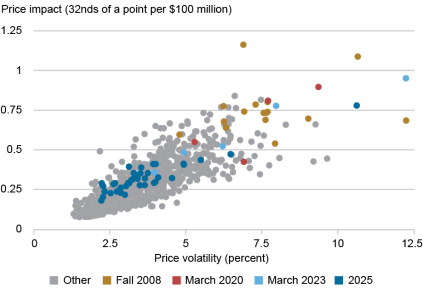
<p>Because volatility is tightly linked to Treasury market liquidity (see <a href="https://libertystreeteconomics.newyorkfed.org/2025/11/how-has-treasury-market-liquidity-fared-in-2025/" target="_blank" rel="noreferrer noopener">this <em>LSE</em> post</a>, for example), we first assess price volatility around important news events since April 2025. Volatility reflects the uncertainty that often emanates from economic and political developments. We measure so-called realized volatility (volatility based on actual price variation) at a daily level for the same securities—and using the same data—employed for our liquidity measures. </p>


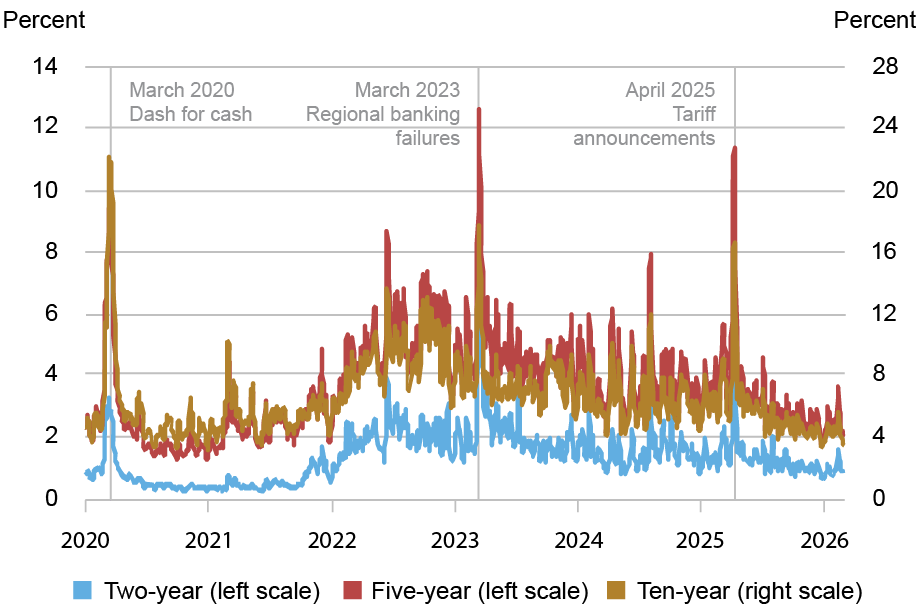
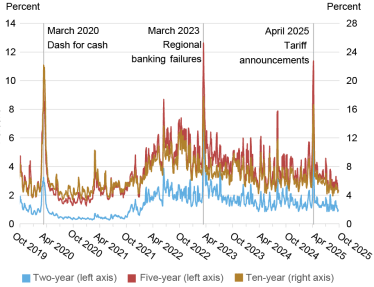
<p>The chart below shows that volatility rose sharply after the <a href="https://www.whitehouse.gov/presidential-actions/2025/04/regulating-imports-with-a-reciprocal-tariff-to-rectify-trade-practices-that-contribute-to-large-and-persistent-annual-united-states-goods-trade-deficits/" target="_blank" rel="noreferrer noopener">April 2,&nbsp;2025 tariff announcement</a>, peaking between April&nbsp;7 and April&nbsp;9. Treasury yields initially declined following the April&nbsp;2 announcement (perhaps due to flight-to-safety behavior by investors), with the 10‑year yield declining from about 4.2 percent to as low as 3.9&nbsp;percent on April&nbsp;4 before closing the day at about 4.0&nbsp;percent (see <a href="https://www.newyorkfed.org/medialibrary/media/newsevents/speeches/2025/Roberto-Perli-May-2025-slides.pdf" target="_blank" rel="noreferrer noopener">the slide deck</a> accompanying <a href="https://www.newyorkfed.org/newsevents/speeches/2025/per250509" target="_blank" rel="noreferrer noopener">this May speech</a> by Roberto Perli, manager of the System Open Market Account).</p>


<div class="wp-block-group frbny-chart-container"><div class="wp-block-group__inner-container is-layout-constrained wp-block-group-is-layout-constrained">
<p class="is-style-title">Volatility Trended Down after April 2025 Spike</p>


<figure class="wp-block-image size-full"><img decoding="async" width="920" height="611" src="https://libertystreeteconomics.newyorkfed.org/wp-content/uploads/sites/2/2026/03/LSE_2026_liquidity-past-year_fleming_ch1_44b40c.png" alt=" Line chart tracking price volatility in percentage (vertical axes) from January 2020 to February 2026 (horizontal axis) for two-year (blue, left scale), five-year (red, left scale), and ten-year (gold, right scale) notes in the interdealer market; volatility rose sharply around the April 2, 2025 tariff announcement, peaking between April 7 and April 9. " class="wp-image-41001" srcset="https://libertystreeteconomics.newyorkfed.org/wp-content/uploads/sites/2/2026/03/LSE_2026_liquidity-past-year_fleming_ch1_44b40c.png 920w, https://libertystreeteconomics.newyorkfed.org/wp-content/uploads/sites/2/2026/03/LSE_2026_liquidity-past-year_fleming_ch1_44b40c.png?resize=460,306 460w, https://libertystreeteconomics.newyorkfed.org/wp-content/uploads/sites/2/2026/03/LSE_2026_liquidity-past-year_fleming_ch1_44b40c.png?resize=768,510 768w, https://libertystreeteconomics.newyorkfed.org/wp-content/uploads/sites/2/2026/03/LSE_2026_liquidity-past-year_fleming_ch1_44b40c.png?resize=434,288 434w" sizes="(max-width: 920px) 100vw, 920px" /><figcaption class="wp-element-caption">Source: Authors’ calculations, based on data from BrokerTec.<br>Notes: The chart plots five-day moving averages of price volatility for the on-the-run two-, five-, and ten-year notes in the interdealer market from January 2, 2020 to February 27, 2026. Price volatility is calculated for each day by summing squared one-minute returns (log changes in midpoint prices) from 7:30 a.m. to 5 p.m., annualizing by multiplying by 252, and then taking the square root. It is reported in percent. Drop lines flag the peaks in the five-day moving average for the ten-year note, which are centered around March 11, 2020, March 14, 2023, and April 8, 2025.</figcaption></figure>
</div></div>


<div style="height:15px" aria-hidden="true" class="wp-block-spacer"></div>


<p>At the start of the next trading week, the ten-year yield opened lower than Friday’s close but rose rapidly, from about 3.9&nbsp;percent to 4.5&nbsp;percent, or roughly 60&nbsp;basis points, between 8 p.m. on April&nbsp;6 and midnight two days later. <a href="https://www.newyorkfed.org/newsevents/speeches/2025/per250509" target="_blank" rel="noreferrer noopener">Some analyses</a> suggest the unwinding of swap spread trades contributed to the rise in yields while <a href="https://www.gsb.stanford.edu/faculty-research/working-papers/dollar-upheaval-time-different" target="_blank" rel="noreferrer noopener">others</a> point to foreigners’ decreased willingness to hold Treasuries. On April 9, <a href="https://www.whitehouse.gov/presidential-actions/2025/04/modifying-reciprocal-tariff-rates-to-reflect-trading-partner-retaliation-and-alignment/" target="_blank" rel="noreferrer noopener">President Trump announced</a> that most of the new country-specific tariffs were being postponed for 90&nbsp;days. The ten-year yield declined sharply that day, later ending the week about 20&nbsp;basis points higher than its level at the time of the April&nbsp;2 announcement.</p>


<p>After April&nbsp;9, volatility quickly declined to more normal levels and continued trending down in subsequent months as additional tariff-related news was announced: the implementation of the reciprocal tariffs, the <a href="https://www.supremecourt.gov/opinions/25pdf/24-1287_new_3135.pdf" target="_blank" rel="noreferrer noopener">Supreme Court decision striking down the tariffs</a>, and the immediate imposition of <a href="https://www.whitehouse.gov/presidential-actions/2026/02/imposing-a-temporary-import-surcharge-to-address-fundamental-international-payments-problems/" target="_blank" rel="noreferrer noopener">new temporary tariffs</a>. There was a blip up in volatility in February&nbsp;2026 around the releases of the employment report (February&nbsp;11) and consumer price index (February&nbsp;13) but not around the Supreme Court decision (February&nbsp;20). Note that our analysis ends with the last trading day of February&nbsp;2026 and hence does not reflect effects from the conflict with Iran, which started the next day. </p>


<h4 class="wp-block-heading"><strong>Market Liquidity&nbsp;over the Past Year</strong>&nbsp;</h4>


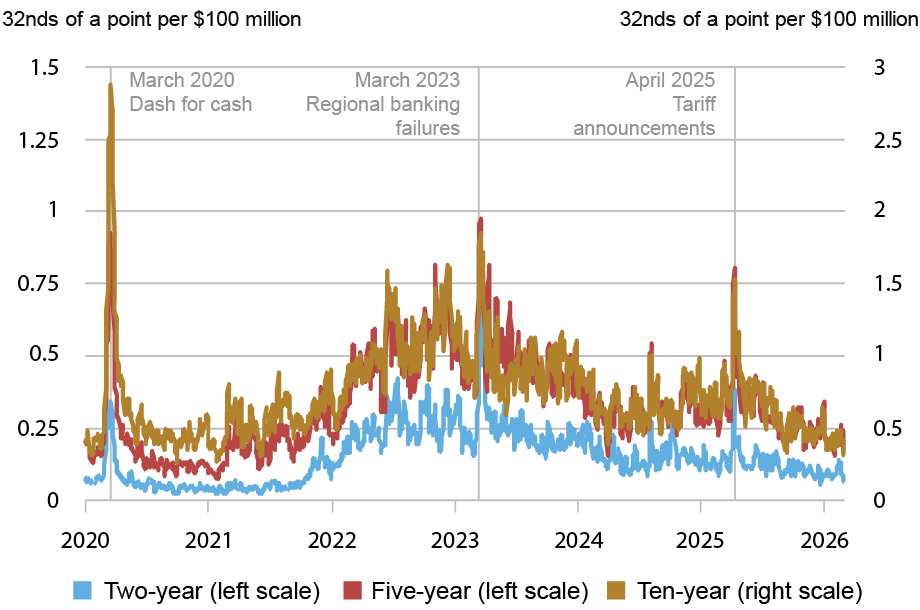
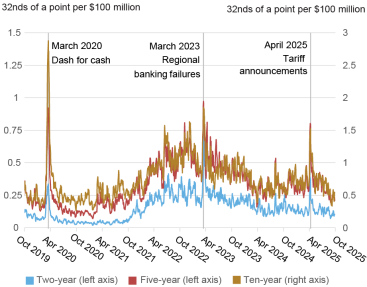
<p>The bid-ask spread is the difference between the lowest ask price and highest bid price for a security, with a wider spread suggesting worse liquidity. Bid-ask spreads, shown in the chart below, widened markedly after the April&nbsp;2 tariff announcement, albeit much less than in <a href="https://libertystreeteconomics.newyorkfed.org/2020/04/treasury-market-liquidity-during-the-covid-19-crisis/" target="_blank" rel="noreferrer noopener">March 2020</a> and even somewhat less than during the <a href="https://libertystreeteconomics.newyorkfed.org/2023/10/how-has-treasury-market-liquidity-evolved-in-2023/" target="_blank" rel="noreferrer noopener">March 2023 regional banking turmoil</a>. Bid-ask spreads narrowed after the April&nbsp;9 announcement that the new tariffs were mostly being postponed and since then have been similar to levels typically observed in recent years. </p>


<div class="wp-block-group frbny-chart-container"><div class="wp-block-group__inner-container is-layout-constrained wp-block-group-is-layout-constrained">
<p class="is-style-title">Bid-Ask Spreads&nbsp;Were Relatively Stable&nbsp;after April 2025 Widening&nbsp;</p>


<figure class="wp-block-image size-full"><img decoding="async" width="920" height="611" src="https://libertystreeteconomics.newyorkfed.org/wp-content/uploads/sites/2/2026/03/LSE_2026_liquidity-past-year_fleming_ch2_77f2a6.png" alt=" Line chart tracking average bid-ask spreads in 32nds of a point (vertical axes) from January 2020 to February 2026 (horizontal axis) for bid-ask spreads for two-year (blue, left scale), five-year (red, left scale), and ten-year (gold, right scale) notes in the interdealer market; bid-ask spreads widened markedly after the April 2025 tariff announcement, albeit much less than in March 2020 and even somewhat less than during the March 2023 regional banking turmoil.  " class="wp-image-41000" srcset="https://libertystreeteconomics.newyorkfed.org/wp-content/uploads/sites/2/2026/03/LSE_2026_liquidity-past-year_fleming_ch2_77f2a6.png 920w, https://libertystreeteconomics.newyorkfed.org/wp-content/uploads/sites/2/2026/03/LSE_2026_liquidity-past-year_fleming_ch2_77f2a6.png?resize=460,306 460w, https://libertystreeteconomics.newyorkfed.org/wp-content/uploads/sites/2/2026/03/LSE_2026_liquidity-past-year_fleming_ch2_77f2a6.png?resize=768,510 768w, https://libertystreeteconomics.newyorkfed.org/wp-content/uploads/sites/2/2026/03/LSE_2026_liquidity-past-year_fleming_ch2_77f2a6.png?resize=434,288 434w" sizes="(max-width: 920px) 100vw, 920px" /><figcaption class="wp-element-caption">Source: Authors’ calculations, based on data from BrokerTec.<br>Notes: The chart plots five-day moving averages of average daily bid-ask spreads for the on-the-run two-, five-, and ten-year notes in the interdealer market from January 2, 2020 to February 27, 2026. Spreads are measured in 32nds of a point, where a point equals one percent of par. Drop lines flag the peaks in the five-day moving average for the ten-year note, which are centered around March 16, 2020, March 15, 2023, and April 9, 2025.</figcaption></figure>
</div></div>


<div style="height:15px" aria-hidden="true" class="wp-block-spacer"></div>


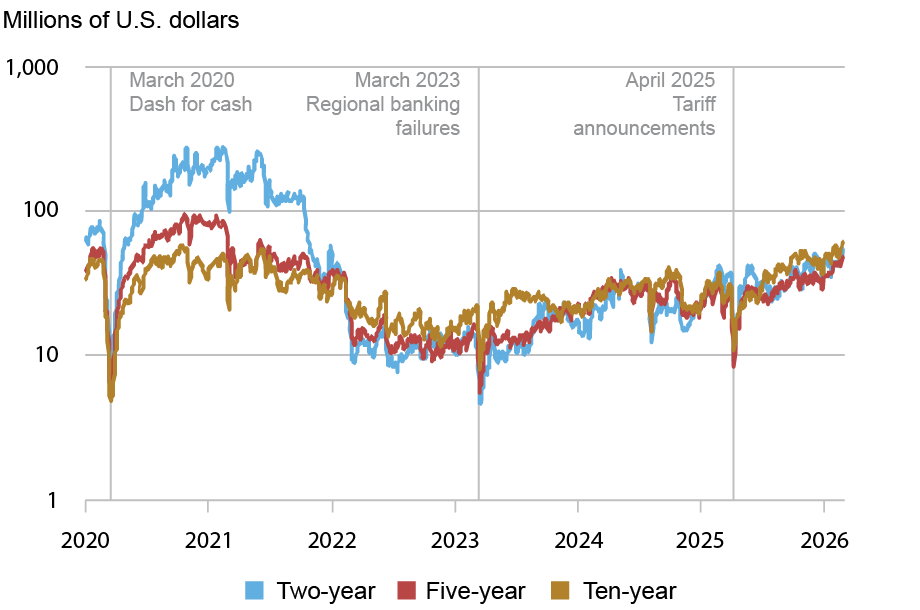
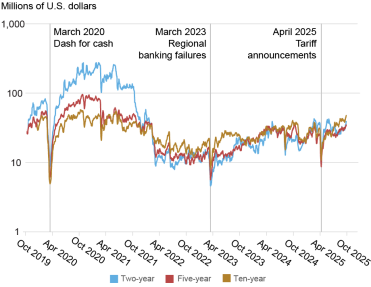
<p>Order book depth is measured as the average quantity of securities posted for purchase or sale at the best bid and offer prices. Lower depth implies worse liquidity. This metric also points to relatively poor liquidity in April&nbsp;2025, when available depth declined to the lowest levels since March&nbsp;2023 (see chart below). Depth quickly recovered and by late summer 2025 was at levels similar to, if not better than, any time since the Fed’s post-COVID tightening cycle started in March 2022. Depth continued trending higher through February&nbsp;2026.</p>


<div class="wp-block-group frbny-chart-container"><div class="wp-block-group__inner-container is-layout-constrained wp-block-group-is-layout-constrained">
<p class="is-style-title">Order Book Depth Increased Steadily after April 2025 Decline&nbsp;</p>


<figure class="wp-block-image size-full"><img loading="lazy" decoding="async" width="920" height="610" src="https://libertystreeteconomics.newyorkfed.org/wp-content/uploads/sites/2/2026/03/LSE_2026_liquidity-past-year_fleming_ch3_630586.png" alt=" Line chart tracking order book depth in millions of U.S. dollars (vertical axis) from January 2020 to February 2026 (horizontal axis) for bid-ask spreads for two-year (blue), five-year (red), and ten-year (gold) notes in the interdealer market; this metric points to relatively poor liquidity in April 2025, when available depth declined to the lowest levels since March 2023. " class="wp-image-41020" srcset="https://libertystreeteconomics.newyorkfed.org/wp-content/uploads/sites/2/2026/03/LSE_2026_liquidity-past-year_fleming_ch3_630586.png 920w, https://libertystreeteconomics.newyorkfed.org/wp-content/uploads/sites/2/2026/03/LSE_2026_liquidity-past-year_fleming_ch3_630586.png?resize=460,305 460w, https://libertystreeteconomics.newyorkfed.org/wp-content/uploads/sites/2/2026/03/LSE_2026_liquidity-past-year_fleming_ch3_630586.png?resize=768,509 768w, https://libertystreeteconomics.newyorkfed.org/wp-content/uploads/sites/2/2026/03/LSE_2026_liquidity-past-year_fleming_ch3_630586.png?resize=434,288 434w" sizes="auto, (max-width: 920px) 100vw, 920px" /><figcaption class="wp-element-caption">Source: Authors’ calculations, based on data from BrokerTec.<br>Notes: The chart plots five-day moving averages of average daily depth for the on-the-run two-, five-, and ten-year notes in the interdealer market from January 2, 2020 to February 27, 2026. Data are for order book depth at the inside tier, averaged across the bid and offer sides. Depth is measured in millions of U.S. dollars par and plotted on a logarithmic scale. Drop lines flag the low points in the five-day moving average for the ten-year note, which are centered around March 16, 2020, March 15, 2023, and April 9, 2025.</figcaption></figure>
</div></div>


<div style="height:15px" aria-hidden="true" class="wp-block-spacer"></div>


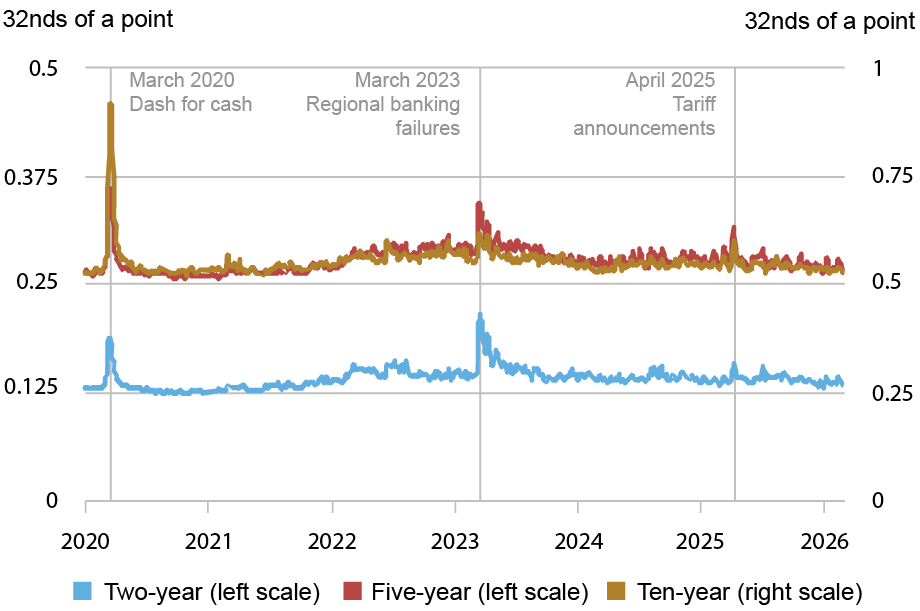
<p>Measures of the price impact of trades also suggest a sharp deterioration of liquidity in April&nbsp;2025, a quick rebound, and steady improvement thereafter. The next chart plots the estimated price impact per $100&nbsp;million in net order flow (defined as buyer-initiated trading volume less seller-initiated trading volume). A higher price impact suggests reduced liquidity. Price impact rose abruptly on April&nbsp;2, but then quickly reverted. By early 2026, price impact had become as low as at any time since 2021.</p>


<div class="wp-block-group frbny-chart-container"><div class="wp-block-group__inner-container is-layout-constrained wp-block-group-is-layout-constrained">
<p class="is-style-title">Price Impact&nbsp;Trended Down&nbsp;after April 2025 Increase</p>


<figure class="wp-block-image size-full"><img loading="lazy" decoding="async" width="920" height="610" src="https://libertystreeteconomics.newyorkfed.org/wp-content/uploads/sites/2/2026/03/LSE_2026_liquidity-past-year_fleming_ch4_487668.png" alt=" Line chart tracking price impact in 32nds of a point per $100 million (vertical axes) from January 2020 to February 2026 (horizontal axis) for the price impact of trades for two-year (blue, left scale), five-year (red, left scale), and ten-year (gold, right scale) notes in the interdealer market; price impact rose abruptly in April 2025 but then quickly reverted; by early 2026, price impact had become as low as at any time since 2021. " class="wp-image-40997" srcset="https://libertystreeteconomics.newyorkfed.org/wp-content/uploads/sites/2/2026/03/LSE_2026_liquidity-past-year_fleming_ch4_487668.png 920w, https://libertystreeteconomics.newyorkfed.org/wp-content/uploads/sites/2/2026/03/LSE_2026_liquidity-past-year_fleming_ch4_487668.png?resize=460,305 460w, https://libertystreeteconomics.newyorkfed.org/wp-content/uploads/sites/2/2026/03/LSE_2026_liquidity-past-year_fleming_ch4_487668.png?resize=768,509 768w, https://libertystreeteconomics.newyorkfed.org/wp-content/uploads/sites/2/2026/03/LSE_2026_liquidity-past-year_fleming_ch4_487668.png?resize=434,288 434w" sizes="auto, (max-width: 920px) 100vw, 920px" /><figcaption class="wp-element-caption">Source: Authors’ calculations, based on data from BrokerTec.<br>Notes: The chart plots five-day moving averages of slope coefficients from daily regressions of one-minute price changes on one-minute net order flow (buyer-initiated trading volume less seller-initiated trading volume) for the on-the-run two-, five-, and ten-year notes in the interdealer market from January 2, 2020 to February 27, 2026. Price impact is measured in 32nds of a point per $100 million, where a point equals one percent of par. Drop lines flag the peaks in the five-day moving average for the ten-year note, which are centered around March 17, 2020, March 16, 2023, and April 9, 2025.</figcaption></figure>
</div></div>


<div style="height:15px" aria-hidden="true" class="wp-block-spacer"></div>


<h4 class="wp-block-heading"><strong>Summing Up</strong></h4>


<p>Treasury market liquidity over the past year was marked by a sudden but brief worsening after the April&nbsp;2,&nbsp;2025 tariff announcement, followed by quick improvement when the proposed tariffs were partially rolled back. Liquidity steadily improved thereafter, reaching its best level since 2021 in early 2026. Economic uncertainty and interest rate volatility have increased since the end of our sample period—given the conflict with Iran and its repercussions—underlining the view that Treasury market liquidity warrants continued close watching. </p>


<div class="wp-block-media-text" style="grid-template-columns:15% auto"><figure class="wp-block-media-text__media"><img loading="lazy" decoding="async" width="1200" height="1200" src="https://libertystreeteconomics.newyorkfed.org/wp-content/uploads/sites/2/2026/03/henry-dyer.jpg?w=288" alt="henry dyer" class="wp-image-41015 size-full" srcset="https://libertystreeteconomics.newyorkfed.org/wp-content/uploads/sites/2/2026/03/henry-dyer.jpg 1200w, https://libertystreeteconomics.newyorkfed.org/wp-content/uploads/sites/2/2026/03/henry-dyer.jpg?resize=45,45 45w, https://libertystreeteconomics.newyorkfed.org/wp-content/uploads/sites/2/2026/03/henry-dyer.jpg?resize=460,460 460w, https://libertystreeteconomics.newyorkfed.org/wp-content/uploads/sites/2/2026/03/henry-dyer.jpg?resize=768,768 768w, https://libertystreeteconomics.newyorkfed.org/wp-content/uploads/sites/2/2026/03/henry-dyer.jpg?resize=288,288 288w" sizes="auto, (max-width: 1200px) 100vw, 1200px" /></figure><div class="wp-block-media-text__content">
<p class="is-style-bio-contact">Henry Dyer is a research analyst in the Federal Reserve Bank of New York’s Research and Statistics Group.</p>
</div></div>


<div class="wp-block-media-text" style="grid-template-columns:15% auto"><figure class="wp-block-media-text__media"><img loading="lazy" decoding="async" width="3384" height="3384" src="https://libertystreeteconomics.newyorkfed.org/wp-content/uploads/sites/2/2024/08/fleming-michael_90x90.jpg?w=288" alt="Portrait: Photo of Michael Fleming" class="wp-image-31071 size-full" srcset="https://libertystreeteconomics.newyorkfed.org/wp-content/uploads/sites/2/2024/08/fleming-michael_90x90.jpg 3384w, https://libertystreeteconomics.newyorkfed.org/wp-content/uploads/sites/2/2024/08/fleming-michael_90x90.jpg?resize=45,45 45w, https://libertystreeteconomics.newyorkfed.org/wp-content/uploads/sites/2/2024/08/fleming-michael_90x90.jpg?resize=460,460 460w, https://libertystreeteconomics.newyorkfed.org/wp-content/uploads/sites/2/2024/08/fleming-michael_90x90.jpg?resize=768,768 768w, https://libertystreeteconomics.newyorkfed.org/wp-content/uploads/sites/2/2024/08/fleming-michael_90x90.jpg?resize=288,288 288w, https://libertystreeteconomics.newyorkfed.org/wp-content/uploads/sites/2/2024/08/fleming-michael_90x90.jpg?resize=1536,1536 1536w, https://libertystreeteconomics.newyorkfed.org/wp-content/uploads/sites/2/2024/08/fleming-michael_90x90.jpg?resize=2048,2048 2048w" sizes="auto, (max-width: 3384px) 100vw, 3384px" /></figure><div class="wp-block-media-text__content">
<p class="is-style-bio-contact"><a href="https://www.newyorkfed.org/research/economists/fleming" target="_blank" rel="noreferrer noopener">Michael J. Fleming</a> is head of Capital Markets in the Federal Reserve Bank of New York’s Research and Statistics Group. </p>
</div></div>


<hr class="wp-block-separator has-alpha-channel-opacity"/>


<div class="cite-container">
    <p class="is-style-disclaimer">
        <strong>How to cite this post:</strong><br/>
        Henry Dyer and Michael J. Fleming, &#8220;Treasury Market Liquidity Since April 2025,&#8221; Federal Reserve Bank of New York <em>Liberty Street Economics</em>, April 2, 2026, <a href="https://doi.org/10.59576/lse.20260402">https://doi.org/10.59576/lse.20260402</a>
    <span>BibTeX: <a href="#bibtex" onClick="_toggle_bibtex1()">View</a> | <button class="bibtex-save">Download</button></span>
    </p>

    <script>
        function _toggle_bibtex1(){
            let el = document.getElementById('bibtex1');
            el.style.display = el.style.display === 'none' ? '' : 'none';
        }
    </script>
    <div id="bibtex1" class="bibtex" style="display:none;">
    <pre><code> 
@article{DyerFleming2026,
    author={Dyer, Henry and Fleming, Michael J.},
    title={Treasury Market Liquidity Since April 2025},
    journal={Liberty Street Economics},
    note={Liberty Street Economics Blog},
    number={April 2},
    year={2026},
    url={https://doi.org/10.59576/lse.20260402}
}</code></pre>
    </div>

</div>

<div class="frbny-related">
	<p class="frbny-related__label">You may also be interested in:</p>


<div class="frbny-related__item">
<figure class="wp-block-image size-medium"><img loading="lazy" decoding="async" height="288" width="460" src="https://libertystreeteconomics.newyorkfed.org/wp-content/uploads/sites/2/2023/01/LSE_2023_staff-report_graphic.png?w=460" alt="Image of Staff Reports cover" class="wp-image-20191" srcset="https://libertystreeteconomics.newyorkfed.org/wp-content/uploads/sites/2/2023/01/LSE_2023_staff-report_graphic.png 920w, https://libertystreeteconomics.newyorkfed.org/wp-content/uploads/sites/2/2023/01/LSE_2023_staff-report_graphic.png?resize=460,288 460w, https://libertystreeteconomics.newyorkfed.org/wp-content/uploads/sites/2/2023/01/LSE_2023_staff-report_graphic.png?resize=768,481 768w" sizes="auto, (max-width: 460px) 100vw, 460px" /></figure>
<p><a href="https://www.newyorkfed.org/research/staff_reports/sr827.html">The Evolution of Treasury Market Liquidity: Evidence from 30 Years of Limit Order Book Data</a></p></div>


<div class="frbny-related__item">
<figure class="wp-block-image size-medium"><img decoding="async" src="https://libertystreeteconomics.newyorkfed.org/wp-content/uploads/sites/2/2025/11/LSE_2025_treasury-market-liquidity_fleming_460.jpg?w=460" alt="Interest rates concept. 3D illustration"/></figure>
<p><a href="https://libertystreeteconomics.newyorkfed.org/2025/11/how-has-treasury-market-liquidity-fared-in-2025/">How Has Treasury Market Liquidity Fared in 2025?</a></p></div>


<div class="frbny-related__item">
<figure class="wp-block-image size-medium"><img decoding="async" src="https://libertystreeteconomics.newyorkfed.org/wp-content/uploads/sites/2/2020/04/6a01348793456c970c025d9b47010b200c-500wi.jpg?w=460" alt=""/></figure>
<p><a href="https://libertystreeteconomics.newyorkfed.org/2020/04/treasury-market-liquidity-during-the-covid-19-crisis/">Treasury Market Liquidity during the COVID‑19 Crisis</a></p></div>

</div>


<p></p>


<div>
<div style="height:24px" aria-hidden="true" class="wp-block-spacer"></div>


<hr class="wp-block-separator has-alpha-channel-opacity"/>


<p class="is-style-disclaimer"><strong>Disclaimer</strong><br>The views expressed in this post are those of the author(s) and do not necessarily reflect the position of the Federal Reserve Bank of New York or the Federal Reserve System. Any errors or omissions are the responsibility of the author(s).</p>
</div>
]]></content>
		
					<link rel="replies" type="text/html" href="https://libertystreeteconomics.newyorkfed.org/2026/04/treasury-market-liquidity-since-april-2025/#comments" thr:count="0" />
			<link rel="replies" type="application/atom+xml" href="https://libertystreeteconomics.newyorkfed.org/2026/04/treasury-market-liquidity-since-april-2025/feed/atom/" thr:count="0" />
			<thr:total>0</thr:total>
			</entry>
		<entry>
		<author>
			<name></name>
					</author>

		<title type="html"><![CDATA[Behind the ATM: Exploring the Structure of Bank Holding Companies]]></title>
		<link rel="alternate" type="text/html" href="https://libertystreeteconomics.newyorkfed.org/2026/03/behind-the-atm-exploring-the-structure-of-bank-holding-companies/" />

		<id>https://libertystreeteconomics.newyorkfed.org/?p=40826</id>
		<updated>2026-03-27T15:11:56Z</updated>
		<published>2026-03-31T13:00:00Z</published>
		<category scheme="https://libertystreeteconomics.newyorkfed.org/" term="Banks" />
		<summary type="html"><![CDATA[Many modern banking organizations are highly complex. A “bank” is often a larger structure made up of distinct entities, each subject to different regulatory, supervisory, and reporting requirements. For researchers and policymakers, understanding how these institutions are structured and how they have evolved over time is essential. In this post, we illustrate what a modern financial holding company looks like in practice, document how banks’ organizational structures have changed over time, and explain why these details matter for conducting accurate analyses of the financial system.]]></summary>

					<content type="html" xml:base="https://libertystreeteconomics.newyorkfed.org/2026/03/behind-the-atm-exploring-the-structure-of-bank-holding-companies/"><![CDATA[<p class="ts-blog-article-author">
    Lily Gordon and Lee Seltzer</p>


<figure class="lse-featured-image">
	<img loading="lazy" decoding="async" width="460" height="288" src="https://libertystreeteconomics.newyorkfed.org/wp-content/uploads/sites/2/2026/03/LSE_2026_reg-data-ATM_seltzer_460.jpg?w=460" class="cover-image asset-image img-responsive wp-post-image" alt="Online banking concept with blurred city abstract lights background" srcset="https://libertystreeteconomics.newyorkfed.org/wp-content/uploads/sites/2/2026/03/LSE_2026_reg-data-ATM_seltzer_460.jpg 920w, https://libertystreeteconomics.newyorkfed.org/wp-content/uploads/sites/2/2026/03/LSE_2026_reg-data-ATM_seltzer_460.jpg?resize=460,288 460w, https://libertystreeteconomics.newyorkfed.org/wp-content/uploads/sites/2/2026/03/LSE_2026_reg-data-ATM_seltzer_460.jpg?resize=768,481 768w" sizes="auto, (max-width: 460px) 100vw, 460px" /></figure>


<p>Many modern banking organizations are highly complex. A “bank” is often a larger structure made up of distinct entities, each subject to different regulatory, supervisory, and reporting requirements. For researchers and policymakers, understanding how these institutions are structured and how they have evolved over time is essential. In this post, we illustrate what a modern financial holding company looks like in practice, document how banks’ organizational structures have changed over time, and explain why these details matter for conducting accurate analyses of the financial system.</p>


<p><em>Note: As of March 2026, the New York Fed will discontinue the </em><a href="https://www.newyorkfed.org/research/banking_research/quarterly_trends"><em>Quarterly Trends for Consolidated U.S. Banking Organizations report</em></a><em>. In its place, staff economists will begin producing periodic blog posts that highlight evolutions and developments in the banking sector; this marks the first post in that series</em>.</p>


<h4 class="wp-block-heading">Inside a Financial Holding Company</h4>


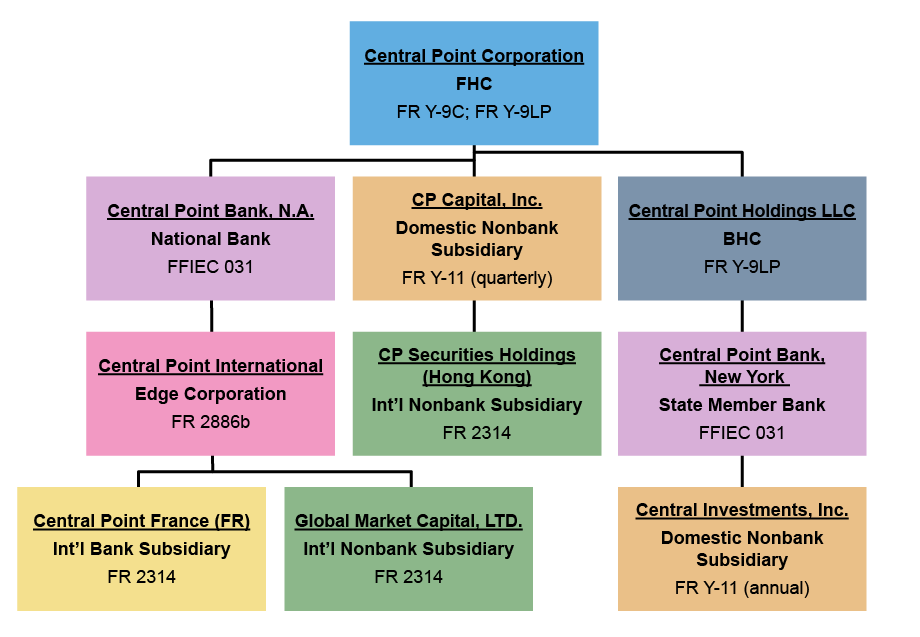
<p>To illustrate the structure of a holding company in practical terms, we present a stylized example: the fictional “Central Point Corporation.”&nbsp;&nbsp;</p>


<div class="wp-block-group frbny-chart-container"><div class="wp-block-group__inner-container is-layout-constrained wp-block-group-is-layout-constrained">
<p class="is-style-title">Central Point Corporation’s Organizational Hierarchy</p>


<figure class="wp-block-image size-full"><img loading="lazy" decoding="async" width="920" height="637" src="https://libertystreeteconomics.newyorkfed.org/wp-content/uploads/sites/2/2026/03/LSE_2026_reg-data-ATM_seltzer_ch1_d953c0.png" alt="Organizational chart depicting the hierarchy of the fictional Central Point Corporation, illustrating the structure of a bank holding company in practical terms. " class="wp-image-40927" srcset="https://libertystreeteconomics.newyorkfed.org/wp-content/uploads/sites/2/2026/03/LSE_2026_reg-data-ATM_seltzer_ch1_d953c0.png 920w, https://libertystreeteconomics.newyorkfed.org/wp-content/uploads/sites/2/2026/03/LSE_2026_reg-data-ATM_seltzer_ch1_d953c0.png?resize=460,319 460w, https://libertystreeteconomics.newyorkfed.org/wp-content/uploads/sites/2/2026/03/LSE_2026_reg-data-ATM_seltzer_ch1_d953c0.png?resize=768,532 768w, https://libertystreeteconomics.newyorkfed.org/wp-content/uploads/sites/2/2026/03/LSE_2026_reg-data-ATM_seltzer_ch1_d953c0.png?resize=416,288 416w" sizes="auto, (max-width: 920px) 100vw, 920px" /><figcaption class="wp-element-caption">Source: Authors’ rendering.&nbsp;<br>Note: The relevant regulatory filing is&nbsp;indicated&nbsp;for each entity type.</figcaption></figure>
</div></div>


<div style="height:15px" aria-hidden="true" class="wp-block-spacer"></div>


<p>At the top of the organizational structure is the parent, or top-tier, holding company. This is Central Point Corporation (blue box).</p>


<p>The most common type of holding company is a <strong>bank holding company (BHC) </strong>which is Central Point Holdings LLC (grey box) in our diagram, which files an <em>FR Y-9LP</em>. These are holding companies that own or control one or more commercial banks or other BHCs. The BHC structure was first established by the Bank Holding Company Act of 1956.</p>


<p>The top-tier holding company, Central Point Corporation, however, is classified as a <strong>financial holding company (FHC)</strong>, and these submit <em>FR Y-9C </em>and <em>FR Y-9LP </em>filings. Financial holding companies were introduced as part of the Gramm-Leach Bliley Act (GLBA) of 1999 as a special type of holding company that can engage in a broader range of financial activities beyond traditional banking, such as insurance and securities underwriting. To qualify as an FHC, a company must derive at least 85 percent of its consolidated gross revenues from financial activities. As you can see from our example, though, an FHC may itself hold a BHC.</p>


<p>Holding companies can have many types of subsidiaries. Some of these are domestic commercial banks, such as <strong>national banks</strong> and <strong>state-chartered member banks </strong>(which both file an <em>FFIEC 031</em>). Central Point Corporation owns a national bank (Central Point Bank, N.A.) and a state-chartered member bank (Central Point Bank, New York). Holding companies can also contain <strong>nonbank financial institutions </strong>(<strong>NBFIs</strong>, which file an <em>FR Y-11 </em>if domestic, and an <em>FR 2314 </em>if international), firms that engage in financial activities besides banking. For example, CP Capital, Inc. and Central Investments, Inc. are NBFIs.</p>


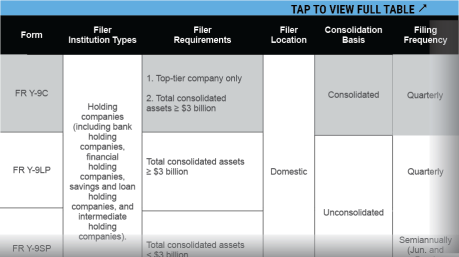
<p>Other subsidiaries may be foreign. These subsidiaries may be placed in an <strong>edge corporation </strong>(which files an <em>FR 2886b</em>) that is allowed by its charter to engage in foreign business. In our example, Central Point Corporation owns an edge corporation (Central Point International), which in turn holds a foreign bank (Central Point France (FR)) and a foreign nonbank (Global Market Capital Ltd). This organizational structure has direct implications for how institutions are observed in the data. Different entities within the same holding company are subject to different reporting requirements, file different regulatory forms, and may appear (or not appear) in commonly used datasets. To support research on these institutions, the table below (<span style="text-decoration: underline;"><a href="https://libertystreeteconomics.newyorkfed.org/wp-content/uploads/sites/2/2026/03/LSE_2026_reg-data-ATM_seltzer_table.pdf">full version available for download</a></span>) summarizes several commonly used U.S. regulatory forms and the types of entities required to file them. While not exhaustive, it provides a strong starting point for navigating the regulatory reporting landscape and identifying appropriate sources for given research questions.</p>


<div class="wp-block-group frbny-chart-container"><div class="wp-block-group__inner-container is-layout-constrained wp-block-group-is-layout-constrained">
<p class="is-style-title"><br>Preview: U.S. Regulatory Forms and Corresponding Entities</p>


<figure class="wp-block-image size-large is-resized"><a href="https://libertystreeteconomics.newyorkfed.org/wp-content/uploads/sites/2/2026/03/LSE_2026_reg-data-ATM_seltzer_table.pdf"><img loading="lazy" decoding="async" width="920" height="515" src="https://libertystreeteconomics.newyorkfed.org/wp-content/uploads/sites/2/2026/03/LSE_2026_REG-DATA-ATM_seltzer_tbl-460_f42c73.png?w=460" alt="LSE_2026_REG-DATA-ATM_seltzer_tbl-460" class="wp-image-40940" style="aspect-ratio:1.7860400072961635;width:459px;height:auto" srcset="https://libertystreeteconomics.newyorkfed.org/wp-content/uploads/sites/2/2026/03/LSE_2026_REG-DATA-ATM_seltzer_tbl-460_f42c73.png 920w, https://libertystreeteconomics.newyorkfed.org/wp-content/uploads/sites/2/2026/03/LSE_2026_REG-DATA-ATM_seltzer_tbl-460_f42c73.png?resize=460,258 460w, https://libertystreeteconomics.newyorkfed.org/wp-content/uploads/sites/2/2026/03/LSE_2026_REG-DATA-ATM_seltzer_tbl-460_f42c73.png?resize=768,430 768w" sizes="auto, (max-width: 920px) 100vw, 920px" /><figcaption class="wp-element-caption"></a><Source: Authors' review of regulatory framework.<br>Notes: Filings used exclusively by the Federal Reserve are prefixed with “FR”, while filings used by other agencies in addition to the Federal Reserve are prefixed with “FFIEC.” <br><strong><a href="https://libertystreeteconomics.newyorkfed.org/wp-content/uploads/sites/2/2026/03/LSE_2026_reg-data-ATM_seltzer_table.pdf">DOWNLOAD FULL TABLE</a></strong></figcaption></figure>
</div></div>


<div style="height:15px" aria-hidden="true" class="wp-block-spacer"></div>


<h4 class="wp-block-heading">The Evolution of Financial Institutions</h4>


<p>Banking organizations were not always as complex as Central Point, and in fact were previously all organized as BHCs. How did banking organizations change over time? And what were the regulatory developments associated with these changes?</p>


<p>Next, we conduct an analysis to show how the composition of holding company types has evolved over time. In addition to FHCs and BHCs, we will also discuss the development of <strong>savings and loan holding companies (SLHCs) </strong>and <strong>intermediate holding companies (IHCs)</strong>, which have developed as alternative holding company structures in recent decades. SLHCs own or control one or more savings associations or other SLHCs, while IHCs are established by large foreign banking organizations to hold all of their U.S. non-branch subsidiaries. Throughout our analysis, we will describe how these holding company types differ from one another, and the regulatory developments that have encouraged their growth.&nbsp;</p>


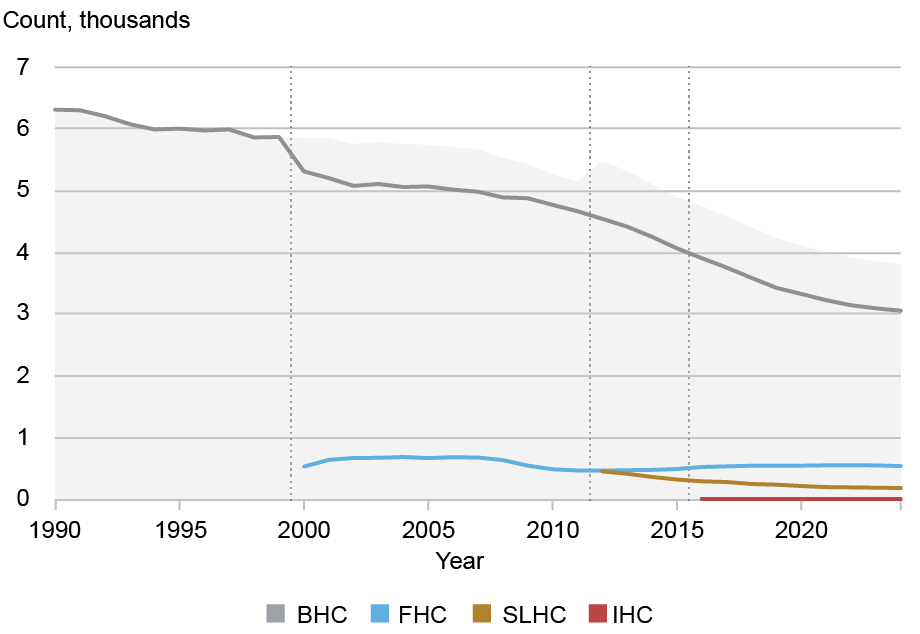
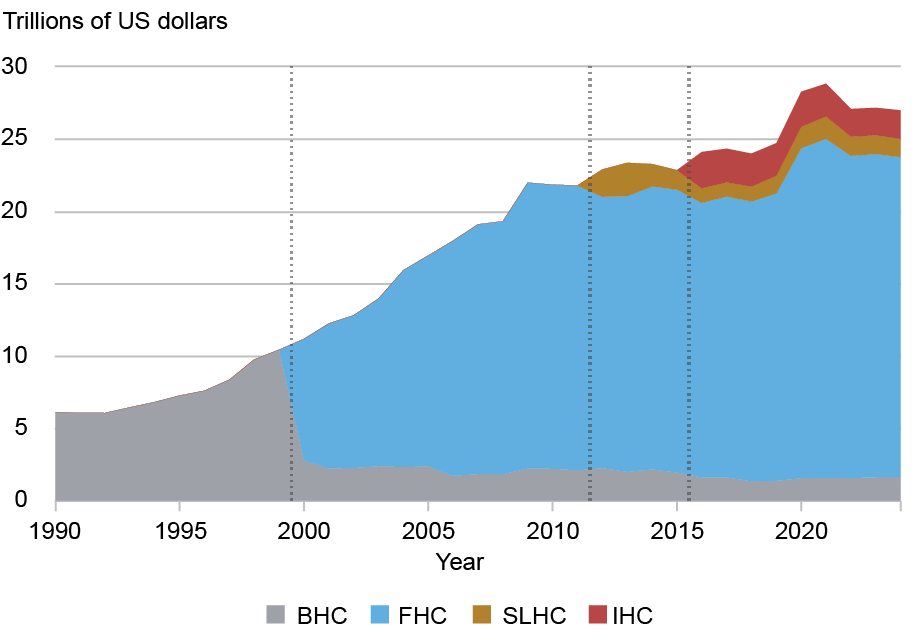
<p>The chart below shows both the number and share of holding company types (BHCs, FHCs, SLHCs, and IHCs) from 1990 to 2024.&nbsp;</p>


<div class="wp-block-group frbny-chart-container"><div class="wp-block-group__inner-container is-layout-constrained wp-block-group-is-layout-constrained">
<p class="is-style-title">Evolution of U.S. Holding Company Types</p>


<figure class="wp-block-image size-full"><img loading="lazy" decoding="async" width="920" height="634" src="https://libertystreeteconomics.newyorkfed.org/wp-content/uploads/sites/2/2026/03/LSE_2026_reg-data-ATM_seltzer_ch2.png" alt="Line and area chart showing the evolution of U.S. holding companies; top chart depicts the count in thousands (vertical axis) from 1990 through 2024 (horizontal axis) of bank holding companies (BHC, dark grey), financial holding companies (FHC, light blue), savings and loan holding companies (SLHC, gold), and intermediate holding companies (IHC, red); light grey shaded area shows the total across all types." class="wp-image-40904" srcset="https://libertystreeteconomics.newyorkfed.org/wp-content/uploads/sites/2/2026/03/LSE_2026_reg-data-ATM_seltzer_ch2.png 920w, https://libertystreeteconomics.newyorkfed.org/wp-content/uploads/sites/2/2026/03/LSE_2026_reg-data-ATM_seltzer_ch2.png?resize=460,317 460w, https://libertystreeteconomics.newyorkfed.org/wp-content/uploads/sites/2/2026/03/LSE_2026_reg-data-ATM_seltzer_ch2.png?resize=768,529 768w, https://libertystreeteconomics.newyorkfed.org/wp-content/uploads/sites/2/2026/03/LSE_2026_reg-data-ATM_seltzer_ch2.png?resize=418,288 418w" sizes="auto, (max-width: 920px) 100vw, 920px" /></figure>


<figure class="wp-block-image size-full"><img loading="lazy" decoding="async" width="920" height="633" src="https://libertystreeteconomics.newyorkfed.org/wp-content/uploads/sites/2/2026/03/LSE_2026_reg-data-ATM_seltzer_ch3.png" alt="Bottom chart depicts the consolidated assets of the same types of companies in trillions of U.S. dollars (vertical axis) from 1990 to 2024 (horizontal axis); despite a substantial decline, BHCs remain the most prevalent holding company type." class="wp-image-40905" srcset="https://libertystreeteconomics.newyorkfed.org/wp-content/uploads/sites/2/2026/03/LSE_2026_reg-data-ATM_seltzer_ch3.png 920w, https://libertystreeteconomics.newyorkfed.org/wp-content/uploads/sites/2/2026/03/LSE_2026_reg-data-ATM_seltzer_ch3.png?resize=460,317 460w, https://libertystreeteconomics.newyorkfed.org/wp-content/uploads/sites/2/2026/03/LSE_2026_reg-data-ATM_seltzer_ch3.png?resize=768,528 768w, https://libertystreeteconomics.newyorkfed.org/wp-content/uploads/sites/2/2026/03/LSE_2026_reg-data-ATM_seltzer_ch3.png?resize=419,288 419w" sizes="auto, (max-width: 920px) 100vw, 920px" /><figcaption class="wp-element-caption">Sources: FR Y-9C; FR Y-10.&nbsp;<br>Notes: The chart shows the evolution of U.S. Holding Company types from 1990 to 2024 at the annual frequency. The top panel shows the count of institutions by entity type for bank holding companies (BHC, dark grey), financial holding companies (FHC, blue), savings and loan holding companies (SLHC, brown), and intermediate holding companies (IHC, red). The light grey shaded area shows the total across all holding company types. The bottom panel shows&nbsp;consolidated&nbsp;assets of top-tier holding companies that file the FR Y-9C, in trillions of 2024 U.S. dollars, using the same colors for each group.&nbsp;Vertical&nbsp;lines&nbsp;represent&nbsp;key regulatory milestone:&nbsp;the GLBA of 1999 (creation of FHCs),&nbsp;the 2012&nbsp;transfer of SLHC supervision to the Federal Reserve under Dodd-Frank, and the 2016 implementation of the IHC requirement for certain foreign banking organizations.</figcaption></figure>
</div></div>


<div style="height:15px" aria-hidden="true" class="wp-block-spacer"></div>


<p>Two patterns stand out. First, the total number of holding companies declined substantially from 6,307 in 1990 to 3,801 in 2024, reflecting consolidation in the banking sector. Despite this decline, BHCs remain the most prevalent holding company type, accounting for roughly 80 percent of all regulated holding companies.&nbsp;</p>


<p>Second, changes in holding company types have been closely tied to regulatory developments. The introduction of the FHC following the GLBA of 1999 allowed BHCs to expand into a broader range of financial activities. While FHCs represent less than 20 percent of all regulated holding companies, the bottom panel of the chart above shows that they hold a disproportionately large share of total assets.&nbsp;</p>


<p>SLHCs have remained relatively small in count, falling from 459 in 2012 (when they were first incorporated into the Federal Reserve reporting framework) to 190 in 2024. IHCs are few in number (only 11 as of 2024), but account for a meaningful volume of assets given the size of their parent organizations.&nbsp;</p>


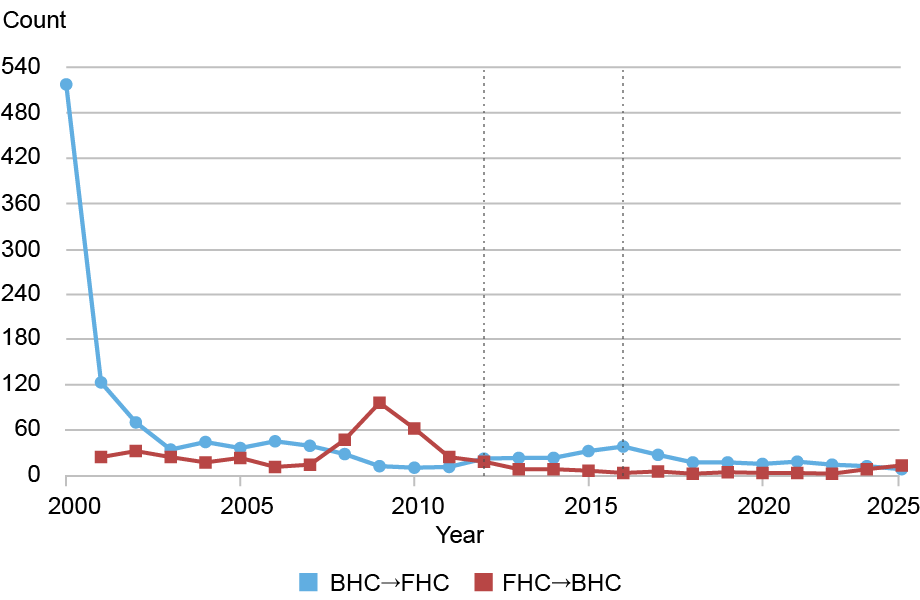
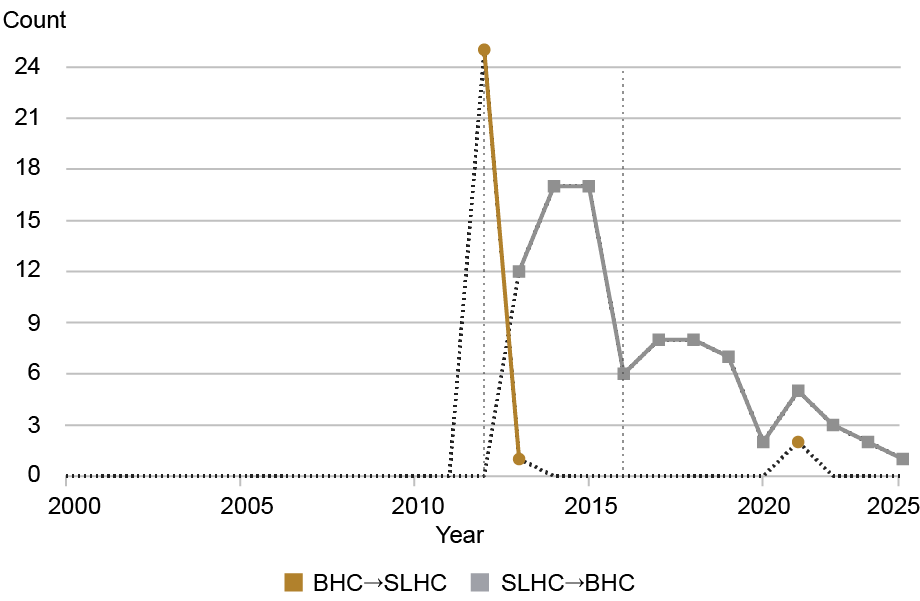
<p>To understand shifts in the composition of holding company types, the chart below tracks changes in holding companies’ designations over time.&nbsp;</p>


<div class="wp-block-group frbny-chart-container"><div class="wp-block-group__inner-container is-layout-constrained wp-block-group-is-layout-constrained">
<p class="is-style-title">Entity-Type Switches by Year</p>


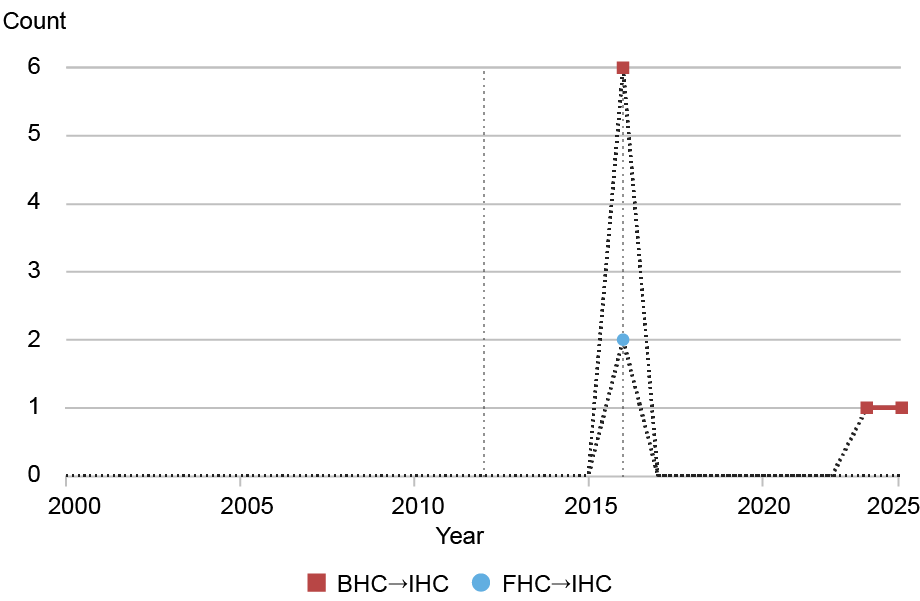
<figure class="wp-block-image size-full"><img loading="lazy" decoding="async" width="920" height="600" src="https://libertystreeteconomics.newyorkfed.org/wp-content/uploads/sites/2/2026/03/LSE_2026_reg-data-ATM_seltzer_ch4.png" alt="Line chart tracking changes in holding companies by count (vertical axis) from 2000 to 2025 (horizontal axis); top chart depicts switches from bank holding companies (BHC) to financial holding companies (FHC) (light blue) and FHC to BHC (red);" class="wp-image-40907" srcset="https://libertystreeteconomics.newyorkfed.org/wp-content/uploads/sites/2/2026/03/LSE_2026_reg-data-ATM_seltzer_ch4.png 920w, https://libertystreeteconomics.newyorkfed.org/wp-content/uploads/sites/2/2026/03/LSE_2026_reg-data-ATM_seltzer_ch4.png?resize=460,300 460w, https://libertystreeteconomics.newyorkfed.org/wp-content/uploads/sites/2/2026/03/LSE_2026_reg-data-ATM_seltzer_ch4.png?resize=768,501 768w, https://libertystreeteconomics.newyorkfed.org/wp-content/uploads/sites/2/2026/03/LSE_2026_reg-data-ATM_seltzer_ch4.png?resize=442,288 442w" sizes="auto, (max-width: 920px) 100vw, 920px" /></figure>


<figure class="wp-block-image size-full"><img loading="lazy" decoding="async" width="920" height="601" src="https://libertystreeteconomics.newyorkfed.org/wp-content/uploads/sites/2/2026/03/LSE_2026_reg-data-ATM_seltzer_ch5.png" alt="Middle of three line charts tracking changes in holding companies by count (vertical axis) from 2000 to 2025 (horizontal axis);  this chart depicts switches  from BHC to savings and loan holding companies (SLHC) (gold) and SLHC to BHC (gray)" class="wp-image-40908" srcset="https://libertystreeteconomics.newyorkfed.org/wp-content/uploads/sites/2/2026/03/LSE_2026_reg-data-ATM_seltzer_ch5.png 920w, https://libertystreeteconomics.newyorkfed.org/wp-content/uploads/sites/2/2026/03/LSE_2026_reg-data-ATM_seltzer_ch5.png?resize=460,301 460w, https://libertystreeteconomics.newyorkfed.org/wp-content/uploads/sites/2/2026/03/LSE_2026_reg-data-ATM_seltzer_ch5.png?resize=768,502 768w, https://libertystreeteconomics.newyorkfed.org/wp-content/uploads/sites/2/2026/03/LSE_2026_reg-data-ATM_seltzer_ch5.png?resize=441,288 441w" sizes="auto, (max-width: 920px) 100vw, 920px" /></figure>


<figure class="wp-block-image size-full"><img loading="lazy" decoding="async" width="920" height="601" src="https://libertystreeteconomics.newyorkfed.org/wp-content/uploads/sites/2/2026/03/LSE_2026_reg-data-ATM_seltzer_ch6.png" alt="Bottom of three line charts tracking changes in holding companies by count (vertical axis) from 2000 to 2025 (horizontal axis);  this chart tracks switches from BHC to intermediate holding companies (IHC) (red) and FHC to IHC (blue); the most common switch is from BHC to FHC. " class="wp-image-40909" srcset="https://libertystreeteconomics.newyorkfed.org/wp-content/uploads/sites/2/2026/03/LSE_2026_reg-data-ATM_seltzer_ch6.png 920w, https://libertystreeteconomics.newyorkfed.org/wp-content/uploads/sites/2/2026/03/LSE_2026_reg-data-ATM_seltzer_ch6.png?resize=460,301 460w, https://libertystreeteconomics.newyorkfed.org/wp-content/uploads/sites/2/2026/03/LSE_2026_reg-data-ATM_seltzer_ch6.png?resize=768,502 768w, https://libertystreeteconomics.newyorkfed.org/wp-content/uploads/sites/2/2026/03/LSE_2026_reg-data-ATM_seltzer_ch6.png?resize=441,288 441w" sizes="auto, (max-width: 920px) 100vw, 920px" /><figcaption class="wp-element-caption">Sources: FR Y-9C; FR Y-10.<br>Notes: The chart shows the number&nbsp;of holding-company-type switches from 2000 to 2024 at the annual frequency. The top panel reports switches between bank holding companies (BHC) and financial holding companies (FHC). The middle panel reports switches between BHCs and savings and loan holding companies (SLHC). The bottom panel reports switches involving intermediate holding companies (IHC), including switches from BHCs and FHCs.&nbsp;Vertical lines&nbsp;represent&nbsp;key regulatory milestone: the GLBA of 1999 (creation of FHCs),&nbsp;the 2012&nbsp;transfer of SLHC supervision to the Federal Reserve under Dodd-Frank, and the 2016 implementation of the IHC requirement for certain foreign banking organizations.&nbsp;</figcaption></figure>
</div></div>


<div style="height:15px" aria-hidden="true" class="wp-block-spacer"></div>


<p>The most common switch is from BHC to FHC, as shown in the top panel. 518 conversions occurred immediately upon the passage of the GLBA in 2000. Another 123 firms converted in 2001, after which the pace of conversions slowed considerably. After the global financial crisis (GFC) in 2008, BHC-to-FHC conversions dipped while FHC-to-BHC reversions spiked, as institutions switched their charters. One reason for these conversions may be that Dodd-Frank increased the regulatory requirements and reporting burdens for large FHCs, making it relatively more costly to have this structure.</p>


<p>The middle panel shows switches between BHCs and SLHCs, and the bottom panel shows conversions into IHCs. While the conversions to SLHCs and IHCs occurred after the introduction of the respective holding company types in 2011 and 2016, these switches are less frequent than those between BHCs and FHCs. One driving force behind the shifts between BHCs and SLHCs is the transfer of supervisory authority over SLHCs from the Office of Thrift Supervision (OTS) to the Federal Reserve in 2012, which made such switches easier. The switches from BHCs to IHCs occurred once the IHC structure was first mandated under the 2016 intermediate holding company rule, which requires any FBO with more than $50 billion in total global consolidated assets and at least $50 billion in U.S. non-branch assets to establish an IHC to house its U.S. subsidiaries.</p>


<h4 class="wp-block-heading">Why This Matters</h4>


<p>The organizational structure of financial organizations is critical for researchers and other analysts to understand, as it shapes both what banks do and what we observe in the data. Ignoring this information can lead to mismeasurement, sample selection errors, and misleading conclusions.&nbsp;&nbsp;</p>


<p>For example, consider a researcher trying to understand differences between banking and non-banking activities of holding companies using FR Y-9C filings. In our stylized example, the top-tier entity, Central Point Corporation, files the FR Y-9C but is designated a financial holding company rather than a bank holding company. If the researcher identifies banking activities as only those related to BHCs, they may inadvertently underestimate the amount of banking activities performed by Central Point Corporation and other economically relevant institutions. Because these firms tend to be the largest and most complex, such misclassifications can systematically bias results.</p>


<p>As a second example, consider an analyst tracking the activities of a single organization over time. Suppose Central Point Corporation initially operated as a BHC and later reclassified itself as an FHC. Such a change would expand the range of activities that the organization is able to conduct, thus altering how it appears in regulatory data. The analyst might observe abrupt changes in reporting variables that reflect reclassification rather than true changes in behavior. Without accounting for organizational transitions, these reporting shifts can be misinterpreted as behavioral effects. We would encourage researchers to use the <a href="https://www.ffiec.gov/NPW">National Information Center database </a>to confirm the structure of holding companies in their data, which could prevent the misclassifications described here.</p>


<h4 class="wp-block-heading">Summing Up</h4>


<p>In this blog post, we described the structure of modern financial institutions with the help of a stylized example, documented how holding company types and designations have evolved, and explained why this knowledge is important for banking analysis. Understanding these organizational choices clarifies how institutions fit within the broader regulatory framework and is essential for researchers involved in banking analysis.</p>


<div class="wp-block-media-text" style="grid-template-columns:15% auto"><figure class="wp-block-media-text__media"><img loading="lazy" decoding="async" width="349" height="349" src="https://libertystreeteconomics.newyorkfed.org/wp-content/uploads/sites/2/2026/03/Lily-Gordon.jpg?w=288" alt="Lily Gordon" class="wp-image-40911 size-full" srcset="https://libertystreeteconomics.newyorkfed.org/wp-content/uploads/sites/2/2026/03/Lily-Gordon.jpg 349w, https://libertystreeteconomics.newyorkfed.org/wp-content/uploads/sites/2/2026/03/Lily-Gordon.jpg?resize=45,45 45w, https://libertystreeteconomics.newyorkfed.org/wp-content/uploads/sites/2/2026/03/Lily-Gordon.jpg?resize=288,288 288w" sizes="auto, (max-width: 349px) 100vw, 349px" /></figure><div class="wp-block-media-text__content">
<p class="is-style-bio-contact">Lily Gordon is a research analyst in the Federal Reserve Bank of New York&#8217;s Research and Statistics Group.</p>
</div></div>


<div class="wp-block-media-text alignwide" style="grid-template-columns:15% auto"><figure class="wp-block-media-text__media"><img loading="lazy" decoding="async" width="90" height="90" src="https://libertystreeteconomics.newyorkfed.org/wp-content/uploads/sites/2/2022/06/seltzer_lee-1.jpg" alt="Portrait: Photo of Lee Seltzer" class="wp-image-16808 size-full" srcset="https://libertystreeteconomics.newyorkfed.org/wp-content/uploads/sites/2/2022/06/seltzer_lee-1.jpg 90w, https://libertystreeteconomics.newyorkfed.org/wp-content/uploads/sites/2/2022/06/seltzer_lee-1.jpg?resize=45,45 45w" sizes="auto, (max-width: 90px) 100vw, 90px" /></figure><div class="wp-block-media-text__content">
<p class="is-style-bio-contact has-large-font-size"><a href="https://www.newyorkfed.org/research/economists/seltzer" target="_blank" rel="noreferrer noopener">Lee Seltzer</a> is a financial research economist in the Federal Reserve Bank of New York’s Research and Statistics Group. </p>
</div></div>


<hr class="wp-block-separator has-alpha-channel-opacity"/>


<div class="cite-container">
    <p class="is-style-disclaimer">
        <strong>How to cite this post:</strong><br/>
        Lily Gordon and Lee Seltzer, &#8220;Behind the ATM: Exploring the Structure of Bank Holding Companies,&#8221; Federal Reserve Bank of New York <em>Liberty Street Economics</em>, March 31, 2026, <a href="https://doi.org/10.59576/lse.20260331">https://doi.org/10.59576/lse.20260331</a>
    <span>BibTeX: <a href="#bibtex" onClick="_toggle_bibtex2()">View</a> | <button class="bibtex-save">Download</button></span>
    </p>

    <script>
        function _toggle_bibtex2(){
            let el = document.getElementById('bibtex2');
            el.style.display = el.style.display === 'none' ? '' : 'none';
        }
    </script>
    <div id="bibtex2" class="bibtex" style="display:none;">
    <pre><code> 
@article{GordonSeltzer2026,
    author={Gordon, Lily and Seltzer, Lee},
    title={Behind the ATM: Exploring the Structure of Bank Holding Companies},
    journal={Liberty Street Economics},
    note={Liberty Street Economics Blog},
    number={March 31},
    year={2026},
    url={https://doi.org/10.59576/lse.20260331}
}</code></pre>
    </div>

</div>

<div class="frbny-related">
	<p class="frbny-related__label">You may also be interested in:</p>


<div class="frbny-related__item">
<figure class="wp-block-image size-medium"><img decoding="async" src="https://libertystreeteconomics.newyorkfed.org/wp-content/uploads/sites/2/2025/11/LSE_2025_nonbank-footprint1_cetorelli_460.jpg?w=460" alt="central banking and international currency concept. Businessman exchanging dollar Yuan Yen Pound sterling and Euro for forex and currency exchange money transfer. international currency, world bank"/></figure>
<p><a href="https://libertystreeteconomics.newyorkfed.org/2025/11/u-s-banks-have-developed-a-significant-nonbank-footprint/">U.S. Banks Have Developed a Significant Nonbank Footprint</a></p></div>


<div class="frbny-related__item">
<figure class="wp-block-image size-medium"><img decoding="async" src="https://libertystreeteconomics.newyorkfed.org/wp-content/uploads/sites/2/2025/06/LSE_2025_reserves-public-data_afonso_460.jpg?w=460" alt="Decorative Photo: Stacks of Hundred Dollar Bills Securely Stored in a Steel Safe for Bank Reserves Concept"/></figure>
<p><a href="https://libertystreeteconomics.newyorkfed.org/2025/06/reserves-and-where-to-find-them/">Reserves and Where to Find Them</a></p></div>


<div class="frbny-related__item">
<figure class="wp-block-image size-medium"><img decoding="async" src="https://libertystreeteconomics.newyorkfed.org/wp-content/uploads/sites/2/2024/12/LSE_2024_payout-restrictions_fringuellotti_460.jpg?w=460" alt="Photo: image of a large dark blue-green modern building with a gold BANK sign on the entrance."/></figure>
<p><a href="https://libertystreeteconomics.newyorkfed.org/2025/01/do-payout-restrictions-reduce-bank-risk/">Do Payout Restrictions Reduce Bank Risk?</a></p></div>

</div>


<div>
<div style="height:24px" aria-hidden="true" class="wp-block-spacer"></div>


<hr class="wp-block-separator has-alpha-channel-opacity"/>


<p class="is-style-disclaimer"><strong>Disclaimer</strong><br>The views expressed in this post are those of the author(s) and do not necessarily reflect the position of the Federal Reserve Bank of New York or the Federal Reserve System. Any errors or omissions are the responsibility of the author(s).</p>
</div>
]]></content>
		
					<link rel="replies" type="text/html" href="https://libertystreeteconomics.newyorkfed.org/2026/03/behind-the-atm-exploring-the-structure-of-bank-holding-companies/#comments" thr:count="0" />
			<link rel="replies" type="application/atom+xml" href="https://libertystreeteconomics.newyorkfed.org/2026/03/behind-the-atm-exploring-the-structure-of-bank-holding-companies/feed/atom/" thr:count="0" />
			<thr:total>0</thr:total>
			</entry>
		<entry>
		<author>
			<name>Jacob Goss and Daniel Mangrum</name>
					</author>

		<title type="html"><![CDATA[Sports Betting Is Everywhere, Especially on Credit Reports]]></title>
		<link rel="alternate" type="text/html" href="https://libertystreeteconomics.newyorkfed.org/2026/03/sports-betting-is-everywhere-especially-on-credit-reports/" />

		<id>https://libertystreeteconomics.newyorkfed.org/?p=40790</id>
		<updated>2026-04-03T17:03:08Z</updated>
		<published>2026-03-25T11:00:00Z</published>
		<category scheme="https://libertystreeteconomics.newyorkfed.org/" term="Household Finance" /><category scheme="https://libertystreeteconomics.newyorkfed.org/" term="Microeconomics" />
		<summary type="html"><![CDATA[Since 2018, more than thirty states have legalized mobile sports betting, leading to more than a half trillion dollars in wagers. In our recent <a href="https://www.newyorkfed.org/medialibrary/media/research/staff_reports/sr1184.pdf" target="_blank" rel="noreferrer noopener">Staff Report</a>, we examine how legalized sports betting affects household financial health by comparing betting activity and consumer credit outcomes between states that legalized to those that have not. We find that legalization increases spending at online sportsbooks roughly tenfold, but betting does not stop at state boundaries. Nearby areas where betting is not legal still experience roughly 15 percent the increase of counties where it is legal. At the same time, consumer financial health suffers. Our analysis finds rising delinquencies in participating states, with spillover effects across state lines. What is more, even though the share of people taking up sports betting after legalization is small (roughly 3 percent of the population), overall credit delinquency rises by about 0.3 percentage points. Our findings suggest that sports betting can have dramatic implications for household financial stability.]]></summary>

					<content type="html" xml:base="https://libertystreeteconomics.newyorkfed.org/2026/03/sports-betting-is-everywhere-especially-on-credit-reports/"><![CDATA[<p class="ts-blog-article-author">
    Jacob Goss and Daniel Mangrum</p>


<p><em>Editor’s Note: The chart notes for the first chart have been updated to correct errors in how we labeled the trend line colors. (March</em>&nbsp;<em>25,</em>&nbsp;<em>2026)</em></p>


<figure class="lse-featured-image">
	<img loading="lazy" decoding="async" width="460" height="288" src="https://libertystreeteconomics.newyorkfed.org/wp-content/uploads/sites/2/2026/03/LSE_2026_sports-betting_mangrum_460.jpg?w=460" class="cover-image asset-image img-responsive wp-post-image" alt="Man using online sports betting services on phone and laptop" srcset="https://libertystreeteconomics.newyorkfed.org/wp-content/uploads/sites/2/2026/03/LSE_2026_sports-betting_mangrum_460.jpg 920w, https://libertystreeteconomics.newyorkfed.org/wp-content/uploads/sites/2/2026/03/LSE_2026_sports-betting_mangrum_460.jpg?resize=460,288 460w, https://libertystreeteconomics.newyorkfed.org/wp-content/uploads/sites/2/2026/03/LSE_2026_sports-betting_mangrum_460.jpg?resize=768,481 768w" sizes="auto, (max-width: 460px) 100vw, 460px" /></figure>


<p>Since 2018, more than thirty states have legalized mobile sports betting, leading to more than a half trillion dollars in wagers. In our recent <a href="https://www.newyorkfed.org/medialibrary/media/research/staff_reports/sr1184.pdf" target="_blank" rel="noreferrer noopener">Staff Report</a>, we examine how legalized sports betting affects household financial health by comparing betting activity and consumer credit outcomes between states that legalized to those that have not. We find that legalization increases spending at online sportsbooks roughly tenfold, but betting does not stop at state boundaries. Nearby areas where betting is not legal still experience roughly 15 percent the increase of counties where it is legal. At the same time, consumer financial health suffers. Our analysis finds rising delinquencies in participating states, with spillover effects across state lines. What is more, even though the share of people taking up sports betting after legalization is small (roughly 3 percent of the population), overall credit delinquency rises by about 0.3 percentage points. Our findings suggest that sports betting can have dramatic implications for household financial stability.</p>


<h4 class="wp-block-heading">Legalization Leads to High Spending that Continues to Rise</h4>


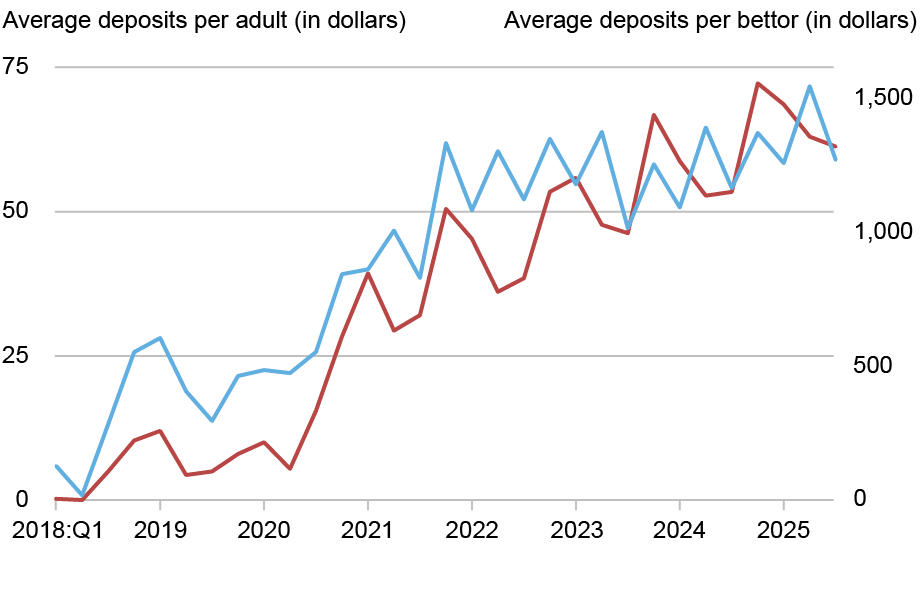
<p>Using <a href="https://www.earnestanalytics.com/" target="_blank" rel="noreferrer noopener">anonymized transaction-level consumer spending data</a>, we aggregate online sportsbook deposits at a county-quarter level to compare counties in legal states to those in not-legal states before and after legalization. The chart below plots two measures of average online sportsbook deposits within legal states over time. The red line (measured by the left axis), presents average deposits per adult. We see that spending grew dramatically after mid-2020, exhibits seasonal patterns consistent with the National Football League season, and continues to grow through the end of 2025.</p>


<p>The blue line (measured on the right axis) shows the total deposits divided by the number of individuals with at least one online sportsbook deposit each quarter. In contrast to average deposits in the population, average deposits <em>per bettor </em>have leveled since 2022. We conclude that long-run growth in total betting is driven less by rising deposits among existing bettors and more by broader participation and continued market expansion.</p>


<div style="height:15px" aria-hidden="true" class="wp-block-spacer"></div>


<div class="wp-block-group frbny-chart-container"><div class="wp-block-group__inner-container is-layout-constrained wp-block-group-is-layout-constrained">
<p class="is-style-title">Average Deposits at Sportsbooks Rise Steeply After Mid-2020</p>


<figure class="wp-block-image size-full"><img loading="lazy" decoding="async" width="920" height="600" src="https://libertystreeteconomics.newyorkfed.org/wp-content/uploads/sites/2/2026/03/LSE_2026_sports-betting_mangrum_ch1_b4e086.png" alt="Line chart plotting average sportsbook deposits per adult (left vertical axis, red line) and average sportsbook deposits per bettor (right vertical axis, blue line) from 2018 through 2025 (horizontal axis); spending grew dramatically after mid-2020, exhibited seasonal patterns consistent with the National Football League season, and continued to grow through the end of 2025.  " class="wp-image-40887" srcset="https://libertystreeteconomics.newyorkfed.org/wp-content/uploads/sites/2/2026/03/LSE_2026_sports-betting_mangrum_ch1_b4e086.png 920w, https://libertystreeteconomics.newyorkfed.org/wp-content/uploads/sites/2/2026/03/LSE_2026_sports-betting_mangrum_ch1_b4e086.png?resize=460,300 460w, https://libertystreeteconomics.newyorkfed.org/wp-content/uploads/sites/2/2026/03/LSE_2026_sports-betting_mangrum_ch1_b4e086.png?resize=768,501 768w, https://libertystreeteconomics.newyorkfed.org/wp-content/uploads/sites/2/2026/03/LSE_2026_sports-betting_mangrum_ch1_b4e086.png?resize=442,288 442w" sizes="auto, (max-width: 920px) 100vw, 920px" /><figcaption class="wp-element-caption">Sources: Earnest Analytics; authors’ calculations.<br>Notes: The chart plots quarterly average deposits at sportsbooks per adult (left axis, red) and per bettor (right axis, blue) in counties with legal mobile sports betting. Both series are unweighted averages across all counties in states where mobile betting is legal in that quarter.</figcaption></figure>
</div></div>


<div style="height:15px" aria-hidden="true" class="wp-block-spacer"></div>


<h4 class="wp-block-heading">Betting Across Borders</h4>


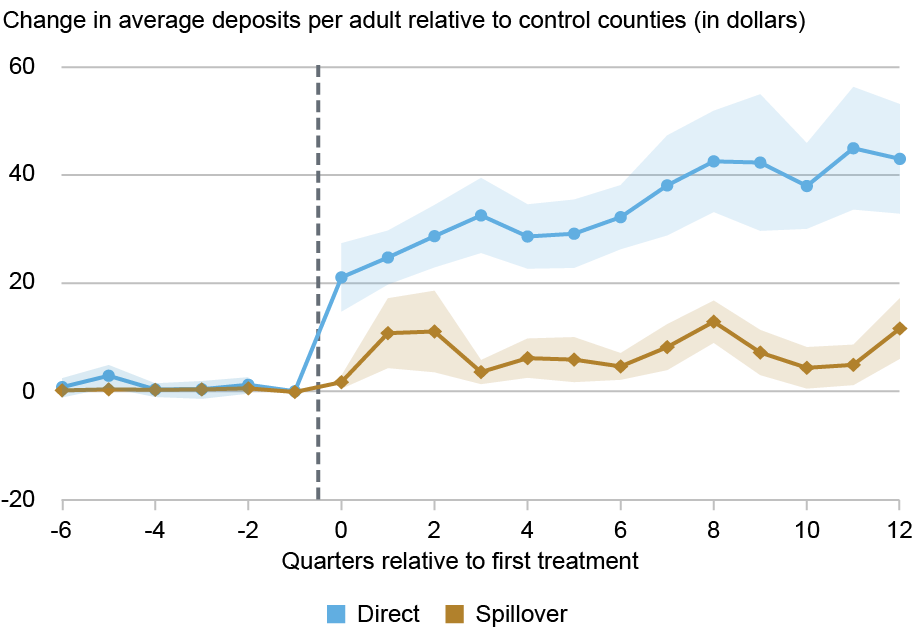
<p>An interesting wrinkle to sports betting access is that potential bettors do not have to be residents of a legal state to place a wager. Since they only need to be physically present in a legal state at the time they make a bet, those living near legal states have relatively easy access to legal sports betting. To account for spillovers across borders in our analysis, we split our sample into three mutually exclusive groups in each quarter: a direct treatment group of counties within a legal state, a spillover group of counties near a legal state but in still-illegal states (within fifteen miles), and a control group of counties farther away from any legal states (at least sixty miles from a legal state). We then compare the evolution of online betting in each quarter relative to the first quarter of legal access (own legalization for the legal counties or nearby legalization for the spillover counties).</p>


<p>The chart below plots the estimated effect of legalization on average deposits at sportsbooks separately for the direct effect and the spillover effect in each quarter relative to the first quarter of legal access. We find a large increase in spending within state lines (blue line) with a similarly sharp but smaller increase in nearby spillover counties (gold line). On average, online betting deposits per adult increase by roughly $30&nbsp;per quarter in the first few quarters after legalization and grow to around $40&nbsp;after three years. Most striking is the magnitude of spillovers: for nearby counties that are not legal, the impact is roughly 15&nbsp;percent the size of the direct effect, representing significant spending coming from across state lines.</p>


<div style="height:15px" aria-hidden="true" class="wp-block-spacer"></div>


<div class="wp-block-group frbny-chart-container"><div class="wp-block-group__inner-container is-layout-constrained wp-block-group-is-layout-constrained">
<p class="is-style-title">Sportsbook Deposits Grow Dramatically After Legalization in Legal Counties and in Nearby Illegal Counties</p>


<figure class="wp-block-image size-full"><img loading="lazy" decoding="async" width="920" height="636" src="https://libertystreeteconomics.newyorkfed.org/wp-content/uploads/sites/2/2026/03/LSE_2026_sports-betting_mangrum_ch2_54378b.png" alt=" Line chart tracking change in average sportsbook deposits in U.S. dollars per adult (vertical axis) against quarters relative to the first quarter of legal access (horizontal axis) for direct, or within state lines (blue circles) and spillover counties (gold diamonds), with 95% confidence intervals (shaded areas); online betting deposits per adult increased by roughly $30 per quarter in the first few quarters after legalization and grew to around $40 after three years; for nearby counties where betting was not legal, the impact was roughly 15 percent the size of the direct effect. " class="wp-image-40890" srcset="https://libertystreeteconomics.newyorkfed.org/wp-content/uploads/sites/2/2026/03/LSE_2026_sports-betting_mangrum_ch2_54378b.png 920w, https://libertystreeteconomics.newyorkfed.org/wp-content/uploads/sites/2/2026/03/LSE_2026_sports-betting_mangrum_ch2_54378b.png?resize=460,318 460w, https://libertystreeteconomics.newyorkfed.org/wp-content/uploads/sites/2/2026/03/LSE_2026_sports-betting_mangrum_ch2_54378b.png?resize=768,531 768w, https://libertystreeteconomics.newyorkfed.org/wp-content/uploads/sites/2/2026/03/LSE_2026_sports-betting_mangrum_ch2_54378b.png?resize=417,288 417w" sizes="auto, (max-width: 920px) 100vw, 920px" /><figcaption class="wp-element-caption">Sources: Earnest Analytics; authors’ calculations.<br>Notes: The chart plots estimates (in circles and squares) and 95 percent confidence intervals (in shaded regions) for the change in average sportsbook deposits per adult in quarters relative to the first quarter of legal access. Legal access is defined as own-state legalization for counties in legal states (blue line) and nearby legalization for counties in spillover states (gold line). The full empirical specification can be found in <a href="https://www.newyorkfed.org/medialibrary/media/research/staff_reports/sr1184.pdf" target="_blank" rel="noreferrer noopener">Goss and Mangrum (2026)</a>.</figcaption></figure>
</div></div>


<div style="height:15px" aria-hidden="true" class="wp-block-spacer"></div>


<h4 class="wp-block-heading">Implications for Consumer Credit</h4>


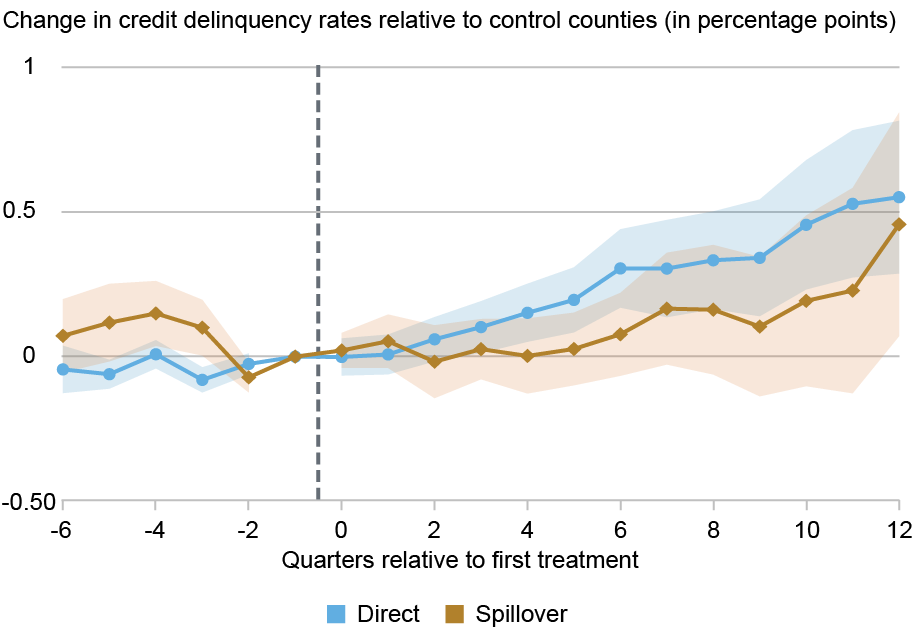
<p>Next, we examine credit delinquencies using the New York Fed Consumer Credit Panel (CCP), a nationally representative 5&nbsp;percent sample of anonymized Equifax credit reports, with the same geographic approach as above. The chart below shows the impact of legalization on the share of the county population with any account ninety or more days past due, with the blue line showing the direct effect and the gold line showing the spillover effect. Following legalization, delinquency rose steadily in legal counties and surpassed half a percentage point three years after legalization, representing a noticeable deterioration in repayment performance from a baseline of 10.7&nbsp;percent. Spillover counties follow a similar pattern with a smaller magnitude increase in delinquencies, suggesting that, as with betting activity, the financial consequences extend across state lines. In our Staff Report, we show that the overall increase in delinquency is driven by borrowers under the age of 40. Following legalization, the share of under-40 borrowers who are delinquent rises by 1.02&nbsp;percentage points for credit cards and 0.55&nbsp;percentage point for auto loans.</p>


<p>Our consumer credit analysis explores the overall impact of sports betting on the full population without differentiating between those that gamble and those that do not. However, the spending analysis shows that only around 3&nbsp;percent of the population newly takes up sports betting after legalization. If we instead focus on only the 3&nbsp;percent of people who newly take up sports betting after legalization, the implied increase in delinquency rate <em>conditional on take-up </em>is 10&nbsp;percentage points, roughly a doubling from the baseline rate.</p>


<div style="height:15px" aria-hidden="true" class="wp-block-spacer"></div>


<div class="wp-block-group frbny-chart-container"><div class="wp-block-group__inner-container is-layout-constrained wp-block-group-is-layout-constrained">
<p class="is-style-title">Credit Delinquencies Increase Steadily After Sports Betting Legalization</p>


<figure class="wp-block-image size-full"><img loading="lazy" decoding="async" width="920" height="633" src="https://libertystreeteconomics.newyorkfed.org/wp-content/uploads/sites/2/2026/03/LSE_2026_sports-betting_mangrum_ch3_d2ab72.png" alt=" Line chart tracking change in credit delinquency rates (vertical axis) against quarters relative to the first quarter of legal access (horizontal axis) relative to direct, or counties within state lines (blue circles) and spillover counties (gold diamonds), with 95% confidence intervals (shaded areas); following legalization, delinquency rose steadily in legal counties and surpassed half a percentage point three years after legalization, representing a noticeable deterioration in repayment performance from a baseline of 10.7 percent; spillover counties follow a similar pattern.  " class="wp-image-40892" srcset="https://libertystreeteconomics.newyorkfed.org/wp-content/uploads/sites/2/2026/03/LSE_2026_sports-betting_mangrum_ch3_d2ab72.png 920w, https://libertystreeteconomics.newyorkfed.org/wp-content/uploads/sites/2/2026/03/LSE_2026_sports-betting_mangrum_ch3_d2ab72.png?resize=460,317 460w, https://libertystreeteconomics.newyorkfed.org/wp-content/uploads/sites/2/2026/03/LSE_2026_sports-betting_mangrum_ch3_d2ab72.png?resize=768,528 768w, https://libertystreeteconomics.newyorkfed.org/wp-content/uploads/sites/2/2026/03/LSE_2026_sports-betting_mangrum_ch3_d2ab72.png?resize=419,288 419w" sizes="auto, (max-width: 920px) 100vw, 920px" /><figcaption class="wp-element-caption">Sources: New York Fed Consumer Credit Panel/Equifax; authors’ calculations.<br>Notes: The chart plots estimates (in circles and squares) and 95 percent confidence intervals (in shaded regions) for the change in credit delinquency rates in quarters relative to the first quarter of legal access. Legal access is defined as own-state legalization for counties in legal states (blue line) and nearby legalization for counties in spillover states (gold line). The full empirical specification can be found in <a href="https://www.newyorkfed.org/medialibrary/media/research/staff_reports/sr1184.pdf" target="_blank" rel="noreferrer noopener">Goss and Mangrum (2026)</a>.</figcaption></figure>
</div></div>


<div style="height:15px" aria-hidden="true" class="wp-block-spacer"></div>


<h4 class="wp-block-heading">Implications for Not-Yet-Legal States</h4>


<p>In our <a href="https://www.newyorkfed.org/medialibrary/media/research/staff_reports/sr1184.pdf" target="_blank" rel="noreferrer noopener">Staff Report</a>, we find that following the legalization of sports betting in a state, credit delinquencies increase, driven by those under 40&nbsp;years old. In addition, betting activity, and the resulting consumer credit distress, do not stop at state boundaries. Some who live in not-yet-legal states near legal states travel across state lines to wager and delinquencies rise in these not-legal areas as well. In legal states, tax revenue from sports betting can help offset some of the negative impacts of legalized sports betting (states collected nearly $3&nbsp;billion in such tax revenue in 2024 alone), but states that are not legal themselves bear negative consequences of sports betting without the tax revenue to offset these costs. As we show in the <a href="https://www.newyorkfed.org/medialibrary/media/research/staff_reports/sr1184.pdf" target="_blank" rel="noreferrer noopener">Staff Report</a>, the negative consequences without compensating tax revenue may create incentives for states to legalize, particularly those with population centers near legal states.</p>


<div class="wp-block-media-text" style="grid-template-columns:15% auto"><figure class="wp-block-media-text__media"><img loading="lazy" decoding="async" width="4096" height="4411" src="https://libertystreeteconomics.newyorkfed.org/wp-content/uploads/sites/2/2026/03/goss_profile@2x_1a264a.png?w=267" alt="goss_profile@2x" class="wp-image-40883 size-full" srcset="https://libertystreeteconomics.newyorkfed.org/wp-content/uploads/sites/2/2026/03/goss_profile@2x_1a264a.png 4096w, https://libertystreeteconomics.newyorkfed.org/wp-content/uploads/sites/2/2026/03/goss_profile@2x_1a264a.png?resize=460,495 460w, https://libertystreeteconomics.newyorkfed.org/wp-content/uploads/sites/2/2026/03/goss_profile@2x_1a264a.png?resize=768,827 768w, https://libertystreeteconomics.newyorkfed.org/wp-content/uploads/sites/2/2026/03/goss_profile@2x_1a264a.png?resize=267,288 267w, https://libertystreeteconomics.newyorkfed.org/wp-content/uploads/sites/2/2026/03/goss_profile@2x_1a264a.png?resize=1426,1536 1426w, https://libertystreeteconomics.newyorkfed.org/wp-content/uploads/sites/2/2026/03/goss_profile@2x_1a264a.png?resize=1902,2048 1902w" sizes="auto, (max-width: 4096px) 100vw, 4096px" /></figure><div class="wp-block-media-text__content">
<p class="is-style-bio-contact">Jacob Goss is a former research analyst in the Federal Reserve Bank of New York’s Research and Statistics Group and a current graduate student at the University of Wisconsin—Madison.</p>
</div></div>


<div class="wp-block-media-text alignwide" style="grid-template-columns:15% auto"><figure class="wp-block-media-text__media"><img loading="lazy" decoding="async" width="91" height="90" src="https://libertystreeteconomics.newyorkfed.org/wp-content/uploads/sites/2/2022/05/Daniel-Mangrum-90-x-90.png?w=91" alt="Photo: portrait of Daniel Mangrum" class="wp-image-16003 size-full" srcset="https://libertystreeteconomics.newyorkfed.org/wp-content/uploads/sites/2/2022/05/Daniel-Mangrum-90-x-90.png 91w, https://libertystreeteconomics.newyorkfed.org/wp-content/uploads/sites/2/2022/05/Daniel-Mangrum-90-x-90.png?resize=45,45 45w" sizes="auto, (max-width: 91px) 100vw, 91px" /></figure><div class="wp-block-media-text__content">
<p class="is-style-bio-contact"><a href="https://www.newyorkfed.org/research/economists/mangrum" target="_blank" rel="noreferrer noopener">Daniel Mangrum</a> is a research economist in the Federal Reserve Bank of New York’s Research and Statistics Group.</p>
</div></div>


<hr class="wp-block-separator has-alpha-channel-opacity"/>


<div class="cite-container">
    <p class="is-style-disclaimer">
        <strong>How to cite this post:</strong><br/>
        Jacob Goss and Daniel Mangrum, &#8220;Sports Betting Is Everywhere, Especially on Credit Reports,&#8221; Federal Reserve Bank of New York <em>Liberty Street Economics</em>, March 25, 2026, <a href="https://doi.org/10.59576/lse.20260325">https://doi.org/10.59576/lse.20260325</a>
    <span>BibTeX: <a href="#bibtex" onClick="_toggle_bibtex3()">View</a> | <button class="bibtex-save">Download</button></span>
    </p>

    <script>
        function _toggle_bibtex3(){
            let el = document.getElementById('bibtex3');
            el.style.display = el.style.display === 'none' ? '' : 'none';
        }
    </script>
    <div id="bibtex3" class="bibtex" style="display:none;">
    <pre><code> 
@article{JacobGossandDanielMangrum2026,
    author={Jacob Goss and Daniel Mangrum},
    title={Sports Betting Is Everywhere, Especially on Credit Reports},
    journal={Liberty Street Economics},
    note={Liberty Street Economics Blog},
    number={March 25},
    year={2026},
    url={https://doi.org/10.59576/lse.20260325}
}</code></pre>
    </div>

</div>

<div class="frbny-related">
	<p class="frbny-related__label">You may also be interested in:</p>


<div class="frbny-related__item">
<figure class="wp-block-image size-medium"><img loading="lazy" decoding="async" height="288" width="460" src="https://libertystreeteconomics.newyorkfed.org/wp-content/uploads/sites/2/2023/01/LSE_2023_staff-report_graphic.png?w=460" alt="Image of Staff Reports cover" class="wp-image-20191" srcset="https://libertystreeteconomics.newyorkfed.org/wp-content/uploads/sites/2/2023/01/LSE_2023_staff-report_graphic.png 920w, https://libertystreeteconomics.newyorkfed.org/wp-content/uploads/sites/2/2023/01/LSE_2023_staff-report_graphic.png?resize=460,288 460w, https://libertystreeteconomics.newyorkfed.org/wp-content/uploads/sites/2/2023/01/LSE_2023_staff-report_graphic.png?resize=768,481 768w" sizes="auto, (max-width: 460px) 100vw, 460px" /></figure>
<p><a href="https://www.newyorkfed.org/medialibrary/media/research/staff_reports/sr1184.pdf" target="_blank" rel="noreferrer noopener">Sports Betting Across Borders: Spatial Spillovers, Credit Distress, and Fiscal Externalities</a></p></div>


<div class="frbny-related__item">
<figure class="wp-block-image size-medium"><img decoding="async" src="https://libertystreeteconomics.newyorkfed.org/wp-content/uploads/sites/2/2026/02/LSE_2026_HDC_scally_460.jpg?w=460" alt="Photo: lower income neighborhood in the U.S."/></figure>
<p><a href="https://libertystreeteconomics.newyorkfed.org/2026/02/where-are-mortgage-delinquencies-rising-the-most/" target="_blank" rel="noreferrer noopener">Where Are Mortgage Delinquencies Rising the Most?</a></p></div>


<div class="frbny-related__item">
<figure class="wp-block-image size-medium"><img decoding="async" src="https://libertystreeteconomics.newyorkfed.org/wp-content/uploads/sites/2/2025/05/LSE_2025_student-loan-dq_mangrum_460.jpg?w=460" alt=""/></figure>
<p><a href="https://libertystreeteconomics.newyorkfed.org/2025/05/student-loan-delinquencies-are-back-and-credit-scores-take-a-tumble/" target="_blank" rel="noreferrer noopener">Student Loan Delinquencies Are Back, and Credit Scores Take a Tumble&nbsp;</a></p></div>

</div>


<div>
<div style="height:24px" aria-hidden="true" class="wp-block-spacer"></div>


<hr class="wp-block-separator has-alpha-channel-opacity"/>


<p class="is-style-disclaimer"><strong>Disclaimer</strong><br>The views expressed in this post are those of the author(s) and do not necessarily reflect the position of the Federal Reserve Bank of New York or the Federal Reserve System. Any errors or omissions are the responsibility of the author(s).</p>
</div>
]]></content>
		
					<link rel="replies" type="text/html" href="https://libertystreeteconomics.newyorkfed.org/2026/03/sports-betting-is-everywhere-especially-on-credit-reports/#comments" thr:count="0" />
			<link rel="replies" type="application/atom+xml" href="https://libertystreeteconomics.newyorkfed.org/2026/03/sports-betting-is-everywhere-especially-on-credit-reports/feed/atom/" thr:count="0" />
			<thr:total>0</thr:total>
			</entry>
		<entry>
		<author>
			<name></name>
					</author>

		<title type="html"><![CDATA[China’s Electric Trade]]></title>
		<link rel="alternate" type="text/html" href="https://libertystreeteconomics.newyorkfed.org/2026/03/chinas-electric-trade/" />

		<id>https://libertystreeteconomics.newyorkfed.org/?p=40291</id>
		<updated>2026-03-20T16:30:34Z</updated>
		<published>2026-03-23T11:00:00Z</published>
		<category scheme="https://libertystreeteconomics.newyorkfed.org/" term="Exports" /><category scheme="https://libertystreeteconomics.newyorkfed.org/" term="International Economics" />
		<summary type="html"><![CDATA[China has spent considerable government resources to develop advanced electric technology industries, such as those that produce electric vehicles, lithium batteries, and solar panels. These efforts have spilled over to international trade as improvements in price and quality have increased the global demand for these goods. One consequence is that passenger cars and batteries have been disproportionately large contributors to the rise in the country’s trade surplus in recent years. This has not been the case, though, for solar panels, as falling prices due to a supply glut pulled down export revenues despite higher volumes.]]></summary>

					<content type="html" xml:base="https://libertystreeteconomics.newyorkfed.org/2026/03/chinas-electric-trade/"><![CDATA[<p class="ts-blog-article-author">
    Thomas Klitgaard</p>


<figure class="lse-featured-image">
	<img loading="lazy" decoding="async" width="460" height="288" src="https://libertystreeteconomics.newyorkfed.org/wp-content/uploads/sites/2/2026/02/LSE_China-electric_klitgaard-_460.jpg?w=460" class="cover-image asset-image img-responsive wp-post-image" alt="AI generated image: red background with yellow stars similar the China flag in the top left corner, white lightning bolt in the center of the image and white grid lines in the top right, bottom left and right of the image." srcset="https://libertystreeteconomics.newyorkfed.org/wp-content/uploads/sites/2/2026/02/LSE_China-electric_klitgaard-_460.jpg 920w, https://libertystreeteconomics.newyorkfed.org/wp-content/uploads/sites/2/2026/02/LSE_China-electric_klitgaard-_460.jpg?resize=460,288 460w, https://libertystreeteconomics.newyorkfed.org/wp-content/uploads/sites/2/2026/02/LSE_China-electric_klitgaard-_460.jpg?resize=768,481 768w" sizes="auto, (max-width: 460px) 100vw, 460px" /></figure>


<p>China has spent considerable government resources to develop advanced electric technology industries, such as those that produce electric vehicles, lithium batteries, and solar panels. These efforts have spilled over to international trade as improvements in price and quality have increased the global demand for these goods. One consequence is that passenger cars and batteries have been disproportionately large contributors to the rise in the country’s trade surplus in recent years. This has not been the case, though, for solar panels, as falling prices due to a supply glut pulled down export revenues despite higher volumes.</p>


<h4 class="wp-block-heading">Industrial Policies</h4>


<p>The use of industrial policies to promote advanced electric technology started in response to concerns about pollution and then transitioned into being part of China’s efforts to be at the vanguard of new technologies. The Five-Year Plan approved in 2011 committed to increasing the share of electricity provided by non-fossil fuels. The 2016 Plan focused on promoting environmental technology industries, specifically mentioning electric vehicles and renewable energy, and the 2021 Plan set a goal of half of all passenger cars sold in China being battery powered by 2035.</p>


<p>The various policies used have been expensive, but the efforts have led to rapid growth in these technologies. Plug-in cars (battery electric and plug-in hybrid) represented 54 percent of passenger cars sold in China in 2025, up from 28 percent in 2022, while China added 360 gigawatts (GW) of <a href="https://iea-pvps.org/wp-content/uploads/2025/10/IEA-PVPS_Trends_2025-.pdf">solar power</a> capacity in 2024, compared to the 100 GW added in 2022. &nbsp;</p>


<p>One consequence of this rapid growth is that some of the new capacity has gone to satisfy foreign demand.</p>


<h4 class="wp-block-heading">Motor Vehicles</h4>


<p>Meeting the 50 percent goal ten years early illustrates how unexpectedly fast the plug-in passenger car industry has grown. The numbers are impressive. Battery electric vehicle production increased from 1 million units in 2020 to 9.5 million units in 2025, and the output of plug-in hybrids increased from 200,000 units to over 4.5&nbsp;million units.</p>


<p>China has historically not exported passenger cars to global markets, so pouring money into the development of plug-in vehicles was a chance to leapfrog established auto firms. Exports of plug-ins, which totaled $3&nbsp;billion in 2020, rose to $23 billion in 2022 and $59 billion in 2025, as shown in the chart below, despite tariffs closing off the U.S. market. (The data are twelve-month rolling sums, meaning each data point represents sales over the past twelve months.) Trade flows were also affected on the import side as increased demand for domestically produced plug-ins helped cause imports of passenger cars to fall from $52 billion in 2022 to $23 billion last year. &nbsp;</p>


<div class="wp-block-group frbny-chart-container"><div class="wp-block-group__inner-container is-layout-constrained wp-block-group-is-layout-constrained">
<p class="is-style-title">China’s Electric Passenger Car Exports Have Soared</p>


<figure class="wp-block-image size-full"><img loading="lazy" decoding="async" width="920" height="600" src="https://libertystreeteconomics.newyorkfed.org/wp-content/uploads/sites/2/2026/02/LSE_2026_china-green-trade_klitgaard_ch1.png" alt=" Line chart tracking China’s passenger car trade in twelve-month rolling sums of billions of dollars (vertical axis) from 2022 through 2025 (horizontal axis) for plug-in car exports (blue) and passenger car imports (red); exports of plug-ins rose from $3 billion in 2020 to $23 billion in 2022 and $59 billion in 2025. " class="wp-image-40702" srcset="https://libertystreeteconomics.newyorkfed.org/wp-content/uploads/sites/2/2026/02/LSE_2026_china-green-trade_klitgaard_ch1.png 920w, https://libertystreeteconomics.newyorkfed.org/wp-content/uploads/sites/2/2026/02/LSE_2026_china-green-trade_klitgaard_ch1.png?resize=460,300 460w, https://libertystreeteconomics.newyorkfed.org/wp-content/uploads/sites/2/2026/02/LSE_2026_china-green-trade_klitgaard_ch1.png?resize=768,501 768w, https://libertystreeteconomics.newyorkfed.org/wp-content/uploads/sites/2/2026/02/LSE_2026_china-green-trade_klitgaard_ch1.png?resize=442,288 442w" sizes="auto, (max-width: 920px) 100vw, 920px" /><figcaption class="wp-element-caption">Source: China General Administration of Customs via Haver.</figcaption></figure>
</div></div>


<div style="height:15px" aria-hidden="true" class="wp-block-spacer"></div>


<p>In terms of the trade balance&#8217;s composition, the rise in plug-in car exports and the decline in passenger car imports, both representing very small shares of total trade flows, contributed $65 billion to the $270 billion increase in China’s trade surplus from 2022 to 2025.</p>


<h4 class="wp-block-heading">Lithium-Ion Batteries</h4>


<p>Progress in producing better and cheaper lithium-ion batteries has been the key factor behind the rise of electric vehicles. One implication is that plug-ins assembled elsewhere often use batteries made in China. Foreign demand is also coming from the need to <a href="https://www.iea.org/reports/batteries-and-secure-energy-transitions/executive-summary">manage</a> the world’s growing reliance on solar and wind power.</p>


<p>The chart below shows the upward trend in battery exports, albeit with a pause in 2024 after surging the previous year, putting 2025 foreign sales 50 percent higher than they were in 2022 ($51 billion to $77&nbsp;billion). Imports during this period were negligible, so batteries also made a disproportionately large contribution to China’s higher trade surplus.</p>


<div class="wp-block-group frbny-chart-container"><div class="wp-block-group__inner-container is-layout-constrained wp-block-group-is-layout-constrained">
<p class="is-style-title">China’s Battery Exports Are Trending Higher</p>


<figure class="wp-block-image size-full"><img loading="lazy" decoding="async" width="920" height="600" src="https://libertystreeteconomics.newyorkfed.org/wp-content/uploads/sites/2/2026/02/LSE_2026_china-green-trade_klitgaard_ch2.png" alt=" Line chart tracking China’s lithium-ion battery exports (blue) in twelve-month rolling sums of billions of dollars (vertical axis) from 2022 through 2025 (horizontal axis); the chart shows the upward trend in battery exports (with a pause in 2024 after surging the previous year), putting 2025 foreign sales 50 percent higher than they were in 2022. " class="wp-image-40704" srcset="https://libertystreeteconomics.newyorkfed.org/wp-content/uploads/sites/2/2026/02/LSE_2026_china-green-trade_klitgaard_ch2.png 920w, https://libertystreeteconomics.newyorkfed.org/wp-content/uploads/sites/2/2026/02/LSE_2026_china-green-trade_klitgaard_ch2.png?resize=460,300 460w, https://libertystreeteconomics.newyorkfed.org/wp-content/uploads/sites/2/2026/02/LSE_2026_china-green-trade_klitgaard_ch2.png?resize=768,501 768w, https://libertystreeteconomics.newyorkfed.org/wp-content/uploads/sites/2/2026/02/LSE_2026_china-green-trade_klitgaard_ch2.png?resize=442,288 442w" sizes="auto, (max-width: 920px) 100vw, 920px" /><figcaption class="wp-element-caption">Source: China General Administration of Customs via Haver.</figcaption></figure>
</div></div>


<div style="height:15px" aria-hidden="true" class="wp-block-spacer"></div>


<p>The global dominance of Chinese firms is evident in import <a href="https://comtradeplus.un.org/TradeFlow?Frequency=A&amp;Flows=X&amp;CommodityCodes=TOTAL&amp;Partners=0&amp;Reporters=all&amp;period=2022&amp;AggregateBy=none&amp;BreakdownMode=plus">data</a> reported by other countries. The United States and the European Union (EU) both bought around $25 billion worth of lithium-ion batteries in 2024 (<a href="https://www.trade.gov/harmonized-system-hs-codes">HS commodity code</a> 850760), with China supplying 70 percent of U.S. imports and 86 percent of the EU’s purchases. The shares were similarly high for other importers such as India (91&nbsp;percent), Pakistan (99 percent), Brazil (80 percent), and Saudi Arabia (98 percent).</p>


<h4 class="wp-block-heading">Solar Panels</h4>


<p>The rest of the world has been investing in solar power, with estimates that capacity additions went from 150 GW in 2022 to 250 GW in 2024. Despite more investment spending abroad, though, China&#8217;s solar panel export revenues fell 40 percent between 2022 and 2025, from $46 billion to $28 billion.</p>


<p>The chart below compares export revenues with export volumes, measured by weight, with both series set to equal 100 in 2022. Driving the co-movement of these lines are changes in prices. For example, if the price per pound is unchanged, then the two lines move together, as is the case from 2022 through the first half of 2023. (Trade data limitations prevent using the standard price per watt measure.) Alternatively, when prices fall, in this case from a supply glut that intensified competitive pressures, then revenues fall even though volumes are rising, as seen in the second half of 2023 and in 2024. Prices stabilized somewhat in 2025, so the value and the weight measures both moved higher.</p>


<div class="wp-block-group frbny-chart-container"><div class="wp-block-group__inner-container is-layout-constrained wp-block-group-is-layout-constrained">
<p class="is-style-title">Solar Panel Export Revenues Are Down While Weight Volumes Are Up</p>


<figure class="wp-block-image size-full"><img loading="lazy" decoding="async" width="920" height="600" src="https://libertystreeteconomics.newyorkfed.org/wp-content/uploads/sites/2/2026/02/LSE_2026_china-green-trade_klitgaard_ch3-1.png" alt=" Line chart tracking China’s solar panel exports in twelve-month rolling sums (vertical axis) in billions of dollars (blue) and tons (red) from 2022 through 2025 (horizontal axis); value and weight lines moved together over the course of 2022 and in the first half of 2023, indicating stable prices, then diverged through 2024 as the price per pound fell sharply and apparently stabilized in 2025. " class="wp-image-40709" srcset="https://libertystreeteconomics.newyorkfed.org/wp-content/uploads/sites/2/2026/02/LSE_2026_china-green-trade_klitgaard_ch3-1.png 920w, https://libertystreeteconomics.newyorkfed.org/wp-content/uploads/sites/2/2026/02/LSE_2026_china-green-trade_klitgaard_ch3-1.png?resize=460,300 460w, https://libertystreeteconomics.newyorkfed.org/wp-content/uploads/sites/2/2026/02/LSE_2026_china-green-trade_klitgaard_ch3-1.png?resize=768,501 768w, https://libertystreeteconomics.newyorkfed.org/wp-content/uploads/sites/2/2026/02/LSE_2026_china-green-trade_klitgaard_ch3-1.png?resize=442,288 442w" sizes="auto, (max-width: 920px) 100vw, 920px" /><figcaption class="wp-element-caption">Source: China General Administration of Customs via Haver.</figcaption></figure>
</div></div>


<div style="height:15px" aria-hidden="true" class="wp-block-spacer"></div>


<p>Falling prices have been a drag on revenues, but the aggressive cost competitiveness has allowed China to maintain almost total dominance in international trade in solar panels. In 2024, Chinese panels (HS&nbsp;commodity code 854143) accounted for almost all of the EU’s imports, with similarly high percentages recorded in India (80&nbsp;percent), Pakistan (100 percent), Brazil (100 percent), and Saudi Arabia (100&nbsp;percent).</p>


<p>High trade barriers mean the United States does not import panels from China, though U.S. panel imports were still substantial in 2024 at $15 billion versus $12 billion by the EU, with the bulk coming from other East Asian countries. The 2025 tariff hikes then caused imports to collapse, with the U.S. managing the cutoff by adding solar power capacity at a <a href="https://www.eia.gov/todayinenergy/detail.php?id=67205">slower </a>pace and by increasing the domestic <a href="https://solartechonline.com/blog/us-solar-manufacturing-guide/">production</a> of assembled solar panels.</p>


<h4 class="wp-block-heading">Outlook</h4>


<p>Advanced electric technology products are enjoying growing demand around the world as China’s policies have helped lower prices and improve the quality of these goods. China’s dominance in global trade in electric technologies seems likely to be sustained in the near term, with competition at this point largely from other East Asian economies. The issue is complicated for governments that want to challenge China’s dominance as they will have to consider the costs and benefits of fostering domestic alternatives.</p>


<div class="wp-block-media-text alignwide" style="grid-template-columns:15% auto"><figure class="wp-block-media-text__media"><img loading="lazy" decoding="async" width="90" height="90" src="https://libertystreeteconomics.newyorkfed.org/wp-content/uploads/sites/2/2022/03/klitgaard_tom.jpg?w=90" alt="Photo: portrait of Thomas Klitgaard" class="wp-image-15299 size-full" srcset="https://libertystreeteconomics.newyorkfed.org/wp-content/uploads/sites/2/2022/03/klitgaard_tom.jpg 90w, https://libertystreeteconomics.newyorkfed.org/wp-content/uploads/sites/2/2022/03/klitgaard_tom.jpg?resize=45,45 45w" sizes="auto, (max-width: 90px) 100vw, 90px" /></figure><div class="wp-block-media-text__content">
<p class="is-style-bio-contact has-large-font-size"><a href="https://www.newyorkfed.org/research/economists/klitgaard" target="_blank" rel="noreferrer noopener">Thomas Klitgaard</a> is an economic policy advisor in the Federal Reserve Bank of New York’s Research and Statistics Group.</p>
</div></div>


<hr class="wp-block-separator has-alpha-channel-opacity"/>


<div class="cite-container">
    <p class="is-style-disclaimer">
        <strong>How to cite this post:</strong><br/>
        Thomas Klitgaard, &#8220;China’s Electric Trade,&#8221; Federal Reserve Bank of New York <em>Liberty Street Economics</em>, March 23, 2026, <a href="https://doi.org/10.59576/lse.20260323"> https://doi.org/10.59576/lse.20260323</a>
    <span>BibTeX: <a href="#bibtex" onClick="_toggle_bibtex4()">View</a> | <button class="bibtex-save">Download</button></span>
    </p>

    <script>
        function _toggle_bibtex4(){
            let el = document.getElementById('bibtex4');
            el.style.display = el.style.display === 'none' ? '' : 'none';
        }
    </script>
    <div id="bibtex4" class="bibtex" style="display:none;">
    <pre><code> 
@article{Klitgaard2026,
    author={Klitgaard, Thomas},
    title={China’s Electric Trade},
    journal={Liberty Street Economics},
    note={Liberty Street Economics Blog},
    number={March 23},
    year={2026},
    url={ https://doi.org/10.59576/lse.20260323}
}</code></pre>
    </div>

</div>

<div class="frbny-related">
	<p class="frbny-related__label">You may also be interested in:</p>


<div class="frbny-related__item">
<figure class="wp-block-image size-medium"><img decoding="async" src="https://libertystreeteconomics.newyorkfed.org/wp-content/uploads/sites/2/2024/02/LSE_2024_china-BEV_klitgaard_460.jpg?w=460" alt="Decorative image: photo of woman charging an electric car"/></figure>
<p><a href="https://libertystreeteconomics.newyorkfed.org/2024/02/can-electric-cars-power-chinas-growth/">Can Electric Cars Power China’s Growth?</a></p></div>


<div class="frbny-related__item">
<figure class="wp-block-image size-medium"><img decoding="async" src="https://libertystreeteconomics.newyorkfed.org/wp-content/uploads/sites/2/2024/03/LSE_2024_china-sugar-high_akinci_460.jpg?w=460" alt="Photo: workers sitting at machines at a factory in China"/></figure>
<p><a href="https://libertystreeteconomics.newyorkfed.org/2024/03/what-if-china-manufactures-a-sugar-high/">What if China Manufactures a Sugar High?</a></p></div>


<div class="frbny-related__item">
<figure class="wp-block-image size-medium"><img decoding="async" src="https://libertystreeteconomics.newyorkfed.org/wp-content/uploads/sites/2/2025/04/LSE_2025_China-policy-stimulus_Clark_460.png?w=460" alt="People walking on Nanjing Road, Shanghai, China"/></figure>
<p><a href="https://libertystreeteconomics.newyorkfed.org/2025/04/gauging-the-strength-of-chinas-economy-in-uncertain-times/">Gauging the Strength of China’s Economy in Uncertain Times</a></p></div>

</div>


<div>
<div style="height:24px" aria-hidden="true" class="wp-block-spacer"></div>


<hr class="wp-block-separator has-alpha-channel-opacity"/>


<p class="is-style-disclaimer"><strong>Disclaimer</strong><br>The views expressed in this post are those of the author(s) and do not necessarily reflect the position of the Federal Reserve Bank of New York or the Federal Reserve System. Any errors or omissions are the responsibility of the author(s).</p>
</div>
]]></content>
		
					<link rel="replies" type="text/html" href="https://libertystreeteconomics.newyorkfed.org/2026/03/chinas-electric-trade/#comments" thr:count="0" />
			<link rel="replies" type="application/atom+xml" href="https://libertystreeteconomics.newyorkfed.org/2026/03/chinas-electric-trade/feed/atom/" thr:count="0" />
			<thr:total>0</thr:total>
			</entry>
		<entry>
		<author>
			<name></name>
					</author>

		<title type="html"><![CDATA[The New York Fed DSGE Model Forecast—March 2026]]></title>
		<link rel="alternate" type="text/html" href="https://libertystreeteconomics.newyorkfed.org/2026/03/the-new-york-fed-dsge-model-forecast-march-2026/" />

		<id>https://libertystreeteconomics.newyorkfed.org/?p=40732</id>
		<updated>2026-03-19T13:45:13Z</updated>
		<published>2026-03-20T13:00:00Z</published>
		<category scheme="https://libertystreeteconomics.newyorkfed.org/" term="DSGE" />
		<summary type="html"><![CDATA[This post presents an update of the economic forecasts generated by the Federal Reserve Bank of New York’s dynamic stochastic general equilibrium (DSGE) model. We describe very briefly our forecast and its change since <a href="https://libertystreeteconomics.newyorkfed.org/2025/12/the-new-york-fed-dsge-model-forecast-december-2025/" target="_blank" rel="noreferrer noopener">December 2025</a>. To summarize, growth in 2026 is expected to be more robust, and inflation more persistent, than predicted in December. Stronger investment is the main driver for higher growth, while cost-push shocks, possibly capturing the effects of tariffs, are the key factors behind higher inflation. Projections for the short-run real natural rate of interest (r*) are the same as in December.]]></summary>

					<content type="html" xml:base="https://libertystreeteconomics.newyorkfed.org/2026/03/the-new-york-fed-dsge-model-forecast-march-2026/"><![CDATA[<p class="ts-blog-article-author">
    Marco Del Negro, Ibrahima Diagne, Keshav Dogra, Elena Elbarmi, Donggyu Lee, and Michael Pham</p>


<figure class="lse-featured-image">
	<img loading="lazy" decoding="async" width="460" height="288" src="https://libertystreeteconomics.newyorkfed.org/wp-content/uploads/sites/2/2023/03/LSE_dsge-photo1_460.jpg?w=460" class="cover-image asset-image img-responsive wp-post-image" alt="decorative photo: chart and stock prices background." srcset="https://libertystreeteconomics.newyorkfed.org/wp-content/uploads/sites/2/2023/03/LSE_dsge-photo1_460.jpg 920w, https://libertystreeteconomics.newyorkfed.org/wp-content/uploads/sites/2/2023/03/LSE_dsge-photo1_460.jpg?resize=460,288 460w, https://libertystreeteconomics.newyorkfed.org/wp-content/uploads/sites/2/2023/03/LSE_dsge-photo1_460.jpg?resize=768,481 768w" sizes="auto, (max-width: 460px) 100vw, 460px" /></figure>


<p>This post presents an update of the economic forecasts generated by the Federal Reserve Bank of New York’s dynamic stochastic general equilibrium (DSGE) model. We describe very briefly our forecast and its change since <a href="https://libertystreeteconomics.newyorkfed.org/2025/12/the-new-york-fed-dsge-model-forecast-december-2025/" target="_blank" rel="noreferrer noopener">December 2025</a>. To summarize, growth in 2026 is expected to be more robust, and inflation more persistent, than predicted in December. Stronger investment is the main driver for higher growth, while cost-push shocks, possibly capturing the effects of tariffs, are the key factors behind higher inflation. Projections for the short-run real natural rate of interest (r*) are the same as in December.</p>


<p><em>Note:&nbsp;The&nbsp;DSGE model forecast is not an official New York Fed forecast, but only an input to the Research staff’s overall forecasting process. For more information about the model and variables discussed here, see&nbsp;our </em><a href="https://www.newyorkfed.org/research/policy/dsge#/overview" target="_blank" rel="noreferrer noopener"><em>DSGE model Q &amp; A</em></a><em>.</em>&nbsp;</p>


<p>The New York Fed DSGE model forecasts&nbsp;use data released through 2025:Q4, augmented for 2026:Q1 with median forecasts for real GDP growth and core PCE inflation from the March release of the Philadelphia Fed&nbsp;<a href="https://www.philadelphiafed.org/surveys-and-data/real-time-data-research/spf-q1-2026" target="_blank" rel="noreferrer noopener">Survey of Professional Forecasters</a>&nbsp;(SPF),&nbsp;as well as the yields on 10-year Treasury securities and Baa-rated&nbsp;corporate bonds based on 2026:Q1 averages up to February 25.&nbsp;Starting in&nbsp;2021:Q4, the expected federal funds rate (FFR) between one and six quarters into the future is restricted to equal the corresponding median point forecast from the latest available&nbsp;<a href="https://www.newyorkfed.org/markets/market-intelligence/survey-of-market-expectations" target="_blank" rel="noreferrer noopener">Survey of Market Expectations</a>&nbsp;(SME) in the corresponding quarter. For the current projection, this is the&nbsp;January&nbsp;SME.&nbsp;Note that the&nbsp;DSGE&nbsp;forecasts were produced before the start of&nbsp;the Iran war&nbsp;and therefore do not incorporate&nbsp;its&nbsp;economic&nbsp;impact.</p>


<p>Once again, the economy turned out to be more resilient, and inflation more persistent, than the DSGE model had predicted in December. GDP growth in&nbsp;2025:Q3 turned out to be about 1.5 percentage points higher than&nbsp;anticipated&nbsp;in the November SPF (which the December DSGE forecast used as a nowcast for&nbsp;2025:Q3, as the Q3 GDP data were not available at the time due to the government shutdown). Moreover, growth in&nbsp;2026:Q1, at least according to the current nowcast, is also more than one percentage point higher than the model predicted in December. The model attributes these upside surprises&nbsp;mainly to&nbsp;shocks that drive up investment. These shocks, which in the DSGE lingo are known as MEI (marginal efficiency of investment) shocks,&nbsp;arguably capture&nbsp;the strength of AI-related investment in the second half of 2025 and the beginning of 2026.&nbsp;&nbsp;&nbsp;</p>


<p>In light of&nbsp;the forecast misses, the model revised upward its projections for growth in 2026 by&nbsp;nearly half&nbsp;a percentage point (1.0 versus 0.6 percent). GDP growth projections are lower than they were in December for the remainder of the forecast horizon, as the level effects of the shocks on output fade (2027, 2028, and 2029 GDP growth forecasts are 0.2, 0.9, and 1.3 percent in March versus 0.8, 1.3, and 1.8 percent, respectively, in the December forecasts). The probability of a recession, defined as four-quarter output growth falling below -1.0 percent over the next four quarters, is 35.8 percent, lower than in December (37.5 percent).&nbsp;&nbsp;&nbsp;</p>


<p>Core PCE inflation in&nbsp;2025:Q4 was slightly lower than expected, but the nowcast for&nbsp;2026:Q1 inflation is almost half a percentage point higher than the model predicted in December.&nbsp;The DSGE attributes this forecast error to cost-push shocks, which&nbsp;possibly capture&nbsp;the effects of tariffs, as well as other idiosyncratic factors affecting inflation.&nbsp;As a consequence of&nbsp;this forecast error, the model revised upward its projections for core PCE inflation (2.4, 1.9, 1.9, and 2.0 percent for 2026, 2027, 2028, and 2029, versus 1.9, 1.6, 1.7, and 1.8 percent, respectively, in December).&nbsp;</p>


<p>The model’s predictions for the short-run real natural rate of interest (r*) are essentially the same as in December (1.9, 1.6, 1.3, and 1.1 percent for 2026, 2027, 2028, and 2029, versus 2.0, 1.6, 1.3, and 1.2 percent, respectively, in December). Since projections for the path of the nominal FFR are also unchanged&nbsp;relative&nbsp;to December, but inflation projections are higher, the model views the current path of policy as slightly more accommodative than it was in December.&nbsp;</p>


<p class="is-style-title">Forecast Comparison</p>


<figure class="wp-block-table is-style-regular has-frozen-first-column"><table><thead><tr><th>Forecast Period</th><th class="has-text-align-center" data-align="center" colspan="2">2026</th><th class="has-text-align-center" data-align="center" colspan="2">2027</th><th class="has-text-align-center" data-align="center" colspan="2">2028</th><th class="has-text-align-center" data-align="center" colspan="2">2029</th></tr></thead><tbody><tr><td><strong>Date&nbsp;of&nbsp;Forecast</strong></td><td class="has-text-align-center" data-align="center"><strong>Mar</strong> <strong>26</strong></td><td class="has-text-align-center" data-align="center"><strong>Dec</strong> <strong>25</strong></td><td class="has-text-align-center" data-align="center"><strong>Mar</strong> <strong>26</strong></td><td class="has-text-align-center" data-align="center"><strong>Dec</strong> <strong>25</strong></td><td class="has-text-align-center" data-align="center"><strong>Mar</strong> <strong>26</strong></td><td class="has-text-align-center" data-align="center"><strong>Dec</strong> <strong>25</strong></td><td class="has-text-align-center" data-align="center"><strong>Mar</strong> <strong>26</strong></td><td class="has-text-align-center" data-align="center"><strong>Dec</strong> <strong>25</strong></td></tr><tr><td><strong>GDP&nbsp;growth<br>(Q4/Q4)</strong></td><td class="has-text-align-center" data-align="center">1.0<br>&nbsp;(-3.4,&nbsp;5.5)&nbsp;</td><td class="has-text-align-center" data-align="center">0.6<br>&nbsp;(-4.6,&nbsp;5.9)&nbsp;</td><td class="has-text-align-center" data-align="center">0.2<br>&nbsp;(-5.0,&nbsp;5.4)&nbsp;</td><td class="has-text-align-center" data-align="center">0.8<br>&nbsp;(-4.5,&nbsp;6.0)&nbsp;</td><td class="has-text-align-center" data-align="center">0.9<br>&nbsp;(-4.7,&nbsp;6.4)&nbsp;</td><td class="has-text-align-center" data-align="center">1.3<br>&nbsp;(-4.3,&nbsp;6.8)&nbsp;</td><td class="has-text-align-center" data-align="center">1.3<br>&nbsp;(-4.3,&nbsp;7.0)&nbsp;</td><td class="has-text-align-center" data-align="center">1.8<br>&nbsp;(-3.9,&nbsp;7.6)&nbsp;</td></tr><tr><td><strong>Core&nbsp;PCE&nbsp;inflation<br>(Q4/Q4)</strong></td><td class="has-text-align-center" data-align="center">2.4<br>&nbsp;(1.6,&nbsp;3.2)&nbsp;</td><td class="has-text-align-center" data-align="center">1.9<br>&nbsp;(0.8,&nbsp;3.0)&nbsp;</td><td class="has-text-align-center" data-align="center">1.9<br>&nbsp;(0.8,&nbsp;3.1)&nbsp;</td><td class="has-text-align-center" data-align="center">1.6<br>&nbsp;(0.4,&nbsp;2.8)&nbsp;</td><td class="has-text-align-center" data-align="center">1.9<br>&nbsp;(0.6,&nbsp;3.2)&nbsp;</td><td class="has-text-align-center" data-align="center">1.7<br>&nbsp;(0.4,&nbsp;3.0)&nbsp;</td><td class="has-text-align-center" data-align="center">2.0<br>&nbsp;(0.6,&nbsp;3.3)&nbsp;</td><td class="has-text-align-center" data-align="center">1.8<br>&nbsp;(0.4,&nbsp;3.2)&nbsp;</td></tr><tr><td><strong>Real&nbsp;natural&nbsp;rate&nbsp;of&nbsp;interest<br>(Q4)</strong></td><td class="has-text-align-center" data-align="center">1.9<br>&nbsp;(0.6,&nbsp;3.3)&nbsp;</td><td class="has-text-align-center" data-align="center">2.0<br>&nbsp;(0.6,&nbsp;3.4)&nbsp;</td><td class="has-text-align-center" data-align="center">1.6<br>&nbsp;(0.0,&nbsp;3.1)&nbsp;</td><td class="has-text-align-center" data-align="center">1.6<br>&nbsp;(0.0,&nbsp;3.1)&nbsp;</td><td class="has-text-align-center" data-align="center">1.3<br>&nbsp;(-0.4,&nbsp;2.9)&nbsp;</td><td class="has-text-align-center" data-align="center">1.3<br>&nbsp;(-0.3,&nbsp;2.9)&nbsp;</td><td class="has-text-align-center" data-align="center">1.1<br>&nbsp;(-0.6,&nbsp;2.7)&nbsp;</td><td class="has-text-align-center" data-align="center">1.2<br>&nbsp;(-0.5,&nbsp;2.9)&nbsp;</td></tr></tr></tbody></table><figcaption>Source: Authors’ calculations. <br>Notes: This table lists the forecasts of output growth, core PCE inflation, and the real natural rate of interest from the March 2026 and December 2025 forecasts. The numbers outside parentheses are the mean forecasts, and the numbers in parentheses are the 68 percent bands.</figcaption></figure>


<div style="height:15px" aria-hidden="true" class="wp-block-spacer"></div>


<div class="wp-block-group frbny-chart-container"><div class="wp-block-group__inner-container is-layout-constrained wp-block-group-is-layout-constrained">
<p class="is-style-title">Forecasts of Output Growth</p>


<figure class="wp-block-image size-full is-resized"><a href="https://www.newyorkfed.org/research/policy/dsge#/interactive"><img loading="lazy" decoding="async" width="920" height="1288" src="https://libertystreeteconomics.newyorkfed.org/wp-content/uploads/sites/2/2026/03/LSE_2026_DSGE_january_del-negro_ch-1a-1b-1.png" alt=" Two charts tracking forecasts of output growth, 2019 - 2028; top line and area chart depicts fourth quarter percentage change: black line shows actual data, 2019 - 2025, red line shows model forecast, 2025 - 2028, and shaded areas mark forecast uncertainty at 50, 60, 70, 80, and 90% probability levels; bottom line chart depicts quarter-to-quarter annualized percentage change: black line shows actual data, 2019 - 2025, blue line shows current forecast, 2025 - 2028, and gray line shows the December 2025 forecast, 2025 – 2028. " class="wp-image-40739" style="width:460px;height:auto" srcset="https://libertystreeteconomics.newyorkfed.org/wp-content/uploads/sites/2/2026/03/LSE_2026_DSGE_january_del-negro_ch-1a-1b-1.png 920w, https://libertystreeteconomics.newyorkfed.org/wp-content/uploads/sites/2/2026/03/LSE_2026_DSGE_january_del-negro_ch-1a-1b-1.png?resize=460,644 460w, https://libertystreeteconomics.newyorkfed.org/wp-content/uploads/sites/2/2026/03/LSE_2026_DSGE_january_del-negro_ch-1a-1b-1.png?resize=768,1075 768w, https://libertystreeteconomics.newyorkfed.org/wp-content/uploads/sites/2/2026/03/LSE_2026_DSGE_january_del-negro_ch-1a-1b-1.png?resize=206,288 206w" sizes="auto, (max-width: 920px) 100vw, 920px" /></a><figcaption class="wp-element-caption">Source: Authors’ calculations.&nbsp;<br>Notes: These two panels depict output growth. In the&nbsp;top&nbsp;panel, the black line&nbsp;indicates&nbsp;actual&nbsp;data&nbsp;and the red line shows the model forecasts. The shaded areas mark the uncertainty associated with our forecasts at 50, 60, 70, 80, and 90 percent probability intervals. In the&nbsp;bottom&nbsp;panel, the blue line shows the current forecast (quarter-to-quarter, annualized), and the gray line shows&nbsp;the&nbsp;December&nbsp;2025&nbsp;forecast.</figcaption></figure>
</div></div>


<div style="height:15px" aria-hidden="true" class="wp-block-spacer"></div>


<div class="wp-block-group frbny-chart-container"><div class="wp-block-group__inner-container is-layout-constrained wp-block-group-is-layout-constrained">
<p class="is-style-title">Forecasts of Inflation</p>


<figure class="wp-block-image size-full is-resized"><a href="https://www.newyorkfed.org/research/policy/dsge#/interactive"><img loading="lazy" decoding="async" width="920" height="1204" src="https://libertystreeteconomics.newyorkfed.org/wp-content/uploads/sites/2/2026/03/LSE_2026_DSGE_january_del-negro_ch-2a-3b.png" alt=" Two line charts tracking inflation forecasts, 2020 - 2028; top chart depicts four-quarter annualized percentage change in core PCE inflation: black line shows actual data, 2020 - 2025, red line shows model forecast, 2025 - 2028, and shaded areas mark forecast uncertainty at 50, 60, 70, 80, and 90% probability levels; bottom chart depicts quarter-to-quarter annualized percentage change in core PCE inflation; black line shows actual data, 2020 - 2025, blue line shows current forecast, 2025 - 2028, and gray line shows December 2025 forecast, 2025 – 2028. " class="wp-image-40740" style="width:460px;height:auto" srcset="https://libertystreeteconomics.newyorkfed.org/wp-content/uploads/sites/2/2026/03/LSE_2026_DSGE_january_del-negro_ch-2a-3b.png 920w, https://libertystreeteconomics.newyorkfed.org/wp-content/uploads/sites/2/2026/03/LSE_2026_DSGE_january_del-negro_ch-2a-3b.png?resize=460,602 460w, https://libertystreeteconomics.newyorkfed.org/wp-content/uploads/sites/2/2026/03/LSE_2026_DSGE_january_del-negro_ch-2a-3b.png?resize=768,1005 768w, https://libertystreeteconomics.newyorkfed.org/wp-content/uploads/sites/2/2026/03/LSE_2026_DSGE_january_del-negro_ch-2a-3b.png?resize=220,288 220w" sizes="auto, (max-width: 920px) 100vw, 920px" /></a><figcaption class="wp-element-caption">Source: Authors’ calculations.&nbsp;<br>Notes: These two panels depict core personal consumption expenditures (PCE) inflation. In the&nbsp;top&nbsp;panel, the black line&nbsp;indicates&nbsp;actual&nbsp;data&nbsp;and the red line shows the model forecasts. The shaded areas mark the uncertainty associated with our forecasts at 50, 60, 70, 80, and 90 percent probability intervals. In the&nbsp;bottom&nbsp;panel, the blue line shows the current forecast (quarter-to-quarter, annualized), and the gray line shows&nbsp;the&nbsp;December&nbsp;2025&nbsp;forecast.</figcaption></figure>
</div></div>


<div style="height:15px" aria-hidden="true" class="wp-block-spacer"></div>


<div class="wp-block-group frbny-chart-container"><div class="wp-block-group__inner-container is-layout-constrained wp-block-group-is-layout-constrained">
<p class="is-style-title">Real Natural Rate of Interest</p>


<figure class="wp-block-image size-full is-resized"><a href="https://www.newyorkfed.org/research/policy/dsge#/interactive"><img loading="lazy" decoding="async" width="920" height="694" src="https://libertystreeteconomics.newyorkfed.org/wp-content/uploads/sites/2/2026/03/LSE_2026_DSGE_january_del-negro_ch-3-1.png" alt=" Line and area chart tracking real natural rate of interest; black line shows the model’s mean estimate of the real natural rate of interest, 2020 - 2025, red line shows model forecast, 2025 - 2028, and shaded areas mark forecast uncertainty at 50, 60, 70, 80, and 90% probability levels. " class="wp-image-40742" style="width:460px;height:auto" srcset="https://libertystreeteconomics.newyorkfed.org/wp-content/uploads/sites/2/2026/03/LSE_2026_DSGE_january_del-negro_ch-3-1.png 920w, https://libertystreeteconomics.newyorkfed.org/wp-content/uploads/sites/2/2026/03/LSE_2026_DSGE_january_del-negro_ch-3-1.png?resize=460,347 460w, https://libertystreeteconomics.newyorkfed.org/wp-content/uploads/sites/2/2026/03/LSE_2026_DSGE_january_del-negro_ch-3-1.png?resize=768,579 768w, https://libertystreeteconomics.newyorkfed.org/wp-content/uploads/sites/2/2026/03/LSE_2026_DSGE_january_del-negro_ch-3-1.png?resize=382,288 382w" sizes="auto, (max-width: 920px) 100vw, 920px" /></a><figcaption class="wp-element-caption">Source: Authors’ calculations.&nbsp;<br>Notes: The black line shows the model’s mean estimate of the real natural rate of interest; the red line shows the model forecast of the real natural rate. The shaded area marks the uncertainty associated with the forecasts at 50, 60, 70, 80,&nbsp;and 90 percent probability intervals.</figcaption></figure>
</div></div>


<div style="height:15px" aria-hidden="true" class="wp-block-spacer"></div>


<div class="wp-block-media-text alignwide" style="grid-template-columns:15% auto"><figure class="wp-block-media-text__media"><img loading="lazy" decoding="async" width="90" height="90" src="https://libertystreeteconomics.newyorkfed.org/wp-content/uploads/sites/2/2022/12/delnegro_marco.jpg" alt="Photo of Marco Del Negro" class="wp-image-19984 size-full" srcset="https://libertystreeteconomics.newyorkfed.org/wp-content/uploads/sites/2/2022/12/delnegro_marco.jpg 90w, https://libertystreeteconomics.newyorkfed.org/wp-content/uploads/sites/2/2022/12/delnegro_marco.jpg?resize=45,45 45w" sizes="auto, (max-width: 90px) 100vw, 90px" /></figure><div class="wp-block-media-text__content">
<p class="is-style-bio-contact has-large-font-size"><a href="https://www.newyorkfed.org/research/economists/delnegro" target="_blank" rel="noreferrer noopener">Marco Del Negro</a> is an economic research advisor in the Federal Reserve Bank of New York’s Research and Statistics Group.</p>
</div></div>


<div class="wp-block-media-text" style="grid-template-columns:15% auto"><figure class="wp-block-media-text__media"><img loading="lazy" decoding="async" width="250" height="250" src="https://libertystreeteconomics.newyorkfed.org/wp-content/uploads/sites/2/2024/09/diagne_ibrahima.jpg?w=250" alt="" class="wp-image-31873 size-full" srcset="https://libertystreeteconomics.newyorkfed.org/wp-content/uploads/sites/2/2024/09/diagne_ibrahima.jpg 250w, https://libertystreeteconomics.newyorkfed.org/wp-content/uploads/sites/2/2024/09/diagne_ibrahima.jpg?resize=45,45 45w" sizes="auto, (max-width: 250px) 100vw, 250px" /></figure><div class="wp-block-media-text__content">
<p class="is-style-bio-contact">Ibrahima Diagne is a research analyst in the Federal Reserve Bank of New York&#8217;s Research and Statistics Group.</p>
</div></div>


<div class="wp-block-media-text alignwide" style="grid-template-columns:15% auto"><figure class="wp-block-media-text__media"><img loading="lazy" decoding="async" width="90" height="90" src="https://libertystreeteconomics.newyorkfed.org/wp-content/uploads/sites/2/2023/01/dogra_keshav-2.jpg" alt="Portrait of Keshav Dogra" class="wp-image-20726 size-full" srcset="https://libertystreeteconomics.newyorkfed.org/wp-content/uploads/sites/2/2023/01/dogra_keshav-2.jpg 90w, https://libertystreeteconomics.newyorkfed.org/wp-content/uploads/sites/2/2023/01/dogra_keshav-2.jpg?resize=45,45 45w" sizes="auto, (max-width: 90px) 100vw, 90px" /></figure><div class="wp-block-media-text__content">
<p class="is-style-bio-contact has-large-font-size"><a href="https://www.newyorkfed.org/research/economists/dogra" target="_blank" rel="noreferrer noopener">Keshav Dogra</a> is an economic research advisor in the Federal Reserve Bank of New York’s Research and Statistics Group.</p>
</div></div>


<div class="wp-block-media-text" style="grid-template-columns:15% auto"><figure class="wp-block-media-text__media"><img loading="lazy" decoding="async" width="1200" height="1200" src="https://libertystreeteconomics.newyorkfed.org/wp-content/uploads/sites/2/2026/02/Elena-Elbarmi.jpg?w=288" alt="Elena Elbarmi" class="wp-image-40279 size-full" srcset="https://libertystreeteconomics.newyorkfed.org/wp-content/uploads/sites/2/2026/02/Elena-Elbarmi.jpg 1200w, https://libertystreeteconomics.newyorkfed.org/wp-content/uploads/sites/2/2026/02/Elena-Elbarmi.jpg?resize=45,45 45w, https://libertystreeteconomics.newyorkfed.org/wp-content/uploads/sites/2/2026/02/Elena-Elbarmi.jpg?resize=460,460 460w, https://libertystreeteconomics.newyorkfed.org/wp-content/uploads/sites/2/2026/02/Elena-Elbarmi.jpg?resize=768,768 768w, https://libertystreeteconomics.newyorkfed.org/wp-content/uploads/sites/2/2026/02/Elena-Elbarmi.jpg?resize=288,288 288w" sizes="auto, (max-width: 1200px) 100vw, 1200px" /></figure><div class="wp-block-media-text__content">
<p class="is-style-bio-contact">Elena Elbarmi&nbsp;is a research analyst in the Federal Reserve Bank of New York&#8217;s Research and Statistics Group.</p>
</div></div>


<div class="wp-block-media-text alignwide" style="grid-template-columns:15% auto"><figure class="wp-block-media-text__media"><img loading="lazy" decoding="async" width="90" height="90" src="https://libertystreeteconomics.newyorkfed.org/wp-content/uploads/sites/2/2022/06/lee_donggyu.jpg" alt="Photo: portrait of Donggyu Lee" class="wp-image-16804 size-full" srcset="https://libertystreeteconomics.newyorkfed.org/wp-content/uploads/sites/2/2022/06/lee_donggyu.jpg 90w, https://libertystreeteconomics.newyorkfed.org/wp-content/uploads/sites/2/2022/06/lee_donggyu.jpg?resize=45,45 45w" sizes="auto, (max-width: 90px) 100vw, 90px" /></figure><div class="wp-block-media-text__content">
<p class="is-style-bio-contact"><a href="https://www.newyorkfed.org/research/economists/dlee">Donggyu Lee</a> is a research economist in the Federal Reserve Bank of New York’s Research and Statistics Group.</p>
</div></div>


<div class="wp-block-media-text" style="grid-template-columns:15% auto"><figure class="wp-block-media-text__media"><img loading="lazy" decoding="async" width="250" height="250" src="https://libertystreeteconomics.newyorkfed.org/wp-content/uploads/sites/2/2026/02/Michael-Pham.jpg?w=250" alt="Michael Pham" class="wp-image-40281 size-full" srcset="https://libertystreeteconomics.newyorkfed.org/wp-content/uploads/sites/2/2026/02/Michael-Pham.jpg 250w, https://libertystreeteconomics.newyorkfed.org/wp-content/uploads/sites/2/2026/02/Michael-Pham.jpg?resize=45,45 45w" sizes="auto, (max-width: 250px) 100vw, 250px" /></figure><div class="wp-block-media-text__content">
<p class="is-style-bio-contact">Michael Pham is a research analyst in the Federal Reserve Bank of New York&#8217;s Research and Statistics Group.</p>
</div></div>


<hr class="wp-block-separator has-alpha-channel-opacity"/>


<div class="cite-container">
    <p class="is-style-disclaimer">
        <strong>How to cite this post:</strong><br/>
        Marco Del Negro, Ibrahima Diagne, Keshav Dogra, Elena Elbarmi, Donggyu Lee, and Michael Pham, &#8220;The New York Fed DSGE Model Forecast—March 2026,&#8221; Federal Reserve Bank of New York <em>Liberty Street Economics</em>, March 20, 2026, https://libertystreeteconomics.newyorkfed.org/2026/03/the-new-york-fed-dsge-model-forecast-march-2026/
    <span>BibTeX: <a href="#bibtex" onClick="_toggle_bibtex5()">View</a> | <button class="bibtex-save">Download</button></span>
    </p>

    <script>
        function _toggle_bibtex5(){
            let el = document.getElementById('bibtex5');
            el.style.display = el.style.display === 'none' ? '' : 'none';
        }
    </script>
    <div id="bibtex5" class="bibtex" style="display:none;">
    <pre><code> 
@article{DelNegroDiagneDograElbarmiLeePham2026,
    author={Del Negro, Marco and Diagne, Ibrahima and Dogra, Keshav and Elbarmi, Elena and Lee, Donggyu and Pham, Michael},
    title={The New York Fed DSGE Model Forecast—March 2026},
    journal={Liberty Street Economics},
    note={Liberty Street Economics Blog},
    number={March 20},
    year={2026},
    url={https://libertystreeteconomics.newyorkfed.org/2026/03/the-new-york-fed-dsge-model-forecast-march-2026/}
}</code></pre>
    </div>

</div>

<div class="frbny-related">
	<p class="frbny-related__label">You may also be interested in:</p>


<div class="frbny-related__item">
<figure class="wp-block-image size-medium"><img decoding="async" src="https://libertystreeteconomics.newyorkfed.org/wp-content/uploads/sites/2/2023/03/LSE_dsge-photo4_460.jpg?w=460" alt="decorative illustration: chart and stock prices background."/></figure>
<p><a href="https://libertystreeteconomics.newyorkfed.org/2025/12/the-new-york-fed-dsge-model-forecast-december-2025/">The New York Fed DSGE Model Forecast— December 2025</a></p></div>


<div class="frbny-related__item">
<figure class="wp-block-image size-medium"><img decoding="async" src="https://libertystreeteconomics.newyorkfed.org/wp-content/uploads/sites/2/2023/03/LSE_dsge-photo3_460.jpg?w=460" alt="decorative photo of line and bar chart over data"/></figure>
<p><a href="https://libertystreeteconomics.newyorkfed.org/2025/09/the-new-york-fed-dsge-model-forecast-september-2025/">The New York Fed DSGE Model Forecast—September 2025</a></p></div>


<div class="frbny-related__item">
<figure class="wp-block-image size-medium"><img decoding="async" src="https://libertystreeteconomics.newyorkfed.org/wp-content/uploads/sites/2/2023/03/LSE_dsge-photo2_460.jpg?w=460" alt="decorative illustration: chart and stock prices background."/></figure>
<p><a href="https://libertystreeteconomics.newyorkfed.org/2025/06/the-new-york-fed-dsge-model-forecast-june-2025/">The New York Fed DSGE Model Forecast—June 2025</a></p></div>

</div>


<div>
<div style="height:24px" aria-hidden="true" class="wp-block-spacer"></div>


<hr class="wp-block-separator has-alpha-channel-opacity"/>


<p class="is-style-disclaimer"><strong>Disclaimer</strong><br>The views expressed in this post are those of the author(s) and do not necessarily reflect the position of the Federal Reserve Bank of New York or the Federal Reserve System. Any errors or omissions are the responsibility of the author(s).</p>
</div>
]]></content>
		
					<link rel="replies" type="text/html" href="https://libertystreeteconomics.newyorkfed.org/2026/03/the-new-york-fed-dsge-model-forecast-march-2026/#comments" thr:count="0" />
			<link rel="replies" type="application/atom+xml" href="https://libertystreeteconomics.newyorkfed.org/2026/03/the-new-york-fed-dsge-model-forecast-march-2026/feed/atom/" thr:count="0" />
			<thr:total>0</thr:total>
			</entry>
		<entry>
		<author>
			<name></name>
					</author>

		<title type="html"><![CDATA[Firms’ Inflation Expectations Return to 2024 Levels]]></title>
		<link rel="alternate" type="text/html" href="https://libertystreeteconomics.newyorkfed.org/2026/03/firms-inflation-expectations-return-to-2024-levels/" />

		<id>https://libertystreeteconomics.newyorkfed.org/?p=40375</id>
		<updated>2026-03-03T17:28:26Z</updated>
		<published>2026-03-04T15:02:00Z</published>
		<category scheme="https://libertystreeteconomics.newyorkfed.org/" term="Inflation" /><category scheme="https://libertystreeteconomics.newyorkfed.org/" term="New Jersey" /><category scheme="https://libertystreeteconomics.newyorkfed.org/" term="New York" /><category scheme="https://libertystreeteconomics.newyorkfed.org/" term="Regional Analysis" />
		<summary type="html"><![CDATA[Businesses experienced substantial <a href="https://libertystreeteconomics.newyorkfed.org/2026/03/whats-driving-rising-business-costs/">cost pressures</a> in 2025 as the cost of insurance and utilities rose sharply, while an increase in <a href="https://libertystreeteconomics.newyorkfed.org/2025/06/are-businesses-absorbing-the-tariffs-or-passing-them-on-to-their-customers/">tariffs</a> contributed to rising goods and materials costs. This post examines how firms in the New York-Northern New Jersey region adjusted their prices in response to these cost pressures and describes their expectations for future price increases and inflation. Survey results show an acceleration in firms’ price increases in 2025, with an especially sharp increase in the manufacturing sector. While both cost and price increases intensified last year, our surveys reveal that these do not contribute to firms believing that inflation will be on the rise in the short or longer term. In fact, firms’ inflation expectations have moderated compared to what was expected a year ago. Firms now anticipate inflation of 3 percent in the year ahead, lower than what was expected last year at this time. Importantly, like last year, longer-term inflation expectations also remain well anchored.]]></summary>

					<content type="html" xml:base="https://libertystreeteconomics.newyorkfed.org/2026/03/firms-inflation-expectations-return-to-2024-levels/"><![CDATA[<p class="ts-blog-article-author">
    Jaison R. Abel, Richard Deitz, and Nick Montalbano</p>


<figure class="lse-featured-image">
	<img loading="lazy" decoding="async" width="460" height="288" src="https://libertystreeteconomics.newyorkfed.org/wp-content/uploads/sites/2/2026/03/LSE_2026_deitz_prices-inflation_pt3_460.jpg?w=460" class="cover-image asset-image img-responsive wp-post-image" alt="Image of a cafe receipt with U.S. money on top to pay the bill." srcset="https://libertystreeteconomics.newyorkfed.org/wp-content/uploads/sites/2/2026/03/LSE_2026_deitz_prices-inflation_pt3_460.jpg 920w, https://libertystreeteconomics.newyorkfed.org/wp-content/uploads/sites/2/2026/03/LSE_2026_deitz_prices-inflation_pt3_460.jpg?resize=460,288 460w, https://libertystreeteconomics.newyorkfed.org/wp-content/uploads/sites/2/2026/03/LSE_2026_deitz_prices-inflation_pt3_460.jpg?resize=768,481 768w" sizes="auto, (max-width: 460px) 100vw, 460px" /></figure>


<p>Businesses experienced substantial <a href="https://libertystreeteconomics.newyorkfed.org/2026/03/whats-driving-rising-business-costs/">cost pressures</a> in 2025 as the cost of insurance and utilities rose sharply, while an increase in <a href="https://libertystreeteconomics.newyorkfed.org/2025/06/are-businesses-absorbing-the-tariffs-or-passing-them-on-to-their-customers/">tariffs</a> contributed to rising goods and materials costs. This post examines how firms in the New York-Northern New Jersey region adjusted their prices in response to these cost pressures and describes their expectations for future price increases and inflation. Survey results show an acceleration in firms’ price increases in 2025, with an especially sharp increase in the manufacturing sector. While both cost and price increases intensified last year, our surveys reveal that these do not contribute to firms believing that inflation will be on the rise in the short or longer term. In fact, firms’ inflation expectations have moderated compared to what was expected a year ago. Firms now anticipate inflation of 3 percent in the year ahead, lower than what was expected last year at this time. Importantly, like last year, longer-term inflation expectations also remain well anchored.</p>


<h4 class="wp-block-heading">Price Increases Picked Up Last Year</h4>


<p>According to our surveys, on the heels of sharp price hikes during the post-pandemic inflationary period, firms’ price increases had moderated in 2023 and 2024, but the pace picked back up again in 2025. Service sector firms increased their prices by an average of 5.0&nbsp;percent in 2025, up from 4.1 percent in 2024, as shown in the chart below, which plots average price increases among firms in our surveys. The increase in prices was even more pronounced in the manufacturing sector, where firms raised prices by 6.0 percent in 2025 on average, nearly double the 3.3 percent pace reported in 2024.</p>


<div class="wp-block-group frbny-chart-container"><div class="wp-block-group__inner-container is-layout-constrained wp-block-group-is-layout-constrained">
<p class="is-style-title">Price Increases Picked Up in 2025, But Are Expected to Moderate</p>


<figure class="wp-block-image size-full"><img loading="lazy" decoding="async" width="920" height="627" src="https://libertystreeteconomics.newyorkfed.org/wp-content/uploads/sites/2/2026/02/LSE_2026_deitz_prices-inflation_pt3_ch1.png" alt="Bar chart tracking price increases by percentage (vertical axis) for 2022 through 2026 (horizontal axis) for service firms (blue, left) and manufacturers (gold, right); price increases had moderated in 2023 and 2024, but the pace picked back up again in 2025; however, firms expect price increases to moderate somewhat in 2026." class="wp-image-40583" srcset="https://libertystreeteconomics.newyorkfed.org/wp-content/uploads/sites/2/2026/02/LSE_2026_deitz_prices-inflation_pt3_ch1.png 920w, https://libertystreeteconomics.newyorkfed.org/wp-content/uploads/sites/2/2026/02/LSE_2026_deitz_prices-inflation_pt3_ch1.png?resize=460,314 460w, https://libertystreeteconomics.newyorkfed.org/wp-content/uploads/sites/2/2026/02/LSE_2026_deitz_prices-inflation_pt3_ch1.png?resize=768,523 768w, https://libertystreeteconomics.newyorkfed.org/wp-content/uploads/sites/2/2026/02/LSE_2026_deitz_prices-inflation_pt3_ch1.png?resize=423,288 423w" sizes="auto, (max-width: 920px) 100vw, 920px" /><figcaption class="wp-element-caption">Source: New York Fed, Regional Business Surveys, December 2025, February 2025, February 2024, December 2022.<br>Note: These averages represent a trimmed mean; the highest 5 percent and the lowest 5 percent of responses are excluded.</figcaption></figure>
</div></div>


<div style="height:15px" aria-hidden="true" class="wp-block-spacer"></div>


<p>These realized price increases in 2025 were fairly close to what was expected by service firms when they were <a href="https://libertystreeteconomics.newyorkfed.org/2025/03/firms-inflation-expectations-have-picked-up/">surveyed last year</a>, but were somewhat higher than the 5.4 percent increase manufacturing firms had anticipated. Looking ahead to 2026, firms expect price increases to moderate somewhat, but to remain elevated at just over 4 percent. This expected pace of price increases represents a deceleration from 2025 levels but remains above price increases reported in 2024 when inflationary pressures were subsiding.</p>


<h4 class="wp-block-heading">Year-Ahead Inflation Expectations Move Down</h4>


<p>Despite a year of elevated cost and price increases, firms’ median year-ahead inflation expectations fell to 3.0 percent, returning to where expectations were in 2024, as shown in the chart below. This represents a moderation compared to last year, when service firms expected 4.0 percent inflation for 2025 and manufacturers expected 3.5 percent. These figures are consistent with the year-ahead <a href="https://www.newyorkfed.org/microeconomics/sce#/inflexp-1">inflation expectations of consumers</a>, which also fell to around 3 percent in early 2026. This stability in inflation expectations could be partially attributed to firms interpreting tariff-induced cost increases in 2025 as a temporary, one-time adjustment rather than the beginning of sustained inflationary pressure. Firms may also be extrapolating from their own planned pricing behavior and expected future costs, as firms expect to raise prices and experience cost growth at a slower pace in 2026 than in 2025.</p>


<div class="wp-block-group frbny-chart-container"><div class="wp-block-group__inner-container is-layout-constrained wp-block-group-is-layout-constrained">
<p class="is-style-title">Firms&#8217; Inflation Expectations Are Well Anchored</p>


<figure class="wp-block-image size-full"><img loading="lazy" decoding="async" width="920" height="658" src="https://libertystreeteconomics.newyorkfed.org/wp-content/uploads/sites/2/2026/02/LSE_2026_deitz_prices-inflation_pt3_ch2-2.png" alt="Bar chart tracking firms’ inflation expectations by percentage (vertical axis) for one year ahead, three years ahead, and five years ahead (horizontal axis) for service firms (blue, left) and manufacturers (gold, right); years listed are 2023 through 2026, with each color progressively lighter to represent each year; despite a year of elevated cost and price increases in 2025, firms’ median year-ahead inflation expectations fell to 3.0 percent for 2026." class="wp-image-40555" srcset="https://libertystreeteconomics.newyorkfed.org/wp-content/uploads/sites/2/2026/02/LSE_2026_deitz_prices-inflation_pt3_ch2-2.png 920w, https://libertystreeteconomics.newyorkfed.org/wp-content/uploads/sites/2/2026/02/LSE_2026_deitz_prices-inflation_pt3_ch2-2.png?resize=460,329 460w, https://libertystreeteconomics.newyorkfed.org/wp-content/uploads/sites/2/2026/02/LSE_2026_deitz_prices-inflation_pt3_ch2-2.png?resize=768,549 768w, https://libertystreeteconomics.newyorkfed.org/wp-content/uploads/sites/2/2026/02/LSE_2026_deitz_prices-inflation_pt3_ch2-2.png?resize=403,288 403w" sizes="auto, (max-width: 920px) 100vw, 920px" /><figcaption class="wp-element-caption">Source: New York Fed Regional Business Surveys, February 2026, February 2025, February 2024, May 2022.<br>Note: Figures represent medians.</figcaption></figure>
</div></div>


<div style="height:15px" aria-hidden="true" class="wp-block-spacer"></div>


<h4 class="wp-block-heading">Longer-Term Inflation Expectations Remain Anchored</h4>


<p>Like the expectations of <a href="https://www.newyorkfed.org/microeconomics/sce#/inflexp-1">households</a>, firms’ longer-term inflation expectations at three- and five-year horizons remain anchored at 3.0&nbsp;percent, meaning shorter-term expectations have come back down to the same level as longer-term expectations. This anchoring of inflation expectations is important. Firms’ expectations about future inflation can shape how they set wages and prices—in other words, expectations about the path of future inflation can affect how current inflation will evolve. If businesses and consumers expect inflation to be high in the future because it is elevated today, they may change their behavior accordingly, which can make inflation even more persistent. All in all, the fact that year-ahead expectations have moved lower and longer-term expectations have held steady despite the significant cost and price pressures firms faced last year suggests that firms’ behavior is less likely to induce more persistent inflation pressures going forward.</p>


<div class="chart-download"><div class="chart-download__wrap"><button class="chart-download__toggle accordionButton">Download Charts Data</button><div class="chart-download__content accordionContent">
<a class="chart-download__link" href="https://libertystreeteconomics.newyorkfed.org/wp-content/uploads/sites/2/2026/02/LSE_2026-Prices-Inflation_Post3_Data.xlsx"><span class="chart-download__link-text">Chart Data</span><span class="chart-download__link-label">EXCEL</span></a>
</div></div></div>


<div class="wp-block-media-text alignwide" style="grid-template-columns:15% auto"><figure class="wp-block-media-text__media"><img loading="lazy" decoding="async" width="90" height="90" src="https://libertystreeteconomics.newyorkfed.org/wp-content/uploads/sites/2/2022/05/abel_jaison.jpg?w=90" alt="Photo: portrait of Jaison Abel" class="wp-image-16092 size-full" srcset="https://libertystreeteconomics.newyorkfed.org/wp-content/uploads/sites/2/2022/05/abel_jaison.jpg 90w, https://libertystreeteconomics.newyorkfed.org/wp-content/uploads/sites/2/2022/05/abel_jaison.jpg?resize=45,45 45w" sizes="auto, (max-width: 90px) 100vw, 90px" /></figure><div class="wp-block-media-text__content">
<p class="is-style-bio-contact has-large-font-size"><a href="https://www.newyorkfed.org/research/economists/abel" target="_blank" rel="noreferrer noopener">Jaison R. Abel</a> is head of Microeconomics in the Federal Reserve Bank of New York’s Research and Statistics Group.</p>
</div></div>


<div class="wp-block-media-text alignwide" style="grid-template-columns:15% auto"><figure class="wp-block-media-text__media"><img loading="lazy" decoding="async" width="90" height="90" src="https://libertystreeteconomics.newyorkfed.org/wp-content/uploads/sites/2/2022/12/deitz_richard.jpg" alt="" class="wp-image-19955 size-full" srcset="https://libertystreeteconomics.newyorkfed.org/wp-content/uploads/sites/2/2022/12/deitz_richard.jpg 90w, https://libertystreeteconomics.newyorkfed.org/wp-content/uploads/sites/2/2022/12/deitz_richard.jpg?resize=45,45 45w" sizes="auto, (max-width: 90px) 100vw, 90px" /></figure><div class="wp-block-media-text__content">
<p class="is-style-bio-contact has-large-font-size"><a href="https://www.newyorkfed.org/research/economists/deitz" target="_blank" rel="noreferrer noopener">Richard Deitz</a> is an economic policy advisor in the Federal Reserve Bank of New York’s Research and Statistics Group.</p>
</div></div>


<div class="wp-block-media-text" style="grid-template-columns:15% auto"><figure class="wp-block-media-text__media"><img loading="lazy" decoding="async" width="1200" height="1200" src="https://libertystreeteconomics.newyorkfed.org/wp-content/uploads/sites/2/2026/02/Nick-Montalbano.jpg?w=288" alt="Nick Montalbano" class="wp-image-40432 size-full" srcset="https://libertystreeteconomics.newyorkfed.org/wp-content/uploads/sites/2/2026/02/Nick-Montalbano.jpg 1200w, https://libertystreeteconomics.newyorkfed.org/wp-content/uploads/sites/2/2026/02/Nick-Montalbano.jpg?resize=45,45 45w, https://libertystreeteconomics.newyorkfed.org/wp-content/uploads/sites/2/2026/02/Nick-Montalbano.jpg?resize=460,460 460w, https://libertystreeteconomics.newyorkfed.org/wp-content/uploads/sites/2/2026/02/Nick-Montalbano.jpg?resize=768,768 768w, https://libertystreeteconomics.newyorkfed.org/wp-content/uploads/sites/2/2026/02/Nick-Montalbano.jpg?resize=288,288 288w" sizes="auto, (max-width: 1200px) 100vw, 1200px" /></figure><div class="wp-block-media-text__content">
<p class="is-style-bio-contact">Nick Montalbano is a data analytics specialist in the Federal Reserve Bank of New York’s Research and Statistics Group.</p>
</div></div>


<hr class="wp-block-separator has-alpha-channel-opacity"/>


<div class="cite-container">
    <p class="is-style-disclaimer">
        <strong>How to cite this post:</strong><br/>
        Jaison R. Abel, Richard Deitz, and Nick Montalbano, &#8220;Firms’ Inflation Expectations Return to 2024 Levels,&#8221; Federal Reserve Bank of New York <em>Liberty Street Economics</em>, March 4, 2026, <a href="https://doi.org/10.59576/lse.20260304c">https://doi.org/10.59576/lse.20260304c</a>
    <span>BibTeX: <a href="#bibtex" onClick="_toggle_bibtex6()">View</a> | <button class="bibtex-save">Download</button></span>
    </p>

    <script>
        function _toggle_bibtex6(){
            let el = document.getElementById('bibtex6');
            el.style.display = el.style.display === 'none' ? '' : 'none';
        }
    </script>
    <div id="bibtex6" class="bibtex" style="display:none;">
    <pre><code> 
@article{AbelDeitzMontalbano2026,
    author={Abel, Jaison R. and Deitz, Richard and Montalbano, Nick},
    title={Firms’ Inflation Expectations Return to 2024 Levels},
    journal={Liberty Street Economics},
    note={Liberty Street Economics Blog},
    number={March 4},
    year={2026},
    url={https://doi.org/10.59576/lse.20260304c}
}</code></pre>
    </div>

</div>

<div class="frbny-related">
	<p class="frbny-related__label">You may also be interested in:</p>


<div class="frbny-related__item">
<figure class="wp-block-image size-medium"><img loading="lazy" decoding="async" height="288" width="460" src="https://libertystreeteconomics.newyorkfed.org/wp-content/uploads/sites/2/2026/03/LSE_2026_costs-increases_dietz_p1_460.jpg?w=460" alt="AI generatored image of manufacturing of Solar Panels." class="wp-image-40679" srcset="https://libertystreeteconomics.newyorkfed.org/wp-content/uploads/sites/2/2026/03/LSE_2026_costs-increases_dietz_p1_460.jpg 920w, https://libertystreeteconomics.newyorkfed.org/wp-content/uploads/sites/2/2026/03/LSE_2026_costs-increases_dietz_p1_460.jpg?resize=460,288 460w, https://libertystreeteconomics.newyorkfed.org/wp-content/uploads/sites/2/2026/03/LSE_2026_costs-increases_dietz_p1_460.jpg?resize=768,481 768w" sizes="auto, (max-width: 460px) 100vw, 460px" /></figure>
<p><a href="https://libertystreeteconomics.newyorkfed.org/2026/03/whats-driving-rising-business-costs/">What&#8217;s Driving Rising Business Costs?</a></p></div>


<div class="frbny-related__item">
<figure class="wp-block-image size-medium"><img loading="lazy" decoding="async" height="288" width="460" src="https://libertystreeteconomics.newyorkfed.org/wp-content/uploads/sites/2/2026/02/LSE_2026_health-insurance-costs_deitz_460.jpg?w=460" alt="Photo: light blue background, with a stethoscope and white paper image of family standing up." class="wp-image-40652" srcset="https://libertystreeteconomics.newyorkfed.org/wp-content/uploads/sites/2/2026/02/LSE_2026_health-insurance-costs_deitz_460.jpg 920w, https://libertystreeteconomics.newyorkfed.org/wp-content/uploads/sites/2/2026/02/LSE_2026_health-insurance-costs_deitz_460.jpg?resize=460,288 460w, https://libertystreeteconomics.newyorkfed.org/wp-content/uploads/sites/2/2026/02/LSE_2026_health-insurance-costs_deitz_460.jpg?resize=768,481 768w" sizes="auto, (max-width: 460px) 100vw, 460px" /></figure>
<p><a href="https://libertystreeteconomics.newyorkfed.org/2026/03/are-rising-employee-health-insurance-costs-dampening-wage-growth/">Are Rising Health Insurance Costs Dampening Wage Growth?</a><br></p></div>


<div class="frbny-related__item">
<figure class="wp-block-image size-medium"><img decoding="async" src="https://libertystreeteconomics.newyorkfed.org/wp-content/uploads/sites/2/2025/06/LSE_2025_Tariff-pass-through_Dietz_460.jpg?w=460" alt="Decorative Photo: Assembly of a steam turbine rotor in a plant workshop."/></figure>
<p><a href="https://libertystreeteconomics.newyorkfed.org/2025/06/are-businesses-absorbing-the-tariffs-or-passing-them-on-to-their-customers/">Are Businesses Absorbing the Tariffs or Passing Them On to Their Customers?</a></p></div>


<div class="frbny-related__item">
<figure class="wp-block-image size-medium"><img loading="lazy" decoding="async" height="230" width="460" src="https://libertystreeteconomics.newyorkfed.org/wp-content/uploads/sites/2/2026/03/research_fp_businessleadersurvey_600.jpg?w=460" alt="research_fp_businessleadersurvey_600" class="wp-image-40657" srcset="https://libertystreeteconomics.newyorkfed.org/wp-content/uploads/sites/2/2026/03/research_fp_businessleadersurvey_600.jpg 600w, https://libertystreeteconomics.newyorkfed.org/wp-content/uploads/sites/2/2026/03/research_fp_businessleadersurvey_600.jpg?resize=460,230 460w" sizes="auto, (max-width: 460px) 100vw, 460px" /></figure>
<p><a href="https://www.newyorkfed.org/survey/business_leaders/bls_overview">Business Leaders Survey</a></p></div>


<div class="frbny-related__item">
<figure class="wp-block-image size-medium"><img loading="lazy" decoding="async" height="230" width="460" src="https://libertystreeteconomics.newyorkfed.org/wp-content/uploads/sites/2/2026/03/research_fp_empirestatemanufsurvey_600.jpg?w=460" alt="research_fp_empirestatemanufsurvey_600" class="wp-image-40654" srcset="https://libertystreeteconomics.newyorkfed.org/wp-content/uploads/sites/2/2026/03/research_fp_empirestatemanufsurvey_600.jpg 600w, https://libertystreeteconomics.newyorkfed.org/wp-content/uploads/sites/2/2026/03/research_fp_empirestatemanufsurvey_600.jpg?resize=460,230 460w" sizes="auto, (max-width: 460px) 100vw, 460px" /></figure>
<p><a href="https://www.newyorkfed.org/survey/empire/empiresurvey_overview">Empire State Manufacturing Survey</a></p></div>

</div>


<div>
<div style="height:24px" aria-hidden="true" class="wp-block-spacer"></div>


<hr class="wp-block-separator has-alpha-channel-opacity"/>


<p class="is-style-disclaimer"><strong>Disclaimer</strong><br>The views expressed in this post are those of the author(s) and do not necessarily reflect the position of the Federal Reserve Bank of New York or the Federal Reserve System. Any errors or omissions are the responsibility of the author(s).</p>
</div>
]]></content>
		
			</entry>
		<entry>
		<author>
			<name></name>
					</author>

		<title type="html"><![CDATA[Are Rising Employee Health Insurance Costs Dampening Wage Growth?]]></title>
		<link rel="alternate" type="text/html" href="https://libertystreeteconomics.newyorkfed.org/2026/03/are-rising-employee-health-insurance-costs-dampening-wage-growth/" />

		<id>https://libertystreeteconomics.newyorkfed.org/?p=40332</id>
		<updated>2026-03-04T15:17:46Z</updated>
		<published>2026-03-04T15:01:00Z</published>
		<category scheme="https://libertystreeteconomics.newyorkfed.org/" term="Labor Market" /><category scheme="https://libertystreeteconomics.newyorkfed.org/" term="Microeconomics" /><category scheme="https://libertystreeteconomics.newyorkfed.org/" term="New Jersey" /><category scheme="https://libertystreeteconomics.newyorkfed.org/" term="New York" /><category scheme="https://libertystreeteconomics.newyorkfed.org/" term="Regional Analysis" />
		<summary type="html"><![CDATA[Employer-sponsored health insurance represents a substantial component of total compensation paid by firms to many workers in the United States. Such costs have <a href="https://fred.stlouisfed.org/series/PCU524114524114">climbed by close to 20 percent</a> over the past five years. Indeed, the average annual premium for employer-sponsored family health insurance coverage was about <a href="https://www.kff.org/health-costs/2025-employer-health-benefits-survey/">$27,000 in 2025</a>—roughly equivalent to the wage of a full-time worker paid $15 per hour. Our February <a href="https://www.newyorkfed.org/survey/business_leaders/Supplemental_Survey_Report">regional business surveys</a> asked firms whether their wage setting decisions were influenced by the rising cost of employee health insurance. As we showed in our <a href="https://libertystreeteconomics.newyorkfed.org/2026/0/whats-driving-rising-business-costs/">companion post</a>, respondents reported an average increase in such costs of more than 13 percent this year. Businesses providing insurance to their workers indicated that absent these cost increases, they would have raised wages by roughly an additional percentage point, on average, suggesting that rising health insurance costs resulted in a drag on wage growth for workers at these firms.]]></summary>

					<content type="html" xml:base="https://libertystreeteconomics.newyorkfed.org/2026/03/are-rising-employee-health-insurance-costs-dampening-wage-growth/"><![CDATA[<p class="ts-blog-article-author">
    Jaison R. Abel, Richard Deitz, and Nick Montalbano</p>


<figure class="lse-featured-image">
	<img loading="lazy" decoding="async" width="460" height="288" src="https://libertystreeteconomics.newyorkfed.org/wp-content/uploads/sites/2/2026/02/LSE_2026_health-insurance-costs_deitz_460.jpg?w=460" class="cover-image asset-image img-responsive wp-post-image" alt="Photo: light blue background, with a stethoscope and white paper image of family standing up." srcset="https://libertystreeteconomics.newyorkfed.org/wp-content/uploads/sites/2/2026/02/LSE_2026_health-insurance-costs_deitz_460.jpg 920w, https://libertystreeteconomics.newyorkfed.org/wp-content/uploads/sites/2/2026/02/LSE_2026_health-insurance-costs_deitz_460.jpg?resize=460,288 460w, https://libertystreeteconomics.newyorkfed.org/wp-content/uploads/sites/2/2026/02/LSE_2026_health-insurance-costs_deitz_460.jpg?resize=768,481 768w" sizes="auto, (max-width: 460px) 100vw, 460px" /></figure>


<p>Employer-sponsored health insurance represents a substantial component of total compensation paid by firms to many workers in the United States. Such costs have <a href="https://fred.stlouisfed.org/series/PCU524114524114">climbed by close to 20 percent</a> over the past five years. Indeed, the average annual premium for employer-sponsored family health insurance coverage was about <a href="https://www.kff.org/health-costs/2025-employer-health-benefits-survey/">$27,000 in 2025</a>—roughly equivalent to the wage of a full-time worker paid $15 per hour. Our February <a href="https://www.newyorkfed.org/survey/business_leaders/Supplemental_Survey_Report">regional business surveys</a> asked firms whether their wage setting decisions were influenced by the rising cost of employee health insurance. As we showed in our <a href="https://libertystreeteconomics.newyorkfed.org/2026/0/whats-driving-rising-business-costs/">companion post</a>, respondents reported an average increase in such costs of more than 13 percent this year. Businesses providing insurance to their workers indicated that absent these cost increases, they would have raised wages by roughly an additional percentage point, on average, suggesting that rising health insurance costs resulted in a drag on wage growth for workers at these firms.</p>


<h4 class="wp-block-heading">Wage Growth Continues to Slow</h4>


<p>Our February regional business surveys asked firms in the New York-Northern New Jersey region about past and expected changes in their wages, questions which we asked <a href="https://libertystreeteconomics.newyorkfed.org/2025/03/firms-inflation-expectations-have-picked-up/">in prior years</a>. As shown in the chart below, wage growth has slowed every year since 2022, likely reflecting the effects from lower inflation pressures and a cooling of the labor market over the last few years. Among service firms, the average wage increase slowed from 5.6 percent in 2022 to 3.4 percent in 2025, and among manufacturers, from 6.3 percent in 2022 to 3.4 percent in 2025. Wage growth is expected to slow further to 2.9 percent among service firms and to 3.2 percent among manufacturers in the year ahead.</p>


<div class="wp-block-group frbny-chart-container"><div class="wp-block-group__inner-container is-layout-constrained wp-block-group-is-layout-constrained">
<p class="is-style-title">Wage Growth Has Slowed, And Is Expected to Slow Further</p>


<figure class="wp-block-image size-full"><img loading="lazy" decoding="async" width="920" height="627" src="https://libertystreeteconomics.newyorkfed.org/wp-content/uploads/sites/2/2026/02/LSE_2026_health-insurance-costs_deitz_pt2_ch1.png" alt="Bar chart tracking wage growth by percentage (vertical axis) for 2022 through 2026 (horizontal axis for service firms (light blue, left) and manufacturers (gold, right); wage growth has slowed every year since 2022, pointing to ongoing cooling in the labor market." class="wp-image-40586" srcset="https://libertystreeteconomics.newyorkfed.org/wp-content/uploads/sites/2/2026/02/LSE_2026_health-insurance-costs_deitz_pt2_ch1.png 920w, https://libertystreeteconomics.newyorkfed.org/wp-content/uploads/sites/2/2026/02/LSE_2026_health-insurance-costs_deitz_pt2_ch1.png?resize=460,314 460w, https://libertystreeteconomics.newyorkfed.org/wp-content/uploads/sites/2/2026/02/LSE_2026_health-insurance-costs_deitz_pt2_ch1.png?resize=768,523 768w, https://libertystreeteconomics.newyorkfed.org/wp-content/uploads/sites/2/2026/02/LSE_2026_health-insurance-costs_deitz_pt2_ch1.png?resize=423,288 423w" sizes="auto, (max-width: 920px) 100vw, 920px" /><figcaption class="wp-element-caption">Source: New York Fed, Regional Business Surveys, February 2026, February 2025, February 2024, February 2023. <br>Note: These averages represent a trimmed mean; the highest 5 percent and the lowest 5 percent of responses are excluded.</figcaption></figure>
</div></div>


<div style="height:15px" aria-hidden="true" class="wp-block-spacer"></div>


<h4 class="wp-block-heading">Rising Employee Health Insurance Costs Dampening Wage Growth</h4>


<p>Though wage growth has slowed in recent years, wages are only one part of total labor costs. About three-quarters of service firms in our surveys and 90 percent of manufacturers provide health insurance to their workers. And while wage growth has been slowing since 2022, health insurance costs have been rising sharply. According to the Kaiser Family Foundation, health insurance costs <a href="https://www.kff.org/health-costs/2025-employer-health-benefits-survey/">increased by about 6</a>&nbsp;<a href="https://www.kff.org/health-costs/2025-employer-health-benefits-survey/">percent</a> in 2025, and were projected to rise by 11 percent in 2026, similar to the more than 13 percent increase businesses in our surveys reported as their policies renewed. Based on information provided by insurers, these higher insurance costs <a href="https://www.healthsystemtracker.org/brief/how-much-and-why-premiums-are-going-up-for-small-businesses-in-2026/">have been driven in large part</a> by the increased cost of hospitalization and physician care, as well as the high cost of providing GLP-1 and other prescription drugs.</p>


<p>How have firms managed these substantial cost increases? Some firms reported that they passed a portion of the cost increases on to their customers by raising prices, while others absorbed them through reduced profit margins. A number of firms reported that they had offset at least some of the increased costs by reducing health insurance coverage to workers or by increasing employee contributions. However, many firms responded to these higher costs by reducing the wage increases they gave to their workers.</p>


<p>In order to better understand the relationship between rising health insurance costs and wages, we asked businesses who saw health insurance cost increases what wage growth would have been in a world where, hypothetically, such costs hadn’t gone up. Though this hypothetical likely does not represent a realistic counterfactual given existing healthcare cost trends, it helps illuminate the extent to which some firms are managing cost pressures by modifying wages in response to higher health insurance costs. Results of this counterfactual are shown in the chart below.</p>


<div class="wp-block-group frbny-chart-container"><div class="wp-block-group__inner-container is-layout-constrained wp-block-group-is-layout-constrained">
<p class="is-style-title">Wage Increases Would Be Higher Absent Rising Employee Health Insurance Costs</p>


<figure class="wp-block-image size-full"><img loading="lazy" decoding="async" width="920" height="627" src="https://libertystreeteconomics.newyorkfed.org/wp-content/uploads/sites/2/2026/02/LSE_2026_costs-increases_dietz_pt2_ch2-2.png" alt="Bar chart tracking responses to the survey question: what would wage growth have been in a world where, hypothetically, health insurance costs hadn’t gone up; responses are shown by percentage (vertical axis) for service firms (blue, left) and manufacturers (gold, right); firms with average wage increases of 3.8 percent over the past year report that the average wage increase they would have given to their workers if health insurance costs had not gone up was about 4.7 percent." class="wp-image-40641" srcset="https://libertystreeteconomics.newyorkfed.org/wp-content/uploads/sites/2/2026/02/LSE_2026_costs-increases_dietz_pt2_ch2-2.png 920w, https://libertystreeteconomics.newyorkfed.org/wp-content/uploads/sites/2/2026/02/LSE_2026_costs-increases_dietz_pt2_ch2-2.png?resize=460,314 460w, https://libertystreeteconomics.newyorkfed.org/wp-content/uploads/sites/2/2026/02/LSE_2026_costs-increases_dietz_pt2_ch2-2.png?resize=768,523 768w, https://libertystreeteconomics.newyorkfed.org/wp-content/uploads/sites/2/2026/02/LSE_2026_costs-increases_dietz_pt2_ch2-2.png?resize=423,288 423w" sizes="auto, (max-width: 920px) 100vw, 920px" /><figcaption class="wp-element-caption">Source: New York Fed, Regional Business Surveys, February 2026<br>Notes: These averages represent a trimmed mean; the highest 5 percent and the lowest 5&nbsp;percent of responses are excluded. Figures are based on firms reporting an increase in employee health insurance costs over the past year.</figcaption></figure>
</div></div>


<div style="height:15px" aria-hidden="true" class="wp-block-spacer"></div>


<p>Among those businesses experiencing an increase in employee health insurance costs, the average wage increase over the past year was 3.8&nbsp;percent for both service firms and manufacturers, slightly higher than the 3.4 percent reported among all firms in the surveys. However, these firms reported that the average wage increase they would have given to their workers if health insurance costs had not gone up was about 4.7 percent. Thus, wage growth for workers at these service and manufacturing firms would have been about one percentage point higher, on average, if health insurance costs had held steady—the equivalent of a 20&nbsp;percent drag on wage growth. As such, there does appear to be a connection between rising health insurance costs and wage growth among many firms.</p>


<h4 class="wp-block-heading"><strong>Labor Costs Are Rising Faster Than Wage Increases Suggest</strong></h4>


<p>Since health insurance expenditures represent a significant portion of total labor compensation for many firms, the true cost of employing workers at these firms has been climbing faster than wage increases alone suggest, potentially squeezing profit margins and making labor more expensive than it appears from the wage bill alone.&nbsp;While not every firm provides health insurance to its workers, it appears that rising employee health insurance costs are increasing cost pressures for some businesses, limiting wage growth for many workers.</p>


<div class="chart-download"><div class="chart-download__wrap"><button class="chart-download__toggle accordionButton">Download Charts Data</button><div class="chart-download__content accordionContent">
<a class="chart-download__link" href="https://libertystreeteconomics.newyorkfed.org/wp-content/uploads/sites/2/2026/02/LSE_2026_Health-Insurance-Costs_Post2_Data-RD-Edit.xlsx"><span class="chart-download__link-text">Chart Data</span><span class="chart-download__link-label">EXCEL</span></a>
</div></div></div>


<div class="wp-block-media-text alignwide" style="grid-template-columns:15% auto"><figure class="wp-block-media-text__media"><img loading="lazy" decoding="async" width="90" height="90" src="https://libertystreeteconomics.newyorkfed.org/wp-content/uploads/sites/2/2022/05/abel_jaison.jpg?w=90" alt="Photo: portrait of Jaison Abel" class="wp-image-16092 size-full" srcset="https://libertystreeteconomics.newyorkfed.org/wp-content/uploads/sites/2/2022/05/abel_jaison.jpg 90w, https://libertystreeteconomics.newyorkfed.org/wp-content/uploads/sites/2/2022/05/abel_jaison.jpg?resize=45,45 45w" sizes="auto, (max-width: 90px) 100vw, 90px" /></figure><div class="wp-block-media-text__content">
<p class="is-style-bio-contact has-large-font-size"><a href="https://www.newyorkfed.org/research/economists/abel" target="_blank" rel="noreferrer noopener">Jaison R. Abel</a> is head of Microeconomics in the Federal Reserve Bank of New York’s Research and Statistics Group.</p>
</div></div>


<div class="wp-block-media-text alignwide" style="grid-template-columns:15% auto"><figure class="wp-block-media-text__media"><img loading="lazy" decoding="async" width="90" height="90" src="https://libertystreeteconomics.newyorkfed.org/wp-content/uploads/sites/2/2022/12/deitz_richard.jpg" alt="" class="wp-image-19955 size-full" srcset="https://libertystreeteconomics.newyorkfed.org/wp-content/uploads/sites/2/2022/12/deitz_richard.jpg 90w, https://libertystreeteconomics.newyorkfed.org/wp-content/uploads/sites/2/2022/12/deitz_richard.jpg?resize=45,45 45w" sizes="auto, (max-width: 90px) 100vw, 90px" /></figure><div class="wp-block-media-text__content">
<p class="is-style-bio-contact has-large-font-size"><a href="https://www.newyorkfed.org/research/economists/deitz" target="_blank" rel="noreferrer noopener">Richard Deitz</a> is an economic policy advisor in the Federal Reserve Bank of New York’s Research and Statistics Group.</p>
</div></div>


<div class="wp-block-media-text" style="grid-template-columns:15% auto"><figure class="wp-block-media-text__media"><img loading="lazy" decoding="async" width="1200" height="1200" src="https://libertystreeteconomics.newyorkfed.org/wp-content/uploads/sites/2/2026/02/Nick-Montalbano.jpg?w=288" alt="Nick Montalbano" class="wp-image-40432 size-full" srcset="https://libertystreeteconomics.newyorkfed.org/wp-content/uploads/sites/2/2026/02/Nick-Montalbano.jpg 1200w, https://libertystreeteconomics.newyorkfed.org/wp-content/uploads/sites/2/2026/02/Nick-Montalbano.jpg?resize=45,45 45w, https://libertystreeteconomics.newyorkfed.org/wp-content/uploads/sites/2/2026/02/Nick-Montalbano.jpg?resize=460,460 460w, https://libertystreeteconomics.newyorkfed.org/wp-content/uploads/sites/2/2026/02/Nick-Montalbano.jpg?resize=768,768 768w, https://libertystreeteconomics.newyorkfed.org/wp-content/uploads/sites/2/2026/02/Nick-Montalbano.jpg?resize=288,288 288w" sizes="auto, (max-width: 1200px) 100vw, 1200px" /></figure><div class="wp-block-media-text__content">
<p class="is-style-bio-contact">Nick Montalbano is a data analytics specialist in the Federal Reserve Bank of New York’s Research and Statistics Group.</p>
</div></div>


<hr class="wp-block-separator has-alpha-channel-opacity"/>


<div class="cite-container">
    <p class="is-style-disclaimer">
        <strong>How to cite this post:</strong><br/>
        Jaison R. Abel, Richard Deitz, and Nick Montalbano, &#8220;Are Rising Employee Health Insurance Costs Dampening Wage Growth?,&#8221; Federal Reserve Bank of New York <em>Liberty Street Economics</em>, March 4, 2026, <a href="https://doi.org/10.59576/lse.20260304b">https://doi.org/10.59576/lse.20260304b</a>
    <span>BibTeX: <a href="#bibtex" onClick="_toggle_bibtex7()">View</a> | <button class="bibtex-save">Download</button></span>
    </p>

    <script>
        function _toggle_bibtex7(){
            let el = document.getElementById('bibtex7');
            el.style.display = el.style.display === 'none' ? '' : 'none';
        }
    </script>
    <div id="bibtex7" class="bibtex" style="display:none;">
    <pre><code> 
@article{AbelDeitzMontalbano2026,
    author={Abel, Jaison R. and Deitz, Richard and Montalbano, Nick},
    title={Are Rising Employee Health Insurance Costs Dampening Wage Growth?},
    journal={Liberty Street Economics},
    note={Liberty Street Economics Blog},
    number={March 4},
    year={2026},
    url={https://doi.org/10.59576/lse.20260304b}
}</code></pre>
    </div>

</div>

<div class="frbny-related">
	<p class="frbny-related__label">You may also be interested in:</p>


<div class="frbny-related__item">
<figure class="wp-block-image size-medium"><img loading="lazy" decoding="async" height="288" width="460" src="https://libertystreeteconomics.newyorkfed.org/wp-content/uploads/sites/2/2026/03/LSE_2026_costs-increases_dietz_p1_460.jpg?w=460" alt="AI generatored image of manufacturing of Solar Panels." class="wp-image-40679" srcset="https://libertystreeteconomics.newyorkfed.org/wp-content/uploads/sites/2/2026/03/LSE_2026_costs-increases_dietz_p1_460.jpg 920w, https://libertystreeteconomics.newyorkfed.org/wp-content/uploads/sites/2/2026/03/LSE_2026_costs-increases_dietz_p1_460.jpg?resize=460,288 460w, https://libertystreeteconomics.newyorkfed.org/wp-content/uploads/sites/2/2026/03/LSE_2026_costs-increases_dietz_p1_460.jpg?resize=768,481 768w" sizes="auto, (max-width: 460px) 100vw, 460px" /></figure>
<p><a href="https://libertystreeteconomics.newyorkfed.org/2026/03/whats-driving-rising-business-costs/">What’s Driving Rising Business Costs?</a></p></div>


<div class="frbny-related__item">
<figure class="wp-block-image size-medium"><img loading="lazy" decoding="async" height="288" width="460" src="https://libertystreeteconomics.newyorkfed.org/wp-content/uploads/sites/2/2026/03/LSE_2026_deitz_prices-inflation_pt3_460.jpg?w=460" alt="Image of a cafe receipt with U.S. money on top to pay the bill." class="wp-image-40677" srcset="https://libertystreeteconomics.newyorkfed.org/wp-content/uploads/sites/2/2026/03/LSE_2026_deitz_prices-inflation_pt3_460.jpg 920w, https://libertystreeteconomics.newyorkfed.org/wp-content/uploads/sites/2/2026/03/LSE_2026_deitz_prices-inflation_pt3_460.jpg?resize=460,288 460w, https://libertystreeteconomics.newyorkfed.org/wp-content/uploads/sites/2/2026/03/LSE_2026_deitz_prices-inflation_pt3_460.jpg?resize=768,481 768w" sizes="auto, (max-width: 460px) 100vw, 460px" /></figure>
<p><a href="https://libertystreeteconomics.newyorkfed.org/2026/03/firms-inflation-expectations-return-to-2024-levels/">Firms’ Inflation Expectations Return to 2024 Levels</a></p></div>


<div class="frbny-related__item">
<figure class="wp-block-image size-medium"><img decoding="async" src="https://libertystreeteconomics.newyorkfed.org/wp-content/uploads/sites/2/2025/03/LSE_2025_firms-inflation-expect_deitz_460_8d69f4.jpg?w=460" alt="Photo of a car mechanic handing a woman customer a card reader in order to have her pay with credit card. She is placing her credit card on the reader."/></figure>
<p><a href="https://libertystreeteconomics.newyorkfed.org/2025/03/firms-inflation-expectations-have-picked-up/">Firms’ Inflation Expectations Have Picked Up</a></p></div>


<div class="frbny-related__item">
<figure class="wp-block-image size-medium"><img loading="lazy" decoding="async" height="230" width="460" src="https://libertystreeteconomics.newyorkfed.org/wp-content/uploads/sites/2/2026/03/research_fp_empirestatemanufsurvey_600.jpg?w=460" alt="research_fp_empirestatemanufsurvey_600" class="wp-image-40654" srcset="https://libertystreeteconomics.newyorkfed.org/wp-content/uploads/sites/2/2026/03/research_fp_empirestatemanufsurvey_600.jpg 600w, https://libertystreeteconomics.newyorkfed.org/wp-content/uploads/sites/2/2026/03/research_fp_empirestatemanufsurvey_600.jpg?resize=460,230 460w" sizes="auto, (max-width: 460px) 100vw, 460px" /></figure>
<p><a href="https://www.newyorkfed.org/survey/empire/empiresurvey_overview">Empire State Manufacturing Survey</a></p></div>


<div class="frbny-related__item">
<figure class="wp-block-image size-medium"><img loading="lazy" decoding="async" height="230" width="460" src="https://libertystreeteconomics.newyorkfed.org/wp-content/uploads/sites/2/2026/03/research_fp_businessleadersurvey_600.jpg?w=460" alt="research_fp_businessleadersurvey_600" class="wp-image-40657" srcset="https://libertystreeteconomics.newyorkfed.org/wp-content/uploads/sites/2/2026/03/research_fp_businessleadersurvey_600.jpg 600w, https://libertystreeteconomics.newyorkfed.org/wp-content/uploads/sites/2/2026/03/research_fp_businessleadersurvey_600.jpg?resize=460,230 460w" sizes="auto, (max-width: 460px) 100vw, 460px" /></figure>
<p><a href="https://www.newyorkfed.org/survey/business_leaders/bls_overview">Business Leaders Survey</a></p></div>

</div>


<div>
<div style="height:24px" aria-hidden="true" class="wp-block-spacer"></div>


<hr class="wp-block-separator has-alpha-channel-opacity"/>


<p class="is-style-disclaimer"><strong>Disclaimer</strong><br>The views expressed in this post are those of the author(s) and do not necessarily reflect the position of the Federal Reserve Bank of New York or the Federal Reserve System. Any errors or omissions are the responsibility of the author(s).</p>
</div>
]]></content>
		
			</entry>
		<entry>
		<author>
			<name>Jaison R. Abel, Richard Deitz, and Nick Montalbano</name>
					</author>

		<title type="html"><![CDATA[What’s Driving Rising Business Costs?]]></title>
		<link rel="alternate" type="text/html" href="https://libertystreeteconomics.newyorkfed.org/2026/03/whats-driving-rising-business-costs/" />

		<id>https://libertystreeteconomics.newyorkfed.org/?p=40316</id>
		<updated>2026-03-03T17:25:52Z</updated>
		<published>2026-03-04T15:00:00Z</published>
		<category scheme="https://libertystreeteconomics.newyorkfed.org/" term="Inflation" /><category scheme="https://libertystreeteconomics.newyorkfed.org/" term="New Jersey" /><category scheme="https://libertystreeteconomics.newyorkfed.org/" term="New York" /><category scheme="https://libertystreeteconomics.newyorkfed.org/" term="Regional Analysis" />
		<summary type="html"><![CDATA[After a period of moderating cost increases, businesses faced mounting cost pressures in 2025. While <a href="https://libertystreeteconomics.newyorkfed.org/2026/02/who-is-paying-for-the-2025-u-s-tariffs/">tariffs</a> played a role in driving up the costs of many inputs—especially among manufacturers—they represent only part of the story. Indeed, firms grappled with substantial cost increases across many categories in the past year. This post is the first in a three-part series analyzing cost and price dynamics among businesses in the New York-Northern New Jersey region based on data collected through our regional <a href="https://www.newyorkfed.org/survey/empire/empiresurvey_overview">business</a> <a href="https://www.newyorkfed.org/survey/business_leaders/bls_overview">surveys</a>. Firms reported that the sharpest cost increases over the past year were for employee health insurance and utilities, followed by business insurance, and goods and materials inputs. Firms expect cost growth to moderate in 2026. Our <a href="https://libertystreeteconomics.newyorkfed.org/2026/03/are-rising-employee-health-insurance-costs-dampening-wage-growth/">second post</a> will examine the sharp increase in employee health insurance costs in more detail and show that such rising costs dampened wage growth for some workers. The <a href="file:///C:/Users/b2rmdpa/AppData/Local/Microsoft/Windows/Temporary%20Internet%20Files/Content.Outlook/JSAPWMCU/Add%20link%20to%20Post%203">th</a><a href="https://libertystreeteconomics.newyorkfed.org/2026/03/firms-inflation-expectations-return-to-2024-levels/">ird post</a> will analyze firms’ pricing behavior in light of these cost pressures, as well as firms’ inflation expectations.]]></summary>

					<content type="html" xml:base="https://libertystreeteconomics.newyorkfed.org/2026/03/whats-driving-rising-business-costs/"><![CDATA[<p class="ts-blog-article-author">
    Jaison R. Abel, Richard Deitz, and Nick Montalbano</p>


<figure class="lse-featured-image">
	<img loading="lazy" decoding="async" width="460" height="288" src="https://libertystreeteconomics.newyorkfed.org/wp-content/uploads/sites/2/2026/03/LSE_2026_costs-increases_dietz_p1_460.jpg?w=460" class="cover-image asset-image img-responsive wp-post-image" alt="AI generated image of manufacturing of Solar Panels." srcset="https://libertystreeteconomics.newyorkfed.org/wp-content/uploads/sites/2/2026/03/LSE_2026_costs-increases_dietz_p1_460.jpg 920w, https://libertystreeteconomics.newyorkfed.org/wp-content/uploads/sites/2/2026/03/LSE_2026_costs-increases_dietz_p1_460.jpg?resize=460,288 460w, https://libertystreeteconomics.newyorkfed.org/wp-content/uploads/sites/2/2026/03/LSE_2026_costs-increases_dietz_p1_460.jpg?resize=768,481 768w" sizes="auto, (max-width: 460px) 100vw, 460px" /></figure>


<p>After a period of moderating cost increases, businesses faced mounting cost pressures in 2025. While <a href="https://libertystreeteconomics.newyorkfed.org/2026/02/who-is-paying-for-the-2025-u-s-tariffs/">tariffs</a> played a role in driving up the costs of many inputs—especially among manufacturers—they represent only part of the story. Indeed, firms grappled with substantial cost increases across many categories in the past year. This post is the first in a three-part series analyzing cost and price dynamics among businesses in the New York-Northern New Jersey region based on data collected through our regional <a href="https://www.newyorkfed.org/survey/empire/empiresurvey_overview">business</a> <a href="https://www.newyorkfed.org/survey/business_leaders/bls_overview">surveys</a>. Firms reported that the sharpest cost increases over the past year were for employee health insurance and utilities, followed by business insurance, and goods and materials inputs. Firms expect cost growth to moderate in 2026. Our <a href="https://libertystreeteconomics.newyorkfed.org/2026/03/are-rising-employee-health-insurance-costs-dampening-wage-growth/">second post</a> will examine the sharp increase in employee health insurance costs in more detail and show that such rising costs dampened wage growth for some workers. The <a href="/Users/b2rmdpa/AppData/Local/Microsoft/Windows/Temporary%20Internet%20Files/Content.Outlook/JSAPWMCU/Add%20link%20to%20Post%203">th</a><a href="https://libertystreeteconomics.newyorkfed.org/2026/03/firms-inflation-expectations-return-to-2024-levels/">ird post</a> will analyze firms’ pricing behavior in light of these cost pressures, as well as firms’ inflation expectations.</p>


<h4 class="wp-block-heading">After Slowing, Cost Increases Picked Up Noticeably Last Year</h4>


<p>As shown in the chart below, businesses reported that the pace of cost increases picked up significantly in 2025 compared to the previous two years, especially among manufacturers. Indeed, cost increases were reported to be about 5 percent in 2024, on average, among both types of firms in our surveys. However, costs rose by about 7&nbsp;percent among service firms in 2025—an increase of 1.7 percentage points—and by 8.5&nbsp;percent among manufacturers—an increase of 3.6&nbsp;percentage points. These increases were meaningfully higher than what was <a href="https://libertystreeteconomics.newyorkfed.org/2025/03/firms-inflation-expectations-have-picked-up/">expected last year</a>, when service firms predicted 2025 would bring a nearly 6 percent increase and manufacturers expected about a 7&nbsp;percent increase.</p>


<div class="wp-block-group frbny-chart-container"><div class="wp-block-group__inner-container is-layout-constrained wp-block-group-is-layout-constrained">
<p class="is-style-title">Cost Increases Picked Up Noticeably in 2025, But Are Expected to Moderate</p>


<figure class="wp-block-image size-full"><img loading="lazy" decoding="async" width="920" height="627" src="https://libertystreeteconomics.newyorkfed.org/wp-content/uploads/sites/2/2026/02/LSE_2026_costs-increases_dietz_p1_ch1-1.png" alt="Bar chart tracking cost increases by percentage (vertical axis) for 2022 through 2026 (horizontal axis) for service firms (light blue, left) and manufacturers (gold, right); the pace of cost increases picked up significantly in 2025 compared to the previous two years, but are expected to be moderate in 2026." class="wp-image-40581" srcset="https://libertystreeteconomics.newyorkfed.org/wp-content/uploads/sites/2/2026/02/LSE_2026_costs-increases_dietz_p1_ch1-1.png 920w, https://libertystreeteconomics.newyorkfed.org/wp-content/uploads/sites/2/2026/02/LSE_2026_costs-increases_dietz_p1_ch1-1.png?resize=460,314 460w, https://libertystreeteconomics.newyorkfed.org/wp-content/uploads/sites/2/2026/02/LSE_2026_costs-increases_dietz_p1_ch1-1.png?resize=768,523 768w, https://libertystreeteconomics.newyorkfed.org/wp-content/uploads/sites/2/2026/02/LSE_2026_costs-increases_dietz_p1_ch1-1.png?resize=423,288 423w" sizes="auto, (max-width: 920px) 100vw, 920px" /><figcaption class="wp-element-caption">Source: New York Fed Regional Business Surveys: December 2025, February 2025, February 2024, December 2022. <br>Note: These averages represent a trimmed mean; the highest 5 percent and the lowest 5&nbsp;percent of responses are excluded.</figcaption></figure>
</div></div>


<div style="height:15px" aria-hidden="true" class="wp-block-spacer"></div>


<h4 class="wp-block-heading">Sharp Increases in the Cost of Insurance and Utilities</h4>


<p>We asked firms for their estimates of cost increases for several categories of inputs over the past twelve months, with average increases shown in the chart below. Notably, cost increases were generally larger among manufacturers than service firms. The largest increase by a wide margin was for employee health insurance, which saw an average increase of 14.2&nbsp;percent among manufacturers and 12.9&nbsp;percent for service firms. Though not common, some firms reported increases of between 25&nbsp;percent and 50&nbsp;percent when they renewed their coverage.</p>


<p>The next largest cost increase was for utilities, which climbed by 8.5&nbsp;percent over the past year for both types of firms, with about 15&nbsp;percent of all respondents reporting increases of 20 percent or more. Indeed, sharply rising utilities costs in some areas have been tied to the <a href="https://www.pbs.org/newshour/show/how-ai-infrastructure-is-driving-a-sharp-rise-in-electricity-bills">explosive growth</a> of <a href="https://www.npr.org/2025/11/06/nx-s1-5597971/electricity-bills-utilities-ai">AI-related data centers</a>. Business insurance—which includes liability, property, auto, and workers’ compensation, among other things—climbed by about 7 percent, on average, for service firms and by 7.5&nbsp;percent for manufacturers. Here too, a significant number of firms reported large increases—close to one in ten reported business insurance hikes of 20&nbsp;percent or more. At the other end of the spectrum, wage increases came in at a more modest 3.4&nbsp;percent and rent increases were relatively small, at around 2&nbsp;percent.</p>


<div class="wp-block-group frbny-chart-container"><div class="wp-block-group__inner-container is-layout-constrained wp-block-group-is-layout-constrained">
<p class="is-style-title">Insurance and Utilities Saw Largest Cost Increase over Past Year</p>


<figure class="wdg-c3-chart wdg-c3-chart--bar" data-type="bar">
	<script type="application/json">{"padding":{"auto":false,"right":7,"left":189},"axis":{"rotated":true,"x":{"show":true,"type":"category","localtime":true,"tick":{"centered":false,"culling":false,"fit":true,"outer":true,"multiline":false,"multilineMax":0,"rotate":20},"label":{"text":"","position":"outer-center"},"categories":["Health insurance","Utilities","Goods and materials inputs","Business insurance","Transportation and shipping costs","Professional services","Wages","Rent or lease payments"]},"y":{"show":true,"inner":false,"type":"linear","inverted":false,"tick":{"centered":false,"culling":false},"padding":{"top":3,"bottom":0},"primary":"","secondary":"","label":{"text":"Percent","position":"outer-bottom"},"max":16,"min":0},"y2":{"show":false,"inner":false,"type":"linear","inverted":false,"padding":{"top":3,"bottom":0},"label":{"text":"","position":"outer-middle"}}},"chartLabel":"","color":{"pattern":["#046C9D","#D0993C","#9FA1A8","#656D76","#8FC3EA","#0D96D4","#B1812C"]},"interaction":{"enabled":true},"point":{"show":false},"data":{"groups":[],"labels":false,"type":"bar","order":"desc","selection":{"enabled":false,"grouped":true,"multiple":true,"draggable":true},"x":"","rows":[[" Service firms","Manufacturers"],["12.9","14.2"],["8.5","8.6"],["5.5","8.0"],["6.8","7.4"],["4.5","7.0"],["4.4","4.4"],["3.4","3.4"],["2.2","1.8"]]},"legend":{"show":true,"position":"bottom"},"tooltip":{"show":true,"grouped":true},"grid":{"x":{"show":false,"lines":[],"type":"indexed","stroke":""},"y":{"show":true,"lines":[],"type":"linear","stroke":""}},"regions":[],"zoom":false,"subchart":false,"download":true,"downloadText":"Download chart","downloadName":"chart","trend":{"show":false,"label":"Trend"}}</script>
	<figcaption class="c3-chart__caption">Source: New York Fed, Regional Business Surveys, February 2026.<br>Note: These averages represent a trimmed mean; the highest 5 percent and the lowest <br>5 percent of responses are excluded.</figcaption>
</figure>
</div></div>


<div style="height:10px" aria-hidden="true" class="wp-block-spacer"></div>


<p>Of note, goods and materials costs climbed by 8&nbsp;percent, on average, among manufacturers, but rose by a more modest yet still significant 5.5&nbsp;percent among service firms. A greater exposure to <a href="https://libertystreeteconomics.newyorkfed.org/2025/06/are-businesses-absorbing-the-tariffs-or-passing-them-on-to-their-customers/">tariffs</a> may be part of the reason manufacturing firms faced a sharper increase in goods and materials costs. Indeed, a number of firms in our surveys have told us about significant increases in the costs of tariffed inputs over the past year, on products such as aluminum, steel, equipment, electrical supplies, auto parts, coffee, and cocoa, among others.</p>


<p>Although the chart above shows which cost categories increased the most, the impact of such increases can vary depending on the nature of the firm. For example, utilities and materials inputs would represent a larger share of costs for manufacturers compared to, say, a consulting firm, where labor costs would have more of an impact. Thus, cost increases for any category could have more of an effect on some firms than others.</p>


<h4 class="wp-block-heading">Looking Ahead</h4>


<p>As shown in the first chart, cost increases are expected to slow to 5.4&nbsp;percent for service firms and 4.8 percent for manufacturers in 2026—a decline from 2025, and a pace similar to what was reported in 2024. Still, these are significant cost increases for many businesses to manage. Our <a href="https://libertystreeteconomics.newyorkfed.org/2026/03/are-rising-employee-health-insurance-costs-dampening-wage-growth/">second post</a> will examine the sharp rise in employee health insurance costs and the effects it has had on the wages firms pay, and our <a href="https://libertystreeteconomics.newyorkfed.org/2026/03/firms-inflation-expectations-return-to-2024-levels/">third post</a> will analyze firms’ pricing behavior and inflation expectations.</p>


<div class="chart-download"><div class="chart-download__wrap"><button class="chart-download__toggle accordionButton">Download Charts Data</button><div class="chart-download__content accordionContent">
<a class="chart-download__link" href="https://libertystreeteconomics.newyorkfed.org/wp-content/uploads/sites/2/2026/02/LSE_2026-CostIncreasesPost1_Data.xlsx"><span class="chart-download__link-text">Chart Data</span><span class="chart-download__link-label">EXCEL</span></a>
</div></div></div>


<div class="wp-block-media-text alignwide" style="grid-template-columns:15% auto"><figure class="wp-block-media-text__media"><img loading="lazy" decoding="async" width="90" height="90" src="https://libertystreeteconomics.newyorkfed.org/wp-content/uploads/sites/2/2022/05/abel_jaison.jpg?w=90" alt="Photo: portrait of Jaison Abel" class="wp-image-16092 size-full" srcset="https://libertystreeteconomics.newyorkfed.org/wp-content/uploads/sites/2/2022/05/abel_jaison.jpg 90w, https://libertystreeteconomics.newyorkfed.org/wp-content/uploads/sites/2/2022/05/abel_jaison.jpg?resize=45,45 45w" sizes="auto, (max-width: 90px) 100vw, 90px" /></figure><div class="wp-block-media-text__content">
<p class="is-style-bio-contact has-large-font-size"><a href="https://www.newyorkfed.org/research/economists/abel" target="_blank" rel="noreferrer noopener">Jaison R. Abel</a> is head of Microeconomics in the Federal Reserve Bank of New York’s Research and Statistics Group.</p>
</div></div>


<div class="wp-block-media-text alignwide" style="grid-template-columns:15% auto"><figure class="wp-block-media-text__media"><img loading="lazy" decoding="async" width="90" height="90" src="https://libertystreeteconomics.newyorkfed.org/wp-content/uploads/sites/2/2022/12/deitz_richard.jpg" alt="" class="wp-image-19955 size-full" srcset="https://libertystreeteconomics.newyorkfed.org/wp-content/uploads/sites/2/2022/12/deitz_richard.jpg 90w, https://libertystreeteconomics.newyorkfed.org/wp-content/uploads/sites/2/2022/12/deitz_richard.jpg?resize=45,45 45w" sizes="auto, (max-width: 90px) 100vw, 90px" /></figure><div class="wp-block-media-text__content">
<p class="is-style-bio-contact has-large-font-size"><a href="https://www.newyorkfed.org/research/economists/deitz" target="_blank" rel="noreferrer noopener">Richard Deitz</a> is an economic policy advisor in the Federal Reserve Bank of New York’s Research and Statistics Group.</p>
</div></div>


<div class="wp-block-media-text" style="grid-template-columns:15% auto"><figure class="wp-block-media-text__media"><img loading="lazy" decoding="async" width="1200" height="1200" src="https://libertystreeteconomics.newyorkfed.org/wp-content/uploads/sites/2/2026/02/Nick-Montalbano.jpg?w=288" alt="Photo of Nick Montalbano" class="wp-image-40432 size-full" srcset="https://libertystreeteconomics.newyorkfed.org/wp-content/uploads/sites/2/2026/02/Nick-Montalbano.jpg 1200w, https://libertystreeteconomics.newyorkfed.org/wp-content/uploads/sites/2/2026/02/Nick-Montalbano.jpg?resize=45,45 45w, https://libertystreeteconomics.newyorkfed.org/wp-content/uploads/sites/2/2026/02/Nick-Montalbano.jpg?resize=460,460 460w, https://libertystreeteconomics.newyorkfed.org/wp-content/uploads/sites/2/2026/02/Nick-Montalbano.jpg?resize=768,768 768w, https://libertystreeteconomics.newyorkfed.org/wp-content/uploads/sites/2/2026/02/Nick-Montalbano.jpg?resize=288,288 288w" sizes="auto, (max-width: 1200px) 100vw, 1200px" /></figure><div class="wp-block-media-text__content">
<p class="is-style-bio-contact">Nick Montalbano is a data analytics specialist in the Federal Reserve Bank of New York’s Research and Statistics Group.</p>
</div></div>


<hr class="wp-block-separator has-alpha-channel-opacity"/>


<div class="cite-container">
    <p class="is-style-disclaimer">
        <strong>How to cite this post:</strong><br/>
        Jaison R. Abel, Richard Deitz, and Nick Montalbano, &#8220;What’s Driving Rising Business Costs?,&#8221; Federal Reserve Bank of New York <em>Liberty Street Economics</em>, March 4, 2026, <a href="https://doi.org/10.59576/lse.20260304a">https://doi.org/10.59576/lse.20260304a</a>
    <span>BibTeX: <a href="#bibtex" onClick="_toggle_bibtex8()">View</a> | <button class="bibtex-save">Download</button></span>
    </p>

    <script>
        function _toggle_bibtex8(){
            let el = document.getElementById('bibtex8');
            el.style.display = el.style.display === 'none' ? '' : 'none';
        }
    </script>
    <div id="bibtex8" class="bibtex" style="display:none;">
    <pre><code> 
@article{JaisonR.Abel,RichardDeitz,andNickMontalbano2026,
    author={Jaison R. Abel, Richard Deitz, and Nick Montalbano},
    title={What’s Driving Rising Business Costs?},
    journal={Liberty Street Economics},
    note={Liberty Street Economics Blog},
    number={March 4},
    year={2026},
    url={https://doi.org/10.59576/lse.20260304a}
}</code></pre>
    </div>

</div>

<div class="frbny-related">
	<p class="frbny-related__label">You may also be interested in:</p>


<div class="frbny-related__item">
<figure class="wp-block-image size-medium"><img loading="lazy" decoding="async" height="288" width="460" src="https://libertystreeteconomics.newyorkfed.org/wp-content/uploads/sites/2/2026/02/LSE_2026_health-insurance-costs_deitz_460.jpg?w=460" alt="Photo: light blue background, with a stethoscope and white paper image of family standing up." class="wp-image-40652" srcset="https://libertystreeteconomics.newyorkfed.org/wp-content/uploads/sites/2/2026/02/LSE_2026_health-insurance-costs_deitz_460.jpg 920w, https://libertystreeteconomics.newyorkfed.org/wp-content/uploads/sites/2/2026/02/LSE_2026_health-insurance-costs_deitz_460.jpg?resize=460,288 460w, https://libertystreeteconomics.newyorkfed.org/wp-content/uploads/sites/2/2026/02/LSE_2026_health-insurance-costs_deitz_460.jpg?resize=768,481 768w" sizes="auto, (max-width: 460px) 100vw, 460px" /></figure>
<p><a href="https://libertystreeteconomics.newyorkfed.org/2026/03/are-rising-employee-health-insurance-costs-dampening-wage-growth/">Are&nbsp;Rising&nbsp;Employee&nbsp;Health&nbsp;Insurance&nbsp;Costs Dampening Wage Growth?</a>&nbsp;</p></div>


<div class="frbny-related__item">
<figure class="wp-block-image size-medium"><img loading="lazy" decoding="async" height="288" width="460" src="https://libertystreeteconomics.newyorkfed.org/wp-content/uploads/sites/2/2026/03/LSE_2026_deitz_prices-inflation_pt3_460.jpg?w=460" alt="Image of a cafe receipt with U.S. money on top to pay the bill." class="wp-image-40677" srcset="https://libertystreeteconomics.newyorkfed.org/wp-content/uploads/sites/2/2026/03/LSE_2026_deitz_prices-inflation_pt3_460.jpg 920w, https://libertystreeteconomics.newyorkfed.org/wp-content/uploads/sites/2/2026/03/LSE_2026_deitz_prices-inflation_pt3_460.jpg?resize=460,288 460w, https://libertystreeteconomics.newyorkfed.org/wp-content/uploads/sites/2/2026/03/LSE_2026_deitz_prices-inflation_pt3_460.jpg?resize=768,481 768w" sizes="auto, (max-width: 460px) 100vw, 460px" /></figure>
<p><a href="https://libertystreeteconomics.newyorkfed.org/2026/03/firms-inflation-expectations-return-to-2024-levels/">Firms’ Inflation Expectations Return to 2024 Levels</a></p></div>


<div class="frbny-related__item">
<figure class="wp-block-image size-medium"><img decoding="async" src="https://libertystreeteconomics.newyorkfed.org/wp-content/uploads/sites/2/2025/06/LSE_2025_Tariff-pass-through_Dietz_460.jpg?w=460" alt="Decorative Photo: Assembly of a steam turbine rotor in a plant workshop."/></figure>
<p><a href="https://libertystreeteconomics.newyorkfed.org/2025/06/are-businesses-absorbing-the-tariffs-or-passing-them-on-to-their-customers/">Are Businesses Absorbing the Tariffs or Passing Them On to Their Customers?</a></p></div>


<div class="frbny-related__item">
<figure class="wp-block-image size-medium"><img loading="lazy" decoding="async" height="230" width="460" src="https://libertystreeteconomics.newyorkfed.org/wp-content/uploads/sites/2/2026/03/research_fp_businessleadersurvey_600.jpg?w=460" alt="research_fp_businessleadersurvey_600" class="wp-image-40657" srcset="https://libertystreeteconomics.newyorkfed.org/wp-content/uploads/sites/2/2026/03/research_fp_businessleadersurvey_600.jpg 600w, https://libertystreeteconomics.newyorkfed.org/wp-content/uploads/sites/2/2026/03/research_fp_businessleadersurvey_600.jpg?resize=460,230 460w" sizes="auto, (max-width: 460px) 100vw, 460px" /></figure>
<p><a href="https://www.newyorkfed.org/survey/business_leaders/bls_overview">Business Leaders Survey</a></p></div>


<div class="frbny-related__item">
<figure class="wp-block-image size-medium"><img loading="lazy" decoding="async" height="230" width="460" src="https://libertystreeteconomics.newyorkfed.org/wp-content/uploads/sites/2/2026/03/research_fp_empirestatemanufsurvey_600.jpg?w=460" alt="research_fp_empirestatemanufsurvey_600" class="wp-image-40654" srcset="https://libertystreeteconomics.newyorkfed.org/wp-content/uploads/sites/2/2026/03/research_fp_empirestatemanufsurvey_600.jpg 600w, https://libertystreeteconomics.newyorkfed.org/wp-content/uploads/sites/2/2026/03/research_fp_empirestatemanufsurvey_600.jpg?resize=460,230 460w" sizes="auto, (max-width: 460px) 100vw, 460px" /></figure>
<p><a href="https://www.newyorkfed.org/survey/empire/empiresurvey_overview">Empire State Manufacturing Survey</a></p></div>

</div>


<div>
<div style="height:24px" aria-hidden="true" class="wp-block-spacer"></div>


<hr class="wp-block-separator has-alpha-channel-opacity"/>


<p class="is-style-disclaimer"><strong>Disclaimer</strong><br>The views expressed in this post are those of the author(s) and do not necessarily reflect the position of the Federal Reserve Bank of New York or the Federal Reserve System. Any errors or omissions are the responsibility of the author(s).</p>
</div>
]]></content>
		
					<link rel="replies" type="text/html" href="https://libertystreeteconomics.newyorkfed.org/2026/03/whats-driving-rising-business-costs/#comments" thr:count="2" />
			<link rel="replies" type="application/atom+xml" href="https://libertystreeteconomics.newyorkfed.org/2026/03/whats-driving-rising-business-costs/feed/atom/" thr:count="2" />
			<thr:total>2</thr:total>
			</entry>
		<entry>
		<author>
			<name></name>
					</author>

		<title type="html"><![CDATA[The Post&#8209;Pandemic Global R*]]></title>
		<link rel="alternate" type="text/html" href="https://libertystreeteconomics.newyorkfed.org/2026/02/the-post-pandemic-global-r/" />

		<id>https://libertystreeteconomics.newyorkfed.org/?p=40230</id>
		<updated>2026-02-24T22:24:08Z</updated>
		<published>2026-02-25T12:00:00Z</published>
		<category scheme="https://libertystreeteconomics.newyorkfed.org/" term="Macroeconomics" />
		<summary type="html"><![CDATA[In this post we provide a measure of “global” r* using data on short- and long-term yields and inflation for several countries with the approach developed in <a href="https://www.sciencedirect.com/science/article/pii/S0022199618302927">“Global Trends in Interest Rates” (Del Negro, Giannone, Giannoni, and Tambalotti)</a>. After declining significantly from the 1990s to before the COVID-19 pandemic, global r* has risen but remains well below its pre-1990s level. These conclusions are based on an econometric model called “<a href="https://www.brookings.edu/wp-content/uploads/2017/08/delnegrotextsp17bpea.pdf">trendy VAR</a>” that extracts common trends across a multitude of variables. Specifically, the common trend in real rates across all the countries in the sample is what we call global r*. The post is based on the <a href="https://www.brookings.edu/wp-content/uploads/2025/07/3c_DelNegro_discussion_Rachel-slides-final.pdf">discussion</a> of an insightful <a href="https://www.brookings.edu/wp-content/uploads/2025/09/3_Rachel_unembargoed.pdf">paper</a> by Lukasz Rachel on the drivers of r* presented at the <a href="https://www.brookings.edu/events/bpea-fall-2025-conference/">Brookings Papers on Economic Activity Fall 2025 conference</a>.]]></summary>

					<content type="html" xml:base="https://libertystreeteconomics.newyorkfed.org/2026/02/the-post-pandemic-global-r/"><![CDATA[<p class="ts-blog-article-author">
    Marco Del Negro, Elena Elbarmi, and Michael Pham</p>


<figure class="lse-featured-image">
	<img loading="lazy" decoding="async" width="460" height="288" src="https://libertystreeteconomics.newyorkfed.org/wp-content/uploads/sites/2/2026/02/LSE_2026_post-pandemic-global-r-star.delNegro_460.jpg?w=460" class="cover-image asset-image img-responsive wp-post-image" alt="Illustration of a flat world map with a percent sign between north america continent and europe/africa continents. Colored in dark blue and golds." srcset="https://libertystreeteconomics.newyorkfed.org/wp-content/uploads/sites/2/2026/02/LSE_2026_post-pandemic-global-r-star.delNegro_460.jpg 920w, https://libertystreeteconomics.newyorkfed.org/wp-content/uploads/sites/2/2026/02/LSE_2026_post-pandemic-global-r-star.delNegro_460.jpg?resize=460,288 460w, https://libertystreeteconomics.newyorkfed.org/wp-content/uploads/sites/2/2026/02/LSE_2026_post-pandemic-global-r-star.delNegro_460.jpg?resize=768,481 768w" sizes="auto, (max-width: 460px) 100vw, 460px" /></figure>


<p>In this post we provide a measure of “global” r* using data on short- and long-term yields and inflation for several countries with the approach developed in <a href="https://www.sciencedirect.com/science/article/pii/S0022199618302927">“Global Trends in Interest Rates” (Del Negro, Giannone, Giannoni, and Tambalotti)</a>. After declining significantly from the 1990s to before the COVID-19 pandemic, global r* has risen but remains well below its pre-1990s level. These conclusions are based on an econometric model called “<a href="https://www.brookings.edu/wp-content/uploads/2017/08/delnegrotextsp17bpea.pdf">trendy VAR</a>” that extracts common trends across a multitude of variables. Specifically, the common trend in real rates across all the countries in the sample is what we call global r*. The post is based on the <a href="https://www.brookings.edu/wp-content/uploads/2025/07/3c_DelNegro_discussion_Rachel-slides-final.pdf">discussion</a> of an insightful <a href="https://www.brookings.edu/wp-content/uploads/2025/09/3_Rachel_unembargoed.pdf">paper</a> by Lukasz Rachel on the drivers of r* presented at the <a href="https://www.brookings.edu/events/bpea-fall-2025-conference/">Brookings Papers on Economic Activity Fall 2025 conference</a>.</p>


<h4 class="wp-block-heading"><strong>Is There a Global R*? Cross-Country Convergence in R*</strong></h4>


<p>The chart below plots estimates of r* using macroeconomic data for the eighteen developed countries included in the <a href="http://www.macrohistory.net/data/">Jordà-Schularick-Taylor Macrohistory database</a>. It shows that before the 1980s there is a lot of dispersion in r* across countries. But after the late 1980s this dispersion disappears all of a sudden, arguably as a result of financial market integration. Therefore, after the late 1980s, we can actually talk of a <em>global </em>r*, since the trends in real rates are one and the same across advanced countries. The important implication of this finding, which was first documented in “<a href="https://www.sciencedirect.com/science/article/pii/S0022199618302927">Global Trends in Interest Rates</a>,” is that both the decline in r* from the 1990s to before COVID and the post-COVID rise that is evident from the chart are <em>global</em> phenomena.</p>


<div style="height:15px" aria-hidden="true" class="wp-block-spacer"></div>


<div class="wp-block-group frbny-chart-container"><div class="wp-block-group__inner-container is-layout-constrained wp-block-group-is-layout-constrained">
<p class="is-style-title">Global Convergence in R*</p>


<figure class="wp-block-image size-full"><img loading="lazy" decoding="async" width="920" height="658" src="https://libertystreeteconomics.newyorkfed.org/wp-content/uploads/sites/2/2026/02/LSE_2026_post-pandemic-global-r-star.delNegro_ch1_f794dd.png" alt="The line chart plots the posterior median estimates of the real neutral rate of interest, r*, for the eighteen developed countries over decades, with dispersion wider before the 1980s and then more convergence from the 1990s." class="wp-image-40285" srcset="https://libertystreeteconomics.newyorkfed.org/wp-content/uploads/sites/2/2026/02/LSE_2026_post-pandemic-global-r-star.delNegro_ch1_f794dd.png 920w, https://libertystreeteconomics.newyorkfed.org/wp-content/uploads/sites/2/2026/02/LSE_2026_post-pandemic-global-r-star.delNegro_ch1_f794dd.png?resize=460,329 460w, https://libertystreeteconomics.newyorkfed.org/wp-content/uploads/sites/2/2026/02/LSE_2026_post-pandemic-global-r-star.delNegro_ch1_f794dd.png?resize=768,549 768w, https://libertystreeteconomics.newyorkfed.org/wp-content/uploads/sites/2/2026/02/LSE_2026_post-pandemic-global-r-star.delNegro_ch1_f794dd.png?resize=403,288 403w" sizes="auto, (max-width: 920px) 100vw, 920px" /><figcaption class="wp-element-caption">Source: Authors’ calculations.<br>Notes: The chart plots the posterior median estimates of r* for the eighteen countries in the sample, namely Australia, Belgium, Canada, Denmark, Finland, France, Germany, Ireland, Italy, Japan, the Netherlands,&nbsp;Norway, Portugal, Spain, Sweden, Switzerland, the U.K., and the U.S. The estimates were prepared for the Fall 2025 Brookings Papers on Economic Activity (BPEA), © The Brookings Institution</figcaption></figure>
</div></div>


<div style="height:15px" aria-hidden="true" class="wp-block-spacer"></div>


<h4 class="wp-block-heading"><strong>The Decline, and Recent Rise, in the Global (and U.S.) R*</strong></h4>


<p>The dashed black line in the chart below shows the posterior median of global r* with the shaded areas showing the 68 and 95 percent posterior coverage intervals. The dotted black line shows the posterior median of U.S. r*. According to the model, global r* fell from about 3 percent in the early 1990s to below 0 percent after the financial crisis. It continued declining in the 2010s and then rose by about 1 percentage point after COVID. By and large, the U.S. r* has tracked global r* since the late 1980s, except that it declined comparatively more in the aftermath of the financial crisis. By 2024, the end of the sample, the median posterior estimates of both global and U.S. r* are around 0.5 percent (more precisely, 0.31 and 0.46). This figure is broadly consistent with “the GDP-weighted average of estimates of r-star for &#8230; Canada, the Euro Area, the United Kingdom, and the United States,” according to a <a href="https://www.newyorkfed.org/newsevents/speeches/2025/wil250825">recent presentation</a> by New York Fed President and CEO John C. Williams, although the U.S. r* point estimate is a bit below <a href="https://www.newyorkfed.org/research/policy/rstar">current estimates of U.S. r*</a> from the well-known <a href="https://direct.mit.edu/rest/article-abstract/85/4/1063/57446">Laubach-Williams</a> and <a href="https://www.sciencedirect.com/science/article/pii/S0022199617300065">Holston-Laubach-Williams</a> models, which are about 1 percent. However, the large posterior coverage intervals shown in the chart are there to remind us that extracting trend from cycle is a difficult task, and that one should take point estimates with more than a grain of salt. The 68 percent posterior coverage intervals for both global and U.S. r* range from about -0.5 to above 1 percent, while the 95 percent intervals range from about -1.5 to above 2 percent.</p>


<div style="height:15px" aria-hidden="true" class="wp-block-spacer"></div>


<div class="wp-block-group frbny-chart-container"><div class="wp-block-group__inner-container is-layout-constrained wp-block-group-is-layout-constrained">
<p class="is-style-title">The Global and the U.S. R*</p>


<figure class="wp-block-image size-full"><img loading="lazy" decoding="async" width="920" height="600" src="https://libertystreeteconomics.newyorkfed.org/wp-content/uploads/sites/2/2026/02/LSE_2026_post-pandemic-global-r-star.delNegro_ch2.png" alt="The line chart plots the U.S. r* versus global r* from 1880 to the present, revealing US r* tracked global r* following the late 1980s, then declined comparatively more in the aftermath of the financial crisis, and later moved closer although slightly below global r*." class="wp-image-40274" srcset="https://libertystreeteconomics.newyorkfed.org/wp-content/uploads/sites/2/2026/02/LSE_2026_post-pandemic-global-r-star.delNegro_ch2.png 920w, https://libertystreeteconomics.newyorkfed.org/wp-content/uploads/sites/2/2026/02/LSE_2026_post-pandemic-global-r-star.delNegro_ch2.png?resize=460,300 460w, https://libertystreeteconomics.newyorkfed.org/wp-content/uploads/sites/2/2026/02/LSE_2026_post-pandemic-global-r-star.delNegro_ch2.png?resize=768,501 768w, https://libertystreeteconomics.newyorkfed.org/wp-content/uploads/sites/2/2026/02/LSE_2026_post-pandemic-global-r-star.delNegro_ch2.png?resize=442,288 442w" sizes="auto, (max-width: 920px) 100vw, 920px" /><figcaption class="wp-element-caption">Source: Authors’ calculations.<br>Notes: The dashed black line shows the posterior median of global r* and the shaded areas show the 68 and 95 percent posterior coverage intervals. The dotted black line shows the posterior median of U.S. r*. The estimates were prepared for the Fall 2025 Brookings Papers on Economic Activity (BPEA), © The Brookings Institution</figcaption></figure>
</div></div>


<div style="height:15px" aria-hidden="true" class="wp-block-spacer"></div>


<p>Even if the <em>level</em> of r* is very uncertain, the model is able to detect <em>changes</em> in r* over time with greater statistical confidence. The first row of the table below reports the decline in global and U.S. r* from 1990 to 2019, by our calculations. The median estimate of the decline is about 3.5 percentage points for both the world and the U.S. Although the width of the 95 percent posterior coverage intervals (in parentheses) indicate that the exact magnitude of the decline is uncertain, there is no question statistically that such a decline in r* has taken place from the 1990s to before COVID: the posterior probability that the change is less than zero is greater than 97.5 percent, as indicated by the three stars next to each number.</p>


<div style="height:15px" aria-hidden="true" class="wp-block-spacer"></div>


<div class="wp-block-group frbny-chart-container"><div class="wp-block-group__inner-container is-layout-constrained wp-block-group-is-layout-constrained">
<p class="is-style-title">Pre- and Post-COVID Changes in R*</p>


<figure class="wp-block-table alignleft rstar-table has-frozen-first-column"><table><tbody><tr><td></td><td class="has-text-align-center" data-align="center" colspan="2"><strong>Global R*</strong></td><td class="has-text-align-left" data-align="left" colspan="2"><strong>U.S. R*</strong></td></tr><tr><td></td><td class="has-text-align-left" data-align="left">1990-2019</td><td class="has-text-align-left" data-align="left">2019-2024</td><td class="has-text-align-left" data-align="left">1990-2019</td><td class="has-text-align-left" data-align="left">2019-2024</td></tr><tr><td><strong>Baseline model</strong></td><td class="has-text-align-center" data-align="center"></td><td class="has-text-align-left" data-align="left"></td><td class="has-text-align-left" data-align="left"></td><td class="has-text-align-left" data-align="left"></td></tr><tr><td>r*</td><td class="has-text-align-left" data-align="left">-3.52***</td><td class="has-text-align-left" data-align="left">0.79***</td><td class="has-text-align-left" data-align="left">-3.27***</td><td class="has-text-align-left" data-align="left">1.11***</td></tr><tr><td></td><td class="has-text-align-left" data-align="left">(-4.94, -2.09)</td><td class="has-text-align-left" data-align="left">(0.07, 1.49)</td><td class="has-text-align-left" data-align="left">(-5.13, -1.36)</td><td class="has-text-align-left" data-align="left">(0.18, 2.06)</td></tr><tr><td><strong>Convenience yield model</strong></td><td class="has-text-align-center" data-align="center"></td><td class="has-text-align-left" data-align="left"></td><td class="has-text-align-left" data-align="left"></td><td class="has-text-align-left" data-align="left"></td></tr><tr><td>r*</td><td class="has-text-align-left" data-align="left">-3.83***</td><td class="has-text-align-left" data-align="left">1.01***</td><td class="has-text-align-left" data-align="left">-3.11***</td><td class="has-text-align-left" data-align="left">1.14***</td></tr><tr><td></td><td class="has-text-align-left" data-align="left">(-5.41, -2.27)</td><td class="has-text-align-left" data-align="left">(0.30, 1.70)</td><td class="has-text-align-left" data-align="left">(-4.45, -1.75)</td><td class="has-text-align-left" data-align="left">(0.42, 1.86)</td></tr><tr><td>cy</td><td class="has-text-align-left" data-align="left">-1.58***</td><td class="has-text-align-left" data-align="left">0.35</td><td class="has-text-align-left" data-align="left">-0.85**</td><td class="has-text-align-left" data-align="left">0.49*</td></tr><tr><td></td><td class="has-text-align-left" data-align="left">(-2.64, -0.50)</td><td class="has-text-align-left" data-align="left">(-0.17, 0.86)</td><td class="has-text-align-left" data-align="left">(-1.57, -0.11)</td><td class="has-text-align-left" data-align="left">(-0.05, 1.03)</td></tr><tr><td>Other</td><td class="has-text-align-left" data-align="left">-2.36***</td><td class="has-text-align-left" data-align="left">0.65**</td><td class="has-text-align-left" data-align="left">-2.26***</td><td class="has-text-align-left" data-align="left">0.65**</td></tr><tr><td></td><td class="has-text-align-left" data-align="left">(-3.55, -0.98)</td><td class="has-text-align-left" data-align="left">(0.08, 1.22)</td><td class="has-text-align-left" data-align="left">(-3.55, -0.98)</td><td class="has-text-align-left" data-align="left">(0.08, 1.22)</td></tr></tbody></table><figcaption class="wp-element-caption">Source: Author&#8217;s calculations.<br>Notes: For each trend, the table reports the posterior median, with the 95 percent posterior coverage interval in parentheses. Statistical significance is indicated with *, **, ***, if the posterior probability that the change in the trend is below (for the 1990-2019 period) or above (for the 2019-24 period) zero is greater than 90, 95, or 97.5 percent, respectively. The estimates were prepared for the Fall 2025 Brookings Papers on Economic Activity (BPEA), © The Brookings Institution</figcaption></figure>
</div></div>


<div style="height:15px" aria-hidden="true" class="wp-block-spacer"></div>


<p>Both the table and the charts above also point to a statistically significant rise in both global and U.S. r* in the post-COVID period: of about 0.8 percentage point for the global r* and a little more than 1 percentage point for the U.S. r*. It is important to remark that the magnitude of the increase is smaller than that of the pre-COVID decline, hence r* remains well below what it was in the 1990s. To the extent that one believes the model’s message of a post-COVID increase in r*, it begs the question of what is driving it. Since the increase is not just a U.S. phenomenon but global—the first chart in the post shows that r* rose in pretty much all developed countries—its drivers better be global as well. Purely country-specific explanations for the increase in r* may not be the whole story.</p>


<p>In <a href="https://www.sciencedirect.com/science/article/pii/S0022199618302927">previous research</a>, some of us have argued that an increase in the <em>global</em> convenience yield—that is, the convenience for safety and liquidity that applies to all advanced economies’ government bonds—is an important driver of the pre-COVID decline in r*. In other words, investors’ <a href="https://www.aeaweb.org/articles?id=10.1257/jep.31.3.29">appetite for safety</a> (and liquidity) drove government bond yields across advanced economies down between 1990 and 2019. To what extent did a sudden <em>decline</em> in the convenience yield between 2019 and 2024 drive r* up?</p>


<p>The bottom panel of the table above decomposes changes in r* into a component attributable to the convenience yield (“cy”) and a component attributable to other drivers (“Other”). The table shows that indeed the increase in the convenience yield explains about one-third of the decline in r* both for the U.S. and the world between 1990 and 2019. The decline in the convenience yield for government bonds also explains one-third to one-half of the post-COVID rise in r*, although it is not precisely estimated. This decline, which in the U.S. is reflected in a compression of corporate bond spreads, reflects the fact that for a variety of reasons, possibly including the surge in government debt across advanced economies, the appeal of government bonds in the U.S. and around the world in terms of safety and liquidity has declined. At the same time, the table shows that this decline is clearly not the entire story: the change in the remainder is larger and statistically more significant than the change in “cy.”</p>


<p>If not the convenience yield, what explains the post-COVID rise in r*?&nbsp; Two plausible candidates are: a forthcoming artificial-intelligence-driven uptick in productivity growth and future surges in debt-to-GDP, possibly driven by a perceived unwillingness on the part of governments in advanced economies to raise taxes to deal with the demographic transition, and/or by higher expected military spending. Rachel’s Brookings <a href="https://www.brookings.edu/wp-content/uploads/2025/09/3_Rachel_unembargoed.pdf">paper</a> considers these scenarios and shows that both factors might well be driving the rise in r*, although the abruptness of the rise is harder to rationalize in the model.</p>


<p>In sum, we find that r* has risen by about 1 percentage point in the U.S. and in advanced economies after COVID, and that about one-third of the change may be due to a decline in the convenience yield for government bonds. The r* estimates discussed in this post, and the replication code, are available on this <a href="https://github.com/FRBNY-DSGE/rstarGlobal-18countries">GitHub page</a>. We hope to update these estimates as new data becomes available. &nbsp;</p>


<div class="wp-block-media-text alignwide" style="grid-template-columns:15% auto"><figure class="wp-block-media-text__media"><img loading="lazy" decoding="async" width="90" height="90" src="https://libertystreeteconomics.newyorkfed.org/wp-content/uploads/sites/2/2022/12/delnegro_marco.jpg" alt="Photo of Marco Del Negro" class="wp-image-19984 size-full" srcset="https://libertystreeteconomics.newyorkfed.org/wp-content/uploads/sites/2/2022/12/delnegro_marco.jpg 90w, https://libertystreeteconomics.newyorkfed.org/wp-content/uploads/sites/2/2022/12/delnegro_marco.jpg?resize=45,45 45w" sizes="auto, (max-width: 90px) 100vw, 90px" /></figure><div class="wp-block-media-text__content">
<p class="is-style-bio-contact has-large-font-size"><a href="https://www.newyorkfed.org/research/economists/delnegro" target="_blank" rel="noreferrer noopener">Marco Del Negro</a> is an economic research advisor in the Federal Reserve Bank of New York’s Research and Statistics Group.</p>
</div></div>


<div class="wp-block-media-text" style="grid-template-columns:15% auto"><figure class="wp-block-media-text__media"><img loading="lazy" decoding="async" width="1200" height="1200" src="https://libertystreeteconomics.newyorkfed.org/wp-content/uploads/sites/2/2026/02/Elena-Elbarmi.jpg?w=288" alt="Elena Elbarmi" class="wp-image-40279 size-full" srcset="https://libertystreeteconomics.newyorkfed.org/wp-content/uploads/sites/2/2026/02/Elena-Elbarmi.jpg 1200w, https://libertystreeteconomics.newyorkfed.org/wp-content/uploads/sites/2/2026/02/Elena-Elbarmi.jpg?resize=45,45 45w, https://libertystreeteconomics.newyorkfed.org/wp-content/uploads/sites/2/2026/02/Elena-Elbarmi.jpg?resize=460,460 460w, https://libertystreeteconomics.newyorkfed.org/wp-content/uploads/sites/2/2026/02/Elena-Elbarmi.jpg?resize=768,768 768w, https://libertystreeteconomics.newyorkfed.org/wp-content/uploads/sites/2/2026/02/Elena-Elbarmi.jpg?resize=288,288 288w" sizes="auto, (max-width: 1200px) 100vw, 1200px" /></figure><div class="wp-block-media-text__content">
<p class="is-style-bio-contact">Elena Elbarmi is a research analyst in the Federal Reserve Bank of New York’s Research and Statistics Group.</p>
</div></div>


<div class="wp-block-media-text" style="grid-template-columns:15% auto"><figure class="wp-block-media-text__media"><img loading="lazy" decoding="async" width="250" height="250" src="https://libertystreeteconomics.newyorkfed.org/wp-content/uploads/sites/2/2026/02/Michael-Pham.jpg" alt="Michael Pham" class="wp-image-40281 size-full" srcset="https://libertystreeteconomics.newyorkfed.org/wp-content/uploads/sites/2/2026/02/Michael-Pham.jpg 250w, https://libertystreeteconomics.newyorkfed.org/wp-content/uploads/sites/2/2026/02/Michael-Pham.jpg?resize=45,45 45w" sizes="auto, (max-width: 250px) 100vw, 250px" /></figure><div class="wp-block-media-text__content">
<p class="is-style-bio-contact">Michael Pham is a research analyst in the Federal Reserve Bank of New York’s Research and Statistics Group.</p>
</div></div>


<hr class="wp-block-separator has-alpha-channel-opacity"/>


<div class="cite-container">
    <p class="is-style-disclaimer">
        <strong>How to cite this post:</strong><br/>
        Marco Del Negro, Elena Elbarmi, and Michael Pham, &#8220;The Post&#8209;Pandemic Global R*,&#8221; Federal Reserve Bank of New York <em>Liberty Street Economics</em>, February 25, 2026, <a href="https://doi.org/10.59576/lse.20260225">https://doi.org/10.59576/lse.20260225</a>
    <span>BibTeX: <a href="#bibtex" onClick="_toggle_bibtex9()">View</a> | <button class="bibtex-save">Download</button></span>
    </p>

    <script>
        function _toggle_bibtex9(){
            let el = document.getElementById('bibtex9');
            el.style.display = el.style.display === 'none' ? '' : 'none';
        }
    </script>
    <div id="bibtex9" class="bibtex" style="display:none;">
    <pre><code> 
@article{DelNegroElbarmiPham2026,
    author={Del Negro, Marco and Elbarmi, Elena and Pham, Michael},
    title={The Post&#8209;Pandemic Global R*},
    journal={Liberty Street Economics},
    note={Liberty Street Economics Blog},
    number={February 25},
    year={2026},
    url={https://doi.org/10.59576/lse.20260225}
}</code></pre>
    </div>

</div>

<div class="frbny-related">
	<p class="frbny-related__label">You may also be interested in:</p>


<div class="frbny-related__item">
<figure class="wp-block-image size-full"><img loading="lazy" decoding="async" width="460" height="288" src="https://libertystreeteconomics.newyorkfed.org/wp-content/uploads/sites/2/2026/02/LSE_GitHub_logo.png" alt="LSE_GitHub_logo" class="wp-image-40276"/></figure>
<p><a href="https://github.com/FRBNY-DSGE/rstarGlobal-18countries">On GitHub: Global R* Estimates</a></p></div>


<div class="frbny-related__item">
<figure class="wp-block-image size-medium"><img decoding="async" src="https://libertystreeteconomics.newyorkfed.org/wp-content/uploads/sites/2/2023/03/LSE_dsge-photo4_460.jpg?w=460" alt="decorative illustration: chart and stock prices background."/></figure>
<p><a href="https://libertystreeteconomics.newyorkfed.org/2025/12/the-new-york-fed-dsge-model-forecast-december-2025/">The New York Fed DSGE Model Forecast— December 2025</a></p></div>


<div class="frbny-related__item">
<figure class="wp-block-image size-medium"><img decoding="async" src="https://libertystreeteconomics.newyorkfed.org/wp-content/uploads/sites/2/2023/08/LSE_2023_post-pandemic-r_delnegro_460.jpg?w=460" alt="Decorative: U.S. dollars and surgical masks in a still life."/></figure>
<p><a href="https://libertystreeteconomics.newyorkfed.org/2023/08/the-post-pandemic-r/">The Post‑Pandemic r*</a></p></div>

</div>


<div>
<div style="height:24px" aria-hidden="true" class="wp-block-spacer"></div>


<hr class="wp-block-separator has-alpha-channel-opacity"/>


<p class="is-style-disclaimer"><strong>Disclaimer</strong><br>The views expressed in this post are those of the author(s) and do not necessarily reflect the position of the Federal Reserve Bank of New York or the Federal Reserve System. Any errors or omissions are the responsibility of the author(s).</p>
</div>
]]></content>
		
			</entry>
		<entry>
		<author>
			<name></name>
					</author>

		<title type="html"><![CDATA[Estimating the Term Structure of Corporate Bond Risk Premia]]></title>
		<link rel="alternate" type="text/html" href="https://libertystreeteconomics.newyorkfed.org/2026/02/estimating-the-term-structure-of-corporate-bond-risk-premia/" />

		<id>https://libertystreeteconomics.newyorkfed.org/?p=40133</id>
		<updated>2026-02-23T21:46:20Z</updated>
		<published>2026-02-24T12:00:00Z</published>
		<category scheme="https://libertystreeteconomics.newyorkfed.org/" term="Corporate Finance" /><category scheme="https://libertystreeteconomics.newyorkfed.org/" term="Financial Markets" />
		<summary type="html"><![CDATA[Understanding how short- and long-term assets are priced is one of the fundamental questions in finance. The term structure of risk premia allows us to perform net present value calculations, test asset pricing models, and potentially explain the sources of many cross-sectional asset pricing anomalies. In this post, I construct a forward-looking estimate of the term structure of risk premia in the corporate bond market following Jankauskas (2024). The U.S. corporate bond market is an ideal laboratory for studying the relationship between risk premia and maturity because of its large size (standing at roughly $16 trillion as of the end of 2024) and because the maturities are well defined (in contrast to equities).]]></summary>

					<content type="html" xml:base="https://libertystreeteconomics.newyorkfed.org/2026/02/estimating-the-term-structure-of-corporate-bond-risk-premia/"><![CDATA[<p class="ts-blog-article-author">
    Tomas Jankauskas</p>


<figure class="lse-featured-image">
	<img loading="lazy" decoding="async" width="460" height="288" src="https://libertystreeteconomics.newyorkfed.org/wp-content/uploads/sites/2/2026/02/LSE_2026_corporate-bond-risk_jankauskas_460.jpg?w=460" class="cover-image asset-image img-responsive wp-post-image" alt="Image of a bond market yields, fixed-income securities, mortgage rates monitor." srcset="https://libertystreeteconomics.newyorkfed.org/wp-content/uploads/sites/2/2026/02/LSE_2026_corporate-bond-risk_jankauskas_460.jpg 920w, https://libertystreeteconomics.newyorkfed.org/wp-content/uploads/sites/2/2026/02/LSE_2026_corporate-bond-risk_jankauskas_460.jpg?resize=460,288 460w, https://libertystreeteconomics.newyorkfed.org/wp-content/uploads/sites/2/2026/02/LSE_2026_corporate-bond-risk_jankauskas_460.jpg?resize=768,481 768w" sizes="auto, (max-width: 460px) 100vw, 460px" /></figure>


<p>Understanding how short- and long-term assets are priced is one of the fundamental questions in finance. The term structure of risk premia allows us to perform net present value calculations, test asset pricing models, and potentially explain the sources of many cross-sectional asset pricing anomalies. In this post, I construct a forward-looking estimate of the term structure of risk premia in the corporate bond market following Jankauskas (2024). The U.S. corporate bond market is an ideal laboratory for studying the relationship between risk premia and maturity because of its large size (standing at roughly $16 trillion as of the end of 2024) and because the maturities are well defined (in contrast to equities).</p>


<h4 class="wp-block-heading"><strong>Extracting Risk Premia from Yields</strong></h4>


<p>The forward-looking nature of yields, combined with the rich literature on expected default probabilities (Campbell, Hilscher, and Szilagyi [2008]; Feldhütter and Schaefer [2018]), allows us to extract expected returns without relying on historical price information. This feature provides powerful empirical advantages because in short historical samples realized returns may be driven by a few recessionary periods (for example, the Global Financial Crisis), structural shifts in the risk-free rate, or time-variation in risk premia, thereby biasing estimates of short- and long-duration returns.</p>


<p>The key input in the risk premium calculations is the expected default loss component. The corporate bond yield is composed of three main parts, as depicted in the figure below: the maturity matched risk-free rate, expected default losses, and a risk premium. The latter two components constitute credit spreads, which are directly observable in the data. The expected default component is estimated using a structural model of default following Feldhütter and Schaefer (2018), along with historical data on loss given default. The advantage of using a structural model to construct expected losses is that it provides ex-ante time-varying measures of risk premia for a wide range of maturities and firms. The resulting time-series and cross-sectional patterns can shed light on how investors price different types of risk.</p>


<div class="wp-block-group frbny-chart-container"><div class="wp-block-group__inner-container is-layout-constrained wp-block-group-is-layout-constrained">
<figure class="wp-block-image size-full"><img loading="lazy" decoding="async" width="920" height="600" src="https://libertystreeteconomics.newyorkfed.org/wp-content/uploads/sites/2/2026/02/LSE_2026_corporate-bond-risk_jankauskas_ch1.png" alt=" Bar chart depicting the decomposition of corporate bond yields into maturity-matched risk-free rate (diagonal black lines) and the following credit spreads: modeled expected losses of default (gray), and residual risk premium (red); the modeled expected losses use historical data (black-outlined box, left) and a structural model of default (blue-outlined box, right). " class="wp-image-40201" srcset="https://libertystreeteconomics.newyorkfed.org/wp-content/uploads/sites/2/2026/02/LSE_2026_corporate-bond-risk_jankauskas_ch1.png 920w, https://libertystreeteconomics.newyorkfed.org/wp-content/uploads/sites/2/2026/02/LSE_2026_corporate-bond-risk_jankauskas_ch1.png?resize=460,300 460w, https://libertystreeteconomics.newyorkfed.org/wp-content/uploads/sites/2/2026/02/LSE_2026_corporate-bond-risk_jankauskas_ch1.png?resize=768,501 768w, https://libertystreeteconomics.newyorkfed.org/wp-content/uploads/sites/2/2026/02/LSE_2026_corporate-bond-risk_jankauskas_ch1.png?resize=442,288 442w" sizes="auto, (max-width: 920px) 100vw, 920px" /><figcaption class="wp-element-caption">Note: The figure depicts the decomposition of corporate bond yields into three main components: the maturity-matched risk-free rate, expected losses of default, and a risk premium.</figcaption></figure>
</div></div>


<div style="height:15px" aria-hidden="true" class="wp-block-spacer"></div>


<h4 class="wp-block-heading"><strong>Duration Varies Substantially Across Corporate Bonds</strong></h4>


<p>Corporate bonds display substantial variation in duration, ranging from just a few years to over fifteen years, as shown in the chart below. This duration dispersion is useful because it allows for the construction of duration-based bond portfolios that diversify idiosyncratic risk and isolate the effects of duration. I form these portfolios as of June each year and keep their composition fixed for a year. The average duration of such portfolios is reported in the table. The shortest-duration portfolios have an average duration of only one to two years, whereas the longest-duration decile has an average duration closer to fourteen years. These values serve as reference points when referring to short- and long-duration risk premia in the subsequent analysis.</p>


<div class="wp-block-group frbny-chart-container"><div class="wp-block-group__inner-container is-layout-constrained wp-block-group-is-layout-constrained">
<p class="is-style-title">Distribution of Bond-Month Observations Across Maturity and Duration</p>


<figure class="wp-block-image size-full"><img loading="lazy" decoding="async" width="920" height="600" src="https://libertystreeteconomics.newyorkfed.org/wp-content/uploads/sites/2/2026/02/LSE_2026_corporate-bond-risk_jankauskas_ch2.png" alt="Stacked bar chart tracking the distribution of bond-month observations by fraction (vertical axis) and years (horizontal axis) for the duration (light blue) and maturity (medium red) of the bonds; the purple bars represent where the duration and maturity bars overlap; the shortest-duration portfolios have an average duration of only one to two years, whereas the longest-duration decile has an average duration closer to fourteen years. " class="wp-image-40203" srcset="https://libertystreeteconomics.newyorkfed.org/wp-content/uploads/sites/2/2026/02/LSE_2026_corporate-bond-risk_jankauskas_ch2.png 920w, https://libertystreeteconomics.newyorkfed.org/wp-content/uploads/sites/2/2026/02/LSE_2026_corporate-bond-risk_jankauskas_ch2.png?resize=460,300 460w, https://libertystreeteconomics.newyorkfed.org/wp-content/uploads/sites/2/2026/02/LSE_2026_corporate-bond-risk_jankauskas_ch2.png?resize=768,501 768w, https://libertystreeteconomics.newyorkfed.org/wp-content/uploads/sites/2/2026/02/LSE_2026_corporate-bond-risk_jankauskas_ch2.png?resize=442,288 442w" sizes="auto, (max-width: 920px) 100vw, 920px" /><figcaption class="wp-element-caption">Sources: TRACE; author&#8217;s calculations.<br>Notes: The chart presents the distribution of the data sample (2002-20) monthly observations by duration and maturity. The duration is measured using the standard Macaulay duration commonly used in the corporate bond literature. Bonds with maturities less than one year or above thirty years are excluded. The dark red bars are where the two histograms overlap.</figcaption></figure>
</div></div>


<div class="wp-block-group frbny-chart-container"><div class="wp-block-group__inner-container is-layout-constrained wp-block-group-is-layout-constrained">
<p class="is-style-title">Average Duration in Duration Deciles</p>


<figure class="wp-block-table wp-block-csv-table has-first-col-align-left has-header-align-left has-cell-align-left has-caption-align-left has-frozen-first-column">	<table class="">
					<thead>
				<tr>
																		<th>Low</th>
													<th>2</th>
													<th>3</th>
													<th>4</th>
													<th>5</th>
													<th>6</th>
													<th>7</th>
													<th>8</th>
													<th>9</th>
													<th>High</th>
													<th>High-Low</th>
															</tr>
			</thead>
							<tbody>
									<tr>
													<td>1.3</td>
													<td>2.4</td>
													<td>3.4</td>
													<td>4.2</td>
													<td>5.1</td>
													<td>6.0</td>
													<td>7.1</td>
													<td>8.8</td>
													<td>11.5</td>
													<td>14.1</td>
													<td>12.7</td>
											</tr>
							</tbody>
					</table>
<figcaption>Sources: TRACE; authors’ calculations.<br>Notes: The table reports the average durations of corporate bonds in the data sample (2002-20) sorted each June into duration deciles. Bonds with maturities less than one year or above thirty years are excluded.<br></figcaption></figure></div></div>


<div style="height:15px" aria-hidden="true" class="wp-block-spacer"></div>


<h4 class="wp-block-heading"><strong>The Slope of the Risk Premia Term Structure</strong></h4>


<p>The next chart presents the decomposition of yields into the risk premium, credit loss, and risk-free rate components across the different duration portfolios. The average term structure of yields is upward-sloping, with most of the slope concentrated between portfolios 1 and 5 and driven primarily by the upward slope of the risk-free rate (depicted in gold). In contrast, the credit spreads, that is, the sum of the blue and red areas, are somewhat hump-shaped.</p>


<p>My analysis decomposes the credit spreads using a structural default model. The main finding is that the term structure of the risk premium is upward sloping (depicted in blue). Since the average risk-free rate term structure also has a positive slope, the total expected returns are strongly upward-sloping, yielding a term premium of roughly 3.4&nbsp;percent. Most of this term premium is driven by the slope of the risk-free rate (2.1&nbsp;percent), but a substantial part comes from the slope of the risk premia (1.3&nbsp;percent). Importantly, the contribution of the risk premium is economically meaningful: it constitutes up to 20&nbsp;percent of long-term bond yields, and up to 30&nbsp;percent of total expected returns (the sum of the risk-free rate and the risk premium). The positive risk premia slope is consistent with classical habit and long-run risk models, which link asset maturity to higher risk exposure.</p>


<div class="wp-block-group frbny-chart-container"><div class="wp-block-group__inner-container is-layout-constrained wp-block-group-is-layout-constrained">
<p class="is-style-title">Risk-Free Rate and Risk Premium Term Structures Are Both Upward Sloping</p>


<figure class="wp-block-image size-full"><img loading="lazy" decoding="async" width="920" height="600" src="https://libertystreeteconomics.newyorkfed.org/wp-content/uploads/sites/2/2026/02/LSE_2026_corporate-bond-risk_jankauskas_ch3.png" alt="Stacked bar chart tracking the decomposition of yields by percent (vertical axis) against duration portfolios (horizontal axis) into risk premium (light blue), credit losses (red), and risk-free rate (gold) components; the term structure of the risk premium is upward sloping." class="wp-image-40204" srcset="https://libertystreeteconomics.newyorkfed.org/wp-content/uploads/sites/2/2026/02/LSE_2026_corporate-bond-risk_jankauskas_ch3.png 920w, https://libertystreeteconomics.newyorkfed.org/wp-content/uploads/sites/2/2026/02/LSE_2026_corporate-bond-risk_jankauskas_ch3.png?resize=460,300 460w, https://libertystreeteconomics.newyorkfed.org/wp-content/uploads/sites/2/2026/02/LSE_2026_corporate-bond-risk_jankauskas_ch3.png?resize=768,501 768w, https://libertystreeteconomics.newyorkfed.org/wp-content/uploads/sites/2/2026/02/LSE_2026_corporate-bond-risk_jankauskas_ch3.png?resize=442,288 442w" sizes="auto, (max-width: 920px) 100vw, 920px" /><figcaption class="wp-element-caption">Source: Author&#8217;s calculations.<br>Notes: The chart presents the average yields, credit spreads, and decomposition of credit spreads into the risk premia and credit losses components by duration decile based on the structural default model of Feldhütter and Schaefer (2018).</figcaption></figure>


<div style="height:15px" aria-hidden="true" class="wp-block-spacer"></div>


<p>The absolute size of risk premia falls well within a reasonable economic magnitude. Short-term bonds, with durations of one to two years, carry a premium close to 0&nbsp;percent. This modest &nbsp;short-term risk premium indicates that investors do not treat corporate bonds strikingly differently from short-term government bonds, despite corporate bonds’ substantial heterogeneity. At longer horizons, the risk premium is much more substantial: it peaks at around 1.8&nbsp;percent at intermediate horizons (four to six years) and levels off at approximately 1.5&nbsp;percent for the longest duration portfolios (twelve years and more). This nonlinear effect is largely driven by the fact that most long-term bonds are issued by the safest issuers.</p>


<p>At first glance, the risk premia may appear small, especially if one compares them with the equity term structure estimates of 10-20&nbsp;percent reported in Weber (2018). Part of the difference arises because the bond returns are net of the maturity-matched risk-free rate. In addition, the equity risk premium arguably reflects compensation for upside risks, to which bonds have limited exposure.</p>


<h4 class="wp-block-heading"><strong>Conclusion</strong> </h4>


<p>In this post, I quantify the shape of the forward-looking term structure in the U.S. corporate bond market. Overall, the evidence from the market highlights that risk premia, while modest in absolute size, play a meaningful role in shaping the term structure of returns. The upward-sloping profile of both the risk-free rate and the risk premium generates a sizeable term premium, with the latter accounting for a nontrivial share of long-term yields. These findings suggest that the corporate bond market provides a good laboratory for studying how investors are rewarded with different types of risk, offering valuable insights into both asset pricing theory and practical portfolio allocation.</p>


<div class="wp-block-media-text" style="grid-template-columns:15% auto"><figure class="wp-block-media-text__media"><img loading="lazy" decoding="async" width="90" height="90" src="https://libertystreeteconomics.newyorkfed.org/wp-content/uploads/sites/2/2025/02/jankaukas_tomas_90x90.png" alt="Portrait of Tomas Jankauka" class="wp-image-35781 size-full" srcset="https://libertystreeteconomics.newyorkfed.org/wp-content/uploads/sites/2/2025/02/jankaukas_tomas_90x90.png 90w, https://libertystreeteconomics.newyorkfed.org/wp-content/uploads/sites/2/2025/02/jankaukas_tomas_90x90.png?resize=45,45 45w" sizes="auto, (max-width: 90px) 100vw, 90px" /></figure><div class="wp-block-media-text__content">
<p class="is-style-bio-contact"><a href="https://www.newyorkfed.org/research/economists/Jankauskas">Tomas Jankauskas</a> is a financial research economist in the Federal Reserve Bank of New York&#8217;s Research and Statistics Group.&nbsp;</p>
</div></div>
</div></div>


<hr class="wp-block-separator has-alpha-channel-opacity"/>


<div class="cite-container">
    <p class="is-style-disclaimer">
        <strong>How to cite this post:</strong><br/>
        Tomas Jankauskas, &#8220;Estimating the Term Structure of Corporate Bond Risk Premia,&#8221; Federal Reserve Bank of New York <em>Liberty Street Economics</em>, February 24, 2026, <a href="https://doi.org/10.59576/lse.20260224">https://doi.org/10.59576/lse.20260224</a>
    <span>BibTeX: <a href="#bibtex" onClick="_toggle_bibtex10()">View</a> | <button class="bibtex-save">Download</button></span>
    </p>

    <script>
        function _toggle_bibtex10(){
            let el = document.getElementById('bibtex10');
            el.style.display = el.style.display === 'none' ? '' : 'none';
        }
    </script>
    <div id="bibtex10" class="bibtex" style="display:none;">
    <pre><code> 
@article{Jankauskas2026,
    author={Jankauskas, Tomas},
    title={Estimating the Term Structure of Corporate Bond Risk Premia},
    journal={Liberty Street Economics},
    note={Liberty Street Economics Blog},
    number={February 24},
    year={2026},
    url={https://doi.org/10.59576/lse.20260224}
}</code></pre>
    </div>

</div>

<div class="frbny-related">
	<p class="frbny-related__label">You may also be interested in:</p>


<div class="frbny-related__item">
<figure class="wp-block-image size-medium"><img decoding="async" src="https://libertystreeteconomics.newyorkfed.org/wp-content/uploads/sites/2/2025/09/LSE_2025_shadow-value_jankauskas_460.jpg?w=460" alt="Frankfurt, Hesse / Germany - May 16, 2018: Sign at the entrance of new European Central Bank headquarters in Frankfurt, Germany - the ECB is the central bank for the euro"/></figure>
<p><a href="https://libertystreeteconomics.newyorkfed.org/2025/10/the-shadow-value-of-central-bank-lending/">The Shadow Value of Central Bank Lending</a></p></div>


<div class="frbny-related__item">
<figure class="wp-block-image size-medium"><img decoding="async" src="https://libertystreeteconomics.newyorkfed.org/wp-content/uploads/sites/2/2024/06/LSE_2024_TIPS-treasury_roussellet_460.jpg?w=460" alt="Decorative image: Treasury Department"/></figure>
<p><a href="https://libertystreeteconomics.newyorkfed.org/2024/07/exploring-the-tips-treasury-valuation-puzzle/">Exploring the TIPS‑Treasury Valuation Puzzle</a></p></div>


<div class="frbny-related__item">
<figure class="wp-block-image size-medium"><img decoding="async" src="https://libertystreeteconomics.newyorkfed.org/wp-content/uploads/sites/2/2022/09/LSE_2022_term-premia_crump_460.jpg?w=460" alt=""/></figure>
<p><a href="https://libertystreeteconomics.newyorkfed.org/2022/09/short-dated-term-premia-and-the-level-of-inflation/">Short‑Dated Term Premia and the Level of Inflation</a></p></div>

</div>


<div>
<div style="height:24px" aria-hidden="true" class="wp-block-spacer"></div>


<hr class="wp-block-separator has-alpha-channel-opacity"/>


<p class="is-style-disclaimer"><strong>Disclaimer</strong><br>The views expressed in this post are those of the author(s) and do not necessarily reflect the position of the Federal Reserve Bank of New York or the Federal Reserve System. Any errors or omissions are the responsibility of the author(s).</p>
</div>
]]></content>
		
					<link rel="replies" type="text/html" href="https://libertystreeteconomics.newyorkfed.org/2026/02/estimating-the-term-structure-of-corporate-bond-risk-premia/#comments" thr:count="1" />
			<link rel="replies" type="application/atom+xml" href="https://libertystreeteconomics.newyorkfed.org/2026/02/estimating-the-term-structure-of-corporate-bond-risk-premia/feed/atom/" thr:count="1" />
			<thr:total>1</thr:total>
			</entry>
		<entry>
		<author>
			<name>Rachel Schuh</name>
					</author>

		<title type="html"><![CDATA[What Workplace Composition Are Job Candidates Looking For?]]></title>
		<link rel="alternate" type="text/html" href="https://libertystreeteconomics.newyorkfed.org/2026/02/what-workplace-composition-are-job-candidates-looking-for/" />

		<id>https://libertystreeteconomics.newyorkfed.org/?p=39426</id>
		<updated>2026-02-19T14:51:14Z</updated>
		<published>2026-02-19T12:00:00Z</published>
		<category scheme="https://libertystreeteconomics.newyorkfed.org/" term="Demographics" /><category scheme="https://libertystreeteconomics.newyorkfed.org/" term="Labor Market" />
		<summary type="html"><![CDATA[Why do workers still segregate by sex across occupations, industries, and firms? Recent research has focused on how preferences for job amenities, like flexibility, may differ by sex. However, one “amenity” that has received relatively little attention is the sex composition of a job itself. In a recent <a href="https://www.newyorkfed.org/research/staff_reports/sr1092">paper</a>, I conducted a survey experiment to estimate men’s and women’s preferences for sex composition in the workplace. One result is that women and young single men prefer jobs with at least half female coworkers.]]></summary>

					<content type="html" xml:base="https://libertystreeteconomics.newyorkfed.org/2026/02/what-workplace-composition-are-job-candidates-looking-for/"><![CDATA[<p class="ts-blog-article-author">
    Rachel Schuh</p>


<figure class="lse-featured-image">
	<img loading="lazy" decoding="async" width="460" height="288" src="https://libertystreeteconomics.newyorkfed.org/wp-content/uploads/sites/2/2026/01/LSE_2026_coworker-demograhics_schuh_460.jpg?w=460" class="cover-image asset-image img-responsive wp-post-image" alt="A group of diverse people working together at a table in a cafe" srcset="https://libertystreeteconomics.newyorkfed.org/wp-content/uploads/sites/2/2026/01/LSE_2026_coworker-demograhics_schuh_460.jpg 920w, https://libertystreeteconomics.newyorkfed.org/wp-content/uploads/sites/2/2026/01/LSE_2026_coworker-demograhics_schuh_460.jpg?resize=460,288 460w, https://libertystreeteconomics.newyorkfed.org/wp-content/uploads/sites/2/2026/01/LSE_2026_coworker-demograhics_schuh_460.jpg?resize=768,481 768w" sizes="auto, (max-width: 460px) 100vw, 460px" /></figure>


<p>Why do workers still segregate by sex across occupations, industries, and firms? Recent research has focused on how preferences for job amenities, like flexibility, may differ by sex. However, one “amenity” that has received relatively little attention is the sex composition of a job itself. In a recent <a href="https://www.newyorkfed.org/research/staff_reports/sr1092">paper</a>, I conducted a survey experiment to estimate men’s and women’s preferences for sex composition in the workplace. One result is that women and young single men prefer jobs with at least half female coworkers.</p>


<h4 class="wp-block-heading"><strong>Measuring Preferences for Job Amenities</strong></h4>


<p>Quantifying worker preferences for job amenities is not straightforward. Using observational data, it is hard to disentangle worker preferences, the cost of providing amenities, and firm hiring behavior. For example, if women are more likely to be in part-time jobs, is that because women prefer working part-time, because it is less costly to offer part-time options in occupations that women perform, or because firms expect that women will be more successful or happy in part-time jobs? Separating these channels is even more difficult when we consider the demographic makeup of a firm as an amenity: sex composition is a direct consequence of both worker choice and firm hiring behavior.</p>


<p>In my paper, I use a hypothetical job choice experiment to measure worker preferences for workplace composition. In the experiment, respondents make several choices between pairs of workplaces where the occupation performed is the same and the job tasks are the same, but the two workplaces differ in wages and demographics. Through this design, I hold constant many attributes that would typically vary with the sex composition of a job, and thus I can estimate preferences for sex composition itself. Respondents make several of these choices across different occupations, including teacher, insurance sales agent, nurse, and software engineer.</p>


<p>Below, I show an example of a choice respondents might make, namely between two jobs as a sales associate at a retail store.</p>


<div style="height:15px" aria-hidden="true" class="wp-block-spacer"></div>


<div class="wp-block-group frbny-chart-container"><div class="wp-block-group__inner-container is-layout-constrained wp-block-group-is-layout-constrained">
<p class="is-style-title">Example Job Choice</p>


<figure class="wp-block-image size-full"><img loading="lazy" decoding="async" width="1047" height="597" src="https://libertystreeteconomics.newyorkfed.org/wp-content/uploads/sites/2/2026/01/LSE_2026_coworker-demographics_schuh_stat_d2c9ae.png" alt="LSE_2026_coworker-demographics_schuh_stat" class="wp-image-39774" srcset="https://libertystreeteconomics.newyorkfed.org/wp-content/uploads/sites/2/2026/01/LSE_2026_coworker-demographics_schuh_stat_d2c9ae.png 1047w, https://libertystreeteconomics.newyorkfed.org/wp-content/uploads/sites/2/2026/01/LSE_2026_coworker-demographics_schuh_stat_d2c9ae.png?resize=460,262 460w, https://libertystreeteconomics.newyorkfed.org/wp-content/uploads/sites/2/2026/01/LSE_2026_coworker-demographics_schuh_stat_d2c9ae.png?resize=768,438 768w" sizes="auto, (max-width: 1047px) 100vw, 1047px" /></figure>
</div></div>


<div style="height:15px" aria-hidden="true" class="wp-block-spacer"></div>


<p>The chart below shows the estimated willingness-to-pay (WTP) for sex composition separately for men and women. All WTPs are expressed relative to a 50 percent female workplace. For example, the -3 percent WTP among women for a 10 percent female job means that, on average, the wage in a 10 percent female job must be 3 percent higher than that in a 50 percent female job for a woman to be indifferent between them.</p>


<div style="height:18px" aria-hidden="true" class="wp-block-spacer"></div>


<div class="wp-block-group frbny-chart-container"><div class="wp-block-group__inner-container is-layout-constrained wp-block-group-is-layout-constrained">
<p class="is-style-title">Estimated Willingness-to-Pay for Female Share by Sex<br></p>


<p class="is-style-default">Response to &#8220;With Whom Would You Rather Work&#8221;</p>


<figure class="wp-block-image size-large"><img loading="lazy" decoding="async" height="288" width="417" src="https://libertystreeteconomics.newyorkfed.org/wp-content/uploads/sites/2/2026/01/LSE_2026_coworker-demograhics_schuh_ch1-Large-1.png?w=417" alt="Line and point chart tracking the estimated willingness-to-pay (WTP) in fraction of wage (vertical axis) for the female share of job (horizontal axis) for male (light blue) and female (red) respondents; bars show 95 percent confidence intervals; overall, men’s WTPs for their preferred sex composition are slightly smaller than women’s. 

 " class="wp-image-39794" srcset="https://libertystreeteconomics.newyorkfed.org/wp-content/uploads/sites/2/2026/01/LSE_2026_coworker-demograhics_schuh_ch1-Large-1.png 920w, https://libertystreeteconomics.newyorkfed.org/wp-content/uploads/sites/2/2026/01/LSE_2026_coworker-demograhics_schuh_ch1-Large-1.png?resize=460,318 460w, https://libertystreeteconomics.newyorkfed.org/wp-content/uploads/sites/2/2026/01/LSE_2026_coworker-demograhics_schuh_ch1-Large-1.png?resize=768,531 768w, https://libertystreeteconomics.newyorkfed.org/wp-content/uploads/sites/2/2026/01/LSE_2026_coworker-demograhics_schuh_ch1-Large-1.png?resize=417,288 417w" sizes="auto, (max-width: 417px) 100vw, 417px" /><figcaption class="wp-element-caption">Source: <a href="https://www.newyorkfed.org/research/staff_reports/sr1092">Schuh (2024)</a>.<br>Notes: The chart shows the willingness-to-pay, as a fraction of the wage, for each possible female share estimated on data from the survey. Bars show 95 percent confidence intervals.</figcaption></figure>
</div></div>


<div style="height:15px" aria-hidden="true" class="wp-block-spacer"></div>


<p>Strikingly, the shape of the WTP profile across sex compositions is smooth and remarkably similar for men and women. Women have negative WTPs for jobs less than 50 percent female, indicating that they prefer jobs with a female majority. However, above 50 percent, the WTP curve is mostly flat and even slightly downward sloping, indicating that the value women place on additional female coworkers is negligible once a job is at least 50 percent female.</p>


<p>The pattern of WTPs is similar for men. They have, on average, a negative WTP for majority-male jobs, which decreases in magnitude as the female share approaches 50 percent. However, relative to women, men have a slightly larger negative WTP for majority-female jobs, and most prefer jobs that are evenly balanced by sex. Overall, men’s WTPs for their preferred sex composition are slightly smaller than women’s.</p>


<p>In the accompanying <a href="https://www.newyorkfed.org/research/staff_reports/sr1092">paper</a>, I also examine workers’ WTP for other demographic attributes, including age and parental status. I find that respondents aged 40 and up prefer more coworkers aged 40 and up, and those without children have a slight preference for more coworkers without children.</p>


<h4 class="wp-block-heading"><strong>Preference Heterogeneity</strong></h4>


<p>The estimated sex composition preferences vary widely across individuals. The chart below shows the preference estimates from a model that groups respondents into preference classes based purely on their answers to the hypothetical choice questions. (The values in parentheses are shares of the total.) I find that for both women (top panel) and men (bottom panel), about half of respondents seem to have no preference for sex composition at all—they prefer higher-wage jobs and are indifferent to the sex of their coworkers. Another group of men and women prefer majority-female jobs, and dislike majority-male jobs more than the average respondent. Finally, for men, there is a third group that prefers more male coworkers. These results suggest that composition preferences are not homogenous across individuals, so understanding this heterogeneity can be important for understanding the motivations behind these preferences.</p>


<div style="height:15px" aria-hidden="true" class="wp-block-spacer"></div>


<div class="wp-block-group frbny-chart-container"><div class="wp-block-group__inner-container is-layout-constrained wp-block-group-is-layout-constrained">
<p class="is-style-title">Heterogeneous Willingness-to-Pay for Female Share</p>


<figure class="wp-block-image size-full"><img loading="lazy" decoding="async" width="920" height="636" src="https://libertystreeteconomics.newyorkfed.org/wp-content/uploads/sites/2/2026/01/LSE_2026_coworker-demograhics_schuh_ch2a-1.png" alt="A line and point chart tracking heterogeneous willingness-to-pay (WTP) (vertical axis) for women respondents or the female share of the job (horizontal axis) for those who prefer higher wages (gold), those who prefer majority female jobs (red), and those who prefer majority male jobs (light blue); bars show 95 percent confidence intervals; for both women and men, about half of respondents seem to have no preference for sex composition at all—they prefer higher-wage jobs and are indifferent to the sex of their coworkers. " class="wp-image-39827" srcset="https://libertystreeteconomics.newyorkfed.org/wp-content/uploads/sites/2/2026/01/LSE_2026_coworker-demograhics_schuh_ch2a-1.png 920w, https://libertystreeteconomics.newyorkfed.org/wp-content/uploads/sites/2/2026/01/LSE_2026_coworker-demograhics_schuh_ch2a-1.png?resize=460,318 460w, https://libertystreeteconomics.newyorkfed.org/wp-content/uploads/sites/2/2026/01/LSE_2026_coworker-demograhics_schuh_ch2a-1.png?resize=768,531 768w, https://libertystreeteconomics.newyorkfed.org/wp-content/uploads/sites/2/2026/01/LSE_2026_coworker-demograhics_schuh_ch2a-1.png?resize=417,288 417w" sizes="auto, (max-width: 920px) 100vw, 920px" /></figure>


<figure class="wp-block-image size-full"><img loading="lazy" decoding="async" width="920" height="636" src="https://libertystreeteconomics.newyorkfed.org/wp-content/uploads/sites/2/2026/01/LSE_2026_coworker-demograhics_schuh_ch2b-1.png" alt="A line and point chart tracking heterogeneous willingness-to-pay (WTP) (vertical axis) for men respondents (bottom chart) for the female share of the job (horizontal axis) for those who prefer higher wages (gold), those who prefer majority female jobs (red), and those who prefer majority male jobs (light blue); bars show 95 percent confidence intervals; for both women and men, about half of respondents seem to have no preference for sex composition at all—they prefer higher-wage jobs and are indifferent to the sex of their coworkers.  " class="wp-image-39830" srcset="https://libertystreeteconomics.newyorkfed.org/wp-content/uploads/sites/2/2026/01/LSE_2026_coworker-demograhics_schuh_ch2b-1.png 920w, https://libertystreeteconomics.newyorkfed.org/wp-content/uploads/sites/2/2026/01/LSE_2026_coworker-demograhics_schuh_ch2b-1.png?resize=460,318 460w, https://libertystreeteconomics.newyorkfed.org/wp-content/uploads/sites/2/2026/01/LSE_2026_coworker-demograhics_schuh_ch2b-1.png?resize=768,531 768w, https://libertystreeteconomics.newyorkfed.org/wp-content/uploads/sites/2/2026/01/LSE_2026_coworker-demograhics_schuh_ch2b-1.png?resize=417,288 417w" sizes="auto, (max-width: 920px) 100vw, 920px" /><figcaption class="wp-element-caption">Source: <a href="https://www.newyorkfed.org/research/staff_reports/sr1092">Schuh (2024)</a>.<br>Notes: The top panel of the chart shows the willingness-to-pay (WTP), as a fraction of the wage, for the two classes among women estimated as described in Schuh (2024). The bottom panel shows the same for the three classes among men as described in the paper. The values in parentheses are shares of the total. Bars show 95 percent confidence intervals.</figcaption></figure>
</div></div>


<div style="height:15px" aria-hidden="true" class="wp-block-spacer"></div>


<p>In the paper, I explore how different respondent characteristics vary with their composition preferences. I find that older women are more likely to prefer female coworkers, relative to younger and middle-aged women. Although I cannot distinguish directly from my survey whether this is a cohort effect or an age effect, both possibilities present interesting stories. On the one hand, if it is a cohort effect, it could be that older women experienced a labor market with more restrictive gender norms in the past or may have experienced more gender-based discrimination in the workplace, leading them to prefer more female coworkers. On the other hand, it could be that as women age, their preferences change, or they learn from experience that they prefer female workplaces.</p>


<p>Interestingly, younger, single men are more likely to prefer female coworkers. This suggests that for young men, finding a romantic partner in the workplace may be a motivation for demographic preferences. Coupled with recent research demonstrating both the prevalence of couple formation in the workplace and the potential costs of workplace dating for women, a potential area for further research would be exploring the selection of men into female-dominated jobs and its effect on female workers’ welfare.</p>


<div class="wp-block-media-text" style="grid-template-columns:15% auto"><figure class="wp-block-media-text__media"><img loading="lazy" decoding="async" width="90" height="90" src="https://libertystreeteconomics.newyorkfed.org/wp-content/uploads/sites/2/2024/08/schuh-rachel_90x90_5938f8.jpg?w=90" alt="Portrait: photo of Rachel Schuh" class="wp-image-31289 size-full" srcset="https://libertystreeteconomics.newyorkfed.org/wp-content/uploads/sites/2/2024/08/schuh-rachel_90x90_5938f8.jpg 90w, https://libertystreeteconomics.newyorkfed.org/wp-content/uploads/sites/2/2024/08/schuh-rachel_90x90_5938f8.jpg?resize=45,45 45w" sizes="auto, (max-width: 90px) 100vw, 90px" /></figure><div class="wp-block-media-text__content">
<p class="is-style-bio-contact"><a href="https://www.newyorkfed.org/research/economists/Schuh" target="_blank" rel="noreferrer noopener">Rachel Schuh</a> is a research economist in the Federal Reserve Bank of New York’s Research and Statistics Group. </p>
</div></div>


<hr class="wp-block-separator has-alpha-channel-opacity"/>


<div class="cite-container">
    <p class="is-style-disclaimer">
        <strong>How to cite this post:</strong><br/>
        Rachel Schuh, &#8220;What Workplace Composition Are Job Candidates Looking For?,&#8221; Federal Reserve Bank of New York <em>Liberty Street Economics</em>, February 19, 2026, <a href="https://doi.org/10.59576/lse.20260219">https://doi.org/10.59576/lse.20260219</a>
    <span>BibTeX: <a href="#bibtex" onClick="_toggle_bibtex11()">View</a> | <button class="bibtex-save">Download</button></span>
    </p>

    <script>
        function _toggle_bibtex11(){
            let el = document.getElementById('bibtex11');
            el.style.display = el.style.display === 'none' ? '' : 'none';
        }
    </script>
    <div id="bibtex11" class="bibtex" style="display:none;">
    <pre><code> 
@article{RachelSchuh2026,
    author={Rachel Schuh},
    title={What Workplace Composition Are Job Candidates Looking For?},
    journal={Liberty Street Economics},
    note={Liberty Street Economics Blog},
    number={February 19},
    year={2026},
    url={https://doi.org/10.59576/lse.20260219}
}</code></pre>
    </div>

</div>

<div class="frbny-related">
	<p class="frbny-related__label">You may also be interested in:</p>


<div class="frbny-related__item">
<figure class="wp-block-image size-medium"><img loading="lazy" decoding="async" height="288" width="460" src="https://libertystreeteconomics.newyorkfed.org/wp-content/uploads/sites/2/2023/01/LSE_2023_staff-report_graphic.png?w=460" alt="Image of Staff Reports cover" class="wp-image-20191" srcset="https://libertystreeteconomics.newyorkfed.org/wp-content/uploads/sites/2/2023/01/LSE_2023_staff-report_graphic.png 920w, https://libertystreeteconomics.newyorkfed.org/wp-content/uploads/sites/2/2023/01/LSE_2023_staff-report_graphic.png?resize=460,288 460w, https://libertystreeteconomics.newyorkfed.org/wp-content/uploads/sites/2/2023/01/LSE_2023_staff-report_graphic.png?resize=768,481 768w" sizes="auto, (max-width: 460px) 100vw, 460px" /></figure>
<p><a href="https://www.newyorkfed.org/research/staff_reports/sr1092.html">Miss-Allocation: The Value of Workplace Gender Composition and Occupational Segregation</a></p></div>


<div class="frbny-related__item">
<figure class="wp-block-image size-medium"><img decoding="async" src="https://libertystreeteconomics.newyorkfed.org/wp-content/uploads/sites/2/2025/07/LSE_2025_management_firms_schuh_460.png?w=460" alt="Photo: Factory Digitalization: Two Industrial Engineers Use Tablet Computer, Big Data Statistics Visualization, Optimization of High-Tech Electronics Facility. Industry 4.0 Machinery Manufacturing Products"/></figure>
<p><a href="https://libertystreeteconomics.newyorkfed.org/2025/08/how-firms-spread-good-management/">How Firms Spread Good Management</a></p></div>


<div class="frbny-related__item">
<figure class="wp-block-image size-medium"><img decoding="async" src="https://libertystreeteconomics.newyorkfed.org/wp-content/uploads/sites/2/2024/10/LSE_2024_recommendation-letters_hirtle_460.jpg?w=460" alt="Photo of an Asian female college student in the library in front of shelves of books looking at her laptop and taking notes with books on the desk beside her."/></figure>
<p><a href="https://libertystreeteconomics.newyorkfed.org/2024/11/to-whom-it-may-concern-demographic-differences-in-letters-of-recommendation/">To Whom It May Concern: Demographic Differences in Letters of Recommendation</a></p></div>

</div>


<div>
<div style="height:24px" aria-hidden="true" class="wp-block-spacer"></div>


<hr class="wp-block-separator has-alpha-channel-opacity"/>


<p class="is-style-disclaimer"><strong>Disclaimer</strong><br>The views expressed in this post are those of the author(s) and do not necessarily reflect the position of the Federal Reserve Bank of New York or the Federal Reserve System. Any errors or omissions are the responsibility of the author(s).</p>
</div>
]]></content>
		
			</entry>
		<entry>
		<author>
			<name></name>
					</author>

		<title type="html"><![CDATA[Seeing Through the Shutdown’s Missing Inflation Data]]></title>
		<link rel="alternate" type="text/html" href="https://libertystreeteconomics.newyorkfed.org/2026/02/seeing-through-the-shutdowns-missing-inflation-data/" />

		<id>https://libertystreeteconomics.newyorkfed.org/?p=39928</id>
		<updated>2026-02-20T21:45:10Z</updated>
		<published>2026-02-17T12:00:00Z</published>
		<category scheme="https://libertystreeteconomics.newyorkfed.org/" term="Inflation" />
		<summary type="html"><![CDATA[Data releases for inflation have been scarce over the past four months due to the government shutdown. As a result, until January 22 no personal consumer expenditures (PCE) data were available beyond September and the consumer price index (CPI) had many missing entries for the one-month changes for October and November. In this post, we use an extended version of the New York Fed's <a href="https://www.newyorkfed.org/research/policy/mct#--:mct-inflation:trend-inflation">Multivariate Core Trend (MCT) inflation model</a> to examine changes in underlying inflation over this period. The MCT model is well-suited to do so because it decomposes sectoral inflation rates into a trend (“persistent”) and a transitory component. In contrast to core (ex-food and energy) inflation, its aim is to remove <em>all</em> transitory factors, thus identifying the underlying trend. In addition, since the model can handle missing data—like for October—it can produce values for trend inflation for months where little or no data were released. Our findings suggest caution: while the fragmented data from November initially signaled a deceleration in price pressures, the integration of December data indicates that these reductions were largely transitory. Once the full data set is used, the aggregate trend for December stands at 2.83 percent, an increase from 2.55 percent in September.]]></summary>

					<content type="html" xml:base="https://libertystreeteconomics.newyorkfed.org/2026/02/seeing-through-the-shutdowns-missing-inflation-data/"><![CDATA[<p class="ts-blog-article-author">
    Martin Almuzara and Geert Mesters</p>


<figure class="lse-featured-image">
	<img loading="lazy" decoding="async" width="460" height="288" src="https://libertystreeteconomics.newyorkfed.org/wp-content/uploads/sites/2/2026/02/2023_MCT_hero.jpg?w=460" class="cover-image asset-image img-responsive wp-post-image" alt="Photo: Man&#039;s hand holding a wallet, with Inflation text and line chart overlay" srcset="https://libertystreeteconomics.newyorkfed.org/wp-content/uploads/sites/2/2026/02/2023_MCT_hero.jpg 920w, https://libertystreeteconomics.newyorkfed.org/wp-content/uploads/sites/2/2026/02/2023_MCT_hero.jpg?resize=460,288 460w, https://libertystreeteconomics.newyorkfed.org/wp-content/uploads/sites/2/2026/02/2023_MCT_hero.jpg?resize=768,481 768w" sizes="auto, (max-width: 460px) 100vw, 460px" /></figure>


<p>Data releases for inflation have been scarce over the past four months due to the government shutdown. As a result, until January 22 no personal consumer expenditures (PCE) data were available beyond September and the consumer price index (CPI) had many missing entries for the one-month changes for October and November. In this post, we use an extended version of the New York Fed&#8217;s <a href="https://www.newyorkfed.org/research/policy/mct#--:mct-inflation:trend-inflation">Multivariate Core Trend (MCT) inflation model</a> to examine changes in underlying inflation over this period. The MCT model is well-suited to do so because it decomposes sectoral inflation rates into a trend (“persistent”) and a transitory component. In contrast to core (ex-food and energy) inflation, its aim is to remove <em>all</em> transitory factors, thus identifying the underlying trend. In addition, since the model can handle missing data—like for October—it can produce values for trend inflation for months where little or no data were released. Our findings suggest caution: while the fragmented data from November initially signaled a deceleration in price pressures, the integration of December data indicates that these reductions were largely transitory. Once the full data set is used, the aggregate trend for December stands at 2.83 percent, an increase from 2.55 percent in September.</p>


<h4 class="wp-block-heading"><strong>Measuring Missing Inflation Data</strong></h4>


<p>We start by measuring month-on-month inflation rates for the last half of 2025. We are mainly interested in the rates for October, November, and December, as little to no data came out over this period.</p>


<p>The observation equation of the MCT model links annualized month-on-month sector-specific inflation rates to common and sector-specific trend and transitory components:</p>


<div class="wp-block-image">
<figure class="aligncenter size-full"><img loading="lazy" decoding="async" width="215" height="20" src="https://libertystreeteconomics.newyorkfed.org/wp-content/uploads/sites/2/2026/02/image.png" alt="image" class="wp-image-39930"/></figure>
</div>


<p>where <em>τ<sub>(c,t)</sub></em> and <em>τ<sub>(i,t)</sub></em> are the common and sector-specific trends that follow a random walk, and <em>ε<sub>(c,t)</sub></em> and <em>ε<sub>(i,t)</sub></em> are transitory components that are modeled as moving average processes. The model takes both sectoral CPI and PCE rates as input. The equation above is for sectoral PCE inflation. CPI inflation sectors are modeled similarly, but the same trends and idiosyncratic components as for PCE are included, up to a constant of proportionality that is estimated along with the other model parameters. Using the trend components, we can compute the aggregate trend:</p>


<div class="wp-block-image">
<figure class="aligncenter size-full"><img loading="lazy" decoding="async" width="172" height="40" src="https://libertystreeteconomics.newyorkfed.org/wp-content/uploads/sites/2/2026/02/image_6f8a01.png" alt="image" class="wp-image-39931"/></figure>
</div>


<p>where the weight <em>ω<sub>(i,t)</sub></em>&nbsp;is the expenditure share of sector <em>i</em>. As we are primarily interested in the trend underlying core inflation, the weights for the sectors food, gasoline, and utilities are set to zero. In addition, we compute trend estimates for core goods, nonhousing core services, and housing using a similar aggregation scheme as for the aggregate trend but tailored to the specific categories.</p>


<p>We estimate the model five times based on the increases in data availability described in the following table. The 10/24/25 information set establishes a benchmark by using only the inflation data available during the shutdown. This is used to produce a nowcast for realized inflation in all components for September and corresponding forecasts for October-December. Next, we update the information set and our estimates every time a new CPI or PCE data set is released.</p>


<div class="wp-block-group frbny-chart-container"><div class="wp-block-group__inner-container is-layout-constrained wp-block-group-is-layout-constrained">
<p class="is-style-title">The Government Shutdown Created Important Gaps in Inflation Data</p>


<figure class="wp-block-table wp-block-csv-table has-first-col-align-left has-header-align-left has-cell-align-left has-caption-align-left has-frozen-first-column">	<table class="">
					<thead>
				<tr>
																		<th>Release Date</th>
													<th>Latest CPI</th>
													<th>Latest PCE</th>
															</tr>
			</thead>
							<tbody>
									<tr>
													<td>10/24/2025</td>
													<td>September</td>
													<td>August</td>
											</tr>
									<tr>
													<td>12/5/2025</td>
													<td>September</td>
													<td>September</td>
											</tr>
									<tr>
													<td>12/18/2025</td>
													<td>November</td>
													<td>September</td>
											</tr>
									<tr>
													<td>1/13/2026</td>
													<td>December</td>
													<td>September</td>
											</tr>
									<tr>
													<td>1/22/2026</td>
													<td>December</td>
													<td>November</td>
											</tr>
							</tbody>
					</table>
<figcaption>Sources: Bureau of Labor Statistics; Bureau of Economic Analysis.<br>Notes: Each line shows the date at which the information set was increased and to which month the CPI or PCE release corresponded. We note that there was an additional PCE release on 12/23/25 when the September PCE was revised. As this revision did not significantly change the results relative to 12/18/25, we do not include it in the analysis. The 01/22/26 PCE release included data for November as well as October. However, the data for October were based on interpolating between September and November, therefore we do not include it in the MCT model.</figcaption></figure></div></div>


<p>Incorporating the November CPI and PCE releases requires additional care. Specifically, as there was no CPI released for October, and only an estimate for PCE in October, we cannot compute the month-on-month inflation rates for October and November (see the technical note in the <a href="https://www.bea.gov/news/2026/personal-income-and-outlays-october-and-november-2025">January 22 PCE release</a>); only the bimonthly inflation rate can be directly computed from the price indexes for September and November. To ensure that the components are correctly measured, we adjust the observation equation above for this period. Specifically, we adjust the observation equation for the bimonthly inflation measurement in November as follows:</p>


<div class="wp-block-image">
<figure class="aligncenter size-full"><img loading="lazy" decoding="async" width="147" height="25" src="https://libertystreeteconomics.newyorkfed.org/wp-content/uploads/sites/2/2026/02/image_c95b49.png" alt="image" class="wp-image-39932"/></figure>
</div>


<p>where the <em>unobserved</em> month-on-month inflation rates for October and November, November, π<em><sub>i,t</sub> </em>and<em> π</em><sub><em>i,t</em>-1</sub>, respectively, are modeled as above. With this modified observation equation, we can back out estimates for the trend and transitory components for October and November just as in the original model. Moreover, we can also back out estimates (that is, nowcasts) for the unobserved monthly PCE inflation rates π<em><sub>i,t</sub></em> and π<em><sub>i,t</sub></em><sub>-1</sub> for October and November. Together with a forecast for PCE inflation in December, this helps us answer the question of whether inflation is persistent or temporary. &nbsp;</p>


<p>The nowcasts and forecasts for headline and core PCE inflation are shown in the following chart, where the different lines describe the estimates for the different information sets. We find that the PCE release for September (12/05/25) had limited influence on the forecasts for October-December when compared to our October baseline. In contrast, the November CPI release (12/18/25) greatly reduces the PCE nowcasts and forecasts for October through December; that is, the November nowcast for headline inflation is nearly 50 percent lower (falling from 0.23 to 0.12) when compared to the benchmark. For core inflation, the drop is slightly lower but still sizable (from 0.23 to 0.13).</p>


<div class="wp-block-group frbny-chart-container"><div class="wp-block-group__inner-container is-layout-constrained wp-block-group-is-layout-constrained">
<p class="is-style-title">November and December Data Gave Opposing Messages About Inflation Dynamics</p>


<figure class="wp-block-image size-full"><img loading="lazy" decoding="async" width="920" height="600" src="https://libertystreeteconomics.newyorkfed.org/wp-content/uploads/sites/2/2026/02/LSE_2026_missing-inflation-data_almuzara_ch1a.png" alt=" Top panel of two line charts tracking headline PCE inflation by percent (vertical axis) from July through December 2025 (horizontal axis) for information sets available on 10/24/25 (light blue), 12/5/25 (green), 12/18/25 (gray), 1/13/26 (red), and 1/22/26 (gold); gray bar represents that no CPI/PCE data were available; based on December data, the nowcast for November moved upward slightly, but most importantly, the December nowcast now exceeds the benchmark forecasts for December, thus erasing any reductions in inflation suggested by intermediate data releases. " class="wp-image-40076" srcset="https://libertystreeteconomics.newyorkfed.org/wp-content/uploads/sites/2/2026/02/LSE_2026_missing-inflation-data_almuzara_ch1a.png 920w, https://libertystreeteconomics.newyorkfed.org/wp-content/uploads/sites/2/2026/02/LSE_2026_missing-inflation-data_almuzara_ch1a.png?resize=460,300 460w, https://libertystreeteconomics.newyorkfed.org/wp-content/uploads/sites/2/2026/02/LSE_2026_missing-inflation-data_almuzara_ch1a.png?resize=768,501 768w, https://libertystreeteconomics.newyorkfed.org/wp-content/uploads/sites/2/2026/02/LSE_2026_missing-inflation-data_almuzara_ch1a.png?resize=442,288 442w" sizes="auto, (max-width: 920px) 100vw, 920px" /></figure>


<figure class="wp-block-image size-full"><img loading="lazy" decoding="async" width="920" height="628" src="https://libertystreeteconomics.newyorkfed.org/wp-content/uploads/sites/2/2026/02/LSE_2026_missing-inflation-data_almuzara_ch1b_d0e77d.png" alt=" Bottom panel of two line charts tracking core PCE inflation (bottom) by percent (vertical axis) from July through December 2025 (horizontal axis) for information sets available on 10/24/25 (light blue), 12/5/25 (green), 12/18/25 (gray), 1/13/26 (red), and 1/22/26 (gold); gray bars represent that no CPI/PCE data were available; based on December data, the nowcast for November moved upward slightly, but most importantly, the December nowcast now exceeds the benchmark forecasts for December, thus erasing any reductions in inflation suggested by intermediate data releases. " class="wp-image-40080" srcset="https://libertystreeteconomics.newyorkfed.org/wp-content/uploads/sites/2/2026/02/LSE_2026_missing-inflation-data_almuzara_ch1b_d0e77d.png 920w, https://libertystreeteconomics.newyorkfed.org/wp-content/uploads/sites/2/2026/02/LSE_2026_missing-inflation-data_almuzara_ch1b_d0e77d.png?resize=460,314 460w, https://libertystreeteconomics.newyorkfed.org/wp-content/uploads/sites/2/2026/02/LSE_2026_missing-inflation-data_almuzara_ch1b_d0e77d.png?resize=768,524 768w, https://libertystreeteconomics.newyorkfed.org/wp-content/uploads/sites/2/2026/02/LSE_2026_missing-inflation-data_almuzara_ch1b_d0e77d.png?resize=422,288 422w" sizes="auto, (max-width: 920px) 100vw, 920px" /><figcaption class="wp-element-caption">Sources: Bureau of Labor Statistics; Bureau of Economic Analysis; authors’ calculations.<br>Notes: The chart plots PCE inflation nowcasts and forecasts for the information sets available on 10/24/25, 12/05/25, 12/18/25, 01/13/26, and 01/22/26 as indicated by the different colored lines. The vertical gray bar indicates that no CPI/PCE data were available for this period. The top panel provides estimates for headline PCE inflation and the bottom panel for core PCE inflation.</figcaption></figure>


<div style="height:15px" aria-hidden="true" class="wp-block-spacer"></div>
</div></div>


<p>The December CPI release (01/13/26) changes the optimistic impression that the November CPI provides. Based on December data, the nowcast for November moved upward slightly, but most importantly, the December nowcast now exceeds the benchmark forecasts for December, thus erasing any reductions in inflation suggested by intermediate data releases. This holds both for headline and core PCE inflation.</p>


<h4 class="wp-block-heading"><strong>Is It Trend?</strong></h4>


<p>The nowcasts and forecasts that we discussed mix transitory and trend components. This leaves open the possibility that the documented differences stemming from the November and December CPI releases are merely transitory. For instance, measurement error introduced by data collection during or just after the government shutdown may explain the differences. To investigate this possibility, we extract the trend estimates from the MCT for the different data releases. The estimates are shown in the following chart. The top left panel shows the aggregate trends for each release.</p>


<div class="wp-block-group frbny-chart-container"><div class="wp-block-group__inner-container is-layout-constrained wp-block-group-is-layout-constrained">
<p class="is-style-title">November and December Data also Impacted Trend Estimates</p>


<figure class="wp-block-image size-full"><img loading="lazy" decoding="async" width="921" height="573" src="https://libertystreeteconomics.newyorkfed.org/wp-content/uploads/sites/2/2026/02/LSE_2026_misssing-inflation-data_almuzara_ch2top.png" alt=" Two line charts plotting trend inflation estimates for aggregate (left) and core goods ( right),  by percent (vertical axis) from July through December 2025 (horizontal axis) for information sets available on 10/24/25 (light blue), 12/5/25 (green), 12/18/25 (gray), 1/13/26 (red), and 1/22/26 (gold); gray bars represent that no CPI/PCE data were available; the authors find a similar pattern to that for the PCE nowcasts: the November CPI greatly reduced the trend estimate, whereas the December CPI returns the trend to its benchmark level established by the pre-shutdown information set dated 10/24/25. " class="wp-image-40084" srcset="https://libertystreeteconomics.newyorkfed.org/wp-content/uploads/sites/2/2026/02/LSE_2026_misssing-inflation-data_almuzara_ch2top.png 921w, https://libertystreeteconomics.newyorkfed.org/wp-content/uploads/sites/2/2026/02/LSE_2026_misssing-inflation-data_almuzara_ch2top.png?resize=460,286 460w, https://libertystreeteconomics.newyorkfed.org/wp-content/uploads/sites/2/2026/02/LSE_2026_misssing-inflation-data_almuzara_ch2top.png?resize=768,478 768w" sizes="auto, (max-width: 921px) 100vw, 921px" /></figure>


<figure class="wp-block-image size-full"><img loading="lazy" decoding="async" width="921" height="655" src="https://libertystreeteconomics.newyorkfed.org/wp-content/uploads/sites/2/2026/02/LSE_2026_misssing-inflation-data_almuzara_ch2bot.png" alt=" Two line charts plotting trend inflation estimates for nonhousing core services (left), and housing (right) by percent (vertical axis) from July through December 2025 (horizontal axis) for information sets available on 10/24/25 (light blue), 12/5/25 (green), 12/18/25 (gray), 1/13/26 (red), and 1/22/26 (gold); gray bars represent that no CPI/PCE data were available; the authors find a similar pattern to that for the PCE nowcasts: the November CPI greatly reduced the trend estimate, whereas the December CPI returns the trend to its benchmark level established by the pre-shutdown information set dated 10/24/25 " class="wp-image-40086" srcset="https://libertystreeteconomics.newyorkfed.org/wp-content/uploads/sites/2/2026/02/LSE_2026_misssing-inflation-data_almuzara_ch2bot.png 921w, https://libertystreeteconomics.newyorkfed.org/wp-content/uploads/sites/2/2026/02/LSE_2026_misssing-inflation-data_almuzara_ch2bot.png?resize=460,327 460w, https://libertystreeteconomics.newyorkfed.org/wp-content/uploads/sites/2/2026/02/LSE_2026_misssing-inflation-data_almuzara_ch2bot.png?resize=768,546 768w, https://libertystreeteconomics.newyorkfed.org/wp-content/uploads/sites/2/2026/02/LSE_2026_misssing-inflation-data_almuzara_ch2bot.png?resize=405,288 405w" sizes="auto, (max-width: 921px) 100vw, 921px" /><figcaption class="wp-element-caption">Sources: Bureau of Labor Statistics; Bureau of Economic Analysis; &nbsp;authors’ calculations.<br>Notes: The panel chart plots trend inflation estimates for different information sets that were available on 10/24/25, 12/05/25, 12/18/25, 01/13/26, and 01/22/26 are indicated by the different colored lines. The vertical gray bar indicates that no CPI/PCE data were available for this period.</figcaption></figure>
</div></div>


<div style="height:15px" aria-hidden="true" class="wp-block-spacer"></div>


<p>We find a similar pattern to that for the PCE nowcasts: the November CPI greatly reduced the trend estimate, whereas the December CPI returns the trend to its benchmark level established by the pre-shutdown information set dated 10/24/25. Not only is the aggregate trend estimate for December roughly unchanged from its October forecast, but it increased relative to the September estimate. Specifically, the December MCT stands at 2.83&nbsp;percent whereas the September estimate was 2.55&nbsp;percent.</p>


<p>Looking at the trend components for different broadly defined sectors—core goods, nonhousing core services, and housing—shows that the patterns observed for the aggregate are replicated across sectors. There are differences regarding the post December level, which is either above its September level (core goods and nonhousing services) or below (housing). But the conflicting effects of the November and December CPI releases are visible in each sector-specific trend.</p>


<p>We conclude that the changes documented in the PCE nowcasts and forecasts across the different CPI releases are not solely due to transitory components but are very much driven by changes in the trend components of the model.</p>


<h4 class="wp-block-heading"><strong>Was November CPI Unusual?</strong></h4>


<p>Given the findings above, it is natural to ask whether the November CPI and PCE releases were unusual. Indeed, at the time of the CPI release, numerous economists and market analysts raised substantial concerns about the reliability of the release, noting that significant gaps in data collection—caused by the recent federal government shutdown—likely distorted the inflation figures. Many price observations typically gathered in October were missing, and delayed data collection in November meant that some prices were only captured later in the month, including during heavy holiday discounting, which can artificially lower reported inflation. This raised skepticism among experts who warned that the headline slowdown may not reflect true underlying price trends and could be an artifact of the disrupted methodology rather than a genuine shift in inflation dynamics.</p>


<p>To study the impact of the November CPI in more detail, we compare our latest nowcast, based on the information available on 01/22/26, with a nowcast that is computed after setting the November CPI and PCE to missing. The next chart shows the comparison for the PCE nowcasts. We find that PCE headline and core nowcasts omitting the November CPI release imply that headline and core PCE inflation were nearly constant, or slightly increasing over the September-November period.</p>


<div class="wp-block-group frbny-chart-container"><div class="wp-block-group__inner-container is-layout-constrained wp-block-group-is-layout-constrained">
<p class="is-style-title">November CPI/PCE Inflation Was Unusually Low</p>


<figure class="wp-block-image size-full"><img loading="lazy" decoding="async" width="920" height="600" src="https://libertystreeteconomics.newyorkfed.org/wp-content/uploads/sites/2/2026/02/LSE_2026_missing-inflation-data_almuzara_ch3a.png" alt=" Top panel of two line charts tracking headline PCE inflation by percent (vertical axis) from July through December 2025 (horizontal axis) for the information set available on 1/22/26 that includes November CPI and PCE (red) and excludes November CPI and PCE (blue dashed); gray bars represent that no CPI/PCE data were available; the large downward revision in the trend estimates leads us to conclude that the November inflation data were unusually low, likely reflecting the delays in data collection caused by the shutdown. " class="wp-image-40091" srcset="https://libertystreeteconomics.newyorkfed.org/wp-content/uploads/sites/2/2026/02/LSE_2026_missing-inflation-data_almuzara_ch3a.png 920w, https://libertystreeteconomics.newyorkfed.org/wp-content/uploads/sites/2/2026/02/LSE_2026_missing-inflation-data_almuzara_ch3a.png?resize=460,300 460w, https://libertystreeteconomics.newyorkfed.org/wp-content/uploads/sites/2/2026/02/LSE_2026_missing-inflation-data_almuzara_ch3a.png?resize=768,501 768w, https://libertystreeteconomics.newyorkfed.org/wp-content/uploads/sites/2/2026/02/LSE_2026_missing-inflation-data_almuzara_ch3a.png?resize=442,288 442w" sizes="auto, (max-width: 920px) 100vw, 920px" /></figure>


<figure class="wp-block-image size-full"><img loading="lazy" decoding="async" width="920" height="605" src="https://libertystreeteconomics.newyorkfed.org/wp-content/uploads/sites/2/2026/02/LSE_2026_missing-inflation-data_almuzara_ch3b.png" alt="Bottom panel of two line charts tracking core PCE inflation by percent (vertical axis) from July through December 2025 (horizontal axis) for the information set available on 1/22/26 that includes November CPI and PCE (red) and excludes November CPI and PCE (blue dashed); gray bars represent that no CPI/PCE data were available; the large downward revision in the trend estimates leads us to conclude that the November inflation data were unusually low, likely reflecting the delays in data collection caused by the shutdown. " class="wp-image-40093" srcset="https://libertystreeteconomics.newyorkfed.org/wp-content/uploads/sites/2/2026/02/LSE_2026_missing-inflation-data_almuzara_ch3b.png 920w, https://libertystreeteconomics.newyorkfed.org/wp-content/uploads/sites/2/2026/02/LSE_2026_missing-inflation-data_almuzara_ch3b.png?resize=460,303 460w, https://libertystreeteconomics.newyorkfed.org/wp-content/uploads/sites/2/2026/02/LSE_2026_missing-inflation-data_almuzara_ch3b.png?resize=768,505 768w, https://libertystreeteconomics.newyorkfed.org/wp-content/uploads/sites/2/2026/02/LSE_2026_missing-inflation-data_almuzara_ch3b.png?resize=438,288 438w" sizes="auto, (max-width: 920px) 100vw, 920px" /><figcaption class="wp-element-caption">Sources: Bureau of Labor Statistics; Bureau of Economic Analysis; authors’ calculations.<br>Notes: The chart plots monthly PCE inflation nowcasts and forecasts for the information set available on 01/22/26, either including (solid line) or excluding (dashed line) November CPI and PCE. The vertical gray bar indicates that no CPI/PCE data were available for this period.</figcaption></figure>
</div></div>


<p>The large downward revision in the trend estimates leads us to conclude that the November data were indeed unusual, likely reflecting the delays in data collection caused by the shutdown. But because these issues were temporary, we see the trend estimates from our MCT model that incorporate December data as a reliable signal of the current state of inflation. By that measure, inflation was close to 3&nbsp;percent by the end of 2025.</p>


<div style="height:15px" aria-hidden="true" class="wp-block-spacer"></div>


<div class="wp-block-media-text alignwide" style="grid-template-columns:15% auto"><figure class="wp-block-media-text__media"><img loading="lazy" decoding="async" width="90" height="90" src="https://libertystreeteconomics.newyorkfed.org/wp-content/uploads/sites/2/2022/12/almuzara_martin-1.jpg" alt="" class="wp-image-19980 size-full" srcset="https://libertystreeteconomics.newyorkfed.org/wp-content/uploads/sites/2/2022/12/almuzara_martin-1.jpg 90w, https://libertystreeteconomics.newyorkfed.org/wp-content/uploads/sites/2/2022/12/almuzara_martin-1.jpg?resize=45,45 45w" sizes="auto, (max-width: 90px) 100vw, 90px" /></figure><div class="wp-block-media-text__content">
<p class="is-style-bio-contact has-large-font-size"><a href="https://www.newyorkfed.org/research/economists/almuzara" target="_blank" rel="noreferrer noopener">Martín Almuzara </a>is a research economist in the Federal Reserve Bank of New York’s Research and Statistics Group.</p>
</div></div>


<div class="wp-block-media-text alignwide" style="grid-template-columns:15% auto"><figure class="wp-block-media-text__media"><img loading="lazy" decoding="async" width="90" height="90" src="https://libertystreeteconomics.newyorkfed.org/wp-content/uploads/sites/2/2026/02/mesters-geert_90x90.jpg" alt="mesters-geert_90x90" class="wp-image-39934 size-full" srcset="https://libertystreeteconomics.newyorkfed.org/wp-content/uploads/sites/2/2026/02/mesters-geert_90x90.jpg 90w, https://libertystreeteconomics.newyorkfed.org/wp-content/uploads/sites/2/2026/02/mesters-geert_90x90.jpg?resize=45,45 45w" sizes="auto, (max-width: 90px) 100vw, 90px" /></figure><div class="wp-block-media-text__content">
<p class="is-style-bio-contact has-large-font-size"><a href="https://www.newyorkfed.org/research/economists/mesters" target="_blank" rel="noreferrer noopener">Geert Mesters</a> is an economic research advisor in the Federal Reserve Bank of New York’s Research and Statistics Group.</p>
</div></div>


<hr class="wp-block-separator has-alpha-channel-opacity"/>


<div class="cite-container">
    <p class="is-style-disclaimer">
        <strong>How to cite this post:</strong><br/>
        Martin Almuzara and Geert Mesters, &#8220;Seeing Through the Shutdown’s Missing Inflation Data,&#8221; Federal Reserve Bank of New York <em>Liberty Street Economics</em>, February 17, 2026, <a href="https://doi.org/10.59576/lse.20260217">https://doi.org/10.59576/lse.20260217</a>
    <span>BibTeX: <a href="#bibtex" onClick="_toggle_bibtex12()">View</a> | <button class="bibtex-save">Download</button></span>
    </p>

    <script>
        function _toggle_bibtex12(){
            let el = document.getElementById('bibtex12');
            el.style.display = el.style.display === 'none' ? '' : 'none';
        }
    </script>
    <div id="bibtex12" class="bibtex" style="display:none;">
    <pre><code> 
@article{AlmuzaraMesters2026,
    author={Almuzara, Martin and Mesters, Geert},
    title={Seeing Through the Shutdown’s Missing Inflation Data},
    journal={Liberty Street Economics},
    note={Liberty Street Economics Blog},
    number={February 17},
    year={2026},
    url={https://doi.org/10.59576/lse.20260217}
}</code></pre>
    </div>

</div>

<div class="frbny-related">
	<p class="frbny-related__label">You may also be interested in:</p>


<div class="frbny-related__item">
<figure class="wp-block-image size-medium"><img loading="lazy" decoding="async" height="288" width="460" src="https://libertystreeteconomics.newyorkfed.org/wp-content/uploads/sites/2/2023/07/MCT_2023_main-image_460.jpg?w=460" alt="" class="wp-image-23860" srcset="https://libertystreeteconomics.newyorkfed.org/wp-content/uploads/sites/2/2023/07/MCT_2023_main-image_460.jpg 920w, https://libertystreeteconomics.newyorkfed.org/wp-content/uploads/sites/2/2023/07/MCT_2023_main-image_460.jpg?resize=460,288 460w, https://libertystreeteconomics.newyorkfed.org/wp-content/uploads/sites/2/2023/07/MCT_2023_main-image_460.jpg?resize=768,481 768w" sizes="auto, (max-width: 460px) 100vw, 460px" /></figure>
<p><a href="https://www.newyorkfed.org/research/policy/mct#--:mct-inflation:trend-inflation">Multivariate Core Trend Inflation: </a>Estimates and Sectoral Insights</p></div>


<div class="frbny-related__item">
<figure class="wp-block-image size-medium"><img loading="lazy" decoding="async" height="288" width="460" src="https://libertystreeteconomics.newyorkfed.org/wp-content/uploads/sites/2/2023/01/LSE_2023_staff-report_graphic.png?w=460" alt="Image of Staff Reports cover" class="wp-image-20191" srcset="https://libertystreeteconomics.newyorkfed.org/wp-content/uploads/sites/2/2023/01/LSE_2023_staff-report_graphic.png 920w, https://libertystreeteconomics.newyorkfed.org/wp-content/uploads/sites/2/2023/01/LSE_2023_staff-report_graphic.png?resize=460,288 460w, https://libertystreeteconomics.newyorkfed.org/wp-content/uploads/sites/2/2023/01/LSE_2023_staff-report_graphic.png?resize=768,481 768w" sizes="auto, (max-width: 460px) 100vw, 460px" /></figure>
<p><a href="https://www.newyorkfed.org/research/staff_reports/sr1115">Measurement and Theory of Core Inflation</a></p></div>


<div class="frbny-related__item"><p></p></div>

</div>


<hr class="wp-block-separator has-alpha-channel-opacity"/>


<div>
<p class="is-style-disclaimer"><strong>Disclaimer</strong><br>The views expressed in this post are those of the author(s) and do not necessarily reflect the position of the Federal Reserve Bank of New York or the Federal Reserve System. Any errors or omissions are the responsibility of the author(s).</p>
</div>


<p></p>
]]></content>
		
			</entry>
		<entry>
		<author>
			<name></name>
					</author>

		<title type="html"><![CDATA[Who Is Paying for the 2025 U.S. Tariffs?]]></title>
		<link rel="alternate" type="text/html" href="https://libertystreeteconomics.newyorkfed.org/2026/02/who-is-paying-for-the-2025-u-s-tariffs/" />

		<id>https://libertystreeteconomics.newyorkfed.org/?p=39963</id>
		<updated>2026-02-20T21:09:24Z</updated>
		<published>2026-02-12T12:00:00Z</published>
		<category scheme="https://libertystreeteconomics.newyorkfed.org/" term="International Economics" />
		<summary type="html"><![CDATA[Over the course of 2025, the average tariff rate on U.S. imports increased from 2.6 to 13 percent. In this blog post, we ask how much of the tariffs were paid by the U.S., using import data through November 2025. We find that nearly 90 percent of the tariffs’ economic burden fell on U.S. firms and consumers.]]></summary>

					<content type="html" xml:base="https://libertystreeteconomics.newyorkfed.org/2026/02/who-is-paying-for-the-2025-u-s-tariffs/"><![CDATA[<p class="ts-blog-article-author">
    Mary Amiti, Chris Flanagan, Sebastian Heise, and David E. Weinstein</p>


<figure class="lse-featured-image">
	<img loading="lazy" decoding="async" width="460" height="288" src="https://libertystreeteconomics.newyorkfed.org/wp-content/uploads/sites/2/2026/02/LSE_2026_paying-for-tariffs_amiti_460.jpg?w=460" class="cover-image asset-image img-responsive wp-post-image" alt="AI generated image of an Asian man in a warehouse with several shelves of cardboard boxes behind him as he scans two boxes in front of him getting ready to ship. Boxes say made in Vietnam." srcset="https://libertystreeteconomics.newyorkfed.org/wp-content/uploads/sites/2/2026/02/LSE_2026_paying-for-tariffs_amiti_460.jpg 920w, https://libertystreeteconomics.newyorkfed.org/wp-content/uploads/sites/2/2026/02/LSE_2026_paying-for-tariffs_amiti_460.jpg?resize=460,288 460w, https://libertystreeteconomics.newyorkfed.org/wp-content/uploads/sites/2/2026/02/LSE_2026_paying-for-tariffs_amiti_460.jpg?resize=768,481 768w" sizes="auto, (max-width: 460px) 100vw, 460px" /></figure>


<p>Over the course of 2025, the average tariff rate on U.S. imports increased from 2.6 to 13 percent. In this blog post, we ask how much of the tariffs were paid by the U.S., using import data through November 2025. We find that nearly 90 percent of the tariffs’ economic burden fell on U.S. firms and consumers.</p>


<h4 class="wp-block-heading"><strong>2025 Tariffs</strong>&nbsp;</h4>


<p>In the chart below, we plot U.S. import tariffs by month in 2025. The blue dots depict the average statutory tariff rate, weighted by 2024 annual import values. The red dots show the average duty rate by month, calculated as total duties collected divided by the value of total imports. The average tariff rate was&nbsp;very low&nbsp;at the beginning of the year, at 2.6 percent. It then spiked in April and May, when tariffs on Chinese goods were raised by 125 percentage points, before being reversed by 115 percentage points in mid-May. By the end of the year, the average tariff rate was 13 percent.&nbsp;</p>


<div style="height:15px" aria-hidden="true" class="wp-block-spacer"></div>


<div class="wp-block-group frbny-chart-container"><div class="wp-block-group__inner-container is-layout-constrained wp-block-group-is-layout-constrained">
<p class="is-style-title">The Average Tariff Rate Has Increased</p>


<figure class="wp-block-image size-full"><img loading="lazy" decoding="async" width="920" height="712" src="https://libertystreeteconomics.newyorkfed.org/wp-content/uploads/sites/2/2026/02/LSE_2026_paying-for-2025-tariffs_amiti_ch1.png" alt="LSE_2026_paying-for-2025-tariffs_amiti_ch1" class="wp-image-40011" srcset="https://libertystreeteconomics.newyorkfed.org/wp-content/uploads/sites/2/2026/02/LSE_2026_paying-for-2025-tariffs_amiti_ch1.png 920w, https://libertystreeteconomics.newyorkfed.org/wp-content/uploads/sites/2/2026/02/LSE_2026_paying-for-2025-tariffs_amiti_ch1.png?resize=460,356 460w, https://libertystreeteconomics.newyorkfed.org/wp-content/uploads/sites/2/2026/02/LSE_2026_paying-for-2025-tariffs_amiti_ch1.png?resize=768,594 768w, https://libertystreeteconomics.newyorkfed.org/wp-content/uploads/sites/2/2026/02/LSE_2026_paying-for-2025-tariffs_amiti_ch1.png?resize=372,288 372w" sizes="auto, (max-width: 920px) 100vw, 920px" /><figcaption class="wp-element-caption">Sources:&nbsp;U.S.&nbsp;Census&nbsp;Bureau,&nbsp;Foreign Trade Statistics;&nbsp;U.S. International Trade Commission (USITC);&nbsp;U.S. Government, Statutory Tariff Rates.&nbsp;&nbsp;<br>Notes:&nbsp;The&nbsp;tariff rate&nbsp;is the average&nbsp;statutory tariff rate, weighted by 2024 annual import values. The average duty rate is the total&nbsp;monthly&nbsp;tariff revenue&nbsp;divided by the total&nbsp;value of&nbsp;imports&nbsp;in the&nbsp;month.</figcaption></figure>


<p>The average duty rate is lower than the average tariff rate because of the many exemptions granted. For example, although the U.S. levies a 35 percent tariff on Canadian imports, 83 percent of those imports are exempt from U.S. duties under the U.S.-Mexico-Canada Agreement (USMCA). A second reason for the lower average duties is that importers shift away from high-tariffed goods. The difference between the statutory rate and the duty rate peaked in April and May, when importers shifted away from Chinese imports&nbsp;in order to&nbsp;avoid the higher tariffs levied on Chinese goods.&nbsp;</p>


<p>The next chart shows how global supply chains shifted in response to the higher tariffs. We plot import shares by country (or region) for 2017, 2024, and 2025, and countries are ordered by their 2017 import shares. These seven exporters accounted for approximately 80 percent of U.S. imports in 2017, with Chinese goods making up&nbsp;nearly 25 percent&nbsp;of total imports that year. Following a 9-percentage-point increase in tariffs on Chinese goods levied in 2018 and 2019, Chinese imports fell to around 15 percent by 2024. What is striking is that, in the first eleven months of 2025, China’s share of U.S. imports fell by another 5 percentage points, slipping below 10 percent. In contrast, Mexico and Vietnam gained the most market share. China now faces the highest tariffs among the countries and regions shown in the chart.&nbsp;</p>
</div></div>


<div style="height:15px" aria-hidden="true" class="wp-block-spacer"></div>


<div class="wp-block-group frbny-chart-container"><div class="wp-block-group__inner-container is-layout-constrained wp-block-group-is-layout-constrained">
<p class="is-style-title">China&#8217;s Share of U.S. Imports Has Fallen Markedly</p>


<figure class="wp-block-image size-full"><img loading="lazy" decoding="async" width="920" height="712" src="https://libertystreeteconomics.newyorkfed.org/wp-content/uploads/sites/2/2026/02/LSE_2026_paying-for-2025-tariffs_amiti_ch2.png" alt="LSE_2026_paying-for-2025-tariffs_amiti_ch2" class="wp-image-40014" srcset="https://libertystreeteconomics.newyorkfed.org/wp-content/uploads/sites/2/2026/02/LSE_2026_paying-for-2025-tariffs_amiti_ch2.png 920w, https://libertystreeteconomics.newyorkfed.org/wp-content/uploads/sites/2/2026/02/LSE_2026_paying-for-2025-tariffs_amiti_ch2.png?resize=460,356 460w, https://libertystreeteconomics.newyorkfed.org/wp-content/uploads/sites/2/2026/02/LSE_2026_paying-for-2025-tariffs_amiti_ch2.png?resize=768,594 768w, https://libertystreeteconomics.newyorkfed.org/wp-content/uploads/sites/2/2026/02/LSE_2026_paying-for-2025-tariffs_amiti_ch2.png?resize=372,288 372w" sizes="auto, (max-width: 920px) 100vw, 920px" /><figcaption class="wp-element-caption">Source: U.S. Census&nbsp;Bureau,&nbsp;Foreign Trade Statistics.&nbsp;&nbsp;<br>Notes:&nbsp;The height of each bar represents the value of non-oil imports from that country as a share of total non-oil imports.&nbsp;For 2025&nbsp;(red bars),&nbsp;the data&nbsp;cover&nbsp;January to November.&nbsp;Countries are ordered by import share in 2017.</figcaption></figure>
</div></div>


<div style="height:15px" aria-hidden="true" class="wp-block-spacer"></div>


<h4 class="wp-block-heading"><strong>Who Bears the Cost of Tariffs?</strong></h4>


<p>Tariff incidence is the technical term for how the costs of a tariff are split between foreign exporters and domestic importers. While importers pay the duty, the “economic burden” of the tariff can be shifted onto exporters if they lower their export prices. We illustrate this effect through a simple example: Suppose foreign exporters charge $100 for a good, and the importing country decides to levy a 25 percent tariff on it. If the foreign price&nbsp;remains&nbsp;unchanged at $100, the duty paid is $25, increasing the import price to $125. In this case, the tariff incidence falls entirely on the importer; in other words, there is 100 percent pass-through from tariffs to import prices, and therefore on U.S. consumers and firms.&nbsp;</p>


<p>In contrast, the exporter might lower its price&nbsp;in order to&nbsp;avoid losing market share. If foreign exporters respond to the tariff by lowering their price to $80 (i.e., $100 divided by 1.25), the price paid by importers will remain $100 (with $20 in duties paid to the government). In this case, 100 percent of the tariff incidence falls on foreign exporters, who now receive $20 less for the same good; in other words, there is zero pass-through from the tariff since the import price is unchanged.&nbsp;</p>


<p>Considering an intermediate case, suppose the exporter lowers its price to $96 to absorb some of the cost in response to the 25 percent tariff. The 25 percent tariff is then calculated on the new, lower price, making the tariff-inclusive price the importer pays $120. In this scenario, the lower export price means the exporter pays $4 of the burden, while the higher tariff-inclusive price means the importer pays $20. We define the incidence on the importer as the ratio between the price increase due to the tariff ($120 minus $100) and the total tariff revenues; in this example, the incidence on the importer is 83 percent ($20 divided by $24); the incidence on the exporter (that is, the price decrease they suffer as a ratio of the total revenues from tariffs) is 17 percent ($4 divided by $24).&nbsp;</p>


<p>Because tariff incidence hinges on how tariffs affect export and import prices, we now focus on estimating the impact of tariffs on these prices. We follow the approach used in our&nbsp;previous&nbsp;<a href="https://www.aeaweb.org/articles?id=10.1257/jep.33.4.187" target="_blank" rel="noreferrer noopener">study</a>, which analyzed the effect of the 2018-2019 tariffs on prices for goods exported to the U.S. In that earlier work, we regressed the twelve-month percentage change in foreign export prices on the twelve-month percentage change in tariffs.&nbsp;We also controlled for average price changes of finely defined products across all countries, and changes in the average price of imports into any country in any month to isolate the differential effects of the tariff.&nbsp;Our past&nbsp;work found&nbsp;that foreign exporters did not lower their prices at all, so the full incidence of the tariffs was borne by the U.S. That is, there was 100 percent pass-through from tariffs into import prices.&nbsp;</p>


<p>We now conduct the same analysis for the 2025 tariffs, covering twelve-month changes from January 2024 through November 2025 (the most recent available data). We report the results in the table below. In this analysis, we also allow the pass-through to change for different months in 2025. Our results show that the bulk of the tariff incidence continues to fall on U.S. firms and consumers. These findings are consistent with two&nbsp;<a href="https://www.nber.org/papers/w34620" target="_blank" rel="noreferrer noopener">other</a>&nbsp;<a href="https://www.kielinstitut.de/publications/americas-own-goal-who-pays-the-tariffs-19398/" target="_blank" rel="noreferrer noopener">studies</a>&nbsp;that report high pass-through of tariffs to U.S. import prices.&nbsp;</p>


<div style="height:15px" aria-hidden="true" class="wp-block-spacer"></div>


<p class="is-style-title">Tariff Incidence Falls Mostly on U.S. Importers</p>


<figure class="wp-block-table has-frozen-first-column"><table class="has-fixed-layout"><tbody><tr><td><strong>Average by 2025 Period</strong></td><td class="has-text-align-center" data-align="center"><strong>Tariff Incidence on </strong><br><strong>Foreign Exporters (%)<br>(1)</strong></td><td class="has-text-align-center" data-align="center"><strong>Tariff Incidence on </strong><br><strong>U.S. Importers (%)<br>(2)</strong></td></tr><tr><td>January-August</td><td class="has-text-align-center" data-align="center">6</td><td class="has-text-align-center" data-align="center">94</td></tr><tr><td>September-October</td><td class="has-text-align-center" data-align="center">8</td><td class="has-text-align-center" data-align="center">92</td></tr><tr><td>November</td><td class="has-text-align-center" data-align="center">14</td><td class="has-text-align-center" data-align="center">86</td></tr></tbody></table><figcaption class="wp-element-caption">Sources: Authors’ calculations; U.S. Census Bureau, Foreign Trade Statistics.<br>Notes: The results are estimated on a sample of monthly data at the 10-digit Harmonized Tariff Schedule (HTS)-country level from 2023m1 to 2025m11, with all variables in twelve-month log changes. The dependent variable is the log change in import prices (proxied by unit values), exclusive of tariffs (i.e., foreign export prices). The independent variable is the twelve-month log change in (1 + tariff rate). We interact this variable with a dummy variable equal to 1 for September/October 2025 and another dummy equal to 1 for November 2025. The regression includes HTS10 product fixed effects and country-date fixed effects.</figcaption></figure>


<p>We highlight two main results. First, 94 percent of the tariff incidence was borne by the U.S. in the first eight months of 2025. This result means that a 10 percent tariff caused only a 0.6 percentage point decline in foreign export prices. Second, the tariff pass-through into import prices has declined in the latter part of the year. That is, a larger share of the tariff incidence was borne by foreign exporters by the end of the year. In November, a 10 percent tariff was associated with a 1.4 percent decline in foreign export prices, suggesting an 86 percent pass-through to U.S. import prices. Given that the average tariff in December was 13 percent (see the first chart), our results imply that U.S. import prices for goods subject to the average tariff increased by 11 percent (13 times 0.86) more than those for goods not subject to tariffs. These higher import prices caused firms to reorganize supply chains, as suggested by the findings presented in the two charts above.&nbsp;</p>


<p>In sum, U.S. firms and consumers continue to bear the bulk of the economic burden of the high tariffs imposed in 2025.&nbsp;</p>


<div style="height:15px" aria-hidden="true" class="wp-block-spacer"></div>


<div class="wp-block-media-text" style="grid-template-columns:15% auto"><figure class="wp-block-media-text__media"><img loading="lazy" decoding="async" width="675" height="675" src="https://libertystreeteconomics.newyorkfed.org/wp-content/uploads/sites/2/2024/03/amiti_mary.jpg?w=288" alt="Portrait: Photo of Mary Amiti" class="wp-image-28756 size-full" srcset="https://libertystreeteconomics.newyorkfed.org/wp-content/uploads/sites/2/2024/03/amiti_mary.jpg 675w, https://libertystreeteconomics.newyorkfed.org/wp-content/uploads/sites/2/2024/03/amiti_mary.jpg?resize=45,45 45w, https://libertystreeteconomics.newyorkfed.org/wp-content/uploads/sites/2/2024/03/amiti_mary.jpg?resize=460,460 460w, https://libertystreeteconomics.newyorkfed.org/wp-content/uploads/sites/2/2024/03/amiti_mary.jpg?resize=288,288 288w" sizes="auto, (max-width: 675px) 100vw, 675px" /></figure><div class="wp-block-media-text__content">
<p class="is-style-bio-contact"><a href="https://www.newyorkfed.org/research/economists/amiti">Mary Amiti</a> is head of Labor and Product Markets in the Federal Reserve Bank of New York’s Research and Statistics Group.</p>
</div></div>


<div class="wp-block-media-text" style="grid-template-columns:15% auto"><figure class="wp-block-media-text__media"><img loading="lazy" decoding="async" width="1200" height="1200" src="https://libertystreeteconomics.newyorkfed.org/wp-content/uploads/sites/2/2026/02/Christopher-Flanagan.jpg?w=288" alt="Christopher Flanagan" class="wp-image-40041 size-full" srcset="https://libertystreeteconomics.newyorkfed.org/wp-content/uploads/sites/2/2026/02/Christopher-Flanagan.jpg 1200w, https://libertystreeteconomics.newyorkfed.org/wp-content/uploads/sites/2/2026/02/Christopher-Flanagan.jpg?resize=45,45 45w, https://libertystreeteconomics.newyorkfed.org/wp-content/uploads/sites/2/2026/02/Christopher-Flanagan.jpg?resize=460,460 460w, https://libertystreeteconomics.newyorkfed.org/wp-content/uploads/sites/2/2026/02/Christopher-Flanagan.jpg?resize=768,768 768w, https://libertystreeteconomics.newyorkfed.org/wp-content/uploads/sites/2/2026/02/Christopher-Flanagan.jpg?resize=288,288 288w" sizes="auto, (max-width: 1200px) 100vw, 1200px" /></figure><div class="wp-block-media-text__content">
<p class="is-style-bio-contact">Chris Flanagan is a research analyst in the Federal Reserve Bank of New York&#8217;s Research and Statistics Group.</p>
</div></div>


<div class="wp-block-media-text alignwide" style="grid-template-columns:15% auto"><figure class="wp-block-media-text__media"><img loading="lazy" decoding="async" width="90" height="90" src="https://libertystreeteconomics.newyorkfed.org/wp-content/uploads/sites/2/2022/12/heise_sebastian.jpg" alt="Photo of Sebastian Heise" class="wp-image-19953 size-full" srcset="https://libertystreeteconomics.newyorkfed.org/wp-content/uploads/sites/2/2022/12/heise_sebastian.jpg 90w, https://libertystreeteconomics.newyorkfed.org/wp-content/uploads/sites/2/2022/12/heise_sebastian.jpg?resize=45,45 45w" sizes="auto, (max-width: 90px) 100vw, 90px" /></figure><div class="wp-block-media-text__content">
<p class="is-style-bio-contact has-large-font-size"><a href="https://www.newyorkfed.org/research/economists/heise" target="_blank" rel="noreferrer noopener">Sebastian Heise</a> is a research economist in the Federal Reserve Bank of New York’s Research and Statistics Group. </p>
</div></div>


<p class="is-style-bio-contact">David E. Weinstein is an economics professor at Columbia University.</p>


<hr class="wp-block-separator has-alpha-channel-opacity"/>


<div class="cite-container">
    <p class="is-style-disclaimer">
        <strong>How to cite this post:</strong><br/>
        Mary Amiti, Chris Flanagan, Sebastian Heise, and David E. Weinstein, &#8220;Who Is Paying for the 2025 U.S. Tariffs?,&#8221; Federal Reserve Bank of New York <em>Liberty Street Economics</em>, February 12, 2026, <a href="https://doi.org/10.59576/lse.20260212">https://doi.org/10.59576/lse.20260212</a>
    <span>BibTeX: <a href="#bibtex" onClick="_toggle_bibtex13()">View</a> | <button class="bibtex-save">Download</button></span>
    </p>

    <script>
        function _toggle_bibtex13(){
            let el = document.getElementById('bibtex13');
            el.style.display = el.style.display === 'none' ? '' : 'none';
        }
    </script>
    <div id="bibtex13" class="bibtex" style="display:none;">
    <pre><code> 
@article{AmitiFlanaganHeiseWeinstein2026,
    author={Amiti, Mary and Flanagan, Chris and Heise, Sebastian and Weinstein, David E.},
    title={Who Is Paying for the 2025 U.S. Tariffs?},
    journal={Liberty Street Economics},
    note={Liberty Street Economics Blog},
    number={February 12},
    year={2026},
    url={https://doi.org/10.59576/lse.20260212}
}</code></pre>
    </div>

</div>

<div class="frbny-related">
	<p class="frbny-related__label">You may also be interested in:</p>


<div class="frbny-related__item">
<figure class="wp-block-image size-medium"><img decoding="async" src="https://libertystreeteconomics.newyorkfed.org/wp-content/uploads/sites/2/2025/06/LSE_2025_Tariff-pass-through_Dietz_460.jpg?w=460" alt="Decorative Photo: Assembly of a steam turbine rotor in a plant workshop."/></figure>
<p><a href="https://libertystreeteconomics.newyorkfed.org/2025/06/are-businesses-absorbing-the-tariffs-or-passing-them-on-to-their-customers/">Are Businesses Absorbing the Tariffs or Passing Them On to Their Customers?</a></p></div>


<div class="frbny-related__item">
<figure class="wp-block-image size-medium"><img decoding="async" src="https://libertystreeteconomics.newyorkfed.org/wp-content/uploads/sites/2/2019/11/6a01348793456c970c0240a4c94a8e200d-500wi.jpg?w=460" alt=""/></figure>
<p><a href="https://libertystreeteconomics.newyorkfed.org/2019/11/who-pays-the-tax-on-imports-from-china/">Who Pays the Tax on Imports from China?</a></p></div>


<div class="frbny-related__item">
<figure class="wp-block-image size-medium"><img decoding="async" src="https://libertystreeteconomics.newyorkfed.org/wp-content/uploads/sites/2/2025/05/LSE_2025_trade-deficit_Klitgaard_460.jpg?w=460" alt="Photo: Shipping container in the middle of the ocean."/></figure>
<p><a href="https://libertystreeteconomics.newyorkfed.org/2025/05/why-does-the-u-s-always-run-a-trade-deficit/">Why Does the U.S. Always Run a Trade Deficit?</a></p></div>


<div class="frbny-related__item">
<figure class="wp-block-image size-medium"><img decoding="async" src="https://libertystreeteconomics.newyorkfed.org/wp-content/uploads/sites/2/2024/10/LSE_2024_cross-section_amiti_460.jpg?w=460" alt="Photo of a port with a large carrier container ship filled up and containers on the pavement near it."/></figure>
<p><a href="https://libertystreeteconomics.newyorkfed.org/2024/12/do-import-tariffs-protect-u-s-firms/">Do Import Tariffs Protect U.S. Firms?</a></p></div>

</div>


<div>
<p class="is-style-disclaimer"><strong>Disclaimer</strong><br>The views expressed in this post are those of the author(s) and do not necessarily reflect the position of the Federal Reserve Bank of New York or the Federal Reserve System. Any errors or omissions are the responsibility of the author(s).</p>
</div>


<p></p>
]]></content>
		
					<link rel="replies" type="text/html" href="https://libertystreeteconomics.newyorkfed.org/2026/02/who-is-paying-for-the-2025-u-s-tariffs/#comments" thr:count="18" />
			<link rel="replies" type="application/atom+xml" href="https://libertystreeteconomics.newyorkfed.org/2026/02/who-is-paying-for-the-2025-u-s-tariffs/feed/atom/" thr:count="18" />
			<thr:total>18</thr:total>
			</entry>
		<entry>
		<author>
			<name></name>
					</author>

		<title type="html"><![CDATA[Where Are Mortgage Delinquencies Rising the Most?]]></title>
		<link rel="alternate" type="text/html" href="https://libertystreeteconomics.newyorkfed.org/2026/02/where-are-mortgage-delinquencies-rising-the-most/" />

		<id>https://libertystreeteconomics.newyorkfed.org/?p=39946</id>
		<updated>2026-02-10T14:59:12Z</updated>
		<published>2026-02-10T16:00:00Z</published>
		<category scheme="https://libertystreeteconomics.newyorkfed.org/" term="Credit" /><category scheme="https://libertystreeteconomics.newyorkfed.org/" term="Household Finance" /><category scheme="https://libertystreeteconomics.newyorkfed.org/" term="Housing" />
		<summary type="html"><![CDATA[The Federal Reserve Bank of New York's <a href="https://www.newyorkfed.org/microeconomics" target="_blank" rel="noreferrer noopener">Center for Microeconomic Data</a> recently released its <a href="https://www.newyorkfed.org/medialibrary/interactives/householdcredit/data/pdf/HHDC_2025Q4" target="_blank" rel="noreferrer noopener">Quarterly Report on Household Debt and Credit</a> for the fourth quarter of 2025, revealing continued growth in household debt balances. Aggregate household debt balances rose by $191 billion to reach $18.8 trillion, marking a $4.6 trillion increase since the end of 2019. Mortgage balances grew by $98 billion to $13.2 trillion, while credit card debt increased by $44 billion to $1.28 trillion. Credit card and auto loan delinquency rates appear to have stabilized, albeit at elevated rates. By contrast, the delinquency rate for mortgages—although still near low levels on a longer-term basis—has been steadily increasing over the past few years. Underlying these aggregate figures, however, there are notable differences in mortgage credit performance across places with different income levels and labor and housing market dynamics. This analysis, as well as the Quarterly Report on Household Debt and Credit, are based on anonymous credit report data from Equifax.<br>]]></summary>

					<content type="html" xml:base="https://libertystreeteconomics.newyorkfed.org/2026/02/where-are-mortgage-delinquencies-rising-the-most/"><![CDATA[<p class="ts-blog-article-author">
    Andrew F. Haughwout, Donghoon Lee, Daniel Mangrum, Joelle W. Scally, and Wilbert van der Klaauw</p>


<figure class="lse-featured-image">
	<img loading="lazy" decoding="async" width="460" height="288" src="https://libertystreeteconomics.newyorkfed.org/wp-content/uploads/sites/2/2026/02/LSE_2026_HDC_scally_460.jpg?w=460" class="cover-image asset-image img-responsive wp-post-image" alt="Photo: lower income neighborhood in the U.S." srcset="https://libertystreeteconomics.newyorkfed.org/wp-content/uploads/sites/2/2026/02/LSE_2026_HDC_scally_460.jpg 920w, https://libertystreeteconomics.newyorkfed.org/wp-content/uploads/sites/2/2026/02/LSE_2026_HDC_scally_460.jpg?resize=460,288 460w, https://libertystreeteconomics.newyorkfed.org/wp-content/uploads/sites/2/2026/02/LSE_2026_HDC_scally_460.jpg?resize=768,481 768w" sizes="auto, (max-width: 460px) 100vw, 460px" /></figure>


<p>The Federal Reserve Bank of New York&#8217;s <a href="https://www.newyorkfed.org/microeconomics" target="_blank" rel="noreferrer noopener">Center for Microeconomic Data</a> recently released its <a href="https://www.newyorkfed.org/medialibrary/interactives/householdcredit/data/pdf/HHDC_2025Q4" target="_blank" rel="noreferrer noopener">Quarterly Report on Household Debt and Credit</a> for the fourth quarter of 2025, revealing continued growth in household debt balances. Aggregate household debt balances rose by $191 billion to reach $18.8 trillion, marking a $4.6 trillion increase since the end of 2019. Mortgage balances grew by $98 billion to $13.2 trillion, while credit card debt increased by $44 billion to $1.28 trillion. Credit card and auto loan delinquency rates appear to have stabilized, albeit at elevated rates. By contrast, the delinquency rate for mortgages—although still near low levels on a longer-term basis—has been steadily increasing over the past few years. Underlying these aggregate figures, however, there are notable differences in mortgage credit performance across places with different income levels and labor and housing market dynamics. This analysis, as well as the Quarterly Report on Household Debt and Credit, are based on anonymous credit report data from Equifax.</p>


<p>While the stock of mortgage balances are held by borrowers with strong credit profiles relative to historic standards, mortgage delinquency rates increased in the fourth quarter. This deterioration has been most pronounced among borrowers living in lower-income zip codes. To illustrate this pattern, we use zip-code level adjusted gross income from the IRS Statistics of Income and categorize borrowers into four income groups of equal size.</p>


<p>The chart below breaks out the new 90+ days delinquency rates by these income groups. While borrowers in the lowest-income zip codes (quartile&nbsp;1) have seen their 90+&nbsp;day delinquency rates surge since 2021—rising from approximately 0.5&nbsp;percent to nearly 3.0&nbsp;percent by late 2025—those in the highest-income areas (quartile&nbsp;4) continue to maintain historically lower delinquency rates. Although financial distress appears to be deepening for households in lower-income areas, borrowers in higher-income areas appear largely insulated from these pressures, at least as measured by mortgage delinquency. The middle-income quartiles show intermediate trends, with delinquency rates rising but not as precipitously as for the lowest income group.</p>


<div class="wp-block-group frbny-chart-container"><div class="wp-block-group__inner-container is-layout-constrained wp-block-group-is-layout-constrained">
<p class="is-style-title">Mortgage Delinquency Rates Return to Levels of Ten Years Ago</p>


<figure class="wp-block-image size-full"><img loading="lazy" decoding="async" width="920" height="600" src="https://libertystreeteconomics.newyorkfed.org/wp-content/uploads/sites/2/2026/02/LSE_2026_HHDC_scally_ch1_b41ccc.png" alt="Line chart plotting new seriously delinquent mortgage balances by zip income quartile from 2016 to the present" class="wp-image-39950" srcset="https://libertystreeteconomics.newyorkfed.org/wp-content/uploads/sites/2/2026/02/LSE_2026_HHDC_scally_ch1_b41ccc.png 920w, https://libertystreeteconomics.newyorkfed.org/wp-content/uploads/sites/2/2026/02/LSE_2026_HHDC_scally_ch1_b41ccc.png?resize=460,300 460w, https://libertystreeteconomics.newyorkfed.org/wp-content/uploads/sites/2/2026/02/LSE_2026_HHDC_scally_ch1_b41ccc.png?resize=768,501 768w, https://libertystreeteconomics.newyorkfed.org/wp-content/uploads/sites/2/2026/02/LSE_2026_HHDC_scally_ch1_b41ccc.png?resize=442,288 442w" sizes="auto, (max-width: 920px) 100vw, 920px" /><figcaption class="wp-element-caption">Sources: New York Fed Consumer Credit Panel/Equifax; IRS Statistics of Income.<br>Notes: The chart plots new 90+&nbsp;days delinquent mortgage balances by zip-income quartile. The lowest-income quartile is quartile&nbsp;1; the highest-income quartile is quartile&nbsp;4. Mortgage delinquency rates are at an annual rate, summing over the four quarters.<br><br></figcaption></figure>
</div></div>


<p>We next examine some potential factors that may be contributing to disparities in mortgage performance. Could worsening regional labor markets be associated with borrowers’ inability to remain current on their debts? The unemployment rate nationally bottomed out at 3.4&nbsp;percent in April 2023 but has risen about 1&nbsp;percentage point&nbsp;since then. Still, there is considerable regional heterogeneity: two-thirds of counties have seen their local unemployment rates rise, and 5&nbsp;percent of the population lives in counties where unemployment rates have risen by more than 1.6&nbsp;percentage points (these counties are disproportionally located in Florida and Minnesota). The chart below presents a binned scatter plot that reveals a correlation between local labor market deterioration and rising mortgage delinquency rates. We divide counties into twenty groups of equal population based on their one-year change in unemployment rate and compute how mortgage delinquency flows have evolved for each group. Counties experiencing the steepest increases in unemployment saw a notable worsening in mortgage delinquency by nearly 0.6&nbsp;percentage&nbsp;points over the past year. In contrast, in counties where unemployment rates have remained stable or declined, the increase in newly delinquent mortgages has been relatively modest—around 0.2&nbsp;percentage points. The upward-sloping fitted line illustrates this relationship, suggesting that as local labor markets weaken, households increasingly struggle to remain current on their mortgage obligations.</p>


<div class="wp-block-group frbny-chart-container"><div class="wp-block-group__inner-container is-layout-constrained wp-block-group-is-layout-constrained">
<p class="is-style-title">Counties with Rising Unemployment Rates Experience Rising Mortgage Delinquencies</p>


<figure class="wp-block-image size-full"><img loading="lazy" decoding="async" width="920" height="600" src="https://libertystreeteconomics.newyorkfed.org/wp-content/uploads/sites/2/2026/02/LSE_2026_HHDC_scally_ch2.png" alt="The chart divides counties into twenty groups of equal population based on their one-year change in unemployment rate and compute how mortgage delinquency flows have evolved for each group. The upward-fitted line reveals a correlation between local labor market deterioration and rising delinquency rates.
" class="wp-image-39951" srcset="https://libertystreeteconomics.newyorkfed.org/wp-content/uploads/sites/2/2026/02/LSE_2026_HHDC_scally_ch2.png 920w, https://libertystreeteconomics.newyorkfed.org/wp-content/uploads/sites/2/2026/02/LSE_2026_HHDC_scally_ch2.png?resize=460,300 460w, https://libertystreeteconomics.newyorkfed.org/wp-content/uploads/sites/2/2026/02/LSE_2026_HHDC_scally_ch2.png?resize=768,501 768w, https://libertystreeteconomics.newyorkfed.org/wp-content/uploads/sites/2/2026/02/LSE_2026_HHDC_scally_ch2.png?resize=442,288 442w" sizes="auto, (max-width: 920px) 100vw, 920px" /><figcaption class="wp-element-caption">Sources: American Community Survey (ACS); New York Fed Consumer Credit Panel/Equifax.<br>Notes: Counties are grouped into twenty bins based on the change in the unemployment rate, with the median change within each bin reported on the x-axis. Bins are weighted using 2022 county population from the ACS. Flow delinquency rates are calculated by grouping borrowers by bins of county unemployment change.</figcaption></figure>
</div></div>


<p>Next, we consider whether local housing market conditions may help explain differential performance in mortgage repayment. As of November 2025, home prices in the United States were up by 1.0&nbsp;percent nationally since the previous year but the national change masks enormous regional variation. When we consider a more regional look into the evolution of home prices, we see that some areas of the country, such as along the Gulf Coast of Florida, have seen pronounced declines in home prices. The chart below plots the change in area home prices, using the Cotality/CoreLogic Home Price Indices at the zip-code level, against the change in mortgage delinquency rates. Mortgage delinquency rates are negatively associated with the pace and direction of home price changes, although this relationship is not as strong as the relationship with unemployment.</p>


<div class="wp-block-group frbny-chart-container"><div class="wp-block-group__inner-container is-layout-constrained wp-block-group-is-layout-constrained">
<p class="is-style-title">Counties with Falling House Prices Experience Rising Mortgage Delinquencies</p>


<figure class="wp-block-image size-full"><img loading="lazy" decoding="async" width="920" height="600" src="https://libertystreeteconomics.newyorkfed.org/wp-content/uploads/sites/2/2026/02/LSE_2026_HHDC_scally_ch3.png" alt="The chart plots the change in area home prices, using a Home Price Indices at the zip-code level, against the change in mortgage delinquency rates." class="wp-image-39953" srcset="https://libertystreeteconomics.newyorkfed.org/wp-content/uploads/sites/2/2026/02/LSE_2026_HHDC_scally_ch3.png 920w, https://libertystreeteconomics.newyorkfed.org/wp-content/uploads/sites/2/2026/02/LSE_2026_HHDC_scally_ch3.png?resize=460,300 460w, https://libertystreeteconomics.newyorkfed.org/wp-content/uploads/sites/2/2026/02/LSE_2026_HHDC_scally_ch3.png?resize=768,501 768w, https://libertystreeteconomics.newyorkfed.org/wp-content/uploads/sites/2/2026/02/LSE_2026_HHDC_scally_ch3.png?resize=442,288 442w" sizes="auto, (max-width: 920px) 100vw, 920px" /><figcaption class="wp-element-caption">Sources: Cotality/Core Logic; American Community Survey (ACS); New York Fed Consumer Credit Panel/Equifax.<br>Notes: Zip codes are grouped into twenty bins based on the change in Home Price Index (HPI), with the median change within each bin reported on the x-axis. Bins are weighted using 2022 population from the ACS at the zip code tabulation area (ZCTA). Flow delinquency rates are calculated by grouping borrowers by bins of ZIP-HPI change.</figcaption></figure>
</div></div>


<p class="is-style-default">It is important to note that overall, mortgages continue to perform well by historical standards and have risen recently only after having reached artificially low levels during the pandemic due to the stimulus and forbearances available to borrowers at that time. On average, about 1.3&nbsp;percent of mortgage balances became seriously delinquent during 2025—a share that looks very similar to the averages observed outside of the period around the Great Recession (when delinquencies exceeded 8 percent). Tight lending standards for mortgages have been a major contributor to this improvement; the median credit score of newly originated mortgages has remained persistently above&nbsp;750 since 2009. Still, in lower-income areas and in areas experiencing worsening labor market or housing market conditions, we are seeing mortgage delinquencies grow at a fast pace.</p>


<div class="chart-download"><div class="chart-download__wrap"><button class="chart-download__toggle accordionButton">Download Charts Data</button><div class="chart-download__content accordionContent">
<a class="chart-download__link" href="https://libertystreeteconomics.newyorkfed.org/wp-content/uploads/sites/2/2026/02/LSE_2026-Scally-Mortgage-Delinquencies_Blog_Charts.xlsx"><span class="chart-download__link-text">Chart Data</span><span class="chart-download__link-label">EXCEL</span></a>
</div></div></div>


<div style="height:15px" aria-hidden="true" class="wp-block-spacer"></div>


<div class="wp-block-media-text alignwide" style="grid-template-columns:15% auto"><figure class="wp-block-media-text__media"><img loading="lazy" decoding="async" width="90" height="90" src="https://libertystreeteconomics.newyorkfed.org/wp-content/uploads/sites/2/2025/02/haughwout_andrew_90x90.jpg" alt="Portrait of Andrew F. Haughwout" class="wp-image-35766 size-full" srcset="https://libertystreeteconomics.newyorkfed.org/wp-content/uploads/sites/2/2025/02/haughwout_andrew_90x90.jpg 90w, https://libertystreeteconomics.newyorkfed.org/wp-content/uploads/sites/2/2025/02/haughwout_andrew_90x90.jpg?resize=45,45 45w" sizes="auto, (max-width: 90px) 100vw, 90px" /></figure><div class="wp-block-media-text__content">
<p class="is-style-bio-contact has-large-font-size"><a href="https://www.newyorkfed.org/research/economists/haughwout" target="_blank" rel="noreferrer noopener">Andrew F. Haughwout</a> is an economic research advisor in the Federal Reserve Bank of New York’s Research and Statistics Group. </p>
</div></div>


<div class="wp-block-media-text alignwide" style="grid-template-columns:15% auto"><figure class="wp-block-media-text__media"><img loading="lazy" decoding="async" width="90" height="90" src="https://libertystreeteconomics.newyorkfed.org/wp-content/uploads/sites/2/2023/01/lee_donghoon.jpg" alt="Portrait of Donghoon Lee" class="wp-image-20721 size-full" srcset="https://libertystreeteconomics.newyorkfed.org/wp-content/uploads/sites/2/2023/01/lee_donghoon.jpg 90w, https://libertystreeteconomics.newyorkfed.org/wp-content/uploads/sites/2/2023/01/lee_donghoon.jpg?resize=45,45 45w" sizes="auto, (max-width: 90px) 100vw, 90px" /></figure><div class="wp-block-media-text__content">
<p class="is-style-bio-contact has-large-font-size"><a href="https://www.newyorkfed.org/research/economists/lee" target="_blank" rel="noreferrer noopener">Donghoon Lee</a> is an economic research advisor in the Federal Reserve Bank of New York’s Research and Statistics Group.</p>
</div></div>


<div class="wp-block-media-text alignwide" style="grid-template-columns:15% auto"><figure class="wp-block-media-text__media"><img loading="lazy" decoding="async" width="91" height="90" src="https://libertystreeteconomics.newyorkfed.org/wp-content/uploads/sites/2/2022/05/Daniel-Mangrum-90-x-90.png?w=91" alt="Photo: portrait of Daniel Mangrum" class="wp-image-16003 size-full" srcset="https://libertystreeteconomics.newyorkfed.org/wp-content/uploads/sites/2/2022/05/Daniel-Mangrum-90-x-90.png 91w, https://libertystreeteconomics.newyorkfed.org/wp-content/uploads/sites/2/2022/05/Daniel-Mangrum-90-x-90.png?resize=45,45 45w" sizes="auto, (max-width: 91px) 100vw, 91px" /></figure><div class="wp-block-media-text__content">
<p class="is-style-bio-contact"><a href="https://www.newyorkfed.org/research/economists/mangrum" target="_blank" rel="noreferrer noopener">Daniel Mangrum</a> is a research economist in the Federal Reserve Bank of New York’s Research and Statistics Group.</p>
</div></div>


<div class="wp-block-media-text alignwide" style="grid-template-columns:15% auto"><figure class="wp-block-media-text__media"><img loading="lazy" decoding="async" width="90" height="90" src="https://libertystreeteconomics.newyorkfed.org/wp-content/uploads/sites/2/2022/05/scally_joelle.jpg?w=90" alt="Photo: portrait of Joelle Scally" class="wp-image-16004 size-full" srcset="https://libertystreeteconomics.newyorkfed.org/wp-content/uploads/sites/2/2022/05/scally_joelle.jpg 90w, https://libertystreeteconomics.newyorkfed.org/wp-content/uploads/sites/2/2022/05/scally_joelle.jpg?resize=45,45 45w" sizes="auto, (max-width: 90px) 100vw, 90px" /></figure><div class="wp-block-media-text__content">
<p class="is-style-bio-contact has-large-font-size"><a href="https://www.newyorkfed.org/research/economists/Scally">Joelle Scally</a> is an economic policy advisor in the Federal Reserve Bank of New York’s Research and Statistics Group.</p>
</div></div>


<div class="wp-block-media-text alignwide" style="grid-template-columns:15% auto"><figure class="wp-block-media-text__media"><img loading="lazy" decoding="async" width="128" height="127" src="https://libertystreeteconomics.newyorkfed.org/wp-content/uploads/sites/2/2022/05/vanderklaauw_wilbert-1.jpg?w=128" alt="Photo: portrait of Wilbert Van der Klaauw" class="wp-image-16240 size-full" srcset="https://libertystreeteconomics.newyorkfed.org/wp-content/uploads/sites/2/2022/05/vanderklaauw_wilbert-1.jpg 128w, https://libertystreeteconomics.newyorkfed.org/wp-content/uploads/sites/2/2022/05/vanderklaauw_wilbert-1.jpg?resize=45,45 45w" sizes="auto, (max-width: 128px) 100vw, 128px" /></figure><div class="wp-block-media-text__content">
<p class="is-style-bio-contact has-large-font-size"><a href="https://www.newyorkfed.org/research/economists/vanderklaauw" target="_blank" rel="noreferrer noopener">Wilbert van der Klaauw</a> is an economic research advisor in the Federal Reserve Bank of New York’s Research and Statistics Group.</p>
</div></div>


<hr class="wp-block-separator has-alpha-channel-opacity"/>


<div class="cite-container">
    <p class="is-style-disclaimer">
        <strong>How to cite this post:</strong><br/>
        Andrew F. Haughwout, Donghoon Lee, Daniel Mangrum, Joelle W. Scally, and Wilbert van der Klaauw, &#8220;Where Are Mortgage Delinquencies Rising the Most?,&#8221; Federal Reserve Bank of New York <em>Liberty Street Economics</em>, February 10, 2026, <a href="https://doi.org/10.59576/lse.20260210">https://doi.org/10.59576/lse.20260210</a>
    <span>BibTeX: <a href="#bibtex" onClick="_toggle_bibtex14()">View</a> | <button class="bibtex-save">Download</button></span>
    </p>

    <script>
        function _toggle_bibtex14(){
            let el = document.getElementById('bibtex14');
            el.style.display = el.style.display === 'none' ? '' : 'none';
        }
    </script>
    <div id="bibtex14" class="bibtex" style="display:none;">
    <pre><code> 
@article{HaughwoutLeeMangrumScallyvanderKlaauw2026,
    author={Haughwout, Andrew F. and Lee, Donghoon and Mangrum, Daniel and Scally, Joelle W. and van der Klaauw, Wilbert},
    title={Where Are Mortgage Delinquencies Rising the Most?},
    journal={Liberty Street Economics},
    note={Liberty Street Economics Blog},
    number={February 10},
    year={2026},
    url={https://doi.org/10.59576/lse.20260210}
}</code></pre>
    </div>

</div>

<div class="frbny-related">
	<p class="frbny-related__label">You may also be interested in:</p>


<div class="frbny-related__item">
<figure class="wp-block-image size-medium"><img decoding="async" src="https://libertystreeteconomics.newyorkfed.org/wp-content/uploads/sites/2/2025/08/LSE_2025_checking-on-mortgage_scally_460.jpg?w=460" alt="Photo: Panorama of sunlit small suburban houses on a tree-lined street in the summer"/></figure>
<p><a href="https://libertystreeteconomics.newyorkfed.org/2025/08/a-check-in-on-the-mortgage-market/">A Check‑In on the Mortgage Market</a></p></div>


<div class="frbny-related__item">
<figure class="wp-block-image size-medium"><img decoding="async" src="https://libertystreeteconomics.newyorkfed.org/wp-content/uploads/sites/2/2024/04/LSE_2024_CCP-lookback_haughwout_460.png?w=460" alt="Video of a man going through a stack of bills. 10 years measuring consumer behavior &amp; expectations text zooms in over the video."/></figure>
<p><a href="https://libertystreeteconomics.newyorkfed.org/2024/04/the-new-york-fed-consumer-credit-panel-a-foundational-cmd-data-set/">The New York Fed Consumer Credit Panel: A Foundational CMD Data Set</a></p></div>


<div class="frbny-related__item">
<figure class="wp-block-image size-medium"><img loading="lazy" decoding="async" height="288" width="460" src="https://libertystreeteconomics.newyorkfed.org/wp-content/uploads/sites/2/2023/02/LSE_2023_Household-Debt-and-Credit-Interactive.jpg?w=460" alt="" class="wp-image-21079" srcset="https://libertystreeteconomics.newyorkfed.org/wp-content/uploads/sites/2/2023/02/LSE_2023_Household-Debt-and-Credit-Interactive.jpg 731w, https://libertystreeteconomics.newyorkfed.org/wp-content/uploads/sites/2/2023/02/LSE_2023_Household-Debt-and-Credit-Interactive.jpg?resize=460,288 460w" sizes="auto, (max-width: 460px) 100vw, 460px" /></figure>
<p><a href="https://www.newyorkfed.org/microeconomics/hhdc/">Interactive Charts: Household Debt and Credit</a></p></div>

</div>


<div>
<div style="height:24px" aria-hidden="true" class="wp-block-spacer"></div>


<hr class="wp-block-separator has-alpha-channel-opacity"/>


<p class="is-style-disclaimer"><strong>Disclaimer</strong><br>The views expressed in this post are those of the author(s) and do not necessarily reflect the position of the Federal Reserve Bank of New York or the Federal Reserve System. Any errors or omissions are the responsibility of the author(s).</p>
</div>
]]></content>
		
			</entry>
		<entry>
		<author>
			<name></name>
					</author>

		<title type="html"><![CDATA[Does the Phillips Curve Steepen When Costs Surge?]]></title>
		<link rel="alternate" type="text/html" href="https://libertystreeteconomics.newyorkfed.org/2026/02/does-the-phillips-curve-steepen-when-costs-surge/" />

		<id>https://libertystreeteconomics.newyorkfed.org/?p=39432</id>
		<updated>2026-02-05T15:06:21Z</updated>
		<published>2026-02-05T12:00:00Z</published>
		<category scheme="https://libertystreeteconomics.newyorkfed.org/" term="Inflation" />
		<summary type="html"><![CDATA[Inflation does not always respond to cost and demand pressures in the same way. When shocks are small, the mapping from costs to prices is roughly proportional—double the shock, double the inflation response. But when the economy is hit by large shocks, this proportionality breaks down. As the recent surge and subsequent decline of global inflation showed, price growth can accelerate—or decelerate—by more than one-for-one relative to the size of the disturbance. Economists refer to this pattern as nonlinear inflation dynamics. In this post, I discuss what these nonlinearities mean, how they relate to the slope of the Phillips curve discussed in a <a href="https://libertystreeteconomics.newyorkfed.org/2026/02/anatomy-not-autopsy-of-the-phillips-curve">companion post</a>, and how firm-level data can help us understand the mechanisms behind them.]]></summary>

					<content type="html" xml:base="https://libertystreeteconomics.newyorkfed.org/2026/02/does-the-phillips-curve-steepen-when-costs-surge/"><![CDATA[<p class="ts-blog-article-author">
    Simone Lenzu</p>


<figure class="lse-featured-image">
	<img loading="lazy" decoding="async" width="460" height="288" src="https://libertystreeteconomics.newyorkfed.org/wp-content/uploads/sites/2/2026/01/LSE_2026_nonlinear-price-dynamics-pt2_460.jpg?w=460" class="cover-image asset-image img-responsive wp-post-image" alt="Precision on the Production Line: Cardboard boxes traverse a mod" srcset="https://libertystreeteconomics.newyorkfed.org/wp-content/uploads/sites/2/2026/01/LSE_2026_nonlinear-price-dynamics-pt2_460.jpg 920w, https://libertystreeteconomics.newyorkfed.org/wp-content/uploads/sites/2/2026/01/LSE_2026_nonlinear-price-dynamics-pt2_460.jpg?resize=460,288 460w, https://libertystreeteconomics.newyorkfed.org/wp-content/uploads/sites/2/2026/01/LSE_2026_nonlinear-price-dynamics-pt2_460.jpg?resize=768,481 768w" sizes="auto, (max-width: 460px) 100vw, 460px" /></figure>


<p>Inflation does not always respond to cost and demand pressures in the same way. When shocks are small, the mapping from costs to prices is roughly proportional—double the shock, double the inflation response. But when the economy is hit by large shocks, this proportionality breaks down. As the recent surge and subsequent decline of global inflation showed, price growth can accelerate—or decelerate—by more than one-for-one relative to the size of the disturbance. Economists refer to this pattern as nonlinear inflation dynamics. In this post, I discuss what these nonlinearities mean, how they relate to the slope of the Phillips curve discussed in a <a href="https://libertystreeteconomics.newyorkfed.org/2026/02/anatomy-not-autopsy-of-the-phillips-curve">companion post</a>, and how firm-level data can help us understand the mechanisms behind them.</p>


<h4 class="wp-block-heading"><strong>Evidence of Nonlinearities in the Data</strong></h4>


<p>The chart below illustrates nonlinear inflation dynamics taken from a recent working paper. It plots a measure of real cost changes for the Belgian manufacturing sector against producer price inflation (PPI) over the period 1999–2023.</p>


<div style="height:15px" aria-hidden="true" class="wp-block-spacer"></div>


<div class="wp-block-group frbny-chart-container"><div class="wp-block-group__inner-container is-layout-constrained wp-block-group-is-layout-constrained">
<p class="is-style-title">The Nonlinear Relation Between Inflation Cost Shocks and&nbsp;Inflation</p>


<figure class="wp-block-image size-full"><img loading="lazy" decoding="async" width="920" height="582" src="https://libertystreeteconomics.newyorkfed.org/wp-content/uploads/sites/2/2026/01/LSE_2026_nonlinear-price-dynamics-pt2_ch1_lenzu_2d316e.png" alt=" Scatter plot and line chart with each dot representing the joint realization of year-over-year change in scaled nominal marginal cost (horizontal axis), tracked against the rate of inflation (vertical axis); blue dashed line measures the slope for small and medium-sized shocks; red dashed line measures the slope for small and medium-sized shocks to large shocks; chart indicates that inflation becomes more sensitive to shocks when the disturbances are sufficiently large. " class="wp-image-39510" srcset="https://libertystreeteconomics.newyorkfed.org/wp-content/uploads/sites/2/2026/01/LSE_2026_nonlinear-price-dynamics-pt2_ch1_lenzu_2d316e.png 920w, https://libertystreeteconomics.newyorkfed.org/wp-content/uploads/sites/2/2026/01/LSE_2026_nonlinear-price-dynamics-pt2_ch1_lenzu_2d316e.png?resize=460,291 460w, https://libertystreeteconomics.newyorkfed.org/wp-content/uploads/sites/2/2026/01/LSE_2026_nonlinear-price-dynamics-pt2_ch1_lenzu_2d316e.png?resize=768,486 768w, https://libertystreeteconomics.newyorkfed.org/wp-content/uploads/sites/2/2026/01/LSE_2026_nonlinear-price-dynamics-pt2_ch1_lenzu_2d316e.png?resize=455,288 455w" sizes="auto, (max-width: 920px) 100vw, 920px" /><figcaption class="wp-element-caption">Source: <a href="https://www.nber.org/papers/w33478">Gagliardone, Gertler, Lenzu, and Tielens (2025)</a>.<br>Notes: Each dot represents the joint realization of year-over-year change in a production-cost index (x-axis) against year-over-year PPI inflation (y-axis) for Belgian manufacturing in the same quarter. The data cover the period 2000:Q1 through 2023:Q4.</figcaption></figure>
</div></div>


<div style="height:15px" aria-hidden="true" class="wp-block-spacer"></div>


<p>For small and medium-sized cost shocks, inflation rises roughly one-for-one with costs: the dots align along a straight line. When the economy is under stress, however, this proportionality breaks down. Once cost shocks exceed a threshold—around a 20 percent annual increase in our data—the slope steepens sharply. Double the size of the shock and inflation rises by much more than twofold. That is, inflation becomes more sensitive to shocks when disturbances are sufficiently large. This pattern is exactly what we observe in recent years, when the energy shocks and supply-chain disruptions associated with the COVID-19 pandemic and the war in Ukraine drove exceptionally large increases in producers’ costs.</p>


<h4 class="wp-block-heading"><strong>The State-Dependent Nature of Pricing</strong></h4>


<p>Nonlinear inflation dynamics reflect the microeconomics of firms’ pricing decisions—and, in particular, the state-dependent way firms respond to shocks. Simply put, firms do not react uniformly: when shocks are small, many wait; when shocks are large, more firms adjust, and by larger amounts.</p>


<p>To see the intuition, consider a world where firms can adjust prices only at random and with a fixed probability—like in a lottery. In this world, the firms that reprice are not necessarily those facing the largest shocks (those whose prices deviate most from their optimal level). Yet when they do reprice, they update their prices to reflect current economic conditions. These ideas underlie the <a href="https://www.sciencedirect.com/science/article/pii/0304393283900600">Calvo model</a>, the workhorse model used in academic and policy analysis. In this framework, the average frequency of price changes does not vary with economic conditions, implying that inflation scales linearly with the size of the shock (a linear Phillips curve). Strict as they may seem, the assumptions behind the Calvo model—particularly the fixed probability of price adjustment—are <a href="https://www.aeaweb.org/articles?id=10.1257/aer.20231569&amp;&amp;from=f">remarkably consistent with the data</a> in normal times.</p>


<p>Things look different when shocks are large. If adjusting prices is costly—because, for example, it involves updating menus or risks alienating customers—firms reprice only when the benefits outweigh those costs, much as a restaurant rewrites its menu only when prices are far out of date. When pressures are modest, few firms find it worthwhile; when shocks surge, many do. These shifts show up clearly in the data: large jumps in the average frequency of price changes occurred, more recently, during the recent pandemic inflation surge.</p>


<p>Such spikes are inconsistent with the Calvo model, but they are exactly what state-dependent pricing models—such as menu-cost models or models with information frictions—predict. These models capture the idea that when the economy is hit by large shocks, the entire price-setting process speeds up.</p>


<h4 class="wp-block-heading">Three Facts About Pricing</h4>


<p>Using detailed administrative data on thousands of Belgian manufacturing firms, we construct an empirical measure of each firm&#8217;s price gap—the percentage difference (in percentage terms) between the price it currently charges and the price it would set if it could adjust freely (its “desired price”). The larger the gap—whether positive or negative—the greater the changes in costs or competitive pressures the firm faces, and the further its current price drifts from the desired one. We thus provide a natural way to study how often and by how much firms adjust in response to shocks of different sizes.</p>


<h4 class="wp-block-heading">Fact 1: Firms adjust more frequently when their prices drift far from&nbsp;optimal</h4>


<p>The chart below shows the relationship between firms’ price gaps and the frequency of price adjustment. The blue line represents the probability density function of price gaps and the red line the fraction of firms that adjust their prices (y-axis) at each point of the price gap distribution. Firms in the tails—those with prices far above or below their desired price level—change prices much more often. The relationship is U-shaped: the further a firm’s price is from its target, the more likely it is to adjust. This is exactly what state-dependent pricing models predict. By contrast, in the Calvo model the probability of adjustment is unrelated to the price gap—its predicted curve would be flat.</p>


<div style="height:15px" aria-hidden="true" class="wp-block-spacer"></div>


<div class="wp-block-group frbny-chart-container"><div class="wp-block-group__inner-container is-layout-constrained wp-block-group-is-layout-constrained">
<p class="is-style-title">The Probability of Price Adjustment Rises with the Size of the Price Gap</p>


<figure class="wp-block-image size-full"><img loading="lazy" decoding="async" width="920" height="618" src="https://libertystreeteconomics.newyorkfed.org/wp-content/uploads/sites/2/2026/01/LSE_2026_nonlinear-price-dynamics-pt2_ch2_lenzu_7b06e2.png" alt=" Line chart and scatter plot tracking the fraction of firms that adjust price (vertical axis) against price gap (horizontal axis) from large deflationary shocks (left) to large inflationary shocks (right); the blue line represents the probability density function of price gap distribution; the red line represents the measured frequency of price adjustment along the price gap distribution; gray dots represent the frequency of price adjustment; firms in the tails—those with prices far above or below their desired price level—change prices much more often. " class="wp-image-39507" srcset="https://libertystreeteconomics.newyorkfed.org/wp-content/uploads/sites/2/2026/01/LSE_2026_nonlinear-price-dynamics-pt2_ch2_lenzu_7b06e2.png 920w, https://libertystreeteconomics.newyorkfed.org/wp-content/uploads/sites/2/2026/01/LSE_2026_nonlinear-price-dynamics-pt2_ch2_lenzu_7b06e2.png?resize=460,309 460w, https://libertystreeteconomics.newyorkfed.org/wp-content/uploads/sites/2/2026/01/LSE_2026_nonlinear-price-dynamics-pt2_ch2_lenzu_7b06e2.png?resize=768,516 768w, https://libertystreeteconomics.newyorkfed.org/wp-content/uploads/sites/2/2026/01/LSE_2026_nonlinear-price-dynamics-pt2_ch2_lenzu_7b06e2.png?resize=429,288 429w" sizes="auto, (max-width: 920px) 100vw, 920px" /><figcaption class="wp-element-caption">Source: <a href="https://www.nber.org/papers/w33478">Gagliardone, Gertler, Lenzu, and Tielens&nbsp;(2025)</a>.<br>Notes: The blue line represents the probability density function of the distribution of price gaps; the red line shows the measured frequency of price adjustment along the price gap distribution.</figcaption></figure>
</div></div>


<div style="height:15px" aria-hidden="true" class="wp-block-spacer"></div>


<h4 class="wp-block-heading">Fact 2: Large aggregate shocks shift the entire distribution of price gaps, prompting more frequent price changes</h4>


<p>The chart below shows how aggregate shocks reshape firms’ incentives to reprice. Before the pandemic, the distribution of price gaps was centered around zero (blue line). In 2022:Q2—the quarter with the largest jump in firms’ production costs—the entire curve shifts rightward (red dashed line) as producers grappled with surging energy prices and widespread supply chain disruptions, and, as predicted by state-dependent pricing, the share of firms changing prices nearly doubled, leading to a marked acceleration in inflation.</p>


<div style="height:15px" aria-hidden="true" class="wp-block-spacer"></div>


<div class="wp-block-group frbny-chart-container"><div class="wp-block-group__inner-container is-layout-constrained wp-block-group-is-layout-constrained">
<p class="is-style-title">Large Aggregate Shocks Shift the Entire Distribution of Price Gaps, Prompting More Frequent Price Changes</p>


<figure class="wp-block-image size-full"><img loading="lazy" decoding="async" width="920" height="630" src="https://libertystreeteconomics.newyorkfed.org/wp-content/uploads/sites/2/2026/01/LSE_2026_nonlinear-price-dynamics-pt2_ch3a_lenzu.png" alt=" Line chart tracking the average frequency of price adjustment (vertical axis) against the price gap (horizontal axis) for price gap distribution in normal times, for pre-pandemic (blue line) and the price gap distribution after a large aggregate cost shock in Q2 of 2022 (red dashed line); vertical lines mark the average gaps in the pre-pandemic period and in 2022; horizontal lines show average adjustment probabilities in each period; in 2022:Q2, the entire curve shifts rightward as producers grappled with surging energy prices and widespread supply chain disruptions, leading to a marked acceleration in inflation. " class="wp-image-39537" srcset="https://libertystreeteconomics.newyorkfed.org/wp-content/uploads/sites/2/2026/01/LSE_2026_nonlinear-price-dynamics-pt2_ch3a_lenzu.png 920w, https://libertystreeteconomics.newyorkfed.org/wp-content/uploads/sites/2/2026/01/LSE_2026_nonlinear-price-dynamics-pt2_ch3a_lenzu.png?resize=460,315 460w, https://libertystreeteconomics.newyorkfed.org/wp-content/uploads/sites/2/2026/01/LSE_2026_nonlinear-price-dynamics-pt2_ch3a_lenzu.png?resize=768,526 768w, https://libertystreeteconomics.newyorkfed.org/wp-content/uploads/sites/2/2026/01/LSE_2026_nonlinear-price-dynamics-pt2_ch3a_lenzu.png?resize=421,288 421w" sizes="auto, (max-width: 920px) 100vw, 920px" /><figcaption class="wp-element-caption">Source: <a href="https://www.nber.org/papers/w33478">Gagliardone, Gertler, Lenzu, and Tielens&nbsp;(2025)</a>.<br>Notes: The blue curve is the pre-pandemic (1999–2019) density of price gaps; the red dashed curve is the 2022:Q2 density. Vertical lines mark the average gaps in the pre-pandemic period and in 2022:Q2. Horizontal lines show average adjustment probabilities in each period.</figcaption></figure>
</div></div>


<div style="height:15px" aria-hidden="true" class="wp-block-spacer"></div>


<h4 class="wp-block-heading"><strong>Fact 3: Inflation grows disproportionately larger when large shocks</strong>&nbsp;<strong>hit</strong></h4>


<p>In the chart below, we again group firms by the size of their price gap. Each dot represents the average price gap for a group of firms (x-axis) plotted against their average price change (y-axis). The red dashed line shows a nonlinear fit through this cloud of points.</p>


<div style="height:15px" aria-hidden="true" class="wp-block-spacer"></div>


<div class="wp-block-group frbny-chart-container"><div class="wp-block-group__inner-container is-layout-constrained wp-block-group-is-layout-constrained">
<p class="is-style-title">Inflation Responds Nonlinearly with the Size of the Shocks to Firms’ Desired Prices</p>


<figure class="wp-block-image size-full"><img loading="lazy" decoding="async" width="920" height="577" src="https://libertystreeteconomics.newyorkfed.org/wp-content/uploads/sites/2/2026/01/LSE_2026_nonlinear-price-dynamics-pt2_ch4_lenzu.png" alt="LSE_2026_nonlinear-price-dynamics-pt2_ch4_lenzu" class="wp-image-39503" srcset="https://libertystreeteconomics.newyorkfed.org/wp-content/uploads/sites/2/2026/01/LSE_2026_nonlinear-price-dynamics-pt2_ch4_lenzu.png 920w, https://libertystreeteconomics.newyorkfed.org/wp-content/uploads/sites/2/2026/01/LSE_2026_nonlinear-price-dynamics-pt2_ch4_lenzu.png?resize=460,288 460w, https://libertystreeteconomics.newyorkfed.org/wp-content/uploads/sites/2/2026/01/LSE_2026_nonlinear-price-dynamics-pt2_ch4_lenzu.png?resize=768,482 768w" sizes="auto, (max-width: 920px) 100vw, 920px" /><figcaption class="wp-element-caption">Source: <a href="https://www.nber.org/papers/w33478">Gagliardone, Gertler, Lenzu, and Tielens&nbsp;(2025)</a>.<br>Notes: The blue dashed line represents a linear fit of price changes (inflation) on price gaps, estimated on the subsample of bins covering firms between the 25th and 75th percentiles of the price gap distribution, with the estimated slope reported in black. The red dashed line represents the fit of a third-order polynomial in price gaps, estimated using bins across the entire price gap distribution.</figcaption></figure>
</div></div>


<div style="height:15px" aria-hidden="true" class="wp-block-spacer"></div>


<p>At any point along this curve, its slope measures how strongly cost shocks are passed through into prices—the steeper the slope, the stronger the pass-through, and the steeper the Phillips curve. This exercise reveals that the mapping between expected price changes and price gaps is not constant. In fact, we can identify two distinct regions.</p>


<p><strong>The Calvo region</strong>. When price gaps are small (roughly +/- 10&nbsp;percent), pricing behavior looks linear: adjustment frequencies are stable, pass-through is proportional, and the elasticity of price changes with respect to gaps matches the average adjustment frequency. This pattern helps explain why the Calvo model works well in low-inflation environments.</p>


<p><strong>The nonlinear regions</strong>. At the tails of the price gap distribution, pricing becomes far more reactive. Firms hit by large shocks exhibit nearly double the usual pass-through due to the significant rise in the frequency of price adjustment. The behavior of these firms mirrors what happens to the broader economy during major disturbances—such as those triggered by the COVID-19 pandemic. During these episodes, the economy is pushed into regions where the slope of the Phillips curve rises, and inflation reacts much more strongly and quickly to cost pressures.</p>


<p>Recognizing when the economy shifts between these regimes is important for decision makers who rely on timely signals about changing inflation conditions. Accounting for these transitions is key to understanding how inflation builds and eventually unwinds.</p>


<div class="wp-block-media-text alignwide" style="grid-template-columns:15% auto"><figure class="wp-block-media-text__media"><img loading="lazy" decoding="async" width="212" height="300" src="https://libertystreeteconomics.newyorkfed.org/wp-content/uploads/sites/2/2026/01/Lenzu-Simone_212x300.jpg?w=204" alt="Lenzu-Simone_212x300" class="wp-image-39454 size-full" srcset="https://libertystreeteconomics.newyorkfed.org/wp-content/uploads/sites/2/2026/01/Lenzu-Simone_212x300.jpg 212w, https://libertystreeteconomics.newyorkfed.org/wp-content/uploads/sites/2/2026/01/Lenzu-Simone_212x300.jpg?resize=204,288 204w" sizes="auto, (max-width: 212px) 100vw, 212px" /></figure><div class="wp-block-media-text__content">
<p class="is-style-bio-contact has-large-font-size"><a href="https://newyorkfed.org/research/economists/Lenzu" data-type="link" data-id="https://newyorkfed.org/research/economists/Lenzu">Simone Lenzu</a> is a financial research economist in the Federal Reserve Bank of New York’s Research and Statistics Group.  </p>
</div></div>


<div class="cite-container">
    <p class="is-style-disclaimer">
        <strong>How to cite this post:</strong><br/>
        Simone Lenzu, &#8220;Does the Phillips Curve Steepen When Costs Surge?,&#8221; Federal Reserve Bank of New York <em>Liberty Street Economics</em>, February 5, 2026, <a href="https://doi.org/10.59576/lse.20260205">https://doi.org/10.59576/lse.20260205</a>
    <span>BibTeX: <a href="#bibtex" onClick="_toggle_bibtex15()">View</a> | <button class="bibtex-save">Download</button></span>
    </p>

    <script>
        function _toggle_bibtex15(){
            let el = document.getElementById('bibtex15');
            el.style.display = el.style.display === 'none' ? '' : 'none';
        }
    </script>
    <div id="bibtex15" class="bibtex" style="display:none;">
    <pre><code> 
@article{Lenzu2026,
    author={Lenzu, Simone},
    title={Does the Phillips Curve Steepen When Costs Surge?},
    journal={Liberty Street Economics},
    note={Liberty Street Economics Blog},
    number={February 5},
    year={2026},
    url={https://doi.org/10.59576/lse.20260205}
}</code></pre>
    </div>

</div>

<div class="frbny-related">
	<p class="frbny-related__label">You may also be interested in:</p>


<div class="frbny-related__item">
<figure class="wp-block-image size-medium"><img decoding="async" src="https://libertystreeteconomics.newyorkfed.org/wp-content/uploads/sites/2/2025/12/LSE_2026_nonlinear-price-dynamics-pt1_lenzu_460.jpg?w=460" alt="Engineer worker in automotive factory car manufacturing process, assembly line production"/></figure>
<p><a href="https://libertystreeteconomics.newyorkfed.org/2026/02/anatomy-not-autopsy-of-the-phillips-curve/">Anatomy (not Autopsy) of the Phillips Curve</a></p></div>


<div class="frbny-related__item"><p></p></div>

</div>


<div>
<div style="height:24px" aria-hidden="true" class="wp-block-spacer"></div>


<hr class="wp-block-separator has-alpha-channel-opacity"/>


<p class="is-style-disclaimer"><strong>Disclaimer</strong><br>The views expressed in this post are those of the author(s) and do not necessarily reflect the position of the Federal Reserve Bank of New York or the Federal Reserve System. Any errors or omissions are the responsibility of the author(s).</p>
</div>
]]></content>
		
			</entry>
		<entry>
		<author>
			<name></name>
					</author>

		<title type="html"><![CDATA[Anatomy (not Autopsy) of the Phillips Curve]]></title>
		<link rel="alternate" type="text/html" href="https://libertystreeteconomics.newyorkfed.org/2026/02/anatomy-not-autopsy-of-the-phillips-curve/" />

		<id>https://libertystreeteconomics.newyorkfed.org/?p=39099</id>
		<updated>2026-02-05T15:12:26Z</updated>
		<published>2026-02-04T12:00:00Z</published>
		<category scheme="https://libertystreeteconomics.newyorkfed.org/" term="Inflation" />
		<summary type="html"><![CDATA[The relationship between inflation and real economic activity has long been central to debates in macroeconomics and monetary policy. At the core of this debate is the Phillips curve (PC), which measures how strongly inflation reacts to movements in economic conditions. The steepness of this curve matters enormously for monetary policy: if the PC is steeper, inflation rises faster during booms and falls faster in recessions, which entails central banks having to act more forcefully if they want to stabilize inflation around their target. Prior analysis found astonishingly small estimates of the slope of the PC, which suggests that the curve is “flat” (or even dead). In this post, I present evidence from coauthored research showing that, contrary to the conventional view, the Phillips curve is alive and steep, and it captures inflation volatility remarkably well once real marginal cost is used instead of standard real economic activity measures.]]></summary>

					<content type="html" xml:base="https://libertystreeteconomics.newyorkfed.org/2026/02/anatomy-not-autopsy-of-the-phillips-curve/"><![CDATA[<p class="ts-blog-article-author">
    Simone Lenzu</p>


<figure class="lse-featured-image">
	<img loading="lazy" decoding="async" width="460" height="288" src="https://libertystreeteconomics.newyorkfed.org/wp-content/uploads/sites/2/2025/12/LSE_2026_nonlinear-price-dynamics-pt1_lenzu_460.jpg?w=460" class="cover-image asset-image img-responsive wp-post-image" alt="Engineer worker in automotive factory car manufacturing process, assembly line production" srcset="https://libertystreeteconomics.newyorkfed.org/wp-content/uploads/sites/2/2025/12/LSE_2026_nonlinear-price-dynamics-pt1_lenzu_460.jpg 920w, https://libertystreeteconomics.newyorkfed.org/wp-content/uploads/sites/2/2025/12/LSE_2026_nonlinear-price-dynamics-pt1_lenzu_460.jpg?resize=460,288 460w, https://libertystreeteconomics.newyorkfed.org/wp-content/uploads/sites/2/2025/12/LSE_2026_nonlinear-price-dynamics-pt1_lenzu_460.jpg?resize=768,481 768w" sizes="auto, (max-width: 460px) 100vw, 460px" /></figure>


<div style="height:15px" aria-hidden="true" class="wp-block-spacer"></div>


<p>The relationship between inflation and real economic activity has long been central to debates in macroeconomics and monetary policy. At the core of this debate is the Phillips curve (PC), which measures how strongly inflation reacts to movements in economic conditions. The steepness of this curve matters enormously for monetary policy: if the PC is steeper, inflation rises faster during booms and falls faster in recessions, which entails central banks having to act more forcefully if they want to stabilize inflation around their target. Prior analysis found astonishingly small estimates of the slope of the PC, which suggests that the curve is “flat” (or even dead). In this post, I present evidence from coauthored research showing that, contrary to the conventional view, the Phillips curve is alive and steep, and it captures inflation volatility remarkably well once real marginal cost is used instead of standard real economic activity measures.</p>


<h4 class="wp-block-heading"><strong>The Conventional Formulation of the Phillips Curve</strong></h4>


<p>The Phillips curve links inflation to expectations of future inflation and a measure of economic slack. In the <em>conventional formulation</em> of the PC, economic slack is typically proxied by the output or unemployment gaps—the deviation of output or employment from its natural level:</p>


<figure class="wp-block-image size-full is-resized"><img loading="lazy" decoding="async" width="613" height="22" src="https://libertystreeteconomics.newyorkfed.org/wp-content/uploads/sites/2/2025/12/LSE_2026_anatomy-phillips-curve-pt1_lenzu_equation-1-1.png" alt="LSE_2026_anatomy-phillips-curve-pt1_lenzu_equation-1" class="wp-image-39650" style="width:557px;height:auto" srcset="https://libertystreeteconomics.newyorkfed.org/wp-content/uploads/sites/2/2025/12/LSE_2026_anatomy-phillips-curve-pt1_lenzu_equation-1-1.png 613w, https://libertystreeteconomics.newyorkfed.org/wp-content/uploads/sites/2/2025/12/LSE_2026_anatomy-phillips-curve-pt1_lenzu_equation-1-1.png?resize=460,17 460w" sizes="auto, (max-width: 613px) 100vw, 613px" /></figure>


<p>In this view, inflation rises when the economy overheats and falls during slowdowns. The <em>slope of the Phillips curve,</em> <strong>K</strong><sub><strong><em>&nbsp;</em></strong></sub>in the equation above<strong><em>, </em></strong>captures how sensitive inflation is to these fluctuations. A large body of research finds that the PC is quite flat—the slope is very small—implying that inflation hardly moves in response to shifts in output or employment gaps. These findings have long puzzled economists and fueled debate about how active monetary policy should be to steer inflation.</p>


<h4 class="wp-block-heading"><strong>The Primitive (Cost-Based) Formulation of the Phillips Curve</strong></h4>


<p>There is another way to think about inflation dynamics and its drivers. At its foundation, the Phillips curve emerges from the aggregation of firms’ pricing decisions in response to changes in production costs. In the <em>primitive formulation</em> of the PC, the variable influencing inflation is real marginal cost in percentage deviation from trend, rather than the output or unemployment gap:</p>


<figure class="wp-block-image size-large"><img loading="lazy" decoding="async" height="17" width="460" src="https://libertystreeteconomics.newyorkfed.org/wp-content/uploads/sites/2/2025/12/image.png?w=460" alt="image" class="wp-image-39574" srcset="https://libertystreeteconomics.newyorkfed.org/wp-content/uploads/sites/2/2025/12/image.png 515w, https://libertystreeteconomics.newyorkfed.org/wp-content/uploads/sites/2/2025/12/image.png?resize=460,17 460w" sizes="auto, (max-width: 460px) 100vw, 460px" /></figure>


<p>In this view, inflation rises when economic forces increase firms’ production costs. The slope of the curve reflects how strongly (and quickly) these costs are passed through into output prices.</p>


<h4 class="wp-block-heading"><strong>The Slope of the Cost-Based Phillips Curve</strong></h4>


<p>The cost-based formulation makes it easier to understand the key forces that determine the slope of the PC. In theory, if markets were perfectly competitive and frictionless, prices would move one-for-one with costs: any increase in wages or input prices would be instantly reflected in consumer prices. That is, the slope would be one.</p>


<p>Reality is very different. Firms typically adjust prices infrequently, since doing so involves both direct costs (such as relabeling or updating systems) and indirect costs (such as confusing customers or losing goodwill). In addition, firms often set prices strategically, choosing to delay changes until they are sure cost pressures will last, or timing revisions to match competitors. Thus, frictions that lead to infrequent price changes and strategic considerations in price setting weaken the transmission of cost shocks into prices. The more firms deviate from the ideal of flexible, competitive markets, the flatter the Phillips curve becomes.</p>


<h4 class="wp-block-heading"><strong>Estimating the Slope of the Cost-Based Phillips Curve Using Microdata</strong></h4>


<p>How steep is the cost-based PC in the data? Answering this question is notoriously difficult, particularly when the estimation is solely based on aggregate data in which many shocks influence inflation and real activity at the same time. To address this problem, we turn to firm-level evidence. In <a href="https://www.aeaweb.org/articles?id=10.1257/aer.20231569&amp;&amp;from=f">a recent paper</a> coauthored with Mark Gertler (New York University), Luca Gagliardone (Yale University), and Joris Tielens (National Bank of Belgium), we use detailed microdata on prices and costs to study how individual firms adjust their prices in response to changes in production costs. This approach allows us to quantify how nominal rigidities (infrequent price changes) and real rigidities (strategic interactions among firms) dampen the response of prices to cost shocks. With these estimates we recover the slope of the primitive form of the Phillips curve.</p>


<p>Our analysis suggests a strong link between inflation and real economic conditions, as captured by producers’ costs. On average, firms keep prices fixed for three to four quarters, confirming a substantial degree of nominal rigidity. We also find strong evidence of strategic complementarities: firms adjust less aggressively because they prefer to move in step with competitors, which cuts the pass-through of cost shocks roughly in half. Taking these frictions into account, we estimate the slope of the cost-based Phillips curve to be three to ten times larger than the estimates for the output- or unemployment-based PC formulation. This implies that the Phillips curve is steep, not flat, even in normal times.</p>


<h4 class="wp-block-heading"><br><strong>Accounting for Aggregate Inflation Dynamics</strong></h4>


<p>Cost pass-through plays a dominant role in shaping aggregate inflation. To illustrate this, we build a cost index by combining firm-level changes in labor and input costs and then feed it into the cost-based Phillips curve. Using the Belgian manufacturing sector as a case study, we construct a model-generated inflation series by feeding data on costs into the Phillips curve. The results, shown in the chart below, show that the predicted inflation aligns very closely with actual producer price inflation (PPI) in Belgium. The two series are highly correlated, with a correlation coefficient above 80 percent; quantitatively, movements in production costs alone account for about 70 percent of observed inflation fluctuations, highlighting the central role of costs in driving inflation dynamics.</p>


<div style="height:15px" aria-hidden="true" class="wp-block-spacer"></div>


<div class="wp-block-group frbny-chart-container"><div class="wp-block-group__inner-container is-layout-constrained wp-block-group-is-layout-constrained">
<p class="is-style-title">Through the Lens of the Cost-Based Phillips Curve, Fluctuations in Production Costs Account Well for Inflation Volatility</p>


<figure class="wdg-c3-chart wdg-c3-chart--line" data-type="line">
	<div class="wdg-c3-chart__labels">
		<p class="wdg-c3-chart__label wdg-c3-chart__label--1">Inflation</p>
	</div>
	<script type="application/json">{"data":{"groups":[],"labels":false,"type":"line","order":"desc","selection":{"enabled":false,"grouped":true,"multiple":true,"draggable":true},"x":"Date","xFormat":"%m\/%d\/%Y","rows":[["Date","Actual Belgium manufacturing PPI","Model-implied Belgium manufacturing PPI "],["4\/1\/2000","0.07","0.05"],["7\/1\/2000","0.08","0.07"],["10\/1\/2000","0.08","0.08"],["1\/1\/2001","0.07","0.07"],["4\/1\/2001","0.05","0.06"],["7\/1\/2001","0.01","0.04"],["10\/1\/2001","-0.01","0.04"],["1\/1\/2002","-0.03","0.01"],["4\/1\/2002","-0.02","0"],["7\/1\/2002","0.02","0.02"],["10\/1\/2002","0.02","0.03"],["1\/1\/2003","0.03","0.03"],["4\/1\/2003","0.03","0.02"],["7\/1\/2003","-0.01","0.02"],["10\/1\/2003","0.02","0.03"],["1\/1\/2004","0.02","0.04"],["4\/1\/2004","0.02","0.03"],["7\/1\/2004","0.06","0.04"],["10\/1\/2004","0.07","0.03"],["1\/1\/2005","0.06","0.04"],["4\/1\/2005","0.07","0.03"],["7\/1\/2005","0.05","0.01"],["10\/1\/2005","0.06","0.02"],["1\/1\/2006","0.06","0.03"],["4\/1\/2006","0.04","0.01"],["7\/1\/2006","0.06","0.02"],["10\/1\/2006","0.04","0.01"],["1\/1\/2007","0.04","0.03"],["4\/1\/2007","0.04","0.02"],["7\/1\/2007","0.03","0.02"],["10\/1\/2007","0.03","0"],["1\/1\/2008","0.07","0.02"],["4\/1\/2008","0.06","0.02"],["7\/1\/2008","0.09","0.04"],["10\/1\/2008","0.06","0.05"],["1\/1\/2009","-0.01","0.03"],["4\/1\/2009","-0.04","0.01"],["7\/1\/2009","-0.06","-0.04"],["10\/1\/2009","-0.05","-0.02"],["1\/1\/2010","0.01","0.02"],["4\/1\/2010","0.05","0.04"],["7\/1\/2010","0.06","0.04"],["10\/1\/2010","0.08","0.06"],["1\/1\/2011","0.09","0.06"],["4\/1\/2011","0.11","0.06"],["7\/1\/2011","0.09","0.07"],["10\/1\/2011","0.05","0.06"],["1\/1\/2012","0.08","0.05"],["4\/1\/2012","0.07","0.03"],["7\/1\/2012","0.06","0.04"],["10\/1\/2012","0.1","0.07"],["1\/1\/2013","0.03","0.04"],["4\/1\/2013","-0.01","0.02"],["7\/1\/2013","-0.01","0.02"],["10\/1\/2013","-0.03","0.02"],["1\/1\/2014","-0.04","0.02"],["4\/1\/2014","-0.02","0.02"],["7\/1\/2014","0.02","0.02"],["10\/1\/2014","0.01","0.02"],["1\/1\/2015","0.01","0.02"],["4\/1\/2015","0","0.01"],["7\/1\/2015","-0.04","-0.02"],["10\/1\/2015","-0.04","0"],["1\/1\/2016","-0.05","0"],["4\/1\/2016","-0.06","0"],["7\/1\/2016","-0.04","0"],["10\/1\/2016","-0.01","0.02"],["1\/1\/2017","0.04","0.05"],["4\/1\/2017","0.08","0.06"],["7\/1\/2017","0.06","0.06"],["10\/1\/2017","0.07","0.06"],["1\/1\/2018","0.06","0.05"],["4\/1\/2018","0.08","0.04"],["7\/1\/2018","0.09","0.05"],["10\/1\/2018","0.08","0.06"],["1\/1\/2019","0.03","0.05"],["4\/1\/2019","-0.03","0.02"],["7\/1\/2019","-0.01","0"],["10\/1\/2019","-0.04","0"]]},"axis":{"rotated":false,"x":{"show":true,"type":"timeseries","localtime":true,"tick":{"centered":false,"culling":{"max":"0"},"fit":true,"outer":true,"multiline":false,"multilineMax":0,"format":"%Y","values":["04\/01\/2000","01\/01\/2002","01\/01\/2004","01\/01\/2006","01\/01\/2008","01\/01\/2010","01\/01\/2012","01\/01\/2014","01\/01\/2016","01\/01\/2018",""]},"label":{"text":"","position":"outer-center"},"categories":["4\/1\/2000","7\/1\/2000","10\/1\/2000","1\/1\/2001","4\/1\/2001","7\/1\/2001","10\/1\/2001","1\/1\/2002","4\/1\/2002","7\/1\/2002","10\/1\/2002","1\/1\/2003","4\/1\/2003","7\/1\/2003","10\/1\/2003","1\/1\/2004","4\/1\/2004","7\/1\/2004","10\/1\/2004","1\/1\/2005","4\/1\/2005","7\/1\/2005","10\/1\/2005","1\/1\/2006","4\/1\/2006","7\/1\/2006","10\/1\/2006","1\/1\/2007","4\/1\/2007","7\/1\/2007","10\/1\/2007","1\/1\/2008","4\/1\/2008","7\/1\/2008","10\/1\/2008","1\/1\/2009","4\/1\/2009","7\/1\/2009","10\/1\/2009","1\/1\/2010","4\/1\/2010","7\/1\/2010","10\/1\/2010","1\/1\/2011","4\/1\/2011","7\/1\/2011","10\/1\/2011","1\/1\/2012","4\/1\/2012","7\/1\/2012","10\/1\/2012","1\/1\/2013","4\/1\/2013","7\/1\/2013","10\/1\/2013","1\/1\/2014","4\/1\/2014","7\/1\/2014","10\/1\/2014","1\/1\/2015","4\/1\/2015","7\/1\/2015","10\/1\/2015","1\/1\/2016","4\/1\/2016","7\/1\/2016","10\/1\/2016","1\/1\/2017","4\/1\/2017","7\/1\/2017","10\/1\/2017","1\/1\/2018","4\/1\/2018","7\/1\/2018","10\/1\/2018","1\/1\/2019","4\/1\/2019","7\/1\/2019","10\/1\/2019"],"format":"%Y-%m-%d"},"y":{"show":true,"inner":false,"type":"linear","inverted":false,"tick":{"centered":false,"culling":false},"padding":{"top":3,"bottom":0},"primary":"","secondary":""},"y2":{"show":false,"inner":false,"type":"linear","inverted":false,"padding":{"top":3,"bottom":0},"label":{"text":"","position":"outer-middle"}}},"chartLabel":"Inflation","padding":{"auto":true},"color":{"pattern":["#61AEE1","#B84645","#B1812C","#046C9D","#9FA1A8","#DCB56E"]},"interaction":{"enabled":true},"point":{"show":false},"legend":{"show":true,"position":"bottom"},"tooltip":{"show":true,"grouped":true},"grid":{"x":{"show":false,"lines":[],"type":"indexed","stroke":""},"y":{"show":true,"lines":[],"type":"linear","stroke":""}},"regions":[],"zoom":false,"subchart":false,"download":true,"downloadText":"Download chart","downloadName":"chart","trend":{"show":false,"label":"Trend"}}</script>
	<figcaption class="c3-chart__caption">Source: <a href="https://www.aeaweb.org/articles?id=10.1257/aer.20231569">Gagliardone, Gertler, Lenzu, and Tielens (2025)</a>.<br>Notes: The blue line represents the time series of manufacturing PPI in Belgium. The red line is the model-implied manufacturing PPI obtained feeding an aggregate cost index to a cost-based PC.</figcaption>
</figure>
</div></div>


<div style="height:15px" aria-hidden="true" class="wp-block-spacer"></div>


<h4 class="wp-block-heading"><strong>Reconciling the Steep Cost-Based Phillips Curve with the Flat Output-Based Phillips Curve</strong></h4>


<p>These results raise a natural question: Why does the cost-based Phillips curve slope steeply while the output-based one appears flat? And are these findings at odds with previous research?</p>


<p>Our research shows that the “flatness” of the conventional Phillips curve reflects a weak link between output gaps and marginal costs. In other words, while production costs feed directly into firms’ pricing decisions, movements in output (or unemployment) bear only a loose relationship to inflation.</p>


<p>From a conceptual standpoint, the conventional PC holds <em>only if</em> marginal cost and the output gap move proportionally—an assumption that requires, among other things, perfectly flexible wages.&nbsp;When these conditions fail, the output gap may be a poor proxy for real marginal cost, biasing estimates of PC downward. Moreover, <em>even if</em> proportionality roughly holds, the output-based slope equals the cost-based slope&nbsp;scaled by the elasticity of marginal cost with respect to output. If this elasticity is low, the slope of output-based PC will be low as well, even if the slope of the cost-based PC is sizable.</p>


<p>These results are confirmed in the data. Focusing on the pre-pandemic period (1999–2019), we estimate a very low elasticity of marginal cost with respect to output. This finding helps explain why the cost-based PC is steep while the conventional PC looks flat.</p>


<h4 class="wp-block-heading"><br><strong>Lessons for the Post-Pandemic Inflation Surge</strong></h4>


<p>Our findings show a strong pass-through from marginal costs to prices, which explains why the cost-based Phillips curve matches inflation dynamics so well. The weak link between output and marginal cost, on the other hand, helps explain why the conventional output-gap version of the PC looks “flat.” In normal times, two factors drive this low elasticity: firms’ cost schedules tend to display nearly constant short-run returns to scale, so marginal costs barely move with output; and wage rigidity further dampens any feedback from demand to costs.</p>


<p>The pandemic and its aftermath revealed how quickly these relationships can change under stress. Severe shocks—whether from labor market tightness or supply chain bottlenecks—pushed firms against capacity limits, sending marginal costs sharply higher and fueling inflation. At the same time, the slope of the Phillips curve itself can shift. Pre-pandemic data showed stable adjustment frequencies and an approximate linear relationship between inflation and (percentage) changes in real marginal costs. More recently, however, firms have been adjusting prices much more often, raising the elasticity of inflation with respect to costs and generating nonlinear inflation dynamics. I will talk about nonlinear inflation dynamics—what it means, how it works, and what it implies—in a <a href="https://libertystreeteconomics.newyorkfed.org/2026/02/does-the-phillips-curve-steepen-when-costs-surge/">companion post</a> on <em>Liberty Street Economics</em>.</p>


<div class="wp-block-media-text alignwide" style="grid-template-columns:15% auto"><figure class="wp-block-media-text__media"><img loading="lazy" decoding="async" width="212" height="300" src="https://libertystreeteconomics.newyorkfed.org/wp-content/uploads/sites/2/2026/01/Lenzu-Simone_212x300.jpg?w=204" alt="Lenzu-Simone_212x300" class="wp-image-39454 size-full" srcset="https://libertystreeteconomics.newyorkfed.org/wp-content/uploads/sites/2/2026/01/Lenzu-Simone_212x300.jpg 212w, https://libertystreeteconomics.newyorkfed.org/wp-content/uploads/sites/2/2026/01/Lenzu-Simone_212x300.jpg?resize=204,288 204w" sizes="auto, (max-width: 212px) 100vw, 212px" /></figure><div class="wp-block-media-text__content">
<p class="is-style-bio-contact has-large-font-size"><a href="https://newyorkfed.org/research/economists/Lenzu" data-type="link" data-id="https://newyorkfed.org/research/economists/Lenzu">Simone Lenzu</a> is a financial research economist in the Federal Reserve Bank of New York’s Research and Statistics Group.  </p>
</div></div>


<div class="cite-container">
    <p class="is-style-disclaimer">
        <strong>How to cite this post:</strong><br/>
        Simone Lenzu, &#8220;Anatomy (not Autopsy) of the Phillips Curve,&#8221; Federal Reserve Bank of New York <em>Liberty Street Economics</em>, February 4, 2026, <a href="https://doi.org/10.59576/lse.20260204">https://doi.org/10.59576/lse.20260204</a>
    <span>BibTeX: <a href="#bibtex" onClick="_toggle_bibtex16()">View</a> | <button class="bibtex-save">Download</button></span>
    </p>

    <script>
        function _toggle_bibtex16(){
            let el = document.getElementById('bibtex16');
            el.style.display = el.style.display === 'none' ? '' : 'none';
        }
    </script>
    <div id="bibtex16" class="bibtex" style="display:none;">
    <pre><code> 
@article{Lenzu2026,
    author={Lenzu, Simone},
    title={Anatomy (not Autopsy) of the Phillips Curve},
    journal={Liberty Street Economics},
    note={Liberty Street Economics Blog},
    number={February 4},
    year={2026},
    url={https://doi.org/10.59576/lse.20260204}
}</code></pre>
    </div>

</div>

<div class="frbny-related">
	<p class="frbny-related__label">You may also be interested in:</p>


<div class="frbny-related__item">
<figure class="wp-block-image size-medium"><img decoding="async" src="https://libertystreeteconomics.newyorkfed.org/wp-content/uploads/sites/2/2026/01/LSE_2026_nonlinear-price-dynamics-pt2_460.jpg?w=460" alt="Precision on the Production Line: Cardboard boxes traverse a mod"/></figure>
<p><a href="https://libertystreeteconomics.newyorkfed.org/2026/02/does-the-phillips-curve-steepen-when-costs-surge/">Does the Phillips Curve Steepen When Costs Surge?</a></p></div>


<div class="frbny-related__item">
<figure class="wp-block-image size-medium"><img decoding="async" src="https://libertystreeteconomics.newyorkfed.org/wp-content/uploads/sites/2/2025/02/LSE_2025_global-trends-US-inflation-1-of-2_akinci_460.jpg?w=460" alt="decorative illustration of shopping cart with globe inside."/></figure>
<p><a href="https://libertystreeteconomics.newyorkfed.org/2025/02/global-trends-in-u-s-inflation-dynamics/">Global Trends in U.S. Inflation Dynamics&nbsp;</a></p></div>


<div class="frbny-related__item"><p></p></div>

</div>


<div>
<div style="height:24px" aria-hidden="true" class="wp-block-spacer"></div>


<hr class="wp-block-separator has-alpha-channel-opacity"/>


<p class="is-style-disclaimer"><strong>Disclaimer</strong><br>The views expressed in this post are those of the author(s) and do not necessarily reflect the position of the Federal Reserve Bank of New York or the Federal Reserve System. Any errors or omissions are the responsibility of the author(s).</p>
</div>
]]></content>
		
					<link rel="replies" type="text/html" href="https://libertystreeteconomics.newyorkfed.org/2026/02/anatomy-not-autopsy-of-the-phillips-curve/#comments" thr:count="2" />
			<link rel="replies" type="application/atom+xml" href="https://libertystreeteconomics.newyorkfed.org/2026/02/anatomy-not-autopsy-of-the-phillips-curve/feed/atom/" thr:count="2" />
			<thr:total>2</thr:total>
			</entry>
		<entry>
		<author>
			<name></name>
					</author>

		<title type="html"><![CDATA[New York Fed EHIs Reveal Small Business Struggles]]></title>
		<link rel="alternate" type="text/html" href="https://libertystreeteconomics.newyorkfed.org/2026/02/new-york-fed-ehis-reveal-small-business-struggles/" />

		<id>https://libertystreeteconomics.newyorkfed.org/?p=39556</id>
		<updated>2026-02-03T15:04:49Z</updated>
		<published>2026-02-03T15:01:00Z</published>
		<category scheme="https://libertystreeteconomics.newyorkfed.org/" term="Employment" /><category scheme="https://libertystreeteconomics.newyorkfed.org/" term="New Jersey" /><category scheme="https://libertystreeteconomics.newyorkfed.org/" term="New York" /><category scheme="https://libertystreeteconomics.newyorkfed.org/" term="Regional Analysis" />
		<summary type="html"><![CDATA[The New York Fed’s <a href="https://www.newyorkfed.org/research/economic-heterogeneity-indicators" target="_blank" rel="noreferrer noopener">Economic Heterogeneity Indicators</a> (EHIs) aim to study macroeconomic outcomes experienced by various groups of people and businesses. We recently added a suite of indicators describing the performance of small businesses to the EHIs—both for the region (defined, for the purpose of this study, as New York, New Jersey, and Connecticut) and nationally. Small businesses are critical to employment generation as they accounted for <a href="https://advocacy.sba.gov/wp-content/uploads/2025/09/EconomicBulletin_SecondQtr2025_090325_FINAL.pdf" target="_blank" rel="noreferrer noopener">almost 63 percent of new private sector jobs since 2005</a> and employed <a href="https://advocacy.sba.gov/wp-content/uploads/2025/06/United_States_2025-State-Profile.pdf" target="_blank" rel="noreferrer noopener">almost 46 percent of all U.S. workers in 2025</a>. Thus, understanding economic trends and impacts for small businesses is important for designing effective monetary policy and aligns with the New York Fed’s mission to support the regional economy. In this post, we highlight some aspects of small business profitability, revenues, employment, and indebtedness since 2019 for firms of different sizes.  ]]></summary>

					<content type="html" xml:base="https://libertystreeteconomics.newyorkfed.org/2026/02/new-york-fed-ehis-reveal-small-business-struggles/"><![CDATA[<p class="ts-blog-article-author">
    Will Aarons and Asani Sarkar</p>


<figure class="lse-featured-image">
	<img loading="lazy" decoding="async" width="460" height="288" src="https://libertystreeteconomics.newyorkfed.org/wp-content/uploads/sites/2/2026/01/LSE_2026_EHI-small-businesses_sarkar_460.jpg?w=460" class="cover-image asset-image img-responsive wp-post-image" alt="Two Senior owner business shopkeeper wearing aprons checking inventory and packing new orders online for customer eco friendly brown paper wrapped with environmental Sustainability friendly before shipping to customers ,zero waster and plastic free quality control" srcset="https://libertystreeteconomics.newyorkfed.org/wp-content/uploads/sites/2/2026/01/LSE_2026_EHI-small-businesses_sarkar_460.jpg 920w, https://libertystreeteconomics.newyorkfed.org/wp-content/uploads/sites/2/2026/01/LSE_2026_EHI-small-businesses_sarkar_460.jpg?resize=460,288 460w, https://libertystreeteconomics.newyorkfed.org/wp-content/uploads/sites/2/2026/01/LSE_2026_EHI-small-businesses_sarkar_460.jpg?resize=768,481 768w" sizes="auto, (max-width: 460px) 100vw, 460px" /></figure>


<p>The New York Fed’s <a href="https://www.newyorkfed.org/research/economic-heterogeneity-indicators" target="_blank" rel="noreferrer noopener">Economic Heterogeneity Indicators</a> (EHIs) aim to study macroeconomic outcomes experienced by various groups of people and businesses. We recently added a suite of indicators describing the performance of small businesses to the EHIs—both for the region (defined, for the purpose of this study, as New York, New Jersey, and Connecticut) and nationally. Small businesses are critical to employment generation as they accounted for <a href="https://advocacy.sba.gov/wp-content/uploads/2025/09/EconomicBulletin_SecondQtr2025_090325_FINAL.pdf" target="_blank" rel="noreferrer noopener">almost 63 percent of new private sector jobs since 2005</a> and employed <a href="https://advocacy.sba.gov/wp-content/uploads/2025/06/United_States_2025-State-Profile.pdf" target="_blank" rel="noreferrer noopener">almost 46 percent of all U.S. workers in 2025</a>. Thus, understanding economic trends and impacts for small businesses is important for designing effective monetary policy and aligns with the New York Fed’s mission to support the regional economy. In this post, we highlight some aspects of small business profitability, revenues, employment, and indebtedness since 2019 for firms of different sizes.  </p>


<h4 class="wp-block-heading"><strong>What is New&nbsp;and Relevant&nbsp;About&nbsp;Small&nbsp;Business Indicators?</strong>&nbsp;</h4>


<p>The&nbsp;small business EHIs&nbsp;leverage&nbsp;data from&nbsp;the&nbsp;<a href="https://www.fedsmallbusiness.org/reports/survey/2025/2025-report-on-nonemployer-firms" target="_blank" rel="noreferrer noopener">Small Business Credit Survey</a>&nbsp;(SBCS),&nbsp;an annual survey&nbsp;of&nbsp;business owners&nbsp;with fewer than 500 employees&nbsp;by the twelve Federal Reserve Banks.&nbsp;We focus on employer firms—that&nbsp;is,&nbsp;firms with at least one employee other than the owner.&nbsp;In addition to performance indicators for&nbsp;small businesses nationally&nbsp;(also provided in the SBCS&nbsp;<a href="https://www.fedsmallbusiness.org/reports/survey/2025/2025-report-on-employer-firms" target="_blank" rel="noreferrer noopener">2025 report</a>), we show&nbsp;how these indicators&nbsp;vary&nbsp;by firm size.&nbsp;In particular, we find that firms with fewer than ten employees (about two-thirds of all firms in our sample, on average) face more difficulties in responding to economic and technological challenges.&nbsp;We further report performance indicators for small businesses in the region and show how they have lagged relative to their national counterparts. &nbsp;&nbsp;</p>


<h4 class="wp-block-heading"><strong>Profitability,&nbsp;Revenues,&nbsp;and Costs</strong>&nbsp;</h4>


<p>Not surprisingly,&nbsp;small business&nbsp;profitability&nbsp;fell sharply during the COVID-19 pandemic&nbsp;in&nbsp;2020 as 46 percentage points&nbsp;more firms reported they were running losses&nbsp;rather&nbsp;than&nbsp;making&nbsp;a&nbsp;profit.&nbsp;By the end of 2023, profitability had recovered partially, with 11 percentage points&nbsp;more firms reporting profits instead of losses.&nbsp;Smaller&nbsp;shares of&nbsp;firms&nbsp;in the&nbsp;region&nbsp;were&nbsp;profitable than&nbsp;firms&nbsp;nationally, with just 6&nbsp;percentage points&nbsp;more firms reporting profits instead of losses at the end of&nbsp;2023.</p>


<p>The recovery in revenue growth following the pandemic has been slower and less sustained than the recovery in profits, with the net share of firms reporting higher revenues remaining well below the level in 2019. This is particularly so for firms in the region, with a larger share of these firms reporting lower rather than higher revenues in every year since 2020. Firms with fewer than ten employees have struggled the most, and, in 2024, more respondents from these firms reported lower rather than higher revenues for the first time since the pandemic (see chart below). Across size groups, lower shares of firms raised prices while higher shares reported weaker sales in 2024, although these changes were small. Nevertheless, revenue expectations for 2025 remained stable for firms nationally, but larger shares of firms in the region expected revenues to decline relative to 2024.</p>


<div style="height:15px" aria-hidden="true" class="wp-block-spacer"></div>


<p class="is-style-title">Recovery in Revenue Growth Since the Pandemic Has Been Sluggish</p>


<div class="wp-block-group frbny-chart-container"><div class="wp-block-group__inner-container is-layout-constrained wp-block-group-is-layout-constrained"><figure class="wdg-c3-chart wdg-c3-chart--line" data-type="line">
	<div class="wdg-c3-chart__labels">
		<p class="wdg-c3-chart__label wdg-c3-chart__label--1">Diffusion index</p>
		<p class="wdg-c3-chart__label wdg-c3-chart__label--2">1-9 Employees</p>
	</div>
	<script type="application/json">{"padding":{"auto":false,"right":10,"left":35},"data":{"groups":[],"labels":false,"type":"line","order":"desc","selection":{"enabled":false,"grouped":true,"multiple":true,"draggable":true},"x":"Date","xFormat":"%Y-%m-%d","rows":[["Date","National","Region"],["2019-01-01","32.89","27.26"],["2020-01-01","-67.74","-85.37"],["2021-01-01","-17.48","-28.21"],["2022-01-01","-1.05","-14.64"],["2023-01-01","1","-4.12"],["2024-01-01","-5.5","-17.1"]]},"axis":{"rotated":false,"x":{"show":true,"type":"timeseries","localtime":true,"tick":{"centered":false,"culling":false,"fit":true,"outer":true,"multiline":false,"multilineMax":0,"rotate":0,"format":"%Y"},"label":{"text":"","position":"outer-center"},"categories":["01\/01\/2019","01\/01\/2020","01\/01\/2021","01\/01\/2022","01\/01\/2023","01\/01\/2024"],"format":"%Y-%m-%d"},"y":{"show":true,"inner":false,"type":"linear","inverted":false,"tick":{"centered":false,"culling":false,"values":["50","0","-50","-100","25","-25","-75"]},"padding":{"top":3,"bottom":0},"primary":"","secondary":"","max":50,"min":-100},"y2":{"show":false,"inner":false,"type":"linear","inverted":false,"padding":{"top":3,"bottom":0},"label":{"text":"","position":"outer-middle"}}},"grid":{"x":{"show":false,"lines":[],"type":"indexed","stroke":""},"y":{"show":true,"lines":[{"value":"0","text":"","position":"middle"}],"type":"linear","stroke":""}},"chartLabel":"Diffusion index","chartLabel2":"1-9 Employees","color":{"pattern":["#61AEE1","#B84645","#B1812C","#046C9D","#9FA1A8","#DCB56E"]},"interaction":{"enabled":true},"point":{"show":false},"legend":{"show":true,"position":"bottom"},"tooltip":{"show":true,"grouped":true},"regions":[],"zoom":false,"subchart":false,"download":true,"downloadText":"Download chart","downloadName":"chart","trend":{"show":false,"label":"Trend"}}</script>
</figure>


<figure class="wdg-c3-chart wdg-c3-chart--line" data-type="line">
	<div class="wdg-c3-chart__labels">
		<p class="wdg-c3-chart__label wdg-c3-chart__label--1">Diffusion index</p>
		<p class="wdg-c3-chart__label wdg-c3-chart__label--2">10+ Employees</p>
	</div>
	<script type="application/json">{"padding":{"auto":false,"right":10,"left":35},"data":{"groups":[],"labels":false,"type":"line","order":"desc","selection":{"enabled":false,"grouped":true,"multiple":true,"draggable":true},"x":"Date","xFormat":"%m\/%d\/%Y","rows":[["Date","National","Region"],["01\/01\/2019","36.95","26.09"],["01\/01\/2020","-51.82","-65.68"],["01\/01\/2021","9.01","-8.66"],["01\/01\/2022","27.50","19.40"],["01\/01\/2023","13.37","6.14"],["01\/01\/2024","3.59","-2.94"]]},"axis":{"rotated":false,"x":{"show":true,"type":"timeseries","localtime":true,"tick":{"centered":false,"culling":false,"fit":true,"outer":true,"multiline":false,"multilineMax":0,"rotate":0,"format":"%Y"},"label":{"text":"","position":"outer-center"},"categories":["01\/01\/2019","01\/01\/2020","01\/01\/2021","01\/01\/2022","01\/01\/2023","01\/01\/2024"],"format":"%Y-%m-%d"},"y":{"show":true,"inner":false,"type":"linear","inverted":false,"tick":{"centered":false,"culling":false,"values":["50","0","-50","-100","25","-25","-75"]},"padding":{"top":3,"bottom":0},"primary":"","secondary":"","max":50,"min":-100},"y2":{"show":false,"inner":false,"type":"linear","inverted":false,"padding":{"top":3,"bottom":0},"label":{"text":"","position":"outer-middle"}}},"chartLabel":"Diffusion index","chartLabel2":"10+ Employees","color":{"pattern":["#61AEE1","#B84645","#B1812C","#046C9D","#9FA1A8","#DCB56E"]},"interaction":{"enabled":true},"point":{"show":false},"legend":{"show":true,"position":"bottom"},"tooltip":{"show":true,"grouped":true},"grid":{"x":{"show":false,"lines":[],"type":"indexed","stroke":""},"y":{"show":true,"lines":[],"type":"linear","stroke":""}},"regions":[],"zoom":false,"subchart":false,"download":true,"downloadText":"Download chart","downloadName":"chart","trend":{"show":false,"label":"Trend"}}</script>
	<figcaption class="c3-chart__caption">Sources: Federal Reserve Banks, 2019-24 Small Business Credit Surveys. ​<br>Notes: The chart plots the diffusion index (% Increase &#8211; % Decrease) of responses to the question: “How did your revenue change over the past 12 months?”​ Total number of respondents by year: 2019, 336; 2020, 1213; 2021, 1745; 2022, 1074; 2023, 594; 2024, 81.​<br>Number of respondents with 1-9 employees by year: 2019, 222; 2020, 895; 2021, 1231; 2022, 756; 2023, 412; 2024, 556.</figcaption>
</figure>
</div></div>


<div style="height:15px" aria-hidden="true" class="wp-block-spacer"></div>


<p>Consistent with declining inflation, fewer firms&nbsp;in the national sample&nbsp;reported higher input and wage costs as a financial challenge in recent years. But, bucking the national trend,&nbsp;regional&nbsp;firms with&nbsp;fewer than&nbsp;ten&nbsp;employees&nbsp;reported higher input and wage costs as a financial challenge in 2024.&nbsp;</p>


<h4 class="wp-block-heading"><strong>Employment</strong></h4>


<p>Similar to revenue growth, employment growth exhibited a gradual but weak recovery from the pandemic, especially for smaller firms. As with Tri-State firms in general, small businesses in the region have struggled even more than firms nationally to generate employment since the pandemic. Indeed, each year since 2020, with the exception of 2023, more firms in the region reported negative employment growth than positive employment growth. Those with fewer than ten employees had the least employment growth (see chart below), and a higher share of these firms downsized and had hiring difficulties in 2024 than in 2023. Even among firms with ten or more employees, lower shares expected higher employment in 2025 nationally and in the region, relative to the previous year.</p>


<div style="height:15px" aria-hidden="true" class="wp-block-spacer"></div>


<p class="is-style-title">Growth in Employment Has Been Weak for Smaller Firms</p>


<div class="wp-block-group frbny-chart-container"><div class="wp-block-group__inner-container is-layout-constrained wp-block-group-is-layout-constrained"><figure class="wdg-c3-chart wdg-c3-chart--line" data-type="line">
	<div class="wdg-c3-chart__labels">
		<p class="wdg-c3-chart__label wdg-c3-chart__label--1">Diffusion index</p>
		<p class="wdg-c3-chart__label wdg-c3-chart__label--2">1-9 Employees</p>
	</div>
	<script type="application/json">{"padding":{"auto":false,"right":10,"left":35},"data":{"groups":[],"labels":false,"type":"line","order":"desc","selection":{"enabled":false,"grouped":true,"multiple":true,"draggable":true},"x":"Date","xFormat":"%Y-%m-%d","rows":[["Date","National","Region"],["2019-01-01","17.72","9.06"],["2020-01-01","-37.34","-49.13"],["2021-01-01","-13.62","-20.40"],["2022-01-01","0.30","-6.28"],["2023-01-01","2.37","9.19"],["2024-01-01","0.82","-4.93"]]},"axis":{"rotated":false,"x":{"show":true,"type":"timeseries","localtime":true,"tick":{"centered":false,"culling":false,"fit":true,"outer":true,"multiline":false,"multilineMax":0,"rotate":0,"format":"%Y"},"label":{"text":"","position":"outer-center"},"categories":["01\/01\/2019","01\/01\/2020","01\/01\/2021","01\/01\/2022","01\/01\/2023","01\/01\/2024"],"format":"%Y-%m-%d"},"y":{"show":true,"inner":false,"type":"linear","inverted":false,"tick":{"centered":false,"culling":false,"values":["50","0","-50","-100","25","-25","-75"]},"padding":{"top":3,"bottom":0},"primary":"","secondary":"","max":50,"min":-100},"y2":{"show":false,"inner":false,"type":"linear","inverted":false,"padding":{"top":3,"bottom":0},"label":{"text":"","position":"outer-middle"}}},"chartLabel":"Diffusion index","chartLabel2":"1-9 Employees","color":{"pattern":["#61AEE1","#B84645","#B1812C","#046C9D","#9FA1A8","#DCB56E"]},"interaction":{"enabled":true},"point":{"show":false},"legend":{"show":true,"position":"bottom"},"tooltip":{"show":true,"grouped":true},"grid":{"x":{"show":false,"lines":[],"type":"indexed","stroke":""},"y":{"show":true,"lines":[],"type":"linear","stroke":""}},"regions":[],"zoom":false,"subchart":false,"download":true,"downloadText":"Download chart","downloadName":"chart","trend":{"show":false,"label":"Trend"}}</script>
</figure>


<figure class="wdg-c3-chart wdg-c3-chart--line" data-type="line">
	<div class="wdg-c3-chart__labels">
		<p class="wdg-c3-chart__label wdg-c3-chart__label--1">Diffusion index</p>
		<p class="wdg-c3-chart__label wdg-c3-chart__label--2">10+ Employees</p>
	</div>
	<script type="application/json">{"padding":{"auto":false,"right":10,"left":35},"data":{"groups":[],"labels":false,"type":"line","order":"desc","selection":{"enabled":false,"grouped":true,"multiple":true,"draggable":true},"x":"Date","xFormat":"%Y-%m-%d","rows":[["Date","National","Region"],["2019-01-01","29.91","12.44"],["2020-01-01","-23.3","-33.45"],["2021-01-01","2.98","-6.03"],["2022-01-01","20.5","14.7"],["2023-01-01","15.64","12.24"],["2024-01-01","11.73","7.36"]]},"axis":{"rotated":false,"x":{"show":true,"type":"timeseries","localtime":true,"tick":{"centered":false,"culling":false,"fit":true,"outer":true,"multiline":false,"multilineMax":0,"rotate":0,"format":"%Y"},"label":{"text":"","position":"outer-center"},"categories":["01\/01\/2019","01\/01\/2020","01\/01\/2021","01\/01\/2022","01\/01\/2023","01\/01\/2024"],"format":"%Y-%m-%d"},"y":{"show":true,"inner":false,"type":"linear","inverted":false,"tick":{"centered":false,"culling":false,"values":["50","0","-50","-100","25","-25","-75"]},"padding":{"top":3,"bottom":0},"primary":"","secondary":"","max":50,"min":-100},"y2":{"show":false,"inner":false,"type":"linear","inverted":false,"padding":{"top":3,"bottom":0},"label":{"text":"","position":"outer-middle"}}},"chartLabel":"Diffusion index","chartLabel2":"10+ Employees","color":{"pattern":["#61AEE1","#B84645","#B1812C","#046C9D","#9FA1A8","#DCB56E"]},"interaction":{"enabled":true},"point":{"show":false},"legend":{"show":true,"position":"bottom"},"tooltip":{"show":true,"grouped":true},"grid":{"x":{"show":false,"lines":[],"type":"indexed","stroke":""},"y":{"show":true,"lines":[],"type":"linear","stroke":""}},"regions":[],"zoom":false,"subchart":false,"download":true,"downloadText":"Download chart","downloadName":"chart","trend":{"show":false,"label":"Trend"}}</script>
	<figcaption class="c3-chart__caption">Sources: Federal Reserve Banks, 2019-24 Small Business Credit Surveys.​<br>Notes: The chart plots the diffusion index (% Increase &#8211; % Decrease) of responses to the question: “How did your number of employees change over the past 12 months?”​<br>Total number of respondents by year: 2019, 310; 2020, 1173; 2021, 1722; 2022, 1057; 2023, 600; 2024, 812.​ Number of respondents with 1-9 employees by year: 2019, 202; 2020, 859; 2021, 1206; 2022, 733; 2023, 415; 2024, 547.</figcaption>
</figure>
</div></div>


<div style="height:15px" aria-hidden="true" class="wp-block-spacer"></div>


<h4 class="wp-block-heading"><strong>Indebtedness</strong>&nbsp;</h4>


<p>In the national sample, debt (defined as the mid-point of the range reported by respondents) per employee declined in 2024, especially for firms with fewer than ten employees. Indebtedness could decrease either due to lower demand for credit or constrained supply of credit. Consistent with a supply effect, higher shares of firms received less than the full amount of credit that they applied for while a lower share of firms reported that they did not apply because they did not need funds. Contrary to national trends, debt per employee for regional firms increased in 2024.</p>


<h4 class="wp-block-heading"><strong>Technology and Supply Chain</strong></h4>


<p>In 2024, more firms (especially those with&nbsp;fewer than&nbsp;ten&nbsp;employees) reported difficulties with utilizing technology such as cybersecurity, e‑commerce, and social media. In the&nbsp;region, more firms of all sizes reported difficulties with&nbsp;utilizing&nbsp;technology,&nbsp;mirroring national trends. The share of firms reporting supply chain difficulties has declined substantially since 2021, both for the national and regional samples. </p>


<h4 class="wp-block-heading"><strong>Summing Up</strong></h4>


<p>Using annual survey data, we report on national and regional trends in small business performance from 2019 to 2024. We find only partial recovery from the pandemic in profitability, and growth in revenues and employment, with worse performance for smaller firms and firms in the region. These trends in employment and revenue growth continued in 2025 for small businesses with 1 to 9 employees, as reported by&nbsp;<a href="https://quickbooks.intuit.com/r/small-business-data/index/january-2026/" target="_blank" rel="noreferrer noopener">Intuit’s Small Business Index</a>&nbsp;using data&nbsp;for almost 475,000&nbsp;firms&nbsp;that run payroll with QuickBooks.&nbsp;Our findings emphasize the increasing fragility of the very smallest firms when responding to economic and technological challenges.</p>


<div class="chart-download"><div class="chart-download__wrap"><button class="chart-download__toggle accordionButton">Download Charts Data</button><div class="chart-download__content accordionContent">
<a class="chart-download__link" href="https://libertystreeteconomics.newyorkfed.org/wp-content/uploads/sites/2/2026/02/LSE_2026_EHI-small-business-sarkar_Data.xlsx"><span class="chart-download__link-text">Chart Data</span><span class="chart-download__link-label">EXCEL</span></a>
</div></div></div>


<div class="wp-block-media-text alignwide" style="grid-template-columns:15% auto"><figure class="wp-block-media-text__media"><img loading="lazy" decoding="async" width="90" height="90" src="https://libertystreeteconomics.newyorkfed.org/wp-content/uploads/sites/2/2025/02/sakar-asani_90x90.png" alt="Portrait of Asani Sarkar" class="wp-image-35775 size-full" srcset="https://libertystreeteconomics.newyorkfed.org/wp-content/uploads/sites/2/2025/02/sakar-asani_90x90.png 90w, https://libertystreeteconomics.newyorkfed.org/wp-content/uploads/sites/2/2025/02/sakar-asani_90x90.png?resize=45,45 45w" sizes="auto, (max-width: 90px) 100vw, 90px" /></figure><div class="wp-block-media-text__content">
<p class="is-style-bio-contact has-large-font-size"><a href="https://www.newyorkfed.org/research/economists/sarkar">Asani Sarkar</a> is a financial research advisor in the Federal Reserve Bank of New York’s Research and Statistics Group.</p>
</div></div>


<div class="wp-block-media-text" style="grid-template-columns:15% auto"><figure class="wp-block-media-text__media"><img loading="lazy" decoding="async" width="1200" height="1200" src="https://libertystreeteconomics.newyorkfed.org/wp-content/uploads/sites/2/2026/01/aaron_will.jpg?w=288" alt="aaron_will" class="wp-image-39739 size-full" srcset="https://libertystreeteconomics.newyorkfed.org/wp-content/uploads/sites/2/2026/01/aaron_will.jpg 1200w, https://libertystreeteconomics.newyorkfed.org/wp-content/uploads/sites/2/2026/01/aaron_will.jpg?resize=45,45 45w, https://libertystreeteconomics.newyorkfed.org/wp-content/uploads/sites/2/2026/01/aaron_will.jpg?resize=460,460 460w, https://libertystreeteconomics.newyorkfed.org/wp-content/uploads/sites/2/2026/01/aaron_will.jpg?resize=768,768 768w, https://libertystreeteconomics.newyorkfed.org/wp-content/uploads/sites/2/2026/01/aaron_will.jpg?resize=288,288 288w" sizes="auto, (max-width: 1200px) 100vw, 1200px" /></figure><div class="wp-block-media-text__content">
<p class="is-style-bio-contact">Will Aarons is a research analyst in the Federal Reserve Bank of New York&#8217;s Research and Statistics Group.</p>
</div></div>


<hr class="wp-block-separator has-alpha-channel-opacity"/>


<div class="cite-container">
    <p class="is-style-disclaimer">
        <strong>How to cite this post:</strong><br/>
        Will Aarons and Asani Sarkar, &#8220;New York Fed EHIs Reveal Small Business Struggles,&#8221; Federal Reserve Bank of New York <em>Liberty Street Economics</em>, February 3, 2026, <a href="https://doi.org/10.59576/lse.20260203b">https://doi.org/10.59576/lse.20260203b</a>
    <span>BibTeX: <a href="#bibtex" onClick="_toggle_bibtex17()">View</a> | <button class="bibtex-save">Download</button></span>
    </p>

    <script>
        function _toggle_bibtex17(){
            let el = document.getElementById('bibtex17');
            el.style.display = el.style.display === 'none' ? '' : 'none';
        }
    </script>
    <div id="bibtex17" class="bibtex" style="display:none;">
    <pre><code> 
@article{AaronsSarkar2026,
    author={Aarons, Will and Sarkar, Asani},
    title={New York Fed EHIs Reveal Small Business Struggles},
    journal={Liberty Street Economics},
    note={Liberty Street Economics Blog},
    number={February 3},
    year={2026},
    url={https://doi.org/10.59576/lse.20260203b}
}</code></pre>
    </div>

</div>

<div class="frbny-related">
	<p class="frbny-related__label">You may also be interested in:</p>


<div class="frbny-related__item">
<figure class="wp-block-image size-medium"><img loading="lazy" decoding="async" height="288" width="460" src="https://libertystreeteconomics.newyorkfed.org/wp-content/uploads/sites/2/2025/05/RES_economic-heterogeneity_460_7c0c3c.jpg?w=460" alt="Decorative image: 12 tiled images of men and women in different occupations tinted yellow and green." class="wp-image-35143" srcset="https://libertystreeteconomics.newyorkfed.org/wp-content/uploads/sites/2/2025/05/RES_economic-heterogeneity_460_7c0c3c.jpg 920w, https://libertystreeteconomics.newyorkfed.org/wp-content/uploads/sites/2/2025/05/RES_economic-heterogeneity_460_7c0c3c.jpg?resize=460,288 460w, https://libertystreeteconomics.newyorkfed.org/wp-content/uploads/sites/2/2025/05/RES_economic-heterogeneity_460_7c0c3c.jpg?resize=768,481 768w" sizes="auto, (max-width: 460px) 100vw, 460px" /></figure>
<p><a href="https://newyorkfedcm.ws.frb.org/medialibrary/Research/Interactives/Data/economic-heterogeneity-indicators/downloads/EGI_regional_small_business.pdf?sc_lang=en&amp;hash=6294BEACB4EF0F84CE7D2D191D1D0B35">Small Business Report: Regional</a></p></div>


<div class="frbny-related__item">
<figure class="wp-block-image size-medium"><img decoding="async" src="https://libertystreeteconomics.newyorkfed.org/wp-content/uploads/sites/2/2026/02/LSE-_2026_numerator-consumer-spending_pinkovskiy_460.jpg?w=460" alt="Mother and children unloading groceries"/></figure>
<p><a href="https://libertystreeteconomics.newyorkfed.org/2026/02/a-new-dataset-for-consumer-spending-in-the-economic-heterogeneity-indicators/">A New Dataset for Consumer Spending in the New York Fed EHIs</a></p></div>


<div class="frbny-related__item">
<figure class="wp-block-image size-medium"><img loading="lazy" decoding="async" height="288" width="460" src="https://libertystreeteconomics.newyorkfed.org/wp-content/uploads/sites/2/2025/05/RES_economic-heterogeneity_460_7c0c3c.jpg?w=460" alt="Decorative image: 12 tiled images of men and women in different occupations tinted yellow and green." class="wp-image-35143" srcset="https://libertystreeteconomics.newyorkfed.org/wp-content/uploads/sites/2/2025/05/RES_economic-heterogeneity_460_7c0c3c.jpg 920w, https://libertystreeteconomics.newyorkfed.org/wp-content/uploads/sites/2/2025/05/RES_economic-heterogeneity_460_7c0c3c.jpg?resize=460,288 460w, https://libertystreeteconomics.newyorkfed.org/wp-content/uploads/sites/2/2025/05/RES_economic-heterogeneity_460_7c0c3c.jpg?resize=768,481 768w" sizes="auto, (max-width: 460px) 100vw, 460px" /></figure>
<p><a href="https://www.newyorkfed.org/research/economic-heterogeneity-indicators">Economic Heterogeneity Indicators (EHIs)</a></p></div>

</div>


<div>
<hr class="wp-block-separator has-alpha-channel-opacity"/>


<p class="is-style-disclaimer"><strong>Disclaimer</strong><br>The views expressed in this post are those of the author(s) and do not necessarily reflect the position of the Federal Reserve Bank of New York or the Federal Reserve System. Any errors or omissions are the responsibility of the author(s).</p>
</div>


<p></p>
]]></content>
		
			</entry>
		<entry>
		<author>
			<name></name>
					</author>

		<title type="html"><![CDATA[A New Dataset for Consumer Spending in the New York Fed EHIs]]></title>
		<link rel="alternate" type="text/html" href="https://libertystreeteconomics.newyorkfed.org/2026/02/a-new-dataset-for-consumer-spending-in-the-economic-heterogeneity-indicators/" />

		<id>https://libertystreeteconomics.newyorkfed.org/?p=39470</id>
		<updated>2026-02-03T15:43:37Z</updated>
		<published>2026-02-03T15:00:00Z</published>
		<category scheme="https://libertystreeteconomics.newyorkfed.org/" term="Demographics" /><category scheme="https://libertystreeteconomics.newyorkfed.org/" term="Equitable Growth" /><category scheme="https://libertystreeteconomics.newyorkfed.org/" term="Household Finance" />
		<summary type="html"><![CDATA[We are enhancing our set of <a href="https://www.newyorkfed.org/research/economic-heterogeneity-indicators">Economic Heterogeneity Indicators</a> (EHIs) by adding a set of metrics on consumer spending with data presented by income, education, race and ethnicity, age, and urban status. The data will help track the evolution of aggregate behavior by analyzing the spending of specific groups in a more timely manner than is possible using public surveys.]]></summary>

					<content type="html" xml:base="https://libertystreeteconomics.newyorkfed.org/2026/02/a-new-dataset-for-consumer-spending-in-the-economic-heterogeneity-indicators/"><![CDATA[<p class="ts-blog-article-author">
    Rajashri Chakrabarti, Thu Pham, Beck Pierce, and Maxim L. Pinkovskiy</p>


<figure class="lse-featured-image">
	<img loading="lazy" decoding="async" width="460" height="288" src="https://libertystreeteconomics.newyorkfed.org/wp-content/uploads/sites/2/2026/02/LSE-_2026_numerator-consumer-spending_pinkovskiy_460.jpg?w=460" class="cover-image asset-image img-responsive wp-post-image" alt="Mother and children unloading groceries" srcset="https://libertystreeteconomics.newyorkfed.org/wp-content/uploads/sites/2/2026/02/LSE-_2026_numerator-consumer-spending_pinkovskiy_460.jpg 920w, https://libertystreeteconomics.newyorkfed.org/wp-content/uploads/sites/2/2026/02/LSE-_2026_numerator-consumer-spending_pinkovskiy_460.jpg?resize=460,288 460w, https://libertystreeteconomics.newyorkfed.org/wp-content/uploads/sites/2/2026/02/LSE-_2026_numerator-consumer-spending_pinkovskiy_460.jpg?resize=768,481 768w" sizes="auto, (max-width: 460px) 100vw, 460px" /></figure>


<p>We are enhancing our set of <a href="https://www.newyorkfed.org/research/economic-heterogeneity-indicators">Economic Heterogeneity Indicators</a> (EHIs) by adding a set of metrics on consumer spending with data presented by income, education, race and ethnicity, age, and urban status. The data will help track the evolution of aggregate behavior by analyzing the spending of specific groups in a more timely manner than is possible using public surveys.</p>


<h4 class="wp-block-heading"><strong>Background</strong></h4>


<p>Our data comes from the consumer analytics firm Numerator, which maintains an elective panel of 200,000 U.S. consumers that it reweighs to match Census aggregates across multiple dimensions. Numerator retail sales aggregates do a good job of capturing consumer spending behavior in the U.S. economy, successfully matching consumer spending growth from the U.S. Census Bureau’s Advance Monthly Retail Trade Survey (MARTS). Numerator reports data on consumer spending by spending category and by the multiple heterogeneities listed above. This new set of metrics will give us a unique opportunity to track—at a granular level and virtually in real time—which groups in the economy may be particularly salient for overall consumption dynamics, and which groups, on the contrary, may be dialing consumption back.</p>


<h4 class="wp-block-heading"><strong>Consumer Spending Grows Faster for College Graduates</strong></h4>


<p>The&nbsp;charts&nbsp;below present examples of what the&nbsp;EHIs&nbsp;can show about heterogeneities in consumer spending, in this case, by education.&nbsp;In&nbsp;the top&nbsp;panel, we see nominal growth in retail spending&nbsp;(excluding autos)&nbsp;relative&nbsp;to January 2023 for households in which the respondent has graduated from college (in red) and households in which the respondent has not graduated from college (in blue). By December 2025, households in which the respondent is a college graduate have&nbsp;experienced&nbsp;growth&nbsp;in retail spending&nbsp;about 2.4&nbsp;percentage points faster&nbsp;than households in which the respondent is not a college graduate, with most of the divergence between the two sets of households taking place by spring&nbsp;2024.&nbsp;</p>


<div style="height:15px" aria-hidden="true" class="wp-block-spacer"></div>


<div class="wp-block-group frbny-chart-container"><div class="wp-block-group__inner-container is-layout-constrained wp-block-group-is-layout-constrained">
<p class="is-style-title">Spending of College Graduates Outpaces Spending of Nongraduates Since 2023</p>


<figure class="wdg-c3-chart wdg-c3-chart--line" data-type="line">
	<div class="wdg-c3-chart__labels">
		<p class="wdg-c3-chart__label wdg-c3-chart__label--1">Nominal cumulative growth (indexed to 2023)</p>
	</div>
	<script type="application/json">{"padding":{"auto":false,"right":20,"left":20},"data":{"groups":[],"labels":false,"type":"line","order":"desc","selection":{"enabled":false,"grouped":true,"multiple":true,"draggable":true},"x":"Date","xFormat":"%m\/%d\/%Y","rows":[["Date","No college","College"],["1\/1\/2023","0.00","0.00"],["2\/1\/2023","1.40","0.91"],["3\/1\/2023","-1.51","-1.07"],["4\/1\/2023","-0.58","3.14"],["5\/1\/2023","-1.62","-0.23"],["6\/1\/2023","-1.02","0.50"],["7\/1\/2023","0.58","3.02"],["8\/1\/2023","0.73","1.25"],["9\/1\/2023","3.00","4.23"],["10\/1\/2023","0.57","2.92"],["11\/1\/2023","1.36","3.38"],["12\/1\/2023","0.41","3.20"],["1\/1\/2024","-1.98","1.49"],["2\/1\/2024","5.04","8.35"],["3\/1\/2024","2.16","5.52"],["4\/1\/2024","0.05","3.66"],["5\/1\/2024","1.89","4.76"],["6\/1\/2024","1.03","4.93"],["7\/1\/2024","0.61","4.03"],["8\/1\/2024","3.06","6.37"],["9\/1\/2024","2.09","6.60"],["10\/1\/2024","2.99","5.87"],["11\/1\/2024","3.64","7.43"],["12\/1\/2024","4.06","8.30"],["1\/1\/2025","4.85","8.23"],["2\/1\/2025","4.67","8.01"],["3\/1\/2025","5.89","9.78"],["4\/1\/2025","6.20","10.60"],["5\/1\/2025","7.13","10.26"],["6\/1\/2025","6.41","10.50"],["7\/1\/2025","7.29","10.98"],["8\/1\/2025","8.87","13.40"],["9\/1\/2025","8.11","10.50"],["10\/1\/2025","8.85","11.38"],["11\/1\/2025","8.02","11.71"],["12\/1\/2025","10.31","12.72"]]},"axis":{"rotated":false,"x":{"show":true,"type":"timeseries","localtime":true,"tick":{"centered":false,"culling":false,"fit":true,"outer":true,"multiline":false,"multilineMax":0,"rotate":20,"format":"%b %Y","values":["01\/01\/2023","05\/01\/2023","09\/01\/2023","01\/01\/2024","05\/01\/2024","09\/01\/2024","01\/01\/2025","05\/01\/2025","09\/01\/2025"]},"label":{"text":"","position":"outer-center"},"categories":["01\/01\/23","02\/01\/23","03\/01\/23","04\/01\/23","05\/01\/23","06\/01\/23","07\/01\/23","08\/01\/23","09\/01\/23","10\/01\/23","11\/01\/23","12\/01\/23","01\/01\/24","02\/01\/24","03\/01\/24","04\/01\/24","05\/01\/24","06\/01\/24","07\/01\/24","08\/01\/24","09\/01\/24","10\/01\/24","11\/01\/24","12\/01\/24","01\/01\/25","02\/01\/25","03\/01\/25","04\/01\/25","05\/01\/25","06\/01\/25","07\/01\/25","08\/01\/25","09\/01\/25","10\/01\/25","11\/01\/25","12\/01\/25"],"format":"%Y-%m-%d"},"y":{"show":true,"inner":false,"type":"linear","inverted":false,"tick":{"centered":false,"culling":false,"values":["8","6","4","2","0","-2","-4","12","10","14"]},"padding":{"top":3,"bottom":0},"primary":"","secondary":"","max":14,"min":-4},"y2":{"show":false,"inner":false,"type":"linear","inverted":false,"padding":{"top":3,"bottom":0},"label":{"text":"","position":"outer-middle"}}},"chartLabel":"Nominal cumulative growth (indexed to 2023)","color":{"pattern":["#61AEE1","#B84645","#B1812C","#046C9D","#9FA1A8","#DCB56E"]},"interaction":{"enabled":true},"point":{"show":false},"legend":{"show":true,"position":"bottom"},"tooltip":{"show":true,"grouped":true},"grid":{"x":{"show":false,"lines":[],"type":"indexed","stroke":""},"y":{"show":true,"lines":[],"type":"linear","stroke":""}},"regions":[],"zoom":false,"subchart":false,"download":true,"downloadText":"Download chart","downloadName":"chart","trend":{"show":false,"label":"Trend"}}</script>
</figure>
</div></div>


<div class="wp-block-group frbny-chart-container"><div class="wp-block-group__inner-container is-layout-constrained wp-block-group-is-layout-constrained"><figure class="wdg-c3-chart wdg-c3-chart--line" data-type="line">
	<div class="wdg-c3-chart__labels">
		<p class="wdg-c3-chart__label wdg-c3-chart__label--1">Real cumulative growth (index to 2023)</p>
	</div>
	<script type="application/json">{"padding":{"auto":false,"right":20,"left":20},"data":{"groups":[],"labels":false,"type":"line","order":"desc","selection":{"enabled":false,"grouped":true,"multiple":true,"draggable":true},"x":"Date","xFormat":"%m\/%d\/%Y","rows":[["Date","No college","College"],["1\/1\/2023","0.00","0.00"],["2\/1\/2023","0.93","0.41"],["3\/1\/2023","-2.07","-1.69"],["4\/1\/2023","-1.88","1.90"],["5\/1\/2023","-3.02","-1.58"],["6\/1\/2023","-2.82","-1.19"],["7\/1\/2023","-1.42","1.12"],["8\/1\/2023","-1.93","-1.15"],["9\/1\/2023","0.27","1.68"],["10\/1\/2023","-1.75","0.61"],["11\/1\/2023","-0.38","1.50"],["12\/1\/2023","-0.96","1.57"],["1\/1\/2024","-3.70","-0.58"],["2\/1\/2024","2.48","5.55"],["3\/1\/2024","-1.08","2.20"],["4\/1\/2024","-3.53","0.07"],["5\/1\/2024","-1.84","1.01"],["6\/1\/2024","-2.60","1.18"],["7\/1\/2024","-3.09","0.23"],["8\/1\/2024","-0.63","2.49"],["9\/1\/2024","-1.56","2.65"],["10\/1\/2024","-0.68","1.91"],["11\/1\/2024","0.17","3.57"],["12\/1\/2024","0.53","4.36"],["1\/1\/2025","0.63","3.62"],["2\/1\/2025","-0.02","2.97"],["3\/1\/2025","0.90","4.39"],["4\/1\/2025","0.87","4.88"],["5\/1\/2025","1.63","4.42"],["6\/1\/2025","0.60","4.32"],["7\/1\/2025","1.26","4.57"],["8\/1\/2025","2.33","6.45"],["9\/1\/2025","1.24","3.37"],["10\/1\/2025","2.28","4.46"],["11\/1\/2025","1.65","4.91"],["12\/1\/2025","4.09","5.99"]]},"axis":{"rotated":false,"x":{"show":true,"type":"timeseries","localtime":true,"tick":{"centered":false,"culling":false,"fit":true,"outer":true,"multiline":false,"multilineMax":0,"rotate":20,"format":"%b %Y","values":["01\/01\/2023","05\/01\/2023","09\/01\/2023","01\/01\/2024","05\/01\/2024","09\/01\/2024","01\/01\/2025","05\/01\/2025","09\/01\/2025"]},"label":{"text":"","position":"outer-center"},"categories":["01\/01\/23","02\/01\/23","03\/01\/23","04\/01\/23","05\/01\/23","06\/01\/23","07\/01\/23","08\/01\/23","09\/01\/23","10\/01\/23","11\/01\/23","12\/01\/23","01\/01\/24","02\/01\/24","03\/01\/24","04\/01\/24","05\/01\/24","06\/01\/24","07\/01\/24","08\/01\/24","09\/01\/24","10\/01\/24","11\/01\/24","12\/01\/24","01\/01\/25","02\/01\/25","03\/01\/25","04\/01\/25","05\/01\/25","06\/01\/25","07\/01\/25","08\/01\/25","09\/01\/25","10\/01\/25","11\/01\/25","12\/01\/25"],"format":"%Y-%m-%d"},"y":{"show":true,"inner":false,"type":"linear","inverted":false,"tick":{"centered":false,"culling":false,"values":["8","6","4","2","0","-2","-4"]},"padding":{"top":3,"bottom":0},"primary":"","secondary":"","max":8,"min":-4},"y2":{"show":false,"inner":false,"type":"linear","inverted":false,"padding":{"top":3,"bottom":0},"label":{"text":"","position":"outer-middle"}}},"chartLabel":"Real cumulative growth (index to 2023)","color":{"pattern":["#61AEE1","#B84645","#B1812C","#046C9D","#9FA1A8","#DCB56E"]},"interaction":{"enabled":true},"point":{"show":false},"legend":{"show":true,"position":"bottom"},"tooltip":{"show":true,"grouped":true},"grid":{"x":{"show":false,"lines":[],"type":"indexed","stroke":""},"y":{"show":true,"lines":[],"type":"linear","stroke":""}},"regions":[],"zoom":false,"subchart":false,"download":true,"downloadText":"Download chart","downloadName":"chart","trend":{"show":false,"label":"Trend"}}</script>
	<figcaption class="c3-chart__caption">Sources: Numerator Consumer Spending Data, Consumer Price Index via Haver Analytics, and authors’ calculations.<br>Note: Real spending uses corresponding demographic prices.<br></figcaption>
</figure>
</div></div>


<p>The&nbsp;bottom&nbsp;panel&nbsp;shows growth in retail spending for the two educational groups adjusted for inflation.&nbsp;&nbsp;We deflate retail spending using our&nbsp;<a href="https://www.newyorkfed.org/research/economic-heterogeneity-indicators#inflation" target="_blank" rel="noreferrer noopener">demographic-specific inflation</a>&nbsp;indices.&nbsp;We see that real retail spending for households with no college graduate respondent was&nbsp;actually lower&nbsp;in 2023 and most of 2024,&nbsp;than&nbsp;it was in January 2023 and currently stands at only about&nbsp;4&nbsp;percent&nbsp;higher than it was in January 2023. On the other hand, while college graduates’ retail spending stagnated in 2023-24, by December 2025 it has risen by&nbsp;6&nbsp;percent&nbsp;relative&nbsp;to January 2023.&nbsp;&nbsp;</p>


<p>Despite the&nbsp;<a href="https://www.newyorkfed.org/research/college-labor-market#--:overview" target="_blank" rel="noreferrer noopener">relatively more difficult labor market faced by college graduates</a>&nbsp;in 2025, they are continuing to consume more than nongraduates do at the same or higher rate than they did in the&nbsp;previous&nbsp;few years. The difference in&nbsp;the trend in&nbsp;retail spending between college graduates and nongraduates is consistent with the story of a&nbsp;<a href="https://www.federalreserve.gov/mediacenter/files/FOMCpresconf20251029.pdf" target="_blank" rel="noreferrer noopener">“K-shaped&nbsp;economy.”</a>&nbsp;</p>


<p>We are looking forward to&nbsp;sharing more insights from Numerator’s consumer spending data&nbsp;in&nbsp;<em>Liberty Street Economics</em>&nbsp;and in&nbsp;subsequent&nbsp;releases&nbsp;of the <a href="https://www.newyorkfed.org/research/economic-heterogeneity-indicators">Economic Heterogeneity Indicators</a>.&nbsp;</p>


<div style="height:16px" aria-hidden="true" class="wp-block-spacer"></div>


<div class="chart-download"><div class="chart-download__wrap"><button class="chart-download__toggle accordionButton">Download Charts Data</button><div class="chart-download__content accordionContent">
<a class="chart-download__link" href="https://libertystreeteconomics.newyorkfed.org/wp-content/uploads/sites/2/2026/02/LSE_2026-numerator-consumer-spending-pinkovskiy_data.xlsx"><span class="chart-download__link-text">Chart Data</span><span class="chart-download__link-label">EXCEL</span></a>
</div></div></div>


<div class="wp-block-media-text alignwide" style="grid-template-columns:15% auto"><figure class="wp-block-media-text__media"><img loading="lazy" decoding="async" width="90" height="90" src="https://libertystreeteconomics.newyorkfed.org/wp-content/uploads/sites/2/2023/01/chakrabarti_raji.jpg" alt="Portrait of Rajashri Chakrabarti " class="wp-image-20717 size-full" srcset="https://libertystreeteconomics.newyorkfed.org/wp-content/uploads/sites/2/2023/01/chakrabarti_raji.jpg 90w, https://libertystreeteconomics.newyorkfed.org/wp-content/uploads/sites/2/2023/01/chakrabarti_raji.jpg?resize=45,45 45w" sizes="auto, (max-width: 90px) 100vw, 90px" /></figure><div class="wp-block-media-text__content">
<p class="is-style-bio-contact has-large-font-size"><a href="https://www.newyorkfed.org/research/economists/chakrabarti" target="_blank" rel="noreferrer noopener">Rajashri Chakrabarti</a> is an economic research advisor in the Federal Reserve Bank of New York’s Research and Statistics Group.  </p>
</div></div>


<div class="wp-block-media-text" style="grid-template-columns:15% auto"><figure class="wp-block-media-text__media"><img loading="lazy" decoding="async" width="1200" height="1200" src="https://libertystreeteconomics.newyorkfed.org/wp-content/uploads/sites/2/2025/05/thu-pham.jpg?w=288" alt="Photo: Thu Pham" class="wp-image-35130 size-full" srcset="https://libertystreeteconomics.newyorkfed.org/wp-content/uploads/sites/2/2025/05/thu-pham.jpg 1200w, https://libertystreeteconomics.newyorkfed.org/wp-content/uploads/sites/2/2025/05/thu-pham.jpg?resize=45,45 45w, https://libertystreeteconomics.newyorkfed.org/wp-content/uploads/sites/2/2025/05/thu-pham.jpg?resize=460,460 460w, https://libertystreeteconomics.newyorkfed.org/wp-content/uploads/sites/2/2025/05/thu-pham.jpg?resize=768,768 768w, https://libertystreeteconomics.newyorkfed.org/wp-content/uploads/sites/2/2025/05/thu-pham.jpg?resize=288,288 288w" sizes="auto, (max-width: 1200px) 100vw, 1200px" /></figure><div class="wp-block-media-text__content">
<p class="is-style-bio-contact">Thu Pham is a research analyst in the Federal Reserve Bank of New York&#8217;s Research and Statistics Group.</p>
</div></div>


<div class="wp-block-media-text" style="grid-template-columns:15% auto"><figure class="wp-block-media-text__media"><img loading="lazy" decoding="async" width="600" height="600" src="https://libertystreeteconomics.newyorkfed.org/wp-content/uploads/sites/2/2025/05/beckett-pierce.jpg?w=288" alt="Photo: Beckett Pierce" class="wp-image-35131 size-full" srcset="https://libertystreeteconomics.newyorkfed.org/wp-content/uploads/sites/2/2025/05/beckett-pierce.jpg 600w, https://libertystreeteconomics.newyorkfed.org/wp-content/uploads/sites/2/2025/05/beckett-pierce.jpg?resize=45,45 45w, https://libertystreeteconomics.newyorkfed.org/wp-content/uploads/sites/2/2025/05/beckett-pierce.jpg?resize=460,460 460w, https://libertystreeteconomics.newyorkfed.org/wp-content/uploads/sites/2/2025/05/beckett-pierce.jpg?resize=288,288 288w" sizes="auto, (max-width: 600px) 100vw, 600px" /></figure><div class="wp-block-media-text__content">
<p class="is-style-bio-contact">Beck Pierce is a research analyst in the Federal Reserve Bank of New York&#8217;s Research and Statistics Group.</p>
</div></div>


<div class="wp-block-media-text alignwide" style="grid-template-columns:15% auto"><figure class="wp-block-media-text__media"><img loading="lazy" decoding="async" width="90" height="90" src="https://libertystreeteconomics.newyorkfed.org/wp-content/uploads/sites/2/2021/07/pinkovskiy_maxim.jpg?w=90" alt="Photo: portrait of Maxim Pinkovskiy" class="wp-image-11385 size-full" srcset="https://libertystreeteconomics.newyorkfed.org/wp-content/uploads/sites/2/2021/07/pinkovskiy_maxim.jpg 90w, https://libertystreeteconomics.newyorkfed.org/wp-content/uploads/sites/2/2021/07/pinkovskiy_maxim.jpg?resize=45,45 45w" sizes="auto, (max-width: 90px) 100vw, 90px" /></figure><div class="wp-block-media-text__content">
<p class="is-style-bio-contact has-large-font-size"><a href="https://www.newyorkfed.org/research/economists/pinkovskiy" target="_blank" rel="noreferrer noopener">Maxim Pinkovskiy</a> is an economic research advisor in the Federal Reserve Bank of New York’s Research and Statistics Group.</p>
</div></div>


<div class="cite-container">
    <p class="is-style-disclaimer">
        <strong>How to cite this post:</strong><br/>
        Rajashri Chakrabarti, Thu Pham, Beck Pierce, and Maxim L. Pinkovskiy, &#8220;A New Dataset for Consumer Spending in the New York Fed EHIs,&#8221; Federal Reserve Bank of New York <em>Liberty Street Economics</em>, February 3, 2026, <a href="https://doi.org/10.59576/lse.20260203a">https://doi.org/10.59576/lse.20260203a</a>
    <span>BibTeX: <a href="#bibtex" onClick="_toggle_bibtex18()">View</a> | <button class="bibtex-save">Download</button></span>
    </p>

    <script>
        function _toggle_bibtex18(){
            let el = document.getElementById('bibtex18');
            el.style.display = el.style.display === 'none' ? '' : 'none';
        }
    </script>
    <div id="bibtex18" class="bibtex" style="display:none;">
    <pre><code> 
@article{ChakrabartiPhamPiercePinkovskiy2026,
    author={Chakrabarti, Rajashri and Pham, Thu and Pierce, Beck and Pinkovskiy, Maxim L.},
    title={A New Dataset for Consumer Spending in the New York Fed EHIs},
    journal={Liberty Street Economics},
    note={Liberty Street Economics Blog},
    number={February 3},
    year={2026},
    url={https://doi.org/10.59576/lse.20260203a}
}</code></pre>
    </div>

</div>

<div class="frbny-related">
	<p class="frbny-related__label">You may also be interested in:</p>


<div class="frbny-related__item">
<figure class="wp-block-image size-medium"><img decoding="async" src="https://libertystreeteconomics.newyorkfed.org/wp-content/uploads/sites/2/2026/01/LSE_2026_EHI-small-businesses_sarkar_460.jpg?w=460" alt="Two Senior owner business shopkeeper wearing aprons checking inventory and packing new orders online for customer eco friendly brown paper wrapped with environmental Sustainability friendly before shipping to customers ,zero waster and plastic free quality control"/></figure>
<p><a href="https://libertystreeteconomics.newyorkfed.org/2026/02/new-york-fed-ehis-reveal-small-business-struggles/">New York Fed EHIs Reveal Small Business Struggles</a></p></div>


<div class="frbny-related__item">
<figure class="wp-block-image size-medium"><img loading="lazy" decoding="async" height="288" width="460" src="https://libertystreeteconomics.newyorkfed.org/wp-content/uploads/sites/2/2025/05/RES_economic-heterogeneity_460_7c0c3c.jpg?w=460" alt="Decorative image: 12 tiled images of men and women in different occupations tinted yellow and green." class="wp-image-35143" srcset="https://libertystreeteconomics.newyorkfed.org/wp-content/uploads/sites/2/2025/05/RES_economic-heterogeneity_460_7c0c3c.jpg 920w, https://libertystreeteconomics.newyorkfed.org/wp-content/uploads/sites/2/2025/05/RES_economic-heterogeneity_460_7c0c3c.jpg?resize=460,288 460w, https://libertystreeteconomics.newyorkfed.org/wp-content/uploads/sites/2/2025/05/RES_economic-heterogeneity_460_7c0c3c.jpg?resize=768,481 768w" sizes="auto, (max-width: 460px) 100vw, 460px" /></figure>
<p><a href="https://newyorkfedcm.ws.frb.org/medialibrary/Research/Interactives/Data/economic-heterogeneity-indicators/downloads/EGI-National-CONSUMERSPENDING.pdf?sc_lang=en&amp;hash=CA6B39651B720BFB9E1FE56EA5876CBB">Consumer Spending Report: National</a></p></div>


<div class="frbny-related__item">
<figure class="wp-block-image size-medium"><img loading="lazy" decoding="async" height="288" width="460" src="https://libertystreeteconomics.newyorkfed.org/wp-content/uploads/sites/2/2025/05/RES_economic-heterogeneity_460_7c0c3c.jpg?w=460" alt="Decorative image: 12 tiled images of men and women in different occupations tinted yellow and green." class="wp-image-35143" srcset="https://libertystreeteconomics.newyorkfed.org/wp-content/uploads/sites/2/2025/05/RES_economic-heterogeneity_460_7c0c3c.jpg 920w, https://libertystreeteconomics.newyorkfed.org/wp-content/uploads/sites/2/2025/05/RES_economic-heterogeneity_460_7c0c3c.jpg?resize=460,288 460w, https://libertystreeteconomics.newyorkfed.org/wp-content/uploads/sites/2/2025/05/RES_economic-heterogeneity_460_7c0c3c.jpg?resize=768,481 768w" sizes="auto, (max-width: 460px) 100vw, 460px" /></figure>
<p><a href="https://www.newyorkfed.org/research/economic-heterogeneity-indicators">Economic Heterogeneity Indicators</a><a href="https://newyorkfedcm.ws.frb.org/medialibrary/Research/Interactives/Data/economic-heterogeneity-indicators/downloads/EGI-Regional-CONSUMERSPENDING.pdf?sc_lang=en&amp;hash=55CA24FB5CBBF19435F4DB965BF590C8"></a></p></div>

</div>


<div>
<div style="height:24px" aria-hidden="true" class="wp-block-spacer"></div>


<hr class="wp-block-separator has-alpha-channel-opacity"/>


<p class="is-style-disclaimer"><strong>Disclaimer</strong><br>The views expressed in this post are those of the author(s) and do not necessarily reflect the position of the Federal Reserve Bank of New York or the Federal Reserve System. Any errors or omissions are the responsibility of the author(s).</p>
</div>
]]></content>
		
			</entry>
		<entry>
		<author>
			<name></name>
					</author>

		<title type="html"><![CDATA[Understating Rising Quality Means Import Price Inflation Is Overstated]]></title>
		<link rel="alternate" type="text/html" href="https://libertystreeteconomics.newyorkfed.org/2026/01/understating-rising-quality-means-import-price-inflation-is-overstated/" />

		<id>https://libertystreeteconomics.newyorkfed.org/?p=39255</id>
		<updated>2026-01-26T22:48:27Z</updated>
		<published>2026-01-14T12:00:00Z</published>
		<category scheme="https://libertystreeteconomics.newyorkfed.org/" term="Inflation" />
		<summary type="html"><![CDATA[It is common for price measures to consider changes in quality. That is, a price index might fall even though listed prices are unchanged because the quality of the item has improved. An adjustment for quality captures the fact that consumers are effectively getting more for the same dollar when product quality rises. In practice, however, it is notoriously difficult to measure quality changes since it requires access to detailed data on all product characteristics that matter to consumers. We offer a novel method to infer quality changes and apply it to U.S. import price indices. When we account for quality improvements in this way, we find that the import price inflation based on official measures has been overstated, revealing that consumers have been getting more from their purchases of imported goods than what standard quality adjustments suggest.]]></summary>

					<content type="html" xml:base="https://libertystreeteconomics.newyorkfed.org/2026/01/understating-rising-quality-means-import-price-inflation-is-overstated/"><![CDATA[<p class="ts-blog-article-author">
    Danial Lashkari</p>


<figure class="lse-featured-image">
	<img loading="lazy" decoding="async" width="460" height="288" src="https://libertystreeteconomics.newyorkfed.org/wp-content/uploads/sites/2/2026/01/LSE_2026_Import-inflation_lashkari_460.jpg?w=460" class="cover-image asset-image img-responsive wp-post-image" alt="Photo: clothing items rolled in a box with label on it Made in France. AI generated" srcset="https://libertystreeteconomics.newyorkfed.org/wp-content/uploads/sites/2/2026/01/LSE_2026_Import-inflation_lashkari_460.jpg 920w, https://libertystreeteconomics.newyorkfed.org/wp-content/uploads/sites/2/2026/01/LSE_2026_Import-inflation_lashkari_460.jpg?resize=460,288 460w, https://libertystreeteconomics.newyorkfed.org/wp-content/uploads/sites/2/2026/01/LSE_2026_Import-inflation_lashkari_460.jpg?resize=768,481 768w" sizes="auto, (max-width: 460px) 100vw, 460px" /></figure>


<p>It is common for price measures to consider changes in quality. That is, a price index might fall even though listed prices are unchanged because the quality of the item has improved. An adjustment for quality captures the fact that consumers are effectively getting more for the same dollar when product quality rises. In practice, however, it is notoriously difficult to measure quality changes since it requires access to detailed data on all product characteristics that matter to consumers. We offer a novel method to infer quality changes and apply it to U.S. import price indices. When we account for quality improvements in this way, we find that the import price inflation based on official measures has been overstated, revealing that consumers have been getting more from their purchases of imported goods than what standard quality adjustments suggest.</p>


<h4 class="wp-block-heading"><strong>Adjusting for Quality</strong></h4>


<p>So how can one address not having detailed information on product characteristics? In a <a href="https://academic.oup.com/qje/article/140/4/3283/8233175">recent paper</a> we estimate quality change for a product by looking at changes in consumer demand for imports that are not accounted for by changes in prices.</p>


<p>Take a simple example. Our approach starts by estimating the elasticity of substitution between imports and domestically produced goods. That is, how responsive is the demand for imported goods if those prices rise by 10 percent relative to the producer price index (PPI) for domestic alternatives. An estimated elasticity of 1 would mean that the quantity sold would fall by 10 percent. If the data show that quantities sold only fell by 5 percent after that kind of jump in relative prices, then one can infer there was a partially offsetting improvement in quality. With that information, we can calculate an alternative import price index. Note that the PPI data are adjusted for quality improvements for several industries and we use this as a quality benchmark for adjusting import prices.</p>


<p>The next stage is to calculate import price indices for 155 individual industries, with the estimated elasticity of substitution allowed to vary across industries. These price series are then aggregated to create an overall import price index, seen in the chart below. While the published import price index rose 13 percent from 1989 to 2018, our alternative index fell 8 percent.</p>


<div style="height:15px" aria-hidden="true" class="wp-block-spacer"></div>


<div class="wp-block-group frbny-chart-container"><div class="wp-block-group__inner-container is-layout-constrained wp-block-group-is-layout-constrained">
<p class="is-style-title">U.S. Import Prices Trend Lower When Adjusted for Higher Quality</p>


<figure class="wp-block-image size-large"><img loading="lazy" decoding="async" height="288" width="442" src="https://libertystreeteconomics.newyorkfed.org/wp-content/uploads/sites/2/2026/01/LSE_2026_import-inflation_lashkari_ch1.png?w=442" alt="LSE_2026_import-inflation_lashkari_ch1" class="wp-image-39374" srcset="https://libertystreeteconomics.newyorkfed.org/wp-content/uploads/sites/2/2026/01/LSE_2026_import-inflation_lashkari_ch1.png 920w, https://libertystreeteconomics.newyorkfed.org/wp-content/uploads/sites/2/2026/01/LSE_2026_import-inflation_lashkari_ch1.png?resize=460,300 460w, https://libertystreeteconomics.newyorkfed.org/wp-content/uploads/sites/2/2026/01/LSE_2026_import-inflation_lashkari_ch1.png?resize=768,501 768w, https://libertystreeteconomics.newyorkfed.org/wp-content/uploads/sites/2/2026/01/LSE_2026_import-inflation_lashkari_ch1.png?resize=442,288 442w" sizes="auto, (max-width: 442px) 100vw, 442px" /><figcaption class="wp-element-caption">Sources:&nbsp;Authors’ calculations based on data from the NBER-CES Manufacturing Industry Database, Bureau of Economic Analysis (BEA), and U.S. Census Bureau.<br>Notes: The chart plots the aggregate import price index and its decomposition into the price and quality components. The solid line represents the aggregate import price index including both the price and quality components. The dashed line represents the price component only. U.S. varieties are used to normalize the quality of imported goods.</figcaption></figure>
</div></div>


<div style="height:15px" aria-hidden="true" class="wp-block-spacer"></div>


<p>One can further decompose quality improvements by industry, to examine which industries have been the most important drivers of higher quality. We find, not surprisingly, that imported machinery and electronic equipment (which includes computers and peripheral equipment) exhibit the strongest quality improvements.</p>


<div style="height:15px" aria-hidden="true" class="wp-block-spacer"></div>


<div class="wp-block-group frbny-chart-container"><div class="wp-block-group__inner-container is-layout-constrained wp-block-group-is-layout-constrained">
<p class="is-style-title">Much of the Understated Quality Improvement Is in the Machinery and Electronics Industry</p>


<figure class="wp-block-image size-full"><img loading="lazy" decoding="async" width="920" height="800" src="https://libertystreeteconomics.newyorkfed.org/wp-content/uploads/sites/2/2026/01/LSE_2026_import-inflation_lashkari_ch3.png" alt="LSE_2026_import-inflation_lashkari_ch3" class="wp-image-39377" srcset="https://libertystreeteconomics.newyorkfed.org/wp-content/uploads/sites/2/2026/01/LSE_2026_import-inflation_lashkari_ch3.png 920w, https://libertystreeteconomics.newyorkfed.org/wp-content/uploads/sites/2/2026/01/LSE_2026_import-inflation_lashkari_ch3.png?resize=460,400 460w, https://libertystreeteconomics.newyorkfed.org/wp-content/uploads/sites/2/2026/01/LSE_2026_import-inflation_lashkari_ch3.png?resize=768,668 768w, https://libertystreeteconomics.newyorkfed.org/wp-content/uploads/sites/2/2026/01/LSE_2026_import-inflation_lashkari_ch3.png?resize=331,288 331w" sizes="auto, (max-width: 920px) 100vw, 920px" /><figcaption class="wp-element-caption">Sources: Authors’ calculations based on data from the NBER-CES Manufacturing Industry Database, Bureau of Economic Analysis (BEA), and U.S. Census Bureau.<br>Notes: The chart plots the quality improvement index at the sectoral level. The index is constructed using the inferred quality at the variety level aggregated using a Tornqvist index.</figcaption></figure>
</div></div>


<div style="height:15px" aria-hidden="true" class="wp-block-spacer"></div>


<p>The chart below shows the ratio of import to domestic prices rises without our quality adjustment and falls with our adjustments. This result resolves a puzzle—U.S. data show import volumes of these products moving higher even though import prices have been trending higher relative to domestic prices in the published data. With our quality adjustment, the costs of imported machinery and electronics are no longer rising relative to domestic prices, helping to explain the ever-increasing demand for these imported goods.</p>


<div style="height:15px" aria-hidden="true" class="wp-block-spacer"></div>


<div class="wp-block-group frbny-chart-container"><div class="wp-block-group__inner-container is-layout-constrained wp-block-group-is-layout-constrained">
<p class="is-style-title">Quality Adjustment Implies Falling Relative Prices of Imported Computers Relative to Domestically Produced Alternatives</p>


<figure class="wp-block-image size-full"><img loading="lazy" decoding="async" width="920" height="600" src="https://libertystreeteconomics.newyorkfed.org/wp-content/uploads/sites/2/2026/01/LSE_2026_import-inflation_lashkari_ch2.png" alt="LSE_2026_import-inflation_lashkari_ch2" class="wp-image-39376" srcset="https://libertystreeteconomics.newyorkfed.org/wp-content/uploads/sites/2/2026/01/LSE_2026_import-inflation_lashkari_ch2.png 920w, https://libertystreeteconomics.newyorkfed.org/wp-content/uploads/sites/2/2026/01/LSE_2026_import-inflation_lashkari_ch2.png?resize=460,300 460w, https://libertystreeteconomics.newyorkfed.org/wp-content/uploads/sites/2/2026/01/LSE_2026_import-inflation_lashkari_ch2.png?resize=768,501 768w, https://libertystreeteconomics.newyorkfed.org/wp-content/uploads/sites/2/2026/01/LSE_2026_import-inflation_lashkari_ch2.png?resize=442,288 442w" sizes="auto, (max-width: 920px) 100vw, 920px" /><figcaption class="wp-element-caption">Sources: Bureau of Labor Statistics (BLS); authors’ calculations.<br>Notes: This chart plots the ratio between the import price index (IPI) and the producer price index (PPI) for the Computer and Peripheral Equipment sector (NAICS 3341). The producer price index is from the BLS. The blue line uses the official import price index from BLS, while the red line uses the import price index adjusted for the inferred quality from the Kimball specification.</figcaption></figure>
</div></div>


<div style="height:15px" aria-hidden="true" class="wp-block-spacer"></div>


<h4 class="wp-block-heading"><strong>Conclusion</strong></h4>


<p>This post deals with the issue of how to adjust price data for changes in quality. The approach presented here addresses this challenge with a novel method that uses customs records to infer quality change. The analysis shows that import price indices appear to substantially overstate import price inflation by failing to fully capture quality improvements.</p>


<div class="wp-block-media-text" style="grid-template-columns:15% auto"><figure class="wp-block-media-text__media"><img loading="lazy" decoding="async" width="90" height="90" src="https://libertystreeteconomics.newyorkfed.org/wp-content/uploads/sites/2/2023/11/lashkari_danial-1.jpg?w=90" alt="Photo of Danial Lashkari" class="wp-image-26805 size-full" srcset="https://libertystreeteconomics.newyorkfed.org/wp-content/uploads/sites/2/2023/11/lashkari_danial-1.jpg 90w, https://libertystreeteconomics.newyorkfed.org/wp-content/uploads/sites/2/2023/11/lashkari_danial-1.jpg?resize=45,45 45w" sizes="auto, (max-width: 90px) 100vw, 90px" /></figure><div class="wp-block-media-text__content">
<p class="is-style-bio-contact"><a href="https://www.newyorkfed.org/research/economists/Lashkari" target="_blank" rel="noreferrer noopener">Danial Lashkari</a> is an economic research advisor in the Federal Reserve Bank of New York&#8217;s Research and Statistics Group. </p>
</div></div>


<div style="height:15px" aria-hidden="true" class="wp-block-spacer"></div>


<hr class="wp-block-separator has-alpha-channel-opacity"/>


<p><a id="_msocom_1"></a></p>


<div class="cite-container">
    <p class="is-style-disclaimer">
        <strong>How to cite this post:</strong><br/>
        Danial Lashkari, &#8220;Understating Rising Quality Means Import Price Inflation Is Overstated,&#8221; Federal Reserve Bank of New York <em>Liberty Street Economics</em>, January 14, 2026, <a href="https://doi.org/10.59576/lse.20260114"> https://doi.org/10.59576/lse.20260114</a>
    <span>BibTeX: <a href="#bibtex" onClick="_toggle_bibtex19()">View</a> | <button class="bibtex-save">Download</button></span>
    </p>

    <script>
        function _toggle_bibtex19(){
            let el = document.getElementById('bibtex19');
            el.style.display = el.style.display === 'none' ? '' : 'none';
        }
    </script>
    <div id="bibtex19" class="bibtex" style="display:none;">
    <pre><code> 
@article{Lashkari2026,
    author={Lashkari, Danial},
    title={Understating Rising Quality Means Import Price Inflation Is Overstated},
    journal={Liberty Street Economics},
    note={Liberty Street Economics Blog},
    number={January 14},
    year={2026},
    url={ https://doi.org/10.59576/lse.20260114}
}</code></pre>
    </div>

</div>

<div class="frbny-related">
	<p class="frbny-related__label">You may also be interested in:</p>


<div class="frbny-related__item">
<figure class="wp-block-image size-medium"><img decoding="async" src="https://libertystreeteconomics.newyorkfed.org/wp-content/uploads/sites/2/2023/12/LSE_2024_inflation_lashkari_460.jpg?w=460" alt="Photo: Young minority family unloading groceries from car"/></figure>
<p><a href="https://libertystreeteconomics.newyorkfed.org/2024/01/measuring-price-inflation-and-growth-in-economic-well-being-with-income-dependent-preferences/">Measuring Price Inflation and Growth in Economic Well‑Being with Income‑Dependent Preferences</a></p></div>


<div class="frbny-related__item">
<figure class="wp-block-image size-medium"><img decoding="async" src="https://libertystreeteconomics.newyorkfed.org/wp-content/uploads/sites/2/2024/12/LSE_2024_RD-puzzle_lashkari-pearce_460.jpg?w=460" alt="Photo: image of a young woman dressed in white overalls, gloves and safety glasses looking down and working with high-tech equipment in a manufacturing environment."/></figure>
<p><a href="https://libertystreeteconomics.newyorkfed.org/2025/01/the-rd-puzzle-in-u-s-manufacturing-productivity-growth/">The R&amp;D Puzzle in U.S. Manufacturing Productivity Growth</a></p></div>


<div class="frbny-related__item"><p></p></div>

</div>


<div>
<div style="height:24px" aria-hidden="true" class="wp-block-spacer"></div>


<hr class="wp-block-separator has-alpha-channel-opacity"/>


<p class="is-style-disclaimer"><strong>Disclaimer</strong><br>The views expressed in this post are those of the author(s) and do not necessarily reflect the position of the Federal Reserve Bank of New York or the Federal Reserve System. Any errors or omissions are the responsibility of the author(s).</p>
</div>
]]></content>
		
					<link rel="replies" type="text/html" href="https://libertystreeteconomics.newyorkfed.org/2026/01/understating-rising-quality-means-import-price-inflation-is-overstated/#comments" thr:count="1" />
			<link rel="replies" type="application/atom+xml" href="https://libertystreeteconomics.newyorkfed.org/2026/01/understating-rising-quality-means-import-price-inflation-is-overstated/feed/atom/" thr:count="1" />
			<thr:total>1</thr:total>
			</entry>
		<entry>
		<author>
			<name></name>
					</author>

		<title type="html"><![CDATA[Disability in the Labor Market: Earnings]]></title>
		<link rel="alternate" type="text/html" href="https://libertystreeteconomics.newyorkfed.org/2026/01/disability-in-the-labor-market-earnings/" />

		<id>https://libertystreeteconomics.newyorkfed.org/?p=38776</id>
		<updated>2026-03-04T16:47:26Z</updated>
		<published>2026-01-12T12:01:00Z</published>
		<category scheme="https://libertystreeteconomics.newyorkfed.org/" term="Equitable Growth" /><category scheme="https://libertystreeteconomics.newyorkfed.org/" term="Labor Market" />
		<summary type="html"><![CDATA[In our <a href="https://libertystreeteconomics.newyorkfed.org/2026/01/disability-in-the-labor-market-employment-and-participation/">previous post</a> we learned that, in general, people with disabilities participate in the labor market at significantly lower rates, and that they are much more likely to be unemployed. Despite these patterns, we found that the labor force participation of workers with disabilities rose noticeably following the pandemic. A relevant question then is how earnings of workers with disabilities compare with workers without disabilities. In this companion post we investigate differences in weekly earnings for workers with and without disabilities. We find that workers with disabilities earn considerably less than workers without disabilities. Additionally, with few exceptions, their earnings have remained roughly constant in real terms since the pre-pandemic period.]]></summary>

					<content type="html" xml:base="https://libertystreeteconomics.newyorkfed.org/2026/01/disability-in-the-labor-market-earnings/"><![CDATA[<p class="ts-blog-article-author">
    Rajashri Chakrabarti, Thu Pham, Beck Pierce, and Maxim L. Pinkovskiy</p>


<figure class="lse-featured-image">
	<img loading="lazy" decoding="async" width="460" height="288" src="https://libertystreeteconomics.newyorkfed.org/wp-content/uploads/sites/2/2025/12/LSE_2026_disability-earnings-pt2_pinkovskiy_460.jpg?w=460" class="cover-image asset-image img-responsive wp-post-image" alt="Disabled young man with an artificial leg is working at the furniture factory" srcset="https://libertystreeteconomics.newyorkfed.org/wp-content/uploads/sites/2/2025/12/LSE_2026_disability-earnings-pt2_pinkovskiy_460.jpg 920w, https://libertystreeteconomics.newyorkfed.org/wp-content/uploads/sites/2/2025/12/LSE_2026_disability-earnings-pt2_pinkovskiy_460.jpg?resize=460,288 460w, https://libertystreeteconomics.newyorkfed.org/wp-content/uploads/sites/2/2025/12/LSE_2026_disability-earnings-pt2_pinkovskiy_460.jpg?resize=768,481 768w" sizes="auto, (max-width: 460px) 100vw, 460px" /></figure>


<p>In our <a href="https://libertystreeteconomics.newyorkfed.org/2026/01/disability-in-the-labor-market-employment-and-participation/">previous post</a> we learned that, in general, people with disabilities participate in the labor market at significantly lower rates, and that they are much more likely to be unemployed. Despite these patterns, we found that the labor force participation of workers with disabilities rose noticeably following the pandemic. A relevant question then is how earnings of workers with disabilities compare with workers without disabilities. In this companion post we investigate differences in weekly earnings for workers with and without disabilities. We find that workers with disabilities earn considerably less than workers without disabilities. Additionally, with few exceptions, their earnings have remained roughly constant in real terms since the pre-pandemic period.</p>


<div style="height:15px" aria-hidden="true" class="wp-block-spacer"></div>


<div class="wp-block-group frbny-chart-container"><div class="wp-block-group__inner-container is-layout-constrained wp-block-group-is-layout-constrained">
<p class="is-style-title">Workers with Disabilities Earn 20 Percent Less than Workers Without Disabilities</p>


<figure class="wdg-c3-chart wdg-c3-chart--line" data-type="line">
	<div class="wdg-c3-chart__labels">
		<p class="wdg-c3-chart__label wdg-c3-chart__label--1">Weekly earnings (real), dollars</p>
	</div>
	<script type="application/json">{"padding":{"auto":false,"left":37,"right":20},"data":{"groups":[],"labels":false,"type":"line","order":"desc","selection":{"enabled":false,"grouped":true,"multiple":true,"draggable":true},"x":"Date","xFormat":"%m\/%d\/%Y","rows":[["Date","No disability","Disability"],["1\/1\/2019","1257.3","1043.5"],["2\/1\/2019","1262.9","1008.8"],["3\/1\/2019","1255.8","968.6"],["4\/1\/2019","1247.5","971.1"],["5\/1\/2019","1243.5","1006.0"],["6\/1\/2019","1243.8","994.6"],["7\/1\/2019","1247.7","997.1"],["8\/1\/2019","1250.1","1001.4"],["9\/1\/2019","1254.7","1002.6"],["10\/1\/2019","1259.0","1012.3"],["11\/1\/2019","1269.7","995.7"],["12\/1\/2019","1271.9","1008.0"],["1\/1\/2020","1277.4","1001.5"],["2\/1\/2020","1275.3","1006.2"],["3\/1\/2020","1280.2","1000.4"],["4\/1\/2020","1306.9","1021.0"],["5\/1\/2020","1337.7","1079.9"],["6\/1\/2020","1358.7","1106.8"],["7\/1\/2020","1352.3","1108.3"],["8\/1\/2020","1342.9","1092.4"],["9\/1\/2020","1331.1","1094.5"],["10\/1\/2020","1319.7","1107.4"],["11\/1\/2020","1307.8","1063.5"],["12\/1\/2020","1307.4","1069.4"],["1\/1\/2021","1309.1","1065.5"],["2\/1\/2021","1309.3","1096.9"],["3\/1\/2021","1307.5","1093.2"],["4\/1\/2021","1302.2","1076.5"],["5\/1\/2021","1293.3","1059.5"],["6\/1\/2021","1281.2","1051.2"],["7\/1\/2021","1272.6","1049.8"],["8\/1\/2021","1270.1","1046.2"],["9\/1\/2021","1283.9","1026.4"],["10\/1\/2021","1286.3","1003.6"],["11\/1\/2021","1286.7","1023.6"],["12\/1\/2021","1277.7","1008.4"],["1\/1\/2022","1277.2","1015.5"],["2\/1\/2022","1276.8","991.4"],["3\/1\/2022","1264.8","1052.4"],["4\/1\/2022","1259.0","1069.6"],["5\/1\/2022","1253.6","1054.5"],["6\/1\/2022","1248.8","1006.2"],["7\/1\/2022","1245.4","1000.4"],["8\/1\/2022","1241.9","1020.4"],["9\/1\/2022","1251.5","1025.7"],["10\/1\/2022","1256.9","1039.4"],["11\/1\/2022","1259.7","1016.9"],["12\/1\/2022","1257.1","1019.5"],["1\/1\/2023","1256.0","996.6"],["2\/1\/2023","1257.3","1018.7"],["3\/1\/2023","1258.1","1015.1"],["4\/1\/2023","1251.2","1020.9"],["5\/1\/2023","1242.6","1025.1"],["6\/1\/2023","1242.4","1014.5"],["7\/1\/2023","1249.9","1003.4"],["8\/1\/2023","1252.1","979.2"],["9\/1\/2023","1251.1","1017.3"],["10\/1\/2023","1248.7","1032.5"],["11\/1\/2023","1255.1","1055.3"],["12\/1\/2023","1260.0","1031.9"],["1\/1\/2024","1264.6","1041.0"],["2\/1\/2024","1258.3","1056.0"],["3\/1\/2024","1249.5","1045.2"],["4\/1\/2024","1244.1","1032.5"],["5\/1\/2024","1236.9","997.4"],["6\/1\/2024","1243.2","1002.0"],["7\/1\/2024","1243.4","1005.2"],["8\/1\/2024","1257.2","1008.3"],["9\/1\/2024","1255.6","1022.1"],["10\/1\/2024","1259.1","1013.9"],["11\/1\/2024","1261.7","1040.8"],["12\/1\/2024","1269.8","1059.0"],["1\/1\/2025","1271.6","1074.7"],["2\/1\/2025","1268.6","1041.1"],["3\/1\/2025","1267.2","1019.7"],["4\/1\/2025","1269.2","996.2"],["5\/1\/2025","1269.1","1022.6"],["6\/1\/2025","1257.2","1036.1"],["7\/1\/2025","1248.5","1026.9"],["8\/1\/2025","1250.3","1022.9"]]},"tooltip":{"show":true,"grouped":true,"format":"m YYYY"},"axis":{"rotated":false,"x":{"show":true,"type":"timeseries","localtime":true,"tick":{"centered":false,"culling":false,"fit":true,"outer":true,"multiline":false,"multilineMax":0,"rotate":20,"format":"%Y","values":["01\/01\/2020","01\/01\/2022","01\/01\/2024","01\/01\/2021","01\/01\/2023","01\/01\/2025","01\/01\/2019"]},"label":{"text":"","position":"outer-center"},"categories":["Jan-19","Jan-21","Jan-23","Jan-25"],"format":"%Y-%m-%d"},"y":{"show":true,"inner":false,"type":"linear","inverted":false,"tick":{"centered":false,"culling":false,"values":["900","1000","1100","1200","1300","1400"]},"padding":{"top":3,"bottom":0},"primary":"","secondary":"","max":1400,"min":900},"y2":{"show":false,"inner":false,"type":"linear","inverted":false,"padding":{"top":3,"bottom":0},"label":{"text":"","position":"outer-middle"}}},"regions":[{"axis":"x","start":"02\/01\/2020","end":"04\/01\/2020","class":""}],"chartLabel":"Weekly earnings (real), dollars","color":{"pattern":["#61AEE1","#B84645","#B1812C","#046C9D","#9FA1A8","#DCB56E"]},"interaction":{"enabled":true},"point":{"show":false},"legend":{"show":true,"position":"bottom"},"grid":{"x":{"show":false,"lines":[],"type":"indexed","stroke":""},"y":{"show":true,"lines":[],"type":"linear","stroke":""}},"zoom":false,"subchart":false,"download":true,"downloadText":"Download chart","downloadName":"chart","trend":{"show":false,"label":"Trend"}}</script>
	<figcaption class="c3-chart__caption">Source: Authors&#8217; calculations.</figcaption>
</figure>
</div></div>


<div style="height:15px" aria-hidden="true" class="wp-block-spacer"></div>


<p>The chart above shows that since January 2019, workers with disabilities have earned about $1,000 per week in 2025 dollars after adjusting for inflation. This amount has remained relatively constant over time, rising or falling only slightly. This is four-fifths of the $1,250 per week in real terms earned by workers without disabilities, which also remained flat during this period. The exception was the period from May 2020 to September 2021, when earnings of workers with disabilities experienced a short-lived increase to as high as $1,107 per week (in October 2020), proportionately a slightly higher rise than the increase experienced by workers without disabilities during this time. During the period between the aftermath of the pandemic recession and widespread vaccination, real weekly earnings increased. This was due to two main reasons: many workers who otherwise would have obtained lower earnings were unemployed or outside of the labor force, and additional compensation was necessary to incentivize workers in many industries for accepting the risk of infection. Unlike the trend of employment for workers with disabilities, which saw a secular increase in the aftermath of the pandemic that persisted for several years, the earnings of workers with disabilities fully returned to their pre-pandemic mean as soon as labor market conditions recovered from the pandemic.&nbsp;</p>


<p>The Current Population Survey data enable us to investigate how earnings differentials for workers with disabilities relative to workers without disabilities vary by type of disability. The chart below presents average weekly earnings for workers with vision, hearing, memory, physical and mobility/care disabilities. Workers with vision and hearing disabilities earn relatively more than workers with other kinds of disabilities, with workers with hearing disabilities earning more than $1,100 per week, while workers with vision disabilities earn between $1,000 and $1,100 per week. In contrast, workers with physical disabilities earn around $1,000 per week, while workers with mobility/care disabilities earn between $800 and $900 per week (as in the previous post, we combine the latter two similar disability groups to improve precision). Workers with memory disabilities are the only workers with disabilities to experience a secular increase in their weekly earnings, which rose from around $800 per week before the COVID-19 recession to around $900 per week subsequently, without reversion to the pre-COVID mean as of September 2025. The rise in earnings of workers with memory disabilities may be due to the appearance of long COVID, as workers who previously did not have disabilities now developed memory disabilities but may continue to earn somewhat more than did people with memory disabilities pre‑COVID.&nbsp;&nbsp;</p>


<div style="height:15px" aria-hidden="true" class="wp-block-spacer"></div>


<div class="wp-block-group frbny-chart-container"><div class="wp-block-group__inner-container is-layout-constrained wp-block-group-is-layout-constrained">
<p class="is-style-title">Weekly Earnings Are Higher for Workers Without Physical Disabilities; Earnings Rise for Workers with Memory Disabilities but Stable for Everyone Else</p>


<figure class="wdg-c3-chart wdg-c3-chart--line" data-type="line">
	<div class="wdg-c3-chart__labels">
		<p class="wdg-c3-chart__label wdg-c3-chart__label--1">Weekly earnings (real): physical disabilities, dollars</p>
	</div>
	<script type="application/json">{"padding":{"auto":false,"left":36,"right":20},"data":{"groups":[],"labels":false,"type":"line","order":"desc","selection":{"enabled":false,"grouped":true,"multiple":true,"draggable":true},"x":"date","xFormat":"%m\/%d\/%Y","rows":[["date","No disability","Physical difficulty","Care\/mobility difficulty"],["1\/1\/2019","1257.3","987.5","861.5"],["2\/1\/2019","1262.9","963.7","851.3"],["3\/1\/2019","1255.8","955.1","835.1"],["4\/1\/2019","1247.5","959.3","823.0"],["5\/1\/2019","1243.5","987.3","843.8"],["6\/1\/2019","1243.8","979.3","819.6"],["7\/1\/2019","1247.7","990.4","853.7"],["8\/1\/2019","1250.1","990.7","817.0"],["9\/1\/2019","1254.7","982.6","822.3"],["10\/1\/2019","1259.0","961.1","817.6"],["11\/1\/2019","1269.7","935.0","757.9"],["12\/1\/2019","1271.9","944.8","777.0"],["1\/1\/2020","1277.4","944.4","734.4"],["2\/1\/2020","1275.3","965.6","814.1"],["3\/1\/2020","1280.2","973.1","755.4"],["4\/1\/2020","1306.9","986.9","810.4"],["5\/1\/2020","1337.7","1083.7","868.4"],["6\/1\/2020","1358.7","1097.0","980.5"],["7\/1\/2020","1352.3","1106.4","993.8"],["8\/1\/2020","1342.9","1004.9","969.7"],["9\/1\/2020","1331.1","1013.6","912.6"],["10\/1\/2020","1319.7","1058.7","940.4"],["11\/1\/2020","1307.8","1040.3","902.7"],["12\/1\/2020","1307.4","1046.2","941.0"],["1\/1\/2021","1309.1","1042.3","921.7"],["2\/1\/2021","1309.3","1082.4","967.7"],["3\/1\/2021","1307.5","1061.0","938.5"],["4\/1\/2021","1302.2","1051.6","920.0"],["5\/1\/2021","1293.3","1040.7","876.7"],["6\/1\/2021","1281.2","1056.2","929.0"],["7\/1\/2021","1272.6","1043.5","943.5"],["8\/1\/2021","1270.1","1044.5","966.7"],["9\/1\/2021","1283.9","1020.1","905.4"],["10\/1\/2021","1286.3","1004.1","863.2"],["11\/1\/2021","1286.7","999.8","838.5"],["12\/1\/2021","1277.7","981.7","803.1"],["1\/1\/2022","1277.2","1000.8","852.6"],["2\/1\/2022","1276.8","1025.9","855.9"],["3\/1\/2022","1264.8","1072.0","908.8"],["4\/1\/2022","1259.0","1058.2","920.4"],["5\/1\/2022","1253.6","986.8","894.1"],["6\/1\/2022","1248.8","953.4","847.2"],["7\/1\/2022","1245.4","973.1","800.8"],["8\/1\/2022","1241.9","1054.6","867.8"],["9\/1\/2022","1251.5","1007.9","887.5"],["10\/1\/2022","1256.9","975.3","885.6"],["11\/1\/2022","1259.7","928.4","889.4"],["12\/1\/2022","1257.1","992.8","891.1"],["1\/1\/2023","1256.0","967.6","862.6"],["2\/1\/2023","1257.3","971.9","820.5"],["3\/1\/2023","1258.1","938.8","789.8"],["4\/1\/2023","1251.2","955.9","813.3"],["5\/1\/2023","1242.6","978.5","800.4"],["6\/1\/2023","1242.4","990.1","842.5"],["7\/1\/2023","1249.9","974.2","853.7"],["8\/1\/2023","1252.1","941.4","846.5"],["9\/1\/2023","1251.1","942.9","855.1"],["10\/1\/2023","1248.7","963.0","871.4"],["11\/1\/2023","1255.1","995.9","883.1"],["12\/1\/2023","1260.0","985.2","884.2"],["1\/1\/2024","1264.6","996.4","872.1"],["2\/1\/2024","1258.3","1070.1","889.8"],["3\/1\/2024","1249.5","1053.8","859.7"],["4\/1\/2024","1244.1","1050.1","864.7"],["5\/1\/2024","1236.9","924.4","863.0"],["6\/1\/2024","1243.2","914.8","832.4"],["7\/1\/2024","1243.4","916.6","813.5"],["8\/1\/2024","1257.2","924.5","754.7"],["9\/1\/2024","1255.6","966.8","773.0"],["10\/1\/2024","1259.1","978.8","776.1"],["11\/1\/2024","1261.7","1014.1","873.7"],["12\/1\/2024","1269.8","1015.7","869.0"],["1\/1\/2025","1271.6","1001.5","870.5"],["2\/1\/2025","1268.6","960.6","812.1"],["3\/1\/2025","1267.2","965.5","844.3"],["4\/1\/2025","1269.2","938.6","831.8"],["5\/1\/2025","1269.1","976.7","874.5"],["6\/1\/2025","1257.2","965.8","836.7"],["7\/1\/2025","1248.5","977.1","779.3"],["8\/1\/2025","1250.3","971.3","794.1"]]},"tooltip":{"show":true,"grouped":true,"format":[]},"axis":{"rotated":false,"x":{"show":true,"type":"timeseries","localtime":true,"tick":{"centered":false,"culling":false,"fit":true,"outer":true,"multiline":false,"multilineMax":0,"rotate":20,"format":"%b %Y","values":["01\/01\/2020","01\/01\/2022","01\/02\/2024","01\/01\/2021","01\/01\/2023","01\/01\/2025","01\/01\/2019"]},"label":{"text":"","position":"outer-center"},"categories":["1\/1\/2019","1\/1\/2020","1\/1\/2021","1\/1\/2022","1\/1\/2023","1\/1\/2024","1\/1\/2025"],"format":"%Y-%m-%d"},"y":{"show":true,"inner":false,"type":"linear","inverted":false,"tick":{"centered":false,"culling":false,"values":["1400","1300","1200","1100","1000","900","800","700","600","500","400"]},"padding":{"top":3,"bottom":0},"primary":"","secondary":"","max":1400,"min":700},"y2":{"show":false,"inner":false,"type":"linear","inverted":false,"padding":{"top":3,"bottom":0},"label":{"text":"","position":"outer-middle"}}},"regions":[{"axis":"x","start":"02\/01\/2020","end":"04\/01\/2020","class":""}],"chartLabel":"Weekly earnings (real): physical disabilities, dollars","color":{"pattern":["#61AEE1","#B84645","#B1812C","#046C9D","#9FA1A8","#DCB56E"]},"interaction":{"enabled":true},"point":{"show":false},"legend":{"show":true,"position":"bottom"},"grid":{"x":{"show":false,"lines":[],"type":"indexed","stroke":""},"y":{"show":true,"lines":[],"type":"linear","stroke":""}},"zoom":false,"subchart":false,"download":true,"downloadText":"Download chart","downloadName":"chart","trend":{"show":false,"label":"Trend"}}</script>
	<figcaption class="c3-chart__caption">Source: Authors&#8217; calculations.</figcaption>
</figure>
</div></div>


<div class="wp-block-group frbny-chart-container"><div class="wp-block-group__inner-container is-layout-constrained wp-block-group-is-layout-constrained"><figure class="wdg-c3-chart wdg-c3-chart--line" data-type="line">
	<div class="wdg-c3-chart__labels">
		<p class="wdg-c3-chart__label wdg-c3-chart__label--1">Weekly earnings (real): non-physical disabilities, dollars</p>
	</div>
	<script type="application/json">{"padding":{"auto":false,"left":36,"right":20},"data":{"groups":[],"labels":false,"type":"line","order":"desc","selection":{"enabled":false,"grouped":true,"multiple":true,"draggable":true},"x":"date","xFormat":"%m\/%d\/%Y","rows":[["date","No disability","Hearing difficulty","Vision difficulty","Memory difficulty"],["1\/1\/2019","1257.3","1233","1091.2","812.9"],["2\/1\/2019","1262.9","1162.9","1103.4","811.8"],["3\/1\/2019","1255.8","1111.8","1024.7","794.4"],["4\/1\/2019","1247.5","1158.1","994.9","786.4"],["5\/1\/2019","1243.5","1261.8","1014.5","763.6"],["6\/1\/2019","1243.8","1250.1","966.4","738.9"],["7\/1\/2019","1247.7","1237.9","1026.3","729.2"],["8\/1\/2019","1250.1","1194.2","987.3","789.8"],["9\/1\/2019","1254.7","1191.7","1032.5","786.9"],["10\/1\/2019","1259","1191.7","1009.7","824.9"],["11\/1\/2019","1269.7","1220.1","1009","822.6"],["12\/1\/2019","1271.9","1220.2","1062.7","867.9"],["1\/1\/2020","1277.4","1202","1112.5","845.1"],["2\/1\/2020","1275.3","1188.8","1144.8","796.4"],["3\/1\/2020","1280.2","1202","1142.6","750.7"],["4\/1\/2020","1306.9","1197.4","1150.6","788.5"],["5\/1\/2020","1337.7","1233.4","1071.3","865.1"],["6\/1\/2020","1358.7","1215.3","1063.9","956.8"],["7\/1\/2020","1352.3","1238","1026.5","988.5"],["8\/1\/2020","1342.9","1239.1","1128.2","980"],["9\/1\/2020","1331.1","1268.3","1162.6","934.6"],["10\/1\/2020","1319.7","1261.2","1195.8","930.8"],["11\/1\/2020","1307.8","1236.8","1105.8","897.5"],["12\/1\/2020","1307.4","1254.1","1077.6","909"],["1\/1\/2021","1309.1","1252.1","1065.7","907.5"],["2\/1\/2021","1309.3","1281","1136.8","915.9"],["3\/1\/2021","1307.5","1247.5","1152.3","935"],["4\/1\/2021","1302.2","1251.8","1153.7","921.3"],["5\/1\/2021","1293.3","1227","1113.5","911.5"],["6\/1\/2021","1281.2","1241.1","1081.2","908.1"],["7\/1\/2021","1272.6","1212","1084.2","877.2"],["8\/1\/2021","1270.1","1184","1087.8","886.1"],["9\/1\/2021","1283.9","1137.6","1071.8","866.7"],["10\/1\/2021","1286.3","1139.1","989.1","852"],["11\/1\/2021","1286.7","1202","999.5","857.7"],["12\/1\/2021","1277.7","1193.5","981.1","843.5"],["1\/1\/2022","1277.2","1208.4","1016.3","823.1"],["2\/1\/2022","1276.8","1161.2","994","810"],["3\/1\/2022","1264.8","1264.4","1046.5","830.7"],["4\/1\/2022","1259","1268.8","1061","873"],["5\/1\/2022","1253.6","1227.4","1096.4","882.5"],["6\/1\/2022","1248.8","1158.8","1054.2","869"],["7\/1\/2022","1245.4","1150.9","1056.2","865.6"],["8\/1\/2022","1241.9","1197.1","1062.7","851.9"],["9\/1\/2022","1251.5","1200.8","1063.7","919.1"],["10\/1\/2022","1256.9","1265.8","1036.8","940.9"],["11\/1\/2022","1259.7","1227.7","991.1","915.6"],["12\/1\/2022","1257.1","1195.9","1055.9","872.8"],["1\/1\/2023","1256","1123.1","1088.8","857"],["2\/1\/2023","1257.3","1105.7","1102.9","923.6"],["3\/1\/2023","1258.1","1112.7","1026.4","904.5"],["4\/1\/2023","1251.2","1116","927.1","926.1"],["5\/1\/2023","1242.6","1138.8","976.5","896.6"],["6\/1\/2023","1242.4","1150.4","971.1","922.6"],["7\/1\/2023","1249.9","1152.9","1029.7","901.8"],["8\/1\/2023","1252.1","1184","973.5","887.6"],["9\/1\/2023","1251.1","1199","1025.5","911.7"],["10\/1\/2023","1248.7","1220.3","1067.1","923.5"],["11\/1\/2023","1255.1","1232.9","1113.8","917.7"],["12\/1\/2023","1260","1226","1101.2","879.7"],["1\/1\/2024","1264.6","1222.3","1083.6","877.2"],["2\/1\/2024","1258.3","1225.3","1056.9","903.3"],["3\/1\/2024","1249.5","1212","1061.5","904.5"],["4\/1\/2024","1244.1","1194.4","1048.6","885.4"],["5\/1\/2024","1236.9","1141.4","1051.3","880.7"],["6\/1\/2024","1243.2","1136","1059.2","896.2"],["7\/1\/2024","1243.4","1161","1049.2","921.3"],["8\/1\/2024","1257.2","1182.1","990.4","958.4"],["9\/1\/2024","1255.6","1237.2","967.2","959.6"],["10\/1\/2024","1259.1","1173.2","994","943.5"],["11\/1\/2024","1261.7","1193.9","1034.9","938.7"],["12\/1\/2024","1269.8","1181.2","1073.9","962.8"],["1\/1\/2025","1271.6","1243.2","1058.2","972.4"],["2\/1\/2025","1268.6","1227.3","1046.8","962.6"],["3\/1\/2025","1267.2","1206.6","993.1","928.5"],["4\/1\/2025","1269.2","1170","990.6","898.6"],["5\/1\/2025","1269.1","1178.1","1001","897.5"],["6\/1\/2025","1257.2","1161.2","1094","906.2"],["7\/1\/2025","1248.5","1145.2","1113.2","886.9"],["8\/1\/2025","1250.3","1096.2","1105.2","901.8"]]},"tooltip":{"show":true,"grouped":true,"format":[]},"axis":{"rotated":false,"x":{"show":true,"type":"timeseries","localtime":true,"tick":{"centered":false,"culling":false,"fit":true,"outer":true,"multiline":false,"multilineMax":0,"format":"%b %Y","values":["01\/01\/2020","01\/01\/2022","01\/01\/2024","01\/01\/2019","01\/01\/2021","01\/01\/2023","01\/01\/2025"],"rotate":20},"label":{"text":"","position":"outer-center"},"categories":["1\/1\/2019","2\/1\/2019","3\/1\/2019","4\/1\/2019","5\/1\/2019","6\/1\/2019","7\/1\/2019","8\/1\/2019","9\/1\/2019","10\/1\/2019","11\/1\/2019","12\/1\/2019","1\/1\/2020","2\/1\/2020","3\/1\/2020","4\/1\/2020","5\/1\/2020","6\/1\/2020","7\/1\/2020","8\/1\/2020","9\/1\/2020","10\/1\/2020","11\/1\/2020","12\/1\/2020","1\/1\/2021","2\/1\/2021","3\/1\/2021","4\/1\/2021","5\/1\/2021","6\/1\/2021","7\/1\/2021","8\/1\/2021","9\/1\/2021","10\/1\/2021","11\/1\/2021","12\/1\/2021","1\/1\/2022","2\/1\/2022","3\/1\/2022","4\/1\/2022","5\/1\/2022","6\/1\/2022","7\/1\/2022","8\/1\/2022","9\/1\/2022","10\/1\/2022","11\/1\/2022","12\/1\/2022","1\/1\/2023","2\/1\/2023","3\/1\/2023","4\/1\/2023","5\/1\/2023","6\/1\/2023","7\/1\/2023","8\/1\/2023","9\/1\/2023","10\/1\/2023","11\/1\/2023","12\/1\/2023","1\/1\/2024","2\/1\/2024","3\/1\/2024","4\/1\/2024","5\/1\/2024","6\/1\/2024","7\/1\/2024","8\/1\/2024","9\/1\/2024","10\/1\/2024","11\/1\/2024","12\/1\/2024","1\/1\/2025","2\/1\/2025","3\/1\/2025","4\/1\/2025","5\/1\/2025","6\/1\/2025","7\/1\/2025","8\/1\/2025"],"format":"%Y-%m-%d"},"y":{"show":true,"inner":false,"type":"linear","inverted":false,"tick":{"centered":false,"culling":false,"values":["1400","1300","1200","1100","1000","900","800","700"]},"padding":{"top":3,"bottom":0},"primary":"","secondary":"","max":1400,"min":700},"y2":{"show":false,"inner":false,"type":"linear","inverted":false,"padding":{"top":3,"bottom":0},"label":{"text":"","position":"outer-middle"}}},"regions":[{"axis":"x","start":"02\/01\/2020","end":"04\/01\/2020","class":""}],"chartLabel":"Weekly earnings (real): non-physical disabilities, dollars","color":{"pattern":["#61AEE1","#B84645","#B1812C","#046C9D","#9FA1A8","#DCB56E"]},"interaction":{"enabled":true},"point":{"show":false},"legend":{"show":true,"position":"bottom"},"grid":{"x":{"show":false,"lines":[],"type":"indexed","stroke":""},"y":{"show":true,"lines":[],"type":"linear","stroke":""}},"zoom":false,"subchart":false,"download":true,"downloadText":"Download chart","downloadName":"chart","trend":{"show":false,"label":"Trend"}}</script>
	<figcaption class="c3-chart__caption">Source: Authors&#8217; calculations.</figcaption>
</figure>
</div></div>


<div style="height:15px" aria-hidden="true" class="wp-block-spacer"></div>


<p>Why do workers with disabilities earn less than workers without disabilities? We could see this happening for two different reasons. First, workers with disabilities could be earning lower wages. Second, they could be earning similar wages to workers without disabilities but working fewer hours. In the chart below, we present average hours (top panel) worked by people with disabilities compared to workers without disabilities, as well as average earnings per hour (wages) obtained by workers with disabilities and workers without disabilities (bottom panel). We see that workers with disabilities work about thirty-six hours per week on average, about 3‑4&nbsp;hours less per week than workers without disabilities. We also see that workers with disabilities earn about $29 per hour, on average, compared to more than $32 per hour on average for workers without disabilities. Thus, the lower earnings of workers with disabilities comes from both of these sources, with lower wages playing a slightly larger role but lower hours explaining nearly half of the overall earnings difference.&nbsp;</p>


<div style="height:15px" aria-hidden="true" class="wp-block-spacer"></div>


<div class="wp-block-group frbny-chart-container"><div class="wp-block-group__inner-container is-layout-constrained wp-block-group-is-layout-constrained">
<p class="is-style-title">Workers With Disabilities Work Both Fewer Hours and In Lower-Paying Jobs Than Workers Without Disabilities</p>


<figure class="wdg-c3-chart wdg-c3-chart--line" data-type="line">
	<div class="wdg-c3-chart__labels">
		<p class="wdg-c3-chart__label wdg-c3-chart__label--1">Hours worked in a typical week</p>
	</div>
	<script type="application/json">{"padding":{"auto":false,"right":20,"left":22},"data":{"groups":[],"labels":false,"type":"line","order":"desc","selection":{"enabled":false,"grouped":true,"multiple":true,"draggable":true},"x":"Date","xFormat":"%m\/%d\/%Y","rows":[["Date","No disability","Disability"],["1\/1\/2019","39.7","36.0"],["2\/1\/2019","39.7","36.0"],["3\/1\/2019","39.7","36.0"],["4\/1\/2019","39.6","36.1"],["5\/1\/2019","39.6","36.3"],["6\/1\/2019","39.6","36.4"],["7\/1\/2019","39.7","36.3"],["8\/1\/2019","39.7","36.2"],["9\/1\/2019","39.7","36.1"],["10\/1\/2019","39.7","36.0"],["11\/1\/2019","39.7","35.9"],["12\/1\/2019","39.7","35.7"],["1\/1\/2020","39.7","35.7"],["2\/1\/2020","39.7","35.7"],["3\/1\/2020","39.6","35.7"],["4\/1\/2020","39.7","36.0"],["5\/1\/2020","39.7","36.5"],["6\/1\/2020","39.7","36.7"],["7\/1\/2020","39.6","36.7"],["8\/1\/2020","39.6","36.6"],["9\/1\/2020","39.6","36.9"],["10\/1\/2020","39.5","37.0"],["11\/1\/2020","39.5","37.1"],["12\/1\/2020","39.5","37.0"],["1\/1\/2021","39.5","37.0"],["2\/1\/2021","39.5","36.9"],["3\/1\/2021","39.5","36.7"],["4\/1\/2021","39.5","36.7"],["5\/1\/2021","39.5","36.7"],["6\/1\/2021","39.5","36.8"],["7\/1\/2021","39.5","36.9"],["8\/1\/2021","39.5","36.9"],["9\/1\/2021","39.5","36.7"],["10\/1\/2021","39.5","36.2"],["11\/1\/2021","39.6","36.1"],["12\/1\/2021","39.6","36.2"],["1\/1\/2022","39.6","36.5"],["2\/1\/2022","39.6","36.8"],["3\/1\/2022","39.6","37.0"],["4\/1\/2022","39.6","36.9"],["5\/1\/2022","39.5","36.7"],["6\/1\/2022","39.5","36.4"],["7\/1\/2022","39.6","36.4"],["8\/1\/2022","39.6","36.2"],["9\/1\/2022","39.6","36.2"],["10\/1\/2022","39.5","36.2"],["11\/1\/2022","39.5","36.4"],["12\/1\/2022","39.5","36.5"],["1\/1\/2023","39.5","36.6"],["2\/1\/2023","39.4","36.5"],["3\/1\/2023","39.4","36.7"],["4\/1\/2023","39.4","36.6"],["5\/1\/2023","39.4","36.5"],["6\/1\/2023","39.4","36.3"],["7\/1\/2023","39.4","36.3"],["8\/1\/2023","39.4","36.5"],["9\/1\/2023","39.3","36.6"],["10\/1\/2023","39.3","36.6"],["11\/1\/2023","39.3","36.5"],["12\/1\/2023","39.3","36.4"],["1\/1\/2024","39.3","36.2"],["2\/1\/2024","39.3","36.1"],["3\/1\/2024","39.2","35.9"],["4\/1\/2024","39.2","35.9"],["5\/1\/2024","39.2","35.7"],["6\/1\/2024","39.3","35.9"],["7\/1\/2024","39.3","35.9"],["8\/1\/2024","39.3","36.2"],["9\/1\/2024","39.3","36.3"],["10\/1\/2024","39.2","36.4"],["11\/1\/2024","39.2","36.3"],["12\/1\/2024","39.2","35.9"],["1\/1\/2025","39.2","35.9"],["2\/1\/2025","39.3","35.9"],["3\/1\/2025","39.3","35.9"],["4\/1\/2025","39.2","35.9"],["5\/1\/2025","39.2","35.9"],["6\/1\/2025","39.2","35.9"],["7\/1\/2025","39.2","35.9"],["8\/1\/2025","39.1","35.8"]]},"axis":{"rotated":false,"x":{"show":true,"type":"timeseries","localtime":true,"tick":{"centered":false,"culling":false,"fit":true,"outer":true,"multiline":false,"multilineMax":0,"format":"%b %Y","values":["01\/01\/2020","01\/01\/2019","01\/01\/2021","01\/01\/2022","01\/01\/2023","01\/01\/2024","01\/01\/2025"],"rotate":20},"label":{"text":"","position":"outer-center"},"categories":["1\/1\/2019","2\/1\/2019","3\/1\/2019","4\/1\/2019","5\/1\/2019","6\/1\/2019","7\/1\/2019","8\/1\/2019","9\/1\/2019","10\/1\/2019","11\/1\/2019","12\/1\/2019","1\/1\/2020","2\/1\/2020","3\/1\/2020","4\/1\/2020","5\/1\/2020","6\/1\/2020","7\/1\/2020","8\/1\/2020","9\/1\/2020","10\/1\/2020","11\/1\/2020","12\/1\/2020","1\/1\/2021","2\/1\/2021","3\/1\/2021","4\/1\/2021","5\/1\/2021","6\/1\/2021","7\/1\/2021","8\/1\/2021","9\/1\/2021","10\/1\/2021","11\/1\/2021","12\/1\/2021","1\/1\/2022","2\/1\/2022","3\/1\/2022","4\/1\/2022","5\/1\/2022","6\/1\/2022","7\/1\/2022","8\/1\/2022","9\/1\/2022","10\/1\/2022","11\/1\/2022","12\/1\/2022","1\/1\/2023","2\/1\/2023","3\/1\/2023","4\/1\/2023","5\/1\/2023","6\/1\/2023","7\/1\/2023","8\/1\/2023","9\/1\/2023","10\/1\/2023","11\/1\/2023","12\/1\/2023","1\/1\/2024","2\/1\/2024","3\/1\/2024","4\/1\/2024","5\/1\/2024","6\/1\/2024","7\/1\/2024","8\/1\/2024","9\/1\/2024","10\/1\/2024","11\/1\/2024","12\/1\/2024","1\/1\/2025","2\/1\/2025","3\/1\/2025","4\/1\/2025","5\/1\/2025","6\/1\/2025","7\/1\/2025","8\/1\/2025"],"format":"%Y-%m-%d"},"y":{"show":true,"inner":false,"type":"linear","inverted":false,"tick":{"centered":false,"culling":false,"values":["40","39","38","37","36","35"]},"padding":{"top":3,"bottom":0},"primary":"","secondary":"","max":40,"min":35},"y2":{"show":false,"inner":false,"type":"linear","inverted":false,"padding":{"top":3,"bottom":0},"label":{"text":"","position":"outer-middle"}}},"regions":[{"axis":"x","start":"02\/01\/2020","end":"04\/01\/2020","class":""}],"chartLabel":"Hours worked in a typical week","color":{"pattern":["#61AEE1","#B84645","#B1812C","#046C9D","#9FA1A8","#DCB56E"]},"interaction":{"enabled":true},"point":{"show":false},"legend":{"show":true,"position":"bottom"},"tooltip":{"show":true,"grouped":true},"grid":{"x":{"show":false,"lines":[],"type":"indexed","stroke":""},"y":{"show":true,"lines":[],"type":"linear","stroke":""}},"zoom":false,"subchart":false,"download":true,"downloadText":"Download chart","downloadName":"chart","trend":{"show":false,"label":"Trend"}}</script>
	<figcaption class="c3-chart__caption">Source: Authors&#8217; calculations.</figcaption>
</figure>
</div></div>


<div class="wp-block-group frbny-chart-container"><div class="wp-block-group__inner-container is-layout-constrained wp-block-group-is-layout-constrained"><figure class="wdg-c3-chart wdg-c3-chart--line" data-type="line">
	<div class="wdg-c3-chart__labels">
		<p class="wdg-c3-chart__label wdg-c3-chart__label--1">Real earnings per hour</p>
	</div>
	<script type="application/json">{"padding":{"auto":false,"left":22,"right":20},"data":{"groups":[],"labels":false,"type":"line","order":"desc","selection":{"enabled":false,"grouped":true,"multiple":true,"draggable":true},"x":"Date","xFormat":"%m\/%d\/%Y","rows":[["Date","No disability","Disability"],["1\/1\/2019","31.7","29.0"],["2\/1\/2019","31.8","28.0"],["3\/1\/2019","31.6","26.9"],["4\/1\/2019","31.5","26.9"],["5\/1\/2019","31.4","27.7"],["6\/1\/2019","31.4","27.3"],["7\/1\/2019","31.4","27.4"],["8\/1\/2019","31.5","27.7"],["9\/1\/2019","31.6","27.8"],["10\/1\/2019","31.7","28.1"],["11\/1\/2019","32.0","27.7"],["12\/1\/2019","32.0","28.2"],["1\/1\/2020","32.2","28.0"],["2\/1\/2020","32.2","28.2"],["3\/1\/2020","32.3","28.0"],["4\/1\/2020","32.9","28.3"],["5\/1\/2020","33.7","29.6"],["6\/1\/2020","34.2","30.1"],["7\/1\/2020","34.1","30.2"],["8\/1\/2020","33.9","29.8"],["9\/1\/2020","33.6","29.6"],["10\/1\/2020","33.4","30.0"],["11\/1\/2020","33.1","28.7"],["12\/1\/2020","33.1","28.9"],["1\/1\/2021","33.1","28.8"],["2\/1\/2021","33.1","29.7"],["3\/1\/2021","33.1","29.8"],["4\/1\/2021","33.0","29.3"],["5\/1\/2021","32.7","28.9"],["6\/1\/2021","32.4","28.6"],["7\/1\/2021","32.2","28.4"],["8\/1\/2021","32.2","28.3"],["9\/1\/2021","32.5","28.0"],["10\/1\/2021","32.5","27.7"],["11\/1\/2021","32.5","28.3"],["12\/1\/2021","32.3","27.8"],["1\/1\/2022","32.3","27.8"],["2\/1\/2022","32.2","27.0"],["3\/1\/2022","31.9","28.5"],["4\/1\/2022","31.8","29.0"],["5\/1\/2022","31.7","28.7"],["6\/1\/2022","31.6","27.6"],["7\/1\/2022","31.5","27.5"],["8\/1\/2022","31.4","28.2"],["9\/1\/2022","31.6","28.3"],["10\/1\/2022","31.8","28.7"],["11\/1\/2022","31.9","28.0"],["12\/1\/2022","31.8","27.9"],["1\/1\/2023","31.8","27.2"],["2\/1\/2023","31.9","27.9"],["3\/1\/2023","31.9","27.7"],["4\/1\/2023","31.7","27.9"],["5\/1\/2023","31.5","28.1"],["6\/1\/2023","31.5","27.9"],["7\/1\/2023","31.7","27.6"],["8\/1\/2023","31.8","26.9"],["9\/1\/2023","31.8","27.8"],["10\/1\/2023","31.7","28.2"],["11\/1\/2023","31.9","28.9"],["12\/1\/2023","32.1","28.3"],["1\/1\/2024","32.2","28.7"],["2\/1\/2024","32.0","29.2"],["3\/1\/2024","31.8","29.1"],["4\/1\/2024","31.7","28.8"],["5\/1\/2024","31.5","28.0"],["6\/1\/2024","31.7","27.9"],["7\/1\/2024","31.7","28.0"],["8\/1\/2024","32.0","27.9"],["9\/1\/2024","32.0","28.2"],["10\/1\/2024","32.1","27.9"],["11\/1\/2024","32.2","28.7"],["12\/1\/2024","32.4","29.5"],["1\/1\/2025","32.4","30.0"],["2\/1\/2025","32.3","29.0"],["3\/1\/2025","32.3","28.4"],["4\/1\/2025","32.4","27.8"],["5\/1\/2025","32.4","28.5"],["6\/1\/2025","32.1","28.8"],["7\/1\/2025","31.9","28.6"],["8\/1\/2025","31.9","28.6"]]},"axis":{"rotated":false,"x":{"show":true,"type":"timeseries","localtime":true,"tick":{"centered":false,"culling":false,"fit":true,"outer":true,"multiline":false,"multilineMax":0,"format":"%b %Y","rotate":20,"values":["01\/01\/2019","01\/01\/2020","01\/01\/2021","01\/01\/2022","01\/01\/2023","01\/01\/2024","01\/01\/2025"]},"label":{"text":"","position":"outer-center"},"categories":["1\/1\/2019","2\/1\/2019","3\/1\/2019","4\/1\/2019","5\/1\/2019","6\/1\/2019","7\/1\/2019","8\/1\/2019","9\/1\/2019","10\/1\/2019","11\/1\/2019","12\/1\/2019","1\/1\/2020","2\/1\/2020","3\/1\/2020","4\/1\/2020","5\/1\/2020","6\/1\/2020","7\/1\/2020","8\/1\/2020","9\/1\/2020","10\/1\/2020","11\/1\/2020","12\/1\/2020","1\/1\/2021","2\/1\/2021","3\/1\/2021","4\/1\/2021","5\/1\/2021","6\/1\/2021","7\/1\/2021","8\/1\/2021","9\/1\/2021","10\/1\/2021","11\/1\/2021","12\/1\/2021","1\/1\/2022","2\/1\/2022","3\/1\/2022","4\/1\/2022","5\/1\/2022","6\/1\/2022","7\/1\/2022","8\/1\/2022","9\/1\/2022","10\/1\/2022","11\/1\/2022","12\/1\/2022","1\/1\/2023","2\/1\/2023","3\/1\/2023","4\/1\/2023","5\/1\/2023","6\/1\/2023","7\/1\/2023","8\/1\/2023","9\/1\/2023","10\/1\/2023","11\/1\/2023","12\/1\/2023","1\/1\/2024","2\/1\/2024","3\/1\/2024","4\/1\/2024","5\/1\/2024","6\/1\/2024","7\/1\/2024","8\/1\/2024","9\/1\/2024","10\/1\/2024","11\/1\/2024","12\/1\/2024","1\/1\/2025","2\/1\/2025","3\/1\/2025","4\/1\/2025","5\/1\/2025","6\/1\/2025","7\/1\/2025","8\/1\/2025"],"format":"%Y-%m-%d"},"y":{"show":true,"inner":false,"type":"linear","inverted":false,"tick":{"centered":false,"culling":false,"values":["36","34","32","30","28","26"]},"padding":{"top":3,"bottom":0},"primary":"","secondary":"","max":36,"min":26},"y2":{"show":false,"inner":false,"type":"linear","inverted":false,"padding":{"top":3,"bottom":0},"label":{"text":"","position":"outer-middle"}}},"regions":[{"axis":"x","start":"02\/01\/2020","end":"04\/01\/2020","class":""}],"chartLabel":"Real earnings per hour","color":{"pattern":["#61AEE1","#B84645","#B1812C","#046C9D","#9FA1A8","#DCB56E"]},"interaction":{"enabled":true},"point":{"show":false},"legend":{"show":true,"position":"bottom"},"tooltip":{"show":true,"grouped":true},"grid":{"x":{"show":false,"lines":[],"type":"indexed","stroke":""},"y":{"show":true,"lines":[],"type":"linear","stroke":""}},"zoom":false,"subchart":false,"download":true,"downloadText":"Download chart","downloadName":"chart","trend":{"show":false,"label":"Trend"}}</script>
	<figcaption class="c3-chart__caption">Source: Authors&#8217; calculations.</figcaption>
</figure>
</div></div>


<div style="height:15px" aria-hidden="true" class="wp-block-spacer"></div>


<p>Workers with disabilities earn considerably less than workers without disabilities, and experience some of the largest earnings differentials among the groups that we consider in the <a href="https://www.newyorkfed.org/research/economic-heterogeneity-indicators" target="_blank" rel="noreferrer noopener">Economic Heterogeneity Indicators</a> (EHIs). COVID may have reshaped the landscape of earnings for people with disabilities. Previously high-earning workers may have experienced a decline in their own earnings due to long COVID, but pulled up the average earnings of workers with memory disabilities. We will continue monitoring trends in labor market outcomes, both employment and earnings, for workers with disabilities in future releases of the EHIs.</p>


<div class="wp-block-media-text alignwide" style="grid-template-columns:15% auto"><figure class="wp-block-media-text__media"><img loading="lazy" decoding="async" width="90" height="90" src="https://libertystreeteconomics.newyorkfed.org/wp-content/uploads/sites/2/2023/01/chakrabarti_raji.jpg" alt="Portrait of Rajashri Chakrabarti " class="wp-image-20717 size-full" srcset="https://libertystreeteconomics.newyorkfed.org/wp-content/uploads/sites/2/2023/01/chakrabarti_raji.jpg 90w, https://libertystreeteconomics.newyorkfed.org/wp-content/uploads/sites/2/2023/01/chakrabarti_raji.jpg?resize=45,45 45w" sizes="auto, (max-width: 90px) 100vw, 90px" /></figure><div class="wp-block-media-text__content">
<p class="is-style-bio-contact has-large-font-size"><a href="https://www.newyorkfed.org/research/economists/chakrabarti" target="_blank" rel="noreferrer noopener">Rajashri Chakrabarti</a> is an economic research advisor in the Federal Reserve Bank of New York’s Research and Statistics Group.  </p>
</div></div>


<div class="wp-block-media-text" style="grid-template-columns:15% auto"><figure class="wp-block-media-text__media"><img loading="lazy" decoding="async" width="1200" height="1200" src="https://libertystreeteconomics.newyorkfed.org/wp-content/uploads/sites/2/2025/05/thu-pham.jpg?w=288" alt="Photo: Thu Pham" class="wp-image-35130 size-full" srcset="https://libertystreeteconomics.newyorkfed.org/wp-content/uploads/sites/2/2025/05/thu-pham.jpg 1200w, https://libertystreeteconomics.newyorkfed.org/wp-content/uploads/sites/2/2025/05/thu-pham.jpg?resize=45,45 45w, https://libertystreeteconomics.newyorkfed.org/wp-content/uploads/sites/2/2025/05/thu-pham.jpg?resize=460,460 460w, https://libertystreeteconomics.newyorkfed.org/wp-content/uploads/sites/2/2025/05/thu-pham.jpg?resize=768,768 768w, https://libertystreeteconomics.newyorkfed.org/wp-content/uploads/sites/2/2025/05/thu-pham.jpg?resize=288,288 288w" sizes="auto, (max-width: 1200px) 100vw, 1200px" /></figure><div class="wp-block-media-text__content">
<p class="is-style-bio-contact">Thu Pham is a research analyst in the Federal Reserve Bank of New York&#8217;s Research and Statistics Group.</p>
</div></div>


<div class="wp-block-media-text" style="grid-template-columns:16% auto"><figure class="wp-block-media-text__media"><img loading="lazy" decoding="async" width="600" height="600" src="https://libertystreeteconomics.newyorkfed.org/wp-content/uploads/sites/2/2025/05/beckett-pierce.jpg?w=288" alt="Photo: Beckett Pierce" class="wp-image-35131 size-full" srcset="https://libertystreeteconomics.newyorkfed.org/wp-content/uploads/sites/2/2025/05/beckett-pierce.jpg 600w, https://libertystreeteconomics.newyorkfed.org/wp-content/uploads/sites/2/2025/05/beckett-pierce.jpg?resize=45,45 45w, https://libertystreeteconomics.newyorkfed.org/wp-content/uploads/sites/2/2025/05/beckett-pierce.jpg?resize=460,460 460w, https://libertystreeteconomics.newyorkfed.org/wp-content/uploads/sites/2/2025/05/beckett-pierce.jpg?resize=288,288 288w" sizes="auto, (max-width: 600px) 100vw, 600px" /></figure><div class="wp-block-media-text__content">
<p class="is-style-bio-contact">Beck Pierce is a research analyst in the Federal Reserve Bank of New York&#8217;s Research and Statistics Group.</p>
</div></div>


<div class="wp-block-media-text alignwide" style="grid-template-columns:15% auto"><figure class="wp-block-media-text__media"><img loading="lazy" decoding="async" width="90" height="90" src="https://libertystreeteconomics.newyorkfed.org/wp-content/uploads/sites/2/2021/07/pinkovskiy_maxim.jpg?w=90" alt="Photo: portrait of Maxim Pinkovskiy" class="wp-image-11385 size-full" srcset="https://libertystreeteconomics.newyorkfed.org/wp-content/uploads/sites/2/2021/07/pinkovskiy_maxim.jpg 90w, https://libertystreeteconomics.newyorkfed.org/wp-content/uploads/sites/2/2021/07/pinkovskiy_maxim.jpg?resize=45,45 45w" sizes="auto, (max-width: 90px) 100vw, 90px" /></figure><div class="wp-block-media-text__content">
<p class="is-style-bio-contact has-large-font-size"><a href="https://www.newyorkfed.org/research/economists/pinkovskiy" target="_blank" rel="noreferrer noopener">Maxim Pinkovskiy</a> is an economic research advisor in the Federal Reserve Bank of New York’s Research and Statistics Group.</p>
</div></div>


<div class="cite-container">
    <p class="is-style-disclaimer">
        <strong>How to cite this post:</strong><br/>
        Rajashri Chakrabarti, Thu Pham, Beck Pierce, and Maxim L. Pinkovskiy, &#8220;Disability in the Labor Market: Earnings,&#8221; Federal Reserve Bank of New York <em>Liberty Street Economics</em>, January 12, 2026, <a href="https://doi.org/10.59576/lse.20260112b">https://doi.org/10.59576/lse.20260112b</a>
    <span>BibTeX: <a href="#bibtex" onClick="_toggle_bibtex20()">View</a> | <button class="bibtex-save">Download</button></span>
    </p>

    <script>
        function _toggle_bibtex20(){
            let el = document.getElementById('bibtex20');
            el.style.display = el.style.display === 'none' ? '' : 'none';
        }
    </script>
    <div id="bibtex20" class="bibtex" style="display:none;">
    <pre><code> 
@article{ChakrabartiPhamPiercePinkovskiy2026,
    author={Chakrabarti, Rajashri and Pham, Thu and Pierce, Beck and Pinkovskiy, Maxim L.},
    title={Disability in the Labor Market: Earnings},
    journal={Liberty Street Economics},
    note={Liberty Street Economics Blog},
    number={January 12},
    year={2026},
    url={https://doi.org/10.59576/lse.20260112b}
}</code></pre>
    </div>

</div>

<div class="frbny-related">
	<p class="frbny-related__label">You may also be interested in:</p>


<div class="frbny-related__item">
<figure class="wp-block-image size-medium"><img decoding="async" src="https://libertystreeteconomics.newyorkfed.org/wp-content/uploads/sites/2/2025/12/LSE_2026_disability-employment-of-population-pt1_pinkovskiy_460.jpg?w=460" alt="Group of people waiting for job interview in the waiting room at office - including young wheelchair user"/></figure>
<p><a href="https://libertystreeteconomics.newyorkfed.org/2026/01/disability-in-the-labor-market-employment-and-participation/">Disability in the Labor Market: Employment and Participation</a></p></div>


<div class="frbny-related__item">
<figure class="wp-block-image size-medium"><img decoding="async" src="https://libertystreeteconomics.newyorkfed.org/wp-content/uploads/sites/2/2022/10/LSE_2022_long-covid_460@4x.png?w=460" alt="Decorative: illustration of briefcase with COVID virus with question: Has the workforce changed?"/></figure>
<p><a href="https://libertystreeteconomics.newyorkfed.org/2022/10/long-covid-appears-to-have-led-to-a-surge-of-the-disabled-in-the-workplace/">Long COVID Appears to Have Led to a Surge of the Disabled in the Workplace</a></p></div>


<div class="frbny-related__item">
<figure class="wp-block-image size-medium"><img decoding="async" src="https://libertystreeteconomics.newyorkfed.org/wp-content/uploads/sites/2/2023/05/LSE_2023_Veterans_Post_2_460.jpg?w=460" alt="Illustration of veteran reading the jobs listings in a newspaper."/></figure>
<p><a href="https://libertystreeteconomics.newyorkfed.org/2023/05/do-veterans-face-disparities-in-the-labor-market-and-what-accounts-for-them/">Do Veterans Face Disparities in the Labor Market—And What Accounts for Them?</a></p></div>

</div>


<div>
<div style="height:24px" aria-hidden="true" class="wp-block-spacer"></div>


<hr class="wp-block-separator has-alpha-channel-opacity"/>


<p class="is-style-disclaimer"><strong>Disclaimer</strong><br>The views expressed in this post are those of the author(s) and do not necessarily reflect the position of the Federal Reserve Bank of New York or the Federal Reserve System. Any errors or omissions are the responsibility of the author(s).</p>
</div>
]]></content>
		
			</entry>
		<entry>
		<author>
			<name></name>
					</author>

		<title type="html"><![CDATA[Disability in the Labor Market: Employment and Participation]]></title>
		<link rel="alternate" type="text/html" href="https://libertystreeteconomics.newyorkfed.org/2026/01/disability-in-the-labor-market-employment-and-participation/" />

		<id>https://libertystreeteconomics.newyorkfed.org/?p=38772</id>
		<updated>2026-02-17T22:05:47Z</updated>
		<published>2026-01-12T12:00:00Z</published>
		<category scheme="https://libertystreeteconomics.newyorkfed.org/" term="Labor Market" />
		<summary type="html"><![CDATA[Among people in prime working age (25-54), around 7 percent have a disability of some kind. In this set of companion posts, we will examine how prime-aged workers with disabilities have fared in the labor market compared to the year prior to the pandemic. In this first post, we will show that people with disabilities are far less likely to be employed than people without disabilities, with both lower labor force participation and higher unemployment playing a role. We will also show that although employment rates of people with disabilities are very low, they have risen rapidly during the post-pandemic period, largely because of rising labor force participation. Our results are consistent with an increased prevalence of work from home (WFH) arrangements in the post-COVID period differentially benefiting people with disabilities. ]]></summary>

					<content type="html" xml:base="https://libertystreeteconomics.newyorkfed.org/2026/01/disability-in-the-labor-market-employment-and-participation/"><![CDATA[<p class="ts-blog-article-author">
    Rajashri Chakrabarti, Thu Pham, Beck Pierce, and Maxim L. Pinkovskiy</p>


<figure class="lse-featured-image">
	<img loading="lazy" decoding="async" width="460" height="288" src="https://libertystreeteconomics.newyorkfed.org/wp-content/uploads/sites/2/2025/12/LSE_2026_disability-employment-of-population-pt1_pinkovskiy_460.jpg?w=460" class="cover-image asset-image img-responsive wp-post-image" alt="Group of people waiting for job interview in the waiting room at office - including young wheelchair user" srcset="https://libertystreeteconomics.newyorkfed.org/wp-content/uploads/sites/2/2025/12/LSE_2026_disability-employment-of-population-pt1_pinkovskiy_460.jpg 920w, https://libertystreeteconomics.newyorkfed.org/wp-content/uploads/sites/2/2025/12/LSE_2026_disability-employment-of-population-pt1_pinkovskiy_460.jpg?resize=460,288 460w, https://libertystreeteconomics.newyorkfed.org/wp-content/uploads/sites/2/2025/12/LSE_2026_disability-employment-of-population-pt1_pinkovskiy_460.jpg?resize=768,481 768w" sizes="auto, (max-width: 460px) 100vw, 460px" /></figure>


<p>Among people in prime working age (25-54), around 7 percent have a disability of some kind. In this set of companion posts, we will examine how prime-aged workers with disabilities have fared in the labor market compared to the year prior to the pandemic. In this first post, we will show that people with disabilities are far less likely to be employed than people without disabilities, with both lower labor force participation and higher unemployment playing a role. We will also show that although employment rates of people with disabilities are very low, they have risen rapidly during the post-pandemic period, largely because of rising labor force participation. Our results are consistent with an increased prevalence of work from home (WFH) arrangements in the post-COVID period differentially benefiting people with disabilities. </p>


<p>We obtain data on employment and disability status from the Current Population Survey (CPS). Respondents are asked to indicate whether or not they have a disability, and if they do, whether it is a vision, hearing, memory, physical, mobility, or care disability. It is important to note that respondents in the CPS are a representative sample of the civilian noninstitutionalized population and therefore people with disabilities are represented in proportion to their prevalence in the population aged 25-54 years old.&nbsp;&nbsp;</p>


<div style="height:15px" aria-hidden="true" class="wp-block-spacer"></div>


<div class="wp-block-group frbny-chart-container"><div class="wp-block-group__inner-container is-layout-constrained wp-block-group-is-layout-constrained">
<p class="is-style-title">Employment for People with Disabilities Is Much Lower than for Other Prime-Aged Individuals</p>


<figure class="wdg-c3-chart wdg-c3-chart--line" data-type="line">
	<div class="wdg-c3-chart__labels">
		<p class="wdg-c3-chart__label wdg-c3-chart__label--1">EPOP (percent)</p>
	</div>
	<script type="application/json">{"padding":{"auto":false,"right":20,"left":23},"data":{"groups":[],"labels":false,"type":"line","order":"desc","selection":{"enabled":false,"grouped":true,"multiple":true,"draggable":true},"x":"Date","xFormat":"%m\/%d\/%Y","rows":[["Date","No disability","Disability"],["1\/1\/2019","82.3","37.0"],["2\/1\/2019","82.4","36.6"],["3\/1\/2019","82.5","36.7"],["4\/1\/2019","82.6","36.7"],["5\/1\/2019","82.8","36.8"],["6\/1\/2019","83.0","36.5"],["7\/1\/2019","83.0","36.6"],["8\/1\/2019","82.9","37.4"],["9\/1\/2019","82.8","37.8"],["10\/1\/2019","82.9","37.5"],["11\/1\/2019","83.0","37.1"],["12\/1\/2019","83.0","36.9"],["1\/1\/2020","83.0","37.8"],["2\/1\/2020","83.0","37.8"],["3\/1\/2020","82.7","37.9"],["4\/1\/2020","79.0","35.5"],["5\/1\/2020","76.0","33.8"],["6\/1\/2020","74.2","32.6"],["7\/1\/2020","75.8","33.3"],["8\/1\/2020","77.1","33.8"],["9\/1\/2020","77.6","33.7"],["10\/1\/2020","78.2","34.1"],["11\/1\/2020","78.4","34.2"],["12\/1\/2020","78.7","34.5"],["1\/1\/2021","78.7","34.3"],["2\/1\/2021","78.8","34.3"],["3\/1\/2021","79.1","34.3"],["4\/1\/2021","79.3","34.8"],["5\/1\/2021","79.6","35.3"],["6\/1\/2021","79.9","36.0"],["7\/1\/2021","80.3","36.2"],["8\/1\/2021","80.5","36.5"],["9\/1\/2021","80.7","37.2"],["10\/1\/2021","80.7","38.0"],["11\/1\/2021","80.9","39.5"],["12\/1\/2021","81.3","39.5"],["1\/1\/2022","81.5","40.0"],["2\/1\/2022","81.8","39.4"],["3\/1\/2022","82.2","39.9"],["4\/1\/2022","82.5","40.1"],["5\/1\/2022","82.9","40.6"],["6\/1\/2022","82.9","41.0"],["7\/1\/2022","82.9","41.2"],["8\/1\/2022","82.8","41.5"],["9\/1\/2022","82.8","41.5"],["10\/1\/2022","82.7","41.8"],["11\/1\/2022","82.6","41.7"],["12\/1\/2022","82.5","42.2"],["1\/1\/2023","82.8","42.8"],["2\/1\/2023","83.1","43.9"],["3\/1\/2023","83.4","44.5"],["4\/1\/2023","83.5","44.3"],["5\/1\/2023","83.6","43.8"],["6\/1\/2023","83.7","43.6"],["7\/1\/2023","83.7","44.4"],["8\/1\/2023","83.6","44.6"],["9\/1\/2023","83.5","44.6"],["10\/1\/2023","83.4","44.2"],["11\/1\/2023","83.4","44.4"],["12\/1\/2023","83.3","44.9"],["1\/1\/2024","83.2","45.3"],["2\/1\/2024","83.1","45.4"],["3\/1\/2024","83.2","45.3"],["4\/1\/2024","83.3","45.8"],["5\/1\/2024","83.4","46.4"],["6\/1\/2024","83.4","47.0"],["7\/1\/2024","83.4","47.1"],["8\/1\/2024","83.4","46.2"],["9\/1\/2024","83.5","46.2"],["10\/1\/2024","83.4","45.7"],["11\/1\/2024","83.3","46.0"],["12\/1\/2024","83.2","45.6"],["1\/1\/2025","83.2","45.4"],["2\/1\/2025","83.2","45.4"],["3\/1\/2025","83.2","45.3"],["4\/1\/2025","83.2","45.2"],["5\/1\/2025","83.2","45.0"],["6\/1\/2025","83.3","45.0"],["7\/1\/2025","83.3","44.9"],["8\/1\/2025","83.4","45.3"]]},"tooltip":{"show":true,"grouped":true,"format":[]},"axis":{"rotated":false,"x":{"show":true,"type":"timeseries","localtime":true,"tick":{"centered":false,"culling":false,"fit":true,"outer":true,"multiline":false,"multilineMax":0,"format":"%b %Y","values":["1\/1\/2019","1\/1\/2020","1\/1\/2021","1\/1\/2022","1\/1\/2023","1\/1\/2024","1\/1\/2025"],"rotate":20},"label":{"text":"","position":"outer-center"},"categories":["1\/1\/2019","2\/1\/2019","3\/1\/2019","4\/1\/2019","5\/1\/2019","6\/1\/2019","7\/1\/2019","8\/1\/2019","9\/1\/2019","10\/1\/2019","11\/1\/2019","12\/1\/2019","1\/1\/2020","2\/1\/2020","3\/1\/2020","4\/1\/2020","5\/1\/2020","6\/1\/2020","7\/1\/2020","8\/1\/2020","9\/1\/2020","10\/1\/2020","11\/1\/2020","12\/1\/2020","1\/1\/2021","2\/1\/2021","3\/1\/2021","4\/1\/2021","5\/1\/2021","6\/1\/2021","7\/1\/2021","8\/1\/2021","9\/1\/2021","10\/1\/2021","11\/1\/2021","12\/1\/2021","1\/1\/2022","2\/1\/2022","3\/1\/2022","4\/1\/2022","5\/1\/2022","6\/1\/2022","7\/1\/2022","8\/1\/2022","9\/1\/2022","10\/1\/2022","11\/1\/2022","12\/1\/2022","1\/1\/2023","2\/1\/2023","3\/1\/2023","4\/1\/2023","5\/1\/2023","6\/1\/2023","7\/1\/2023","8\/1\/2023","9\/1\/2023","10\/1\/2023","11\/1\/2023","12\/1\/2023","1\/1\/2024","2\/1\/2024","3\/1\/2024","4\/1\/2024","5\/1\/2024","6\/1\/2024","7\/1\/2024","8\/1\/2024","9\/1\/2024","10\/1\/2024","11\/1\/2024","12\/1\/2024","1\/1\/2025","2\/1\/2025","3\/1\/2025","4\/1\/2025","5\/1\/2025","6\/1\/2025","7\/1\/2025","8\/1\/2025"],"format":"%Y-%m-%d"},"y":{"show":true,"inner":false,"type":"linear","inverted":false,"tick":{"centered":false,"culling":false,"values":["90","80","70","60","50","40","30"]},"padding":{"top":3,"bottom":0},"primary":"","secondary":"","max":90,"min":30},"y2":{"show":false,"inner":false,"type":"linear","inverted":false,"padding":{"top":3,"bottom":0},"label":{"text":"","position":"outer-middle"}}},"regions":[{"axis":"x","start":"2\/1\/2020","end":"4\/1\/2020","class":""}],"chartLabel":"EPOP (percent)","color":{"pattern":["#61AEE1","#B84645","#B1812C","#046C9D","#9FA1A8","#DCB56E"]},"interaction":{"enabled":true},"point":{"show":false},"legend":{"show":true,"position":"bottom"},"grid":{"x":{"show":false,"lines":[],"type":"indexed","stroke":""},"y":{"show":true,"lines":[],"type":"linear","stroke":""}},"zoom":false,"subchart":false,"download":true,"downloadText":"Download chart","downloadName":"chart","trend":{"show":false,"label":"Trend"}}</script>
	<figcaption class="c3-chart__caption">Sources: U.S. Census Bureau/BLS &#8211; Current Population Survey (CPS) microdata; authors’ calculations, three-month moving averages. <br>Note: The CPS covers the civilian noninstitutional population, which excludes active-duty members of the U.S. armed forces and people confined to, or living in, institutions or facilities.</figcaption>
</figure>
</div></div>


<div style="height:15px" aria-hidden="true" class="wp-block-spacer"></div>


<p>The chart above presents employment rates for people without disabilities aged 25-54 and for the people with disabilities in that age group. We see that while more than 83 percent of the population aged 25-54 who do not have a disability were employed in August 2025, only about 45 percent of people with disabilities aged 25-54 were employed. The employment gap between people with and without disabilities is far larger than any of the racial, ethnic, and gender gaps, and is even larger than the employment gap between people with a bachelor’s degree and people who did not graduate from high school.&nbsp;</p>


<p>However, the employment rate for people with disabilities was lower before the pandemic. In January 2019 it stood at a little under 37&nbsp;percent, more than eight percentage points below its current level. During the pandemic, the fraction of people with disabilities who were employed tumbled to a low of 32.6 percent but then began a secular rise to exceed 47&nbsp;percent in July 2024. Since that point, the employment rate for people with disabilities has decreased slightly to its present level but still remains far above its pre-pandemic numbers.&nbsp;</p>


<div style="height:15px" aria-hidden="true" class="wp-block-spacer"></div>


<div class="wp-block-group frbny-chart-container"><div class="wp-block-group__inner-container is-layout-constrained wp-block-group-is-layout-constrained">
<p class="is-style-title">Employment Growth More Pronounced for People with Memory and Physical Difficulties</p>


<figure class="wdg-c3-chart wdg-c3-chart--line" data-type="line">
	<div class="wdg-c3-chart__labels">
		<p class="wdg-c3-chart__label wdg-c3-chart__label--1">EPOP(percent): physical disabilities</p>
	</div>
	<script type="application/json">{"padding":{"auto":false,"left":22,"right":20},"data":{"groups":[],"labels":false,"type":"line","order":"desc","selection":{"enabled":false,"grouped":true,"multiple":true,"draggable":true},"x":"Date","xFormat":"%m\/%d\/%Y","rows":[["Date","No disability","Physical difficulty","Mobility\/care difficulty"],["1\/1\/2019","82.3","25.4","16.7"],["2\/1\/2019","82.4","25.4","16.6"],["3\/1\/2019","82.5","25.6","16.4"],["4\/1\/2019","82.6","25.9","16.2"],["5\/1\/2019","82.8","25.8","16.1"],["6\/1\/2019","83","25.2","15.8"],["7\/1\/2019","83","24.4","15.7"],["8\/1\/2019","82.9","24.3","15.9"],["9\/1\/2019","82.8","23.9","16.1"],["10\/1\/2019","82.9","23.5","16.4"],["11\/1\/2019","83","23.1","16.3"],["12\/1\/2019","83","23.2","16.1"],["1\/1\/2020","83","23.4","16.7"],["2\/1\/2020","83","23.3","17"],["3\/1\/2020","82.7","23.4","18.1"],["4\/1\/2020","79","22.3","16.5"],["5\/1\/2020","76","21.4","14.7"],["6\/1\/2020","74.2","20.3","13.1"],["7\/1\/2020","75.8","20.7","13.4"],["8\/1\/2020","77.1","21.7","14"],["9\/1\/2020","77.6","22.1","14.6"],["10\/1\/2020","78.2","22.4","15.1"],["11\/1\/2020","78.4","21.6","15.6"],["12\/1\/2020","78.7","20.9","15.6"],["1\/1\/2021","78.7","20.4","15.5"],["2\/1\/2021","78.8","19.7","14.6"],["3\/1\/2021","79.1","20","14.6"],["4\/1\/2021","79.3","20.7","15.3"],["5\/1\/2021","79.6","22.5","16.7"],["6\/1\/2021","79.9","23.7","18.1"],["7\/1\/2021","80.3","24.6","17.7"],["8\/1\/2021","80.5","24.5","17.4"],["9\/1\/2021","80.7","24.8","16.3"],["10\/1\/2021","80.7","24.9","17"],["11\/1\/2021","80.9","25.8","17.6"],["12\/1\/2021","81.3","25.8","18.2"],["1\/1\/2022","81.5","26","18.7"],["2\/1\/2022","81.8","25.7","18.3"],["3\/1\/2022","82.2","25.6","18"],["4\/1\/2022","82.5","25.5","17.3"],["5\/1\/2022","82.9","25.3","17.1"],["6\/1\/2022","82.9","25.4","17"],["7\/1\/2022","82.9","25.1","17.4"],["8\/1\/2022","82.8","25.6","18.6"],["9\/1\/2022","82.8","25.8","19.1"],["10\/1\/2022","82.7","26.4","19.1"],["11\/1\/2022","82.6","26.4","18.2"],["12\/1\/2022","82.5","27.2","17.9"],["1\/1\/2023","82.8","27.6","17.8"],["2\/1\/2023","83.1","28.5","18.9"],["3\/1\/2023","83.4","29.2","20.4"],["4\/1\/2023","83.5","29.7","21.3"],["5\/1\/2023","83.6","29.9","21.6"],["6\/1\/2023","83.7","29.6","21.6"],["7\/1\/2023","83.7","29.5","22.4"],["8\/1\/2023","83.6","28.6","22.4"],["9\/1\/2023","83.5","26.8","21.8"],["10\/1\/2023","83.4","26.2","21.1"],["11\/1\/2023","83.4","26.6","21"],["12\/1\/2023","83.3","28.1","22"],["1\/1\/2024","83.2","28.4","22.1"],["2\/1\/2024","83.1","28","21.5"],["3\/1\/2024","83.2","27.6","20.7"],["4\/1\/2024","83.3","28.4","21.4"],["5\/1\/2024","83.4","29.2","23.5"],["6\/1\/2024","83.4","29.9","24.6"],["7\/1\/2024","83.4","29.7","24.3"],["8\/1\/2024","83.4","29.3","22.7"],["9\/1\/2024","83.5","29.9","22.6"],["10\/1\/2024","83.4","31.2","22.5"],["11\/1\/2024","83.3","32","22.5"],["12\/1\/2024","83.2","31.4","22.1"],["1\/1\/2025","83.2","30.1","22"],["2\/1\/2025","83.2","29.8","22.1"],["3\/1\/2025","83.2","29.3","21.8"],["4\/1\/2025","83.2","28.5","21.3"],["5\/1\/2025","83.2","27.7","21.1"],["6\/1\/2025","83.3","27.5","20.9"],["7\/1\/2025","83.3","28.1","21.1"],["8\/1\/2025","83.4","28.7","21.6"]]},"tooltip":{"show":true,"grouped":true,"format":[]},"axis":{"rotated":false,"x":{"show":true,"type":"timeseries","localtime":true,"tick":{"centered":false,"culling":false,"fit":true,"outer":true,"multiline":false,"multilineMax":0,"format":"%b %Y","values":["1\/1\/2020","1\/1\/2022","1\/1\/2024","01\/01\/2019","01\/01\/2021","01\/01\/2023","01\/01\/2025"],"rotate":20},"label":{"text":"","position":"outer-center"},"categories":["1\/1\/2019","2\/1\/2019","3\/1\/2019","4\/1\/2019","5\/1\/2019","6\/1\/2019","7\/1\/2019","8\/1\/2019","9\/1\/2019","10\/1\/2019","11\/1\/2019","12\/1\/2019","1\/1\/2020","2\/1\/2020","3\/1\/2020","4\/1\/2020","5\/1\/2020","6\/1\/2020","7\/1\/2020","8\/1\/2020","9\/1\/2020","10\/1\/2020","11\/1\/2020","12\/1\/2020","1\/1\/2021","2\/1\/2021","3\/1\/2021","4\/1\/2021","5\/1\/2021","6\/1\/2021","7\/1\/2021","8\/1\/2021","9\/1\/2021","10\/1\/2021","11\/1\/2021","12\/1\/2021","1\/1\/2022","2\/1\/2022","3\/1\/2022","4\/1\/2022","5\/1\/2022","6\/1\/2022","7\/1\/2022","8\/1\/2022","9\/1\/2022","10\/1\/2022","11\/1\/2022","12\/1\/2022","1\/1\/2023","2\/1\/2023","3\/1\/2023","4\/1\/2023","5\/1\/2023","6\/1\/2023","7\/1\/2023","8\/1\/2023","9\/1\/2023","10\/1\/2023","11\/1\/2023","12\/1\/2023","1\/1\/2024","2\/1\/2024","3\/1\/2024","4\/1\/2024","5\/1\/2024","6\/1\/2024","7\/1\/2024","8\/1\/2024","9\/1\/2024","10\/1\/2024","11\/1\/2024","12\/1\/2024","1\/1\/2025","2\/1\/2025","3\/1\/2025","4\/1\/2025","5\/1\/2025","6\/1\/2025","7\/1\/2025","8\/1\/2025"],"format":"%Y-%m-%d"},"y":{"show":true,"inner":false,"type":"linear","inverted":false,"tick":{"centered":false,"culling":false},"padding":{"top":3,"bottom":0},"primary":"","secondary":"","max":90,"min":10},"y2":{"show":false,"inner":false,"type":"linear","inverted":false,"padding":{"top":3,"bottom":0},"label":{"text":"","position":"outer-middle"}}},"regions":[{"axis":"x","start":"2\/1\/2020","end":"4\/1\/2020","class":""}],"chartLabel":"EPOP(percent): physical disabilities","color":{"pattern":["#61AEE1","#B84645","#B1812C","#046C9D","#9FA1A8","#DCB56E"]},"interaction":{"enabled":true},"point":{"show":false},"legend":{"show":true,"position":"bottom"},"grid":{"x":{"show":false,"lines":[],"type":"indexed","stroke":""},"y":{"show":true,"lines":[],"type":"linear","stroke":""}},"zoom":false,"subchart":false,"download":true,"downloadText":"Download chart","downloadName":"chart","trend":{"show":false,"label":"Trend"}}</script>
</figure>


<figure class="wdg-c3-chart wdg-c3-chart--line" data-type="line">
	<div class="wdg-c3-chart__labels">
		<p class="wdg-c3-chart__label wdg-c3-chart__label--1">EPOP(percent): non-physical disabilities</p>
	</div>
	<script type="application/json">{"padding":{"auto":false,"left":22,"right":20},"data":{"groups":[],"labels":false,"type":"line","order":"desc","selection":{"enabled":false,"grouped":true,"multiple":true,"draggable":true},"x":"Date","xFormat":"%m\/%d\/%Y","rows":[["Date","No disability","Hearing difficulty","Vision difficulty","Memory difficulty"],["1\/1\/2019","82.3","59.6","48","28.9"],["2\/1\/2019","82.4","59.2","48","28.5"],["3\/1\/2019","82.5","59.7","46.9","28.1"],["4\/1\/2019","82.6","60.4","46","27.6"],["5\/1\/2019","82.8","61.3","45.5","27.5"],["6\/1\/2019","83","61","45.2","27.1"],["7\/1\/2019","83","61.2","45.1","28.3"],["8\/1\/2019","82.9","61.6","45.6","29.8"],["9\/1\/2019","82.8","60.9","45.6","31.8"],["10\/1\/2019","82.9","61.1","45.9","31.3"],["11\/1\/2019","83","60.9","46.9","30.8"],["12\/1\/2019","83","61.3","47.1","29.9"],["1\/1\/2020","83","61.4","46.5","30.9"],["2\/1\/2020","83","60.7","44.7","31.4"],["3\/1\/2020","82.7","60.8","43.8","32"],["4\/1\/2020","79","57.6","42.4","30.3"],["5\/1\/2020","76","56.4","40.2","28.7"],["6\/1\/2020","74.2","53.9","40","27.3"],["7\/1\/2020","75.8","53.3","42.6","27.4"],["8\/1\/2020","77.1","52.3","46.5","27.1"],["9\/1\/2020","77.6","53.3","47.1","26.7"],["10\/1\/2020","78.2","54.8","45","26.6"],["11\/1\/2020","78.4","55.4","41.9","27.1"],["12\/1\/2020","78.7","55.1","40.2","28.5"],["1\/1\/2021","78.7","55.2","39.2","29"],["2\/1\/2021","78.8","55.6","39.7","29.4"],["3\/1\/2021","79.1","54.8","40.2","28.8"],["4\/1\/2021","79.3","54.2","42","29.3"],["5\/1\/2021","79.6","53.5","42","29.4"],["6\/1\/2021","79.9","54.1","42.1","30.6"],["7\/1\/2021","80.3","54","39.2","30.5"],["8\/1\/2021","80.5","54.8","37.5","30.7"],["9\/1\/2021","80.7","56.1","37.8","30.8"],["10\/1\/2021","80.7","57","40.2","31.9"],["11\/1\/2021","80.9","59.3","44.6","33.8"],["12\/1\/2021","81.3","58.1","47.1","34.5"],["1\/1\/2022","81.5","57.9","49.8","35.1"],["2\/1\/2022","81.8","56.6","49.6","34.3"],["3\/1\/2022","82.2","58.8","49.5","34.7"],["4\/1\/2022","82.5","60.2","49.3","35"],["5\/1\/2022","82.9","60.4","50.1","36.3"],["6\/1\/2022","82.9","59.4","50.5","36.7"],["7\/1\/2022","82.9","58.6","50","36.7"],["8\/1\/2022","82.8","58.2","49.2","37.2"],["9\/1\/2022","82.8","57.4","48.4","37.8"],["10\/1\/2022","82.7","57.7","47.7","38.5"],["11\/1\/2022","82.6","58.1","47.2","37.4"],["12\/1\/2022","82.5","60","45.7","37.3"],["1\/1\/2023","82.8","60.7","46.1","37.6"],["2\/1\/2023","83.1","61.2","47.4","39.6"],["3\/1\/2023","83.4","60.6","50.5","40.5"],["4\/1\/2023","83.5","59.6","50.7","40.9"],["5\/1\/2023","83.6","59.2","50.2","40.5"],["6\/1\/2023","83.7","60.2","49.8","39.9"],["7\/1\/2023","83.7","61.9","51.2","40.2"],["8\/1\/2023","83.6","62.5","52.9","40"],["9\/1\/2023","83.5","61.4","53","40.5"],["10\/1\/2023","83.4","58.9","53.6","40"],["11\/1\/2023","83.4","57.8","52.9","40.1"],["12\/1\/2023","83.3","58.4","52.6","40.5"],["1\/1\/2024","83.2","60.5","51.2","40.8"],["2\/1\/2024","83.1","62","50.9","41"],["3\/1\/2024","83.2","62.7","50.7","40.9"],["4\/1\/2024","83.3","63.3","50.7","41.6"],["5\/1\/2024","83.4","63.9","50.4","42.4"],["6\/1\/2024","83.4","65","50.6","43.4"],["7\/1\/2024","83.4","65.5","49.7","44.1"],["8\/1\/2024","83.4","64.8","49.5","43.4"],["9\/1\/2024","83.5","64","49.9","42.8"],["10\/1\/2024","83.4","62.6","50.7","41.9"],["11\/1\/2024","83.3","63.3","51.1","41.5"],["12\/1\/2024","83.2","62.8","52.2","41.1"],["1\/1\/2025","83.2","62.6","51.8","40.7"],["2\/1\/2025","83.2","61.1","51.3","40.6"],["3\/1\/2025","83.2","61.2","49.7","40.3"],["4\/1\/2025","83.2","62.2","49.9","40.2"],["5\/1\/2025","83.2","63.5","51.2","40.6"],["6\/1\/2025","83.3","63","51.6","41.5"],["7\/1\/2025","83.3","61.8","53","41.9"],["8\/1\/2025","83.4","62.9","53.5","43"]]},"tooltip":{"show":true,"grouped":true,"format":[]},"axis":{"rotated":false,"x":{"show":true,"type":"timeseries","localtime":true,"tick":{"centered":false,"culling":false,"fit":true,"outer":true,"multiline":false,"multilineMax":0,"format":"%b %Y","values":["1\/1\/2020","1\/1\/2022","1\/1\/2024","01\/01\/2019","01\/01\/2021","01\/01\/2023","01\/01\/2025"],"rotate":20},"label":{"text":"","position":"outer-center"},"categories":["1\/1\/2019","2\/1\/2019","3\/1\/2019","4\/1\/2019","5\/1\/2019","6\/1\/2019","7\/1\/2019","8\/1\/2019","9\/1\/2019","10\/1\/2019","11\/1\/2019","12\/1\/2019","1\/1\/2020","2\/1\/2020","3\/1\/2020","4\/1\/2020","5\/1\/2020","6\/1\/2020","7\/1\/2020","8\/1\/2020","9\/1\/2020","10\/1\/2020","11\/1\/2020","12\/1\/2020","1\/1\/2021","2\/1\/2021","3\/1\/2021","4\/1\/2021","5\/1\/2021","6\/1\/2021","7\/1\/2021","8\/1\/2021","9\/1\/2021","10\/1\/2021","11\/1\/2021","12\/1\/2021","1\/1\/2022","2\/1\/2022","3\/1\/2022","4\/1\/2022","5\/1\/2022","6\/1\/2022","7\/1\/2022","8\/1\/2022","9\/1\/2022","10\/1\/2022","11\/1\/2022","12\/1\/2022","1\/1\/2023","2\/1\/2023","3\/1\/2023","4\/1\/2023","5\/1\/2023","6\/1\/2023","7\/1\/2023","8\/1\/2023","9\/1\/2023","10\/1\/2023","11\/1\/2023","12\/1\/2023","1\/1\/2024","2\/1\/2024","3\/1\/2024","4\/1\/2024","5\/1\/2024","6\/1\/2024","7\/1\/2024","8\/1\/2024","9\/1\/2024","10\/1\/2024","11\/1\/2024","12\/1\/2024","1\/1\/2025","2\/1\/2025","3\/1\/2025","4\/1\/2025","5\/1\/2025","6\/1\/2025","7\/1\/2025","8\/1\/2025"],"format":"%Y-%m-%d"},"y":{"show":true,"inner":false,"type":"linear","inverted":false,"tick":{"centered":false,"culling":false},"padding":{"top":3,"bottom":0},"primary":"","secondary":"","max":90,"min":20},"y2":{"show":false,"inner":false,"type":"linear","inverted":false,"padding":{"top":3,"bottom":0},"label":{"text":"","position":"outer-middle"}}},"regions":[{"axis":"x","start":"2\/1\/2020","end":"4\/1\/2020","class":""}],"chartLabel":"EPOP(percent): non-physical disabilities","color":{"pattern":["#61AEE1","#B84645","#B1812C","#046C9D","#9FA1A8","#DCB56E"]},"interaction":{"enabled":true},"point":{"show":false},"legend":{"show":true,"position":"bottom"},"grid":{"x":{"show":false,"lines":[],"type":"indexed","stroke":""},"y":{"show":true,"lines":[],"type":"linear","stroke":""}},"zoom":false,"subchart":false,"download":true,"downloadText":"Download chart","downloadName":"chart","trend":{"show":false,"label":"Trend"}}</script>
</figure>


<p class="is-style-caption">Sources: U.S. Census Bureau/BLS &#8211; Current Population Survey (CPS) microdata; authors’ calculations, three-month moving averages. <br>Note: The CPS covers the civilian noninstitutional population, which excludes active-duty members of the U.S. armed forces and people confined to, or living in, institutions or facilities.</p>
</div></div>


<div style="height:15px" aria-hidden="true" class="wp-block-spacer"></div>


<p>Using the CPS, we can look at the employment rates for people with specific disabilities. As the above chart shows, as of August 2025, people with hearing and vision disabilities had employment rates above 50&nbsp;percent, while people with memory disabilities had an employment rate of 43 percent. People with physical disabilities were employed at a rate of 29&nbsp;percent, people with mobility or care difficulties at 22 percent (we combine these two groups to obtain more precise estimates and as these disabilities are substantially similar). Employment rates increased after the pandemic for nearly every disability category, although the rise was more pronounced for people with memory and physical difficulties. This increase may have been contributed to by two factors: the increased incidence of work from home and long COVID.&nbsp;&nbsp;</p>


<p>First, expanded opportunities to work from home that arose during the pandemic and beyond may have been especially salient for workers with physical and care disabilities, opening up remote work opportunities and consequently resulting in increases in their employment rates. This factor played a positive role in employment rates for workers with other disabilities as well. A second reason may be that more prime-aged workers now have disabilities due to <a href="https://libertystreeteconomics.newyorkfed.org/2022/10/long-covid-appears-to-have-led-to-a-surge-of-the-disabled-in-the-workplace/">long COVID</a>—for example, brain fog could be a “memory disability”—but remain employable, more so in a remote work setting, driving the employment rate of people with disabilities upward. In fact, the fraction of prime-aged with memory disabilities increased from 2.5&nbsp;percent to 3.5 percent of the prime-age population after the beginning of the pandemic. The decline of employment rates for people with disabilities starting mid-2024 is consistent with the gradual curtailment of WFH opportunities in the workforce, as the fraction of workers engaged in telework fell from a peak of 23.8&nbsp;percent in October 2024 to 22.1 percent in August 2025.&nbsp;</p>


<div style="height:15px" aria-hidden="true" class="wp-block-spacer"></div>


<div class="wp-block-group frbny-chart-container"><div class="wp-block-group__inner-container is-layout-constrained wp-block-group-is-layout-constrained">
<p class="is-style-title">Labor Force Participation Drives Employment Differential for People with Disabilities</p>


<figure class="wdg-c3-chart wdg-c3-chart--line" data-type="line">
	<div class="wdg-c3-chart__labels">
		<p class="wdg-c3-chart__label wdg-c3-chart__label--1">Unemployment rate (percent)</p>
	</div>
	<script type="application/json">{"padding":{"auto":false,"right":20,"left":22,"top":0},"data":{"groups":[],"labels":false,"type":"line","order":"desc","selection":{"enabled":false,"grouped":true,"multiple":true,"draggable":true},"x":"Date","xFormat":"%m\/%d\/%Y","rows":[["Date","No disability","Disability"],["1\/1\/2019","3.3","9.1"],["2\/1\/2019","3.3","9.6"],["3\/1\/2019","3.2","9.5"],["4\/1\/2019","3.0","8.8"],["5\/1\/2019","2.8","8.0"],["6\/1\/2019","2.7","7.7"],["7\/1\/2019","2.7","8.1"],["8\/1\/2019","2.8","8.1"],["9\/1\/2019","2.9","8.1"],["10\/1\/2019","2.9","8.3"],["11\/1\/2019","3.0","8.4"],["12\/1\/2019","3.1","8.7"],["1\/1\/2020","3.1","8.3"],["2\/1\/2020","3.1","8.6"],["3\/1\/2020","3.2","8.4"],["4\/1\/2020","6.4","12.1"],["5\/1\/2020","9.2","15.3"],["6\/1\/2020","10.9","17.7"],["7\/1\/2020","9.5","16.0"],["8\/1\/2020","7.9","14.4"],["9\/1\/2020","7.4","13.8"],["10\/1\/2020","6.9","12.9"],["11\/1\/2020","6.8","13.2"],["12\/1\/2020","6.5","12.7"],["1\/1\/2021","6.2","13.2"],["2\/1\/2021","5.9","12.9"],["3\/1\/2021","5.6","12.4"],["4\/1\/2021","5.4","11.6"],["5\/1\/2021","5.2","11.3"],["6\/1\/2021","5.1","11.3"],["7\/1\/2021","4.8","12.0"],["8\/1\/2021","4.6","12.1"],["9\/1\/2021","4.4","12.2"],["10\/1\/2021","4.2","11.4"],["11\/1\/2021","4.1","10.0"],["12\/1\/2021","3.8","9.6"],["1\/1\/2022","3.6","9.2"],["2\/1\/2022","3.4","9.4"],["3\/1\/2022","3.2","9.1"],["4\/1\/2022","3.0","8.9"],["5\/1\/2022","2.8","8.5"],["6\/1\/2022","2.7","8.4"],["7\/1\/2022","2.7","7.8"],["8\/1\/2022","2.8","7.7"],["9\/1\/2022","2.9","7.7"],["10\/1\/2022","3.0","8.2"],["11\/1\/2022","3.0","8.1"],["12\/1\/2022","3.1","7.1"],["1\/1\/2023","3.0","6.9"],["2\/1\/2023","3.0","7.0"],["3\/1\/2023","2.9","8.2"],["4\/1\/2023","2.9","8.1"],["5\/1\/2023","2.9","8.3"],["6\/1\/2023","2.9","7.8"],["7\/1\/2023","2.9","7.7"],["8\/1\/2023","2.9","7.4"],["9\/1\/2023","3.0","7.7"],["10\/1\/2023","3.0","7.8"],["11\/1\/2023","3.0","8.0"],["12\/1\/2023","3.1","7.8"],["1\/1\/2024","3.2","7.4"],["2\/1\/2024","3.3","6.9"],["3\/1\/2024","3.3","7.4"],["4\/1\/2024","3.2","7.5"],["5\/1\/2024","3.1","7.9"],["6\/1\/2024","3.2","7.4"],["7\/1\/2024","3.3","7.7"],["8\/1\/2024","3.4","7.9"],["9\/1\/2024","3.4","7.7"],["10\/1\/2024","3.3","7.7"],["11\/1\/2024","3.4","7.6"],["12\/1\/2024","3.5","7.9"],["1\/1\/2025","3.4","8.2"],["2\/1\/2025","3.3","8.7"],["3\/1\/2025","3.4","8.4"],["4\/1\/2025","3.4","8.2"],["5\/1\/2025","3.4","7.3"],["6\/1\/2025","3.3","7.4"],["7\/1\/2025","3.3","8.4"],["8\/1\/2025","3.2","8.7"]]},"tooltip":{"show":true,"grouped":true,"format":[]},"axis":{"rotated":false,"x":{"show":true,"type":"timeseries","localtime":true,"tick":{"centered":false,"culling":false,"fit":true,"outer":true,"multiline":false,"multilineMax":0,"format":"%b %Y","values":["01\/01\/2019","01\/01\/2020","01\/01\/2021","01\/01\/2022","01\/01\/2023","01\/01\/2024","01\/01\/2025"],"rotate":20},"label":{"text":"","position":"outer-center"},"categories":["1\/1\/2019","2\/1\/2019","3\/1\/2019","4\/1\/2019","5\/1\/2019","6\/1\/2019","7\/1\/2019","8\/1\/2019","9\/1\/2019","10\/1\/2019","11\/1\/2019","12\/1\/2019","1\/1\/2020","2\/1\/2020","3\/1\/2020","4\/1\/2020","5\/1\/2020","6\/1\/2020","7\/1\/2020","8\/1\/2020","9\/1\/2020","10\/1\/2020","11\/1\/2020","12\/1\/2020","1\/1\/2021","2\/1\/2021","3\/1\/2021","4\/1\/2021","5\/1\/2021","6\/1\/2021","7\/1\/2021","8\/1\/2021","9\/1\/2021","10\/1\/2021","11\/1\/2021","12\/1\/2021","1\/1\/2022","2\/1\/2022","3\/1\/2022","4\/1\/2022","5\/1\/2022","6\/1\/2022","7\/1\/2022","8\/1\/2022","9\/1\/2022","10\/1\/2022","11\/1\/2022","12\/1\/2022","1\/1\/2023","2\/1\/2023","3\/1\/2023","4\/1\/2023","5\/1\/2023","6\/1\/2023","7\/1\/2023","8\/1\/2023","9\/1\/2023","10\/1\/2023","11\/1\/2023","12\/1\/2023","1\/1\/2024","2\/1\/2024","3\/1\/2024","4\/1\/2024","5\/1\/2024","6\/1\/2024","7\/1\/2024","8\/1\/2024","9\/1\/2024","10\/1\/2024","11\/1\/2024","12\/1\/2024","1\/1\/2025","2\/1\/2025","3\/1\/2025","4\/1\/2025","5\/1\/2025","6\/1\/2025","7\/1\/2025","8\/1\/2025"],"format":"%Y-%m-%d"},"y":{"show":true,"inner":false,"type":"linear","inverted":false,"tick":{"centered":false,"culling":false,"values":["5","10","15","20","0"]},"padding":{"top":3,"bottom":0},"primary":"","secondary":"","max":20,"min":0},"y2":{"show":false,"inner":false,"type":"linear","inverted":false,"padding":{"top":3,"bottom":0},"label":{"text":"","position":"outer-middle"}}},"regions":[{"axis":"x","start":"2\/1\/2020","end":"4\/1\/2020","class":""}],"chartLabel":"Unemployment rate (percent)","color":{"pattern":["#61AEE1","#B84645","#B1812C","#046C9D","#9FA1A8","#DCB56E"]},"interaction":{"enabled":true},"point":{"show":false},"legend":{"show":true,"position":"bottom"},"grid":{"x":{"show":false,"lines":[],"type":"indexed","stroke":""},"y":{"show":true,"lines":[],"type":"linear","stroke":""}},"zoom":false,"subchart":false,"download":true,"downloadText":"Download chart","downloadName":"chart","trend":{"show":false,"label":"Trend"}}</script>
</figure>


<figure class="wdg-c3-chart wdg-c3-chart--line" data-type="line">
	<div class="wdg-c3-chart__labels">
		<p class="wdg-c3-chart__label wdg-c3-chart__label--1">Labor force participation (percent)</p>
	</div>
	<script type="application/json">{"padding":{"auto":false,"left":22,"right":20},"data":{"groups":[],"labels":false,"type":"line","order":"desc","selection":{"enabled":false,"grouped":true,"multiple":true,"draggable":true},"x":"Date","xFormat":"%m\/%d\/%Y","rows":[["Date","No disability","Disability"],["1\/1\/2019","85.2","40.6"],["2\/1\/2019","85.3","40.5"],["3\/1\/2019","85.2","40.5"],["4\/1\/2019","85.2","40.4"],["5\/1\/2019","85.2","40.1"],["6\/1\/2019","85.2","39.6"],["7\/1\/2019","85.1","39.7"],["8\/1\/2019","85.1","40.5"],["9\/1\/2019","85.2","41.1"],["10\/1\/2019","85.5","41.0"],["11\/1\/2019","85.7","40.5"],["12\/1\/2019","85.8","40.5"],["1\/1\/2020","85.8","41.2"],["2\/1\/2020","85.8","41.3"],["3\/1\/2020","85.5","41.4"],["4\/1\/2020","84.3","40.4"],["5\/1\/2020","83.5","40.0"],["6\/1\/2020","83.2","39.8"],["7\/1\/2020","83.7","39.7"],["8\/1\/2020","84.0","39.5"],["9\/1\/2020","83.9","39.1"],["10\/1\/2020","83.9","39.2"],["11\/1\/2020","83.9","39.3"],["12\/1\/2020","83.9","39.5"],["1\/1\/2021","83.8","39.4"],["2\/1\/2021","83.8","39.3"],["3\/1\/2021","83.9","39.1"],["4\/1\/2021","83.9","39.4"],["5\/1\/2021","84.0","39.8"],["6\/1\/2021","84.1","40.6"],["7\/1\/2021","84.2","41.0"],["8\/1\/2021","84.3","41.5"],["9\/1\/2021","84.4","42.4"],["10\/1\/2021","84.3","42.9"],["11\/1\/2021","84.4","43.9"],["12\/1\/2021","84.6","43.8"],["1\/1\/2022","84.7","44.0"],["2\/1\/2022","84.7","43.6"],["3\/1\/2022","84.9","43.8"],["4\/1\/2022","85.0","44.0"],["5\/1\/2022","85.2","44.4"],["6\/1\/2022","85.2","44.7"],["7\/1\/2022","85.1","44.6"],["8\/1\/2022","85.1","44.9"],["9\/1\/2022","85.2","45.0"],["10\/1\/2022","85.3","45.6"],["11\/1\/2022","85.2","45.4"],["12\/1\/2022","85.3","45.7"],["1\/1\/2023","85.4","46.1"],["2\/1\/2023","85.7","47.5"],["3\/1\/2023","85.9","48.4"],["4\/1\/2023","86.0","48.1"],["5\/1\/2023","86.1","47.7"],["6\/1\/2023","86.1","47.3"],["7\/1\/2023","86.1","48.0"],["8\/1\/2023","86.0","48.1"],["9\/1\/2023","86.0","48.3"],["10\/1\/2023","86.0","48.0"],["11\/1\/2023","86.1","48.3"],["12\/1\/2023","86.0","48.8"],["1\/1\/2024","85.9","49.1"],["2\/1\/2024","85.9","49.0"],["3\/1\/2024","85.9","48.9"],["4\/1\/2024","86.0","49.4"],["5\/1\/2024","86.0","50.2"],["6\/1\/2024","86.1","50.7"],["7\/1\/2024","86.2","51.0"],["8\/1\/2024","86.3","50.2"],["9\/1\/2024","86.4","50.0"],["10\/1\/2024","86.3","49.6"],["11\/1\/2024","86.3","49.7"],["12\/1\/2024","86.2","49.6"],["1\/1\/2025","86.2","49.5"],["2\/1\/2025","86.1","49.9"],["3\/1\/2025","86.1","49.4"],["4\/1\/2025","86.1","49.0"],["5\/1\/2025","86.1","48.4"],["6\/1\/2025","86.1","48.6"],["7\/1\/2025","86.1","49.0"],["8\/1\/2025","86.1","49.6"]]},"tooltip":{"show":true,"grouped":true,"format":[]},"axis":{"rotated":false,"x":{"show":true,"type":"timeseries","localtime":true,"tick":{"centered":false,"culling":false,"fit":true,"outer":true,"multiline":false,"multilineMax":0,"format":"%b %Y","values":["1\/1\/2019","1\/1\/2020","1\/1\/2021","1\/1\/2022","1\/1\/2023","1\/1\/2024","1\/1\/2025"],"rotate":20},"label":{"text":"","position":"outer-center"},"categories":["1\/1\/2019","2\/1\/2019","3\/1\/2019","4\/1\/2019","5\/1\/2019","6\/1\/2019","7\/1\/2019","8\/1\/2019","9\/1\/2019","10\/1\/2019","11\/1\/2019","12\/1\/2019","1\/1\/2020","2\/1\/2020","3\/1\/2020","4\/1\/2020","5\/1\/2020","6\/1\/2020","7\/1\/2020","8\/1\/2020","9\/1\/2020","10\/1\/2020","11\/1\/2020","12\/1\/2020","1\/1\/2021","2\/1\/2021","3\/1\/2021","4\/1\/2021","5\/1\/2021","6\/1\/2021","7\/1\/2021","8\/1\/2021","9\/1\/2021","10\/1\/2021","11\/1\/2021","12\/1\/2021","1\/1\/2022","2\/1\/2022","3\/1\/2022","4\/1\/2022","5\/1\/2022","6\/1\/2022","7\/1\/2022","8\/1\/2022","9\/1\/2022","10\/1\/2022","11\/1\/2022","12\/1\/2022","1\/1\/2023","2\/1\/2023","3\/1\/2023","4\/1\/2023","5\/1\/2023","6\/1\/2023","7\/1\/2023","8\/1\/2023","9\/1\/2023","10\/1\/2023","11\/1\/2023","12\/1\/2023","1\/1\/2024","2\/1\/2024","3\/1\/2024","4\/1\/2024","5\/1\/2024","6\/1\/2024","7\/1\/2024","8\/1\/2024","9\/1\/2024","10\/1\/2024","11\/1\/2024","12\/1\/2024","1\/1\/2025","2\/1\/2025","3\/1\/2025","4\/1\/2025","5\/1\/2025","6\/1\/2025","7\/1\/2025","8\/1\/2025"],"format":"%Y-%m-%d"},"y":{"show":true,"inner":false,"type":"linear","inverted":false,"tick":{"centered":false,"culling":false,"values":["90","80","70","60","50","40","30","20","10"]},"padding":{"top":3,"bottom":0},"primary":"","secondary":"","max":90,"min":30},"y2":{"show":false,"inner":false,"type":"linear","inverted":false,"padding":{"top":3,"bottom":0},"label":{"text":"","position":"outer-middle"}}},"regions":[{"axis":"x","start":"2\/1\/2020","end":"4\/1\/2020","class":""}],"chartLabel":"Labor force participation (percent)","color":{"pattern":["#61AEE1","#B84645","#B1812C","#046C9D","#9FA1A8","#DCB56E"]},"interaction":{"enabled":true},"point":{"show":false},"legend":{"show":true,"position":"bottom"},"grid":{"x":{"show":false,"lines":[],"type":"indexed","stroke":""},"y":{"show":true,"lines":[],"type":"linear","stroke":""}},"zoom":false,"subchart":false,"download":true,"downloadText":"Download chart","downloadName":"chart","trend":{"show":false,"label":"Trend"}}</script>
</figure>


<p class="is-style-caption">Sources: U.S. Census Bureau/BLS &#8211; Current Population Survey (CPS) microdata; authors’ calculations, three-month moving averages. <br>Note: The CPS covers the civilian noninstitutional population, which excludes active-duty members of the U.S. armed forces and people confined to, or living in, institutions or facilities.</p>
</div></div>


<div style="height:15px" aria-hidden="true" class="wp-block-spacer"></div>


<p>Is the convergence of the employment gap between workers with and without disabilities that followed the pandemic driven by a convergence of labor force participation (LFP) rates or of unemployment rates? In the bottom panel of the above chart, we see a visible convergence of the labor force participation gap until mid-2024 (with the difference between the LFP of workers with and without disabilities declining by 10 percentage points), with the decline driven by an increase in the labor force participation of people with disabilities.&nbsp;&nbsp;</p>


<p>In the top panel, we see a relatively constant gap in unemployment rates of workers with and without disabilities of roughly five percentage points since mid-2022, with few fluctuations over time. Thus, the convergence in employment rates between people with and without disabilities is driven by the convergence in their labor force participation rates. The labor force participation rate of people with disabilities peaked in July 2024 and subsequently declined by two percentage points, driving most of the concurrent decline in their employment rate. Nevertheless, unemployment is also a serious problem for people with disabilities, who experience unemployment rates of 8 percent, more than twice the rates for people without disabilities. So differences in both LFP and unemployment rates contribute to the employment gap faced by workers with disabilities.&nbsp;</p>


<p>People with disabilities have some of the worst labor market outcomes among the groups we have considered in the <a href="https://www.newyorkfed.org/research/economic-heterogeneity-indicators" target="_blank" rel="noreferrer noopener">Economic Heterogeneity Indicators</a> (EHIs), but this picture has been evolving. The significant increase in employment for people with disabilities during the post-pandemic period may be a consequence of the interplay of two factors: increased remote-work opportunities and an increase in the fraction of people with disabilities due to COVID. However, it also suggests that the low labor market participation of people with disabilities may not be a constant and we will continue to monitor their labor market situation in future releases of the EHIs. In our companion post, we will discuss the labor market earnings of people with disabilities.&nbsp;</p>


<div class="wp-block-media-text alignwide" style="grid-template-columns:15% auto"><figure class="wp-block-media-text__media"><img loading="lazy" decoding="async" width="90" height="90" src="https://libertystreeteconomics.newyorkfed.org/wp-content/uploads/sites/2/2023/01/chakrabarti_raji.jpg" alt="Portrait of Rajashri Chakrabarti " class="wp-image-20717 size-full" srcset="https://libertystreeteconomics.newyorkfed.org/wp-content/uploads/sites/2/2023/01/chakrabarti_raji.jpg 90w, https://libertystreeteconomics.newyorkfed.org/wp-content/uploads/sites/2/2023/01/chakrabarti_raji.jpg?resize=45,45 45w" sizes="auto, (max-width: 90px) 100vw, 90px" /></figure><div class="wp-block-media-text__content">
<p class="is-style-bio-contact has-large-font-size"><a href="https://www.newyorkfed.org/research/economists/chakrabarti" target="_blank" rel="noreferrer noopener">Rajashri Chakrabarti</a> is an economic research advisor in the Federal Reserve Bank of New York’s Research and Statistics Group.  </p>
</div></div>


<div class="wp-block-media-text" style="grid-template-columns:15% auto"><figure class="wp-block-media-text__media"><img loading="lazy" decoding="async" width="1200" height="1200" src="https://libertystreeteconomics.newyorkfed.org/wp-content/uploads/sites/2/2025/05/thu-pham.jpg?w=288" alt="Photo: Thu Pham" class="wp-image-35130 size-full" srcset="https://libertystreeteconomics.newyorkfed.org/wp-content/uploads/sites/2/2025/05/thu-pham.jpg 1200w, https://libertystreeteconomics.newyorkfed.org/wp-content/uploads/sites/2/2025/05/thu-pham.jpg?resize=45,45 45w, https://libertystreeteconomics.newyorkfed.org/wp-content/uploads/sites/2/2025/05/thu-pham.jpg?resize=460,460 460w, https://libertystreeteconomics.newyorkfed.org/wp-content/uploads/sites/2/2025/05/thu-pham.jpg?resize=768,768 768w, https://libertystreeteconomics.newyorkfed.org/wp-content/uploads/sites/2/2025/05/thu-pham.jpg?resize=288,288 288w" sizes="auto, (max-width: 1200px) 100vw, 1200px" /></figure><div class="wp-block-media-text__content">
<p class="is-style-bio-contact">Thu Pham is a research analyst in the Federal Reserve Bank of New York&#8217;s Research and Statistics Group.</p>
</div></div>


<div class="wp-block-media-text" style="grid-template-columns:15% auto"><figure class="wp-block-media-text__media"><img loading="lazy" decoding="async" width="600" height="600" src="https://libertystreeteconomics.newyorkfed.org/wp-content/uploads/sites/2/2025/05/beckett-pierce.jpg?w=288" alt="Photo: Beckett Pierce" class="wp-image-35131 size-full" srcset="https://libertystreeteconomics.newyorkfed.org/wp-content/uploads/sites/2/2025/05/beckett-pierce.jpg 600w, https://libertystreeteconomics.newyorkfed.org/wp-content/uploads/sites/2/2025/05/beckett-pierce.jpg?resize=45,45 45w, https://libertystreeteconomics.newyorkfed.org/wp-content/uploads/sites/2/2025/05/beckett-pierce.jpg?resize=460,460 460w, https://libertystreeteconomics.newyorkfed.org/wp-content/uploads/sites/2/2025/05/beckett-pierce.jpg?resize=288,288 288w" sizes="auto, (max-width: 600px) 100vw, 600px" /></figure><div class="wp-block-media-text__content">
<p class="is-style-bio-contact">Beck Pierce is a research analyst in the Federal Reserve Bank of New York&#8217;s Research and Statistics Group.</p>
</div></div>


<div class="wp-block-media-text alignwide" style="grid-template-columns:15% auto"><figure class="wp-block-media-text__media"><img loading="lazy" decoding="async" width="90" height="90" src="https://libertystreeteconomics.newyorkfed.org/wp-content/uploads/sites/2/2021/07/pinkovskiy_maxim.jpg?w=90" alt="Photo: portrait of Maxim Pinkovskiy" class="wp-image-11385 size-full" srcset="https://libertystreeteconomics.newyorkfed.org/wp-content/uploads/sites/2/2021/07/pinkovskiy_maxim.jpg 90w, https://libertystreeteconomics.newyorkfed.org/wp-content/uploads/sites/2/2021/07/pinkovskiy_maxim.jpg?resize=45,45 45w" sizes="auto, (max-width: 90px) 100vw, 90px" /></figure><div class="wp-block-media-text__content">
<p class="is-style-bio-contact has-large-font-size"><a href="https://www.newyorkfed.org/research/economists/pinkovskiy" target="_blank" rel="noreferrer noopener">Maxim Pinkovskiy</a> is an economic research advisor in the Federal Reserve Bank of New York’s Research and Statistics Group.</p>
</div></div>


<div class="cite-container">
    <p class="is-style-disclaimer">
        <strong>How to cite this post:</strong><br/>
        Rajashri Chakrabarti, Thu Pham, Beck Pierce, and Maxim L. Pinkovskiy, &#8220;Disability in the Labor Market: Employment and Participation,&#8221; Federal Reserve Bank of New York <em>Liberty Street Economics</em>, January 12, 2026, <a href="https://doi.org/10.59576/lse20260112a">https://doi.org/10.59576/lse20260112a</a>
    <span>BibTeX: <a href="#bibtex" onClick="_toggle_bibtex21()">View</a> | <button class="bibtex-save">Download</button></span>
    </p>

    <script>
        function _toggle_bibtex21(){
            let el = document.getElementById('bibtex21');
            el.style.display = el.style.display === 'none' ? '' : 'none';
        }
    </script>
    <div id="bibtex21" class="bibtex" style="display:none;">
    <pre><code> 
@article{ChakrabartiPhamPiercePinkovskiy2026,
    author={Chakrabarti, Rajashri and Pham, Thu and Pierce, Beck and Pinkovskiy, Maxim L.},
    title={Disability in the Labor Market: Employment and Participation},
    journal={Liberty Street Economics},
    note={Liberty Street Economics Blog},
    number={January 12},
    year={2026},
    url={https://doi.org/10.59576/lse20260112a}
}</code></pre>
    </div>

</div>

<div class="frbny-related">
	<p class="frbny-related__label">You may also be interested in:</p>


<div class="frbny-related__item">
<figure class="wp-block-image size-medium"><img decoding="async" src="https://libertystreeteconomics.newyorkfed.org/wp-content/uploads/sites/2/2025/12/LSE_2026_disability-earnings-pt2_pinkovskiy_460.jpg?w=460" alt="Disabled young man with an artificial leg is working at the furniture factory"/></figure>
<p><a href="https://libertystreeteconomics.newyorkfed.org/2026/01/disability-in-the-labor-market-earnings/">Disability in the Labor Market: Earnings</a></p></div>


<div class="frbny-related__item">
<figure class="wp-block-image size-medium"><img decoding="async" src="https://libertystreeteconomics.newyorkfed.org/wp-content/uploads/sites/2/2022/10/LSE_2022_long-covid_460@4x.png?w=460" alt="Decorative: illustration of briefcase with COVID virus with question: Has the workforce changed?"/></figure>
<p><a href="https://libertystreeteconomics.newyorkfed.org/2022/10/long-covid-appears-to-have-led-to-a-surge-of-the-disabled-in-the-workplace/">Long COVID Appears to Have Led to a Surge of the Disabled in the Workplace</a></p></div>


<div class="frbny-related__item">
<figure class="wp-block-image size-medium"><img decoding="async" src="https://libertystreeteconomics.newyorkfed.org/wp-content/uploads/sites/2/2023/05/LSE_2023_Veterans_Post_2_460.jpg?w=460" alt="Illustration of veteran reading the jobs listings in a newspaper."/></figure>
<p><a href="https://libertystreeteconomics.newyorkfed.org/2023/05/do-veterans-face-disparities-in-the-labor-market-and-what-accounts-for-them/">Do Veterans Face Disparities in the Labor Market—And What Accounts for Them?</a></p></div>

</div>


<div>
<div style="height:24px" aria-hidden="true" class="wp-block-spacer"></div>


<hr class="wp-block-separator has-alpha-channel-opacity"/>


<p class="is-style-disclaimer"><strong>Disclaimer</strong><br>The views expressed in this post are those of the author(s) and do not necessarily reflect the position of the Federal Reserve Bank of New York or the Federal Reserve System. Any errors or omissions are the responsibility of the author(s).</p>
</div>
]]></content>
		
			</entry>
		<entry>
		<author>
			<name></name>
					</author>

		<title type="html"><![CDATA[Measuring Labor Market Tightness: Data Update and New Web Feature]]></title>
		<link rel="alternate" type="text/html" href="https://libertystreeteconomics.newyorkfed.org/2026/01/measuring-labor-market-tightness-data-update-and-new-web-feature/" />

		<id>https://libertystreeteconomics.newyorkfed.org/?p=37977</id>
		<updated>2026-01-08T16:52:21Z</updated>
		<published>2026-01-08T19:00:00Z</published>
		<category scheme="https://libertystreeteconomics.newyorkfed.org/" term="Employment" /><category scheme="https://libertystreeteconomics.newyorkfed.org/" term="Forecasting" /><category scheme="https://libertystreeteconomics.newyorkfed.org/" term="Labor Market" />
		<summary type="html"><![CDATA[Good measures of labor market tightness are essential to predict wage inflation and to calibrate monetary policy. In an <a href="https://libertystreeteconomics.newyorkfed.org/2024/10/a-new-indicator-of-labor-market-tightness-for-predicting-wage-inflation/">October 2024 post</a>, we introduced a new indicator of labor market tightness and showed that it tracked wage inflation best out of a broad range of tightness measures. In this post, we update our index through 2025 and show that it also <em>forecasts</em> future wage inflation best both in and out of sample. In addition, we highlight availability of the index as a <a href="https://www.newyorkfed.org/research/labor-market-tightness">new regularly updated feature</a> on the New York Fed's website.]]></summary>

					<content type="html" xml:base="https://libertystreeteconomics.newyorkfed.org/2026/01/measuring-labor-market-tightness-data-update-and-new-web-feature/"><![CDATA[<p class="ts-blog-article-author">
    Sebastian Heise, Jeremy Pearce, and Jacob P. Weber</p>


<figure class="lse-featured-image">
	<img loading="lazy" decoding="async" width="460" height="286" src="https://libertystreeteconomics.newyorkfed.org/wp-content/uploads/sites/2/2025/10/LSE_2025_HPW_pearce_460.jpg?w=460" class="cover-image asset-image img-responsive wp-post-image" alt="LSE_2025_HPW_pearce_460" srcset="https://libertystreeteconomics.newyorkfed.org/wp-content/uploads/sites/2/2025/10/LSE_2025_HPW_pearce_460.jpg 920w, https://libertystreeteconomics.newyorkfed.org/wp-content/uploads/sites/2/2025/10/LSE_2025_HPW_pearce_460.jpg?resize=460,286 460w, https://libertystreeteconomics.newyorkfed.org/wp-content/uploads/sites/2/2025/10/LSE_2025_HPW_pearce_460.jpg?resize=768,477 768w" sizes="auto, (max-width: 460px) 100vw, 460px" /></figure>


<p>Good measures of labor market tightness are essential to predict wage inflation and to calibrate monetary policy. In an <a href="https://libertystreeteconomics.newyorkfed.org/2024/10/a-new-indicator-of-labor-market-tightness-for-predicting-wage-inflation/">October 2024 post</a>, we introduced a new indicator of labor market tightness and showed that it tracked wage inflation best out of a broad range of tightness measures. In this post, we update our index through 2025 and show that it also <em>forecasts</em> future wage inflation best both in and out of sample. In addition, we highlight availability of the index as a <a href="https://www.newyorkfed.org/research/labor-market-tightness">new regularly updated feature</a> on the New York Fed&#8217;s website.</p>


<div style="height:15px" aria-hidden="true" class="wp-block-spacer"></div>


<hr class="wp-block-separator has-alpha-channel-opacity"/>


<div class="wp-block-columns is-layout-flex wp-container-core-columns-is-layout-28f84493 wp-block-columns-is-layout-flex">
<div class="wp-block-column is-layout-flow wp-block-column-is-layout-flow">
<p></p>


<p></p>


<p class="has-text-align-left is-style-disclaimer"><strong>Watch as the economists behind the HPW Index describe the index, how it compares to other measures, and its usefulness for policymakers.</strong></p>
</div>


<div class="wp-block-column is-layout-flow wp-block-column-is-layout-flow" style="flex-basis:300px">
<div style="max-width: 388px;">
  <video-js
    data-account="62612260001"
    data-player="ZvrDIQ1n6X"
    data-embed="default"
    controls=""
    data-video-id="6386249498112"
    data-playlist-id=""
    data-application-id=""
    class="vjs-16-9"></video-js>
</div>
<script
  src="https://players.brightcove.net/62612260001/ZvrDIQ1n6X_default/index.min.js">
</script>
</div>
</div>


<hr class="wp-block-separator has-alpha-channel-opacity"/>


<div style="height:25px" aria-hidden="true" class="wp-block-spacer"></div>


<h4 class="wp-block-heading"><strong>Updating the HPW Index and Introducing a Monthly Series</strong></h4>


<p>Many policymakers and practitioners are interested in the <em>tightness</em> of the labor market—that is, how difficult it is for firms to find workers—to forecast wage inflation. However, traditional measures of labor market tightness, such as the unemployment rate or the ratio of vacancies to unemployed, have had mixed performance in tracking wage growth recently. For example, the unemployment rate quickly returned to its pre-pandemic level after spiking in early 2020, while wage growth remained elevated at far above its pre-pandemic level into 2022. As shown in our <a href="https://libertystreeteconomics.newyorkfed.org/2024/10/a-new-indicator-of-labor-market-tightness-for-predicting-wage-inflation/">earlier post</a>, we can account for this elevated wage growth if we factor in the behavior of employed job seekers, as on-the-job search is a key component of labor market tightness.</p>


<p>Specifically, we find that two measures stand out in their ability to track wage growth—the quits rate and vacancies per effective searcher (V/ES), where searchers include both the unemployed and the employed. We obtain the quits rate and job openings from the Job Openings and Labor Turnover Survey (JOLTS) and construct effective searchers from the Current Population Survey (CPS). Both measures incorporate employed job seekers’ activity as a central input. We build on this insight by constructing the <a href="https://www.newyorkfed.org/research/labor-market-tightness">Heise, Pearce, Weber (HPW) Labor Market Tightness Index</a>, which combines the quits rate and V/ES using as weights coefficients from a regression of wage growth on these two variables. The HPW Index tracks current and future wage growth best out of a large range of tightness measures.</p>


<p>The chart below shows an updated version of the HPW Index at the quarterly (left panel) and monthly (right panel) frequency, through 2025:Q3 and November 2025, respectively. We compare the index to three-month wage growth from the Employment Cost Index (ECI), with each series normalized to have a mean zero and a standard deviation of one. The monthly HPW tightness series is constructed using the monthly quits rate and V/ES weighted by the regression weights from the quarterly regression, since the ECI is only available at a quarterly frequency. A reading of one for either variable indicates that the measure is one standard deviation above its mean in the period between 1990:Q2 and 2025:Q3. The chart shows that in the recent period both the HPW Index and wage growth have been relatively flat, after trending downward from 2022 through 2024. The current reading of the monthly HPW Index (-0.01 in November 2025) indicates that wage pressures are at their long-run average.</p>


<div class="wp-block-group frbny-chart-container"><div class="wp-block-group__inner-container is-layout-constrained wp-block-group-is-layout-constrained">
<p class="is-style-title">The HPW Index Has Fallen to Its Long-Run Average in Both the Quarterly and Monthly Series</p>


<figure class="wp-block-image size-large"><img loading="lazy" decoding="async" height="288" width="442" src="https://libertystreeteconomics.newyorkfed.org/wp-content/uploads/sites/2/2025/10/LSE_2026_hpw-nov2025_pearce_ch1_panel.png?w=442" alt="Two line charts tracking the standardized measure of the HPW index (vertical axis) at the quarterly frequency (left chart, horizontal axis) and at the monthly frequency (right chart, horizontal axis); the HPW index is represented by a light blue line and wage growth is represented by a dotted gray line;  the charts show that in the recent period both the HPW Index and wage growth have been relatively flat, after trending downward from 2022 through 2024." class="wp-image-39220" srcset="https://libertystreeteconomics.newyorkfed.org/wp-content/uploads/sites/2/2025/10/LSE_2026_hpw-nov2025_pearce_ch1_panel.png 920w, https://libertystreeteconomics.newyorkfed.org/wp-content/uploads/sites/2/2025/10/LSE_2026_hpw-nov2025_pearce_ch1_panel.png?resize=460,300 460w, https://libertystreeteconomics.newyorkfed.org/wp-content/uploads/sites/2/2025/10/LSE_2026_hpw-nov2025_pearce_ch1_panel.png?resize=768,501 768w, https://libertystreeteconomics.newyorkfed.org/wp-content/uploads/sites/2/2025/10/LSE_2026_hpw-nov2025_pearce_ch1_panel.png?resize=442,288 442w" sizes="auto, (max-width: 442px) 100vw, 442px" /><figcaption class="wp-element-caption">Sources: Bureau of Labor Statistics, Job Openings and Labor Turnover Survey (JOLTS) and Employment Cost Index (ECI); Davis, Faberman, and Haltiwanger (2012); Barnichon (2010).<br>Notes: The HPW Index is computed as a weighted average of the quits rate and vacancies per effective searcher, where the weights are obtained as described in Table 2 of <a href="https://www.newyorkfed.org/research/staff_reports/sr1128.html">Heise, Pearce, and Weber (2024, rev. March 2025)</a>. Wage growth is measured using the three-month percentage change in the ECI for salaries and wages of private industry workers. Both the HPW Index and wage growth are normalized to have a mean of zero and a standard deviation of one. Quarterly data are from the first quarter of 1994 to 2025:Q3. Monthly data are from December 2000 to November 2025.</figcaption></figure>
</div></div>


<p></p>


<h4 class="wp-block-heading">Forecasting</h4>


<p>Our previous post highlighted that our quarterly tightness index tracked wage growth contemporaneously, as shown in the chart above. Here, we show that the HPW Index can also <em>forecast</em> wage inflation well, using only the information available in real time.</p>


<p>The chart below uses quarterly data to investigate how well various labor market tightness measures forecast next quarter’s reading of the three-month ECI wage growth out-of-sample. For comparison, we also include results from a model that forecasts next period’s wage inflation based on last period’s wage inflation alone, in other words, assuming an AR(1) model for wage inflation. Note that the chart highlights only a few of the tightness measures we considered; see our accompanying <a href="https://www.newyorkfed.org/research/staff_reports/sr1128.html"><em>Staff</em></a>&nbsp;<a href="https://www.newyorkfed.org/research/staff_reports/sr1128.html"><em>Report</em> </a>for a full list and more detailed definitions.</p>


<div class="wp-block-group frbny-chart-container"><div class="wp-block-group__inner-container is-layout-constrained wp-block-group-is-layout-constrained">
<p class="is-style-title">HPW and the Quits Rate Provide the Best Out-of-Sample Forecast of Wage Growth</p>


<figure class="wp-block-image size-large"><img loading="lazy" decoding="async" height="288" width="460" src="https://libertystreeteconomics.newyorkfed.org/wp-content/uploads/sites/2/2025/10/LSE_2026_HPW_pearce_ch2.png?w=460" alt="Line chart tracking the root mean square error (root MSE, vertical axis) from 2010 through 2025 (horizontal axis) of HPW (light blue), quits rate (light green dashed), V/ES-S (gold solid), V/ES-AHR (red dashed), AR(1) (dark blue dashed), V/U (dark green dashed), aggregate hours gap (gold dashed), unemployment (gray dashed), and job-finding rate (orange solid); the chart shows that prior to the COVID period, the quits rate and the HPW Index were the measures with the best forecasting performance, but many other tightness measures performed nearly as well." class="wp-image-39221" srcset="https://libertystreeteconomics.newyorkfed.org/wp-content/uploads/sites/2/2025/10/LSE_2026_HPW_pearce_ch2.png 920w, https://libertystreeteconomics.newyorkfed.org/wp-content/uploads/sites/2/2025/10/LSE_2026_HPW_pearce_ch2.png?resize=460,288 460w, https://libertystreeteconomics.newyorkfed.org/wp-content/uploads/sites/2/2025/10/LSE_2026_HPW_pearce_ch2.png?resize=768,481 768w" sizes="auto, (max-width: 460px) 100vw, 460px" /><figcaption class="wp-element-caption">Source: Bureau of Labor Statistics, Job Openings and Labor Turnover Survey (JOLTS) and Current Population Survey (CPS); authors’ calculations. <br>Notes: HPW is the HPW Labor Market Tightness Index. The quits rate is from JOLTS. V/ES-S is vacancies per effective searcher computed from JOLTS and CPS data following <a href="https://www.brookings.edu/wp-content/uploads/2020/12/Abraham-final-web.pdf">Sahin (2020)</a>. V/ES-AHR is the same ratio but following <a href="https://www.brookings.edu/wp-content/uploads/2020/12/Abraham-final-web.pdf">Abraham, Haltiwanger, and Rendell (2020)</a>. The AR(1) model forecasts wage growth using its own lag. V/U is the ratio of vacancies to unemployed. Aggregate hours gap is from <a href="https://www.newyorkfed.org/medialibrary/media/research/economists/topa/Topa_FMST_shadowmargins">Faberman, Mueller, Sahin, and Topa (2020)</a>. Unemployment is the U‑3 unemployment rate. Both the U-3 and the job-finding rate for unemployed workers are computed from CPS data. Series do not extend beyond 2024:Q4 because some series are not available beyond that date. </figcaption></figure>
</div></div>


<p>We construct the out-of-sample forecasts starting with 2004:Q1 using the data available up to 2003:Q4 to predict the next quarter’s ECI growth, and then roll this methodology forward to subsequent quarters. Given the predictions, we compute the squared difference between our predicted wage growth and the realized wage growth in each quarter. We average these differences over forty-quarter rolling windows, starting with the window that ends in 2010:Q1. The vertical axis plots this root mean square error (root MSE) over time from 2010:Q1 onward. To interpret the chart, note that a lower value for a particular measure is good, in the sense that the measure would have been more accurate and made fewer errors up to that point in time than a measure with a higher value.</p>


<p>The chart shows that prior to the COVID period, the quits rate and the HPW Index were the measures with the best forecasting performance, but many other tightness measures performed nearly as well. In 2020, the quits rate and HPW separate from the other measures of tightness and become unambiguously the best out-of-sample predictors of wage growth. Toward the end of our sample, HPW modestly outperforms even quits in forecasting wage inflation. They are the only two measures to consistently outperform the AR(1) model.</p>


<p>Traditional tightness measures such as vacancies over unemployment (V/U) also do a relatively good job in predicting wage growth until about 2015, when V/U begins to falter. The steady deterioration in the forecasting performance of vacancy-based measures such as V/U and V/ES on its own aligns with <a href="https://www.minneapolisfed.org/article/2023/are-job-vacancies-still-as-plentiful-as-they-appear-implications-for-the-soft-landing">earlier work</a> finding that the relationship between vacancies and other labor market variables has shifted over time.</p>


<h4 class="wp-block-heading"><strong>Conclusion</strong></h4>


<p>Our findings suggest that the HPW Index and the quits rate are the best predictors of wage growth in the next quarter. Going forward, the <a href="https://www.newyorkfed.org/research/labor-market-tightness">web feature</a> launched today will update both a quarterly and a monthly series of HPW in conjunction with the ECI, to track wage pressures in real time. The model is estimated at the quarterly frequency due to wage information, but with monthly releases of CPS and JOLTS data the HPW Index is also released at the monthly level to provide a regularly updated summary of the state of the U.S. labor market.</p>


<div class="wp-block-media-text alignwide" style="grid-template-columns:15% auto"><figure class="wp-block-media-text__media"><img loading="lazy" decoding="async" width="90" height="90" src="https://libertystreeteconomics.newyorkfed.org/wp-content/uploads/sites/2/2022/12/heise_sebastian.jpg" alt="Photo of Sebastian Heise" class="wp-image-19953 size-full" srcset="https://libertystreeteconomics.newyorkfed.org/wp-content/uploads/sites/2/2022/12/heise_sebastian.jpg 90w, https://libertystreeteconomics.newyorkfed.org/wp-content/uploads/sites/2/2022/12/heise_sebastian.jpg?resize=45,45 45w" sizes="auto, (max-width: 90px) 100vw, 90px" /></figure><div class="wp-block-media-text__content">
<p class="is-style-bio-contact has-large-font-size"><a href="https://www.newyorkfed.org/research/economists/heise" target="_blank" rel="noreferrer noopener">Sebastian Heise</a> is a research economist in the Federal Reserve Bank of New York’s Research and Statistics Group. </p>
</div></div>


<div class="wp-block-media-text" style="grid-template-columns:15% auto"><figure class="wp-block-media-text__media"><img loading="lazy" decoding="async" width="180" height="180" src="https://libertystreeteconomics.newyorkfed.org/wp-content/uploads/sites/2/2025/02/Pearce-Jeremy_90x90.jpg" alt="Portrait of Jeremy Pearce" class="wp-image-35578 size-full" srcset="https://libertystreeteconomics.newyorkfed.org/wp-content/uploads/sites/2/2025/02/Pearce-Jeremy_90x90.jpg 180w, https://libertystreeteconomics.newyorkfed.org/wp-content/uploads/sites/2/2025/02/Pearce-Jeremy_90x90.jpg?resize=45,45 45w" sizes="auto, (max-width: 180px) 100vw, 180px" /></figure><div class="wp-block-media-text__content">
<p class="is-style-bio-contact"><a href="https://www.newyorkfed.org/research/economists/Pearce" target="_blank" rel="noreferrer noopener">Jeremy Pearce</a> is a research economist in the Federal Reserve Bank of New York’s Research and Statistics Group.&nbsp;</p>
</div></div>


<div class="wp-block-media-text" style="grid-template-columns:15% auto"><figure class="wp-block-media-text__media"><img loading="lazy" decoding="async" width="90" height="90" src="https://libertystreeteconomics.newyorkfed.org/wp-content/uploads/sites/2/2024/08/weber-jake_90x90.jpg" alt="Portrait: Photo of Jacob P. Weber" class="wp-image-31178 size-full" srcset="https://libertystreeteconomics.newyorkfed.org/wp-content/uploads/sites/2/2024/08/weber-jake_90x90.jpg 90w, https://libertystreeteconomics.newyorkfed.org/wp-content/uploads/sites/2/2024/08/weber-jake_90x90.jpg?resize=45,45 45w" sizes="auto, (max-width: 90px) 100vw, 90px" /></figure><div class="wp-block-media-text__content">
<p class="is-style-bio-contact"><a href="https://www.newyorkfed.org/research/economists/Weber" target="_blank" rel="noreferrer noopener">Jacob P. Weber</a> is a research economist in the Federal Reserve Bank of New York’s Research and Statistics Group. </p>
</div></div>


<div class="cite-container">
    <p class="is-style-disclaimer">
        <strong>How to cite this post:</strong><br/>
        Sebastian Heise, Jeremy Pearce, and Jacob P. Weber, &#8220;Measuring Labor Market Tightness: Data Update and New Web Feature,&#8221; Federal Reserve Bank of New York <em>Liberty Street Economics</em>, January 8, 2026, <a href="https://doi.org/10.59576/lse.20260108">https://doi.org/10.59576/lse.20260108</a>
    <span>BibTeX: <a href="#bibtex" onClick="_toggle_bibtex22()">View</a> | <button class="bibtex-save">Download</button></span>
    </p>

    <script>
        function _toggle_bibtex22(){
            let el = document.getElementById('bibtex22');
            el.style.display = el.style.display === 'none' ? '' : 'none';
        }
    </script>
    <div id="bibtex22" class="bibtex" style="display:none;">
    <pre><code> 
@article{HeisePearceWeber2026,
    author={Heise, Sebastian and Pearce, Jeremy and Weber, Jacob P.},
    title={Measuring Labor Market Tightness: Data Update and New Web Feature},
    journal={Liberty Street Economics},
    note={Liberty Street Economics Blog},
    number={January 8},
    year={2026},
    url={https://doi.org/10.59576/lse.20260108}
}</code></pre>
    </div>

</div>

<div class="frbny-related">
	<p class="frbny-related__label">You may also be interested in:</p>


<div class="frbny-related__item">
<figure class="wp-block-image size-medium"><img loading="lazy" decoding="async" height="288" width="460" src="https://libertystreeteconomics.newyorkfed.org/wp-content/uploads/sites/2/2023/01/LSE_2023_staff-report_graphic.png?w=460" alt="Image of Staff Reports cover" class="wp-image-20191" srcset="https://libertystreeteconomics.newyorkfed.org/wp-content/uploads/sites/2/2023/01/LSE_2023_staff-report_graphic.png 920w, https://libertystreeteconomics.newyorkfed.org/wp-content/uploads/sites/2/2023/01/LSE_2023_staff-report_graphic.png?resize=460,288 460w, https://libertystreeteconomics.newyorkfed.org/wp-content/uploads/sites/2/2023/01/LSE_2023_staff-report_graphic.png?resize=768,481 768w" sizes="auto, (max-width: 460px) 100vw, 460px" /></figure>
<p><a href="https://www.newyorkfed.org/research/staff_reports/sr1128.html">Wage Growth and Labor Market Tightness</a></p></div>


<div class="frbny-related__item">
<figure class="wp-block-image size-medium"><img decoding="async" src="https://libertystreeteconomics.newyorkfed.org/wp-content/uploads/sites/2/2024/10/LSE_2024_labor-market-slack_pearce_460.jpg?w=460" alt="Job candidates standing in line, waiting for their turn to be interviewed for a new position at a corporate company. Shallow field of view."/></figure>
<p><a href="https://libertystreeteconomics.newyorkfed.org/2024/10/a-new-indicator-of-labor-market-tightness-for-predicting-wage-inflation/">A New Indicator of Labor Market Tightness for Predicting Wage Inflation</a></p></div>


<div class="frbny-related__item">
<figure class="wp-block-image size-medium"><img decoding="async" src="https://libertystreeteconomics.newyorkfed.org/wp-content/uploads/sites/2/2025/08/LSE_2025_reg-special-AI-hiring_deitz_460.jpg?w=460" alt="Generative AI virtual assistant tools for prompt engineer and user for ease of engage artificial intelligence AI technology help people to work with generative AI functions by prompting the AI snugly"/></figure>
<p><a href="https://libertystreeteconomics.newyorkfed.org/2025/09/are-businesses-scaling-back-hiring-due-to-ai/">Are Businesses Scaling Back Hiring Due to AI?</a></p></div>

</div>


<div>
<div style="height:24px" aria-hidden="true" class="wp-block-spacer"></div>


<hr class="wp-block-separator has-alpha-channel-opacity"/>


<p class="is-style-disclaimer"><strong>Disclaimer</strong><br>The views expressed in this post are those of the author(s) and do not necessarily reflect the position of the Federal Reserve Bank of New York or the Federal Reserve System. Any errors or omissions are the responsibility of the author(s).</p>
</div>
]]></content>
		
			</entry>
		<entry>
		<author>
			<name></name>
					</author>

		<title type="html"><![CDATA[What Is a Carbon Tariff and Why Is the EU Imposing One?]]></title>
		<link rel="alternate" type="text/html" href="https://libertystreeteconomics.newyorkfed.org/2026/01/what-is-a-carbon-tariff-and-why-is-the-eu-imposing-one/" />

		<id>https://libertystreeteconomics.newyorkfed.org/?p=38684</id>
		<updated>2025-12-31T17:09:35Z</updated>
		<published>2026-01-07T12:01:00Z</published>
		<category scheme="https://libertystreeteconomics.newyorkfed.org/" term="Exports" /><category scheme="https://libertystreeteconomics.newyorkfed.org/" term="Financial Markets" /><category scheme="https://libertystreeteconomics.newyorkfed.org/" term="Supply Chain" />
		<summary type="html"><![CDATA[The European Union has been an early adopter of carbon policies, with the introduction of the EU Emissions Trading System (ETS) in 2005. This scheme sets a common price for carbon and is applied to the most polluting manufacturing sectors. By increasing the cost of emissions-intensive production, the system incentivizes firms to decrease their use of fossil fuels. However, as we show in a <a href="https://libertystreeteconomics.newyorkfed.org/2026/01/what-can-undermine-a-carbon-tax/">companion post</a>, the policy’s impact was moderated by firms increasing their reliance on high-emissions imports. To eliminate this workaround, the EU will expand the ETS to imports in 2026, through the Carbon Border Adjustment Mechanism (CBAM). The CBAM will essentially put a tariff on imported goods based on their carbon content. Our <a href="https://www.newyorkfed.org/research/staff_reports/sr1136">recent work</a> provides a quantitative analysis of how the ETS and CBAM affect firms’ supply choice decisions, and the resulting changes in domestic prices and emissions.<br>]]></summary>

					<content type="html" xml:base="https://libertystreeteconomics.newyorkfed.org/2026/01/what-is-a-carbon-tariff-and-why-is-the-eu-imposing-one/"><![CDATA[<p class="ts-blog-article-author">
    Pierre Coster, Julian di Giovanni, and Isabelle Mejean</p>


<figure class="lse-featured-image">
	<img loading="lazy" decoding="async" width="460" height="288" src="https://libertystreeteconomics.newyorkfed.org/wp-content/uploads/sites/2/2025/12/LSE_2026_EU-policy-impact_diGiovanni_460.jpg?w=460" class="cover-image asset-image img-responsive wp-post-image" alt="EU-flag with dramatic sky" srcset="https://libertystreeteconomics.newyorkfed.org/wp-content/uploads/sites/2/2025/12/LSE_2026_EU-policy-impact_diGiovanni_460.jpg 920w, https://libertystreeteconomics.newyorkfed.org/wp-content/uploads/sites/2/2025/12/LSE_2026_EU-policy-impact_diGiovanni_460.jpg?resize=460,288 460w, https://libertystreeteconomics.newyorkfed.org/wp-content/uploads/sites/2/2025/12/LSE_2026_EU-policy-impact_diGiovanni_460.jpg?resize=768,481 768w" sizes="auto, (max-width: 460px) 100vw, 460px" /></figure>


<p>The European Union has been an early adopter of carbon policies, with the introduction of the EU Emissions Trading System (ETS) in 2005. This scheme sets a common price for carbon and is applied to the most polluting manufacturing sectors. By increasing the cost of emissions-intensive production, the system incentivizes firms to decrease their use of fossil fuels. However, as we show in a <a href="https://libertystreeteconomics.newyorkfed.org/2026/01/what-can-undermine-a-carbon-tax/">companion post</a>, the policy’s impact was moderated by firms increasing their reliance on high-emissions imports. To eliminate this workaround, the EU will expand the ETS to imports in 2026, through the Carbon Border Adjustment Mechanism (CBAM). The CBAM will essentially put a tariff on imported goods based on their carbon content. Our <a href="https://www.newyorkfed.org/research/staff_reports/sr1136">recent work</a> provides a quantitative analysis of how the ETS and CBAM affect firms’ supply choice decisions, and the resulting changes in domestic prices and emissions.</p>


<h4 class="wp-block-heading"><strong>A Quantitative Framework</strong></h4>


<p>Our companion post showed that French firms adapted to the ETS by increasing their imports of ETS-regulated products from outside the EU. Here, we highlight findings from a model that allows firms to choose between unregulated and regulated inputs, based on the relative costs of these inputs. The distinction between unregulated and regulated inputs makes it possible to mimic the two ETS policy regimes: (1) a carbon tax on all inputs produced by regulated sectors in ETS member states, and (2) the ETS + CBAM system, in which the same inputs imported from outside the EU are also taxed. These simulations thus allow us to study how adding the CBAM impacts firms’ supply chain adjustments across types of inputs and countries, along with the resulting changes in emissions and in prices faced by French households in their consumption of final goods.</p>


<h4 class="wp-block-heading"><strong>Model Estimation</strong></h4>


<p>Before running the model-based policy simulations, we estimate several parameters that drive the sourcing decisions of French firms. One key statistic is a country’s sourcing potential, which captures the comparative advantage that firms in another country have in producing an input relative to those produced by French firms. We use French firms’ product-level import data to estimate these sourcing potentials for pre-ETS data for the year 2004. This estimation provides intuitive results—for example, that non-ETS countries like Russia and Australia and the ETS member Norway, all of which are major exporters of petroleum products and high-emissions raw materials, have a comparative advantage in producing such goods relative to firms operating in France. The estimated model is able to generate data that match the share of French imports of regulated and unregulated goods observed in the actual data.</p>


<h4 class="wp-block-heading"><strong>Policy Scenario Analysis</strong></h4>


<p>Under the ETS-only scenario and applying a carbon tax that matches the price of carbon in the ETS market, global emissions fall by 0.7&nbsp;million tons of CO<sub>2</sub>, but at the cost of a modest increase in the price of French manufacturing products (0.87 percent). The impact on emissions is small due to French firms switching input sourcing away from regulated countries—the carbon leakage we documented in our <a href="https://libertystreeteconomics.newyorkfed.org/2026/01/what-can-undermine-a-carbon-tax">companion post</a>. Indeed, the model replicates 80 percent of the carbon leakage estimated in the data.</p>


<p>When we extend the ETS system to include imported products, thus mimicking the future CBAM, the global reduction in emissions increases sevenfold while the manufacturing price level nearly doubles (1.42&nbsp;percent). The combined ETS + CBAM tax is far more powerful than ETS alone, as the CBAM eliminates the incentive to import regulated goods. Firms shift sourcing away from countries like Russia and China that are outside the regulated area and toward less polluting countries, such as France. According to the model’s simulation, the resulting cut in emissions comes with a cost, however, as prices faced by French consumers rise quite a bit given the higher cost of inputs.</p>


<h4 class="wp-block-heading"><strong>Conclusion</strong></h4>


<p>The results in our two posts underscore the importance of considering the indirect impacts of carbon policy through supply chain linkages. Firms can adapt along multiple dimensions to minimize the cost of carbon policies. These adaptation strategies can be welfare-improving when incentivizing clean technology investment, but they can also induce undesirable carbon leakage effects when firms adapt their sourcing strategy. While firms in our model reshore regulated inputs locally under the ETS + CBAM policy, thus reducing emissions generated by French production, firms’ international competitiveness is also reduced, which leads to higher prices faced by domestic households.</p>


<p class="is-style-bio-contact">Pierre Coster is an economics Ph.D. student at the University of Southern California.</p>


<div class="wp-block-media-text alignwide" style="grid-template-columns:15% auto"><figure class="wp-block-media-text__media"><img loading="lazy" decoding="async" width="90" height="90" src="https://libertystreeteconomics.newyorkfed.org/wp-content/uploads/sites/2/2022/05/di-giovanni_julian.png?w=90" alt="Photo: portrait of Julian Di Giovanni" class="wp-image-16114 size-full" srcset="https://libertystreeteconomics.newyorkfed.org/wp-content/uploads/sites/2/2022/05/di-giovanni_julian.png 90w, https://libertystreeteconomics.newyorkfed.org/wp-content/uploads/sites/2/2022/05/di-giovanni_julian.png?resize=45,45 45w" sizes="auto, (max-width: 90px) 100vw, 90px" /></figure><div class="wp-block-media-text__content">
<p class="is-style-bio-contact has-large-font-size"><a href="https://www.newyorkfed.org/research/economists/digiovanni" target="_blank" rel="noreferrer noopener">Julian di Giovanni</a> is an economic research advisor in the Federal Reserve Bank of New York’s Research and Statistics Group.  </p>
</div></div>


<p class="is-style-bio-contact">Isabelle Mejean is a professor of economics at Sciences Po.</p>


<div class="cite-container">
    <p class="is-style-disclaimer">
        <strong>How to cite this post:</strong><br/>
        Pierre Coster, Julian di Giovanni, and Isabelle Mejean, &#8220;What Is a Carbon Tariff and Why Is the EU Imposing One?,&#8221; Federal Reserve Bank of New York <em>Liberty Street Economics</em>, January 7, 2026, <a href="https://doi.org/10.59576/lse.20260107b">https://doi.org/10.59576/lse.20260107b</a>
    <span>BibTeX: <a href="#bibtex" onClick="_toggle_bibtex23()">View</a> | <button class="bibtex-save">Download</button></span>
    </p>

    <script>
        function _toggle_bibtex23(){
            let el = document.getElementById('bibtex23');
            el.style.display = el.style.display === 'none' ? '' : 'none';
        }
    </script>
    <div id="bibtex23" class="bibtex" style="display:none;">
    <pre><code> 
@article{CosterdiGiovanniMejean2026,
    author={Coster, Pierre and di Giovanni, Julian and Mejean, Isabelle},
    title={What Is a Carbon Tariff and Why Is the EU Imposing One?},
    journal={Liberty Street Economics},
    note={Liberty Street Economics Blog},
    number={January 7},
    year={2026},
    url={https://doi.org/10.59576/lse.20260107b}
}</code></pre>
    </div>

</div>

<div class="frbny-related">
	<p class="frbny-related__label">You may also be interested in:</p>


<div class="frbny-related__item">
<figure class="wp-block-image size-medium"><img loading="lazy" decoding="async" height="288" width="460" src="https://libertystreeteconomics.newyorkfed.org/wp-content/uploads/sites/2/2025/12/LSE_2026_carbon-leakage_diGiovanni_460.jpg?w=460" alt="cement factory and chalk quarry against the sky with clouds" class="wp-image-39090" srcset="https://libertystreeteconomics.newyorkfed.org/wp-content/uploads/sites/2/2025/12/LSE_2026_carbon-leakage_diGiovanni_460.jpg 920w, https://libertystreeteconomics.newyorkfed.org/wp-content/uploads/sites/2/2025/12/LSE_2026_carbon-leakage_diGiovanni_460.jpg?resize=460,288 460w, https://libertystreeteconomics.newyorkfed.org/wp-content/uploads/sites/2/2025/12/LSE_2026_carbon-leakage_diGiovanni_460.jpg?resize=768,481 768w" sizes="auto, (max-width: 460px) 100vw, 460px" /></figure>
<p><a href="https://libertystreeteconomics.newyorkfed.org/2026/01/what-can-undermine-a-carbon-tax">What Can Undermine a Carbon Tax</a></p></div>


<div class="frbny-related__item"><p></p></div>


<div class="frbny-related__item"><p></p></div>

</div>


<div>
<div style="height:24px" aria-hidden="true" class="wp-block-spacer"></div>


<hr class="wp-block-separator has-alpha-channel-opacity"/>


<p class="is-style-disclaimer"><strong>Disclaimer</strong><br>The views expressed in this post are those of the author(s) and do not necessarily reflect the position of the Federal Reserve Bank of New York or the Federal Reserve System. Any errors or omissions are the responsibility of the author(s).</p>
</div>
]]></content>
		
			</entry>
		<entry>
		<author>
			<name></name>
					</author>

		<title type="html"><![CDATA[What Can Undermine a Carbon Tax?]]></title>
		<link rel="alternate" type="text/html" href="https://libertystreeteconomics.newyorkfed.org/2026/01/what-can-undermine-a-carbon-tax/" />

		<id>https://libertystreeteconomics.newyorkfed.org/?p=38678</id>
		<updated>2025-12-31T17:09:04Z</updated>
		<published>2026-01-07T12:00:00Z</published>
		<category scheme="https://libertystreeteconomics.newyorkfed.org/" term="Exports" /><category scheme="https://libertystreeteconomics.newyorkfed.org/" term="Financial Markets" /><category scheme="https://libertystreeteconomics.newyorkfed.org/" term="Supply Chain" />
		<summary type="html"><![CDATA[Several countries have implemented a carbon tax or cap-and-trade system to establish high carbon prices and create a disincentive for the use of fossil fuels. Essentially, the tax encourages firms to substitute toward low carbon emission energy. Costs also rise for firms down the supply chain that use production inputs with high-emission content, so the total impact of a carbon tax can be large. In practice, however, firms also have an incentive to find an offset to a carbon tax. In this post, based on our <a href="https://www.newyorkfed.org/research/staff_reports/sr1136">recent work</a>, we present evidence of one such adaptation strategy. We show that French firms increased their imports of high-emission inputs from suppliers outside the European Union’s cap-and-trade system, known as the EU Emissions Trading System (EU ETS), reducing the effectiveness of this approach to cutting carbon emissions—an adaptation strategy that leads to “carbon leakage.” To help stop this leakage, the EU is implementing a "carbon tariff" in 2026, which is the topic of a <a href="https://libertystreeteconomics.newyorkfed.org/2026/01/what-is-a-carbon-tariff-and-why-is-the-eu-imposing-one/">companion post</a>.]]></summary>

					<content type="html" xml:base="https://libertystreeteconomics.newyorkfed.org/2026/01/what-can-undermine-a-carbon-tax/"><![CDATA[<p class="ts-blog-article-author">
    Pierre Coster, Julian di Giovanni, and Isabelle Mejean</p>


<figure class="lse-featured-image">
	<img loading="lazy" decoding="async" width="460" height="288" src="https://libertystreeteconomics.newyorkfed.org/wp-content/uploads/sites/2/2025/12/LSE_2026_carbon-leakage_diGiovanni_460.jpg?w=460" class="cover-image asset-image img-responsive wp-post-image" alt="cement factory and chalk quarry against the sky with clouds" srcset="https://libertystreeteconomics.newyorkfed.org/wp-content/uploads/sites/2/2025/12/LSE_2026_carbon-leakage_diGiovanni_460.jpg 920w, https://libertystreeteconomics.newyorkfed.org/wp-content/uploads/sites/2/2025/12/LSE_2026_carbon-leakage_diGiovanni_460.jpg?resize=460,288 460w, https://libertystreeteconomics.newyorkfed.org/wp-content/uploads/sites/2/2025/12/LSE_2026_carbon-leakage_diGiovanni_460.jpg?resize=768,481 768w" sizes="auto, (max-width: 460px) 100vw, 460px" /></figure>


<p>Several countries have implemented a carbon tax or cap-and-trade system to establish high carbon prices and create a disincentive for the use of fossil fuels. Essentially, the tax encourages firms to substitute toward low carbon emission energy. Costs also rise for firms down the supply chain that use production inputs with high-emission content, so the total impact of a carbon tax can be large. In practice, however, firms also have an incentive to find an offset to a carbon tax. In this post, based on our <a href="https://www.newyorkfed.org/research/staff_reports/sr1136">recent work</a>, we present evidence of one such adaptation strategy. We show that French firms increased their imports of high-emission inputs from suppliers outside the European Union’s cap-and-trade system, known as the EU Emissions Trading System (EU ETS), reducing the effectiveness of this approach to cutting carbon emissions—an adaptation strategy that leads to “carbon leakage.” To help stop this leakage, the EU is implementing a &#8220;carbon tariff&#8221; in 2026, which is the topic of a <a href="https://libertystreeteconomics.newyorkfed.org/2026/01/what-is-a-carbon-tariff-and-why-is-the-eu-imposing-one/">companion post</a>.</p>


<h4 class="wp-block-heading"><strong>The EU ETS and Carbon Prices</strong></h4>


<p>The EU ETS imposes a cap (limit) of emitted greenhouse gases for a set of firms in high-emission industries, such as steel production, chemicals, cement, or ceramic goods. These firms can bid on allowances to have larger emission limits via a centralized auction system. These allowances are then traded on the ETS market, setting a market price for carbon emissions. The implementation of this system began in 2005 and has evolved over three phases to be more stringent. The chart below shows the evolution of the carbon price over time due both to changes in ETS policy and growth in economic activity.</p>


<div style="height:15px" aria-hidden="true" class="wp-block-spacer"></div>


<div class="wp-block-group frbny-chart-container"><div class="wp-block-group__inner-container is-layout-constrained wp-block-group-is-layout-constrained">
<p class="is-style-title">Carbon Prices in the EU ETS Have Moved Higher over Time</p>


<figure class="wp-block-image size-full"><img loading="lazy" decoding="async" width="920" height="600" src="https://libertystreeteconomics.newyorkfed.org/wp-content/uploads/sites/2/2025/12/LSE_2025_carbon-leakage_diGiovanni_ch1.png" alt="Line chart tracking the price of carbon in euros (vertical axis) from 2005 to 2025 (horizontal axis); the chart  shows the evolution of carbon price over time stemming from both changes in ETS policy and growth in economic activity.   " class="wp-image-38724" srcset="https://libertystreeteconomics.newyorkfed.org/wp-content/uploads/sites/2/2025/12/LSE_2025_carbon-leakage_diGiovanni_ch1.png 920w, https://libertystreeteconomics.newyorkfed.org/wp-content/uploads/sites/2/2025/12/LSE_2025_carbon-leakage_diGiovanni_ch1.png?resize=460,300 460w, https://libertystreeteconomics.newyorkfed.org/wp-content/uploads/sites/2/2025/12/LSE_2025_carbon-leakage_diGiovanni_ch1.png?resize=768,501 768w, https://libertystreeteconomics.newyorkfed.org/wp-content/uploads/sites/2/2025/12/LSE_2025_carbon-leakage_diGiovanni_ch1.png?resize=442,288 442w" sizes="auto, (max-width: 920px) 100vw, 920px" /><figcaption class="wp-element-caption">Source: Intercontinental Exchange Inc. (ICE).<br>Notes: The chart is constructed using the end-of-month value of the closest carbon futures contract series sourced from ICE. Each shaded and nonshaded area represents a phase of the EU&nbsp;Emissions Trading System (EU ETS).</figcaption></figure>
</div></div>


<div style="height:15px" aria-hidden="true" class="wp-block-spacer"></div>


<h4 class="wp-block-heading"><strong>How We Define Regulated Goods and Sourcing Choices</strong></h4>


<p>We construct a new dataset that classifies “unregulated” and “regulated” manufacturing goods by leveraging information about the scope of the European policies. That is, we define a list of regulated inputs based on whether these goods are covered by the ETS. We merge the list of regulated goods to French firms’ import data to study where firms source unregulated and regulated goods and how this behavior has changed over time. By focusing on firms’ imports usage, we capture the indirect impact of a policy on downstream customer firms.</p>


<h4 class="wp-block-heading"><strong>Outsourcing High-Emission Inputs Along the Supply Chain</strong></h4>


<p>We draw from this dataset to study whether the ETS generated more regulated imports. The use of detailed information allows us to control for common trends and other economic forces that may be driving patterns observed in French imports, and which would make it difficult to identify the impact of the ETS on firm behavior. Specifically, we analyze our dataset across three dimensions—importing firm, source country, and product type—to identify how firms have changed their relative sourcing of regulated imports from non-ETS countries.</p>


<p>We estimate panel regressions and consider two margins of adjustment as a dependent variable. The first measure is the import share of a given input relative to total firm imports. The second measure is a dummy variable that indicates whether a firm begins to source a product from a new source country. An increase in either of these two variables for regulated goods relative to unregulated goods would indicate undercutting of the ETS by firms. To capture this effect in our regression, we include an independent variable that interacts a time dummy with a dummy variable indicating whether an input sourced from a non-ETS country is regulated or not. We further include an array of fixed effects to control for common trends and other unobserved variables that may otherwise bias our estimates.</p>


<p>Our regression estimates indicate that French firms increased their sourcing of regulated inputs from non-ETS countries over time, with that sourcing increasing substantially as carbon prices started to rise. This carbon leakage is economically significant: the share of ETS-regulated products sourced from outside the EU rose by 4.3 percentage points between 2004, the year before the ETS was implemented, and 2019. Further, this increase was in part driven by a 3.6 percentage point rise in the probability of a firm starting to import regulated goods from non-ETS countries. These estimates confirm that French firms increased their sourcing of regulated goods from outside the ETS over time and thus reduced the effectiveness of the ETS.</p>


<h4 class="wp-block-heading"><strong>Conclusion</strong></h4>


<p>This post shows why domestic carbon policy may not be as effective as intended in decreasing global emissions, since firms can adapt in an open economy by changing their sourcing behavior—which simply shifts where high-emission content inputs are sourced from and does not decrease their global production.</p>


<p>Other policies, such as carbon tariffs, can help solve this problem at the border. In a <a href="https://libertystreeteconomics.newyorkfed.org/2026/01/what-is-a-carbon-tariff-and-why-is-the-eu-imposing-one/">companion post</a>, we examine the welfare consequence of such a tariff that is about to be implemented—the EU’s Carbon Border Adjustment Mechanism (CBAM).</p>


<p class="is-style-bio-contact">Pierre Coster is an economics Ph.D. student at the University of Southern California.</p>


<div class="wp-block-media-text alignwide" style="grid-template-columns:15% auto"><figure class="wp-block-media-text__media"><img loading="lazy" decoding="async" width="90" height="90" src="https://libertystreeteconomics.newyorkfed.org/wp-content/uploads/sites/2/2022/05/di-giovanni_julian.png?w=90" alt="Photo: portrait of Julian Di Giovanni" class="wp-image-16114 size-full" srcset="https://libertystreeteconomics.newyorkfed.org/wp-content/uploads/sites/2/2022/05/di-giovanni_julian.png 90w, https://libertystreeteconomics.newyorkfed.org/wp-content/uploads/sites/2/2022/05/di-giovanni_julian.png?resize=45,45 45w" sizes="auto, (max-width: 90px) 100vw, 90px" /></figure><div class="wp-block-media-text__content">
<p class="is-style-bio-contact has-large-font-size"><a href="https://www.newyorkfed.org/research/economists/digiovanni" target="_blank" rel="noreferrer noopener">Julian di Giovanni</a> is an economic research advisor in the Federal Reserve Bank of New York’s Research and Statistics Group.  </p>
</div></div>


<p class="is-style-bio-contact">Isabelle Mejean is a professor of economics at Sciences Po.</p>


<hr class="wp-block-separator has-alpha-channel-opacity"/>


<p><a id="_msocom_1"></a></p>


<p><a id="_msocom_2"></a></p>


<p><a id="_msocom_3"></a></p>


<p><a id="_msocom_4"></a></p>


<p><a id="_msocom_5"></a></p>


<div class="cite-container">
    <p class="is-style-disclaimer">
        <strong>How to cite this post:</strong><br/>
        Pierre Coster, Julian di Giovanni, and Isabelle Mejean, &#8220;What Can Undermine a Carbon Tax?,&#8221; Federal Reserve Bank of New York <em>Liberty Street Economics</em>, January 7, 2026, <a href="https://doi.org/10.59576/lse.20260107a">https://doi.org/10.59576/lse.20260107a</a>
    <span>BibTeX: <a href="#bibtex" onClick="_toggle_bibtex24()">View</a> | <button class="bibtex-save">Download</button></span>
    </p>

    <script>
        function _toggle_bibtex24(){
            let el = document.getElementById('bibtex24');
            el.style.display = el.style.display === 'none' ? '' : 'none';
        }
    </script>
    <div id="bibtex24" class="bibtex" style="display:none;">
    <pre><code> 
@article{CosterdiGiovanniMejean2026,
    author={Coster, Pierre and di Giovanni, Julian and Mejean, Isabelle},
    title={What Can Undermine a Carbon Tax?},
    journal={Liberty Street Economics},
    note={Liberty Street Economics Blog},
    number={January 7},
    year={2026},
    url={https://doi.org/10.59576/lse.20260107a}
}</code></pre>
    </div>

</div>

<div class="frbny-related">
	<p class="frbny-related__label">You may also be interested in:</p>


<div class="frbny-related__item">
<figure class="wp-block-image size-medium"><img loading="lazy" decoding="async" height="288" width="460" src="https://libertystreeteconomics.newyorkfed.org/wp-content/uploads/sites/2/2025/12/LSE_2026_EU-policy-impact_diGiovanni_460.jpg?w=460" alt="EU-flag with dramatic sky" class="wp-image-39091" srcset="https://libertystreeteconomics.newyorkfed.org/wp-content/uploads/sites/2/2025/12/LSE_2026_EU-policy-impact_diGiovanni_460.jpg 920w, https://libertystreeteconomics.newyorkfed.org/wp-content/uploads/sites/2/2025/12/LSE_2026_EU-policy-impact_diGiovanni_460.jpg?resize=460,288 460w, https://libertystreeteconomics.newyorkfed.org/wp-content/uploads/sites/2/2025/12/LSE_2026_EU-policy-impact_diGiovanni_460.jpg?resize=768,481 768w" sizes="auto, (max-width: 460px) 100vw, 460px" /></figure>
<p><a href="https://libertystreeteconomics.newyorkfed.org/2026/01/what-is-a-carbon-tariff-and-why-is-the-eu-imposing-one/">What Is a Carbon Tariff and Why Is the EU Imposing One</a>?</p></div>


<div class="frbny-related__item"><p></p></div>

</div>


<div>
<div style="height:24px" aria-hidden="true" class="wp-block-spacer"></div>


<hr class="wp-block-separator has-alpha-channel-opacity"/>


<p class="is-style-disclaimer"><strong>Disclaimer</strong><br>The views expressed in this post are those of the author(s) and do not necessarily reflect the position of the Federal Reserve Bank of New York or the Federal Reserve System. Any errors or omissions are the responsibility of the author(s).</p>
</div>


<p></p>
]]></content>
		
			</entry>
		<entry>
		<author>
			<name></name>
					</author>

		<title type="html"><![CDATA[Which Entrepreneurs Boost Productivity?  ]]></title>
		<link rel="alternate" type="text/html" href="https://libertystreeteconomics.newyorkfed.org/2026/01/which-entrepreneurs-boost-productivity/" />

		<id>https://libertystreeteconomics.newyorkfed.org/?p=38619</id>
		<updated>2025-12-31T14:35:11Z</updated>
		<published>2026-01-05T12:00:00Z</published>
		<category scheme="https://libertystreeteconomics.newyorkfed.org/" term="Microeconomics" />
		<summary type="html"><![CDATA[Why do some entrepreneurs drive economic growth while others do not? This piece discusses <a href="https://www.nber.org/papers/w33766">new work </a>that studies entrepreneurs using a comprehensive dataset from Denmark. We study who becomes an entrepreneur, along with their hiring and business decisions, and find that a distinct minority are “transformative.” These individuals, who generate disproportionate productivity gains, tend to have high IQ scores, be well-educated, and hire technical (R&#38;D) workers. The data support the idea of productivity growth being driven by the symbiotic relationship between transformative entrepreneurs and R&#38;D workers. For policymakers, the lesson is that when an economy has more R&#38;D workers and transformative entrepreneurs, they sustain higher long-run productivity growth.]]></summary>

					<content type="html" xml:base="https://libertystreeteconomics.newyorkfed.org/2026/01/which-entrepreneurs-boost-productivity/"><![CDATA[<p class="ts-blog-article-author">
    Ufuk Akcigit, Harun Alp, Jeremy Pearce, and Marta Prato</p>


<figure class="lse-featured-image">
	<img loading="lazy" decoding="async" width="460" height="288" src="https://libertystreeteconomics.newyorkfed.org/wp-content/uploads/sites/2/2025/11/LSE_2026_enterpreneurship_pearce_460.jpg?w=460" class="cover-image asset-image img-responsive wp-post-image" alt="AI research facility, highlighting scientists or engineers work" srcset="https://libertystreeteconomics.newyorkfed.org/wp-content/uploads/sites/2/2025/11/LSE_2026_enterpreneurship_pearce_460.jpg 920w, https://libertystreeteconomics.newyorkfed.org/wp-content/uploads/sites/2/2025/11/LSE_2026_enterpreneurship_pearce_460.jpg?resize=460,288 460w, https://libertystreeteconomics.newyorkfed.org/wp-content/uploads/sites/2/2025/11/LSE_2026_enterpreneurship_pearce_460.jpg?resize=768,481 768w" sizes="auto, (max-width: 460px) 100vw, 460px" /></figure>


<p>Why do some entrepreneurs drive economic growth while others do not? This piece discusses <a href="https://www.nber.org/papers/w33766">new work </a>that studies entrepreneurs using a comprehensive dataset from Denmark. We study who becomes an entrepreneur, along with their hiring and business decisions, and find that a distinct minority are “transformative.” These individuals, who generate disproportionate productivity gains, tend to have high IQ scores, be well-educated, and hire technical (R&amp;D) workers. The data support the idea of productivity growth being driven by the symbiotic relationship between transformative entrepreneurs and R&amp;D workers. For policymakers, the lesson is that when an economy has more R&amp;D workers and transformative entrepreneurs, they sustain higher long-run productivity growth.</p>


<h4 class="wp-block-heading"><strong>Facts on Entrepreneurs</strong>&nbsp;</h4>


<p>Our work develops new facts using comprehensive data on individuals and firms from Denmark Statistics. For instance, individuals’ IQ test scores come from a military test that is generally taken in very early adulthood. We combine this measure with details of entrepreneurs’ education and parental backgrounds and firm performance to connect individuals’ backgrounds with their firms. The data are discussed in further detail in our <a href="https://www.nber.org/papers/w33766">working paper</a>.&nbsp;</p>


<p>We identify entrepreneurs as individuals who register as primary founders of firms with at least one employee. Among this group, we distinguish transformative entrepreneurs, those who hire at least one R&amp;D worker, from non-transformative entrepreneurs, who do not employ technical personnel. This classification captures innovation intent rather than performance outcomes. R&amp;D workers are defined as individuals employed in occupations with high patenting intensity, reflecting their direct involvement in innovation-related activities.&nbsp;</p>


<p>The data reveal striking patterns. The first chart shows how the shares of entrepreneurs and R&amp;D workers vary across IQ deciles. The pattern is reversed across the two groups: individuals with higher IQs are more likely to be R&amp;D workers, but less likely to be entrepreneurs.&nbsp;</p>


<div style="height:15px" aria-hidden="true" class="wp-block-spacer"></div>


<div class="wp-block-group frbny-chart-container"><div class="wp-block-group__inner-container is-layout-constrained wp-block-group-is-layout-constrained">
<p class="is-style-title">R&amp;D Workers Tend to Have Higher IQs than Entrepreneurs</p>


<figure class="wp-block-image size-full"><img loading="lazy" decoding="async" width="920" height="713" src="https://libertystreeteconomics.newyorkfed.org/wp-content/uploads/sites/2/2025/11/LSE_2025_enterpreneurship_pearce_ch1.png" alt="Bar chart tracking the share of IQ deciles in percentage (vertical axis) against IQ deciles from 1-10 (horizontal axis) of R&amp;D workers (blue bars) and entrepreneurs (gray bars); individuals with higher IQs are more likely to be R&amp;D workers, but less likely to be entrepreneurs.  " class="wp-image-38740" srcset="https://libertystreeteconomics.newyorkfed.org/wp-content/uploads/sites/2/2025/11/LSE_2025_enterpreneurship_pearce_ch1.png 920w, https://libertystreeteconomics.newyorkfed.org/wp-content/uploads/sites/2/2025/11/LSE_2025_enterpreneurship_pearce_ch1.png?resize=460,357 460w, https://libertystreeteconomics.newyorkfed.org/wp-content/uploads/sites/2/2025/11/LSE_2025_enterpreneurship_pearce_ch1.png?resize=768,595 768w, https://libertystreeteconomics.newyorkfed.org/wp-content/uploads/sites/2/2025/11/LSE_2025_enterpreneurship_pearce_ch1.png?resize=372,288 372w" sizes="auto, (max-width: 920px) 100vw, 920px" /><figcaption class="wp-element-caption">Source: Denmark Statistics.<br>Notes: The chart shows the share of all individuals in each IQ decile that are entrepreneurs (gray bars) and R&amp;D workers (blue bars). Definitions available in text and in Akcigit-Alp-Pearce-Prato (2025).</figcaption></figure>
</div></div>


<div style="height:15px" aria-hidden="true" class="wp-block-spacer"></div>


<p>The pattern flips for transformative entrepreneurs, as shown in the next chart: individuals with higher IQs are more likely to be transformative entrepreneurs. These patterns remain when controlling for parental background, education, and age.&nbsp;</p>


<div style="height:15px" aria-hidden="true" class="wp-block-spacer"></div>


<div class="wp-block-group frbny-chart-container"><div class="wp-block-group__inner-container is-layout-constrained wp-block-group-is-layout-constrained">
<p class="is-style-title">Transformative Entrepreneurs Have Higher IQs than Other Entrepreneurs</p>


<figure class="wp-block-image size-full"><img loading="lazy" decoding="async" width="920" height="712" src="https://libertystreeteconomics.newyorkfed.org/wp-content/uploads/sites/2/2025/11/LSE_2026_entrepreneurship_pearce_ch2.png" alt="Bar chart tracking the share of IQ deciles in percentage (vertical axis) against IQ deciles from 1-10 (horizontal axis) of non-transformative entrepreneurs (gray bars) and transformative entrepreneurs (red bars); individuals with higher IQs are more likely to be transformative entrepreneurs.   " class="wp-image-39148" srcset="https://libertystreeteconomics.newyorkfed.org/wp-content/uploads/sites/2/2025/11/LSE_2026_entrepreneurship_pearce_ch2.png 920w, https://libertystreeteconomics.newyorkfed.org/wp-content/uploads/sites/2/2025/11/LSE_2026_entrepreneurship_pearce_ch2.png?resize=460,356 460w, https://libertystreeteconomics.newyorkfed.org/wp-content/uploads/sites/2/2025/11/LSE_2026_entrepreneurship_pearce_ch2.png?resize=768,594 768w, https://libertystreeteconomics.newyorkfed.org/wp-content/uploads/sites/2/2025/11/LSE_2026_entrepreneurship_pearce_ch2.png?resize=372,288 372w" sizes="auto, (max-width: 920px) 100vw, 920px" /><figcaption class="wp-element-caption">Source: Denmark Statistics.<br>Notes: The chart shows the share of all individuals in each IQ decile that are classified as non-transformative entrepreneurs (gray bars) and transformative entrepreneurs (red bars). Definitions available in text and in Akcigit-Alp-Pearce-Prato (2025).</figcaption></figure>
</div></div>


<div style="height:15px" aria-hidden="true" class="wp-block-spacer"></div>


<p>Educational attainment shows similar patterns as IQ: college graduates are less likely to become entrepreneurs overall but are much more likely to found transformative firms once they do. The strongest predictor of entrepreneurship is having a parent who is an entrepreneur. Education is central for transformative entrepreneurship and R&amp;D workers, and is a key building block for an innovative ecosystem.&nbsp;</p>


<h4 class="wp-block-heading"><strong>The Firms of Entrepreneurs</strong>&nbsp;</h4>


<p>Tracking firm employment over the first decade after a firm is founded reveals substantial performance differences between entrepreneur types. Transformative entrepreneurs start firms that employ approximately twice as many workers as those founded by non-transformative entrepreneurs and maintain significantly higher annual employment growth rates (16 percent versus 8 percent). This can be seen in the next chart.&nbsp;&nbsp;</p>


<div style="height:15px" aria-hidden="true" class="wp-block-spacer"></div>


<div class="wp-block-group frbny-chart-container"><div class="wp-block-group__inner-container is-layout-constrained wp-block-group-is-layout-constrained">
<p class="is-style-title">Transformative Firms Grow Faster</p>


<figure class="wp-block-image size-full"><img loading="lazy" decoding="async" width="920" height="627" src="https://libertystreeteconomics.newyorkfed.org/wp-content/uploads/sites/2/2025/11/LSE_2025_enterpreneurship_pearce_ch3.png" alt=" Line chart tracking the level of normalized employment (vertical axis) for firms from 1 to 10 years old (horizontal axis) of non-transformative (gray dashed) and transformative (red) entrepreneurs; transformative entrepreneurs start firms that employ approximately twice as many workers as those founded by non-transformative entrepreneurs and maintain significantly higher annual growth rates. " class="wp-image-38742" srcset="https://libertystreeteconomics.newyorkfed.org/wp-content/uploads/sites/2/2025/11/LSE_2025_enterpreneurship_pearce_ch3.png 920w, https://libertystreeteconomics.newyorkfed.org/wp-content/uploads/sites/2/2025/11/LSE_2025_enterpreneurship_pearce_ch3.png?resize=460,314 460w, https://libertystreeteconomics.newyorkfed.org/wp-content/uploads/sites/2/2025/11/LSE_2025_enterpreneurship_pearce_ch3.png?resize=768,523 768w, https://libertystreeteconomics.newyorkfed.org/wp-content/uploads/sites/2/2025/11/LSE_2025_enterpreneurship_pearce_ch3.png?resize=423,288 423w" sizes="auto, (max-width: 920px) 100vw, 920px" /><figcaption class="wp-element-caption">Source: Denmark Statistics.<br>Note: Average employment by firm age and entrepreneur type, normalized to one at age zero.</figcaption></figure>
</div></div>


<div style="height:15px" aria-hidden="true" class="wp-block-spacer"></div>


<p>Revenue trajectories mirror employment patterns. Transformative firms reach seven times their initial revenue by year ten, while non-transformative firms plateau at 2.5 times initial levels. Exit rates differ modestly between firm types: in their first year, 16 percent of non-transformative firms exit, compared to 12 percent of transformative firms, though both rates converge to around 8–9 percent by year eight.&nbsp;</p>


<p>Industry sorting by IQ also exhibits intuitive patterns. Low-IQ entrepreneurs concentrate in traditional sectors like trade/transport and construction/agriculture, while high-IQ entrepreneurs dominate knowledge-intensive industries, with the knowledge/communication sector representing 50 percent of entrepreneurial activity in the top IQ deciles.</p>


<h4 class="wp-block-heading"><strong>The Macroeconomics of Entrepreneurship</strong>&nbsp;</h4>


<p>We develop a quantitative model to study the macroeconomic effects of entrepreneurship on innovation and economic growth, incorporating individual differences in ability, family income, and entrepreneurial exposure. In the model, individuals choose between production work and R&amp;D careers initially, then decide later in life whether to become an entrepreneur, consistent with the age profile in the data. In line with the data, educational attainment, necessary for a technical career path, is determined by both ability and family resources. The model replicates key empirical patterns: negative selection into general entrepreneurship with respect to ability, positive selection into transformative entrepreneurship and R&amp;D work with respect to ability, and the observed correlation between firm performance and entrepreneur type.&nbsp;</p>


<p>The model captures the symbiotic relationship between transformative entrepreneurs and R&amp;D workers by linking individual career choices to firm-level innovation decisions. This microeconomic foundation enables us to trace how barriers and choices at the individual level aggregate to economy-wide productivity effects through both supply-side constraints (shaped by the availability of R&amp;D workers) and demand-side limitations (determined by the pool of transformative entrepreneurs hiring technical talent). This framework is necessary to develop a full range of realistic responses to policies and changes in the institutional environment.&nbsp;</p>


<p>We use the model to study the effects of various constraints and policies. Eliminating financial constraints in education access, for example, increases R&amp;D workers’ share of the workforce by 15 percent and boosts transformative entrepreneurs’ share by 7 percent, with both effects concentrated among high-ability individuals from low-income families. In addition, the pace of economic growth increases by 11 percent.&nbsp;</p>


<p>Supply-side changes alone generate only 60 percent of the total growth effect, with the remaining 40 percent stemming from increased demand for R&amp;D workers by additional transformative entrepreneurs. This illustrates the symbiotic relationship between these entrepreneurs and R&amp;D workers.&nbsp;&nbsp;</p>


<p>Policy-wise, subsidies to technical education outperform R&amp;D and startup subsidies, generating around four times as much initial return at low budgets by unlocking access to innovative careers for talented individuals from disadvantaged backgrounds. These simulations suggest that it is sensible to mix the different subsidies to jointly stimulate the supply and demand sides of the innovation pipeline.&nbsp;</p>


<h4 class="wp-block-heading"><strong>Conclusions</strong>&nbsp;</h4>


<p>This piece explores the macroeconomics of entrepreneurship using rich microdata. The evidence illustrates that differences between entrepreneur types are stark, and this has substantial implications for aggregate innovation and growth.&nbsp;</p>


<p>The symbiotic relationship between transformative entrepreneurs and technical workers means that policies affecting one group also influence the other. Education subsidies prove most effective because they simultaneously increase both the supply of R&amp;D talent and demand for R&amp;D talent from the pool of innovation-focused entrepreneurs. Policies that develop ecosystems of talent foster connections between the builders of companies and the builders of ideas. This lesson applies broadly to innovation ecosystems: a thriving economy emerges from many interconnected elements working together.&nbsp;</p>


<div style="height:18px" aria-hidden="true" class="wp-block-spacer"></div>


<p class="is-style-bio-contact">Ufuk Akcigit is a professor of economics at the University of Chicago.</p>


<p class="is-style-bio-contact">Harun Alp is a principal economist in the Emerging Market Economies section of the Board of Governors of the Federal Reserve System.</p>


<div class="wp-block-media-text" style="grid-template-columns:15% auto"><figure class="wp-block-media-text__media"><img loading="lazy" decoding="async" width="180" height="180" src="https://libertystreeteconomics.newyorkfed.org/wp-content/uploads/sites/2/2025/02/Pearce-Jeremy_90x90.jpg" alt="Portrait of Jeremy Pearce" class="wp-image-35578 size-full" srcset="https://libertystreeteconomics.newyorkfed.org/wp-content/uploads/sites/2/2025/02/Pearce-Jeremy_90x90.jpg 180w, https://libertystreeteconomics.newyorkfed.org/wp-content/uploads/sites/2/2025/02/Pearce-Jeremy_90x90.jpg?resize=45,45 45w" sizes="auto, (max-width: 180px) 100vw, 180px" /></figure><div class="wp-block-media-text__content">
<p class="is-style-bio-contact"><a href="https://www.newyorkfed.org/research/economists/Pearce" target="_blank" rel="noreferrer noopener">Jeremy Pearce</a> is a research economist in the Federal Reserve Bank of New York’s Research and Statistics Group.&nbsp;</p>
</div></div>


<p class="is-style-bio-contact">Marta Prato is an assistant professor of economics at Bocconi University.</p>


<div class="cite-container">
    <p class="is-style-disclaimer">
        <strong>How to cite this post:</strong><br/>
        Ufuk Akcigit, Harun Alp, Jeremy Pearce, and Marta Prato, &#8220;Which Entrepreneurs Boost Productivity?  ,&#8221; Federal Reserve Bank of New York <em>Liberty Street Economics</em>, January 5, 2026, <a href="https://doi.org/10.59576/lse.20260105">https://doi.org/10.59576/lse.20260105</a>
    <span>BibTeX: <a href="#bibtex" onClick="_toggle_bibtex25()">View</a> | <button class="bibtex-save">Download</button></span>
    </p>

    <script>
        function _toggle_bibtex25(){
            let el = document.getElementById('bibtex25');
            el.style.display = el.style.display === 'none' ? '' : 'none';
        }
    </script>
    <div id="bibtex25" class="bibtex" style="display:none;">
    <pre><code> 
@article{AkcigitAlpPearcePrato2026,
    author={Akcigit, Ufuk and Alp, Harun and Pearce, Jeremy and Prato, Marta},
    title={Which Entrepreneurs Boost Productivity?  },
    journal={Liberty Street Economics},
    note={Liberty Street Economics Blog},
    number={January 5},
    year={2026},
    url={https://doi.org/10.59576/lse.20260105}
}</code></pre>
    </div>

</div>

<div class="frbny-related">
	<p class="frbny-related__label">You may also be interested in:</p>


<div class="frbny-related__item">
<figure class="wp-block-image size-medium"><img decoding="async" src="https://libertystreeteconomics.newyorkfed.org/wp-content/uploads/sites/2/2025/07/LSE_2025_management_firms_schuh_460.png?w=460" alt="Photo: Factory Digitalization: Two Industrial Engineers Use Tablet Computer, Big Data Statistics Visualization, Optimization of High-Tech Electronics Facility. Industry 4.0 Machinery Manufacturing Products"/></figure>
<p><a href="https://libertystreeteconomics.newyorkfed.org/2025/08/how-firms-spread-good-management/">How Firms Spread Good Management</a></p></div>


<div class="frbny-related__item">
<figure class="wp-block-image size-medium"><img decoding="async" src="https://libertystreeteconomics.newyorkfed.org/wp-content/uploads/sites/2/2025/09/LSE_2025_pay-transparency_audoly_460.jpg?w=460" alt="Photo: Hands, person and tablet screen for job search on website, vacancy listings and contact us of recruitment process. Digital, resume app and online for hiring service, application post and opportunity."/></figure>
<p><a href="https://libertystreeteconomics.newyorkfed.org/2025/10/do-employers-comply-with-pay-transparency-requirements-in-job-postings/">Do Employers Comply with Pay Transparency Requirements in Job Postings?</a></p></div>


<div class="frbny-related__item">
<figure class="wp-block-image size-medium"><img decoding="async" src="https://libertystreeteconomics.newyorkfed.org/wp-content/uploads/sites/2/2025/11/LSE_2025_nonbank-footprint1_cetorelli_460.jpg?w=460" alt="central banking and international currency concept. Businessman exchanging dollar Yuan Yen Pound sterling and Euro for forex and currency exchange money transfer. international currency, world bank"/></figure>
<p><a href="https://libertystreeteconomics.newyorkfed.org/2025/11/u-s-banks-have-developed-a-significant-nonbank-footprint/">U.S. Banks Have Developed a Significant Nonbank Footprint</a></p></div>

</div>


<div>
<div style="height:24px" aria-hidden="true" class="wp-block-spacer"></div>


<hr class="wp-block-separator has-alpha-channel-opacity"/>


<p class="is-style-disclaimer"><strong>Disclaimer</strong><br>The views expressed in this post are those of the author(s) and do not necessarily reflect the position of the Federal Reserve Bank of New York or the Federal Reserve System. Any errors or omissions are the responsibility of the author(s).</p>
</div>
]]></content>
		
			</entry>
		<entry>
		<author>
			<name></name>
					</author>

		<title type="html"><![CDATA[Tariffs, Trade, and Tumbling Credit Scores: The Top 5 LSE Posts of 2025]]></title>
		<link rel="alternate" type="text/html" href="https://libertystreeteconomics.newyorkfed.org/2025/12/tariffs-trade-and-tumbling-credit-scores-the-top-5-lse-posts-of-2025/" />

		<id>https://libertystreeteconomics.newyorkfed.org/?p=38815</id>
		<updated>2025-12-26T17:45:18Z</updated>
		<published>2025-12-23T12:00:00Z</published>
		<category scheme="https://libertystreeteconomics.newyorkfed.org/" term="Household Finance" /><category scheme="https://libertystreeteconomics.newyorkfed.org/" term="International Economics" />
		<summary type="html"><![CDATA[Each year brings a new set of economic challenges: In 2025, major areas of focus included tariffs and trade tensions, as well as the financial pressures facing younger adults. New York Fed economists contributed insightful research on both topics—and readers took notice. In fact, all five of the year’s most-read posts on <em>Liberty Street Economics</em> analyzed aspects of these issues. Read on to see how the restoration of student loan data to credit reports affected borrowers’ credit scores, whether the costs of a college degree are still worth it, how businesses are responding to higher tariffs, and why the U.S. runs a trade deficit.<br>]]></summary>

					<content type="html" xml:base="https://libertystreeteconomics.newyorkfed.org/2025/12/tariffs-trade-and-tumbling-credit-scores-the-top-5-lse-posts-of-2025/"><![CDATA[<p class="ts-blog-article-author">
    Maureen Egan</p>


<figure class="lse-featured-image">
	<img loading="lazy" decoding="async" width="460" height="288" src="https://libertystreeteconomics.newyorkfed.org/wp-content/uploads/sites/2/2025/12/LSE_2025_LSE-top-5-posts-_460.jpg?w=460" class="cover-image asset-image img-responsive wp-post-image" alt="Photo: Liberty Street Economics Top Five Posts" srcset="https://libertystreeteconomics.newyorkfed.org/wp-content/uploads/sites/2/2025/12/LSE_2025_LSE-top-5-posts-_460.jpg 920w, https://libertystreeteconomics.newyorkfed.org/wp-content/uploads/sites/2/2025/12/LSE_2025_LSE-top-5-posts-_460.jpg?resize=460,288 460w, https://libertystreeteconomics.newyorkfed.org/wp-content/uploads/sites/2/2025/12/LSE_2025_LSE-top-5-posts-_460.jpg?resize=768,481 768w" sizes="auto, (max-width: 460px) 100vw, 460px" /></figure>


<p>Each year brings a new set of economic challenges: In 2025, major areas of focus included tariffs and trade tensions, as well as the financial pressures facing younger adults. New York Fed economists contributed insightful research on both topics—and readers took notice. In fact, all five of the year’s most-read posts on <em>Liberty Street Economics</em> analyzed aspects of these issues. Read on to see how the restoration of student loan data to credit reports affected borrowers’ credit scores, whether the costs of a college degree are still worth it, how businesses are responding to higher tariffs, and why the U.S. runs a trade deficit.</p>


<div style="height:20px" aria-hidden="true" class="wp-block-spacer"></div>


<figure class="wp-block-image size-large"><a href="https://libertystreeteconomics.newyorkfed.org/2025/06/are-businesses-absorbing-the-tariffs-or-passing-them-on-to-their-customers/"><img loading="lazy" decoding="async" height="94" width="460" src="https://libertystreeteconomics.newyorkfed.org/wp-content/uploads/sites/2/2025/12/LSE_2025_LSE-top-5-posts-graphics1.jpg?w=460" alt="LSE_2025_LSE-top-5-posts-graphics1" class="wp-image-38823" srcset="https://libertystreeteconomics.newyorkfed.org/wp-content/uploads/sites/2/2025/12/LSE_2025_LSE-top-5-posts-graphics1.jpg 1833w, https://libertystreeteconomics.newyorkfed.org/wp-content/uploads/sites/2/2025/12/LSE_2025_LSE-top-5-posts-graphics1.jpg?resize=460,94 460w, https://libertystreeteconomics.newyorkfed.org/wp-content/uploads/sites/2/2025/12/LSE_2025_LSE-top-5-posts-graphics1.jpg?resize=768,157 768w, https://libertystreeteconomics.newyorkfed.org/wp-content/uploads/sites/2/2025/12/LSE_2025_LSE-top-5-posts-graphics1.jpg?resize=1536,314 1536w" sizes="auto, (max-width: 460px) 100vw, 460px" /></a></figure>


<p><em>Jaison R. Abel, Richard Deitz, Sebastian Heise, Ben Hyman, and Nick</em>&nbsp;<em>Montalbano</em></p>


<p>Surveying firms in New York and Northern New Jersey, the authors were able to gather timely data on how businesses were responding to the historically high import tariffs announced beginning in February. This post summarizes their findings, which showed, among other things, that most businesses passed on at least some of the costs of higher tariffs to customers via price increases, with many passing all of those costs along. (<a href="https://libertystreeteconomics.newyorkfed.org/2025/06/are-businesses-absorbing-the-tariffs-or-passing-them-on-to-their-customers/">June 4</a>)</p>


<div style="height:20px" aria-hidden="true" class="wp-block-spacer"></div>


<figure class="wp-block-image size-large"><a href="https://libertystreeteconomics.newyorkfed.org/2025/03/credit-score-impacts-from-past-due-student-loan-payments/"><img loading="lazy" decoding="async" height="94" width="460" src="https://libertystreeteconomics.newyorkfed.org/wp-content/uploads/sites/2/2025/12/LSE_2025_LSE-top-5-posts-graphics2.jpg?w=460" alt="LSE_2025_LSE-top-5-posts-graphics2" class="wp-image-38824" srcset="https://libertystreeteconomics.newyorkfed.org/wp-content/uploads/sites/2/2025/12/LSE_2025_LSE-top-5-posts-graphics2.jpg 1833w, https://libertystreeteconomics.newyorkfed.org/wp-content/uploads/sites/2/2025/12/LSE_2025_LSE-top-5-posts-graphics2.jpg?resize=460,94 460w, https://libertystreeteconomics.newyorkfed.org/wp-content/uploads/sites/2/2025/12/LSE_2025_LSE-top-5-posts-graphics2.jpg?resize=768,157 768w, https://libertystreeteconomics.newyorkfed.org/wp-content/uploads/sites/2/2025/12/LSE_2025_LSE-top-5-posts-graphics2.jpg?resize=1536,314 1536w" sizes="auto, (max-width: 460px) 100vw, 460px" /></a></figure>


<p><em>Daniel Mangrum and Crystal Wang</em></p>


<p>Early in the pandemic, the federal government suspended both student loan payments and the accrual of interest on government loans, marking as current all such loans that were past due or in default. Required payments resumed in October 2024, and delinquencies were expected to begin hitting borrowers’ credit reports in the first quarter of 2025. In this post from March, the authors first demonstrate how the pause had improved borrowers’ credit scores and then estimate the imminent impact of the return of negative reporting, finding that more than nine million student loan borrowers would face significant drops in their credit scores. (<a href="https://libertystreeteconomics.newyorkfed.org/2025/03/credit-score-impacts-from-past-due-student-loan-payments/">March 26</a>)</p>


<div style="height:20px" aria-hidden="true" class="wp-block-spacer"></div>


<figure class="wp-block-image size-large"><a href="https://libertystreeteconomics.newyorkfed.org/2025/05/student-loan-delinquencies-are-back-and-credit-scores-take-a-tumble/"><img loading="lazy" decoding="async" height="94" width="460" src="https://libertystreeteconomics.newyorkfed.org/wp-content/uploads/sites/2/2025/12/LSE_2025_LSE-top-5-posts-graphics3.jpg?w=460" alt="LSE_2025_LSE-top-5-posts-graphics3" class="wp-image-38825" srcset="https://libertystreeteconomics.newyorkfed.org/wp-content/uploads/sites/2/2025/12/LSE_2025_LSE-top-5-posts-graphics3.jpg 1833w, https://libertystreeteconomics.newyorkfed.org/wp-content/uploads/sites/2/2025/12/LSE_2025_LSE-top-5-posts-graphics3.jpg?resize=460,94 460w, https://libertystreeteconomics.newyorkfed.org/wp-content/uploads/sites/2/2025/12/LSE_2025_LSE-top-5-posts-graphics3.jpg?resize=768,157 768w, https://libertystreeteconomics.newyorkfed.org/wp-content/uploads/sites/2/2025/12/LSE_2025_LSE-top-5-posts-graphics3.jpg?resize=1536,314 1536w" sizes="auto, (max-width: 460px) 100vw, 460px" /></a></figure>


<p><em>Andrew F. Haughwout, Donghoon Lee, Daniel Mangrum, Joelle</em>&nbsp;<em>Scally, and Wilbert van der Klaauw</em></p>


<p>This post analyzes student loan delinquency following the October 2024 resumption of student loan payments and reporting to credit bureaus, identifying which types of borrowers were past due as of the first quarter of 2025 and what that might mean for their access to credit. Drawing on data from the <a href="https://www.newyorkfed.org/medialibrary/interactives/householdcredit/data/pdf/hhdc_2025q1.pdf"><em>Quarterly Report on Household Debt and Credit</em></a>, the researchers find that among those borrowers who were required to make payments, nearly one in four were behind on their loans in the first quarter of 2025. In addition, more than 2.2 million who became newly delinquent saw their credit scores fall more than 100 points, and more than one million saw drops of at least 150 points. (<a href="https://libertystreeteconomics.newyorkfed.org/2025/05/student-loan-delinquencies-are-back-and-credit-scores-take-a-tumble/">May 13</a>)</p>


<div style="height:20px" aria-hidden="true" class="wp-block-spacer"></div>


<figure class="wp-block-image size-large"><a href="https://libertystreeteconomics.newyorkfed.org/2025/05/why-does-the-u-s-always-run-a-trade-deficit/"><img loading="lazy" decoding="async" height="94" width="460" src="https://libertystreeteconomics.newyorkfed.org/wp-content/uploads/sites/2/2025/12/LSE_2025_LSE-top-5-posts-graphics4.jpg?w=460" alt="LSE_2025_LSE-top-5-posts-graphics4" class="wp-image-38826" srcset="https://libertystreeteconomics.newyorkfed.org/wp-content/uploads/sites/2/2025/12/LSE_2025_LSE-top-5-posts-graphics4.jpg 1833w, https://libertystreeteconomics.newyorkfed.org/wp-content/uploads/sites/2/2025/12/LSE_2025_LSE-top-5-posts-graphics4.jpg?resize=460,94 460w, https://libertystreeteconomics.newyorkfed.org/wp-content/uploads/sites/2/2025/12/LSE_2025_LSE-top-5-posts-graphics4.jpg?resize=768,157 768w, https://libertystreeteconomics.newyorkfed.org/wp-content/uploads/sites/2/2025/12/LSE_2025_LSE-top-5-posts-graphics4.jpg?resize=1536,314 1536w" sizes="auto, (max-width: 460px) 100vw, 460px" /></a></figure>


<p><em>Thomas Klitgaard</em></p>


<p>One reason given for the increased tariffs in 2025 was the desire to reduce the size of the U.S. trade deficit. This post explores the question of why the U.S. has a trade deficit at all. In addition to the obvious answer—that exports have not kept up with imports—the author explains that U.S. deficits are also due to a persistent shortfall in domestic saving that requires funds from abroad to finance domestic investment spending. Reducing the trade imbalance therefore requires both more exports relative to imports as well as a narrowing of the gap between saving and investment spending. (<a href="https://libertystreeteconomics.newyorkfed.org/2025/05/why-does-the-u-s-always-run-a-trade-deficit/">May 20</a>)</p>


<div style="height:20px" aria-hidden="true" class="wp-block-spacer"></div>


<figure class="wp-block-image size-large"><a href="https://libertystreeteconomics.newyorkfed.org/2025/04/is-college-still-worth-it/"><img loading="lazy" decoding="async" height="94" width="460" src="https://libertystreeteconomics.newyorkfed.org/wp-content/uploads/sites/2/2025/12/LSE_2025_LSE-top-5-posts-graphics5.jpg?w=460" alt="LSE_2025_LSE-top-5-posts-graphics5" class="wp-image-38822" srcset="https://libertystreeteconomics.newyorkfed.org/wp-content/uploads/sites/2/2025/12/LSE_2025_LSE-top-5-posts-graphics5.jpg 1833w, https://libertystreeteconomics.newyorkfed.org/wp-content/uploads/sites/2/2025/12/LSE_2025_LSE-top-5-posts-graphics5.jpg?resize=460,94 460w, https://libertystreeteconomics.newyorkfed.org/wp-content/uploads/sites/2/2025/12/LSE_2025_LSE-top-5-posts-graphics5.jpg?resize=768,157 768w, https://libertystreeteconomics.newyorkfed.org/wp-content/uploads/sites/2/2025/12/LSE_2025_LSE-top-5-posts-graphics5.jpg?resize=1536,314 1536w" sizes="auto, (max-width: 460px) 100vw, 460px" /></a></figure>


<p><em>Jaison R. Abel and Richard Deitz</em></p>


<p>Concerns about the rising cost of college and the struggles of recent college graduates to find good jobs have led many Americans to question the value of higher education. This shift in sentiment has become even more widespread since the pandemic, as wages have grown for those without a degree as labor markets strengthened. Examining the costs and benefits of college for the typical college graduate, the authors find that the rate of return to college is 12.5 percent, well above the threshold for a sound investment. While the opportunity costs in particular have risen, so has the annual “wage premium” earned by college graduates. (<a href="https://libertystreeteconomics.newyorkfed.org/2025/04/is-college-still-worth-it/">April 16</a>)</p>


<p class="is-style-bio-contact">Maureen Egan is a senior editor in the Federal Reserve Bank of New York’s Research and Statistics Group.</p>


<div class="cite-container">
    <p class="is-style-disclaimer">
        <strong>How to cite this post:</strong><br/>
        Maureen Egan, &#8220;Tariffs, Trade, and Tumbling Credit Scores: The Top 5 LSE Posts of 2025,&#8221; Federal Reserve Bank of New York <em>Liberty Street Economics</em>, December 23, 2025, https://libertystreeteconomics.newyorkfed.org/2025/12/tariffs-trade-and-tumbling-credit-scores-the-top-5-lse-posts-of-2025/
    <span>BibTeX: <a href="#bibtex" onClick="_toggle_bibtex26()">View</a> | <button class="bibtex-save">Download</button></span>
    </p>

    <script>
        function _toggle_bibtex26(){
            let el = document.getElementById('bibtex26');
            el.style.display = el.style.display === 'none' ? '' : 'none';
        }
    </script>
    <div id="bibtex26" class="bibtex" style="display:none;">
    <pre><code> 
@article{Egan2025,
    author={Egan, Maureen},
    title={Tariffs, Trade, and Tumbling Credit Scores: The Top 5 LSE Posts of 2025},
    journal={Liberty Street Economics},
    note={Liberty Street Economics Blog},
    number={December 23},
    year={2025},
    url={https://libertystreeteconomics.newyorkfed.org/2025/12/tariffs-trade-and-tumbling-credit-scores-the-top-5-lse-posts-of-2025/}
}</code></pre>
    </div>

</div>

<div class="frbny-related">
	<p class="frbny-related__label">You may also be interested in:</p>


<div class="frbny-related__item">
<figure class="wp-block-image size-medium"><img decoding="async" src="https://libertystreeteconomics.newyorkfed.org/wp-content/uploads/sites/2/2024/12/LSE_2024-top-5-hero_2.gif?w=460" alt=""/></figure>
<p><a href="https://libertystreeteconomics.newyorkfed.org/2024/12/every-dollar-counts-the-top-5-liberty-street-economics-posts-of-2024/">Every Dollar Counts: The Top 5 Liberty Street Economics Posts of 2024</a></p></div>


<div class="frbny-related__item">
<figure class="wp-block-image size-medium"><img decoding="async" src="https://libertystreeteconomics.newyorkfed.org/wp-content/uploads/sites/2/2023/12/LSE_2023_top-5-posts_460.gif?w=460" alt="The Top 5 Posts of 2023 Graphic"/></figure>
<p><a href="https://libertystreeteconomics.newyorkfed.org/2023/12/where-is-r-star-and-the-end-of-the-refi-boom-the-top-5-posts-of-2023/">Where Is R‑Star and the End of the Refi Boom: The Top 5 Posts of 2023</a></p></div>


<div class="frbny-related__item">
<figure class="wp-block-image size-medium"><img decoding="async" src="https://libertystreeteconomics.newyorkfed.org/wp-content/uploads/sites/2/2022/12/LSE_2022_top-5_egan-graphic_460.gif?w=460" alt=""/></figure>
<p><a href="https://libertystreeteconomics.newyorkfed.org/2022/12/supply-chains-student-debt-and-stablecoins-the-top-5-liberty-street-economics-posts-of-2022/">Supply Chains, Student Debt, and Stablecoins—The Top 5 Liberty Street Economics Posts of 2022</a></p></div>

</div>


<div>
<div style="height:24px" aria-hidden="true" class="wp-block-spacer"></div>


<hr class="wp-block-separator has-alpha-channel-opacity"/>


<p class="is-style-disclaimer"><strong>Disclaimer</strong><br>The views expressed in this post are those of the author(s) and do not necessarily reflect the position of the Federal Reserve Bank of New York or the Federal Reserve System. Any errors or omissions are the responsibility of the author(s).</p>
</div>
]]></content>
		
			</entry>
		<entry>
		<author>
			<name>Sergio Correia, Tiffany Fermin, Stephan Luck, and Emil Verner</name>
					</author>

		<title type="html"><![CDATA[A New Public Data Source: Call Reports from 1959 to 2025]]></title>
		<link rel="alternate" type="text/html" href="https://libertystreeteconomics.newyorkfed.org/2025/12/a-new-public-data-source-call-reports-from-1959-to-2025/" />

		<id>https://libertystreeteconomics.newyorkfed.org/?p=38830</id>
		<updated>2025-12-18T21:08:09Z</updated>
		<published>2025-12-22T14:00:00Z</published>
		<category scheme="https://libertystreeteconomics.newyorkfed.org/" term="Banks" /><category scheme="https://libertystreeteconomics.newyorkfed.org/" term="Financial Institutions" />
		<summary type="html"><![CDATA[Call Reports are regulatory filings in which commercial banks report their assets, liabilities, income, and other information. They are one of the most-used data sources in banking and finance. In this post, we describe a <a href="https://www.newyorkfed.org/research/banking_research/balance-sheets-income-statements">new dataset</a> made available on the Federal Reserve Bank of New York’s website that contains time-consistent balance sheets and income statements for commercial banks in the United States from 1959 to 2025.]]></summary>

					<content type="html" xml:base="https://libertystreeteconomics.newyorkfed.org/2025/12/a-new-public-data-source-call-reports-from-1959-to-2025/"><![CDATA[<p class="ts-blog-article-author">
    Sergio Correia, Tiffany Fermin, Stephan Luck, and Emil Verner</p>


<figure class="lse-featured-image">
	<img loading="lazy" decoding="async" width="460" height="288" src="https://libertystreeteconomics.newyorkfed.org/wp-content/uploads/sites/2/2025/12/LSE_2025_eport-data-releases_luck_460.jpg?w=460" class="cover-image asset-image img-responsive wp-post-image" alt="Classic bank building with columns overlaid with balance sheet numbers." srcset="https://libertystreeteconomics.newyorkfed.org/wp-content/uploads/sites/2/2025/12/LSE_2025_eport-data-releases_luck_460.jpg 920w, https://libertystreeteconomics.newyorkfed.org/wp-content/uploads/sites/2/2025/12/LSE_2025_eport-data-releases_luck_460.jpg?resize=460,288 460w, https://libertystreeteconomics.newyorkfed.org/wp-content/uploads/sites/2/2025/12/LSE_2025_eport-data-releases_luck_460.jpg?resize=768,481 768w" sizes="auto, (max-width: 460px) 100vw, 460px" /></figure>


<p>Call Reports are regulatory filings in which commercial banks report their assets, liabilities, income, and other information. They are one of the most-used data sources in banking and finance. In this post, we describe a <a href="https://www.newyorkfed.org/research/banking_research/balance-sheets-income-statements">new dataset</a> made available on the Federal Reserve Bank of New York’s website that contains time-consistent balance sheets and income statements for commercial banks in the United States from 1959 to 2025.</p>


<h4 class="wp-block-heading"><strong>What Are Call Reports?</strong></h4>


<p>A call report is a regulatory filing submitted by a bank to a regulatory agency that provides information about the bank’s financial health. Typically, Call Reports contain information on a bank’s balance sheet such as an income statement and other information relating to the bank’s number of employees or off-balance sheet exposures. Call Reports are used by regulatory agencies to monitor the condition, performance, and risk profile of individual institutions and the industry as a whole. Further, by virtue of being publicly available, Call Reports allow the broader public to assess the performance of the banking sector in a transparent way.</p>


<p>Call Reports have been collected by bank regulatory agencies in the United States at least since 1863. For instance, as discussed in this <a href="https://libertystreeteconomics.newyorkfed.org/2023/03/insights-from-newly-digitized-banking-data-1867-1904/" target="_blank" rel="noreferrer noopener">previous post</a>, national banks provided Call Reports, which were collected by the Office of the Comptroller of the Currency (OCC), during the National Banking Era. In the current U.S. banking system, national banks, state member banks, savings associations, and state non-member banks that are members of the Federal Deposit Insurance Corporation (FDIC) are required to file the Federal Financial Institutions Examination Council’s (FFIEC)<a href="https://cdr.ffiec.gov/public/ManageFacsimiles.aspx" target="_blank" rel="noreferrer noopener"> “Consolidated Reports of Condition and Income.”</a></p>


<h4 class="wp-block-heading"><strong>A New Dataset</strong></h4>


<p>We now describe a new dataset that uses call reports filed by commercial banks from 1959 to&nbsp;2025. The key advantage of our dataset over existing data available through the <a href="https://www.chicagofed.org/banking/financial-institution-reports/commercial-bank-data" target="_blank" rel="noreferrer noopener">Federal Reserve Bank of Chicago</a> or the <a href="https://cdr.ffiec.gov/public/ManageFacsimiles.aspx" target="_blank" rel="noreferrer noopener">FFIEC</a> is that our data cover a longer time horizon, starting in 1959 rather than 1976, and extending to 2025. Moreover, we standardize key balance sheet items across time.</p>


<p>The chart below shows the number of institutions that file the call report since 1959 by bank type. The number of respondents peaked in the early 1980s at almost 15,000. Since then, following the deregulation and consolidation of the U.S. banking landscape, there are now around 5,000 respondents as of 2024.</p>


<div style="height:15px" aria-hidden="true" class="wp-block-spacer"></div>


<div class="wp-block-group frbny-chart-container"><div class="wp-block-group__inner-container is-layout-constrained wp-block-group-is-layout-constrained">
<p class="is-style-title">The Number of Call Report Respondents Peaked in the Early 1980s</p>


<figure class="wp-block-image size-full"><img loading="lazy" decoding="async" width="920" height="662" src="https://libertystreeteconomics.newyorkfed.org/wp-content/uploads/sites/2/2025/12/LSE_2025_report-data-releases_luck_ch1.png" alt="Line and area chart tracking number of respondents that file call reports (vertical axis) from 1959 through 2023 (horizontal axis) for total respondents (black line) and the following types of institutions, ranging from lightest green to darkest green: national bank, state member bank, non-member bank, state savings bank, federal savings bank, other savings associations, and others; the number of respondents peaked in the early 1980s and has dropped to 5,000 since." class="wp-image-38903" srcset="https://libertystreeteconomics.newyorkfed.org/wp-content/uploads/sites/2/2025/12/LSE_2025_report-data-releases_luck_ch1.png 920w, https://libertystreeteconomics.newyorkfed.org/wp-content/uploads/sites/2/2025/12/LSE_2025_report-data-releases_luck_ch1.png?resize=460,331 460w, https://libertystreeteconomics.newyorkfed.org/wp-content/uploads/sites/2/2025/12/LSE_2025_report-data-releases_luck_ch1.png?resize=768,553 768w, https://libertystreeteconomics.newyorkfed.org/wp-content/uploads/sites/2/2025/12/LSE_2025_report-data-releases_luck_ch1.png?resize=400,288 400w" sizes="auto, (max-width: 920px) 100vw, 920px" /><figcaption class="wp-element-caption">Sources: FFIEC 010, 014, 031, 041, and 051.</figcaption></figure>
</div></div>


<div style="height:15px" aria-hidden="true" class="wp-block-spacer"></div>


<p>Call Report forms have become increasingly detailed over time. We use the aggregation level prevailing during the 1960s as the base and create time-consistent line items which account for various changes in the reporting forms since then. Our final data contains balance sheet line items such as cash, securities, loans, and other items on the asset side, and deposits, federal funds purchased, and other borrowed money among other items on the liability side (see the chart below for the evolution of broad categories of assets and liabilities since 1959). The data also report bank income statement variables which distinguish between interest on loans and securities, and service charges on the income side, and employee salaries and benefits, interest on deposits, and the cost of fixed assets on the expense side. Moreover, as described in further detail in the data documentation, the data also contain more granular variables such as loans by lines of business and deposits by maturity, and many other granular line items.</p>


<div style="height:15px" aria-hidden="true" class="wp-block-spacer"></div>


<div class="wp-block-group frbny-chart-container"><div class="wp-block-group__inner-container is-layout-constrained wp-block-group-is-layout-constrained">
<p class="is-style-title">Time-Consistent Variables Help Illustrate Trends in Banks’ Balance Sheet Composition</p>


<figure class="wp-block-image size-full"><img loading="lazy" decoding="async" width="920" height="1058" src="https://libertystreeteconomics.newyorkfed.org/wp-content/uploads/sites/2/2025/12/LSE_2025_report-data-releases_luck_ch2.png" alt="Area chart plotting balance sheet composition in trillions of U.S. dollars (horizontal axis) from 1959 to 2023 (horizontal axis) for the following assets: cash and balances due from depository institutions (red), securities (orange), loans (brown), trading assets (light brown), federal funds sold (dark pink,), fixed assets (yellow), other real estate owned (light pink), and other assets (light orange), and the following liabilities and equity: total deposits (light blue), federal funds purchased (dark blue), trading liabilities (purple), other borrowed money (medium green), subordinated notes (light green), other liabilities (green), and total equity (dark green); call report forms have become increasingly detailed over time." class="wp-image-38904" srcset="https://libertystreeteconomics.newyorkfed.org/wp-content/uploads/sites/2/2025/12/LSE_2025_report-data-releases_luck_ch2.png 920w, https://libertystreeteconomics.newyorkfed.org/wp-content/uploads/sites/2/2025/12/LSE_2025_report-data-releases_luck_ch2.png?resize=460,529 460w, https://libertystreeteconomics.newyorkfed.org/wp-content/uploads/sites/2/2025/12/LSE_2025_report-data-releases_luck_ch2.png?resize=768,883 768w, https://libertystreeteconomics.newyorkfed.org/wp-content/uploads/sites/2/2025/12/LSE_2025_report-data-releases_luck_ch2.png?resize=250,288 250w" sizes="auto, (max-width: 920px) 100vw, 920px" /><figcaption class="wp-element-caption">Sources: FFIEC 010, 014, 031, 041, and 051; Federal Reserve Bank of New York, <a href="https://www.newyorkfed.org/research/banking_research/balance-sheets-income-statements" target="_blank" rel="noreferrer noopener">Balance Sheets and Income Statements of Commercial Banks: 1959 to 2025</a>.</figcaption></figure>
</div></div>


<div style="height:15px" aria-hidden="true" class="wp-block-spacer"></div>


<h4 class="wp-block-heading"><strong>What Can We Learn from the Long Panel?</strong>`</h4>


<p>Our final dataset contains detailed information from more than 2.5 million quarterly financial statements for more than 24,000 unique banks from 1959 to 2025. The data can serve as a source for research by academics and practitioners to generate insights into the dynamics in the U.S. banking sector. As an example of how the data can be used, a recent Staff Report by <a href="https://www.newyorkfed.org/research/staff_reports/sr1117.html" target="_blank" rel="noreferrer noopener">Correia, Luck, and Verner (2024)</a> (forthcoming in the <em>Quarterly Journal of Economics</em>) uses the data to uncover commonalities in failing banks (also discussed in a series of posts on <em>Liberty Street Economics</em> (<a href="https://libertystreeteconomics.newyorkfed.org/2024/11/why-do-banks-fail-three-facts-about-failing-banks/" target="_blank" rel="noreferrer noopener">Link1</a>, <a href="https://libertystreeteconomics.newyorkfed.org/2024/11/why-do-banks-fail-the-predictability-of-bank-failures/" target="_blank" rel="noreferrer noopener">Link2</a>, and <a href="https://libertystreeteconomics.newyorkfed.org/2024/11/why-do-banks-fail-bank-runs-versus-solvency/" target="_blank" rel="noreferrer noopener">Link3</a>).</p>


<h4 class="wp-block-heading"><strong>Sharing the Data</strong></h4>


<p>This post marks the release of&nbsp;this dataset on the bank’s public website— <a href="https://www.newyorkfed.org/research/banking_research/balance-sheets-income-statements" target="_blank" rel="noreferrer noopener">Balance Sheets and Income Statements of Commercial Banks: 1959 to 2025</a>.</p>


<p class="is-style-bio-contact"></p>


<p class="is-style-bio-contact">Sergio Correia is a senior economist at the Federal Reserve Bank of Richmond.</p>


<p class="is-style-bio-contact">Tiffany Fermin is a former research analyst in the Federal Reserve Bank of New York’s Research and Statistics Group.</p>


<div class="wp-block-media-text alignwide" style="grid-template-columns:15% auto"><figure class="wp-block-media-text__media"><img loading="lazy" decoding="async" width="90" height="90" src="https://libertystreeteconomics.newyorkfed.org/wp-content/uploads/sites/2/2023/02/luck_stephan.jpg?w=90" alt="portrait of Stephan Luck" class="wp-image-20768 size-full" srcset="https://libertystreeteconomics.newyorkfed.org/wp-content/uploads/sites/2/2023/02/luck_stephan.jpg 90w, https://libertystreeteconomics.newyorkfed.org/wp-content/uploads/sites/2/2023/02/luck_stephan.jpg?resize=45,45 45w" sizes="auto, (max-width: 90px) 100vw, 90px" /></figure><div class="wp-block-media-text__content">
<p class="is-style-bio-contact"><a href="https://www.newyorkfed.org/research/economists/luck" target="_blank" rel="noreferrer noopener">Stephan Luck</a> is a financial research advisor in the Federal Reserve Bank of New York’s Research and Statistics Group.   </p>
</div></div>


<p class="is-style-bio-contact">Emil Verner is the Lemelson Professor of Management and Financial Economics and a professor of finance at MIT Sloan School of Management.</p>


<div class="cite-container">
    <p class="is-style-disclaimer">
        <strong>How to cite this post:</strong><br/>
        Sergio Correia, Tiffany Fermin, Stephan Luck, and Emil Verner, &#8220;A New Public Data Source: Call Reports from 1959 to 2025,&#8221; Federal Reserve Bank of New York <em>Liberty Street Economics</em>, December 22, 2025, <a href="https://doi.org/10.59576/lse.20251222"> https://doi.org/10.59576/lse.20251222</a>
    <span>BibTeX: <a href="#bibtex" onClick="_toggle_bibtex27()">View</a> | <button class="bibtex-save">Download</button></span>
    </p>

    <script>
        function _toggle_bibtex27(){
            let el = document.getElementById('bibtex27');
            el.style.display = el.style.display === 'none' ? '' : 'none';
        }
    </script>
    <div id="bibtex27" class="bibtex" style="display:none;">
    <pre><code> 
@article{SergioCorreia,TiffanyFermin,StephanLuck,andEmilVerner2025,
    author={Sergio Correia, Tiffany Fermin, Stephan Luck, and Emil Verner},
    title={A New Public Data Source: Call Reports from 1959 to 2025},
    journal={Liberty Street Economics},
    note={Liberty Street Economics Blog},
    number={December 22},
    year={2025},
    url={ https://doi.org/10.59576/lse.20251222}
}</code></pre>
    </div>

</div>

<div class="frbny-related">
	<p class="frbny-related__label">You may also be interested in:</p>


<div class="frbny-related__item">
<figure class="wp-block-image size-medium"><img decoding="async" src="https://libertystreeteconomics.newyorkfed.org/wp-content/uploads/sites/2/2024/11/LSE_2024_why-do-banks-fail_PART1_luck_460.jpg?w=460" alt="Depositors &quot;run&quot; on a failing New York City bank in an effort to recover their money, July 1914"/></figure>
<p><a href="https://libertystreeteconomics.newyorkfed.org/2024/11/why-do-banks-fail-three-facts-about-failing-banks/">Why Do Banks Fail? Three Facts About Failing Banks</a></p></div>


<div class="frbny-related__item">
<figure class="wp-block-image size-medium"><img decoding="async" src="https://libertystreeteconomics.newyorkfed.org/wp-content/uploads/sites/2/2024/11/LSE_2024_why-do-banks-fail_PART2_luck_460_941395.jpg?w=460" alt="Photo of old bank building with columns."/></figure>
<p><a href="https://libertystreeteconomics.newyorkfed.org/2024/11/why-do-banks-fail-the-predictability-of-bank-failures/">Why Do Banks Fail? The Predictability of Bank Failures</a></p></div>


<div class="frbny-related__item">
<figure class="wp-block-image size-medium"><img decoding="async" src="https://libertystreeteconomics.newyorkfed.org/wp-content/uploads/sites/2/2024/11/LSE_2024_why-do-banks-fail_Part3_luck_460_bfc49d.jpg?w=460" alt="Photo: generic image of the word Bank on an old building facade."/></figure>
<p><a href="https://libertystreeteconomics.newyorkfed.org/2024/11/why-do-banks-fail-bank-runs-versus-solvency/">Why Do Banks Fail? Bank Runs Versus Solvency</a></p></div>


<div class="frbny-related__item">
<figure class="wp-block-image size-medium"><img decoding="async" src="https://libertystreeteconomics.newyorkfed.org/wp-content/uploads/sites/2/2023/03/LSE_2023_banking-history_luck_460-1.jpg?w=460" alt="decorative photo: 19th century bank building with roman columns and resources/liabilities data superimposed."/></figure>
<p><a href="https://libertystreeteconomics.newyorkfed.org/2023/03/insights-from-newly-digitized-banking-data-1867-1904/">Insights from Newly Digitized Banking Data, 1867‑1904</a></p></div>

</div>


<div>
<div style="height:24px" aria-hidden="true" class="wp-block-spacer"></div>


<hr class="wp-block-separator has-alpha-channel-opacity"/>


<p class="is-style-disclaimer"><strong>Disclaimer</strong><br>The views expressed in this post are those of the author(s) and do not necessarily reflect the position of the Federal Reserve Bank of New York or the Federal Reserve System. Any errors or omissions are the responsibility of the author(s).</p>
</div>
]]></content>
		
			</entry>
		<entry>
		<author>
			<name></name>
					</author>

		<title type="html"><![CDATA[Letters of Recommendation in the PhD Job Market: Lessons from Specialized Banks]]></title>
		<link rel="alternate" type="text/html" href="https://libertystreeteconomics.newyorkfed.org/2025/12/letters-of-recommendation-in-the-phd-job-market-lessons-from-specialized-banks/" />

		<id>https://libertystreeteconomics.newyorkfed.org/?p=38699</id>
		<updated>2026-01-29T21:40:12Z</updated>
		<published>2025-12-17T12:00:00Z</published>
		<category scheme="https://libertystreeteconomics.newyorkfed.org/" term="Banks" /><category scheme="https://libertystreeteconomics.newyorkfed.org/" term="Employment" /><category scheme="https://libertystreeteconomics.newyorkfed.org/" term="Financial Institutions" />
		<summary type="html"><![CDATA[Banks must extract useful signals of a potential borrower's quality from a large set of possibly informative characteristics when making lending decisions. A model that speaks to how banks specialize in lending to an industry in order to better extract signals from data can potentially be applied to a number of real-world scenarios. In this post, we apply lessons from such a model to a topic of timely relevance in economics: job market recommendation letters. Institutions looking to hire new economists must evaluate PhD applicants based on limited and often noisy signals of future performance, including letters of recommendation from these applicants’ advisors or co-authors. Using insights from our model, we argue that the value of these letters depends on who reads them.]]></summary>

					<content type="html" xml:base="https://libertystreeteconomics.newyorkfed.org/2025/12/letters-of-recommendation-in-the-phd-job-market-lessons-from-specialized-banks/"><![CDATA[<p class="ts-blog-article-author">
    Kristian S. Blickle and Cecilia Parlatore</p>


<figure class="lse-featured-image">
	<img loading="lazy" decoding="async" width="460" height="288" src="https://libertystreeteconomics.newyorkfed.org/wp-content/uploads/sites/2/2025/12/LSE_2025_letters-of-recommendation_blickle_460.jpg?w=460" class="cover-image asset-image img-responsive wp-post-image" alt="Business people, handshake and interview success or recruitment, employment and hiring in office. Corporate, men and executive shaking hands with new employee or collaboration on deal or partnership." srcset="https://libertystreeteconomics.newyorkfed.org/wp-content/uploads/sites/2/2025/12/LSE_2025_letters-of-recommendation_blickle_460.jpg 920w, https://libertystreeteconomics.newyorkfed.org/wp-content/uploads/sites/2/2025/12/LSE_2025_letters-of-recommendation_blickle_460.jpg?resize=460,288 460w, https://libertystreeteconomics.newyorkfed.org/wp-content/uploads/sites/2/2025/12/LSE_2025_letters-of-recommendation_blickle_460.jpg?resize=768,481 768w" sizes="auto, (max-width: 460px) 100vw, 460px" /></figure>


<p>Banks must extract useful signals of a potential borrower&#8217;s quality from a large set of possibly informative characteristics when making lending decisions. A model that speaks to how banks specialize in lending to an industry in order to better extract signals from data can potentially be applied to a number of real-world scenarios. In this post, we apply lessons from such a model to a topic of timely relevance in economics: job market recommendation letters. Institutions looking to hire new economists must evaluate PhD applicants based on limited and often noisy signals of future performance, including letters of recommendation from these applicants’ advisors or co-authors. Using insights from our model, we argue that the value of these letters depends on who reads them.</p>


<h4 class="wp-block-heading"><strong>Specialized Bank Lenders and Borrower Quality</strong></h4>


<p>In a recent <a href="https://www.nber.org/system/files/working_papers/w32155/w32155.pdf" target="_blank" rel="noreferrer noopener">paper</a>, we (together with our co-authors Zhiguo He and Jing Huang) build a model of the bank-lender relationship, which has the feature that lenders receive signals of borrower quality. A lender that has specialized in the borrower’s business (by lending repeatedly to similar borrowers in the past) can learn about aspects of the borrower’s quality that a more diversified competitor cannot. Armed with such superior information, these lenders can assess loan risks more accurately and bid more aggressively for high-quality borrowers, thereby avoiding the costs of selecting lower-quality borrowers. </p>


<p>Traditional banking models rely on varying only the precision of a single signal to capture differences in bank screening abilities. These models thus yield strong adverse selection effects (the winner&#8217;s curse) and thereby preclude more aggressive rate-setting by the better-informed bank. Our model reconciles traditional views of banking and credit signals with observed reality. In our model, we find that these specialized lenders can offer better terms—lower interest rates—and provide loans that are less likely to default. Thus, specialization enables efficiency-enhancing competition. As can be seen in the chart below, our model’s predictions are well-supported by empirical data. Loans by specialized lenders charge lower rates (for a given risk) and are less likely to default (at a given price) at any point in time. Specialized lenders use their superior information to capture the best borrowers. </p>


<div style="height:15px" aria-hidden="true" class="wp-block-spacer"></div>


<div class="wp-block-group frbny-chart-container"><div class="wp-block-group__inner-container is-layout-constrained wp-block-group-is-layout-constrained">
<p class="is-style-title">Specialized Lending: Lower Defaults and Lower Prices</p>


<figure class="wp-block-image size-full"><img loading="lazy" decoding="async" width="920" height="756" src="https://libertystreeteconomics.newyorkfed.org/wp-content/uploads/sites/2/2025/12/LSE_2025_letters-of-recommendation_blickle_ch1.png" alt="Line chart tracking the rate difference in percent (left vertical axis) and the performance difference in percent (right vertical axis) for specialized lenders’ loan interest rates (red line) and non-performing loans (black dashed line) from 2012 through 2022 (horizontal axis); loans by specialized lenders charge lower rates (for a given risk) and are less likely to default (at a given price) at any point in time." class="wp-image-38719" srcset="https://libertystreeteconomics.newyorkfed.org/wp-content/uploads/sites/2/2025/12/LSE_2025_letters-of-recommendation_blickle_ch1.png 920w, https://libertystreeteconomics.newyorkfed.org/wp-content/uploads/sites/2/2025/12/LSE_2025_letters-of-recommendation_blickle_ch1.png?resize=460,378 460w, https://libertystreeteconomics.newyorkfed.org/wp-content/uploads/sites/2/2025/12/LSE_2025_letters-of-recommendation_blickle_ch1.png?resize=768,631 768w, https://libertystreeteconomics.newyorkfed.org/wp-content/uploads/sites/2/2025/12/LSE_2025_letters-of-recommendation_blickle_ch1.png?resize=350,288 350w" sizes="auto, (max-width: 920px) 100vw, 920px" /><figcaption class="wp-element-caption">Source: Author calculations using Y14 Supervisory bank data.<br>Notes: We compare the characteristics of loans made by banks that are specialized in an industry with those made by banks that are diversified or specialized in another industry. The red line relates the difference in interest rates paid by borrowers and the black line relates the difference in the likelihood with which a loan becomes non-accruing or defaults. The graph shows residual differences in rates and performance after we account for some borrower characteristics.&nbsp;</figcaption></figure>
</div></div>


<div style="height:15px" aria-hidden="true" class="wp-block-spacer"></div>


<h4 class="wp-block-heading"><strong>Recommendation Letters for the Job Market</strong></h4>


<p>Recommendation letters for PhD candidates extol the virtues of the candidate, focusing on their work ethic, past (and expected future) performance, teaching ability, and other skills that the letter writer thinks would make the candidate stand out from their peers. In many cases, the letters are instrumental in determining whether a candidate receives coveted interviews with top-ranked institutions. Notable <a href="https://www.newyorkfed.org/research/staff_reports/sr1129" target="_blank" rel="noreferrer noopener">previous work</a> by colleagues shows that top recommendations are meaningfully correlated with future performance.&nbsp;&nbsp;</p>


<p>The insights from our model apply to some aspects of screening for good candidates in the academic job market. Hiring institutions play the role of lenders and job candidates that of borrowers. Letters of recommendation are akin to signals of borrower credit quality. But just as in our model, what can be learned from those signals depends on the letter reader’s experience and familiarity with the letter writers and with the specific field of study of the applicant. Some candidates receive an unequivocally good signal. For others, the signal strength is less clear, and nuance—which can be parsed by experienced letter readers—plays a role.&nbsp;&nbsp;</p>


<p>Crucially, a committee member who has read hundreds of letters in a field of study and has had repeated interactions with particular writers is akin to a highly specialized lender. Specifically, these members know how to parse subtle cues by better separating the signal from the noise. Conversely, a member unfamiliar with the writer, or with less experience reading letters in general, resembles the non-specialized lender: relying on more generic indicators and potentially missing important nuances.</p>


<p>This helps explain a common observation among hiring committees: letters from well-known advisors often carry more weight, not just because of their prestige, but because experienced readers have learned how to interpret them. It also suggests that recommendation letters may be less portable across fields or subfields of study. A letter written by a preeminent expert in the field of behavioral finance might not be interpreted the same way when read by an industrial organization theorist.&nbsp;</p>


<p>In our lending model, specialized lenders don’t always dominate. They win when they can undercut generalists when bidding for high-quality borrowers—but if the information isn’t precise enough, or if the market is highly competitive, their advantage may be muted. Analogously, in the job market, specialized readers have an edge only when their informational advantage can be brought to bear. This may be the case when they are an important part of the hiring committee and able to make crucial decisions, or when they know how to translate a specific writer’s style into a credible signal that can be communicated to their colleagues on the committee.&nbsp;&nbsp;</p>


<h4 class="wp-block-heading"><strong>Implications for Recruiters and Students</strong></h4>


<p>For those wishing to hire top talent—or place top talent well—it makes sense to cultivate deep relationships. Writing letters often (for multiple students each year) may help the recipients/readers of these letters to eventually learn how to parse signal from noise. In that way, a writer who has written letters often may be well placed to send a truly strong signal when it matters most. Similarly, reading letters each year may make someone a better and more effective member of a hiring committee. This may mean it makes sense for institutions to place more seasoned veterans in prominent hiring committee positions. Finally, top students looking to send a strong signal may wish to seek letters by well known and prolific letter writers. Weaker students, on the other hand, may wish to seek out a noisy signal.</p>


<div class="wp-block-media-text alignwide" style="grid-template-columns:15% auto"><figure class="wp-block-media-text__media"><img loading="lazy" decoding="async" width="90" height="90" src="https://libertystreeteconomics.newyorkfed.org/wp-content/uploads/sites/2/2022/05/blickle_kristian.jpg" alt="Photo: portrait of Kristian Blickle" class="wp-image-16190 size-full" srcset="https://libertystreeteconomics.newyorkfed.org/wp-content/uploads/sites/2/2022/05/blickle_kristian.jpg 90w, https://libertystreeteconomics.newyorkfed.org/wp-content/uploads/sites/2/2022/05/blickle_kristian.jpg?resize=45,45 45w" sizes="auto, (max-width: 90px) 100vw, 90px" /></figure><div class="wp-block-media-text__content">
<p class="is-style-bio-contact has-large-font-size"><a href="https://www.newyorkfed.org/research/economists/blickle">Kristian Blickle</a> is a financial research advisor in the Federal Reserve Bank of New York’s Research and Statistics Group.</p>
</div></div>


<p class="is-style-bio-contact">Cecelia Parlatore is an associate professor of finance at the NYU Stern School of Business.</p>


<div class="cite-container">
    <p class="is-style-disclaimer">
        <strong>How to cite this post:</strong><br/>
        Kristian S. Blickle and Cecilia Parlatore, &#8220;Letters of Recommendation in the PhD Job Market: Lessons from Specialized Banks,&#8221; Federal Reserve Bank of New York <em>Liberty Street Economics</em>, December 17, 2025, <a href="https://doi.org/10.59576/lse.20251217">https://doi.org/10.59576/lse.20251217</a>
    <span>BibTeX: <a href="#bibtex" onClick="_toggle_bibtex28()">View</a> | <button class="bibtex-save">Download</button></span>
    </p>

    <script>
        function _toggle_bibtex28(){
            let el = document.getElementById('bibtex28');
            el.style.display = el.style.display === 'none' ? '' : 'none';
        }
    </script>
    <div id="bibtex28" class="bibtex" style="display:none;">
    <pre><code> 
@article{BlickleParlatore2025,
    author={Blickle, Kristian S. and Parlatore, Cecilia},
    title={Letters of Recommendation in the PhD Job Market: Lessons from Specialized Banks},
    journal={Liberty Street Economics},
    note={Liberty Street Economics Blog},
    number={December 17},
    year={2025},
    url={https://doi.org/10.59576/lse.20251217}
}</code></pre>
    </div>

</div>

<div class="frbny-related">
	<p class="frbny-related__label">You may also be interested in:</p>


<div class="frbny-related__item">
<figure class="wp-block-image size-medium"><img loading="lazy" decoding="async" height="288" width="460" src="https://libertystreeteconomics.newyorkfed.org/wp-content/uploads/sites/2/2023/01/LSE_2023_staff-report_graphic.png?w=460" alt="Image of Staff Reports cover" class="wp-image-20191" srcset="https://libertystreeteconomics.newyorkfed.org/wp-content/uploads/sites/2/2023/01/LSE_2023_staff-report_graphic.png 920w, https://libertystreeteconomics.newyorkfed.org/wp-content/uploads/sites/2/2023/01/LSE_2023_staff-report_graphic.png?resize=460,288 460w, https://libertystreeteconomics.newyorkfed.org/wp-content/uploads/sites/2/2023/01/LSE_2023_staff-report_graphic.png?resize=768,481 768w" sizes="auto, (max-width: 460px) 100vw, 460px" /></figure>
<p><a href="https://www.newyorkfed.org/research/staff_reports/sr1129">Demographic Differences in Letters of Recommendation for Economics Ph.D. Students</a></p></div>


<div class="frbny-related__item">
<figure class="wp-block-image size-medium"><img decoding="async" src="https://libertystreeteconomics.newyorkfed.org/wp-content/uploads/sites/2/2024/10/LSE_2024_recommendation-letters_hirtle_460.jpg?w=460" alt="Photo of an Asian female college student in the library in front of shelves of books looking at her laptop and taking notes with books on the desk beside her."/></figure>
<p><a href="https://libertystreeteconomics.newyorkfed.org/2024/11/to-whom-it-may-concern-demographic-differences-in-letters-of-recommendation/">To Whom It May Concern: Demographic Differences in Letters of Recommendation</a></p></div>


<div class="frbny-related__item"><p></p></div>

</div>


<div>
<div style="height:24px" aria-hidden="true" class="wp-block-spacer"></div>


<hr class="wp-block-separator has-alpha-channel-opacity"/>


<p class="is-style-disclaimer"><strong>Disclaimer</strong><br>The views expressed in this post are those of the author(s) and do not necessarily reflect the position of the Federal Reserve Bank of New York or the Federal Reserve System. Any errors or omissions are the responsibility of the author(s).</p>
</div>


<p></p>
]]></content>
		
			</entry>
		<entry>
		<author>
			<name></name>
					</author>

		<title type="html"><![CDATA[Designing Bank Regulation with Accounting Discretion]]></title>
		<link rel="alternate" type="text/html" href="https://libertystreeteconomics.newyorkfed.org/2025/12/designing-bank-regulation-with-accounting-discretion/" />

		<id>https://libertystreeteconomics.newyorkfed.org/?p=38644</id>
		<updated>2025-12-10T21:38:58Z</updated>
		<published>2025-12-15T12:00:00Z</published>
		<category scheme="https://libertystreeteconomics.newyorkfed.org/" term="Banks" /><category scheme="https://libertystreeteconomics.newyorkfed.org/" term="Regulation" />
		<summary type="html"><![CDATA[Why does the banking industry remain prone to large and costly disruptions despite being so heavily regulated? Is there a need for more regulation, less regulation, or simply different regulation? Our <a href="https://www.newyorkfed.org/research/staff_reports/sr1155.html">recent Staff Report</a> combines insights from academic research in economics, finance, and accounting to provide a deeper understanding of the challenges involved in designing and implementing bank regulation, as well as opportunities for future exploration. This post focuses on the regulation of bank capital, but the ideas are applicable more broadly.]]></summary>

					<content type="html" xml:base="https://libertystreeteconomics.newyorkfed.org/2025/12/designing-bank-regulation-with-accounting-discretion/"><![CDATA[<p class="ts-blog-article-author">
    Kinda Hachem</p>


<figure class="lse-featured-image">
	<img loading="lazy" decoding="async" width="460" height="288" src="https://libertystreeteconomics.newyorkfed.org/wp-content/uploads/sites/2/2025/11/LSE_2025_designing-bank-regulation_hachem_460.jpg?w=460" class="cover-image asset-image img-responsive wp-post-image" alt="Financial stability: A classic bank building with columns, financial symbols, and charts, representing the concept of financial stability and security." srcset="https://libertystreeteconomics.newyorkfed.org/wp-content/uploads/sites/2/2025/11/LSE_2025_designing-bank-regulation_hachem_460.jpg 920w, https://libertystreeteconomics.newyorkfed.org/wp-content/uploads/sites/2/2025/11/LSE_2025_designing-bank-regulation_hachem_460.jpg?resize=460,288 460w, https://libertystreeteconomics.newyorkfed.org/wp-content/uploads/sites/2/2025/11/LSE_2025_designing-bank-regulation_hachem_460.jpg?resize=768,481 768w" sizes="auto, (max-width: 460px) 100vw, 460px" /></figure>


<p>Why does the banking industry remain prone to large and costly disruptions despite being so heavily regulated? Is there a need for more regulation, less regulation, or simply different regulation? Our <a href="https://www.newyorkfed.org/research/staff_reports/sr1155.html">recent Staff Report</a> combines insights from academic research in economics, finance, and accounting to provide a deeper understanding of the challenges involved in designing and implementing bank regulation, as well as opportunities for future exploration. This post focuses on the regulation of bank capital, but the ideas are applicable more broadly.</p>


<h4 class="wp-block-heading"><strong>The Case for Bank Regulation</strong></h4>


<p>Consider a simple bank balance sheet, with two types of assets and two types of funding. On the asset side are cash and loans. Cash is fully liquid with zero return; loans are illiquid but generate positive expected returns if held to maturity. On the funding side are deposits and capital. Deposits are short-term debt contracts that promise fixed payments whenever withdrawn; capital is a loss-absorbing equity stake that profits if and only if the realized loan return is higher than expected.</p>


<p>Banks create social value in two main ways, as highlighted in the work that led to the <a href="https://www.nobelprize.org/prizes/economic-sciences/2022/press-release/">2022 Nobel Prize in Economic Sciences</a>. First, they make loans to informationally opaque but productive firms that would otherwise struggle to produce. Second, they use the returns from those illiquid loans to create liquid deposit contracts for risk-averse investors. There is a social value to the liquidity service, so it would be suboptimal for the information service to be fully equity-funded. At the same time, loan returns and depositor withdrawals both have some randomness to them, so it would be too risky for the information service to be fully deposit-funded.</p>


<p>Naturally, there are trade-offs when determining how much capital a bank should have. Too little capital means insufficient loss-absorption and an increased risk of insolvency, while too much capital means the bank offers fewer deposits and hence provides a lower liquidity service. A case for regulation emerges when the bank’s evaluation of this trade-off differs from a social planner’s.</p>


<p>A bank chooses capital to maximize its expected profits; the planner chooses capital to maximize social welfare. A large theoretical literature establishes that banks undervalue the loss-absorbing properties of capital relative to the planner and would thus fund themselves with too many deposits in the absence of capital requirements. The root of this undervaluation is that an individual bank does not internalize the negative effects of its failure on other banks. These negative effects are particularly severe in banking because the business model of using loans to back shorter-term claims is susceptible to runs, introducing a role for beliefs that does not exist in other industries. The failure of one bank can trigger panic and lead to failures of other banks. Additional rationales for capital requirements include the destabilizing effects of fire sales when banks try to stave off failure and the possibility of moral hazard when deposit insurance is priced under imperfect information.</p>


<p>At some level, banking is like any other industry where firms that impart externalities—as captured by a difference in the private and social values of firm activity—are regulated by a public agency. Where industries differ is in the size of the externalities that their firms impart, leading to some industries, including banking, being more heavily regulated than others.</p>


<h4 class="wp-block-heading"><strong>How Accounting Discretion Complicates Bank Regulation</strong></h4>


<p>A growing empirical literature reviewed in our Staff Report suggests that circumvention of regulatory constraints is particularly pervasive in banking. The simplest theoretical explanation is precisely that regulatory constraints on banks are more binding because the externalities any one bank imparts—and hence the corrective regulations imposed—are larger than for a nonbank firm. Accordingly, banks have a higher marginal benefit of circumventing regulation. It is important to note that regulatory circumvention does not mean violation of regulation; most of the examples in the empirical literature involve banks taking actions that are fully consistent with the letter of the regulation being circumvented. The problem is that one can follow the letter of a regulation without following the spirit, and it is this gap that opens the door to the possibility of actions that loosen the burden of bank regulation. The marginal cost of undertaking such actions is then critical for determining whether regulation will have its intended effect.</p>


<p>Accounting standards can make it easier or harder for a firm to structure its activities one way while also reporting these activities in a way that complies with regulation. Allowing for more discretion in regulatory reporting makes it easier; allowing for less makes it harder. More discretion therefore decreases the cost to a bank of undertaking a given amount of regulatory circumvention. More discretion also decreases the marginal cost of circumventing regulation. In this way, the success of bank regulation is strongly influenced by the discretion that accounting standards afford.</p>


<p>Empirical studies provide many examples where accounting discretion was used to lessen the burden of capital regulation without changing the true nature of bank activity. For example, some thrifts used discretion in loan loss recognition to smooth earnings around the savings and loan crisis of the 1980s, and a number of banks used discretion in the classification of securities to avoid realizing mark-to-market losses in the run-up to the regional banking distress of March 2023. Leading into the 2008 financial crisis, several banks also moved some activities to special-purpose vehicles and used discretion in the reporting of contingent liabilities to guarantee the vehicles just enough that they could be funded on good terms but not so much that the banks incurred substantial capital charges for providing the guarantees.</p>


<p>A potential solution is to limit discretion so that the marginal cost of circumventing regulation exceeds the marginal benefit. However, a long accounting literature argues that there are independent and socially valuable rationales for allowing discretion in financial reporting. For example, discretion enables firms to use their private information to give stakeholders timely signals about fundamentals. Discretion also introduces more dimensions on which managerial performance can be judged, facilitating the design of incentive-compatible contracts and mitigating internal agency problems.</p>


<h4 class="wp-block-heading"><strong>Implications and Open Questions</strong></h4>


<p>Academic research on bank regulation and accounting discretion has unfolded largely in parallel, with little attention paid to how these two policy choices interact. What would a more unified approach suggest? Our Staff Report provides a conceptual framework that sheds light on this question.</p>


<p>A meaningful interaction between bank regulation and accounting standards emerges under two conditions. First, more discretion lowers the marginal cost of circumventing regulation. Second, the level of discretion that achieves the benefits detailed in the accounting literature exceeds the level that would eliminate the incentive to circumvent regulation; that is, a tension exists between the objectives of a social planner who chooses both accounting standards and bank regulation. Understanding that discretion interferes with corrective regulation, the planner will choose less discretion than would otherwise be optimal, and understanding that corrective regulation triggers a social cost to discretion (regulatory circumvention), the planner also chooses to implement a lower capital ratio than would otherwise be optimal. The planner will not want to sacrifice all the benefits of accounting discretion if the social cost of a bit of regulatory circumvention is small.</p>


<p>An important direction for future research is modeling discretion and regulation as multidimensional objects. Discretion may be allowed on some parts of the balance sheet but not others, and regulation extends beyond capital requirements since multiple quantities can be regulated. The planner may find combinations of discretion and regulation that are not in tension. For other combinations, the planner will likely have to choose less regulation and less discretion on at least some dimensions. An open question for further research is which dimensions.</p>


<div class="wp-block-media-text" style="grid-template-columns:15% auto"><figure class="wp-block-media-text__media"><img loading="lazy" decoding="async" width="2316" height="2316" src="https://libertystreeteconomics.newyorkfed.org/wp-content/uploads/sites/2/2024/08/hachem-kinda_90x90.jpg?w=288" alt="Portrait: Photo of Kinda Hachem" class="wp-image-31078 size-full" srcset="https://libertystreeteconomics.newyorkfed.org/wp-content/uploads/sites/2/2024/08/hachem-kinda_90x90.jpg 2316w, https://libertystreeteconomics.newyorkfed.org/wp-content/uploads/sites/2/2024/08/hachem-kinda_90x90.jpg?resize=45,45 45w, https://libertystreeteconomics.newyorkfed.org/wp-content/uploads/sites/2/2024/08/hachem-kinda_90x90.jpg?resize=460,460 460w, https://libertystreeteconomics.newyorkfed.org/wp-content/uploads/sites/2/2024/08/hachem-kinda_90x90.jpg?resize=768,768 768w, https://libertystreeteconomics.newyorkfed.org/wp-content/uploads/sites/2/2024/08/hachem-kinda_90x90.jpg?resize=288,288 288w, https://libertystreeteconomics.newyorkfed.org/wp-content/uploads/sites/2/2024/08/hachem-kinda_90x90.jpg?resize=1536,1536 1536w, https://libertystreeteconomics.newyorkfed.org/wp-content/uploads/sites/2/2024/08/hachem-kinda_90x90.jpg?resize=2048,2048 2048w" sizes="auto, (max-width: 2316px) 100vw, 2316px" /></figure><div class="wp-block-media-text__content">
<p class="is-style-bio-contact"><a href="https://www.newyorkfed.org/research/economists/Hachem" target="_blank" rel="noreferrer noopener">Kinda Hachem</a> is a financial research advisor in the Federal Reserve Bank of New York&#8217;s Research and Statistics Group. </p>
</div></div>


<div class="cite-container">
    <p class="is-style-disclaimer">
        <strong>How to cite this post:</strong><br/>
        Kinda Hachem, &#8220;Designing Bank Regulation with Accounting Discretion,&#8221; Federal Reserve Bank of New York <em>Liberty Street Economics</em>, December 15, 2025, <a href="https://doi.org/10.59576/lse.20251215">https://doi.org/10.59576/lse.20251215</a>
    <span>BibTeX: <a href="#bibtex" onClick="_toggle_bibtex29()">View</a> | <button class="bibtex-save">Download</button></span>
    </p>

    <script>
        function _toggle_bibtex29(){
            let el = document.getElementById('bibtex29');
            el.style.display = el.style.display === 'none' ? '' : 'none';
        }
    </script>
    <div id="bibtex29" class="bibtex" style="display:none;">
    <pre><code> 
@article{Hachem2025,
    author={Hachem, Kinda},
    title={Designing Bank Regulation with Accounting Discretion},
    journal={Liberty Street Economics},
    note={Liberty Street Economics Blog},
    number={December 15},
    year={2025},
    url={https://doi.org/10.59576/lse.20251215}
}</code></pre>
    </div>

</div>

<div class="frbny-related">
	<p class="frbny-related__label">You may also be interested in:</p>


<div class="frbny-related__item">
<figure class="wp-block-image size-medium"><img loading="lazy" decoding="async" height="288" width="460" src="https://libertystreeteconomics.newyorkfed.org/wp-content/uploads/sites/2/2023/01/LSE_2023_staff-report_graphic.png?w=460" alt="Image of Staff Reports cover" class="wp-image-20191" srcset="https://libertystreeteconomics.newyorkfed.org/wp-content/uploads/sites/2/2023/01/LSE_2023_staff-report_graphic.png 920w, https://libertystreeteconomics.newyorkfed.org/wp-content/uploads/sites/2/2023/01/LSE_2023_staff-report_graphic.png?resize=460,288 460w, https://libertystreeteconomics.newyorkfed.org/wp-content/uploads/sites/2/2023/01/LSE_2023_staff-report_graphic.png?resize=768,481 768w" sizes="auto, (max-width: 460px) 100vw, 460px" /></figure>
<p><a href="https://www.newyorkfed.org/research/staff_reports/sr1155.html">The Theory of Financial Stability Meets Reality</a></p></div>


<div class="frbny-related__item">
<figure class="wp-block-image size-medium"><img decoding="async" src="https://libertystreeteconomics.newyorkfed.org/wp-content/uploads/sites/2/2025/07/LSE_2025_prudential_hachem_460.png?w=460" alt="Photo: Imposing bank facade with columns bathed in dramatic light in black setting, conveying shadow banking. Ai generated image."/></figure>
<p><a href="https://libertystreeteconomics.newyorkfed.org/2025/07/how-shadow-banking-reshapes-the-optimal-mix-of-regulation/">How Shadow Banking Reshapes the Optimal Mix of Regulation</a></p></div>


<div class="frbny-related__item">
<figure class="wp-block-image size-medium"><img decoding="async" src="https://libertystreeteconomics.newyorkfed.org/wp-content/uploads/sites/2/2021/07/LSE_2021_tailoring_sarkar-920_x_576.jpg?w=460" alt=""/></figure>
<p><a href="https://libertystreeteconomics.newyorkfed.org/2021/07/tailoring-regulations/">Tailoring Regulations</a></p></div>

</div>


<div>
<div style="height:24px" aria-hidden="true" class="wp-block-spacer"></div>


<hr class="wp-block-separator has-alpha-channel-opacity"/>


<p class="is-style-disclaimer"><strong>Disclaimer</strong><br>The views expressed in this post are those of the author(s) and do not necessarily reflect the position of the Federal Reserve Bank of New York or the Federal Reserve System. Any errors or omissions are the responsibility of the author(s).</p>
</div>
]]></content>
		
			</entry>
		<entry>
		<author>
			<name></name>
					</author>

		<title type="html"><![CDATA[The New York Fed DSGE Model Forecast— December 2025]]></title>
		<link rel="alternate" type="text/html" href="https://libertystreeteconomics.newyorkfed.org/2025/12/the-new-york-fed-dsge-model-forecast-december-2025/" />

		<id>https://libertystreeteconomics.newyorkfed.org/?p=38734</id>
		<updated>2025-12-11T22:03:57Z</updated>
		<published>2025-12-12T14:00:00Z</published>
		<category scheme="https://libertystreeteconomics.newyorkfed.org/" term="DSGE" />
		<summary type="html"><![CDATA[This post presents an update of the economic forecasts generated by the Federal Reserve Bank of New York’s dynamic stochastic general equilibrium (DSGE) model. We describe very briefly our forecast and its change since <a href="https://libertystreeteconomics.newyorkfed.org/2025/09/the-new-york-fed-dsge-model-forecast-september-2025/" target="_blank" rel="noreferrer noopener">September 2025</a>. To summarize, growth in 2025 is expected to be stronger than in September due to a lower projected path of the policy rate, as well as higher productivity. Inflation projections are higher in 2025 because of cost-push shocks, which capture the effects of tariffs. The model’s predictions for the short-run real natural rate of interest (or r*) in 2025 have decreased relative to September.]]></summary>

					<content type="html" xml:base="https://libertystreeteconomics.newyorkfed.org/2025/12/the-new-york-fed-dsge-model-forecast-december-2025/"><![CDATA[<p class="ts-blog-article-author">
    Marco Del Negro, Ibrahima Diagne, Keshav Dogra, Elena Elbarmi, Donggyu Lee, and Michael Pham</p>


<figure class="lse-featured-image">
	<img loading="lazy" decoding="async" width="460" height="288" src="https://libertystreeteconomics.newyorkfed.org/wp-content/uploads/sites/2/2023/03/LSE_dsge-photo4_460.jpg?w=460" class="cover-image asset-image img-responsive wp-post-image" alt="decorative illustration: chart and stock prices background." srcset="https://libertystreeteconomics.newyorkfed.org/wp-content/uploads/sites/2/2023/03/LSE_dsge-photo4_460.jpg 920w, https://libertystreeteconomics.newyorkfed.org/wp-content/uploads/sites/2/2023/03/LSE_dsge-photo4_460.jpg?resize=460,288 460w, https://libertystreeteconomics.newyorkfed.org/wp-content/uploads/sites/2/2023/03/LSE_dsge-photo4_460.jpg?resize=768,481 768w" sizes="auto, (max-width: 460px) 100vw, 460px" /></figure>


<p>This post presents an update of the economic forecasts generated by the Federal Reserve Bank of New York’s dynamic stochastic general equilibrium (DSGE) model. We describe very briefly our forecast and its change since <a href="https://libertystreeteconomics.newyorkfed.org/2025/09/the-new-york-fed-dsge-model-forecast-september-2025/" target="_blank" rel="noreferrer noopener">September 2025</a>. To summarize, growth in 2025 is expected to be stronger than in September due to a lower projected path of the policy rate, as well as higher productivity. Inflation projections are higher in 2025 because of cost-push shocks, which capture the effects of tariffs. The model’s predictions for the short-run real natural rate of interest (or r*) in 2025 have decreased relative to September.</p>


<p><em>Note: The DSGE model forecast is not an official New York Fed forecast, but only an input to the Research staff’s overall forecasting process. For more information about the model and variables discussed here, see our </em><a href="https://www.newyorkfed.org/research/policy/dsge#/overview" target="_blank" rel="noreferrer noopener"><em>DSGE model Q &amp; A</em></a><em>.</em>&nbsp;</p>


<p>The New York Fed DSGE model forecasts use data released through 2025:Q2, augmented for 2025:Q3 and 2025:Q4 with the median forecasts for real GDP growth, core PCE inflation, and short-run inflation expectations from the November release of the Philadelphia Fed <a href="https://www.philadelphiafed.org/surveys-and-data/real-time-data-research/spf-q3-2025" target="_blank" rel="noreferrer noopener">Survey of Professional Forecasters</a> (SPF) for 2025:Q3 and 2025:Q4, as well as the yields on 10-year Treasury securities and Baa-rated corporate bonds based on 2025:Q4 averages up to November 25. Starting in 2021:Q4, the expected federal funds rate (FFR) between one and six quarters into the future is restricted to equal the corresponding median point forecast from the latest available <a href="https://www.newyorkfed.org/markets/market-intelligence/survey-of-market-expectations" target="_blank" rel="noreferrer noopener">Survey of Market Expectations</a> (SME) in the corresponding quarter. For the current projection, this is the October SME.&nbsp;</p>


<p>Growth in 2025 is forecasted to be almost half a percentage point stronger than in September (1.8 versus 1.4 percent). This change in the forecast is due to yet another upside surprise in economic activity: just as activity in 2025:Q2 was stronger than had been projected in March, GDP growth in 2025:Q3, at least according to the November SPF, turned out to be higher than anticipated in the August SPF (which the September DSGE forecast used as a nowcast for 2025:Q3). The model attributes this upside surprise to a more accommodative projected path of the policy rate than forecasted in September (this change reflects the adjustment of SME policy expectations between July and October), and to an unexpected increase in the level of productivity. GDP projections are slightly lower for 2026, as the level effect of the shocks on output fades, and unchanged for 2027 and 2028 (2026, 2027, and 2028 GDP growth forecasts are 0.6, 0.8, and 1.3 percent in December versus 0.9, 0.8, and 1.3 percent, respectively, in the September forecasts). The probability of a recession, defined as four-quarter output growth falling below -1.0 percent over the next four quarters, is 37.5 percent, roughly the same as in September (33 percent).&nbsp;&nbsp;</p>


<p>Core PCE inflation in 2025:Q4, at least according to the SPF nowcast, was higher than predicted by the model in September. The DSGE attributes this forecast error to cost-push shocks, which arguably capture the effects of tariffs. As a consequence of these shocks, core PCE inflation projections are slightly higher than they were in September for 2025 and 2026 (3.0 versus 2.8 percent for 2025, and 1.9 versus 1.8 percent for 2026). However, inflation projections are a bit lower for the reminder of the forecast horizon (1.6 versus 1.7 percent for 2027, and 1.7 versus 1.8 percent for 2028).&nbsp;</p>


<p>The model’s predictions for the short-run real natural rate of interest (r*) have decreased somewhat in 2025 (2.2 versus 2.6 percent) because of the level increase in total factor productivity (TFP), which the model views as largely temporary, but are essentially unchanged for the remainder of the forecast horizon (2.0, 1.6, and 1.3 percent, respectively, in 2026, 2027, and 2028 versus 2.1, 1.6, and 1.4 percent in the September forecast). As projections for r* have declined along with projections for the policy rate, the model’s assessment of the stance of policy has not changed much since September. </p>


<div style="height:15px" aria-hidden="true" class="wp-block-spacer"></div>


<p class="is-style-title">Forecast Comparison</p>


<figure class="wp-block-table is-style-regular has-frozen-first-column"><table><thead><tr><th>Forecast Period</th><th class="has-text-align-center" data-align="center" colspan="2">2025</th><th class="has-text-align-center" data-align="center" colspan="2">2026</th><th class="has-text-align-center" data-align="center" colspan="2">2027</th><th class="has-text-align-center" data-align="center" colspan="2">2028</th></tr></thead><tbody><tr><td><strong>Date&nbsp;of&nbsp;Forecast</strong></td><td class="has-text-align-center" data-align="center"><strong>Dec</strong> <strong>25</strong></td><td class="has-text-align-center" data-align="center"><strong>Sep</strong> <strong>25</strong></td><td class="has-text-align-center" data-align="center"><strong>Dec</strong> <strong>25</strong></td><td class="has-text-align-center" data-align="center"><strong>Sep</strong> <strong>25</strong></td><td class="has-text-align-center" data-align="center"><strong>Dec</strong> <strong>25</strong></td><td class="has-text-align-center" data-align="center"><strong>Sep</strong> <strong>25</strong></td><td class="has-text-align-center" data-align="center"><strong>Dec</strong> <strong>25</strong></td><td class="has-text-align-center" data-align="center"><strong>Sep</strong> <strong>25</strong></td></tr><tr><td><strong>GDP&nbsp;growth<br>(Q4/Q4)</strong></td><td class="has-text-align-center" data-align="center">1.8<br>&nbsp;(0.9,&nbsp;2.6)&nbsp;</td><td class="has-text-align-center" data-align="center">1.4<br>&nbsp;(-0.4,&nbsp;3.3)&nbsp;</td><td class="has-text-align-center" data-align="center">0.6<br>&nbsp;(-4.6,&nbsp;5.9)&nbsp;</td><td class="has-text-align-center" data-align="center">0.9<br>&nbsp;(-4.5,&nbsp;6.4)&nbsp;</td><td class="has-text-align-center" data-align="center">0.8<br>&nbsp;(-4.5,&nbsp;6.0)&nbsp;</td><td class="has-text-align-center" data-align="center">0.8<br>&nbsp;(-4.7,&nbsp;6.2)&nbsp;</td><td class="has-text-align-center" data-align="center">1.3<br>&nbsp;(-4.3,&nbsp;6.8)&nbsp;</td><td class="has-text-align-center" data-align="center">1.3<br>&nbsp;(-4.3,&nbsp;6.9)&nbsp;</td></tr><tr><td><strong>Core&nbsp;PCE&nbsp;inflation<br>(Q4/Q4)</strong></td><td class="has-text-align-center" data-align="center">3.0<br>&nbsp;(2.9,&nbsp;3.1)&nbsp;</td><td class="has-text-align-center" data-align="center">2.8<br>&nbsp;(2.5,&nbsp;3.1)&nbsp;</td><td class="has-text-align-center" data-align="center">1.9<br>&nbsp;(0.8,&nbsp;3.0)&nbsp;</td><td class="has-text-align-center" data-align="center">1.8<br>&nbsp;(0.7,&nbsp;2.9)&nbsp;</td><td class="has-text-align-center" data-align="center">1.6<br>&nbsp;(0.4,&nbsp;2.8)&nbsp;</td><td class="has-text-align-center" data-align="center">1.7<br>&nbsp;(0.5,&nbsp;3.0)&nbsp;</td><td class="has-text-align-center" data-align="center">1.7<br>&nbsp;(0.4,&nbsp;3.0)&nbsp;</td><td class="has-text-align-center" data-align="center">1.8<br>&nbsp;(0.5,&nbsp;3.1)&nbsp;</td></tr><tr><td><strong>Real&nbsp;natural&nbsp;rate&nbsp;of&nbsp;interest<br>(Q4)</strong></td><td class="has-text-align-center" data-align="center">2.2<br>&nbsp;(1.1,&nbsp;3.3)&nbsp;</td><td class="has-text-align-center" data-align="center">2.6<br>&nbsp;(1.4,&nbsp;3.8)&nbsp;</td><td class="has-text-align-center" data-align="center">2.0<br>&nbsp;(0.6,&nbsp;3.4)&nbsp;</td><td class="has-text-align-center" data-align="center">2.1<br>&nbsp;(0.6,&nbsp;3.5)&nbsp;</td><td class="has-text-align-center" data-align="center">1.6<br>&nbsp;(0.0,&nbsp;3.1)&nbsp;</td><td class="has-text-align-center" data-align="center">1.6<br>&nbsp;(0.1,&nbsp;3.2)&nbsp;</td><td class="has-text-align-center" data-align="center">1.3<br>&nbsp;(-0.3,&nbsp;2.9)&nbsp;</td><td class="has-text-align-center" data-align="center">1.4<br>&nbsp;(-0.3,&nbsp;3.0)&nbsp;</td></tr></tr></tbody></table><figcaption>Source: Authors’ calculations. <br>Notes: This table lists the forecasts of output growth, core PCE inflation, and the real natural rate of interest from the December 2025 and September 2025 forecasts. The numbers outside parentheses are the mean forecasts, and the numbers in parentheses are the 68 percent bands.</figcaption></figure>


<div style="height:15px" aria-hidden="true" class="wp-block-spacer"></div>


<div class="wp-block-group frbny-chart-container"><div class="wp-block-group__inner-container is-layout-constrained wp-block-group-is-layout-constrained">
<p class="is-style-title">Forecasts of Output Growth</p>


<figure class="wp-block-image size-full"><a href="https://www.newyorkfed.org/research/policy/dsge#/interactive"><img loading="lazy" decoding="async" width="920" height="1288" src="https://libertystreeteconomics.newyorkfed.org/wp-content/uploads/sites/2/2025/12/LSE_2025_DSGE_december_del-negro_ch-1a-1b-1.png" alt="Two charts tracking forecasts of output growth, 2019 - 2028; top line and area chart depicts fourth quarter percentage change: black line shows actual data, 2019 - 2025, red line shows model forecast, 2025 - 2028, and shaded areas mark forecast uncertainty at 50, 60, 70, 80, and 90% probability levels; bottom line chart depicts quarter-to-quarter annualized percentage change: black line shows actual data, 2019 - 2025, blue line shows current forecast, 2025 - 2028, and gray line shows September 2025 forecast, 2025 – 2028." class="wp-image-38797" srcset="https://libertystreeteconomics.newyorkfed.org/wp-content/uploads/sites/2/2025/12/LSE_2025_DSGE_december_del-negro_ch-1a-1b-1.png 920w, https://libertystreeteconomics.newyorkfed.org/wp-content/uploads/sites/2/2025/12/LSE_2025_DSGE_december_del-negro_ch-1a-1b-1.png?resize=460,644 460w, https://libertystreeteconomics.newyorkfed.org/wp-content/uploads/sites/2/2025/12/LSE_2025_DSGE_december_del-negro_ch-1a-1b-1.png?resize=768,1075 768w, https://libertystreeteconomics.newyorkfed.org/wp-content/uploads/sites/2/2025/12/LSE_2025_DSGE_december_del-negro_ch-1a-1b-1.png?resize=206,288 206w" sizes="auto, (max-width: 920px) 100vw, 920px" /></a><figcaption class="wp-element-caption">Source: Authors’ calculations.&nbsp;<br>Notes: These two panels depict output growth. In the top panel, the black line indicates actual data and the red line shows the model forecasts. The shaded areas mark the uncertainty associated with our forecasts at 50, 60, 70, 80, and 90 percent probability intervals. In the bottom panel, the blue line shows the current forecast (quarter-to-quarter, annualized), and the gray line shows the September 2025 forecast.</figcaption></figure>
</div></div>


<div style="height:15px" aria-hidden="true" class="wp-block-spacer"></div>


<div class="wp-block-group frbny-chart-container"><div class="wp-block-group__inner-container is-layout-constrained wp-block-group-is-layout-constrained">
<p class="is-style-title">Forecasts of Inflation</p>


<figure class="wp-block-image size-full"><a href="https://www.newyorkfed.org/research/policy/dsge#/interactive"><img loading="lazy" decoding="async" width="920" height="1204" src="https://libertystreeteconomics.newyorkfed.org/wp-content/uploads/sites/2/2025/12/LSE_2025_DSGE_december_del-negro_ch-2a-3b.png" alt="Two line charts tracking inflation forecasts, 2020 - 2028; top chart depicts four-quarter annualized percentage change in core PCE inflation: black line shows actual data, 2020 - 2025, red line shows model forecast, 2025 - 2028, and shaded areas mark forecast uncertainty at 50, 60, 70, 80, and 90% probability levels; bottom chart depicts quarter-to-quarter annualized percentage change in core PCE inflation; black line shows actual data, 2020 - 2025, blue line shows current forecast, 2025 - 2028, and gray line shows September 2025 forecast, 2025 – 2028." class="wp-image-38799" srcset="https://libertystreeteconomics.newyorkfed.org/wp-content/uploads/sites/2/2025/12/LSE_2025_DSGE_december_del-negro_ch-2a-3b.png 920w, https://libertystreeteconomics.newyorkfed.org/wp-content/uploads/sites/2/2025/12/LSE_2025_DSGE_december_del-negro_ch-2a-3b.png?resize=460,602 460w, https://libertystreeteconomics.newyorkfed.org/wp-content/uploads/sites/2/2025/12/LSE_2025_DSGE_december_del-negro_ch-2a-3b.png?resize=768,1005 768w, https://libertystreeteconomics.newyorkfed.org/wp-content/uploads/sites/2/2025/12/LSE_2025_DSGE_december_del-negro_ch-2a-3b.png?resize=220,288 220w" sizes="auto, (max-width: 920px) 100vw, 920px" /></a><figcaption class="wp-element-caption">Source: Authors’ calculations.&nbsp;<br>Notes: These two panels depict core personal consumption expenditures (PCE) inflation. In the top panel, the black line indicates actual data and the red line shows the model forecasts. The shaded areas mark the uncertainty associated with our forecasts at 50, 60, 70, 80, and 90 percent probability intervals. In the bottom panel, the blue line shows the current forecast (quarter-to-quarter, annualized), and the gray line shows the September 2025 forecast.</figcaption></figure>
</div></div>


<div style="height:15px" aria-hidden="true" class="wp-block-spacer"></div>


<div class="wp-block-group frbny-chart-container"><div class="wp-block-group__inner-container is-layout-constrained wp-block-group-is-layout-constrained">
<p class="is-style-title">Real Natural Rate of Interest</p>


<figure class="wp-block-image size-full"><a href="https://www.newyorkfed.org/research/policy/dsge#/interactive"><img loading="lazy" decoding="async" width="920" height="694" src="https://libertystreeteconomics.newyorkfed.org/wp-content/uploads/sites/2/2025/12/LSE_2025_DSGE_december_del-negro_ch-3.png" alt="Line and area chart tracking real natural rate of interest; black line shows the model’s mean estimate of the real natural rate of interest, 2020 - 2025, red line shows model forecast, 2025 - 2028, and shaded areas mark forecast uncertainty at 50, 60, 70, 80, and 90% probability levels." class="wp-image-38800" srcset="https://libertystreeteconomics.newyorkfed.org/wp-content/uploads/sites/2/2025/12/LSE_2025_DSGE_december_del-negro_ch-3.png 920w, https://libertystreeteconomics.newyorkfed.org/wp-content/uploads/sites/2/2025/12/LSE_2025_DSGE_december_del-negro_ch-3.png?resize=460,347 460w, https://libertystreeteconomics.newyorkfed.org/wp-content/uploads/sites/2/2025/12/LSE_2025_DSGE_december_del-negro_ch-3.png?resize=768,579 768w, https://libertystreeteconomics.newyorkfed.org/wp-content/uploads/sites/2/2025/12/LSE_2025_DSGE_december_del-negro_ch-3.png?resize=382,288 382w" sizes="auto, (max-width: 920px) 100vw, 920px" /></a><figcaption class="wp-element-caption">Source: Authors’ calculations.&nbsp;<br>Notes: The black line shows the model’s mean estimate of the real natural rate of interest; the red line shows the model forecast of the real natural rate. The shaded area marks the uncertainty associated with the forecasts at 50, 60, 70, 80, and 90 percent probability intervals.</figcaption></figure>
</div></div>


<div style="height:15px" aria-hidden="true" class="wp-block-spacer"></div>


<div class="wp-block-media-text alignwide" style="grid-template-columns:15% auto"><figure class="wp-block-media-text__media"><img loading="lazy" decoding="async" width="90" height="90" src="https://libertystreeteconomics.newyorkfed.org/wp-content/uploads/sites/2/2022/12/delnegro_marco.jpg" alt="Photo of Marco Del Negro" class="wp-image-19984 size-full" srcset="https://libertystreeteconomics.newyorkfed.org/wp-content/uploads/sites/2/2022/12/delnegro_marco.jpg 90w, https://libertystreeteconomics.newyorkfed.org/wp-content/uploads/sites/2/2022/12/delnegro_marco.jpg?resize=45,45 45w" sizes="auto, (max-width: 90px) 100vw, 90px" /></figure><div class="wp-block-media-text__content">
<p class="is-style-bio-contact has-large-font-size"><a href="https://www.newyorkfed.org/research/economists/delnegro" target="_blank" rel="noreferrer noopener">Marco Del Negro</a> is an economic research advisor in the Federal Reserve Bank of New York’s Research and Statistics Group.</p>
</div></div>


<div class="wp-block-media-text" style="grid-template-columns:15% auto"><figure class="wp-block-media-text__media"><img loading="lazy" decoding="async" width="250" height="250" src="https://libertystreeteconomics.newyorkfed.org/wp-content/uploads/sites/2/2024/09/diagne_ibrahima.jpg?w=250" alt="" class="wp-image-31873 size-full" srcset="https://libertystreeteconomics.newyorkfed.org/wp-content/uploads/sites/2/2024/09/diagne_ibrahima.jpg 250w, https://libertystreeteconomics.newyorkfed.org/wp-content/uploads/sites/2/2024/09/diagne_ibrahima.jpg?resize=45,45 45w" sizes="auto, (max-width: 250px) 100vw, 250px" /></figure><div class="wp-block-media-text__content">
<p class="is-style-bio-contact">Ibrahima Diagne is a research analyst in the Federal Reserve Bank of New York’s Research and Statistics Group.&nbsp;&nbsp;</p>
</div></div>


<div class="wp-block-media-text alignwide" style="grid-template-columns:15% auto"><figure class="wp-block-media-text__media"><img loading="lazy" decoding="async" width="90" height="90" src="https://libertystreeteconomics.newyorkfed.org/wp-content/uploads/sites/2/2023/01/dogra_keshav-2.jpg" alt="Portrait of Keshav Dogra" class="wp-image-20726 size-full" srcset="https://libertystreeteconomics.newyorkfed.org/wp-content/uploads/sites/2/2023/01/dogra_keshav-2.jpg 90w, https://libertystreeteconomics.newyorkfed.org/wp-content/uploads/sites/2/2023/01/dogra_keshav-2.jpg?resize=45,45 45w" sizes="auto, (max-width: 90px) 100vw, 90px" /></figure><div class="wp-block-media-text__content">
<p class="is-style-bio-contact has-large-font-size"><a href="https://www.newyorkfed.org/research/economists/dogra" target="_blank" rel="noreferrer noopener">Keshav Dogra</a> is an economic research advisor in the Federal Reserve Bank of New York’s Research and Statistics Group.</p>
</div></div>


<div class="wp-block-media-text" style="grid-template-columns:15% auto"><figure class="wp-block-media-text__media"><img loading="lazy" decoding="async" width="1200" height="1200" src="https://libertystreeteconomics.newyorkfed.org/wp-content/uploads/sites/2/2025/09/elena-elbarmi.jpg?w=288" alt="photo of Elena Elbarmi" class="wp-image-37227 size-full" srcset="https://libertystreeteconomics.newyorkfed.org/wp-content/uploads/sites/2/2025/09/elena-elbarmi.jpg 1200w, https://libertystreeteconomics.newyorkfed.org/wp-content/uploads/sites/2/2025/09/elena-elbarmi.jpg?resize=45,45 45w, https://libertystreeteconomics.newyorkfed.org/wp-content/uploads/sites/2/2025/09/elena-elbarmi.jpg?resize=460,460 460w, https://libertystreeteconomics.newyorkfed.org/wp-content/uploads/sites/2/2025/09/elena-elbarmi.jpg?resize=768,768 768w, https://libertystreeteconomics.newyorkfed.org/wp-content/uploads/sites/2/2025/09/elena-elbarmi.jpg?resize=288,288 288w" sizes="auto, (max-width: 1200px) 100vw, 1200px" /></figure><div class="wp-block-media-text__content">
<p class="is-style-bio-contact">Elena Elbarmi is a research analyst in the Federal Reserve Bank of New York’s Research and Statistics Group.</p>
</div></div>


<div class="wp-block-media-text alignwide" style="grid-template-columns:15% auto"><figure class="wp-block-media-text__media"><img loading="lazy" decoding="async" width="90" height="90" src="https://libertystreeteconomics.newyorkfed.org/wp-content/uploads/sites/2/2022/06/lee_donggyu.jpg" alt="Photo: portrait of Donggyu Lee" class="wp-image-16804 size-full" srcset="https://libertystreeteconomics.newyorkfed.org/wp-content/uploads/sites/2/2022/06/lee_donggyu.jpg 90w, https://libertystreeteconomics.newyorkfed.org/wp-content/uploads/sites/2/2022/06/lee_donggyu.jpg?resize=45,45 45w" sizes="auto, (max-width: 90px) 100vw, 90px" /></figure><div class="wp-block-media-text__content">
<p class="is-style-bio-contact"><a href="https://www.newyorkfed.org/research/economists/dlee">Donggyu Lee</a> is a research economist in the Federal Reserve Bank of New York’s Research and Statistics Group.</p>
</div></div>


<div class="wp-block-media-text" style="grid-template-columns:15% auto"><figure class="wp-block-media-text__media"><img loading="lazy" decoding="async" width="250" height="250" src="https://libertystreeteconomics.newyorkfed.org/wp-content/uploads/sites/2/2025/09/michael-pham.jpg?w=250" alt="photo of Michael Pham" class="wp-image-37228 size-full" srcset="https://libertystreeteconomics.newyorkfed.org/wp-content/uploads/sites/2/2025/09/michael-pham.jpg 250w, https://libertystreeteconomics.newyorkfed.org/wp-content/uploads/sites/2/2025/09/michael-pham.jpg?resize=45,45 45w" sizes="auto, (max-width: 250px) 100vw, 250px" /></figure><div class="wp-block-media-text__content">
<p class="is-style-bio-contact">Michael Pham is a research analyst in the Federal Reserve Bank of New York’s Research and Statistics Group.</p>
</div></div>


<div class="cite-container">
    <p class="is-style-disclaimer">
        <strong>How to cite this post:</strong><br/>
        Marco Del Negro, Ibrahima Diagne, Keshav Dogra, Elena Elbarmi, Donggyu Lee, and Michael Pham, &#8220;The New York Fed DSGE Model Forecast— December 2025,&#8221; Federal Reserve Bank of New York <em>Liberty Street Economics</em>, December 12, 2025, https://libertystreeteconomics.newyorkfed.org/2025/12/the-new-york-fed-dsge-model-forecast-december-2025/
    <span>BibTeX: <a href="#bibtex" onClick="_toggle_bibtex30()">View</a> | <button class="bibtex-save">Download</button></span>
    </p>

    <script>
        function _toggle_bibtex30(){
            let el = document.getElementById('bibtex30');
            el.style.display = el.style.display === 'none' ? '' : 'none';
        }
    </script>
    <div id="bibtex30" class="bibtex" style="display:none;">
    <pre><code> 
@article{DelNegroDiagneDograElbarmiLeePham2025,
    author={Del Negro, Marco and Diagne, Ibrahima and Dogra, Keshav and Elbarmi, Elena and Lee, Donggyu and Pham, Michael},
    title={The New York Fed DSGE Model Forecast— December 2025},
    journal={Liberty Street Economics},
    note={Liberty Street Economics Blog},
    number={December 12},
    year={2025},
    url={https://libertystreeteconomics.newyorkfed.org/2025/12/the-new-york-fed-dsge-model-forecast-december-2025/}
}</code></pre>
    </div>

</div>

<div class="frbny-related">
	<p class="frbny-related__label">You may also be interested in:</p>


<div class="frbny-related__item">
<figure class="wp-block-image size-medium"><img decoding="async" src="https://libertystreeteconomics.newyorkfed.org/wp-content/uploads/sites/2/2023/03/LSE_dsge-photo3_460.jpg?w=460" alt="decorative photo of line and bar chart over data"/></figure>
<p><a href="https://libertystreeteconomics.newyorkfed.org/2025/09/the-new-york-fed-dsge-model-forecast-september-2025/">The New York Fed DSGE Model Forecast—September 2025</a></p></div>


<div class="frbny-related__item">
<figure class="wp-block-image size-medium"><img decoding="async" src="https://libertystreeteconomics.newyorkfed.org/wp-content/uploads/sites/2/2023/03/LSE_dsge-photo2_460.jpg?w=460" alt="decorative illustration: chart and stock prices background."/></figure>
<p><a href="https://libertystreeteconomics.newyorkfed.org/2025/06/the-new-york-fed-dsge-model-forecast-june-2025/">The New York Fed DSGE Model Forecast—June 2025</a></p></div>


<div class="frbny-related__item">
<figure class="wp-block-image size-medium"><img decoding="async" src="https://libertystreeteconomics.newyorkfed.org/wp-content/uploads/sites/2/2023/03/LSE_2022_DSGE-3_delnegro_460.jpg?w=460" alt="decorative photo of line and bar chart over data"/></figure>
<p><a href="https://libertystreeteconomics.newyorkfed.org/2025/03/the-new-york-fed-dsge-model-forecast-march-2025/">The New York Fed DSGE Model Forecast—March 2025</a></p></div>

</div>


<div>
<div style="height:24px" aria-hidden="true" class="wp-block-spacer"></div>


<hr class="wp-block-separator has-alpha-channel-opacity"/>


<p class="is-style-disclaimer"><strong>Disclaimer</strong><br>The views expressed in this post are those of the author(s) and do not necessarily reflect the position of the Federal Reserve Bank of New York or the Federal Reserve System. Any errors or omissions are the responsibility of the author(s).</p>
</div>
]]></content>
		
			</entry>
		<entry>
		<author>
			<name></name>
					</author>

		<title type="html"><![CDATA[The Future of Payment Infrastructure Could Be Permissionless]]></title>
		<link rel="alternate" type="text/html" href="https://libertystreeteconomics.newyorkfed.org/2025/11/the-future-of-payment-infrastructure-could-be-permissionless/" />

		<id>https://libertystreeteconomics.newyorkfed.org/?p=38596</id>
		<updated>2026-01-29T21:52:47Z</updated>
		<published>2025-11-25T12:00:00Z</published>
		<category scheme="https://libertystreeteconomics.newyorkfed.org/" term="Cryptocurrencies" />
		<summary type="html"><![CDATA[Following the recent passage of <a href="https://www.congress.gov/bill/119th-congress/senate-bill/1582" target="_blank" rel="noreferrer noopener">legislation in the U.S.</a>, payment stablecoins seem to be on the brink of wider-scale adoption and explosive growth in market capitalization. In this post, we contend that the driving factor is not their proximity to digital cash instruments, but rather how they are transferred—via global, open-access, peer-to-peer systems, or “permissionless blockchains,” for short.]]></summary>

					<content type="html" xml:base="https://libertystreeteconomics.newyorkfed.org/2025/11/the-future-of-payment-infrastructure-could-be-permissionless/"><![CDATA[<p class="ts-blog-article-author">
    Rod Garratt and Michael Junho Lee</p>


<figure class="lse-featured-image">
	<img loading="lazy" decoding="async" width="460" height="288" src="https://libertystreeteconomics.newyorkfed.org/wp-content/uploads/sites/2/2025/11/LSE_2025_future-of-payment-infrastructure_lee_460.jpg?w=460" class="cover-image asset-image img-responsive wp-post-image" alt="USD Coin Stock Market Ticker Crypto World 1 - Positive Returns - Green Version 1" srcset="https://libertystreeteconomics.newyorkfed.org/wp-content/uploads/sites/2/2025/11/LSE_2025_future-of-payment-infrastructure_lee_460.jpg 920w, https://libertystreeteconomics.newyorkfed.org/wp-content/uploads/sites/2/2025/11/LSE_2025_future-of-payment-infrastructure_lee_460.jpg?resize=460,288 460w, https://libertystreeteconomics.newyorkfed.org/wp-content/uploads/sites/2/2025/11/LSE_2025_future-of-payment-infrastructure_lee_460.jpg?resize=768,481 768w" sizes="auto, (max-width: 460px) 100vw, 460px" /></figure>


<p>Following the recent passage of <a href="https://www.congress.gov/bill/119th-congress/senate-bill/1582" target="_blank" rel="noreferrer noopener">legislation in the U.S.</a>, payment stablecoins seem to be on the brink of wider-scale adoption and explosive growth in market capitalization. In this post, we contend that the driving factor is not their proximity to digital cash instruments, but rather how they are transferred—via global, open-access, peer-to-peer systems, or “permissionless blockchains,” for short.</p>


<h4 class="wp-block-heading">The Current State of Stablecoin Activity&nbsp;</h4>


<p>Stablecoin market capitalization has recently exceeded $260 billion and total transfer value reached <a href="https://blog.cex.io/ecosystem/stablecoin-landscape-34864" target="_blank" rel="noreferrer noopener">$27.6 trillion in 2024</a>, surpassing the combined value processed by Visa and Mastercard. On the surface, this appears to represent a fundamental shift in how value is transferred digitally.&nbsp;&nbsp;</p>


<p>However, <a href="https://www.pymnts.com/cryptocurrency/2024/visa-bots-drive-90percent-of-stablecoin-transactions/#:~:text=By%20PYMNTS%20May%206%2C%202024,transactions%2C%20recent%20Visa%20research%20shows." target="_blank" rel="noreferrer noopener">research</a> by Visa and Allium Labs suggests that less than 10 percent of stablecoin transaction volumes are organic (that is, come from real people). Instead, they find that most stablecoin activity is linked to bot-like transactions, a reflection of factors inherent to blockchain-based systems. Automated market makers, decentralized exchanges, and algorithmic trading strategies generate significant transaction volume without representing actual payment flows. In addition, non-economic transfers could be made for purposes of obfuscation, privacy, or even the manipulation of on-chain statistics. Finally, the composable and transparent nature of decentralized finance protocols means that a single payment can trigger multiple, observable on-chain movements. These facts highlight the critical distinction between transaction value and actual payment adoption. While blockchain infrastructure is processing massive amounts of value, use cases for consumer and business payments are still developing. </p>


<p>Notwithstanding these caveats, the growth in legitimate on-chain transactions is substantial. Excluding bot-like transactions, the annual volume of stablecoin transactions rose from $3.29 trillion in 2021 to $5.68 trillion in 2024, a <a href="https://visaonchainanalytics.com/transactions#adjusted-transaction-methodology" target="_blank" rel="noreferrer noopener">roughly 80 percent increase</a>. This growth demonstrates the practical utility of stablecoins for real-world payments.&nbsp;&nbsp;</p>


<h4 class="wp-block-heading"><strong>What Does the Future Hold?</strong>&nbsp;&nbsp;</h4>


<p>The landscape of real-time payments has become increasingly competitive with the launch of new, faster payment systems—including <a href="https://tellerwindow.newyorkfed.org/2023/06/26/fednow-is-coming-in-july-what-is-it-and-what-does-it-do/" target="_blank" rel="noreferrer noopener">FedNow</a>, the Federal Reserve&#8217;s fast retail payment system. FedNow enables near-instant money transfers, in contrast to the hours or even days traditional U.S. payment systems sometimes require. In addition, it’s <a href="https://explore.fednow.org/explore-the-city?id=3&amp;postId=74&amp;postTitle=2025-fednow-service-pricing,-quarterly-volume-data-now-available" target="_blank" rel="noreferrer noopener">cheap</a>, runs 24/7, and connects customers across thousands of financial institutions.&nbsp;</p>


<p>FedNow&#8217;s technical capabilities align closely with many of the benefits commonly associated with stablecoins. On FedNow, funds are transferred directly from the sender&#8217;s bank account to the receiver&#8217;s bank account, providing immediate finality and reducing counterparty risk for retail customers. This architecture addresses many of the speed and settlement issues that have historically plagued traditional payment systems, and challenges the value proposition of stablecoins as domestic payment solutions.&nbsp;&nbsp;</p>


<p>Other faster payment solutions that exist today include Real-Time Payments (a fast payments platform supporting Zelle), same-day ACH, and peer-to-peer payment platforms (such as Venmo and CashApp). These systems vary in settlement type, payment rail, costs, payment protocols, and transaction value limits. Each serves different market segments and use cases.&nbsp;</p>


<p>So, what differentiates stablecoins from these alternatives? The answer lies in accessibility. All the faster payment solutions, including FedNow, operate within the traditional banking system, requiring both sender and receiver to be customers of participating financial institutions. Unbanked and underbanked populations are excluded, and international transactions for which correspondent banking relationships are required are typically not supported. There are initiatives like the BIS Innovation Hub’s <a href="https://www.bis.org/about/bisih/topics/fmis/nexus.htm" target="_blank" rel="noreferrer noopener">Project Nexus</a> that seek to connect faster payment systems around the globe. However, these efforts are not yet fully operational. In contrast, stablecoins are already accessible worldwide and enable transactions without restrictions on value or counterparties. The borderless nature of stablecoins provides significant advantages for international payments, remittances, and cross-border commerce.&nbsp;&nbsp;</p>


<p>These advantages are not intrinsic to the form of money that stablecoins embody but instead arise from their issuance on permissionless blockchains. Indeed, any monetary instrument issued on such blockchains can achieve borderless, global reach. New types of tokenized money instruments are emerging daily, spanning non-fiat-backed stablecoins,&nbsp; <a href="https://securitize.io/blackrock/buidl" target="_blank" rel="noreferrer noopener">tokenized Treasury funds</a>, and <a href="https://www.jpmorgan.com/kinexys/content-hub/deposit-tokens" target="_blank" rel="noreferrer noopener">deposit tokens</a>, each offering benefits that will attract different segments of the market. &nbsp;</p>


<h4 class="wp-block-heading"><strong>Permissionless Blockchains as Public Infrastructure&nbsp;</strong>&nbsp;</h4>


<p>What attributes should permissionless systems possess to support the exchange of tokenized money and assets? We identify three key criteria:&nbsp;</p>


<ol start="1" class="wp-block-list">
<li><em>Universal access to settlement. </em>Allowing for payment instruments to be transferred across digital wallets self-managed by individuals provides opportunities for all who are seeking dollar settlement. This takes full advantage of the global, open-access community of blockchain systems.&nbsp;&nbsp;</li>
</ol>


<ol start="2" class="wp-block-list">
<li><em>Code without constraint. </em>Smart contracts can automate complex payment flows, enable conditional payments, and integrate with decentralized applications. This programmability opens new possibilities for business process automation and financial innovation. While programmability is not unique to permissionless blockchains, let alone to distributed ledger technology, permissionless blockchains stand out as anyone can program, and compose a program with any other asset on the blockchain.&nbsp;&nbsp;</li>
</ol>


<ol start="3" class="wp-block-list">
<li><em>Innate composability. </em>Composability means assets and contracts can freely reference and interact with each other. While it is possible to compose across multiple asset classes in traditional finance, this requires significant coordination and consensus across stakeholders. In contrast, on permissionless blockchains composability arises as an innate and defining feature.&nbsp;&nbsp;</li>
</ol>


<p>There remain substantive issues that must be resolved before permissionless blockchains can reach mainstream adoption.&nbsp;&nbsp;</p>


<ul class="wp-block-list">
<li>Permissionless blockchains, unlike instant payment systems, are not regulated by central banks and are not fully integrated into established financial ecosystems. This instills a level of insecurity and mistrust that many tokenized solutions experience due to their decentralized nature.&nbsp;&nbsp;</li>
</ul>


<ul class="wp-block-list">
<li>Making payments on permissionless blockchains requires individual users to understand nuanced aspects of blockchain settlement and the novel risks associated with the custody of on-chain assets. Major efforts to streamline the user experience are underway by creating standards that improve account management&nbsp;(for example, with <a href="https://eip7702.io/" target="_blank" rel="noreferrer noopener">EIP-7702</a>) and incorporating&nbsp;authentication processes that are already familiar to the general public (for example, through implementations of <a href="https://arxiv.org/abs/2401.11735" target="_blank" rel="noreferrer noopener">zkLogin</a>).&nbsp; These initiatives offer more flexible and natural ways for users to secure and access their assets on-chain, and ultimately lower the burden of account management.&nbsp;</li>
</ul>


<ul class="wp-block-list">
<li>Consumers require transactional privacy. Since public blockchains provide a transparent record of all transactions, transactional privacy requires some form of end-to-end encryption. Several blockchains offer transactional privacy using cryptographic techniques. However, institutional users often require higher standards of privacy and control, requirements that certain <a href="https://www.canton.network/" target="_blank" rel="noreferrer noopener">platforms</a> aim to achieve.&nbsp;</li>
</ul>


<p>In addition to these usability issues, there are safety, resiliency, and efficiency issues that permissionless blockchains must resolve.&nbsp;</p>


<ul class="wp-block-list">
<li>They must prevent illicit financial activities, such as money laundering and terrorism financing. These require both knowing and tracking the identities of users (e.g. know-your-customer, or KYC, capabilities), as well as transaction monitoring (e.g. anti-money-laundering, or AML, processes). Implementing these capabilities remains challenging for permissionless blockchains. Identity verification conflicts with permissionless systems; <a href="https://www.newyorkfed.org/medialibrary/media/research/staff_reports/sr1112.pdf" target="_blank" rel="noreferrer noopener">censoring select transactions</a> can be difficult due to their decentralized nature.&nbsp;</li>
</ul>


<ul class="wp-block-list">
<li>They must meet high operational standards, and for those that become systemically important, undergo supervision. This poses challenges for distributed networks where no central entity can bear responsibility or represent their stakeholders.&nbsp;</li>
</ul>


<ul class="wp-block-list">
<li>To fully integrate with and meet the demands of traditional finance systems, public blockchains require significantly higher throughput capabilities, on par with or exceeding the thousands of transactions per second processed by established systems. Various scalability solutions, including modifications to Layer 1 blockchains (e.g., sharding, proof-of-stake) and <a href="https://www.investopedia.com/what-are-layer-1-and-layer-2-blockchain-scaling-solutions-7104877" target="_blank" rel="noreferrer noopener">Layer 2 solutions</a> (e.g., rollups, state channels), are being developed to bridge this gap. However, the simultaneous achievement of optimal decentralization, security, and scalability remains a significant challenge.&nbsp;</li>
</ul>


<h4 class="wp-block-heading"><strong>Final Words</strong>&nbsp;</h4>


<p>Recent legislation provides regulatory clarity on payment stablecoins, but more importantly reflects a rising interest in allowing people to exercise greater control over their money. This control was largely surrendered with the ascendance of book-entry money, where payments relied on the updating of proprietary data sets. In some respects, permissionless blockchains represent a return to peer-to-peer transfers of value, albeit in digital form. We have argued that this can be beneficial, provided the individual’s desire for control is balanced against society’s need for safety and the business community’s demand for functionality.&nbsp;&nbsp;</p>


<p class="is-style-bio-contact">Rod Garratt is a professor of economics&nbsp;at the University of California, Santa Barbara.&nbsp;</p>


<div class="wp-block-media-text alignwide" style="grid-template-columns:15% auto"><figure class="wp-block-media-text__media"><img loading="lazy" decoding="async" width="90" height="90" src="https://libertystreeteconomics.newyorkfed.org/wp-content/uploads/sites/2/2025/02/lee-michael-junho_90x90.jpg" alt="" class="wp-image-36136 size-full" srcset="https://libertystreeteconomics.newyorkfed.org/wp-content/uploads/sites/2/2025/02/lee-michael-junho_90x90.jpg 90w, https://libertystreeteconomics.newyorkfed.org/wp-content/uploads/sites/2/2025/02/lee-michael-junho_90x90.jpg?resize=45,45 45w" sizes="auto, (max-width: 90px) 100vw, 90px" /></figure><div class="wp-block-media-text__content">
<p class="is-style-bio-contact has-large-font-size"><a href="https://www.newyorkfed.org/research/economists/mlee" target="_blank" rel="noreferrer noopener">Michael Junho Lee</a> is a financial research economist in the Federal Reserve Bank of New York’s Research and Statistics Group.  &nbsp;</p>
</div></div>


<div class="cite-container">
    <p class="is-style-disclaimer">
        <strong>How to cite this post:</strong><br/>
        Rod Garratt and Michael Junho Lee, &#8220;The Future of Payment Infrastructure Could Be Permissionless,&#8221; Federal Reserve Bank of New York <em>Liberty Street Economics</em>, November 25, 2025, <a href="https://doi.org/10.59576/lse.20251125">https://doi.org/10.59576/lse.20251125</a>
    <span>BibTeX: <a href="#bibtex" onClick="_toggle_bibtex31()">View</a> | <button class="bibtex-save">Download</button></span>
    </p>

    <script>
        function _toggle_bibtex31(){
            let el = document.getElementById('bibtex31');
            el.style.display = el.style.display === 'none' ? '' : 'none';
        }
    </script>
    <div id="bibtex31" class="bibtex" style="display:none;">
    <pre><code> 
@article{GarrattLee2025,
    author={Garratt, Rod and Lee, Michael Junho},
    title={The Future of Payment Infrastructure Could Be Permissionless},
    journal={Liberty Street Economics},
    note={Liberty Street Economics Blog},
    number={November 25},
    year={2025},
    url={https://doi.org/10.59576/lse.20251125}
}</code></pre>
    </div>

</div>

<div class="frbny-related">
	<p class="frbny-related__label">You may also be interested in:</p>


<div class="frbny-related__item">
<figure class="wp-block-image size-medium"><img decoding="async" src="https://libertystreeteconomics.newyorkfed.org/wp-content/uploads/sites/2/2025/09/LSE_2025_historical-perspective-stablecoin_luck_460.jpg?w=460" alt="The first issue of National Bank Notes. Original and series 1875. Rendered in decorative design for different values from $1 to $1000. Black and white on the front and green on the back side."/></figure>
<p><a href="https://libertystreeteconomics.newyorkfed.org/2025/10/a-historical-perspective-on-stablecoins/">A Historical Perspective on Stablecoins</a></p></div>


<div class="frbny-related__item">
<figure class="wp-block-image size-medium"><img decoding="async" src="https://libertystreeteconomics.newyorkfed.org/wp-content/uploads/sites/2/2025/08/LSE_2025_tokenization-financial-implications_azar_460.jpg?w=460" alt="Abstract visuals of blockchain technology in business, featuring"/></figure>
<p><a href="https://libertystreeteconomics.newyorkfed.org/2025/09/tokenized-investment-funds/">The Financial Stability Implications of&nbsp;Tokenized&nbsp;Investment Funds</a></p></div>


<div class="frbny-related__item">
<figure class="wp-block-image size-medium"><img decoding="async" src="https://libertystreeteconomics.newyorkfed.org/wp-content/uploads/sites/2/2025/04/LSE_2025_stablecoins-crypto_laspada_460.jpg?w=460" alt="Photo of USD Coin price ticker with up arrows on +2.6% 22.4."/></figure>
<p><a href="https://libertystreeteconomics.newyorkfed.org/2025/04/stablecoins-and-crypto-shocks-an-update/">Stablecoins and Crypto Shocks: An Update</a></p></div>

</div>


<div>
<div style="height:24px" aria-hidden="true" class="wp-block-spacer"></div>


<hr class="wp-block-separator has-alpha-channel-opacity"/>


<p class="is-style-disclaimer"><strong>Disclaimer</strong><br>The views expressed in this post are those of the author(s) and do not necessarily reflect the position of the Federal Reserve Bank of New York or the Federal Reserve System. Any errors or omissions are the responsibility of the author(s).</p>
</div>
]]></content>
		
			</entry>
		<entry>
		<author>
			<name></name>
					</author>

		<title type="html"><![CDATA[How Businesses Set Prices—In Their Own Words]]></title>
		<link rel="alternate" type="text/html" href="https://libertystreeteconomics.newyorkfed.org/2025/11/how-businesses-set-prices-in-their-own-words/" />

		<id>https://libertystreeteconomics.newyorkfed.org/?p=38385</id>
		<updated>2025-11-21T16:50:34Z</updated>
		<published>2025-11-24T12:00:00Z</published>
		<category scheme="https://libertystreeteconomics.newyorkfed.org/" term="Inflation" />
		<summary type="html"><![CDATA[There has been a lot of interest in firms’ pricing decisions in the past few years—both during the inflation surge of 2021-23 and in the more recent rounds of tariff increases. In this post, we let firms speak for themselves about what factors they consider when adjusting prices in response to various shocks. The analysis is based on an ongoing research project, joint with the Atlanta and Cleveland Federal Reserve Banks, on how businesses set prices and the extent of passthrough of cost increases. In particular, we leverage the qualitative portion of the study based on open-ended interviews with senior decision-makers on how they approach pricing decisions in their firms. Rather than a uniform approach, a very nuanced picture emerges of businesses trying to balance competing objectives while keeping an eye on demand conditions for their products as well as on their direct competitors’ behavior in the market.]]></summary>

					<content type="html" xml:base="https://libertystreeteconomics.newyorkfed.org/2025/11/how-businesses-set-prices-in-their-own-words/"><![CDATA[<p class="ts-blog-article-author">
    Wändi Bruine de Bruin, Keshav Dogra, Sebastian Heise, Edward S. Knotek II, Brent H. Meyer, Robert W. Rich, Raphael S. Schoenle, Giorgio Topa, and Wilbert van der Klaauw</p>


<figure class="lse-featured-image">
	<img loading="lazy" decoding="async" width="460" height="288" src="https://libertystreeteconomics.newyorkfed.org/wp-content/uploads/sites/2/2025/11/LSE_2025_how-business-set-prices_topa_460.jpg?w=460" class="cover-image asset-image img-responsive wp-post-image" alt="Price tag on a clothes rack with the inscription Pullover, Sweater 26.99" srcset="https://libertystreeteconomics.newyorkfed.org/wp-content/uploads/sites/2/2025/11/LSE_2025_how-business-set-prices_topa_460.jpg 920w, https://libertystreeteconomics.newyorkfed.org/wp-content/uploads/sites/2/2025/11/LSE_2025_how-business-set-prices_topa_460.jpg?resize=460,288 460w, https://libertystreeteconomics.newyorkfed.org/wp-content/uploads/sites/2/2025/11/LSE_2025_how-business-set-prices_topa_460.jpg?resize=768,481 768w" sizes="auto, (max-width: 460px) 100vw, 460px" /></figure>


<p>There has been a lot of interest in firms’ pricing decisions in the past few years—both during the inflation surge of 2021-23 and in the more recent rounds of tariff increases. In this post, we let firms speak for themselves about what factors they consider when adjusting prices in response to various shocks. The analysis is based on an ongoing research project, joint with the Atlanta and Cleveland Federal Reserve Banks, on how businesses set prices and the extent of passthrough of cost increases. In particular, we leverage the qualitative portion of the study based on open-ended interviews with senior decision-makers on how they approach pricing decisions in their firms. Rather than a uniform approach, a very nuanced picture emerges of businesses trying to balance competing objectives while keeping an eye on demand conditions for their products as well as on their direct competitors’ behavior in the market.</p>


<h4 class="wp-block-heading">Businesses Trade Off Profit Margins and Sales Volume in Deciding Whether to Pass Through Cost Increases</h4>


<p>As described in a previous <a href="https://libertystreeteconomics.newyorkfed.org/2023/06/how-do-firms-adjust-prices-in-a-high-inflation-environment/" target="_blank" rel="noreferrer noopener"><em>Liberty Street Economics </em>post</a>, we adopted a two-stage approach to study firms’ pricing behavior, using both qualitative and quantitative methods.&nbsp;Here we focus on the qualitative part of the analysis, based on open-ended interviews with thirty-three business decision-makers (CEOs, CFOs, and business owners) from a variety of industries in 2021 to talk about their price-setting behavior. The second stage of the analysis consisted of a quantitative survey of about 700 businesses fielded in late 2022 and early 2023 across the <a href="https://www.newyorkfed.org/regional-economy" target="_blank" rel="noreferrer noopener">Second</a>, Fourth and Sixth Federal Reserve districts. The overall findings of the project so far are discussed <a href="https://www.newyorkfed.org/research/staff_reports/sr1062" target="_blank" rel="noreferrer noopener">here</a>.&nbsp;</p>


<p>Virtually all firms in our sample have a target margin for their operations overall. This is usually expressed as a percent target, although a couple of firms (commodity producers and retailers) target a fixed dollar margin. But even though having an explicit target margin is widespread, this is generally just a benchmark. Almost none of our interviewees mechanically follow a strict cost-plus pricing rule in all circumstances: instead, many factors influence the actual margin a given business is able to achieve.&nbsp;&nbsp;</p>


<p>One key consideration for firms in deciding whether (and to what extent) to pass through cost increases to their customers is the trade-off between margins and sales volumes. Often, a business will accept a lower margin to protect volume. For example, a fluff and pulp manufacturer stated:&nbsp;&nbsp;</p>


<blockquote class="wp-block-quote is-layout-flow wp-block-quote-is-layout-flow">
<p>As an organization, we’re tasked with getting as much as we can from a contribution margin perspective for every time and each amount of time allotted to that machine. But also … there’s risk/reward. You can’t push that too high, because you’ll sacrifice volume.</p>
</blockquote>


<p>Along similar lines, an equipment manufacturer stated that their business would only increase prices by 2.5 percent following cost increases of 4 percent, and explained that decision as follows:&nbsp;&nbsp;</p>


<blockquote class="wp-block-quote is-layout-flow wp-block-quote-is-layout-flow">
<p>We have a lot of pricing power, but there is still a point where somebody’s like, ‘Hey, I bought one of these two years ago and it’s 15 percent more expensive now. What’s going on?’ We do get … a little bit of pushback. We’re a bit thoughtful about trying to go after too much too fast.&nbsp;</p>
</blockquote>


<p>Conversely, one construction company explained that they might raise margins above their 5 percent target if they have already met their annual sales goal:&nbsp;&nbsp;</p>


<blockquote class="wp-block-quote is-layout-flow wp-block-quote-is-layout-flow">
<p>You know what’s going to drive our margins up? When we just don’t feel like we don’t need to add any more work, right? If we get six months through this year and that $600&nbsp;million that we had in front of us is already converted, just because we can take a chance on not winning another piece of business, we’re going to take some of that 5&nbsp;percent work and make it 7&nbsp;percent.&nbsp;</p>
</blockquote>


<h4 class="wp-block-heading"><strong>Demand Conditions Affect the Extent of Pass-Through</strong></h4>


<p>As the previous quotes suggest, the trade-off between margins and sales and the extent of cost pass-through are heavily influenced by the demand conditions faced by a business. Most of our interviews were conducted during a period of generally strong demand as the economy emerged from the COVID pandemic. This strong demand made it easier for firms to maintain or even increase margins in response to higher costs. As a residential real estate developer put it:&nbsp;&nbsp;</p>


<blockquote class="wp-block-quote is-layout-flow wp-block-quote-is-layout-flow">
<p>So, and again, the good news is that [the] market has allowed us to raise prices, in effect, more than what the cost increases have gone up. But it isn’t necessarily so. It’s not kind of, the cause and effect isn’t, ‘Hey, our costs have gone up so let’s raise prices.’ You know, I mean, if the market demand wasn’t strong enough to raise prices, we’d be stuck with lower margins.</p>
</blockquote>


<p>Perhaps not surprisingly, firms are generally aware that demand for their products is downward-sloping and take into account demand elasticities in their pricing decisions. Indeed, some firms explicitly experiment to get a better sense of the slope of the demand curve they face. One producer of dairy ingredients said:&nbsp;&nbsp;</p>


<blockquote class="wp-block-quote is-layout-flow wp-block-quote-is-layout-flow">
<p>We’re always constantly trying to push the envelope to see what the market will bear … until you start losing a few [customers], you haven’t achieved the maximum price in the marketplace.&nbsp;&nbsp;</p>
</blockquote>


<p>And one retailer told us:&nbsp;</p>


<blockquote class="wp-block-quote is-layout-flow wp-block-quote-is-layout-flow">
<p>We have done some testing … where we have pushed the upper limit in one or two stores … Where we took, basically, a 7 percent increase all at once, to see what the consumer would do, and they retracted.&nbsp;&nbsp;</p>
</blockquote>


<p>Interestingly though, even firms who referred to the concept of “elasticities” do not seem to use them to set markups over costs, as standard theory would suggest: rather, a high elasticity is cited as a reason to refrain from <em>passing through</em> an increase in cost.&nbsp;</p>


<h4 class="wp-block-heading"><strong>Businesses Watch Their Competitors Carefully</strong>&nbsp;</h4>


<p>Another important determinant of firms’ pricing decisions is the behavior of their competitors. One tire manufacturer said:&nbsp;&nbsp;</p>


<blockquote class="wp-block-quote is-layout-flow wp-block-quote-is-layout-flow">
<p>The biggest consideration here has been what is the competition doing.… We want to remain price relevant in the market, and understand how much of true cost can we mitigate, or manage, but really it’s what is the competition doing.… If the competition is going 2&nbsp;percent we don’t want to go out and say, ‘well we really need to pass on four [percent]’ because it won’t hold in the market.&nbsp;&nbsp;</p>
</blockquote>


<p>Another manufacturer put it quite poetically:&nbsp;</p>


<blockquote class="wp-block-quote is-layout-flow wp-block-quote-is-layout-flow">
<p>It’s an industry where competition watches each other … it’s a very fine balance and a well-orchestrated dance that we watch each other very closely.&nbsp;&nbsp;</p>
</blockquote>


<p>And a gas station owner said succinctly:&nbsp;&nbsp;</p>


<blockquote class="wp-block-quote is-layout-flow wp-block-quote-is-layout-flow">
<p>It’s the competition, whatever is going on in the local market. We try to maximize our profits and protect our volumes.&nbsp;&nbsp;</p>
</blockquote>


<p>This mutual watching among competitors within an industry generates a degree of “strategic complementarity” among businesses: In other words, firms may be more likely to “cross the street in unison” when making pricing decisions. This dynamic may amplify price fluctuations within an industry as firms move in tandem with their competitors, especially when they face common shocks; it may also dampen price fluctuations when firms are hit by shocks that are more firm-specific.&nbsp;</p>


<h4 class="wp-block-heading"><strong>Firms View Labor Cost Increases Differently than Other Input Cost Shocks</strong>&nbsp;</h4>


<p>Finally, an interesting asymmetry in pass-through was revealed in our interviews regarding labor cost increases relative to other cost increases. A&nbsp;sizable share of interviewees (roughly one quarter, all of them in goods producing firms) stated that labor cost increases do not have a first order impact on price increases for their products. Rather, they typically try to offset those labor cost increases through productivity gains and other efficiencies in their production processes. One respondent said:&nbsp;&nbsp;</p>


<blockquote class="wp-block-quote is-layout-flow wp-block-quote-is-layout-flow">
<p>We’ve been able to maintain quality, lower our costs through … improvements in our operational capabilities. That’s typically how we think about capturing wage growth, is that if our wages are increasing at three percent annually, we should be aiming for a five percent in sort of efficiency improvements.&nbsp;&nbsp;</p>
</blockquote>


<p>Similarly, a steel manufacturer told us:&nbsp;&nbsp;</p>


<blockquote class="wp-block-quote is-layout-flow wp-block-quote-is-layout-flow">
<p>Labor cost is going up. There are things that we have to do to get more efficient, to try to offset that.&nbsp;&nbsp;</p>
</blockquote>


<p>The muted response of these firms’ prices to labor cost increases is consistent with other recent research: “<a href="https://onlinelibrary.wiley.com/doi/full/10.1111/jmcb.12896" target="_blank" rel="noreferrer noopener">The Missing Inflation Puzzle: The Role of the Wage-Price Pass-Through</a>,” and “<a href="https://www.ecb.europa.eu/pub/pdf/scpwps/ecb.wp2583~50c8fa6c72.en.pdf" target="_blank" rel="noreferrer noopener">The Changing Link Between Labor Cost and Price Inflation in the United States</a>.” In contrast, firms are much more likely to pass through raw materials costs, often via contractual indexation: for a packaging business, “the only adjustments that are made during a contract in terms of pricing has to do with the increases or decreases in raw materials from some baseline that was established at the outset of the beginning of the contract.”&nbsp;</p>


<h4 class="wp-block-heading"><strong>Conclusion</strong>&nbsp;</h4>


<p>Our ongoing project has uncovered some fascinating nuances in how businesses approach their pricing decisions. Virtually all firms have a margin target, but that target is an “aspirational” one: In practice, most firms set margins flexibly and trade off profit margins against sales volume and market share. Demand conditions, and the elasticity of demand for their products are a key factor in price setting and in the extent of pass-through of any cost increases: A stronger demand allows for a higher degree of pass-through, and vice versa. Competitors’ behavior also features prominently in a firm’s calculus regarding pricing: To the extent that businesses in an industry “watch each other carefully,” this has implications for the extent of pass-through and can potentially amplify price fluctuations as “price followers” catch up with “price leaders.” Finally, many firms—at least in goods producing sectors—are less willing to pass through labor cost increases than other input cost shocks, which may limit the passthrough of wage pressures to price inflation.&nbsp;</p>


<p class="is-style-bio-contact">Wändi Bruine de Bruin is provost professor of public policy, psychology, and behavioral science at the Sol Price School of Public Policy at the University of Southern California (USC), and director of the&nbsp;USC Behavioral Science and Well-Being Policy&nbsp;initiative.</p>


<div class="wp-block-media-text alignwide" style="grid-template-columns:15% auto"><figure class="wp-block-media-text__media"><img loading="lazy" decoding="async" width="90" height="90" src="https://libertystreeteconomics.newyorkfed.org/wp-content/uploads/sites/2/2023/01/dogra_keshav-2.jpg" alt="Portrait of Keshav Dogra" class="wp-image-20726 size-full" srcset="https://libertystreeteconomics.newyorkfed.org/wp-content/uploads/sites/2/2023/01/dogra_keshav-2.jpg 90w, https://libertystreeteconomics.newyorkfed.org/wp-content/uploads/sites/2/2023/01/dogra_keshav-2.jpg?resize=45,45 45w" sizes="auto, (max-width: 90px) 100vw, 90px" /></figure><div class="wp-block-media-text__content">
<p class="is-style-bio-contact has-large-font-size"><a href="https://www.newyorkfed.org/research/economists/dogra" target="_blank" rel="noreferrer noopener">Keshav Dogra</a> is an economic research advisor in the Federal Reserve Bank of New York’s Research and Statistics Group.</p>
</div></div>


<div class="wp-block-media-text alignwide" style="grid-template-columns:15% auto"><figure class="wp-block-media-text__media"><img loading="lazy" decoding="async" width="90" height="90" src="https://libertystreeteconomics.newyorkfed.org/wp-content/uploads/sites/2/2022/12/heise_sebastian.jpg" alt="Photo of Sebastian Heise" class="wp-image-19953 size-full" srcset="https://libertystreeteconomics.newyorkfed.org/wp-content/uploads/sites/2/2022/12/heise_sebastian.jpg 90w, https://libertystreeteconomics.newyorkfed.org/wp-content/uploads/sites/2/2022/12/heise_sebastian.jpg?resize=45,45 45w" sizes="auto, (max-width: 90px) 100vw, 90px" /></figure><div class="wp-block-media-text__content">
<p class="is-style-bio-contact has-large-font-size"><a href="https://www.newyorkfed.org/research/economists/heise" target="_blank" rel="noreferrer noopener">Sebastian Heise</a> is a research economist in the Federal Reserve Bank of New York’s Research and Statistics Group. </p>
</div></div>


<p class="is-style-bio-contact">Edward S.&nbsp;Knotek II&nbsp;is a senior vice president and director of research in the Research Department at the Federal Reserve Bank of Cleveland.</p>


<p class="is-style-bio-contact">Brent H. Meyer is an assistant vice president and economist in the research department at the Federal Reserve Bank of Atlanta.</p>


<p class="is-style-bio-contact">Robert W. Rich is the director of the Center for Inflation Research and a senior economic and policy advisor in the Research Department at the Federal Reserve Bank of Cleveland.&nbsp;</p>


<p class="is-style-bio-contact">Raphael S. Schoenle is a professor of economics at Brandeis University. </p>


<div class="wp-block-media-text alignwide" style="grid-template-columns:15% auto"><figure class="wp-block-media-text__media"><img loading="lazy" decoding="async" width="90" height="90" src="https://libertystreeteconomics.newyorkfed.org/wp-content/uploads/sites/2/2024/08/topa-giorgio_90x90.jpg" alt="Portrait: Photo of Giorgio Topa" class="wp-image-31176 size-full" srcset="https://libertystreeteconomics.newyorkfed.org/wp-content/uploads/sites/2/2024/08/topa-giorgio_90x90.jpg 90w, https://libertystreeteconomics.newyorkfed.org/wp-content/uploads/sites/2/2024/08/topa-giorgio_90x90.jpg?resize=45,45 45w" sizes="auto, (max-width: 90px) 100vw, 90px" /></figure><div class="wp-block-media-text__content">
<p class="is-style-bio-contact has-large-font-size"><a href="https://www.newyorkfed.org/research/economists/topa" target="_blank" rel="noreferrer noopener">Giorgio Topa</a> is an economic research advisor in the Federal Reserve Bank of New York’s Research and Statistics Group.</p>
</div></div>


<div class="wp-block-media-text alignwide" style="grid-template-columns:15% auto"><figure class="wp-block-media-text__media"><img loading="lazy" decoding="async" width="128" height="127" src="https://libertystreeteconomics.newyorkfed.org/wp-content/uploads/sites/2/2022/05/vanderklaauw_wilbert-1.jpg?w=128" alt="Photo: portrait of Wilbert Van der Klaauw" class="wp-image-16240 size-full" srcset="https://libertystreeteconomics.newyorkfed.org/wp-content/uploads/sites/2/2022/05/vanderklaauw_wilbert-1.jpg 128w, https://libertystreeteconomics.newyorkfed.org/wp-content/uploads/sites/2/2022/05/vanderklaauw_wilbert-1.jpg?resize=45,45 45w" sizes="auto, (max-width: 128px) 100vw, 128px" /></figure><div class="wp-block-media-text__content">
<p class="is-style-bio-contact has-large-font-size"><a href="https://www.newyorkfed.org/research/economists/vanderklaauw" target="_blank" rel="noreferrer noopener">Wilbert van der Klaauw</a> is an economic research advisor in the Federal Reserve Bank of New York’s Research and Statistics Group.</p>
</div></div>


<div class="cite-container">
    <p class="is-style-disclaimer">
        <strong>How to cite this post:</strong><br/>
        Wändi Bruine de Bruin, Keshav Dogra, Sebastian Heise, Edward S. Knotek II, Brent H. Meyer, Robert W. Rich, Raphael S. Schoenle, Giorgio Topa, and Wilbert van der Klaauw, &#8220;How Businesses Set Prices—In Their Own Words,&#8221; Federal Reserve Bank of New York <em>Liberty Street Economics</em>, November 24, 2025, <a href="https://doi.org/10.59576/lse.20251124">https://doi.org/10.59576/lse.20251124</a>
    <span>BibTeX: <a href="#bibtex" onClick="_toggle_bibtex32()">View</a> | <button class="bibtex-save">Download</button></span>
    </p>

    <script>
        function _toggle_bibtex32(){
            let el = document.getElementById('bibtex32');
            el.style.display = el.style.display === 'none' ? '' : 'none';
        }
    </script>
    <div id="bibtex32" class="bibtex" style="display:none;">
    <pre><code> 
@article{BruinedeBruinDograHeiseKnotekIIMeyerRichSchoenleTopavanderKlaauw2025,
    author={Bruine de Bruin, Wändi and Dogra, Keshav and Heise, Sebastian and Knotek II, Edward S. and Meyer, Brent H. and Rich, Robert W. and Schoenle, Raphael S. and Topa, Giorgio and van der Klaauw, Wilbert},
    title={How Businesses Set Prices—In Their Own Words},
    journal={Liberty Street Economics},
    note={Liberty Street Economics Blog},
    number={November 24},
    year={2025},
    url={https://doi.org/10.59576/lse.20251124}
}</code></pre>
    </div>

</div>

<div class="frbny-related">
	<p class="frbny-related__label">You may also be interested in:</p>


<div class="frbny-related__item">
<figure class="wp-block-image size-medium"><img decoding="async" src="https://libertystreeteconomics.newyorkfed.org/wp-content/uploads/sites/2/2023/06/LSE_firms-set-prices_topa_460.jpg?w=460" alt="c"/></figure>
<p><a href="https://libertystreeteconomics.newyorkfed.org/2023/06/how-do-firms-adjust-prices-in-a-high-inflation-environment/">How Do Firms Adjust Prices in a High Inflation Environment?</a></p></div>


<div class="frbny-related__item">
<figure class="wp-block-image size-medium"><img loading="lazy" decoding="async" height="288" width="460" src="https://libertystreeteconomics.newyorkfed.org/wp-content/uploads/sites/2/2023/01/LSE_2023_staff-report_graphic.png?w=460" alt="Image of Staff Reports cover" class="wp-image-20191" srcset="https://libertystreeteconomics.newyorkfed.org/wp-content/uploads/sites/2/2023/01/LSE_2023_staff-report_graphic.png 920w, https://libertystreeteconomics.newyorkfed.org/wp-content/uploads/sites/2/2023/01/LSE_2023_staff-report_graphic.png?resize=460,288 460w, https://libertystreeteconomics.newyorkfed.org/wp-content/uploads/sites/2/2023/01/LSE_2023_staff-report_graphic.png?resize=768,481 768w" sizes="auto, (max-width: 460px) 100vw, 460px" /></figure>
<p><a href="https://www.newyorkfed.org/research/staff_reports/sr1062">Estimates of Cost-Price Passthrough from Business Survey Data</a></p></div>


<div class="frbny-related__item"><p></p></div>

</div>


<div>
<div style="height:24px" aria-hidden="true" class="wp-block-spacer"></div>


<hr class="wp-block-separator has-alpha-channel-opacity"/>


<p class="is-style-disclaimer"><strong>Disclaimer</strong><br>The views expressed in this post are those of the author(s) and do not necessarily reflect the position of the Federal Reserve Bank of New York or the Federal Reserve System. Any errors or omissions are the responsibility of the author(s).</p>
</div>
]]></content>
		
			</entry>
		<entry>
		<author>
			<name></name>
					</author>

		<title type="html"><![CDATA[Is Monetary Policy Still Seasonal? ]]></title>
		<link rel="alternate" type="text/html" href="https://libertystreeteconomics.newyorkfed.org/2025/11/is-monetary-policy-still-seasonal/" />

		<id>https://libertystreeteconomics.newyorkfed.org/?p=37835</id>
		<updated>2025-11-18T15:05:14Z</updated>
		<published>2025-11-19T12:00:00Z</published>
		<category scheme="https://libertystreeteconomics.newyorkfed.org/" term="Monetary Policy" />
		<summary type="html"><![CDATA[A <a href="https://libertystreeteconomics.newyorkfed.org/2012/10/is-us-monetary-policy-seasonal/" target="_blank" rel="noreferrer noopener">2012 <em>Liberty Street Economics</em> post</a> noted that U.S. monetary policy exhibits a surprising degree of seasonal behavior: over the 1987-2008 period, the Federal Reserve was much more likely to lower interest rates (or abstain from raising rates) in the first month of each quarter than in the two subsequent months. Thirteen years later, we revisit that analysis to investigate whether the seasonal pattern in monetary policy still holds today, in the wake of a rate hiking cycle, a pandemic, a surge in inflation, and a second round of rate hikes. We find that the pattern has indeed continued; however, unlike in the earlier sample period, it can be completely explained by the timing of the FOMC calendar.]]></summary>

					<content type="html" xml:base="https://libertystreeteconomics.newyorkfed.org/2025/11/is-monetary-policy-still-seasonal/"><![CDATA[<p class="ts-blog-article-author">
    Richard Crump, Keshav Dogra, and Dennis Kongoli</p>


<figure class="lse-featured-image">
	<img loading="lazy" decoding="async" width="460" height="288" src="https://libertystreeteconomics.newyorkfed.org/wp-content/uploads/sites/2/2025/10/LSE_2025_monetary-policy-seasonal_crump_460.jpg?w=460" class="cover-image asset-image img-responsive wp-post-image" alt="LSE_2025_monetary-policy-seasonal_crump_460" srcset="https://libertystreeteconomics.newyorkfed.org/wp-content/uploads/sites/2/2025/10/LSE_2025_monetary-policy-seasonal_crump_460.jpg 920w, https://libertystreeteconomics.newyorkfed.org/wp-content/uploads/sites/2/2025/10/LSE_2025_monetary-policy-seasonal_crump_460.jpg?resize=460,288 460w, https://libertystreeteconomics.newyorkfed.org/wp-content/uploads/sites/2/2025/10/LSE_2025_monetary-policy-seasonal_crump_460.jpg?resize=768,481 768w" sizes="auto, (max-width: 460px) 100vw, 460px" /></figure>


<p>A <a href="https://libertystreeteconomics.newyorkfed.org/2012/10/is-us-monetary-policy-seasonal/" target="_blank" rel="noreferrer noopener">2012 <em>Liberty Street Economics</em> post</a> noted that U.S. monetary policy exhibits a surprising degree of seasonal behavior: over the 1987-2008 period, the Federal Reserve was much more likely to lower interest rates (or abstain from raising rates) in the first month of each quarter than in the two subsequent months. Thirteen years later, we revisit that analysis to investigate whether the seasonal pattern in monetary policy still holds today, in the wake of a rate hiking cycle, a pandemic, a surge in inflation, and a second round of rate hikes. We find that the pattern has indeed continued; however, unlike in the earlier sample period, it can be completely explained by the timing of the FOMC calendar.</p>


<h4 class="wp-block-heading">A Seasonal Pattern in FOMC Decisions</h4>


<p>In this post, we focus on a twenty-five-year sample period: January 2000 to July 2025. Note that before October 2008—the endpoint of the period covered in the previous post—the FOMC conducted monetary policy by announcing a target for the federal funds rate (FFR or funds rate). After October 2008, the FOMC conducted policy by communicating a target range for the funds rate.&nbsp;&nbsp;</p>


<p>As shown in the chart below, since 2008, the funds rate spent six years at the zero lower bound, before a moderate hiking cycle in the late 2010s, another return to the zero lower bound during the COVID pandemic, and a much steeper hiking cycle starting in 2022. Whereas the funds rate declined by around 600 basis points over the twenty-five-year period studied in the 2012 blog post, it only declined, on net, by 125-150 basis points since 2000.&nbsp;</p>


<div style="height:15px" aria-hidden="true" class="wp-block-spacer"></div>


<div class="wp-block-group frbny-chart-container"><div class="wp-block-group__inner-container is-layout-constrained wp-block-group-is-layout-constrained">
<p class="is-style-title">Monetary Policy Easing and Tightening Cycles over the Past 25 Years</p>


<figure class="wp-block-image size-full"><img loading="lazy" decoding="async" width="920" height="600" src="https://libertystreeteconomics.newyorkfed.org/wp-content/uploads/sites/2/2025/10/LSE_2025_monetary-policy-seasonal_crump_ch1.png" alt="Line chart tracking the federal funds rate (FFR, black) and the upper (red) and lower (blue) FFR target range by percentage (vertical axis) from 2000 through 2025 (horizontal axis); since 2008, the funds rate spent six years at the zero lower bound, before a moderate hiking cycle in the late 2010s, another return to the zero lower bound during the COVID pandemic, and a much steeper hiking cycle starting in 2022." class="wp-image-37846" srcset="https://libertystreeteconomics.newyorkfed.org/wp-content/uploads/sites/2/2025/10/LSE_2025_monetary-policy-seasonal_crump_ch1.png 920w, https://libertystreeteconomics.newyorkfed.org/wp-content/uploads/sites/2/2025/10/LSE_2025_monetary-policy-seasonal_crump_ch1.png?resize=460,300 460w, https://libertystreeteconomics.newyorkfed.org/wp-content/uploads/sites/2/2025/10/LSE_2025_monetary-policy-seasonal_crump_ch1.png?resize=768,501 768w, https://libertystreeteconomics.newyorkfed.org/wp-content/uploads/sites/2/2025/10/LSE_2025_monetary-policy-seasonal_crump_ch1.png?resize=442,288 442w" sizes="auto, (max-width: 920px) 100vw, 920px" /><figcaption class="wp-element-caption">Source: Board of Governors of the Federal Reserve System.</figcaption></figure>
</div></div>


<div style="height:15px" aria-hidden="true" class="wp-block-spacer"></div>


<p>Despite the notable events that have occurred since 2012, surprisingly, we find that changes in the funds rate have exhibited essentially the same seasonal behavior over the past twenty-five years as they did over the 1987-2008 period. This pattern is illustrated in the chart below, which shows the upward and downward changes in the target federal funds rate made at each meeting since the late 1980s (we include unscheduled meetings with rate changes but exclude meetings with no change in the target rate).&nbsp;&nbsp;</p>


<p>We can see that meetings held in the first month of a quarter (blue dots) are over-represented when there are decreases in the target rate (i.e., negative values in the chart) and under-represented when there are increases in the target rate. Furthermore, this pattern broadly persists after October 2012, when the original blog post was published (marked by a vertical line). Most strikingly, there are many more red dots than blue dots in the top right area of the chart—recent tightening of policy almost always occurred in either the second or third month of the quarter.&nbsp;</p>


<div style="height:15px" aria-hidden="true" class="wp-block-spacer"></div>


<div class="wp-block-group frbny-chart-container"><div class="wp-block-group__inner-container is-layout-constrained wp-block-group-is-layout-constrained">
<p class="is-style-title">Changes in the Federal Funds Target: 1st Month of a Quarter versus 2nd/3rd Months</p>


<figure class="wp-block-image size-full"><img loading="lazy" decoding="async" width="920" height="598" src="https://libertystreeteconomics.newyorkfed.org/wp-content/uploads/sites/2/2025/10/LSE_2025_monetary-policy-seasonal_crump_ch2.png" alt="Scatter plot tracking the changes in the target federal funds rate by percentage points (vertical axis) from 1990 through 2025 (horizontal axis) for meetings held in the first month of a quarter (blue dots) and the second or third month of the quarter (red dots); vertical line marks when original blog post was published in 2012; before 2012, meetings held in the first month of a quarter are over-represented when there are decreases in the target rate and under-represented when there are increases in the target rate; the pattern also broadly persists after 2012." class="wp-image-37848" srcset="https://libertystreeteconomics.newyorkfed.org/wp-content/uploads/sites/2/2025/10/LSE_2025_monetary-policy-seasonal_crump_ch2.png 920w, https://libertystreeteconomics.newyorkfed.org/wp-content/uploads/sites/2/2025/10/LSE_2025_monetary-policy-seasonal_crump_ch2.png?resize=460,299 460w, https://libertystreeteconomics.newyorkfed.org/wp-content/uploads/sites/2/2025/10/LSE_2025_monetary-policy-seasonal_crump_ch2.png?resize=768,499 768w, https://libertystreeteconomics.newyorkfed.org/wp-content/uploads/sites/2/2025/10/LSE_2025_monetary-policy-seasonal_crump_ch2.png?resize=443,288 443w" sizes="auto, (max-width: 920px) 100vw, 920px" /><figcaption class="wp-element-caption">Sources: Board of Governors of the Federal Reserve System; authors’ calculations.<br>Note: The orange vertical line marks the release (October 2012) of the original <em>Liberty Street Economics </em>post on seasonality in monetary policy.</figcaption></figure>
</div></div>


<div style="height:15px" aria-hidden="true" class="wp-block-spacer"></div>


<p>We can make this point more precisely by accumulating these changes for each calendar year. The table below shows the total percentage point change in the federal funds rate target for FOMC meetings in the first month of the quarter (January, April, July, and October), compared with the total change over the remaining eight months of the year (we omit years in which there was no change in the target funds rate). The funds rate declined by 4 percentage points, in total, during meetings in the first month of each quarter since 2000. During meetings in the remaining eight months of each year, the funds rate <em>increased</em> by almost 3 percentage points. Since the original blog post was published in 2012, the funds rate increased by 50 basis points in the first month of the quarter but rose by 375 basis points in all other months. Thus, the seasonal pattern appears to be intact.&nbsp;</p>


<div style="height:15px" aria-hidden="true" class="wp-block-spacer"></div>


<p class="is-style-title">Annual Changes in the Federal Funds Target: 1st Month versus 2nd/3rd Months&nbsp;</p>


<figure class="wp-block-table has-frozen-first-column"><table class="has-fixed-layout"><tbody><tr><td class="has-text-align-right" data-align="right"><strong>Year</strong></td><td class="has-text-align-right" data-align="right"><strong>Total Change</strong></td><td class="has-text-align-right" data-align="right"><strong>1st Month of Quarter</strong></td><td class="has-text-align-right" data-align="right"><strong>2nd/3rd Months of Quarter</strong></td></tr><tr><td class="has-text-align-right" data-align="right">2000</td><td class="has-text-align-right" data-align="right">1.00</td><td class="has-text-align-right" data-align="right">0.00</td><td class="has-text-align-right" data-align="right">1.00</td></tr><tr><td class="has-text-align-right" data-align="right">2001</td><td class="has-text-align-right" data-align="right">-4.75</td><td class="has-text-align-right" data-align="right">-2.00</td><td class="has-text-align-right" data-align="right">-2.75</td></tr><tr><td class="has-text-align-right" data-align="right">2002</td><td class="has-text-align-right" data-align="right">-0.50</td><td class="has-text-align-right" data-align="right">0.00</td><td class="has-text-align-right" data-align="right">-0.50</td></tr><tr><td class="has-text-align-right" data-align="right">2003</td><td class="has-text-align-right" data-align="right">-0.25</td><td class="has-text-align-right" data-align="right">0.00</td><td class="has-text-align-right" data-align="right">-0.25</td></tr><tr><td class="has-text-align-right" data-align="right">2004</td><td class="has-text-align-right" data-align="right">1.25</td><td class="has-text-align-right" data-align="right">0.00</td><td class="has-text-align-right" data-align="right">1.25</td></tr><tr><td class="has-text-align-right" data-align="right">2005</td><td class="has-text-align-right" data-align="right">2.00</td><td class="has-text-align-right" data-align="right">0.00</td><td class="has-text-align-right" data-align="right">2.00</td></tr><tr><td class="has-text-align-right" data-align="right">2006</td><td class="has-text-align-right" data-align="right">1.00</td><td class="has-text-align-right" data-align="right">0.25</td><td class="has-text-align-right" data-align="right">0.75</td></tr><tr><td class="has-text-align-right" data-align="right">2007</td><td class="has-text-align-right" data-align="right">-1.00</td><td class="has-text-align-right" data-align="right">-0.25</td><td class="has-text-align-right" data-align="right">-0.75</td></tr><tr><td class="has-text-align-right" data-align="right">2008</td><td class="has-text-align-right" data-align="right">-4.13</td><td class="has-text-align-right" data-align="right">-2.50</td><td class="has-text-align-right" data-align="right">-1.63</td></tr><tr><td class="has-text-align-right" data-align="right">2015</td><td class="has-text-align-right" data-align="right">0.25</td><td class="has-text-align-right" data-align="right">0.00</td><td class="has-text-align-right" data-align="right">0.25</td></tr><tr><td class="has-text-align-right" data-align="right">2016</td><td class="has-text-align-right" data-align="right">0.25</td><td class="has-text-align-right" data-align="right">0.00</td><td class="has-text-align-right" data-align="right">0.25</td></tr><tr><td class="has-text-align-right" data-align="right">2017</td><td class="has-text-align-right" data-align="right">0.75</td><td class="has-text-align-right" data-align="right">0.00</td><td class="has-text-align-right" data-align="right">0.75</td></tr><tr><td class="has-text-align-right" data-align="right">2018</td><td class="has-text-align-right" data-align="right">1.00</td><td class="has-text-align-right" data-align="right">0.00</td><td class="has-text-align-right" data-align="right">1.00</td></tr><tr><td class="has-text-align-right" data-align="right">2019</td><td class="has-text-align-right" data-align="right">-0.75</td><td class="has-text-align-right" data-align="right">-0.50</td><td class="has-text-align-right" data-align="right">-0.25</td></tr><tr><td class="has-text-align-right" data-align="right">2020</td><td class="has-text-align-right" data-align="right">-1.50</td><td class="has-text-align-right" data-align="right">0.00</td><td class="has-text-align-right" data-align="right">-1.50</td></tr><tr><td class="has-text-align-right" data-align="right">2022</td><td class="has-text-align-right" data-align="right">4.25</td><td class="has-text-align-right" data-align="right">0.75</td><td class="has-text-align-right" data-align="right">3.50</td></tr><tr><td class="has-text-align-right" data-align="right">2023</td><td class="has-text-align-right" data-align="right">1.00</td><td class="has-text-align-right" data-align="right">0.25</td><td class="has-text-align-right" data-align="right">0.75</td></tr><tr><td class="has-text-align-right" data-align="right">2024</td><td class="has-text-align-right" data-align="right">-1.00</td><td class="has-text-align-right" data-align="right">0.00</td><td class="has-text-align-right" data-align="right">-1.00</td></tr><tr><td class="has-text-align-right" data-align="right"><strong>Total</strong></td><td class="has-text-align-right" data-align="right"><strong>-1.13</strong></td><td class="has-text-align-right" data-align="right"><strong>-4.00</strong></td><td class="has-text-align-right" data-align="right"><strong>2.88</strong></td></tr><tr><td class="has-text-align-right" data-align="right"><strong>Since 2012</strong></td><td class="has-text-align-right" data-align="right"><strong>4.25</strong></td><td class="has-text-align-right" data-align="right"><strong>0.50</strong></td><td class="has-text-align-right" data-align="right"><strong>3.75</strong></td></tr></tbody></table><figcaption class="wp-element-caption">Sources: Board of Governors of the Federal Reserve System; authors’ calculations.</figcaption></figure>


<div style="height:15px" aria-hidden="true" class="wp-block-spacer"></div>


<p>As discussed in the original post, this surprising result could be a matter of coincidence, with the schedule of FOMC meetings falling into a certain alignment with the timing of hiking and easing cycles. Over the 1987-2008 period, there happened to be more FOMC meetings in the first month of each quarter during periods when the fed funds target was falling, compared to periods when the rate was rising. For example, in 2005—during the 2004-2006 tightening cycle—there were no FOMC meetings held in the first month of the quarter. The prior blog post, however, found that removing years in which there were particularly few or many FOMC meetings scheduled in the first month of each quarter did not eliminate the statistical and economic significance of the seasonal differences.&nbsp;&nbsp;</p>


<p>Here, we investigate this issue in a slightly different way. For each year, we calculate the total change in the funds rate. We then imagine a counterfactual world in which this total change was distributed evenly across the FOMC meetings that occurred in that year, taking the schedule of meetings as given (we include unscheduled meetings where a change in the target funds rate occurred). The results are shown in the table below.</p>


<div style="height:15px" aria-hidden="true" class="wp-block-spacer"></div>


<p class="is-style-title">Counterfactual Annual Changes in the Federal Funds Target: <br>1st Month versus 2nd/3rd Months</p>


<figure class="wp-block-table has-frozen-first-column"><table class="has-fixed-layout"><tbody><tr><td><strong>Year</strong></td><td class="has-text-align-right" data-align="right"><strong>Total Change</strong></td><td class="has-text-align-right" data-align="right"><strong>1st Month of Quarter</strong></td><td class="has-text-align-right" data-align="right"><strong>2nd/3rd Month of Quarter</strong></td></tr><tr><td>2000</td><td class="has-text-align-right" data-align="right">1.00</td><td class="has-text-align-right" data-align="right">0.12</td><td class="has-text-align-right" data-align="right">0.88</td></tr><tr><td>2001</td><td class="has-text-align-right" data-align="right">-4.75</td><td class="has-text-align-right" data-align="right">-1.73</td><td class="has-text-align-right" data-align="right">-3.02</td></tr><tr><td>2002</td><td class="has-text-align-right" data-align="right">-0.50</td><td class="has-text-align-right" data-align="right">-0.06</td><td class="has-text-align-right" data-align="right">-0.44</td></tr><tr><td>2003</td><td class="has-text-align-right" data-align="right">-0.25</td><td class="has-text-align-right" data-align="right">-0.06</td><td class="has-text-align-right" data-align="right">-0.19</td></tr><tr><td>2004</td><td class="has-text-align-right" data-align="right">1.25</td><td class="has-text-align-right" data-align="right">0.16</td><td class="has-text-align-right" data-align="right">1.09</td></tr><tr><td>2005</td><td class="has-text-align-right" data-align="right">2.00</td><td class="has-text-align-right" data-align="right">0.00</td><td class="has-text-align-right" data-align="right">2.00</td></tr><tr><td>2006</td><td class="has-text-align-right" data-align="right">1.00</td><td class="has-text-align-right" data-align="right">0.25</td><td class="has-text-align-right" data-align="right">0.75</td></tr><tr><td>2007</td><td class="has-text-align-right" data-align="right">-1.00</td><td class="has-text-align-right" data-align="right">-0.25</td><td class="has-text-align-right" data-align="right">-0.75</td></tr><tr><td>2008</td><td class="has-text-align-right" data-align="right">-4.12</td><td class="has-text-align-right" data-align="right">-2.06</td><td class="has-text-align-right" data-align="right">-2.06</td></tr><tr><td>2015</td><td class="has-text-align-right" data-align="right">0.25</td><td class="has-text-align-right" data-align="right">0.12</td><td class="has-text-align-right" data-align="right">0.12</td></tr><tr><td>2016</td><td class="has-text-align-right" data-align="right">0.25</td><td class="has-text-align-right" data-align="right">0.09</td><td class="has-text-align-right" data-align="right">0.16</td></tr><tr><td>2017</td><td class="has-text-align-right" data-align="right">0.75</td><td class="has-text-align-right" data-align="right">0.09</td><td class="has-text-align-right" data-align="right">0.66</td></tr><tr><td>2018</td><td class="has-text-align-right" data-align="right">1.00</td><td class="has-text-align-right" data-align="right">0.12</td><td class="has-text-align-right" data-align="right">0.88</td></tr><tr><td>2019</td><td class="has-text-align-right" data-align="right">-0.75</td><td class="has-text-align-right" data-align="right">-0.28</td><td class="has-text-align-right" data-align="right">-0.47</td></tr><tr><td>2020</td><td class="has-text-align-right" data-align="right">-1.50</td><td class="has-text-align-right" data-align="right">-0.50</td><td class="has-text-align-right" data-align="right">-1.00</td></tr><tr><td>2022</td><td class="has-text-align-right" data-align="right">4.25</td><td class="has-text-align-right" data-align="right">1.06</td><td class="has-text-align-right" data-align="right">3.19</td></tr><tr><td>2023</td><td class="has-text-align-right" data-align="right">1.00</td><td class="has-text-align-right" data-align="right">0.12</td><td class="has-text-align-right" data-align="right">0.88</td></tr><tr><td>2024</td><td class="has-text-align-right" data-align="right">-1.00</td><td class="has-text-align-right" data-align="right">-0.25</td><td class="has-text-align-right" data-align="right">-0.75</td></tr><tr><td><strong>Total</strong></td><td class="has-text-align-right" data-align="right"><strong>-1.13</strong></td><td class="has-text-align-right" data-align="right"><strong>-3.06</strong></td><td class="has-text-align-right" data-align="right"><strong>1.93</strong></td></tr><tr><td><strong>Since 2012</strong></td><td class="has-text-align-right" data-align="right"><strong>4.25</strong></td><td class="has-text-align-right" data-align="right"><strong>0.57</strong></td><td class="has-text-align-right" data-align="right"><strong>3.67</strong></td></tr></tbody></table><figcaption class="wp-element-caption">Sources: Board of Governors of the Federal Reserve System; authors’ calculations.</figcaption></figure>


<div style="height:15px" aria-hidden="true" class="wp-block-spacer"></div>


<p>In this counterfactual world, the totality of rate changes over 2000-2024 resulted in a 306 basis point decline in the first month of the quarter and a rise of 193 basis points in all other months. This is a differential of about 5 percentage points, as compared to 6.88 percentage points in the table above. Thus, while the timing of FOMC meetings can account for a significant fraction of the seasonality observed over this whole period, there is still almost 200 basis points that is not explained by timing.&nbsp;&nbsp;</p>


<p>In contrast, since 2012 the counterfactual path of changes in the funds rate is almost exactly the same as the historical path shown in the table above. In reality, there was a total increase of 50 basis points in the first month of the quarter as compared to an increase of 57 basis points in the counterfactual exercise. In all other months there was a rise of 3.75 percentage points as compared to 3.67 percentage points in the counterfactual exercise.&nbsp; This implies that the seasonal pattern we have observed since 2012 is essentially explained in full by the timing of FOMC meetings alone. Thus, under further scrutiny, we can conclude that the “excess seasonality” noted in the <a href="https://libertystreeteconomics.newyorkfed.org/2012/10/is-us-monetary-policy-seasonal/" target="_blank" rel="noreferrer noopener">original post</a> does not appear to have persisted beyond 2012.&nbsp;</p>


<hr class="wp-block-separator has-alpha-channel-opacity"/>


<div class="wp-block-media-text alignwide" style="grid-template-columns:15% auto"><figure class="wp-block-media-text__media"><img loading="lazy" decoding="async" width="90" height="90" src="https://libertystreeteconomics.newyorkfed.org/wp-content/uploads/sites/2/2022/06/crump_richard.jpg" alt="Photo: Portrait of Richard K. Crump" class="wp-image-16628 size-full" srcset="https://libertystreeteconomics.newyorkfed.org/wp-content/uploads/sites/2/2022/06/crump_richard.jpg 90w, https://libertystreeteconomics.newyorkfed.org/wp-content/uploads/sites/2/2022/06/crump_richard.jpg?resize=45,45 45w" sizes="auto, (max-width: 90px) 100vw, 90px" /></figure><div class="wp-block-media-text__content">
<p class="is-style-bio-contact has-large-font-size"><a href="https://www.newyorkfed.org/research/economists/crump">Richard K. Crump</a> is a financial research advisor in the Federal Reserve Bank of New York’s Research and Statistics Group.</p>
</div></div>


<div class="wp-block-media-text alignwide" style="grid-template-columns:15% auto"><figure class="wp-block-media-text__media"><img loading="lazy" decoding="async" width="90" height="90" src="https://libertystreeteconomics.newyorkfed.org/wp-content/uploads/sites/2/2023/01/dogra_keshav-2.jpg" alt="Portrait of Keshav Dogra" class="wp-image-20726 size-full" srcset="https://libertystreeteconomics.newyorkfed.org/wp-content/uploads/sites/2/2023/01/dogra_keshav-2.jpg 90w, https://libertystreeteconomics.newyorkfed.org/wp-content/uploads/sites/2/2023/01/dogra_keshav-2.jpg?resize=45,45 45w" sizes="auto, (max-width: 90px) 100vw, 90px" /></figure><div class="wp-block-media-text__content">
<p class="is-style-bio-contact has-large-font-size"><a href="https://www.newyorkfed.org/research/economists/dogra" target="_blank" rel="noreferrer noopener">Keshav Dogra</a> is an economic research advisor in the Federal Reserve Bank of New York’s Research and Statistics Group.</p>
</div></div>


<div class="wp-block-media-text" style="grid-template-columns:15% auto"><figure class="wp-block-media-text__media"><img loading="lazy" decoding="async" width="600" height="600" src="https://libertystreeteconomics.newyorkfed.org/wp-content/uploads/sites/2/2025/10/Dennis-Kongol.jpg?w=288" alt="Dennis-Kongol" class="wp-image-37847 size-full" srcset="https://libertystreeteconomics.newyorkfed.org/wp-content/uploads/sites/2/2025/10/Dennis-Kongol.jpg 600w, https://libertystreeteconomics.newyorkfed.org/wp-content/uploads/sites/2/2025/10/Dennis-Kongol.jpg?resize=45,45 45w, https://libertystreeteconomics.newyorkfed.org/wp-content/uploads/sites/2/2025/10/Dennis-Kongol.jpg?resize=460,460 460w, https://libertystreeteconomics.newyorkfed.org/wp-content/uploads/sites/2/2025/10/Dennis-Kongol.jpg?resize=288,288 288w" sizes="auto, (max-width: 600px) 100vw, 600px" /></figure><div class="wp-block-media-text__content">
<p class="is-style-bio-contact">Dennis Kongoli is a research analyst in the Federal Reserve Bank of New York&#8217;s Research and Statistics Group.</p>
</div></div>


<div class="cite-container">
    <p class="is-style-disclaimer">
        <strong>How to cite this post:</strong><br/>
        Richard Crump, Keshav Dogra, and Dennis Kongoli, &#8220;Is Monetary Policy Still Seasonal? ,&#8221; Federal Reserve Bank of New York <em>Liberty Street Economics</em>, November 19, 2025, <a href="https://doi.org/10.59576/lse.20251119">https://doi.org/10.59576/lse.20251119</a>
    <span>BibTeX: <a href="#bibtex" onClick="_toggle_bibtex33()">View</a> | <button class="bibtex-save">Download</button></span>
    </p>

    <script>
        function _toggle_bibtex33(){
            let el = document.getElementById('bibtex33');
            el.style.display = el.style.display === 'none' ? '' : 'none';
        }
    </script>
    <div id="bibtex33" class="bibtex" style="display:none;">
    <pre><code> 
@article{CrumpDograKongoli2025,
    author={Crump, Richard and Dogra, Keshav and Kongoli, Dennis},
    title={Is Monetary Policy Still Seasonal? },
    journal={Liberty Street Economics},
    note={Liberty Street Economics Blog},
    number={November 19},
    year={2025},
    url={https://doi.org/10.59576/lse.20251119}
}</code></pre>
    </div>

</div>

<div class="frbny-related">
	<p class="frbny-related__label">You may also be interested in:</p>


<div class="frbny-related__item">
<figure class="wp-block-image size-medium"><img loading="lazy" decoding="async" height="288" width="460" src="https://libertystreeteconomics.newyorkfed.org/wp-content/uploads/sites/2/2022/01/LSE_2022_series-mpi-1_monetary-policy-framework_martin-920_x_576.jpg?w=460" alt="" class="wp-image-14026" srcset="https://libertystreeteconomics.newyorkfed.org/wp-content/uploads/sites/2/2022/01/LSE_2022_series-mpi-1_monetary-policy-framework_martin-920_x_576.jpg 920w, https://libertystreeteconomics.newyorkfed.org/wp-content/uploads/sites/2/2022/01/LSE_2022_series-mpi-1_monetary-policy-framework_martin-920_x_576.jpg?resize=460,288 460w, https://libertystreeteconomics.newyorkfed.org/wp-content/uploads/sites/2/2022/01/LSE_2022_series-mpi-1_monetary-policy-framework_martin-920_x_576.jpg?resize=768,481 768w" sizes="auto, (max-width: 460px) 100vw, 460px" /></figure>
<p><a href="https://libertystreeteconomics.newyorkfed.org/2012/10/is-us-monetary-policy-seasonal/">Is U.S. Monetary Policy Cyclical?</a></p></div>


<div class="frbny-related__item">
<figure class="wp-block-image size-medium"><img decoding="async" src="https://libertystreeteconomics.newyorkfed.org/wp-content/uploads/sites/2/2024/10/RDE_2024_elasticity-main-revise_afonso_460.jpg?w=460" alt="Decorative image: Man pulling an orange rubber band, holding a rubber band ball"/></figure>
<p><a href="https://libertystreeteconomics.newyorkfed.org/2024/10/tracking-reserve-ampleness-in-real-time-using-reserve-demand-elasticity/">Tracking Reserve Ampleness in Real Time Using Reserve Demand Elasticity</a></p></div>


<div class="frbny-related__item">
<figure class="wp-block-image size-medium"><img decoding="async" src="https://libertystreeteconomics.newyorkfed.org/wp-content/uploads/sites/2/2024/09/LSE_2024_forecasting_cisternas_460.jpg?w=460" alt="Photo: Wooden figurine pawn standing on wooden cube above other wooden figurines against minimal blue background. The concepts of competition, success, leadership, winning."/></figure>
<p><a href="https://libertystreeteconomics.newyorkfed.org/2024/09/the-central-banking-beauty-contest/">The Central Banking Beauty Contest</a></p></div>

</div>


<div>
<div style="height:24px" aria-hidden="true" class="wp-block-spacer"></div>


<hr class="wp-block-separator has-alpha-channel-opacity"/>


<p class="is-style-disclaimer"><strong>Disclaimer</strong><br>The views expressed in this post are those of the author(s) and do not necessarily reflect the position of the Federal Reserve Bank of New York or the Federal Reserve System. Any errors or omissions are the responsibility of the author(s).</p>
</div>
]]></content>
		
			</entry>
		<entry>
		<author>
			<name>Nicola Cetorelli and Saketh Prazad</name>
					</author>

		<title type="html"><![CDATA[Banks Develop a Nonbank Footprint to Better Manage Liquidity Needs]]></title>
		<link rel="alternate" type="text/html" href="https://libertystreeteconomics.newyorkfed.org/2025/11/banks-develop-a-nonbank-footprint-to-better-manage-liquidity-needs/" />

		<id>https://libertystreeteconomics.newyorkfed.org/?p=38449</id>
		<updated>2025-11-18T13:34:44Z</updated>
		<published>2025-11-18T12:01:00Z</published>
		<category scheme="https://libertystreeteconomics.newyorkfed.org/" term="Financial Institutions" /><category scheme="https://libertystreeteconomics.newyorkfed.org/" term="Financial Intermediation" /><category scheme="https://libertystreeteconomics.newyorkfed.org/" term="Nonbank (NBFI)" />
		<summary type="html"><![CDATA[In a <a href="https://libertystreeteconomics.newyorkfed.org/u-s-banks-have-developed-a-significant-nonbank-footprint">previous post</a>, we documented how, over the past five decades, the typical U.S. bank has evolved from an entity mainly focused on deposit taking and loan making to a more diversified conglomerate also incorporating a variety of nonbank activities. In this post, we show that an important driver of the evolution of this new organizational form is the desire of banks to efficiently manage liquidity needs.<br>]]></summary>

					<content type="html" xml:base="https://libertystreeteconomics.newyorkfed.org/2025/11/banks-develop-a-nonbank-footprint-to-better-manage-liquidity-needs/"><![CDATA[<p class="ts-blog-article-author">
    Nicola Cetorelli and Saketh Prazad</p>


<figure class="lse-featured-image">
	<img loading="lazy" decoding="async" width="460" height="288" src="https://libertystreeteconomics.newyorkfed.org/wp-content/uploads/sites/2/2025/11/LSE_2025_nonbank-footprint_pt2_cetorelli_460.jpg?w=460" class="cover-image asset-image img-responsive wp-post-image" alt="central banking and international currency concept. Businessman exchanging dollar Yuan Yen Pound sterling and Euro for forex and currency exchange money transfer. international currency, world bank" srcset="https://libertystreeteconomics.newyorkfed.org/wp-content/uploads/sites/2/2025/11/LSE_2025_nonbank-footprint_pt2_cetorelli_460.jpg 920w, https://libertystreeteconomics.newyorkfed.org/wp-content/uploads/sites/2/2025/11/LSE_2025_nonbank-footprint_pt2_cetorelli_460.jpg?resize=460,288 460w, https://libertystreeteconomics.newyorkfed.org/wp-content/uploads/sites/2/2025/11/LSE_2025_nonbank-footprint_pt2_cetorelli_460.jpg?resize=768,481 768w" sizes="auto, (max-width: 460px) 100vw, 460px" /></figure>


<p>In a <a href="https://libertystreeteconomics.newyorkfed.org/u-s-banks-have-developed-a-significant-nonbank-footprint">previous post</a>, we documented how, over the past five decades, the typical U.S. bank has evolved from an entity mainly focused on deposit taking and loan making to a more diversified conglomerate also incorporating a variety of nonbank activities. In this post, we show that an important driver of the evolution of this new organizational form is the desire of banks to efficiently manage liquidity needs.</p>


<h4 class="wp-block-heading"><strong>Managing Liquidity Risk Through Diversification</strong></h4>


<p>A distinctive trait of financial intermediaries is their exposure to liquidity risk. An influential academic <a href="https://onlinelibrary.wiley.com/doi/full/10.1111/1540-6261.00415">paper</a> demonstrated that banks can manage liquidity more efficiently by combining deposit-taking and credit-extension activities. This is due to the imperfect correlation between liquidity demands from unexpected deposit withdrawals and changing credit needs, enabling the bank to hold fewer overall liquid assets, relative to two entities each specializing in deposits and lending.</p>


<p>This theoretical framework, originally applied to a traditional bank, is also relevant to modern, diversified U.S. banking firms operating as bank holding companies (BHCs) with both bank and nonbank subsidiaries. When bank and nonbank affiliates of BHCs face liquidity outflows that are relatively uncorrelated, the BHCs can afford to hold lower liquidity buffers relative to independent, separate entities that specialize in these activities. In other words, by diversifying across bank and nonbank activities, BHCs economize on their liquidity holdings and optimize the management of their liquidity risks. Consistent with this idea, our study, “<a href="https://www.newyorkfed.org/research/staff_reports/sr1118">The Nonbank Footprint of Banks</a>,” shows that banking firms with a more extensive nonbank presence can better manage their liquidity needs.</p>


<h4 class="wp-block-heading"><strong>Bank and Nonbank Subsidiaries Provide Mutual Liquidity Support</strong></h4>


<p>If bank and nonbank subsidiaries operate in a way that supports one another’s liquidity needs, then we should observe a significant amount of <em>intracompany </em>borrowing and lending<em> </em>between affiliated banks and nonbanks. The chart below reports such intracompany transfers, aggregated for the entire U.S. banking industry. The area above the horizontal axis shows what percentage of commercial bank assets are funded with intracompany borrowing from affiliated nonbanks (gold area). The area below the horizontal axis displays the extent of lending by commercial bank subsidiaries (“negative” borrowing) to affiliated nonbanks (gray area). The extent of these intracompany transfers varies over time, averaging about 5 percent of bank subsidiaries’ total assets. These numbers are economically significant, providing sufficient evidence to corroborate the assumption of active liquidity support between bank and nonbank subsidiaries.</p>


<div style="height:15px" aria-hidden="true" class="wp-block-spacer"></div>


<div class="wp-block-group frbny-chart-container"><div class="wp-block-group__inner-container is-layout-constrained wp-block-group-is-layout-constrained">
<p class="is-style-title">Extensive Borrowing and Lending Between Affiliated Banks and Nonbanks</p>


<figure class="wp-block-image size-full"><img loading="lazy" decoding="async" width="920" height="635" src="https://libertystreeteconomics.newyorkfed.org/wp-content/uploads/sites/2/2025/11/LSE_2025_nonbank-footprint_pt_cetorelli_ch1_updated.png" alt="LSE_2025_nonbank-footprint_pt_cetorelli_ch1_updated" class="wp-image-38594" srcset="https://libertystreeteconomics.newyorkfed.org/wp-content/uploads/sites/2/2025/11/LSE_2025_nonbank-footprint_pt_cetorelli_ch1_updated.png 920w, https://libertystreeteconomics.newyorkfed.org/wp-content/uploads/sites/2/2025/11/LSE_2025_nonbank-footprint_pt_cetorelli_ch1_updated.png?resize=460,318 460w, https://libertystreeteconomics.newyorkfed.org/wp-content/uploads/sites/2/2025/11/LSE_2025_nonbank-footprint_pt_cetorelli_ch1_updated.png?resize=768,530 768w, https://libertystreeteconomics.newyorkfed.org/wp-content/uploads/sites/2/2025/11/LSE_2025_nonbank-footprint_pt_cetorelli_ch1_updated.png?resize=417,288 417w" sizes="auto, (max-width: 920px) 100vw, 920px" /><figcaption class="wp-element-caption">Source: Authors’ calculations.<br>Notes: This chart plots intracompany borrowing and lending for commercial bank subsidiaries as a share of assets using a balanced panel of bank holding companies from 1995 to 2022. The gold area above the horizontal axis shows what percentage of commercial bank assets are funded with intracompany borrowing from affiliated nonbanks. The gray area below the axis displays the extent of lending by commercial bank subsidiaries to affiliated nonbanks.</figcaption></figure>
</div></div>


<div style="height:15px" aria-hidden="true" class="wp-block-spacer"></div>


<h4 class="wp-block-heading"><strong>Subsidiaries Fund Each Other in Times of Stress</strong></h4>


<p>The existence of intracompany transactions doesn&#8217;t prove per se that BHCs expand their nonbank footprints as a deliberate liquidity strategy. For example, the flows could be due to operational convenience, like a nonbank affiliate depositing surplus cash with its bank sibling. So, next, we investigate whether internal funding <em>increases </em>during periods of heightened need.</p>


<p>To better understand the drivers of intracompany transfers, we looked at a specific event in which commercial banks had different levels of exposure to a liquidity shock: In the summer of 2007, asset-backed commercial paper (ABCP) conduits <a href="https://www.sciencedirect.com/science/article/pii/S0304405X12001894">experienced distress</a>. Some commercial banks were important sponsors of such conduits, and so at the time of distress, these banks faced significant liquidity needs. We then ran the following experiment: we compared two sets of banks, all in BHCs with a similar nonbank footprint, but one set was highly exposed to the ABCP distress while the other was not. According to our prior, we should have observed the first set of banks increase its borrowing from the nonbank affiliates—and this is exactly what we found. &nbsp;</p>


<p>What’s more, those same banks borrowed less from the Federal Reserve’s emergency liquidity facilities, indicating that the availability of funding from the nonbank affiliates reduced the need for official-sector support. A back-of-the-envelope calculation indicates that funding from nonbank affiliates reduced borrowing from the Fed by about $176 billion—a significant number, considering that <a href="https://fred.stlouisfed.org/graph/?g=iXNL">total borrowings from the Federal Reserve</a> peaked at about $700 billion in 2008.</p>


<h4 class="wp-block-heading"><strong>Do BHCs Create Nonbank Subsidiaries to Benefit from Liquidity Synergies?</strong></h4>


<p>A testable prediction of the liquidity synergy motive is that a BHC’s nonbank operations will be sized according to the <em>value </em>of liquidity provision by these nonbank affiliates. In particular, if internal liquidity sharing is a key motivation for integrating nonbanks into a BHC, then a diminished value of this &#8220;insurance&#8221; should prompt a BHC to reduce its nonbank footprint. Conversely, if the nonbank footprint is unrelated to liquidity insurance, its reduced value should not result in changes to the BHC’s organizational structure.</p>


<p>We test this prediction by analyzing the effect of a regulatory “shock” that significantly decreased the value of engaging in internal funding transactions between bank and nonbank affiliates of BHCs. Specifically, as part of the <a href="https://www.congress.gov/bill/111th-congress/house-bill/4173/text">Dodd-Frank Act</a>, a subset of BHCs became subject to the so-called “<a href="https://www.federalreserve.gov/supervisionreg/resolution-plans.htm">living wills</a>” mandate, which requires detailing their resolution plans in the event of failure. Crucially, the regulation explicitly discouraged funding interdependence between bank and nonbank subsidiaries, thus representing an exogenous (negative) shock to the value of internal funding.</p>


<p>BHCs internalized this lower value. For instance, in its <a href="https://www.federalreserve.gov/bankinforeg/resolution-plans/goldman-sachs-1g-20150701.pdf">2015 plans</a>, Goldman Sachs wrote that it had “devoted substantial resources to reducing &#8230; the number of internal transactions which transfer risk and positions from one GS Group entity to another.” Similarly, J.P. Morgan wrote in its <a href="https://www.fdic.gov/system/files/2024-07/jpmchase-165-1907.pdf">2019 plans</a>: “Among other enhancements, we &#8230; executed actions to simplify material intercompany funding relationships and reduce interconnectedness.”</p>


<p>We examine how a BHC’s nonbank footprint changed in the quarters and years after the living wills regulation, by comparing BHCs that were subject to the regulation with those that weren’t. The results are displayed in the chart below, for four distinct measures of a BHC’s nonbank footprint: the assets of nonbank subsidiaries as a share of total BHC assets; the number of nonbank subsidiaries; the number of unique nonbank business lines; and the size of intracompany funding flows between banks and nonbanks. The BHCs subject to the regulatory “treatment” exhibited a marked decrease in each of these four measures after the regulation (the red line in the charts), with respect to a “control” group (the blue line in the charts). This result suggests that a BHC’s incentive to dispose of nonbank subsidiaries is closely tied to the value of the liquidity provided by those subsidiaries.</p>


<div style="height:15px" aria-hidden="true" class="wp-block-spacer"></div>


<div class="wp-block-group frbny-chart-container"><div class="wp-block-group__inner-container is-layout-constrained wp-block-group-is-layout-constrained">
<p class="has-text-align-left is-style-title">Bank Holding Companies Reduce Their Nonbank Footprints Following “Living Wills” Mandate</p>


<div class="wp-block-columns is-layout-flex wp-container-core-columns-is-layout-28f84493 wp-block-columns-is-layout-flex">
<div class="wp-block-column is-layout-flow wp-block-column-is-layout-flow">
<p class="is-style-title">Nonbank Asset Share</p>


<figure class="wdg-c3-chart wdg-c3-chart--line" data-type="line">
	<div class="wdg-c3-chart__labels">
		<p class="wdg-c3-chart__label wdg-c3-chart__label--1">Magnitude</p>
	</div>
	<script type="application/json">{"padding":{"auto":false,"left":33},"axis":{"rotated":false,"x":{"show":true,"type":"category","localtime":true,"tick":{"centered":false,"culling":{"max":"5"},"fit":true,"outer":true,"multiline":false,"multilineMax":0},"label":{"text":"Quarters to treatment","position":"outer-center"},"categories":["-7","-6","-5","-4","-3","-2","-1","0","1","2","3","4","5","6","7","8","9","10","11","12","13","14","15","16","17","18","19","20","21","22","23","24","25"]},"y":{"show":true,"inner":false,"type":"linear","inverted":false,"tick":{"centered":false,"culling":false,"count":0,"values":["0.25","0.2","0.16","0.17","0.18","0.19","0.21","0.22"]},"padding":{"top":3,"bottom":0},"primary":"","secondary":"","label":{"text":"test","position":"outer-middle"},"min":0.16,"max":0.22},"y2":{"show":false,"inner":false,"type":"linear","inverted":false,"padding":{"top":3},"label":{"text":"","position":"outer-middle"}}},"grid":{"x":{"show":false,"lines":[{"value":"0","text":"","position":""}],"type":"indexed","stroke":""},"y":{"show":true,"lines":[],"type":"linear","stroke":""}},"chartLabel":"Magnitude","color":{"pattern":["#61AEE1","#B84645","#B1812C","#046C9D","#9FA1A8","#DCB56E"]},"interaction":{"enabled":true},"point":{"show":false},"data":{"groups":[],"labels":false,"type":"line","order":"desc","selection":{"enabled":false,"grouped":true,"multiple":true,"draggable":true},"x":"","rows":[["Synthetic control","Treatment"],["0.2081","0.213"],["0.2062","0.2107"],["0.2049","0.2067"],["0.2042","0.2023"],["0.1984","0.2022"],["0.1974","0.1979"],["0.1915","0.1915"],["0.1917","0.1852"],["0.1918","0.1991"],["0.1916","0.201"],["0.1906","0.1907"],["0.1899","0.1774"],["0.1905","0.1762"],["0.1901","0.1733"],["0.1896","0.1726"],["0.1893","0.1713"],["0.1893","0.1711"],["0.189","0.17"],["0.1882","0.1705"],["0.189","0.1684"],["0.1907","0.1764"],["0.1917","0.1751"],["0.1908","0.1737"],["0.1902","0.1659"],["0.1884","0.166"],["0.1874","0.1656"],["0.1877","0.1662"],["0.1873","0.1688"],["0.1866","0.1685"],["0.186","0.1708"],["0.1862","0.167"],["0.1862","0.1614"],["0.1866","0.1618"]]},"legend":{"show":true,"position":"bottom"},"tooltip":{"show":true,"grouped":true},"regions":[],"zoom":false,"subchart":false,"download":true,"downloadText":"Download chart","downloadName":"chart","trend":{"show":false,"label":"Trend"}}</script>
</figure>
</div>


<div class="wp-block-column is-layout-flow wp-block-column-is-layout-flow">
<p class="is-style-title">Unique Nonbank Activities</p>


<figure class="wdg-c3-chart wdg-c3-chart--line" data-type="line">
	<div class="wdg-c3-chart__labels">
		<p class="wdg-c3-chart__label wdg-c3-chart__label--1">Magnitude</p>
	</div>
	<script type="application/json">{"padding":{"auto":false,"left":24,"right":0},"axis":{"rotated":false,"x":{"show":true,"type":"category","localtime":true,"tick":{"centered":false,"culling":{"max":"5"},"fit":true,"outer":true,"multiline":false,"multilineMax":0},"label":{"text":"Quarters to treatment","position":"outer-center"},"categories":["-7","-6","-5","-4","-3","-2","-1","0","1","2","3","4","5","6","7","8","9","10","11","12","13","14","15","16","17","18","19","20","21","22","23","24","25"]},"y":{"show":true,"inner":false,"type":"linear","inverted":false,"tick":{"centered":false,"culling":false,"count":0,"values":["20","30","24","26","22","28"]},"padding":{"top":3,"bottom":0},"primary":"","secondary":"","label":{"text":"","position":"outer-middle"},"min":20,"max":30},"y2":{"show":false,"inner":false,"type":"linear","inverted":false,"padding":{"top":3},"label":{"text":"","position":"outer-middle"}}},"grid":{"x":{"show":false,"lines":[{"value":"0","text":"","position":""}],"type":"indexed","stroke":""},"y":{"show":true,"lines":[],"type":"linear","stroke":""}},"chartLabel":"Magnitude","color":{"pattern":["#61AEE1","#B84645","#B1812C","#046C9D","#9FA1A8","#DCB56E"]},"interaction":{"enabled":true},"point":{"show":false},"data":{"groups":[],"labels":false,"type":"line","order":"desc","selection":{"enabled":false,"grouped":true,"multiple":true,"draggable":true},"x":"","rows":[["Synthetic control","Treatment"],["27.6568","27.8261"],["27.5912","27.5652"],["27.4608","27.4348"],["27.3662","27.3913"],["27.1924","27.2609"],["27.124","27.1304"],["27.0739","26.9565"],["27.0203","26.3913"],["27.0096","26.4783"],["27.0108","26.3478"],["26.9772","26.3478"],["27.028","26.1739"],["26.9817","26.0435"],["26.9652","25.6522"],["26.9885","25.6957"],["26.9272","25.3478"],["26.8706","25.1739"],["26.8771","25"],["26.9403","24.9565"],["27.0421","24.913"],["27.0998","24.7391"],["27.0462","24.2609"],["27.021","24.3043"],["27.0321","23.8696"],["27.0271","23.3478"],["27.0508","23.3043"],["27.0633","23.4348"],["27.087","23.087"],["27.0634","22.913"],["27.0989","22.6522"],["27.1088","22.6522"],["27.2171","22.5652"],["27.2325","22.3043"]]},"legend":{"show":true,"position":"bottom"},"tooltip":{"show":true,"grouped":true},"regions":[],"zoom":false,"subchart":false,"download":true,"downloadText":"Download chart","downloadName":"chart","trend":{"show":false,"label":"Trend"}}</script>
</figure>
</div>
</div>


<div style="height:15px" aria-hidden="true" class="wp-block-spacer"></div>


<div class="wp-block-columns is-layout-flex wp-container-core-columns-is-layout-28f84493 wp-block-columns-is-layout-flex">
<div class="wp-block-column is-layout-flow wp-block-column-is-layout-flow">
<p class="is-style-title">Log Nonbank Subsidiaries</p>


<figure class="wdg-c3-chart wdg-c3-chart--line" data-type="line">
	<div class="wdg-c3-chart__labels">
		<p class="wdg-c3-chart__label wdg-c3-chart__label--1">Magnitude</p>
	</div>
	<script type="application/json">{"padding":{"auto":false,"left":29},"axis":{"rotated":false,"x":{"show":true,"type":"category","localtime":true,"tick":{"centered":false,"culling":{"max":"5"},"fit":true,"outer":true,"multiline":false,"multilineMax":0},"label":{"text":"Quarters to treatment","position":"outer-center"},"categories":["-7","-6","-5","-4","-3","-2","-1","0","1","2","3","4","5","6","7","8","9","10","11","12","13","14","15","16","17","18","19","20","21","22","23","24","25"]},"y":{"show":true,"inner":false,"type":"linear","inverted":false,"tick":{"centered":false,"culling":false,"count":0,"values":["5.9","5.8","5.7","5.6","5.5","5.4","5.3"]},"padding":{"top":3,"bottom":0},"primary":"","secondary":"","label":{"text":"","position":"outer-middle"},"min":5.5,"max":5.9},"y2":{"show":false,"inner":false,"type":"linear","inverted":false,"padding":{"top":3},"label":{"text":"","position":"outer-middle"}}},"grid":{"x":{"show":false,"lines":[{"value":"0","text":"  ","position":""}],"type":"indexed","stroke":""},"y":{"show":true,"lines":[],"type":"linear","stroke":""}},"chartLabel":"Magnitude","color":{"pattern":["#61AEE1","#B84645","#B1812C","#046C9D","#9FA1A8","#DCB56E"]},"interaction":{"enabled":true},"point":{"show":false},"data":{"groups":[],"labels":false,"type":"line","order":"desc","selection":{"enabled":false,"grouped":true,"multiple":true,"draggable":true},"x":"","rows":[["Synthetic control","Treatment"],["5.8052","5.8023"],["5.817","5.8101"],["5.8246","5.8241"],["5.8235","5.8207"],["5.8223","5.8315"],["5.821","5.8246"],["5.8288","5.8273"],["5.8199","5.8019"],["5.8147","5.7939"],["5.8117","5.7816"],["5.8054","5.7836"],["5.8347","5.7825"],["5.8138","5.772"],["5.7953","5.7495"],["5.7984","5.7407"],["5.8018","5.7039"],["5.7951","5.6851"],["5.805","5.6871"],["5.8114","5.6757"],["5.839","5.6479"],["5.8518","5.643"],["5.8606","5.6423"],["5.8661","5.6337"],["5.8755","5.6167"],["5.8749","5.5877"],["5.8732","5.5849"],["5.8829","5.5934"],["5.871","5.5723"],["5.8588","5.549"],["5.8627","5.5385"],["5.8756","5.5494"],["5.8856","5.5352"],["5.8843","5.5096"]]},"legend":{"show":true,"position":"bottom"},"tooltip":{"show":true,"grouped":true},"regions":[],"zoom":false,"subchart":false,"download":true,"downloadText":"Download chart","downloadName":"chart","trend":{"show":false,"label":"Trend"}}</script>
</figure>
</div>


<div class="wp-block-column is-layout-flow wp-block-column-is-layout-flow">
<p class="is-style-title">Log Intercompany Balances</p>


<figure class="wdg-c3-chart wdg-c3-chart--line" data-type="line">
	<div class="wdg-c3-chart__labels">
		<p class="wdg-c3-chart__label wdg-c3-chart__label--1">Magnitude</p>
	</div>
	<script type="application/json">{"padding":{"auto":false,"left":35},"axis":{"rotated":false,"x":{"show":true,"type":"category","localtime":true,"tick":{"centered":false,"culling":{"max":"5"},"fit":true,"outer":true,"multiline":false,"multilineMax":0},"label":{"text":"Quarters to treatment","position":"outer-center"},"categories":["-7","-6","-5","-4","-3","-2","-1","0","1","2","3","4","5","6","7","8","9","10","11","12","13","14","15","16","17","18","19","20","21","22","23","24","25"]},"y":{"show":true,"inner":false,"type":"linear","inverted":false,"tick":{"centered":false,"culling":false,"count":0,"values":["15","14.5","14","13.5","15.5"]},"padding":{"top":3,"bottom":0},"primary":"","secondary":"","label":{"text":"","position":"outer-middle"},"min":13.5,"max":15.5},"y2":{"show":false,"inner":false,"type":"linear","inverted":false,"padding":{"top":3},"label":{"text":"","position":"outer-middle"}}},"grid":{"x":{"show":false,"lines":[{"value":"0","text":" ","position":""}],"type":"indexed","stroke":""},"y":{"show":true,"lines":[],"type":"linear","stroke":""}},"chartLabel":"Magnitude","color":{"pattern":["#61AEE1","#B84645","#B1812C","#046C9D","#9FA1A8","#DCB56E"]},"interaction":{"enabled":true},"point":{"show":false},"data":{"groups":[],"labels":false,"type":"line","order":"desc","selection":{"enabled":false,"grouped":true,"multiple":true,"draggable":true},"x":"","rows":[["Synthetic control","Treatment"],["14.2343","14.441"],["14.3551","14.5044"],["14.4273","14.4553"],["14.2596","14.2476"],["14.4859","14.2811"],["14.4001","14.2363"],["14.3158","14.3028"],["14.2037","14.2135"],["14.4031","14.4283"],["14.3659","14.4497"],["14.5373","14.5444"],["14.5414","14.4783"],["14.5179","14.1989"],["14.4178","14.12"],["14.3839","14.1699"],["14.6048","14.3324"],["14.5374","14.138"],["14.6456","14.0256"],["14.6011","14.1072"],["14.623","14.0983"],["14.608","14.0631"],["14.6213","14.1138"],["14.6778","14.0757"],["14.719","14.0131"],["14.794","13.9869"],["14.771","14.0469"],["14.8428","14.1633"],["14.7162","14.0431"],["14.7421","14.0438"],["14.7457","14.1961"],["14.9817","14.2228"],["15.0098","14.1831"],["14.9203","14.1376"]]},"legend":{"show":true,"position":"bottom"},"tooltip":{"show":true,"grouped":true},"regions":[],"zoom":false,"subchart":false,"download":true,"downloadText":"Download chart","downloadName":"chart","trend":{"show":false,"label":"Trend"}}</script>
</figure>
</div>
</div>


<p class="is-style-caption">Source: Authors’ calculations.<br>Notes: The chart plots the trajectories of the outcome variables for the treatment group and for the synthetic control group associated with each outcome. To make parallel trends more apparent, there is a vertical shift of the synthetic control trajectory so that the pre-treatment trajectories of the synthetic control and the treatment are overlaid on top of each other. The vertical line corresponds to 2011:Q3, which is the final “pre-treatment” period before living wills were announced in 2011:Q4.</p>
</div></div>


<div style="height:15px" aria-hidden="true" class="wp-block-spacer"></div>


<h4 class="wp-block-heading"><strong>Final Thoughts</strong></h4>


<p>Since the 1980s, BHCs have integrated thousands of nonbank financial institutions into their operations, moving beyond traditional depository and lending services. Our <a href="https://www.newyorkfed.org/medialibrary/media/research/staff_reports/sr1118.pdf?sc_lang=en">study</a> documents this expansion, implying that the textbook model of a commercial bank is outdated. This fact offers a new perspective on the evolution of financial intermediation and the rise of nonbanks, revealing that a significant portion of this growth has occurred within the boundaries of U.S. banking firms.</p>


<p>Our analysis indicates that efficient liquidity management is a core driver of financial intermediation as BHCs acquire or shed nonbank subsidiaries based on their liquidity services. This suggests that regulations that restrict banks’ activities are likely to shift intermediation toward nonbank entities <em>outside </em>the banking perimeter. Paradoxically, banks themselves play a crucial role in enabling this shift, by supplying liquidity to unaffiliated nonbanks, as shown in previous posts (<a href="https://libertystreeteconomics.newyorkfed.org/2024/06/nonbanks-are-growing-but-their-growth-is-heavily-supported-by-banks/">here</a>, <a href="https://libertystreeteconomics.newyorkfed.org/2024/06/banks-and-nonbanks-are-not-separate-but-interwoven/">here</a>, and <a href="https://libertystreeteconomics.newyorkfed.org/2024/06/the-growing-risk-of-spillovers-and-spillbacks-in-the-bank-nbfi-nexus/">here</a>). The broad takeaway is that, even if regulations can establish clear legal boundaries between banks and nonbanks, they may fail at separating them operationally. Risks that were intended to be removed from the banking sector may simply resurface in a different and more complex form.</p>


<div class="wp-block-media-text alignwide" style="grid-template-columns:15% auto"><figure class="wp-block-media-text__media"><img loading="lazy" decoding="async" width="90" height="90" src="https://libertystreeteconomics.newyorkfed.org/wp-content/uploads/sites/2/2025/02/cetorelli_nicola_90x90.jpg" alt="Portrait of Nicola Cetorelli" class="wp-image-35769 size-full" srcset="https://libertystreeteconomics.newyorkfed.org/wp-content/uploads/sites/2/2025/02/cetorelli_nicola_90x90.jpg 90w, https://libertystreeteconomics.newyorkfed.org/wp-content/uploads/sites/2/2025/02/cetorelli_nicola_90x90.jpg?resize=45,45 45w" sizes="auto, (max-width: 90px) 100vw, 90px" /></figure><div class="wp-block-media-text__content">
<p class="is-style-bio-contact has-large-font-size"><a href="https://www.newyorkfed.org/research/economists/cetorelli" target="_blank" rel="noreferrer noopener">Nicola Cetorelli</a> is head of Financial Intermediation in the Federal Reserve Bank of New York’s Research and Statistics Group.&nbsp;</p>
</div></div>


<p class="is-style-bio-contact">Saketh Prazad is a former research analyst in the Federal Reserve Bank of New York&#8217;s Research and Statistics Group.</p>


<div class="cite-container">
    <p class="is-style-disclaimer">
        <strong>How to cite this post:</strong><br/>
        Nicola Cetorelli and Saketh Prazad, &#8220;Banks Develop a Nonbank Footprint to Better Manage Liquidity Needs,&#8221; Federal Reserve Bank of New York <em>Liberty Street Economics</em>, November 18, 2025, <a href="https://doi.org/10.59576/lse.20251118b">https://doi.org/10.59576/lse.20251118b</a>
    <span>BibTeX: <a href="#bibtex" onClick="_toggle_bibtex34()">View</a> | <button class="bibtex-save">Download</button></span>
    </p>

    <script>
        function _toggle_bibtex34(){
            let el = document.getElementById('bibtex34');
            el.style.display = el.style.display === 'none' ? '' : 'none';
        }
    </script>
    <div id="bibtex34" class="bibtex" style="display:none;">
    <pre><code> 
@article{NicolaCetorelliandSakethPrazad2025,
    author={Nicola Cetorelli and Saketh Prazad},
    title={Banks Develop a Nonbank Footprint to Better Manage Liquidity Needs},
    journal={Liberty Street Economics},
    note={Liberty Street Economics Blog},
    number={November 18},
    year={2025},
    url={https://doi.org/10.59576/lse.20251118b}
}</code></pre>
    </div>

</div>

<div class="frbny-related">
	<p class="frbny-related__label">You may also be interested in:</p>


<div class="frbny-related__item">
<figure class="wp-block-image size-medium"><img decoding="async" src="https://libertystreeteconomics.newyorkfed.org/wp-content/uploads/sites/2/2025/11/LSE_2025_nonbank-footprint1_cetorelli_460.jpg?w=460" alt="central banking and international currency concept. Businessman exchanging dollar Yuan Yen Pound sterling and Euro for forex and currency exchange money transfer. international currency, world bank"/></figure>
<p><a href="https://libertystreeteconomics.newyorkfed.org/2025/11/u-s-banks-have-developed-a-significant-nonbank-footprint/">U.S. Banks Have Developed a Significant Nonbank Footprint</a></p></div>


<div class="frbny-related__item">
<figure class="wp-block-image size-medium"><img loading="lazy" decoding="async" height="288" width="460" src="https://libertystreeteconomics.newyorkfed.org/wp-content/uploads/sites/2/2023/01/LSE_2023_staff-report_graphic.png?w=460" alt="Image of Staff Reports cover" class="wp-image-20191" srcset="https://libertystreeteconomics.newyorkfed.org/wp-content/uploads/sites/2/2023/01/LSE_2023_staff-report_graphic.png 920w, https://libertystreeteconomics.newyorkfed.org/wp-content/uploads/sites/2/2023/01/LSE_2023_staff-report_graphic.png?resize=460,288 460w, https://libertystreeteconomics.newyorkfed.org/wp-content/uploads/sites/2/2023/01/LSE_2023_staff-report_graphic.png?resize=768,481 768w" sizes="auto, (max-width: 460px) 100vw, 460px" /></figure>
<p><a href="https://www.newyorkfed.org/medialibrary/media/research/staff_reports/sr1118.pdf?sc_lang=en">The Nonbank Footprint of Banks</a></p></div>


<div class="frbny-related__item">
<figure class="wp-block-image size-medium"><img decoding="async" src="https://libertystreeteconomics.newyorkfed.org/wp-content/uploads/sites/2/2024/06/LSE_NBFI_1_cetorelli_460.jpg?w=460" alt="Decorative image: View of high rise glass building and dark steel in London"/></figure>
<p><a href="https://libertystreeteconomics.newyorkfed.org/2024/06/nonbanks-are-growing-but-their-growth-is-heavily-supported-by-banks/">Nonbanks Are Growing but Their Growth Is Heavily Supported by Banks</a></p></div>

</div>


<div>
<div style="height:24px" aria-hidden="true" class="wp-block-spacer"></div>


<hr class="wp-block-separator has-alpha-channel-opacity"/>


<p class="is-style-disclaimer"><strong>Disclaimer</strong><br>The views expressed in this post are those of the author(s) and do not necessarily reflect the position of the Federal Reserve Bank of New York or the Federal Reserve System. Any errors or omissions are the responsibility of the author(s).</p>
</div>
]]></content>
		
			</entry>
		<entry>
		<author>
			<name></name>
					</author>

		<title type="html"><![CDATA[U.S. Banks Have Developed a Significant Nonbank Footprint]]></title>
		<link rel="alternate" type="text/html" href="https://libertystreeteconomics.newyorkfed.org/2025/11/u-s-banks-have-developed-a-significant-nonbank-footprint/" />

		<id>https://libertystreeteconomics.newyorkfed.org/?p=38001</id>
		<updated>2025-11-18T13:35:31Z</updated>
		<published>2025-11-18T12:00:00Z</published>
		<category scheme="https://libertystreeteconomics.newyorkfed.org/" term="Banks" /><category scheme="https://libertystreeteconomics.newyorkfed.org/" term="Financial Intermediation" /><category scheme="https://libertystreeteconomics.newyorkfed.org/" term="Nonbank (NBFI)" />
		<summary type="html"><![CDATA[ <br>In light of the rapid growth of nonbank financial institutions (NBFIs), many have argued that bank-led financial intermediation is on the decline, based on the traditional notion that banks operate to take in deposits and make loans. However, we argue that deposit-taking and loan-making have not accurately characterized U.S. banking operations in recent decades. Instead, as we propose in this post, absent regulatory restrictions, banks naturally expand their boundaries to include NBFI subsidiaries. A significant component of the growth of NBFIs has in fact taken place <em>inside </em>the boundaries of banking firms.  ]]></summary>

					<content type="html" xml:base="https://libertystreeteconomics.newyorkfed.org/2025/11/u-s-banks-have-developed-a-significant-nonbank-footprint/"><![CDATA[<p class="ts-blog-article-author">
    Nicola Cetorelli and Saketh Prazad</p>


<figure class="lse-featured-image">
	<img loading="lazy" decoding="async" width="460" height="288" src="https://libertystreeteconomics.newyorkfed.org/wp-content/uploads/sites/2/2025/11/LSE_2025_nonbank-footprint1_cetorelli_460.jpg?w=460" class="cover-image asset-image img-responsive wp-post-image" alt="central banking and international currency concept. Businessman exchanging dollar Yuan Yen Pound sterling and Euro for forex and currency exchange money transfer. international currency, world bank" srcset="https://libertystreeteconomics.newyorkfed.org/wp-content/uploads/sites/2/2025/11/LSE_2025_nonbank-footprint1_cetorelli_460.jpg 920w, https://libertystreeteconomics.newyorkfed.org/wp-content/uploads/sites/2/2025/11/LSE_2025_nonbank-footprint1_cetorelli_460.jpg?resize=460,288 460w, https://libertystreeteconomics.newyorkfed.org/wp-content/uploads/sites/2/2025/11/LSE_2025_nonbank-footprint1_cetorelli_460.jpg?resize=768,481 768w" sizes="auto, (max-width: 460px) 100vw, 460px" /></figure>


<p> <br />In light of the rapid growth of nonbank financial institutions (NBFIs), many have argued that bank-led financial intermediation is on the decline, based on the traditional notion that banks operate to take in deposits and make loans. However, we argue that deposit-taking and loan-making have not accurately characterized U.S. banking operations in recent decades. Instead, as we propose in this post, absent regulatory restrictions, banks naturally expand their boundaries to include NBFI subsidiaries. A significant component of the growth of NBFIs has in fact taken place <em>inside </em>the boundaries of banking firms.  </p>


<h4 class="wp-block-heading"><strong>The Changing Nature of Banking</strong></h4>


<p>Historically, banks were primarily defined by their deposit-taking and loan-making operations, functioning within a regulatory environment epitomized by the Glass-Steagall Act of 1933, which separated commercial banking from investment banking and other financial services.</p>


<p>In the mid-1980s, regulatory interpretations started to <a href="https://scholarship.law.upenn.edu/cgi/viewcontent.cgi?referer=&amp;httpsredir=1&amp;article=1365&amp;context=jbl">evolve</a>, bank holding companies (BHCs) were granted increased flexibility to engage in a broader range of activities, and became more diversified. They increasingly expanded into nonbank sectors in the following decades. In a recent paper, “<a href="https://www.newyorkfed.org/research/staff_reports/sr1118">The Nonbank Footprint of Banks</a>,” we provide insights into this phenomenon, using a unique dataset of the organizational structure and financial reports of BHCs combined with less known and underutilized financial regulatory filings of BHCs and their subsidiaries, to present new evidence on the expanding boundaries of the banking firm over the last few decades.</p>


<h4 class="wp-block-heading"><strong>The Scope of Nonbank Activities of U.S. Banks</strong></h4>


<p>The transformation of banking in the United States over the last several decades has been marked by the gradual but profound expansion of BHCs into nonbank sectors. This evolution has redefined the landscape of financial intermediation and raised important questions about the nature of banks themselves. Below, we present four stylized facts that characterize this evolution of the U.S. banking industry.</p>


<h4 class="wp-block-heading"><strong>Fact 1: BHCs have significantly departed from the traditional banking business model since the late 1980s.</strong></h4>


<p>Since the 1980s, BHCs have been adding NBFI subsidiaries representing the full array of intermediation activities, including investment funds, securities dealers, insurers, and specialty lenders. In terms of asset composition, the data unambiguously show that nonbank subsidiaries of BHCs have grown steadily over the years. As the chart below shows, the asset shares of nonbank subsidiaries have grown, in aggregate, from about 10 percent in the mid-1990s to over 30&nbsp;percent right before the global financial crisis (GFC). The trend displays a reversal following the GFC, before stabilizing around 20&nbsp;percent over the last two decades.</p>


<div style="height:15px" aria-hidden="true" class="wp-block-spacer"></div>


<div class="wp-block-group frbny-chart-container"><div class="wp-block-group__inner-container is-layout-constrained wp-block-group-is-layout-constrained">
<p class="is-style-title">Asset Shares of Nonbank Subsidiaries Have Grown</p>


<figure class="wdg-c3-chart wdg-c3-chart--line" data-type="line">
	<div class="wdg-c3-chart__labels">
		<p class="wdg-c3-chart__label wdg-c3-chart__label--1">Percent</p>
	</div>
	<script type="application/json">{"padding":{"auto":false,"left":23,"right":0},"data":{"groups":[],"labels":false,"type":"line","order":"desc","selection":{"enabled":false,"grouped":true,"multiple":true,"draggable":true},"x":"Date","xFormat":"%m\/%d\/%Y","rows":[["Date","Nonbank assets\/ consolidated BHC assets"],["1\/1\/1995","8.18"],["4\/1\/1995","8.24"],["7\/1\/1995","8.57"],["10\/1\/1995","8.59"],["1\/1\/1996","9.62"],["4\/1\/1996","8.6"],["7\/1\/1996","8.56"],["10\/1\/1996","8.57"],["1\/1\/1997","8.88"],["4\/1\/1997","9.34"],["7\/1\/1997","8.98"],["10\/1\/1997","8.93"],["1\/1\/1998","9.99"],["4\/1\/1998","9.99"],["7\/1\/1998","10.01"],["10\/1\/1998","15.95"],["1\/1\/1999","15.93"],["4\/1\/1999","15.71"],["7\/1\/1999","15.22"],["10\/1\/1999","14.63"],["1\/1\/2000","15.31"],["4\/1\/2000","16.7"],["7\/1\/2000","17.31"],["10\/1\/2000","17.84"],["1\/1\/2001","21.2"],["4\/1\/2001","22.12"],["7\/1\/2001","23.23"],["10\/1\/2001","21.76"],["1\/1\/2002","23.14"],["4\/1\/2002","21.45"],["7\/1\/2002","20.63"],["10\/1\/2002","21.31"],["1\/1\/2003","21.49"],["4\/1\/2003","21.92"],["7\/1\/2003","22.8"],["10\/1\/2003","22"],["1\/1\/2004","22.35"],["4\/1\/2004","22.61"],["7\/1\/2004","22.89"],["10\/1\/2004","22.71"],["1\/1\/2005","23.46"],["4\/1\/2005","23.66"],["7\/1\/2005","23.49"],["10\/1\/2005","23.36"],["1\/1\/2006","24.05"],["4\/1\/2006","24.15"],["7\/1\/2006","24.83"],["10\/1\/2006","25.05"],["1\/1\/2007","25.32"],["4\/1\/2007","26.33"],["7\/1\/2007","25.99"],["10\/1\/2007","23.12"],["1\/1\/2008","22.88"],["4\/1\/2008","24.56"],["7\/1\/2008","25.31"],["10\/1\/2008","22.98"],["1\/1\/2009","33.07"],["4\/1\/2009","32.79"],["7\/1\/2009","48.4"],["10\/1\/2009","32.13"],["1\/1\/2010","33.14"],["4\/1\/2010","33.17"],["7\/1\/2010","33.12"],["10\/1\/2010","32.66"],["1\/1\/2011","32.74"],["4\/1\/2011","32.24"],["7\/1\/2011","30.88"],["10\/1\/2011","29.75"],["1\/1\/2012","30.81"],["4\/1\/2012","30.86"],["7\/1\/2012","30.24"],["10\/1\/2012","25.34"],["1\/1\/2013","25.41"],["4\/1\/2013","25.73"],["7\/1\/2013","25.26"],["10\/1\/2013","24.57"],["1\/1\/2014","24.33"],["4\/1\/2014","23.59"],["7\/1\/2014","23.28"],["10\/1\/2014","22.72"],["1\/1\/2015","23.69"],["4\/1\/2015","23.36"],["7\/1\/2015","23.26"],["10\/1\/2015","21.39"],["1\/1\/2016","21.58"],["4\/1\/2016","21.58"],["7\/1\/2016","21.59"],["10\/1\/2016","22.21"],["1\/1\/2017","22.02"],["4\/1\/2017","22.5"],["7\/1\/2017","22.34"],["10\/1\/2017","21.94"],["1\/1\/2018","22.4"],["4\/1\/2018","22.11"],["7\/1\/2018","22.55"],["10\/1\/2018","22.27"],["1\/1\/2019","22.94"],["4\/1\/2019","22.62"],["7\/1\/2019","23.01"],["10\/1\/2019","22.33"],["1\/1\/2020","21.64"],["4\/1\/2020","21.48"],["7\/1\/2020","21.59"],["10\/1\/2020","22.1"],["1\/1\/2021","22.48"],["4\/1\/2021","22.65"],["7\/1\/2021","22.18"],["10\/1\/2021","21.18"],["1\/1\/2022","22.07"],["4\/1\/2022","21.85"],["7\/1\/2022","21.88"],["10\/1\/2022","21.08"]]},"tooltip":{"show":true,"grouped":true,"format":{"title":"YYYY:Q#"}},"axis":{"rotated":false,"x":{"show":true,"type":"timeseries","localtime":true,"tick":{"centered":false,"culling":false,"fit":true,"outer":true,"multiline":false,"multilineMax":0,"rotate":0,"values":["1\/1\/1995","1\/1\/2000","1\/1\/2005","1\/1\/2010","1\/1\/2015","1\/1\/2020"],"format":"%Y"},"label":{"text":"","position":"outer-center"},"format":"%Y-%m-%d"},"y":{"show":true,"inner":false,"type":"linear","inverted":false,"tick":{"centered":false,"culling":false,"values":["50","40","30","20","10","0"]},"padding":{"top":3,"bottom":0},"primary":"","secondary":"","label":{"text":"","position":"outer-middle"},"max":50,"min":0},"y2":{"show":false,"inner":false,"type":"linear","inverted":false,"padding":{"top":3},"label":{"text":"","position":"outer-middle"}}},"chartLabel":"Percent","color":{"pattern":["#61AEE1","#B84645","#B1812C","#046C9D","#9FA1A8","#DCB56E"]},"interaction":{"enabled":true},"point":{"show":false},"legend":{"show":true,"position":"bottom"},"grid":{"x":{"show":false,"lines":[],"type":"indexed","stroke":""},"y":{"show":true,"lines":[],"type":"linear","stroke":""}},"regions":[],"zoom":false,"subchart":false,"download":true,"downloadText":"Download chart","downloadName":"chart","trend":{"show":false,"label":"Trend"}}</script>
	<figcaption class="c3-chart__caption">Sources: FR Y-9C and FR Y-9LP. <br>Notes: The chart reports the aggregate size of nonbank subsidiaries of U.S. bank holding companies (BHCs) as a share of consolidated BHCs’ industry assets. The sample is all BHCs from 1995:Q1 (when the data on nonbank assets become available) to 2022:Q4. </figcaption>
</figure>
</div></div>


<div style="height:15px" aria-hidden="true" class="wp-block-spacer"></div>


<h4 class="wp-block-heading"><strong>Fact 2: BHCs exhibit high levels of diversification across nonbank business lines.</strong></h4>


<p>The rising share of nonbank assets in BHCs is not driven by just one nonbank type. The second chart below, shows a granular measure of the scope of the nonbank footprint of BHCs. Specifically, for each BHC at any point in time, we count the number of its unique nonbank activities, based on the number of unique five-digit <a href="https://www.census.gov/naics/">NAICS codes</a> associated with each BHC’s nonbank subsidiaries. We then take a weighted average of this count across BHCs, using BHCs’ consolidated assets as weights. The data show the progressive expansion in nonbank scope throughout the 1990s, peaking right around the GFC, as the previous chart showed. At its peak, the “typical” BHC was engaged in approximately thirty-seven unique nonbank business activities, twice as many as the typical BHC in the 1980s. The chart further suggests a reduction in business scope among BHCs post-GFC. Both illustrations clearly show that this evolution of the BHCs occurs well before the partial repeal of Glass Steagall in 1999, and it is also not driven by several new financial institutions with complex organizational structures that became BHCs in 2009 (such as Goldman Sachs and Morgan Stanley, among others). In other words, the U.S. banking industry has grown over the last five decades to include well-diversified financial conglomerates, operating with significant nonbank footprints.</p>


<div style="height:15px" aria-hidden="true" class="wp-block-spacer"></div>


<div class="wp-block-group frbny-chart-container"><div class="wp-block-group__inner-container is-layout-constrained wp-block-group-is-layout-constrained">
<p class="is-style-title">The Typical BHC Deepened Its Nonbank Activities Throughout the 1990s</p>


<figure class="wdg-c3-chart wdg-c3-chart--line" data-type="line">
	<script type="application/json">{"data":{"groups":[],"labels":false,"type":"line","order":"desc","selection":{"enabled":false,"grouped":true,"multiple":true,"draggable":true},"x":"Date","xFormat":"%m\/%d\/%Y","rows":[["Date","Weighted average nonbank activity count"],["4\/1\/1981","17.65"],["7\/1\/1981","17.69"],["10\/1\/1981","16.50"],["1\/1\/1982","16.61"],["4\/1\/1982","16.80"],["7\/1\/1982","16.99"],["10\/1\/1982","16.43"],["1\/1\/1983","16.98"],["4\/1\/1983","17.30"],["7\/1\/1983","17.92"],["10\/1\/1983","18.02"],["1\/1\/1984","18.74"],["4\/1\/1984","19.73"],["7\/1\/1984","19.42"],["10\/1\/1984","17.77"],["1\/1\/1985","16.73"],["4\/1\/1985","16.96"],["7\/1\/1985","17.45"],["10\/1\/1985","17.07"],["1\/1\/1986","17.04"],["4\/1\/1986","16.96"],["7\/1\/1986","17.10"],["10\/1\/1986","17.01"],["1\/1\/1987","17.15"],["4\/1\/1987","17.26"],["7\/1\/1987","17.55"],["10\/1\/1987","17.60"],["1\/1\/1988","17.82"],["4\/1\/1988","17.88"],["7\/1\/1988","18.02"],["10\/1\/1988","18.19"],["1\/1\/1989","18.33"],["4\/1\/1989","18.31"],["7\/1\/1989","18.50"],["10\/1\/1989","18.34"],["1\/1\/1990","18.49"],["4\/1\/1990","18.57"],["7\/1\/1990","18.83"],["10\/1\/1990","18.72"],["1\/1\/1991","18.54"],["4\/1\/1991","18.84"],["7\/1\/1991","18.99"],["10\/1\/1991","19.60"],["1\/1\/1992","21.78"],["4\/1\/1992","23.06"],["7\/1\/1992","23.13"],["10\/1\/1992","23.85"],["1\/1\/1993","24.61"],["4\/1\/1993","24.83"],["7\/1\/1993","24.86"],["10\/1\/1993","24.67"],["1\/1\/1994","25.25"],["4\/1\/1994","25.87"],["7\/1\/1994","26.91"],["10\/1\/1994","26.47"],["1\/1\/1995","27.36"],["4\/1\/1995","27.15"],["7\/1\/1995","27.46"],["10\/1\/1995","26.75"],["1\/1\/1996","28.61"],["4\/1\/1996","29.43"],["7\/1\/1996","29.22"],["10\/1\/1996","29.07"],["1\/1\/1997","29.18"],["4\/1\/1997","29.01"],["7\/1\/1997","28.60"],["10\/1\/1997","28.62"],["1\/1\/1998","29.06"],["4\/1\/1998","29.02"],["7\/1\/1998","30.98"],["10\/1\/1998","34.25"],["1\/1\/1999","33.58"],["4\/1\/1999","32.46"],["7\/1\/1999","32.76"],["10\/1\/1999","33.60"],["1\/1\/2000","34.22"],["4\/1\/2000","32.73"],["7\/1\/2000","32.57"],["10\/1\/2000","34.37"],["1\/1\/2001","33.07"],["4\/1\/2001","31.26"],["7\/1\/2001","30.09"],["10\/1\/2001","28.90"],["1\/1\/2002","28.85"],["4\/1\/2002","28.29"],["7\/1\/2002","28.14"],["10\/1\/2002","28.71"],["1\/1\/2003","29.16"],["4\/1\/2003","29.42"],["7\/1\/2003","29.69"],["10\/1\/2003","29.68"],["1\/1\/2004","30.26"],["4\/1\/2004","32.15"],["7\/1\/2004","34.01"],["10\/1\/2004","33.98"],["1\/1\/2005","34.06"],["4\/1\/2005","33.87"],["7\/1\/2005","32.96"],["10\/1\/2005","32.68"],["1\/1\/2006","33.53"],["4\/1\/2006","33.57"],["7\/1\/2006","33.42"],["10\/1\/2006","33.48"],["1\/1\/2007","34.47"],["4\/1\/2007","35.02"],["7\/1\/2007","35.34"],["10\/1\/2007","34.90"],["1\/1\/2008","34.95"],["4\/1\/2008","35.71"],["7\/1\/2008","36.82"],["10\/1\/2008","37.32"],["1\/1\/2009","36.86"],["4\/1\/2009","35.93"],["7\/1\/2009","35.65"],["10\/1\/2009","34.80"],["1\/1\/2010","35.17"],["4\/1\/2010","34.48"],["7\/1\/2010","34.42"],["10\/1\/2010","34.01"],["1\/1\/2011","34.03"],["4\/1\/2011","33.82"],["7\/1\/2011","33.12"],["10\/1\/2011","31.68"],["1\/1\/2012","30.65"],["4\/1\/2012","30.35"],["7\/1\/2012","30.58"],["10\/1\/2012","31.33"],["1\/1\/2013","31.57"],["4\/1\/2013","31.17"],["7\/1\/2013","31.25"],["10\/1\/2013","30.85"],["1\/1\/2014","30.47"],["4\/1\/2014","30.54"],["7\/1\/2014","30.30"],["10\/1\/2014","29.99"],["1\/1\/2015","29.81"],["4\/1\/2015","29.02"],["7\/1\/2015","28.91"],["10\/1\/2015","28.06"],["1\/1\/2016","27.22"],["4\/1\/2016","27.23"],["7\/1\/2016","27.00"],["10\/1\/2016","26.24"],["1\/1\/2017","26.16"],["4\/1\/2017","25.50"],["7\/1\/2017","25.45"],["10\/1\/2017","25.35"],["1\/1\/2018","25.48"],["4\/1\/2018","25.58"],["7\/1\/2018","25.29"],["10\/1\/2018","24.87"],["1\/1\/2019","24.87"],["4\/1\/2019","24.83"],["7\/1\/2019","24.76"],["10\/1\/2019","24.41"],["1\/1\/2020","24.77"],["4\/1\/2020","24.52"],["7\/1\/2020","24.49"],["10\/1\/2020","24.81"],["1\/1\/2021","24.86"],["4\/1\/2021","24.68"],["7\/1\/2021","24.86"],["10\/1\/2021","24.72"],["1\/1\/2022","24.92"],["4\/1\/2022","25.01"],["7\/1\/2022","26.69"],["10\/1\/2022","26.52"]]},"tooltip":{"show":true,"grouped":true,"format":{"title":"YYYY:Q#"}},"axis":{"rotated":false,"x":{"show":true,"type":"timeseries","localtime":true,"tick":{"centered":false,"culling":false,"fit":true,"outer":true,"multiline":false,"multilineMax":0,"format":"%Y","values":["4\/1\/1980","1\/1\/1990","1\/1\/2000","1\/1\/2010","1\/1\/2020",""]},"label":{"text":"","position":"outer-center"},"format":"%Y-%m-%d"},"y":{"show":true,"inner":false,"type":"linear","inverted":false,"tick":{"centered":false,"culling":false,"values":["40","30","20","10"]},"padding":{"top":3,"bottom":0},"primary":"","secondary":"","label":{"text":"","position":"outer-middle"},"max":40,"min":10},"y2":{"show":false,"inner":false,"type":"linear","inverted":false,"padding":{"top":3},"label":{"text":"","position":"outer-middle"}}},"chartLabel":"","padding":{"auto":true},"color":{"pattern":["#61AEE1","#B84645","#B1812C","#046C9D","#9FA1A8","#DCB56E"]},"interaction":{"enabled":true},"point":{"show":false},"legend":{"show":true,"position":"bottom"},"grid":{"x":{"show":false,"lines":[],"type":"indexed","stroke":""},"y":{"show":true,"lines":[],"type":"linear","stroke":""}},"regions":[],"zoom":false,"subchart":false,"download":true,"downloadText":"Download chart","downloadName":"chart","trend":{"show":false,"label":"Trend"}}</script>
	<figcaption class="c3-chart__caption">Sources: FR Y-10 and FR Y9-C. <br>Notes: The chart depicts the weighted average of unique nonbank activity counts across the bank holding company (BHC) industry, where the weights are consolidated BHC assets. The sample period is 1981 to 2022. Unique nonbank activity is measured as the number of unique five-digit NAICS codes among nonbank subsidiaries of BHCs.</figcaption>
</figure>
</div></div>


<div style="height:15px" aria-hidden="true" class="wp-block-spacer"></div>


<h4 class="wp-block-heading"><strong>Fact 3: NBFI holdings are not limited to the largest banks.</strong></h4>


<p>Are these trends driven by a handful of the largest BHCs? No, because we find that the expansion of the nonbank footprint has been a widespread phenomenon. The table below shows the fraction of BHCs within the largest 200&nbsp;organizations (amounting to about 90&nbsp;percent of industry assets) with at least one subsidiary in each of its reported business activities. This sample excludes most tiny banks that do not have sufficient scale to invest in NBFIs. The data clearly indicate that nonbank holdings have been widespread across the banking industry for decades. For instance, already in the first quarter of 1990, 69&nbsp;percent of the top 200&nbsp;BHCs had at least one specialty lender subsidiary, with significant heterogeneity in subcategories within specialty lending (for example, we see 12.5&nbsp;percent of BHCs with credit card issuing subsidiaries; 41 percent with sales financing subsidiaries). In 1990, significant shares of the BHC population also held NBFIs related to securities brokerage and insurance. Over the next few decades, medium-sized banks continued to hold a variety of NBFIs. By the first quarter of 2020, 64 percent of BHCs had at least one specialty lender, 69&nbsp;percent had at least one securities broker, 66&nbsp;percent had at least one insurance carrier or broker, and 74&nbsp;percent had at least one investment fund.</p>


<div style="height:15px" aria-hidden="true" class="wp-block-spacer"></div>


<div class="wp-block-group frbny-chart-container"><div class="wp-block-group__inner-container is-layout-constrained wp-block-group-is-layout-constrained">
<p class="is-style-title">Share of Top 200 BHCs Holding Nonbank Business Lines over Time</p>


<figure class="wp-block-table has-frozen-first-column"><table><thead><tr><th></th><th>1990:Q1</th><th>2000:Q1</th><th>2010:Q1</th><th>2020:Q1</th></tr></thead><tbody><tr><td><strong>Specialty lenders (5222, 5223)</strong></td><td>0.685</td><td>0.710</td><td>0.565</td><td>0.635</td></tr><tr><td>Credit card issuing (52221)</td><td>0.125</td><td>0.115</td><td>0.055</td><td>0.045</td></tr><tr><td> Sales financing (52222)</td><td>0.410</td><td>0.425</td><td>0.345</td><td>0.300</td></tr><tr><td>Mortgage and consumer lending      (52229)</td><td>0.570</td><td>0.575</td><td>0.400</td><td>0.420</td></tr><tr><td>Miscellaneous lending activities (5223)</td><td>0.285</td><td>0.270</td><td>0.250</td><td>0.310</td></tr><tr><td><strong>Securities brokerage (523)</strong></td><td>0.675</td><td>0.730</td><td>0.660</td><td>0.685</td></tr><tr><td>Investment Banking (5231)</td><td>0.520</td><td>0.520</td><td>0.380</td><td>0.365</td></tr><tr><td>Miscellaneous brokerage activities (5232, 5239)</td><td>0.550</td><td>0.545</td><td>0.605</td><td>0.635</td></tr><tr><td><strong>Insurance (524)</strong></td><td>0.615</td><td>0.650</td><td>0.635</td><td>0.655</td></tr><tr><td>Insurance carriers (5241)</td><td>0.480</td><td>0.365</td><td>0.275</td><td>0.305</td></tr><tr><td>Insurance brokers (5242)</td><td>0.320</td><td>0.555</td><td>0.590</td><td>0.570</td></tr><tr><td><strong>Investment funds (525)</strong></td><td>0.085</td><td>0.510</td><td>0.855</td><td>0.740</td></tr><tr><td>Employee benefit funds (5251)</td><td>0.000</td><td>0.015</td><td>0.015</td><td>0.015</td></tr><tr><td>Open-end funds (52591)</td><td>0.020</td><td>0.040</td><td>0.080</td><td>0.075</td></tr><tr><td>Other investment funds (52599)</td><td>0.030</td><td>0.490</td><td>0.845</td><td>0.730</td></tr></tbody></table><figcaption class="wp-element-caption">Source: FR Y-10.<br>Notes: The table uses the database of bank holding company (BHC) subsidiaries to determine the share of the top 200 BHCs by assets that hold at least one subsidiary within each nonbank business line listed in the table. Nonbank business lines are identified using the three-, four- or five-digit NAICS code of the subsidiary. For instance, BHCs have had subsidiaries in the broad category “Investment Funds” (525), in turn separately identified in the three distinct subcategory of business lines of Employee Benefit Funds (for example, Pension Funds) – 5251, Open-End Funds – 52591, and Other Investment Funds – 52599. The top 200 BHCs are selected within each quarter based on consolidated BHC assets.</figcaption></figure>
</div></div>


<div style="height:15px" aria-hidden="true" class="wp-block-spacer"></div>


<h4 class="wp-block-heading"><strong>Fact 4: BHC-affiliated NBFIs account for a substantial share of the NBFI industry.</strong></h4>


<p>Not only do NBFI subsidiaries of BHCs represent a sizeable share of BHC assets, but they constitute a non-negligible share of the U.S. NBFI industry as a whole. From BHCs’ financial reporting, we construct the aggregate assets of their NBFI subsidiaries, separately for the four major segments of broker-dealers, nonbank lenders, and insurance subsidiaries. In addition, BHCs also have large holdings of proprietary mutual funds and annuities. Although the assets under management (AUM) of these proprietary funds are not considered to be assets on the balance sheet of the BHCs themselves, the funds’ AUMs are a good indication of the size of the asset management business of BHCs. We then compare these aggregate AUMs to those of the equivalent NBFI segments as reported in the U.S. Financial Accounts (Flow of Funds). In the table below, we report the assets of BHC-affiliated NBFIs as a share of each corresponding NBFI industry. We first show these shares for all nonbanks together and then separately for broker-dealers, mutual funds, nonbank lenders, and insurers. The magnitude of these shares confirms that BHC-held NBFIs are an important segment of the financial intermediation industry. Also, the figures for broker-dealer assets are a good validation of our data, since the post-GFC shift of broker-dealers towards the banking industry has been well-documented.</p>


<div style="height:15px" aria-hidden="true" class="wp-block-spacer"></div>


<p class="is-style-title">BHC-Affiliated NBFIs Are a Substantial Share of the Aggregate NBFI Industry and Key Subgroups</p>


<figure class="wp-block-table wp-block-csv-table has-first-col-align-left has-header-align-left has-cell-align-left has-caption-align-left has-frozen-first-column">	<table class="">
					<thead>
				<tr>
																		<th></th>
													<th>All Nonbanks</th>
													<th>Broker-Dealers</th>
													<th>Mutual Funds</th>
													<th>Nonbank Lenders</th>
													<th>Insurers</th>
															</tr>
			</thead>
							<tbody>
									<tr>
													<td>2005:Q1</td>
													<td>0.112</td>
													<td>0.160</td>
													<td>0.234</td>
													<td>0.223</td>
													<td>0.072</td>
											</tr>
									<tr>
													<td>2010:Q1</td>
													<td>0.272</td>
													<td>0.532</td>
													<td>0.192</td>
													<td>0.277</td>
													<td>0.083</td>
											</tr>
									<tr>
													<td>2015:Q1</td>
													<td>0.196</td>
													<td>0.524</td>
													<td>0.189</td>
													<td>0.194</td>
													<td>0.003</td>
											</tr>
									<tr>
													<td>2020:Q1</td>
													<td>0.201</td>
													<td>0.641</td>
													<td>0.195</td>
													<td>0.177</td>
													<td>0.002</td>
											</tr>
							</tbody>
					</table>
<figcaption>Sources: FR Y9-C, FR Y9-LP, and Flow of Funds.<br>Notes: The table uses data from the FR Y9-LP, FR Y9-C, and Financial Accounts of the United States (Flow of Funds) to find the ratio of assets of BHC-held NBFIs to all NBFIs in the United States for 2005:Q1, 2010:Q1, 2015:Q1, and 2020:Q1.</figcaption></figure>


<div style="height:21px" aria-hidden="true" class="wp-block-spacer"></div>


<h4 class="wp-block-heading"><strong>Final Words</strong></h4>


<p>Between the mid-1980s and the GFC, U.S. BHCs operated in a mostly unconstrained regulatory environment with respect to their choice of business activities. Our evidence shows that, during this period, the banking industry added thousands of nonbank subsidiaries spanning virtually every NBFI segment, including specialty lenders, securities firms, insurers, and investment funds. In other words, the modern U.S. banking firm is not the textbook institution defined by its deposit taking and loan making operations. Left to themselves, in a relatively unconstrained environment, banking firms will naturally expand their boundaries to include any relevant type of specialized institution engaging in financial intermediation.</p>


<p>But why have so many banks pursued a strategy of business scope expansion, and by including many NBFI subsidiaries under their organizational umbrellas? We delve deeper into this important question in the next post.</p>


<div style="height:10px" aria-hidden="true" class="wp-block-spacer"></div>


<div class="wp-block-media-text alignwide" style="grid-template-columns:15% auto"><figure class="wp-block-media-text__media"><img loading="lazy" decoding="async" width="90" height="90" src="https://libertystreeteconomics.newyorkfed.org/wp-content/uploads/sites/2/2025/02/cetorelli_nicola_90x90.jpg" alt="Portrait of Nicola Cetorelli" class="wp-image-35769 size-full" srcset="https://libertystreeteconomics.newyorkfed.org/wp-content/uploads/sites/2/2025/02/cetorelli_nicola_90x90.jpg 90w, https://libertystreeteconomics.newyorkfed.org/wp-content/uploads/sites/2/2025/02/cetorelli_nicola_90x90.jpg?resize=45,45 45w" sizes="auto, (max-width: 90px) 100vw, 90px" /></figure><div class="wp-block-media-text__content">
<p class="is-style-bio-contact has-large-font-size"><a href="https://www.newyorkfed.org/research/economists/cetorelli" target="_blank" rel="noreferrer noopener">Nicola Cetorelli</a> is head of Financial Intermediation in the Federal Reserve Bank of New York’s Research and Statistics Group.&nbsp;</p>
</div></div>


<p class="is-style-bio-contact">Saketh Prazad is a former research analyst in the Federal Reserve Bank of New York&#8217;s Research and Statistics Group.</p>


<hr class="wp-block-separator has-alpha-channel-opacity"/>


<div class="cite-container">
    <p class="is-style-disclaimer">
        <strong>How to cite this post:</strong><br/>
        Nicola Cetorelli and Saketh Prazad, &#8220;U.S. Banks Have Developed a Significant Nonbank Footprint,&#8221; Federal Reserve Bank of New York <em>Liberty Street Economics</em>, November 18, 2025, <a href="https://doi.org/10.59576/lse.20251118a">https://doi.org/10.59576/lse.20251118a</a>
    <span>BibTeX: <a href="#bibtex" onClick="_toggle_bibtex35()">View</a> | <button class="bibtex-save">Download</button></span>
    </p>

    <script>
        function _toggle_bibtex35(){
            let el = document.getElementById('bibtex35');
            el.style.display = el.style.display === 'none' ? '' : 'none';
        }
    </script>
    <div id="bibtex35" class="bibtex" style="display:none;">
    <pre><code> 
@article{CetorelliPrazad2025,
    author={Cetorelli, Nicola and Prazad, Saketh},
    title={U.S. Banks Have Developed a Significant Nonbank Footprint},
    journal={Liberty Street Economics},
    note={Liberty Street Economics Blog},
    number={November 18},
    year={2025},
    url={https://doi.org/10.59576/lse.20251118a}
}</code></pre>
    </div>

</div>

<div class="frbny-related">
	<p class="frbny-related__label">You may also be interested in:</p>


<div class="frbny-related__item">
<figure class="wp-block-image size-medium"><img decoding="async" src="https://libertystreeteconomics.newyorkfed.org/wp-content/uploads/sites/2/2025/11/LSE_2025_nonbank-footprint_pt2_cetorelli_460.jpg?w=460" alt="central banking and international currency concept. Businessman exchanging dollar Yuan Yen Pound sterling and Euro for forex and currency exchange money transfer. international currency, world bank"/></figure>
<p><a href="https://libertystreeteconomics.newyorkfed.org/2025/11/banks-develop-a-nonbank-footprint-to-better-manage-liquidity-needs/">Banks Develop a Nonbank Footprint to Better Manage Liquidity Needs</a></p></div>


<div class="frbny-related__item">
<figure class="wp-block-image size-medium"><img loading="lazy" decoding="async" height="288" width="460" src="https://libertystreeteconomics.newyorkfed.org/wp-content/uploads/sites/2/2023/01/LSE_2023_staff-report_graphic.png?w=460" alt="Image of Staff Reports cover" class="wp-image-20191" srcset="https://libertystreeteconomics.newyorkfed.org/wp-content/uploads/sites/2/2023/01/LSE_2023_staff-report_graphic.png 920w, https://libertystreeteconomics.newyorkfed.org/wp-content/uploads/sites/2/2023/01/LSE_2023_staff-report_graphic.png?resize=460,288 460w, https://libertystreeteconomics.newyorkfed.org/wp-content/uploads/sites/2/2023/01/LSE_2023_staff-report_graphic.png?resize=768,481 768w" sizes="auto, (max-width: 460px) 100vw, 460px" /></figure>
<p><a href="https://www.newyorkfed.org/research/staff_reports/sr1118">The Nonbank Footprint of Banks</a></p></div>


<div class="frbny-related__item">
<figure class="wp-block-image size-medium"><img decoding="async" src="https://libertystreeteconomics.newyorkfed.org/wp-content/uploads/sites/2/2025/05/LSE_2025_nonbanks-andbanks_cisterns_460.jpg?w=460" alt="Photo: Picture of a bank building."/></figure>
<p><a href="https://libertystreeteconomics.newyorkfed.org/2025/05/nonbanks-and-banks-alone-or-together/">Nonbanks and Banks: Alone or Together?</a></p></div>

</div>


<div>
<div style="height:24px" aria-hidden="true" class="wp-block-spacer"></div>


<hr class="wp-block-separator has-alpha-channel-opacity"/>


<p class="is-style-disclaimer"><strong>Disclaimer</strong><br>The views expressed in this post are those of the author(s) and do not necessarily reflect the position of the Federal Reserve Bank of New York or the Federal Reserve System. Any errors or omissions are the responsibility of the author(s).</p>
</div>
]]></content>
		
			</entry>
		<entry>
		<author>
			<name></name>
					</author>

		<title type="html"><![CDATA[How Has Treasury Market Liquidity Fared in 2025?]]></title>
		<link rel="alternate" type="text/html" href="https://libertystreeteconomics.newyorkfed.org/2025/11/how-has-treasury-market-liquidity-fared-in-2025/" />

		<id>https://libertystreeteconomics.newyorkfed.org/?p=38322</id>
		<updated>2025-11-10T22:42:28Z</updated>
		<published>2025-11-12T12:00:00Z</published>
		<category scheme="https://libertystreeteconomics.newyorkfed.org/" term="Financial Markets" /><category scheme="https://libertystreeteconomics.newyorkfed.org/" term="Liquidity" /><category scheme="https://libertystreeteconomics.newyorkfed.org/" term="Treasury" />
		<summary type="html"><![CDATA[In 2025, the Federal Reserve has cut interest rates, trade policy has shifted abruptly, and economic policy uncertainty has increased. How have these developments affected the functioning of the key U.S. Treasury securities market? In this post, we return to some familiar metrics to assess the recent behavior of Treasury market liquidity. We find that liquidity briefly worsened around the April 2025 tariff announcements but that its relation to Treasury volatility has been similar to what it was in the past.]]></summary>

					<content type="html" xml:base="https://libertystreeteconomics.newyorkfed.org/2025/11/how-has-treasury-market-liquidity-fared-in-2025/"><![CDATA[<p class="ts-blog-article-author">
    Michael J. Fleming</p>


<figure class="lse-featured-image">
	<img loading="lazy" decoding="async" width="460" height="288" src="https://libertystreeteconomics.newyorkfed.org/wp-content/uploads/sites/2/2025/11/LSE_2025_treasury-market-liquidity_fleming_460.jpg?w=460" class="cover-image asset-image img-responsive wp-post-image" alt="Interest rates concept. 3D illustration" srcset="https://libertystreeteconomics.newyorkfed.org/wp-content/uploads/sites/2/2025/11/LSE_2025_treasury-market-liquidity_fleming_460.jpg 920w, https://libertystreeteconomics.newyorkfed.org/wp-content/uploads/sites/2/2025/11/LSE_2025_treasury-market-liquidity_fleming_460.jpg?resize=460,288 460w, https://libertystreeteconomics.newyorkfed.org/wp-content/uploads/sites/2/2025/11/LSE_2025_treasury-market-liquidity_fleming_460.jpg?resize=768,481 768w" sizes="auto, (max-width: 460px) 100vw, 460px" /></figure>


<p>In 2025, the Federal Reserve has cut interest rates, trade policy has shifted abruptly, and economic policy uncertainty has increased. How have these developments affected the functioning of the key U.S. Treasury securities market? In this post, we return to some familiar metrics to assess the recent behavior of Treasury market liquidity. We find that liquidity briefly worsened around the April 2025 tariff announcements but that its relation to Treasury volatility has been similar to what it was in the past.</p>


<h4 class="wp-block-heading"><strong>Why Treasury Market Liquidity Matters</strong></h4>


<p>The U.S. Treasury market is the largest securities market in the world, with nearly $30 trillion in marketable debt outstanding as of September 30. The market is used by the Treasury Department to finance the U.S. government, by the Fed to implement monetary policy, and by numerous financial institutions as a safe asset, to manage interest rate risk, and to value other securities. Liquidity is critical to all of these uses and is hence followed closely by both market participants and policymakers.</p>


<h4 class="wp-block-heading"><strong>How We Measure Treasury Market Liquidity</strong></h4>


<p>Market liquidity can be defined as the cost of quickly converting an asset into cash (or vice versa) and may be measured in several ways. As in <a href="https://www.newyorkfed.org/research/staff_reports/sr827.html">past work</a>, we look at three common measures, estimated using high-frequency data from the interdealer market: the bid-ask spread, the order book depth, and the price impact. The measures are calculated for the most recently auctioned (on-the-run) two-, five-, and ten-year notes (the three most actively traded Treasury securities, as shown in&nbsp;<a href="https://libertystreeteconomics.newyorkfed.org/2018/11/breaking-down-trace-volumes-further/">this post</a>) over New York trading hours (defined as 7:30 a.m. to 5 p.m., eastern time).</p>


<h4 class="wp-block-heading"><strong>Liquidity Deteriorated in April 2025</strong></h4>


<p>The bid-ask spread is the difference between the lowest ask price and the highest bid price for a security, with a wider spread suggesting worse liquidity. Bid-ask spreads, shown in the chart below, widened notably after the <a href="https://www.whitehouse.gov/presidential-actions/2025/04/regulating-imports-with-a-reciprocal-tariff-to-rectify-trade-practices-that-contribute-to-large-and-persistent-annual-united-states-goods-trade-deficits/">April 2 tariff announcement</a>, albeit to a much lesser extent than in March 2020 and even somewhat less than during the March 2023 regional banking turmoil.&nbsp;Bid-ask spreads then narrowed after the <a href="https://www.whitehouse.gov/presidential-actions/2025/04/modifying-reciprocal-tariff-rates-to-reflect-trading-partner-retaliation-and-alignment/">April 9 announcement</a> that the new tariffs were mostly being postponed and have since been commensurate with levels typically observed in recent years.</p>


<div class="wp-block-group frbny-chart-container"><div class="wp-block-group__inner-container is-layout-constrained wp-block-group-is-layout-constrained">
<p class="is-style-title">Bid-Ask Spreads Widened in April 2025</p>


<figure class="wp-block-image size-large is-resized"><img loading="lazy" decoding="async" height="288" width="373" src="https://libertystreeteconomics.newyorkfed.org/wp-content/uploads/sites/2/2025/11/LSE_2025_treasury-market-liquidity_fleming_ch1_60fcda.png?w=373" alt="Line chart tracking the bid-ask spread in 32nds of a point (vertical axis) from October 2019 through October 2025 (horizontal axis) for two-year notes (blue line, left scale), five-year notes (red line, left scale), and ten-year notes (gold line, right scale); bid-ask spreads widened notably after the April 2025 tariff announcement, albeit less than in March 2020 during COVID and in March 2023 during regional banking turmoil." class="wp-image-38371" style="width:460px;height:auto" srcset="https://libertystreeteconomics.newyorkfed.org/wp-content/uploads/sites/2/2025/11/LSE_2025_treasury-market-liquidity_fleming_ch1_60fcda.png 937w, https://libertystreeteconomics.newyorkfed.org/wp-content/uploads/sites/2/2025/11/LSE_2025_treasury-market-liquidity_fleming_ch1_60fcda.png?resize=460,355 460w, https://libertystreeteconomics.newyorkfed.org/wp-content/uploads/sites/2/2025/11/LSE_2025_treasury-market-liquidity_fleming_ch1_60fcda.png?resize=768,593 768w, https://libertystreeteconomics.newyorkfed.org/wp-content/uploads/sites/2/2025/11/LSE_2025_treasury-market-liquidity_fleming_ch1_60fcda.png?resize=373,288 373w" sizes="auto, (max-width: 373px) 100vw, 373px" /><figcaption class="wp-element-caption">Source: Author’s calculations, based on data from BrokerTec.<br>Notes: The chart plots five-day moving averages of average daily bid-ask spreads for the on-the-run two-, five-, and ten-year notes in the interdealer market from October 1, 2019, to September 30, 2025. Spreads are measured in 32nds of a point, where a point equals one percent of par. Vertical lines flag the peaks in the five-day moving average for the ten-year note, which are centered around March 16, 2020, March 15, 2023, and April 9, 2025.</figcaption></figure>
</div></div>


<p>The next chart plots order book depth, measured as the average quantity of securities available for sale or purchase at the best bid and offer prices. This metric also points to relatively poor liquidity in April 2025, when available depth declined to the lowest levels since March 2023. Depth then quickly recovered and by late summer 2025 was at levels similar to, if not better than, at any time since the start of the Fed’s post-COVID tightening cycle in March 2022.</p>


<div class="wp-block-group frbny-chart-container"><div class="wp-block-group__inner-container is-layout-constrained wp-block-group-is-layout-constrained">
<p class="is-style-title">Order Book Depth Dropped in April 2025</p>


<figure class="wp-block-image size-large is-resized"><img loading="lazy" decoding="async" height="288" width="372" src="https://libertystreeteconomics.newyorkfed.org/wp-content/uploads/sites/2/2025/11/LSE_2025_treasury-market-liquidity_fleming_ch2_4ef75a.png?w=372" alt="Line chart tracking the five-day moving averages of book depth in millions of U.S. dollars (horizontal axis) from October 2019 through October 2025 (horizontal axis) for on-the-run two-year (blue line), five-year (red line), and ten-year (gold line) notes in the interdealer market; this metric points to relatively poor liquidity in April 2025, with depth recovering by the late summer of 2025. " class="wp-image-38373" style="width:460px;height:auto" srcset="https://libertystreeteconomics.newyorkfed.org/wp-content/uploads/sites/2/2025/11/LSE_2025_treasury-market-liquidity_fleming_ch2_4ef75a.png 920w, https://libertystreeteconomics.newyorkfed.org/wp-content/uploads/sites/2/2025/11/LSE_2025_treasury-market-liquidity_fleming_ch2_4ef75a.png?resize=460,356 460w, https://libertystreeteconomics.newyorkfed.org/wp-content/uploads/sites/2/2025/11/LSE_2025_treasury-market-liquidity_fleming_ch2_4ef75a.png?resize=768,594 768w, https://libertystreeteconomics.newyorkfed.org/wp-content/uploads/sites/2/2025/11/LSE_2025_treasury-market-liquidity_fleming_ch2_4ef75a.png?resize=372,288 372w" sizes="auto, (max-width: 372px) 100vw, 372px" /><figcaption class="wp-element-caption">Source: Author’s calculations, based on data from BrokerTec.<br>Notes: The chart plots five-day moving averages of average daily depth for the on‑the‑run two-, five-, and ten-year notes in the interdealer market from October 1, 2019, to September 30, 2025. Data are for order book depth at the inside tier, averaged across the bid and offer sides. Depth is measured in millions of U.S. dollars par and plotted on a logarithmic scale. Vertical lines flag the low points in the five-day moving average for the ten-year note, which are centered around March 16, 2020, March 15, 2023, and April 9, 2025.</figcaption></figure>
</div></div>


<p>Measures of the price impact of trades also suggest a sharp deterioration of liquidity in April 2025. The next chart plots the estimated price impact per $100 million in net order flow (defined as buyer-initiated trading volume less seller-initiated trading volume). A higher price impact suggests reduced liquidity. Price impact rose abruptly on April 2, but then quickly reverted. By late summer 2025, price impact was about as low as at any time since early 2022.</p>


<div class="wp-block-group frbny-chart-container"><div class="wp-block-group__inner-container is-layout-constrained wp-block-group-is-layout-constrained">
<p class="is-style-title">Price Impact Rose in April 2025</p>


<figure class="wp-block-image size-large is-resized"><img loading="lazy" decoding="async" height="288" width="368" src="https://libertystreeteconomics.newyorkfed.org/wp-content/uploads/sites/2/2025/11/LSE_2025_treasury-market-liquidity_fleming_ch3.png?w=368" alt="Line chart tracking the estimated price impact in 32nds of a point per $100 million (vertical axis) from October 2019 through October 2025 (horizontal axis) for on-the-run two-year notes (blue line, left scale), five-year notes (red line, left scale), and ten-year notes (gold line, right scale); price impact rose abruptly in April 2025 but then quickly reverted; by late summer 2025, price impact was about as low as at any time since early 2022. " class="wp-image-38355" style="width:460px;height:auto" srcset="https://libertystreeteconomics.newyorkfed.org/wp-content/uploads/sites/2/2025/11/LSE_2025_treasury-market-liquidity_fleming_ch3.png 921w, https://libertystreeteconomics.newyorkfed.org/wp-content/uploads/sites/2/2025/11/LSE_2025_treasury-market-liquidity_fleming_ch3.png?resize=460,360 460w, https://libertystreeteconomics.newyorkfed.org/wp-content/uploads/sites/2/2025/11/LSE_2025_treasury-market-liquidity_fleming_ch3.png?resize=768,600 768w, https://libertystreeteconomics.newyorkfed.org/wp-content/uploads/sites/2/2025/11/LSE_2025_treasury-market-liquidity_fleming_ch3.png?resize=368,288 368w" sizes="auto, (max-width: 368px) 100vw, 368px" /><figcaption class="wp-element-caption">Source: Author’s calculations, based on data from BrokerTec.<br>Notes: The chart plots five-day moving averages of slope coefficients from daily regressions of one-minute price changes on one-minute net order flow (buyer-initiated trading volume less seller-initiated trading volume) for the on-the-run two-, five-, and ten-year notes in the interdealer market from October 1, 2019, to September 30, 2025. Price impact is measured in 32nds of a point per $100 million, where a point equals one percent of par. Vertical lines flag the peaks in the five-day moving average for the ten-year note, which are centered around March 17, 2020, March 16, 2023, and April 9, 2025.</figcaption></figure>
</div></div>


<h4 class="wp-block-heading"><strong>Liquidity Closely Tracks Volatility</strong></h4>


<p>A close negative relationship between Treasury liquidity and price volatility is well documented (see <a href="https://www.newyorkfed.org/research/epr/03v09n3/0309flem.html">this study</a>, for example). Volatility causes market makers to widen their bid-ask spreads and post less depth to manage the increased risk of taking positions. Volatility, in turn, is driven by uncertainty about the expected path of interest rates, reflecting uncertainty about economic growth, inflation, and policy, both fiscal and monetary.</p>


<p>As shown in the next chart, Treasury price volatility rose sharply following the April 2 tariff announcement, peaking between April 7 and April 9. Volatility then quickly declined after the April 9 announcement that the tariffs were being postponed. Volatility continued trending down in subsequent months, and—like the price impact—by late summer was roughly as low as at any time since early 2022.</p>


<div class="wp-block-group frbny-chart-container"><div class="wp-block-group__inner-container is-layout-constrained wp-block-group-is-layout-constrained">
<p class="is-style-title">Price Volatility Spiked in April 2025</p>


<figure class="wp-block-image size-large is-resized"><img loading="lazy" decoding="async" height="288" width="375" src="https://libertystreeteconomics.newyorkfed.org/wp-content/uploads/sites/2/2025/11/LSE_2025_treasury-market-liquidity_fleming_ch4.png?w=375" alt="Line chart tracking the price volatility in percent (vertical axis) from October 2019 through October 2025 (horizontal axis) for on-the-run two-year (blue line, left scale), five-year (red line, left scale), and ten-year (gold line, right scale) notes in the interdealer market; volatility rose sharply following the April 2 tariff announcement and then quickly declined after the April 9 announcement that the tariffs were being postponed." class="wp-image-38357" style="width:460px;height:auto" srcset="https://libertystreeteconomics.newyorkfed.org/wp-content/uploads/sites/2/2025/11/LSE_2025_treasury-market-liquidity_fleming_ch4.png 913w, https://libertystreeteconomics.newyorkfed.org/wp-content/uploads/sites/2/2025/11/LSE_2025_treasury-market-liquidity_fleming_ch4.png?resize=460,353 460w, https://libertystreeteconomics.newyorkfed.org/wp-content/uploads/sites/2/2025/11/LSE_2025_treasury-market-liquidity_fleming_ch4.png?resize=768,590 768w, https://libertystreeteconomics.newyorkfed.org/wp-content/uploads/sites/2/2025/11/LSE_2025_treasury-market-liquidity_fleming_ch4.png?resize=375,288 375w" sizes="auto, (max-width: 375px) 100vw, 375px" /><figcaption class="wp-element-caption">Source: Author’s calculations, based on data from BrokerTec.<br>Notes: The chart plots five-day moving averages of price volatility for the on-the-run two-, five-, and ten-year notes in the interdealer market from October 1, 2019, to September&nbsp;30, 2025. Price volatility is calculated for each day by summing squared one-minute returns (log changes in midpoint prices) from 7:30 a.m. to 5 p.m., annualizing by multiplying by 252, and then taking the square root. It is reported in percent. Vertical lines flag the peaks in the five-day moving average for the ten-year note, which are centered around March 11, 2020, March 14, 2023, and April 8, 2025.</figcaption></figure>
</div></div>


<p>As with <em>Liberty Street Economics</em> posts in <a href="https://libertystreeteconomics.newyorkfed.org/2022/11/how-liquid-has-the-treasury-market-been-in-2022/">2022</a> and <a href="https://libertystreeteconomics.newyorkfed.org/2023/10/how-has-treasury-market-liquidity-evolved-in-2023/">2023</a>, we assess whether liquidity has been unusual given the level of volatility by examining scatter plots of price impact against volatility. The chart below provides such a plot for the five-year note, showing that the 2025 observations (in dark blue) fall in line with the historical relationship. That is, the association between liquidity and volatility in 2025 has been consistent with the past association between these two variables; similar results are shown in the presentation accompanying <a href="https://www.newyorkfed.org/newsevents/speeches/2025/per250509">this speech</a> by Roberto Perli, manager of the System Open Market Account, using a somewhat different approach.</p>


<div class="wp-block-group frbny-chart-container"><div class="wp-block-group__inner-container is-layout-constrained wp-block-group-is-layout-constrained">
<p class="is-style-title">Liquidity and Volatility in Line with Historical Relationship</p>


<figure class="wp-block-image size-large is-resized"><img loading="lazy" decoding="async" height="288" width="423" src="https://libertystreeteconomics.newyorkfed.org/wp-content/uploads/sites/2/2025/11/LSE_2025_treasury-market-liquidity_fleming_ch5.png?w=423" alt="Scatter plot tracking the price impact in 32nds of a point per $100 million(vertical axis) by price volatility in percent (horizontal axis) for the on-the-run five-year note in fall 2008 (gold dots), March 2020 (red dots), March 2023 (light blue dots), 2025 (dark blue dots), and other (gray dots); the association between liquidity and volatility in 2025 has been consistent with the past association between these two variables." class="wp-image-38333" style="width:460px;height:auto" srcset="https://libertystreeteconomics.newyorkfed.org/wp-content/uploads/sites/2/2025/11/LSE_2025_treasury-market-liquidity_fleming_ch5.png 920w, https://libertystreeteconomics.newyorkfed.org/wp-content/uploads/sites/2/2025/11/LSE_2025_treasury-market-liquidity_fleming_ch5.png?resize=460,314 460w, https://libertystreeteconomics.newyorkfed.org/wp-content/uploads/sites/2/2025/11/LSE_2025_treasury-market-liquidity_fleming_ch5.png?resize=768,523 768w, https://libertystreeteconomics.newyorkfed.org/wp-content/uploads/sites/2/2025/11/LSE_2025_treasury-market-liquidity_fleming_ch5.png?resize=423,288 423w" sizes="auto, (max-width: 423px) 100vw, 423px" /><figcaption class="wp-element-caption">Source: Author’s calculations, based on data from BrokerTec.<br>Notes: The chart plots price impact against price volatility by week for the on-the-run five-year note from January 2, 2005, to September 30, 2025. The weekly measures for both series are averages of the daily measures plotted in the preceding two charts. Fall 2008 points are for September 14, 2008–January 3, 2009, March 2020 points are for March 1, 2020–March&nbsp;28, 2020, March 2023 points are for February 26, 2023–April 1, 2023, and 2025 points are for December 29, 2024–September 30, 2025.</figcaption></figure>
</div></div>


<h4 class="wp-block-heading"><strong>Liquidity Bears Close Watching</strong></h4>


<p>Although U.S. Treasury market liquidity has not been unusual given the level of volatility, it still bears close watching. Liquidity is crucial to many essential uses of this important market, as noted earlier. Market liquidity has also experienced periodic disruptions, as shown above, and faces the ongoing challenge of growth in Treasury debt outstanding amidst <a href="https://www.newyorkfed.org/research/staff_reports/sr1070">limited dealer capacity</a>. At the same time, policymakers have taken many <a href="https://home.treasury.gov/system/files/136/2024-IAWG-report.pdf">steps to promote Treasury market resilience</a>. &nbsp;It remains to be seen how these various developments will affect market functioning and liquidity.</p>


<div class="wp-block-media-text" style="grid-template-columns:15% auto"><figure class="wp-block-media-text__media"><img loading="lazy" decoding="async" width="3384" height="3384" src="https://libertystreeteconomics.newyorkfed.org/wp-content/uploads/sites/2/2024/08/fleming-michael_90x90.jpg?w=288" alt="Portrait: Photo of Michael Fleming" class="wp-image-31071 size-full" srcset="https://libertystreeteconomics.newyorkfed.org/wp-content/uploads/sites/2/2024/08/fleming-michael_90x90.jpg 3384w, https://libertystreeteconomics.newyorkfed.org/wp-content/uploads/sites/2/2024/08/fleming-michael_90x90.jpg?resize=45,45 45w, https://libertystreeteconomics.newyorkfed.org/wp-content/uploads/sites/2/2024/08/fleming-michael_90x90.jpg?resize=460,460 460w, https://libertystreeteconomics.newyorkfed.org/wp-content/uploads/sites/2/2024/08/fleming-michael_90x90.jpg?resize=768,768 768w, https://libertystreeteconomics.newyorkfed.org/wp-content/uploads/sites/2/2024/08/fleming-michael_90x90.jpg?resize=288,288 288w, https://libertystreeteconomics.newyorkfed.org/wp-content/uploads/sites/2/2024/08/fleming-michael_90x90.jpg?resize=1536,1536 1536w, https://libertystreeteconomics.newyorkfed.org/wp-content/uploads/sites/2/2024/08/fleming-michael_90x90.jpg?resize=2048,2048 2048w" sizes="auto, (max-width: 3384px) 100vw, 3384px" /></figure><div class="wp-block-media-text__content">
<p class="is-style-bio-contact"><a href="https://www.newyorkfed.org/research/economists/fleming" target="_blank" rel="noreferrer noopener">Michael J. Fleming</a> is head of Capital Markets in the Federal Reserve Bank of New York’s Research and Statistics Group. </p>
</div></div>


<div class="cite-container">
    <p class="is-style-disclaimer">
        <strong>How to cite this post:</strong><br/>
        Michael J. Fleming, &#8220;How Has Treasury Market Liquidity Fared in 2025?,&#8221; Federal Reserve Bank of New York <em>Liberty Street Economics</em>, November 12, 2025, <a href="https://doi.org/10.59576/lse.20251112">https://doi.org/10.59576/lse.20251112</a>
    <span>BibTeX: <a href="#bibtex" onClick="_toggle_bibtex36()">View</a> | <button class="bibtex-save">Download</button></span>
    </p>

    <script>
        function _toggle_bibtex36(){
            let el = document.getElementById('bibtex36');
            el.style.display = el.style.display === 'none' ? '' : 'none';
        }
    </script>
    <div id="bibtex36" class="bibtex" style="display:none;">
    <pre><code> 
@article{Fleming2025,
    author={Fleming, Michael J.},
    title={How Has Treasury Market Liquidity Fared in 2025?},
    journal={Liberty Street Economics},
    note={Liberty Street Economics Blog},
    number={November 12},
    year={2025},
    url={https://doi.org/10.59576/lse.20251112}
}</code></pre>
    </div>

</div>

<div class="frbny-related">
	<p class="frbny-related__label">You may also be interested in:</p>


<div class="frbny-related__item">
<figure class="wp-block-image size-medium"><img decoding="async" src="https://libertystreeteconomics.newyorkfed.org/wp-content/uploads/sites/2/2024/09/LSE_liquidity_colored1_460.jpg?w=460" alt="Decorative image: Ripple of water over dollar bills"/></figure>
<p><a href="https://libertystreeteconomics.newyorkfed.org/2024/09/has-treasury-market-liquidity-improved-in-2024/">Has Treasury Market Liquidity Improved in 2024?</a></p></div>


<div class="frbny-related__item">
<figure class="wp-block-image size-medium"><img decoding="async" src="https://libertystreeteconomics.newyorkfed.org/wp-content/uploads/sites/2/2023/10/LSE_2023_treasury-liquidity_fleming_460.jpg?w=460" alt="Decorative photo: close up of the words &quot;The Treasury&quot; on the treasury building showing the top of the columns outside the structure."/></figure>
<p><a href="https://libertystreeteconomics.newyorkfed.org/2023/10/how-has-treasury-market-liquidity-evolved-in-2023/">How Has Treasury Market Liquidity Evolved in 2023?</a></p></div>


<div class="frbny-related__item">
<figure class="wp-block-image size-medium"><img loading="lazy" decoding="async" height="288" width="460" src="https://libertystreeteconomics.newyorkfed.org/wp-content/uploads/sites/2/2023/01/LSE_2023_staff-report_graphic.png?w=460" alt="Image of Staff Reports cover" class="wp-image-20191" srcset="https://libertystreeteconomics.newyorkfed.org/wp-content/uploads/sites/2/2023/01/LSE_2023_staff-report_graphic.png 920w, https://libertystreeteconomics.newyorkfed.org/wp-content/uploads/sites/2/2023/01/LSE_2023_staff-report_graphic.png?resize=460,288 460w, https://libertystreeteconomics.newyorkfed.org/wp-content/uploads/sites/2/2023/01/LSE_2023_staff-report_graphic.png?resize=768,481 768w" sizes="auto, (max-width: 460px) 100vw, 460px" /></figure>
<p><a href="https://www.newyorkfed.org/research/staff_reports/sr827.html">The Evolution of Treasury Market Liquidity: Evidence from 30 Years of Limit Order Book Data</a></p></div>

</div>


<div>
<div style="height:24px" aria-hidden="true" class="wp-block-spacer"></div>


<hr class="wp-block-separator has-alpha-channel-opacity"/>


<p class="is-style-disclaimer"><strong>Disclaimer</strong><br>The views expressed in this post are those of the author(s) and do not necessarily reflect the position of the Federal Reserve Bank of New York or the Federal Reserve System. Any errors or omissions are the responsibility of the author(s).</p>
</div>
]]></content>
		
			</entry>
		<entry>
		<author>
			<name></name>
					</author>

		<title type="html"><![CDATA[Economic Capital: A Better Measure of Bank Failure?]]></title>
		<link rel="alternate" type="text/html" href="https://libertystreeteconomics.newyorkfed.org/2025/11/economic-capital-a-better-measure-of-bank-failure/" />

		<id>https://libertystreeteconomics.newyorkfed.org/?p=37929</id>
		<updated>2025-11-05T19:30:48Z</updated>
		<published>2025-11-06T12:00:00Z</published>
		<category scheme="https://libertystreeteconomics.newyorkfed.org/" term="Bank Capital" />
		<summary type="html"><![CDATA[Bank failures and distress can be costly to the economy, causing losses to creditors and reducing the flow of credit and other financial intermediation services. Thus, there is significant value in being able to identify “at risk” banks in a timely and accurate way. In a <a href="https://libertystreeteconomics.newyorkfed.org/2025/09/economic-capital-a-new-measure-of-bank-solvency/" target="_blank" rel="noreferrer noopener">previous post</a>, we presented a new solvency metric, Economic Capital, and showed how solvency risks in the U.S. banking industry have evolved over time according to this measure. In this post, we continue to draw on our recent <a href="https://www.newyorkfed.org/research/staff_reports/sr1144.html" target="_blank" rel="noreferrer noopener">Staff Report</a> to present analysis showing that Economic Capital identifies failing banks earlier and more accurately than more conventional solvency measures.]]></summary>

					<content type="html" xml:base="https://libertystreeteconomics.newyorkfed.org/2025/11/economic-capital-a-better-measure-of-bank-failure/"><![CDATA[<p class="ts-blog-article-author">
    Beverly Hirtle and Matthew C. Plosser</p>


<figure class="lse-featured-image">
	<img loading="lazy" decoding="async" width="460" height="286" src="https://libertystreeteconomics.newyorkfed.org/wp-content/uploads/sites/2/2025/10/LSE_2025_economic-capital-pt2_hirtle_460.jpg?w=460" class="cover-image asset-image img-responsive wp-post-image" alt="Financial stability: A classic bank building with columns, financial symbols, and charts, showcasing the reliability and trustworthiness of a bank" srcset="https://libertystreeteconomics.newyorkfed.org/wp-content/uploads/sites/2/2025/10/LSE_2025_economic-capital-pt2_hirtle_460.jpg 920w, https://libertystreeteconomics.newyorkfed.org/wp-content/uploads/sites/2/2025/10/LSE_2025_economic-capital-pt2_hirtle_460.jpg?resize=460,286 460w, https://libertystreeteconomics.newyorkfed.org/wp-content/uploads/sites/2/2025/10/LSE_2025_economic-capital-pt2_hirtle_460.jpg?resize=768,477 768w" sizes="auto, (max-width: 460px) 100vw, 460px" /></figure>


<p>Bank failures and distress can be costly to the economy, causing losses to creditors and reducing the flow of credit and other financial intermediation services. Thus, there is significant value in being able to identify “at risk” banks in a timely and accurate way. In a <a href="https://libertystreeteconomics.newyorkfed.org/2025/09/economic-capital-a-new-measure-of-bank-solvency/" target="_blank" rel="noreferrer noopener">previous post</a>, we presented a new solvency metric, Economic Capital, and showed how solvency risks in the U.S. banking industry have evolved over time according to this measure. In this post, we continue to draw on our recent <a href="https://www.newyorkfed.org/research/staff_reports/sr1144.html" target="_blank" rel="noreferrer noopener">Staff Report</a> to present analysis showing that Economic Capital identifies failing banks earlier and more accurately than more conventional solvency measures.</p>


<h4 class="wp-block-heading">An Overview of Economic Capital&nbsp;</h4>


<p>As an alternative to more traditional measures of bank solvency such as regulatory capital and tangible common equity (TCE), we propose and develop a measure of economic capital (EC). EC is calculated using estimates of the present value of bank assets, liabilities, and necessary operating expense. EC embeds changes in the value of bank assets and liabilities due to changes in interest rates and credit spreads over time, in contrast to more traditional solvency measures based on accounting principles, which do not consistently recognize changes in value before contractual maturity. We calculate EC using publicly available regulatory data for nearly all U.S. commercial banks over a long historical period from 1997 to the beginning of 2025.&nbsp;&nbsp;</p>


<p>As discussed in our <a href="https://libertystreeteconomics.newyorkfed.org/2025/09/economic-capital-a-new-measure-of-bank-solvency/" target="_blank" rel="noreferrer noopener">prior post</a>, EC has several conceptual and computational advantages relative to measures based on accounting principles. Of particular interest, we can calculate R-EC, or the value of EC under the assumption that uninsured depositors will run on the bank. This measure provides insight into whether banks would continue to be solvent in such circumstances.&nbsp;&nbsp;</p>


<h4 class="wp-block-heading">Better Identification of Failing Banks?&nbsp;</h4>


<p>While EC has certain conceptual advantages, does it really do a better job of identifying failing banks earlier or more accurately than accounting-based solvency measures? To address this question, we consider failures during the March 2023 period, when sharp increases in interest rates decreased the value of bank assets, leading to runs and the failure of four large banks. We examine all failing banks between 1997 and 2025, a sample that is dominated by credit-related failures during the 2007-2009 Global Financial Crisis (GFC).&nbsp;&nbsp;</p>


<h4 class="wp-block-heading">Test Case: March 2023 Banking Stress Episode&nbsp;</h4>


<p>The chart below tracks four solvency measures in the five years before March 2023. The four measures are our baseline EC measure, R-EC, TCE, and TCE adjusted for estimated losses on loans and securities (MTM TCE). Each measure is scaled by total bank assets to create a leverage ratio-type metric. The chart shows the path of each measure for the four banks that failed during this episode—Silicon Valley Bank (SVB), First Republic, Silvergate, and Signature Bank—along with the 5th to 95th percentile range of each measure for all banks in our sample (“the industry”).&nbsp;&nbsp;</p>


<p>As the top left panel shows, while the failing banks have low EC ratios, they were not stark outliers with respect to the overall distribution of banks until interest rates began to rise in 2022. In contrast, R-EC ratios for these banks are notably low—sometimes below 5th percentile values—as far back as five years before the industry became stressed in 2023. In fact, the R-EC ratios for SVB and First Republic were <em>negative</em> by mid-2022.&nbsp;&nbsp;</p>


<p>Overall, R-EC signaled a high risk of insolvency at these banks under a run scenario well ahead of actual events. In contrast, neither of the accounting-based TCE measures provided as clear a signal. While TCE ratios for the failing banks were below industry averages, they were within the 5th–95th percentile range for the entire period. In fact, MTM TCE ratios for these firms actually rose in the distribution—for Silvergate and Signature Bank, to levels above the industry average—over the course of 2022. While the level of MTM TCE ratios for these firms fell in absolute terms, they fell by less than the industry average, illustrating the shortcomings of marking only one side of the balance sheet to market.&nbsp;</p>


<div style="height:15px" aria-hidden="true" class="wp-block-spacer"></div>


<p class="has-text-align-center is-style-title">Failed-Bank Solvency Measures</p>


<div class="wp-block-columns is-layout-flex wp-container-core-columns-is-layout-28f84493 wp-block-columns-is-layout-flex">
<div class="wp-block-column is-layout-flow wp-block-column-is-layout-flow">
<div class="wp-block-group frbny-chart-container"><div class="wp-block-group__inner-container is-layout-constrained wp-block-group-is-layout-constrained">
<p class="has-text-align-center is-style-title">EC</p>


<figure class="wp-block-image size-full"><img loading="lazy" decoding="async" width="920" height="600" src="https://libertystreeteconomics.newyorkfed.org/wp-content/uploads/sites/2/2025/10/LSE_2025_economic-capital-pt2_hirtle_ch1a_79d1c8.png" alt="Four line charts tracking different solvency measures by percentage (vertical axis) from March 2018 to March 2023 (horizontal axis): baseline EC (top left), R-EC (top right), TCE (bottom left), and MTM TCE (bottom right), for the four banks that failed during this period: Silicon Valley Bank (SVB) (red), First Republic (green), Signature (gold), and Silvergate (light blue); vertical gray lines represent the 5th to 95th percentile range for all banks in our sample, with the green dot marking the average; R-EC ratios for these banks are notably low as far back as five years before the industry became stressed in 2023." class="wp-image-38031" srcset="https://libertystreeteconomics.newyorkfed.org/wp-content/uploads/sites/2/2025/10/LSE_2025_economic-capital-pt2_hirtle_ch1a_79d1c8.png 920w, https://libertystreeteconomics.newyorkfed.org/wp-content/uploads/sites/2/2025/10/LSE_2025_economic-capital-pt2_hirtle_ch1a_79d1c8.png?resize=460,300 460w, https://libertystreeteconomics.newyorkfed.org/wp-content/uploads/sites/2/2025/10/LSE_2025_economic-capital-pt2_hirtle_ch1a_79d1c8.png?resize=768,501 768w, https://libertystreeteconomics.newyorkfed.org/wp-content/uploads/sites/2/2025/10/LSE_2025_economic-capital-pt2_hirtle_ch1a_79d1c8.png?resize=442,288 442w" sizes="auto, (max-width: 920px) 100vw, 920px" /></figure>
</div></div>
</div>


<div class="wp-block-column is-layout-flow wp-block-column-is-layout-flow">
<div class="wp-block-group frbny-chart-container"><div class="wp-block-group__inner-container is-layout-constrained wp-block-group-is-layout-constrained">
<p class="has-text-align-center is-style-title">R-EC</p>


<figure class="wp-block-image size-full"><img loading="lazy" decoding="async" width="920" height="600" src="https://libertystreeteconomics.newyorkfed.org/wp-content/uploads/sites/2/2025/10/LSE_2025_economic-capital-pt2_hirtle_ch1b_562105.png" alt="" class="wp-image-38033" srcset="https://libertystreeteconomics.newyorkfed.org/wp-content/uploads/sites/2/2025/10/LSE_2025_economic-capital-pt2_hirtle_ch1b_562105.png 920w, https://libertystreeteconomics.newyorkfed.org/wp-content/uploads/sites/2/2025/10/LSE_2025_economic-capital-pt2_hirtle_ch1b_562105.png?resize=460,300 460w, https://libertystreeteconomics.newyorkfed.org/wp-content/uploads/sites/2/2025/10/LSE_2025_economic-capital-pt2_hirtle_ch1b_562105.png?resize=768,501 768w, https://libertystreeteconomics.newyorkfed.org/wp-content/uploads/sites/2/2025/10/LSE_2025_economic-capital-pt2_hirtle_ch1b_562105.png?resize=442,288 442w" sizes="auto, (max-width: 920px) 100vw, 920px" /></figure>
</div></div>
</div>
</div>


<div class="wp-block-columns is-layout-flex wp-container-core-columns-is-layout-28f84493 wp-block-columns-is-layout-flex">
<div class="wp-block-column is-layout-flow wp-block-column-is-layout-flow">
<div class="wp-block-group frbny-chart-container"><div class="wp-block-group__inner-container is-layout-constrained wp-block-group-is-layout-constrained">
<p class="has-text-align-center is-style-title">TCE</p>


<figure class="wp-block-image size-full"><img loading="lazy" decoding="async" width="920" height="600" src="https://libertystreeteconomics.newyorkfed.org/wp-content/uploads/sites/2/2025/10/LSE_2025_economic-capital-pt2_hirtle_ch1c_bbb296.png" alt="" class="wp-image-38035" srcset="https://libertystreeteconomics.newyorkfed.org/wp-content/uploads/sites/2/2025/10/LSE_2025_economic-capital-pt2_hirtle_ch1c_bbb296.png 920w, https://libertystreeteconomics.newyorkfed.org/wp-content/uploads/sites/2/2025/10/LSE_2025_economic-capital-pt2_hirtle_ch1c_bbb296.png?resize=460,300 460w, https://libertystreeteconomics.newyorkfed.org/wp-content/uploads/sites/2/2025/10/LSE_2025_economic-capital-pt2_hirtle_ch1c_bbb296.png?resize=768,501 768w, https://libertystreeteconomics.newyorkfed.org/wp-content/uploads/sites/2/2025/10/LSE_2025_economic-capital-pt2_hirtle_ch1c_bbb296.png?resize=442,288 442w" sizes="auto, (max-width: 920px) 100vw, 920px" /></figure>
</div></div>
</div>


<div class="wp-block-column is-layout-flow wp-block-column-is-layout-flow">
<div class="wp-block-group frbny-chart-container"><div class="wp-block-group__inner-container is-layout-constrained wp-block-group-is-layout-constrained">
<p class="has-text-align-center is-style-title">MTM TCE</p>


<figure class="wp-block-image size-full"><img loading="lazy" decoding="async" width="920" height="600" src="https://libertystreeteconomics.newyorkfed.org/wp-content/uploads/sites/2/2025/10/LSE_2025_economic-capital-pt2_hirtle_ch1d_658e8a.png" alt="" class="wp-image-38036" srcset="https://libertystreeteconomics.newyorkfed.org/wp-content/uploads/sites/2/2025/10/LSE_2025_economic-capital-pt2_hirtle_ch1d_658e8a.png 920w, https://libertystreeteconomics.newyorkfed.org/wp-content/uploads/sites/2/2025/10/LSE_2025_economic-capital-pt2_hirtle_ch1d_658e8a.png?resize=460,300 460w, https://libertystreeteconomics.newyorkfed.org/wp-content/uploads/sites/2/2025/10/LSE_2025_economic-capital-pt2_hirtle_ch1d_658e8a.png?resize=768,501 768w, https://libertystreeteconomics.newyorkfed.org/wp-content/uploads/sites/2/2025/10/LSE_2025_economic-capital-pt2_hirtle_ch1d_658e8a.png?resize=442,288 442w" sizes="auto, (max-width: 920px) 100vw, 920px" /></figure>
</div></div>
</div>
</div>


<p class="is-style-caption">Sources: Call Reports; authors’ calculations. &nbsp;<br>Notes: The chart shows four solvency measures from 2018:Q1 to 2022:Q4 for the four banks that failed or were liquidated in the March 2023 period of banking industry stress. The solvency measures are economic capital (EC), run economic capital (R-EC), tangible common equity (TCE), and mark-to-market TCE (MTM TCE). The four banks are Silicon Valley Bank (SVB, in red), First Republic (in green), Signature (in orange), and Silvergate (in blue). The grey bars are the 5th to 95th percentile range for all commercial banks with assets greater than $50 million, excluding trust banks.</p>


<div style="height:15px" aria-hidden="true" class="wp-block-spacer"></div>


<h4 class="wp-block-heading">Is It Just Interest Rate Risk?&nbsp;</h4>


<p>While the analysis thus far suggests that R-EC did a better job of anticipating which banks would fail in 2023, this finding may reflect the characteristics of that particular episode rather than a broader capability to accurately identify failing banks. To address this concern, we consider all banks that failed at any time during our sample period, based on <a href="https://www.fdic.gov/bank-failures/failed-bank-list" target="_blank" rel="noreferrer noopener">information from the FDIC</a>. The resulting sample of 465 failed banks is dominated by failures during the GFC, as roughly two-thirds of the failures occurred from 2008 to 2010, <a href="https://www.newyorkfed.org/research/staff_reports/sr1117.html" target="_blank" rel="noreferrer noopener">largely reflecting credit losses</a>—distinct from the interest-rate-driven market value losses that spurred the 2023 episode.&nbsp;&nbsp;</p>


<p>To explore how well the various solvency measures predict the broader set of bank failures, we estimate simple logit models, using a zero-one indicator of bank failure and values of R-EC, TCE, and MTM TCE, in turn, as the explanatory variable. (We do not report results for EC as they are very close to those for R-EC.) We estimate these models using solvency measures eight and twelve quarters prior to failure and use the resulting coefficients to construct “Receiver Operating Curves” (ROCs) showing the tradeoff between correctly identifying a failing bank (on the y-axis) and incorrectly identifying a non-failing bank as failing (on the x-axis). An ideal measure would correctly identify a high portion of failing banks but incorrectly identify only a small portion of non-failing banks, so curves that are sharply sloped and closer to the y-axis (with more area under the curve) indicate better performance of the metric in optimizing this tradeoff.&nbsp;</p>


<p>The chart below shows the ROCs for the three solvency metrics eight and twelve quarters before failure. At both horizons, R-EC is more accurate than the alternative solvency metrics, with differences at the eight-quarter horizon being particularly notable. In all cases, results for R-EC (the red lines) are steeper and closer to the y-axis than results for TCE and MTM TCE, which perform similarly to one another.&nbsp;&nbsp;</p>


<div style="height:15px" aria-hidden="true" class="wp-block-spacer"></div>


<p class="has-text-align-center is-style-title">Receiver Operating Curves for Solvency Measures</p>


<div class="wp-block-columns is-layout-flex wp-container-core-columns-is-layout-28f84493 wp-block-columns-is-layout-flex">
<div class="wp-block-column is-layout-flow wp-block-column-is-layout-flow">
<div class="wp-block-group frbny-chart-container"><div class="wp-block-group__inner-container is-layout-constrained wp-block-group-is-layout-constrained">
<p class="has-text-align-center is-style-title">8-quarter</p>


<figure class="wp-block-image size-full"><img loading="lazy" decoding="async" width="920" height="624" src="https://libertystreeteconomics.newyorkfed.org/wp-content/uploads/sites/2/2025/10/LSE_2025_economic-capital-pt2_hirtle_ch2a-1.png" alt="LSE_2025_economic-capital-pt2_hirtle_ch2a" class="wp-image-38235" srcset="https://libertystreeteconomics.newyorkfed.org/wp-content/uploads/sites/2/2025/10/LSE_2025_economic-capital-pt2_hirtle_ch2a-1.png 920w, https://libertystreeteconomics.newyorkfed.org/wp-content/uploads/sites/2/2025/10/LSE_2025_economic-capital-pt2_hirtle_ch2a-1.png?resize=460,312 460w, https://libertystreeteconomics.newyorkfed.org/wp-content/uploads/sites/2/2025/10/LSE_2025_economic-capital-pt2_hirtle_ch2a-1.png?resize=768,521 768w, https://libertystreeteconomics.newyorkfed.org/wp-content/uploads/sites/2/2025/10/LSE_2025_economic-capital-pt2_hirtle_ch2a-1.png?resize=425,288 425w" sizes="auto, (max-width: 920px) 100vw, 920px" /></figure>
</div></div>
</div>


<div class="wp-block-column is-layout-flow wp-block-column-is-layout-flow">
<div class="wp-block-group frbny-chart-container"><div class="wp-block-group__inner-container is-layout-constrained wp-block-group-is-layout-constrained">
<p class="has-text-align-center is-style-title">12-quarter</p>


<figure class="wp-block-image size-full"><img loading="lazy" decoding="async" width="920" height="624" src="https://libertystreeteconomics.newyorkfed.org/wp-content/uploads/sites/2/2025/10/LSE_2025_economic-capital-pt2_hirtle_ch2b.png" alt="" class="wp-image-38045" srcset="https://libertystreeteconomics.newyorkfed.org/wp-content/uploads/sites/2/2025/10/LSE_2025_economic-capital-pt2_hirtle_ch2b.png 920w, https://libertystreeteconomics.newyorkfed.org/wp-content/uploads/sites/2/2025/10/LSE_2025_economic-capital-pt2_hirtle_ch2b.png?resize=460,312 460w, https://libertystreeteconomics.newyorkfed.org/wp-content/uploads/sites/2/2025/10/LSE_2025_economic-capital-pt2_hirtle_ch2b.png?resize=768,521 768w, https://libertystreeteconomics.newyorkfed.org/wp-content/uploads/sites/2/2025/10/LSE_2025_economic-capital-pt2_hirtle_ch2b.png?resize=425,288 425w" sizes="auto, (max-width: 920px) 100vw, 920px" /></figure>
</div></div>
</div>
</div>


<p class="is-style-caption">Source: Authors’ calculations. <br>Notes: The chart shows the receiver operating curves (ROCs) distinguishing banks that fail (on the y-axis) from banks that do not fail (x-axis) based on logit regressions using three solvency measures: run economic capital (R-EC), tangible common equity (TCE), and mark-to-market TCE (MTM TCE). The panels show the ROCs 8 quarters and 12 quarters before failure.</p>


<div style="height:15px" aria-hidden="true" class="wp-block-spacer"></div>


<h4 class="wp-block-heading">Summing Up&nbsp;</h4>


<p>In this post, we present a range of results showing that our measure of Economic Capital is a more timely and accurate indicator of bank failure than more conventional accounting-based measures of bank solvency. Accounting-based measures are founded on the assumption that the bank will continue as a going concern and thus that the contractual timing of payments on assets and liabilities will prevail. Conceptually, this assumption does not capture circumstances in which depositors choose to withdraw their funds and thus is unlikely to provide strong signals about solvency under such circumstances. Economic Capital, in contrast, can be calculated under a bank run scenario to illustrate precisely this form of solvency risk. Our analysis supports the idea that this matters in practice by accurately identifying failing banks, indicating that Economic Capital could be a useful supplement to existing solvency metrics in monitoring both the health of individual banks and the risks facing the banking system.&nbsp;</p>


<hr class="wp-block-separator has-alpha-channel-opacity"/>


<div class="wp-block-media-text" style="grid-template-columns:15% auto"><figure class="wp-block-media-text__media"><img loading="lazy" decoding="async" width="1738" height="1738" src="https://libertystreeteconomics.newyorkfed.org/wp-content/uploads/sites/2/2024/03/hirtle-bev_90x90.jpg?w=288" alt="Portrait: Photo of Beverly Hirtle" class="wp-image-28808 size-full" srcset="https://libertystreeteconomics.newyorkfed.org/wp-content/uploads/sites/2/2024/03/hirtle-bev_90x90.jpg 1738w, https://libertystreeteconomics.newyorkfed.org/wp-content/uploads/sites/2/2024/03/hirtle-bev_90x90.jpg?resize=45,45 45w, https://libertystreeteconomics.newyorkfed.org/wp-content/uploads/sites/2/2024/03/hirtle-bev_90x90.jpg?resize=460,460 460w, https://libertystreeteconomics.newyorkfed.org/wp-content/uploads/sites/2/2024/03/hirtle-bev_90x90.jpg?resize=768,768 768w, https://libertystreeteconomics.newyorkfed.org/wp-content/uploads/sites/2/2024/03/hirtle-bev_90x90.jpg?resize=288,288 288w, https://libertystreeteconomics.newyorkfed.org/wp-content/uploads/sites/2/2024/03/hirtle-bev_90x90.jpg?resize=1536,1536 1536w" sizes="auto, (max-width: 1738px) 100vw, 1738px" /></figure><div class="wp-block-media-text__content">
<p class="is-style-bio-contact"><a href="https://www.newyorkfed.org/research/economists/hirtle" target="_blank" rel="noreferrer noopener">Beverly Hirtle</a> is a financial research advisor in the Federal Reserve Bank of New York’s Research and Statistics Group.  </p>
</div></div>


<div class="wp-block-media-text" style="grid-template-columns:15% auto"><figure class="wp-block-media-text__media"><img loading="lazy" decoding="async" width="90" height="90" src="https://libertystreeteconomics.newyorkfed.org/wp-content/uploads/sites/2/2022/06/plosser_matthew.jpg?w=90" alt="Photo: portrait of Matthew Plosser" class="wp-image-16708 size-full" srcset="https://libertystreeteconomics.newyorkfed.org/wp-content/uploads/sites/2/2022/06/plosser_matthew.jpg 90w, https://libertystreeteconomics.newyorkfed.org/wp-content/uploads/sites/2/2022/06/plosser_matthew.jpg?resize=45,45 45w" sizes="auto, (max-width: 90px) 100vw, 90px" /></figure><div class="wp-block-media-text__content">
<p class="is-style-bio-contact">At the time this post was written, Matthew C. Plosser was a financial research advisor in the Federal Reserve Bank of New York’s Research and Statistics Group.</p>
</div></div>


<div class="cite-container">
    <p class="is-style-disclaimer">
        <strong>How to cite this post:</strong><br/>
        Beverly Hirtle and Matthew C. Plosser, &#8220;Economic Capital: A Better Measure of Bank Failure?,&#8221; Federal Reserve Bank of New York <em>Liberty Street Economics</em>, November 6, 2025, <a href="https://doi.org/10.59576/lse.20251106">https://doi.org/10.59576/lse.20251106</a>
    <span>BibTeX: <a href="#bibtex" onClick="_toggle_bibtex37()">View</a> | <button class="bibtex-save">Download</button></span>
    </p>

    <script>
        function _toggle_bibtex37(){
            let el = document.getElementById('bibtex37');
            el.style.display = el.style.display === 'none' ? '' : 'none';
        }
    </script>
    <div id="bibtex37" class="bibtex" style="display:none;">
    <pre><code> 
@article{HirtlePlosser2025,
    author={Hirtle, Beverly and Plosser, Matthew C.},
    title={Economic Capital: A Better Measure of Bank Failure?},
    journal={Liberty Street Economics},
    note={Liberty Street Economics Blog},
    number={November 6},
    year={2025},
    url={https://doi.org/10.59576/lse.20251106}
}</code></pre>
    </div>

</div>

<div class="frbny-related">
	<p class="frbny-related__label">You may also be interested in:</p>


<div class="frbny-related__item">
<figure class="wp-block-image size-medium"><img decoding="async" src="https://libertystreeteconomics.newyorkfed.org/wp-content/uploads/sites/2/2025/08/LSE_2025_economice-capital_hirtle_460.jpg?w=460" alt="Financial stability: A classic bank building with columns, financial symbols, and charts, showcasing the reliability and trustworthiness of a bank"/></figure>
<p><a href="https://libertystreeteconomics.newyorkfed.org/2025/09/economic-capital-a-new-measure-of-bank-solvency/">Economic Capital: A New Measure of Bank Solvency&nbsp;</a></p></div>


<div class="frbny-related__item">
<figure class="wp-block-image size-medium"><img decoding="async" src="https://libertystreeteconomics.newyorkfed.org/wp-content/uploads/sites/2/2023/05/LSE_2023_financial-post3_akinci-920_x_576-1.jpg?w=460" alt="Decorative photo: gold image of coins with bar and line chart super imposed."/></figure>
<p><a href="https://libertystreeteconomics.newyorkfed.org/2023/05/measuring-the-financial-stability-real-interest-rate-r/">Measuring the Financial Stability Real Interest Rate, r**</a></p></div>


<div class="frbny-related__item">
<figure class="wp-block-image size-medium"><img decoding="async" src="https://libertystreeteconomics.newyorkfed.org/wp-content/uploads/sites/2/2023/04/LSE_2023_MBR_cipriani_460.jpg?w=460" alt="Decorative image: SANTA CLARA, CALIFORNIA - MARCH 13: Members of the media line up outside of a Silicon Valley Bank office on March 13, 2023 in Santa Clara, California. Days after Silicon Valley Bank collapsed, customers are lining up to try and retrieve their funds from the failed bank. The Silicon Valley Bank failure is the second largest in U.S. history. (Photo by Justin Sullivan/Getty Images)"/></figure>
<p><a href="https://libertystreeteconomics.newyorkfed.org/2023/04/mitigating-the-risk-of-runs-on-uninsured-deposits-the-minimum-balance-at-risk/">Mitigating the Risk of Runs on Uninsured Deposits: The Minimum Balance at Risk</a></p></div>

</div>


<div>
<div style="height:24px" aria-hidden="true" class="wp-block-spacer"></div>


<hr class="wp-block-separator has-alpha-channel-opacity"/>


<p class="is-style-disclaimer"><strong>Disclaimer</strong><br>The views expressed in this post are those of the author(s) and do not necessarily reflect the position of the Federal Reserve Bank of New York or the Federal Reserve System. Any errors or omissions are the responsibility of the author(s).</p>
</div>
]]></content>
		
			</entry>
		<entry>
		<author>
			<name>Matteo Crosignani, Thomas Eisenbach, and Fulvia Fringuellotti</name>
					</author>

		<title type="html"><![CDATA[Banking System Vulnerability: 2025 Update]]></title>
		<link rel="alternate" type="text/html" href="https://libertystreeteconomics.newyorkfed.org/2025/11/banking-system-vulnerability-2025-update/" />

		<id>https://libertystreeteconomics.newyorkfed.org/?p=38011</id>
		<updated>2025-11-04T14:22:30Z</updated>
		<published>2025-11-04T12:00:00Z</published>
		<category scheme="https://libertystreeteconomics.newyorkfed.org/" term="Bank Capital" /><category scheme="https://libertystreeteconomics.newyorkfed.org/" term="Banks" /><category scheme="https://libertystreeteconomics.newyorkfed.org/" term="Financial Institutions" /><category scheme="https://libertystreeteconomics.newyorkfed.org/" term="Liquidity" /><category scheme="https://libertystreeteconomics.newyorkfed.org/" term="Systemic Risk" />
		<summary type="html"><![CDATA[As in previous years, we provide in this post an update on the vulnerability of the U.S. banking system based on four analytical models that capture different aspects of this vulnerability. We use data through 2025:Q2 for our analysis, and also discuss how the vulnerability measures have changed since our last update <a href="https://libertystreeteconomics.newyorkfed.org/2024/11/banking-system-vulnerability-2024-update/?_ppp=6960e497ee">one year ago</a>.]]></summary>

					<content type="html" xml:base="https://libertystreeteconomics.newyorkfed.org/2025/11/banking-system-vulnerability-2025-update/"><![CDATA[<p class="ts-blog-article-author">
    Matteo Crosignani, Thomas Eisenbach, and Fulvia Fringuellotti</p>


<figure class="lse-featured-image">
	<img loading="lazy" decoding="async" width="460" height="288" src="https://libertystreeteconomics.newyorkfed.org/wp-content/uploads/sites/2/2025/10/LSE_2025_banking-system-vulnerability_eisenbach_460.jpg?w=460" class="cover-image asset-image img-responsive wp-post-image" alt="Banking System and Electronic Transfer for Business" srcset="https://libertystreeteconomics.newyorkfed.org/wp-content/uploads/sites/2/2025/10/LSE_2025_banking-system-vulnerability_eisenbach_460.jpg 920w, https://libertystreeteconomics.newyorkfed.org/wp-content/uploads/sites/2/2025/10/LSE_2025_banking-system-vulnerability_eisenbach_460.jpg?resize=460,288 460w, https://libertystreeteconomics.newyorkfed.org/wp-content/uploads/sites/2/2025/10/LSE_2025_banking-system-vulnerability_eisenbach_460.jpg?resize=768,481 768w" sizes="auto, (max-width: 460px) 100vw, 460px" /></figure>


<p>As in previous years, we provide in this post an update on the vulnerability of the U.S. banking system based on four analytical models that capture different aspects of this vulnerability. We use data through 2025:Q2 for our analysis, and also discuss how the vulnerability measures have changed since our last update <a href="https://libertystreeteconomics.newyorkfed.org/2024/11/banking-system-vulnerability-2024-update/?_ppp=6960e497ee">one year ago</a>.</p>


<h4 class="wp-block-heading">How Do We Measure Banking System Vulnerability?</h4>


<p>We consider the following measures to capture key dimensions of banking system vulnerability, based either on analytical frameworks developed by New York Fed staff or adapted from academic research. The four measures were originally introduced in a <a href="https://libertystreeteconomics.newyorkfed.org/2018/11/ten-years-after-the-crisis-is-the-banking-system-safer/"><em>Liberty Street Economics</em> post in 2018</a> and have been updated annually since then, with a revision of the methodology <a href="https://libertystreeteconomics.newyorkfed.org/2023/11/banking-system-vulnerability-2023-update/">implemented in 2023</a>. The analysis uses publicly available regulatory data on bank holding companies.</p>


<p>The four measures aim to capture capital, fire sale, liquidity, and run vulnerabilities—and the way in which they interact to amplify negative shocks. The chart below shows the evolution of these measures.</p>


<div class="wp-block-columns is-layout-flex wp-container-core-columns-is-layout-28f84493 wp-block-columns-is-layout-flex">
<div class="wp-block-column is-layout-flow wp-block-column-is-layout-flow">
<div class="wp-block-group frbny-chart-container"><div class="wp-block-group__inner-container is-layout-constrained wp-block-group-is-layout-constrained">
<p class="is-style-title">Capital Vulnerability Indexes</p>


<figure class="wdg-c3-chart wdg-c3-chart--line" data-type="line">
	<div class="wdg-c3-chart__labels">
		<p class="wdg-c3-chart__label wdg-c3-chart__label--1">Capital gap (billions of dollars)</p>
	</div>
	<script type="application/json">{"padding":{"auto":false,"left":36,"right":16},"data":{"groups":[],"labels":false,"type":"line","order":"desc","selection":{"enabled":false,"grouped":true,"multiple":true,"draggable":true},"x":"Date","xFormat":"%m\/%d\/%Y","rows":[["Date","2008 redux","2022 redux"],["4\/1\/2002","138.14","125.5"],["7\/1\/2002","191.38","114.38"],["10\/1\/2002","150.77","114.75"],["1\/1\/2003","139.15","114.75"],["4\/1\/2003","146.36","120.7"],["7\/1\/2003","146.19","128.65"],["10\/1\/2003","138.94","123.22"],["1\/1\/2004","147.9","129.35"],["4\/1\/2004","190.87","220.28"],["7\/1\/2004","174.92","158.47"],["10\/1\/2004","174.04","153.18"],["1\/1\/2005","203.82","179.2"],["4\/1\/2005","241.57","176.33"],["7\/1\/2005","213.89","188.3"],["10\/1\/2005","255.35","233.99"],["1\/1\/2006","230.31","220.64"],["4\/1\/2006","237.8","270.03"],["7\/1\/2006","254.39","238.88"],["10\/1\/2006","254.85","213.79"],["1\/1\/2007","278.35","229.47"],["4\/1\/2007","295.14","275.9"],["7\/1\/2007","346.76","309.7"],["10\/1\/2007","450.77","351.13"],["1\/1\/2008","533.37","406.99"],["4\/1\/2008","440.46","442.44"],["7\/1\/2008","635.12","581.4"],["10\/1\/2008","1403.12","1470.19"],["1\/1\/2009","526.28","509.47"],["4\/1\/2009","442.62","514.91"],["7\/1\/2009","339.04","385.69"],["10\/1\/2009","335.82","256.16"],["1\/1\/2010","200.19","187.15"],["4\/1\/2010","235.02","160.74"],["7\/1\/2010","277.33","110.13"],["10\/1\/2010","181.51","111.69"],["1\/1\/2011","124.86","120.18"],["4\/1\/2011","197.64","103.02"],["7\/1\/2011","252.69","56.68"],["10\/1\/2011","280.3","79.39"],["1\/1\/2012","70.21","24.2"],["4\/1\/2012","78.05","20.63"],["7\/1\/2012","65.22","17.03"],["10\/1\/2012","46.39","18.61"],["1\/1\/2013","54.43","23.5"],["4\/1\/2013","51.46","29.26"],["7\/1\/2013","55.3","113.56"],["10\/1\/2013","15","17.23"],["1\/1\/2014","17.02","16.13"],["4\/1\/2014","12.83","14.15"],["7\/1\/2014","21.47","15.68"],["10\/1\/2014","40.74","14.49"],["1\/1\/2015","40.42","12.29"],["4\/1\/2015","19.98","16.96"],["7\/1\/2015","17.33","9.35"],["10\/1\/2015","48.91","38.8"],["1\/1\/2016","20.94","3.5"],["4\/1\/2016","3.7","2.17"],["7\/1\/2016","8.9","2.64"],["10\/1\/2016","15.67","57.39"],["1\/1\/2017","7.55","14.72"],["4\/1\/2017","6.52","5.36"],["7\/1\/2017","6.01","4.82"],["10\/1\/2017","12.98","13.25"],["1\/1\/2018","15.97","37.48"],["4\/1\/2018","15.77","30.23"],["7\/1\/2018","14.98","20.29"],["10\/1\/2018","20.01","29.46"],["1\/1\/2019","32.72","13.65"],["4\/1\/2019","15.65","9.11"],["7\/1\/2019","29.01","4.96"],["10\/1\/2019","40.32","15.2"],["1\/1\/2020","148.07","8.24"],["4\/1\/2020","224.05","11.94"],["7\/1\/2020","10.28","0.82"],["10\/1\/2020","12.28","0.7"],["1\/1\/2021","8.45","66.89"],["4\/1\/2021","9.73","18.84"],["7\/1\/2021","13.56","1.84"],["10\/1\/2021","32.6","63.27"],["1\/1\/2022","89.07","379.29"],["4\/1\/2022","77.15","762.71"],["7\/1\/2022","63.17","426.03"],["10\/1\/2022","55.62","606.59"],["1\/1\/2023","32.55","270.63"],["4\/1\/2023","41.01","271.43"],["7\/1\/2023","16.26","417.7"],["10\/1\/2023","78.06","355.25"],["1\/1\/2024","9.42","206.39"],["4\/1\/2024","5.12","260.47"],["7\/1\/2024","10.28","193.16"],["10\/1\/2024","4.04","230.4"],["1\/1\/2025","4.19","196.9"],["4\/1\/2025","1.92","161.32"]]},"tooltip":{"show":true,"grouped":true,"format":{"title":"YYYY:Q#"}},"axis":{"rotated":false,"x":{"show":true,"type":"timeseries","localtime":true,"tick":{"centered":false,"culling":{"max":"0"},"fit":true,"outer":true,"multiline":false,"multilineMax":0,"values":["1\/1\/2002","1\/1\/2006","1\/1\/2010","1\/1\/2014","1\/1\/2018","1\/1\/2022"],"format":"%Y","rotate":32},"label":{"text":"","position":"outer-center"},"format":"%Y-%m-%d"},"y":{"show":true,"inner":false,"type":"linear","inverted":false,"tick":{"centered":false,"culling":false},"padding":{"top":3,"bottom":0},"primary":"","secondary":"","label":{"text":"","position":"outer-middle"},"max":1400,"min":0},"y2":{"show":false,"inner":false,"type":"linear","inverted":false,"padding":{"top":3},"label":{"text":"","position":"outer-middle"}}},"chartLabel":"Capital gap (billions of dollars)","color":{"pattern":["#61AEE1","#B84645","#B1812C","#046C9D","#9FA1A8","#DCB56E"]},"interaction":{"enabled":true},"point":{"show":false},"legend":{"show":true,"position":"bottom"},"grid":{"x":{"show":false,"lines":[],"type":"indexed","stroke":""},"y":{"show":true,"lines":[],"type":"linear","stroke":""}},"regions":[],"zoom":false,"subchart":false,"download":true,"downloadText":"Download chart","downloadName":"chart","trend":{"show":false,"label":"Trend"}}</script>
</figure>
</div></div>
</div>


<div class="wp-block-column is-layout-flow wp-block-column-is-layout-flow">
<div class="wp-block-group frbny-chart-container"><div class="wp-block-group__inner-container is-layout-constrained wp-block-group-is-layout-constrained">
<p class="is-style-title">Fire-Sale Vulnerability Index</p>


<figure class="wdg-c3-chart wdg-c3-chart--line" data-type="line">
	<div class="wdg-c3-chart__labels">
		<p class="wdg-c3-chart__label wdg-c3-chart__label--1">Fraction of capital at risk</p>
	</div>
	<script type="application/json">{"padding":{"auto":false,"left":25,"right":16},"data":{"groups":[],"labels":false,"type":"line","order":"desc","selection":{"enabled":false,"grouped":true,"multiple":true,"draggable":true},"x":"Date","xFormat":"%m\/%d\/%Y","rows":[["Date","Fraction of capital at risk"],["1\/1\/2002","0.1717"],["4\/1\/2002","0.1657"],["7\/1\/2002","0.1629"],["10\/1\/2002","0.1674"],["1\/1\/2003","0.1689"],["4\/1\/2003","0.1753"],["7\/1\/2003","0.1766"],["10\/1\/2003","0.1670"],["1\/1\/2004","0.1636"],["4\/1\/2004","0.2136"],["7\/1\/2004","0.2051"],["10\/1\/2004","0.2078"],["1\/1\/2005","0.2266"],["4\/1\/2005","0.2130"],["7\/1\/2005","0.2316"],["10\/1\/2005","0.2340"],["1\/1\/2006","0.2508"],["4\/1\/2006","0.2752"],["7\/1\/2006","0.2272"],["10\/1\/2006","0.2426"],["1\/1\/2007","0.2479"],["4\/1\/2007","0.2816"],["7\/1\/2007","0.2921"],["10\/1\/2007","0.2995"],["1\/1\/2008","0.3044"],["4\/1\/2008","0.2742"],["7\/1\/2008","0.3797"],["10\/1\/2008","0.2599"],["1\/1\/2009","0.2488"],["4\/1\/2009","0.2240"],["7\/1\/2009","0.1808"],["10\/1\/2009","0.1889"],["1\/1\/2010","0.1980"],["4\/1\/2010","0.1783"],["7\/1\/2010","0.1660"],["10\/1\/2010","0.1634"],["1\/1\/2011","0.1626"],["4\/1\/2011","0.1554"],["7\/1\/2011","0.1580"],["10\/1\/2011","0.1449"],["1\/1\/2012","0.1338"],["4\/1\/2012","0.1309"],["7\/1\/2012","0.1256"],["10\/1\/2012","0.1166"],["1\/1\/2013","0.1083"],["4\/1\/2013","0.1143"],["7\/1\/2013","0.1071"],["10\/1\/2013","0.1057"],["1\/1\/2014","0.0971"],["4\/1\/2014","0.0909"],["7\/1\/2014","0.0896"],["10\/1\/2014","0.0856"],["1\/1\/2015","0.0858"],["4\/1\/2015","0.0855"],["7\/1\/2015","0.0827"],["10\/1\/2015","0.0840"],["1\/1\/2016","0.0829"],["4\/1\/2016","0.0816"],["7\/1\/2016","0.0874"],["10\/1\/2016","0.0906"],["1\/1\/2017","0.0888"],["4\/1\/2017","0.0870"],["7\/1\/2017","0.0859"],["10\/1\/2017","0.0866"],["1\/1\/2018","0.0932"],["4\/1\/2018","0.0910"],["7\/1\/2018","0.0920"],["10\/1\/2018","0.0955"],["1\/1\/2019","0.0905"],["4\/1\/2019","0.0876"],["7\/1\/2019","0.0896"],["10\/1\/2019","0.0881"],["1\/1\/2020","0.1114"],["4\/1\/2020","0.0902"],["7\/1\/2020","0.0837"],["10\/1\/2020","0.0799"],["1\/1\/2021","0.0904"],["4\/1\/2021","0.0868"],["7\/1\/2021","0.0894"],["10\/1\/2021","0.0924"],["1\/1\/2022","0.1419"],["4\/1\/2022","0.1800"],["7\/1\/2022","0.2295"],["10\/1\/2022","0.2022"],["1\/1\/2023","0.1757"],["4\/1\/2023","0.1801"],["7\/1\/2023","0.2022"],["10\/1\/2023","0.1510"],["1\/1\/2024","0.1612"],["4\/1\/2024","0.1533"],["7\/1\/2024","0.1289"],["10\/1\/2024","0.1397"],["1\/1\/2025","0.1426"],["4\/1\/2025","0.1444"]]},"legend":{"show":false,"position":"bottom"},"tooltip":{"show":true,"grouped":true,"format":{"title":"YYYY:Q#"}},"axis":{"rotated":false,"x":{"show":true,"type":"timeseries","localtime":true,"tick":{"centered":false,"culling":{"max":"0"},"fit":true,"outer":true,"multiline":false,"multilineMax":0,"values":["1\/1\/2002","1\/1\/2006","1\/1\/2010","1\/1\/2014","1\/1\/2018","1\/1\/2022"],"format":"%Y","rotate":23},"label":{"text":"","position":"outer-center"},"format":"%Y-%m-%d"},"y":{"show":true,"inner":false,"type":"linear","inverted":false,"tick":{"centered":false,"culling":false,"values":["0","0.1","0.2","0.3","0.4"]},"padding":{"top":3,"bottom":0},"primary":"","secondary":"","label":{"text":"","position":"outer-middle"},"max":0.4,"min":0},"y2":{"show":false,"inner":false,"type":"linear","inverted":false,"padding":{"top":3},"label":{"text":"","position":"outer-middle"}}},"chartLabel":"Fraction of capital at risk","color":{"pattern":["#61AEE1","#B84645","#B1812C","#046C9D","#9FA1A8","#DCB56E"]},"interaction":{"enabled":true},"point":{"show":false},"grid":{"x":{"show":false,"lines":[],"type":"indexed","stroke":""},"y":{"show":true,"lines":[],"type":"linear","stroke":""}},"regions":[],"zoom":false,"subchart":false,"download":true,"downloadText":"Download chart","downloadName":"chart","trend":{"show":false,"label":"Trend"}}</script>
</figure>
</div></div>
</div>
</div>


<div class="wp-block-columns is-layout-flex wp-container-core-columns-is-layout-28f84493 wp-block-columns-is-layout-flex">
<div class="wp-block-column is-layout-flow wp-block-column-is-layout-flow">
<div class="wp-block-group frbny-chart-container"><div class="wp-block-group__inner-container is-layout-constrained wp-block-group-is-layout-constrained">
<p class="is-style-title">Liquidity Stress Ratio</p>


<figure class="wdg-c3-chart wdg-c3-chart--line" data-type="line">
	<div class="wdg-c3-chart__labels">
		<p class="wdg-c3-chart__label wdg-c3-chart__label--1">Ratio of liquid liabilities to liquid assets</p>
	</div>
	<script type="application/json">{"padding":{"auto":false,"left":25,"right":16},"data":{"groups":[],"labels":false,"type":"line","order":"desc","selection":{"enabled":false,"grouped":true,"multiple":true,"draggable":true},"x":"Date","xFormat":"%m\/%d\/%Y","rows":[["Date","Ratio of liquid liabilities to liquid assets"],["1\/1\/2002","0.7633"],["4\/1\/2002","0.7553"],["7\/1\/2002","0.7533"],["10\/1\/2002","0.7409"],["1\/1\/2003","0.7321"],["4\/1\/2003","0.7266"],["7\/1\/2003","0.7371"],["10\/1\/2003","0.7332"],["1\/1\/2004","0.7324"],["4\/1\/2004","0.7196"],["7\/1\/2004","0.7348"],["10\/1\/2004","0.7387"],["1\/1\/2005","0.7477"],["4\/1\/2005","0.7613"],["7\/1\/2005","0.7717"],["10\/1\/2005","0.7722"],["1\/1\/2006","0.7879"],["4\/1\/2006","0.7899"],["7\/1\/2006","0.8075"],["10\/1\/2006","0.786"],["1\/1\/2007","0.8124"],["4\/1\/2007","0.8204"],["7\/1\/2007","0.8258"],["10\/1\/2007","0.8042"],["1\/1\/2008","0.7889"],["4\/1\/2008","0.7614"],["7\/1\/2008","0.7249"],["10\/1\/2008","0.6587"],["1\/1\/2009","0.6212"],["4\/1\/2009","0.5954"],["7\/1\/2009","0.5776"],["10\/1\/2009","0.5595"],["1\/1\/2010","0.5702"],["4\/1\/2010","0.5655"],["7\/1\/2010","0.5691"],["10\/1\/2010","0.5401"],["1\/1\/2011","0.5453"],["4\/1\/2011","0.5297"],["7\/1\/2011","0.5186"],["10\/1\/2011","0.51"],["1\/1\/2012","0.5064"],["4\/1\/2012","0.5091"],["7\/1\/2012","0.5069"],["10\/1\/2012","0.5256"],["1\/1\/2013","0.5213"],["4\/1\/2013","0.5265"],["7\/1\/2013","0.5127"],["10\/1\/2013","0.5063"],["1\/1\/2014","0.4928"],["4\/1\/2014","0.4878"],["7\/1\/2014","0.4832"],["10\/1\/2014","0.4725"],["1\/1\/2015","0.4651"],["4\/1\/2015","0.4685"],["7\/1\/2015","0.4565"],["10\/1\/2015","0.4527"],["1\/1\/2016","0.453"],["4\/1\/2016","0.4512"],["7\/1\/2016","0.4633"],["10\/1\/2016","0.4569"],["1\/1\/2017","0.4591"],["4\/1\/2017","0.4642"],["7\/1\/2017","0.4622"],["10\/1\/2017","0.4565"],["1\/1\/2018","0.4607"],["4\/1\/2018","0.464"],["7\/1\/2018","0.4625"],["10\/1\/2018","0.4527"],["1\/1\/2019","0.4546"],["4\/1\/2019","0.4613"],["7\/1\/2019","0.4575"],["10\/1\/2019","0.4456"],["1\/1\/2020","0.4299"],["4\/1\/2020","0.3912"],["7\/1\/2020","0.3855"],["10\/1\/2020","0.3787"],["1\/1\/2021","0.3819"],["4\/1\/2021","0.3834"],["7\/1\/2021","0.3745"],["10\/1\/2021","0.3672"],["1\/1\/2022","0.3826"],["4\/1\/2022","0.4013"],["7\/1\/2022","0.4138"],["10\/1\/2022","0.4061"],["1\/1\/2023","0.4245"],["4\/1\/2023","0.4402"],["7\/1\/2023","0.4403"],["10\/1\/2023","0.4299"],["1\/1\/2024","0.4384"],["4\/1\/2024","0.4548"],["7\/1\/2024","0.4447"],["10\/1\/2024","0.4401"],["1\/1\/2025","0.4554"],["4\/1\/2025","0.4697"]]},"legend":{"show":false,"position":"bottom"},"tooltip":{"show":true,"grouped":true,"format":{"title":"YYYY:Q#"}},"axis":{"rotated":false,"x":{"show":true,"type":"timeseries","localtime":true,"tick":{"centered":false,"culling":{"max":"0"},"fit":true,"outer":true,"multiline":false,"multilineMax":0,"values":["1\/1\/2002","1\/1\/2006","1\/1\/2010","1\/1\/2014","1\/1\/2018","1\/1\/2022"],"format":"%Y","rotate":23},"label":{"text":"","position":"outer-center"},"format":"%Y-%m-%d"},"y":{"show":true,"inner":false,"type":"linear","inverted":false,"tick":{"centered":false,"culling":false},"padding":{"top":3,"bottom":0},"primary":"","secondary":"","label":{"text":"","position":"outer-middle"},"max":0.9,"min":0},"y2":{"show":false,"inner":false,"type":"linear","inverted":false,"padding":{"top":3},"label":{"text":"","position":"outer-middle"}}},"chartLabel":"Ratio of liquid liabilities to liquid assets","color":{"pattern":["#61AEE1","#B84645","#B1812C","#046C9D","#9FA1A8","#DCB56E"]},"interaction":{"enabled":true},"point":{"show":false},"grid":{"x":{"show":false,"lines":[],"type":"indexed","stroke":""},"y":{"show":true,"lines":[],"type":"linear","stroke":""}},"regions":[],"zoom":false,"subchart":false,"download":true,"downloadText":"Download chart","downloadName":"chart","trend":{"show":false,"label":"Trend"}}</script>
</figure>
</div></div>
</div>


<div class="wp-block-column is-layout-flow wp-block-column-is-layout-flow">
<div class="wp-block-group frbny-chart-container"><div class="wp-block-group__inner-container is-layout-constrained wp-block-group-is-layout-constrained">
<p class="is-style-title">Run Vulnerability Index</p>


<figure class="wdg-c3-chart wdg-c3-chart--line" data-type="line">
	<div class="wdg-c3-chart__labels">
		<p class="wdg-c3-chart__label wdg-c3-chart__label--1">Critical fraction of unstable funding</p>
	</div>
	<script type="application/json">{"padding":{"auto":false,"left":25,"right":16},"data":{"groups":[],"labels":false,"type":"line","order":"desc","selection":{"enabled":false,"grouped":true,"multiple":true,"draggable":true},"x":"Date","xFormat":"%m\/%d\/%Y","rows":[["Date","Critical fraction of unstable funding"],["1\/1\/2002","0.4117"],["4\/1\/2002","0.3993"],["7\/1\/2002","0.3897"],["10\/1\/2002","0.3932"],["1\/1\/2003","0.3934"],["4\/1\/2003","0.3978"],["7\/1\/2003","0.4092"],["10\/1\/2003","0.418"],["1\/1\/2004","0.4004"],["4\/1\/2004","0.4351"],["7\/1\/2004","0.4253"],["10\/1\/2004","0.447"],["1\/1\/2005","0.4607"],["4\/1\/2005","0.4592"],["7\/1\/2005","0.461"],["10\/1\/2005","0.4604"],["1\/1\/2006","0.4673"],["4\/1\/2006","0.4855"],["7\/1\/2006","0.4487"],["10\/1\/2006","0.4539"],["1\/1\/2007","0.4731"],["4\/1\/2007","0.484"],["7\/1\/2007","0.5034"],["10\/1\/2007","0.5281"],["1\/1\/2008","0.5246"],["4\/1\/2008","0.5019"],["7\/1\/2008","0.5327"],["10\/1\/2008","0.4198"],["1\/1\/2009","0.3452"],["4\/1\/2009","0.3132"],["7\/1\/2009","0.2833"],["10\/1\/2009","0.296"],["1\/1\/2010","0.298"],["4\/1\/2010","0.2815"],["7\/1\/2010","0.2794"],["10\/1\/2010","0.2491"],["1\/1\/2011","0.2638"],["4\/1\/2011","0.2511"],["7\/1\/2011","0.2673"],["10\/1\/2011","0.2407"],["1\/1\/2012","0.2564"],["4\/1\/2012","0.2485"],["7\/1\/2012","0.2562"],["10\/1\/2012","0.2697"],["1\/1\/2013","0.2542"],["4\/1\/2013","0.2582"],["7\/1\/2013","0.2384"],["10\/1\/2013","0.2314"],["1\/1\/2014","0.2003"],["4\/1\/2014","0.1847"],["7\/1\/2014","0.175"],["10\/1\/2014","0.1524"],["1\/1\/2015","0.1485"],["4\/1\/2015","0.1459"],["7\/1\/2015","0.1358"],["10\/1\/2015","0.1374"],["1\/1\/2016","0.1339"],["4\/1\/2016","0.1334"],["7\/1\/2016","0.1358"],["10\/1\/2016","0.1323"],["1\/1\/2017","0.1119"],["4\/1\/2017","0.1192"],["7\/1\/2017","0.1161"],["10\/1\/2017","0.1119"],["1\/1\/2018","0.1188"],["4\/1\/2018","0.1159"],["7\/1\/2018","0.1183"],["10\/1\/2018","0.1283"],["1\/1\/2019","0.1251"],["4\/1\/2019","0.1239"],["7\/1\/2019","0.1257"],["10\/1\/2019","0.1158"],["1\/1\/2020","0.1455"],["4\/1\/2020","0.1168"],["7\/1\/2020","0.109"],["10\/1\/2020","0.1141"],["1\/1\/2021","0.1425"],["4\/1\/2021","0.1432"],["7\/1\/2021","0.1478"],["10\/1\/2021","0.1391"],["1\/1\/2022","0.2103"],["4\/1\/2022","0.2493"],["7\/1\/2022","0.2827"],["10\/1\/2022","0.2603"],["1\/1\/2023","0.2463"],["4\/1\/2023","0.257"],["7\/1\/2023","0.2646"],["10\/1\/2023","0.2115"],["1\/1\/2024","0.2372"],["4\/1\/2024","0.2418"],["7\/1\/2024","0.2223"],["10\/1\/2024","0.2205"],["1\/1\/2025","0.2546"],["4\/1\/2025","0.2572"]]},"legend":{"show":false,"position":"bottom"},"tooltip":{"show":true,"grouped":true,"format":{"title":"YYYY:Q#"}},"axis":{"rotated":false,"x":{"show":true,"type":"timeseries","localtime":true,"tick":{"centered":false,"culling":{"max":"0"},"fit":true,"outer":true,"multiline":false,"multilineMax":0,"values":["1\/1\/2002","1\/1\/2006","1\/1\/2010","1\/1\/2014","1\/1\/2018","1\/1\/2022"],"format":"%Y","rotate":23},"label":{"text":"","position":"outer-center"},"format":"%Y-%m-%d"},"y":{"show":true,"inner":false,"type":"linear","inverted":false,"tick":{"centered":false,"culling":false,"values":["0.6","0.5","0.4","0.3","0.2","0.1","0"]},"padding":{"top":3,"bottom":0},"primary":"","secondary":"","label":{"text":"","position":"outer-middle"},"min":0,"max":0.6},"y2":{"show":false,"inner":false,"type":"linear","inverted":false,"padding":{"top":3},"label":{"text":"","position":"outer-middle"}}},"chartLabel":"Critical fraction of unstable funding","color":{"pattern":["#61AEE1","#B84645","#B1812C","#046C9D","#9FA1A8","#DCB56E"]},"interaction":{"enabled":true},"point":{"show":false},"grid":{"x":{"show":false,"lines":[],"type":"indexed","stroke":""},"y":{"show":true,"lines":[],"type":"linear","stroke":""}},"regions":[],"zoom":false,"subchart":false,"download":true,"downloadText":"Download chart","downloadName":"chart","trend":{"show":false,"label":"Trend"}}</script>
</figure>
</div></div>
</div>
</div>


<p class="is-style-caption">Source: Authors’ calculations, based on FR Y-9C reports.</p>


<div style="height:30px" aria-hidden="true" class="wp-block-spacer"></div>


<h4 class="wp-block-heading">Capital Vulnerability Indexes</h4>


<p>These two indexes measure how well-capitalized the banks are projected to be after a severe macroeconomic shock. They are constructed using the <a href="https://www.newyorkfed.org/medialibrary/media/research/staff_reports/sr663.pdf">CLASS model</a>, a top-down stress-testing model developed by New York Fed staff. The indexes measure the capital gap, defined as the aggregate amount of capital needed under a macroeconomic scenario to bring each bank’s Tier 1 common equity capital to at least 10 percent of its risk-weighted assets.</p>


<p>We calculate the Capital Vulnerability Indexes under two macroeconomic scenarios: one that replicates the conditions experienced during the 2007-09 financial crisis (“2008 redux”) and one that replicates the conditions experienced during the 2022 rise in interest rates (“2022 redux”). In the second scenario, unrealized gains and losses on securities held in the AFS (“available for sale”) and HTM (“held to maturity”) portfolios are fully reflected in banks’ capital levels. Both indexes are stable and, if anything, have improved over the last four quarters: based on the “2008 redux,” the capital gap now stands at $1.92 billion (down from $5.1 billion in 2024:Q2), while based on the “2022 redux,” the gap is now $161.32 billion (down from $260.47 billion in 2024:Q2). Banks’ capital ratios, high by historical standards, are an important driver of this dynamic.</p>


<p>The chart below documents the decomposition of the Capital Vulnerability Indexes into two main components at any given point in time, namely the starting level of capital and the capital depletion during the projection period. Note that the starting level of capital, especially once unrealized gains and losses on securities are taken into account, has been improving since 2023 as both (1) the level of actual bank capital has improved (light blue line) and (2) the unrealized losses on securities have decreased (further pushing the red line up).</p>


<div style="height:15px" aria-hidden="true" class="wp-block-spacer"></div>


<div class="wp-block-group frbny-chart-container"><div class="wp-block-group__inner-container is-layout-constrained wp-block-group-is-layout-constrained">
<p class="is-style-title">Decomposition of the Capital Vulnerability Index</p>


<figure class="wdg-c3-chart wdg-c3-chart--line" data-type="line">
	<div class="wdg-c3-chart__labels">
		<p class="wdg-c3-chart__label wdg-c3-chart__label--1">Ratio of capital to risk-weighted assets (percent)</p>
	</div>
	<script type="application/json">{"padding":{"auto":false,"left":25,"right":0},"data":{"groups":[],"labels":false,"type":"line","order":"desc","selection":{"enabled":false,"grouped":true,"multiple":true,"draggable":true},"x":"Date","xFormat":"%m\/%d\/%Y","rows":[["Date","Starting capital","Starting capital with unrealized gains\/losses","Depletion in 2008 redux","Depletion in 2022 redux"],["4\/1\/2002","7.26","7.74","0","-0.04"],["7\/1\/2002","7.26","7.98","-0.86","0"],["10\/1\/2002","7.13","7.79","0","0"],["1\/1\/2003","7.21","7.86","0","0"],["4\/1\/2003","7.11","7.86","0","0"],["7\/1\/2003","7.34","7.97","0","-0.14"],["10\/1\/2003","7.38","7.93","0","0"],["1\/1\/2004","7.37","8.19","0","0"],["4\/1\/2004","7.25","7.38","-0.07","-0.86"],["7\/1\/2004","7.27","7.74","0","0"],["10\/1\/2004","7.4","7.78","0","0"],["1\/1\/2005","7.3","7.38","-0.11","-0.06"],["4\/1\/2005","7.3","7.65","-0.49","-0.05"],["7\/1\/2005","7.19","7.26","0","0"],["10\/1\/2005","7.17","7.14","-0.54","-0.38"],["1\/1\/2006","7.08","6.82","-0.03","0"],["4\/1\/2006","7.07","6.59","-0.07","-0.2"],["7\/1\/2006","7.19","7.32","-0.26","0"],["10\/1\/2006","7.13","7.14","-0.23","0"],["1\/1\/2007","6.93","7","-0.32","0"],["4\/1\/2007","6.75","6.53","-0.22","-0.01"],["7\/1\/2007","6.62","6.54","-0.57","-0.24"],["10\/1\/2007","5.95","6.08","-1.09","-0.32"],["1\/1\/2008","5.69","5.58","-1.51","-0.25"],["4\/1\/2008","5.7","5.37","-0.47","-0.41"],["7\/1\/2008","5.53","5.05","-2.23","-1.28"],["10\/1\/2008","5.12","4.25","-10.14","-10.12"],["1\/1\/2009","5.36","4.62","-0.46","0"],["4\/1\/2009","6.42","5.91","0","-0.35"],["7\/1\/2009","7.47","7.58","0","-0.12"],["10\/1\/2009","8.05","8.17","-0.99","-0.53"],["1\/1\/2010","8.25","8.52","-0.01","-0.23"],["4\/1\/2010","8.73","9.21","-0.9","-0.25"],["7\/1\/2010","9.1","9.87","-1.68","-0.15"],["10\/1\/2010","9.35","9.81","-0.79","-0.46"],["1\/1\/2011","9.68","10.12","-0.55","-1.07"],["4\/1\/2011","9.89","10.49","-1.41","-0.44"],["7\/1\/2011","9.98","10.67","-2.12","-0.16"],["10\/1\/2011","10.25","10.87","-2.85","-1.09"],["1\/1\/2012","10.75","11.44","-0.74","-0.25"],["4\/1\/2012","10.87","11.69","-1.02","-0.26"],["7\/1\/2012","11.04","12.12","-1.1","-0.29"],["10\/1\/2012","11.24","11.92","-0.58","-0.18"],["1\/1\/2013","10.88","11.44","-0.66","-0.49"],["4\/1\/2013","11.09","11.17","-0.87","-0.32"],["7\/1\/2013","11.31","11.4","-0.87","-1.77"],["10\/1\/2013","11.42","11.35","-0.12","-0.06"],["1\/1\/2014","11.45","11.5","-0.16","-0.03"],["4\/1\/2014","11.51","11.75","-0.2","0"],["7\/1\/2014","11.63","11.8","-0.52","-0.1"],["10\/1\/2014","11.67","11.96","-1.23","-0.38"],["1\/1\/2015","11.55","11.85","-1","-0.12"],["4\/1\/2015","11.78","11.91","-0.41","-0.31"],["7\/1\/2015","12.03","12.23","-1.15","-0.76"],["10\/1\/2015","12.27","12.32","-1.2","-0.63"],["1\/1\/2016","12.2","12.44","-1.49","-0.48"],["4\/1\/2016","12.34","12.81","-0.09","0"],["7\/1\/2016","12.48","12.78","-0.57","0"],["10\/1\/2016","12.55","12.45","-0.7","-1.36"],["1\/1\/2017","12.58","12.51","-0.58","-0.61"],["4\/1\/2017","12.65","12.64","-0.63","-0.05"],["7\/1\/2017","12.69","12.7","-0.63","-0.17"],["10\/1\/2017","12.38","12.31","-0.74","-0.45"],["1\/1\/2018","11.98","11.73","-0.7","-0.8"],["4\/1\/2018","12.13","11.82","-1.02","-0.73"],["7\/1\/2018","12.15","11.78","-0.61","-0.21"],["10\/1\/2018","12.13","11.93","-0.88","-0.63"],["1\/1\/2019","12.18","12.14","-1.28","-0.1"],["4\/1\/2019","12.26","12.4","-0.59","0"],["7\/1\/2019","12.11","12.33","-1.13","0"],["10\/1\/2019","12.01","12.18","-1.15","-0.51"],["1\/1\/2020","11.56","12.11","-2.02","-0.45"],["4\/1\/2020","12.12","12.78","-3.38","-0.56"],["7\/1\/2020","12.59","13.22","0","0"],["10\/1\/2020","12.68","13.28","-0.33","-0.33"],["1\/1\/2021","12.73","12.81","-0.19","-1.23"],["4\/1\/2021","12.67","12.89","-0.44","-0.77"],["7\/1\/2021","12.51","12.6","-0.55","0"],["10\/1\/2021","12.31","12.22","-0.74","-0.98"],["1\/1\/2022","11.76","10.24","-1.43","-2.29"],["4\/1\/2022","11.75","9.27","-1.11","-4.26"],["7\/1\/2022","11.87","8.11","-1.14","-0.77"],["10\/1\/2022","12.07","8.67","-0.93","-2.42"],["1\/1\/2023","12.2","9.37","-0.25","0"],["4\/1\/2023","12.29","9.17","-1.13","-0.28"],["7\/1\/2023","12.55","8.69","-0.37","-0.82"],["10\/1\/2023","12.7","9.97","-1.57","-1.49"],["1\/1\/2024","12.76","9.77","-0.46","0"],["4\/1\/2024","13.01","10.05","-0.62","-0.64"],["7\/1\/2024","13.13","11.02","-1.19","0"],["10\/1\/2024","13.21","10.74","-0.15","-0.53"],["1\/1\/2025","13.14","11.1","-0.55","-0.49"],["4\/1\/2025","13.01","11.1","-0.94","-0.27"]]},"tooltip":{"show":true,"grouped":true,"format":{"title":"YYYY:Q#"}},"axis":{"rotated":false,"x":{"show":true,"type":"timeseries","localtime":true,"tick":{"centered":false,"culling":{"max":"0"},"fit":true,"outer":true,"multiline":false,"multilineMax":0,"format":"%Y","rotate":0,"values":["4\/1\/2002","4\/1\/2004","4\/1\/2006","4\/1\/2008","4\/1\/2010","4\/1\/2012","4\/1\/2014","4\/1\/2016","4\/1\/2018","4\/1\/2020","4\/1\/2022","4\/1\/2024"]},"label":{"text":"","position":"outer-center"},"format":"%Y-%m-%d"},"y":{"show":true,"inner":false,"type":"linear","inverted":false,"tick":{"centered":false,"culling":false},"padding":{"top":3,"bottom":0},"primary":"","secondary":"","label":{"text":"","position":"outer-middle"},"max":15,"min":-10},"y2":{"show":false,"inner":false,"type":"linear","inverted":false,"padding":{"top":3},"label":{"text":"","position":"outer-middle"}}},"chartLabel":"Ratio of capital to risk-weighted assets (percent)","color":{"pattern":["#61AEE1","#B84645","#B1812C","#046C9D","#9FA1A8","#DCB56E"]},"interaction":{"enabled":true},"point":{"show":false},"legend":{"show":true,"position":"bottom"},"grid":{"x":{"show":false,"lines":[],"type":"indexed","stroke":""},"y":{"show":true,"lines":[],"type":"linear","stroke":""}},"regions":[],"zoom":false,"subchart":false,"download":true,"downloadText":"Download chart","downloadName":"chart","trend":{"show":false,"label":"Trend"}}</script>
	<figcaption class="c3-chart__caption">Source: Authors’ calculations, based on FR Y-9C reports.</figcaption>
</figure>
</div></div>


<div style="height:15px" aria-hidden="true" class="wp-block-spacer"></div>


<h4 class="wp-block-heading">Fire-Sale Vulnerability Index</h4>


<p>This index, based on the <em>Journal of Finance</em> article “<a href="https://doi.org/10.1111/jofi.13010">Fire-Sale Spillovers and Systemic Risk</a>,” captures the vulnerability of banks to a hypothetical system-wide asset fire sale. The scenario assumes a uniform shock to all asset values, incentivizing banks to sell assets in order to reduce their leverage. The spillover losses, resulting from the price impact of the asset sales, are calculated as a fraction of banks’ Tier 1 capital. Given the experience of March 2023, the methodology uses the “fair value” for all securities and adjusts bank capital for unrealized losses (or gains). This adjustment increases leverage and therefore fire-sale vulnerability in periods of notable unrealized losses, due, for example, to rising interest rates.</p>


<p>The Fire-Sale Vulnerability Index is roughly level compared to the previous annual update. The index has been on an unsteady decreasing trend since increasing sharply starting in 2022:Q1 and peaking in 2022:Q3 at a level last seen in 2009 (see the first chart in this post). Since then, the index has retraced more than half of its increase and has been at a moderate level by historical standards, but it remains elevated compared to the low levels observed between 2015 and 2022. The chart below decomposes the index into the size of the banking system (relative to the rest of the financial sector), its leverage, and its “connectedness” (capturing the commonality of asset liquidity, leverage, and size across banks). Both the increase in the index in 2022 and the decrease since then have been driven mainly by changes in leverage, measured at fair value.</p>


<div style="height:15px" aria-hidden="true" class="wp-block-spacer"></div>


<div class="wp-block-group frbny-chart-container"><div class="wp-block-group__inner-container is-layout-constrained wp-block-group-is-layout-constrained">
<p class="is-style-title">Decomposition of the Fire-Sale Vulnerability Index</p>


<figure class="wdg-c3-chart wdg-c3-chart--line" data-type="line">
	<div class="wdg-c3-chart__labels">
		<p class="wdg-c3-chart__label wdg-c3-chart__label--1">Normalized to 100 in 2006:Q1</p>
	</div>
	<script type="application/json">{"padding":{"auto":false,"left":28,"right":0},"data":{"groups":[],"labels":false,"type":"line","order":"desc","selection":{"enabled":false,"grouped":true,"multiple":true,"draggable":true},"x":"Date","xFormat":"%m\/%d\/%Y","rows":[["Date","Leverage","Relative size","Connectedness"],["3\/31\/2001","75","88","108"],["6\/30\/2001","76","87","106"],["9\/30\/2001","78","93","109"],["12\/31\/2001","80","88","105"],["3\/31\/2002","77","86","103"],["6\/30\/2002","73","89","101"],["9\/30\/2002","72","91","99"],["12\/31\/2002","73","91","101"],["3\/31\/2003","74","92","99"],["6\/30\/2003","75","93","100"],["9\/30\/2003","74","92","103"],["12\/31\/2003","74","91","99"],["3\/31\/2004","73","93","96"],["6\/30\/2004","89","96","100"],["9\/30\/2004","83","97","102"],["12\/31\/2004","83","98","102"],["3\/31\/2005","91","101","98"],["6\/30\/2005","84","101","100"],["9\/30\/2005","91","101","100"],["12\/31\/2005","92","100","102"],["3\/31\/2006","100","100","100"],["6\/30\/2006","106","102","102"],["9\/30\/2006","89","102","101"],["12\/31\/2006","92","102","103"],["3\/31\/2007","98","101","99"],["6\/30\/2007","109","102","101"],["9\/30\/2007","109","104","103"],["12\/31\/2007","112","103","104"],["3\/31\/2008","114","107","99"],["6\/30\/2008","104","105","100"],["9\/30\/2008","129","118","100"],["12\/31\/2008","90","114","101"],["3\/31\/2009","77","137","94"],["6\/30\/2009","68","136","97"],["9\/30\/2009","59","135","90"],["12\/31\/2009","62","133","91"],["3\/31\/2010","65","139","87"],["6\/30\/2010","58","140","87"],["9\/30\/2010","55","139","86"],["12\/31\/2010","55","132","90"],["3\/31\/2011","57","132","86"],["6\/30\/2011","56","133","83"],["9\/30\/2011","56","138","81"],["12\/31\/2011","54","134","81"],["3\/31\/2012","51","129","82"],["6\/30\/2012","50","129","81"],["9\/30\/2012","48","128","81"],["12\/31\/2012","50","120","77"],["3\/31\/2013","49","117","76"],["6\/30\/2013","52","116","76"],["9\/30\/2013","51","115","73"],["12\/31\/2013","51","112","74"],["3\/31\/2014","48","113","72"],["6\/30\/2014","45","113","72"],["9\/30\/2014","44","112","72"],["12\/31\/2014","43","112","71"],["3\/31\/2015","43","114","69"],["6\/30\/2015","42","113","71"],["9\/30\/2015","40","116","70"],["12\/31\/2015","40","116","72"],["3\/31\/2016","40","117","70"],["6\/30\/2016","40","117","70"],["9\/30\/2016","41","125","68"],["12\/31\/2016","42","123","69"],["3\/31\/2017","43","122","67"],["6\/30\/2017","42","121","68"],["9\/30\/2017","42","119","68"],["12\/31\/2017","43","116","68"],["3\/31\/2018","46","118","68"],["6\/30\/2018","45","117","69"],["9\/30\/2018","46","115","69"],["12\/31\/2018","46","120","69"],["3\/31\/2019","44","116","70"],["6\/30\/2019","43","115","71"],["9\/30\/2019","44","116","70"],["12\/31\/2019","44","112","71"],["3\/31\/2020","51","129","67"],["6\/30\/2020","50","123","58"],["9\/30\/2020","48","120","58"],["12\/31\/2020","48","119","56"],["3\/31\/2021","54","121","55"],["6\/30\/2021","53","118","55"],["9\/30\/2021","56","119","54"],["12\/31\/2021","58","116","54"],["3\/31\/2022","79","123","58"],["6\/30\/2022","88","127","64"],["9\/30\/2022","104","128","68"],["12\/31\/2022","94","124","69"],["3\/31\/2023","88","122","65"],["6\/30\/2023","91","120","66"],["9\/30\/2023","98","120","69"],["12\/31\/2023","81","116","64"],["3\/31\/2024","88","116","63"],["6\/30\/2024","82","114","65"],["9\/30\/2024","72","113","64"],["12\/31\/2024","77","110","66"],["3\/31\/2025","77","114","65"],["6\/30\/2025","78","113","66"]]},"tooltip":{"show":true,"grouped":true,"format":{"title":"YYYY:Q#"}},"axis":{"rotated":false,"x":{"show":true,"type":"timeseries","localtime":true,"tick":{"centered":false,"culling":{"max":"0"},"fit":true,"outer":true,"multiline":false,"multilineMax":0,"format":"%Y","rotate":0,"values":["4\/1\/2002","4\/1\/2004","4\/1\/2006","4\/1\/2008","4\/1\/2010","4\/1\/2012","4\/1\/2014","4\/1\/2016","4\/1\/2018","4\/1\/2020","4\/1\/2022","4\/1\/2024"]},"label":{"text":"","position":"outer-center"},"format":"%Y-%m-%d"},"y":{"show":true,"inner":false,"type":"linear","inverted":false,"tick":{"centered":false,"culling":false},"padding":{"bottom":0},"primary":"","secondary":"","label":{"text":"","position":"outer-middle"},"max":160,"min":0},"y2":{"show":false,"inner":false,"type":"linear","inverted":false,"padding":{"top":3},"label":{"text":"","position":"outer-middle"}}},"chartLabel":"Normalized to 100 in 2006:Q1","color":{"pattern":["#61AEE1","#B84645","#B1812C","#046C9D","#9FA1A8","#DCB56E"]},"interaction":{"enabled":true},"point":{"show":false},"legend":{"show":true,"position":"bottom"},"grid":{"x":{"show":false,"lines":[],"type":"indexed","stroke":""},"y":{"show":true,"lines":[],"type":"linear","stroke":""}},"regions":[],"zoom":false,"subchart":false,"download":true,"downloadText":"Download chart","downloadName":"chart","trend":{"show":false,"label":"Trend"}}</script>
	<figcaption class="c3-chart__caption">Source: Authors’ calculations, based on FR Y-9C reports.</figcaption>
</figure>
</div></div>


<div style="height:15px" aria-hidden="true" class="wp-block-spacer"></div>


<h4 class="wp-block-heading">Liquidity Stress Ratio</h4>


<p>This ratio measures the potential liquidity shortfall of banks under conditions of liquidity stress as captured by the mismatch between liability-side (and off-balance-sheet) liquidity outflows and asset-side liquidity inflows. For each individual bank, <a href="https://libertystreeteconomics.newyorkfed.org/2014/04/the-liquidity-stress-ratio-measuring-liquidity-mismatch-on-banks-balance-sheets.html" target="_blank" rel="noreferrer noopener">it is defined</a> as the ratio of runnability-adjusted liabilities plus off-balance-sheet exposures to liquidity-adjusted assets. The liabilities are adjusted for runnability by weighting each exposure category by its expected outflow rate, while the assets are adjusted for liquidity by weighting each asset category by its expected market liquidity. The liquidity stress ratio grows when expected funding outflows increase or assets become less liquid.&nbsp;Following the events of March 2023, the methodology accounts for unrealized losses or gains on all securities by using the fair value method, which implies an increase in the ratio when assets depreciate—due, for example, to rising interest rates. The aggregate ratio is computed as a size-weighted average of the individual banks’ liquidity stress ratio.</p>


<p>The first chart in this post shows that the liquidity stress ratio is somewhat above the level of the previous annual update. The ratio has been on an increasing trend since 2022:Q1 and currently stands at its pre-pandemic value. Nevertheless, it is moderate by historical standards, being roughly half of the 2007:Q3 peak but above the low levels of 2020–21. The chart below plots the underlying components of the liquidity stress ratio. The significant rise in the ratio since early 2022 has been driven by a decline in liquid assets, coupled with an increase in unstable funding and off-balance-sheet exposures.</p>


<div style="height:15px" aria-hidden="true" class="wp-block-spacer"></div>


<div class="wp-block-group frbny-chart-container"><div class="wp-block-group__inner-container is-layout-constrained wp-block-group-is-layout-constrained">
<p class="is-style-title">Decomposition of the Liquidity Stress Ratio</p>


<figure class="wp-block-image size-full"><img loading="lazy" decoding="async" width="920" height="662" src="https://libertystreeteconomics.newyorkfed.org/wp-content/uploads/sites/2/2025/10/LSE_2025_banking-system-vulnerability_eisenbach_ch4_4c6fc4.png" alt=" Line and area chart tracking the liquidity stress ratio (LSR, left vertical axis) and its components scaled by total assets and normalized to one in the first quarter of 2002 (right vertical axis) from 2002 to 2024 (horizontal axis) for liquidity stress ratio, measured on the left vertical axis (gray shading) and for liquidity-adjusted assets (blue line), liquidity-adjusted liabilities (red line), and liquidity-adjusted off balance sheet exposures (green line), measured on the right vertical axis; the LSR has been increasing since the first quarter of 2022, but remains moderate by historical standards. " class="wp-image-38168" srcset="https://libertystreeteconomics.newyorkfed.org/wp-content/uploads/sites/2/2025/10/LSE_2025_banking-system-vulnerability_eisenbach_ch4_4c6fc4.png 920w, https://libertystreeteconomics.newyorkfed.org/wp-content/uploads/sites/2/2025/10/LSE_2025_banking-system-vulnerability_eisenbach_ch4_4c6fc4.png?resize=460,331 460w, https://libertystreeteconomics.newyorkfed.org/wp-content/uploads/sites/2/2025/10/LSE_2025_banking-system-vulnerability_eisenbach_ch4_4c6fc4.png?resize=768,553 768w, https://libertystreeteconomics.newyorkfed.org/wp-content/uploads/sites/2/2025/10/LSE_2025_banking-system-vulnerability_eisenbach_ch4_4c6fc4.png?resize=400,288 400w" sizes="auto, (max-width: 920px) 100vw, 920px" /><figcaption class="wp-element-caption">Source: Authors&#8217; calculations, based on FR Y-9C reports.</figcaption></figure>
</div></div>


<div style="height:15px" aria-hidden="true" class="wp-block-spacer"></div>


<h4 class="wp-block-heading">Run Vulnerability Index</h4>


<p>This measure gauges a bank’s vulnerability to runs, taking into account both the bank’s liquidity and its solvency. We assume that a shock to assets and a concurrent loss of funding forces costly asset liquidations. Consequently, a bank can become insolvent due to a sufficiently bad asset shock, a sufficiently large loss of funding, or both. An individual bank’s run vulnerability is measured as the minimum fraction of unstable funding that the bank needs to retain in the stress scenario to prevent insolvency. The aggregate index is computed as a size-weighted average of the individual banks’ run vulnerabilities. This methodology also uses the fair value for all securities, which results in higher values of bank leverage in the period since early 2022.</p>


<p>The Run Vulnerability Index is at similar levels as during the previous annual update. Since increasing sharply starting in 2022:Q1 and peaking in 2022:Q3 at a level last seen in 2012, the index has not shown a clear trend. Run vulnerability is currently moderate by historical standards but remains elevated compared to the low levels between 2015 and 2022. Considering the underlying components of run vulnerability (see the chart below), we see that the increase in the index since early 2022 is mainly due to an increase in leverage, but the other components (unstable funding and illiquid assets) have also increased over this period.</p>


<div style="height:15px" aria-hidden="true" class="wp-block-spacer"></div>


<div class="wp-block-group frbny-chart-container"><div class="wp-block-group__inner-container is-layout-constrained wp-block-group-is-layout-constrained">
<p class="is-style-title">Decomposition of the Run Vulnerability Index</p>


<figure class="wdg-c3-chart wdg-c3-chart--line" data-type="line">
	<div class="wdg-c3-chart__labels">
		<p class="wdg-c3-chart__label wdg-c3-chart__label--1">Normalized to 0 in 2002:Q1</p>
	</div>
	<script type="application/json">{"padding":{"auto":false,"left":30,"right":0},"data":{"groups":[],"labels":false,"type":"line","order":"desc","selection":{"enabled":false,"grouped":true,"multiple":true,"draggable":true},"x":"Date","xFormat":"%m\/%d\/%Y","rows":[["Date","Illiquid assets","Unstable funding","Stress leverage"],["1\/1\/2002","0","0","0"],["4\/1\/2002","-0.0049","0.0008","-0.0055"],["7\/1\/2002","-0.0102","0.0049","-0.0082"],["10\/1\/2002","-0.012","-0.0008","-0.0072"],["1\/1\/2003","-0.0111","-0.0061","-0.0042"],["4\/1\/2003","-0.013","-0.0036","-0.0026"],["7\/1\/2003","-0.0022","-0.0078","-0.0049"],["10\/1\/2003","-0.0037","-0.0042","-0.0047"],["1\/1\/2004","-0.0104","-0.0016","-0.0078"],["4\/1\/2004","-0.0104","-0.007","0.018"],["7\/1\/2004","-0.0007","-0.0126","0.0098"],["10\/1\/2004","0.0102","-0.0098","0.0098"],["1\/1\/2005","0.0078","0.0016","0.0214"],["4\/1\/2005","0.0135","0.0049","0.0113"],["7\/1\/2005","0.0163","0.0071","0.0212"],["10\/1\/2005","0.0162","0.0031","0.0222"],["1\/1\/2006","0.0223","0.0135","0.0334"],["4\/1\/2006","0.0221","0.0178","0.0398"],["7\/1\/2006","0.0194","0.0242","0.0183"],["10\/1\/2006","0.0195","0.0168","0.0232"],["1\/1\/2007","0.0235","0.027","0.0313"],["4\/1\/2007","0.018","0.0334","0.0435"],["7\/1\/2007","0.0239","0.0365","0.043"],["10\/1\/2007","0.0187","0.0341","0.0463"],["1\/1\/2008","0.0164","0.0346","0.0476"],["4\/1\/2008","0.0151","0.0181","0.037"],["7\/1\/2008","-0.001","0.0261","0.0604"],["10\/1\/2008","-0.0352","0.0001","0.0202"],["1\/1\/2009","-0.0318","-0.0277","-0.0014"],["4\/1\/2009","-0.0206","-0.0439","-0.0189"],["7\/1\/2009","-0.0326","-0.0449","-0.0381"],["10\/1\/2009","-0.0327","-0.0496","-0.0308"],["1\/1\/2010","-0.0402","-0.0486","-0.0232"],["4\/1\/2010","-0.0399","-0.0524","-0.0395"],["7\/1\/2010","-0.0381","-0.0484","-0.047"],["10\/1\/2010","-0.0354","-0.069","-0.0487"],["1\/1\/2011","-0.046","-0.0614","-0.0416"],["4\/1\/2011","-0.0583","-0.0598","-0.0438"],["7\/1\/2011","-0.0574","-0.0456","-0.0439"],["10\/1\/2011","-0.0567","-0.0503","-0.0512"],["1\/1\/2012","-0.0556","-0.0473","-0.0597"],["4\/1\/2012","-0.056","-0.0497","-0.0628"],["7\/1\/2012","-0.0545","-0.0499","-0.067"],["10\/1\/2012","-0.0647","-0.0303","-0.0605"],["1\/1\/2013","-0.0738","-0.0326","-0.0652"],["4\/1\/2013","-0.0832","-0.0295","-0.0567"],["7\/1\/2013","-0.0988","-0.0324","-0.0585"],["10\/1\/2013","-0.0995","-0.0353","-0.0592"],["1\/1\/2014","-0.1134","-0.0413","-0.0688"],["4\/1\/2014","-0.1186","-0.0405","-0.079"],["7\/1\/2014","-0.1229","-0.0451","-0.0826"],["10\/1\/2014","-0.1337","-0.0475","-0.0881"],["1\/1\/2015","-0.1367","-0.0515","-0.0876"],["4\/1\/2015","-0.1249","-0.0533","-0.0919"],["7\/1\/2015","-0.1195","-0.0632","-0.1003"],["10\/1\/2015","-0.1161","-0.0661","-0.1013"],["1\/1\/2016","-0.1226","-0.0629","-0.1006"],["4\/1\/2016","-0.1204","-0.0619","-0.1041"],["7\/1\/2016","-0.1226","-0.0561","-0.0975"],["10\/1\/2016","-0.1203","-0.0626","-0.0931"],["1\/1\/2017","-0.1334","-0.0684","-0.0897"],["4\/1\/2017","-0.1221","-0.0635","-0.0935"],["7\/1\/2017","-0.1223","-0.0691","-0.0933"],["10\/1\/2017","-0.121","-0.0709","-0.0889"],["1\/1\/2018","-0.1256","-0.0701","-0.0778"],["4\/1\/2018","-0.1197","-0.0746","-0.0822"],["7\/1\/2018","-0.1203","-0.0747","-0.0783"],["10\/1\/2018","-0.1199","-0.076","-0.0795"],["1\/1\/2019","-0.114","-0.0773","-0.0845"],["4\/1\/2019","-0.1118","-0.0755","-0.0901"],["7\/1\/2019","-0.1125","-0.0762","-0.0856"],["10\/1\/2019","-0.1214","-0.0808","-0.0838"],["1\/1\/2020","-0.1584","-0.0603","-0.0589"],["4\/1\/2020","-0.2024","-0.0561","-0.0637"],["7\/1\/2020","-0.2017","-0.0572","-0.0713"],["10\/1\/2020","-0.2166","-0.0224","-0.0691"],["1\/1\/2021","-0.2301","-0.0162","-0.0498"],["4\/1\/2021","-0.2262","-0.012","-0.0526"],["7\/1\/2021","-0.2333","-0.007","-0.0456"],["10\/1\/2021","-0.2344","-0.0133","-0.0392"],["1\/1\/2022","-0.2217","-0.0005","0.0028"],["4\/1\/2022","-0.2027","0.0112","0.0156"],["7\/1\/2022","-0.1972","0.0231","0.0354"],["10\/1\/2022","-0.1949","0.0154","0.0238"],["1\/1\/2023","-0.2053","0.0316","0.0164"],["4\/1\/2023","-0.1945","0.0315","0.0207"],["7\/1\/2023","-0.1954","0.0315","0.029"],["10\/1\/2023","-0.2075","0.0248","0.0071"],["1\/1\/2024","-0.214","0.0389","0.0173"],["4\/1\/2024","-0.2006","0.0393","0.0089"],["7\/1\/2024","-0.198","0.0334","-0.0083"],["10\/1\/2024","-0.2101","0.0316","0.0004"],["1\/1\/2025","-0.1947","0.0404","0.0008"],["4\/1\/2025","-0.1952","0.0424","0.0022"]]},"tooltip":{"show":true,"grouped":true,"format":{"title":"YYYY:Q#"}},"axis":{"rotated":false,"x":{"show":true,"type":"timeseries","localtime":true,"tick":{"centered":false,"culling":{"max":"0"},"fit":true,"outer":true,"multiline":false,"multilineMax":0,"values":["1\/1\/2002","1\/1\/2004","1\/1\/2006","1\/1\/2008","1\/1\/2010","1\/1\/2012","1\/1\/2014","1\/1\/2016","1\/1\/2018","1\/1\/2020","1\/1\/2022","1\/1\/2024"],"format":"%Y","rotate":0},"label":{"text":"","position":"outer-center"},"format":"%Y-%m-%d"},"y":{"show":true,"inner":false,"type":"linear","inverted":false,"tick":{"centered":false,"culling":false,"count":0,"values":["0","0.1","-0.1","-0.2","-0.3"]},"padding":{"top":3,"bottom":0},"primary":"","secondary":"","label":{"text":"","position":"outer-middle"},"max":0.1,"min":-0.3},"y2":{"show":false,"inner":false,"type":"linear","inverted":false,"padding":{"top":3},"label":{"text":"","position":"outer-middle"}}},"chartLabel":"Normalized to 0 in 2002:Q1","color":{"pattern":["#61AEE1","#B84645","#B1812C","#046C9D","#9FA1A8","#DCB56E"]},"interaction":{"enabled":true},"point":{"show":false},"legend":{"show":true,"position":"bottom"},"grid":{"x":{"show":false,"lines":[],"type":"indexed","stroke":""},"y":{"show":true,"lines":[],"type":"linear","stroke":""}},"regions":[],"zoom":false,"subchart":false,"download":true,"downloadText":"Download chart","downloadName":"chart","trend":{"show":false,"label":"Trend"}}</script>
	<figcaption class="c3-chart__caption">Source: Authors&#8217; calculations, based on FR Y-9C reports.</figcaption>
</figure>
</div></div>


<div style="height:15px" aria-hidden="true" class="wp-block-spacer"></div>


<h4 class="wp-block-heading">Final Words</h4>


<p>Our measures present a mixed picture of trends in banking system vulnerabilities in recent years. While uniformly lower than the high levels seen in the run-up to the 2008–09 financial crisis, some of the measures have been higher in recent years than the low levels attained between 2015 and 2020.</p>


<div class="wp-block-media-text alignwide" style="grid-template-columns:15% auto"><figure class="wp-block-media-text__media"><img loading="lazy" decoding="async" width="90" height="90" src="https://libertystreeteconomics.newyorkfed.org/wp-content/uploads/sites/2/2022/12/crosignani_matteo.jpg" alt="Portrait: Photo of Matteo Crosignani" class="wp-image-19938 size-full" srcset="https://libertystreeteconomics.newyorkfed.org/wp-content/uploads/sites/2/2022/12/crosignani_matteo.jpg 90w, https://libertystreeteconomics.newyorkfed.org/wp-content/uploads/sites/2/2022/12/crosignani_matteo.jpg?resize=45,45 45w" sizes="auto, (max-width: 90px) 100vw, 90px" /></figure><div class="wp-block-media-text__content">
<p class="is-style-bio-contact has-large-font-size"><a href="https://www.newyorkfed.org/research/economists/crosignani" target="_blank" rel="noreferrer noopener">Matteo Crosignani</a> is a financial research advisor in the Federal Reserve Bank of New York’s Research and Statistics Group. </p>
</div></div>


<div class="wp-block-media-text alignwide" style="grid-template-columns:15% auto"><figure class="wp-block-media-text__media"><img loading="lazy" decoding="async" width="90" height="90" src="https://libertystreeteconomics.newyorkfed.org/wp-content/uploads/sites/2/2022/12/eisenbach_thomas.jpg" alt="Portrait: Photo of Thomas M. Eisenbach" class="wp-image-19943 size-full" srcset="https://libertystreeteconomics.newyorkfed.org/wp-content/uploads/sites/2/2022/12/eisenbach_thomas.jpg 90w, https://libertystreeteconomics.newyorkfed.org/wp-content/uploads/sites/2/2022/12/eisenbach_thomas.jpg?resize=45,45 45w" sizes="auto, (max-width: 90px) 100vw, 90px" /></figure><div class="wp-block-media-text__content">
<p class="is-style-bio-contact has-large-font-size"><a href="https://www.newyorkfed.org/research/economists/eisenbach" target="_blank" rel="noreferrer noopener">Thomas M. Eisenbach</a> is a financial research advisor in the Federal Reserve Bank of New York’s Research and Statistics Group.</p>
</div></div>


<div class="wp-block-media-text alignwide" style="grid-template-columns:15% auto"><figure class="wp-block-media-text__media"><img loading="lazy" decoding="async" width="90" height="90" src="https://libertystreeteconomics.newyorkfed.org/wp-content/uploads/sites/2/2021/10/fringuellotti_fulvia-1.jpg?w=90" alt="Photo: portrait of Fulvia Fringuellotti" class="wp-image-12505 size-full" srcset="https://libertystreeteconomics.newyorkfed.org/wp-content/uploads/sites/2/2021/10/fringuellotti_fulvia-1.jpg 90w, https://libertystreeteconomics.newyorkfed.org/wp-content/uploads/sites/2/2021/10/fringuellotti_fulvia-1.jpg?resize=45,45 45w" sizes="auto, (max-width: 90px) 100vw, 90px" /></figure><div class="wp-block-media-text__content">
<p class="is-style-bio-contact has-large-font-size"><a href="https://www.newyorkfed.org/research/economists/fringuellotti" target="_blank" rel="noreferrer noopener">Fulvia Fringuellotti</a> is a financial research economist in the Federal Reserve Bank of New York’s Research and Statistics Group.  </p>
</div></div>


<div class="cite-container">
    <p class="is-style-disclaimer">
        <strong>How to cite this post:</strong><br/>
        Matteo Crosignani, Thomas Eisenbach, and Fulvia Fringuellotti, &#8220;Banking System Vulnerability: 2025 Update,&#8221; Federal Reserve Bank of New York <em>Liberty Street Economics</em>, November 4, 2025, <a href="https://doi.org/10.59576/lse.20251104">https://doi.org/10.59576/lse.20251104</a>
    <span>BibTeX: <a href="#bibtex" onClick="_toggle_bibtex38()">View</a> | <button class="bibtex-save">Download</button></span>
    </p>

    <script>
        function _toggle_bibtex38(){
            let el = document.getElementById('bibtex38');
            el.style.display = el.style.display === 'none' ? '' : 'none';
        }
    </script>
    <div id="bibtex38" class="bibtex" style="display:none;">
    <pre><code> 
@article{MatteoCrosignani,ThomasEisenbach,andFulviaFringuellotti2025,
    author={Matteo Crosignani, Thomas Eisenbach, and Fulvia Fringuellotti},
    title={Banking System Vulnerability: 2025 Update},
    journal={Liberty Street Economics},
    note={Liberty Street Economics Blog},
    number={November 4},
    year={2025},
    url={https://doi.org/10.59576/lse.20251104}
}</code></pre>
    </div>

</div>

<div class="frbny-related">
	<p class="frbny-related__label">You may also be interested in:</p>


<div class="frbny-related__item">
<figure class="wp-block-image size-medium"><img decoding="async" src="https://libertystreeteconomics.newyorkfed.org/wp-content/uploads/sites/2/2024/10/LSE_2024_fiva_fringuellotti_420.jpg?w=460" alt="Photo of a caucasian male at Bank ATM machine."/></figure>
<p><a href="https://libertystreeteconomics.newyorkfed.org/2024/11/banking-system-vulnerability-2024-update/">Banking System Vulnerability: 2024 Update</a></p></div>


<div class="frbny-related__item">
<figure class="wp-block-image size-medium"><img decoding="async" src="https://libertystreeteconomics.newyorkfed.org/wp-content/uploads/sites/2/2024/12/LSE_2024_bank-run-2023_cipriani_460.jpg?w=460" alt="Photo of a group of depositors in front of the closed American Union Bank, New York City, April 26, 1932."/></figure>
<p><a href="https://libertystreeteconomics.newyorkfed.org/2024/12/anatomy-of-the-bank-runs-in-march-2023/">Anatomy of the Bank Runs in March 2023</a></p></div>


<div class="frbny-related__item">
<figure class="wp-block-image size-medium"><img decoding="async" src="https://libertystreeteconomics.newyorkfed.org/wp-content/uploads/sites/2/2023/10/LSE_2023_banking-vulnerability_eisenbach_460.jpg?w=460" alt="decorative image: first republic bank building photographed from the ground looking up toward the sky with a few tall buildings next to it."/></figure>
<p><a href="https://libertystreeteconomics.newyorkfed.org/2023/11/banking-system-vulnerability-2023-update/">Banking System Vulnerability: 2023 Update</a></p></div>

</div>


<div>
<div style="height:24px" aria-hidden="true" class="wp-block-spacer"></div>


<hr class="wp-block-separator has-alpha-channel-opacity"/>


<p class="is-style-disclaimer"><strong>Disclaimer</strong><br>The views expressed in this post are those of the author(s) and do not necessarily reflect the position of the Federal Reserve Bank of New York or the Federal Reserve System. Any errors or omissions are the responsibility of the author(s).</p>
</div>
]]></content>
		
			</entry>
		<entry>
		<author>
			<name></name>
					</author>

		<title type="html"><![CDATA[The Shadow Value of Central Bank Lending]]></title>
		<link rel="alternate" type="text/html" href="https://libertystreeteconomics.newyorkfed.org/2025/10/the-shadow-value-of-central-bank-lending/" />

		<id>https://libertystreeteconomics.newyorkfed.org/?p=37669</id>
		<updated>2025-10-17T15:43:03Z</updated>
		<published>2025-10-16T11:00:00Z</published>
		<category scheme="https://libertystreeteconomics.newyorkfed.org/" term="Banks" /><category scheme="https://libertystreeteconomics.newyorkfed.org/" term="Central Bank" />
		<summary type="html"><![CDATA[After the Great Financial Crisis, the European Central Bank (ECB) extended its monetary policy toolbox to include the use of long-term loans to banks at interest rates close to zero or even negative. These central bank interventions were aimed at supporting the transmission of expansionary monetary policy and likely played a crucial role in bolstering the financial stability of the euro area, namely by reducing the chance of bank runs. However, quantitative evidence on the effects of these interventions on financial stability remains scant. In this post, we quantify the effectiveness of central bank lending programs in supporting financial stability through the lens of a novel structural model discussed in this <a href="https://papers.ssrn.com/sol3/papers.cfm?abstract_id=3708226">paper</a>.]]></summary>

					<content type="html" xml:base="https://libertystreeteconomics.newyorkfed.org/2025/10/the-shadow-value-of-central-bank-lending/"><![CDATA[<p class="ts-blog-article-author">
    Tomas Jankauskas, Ugo Albertazzi, Lorenzo Burlon, and Nicola Pavanini</p>


<figure class="lse-featured-image">
	<img loading="lazy" decoding="async" width="460" height="288" src="https://libertystreeteconomics.newyorkfed.org/wp-content/uploads/sites/2/2025/09/LSE_2025_shadow-value_jankauskas_460.jpg?w=460" class="cover-image asset-image img-responsive wp-post-image" alt="Frankfurt, Hesse / Germany - May 16, 2018: Sign at the entrance of new European Central Bank headquarters in Frankfurt, Germany - the ECB is the central bank for the euro" srcset="https://libertystreeteconomics.newyorkfed.org/wp-content/uploads/sites/2/2025/09/LSE_2025_shadow-value_jankauskas_460.jpg 920w, https://libertystreeteconomics.newyorkfed.org/wp-content/uploads/sites/2/2025/09/LSE_2025_shadow-value_jankauskas_460.jpg?resize=460,288 460w, https://libertystreeteconomics.newyorkfed.org/wp-content/uploads/sites/2/2025/09/LSE_2025_shadow-value_jankauskas_460.jpg?resize=768,481 768w" sizes="auto, (max-width: 460px) 100vw, 460px" /></figure>


<p>After the Great Financial Crisis, the European Central Bank (ECB) extended its monetary policy toolbox to include the use of long-term loans to banks at interest rates close to zero or even negative. These central bank interventions were aimed at supporting the transmission of expansionary monetary policy and likely played a crucial role in bolstering the financial stability of the euro area, namely by reducing the chance of bank runs. However, quantitative evidence on the effects of these interventions on financial stability remains scant. In this post, we quantify the effectiveness of central bank lending programs in supporting financial stability through the lens of a novel structural model discussed in this <a href="https://papers.ssrn.com/sol3/papers.cfm?abstract_id=3708226">paper</a>.</p>


<h4 class="wp-block-heading"><strong>Empirical Challenges in Assessing Central Bank Policies</strong></h4>


<p>The chart below illustrates the evolution of ECB lending to banks in euro area countries, based on a sample of banks covering roughly half of the total deposit and loan market. As we can see, most of this lending occurred after the euro area sovereign debt crisis. Lending rapidly accelerated during the COVID-19 pandemic, especially when the central bank expanded its balance sheet while reducing the interest rate at which banks could borrow from the central bank to as low as -1&nbsp;percent (similar lending programs were implemented by the Bank of Japan and the Bank of England). The quantitative easing facilities launched in parallel by the ECB and many central banks around the world, unlike these lending operations, were not directly aimed at bolstering the stability of the banking system.</p>


<div style="height:15px" aria-hidden="true" class="wp-block-spacer"></div>


<div class="wp-block-group frbny-chart-container"><div class="wp-block-group__inner-container is-layout-constrained wp-block-group-is-layout-constrained">
<p class="is-style-title">ECB Lending Facilities and the Policy Rate</p>


<figure class="wp-block-image size-full"><img loading="lazy" decoding="async" width="920" height="600" src="https://libertystreeteconomics.newyorkfed.org/wp-content/uploads/sites/2/2025/09/LSE_2025_shadow-value_jankauskas_ch1.png" alt="Line and area chart depicting lending from the European Central Bank in billions of euros (left vertical axis) and policy rate (right vertical axis) from 2010 through 2021 (horizontal axis) for targeted longer-term refinancing operation (TLTRO) I (blue), TLTRO II (gold), TLTRO III (red), other (gray), and the policy rate (black line); the vertical red line indicates the beginning of the sample period; lending rapidly accelerated during the COVID-19 pandemic, especially when the central bank expanded its balance sheet while reducing the interest rate." class="wp-image-37728" srcset="https://libertystreeteconomics.newyorkfed.org/wp-content/uploads/sites/2/2025/09/LSE_2025_shadow-value_jankauskas_ch1.png 920w, https://libertystreeteconomics.newyorkfed.org/wp-content/uploads/sites/2/2025/09/LSE_2025_shadow-value_jankauskas_ch1.png?resize=460,300 460w, https://libertystreeteconomics.newyorkfed.org/wp-content/uploads/sites/2/2025/09/LSE_2025_shadow-value_jankauskas_ch1.png?resize=768,501 768w, https://libertystreeteconomics.newyorkfed.org/wp-content/uploads/sites/2/2025/09/LSE_2025_shadow-value_jankauskas_ch1.png?resize=442,288 442w" sizes="auto, (max-width: 920px) 100vw, 920px" /><figcaption class="wp-element-caption">Sources: European Central Bank; authors’ calculations.<br>Notes: The chart presents the dynamics of the European Central Bank’s (ECB) lending and its policy rate over 2010-2021. TLTRO I, II, and III correspond to the Targeted Longer-Term Refinancing Operations announced respectively in June 2014, March 2016, and March 2019. The vertical red line indicates the beginning of the sample period. Policy rate is the borrowing rate applied to refinancing operations over time. The chart is based on a sample of banks corresponding to roughly 50 percent of overall loan and deposit volumes; this proportion is also reflected in the amount of ECB funding that the sample covers.</figcaption></figure>
</div></div>


<div style="height:15px" aria-hidden="true" class="wp-block-spacer"></div>


<p>Despite the scale and direct impact on banks’ balance sheets, quantitative assessment of the effects of refinancing operations is hindered by a set of empirical challenges. First, to quantify the effectiveness of these interventions, one should compare similar episodes where central banks did or did not intervene. However, these measures were adopted when economic conditions were worsening, making it challenging to isolate the role of monetary policy. Second, bank runs can be averted even in the absence of an explicit central bank intervention, as depositors’ expectations of an intervention can be sufficient to assuage their fears and stop them from running on a bank. All of this makes it difficult to identify a suitable benchmark in the data (one in which economic conditions are similar but central banks do not intervene and bank runs materialize), thereby calling for a more formal analytical framework.</p>


<h4 class="wp-block-heading"><strong>Financial Stability and the Central Bank Lending Rate</strong></h4>


<p>A recent paper by <a href="https://papers.ssrn.com/sol3/papers.cfm?abstract_id=3708226">Albertazzi, Burlon, Jankauskas, and Pavanini </a>overcomes these empirical challenges, quantifying the effectiveness of central bank lending programs through a structural framework of the euro area banking sector. The model features demand and supply in imperfectly competitive deposit and loan markets, as well as borrowers&#8217; and banks&#8217; default risk and the central bank&#8217;s funding facility. The structure of the model enables the identification of all alternative scenarios, including runs, that could have materialized, at each point in time and in each euro area country banking sector. By allowing us to evaluate how these scenarios are affected by central bank interventions, this framework provides a comprehensive benchmark for more in-depth policy assessment.</p>


<p>We start by displaying our model-implied alternative scenarios. The chart below presents the distribution of historical and model-implied bank default probabilities in euro area countries over 2014-2021. While the realized default probabilities (gray bars) exhibit substantial heterogeneity, the model reveals that the alternative scenarios are characterized by a visibly thicker right tail (blue bars). Namely, the model unveils scenarios exhibiting bank default probabilities of up to 50 percent. Since high default risk potentially carries large economic welfare costs, it is critical to consider such cases while assessing monetary policy implications.</p>


<div style="height:15px" aria-hidden="true" class="wp-block-spacer"></div>


<div class="wp-block-group frbny-chart-container"><div class="wp-block-group__inner-container is-layout-constrained wp-block-group-is-layout-constrained">
<p class="is-style-title">Realized and Alternative Bank Default Probabilities</p>


<figure class="wp-block-image size-full"><img loading="lazy" decoding="async" width="920" height="600" src="https://libertystreeteconomics.newyorkfed.org/wp-content/uploads/sites/2/2025/09/LSE_2025_shadow-value_jankauskas_ch2.png" alt="Bar chart tracking the distribution of historical and model-implied bank default probabilities in euro area countries over 2014-2021 by percent (vertical axis) and default probability (horizontal axis) for realized equilibria (gray) and alternative equilibria (light blue); the dark blue bars are where they overlap; the model unveils scenarios exhibiting bank default probabilities of up to 50 percent." class="wp-image-37729" srcset="https://libertystreeteconomics.newyorkfed.org/wp-content/uploads/sites/2/2025/09/LSE_2025_shadow-value_jankauskas_ch2.png 920w, https://libertystreeteconomics.newyorkfed.org/wp-content/uploads/sites/2/2025/09/LSE_2025_shadow-value_jankauskas_ch2.png?resize=460,300 460w, https://libertystreeteconomics.newyorkfed.org/wp-content/uploads/sites/2/2025/09/LSE_2025_shadow-value_jankauskas_ch2.png?resize=768,501 768w, https://libertystreeteconomics.newyorkfed.org/wp-content/uploads/sites/2/2025/09/LSE_2025_shadow-value_jankauskas_ch2.png?resize=442,288 442w" sizes="auto, (max-width: 920px) 100vw, 920px" /><figcaption class="wp-element-caption">Sources: European Central Bank; authors’ calculations.<br>Notes: The chart presents the distribution of realized and alternative equilibria. “Realized equilibria&#8221; reflect the data (December observations from 2014 to 2020 plus July 2021 for the balanced panel of thirty banks). “Alternative equilibria&#8221; are the scenarios implied by the model. Dark blue bars are where the two equilibria overlap.</figcaption></figure>
</div></div>


<div style="height:15px" aria-hidden="true" class="wp-block-spacer"></div>


<p>How did the central bank lending programs impact financial stability? Our framework sheds light on this question. We model the availability of central bank funding by varying the rates at which the central bank lends to banks, providing a stable source of financing in times of distress when flighty uninsured deposits may leave the banks. We use counterfactual simulations of the model to quantify the shadow value of the central bank&#8217;s interventions, documenting what would have happened to banks&#8217; fragility if these policies had been more or less accommodative. We find that a 1 percentage point increase in the rate at which banks borrow from the central bank increases banks&#8217; default probability by, on average, 1.8 percentage points. The chart below illustrates this effect by showing the distributions of scenarios with higher (positive numbers) and lower (negative numbers) policy rates. We can see that when the funding rate increases, the distribution of default probabilities shifts upward, with a pronounced effect on the upper tail (maximum) and the interquartile range. This highlights substantial stability gains stemming from central bank lending at lower rates.</p>


<div style="height:15px" aria-hidden="true" class="wp-block-spacer"></div>


<div class="wp-block-group frbny-chart-container"><div class="wp-block-group__inner-container is-layout-constrained wp-block-group-is-layout-constrained">
<p class="is-style-title">Banks’ Default Risk Increases with Higher Policy Rates</p>


<figure class="wp-block-image size-full"><img loading="lazy" decoding="async" width="920" height="611" src="https://libertystreeteconomics.newyorkfed.org/wp-content/uploads/sites/2/2025/09/LSE_2025_shadow-value_jankauskas_ch3.png" alt="Box plot tracking value-weighted bank default risk in percent (vertical axis) by policy rates in percentage points from -2 to 2 (horizontal axis) for interquartile range (gray box), median (red circle), and realized equilibrium (solid green circle); when the funding rate increases, the distribution of default probabilities shifts upward, with a pronounced effect on the upper tail (maximum) and the interquartile range, highlighting the substantial stability gains stemming from central bank lending at lower rates." class="wp-image-37730" srcset="https://libertystreeteconomics.newyorkfed.org/wp-content/uploads/sites/2/2025/09/LSE_2025_shadow-value_jankauskas_ch3.png 920w, https://libertystreeteconomics.newyorkfed.org/wp-content/uploads/sites/2/2025/09/LSE_2025_shadow-value_jankauskas_ch3.png?resize=460,306 460w, https://libertystreeteconomics.newyorkfed.org/wp-content/uploads/sites/2/2025/09/LSE_2025_shadow-value_jankauskas_ch3.png?resize=768,510 768w, https://libertystreeteconomics.newyorkfed.org/wp-content/uploads/sites/2/2025/09/LSE_2025_shadow-value_jankauskas_ch3.png?resize=434,288 434w" sizes="auto, (max-width: 920px) 100vw, 920px" /><figcaption class="wp-element-caption">Sources: European Central Bank; authors’ calculations.<br>Notes: The chart displays the distribution of equilibria for each level of the policy rate and across country-year scenarios of banks&#8217; default probabilities in levels. The black line shows the full range of the distribution, the gray area the interquantile range, the red empty circle the median, and the green solid circle the median of the realized equilibrium.</figcaption></figure>
</div></div>


<div style="height:15px" aria-hidden="true" class="wp-block-spacer"></div>


<p>The comprehensive assessment of central bank interventions considers not only banks’ default probabilities but also the costs of these programs. We evaluate the interventions using a welfare concept that directly incorporates the monetary effects on expected deposit insurance costs, bank profits, and deposit and lending rates, which affect the well-being of depositors and borrowers. The chart below shows the distribution of welfare across scenarios and alternative policy rates. These distributions largely mirror those of default probabilities: scenarios with high bank-run risks are associated with large potential welfare losses (reflected in the tails).</p>


<div style="height:15px" aria-hidden="true" class="wp-block-spacer"></div>


<div class="wp-block-group frbny-chart-container"><div class="wp-block-group__inner-container is-layout-constrained wp-block-group-is-layout-constrained">
<p class="is-style-title">Welfare Outcomes Improve with Lower Policy Rates</p>


<figure class="wp-block-image size-full"><img loading="lazy" decoding="async" width="920" height="610" src="https://libertystreeteconomics.newyorkfed.org/wp-content/uploads/sites/2/2025/09/LSE_2025_shadow-value_jankauskas_ch4.png" alt="Box plot tracking change in total welfare in billions of euros (vertical axis) by policy rates in percentage points from -2 to 2 (horizontal axis) for interquartile range (gray box), median (red circle), and realized equilibrium (solid green circle); lower lending rates lead to economic gains, suggesting that the central bank lending programs were welfare-improving." class="wp-image-37731" srcset="https://libertystreeteconomics.newyorkfed.org/wp-content/uploads/sites/2/2025/09/LSE_2025_shadow-value_jankauskas_ch4.png 920w, https://libertystreeteconomics.newyorkfed.org/wp-content/uploads/sites/2/2025/09/LSE_2025_shadow-value_jankauskas_ch4.png?resize=460,305 460w, https://libertystreeteconomics.newyorkfed.org/wp-content/uploads/sites/2/2025/09/LSE_2025_shadow-value_jankauskas_ch4.png?resize=768,509 768w, https://libertystreeteconomics.newyorkfed.org/wp-content/uploads/sites/2/2025/09/LSE_2025_shadow-value_jankauskas_ch4.png?resize=434,288 434w" sizes="auto, (max-width: 920px) 100vw, 920px" /><figcaption class="wp-element-caption">Sources: European Central Bank; authors’ calculations.<br>Notes: The chart displays the distribution of equilibria for each level of the policy rate and across country-year scenarios of total welfare in deviation from the realized equilibrium in billions of euros. The black line shows the full range of the distribution, the gray area the interquantile range, the red empty circle the median, and the green solid circle the median of the realized equilibrium.</figcaption></figure>
</div></div>


<div style="height:15px" aria-hidden="true" class="wp-block-spacer"></div>


<p>We observe that lower lending rates lead to economic gains, suggesting that the central bank lending programs were welfare-improving. This effect was primarily driven by reduced bank risk, lower expected deposit insurance costs, and decreased lending rates for households and firms. At the same time, since lower policy rates were also transmitted to deposit rates, most of the negative effects are borne by depositors. While the overall welfare gain was positive, the multifaceted nature of monetary policy highlights the trade-offs policymakers face.</p>


<h4 class="wp-block-heading"><strong>Conclusion</strong></h4>


<p>In this post, we quantify the impact that ECB lending facilities had on the euro area banking sector&#8217;s financial stability. To overcome empirical challenges in the assessment of these interventions, we rely on the novel model of Albertazzi, Burlon, Jankauskas, and Pavanini (2025), which enables the recovery of alternative scenarios and simulation of different policy counterfactuals. The model simulations show that these policies were particularly effective in reducing the risk of unwarranted and self-fulfilling runs and improving overall welfare.</p>


<div class="wp-block-media-text" style="grid-template-columns:15% auto"><figure class="wp-block-media-text__media"><img loading="lazy" decoding="async" width="90" height="90" src="https://libertystreeteconomics.newyorkfed.org/wp-content/uploads/sites/2/2025/02/jankaukas_tomas_90x90.png" alt="Portrait of Tomas Jankauka" class="wp-image-35781 size-full" srcset="https://libertystreeteconomics.newyorkfed.org/wp-content/uploads/sites/2/2025/02/jankaukas_tomas_90x90.png 90w, https://libertystreeteconomics.newyorkfed.org/wp-content/uploads/sites/2/2025/02/jankaukas_tomas_90x90.png?resize=45,45 45w" sizes="auto, (max-width: 90px) 100vw, 90px" /></figure><div class="wp-block-media-text__content">
<p class="is-style-bio-contact"><a href="https://www.newyorkfed.org/research/economists/Jankauskas">Tomas Jankauskas</a> is a financial research economist in the Federal Reserve Bank of New York&#8217;s Research and Statistics Group.&nbsp;</p>
</div></div>


<p class="is-style-bio-contact">Ugo Albertazzi is an adviser in the Directorate General Macroprudential Policy and Financial Stability at the European Central Bank.</p>


<p class="is-style-bio-contact">Lorenzo Burlon is a head of section in the Directorate General Monetary Policy at the European Central Bank.</p>


<p class="is-style-bio-contact">Nicola Pavanini is a professor of finance and industrial organization at Tilburg University.</p>


<div class="cite-container">
    <p class="is-style-disclaimer">
        <strong>How to cite this post:</strong><br/>
        Tomas Jankauskas, Ugo Albertazzi, Lorenzo Burlon, and Nicola Pavanini, &#8220;The Shadow Value of Central Bank Lending,&#8221; Federal Reserve Bank of New York <em>Liberty Street Economics</em>, October 16, 2025, <a href="https://doi.org/10.59576/lse.20251016">https://doi.org/10.59576/lse.20251016</a>
    <span>BibTeX: <a href="#bibtex" onClick="_toggle_bibtex39()">View</a> | <button class="bibtex-save">Download</button></span>
    </p>

    <script>
        function _toggle_bibtex39(){
            let el = document.getElementById('bibtex39');
            el.style.display = el.style.display === 'none' ? '' : 'none';
        }
    </script>
    <div id="bibtex39" class="bibtex" style="display:none;">
    <pre><code> 
@article{JankauskasAlbertazziBurlonPavanini2025,
    author={Jankauskas, Tomas and Albertazzi, Ugo and Burlon, Lorenzo and Pavanini, Nicola},
    title={The Shadow Value of Central Bank Lending},
    journal={Liberty Street Economics},
    note={Liberty Street Economics Blog},
    number={October 16},
    year={2025},
    url={https://doi.org/10.59576/lse.20251016}
}</code></pre>
    </div>

</div>

<div class="frbny-related">
	<p class="frbny-related__label">You may also be interested in:</p>


<div class="frbny-related__item">
<figure class="wp-block-image size-medium"><img decoding="async" src="https://libertystreeteconomics.newyorkfed.org/wp-content/uploads/sites/2/2025/09/LSE_2025_fed-support_sarkar_460.jpg?w=460" alt="People queuing in front of the bank door - AI Generated"/></figure>
<p><a href="https://libertystreeteconomics.newyorkfed.org/2025/09/calming-the-panic-investor-risk-perceptions-and-the-feds-emergency-lending-during-the-2023-bank-run/">Calming the Panic: Investor Risk Perceptions and the Fed’s Emergency Lending during the 2023 Bank Run</a></p></div>


<div class="frbny-related__item">
<figure class="wp-block-image size-medium"><img decoding="async" src="https://libertystreeteconomics.newyorkfed.org/wp-content/uploads/sites/2/2024/11/LSE_2024_why-do-banks-fail_Part3_luck_460_bfc49d.jpg?w=460" alt="Photo: generic image of the word Bank on an old building facade."/></figure>
<p><a href="https://libertystreeteconomics.newyorkfed.org/2024/11/why-do-banks-fail-bank-runs-versus-solvency/">Why Do Banks Fail? Bank Runs Versus Solvency</a></p></div>


<div class="frbny-related__item">
<figure class="wp-block-image size-medium"><img decoding="async" src="https://libertystreeteconomics.newyorkfed.org/wp-content/uploads/sites/2/2024/08/LSE_reallocating-liquidity_hachem_460.jpg?w=460" alt="Decorative photo of silver spigot on blackboard with dollar signs chalked on the board coming out of the spigot."/></figure>
<p><a href="https://libertystreeteconomics.newyorkfed.org/2024/08/reallocating-liquidity-to-resolve-a-crisis/">Reallocating Liquidity to Resolve a Crisis</a></p></div>

</div>


<div>
<div style="height:24px" aria-hidden="true" class="wp-block-spacer"></div>


<hr class="wp-block-separator has-alpha-channel-opacity"/>


<p class="is-style-disclaimer"><strong>Disclaimer</strong><br>The views expressed in this post are those of the author(s) and do not necessarily reflect the position of the Federal Reserve Bank of New York, the Federal Reserve System, the European Central Bank, or the Eurosystem. Any errors or omissions are the responsibility of the author(s).</p>
</div>
]]></content>
		
			</entry>
		<entry>
		<author>
			<name></name>
					</author>

		<title type="html"><![CDATA[A Danger to Self and Others: Consequences of Involuntary Hospitalization]]></title>
		<link rel="alternate" type="text/html" href="https://libertystreeteconomics.newyorkfed.org/2025/10/a-danger-to-self-and-others-consequences-of-involuntary-hospitalization/" />

		<id>https://libertystreeteconomics.newyorkfed.org/?p=37861</id>
		<updated>2025-10-14T14:15:50Z</updated>
		<published>2025-10-15T11:00:00Z</published>
		<category scheme="https://libertystreeteconomics.newyorkfed.org/" term="Labor Market" />
		<summary type="html"><![CDATA[Every state in the country has a law permitting involuntary hospitalization if a person presents a danger to themselves or others as a result of mental illness. If a person reaches this high bar, the logic goes, they should be confined in a psychiatric hospital for treatment until they are stabilized. (The process is also sometimes called involuntary commitment, involuntary psychiatric hold, or sectioning.) Although there is no definitive national accounting, it is estimated that about 1.2 million involuntary psychiatric hospitalizations occur every year (<a href="https://psychiatryonline.org/doi/10.1176/appi.ps.201900477">Lee and Cohen 2021</a>). This puts the magnitude on par with the 1.2 million individuals imprisoned in state, federal, and military prisons every year (<a href="https://bjs.ojp.gov/library/publications/prisoners-2021-statistical-tables">Carson 2022</a>). In a new <a href="https://www.newyorkfed.org/research/staff_reports/sr1158.html">Staff Report</a>, we use data from Allegheny County, which includes Pittsburgh, to measure how psychiatric commitments are impacting an individual’s risk of danger to themselves or others, earnings, and housing.]]></summary>

					<content type="html" xml:base="https://libertystreeteconomics.newyorkfed.org/2025/10/a-danger-to-self-and-others-consequences-of-involuntary-hospitalization/"><![CDATA[<p class="ts-blog-article-author">
    Natalia Emanuel, Pim Welle, and Valentin Bolotnyy</p>


<figure class="lse-featured-image">
	<img loading="lazy" decoding="async" width="460" height="288" src="https://libertystreeteconomics.newyorkfed.org/wp-content/uploads/sites/2/2025/10/LSE_2025_involuntary-hospitalization_emanuel_460.jpg?w=460" class="cover-image asset-image img-responsive wp-post-image" alt="Lonely senior patient suffering from insomnia and sitting on the hospital bed at night" srcset="https://libertystreeteconomics.newyorkfed.org/wp-content/uploads/sites/2/2025/10/LSE_2025_involuntary-hospitalization_emanuel_460.jpg 920w, https://libertystreeteconomics.newyorkfed.org/wp-content/uploads/sites/2/2025/10/LSE_2025_involuntary-hospitalization_emanuel_460.jpg?resize=460,288 460w, https://libertystreeteconomics.newyorkfed.org/wp-content/uploads/sites/2/2025/10/LSE_2025_involuntary-hospitalization_emanuel_460.jpg?resize=768,481 768w" sizes="auto, (max-width: 460px) 100vw, 460px" /></figure>


<p>Every state in the country has a law permitting involuntary hospitalization if a person presents a danger to themselves or others as a result of mental illness. If a person reaches this high bar, the logic goes, they should be confined in a psychiatric hospital for treatment until they are stabilized. (The process is also sometimes called involuntary commitment, involuntary psychiatric hold, or sectioning.) Although there is no definitive national accounting, it is estimated that about 1.2 million involuntary psychiatric hospitalizations occur every year (<a href="https://psychiatryonline.org/doi/10.1176/appi.ps.201900477">Lee and Cohen 2021</a>). This puts the magnitude on par with the 1.2 million individuals imprisoned in state, federal, and military prisons every year (<a href="https://bjs.ojp.gov/library/publications/prisoners-2021-statistical-tables">Carson 2022</a>). In a new <a href="https://www.newyorkfed.org/research/staff_reports/sr1158.html">Staff Report</a>, we use data from Allegheny County, which includes Pittsburgh, to measure how psychiatric commitments are impacting an individual’s risk of danger to themselves or others, earnings, and housing.</p>


<p>In the abstract, the impact of an involuntary hospitalization is unclear. During episodes of mental health crisis, involuntary hospitalization may help remove an individual from a dangerous setting and give them access to stabilizing care. This care can in part connect a person to treatment and/or services outside the hospital. Incapacitation may also reduce risk, since individuals are held in inpatient care under supervision and the majority of both violent offenses and suicides are premeditated very briefly (<a href="https://repository.tilburguniversity.edu/server/api/core/bitstreams/34444cff-0419-42b1-9b58-abc23e19bfea/content?_ppp=24c2f6c2e7">Brouwers Appelo and Oei 2010</a>; <a href="https://pubmed.ncbi.nlm.nih.gov/19026258/">Deisenhammer et al. 2009</a>).</p>


<p>On the other hand, involuntary hospitalization may disrupt beneficial social supports such as therapeutic relationships, housing, and employment. Moreover, if individuals find involuntary hospitalization unwelcome, it may degrade trust in the healthcare system, making it harder to access treatment thereafter.</p>


<h4 class="wp-block-heading"><strong>Variance in Physician Behavior</strong></h4>


<p>For involuntary hospitalization to proceed, a physician needs to determine that the individual poses a danger to themselves or to others. This evaluation is performed by a physician on staff in the emergency department. We find that once a person has been brought to a given hospital, in a given shift, which physician performs the evaluation is as good as random. This is because there is a very short window in which the evaluation must occur and so the next available physician takes the case. Which physician evaluates a given case is important because physicians vary substantially in what share of cases they refer for involuntary hospitalization. The chart below shows the distribution of physicians’ tendency to involuntarily hospitalize the patients they evaluate. The vertical lines show the 5th and 95th percentile, revealing that physicians at the lower end of the distribution hospitalize as few as 64 percent of the patients they evaluate while those at the upper end of the distribution hospitalize as many as 93 percent.</p>


<div style="height:15px" aria-hidden="true" class="wp-block-spacer"></div>


<div class="wp-block-group frbny-chart-container"><div class="wp-block-group__inner-container is-layout-constrained wp-block-group-is-layout-constrained">
<p class="is-style-title">Distribution of Physicians’ Tendencies to Involuntarily Hospitalize</p>


<figure class="wp-block-image size-full"><img loading="lazy" decoding="async" width="920" height="600" src="https://libertystreeteconomics.newyorkfed.org/wp-content/uploads/sites/2/2025/10/LSE_2025_involuntary-hospitalization_emanuel_ch1.png" alt=" Bar chart tracking the distribution of physicians’ tendencies to involuntarily hospitalize patients by fraction of cases (vertical axis) versus residual physician tendency (horizontal axis); vertical lines show the 5th and 95th percentile; physicians at the lower end of the distribution hospitalize as few as 64 percent of the patients, while those at the upper end of the distribution hospitalize as many as 93 percent. " class="wp-image-37868" srcset="https://libertystreeteconomics.newyorkfed.org/wp-content/uploads/sites/2/2025/10/LSE_2025_involuntary-hospitalization_emanuel_ch1.png 920w, https://libertystreeteconomics.newyorkfed.org/wp-content/uploads/sites/2/2025/10/LSE_2025_involuntary-hospitalization_emanuel_ch1.png?resize=460,300 460w, https://libertystreeteconomics.newyorkfed.org/wp-content/uploads/sites/2/2025/10/LSE_2025_involuntary-hospitalization_emanuel_ch1.png?resize=768,501 768w, https://libertystreeteconomics.newyorkfed.org/wp-content/uploads/sites/2/2025/10/LSE_2025_involuntary-hospitalization_emanuel_ch1.png?resize=442,288 442w" sizes="auto, (max-width: 920px) 100vw, 920px" /><figcaption class="wp-element-caption">Source: Authors&#8217; calculations.</figcaption></figure>
</div></div>


<div style="height:15px" aria-hidden="true" class="wp-block-spacer"></div>


<p>We leverage this quasi-random assignment to which physician performs the examination in instrumental variables analysis akin to an examiner research design. In a randomized experiment, a patient is randomly assigned to a treatment or control group. In our context, a patient is quasi-randomly assigned a physician for an exam, and that physician may have a high or low tendency to hospitalize patients. We use this variation in examiner behavior to untangle causal effects. By comparing the outcomes among individuals seen by physicians who hospitalize relatively more of their patients to the outcomes among individuals evaluated by physicians who hospitalize fewer of their patients, we can assess the impact of involuntary hospitalization.</p>


<p>The group that could end up in either treatment or control, depending on which physician assesses them, are called the “compliers”—individuals who are, from the perspective of the evaluating physicians, a judgment call for an involuntary hospitalization. We estimate that roughly 43 percent of those evaluated for involuntary hospitalization fall into this group. The result of any instrumental variables analysis only applies to this “complier” group, the judgment call cases.</p>


<h4 class="wp-block-heading"><strong>Danger to Self and Others</strong></h4>


<p>The chart below shows the local average treatment effect (LATE) of hospitalization on being charged with a violent crime or dying by suicide or overdose in the six months following an evaluation. </p>


<p>We find that in these judgment call cases, involuntary hospitalization significantly increases the likelihood of harm to self or harm to others. In particular, for judgment call cases we find that the risk of a being charged with a violent crime in the three months following an evaluation is increased by 2.6 percentage points above a baseline of 3.3&nbsp;percent&nbsp; (though the chart shows results for each month through the six months after evaluation). Likewise, for judgment call cases, involuntary hospitalization increases risk of dying from suicide or drug overdose death is increased by 1.0 percentage point above a baseline risk of 1.1 percent over a three-month period after evaluation for hospitalization.</p>


<div style="height:15px" aria-hidden="true" class="wp-block-spacer"></div>


<div class="wp-block-group frbny-chart-container"><div class="wp-block-group__inner-container is-layout-constrained wp-block-group-is-layout-constrained">
<p class="is-style-title">Increases in Charges for Violent Crime and Death by Suicide/Overdose for Judgment Call Cases&nbsp;</p>


<figure class="wp-block-image size-full"><img loading="lazy" decoding="async" width="920" height="718" src="https://libertystreeteconomics.newyorkfed.org/wp-content/uploads/sites/2/2025/10/LSE_2025_involuntary-hospitalization_emanuel_ch2.png" alt=" Line and area chart showing the local average treatment effect (LATE) of involuntary hospitalization on being charged with a violent crime (vertical axis) for 1-6 months after evaluation (horizontal axis); the risk of being charged with a violent crime in the three months following an evaluation is increased by 2.6 percentage points above a baseline of 3.3 percent. " class="wp-image-37869" srcset="https://libertystreeteconomics.newyorkfed.org/wp-content/uploads/sites/2/2025/10/LSE_2025_involuntary-hospitalization_emanuel_ch2.png 920w, https://libertystreeteconomics.newyorkfed.org/wp-content/uploads/sites/2/2025/10/LSE_2025_involuntary-hospitalization_emanuel_ch2.png?resize=460,359 460w, https://libertystreeteconomics.newyorkfed.org/wp-content/uploads/sites/2/2025/10/LSE_2025_involuntary-hospitalization_emanuel_ch2.png?resize=768,599 768w, https://libertystreeteconomics.newyorkfed.org/wp-content/uploads/sites/2/2025/10/LSE_2025_involuntary-hospitalization_emanuel_ch2.png?resize=369,288 369w" sizes="auto, (max-width: 920px) 100vw, 920px" /></figure>
</div></div>


<div class="wp-block-group frbny-chart-container"><div class="wp-block-group__inner-container is-layout-constrained wp-block-group-is-layout-constrained">
<p></p>


<figure class="wp-block-image size-full"><img loading="lazy" decoding="async" width="920" height="718" src="https://libertystreeteconomics.newyorkfed.org/wp-content/uploads/sites/2/2025/10/LSE_2025_involuntary-hospitalization_emanuel_ch3.png" alt=" Line and area chart showing the local average treatment effect (LATE) of involuntary hospitalization on the risk of dying of suicide or drug overdose (vertical axis) for 1-6 months after evaluation (horizontal axis); involuntary hospitalization increases the risk of dying from suicide or drug overdose by 1.0 percentage point above a baseline risk of 1.1 percent over a three-month period after evaluation for hospitalization.  " class="wp-image-37871" srcset="https://libertystreeteconomics.newyorkfed.org/wp-content/uploads/sites/2/2025/10/LSE_2025_involuntary-hospitalization_emanuel_ch3.png 920w, https://libertystreeteconomics.newyorkfed.org/wp-content/uploads/sites/2/2025/10/LSE_2025_involuntary-hospitalization_emanuel_ch3.png?resize=460,359 460w, https://libertystreeteconomics.newyorkfed.org/wp-content/uploads/sites/2/2025/10/LSE_2025_involuntary-hospitalization_emanuel_ch3.png?resize=768,599 768w, https://libertystreeteconomics.newyorkfed.org/wp-content/uploads/sites/2/2025/10/LSE_2025_involuntary-hospitalization_emanuel_ch3.png?resize=369,288 369w" sizes="auto, (max-width: 920px) 100vw, 920px" /><figcaption class="wp-element-caption">Source: Authors&#8217; calculations.</figcaption></figure>
</div></div>


<div style="height:15px" aria-hidden="true" class="wp-block-spacer"></div>


<p>This result is surprising. Involuntary hospitalizations are a public safety measure, and the finding that they are driving more of the outcomes they seek to prevent in the judgment call subpopulation we study has important policy implications. The significance is especially pronounced since many areas across the country are seeking to scale up involuntary hospitalizations.</p>


<h4 class="wp-block-heading"><strong>Interpretation</strong></h4>


<p>Why might involuntary psychiatric hospitalization make someone more likely to die by suicide or drug overdose or be charged with a violent crime? To better understand our main results, we assess whether involuntary hospitalization affects an individual’s earnings and housing status. Using the same instrumental variables approach, we see that earnings drop significantly for those in the “complier” (judgment call) group who are hospitalized. We also see significantly more homeless shelter usage for people who have not used shelter before and are among these judgment call cases, indicating a destabilization of housing.</p>


<p>We do not observe significant improvements in medication adherence or engagement with outpatient care in the months after the judgment call evaluations, indicating that involuntary commitment is not significantly connecting judgment call individuals to care.</p>


<p>This evidence together suggests that, on net, the destabilizing forces are more powerful than the therapeutic ones for the “complier” (judgment call) group we assess in this study. This connects with prior evidence that destabilizing forces can increase the likelihood of adverse outcomes (<a href="https://www.researchgate.net/publication/24142187_Does_Unemployment_Increase_Crime_Evidence_from_US_Data_1974-2000">Lin 2008</a>; <a href="https://academic.oup.com/qje/article/124/3/1265/1905153">Sullivan and von Wachter 2009</a>; <a href="https://jhr.uwpress.org/content/44/2/277">Eliason and Storrie 2009</a>; <a href="https://www.aeaweb.org/articles?id=10.1257/aer.20161038">Dobkin et al. 2018</a>). It also connects to related research documenting that defensive medicine can have adverse consequences for patients’ wellbeing (<a href="Kessler%20and%20McClellan,%201996">Kessler and McClellan 1996</a>;&nbsp; <a href="https://jamanetwork.com/journals/jama/fullarticle/200994">Studdert et al. 2005</a>).</p>


<p>The result has broad policy implications. Public cases in which persons who have not been involuntarily hospitalized and have subsequently engaged in violent behavior have prompted calls for expansions of involuntary hospitalization (<a href="https://www.city-journal.org/article/cody-balmer-josh-shapiro-pennsylvania-involuntary-commitment-mental-illness" target="_blank" rel="noreferrer noopener">Hirschauer 2025</a>). Our results suggest that, if involuntary hospitalization systems in other areas have similar effects on patients to those we document in our study, it may be worth exploring additional or alternative measures to support individuals in mental health crises.&nbsp;</p>


<p>Moreover, our analysis suggests multiple lines of future research. Outcomes among those evaluated for involuntary hospitalization are very poor, whether they are hospitalized or not (<a href="https://www.alleghenycountyanalytics.us/wp-content/uploads/2023/11/23-ACDHS_Involuntary-Hospitalization.pdf">Welle et al. 2023</a>), suggesting a need to develop better forms of care for people facing psychiatric emergencies. The more we understand when involuntary hospitalization is likely to improve patient outcomes and when it is likely to hurt outcomes, the better targeted this intervention can be.</p>


<p>Lastly, from a fairness lens more work should be done to assist physicians in their decision-making processes and to reduce the variance across physicians in the tendency to hospitalize. Better utilization of scarce healthcare resources, including emergency and inpatient hospital beds, has the potential to improve care for all.</p>


<div class="wp-block-media-text alignwide" style="grid-template-columns:15% auto"><figure class="wp-block-media-text__media"><img loading="lazy" decoding="async" width="90" height="90" src="https://libertystreeteconomics.newyorkfed.org/wp-content/uploads/sites/2/2025/02/Emanuel_Natalia_90x90.jpg" alt="" class="wp-image-36143 size-full" srcset="https://libertystreeteconomics.newyorkfed.org/wp-content/uploads/sites/2/2025/02/Emanuel_Natalia_90x90.jpg 90w, https://libertystreeteconomics.newyorkfed.org/wp-content/uploads/sites/2/2025/02/Emanuel_Natalia_90x90.jpg?resize=45,45 45w" sizes="auto, (max-width: 90px) 100vw, 90px" /></figure><div class="wp-block-media-text__content">
<p class="is-style-bio-contact"><a href="https://www.newyorkfed.org/research/economists/emanuel">Natalia Emanuel</a> is a research economist in the Federal Reserve Bank of New York&#8217;s Research and Statistics Group.</p>
</div></div>


<p class="is-style-bio-contact">Pim Welle is chief data scientist for the Allegheny County Department of Human Services in Pittsburgh, PA.</p>


<p class="is-style-bio-contact">Valentin Bolotnyy is a Kleinheinz Fellow at Stanford University&#8217;s Hoover Institution.</p>


<div class="cite-container">
    <p class="is-style-disclaimer">
        <strong>How to cite this post:</strong><br/>
        Natalia Emanuel, Pim Welle, and Valentin Bolotnyy, &#8220;A Danger to Self and Others: Consequences of Involuntary Hospitalization,&#8221; Federal Reserve Bank of New York <em>Liberty Street Economics</em>, October 15, 2025, <a href="https://doi.org/10.59576/lse.20251015">https://doi.org/10.59576/lse.20251015</a>
    <span>BibTeX: <a href="#bibtex" onClick="_toggle_bibtex40()">View</a> | <button class="bibtex-save">Download</button></span>
    </p>

    <script>
        function _toggle_bibtex40(){
            let el = document.getElementById('bibtex40');
            el.style.display = el.style.display === 'none' ? '' : 'none';
        }
    </script>
    <div id="bibtex40" class="bibtex" style="display:none;">
    <pre><code> 
@article{EmanuelWelleBolotnyy2025,
    author={Emanuel, Natalia and Welle, Pim and Bolotnyy, Valentin},
    title={A Danger to Self and Others: Consequences of Involuntary Hospitalization},
    journal={Liberty Street Economics},
    note={Liberty Street Economics Blog},
    number={October 15},
    year={2025},
    url={https://doi.org/10.59576/lse.20251015}
}</code></pre>
    </div>

</div>

<div class="frbny-related">
	<p class="frbny-related__label">You may also be interested in:</p>


<div class="frbny-related__item">
<figure class="wp-block-image size-medium"><img loading="lazy" decoding="async" height="288" width="460" src="https://libertystreeteconomics.newyorkfed.org/wp-content/uploads/sites/2/2023/01/LSE_2023_staff-report_graphic.png?w=460" alt="Image of Staff Reports cover" class="wp-image-20191" srcset="https://libertystreeteconomics.newyorkfed.org/wp-content/uploads/sites/2/2023/01/LSE_2023_staff-report_graphic.png 920w, https://libertystreeteconomics.newyorkfed.org/wp-content/uploads/sites/2/2023/01/LSE_2023_staff-report_graphic.png?resize=460,288 460w, https://libertystreeteconomics.newyorkfed.org/wp-content/uploads/sites/2/2023/01/LSE_2023_staff-report_graphic.png?resize=768,481 768w" sizes="auto, (max-width: 460px) 100vw, 460px" /></figure>
<p><a href="https://www.newyorkfed.org/research/staff_reports/sr1158.html">A Danger to Self and Others: Health and Criminal Consequences of Involuntary Hospitalization</a></p></div>


<div class="frbny-related__item"><p></p></div>


<div class="frbny-related__item"><p></p></div>

</div>


<div>
<div style="height:24px" aria-hidden="true" class="wp-block-spacer"></div>


<hr class="wp-block-separator has-alpha-channel-opacity"/>


<p class="is-style-disclaimer"><strong>Disclaimer</strong><br>The views expressed in this post are those of the author(s) and do not necessarily reflect the position of the Federal Reserve Bank of New York or the Federal Reserve System. Any errors or omissions are the responsibility of the author(s).</p>
</div>
]]></content>
		
					<link rel="replies" type="text/html" href="https://libertystreeteconomics.newyorkfed.org/2025/10/a-danger-to-self-and-others-consequences-of-involuntary-hospitalization/#comments" thr:count="3" />
			<link rel="replies" type="application/atom+xml" href="https://libertystreeteconomics.newyorkfed.org/2025/10/a-danger-to-self-and-others-consequences-of-involuntary-hospitalization/feed/atom/" thr:count="3" />
			<thr:total>3</thr:total>
			</entry>
		<entry>
		<author>
			<name></name>
					</author>

		<title type="html"><![CDATA[Consumption Sensitivity of Uncertain Households]]></title>
		<link rel="alternate" type="text/html" href="https://libertystreeteconomics.newyorkfed.org/2025/10/consumption-sensitivity-of-uncertain-households/" />

		<id>https://libertystreeteconomics.newyorkfed.org/?p=37747</id>
		<updated>2025-10-10T17:20:03Z</updated>
		<published>2025-10-14T11:00:00Z</published>
		<category scheme="https://libertystreeteconomics.newyorkfed.org/" term="Expectations" /><category scheme="https://libertystreeteconomics.newyorkfed.org/" term="Household Finance" /><category scheme="https://libertystreeteconomics.newyorkfed.org/" term="Microeconomics" />
		<summary type="html"><![CDATA[Uncertainty is a key component of everyday economic decisions of consumers and, perhaps not surprisingly, it plays a central role in economic models. According to economic theory, forward-looking consumers rely on their expectations and perceived uncertainty when making economic decisions. Nevertheless, measuring the uncertainty that households actually perceive, and how it affects consumer behavior, is challenging. The probabilistic nature of the <a href="https://www.newyorkfed.org/microeconomics/sce" target="_blank" rel="noreferrer noopener">Survey of Consumer Expectations</a> enables us to make progress on this subject and to construct household-specific time-varying uncertainty. In our recent <a href="https://www.newyorkfed.org/research/staff_reports/sr1148" target="_blank" rel="noreferrer noopener">Staff Report</a>, we empirically show that the marginal propensity to consume (MPC) is increasing and concave in perceived uncertainty. This novel empirical evidence poses a challenge for the conventional consumption-savings model with incomplete markets. ]]></summary>

					<content type="html" xml:base="https://libertystreeteconomics.newyorkfed.org/2025/10/consumption-sensitivity-of-uncertain-households/"><![CDATA[<p class="ts-blog-article-author">
    Gizem Kosar and Davide Melcangi</p>


<figure class="lse-featured-image">
	<img loading="lazy" decoding="async" width="460" height="288" src="https://libertystreeteconomics.newyorkfed.org/wp-content/uploads/sites/2/2025/10/LSE_2025_mpc-earning_uncertainty_melcangi_460.jpg?w=460" class="cover-image asset-image img-responsive wp-post-image" alt="Attractive brunette window shopping looking into boutique. Outdoor store selling luxury items." srcset="https://libertystreeteconomics.newyorkfed.org/wp-content/uploads/sites/2/2025/10/LSE_2025_mpc-earning_uncertainty_melcangi_460.jpg 920w, https://libertystreeteconomics.newyorkfed.org/wp-content/uploads/sites/2/2025/10/LSE_2025_mpc-earning_uncertainty_melcangi_460.jpg?resize=460,288 460w, https://libertystreeteconomics.newyorkfed.org/wp-content/uploads/sites/2/2025/10/LSE_2025_mpc-earning_uncertainty_melcangi_460.jpg?resize=768,481 768w" sizes="auto, (max-width: 460px) 100vw, 460px" /></figure>


<p>Uncertainty is a key component of everyday economic decisions of consumers and, perhaps not surprisingly, it plays a central role in economic models. According to economic theory, forward-looking consumers rely on their expectations and perceived uncertainty when making economic decisions. Nevertheless, measuring the uncertainty that households actually perceive, and how it affects consumer behavior, is challenging. The probabilistic nature of the <a href="https://www.newyorkfed.org/microeconomics/sce" target="_blank" rel="noreferrer noopener">Survey of Consumer Expectations</a> enables us to make progress on this subject and to construct household-specific time-varying uncertainty. In our recent <a href="https://www.newyorkfed.org/research/staff_reports/sr1148" target="_blank" rel="noreferrer noopener">Staff Report</a>, we empirically show that the marginal propensity to consume (MPC) is increasing and concave in perceived uncertainty. This novel empirical evidence poses a challenge for the conventional consumption-savings model with incomplete markets. </p>


<h4 class="wp-block-heading"><strong>Measuring Perceived Uncertainty and the MPC</strong></h4>


<p>In our empirical analysis, we use data from the New York Fed’s <a href="https://www.newyorkfed.org/microeconomics/sce#/" target="_blank" rel="noreferrer noopener">Survey of Consumer Expectations</a> (SCE). A unique feature of the SCE is the use of probabilistic questions. For outcomes that can take a range of values, such as earnings growth, this implies eliciting respondents’ full density forecasts.&nbsp;&nbsp;</p>


<p>In the context of earnings growth, respondents in the SCE are asked to think about their earnings twelve months from now, conditional on working in the exact same job at the same place they currently work, and working the exact same number of hours. They are then asked to assign probabilities to their twelve-month-ahead earnings growth falling into each of a pre-determined set of bins, such as their earnings in twelve months decreasing by 2 to 4 percent, or increasing 4 to 8 percent, etc. </p>


<p>Using this information, we define perceived earnings uncertainty as the standard deviation of the distribution that arises from these probabilities. Intuitively, respondents who put positive—and dispersed—probabilities on various outcomes are more uncertain about their future earnings growth. In a separate question, respondents are also asked about their future spending growth: we construct, in an analogous way, a measure of perceived spending growth uncertainty.</p>


<p>Because it is drawn from household expectations, our measure of uncertainty is a good gauge of the uncertainty that affects consumers’ economic decisions. Moreover, we are able to measure perceived uncertainty not only at the individual level, but also over time, as respondents participate in the SCE for multiple months.&nbsp;</p>


<p>The MPC is also measured directly, by asking respondents in the SCE about their behavior in the face of a hypothetical income windfall. They respond by reporting what fraction (out of 100) of this income shock they would spend, save, or use to pay down debt. The amount the respondents report they would spend is what we use as the MPC.&nbsp;</p>


<h4 class="wp-block-heading"><strong>Uncertainty and the MPC Across Households</strong>&nbsp;</h4>


<p>Since we observe MPCs and perceived uncertainty for each individual and over time, we can provide novel and extensive empirical evidence on their empirical association. We start by showing how these two objects are related across all observations in our sample. To illustrate, the chart below bins our approximately 17,000 observations in quantiles representing a roughly equal share of observations.&nbsp;</p>


<div style="height:15px" aria-hidden="true" class="wp-block-spacer"></div>


<div class="wp-block-group frbny-chart-container"><div class="wp-block-group__inner-container is-layout-constrained wp-block-group-is-layout-constrained">
<p class="is-style-title">The MPC Is Increasing and Concave in Perceived Earnings Growth Uncertainty</p>


<figure class="wp-block-image size-full"><img loading="lazy" decoding="async" width="920" height="600" src="https://libertystreeteconomics.newyorkfed.org/wp-content/uploads/sites/2/2025/10/LSE_2025_mpc-earn_uncertainty_melcangi_ch1.png" alt=" Scatter plot tracking consumers’ marginal propensity to consume or MPC (vertical axis) against earning growth uncertainty (horizontal axis); for the vast majority of the observations, there is a positive association between the MPC and perceived earnings uncertainty. " class="wp-image-37796" srcset="https://libertystreeteconomics.newyorkfed.org/wp-content/uploads/sites/2/2025/10/LSE_2025_mpc-earn_uncertainty_melcangi_ch1.png 920w, https://libertystreeteconomics.newyorkfed.org/wp-content/uploads/sites/2/2025/10/LSE_2025_mpc-earn_uncertainty_melcangi_ch1.png?resize=460,300 460w, https://libertystreeteconomics.newyorkfed.org/wp-content/uploads/sites/2/2025/10/LSE_2025_mpc-earn_uncertainty_melcangi_ch1.png?resize=768,501 768w, https://libertystreeteconomics.newyorkfed.org/wp-content/uploads/sites/2/2025/10/LSE_2025_mpc-earn_uncertainty_melcangi_ch1.png?resize=442,288 442w" sizes="auto, (max-width: 920px) 100vw, 920px" /><figcaption class="wp-element-caption">Source: Authors&#8217; calculations from the New York Fed’s Survey of Consumer Expectations.</figcaption></figure>
</div></div>


<div style="height:15px" aria-hidden="true" class="wp-block-spacer"></div>


<p>As shown in the chart above, for the vast majority of the observations, there is a positive association between the MPC and perceived earnings uncertainty. This means that more uncertain households have higher MPCs. When perceived uncertainty becomes very large, however, the relationship bends.&nbsp;</p>


<p>We then test this correlation more formally, regressing the MPC on uncertainty (and its square, to allow for nonlinear effects), while controlling for various factors that might confound the relationship. We report the regression estimates in the table below.</p>


<div style="height:15px" aria-hidden="true" class="wp-block-spacer"></div>


<div class="wp-block-group frbny-chart-container"><div class="wp-block-group__inner-container is-layout-constrained wp-block-group-is-layout-constrained">
<p class="is-style-title">The Relationship Between the MPC and Uncertainty Is Driven by Variation Between Households&nbsp;</p>


<figure class="wp-block-table is-style-regular"><table><thead><tr><th class="has-text-align-left" data-align="left"></th><th class="has-text-align-center" data-align="center">(1)</th><th class="has-text-align-center" data-align="center">(2)</th><th class="has-text-align-center" data-align="center">(3)</th><th class="has-text-align-center" data-align="center">(4)</th><th class="has-text-align-center" data-align="center">(5)</th></tr></thead><tbody><tr><td class="has-text-align-left" data-align="left">Earnings growth uncertainty</td><td class="has-text-align-center" data-align="center">0.797***</td><td class="has-text-align-center" data-align="center">0.845***</td><td class="has-text-align-center" data-align="center">0.799***</td><td class="has-text-align-center" data-align="center">0.917***</td><td class="has-text-align-center" data-align="center">0.165</td></tr><tr><td class="has-text-align-left" data-align="left"></td><td class="has-text-align-center" data-align="center">(0.168)</td><td class="has-text-align-center" data-align="center">(0.180)</td><td class="has-text-align-center" data-align="center">(0.180)</td><td class="has-text-align-center" data-align="center">(0.334)</td><td class="has-text-align-center" data-align="center">(0.826)</td></tr><tr><td class="has-text-align-left" data-align="left">Uncertainty squared</td><td class="has-text-align-center" data-align="center">-0.076***</td><td class="has-text-align-center" data-align="center">-0.079***</td><td class="has-text-align-center" data-align="center">-0.076***</td><td class="has-text-align-center" data-align="center">-0.080***</td><td class="has-text-align-center" data-align="center">-0.040</td></tr><tr><td class="has-text-align-left" data-align="left"></td><td class="has-text-align-center" data-align="center">(0.014)</td><td class="has-text-align-center" data-align="center">(0.014)</td><td class="has-text-align-center" data-align="center">(0.024)</td><td class="has-text-align-center" data-align="center">(0.024)</td><td class="has-text-align-center" data-align="center">(0.061)</td></tr><tr><td class="has-text-align-left" data-align="left">Expected earnings growth</td><td class="has-text-align-center" data-align="center"></td><td class="has-text-align-center" data-align="center">-0.034</td><td class="has-text-align-center" data-align="center">-0.033</td><td class="has-text-align-center" data-align="center">-0.144*</td><td class="has-text-align-center" data-align="center">0.121</td></tr><tr><td class="has-text-align-left" data-align="left"></td><td class="has-text-align-center" data-align="center"></td><td class="has-text-align-center" data-align="center">(0.039</td><td class="has-text-align-center" data-align="center">(0.039)</td><td class="has-text-align-center" data-align="center">(0.080)</td><td class="has-text-align-center" data-align="center">(0.156)</td></tr><tr><td class="has-text-align-left" data-align="left"></td><td class="has-text-align-center" data-align="center"></td><td class="has-text-align-center" data-align="center"></td><td class="has-text-align-center" data-align="center"></td><td class="has-text-align-center" data-align="center"></td><td class="has-text-align-center" data-align="center"></td></tr><tr><td class="has-text-align-left" data-align="left">Controls</td><td class="has-text-align-center" data-align="center"> √.</td><td class="has-text-align-center" data-align="center">√.</td><td class="has-text-align-center" data-align="center">√.</td><td class="has-text-align-center" data-align="center">√.</td><td class="has-text-align-center" data-align="center">√<strong>.</strong></td></tr><tr><td class="has-text-align-left" data-align="left">Year dummies</td><td class="has-text-align-center" data-align="center"></td><td class="has-text-align-center" data-align="center"></td><td class="has-text-align-center" data-align="center">√.</td><td class="has-text-align-center" data-align="center"><strong>√.</strong></td><td class="has-text-align-center" data-align="center"></td></tr><tr><td class="has-text-align-left" data-align="left">Net liquid wealth over income</td><td class="has-text-align-center" data-align="center"></td><td class="has-text-align-center" data-align="center"></td><td class="has-text-align-center" data-align="center"></td><td class="has-text-align-center" data-align="center"><strong>√.</strong></td><td class="has-text-align-center" data-align="center"><strong>√.</strong></td></tr><tr><td class="has-text-align-left" data-align="left">Individual fixed effects</td><td class="has-text-align-center" data-align="center"></td><td class="has-text-align-center" data-align="center"></td><td class="has-text-align-center" data-align="center"></td><td class="has-text-align-center" data-align="center"></td><td class="has-text-align-center" data-align="center"><strong>√.</strong></td></tr><tr><td class="has-text-align-left" data-align="left"></td><td class="has-text-align-center" data-align="center"></td><td class="has-text-align-center" data-align="center"></td><td class="has-text-align-center" data-align="center"></td><td class="has-text-align-center" data-align="center"></td><td class="has-text-align-center" data-align="center"></td></tr><tr><td class="has-text-align-left" data-align="left">Dep. var. mean</td><td class="has-text-align-center" data-align="center">16.654</td><td class="has-text-align-center" data-align="center">16.654</td><td class="has-text-align-center" data-align="center">16.654</td><td class="has-text-align-center" data-align="center">16.028</td><td class="has-text-align-center" data-align="center">16.078</td></tr><tr><td class="has-text-align-left" data-align="left">Adj. R-squared</td><td class="has-text-align-center" data-align="center">0.017</td><td class="has-text-align-center" data-align="center">0.017</td><td class="has-text-align-center" data-align="center">0.019</td><td class="has-text-align-center" data-align="center">0.017</td><td class="has-text-align-center" data-align="center">0.386</td></tr><tr><td class="has-text-align-left" data-align="left">Observations</td><td class="has-text-align-center" data-align="center">17,190</td><td class="has-text-align-center" data-align="center">17,190</td><td class="has-text-align-center" data-align="center">17,190</td><td class="has-text-align-center" data-align="center">4,088</td><td class="has-text-align-center" data-align="center">2,556</td></tr></tbody></table><figcaption class="wp-element-caption">Source: Authors’ calculations from the New York Fed’s Survey of Consumer Expectations.</figcaption></figure>
</div></div>


<div style="height:15px" aria-hidden="true" class="wp-block-spacer"></div>


<p>The MPC is increasing and concave in uncertainty even when we control for demographics, expected earnings growth rates, time dummies, and net liquid wealth over income. In our Staff Report, we show that the relationship is robust to a large number of controls and factors, as well as to different measurements of the MPC and uncertainty.&nbsp;</p>


<p>MPCs are, however, statistically uncorrelated with uncertainty when controlling for individual fixed effects, that is when we focus on within-person changes. This implies that, at the individual level, changes in perceived uncertainty are not significantly associated with changes in the MPC. &nbsp;</p>


<p>This result suggests that the relationship we uncover is primarily driven by variation between households. As we discuss in detail in our Staff Report, we also find that most of the variation in uncertainty is between households—rather than within households over time—and is largely unexplained by the household characteristics that we observe in the SCE.&nbsp;</p>


<p>Our dataset also enables us to investigate patterns associated with spending growth perceived uncertainty. We find that this type of uncertainty is large, suggesting that households likely face relevant risks not specific to the labor market, such as health issues, having a child, etc. Moreover, we find that MPCs are also increasing and concave in spending growth perceived uncertainty, as we show in the chart below, which again represents a binned scatterplot.&nbsp;</p>


<div style="height:15px" aria-hidden="true" class="wp-block-spacer"></div>


<div class="wp-block-group frbny-chart-container"><div class="wp-block-group__inner-container is-layout-constrained wp-block-group-is-layout-constrained">
<p class="is-style-title">The MPC Is Increasing and Concave in Spending Growth Perceived Uncertainty&nbsp;</p>


<figure class="wp-block-image size-full"><img loading="lazy" decoding="async" width="920" height="600" src="https://libertystreeteconomics.newyorkfed.org/wp-content/uploads/sites/2/2025/10/LSE_2025_mpc-earn_uncertainty_melcangi_ch2.png" alt=" Scatter plot tracking consumers’ marginal propensity to consume or MPC (vertical axis) against spending growth uncertainty (horizontal axis); MPCs are also increasing and concave in spending growth perceived uncertainty. " class="wp-image-37798" srcset="https://libertystreeteconomics.newyorkfed.org/wp-content/uploads/sites/2/2025/10/LSE_2025_mpc-earn_uncertainty_melcangi_ch2.png 920w, https://libertystreeteconomics.newyorkfed.org/wp-content/uploads/sites/2/2025/10/LSE_2025_mpc-earn_uncertainty_melcangi_ch2.png?resize=460,300 460w, https://libertystreeteconomics.newyorkfed.org/wp-content/uploads/sites/2/2025/10/LSE_2025_mpc-earn_uncertainty_melcangi_ch2.png?resize=768,501 768w, https://libertystreeteconomics.newyorkfed.org/wp-content/uploads/sites/2/2025/10/LSE_2025_mpc-earn_uncertainty_melcangi_ch2.png?resize=442,288 442w" sizes="auto, (max-width: 920px) 100vw, 920px" /><figcaption class="wp-element-caption">Source: Authors&#8217; calculations from the New York Fed’s Survey of Consumer Expectations&nbsp;<br>&nbsp; .</figcaption></figure>
</div></div>


<div style="height:15px" aria-hidden="true" class="wp-block-spacer"></div>


<h4 class="wp-block-heading"><strong>Implications for Consumption-Savings Models</strong></h4>


<p>The fact that more uncertain households display a greater MPC poses a challenge for the conventional consumption-savings model with incomplete markets, as we show in our Staff Report. In the model, higher uncertainty prompts households to engage in precautionary savings and accumulate liquid wealth. In this class of models, higher wealth is associated with lower MPCs. As a result, MPCs fall with uncertainty across households in the model.</p>


<p>Our analysis shows that we may need substantial deviations from the canonical model to reconcile our empirical findings. One option is to depart from a framework with full information and rational expectations. An example is a setting where households misperceive the true extent of the earnings risk they face. Alternatively, theories of bounded rationality could be consistent with what we observe in the data. These models can generate large MPCs for all households, including those with high liquidity, and also reduce wealth accumulation in the face of risk. In our Staff Report we show that both forces, together, can generate MPCs that do not fall with uncertainty.</p>


<div class="wp-block-media-text alignwide" style="grid-template-columns:15% auto"><figure class="wp-block-media-text__media"><img loading="lazy" decoding="async" width="90" height="90" src="https://libertystreeteconomics.newyorkfed.org/wp-content/uploads/sites/2/2026/02/kosar-gizem_90x90.jpg?w=90" alt="Photo: portrait of Gizem Kosar" class="wp-image-39920 size-full" srcset="https://libertystreeteconomics.newyorkfed.org/wp-content/uploads/sites/2/2026/02/kosar-gizem_90x90.jpg 90w, https://libertystreeteconomics.newyorkfed.org/wp-content/uploads/sites/2/2026/02/kosar-gizem_90x90.jpg?resize=45,45 45w" sizes="auto, (max-width: 90px) 100vw, 90px" /></figure><div class="wp-block-media-text__content">
<p class="is-style-bio-contact has-large-font-size"><a href="https://www.newyorkfed.org/research/economists/kosar" target="_blank" rel="noreferrer noopener">Gizem Kosar</a> is an economic research advisor in the Federal Reserve Bank of New York’s Research and Statistics Group.</p>
</div></div>


<div class="wp-block-media-text alignwide" style="grid-template-columns:15% auto"><figure class="wp-block-media-text__media"><img loading="lazy" decoding="async" width="90" height="90" src="https://libertystreeteconomics.newyorkfed.org/wp-content/uploads/sites/2/2022/06/melcangi_davide.png?w=90" alt="Photo: portrait of Davide Melcangi" class="wp-image-16703 size-full" srcset="https://libertystreeteconomics.newyorkfed.org/wp-content/uploads/sites/2/2022/06/melcangi_davide.png 90w, https://libertystreeteconomics.newyorkfed.org/wp-content/uploads/sites/2/2022/06/melcangi_davide.png?resize=45,45 45w" sizes="auto, (max-width: 90px) 100vw, 90px" /></figure><div class="wp-block-media-text__content">
<p class="is-style-bio-contact has-large-font-size"><a href="https://www.newyorkfed.org/research/economists/melcangi" target="_blank" rel="noreferrer noopener">Davide Melcangi</a> is a research economist in the Federal Reserve Bank of New York’s Research and Statistics Group.</p>
</div></div>


<div class="cite-container">
    <p class="is-style-disclaimer">
        <strong>How to cite this post:</strong><br/>
        Gizem Kosar and Davide Melcangi, &#8220;Consumption Sensitivity of Uncertain Households,&#8221; Federal Reserve Bank of New York <em>Liberty Street Economics</em>, October 14, 2025, <a href="https://doi.org/10.59576/lse.20251014">https://doi.org/10.59576/lse.20251014</a>
    <span>BibTeX: <a href="#bibtex" onClick="_toggle_bibtex41()">View</a> | <button class="bibtex-save">Download</button></span>
    </p>

    <script>
        function _toggle_bibtex41(){
            let el = document.getElementById('bibtex41');
            el.style.display = el.style.display === 'none' ? '' : 'none';
        }
    </script>
    <div id="bibtex41" class="bibtex" style="display:none;">
    <pre><code> 
@article{KosarMelcangi2025,
    author={Kosar, Gizem and Melcangi, Davide},
    title={Consumption Sensitivity of Uncertain Households},
    journal={Liberty Street Economics},
    note={Liberty Street Economics Blog},
    number={October 14},
    year={2025},
    url={https://doi.org/10.59576/lse.20251014}
}</code></pre>
    </div>

</div>

<div class="frbny-related">
	<p class="frbny-related__label">You may also be interested in:</p>


<div class="frbny-related__item">
<figure class="wp-block-image size-medium"><img loading="lazy" decoding="async" height="288" width="460" src="https://libertystreeteconomics.newyorkfed.org/wp-content/uploads/sites/2/2023/01/LSE_2023_staff-report_graphic.png?w=460" alt="Image of Staff Reports cover" class="wp-image-20191" srcset="https://libertystreeteconomics.newyorkfed.org/wp-content/uploads/sites/2/2023/01/LSE_2023_staff-report_graphic.png 920w, https://libertystreeteconomics.newyorkfed.org/wp-content/uploads/sites/2/2023/01/LSE_2023_staff-report_graphic.png?resize=460,288 460w, https://libertystreeteconomics.newyorkfed.org/wp-content/uploads/sites/2/2023/01/LSE_2023_staff-report_graphic.png?resize=768,481 768w" sizes="auto, (max-width: 460px) 100vw, 460px" /></figure>
<p><a href="https://www.newyorkfed.org/research/staff_reports/sr1148">Subjective Uncertainty and the Marginal Propensity to Consume</a></p></div>


<div class="frbny-related__item">
<figure class="wp-block-image size-medium"><img loading="lazy" decoding="async" height="288" width="460" src="https://libertystreeteconomics.newyorkfed.org/wp-content/uploads/sites/2/2025/10/SCE-Core-Related-Reading-Image.png?w=460" alt="Survey of Consumer Expectations Icon" class="wp-image-37805" srcset="https://libertystreeteconomics.newyorkfed.org/wp-content/uploads/sites/2/2025/10/SCE-Core-Related-Reading-Image.png 920w, https://libertystreeteconomics.newyorkfed.org/wp-content/uploads/sites/2/2025/10/SCE-Core-Related-Reading-Image.png?resize=460,288 460w, https://libertystreeteconomics.newyorkfed.org/wp-content/uploads/sites/2/2025/10/SCE-Core-Related-Reading-Image.png?resize=768,481 768w" sizes="auto, (max-width: 460px) 100vw, 460px" /></figure>
<p><a href="https://www.newyorkfed.org/microeconomics/sce#/">Survey of Consumer Expectations</a></p></div>


<div class="frbny-related__item">
<figure class="wp-block-image size-medium"><img loading="lazy" decoding="async" height="242" width="460" src="https://libertystreeteconomics.newyorkfed.org/wp-content/uploads/sites/2/2023/08/CMD-main-tab-feature-image.jpg?w=460" alt="Decorative illustration with medium blue and dark blue panels reading Federal Reserve Bank of New York at the top on light blue panel; red horizontal rule under it. Followed by Center for Microeconomic Data on dark blue panel below." class="wp-image-24267" srcset="https://libertystreeteconomics.newyorkfed.org/wp-content/uploads/sites/2/2023/08/CMD-main-tab-feature-image.jpg 2133w, https://libertystreeteconomics.newyorkfed.org/wp-content/uploads/sites/2/2023/08/CMD-main-tab-feature-image.jpg?resize=460,242 460w, https://libertystreeteconomics.newyorkfed.org/wp-content/uploads/sites/2/2023/08/CMD-main-tab-feature-image.jpg?resize=768,403 768w, https://libertystreeteconomics.newyorkfed.org/wp-content/uploads/sites/2/2023/08/CMD-main-tab-feature-image.jpg?resize=1536,807 1536w, https://libertystreeteconomics.newyorkfed.org/wp-content/uploads/sites/2/2023/08/CMD-main-tab-feature-image.jpg?resize=2048,1075 2048w" sizes="auto, (max-width: 460px) 100vw, 460px" /></figure>
<p><a href="https://www.newyorkfed.org/microeconomics">Center for Microeconomic Data</a></p></div>

</div>


<div>
<div style="height:24px" aria-hidden="true" class="wp-block-spacer"></div>


<hr class="wp-block-separator has-alpha-channel-opacity"/>


<p class="is-style-disclaimer"><strong>Disclaimer</strong><br>The views expressed in this post are those of the author(s) and do not necessarily reflect the position of the Federal Reserve Bank of New York or the Federal Reserve System. Any errors or omissions are the responsibility of the author(s).</p>
</div>
]]></content>
		
			</entry>
		<entry>
		<author>
			<name></name>
					</author>

		<title type="html"><![CDATA[End&#8209;of&#8209;Month Activity Across the Treasury Market]]></title>
		<link rel="alternate" type="text/html" href="https://libertystreeteconomics.newyorkfed.org/2025/10/end-of-month-activity-across-the-treasury-market/" />

		<id>https://libertystreeteconomics.newyorkfed.org/?p=37036</id>
		<updated>2026-02-17T21:43:09Z</updated>
		<published>2025-10-09T11:00:00Z</published>
		<category scheme="https://libertystreeteconomics.newyorkfed.org/" term="Financial Markets" />
		<summary type="html"><![CDATA[In <a href="https://libertystreeteconomics.newyorkfed.org/2024/09/end-of-month-liquidity-in-the-treasury-market/" target="_blank" rel="noreferrer noopener">a 2024 post</a>, we showed that interdealer trading in benchmark U.S. Treasury notes and bonds concentrates on the last trading day of the month, likely due to passive investment funds’ turn-of-month portfolio rebalancing. In this post, we extend our trading activity analysis to the full range of Treasury securities and market segments. We find that trading is even more concentrated on the last trading day of the month for other types of Treasury securities and in the dealer-to-customer segment of the market, with trading volume in off-the-run Treasuries twice as high as on other days, on average. ]]></summary>

					<content type="html" xml:base="https://libertystreeteconomics.newyorkfed.org/2025/10/end-of-month-activity-across-the-treasury-market/"><![CDATA[<p class="ts-blog-article-author">
    Michael J. Fleming, Jonathan Palash-Mizner, and Or Shachar</p>


<figure class="lse-featured-image">
	<img loading="lazy" decoding="async" width="460" height="288" src="https://libertystreeteconomics.newyorkfed.org/wp-content/uploads/sites/2/2025/09/LSE_2025_end-of-month_fleming_460.jpg?w=460" class="cover-image asset-image img-responsive wp-post-image" alt="Photo: Partial calendar with a green pin on the 31st." srcset="https://libertystreeteconomics.newyorkfed.org/wp-content/uploads/sites/2/2025/09/LSE_2025_end-of-month_fleming_460.jpg 920w, https://libertystreeteconomics.newyorkfed.org/wp-content/uploads/sites/2/2025/09/LSE_2025_end-of-month_fleming_460.jpg?resize=460,288 460w, https://libertystreeteconomics.newyorkfed.org/wp-content/uploads/sites/2/2025/09/LSE_2025_end-of-month_fleming_460.jpg?resize=768,481 768w" sizes="auto, (max-width: 460px) 100vw, 460px" /></figure>


<p>In <a href="https://libertystreeteconomics.newyorkfed.org/2024/09/end-of-month-liquidity-in-the-treasury-market/" target="_blank" rel="noreferrer noopener">a 2024 post</a>, we showed that interdealer trading in benchmark U.S. Treasury notes and bonds concentrates on the last trading day of the month, likely due to passive investment funds’ turn-of-month portfolio rebalancing. In this post, we extend our trading activity analysis to the full range of Treasury securities and market segments. We find that trading is even more concentrated on the last trading day of the month for other types of Treasury securities and in the dealer-to-customer segment of the market, with trading volume in off-the-run Treasuries twice as high as on other days, on average. </p>


<h4 class="wp-block-heading">Turning from Interdealer Data to TRACE Data&nbsp;</h4>


<p>In <a href="https://libertystreeteconomics.newyorkfed.org/2024/09/end-of-month-liquidity-in-the-treasury-market/" target="_blank" rel="noreferrer noopener">our earlier post</a>, we showed that interdealer trading volume in benchmark (or on-the-run) Treasury notes and bonds is roughly 46&nbsp;percent higher on the last trading day of the month. &nbsp;Our data for that work came from the interdealer broker market, in which dealers and principal trading firms transact. Our data source did not include trading by customers and it did not include trading in off-the-run securities.&nbsp;</p>


<p>In this post, we use data from the Financial Industry Regulatory Authority’s (FINRA) Trade Reporting and Compliance Engine (TRACE). TRACE captures data on all trades of dealers and certain depository institutions, including their trades with customers. Moreover, TRACE covers trades across the full range of Treasury securities, including bills, Treasury Inflation-Protected Securities (TIPS), floating rate notes (FRNs), and both off-the-run and on-the-run notes and bonds.&nbsp;</p>


<p>Our source of Treasury TRACE data is FINRA’s <a href="https://www.finra.org/finra-data/browse-catalog/about-treasury/daily-data" target="_blank" rel="noreferrer noopener">Treasury Daily Aggregate Statistics</a>, with daily information available from February 13, 2023. The data are aggregated across dealers and across broad categories of securities for all Treasuries except on-the-run notes, bonds, and TIPS, for which activity is reported by security. Activity is further split into “ATS (Alternative Trading System) and Interdealer” (which we refer to as “Interdealer”) and “Dealer-to-Customer” segments.&nbsp;</p>


<h4 class="wp-block-heading">Controlling for Day-of-Week Effects&nbsp;</h4>


<p>As in our earlier post, we control for day-of-week effects in our analysis. This matters because the last trading day of the month is about three times more likely to fall on a Friday than on other weekdays and because trading volume tends to be about 11 percent lower on Fridays, on average. By comparison, volume is 9 percent lower than average on Mondays, whereas volume is higher than average on Tuesdays, Wednesdays, and Thursdays (by 3 percent, 9 percent, and 6 percent, respectively).&nbsp;</p>


<h4 class="wp-block-heading">End-of-Month Patterns Are Stronger Than Prior Work Suggests&nbsp;</h4>


<p>Overall Treasury security trading volume is about 58 percent higher on the last trading day of the month than on other days, on average (see chart below). This increase is appreciably larger than the 46 percent increase found in our earlier blog post, which examined interdealer broker trading of on-the-run notes and bonds. These findings imply that the end-of-month pattern is even stronger in the dealer-to-customer segment and/or for off-the-run securities. &nbsp;</p>


<div style="height:15px" aria-hidden="true" class="wp-block-spacer"></div>


<div class="wp-block-group frbny-chart-container"><div class="wp-block-group__inner-container is-layout-constrained wp-block-group-is-layout-constrained">
<p class="is-style-title">Trading Volume Is Much Higher on the Last Day of the Month</p>


<figure class="wdg-c3-chart wdg-c3-chart--bar" data-type="bar">
	<div class="wdg-c3-chart__labels">
		<p class="wdg-c3-chart__label wdg-c3-chart__label--1">Percent difference</p>
	</div>
	<script type="application/json">{"padding":{"auto":false,"left":27,"right":1},"axis":{"rotated":false,"x":{"show":true,"type":"category","localtime":true,"tick":{"centered":false,"culling":false,"fit":true,"outer":true,"multiline":false,"multilineMax":0},"label":{"text":"","position":"outer-center"},"categories":["-10","-9","-8","-7","-6","-5","-4","-3","-2","-1","0","1","2","3","4","5","6","7","8","9","10"]},"y":{"show":true,"inner":false,"type":"linear","inverted":false,"tick":{"centered":false,"culling":false},"padding":{"top":3,"bottom":0},"primary":"","secondary":"","label":{"text":"","position":"outer-middle"},"max":60,"min":-20},"y2":{"show":false,"inner":false,"type":"linear","inverted":false,"padding":{"top":3,"bottom":0},"label":{"text":"","position":"outer-middle"}}},"chartLabel":"Percent difference","color":{"pattern":["#046C9D","#D0993C","#9FA1A8","#656D76","#8FC3EA","#0D96D4","#B1812C"]},"interaction":{"enabled":true},"point":{"show":false},"data":{"groups":[],"labels":false,"type":"bar","order":"desc","selection":{"enabled":false,"grouped":true,"multiple":true,"draggable":true},"x":"","rows":[["Trading volume"],["-12.1"],["-17.1"],["-13.1"],["-11.6"],["-9.9"],["-15.6"],["-8.9"],["6.5"],["8.5"],["11.6"],["58.4"],["17.5"],["9.5"],["5.1"],["2.5"],["-5.4"],["-3.8"],["0.5"],["2.3"],["-2.2"],["-6.8"]]},"legend":{"show":true,"position":"bottom"},"tooltip":{"show":true,"grouped":true},"grid":{"x":{"show":false,"lines":[],"type":"indexed","stroke":""},"y":{"show":true,"lines":[],"type":"linear","stroke":""}},"regions":[],"zoom":false,"subchart":false,"download":true,"downloadText":"Download chart","downloadName":"chart","trend":{"show":false,"label":"Trend"}}</script>
	<figcaption class="c3-chart__caption">Source: Authors’ calculations, based on data from the Financial Industry Regulatory Authority. <br>Notes: The chart shows the average percent deviation of overall Treasury security trading volume on each day of the month as compared to the average for the same day of the week for the two weeks preceding and following that day. Days of the month are plotted relative to the last day of the month, with 0 being the last trading day and 1 being the first trading day. The sample period is February 13, 2023, to June 13, 2025.</figcaption>
</figure>
</div></div>


<div style="height:15px" aria-hidden="true" class="wp-block-spacer"></div>


<h4 class="wp-block-heading">End-of-Month Patterns Vary by Market Segment&nbsp;</h4>


<p>The end-of-month increase in trading volume in the dealer-to-customer segment is 73 percent, as shown in the chart below, much greater than the 46 percent increase observed in the interdealer segment. The larger increase in the dealer-to-customer segment does not seem surprising given our conjecture that the end-of-month pattern is driven by customer activity. Dealers likely offset some but not all of their trading with customers in the interdealer segment.&nbsp;</p>


<div style="height:15px" aria-hidden="true" class="wp-block-spacer"></div>


<div class="wp-block-group frbny-chart-container"><div class="wp-block-group__inner-container is-layout-constrained wp-block-group-is-layout-constrained">
<p class="is-style-title">End-of-Month Volume Increase Is Greater in the Dealer-to-Customer Segment</p>


<figure class="wdg-c3-chart wdg-c3-chart--bar" data-type="bar">
	<div class="wdg-c3-chart__labels">
		<p class="wdg-c3-chart__label wdg-c3-chart__label--1">Percent difference</p>
	</div>
	<script type="application/json">{"padding":{"auto":false,"left":22,"right":1},"axis":{"rotated":false,"x":{"show":true,"type":"category","localtime":true,"tick":{"centered":false,"culling":false,"fit":true,"outer":true,"multiline":false,"multilineMax":0},"label":{"text":"","position":"outer-center"},"categories":["Dealer to customer","Interdealer","All"]},"y":{"show":true,"inner":false,"type":"linear","inverted":false,"tick":{"centered":false,"culling":false,"values":["75","50","25","0"]},"padding":{"top":3,"bottom":0},"primary":"","secondary":"","label":{"text":"","position":"outer-middle"},"max":75,"min":0},"y2":{"show":false,"inner":false,"type":"linear","inverted":false,"padding":{"top":3,"bottom":0},"label":{"text":"","position":"outer-middle"}}},"chartLabel":"Percent difference","color":{"pattern":["#046C9D","#D0993C","#9FA1A8","#656D76","#8FC3EA","#0D96D4","#B1812C"]},"interaction":{"enabled":true},"point":{"show":false},"data":{"groups":[],"labels":false,"type":"bar","order":"desc","selection":{"enabled":false,"grouped":true,"multiple":true,"draggable":true},"x":"","rows":[["Market segment"],["72.9"],["45.8"],["58.4"]]},"legend":{"show":true,"position":"bottom"},"tooltip":{"show":true,"grouped":true},"grid":{"x":{"show":false,"lines":[],"type":"indexed","stroke":""},"y":{"show":true,"lines":[],"type":"linear","stroke":""}},"regions":[],"zoom":false,"subchart":false,"download":true,"downloadText":"Download chart","downloadName":"chart","trend":{"show":false,"label":"Trend"}}</script>
	<figcaption class="c3-chart__caption">Source: Authors’ calculations, based on data from the Financial Industry Regulatory Authority. <br>Notes: The chart shows the average percent deviation of Treasury security trading volume by market segment on the last day of the month as compared to the average for the same day of the week for the two weeks preceding and following that day. The sample period is February 13, 2023, to June 13, 2025.</figcaption>
</figure>
</div></div>


<div style="height:15px" aria-hidden="true" class="wp-block-spacer"></div>


<h4 class="wp-block-heading">End-of-Month Patterns Vary by Security Type&nbsp;</h4>


<p>The end-of-month increase in trading volume also varies across securities, as shown in the next chart, averaging 220 percent for FRNs, 167 percent for TIPS, 63 percent for notes and bonds, and 30 percent for bills. The larger end-of-month increases for FRNs and TIPS may reflect these securities’ more common end-of-month issuance and maturity dates as well as investors’ greater inclination to concentrate their trading in these less active securities. For context, daily trading volume over our sample period averages about $3 billion for FRNs, $18 billion for TIPS, $174 billion for bills, and $701 billion for notes and bonds.&nbsp;</p>


<div style="height:15px" aria-hidden="true" class="wp-block-spacer"></div>


<div class="wp-block-group frbny-chart-container"><div class="wp-block-group__inner-container is-layout-constrained wp-block-group-is-layout-constrained">
<p class="is-style-title">End-of-Month Volume Increase Is Greater in FRNs and TIPS</p>


<figure class="wdg-c3-chart wdg-c3-chart--bar" data-type="bar">
	<div class="wdg-c3-chart__labels">
		<p class="wdg-c3-chart__label wdg-c3-chart__label--1">Percent difference</p>
	</div>
	<script type="application/json">{"padding":{"auto":false,"left":28,"right":1},"axis":{"rotated":false,"x":{"show":true,"type":"category","localtime":true,"tick":{"centered":false,"culling":false,"fit":true,"outer":true,"multiline":false,"multilineMax":0},"label":{"text":"","position":"outer-center"},"categories":["Bills","Notes and bonds","TIPS","FRNs"]},"y":{"show":true,"inner":false,"type":"linear","inverted":false,"tick":{"centered":false,"culling":false,"values":["250","200","150","100","50","0"]},"padding":{"top":3,"bottom":0},"primary":"","secondary":"","label":{"text":"","position":"outer-middle"},"max":250,"min":0},"y2":{"show":false,"inner":false,"type":"linear","inverted":false,"padding":{"top":3,"bottom":0},"label":{"text":"","position":"outer-middle"}}},"chartLabel":"Percent difference","color":{"pattern":["#046C9D","#D0993C","#9FA1A8","#656D76","#8FC3EA","#0D96D4","#B1812C"]},"interaction":{"enabled":true},"point":{"show":false},"data":{"groups":[],"labels":false,"type":"bar","order":"desc","selection":{"enabled":false,"grouped":true,"multiple":true,"draggable":true},"x":"","rows":[["Security type"],["30"],["62.7"],["167.4"],["219.6"]]},"legend":{"show":true,"position":"bottom"},"tooltip":{"show":true,"grouped":true},"grid":{"x":{"show":false,"lines":[],"type":"indexed","stroke":""},"y":{"show":true,"lines":[],"type":"linear","stroke":""}},"regions":[],"zoom":false,"subchart":false,"download":true,"downloadText":"Download chart","downloadName":"chart","trend":{"show":false,"label":"Trend"}}</script>
	<figcaption class="c3-chart__caption">Source: Authors’ calculations, based on data from the Financial Industry Regulatory Authority. <br>Notes: The chart shows the average percent deviation of Treasury security trading volume by security type on the last day of the month as compared to the average for the same day of the week for the two weeks preceding and following that day. The sample period is February 13, 2023, to June 13, 2025. FRNs = floating rate notes.  TIPS = Treasury Inflation-Protected Securities.</figcaption>
</figure>
</div></div>


<div style="height:15px" aria-hidden="true" class="wp-block-spacer"></div>


<p>The table below shows that the patterns discussed above generally hold across security types within a market segment and across market segments within a security type. The one exception is that we find a larger end-of-month increase for FRNs in the interdealer segment than the dealer-to-customer segment. This is explained by the fact that the FRNs’ interdealer segment has low volume generally, with some large outliers for the end-of-month increases. So when looking at the median end-of-month increase, which is less sensitive to outliers, the interdealer segment for FRNs has a smaller increase than the dealer-to-customer segment.&nbsp;</p>


<div style="height:15px" aria-hidden="true" class="wp-block-spacer"></div>


<div class="wp-block-group frbny-chart-container"><div class="wp-block-group__inner-container is-layout-constrained wp-block-group-is-layout-constrained">
<p class="is-style-title">End-of-Month Volume Increase Is Consistently Greater in Dealer-to-Customer Segment and for FRNs and TIPS</p>


<figure class="wp-block-table is-style-regular has-frozen-first-column"><table class="has-fixed-layout"><tbody><tr><td></td><td class="has-text-align-center" data-align="center"></td><td class="has-text-align-center" data-align="center"><strong>Market Segment</strong></td><td class="has-text-align-center" data-align="center"></td></tr><tr><td><strong>Security Type</strong></td><td class="has-text-align-center" data-align="center"><strong>Dealer-to-Customer</strong></td><td class="has-text-align-center" data-align="center"><strong>Interdealer</strong></td><td class="has-text-align-center" data-align="center"><strong>All</strong></td></tr><tr><td><strong>Bills</strong></td><td class="has-text-align-center" data-align="center">36.9</td><td class="has-text-align-center" data-align="center">18.3</td><td class="has-text-align-center" data-align="center">30.0</td></tr><tr><td><strong>Notes and bonds</strong></td><td class="has-text-align-center" data-align="center">81.2</td><td class="has-text-align-center" data-align="center">49.3</td><td class="has-text-align-center" data-align="center">62.7</td></tr><tr><td><strong>TIPS</strong></td><td class="has-text-align-center" data-align="center">198.4</td><td class="has-text-align-center" data-align="center">109.5</td><td class="has-text-align-center" data-align="center">167.4</td></tr><tr><td><strong>FRNs</strong></td><td class="has-text-align-center" data-align="center">240.5</td><td class="has-text-align-center" data-align="center">251.0</td><td class="has-text-align-center" data-align="center">219.6</td></tr><tr><td><strong>All</strong></td><td class="has-text-align-center" data-align="center">72.9</td><td class="has-text-align-center" data-align="center">45.8</td><td class="has-text-align-center" data-align="center">58.4</td></tr></tbody></table><figcaption class="wp-element-caption">Source: Authors’ calculations, based on data from the Financial Industry Regulatory Authority.&nbsp;<br>Notes: The table shows the average percent deviation of Treasury security trading volume by market segment and security type on the last day of the month as compared to the average for the same day of the week for the two weeks preceding and following that day. The sample period is February 13, 2023, to June 13, 2025. FRNs = floating rate notes.&nbsp; TIPS = Treasury Inflation-Protected Securities.&nbsp;</figcaption></figure>
</div></div>


<div style="height:15px" aria-hidden="true" class="wp-block-spacer"></div>


<h4 class="wp-block-heading">End-of-Month Patterns Vary by On-the-Run/Off-the-Run Status&nbsp;</h4>


<p>Our last chart shows that the end-of-month increase in trading volume is 108 percent for off-the-run securities versus 52 percent for on-the-run securities. The increases are larger for TIPS than for notes and bonds, as shown above, with the on-the-run/off-the-run differentials similar across security types. The larger end-of-month increases for off-the-runs may reflect customers’ greater ownership and hence trading of these securities. Trading in on-the-run securities, in contrast, is concentrated among dealers and principal trading firms.&nbsp;</p>


<div style="height:15px" aria-hidden="true" class="wp-block-spacer"></div>


<div class="wp-block-group frbny-chart-container"><div class="wp-block-group__inner-container is-layout-constrained wp-block-group-is-layout-constrained">
<p class="is-style-title">End-of-Month Volume Increase Is Greater in Off-the-Run Securities</p>


<figure class="wdg-c3-chart wdg-c3-chart--bar" data-type="bar">
	<div class="wdg-c3-chart__labels">
		<p class="wdg-c3-chart__label wdg-c3-chart__label--1">Percent difference</p>
	</div>
	<script type="application/json">{"padding":{"auto":false,"left":29,"right":1},"axis":{"rotated":false,"x":{"show":true,"type":"category","localtime":true,"tick":{"centered":false,"culling":false,"fit":true,"outer":true,"multiline":false,"multilineMax":0},"label":{"text":"","position":"outer-center"},"categories":["Notes and bonds","TIPS","Both"]},"y":{"show":true,"inner":false,"type":"linear","inverted":false,"tick":{"centered":false,"culling":false,"values":["200","150","100","50","0"]},"padding":{"top":3,"bottom":0},"primary":"","secondary":"","label":{"text":"","position":"outer-middle"},"max":200,"min":0},"y2":{"show":false,"inner":false,"type":"linear","inverted":false,"padding":{"top":3,"bottom":0},"label":{"text":"","position":"outer-middle"}}},"chartLabel":"Percent difference","color":{"pattern":["#046C9D","#D0993C","#9FA1A8","#656D76","#8FC3EA","#0D96D4","#B1812C"]},"interaction":{"enabled":true},"point":{"show":false},"data":{"groups":[],"labels":false,"type":"bar","order":"desc","selection":{"enabled":false,"grouped":true,"multiple":true,"draggable":true},"x":"","rows":[["On-the-run","Off-the-run"],["50.2","104.3"],["151.6","196.1"],["52","107.7"]]},"legend":{"show":true,"position":"bottom"},"tooltip":{"show":true,"grouped":true},"grid":{"x":{"show":false,"lines":[],"type":"indexed","stroke":""},"y":{"show":true,"lines":[],"type":"linear","stroke":""}},"regions":[],"zoom":false,"subchart":false,"download":true,"downloadText":"Download chart","downloadName":"chart","trend":{"show":false,"label":"Trend"}}</script>
	<figcaption class="c3-chart__caption">Source: Authors’ calculations, based on data from the Financial Industry Regulatory Authority. <br>Notes: The chart shows the average percent deviation of Treasury security trading volume by security type and on-the-run/off-the-run status on the last day of the month as compared to the average for the same day of the week for the two weeks preceding and following that day. The sample period is February 13, 2023, to June 13, 2025.</figcaption>
</figure>
</div></div>


<div style="height:15px" aria-hidden="true" class="wp-block-spacer"></div>


<p>The table below shows that the patterns discussed above hold within a particular market segment, security type, and on-the-run/off-the-run status. That is, the end-of-month volume increase is more pronounced in the dealer-to-customer segment, for TIPS, and for off-the-run securities.&nbsp;</p>


<div style="height:15px" aria-hidden="true" class="wp-block-spacer"></div>


<div class="wp-block-group frbny-chart-container"><div class="wp-block-group__inner-container is-layout-constrained wp-block-group-is-layout-constrained">
<p class="is-style-title">End-of-Month Volume Increase Is Consistently Greater in Dealer-to-Customer Segment, for TIPS, and for Off-the-Run Securities</p>


<figure class="wp-block-table has-frozen-first-column"><table><tbody><tr><td></td><td class="has-text-align-center" data-align="center"></td><td class="has-text-align-right" data-align="right"></td><td class="has-text-align-center" data-align="center"><strong>Market Segment</strong></td><td class="has-text-align-left" data-align="left"></td></tr><tr><td><strong>Security Type</strong></td><td class="has-text-align-center" data-align="center"><strong>Status</strong></td><td class="has-text-align-right" data-align="right"><strong>Interdealer</strong></td><td class="has-text-align-center" data-align="center"><strong>Dealer-to-Customer</strong></td><td class="has-text-align-left" data-align="left"><strong>All</strong></td></tr><tr><td><strong>Notes and bonds</strong></td><td class="has-text-align-center" data-align="center">On-the-run</td><td class="has-text-align-right" data-align="right">44.3</td><td class="has-text-align-center" data-align="center">61.1</td><td class="has-text-align-left" data-align="left">50.2</td></tr><tr><td></td><td class="has-text-align-center" data-align="center">Off-the-run</td><td class="has-text-align-right" data-align="right">79.8</td><td class="has-text-align-center" data-align="center">118.4</td><td class="has-text-align-left" data-align="left">104.3</td></tr><tr><td><strong>TIPS</strong></td><td class="has-text-align-center" data-align="center">On-the-run</td><td class="has-text-align-right" data-align="right">103.5</td><td class="has-text-align-center" data-align="center">187.9</td><td class="has-text-align-left" data-align="left">151.6</td></tr><tr><td></td><td class="has-text-align-center" data-align="center">Off-the-run</td><td class="has-text-align-right" data-align="right">131.3</td><td class="has-text-align-center" data-align="center">220.9</td><td class="has-text-align-left" data-align="left">196.1</td></tr><tr><td><strong>Both</strong></td><td class="has-text-align-center" data-align="center">On-the-run</td><td class="has-text-align-right" data-align="right">45.0</td><td class="has-text-align-center" data-align="center">64.6</td><td class="has-text-align-left" data-align="left">52.0</td></tr><tr><td></td><td class="has-text-align-center" data-align="center">Off-the-run</td><td class="has-text-align-right" data-align="right">80.8</td><td class="has-text-align-center" data-align="center">122.9</td><td class="has-text-align-left" data-align="left">107.7</td></tr></tbody></table><figcaption class="wp-element-caption">Source: Authors’ calculations, based on data from the Financial Industry Regulatory Authority.&nbsp;<br>Notes: The table shows the average percent deviation of Treasury security trading volume by market segment, security type, and on-the-run/off-the-run status on the last day of the month as compared to the average for the same day of the week for the two weeks preceding and following that day. The sample period is February 13, 2023, to June 13, 2025. TIPS = Treasury Inflation-Protected Securities.</figcaption></figure>
</div></div>


<div style="height:15px" aria-hidden="true" class="wp-block-spacer"></div>


<h4 class="wp-block-heading">Summing Up&nbsp;</h4>


<p>Trading activity is more highly concentrated on the last trading day of the month than our earlier analysis suggests. In particular, the end-of-month increase in trading volume is greater in the dealer-to-customer segment, greater for off-the-run securities, and greater for FRNs and TIPS than for notes and bonds. These findings are important for market participants managing trade execution strategies and for policymakers monitoring market functioning and liquidity provision. Future work could explore whether the increased end-of-month trading in these other parts of the market is associated with improved liquidity, as we found for benchmark notes and bonds in our past work.&nbsp;</p>


<div class="wp-block-media-text" style="grid-template-columns:15% auto"><figure class="wp-block-media-text__media"><img loading="lazy" decoding="async" width="3384" height="3384" src="https://libertystreeteconomics.newyorkfed.org/wp-content/uploads/sites/2/2024/08/fleming-michael_90x90.jpg?w=288" alt="Portrait: Photo of Michael Fleming" class="wp-image-31071 size-full" srcset="https://libertystreeteconomics.newyorkfed.org/wp-content/uploads/sites/2/2024/08/fleming-michael_90x90.jpg 3384w, https://libertystreeteconomics.newyorkfed.org/wp-content/uploads/sites/2/2024/08/fleming-michael_90x90.jpg?resize=45,45 45w, https://libertystreeteconomics.newyorkfed.org/wp-content/uploads/sites/2/2024/08/fleming-michael_90x90.jpg?resize=460,460 460w, https://libertystreeteconomics.newyorkfed.org/wp-content/uploads/sites/2/2024/08/fleming-michael_90x90.jpg?resize=768,768 768w, https://libertystreeteconomics.newyorkfed.org/wp-content/uploads/sites/2/2024/08/fleming-michael_90x90.jpg?resize=288,288 288w, https://libertystreeteconomics.newyorkfed.org/wp-content/uploads/sites/2/2024/08/fleming-michael_90x90.jpg?resize=1536,1536 1536w, https://libertystreeteconomics.newyorkfed.org/wp-content/uploads/sites/2/2024/08/fleming-michael_90x90.jpg?resize=2048,2048 2048w" sizes="auto, (max-width: 3384px) 100vw, 3384px" /></figure><div class="wp-block-media-text__content">
<p class="is-style-bio-contact"><a href="https://www.newyorkfed.org/research/economists/fleming" target="_blank" rel="noreferrer noopener">Michael J. Fleming</a> is head of Capital Markets in the Federal Reserve Bank of New York’s Research and Statistics Group. </p>
</div></div>


<p class="is-style-bio-contact">Jonathan Palash-Mizner, a former undergraduate intern at the Bank, is a student at Yale University.</p>


<div class="wp-block-media-text alignwide" style="grid-template-columns:15% auto"><figure class="wp-block-media-text__media"><img loading="lazy" decoding="async" width="90" height="90" src="https://libertystreeteconomics.newyorkfed.org/wp-content/uploads/sites/2/2022/06/shachar_or.jpg" alt="Photo: portrait of Or Shachar" class="wp-image-16630 size-full" srcset="https://libertystreeteconomics.newyorkfed.org/wp-content/uploads/sites/2/2022/06/shachar_or.jpg 90w, https://libertystreeteconomics.newyorkfed.org/wp-content/uploads/sites/2/2022/06/shachar_or.jpg?resize=45,45 45w" sizes="auto, (max-width: 90px) 100vw, 90px" /></figure><div class="wp-block-media-text__content">
<p class="is-style-bio-contact has-large-font-size"><a href="https://www.newyorkfed.org/research/economists/shachar">Or Shachar</a> is a financial research advisor in the Federal Reserve Bank of New York’s Research and Statistics Group.</p>
</div></div>


<div class="cite-container">
    <p class="is-style-disclaimer">
        <strong>How to cite this post:</strong><br/>
        Michael J. Fleming, Jonathan Palash-Mizner, and Or Shachar, &#8220;End&#8209;of&#8209;Month Activity Across the Treasury Market,&#8221; Federal Reserve Bank of New York <em>Liberty Street Economics</em>, October 9, 2025, <a href="https://doi.org/10.59576/lse.20251009">https://doi.org/10.59576/lse.20251009</a>
    <span>BibTeX: <a href="#bibtex" onClick="_toggle_bibtex42()">View</a> | <button class="bibtex-save">Download</button></span>
    </p>

    <script>
        function _toggle_bibtex42(){
            let el = document.getElementById('bibtex42');
            el.style.display = el.style.display === 'none' ? '' : 'none';
        }
    </script>
    <div id="bibtex42" class="bibtex" style="display:none;">
    <pre><code> 
@article{FlemingPalash-MiznerShachar2025,
    author={Fleming, Michael J. and Palash-Mizner, Jonathan and Shachar, Or},
    title={End&#8209;of&#8209;Month Activity Across the Treasury Market},
    journal={Liberty Street Economics},
    note={Liberty Street Economics Blog},
    number={October 9},
    year={2025},
    url={https://doi.org/10.59576/lse.20251009}
}</code></pre>
    </div>

</div>

<div class="frbny-related">
	<p class="frbny-related__label">You may also be interested in:</p>


<div class="frbny-related__item">
<figure class="wp-block-image size-medium"><img decoding="async" src="https://libertystreeteconomics.newyorkfed.org/wp-content/uploads/sites/2/2024/12/LSE_2025_stigma-post-GFC_cipriani_460.jpg?w=460" alt="Close up photo of the Federal Reserve building's name carved in the stone at the top of the pillars."/></figure>
<p><a href="https://libertystreeteconomics.newyorkfed.org/2025/07/the-feds-treasury-purchase-prices-during-the-pandemic/">The Fed’s Treasury Purchase Prices During the Pandemic</a></p></div>


<div class="frbny-related__item">
<figure class="wp-block-image size-medium"><img decoding="async" src="https://libertystreeteconomics.newyorkfed.org/wp-content/uploads/sites/2/2024/09/LSE_liquidity_colored1_460.jpg?w=460" alt="Decorative image: Ripple of water over dollar bills"/></figure>
<p><a href="https://libertystreeteconomics.newyorkfed.org/2024/09/has-treasury-market-liquidity-improved-in-2024/">Has Treasury Market Liquidity Improved in 2024?</a></p></div>


<div class="frbny-related__item">
<figure class="wp-block-image size-medium"><img decoding="async" src="https://libertystreeteconomics.newyorkfed.org/wp-content/uploads/sites/2/2023/05/LSE_2023_SFT-clearing_copeland_460.jpg?w=460" alt="Decorative photo: digital terminal screen with rows and columns of numbers and candlestick chart over it with hand with a pen pointing on the chart."/></figure>
<p><a href="https://libertystreeteconomics.newyorkfed.org/2023/05/are-there-too-many-ways-to-clear-and-settle-secured-financing-transactions/">Are There Too Many Ways to Clear and Settle Secured Financing Transactions?</a></p></div>

</div>


<div>
<div style="height:24px" aria-hidden="true" class="wp-block-spacer"></div>


<hr class="wp-block-separator has-alpha-channel-opacity"/>


<p class="is-style-disclaimer"><strong>Disclaimer</strong><br>The views expressed in this post are those of the author(s) and do not necessarily reflect the position of the Federal Reserve Bank of New York or the Federal Reserve System. Any errors or omissions are the responsibility of the author(s).</p>
</div>
]]></content>
		
			</entry>
		<entry>
		<author>
			<name>Adam Copeland and R. Jay Kahn</name>
					</author>

		<title type="html"><![CDATA[The Rise of Sponsored Service for Clearing Repo]]></title>
		<link rel="alternate" type="text/html" href="https://libertystreeteconomics.newyorkfed.org/2025/10/the-rise-of-sponsored-service-for-clearing-repo/" />

		<id>https://libertystreeteconomics.newyorkfed.org/?p=36992</id>
		<updated>2025-10-07T13:02:41Z</updated>
		<published>2025-10-08T11:00:00Z</published>
		<category scheme="https://libertystreeteconomics.newyorkfed.org/" term="Financial Markets" /><category scheme="https://libertystreeteconomics.newyorkfed.org/" term="Repo" /><category scheme="https://libertystreeteconomics.newyorkfed.org/" term="Treasury" />
		<summary type="html"><![CDATA[Recently instituted rule amendments have initiated a large migration of dealer-to-client Treasury repurchase trades to central clearing. To date, the main avenue used to access central clearing is Sponsored Service, a clearing product that has, until now, received little attention. This post highlights the results from <a href="https://www.newyorkfed.org/research/staff_reports/sr1140">a recent Staff Report</a> which presents a deep dive into Sponsored Service. Here, we summarize the description of the institutional details of this service and its costs and benefits. We then document some basic facts on how market participants use this service, based on confidential data.]]></summary>

					<content type="html" xml:base="https://libertystreeteconomics.newyorkfed.org/2025/10/the-rise-of-sponsored-service-for-clearing-repo/"><![CDATA[<p class="ts-blog-article-author">
    Adam Copeland and R. Jay Kahn</p>


<figure class="lse-featured-image">
	<img loading="lazy" decoding="async" width="460" height="288" src="https://libertystreeteconomics.newyorkfed.org/wp-content/uploads/sites/2/2025/09/LSE_2025_rise-of-sponsored-repo_copeland_460.jpg?w=460" class="cover-image asset-image img-responsive wp-post-image" alt="Photo: Washington, DC, USA - June 25, 2022: The logo of the U.S. Securities and Exchange Commission" srcset="https://libertystreeteconomics.newyorkfed.org/wp-content/uploads/sites/2/2025/09/LSE_2025_rise-of-sponsored-repo_copeland_460.jpg 920w, https://libertystreeteconomics.newyorkfed.org/wp-content/uploads/sites/2/2025/09/LSE_2025_rise-of-sponsored-repo_copeland_460.jpg?resize=460,288 460w, https://libertystreeteconomics.newyorkfed.org/wp-content/uploads/sites/2/2025/09/LSE_2025_rise-of-sponsored-repo_copeland_460.jpg?resize=768,481 768w" sizes="auto, (max-width: 460px) 100vw, 460px" /></figure>


<p>Recently instituted rule amendments have initiated a large migration of dealer-to-client Treasury repurchase trades to central clearing. To date, the main avenue used to access central clearing is Sponsored Service, a clearing product that has, until now, received little attention. This post highlights the results from <a href="https://www.newyorkfed.org/research/staff_reports/sr1140">a recent Staff Report</a> which presents a deep dive into Sponsored Service. Here, we summarize the description of the institutional details of this service and its costs and benefits. We then document some basic facts on how market participants use this service, based on confidential data.</p>


<h4 class="wp-block-heading">Why the Sudden Interest in Sponsored Service?</h4>


<p>In December 2023, the <a href="https://www.sec.gov/newsroom/press-releases/2023-247">Securities and Exchange Commission (SEC) instituted rule amendments to central clearing</a> of Treasury repurchase (repo) trades that are expected to greatly expand the number of dealer-to-client trades that are centrally cleared. How firms will comply with these rule amendments is still uncertain, but it is likely that a substantial amount of repo will be centrally cleared using the Fixed Income Clearing Corporation&#8217;s (FICC) Sponsored Service offering.</p>


<p>FICC, currently the only central counterparty for Treasury repo, offers a full suite of clearing services for its direct clearing members. For a variety of reasons, not all repo market participants want (or are eligible) to become direct clearing members, and so repo trades with these firms are not eligible for FICC’s usual central clearing services (which are FICC DVP and GCF Repo; see <a href="https://libertystreeteconomics.newyorkfed.org/2012/06/mapping-and-sizing-the-us-repo-market/">this post</a> for a map of U.S. repo segments).</p>


<p>FICC’s list of direct clearing members includes a wide variety of firms, but securities dealers account for a strong majority of centrally cleared trades. As such, for the purposes of this post, we characterize the direct clearing members as “dealers.” &nbsp;</p>


<p>Although dealer-to-dealer repos can be cleared and settled through the usual central clearing services, dealer-to-client trades cannot because the client is not a direct clearing member. Sponsored Service provide a way for these dealer-to-client trades to receive some of the benefits of central clearing. For these trades to be eligible for this service, clients must become sponsored members of FICC, a less stringent type of membership relative to direct clearing members, and dealers must become sponsoring members.</p>


<p>There are two forms of Sponsored Service. The first is “sponsored repo” and it uses the plumbing of FICC’s DVP Service. The second is “sponsored GC” and it uses the tri-party settlement platform offered by the Bank of New York Mellon. A main difference across the two offerings is that sponsored GC only accommodates general collateral transactions (the counterparties execute the trade agreeing that any securities within a specific class can be delivered) whereas for sponsored repo the counterparties agree upon the securities to be delivered at the time of trade execution.&nbsp;</p>


<p>The growth in sponsored GC mainly seems to be coming from repo transactions already cleared and settled on the tri-party settlement platform, a repo segment about which a lot is already known (see, for example, <a href="https://libertystreeteconomics.newyorkfed.org/2011/04/everything-you-wanted-to-know-about-the-tri-party-repo-market-but-didnt-know-to-ask/">this post</a>). As a result, this analysis focuses on sponsored repo.</p>


<h4 class="wp-block-heading">What Are the Costs and Benefits of Sponsored Repo?</h4>


<p>The main benefit to dealers from engaging with sponsored repo is balance-sheet netting. This accounting benefit allows for the net value of repo positions to be reported on a dealer’s balance sheet as opposed to the gross value. Netting can benefit a dealer because a smaller balance sheet typically requires holding less capital. For those dealers that are part of bank holding companies (BHCs), balance-sheet netting helps the BHC meet regulatory targets, such as the supplementary leverage ratio.</p>


<p>A necessary requirement to net two offsetting repos is for those trades to have the same counterparty. As a result, when a dealer enters into repos with a variety of clients, there can be no netting of trades across clients even if there are otherwise offsetting positions. If these dealer-to-client trades are successfully submitted to FICC, however, the result is that the dealer faces FICC across all these trades (this novation is a feature of central clearing), increasing the potential for balance-sheet netting.</p>


<p>A main cost to dealers from moving a trade into sponsored repo is likely to be higher margining costs, since all FICC trades are subject to a value at risk (VaR) charge in calculating margins. Furthermore, the dealer remains on the hook for the performance of the sponsored member (the client). These features often lead to the dealer having to post a larger amount of margin against the trade than would be the case if the dealer cleared the repo trade outside of central clearing.&nbsp;</p>


<h4 class="wp-block-heading">How Is Sponsored Repo Being Used?</h4>


<p>To analyze how market participants are using sponsored repo, we employ data collected by the Office of Financial Research (OFR) as part of <a href="https://www.financialresearch.gov/data/collections/cleared-repo-data/">its data collection on centrally cleared repo</a>.</p>


<p>These data allow us to see a great amount of detail, including the specific securities exchanged, the cash principal amount, the repo rate, and the counterparties involved. Repos involving Treasury securities and agency debentures are observed in the data. However, to provide a cleaner analysis, we focus on Treasuries, which make up more than 99.9 percent of total activity. &nbsp;</p>


<p>We classify trades where the sponsored member is borrowing cash as “sponsored borrowing,” and trades where the sponsored member is lending cash as “sponsored lending.” All other trades are between two direct clearing members and, as such, are labelled “interdealer.”</p>


<p class="is-style-default">In the table below, we display the average daily volumes by trade type over the sample period of January 2020 to June 2024. On average, sponsored trades made up 29.5 percent of total transaction volumes, with sponsored lending making up 15.9 percent ($244.3 billion) and sponsored borrowing making up 13.6 percent ($209.3 billion). Therefore, on an average day, sponsored repo is more heavily used to centrally clear dealer-to-customer trades where the customer is delivering cash and receiving securities.</p>


<div style="height:15px" aria-hidden="true" class="wp-block-spacer"></div>


<div class="wp-block-group frbny-chart-container"><div class="wp-block-group__inner-container is-layout-constrained wp-block-group-is-layout-constrained">
<p class="is-style-title">Sponsored Repo Accounts for a Significant Share of Treasury Repo Activity</p>


<figure class="wp-block-table wp-block-csv-table has-first-col-align-left has-header-align-left has-cell-align-left has-caption-align-left has-frozen-first-column">	<table class="">
					<thead>
				<tr>
																		<th>﻿Trade Type</th>
													<th>Total (in Billions of U.S. Dollars)</th>
													<th>Total (in Percent)</th>
															</tr>
			</thead>
							<tbody>
									<tr>
													<td>Sponsored lending</td>
													<td>244.3</td>
													<td>15.9</td>
											</tr>
									<tr>
													<td>Sponsored borrowing</td>
													<td>209.3</td>
													<td>13.6</td>
											</tr>
									<tr>
													<td>Interdealer</td>
													<td>1,086.1</td>
													<td>70.5</td>
											</tr>
									<tr>
													<td>Total</td>
													<td>1,539.7</td>
													<td></td>
											</tr>
							</tbody>
					</table>
<figcaption>Sources: Office of Financial Research centrally cleared repo data collection; authors’ calculations.<br>Note: The table shows average daily Treasury repo volumes in billions of dollars from January 2020 to June 2024, by trade type.</figcaption></figure></div></div>


<div style="height:15px" aria-hidden="true" class="wp-block-spacer"></div>


<p>The two main groups of dealer customers that take advantage of sponsored repo are money market funds and hedge funds. Money market funds, which are looking to invest their cash holdings in short-term secured investments, dominate sponsored lending. Hedge funds dominate sponsored borrowing. The motivations for hedge funds vary across firms and time, however, a current driver of hedge fund borrowing behavior in sponsored repo is to implement a cash-futures basis trading strategy (see <a href="https://www.federalreserve.gov/econres/notes/feds-notes/recent-developments-in-hedge-funds-treasury-futures-and-repo-positions-20230830.html">this article</a> for more details).&nbsp;</p>


<p>The dynamics of sponsored repo are illustrated in the chart below, which plots total sponsored lending and borrowing over the sample period. From 2020, the beginning of the sample period, until 2022, sponsored lending activity was greater than sponsored borrowing, and often by a substantial amount. This pattern changed starting in mid-2022, when both types of sponsored repo became roughly equal in terms of value and both increased at a sharp clip, more than doubling in value by the end of the sample period.</p>


<div style="height:15px" aria-hidden="true" class="wp-block-spacer"></div>


<div class="wp-block-group frbny-chart-container"><div class="wp-block-group__inner-container is-layout-constrained wp-block-group-is-layout-constrained">
<p class="is-style-title">Both Sponsored Borrowing and Lending More Than Doubled from 2022 to 2024</p>


<figure class="wdg-c3-chart wdg-c3-chart--line" data-type="line">
	<div class="wdg-c3-chart__labels">
		<p class="wdg-c3-chart__label wdg-c3-chart__label--1">Billions of U.S. dollars</p>
	</div>
	<script type="application/json">{"padding":{"auto":false,"left":28,"right":12},"data":{"groups":[],"labels":false,"type":"line","order":"desc","selection":{"enabled":false,"grouped":true,"multiple":true,"draggable":true},"x":"Date","xFormat":"%m\/%d\/%Y","rows":[["Date","Sponsored lending","Sponsored borrowing"],["1\/10\/2020","224","166"],["1\/13\/2020","224","165"],["1\/14\/2020","220","164"],["1\/15\/2020","221","172"],["1\/16\/2020","229","175"],["1\/17\/2020","236","175"],["1\/21\/2020","241","180"],["1\/22\/2020","252","173"],["1\/23\/2020","252","170"],["1\/24\/2020","253","169"],["1\/27\/2020","228","173"],["1\/28\/2020","252","170"],["1\/29\/2020","251","170"],["1\/30\/2020","254","172"],["1\/31\/2020","271","200"],["2\/3\/2020","251","181"],["2\/4\/2020","260","174"],["2\/5\/2020","257","168"],["2\/6\/2020","258","164"],["2\/7\/2020","254","162"],["2\/10\/2020","255","161"],["2\/11\/2020","258","163"],["2\/12\/2020","256","161"],["2\/13\/2020","247","157"],["2\/14\/2020","243","156"],["2\/18\/2020","247","174"],["2\/19\/2020","248","173"],["2\/20\/2020","239","171"],["2\/21\/2020","243","167"],["2\/24\/2020","238","168"],["2\/25\/2020","236","167"],["2\/26\/2020","237","171"],["2\/27\/2020","232","173"],["2\/28\/2020","235","180"],["3\/2\/2020","236","186"],["3\/3\/2020","247","180"],["3\/4\/2020","250","186"],["3\/5\/2020","256","176"],["3\/6\/2020","256","175"],["3\/9\/2020","249","176"],["3\/10\/2020","237","171"],["3\/11\/2020","235","174"],["3\/12\/2020","236","169"],["3\/13\/2020","240","173"],["3\/16\/2020","274","209"],["3\/17\/2020","277","206"],["3\/18\/2020","311","207"],["3\/19\/2020","301","211"],["3\/20\/2020","300","206"],["3\/23\/2020","321","218"],["3\/24\/2020","338","217"],["3\/25\/2020","337","206"],["3\/26\/2020","352","202"],["3\/27\/2020","342","189"],["3\/30\/2020","320","177"],["3\/31\/2020","323","217"],["4\/1\/2020","336","184"],["4\/2\/2020","324","170"],["4\/3\/2020","315","167"],["4\/6\/2020","319","165"],["4\/7\/2020","310","152"],["4\/8\/2020","303","147"],["4\/9\/2020","285","145"],["4\/13\/2020","267","147"],["4\/14\/2020","257","141"],["4\/15\/2020","279","158"],["4\/16\/2020","276","160"],["4\/17\/2020","275","158"],["4\/20\/2020","265","156"],["4\/21\/2020","250","155"],["4\/22\/2020","250","141"],["4\/23\/2020","252","145"],["4\/24\/2020","255","143"],["4\/27\/2020","258","142"],["4\/28\/2020","245","136"],["4\/29\/2020","238","140"],["4\/30\/2020","255","165"],["5\/1\/2020","248","149"],["5\/4\/2020","244","151"],["5\/5\/2020","229","146"],["5\/6\/2020","234","142"],["5\/7\/2020","219","141"],["5\/8\/2020","230","142"],["5\/11\/2020","218","141"],["5\/12\/2020","221","140"],["5\/13\/2020","212","139"],["5\/14\/2020","195","135"],["5\/15\/2020","192","150"],["5\/18\/2020","189","143"],["5\/19\/2020","196","140"],["5\/20\/2020","193","141"],["5\/21\/2020","181","138"],["5\/22\/2020","172","137"],["5\/26\/2020","168","135"],["5\/27\/2020","182","130"],["5\/28\/2020","182","133"],["5\/29\/2020","177","129"],["6\/1\/2020","177","141"],["6\/2\/2020","167","141"],["6\/3\/2020","168","137"],["6\/4\/2020","162","134"],["6\/5\/2020","165","129"],["6\/8\/2020","163","121"],["6\/9\/2020","160","123"],["6\/10\/2020","160","121"],["6\/11\/2020","159","121"],["6\/12\/2020","152","119"],["6\/15\/2020","153","128"],["6\/16\/2020","152","125"],["6\/17\/2020","161","124"],["6\/18\/2020","150","126"],["6\/19\/2020","147","126"],["6\/22\/2020","143","128"],["6\/23\/2020","150","123"],["6\/24\/2020","156","129"],["6\/25\/2020","145","126"],["6\/26\/2020","144","124"],["6\/29\/2020","138","123"],["6\/30\/2020","156","159"],["7\/1\/2020","152","140"],["7\/2\/2020","142","136"],["7\/6\/2020","144","133"],["7\/7\/2020","155","129"],["7\/8\/2020","165","127"],["7\/9\/2020","163","119"],["7\/10\/2020","157","118"],["7\/13\/2020","148","121"],["7\/14\/2020","140","120"],["7\/15\/2020","141","131"],["7\/16\/2020","139","130"],["7\/17\/2020","142","129"],["7\/20\/2020","142","125"],["7\/21\/2020","158","124"],["7\/22\/2020","162","124"],["7\/23\/2020","162","124"],["7\/24\/2020","151","124"],["7\/27\/2020","149","123"],["7\/28\/2020","151","120"],["7\/29\/2020","145","117"],["7\/30\/2020","151","119"],["7\/31\/2020","169","140"],["8\/3\/2020","162","128"],["8\/4\/2020","172","124"],["8\/5\/2020","171","121"],["8\/6\/2020","179","119"],["8\/7\/2020","182","119"],["8\/10\/2020","179","118"],["8\/11\/2020","180","116"],["8\/12\/2020","176","118"],["8\/13\/2020","175","119"],["8\/14\/2020","175","115"],["8\/17\/2020","170","124"],["8\/18\/2020","179","125"],["8\/19\/2020","173","123"],["8\/20\/2020","173","123"],["8\/21\/2020","173","119"],["8\/24\/2020","170","121"],["8\/25\/2020","174","118"],["8\/26\/2020","178","117"],["8\/27\/2020","153","110"],["8\/28\/2020","149","105"],["8\/31\/2020","177","130"],["9\/1\/2020","178","114"],["9\/2\/2020","178","113"],["9\/3\/2020","166","113"],["9\/4\/2020","163","113"],["9\/8\/2020","165","113"],["9\/9\/2020","162","113"],["9\/10\/2020","163","106"],["9\/11\/2020","165","107"],["9\/14\/2020","164","108"],["9\/15\/2020","167","111"],["9\/16\/2020","159","115"],["9\/17\/2020","159","109"],["9\/18\/2020","154","111"],["9\/21\/2020","152","107"],["9\/22\/2020","169","108"],["9\/23\/2020","157","111"],["9\/24\/2020","158","110"],["9\/25\/2020","175","109"],["9\/28\/2020","171","108"],["9\/29\/2020","181","109"],["9\/30\/2020","215","151"],["10\/1\/2020","177","129"],["10\/2\/2020","170","120"],["10\/5\/2020","167","117"],["10\/6\/2020","167","115"],["10\/7\/2020","167","116"],["10\/8\/2020","166","109"],["10\/9\/2020","166","108"],["10\/13\/2020","170","105"],["10\/14\/2020","168","104"],["10\/15\/2020","171","110"],["10\/16\/2020","168","110"],["10\/19\/2020","165","108"],["10\/20\/2020","163","107"],["10\/21\/2020","170","110"],["10\/22\/2020","155","112"],["10\/23\/2020","162","107"],["10\/26\/2020","164","106"],["10\/27\/2020","170","105"],["10\/28\/2020","168","106"],["10\/29\/2020","163","103"],["10\/30\/2020","167","106"],["11\/2\/2020","177","117"],["11\/3\/2020","178","114"],["11\/4\/2020","185","112"],["11\/5\/2020","180","115"],["11\/6\/2020","174","109"],["11\/9\/2020","173","107"],["11\/10\/2020","172","107"],["11\/12\/2020","175","104"],["11\/13\/2020","180","103"],["11\/16\/2020","184","108"],["11\/17\/2020","193","100"],["11\/18\/2020","190","100"],["11\/19\/2020","174","96"],["11\/20\/2020","161","95"],["11\/23\/2020","170","96"],["11\/24\/2020","181","96"],["11\/25\/2020","188","94"],["11\/27\/2020","189","91"],["11\/30\/2020","225","117"],["12\/1\/2020","192","106"],["12\/2\/2020","190","105"],["12\/3\/2020","193","107"],["12\/4\/2020","204","107"],["12\/7\/2020","195","106"],["12\/8\/2020","183","101"],["12\/9\/2020","188","106"],["12\/10\/2020","183","103"],["12\/11\/2020","184","100"],["12\/14\/2020","182","96"],["12\/15\/2020","184","104"],["12\/16\/2020","184","114"],["12\/17\/2020","177","115"],["12\/18\/2020","174","113"],["12\/21\/2020","177","114"],["12\/22\/2020","184","119"],["12\/23\/2020","196","125"],["12\/24\/2020","178","124"],["12\/28\/2020","190","126"],["12\/29\/2020","205","137"],["12\/30\/2020","211","136"],["12\/31\/2020","272","192"],["1\/4\/2021","219","137"],["1\/5\/2021","211","132"],["1\/6\/2021","208","123"],["1\/7\/2021","195","115"],["1\/8\/2021","204","113"],["1\/11\/2021","201","105"],["1\/12\/2021","194","103"],["1\/13\/2021","183","96"],["1\/14\/2021","189","89"],["1\/15\/2021","195","99"],["1\/19\/2021","172","95"],["1\/20\/2021","171","94"],["1\/21\/2021","163","92"],["1\/22\/2021","162","92"],["1\/25\/2021","161","90"],["1\/26\/2021","165","88"],["1\/27\/2021","163","87"],["1\/28\/2021","168","85"],["1\/29\/2021","182","85"],["2\/1\/2021","185","99"],["2\/2\/2021","188","92"],["2\/3\/2021","186","93"],["2\/4\/2021","180","91"],["2\/5\/2021","165","86"],["2\/8\/2021","160","83"],["2\/9\/2021","157","78"],["2\/10\/2021","159","80"],["2\/11\/2021","153","74"],["2\/12\/2021","150","71"],["2\/16\/2021","157","81"],["2\/17\/2021","157","81"],["2\/18\/2021","150","82"],["2\/19\/2021","148","80"],["2\/22\/2021","146","77"],["2\/23\/2021","155","78"],["2\/24\/2021","156","72"],["2\/25\/2021","159","71"],["2\/26\/2021","157","70"],["3\/1\/2021","156","82"],["3\/2\/2021","153","76"],["3\/3\/2021","156","73"],["3\/4\/2021","170","77"],["3\/5\/2021","165","75"],["3\/8\/2021","164","72"],["3\/9\/2021","162","70"],["3\/10\/2021","164","71"],["3\/11\/2021","164","67"],["3\/12\/2021","157","68"],["3\/15\/2021","157","72"],["3\/16\/2021","159","72"],["3\/17\/2021","161","72"],["3\/18\/2021","153","70"],["3\/19\/2021","145","70"],["3\/22\/2021","144","72"],["3\/23\/2021","153","73"],["3\/24\/2021","158","75"],["3\/25\/2021","176","70"],["3\/26\/2021","179","69"],["3\/29\/2021","165","69"],["3\/30\/2021","157","74"],["3\/31\/2021","193","95"],["4\/1\/2021","206","81"],["4\/5\/2021","203","80"],["4\/6\/2021","201","78"],["4\/7\/2021","189","77"],["4\/8\/2021","172","77"],["4\/9\/2021","166","74"],["4\/12\/2021","159","71"],["4\/13\/2021","169","80"],["4\/14\/2021","165","78"],["4\/15\/2021","188","80"],["4\/16\/2021","169","81"],["4\/19\/2021","165","79"],["4\/20\/2021","159","79"],["4\/21\/2021","157","79"],["4\/22\/2021","164","81"],["4\/23\/2021","165","77"],["4\/26\/2021","164","81"],["4\/27\/2021","162","79"],["4\/28\/2021","152","77"],["4\/29\/2021","149","77"],["4\/30\/2021","187","96"],["5\/3\/2021","174","82"],["5\/4\/2021","169","81"],["5\/5\/2021","158","80"],["5\/6\/2021","169","78"],["5\/7\/2021","165","81"],["5\/10\/2021","157","77"],["5\/11\/2021","154","74"],["5\/12\/2021","156","76"],["5\/13\/2021","139","78"],["5\/14\/2021","137","79"],["5\/17\/2021","160","82"],["5\/18\/2021","162","90"],["5\/19\/2021","153","86"],["5\/20\/2021","149","85"],["5\/21\/2021","136","81"],["5\/24\/2021","132","81"],["5\/25\/2021","137","81"],["5\/26\/2021","134","83"],["5\/27\/2021","134","86"],["5\/28\/2021","142","86"],["6\/1\/2021","176","99"],["6\/2\/2021","168","97"],["6\/3\/2021","158","82"],["6\/4\/2021","152","84"],["6\/7\/2021","148","82"],["6\/8\/2021","154","80"],["6\/9\/2021","145","83"],["6\/10\/2021","151","83"],["6\/11\/2021","141","83"],["6\/14\/2021","133","82"],["6\/15\/2021","158","91"],["6\/16\/2021","153","93"],["6\/17\/2021","144","95"],["6\/18\/2021","138","97"],["6\/21\/2021","134","95"],["6\/22\/2021","140","97"],["6\/23\/2021","136","93"],["6\/24\/2021","140","93"],["6\/25\/2021","150","94"],["6\/28\/2021","145","92"],["6\/29\/2021","142","93"],["6\/30\/2021","164","123"],["7\/1\/2021","185","103"],["7\/2\/2021","170","101"],["7\/6\/2021","158","104"],["7\/7\/2021","156","91"],["7\/8\/2021","139","95"],["7\/9\/2021","141","88"],["7\/12\/2021","144","86"],["7\/13\/2021","144","84"],["7\/14\/2021","141","83"],["7\/15\/2021","165","87"],["7\/16\/2021","146","87"],["7\/19\/2021","135","88"],["7\/20\/2021","148","99"],["7\/21\/2021","142","98"],["7\/22\/2021","150","97"],["7\/23\/2021","145","96"],["7\/26\/2021","155","95"],["7\/27\/2021","158","98"],["7\/28\/2021","147","100"],["7\/29\/2021","150","95"],["7\/30\/2021","150","99"],["8\/2\/2021","182","104"],["8\/3\/2021","198","106"],["8\/4\/2021","180","107"],["8\/5\/2021","176","104"],["8\/6\/2021","164","103"],["8\/9\/2021","154","107"],["8\/10\/2021","160","106"],["8\/11\/2021","153","105"],["8\/12\/2021","151","100"],["8\/13\/2021","149","97"],["8\/16\/2021","161","105"],["8\/17\/2021","164","105"],["8\/18\/2021","153","109"],["8\/19\/2021","153","113"],["8\/20\/2021","152","109"],["8\/23\/2021","151","107"],["8\/24\/2021","152","110"],["8\/25\/2021","159","112"],["8\/26\/2021","160","107"],["8\/27\/2021","159","105"],["8\/30\/2021","154","93"],["8\/31\/2021","180","135"],["9\/1\/2021","179","119"],["9\/2\/2021","186","116"],["9\/3\/2021","177","107"],["9\/7\/2021","173","107"],["9\/8\/2021","171","111"],["9\/9\/2021","170","105"],["9\/10\/2021","175","105"],["9\/13\/2021","182","106"],["9\/14\/2021","176","102"],["9\/15\/2021","182","110"],["9\/16\/2021","175","104"],["9\/17\/2021","157","106"],["9\/20\/2021","152","105"],["9\/21\/2021","159","99"],["9\/22\/2021","154","100"],["9\/23\/2021","157","102"],["9\/24\/2021","158","101"],["9\/27\/2021","161","101"],["9\/28\/2021","157","99"],["9\/29\/2021","150","99"],["9\/30\/2021","188","142"],["10\/1\/2021","182","113"],["10\/4\/2021","171","99"],["10\/5\/2021","171","97"],["10\/6\/2021","161","97"],["10\/7\/2021","164","96"],["10\/8\/2021","163","94"],["10\/12\/2021","166","91"],["10\/13\/2021","160","91"],["10\/14\/2021","156","89"],["10\/15\/2021","147","90"],["10\/18\/2021","150","87"],["10\/19\/2021","146","89"],["10\/20\/2021","154","89"],["10\/21\/2021","145","87"],["10\/22\/2021","154","87"],["10\/25\/2021","151","84"],["10\/26\/2021","163","87"],["10\/27\/2021","164","85"],["10\/28\/2021","168","87"],["10\/29\/2021","161","89"],["11\/1\/2021","178","95"],["11\/2\/2021","174","91"],["11\/3\/2021","174","88"],["11\/4\/2021","178","88"],["11\/5\/2021","179","86"],["11\/8\/2021","179","91"],["11\/9\/2021","184","90"],["11\/10\/2021","174","89"],["11\/12\/2021","174","90"],["11\/15\/2021","196","92"],["11\/16\/2021","185","89"],["11\/17\/2021","173","89"],["11\/18\/2021","167","87"],["11\/19\/2021","178","85"],["11\/22\/2021","188","89"],["11\/23\/2021","195","91"],["11\/24\/2021","187","98"],["11\/26\/2021","196","101"],["11\/29\/2021","200","105"],["11\/30\/2021","249","141"],["12\/1\/2021","249","133"],["12\/2\/2021","237","123"],["12\/3\/2021","216","124"],["12\/6\/2021","214","123"],["12\/7\/2021","213","125"],["12\/8\/2021","207","124"],["12\/9\/2021","203","124"],["12\/10\/2021","198","123"],["12\/13\/2021","184","123"],["12\/14\/2021","180","125"],["12\/15\/2021","182","132"],["12\/16\/2021","184","126"],["12\/17\/2021","184","130"],["12\/20\/2021","179","129"],["12\/21\/2021","172","123"],["12\/22\/2021","175","123"],["12\/23\/2021","181","124"],["12\/27\/2021","180","124"],["12\/28\/2021","178","120"],["12\/29\/2021","194","128"],["12\/30\/2021","194","132"],["12\/31\/2021","258","197"],["1\/3\/2022","215","145"],["1\/4\/2022","230","142"],["1\/5\/2022","210","134"],["1\/6\/2022","205","130"],["1\/7\/2022","200","132"],["1\/10\/2022","195","128"],["1\/11\/2022","194","123"],["1\/12\/2022","190","122"],["1\/13\/2022","193","122"],["1\/14\/2022","192","116"],["1\/18\/2022","201","129"],["1\/19\/2022","187","124"],["1\/20\/2022","191","124"],["1\/21\/2022","182","116"],["1\/24\/2022","184","115"],["1\/25\/2022","188","115"],["1\/26\/2022","188","113"],["1\/27\/2022","187","115"],["1\/28\/2022","182","116"],["1\/31\/2022","210","141"],["2\/1\/2022","210","127"],["2\/2\/2022","198","123"],["2\/3\/2022","201","117"],["2\/4\/2022","191","111"],["2\/7\/2022","186","111"],["2\/8\/2022","190","113"],["2\/9\/2022","191","114"],["2\/10\/2022","198","113"],["2\/11\/2022","201","106"],["2\/14\/2022","202","113"],["2\/15\/2022","215","133"],["2\/16\/2022","204","127"],["2\/17\/2022","207","127"],["2\/18\/2022","213","117"],["2\/22\/2022","204","121"],["2\/23\/2022","201","119"],["2\/24\/2022","205","121"],["2\/25\/2022","211","130"],["2\/28\/2022","256","167"],["3\/1\/2022","253","146"],["3\/2\/2022","234","150"],["3\/3\/2022","222","139"],["3\/4\/2022","211","132"],["3\/7\/2022","228","143"],["3\/8\/2022","202","140"],["3\/9\/2022","204","135"],["3\/10\/2022","204","133"],["3\/11\/2022","206","130"],["3\/14\/2022","205","129"],["3\/15\/2022","209","136"],["3\/16\/2022","219","139"],["3\/17\/2022","209","131"],["3\/18\/2022","208","133"],["3\/21\/2022","202","135"],["3\/22\/2022","189","125"],["3\/23\/2022","187","123"],["3\/24\/2022","190","121"],["3\/25\/2022","197","130"],["3\/28\/2022","183","129"],["3\/29\/2022","192","129"],["3\/30\/2022","192","134"],["3\/31\/2022","233","189"],["4\/1\/2022","208","146"],["4\/4\/2022","199","147"],["4\/5\/2022","200","139"],["4\/6\/2022","197","131"],["4\/7\/2022","188","129"],["4\/8\/2022","190","124"],["4\/11\/2022","186","119"],["4\/12\/2022","187","119"],["4\/13\/2022","185","122"],["4\/14\/2022","184","120"],["4\/18\/2022","187","126"],["4\/19\/2022","190","126"],["4\/20\/2022","192","128"],["4\/21\/2022","185","122"],["4\/22\/2022","183","127"],["4\/25\/2022","181","125"],["4\/26\/2022","182","120"],["4\/27\/2022","181","122"],["4\/28\/2022","181","125"],["4\/29\/2022","192","136"],["5\/2\/2022","203","141"],["5\/3\/2022","186","144"],["5\/4\/2022","183","136"],["5\/5\/2022","190","131"],["5\/6\/2022","183","131"],["5\/9\/2022","181","126"],["5\/10\/2022","178","125"],["5\/11\/2022","178","128"],["5\/12\/2022","173","131"],["5\/13\/2022","176","135"],["5\/16\/2022","204","146"],["5\/17\/2022","177","141"],["5\/18\/2022","179","138"],["5\/19\/2022","186","146"],["5\/20\/2022","188","147"],["5\/23\/2022","190","144"],["5\/24\/2022","187","141"],["5\/25\/2022","184","143"],["5\/26\/2022","188","148"],["5\/27\/2022","179","139"],["5\/31\/2022","199","184"],["6\/1\/2022","193","158"],["6\/2\/2022","197","153"],["6\/3\/2022","190","140"],["6\/6\/2022","198","136"],["6\/7\/2022","193","135"],["6\/8\/2022","189","131"],["6\/9\/2022","184","130"],["6\/10\/2022","179","129"],["6\/13\/2022","165","127"],["6\/14\/2022","150","126"],["6\/15\/2022","150","141"],["6\/16\/2022","151","132"],["6\/17\/2022","156","131"],["6\/21\/2022","165","136"],["6\/22\/2022","163","133"],["6\/23\/2022","167","136"],["6\/24\/2022","170","142"],["6\/27\/2022","172","139"],["6\/28\/2022","172","139"],["6\/29\/2022","167","142"],["6\/30\/2022","179","198"],["7\/1\/2022","168","160"],["7\/5\/2022","184","164"],["7\/6\/2022","159","161"],["7\/7\/2022","163","151"],["7\/8\/2022","158","155"],["7\/11\/2022","164","152"],["7\/12\/2022","156","152"],["7\/13\/2022","152","154"],["7\/14\/2022","155","149"],["7\/15\/2022","160","155"],["7\/18\/2022","157","149"],["7\/19\/2022","156","148"],["7\/20\/2022","154","146"],["7\/21\/2022","155","146"],["7\/22\/2022","149","155"],["7\/25\/2022","164","148"],["7\/26\/2022","177","151"],["7\/27\/2022","168","151"],["7\/28\/2022","153","154"],["7\/29\/2022","153","162"],["8\/1\/2022","182","167"],["8\/2\/2022","188","170"],["8\/3\/2022","157","168"],["8\/4\/2022","156","165"],["8\/5\/2022","155","167"],["8\/8\/2022","155","163"],["8\/9\/2022","162","157"],["8\/10\/2022","156","160"],["8\/11\/2022","157","160"],["8\/12\/2022","149","156"],["8\/15\/2022","161","158"],["8\/16\/2022","156","163"],["8\/17\/2022","152","159"],["8\/18\/2022","158","157"],["8\/19\/2022","158","164"],["8\/22\/2022","159","148"],["8\/23\/2022","156","147"],["8\/24\/2022","157","150"],["8\/25\/2022","164","150"],["8\/26\/2022","158","154"],["8\/29\/2022","159","142"],["8\/30\/2022","162","151"],["8\/31\/2022","162","181"],["9\/1\/2022","155","161"],["9\/2\/2022","153","148"],["9\/6\/2022","156","153"],["9\/7\/2022","150","144"],["9\/8\/2022","152","144"],["9\/9\/2022","146","140"],["9\/12\/2022","146","141"],["9\/13\/2022","140","138"],["9\/14\/2022","141","135"],["9\/15\/2022","146","141"],["9\/16\/2022","142","149"],["9\/19\/2022","140","151"],["9\/20\/2022","140","143"],["9\/21\/2022","140","142"],["9\/22\/2022","154","148"],["9\/23\/2022","146","145"],["9\/26\/2022","146","133"],["9\/27\/2022","153","138"],["9\/28\/2022","146","129"],["9\/29\/2022","147","132"],["9\/30\/2022","174","216"],["10\/3\/2022","163","159"],["10\/4\/2022","165","156"],["10\/5\/2022","161","150"],["10\/6\/2022","168","157"],["10\/7\/2022","166","155"],["10\/11\/2022","164","156"],["10\/12\/2022","153","155"],["10\/13\/2022","162","158"],["10\/14\/2022","142","159"],["10\/17\/2022","166","163"],["10\/18\/2022","146","159"],["10\/19\/2022","145","157"],["10\/20\/2022","145","158"],["10\/21\/2022","141","162"],["10\/24\/2022","137","159"],["10\/25\/2022","153","158"],["10\/26\/2022","155","160"],["10\/27\/2022","160","161"],["10\/28\/2022","153","163"],["10\/31\/2022","181","217"],["11\/1\/2022","185","182"],["11\/2\/2022","166","178"],["11\/3\/2022","172","178"],["11\/4\/2022","159","172"],["11\/7\/2022","158","173"],["11\/8\/2022","164","166"],["11\/9\/2022","156","164"],["11\/10\/2022","167","166"],["11\/14\/2022","171","171"],["11\/15\/2022","225","195"],["11\/16\/2022","214","192"],["11\/17\/2022","201","190"],["11\/18\/2022","184","195"],["11\/21\/2022","175","191"],["11\/22\/2022","183","186"],["11\/23\/2022","175","180"],["11\/25\/2022","188","186"],["11\/28\/2022","199","189"],["11\/29\/2022","204","193"],["11\/30\/2022","223","228"],["12\/1\/2022","235","208"],["12\/2\/2022","238","211"],["12\/5\/2022","220","207"],["12\/6\/2022","210","202"],["12\/7\/2022","204","205"],["12\/8\/2022","209","210"],["12\/9\/2022","211","207"],["12\/12\/2022","208","211"],["12\/13\/2022","211","207"],["12\/14\/2022","204","229"],["12\/15\/2022","244","255"],["12\/16\/2022","233","262"],["12\/19\/2022","210","249"],["12\/20\/2022","209","248"],["12\/21\/2022","198","240"],["12\/22\/2022","208","247"],["12\/23\/2022","210","263"],["12\/27\/2022","224","256"],["12\/28\/2022","218","261"],["12\/29\/2022","228","268"],["12\/30\/2022","241","328"],["1\/3\/2023","280","297"],["1\/4\/2023","255","275"],["1\/5\/2023","245","278"],["1\/6\/2023","245","270"],["1\/9\/2023","243","268"],["1\/10\/2023","240","261"],["1\/11\/2023","234","263"],["1\/12\/2023","239","263"],["1\/13\/2023","231","264"],["1\/17\/2023","278","277"],["1\/18\/2023","231","273"],["1\/19\/2023","250","278"],["1\/20\/2023","232","280"],["1\/23\/2023","221","273"],["1\/24\/2023","232","270"],["1\/25\/2023","224","266"],["1\/26\/2023","234","271"],["1\/27\/2023","219","275"],["1\/30\/2023","218","266"],["1\/31\/2023","258","314"],["2\/1\/2023","247","279"],["2\/2\/2023","264","290"],["2\/3\/2023","261","285"],["2\/6\/2023","244","291"],["2\/7\/2023","255","289"],["2\/8\/2023","242","284"],["2\/9\/2023","257","278"],["2\/10\/2023","246","270"],["2\/13\/2023","240","266"],["2\/14\/2023","250","259"],["2\/15\/2023","253","268"],["2\/16\/2023","258","270"],["2\/17\/2023","227","267"],["2\/21\/2023","233","261"],["2\/22\/2023","218","247"],["2\/23\/2023","222","250"],["2\/24\/2023","212","250"],["2\/27\/2023","204","239"],["2\/28\/2023","254","277"],["3\/1\/2023","235","251"],["3\/2\/2023","232","244"],["3\/3\/2023","211","232"],["3\/6\/2023","211","227"],["3\/7\/2023","227","221"],["3\/8\/2023","210","224"],["3\/9\/2023","208","220"],["3\/10\/2023","213","221"],["3\/13\/2023","221","224"],["3\/14\/2023","257","226"],["3\/15\/2023","270","242"],["3\/16\/2023","293","243"],["3\/17\/2023","269","258"],["3\/20\/2023","261","260"],["3\/21\/2023","236","251"],["3\/22\/2023","251","258"],["3\/23\/2023","293","257"],["3\/24\/2023","304","270"],["3\/27\/2023","305","273"],["3\/28\/2023","316","275"],["3\/29\/2023","303","288"],["3\/30\/2023","328","299"],["4\/3\/2023","336","298"],["4\/4\/2023","343","287"],["4\/5\/2023","326","286"],["4\/6\/2023","327","274"],["4\/10\/2023","312","275"],["4\/11\/2023","298","282"],["4\/12\/2023","284","271"],["4\/13\/2023","289","277"],["4\/14\/2023","298","276"],["4\/17\/2023","295","278"],["4\/18\/2023","305","284"],["4\/19\/2023","272","278"],["4\/20\/2023","274","285"],["4\/21\/2023","264","290"],["4\/24\/2023","259","283"],["4\/25\/2023","271","281"],["4\/26\/2023","269","290"],["4\/27\/2023","290","296"],["4\/28\/2023","296","329"],["5\/1\/2023","330","308"],["5\/2\/2023","327","307"],["5\/3\/2023","331","315"],["5\/4\/2023","334","311"],["5\/5\/2023","333","303"],["5\/8\/2023","318","304"],["5\/9\/2023","323","303"],["5\/10\/2023","315","299"],["5\/11\/2023","281","299"],["5\/12\/2023","285","298"],["5\/15\/2023","309","315"],["5\/16\/2023","318","321"],["5\/17\/2023","302","315"],["5\/18\/2023","304","326"],["5\/19\/2023","288","333"],["5\/22\/2023","288","322"],["5\/23\/2023","301","328"],["5\/24\/2023","311","318"],["5\/25\/2023","323","307"],["5\/26\/2023","310","310"],["5\/30\/2023","311","302"],["5\/31\/2023","365","377"],["6\/1\/2023","345","323"],["6\/2\/2023","338","310"],["6\/5\/2023","313","315"],["6\/6\/2023","309","310"],["6\/7\/2023","277","303"],["6\/8\/2023","283","303"],["6\/9\/2023","275","303"],["6\/12\/2023","275","310"],["6\/13\/2023","282","309"],["6\/14\/2023","264","310"],["6\/15\/2023","313","324"],["6\/16\/2023","287","318"],["6\/20\/2023","309","318"],["6\/21\/2023","278","311"],["6\/22\/2023","303","311"],["6\/23\/2023","294","325"],["6\/26\/2023","317","320"],["6\/27\/2023","330","313"],["6\/28\/2023","327","312"],["6\/29\/2023","338","322"],["6\/30\/2023","380","409"],["7\/3\/2023","340","330"],["7\/5\/2023","345","319"],["7\/6\/2023","340","318"],["7\/7\/2023","326","313"],["7\/10\/2023","327","300"],["7\/11\/2023","332","294"],["7\/12\/2023","309","293"],["7\/13\/2023","340","305"],["7\/14\/2023","340","316"],["7\/17\/2023","346","315"],["7\/18\/2023","335","317"],["7\/19\/2023","328","314"],["7\/20\/2023","336","321"],["7\/21\/2023","310","330"],["7\/24\/2023","313","318"],["7\/25\/2023","338","317"],["7\/26\/2023","321","321"],["7\/27\/2023","318","329"],["7\/28\/2023","296","322"],["7\/31\/2023","330","392"],["8\/1\/2023","317","340"],["8\/2\/2023","310","338"],["8\/3\/2023","305","330"],["8\/4\/2023","291","321"],["8\/7\/2023","276","318"],["8\/8\/2023","302","312"],["8\/9\/2023","291","309"],["8\/10\/2023","319","313"],["8\/11\/2023","302","309"],["8\/14\/2023","293","312"],["8\/15\/2023","332","323"],["8\/16\/2023","301","322"],["8\/17\/2023","294","326"],["8\/18\/2023","270","343"],["8\/21\/2023","262","314"],["8\/22\/2023","274","304"],["8\/23\/2023","278","297"],["8\/24\/2023","316","297"],["8\/25\/2023","323","310"],["8\/28\/2023","308","301"],["8\/29\/2023","307","298"],["8\/30\/2023","296","296"],["8\/31\/2023","365","365"],["9\/1\/2023","341","315"],["9\/5\/2023","344","317"],["9\/6\/2023","309","318"],["9\/7\/2023","338","329"],["9\/8\/2023","342","315"],["9\/11\/2023","313","313"],["9\/12\/2023","342","312"],["9\/13\/2023","309","302"],["9\/14\/2023","335","306"],["9\/15\/2023","369","342"],["9\/18\/2023","348","329"],["9\/19\/2023","358","325"],["9\/20\/2023","346","328"],["9\/21\/2023","363","334"],["9\/22\/2023","363","353"],["9\/25\/2023","368","335"],["9\/26\/2023","378","338"],["9\/27\/2023","365","344"],["9\/28\/2023","374","358"],["9\/29\/2023","411","420"],["10\/2\/2023","405","351"],["10\/3\/2023","384","340"],["10\/4\/2023","362","328"],["10\/5\/2023","393","339"],["10\/6\/2023","364","323"],["10\/10\/2023","394","342"],["10\/11\/2023","364","330"],["10\/12\/2023","370","334"],["10\/13\/2023","358","322"],["10\/16\/2023","362","336"],["10\/17\/2023","361","327"],["10\/18\/2023","325","310"],["10\/19\/2023","328","319"],["10\/20\/2023","309","328"],["10\/23\/2023","307","310"],["10\/24\/2023","320","320"],["10\/25\/2023","335","318"],["10\/26\/2023","340","321"],["10\/27\/2023","336","332"],["10\/30\/2023","328","331"],["10\/31\/2023","403","435"],["11\/1\/2023","391","368"],["11\/2\/2023","382","367"],["11\/3\/2023","367","355"],["11\/6\/2023","384","356"],["11\/7\/2023","391","350"],["11\/8\/2023","369","350"],["11\/9\/2023","385","364"],["11\/10\/2023","352","348"],["11\/13\/2023","351","346"],["11\/14\/2023","362","357"],["11\/15\/2023","391","380"],["11\/16\/2023","394","387"],["11\/17\/2023","376","405"],["11\/20\/2023","360","381"],["11\/21\/2023","370","390"],["11\/22\/2023","374","379"],["11\/24\/2023","397","408"],["11\/27\/2023","400","387"],["11\/28\/2023","394","395"],["11\/29\/2023","385","386"],["11\/30\/2023","451","462"],["12\/1\/2023","451","427"],["12\/4\/2023","440","422"],["12\/5\/2023","429","433"],["12\/6\/2023","430","438"],["12\/7\/2023","435","443"],["12\/8\/2023","435","449"],["12\/11\/2023","422","454"],["12\/12\/2023","429","464"],["12\/13\/2023","410","460"],["12\/14\/2023","442","475"],["12\/15\/2023","471","520"],["12\/18\/2023","453","505"],["12\/19\/2023","442","513"],["12\/20\/2023","444","522"],["12\/21\/2023","454","541"],["12\/22\/2023","481","564"],["12\/26\/2023","488","553"],["12\/27\/2023","492","559"],["12\/28\/2023","518","587"],["1\/2\/2024","504","600"],["1\/3\/2024","480","560"],["1\/4\/2024","487","560"],["1\/5\/2024","465","536"],["1\/8\/2024","448","517"],["1\/9\/2024","465","497"],["1\/10\/2024","440","479"],["1\/11\/2024","452","473"],["1\/12\/2024","441","463"],["1\/16\/2024","451","487"],["1\/17\/2024","443","478"],["1\/18\/2024","412","472"],["1\/19\/2024","399","486"],["1\/22\/2024","393","448"],["1\/23\/2024","405","440"],["1\/24\/2024","422","438"],["1\/25\/2024","456","440"],["1\/26\/2024","433","447"],["1\/29\/2024","423","415"],["1\/30\/2024","429","418"],["1\/31\/2024","486","540"],["2\/1\/2024","472","462"],["2\/2\/2024","478","456"],["2\/5\/2024","463","449"],["2\/6\/2024","471","448"],["2\/7\/2024","450","459"],["2\/8\/2024","465","450"],["2\/9\/2024","444","444"],["2\/12\/2024","427","448"],["2\/13\/2024","431","433"],["2\/14\/2024","413","426"],["2\/15\/2024","444","458"],["2\/16\/2024","418","473"],["2\/20\/2024","409","446"],["2\/21\/2024","393","430"],["2\/22\/2024","406","436"],["2\/23\/2024","417","453"],["2\/26\/2024","425","429"],["2\/27\/2024","440","434"],["2\/28\/2024","411","434"],["2\/29\/2024","494","540"],["3\/1\/2024","454","480"],["3\/4\/2024","456","468"],["3\/5\/2024","455","466"],["3\/6\/2024","432","451"],["3\/7\/2024","463","462"],["3\/8\/2024","461","452"],["3\/11\/2024","456","447"],["3\/12\/2024","479","449"],["3\/13\/2024","442","452"],["3\/14\/2024","469","447"],["3\/15\/2024","476","483"],["3\/18\/2024","435","460"],["3\/19\/2024","455","466"],["3\/20\/2024","429","466"],["3\/21\/2024","473","480"],["3\/22\/2024","478","493"],["3\/25\/2024","486","464"],["3\/26\/2024","493","466"],["3\/27\/2024","478","497"],["3\/28\/2024","525","624"],["4\/1\/2024","514","517"],["4\/2\/2024","511","500"],["4\/3\/2024","503","482"],["4\/4\/2024","502","473"],["4\/5\/2024","488","468"],["4\/8\/2024","474","459"],["4\/9\/2024","495","465"],["4\/10\/2024","491","465"],["4\/11\/2024","483","453"],["4\/12\/2024","465","445"],["4\/15\/2024","488","457"],["4\/16\/2024","484","454"],["4\/17\/2024","431","442"],["4\/18\/2024","441","450"],["4\/19\/2024","443","472"],["4\/22\/2024","434","449"],["4\/23\/2024","429","443"],["4\/24\/2024","461","446"],["4\/25\/2024","460","442"],["4\/26\/2024","444","458"],["4\/29\/2024","443","435"],["4\/30\/2024","510","570"],["5\/1\/2024","487","458"],["5\/2\/2024","483","457"],["5\/3\/2024","461","446"],["5\/6\/2024","464","448"],["5\/7\/2024","462","437"],["5\/8\/2024","457","435"],["5\/9\/2024","474","437"],["5\/10\/2024","443","426"],["5\/13\/2024","445","429"],["5\/14\/2024","445","425"],["5\/15\/2024","478","461"],["5\/16\/2024","501","476"],["5\/17\/2024","496","495"],["5\/20\/2024","465","471"],["5\/21\/2024","486","467"],["5\/22\/2024","481","462"],["5\/23\/2024","489","466"],["5\/24\/2024","492","486"],["5\/28\/2024","505","468"],["5\/29\/2024","485","461"],["5\/30\/2024","474","448"],["5\/31\/2024","515","590"],["6\/3\/2024","508","505"],["6\/4\/2024","508","509"],["6\/5\/2024","502","497"],["6\/6\/2024","507","503"],["6\/7\/2024","497","503"],["6\/10\/2024","478","495"],["6\/11\/2024","484","493"],["6\/12\/2024","465","492"],["6\/13\/2024","487","512"],["6\/14\/2024","484","535"],["6\/17\/2024","508","555"],["6\/18\/2024","499","538"],["6\/20\/2024","500","548"],["6\/21\/2024","486","556"],["6\/24\/2024","495","535"],["6\/25\/2024","527","548"],["6\/26\/2024","519","565"],["6\/27\/2024","503","577"],["6\/28\/2024","548","704"]]},"tooltip":{"show":true,"grouped":true,"format":{"title":"m YYYY"}},"axis":{"rotated":false,"x":{"show":true,"type":"timeseries","localtime":true,"tick":{"centered":false,"culling":false,"fit":true,"outer":true,"multiline":false,"multilineMax":0,"values":["01\/01\/2020","01\/01\/2021","01\/01\/2022","01\/01\/2023","01\/01\/2024"],"format":"%b %Y"},"label":{"text":"","position":"outer-center"},"format":"%Y-%m-%d"},"y":{"show":true,"inner":false,"type":"linear","inverted":false,"tick":{"centered":false,"culling":false},"padding":{"top":3,"bottom":0},"primary":"","secondary":"","label":{"text":"","position":"outer-middle"},"max":800,"min":0},"y2":{"show":false,"inner":false,"type":"linear","inverted":false,"padding":{"top":3},"label":{"text":"","position":"outer-middle"}}},"chartLabel":"Billions of U.S. dollars","color":{"pattern":["#61AEE1","#B84645","#B1812C","#046C9D","#9FA1A8","#DCB56E"]},"interaction":{"enabled":true},"point":{"show":false},"legend":{"show":true,"position":"bottom"},"grid":{"x":{"show":false,"lines":[],"type":"indexed","stroke":""},"y":{"show":true,"lines":[],"type":"linear","stroke":""}},"regions":[],"zoom":false,"subchart":false,"download":true,"downloadText":"Download chart","downloadName":"chart","trend":{"show":false,"label":"Trend"}}</script>
	<figcaption class="c3-chart__caption">Sources: Office of Financial Research centrally cleared repo data collection; authors’ calculations.<br>Note: This chart displays total daily sponsored Treasury repo activity by trade type.</figcaption>
</figure>
</div></div>


<div style="height:15px" aria-hidden="true" class="wp-block-spacer"></div>


<h4 class="wp-block-heading">Looking Ahead</h4>


<p>Sponsored repo is likely to grow more important in the years ahead given the SEC’s central clearing mandate for Treasury repo. In addition to the rise in activity detailed above, many dealer clients are becoming sponsored members of FICC. Between December 2020 and August 2022, FICC’s <a href="https://www.dtcc.com/client-center/ficc-gov-directories">list of sponsored members</a> increased by only thirty-eight, whereas between August 2022 and July 2024, it increased by 555. In the next few years, understanding the details of sponsored repo and the trade-offs it presents relative to other forms of repo will only grow more important.</p>


<div class="wp-block-media-text alignwide" style="grid-template-columns:15% auto"><figure class="wp-block-media-text__media"><img loading="lazy" decoding="async" width="90" height="90" src="https://libertystreeteconomics.newyorkfed.org/wp-content/uploads/sites/2/2022/12/copeland_adam.jpg" alt="Portrait: Photo of Adam Copeland" class="wp-image-19931 size-full" srcset="https://libertystreeteconomics.newyorkfed.org/wp-content/uploads/sites/2/2022/12/copeland_adam.jpg 90w, https://libertystreeteconomics.newyorkfed.org/wp-content/uploads/sites/2/2022/12/copeland_adam.jpg?resize=45,45 45w" sizes="auto, (max-width: 90px) 100vw, 90px" /></figure><div class="wp-block-media-text__content">
<p class="is-style-bio-contact"><a href="https://www.newyorkfed.org/research/economists/copeland" target="_blank" rel="noreferrer noopener">Adam Copeland</a> is a financial research advisor in the Federal Reserve Bank of New York’s Research and Statistics Group.  </p>
</div></div>


<p class="is-style-bio-contact">R. Jay Kahn is a senior economist at the Federal Reserve Board.</p>


<div class="cite-container">
    <p class="is-style-disclaimer">
        <strong>How to cite this post:</strong><br/>
        Adam Copeland and R. Jay Kahn, &#8220;The Rise of Sponsored Service for Clearing Repo,&#8221; Federal Reserve Bank of New York <em>Liberty Street Economics</em>, October 8, 2025, <a href="https://doi.org/10.59576/lse.20251008">https://doi.org/10.59576/lse.20251008</a>
    <span>BibTeX: <a href="#bibtex" onClick="_toggle_bibtex43()">View</a> | <button class="bibtex-save">Download</button></span>
    </p>

    <script>
        function _toggle_bibtex43(){
            let el = document.getElementById('bibtex43');
            el.style.display = el.style.display === 'none' ? '' : 'none';
        }
    </script>
    <div id="bibtex43" class="bibtex" style="display:none;">
    <pre><code> 
@article{AdamCopelandandR.JayKahn2025,
    author={Adam Copeland and R. Jay Kahn},
    title={The Rise of Sponsored Service for Clearing Repo},
    journal={Liberty Street Economics},
    note={Liberty Street Economics Blog},
    number={October 8},
    year={2025},
    url={https://doi.org/10.59576/lse.20251008}
}</code></pre>
    </div>

</div>

<div class="frbny-related">
	<p class="frbny-related__label">You may also be interested in:</p>


<div class="frbny-related__item">
<figure class="wp-block-image size-medium"><img loading="lazy" decoding="async" height="288" width="460" src="https://libertystreeteconomics.newyorkfed.org/wp-content/uploads/sites/2/2023/01/LSE_2023_staff-report_graphic.png?w=460" alt="Image of Staff Reports cover" class="wp-image-20191" srcset="https://libertystreeteconomics.newyorkfed.org/wp-content/uploads/sites/2/2023/01/LSE_2023_staff-report_graphic.png 920w, https://libertystreeteconomics.newyorkfed.org/wp-content/uploads/sites/2/2023/01/LSE_2023_staff-report_graphic.png?resize=460,288 460w, https://libertystreeteconomics.newyorkfed.org/wp-content/uploads/sites/2/2023/01/LSE_2023_staff-report_graphic.png?resize=768,481 768w" sizes="auto, (max-width: 460px) 100vw, 460px" /></figure>
<p><a href="https://www.newyorkfed.org/research/staff_reports/sr1140">Repo Intermediation and Central Clearing: An Analysis of Sponsored Repo</a></p></div>


<div class="frbny-related__item">
<figure class="wp-block-image size-medium"><img loading="lazy" decoding="async" height="288" width="460" src="https://libertystreeteconomics.newyorkfed.org/wp-content/uploads/sites/2/2025/04/LSE_2025_origins-of-market-power_azar-460.png?w=460" alt="Photoillustration of blockchain in colors of blue." class="wp-image-34840" srcset="https://libertystreeteconomics.newyorkfed.org/wp-content/uploads/sites/2/2025/04/LSE_2025_origins-of-market-power_azar-460.png 920w, https://libertystreeteconomics.newyorkfed.org/wp-content/uploads/sites/2/2025/04/LSE_2025_origins-of-market-power_azar-460.png?resize=460,288 460w, https://libertystreeteconomics.newyorkfed.org/wp-content/uploads/sites/2/2025/04/LSE_2025_origins-of-market-power_azar-460.png?resize=768,481 768w" sizes="auto, (max-width: 460px) 100vw, 460px" /></figure>
<p><a href="https://libertystreeteconomics.newyorkfed.org/2012/06/mapping-and-sizing-the-us-repo-market/">Mapping and Sizing the U.S. Repo Market</a></p></div>


<div class="frbny-related__item">
<figure class="wp-block-image size-medium"><img loading="lazy" decoding="async" height="288" width="460" src="https://libertystreeteconomics.newyorkfed.org/wp-content/uploads/sites/2/2023/03/TWI_2021_DSGE-4_460.jpg?w=460" alt="decorative photo of line and bar chart over data" class="wp-image-21588" srcset="https://libertystreeteconomics.newyorkfed.org/wp-content/uploads/sites/2/2023/03/TWI_2021_DSGE-4_460.jpg 920w, https://libertystreeteconomics.newyorkfed.org/wp-content/uploads/sites/2/2023/03/TWI_2021_DSGE-4_460.jpg?resize=460,288 460w, https://libertystreeteconomics.newyorkfed.org/wp-content/uploads/sites/2/2023/03/TWI_2021_DSGE-4_460.jpg?resize=768,481 768w" sizes="auto, (max-width: 460px) 100vw, 460px" /></figure>
<p><a href="https://libertystreeteconomics.newyorkfed.org/2011/04/everything-you-wanted-to-know-about-the-tri-party-repo-market-but-didnt-know-to-ask/">Everything You Wanted to Know about the Tri‑Party Repo Market, but Didn’t Know to Ask</a></p></div>

</div>


<div>
<div style="height:24px" aria-hidden="true" class="wp-block-spacer"></div>


<hr class="wp-block-separator has-alpha-channel-opacity"/>


<p class="is-style-disclaimer"><strong>Disclaimer</strong><br>The views expressed in this post are those of the author(s) and do not necessarily reflect the position of the Federal Reserve Bank of New York or the Federal Reserve System. Any errors or omissions are the responsibility of the author(s).</p>
</div>


<p></p>
]]></content>
		
			</entry>
		<entry>
		<author>
			<name>Stein Berre and Asani Sarkar</name>
					</author>

		<title type="html"><![CDATA[Dutch Treat: The Netherlands’ Exorbitant Privilege in the Eighteenth Century]]></title>
		<link rel="alternate" type="text/html" href="https://libertystreeteconomics.newyorkfed.org/2025/10/dutch-treat-the-netherlands-exorbitant-privilege-in-the-eighteenth-century/" />

		<id>https://libertystreeteconomics.newyorkfed.org/?p=37069</id>
		<updated>2025-10-07T12:55:07Z</updated>
		<published>2025-10-07T11:00:00Z</published>
		<category scheme="https://libertystreeteconomics.newyorkfed.org/" term="Economic History" /><category scheme="https://libertystreeteconomics.newyorkfed.org/" term="International Economics" /><category scheme="https://libertystreeteconomics.newyorkfed.org/" term="Nonbank (NBFI)" />
		<summary type="html"><![CDATA[The term “exorbitant privilege” emerged in the 1960s to describe the advantages derived by the U.S. economy from the dollar’s status as the de facto global reserve currency. In this post, we examine the exorbitant privilege that accrued to the Netherlands in the eighteenth century, when the Dutch guilder enjoyed global <a href="https://www.ijcb.org/journal/ijcb16q4a2.pdf">reserve currency</a> status. We show how the private actions of financial institutions created and maintained this privilege, even in the absence of a central bank. While privilege benefited the Dutch financial system in many ways, it also laid the seeds of later financial crisis.]]></summary>

					<content type="html" xml:base="https://libertystreeteconomics.newyorkfed.org/2025/10/dutch-treat-the-netherlands-exorbitant-privilege-in-the-eighteenth-century/"><![CDATA[<p class="ts-blog-article-author">
    Stein Berre and Asani Sarkar</p>


<figure class="lse-featured-image">
	<img loading="lazy" decoding="async" width="460" height="288" src="https://libertystreeteconomics.newyorkfed.org/wp-content/uploads/sites/2/2025/10/LSE_2025_exorbitant-privilege_sarkar_460.jpg?w=460" class="cover-image asset-image img-responsive wp-post-image" alt="Photo: Old Dutch coins from the province of Holland with ancient Dutch banknotes." srcset="https://libertystreeteconomics.newyorkfed.org/wp-content/uploads/sites/2/2025/10/LSE_2025_exorbitant-privilege_sarkar_460.jpg 920w, https://libertystreeteconomics.newyorkfed.org/wp-content/uploads/sites/2/2025/10/LSE_2025_exorbitant-privilege_sarkar_460.jpg?resize=460,288 460w, https://libertystreeteconomics.newyorkfed.org/wp-content/uploads/sites/2/2025/10/LSE_2025_exorbitant-privilege_sarkar_460.jpg?resize=768,481 768w" sizes="auto, (max-width: 460px) 100vw, 460px" /></figure>


<p>The term “exorbitant privilege” emerged in the 1960s to describe the advantages derived by the U.S. economy from the dollar’s status as the de facto global reserve currency. In this post, we examine the exorbitant privilege that accrued to the Netherlands in the eighteenth century, when the Dutch guilder enjoyed global <a href="https://www.ijcb.org/journal/ijcb16q4a2.pdf">reserve currency</a> status. We show how the private actions of financial institutions created and maintained this privilege, even in the absence of a central bank. While privilege benefited the Dutch financial system in many ways, it also laid the seeds of later financial crisis.</p>


<h4 class="wp-block-heading"><strong>Origins of the Netherlands’ Exorbitant Privilege</strong></h4>


<p>A country’s exorbitant privilege allows it to borrow and lend using its own currency on more favorable terms than other countries using their local currencies. As the U.S. has been the sole beneficiary of exorbitant privilege since World War II, researchers look to history to understand privilege’s determinants. <a href="https://www.bankofengland.co.uk/working-paper/2017/an-exorbitant-privilege-in-the-first-age-of-international-financial-integration">Prior studies</a> have examined the exorbitant privilege enjoyed by the United Kingdom in the nineteenth century, when the British pound was the global reserve currency. We focus on the experience of the Netherlands in the seventeenth and eighteenth centuries, as the Netherlands had a different financial system from the UK at the time and from the U.S. today. In particular, as the Netherlands did not have a central bank and <a href="https://libertystreeteconomics.newyorkfed.org/2023/04/financial-fragility-without-banks/">its financial intermediaries were nonbank financial institutions (NBFIs)</a>, its exorbitant privilege grew out of the private actions of these NBFIs, as we show below.</p>


<p>The role of the Dutch guilder as the global reserve currency allowed the Netherlands to have the lowest prevailing rate of interest in Europe, as foreign investors were more willing to exchange their surpluses for financial assets in the Netherlands. One consequence was that foreign investors left large deposits with the leading merchant banks of Amsterdam. Since these deposits paid no interest, they provided these firms with a source of low-cost funding.</p>


<h4 class="wp-block-heading"><strong>Hope &amp; Co.: A Case Study of Exorbitant Privilege</strong></h4>


<p>To provide a more granular view of how the Dutch system operated, we analyze the ledgers of Hope &amp; Co., the largest private financial firm in the Netherlands in the early 1770s, when Amsterdam was likely still the largest financial center in Europe. Hope was a broker-dealer, trading in commodities, securities, and money markets; it also issued securities and was one of the leading cross-border payments providers. Between 1770 and 1775, more than 1,200 active international clients maintained accounts with Hope, most of which contained callable, non-interest-bearing balances, like wholesale deposits in modern times.</p>


<p>About 20 percent of Hope’s clients held balances but transacted infrequently. Some of these clients, particularly those far from Amsterdam such as in Russia or the West Indies, may have been using their accounts as a safe, offshore store of value. These accounts also served as a means of payment, since the Bank of Amsterdam (AWB), the primary entity for clearing money market transactions, restricted foreign firms from holding accounts with it.</p>


<p>The remaining 80 percent of Hope’s clients tended to keep large balances (see chart below)—but only temporarily. In some cases, clients placed funds in anticipation of large outlays (such as purchases of foreign goods when the Dutch East India shipping fleet returned to Amsterdam). In other cases, they held funds in joint venture accounts, expecting to use them for business ventures. Finally, clients held monies for future interest payments on bonds as well as in anticipation of speculation or other opportunities.</p>


<div style="height:15px" aria-hidden="true" class="wp-block-spacer"></div>


<div class="wp-block-group frbny-chart-container"><div class="wp-block-group__inner-container is-layout-constrained wp-block-group-is-layout-constrained">
<p class="is-style-title">Foreign Depositors Held Large Balances with Hope &amp; Co.</p>


<figure class="wp-block-image size-full"><img loading="lazy" decoding="async" width="920" height="664" src="https://libertystreeteconomics.newyorkfed.org/wp-content/uploads/sites/2/2025/09/LSE_2025_exopriv_sarkar_ch-1.png" alt="Area chart tracking the account balances held by foreign depositors at Hope &amp; Company in millions of guilders (vertical axis) from 1770 through 1775 (horizontal axis), color-coded by country; 20% of clients in countries far from Amsterdam such as Russia and the West Indies held balances but transacted infrequently; the other 80% tended to keep large balances, but only temporarily." class="wp-image-37446" srcset="https://libertystreeteconomics.newyorkfed.org/wp-content/uploads/sites/2/2025/09/LSE_2025_exopriv_sarkar_ch-1.png 920w, https://libertystreeteconomics.newyorkfed.org/wp-content/uploads/sites/2/2025/09/LSE_2025_exopriv_sarkar_ch-1.png?resize=460,332 460w, https://libertystreeteconomics.newyorkfed.org/wp-content/uploads/sites/2/2025/09/LSE_2025_exopriv_sarkar_ch-1.png?resize=768,554 768w, https://libertystreeteconomics.newyorkfed.org/wp-content/uploads/sites/2/2025/09/LSE_2025_exopriv_sarkar_ch-1.png?resize=399,288 399w" sizes="auto, (max-width: 920px) 100vw, 920px" /><figcaption class="wp-element-caption">Source: Hope &amp; Co. current account ledgers from Stadsarchief (city archives) Amsterdam.<br>Notes: The chart shows balances in accounts held by foreign depositors at Hope &amp; Co. by region of origin. The sample period is 1770-75.</figcaption></figure>
</div></div>


<div style="height:15px" aria-hidden="true" class="wp-block-spacer"></div>


<p>The temporary nature of deposits implies that, at the individual client level, deposit balances were volatile over time (see chart below), with a coefficient of variation (in other words, the standard deviation of an account balance divided by the average balance) of 73 percent on average. However, if clients did not withdraw deposits at the same time, Hope’s large base of international depositors afforded a great deal of diversification, so that for the entire portfolio, the coefficient of variation was just 30 percent.</p>


<div style="height:15px" aria-hidden="true" class="wp-block-spacer"></div>


<div class="wp-block-group frbny-chart-container"><div class="wp-block-group__inner-container is-layout-constrained wp-block-group-is-layout-constrained">
<p class="is-style-title">Individual Account Balances Were Highly Volatile</p>


<figure class="wdg-c3-chart wdg-c3-chart--bar" data-type="bar">
	<div class="wdg-c3-chart__labels">
		<p class="wdg-c3-chart__label wdg-c3-chart__label--2">Percent</p>
	</div>
	<script type="application/json">{"padding":{"auto":false,"left":125,"right":9},"legend":{"show":false,"position":"bottom"},"axis":{"rotated":true,"x":{"show":true,"type":"category","localtime":true,"tick":{"centered":false,"culling":false,"fit":true,"outer":true,"multiline":false,"multilineMax":0},"label":{"text":"","position":"outer-center"},"categories":["Baltic (Other)","Denmark - Norway","France","Germany","Italy","Netherlands","New England, Philadelphia","Poland","Portugal","Russia","Spain","Surinam","Sweden","United Kingdom","West Indies"]},"y":{"show":true,"inner":false,"type":"linear","inverted":false,"tick":{"centered":false,"culling":false},"padding":{"top":3,"bottom":0},"primary":"","secondary":"","label":{"text":"","position":"outer-middle"},"max":220},"y2":{"show":false,"inner":false,"type":"linear","inverted":false,"padding":{"top":3},"label":{"text":"","position":"outer-middle"}}},"chartLabel2":"Percent","color":{"pattern":["#046C9D","#D0993C","#9FA1A8","#656D76","#8FC3EA","#0D96D4","#B1812C"]},"interaction":{"enabled":true},"point":{"show":false},"data":{"groups":[],"labels":false,"type":"bar","order":"desc","selection":{"enabled":false,"grouped":true,"multiple":true,"draggable":true},"x":"","rows":[["Coefficient of Variation"],["122"],["69"],["52"],["30"],["46"],["43"],["108"],["131"],["218"],["20"],["44"],["156"],["82"],["37"],["15"]]},"tooltip":{"show":true,"grouped":true},"grid":{"x":{"show":false,"lines":[],"type":"indexed","stroke":""},"y":{"show":true,"lines":[],"type":"linear","stroke":""}},"regions":[],"zoom":false,"subchart":false,"download":true,"downloadText":"Download chart","downloadName":"chart","trend":{"show":false,"label":"Trend"}}</script>
	<figcaption class="c3-chart__caption">Source: Hope &amp; Co. current account ledgers from Stadsarchief (city archives) Amsterdam.<br>Notes: The chart shows the coefficient of variation of balances in accounts held by foreign depositors at Hope &amp; Co. by region of origin, averaged over all accounts in the region. One region with a negative average balance is excluded. The sample period is 1770-75.</figcaption>
</figure>
</div></div>


<div style="height:15px" aria-hidden="true" class="wp-block-spacer"></div>


<p>In addition to providing a liquidity reserve, Hope’s cross-border deposits formed a stable base of zero-interest funding for its own activities. Indeed, the Hopes were able to fund about two-thirds of the firm’s liabilities interest free. Given that the Hopes expected to achieve a 3-4 percent return on passive investment in a typical year, the deposit balances may have generated 15-25 percent of the firm’s immense annual profits. Hope &amp; Co. seems to have kept about half of this investment in working capital for its core businesses and the other half on deposit with AWB. It was the largest transactor with the AWB, using its AWB deposits to regularly purchase short-term bills on the money market, lend money against securities or commodities, and speculate in the market on its own account.</p>


<h4 class="wp-block-heading"><strong>Benefits for the Dutch Economy</strong></h4>


<p>Abundant foreign funds helped ensure that the Dutch Republic had the lowest interest rate in Europe, which helped the country to offset declining balances of merchandise trade via its large exports of financial services such as payments, credit, insurance, and brokerage. It also had the most liquid money markets in Europe, since firms like Hope could accept or discount bills profitably, even when margins were very thin.</p>


<p>In addition, Amsterdam became a provider of global safe assets. Political or financial turmoil in neighboring countries tended to draw in additional deposits for safekeeping. This allowed Hope &amp; Co. and other large merchants in Amsterdam to function as private “lenders of last resort” and stabilize the Dutch economy in periods of crisis. For example, Hope &amp; Co. was able to <a href="https://onlinelibrary.wiley.com/doi/full/10.1111/ehr.13345">backstop</a> the Amsterdam money markets during the worst months of the major financial crisis of 1772‑73. It did so by buying at a discount a large volume of riskier bills of exchange coming to the market, growing its share in discounting riskier bills from 10 percent before the crisis to 25 percent at the height of the crisis.</p>


<p>In turn, the stabilizing effects of interventions by large merchant banks incentivized the flow of new cross-border deposits during crises from firms seeking a safe place to store their money. Indeed, deposits at Hope &amp; Co. surged in 1772-73 (see first chart above). This phenomenon is similar to the <a href="https://www.hbs.edu/ris/Publication%20Files/Bank%20LendingDuring%20The%20Financial%20Crisis%202008_423edf8e-e0ff-4791-8018-eb5287c5d12d.pdf">flow of deposits into the modern U.S. banking system during crisis periods</a>.</p>


<h4 class="wp-block-heading"><strong>Final Thoughts</strong></h4>


<p>The exorbitant privilege enjoyed by the Dutch in the eighteenth century arose from the role of the guilder as the global reserve currency and the actions of NBFIs that provided safe assets to foreigners and large domestic firms. In turn, the NBFIs profited from this arrangement by having access to zero-interest-rate funding and helped to stabilize the Dutch financial system during crises.</p>


<p>Exorbitant privilege, however, can be a double-edged sword. The availability of cheap money resulted in <a href="https://libertystreeteconomics.newyorkfed.org/2023/04/financial-fragility-without-banks/">risky behavior</a> by large, highly leveraged wholesale players and a financial crisis in 1772, leading to boom-and-bust cycles in such assets as plantation mortgages, foreign sovereign lending, and leveraged bets on the performance of equities. Once the guilder lost its reserve currency status at the turn of the nineteenth century due to <a href="https://en.wikipedia.org/wiki/Economic_history_of_the_Netherlands_(1500%E2%80%931815)">war and revolution</a>, the Netherlands was no longer able to finance its massive debt at low rates, and its perch at the top of international <a href="https://wifpr.wharton.upenn.edu/wp-content/uploads/2025/06/CJLNX_Final.pdf">public finance collapsed</a>.</p>


<div class="wp-block-media-text" style="grid-template-columns:15% auto"><figure class="wp-block-media-text__media"><img loading="lazy" decoding="async" width="902" height="902" src="https://libertystreeteconomics.newyorkfed.org/wp-content/uploads/sites/2/2025/09/steine_berre.jpg?w=288" alt="steine_berre" class="wp-image-37473 size-full" srcset="https://libertystreeteconomics.newyorkfed.org/wp-content/uploads/sites/2/2025/09/steine_berre.jpg 902w, https://libertystreeteconomics.newyorkfed.org/wp-content/uploads/sites/2/2025/09/steine_berre.jpg?resize=45,45 45w, https://libertystreeteconomics.newyorkfed.org/wp-content/uploads/sites/2/2025/09/steine_berre.jpg?resize=460,460 460w, https://libertystreeteconomics.newyorkfed.org/wp-content/uploads/sites/2/2025/09/steine_berre.jpg?resize=768,768 768w, https://libertystreeteconomics.newyorkfed.org/wp-content/uploads/sites/2/2025/09/steine_berre.jpg?resize=288,288 288w" sizes="auto, (max-width: 902px) 100vw, 902px" /></figure><div class="wp-block-media-text__content">
<p class="is-style-bio-contact">Stein Berre is a principal examiner in the Federal Reserve Bank of New York’s Supervision Group.</p>
</div></div>


<div class="wp-block-media-text alignwide" style="grid-template-columns:15% auto"><figure class="wp-block-media-text__media"><img loading="lazy" decoding="async" width="90" height="90" src="https://libertystreeteconomics.newyorkfed.org/wp-content/uploads/sites/2/2025/02/sakar-asani_90x90.png" alt="Portrait of Asani Sarkar" class="wp-image-35775 size-full" srcset="https://libertystreeteconomics.newyorkfed.org/wp-content/uploads/sites/2/2025/02/sakar-asani_90x90.png 90w, https://libertystreeteconomics.newyorkfed.org/wp-content/uploads/sites/2/2025/02/sakar-asani_90x90.png?resize=45,45 45w" sizes="auto, (max-width: 90px) 100vw, 90px" /></figure><div class="wp-block-media-text__content">
<p class="is-style-bio-contact has-large-font-size"><a href="https://www.newyorkfed.org/research/economists/sarkar">Asani Sarkar</a> is a financial research advisor in the Federal Reserve Bank of New York’s Research and Statistics Group.</p>
</div></div>


<div class="cite-container">
    <p class="is-style-disclaimer">
        <strong>How to cite this post:</strong><br/>
        Stein Berre and Asani Sarkar, &#8220;Dutch Treat: The Netherlands’ Exorbitant Privilege in the Eighteenth Century,&#8221; Federal Reserve Bank of New York <em>Liberty Street Economics</em>, October 7, 2025, <a href="https://doi.org/10.59576/lse.20251007">https://doi.org/10.59576/lse.20251007</a>
    <span>BibTeX: <a href="#bibtex" onClick="_toggle_bibtex44()">View</a> | <button class="bibtex-save">Download</button></span>
    </p>

    <script>
        function _toggle_bibtex44(){
            let el = document.getElementById('bibtex44');
            el.style.display = el.style.display === 'none' ? '' : 'none';
        }
    </script>
    <div id="bibtex44" class="bibtex" style="display:none;">
    <pre><code> 
@article{SteinBerreandAsaniSarkar2025,
    author={Stein Berre and Asani Sarkar},
    title={Dutch Treat: The Netherlands’ Exorbitant Privilege in the Eighteenth Century},
    journal={Liberty Street Economics},
    note={Liberty Street Economics Blog},
    number={October 7},
    year={2025},
    url={https://doi.org/10.59576/lse.20251007}
}</code></pre>
    </div>

</div>

<div class="frbny-related">
	<p class="frbny-related__label">You may also be interested in:</p>


<div class="frbny-related__item">
<figure class="wp-block-image size-medium"><img decoding="async" src="https://libertystreeteconomics.newyorkfed.org/wp-content/uploads/sites/2/2023/03/LSE_2023_crisis-nfbi_sarkar_460.jpg?w=460" alt="Painting of the old town hall in Amsterdam with the Bank of Amsterdam to the right by Pieter Saenredam."/></figure>
<p><a href="https://libertystreeteconomics.newyorkfed.org/2023/04/financial-fragility-without-banks/">Financial Fragility without Banks</a></p></div>


<div class="frbny-related__item">
<figure class="wp-block-image size-medium"><img decoding="async" src="https://libertystreeteconomics.newyorkfed.org/wp-content/uploads/sites/2/2025/05/LSE_2025_nonbanks-andbanks_cisterns_460.jpg?w=460" alt="Photo: Picture of a bank building."/></figure>
<p><a href="https://libertystreeteconomics.newyorkfed.org/2025/05/nonbanks-and-banks-alone-or-together/">Nonbanks and Banks: Alone or Together?</a></p></div>


<div class="frbny-related__item">
<figure class="wp-block-image size-medium"><img decoding="async" src="https://libertystreeteconomics.newyorkfed.org/wp-content/uploads/sites/2/2024/06/LSE_NBFI_2_cetorelli_460.jpg?w=460" alt="Decorative image: View of high rise glass building and dark steel in London"/></figure>
<p><a href="https://libertystreeteconomics.newyorkfed.org/2024/06/banks-and-nonbanks-are-not-separate-but-interwoven/">Banks and Nonbanks Are Not Separate, but Interwoven</a></p></div>

</div>


<div>
<div style="height:24px" aria-hidden="true" class="wp-block-spacer"></div>


<hr class="wp-block-separator has-alpha-channel-opacity"/>


<p class="is-style-disclaimer"><strong>Disclaimer</strong><br>The views expressed in this post are those of the author(s) and do not necessarily reflect the position of the Federal Reserve Bank of New York or the Federal Reserve System. Any errors or omissions are the responsibility of the author(s).</p>
</div>
]]></content>
		
			</entry>
		<entry>
		<author>
			<name></name>
					</author>

		<title type="html"><![CDATA[A Country&#8209;Specific View of Tariffs]]></title>
		<link rel="alternate" type="text/html" href="https://libertystreeteconomics.newyorkfed.org/2025/10/a-country-specific-view-of-tariffs/" />

		<id>https://libertystreeteconomics.newyorkfed.org/?p=37690</id>
		<updated>2025-10-06T17:40:45Z</updated>
		<published>2025-10-06T11:00:00Z</published>
		<category scheme="https://libertystreeteconomics.newyorkfed.org/" term="International Economics" /><category scheme="https://libertystreeteconomics.newyorkfed.org/" term="Tariffs" />
		<summary type="html"><![CDATA[U.S. trade policy remains in flux. Nevertheless, important elements of the new policy regime are apparent in data through July. What stands out are the large differences in realized tariff rates by trading partner, ranging from less than 5 percent for Canada and Mexico to 15 percent for Japan and to 40 percent for China. This post shows that the bulk of cross-country differences in tariff rates is explained by two factors:  the U.S.-Canada-Mexico free trade agreement and differing sales shares in tariff-exempt categories.  ]]></summary>

					<content type="html" xml:base="https://libertystreeteconomics.newyorkfed.org/2025/10/a-country-specific-view-of-tariffs/"><![CDATA[<p class="ts-blog-article-author">
    Matthew Higgins and Thomas Klitgaard</p>


<figure class="lse-featured-image">
	<img loading="lazy" decoding="async" width="460" height="288" src="https://libertystreeteconomics.newyorkfed.org/wp-content/uploads/sites/2/2025/10/LSE_2025_tariffs_klitgaard_460.jpg?w=460" class="cover-image asset-image img-responsive wp-post-image" alt="Photo: AI and global logistics concept with world map, supply chain net" srcset="https://libertystreeteconomics.newyorkfed.org/wp-content/uploads/sites/2/2025/10/LSE_2025_tariffs_klitgaard_460.jpg 920w, https://libertystreeteconomics.newyorkfed.org/wp-content/uploads/sites/2/2025/10/LSE_2025_tariffs_klitgaard_460.jpg?resize=460,288 460w, https://libertystreeteconomics.newyorkfed.org/wp-content/uploads/sites/2/2025/10/LSE_2025_tariffs_klitgaard_460.jpg?resize=768,481 768w" sizes="auto, (max-width: 460px) 100vw, 460px" /></figure>


<p>U.S. trade policy remains in flux. Nevertheless, important elements of the new policy regime are apparent in data through July. What stands out are the large differences in realized tariff rates by trading partner, ranging from less than 5 percent for Canada and Mexico to 15 percent for Japan and to 40 percent for China. This post shows that the bulk of cross-country differences in tariff rates is explained by two factors:  the U.S.-Canada-Mexico free trade agreement and differing sales shares in tariff-exempt categories.  </p>


<h4 class="wp-block-heading"><strong>Rising Tariff Rates, Rising Tariff Revenues</strong></h4>


<p>U.S. tariff rates have risen dramatically since the start of the year. The policy shift began in February with new tariffs on goods from China. The shift continued with additional measures aimed at China; new tariffs on products from Canada and Mexico; targeted tariffs on steel and aluminum products and on the auto sector; and the April <a href="https://www.nytimes.com/2025/04/09/us/politics/trump-tariffs-stocks-china.html">announcement</a> of higher tariffs on a broad range of countries. In July, the Administration announced tentative trade deals with several major trading partners (notably, the European Union (EU), Japan, and Korea) fixing baseline tariff rates at 15&nbsp;percent, alongside stepped-up, country-specific “reciprocal” tariffs where no agreement had yet been reached. In late <a href="https://www.nytimes.com/2025/09/25/business/economy/trump-tariffs-pharmaceuticals-furniture-trucks.html">September</a>, the Administration announced plans for new tariffs on certain pharmaceuticals, heavy trucks, and household furnishings. This account, of course, represents only the briefest of summaries, and developments are <a href="https://www.tradecomplianceresourcehub.com/2025/08/15/trump-2-0-tariff-tracker/">ongoing</a>.</p>


<p>As shown in the chart below, U.S. tariff revenues have risen dramatically.&nbsp; The blue line shows net customs duties paid by importers and deposited in the U.S. Treasury. In 2024, net revenues for the year totaled $79&nbsp;billion, an average of $6.6&nbsp;billion per month. In August, revenues reached $30&nbsp;billion—$360&nbsp;billion on an annualized basis.</p>


<div style="height:15px" aria-hidden="true" class="wp-block-spacer"></div>


<div class="wp-block-group frbny-chart-container"><div class="wp-block-group__inner-container is-layout-constrained wp-block-group-is-layout-constrained">
<p class="is-style-title">Government Revenues from Tariffs Have Skyrocketed</p>


<figure class="wp-block-image size-full"><img loading="lazy" decoding="async" width="920" height="600" src="https://libertystreeteconomics.newyorkfed.org/wp-content/uploads/sites/2/2025/10/LSE_2025_tariffs_klitgaard_ch1.png" alt="Line chart tracking U.S. tariff revenues in billions of U.S. dollars (vertical axis) from January 2024 through August 2025 (horizontal axis) for net federal customs receipts (blue solid line) and estimated customs duties (red dashed line); net revenues averaged $6.6 billion in 2024 and reached $30 billion in August 2025." class="wp-image-37710" srcset="https://libertystreeteconomics.newyorkfed.org/wp-content/uploads/sites/2/2025/10/LSE_2025_tariffs_klitgaard_ch1.png 920w, https://libertystreeteconomics.newyorkfed.org/wp-content/uploads/sites/2/2025/10/LSE_2025_tariffs_klitgaard_ch1.png?resize=460,300 460w, https://libertystreeteconomics.newyorkfed.org/wp-content/uploads/sites/2/2025/10/LSE_2025_tariffs_klitgaard_ch1.png?resize=768,501 768w, https://libertystreeteconomics.newyorkfed.org/wp-content/uploads/sites/2/2025/10/LSE_2025_tariffs_klitgaard_ch1.png?resize=442,288 442w" sizes="auto, (max-width: 920px) 100vw, 920px" /><figcaption class="wp-element-caption">Sources: U.S. Treasury; U.S. Census Bureau.</figcaption></figure>
</div></div>


<div style="height:15px" aria-hidden="true" class="wp-block-spacer"></div>


<p>The aggregate <em>realized</em> tariff rate—revenues as a percentage of import values — reached roughly 10&nbsp;percent in June and July and climbed to just under 11½&nbsp;percent in August. Based on daily Treasury revenue reports, the rate in September is likely to come in close to the August figure. For comparison, the average tariff rate was 2.4&nbsp;percent in 2024.</p>


<h4 class="wp-block-heading"><strong>Dutiable Value and Realized Tariff Rates</strong></h4>


<p>To examine tariff details by country and product, we rely on data published by the U.S. Census Bureau. Unlike the Treasury series, the Census data are for calculated duties, estimated when goods come into port rather than when tariff revenues are received (sometimes several weeks later). Other measurement differences are outlined in <a href="https://www.census.gov/foreign-trade/reference/definitions/index.html">Census documentation</a>. &nbsp;We plot this series as the red line in the above chart. As can be seen from comparing the red and blue lines, the two series track closely over time. The Census Bureau also reports on <em>dutiable value</em> by country and product—imports subject to a duty versus those coming in duty free.</p>


<p>The table below summarizes the situation in July, focusing on the eight trading partners with the highest U.S. market share. (These data have yet to be released for August.) &nbsp;Collectively, these partners account for just over 80 percent of U.S. imports; two—the EU and ASEAN (the Association of Southeast Asian Nations)—are of course multicountry aggregates. The first column shows realized tariff rates, that is, the duties assessed divided by total imports. The second column shows the fraction of U.S. imports subject to duty. The third column shows realized tariff rates on goods subject to duty, calculated as duties assessed divided by dutiable imports rather than total imports.</p>


<div style="height:15px" aria-hidden="true" class="wp-block-spacer"></div>


<div class="wp-block-group frbny-chart-container"><div class="wp-block-group__inner-container is-layout-constrained wp-block-group-is-layout-constrained">
<p class="is-style-title">The Share of Imports Subject to Duties Is the Key Driver of Realized Tariff Rates</p>


<figure class="wp-block-table wp-block-csv-table has-first-col-align-left has-header-align-left has-cell-align-left has-caption-align-left is-style-default">	<table class="">
					<thead>
				<tr>
																		<th>﻿Import Partner</th>
													<th>Realized Tariff Rates (Calculated as Share of Total Imports)</th>
													<th>Share of Imports Subject to Duties</th>
													<th>Realized Dutiable Tariff Rates (Calculated as Share of Dutiable Imports)</th>
															</tr>
			</thead>
							<tbody>
									<tr>
													<td>All countries</td>
													<td>9.7</td>
													<td>46.4</td>
													<td>21.0</td>
											</tr>
									<tr>
													<td>China</td>
													<td>40.4</td>
													<td>93.9</td>
													<td>43.0</td>
											</tr>
									<tr>
													<td>Japan</td>
													<td>14.8</td>
													<td>84.9</td>
													<td>17.4</td>
											</tr>
									<tr>
													<td>Korea</td>
													<td>13.1</td>
													<td>69.7</td>
													<td>18.7</td>
											</tr>
									<tr>
													<td>European Union</td>
													<td>9.1</td>
													<td>61.7</td>
													<td>14.7</td>
											</tr>
									<tr>
													<td>ASEAN</td>
													<td>8.4</td>
													<td>54.5</td>
													<td>15.5</td>
											</tr>
									<tr>
													<td>Mexico</td>
													<td>4.7</td>
													<td>18.9</td>
													<td>25.1</td>
											</tr>
									<tr>
													<td>Taiwan</td>
													<td>3.1</td>
													<td>19.1</td>
													<td>16.4</td>
											</tr>
									<tr>
													<td>Canada</td>
													<td>3.0</td>
													<td>10.4</td>
													<td>28.9</td>
											</tr>
							</tbody>
					</table>
<figcaption>Sources: U.S. Census Bureau, accessed via the U.S. International Trade Commission’s DataWeb at <a href="https://dataweb.usitc.gov/">https://dataweb.usitc.gov/</a>.<br>Notes: Data are for July 2025. The denominator for these calculations is <em>imports for consumption</em>. There can be a small gap between this variable and <em>general imports</em> given net movements into and out of bonded warehouses and free-trade zones. The&nbsp;Association of Southeast Asian Nations (ASEAN) is a regional grouping of ten&nbsp;states&nbsp;in&nbsp;Southeast Asia: Brunei, Cambodia, Indonesia, Laos, Malaysia, Myanmar, Philippines, Singapore, Thailand, and Vietnam.</figcaption></figure></div></div>


<div style="height:15px" aria-hidden="true" class="wp-block-spacer"></div>


<p>The differences in realized tariff rates are quite dramatic. At one extreme, assessed duties on imported goods from China came to 40&nbsp;percent of product value. Goods from Japan and Korea also faced high if less eye-popping duties, at 15&nbsp;percent and 13&nbsp;percent, respectively. At the lower extreme, duties on goods from Canada, Mexico, and Taiwan came in below 5&nbsp;percent.</p>


<p>In the second column, we see that variation in the dutiable fraction of imports is also quite wide. Again, China stands at the top, with more than 90&nbsp;percent of imports subject to duty. Japan is close behind, and Korea and the EU not that much farther behind. Canada, Mexico, and Taiwan show the lowest shares of imports subject to duty.</p>


<p>Given this pattern, it is no surprise that tariffs rates as a fraction of dutiable imports rather than total imports are more tightly bunched (column 3). China remains on top, at 43&nbsp;percent. But realized tariff rates on goods from Canada and Mexico calculated on this basis are not too far behind, at 25&nbsp;and 29&nbsp;percent, respectively. Elsewhere, these realized rates approach or exceed 15&nbsp;percent.</p>


<p>This leaves an obvious question: Why do dutiable import shares vary so widely across U.S. trading partners?&nbsp;</p>


<h4 class="wp-block-heading"><strong>The Role of the U.S.-Canada-Mexico Agreement</strong></h4>


<p>An important reason for the low tariffs collected on goods from Canada and Mexico is the United States, Mexico, and Canada Agreement (USMCA), which took effect in 2020 as successor to the 1994 NAFTA treaty.</p>


<p>Under the terms of the USMCA, trade among the three countries is duty free so long as the preponderance of product value is generated in the region. (The required share is 60 to 75&nbsp;percent depending on the product, though this is a considerable simplification: Trade agreements are <a href="https://ustr.gov/sites/default/files/files/agreements/FTA/USMCA/Text/04%20Rules%20of%20Origin.pdf">complicated</a>.) Firms are required to certify that goods entering the U.S. comply with treaty requirements. U.S. Customs can charge arrears and penalties for violations.</p>


<p>Executive orders have exempted USMCA-compliant goods from baseline and most product-based tariffs, such as those on autos and auto parts. Steel and aluminum products, however, have not been exempted and currently face a tariff rate of 50&nbsp;percent.</p>


<p>The <a href="https://dataweb.usitc.gov/trade/search/GenImp/HTS">Census data</a> contain detailed codes specifying whether goods came in under specific trade agreements. In July, some 79&nbsp;percent of imports from Canada came in duty free under the USMCA, the bulk of the country’s total duty-free share (90&nbsp;percent). Some 76&nbsp;percent of imports from Mexico came in on this basis, also most of that country’s duty-free share (81&nbsp;percent).</p>


<p>The July figures represent a sharp increase from 2024 when only 38&nbsp;percent of imports from Canada and 50&nbsp;percent of imports from Mexico were classified as USMCA-compliant. The reason for the increase is straightforward. Prior to this year, many goods came in duty free under general Most Favored Nation provisions or were subject to minimal tariff rates. Firms simply didn’t bother to file the USMCA paperwork. At July levels, official USMCA compliance is not far below analysts’ estimates of the share that meets the treaty’s regional content requirements.</p>


<h4 class="wp-block-heading"><strong>The Role of Product Exemptions</strong></h4>


<p>Executive orders contain <a href="https://www.whitehouse.gov/wp-content/uploads/2025/04/Annex-II.pdf">provisions</a> exempting various products from baseline tariff increases. Examples include petroleum, many industrial raw materials, most pharmaceuticals, various categories of industrial machinery, and semiconductors and chip-making equipment. Importantly, goods from China are excluded from most of these product-based tariff exemptions.</p>


<p>In addition, several import categories remain exempt under longstanding provisions. Examples include items returned without processing, goods for the handicapped, gold, works of art, and certain low-value transactions.</p>


<p>The chart below summarizes the role of product-based exemptions. Some 38 percent of U.S. imports came in July came in duty free via product exemptions, more than two-thirds of the duty-free total. (Duty-free shares are simply 100&nbsp;minus the dutiable value shares from our table.) For countries outside Canada and Mexico, product-based exemptions accounted for nearly all duty-free imports. Comparison of realized tariff rates for several thousand detailed Harmonized Tariff Schedule (HS8) product categories points to essentially uniform application of these exemptions across non-Chinese trading partners.</p>


<div style="height:15px" aria-hidden="true" class="wp-block-spacer"></div>


<div class="wp-block-group frbny-chart-container"><div class="wp-block-group__inner-container is-layout-constrained wp-block-group-is-layout-constrained">
<p class="is-style-title">Product Exemptions Account for Most Duty-Free Imports Outside of the USMCA</p>


<figure class="wp-block-image size-full"><img loading="lazy" decoding="async" width="920" height="600" src="https://libertystreeteconomics.newyorkfed.org/wp-content/uploads/sites/2/2025/10/LSE_2025_tariffs_klitgaard_ch3.png" alt="Bar chart tracking product-based exemptions of U.S. imports in percentage (vertical axis) for (left to right) the world, Taiwan, Canada, the ASEAN, the European Union, Mexico, Korea, Japan, and China (horizontal axis); the variation in these exemptions is explained by patterns of specialization, e.g. Taiwan’s very high share reflects its concentration of specialized electronic components." class="wp-image-37711" srcset="https://libertystreeteconomics.newyorkfed.org/wp-content/uploads/sites/2/2025/10/LSE_2025_tariffs_klitgaard_ch3.png 920w, https://libertystreeteconomics.newyorkfed.org/wp-content/uploads/sites/2/2025/10/LSE_2025_tariffs_klitgaard_ch3.png?resize=460,300 460w, https://libertystreeteconomics.newyorkfed.org/wp-content/uploads/sites/2/2025/10/LSE_2025_tariffs_klitgaard_ch3.png?resize=768,501 768w, https://libertystreeteconomics.newyorkfed.org/wp-content/uploads/sites/2/2025/10/LSE_2025_tariffs_klitgaard_ch3.png?resize=442,288 442w" sizes="auto, (max-width: 920px) 100vw, 920px" /><figcaption class="wp-element-caption">Source: U.S. Census, Bureau, accessed via the U.S. International Trade Commission’s DataWeb at <a href="https://dataweb.usitc.gov">https://dataweb.usitc.gov</a>. <br>Notes: The chart plots the share of imports with product-based exemptions. Data are for July 2025. Exempt product codes are listed in <a href="https://public-inspection.federalregister.gov/2025-06063.pdf">Executive Order 14257, Annex II</a>. A handful of additional exempt categories are identified based on detailed Census tariff rate codes. Figures for Canada and Mexico include goods also exempt from duty given USMCA compliance. The&nbsp;ASEAN countries are Brunei, Cambodia, Indonesia, Laos, Malaysia, Myanmar, Philippines, Singapore, Thailand, and Vietnam.</figcaption></figure>
</div></div>


<div style="height:15px" aria-hidden="true" class="wp-block-spacer"></div>


<p>The variation in these exemptions is explained by patterns of specialization. Taiwan’s very high share reflects concentration specialized electronic components. Indeed, more than 70&nbsp;percent of July sales were classified under just four exempt HS8 product codes out of several thousand. Conversely, Japan’s low share reflects the country’s minimal presence in most exempt categories, from raw materials and pharmaceuticals to electronic components. China’s very low share is of course due mainly to its exclusion from product exemptions rather than unfavorable specialization.</p>


<p>Some readers may have noticed an anomaly for Canada and Mexico: Taken together, product-based exemptions and USMCA compliance cover more than 100 percent of U.S. purchases. The reason is that many goods covered by product exemptions are also USMCA-compliant—in effect, doubly protected from duty. The detailed data allow us to isolate the incremental impact of product exemptions. For Canada, product exemptions shielded an additional 9 percent of purchases from U.S. duties. The incremental impact for Mexico was smaller, at only 4 percent.</p>


<h4 class="wp-block-heading"><strong>Looking Ahead</strong></h4>


<p>Recent executive orders keep in place key features of the tariff landscape outlined here. Exemptions for USMCA-compliant goods have been retained as have most product-based exemptions. High tariffs remain in place for steel and aluminum products.</p>


<p>To be sure, how U.S. tariff policy will evolve remains uncertain. Pending court decisions could limit or invalidate many current tariffs while the Administration is said to be studying alternative mechanisms for imposing new tariffs.&nbsp;</p>


<p>Absent dramatic moves, however, the recent pattern of realized tariff rates is likely to remain little changed. Tariffs on goods from China stand to remain quite high while tariffs for Canada and Mexico stand to remain quite low. One implication is that the already high share of U.S. imports coming from Canada and Mexico could climb still higher.</p>


<div style="height:15px" aria-hidden="true" class="wp-block-spacer"></div>


<div class="wp-block-media-text alignwide" style="grid-template-columns:15% auto"><figure class="wp-block-media-text__media"><img loading="lazy" decoding="async" width="90" height="90" src="https://libertystreeteconomics.newyorkfed.org/wp-content/uploads/sites/2/2025/02/higgins_matthew_90x90.png" alt="Portrait of Matthew Higgins" class="wp-image-35771 size-full" srcset="https://libertystreeteconomics.newyorkfed.org/wp-content/uploads/sites/2/2025/02/higgins_matthew_90x90.png 90w, https://libertystreeteconomics.newyorkfed.org/wp-content/uploads/sites/2/2025/02/higgins_matthew_90x90.png?resize=45,45 45w" sizes="auto, (max-width: 90px) 100vw, 90px" /></figure><div class="wp-block-media-text__content">
<p class="is-style-bio-contact has-large-font-size"><a href="https://www.newyorkfed.org/research/economists/higgins" target="_blank" rel="noreferrer noopener">Matthew Higgins</a> is an economic policy advisor in the Federal Reserve Bank of New York’s Research and Statistics Group.</p>
</div></div>


<div class="wp-block-media-text alignwide" style="grid-template-columns:15% auto"><figure class="wp-block-media-text__media"><img loading="lazy" decoding="async" width="90" height="90" src="https://libertystreeteconomics.newyorkfed.org/wp-content/uploads/sites/2/2022/03/klitgaard_tom.jpg?w=90" alt="Photo: portrait of Thomas Klitgaard" class="wp-image-15299 size-full" srcset="https://libertystreeteconomics.newyorkfed.org/wp-content/uploads/sites/2/2022/03/klitgaard_tom.jpg 90w, https://libertystreeteconomics.newyorkfed.org/wp-content/uploads/sites/2/2022/03/klitgaard_tom.jpg?resize=45,45 45w" sizes="auto, (max-width: 90px) 100vw, 90px" /></figure><div class="wp-block-media-text__content">
<p class="is-style-bio-contact has-large-font-size"><a href="https://www.newyorkfed.org/research/economists/klitgaard" target="_blank" rel="noreferrer noopener">Thomas Klitgaard</a> is an economic policy advisor in the Federal Reserve Bank of New York’s Research and Statistics Group.</p>
</div></div>


<div class="cite-container">
    <p class="is-style-disclaimer">
        <strong>How to cite this post:</strong><br/>
        Matthew Higgins and Thomas Klitgaard, &#8220;A Country&#8209;Specific View of Tariffs,&#8221; Federal Reserve Bank of New York <em>Liberty Street Economics</em>, October 6, 2025, <a href="https://doi.org/10.59576/lse.20251006">https://doi.org/10.59576/lse.20251006</a>
    <span>BibTeX: <a href="#bibtex" onClick="_toggle_bibtex45()">View</a> | <button class="bibtex-save">Download</button></span>
    </p>

    <script>
        function _toggle_bibtex45(){
            let el = document.getElementById('bibtex45');
            el.style.display = el.style.display === 'none' ? '' : 'none';
        }
    </script>
    <div id="bibtex45" class="bibtex" style="display:none;">
    <pre><code> 
@article{HigginsKlitgaard2025,
    author={Higgins, Matthew and Klitgaard, Thomas},
    title={A Country&#8209;Specific View of Tariffs},
    journal={Liberty Street Economics},
    note={Liberty Street Economics Blog},
    number={October 6},
    year={2025},
    url={https://doi.org/10.59576/lse.20251006}
}</code></pre>
    </div>

</div>

<div class="frbny-related">
	<p class="frbny-related__label">You may also be interested in:</p>


<div class="frbny-related__item">
<figure class="wp-block-image size-medium"><img decoding="async" src="https://libertystreeteconomics.newyorkfed.org/wp-content/uploads/sites/2/2025/05/LSE_2025_trade-deficit_Klitgaard_460.jpg?w=460" alt="Photo: Shipping container in the middle of the ocean."/></figure>
<p><a href="https://libertystreeteconomics.newyorkfed.org/2025/05/why-does-the-u-s-always-run-a-trade-deficit/">Why Does the U.S. Always Run a Trade Deficit?</a></p></div>


<div class="frbny-related__item">
<figure class="wp-block-image size-medium"><img decoding="async" src="https://libertystreeteconomics.newyorkfed.org/wp-content/uploads/sites/2/2024/07/LSE_2024_grocery-store-prices_klitgaard_460.jpg?w=460" alt="Liberty Street Economics stock image."/></figure>
<p><a href="https://libertystreeteconomics.newyorkfed.org/2024/07/what-was-up-with-grocery-prices/">What Was Up with Grocery Prices?</a></p></div>


<div class="frbny-related__item">
<figure class="wp-block-image size-medium"><img decoding="async" src="https://libertystreeteconomics.newyorkfed.org/wp-content/uploads/sites/2/2023/10/LSE_2023_china-longterm-growth_clark_460.jpg?w=460" alt="Decorative image: Chinese men and women assembling products in a factory?"/></figure>
<p><a href="https://libertystreeteconomics.newyorkfed.org/2023/10/can-china-catch-up-with-greece/">Can China Catch Up with Greece?</a></p></div>

</div>


<div>
<hr class="wp-block-separator has-alpha-channel-opacity"/>


<p class="is-style-disclaimer"><strong>Disclaimer</strong><br>The views expressed in this post are those of the author(s) and do not necessarily reflect the position of the Federal Reserve Bank of New York or the Federal Reserve System. Any errors or omissions are the responsibility of the author(s).</p>
</div>
]]></content>
		
					<link rel="replies" type="text/html" href="https://libertystreeteconomics.newyorkfed.org/2025/10/a-country-specific-view-of-tariffs/#comments" thr:count="1" />
			<link rel="replies" type="application/atom+xml" href="https://libertystreeteconomics.newyorkfed.org/2025/10/a-country-specific-view-of-tariffs/feed/atom/" thr:count="1" />
			<thr:total>1</thr:total>
			</entry>
		<entry>
		<author>
			<name></name>
					</author>

		<title type="html"><![CDATA[Do Employers Comply with Pay Transparency Requirements in Job Postings?]]></title>
		<link rel="alternate" type="text/html" href="https://libertystreeteconomics.newyorkfed.org/2025/10/do-employers-comply-with-pay-transparency-requirements-in-job-postings/" />

		<id>https://libertystreeteconomics.newyorkfed.org/?p=37106</id>
		<updated>2025-10-01T17:48:39Z</updated>
		<published>2025-10-02T11:00:00Z</published>
		<category scheme="https://libertystreeteconomics.newyorkfed.org/" term="Labor Market" />
		<summary type="html"><![CDATA[Over the past few months, New Jersey and Vermont have joined a growing number of U.S. states in requiring employers to include an estimated salary range in their online job listings. Has this push for greater pay transparency been effective? In this post, we use granular data on U.S. job postings from Lightcast to assess employers’ compliance with these new regulations. Focusing on the jurisdictions that adopted pay transparency laws early on, we find that many employers ignore pay transparency requirements; roughly a quarter of job listings covered by these laws fail to include salary information.]]></summary>

					<content type="html" xml:base="https://libertystreeteconomics.newyorkfed.org/2025/10/do-employers-comply-with-pay-transparency-requirements-in-job-postings/"><![CDATA[<p class="ts-blog-article-author">
    Richard Audoly and Roshie Xing</p>


<figure class="lse-featured-image">
	<img loading="lazy" decoding="async" width="460" height="288" src="https://libertystreeteconomics.newyorkfed.org/wp-content/uploads/sites/2/2025/09/LSE_2025_pay-transparency_audoly_460.jpg?w=460" class="cover-image asset-image img-responsive wp-post-image" alt="Photo: Hands, person and tablet screen for job search on website, vacancy listings and contact us of recruitment process. Digital, resume app and online for hiring service, application post and opportunity." srcset="https://libertystreeteconomics.newyorkfed.org/wp-content/uploads/sites/2/2025/09/LSE_2025_pay-transparency_audoly_460.jpg 920w, https://libertystreeteconomics.newyorkfed.org/wp-content/uploads/sites/2/2025/09/LSE_2025_pay-transparency_audoly_460.jpg?resize=460,288 460w, https://libertystreeteconomics.newyorkfed.org/wp-content/uploads/sites/2/2025/09/LSE_2025_pay-transparency_audoly_460.jpg?resize=768,481 768w" sizes="auto, (max-width: 460px) 100vw, 460px" /></figure>


<p>Over the past few months, New Jersey and Vermont have joined a growing number of U.S. states in requiring employers to include an estimated salary range in their online job listings. Has this push for greater pay transparency been effective? In this post, we use granular data on U.S. job postings from Lightcast to assess employers’ compliance with these new regulations. Focusing on the jurisdictions that adopted pay transparency laws early on, we find that many employers ignore pay transparency requirements; roughly a quarter of job listings covered by these laws fail to include salary information.</p>


<h4 class="wp-block-heading"><strong>Aggregate Pay Transparency in Online Job Ads</strong>&nbsp;</h4>


<p>Across the United States, the monthly share of online job postings with pay information has risen dramatically, from an average of 15 percent before January 2018 to approximately 53 percent since January 2024. In the Lightcast data, pay information is recorded in the form of an annualized upper and lower bound of advertised salary. For most jobs posted in recent years, pay information is an actual range. The share of job postings with the same lower and upper bounds (a “point salary”) has plateaued at about 15 percent, as shown by the red line in the chart below. While researchers have <a href="https://www.nber.org/system/files/working_papers/w31984/w31984.pdf" target="_blank" rel="noreferrer noopener">suggested</a> potential explanations for this overall trend, notably the inclusion of an estimated salary range by some major job listing platforms, we focus on recent legislation requiring employers to include an expected starting pay range in their job listings. How has pay transparency in online job ads evolved in the jurisdictions that have enacted these requirements?&nbsp;&nbsp;</p>


<div style="height:15px" aria-hidden="true" class="wp-block-spacer"></div>


<div class="wp-block-group frbny-chart-container"><div class="wp-block-group__inner-container is-layout-constrained wp-block-group-is-layout-constrained">
<p class="is-style-title">The Share of U.S. Job Postings Advertising Salary Information Has More than Tripled Since 2018</p>


<figure class="wdg-c3-chart wdg-c3-chart--line" data-type="line">
	<div class="wdg-c3-chart__labels">
		<p class="wdg-c3-chart__label wdg-c3-chart__label--1">Share of postings (percent)</p>
	</div>
	<script type="application/json">{"padding":{"auto":false,"left":22,"right":0},"data":{"groups":[],"labels":false,"type":"line","order":"desc","selection":{"enabled":false,"grouped":true,"multiple":true,"draggable":true},"x":"ym","xFormat":"%m\/%d\/%Y","rows":[["ym","With salary range","With point salary"],["1\/1\/2010","23.1","11.7"],["2\/1\/2010","11.2","3.7"],["3\/1\/2010","16.3","5.8"],["4\/1\/2010","16.0","6.5"],["5\/1\/2010","16.7","6.4"],["6\/1\/2010","16.6","6.3"],["7\/1\/2010","16.4","5.5"],["8\/1\/2010","17.0","6.1"],["9\/1\/2010","17.8","6.1"],["10\/1\/2010","16.0","5.6"],["11\/1\/2010","16.4","5.5"],["12\/1\/2010","15.5","5.5"],["1\/1\/2011","15.5","5.3"],["2\/1\/2011","14.5","4.9"],["3\/1\/2011","16.2","5.8"],["4\/1\/2011","15.1","5.4"],["5\/1\/2011","15.1","4.8"],["6\/1\/2011","15.7","5.3"],["7\/1\/2011","16.0","5.7"],["8\/1\/2011","16.7","6.6"],["9\/1\/2011","17.8","7.4"],["10\/1\/2011","16.8","6.3"],["11\/1\/2011","15.9","6.5"],["12\/1\/2011","15.5","5.5"],["1\/1\/2012","16.5","6.2"],["2\/1\/2012","16.2","6.0"],["3\/1\/2012","16.1","6.1"],["4\/1\/2012","16.9","6.5"],["5\/1\/2012","15.5","6.0"],["6\/1\/2012","15.9","5.6"],["7\/1\/2012","14.3","5.1"],["8\/1\/2012","15.1","5.4"],["9\/1\/2012","15.0","5.6"],["10\/1\/2012","14.9","5.3"],["11\/1\/2012","13.5","5.1"],["12\/1\/2012","14.5","5.1"],["1\/1\/2013","11.7","4.5"],["2\/1\/2013","13.2","5.2"],["3\/1\/2013","11.4","4.5"],["4\/1\/2013","12.2","5.1"],["5\/1\/2013","13.9","5.5"],["6\/1\/2013","15.1","6.2"],["7\/1\/2013","13.6","5.6"],["8\/1\/2013","13.9","5.6"],["9\/1\/2013","15.5","6.8"],["10\/1\/2013","14.9","6.4"],["11\/1\/2013","14.2","5.9"],["12\/1\/2013","15.0","5.9"],["1\/1\/2014","14.6","6.2"],["2\/1\/2014","14.9","6.1"],["3\/1\/2014","15.1","6.1"],["4\/1\/2014","16.4","6.5"],["5\/1\/2014","15.8","6.4"],["6\/1\/2014","14.1","5.6"],["7\/1\/2014","13.9","5.2"],["8\/1\/2014","13.0","4.6"],["9\/1\/2014","12.8","4.6"],["10\/1\/2014","12.2","4.6"],["11\/1\/2014","13.2","4.9"],["12\/1\/2014","14.1","4.8"],["1\/1\/2015","13.4","4.6"],["2\/1\/2015","13.4","4.7"],["3\/1\/2015","13.5","4.8"],["4\/1\/2015","13.8","5.0"],["5\/1\/2015","13.0","4.6"],["6\/1\/2015","13.9","5.1"],["7\/1\/2015","13.4","4.7"],["8\/1\/2015","14.9","5.5"],["9\/1\/2015","14.3","5.5"],["10\/1\/2015","14.4","4.8"],["11\/1\/2015","14.8","5.1"],["12\/1\/2015","13.5","5.0"],["1\/1\/2016","13.7","4.7"],["2\/1\/2016","13.5","4.8"],["3\/1\/2016","14.1","5.1"],["4\/1\/2016","14.1","4.9"],["5\/1\/2016","14.3","5.2"],["6\/1\/2016","15.2","5.1"],["7\/1\/2016","13.8","4.8"],["8\/1\/2016","14.9","5.2"],["9\/1\/2016","14.6","5.2"],["10\/1\/2016","15.5","5.6"],["11\/1\/2016","15.7","5.4"],["12\/1\/2016","15.8","5.8"],["1\/1\/2017","14.5","5.3"],["2\/1\/2017","14.0","5.2"],["3\/1\/2017","14.9","5.8"],["4\/1\/2017","14.1","5.3"],["5\/1\/2017","13.7","5.2"],["6\/1\/2017","14.3","4.8"],["7\/1\/2017","13.5","5.0"],["8\/1\/2017","13.9","4.8"],["9\/1\/2017","14.3","5.0"],["10\/1\/2017","13.8","4.8"],["11\/1\/2017","13.4","4.8"],["12\/1\/2017","12.2","4.6"],["1\/1\/2018","12.5","4.7"],["2\/1\/2018","14.7","5.1"],["3\/1\/2018","14.2","5.0"],["4\/1\/2018","15.8","6.2"],["5\/1\/2018","18.6","7.1"],["6\/1\/2018","19.4","7.2"],["7\/1\/2018","19.4","7.0"],["8\/1\/2018","20.3","7.9"],["9\/1\/2018","20.1","7.8"],["10\/1\/2018","18.3","6.9"],["11\/1\/2018","21.2","7.7"],["12\/1\/2018","20.5","7.6"],["1\/1\/2019","18.4","6.8"],["2\/1\/2019","19.3","6.8"],["3\/1\/2019","21.3","7.5"],["4\/1\/2019","19.2","7.2"],["5\/1\/2019","21.7","7.8"],["6\/1\/2019","20.1","7.0"],["7\/1\/2019","20.3","6.9"],["8\/1\/2019","20.1","7.0"],["9\/1\/2019","21.3","7.0"],["10\/1\/2019","21.7","7.1"],["11\/1\/2019","22.0","7.1"],["12\/1\/2019","20.1","6.9"],["1\/1\/2020","21.2","6.8"],["2\/1\/2020","21.8","6.7"],["3\/1\/2020","23.6","7.5"],["4\/1\/2020","25.5","8.4"],["5\/1\/2020","28.2","9.7"],["6\/1\/2020","27.1","9.4"],["7\/1\/2020","27.2","10.2"],["8\/1\/2020","31.2","11.8"],["9\/1\/2020","30.6","11.0"],["10\/1\/2020","29.7","10.7"],["11\/1\/2020","29.3","10.9"],["12\/1\/2020","28.1","10.3"],["1\/1\/2021","30.1","10.6"],["2\/1\/2021","30.3","10.2"],["3\/1\/2021","33.6","11.6"],["4\/1\/2021","33.7","11.6"],["5\/1\/2021","31.8","11.2"],["6\/1\/2021","31.4","11.5"],["7\/1\/2021","31.2","11.7"],["8\/1\/2021","31.6","12.0"],["9\/1\/2021","32.0","12.7"],["10\/1\/2021","30.8","12.3"],["11\/1\/2021","30.6","12.0"],["12\/1\/2021","32.8","12.6"],["1\/1\/2022","33.1","12.5"],["2\/1\/2022","31.9","12.0"],["3\/1\/2022","34.3","13.2"],["4\/1\/2022","32.6","12.2"],["5\/1\/2022","32.6","11.9"],["6\/1\/2022","33.7","12.4"],["7\/1\/2022","34.1","12.8"],["8\/1\/2022","36.7","13.6"],["9\/1\/2022","36.8","13.4"],["10\/1\/2022","37.5","13.1"],["11\/1\/2022","37.7","12.9"],["12\/1\/2022","40.0","13.5"],["1\/1\/2023","44.6","13.8"],["2\/1\/2023","44.3","13.3"],["3\/1\/2023","45.9","13.7"],["4\/1\/2023","45.0","13.4"],["5\/1\/2023","44.5","13.5"],["6\/1\/2023","45.3","14.2"],["7\/1\/2023","46.8","15.1"],["8\/1\/2023","47.8","15.3"],["9\/1\/2023","48.8","15.7"],["10\/1\/2023","49.5","15.8"],["11\/1\/2023","49.4","16.0"],["12\/1\/2023","50.7","15.7"],["1\/1\/2024","51.5","16.4"],["2\/1\/2024","51.4","15.8"],["3\/1\/2024","53.8","16.5"],["4\/1\/2024","53.0","16.5"],["5\/1\/2024","52.3","16.0"],["6\/1\/2024","52.6","16.2"],["7\/1\/2024","54.3","15.8"],["8\/1\/2024","53.1","15.7"],["9\/1\/2024","54.5","15.8"],["10\/1\/2024","53.1","15.3"],["11\/1\/2024","54.5","16.1"],["12\/1\/2024","52.7","15.8"],["1\/1\/2025","52.2","15.7"],["2\/1\/2025","51.8","14.8"],["3\/1\/2025","52.6","15.2"]]},"tooltip":{"show":true,"grouped":true,"format":{"title":"m YYYY"}},"axis":{"rotated":false,"x":{"show":true,"type":"timeseries","localtime":true,"tick":{"centered":false,"culling":false,"fit":true,"outer":true,"multiline":false,"multilineMax":0,"values":["01\/01\/2010","01\/01\/2012","01\/01\/2014","01\/01\/2016","01\/01\/2018","01\/01\/2020","01\/01\/2022","01\/01\/2024"],"format":"%Y"},"label":{"text":"","position":"outer-center"},"format":"%Y-%m-%d"},"y":{"show":true,"inner":false,"type":"linear","inverted":false,"tick":{"centered":false,"culling":false,"values":["0","10","20","30","40","50","60"]},"padding":{"top":3,"bottom":0},"primary":"","secondary":"","label":{"text":"","position":"outer-middle"},"max":60,"min":0},"y2":{"show":false,"inner":false,"type":"linear","inverted":false,"padding":{"top":3},"label":{"text":"","position":"outer-middle"}}},"chartLabel":"Share of postings (percent)","color":{"pattern":["#61AEE1","#B84645","#B1812C","#046C9D","#9FA1A8","#DCB56E"]},"interaction":{"enabled":true},"point":{"show":false},"legend":{"show":true,"position":"bottom"},"grid":{"x":{"show":false,"lines":[],"type":"indexed","stroke":""},"y":{"show":true,"lines":[],"type":"linear","stroke":""}},"regions":[],"zoom":false,"subchart":false,"download":true,"downloadText":"Download chart","downloadName":"chart","trend":{"show":false,"label":"Trend"}}</script>
	<figcaption class="c3-chart__caption">Sources: Lightcast; authors&#8217; calculations.</figcaption>
</figure>
</div></div>


<div style="height:15px" aria-hidden="true" class="wp-block-spacer"></div>


<h4 class="wp-block-heading"><strong>Pay Transparency Requirements</strong>&nbsp;</h4>


<p>To date, ten states, the District of Columbia, and multiple local jurisdictions have adopted such pay transparency laws; the most recent states to do so—New Jersey and Vermont—began implementation in June and July of 2025, respectively. Broadly, these laws require firms that advertise jobs externally to include a “good faith” estimate of the salary or wage range that they expect to pay. These laws are frequently proposed and written with the aim of addressing pay disparities. For example, Massachusetts’ <a href="https://www.mass.gov/doc/ago-wage-transparency-act-guidance-4302025-002/download" target="_blank" rel="noreferrer noopener">fact sheet</a> for employers begins by stating that its pay transparency law was signed “to increase equity and transparency in pay in the Commonwealth,” with pay transparency cited as “one of the best tools to close gender and racial wage gaps.”&nbsp;</p>


<p>In this post, we focus on the three earliest states to implement these laws—Colorado (January 2021), California (January 2023), and Washington (January 2023)—in addition to New York City (November 2022); combined, these four jurisdictions account for about 20 percent of all job postings across the United States.&nbsp;&nbsp;</p>


<p>The chart below shows the monthly share of job postings with salary information in these four jurisdictions; for comparison, the “other” line tracks the average percentage for all other states excluding New York. We remove non-New York City postings from the New York State data, as the state began implementation of a parallel pay transparency law in September 2023. The dashed lines demarcate when legislation enforcement began. We can see the impact of pay transparency requirements: in the month when regulations were implemented, the share of postings with salary information increased by an average of 20 percentage points, while there was a similar 27 percentage point increase across the entire January 2020-March 2025 period for states without such a law. We can also see that the post-transparency-legislation shares do not reach 100 percent. However, given that businesses with few employees are exempt from pay transparency requirements, to what degree does that shortfall reflect noncompliance?&nbsp;</p>


<div style="height:15px" aria-hidden="true" class="wp-block-spacer"></div>


<div class="wp-block-group frbny-chart-container"><div class="wp-block-group__inner-container is-layout-constrained wp-block-group-is-layout-constrained">
<p class="is-style-title">Pay Transparency Substantially Increases in the Months Following Legislation</p>


<figure class="wdg-c3-chart wdg-c3-chart--line" data-type="line">
	<div class="wdg-c3-chart__labels">
		<p class="wdg-c3-chart__label wdg-c3-chart__label--1">Share of postings (percent)</p>
	</div>
	<script type="application/json">{"padding":{"auto":false,"left":28,"right":1},"data":{"groups":[],"labels":false,"type":"line","order":"desc","selection":{"enabled":false,"grouped":true,"multiple":true,"draggable":true},"x":"ym","xFormat":"%m\/%d\/%Y","rows":[["ym","CA","CO","NYC","WA","Other"],["1\/1\/2020","24.8","23","18.9","23.7","20.6"],["2\/1\/2020","25.4","24.5","17.5","24.3","21.2"],["3\/1\/2020","26.7","25.7","17.9","27","23.1"],["4\/1\/2020","26.4","28.5","18.1","25.6","25.5"],["5\/1\/2020","29.9","31.6","19.5","33.8","27.9"],["6\/1\/2020","28.4","28.4","20.4","29.5","27"],["7\/1\/2020","30","31.2","18.7","29.9","26.8"],["8\/1\/2020","33.9","33.8","23.4","33.8","30.8"],["9\/1\/2020","32.9","31.6","24.1","34.3","30.3"],["10\/1\/2020","33.1","28.6","23.1","31.3","29.3"],["11\/1\/2020","33.1","27.8","23","33.5","28.8"],["12\/1\/2020","30.6","29.2","20.3","31.4","27.8"],["1\/1\/2021","30.9","43","22.3","31","29.8"],["2\/1\/2021","31.1","46.9","21.8","28.7","29.9"],["3\/1\/2021","35.7","51.5","25.1","32.7","32.9"],["4\/1\/2021","35.5","53.7","24.5","36","32.8"],["5\/1\/2021","34.9","54.5","22.9","32.5","30.7"],["6\/1\/2021","35.2","56.2","23.9","32.2","30.1"],["7\/1\/2021","34.5","62.3","21.9","30.4","29.9"],["8\/1\/2021","36","63.3","23.9","29.8","30.1"],["9\/1\/2021","35.6","63.7","25","31.9","30.7"],["10\/1\/2021","33.9","62.7","22.6","30.6","29.7"],["11\/1\/2021","32.1","63","22.3","30.7","29.6"],["12\/1\/2021","33.5","60.9","26","33.6","31.6"],["1\/1\/2022","34.8","64.1","25.8","32.7","31.9"],["2\/1\/2022","32.3","63.4","25.3","31.1","30.9"],["3\/1\/2022","35.6","64.2","27.3","34.8","33.3"],["4\/1\/2022","32.9","63.8","26.1","32.9","31.7"],["5\/1\/2022","32.8","64.6","26.3","32.7","31.7"],["6\/1\/2022","33.4","64","27.3","33.7","33"],["7\/1\/2022","33.4","65.5","29","36.5","33.3"],["8\/1\/2022","37.8","69.5","28.7","37.7","35.9"],["9\/1\/2022","37.1","66.6","28.3","38.7","36.1"],["10\/1\/2022","37.7","68.9","32.2","39.8","36.7"],["11\/1\/2022","36.8","69.7","60.1","41.6","36.2"],["12\/1\/2022","42.2","67.3","63.4","50.2","37.8"],["1\/1\/2023","61.1","70.6","65.6","68.1","40.3"],["2\/1\/2023","59.6","71.4","62.7","68.6","39.8"],["3\/1\/2023","63.8","72.9","60","72.4","41.1"],["4\/1\/2023","62.5","72.9","62.3","70.8","40.3"],["5\/1\/2023","62.2","71.7","62.4","71.3","39.7"],["6\/1\/2023","65","72.7","62.4","72.5","40.3"],["7\/1\/2023","66.9","74.7","63","72.5","41.9"],["8\/1\/2023","67.9","74.5","63.3","73","42.8"],["9\/1\/2023","70.3","76.3","67.3","73.9","43.3"],["10\/1\/2023","71.3","75.1","72.9","75.4","43.6"],["11\/1\/2023","70.5","75.4","69.5","75.1","43.8"],["12\/1\/2023","73.4","76.8","71.3","75.1","44.8"],["1\/1\/2024","73.8","76.9","75.5","74.5","45.7"],["2\/1\/2024","73.4","75.2","75.5","74.9","45.6"],["3\/1\/2024","76.2","78.2","78.1","76.9","48.1"],["4\/1\/2024","74.7","79","74.6","76","47.3"],["5\/1\/2024","73.4","77.5","73.9","77.6","46.7"],["6\/1\/2024","72.6","76.2","73.7","75.9","47.1"],["7\/1\/2024","75.8","77.8","77","78.3","48.5"],["8\/1\/2024","74.8","75.7","74.2","73.8","47.7"],["9\/1\/2024","75.6","76.5","74.6","76.3","48.9"],["10\/1\/2024","74.6","75.5","72.4","75.9","47.6"],["11\/1\/2024","74.7","75.8","72.7","76.6","49.2"],["12\/1\/2024","72.6","73.7","72.1","74.5","47.7"],["1\/1\/2025","69.8","72.9","70.2","74.8","47.5"],["2\/1\/2025","68.3","72.3","68.7","72.1","47.3"],["3\/1\/2025","70.1","72.7","71.6","74.5","47.9"]]},"tooltip":{"show":true,"grouped":true,"format":{"title":"m YYYY"}},"axis":{"rotated":false,"x":{"show":true,"type":"timeseries","localtime":true,"tick":{"centered":false,"culling":false,"fit":true,"outer":true,"multiline":false,"multilineMax":0,"values":["01\/01\/2020","01\/01\/2022","01\/01\/2021","01\/01\/2023","01\/01\/2024","01\/01\/2025"],"format":"%Y"},"label":{"text":"","position":"outer-center"},"format":"%Y-%m-%d"},"y":{"show":true,"inner":false,"type":"linear","inverted":false,"tick":{"centered":false,"culling":false,"values":["100","80","60","40","20","0"]},"padding":{"top":3,"bottom":0},"primary":"","secondary":"","label":{"text":"","position":"outer-middle"},"max":100,"min":0},"y2":{"show":false,"inner":false,"type":"linear","inverted":false,"padding":{"top":3},"label":{"text":"","position":"outer-middle"}}},"grid":{"x":{"show":false,"lines":[{"value":"01\/01\/2021","text":"CO","position":""},{"value":"11\/01\/2022","text":"NYC","position":""},{"value":"01\/1\/2023","text":"CA\/WA","position":""}],"type":"indexed","stroke":""},"y":{"show":true,"lines":[],"type":"linear","stroke":""}},"chartLabel":"Share of postings (percent)","trend":{"show":false,"label":"Trend","col":"CA"},"color":{"pattern":["#61AEE1","#B84645","#B1812C","#046C9D","#9FA1A8","#DCB56E"]},"interaction":{"enabled":true},"point":{"show":false},"legend":{"show":true,"position":"bottom"},"regions":[],"zoom":false,"subchart":false,"download":true,"downloadText":"Download chart","downloadName":"chart"}</script>
	<figcaption class="c3-chart__caption">Sources: Lightcast; authors’ calculations.</figcaption>
</figure>
</div></div>


<div style="height:15px" aria-hidden="true" class="wp-block-spacer"></div>


<h4 class="wp-block-heading"><strong>Expected versus Observed Compliance</strong>&nbsp;</h4>


<p>Exceptions for small employers, temporary help agencies, and narrow cases of remote work imply that employers could be in full compliance even if not all postings include salary information. Specifically, employers with a national headcount of fewer than fifteen workers are excluded from California’s and Washington’s pay transparency requirements. This threshold is even lower for employers in New York City (four) and Colorado (one employee in the state). In the panels below, the light blue lines show the evolution of the monthly share of job postings with salary information for each state, plotted against estimates of the expected share under full compliance.&nbsp;&nbsp;</p>


<p>We use two supplementary data sources to construct these benchmarks. First, we use the Bureau of Labor Statistics’ Job Openings and Labor Turnover Survey (JOLTS) <a href="https://www.bls.gov/jlt/sizeclassmethodology.htm" target="_blank" rel="noreferrer noopener">estimates</a> of job openings by establishment size class to approximate the share of vacancies belonging to establishments with at least ten employees between January 2023 and April 2025. The resulting estimate (80.4 percent) is plotted in the panels below as a red line.&nbsp;&nbsp;</p>


<div style="height:15px" aria-hidden="true" class="wp-block-spacer"></div>


<p class="is-style-title">Observed Compliance with Pay Transparency Laws Falls Short of Compliance Expected from Laws’ Firm Size Exemptions</p>


<div class="wp-block-columns is-layout-flex wp-container-core-columns-is-layout-28f84493 wp-block-columns-is-layout-flex">
<div class="wp-block-column is-layout-flow wp-block-column-is-layout-flow">
<div class="wp-block-group frbny-chart-container"><div class="wp-block-group__inner-container is-layout-constrained wp-block-group-is-layout-constrained">
<p class="has-text-align-center is-style-title">Colorado</p>


<figure class="wdg-c3-chart wdg-c3-chart--line" data-type="line">
	<div class="wdg-c3-chart__labels">
		<p class="wdg-c3-chart__label wdg-c3-chart__label--1">Share of postings (percent)</p>
	</div>
	<script type="application/json">{"padding":{"auto":false,"left":27,"right":4},"data":{"groups":[],"labels":false,"type":"line","order":"desc","selection":{"enabled":false,"grouped":true,"multiple":true,"draggable":true},"x":"ym","xFormat":"%m\/%d\/%Y","rows":[["ym","Postings with salary information","Full-compliance estimate: JOLTS","Full-compliance estimate: Lightcast"],["1\/1\/2018","13.8","80.4","87.9"],["2\/1\/2018","14.4","80.4","87.9"],["3\/1\/2018","14.5","80.4","87.9"],["4\/1\/2018","17.4","80.4","87.9"],["5\/1\/2018","20.4","80.4","87.9"],["6\/1\/2018","20.6","80.4","87.9"],["7\/1\/2018","21.6","80.4","87.9"],["8\/1\/2018","21.4","80.4","87.9"],["9\/1\/2018","21.6","80.4","87.9"],["10\/1\/2018","20.5","80.4","87.9"],["11\/1\/2018","23.8","80.4","87.9"],["12\/1\/2018","22.8","80.4","87.9"],["1\/1\/2019","21.2","80.4","87.9"],["2\/1\/2019","23.4","80.4","87.9"],["3\/1\/2019","25","80.4","87.9"],["4\/1\/2019","22.1","80.4","87.9"],["5\/1\/2019","25.1","80.4","87.9"],["6\/1\/2019","24.5","80.4","87.9"],["7\/1\/2019","22.3","80.4","87.9"],["8\/1\/2019","23.8","80.4","87.9"],["9\/1\/2019","24.1","80.4","87.9"],["10\/1\/2019","24.5","80.4","87.9"],["11\/1\/2019","24.5","80.4","87.9"],["12\/1\/2019","23.7","80.4","87.9"],["1\/1\/2020","23","80.4","87.9"],["2\/1\/2020","24.5","80.4","87.9"],["3\/1\/2020","25.7","80.4","87.9"],["4\/1\/2020","28.5","80.4","87.9"],["5\/1\/2020","31.6","80.4","87.9"],["6\/1\/2020","28.4","80.4","87.9"],["7\/1\/2020","31.2","80.4","87.9"],["8\/1\/2020","33.8","80.4","87.9"],["9\/1\/2020","31.6","80.4","87.9"],["10\/1\/2020","28.6","80.4","87.9"],["11\/1\/2020","27.8","80.4","87.9"],["12\/1\/2020","29.2","80.4","87.9"],["1\/1\/2021","43","80.4","87.9"],["2\/1\/2021","46.9","80.4","87.9"],["3\/1\/2021","51.5","80.4","87.9"],["4\/1\/2021","53.7","80.4","87.9"],["5\/1\/2021","54.5","80.4","87.9"],["6\/1\/2021","56.2","80.4","87.9"],["7\/1\/2021","62.3","80.4","87.9"],["8\/1\/2021","63.3","80.4","87.9"],["9\/1\/2021","63.7","80.4","87.9"],["10\/1\/2021","62.7","80.4","87.9"],["11\/1\/2021","63","80.4","87.9"],["12\/1\/2021","60.9","80.4","87.9"],["1\/1\/2022","64.1","80.4","87.9"],["2\/1\/2022","63.4","80.4","87.9"],["3\/1\/2022","64.2","80.4","87.9"],["4\/1\/2022","63.8","80.4","87.9"],["5\/1\/2022","64.6","80.4","87.9"],["6\/1\/2022","64","80.4","87.9"],["7\/1\/2022","65.5","80.4","87.9"],["8\/1\/2022","69.5","80.4","87.9"],["9\/1\/2022","66.6","80.4","87.9"],["10\/1\/2022","68.9","80.4","87.9"],["11\/1\/2022","69.7","80.4","87.9"],["12\/1\/2022","67.3","80.4","87.9"],["1\/1\/2023","70.6","80.4","87.9"],["2\/1\/2023","71.4","80.4","87.9"],["3\/1\/2023","72.9","80.4","87.9"],["4\/1\/2023","72.9","80.4","87.9"],["5\/1\/2023","71.7","80.4","87.9"],["6\/1\/2023","72.7","80.4","87.9"],["7\/1\/2023","74.7","80.4","87.9"],["8\/1\/2023","74.5","80.4","87.9"],["9\/1\/2023","76.3","80.4","87.9"],["10\/1\/2023","75.1","80.4","87.9"],["11\/1\/2023","75.4","80.4","87.9"],["12\/1\/2023","76.8","80.4","87.9"],["1\/1\/2024","76.9","80.4","87.9"],["2\/1\/2024","75.2","80.4","87.9"],["3\/1\/2024","78.2","80.4","87.9"],["4\/1\/2024","79","80.4","87.9"],["5\/1\/2024","77.5","80.4","87.9"],["6\/1\/2024","76.2","80.4","87.9"],["7\/1\/2024","77.8","80.4","87.9"],["8\/1\/2024","75.7","80.4","87.9"],["9\/1\/2024","76.5","80.4","87.9"],["10\/1\/2024","75.5","80.4","87.9"],["11\/1\/2024","75.8","80.4","87.9"],["12\/1\/2024","73.7","80.4","87.9"],["1\/1\/2025","72.9","80.4","87.9"],["2\/1\/2025","72.3","80.4","87.9"],["3\/1\/2025","72.7","80.4","87.9"]]},"legend":{"show":false,"position":"bottom"},"tooltip":{"show":true,"grouped":true,"format":{"title":"m YYYY"}},"axis":{"rotated":false,"x":{"show":true,"type":"timeseries","localtime":true,"tick":{"centered":false,"culling":false,"fit":true,"outer":true,"multiline":false,"multilineMax":0,"format":"%Y","values":["01\/01\/2018","01\/01\/2020","01\/01\/2022","01\/01\/2024"]},"label":{"text":"","position":"outer-center"},"format":"%Y-%m-%d"},"y":{"show":true,"inner":false,"type":"linear","inverted":false,"tick":{"centered":false,"culling":false,"values":["100","80","60","40","20","0"]},"padding":{"top":3,"bottom":0},"primary":"","secondary":"","label":{"text":"","position":"outer-middle"},"max":100,"min":0},"y2":{"show":false,"inner":false,"type":"linear","inverted":false,"padding":{"top":3},"label":{"text":"","position":"outer-middle"}}},"grid":{"x":{"show":false,"lines":[],"type":"indexed","stroke":""},"y":{"show":true,"lines":[{"value":"80.4","text":"JOLTS: Full-compliance ","position":""},{"value":"87.9","text":"Lightcast: Full-compliance ","position":""}],"type":"linear","stroke":""}},"chartLabel":"Share of postings (percent)","trend":{"show":false,"label":"JOLTS","col":"jolts10"},"color":{"pattern":["#61AEE1","#B84645","#B1812C","#046C9D","#9FA1A8","#DCB56E"]},"interaction":{"enabled":true},"point":{"show":false},"regions":[],"zoom":false,"subchart":false,"download":true,"downloadText":"Download chart","downloadName":"chart"}</script>
</figure>
</div></div>
</div>


<div class="wp-block-column is-layout-flow wp-block-column-is-layout-flow">
<div class="wp-block-group frbny-chart-container"><div class="wp-block-group__inner-container is-layout-constrained wp-block-group-is-layout-constrained">
<p class="has-text-align-center is-style-title">New York City</p>


<figure class="wdg-c3-chart wdg-c3-chart--line" data-type="line">
	<div class="wdg-c3-chart__labels">
		<p class="wdg-c3-chart__label wdg-c3-chart__label--1">Share of postings (percent)</p>
	</div>
	<script type="application/json">{"padding":{"auto":false,"left":27,"right":4},"data":{"groups":[],"labels":false,"type":"line","order":"desc","selection":{"enabled":false,"grouped":true,"multiple":true,"draggable":true},"x":"ym","xFormat":"%m\/%d\/%Y","rows":[["ym","Postings with salary information","Full-compliance estimate: JOLTS","Full-compliance estimate: Lightcast"],["1\/1\/2018","9.5","80.4","86.4"],["2\/1\/2018","10.7","80.4","86.4"],["3\/1\/2018","12.3","80.4","86.4"],["4\/1\/2018","12.3","80.4","86.4"],["5\/1\/2018","15.2","80.4","86.4"],["6\/1\/2018","15.1","80.4","86.4"],["7\/1\/2018","14.7","80.4","86.4"],["8\/1\/2018","16.1","80.4","86.4"],["9\/1\/2018","15.4","80.4","86.4"],["10\/1\/2018","13.9","80.4","86.4"],["11\/1\/2018","16.9","80.4","86.4"],["12\/1\/2018","17.1","80.4","86.4"],["1\/1\/2019","14.4","80.4","86.4"],["2\/1\/2019","14.9","80.4","86.4"],["3\/1\/2019","15.2","80.4","86.4"],["4\/1\/2019","14.1","80.4","86.4"],["5\/1\/2019","16.7","80.4","86.4"],["6\/1\/2019","15.4","80.4","86.4"],["7\/1\/2019","16","80.4","86.4"],["8\/1\/2019","16.8","80.4","86.4"],["9\/1\/2019","16.8","80.4","86.4"],["10\/1\/2019","17.2","80.4","86.4"],["11\/1\/2019","17.5","80.4","86.4"],["12\/1\/2019","15.9","80.4","86.4"],["1\/1\/2020","18.9","80.4","86.4"],["2\/1\/2020","17.5","80.4","86.4"],["3\/1\/2020","17.9","80.4","86.4"],["4\/1\/2020","18.1","80.4","86.4"],["5\/1\/2020","19.5","80.4","86.4"],["6\/1\/2020","20.4","80.4","86.4"],["7\/1\/2020","18.7","80.4","86.4"],["8\/1\/2020","23.4","80.4","86.4"],["9\/1\/2020","24.1","80.4","86.4"],["10\/1\/2020","23.1","80.4","86.4"],["11\/1\/2020","23","80.4","86.4"],["12\/1\/2020","20.3","80.4","86.4"],["1\/1\/2021","22.3","80.4","86.4"],["2\/1\/2021","21.8","80.4","86.4"],["3\/1\/2021","25.1","80.4","86.4"],["4\/1\/2021","24.5","80.4","86.4"],["5\/1\/2021","22.9","80.4","86.4"],["6\/1\/2021","23.9","80.4","86.4"],["7\/1\/2021","21.9","80.4","86.4"],["8\/1\/2021","23.9","80.4","86.4"],["9\/1\/2021","25","80.4","86.4"],["10\/1\/2021","22.6","80.4","86.4"],["11\/1\/2021","22.3","80.4","86.4"],["12\/1\/2021","26","80.4","86.4"],["1\/1\/2022","25.8","80.4","86.4"],["2\/1\/2022","25.3","80.4","86.4"],["3\/1\/2022","27.3","80.4","86.4"],["4\/1\/2022","26.1","80.4","86.4"],["5\/1\/2022","26.3","80.4","86.4"],["6\/1\/2022","27.3","80.4","86.4"],["7\/1\/2022","29","80.4","86.4"],["8\/1\/2022","28.7","80.4","86.4"],["9\/1\/2022","28.3","80.4","86.4"],["10\/1\/2022","32.2","80.4","86.4"],["11\/1\/2022","60.1","80.4","86.4"],["12\/1\/2022","63.4","80.4","86.4"],["1\/1\/2023","65.6","80.4","86.4"],["2\/1\/2023","62.7","80.4","86.4"],["3\/1\/2023","60","80.4","86.4"],["4\/1\/2023","62.3","80.4","86.4"],["5\/1\/2023","62.4","80.4","86.4"],["6\/1\/2023","62.4","80.4","86.4"],["7\/1\/2023","63","80.4","86.4"],["8\/1\/2023","63.3","80.4","86.4"],["9\/1\/2023","67.3","80.4","86.4"],["10\/1\/2023","72.9","80.4","86.4"],["11\/1\/2023","69.5","80.4","86.4"],["12\/1\/2023","71.3","80.4","86.4"],["1\/1\/2024","75.5","80.4","86.4"],["2\/1\/2024","75.5","80.4","86.4"],["3\/1\/2024","78.1","80.4","86.4"],["4\/1\/2024","74.6","80.4","86.4"],["5\/1\/2024","73.9","80.4","86.4"],["6\/1\/2024","73.7","80.4","86.4"],["7\/1\/2024","77","80.4","86.4"],["8\/1\/2024","74.2","80.4","86.4"],["9\/1\/2024","74.6","80.4","86.4"],["10\/1\/2024","72.4","80.4","86.4"],["11\/1\/2024","72.7","80.4","86.4"],["12\/1\/2024","72.1","80.4","86.4"],["1\/1\/2025","70.2","80.4","86.4"],["2\/1\/2025","68.7","80.4","86.4"],["3\/1\/2025","71.6","80.4","86.4"]]},"legend":{"show":false,"position":"bottom"},"tooltip":{"show":true,"grouped":true,"format":{"title":"m YYYY"}},"axis":{"rotated":false,"x":{"show":true,"type":"timeseries","localtime":true,"tick":{"centered":false,"culling":false,"fit":true,"outer":true,"multiline":false,"multilineMax":0,"format":"%Y","values":["01\/01\/2018","01\/01\/2020","01\/01\/2022","01\/01\/2024"]},"label":{"text":"","position":"outer-center"},"format":"%Y-%m-%d"},"y":{"show":true,"inner":false,"type":"linear","inverted":false,"tick":{"centered":false,"culling":false,"values":["100","80","60","40","20","0"]},"padding":{"top":3,"bottom":0},"primary":"","secondary":"","label":{"text":"","position":"outer-middle"},"max":100,"min":0},"y2":{"show":false,"inner":false,"type":"linear","inverted":false,"padding":{"top":3},"label":{"text":"","position":"outer-middle"}}},"chartLabel":"Share of postings (percent)","trend":{"show":false,"label":"JOLTS","col":"jolts10"},"color":{"pattern":["#61AEE1","#B84645","#B1812C","#046C9D","#9FA1A8","#DCB56E"]},"interaction":{"enabled":true},"point":{"show":false},"grid":{"x":{"show":false,"lines":[],"type":"indexed","stroke":""},"y":{"show":true,"lines":[],"type":"linear","stroke":""}},"regions":[],"zoom":false,"subchart":false,"download":true,"downloadText":"Download chart","downloadName":"chart"}</script>
</figure>
</div></div>
</div>
</div>


<div class="wp-block-columns is-layout-flex wp-container-core-columns-is-layout-28f84493 wp-block-columns-is-layout-flex">
<div class="wp-block-column is-layout-flow wp-block-column-is-layout-flow">
<div class="wp-block-group frbny-chart-container"><div class="wp-block-group__inner-container is-layout-constrained wp-block-group-is-layout-constrained">
<p class="has-text-align-center is-style-title">California</p>


<figure class="wdg-c3-chart wdg-c3-chart--line" data-type="line">
	<div class="wdg-c3-chart__labels">
		<p class="wdg-c3-chart__label wdg-c3-chart__label--1">Share of postings (percent)</p>
	</div>
	<script type="application/json">{"padding":{"auto":false,"left":27,"right":6},"data":{"groups":[],"labels":false,"type":"line","order":"desc","selection":{"enabled":false,"grouped":true,"multiple":true,"draggable":true},"x":"ym","xFormat":"%m\/%d\/%Y","rows":[["ym","Postings with salary information","Full-compliance estimate: JOLTS","Full-compliance estimate: Lightcast"],[null,null,"80.4",null],["1\/1\/2018","15.4","80.4","86"],["2\/1\/2018","17.2","80.4","86"],["3\/1\/2018","16.5","80.4","86"],["4\/1\/2018","19.1","80.4","86"],["5\/1\/2018","22","80.4","86"],["6\/1\/2018","23","80.4","86"],["7\/1\/2018","23","80.4","86"],["8\/1\/2018","23.3","80.4","86"],["9\/1\/2018","24.2","80.4","86"],["10\/1\/2018","21.9","80.4","86"],["11\/1\/2018","24.8","80.4","86"],["12\/1\/2018","23.2","80.4","86"],["1\/1\/2019","21.1","80.4","86"],["2\/1\/2019","22.2","80.4","86"],["3\/1\/2019","23.3","80.4","86"],["4\/1\/2019","21.6","80.4","86"],["5\/1\/2019","24.9","80.4","86"],["6\/1\/2019","23","80.4","86"],["7\/1\/2019","23","80.4","86"],["8\/1\/2019","23.3","80.4","86"],["9\/1\/2019","24.6","80.4","86"],["10\/1\/2019","24.4","80.4","86"],["11\/1\/2019","24.9","80.4","86"],["12\/1\/2019","23.2","80.4","86"],["1\/1\/2020","24.8","80.4","86"],["2\/1\/2020","25.4","80.4","86"],["3\/1\/2020","26.7","80.4","86"],["4\/1\/2020","26.4","80.4","86"],["5\/1\/2020","29.9","80.4","86"],["6\/1\/2020","28.4","80.4","86"],["7\/1\/2020","30","80.4","86"],["8\/1\/2020","33.9","80.4","86"],["9\/1\/2020","32.9","80.4","86"],["10\/1\/2020","33.1","80.4","86"],["11\/1\/2020","33.1","80.4","86"],["12\/1\/2020","30.6","80.4","86"],["1\/1\/2021","30.9","80.4","86"],["2\/1\/2021","31.1","80.4","86"],["3\/1\/2021","35.7","80.4","86"],["4\/1\/2021","35.5","80.4","86"],["5\/1\/2021","34.9","80.4","86"],["6\/1\/2021","35.2","80.4","86"],["7\/1\/2021","34.5","80.4","86"],["8\/1\/2021","36","80.4","86"],["9\/1\/2021","35.6","80.4","86"],["10\/1\/2021","33.9","80.4","86"],["11\/1\/2021","32.1","80.4","86"],["12\/1\/2021","33.5","80.4","86"],["1\/1\/2022","34.8","80.4","86"],["2\/1\/2022","32.3","80.4","86"],["3\/1\/2022","35.6","80.4","86"],["4\/1\/2022","32.9","80.4","86"],["5\/1\/2022","32.8","80.4","86"],["6\/1\/2022","33.4","80.4","86"],["7\/1\/2022","33.4","80.4","86"],["8\/1\/2022","37.8","80.4","86"],["9\/1\/2022","37.1","80.4","86"],["10\/1\/2022","37.7","80.4","86"],["11\/1\/2022","36.8","80.4","86"],["12\/1\/2022","42.2","80.4","86"],["1\/1\/2023","61.1","80.4","86"],["2\/1\/2023","59.6","80.4","86"],["3\/1\/2023","63.8","80.4","86"],["4\/1\/2023","62.5","80.4","86"],["5\/1\/2023","62.2","80.4","86"],["6\/1\/2023","65","80.4","86"],["7\/1\/2023","66.9","80.4","86"],["8\/1\/2023","67.9","80.4","86"],["9\/1\/2023","70.3","80.4","86"],["10\/1\/2023","71.3","80.4","86"],["11\/1\/2023","70.5","80.4","86"],["12\/1\/2023","73.4","80.4","86"],["1\/1\/2024","73.8","80.4","86"],["2\/1\/2024","73.4","80.4","86"],["3\/1\/2024","76.2","80.4","86"],["4\/1\/2024","74.7","80.4","86"],["5\/1\/2024","73.4","80.4","86"],["6\/1\/2024","72.6","80.4","86"],["7\/1\/2024","75.8","80.4","86"],["8\/1\/2024","74.8","80.4","86"],["9\/1\/2024","75.6","80.4","86"],["10\/1\/2024","74.6","80.4","86"],["11\/1\/2024","74.7","80.4","86"],["12\/1\/2024","72.6","80.4","86"],["1\/1\/2025","69.8","80.4","86"],["2\/1\/2025","68.3","80.4","86"],["3\/1\/2025","70.1","80.4","86"]]},"legend":{"show":false,"position":"bottom"},"tooltip":{"show":true,"grouped":true,"format":{"title":"m YYYY"}},"axis":{"rotated":false,"x":{"show":true,"type":"timeseries","localtime":true,"tick":{"centered":false,"culling":false,"fit":true,"outer":true,"multiline":false,"multilineMax":0,"format":"%Y","values":["01\/01\/2018","01\/01\/2020","01\/01\/2022","01\/01\/2024"]},"label":{"text":"","position":"outer-center"},"format":"%Y-%m-%d"},"y":{"show":true,"inner":false,"type":"linear","inverted":false,"tick":{"centered":false,"culling":false,"values":["100","80","60","40","20","0"]},"padding":{"top":3,"bottom":0},"primary":"","secondary":"","label":{"text":"","position":"outer-middle"},"max":100,"min":0},"y2":{"show":false,"inner":false,"type":"linear","inverted":false,"padding":{"top":3},"label":{"text":"","position":"outer-middle"}}},"chartLabel":"Share of postings (percent)","trend":{"show":false,"label":"JOLTS","col":"jolts10"},"color":{"pattern":["#61AEE1","#B84645","#B1812C","#046C9D","#9FA1A8","#DCB56E"]},"interaction":{"enabled":true},"point":{"show":false},"grid":{"x":{"show":false,"lines":[],"type":"indexed","stroke":""},"y":{"show":true,"lines":[],"type":"linear","stroke":""}},"regions":[],"zoom":false,"subchart":false,"download":true,"downloadText":"Download chart","downloadName":"chart"}</script>
</figure>
</div></div>
</div>


<div class="wp-block-column is-layout-flow wp-block-column-is-layout-flow">
<div class="wp-block-group frbny-chart-container"><div class="wp-block-group__inner-container is-layout-constrained wp-block-group-is-layout-constrained">
<p class="has-text-align-center is-style-title">Washington</p>


<figure class="wdg-c3-chart wdg-c3-chart--line" data-type="line">
	<div class="wdg-c3-chart__labels">
		<p class="wdg-c3-chart__label wdg-c3-chart__label--1">Share of postings (percent)</p>
	</div>
	<script type="application/json">{"padding":{"auto":false,"left":27,"right":4},"data":{"groups":[],"labels":false,"type":"line","order":"desc","selection":{"enabled":false,"grouped":true,"multiple":true,"draggable":true},"x":"ym","xFormat":"%m\/%d\/%Y","rows":[["ym","Postings with salary information","Full-compliance estimate: JOLTS","Full-compliance estimate: Lightcast"],["1\/1\/2018","13.1","80.4","88.2"],["2\/1\/2018","14.9","80.4","88.2"],["3\/1\/2018","14.8","80.4","88.2"],["4\/1\/2018","15.8","80.4","88.2"],["5\/1\/2018","20.4","80.4","88.2"],["6\/1\/2018","19.7","80.4","88.2"],["7\/1\/2018","20.2","80.4","88.2"],["8\/1\/2018","20.2","80.4","88.2"],["9\/1\/2018","19.4","80.4","88.2"],["10\/1\/2018","19","80.4","88.2"],["11\/1\/2018","21.9","80.4","88.2"],["12\/1\/2018","22.7","80.4","88.2"],["1\/1\/2019","20.4","80.4","88.2"],["2\/1\/2019","20.8","80.4","88.2"],["3\/1\/2019","23.3","80.4","88.2"],["4\/1\/2019","21.8","80.4","88.2"],["5\/1\/2019","25.1","80.4","88.2"],["6\/1\/2019","23.3","80.4","88.2"],["7\/1\/2019","24.2","80.4","88.2"],["8\/1\/2019","25","80.4","88.2"],["9\/1\/2019","25.5","80.4","88.2"],["10\/1\/2019","25","80.4","88.2"],["11\/1\/2019","24.8","80.4","88.2"],["12\/1\/2019","23.5","80.4","88.2"],["1\/1\/2020","23.7","80.4","88.2"],["2\/1\/2020","24.3","80.4","88.2"],["3\/1\/2020","27","80.4","88.2"],["4\/1\/2020","25.6","80.4","88.2"],["5\/1\/2020","33.8","80.4","88.2"],["6\/1\/2020","29.5","80.4","88.2"],["7\/1\/2020","29.9","80.4","88.2"],["8\/1\/2020","33.8","80.4","88.2"],["9\/1\/2020","34.3","80.4","88.2"],["10\/1\/2020","31.3","80.4","88.2"],["11\/1\/2020","33.5","80.4","88.2"],["12\/1\/2020","31.4","80.4","88.2"],["1\/1\/2021","31","80.4","88.2"],["2\/1\/2021","28.7","80.4","88.2"],["3\/1\/2021","32.7","80.4","88.2"],["4\/1\/2021","36","80.4","88.2"],["5\/1\/2021","32.5","80.4","88.2"],["6\/1\/2021","32.2","80.4","88.2"],["7\/1\/2021","30.4","80.4","88.2"],["8\/1\/2021","29.8","80.4","88.2"],["9\/1\/2021","31.9","80.4","88.2"],["10\/1\/2021","30.6","80.4","88.2"],["11\/1\/2021","30.7","80.4","88.2"],["12\/1\/2021","33.6","80.4","88.2"],["1\/1\/2022","32.7","80.4","88.2"],["2\/1\/2022","31.1","80.4","88.2"],["3\/1\/2022","34.8","80.4","88.2"],["4\/1\/2022","32.9","80.4","88.2"],["5\/1\/2022","32.7","80.4","88.2"],["6\/1\/2022","33.7","80.4","88.2"],["7\/1\/2022","36.5","80.4","88.2"],["8\/1\/2022","37.7","80.4","88.2"],["9\/1\/2022","38.7","80.4","88.2"],["10\/1\/2022","39.8","80.4","88.2"],["11\/1\/2022","41.6","80.4","88.2"],["12\/1\/2022","50.2","80.4","88.2"],["1\/1\/2023","68.1","80.4","88.2"],["2\/1\/2023","68.6","80.4","88.2"],["3\/1\/2023","72.4","80.4","88.2"],["4\/1\/2023","70.8","80.4","88.2"],["5\/1\/2023","71.3","80.4","88.2"],["6\/1\/2023","72.5","80.4","88.2"],["7\/1\/2023","72.5","80.4","88.2"],["8\/1\/2023","73","80.4","88.2"],["9\/1\/2023","73.9","80.4","88.2"],["10\/1\/2023","75.4","80.4","88.2"],["11\/1\/2023","75.1","80.4","88.2"],["12\/1\/2023","75.1","80.4","88.2"],["1\/1\/2024","74.5","80.4","88.2"],["2\/1\/2024","74.9","80.4","88.2"],["3\/1\/2024","76.9","80.4","88.2"],["4\/1\/2024","76","80.4","88.2"],["5\/1\/2024","77.6","80.4","88.2"],["6\/1\/2024","75.9","80.4","88.2"],["7\/1\/2024","78.3","80.4","88.2"],["8\/1\/2024","73.8","80.4","88.2"],["9\/1\/2024","76.3","80.4","88.2"],["10\/1\/2024","75.9","80.4","88.2"],["11\/1\/2024","76.6","80.4","88.2"],["12\/1\/2024","74.5","80.4","88.2"],["1\/1\/2025","74.8","80.4","88.2"],["2\/1\/2025","72.1","80.4","88.2"],["3\/1\/2025","74.5","80.4","88.2"]]},"legend":{"show":false,"position":"bottom"},"tooltip":{"show":true,"grouped":true,"format":{"title":"m YYYY"}},"axis":{"rotated":false,"x":{"show":true,"type":"timeseries","localtime":true,"tick":{"centered":false,"culling":false,"fit":true,"outer":true,"multiline":false,"multilineMax":0,"format":"%Y","values":["01\/01\/2018","01\/01\/2020","01\/01\/2022","01\/01\/2024"]},"label":{"text":"","position":"outer-center"},"format":"%Y-%m-%d"},"y":{"show":true,"inner":false,"type":"linear","inverted":false,"tick":{"centered":false,"culling":false,"values":["100","80","60","40","20","0"]},"padding":{"top":3,"bottom":0},"primary":"","secondary":"","label":{"text":"","position":"outer-middle"},"max":100,"min":0},"y2":{"show":false,"inner":false,"type":"linear","inverted":false,"padding":{"top":3},"label":{"text":"","position":"outer-middle"}}},"chartLabel":"Share of postings (percent)","trend":{"show":false,"label":"JOLTS","col":"jolts10"},"color":{"pattern":["#61AEE1","#B84645","#B1812C","#046C9D","#9FA1A8","#DCB56E"]},"interaction":{"enabled":true},"point":{"show":false},"grid":{"x":{"show":false,"lines":[],"type":"indexed","stroke":""},"y":{"show":true,"lines":[],"type":"linear","stroke":""}},"regions":[],"zoom":false,"subchart":false,"download":true,"downloadText":"Download chart","downloadName":"chart"}</script>
</figure>
</div></div>
</div>
</div>


<p class="is-style-caption">Sources: Lightcast; Bureau of Labor Statistics, JOLTS; authors’ calculations. <br>Notes: The Bureau of Labor Statistics does not report establishment size estimates by state, so we assume that this distribution is constant across states. Additionally, the laws’ size restrictions are based on firm (national) employment rather than local establishment sizes.&nbsp;</p>


<div style="height:15px" aria-hidden="true" class="wp-block-spacer"></div>


<p>For a more refined approach, we turn to firm characteristics identified by Lightcast, which include firm size classes. In the panels above, the gold line represents the average monthly share of Lightcast job postings in each state originating from firms with at least eleven employees. Although there is minor variation across the four states, this share is approximately 87 percent. From the substantial gap between the light blue and gold lines, we can observe that while actual compliance with pay transparency laws is high, it falls short of our back-of-the-envelope estimation of expected compliance.&nbsp;&nbsp;</p>


<p>Even when breaking out the share of compliant postings by firm size class in the charts below, we fail to observe 100 percent compliance. If anything, the largest firms—which should all be bound by pay disclosure laws—are least likely to voluntarily post salary information in job postings prior to regulations. After pay disclosure laws are implemented, the shares of job postings with salary information from firms in the three largest size classes are in line with the share from firms with ten or fewer employees. Taken together, the online postings data provided by Lightcast suggest that, as of January 2025, approximately 24 percent of ads do not comply with pay transparency requirements. Echoing these findings, several jurisdictions, such as Colorado and New York City, have conducted violation investigations and issued notices or fines since these laws were passed.&nbsp;&nbsp;</p>


<div style="height:15px" aria-hidden="true" class="wp-block-spacer"></div>


<p class="is-style-title">A Substantial Share of Firms Bound by Pay Transparency Laws Remain Noncompliant</p>


<p>Share of postings by firm size (number of employees)</p>


<div class="wp-block-columns is-layout-flex wp-container-core-columns-is-layout-28f84493 wp-block-columns-is-layout-flex">
<div class="wp-block-column is-layout-flow wp-block-column-is-layout-flow">
<div class="wp-block-group frbny-chart-container"><div class="wp-block-group__inner-container is-layout-constrained wp-block-group-is-layout-constrained">
<p class="has-text-align-center is-style-title">Colorado</p>


<figure class="wdg-c3-chart wdg-c3-chart--line" data-type="line">
	<div class="wdg-c3-chart__labels">
		<p class="wdg-c3-chart__label wdg-c3-chart__label--1">Share of postings (percent)</p>
	</div>
	<script type="application/json">{"padding":{"auto":false,"left":27,"right":1},"data":{"groups":[],"labels":false,"type":"line","order":"desc","selection":{"enabled":false,"grouped":true,"multiple":true,"draggable":true},"x":"ym","xFormat":"%m\/%d\/%Y","rows":[["ym","1-10","11-50","51-200","201-500","501+"],["1\/1\/2018","19.5","14.7","10.9","13.5","13.6"],["2\/1\/2018","20.4","19.8","12.1","14.9","13.5"],["3\/1\/2018","20.3","20.1","11.7","14.5","13.2"],["4\/1\/2018","24.9","23.0","16.7","17.4","15.9"],["5\/1\/2018","35.8","30.3","20.1","19.8","16.3"],["6\/1\/2018","35.1","27.7","19.2","18.8","17.5"],["7\/1\/2018","39.6","34.7","22.4","19.1","17.3"],["8\/1\/2018","41.9","32.3","26.5","20.8","17.1"],["9\/1\/2018","41.1","32.3","26.5","21.9","17.9"],["10\/1\/2018","38.6","32.7","22.8","20.5","16.8"],["11\/1\/2018","41.3","35.2","26.9","23.7","18.4"],["12\/1\/2018","38.0","33.6","26.3","23.2","18.2"],["1\/1\/2019","39.8","30.8","21.7","22.3","16.5"],["2\/1\/2019","45.6","35.1","25.4","21.3","17.7"],["3\/1\/2019","40.5","36.6","24.1","18.4","18.6"],["4\/1\/2019","37.6","32.5","24.5","17.0","16.8"],["5\/1\/2019","43.5","34.4","26.0","21.7","19.1"],["6\/1\/2019","43.0","37.1","24.2","20.7","18.1"],["7\/1\/2019","41.7","36.4","21.0","20.9","17.0"],["8\/1\/2019","42.7","35.2","21.0","20.2","16.6"],["9\/1\/2019","41.9","33.8","19.9","19.7","18.8"],["10\/1\/2019","43.2","35.3","21.1","20.5","18.1"],["11\/1\/2019","43.5","36.1","20.6","21.0","18.0"],["12\/1\/2019","34.3","32.3","18.1","22.0","17.7"],["1\/1\/2020","41.6","36.8","20.9","21.3","15.2"],["2\/1\/2020","42.1","38.8","22.1","22.0","16.9"],["3\/1\/2020","42.5","35.4","21.0","21.2","18.9"],["4\/1\/2020","42.0","37.4","23.2","21.0","22.1"],["5\/1\/2020","45.3","41.2","25.8","21.6","23.4"],["6\/1\/2020","48.3","37.2","24.0","19.0","18.2"],["7\/1\/2020","44.5","45.0","23.4","24.5","24.2"],["8\/1\/2020","48.3","46.1","25.5","22.6","27.3"],["9\/1\/2020","44.7","45.7","28.1","22.5","23.8"],["10\/1\/2020","47.0","45.6","21.1","24.9","20.8"],["11\/1\/2020","44.4","46.4","21.0","20.9","20.5"],["12\/1\/2020","39.7","47.6","25.9","23.1","21.0"],["1\/1\/2021","56.5","52.1","38.7","38.8","36.9"],["2\/1\/2021","55.5","52.8","42.1","42.0","43.9"],["3\/1\/2021","64.8","61.1","49.0","43.2","47.7"],["4\/1\/2021","67.1","60.8","53.5","44.9","50.4"],["5\/1\/2021","65.4","63.0","57.1","46.9","51.4"],["6\/1\/2021","70.9","66.7","57.8","50.5","51.7"],["7\/1\/2021","75.0","68.3","62.2","56.5","59.5"],["8\/1\/2021","75.7","73.7","66.1","59.0","59.0"],["9\/1\/2021","77.0","71.7","66.7","55.9","59.9"],["10\/1\/2021","73.3","64.6","65.4","54.8","60.9"],["11\/1\/2021","69.0","65.6","64.1","56.5","59.0"],["12\/1\/2021","68.4","62.0","73.0","50.7","56.9"],["1\/1\/2022","70.2","69.6","67.8","57.9","60.9"],["2\/1\/2022","68.9","70.4","67.0","56.9","57.4"],["3\/1\/2022","68.7","71.5","65.6","57.5","59.0"],["4\/1\/2022","70.3","70.6","67.1","57.7","57.6"],["5\/1\/2022","70.5","70.7","66.7","60.8","60.5"],["6\/1\/2022","69.9","70.3","63.4","61.5","59.6"],["7\/1\/2022","71.4","72.3","66.6","62.9","61.6"],["8\/1\/2022","72.2","75.3","69.5","67.2","64.5"],["9\/1\/2022","73.1","70.9","67.7","62.4","63.6"],["10\/1\/2022","74.7","73.6","68.9","65.2","64.3"],["11\/1\/2022","71.0","75.7","72.9","66.0","65.1"],["12\/1\/2022","71.5","69.5","68.4","65.0","63.5"],["1\/1\/2023","74.6","75.6","71.1","68.2","67.8"],["2\/1\/2023","76.8","73.2","74.1","66.6","70.1"],["3\/1\/2023","76.3","74.5","71.5","71.6","70.4"],["4\/1\/2023","77.1","76.0","74.8","68.6","69.6"],["5\/1\/2023","71.7","73.7","74.0","70.2","70.4"],["6\/1\/2023","74.4","75.1","71.6","67.7","71.9"],["7\/1\/2023","77.1","78.4","75.7","72.0","73.4"],["8\/1\/2023","72.2","78.9","76.2","74.9","72.4"],["9\/1\/2023","79.4","77.7","78.6","73.7","74.7"],["10\/1\/2023","80.2","74.4","77.0","75.0","73.5"],["11\/1\/2023","76.8","77.1","80.4","73.8","75.0"],["12\/1\/2023","81.8","76.8","80.6","75.3","75.9"],["1\/1\/2024","81.5","74.3","82.4","77.1","74.7"],["2\/1\/2024","81.4","73.4","77.4","77.1","73.6"],["3\/1\/2024","84.0","79.0","79.3","77.5","75.5"],["4\/1\/2024","85.0","79.1","80.4","78.4","75.5"],["5\/1\/2024","82.6","77.1","80.0","78.0","75.2"],["6\/1\/2024","81.7","80.2","80.2","77.2","73.0"],["7\/1\/2024","85.1","80.1","81.7","74.2","75.1"],["8\/1\/2024","84.3","76.6","80.9","71.2","73.6"],["9\/1\/2024","83.1","76.4","79.2","74.5","75.3"],["10\/1\/2024","81.6","76.7","80.6","70.2","74.3"],["11\/1\/2024","80.3","78.8","77.0","73.0","72.8"],["12\/1\/2024","78.7","73.5","78.5","73.4","72.2"],["1\/1\/2025","75.1","74.9","76.4","74.3","73.0"],["2\/1\/2025","76.1","71.7","73.0","71.7","72.6"],["3\/1\/2025","76.1","73.7","77.8","71.6","71.8"]]},"tooltip":{"show":true,"grouped":true,"format":{"title":"m YYYY"}},"axis":{"rotated":false,"x":{"show":true,"type":"timeseries","localtime":true,"tick":{"centered":false,"culling":false,"fit":true,"outer":true,"multiline":false,"multilineMax":0,"format":"%Y","values":["01\/01\/2018","01\/01\/2020","01\/01\/2022","01\/01\/2024"]},"label":{"text":"","position":"outer-center"},"format":"%Y-%m-%d"},"y":{"show":true,"inner":false,"type":"linear","inverted":false,"tick":{"centered":false,"culling":false,"values":["100","80","60","40","20","0"]},"padding":{"top":3,"bottom":0},"primary":"","secondary":"","label":{"text":"","position":"outer-middle"},"max":100,"min":0},"y2":{"show":false,"inner":false,"type":"linear","inverted":false,"padding":{"top":3},"label":{"text":"","position":"outer-middle"}}},"chartLabel":"Share of postings (percent)","color":{"pattern":["#61AEE1","#B84645","#B1812C","#046C9D","#9FA1A8","#DCB56E"]},"interaction":{"enabled":true},"point":{"show":false},"legend":{"show":true,"position":"bottom"},"grid":{"x":{"show":false,"lines":[],"type":"indexed","stroke":""},"y":{"show":true,"lines":[],"type":"linear","stroke":""}},"regions":[],"zoom":false,"subchart":false,"download":true,"downloadText":"Download chart","downloadName":"chart","trend":{"show":false,"label":"Trend"}}</script>
</figure>
</div></div>
</div>


<div class="wp-block-column is-layout-flow wp-block-column-is-layout-flow">
<div class="wp-block-group frbny-chart-container"><div class="wp-block-group__inner-container is-layout-constrained wp-block-group-is-layout-constrained">
<p class="has-text-align-center is-style-title">New York City</p>


<figure class="wdg-c3-chart wdg-c3-chart--line" data-type="line">
	<div class="wdg-c3-chart__labels">
		<p class="wdg-c3-chart__label wdg-c3-chart__label--1">Share of postings (percent)</p>
	</div>
	<script type="application/json">{"padding":{"auto":false,"left":27,"right":1},"data":{"groups":[],"labels":false,"type":"line","order":"desc","selection":{"enabled":false,"grouped":true,"multiple":true,"draggable":true},"x":"ym","xFormat":"%m\/%d\/%Y","rows":[["ym","1-10","11-50","51-200","201-500","501+"],["1\/1\/2018","11.2","12.8","7.9","10.1","8.3"],["2\/1\/2018","12.6","14.8","9.3","11.7","9.0"],["3\/1\/2018","15.6","14.9","11.4","11.3","10.3"],["4\/1\/2018","16.8","18.0","10.5","12.2","9.1"],["5\/1\/2018","23.5","21.6","14.2","13.8","9.3"],["6\/1\/2018","22.3","21.4","13.2","14.3","9.2"],["7\/1\/2018","23.2","21.3","14.7","15.1","8.4"],["8\/1\/2018","23.5","22.9","19.5","16.8","9.5"],["9\/1\/2018","24.1","22.4","17.5","15.3","9.7"],["10\/1\/2018","20.3","21.9","15.7","16.3","8.4"],["11\/1\/2018","26.3","23.1","18.8","16.0","10.6"],["12\/1\/2018","25.1","24.0","18.5","19.4","9.9"],["1\/1\/2019","22.6","20.7","16.3","14.1","8.8"],["2\/1\/2019","26.1","21.8","15.9","13.3","9.2"],["3\/1\/2019","26.7","24.5","15.8","11.7","10.0"],["4\/1\/2019","25.3","22.7","13.9","12.0","9.4"],["5\/1\/2019","29.5","26.7","17.7","16.5","10.5"],["6\/1\/2019","29.0","27.7","18.0","14.1","9.1"],["7\/1\/2019","28.0","27.1","19.1","17.3","9.1"],["8\/1\/2019","27.8","24.8","16.6","16.2","10.4"],["9\/1\/2019","27.8","23.0","17.4","14.7","11.6"],["10\/1\/2019","30.3","25.4","17.6","16.8","11.4"],["11\/1\/2019","29.8","24.0","17.7","15.9","11.3"],["12\/1\/2019","26.1","21.9","16.5","14.8","10.8"],["1\/1\/2020","31.1","27.1","18.8","16.0","11.6"],["2\/1\/2020","29.5","25.7","17.7","15.1","11.2"],["3\/1\/2020","27.3","23.1","16.4","15.1","11.8"],["4\/1\/2020","25.4","22.4","16.9","15.8","12.1"],["5\/1\/2020","29.4","28.9","17.0","14.1","11.2"],["6\/1\/2020","32.3","26.6","18.2","17.2","10.6"],["7\/1\/2020","32.5","26.9","15.9","15.3","8.8"],["8\/1\/2020","39.3","31.0","19.8","16.0","10.2"],["9\/1\/2020","42.5","32.6","24.2","17.1","10.1"],["10\/1\/2020","40.1","34.7","23.8","19.3","10.3"],["11\/1\/2020","41.0","36.7","24.7","19.1","9.1"],["12\/1\/2020","35.8","31.6","21.2","19.5","9.1"],["1\/1\/2021","42.0","36.4","23.6","19.3","9.4"],["2\/1\/2021","38.5","35.2","23.6","16.1","9.9"],["3\/1\/2021","46.9","40.4","26.2","21.6","10.7"],["4\/1\/2021","46.3","40.8","25.1","21.5","10.1"],["5\/1\/2021","41.7","39.9","24.6","18.6","9.8"],["6\/1\/2021","43.5","39.0","26.6","21.4","10.5"],["7\/1\/2021","40.3","30.5","23.2","24.2","10.3"],["8\/1\/2021","41.0","38.9","25.8","22.5","11.8"],["9\/1\/2021","43.4","40.2","26.4","23.4","12.5"],["10\/1\/2021","39.6","34.1","23.7","22.0","12.6"],["11\/1\/2021","35.9","31.6","23.1","19.1","12.2"],["12\/1\/2021","38.9","37.0","29.0","21.2","13.6"],["1\/1\/2022","40.8","37.6","27.8","24.2","13.8"],["2\/1\/2022","42.1","37.3","28.8","23.4","13.6"],["3\/1\/2022","45.4","40.9","30.3","26.6","15.3"],["4\/1\/2022","40.1","38.6","30.8","26.9","15.9"],["5\/1\/2022","44.6","41.4","32.4","23.9","13.9"],["6\/1\/2022","46.2","43.1","31.8","28.7","14.1"],["7\/1\/2022","49.8","44.5","33.7","28.5","16.0"],["8\/1\/2022","45.3","40.6","32.4","28.9","16.7"],["9\/1\/2022","45.9","41.2","31.2","29.6","16.4"],["10\/1\/2022","48.4","42.3","33.4","32.9","21.4"],["11\/1\/2022","66.0","59.3","57.7","64.2","57.3"],["12\/1\/2022","70.0","63.4","63.1","65.5","60.6"],["1\/1\/2023","68.0","62.4","64.6","67.0","64.1"],["2\/1\/2023","66.2","58.5","60.7","64.4","63.5"],["3\/1\/2023","60.1","53.0","53.4","59.3","62.8"],["4\/1\/2023","61.5","58.4","56.6","66.1","63.2"],["5\/1\/2023","62.7","58.8","57.2","65.7","63.2"],["6\/1\/2023","60.2","56.0","54.2","65.3","65.0"],["7\/1\/2023","62.1","59.7","58.5","70.2","65.0"],["8\/1\/2023","62.2","57.5","57.9","69.9","66.7"],["9\/1\/2023","63.1","65.9","63.4","74.1","71.0"],["10\/1\/2023","72.6","71.5","73.3","76.5","74.7"],["11\/1\/2023","63.0","68.9","70.6","74.0","73.6"],["12\/1\/2023","67.1","70.6","73.0","75.9","74.7"],["1\/1\/2024","76.2","73.8","75.9","79.6","75.4"],["2\/1\/2024","75.5","74.2","75.3","78.7","77.2"],["3\/1\/2024","79.1","78.3","77.1","82.0","76.9"],["4\/1\/2024","70.3","75.8","80.0","82.1","74.4"],["5\/1\/2024","73.1","76.1","76.6","78.6","73.5"],["6\/1\/2024","68.5","74.3","75.5","81.3","73.8"],["7\/1\/2024","78.7","79.0","78.6","77.4","76.5"],["8\/1\/2024","76.1","75.2","75.8","77.0","73.2"],["9\/1\/2024","75.5","74.5","76.0","80.0","74.8"],["10\/1\/2024","72.6","69.5","72.9","74.7","73.7"],["11\/1\/2024","70.8","71.6","71.7","75.8","73.2"],["12\/1\/2024","74.2","71.7","67.2","74.2","72.4"],["1\/1\/2025","70.2","67.6","70.7","72.9","72.2"],["2\/1\/2025","73.3","66.2","67.3","72.2","67.9"],["3\/1\/2025","74.3","67.2","71.7","72.4","73.1"]]},"tooltip":{"show":true,"grouped":true,"format":{"title":"m YYYY"}},"axis":{"rotated":false,"x":{"show":true,"type":"timeseries","localtime":true,"tick":{"centered":false,"culling":false,"fit":true,"outer":true,"multiline":false,"multilineMax":0,"format":"%Y","values":["01\/01\/2018","01\/01\/2020","01\/01\/2022","01\/01\/2024"]},"label":{"text":"","position":"outer-center"},"format":"%Y-%m-%d"},"y":{"show":true,"inner":false,"type":"linear","inverted":false,"tick":{"centered":false,"culling":false,"values":["100","80","60","40","20","0"]},"padding":{"top":3,"bottom":0},"primary":"","secondary":"","label":{"text":"","position":"outer-middle"},"max":100,"min":0},"y2":{"show":false,"inner":false,"type":"linear","inverted":false,"padding":{"top":3},"label":{"text":"","position":"outer-middle"}}},"chartLabel":"Share of postings (percent)","color":{"pattern":["#61AEE1","#B84645","#B1812C","#046C9D","#9FA1A8","#DCB56E"]},"interaction":{"enabled":true},"point":{"show":false},"legend":{"show":true,"position":"bottom"},"grid":{"x":{"show":false,"lines":[],"type":"indexed","stroke":""},"y":{"show":true,"lines":[],"type":"linear","stroke":""}},"regions":[],"zoom":false,"subchart":false,"download":true,"downloadText":"Download chart","downloadName":"chart","trend":{"show":false,"label":"Trend"}}</script>
</figure>
</div></div>
</div>
</div>


<div class="wp-block-columns is-layout-flex wp-container-core-columns-is-layout-28f84493 wp-block-columns-is-layout-flex">
<div class="wp-block-column is-layout-flow wp-block-column-is-layout-flow">
<div class="wp-block-group frbny-chart-container"><div class="wp-block-group__inner-container is-layout-constrained wp-block-group-is-layout-constrained">
<p class="has-text-align-center is-style-title">California</p>


<figure class="wdg-c3-chart wdg-c3-chart--line" data-type="line">
	<div class="wdg-c3-chart__labels">
		<p class="wdg-c3-chart__label wdg-c3-chart__label--1">Share of postings (percent)</p>
	</div>
	<script type="application/json">{"padding":{"auto":false,"left":27,"right":1},"data":{"groups":[],"labels":false,"type":"line","order":"desc","selection":{"enabled":false,"grouped":true,"multiple":true,"draggable":true},"x":"ym","xFormat":"%m\/%d\/%Y","rows":[["ym","1-10","11-50","51-200","201-500","501+"],["1\/1\/2018","14.5","20.0","16.4","16.5","12.9"],["2\/1\/2018","17.6","19.8","17.4","19.0","14.5"],["3\/1\/2018","19.2","21.1","18.4","18.7","13.4"],["4\/1\/2018","24.1","25.8","20.4","19.3","14.4"],["5\/1\/2018","31.7","29.2","21.5","20.2","15.7"],["6\/1\/2018","33.4","30.6","21.8","22.4","16.3"],["7\/1\/2018","34.6","33.4","24.8","23.6","15.1"],["8\/1\/2018","34.0","32.2","27.0","23.6","15.9"],["9\/1\/2018","35.7","32.3","27.6","25.1","16.8"],["10\/1\/2018","34.2","29.6","25.1","21.5","15.6"],["11\/1\/2018","36.8","31.8","27.1","23.3","18.2"],["12\/1\/2018","33.7","30.9","27.4","22.6","16.7"],["1\/1\/2019","31.3","27.1","22.7","22.6","15.4"],["2\/1\/2019","35.4","29.4","23.6","20.6","16.5"],["3\/1\/2019","36.0","32.9","24.8","18.9","19.3"],["4\/1\/2019","33.3","30.5","22.9","19.5","18.3"],["5\/1\/2019","38.2","32.8","26.5","24.4","18.8"],["6\/1\/2019","36.7","33.4","26.7","24.0","16.6"],["7\/1\/2019","35.0","31.9","25.4","23.7","16.4"],["8\/1\/2019","36.1","32.7","24.0","22.6","17.1"],["9\/1\/2019","37.7","32.1","24.6","23.0","18.1"],["10\/1\/2019","37.0","33.2","26.0","23.2","17.5"],["11\/1\/2019","38.9","32.9","24.3","23.7","17.7"],["12\/1\/2019","33.3","29.9","22.1","22.2","17.3"],["1\/1\/2020","37.2","33.4","25.6","23.8","16.9"],["2\/1\/2020","37.4","33.3","25.5","24.4","17.7"],["3\/1\/2020","36.8","33.8","24.3","23.0","20.6"],["4\/1\/2020","31.4","32.7","23.7","24.7","20.3"],["5\/1\/2020","39.3","36.0","27.2","23.9","22.0"],["6\/1\/2020","43.1","35.8","26.0","24.9","18.7"],["7\/1\/2020","41.1","36.1","27.6","26.1","22.2"],["8\/1\/2020","47.0","42.3","32.2","28.7","23.7"],["9\/1\/2020","44.5","42.4","33.2","27.4","24.0"],["10\/1\/2020","49.3","43.8","33.4","28.5","23.3"],["11\/1\/2020","46.1","42.6","36.4","27.4","23.5"],["12\/1\/2020","41.7","41.6","31.9","25.8","21.0"],["1\/1\/2021","46.5","42.0","34.1","27.0","19.6"],["2\/1\/2021","48.7","41.9","31.4","26.0","19.7"],["3\/1\/2021","57.0","49.1","37.0","30.6","21.3"],["4\/1\/2021","58.6","49.2","36.2","30.8","21.1"],["5\/1\/2021","58.7","50.2","37.9","30.7","19.6"],["6\/1\/2021","58.8","49.3","40.1","31.0","20.8"],["7\/1\/2021","58.9","48.1","36.9","31.7","20.2"],["8\/1\/2021","58.8","50.0","39.2","33.7","23.4"],["9\/1\/2021","58.0","52.1","39.0","30.2","24.1"],["10\/1\/2021","53.7","45.5","35.5","30.0","23.1"],["11\/1\/2021","49.6","44.9","31.7","27.8","21.7"],["12\/1\/2021","51.9","44.8","34.0","26.7","22.8"],["1\/1\/2022","53.4","43.9","33.2","30.2","23.8"],["2\/1\/2022","49.0","41.7","32.4","26.9","23.3"],["3\/1\/2022","52.7","46.6","37.0","32.6","24.6"],["4\/1\/2022","43.8","41.0","35.2","30.2","23.0"],["5\/1\/2022","48.0","41.4","32.8","28.1","22.0"],["6\/1\/2022","47.7","42.0","32.8","30.2","22.7"],["7\/1\/2022","48.0","44.5","34.4","30.3","23.1"],["8\/1\/2022","51.6","49.1","39.5","34.3","26.2"],["9\/1\/2022","52.3","46.3","38.6","34.7","26.2"],["10\/1\/2022","52.5","45.7","37.6","35.6","27.8"],["11\/1\/2022","47.9","46.6","38.3","36.0","27.2"],["12\/1\/2022","55.1","50.8","41.7","40.8","33.4"],["1\/1\/2023","67.6","64.0","59.3","59.5","57.8"],["2\/1\/2023","68.4","65.0","59.8","60.3","58.5"],["3\/1\/2023","69.3","65.2","61.8","62.8","61.4"],["4\/1\/2023","69.3","66.5","63.6","63.7","61.0"],["5\/1\/2023","62.8","65.1","62.5","64.8","64.1"],["6\/1\/2023","71.0","66.7","64.9","63.4","65.3"],["7\/1\/2023","65.2","68.0","65.1","68.1","65.9"],["8\/1\/2023","66.8","70.0","68.4","67.8","66.7"],["9\/1\/2023","75.6","72.2","71.1","70.2","68.2"],["10\/1\/2023","76.4","71.2","72.5","70.6","70.6"],["11\/1\/2023","67.4","72.7","72.4","68.9","70.5"],["12\/1\/2023","77.2","73.5","76.1","72.8","73.1"],["1\/1\/2024","78.5","74.9","78.9","72.9","71.1"],["2\/1\/2024","78.9","72.4","76.8","74.4","72.0"],["3\/1\/2024","81.0","76.6","78.4","76.8","74.3"],["4\/1\/2024","80.6","76.2","79.1","75.1","71.4"],["5\/1\/2024","78.5","71.7","76.1","73.8","72.1"],["6\/1\/2024","76.0","71.5","74.6","74.7","71.5"],["7\/1\/2024","80.1","75.9","78.6","73.7","75.0"],["8\/1\/2024","82.0","75.7","77.0","72.4","72.3"],["9\/1\/2024","79.2","74.8","78.3","75.9","74.6"],["10\/1\/2024","78.5","77.2","78.2","70.9","73.5"],["11\/1\/2024","76.1","74.0","75.8","71.1","73.6"],["12\/1\/2024","75.6","72.5","74.2","70.3","72.6"],["1\/1\/2025","71.4","67.9","71.6","67.8","71.4"],["2\/1\/2025","71.5","67.5","70.2","65.2","68.2"],["3\/1\/2025","73.5","68.8","72.4","72.0","69.0"]]},"tooltip":{"show":true,"grouped":true,"format":{"title":"m YYYY"}},"axis":{"rotated":false,"x":{"show":true,"type":"timeseries","localtime":true,"tick":{"centered":false,"culling":false,"fit":true,"outer":true,"multiline":false,"multilineMax":0,"format":"%Y","values":["01\/01\/2018","01\/01\/2020","01\/01\/2022","01\/01\/2024"]},"label":{"text":"","position":"outer-center"},"format":"%Y-%m-%d"},"y":{"show":true,"inner":false,"type":"linear","inverted":false,"tick":{"centered":false,"culling":false,"values":["100","80","60","40","20","0"]},"padding":{"top":3,"bottom":0},"primary":"","secondary":"","label":{"text":"","position":"outer-middle"},"max":100,"min":0},"y2":{"show":false,"inner":false,"type":"linear","inverted":false,"padding":{"top":3},"label":{"text":"","position":"outer-middle"}}},"chartLabel":"Share of postings (percent)","color":{"pattern":["#61AEE1","#B84645","#B1812C","#046C9D","#9FA1A8","#DCB56E"]},"interaction":{"enabled":true},"point":{"show":false},"legend":{"show":true,"position":"bottom"},"grid":{"x":{"show":false,"lines":[],"type":"indexed","stroke":""},"y":{"show":true,"lines":[],"type":"linear","stroke":""}},"regions":[],"zoom":false,"subchart":false,"download":true,"downloadText":"Download chart","downloadName":"chart","trend":{"show":false,"label":"Trend"}}</script>
</figure>
</div></div>
</div>


<div class="wp-block-column is-layout-flow wp-block-column-is-layout-flow">
<div class="wp-block-group frbny-chart-container"><div class="wp-block-group__inner-container is-layout-constrained wp-block-group-is-layout-constrained">
<p class="has-text-align-center is-style-title">Washington</p>


<figure class="wdg-c3-chart wdg-c3-chart--line" data-type="line">
	<div class="wdg-c3-chart__labels">
		<p class="wdg-c3-chart__label wdg-c3-chart__label--1">Share of postings (percent)</p>
	</div>
	<script type="application/json">{"padding":{"auto":false,"left":27,"right":1},"data":{"groups":[],"labels":false,"type":"line","order":"desc","selection":{"enabled":false,"grouped":true,"multiple":true,"draggable":true},"x":"ym","xFormat":"%m\/%d\/%Y","rows":[["ym","1-10","11-50","51-200","201-500","501+"],["1\/1\/2018","6.1","9.4","14.4","15.8","11.8"],["2\/1\/2018","14.4","15.3","19.2","15.0","11.7"],["3\/1\/2018","12.9","16.2","17.1","13.2","12.3"],["4\/1\/2018","18.7","15.6","18.8","13.9","13.3"],["5\/1\/2018","29.8","28.0","22.8","18.7","14.6"],["6\/1\/2018","31.6","25.0","23.5","18.4","13.6"],["7\/1\/2018","28.6","30.0","25.6","19.0","14.0"],["8\/1\/2018","31.4","27.9","24.0","20.2","13.9"],["9\/1\/2018","29.5","27.5","25.9","18.0","14.0"],["10\/1\/2018","29.7","26.6","22.8","18.1","13.2"],["11\/1\/2018","31.9","29.3","27.7","18.0","16.8"],["12\/1\/2018","31.8","31.5","28.3","24.4","15.8"],["1\/1\/2019","27.8","28.9","25.3","20.4","14.7"],["2\/1\/2019","32.6","28.1","26.7","20.1","15.3"],["3\/1\/2019","33.2","30.1","26.7","17.3","18.2"],["4\/1\/2019","31.0","26.6","24.9","16.7","18.0"],["5\/1\/2019","39.1","30.7","25.7","20.7","18.9"],["6\/1\/2019","36.1","29.5","25.3","19.9","18.1"],["7\/1\/2019","38.1","31.1","25.8","19.4","18.8"],["8\/1\/2019","36.2","30.5","24.5","20.4","19.0"],["9\/1\/2019","40.0","29.8","25.0","22.2","19.2"],["10\/1\/2019","37.9","31.9","27.1","21.0","18.1"],["11\/1\/2019","41.2","32.5","26.4","22.0","17.2"],["12\/1\/2019","38.2","29.2","24.7","22.1","17.2"],["1\/1\/2020","30.3","30.5","24.6","22.0","17.2"],["2\/1\/2020","39.1","32.8","24.9","23.5","17.2"],["3\/1\/2020","39.9","32.5","26.0","23.5","20.3"],["4\/1\/2020","31.9","29.8","23.7","22.5","19.2"],["5\/1\/2020","39.5","34.9","30.9","23.1","29.0"],["6\/1\/2020","42.2","37.1","30.6","26.2","20.9"],["7\/1\/2020","45.6","35.0","33.0","23.5","22.5"],["8\/1\/2020","49.2","41.3","36.9","28.4","25.0"],["9\/1\/2020","46.9","38.9","38.9","27.1","26.1"],["10\/1\/2020","45.6","39.5","34.0","26.1","25.0"],["11\/1\/2020","41.0","28.7","37.2","28.0","31.1"],["12\/1\/2020","42.4","34.0","29.3","23.5","27.9"],["1\/1\/2021","49.5","38.2","37.1","25.1","22.6"],["2\/1\/2021","49.8","39.1","36.2","24.5","18.6"],["3\/1\/2021","55.0","42.2","37.2","26.6","22.3"],["4\/1\/2021","57.8","44.2","36.7","27.5","28.9"],["5\/1\/2021","56.3","44.9","40.6","29.3","20.2"],["6\/1\/2021","56.7","43.8","42.8","27.7","21.2"],["7\/1\/2021","55.3","39.9","36.9","29.7","19.7"],["8\/1\/2021","53.6","38.4","40.5","31.5","20.1"],["9\/1\/2021","56.0","44.7","38.7","28.4","22.9"],["10\/1\/2021","53.8","38.9","36.4","30.5","22.6"],["11\/1\/2021","47.2","38.8","33.4","29.0","23.1"],["12\/1\/2021","49.2","44.2","35.7","30.2","25.1"],["1\/1\/2022","49.8","39.7","35.7","31.5","23.7"],["2\/1\/2022","51.2","38.8","34.5","28.1","22.8"],["3\/1\/2022","54.2","41.5","37.4","33.7","26.7"],["4\/1\/2022","49.6","44.8","36.5","33.2","24.5"],["5\/1\/2022","50.7","43.8","34.9","31.7","24.0"],["6\/1\/2022","50.8","44.0","36.5","34.3","24.0"],["7\/1\/2022","56.4","53.1","40.9","34.8","26.2"],["8\/1\/2022","54.4","46.4","42.3","38.3","27.8"],["9\/1\/2022","54.3","46.7","43.5","37.7","30.1"],["10\/1\/2022","54.5","46.4","43.2","37.3","31.6"],["11\/1\/2022","57.8","47.2","45.6","38.7","32.6"],["12\/1\/2022","66.0","54.6","53.1","48.4","42.1"],["1\/1\/2023","75.3","72.9","68.7","67.6","65.8"],["2\/1\/2023","71.6","71.4","69.0","66.3","66.9"],["3\/1\/2023","80.0","75.3","73.1","70.6","68.6"],["4\/1\/2023","76.4","73.6","70.9","67.7","68.0"],["5\/1\/2023","75.9","75.1","72.4","68.8","68.8"],["6\/1\/2023","78.3","73.8","72.0","70.4","70.3"],["7\/1\/2023","72.2","79.8","71.4","72.4","71.2"],["8\/1\/2023","71.6","78.9","73.6","68.3","72.4"],["9\/1\/2023","71.8","80.6","75.5","70.7","73.0"],["10\/1\/2023","77.1","78.8","77.3","70.7","75.7"],["11\/1\/2023","74.2","79.8","74.2","71.8","75.4"],["12\/1\/2023","75.8","75.3","73.6","74.2","75.3"],["1\/1\/2024","78.1","72.4","74.6","73.2","73.0"],["2\/1\/2024","79.6","72.6","75.2","75.3","75.0"],["3\/1\/2024","80.5","80.2","76.3","74.8","75.6"],["4\/1\/2024","80.7","74.5","76.5","76.2","75.1"],["5\/1\/2024","81.5","76.1","78.5","76.9","76.9"],["6\/1\/2024","76.9","71.7","72.6","75.3","73.4"],["7\/1\/2024","82.2","74.8","76.0","74.1","77.2"],["8\/1\/2024","78.4","69.6","73.6","68.3","74.3"],["9\/1\/2024","80.5","71.9","76.5","73.3","75.8"],["10\/1\/2024","79.0","73.7","76.3","68.1","76.6"],["11\/1\/2024","76.9","72.0","74.8","68.7","75.7"],["12\/1\/2024","73.3","70.7","74.8","67.1","76.1"],["1\/1\/2025","74.1","74.4","76.0","69.8","76.5"],["2\/1\/2025","73.4","69.3","71.9","67.6","72.5"],["3\/1\/2025","76.3","73.7","73.9","70.2","74.8"]]},"tooltip":{"show":true,"grouped":true,"format":{"title":"m YYYY"}},"axis":{"rotated":false,"x":{"show":true,"type":"timeseries","localtime":true,"tick":{"centered":false,"culling":false,"fit":true,"outer":true,"multiline":false,"multilineMax":0,"format":"%Y","values":["01\/01\/2018","01\/01\/2020","01\/01\/2022","01\/01\/2024"]},"label":{"text":"","position":"outer-center"},"format":"%Y-%m-%d"},"y":{"show":true,"inner":false,"type":"linear","inverted":false,"tick":{"centered":false,"culling":false,"values":["100","80","60","40","20","0"]},"padding":{"top":3,"bottom":0},"primary":"","secondary":"","label":{"text":"","position":"outer-middle"},"max":100,"min":0},"y2":{"show":false,"inner":false,"type":"linear","inverted":false,"padding":{"top":3},"label":{"text":"","position":"outer-middle"}}},"chartLabel":"Share of postings (percent)","color":{"pattern":["#61AEE1","#B84645","#B1812C","#046C9D","#9FA1A8","#DCB56E"]},"interaction":{"enabled":true},"point":{"show":false},"legend":{"show":true,"position":"bottom"},"grid":{"x":{"show":false,"lines":[],"type":"indexed","stroke":""},"y":{"show":true,"lines":[],"type":"linear","stroke":""}},"regions":[],"zoom":false,"subchart":false,"download":true,"downloadText":"Download chart","downloadName":"chart","trend":{"show":false,"label":"Trend"}}</script>
</figure>
</div></div>
</div>
</div>


<p class="is-style-caption">Sources: Lightcast; authors&#8217; calculations.</p>


<div style="height:30px" aria-hidden="true" class="wp-block-spacer"></div>


<h4 class="wp-block-heading"><strong>Conclusion</strong>&nbsp;</h4>


<p>Across a range of jurisdictions, we document that pay transparency in job postings remains incomplete several years after legal mandates came into force: nearly a quarter of ads bound by mandates in early adopting states still omit wage information. The reasons for noncompliance, however, are still unclear. Are employers unaware of the new rules requiring pay transparency in job postings or do they actively withhold the expected salary? Tracking compliance only represents the first step toward understanding the response of employers to pay transparency regulations.&nbsp;&nbsp;</p>


<div class="wp-block-media-text alignwide" style="grid-template-columns:15% auto"><figure class="wp-block-media-text__media"><img loading="lazy" decoding="async" width="90" height="90" src="https://libertystreeteconomics.newyorkfed.org/wp-content/uploads/sites/2/2022/12/audoly_richard.jpg" alt="" class="wp-image-19957 size-full" srcset="https://libertystreeteconomics.newyorkfed.org/wp-content/uploads/sites/2/2022/12/audoly_richard.jpg 90w, https://libertystreeteconomics.newyorkfed.org/wp-content/uploads/sites/2/2022/12/audoly_richard.jpg?resize=45,45 45w" sizes="auto, (max-width: 90px) 100vw, 90px" /></figure><div class="wp-block-media-text__content">
<p class="is-style-bio-contact"><a href="https://www.newyorkfed.org/research/economists/audoly">Richard Audoly</a> is a research economist in the Federal Reserve Bank of New York&#8217;s Research and Statistics Group.</p>
</div></div>


<div class="wp-block-media-text" style="grid-template-columns:15% auto"><figure class="wp-block-media-text__media"><img loading="lazy" decoding="async" width="600" height="600" src="https://libertystreeteconomics.newyorkfed.org/wp-content/uploads/sites/2/2024/08/xing_roshie.jpg?w=288" alt="" class="wp-image-31132 size-full" srcset="https://libertystreeteconomics.newyorkfed.org/wp-content/uploads/sites/2/2024/08/xing_roshie.jpg 600w, https://libertystreeteconomics.newyorkfed.org/wp-content/uploads/sites/2/2024/08/xing_roshie.jpg?resize=45,45 45w, https://libertystreeteconomics.newyorkfed.org/wp-content/uploads/sites/2/2024/08/xing_roshie.jpg?resize=460,460 460w, https://libertystreeteconomics.newyorkfed.org/wp-content/uploads/sites/2/2024/08/xing_roshie.jpg?resize=288,288 288w" sizes="auto, (max-width: 600px) 100vw, 600px" /></figure><div class="wp-block-media-text__content">
<p class="is-style-bio-contact">Roshie Xing, a former research analyst at the Federal Reserve Bank of New York, is currently a first-year PhD candidate in economics at Stanford University.</p>
</div></div>


<div class="cite-container">
    <p class="is-style-disclaimer">
        <strong>How to cite this post:</strong><br/>
        Richard Audoly and Roshie Xing, &#8220;Do Employers Comply with Pay Transparency Requirements in Job Postings?,&#8221; Federal Reserve Bank of New York <em>Liberty Street Economics</em>, October 2, 2025, <a href="https://doi.org/10.59576/lse.20251002"> https://doi.org/10.59576/lse.20251002</a>
    <span>BibTeX: <a href="#bibtex" onClick="_toggle_bibtex46()">View</a> | <button class="bibtex-save">Download</button></span>
    </p>

    <script>
        function _toggle_bibtex46(){
            let el = document.getElementById('bibtex46');
            el.style.display = el.style.display === 'none' ? '' : 'none';
        }
    </script>
    <div id="bibtex46" class="bibtex" style="display:none;">
    <pre><code> 
@article{AudolyXing2025,
    author={Audoly, Richard and Xing, Roshie},
    title={Do Employers Comply with Pay Transparency Requirements in Job Postings?},
    journal={Liberty Street Economics},
    note={Liberty Street Economics Blog},
    number={October 2},
    year={2025},
    url={ https://doi.org/10.59576/lse.20251002}
}</code></pre>
    </div>

</div>

<div class="frbny-related">
	<p class="frbny-related__label">You may also be interested in:</p>


<div class="frbny-related__item">
<figure class="wp-block-image size-medium"><img decoding="async" src="https://libertystreeteconomics.newyorkfed.org/wp-content/uploads/sites/2/2025/08/LSE_2025_reg-special-AI-hiring_deitz_460.jpg?w=460" alt="Generative AI virtual assistant tools for prompt engineer and user for ease of engage artificial intelligence AI technology help people to work with generative AI functions by prompting the AI snugly"/></figure>
<p><a href="https://libertystreeteconomics.newyorkfed.org/2025/09/are-businesses-scaling-back-hiring-due-to-ai/">Are Businesses Scaling Back Hiring Due to AI?</a></p></div>


<div class="frbny-related__item">
<figure class="wp-block-image size-medium"><img decoding="async" src="https://libertystreeteconomics.newyorkfed.org/wp-content/uploads/sites/2/2024/10/LSE_2024_labor-market-slack_pearce_460.jpg?w=460" alt="Job candidates standing in line, waiting for their turn to be interviewed for a new position at a corporate company. Shallow field of view."/></figure>
<p><a href="https://libertystreeteconomics.newyorkfed.org/2024/10/a-new-indicator-of-labor-market-tightness-for-predicting-wage-inflation/">A New Indicator of Labor Market Tightness for Predicting Wage Inflation</a></p></div>


<div class="frbny-related__item">
<figure class="wp-block-image size-medium"><img decoding="async" src="https://libertystreeteconomics.newyorkfed.org/wp-content/uploads/sites/2/2024/08/LSE_2024_SCE-reservation-wage_kosar_460.jpg?w=460" alt=""/></figure>
<p><a href="https://libertystreeteconomics.newyorkfed.org/2024/08/an-update-on-the-reservation-wages-in-the-sce-labor-market-survey/">An Update on the Reservation Wages in the SCE Labor Market Survey</a></p></div>

</div>


<div>
<div style="height:24px" aria-hidden="true" class="wp-block-spacer"></div>


<hr class="wp-block-separator has-alpha-channel-opacity"/>


<p class="is-style-disclaimer"><strong>Disclaimer</strong><br>The views expressed in this post are those of the author(s) and do not necessarily reflect the position of the Federal Reserve Bank of New York or the Federal Reserve System. Any errors or omissions are the responsibility of the author(s).</p>
</div>
]]></content>
		
			</entry>
		<entry>
		<author>
			<name>Stephan Luck</name>
					</author>

		<title type="html"><![CDATA[A Historical Perspective on Stablecoins]]></title>
		<link rel="alternate" type="text/html" href="https://libertystreeteconomics.newyorkfed.org/2025/10/a-historical-perspective-on-stablecoins/" />

		<id>https://libertystreeteconomics.newyorkfed.org/?p=37179</id>
		<updated>2025-09-30T17:22:16Z</updated>
		<published>2025-10-01T11:00:00Z</published>
		<category scheme="https://libertystreeteconomics.newyorkfed.org/" term="Banks" /><category scheme="https://libertystreeteconomics.newyorkfed.org/" term="Cryptocurrencies" />
		<summary type="html"><![CDATA[Digital currencies have grown rapidly in recent years. In July 2025, Congress passed the “Guiding and Establishing National Innovation for U.S. Stablecoins Act” (GENIUS) Act, establishing the first comprehensive federal framework governing the issuance of stablecoins. In this post, we place stablecoins in a historical perspective by comparing them to national bank notes, a form of privately issued money that circulated in the United States from 1863 through 1935.]]></summary>

					<content type="html" xml:base="https://libertystreeteconomics.newyorkfed.org/2025/10/a-historical-perspective-on-stablecoins/"><![CDATA[<p class="ts-blog-article-author">
    Stephan Luck</p>


<figure class="lse-featured-image">
	<img loading="lazy" decoding="async" width="460" height="288" src="https://libertystreeteconomics.newyorkfed.org/wp-content/uploads/sites/2/2025/09/LSE_2025_historical-perspective-stablecoin_luck_460.jpg?w=460" class="cover-image asset-image img-responsive wp-post-image" alt="The first issue of National Bank Notes. Original and series 1875. Rendered in decorative design for different values from $1 to $1000. Black and white on the front and green on the back side." srcset="https://libertystreeteconomics.newyorkfed.org/wp-content/uploads/sites/2/2025/09/LSE_2025_historical-perspective-stablecoin_luck_460.jpg 920w, https://libertystreeteconomics.newyorkfed.org/wp-content/uploads/sites/2/2025/09/LSE_2025_historical-perspective-stablecoin_luck_460.jpg?resize=460,288 460w, https://libertystreeteconomics.newyorkfed.org/wp-content/uploads/sites/2/2025/09/LSE_2025_historical-perspective-stablecoin_luck_460.jpg?resize=768,481 768w" sizes="auto, (max-width: 460px) 100vw, 460px" /></figure>


<p>Digital currencies have grown rapidly in recent years. In July 2025, Congress passed the “Guiding and Establishing National Innovation for U.S. Stablecoins Act” (GENIUS) Act, establishing the first comprehensive federal framework governing the issuance of stablecoins. In this post, we place stablecoins in a historical perspective by comparing them to national bank notes, a form of privately issued money that circulated in the United States from 1863 through 1935.</p>


<h4 class="wp-block-heading"><strong>What Are Stablecoins?</strong></h4>


<p>Stablecoins are digital currencies designed to maintain a stable nominal value by being pegged to a benchmark such as the U.S. dollar. Stablecoins aim to combine decentralized payment systems’ technological advantages—such as digital methods of recording transactions (i.e., digital ledgers/blockchains) and of representing traditional assets (e.g., tokenization)—with the convenience of traditional forms of money.</p>


<p>The GENIUS Act gives fiat-backed stablecoins a clear legal foundation in the United States. Under the Act, permitted payment stablecoin issuers (PPSIs), such as federally regulated banks, approved nonbanks, or qualifying state-chartered entities, are authorized to issue stablecoins. Stablecoins under the Act must be fully backed one-to-one by safe, liquid assets such as U.S. dollars, short-term Treasury securities, uninsured deposits at commercial banks, or cash equivalents. Issuers may not pay interest or yields on stablecoin balances, and holders enjoy priority claims in bankruptcy. To promote transparency, issuers must provide monthly public disclosures of their reserves.</p>


<h4 class="wp-block-heading"><strong>National Bank Notes: A Historical Parallel</strong></h4>


<p>Stablecoins may feel novel but, conceptually, they echo an earlier era of U.S. financial history. From 1863 to 1935, “national bank notes” circulated widely as a form of private money that was backed by public debt. Authorized by the National Banking Acts of 1863 and 1864, these notes were issued by national banks, which were commercial banks chartered under federal law.</p>


<p>How did note issuance by national banks work? A bank could apply for a national bank charter by the Office of the Comptroller of the Currency if it fulfilled a set of requirements such as having a minimum amount of capital. Once the bank was granted a national bank charter, it could use its capital to purchase government bonds. To print notes, the bank then had to deposit with the Treasury U.S. government bonds that were eligible for note issuance. National bank notes were redeemable in lawful money such as specie (coin) or greenbacks (paper money issued by the Treasury directly). Typically, a bank could issue notes valued at up to 90 percent of the par value of the government bonds it deposited. This structure ensured that the notes were overcollateralized, with government bonds available to protect note holders in case the issuing bank defaulted. Indeed, for the more than 2,000 national bank failures that took place from 1863 through 1935, no losses were ever incurred by holders of national bank notes.</p>


<p>The original motive of the National Banking Acts was twofold. First, the issuance of national bank notes was intended to create a uniform currency. Before the National Banking Era (1863-1913), during the so-called Free Banking Era (1837-1863), banks were typically legally required to back any note issuance with bonds of the state governments. Because states tended to default frequently, state bonds were a risky investment. Such risk often led to concerns about the value of the bank notes, and thus the same bank note often had a different market value in different parts of the country at the same point in time, reducing its usefulness as a form of money for transaction purposes. Providing a currency for circulation through the newly formed national banking system was an attempt to create a uniform currency in which bank notes had the same value in all parts of the country.</p>


<p>Second, directly connecting the issuance of national bank notes to federal government bonds was a means to increase demand for the bonds. The federal government saw a large rise in its expenses during the Civil War, and, to finance those expenses, it desired to issue government bonds. Thus, it was expedient to create a currency based on its own debt.</p>


<p>National banks, however, did more than just issue bank notes and invest in government bonds. They essentially operated two lines of business within the same entity. First, they operated a note-issuing business that allowed them to earn interest on government bonds while paying no interest to note holders. National banks therefore captured most of the “seigniorage” (government revenue received through creating money) during the National Banking Era. Second, national banks operated regular commercial banking businesses in which they financed loans and securities through deposits and equity, just like commercial banks do nowadays.</p>


<h4 class="wp-block-heading"><strong>What Can History Teach Us About the Potential Success of Stablecoins?</strong></h4>


<p>These historical details show that national bank notes and stablecoins have many commonalities. Similar to national bank notes, stablecoins under the GENIUS Act are privately issued but can be partially or fully backed by government securities. Moreover, they are issued by many private entities that are granted a charter to earn seigniorage from holding government bonds. Like national banks, issuers of stablecoins can also engage in other lines of business. Finally, stablecoins, like national bank notes, promise to be redeemable at par and the one-to-one convertibility with government money is supposed to be maintained even when the issuer fails and defaults on other liabilities that are not stablecoins.</p>


<p>National bank notes were initially successful for two main reasons. First, given that they were traded at the same price as greenbacks and specie, they were a more useful form of money than other circulating notes. Second, bank notes faced little competition from other forms of money, such as bank deposits. Before the rise of deposit insurance, deposits were often risky investments and, historically, not a widely accepted form of payment.</p>


<p>However, as the interbank system in the U.S. developed, the use of deposits for payments became increasingly common. While national bank notes represented around 20 percent of total bank assets by the end of 1880, that share declined thereafter, as shown in the chart below. The decline in bank notes was mirrored by the increase in deposits. This pattern is in line with a decline in the demand for bank notes and the rise of bank deposits as an alternative source of money.</p>


<div style="height:15px" aria-hidden="true" class="wp-block-spacer"></div>


<div class="wp-block-group frbny-chart-container"><div class="wp-block-group__inner-container is-layout-constrained wp-block-group-is-layout-constrained">
<p class="is-style-title">National Bank Notes and Deposits During the National Banking&nbsp;Era</p>


<figure class="wdg-c3-chart wdg-c3-chart--line" data-type="line">
	<div class="wdg-c3-chart__labels">
		<p class="wdg-c3-chart__label wdg-c3-chart__label--1">Share of total bank assets (percent)</p>
	</div>
	<script type="application/json">{"padding":{"auto":false,"left":28,"right":-1},"axis":{"rotated":false,"x":{"show":true,"type":"category","localtime":true,"tick":{"centered":false,"culling":{"max":"8"},"fit":true,"outer":true,"multiline":false,"multilineMax":0},"label":{"text":"","position":"outer-center"},"categories":["1863","1864","1865","1866","1867","1868","1869","1870","1871","1872","1873","1874","1875","1876","1877","1878","1879","1880","1881","1882","1883","1884","1885","1886","1887","1888","1889","1890","1891","1892","1893","1894","1895","1896","1897","1898","1899","1900","1901","1902","1903","1904","1905","1906","1907","1908","1909","1910","1911","1912","1913","1914"]},"y":{"show":true,"inner":false,"type":"linear","inverted":false,"tick":{"centered":false,"culling":false,"values":["100","80","60","40","20","0"]},"padding":{"top":3,"bottom":0},"primary":"","secondary":"","label":{"text":"","position":"outer-middle"},"max":100,"min":0},"y2":{"show":false,"inner":false,"type":"linear","inverted":false,"padding":{"top":3},"label":{"text":"","position":"outer-middle"}}},"chartLabel":"Share of total bank assets (percent)","color":{"pattern":["#61AEE1","#B84645","#B1812C","#046C9D","#9FA1A8","#DCB56E"]},"interaction":{"enabled":true},"point":{"show":false},"data":{"groups":[],"labels":false,"type":"line","order":"desc","selection":{"enabled":false,"grouped":true,"multiple":true,"draggable":true},"x":"","rows":[["National bank notes","Deposits"],["0","44"],["15","41"],["13","36"],["18","37"],["20","36"],["19","37"],["20","34"],["19","33"],["18","35"],["19","35"],["19","34"],["18","36"],["17","35"],["16","36"],["17","35"],["17","35"],["17","38"],["15","41"],["14","45"],["13","41"],["13","43"],["13","42"],["11","44"],["9","45"],["6","48"],["5","48"],["4","49"],["4","49"],["4","48"],["4","49"],["6","46"],["5","49"],["5","49"],["6","48"],["5","49"],["5","50"],["4","51"],["6","49"],["6","50"],["5","50"],["6","49"],["6","49"],["6","52"],["7","51"],["7","50"],["7","52"],["7","52"],["7","53"],["6","53"],["7","53"],["8","52"],["6","55"]]},"legend":{"show":true,"position":"bottom"},"tooltip":{"show":true,"grouped":true},"grid":{"x":{"show":false,"lines":[],"type":"indexed","stroke":""},"y":{"show":true,"lines":[],"type":"linear","stroke":""}},"regions":[],"zoom":false,"subchart":false,"download":true,"downloadText":"Download chart","downloadName":"chart","trend":{"show":false,"label":"Trend"}}</script>
	<figcaption class="c3-chart__caption">Source: The data are from <a href="https://www.newyorkfed.org/research/staff_reports/sr1117">Correia et al., 2024</a>.<br>Notes: This chart shows the total of national bank notes and deposits as a share of total national bank assets from 1863 through 1935.</figcaption>
</figure>
</div></div>


<div style="height:15px" aria-hidden="true" class="wp-block-spacer"></div>


<p>Bank deposits had an advantage over national bank notes in that they were able to earn interest. And while deposits remained risky investments, they became increasingly attractive as payment systems improved. Eventually, most households and firms that desired to hold money for transaction purposes held deposits rather than national bank notes, and they either used checks or wired money from bank to bank to make payments, rather than carrying notes.</p>


<p>This dynamic between national bank notes and bank deposits is a cautionary tale for the potential rise of stablecoins. Currently, most retail deposits pay little interest. Moreover, banks charge considerable fees for large instant payments such as wire fees. However, as stablecoins become more commonly used, the traditional centralized payment system may move to become more attractive in response. To avoid losing valuable deposits, banks may start to offer better terms on deposits or offer both higher interest and better payment services, just as they did during the National Banking Era. Alternatively, bank deposits may become “tokenized” themselves.</p>


<p>Thus, at least for domestic payments, the footprint of stablecoins may be limited given that many potential retail depositors may stick with bank deposits. For international payments, because the scope for improvements in the efficiency of the international payment system is itself more limited, demand for stablecoins may be highest from international investors that either require seamless cross-border payments, otherwise have no access to reliable forms of money, or prefer decentralized payment systems for other reasons.</p>


<h4 class="wp-block-heading"><strong>Wrapping Up</strong></h4>


<p>Stablecoins under the GENIUS Act share important features with national bank notes: both are forms of private money backed by federal government debt. The historical experience of national bank notes illustrates that stablecoins may have a large potential to increase the demand for U.S. government debt. However, at the same time, the demise of national bank notes and the rise of bank deposits also suggest that other forms of money may become more attractive as a consequence of the new competition. While this would arguably be a desirable effect of the GENIUS Act, it may also induce a natural upper limit for the growth of the market for stablecoins themselves.</p>


<div class="wp-block-media-text alignwide" style="grid-template-columns:15% auto"><figure class="wp-block-media-text__media"><img loading="lazy" decoding="async" width="90" height="90" src="https://libertystreeteconomics.newyorkfed.org/wp-content/uploads/sites/2/2023/02/luck_stephan.jpg?w=90" alt="portrait of Stephan Luck" class="wp-image-20768 size-full" srcset="https://libertystreeteconomics.newyorkfed.org/wp-content/uploads/sites/2/2023/02/luck_stephan.jpg 90w, https://libertystreeteconomics.newyorkfed.org/wp-content/uploads/sites/2/2023/02/luck_stephan.jpg?resize=45,45 45w" sizes="auto, (max-width: 90px) 100vw, 90px" /></figure><div class="wp-block-media-text__content">
<p class="is-style-bio-contact"><a href="https://www.newyorkfed.org/research/economists/luck" target="_blank" rel="noreferrer noopener">Stephan Luck</a> is a financial research advisor in the Federal Reserve Bank of New York’s Research and Statistics Group.   </p>
</div></div>


<div class="cite-container">
    <p class="is-style-disclaimer">
        <strong>How to cite this post:</strong><br/>
        Stephan Luck, &#8220;A Historical Perspective on Stablecoins,&#8221; Federal Reserve Bank of New York <em>Liberty Street Economics</em>, October 1, 2025, <a href="https://doi.org/10.59576/lse.20251001">https://doi.org/10.59576/lse.20251001</a>
    <span>BibTeX: <a href="#bibtex" onClick="_toggle_bibtex47()">View</a> | <button class="bibtex-save">Download</button></span>
    </p>

    <script>
        function _toggle_bibtex47(){
            let el = document.getElementById('bibtex47');
            el.style.display = el.style.display === 'none' ? '' : 'none';
        }
    </script>
    <div id="bibtex47" class="bibtex" style="display:none;">
    <pre><code> 
@article{StephanLuck2025,
    author={Stephan Luck},
    title={A Historical Perspective on Stablecoins},
    journal={Liberty Street Economics},
    note={Liberty Street Economics Blog},
    number={October 1},
    year={2025},
    url={https://doi.org/10.59576/lse.20251001}
}</code></pre>
    </div>

</div>

<div class="frbny-related">
	<p class="frbny-related__label">You may also be interested in:</p>


<div class="frbny-related__item">
<figure class="wp-block-image size-medium"><img decoding="async" src="https://libertystreeteconomics.newyorkfed.org/wp-content/uploads/sites/2/2025/04/LSE_2025_stablecoins-crypto_laspada_460.jpg?w=460" alt="Photo of USD Coin price ticker with up arrows on +2.6% 22.4."/></figure>
<p><a href="https://libertystreeteconomics.newyorkfed.org/2025/04/stablecoins-and-crypto-shocks-an-update/">Stablecoins and Crypto Shocks: An Update</a></p></div>


<div class="frbny-related__item">
<figure class="wp-block-image size-medium"><img decoding="async" src="https://libertystreeteconomics.newyorkfed.org/wp-content/uploads/sites/2/2024/03/LSE_2024_run-stablecoins2_cipriani_460.jpg?w=460" alt="Decorative photo of computer board with &quot;stable coin&quot; letters embedded."/></figure>
<p><a href="https://libertystreeteconomics.newyorkfed.org/2024/03/stablecoins-and-crypto-shocks/">Stablecoins and Crypto Shocks</a></p></div>


<div class="frbny-related__item">
<figure class="wp-block-image size-medium"><img decoding="async" src="https://libertystreeteconomics.newyorkfed.org/wp-content/uploads/sites/2/2023/07/LSE_2022_stable-coins_azar_920_x_576.jpg?w=460" alt="Decorative image; list of bitcoins with chart overlay"/></figure>
<p><a href="https://libertystreeteconomics.newyorkfed.org/2023/07/runs-on-stablecoins/">Runs on Stablecoins</a></p></div>

</div>


<div>
<div style="height:24px" aria-hidden="true" class="wp-block-spacer"></div>


<hr class="wp-block-separator has-alpha-channel-opacity"/>


<p class="is-style-disclaimer"><strong>Disclaimer</strong><br>The views expressed in this post are those of the author(s) and do not necessarily reflect the position of the Federal Reserve Bank of New York or the Federal Reserve System. Any errors or omissions are the responsibility of the author(s).</p>
</div>
]]></content>
		
					<link rel="replies" type="text/html" href="https://libertystreeteconomics.newyorkfed.org/2025/10/a-historical-perspective-on-stablecoins/#comments" thr:count="1" />
			<link rel="replies" type="application/atom+xml" href="https://libertystreeteconomics.newyorkfed.org/2025/10/a-historical-perspective-on-stablecoins/feed/atom/" thr:count="1" />
			<thr:total>1</thr:total>
			</entry>
		<entry>
		<author>
			<name></name>
					</author>

		<title type="html"><![CDATA[Calming the Panic: Investor Risk Perceptions and the Fed’s Emergency Lending During the 2023 Bank Run]]></title>
		<link rel="alternate" type="text/html" href="https://libertystreeteconomics.newyorkfed.org/2025/09/calming-the-panic-investor-risk-perceptions-and-the-feds-emergency-lending-during-the-2023-bank-run/" />

		<id>https://libertystreeteconomics.newyorkfed.org/?p=37258</id>
		<updated>2025-11-04T17:34:27Z</updated>
		<published>2025-09-30T11:01:00Z</published>
		<category scheme="https://libertystreeteconomics.newyorkfed.org/" term="Banks" /><category scheme="https://libertystreeteconomics.newyorkfed.org/" term="Central Bank" />
		<summary type="html"><![CDATA[In a <a href="https://libertystreeteconomics.newyorkfed.org/2025/09/reading-the-panic-how-investors-perceived-bank-risk-during-the-2023-bank-run/">companion post</a>, we showed that during the bank run of spring 2023 investors were seemingly not concerned about bank risk broadly but rather became sensitized to the risk of only about a third of all publicly traded banks. In this post, we investigate how the Federal Reserve’s liquidity support affected investor risk perceptions during the run. We find that the announcement of the Fed’s novel Bank Term Funding Program (BTFP), and subsequent borrowings from the program, substantially reduced investor risk perceptions. However, borrowings from the Fed’s traditional discount window (DW) had no such effect.]]></summary>

					<content type="html" xml:base="https://libertystreeteconomics.newyorkfed.org/2025/09/calming-the-panic-investor-risk-perceptions-and-the-feds-emergency-lending-during-the-2023-bank-run/"><![CDATA[<p class="ts-blog-article-author">
    Natalia Fischl-Lanzoni, Martin Hiti, and Asani Sarkar</p>


<figure class="lse-featured-image">
	<img loading="lazy" decoding="async" width="460" height="288" src="https://libertystreeteconomics.newyorkfed.org/wp-content/uploads/sites/2/2025/09/LSE_2025_fed-support_sarkar_460.jpg?w=460" class="cover-image asset-image img-responsive wp-post-image" alt="People queuing in front of the bank door - AI Generated" srcset="https://libertystreeteconomics.newyorkfed.org/wp-content/uploads/sites/2/2025/09/LSE_2025_fed-support_sarkar_460.jpg 920w, https://libertystreeteconomics.newyorkfed.org/wp-content/uploads/sites/2/2025/09/LSE_2025_fed-support_sarkar_460.jpg?resize=460,288 460w, https://libertystreeteconomics.newyorkfed.org/wp-content/uploads/sites/2/2025/09/LSE_2025_fed-support_sarkar_460.jpg?resize=768,481 768w" sizes="auto, (max-width: 460px) 100vw, 460px" /></figure>


<p>In a <a href="https://libertystreeteconomics.newyorkfed.org/2025/09/reading-the-panic-how-investors-perceived-bank-risk-during-the-2023-bank-run/">companion post</a>, we showed that during the bank run of spring 2023 investors were seemingly not concerned about bank risk broadly but rather became sensitized to the risk of only about a third of all publicly traded banks. In this post, we investigate how the Federal Reserve’s liquidity support affected investor risk perceptions during the run. We find that the announcement of the Fed’s novel Bank Term Funding Program (BTFP), and subsequent borrowings from the program, substantially reduced investor risk perceptions. However, borrowings from the Fed’s traditional discount window (DW) had no such effect.</p>


<h4 class="wp-block-heading"><strong>The Fed&#8217;s Liquidity Support Programs During the 2023 Bank Run</strong></h4>


<p>The Federal Reserve deployed two main liquidity facilities during the&nbsp;bank run, with different designs. The <a href="https://www.federalreserve.gov/financial-stability/bank-term-funding-program.htm">BTFP</a>, announced on March&nbsp;12, 2023, allowed banks to borrow against the face value of securities eligible for purchase by the Federal Reserve Banks in open market operations (OMO)—such as U.S. Treasuries, U.S. agency securities, and U.S. agency mortgage-backed securities—with a maturity of up to one year. Banks that had suffered capital losses on these securities when rising rates reduced their prices could post them as collateral to the BTFP and obtain funding equal to their full face&nbsp;value. In contrast, the <a href="https://www.frbdiscountwindow.org/">DW</a>, a long-established liquidity facility, provided short-term funds against the <em>market value</em> of eligible securities, which is lower than the par value for underwater securities. However, the DW accepts a wider range of collateral (both liquid and illiquid) than the BTFP. During this period, neither facility applied a haircut to the borrowing amount.</p>


<p>The chart below shows publicly traded banks’ average unrealized losses on their OMO-eligible securities (called OMO losses from now on) as a share of total assets as of 2022:Q4. Since banks needed to own the OMO collateral as of March 12, 2023, to borrow from the BTFP, banks with greater shares of pre-existing OMO losses were most likely to benefit from the program. Distressed banks (those that would be downgraded in April 2023) had the highest share of OMO losses, followed by the large regional banks (those in the Regional Banking Index, or KRX). By comparison, stress-tested banks, or STBs, and smaller regional banks (those not in any bank index and with assets of at least $10 billion) had relatively low shares of OMO losses.</p>


<div style="height:15px" aria-hidden="true" class="wp-block-spacer"></div>


<div class="wp-block-group frbny-chart-container"><div class="wp-block-group__inner-container is-layout-constrained wp-block-group-is-layout-constrained">
<p class="is-style-title">Distressed Banks Had the Most Losses on Their Liquid Securities</p>


<figure class="wdg-c3-chart wdg-c3-chart--bar" data-type="bar">
	<div class="wdg-c3-chart__labels">
		<p class="wdg-c3-chart__label wdg-c3-chart__label--1">Percent</p>
	</div>
	<script type="application/json">{"padding":{"auto":false,"left":26,"right":68},"legend":{"show":false,"position":"bottom"},"axis":{"rotated":false,"x":{"show":true,"type":"category","localtime":true,"tick":{"centered":false,"culling":{"max":"0"},"fit":true,"outer":true,"multiline":false,"multilineMax":0,"rotate":8},"label":{"text":"","position":"outer-center"},"categories":["Distressed banks","Stress-tested banks","Large regional banks","Small regional banks"]},"y":{"show":true,"inner":false,"type":"linear","inverted":false,"tick":{"centered":false,"culling":false,"values":["0.5","0","1","1.5","2","2.5"]},"padding":{"top":3,"bottom":0},"primary":"","secondary":"","label":{"text":"","position":"outer-middle"},"max":2.5,"min":0},"y2":{"show":false,"inner":false,"type":"linear","inverted":false,"padding":{"top":3},"label":{"text":"","position":"outer-middle"}}},"chartLabel":"Percent","color":{"pattern":["#046C9D","#D0993C","#9FA1A8","#656D76","#8FC3EA","#0D96D4","#B1812C"]},"interaction":{"enabled":true},"point":{"show":false},"data":{"groups":[],"labels":false,"type":"bar","order":"desc","selection":{"enabled":false,"grouped":true,"multiple":true,"draggable":true},"x":"","rows":[["OMO Loss (% of Assets)"],["2.2"],["1.8"],["2"],["1.7"]]},"tooltip":{"show":true,"grouped":true},"grid":{"x":{"show":false,"lines":[],"type":"indexed","stroke":""},"y":{"show":true,"lines":[],"type":"linear","stroke":""}},"regions":[],"zoom":false,"subchart":false,"download":true,"downloadText":"Download chart","downloadName":"chart","trend":{"show":false,"label":"Trend"}}</script>
	<figcaption class="c3-chart__caption">Sources: Federal Reserve Board, Consolidated Financial Statements of Bank Holding Companies (FR Y-9C data); Federal Financial Institutions Examination Council, Consolidated Reports of Condition and Income (Call Reports).<br>Notes: The chart shows the mean asset shares of unrealized losses on securities eligible for open market operations (OMO) in 2022:Q4 by groups of publicly traded banks. Distressed banks are those that were downgraded in April 2023. Stress-tested banks are banks that were part of the Federal Reserve’s stress tests in 2022 and part of the broad bank index KBW. Large regional banks consist of non-downgraded regional banks in the KRX bank index. Small regional banks have assets of at least $10 billion and were not included in any bank index.<br></figcaption>
</figure>
</div></div>


<div style="height:15px" aria-hidden="true" class="wp-block-spacer"></div>


<h4 class="wp-block-heading"><strong>How Did the BTFP Affect Bank Returns?</strong></h4>


<p>If the stock market expected the BTFP to benefit banks, then banks likely to benefit more from the facility should have seen a greater increase in their stock price upon the program’s announcement. This is indeed what we find. Specifically, stock prices of distressed banks with higher OMO losses increased more than 8 percent in the two weeks after the announcement, relative to banks expected to benefit less—a statistically significant difference. In our analysis, we rule out the possibility that the announcement effect was a “bounce back” in stock prices from the sharp fall on March 9 and 10 (the first two days of the bank run).</p>


<h4 class="wp-block-heading"><strong>How Did the BTFP Affect Investor Perceptions of Bank Risk?</strong></h4>


<p>We find that investor perception of risks from uninsured deposits and unrealized losses on securities (measured by the <em>UID</em> and <em>Losses</em> betas, respectively, as explained in our <a href="https://libertystreeteconomics.newyorkfed.org/2025/09/reading-the-panic-how-investors-perceived-bank-risk-during-the-2023-bank-run/">companion post</a>) <em>increased</em> <em>with OMO losses</em> in the two weeks <em>prior</em> to the BTFP announcement but <em>decreased</em> <em>with OMO losses</em> in the two weeks <em>following</em> the announcement. For banks with high OMO losses, this decline was substantial. For example, for banks in the 90th percentile of OMO losses, the BTFP announcement almost fully offsets the increased risk perceptions in the two weeks prior to the announcement.</p>


<p>How did risk perceptions change once banks subsequently borrowed from the BTFP? Although the BTFP borrowings were anonymous, they may have been inferred, as with DW borrowings. However, given the significant announcement effects, benefits from actual borrowing may have been largely internalized by investors, implying a weak effect of borrowings on risk perceptions. Moreover, actual borrowing may also have <em>heightened</em> investor risk perceptions if investors inferred that borrowers’ OMO losses were greater than they had anticipated. Indeed, we find no further effect on risk perceptions regarding <em>UID</em> and <em>Losses</em> after borrowings. However, investor perceptions of banks’ cash and capital risk (as measured by the corresponding betas) declined, perhaps reflecting the positive effects of enhanced liquidity from the borrowings.</p>


<h4 class="wp-block-heading"><strong>Discount Window Borrowings</strong></h4>


<p>We find that DW borrowings did not affect investor risk perceptions. The different effects of BTFP and DW borrowings could reflect the stricter funding terms of the latter when pledging underwater liquid securities, and the <a href="https://libertystreeteconomics.newyorkfed.org/2015/08/history-of-discount-window-stigma/">historical stigmatization</a> of the DW. Also, the BTFP directly addressed the specific problem banks faced during the crisis (in other words, underwater liquid securities), which may have enhanced its chances of success.</p>


<h4 class="wp-block-heading"><strong>Final Words</strong></h4>


<p>The BTFP strongly reduced investor risk perceptions of banks that carried large amounts of unrealized losses on underwater liquid securities on their books. By credibly committing to lending against the face value of these securities, the Federal Reserve mitigated the market&#8217;s concern about the banks being forced to realize losses on their securities portfolios. The announcement of this backstop was enough to calm investor nerves, even before banks used the facility. In contrast to the BTFP, the traditional DW facility did not affect investor concerns about bank risk, suggesting that liquidity programs targeting the specific causes of a crisis may be more effective.</p>


<p>Despite these beneficial effects, there are likely limits to BTFP-style interventions. Distressed banks benefited most from the BTFP, and similar results were found in <a href="https://www.newyorkfed.org/research/staff_reports/sr673.html">prior research</a> on the Federal Reserve’s liquidity facilities during the global financial crisis of 2008. Thus, liquidity programs may slow down the resolution of distressed banks, thereby limiting market discipline. On the other hand, resolution of distressed banks during a crisis may have contagious effects even on safer banks, and so delaying such resolutions till the crisis is over may be prudent.</p>


<p class="is-style-bio-contact">Natalia Fischl-Lanzoni, a former research analyst in the Federal Reserve Bank of New York’s Research and Statistics Group, is pursuing a master’s in computer science at NYU Courant.</p>


<p class="is-style-bio-contact">Martin Hiti, a former research analyst in the Federal Reserve Bank of New York’s Research and Statistics Group, is a Ph.D. student in finance at the MIT Sloan School of Management.</p>


<div class="wp-block-media-text alignwide" style="grid-template-columns:15% auto"><figure class="wp-block-media-text__media"><img loading="lazy" decoding="async" width="90" height="90" src="https://libertystreeteconomics.newyorkfed.org/wp-content/uploads/sites/2/2025/02/sakar-asani_90x90.png" alt="Portrait of Asani Sarkar" class="wp-image-35775 size-full" srcset="https://libertystreeteconomics.newyorkfed.org/wp-content/uploads/sites/2/2025/02/sakar-asani_90x90.png 90w, https://libertystreeteconomics.newyorkfed.org/wp-content/uploads/sites/2/2025/02/sakar-asani_90x90.png?resize=45,45 45w" sizes="auto, (max-width: 90px) 100vw, 90px" /></figure><div class="wp-block-media-text__content">
<p class="is-style-bio-contact has-large-font-size"><a href="https://www.newyorkfed.org/research/economists/sarkar">Asani Sarkar</a> is a financial research advisor in the Federal Reserve Bank of New York’s Research and Statistics Group.</p>
</div></div>


<div class="cite-container">
    <p class="is-style-disclaimer">
        <strong>How to cite this post:</strong><br/>
        Natalia Fischl-Lanzoni, Martin Hiti, and Asani Sarkar, &#8220;Calming the Panic: Investor Risk Perceptions and the Fed’s Emergency Lending During the 2023 Bank Run,&#8221; Federal Reserve Bank of New York <em>Liberty Street Economics</em>, September 30, 2025, <a href="https://doi.org/10.59576/lse.20250930b">https://doi.org/10.59576/lse.20250930b</a>
    <span>BibTeX: <a href="#bibtex" onClick="_toggle_bibtex48()">View</a> | <button class="bibtex-save">Download</button></span>
    </p>

    <script>
        function _toggle_bibtex48(){
            let el = document.getElementById('bibtex48');
            el.style.display = el.style.display === 'none' ? '' : 'none';
        }
    </script>
    <div id="bibtex48" class="bibtex" style="display:none;">
    <pre><code> 
@article{Fischl-LanzoniHitiSarkar2025,
    author={Fischl-Lanzoni, Natalia and Hiti, Martin and Sarkar, Asani},
    title={Calming the Panic: Investor Risk Perceptions and the Fed’s Emergency Lending During the 2023 Bank Run},
    journal={Liberty Street Economics},
    note={Liberty Street Economics Blog},
    number={September 30},
    year={2025},
    url={https://doi.org/10.59576/lse.20250930b}
}</code></pre>
    </div>

</div>

<div class="frbny-related">
	<p class="frbny-related__label">You may also be interested in:</p>


<div class="frbny-related__item">
<figure class="wp-block-image size-medium"><img loading="lazy" decoding="async" height="288" width="460" src="https://libertystreeteconomics.newyorkfed.org/wp-content/uploads/sites/2/2023/01/LSE_2023_staff-report_graphic.png?w=460" alt="Image of Staff Reports cover" class="wp-image-20191" srcset="https://libertystreeteconomics.newyorkfed.org/wp-content/uploads/sites/2/2023/01/LSE_2023_staff-report_graphic.png 920w, https://libertystreeteconomics.newyorkfed.org/wp-content/uploads/sites/2/2023/01/LSE_2023_staff-report_graphic.png?resize=460,288 460w, https://libertystreeteconomics.newyorkfed.org/wp-content/uploads/sites/2/2023/01/LSE_2023_staff-report_graphic.png?resize=768,481 768w" sizes="auto, (max-width: 460px) 100vw, 460px" /></figure>
<p><a href="https://www.newyorkfed.org/research/staff_reports/sr1095.html">Investor Attention to Bank Risk During the Spring 2023 Bank Run</a></p></div>


<div class="frbny-related__item">
<figure class="wp-block-image size-medium"><img decoding="async" src="https://libertystreeteconomics.newyorkfed.org/wp-content/uploads/sites/2/2025/09/LSE_2025_crisis-news_sarkar_460.jpg?w=460" alt="People queuing in front of the bank door - AI Generated"/></figure>
<p><a href="https://libertystreeteconomics.newyorkfed.org/2025/09/reading-the-panic-how-investors-perceived-bank-risk-during-the-2023-bank-run/">Reading the Panic: How Investors Perceived Bank Risk During the 2023 Bank Run</a></p></div>


<div class="frbny-related__item">
<figure class="wp-block-image size-medium"><img decoding="async" src="https://libertystreeteconomics.newyorkfed.org/wp-content/uploads/sites/2/2024/11/LSE_2024_why-do-banks-fail_Part3_luck_460_bfc49d.jpg?w=460" alt="Photo: generic image of the word Bank on an old building facade."/></figure>
<p><a href="https://libertystreeteconomics.newyorkfed.org/2024/11/why-do-banks-fail-bank-runs-versus-solvency/">Why Do Banks Fail? Bank Runs Versus Solvency</a></p></div>

</div>


<div>
<div style="height:24px" aria-hidden="true" class="wp-block-spacer"></div>


<hr class="wp-block-separator has-alpha-channel-opacity"/>


<p class="is-style-disclaimer"><strong>Disclaimer</strong><br>The views expressed in this post are those of the author(s) and do not necessarily reflect the position of the Federal Reserve Bank of New York or the Federal Reserve System. Any errors or omissions are the responsibility of the author(s).</p>
</div>


<p></p>
]]></content>
		
			</entry>
		<entry>
		<author>
			<name>Natalia Fischl-Lanzoni, Martin Hiti, and Asani Sarkar</name>
					</author>

		<title type="html"><![CDATA[Reading the Panic: How Investors Perceived Bank Risk During the 2023 Bank Run]]></title>
		<link rel="alternate" type="text/html" href="https://libertystreeteconomics.newyorkfed.org/2025/09/reading-the-panic-how-investors-perceived-bank-risk-during-the-2023-bank-run/" />

		<id>https://libertystreeteconomics.newyorkfed.org/?p=37029</id>
		<updated>2025-09-30T14:34:40Z</updated>
		<published>2025-09-30T11:00:00Z</published>
		<category scheme="https://libertystreeteconomics.newyorkfed.org/" term="Banks" />
		<summary type="html"><![CDATA[The bank run that started in March 2023 in the U.S. occurred at an unusually rapid pace, suggesting that depositors were surprised by these events. Given that public data revealed bank vulnerabilities as early as 2022:Q1, were other market participants also surprised? In this post, based on a <a href="https://www.newyorkfed.org/research/staff_reports/sr1095">recent paper</a>, we develop a new, high-frequency measure of bank balance sheet risk to examine how stock market investors’ risk sensitivity evolved around the run. We find that stock market investors only became attentive to bank risk after the run and only to the risk of a limited number (less than one-third) of publicly traded banks. Surprisingly, investors seem to have mostly focused on media exposure and not fundamentals when evaluating bank risk. In a <a href="https://libertystreeteconomics.newyorkfed.org/2025/09/calming-the-panic-investor-risk-perceptions-and-the-feds-emergency-lending-during-the-2023-bank-run/">companion post</a>, we examine how the Federal Reserve’s liquidity support affected investor risk perceptions.]]></summary>

					<content type="html" xml:base="https://libertystreeteconomics.newyorkfed.org/2025/09/reading-the-panic-how-investors-perceived-bank-risk-during-the-2023-bank-run/"><![CDATA[<p class="ts-blog-article-author">
    Natalia Fischl-Lanzoni, Martin Hiti, and Asani Sarkar</p>


<figure class="lse-featured-image">
	<img loading="lazy" decoding="async" width="460" height="288" src="https://libertystreeteconomics.newyorkfed.org/wp-content/uploads/sites/2/2025/09/LSE_2025_crisis-news_sarkar_460.jpg?w=460" class="cover-image asset-image img-responsive wp-post-image" alt="People queuing in front of the bank door - AI Generated" srcset="https://libertystreeteconomics.newyorkfed.org/wp-content/uploads/sites/2/2025/09/LSE_2025_crisis-news_sarkar_460.jpg 920w, https://libertystreeteconomics.newyorkfed.org/wp-content/uploads/sites/2/2025/09/LSE_2025_crisis-news_sarkar_460.jpg?resize=460,288 460w, https://libertystreeteconomics.newyorkfed.org/wp-content/uploads/sites/2/2025/09/LSE_2025_crisis-news_sarkar_460.jpg?resize=768,481 768w" sizes="auto, (max-width: 460px) 100vw, 460px" /></figure>


<p>The bank run that started in March 2023 in the U.S. occurred at an unusually rapid pace, suggesting that depositors were surprised by these events. Given that public data revealed bank vulnerabilities as early as 2022:Q1, were other market participants also surprised? In this post, based on a <a href="https://www.newyorkfed.org/research/staff_reports/sr1095">recent paper</a>, we develop a new, high-frequency measure of bank balance sheet risk to examine how stock market investors’ risk sensitivity evolved around the run. We find that stock market investors only became attentive to bank risk after the run and only to the risk of a limited number (less than one-third) of publicly traded banks. Surprisingly, investors seem to have mostly focused on media exposure and not fundamentals when evaluating bank risk. In a <a href="https://libertystreeteconomics.newyorkfed.org/2025/09/calming-the-panic-investor-risk-perceptions-and-the-feds-emergency-lending-during-the-2023-bank-run/">companion post</a>, we examine how the Federal Reserve’s liquidity support affected investor risk perceptions.</p>


<h4 class="wp-block-heading"><strong>How Risky Were Banks Before the Bank Run?</strong></h4>


<p>We emphasize two balance sheet features that turned out to be particularly problematic during the bank run: the share in total assets of uninsured deposits (denoted <em>UID</em>) and the share in total assets of unrealized losses on securities held in accounts not intended for trading (denoted <em>Losses</em>). High values of <em>UID</em> proved to be risky as they were concentrated in certain sectors, which heightened the risk of rapid withdrawals. When <em>Losses</em> are high (typically when interest rates are increasing, as in 2022) and ultimately realized, bank capital is more likely to be eroded below regulatory limits.</p>


<p>To benchmark bank risk, we construct four groups of publicly traded banks that were differentially affected during the bank run: distressed banks that were downgraded in April 2023, large regional banks (those included in the Regional Banking Index, or KRX) that were at the heart of the crisis, small regional banks (those with assets greater than $10&nbsp;billion that are not included in any bank index), and stress-tested banks, or STBs (the large banks that participated in the Federal Reserve stress tests of 2022 and that are included in the broad bank index, or KBW).</p>


<p>The chart below shows the median values of <em>UID</em> (left panel) and <em>Losses</em> (right panel) in 2022 by bank group. For reference, we also include the three banks that failed in March 2023 (Silicon Valley Bank, Signature Bank of New York, and Silvergate Bank), although they are not part of our analysis. Bank vulnerabilities were apparent as far back as 2022:Q1. Banks that would later fail or be distressed stood out with the highest levels of <em>UID</em> and <em>Losses</em>. Notably, <em>Losses</em> increased for <em>all</em> bank groups as the Federal Reserve raised rates, peaking in Q3. While large regional banks did not have atypical levels of <em>UID</em>, they had more <em>Losses</em> than smaller regionals and STBs.</p>


<div style="height:15px" aria-hidden="true" class="wp-block-spacer"></div>


<p class="is-style-title">Bank Vulnerabilities Were Apparent in 2022</p>


<div class="wp-block-columns is-layout-flex wp-container-core-columns-is-layout-28f84493 wp-block-columns-is-layout-flex">
<div class="wp-block-column is-layout-flow wp-block-column-is-layout-flow">
<div class="wp-block-group frbny-chart-container"><div class="wp-block-group__inner-container is-layout-constrained wp-block-group-is-layout-constrained">
<p class="has-text-align-center is-style-title"><em>UID</em></p>


<figure class="wdg-c3-chart wdg-c3-chart--bar" data-type="bar">
	<div class="wdg-c3-chart__labels">
		<p class="wdg-c3-chart__label wdg-c3-chart__label--1">Share (percent)</p>
	</div>
	<script type="application/json">{"padding":{"auto":false,"left":21,"right":46},"axis":{"rotated":false,"x":{"show":true,"type":"category","localtime":true,"tick":{"centered":false,"culling":false,"fit":true,"outer":true,"multiline":false,"multilineMax":0,"rotate":57},"label":{"text":"","position":"outer-center"},"categories":["Failed banks","Distressed banks","Large regional banks","Small regional banks","Stress-tested banks"]},"y":{"show":true,"inner":false,"type":"linear","inverted":false,"tick":{"centered":false,"culling":false},"padding":{"top":3,"bottom":0},"primary":"","secondary":"","label":{"text":"","position":"outer-middle"}},"y2":{"show":false,"inner":false,"type":"linear","inverted":false,"padding":{"top":3},"label":{"text":"","position":"outer-middle"}}},"chartLabel":"Share (percent)","color":{"pattern":["#046C9D","#D0993C","#9FA1A8","#656D76","#8FC3EA","#0D96D4","#B1812C"]},"interaction":{"enabled":true},"point":{"show":false},"data":{"groups":[],"labels":false,"type":"bar","order":"desc","selection":{"enabled":false,"grouped":true,"multiple":true,"draggable":true},"x":"","rows":[["Quarter 1","Quarter 2","Quarter 3","Quarter 4"],["80.2","79.0","76.3","69.5"],["47.3","45.0","43.6","41.2"],["37.1","36.6","34.9","34.8"],["40.0","38.7","38.7","36.9"],["35.8","36.7","34.2","31.7"]]},"legend":{"show":true,"position":"bottom"},"tooltip":{"show":true,"grouped":true},"grid":{"x":{"show":false,"lines":[],"type":"indexed","stroke":""},"y":{"show":true,"lines":[],"type":"linear","stroke":""}},"regions":[],"zoom":false,"subchart":false,"download":true,"downloadText":"Download chart","downloadName":"chart","trend":{"show":false,"label":"Trend"}}</script>
</figure>
</div></div>
</div>


<div class="wp-block-column is-layout-flow wp-block-column-is-layout-flow">
<div class="wp-block-group frbny-chart-container"><div class="wp-block-group__inner-container is-layout-constrained wp-block-group-is-layout-constrained">
<p class="has-text-align-center is-style-title"><em>Losses</em></p>


<figure class="wdg-c3-chart wdg-c3-chart--bar" data-type="bar">
	<div class="wdg-c3-chart__labels">
		<p class="wdg-c3-chart__label wdg-c3-chart__label--1">Share (percent)</p>
	</div>
	<script type="application/json">{"padding":{"auto":false,"right":46,"left":26},"axis":{"rotated":false,"x":{"show":true,"type":"category","localtime":true,"tick":{"centered":false,"culling":false,"fit":true,"outer":true,"multiline":false,"multilineMax":0,"rotate":57},"label":{"text":"","position":"outer-center"},"categories":["Failed banks","Distressed banks","Large regional banks","Small regional banks","Stress-tested banks"]},"y":{"show":true,"inner":false,"type":"linear","inverted":false,"tick":{"centered":false,"culling":false},"padding":{"top":3,"bottom":0},"primary":"","secondary":"","label":{"text":"","position":"outer-middle"}},"y2":{"show":false,"inner":false,"type":"linear","inverted":false,"padding":{"top":3},"label":{"text":"","position":"outer-middle"}}},"chartLabel":"Share (percent)","color":{"pattern":["#046C9D","#D0993C","#9FA1A8","#656D76","#8FC3EA","#0D96D4","#B1812C"]},"interaction":{"enabled":true},"point":{"show":false},"data":{"groups":[],"labels":false,"type":"bar","order":"desc","selection":{"enabled":false,"grouped":true,"multiple":true,"draggable":true},"x":"","rows":[["Quarter 1","Quarter 2","Quarter 3","Quarter 4"],["3.1","5.1","6.6","2.9"],["1.3","2.1","3.4","2.7"],["1","1.7","2.5","2.5"],["0.8","1.4","2.1","1.9"],["0.9","1.6","2.4","2.2"]]},"legend":{"show":true,"position":"bottom"},"tooltip":{"show":true,"grouped":true},"grid":{"x":{"show":false,"lines":[],"type":"indexed","stroke":""},"y":{"show":true,"lines":[],"type":"linear","stroke":""}},"regions":[],"zoom":false,"subchart":false,"download":true,"downloadText":"Download chart","downloadName":"chart","trend":{"show":false,"label":"Trend"}}</script>
</figure>
</div></div>
</div>
</div>


<p class="is-style-caption">Sources: Federal Reserve Board, Consolidated Financial Statements of Bank Holding Companies (FR Y-9C data); Federal Financial Institutions Examination Council, Consolidated Reports of Condition and Income (Call Reports).<br>Notes: The chart shows the median asset shares of uninsured deposits (<em>UID</em>) and unrealized securities losses (<em>Losses</em>) in 2022 by groups of publicly traded banks. Failed banks are those that were liquidated or failed in March 2023. Distressed banks are those that were downgraded in April 2023. Large regional banks consist of non-downgraded regional banks in the Regional Banking Index (KRX). Small regional banks are those with assets of at least $10 billion that were not included in any bank index. Stress-tested banks were part of the Federal Reserve’s stress tests in 2022 and part of the broad bank index KBW.</p>


<div style="height:30px" aria-hidden="true" class="wp-block-spacer"></div>


<h4 class="wp-block-heading"><strong>Did Stock Market Investors Monitor Risky Banks?</strong></h4>


<p>Our novel measure of bank balance sheet risk is constructed as follows. First, we calculate the average stock returns of a portfolio of banks with a particular balance sheet characteristic (such as <em>UID</em>) in 2022:Q3. For example, the <em>UID</em> portfolio return is the average difference in stock returns of banks with the highest <em>UID</em> minus those with the lowest <em>UID</em> in 2022:Q3. If banks with higher <em>UID</em> are riskier, this factor is expected to have a positive return on average (to compensate stock market investors for the greater risk).</p>


<p>Next, to measure how investors perceived the <em>UID</em> risk of a bank, we estimate the co-movement of a bank’s excess stock returns with the <em>UID</em> portfolio return, after accounting for other types of risk (for example, size, value, and stock market risk). We denote this co-movement as the <em>UID</em> beta. If a bank’s <em>UID</em> beta increases, this indicates that investors are more sensitive to the bank’s systematic <em>UID</em> risk. We construct the <em>Losses</em> beta using an identical procedure. (Our <a href="https://www.newyorkfed.org/research/staff_reports/sr1095">paper</a> also constructs betas with respect to cash and regulatory capital.)</p>


<p>The chart below shows estimates (indicated by the dots) of the average&nbsp;<em>UID</em> beta and <em>Losses</em> beta for all banks before the run (January–February 2023; <em>Pre</em> in the chart) and during the run (March&nbsp;1–May 5, 2023; <em>Post</em> in the chart). The lines through the dots indicate confidence intervals. The chart shows that, before the run, the betas were not statistically different from zero (since the confidence interval straddles zero). But after the run the betas become positive and statistically significant. In other words, investors mostly ignored risks from high levels of uninsured deposits and unrealized losses on securities—until the crisis actually hit.</p>


<div style="height:15px" aria-hidden="true" class="wp-block-spacer"></div>


<div class="wp-block-group frbny-chart-container"><div class="wp-block-group__inner-container is-layout-constrained wp-block-group-is-layout-constrained">
<p class="is-style-title">Investors Mostly Ignored Bank Risk Until the Bank Run Hit</p>


<figure class="wp-block-image size-full"><img loading="lazy" decoding="async" width="920" height="600" src="https://libertystreeteconomics.newyorkfed.org/wp-content/uploads/sites/2/2025/09/LSE_2025_crisis-news_sarkar_ch-2.png" alt="Dot and line chart plotting the pre bank run and post bank run averages for UID beta (top) and losses beta (bottom, vertical axis) by the estimates(dots) and 95% confidence interval of the estimates (lines, horizontal axis); before the run, the betas were not statistically different from zero (since the confidence interval straddles zero); after the run, the betas become positive and statistically significant. " class="wp-image-37146" srcset="https://libertystreeteconomics.newyorkfed.org/wp-content/uploads/sites/2/2025/09/LSE_2025_crisis-news_sarkar_ch-2.png 920w, https://libertystreeteconomics.newyorkfed.org/wp-content/uploads/sites/2/2025/09/LSE_2025_crisis-news_sarkar_ch-2.png?resize=460,300 460w, https://libertystreeteconomics.newyorkfed.org/wp-content/uploads/sites/2/2025/09/LSE_2025_crisis-news_sarkar_ch-2.png?resize=768,501 768w, https://libertystreeteconomics.newyorkfed.org/wp-content/uploads/sites/2/2025/09/LSE_2025_crisis-news_sarkar_ch-2.png?resize=442,288 442w" sizes="auto, (max-width: 920px) 100vw, 920px" /><figcaption class="wp-element-caption">Sources: Authors’ calculations. Stock returns are from the Center for Research in Security Prices (CRSP) database. Bank balance sheet data is from the FR Y-9C and Call Reports.<br>Notes: The chart shows the estimates of the <em>UID </em>beta and <em>Losses </em>beta using data from January 3 to May 5, 2023. Pre indicates the pre-bank-run period defined as before March 1, 2023. Post indicates the post-bank-run period defined as since March 1, 2023. The dots indicate the estimates, while the lines indicate the 95 percent confidence interval of the estimates.</figcaption></figure>
</div></div>


<div style="height:15px" aria-hidden="true" class="wp-block-spacer"></div>


<h4 class="wp-block-heading"><strong>Which Banks Did Investors Run On?</strong></h4>


<p>At the individual bank level, we find that the betas increased during the run for about a third of all publicly traded banks. Thus, investor concerns about bank risk were seemingly not broad-based. What characterized this limited set of banks? Surprisingly, we find that balance sheet variables as of 2022:Q3 or Q4 fail to predict which banks had significantly higher betas during the run. In other words, banks perceived as riskier by investors during the run were seemingly not the ones with worse fundamentals in 2022.</p>


<h4 class="wp-block-heading"><strong>How News Drove Risk Perceptions</strong></h4>


<p>If fundamentals did not drive investor attention, then what did? We consider whether news coverage facilitated the coordination of investor attention on certain banks. Such a possibility has previously been found in the context of <a href="https://papers.ssrn.com/sol3/papers.cfm?abstract_id=4880076">bank failures</a>. We define a bank’s news coverage as the number of articles about a bank on a given day divided by the bank’s assets, to account for larger banks having more publications. We denote this variable <em>Pubcount</em>. In the chart below, <em>Pubcount</em> (measured as deviations from zero, and in standard deviation units) shows considerable daily variation, implying that even banks with low average media coverage experience periods of relatively intense publicity. Through March 8, just before the crisis, <em>Pubcount</em> was negative (i.e., below average) for all groups. When some distressed banks were put on a downgrade watch by Moody’s after the markets closed on March 13, <em>Pubcount</em> spiked for <em>all</em> distressed banks. Media interest surged again when the distressed banks were downgraded starting on April 14. In general, it appears that increases in <em>Pubcount</em> are associated with risk events.</p>


<div style="height:15px" aria-hidden="true" class="wp-block-spacer"></div>


<div class="wp-block-group frbny-chart-container"><div class="wp-block-group__inner-container is-layout-constrained wp-block-group-is-layout-constrained">
<p class="is-style-title">Bank Publications Increase Around Risk Events</p>


<figure class="wp-block-image size-full"><img loading="lazy" decoding="async" width="920" height="630" src="https://libertystreeteconomics.newyorkfed.org/wp-content/uploads/sites/2/2025/09/LSE_2025_crisis-news_sarkar_ch-3-1.png" alt="Line chart plotting the Pubcount, or the number of articles about a bank on a given day divided by the bank’s assets (vertical axis), from January through May 2023 (horizontal axis) for distressed banks (dark blue solid), small regional banks (red dashed), stress-tested banks or STBs (gold dotted), and large regional banks (light blue solid); horizontal lines denote March 10 (dark green dashed), March 14 (light green dashed), and April 14 (gray dashed); in general, it appears that increases in Pubcount are associated with risk events. " class="wp-image-37281" srcset="https://libertystreeteconomics.newyorkfed.org/wp-content/uploads/sites/2/2025/09/LSE_2025_crisis-news_sarkar_ch-3-1.png 920w, https://libertystreeteconomics.newyorkfed.org/wp-content/uploads/sites/2/2025/09/LSE_2025_crisis-news_sarkar_ch-3-1.png?resize=460,315 460w, https://libertystreeteconomics.newyorkfed.org/wp-content/uploads/sites/2/2025/09/LSE_2025_crisis-news_sarkar_ch-3-1.png?resize=768,526 768w, https://libertystreeteconomics.newyorkfed.org/wp-content/uploads/sites/2/2025/09/LSE_2025_crisis-news_sarkar_ch-3-1.png?resize=421,288 421w" sizes="auto, (max-width: 920px) 100vw, 920px" /><figcaption class="wp-element-caption">Sources: Authors’ calculations. Bank publications data is from Bloomberg Heatmap.<br>Notes: The chart shows the average time series of Pubcount, or publication counts, divided by assets, by bank group. Pubcount is standardized to have a mean of zero and standard deviation of one. Distressed banks are those that were downgraded in April 2023. Large regional banks consist of non-downgraded regional banks in the KRX bank index. Small regional banks are those with assets of at least $10 billion that were not included in any bank index. Stress-tested banks (STBs) were part of the Federal Reserve’s stress tests in 2022 and part of the broad bank index KBW.</figcaption></figure>
</div></div>


<div style="height:15px" aria-hidden="true" class="wp-block-spacer"></div>


<p>Does news coverage affect the balance sheet betas? In the chart below, we show estimates of news betas (or the component of betas that vary with <em>Pubcount</em>) around the bank run. These news betas are significantly negative before the run (i.e., publications were associated with <em>lower</em> investor risk sensitivity) but became significantly positive during the run (i.e., publications were associated with <em>higher</em> investor risk sensitivity). These effects are economically meaningful as the news betas are at least as large as the non-news betas. The effect of news on the betas persisted for days after publication, suggesting that investors paid attention to news only when it became salient to them.</p>


<div style="height:7px" aria-hidden="true" class="wp-block-spacer"></div>


<div class="wp-block-group frbny-chart-container"><div class="wp-block-group__inner-container is-layout-constrained wp-block-group-is-layout-constrained">
<p class="is-style-title">Investor Risk Sensitivities Increased with Bank News Coverage During the Bank Run</p>


<figure class="wdg-c3-chart wdg-c3-chart--bar" data-type="bar">
	<script type="application/json">{"padding":{"auto":false,"right":54},"axis":{"rotated":false,"x":{"show":true,"type":"category","localtime":true,"tick":{"centered":false,"culling":false,"fit":true,"outer":true,"multiline":false,"multilineMax":0,"rotate":19},"label":{"text":"","position":"outer-center"},"categories":["UID factor: Pre","UID factor: Post","Losses factor: Pre","Losses factor: Post"]},"y":{"show":true,"inner":false,"type":"linear","inverted":false,"tick":{"centered":false,"culling":false},"padding":{"top":3,"bottom":0},"primary":"","secondary":"","label":{"text":"","position":"outer-middle"}},"y2":{"show":false,"inner":false,"type":"linear","inverted":false,"padding":{"top":3},"label":{"text":"","position":"outer-middle"}}},"color":{"pattern":["#046C9D","#D0993C","#9FA1A8","#656D76","#8FC3EA","#0D96D4","#B1812C"]},"interaction":{"enabled":true},"point":{"show":false},"data":{"groups":[],"labels":false,"type":"bar","order":"desc","selection":{"enabled":false,"grouped":true,"multiple":true,"draggable":true},"x":"","rows":[["News beta","Non-news beta"],["-0.03","0.03"],["0.16","0.11"],["-0.04","0.04"],["0.12","0.12"]]},"legend":{"show":true,"position":"bottom"},"tooltip":{"show":true,"grouped":true},"grid":{"x":{"show":false,"lines":[],"type":"indexed","stroke":""},"y":{"show":true,"lines":[],"type":"linear","stroke":""}},"regions":[],"zoom":false,"subchart":false,"download":true,"downloadText":"Download chart","downloadName":"chart","trend":{"show":false,"label":"Trend"}}</script>
	<figcaption class="c3-chart__caption">Sources: Authors’ calculations. Bank publications data is from Bloomberg Heatmap. Stock returns are from the Center for Research in Security Prices (CRSP) database. Bank balance sheet data is from the FR Y-9C and Call Reports.<br>Notes: The chart shows the estimates of news and non-news components of the <em>UID </em>and <em>Losses </em>beta using data from January 3 to May 5, 2023. Pre indicates the pre-bank-run period defined as before March 1, 2023. Post indicates the post-bank-run period defined as since March 1, 2023. The dots indicate the estimates, while the lines indicate the 95 percent confidence interval of the estimates.</figcaption>
</figure>
</div></div>


<div style="height:15px" aria-hidden="true" class="wp-block-spacer"></div>


<p>When a bank appeared in the news during the crisis, investors became much more sensitive to its risks—<em>regardless</em> of whether the bank had a riskier balance sheet than its peers. This result reinforces the notion that news coverage coordinated investors’ actions (and thereby their perceptions of bank risk), either because it reflected latent risk events not captured by balance sheet data, or because investors overreacted to the news.</p>


<h4 class="wp-block-heading"><strong>Final Words</strong></h4>


<p>During the bank run of 2023, news flows were at least as important as underlying bank fundamentals in driving investor perceptions of bank risk. News coverage, even when stale, appeared to have served as a coordination device, helping investors focus collectively on certain banks. These results imply that investors may be unable to quickly process information in a crisis, potentially making market price dynamics noisier, to the detriment of market participants and policymakers. However, as investor attention was focused on a few banks rather than a broad swathe of the banking sector, the contagion was contained. Liquidity support by the Federal Reserve may also have limited contagion, a topic we examine in our <a href="https://libertystreeteconomics.newyorkfed.org/2025/09/calming-the-panic-investor-risk-perceptions-and-the-feds-emergency-lending-during-the-2023-bank-run/">companion post</a>.</p>


<p class="is-style-bio-contact">Natalia Fischl-Lanzoni, a former research analyst in the Federal Reserve Bank of New York’s Research and Statistics Group, is pursuing a master&#8217;s in computer science at NYU Courant.</p>


<p class="is-style-bio-contact">Martin Hiti, a former research analyst in the Federal Reserve Bank of New York’s Research and Statistics Group, is a Ph.D. student in finance at the MIT&nbsp;Sloan School of Management.</p>


<div class="wp-block-media-text alignwide" style="grid-template-columns:15% auto"><figure class="wp-block-media-text__media"><img loading="lazy" decoding="async" width="90" height="90" src="https://libertystreeteconomics.newyorkfed.org/wp-content/uploads/sites/2/2025/02/sakar-asani_90x90.png" alt="Portrait of Asani Sarkar" class="wp-image-35775 size-full" srcset="https://libertystreeteconomics.newyorkfed.org/wp-content/uploads/sites/2/2025/02/sakar-asani_90x90.png 90w, https://libertystreeteconomics.newyorkfed.org/wp-content/uploads/sites/2/2025/02/sakar-asani_90x90.png?resize=45,45 45w" sizes="auto, (max-width: 90px) 100vw, 90px" /></figure><div class="wp-block-media-text__content">
<p class="is-style-bio-contact has-large-font-size"><a href="https://www.newyorkfed.org/research/economists/sarkar">Asani Sarkar</a> is a financial research advisor in the Federal Reserve Bank of New York’s Research and Statistics Group.</p>
</div></div>


<div class="cite-container">
    <p class="is-style-disclaimer">
        <strong>How to cite this post:</strong><br/>
        Natalia Fischl-Lanzoni, Martin Hiti, and Asani Sarkar, &#8220;Reading the Panic: How Investors Perceived Bank Risk During the 2023 Bank Run,&#8221; Federal Reserve Bank of New York <em>Liberty Street Economics</em>, September 30, 2025, <a href="https://doi.org/10.59576/lse.20250930a">https://doi.org/10.59576/lse.20250930a</a>
    <span>BibTeX: <a href="#bibtex" onClick="_toggle_bibtex49()">View</a> | <button class="bibtex-save">Download</button></span>
    </p>

    <script>
        function _toggle_bibtex49(){
            let el = document.getElementById('bibtex49');
            el.style.display = el.style.display === 'none' ? '' : 'none';
        }
    </script>
    <div id="bibtex49" class="bibtex" style="display:none;">
    <pre><code> 
@article{NataliaFischl-Lanzoni,MartinHiti,andAsaniSarkar2025,
    author={Natalia Fischl-Lanzoni, Martin Hiti, and Asani Sarkar},
    title={Reading the Panic: How Investors Perceived Bank Risk During the 2023 Bank Run},
    journal={Liberty Street Economics},
    note={Liberty Street Economics Blog},
    number={September 30},
    year={2025},
    url={https://doi.org/10.59576/lse.20250930a}
}</code></pre>
    </div>

</div>

<div class="frbny-related">
	<p class="frbny-related__label">You may also be interested in:</p>


<div class="frbny-related__item">
<figure class="wp-block-image size-medium"><img decoding="async" src="https://libertystreeteconomics.newyorkfed.org/wp-content/uploads/sites/2/2024/11/LSE_2024_why-do-banks-fail_Part3_luck_460_bfc49d.jpg?w=460" alt="Photo: generic image of the word Bank on an old building facade."/></figure>
<p><a href="https://libertystreeteconomics.newyorkfed.org/2025/09/calming-the-panic-investor-risk-perceptions-and-the-federal-reserves-emergency-lending-during-the-2023-bank-run/">Calming the Panic: Investor Risk Perceptions and the Federal Reserve&#8217;s Emergency Lending During the 2023 Bank Run</a></p></div>


<div class="frbny-related__item">
<figure class="wp-block-image size-medium"><img loading="lazy" decoding="async" height="288" width="460" src="https://libertystreeteconomics.newyorkfed.org/wp-content/uploads/sites/2/2023/01/LSE_2023_staff-report_graphic.png?w=460" alt="Image of Staff Reports cover" class="wp-image-20191" srcset="https://libertystreeteconomics.newyorkfed.org/wp-content/uploads/sites/2/2023/01/LSE_2023_staff-report_graphic.png 920w, https://libertystreeteconomics.newyorkfed.org/wp-content/uploads/sites/2/2023/01/LSE_2023_staff-report_graphic.png?resize=460,288 460w, https://libertystreeteconomics.newyorkfed.org/wp-content/uploads/sites/2/2023/01/LSE_2023_staff-report_graphic.png?resize=768,481 768w" sizes="auto, (max-width: 460px) 100vw, 460px" /></figure>
<p><a href="https://www.newyorkfed.org/research/staff_reports/sr1095">Investor Attention to Bank Risk During the Spring 2023 Bank Run</a><br></p></div>


<div class="frbny-related__item">
<figure class="wp-block-image size-medium"><img decoding="async" src="https://libertystreeteconomics.newyorkfed.org/wp-content/uploads/sites/2/2024/12/LSE_2024_bank-run-2023_cipriani_460.jpg?w=460" alt="Photo of a group of depositors in front of the closed American Union Bank, New York City, April 26, 1932."/></figure>
<p><a href="https://libertystreeteconomics.newyorkfed.org/2024/12/anatomy-of-the-bank-runs-in-march-2023/">Anatomy of the Bank Runs in March 2023</a></p></div>

</div>


<div>
<div style="height:24px" aria-hidden="true" class="wp-block-spacer"></div>


<hr class="wp-block-separator has-alpha-channel-opacity"/>


<p class="is-style-disclaimer"><strong>Disclaimer</strong><br>The views expressed in this post are those of the author(s) and do not necessarily reflect the position of the Federal Reserve Bank of New York or the Federal Reserve System. Any errors or omissions are the responsibility of the author(s).</p>
</div>
]]></content>
		
					<link rel="replies" type="text/html" href="https://libertystreeteconomics.newyorkfed.org/2025/09/reading-the-panic-how-investors-perceived-bank-risk-during-the-2023-bank-run/#comments" thr:count="3" />
			<link rel="replies" type="application/atom+xml" href="https://libertystreeteconomics.newyorkfed.org/2025/09/reading-the-panic-how-investors-perceived-bank-risk-during-the-2023-bank-run/feed/atom/" thr:count="3" />
			<thr:total>3</thr:total>
			</entry>
		<entry>
		<author>
			<name></name>
					</author>

		<title type="html"><![CDATA[The Financial Stability Implications of Tokenized Investment Funds]]></title>
		<link rel="alternate" type="text/html" href="https://libertystreeteconomics.newyorkfed.org/2025/09/tokenized-investment-funds/" />

		<id>https://libertystreeteconomics.newyorkfed.org/?p=36748</id>
		<updated>2025-09-23T13:16:36Z</updated>
		<published>2025-09-24T11:01:00Z</published>
		<category scheme="https://libertystreeteconomics.newyorkfed.org/" term="Cryptocurrencies" /><category scheme="https://libertystreeteconomics.newyorkfed.org/" term="Systemic Risk" />
		<summary type="html"><![CDATA[In a<a href="https://libertystreeteconomics.newyorkfed.org/2025/09/the-emergence-of-tokenized-investment-funds-and-their-use-cases"> previous post</a>, we provided background information about the emergence of tokenized investment funds and their use cases. These use cases are currently limited to the digital asset ecosystem. However, the recent approval of cryptocurrency exchange-traded funds (ETFs) and the passage of the GENIUS Act raise concerns about the impact of these tokenized investment fund to the broader financial system. In this post, we assess this impact by considering three economic mechanisms based in part on market participants’ investment strategies and liquidity needs. They include: liquidity transformation, interconnections between the digital asset and the traditional financial system, and transaction settlement. Through these mechanisms, tokenization of investment funds can bring about financial stability benefits in the form of reduced redemption pressures and additional sources of liquidity for fund issuances, but may also increase interconnectedness between the traditional financial system and digital asset ecosystem, thereby amplifying existing financial stability risks.]]></summary>

					<content type="html" xml:base="https://libertystreeteconomics.newyorkfed.org/2025/09/tokenized-investment-funds/"><![CDATA[<p class="ts-blog-article-author">
    Pablo Azar, Francesca Carapella, JP Perez-Sangimino, Nathan Swem, and Alexandros P. Vardoulakis</p>


<figure class="lse-featured-image">
	<img loading="lazy" decoding="async" width="460" height="288" src="https://libertystreeteconomics.newyorkfed.org/wp-content/uploads/sites/2/2025/08/LSE_2025_tokenization-financial-implications_azar_460.jpg?w=460" class="cover-image asset-image img-responsive wp-post-image" alt="Abstract visuals of blockchain technology in business, featuring" srcset="https://libertystreeteconomics.newyorkfed.org/wp-content/uploads/sites/2/2025/08/LSE_2025_tokenization-financial-implications_azar_460.jpg 920w, https://libertystreeteconomics.newyorkfed.org/wp-content/uploads/sites/2/2025/08/LSE_2025_tokenization-financial-implications_azar_460.jpg?resize=460,288 460w, https://libertystreeteconomics.newyorkfed.org/wp-content/uploads/sites/2/2025/08/LSE_2025_tokenization-financial-implications_azar_460.jpg?resize=768,481 768w" sizes="auto, (max-width: 460px) 100vw, 460px" /></figure>


<p>In a<a href="https://libertystreeteconomics.newyorkfed.org/2025/09/the-emergence-of-tokenized-investment-funds-and-their-use-cases"> previous post</a>, we provided background information about the emergence of tokenized investment funds and their use cases. These use cases are currently limited to the digital asset ecosystem. However, the recent approval of cryptocurrency exchange-traded funds (ETFs) and the passage of the GENIUS Act raise concerns about the impact of these tokenized investment fund to the broader financial system. In this post, we assess this impact by considering three economic mechanisms based in part on market participants’ investment strategies and liquidity needs. They include: liquidity transformation, interconnections between the digital asset and the traditional financial system, and transaction settlement. Through these mechanisms, tokenization of investment funds can bring about financial stability benefits in the form of reduced redemption pressures and additional sources of liquidity for fund issuances, but may also increase interconnectedness between the traditional financial system and digital asset ecosystem, thereby amplifying existing financial stability risks.</p>


<h4 class="wp-block-heading"><strong>Liquidity Transformation in the Financial System</strong></h4>


<p>Tokenized investment funds, like their traditional counterparts, engage in liquidity transformation by offering liabilities that can be redeemed on demand and at par while investing in a pool of less liquid assets, thereby making the funds prone to run risk. Tokenization might change the incentives of investors to redeem their shares with the fund that, in turn, could entail benefits for or risks to financial stability.&nbsp; </p>


<p>Investors have traditionally treated investment funds as cash management vehicles and a store of value. When capital is needed elsewhere, the shares are typically redeemed for cash directly with the fund. The ability to use the tokenized shares instead of cash to pay for transactions might reduce the need to redeem them to obtain liquidity and, consequently, alleviate the need for an investment fund to sell its assets to meet redemptions.</p>


<p>Using tokenized funds to meet margin requirements can simplify investors’ cash management and dampen redemption pressures. In March 2020, for example, money market fund (MMF) investors partly met margin calls in repurchase agreements and derivatives contracts by redeeming their MMF shares, amplifying stress and instability in funding markets. In contrast, the ability to post tokenized shares for margin requirements could mitigate such stress as those tokenized funds are considered as cash for margin purposes, and, thus, would not need to be sold. Only in the event of default might those margins need to be liquidated to close the position they secure.</p>


<p>Another potential benefit is the ability to source liquidity if secondary markets for tokenized shares develop, which might be especially valuable for institutions that perform maturity transformation and so are inherently fragile. The possibility of a secondary market for tokenized shares is presaged in recent market developments whereby investment funds and stablecoin issuers hold tokenized shares of other funds as part of their reserve assets. On the risk side, tokenization may make the fund more vulnerable to external shocks, increasing its funding fragility. While the ability to use tokenized shares in secondary markets likely contributes to the growth of the funds, it also enhances the funds’ exposure to shocks in secondary markets that could be unrelated to the underlying fund’s reserve composition. For example, a negative shock to the convenience yield (derived from the ability to quickly use tokenized shares to purchase other assets) that tokenized shares earn from their use in secondary markets would put downward pressure on the price of the tokens in the secondary markets and, in turn, increase the pressures to redeem shares.</p>


<h4 class="wp-block-heading"><strong>Interconnections</strong></h4>


<p>Tokenized shares might affect financial stability through their increasing interconnections with the traditional financial system. The use of tokenized shares as collateral, as an instrument to access liquidity, and as a reserve asset all increase the convenience yield of tokenized shares while also expanding the channels of shock transmissions within the digital asset ecosystem and to the traditional financial system.</p>


<p>As a benefit, firms may take advantage of the convenience associated with tokenized shares to obtain funding through markets for digital assets, or to enhance their ability to collateralize their loans in the traditional financial market by appealing to a broader investor base. Hence, firms’ reliance on funding from traditional financial intermediaries and markets may decline. However, the ability of firms to diversify their sources of funding will depend on whether tokenization evolves into a readily accessible technology in the economy.</p>


<p>Tokenization, however, might cause bank disintermediation by displacing deposits if tokenized shares pay higher yields than deposits, and/or earn a higher convenience yield than deposits. In times of stress, tokenized shares might amplify the systemic impact of a run on an investment fund if tokens are used to meet margin calls while also being used as a reserve asset for other financial products. Moreover, recent market developments focused on introducing smart contract functionality to allow for instant redemption of tokenized assets through issuers of stablecoins, such as Circle, and of other tokenized funds, such as Ondo Finance, might trigger contagion, as redemption pressures at one issuer might transmit to another issuer.</p>


<p>Likewise, interconnections across various issuers of tokenized funds, and between issuers of tokenized funds and stablecoins in the form of cross holdings of their liabilities might spur additional interconnections when an issuer liquidates assets that are liabilities of another issuer. Relatedly, because the reserve assets of some issuers are held in the traditional financial sector, the digital asset ecosystem might amplify shocks at the same time as they are transmitted to the traditional financial system.</p>


<h4 class="wp-block-heading"><strong>Settlement-Related Services</strong></h4>


<p>Features such as faster settlement times and 24/7 trading that are currently available on public blockchains may become particularly valuable in times of stress, as market participants may need to post collateral with counterparties outside of the trading day, or with central bank liquidity facilities. Furthermore, 24/7 trading and settlement could facilitate intraday liquidity if tokenization scales, which might strengthen the benefits from liquid secondary markets, as discussed above.</p>


<p>Tokenized shares could also be used like cash, while allowing the token holder to collect interest. The ability to use tokenized shares for settlement and posting collateral might allow asset managers to substitute tokens for cash holdings in their portfolios, possibly generating higher income and improving their resiliency.</p>


<p>As to risks, round-the-clock trading and settlement may speed up a run on an investment fund, if disruptions in the market for tokens outside normal market hours escalate. As tokenized shares scale, network externalities may result if the scaling occurs on a small number of platforms, possibly allowing such platforms to eventually become systemic. Tokenization is mostly occurring on so-called “permissionless blockchains” which have opaque and purportedly decentralized governance structures. Such blockchains, and any private proprietary infrastructure that may eventually compete with them, might undermine policymakers’ ability to preserve the integrity of payments systems, especially in times of stress.</p>


<h4 class="wp-block-heading"><strong>Final Words</strong></h4>


<p>Strong growth in the use of tokenized investment funds shares can have important benefits if they are used as a medium of exchange, thereby improving liquidity and facilitating settlement as well as reducing risks arising from sudden redemption requests by investors. However, tokenization also ties the demand for investment fund shares to external factors other than the profitability of their assets. Such linkages could introduce new sources of funding risks for investment funds and amplify the buildup of vulnerabilities in the financial system.</p>


<div class="wp-block-media-text alignwide" style="grid-template-columns:15% auto"><figure class="wp-block-media-text__media"><img loading="lazy" decoding="async" width="90" height="90" src="https://libertystreeteconomics.newyorkfed.org/wp-content/uploads/sites/2/2021/09/azar_pablo.jpg?w=90" alt="Photo: portrait of Pablo Azar" class="wp-image-12001 size-full" srcset="https://libertystreeteconomics.newyorkfed.org/wp-content/uploads/sites/2/2021/09/azar_pablo.jpg 90w, https://libertystreeteconomics.newyorkfed.org/wp-content/uploads/sites/2/2021/09/azar_pablo.jpg?resize=45,45 45w" sizes="auto, (max-width: 90px) 100vw, 90px" /></figure><div class="wp-block-media-text__content">
<p class="is-style-bio-contact has-large-font-size"><a href="https://www.newyorkfed.org/research/economists/azar" target="_blank" rel="noreferrer noopener">Pablo Azar</a> is a financial research economist in the Federal Reserve Bank of New York’s Research and Statistics Group.</p>
</div></div>


<p class="is-style-bio-contact">Francesca Carapella is a principal economist in the Macroprudential Policy Analysis Section at the Federal Reserve Board.&nbsp;</p>


<p class="is-style-bio-contact">JP Perez-Sangimino is a senior policy analyst in Innovation Policy at the Federal Reserve Board.</p>


<p class="is-style-bio-contact">Nathan Swem is a principal economist in the Financial Stability Assessment Section at the Federal Reserve Board.</p>


<p class="is-style-bio-contact">Alexandros P. Vardoulakis is chief of the Macroprudential Policy Analysis Section at the Federal Reserve Board.</p>


<div class="cite-container">
    <p class="is-style-disclaimer">
        <strong>How to cite this post:</strong><br/>
        Pablo Azar, Francesca Carapella, JP Perez-Sangimino, Nathan Swem, and Alexandros P. Vardoulakis, &#8220;The Financial Stability Implications of Tokenized Investment Funds,&#8221; Federal Reserve Bank of New York <em>Liberty Street Economics</em>, September 24, 2025, <a href="https://doi.org/10.59576/lse.20250924b"> https://doi.org/10.59576/lse.20250924b</a>
    <span>BibTeX: <a href="#bibtex" onClick="_toggle_bibtex50()">View</a> | <button class="bibtex-save">Download</button></span>
    </p>

    <script>
        function _toggle_bibtex50(){
            let el = document.getElementById('bibtex50');
            el.style.display = el.style.display === 'none' ? '' : 'none';
        }
    </script>
    <div id="bibtex50" class="bibtex" style="display:none;">
    <pre><code> 
@article{AzarCarapellaPerez-SangiminoSwemVardoulakis2025,
    author={Azar, Pablo and Carapella, Francesca and Perez-Sangimino, JP and Swem, Nathan and Vardoulakis, Alexandros P.},
    title={The Financial Stability Implications of Tokenized Investment Funds},
    journal={Liberty Street Economics},
    note={Liberty Street Economics Blog},
    number={September 24},
    year={2025},
    url={ https://doi.org/10.59576/lse.20250924b}
}</code></pre>
    </div>

</div>

<div class="frbny-related">
	<p class="frbny-related__label">You may also be interested in:</p>


<div class="frbny-related__item">
<figure class="wp-block-image size-medium"><img decoding="async" src="https://libertystreeteconomics.newyorkfed.org/wp-content/uploads/sites/2/2025/04/LSE_2025_stablecoins-crypto_laspada_460.jpg?w=460" alt="Photo of USD Coin price ticker with up arrows on +2.6% 22.4."/></figure>
<p><a href="https://libertystreeteconomics.newyorkfed.org/2025/04/stablecoins-and-crypto-shocks-an-update/">Stablecoins and Crypto Shocks: An Update</a></p></div>


<div class="frbny-related__item">
<figure class="wp-block-image size-medium"><img decoding="async" src="https://libertystreeteconomics.newyorkfed.org/wp-content/uploads/sites/2/2025/03/LSE-2025_interoperability_p2_lee_460.png?w=460" alt="Decorative image: blockchain with spokes including cryptocurrency, mobile $, buy/sell icons. Cryptocurrency fintech theme with big city lights at night."/></figure>
<p><a href="https://libertystreeteconomics.newyorkfed.org/2025/03/interoperability-of-blockchain-systems-and-the-future-of-payments/">Interoperability of Blockchain Systems and the Future of Payments</a></p></div>


<div class="frbny-related__item">
<figure class="wp-block-image size-medium"><img decoding="async" src="https://libertystreeteconomics.newyorkfed.org/wp-content/uploads/sites/2/2025/02/LSE_2025_regulating-decentral-systems_lee_460.jpg?w=460" alt="photo illustration of block chain in shades of teal green."/></figure>
<p><a href="https://libertystreeteconomics.newyorkfed.org/2025/02/how-censorship-resistant-are-decentralized-systems/">How Censorship Resistant Are Decentralized Systems?</a></p></div>

</div>


<div>
<div style="height:24px" aria-hidden="true" class="wp-block-spacer"></div>


<hr class="wp-block-separator has-alpha-channel-opacity"/>


<p class="is-style-disclaimer"><strong>Disclaimer</strong><br>The views expressed in this post are those of the author(s) and do not necessarily reflect the position of the Federal Reserve Bank of New York or the Federal Reserve System. Any errors or omissions are the responsibility of the author(s).</p>
</div>
]]></content>
		
					<link rel="replies" type="text/html" href="https://libertystreeteconomics.newyorkfed.org/2025/09/tokenized-investment-funds/#comments" thr:count="2" />
			<link rel="replies" type="application/atom+xml" href="https://libertystreeteconomics.newyorkfed.org/2025/09/tokenized-investment-funds/feed/atom/" thr:count="2" />
			<thr:total>2</thr:total>
			</entry>
		<entry>
		<author>
			<name></name>
					</author>

		<title type="html"><![CDATA[The Emergence of Tokenized Investment Funds and Their Use Cases]]></title>
		<link rel="alternate" type="text/html" href="https://libertystreeteconomics.newyorkfed.org/2025/09/the-emergence-of-tokenized-investment-funds-and-their-use-cases/" />

		<id>https://libertystreeteconomics.newyorkfed.org/?p=37056</id>
		<updated>2025-09-23T13:13:00Z</updated>
		<published>2025-09-24T11:00:00Z</published>
		<category scheme="https://libertystreeteconomics.newyorkfed.org/" term="Cryptocurrencies" /><category scheme="https://libertystreeteconomics.newyorkfed.org/" term="Systemic Risk" />
		<summary type="html"><![CDATA[A blockchain is a distributed database where independent computers across the world maintain identical copies of a transaction record, updating it only when the network reaches consensus on new transactions—making the history transparent and extraordinarily difficult to alter. Historically, bonds have traded almost entirely in over-the-counter (OTC) markets, while equities and money market fund shares have largely settled through centralized infrastructures such as stock exchanges and central securities depositories. In both settings, each institution maintains its own records, and post-trade steps like confirmation, clearing, and settlement require multiple intermediaries and repeated reconciliation.]]></summary>

					<content type="html" xml:base="https://libertystreeteconomics.newyorkfed.org/2025/09/the-emergence-of-tokenized-investment-funds-and-their-use-cases/"><![CDATA[<p class="ts-blog-article-author">
    Pablo Azar, Francesca Carapella, JP Perez-Sangimino, Nathan Swem, and Alexandros P. Vardoulakis</p>


<figure class="lse-featured-image">
	<img loading="lazy" decoding="async" width="460" height="288" src="https://libertystreeteconomics.newyorkfed.org/wp-content/uploads/sites/2/2025/09/LSE_2025_mmf-tokenization_azar_460.jpg?w=460" class="cover-image asset-image img-responsive wp-post-image" alt="Abstract visuals of blockchain technology in business, featuring" srcset="https://libertystreeteconomics.newyorkfed.org/wp-content/uploads/sites/2/2025/09/LSE_2025_mmf-tokenization_azar_460.jpg 920w, https://libertystreeteconomics.newyorkfed.org/wp-content/uploads/sites/2/2025/09/LSE_2025_mmf-tokenization_azar_460.jpg?resize=460,288 460w, https://libertystreeteconomics.newyorkfed.org/wp-content/uploads/sites/2/2025/09/LSE_2025_mmf-tokenization_azar_460.jpg?resize=768,481 768w" sizes="auto, (max-width: 460px) 100vw, 460px" /></figure>


<p>A blockchain is a distributed database where independent computers across the world maintain identical copies of a transaction record, updating it only when the network reaches consensus on new transactions—making the history transparent and extraordinarily difficult to alter. Historically, bonds have traded almost entirely in over-the-counter (OTC) markets, while equities and money market fund shares have largely settled through centralized infrastructures such as stock exchanges and central securities depositories. In both settings, each institution maintains its own records, and post-trade steps like confirmation, clearing, and settlement require multiple intermediaries and repeated reconciliation.</p>


<p>Blockchain offers a different model: instead of fragmented books or a single central authority, all participants share a single, consensus-validated ledger of ownership and transactions. A&nbsp;tokenized asset—whether a bond, equity, or money market fund share—is a digital representation of that claim on the blockchain, with transfers recorded as direct updates to this shared ledger. While distributed ledgers are not inherently faster or cheaper than centralized systems, they differ in important ways: no single entity controls the record; programmable logic can automate corporate actions or enforce transfer restrictions; and auditability is native through an append-only history.</p>


<p>In this way, blockchain replaces bilateral and centrally governed recordkeeping with a common ledger that is jointly maintained and verifiable in real time. While many types of assets have been tokenized to date, we focus on the tokenization of&nbsp;“money-like” investment funds that potentially allow for novel use cases. We provide a background of how these products have evolved and discuss their use cases. In a <a href="https://libertystreeteconomics.newyorkfed.org/the-financial-stability-implications-of-tokenized-investment-funds">subsequent post</a>, we examine the benefits and risks to financial stability from these products.</p>


<h4 class="wp-block-heading"><strong>Background</strong></h4>


<p>Many types of assets have been tokenized to date, including real estate, commodities, agriculture, and other financial securities. But the bulk of tokenization activity in the United States has concentrated on two types of funds: money market funds (MMFs), which are open-end funds registered under the Investment Company Act of 1940 (1940 Act), and private funds that are exempt from registration under that Act. Several private funds have been proposed by large financial institutions, suggesting surging interest among market participants and the possibility of wider adoption.</p>


<p>Private funds are exempt from many of the requirements in federal securities laws and regulations applicable to MMFs, including the 1940 Act’s disclosure requirements for investment companies. As a result, regulators and the public have little visibility into their operations, including whether they have instituted the same type of liquidity risk management tools as MMFs are required to implement (for example, portfolio maturity maximums and liquid asset minimums).</p>


<p>Three prominent tokenized MMFs are Franklin Templeton’s FOBXX (AUM $708M), Circle/Hashnote’s USYC ($488M) and WisdomTree’s WTGXX ($10.8M); the largest tokenized private fund is BlackRock’s BUIDL (AUM $2.5B). The chart below shows the growth of these four tokenized funds.</p>


<div style="height:15px" aria-hidden="true" class="wp-block-spacer"></div>


<div class="wp-block-group frbny-chart-container"><div class="wp-block-group__inner-container is-layout-constrained wp-block-group-is-layout-constrained">
<p class="is-style-title">Total Assets Under Management of Select Tokenized Funds</p>


<figure class="wp-block-image size-full"><img loading="lazy" decoding="async" width="920" height="601" src="https://libertystreeteconomics.newyorkfed.org/wp-content/uploads/sites/2/2025/09/LSE_2025_mmf-tokenization_azar_chart13.png" alt="Area chart tracking the total assets under management in billions of U.S. dollars (vertical axis) for the following tokenized money market funds: WisdomTree’s WTGXX (light blue), Blackrock’s BUIDL (dark blue), Circle/Hashnote’s USYC (red), and Franklin Templeton’s FOBXX (gold) from June 2023 through June 2025 (horizontal axis); all four tokenized assets have shown growth." class="wp-image-37187" srcset="https://libertystreeteconomics.newyorkfed.org/wp-content/uploads/sites/2/2025/09/LSE_2025_mmf-tokenization_azar_chart13.png 920w, https://libertystreeteconomics.newyorkfed.org/wp-content/uploads/sites/2/2025/09/LSE_2025_mmf-tokenization_azar_chart13.png?resize=460,301 460w, https://libertystreeteconomics.newyorkfed.org/wp-content/uploads/sites/2/2025/09/LSE_2025_mmf-tokenization_azar_chart13.png?resize=768,502 768w, https://libertystreeteconomics.newyorkfed.org/wp-content/uploads/sites/2/2025/09/LSE_2025_mmf-tokenization_azar_chart13.png?resize=441,288 441w" sizes="auto, (max-width: 920px) 100vw, 920px" /><figcaption class="wp-element-caption">Source: rwa.xyz.</figcaption></figure>
</div></div>


<div style="height:15px" aria-hidden="true" class="wp-block-spacer"></div>


<h4 class="wp-block-heading"><strong>Use Cases</strong></h4>


<p>Three prominent use cases of tokenized funds have been developed to date, all of which are novel as they have historically not been available to investment funds due to numerous legal, regulatory, and/or market reasons. See, for example, “<a href="https://www.federalreserve.gov/econres/notes/feds-notes/lessons-from-the-history-of-the-u-s-regulatory-perimeter-20211015.html">Lessons from the History of the U.S. Regulatory Perimeter</a>” for how the legal perimeter has evolved in the United States, separating deposit liabilities, which are considered legal payment instruments, from other types such as investment funds’ liabilities, which are not.</p>


<p><em>Use Case I: Development of a Secondary Market and Instantaneous Liquidity Pools</em></p>


<p>Investors may want to hold tokenized shares beyond their traditional function as a store of value. For example, tokenization allows shares to circulate as a medium of exchange in secondary markets. Such a possibility would be facilitated by innovative efforts to offer immediate liquidity against tokenized shares. For instance, some fund issuers have established processes by which their tokenized shares can be exchanged for more widely used means of digital-asset payments, namely stablecoins. A prominent example is the smart-contract-controlled pool where BUIDL and FOBXX are instantaneously exchangeable for USDC, the second-biggest stablecoin by market capitalization. These initiatives enable a deeper integration of tokenized funds with the digital-asset ecosystem, thereby increasing benefits to investors of tokenized funds, as they can use their shares to transact in ways historically unavailable to such shares.</p>


<p><em>Use Case II: Reserve Asset for DeFi-based Products</em></p>


<p>Tokenization can also facilitate the use of the shares to be used as a store of value in the digital-asset ecosystem. For example, at least three DeFi-based products use BUIDL as a reserve asset. One such product is Ondo Finance’s “Short-Term U.S. Government Treasuries” (<a href="https://ondo.finance/ousg">OUSG</a>). Recently, Ondo announced it would exchange shares of OUSG for shares in four tokenized MMFs (FOBXX, WTGXX, and two international funds). Ondo plans to then hold the acquired shares as part of OUSG’s reserve assets which are predominantly made up of BUIDL. In essence, OUSG serves as an example of the secondary market functionality discussed above with an increased role for tokenized shares to be a store of value in the digital-asset ecosystem, while also providing additional liquidity for token holders given the 24/7 on-off ramp in which tokenized funds can be indirectly exchanged for stablecoins. While Ondo could have used stablecoins as collateral directly, this would have been less attractive as a store of value since stablecoins do not pay interest. In addition, both <a href="https://drive.google.com/file/d/17e06tr4YtLujuStWqX3fUiL4DbklLa-x/view?pli=1">Mountain Protocol’s stablecoin</a> and the <a href="https://www.prnewswire.com/news-releases/frax-launches-frxusd-stablecoin-backed-by-the-blackrocks-usd-institutional-digital-liquidity-fund-buidl-tokenized-by-securitize-302341497.html">rebranded FRAX stablecoin</a> claim that BUIDL comprises a portion of their reserve assets. <a></a></p>


<p><em>Use Case III: Collateral for Derivatives</em></p>


<p>A third use case for tokenized shares is posting margins for repurchase agreements and derivatives transactions. Bloomberg <a href="https://www.bloomberg.com/news/articles/2024-10-18/blackrock-wants-crypto-exchanges-to-use-buidl-token-as-collateral">reports</a> that two of the world’s largest crypto prime brokers allow clients, including hedge funds, to use BlackRock’s BUIDL as collateral for crypto-based derivatives trading and are in early talks with some of the world’s largest crypto exchanges to expand this offering. Moreover, Circle recently <a href="https://www.circle.com/pressroom/circle-announces-acquisition-of-hashnote-and-usyc-tokenized-money-market-fund-alongside-strategic-partnership-with-global-trading-firm-drw">purchased</a> Hashnote, the issuer of the world’s largest tokenized MMF to “emerge as a preferred form of yield-bearing collateral on crypto exchanges, and also with custodians and prime brokers.” Meanwhile, in traditional derivatives, JPMorgan Chase facilitated a transaction in which tokenized BlackRock MMF shares were pledged as collateral with Barclays for a derivatives contract, although there haven’t been any additional transactions to date.&nbsp;</p>


<h4 class="wp-block-heading"><strong>Final Words</strong> </h4>


<p>It is too early to tell what impact, if any, tokenized shares will have on the financial system. Thus far tokenized shares have been mainly facilitating use cases within the digital-asset ecosystem. While there exists a lot of opacity in how these tokenized funds are being used as well as limited evidence of broader acceptance so far, interconnections between the traditional financial system and digital assets could increase if these products are used more broadly by market participants in the future.</p>


<p class="is-style-bio-contact"></p>


<div class="wp-block-media-text alignwide" style="grid-template-columns:15% auto"><figure class="wp-block-media-text__media"><img loading="lazy" decoding="async" width="90" height="90" src="https://libertystreeteconomics.newyorkfed.org/wp-content/uploads/sites/2/2021/09/azar_pablo.jpg?w=90" alt="Photo: portrait of Pablo Azar" class="wp-image-12001 size-full" srcset="https://libertystreeteconomics.newyorkfed.org/wp-content/uploads/sites/2/2021/09/azar_pablo.jpg 90w, https://libertystreeteconomics.newyorkfed.org/wp-content/uploads/sites/2/2021/09/azar_pablo.jpg?resize=45,45 45w" sizes="auto, (max-width: 90px) 100vw, 90px" /></figure><div class="wp-block-media-text__content">
<p class="is-style-bio-contact has-large-font-size"><a href="https://www.newyorkfed.org/research/economists/azar" target="_blank" rel="noreferrer noopener">Pablo Azar</a> is a financial research economist in the Federal Reserve Bank of New York’s Research and Statistics Group.</p>
</div></div>


<p class="is-style-bio-contact">Francesca Carapella is a principal economist in the Macroprudential Policy Analysis Section at the Federal Reserve Board.&nbsp;</p>


<p class="is-style-bio-contact">JP Perez-Sangimino is a senior policy analyst in Innovation Policy at the Federal Reserve Board.</p>


<p class="is-style-bio-contact">Nathan Swem is a principal economist in the Financial Stability Assessment Section at the Federal Reserve Board.</p>


<p class="is-style-bio-contact">Alexandros P. Vardoulakis is chief of the Macroprudential Policy Analysis Section at the Federal Reserve Board.</p>


<div class="cite-container">
    <p class="is-style-disclaimer">
        <strong>How to cite this post:</strong><br/>
        Pablo Azar, Francesca Carapella, JP Perez-Sangimino, Nathan Swem, and Alexandros P. Vardoulakis, &#8220;The Emergence of Tokenized Investment Funds and Their Use Cases,&#8221; Federal Reserve Bank of New York <em>Liberty Street Economics</em>, September 24, 2025, <a href="https://doi.org/10.59576/lse.20250924a"> https://doi.org/10.59576/lse.20250924a</a>
    <span>BibTeX: <a href="#bibtex" onClick="_toggle_bibtex51()">View</a> | <button class="bibtex-save">Download</button></span>
    </p>

    <script>
        function _toggle_bibtex51(){
            let el = document.getElementById('bibtex51');
            el.style.display = el.style.display === 'none' ? '' : 'none';
        }
    </script>
    <div id="bibtex51" class="bibtex" style="display:none;">
    <pre><code> 
@article{AzarCarapellaPerez-SangiminoSwemVardoulakis2025,
    author={Azar, Pablo and Carapella, Francesca and Perez-Sangimino, JP and Swem, Nathan and Vardoulakis, Alexandros P.},
    title={The Emergence of Tokenized Investment Funds and Their Use Cases},
    journal={Liberty Street Economics},
    note={Liberty Street Economics Blog},
    number={September 24},
    year={2025},
    url={ https://doi.org/10.59576/lse.20250924a}
}</code></pre>
    </div>

</div>

<div class="frbny-related">
	<p class="frbny-related__label">You may also be interested in:</p>


<div class="frbny-related__item">
<figure class="wp-block-image size-medium"><img decoding="async" src="https://libertystreeteconomics.newyorkfed.org/wp-content/uploads/sites/2/2025/04/LSE_2025_stablecoins-crypto_laspada_460.jpg?w=460" alt="Photo of USD Coin price ticker with up arrows on +2.6% 22.4."/></figure>
<p><a href="https://libertystreeteconomics.newyorkfed.org/2025/04/stablecoins-and-crypto-shocks-an-update/">Stablecoins and Crypto Shocks: An Update</a></p></div>


<div class="frbny-related__item">
<figure class="wp-block-image size-medium"><img loading="lazy" decoding="async" height="288" width="460" src="https://libertystreeteconomics.newyorkfed.org/wp-content/uploads/sites/2/2023/01/LSE_2023-EPR_graphic.png?w=460" alt="Economic Policy Review" class="wp-image-20200" srcset="https://libertystreeteconomics.newyorkfed.org/wp-content/uploads/sites/2/2023/01/LSE_2023-EPR_graphic.png 920w, https://libertystreeteconomics.newyorkfed.org/wp-content/uploads/sites/2/2023/01/LSE_2023-EPR_graphic.png?resize=460,288 460w, https://libertystreeteconomics.newyorkfed.org/wp-content/uploads/sites/2/2023/01/LSE_2023-EPR_graphic.png?resize=768,481 768w" sizes="auto, (max-width: 460px) 100vw, 460px" /></figure>
<p><a href="https://www.newyorkfed.org/research/epr/2024/epr_2024_digital-assets_azar.html">The Financial Stability Implications of Digital Assets</a></p></div>


<div class="frbny-related__item"><p></p></div>

</div>


<div>
<div style="height:24px" aria-hidden="true" class="wp-block-spacer"></div>


<hr class="wp-block-separator has-alpha-channel-opacity"/>


<p class="is-style-disclaimer"><strong>Disclaimer</strong><br>The views expressed in this post are those of the author(s) and do not necessarily reflect the position of the Federal Reserve Bank of New York or the Federal Reserve System. Any errors or omissions are the responsibility of the author(s).</p>
</div>
]]></content>
		
			</entry>
		<entry>
		<author>
			<name>Linda S. Goldberg and Samantha Hirschhorn</name>
					</author>

		<title type="html"><![CDATA[Financial Intermediaries and Pressures on International Capital Flows]]></title>
		<link rel="alternate" type="text/html" href="https://libertystreeteconomics.newyorkfed.org/2025/09/financial-intermediaries-and-pressures-on-international-capital-flows/" />

		<id>https://libertystreeteconomics.newyorkfed.org/?p=37121</id>
		<updated>2025-09-22T15:27:25Z</updated>
		<published>2025-09-22T11:00:00Z</published>
		<category scheme="https://libertystreeteconomics.newyorkfed.org/" term="Bank Capital" /><category scheme="https://libertystreeteconomics.newyorkfed.org/" term="Exchange Rates" /><category scheme="https://libertystreeteconomics.newyorkfed.org/" term="Financial Institutions" /><category scheme="https://libertystreeteconomics.newyorkfed.org/" term="International Economics" /><category scheme="https://libertystreeteconomics.newyorkfed.org/" term="Systemic Risk" />
		<summary type="html"><![CDATA[Global factors, like monetary policy rates from advanced economies and risk conditions, drive fluctuations in volumes of international capital flows and put pressure on exchange rates. The components of international capital flows that are described as global liquidity—consisting of cross-border bank lending and financing of issuance of international debt securities—have sensitivities to risk conditions that have evolved considerably over time. This risk sensitivity has been driven, in part, by the composition and business models of the financial institutions involved in funding.  In this post, we ask whether these same features have led to changes in the pressures on currency values as risk conditions evolve. Using the <a href="https://www.newyorkfed.org/medialibrary/media/research/economists/goldberg/Exchange_Market_Pressure_JIE">Goldberg and Krogstrup (2023)</a> Exchange Market Pressure (EMP) country indices, we show that the features of financial institutions in the source countries for international capital do influence how destination countries experience currency pressures when risk conditions change. Better shock-absorbing capacity in financial institutions moderates the pressures toward depreciation of currencies during adverse global risk events.  ]]></summary>

					<content type="html" xml:base="https://libertystreeteconomics.newyorkfed.org/2025/09/financial-intermediaries-and-pressures-on-international-capital-flows/"><![CDATA[<p class="ts-blog-article-author">
    Linda S. Goldberg and Samantha Hirschhorn</p>


<figure class="lse-featured-image">
	<img loading="lazy" decoding="async" width="460" height="288" src="https://libertystreeteconomics.newyorkfed.org/wp-content/uploads/sites/2/2025/09/LSE_2025_intl-capital-flows_goldberg_460.jpg?w=460" class="cover-image asset-image img-responsive wp-post-image" alt="Money transfer. Global Currency. Stock Exchange. Stock vector illustration." srcset="https://libertystreeteconomics.newyorkfed.org/wp-content/uploads/sites/2/2025/09/LSE_2025_intl-capital-flows_goldberg_460.jpg 920w, https://libertystreeteconomics.newyorkfed.org/wp-content/uploads/sites/2/2025/09/LSE_2025_intl-capital-flows_goldberg_460.jpg?resize=460,288 460w, https://libertystreeteconomics.newyorkfed.org/wp-content/uploads/sites/2/2025/09/LSE_2025_intl-capital-flows_goldberg_460.jpg?resize=768,481 768w" sizes="auto, (max-width: 460px) 100vw, 460px" /></figure>


<p>Global factors, like monetary policy rates from advanced economies and risk conditions, drive fluctuations in volumes of international capital flows and put pressure on exchange rates. The components of international capital flows that are described as global liquidity—consisting of cross-border bank lending and financing of issuance of international debt securities—have sensitivities to risk conditions that have evolved considerably over time. This risk sensitivity has been driven, in part, by the composition and business models of the financial institutions involved in funding.  In this post, we ask whether these same features have led to changes in the pressures on currency values as risk conditions evolve. Using the <a href="https://www.newyorkfed.org/medialibrary/media/research/economists/goldberg/Exchange_Market_Pressure_JIE">Goldberg and Krogstrup (2023)</a> Exchange Market Pressure (EMP) country indices, we show that the features of financial institutions in the source countries for international capital do influence how destination countries experience currency pressures when risk conditions change. Better shock-absorbing capacity in financial institutions moderates the pressures toward depreciation of currencies during adverse global risk events.  </p>


<h4 class="wp-block-heading"><strong>International Capital Flow Pressures and Risk Sensitivity</strong></h4>


<p>The traditional way to measure the results of international capital flow pressures is to track the behavior of country exchange rates defined as units of domestic currency needed to purchase a unit of foreign currency. This traditional exchange rate measure masks the part of the pressures that foreign governments work to temper by applying tools like foreign exchange intervention and monetary policy rate changes. To correct this shortcoming, the Goldberg and Krogstrup EMP model represents these interventions in exchange rate depreciation equivalent units and then provides a consolidated alternative to the actual exchange rate change that can be compared across countries and over time. By country, this measure captures a mix of currency depreciation, foreign exchange intervention, and monetary policy changes.</p>


<p>The related Global Risk Response index (GRR) estimates the correlation between monthly values of the EMP and variations in a measure of risk that, typically, is the VIX index of the implied volatility in S&amp;P 500 stock index option prices from the Chicago Board Options Exchange (CBOE). Positive values indicate a tendency toward currency appreciation pressures when risk conditions worsen, while negative values imply currency depreciation pressures. Research shows that worsening risk leads to appreciation pressures on relatively stable safe-haven currencies, such as the U.S. dollar, the Swiss Franc, and the Japanese Yen, and depreciation pressures on other currencies.</p>


<p>During the period following the global financial crisis (GFC), the risk sensitivity of global liquidity declined significantly, as discussed in this <a href="https://libertystreeteconomics.newyorkfed.org/2025/06/financial-intermediaries-and-the-changing-risk-sensitivity-of-global-liquidity-flows/">recent <em>Liberty Street Economics</em> post</a>. Have evolving foreign financial institution conditions shaped how a domestic currency is pressured in response to changing risk conditions, similar to the case for <a href="https://www.nber.org/papers/w33674">global liquidity flows</a>?</p>


<h4 class="wp-block-heading"><strong>Unpacking EMP Risk Sensitivity Drivers</strong></h4>


<p>We use regression analysis to estimate the relationship between the EMP (defined in depreciation units of the local currency versus the U.S. dollar), and the VIX, U.S. monetary policy, and several global and borrowing country-level controls. We use the term Other Advanced Economies (OAEs) to refer to advanced economies other than those that are characterized as so-called safe havens. Regressions use data for a sample of thirty-eight “countries” that includes eight OAEs, three safe havens, and twenty-seven emerging market economies (EMEs) over the period 2000:Q1-2024:Q4. The Euro Area is considered as a single advanced economy due to its shared currency.</p>


<p>The risk sensitivity of the EMP varies over time for OAEs and EMEs. The panel chart below shows the post-GFC period, with a pre-break sensitivity line. Pre-GFC, OAE EMPs had a risk sensitivity of about 4.6 percentage points. Then, the risk sensitivity declines in the post-GFC period, remaining below pre-GFC levels through the end of 2024. The pattern is similar for EMEs, although notably the pre-break sensitivity for EMEs is higher at 4.2 percentage points under the EMP measure than the exchange rate at 3.3 percentage points. (Exchange rate depreciation figures are not shown but can be provided upon request.) During the period immediately following the GFC, we see a spike in risk sensitivities across both OAEs and EMEs. The EMP’s risk sensitivity jumps from 4.2 to 12.3 percentage points through 2013, reflecting increased risk sensitivity globally in response to the crisis. In the following period, risk sensitivity drops to below pre-GFC level across both economy types, possibly due to tighter regulation ameliorating capital flow pressures in response to risk. For EMEs, the response to elevated risk is captured more strongly by the EMP compared to what would be measured if the exchange rate alone was considered, with the risk sensitivity 3.5 percentage points for the former versus 3.1 percentage points for the latter. For OAEs, the EMP and the exchange rate perform similarly, with a full period post-GFC sensitivity of 2.7 percentage points under the EMP.</p>


<div style="height:15px" aria-hidden="true" class="wp-block-spacer"></div>


<p class="is-style-title">Risk Sensitivities Remain Below Pre-Crisis Levels</p>


<div class="wp-block-columns is-layout-flex wp-container-core-columns-is-layout-28f84493 wp-block-columns-is-layout-flex">
<div class="wp-block-column is-layout-flow wp-block-column-is-layout-flow">
<div class="wp-block-group frbny-chart-container"><div class="wp-block-group__inner-container is-layout-constrained wp-block-group-is-layout-constrained">
<p class="has-text-align-center is-style-title">EMP (USD): OAE</p>


<figure class="wp-block-image size-full"><img loading="lazy" decoding="async" width="920" height="629" src="https://libertystreeteconomics.newyorkfed.org/wp-content/uploads/sites/2/2025/09/LSE_2025_emp-risk_goldberg_oae_5b593c.png" alt="LSE_2025_emp-risk_goldberg_oae" class="wp-image-37123" srcset="https://libertystreeteconomics.newyorkfed.org/wp-content/uploads/sites/2/2025/09/LSE_2025_emp-risk_goldberg_oae_5b593c.png 920w, https://libertystreeteconomics.newyorkfed.org/wp-content/uploads/sites/2/2025/09/LSE_2025_emp-risk_goldberg_oae_5b593c.png?resize=460,315 460w, https://libertystreeteconomics.newyorkfed.org/wp-content/uploads/sites/2/2025/09/LSE_2025_emp-risk_goldberg_oae_5b593c.png?resize=768,525 768w, https://libertystreeteconomics.newyorkfed.org/wp-content/uploads/sites/2/2025/09/LSE_2025_emp-risk_goldberg_oae_5b593c.png?resize=421,288 421w" sizes="auto, (max-width: 920px) 100vw, 920px" /></figure>
</div></div>
</div>


<div class="wp-block-column is-layout-flow wp-block-column-is-layout-flow">
<div class="wp-block-group frbny-chart-container"><div class="wp-block-group__inner-container is-layout-constrained wp-block-group-is-layout-constrained">
<p class="has-text-align-center is-style-title">EMP (USD): EME</p>


<figure class="wp-block-image size-full"><img loading="lazy" decoding="async" width="920" height="628" src="https://libertystreeteconomics.newyorkfed.org/wp-content/uploads/sites/2/2025/09/LSE_2025_emp-risk_goldberg_ems.png" alt="Two line charts tracking the risk sensitivity of the Exchange Market Pressure (EMP) model for other advanced economies (OAEs), left, and emerging market economies (EMEs), right, by coefficient (vertical axis) and year by quarter (2014 – 2024, horizontal axis); measurement is for parameter estimate (light blue), lower bound (dashed green), and upper bound (dashed red); gold line represents the pre-break parameter estimate (2000:Q1 – 2008:Q4); for OAEs, the risk sensitivity remains below pre-GFC levels through the end of 2024, with a similar pattern for EMEs." class="wp-image-37124" srcset="https://libertystreeteconomics.newyorkfed.org/wp-content/uploads/sites/2/2025/09/LSE_2025_emp-risk_goldberg_ems.png 920w, https://libertystreeteconomics.newyorkfed.org/wp-content/uploads/sites/2/2025/09/LSE_2025_emp-risk_goldberg_ems.png?resize=460,314 460w, https://libertystreeteconomics.newyorkfed.org/wp-content/uploads/sites/2/2025/09/LSE_2025_emp-risk_goldberg_ems.png?resize=768,524 768w, https://libertystreeteconomics.newyorkfed.org/wp-content/uploads/sites/2/2025/09/LSE_2025_emp-risk_goldberg_ems.png?resize=422,288 422w" sizes="auto, (max-width: 920px) 100vw, 920px" /></figure>
</div></div>
</div>
</div>


<p class="is-style-caption">Source: Authors&#8217; calculations.<br>Notes: The panel chart shows the evolution over time of sensitivities to the log (VIX) for currency Exchange Market Pressure (EMP) from 2014:Q2-2024:Q4. For each quarter <em>t</em>, the illustrations show the post-break coefficient (and its 90% confidence interval) obtained by estimating the model with a sample from 2000:Q1 up to quarter<em> t</em>, with a break in 2009:Q1. The gold line in each panel represents the pre-break estimate of the sensitivity to VIX. The Other Advanced Economies (OAEs) are Australia, Canada, Denmark, Euro Area, Great Britain, Norway, New Zealand, and Sweden. The Emerging Market Economies (EMEs) are Armenia, Bolivia, Brazil, Botswana, Chile, China, Colombia, Czech Republic, Hong Kong, Hungary, Israel, India, Jordan, South Korea, South Africa, Morocco, Mexico, Malaysia, Peru, Poland, Romania, Russia, Singapore, Thailand, Tunisia, Ukraine, and Uruguay. (Three “safe-havens” —Japan, Switzerland, and United States—are part of the full data sample, but are not included here).</p>


<div style="height:15px" aria-hidden="true" class="wp-block-spacer"></div>


<p>What is the role played by source country financial institution conditions? Focusing on OAEs, we find that higher bank capitalization dampens the risk sensitivity of exchange market pressure, as does lower leverage of nonbank financial institutions (NBFI). Specifications that include measures of financial institution health suggest that for OAEs an increase in bank capitalization decreases the EMP sensitivity to risk by 1.5 percentage points, which is equivalent to an increase in bank capitalization levels from 5.3 to 6.2. This result is consistent with our hypothesis that better capitalized banks experience less currency pressure in response to risk. We also find that an increase in NBFI leverage increases the EMP sensitivity to risk by 1.9 percentage points, suggesting that more leveraged NBFI lenders elevate currency pressure on the borrowing country.</p>


<h4 class="wp-block-heading"><strong>Are Changes in Risk Sensitivity Permanent or Transitory?</strong></h4>


<p>While higher banking sector capitalization in the source countries of lending flows lowered risk sensitivity of exchange market pressures, other drivers of change could also be important. For example, we have not taken into account the characteristics of the domestic financial institutions involved in sourcing or receiving international capital flows. Nor have we considered the role of micro and macroprudential instruments that have been introduced to respond to cyclical and structural vulnerabilities within countries.</p>


<div class="wp-block-media-text alignwide" style="grid-template-columns:15% auto"><figure class="wp-block-media-text__media"><img loading="lazy" decoding="async" width="78" height="78" src="https://libertystreeteconomics.newyorkfed.org/wp-content/uploads/sites/2/2024/01/goldberg-linda_90x90-1.jpg?w=78" alt="Portrait: Photo of Linda S. Goldberg" class="wp-image-27906 size-full" srcset="https://libertystreeteconomics.newyorkfed.org/wp-content/uploads/sites/2/2024/01/goldberg-linda_90x90-1.jpg 78w, https://libertystreeteconomics.newyorkfed.org/wp-content/uploads/sites/2/2024/01/goldberg-linda_90x90-1.jpg?resize=45,45 45w" sizes="auto, (max-width: 78px) 100vw, 78px" /></figure><div class="wp-block-media-text__content">
<p class="is-style-bio-contact has-large-font-size"><a href="https://www.newyorkfed.org/research/economists/goldberg" target="_blank" rel="noreferrer noopener">Linda S. Goldberg</a> is a financial research advisor in the Federal Reserve Bank of New York’s Research and Statistics Group.</p>
</div></div>


<div class="wp-block-media-text" style="grid-template-columns:15% auto"><figure class="wp-block-media-text__media"><img loading="lazy" decoding="async" width="600" height="600" src="https://libertystreeteconomics.newyorkfed.org/wp-content/uploads/sites/2/2025/09/samantha-hirschhorn.jpg?w=288" alt="samantha-hirschhorn" class="wp-image-37498 size-full" srcset="https://libertystreeteconomics.newyorkfed.org/wp-content/uploads/sites/2/2025/09/samantha-hirschhorn.jpg 600w, https://libertystreeteconomics.newyorkfed.org/wp-content/uploads/sites/2/2025/09/samantha-hirschhorn.jpg?resize=45,45 45w, https://libertystreeteconomics.newyorkfed.org/wp-content/uploads/sites/2/2025/09/samantha-hirschhorn.jpg?resize=460,460 460w, https://libertystreeteconomics.newyorkfed.org/wp-content/uploads/sites/2/2025/09/samantha-hirschhorn.jpg?resize=288,288 288w" sizes="auto, (max-width: 600px) 100vw, 600px" /></figure><div class="wp-block-media-text__content">
<p class="is-style-bio-contact">Samantha Hirschhorn is a research analyst in the Federal Reserve Bank of New York’s Research and Statistics Group.</p>
</div></div>


<div class="cite-container">
    <p class="is-style-disclaimer">
        <strong>How to cite this post:</strong><br/>
        Linda S. Goldberg and Samantha Hirschhorn, &#8220;Financial Intermediaries and Pressures on International Capital Flows,&#8221; Federal Reserve Bank of New York <em>Liberty Street Economics</em>, September 22, 2025, <a href="https://doi.org/10.59576/lse.20250922">https://doi.org/10.59576/lse.20250922</a>
    <span>BibTeX: <a href="#bibtex" onClick="_toggle_bibtex52()">View</a> | <button class="bibtex-save">Download</button></span>
    </p>

    <script>
        function _toggle_bibtex52(){
            let el = document.getElementById('bibtex52');
            el.style.display = el.style.display === 'none' ? '' : 'none';
        }
    </script>
    <div id="bibtex52" class="bibtex" style="display:none;">
    <pre><code> 
@article{LindaS.GoldbergandSamanthaHirschhorn2025,
    author={Linda S. Goldberg and Samantha Hirschhorn},
    title={Financial Intermediaries and Pressures on International Capital Flows},
    journal={Liberty Street Economics},
    note={Liberty Street Economics Blog},
    number={September 22},
    year={2025},
    url={https://doi.org/10.59576/lse.20250922}
}</code></pre>
    </div>

</div>

<div class="frbny-related">
	<p class="frbny-related__label">You may also be interested in:</p>


<div class="frbny-related__item">
<figure class="wp-block-image size-medium"><img decoding="async" src="https://libertystreeteconomics.newyorkfed.org/wp-content/uploads/sites/2/2025/06/LSE_2025_global-liquidity_goldberg_460.jpg?w=460" alt="Decorative Photo: Money transfer. Global Currency. Stock Exchange. Stock vector illustration"/></figure>
<p><a href="https://libertystreeteconomics.newyorkfed.org/2025/06/financial-intermediaries-and-the-changing-risk-sensitivity-of-global-liquidity-flows/">Financial Intermediaries and the Changing Risk Sensitivity of Global Liquidity Flows</a></p></div>


<div class="frbny-related__item">
<figure class="wp-block-image size-medium"><img decoding="async" src="https://libertystreeteconomics.newyorkfed.org/wp-content/uploads/sites/2/2023/12/LSE_2023_trade-uncertainty_digiovanni_460.jpg?w=460" alt="two cargo ships loaded with shipping containers on a calm sea."/></figure>
<p><a href="https://libertystreeteconomics.newyorkfed.org/2023/12/does-trade-uncertainty-affect-bank-lending/">Does Trade Uncertainty Affect Bank Lending?</a></p></div>


<div class="frbny-related__item">
<figure class="wp-block-image size-medium"><img decoding="async" src="https://libertystreeteconomics.newyorkfed.org/wp-content/uploads/sites/2/2022/11/LSE_2022_international-pressures_goldberg_460-1.jpg?w=460" alt=""/></figure>
<p><a href="https://libertystreeteconomics.newyorkfed.org/2022/11/do-exchange-rates-fully-reflect-currency-pressures/">Do Exchange Rates Fully Reflect Currency Pressures?</a></p></div>

</div>


<div>
<div style="height:24px" aria-hidden="true" class="wp-block-spacer"></div>


<hr class="wp-block-separator has-alpha-channel-opacity"/>


<p class="is-style-disclaimer"><strong>Disclaimer</strong><br>The views expressed in this post are those of the author(s) and do not necessarily reflect the position of the Federal Reserve Bank of New York or the Federal Reserve System. Any errors or omissions are the responsibility of the author(s).</p>
</div>
]]></content>
		
			</entry>
		<entry>
		<author>
			<name></name>
					</author>

		<title type="html"><![CDATA[The New York Fed DSGE Model Forecast—September 2025]]></title>
		<link rel="alternate" type="text/html" href="https://libertystreeteconomics.newyorkfed.org/2025/09/the-new-york-fed-dsge-model-forecast-september-2025/" />

		<id>https://libertystreeteconomics.newyorkfed.org/?p=37183</id>
		<updated>2025-09-19T14:04:53Z</updated>
		<published>2025-09-19T13:00:00Z</published>
		<category scheme="https://libertystreeteconomics.newyorkfed.org/" term="DSGE" />
		<summary type="html"><![CDATA[This post presents an update of the economic forecasts generated by the Federal Reserve Bank of New York’s dynamic stochastic general equilibrium (DSGE) model. We describe very briefly our forecast and its change since <a href="https://libertystreeteconomics.newyorkfed.org/2025/06/the-new-york-fed-dsge-model-forecast-june-2025/" target="_blank" rel="noreferrer noopener">June 2025</a>. To summarize, the model expects growth in 2025 to be stronger, and inflation lower, than in June. Moreover, the model’s predictions for the short-run real natural rate of interest (r*) have increased relative to June throughout the forecast horizon, partly reflecting the strength in the economy and the buoyant financial conditions. ]]></summary>

					<content type="html" xml:base="https://libertystreeteconomics.newyorkfed.org/2025/09/the-new-york-fed-dsge-model-forecast-september-2025/"><![CDATA[<p class="ts-blog-article-author">
    Marco Del Negro, Ibrahima Diagne, Keshav Dogra, Elena Elbarmi, Donggyu Lee, and Michael Pham</p>


<figure class="lse-featured-image">
	<img loading="lazy" decoding="async" width="460" height="288" src="https://libertystreeteconomics.newyorkfed.org/wp-content/uploads/sites/2/2023/03/LSE_dsge-photo3_460.jpg?w=460" class="cover-image asset-image img-responsive wp-post-image" alt="decorative photo of line and bar chart over data" srcset="https://libertystreeteconomics.newyorkfed.org/wp-content/uploads/sites/2/2023/03/LSE_dsge-photo3_460.jpg 920w, https://libertystreeteconomics.newyorkfed.org/wp-content/uploads/sites/2/2023/03/LSE_dsge-photo3_460.jpg?resize=460,288 460w, https://libertystreeteconomics.newyorkfed.org/wp-content/uploads/sites/2/2023/03/LSE_dsge-photo3_460.jpg?resize=768,481 768w" sizes="auto, (max-width: 460px) 100vw, 460px" /></figure>


<p>This post presents an update of the economic forecasts generated by the Federal Reserve Bank of New York’s dynamic stochastic general equilibrium (DSGE) model. We describe very briefly our forecast and its change since <a href="https://libertystreeteconomics.newyorkfed.org/2025/06/the-new-york-fed-dsge-model-forecast-june-2025/" target="_blank" rel="noreferrer noopener">June 2025</a>. To summarize, the model expects growth in 2025 to be stronger, and inflation lower, than in June. Moreover, the model’s predictions for the short-run real natural rate of interest (r*) have increased relative to June throughout the forecast horizon, partly reflecting the strength in the economy and the buoyant financial conditions. </p>


<p><em>Note: The DSGE model forecast is not an official New York Fed forecast, but only an input to the Research staff’s overall forecasting process. For more information about the model and variables discussed here, see our </em><a href="https://www.newyorkfed.org/research/policy/dsge#/overview" target="_blank" rel="noreferrer noopener"><em>DSGE model Q &amp; A</em></a><em>.</em>&nbsp;</p>


<p>The New York Fed DSGE model forecasts use data released through 2025:Q2, augmented for 2025:Q3 with the median forecasts for real GDP growth, core PCE inflation, and short-run inflation expectations from the August release of the Philadelphia Fed <a href="https://www.philadelphiafed.org/surveys-and-data/real-time-data-research/spf-q3-2025" target="_blank" rel="noreferrer noopener">Survey of Professional Forecasters</a> (SPF), as well as the yields on 10-year Treasury securities and Baa-rated corporate bonds based on 2025:Q3 averages up to August 18. Starting in 2021:Q4, the expected federal funds rate (FFR) between one and six quarters into the future is restricted to equal the corresponding median point forecast from the latest available <a href="https://www.newyorkfed.org/markets/market-intelligence/survey-of-market-expectations" target="_blank" rel="noreferrer noopener">Survey of Market Expectations</a> (SME) in the corresponding quarter. For the current projection, this is the July SME.&nbsp;</p>


<p>Growth in 2025 is expected to be stronger, and inflation lower, than in June. This is the result of two interconnected factors. First, the economy turned out to be firmer than anticipated in June for both 2025:Q2 and, according to the SPF projections, 2025:Q3 as well. Also, inflation in these two quarters was lower than the model expected. Second, and possibly related, the effects of tariffs on economic activity and inflation, which the model infers from the 2025 SPF core inflation forecasts, is less than predicted in June. As a reminder, we augmented the model with one- and two-period anticipated cost-push shocks in 2025:Q2 and Q3 to incorporate the effects of tariff announcements on the economy.&nbsp;&nbsp;</p>


<p>Output growth is higher than predicted in June for 2025 and 2026 (1.4 versus 0.3 percent, and 0.9 versus 0.1 percent, respectively) but slightly lower for 2027 and 2028 (0.8 versus 1.0 percent, and 1.3 versus 1.7 percent, respectively). The lower long-run growth rate is largely a repercussive effect of stronger growth in the short run as negative cost-push shocks, which capture the effects of tariffs, have a level effect on output that dissipates over time according to the model (so that lower growth now implies higher growth later, and <em>vice versa</em> when the shock is positive, as was the case between June and September).&nbsp;</p>


<p>As mentioned, core PCE inflation is expected to be lower than projected in June for 2025 and 2026 (2.8 versus 3.4, and 1.8 versus 2.1, respectively) and essentially unchanged for 2027 and 2028 (1.7 versus 1.6, and 1.8 versus 1.6 percent, respectively). Uncertainty about both output growth and inflation is considerably lower than it was in June, especially for the current year.&nbsp;</p>


<p>In terms of assessing the policy stance, the model’s predictions for the short-run real natural rate of interest (r*) have increased noticeably relative to June throughout the forecast horizon (2.6, 2.1, 1.6, and 1.4 percent, respectively, in 2025, 2026, 2027, and 2028 versus 2.2, 1.7, 1.3, and 1.1 percent in the June forecast), partly reflecting the strength of the economy and buoyant financial conditions. The model’s expectations for the policy rate, which are informed by the SME, have not changed much in nominal terms since the beginning of the year, but expected inflation is still higher than it was earlier in the year because of tariffs, resulting in a lower real rate. As a consequence, given the elevated short-run r*, the model views the policy stance as slightly accommodative over the next few quarters.&nbsp; &nbsp;</p>


<div style="height:15px" aria-hidden="true" class="wp-block-spacer"></div>


<p class="is-style-title">Forecast Comparison</p>


<figure class="wp-block-table is-style-regular has-frozen-first-column"><table><thead><tr><th>Forecast Period</th><th class="has-text-align-center" data-align="center" colspan="2">2025</th><th class="has-text-align-center" data-align="center" colspan="2">2026</th><th class="has-text-align-center" data-align="center" colspan="2">2027</th><th class="has-text-align-center" data-align="center" colspan="2">2028</th></tr></thead><tbody><tr><td><strong>Date&nbsp;of&nbsp;Forecast</strong></td><td class="has-text-align-center" data-align="center"><strong>Sep</strong> <strong>25</strong></td><td class="has-text-align-center" data-align="center"><strong>Jun</strong> <strong>25</strong></td><td class="has-text-align-center" data-align="center"><strong>Sep</strong> <strong>25</strong></td><td class="has-text-align-center" data-align="center"><strong>Jun</strong> <strong>25</strong></td><td class="has-text-align-center" data-align="center"><strong>Sep</strong> <strong>25</strong></td><td class="has-text-align-center" data-align="center"><strong>Jun</strong> <strong>25</strong></td><td class="has-text-align-center" data-align="center"><strong>Sep</strong> <strong>25</strong></td><td class="has-text-align-center" data-align="center"><strong>Jun</strong> <strong>25</strong></td></tr><tr><td><strong>GDP&nbsp;growth<br>(Q4/Q4)</strong></td><td class="has-text-align-center" data-align="center">1.4<br>&nbsp;(-0.4,&nbsp;3.3)&nbsp;</td><td class="has-text-align-center" data-align="center">0.3<br>&nbsp;(-3.4,&nbsp;3.9)&nbsp;</td><td class="has-text-align-center" data-align="center">0.9<br>&nbsp;(-4.5,&nbsp;6.4)&nbsp;</td><td class="has-text-align-center" data-align="center">0.1<br>&nbsp;(-5.5,&nbsp;5.8)&nbsp;</td><td class="has-text-align-center" data-align="center">0.8<br>&nbsp;(-4.7,&nbsp;6.2)&nbsp;</td><td class="has-text-align-center" data-align="center">1.0<br>&nbsp;(-4.4,&nbsp;6.4)&nbsp;</td><td class="has-text-align-center" data-align="center">1.3<br>&nbsp;(-4.3,&nbsp;6.9)&nbsp;</td><td class="has-text-align-center" data-align="center">1.7<br>&nbsp;(-4.0,&nbsp;7.3)&nbsp;</td></tr><tr><td><strong>Core&nbsp;PCE&nbsp;inflation<br>(Q4/Q4)</strong></td><td class="has-text-align-center" data-align="center">2.8<br>&nbsp;(2.5,&nbsp;3.1)&nbsp;</td><td class="has-text-align-center" data-align="center">3.4<br>&nbsp;(1.2,&nbsp;5.5)&nbsp;</td><td class="has-text-align-center" data-align="center">1.8<br>&nbsp;(0.7,&nbsp;2.9)&nbsp;</td><td class="has-text-align-center" data-align="center">2.1<br>&nbsp;(0.0,&nbsp;4.1)&nbsp;</td><td class="has-text-align-center" data-align="center">1.7<br>&nbsp;(0.5,&nbsp;3.0)&nbsp;</td><td class="has-text-align-center" data-align="center">1.6<br>&nbsp;(0.3,&nbsp;2.9)&nbsp;</td><td class="has-text-align-center" data-align="center">1.8<br>&nbsp;(0.5,&nbsp;3.1)&nbsp;</td><td class="has-text-align-center" data-align="center">1.6<br>&nbsp;(0.2,&nbsp;3.0)&nbsp;</td></tr><tr><td><strong>Real&nbsp;natural&nbsp;rate&nbsp;of&nbsp;interest<br>(Q4)</strong></td><td class="has-text-align-center" data-align="center">2.6<br>&nbsp;(1.4,&nbsp;3.8)&nbsp;</td><td class="has-text-align-center" data-align="center">2.2<br>&nbsp;(0.9,&nbsp;3.5)&nbsp;</td><td class="has-text-align-center" data-align="center">2.1<br>&nbsp;(0.6,&nbsp;3.5)&nbsp;</td><td class="has-text-align-center" data-align="center">1.7<br>&nbsp;(0.2,&nbsp;3.2)&nbsp;</td><td class="has-text-align-center" data-align="center">1.6<br>&nbsp;(0.1,&nbsp;3.2)&nbsp;</td><td class="has-text-align-center" data-align="center">1.3<br>&nbsp;(-0.3,&nbsp;2.9)&nbsp;</td><td class="has-text-align-center" data-align="center">1.4<br>&nbsp;(-0.3,&nbsp;3.0)&nbsp;</td><td class="has-text-align-center" data-align="center">1.1<br>&nbsp;(-0.6,&nbsp;2.7)&nbsp;</td></tr></tr></tbody></table><figcaption>Source: Authors’ calculations. <br>Notes: This table lists the forecasts of output growth, core PCE inflation, and the real natural rate of interest from the September 2025 and June 2025 forecasts. The numbers outside parentheses are the mean forecasts, and the numbers in parentheses are the 68 percent bands.</figcaption></figure>


<div style="height:15px" aria-hidden="true" class="wp-block-spacer"></div>


<div class="wp-block-group frbny-chart-container"><div class="wp-block-group__inner-container is-layout-constrained wp-block-group-is-layout-constrained">
<p class="is-style-title">Forecasts of Output Growth</p>


<figure class="wp-block-image size-full"><a href="https://www.newyorkfed.org/research/policy/dsge#/interactive"><img loading="lazy" decoding="async" width="920" height="1288" src="https://libertystreeteconomics.newyorkfed.org/wp-content/uploads/sites/2/2025/09/LSE_2025_DSGE_spetember_del-negro_ch-1a-1b.png" alt="LSE_2025_DSGE_spetember_del-negro_ch 1a 1b" class="wp-image-37313" srcset="https://libertystreeteconomics.newyorkfed.org/wp-content/uploads/sites/2/2025/09/LSE_2025_DSGE_spetember_del-negro_ch-1a-1b.png 920w, https://libertystreeteconomics.newyorkfed.org/wp-content/uploads/sites/2/2025/09/LSE_2025_DSGE_spetember_del-negro_ch-1a-1b.png?resize=460,644 460w, https://libertystreeteconomics.newyorkfed.org/wp-content/uploads/sites/2/2025/09/LSE_2025_DSGE_spetember_del-negro_ch-1a-1b.png?resize=768,1075 768w, https://libertystreeteconomics.newyorkfed.org/wp-content/uploads/sites/2/2025/09/LSE_2025_DSGE_spetember_del-negro_ch-1a-1b.png?resize=206,288 206w" sizes="auto, (max-width: 920px) 100vw, 920px" /></a><figcaption class="wp-element-caption">Source: Authors&#8217; calculations.<br>Notes: These two panels depict output growth. In the top panel, the black line indicates actual data and the red line shows the model forecasts. The shaded areas mark the uncertainty associated with our forecasts at 50, 60, 70, 80, and 90 percent probability intervals. In the bottom panel, the blue line shows the current forecast (quarter-to-quarter, annualized), and the gray line shows the June 2025 forecast.</figcaption></figure>
</div></div>


<div style="height:15px" aria-hidden="true" class="wp-block-spacer"></div>


<div class="wp-block-group frbny-chart-container"><div class="wp-block-group__inner-container is-layout-constrained wp-block-group-is-layout-constrained">
<p class="is-style-title">Forecasts of Inflation</p>


<figure class="wp-block-image size-full"><a href="https://www.newyorkfed.org/research/policy/dsge#/interactive"><img loading="lazy" decoding="async" width="920" height="1204" src="https://libertystreeteconomics.newyorkfed.org/wp-content/uploads/sites/2/2025/09/LSE_2025_DSGE_spetember_del-negro_ch-3a-3b.png" alt="LSE_2025_DSGE_spetember_del-negro_ch 3a-3b" class="wp-image-37315" srcset="https://libertystreeteconomics.newyorkfed.org/wp-content/uploads/sites/2/2025/09/LSE_2025_DSGE_spetember_del-negro_ch-3a-3b.png 920w, https://libertystreeteconomics.newyorkfed.org/wp-content/uploads/sites/2/2025/09/LSE_2025_DSGE_spetember_del-negro_ch-3a-3b.png?resize=460,602 460w, https://libertystreeteconomics.newyorkfed.org/wp-content/uploads/sites/2/2025/09/LSE_2025_DSGE_spetember_del-negro_ch-3a-3b.png?resize=768,1005 768w, https://libertystreeteconomics.newyorkfed.org/wp-content/uploads/sites/2/2025/09/LSE_2025_DSGE_spetember_del-negro_ch-3a-3b.png?resize=220,288 220w" sizes="auto, (max-width: 920px) 100vw, 920px" /></a><figcaption class="wp-element-caption">Source: Authors&#8217; calculations.<br>Notes: These two panels depict core personal consumption expenditures (PCE) inflation. In the top panel, the black line indicates actual data and the red line shows the model forecasts. The shaded areas mark the uncertainty associated with our forecasts at 50, 60, 70, 80, and 90 percent probability intervals. In the bottom panel, the blue line shows the current forecast (quarter-to-quarter, annualized), and the gray line shows the June 2025 forecast.</figcaption></figure>
</div></div>


<div style="height:15px" aria-hidden="true" class="wp-block-spacer"></div>


<div class="wp-block-group frbny-chart-container"><div class="wp-block-group__inner-container is-layout-constrained wp-block-group-is-layout-constrained">
<p class="is-style-title">Real Natural Rate of Interest</p>


<figure class="wp-block-image size-full"><a href="https://www.newyorkfed.org/research/policy/dsge#/interactive"><img loading="lazy" decoding="async" width="920" height="694" src="https://libertystreeteconomics.newyorkfed.org/wp-content/uploads/sites/2/2025/09/LSE_2025_DSGE_spetember_del-negro_ch-5.png" alt="LSE_2025_DSGE_spetember_del-negro_ch 5" class="wp-image-37316" srcset="https://libertystreeteconomics.newyorkfed.org/wp-content/uploads/sites/2/2025/09/LSE_2025_DSGE_spetember_del-negro_ch-5.png 920w, https://libertystreeteconomics.newyorkfed.org/wp-content/uploads/sites/2/2025/09/LSE_2025_DSGE_spetember_del-negro_ch-5.png?resize=460,347 460w, https://libertystreeteconomics.newyorkfed.org/wp-content/uploads/sites/2/2025/09/LSE_2025_DSGE_spetember_del-negro_ch-5.png?resize=768,579 768w, https://libertystreeteconomics.newyorkfed.org/wp-content/uploads/sites/2/2025/09/LSE_2025_DSGE_spetember_del-negro_ch-5.png?resize=382,288 382w" sizes="auto, (max-width: 920px) 100vw, 920px" /></a><figcaption class="wp-element-caption">Source: Authors&#8217; calculations.<br>Notes: The black line shows the model’s mean estimate of the real natural rate of interest; the red line shows the model forecast of the real natural rate. The shaded area marks the uncertainty associated with the forecasts at 50, 60, 70, 80, and 90 percent probability intervals.</figcaption></figure>
</div></div>


<div style="height:15px" aria-hidden="true" class="wp-block-spacer"></div>


<div class="cite-container">
    <p class="is-style-disclaimer">
        <strong>How to cite this post:</strong><br/>
        Marco Del Negro, Ibrahima Diagne, Keshav Dogra, Elena Elbarmi, Donggyu Lee, and Michael Pham, &#8220;The New York Fed DSGE Model Forecast—September 2025,&#8221; Federal Reserve Bank of New York <em>Liberty Street Economics</em>, September 19, 2025, https://libertystreeteconomics.newyorkfed.org/2025/09/the-new-york-fed-dsge-model-forecast-september-2025/
    <span>BibTeX: <a href="#bibtex" onClick="_toggle_bibtex53()">View</a> | <button class="bibtex-save">Download</button></span>
    </p>

    <script>
        function _toggle_bibtex53(){
            let el = document.getElementById('bibtex53');
            el.style.display = el.style.display === 'none' ? '' : 'none';
        }
    </script>
    <div id="bibtex53" class="bibtex" style="display:none;">
    <pre><code> 
@article{DelNegroDiagneDograElbarmiLeePham2025,
    author={Del Negro, Marco and Diagne, Ibrahima and Dogra, Keshav and Elbarmi, Elena and Lee, Donggyu and Pham, Michael},
    title={The New York Fed DSGE Model Forecast—September 2025},
    journal={Liberty Street Economics},
    note={Liberty Street Economics Blog},
    number={September 19},
    year={2025},
    url={https://libertystreeteconomics.newyorkfed.org/2025/09/the-new-york-fed-dsge-model-forecast-september-2025/}
}</code></pre>
    </div>

</div>


<div class="wp-block-media-text alignwide" style="grid-template-columns:15% auto"><figure class="wp-block-media-text__media"><img loading="lazy" decoding="async" width="90" height="90" src="https://libertystreeteconomics.newyorkfed.org/wp-content/uploads/sites/2/2022/12/delnegro_marco.jpg" alt="Photo of Marco Del Negro" class="wp-image-19984 size-full" srcset="https://libertystreeteconomics.newyorkfed.org/wp-content/uploads/sites/2/2022/12/delnegro_marco.jpg 90w, https://libertystreeteconomics.newyorkfed.org/wp-content/uploads/sites/2/2022/12/delnegro_marco.jpg?resize=45,45 45w" sizes="auto, (max-width: 90px) 100vw, 90px" /></figure><div class="wp-block-media-text__content">
<p class="is-style-bio-contact has-large-font-size"><a href="https://www.newyorkfed.org/research/economists/delnegro" target="_blank" rel="noreferrer noopener">Marco Del Negro</a> is an economic research advisor in the Federal Reserve Bank of New York’s Research and Statistics Group.</p>
</div></div>


<div class="wp-block-media-text" style="grid-template-columns:15% auto"><figure class="wp-block-media-text__media"><img loading="lazy" decoding="async" width="250" height="250" src="https://libertystreeteconomics.newyorkfed.org/wp-content/uploads/sites/2/2024/09/diagne_ibrahima.jpg?w=250" alt="" class="wp-image-31873 size-full" srcset="https://libertystreeteconomics.newyorkfed.org/wp-content/uploads/sites/2/2024/09/diagne_ibrahima.jpg 250w, https://libertystreeteconomics.newyorkfed.org/wp-content/uploads/sites/2/2024/09/diagne_ibrahima.jpg?resize=45,45 45w" sizes="auto, (max-width: 250px) 100vw, 250px" /></figure><div class="wp-block-media-text__content">
<p class="is-style-bio-contact">Ibrahima Diagne is a research analyst in the Federal Reserve Bank of New York’s Research and Statistics Group.</p>
</div></div>


<div class="wp-block-media-text alignwide" style="grid-template-columns:15% auto"><figure class="wp-block-media-text__media"><img loading="lazy" decoding="async" width="90" height="90" src="https://libertystreeteconomics.newyorkfed.org/wp-content/uploads/sites/2/2023/01/dogra_keshav-2.jpg" alt="Portrait of Keshav Dogra" class="wp-image-20726 size-full" srcset="https://libertystreeteconomics.newyorkfed.org/wp-content/uploads/sites/2/2023/01/dogra_keshav-2.jpg 90w, https://libertystreeteconomics.newyorkfed.org/wp-content/uploads/sites/2/2023/01/dogra_keshav-2.jpg?resize=45,45 45w" sizes="auto, (max-width: 90px) 100vw, 90px" /></figure><div class="wp-block-media-text__content">
<p class="is-style-bio-contact has-large-font-size"><a href="https://www.newyorkfed.org/research/economists/dogra" target="_blank" rel="noreferrer noopener">Keshav Dogra</a> is an economic research advisor in the Federal Reserve Bank of New York’s Research and Statistics Group.</p>
</div></div>


<div class="wp-block-media-text" style="grid-template-columns:15% auto"><figure class="wp-block-media-text__media"><img loading="lazy" decoding="async" width="1200" height="1200" src="https://libertystreeteconomics.newyorkfed.org/wp-content/uploads/sites/2/2025/09/elena-elbarmi.jpg?w=288" alt="elena-elbarmi" class="wp-image-37227 size-full" srcset="https://libertystreeteconomics.newyorkfed.org/wp-content/uploads/sites/2/2025/09/elena-elbarmi.jpg 1200w, https://libertystreeteconomics.newyorkfed.org/wp-content/uploads/sites/2/2025/09/elena-elbarmi.jpg?resize=45,45 45w, https://libertystreeteconomics.newyorkfed.org/wp-content/uploads/sites/2/2025/09/elena-elbarmi.jpg?resize=460,460 460w, https://libertystreeteconomics.newyorkfed.org/wp-content/uploads/sites/2/2025/09/elena-elbarmi.jpg?resize=768,768 768w, https://libertystreeteconomics.newyorkfed.org/wp-content/uploads/sites/2/2025/09/elena-elbarmi.jpg?resize=288,288 288w" sizes="auto, (max-width: 1200px) 100vw, 1200px" /></figure><div class="wp-block-media-text__content">
<p class="is-style-bio-contact">Elena Elbarmi is a research analyst in the Federal Reserve Bank of New York’s Research and Statistics Group.</p>
</div></div>


<div class="wp-block-media-text alignwide" style="grid-template-columns:15% auto"><figure class="wp-block-media-text__media"><img loading="lazy" decoding="async" width="90" height="90" src="https://libertystreeteconomics.newyorkfed.org/wp-content/uploads/sites/2/2022/06/lee_donggyu.jpg" alt="Photo: portrait of Donggyu Lee" class="wp-image-16804 size-full" srcset="https://libertystreeteconomics.newyorkfed.org/wp-content/uploads/sites/2/2022/06/lee_donggyu.jpg 90w, https://libertystreeteconomics.newyorkfed.org/wp-content/uploads/sites/2/2022/06/lee_donggyu.jpg?resize=45,45 45w" sizes="auto, (max-width: 90px) 100vw, 90px" /></figure><div class="wp-block-media-text__content">
<p class="is-style-bio-contact"><a href="https://www.newyorkfed.org/research/economists/dlee">Donggyu Lee</a> is a research economist in the Federal Reserve Bank of New York’s Research and Statistics Group.</p>
</div></div>


<div class="wp-block-media-text" style="grid-template-columns:15% auto"><figure class="wp-block-media-text__media"><img loading="lazy" decoding="async" width="250" height="250" src="https://libertystreeteconomics.newyorkfed.org/wp-content/uploads/sites/2/2025/09/michael-pham.jpg" alt="michael-pham" class="wp-image-37228 size-full" srcset="https://libertystreeteconomics.newyorkfed.org/wp-content/uploads/sites/2/2025/09/michael-pham.jpg 250w, https://libertystreeteconomics.newyorkfed.org/wp-content/uploads/sites/2/2025/09/michael-pham.jpg?resize=45,45 45w" sizes="auto, (max-width: 250px) 100vw, 250px" /></figure><div class="wp-block-media-text__content">
<p class="is-style-bio-contact">Michael Pham is a research analyst in the Federal Reserve Bank of New York’s Research and Statistics Group.</p>
</div></div>


<div class="frbny-related">
	<p class="frbny-related__label">You may also be interested in:</p>


<div class="frbny-related__item">
<figure class="wp-block-image size-medium"><img decoding="async" src="https://libertystreeteconomics.newyorkfed.org/wp-content/uploads/sites/2/2023/03/LSE_dsge-photo2_460.jpg?w=460" alt="decorative illustration: chart and stock prices background."/></figure>
<p><a href="https://libertystreeteconomics.newyorkfed.org/2025/06/the-new-york-fed-dsge-model-forecast-june-2025/">The New York Fed DSGE Model Forecast—June 2025</a></p></div>


<div class="frbny-related__item">
<figure class="wp-block-image size-medium"><img decoding="async" src="https://libertystreeteconomics.newyorkfed.org/wp-content/uploads/sites/2/2025/08/LSE_2025_r-star2_williams_460.jpg?w=460" alt="Photo: Stock market graph trading analysis investment financial, stock exchange financial or forex graph stock market graph chart business crisis crash loss and grow up gain and profits win up trend."/></figure>
<p><a href="https://libertystreeteconomics.newyorkfed.org/2025/08/are-financial-markets-good-predictors-of-r-star/">Are Financial Markets Good Predictors of R‑Star?</a></p></div>


<div class="frbny-related__item">
<figure class="wp-block-image size-medium"><img decoding="async" src="https://libertystreeteconomics.newyorkfed.org/wp-content/uploads/sites/2/2025/06/LSE_2025_Tariff-pass-through_Dietz_460.jpg?w=460" alt="Decorative Photo: Assembly of a steam turbine rotor in a plant workshop."/></figure>
<p><a href="https://libertystreeteconomics.newyorkfed.org/2025/06/are-businesses-absorbing-the-tariffs-or-passing-them-on-to-their-customers/">Are Businesses Absorbing the Tariffs or Passing Them On to Their Customers?</a></p></div>

</div>


<div>
<div style="height:24px" aria-hidden="true" class="wp-block-spacer"></div>


<hr class="wp-block-separator has-alpha-channel-opacity"/>


<p class="is-style-disclaimer"><strong>Disclaimer</strong><br>The views expressed in this post are those of the author(s) and do not necessarily reflect the position of the Federal Reserve Bank of New York or the Federal Reserve System. Any errors or omissions are the responsibility of the author(s).</p>
</div>
]]></content>
		
			</entry>
		<entry>
		<author>
			<name>Jaison R. Abel, Richard Deitz, Natalia Emanuel, Ben Hyman, and Nick Montalbano</name>
					</author>

		<title type="html"><![CDATA[Are Businesses Scaling Back Hiring Due to AI?]]></title>
		<link rel="alternate" type="text/html" href="https://libertystreeteconomics.newyorkfed.org/2025/09/are-businesses-scaling-back-hiring-due-to-ai/" />

		<id>https://libertystreeteconomics.newyorkfed.org/?p=36928</id>
		<updated>2025-11-04T13:46:33Z</updated>
		<published>2025-09-04T14:00:00Z</published>
		<category scheme="https://libertystreeteconomics.newyorkfed.org/" term="Labor Market" /><category scheme="https://libertystreeteconomics.newyorkfed.org/" term="New Jersey" /><category scheme="https://libertystreeteconomics.newyorkfed.org/" term="New York" /><category scheme="https://libertystreeteconomics.newyorkfed.org/" term="Regional Analysis" />
		<summary type="html"><![CDATA[The swift advancement of artificial intelligence (AI) has sparked significant concern that this new technology will replace jobs and stifle hiring. To explore the effects of AI on employment, our August regional business surveys asked firms about their adoption of AI and if they had made any corresponding adjustments to their workforces. Businesses reported a notable increase in AI use over the past year, yet very few firms reported AI-induced layoffs. Indeed, for those already employed, our results indicate AI is more likely to result in retraining than job loss, similar to our <a href="https://libertystreeteconomics.newyorkfed.org/2024/09/ai-and-the-labor-market-will-firms-hire-fire-or-retrain/" target="_blank" rel="noreferrer noopener">findings from last year</a>. That said, AI is influencing recruiting, with some firms scaling back hiring due to AI and some firms adding workers proficient in its use. Looking ahead, however, layoffs and reductions in hiring plans due to AI use are expected to increase, especially for workers with a college degree.   ]]></summary>

					<content type="html" xml:base="https://libertystreeteconomics.newyorkfed.org/2025/09/are-businesses-scaling-back-hiring-due-to-ai/"><![CDATA[<p class="ts-blog-article-author">
    Jaison R. Abel, Richard Deitz, Natalia Emanuel, Ben Hyman, and Nick Montalbano</p>


<figure class="lse-featured-image">
	<img loading="lazy" decoding="async" width="460" height="288" src="https://libertystreeteconomics.newyorkfed.org/wp-content/uploads/sites/2/2025/08/LSE_2025_reg-special-AI-hiring_deitz_460.jpg?w=460" class="cover-image asset-image img-responsive wp-post-image" alt="Generative AI virtual assistant tools for prompt engineer and user for ease of engage artificial intelligence AI technology help people to work with generative AI functions by prompting the AI snugly" srcset="https://libertystreeteconomics.newyorkfed.org/wp-content/uploads/sites/2/2025/08/LSE_2025_reg-special-AI-hiring_deitz_460.jpg 920w, https://libertystreeteconomics.newyorkfed.org/wp-content/uploads/sites/2/2025/08/LSE_2025_reg-special-AI-hiring_deitz_460.jpg?resize=460,288 460w, https://libertystreeteconomics.newyorkfed.org/wp-content/uploads/sites/2/2025/08/LSE_2025_reg-special-AI-hiring_deitz_460.jpg?resize=768,481 768w" sizes="auto, (max-width: 460px) 100vw, 460px" /></figure>


<p>The swift advancement of artificial intelligence (AI) has sparked significant concern that this new technology will replace jobs and stifle hiring. To explore the effects of AI on employment, our August regional business surveys asked firms about their adoption of AI and if they had made any corresponding adjustments to their workforces. Businesses reported a notable increase in AI use over the past year, yet very few firms reported AI-induced layoffs. Indeed, for those already employed, our results indicate AI is more likely to result in retraining than job loss, similar to our <a href="https://libertystreeteconomics.newyorkfed.org/2024/09/ai-and-the-labor-market-will-firms-hire-fire-or-retrain/" target="_blank" rel="noreferrer noopener">findings from last year</a>. That said, AI is influencing recruiting, with some firms scaling back hiring due to AI and some firms adding workers proficient in its use. Looking ahead, however, layoffs and reductions in hiring plans due to AI use are expected to increase, especially for workers with a college degree.   </p>


<h4 class="wp-block-heading"><strong>More Businesses Are Using AI</strong></h4>


<p>Our August <a href="https://www.newyorkfed.org/survey/empire/empiresurvey_overview" target="_blank" rel="noreferrer noopener">business</a> <a href="https://www.newyorkfed.org/survey/business_leaders/bls_overview" target="_blank" rel="noreferrer noopener">surveys</a> asked firms in the New York–Northern New Jersey region whether they used AI as part of their business process in the past six months and whether they planned to use AI over the next six months. This included searching for information, marketing, business analytics, data management, and customer service, among other uses. Firms using AI exclusively as an information search tool but nothing else were not counted as AI users. As shown in the chart below, 40 percent of service firms reported using AI this year, up from 25 percent this time last year, and 44 percent expect to use AI over the next six months. Among manufacturers, there was a similarly sized jump in use, from 16 percent last year to 26&nbsp;percent this year, with roughly a third expecting to use AI over the next six months.&nbsp; These shares are toward the high end of the range of <a href="https://www.federalreserve.gov/econres/notes/feds-notes/measuring-ai-uptake-in-the-workplace-20240205.html" target="_blank" rel="noreferrer noopener">existing studies</a> of AI uptake in the workplace.</p>


<div style="height:15px" aria-hidden="true" class="wp-block-spacer"></div>


<div class="wp-block-group frbny-chart-container"><div class="wp-block-group__inner-container is-layout-constrained wp-block-group-is-layout-constrained">
<p class="is-style-title">AI Use Has Increased, and is Expected to Continue to Increase</p>


<figure class="wdg-c3-chart wdg-c3-chart--bar" data-type="bar">
	<div class="wdg-c3-chart__labels">
		<p class="wdg-c3-chart__label wdg-c3-chart__label--1">Percent</p>
	</div>
	<script type="application/json">{"padding":{"auto":false,"left":23,"right":1},"axis":{"rotated":false,"x":{"show":true,"type":"category","localtime":true,"tick":{"centered":false,"culling":false,"fit":true,"outer":true,"multiline":false,"multilineMax":0},"label":{"text":"","position":"outer-center"},"categories":["Service firms","Manufacturers"]},"y":{"show":true,"inner":false,"type":"linear","inverted":false,"tick":{"centered":false,"culling":false,"values":["10","0","20","30","40"]},"padding":{"top":3,"bottom":0},"primary":"","secondary":"","label":{"text":"","position":"outer-middle"}},"y2":{"show":false,"inner":false,"type":"linear","inverted":false,"padding":{"top":3},"label":{"text":"","position":"outer-middle"}}},"chartLabel":"Percent","color":{"pattern":["#046C9D","#D0993C","#9FA1A8","#656D76","#8FC3EA","#0D96D4","#B1812C"]},"interaction":{"enabled":true},"point":{"show":false},"data":{"groups":[],"labels":false,"type":"bar","order":"desc","selection":{"enabled":false,"grouped":true,"multiple":true,"draggable":true},"x":"","rows":[["Share using AI in 2024","Share using AI in 2025","Share expecting to use AI in next six months"],["25","40","44"],["16","26","33"]]},"legend":{"show":true,"position":"bottom"},"tooltip":{"show":true,"grouped":true},"grid":{"x":{"show":false,"lines":[],"type":"indexed","stroke":""},"y":{"show":true,"lines":[],"type":"linear","stroke":""}},"regions":[],"zoom":false,"subchart":false,"download":true,"downloadText":"Download chart","downloadName":"chart","trend":{"show":false,"label":"Trend"}}</script>
	<figcaption class="c3-chart__caption">Source: Federal Reserve Bank of New York, Regional Business Surveys, August 2025.<br>Note: Firms using AI exclusively as an information search tool but nothing else were not counted as AI users.</figcaption>
</figure>
</div></div>


<div style="height:15px" aria-hidden="true" class="wp-block-spacer"></div>


<p>As might be expected, AI use varied widely among businesses in different industries. For example, over half of firms in the information, finance, and professional &amp; business services sectors reported using AI as part of their business processes, while no firms in the agriculture industry indicated using AI. Around 40 to 45 percent of firms in the wholesale and leisure &amp; hospitality sectors use it, as do roughly a third of firms in the education &amp; health, personal services, and retail sectors.&nbsp;</p>


<p>Of note, more firms are using paid AI tools compared to last year, a testament to AI’s penetration into the workplace: about half of service firms that use AI report using paid tools, up 16 percentage points from this time last year, as did 46 percent of manufacturing firms, up a whopping 39 percentage points from last year when only 7 percent were using paid services.&nbsp;</p>


<p>Businesses are using AI in a number of different ways, as shown in the chart below, though a few purposes stand out. Over half of service firms and more than 40 percent of manufacturers that use AI use it to search for information, while 50 to 60 percent of both types of firms use AI for marketing and advertising. Business analysis was also a popular use. Around a third of service firms use AI for data management, and around a quarter of them use AI for customer service and to develop new workflows. A smaller but significant share of manufacturers also used AI to develop new workflows, as well as for customer service, quality control, and accounting.&nbsp;</p>


<div style="height:15px" aria-hidden="true" class="wp-block-spacer"></div>


<div class="wp-block-group frbny-chart-container"><div class="wp-block-group__inner-container is-layout-constrained wp-block-group-is-layout-constrained">
<p class="is-style-title">How Firms are Using AI</p>


<figure class="wdg-c3-chart wdg-c3-chart--bar" data-type="bar">
	<div class="wdg-c3-chart__labels">
		<p class="wdg-c3-chart__label wdg-c3-chart__label--2">Percent</p>
	</div>
	<script type="application/json">{"padding":{"auto":false,"left":309,"right":1},"axis":{"rotated":true,"x":{"show":true,"type":"category","localtime":true,"tick":{"centered":false,"culling":false,"fit":true,"outer":true,"multiline":false,"multilineMax":0},"label":{"text":"","position":"outer-center"},"categories":["Search for information","Marketing\/advertising","Business analysis\/predictive analytics","Data management","Develop new workflows","Customer service","Accounting","Process automation (including robotics)","Cybersecurity\/fraud detection","Comp. power\/ Specialized equip.\/ cloud svcs. or storage","Quality control","Supply-chain optimization"]},"y":{"show":true,"inner":false,"type":"linear","inverted":false,"tick":{"centered":false,"culling":false,"values":["20","40","60","0"]},"padding":{"top":3,"bottom":0},"primary":"","secondary":"","label":{"text":"","position":"outer-middle"}},"y2":{"show":false,"inner":false,"type":"linear","inverted":false,"padding":{"top":3},"label":{"text":"","position":"outer-middle"}}},"chartLabel":"","chartLabel2":"Percent","color":{"pattern":["#046C9D","#D0993C","#9FA1A8","#656D76","#8FC3EA","#0D96D4","#B1812C"]},"interaction":{"enabled":true},"point":{"show":false},"data":{"groups":[],"labels":false,"type":"bar","order":"desc","selection":{"enabled":false,"grouped":true,"multiple":true,"draggable":true},"x":"","rows":[["Service firms","Manufacturers"],["54","43"],["52","61"],["47","39"],["33","7"],["24","18"],["24","11"],["12","18"],["10","4"],["10","7"],["7","4"],["7","14"],["5","7"]]},"legend":{"show":true,"position":"bottom"},"tooltip":{"show":true,"grouped":true},"grid":{"x":{"show":false,"lines":[],"type":"indexed","stroke":""},"y":{"show":true,"lines":[],"type":"linear","stroke":""}},"regions":[],"zoom":false,"subchart":false,"download":true,"downloadText":"Download chart","downloadName":"chart","trend":{"show":false,"label":"Trend"}}</script>
	<figcaption class="c3-chart__caption">Source: Federal Reserve Bank of New York, Regional Business Surveys, August 2025.</figcaption>
</figure>
</div></div>


<div style="height:15px" aria-hidden="true" class="wp-block-spacer"></div>


<h4 class="wp-block-heading"><strong>How Are Businesses Adjusting Their Workforces?</strong></h4>


<p>Our surveys sought to assess the extent to which firms were adjusting their workforces in response to AI in four ways. First, firms may lay off existing employees as AI replaces their roles entirely. Second, firms could reduce planned hiring as AI takes over certain tasks or increases productivity, leading to less need for new workers. Third, firms may secure new employees who can effectively use AI. Fourth, firms could decide to retrain their current workforce to adapt to and utilize AI in their jobs. We show the shares of firms that made each of these adjustments in the chart below and compare them to what firms told us last year at this time, as well as their expectations for the next six months.&nbsp;</p>


<div style="height:15px" aria-hidden="true" class="wp-block-spacer"></div>


<div class="wp-block-group frbny-chart-container"><div class="wp-block-group__inner-container is-layout-constrained wp-block-group-is-layout-constrained">
<p class="is-style-title">Ways Service Firms Are Adjusting Their Workforces</p>


<figure class="wdg-c3-chart wdg-c3-chart--bar" data-type="bar">
	<div class="wdg-c3-chart__labels">
		<p class="wdg-c3-chart__label wdg-c3-chart__label--1">Share of AI users (percent)</p>
	</div>
	<script type="application/json">{"padding":{"auto":false,"left":22,"right":1},"axis":{"rotated":false,"x":{"show":true,"type":"category","localtime":true,"tick":{"centered":false,"culling":false,"fit":true,"outer":true,"multiline":false,"multilineMax":0},"label":{"text":"","position":"outer-center"},"categories":["Layoff","Hire fewer","Hire more","Retrain"]},"y":{"show":true,"inner":false,"type":"linear","inverted":false,"tick":{"centered":false,"culling":false,"values":["0","15","30","45"]},"padding":{"top":3,"bottom":0},"primary":"","secondary":"","label":{"text":"","position":"outer-middle"}},"y2":{"show":false,"inner":false,"type":"linear","inverted":false,"padding":{"top":3},"label":{"text":"","position":"outer-middle"}}},"chartLabel":"Share of AI users (percent)","color":{"pattern":["#046C9D","#D0993C","#9FA1A8","#656D76","#8FC3EA","#0D96D4","#B1812C"]},"interaction":{"enabled":true},"point":{"show":false},"data":{"groups":[],"labels":false,"type":"bar","order":"desc","selection":{"enabled":false,"grouped":true,"multiple":true,"draggable":true},"x":"","rows":[["2024","2025","Expected over next six months"],["10","1","13"],[null,"12","23"],["5","11","12"],["24","35","47"]]},"legend":{"show":true,"position":"bottom"},"tooltip":{"show":true,"grouped":true},"grid":{"x":{"show":false,"lines":[],"type":"indexed","stroke":""},"y":{"show":true,"lines":[],"type":"linear","stroke":""}},"regions":[],"zoom":false,"subchart":false,"download":true,"downloadText":"Download chart","downloadName":"chart","trend":{"show":false,"label":"Trend"}}</script>
	<figcaption class="c3-chart__caption">Source: Federal Reserve Bank of New York, Regional Business Surveys, August 2025.<br>Note: Firms were not asked whether they hired fewer workers in 2024.</figcaption>
</figure>
</div></div>


<div class="wp-block-group frbny-chart-container"><div class="wp-block-group__inner-container is-layout-constrained wp-block-group-is-layout-constrained">
<p class="is-style-title">Ways Manufacturers Are Adjusting Their Workforces</p>


<figure class="wdg-c3-chart wdg-c3-chart--bar" data-type="bar">
	<div class="wdg-c3-chart__labels">
		<p class="wdg-c3-chart__label wdg-c3-chart__label--1">Share of AI users (percent)</p>
	</div>
	<script type="application/json">{"padding":{"auto":false,"left":22,"right":1},"axis":{"rotated":false,"x":{"show":true,"type":"category","localtime":true,"tick":{"centered":false,"culling":false,"fit":true,"outer":true,"multiline":false,"multilineMax":0},"label":{"text":"","position":"outer-center"},"categories":["Layoff","Hire fewer","Hire more","Retrain"]},"y":{"show":true,"inner":false,"type":"linear","inverted":false,"tick":{"centered":false,"culling":false,"values":["0","15","30","45"]},"padding":{"top":3,"bottom":0},"primary":"","secondary":"","label":{"text":"","position":"outer-middle"}},"y2":{"show":false,"inner":false,"type":"linear","inverted":false,"padding":{"top":3},"label":{"text":"","position":"outer-middle"}}},"chartLabel":"Share of AI users (percent)","color":{"pattern":["#046C9D","#D0993C","#9FA1A8","#656D76","#8FC3EA","#0D96D4","#B1812C"]},"interaction":{"enabled":true},"point":{"show":false},"data":{"groups":[],"labels":false,"type":"bar","order":"desc","selection":{"enabled":false,"grouped":true,"multiple":true,"draggable":true},"x":"","rows":[["2024","2025","Expected over next six months"],["0","0","0"],[null,"0","8"],["0","7","14"],["31","14","47"]]},"legend":{"show":true,"position":"bottom"},"tooltip":{"show":true,"grouped":true},"grid":{"x":{"show":false,"lines":[],"type":"indexed","stroke":""},"y":{"show":true,"lines":[],"type":"linear","stroke":""}},"regions":[],"zoom":false,"subchart":false,"download":true,"downloadText":"Download chart","downloadName":"chart","trend":{"show":false,"label":"Trend"}}</script>
	<figcaption class="c3-chart__caption">Source: Federal Reserve Bank of New York, Regional Business Surveys, August 2025.<br>Note: Firms were not asked whether they hired fewer workers in 2024.</figcaption>
</figure>
</div></div>


<div style="height:15px" aria-hidden="true" class="wp-block-spacer"></div>


<p>Though layoffs due to AI were uncommon, service firms expected more layoffs in the coming months. Only 1 percent of service firms reported letting go of workers in response to AI over the past six months, a decrease from 10 percent who said they had laid off workers due to AI in last year’s survey. However, 13&nbsp;percent of service firms anticipate layoffs over the next six months. This projection is perhaps tempered by the fact that in last year’s survey about the same share expected to lay off workers, when in fact very few did so this year. No manufacturers reported layoffs this year or last year, and none expected layoffs over the next six months.&nbsp;</p>


<p>However, about 12 percent of service firms using AI said they had hired fewer workers due to its use in the past six months and nearly a quarter of those that plan to use AI in the months ahead said they expected to hire fewer workers as a consequence (note: this question was not asked in 2024). This is consistent with <a href="https://www.dallasfed.org/research/economics/2024/0625" target="_blank" rel="noreferrer noopener">findings</a> from a Dallas Fed regional survey, which found that 10 percent of business executives reported that AI decreased their need for workers. Interestingly, the reduction in hiring due to AI was concentrated among jobs that require a college degree. Such curbs on hiring may be contributing in some small part to <a href="https://www.theatlantic.com/economy/archive/2025/04/job-market-youth/682641/" target="_blank" rel="noreferrer noopener">reports</a> of <a href="https://www.newyorkfed.org/research/college-labor-market#--:overview" target="_blank" rel="noreferrer noopener">recent college grads</a> struggling to find jobs. By contrast, no AI-using manufacturers had reduced hiring due to AI, though close to 10 percent expected to reduce hiring over the next six months.&nbsp;&nbsp;</p>


<p>Offsetting this reduction in hiring, 11 percent of service firms and 7&nbsp;percent of manufacturers said they had hired more workers due to AI, and 10 to 15&nbsp;percent of both types of firms expected to hire new workers due to AI over the next six months. Businesses report that such hiring is also concentrated among those with a college degree, consistent with <a href="https://www.atlantafed.org/cweo/workforce-currents/2025/05/21/by-degrees-measuring-employer-demand-for-ai-skills-by-educational-requirements" target="_blank" rel="noreferrer noopener">recent research findings</a> from the Atlanta Fed. Although not common, some firms who laid off or scaled back hiring also hired new workers, suggesting the effects of AI on individual firms’ workforces are complex.</p>


<p>Meanwhile, like last year, a large share of businesses report <a href="https://libertystreeteconomics.newyorkfed.org/2024/09/ai-and-the-labor-market-will-firms-hire-fire-or-retrain/" target="_blank" rel="noreferrer noopener">retraining existing workers</a> exposed to AI. Among businesses that use AI, just over a third of service firms and 14 percent of manufacturing firms report retraining workers in response to AI. Firms report retraining workers across the educational spectrum, though somewhat more of those with college degrees. Nearly half of both types of firms anticipate retraining their workers to use AI over the next six months, again across the educational spectrum, similar to expectations reported last year at this time.&nbsp;</p>


<h4 class="wp-block-heading"><strong>Modest Economywide Impacts &#8230; So Far</strong></h4>


<p>While our surveys indicate that firms using AI have made adjustments to their workforces due to AI, it is important to keep in mind that they apply only to the 25 to 40 percent of firms that are using it. Thus, any implied economywide labor market impacts are likely to be relatively modest, and at least so far, do not point to significant reductions in employment, particularly since employment effects can be <a href="https://digitaleconomy.stanford.edu/wp-content/uploads/2025/08/Canaries_BrynjolfssonChandarChen.pdf" target="_blank" rel="noreferrer noopener">both positive and negative</a>. Indeed, our surveys suggest that for those who have a job, they are more likely to be <a href="https://www.newyorkfed.org/research/staff_reports/sr1165.html" target="_blank" rel="noreferrer noopener">retrained</a> than replaced by AI. Moreover, AI has <a href="https://www.wsj.com/tech/ai/ai-jobs-entry-level-salary-ab2a11c0" target="_blank" rel="noreferrer noopener">created job opportunities</a> for those skilled in its use, with some firms hiring new employees to work with this emerging technology. However, for some job seekers, AI has likely made it a bit harder to find a job as some firms have reduced hiring due to its use. Looking ahead, firms anticipate more significant layoffs and scaled back hiring as they continue to integrate AI into their operations.&nbsp;</p>


<div class="chart-download"><div class="chart-download__wrap"><button class="chart-download__toggle accordionButton">Download Charts Data</button><div class="chart-download__content accordionContent">
<a class="chart-download__link" href="https://libertystreeteconomics.newyorkfed.org/wp-content/uploads/sites/2/2025/08/2025_LSE_AI-Data.xlsx"><span class="chart-download__link-text">Chart Data</span><span class="chart-download__link-label">EXCEL</span></a>
</div></div></div>


<div class="wp-block-media-text alignwide" style="grid-template-columns:15% auto"><figure class="wp-block-media-text__media"><img loading="lazy" decoding="async" width="90" height="90" src="https://libertystreeteconomics.newyorkfed.org/wp-content/uploads/sites/2/2022/05/abel_jaison.jpg?w=90" alt="Photo: portrait of Jaison Abel" class="wp-image-16092 size-full" srcset="https://libertystreeteconomics.newyorkfed.org/wp-content/uploads/sites/2/2022/05/abel_jaison.jpg 90w, https://libertystreeteconomics.newyorkfed.org/wp-content/uploads/sites/2/2022/05/abel_jaison.jpg?resize=45,45 45w" sizes="auto, (max-width: 90px) 100vw, 90px" /></figure><div class="wp-block-media-text__content">
<p class="is-style-bio-contact has-large-font-size"><a href="https://www.newyorkfed.org/research/economists/abel" target="_blank" rel="noreferrer noopener">Jaison R. Abel</a> is head of Microeconomics in the Federal Reserve Bank of New York’s Research and Statistics Group.</p>
</div></div>


<div class="wp-block-media-text alignwide" style="grid-template-columns:15% auto"><figure class="wp-block-media-text__media"><img loading="lazy" decoding="async" width="90" height="90" src="https://libertystreeteconomics.newyorkfed.org/wp-content/uploads/sites/2/2022/12/deitz_richard.jpg" alt="" class="wp-image-19955 size-full" srcset="https://libertystreeteconomics.newyorkfed.org/wp-content/uploads/sites/2/2022/12/deitz_richard.jpg 90w, https://libertystreeteconomics.newyorkfed.org/wp-content/uploads/sites/2/2022/12/deitz_richard.jpg?resize=45,45 45w" sizes="auto, (max-width: 90px) 100vw, 90px" /></figure><div class="wp-block-media-text__content">
<p class="is-style-bio-contact has-large-font-size"><a href="https://www.newyorkfed.org/research/economists/deitz" target="_blank" rel="noreferrer noopener">Richard Deitz</a> is an economic policy advisor in the Federal Reserve Bank of New York’s Research and Statistics Group.</p>
</div></div>


<div class="wp-block-media-text alignwide" style="grid-template-columns:15% auto"><figure class="wp-block-media-text__media"><img loading="lazy" decoding="async" width="90" height="90" src="https://libertystreeteconomics.newyorkfed.org/wp-content/uploads/sites/2/2025/02/Emanuel_Natalia_90x90.jpg" alt="" class="wp-image-36143 size-full" srcset="https://libertystreeteconomics.newyorkfed.org/wp-content/uploads/sites/2/2025/02/Emanuel_Natalia_90x90.jpg 90w, https://libertystreeteconomics.newyorkfed.org/wp-content/uploads/sites/2/2025/02/Emanuel_Natalia_90x90.jpg?resize=45,45 45w" sizes="auto, (max-width: 90px) 100vw, 90px" /></figure><div class="wp-block-media-text__content">
<p class="is-style-bio-contact"><a href="https://www.newyorkfed.org/research/economists/emanuel">Natalia Emanuel</a> is a research economist in the Federal Reserve Bank of New York&#8217;s Research and Statistics Group.</p>
</div></div>


<div class="wp-block-media-text alignwide" style="grid-template-columns:15% auto"><figure class="wp-block-media-text__media"><img loading="lazy" decoding="async" width="90" height="90" src="https://libertystreeteconomics.newyorkfed.org/wp-content/uploads/sites/2/2022/04/hyman_ben.jpg?w=90" alt="Photo: portrait of Ben Hyman" class="wp-image-15569 size-full" srcset="https://libertystreeteconomics.newyorkfed.org/wp-content/uploads/sites/2/2022/04/hyman_ben.jpg 90w, https://libertystreeteconomics.newyorkfed.org/wp-content/uploads/sites/2/2022/04/hyman_ben.jpg?resize=45,45 45w" sizes="auto, (max-width: 90px) 100vw, 90px" /></figure><div class="wp-block-media-text__content">
<p class="is-style-bio-contact has-large-font-size">Ben Hyman is a research economist in the Federal Reserve Bank of New York’s Research and Statistics Group.  </p>
</div></div>


<div class="wp-block-media-text" style="grid-template-columns:15% auto"><figure class="wp-block-media-text__media"><img loading="lazy" decoding="async" width="1200" height="1200" src="https://libertystreeteconomics.newyorkfed.org/wp-content/uploads/sites/2/2025/05/Nick-Montalbano.jpg?w=288" alt="Portrait: Nick Montalbano" class="wp-image-35508 size-full" srcset="https://libertystreeteconomics.newyorkfed.org/wp-content/uploads/sites/2/2025/05/Nick-Montalbano.jpg 1200w, https://libertystreeteconomics.newyorkfed.org/wp-content/uploads/sites/2/2025/05/Nick-Montalbano.jpg?resize=45,45 45w, https://libertystreeteconomics.newyorkfed.org/wp-content/uploads/sites/2/2025/05/Nick-Montalbano.jpg?resize=460,460 460w, https://libertystreeteconomics.newyorkfed.org/wp-content/uploads/sites/2/2025/05/Nick-Montalbano.jpg?resize=768,768 768w, https://libertystreeteconomics.newyorkfed.org/wp-content/uploads/sites/2/2025/05/Nick-Montalbano.jpg?resize=288,288 288w" sizes="auto, (max-width: 1200px) 100vw, 1200px" /></figure><div class="wp-block-media-text__content">
<p class="is-style-bio-contact">Nick Montalbano is a data analytics specialist in the Federal Reserve Bank of New York’s Research and Statistics Group.</p>
</div></div>


<div class="cite-container">
    <p class="is-style-disclaimer">
        <strong>How to cite this post:</strong><br/>
        Jaison R. Abel, Richard Deitz, Natalia Emanuel, Ben Hyman, and Nick Montalbano, &#8220;Are Businesses Scaling Back Hiring Due to AI?,&#8221; Federal Reserve Bank of New York <em>Liberty Street Economics</em>, September 4, 2025, <a href="https://doi.org/10.59576/lse.20250904">https://doi.org/10.59576/lse.20250904</a>
    <span>BibTeX: <a href="#bibtex" onClick="_toggle_bibtex54()">View</a> | <button class="bibtex-save">Download</button></span>
    </p>

    <script>
        function _toggle_bibtex54(){
            let el = document.getElementById('bibtex54');
            el.style.display = el.style.display === 'none' ? '' : 'none';
        }
    </script>
    <div id="bibtex54" class="bibtex" style="display:none;">
    <pre><code> 
@article{JaisonR.Abel,RichardDeitz,NataliaEmanuel,BenHyman,andNickMontalbano2025,
    author={Jaison R. Abel, Richard Deitz, Natalia Emanuel, Ben Hyman, and Nick Montalbano},
    title={Are Businesses Scaling Back Hiring Due to AI?},
    journal={Liberty Street Economics},
    note={Liberty Street Economics Blog},
    number={September 4},
    year={2025},
    url={https://doi.org/10.59576/lse.20250904}
}</code></pre>
    </div>

</div>

<div class="frbny-related">
	<p class="frbny-related__label">You may also be interested in:</p>


<div class="frbny-related__item">
<figure class="wp-block-image size-medium"><img decoding="async" src="https://libertystreeteconomics.newyorkfed.org/wp-content/uploads/sites/2/2024/08/LSE_2024_artificial-intelligence_hyman_460.jpg?w=460" alt="Decorative Image: Engineers programming automated robot during checking the robot coding."/></figure>
<p><a href="https://libertystreeteconomics.newyorkfed.org/2024/09/ai-and-the-labor-market-will-firms-hire-fire-or-retrain/">AI and the Labor Market: Will Firms Hire, Fire, or Retrain?</a></p></div>


<div class="frbny-related__item">
<figure class="wp-block-image size-medium"><img loading="lazy" decoding="async" height="288" width="460" src="https://libertystreeteconomics.newyorkfed.org/wp-content/uploads/sites/2/2025/08/Labor-Market-for-Recent-College-Graduates_460.jpg?w=460" alt="" class="wp-image-36978" srcset="https://libertystreeteconomics.newyorkfed.org/wp-content/uploads/sites/2/2025/08/Labor-Market-for-Recent-College-Graduates_460.jpg 2795w, https://libertystreeteconomics.newyorkfed.org/wp-content/uploads/sites/2/2025/08/Labor-Market-for-Recent-College-Graduates_460.jpg?resize=460,288 460w, https://libertystreeteconomics.newyorkfed.org/wp-content/uploads/sites/2/2025/08/Labor-Market-for-Recent-College-Graduates_460.jpg?resize=768,481 768w, https://libertystreeteconomics.newyorkfed.org/wp-content/uploads/sites/2/2025/08/Labor-Market-for-Recent-College-Graduates_460.jpg?resize=1536,962 1536w, https://libertystreeteconomics.newyorkfed.org/wp-content/uploads/sites/2/2025/08/Labor-Market-for-Recent-College-Graduates_460.jpg?resize=2048,1282 2048w" sizes="auto, (max-width: 460px) 100vw, 460px" /></figure>
<p>Labor Market for Recent College Graduates</p></div>


<div class="frbny-related__item">
<figure class="wp-block-image size-medium"><img loading="lazy" decoding="async" height="288" width="460" src="https://libertystreeteconomics.newyorkfed.org/wp-content/uploads/sites/2/2023/01/LSE_2023_staff-report_graphic.png?w=460" alt="Image of Staff Reports cover" class="wp-image-20191" srcset="https://libertystreeteconomics.newyorkfed.org/wp-content/uploads/sites/2/2023/01/LSE_2023_staff-report_graphic.png 920w, https://libertystreeteconomics.newyorkfed.org/wp-content/uploads/sites/2/2023/01/LSE_2023_staff-report_graphic.png?resize=460,288 460w, https://libertystreeteconomics.newyorkfed.org/wp-content/uploads/sites/2/2023/01/LSE_2023_staff-report_graphic.png?resize=768,481 768w" sizes="auto, (max-width: 460px) 100vw, 460px" /></figure>
<p><a href="https://www.newyorkfed.org/research/staff_reports/sr1165.html">How Retrainable Are AI-Exposed Workers?</a></p></div>

</div>


<div>
<div style="height:24px" aria-hidden="true" class="wp-block-spacer"></div>


<hr class="wp-block-separator has-alpha-channel-opacity"/>


<p class="is-style-disclaimer"><strong>Disclaimer</strong><br>The views expressed in this post are those of the author(s) and do not necessarily reflect the position of the Federal Reserve Bank of New York or the Federal Reserve System. Any errors or omissions are the responsibility of the author(s).</p>
</div>
]]></content>
		
			</entry>
		<entry>
		<author>
			<name>Beverly Hirtle and Matthew Plosser </name>
					</author>

		<title type="html"><![CDATA[Economic Capital: A New Measure of Bank Solvency ]]></title>
		<link rel="alternate" type="text/html" href="https://libertystreeteconomics.newyorkfed.org/2025/09/economic-capital-a-new-measure-of-bank-solvency/" />

		<id>https://libertystreeteconomics.newyorkfed.org/?p=36626</id>
		<updated>2025-09-16T16:23:46Z</updated>
		<published>2025-09-03T11:00:00Z</published>
		<category scheme="https://libertystreeteconomics.newyorkfed.org/" term="Bank Capital" />
		<summary type="html"><![CDATA[Bank supervisors, industry analysts, and academic researchers rely on a range of metrics to track the health of both individual banks and the banking system as a whole. Many of these metrics focus on bank solvency—the likelihood that a bank will be able to repay its obligations and thus retain its funding and continue to supply services to consumers, businesses, and other financial institutions. We draw on our <a href="https://www.newyorkfed.org/research/staff_reports/sr1144.html" target="_blank" rel="noreferrer noopener">recent research</a> to describe a new solvency metric that is more forward-looking, more timely, and more comprehensive in its assessment of solvency than many current measures. ]]></summary>

					<content type="html" xml:base="https://libertystreeteconomics.newyorkfed.org/2025/09/economic-capital-a-new-measure-of-bank-solvency/"><![CDATA[<p class="ts-blog-article-author">
    Beverly Hirtle and Matthew Plosser </p>


<figure class="lse-featured-image">
	<img loading="lazy" decoding="async" width="460" height="288" src="https://libertystreeteconomics.newyorkfed.org/wp-content/uploads/sites/2/2025/08/LSE_2025_economice-capital_hirtle_460.jpg?w=460" class="cover-image asset-image img-responsive wp-post-image" alt="Financial stability: A classic bank building with columns, financial symbols, and charts, showcasing the reliability and trustworthiness of a bank" srcset="https://libertystreeteconomics.newyorkfed.org/wp-content/uploads/sites/2/2025/08/LSE_2025_economice-capital_hirtle_460.jpg 920w, https://libertystreeteconomics.newyorkfed.org/wp-content/uploads/sites/2/2025/08/LSE_2025_economice-capital_hirtle_460.jpg?resize=460,288 460w, https://libertystreeteconomics.newyorkfed.org/wp-content/uploads/sites/2/2025/08/LSE_2025_economice-capital_hirtle_460.jpg?resize=768,481 768w" sizes="auto, (max-width: 460px) 100vw, 460px" /></figure>


<p>Bank supervisors, industry analysts, and academic researchers rely on a range of metrics to track the health of both individual banks and the banking system as a whole. Many of these metrics focus on bank solvency—the likelihood that a bank will be able to repay its obligations and thus retain its funding and continue to supply services to consumers, businesses, and other financial institutions. We draw on our <a href="https://www.newyorkfed.org/research/staff_reports/sr1144.html" target="_blank" rel="noreferrer noopener">recent research</a> to describe a new solvency metric that is more forward-looking, more timely, and more comprehensive in its assessment of solvency than many current measures. </p>


<h4 class="wp-block-heading">Economic Capital: Combining Credit, Liquidity, and Funding Risk&nbsp;</h4>


<p>Arguably the most widely used solvency measures are regulatory capital and tangible common equity (TCE), both of which are grounded in U.S. Generally Accepted Accounting Principles (GAAP). Under U.S. GAAP, many assets and liabilities on banks’ balance sheets are carried at historical or amortized cost rather than at fair market values. While credit losses are recognized via reserving, changes in value due to movements in interest rates and credit spreads are&nbsp;only partially recognized. A key underlying assumption of this approach is that the bank will continue to be a going concern even after facing losses in value, receiving payments due and making payments owed based on contractual obligations.&nbsp;&nbsp;</p>


<p>However, many bank assets and liabilities do not have binding contractual payment dates, providing bank customers with the option to prepay (in the case of loans) or withdraw funds on demand (in the case of deposits). When a bank’s solvency is in question, depositors have an incentive to run on the institution in an attempt to avoid losses. These incentives are documented in seminal academic work by <a href="https://www.journals.uchicago.edu/doi/10.1086/261155" target="_blank" rel="noreferrer noopener">Diamond and Dybvig (1983)</a>. Hence, solvency measures based on accounting standards are not able to quantify the interactions between bank solvency and liquidity that can threaten banks.&nbsp;</p>


<p>To address these shortcomings, we develop an alternative measure of bank solvency based on estimates of the present values of assets, liabilities, and operating expenses. This measure, Economic Capital (EC), incorporates changes in bank value due to movements in interest rates and credit spreads as well as the changes in value from credit losses recognized in traditional solvency measures. Importantly, EC also incorporates assumptions about the timing of payments and the stability of deposits.&nbsp;&nbsp; Specifically, we are able to consider cases where uninsured deposits must be replaced with market-rate financing and under potential stress shocks to interest rates and credit spreads.&nbsp;&nbsp;</p>


<p>Conceptually, EC is closely related to the Economic Value of Equity (EVE), a measure that has long been used <a href="https://www.bis.org/bcbs/publ/d368.pdf" target="_blank" rel="noreferrer noopener">to assess banks’ interest rate risk exposures</a>. Traditionally, EVE-based measures have been used to assess <em>changes</em> in economic value (∆EVE) resulting from potential interest rate movements, often scaled by an accounting-based measure of bank capital. This sensitivity is intended to capture capital at risk due to interest rate movements. In contrast, our implementation of EC focuses on the <em>level</em> of economic capital. In this sense, EC is comparable to other solvency measures such as regulatory capital and TCE. By comparing the level of EC to its sensitivity to interest rates, market prices, and depositor behavior, we can quantify banks’ solvency in response to market conditions and funding shocks.&nbsp;</p>


<h4 class="wp-block-heading">Calculating Economic Capital&nbsp;</h4>


<p>We calculate EC using publicly available regulatory data for U.S. commercial banks—the Call Reports. These reports contain detailed quarterly balance sheet and income statement information and, critical for our purposes, information about the remaining maturity of each bank’s loan portfolio, time deposits, and long-term debt. The Call Reports also contain bank-reported estimates of the fair market value of securities and trading account assets and liabilities, which we incorporate directly into our measure of EC. Using the information in the Call Reports, we can estimate the present value of loans, demand and time deposits, and other liabilities. As detailed in our <a href="https://www.newyorkfed.org/research/staff_reports/sr1144.html" target="_blank" rel="noreferrer noopener">paper</a>, our estimates incorporate bank-specific, time-varying factors such as the relative riskiness of the loan portfolio and the price sensitivity of demand deposits to interest rates (“deposit beta”). We also generate bank-specific, time-varying estimates of the minimum operating expenses necessary for each bank to realize the value of its assets and to supply deposit-related services. EC equals our estimates of the present value of assets minus the present value of liabilities minus the present value of these minimally necessary operating expenses.&nbsp;&nbsp;</p>


<p>&nbsp;The Call Report data enable us to calculate EC back to 1997, a period that spans several business and interest rate cycles, as well as two periods of significant banking industry stress: the 2007-09 Global Financial Crisis (GFC) and the 2023 episode of banking industry turmoil. This long history provides rich context for assessing the outcomes we produce and for analyzing how the banking industry’s solvency has evolved over time.&nbsp;</p>


<h4 class="wp-block-heading">Banking Industry Solvency Over Time&nbsp;</h4>


<p>The chart below presents our baseline measure of EC assuming that banks retain their uninsured demand deposits. This is a benign scenario in that economic value is calculated assuming that banks do not incur funding stress. The chart depicts EC scaled by book assets—an EC leverage ratio—for all U.S. commercial banks between 1997:Q2 and 2025:Q1. The blue diamonds are the unweighted average across all banks, the red diamonds are the average weighted by bank asset size, and the gray shading represents the 5th-95th percentile estimates across all banks.&nbsp;&nbsp;</p>


<p>On average, EC has varied between 10 and 25 percent of assets for most of the sample period. There was a pronounced dip during the GFC, when banks experienced large credit losses and credit spreads (the black dashed line) widened significantly. During this period, a significant share of banks had negative economic capital. That decline is consistent with concerns that motivated policy interventions to stabilize the banking sector even though conventional solvency measures showed much less deterioration.&nbsp;</p>


<p>EC has since risen above pre-GFC levels, averaging 20 percent or more of assets since the mid-2010s. Larger banks typically had higher levels of EC than smaller banks during this period (the weighted average exceeds the unweighted average), implying that these banks increased their capital in the wake of the financial crisis.&nbsp;</p>


<div style="height:15px" aria-hidden="true" class="wp-block-spacer"></div>


<div class="wp-block-group frbny-chart-container"><div class="wp-block-group__inner-container is-layout-constrained wp-block-group-is-layout-constrained">
<p class="is-style-title">Economic Capital (EC) Over Time</p>


<figure class="wp-block-image size-full"><img loading="lazy" decoding="async" width="920" height="606" src="https://libertystreeteconomics.newyorkfed.org/wp-content/uploads/sites/2/2025/08/LSE_2025_economics-capital_hirtle_ec_ch1@2x_60da31.png" alt="Scatter plot, line, and area chart tracking baseline economic capital / assets for all U.S. commercial banks in percent (left vertical axis) and by rate in percent (right vertical axis) from 1995 through 2025 (horizontal axis), assuming banks retain their uninsured demand deposits, for the mean (blue), weighted mean (red), 5th to 95th percentile (gray area), Fed funds (right scale, dotted black line), and single-B (right scale, dashed black line); economic capital has risen above pre-GFC levels, averaging 20 percent or more of assets since the mid-2010s. " class="wp-image-36911" srcset="https://libertystreeteconomics.newyorkfed.org/wp-content/uploads/sites/2/2025/08/LSE_2025_economics-capital_hirtle_ec_ch1@2x_60da31.png 920w, https://libertystreeteconomics.newyorkfed.org/wp-content/uploads/sites/2/2025/08/LSE_2025_economics-capital_hirtle_ec_ch1@2x_60da31.png?resize=460,303 460w, https://libertystreeteconomics.newyorkfed.org/wp-content/uploads/sites/2/2025/08/LSE_2025_economics-capital_hirtle_ec_ch1@2x_60da31.png?resize=768,506 768w, https://libertystreeteconomics.newyorkfed.org/wp-content/uploads/sites/2/2025/08/LSE_2025_economics-capital_hirtle_ec_ch1@2x_60da31.png?resize=437,288 437w" sizes="auto, (max-width: 920px) 100vw, 920px" /><figcaption class="wp-element-caption">Source: Authors&#8217; calculations.<br>Notes: The chart shows the distribution of economic capital scaled by assets from 1997:Q2 to 2025:Q1 for all commercial banks with assets exceeding $50 million, excluding trust banks. The blue diamonds are average values, the red diamonds are asset-weighted averages, and the grey shading depicts the 5th to 95th percentile range. The dashed line is the average yield on B- and BB-rated corporate bonds.</figcaption></figure>
</div></div>


<div style="height:15px" aria-hidden="true" class="wp-block-spacer"></div>


<p>The results for our baseline EC measure thus present a relatively encouraging perspective on banking industry solvency. However, because baseline EC is calculated assuming stable funding, it does not incorporate funding liquidity stress. The next chart presents estimates of economic capital under a “run scenario” (R-EC), where we assume that uninsured deposits must be replaced with market-rate funding which is more expensive than deposits.&nbsp;&nbsp;</p>


<p>Stressing funding costs raises the present value of liabilities by bringing the timing of deposit payments forward in time and assuming they are replaced with more expensive funding sources. The result is that R-EC is less than EC. While R-EC increases after the sharp decline during the GFC, the post-GFC level of R-EC is not materially higher than the level prevailing before the financial crisis. In addition, smaller banks tend to have higher levels of R-EC than larger banks (the unweighted average exceeds the weighted average) due to large banks’ greater reliance on uninsured deposits, suggesting that the typical large bank has higher risk under a run than smaller institutions. Thus, based on our measure of stressed economic capital, post-crisis changes in prudential regulation aimed at larger banks do not appear to have resulted in materially lower solvency risk for these firms, either over time or relative to smaller banks.&nbsp;</p>


<div style="height:15px" aria-hidden="true" class="wp-block-spacer"></div>


<div class="wp-block-group frbny-chart-container"><div class="wp-block-group__inner-container is-layout-constrained wp-block-group-is-layout-constrained">
<p class="is-style-title">Run Economic Capital (R-EC) Over Time&nbsp;</p>


<figure class="wp-block-image size-full"><img loading="lazy" decoding="async" width="920" height="606" src="https://libertystreeteconomics.newyorkfed.org/wp-content/uploads/sites/2/2025/08/LSE_2025_economics-capital_hirtle_rec_ch2@2x_2c53b2.png" alt="Scatter plot, line, and area chart tracking a run scenario for economic capital / assets for all U.S. commercial banks in percent (left vertical axis) and by rate in percent (right vertical axis) from 1995 through 2025 (horizontal axis), assuming that uninsured deposits must be replaced with market-rate funding, which is more expensive than deposits, for the mean (blue), weighted mean (red), 5th to 95th percentile (gray area), Fed funds (right scale, dotted black line), and single-B (right scale, dashed black line); in this scenario, run economic capital is less than economic capital. " class="wp-image-36912" srcset="https://libertystreeteconomics.newyorkfed.org/wp-content/uploads/sites/2/2025/08/LSE_2025_economics-capital_hirtle_rec_ch2@2x_2c53b2.png 920w, https://libertystreeteconomics.newyorkfed.org/wp-content/uploads/sites/2/2025/08/LSE_2025_economics-capital_hirtle_rec_ch2@2x_2c53b2.png?resize=460,303 460w, https://libertystreeteconomics.newyorkfed.org/wp-content/uploads/sites/2/2025/08/LSE_2025_economics-capital_hirtle_rec_ch2@2x_2c53b2.png?resize=768,506 768w, https://libertystreeteconomics.newyorkfed.org/wp-content/uploads/sites/2/2025/08/LSE_2025_economics-capital_hirtle_rec_ch2@2x_2c53b2.png?resize=437,288 437w" sizes="auto, (max-width: 920px) 100vw, 920px" /><figcaption class="wp-element-caption">Source: Authors&#8217; calculations.<br>Notes: The chart shows run economic capital scaled by assets from 1997:Q2 to 2025:Q1 for all commercial banks with assets exceeding $50 million, excluding trust banks. The blue diamonds are average values, the red diamonds are asset-weighted averages, and the grey shading depicts the 5th to 95th percentile range. The dashed line is the average yield on B- and BB-rated corporate bonds.</figcaption></figure>
</div></div>


<div style="height:15px" aria-hidden="true" class="wp-block-spacer"></div>


<p>The next chart, which plots the difference between EC and R-EC, presents an additional perspective on evolving risks to banking industry solvency. This difference is a measure of the extent of deposit funding risk, as it captures the change in economic capital resulting from a run on uninsured deposits. The banking industry’s exposure to this risk has risen over time, especially for larger banks. The weighted average, unweighted average and cross-bank range have all increased steadily since the GFC, reflecting increased reliance on uninsured deposits in banks’ funding structures.&nbsp;&nbsp;</p>


<div style="height:15px" aria-hidden="true" class="wp-block-spacer"></div>


<div class="wp-block-group frbny-chart-container"><div class="wp-block-group__inner-container is-layout-constrained wp-block-group-is-layout-constrained">
<p class="is-style-title">Deposit Funding Risk</p>


<figure class="wp-block-image size-full"><img loading="lazy" decoding="async" width="920" height="606" src="https://libertystreeteconomics.newyorkfed.org/wp-content/uploads/sites/2/2025/08/LSE_2025_economics-capital_hirtle_delta_ch3@2x_fbd030.png" alt="Scatter plot, line, and area chart plotting the difference between economic capital and run economic capital for all U.S. commercial banks in percent (left vertical axis) and by rate in percent (right vertical axis) from 1995 through 2025 (horizontal axis), for the mean (blue), weighted mean (red), 5th to 95th percentile (gray area), Fed funds (right scale, dotted black line), and single-B (right scale, dashed black line); the weighted average, unweighted average, and cross-bank range have all increased steadily since the GFC, reflecting increased reliance on uninsured deposits in banks’ funding structures. " class="wp-image-36913" srcset="https://libertystreeteconomics.newyorkfed.org/wp-content/uploads/sites/2/2025/08/LSE_2025_economics-capital_hirtle_delta_ch3@2x_fbd030.png 920w, https://libertystreeteconomics.newyorkfed.org/wp-content/uploads/sites/2/2025/08/LSE_2025_economics-capital_hirtle_delta_ch3@2x_fbd030.png?resize=460,303 460w, https://libertystreeteconomics.newyorkfed.org/wp-content/uploads/sites/2/2025/08/LSE_2025_economics-capital_hirtle_delta_ch3@2x_fbd030.png?resize=768,506 768w, https://libertystreeteconomics.newyorkfed.org/wp-content/uploads/sites/2/2025/08/LSE_2025_economics-capital_hirtle_delta_ch3@2x_fbd030.png?resize=437,288 437w" sizes="auto, (max-width: 920px) 100vw, 920px" /><figcaption class="wp-element-caption">Source: Authors&#8217; calculations.<br>Notes: The chart shows the difference between economic capital and run economic capital scaled by assets from 1997:Q2 to 2025:Q1 for all commercial banks with assets exceeding $50 million, excluding trust banks. The blue diamonds are average values, the red diamonds are asset-weighted averages, and the grey shading depicts the 5th to 95th percentile range. The dashed line is the average yield on B- and BB-rated corporate bonds.</figcaption></figure>
</div></div>


<div style="height:15px" aria-hidden="true" class="wp-block-spacer"></div>


<h4 class="wp-block-heading">Summing Up&nbsp;</h4>


<p>In this post, we present new measures of bank solvency that incorporate changes in economic value stemming from movements in interest rates and credit spreads under a range of assumptions about depositor behavior. While accounting and regulatory capital ratios suggest that the banking industry is better capitalized relative to before the GFC, economic capital suggests a more nuanced story. When we assume that deposit funding is stable, it appears the banking industry has improved its solvency since the early 2000s. However, when we assume deposit funding is stressed, we find that economic capital has not materially changed relative to pre-GFC. This reflects the banking industry’s increasing reliance on uninsured deposits as a source of funding, particularly among larger banks. In a future post, we will examine whether our economic capital measures do a better job of identifying failing banks than alternative solvency measures.  </p>


<hr class="wp-block-separator has-alpha-channel-opacity"/>


<div class="wp-block-media-text" style="grid-template-columns:15% auto"><figure class="wp-block-media-text__media"><img loading="lazy" decoding="async" width="90" height="90" src="https://libertystreeteconomics.newyorkfed.org/wp-content/uploads/sites/2/2022/06/hirtle_beverly.jpg?w=90" alt="Photo: portrait of Beverly Hirtle" class="wp-image-16696 size-full" srcset="https://libertystreeteconomics.newyorkfed.org/wp-content/uploads/sites/2/2022/06/hirtle_beverly.jpg 90w, https://libertystreeteconomics.newyorkfed.org/wp-content/uploads/sites/2/2022/06/hirtle_beverly.jpg?resize=45,45 45w" sizes="auto, (max-width: 90px) 100vw, 90px" /></figure><div class="wp-block-media-text__content">
<p class="is-style-bio-contact"><a href="https://www.newyorkfed.org/research/economists/Hirtle">Beverly Hirtle</a> is a financial research advisor in Financial Intermediation Policy Research in the Federal Reserve Bank of New York’s Research and Statistics Group.</p>
</div></div>


<div class="wp-block-media-text" style="grid-template-columns:15% auto"><figure class="wp-block-media-text__media"><img loading="lazy" decoding="async" width="90" height="90" src="https://libertystreeteconomics.newyorkfed.org/wp-content/uploads/sites/2/2022/06/plosser_matthew.jpg?w=90" alt="Photo: portrait of Matthew Plosser" class="wp-image-16708 size-full" srcset="https://libertystreeteconomics.newyorkfed.org/wp-content/uploads/sites/2/2022/06/plosser_matthew.jpg 90w, https://libertystreeteconomics.newyorkfed.org/wp-content/uploads/sites/2/2022/06/plosser_matthew.jpg?resize=45,45 45w" sizes="auto, (max-width: 90px) 100vw, 90px" /></figure><div class="wp-block-media-text__content">
<p class="is-style-bio-contact"><a href="https://www.newyorkfed.org/research/economists/plosser">Matthew Plosser</a> is a financial research advisor in the Federal Reserve Bank of New York’s Research and Statistics Group.</p>
</div></div>


<div class="cite-container">
    <p class="is-style-disclaimer">
        <strong>How to cite this post:</strong><br/>
        Beverly Hirtle and Matthew Plosser , &#8220;Economic Capital: A New Measure of Bank Solvency ,&#8221; Federal Reserve Bank of New York <em>Liberty Street Economics</em>, September 3, 2025, https://libertystreeteconomics.newyorkfed.org/2025/09/economic-capital-a-new-measure-of-bank-solvency/
    <span>BibTeX: <a href="#bibtex" onClick="_toggle_bibtex55()">View</a> | <button class="bibtex-save">Download</button></span>
    </p>

    <script>
        function _toggle_bibtex55(){
            let el = document.getElementById('bibtex55');
            el.style.display = el.style.display === 'none' ? '' : 'none';
        }
    </script>
    <div id="bibtex55" class="bibtex" style="display:none;">
    <pre><code> 
@article{BeverlyHirtleandMatthewPlosser 2025,
    author={Beverly Hirtle and Matthew Plosser },
    title={Economic Capital: A New Measure of Bank Solvency },
    journal={Liberty Street Economics},
    note={Liberty Street Economics Blog},
    number={September 3},
    year={2025},
    url={https://libertystreeteconomics.newyorkfed.org/2025/09/economic-capital-a-new-measure-of-bank-solvency/}
}</code></pre>
    </div>

</div>

<div class="frbny-related">
	<p class="frbny-related__label">You may also be interested in:</p>


<div class="frbny-related__item">
<figure class="wp-block-image size-medium"><img decoding="async" src="https://libertystreeteconomics.newyorkfed.org/wp-content/uploads/sites/2/2023/01/LSE_2023_bk-profits_hirtle_460.jpg?w=460" alt="decorative image: skyscrapers with overlay of a 100 dollar bill and line graph"/></figure>
<p><a href="https://libertystreeteconomics.newyorkfed.org/2023/01/bank-profits-and-shareholder-payouts-the-repurchases-cycle/">Bank Profits and Shareholder Payouts: The Repurchases Cycle</a></p></div>


<div class="frbny-related__item">
<figure class="wp-block-image size-medium"><img decoding="async" src="https://libertystreeteconomics.newyorkfed.org/wp-content/uploads/sites/2/2025/07/LSE_2025_prudential_hachem_460.png?w=460" alt="Photo: Imposing bank facade with columns bathed in dramatic light in black setting, conveying shadow banking. Ai generated image."/></figure>
<p><a href="https://libertystreeteconomics.newyorkfed.org/2025/07/how-shadow-banking-reshapes-the-optimal-mix-of-regulation/">How Shadow Banking Reshapes the Optimal Mix of Regulation</a></p></div>


<div class="frbny-related__item">
<figure class="wp-block-image size-medium"><img decoding="async" src="https://libertystreeteconomics.newyorkfed.org/wp-content/uploads/sites/2/2025/08/LSE_2025_checking-on-mortgage_scally_460.jpg?w=460" alt="Photo: Panorama of sunlit small suburban houses on a tree-lined street in the summer"/></figure>
<p><a href="https://libertystreeteconomics.newyorkfed.org/2025/08/a-check-in-on-the-mortgage-market/">A Check‑In on the Mortgage Market</a></p></div>

</div>


<div>
<div style="height:24px" aria-hidden="true" class="wp-block-spacer"></div>


<hr class="wp-block-separator has-alpha-channel-opacity"/>


<p class="is-style-disclaimer"><strong>Disclaimer</strong><br>The views expressed in this post are those of the author(s) and do not necessarily reflect the position of the Federal Reserve Bank of New York or the Federal Reserve System. Any errors or omissions are the responsibility of the author(s).</p>
</div>
]]></content>
		
			</entry>
		<entry>
		<author>
			<name></name>
					</author>

		<title type="html"><![CDATA[What Is Natural Disaster Clustering—and Why Does It Matter for the Economy?]]></title>
		<link rel="alternate" type="text/html" href="https://libertystreeteconomics.newyorkfed.org/2025/09/what-is-natural-disaster-clustering-and-why-does-it-matter-for-the-economy/" />

		<id>https://libertystreeteconomics.newyorkfed.org/?p=35241</id>
		<updated>2025-09-16T16:22:27Z</updated>
		<published>2025-09-02T11:00:00Z</published>
		<category scheme="https://libertystreeteconomics.newyorkfed.org/" term="Macroeconomics" />
		<summary type="html"><![CDATA[Understanding the economic and financial consequences of natural disasters is a major concern for researchers and policymakers. The way in which overlapping natural disaster systems interact, as exemplified by the recent fires in Los Angeles being exacerbated by strong winds, is a major area of study in environmental science but has received comparatively little attention in the economics literature. Examining these potential interactions would likely be important for financial institutions, since such assessments would, in many instances, increase the estimated financial impact of a given natural disaster. In our recent <a href="https://www.newyorkfed.org/research/staff_reports/sr1135" target="_blank" rel="noreferrer noopener">Staff Report</a>, we develop a method of identifying disaster systems in natural disaster data, such as the Spatial Hazard Events and Loss Database (SHELDUS), and use it to argue that the economics and finance literatures may have overlooked some sources of systemic risk.]]></summary>

					<content type="html" xml:base="https://libertystreeteconomics.newyorkfed.org/2025/09/what-is-natural-disaster-clustering-and-why-does-it-matter-for-the-economy/"><![CDATA[<p class="ts-blog-article-author">
    Jacob Kim-Sherman and Lee Seltzer</p>


<figure class="lse-featured-image">
	<img loading="lazy" decoding="async" width="460" height="288" src="https://libertystreeteconomics.newyorkfed.org/wp-content/uploads/sites/2/2025/07/LSE_2025_natural-disasters-cluster-matters_seltzer_460.jpg?w=460" class="cover-image asset-image img-responsive wp-post-image" alt="Photo of Large Fire Overtaking California Homes" srcset="https://libertystreeteconomics.newyorkfed.org/wp-content/uploads/sites/2/2025/07/LSE_2025_natural-disasters-cluster-matters_seltzer_460.jpg 1800w, https://libertystreeteconomics.newyorkfed.org/wp-content/uploads/sites/2/2025/07/LSE_2025_natural-disasters-cluster-matters_seltzer_460.jpg?resize=460,288 460w, https://libertystreeteconomics.newyorkfed.org/wp-content/uploads/sites/2/2025/07/LSE_2025_natural-disasters-cluster-matters_seltzer_460.jpg?resize=768,481 768w, https://libertystreeteconomics.newyorkfed.org/wp-content/uploads/sites/2/2025/07/LSE_2025_natural-disasters-cluster-matters_seltzer_460.jpg?resize=1536,962 1536w" sizes="auto, (max-width: 460px) 100vw, 460px" /></figure>


<p>Understanding the economic and financial consequences of natural disasters is a major concern for researchers and policymakers. The way in which overlapping natural disaster systems interact, as exemplified by the recent fires in Los Angeles being exacerbated by strong winds, is a major area of study in environmental science but has received comparatively little attention in the economics literature. Examining these potential interactions would likely be important for financial institutions, since such assessments would, in many instances, increase the estimated financial impact of a given natural disaster. In our recent <a href="https://www.newyorkfed.org/research/staff_reports/sr1135" target="_blank" rel="noreferrer noopener">Staff Report</a>, we develop a method of identifying disaster systems in natural disaster data, such as the Spatial Hazard Events and Loss Database (SHELDUS), and use it to argue that the economics and finance literatures may have overlooked some sources of systemic risk.</p>


<h4 class="wp-block-heading"><strong>What Is Clustering?</strong>&nbsp;</h4>


<p>We define clustering in natural disaster occurrences as the tendency for natural disasters to be concentrated in certain geographic regions and/or short periods of time. In this post, we focus on spatial clustering (that is, clustering in geographic regions), but the Staff Report also presents results on temporal clustering (that is, clustering across time). Clustering could have important implications for how we understand natural disasters if they have spatial spillover effects. For example, if neighboring counties are dependent on common emergency resources for aid in recovery, these resources may be strained if all of these counties are simultaneously affected by disasters. For these reasons, it is important to identify clusters of natural disasters across space in economic data on natural disasters.&nbsp;</p>


<h4 class="wp-block-heading"><strong>A Novel Approach for Identifying Natural Disaster “Clusters”</strong>&nbsp;</h4>


<p>For a given pair of neighboring counties, we ask whether they both experience damages from the same hazard type in the same month, as reported by SHELDUS. If so, they are treated as being part of the same cluster. This approach is repeated until no additional county pairs can be linked. In the left panel of the figure below, we see the cluster of counties that can be linked to Harris County, Texas (Houston) when Hurricane Harvey struck in August 2017. In comparison, the right-hand panel shows the footprint of counties identified in the official Hurricane Harvey Disaster Declaration by FEMA. The similarity of the identified cluster with FEMA’s declared disaster area shows that our algorithm can identify major disasters in the data with reasonable accuracy.&nbsp;</p>


<div style="height:15px" aria-hidden="true" class="wp-block-spacer"></div>


<div class="wp-block-group frbny-chart-container"><div class="wp-block-group__inner-container is-layout-constrained wp-block-group-is-layout-constrained">
<p class="is-style-title">Comparing the Harris County August 2017 Spatial Cluster (left) with the FEMA Hurricane Harvey disaster (right)&nbsp;</p>


<figure class="wp-block-image size-full"><img loading="lazy" decoding="async" width="764" height="284" src="https://libertystreeteconomics.newyorkfed.org/wp-content/uploads/sites/2/2025/09/LSE_2025_cluster-matter_map_seltzer-1.png" alt="Two county maps of Texas showing damages from Hurricane Harvey in 2017; left map depicts spatial cluster based on the authors’ algorithm, right map is the official disaster declaration by FEMA; the similarity of the maps demonstrates the accuracy of the authors’ algorithm. " class="wp-image-36622" srcset="https://libertystreeteconomics.newyorkfed.org/wp-content/uploads/sites/2/2025/09/LSE_2025_cluster-matter_map_seltzer-1.png 764w, https://libertystreeteconomics.newyorkfed.org/wp-content/uploads/sites/2/2025/09/LSE_2025_cluster-matter_map_seltzer-1.png?resize=460,171 460w" sizes="auto, (max-width: 764px) 100vw, 764px" /><figcaption class="wp-element-caption">Source: Authors&#8217; calculations.Sources: Authors&#8217; calculations; Federal Emergency Management Agency (FEMA).<br>Notes: These maps illustrate the set of counties that are included in the Harris County August 2017 spatial cluster (left), as obtained by the described clustering procedure, and the set of counties included in the “Hurricane Harvey&#8221; Presidential Disaster Declaration (right).&nbsp;</figcaption></figure>
</div></div>


<div style="height:20px" aria-hidden="true" class="wp-block-spacer"></div>


<h4 class="wp-block-heading"><strong>Why Does “Clustering” Matter?</strong>&nbsp;</h4>


<p>Natural disaster damages data that are aggregated at the cluster level may have different distributional properties compared to standard panel data, which are measured at the county level. The chart below shows a comparison of the damages in the standard SHELDUS disasters data (that is, panel data at the county level), relative to a dataset of damages aggregated at the cluster level using our method. Interestingly, we tend to observe more extreme damages when analyzing damages at the cluster level. The difference between the distributions of damages using county- and cluster-level data highlights how it may be easier to capture the effects of extreme disasters when incorporating clustering into analyses of natural disaster outcomes.&nbsp;</p>


<div style="height:15px" aria-hidden="true" class="wp-block-spacer"></div>


<div class="wp-block-group frbny-chart-container"><div class="wp-block-group__inner-container is-layout-constrained wp-block-group-is-layout-constrained">
<p class="is-style-title">The Distribution of Disaster Damages According to Clusters and Counties&nbsp;</p>


<figure class="wp-block-image size-full"><img loading="lazy" decoding="async" width="1917" height="1304" src="https://libertystreeteconomics.newyorkfed.org/wp-content/uploads/sites/2/2025/09/LSE_2025_cluster-matters_seltzer_ch2.png" alt="Bar chart comparing total damages by density (vertical axis) and log of damages (horizontal axis) for the authors’ spatial clusters (blue) and panel data at the county level (red); the authors’ cluster level tends to observe more extreme damages and highlights how clustering may more easily capture the effects of extreme disasters. " class="wp-image-36621" srcset="https://libertystreeteconomics.newyorkfed.org/wp-content/uploads/sites/2/2025/09/LSE_2025_cluster-matters_seltzer_ch2.png 1917w, https://libertystreeteconomics.newyorkfed.org/wp-content/uploads/sites/2/2025/09/LSE_2025_cluster-matters_seltzer_ch2.png?resize=460,313 460w, https://libertystreeteconomics.newyorkfed.org/wp-content/uploads/sites/2/2025/09/LSE_2025_cluster-matters_seltzer_ch2.png?resize=768,522 768w, https://libertystreeteconomics.newyorkfed.org/wp-content/uploads/sites/2/2025/09/LSE_2025_cluster-matters_seltzer_ch2.png?resize=423,288 423w, https://libertystreeteconomics.newyorkfed.org/wp-content/uploads/sites/2/2025/09/LSE_2025_cluster-matters_seltzer_ch2.png?resize=1536,1045 1536w" sizes="auto, (max-width: 1917px) 100vw, 1917px" /><figcaption class="wp-element-caption">Source: Authors&#8217; calculations.Sources: Authors&#8217; calculations; FEMA.<br>Notes: This chart shows the distribution of the log of total damages defined at the spatial cluster level, alongside the distribution of the log of total damages defined at the county level. Data on natural disasters are sourced from SHELDUS and run from 2000 though 2020.&nbsp;</figcaption></figure>
</div></div>


<div style="height:15px" aria-hidden="true" class="wp-block-spacer"></div>


<p>To further explore whether larger clusters tend to be more damaging, we look at how disaster damages vary according to the size of a cluster, measured by the number of affected counties in the cluster. The chart below suggests that as relative size increases, average damages grow quickly. This chart, along with additional analysis in our Staff Report, suggests that counties tend to experience disproportionately more disaster damage when they are part of clusters that experience large amounts of damage.&nbsp; This is suggestive of the existence of the types of disaster damage-related spillover effects that were discussed above.&nbsp;&nbsp;</p>


<div style="height:15px" aria-hidden="true" class="wp-block-spacer"></div>


<div class="wp-block-group frbny-chart-container"><div class="wp-block-group__inner-container is-layout-constrained wp-block-group-is-layout-constrained">
<p class="is-style-title">Differences in Disaster Damage in Terms of Cluster Size&nbsp;</p>


<figure class="wp-block-image size-full"><img loading="lazy" decoding="async" width="1917" height="1273" src="https://libertystreeteconomics.newyorkfed.org/wp-content/uploads/sites/2/2025/09/LSE_2025_cluster-matters_seltzer_ch3.png" alt="Scatter plot tracking the log of disaster damages (vertical axis) against the cluster size percentile (horizontal axis); counties tend to experience disproportionately more disaster damage when they are part of clusters that experience large amounts of damage. " class="wp-image-36620" srcset="https://libertystreeteconomics.newyorkfed.org/wp-content/uploads/sites/2/2025/09/LSE_2025_cluster-matters_seltzer_ch3.png 1917w, https://libertystreeteconomics.newyorkfed.org/wp-content/uploads/sites/2/2025/09/LSE_2025_cluster-matters_seltzer_ch3.png?resize=460,305 460w, https://libertystreeteconomics.newyorkfed.org/wp-content/uploads/sites/2/2025/09/LSE_2025_cluster-matters_seltzer_ch3.png?resize=768,510 768w, https://libertystreeteconomics.newyorkfed.org/wp-content/uploads/sites/2/2025/09/LSE_2025_cluster-matters_seltzer_ch3.png?resize=434,288 434w, https://libertystreeteconomics.newyorkfed.org/wp-content/uploads/sites/2/2025/09/LSE_2025_cluster-matters_seltzer_ch3.png?resize=1536,1020 1536w" sizes="auto, (max-width: 1917px) 100vw, 1917px" /><figcaption class="wp-element-caption">Source: Authors&#8217; calculations.Sources: Authors&#8217; calculations; Arizona State University, SHELDUS.<br>Notes: This chart shows the expected log damage of a cluster conditional on the size of the cluster it lies in. Data on natural disasters are sourced from SHELDUS and run from 2000 though 2020.</figcaption></figure>
</div></div>


<div style="height:15px" aria-hidden="true" class="wp-block-spacer"></div>


<p>Lastly, we ask whether certain hazard types appear to cause different levels of damage depending on whether county- or cluster-level data are used. The chart below displays the relationship between average damages for various hazard types based on county-level data and those based on cluster-level aggregates. The scatter points lie above the 45-degree line, implying that all hazard types appear more destructive when using cluster-level aggregates rather than county-level data. This effect is especially pronounced for certain hazard types: Droughts are the ninth-most severe hazard type when using county-level data but are the second-most severe hazard type when aggregating damages to the cluster level, possibly because the average drought occurs in a cluster of about thirty counties, relative to an average cluster size of four counties across all hazard types. Damages from droughts therefore tend to be spread out across more counties. As a result, analyses of disaster damages at the county level may lead researchers to underestimate the severity of certain hazard types when those hazard types tend to occur in large clusters.&nbsp;</p>


<div style="height:15px" aria-hidden="true" class="wp-block-spacer"></div>


<div class="wp-block-group frbny-chart-container"><div class="wp-block-group__inner-container is-layout-constrained wp-block-group-is-layout-constrained">
<p class="is-style-title">Relationship Between Spatial Cluster Damage and County Damage by Hazard Type&nbsp;</p>


<figure class="wp-block-image size-full"><img loading="lazy" decoding="async" width="460" height="303" src="https://libertystreeteconomics.newyorkfed.org/wp-content/uploads/sites/2/2025/09/LSE_2025_cluster-matters_seltzer_ch4a.png" alt="Scatter plot tracking the mean spatial cluster damage (vertical axis) against the mean county damage (horizontal axis) for a variety of given hazard types (labeled blue dots); the scatter points lie above the 45-degree line, implying that all hazard types appear more destructive when using cluster-level aggregates rather than county-level data. " class="wp-image-36623" srcset="https://libertystreeteconomics.newyorkfed.org/wp-content/uploads/sites/2/2025/09/LSE_2025_cluster-matters_seltzer_ch4a.png 460w, https://libertystreeteconomics.newyorkfed.org/wp-content/uploads/sites/2/2025/09/LSE_2025_cluster-matters_seltzer_ch4a.png?resize=437,288 437w" sizes="auto, (max-width: 460px) 100vw, 460px" /><figcaption class="wp-element-caption">Source: Authors&#8217; calculations.Sources: Authors&#8217; calculations; Arizona State University, SHELDUS.<br>Notes: This chart shows the relationship between the average county-level damage compared to the average spatial cluster-level damage conditional on a given hazard type being present. Data on natural disasters are sourced from SHELDUS, and run from 2000 though 2020.</figcaption></figure>
</div></div>


<div style="height:15px" aria-hidden="true" class="wp-block-spacer"></div>


<h4 class="wp-block-heading"><strong>Final Words</strong>&nbsp;</h4>


<p>Inspired by an important idea from the environmental science literature, we develop a method for identifying clusters of disasters. We show that this approach is economically meaningful as it illustrates the heterogeneities in damages by natural disaster type. Failing to account for clustering may have implications for both policymakers and practitioners. For instance, if clustering is ignored, policymakers may insufficiently prepare for certain hazard types that tend to occur in large spatial clusters, such as droughts. Moreover, financial institutions may not correctly quantify natural disaster risk in their portfolios with respect to regions that are potentially exposed to low-probability, high-impact disasters. Finally, if disaster damages are correlated across different regions due to the phenomenon of spatial clustering, it may be difficult to obtain insurance for assets located in such areas. This could increase the likelihood of credit rationing in regions exposed to natural disasters, especially in markets where insurance is important, such as the real estate market. Therefore, our project sheds light on a potential source of systemic risk that banks, insurers, and policymakers may want to take into account.&nbsp;</p>


<div style="height:15px" aria-hidden="true" class="wp-block-spacer"></div>


<div class="wp-block-group is-nowrap is-layout-flex wp-container-core-group-is-layout-6c531013 wp-block-group-is-layout-flex">
<div class="wp-block-media-text" style="grid-template-columns:15% auto"><figure class="wp-block-media-text__media"><img loading="lazy" decoding="async" width="399" height="398" src="https://libertystreeteconomics.newyorkfed.org/wp-content/uploads/sites/2/2025/05/Jacob-Kim-Sherman_photo.jpg?w=289" alt="photo of Jacob Kim-Sherman" class="wp-image-35312 size-full" srcset="https://libertystreeteconomics.newyorkfed.org/wp-content/uploads/sites/2/2025/05/Jacob-Kim-Sherman_photo.jpg 399w, https://libertystreeteconomics.newyorkfed.org/wp-content/uploads/sites/2/2025/05/Jacob-Kim-Sherman_photo.jpg?resize=45,45 45w, https://libertystreeteconomics.newyorkfed.org/wp-content/uploads/sites/2/2025/05/Jacob-Kim-Sherman_photo.jpg?resize=289,288 289w" sizes="auto, (max-width: 399px) 100vw, 399px" /></figure><div class="wp-block-media-text__content">
<p class="is-style-bio-contact">Jacob Kim-Sherman is a research analyst in the Federal Reserve Bank of New York&#8217;s Research and Statistics Group.</p>
</div></div>
</div>


<div class="wp-block-media-text alignwide" style="grid-template-columns:15% auto"><figure class="wp-block-media-text__media"><img loading="lazy" decoding="async" width="90" height="90" src="https://libertystreeteconomics.newyorkfed.org/wp-content/uploads/sites/2/2022/06/seltzer_lee-1.jpg" alt="Portrait: Photo of Lee Seltzer" class="wp-image-16808 size-full" srcset="https://libertystreeteconomics.newyorkfed.org/wp-content/uploads/sites/2/2022/06/seltzer_lee-1.jpg 90w, https://libertystreeteconomics.newyorkfed.org/wp-content/uploads/sites/2/2022/06/seltzer_lee-1.jpg?resize=45,45 45w" sizes="auto, (max-width: 90px) 100vw, 90px" /></figure><div class="wp-block-media-text__content">
<p class="is-style-bio-contact has-large-font-size"><a href="https://www.newyorkfed.org/research/economists/seltzer" target="_blank" rel="noreferrer noopener">Lee Seltzer</a> is a financial research economist in the Federal Reserve Bank of New York’s Research and Statistics Group. </p>
</div></div>


<div class="cite-container">
    <p class="is-style-disclaimer">
        <strong>How to cite this post:</strong><br/>
        Jacob Kim-Sherman and Lee Seltzer, &#8220;What Is Natural Disaster Clustering—and Why Does It Matter for the Economy?,&#8221; Federal Reserve Bank of New York <em>Liberty Street Economics</em>, September 2, 2025, https://libertystreeteconomics.newyorkfed.org/2025/09/what-is-natural-disaster-clustering-and-why-does-it-matter-for-the-economy/
    <span>BibTeX: <a href="#bibtex" onClick="_toggle_bibtex56()">View</a> | <button class="bibtex-save">Download</button></span>
    </p>

    <script>
        function _toggle_bibtex56(){
            let el = document.getElementById('bibtex56');
            el.style.display = el.style.display === 'none' ? '' : 'none';
        }
    </script>
    <div id="bibtex56" class="bibtex" style="display:none;">
    <pre><code> 
@article{Kim-ShermanSeltzer2025,
    author={Kim-Sherman, Jacob and Seltzer, Lee},
    title={What Is Natural Disaster Clustering—and Why Does It Matter for the Economy?},
    journal={Liberty Street Economics},
    note={Liberty Street Economics Blog},
    number={September 2},
    year={2025},
    url={https://libertystreeteconomics.newyorkfed.org/2025/09/what-is-natural-disaster-clustering-and-why-does-it-matter-for-the-economy/}
}</code></pre>
    </div>

</div>

<div class="frbny-related">
	<p class="frbny-related__label">You may also be interested in:</p>


<div class="frbny-related__item">
<figure class="wp-block-image size-medium"><img decoding="async" src="https://libertystreeteconomics.newyorkfed.org/wp-content/uploads/sites/2/2023/11/LSE_2023_extreme-weather-banner9_460.jpg?w=460" alt="Decorative image: Man in front of a house with belongings from flood damage."/></figure>
<p><a href="https://libertystreeteconomics.newyorkfed.org/2023/11/flood-prone-basement-housing-in-new-york-city-and-the-impact-on-low-and-moderate-income-renters/">Flood‑Prone Basement Housing in New York City and the Impact on Low‑ and Moderate‑Income Renters</a></p></div>


<div class="frbny-related__item">
<figure class="wp-block-image size-medium"><img decoding="async" src="https://libertystreeteconomics.newyorkfed.org/wp-content/uploads/sites/2/2023/11/LSE_2023_extreme-weather-banner8_460.jpg?w=460" alt=""/></figure>
<p><a href="https://libertystreeteconomics.newyorkfed.org/2023/11/small-business-recovery-after-natural-disasters-in-the-feds-second-district/">Small Business Recovery after Natural Disasters in the Fed’s Second District</a></p></div>


<div class="frbny-related__item">
<figure class="wp-block-image size-medium"><img decoding="async" src="https://libertystreeteconomics.newyorkfed.org/wp-content/uploads/sites/2/2023/11/LSE_2023_extreme-weather-banner4_460_v2.jpg?w=460" alt=""/></figure>
<p><a href="https://libertystreeteconomics.newyorkfed.org/2023/11/potential-flood-map-inaccuracies-in-the-feds-second-district/">Potential Flood Map Inaccuracies in the Fed’s Second District</a></p></div>

</div>


<div>
<div style="height:24px" aria-hidden="true" class="wp-block-spacer"></div>


<hr class="wp-block-separator has-alpha-channel-opacity"/>


<p class="is-style-disclaimer"><strong>Disclaimer</strong><br>The views expressed in this post are those of the author(s) and do not necessarily reflect the position of the Federal Reserve Bank of New York or the Federal Reserve System. Any errors or omissions are the responsibility of the author(s).</p>
</div>
]]></content>
		
			</entry>
		<entry>
		<author>
			<name></name>
					</author>

		<title type="html"><![CDATA[Are Financial Markets Good Predictors of R&#8209;Star?]]></title>
		<link rel="alternate" type="text/html" href="https://libertystreeteconomics.newyorkfed.org/2025/08/are-financial-markets-good-predictors-of-r-star/" />

		<id>https://libertystreeteconomics.newyorkfed.org/?p=36650</id>
		<updated>2025-09-16T16:57:33Z</updated>
		<published>2025-08-25T15:00:00Z</published>
		<category scheme="https://libertystreeteconomics.newyorkfed.org/" term="Inflation" /><category scheme="https://libertystreeteconomics.newyorkfed.org/" term="Macroeconomics" /><category scheme="https://libertystreeteconomics.newyorkfed.org/" term="Monetary Policy" />
		<summary type="html"><![CDATA[Recently, there has been renewed attention on the natural rate of interest—often referred to as “r-star”—and whether it has risen from the historically low levels that prevailed before the COVID-19 pandemic. The natural interest rate is the real (inflation-adjusted) interest rate expected to prevail when supply and demand in the economy are in balance and inflation is stable. Some commentators claim that the prior decline in r‑star has reversed, pointing to the recent rise in future real interest rates implied by the bond market. But before declaring the death of this “low r‑star” era, a natural question to ask is: how reliable are market-based measures of r‑star? In this <em>Liberty Street Economics </em>post, we evaluate whether such measures provide additional information on future real interest rates beyond what is already contained in macroeconomic model-based estimates of r-star. Our findings suggest they do not, and we conclude that reports of the death of low r-star are greatly exaggerated.<br>]]></summary>

					<content type="html" xml:base="https://libertystreeteconomics.newyorkfed.org/2025/08/are-financial-markets-good-predictors-of-r-star/"><![CDATA[<p class="ts-blog-article-author">
    Sophia Cho and John C. Williams</p>


<figure class="lse-featured-image">
	<img loading="lazy" decoding="async" width="460" height="288" src="https://libertystreeteconomics.newyorkfed.org/wp-content/uploads/sites/2/2025/08/LSE_2025_r-star2_williams_460.jpg?w=460" class="cover-image asset-image img-responsive wp-post-image" alt="Photo: Stock market graph trading analysis investment financial, stock exchange financial or forex graph stock market graph chart business crisis crash loss and grow up gain and profits win up trend." srcset="https://libertystreeteconomics.newyorkfed.org/wp-content/uploads/sites/2/2025/08/LSE_2025_r-star2_williams_460.jpg 920w, https://libertystreeteconomics.newyorkfed.org/wp-content/uploads/sites/2/2025/08/LSE_2025_r-star2_williams_460.jpg?resize=460,288 460w, https://libertystreeteconomics.newyorkfed.org/wp-content/uploads/sites/2/2025/08/LSE_2025_r-star2_williams_460.jpg?resize=768,481 768w" sizes="auto, (max-width: 460px) 100vw, 460px" /></figure>


<p>Recently, there has been renewed attention on the natural rate of interest—often referred to as “r-star”—and whether it has risen from the historically low levels that prevailed before the COVID-19 pandemic. The natural interest rate is the real (inflation-adjusted) interest rate expected to prevail when supply and demand in the economy are in balance and inflation is stable. Some commentators claim that the prior decline in r‑star has reversed, pointing to the recent rise in future real interest rates implied by the bond market. But before declaring the death of this “low r‑star” era, a natural question to ask is: how reliable are market-based measures of r‑star? In this <em>Liberty Street Economics </em>post, we evaluate whether such measures provide additional information on future real interest rates beyond what is already contained in macroeconomic model-based estimates of r-star. Our findings suggest they do not, and we conclude that reports of the death of low r-star are greatly exaggerated.</p>


<h4 class="wp-block-heading"><strong>Shifting Trends</strong></h4>


<p>Real interest rates in many countries exhibited a sizable downtrend over the quarter-century leading up to the COVID-19 pandemic (<a href="https://www.frbsf.org/research-and-insights/publications/economic-letter/2017/07/global-growth-slump-causes-consequences-speech/">Williams 2017</a>). This pattern is seen in U.S. data shown in the chart below. The blue line represents the ex post real federal funds rate, defined as the effective federal funds rate minus the four-quarter percent change in the price index for personal consumption expenditures excluding food and energy (“core PCE inflation”). The red line represents a market-based measure of longer-term real interest rates: the five-year, five-year-forward real yield implied by U.S. Treasury Inflation-Protected Securities (TIPS), measured at the end of each quarter. The shaded areas indicate recessions, as determined by the National Bureau of Economic Research (NBER) <a href="https://www.nber.org/research/business-cycle-dating?_ppp=a3dd57838c">Business Cycle Dating Committee</a>. As seen in the chart, short- and longer-term real interest rates averaged around 4 percent in 2000, around 2&nbsp;1/2 percent in 2007, and only about 1/2 percent in 2019—all periods of a cyclically strong U.S. economy.</p>


<div class="wp-block-group frbny-chart-container"><div class="wp-block-group__inner-container is-layout-constrained wp-block-group-is-layout-constrained">
<p class="is-style-title">Real Federal Funds Rate and TIPS Yield Over Time</p>


<figure class="wdg-c3-chart wdg-c3-chart--line" data-type="line">
	<div class="wdg-c3-chart__labels">
		<p class="wdg-c3-chart__label wdg-c3-chart__label--1">Percent</p>
	</div>
	<script type="application/json">{"size":{"width":""},"padding":{"auto":false,"left":19,"right":25},"data":{"groups":[],"labels":false,"type":"line","order":"desc","selection":{"enabled":false,"grouped":true,"multiple":true,"draggable":true},"x":"Date","xFormat":"%m\/%d\/%Y","rows":[["Date","Real Federal Funds Rate","TIPS Yield"],["1\/1\/1995","3.53",null],["4\/1\/1995","3.82",null],["7\/1\/1995","3.68",null],["10\/1\/1995","3.61",null],["1\/1\/1996","3.38",null],["4\/1\/1996","3.38",null],["7\/1\/1996","3.47",null],["10\/1\/1996","3.37",null],["1\/1\/1997","3.37",null],["4\/1\/1997","3.57",null],["7\/1\/1997","3.80",null],["10\/1\/1997","4.04",null],["1\/1\/1998","4.15",null],["4\/1\/1998","4.34",null],["7\/1\/1998","4.25",null],["10\/1\/1998","3.58",null],["1\/1\/1999","3.49","3.91"],["4\/1\/1999","3.47","4.00"],["7\/1\/1999","3.80","4.03"],["10\/1\/1999","3.87","4.29"],["1\/1\/2000","3.96","3.96"],["4\/1\/2000","4.55","3.98"],["7\/1\/2000","4.68","3.96"],["10\/1\/2000","4.61","3.72"],["1\/1\/2001","3.60","3.63"],["4\/1\/2001","2.31","4.03"],["7\/1\/2001","1.71","3.75"],["10\/1\/2001","0.35","3.83"],["1\/1\/2002","0.30","3.80"],["4\/1\/2002","0.14","3.69"],["7\/1\/2002","-0.15","3.03"],["10\/1\/2002","-0.32","3.11"],["1\/1\/2003","-0.51","3.27"],["4\/1\/2003","-0.34","3.00"],["7\/1\/2003","-0.49","3.15"],["10\/1\/2003","-0.60","2.95"],["1\/1\/2004","-0.85","2.51"],["4\/1\/2004","-1.03","2.84"],["7\/1\/2004","-0.51","2.56"],["10\/1\/2004","-0.09","2.36"],["1\/1\/2005","0.27","2.30"],["4\/1\/2005","0.82","1.96"],["7\/1\/2005","1.30","2.12"],["10\/1\/2005","1.70","2.13"],["1\/1\/2006","2.31","2.43"],["4\/1\/2006","2.45","2.66"],["7\/1\/2006","2.64","2.26"],["10\/1\/2006","2.88","2.42"],["1\/1\/2007","2.78","2.42"],["4\/1\/2007","3.16","2.67"],["7\/1\/2007","3.03","2.44"],["10\/1\/2007","2.19","2.42"],["1\/1\/2008","1.03","2.21"],["4\/1\/2008","-0.06","2.38"],["7\/1\/2008","-0.23","2.76"],["10\/1\/2008","-0.88","2.12"],["1\/1\/2009","-0.67","2.17"],["4\/1\/2009","-0.64","2.43"],["7\/1\/2009","-0.51","2.19"],["10\/1\/2009","-1.25","2.45"],["1\/1\/2010","-1.59","2.68"],["4\/1\/2010","-1.41","2.06"],["7\/1\/2010","-1.20","1.63"],["10\/1\/2010","-0.90","2.08"],["1\/1\/2011","-1.02","2.22"],["4\/1\/2011","-1.41","2.01"],["7\/1\/2011","-1.73","0.98"],["10\/1\/2011","-1.78","0.72"],["1\/1\/2012","-1.94","0.90"],["4\/1\/2012","-1.72","0.16"],["7\/1\/2012","-1.56","0.02"],["10\/1\/2012","-1.63","0.12"],["1\/1\/2013","-1.40","0.34"],["4\/1\/2013","-1.29","1.48"],["7\/1\/2013","-1.44","1.51"],["10\/1\/2013","-1.41","1.91"],["1\/1\/2014","-1.36","1.59"],["4\/1\/2014","-1.50","1.20"],["7\/1\/2014","-1.48","1.28"],["10\/1\/2014","-1.31","0.85"],["1\/1\/2015","-1.15","0.80"],["4\/1\/2015","-1.15","1.15"],["7\/1\/2015","-1.07","1.21"],["10\/1\/2015","-1.03","1.27"],["1\/1\/2016","-1.08","0.83"],["4\/1\/2016","-1.18","0.69"],["7\/1\/2016","-1.26","0.60"],["10\/1\/2016","-1.31","1.23"],["1\/1\/2017","-1.10","1.05"],["4\/1\/2017","-0.64","1.06"],["7\/1\/2017","-0.30","0.97"],["10\/1\/2017","-0.35","0.72"],["1\/1\/2018","-0.28","0.94"],["4\/1\/2018","-0.19","0.85"],["7\/1\/2018","-0.03","1.05"],["10\/1\/2018","0.25","1.13"],["1\/1\/2019","0.66","0.71"],["4\/1\/2019","0.78","0.47"],["7\/1\/2019","0.52","0.25"],["10\/1\/2019","0.08","0.41"],["1\/1\/2020","-0.32","-0.13"],["4\/1\/2020","-0.89","-0.33"],["7\/1\/2020","-1.25","-0.57"],["10\/1\/2020","-1.35","-0.48"],["1\/1\/2021","-1.79","0.33"],["4\/1\/2021","-3.47","-0.05"],["7\/1\/2021","-3.91","-0.06"],["10\/1\/2021","-4.80","-0.49"],["1\/1\/2022","-5.44","-0.08"],["4\/1\/2022","-4.52","0.95"],["7\/1\/2022","-3.17","1.64"],["10\/1\/2022","-1.55","1.60"],["1\/1\/2023","-0.34","1.22"],["4\/1\/2023","0.37","1.31"],["7\/1\/2023","1.36","2.24"],["10\/1\/2023","2.10","1.83"],["1\/1\/2024","2.34","1.92"],["4\/1\/2024","2.60","2.11"],["7\/1\/2024","2.57","1.85"],["10\/1\/2024","1.81","2.47"],["1\/1\/2025","1.54","2.28"]]},"axis":{"rotated":false,"x":{"show":true,"type":"timeseries","localtime":true,"tick":{"centered":false,"culling":false,"fit":true,"outer":true,"multiline":false,"multilineMax":0,"format":"%Y:$QQ","values":["1\/1\/1995","1\/1\/2000","1\/1\/2005","1\/1\/2010","1\/1\/2015","1\/1\/2020","1\/1\/2025"]},"label":{"text":"","position":"outer-center"},"format":"%Y-%m-%d","padding":{"right":0,"left":22}},"y":{"show":true,"inner":false,"type":"linear","inverted":false,"tick":{"centered":false,"culling":false},"padding":{"top":3,"bottom":0},"primary":"","secondary":"","label":{"text":"Percent","position":"outer-middle"},"max":5,"min":-6},"y2":{"show":false,"inner":false,"type":"linear","inverted":false,"padding":{"top":3},"label":{"text":"","position":"outer-middle"}}},"regions":[{"axis":"x","start":"4\/1\/2001","end":"11\/1\/2001","class":""},{"axis":"x","start":"1\/1\/2008","end":"6\/1\/2009","class":""},{"axis":"x","start":"3\/1\/2020","end":"4\/1\/2020","class":""}],"chartLabel":"Percent","color":{"pattern":["#61AEE1","#B84645","#B1812C","#046C9D","#9FA1A8","#DCB56E"]},"interaction":{"enabled":true},"point":{"show":false},"legend":{"show":true,"position":"bottom"},"tooltip":{"show":true,"grouped":true},"grid":{"x":{"show":false,"lines":[],"type":"indexed","stroke":""},"y":{"show":true,"lines":[],"type":"linear","stroke":""}},"zoom":false,"subchart":false,"download":true,"downloadText":"Download chart","downloadName":"chart","trend":{"show":false,"label":"Trend"}}</script>
	<figcaption class="c3-chart__caption">Sources: Federal Reserve Bank of St. Louis, FRED database; Haver Analytics; authors&#8217; calculations.<br>Notes: This chart plots the real federal funds rate (1995:Q1–2025:Q1) and the five-year, five-year-forward TIPS yield (1999:Q1–2025:Q1). The shaded areas indicate recessions, as determined by the NBER Business Cycle Dating Committee.<br></figcaption>
</figure>
</div></div>


<p>Over the past year, both short- and longer-term real interest rates have risen well above levels that prevailed in the years leading up to the pandemic. In particular, recent TIPS yields have been between 2&nbsp;1/4 and 2&nbsp;1/2 percent, comparable to levels seen directly before the global financial crisis. Looking at TIPS yields alone, one might conclude that the low r‑star era has indeed come to an end.</p>


<h4 class="wp-block-heading"><strong>TIPS: A Leading Indicator of R-Star?</strong></h4>


<p>In theory, market-based measures of r-star should be very informative about future interest rates and should outperform macroeconomic model-based estimates that rely on only a limited number of indicators. Indeed, market participants have strong financial incentives to incorporate all available information—including that from models—to make highly informed forecasts of future interest rates. In practice, however, it is not that simple. For example, model-based forecasts can perform as well as or better than direct reads of future interest rates from longer-term yields (<a href="https://www.bankofengland.co.uk/-/media/boe/files/speech/2025/unexpected-curves-remarks-by-alan-taylor-appendix.pdf?_ppp=8958b51a85">Taylor, Brandt, and Dotta 2025</a>).</p>


<p>To shed further light on this subject, we evaluate various measures of r‑star based on their ability to predict future real interest rates. To conduct an “apples-to-apples” comparison, we compare market-based measures of r-star with the corresponding real-time estimates from the Holston, Laubach, and Williams (HLW) model described in our <a href="https://libertystreeteconomics.newyorkfed.org/2025/03/comparing-apples-to-apples-synthetic-real-time-estimates-of-r-star/">previous post</a>. The chart below displays four-quarter moving averages of the real-time HLW estimate (blue line) and the five-year, five-year-forward TIPS yield (red line). TIPS yields are based on CPI inflation, while HLW estimates are based on core PCE inflation, so the levels are not perfectly comparable. This difference, however, does not affect the broad movements over time (<a href="https://ideas.repec.org/a/pal/buseco/v50y2015i2p57-60.html">Williams 2015</a>).</p>


<div class="wp-block-group frbny-chart-container"><div class="wp-block-group__inner-container is-layout-constrained wp-block-group-is-layout-constrained">
<p class="is-style-title">Real-Time HLW R-Star and TIPS Yield Over Time</p>


<figure class="wdg-c3-chart wdg-c3-chart--line" data-type="line">
	<div class="wdg-c3-chart__labels">
		<p class="wdg-c3-chart__label wdg-c3-chart__label--1">Percent</p>
	</div>
	<script type="application/json">{"padding":{"auto":false,"left":29,"right":19},"data":{"groups":[],"labels":false,"type":"line","order":"desc","selection":{"enabled":false,"grouped":true,"multiple":true,"draggable":true},"x":"Date","xFormat":"%m\/%d\/%Y","rows":[["Date","Real-Time HLW R-Star","TIPS Yield"],["10\/1\/1995",null,null],["1\/1\/1996",null,null],["4\/1\/1996",null,null],["7\/1\/1996","1.93",null],["10\/1\/1996","2.05",null],["1\/1\/1997","2.28",null],["4\/1\/1997","2.45",null],["7\/1\/1997","2.59",null],["10\/1\/1997","2.68",null],["1\/1\/1998","2.71",null],["4\/1\/1998","2.75",null],["7\/1\/1998","2.85",null],["10\/1\/1998","2.99",null],["1\/1\/1999","3.09",null],["4\/1\/1999","3.18",null],["7\/1\/1999","3.28",null],["10\/1\/1999","3.41","4.05"],["1\/1\/2000","3.55","4.07"],["4\/1\/2000","3.69","4.06"],["7\/1\/2000","3.77","4.05"],["10\/1\/2000","3.73","3.9"],["1\/1\/2001","3.71","3.82"],["4\/1\/2001","3.55","3.83"],["7\/1\/2001","3.32","3.78"],["10\/1\/2001","3.19","3.81"],["1\/1\/2002","3","3.85"],["4\/1\/2002","2.89","3.77"],["7\/1\/2002","2.87","3.59"],["10\/1\/2002","2.7","3.41"],["1\/1\/2003","2.48","3.27"],["4\/1\/2003","2.31","3.1"],["7\/1\/2003","2.25","3.13"],["10\/1\/2003","2.2","3.09"],["1\/1\/2004","2.29","2.9"],["4\/1\/2004","2.38","2.86"],["7\/1\/2004","2.3","2.71"],["10\/1\/2004","2.31","2.57"],["1\/1\/2005","2.29","2.51"],["4\/1\/2005","2.25","2.3"],["7\/1\/2005","2.23","2.19"],["10\/1\/2005","2.2","2.13"],["1\/1\/2006","2.19","2.16"],["4\/1\/2006","2.25","2.34"],["7\/1\/2006","2.31","2.37"],["10\/1\/2006","2.33","2.44"],["1\/1\/2007","2.3","2.44"],["4\/1\/2007","2.19","2.44"],["7\/1\/2007","2.16","2.49"],["10\/1\/2007","2.18","2.49"],["1\/1\/2008","2.18","2.43"],["4\/1\/2008","2.23","2.36"],["7\/1\/2008","2.19","2.44"],["10\/1\/2008","1.9","2.37"],["1\/1\/2009","1.57","2.36"],["4\/1\/2009","1.19","2.37"],["7\/1\/2009","0.87","2.23"],["10\/1\/2009","0.84","2.31"],["1\/1\/2010","0.84","2.44"],["4\/1\/2010","0.85","2.34"],["7\/1\/2010","0.82","2.2"],["10\/1\/2010","0.69","2.11"],["1\/1\/2011","0.64","1.99"],["4\/1\/2011","0.6","1.98"],["7\/1\/2011","0.6","1.82"],["10\/1\/2011","0.62","1.48"],["1\/1\/2012","0.63","1.15"],["4\/1\/2012","0.63","0.69"],["7\/1\/2012","0.59","0.45"],["10\/1\/2012","0.51","0.3"],["1\/1\/2013","0.44","0.16"],["4\/1\/2013","0.39","0.49"],["7\/1\/2013","0.4","0.86"],["10\/1\/2013","0.45","1.31"],["1\/1\/2014","0.46","1.62"],["4\/1\/2014","0.53","1.55"],["7\/1\/2014","0.55","1.49"],["10\/1\/2014","0.55","1.23"],["1\/1\/2015","0.52","1.03"],["4\/1\/2015","0.5","1.02"],["7\/1\/2015","0.46","1"],["10\/1\/2015","0.42","1.11"],["1\/1\/2016","0.46","1.11"],["4\/1\/2016","0.43","1"],["7\/1\/2016","0.44","0.85"],["10\/1\/2016","0.42","0.84"],["1\/1\/2017","0.42","0.89"],["4\/1\/2017","0.38","0.98"],["7\/1\/2017","0.35","1.08"],["10\/1\/2017","0.38","0.95"],["1\/1\/2018","0.41","0.92"],["4\/1\/2018","0.49","0.87"],["7\/1\/2018","0.55","0.89"],["10\/1\/2018","0.58","0.99"],["1\/1\/2019","0.54","0.93"],["4\/1\/2019","0.51","0.84"],["7\/1\/2019","0.53","0.64"],["10\/1\/2019","0.51","0.46"],["1\/1\/2020","0.54","0.25"],["4\/1\/2020","0.42","0.05"],["7\/1\/2020","0.5","-0.16"],["10\/1\/2020","0.64","-0.38"],["1\/1\/2021","0.82","-0.26"],["4\/1\/2021","1.09","-0.19"],["7\/1\/2021","1.12","-0.07"],["10\/1\/2021","1.17","-0.07"],["1\/1\/2022","1.13","-0.17"],["4\/1\/2022","1.09","0.08"],["7\/1\/2022","1.05","0.5"],["10\/1\/2022","0.93","1.03"],["1\/1\/2023","0.79","1.35"],["4\/1\/2023","0.69","1.44"],["7\/1\/2023","0.68","1.59"],["10\/1\/2023","0.69","1.65"],["1\/1\/2024","0.72","1.83"],["4\/1\/2024","0.76","2.03"],["7\/1\/2024","0.74","1.93"],["10\/1\/2024","0.75","2.09"],["1\/1\/2025","0.77","2.18"]]},"axis":{"rotated":false,"x":{"show":true,"type":"timeseries","localtime":true,"tick":{"centered":false,"culling":false,"fit":true,"outer":true,"multiline":false,"multilineMax":0,"format":"%Y:$QQ","values":["1\/1\/1995","1\/1\/2000","1\/1\/2005","1\/1\/2010","1\/1\/2015","1\/1\/2020","1\/1\/2025"]},"label":{"text":"","position":"outer-center"},"format":"%Y-%m-%d"},"y":{"show":true,"inner":false,"type":"linear","inverted":false,"tick":{"centered":false,"culling":false},"padding":{"top":3,"bottom":0},"primary":"","secondary":"","label":{"text":"","position":"outer-middle"},"max":4.5,"min":-0.5},"y2":{"show":false,"inner":false,"type":"linear","inverted":false,"padding":{"top":3},"label":{"text":"","position":"outer-middle"}}},"regions":[{"axis":"x","start":0,"end":10,"class":""},{"axis":"x","start":0,"end":10,"class":""},{"axis":"x","start":0,"end":10,"class":""}],"chartLabel":"Percent","color":{"pattern":["#61AEE1","#B84645","#B1812C","#046C9D","#9FA1A8","#DCB56E"]},"interaction":{"enabled":true},"point":{"show":false},"legend":{"show":true,"position":"bottom"},"tooltip":{"show":true,"grouped":true},"grid":{"x":{"show":false,"lines":[],"type":"indexed","stroke":""},"y":{"show":true,"lines":[],"type":"linear","stroke":""}},"zoom":false,"subchart":false,"download":true,"downloadText":"Download chart","downloadName":"chart","trend":{"show":false,"label":"Trend"}}</script>
	<figcaption class="c3-chart__caption">Sources: Haver Analytics; authors’ calculations.<br>Note: This chart plots four-quarter moving averages of real-time HLW r-star (1995:Q4–2025:Q1) and the five-year, five-year-forward TIPS yield (1999:Q1–2025:Q1).<br></figcaption>
</figure>
</div></div>


<p>As seen in the chart, the overall pattern of declining TIPS yields is similar to that of real-time HLW estimates prior to the pandemic. That said, two key differences stand out. First, TIPS yields tend to be much more volatile, evident in the sharp rise and reversal over 2013–2014 and the decline and reversal over 2019–2021. Second, downward movements in TIPS yields lag those in real-time HLW estimates, both in the early 2000s and early 2010s.</p>


<p>In contrast to the real-time HLW measure of r-star, the TIPS-based measure has essentially no predictive power for real rates three years in the future. This can be seen in a simple regression of the real federal funds rate on the five-year, five-year-forward TIPS yield from three years earlier (and a constant). The estimated coefficient on the lagged TIPS yield is very small and statistically indistinguishable from zero. This result also holds for TIPS yields at shorter forecast horizons, such as four or five years in the future. In comparison, the real-time HLW measure is positively correlated with future real rates, consistent with <a href="https://www.bankofengland.co.uk/-/media/boe/files/speech/2025/unexpected-curves-remarks-by-alan-taylor-appendix.pdf">Taylor, Brandt, and Dotta (2025)</a>, who conduct a more extensive assessment of the predictability of nominal rates using current, rather than real-time, measures of r-star.</p>


<h4 class="wp-block-heading"><strong>Is There a Better Market-Based Measure of R-Star?</strong></h4>


<p>The lack of predictive power of longer-term TIPS yields for future real rates suggests that TIPS yields have not been a reliable guide to r-star. One plausible explanation for this poor forecasting performance is that TIPS yields do not necessarily correspond to market expectations of short-term interest rates, owing to liquidity and risk premiums embedded in these yields. To address these factors, we turn to term structure models and a survey-based measure of r‑star.</p>


<p>A number of term structure models have been developed that adjust for liquidity and risk premiums, with the goal of producing market-based estimates of real interest rate expectations that correspond more closely to r-star. Among these is the <a href="https://www.cambridge.org/core/journals/journal-of-financial-and-quantitative-analysis/article/tips-from-tips-the-informational-content-of-treasury-inflationprotected-security-prices/76EBC9C8B0FEF951704DCCA4A4781CEC">D’Amico, Kim, and Wei (DKW)</a> model, which provides estimates of the expected real short rate five-to-ten-years ahead, measured at the end of each quarter. These estimates include the period before TIPS were first issued, allowing our analysis to extend back an additional five years. Note that we use current, revised DKW estimates, which are not directly comparable to real-time HLW estimates but should still provide reasonable proxies for market expectations of real rates.</p>


<p>We also evaluate the Blue Chip survey of long-run forecasts. This survey directly asks about expectations of interest rates and inflation, making it immune to concerns about liquidity and risk premiums. It is conducted twice a year, typically in early June and again in early December. We construct a Blue Chip measure of r-star by subtracting the consensus projection for the GDP chained price index inflation rate from the projection for the federal funds rate, for the five-year period furthest into the future. To be roughly consistent with the timing of the real-time HLW measure, we treat the first Blue Chip long-run forecast of each year as being based on first-quarter data and the second as being based on third-quarter data.</p>


<p>The DKW and Blue Chip measures of r-star differ significantly in the two decades before the onset of the pandemic but are broadly similar since then. The chart below compares the real-time HLW (blue line), DKW (red line), and Blue Chip (gold line) measures of r-star. The rise and reversal in r-star over the late 1990s and early 2000s is evident in the real-time HLW and Blue Chip measures but less so in the DKW measure. Following the global financial crisis, the decline in the Blue Chip measure is far more gradual than in the real-time HLW measure. During the pandemic, the DKW and Blue Chip measures fall to around 0 percent but then rise to somewhat above 1 percent.</p>


<div class="wp-block-group frbny-chart-container"><div class="wp-block-group__inner-container is-layout-constrained wp-block-group-is-layout-constrained">
<p class="is-style-title">Real-Time HLW, DKW, and Blue Chip R-Star Over Time</p>


<figure class="wdg-c3-chart wdg-c3-chart--line" data-type="line">
	<div class="wdg-c3-chart__labels">
		<p class="wdg-c3-chart__label wdg-c3-chart__label--1">Percent</p>
	</div>
	<script type="application/json">{"padding":{"auto":false,"left":29,"right":19},"data":{"groups":[],"labels":false,"type":"line","order":"desc","selection":{"enabled":false,"grouped":true,"multiple":true,"draggable":true},"x":"Date","xFormat":"%m\/%d\/%Y","rows":[["Date","Real-Time HLW R-Star","DKW R-Star","Blue Chip R-Star"],["10\/1\/1995",null,null,null],["1\/1\/1996",null,null,null],["4\/1\/1996",null,null,null],["7\/1\/1996","1.93","1.91","2.55"],["10\/1\/1996","2.05","1.96","2.55"],["1\/1\/1997","2.28","1.99","2.75"],["4\/1\/1997","2.45","1.97","2.75"],["7\/1\/1997","2.59","1.93","2.9"],["10\/1\/1997","2.68","1.87","2.9"],["1\/1\/1998","2.71","1.78","2.65"],["4\/1\/1998","2.75","1.7","2.65"],["7\/1\/1998","2.85","1.59","2.6"],["10\/1\/1998","2.99","1.53","2.6"],["1\/1\/1999","3.09","1.51","2.55"],["4\/1\/1999","3.18","1.56","2.55"],["7\/1\/1999","3.28","1.68","2.8"],["10\/1\/1999","3.41","1.82","2.8"],["1\/1\/2000","3.55","1.87","3.25"],["4\/1\/2000","3.69","1.89","3.25"],["7\/1\/2000","3.77","1.89","3.3"],["10\/1\/2000","3.73","1.8","3.3"],["1\/1\/2001","3.71","1.74","2.85"],["4\/1\/2001","3.55","1.68","2.85"],["7\/1\/2001","3.32","1.58","2.35"],["10\/1\/2001","3.19","1.52","2.35"],["1\/1\/2002","3","1.51","2.2"],["4\/1\/2002","2.89","1.46","2.2"],["7\/1\/2002","2.87","1.39","2.15"],["10\/1\/2002","2.7","1.32","2.15"],["1\/1\/2003","2.48","1.24","1.9"],["4\/1\/2003","2.31","1.14","1.9"],["7\/1\/2003","2.25","1.15","1.9"],["10\/1\/2003","2.2","1.16","1.9"],["1\/1\/2004","2.29","1.14","2.05"],["4\/1\/2004","2.38","1.2","2.05"],["7\/1\/2004","2.3","1.2","2.05"],["10\/1\/2004","2.31","1.2","2.05"],["1\/1\/2005","2.29","1.22","2"],["4\/1\/2005","2.25","1.16","2"],["7\/1\/2005","2.23","1.16","2.15"],["10\/1\/2005","2.2","1.17","2.15"],["1\/1\/2006","2.19","1.22","2.35"],["4\/1\/2006","2.25","1.33","2.35"],["7\/1\/2006","2.31","1.38","2.45"],["10\/1\/2006","2.33","1.42","2.45"],["1\/1\/2007","2.3","1.42","2.6"],["4\/1\/2007","2.19","1.41","2.6"],["7\/1\/2007","2.16","1.42","2.55"],["10\/1\/2007","2.18","1.39","2.55"],["1\/1\/2008","2.18","1.31","2.25"],["4\/1\/2008","2.23","1.22","2.25"],["7\/1\/2008","2.19","1.17","2"],["10\/1\/2008","1.9","1.02","2"],["1\/1\/2009","1.57","0.94","1.85"],["4\/1\/2009","1.19","0.91","1.85"],["7\/1\/2009","0.87","0.85","1.85"],["10\/1\/2009","0.84","0.95","1.85"],["1\/1\/2010","0.84","1.02","1.9"],["4\/1\/2010","0.85","0.97","1.9"],["7\/1\/2010","0.82","0.91","1.85"],["10\/1\/2010","0.69","0.87","1.85"],["1\/1\/2011","0.64","0.84","1.7"],["4\/1\/2011","0.6","0.87","1.7"],["7\/1\/2011","0.6","0.8","1.6"],["10\/1\/2011","0.62","0.66","1.6"],["1\/1\/2012","0.63","0.55","1.55"],["4\/1\/2012","0.63","0.38","1.55"],["7\/1\/2012","0.59","0.35","1.55"],["10\/1\/2012","0.51","0.33","1.55"],["1\/1\/2013","0.44","0.3","1.6"],["4\/1\/2013","0.39","0.38","1.6"],["7\/1\/2013","0.4","0.48","1.6"],["10\/1\/2013","0.45","0.61","1.6"],["1\/1\/2014","0.46","0.67","1.65"],["4\/1\/2014","0.53","0.65","1.65"],["7\/1\/2014","0.55","0.61","1.6"],["10\/1\/2014","0.55","0.48","1.6"],["1\/1\/2015","0.52","0.38","1.45"],["4\/1\/2015","0.5","0.36","1.45"],["7\/1\/2015","0.46","0.32","1.35"],["10\/1\/2015","0.42","0.34","1.35"],["1\/1\/2016","0.46","0.34","1.2"],["4\/1\/2016","0.43","0.26","1.2"],["7\/1\/2016","0.44","0.22","1.05"],["10\/1\/2016","0.42","0.23","1.05"],["1\/1\/2017","0.42","0.28","1"],["4\/1\/2017","0.38","0.36","1"],["7\/1\/2017","0.35","0.43","0.95"],["10\/1\/2017","0.38","0.42","0.95"],["1\/1\/2018","0.41","0.44","0.9"],["4\/1\/2018","0.49","0.47","0.9"],["7\/1\/2018","0.55","0.52","0.95"],["10\/1\/2018","0.58","0.57","0.95"],["1\/1\/2019","0.54","0.56","0.9"],["4\/1\/2019","0.51","0.52","0.9"],["7\/1\/2019","0.53","0.42","0.5"],["10\/1\/2019","0.51","0.35","0.5"],["1\/1\/2020","0.54","0.18","0.25"],["4\/1\/2020","0.42","0.04","0.25"],["7\/1\/2020","0.5","-0.05","0"],["10\/1\/2020","0.64","-0.14","0"],["1\/1\/2021","0.82","-0.03","-0.1"],["4\/1\/2021","1.09","0.04","-0.1"],["7\/1\/2021","1.12","0.12","0.1"],["10\/1\/2021","1.17","0.15","0.1"],["1\/1\/2022","1.13","0.13","0.2"],["4\/1\/2022","1.09","0.26","0.2"],["7\/1\/2022","1.05","0.46","0.5"],["10\/1\/2022","0.93","0.71","0.5"],["1\/1\/2023","0.79","0.9","0.6"],["4\/1\/2023","0.69","1.02","0.6"],["7\/1\/2023","0.68","1.13","0.65"],["10\/1\/2023","0.69","1.16","0.65"],["1\/1\/2024","0.72","1.23","0.95"],["4\/1\/2024","0.76","1.28","0.95"],["7\/1\/2024","0.74","1.21","1.1"],["10\/1\/2024","0.75","1.24","1.1"],["1\/1\/2025","0.77","1.23","1.05"]]},"axis":{"rotated":false,"x":{"show":true,"type":"timeseries","localtime":true,"tick":{"centered":false,"culling":false,"fit":true,"outer":true,"multiline":false,"multilineMax":0,"format":"%Y:$QQ","values":["1\/1\/1995","1\/1\/2000","1\/1\/2005","1\/1\/2010","1\/1\/2015","1\/1\/2020","1\/1\/2025"]},"label":{"text":"","position":"outer-center"},"format":"%Y-%m-%d"},"y":{"show":true,"inner":false,"type":"linear","inverted":false,"tick":{"centered":false,"culling":false},"padding":{"top":3,"bottom":0},"primary":"","secondary":"","label":{"text":"","position":"outer-middle"},"max":4.5,"min":-0.5},"y2":{"show":false,"inner":false,"type":"linear","inverted":false,"padding":{"top":3},"label":{"text":"","position":"outer-middle"}}},"chartLabel":"Percent","color":{"pattern":["#61AEE1","#B84645","#B1812C","#046C9D","#9FA1A8","#DCB56E"]},"interaction":{"enabled":true},"point":{"show":false},"legend":{"show":true,"position":"bottom"},"tooltip":{"show":true,"grouped":true},"grid":{"x":{"show":false,"lines":[],"type":"indexed","stroke":""},"y":{"show":true,"lines":[],"type":"linear","stroke":""}},"regions":[],"zoom":false,"subchart":false,"download":true,"downloadText":"Download chart","downloadName":"chart","trend":{"show":false,"label":"Trend"}}</script>
	<figcaption class="c3-chart__caption">Sources: Haver Analytics; authors’ calculations.<br>Note: This chart plots four-quarter moving averages of real-time HLW, DKW, and Blue Chip r-star (1995:Q4–2025:Q1).<br></figcaption>
</figure>
</div></div>


<p>Based on simple regression analysis, the DKW measure of r-star has some predictive power for future real interest rates, but it does not add much information beyond what is already contained in the real-time HLW measure. The table below reports the regression results: column (1) for the real-time HLW measure, column (2) for the DKW measure, and column (3) for both measures. The DKW and real-time HLW measures both have predictive power for future real interest rates, with the real-time HLW measure providing somewhat better forecasting performance. That said, the DKW measure does not improve forecasts if the real-time HLW measure is already included, seen by the nearly identical root mean square forecast errors in columns (1) and (3). We find similar results when we extend the real interest rate forecast horizon to four or five years.</p>


<div class="wp-block-group frbny-chart-container"><div class="wp-block-group__inner-container is-layout-constrained wp-block-group-is-layout-constrained">
<p class="is-style-title">Forecasting Performance of Real-Time HLW and DKW R‑Star</p>


<figure class="wp-block-table has-frozen-first-column"><table><thead><tr><th></th><th class="has-text-align-center" data-align="center">(1)<br><br>Real-Time HLW R-Star</th><th class="has-text-align-center" data-align="center">(2)<br><br>DKW R-Star   </th><th class="has-text-align-center" data-align="center">(3)<br>Real-Time HLW R-Star <br>+ DKW R-Star</th></tr></thead><tbody><tr><td>Constant</td><td class="has-text-align-center" data-align="center">-1.16 <br>(-3.55) </td><td class="has-text-align-center" data-align="center">-1.12<br>(-3.16)</td><td class="has-text-align-center" data-align="center">-1.20<br>(-3.42)</td></tr><tr><td>Real-Time HLW R-Star</td><td class="has-text-align-center" data-align="center">0.76<br>(4.46)</td><td class="has-text-align-center" data-align="center"></td><td class="has-text-align-center" data-align="center">0.67<br>(2.06)</td></tr><tr><td>DKW R-Star</td><td class="has-text-align-center" data-align="center"></td><td class="has-text-align-center" data-align="center">1.21<br>(3.88)</td><td class="has-text-align-center" data-align="center">0.18<br>(0.30)</td></tr><tr><td></td><td class="has-text-align-center" data-align="center"></td><td class="has-text-align-center" data-align="center"></td><td class="has-text-align-center" data-align="center"></td></tr><tr><td>Observations</td><td class="has-text-align-center" data-align="center">106</td><td class="has-text-align-center" data-align="center">106</td><td class="has-text-align-center" data-align="center">106</td></tr><tr><td>R2</td><td class="has-text-align-center" data-align="center">0.16</td><td class="has-text-align-center" data-align="center">0.13</td><td class="has-text-align-center" data-align="center">0.16</td></tr><tr><td>RMSE</td><td class="has-text-align-center" data-align="center">1.90</td><td class="has-text-align-center" data-align="center">1.94</td><td class="has-text-align-center" data-align="center">1.91</td></tr></tbody></table><figcaption class="wp-element-caption">Sources: Haver Analytics; authors’ calculations.<br>Notes: This table reports regression results of the real federal funds rate on three-year lags of (1) the real-time HLW measure of r-star, (2) the DKW measure, and (3) both measures. T‑statistics are in parentheses, and RMSE is root mean square error.<br></figcaption></figure>
</div></div>
</div></div>


<p>The Blue Chip measure of r-star also has some predictive power for future real rates, but it is clearly dominated by the real-time HLW measure. The table below reports the regression results. Adding the Blue Chip measure to the real-time HLW measure does not improve forecasts, seen by comparing columns (1) and (3).</p>


<div class="wp-block-group frbny-chart-container"><div class="wp-block-group__inner-container is-layout-constrained wp-block-group-is-layout-constrained">
<p class="is-style-title">Forecasting Performance of Real-Time HLW and Blue Chip R‑Star</p>


<figure class="wp-block-table has-frozen-first-column"><table class="has-fixed-layout"><thead><tr><th></th><th class="has-text-align-center" data-align="center"><strong>(1)<br></strong><br><strong>Real-Time HLW <br>R-Star</strong></th><th class="has-text-align-center" data-align="center"><strong>(2)<br><br><br>Blue Chip R-Star</strong></th><th class="has-text-align-center" data-align="center"><strong>(3)<br>Real-Time HLW <br>R-Star + Blue Chip <br>R-Star</strong></th></tr></thead><tbody><tr><td>Constant</td><td class="has-text-align-center" data-align="center">-1.18<br>(-2.53)</td><td class="has-text-align-center" data-align="center">-0.88<br>(-1.38)</td><td class="has-text-align-center" data-align="center">-0.79<br>(-1.31)</td></tr><tr><td>Real-Time HLW <br>R-Star</td><td class="has-text-align-center" data-align="center">0.76<br>(3.19)</td><td class="has-text-align-center" data-align="center"></td><td class="has-text-align-center" data-align="center">1.05<br>(2.87)</td></tr><tr><td>Blue Chip R-Star</td><td class="has-text-align-center" data-align="center"></td><td class="has-text-align-center" data-align="center">0.53<br>(1.62)</td><td class="has-text-align-center" data-align="center">-0.48<br>(-1.03)</td></tr><tr><td></td><td class="has-text-align-center" data-align="center"></td><td class="has-text-align-center" data-align="center"></td><td class="has-text-align-center" data-align="center"></td></tr><tr><td>Observations</td><td class="has-text-align-center" data-align="center">53</td><td class="has-text-align-center" data-align="center">53</td><td class="has-text-align-center" data-align="center">53</td></tr><tr><td>R2</td><td class="has-text-align-center" data-align="center">0.17</td><td class="has-text-align-center" data-align="center">0.05</td><td class="has-text-align-center" data-align="center">0.18</td></tr><tr><td>RMSE</td><td class="has-text-align-center" data-align="center">1.90</td><td class="has-text-align-center" data-align="center">2.03</td><td class="has-text-align-center" data-align="center">1.90</td></tr></tbody></table><figcaption class="wp-element-caption">Sources: Haver Analytics; authors’ calculations.<br>Notes: This table reports regression results of the real federal funds rate on three-year lags of (1) the real-time HLW measure of r-star, (2) the Blue Chip measure, and (3) both measures. T-statistics are in parentheses, and RMSE is root mean square error.</figcaption></figure>
</div></div>


<h4 class="wp-block-heading"><strong>Whither R-Star?</strong></h4>


<p>Given past forecasting performance, one should look first to macroeconomic models for guidance on r-star, rather than to market-based measures. So what do these models tell us about r-star’s movement since the pandemic?</p>


<p>As shown in the table below, relative to the real-time estimate from the third quarter of 2018 (a point in time for which we have real-time r‑star estimates from a variety of models), the HLW estimate has risen by about 1/4 percentage point. Looking more broadly at the five macroeconomic models, the typical increase over this time period is between 1/4 and 1/2 percentage point, with a median increase of 30&nbsp;basis points. Although estimates from the six term structure models are more dispersed than those from the macroeconomic models, their median increase of 1/2 percentage point is significantly smaller than the 1 1/2 percentage point rise in the longer-term TIPS yield over the same period.</p>


<div class="wp-block-group frbny-chart-container"><div class="wp-block-group__inner-container is-layout-constrained wp-block-group-is-layout-constrained">
<p class="is-style-title">Comparison of Real-Time R-Star Estimates</p>


<figure class="wp-block-table wp-block-csv-table has-first-col-align-left has-header-align-left has-cell-align-left has-caption-align-left has-frozen-first-column">	<table class="">
					<thead>
				<tr>
																		<th></th>
													<th></th>
													<th>2018:Q3</th>
													<th>2025:Q1</th>
													<th>Change</th>
															</tr>
			</thead>
							<tbody>
									<tr>
													<td>Macroeconomic Model Estimates</td>
													<td>Del Negro et al. (2017): Trendy VAR</td>
													<td>1.2</td>
													<td>1.0</td>
													<td>-0.2</td>
											</tr>
									<tr>
													<td></td>
													<td>Holston, Laubach, and Williams (2017, 2023)</td>
													<td>0.6</td>
													<td>0.8</td>
													<td>0.2</td>
											</tr>
									<tr>
													<td></td>
													<td>Kiley (2015)</td>
													<td>0.5</td>
													<td>0.8</td>
													<td>0.3</td>
											</tr>
									<tr>
													<td></td>
													<td>Laubach and Williams (2003)</td>
													<td>0.8</td>
													<td>1.4</td>
													<td>0.6</td>
											</tr>
									<tr>
													<td></td>
													<td>Lubik and Matthes (2015)</td>
													<td>1.2</td>
													<td>1.8</td>
													<td>0.6</td>
											</tr>
									<tr>
													<td></td>
													<td>Median</td>
													<td>0.8</td>
													<td>1.0</td>
													<td>0.3</td>
											</tr>
									<tr>
													<td></td>
													<td></td>
													<td></td>
													<td></td>
													<td></td>
											</tr>
									<tr>
													<td>Term Structure Model Estimates</td>
													<td>Ajello, Benzoni, and Chyruk (2012)</td>
													<td>-0.1</td>
													<td>1.7</td>
													<td>1.8</td>
											</tr>
									<tr>
													<td></td>
													<td>Christensen, Lopez, and Rudebusch (2010)</td>
													<td>1.6</td>
													<td>1.5</td>
													<td>-0.1</td>
											</tr>
									<tr>
													<td></td>
													<td>Christensen and Rudebusch (2017)</td>
													<td>0.7</td>
													<td>1.3</td>
													<td>0.6</td>
											</tr>
									<tr>
													<td></td>
													<td>Crump, Eusepi, and Moench (2018)</td>
													<td>0.5</td>
													<td>0.9</td>
													<td>0.4</td>
											</tr>
									<tr>
													<td></td>
													<td>D&#8217;Amico, Kim, and Wei (2018)</td>
													<td>0.8</td>
													<td>1.3</td>
													<td>0.5</td>
											</tr>
									<tr>
													<td></td>
													<td>Haubrich, Pennacchi, and Ritchken (2012)</td>
													<td>0.0</td>
													<td>0.4</td>
													<td>0.4</td>
											</tr>
									<tr>
													<td></td>
													<td>Median</td>
													<td>0.6</td>
													<td>1.3</td>
													<td>0.5</td>
											</tr>
									<tr>
													<td></td>
													<td></td>
													<td></td>
													<td></td>
													<td></td>
											</tr>
									<tr>
													<td></td>
													<td>TIPS Yield</td>
													<td>0.9</td>
													<td>2.4</td>
													<td>1.5</td>
											</tr>
							</tbody>
					</table>
<figcaption>Sources: <a href="https://www.federalreserve.gov/econres/notes/feds-notes/tips-from-tips-update-and-discussions-20190521.html">Kim, Walsh, and Wei (2019)</a>; various model authors; Haver Analytics; authors’ calculations.<br>Notes: This table reports 2018:Q3 and 2025:Q1 real-time r-star estimates from five macroeconomic models, six term structure models, and the five-year, five-year-forward TIPS yield. Daily and monthly estimates are averaged to the quarterly frequency.<br></figcaption></figure></div></div>


<p>While r-star is famously difficult to estimate with precision and estimates vary across models, model-based estimates remain valuable for predicting future real interest rates, especially compared with market-based measures. Drawing on evidence from a variety of models, a reasonable estimate is that r-star has risen by a relatively modest 1/4 to 1/2 percentage point from its 2018 level. Thus, despite the recent rise in TIPS yields, the evidence suggests that the low r-star era is far from over.</p>


<div style="height:24px" aria-hidden="true" class="wp-block-spacer"></div>


<div class="wp-block-media-text" style="grid-template-columns:15% auto"><figure class="wp-block-media-text__media"><img loading="lazy" decoding="async" width="90" height="90" src="https://libertystreeteconomics.newyorkfed.org/wp-content/uploads/sites/2/2025/02/Sophia-Choz-90x90-1.jpg?w=90" alt="Portrait of Sophia Cho" class="wp-image-33960 size-full" srcset="https://libertystreeteconomics.newyorkfed.org/wp-content/uploads/sites/2/2025/02/Sophia-Choz-90x90-1.jpg 90w, https://libertystreeteconomics.newyorkfed.org/wp-content/uploads/sites/2/2025/02/Sophia-Choz-90x90-1.jpg?resize=45,45 45w" sizes="auto, (max-width: 90px) 100vw, 90px" /></figure><div class="wp-block-media-text__content">
<p class="is-style-bio-contact">Sophia Cho is a research analyst in the Federal Reserve Bank of New York’s Research and Statistics Group.</p>
</div></div>


<div class="wp-block-media-text alignwide" style="grid-template-columns:15% auto"><figure class="wp-block-media-text__media"><img loading="lazy" decoding="async" width="90" height="90" src="https://libertystreeteconomics.newyorkfed.org/wp-content/uploads/sites/2/2022/05/williams_john.jpg?w=90" alt="Photo: portrait of John Williams" class="wp-image-16241 size-full" srcset="https://libertystreeteconomics.newyorkfed.org/wp-content/uploads/sites/2/2022/05/williams_john.jpg 90w, https://libertystreeteconomics.newyorkfed.org/wp-content/uploads/sites/2/2022/05/williams_john.jpg?resize=45,45 45w" sizes="auto, (max-width: 90px) 100vw, 90px" /></figure><div class="wp-block-media-text__content">
<p class="is-style-bio-contact has-large-font-size"><a href="https://www.newyorkfed.org/research/economists/williams" target="_blank" rel="noreferrer noopener">John C. Williams</a> is the president and chief executive officer of the Federal Reserve Bank of New York. &nbsp;</p>
</div></div>


<p></p>


<div class="cite-container">
    <p class="is-style-disclaimer">
        <strong>How to cite this post:</strong><br/>
        Sophia Cho and John C. Williams, &#8220;Are Financial Markets Good Predictors of R&#8209;Star?,&#8221; Federal Reserve Bank of New York <em>Liberty Street Economics</em>, August 25, 2025, https://libertystreeteconomics.newyorkfed.org/2025/08/are-financial-markets-good-predictors-of-r-star/
    <span>BibTeX: <a href="#bibtex" onClick="_toggle_bibtex57()">View</a> | <button class="bibtex-save">Download</button></span>
    </p>

    <script>
        function _toggle_bibtex57(){
            let el = document.getElementById('bibtex57');
            el.style.display = el.style.display === 'none' ? '' : 'none';
        }
    </script>
    <div id="bibtex57" class="bibtex" style="display:none;">
    <pre><code> 
@article{ChoWilliams2025,
    author={Cho, Sophia and Williams, John C.},
    title={Are Financial Markets Good Predictors of R&#8209;Star?},
    journal={Liberty Street Economics},
    note={Liberty Street Economics Blog},
    number={August 25},
    year={2025},
    url={https://libertystreeteconomics.newyorkfed.org/2025/08/are-financial-markets-good-predictors-of-r-star/}
}</code></pre>
    </div>

</div>

<div class="frbny-related">
	<p class="frbny-related__label">You may also be interested in:</p>


<div class="frbny-related__item">
<figure class="wp-block-image size-medium"><img decoding="async" src="https://libertystreeteconomics.newyorkfed.org/wp-content/uploads/sites/2/2025/02/LSE_2025_comparing-apples_williams_460.jpg?w=460" alt="Photo of two apples on a seesaw that is horizontally stable; one is red with two bright green leaves sticking up off the stem; the other is a green apple with stem and no leaves. On a light green background."/></figure>
<p><a href="https://libertystreeteconomics.newyorkfed.org/2025/03/comparing-apples-to-apples-synthetic-real-time-estimates-of-r-star/">Comparing Apples to Apples: “Synthetic Real‑Time” Estimates of R‑Star</a></p></div>


<div class="frbny-related__item">
<figure class="wp-block-image size-medium"><img loading="lazy" decoding="async" height="288" width="460" src="https://libertystreeteconomics.newyorkfed.org/wp-content/uploads/sites/2/2025/03/r-star-product-image.png?w=460" alt="" class="wp-image-34001" srcset="https://libertystreeteconomics.newyorkfed.org/wp-content/uploads/sites/2/2025/03/r-star-product-image.png 920w, https://libertystreeteconomics.newyorkfed.org/wp-content/uploads/sites/2/2025/03/r-star-product-image.png?resize=460,288 460w, https://libertystreeteconomics.newyorkfed.org/wp-content/uploads/sites/2/2025/03/r-star-product-image.png?resize=768,481 768w" sizes="auto, (max-width: 460px) 100vw, 460px" /></figure>
<p><a href="https://www.newyorkfed.org/research/policy/rstar">Measuring the Natural Rate of Interest</a></p></div>


<div class="frbny-related__item">
<figure class="wp-block-image size-medium"><img loading="lazy" decoding="async" height="288" width="460" src="https://libertystreeteconomics.newyorkfed.org/wp-content/uploads/sites/2/2023/01/LSE_2023_staff-report_graphic.png?w=460" alt="Image of Staff Reports cover" class="wp-image-20191" srcset="https://libertystreeteconomics.newyorkfed.org/wp-content/uploads/sites/2/2023/01/LSE_2023_staff-report_graphic.png 920w, https://libertystreeteconomics.newyorkfed.org/wp-content/uploads/sites/2/2023/01/LSE_2023_staff-report_graphic.png?resize=460,288 460w, https://libertystreeteconomics.newyorkfed.org/wp-content/uploads/sites/2/2023/01/LSE_2023_staff-report_graphic.png?resize=768,481 768w" sizes="auto, (max-width: 460px) 100vw, 460px" /></figure>
<p><a href="https://www.newyorkfed.org/research/staff_reports/sr1063">Measuring the Natural Rate of Interest after COVID-19</a></p></div>

</div>


<div>
<div style="height:24px" aria-hidden="true" class="wp-block-spacer"></div>


<hr class="wp-block-separator has-alpha-channel-opacity"/>


<p class="is-style-disclaimer"><strong>Disclaimer</strong><br>The views expressed in this post are those of the author(s) and do not necessarily reflect the position of the Federal Reserve Bank of New York or the Federal Reserve System. Any errors or omissions are the responsibility of the author(s).</p>
</div>


<p></p>
]]></content>
		
					<link rel="replies" type="text/html" href="https://libertystreeteconomics.newyorkfed.org/2025/08/are-financial-markets-good-predictors-of-r-star/#comments" thr:count="2" />
			<link rel="replies" type="application/atom+xml" href="https://libertystreeteconomics.newyorkfed.org/2025/08/are-financial-markets-good-predictors-of-r-star/feed/atom/" thr:count="2" />
			<thr:total>2</thr:total>
			</entry>
		<entry>
		<author>
			<name>Nicholas Bloom, Jonathan Hartley, Raffaella Sadun, Rachel Schuh, and John Van Reenen</name>
					</author>

		<title type="html"><![CDATA[How Firms Spread Good Management]]></title>
		<link rel="alternate" type="text/html" href="https://libertystreeteconomics.newyorkfed.org/2025/08/how-firms-spread-good-management/" />

		<id>https://libertystreeteconomics.newyorkfed.org/?p=35853</id>
		<updated>2025-08-11T21:06:45Z</updated>
		<published>2025-08-13T11:00:00Z</published>
		<category scheme="https://libertystreeteconomics.newyorkfed.org/" term="Microeconomics" />
		<summary type="html"><![CDATA[What is good management, and how is it transmitted across firms and plants? In a <a href="https://www.newyorkfed.org/research/staff_reports/sr1157.html">recent paper</a>, we use survey and administrative data, coupled with a structural model of management, to explore these questions. We show that well-managed manufacturing firms—that is, firms that adopt more structured management practices described below—not only open and acquire more plants, but also close and sell more plants. Through this process, the firms transmit their management practices to new plants. These facts, taken together, imply that acquisitions can increase aggregate productivity by allowing well-managed firms to take over poorly managed plants and improve their management practices. ]]></summary>

					<content type="html" xml:base="https://libertystreeteconomics.newyorkfed.org/2025/08/how-firms-spread-good-management/"><![CDATA[<p class="ts-blog-article-author">
    Nicholas Bloom, Jonathan Hartley, Raffaella Sadun, Rachel Schuh, and John Van Reenen</p>


<figure class="lse-featured-image">
	<img loading="lazy" decoding="async" width="460" height="288" src="https://libertystreeteconomics.newyorkfed.org/wp-content/uploads/sites/2/2025/07/LSE_2025_management_firms_schuh_460.png?w=460" class="cover-image asset-image img-responsive wp-post-image" alt="Photo: Factory Digitalization: Two Industrial Engineers Use Tablet Computer, Big Data Statistics Visualization, Optimization of High-Tech Electronics Facility. Industry 4.0 Machinery Manufacturing Products" srcset="https://libertystreeteconomics.newyorkfed.org/wp-content/uploads/sites/2/2025/07/LSE_2025_management_firms_schuh_460.png 2847w, https://libertystreeteconomics.newyorkfed.org/wp-content/uploads/sites/2/2025/07/LSE_2025_management_firms_schuh_460.png?resize=460,288 460w, https://libertystreeteconomics.newyorkfed.org/wp-content/uploads/sites/2/2025/07/LSE_2025_management_firms_schuh_460.png?resize=768,481 768w, https://libertystreeteconomics.newyorkfed.org/wp-content/uploads/sites/2/2025/07/LSE_2025_management_firms_schuh_460.png?resize=1536,962 1536w, https://libertystreeteconomics.newyorkfed.org/wp-content/uploads/sites/2/2025/07/LSE_2025_management_firms_schuh_460.png?resize=2048,1283 2048w" sizes="auto, (max-width: 460px) 100vw, 460px" /></figure>


<p>What is good management, and how is it transmitted across firms and plants? In a <a href="https://www.newyorkfed.org/research/staff_reports/sr1157.html">recent paper</a>, we use survey and administrative data, coupled with a structural model of management, to explore these questions. We show that well-managed manufacturing firms—that is, firms that adopt more structured management practices described below—not only open and acquire more plants, but also close and sell more plants. Through this process, the firms transmit their management practices to new plants. These facts, taken together, imply that acquisitions can increase aggregate productivity by allowing well-managed firms to take over poorly managed plants and improve their management practices. </p>


<h4 class="wp-block-heading">Measuring Management&nbsp;</h4>


<p>We use two large-scale surveys to measure management practices: the U.S. Census Bureau’s Management and Organizational Practices Survey (MOPS), which covers manufacturing firms in the United States, and the World Management Survey (WMS), which covers manufacturing firms in thirty-eight additional countries. Both surveys pose a series of questions about three areas of management practices: monitoring, target setting, and people management.&nbsp;&nbsp;</p>


<p>The monitoring section of the surveys asks firms about how they track information to monitor and improve their production process. For example, plant managers are asked how many performance indicators are monitored at each establishment, how they are displayed, and how often they are reviewed by plant managers and non-managerial workers. Firms that track multiple indicators, display them clearly, and review them frequently receive higher management scores.&nbsp;</p>


<p>The target setting section of the surveys asks firms about how production targets are designed and how realistic they are. For example, plant managers are asked about the time frame and difficulty of meeting their production targets. Firms that have both short- and long-term production targets that are demanding but not impossible to achieve receive higher management scores.&nbsp;</p>


<p>Finally, the people management section of the survey asks how performance is incentivized for managers and non-managers through promotion, bonuses, and dismissal policies. For example, plant managers are asked if promotions are based solely on performance and ability, or on other factors such as tenure or family connections. Firms that base promotion and compensation decisions on individual performance receive higher management scores.&nbsp;&nbsp;&nbsp;</p>


<p>We use the answers to these surveys to create an overall management score for each plant and firm that ranges from zero to one, with higher scores indicating the adoption of more structured management practices. Using the MOPS in conjunction with other data from the U.S. Census, including the Census of Manufacturers and Longitudinal Business Database, we can track plant openings, closings, and acquisitions, enabling us to investigate the relationship between the management practices and dynamics of a given firm.&nbsp;</p>


<h4 class="wp-block-heading"><strong>Management and Firm Growth</strong>&nbsp;</h4>


<p>We find that well-managed firms in the MOPS exhibit higher plant turnover: they open, close, acquire, and sell more plants.&nbsp;</p>


<p>We consider four margins of firm growth: entry (plants that are opened), exit (plants that are closed), acquisitions (plants that change ownership to the focal firm from another firm), and disposals (plants that change ownership from the focal firm to another firm). We calculate the entry rate as the number of plants that were opened divided by the initial number of plants managed by the firm, then measure these growth rates over five-year intervals. (We perform similar calculations for the other margins of growth.)&nbsp;</p>


<p>The chart below shows that firms with higher management scores open more new plants. This comports with prior evidence that well-managed firms are generally more productive and grow faster. Interestingly, firms with higher management scores also close a larger share of their plants. While prior research suggests that well-managed plants are less likely to exit, these results are limited to “surviving” firms that are present throughout the five-year period. So, although individual well-managed plants are less likely to exit, well-managed firms still exit a larger share of plants.&nbsp;</p>


<div style="height:15px" aria-hidden="true" class="wp-block-spacer"></div>


<div class="wp-block-group frbny-chart-container"><div class="wp-block-group__inner-container is-layout-constrained wp-block-group-is-layout-constrained">
<p class="is-style-title">Well-Managed Firms Have Greater Entry and Exit Rates&nbsp;</p>


<figure class="wp-block-image size-full"><img loading="lazy" decoding="async" width="460" height="317" src="https://libertystreeteconomics.newyorkfed.org/wp-content/uploads/sites/2/2025/06/LSE_2025_management_firm_schuh_ch1.png" alt="Scatter plot tracking the rates (vertical axis) of entry, or plants that are opened (red), and exit, or plants that are closed (blue), of firms against the management score of the parent firm over a five-year period (horizontal axis); although individual well-managed plants are less likely to exit, well-managed firms still exit a larger share of plants." class="wp-image-36271" srcset="https://libertystreeteconomics.newyorkfed.org/wp-content/uploads/sites/2/2025/06/LSE_2025_management_firm_schuh_ch1.png 460w, https://libertystreeteconomics.newyorkfed.org/wp-content/uploads/sites/2/2025/06/LSE_2025_management_firm_schuh_ch1.png?resize=418,288 418w" sizes="auto, (max-width: 460px) 100vw, 460px" /><figcaption class="wp-element-caption">Sources: Management and Organizational Practices Survey (MOPS), U.S. Census Bureau; authors’ calculations.&nbsp;<br>Notes: Data from MOPS of firms that had at least one plant in the MOPS in 2010 or 2015. Only stayer firms are included, i.e. those that had one plant present in 2010 and 2015 or 2015 and 2019. The entry (exit) rate is defined as the number of manufacturing plants entering (exiting) between year t-5 and year t divided by the total number of manufacturing plants at the firm in year t-5. All rates are winsorized at the 99th percentile. Plot shows means for 20 equal-sized bins of parent firm management scores. Bin scatters include fixed effects for the modal 3-digit NAICS industry and modal state for plants in the firm. Growth rates are defined from 2010-2015 and 2015-2019 (the latest available data at the time of writing). N=32,000 firms.&nbsp;</figcaption></figure>
</div></div>


<div style="height:15px" aria-hidden="true" class="wp-block-spacer"></div>


<p>Echoing the results for entry and exit, the next chart extends this analysis to acquisition and disposal of plants on the M&amp;A market. The data show that well-managed firms acquire more plants, and that they also dispose of more plants.&nbsp;&nbsp;</p>


<p>Taken together, these findings indicate that firms with better management practices exhibit greater plant turnover. This trend parallels patterns observed in private equity takeovers, where high rates of plant churn are common. Notably, on both the entry/exit and acquisition/disposal margins, the net gains are positively correlated with management quality, so well-managed firms still grow more overall.&nbsp;</p>


<div style="height:15px" aria-hidden="true" class="wp-block-spacer"></div>


<div class="wp-block-group frbny-chart-container"><div class="wp-block-group__inner-container is-layout-constrained wp-block-group-is-layout-constrained">
<p class="is-style-title">Well-Managed Firms Have Greater Acquisition and Disposal Rates</p>


<figure class="wp-block-image size-full"><img loading="lazy" decoding="async" width="460" height="319" src="https://libertystreeteconomics.newyorkfed.org/wp-content/uploads/sites/2/2025/06/LSE_2025_management_firm_schuh_ch2.png" alt="Scatter plot tracking the rates (vertical axis) of acquisition, or plants that change ownership to the focal firm from another firm (red), and disposal, or plants that change ownership from the focal firm to another firm (blue), against the management score of the parent firm over a five-year period (horizontal axis); echoing the results for entry and exit, the data show that well-managed firms acquire more plants and that they also dispose of more plants." class="wp-image-36272" srcset="https://libertystreeteconomics.newyorkfed.org/wp-content/uploads/sites/2/2025/06/LSE_2025_management_firm_schuh_ch2.png 460w, https://libertystreeteconomics.newyorkfed.org/wp-content/uploads/sites/2/2025/06/LSE_2025_management_firm_schuh_ch2.png?resize=415,288 415w" sizes="auto, (max-width: 460px) 100vw, 460px" /><figcaption class="wp-element-caption">Sources: Management and Organizational Practices Survey (MOPS), U.S. Census Bureau; authors’ calculations.&nbsp;<br>Notes: The sample, plot construction, and controls are identical to those in the chart above. The acquisition (disposal) rate is defined as the number of manufacturing plants acquired (disposed of) between year t-5 and year t divided by the total number of manufacturing plants owned by the firm in year t-5.&nbsp;</figcaption></figure>
</div></div>


<div style="height:15px" aria-hidden="true" class="wp-block-spacer"></div>


<h4 class="wp-block-heading">Transmission of Management Practices&nbsp;</h4>


<p>Given the relationship between management quality and plant turnover, we next turn our attention to how management practices spread across plants within a firm. We are interested in understanding the extent to which management is non-rival. That is, can management practices be shared freely across plants within a firm as a type of technology, without diminishing their availability? Or, is management more akin to capital, with the presence of specific managers or equipment being necessary to spread management practices across plants?&nbsp;&nbsp;</p>


<p>We find evidence that management is at least partially non-rival: good management practices spread to new entrant plants and to newly acquired plants. In the paper, we show that the management scores of new entrant plants are positively correlated with the management scores of their parent firms in the MOPS. We also show that acquired plants in the MOPS converge in management to their acquirer firm. Plants that are purchased by well-managed firms from poorly managed firms increase their management scores and revenue.&nbsp;</p>


<p>We use WMS data to take a closer look at how management is transferred through acquisitions, running event study regressions to assess the effect of acquirer firm management on target firm performance. As shown in the chart below, we find that acquirer management scores have a positive effect on target revenue. Interestingly, the positive effect of acquirer management on revenue doesn’t show up until four years after acquisition, suggesting that it takes time for the purchased firm to implement the management practices of the acquiring firm. In the paper, we show that takeovers by well-managed firms also cause acquired firms to increase their productivity and decrease their employment and capital, suggesting that they can produce more efficiently post-acquisition.&nbsp;</p>


<div style="height:15px" aria-hidden="true" class="wp-block-spacer"></div>


<div class="wp-block-group frbny-chart-container"><div class="wp-block-group__inner-container is-layout-constrained wp-block-group-is-layout-constrained">
<p class="is-style-title">Performance Rises after Acquisition by Well-Managed Firms&nbsp;</p>


<figure class="wp-block-image size-full"><img loading="lazy" decoding="async" width="460" height="320" src="https://libertystreeteconomics.newyorkfed.org/wp-content/uploads/sites/2/2025/06/LSE_2025_management_firm_schuh_ch3.png" alt="Line chart tracking the effect on revenue (horizontal axis) of the acquirer management score (red) with a 95% confidence interval (blue dashed) by years before/after the acquisition (horizontal axis), from 2 years before to 10 years after (left to right); acquirer management scores have a positive effect on target revenue, but it doesn’t show up until four years after acquisition. " class="wp-image-36273" srcset="https://libertystreeteconomics.newyorkfed.org/wp-content/uploads/sites/2/2025/06/LSE_2025_management_firm_schuh_ch3.png 460w, https://libertystreeteconomics.newyorkfed.org/wp-content/uploads/sites/2/2025/06/LSE_2025_management_firm_schuh_ch3.png?resize=414,288 414w" sizes="auto, (max-width: 460px) 100vw, 460px" /><figcaption class="wp-element-caption">Sources: World Management Survey; authors’ calculations.&nbsp;<br>Notes: Data from 1,247 targets acquired by 687 firms in the World Management Survey from 1997 to 2018. X-axis shows years since acquisition, benchmarked to zero, and y-axis shows marginal effect of acquirer management score on target revenue.</figcaption></figure>
</div></div>


<div style="height:15px" aria-hidden="true" class="wp-block-spacer"></div>


<h4 class="wp-block-heading is-style-title">Aggregate Implications&nbsp;</h4>


<p>In the paper, we develop a model of firm dynamics to explore the implications of these relationships for aggregate outcomes. Using the model, we assess the effect of restrictive M&amp;A policy and find that banning acquisitions has negative effects on productivity and output. When we turn off M&amp;A, average management quality and average revenue both decrease by about 13 percent. This is because acquisitions reallocate plants from poorly managed to well-managed firms, which increases overall output and management quality. This highlights the important role of the M&amp;A market in resource allocation.&nbsp;</p>


<p>We also use the model to estimate the contribution of management to productivity gaps across countries, and find that, on average, management quality accounts for a 12 percent productivity gap with the U.S.—about one-fifth of the total average productivity gap between non-U.S. firms and U.S. firms. The bulk of this management gap is explained by absolute differences in management practices (that is, firms in other countries on average exhibit less structured management practices than the average practices in the United States), but one-quarter is explained by reallocation. That is, the covariance between management quality and firm size is larger in the United States, suggesting that U.S. firms are better able to allocate resources to well-managed firms. These findings are consistent with the idea that the allocative effects of management, realized through organic growth and acquisitions, have important consequences for aggregate output.&nbsp;</p>


<div style="height:15px" aria-hidden="true" class="wp-block-spacer"></div>


<p class="is-style-bio-contact">Nicholas Bloom&nbsp;is the William Eberle Professor of Economics at Stanford University.</p>


<p class="is-style-bio-contact">Jonathan Hartley is an economics Ph.D. Candidate at Stanford University.</p>


<p class="is-style-bio-contact">Raffaella Sadun is the Charles E. Wilson Professor of Business Administration at Harvard Business School.</p>


<div class="wp-block-media-text" style="grid-template-columns:15% auto"><figure class="wp-block-media-text__media"><img loading="lazy" decoding="async" width="90" height="90" src="https://libertystreeteconomics.newyorkfed.org/wp-content/uploads/sites/2/2024/08/schuh-rachel_90x90_5938f8.jpg?w=90" alt="Portrait: photo of Rachel Schuh" class="wp-image-31289 size-full" srcset="https://libertystreeteconomics.newyorkfed.org/wp-content/uploads/sites/2/2024/08/schuh-rachel_90x90_5938f8.jpg 90w, https://libertystreeteconomics.newyorkfed.org/wp-content/uploads/sites/2/2024/08/schuh-rachel_90x90_5938f8.jpg?resize=45,45 45w" sizes="auto, (max-width: 90px) 100vw, 90px" /></figure><div class="wp-block-media-text__content">
<p class="is-style-bio-contact"><a href="https://www.newyorkfed.org/research/economists/Schuh" target="_blank" rel="noreferrer noopener">Rachel Schuh</a> is a research economist in the Federal Reserve Bank of New York’s Research and Statistics Group. </p>
</div></div>


<p class="is-style-bio-contact">John Van Reenen is Ronald Coase School Professor at the London School of Economics and Digital Fellow, Initiative for the Digital Economy at the Massachusetts Institute for Technology.</p>


<div class="cite-container">
    <p class="is-style-disclaimer">
        <strong>How to cite this post:</strong><br/>
        Nicholas Bloom, Jonathan Hartley, Raffaella Sadun, Rachel Schuh, and John Van Reenen, &#8220;How Firms Spread Good Management,&#8221; Federal Reserve Bank of New York <em>Liberty Street Economics</em>, August 13, 2025, https://libertystreeteconomics.newyorkfed.org/2025/08/how-firms-spread-good-management/
    <span>BibTeX: <a href="#bibtex" onClick="_toggle_bibtex58()">View</a> | <button class="bibtex-save">Download</button></span>
    </p>

    <script>
        function _toggle_bibtex58(){
            let el = document.getElementById('bibtex58');
            el.style.display = el.style.display === 'none' ? '' : 'none';
        }
    </script>
    <div id="bibtex58" class="bibtex" style="display:none;">
    <pre><code> 
@article{NicholasBloom,JonathanHartley,RaffaellaSadun,RachelSchuh,andJohnVanReenen2025,
    author={Nicholas Bloom, Jonathan Hartley, Raffaella Sadun, Rachel Schuh, and John Van Reenen},
    title={How Firms Spread Good Management},
    journal={Liberty Street Economics},
    note={Liberty Street Economics Blog},
    number={August 13},
    year={2025},
    url={https://libertystreeteconomics.newyorkfed.org/2025/08/how-firms-spread-good-management/}
}</code></pre>
    </div>

</div>

<div class="frbny-related">
	<p class="frbny-related__label">You may also be interested in:</p>


<div class="frbny-related__item">
<figure class="wp-block-image size-medium"><img decoding="async" src="https://libertystreeteconomics.newyorkfed.org/wp-content/uploads/sites/2/2025/06/LSE_2025_Tariff-pass-through_Dietz_460.jpg?w=460" alt="Decorative Photo: Assembly of a steam turbine rotor in a plant workshop."/></figure>
<p><a href="https://libertystreeteconomics.newyorkfed.org/2025/06/are-businesses-absorbing-the-tariffs-or-passing-them-on-to-their-customers/">Are Businesses Absorbing the Tariffs or Passing Them On to Their Customers?</a></p></div>


<div class="frbny-related__item">
<figure class="wp-block-image size-medium"><img decoding="async" src="https://libertystreeteconomics.newyorkfed.org/wp-content/uploads/sites/2/2025/05/LSE_2025_nonbanks-andbanks_cisterns_460.jpg?w=460" alt="Photo: Picture of a bank building."/></figure>
<p><a href="https://libertystreeteconomics.newyorkfed.org/2025/05/nonbanks-and-banks-alone-or-together/">Nonbanks and Banks: Alone or Together?</a></p></div>


<div class="frbny-related__item">
<figure class="wp-block-image size-medium"><img decoding="async" src="https://libertystreeteconomics.newyorkfed.org/wp-content/uploads/sites/2/2025/04/LSE_2025_origins-of-market-power_azar-460.png?w=460" alt="Photoillustration of blockchain in colors of blue."/></figure>
<p><a href="https://libertystreeteconomics.newyorkfed.org/2025/04/the-origins-of-market-power-in-defi/">The Origins of Market Power in DeFi</a></p></div>

</div>


<div>
<div style="height:24px" aria-hidden="true" class="wp-block-spacer"></div>


<hr class="wp-block-separator has-alpha-channel-opacity"/>


<p class="is-style-disclaimer"><strong>Disclaimer</strong><br>The views expressed in this post are those of the author(s) and do not necessarily reflect the position of the Federal Reserve Bank of New York or the Federal Reserve System. Any errors or omissions are the responsibility of the author(s). Further, any views expressed are those of the authors and not those of the U.S. Census Bureau. The Census Bureau&#8217;s Disclosure Review Board and Disclosure Avoidance Officers have reviewed this information product for unauthorized disclosure of confidential information and have approved the disclosure avoidance practices applied to this release. This research was performed at a Federal Statistical Research Data Center under FSRDC Project Number 1694.</p>

</div>
]]></content>
		
			</entry>
		<entry>
		<author>
			<name>Donghoon Lee and Joseph Tracy</name>
					</author>

		<title type="html"><![CDATA[Who Is Still on First? An Update of Characteristics of First&#8209;Time Homebuyers]]></title>
		<link rel="alternate" type="text/html" href="https://libertystreeteconomics.newyorkfed.org/2025/08/who-is-still-on-first-an-update-of-characteristics-of-first-time-homebuyers/" />

		<id>https://libertystreeteconomics.newyorkfed.org/?p=36357</id>
		<updated>2025-08-08T18:37:36Z</updated>
		<published>2025-08-11T11:00:00Z</published>
		<category scheme="https://libertystreeteconomics.newyorkfed.org/" term="Household Finance" /><category scheme="https://libertystreeteconomics.newyorkfed.org/" term="Housing" />
		<summary type="html"><![CDATA[Following the COVID-19 health crisis, home prices and mortgage rates rose sharply. This created concerns that first-time homebuyers (FTBs) would be disadvantaged and would lose ground. Earlier this year, we <a href="https://libertystreeteconomics.newyorkfed.org/2025/02/are-first-time-home-buyers-facing-desperate-times/">documented </a>that the share of purchase mortgages by FTBs, as well as their share of home purchases, have actually increased slightly over the past couple of years. It appears that FTBs are holding their own in this challenging housing market. This raises the question of whether the characteristics of FTBs have changed. In a <a href="https://libertystreeteconomics.newyorkfed.org/2019/04/whos-on-first-characteristics-of-first-time-homebuyers/">2019 post</a>, we described the characteristics of these buyers over the period from 2000 to 2016. In this post, we provide an update through 2024.]]></summary>

					<content type="html" xml:base="https://libertystreeteconomics.newyorkfed.org/2025/08/who-is-still-on-first-an-update-of-characteristics-of-first-time-homebuyers/"><![CDATA[<p class="ts-blog-article-author">
    Donghoon Lee and Joseph Tracy</p>


<figure class="lse-featured-image">
	<img loading="lazy" decoding="async" width="460" height="288" src="https://libertystreeteconomics.newyorkfed.org/wp-content/uploads/sites/2/2025/07/LSE_2025_first-time-buyers_lee_460.png?w=460" class="cover-image asset-image img-responsive wp-post-image" alt="Photo: young couple with boy child bringing moving boxes into a newly purchased home that is blue clapboard and white trimmed windows. Boy is bringing his mother, who is standing in the doorway, a plant that looks like lavender." srcset="https://libertystreeteconomics.newyorkfed.org/wp-content/uploads/sites/2/2025/07/LSE_2025_first-time-buyers_lee_460.png 920w, https://libertystreeteconomics.newyorkfed.org/wp-content/uploads/sites/2/2025/07/LSE_2025_first-time-buyers_lee_460.png?resize=460,288 460w, https://libertystreeteconomics.newyorkfed.org/wp-content/uploads/sites/2/2025/07/LSE_2025_first-time-buyers_lee_460.png?resize=768,481 768w" sizes="auto, (max-width: 460px) 100vw, 460px" /></figure>


<p>Following the COVID-19 health crisis, home prices and mortgage rates rose sharply. This created concerns that first-time homebuyers (FTBs) would be disadvantaged and would lose ground. Earlier this year, we <a href="https://libertystreeteconomics.newyorkfed.org/2025/02/are-first-time-home-buyers-facing-desperate-times/">documented </a>that the share of purchase mortgages by FTBs, as well as their share of home purchases, have actually increased slightly over the past couple of years. It appears that FTBs are holding their own in this challenging housing market. This raises the question of whether the characteristics of FTBs have changed. In a <a href="https://libertystreeteconomics.newyorkfed.org/2019/04/whos-on-first-characteristics-of-first-time-homebuyers/">2019 post</a>, we described the characteristics of these buyers over the period from 2000 to 2016. In this post, we provide an update through 2024.</p>


<h4 class="wp-block-heading"><strong>Mortgage Size</strong> </h4>


<p>To transition from renting to owning, a household typically needs to access financing to assist with the purchase. The chart below shows the average origination mortgage balances for FTBs and repeat buyers over time. In each year, there is a positive gap between these balances, with repeat buyers taking out larger mortgages. In 2016, this gap was $59,725. By 2019 it had fallen to $48,593, but on the heels of the health crisis it increased to $70,820 in 2022, subsequently easing to $64,760 by 2024. This widening of the difference in average origination mortgage balances was driven by an increase in relatively large mortgages taken out by repeat buyers. In contrast to the average balance difference, the difference in the median origination mortgage balance was only $36,750 in 2022 and declined to $29,653 in 2024.</p>


<div style="height:15px" aria-hidden="true" class="wp-block-spacer"></div>


<div class="wp-block-group frbny-chart-container"><div class="wp-block-group__inner-container is-layout-constrained wp-block-group-is-layout-constrained">
<p class="is-style-title">Average Origination Mortgage Balance</p>


<figure class="wdg-c3-chart wdg-c3-chart--line" data-type="line">
	<div class="wdg-c3-chart__labels">
		<p class="wdg-c3-chart__label wdg-c3-chart__label--1">Thousands of dollars</p>
	</div>
	<script type="application/json">{"padding":{"auto":false,"left":30,"right":11},"axis":{"rotated":false,"x":{"show":true,"type":"category","localtime":true,"tick":{"centered":false,"culling":{"max":"8"},"fit":true,"outer":true,"multiline":false,"multilineMax":0},"label":{"text":"","position":"outer-center"},"categories":["2000","2001","2002","2003","2004","2005","2006","2007","2008","2009","2010","2011","2012","2013","2014","2015","2016","2017","2018","2019","2020","2021","2022","2023","2024"]},"y":{"show":true,"inner":false,"type":"linear","inverted":false,"tick":{"centered":false,"culling":false},"padding":{"top":3,"bottom":0},"primary":"","secondary":"","label":{"text":"","position":"outer-middle"},"max":450,"min":50},"y2":{"show":false,"inner":false,"type":"linear","inverted":false,"padding":{"top":3},"label":{"text":"","position":"outer-middle"}}},"chartLabel":"Thousands of dollars","color":{"pattern":["#61AEE1","#B84645","#B1812C","#046C9D","#9FA1A8","#DCB56E"]},"interaction":{"enabled":true},"point":{"show":false},"data":{"groups":[],"labels":false,"type":"line","order":"desc","selection":{"enabled":false,"grouped":true,"multiple":true,"draggable":true},"x":"","rows":[["First-time buyers","Repeat buyers"],["116.066","140.243"],["126.85","149.849"],["136.63","163.698"],["144.867","168.069"],["155.344","195.968"],["171.612","221.496"],["177.172","237.338"],["184.876","233.879"],["170.591","224.501"],["170.406","215.452"],["174.746","215.772"],["176.481","221.699"],["174.581","240.009"],["187.331","237.673"],["194.676","248.687"],["198.822","260.564"],["212.289","272.014"],["221.225","268.161"],["229.993","285.416"],["238.906","287.499"],["258.985","315.867"],["293.309","354.517"],["321.041","391.861"],["321.256","381.893"],["333.578","398.338"]]},"legend":{"show":true,"position":"bottom"},"tooltip":{"show":true,"grouped":true},"grid":{"x":{"show":false,"lines":[],"type":"indexed","stroke":""},"y":{"show":true,"lines":[],"type":"linear","stroke":""}},"regions":[],"zoom":false,"subchart":false,"download":true,"downloadText":"Download chart","downloadName":"chart","trend":{"show":false,"label":"Trend"}}</script>
	<figcaption class="c3-chart__caption">Sources: New York Fed Consumer Credit Panel/Equifax data; authors’ calculations.<br>Note: Amounts reflect nominal dollars, not adjusted for inflation.</figcaption>
</figure>
</div></div>


<div style="height:15px" aria-hidden="true" class="wp-block-spacer"></div>


<h4 class="wp-block-heading"><strong>Credit Score</strong></h4>


<p>The mortgage rate that a household pays depends on the average mortgage rate at the time as well as the credit score of the household. As expected, the average credit score for repeat buyers exceeds that for FTBs. In 2016, repeat buyers had an average credit score of 750, while FTBs had an average score of 714. Both average scores moved up modestly by 2019, to 758 and 718, respectively. During the COVID-19 crisis from 2020 to 2022, the average credit scores for both groups of households moved higher, to 767 and 729, respectively. This upward trend continued over the next two years so that in 2024 the average credit scores were 775 and 734, respectively. Over the twenty-four years covered by the data, average credit scores for repeat buyers rose by 71 points and for FTBs by 64 points.</p>


<div style="height:15px" aria-hidden="true" class="wp-block-spacer"></div>


<div class="wp-block-group frbny-chart-container"><div class="wp-block-group__inner-container is-layout-constrained wp-block-group-is-layout-constrained">
<p class="is-style-title">Average Credit Score at Origination</p>


<figure class="wdg-c3-chart wdg-c3-chart--line" data-type="line">
	<div class="wdg-c3-chart__labels">
		<p class="wdg-c3-chart__label wdg-c3-chart__label--1">Credit score</p>
	</div>
	<script type="application/json">{"padding":{"auto":false,"right":5,"left":29},"axis":{"rotated":false,"x":{"show":true,"type":"category","localtime":true,"tick":{"centered":false,"culling":{"max":"8"},"fit":true,"outer":true,"multiline":false,"multilineMax":0},"label":{"text":"","position":"outer-center"},"categories":["2000","2001","2002","2003","2004","2005","2006","2007","2008","2009","2010","2011","2012","2013","2014","2015","2016","2017","2018","2019","2020","2021","2022","2023","2024"]},"y":{"show":true,"inner":false,"type":"linear","inverted":false,"tick":{"centered":false,"culling":false},"padding":{"top":3,"bottom":0},"primary":"","secondary":"","label":{"text":"","position":"outer-middle"},"max":800,"min":640},"y2":{"show":false,"inner":false,"type":"linear","inverted":false,"padding":{"top":3},"label":{"text":"","position":"outer-middle"}}},"chartLabel":"Credit score","color":{"pattern":["#61AEE1","#B84645","#B1812C","#046C9D","#9FA1A8","#DCB56E"]},"interaction":{"enabled":true},"point":{"show":false},"data":{"groups":[],"labels":false,"type":"line","order":"desc","selection":{"enabled":false,"grouped":true,"multiple":true,"draggable":true},"x":"","rows":[["First-time buyers","Repeat buyers"],["670","704"],["676","710"],["682","714"],["686","719"],["679","715"],["675","717"],["673","715"],["681","720"],["690","734"],["708","744"],["707","748"],["710","755"],["716","756"],["717","756"],["714","750"],["713","750"],["714","750"],["715","752"],["715","759"],["718","758"],["729","767"],["730","772"],["729","768"],["731","768"],["734","775"]]},"legend":{"show":true,"position":"bottom"},"tooltip":{"show":true,"grouped":true},"grid":{"x":{"show":false,"lines":[],"type":"indexed","stroke":""},"y":{"show":true,"lines":[],"type":"linear","stroke":""}},"regions":[],"zoom":false,"subchart":false,"download":true,"downloadText":"Download chart","downloadName":"chart","trend":{"show":false,"label":"Trend"}}</script>
	<figcaption class="c3-chart__caption">Sources: New York Fed Consumer Credit Panel/Equifax data; authors’ calculations.<br>Note: Credit score reflects Equifax Risk Score 3.0.</figcaption>
</figure>
</div></div>


<div style="height:15px" aria-hidden="true" class="wp-block-spacer"></div>


<h4 class="wp-block-heading"><strong>Age</strong> </h4>


<p>A natural question is whether FTBs have had to delay their transition to owning due to the rise in home prices and mortgage rates. In our 2019 post, we showed that the average (median) age of FTBs in 2000 was 37.9 (35) years and that by 2016 it had declined to 35.4 (32) years. By 2019, the average (median) age of FTBs had edged upward to 36.4 (33) years, as shown below. There was little change over the next five years, as the average (median) in 2024 was 36.3 (33) years. And so, despite the financial challenges in transitioning from renting to owning, over the past decade households have managed the transition at essentially the same average age.</p>


<div style="height:15px" aria-hidden="true" class="wp-block-spacer"></div>


<div class="wp-block-group frbny-chart-container"><div class="wp-block-group__inner-container is-layout-constrained wp-block-group-is-layout-constrained">
<p class="is-style-title">Average Age at Time of Home Purchase</p>


<figure class="wdg-c3-chart wdg-c3-chart--line" data-type="line">
	<div class="wdg-c3-chart__labels">
		<p class="wdg-c3-chart__label wdg-c3-chart__label--1">Age</p>
	</div>
	<script type="application/json">{"padding":{"auto":false,"right":10,"left":23},"axis":{"rotated":false,"x":{"show":true,"type":"category","localtime":true,"tick":{"centered":false,"culling":{"max":"8"},"fit":true,"outer":true,"multiline":false,"multilineMax":0},"label":{"text":"","position":"outer-center"},"categories":["2000","2001","2002","2003","2004","2005","2006","2007","2008","2009","2010","2011","2012","2013","2014","2015","2016","2017","2018","2019","2020","2021","2022","2023","2024"]},"y":{"show":true,"inner":false,"type":"linear","inverted":false,"tick":{"centered":false,"culling":false},"padding":{"top":3,"bottom":0},"primary":"","secondary":"","label":{"text":"","position":"outer-middle"},"max":50,"min":30},"y2":{"show":false,"inner":false,"type":"linear","inverted":false,"padding":{"top":3},"label":{"text":"","position":"outer-middle"}}},"chartLabel":"Age","color":{"pattern":["#61AEE1","#B84645","#B1812C","#046C9D","#9FA1A8","#DCB56E"]},"interaction":{"enabled":true},"point":{"show":false},"data":{"groups":[],"labels":false,"type":"line","order":"desc","selection":{"enabled":false,"grouped":true,"multiple":true,"draggable":true},"x":"","rows":[["First-time buyers","Repeat buyers"],["37.9","44.5"],["37.9","44.6"],["37.3","44.5"],["37.8","45.1"],["37.2","44.4"],["37.4","44.4"],["37.6","44.6"],["37.4","45.4"],["36.8","45.8"],["36.1","46.0"],["35.7","46.6"],["36.9","47.0"],["36.2","47.1"],["36.4","47.4"],["35.6","47.0"],["35.7","46.9"],["35.5","47.2"],["35.8","47.5"],["36.1","48.3"],["36.4","48.4"],["35.8","48.2"],["36.4","48.3"],["36.4","47.8"],["35.7","48.1"],["36.3","47.9"]]},"legend":{"show":true,"position":"bottom"},"tooltip":{"show":true,"grouped":true},"grid":{"x":{"show":false,"lines":[],"type":"indexed","stroke":""},"y":{"show":true,"lines":[],"type":"linear","stroke":""}},"regions":[],"zoom":false,"subchart":false,"download":true,"downloadText":"Download chart","downloadName":"chart","trend":{"show":false,"label":"Trend"}}</script>
	<figcaption class="c3-chart__caption">Sources: New York Fed Consumer Credit Panel/Equifax data; authors’ calculations.</figcaption>
</figure>
</div></div>


<div style="height:15px" aria-hidden="true" class="wp-block-spacer"></div>


<h4 class="wp-block-heading"><strong>Income</strong></h4>


<p>Our data does not provide borrower-level income. However, we do know the zip code where the home buyer resides. This information allows us to look at the average adjusted gross income of the zip code using the 2022 IRS tax statistics and to see how this may be changing over time for FTBs and repeat buyers. Note that each zip code is matched to the average income of 2022 for all years, so that any movement over the years represents the relative neighborhood income position of the home buyer, and not the changes in actual zip code income over time.</p>


<p>As the chart below shows, average zip code income declined for both types of buyers during the housing boom of the early 2000s. Following the housing crash, these incomes increased for both types of buyers, peaking in 2012 for repeat buyers and two years later for FTBs. For repeat buyers, average zip code incomes subsequently trended lower until 2019 and then increased sharply over 2020 and 2021. For FTBs, the change in average zip code incomes from 2014 to 2022 was modest, and then from 2022 to 2023 it declined by more than $5,800. This decline could reflect FTBs switching their focus to lower-income neighborhoods as house prices and mortgage rates moved higher.</p>


<div style="height:15px" aria-hidden="true" class="wp-block-spacer"></div>


<div class="wp-block-group frbny-chart-container"><div class="wp-block-group__inner-container is-layout-constrained wp-block-group-is-layout-constrained">
<p class="is-style-title">Average Zip Code Income</p>


<figure class="wdg-c3-chart wdg-c3-chart--line" data-type="line">
	<div class="wdg-c3-chart__labels">
		<p class="wdg-c3-chart__label wdg-c3-chart__label--1">Thousands of dollars</p>
	</div>
	<script type="application/json">{"padding":{"auto":false,"left":30,"right":11},"axis":{"rotated":false,"x":{"show":true,"type":"category","localtime":true,"tick":{"centered":false,"culling":{"max":"8"},"fit":true,"outer":true,"multiline":false,"multilineMax":0},"label":{"text":"","position":"outer-center"},"categories":["2000","2001","2002","2003","2004","2005","2006","2007","2008","2009","2010","2011","2012","2013","2014","2015","2016","2017","2018","2019","2020","2021","2022","2023","2024"]},"y":{"show":true,"inner":false,"type":"linear","inverted":false,"tick":{"centered":false,"culling":false},"padding":{"top":3,"bottom":0},"primary":"","secondary":"","label":{"text":"","position":"outer-middle"},"max":120,"min":80},"y2":{"show":false,"inner":false,"type":"linear","inverted":false,"padding":{"top":3},"label":{"text":"","position":"outer-middle"}}},"chartLabel":"Thousands of dollars","color":{"pattern":["#61AEE1","#B84645","#B1812C","#046C9D","#9FA1A8","#DCB56E"]},"interaction":{"enabled":true},"point":{"show":false},"data":{"groups":[],"labels":false,"type":"line","order":"desc","selection":{"enabled":false,"grouped":true,"multiple":true,"draggable":true},"x":"","rows":[["First-time buyers","Repeat buyers"],["92.975","108.513"],["93.069","109.907"],["96.881","107.934"],["95.092","108.792"],["90.845","107.629"],["90.379","106.46"],["88.73","105.092"],["89.611","104.692"],["88.176","106.177"],["92.171","106.067"],["92.654","109.628"],["95.948","110.738"],["95.197","116.565"],["97.744","115.745"],["99.552","111.758"],["94.424","111.36"],["93.835","110.826"],["93.63","107.275"],["93.414","111.827"],["93.048","106.578"],["92.503","112.388"],["94.507","115.726"],["94.694","107.503"],["88.823","106.854"],["91.642","108.311"]]},"legend":{"show":true,"position":"bottom"},"tooltip":{"show":true,"grouped":true},"grid":{"x":{"show":false,"lines":[],"type":"indexed","stroke":""},"y":{"show":true,"lines":[],"type":"linear","stroke":""}},"regions":[],"zoom":false,"subchart":false,"download":true,"downloadText":"Download chart","downloadName":"chart","trend":{"show":false,"label":"Trend"}}</script>
	<figcaption class="c3-chart__caption">Sources: New York Fed Consumer Credit Panel/Equifax data; authors’ calculations.<br>Note: Each mortgage is matched to the 2022 average zip code income from IRS statistics, regardless of the year of origination.</figcaption>
</figure>
</div></div>


<div style="height:15px" aria-hidden="true" class="wp-block-spacer"></div>


<h4 class="wp-block-heading"><strong>Summing Up</strong></h4>


<p>First-time homebuyers have been more resilient than many feared in the tight housing market of the past few years. As we <a href="https://libertystreeteconomics.newyorkfed.org/2025/02/are-first-time-home-buyers-facing-desperate-times/">documented</a> earlier and above, they have managed to maintain their overall share of purchases without having to delay the transition to homeownership. The continued improvement in FTBs’ credit scores has helped these buyers maintain their access to mortgage credit. One strategy used by FTBs in this difficult market may have been to focus their house search in lower-income zip codes.</p>


<div class="wp-block-media-text alignwide" style="grid-template-columns:15% auto"><figure class="wp-block-media-text__media"><img loading="lazy" decoding="async" width="90" height="90" src="https://libertystreeteconomics.newyorkfed.org/wp-content/uploads/sites/2/2023/01/lee_donghoon.jpg" alt="Portrait of Donghoon Lee" class="wp-image-20721 size-full" srcset="https://libertystreeteconomics.newyorkfed.org/wp-content/uploads/sites/2/2023/01/lee_donghoon.jpg 90w, https://libertystreeteconomics.newyorkfed.org/wp-content/uploads/sites/2/2023/01/lee_donghoon.jpg?resize=45,45 45w" sizes="auto, (max-width: 90px) 100vw, 90px" /></figure><div class="wp-block-media-text__content">
<p class="is-style-bio-contact has-large-font-size"><a rel="noreferrer noopener" href="https://www.newyorkfed.org/research/economists/lee" target="_blank">Donghoon Lee</a> is an economic research advisor in Consumer Behavior Studies in the Federal Reserve Bank of New York’s Research and Statistics Group.</p>
</div></div>


<p class="is-style-bio-contact">Joseph Tracy is a Distinguished Fellow at Purdue’s Daniels School of Business and a nonresident senior scholar at the American Enterprise Institute.</p>


<div style="height:1px" aria-hidden="true" class="wp-block-spacer"></div>


<div class="cite-container">
    <p class="is-style-disclaimer">
        <strong>How to cite this post:</strong><br/>
        Donghoon Lee and Joseph Tracy, &#8220;Who Is Still on First? An Update of Characteristics of First&#8209;Time Homebuyers,&#8221; Federal Reserve Bank of New York <em>Liberty Street Economics</em>, August 11, 2025, https://libertystreeteconomics.newyorkfed.org/2025/08/who-is-still-on-first-an-update-of-characteristics-of-first-time-homebuyers/
    <span>BibTeX: <a href="#bibtex" onClick="_toggle_bibtex59()">View</a> | <button class="bibtex-save">Download</button></span>
    </p>

    <script>
        function _toggle_bibtex59(){
            let el = document.getElementById('bibtex59');
            el.style.display = el.style.display === 'none' ? '' : 'none';
        }
    </script>
    <div id="bibtex59" class="bibtex" style="display:none;">
    <pre><code> 
@article{DonghoonLeeandJosephTracy2025,
    author={Donghoon Lee and Joseph Tracy},
    title={Who Is Still on First? An Update of Characteristics of First&#8209;Time Homebuyers},
    journal={Liberty Street Economics},
    note={Liberty Street Economics Blog},
    number={August 11},
    year={2025},
    url={https://libertystreeteconomics.newyorkfed.org/2025/08/who-is-still-on-first-an-update-of-characteristics-of-first-time-homebuyers/}
}</code></pre>
    </div>

</div>

<div class="frbny-related">
	<p class="frbny-related__label">You may also be interested in:</p>


<div class="frbny-related__item">
<figure class="wp-block-image size-medium"><img decoding="async" src="https://libertystreeteconomics.newyorkfed.org/wp-content/uploads/sites/2/2019/04/6a01348793456c970c0240a49ebb48200b-500wi.jpg?w=460" alt=""/></figure>
<p><a href="https://libertystreeteconomics.newyorkfed.org/2019/04/whos-on-first-characteristics-of-first-time-homebuyers/">Who’s on First? Characteristics of First‑Time Homebuyers</a></p></div>


<div class="frbny-related__item">
<figure class="wp-block-image size-medium"><img decoding="async" src="https://libertystreeteconomics.newyorkfed.org/wp-content/uploads/sites/2/2024/12/LSE_2024_first-time-buyers_lee_460.jpg?w=460" alt="Decorative Image: A young family standing in front of the new home they purchased with the for sale/ sold sign next to them."/></figure>
<p><a href="https://libertystreeteconomics.newyorkfed.org/2025/02/are-first-time-home-buyers-facing-desperate-times/">Are First‑Time Home Buyers Facing Desperate Times?</a></p></div>


<div class="frbny-related__item">
<figure class="wp-block-image size-medium"><img decoding="async" src="https://libertystreeteconomics.newyorkfed.org/wp-content/uploads/sites/2/2019/04/6a01348793456c970c0240a44f5ebf200c-500wi.jpg?w=460" alt=""/></figure>
<p><a href="https://libertystreeteconomics.newyorkfed.org/2019/04/a-better-measure-of-first-time-homebuyers/">A Better Measure of First‑Time Homebuyers</a></p></div>

</div>


<div>
<div style="height:24px" aria-hidden="true" class="wp-block-spacer"></div>


<hr class="wp-block-separator has-alpha-channel-opacity"/>


<p class="is-style-disclaimer"><strong>Disclaimer</strong><br>The views expressed in this post are those of the author(s) and do not necessarily reflect the position of the Federal Reserve Bank of New York or the Federal Reserve System. Any errors or omissions are the responsibility of the author(s).</p>
</div>
]]></content>
		
					<link rel="replies" type="text/html" href="https://libertystreeteconomics.newyorkfed.org/2025/08/who-is-still-on-first-an-update-of-characteristics-of-first-time-homebuyers/#comments" thr:count="2" />
			<link rel="replies" type="application/atom+xml" href="https://libertystreeteconomics.newyorkfed.org/2025/08/who-is-still-on-first-an-update-of-characteristics-of-first-time-homebuyers/feed/atom/" thr:count="2" />
			<thr:total>2</thr:total>
			</entry>
		<entry>
		<author>
			<name>Kristian S. Blickle, Evan Perry, and João A.C. Santos</name>
					</author>

		<title type="html"><![CDATA[Flood Risk and Flood Insurance]]></title>
		<link rel="alternate" type="text/html" href="https://libertystreeteconomics.newyorkfed.org/2025/08/flood-risk-and-flood-insurance/" />

		<id>https://libertystreeteconomics.newyorkfed.org/?p=36182</id>
		<updated>2025-10-15T18:59:34Z</updated>
		<published>2025-08-07T11:00:00Z</published>
		<category scheme="https://libertystreeteconomics.newyorkfed.org/" term="Banks" /><category scheme="https://libertystreeteconomics.newyorkfed.org/" term="Climate Change" /><category scheme="https://libertystreeteconomics.newyorkfed.org/" term="Housing" />
		<summary type="html"><![CDATA[Recent natural disasters have renewed concerns about insurance markets for natural disaster relief. In January 2025, wildfires wreaked havoc in residential areas outside of Los Angeles. Direct damage estimates for the Los Angeles wildfires range from $76 billion to $131 billion, with only up to $45 billion of insured losses (<a href="https://www.anderson.ucla.edu/about/centers/ucla-anderson-forecast/economic-impact-los-angeles-wildfires" target="_blank" rel="noreferrer noopener">Li and Yu, 2025</a>). In this post, we examine the state of another disaster insurance market: the flood insurance market. We review features of flood insurance mandates, flood insurance take-up, and connect this to work <a href="https://www.newyorkfed.org/research/staff_reports/sr1101.html" target="_blank" rel="noreferrer noopener">in a related Staff Report</a> that explores how mortgage lenders manage their exposure to flood risk. Mortgages are a transmission channel for monetary policy and also an important financial product for both banks and nonbank lenders that actively participate in the mortgage market. ]]></summary>

					<content type="html" xml:base="https://libertystreeteconomics.newyorkfed.org/2025/08/flood-risk-and-flood-insurance/"><![CDATA[<p class="ts-blog-article-author">
    Kristian S. Blickle, Evan Perry, and João A.C. Santos</p>


<figure class="lse-featured-image">
	<img loading="lazy" decoding="async" width="460" height="288" src="https://libertystreeteconomics.newyorkfed.org/wp-content/uploads/sites/2/2025/07/LSE_2025_flood-insurance_santos_460.png?w=460" class="cover-image asset-image img-responsive wp-post-image" alt="An aerial view shows floodwater surrounding homes on April 07, 2025 in East Prairie, Missouri. Thunderstorms, heavy rains, high winds and tornadoes have plagued the region for the past several days, causing widespread damage before moving east. (Photo by Scott Olson/Getty Images)" srcset="https://libertystreeteconomics.newyorkfed.org/wp-content/uploads/sites/2/2025/07/LSE_2025_flood-insurance_santos_460.png 920w, https://libertystreeteconomics.newyorkfed.org/wp-content/uploads/sites/2/2025/07/LSE_2025_flood-insurance_santos_460.png?resize=460,288 460w, https://libertystreeteconomics.newyorkfed.org/wp-content/uploads/sites/2/2025/07/LSE_2025_flood-insurance_santos_460.png?resize=768,481 768w" sizes="auto, (max-width: 460px) 100vw, 460px" /></figure>


<p>Recent natural disasters have renewed concerns about insurance markets for natural disaster relief. In January 2025, wildfires wreaked havoc in residential areas outside of Los Angeles. Direct damage estimates for the Los Angeles wildfires range from $76 billion to $131 billion, with only up to $45 billion of insured losses (<a href="https://www.anderson.ucla.edu/about/centers/ucla-anderson-forecast/economic-impact-los-angeles-wildfires" target="_blank" rel="noreferrer noopener">Li and Yu, 2025</a>). In this post, we examine the state of another disaster insurance market: the flood insurance market. We review features of flood insurance mandates, flood insurance take-up, and connect this to work <a href="https://www.newyorkfed.org/research/staff_reports/sr1101.html" target="_blank" rel="noreferrer noopener">in a related Staff Report</a> that explores how mortgage lenders manage their exposure to flood risk. Mortgages are a transmission channel for monetary policy and also an important financial product for both banks and nonbank lenders that actively participate in the mortgage market. </p>


<h4 class="wp-block-heading"><strong>Flood Damages and Insurance Coverage</strong></h4>


<p>The U.S. has sustained substantial and largely uninsured damages from flooding over the past fifteen years. The chart below displays the cumulative damages from flooding in the U.S. and the cumulative insurance payouts on these damages, starting in 2010. Between 2010 and 2023, the direct property damage from flooding totaled nearly $144&nbsp;billion (in 2023 USD). In the same period, insurance payments on property damage from the National Flood Insurance Program totaled approximately $50 billion (in 2023 USD)—just 35 percent of the direct damages. These damage estimates understate the full economic cost of flooding by excluding indirect damages (for example, lost income and production associated with floods).&nbsp;</p>


<div style="height:15px" aria-hidden="true" class="wp-block-spacer"></div>


<div class="wp-block-group frbny-chart-container"><div class="wp-block-group__inner-container is-layout-constrained wp-block-group-is-layout-constrained">
<p class="is-style-title">Cumulative Flood Damages and Insurance Payments, 2010‑23&nbsp;</p>


<figure class="wp-block-image size-large"><img loading="lazy" decoding="async" height="288" width="440" src="https://libertystreeteconomics.newyorkfed.org/wp-content/uploads/sites/2/2025/07/LSE_2025_flood-insurance_santos_chart-1.png?w=440" alt="Line chart tracking cumulative flood property damage (blue) and cumulative flood insurance payouts (red) in billions of U.S. dollars (vertical axis) from 2010 through 2024 (horizontal axis); between 2010 and 2023, the direct property damage from flooding totaled nearly $144 billion while the flood insurance payouts totaled $50 billion—35% of the damages. " class="wp-image-36245" srcset="https://libertystreeteconomics.newyorkfed.org/wp-content/uploads/sites/2/2025/07/LSE_2025_flood-insurance_santos_chart-1.png 920w, https://libertystreeteconomics.newyorkfed.org/wp-content/uploads/sites/2/2025/07/LSE_2025_flood-insurance_santos_chart-1.png?resize=460,301 460w, https://libertystreeteconomics.newyorkfed.org/wp-content/uploads/sites/2/2025/07/LSE_2025_flood-insurance_santos_chart-1.png?resize=768,503 768w, https://libertystreeteconomics.newyorkfed.org/wp-content/uploads/sites/2/2025/07/LSE_2025_flood-insurance_santos_chart-1.png?resize=440,288 440w" sizes="auto, (max-width: 440px) 100vw, 440px" /><figcaption class="wp-element-caption">Sources: Authors’ calculations, NOAA Storm Events Database, FEMA.&nbsp;<br>Notes: Both damages and insurance payments considered are restricted to those in the fifty states and District of Columbia, excluding damages and claims in U.S. territories.</figcaption></figure>
</div></div>


<div style="height:15px" aria-hidden="true" class="wp-block-spacer"></div>


<h4 class="wp-block-heading"><strong>Insurance Mandates</strong></h4>


<p>What does the flood insurance market look like and who has to purchase flood insurance? Flood insurance in the U.S. is almost exclusively provided through the National Flood Insurance Program (NFIP), which is managed by the Federal Emergency Management Agency (FEMA). In its role administering the NFIP, FEMA designates special areas with elevated flood risk, known as 100-year flood zones. A 100-year flood zone is a FEMA-designated area with an annual probability of experiencing a major flood of at least 1 percent (that is, at least one major flood is expected every 100 years). With little exception, flood insurance is required to obtain a mortgage for a property in 100-year flood zones—areas that cover roughly 5 percent of residential properties.&nbsp;</p>



<p>Although these flood-prone areas are mostly concentrated in coastal and riverine areas, smaller pockets exist across the country. The chart below shows the county-level proportion of properties covered by a 100-year flood zone for the contiguous states. Nearly 20 percent of all properties located in one of FEMA’s 100-year flood zones are located within one mile of the coast, but the majority are located further inland—approximately 60&nbsp;percent of properties inside a 100-year flood zone are located more than ten miles from the coast.&nbsp;&nbsp;</p>


<div style="height:15px" aria-hidden="true" class="wp-block-spacer"></div>


<div class="wp-block-group frbny-chart-container"><div class="wp-block-group__inner-container is-layout-constrained wp-block-group-is-layout-constrained">
<p class="is-style-title">County-Level Percent of Properties in a 100-year Flood Zone</p>


<figure class="wp-block-image size-full"><img loading="lazy" decoding="async" width="920" height="737" src="https://libertystreeteconomics.newyorkfed.org/wp-content/uploads/sites/2/2025/07/LSE_2025_flood-insurance_santos__ch-2.png" alt="County-level map of the contiguous United States depicting the percentage of properties in 100-year flood-zones (horizontal axis) from 0 (light gold) to 100 (dark red); approximately 60 percent of properties inside a 100-year flood zone are located more than ten miles from the coast.  " class="wp-image-36247" srcset="https://libertystreeteconomics.newyorkfed.org/wp-content/uploads/sites/2/2025/07/LSE_2025_flood-insurance_santos__ch-2.png 920w, https://libertystreeteconomics.newyorkfed.org/wp-content/uploads/sites/2/2025/07/LSE_2025_flood-insurance_santos__ch-2.png?resize=460,369 460w, https://libertystreeteconomics.newyorkfed.org/wp-content/uploads/sites/2/2025/07/LSE_2025_flood-insurance_santos__ch-2.png?resize=768,615 768w, https://libertystreeteconomics.newyorkfed.org/wp-content/uploads/sites/2/2025/07/LSE_2025_flood-insurance_santos__ch-2.png?resize=360,288 360w" sizes="auto, (max-width: 920px) 100vw, 920px" /><figcaption class="wp-element-caption">Sources: Authors’ calculations, FEMA, CoreLogic.</figcaption></figure>
</div></div>


<div style="height:15px" aria-hidden="true" class="wp-block-spacer"></div>


<p>Corresponding with updates in the NFIP’s pricing structure, flood insurance prices are on the rise. From 2009 to 2023, the mean annual cost of a flood insurance policy for a single-family home increased by 82&nbsp;percent—an average annual growth rate of approximately 4.4&nbsp;percent. At the same time, flood insurance coverage has fallen. There were nearly 900,000 fewer active flood insurance policies in 2023 than in 2009, an approximately 16 percent drop over the period.&nbsp;</p>


<h4 class="wp-block-heading"><strong>Risk and Insurance Take-Up</strong></h4>


<p>Despite the virtually mandatory nature of flood insurance inside a 100-year flood zone, most flood damages are not insured, partly because of the prevalence of flood risk outside of official flood zones.&nbsp;</p>


<p>Properties outside an official 100-year flood zone can still purchase flood insurance from the NFIP, but this is quite rare in practice. Both underlying flood risk and the presence of a flood insurance mandate are important drivers of flood insurance adoption. The chart below looks at the relationship between flood risk, flood mandates, and flood insurance adoption. For each of the contiguous forty-eight states, we compute the average flood risk and flood insurance take-up rates for properties inside a 100-year flood zone (red) and outside a 100-year flood zone (blue). Not all properties inside a 100-year flood zone have flood insurance, either because they do not have a mortgage or because they have fallen out of compliance. On average, properties in official flood zones are exposed to high flood risk relative to properties outside of official flood zones—the exception being Louisiana, where even the average property outside of an official flood zone faces high flood risk. Also, flood insurance is more common in areas (1) where the average flood risk is high, and (2) subject to the insurance mandate.&nbsp;</p>




<div style="height:15px" aria-hidden="true" class="wp-block-spacer"></div>


<div class="wp-block-group frbny-chart-container"><div class="wp-block-group__inner-container is-layout-constrained wp-block-group-is-layout-constrained">
<p class="is-style-title">Flood Risk and Insurance Take-Up, In and Out of Flood Zones</p>


<figure class="wp-block-image size-full"><img loading="lazy" decoding="async" width="920" height="622" src="https://libertystreeteconomics.newyorkfed.org/wp-content/uploads/sites/2/2025/07/LSE_2025_flood-insurance_santos_chart-3.png" alt="Scatter plot tracking percentage of properties with flood insurance (vertical axis) for those outside 100-year flood zones (blue) and inside 100-year flood zones (red) by flood risk (horizontal axis); flood insurance is more common in areas where the average flood risk is high. " class="wp-image-36248" srcset="https://libertystreeteconomics.newyorkfed.org/wp-content/uploads/sites/2/2025/07/LSE_2025_flood-insurance_santos_chart-3.png 920w, https://libertystreeteconomics.newyorkfed.org/wp-content/uploads/sites/2/2025/07/LSE_2025_flood-insurance_santos_chart-3.png?resize=460,311 460w, https://libertystreeteconomics.newyorkfed.org/wp-content/uploads/sites/2/2025/07/LSE_2025_flood-insurance_santos_chart-3.png?resize=768,519 768w, https://libertystreeteconomics.newyorkfed.org/wp-content/uploads/sites/2/2025/07/LSE_2025_flood-insurance_santos_chart-3.png?resize=426,288 426w" sizes="auto, (max-width: 920px) 100vw, 920px" /><figcaption class="wp-element-caption">Sources: Authors’ calculations, FEMA, CoreLogic.&nbsp;<br>Notes: A point on the plot represents a state-flood zone combination. Flood risk in a state-flood zone is computed as the unweighted mean of properties’ average annual loss (AAL) as a proportion of their insurable value, as estimated by CoreLogic.</figcaption></figure>
</div></div>


<div style="height:15px" aria-hidden="true" class="wp-block-spacer"></div>


<p>At the state-level, it is difficult to identify if flood zone designations have any meaningful impact on insurance take-up or whether the higher insurance take-up rates are driven purely by higher flood risk. Using more granular data in our own analysis, we find a significant difference in flood insurance take-up across flood zones: a property outside a 100-year flood zone is 15 percentage points less likely to have flood insurance than a property inside a flood zone, even when we control for local measures of flood risk.&nbsp;</p>


<h4 class="wp-block-heading is-style-title">Implications for Mortgage Lending</h4>


<p>What are the implications of uninsured flood risk for financial intermediaries and the mortgage market? In the associated <a href="https://www.newyorkfed.org/research/staff_reports/sr1101.html" target="_blank" rel="noreferrer noopener">Staff Report</a>, we explore to what extent mortgage lenders have responded to flood risk for loans secured by properties outside an official flood zone. We find that in the aggregate, mortgage lenders are aware of flood risk outside of official flood zones. For instance, mortgage lenders have lower mortgage origination rates for homes with moderate-to-high flood risk outside FEMA’s official flood zones, relative to otherwise comparable homes with low-to-no flood risk and also located outside FEMA’s official flood zones. Not all lenders respond in the same way though. Large banks have managed their exposure by reducing their originations while non-banks have done so by selling and securitizing these mortgages. Consistent with this fact, we document higher growth rates for non-banks’ market share in high-flood risk census tracts than low-flood risk census tracts.</p>


<h4 class="wp-block-heading"><strong>Final Words</strong></h4>


<p>In this post, we have emphasized that (1) substantial flood risk exists even for properties outside of the mandated insurance areas, and (2) there are significant differences in flood insurance take-up between properties inside and outside the mandated insurance areas. Mortgage lenders are aware of this predominantly uninsured flood risk and have taken actions to manage their exposures.&nbsp;&nbsp;</p>


<div class="wp-block-media-text alignwide" style="grid-template-columns:15% auto"><figure class="wp-block-media-text__media"><img loading="lazy" decoding="async" width="90" height="90" src="https://libertystreeteconomics.newyorkfed.org/wp-content/uploads/sites/2/2022/05/blickle_kristian.jpg" alt="Photo: portrait of Kristian Blickle" class="wp-image-16190 size-full" srcset="https://libertystreeteconomics.newyorkfed.org/wp-content/uploads/sites/2/2022/05/blickle_kristian.jpg 90w, https://libertystreeteconomics.newyorkfed.org/wp-content/uploads/sites/2/2022/05/blickle_kristian.jpg?resize=45,45 45w" sizes="auto, (max-width: 90px) 100vw, 90px" /></figure><div class="wp-block-media-text__content">
<p class="is-style-bio-contact has-large-font-size"><a href="https://www.newyorkfed.org/research/economists/blickle">Kristian Blickle</a> is a financial research advisor in the Federal Reserve Bank of New York’s Research and Statistics Group.</p>
</div></div>


<div class="wp-block-media-text" style="grid-template-columns:15% auto"><figure class="wp-block-media-text__media"><img loading="lazy" decoding="async" width="600" height="600" src="https://libertystreeteconomics.newyorkfed.org/wp-content/uploads/sites/2/2024/09/evan_perry.jpg?w=288" alt="Portrait Image of Evan Perry" class="wp-image-31802 size-full" srcset="https://libertystreeteconomics.newyorkfed.org/wp-content/uploads/sites/2/2024/09/evan_perry.jpg 600w, https://libertystreeteconomics.newyorkfed.org/wp-content/uploads/sites/2/2024/09/evan_perry.jpg?resize=45,45 45w, https://libertystreeteconomics.newyorkfed.org/wp-content/uploads/sites/2/2024/09/evan_perry.jpg?resize=460,460 460w, https://libertystreeteconomics.newyorkfed.org/wp-content/uploads/sites/2/2024/09/evan_perry.jpg?resize=288,288 288w" sizes="auto, (max-width: 600px) 100vw, 600px" /></figure><div class="wp-block-media-text__content">
<p class="is-style-bio-contact">Evan Perry, a former research analyst in the Federal Reserve Bank of New York’s Research and Statistics Group, is a Ph.D. student in Environmental Economics at Yale University.</p>
</div></div>


<div class="wp-block-media-text alignwide" style="grid-template-columns:15% auto"><figure class="wp-block-media-text__media"><img loading="lazy" decoding="async" width="90" height="90" src="https://libertystreeteconomics.newyorkfed.org/wp-content/uploads/sites/2/2022/05/santos_joao.jpg" alt="Photo: portrait of João A.C. Santos" class="wp-image-16193 size-full" srcset="https://libertystreeteconomics.newyorkfed.org/wp-content/uploads/sites/2/2022/05/santos_joao.jpg 90w, https://libertystreeteconomics.newyorkfed.org/wp-content/uploads/sites/2/2022/05/santos_joao.jpg?resize=45,45 45w" sizes="auto, (max-width: 90px) 100vw, 90px" /></figure><div class="wp-block-media-text__content">
<p class="is-style-bio-contact has-large-font-size"><a href="https://www.newyorkfed.org/research/economists/santos">João A.C. Santos</a> is a financial research advisor in the Federal Reserve Bank of New York’s Research and Statistics Group.</p>
</div></div>


<div class="cite-container">
    <p class="is-style-disclaimer">
        <strong>How to cite this post:</strong><br/>
        Kristian S. Blickle, Evan Perry, and João A.C. Santos, &#8220;Flood Risk and Flood Insurance,&#8221; Federal Reserve Bank of New York <em>Liberty Street Economics</em>, August 7, 2025, https://libertystreeteconomics.newyorkfed.org/2025/08/flood-risk-and-flood-insurance/
    <span>BibTeX: <a href="#bibtex" onClick="_toggle_bibtex60()">View</a> | <button class="bibtex-save">Download</button></span>
    </p>

    <script>
        function _toggle_bibtex60(){
            let el = document.getElementById('bibtex60');
            el.style.display = el.style.display === 'none' ? '' : 'none';
        }
    </script>
    <div id="bibtex60" class="bibtex" style="display:none;">
    <pre><code> 
@article{KristianS.Blickle,EvanPerry,andJoãoA.C.Santos2025,
    author={Kristian S. Blickle, Evan Perry, and João A.C. Santos},
    title={Flood Risk and Flood Insurance},
    journal={Liberty Street Economics},
    note={Liberty Street Economics Blog},
    number={August 7},
    year={2025},
    url={https://libertystreeteconomics.newyorkfed.org/2025/08/flood-risk-and-flood-insurance/}
}</code></pre>
    </div>

</div>

<div class="frbny-related">
	<p class="frbny-related__label">You may also be interested in:</p>


<div class="frbny-related__item">
<figure class="wp-block-image size-medium is-style-default"><img loading="lazy" decoding="async" height="288" width="460" src="https://libertystreeteconomics.newyorkfed.org/wp-content/uploads/sites/2/2023/01/LSE_2023_staff-report_graphic.png?w=460" alt="Image of Staff Reports cover" class="wp-image-20191" srcset="https://libertystreeteconomics.newyorkfed.org/wp-content/uploads/sites/2/2023/01/LSE_2023_staff-report_graphic.png 920w, https://libertystreeteconomics.newyorkfed.org/wp-content/uploads/sites/2/2023/01/LSE_2023_staff-report_graphic.png?resize=460,288 460w, https://libertystreeteconomics.newyorkfed.org/wp-content/uploads/sites/2/2023/01/LSE_2023_staff-report_graphic.png?resize=768,481 768w" sizes="auto, (max-width: 460px) 100vw, 460px" /></figure>
<p><a href="https://www.newyorkfed.org/research/staff_reports/sr1101.html">Do Mortgage Lenders Respond to Flood Risk?</a></p></div>


<div class="frbny-related__item">
<figure class="wp-block-image size-medium"><img decoding="async" src="https://libertystreeteconomics.newyorkfed.org/wp-content/uploads/sites/2/2025/07/LSE_2025_natural-disasters_crosignani_460_873315.png?w=460" alt="Photo: a four-panel picture of people cleaning up after natural disasters: fire, hurricane, tornado, and flood."/></figure>
<p><a href="https://libertystreeteconomics.newyorkfed.org/2025/07/new-dataset-maps-losses-from-natural-disasters-to-the-county-level/">New Dataset Maps Losses from Natural Disasters to the County Level</a></p></div>


<div class="frbny-related__item">
<figure class="wp-block-image size-medium"><img decoding="async" src="https://libertystreeteconomics.newyorkfed.org/wp-content/uploads/sites/2/2024/09/LSE_2024_flood-risk-outside_blickle_460.jpg?w=460" alt="Decorative image: Aerial view river that flooded the city and houses. Flooded houses in the water."/></figure>
<p><a href="https://libertystreeteconomics.newyorkfed.org/2024/09/flood-risk-outside-flood-zones-a-look-at-mortgage-lending-in-risky-areas/">Flood&nbsp;Risk Outside Flood Zones — A Look at Mortgage Lending in Risky Areas</a></p></div>

</div>


<div>
<div style="height:24px" aria-hidden="true" class="wp-block-spacer"></div>


<hr class="wp-block-separator has-alpha-channel-opacity"/>


<p class="is-style-disclaimer"><strong>Disclaimer</strong><br>The views expressed in this post are those of the author(s) and do not necessarily reflect the position of the Federal Reserve Bank of New York or the Federal Reserve System. Any errors or omissions are the responsibility of the author(s).</p>
</div>
]]></content>
		
			</entry>
		<entry>
		<author>
			<name>Andrew F. Haughwout, Donghoon Lee, Jonathan Lee, Joelle Scally, and Wilbert van der Klaauw</name>
					</author>

		<title type="html"><![CDATA[A Check&#8209;In on the Mortgage Market]]></title>
		<link rel="alternate" type="text/html" href="https://libertystreeteconomics.newyorkfed.org/2025/08/a-check-in-on-the-mortgage-market/" />

		<id>https://libertystreeteconomics.newyorkfed.org/?p=36461</id>
		<updated>2025-08-06T16:57:01Z</updated>
		<published>2025-08-05T15:00:00Z</published>
		<category scheme="https://libertystreeteconomics.newyorkfed.org/" term="Banks" /><category scheme="https://libertystreeteconomics.newyorkfed.org/" term="Household Finance" /><category scheme="https://libertystreeteconomics.newyorkfed.org/" term="Housing" />
		<summary type="html"><![CDATA[Debt balances continued to march upward in the second quarter of 2025, according to the latest <a href="https://www.newyorkfed.org/medialibrary/interactives/householdcredit/data/pdf/HHDC_2025Q2" target="_blank" rel="noreferrer noopener"><em>Quarterly Report on Household Debt and Credit</em></a> from the New York Fed’s <a href="https://www.newyorkfed.org/microeconomics">Center for Microeconomic Data</a>. Mortgage balances in particular saw an increase of $131 billion. Following a steep rise in home prices since 2019, several housing markets have seen dips in prices and concerns were sparked about the state of the mortgage market. Here, we disaggregate mortgage balances and delinquency rates by type and region to better understand the landscape of the current mortgage market, where any ongoing risks may lie, regionally and by product. ]]></summary>

					<content type="html" xml:base="https://libertystreeteconomics.newyorkfed.org/2025/08/a-check-in-on-the-mortgage-market/"><![CDATA[<p class="ts-blog-article-author">
    Andrew F. Haughwout, Donghoon Lee, Jonathan Lee, Joelle Scally, and Wilbert van der Klaauw</p>


<figure class="lse-featured-image">
	<img loading="lazy" decoding="async" width="460" height="288" src="https://libertystreeteconomics.newyorkfed.org/wp-content/uploads/sites/2/2025/08/LSE_2025_checking-on-mortgage_scally_460.jpg?w=460" class="cover-image asset-image img-responsive wp-post-image" alt="Photo: Panorama of sunlit small suburban houses on a tree-lined street in the summer" srcset="https://libertystreeteconomics.newyorkfed.org/wp-content/uploads/sites/2/2025/08/LSE_2025_checking-on-mortgage_scally_460.jpg 2196w, https://libertystreeteconomics.newyorkfed.org/wp-content/uploads/sites/2/2025/08/LSE_2025_checking-on-mortgage_scally_460.jpg?resize=460,288 460w, https://libertystreeteconomics.newyorkfed.org/wp-content/uploads/sites/2/2025/08/LSE_2025_checking-on-mortgage_scally_460.jpg?resize=768,481 768w, https://libertystreeteconomics.newyorkfed.org/wp-content/uploads/sites/2/2025/08/LSE_2025_checking-on-mortgage_scally_460.jpg?resize=1536,962 1536w, https://libertystreeteconomics.newyorkfed.org/wp-content/uploads/sites/2/2025/08/LSE_2025_checking-on-mortgage_scally_460.jpg?resize=2048,1282 2048w" sizes="auto, (max-width: 460px) 100vw, 460px" /></figure>


<p>Debt balances continued to march upward in the second quarter of 2025, according to the latest <a href="https://www.newyorkfed.org/medialibrary/interactives/householdcredit/data/pdf/HHDC_2025Q2" target="_blank" rel="noreferrer noopener"><em>Quarterly Report on Household Debt and Credit</em></a> from the New York Fed’s <a href="https://www.newyorkfed.org/microeconomics">Center for Microeconomic Data</a>. Mortgage balances in particular saw an increase of $131 billion. Following a steep rise in home prices since 2019, several housing markets have seen dips in prices and concerns were sparked about the state of the mortgage market. Here, we disaggregate mortgage balances and delinquency rates by type and region to better understand the landscape of the current mortgage market, where any ongoing risks may lie, regionally and by product. </p>


<p><em>Note: The </em>Quarterly Report<em> and this analysis are based on the New</em>&nbsp;<em>York Fed Consumer Credit Panel, which is drawn from anonymized Equifax credit reports.</em></p>


<h4 class="wp-block-heading"><strong>Mortgage Balance Composition</strong></h4>


<p>As of June 2025, total outstanding mortgage balances in the United States stood at $12.94 trillion. Loans securitized by government-sponsored enterprises (GSEs) like Fannie Mae and Freddie Mac continue to dominate the market, comprising around 52 percent of all balances at roughly $6.5 trillion. Government-backed loans, such as those insured by the Federal Housing Administration (FHA) or Department of Veterans Affairs (VA), account for 19 percent or $2.5 trillion. FHA loans are designed for first-time and lower-income buyers and make up 12 percent of balances, while VA loans that are available to U.S. military veterans comprise 8 percent. </p>


<h4 class="wp-block-heading is-style-title">Mortgage Balances Continue to Climb</h4>


<p>The composition of total mortgage balances by type has stayed mostly stable since 2019. Other loans, shown in teal in the chart below, are comprised by a blend of loans, including loans held on bank portfolios as well as private label securitized loans. The more recent cross-section of “other” loans would be overwhelmingly portfolio loans, particularly jumbo loans that cannot be sold to the GSEs. The bulk of the loans in the “other” category in the earlier cross sections of the chart would likely have been comprised of the large volume of subprime loans that had been securitized on the private market.&nbsp;</p>


<div style="height:15px" aria-hidden="true" class="wp-block-spacer"></div>


<div class="wp-block-group frbny-chart-container"><div class="wp-block-group__inner-container is-layout-constrained wp-block-group-is-layout-constrained">
<p class="is-style-title">Total Mortgage Balance Outstanding by Investor Type&nbsp;</p>


<figure class="wp-block-image size-full is-style-default"><img loading="lazy" decoding="async" width="920" height="600" src="https://libertystreeteconomics.newyorkfed.org/wp-content/uploads/sites/2/2025/08/LSE-2025_checkin-on-mortgage_lee_ch1.png" alt="Area chart tracking total mortgage balance in trillions of dollars (vertical axis) from 2005 to 2025 (horizontal axis) for Federal Housing Administration (FHA) (blue), Department of Veterans Affairs (VA) (red), government-sponsored entities (GSE) (gold), and other (teal); GSE mortgages make up the largest share at around $6.5 trillion in 2025. " class="wp-image-36478" srcset="https://libertystreeteconomics.newyorkfed.org/wp-content/uploads/sites/2/2025/08/LSE-2025_checkin-on-mortgage_lee_ch1.png 920w, https://libertystreeteconomics.newyorkfed.org/wp-content/uploads/sites/2/2025/08/LSE-2025_checkin-on-mortgage_lee_ch1.png?resize=460,300 460w, https://libertystreeteconomics.newyorkfed.org/wp-content/uploads/sites/2/2025/08/LSE-2025_checkin-on-mortgage_lee_ch1.png?resize=768,501 768w, https://libertystreeteconomics.newyorkfed.org/wp-content/uploads/sites/2/2025/08/LSE-2025_checkin-on-mortgage_lee_ch1.png?resize=442,288 442w" sizes="auto, (max-width: 920px) 100vw, 920px" /><figcaption class="wp-element-caption">Source: New York Fed Consumer Credit Panel / Equifax; author’s calculations.<br>Note: Other includes mortgages held on portfolio, private label securities, and otherwise unnarrated loans.</figcaption></figure>
</div></div>


<div style="height:15px" aria-hidden="true" class="wp-block-spacer"></div>


<h4 class="wp-block-heading is-style-title">New Delinquencies</h4>


<p>Mortgage delinquency rates have risen modestly overall, although they remain low by historical standards. However, when we split mortgage balances by their underlying investor types, we note substantial heterogeneity. FHA loans, shown in blue in the chart below, have historically had higher delinquency rates—as an outcome of their mission to expand homeownership to new homeowners. These mortgages have recently seen the steepest <em>rise </em>in delinquency rates, with transitions into 30 days past due exceeding 4 percent quarterly. In a way, the current higher flow delinquency rates are offsetting the artificially low flow delinquency rates during the pandemic.&nbsp;&nbsp;</p>


<div style="height:15px" aria-hidden="true" class="wp-block-spacer"></div>


<div class="wp-block-group frbny-chart-container"><div class="wp-block-group__inner-container is-layout-constrained wp-block-group-is-layout-constrained">
<p class="is-style-title">Quarterly New Delinquencies Have Risen Among FHA Mortgages but Remain Low and Stable for Other Types</p>


<figure class="wdg-c3-chart wdg-c3-chart--line" data-type="line">
	<div class="wdg-c3-chart__labels">
		<p class="wdg-c3-chart__label wdg-c3-chart__label--1">Transition into delinquency (percent)</p>
	</div>
	<script type="application/json">{"padding":{"auto":false,"left":17,"right":7},"data":{"groups":[],"labels":false,"type":"line","order":"desc","selection":{"enabled":false,"grouped":true,"multiple":true,"draggable":true},"x":"Date","xFormat":"%m\/%d\/%Y","rows":[["Date","FHA","VA","GSE","Other"],["3\/1\/2005",null,null,null,null],["6\/1\/2005",null,null,null,null],["9\/1\/2005",null,null,null,null],["12\/1\/2005","4.74","2.12","0.66","1.89"],["3\/1\/2006","4.53","2.17","0.65","1.93"],["6\/1\/2006","4.44","2.06","0.63","2.04"],["9\/1\/2006","4.41","2.08","0.65","2.18"],["12\/1\/2006","4.1","1.91","0.64","2.39"],["3\/1\/2007","4.31","1.8","0.7","2.65"],["6\/1\/2007","4.44","1.78","0.76","2.87"],["9\/1\/2007","4.31","2.13","0.8","3.14"],["12\/1\/2007","4.73","2.06","0.93","3.4"],["3\/1\/2008","4.72","2.33","1.01","3.56"],["6\/1\/2008","4.93","2.34","1.13","3.74"],["9\/1\/2008","5.44","2.17","1.31","3.89"],["12\/1\/2008","5.63","2.45","1.5","4.21"],["3\/1\/2009","5.93","2.36","1.71","4.46"],["6\/1\/2009","5.77","2.55","1.85","4.72"],["9\/1\/2009","5.56","2.59","1.93","4.76"],["12\/1\/2009","5.02","2.54","1.87","4.51"],["3\/1\/2010","4.5","2.44","1.78","4.32"],["6\/1\/2010","4.19","2.44","1.68","4.01"],["9\/1\/2010","3.92","2.33","1.6","3.8"],["12\/1\/2010","3.84","2.37","1.55","3.55"],["3\/1\/2011","3.77","2.31","1.46","3.37"],["6\/1\/2011","3.55","1.91","1.38","3.16"],["9\/1\/2011","3.5","1.9","1.34","3.14"],["12\/1\/2011","3.43","1.81","1.32","3.04"],["3\/1\/2012","3.26","1.66","1.25","2.86"],["6\/1\/2012","3.37","1.87","1.26","2.67"],["9\/1\/2012","3.12","1.79","1.2","2.42"],["12\/1\/2012","2.97","1.71","1.1","2.32"],["3\/1\/2013","2.99","1.77","1.03","2.21"],["6\/1\/2013","2.88","1.82","0.95","2.2"],["9\/1\/2013","2.93","1.73","0.87","2.16"],["12\/1\/2013","2.85","1.61","0.82","2.15"],["3\/1\/2014","2.66","1.52","0.76","2.06"],["6\/1\/2014","2.44","1.28","0.67","2.03"],["9\/1\/2014","2.36","1.39","0.64","1.93"],["12\/1\/2014","2.35","1.36","0.61","1.71"],["3\/1\/2015","2.3","1.38","0.58","1.64"],["6\/1\/2015","2.43","1.43","0.64","1.57"],["9\/1\/2015","2.46","1.32","0.6","1.5"],["12\/1\/2015","2.45","1.39","0.56","1.49"],["3\/1\/2016","2.42","1.33","0.58","1.36"],["6\/1\/2016","2.27","1.22","0.54","1.23"],["9\/1\/2016","2.27","1.25","0.56","1.17"],["12\/1\/2016","2.36","1.24","0.55","1.1"],["3\/1\/2017","2.43","1.3","0.56","1.14"],["6\/1\/2017","2.56","1.25","0.55","1.18"],["9\/1\/2017","2.5","1.23","0.52","1.12"],["12\/1\/2017","2.41","1.27","0.54","1.07"],["3\/1\/2018","2.52","1.18","0.55","1.01"],["6\/1\/2018","2.54","1.24","0.58","0.98"],["9\/1\/2018","2.59","1.22","0.56","1.08"],["12\/1\/2018","2.6","1.12","0.55","1.07"],["3\/1\/2019","2.59","1.21","0.52","1.06"],["6\/1\/2019","2.61","1.21","0.51","1.01"],["9\/1\/2019","2.79","1.18","0.54","0.95"],["12\/1\/2019","3","1.15","0.54","0.95"],["3\/1\/2020","3.07","1.04","0.52","0.94"],["6\/1\/2020","2.6","0.93","0.47","0.88"],["9\/1\/2020","2.11","0.75","0.4","0.71"],["12\/1\/2020","1.51","0.57","0.33","0.58"],["3\/1\/2021","1.1","0.5","0.31","0.48"],["6\/1\/2021","1.1","0.43","0.27","0.44"],["9\/1\/2021","1.03","0.43","0.26","0.43"],["12\/1\/2021","1.25","0.48","0.29","0.46"],["3\/1\/2022","1.51","0.52","0.28","0.47"],["6\/1\/2022","1.95","0.7","0.31","0.48"],["9\/1\/2022","2.36","0.84","0.33","0.45"],["12\/1\/2022","2.75","0.97","0.31","0.45"],["3\/1\/2023","2.94","1.04","0.33","0.46"],["6\/1\/2023","3.1","1.08","0.35","0.46"],["9\/1\/2023","3.28","1.11","0.38","0.51"],["12\/1\/2023","3.37","1.1","0.43","0.58"],["3\/1\/2024","3.91","0.97","0.46","0.61"],["6\/1\/2024","3.99","0.86","0.46","0.67"],["9\/1\/2024","4.19","0.83","0.52","0.75"],["12\/1\/2024","4.34","0.84","0.5","0.72"],["3\/1\/2025","4.19","1.17","0.53","0.73"],["6\/1\/2025","4.1","1.29","0.53","0.72"]]},"axis":{"rotated":false,"x":{"show":true,"type":"timeseries","localtime":true,"tick":{"centered":false,"culling":false,"fit":true,"outer":true,"multiline":false,"multilineMax":0,"format":"%Y","values":["3\/1\/2005","3\/1\/2010","3\/1\/2015","3\/1\/2020","3\/1\/2025"]},"label":{"text":"","position":"outer-center"},"format":"%Y-%m-%d"},"y":{"show":true,"inner":false,"type":"linear","inverted":false,"tick":{"centered":false,"culling":false,"values":["6","5","4","3","2","1","0"]},"padding":{"top":3,"bottom":0},"primary":"","secondary":"","label":{"text":"","position":"outer-middle"},"max":6,"min":0},"y2":{"show":false,"inner":false,"type":"linear","inverted":false,"padding":{"top":3},"label":{"text":"","position":"outer-middle"}}},"chartLabel":"Transition into delinquency (percent)","color":{"pattern":["#61AEE1","#B84645","#B1812C","#046C9D","#9FA1A8","#DCB56E"]},"interaction":{"enabled":true},"point":{"show":false},"legend":{"show":true,"position":"bottom"},"tooltip":{"show":true,"grouped":true},"grid":{"x":{"show":false,"lines":[],"type":"indexed","stroke":""},"y":{"show":true,"lines":[],"type":"linear","stroke":""}},"regions":[],"zoom":false,"subchart":false,"download":true,"downloadText":"Download chart","downloadName":"chart","trend":{"show":false,"label":"Trend"}}</script>
	<figcaption class="c3-chart__caption">Source: New York Fed Consumer Credit Panel / Equifax; authors’ calculations.<br>Note: 4-quarter moving average.</figcaption>
</figure>
</div></div>


<div style="height:15px" aria-hidden="true" class="wp-block-spacer"></div>


<div class="wp-block-group frbny-chart-container"><div class="wp-block-group__inner-container is-layout-constrained wp-block-group-is-layout-constrained">
<p class="is-style-title">FHA Mortgages Comprise a Disproportionately Large Share of Delinquent Balances in 2025:Q2&nbsp;</p>


<figure class="wp-block-image size-full"><img loading="lazy" decoding="async" width="920" height="600" src="https://libertystreeteconomics.newyorkfed.org/wp-content/uploads/sites/2/2025/08/LSE-2025_checkin-on-mortgage_scally_ch1.png" alt="" class="wp-image-36548" srcset="https://libertystreeteconomics.newyorkfed.org/wp-content/uploads/sites/2/2025/08/LSE-2025_checkin-on-mortgage_scally_ch1.png 920w, https://libertystreeteconomics.newyorkfed.org/wp-content/uploads/sites/2/2025/08/LSE-2025_checkin-on-mortgage_scally_ch1.png?resize=460,300 460w, https://libertystreeteconomics.newyorkfed.org/wp-content/uploads/sites/2/2025/08/LSE-2025_checkin-on-mortgage_scally_ch1.png?resize=768,501 768w, https://libertystreeteconomics.newyorkfed.org/wp-content/uploads/sites/2/2025/08/LSE-2025_checkin-on-mortgage_scally_ch1.png?resize=442,288 442w" sizes="auto, (max-width: 920px) 100vw, 920px" /><figcaption class="wp-element-caption">Source: New York Fed Consumer Credit Panel / Equifax.</figcaption></figure>
</div></div>


<div style="height:15px" aria-hidden="true" class="wp-block-spacer"></div>


<p>We next consider the actual dollar share of mortgages that are delinquent broken out by mortgage type. Currently, 2.1 percent of mortgage balances are 30 or more days past due, which is slightly below pre-pandemic levels in 2019:Q1. In 2025:Q2, GSE loans make up more than half of all mortgage debt, but less than a quarter of delinquent mortgages. On the other hand, FHA loans make up 38&nbsp;percent of 30+ day delinquent balances despite constituting only 12&nbsp;percent of total balances. This is a larger proportion of delinquent balances compared to before the pandemic, when FHA loans made up only 30.5&nbsp;percent of delinquent balances in 2019:Q1. A look at the historic data shows that the markedly elevated levels observed in the teal bars prior to 2010 in the chart above align with the predominance of subprime and Alt-A mortgages in that category.</p>


<div style="height:15px" aria-hidden="true" class="wp-block-spacer"></div>


<div class="wp-block-group frbny-chart-container"><div class="wp-block-group__inner-container is-layout-constrained wp-block-group-is-layout-constrained">
<p class="is-style-title">Quality of Newly Originated Mortgages Remains Solid, Even Among FHA Borrowers</p>


<figure class="wdg-c3-chart wdg-c3-chart--line" data-type="line">
	<div class="wdg-c3-chart__labels">
		<p class="wdg-c3-chart__label wdg-c3-chart__label--1">Mean origination credit score, annual</p>
	</div>
	<script type="application/json">{"padding":{"auto":false,"left":30,"right":10},"data":{"groups":[],"labels":false,"type":"line","order":"desc","selection":{"enabled":false,"grouped":true,"multiple":true,"draggable":true},"xFormat":"%m\/%d\/%Y","x":"Year","rows":[["Year","FHA","VA","GSE","Other"],["3\/1\/2005","633","673","733","690"],["3\/1\/2006","641","678","727","687"],["3\/1\/2007","636","678","727","705"],["3\/1\/2008","661","685","751","731"],["3\/1\/2009","691","706","773","751"],["3\/1\/2010","705","711","774","760"],["3\/1\/2011","701","714","772","756"],["3\/1\/2012","703","724","771","759"],["3\/1\/2013","697","715","761","754"],["3\/1\/2014","676","714","755","747"],["3\/1\/2015","683","713","761","757"],["3\/1\/2016","683","718","761","758"],["3\/1\/2017","681","716","756","756"],["3\/1\/2018","673","722","755","757"],["3\/1\/2019","675","724","764","763"],["3\/1\/2020","687","743","777","773"],["3\/1\/2021","679","741","771","773"],["3\/1\/2022","673","729","761","763"],["3\/1\/2023","685","725","767","762"],["3\/1\/2024","690","728","768","769"],["3\/1\/2025","697","726","773","774"]]},"axis":{"rotated":false,"x":{"show":true,"type":"timeseries","localtime":true,"tick":{"centered":false,"culling":false,"fit":true,"outer":true,"multiline":false,"multilineMax":0,"format":"%Y","values":["3\/1\/2005","3\/1\/2010","3\/1\/2015","3\/1\/2020","3\/1\/2025"]},"label":{"text":"","position":"outer-center"},"format":"%Y-%m-%d"},"y":{"show":true,"inner":false,"type":"linear","inverted":false,"tick":{"centered":false,"culling":false},"padding":{"top":3,"bottom":0},"primary":"","secondary":"","label":{"text":"","position":"outer-middle"},"max":780,"min":620},"y2":{"show":false,"inner":false,"type":"linear","inverted":false,"padding":{"top":3},"label":{"text":"","position":"outer-middle"}}},"chartLabel":"Mean origination credit score, annual","color":{"pattern":["#61AEE1","#B84645","#B1812C","#046C9D","#9FA1A8","#DCB56E"]},"interaction":{"enabled":true},"point":{"show":false},"legend":{"show":true,"position":"bottom"},"tooltip":{"show":true,"grouped":true},"grid":{"x":{"show":false,"lines":[],"type":"indexed","stroke":""},"y":{"show":true,"lines":[],"type":"linear","stroke":""}},"regions":[],"zoom":false,"subchart":false,"download":true,"downloadText":"Download chart","downloadName":"chart","trend":{"show":false,"label":"Trend"}}</script>
	<figcaption class="c3-chart__caption">Source: New York Fed Consumer Credit Panel / Equifax; author’s calculations. Credit score is Equifax Risk Score 3.0.</figcaption>
</figure>
</div></div>


<div style="height:15px" aria-hidden="true" class="wp-block-spacer"></div>


<p>Mortgage underwriting standards remained strict and average credit scores remained near historical highs even during the surge in homebuying in the pandemic-era. Credit scores at origination for GSE and other loans are the highest of all loan types and remain elevated at an average of 774. FHA loans, which typically have lower credit scores at origination, are showing average credit scores of new borrowers around 700. This score is near long-term highs, even as home prices and demand have surged upward over the past five years.&nbsp;&nbsp;</p>


<h4 class="wp-block-heading"><strong>Where Are the FHA Borrowers?&nbsp;</strong>&nbsp;</h4>


<p>Looking at geographic concentrations of loans, recent data indicate that a higher proportion of mortgage balances are delinquent in many of the southern states and Puerto Rico. We also note that a higher proportion of mortgage balances are FHA loans in the southern states. Notably, about 20 percent of mortgage balances in Oklahoma, Mississippi, and Puerto Rico are FHA loans, almost double the national average of 11 percent. Historically, we see that higher delinquency rates coincide with a higher share of FHA loans across states.&nbsp;&nbsp;&nbsp;</p>


<div style="height:15px" aria-hidden="true" class="wp-block-spacer"></div>


<div class="wp-block-group frbny-chart-container"><div class="wp-block-group__inner-container is-layout-constrained wp-block-group-is-layout-constrained">
<p class="is-style-title">FHA Mortgages Are More Concentrated in the Southeast</p>


<figure class="wp-block-image size-full"><img loading="lazy" decoding="async" width="920" height="662" src="https://libertystreeteconomics.newyorkfed.org/wp-content/uploads/sites/2/2025/08/LSE_2025_checkin-on-mortgage_scally_ch5.png" alt="Map of the United States showing Federal Housing Administration (FHA) balance share by state in the second quarter of 2025; color scale ranges from light to dark, representing lower to higher percentages of FHA loan balances; about 20% of mortgage balances in Oklahoma, Mississippi, and Puerto Rico are FHA loans, almost double the national average of 11%. " class="wp-image-36481" srcset="https://libertystreeteconomics.newyorkfed.org/wp-content/uploads/sites/2/2025/08/LSE_2025_checkin-on-mortgage_scally_ch5.png 920w, https://libertystreeteconomics.newyorkfed.org/wp-content/uploads/sites/2/2025/08/LSE_2025_checkin-on-mortgage_scally_ch5.png?resize=460,331 460w, https://libertystreeteconomics.newyorkfed.org/wp-content/uploads/sites/2/2025/08/LSE_2025_checkin-on-mortgage_scally_ch5.png?resize=768,553 768w, https://libertystreeteconomics.newyorkfed.org/wp-content/uploads/sites/2/2025/08/LSE_2025_checkin-on-mortgage_scally_ch5.png?resize=400,288 400w" sizes="auto, (max-width: 920px) 100vw, 920px" /><figcaption class="wp-element-caption">Source: New York Fed Consumer Credit Panel / Equifax.</figcaption></figure>
</div></div>


<div style="height:15px" aria-hidden="true" class="wp-block-spacer"></div>


<h4 class="wp-block-heading is-style-default"><strong>Conclusion</strong></h4>


<p>The picture of the U.S. mortgage market is very different today than it was in 2008, when a substantial portion of outstanding mortgage balances consisted of non-GSE mortgages. These mortgages were particularly vulnerable to default, and delinquency rates surged after home prices began to decline. This was largely due to their lower credit quality and higher loan-to-value ratios, among other factors. By contrast, today&#8217;s mortgage landscape is marked by more prudent lending practices, and credit quality has improved. The average credit score for mortgages at origination in 2025 was 22 points higher among GSE loans compared to 2008, and FHA loans were 38 points higher. Further, outside of FHA, mortgages generally require lower loan-to-value ratios.&nbsp;</p>


<p>This longer-term improvement in quality has resulted in lower delinquency rates. <a href="https://www.newyorkfed.org/research/staff_reports/sr787" target="_blank" rel="noreferrer noopener">While home prices have only declined slightly, there is some risk that a continued decline in home prices may add pressure should more borrowers find themselves underwater</a>. Some of this pressure may be more relevant among FHA borrowers. FHA loan products allow for a smaller down payment at origination. The weakening performance among these borrowers may reflect rising financial pressure amid softening home prices, especially considering the preceding pandemic period of artificially low delinquency rates.&nbsp;</p>


<p>Mortgages are a financial tool that has historically helped American households bridge into homeownership and to build wealth, and the mortgage market remains the largest and most important credit market for American households. The recent uptick in mortgage delinquency seems to be concentrated among FHA borrowers, however, mortgage performance remains very solid when viewed in light of the twenty-year history of our data. Still, with the unusual dynamics of home prices in the last five years, many eyes are on mortgage performance, and we will continue to monitor this important market.&nbsp;</p>


<div class="chart-download"><div class="chart-download__wrap"><button class="chart-download__toggle accordionButton">Download Charts Data</button><div class="chart-download__content accordionContent">
<a class="chart-download__link" href="https://libertystreeteconomics.newyorkfed.org/wp-content/uploads/sites/2/2025/08/Lee_CheckInOnMortgage_charts.xlsx"><span class="chart-download__link-text">Chart Data</span><span class="chart-download__link-label">EXCEL</span></a>
</div></div></div>


<div class="wp-block-media-text alignwide" style="grid-template-columns:15% auto"><figure class="wp-block-media-text__media"><img loading="lazy" decoding="async" width="90" height="90" src="https://libertystreeteconomics.newyorkfed.org/wp-content/uploads/sites/2/2025/02/haughwout_andrew_90x90.jpg" alt="Portrait of Andrew F. Haughwout" class="wp-image-35766 size-full" srcset="https://libertystreeteconomics.newyorkfed.org/wp-content/uploads/sites/2/2025/02/haughwout_andrew_90x90.jpg 90w, https://libertystreeteconomics.newyorkfed.org/wp-content/uploads/sites/2/2025/02/haughwout_andrew_90x90.jpg?resize=45,45 45w" sizes="auto, (max-width: 90px) 100vw, 90px" /></figure><div class="wp-block-media-text__content">
<p class="is-style-bio-contact has-large-font-size"><a href="https://www.newyorkfed.org/research/economists/haughwout" target="_blank" rel="noreferrer noopener">Andrew F. Haughwout</a> is deputy research director in the Federal Reserve Bank of New York’s Research and Statistics Group.&nbsp;</p>
</div></div>


<div class="wp-block-media-text alignwide" style="grid-template-columns:15% auto"><figure class="wp-block-media-text__media"><img loading="lazy" decoding="async" width="90" height="90" src="https://libertystreeteconomics.newyorkfed.org/wp-content/uploads/sites/2/2023/01/lee_donghoon.jpg" alt="Portrait of Donghoon Lee" class="wp-image-20721 size-full" srcset="https://libertystreeteconomics.newyorkfed.org/wp-content/uploads/sites/2/2023/01/lee_donghoon.jpg 90w, https://libertystreeteconomics.newyorkfed.org/wp-content/uploads/sites/2/2023/01/lee_donghoon.jpg?resize=45,45 45w" sizes="auto, (max-width: 90px) 100vw, 90px" /></figure><div class="wp-block-media-text__content">
<p class="is-style-bio-contact has-large-font-size"><a href="https://www.newyorkfed.org/research/economists/lee" target="_blank" rel="noreferrer noopener">Donghoon Lee</a> is an economic research advisor in the Federal Reserve Bank of New York’s Research and Statistics Group.</p>
</div></div>


<div class="wp-block-media-text" style="grid-template-columns:15% auto"><figure class="wp-block-media-text__media"><img loading="lazy" decoding="async" width="1200" height="1200" src="https://libertystreeteconomics.newyorkfed.org/wp-content/uploads/sites/2/2025/08/jonathan-lee_8b0bb4-1.webp?w=288" alt="portrait of Jonathan Lee" class="wp-image-36575 size-full" srcset="https://libertystreeteconomics.newyorkfed.org/wp-content/uploads/sites/2/2025/08/jonathan-lee_8b0bb4-1.webp 1200w, https://libertystreeteconomics.newyorkfed.org/wp-content/uploads/sites/2/2025/08/jonathan-lee_8b0bb4-1.webp?resize=45,45 45w, https://libertystreeteconomics.newyorkfed.org/wp-content/uploads/sites/2/2025/08/jonathan-lee_8b0bb4-1.webp?resize=460,460 460w, https://libertystreeteconomics.newyorkfed.org/wp-content/uploads/sites/2/2025/08/jonathan-lee_8b0bb4-1.webp?resize=768,768 768w, https://libertystreeteconomics.newyorkfed.org/wp-content/uploads/sites/2/2025/08/jonathan-lee_8b0bb4-1.webp?resize=288,288 288w" sizes="auto, (max-width: 1200px) 100vw, 1200px" /></figure><div class="wp-block-media-text__content">
<p class="is-style-bio-contact">Jonathan Lee is a research analyst in the Federal Reserve Bank of New York’s Research and Statistics Group.</p>
</div></div>


<div class="wp-block-media-text alignwide" style="grid-template-columns:15% auto"><figure class="wp-block-media-text__media"><img loading="lazy" decoding="async" width="90" height="90" src="https://libertystreeteconomics.newyorkfed.org/wp-content/uploads/sites/2/2022/05/scally_joelle.jpg?w=90" alt="Photo: portrait of Joelle Scally" class="wp-image-16004 size-full" srcset="https://libertystreeteconomics.newyorkfed.org/wp-content/uploads/sites/2/2022/05/scally_joelle.jpg 90w, https://libertystreeteconomics.newyorkfed.org/wp-content/uploads/sites/2/2022/05/scally_joelle.jpg?resize=45,45 45w" sizes="auto, (max-width: 90px) 100vw, 90px" /></figure><div class="wp-block-media-text__content">
<p class="is-style-bio-contact has-large-font-size"><a href="https://www.newyorkfed.org/research/economists/Scally">Joelle Scally</a> is an economic policy advisor in the Federal Reserve Bank of New York’s Research and Statistics Group.</p>
</div></div>


<div class="wp-block-media-text alignwide" style="grid-template-columns:15% auto"><figure class="wp-block-media-text__media"><img loading="lazy" decoding="async" width="128" height="127" src="https://libertystreeteconomics.newyorkfed.org/wp-content/uploads/sites/2/2022/05/vanderklaauw_wilbert-1.jpg?w=128" alt="Photo: portrait of Wilbert Van der Klaauw" class="wp-image-16240 size-full" srcset="https://libertystreeteconomics.newyorkfed.org/wp-content/uploads/sites/2/2022/05/vanderklaauw_wilbert-1.jpg 128w, https://libertystreeteconomics.newyorkfed.org/wp-content/uploads/sites/2/2022/05/vanderklaauw_wilbert-1.jpg?resize=45,45 45w" sizes="auto, (max-width: 128px) 100vw, 128px" /></figure><div class="wp-block-media-text__content">
<p class="is-style-bio-contact has-large-font-size"><a href="https://www.newyorkfed.org/research/economists/vanderklaauw" target="_blank" rel="noreferrer noopener">Wilbert van der Klaauw</a> is an economic research advisor in the Federal Reserve Bank of New York’s Research and Statistics Group.</p>
</div></div>


<div class="cite-container">
    <p class="is-style-disclaimer">
        <strong>How to cite this post:</strong><br/>
        Andrew F. Haughwout, Donghoon Lee, Jonathan Lee, Joelle Scally, and Wilbert van der Klaauw, &#8220;A Check&#8209;In on the Mortgage Market,&#8221; Federal Reserve Bank of New York <em>Liberty Street Economics</em>, August 5, 2025, https://libertystreeteconomics.newyorkfed.org/2025/08/a-check-in-on-the-mortgage-market/
    <span>BibTeX: <a href="#bibtex" onClick="_toggle_bibtex61()">View</a> | <button class="bibtex-save">Download</button></span>
    </p>

    <script>
        function _toggle_bibtex61(){
            let el = document.getElementById('bibtex61');
            el.style.display = el.style.display === 'none' ? '' : 'none';
        }
    </script>
    <div id="bibtex61" class="bibtex" style="display:none;">
    <pre><code> 
@article{AndrewF.Haughwout,DonghoonLee,JonathanLee,JoelleScally,andWilbertvanderKlaauw2025,
    author={Andrew F. Haughwout, Donghoon Lee, Jonathan Lee, Joelle Scally, and Wilbert van der Klaauw},
    title={A Check&#8209;In on the Mortgage Market},
    journal={Liberty Street Economics},
    note={Liberty Street Economics Blog},
    number={August 5},
    year={2025},
    url={https://libertystreeteconomics.newyorkfed.org/2025/08/a-check-in-on-the-mortgage-market/}
}</code></pre>
    </div>

</div>

<div class="frbny-related">
	<p class="frbny-related__label">You may also be interested in:</p>


<div class="frbny-related__item">
<figure class="wp-block-image size-medium"><img loading="lazy" decoding="async" height="288" width="460" src="https://libertystreeteconomics.newyorkfed.org/wp-content/uploads/sites/2/2023/01/LSE_2023_staff-report_graphic.png?w=460" alt="Image of Staff Reports cover" class="wp-image-20191" srcset="https://libertystreeteconomics.newyorkfed.org/wp-content/uploads/sites/2/2023/01/LSE_2023_staff-report_graphic.png 920w, https://libertystreeteconomics.newyorkfed.org/wp-content/uploads/sites/2/2023/01/LSE_2023_staff-report_graphic.png?resize=460,288 460w, https://libertystreeteconomics.newyorkfed.org/wp-content/uploads/sites/2/2023/01/LSE_2023_staff-report_graphic.png?resize=768,481 768w" sizes="auto, (max-width: 460px) 100vw, 460px" /></figure>
<p><a href="https://www.newyorkfed.org/research/staff_reports/sr787">Tracking and Stress-Testing U.S. Household Leverage</a></p></div>


<div class="frbny-related__item">
<figure class="wp-block-image size-medium"><img loading="lazy" decoding="async" height="288" width="460" src="https://libertystreeteconomics.newyorkfed.org/wp-content/uploads/sites/2/2023/02/LSE_2023_Household-Debt-and-Credit-Interactive.jpg?w=460" alt="" class="wp-image-21079" srcset="https://libertystreeteconomics.newyorkfed.org/wp-content/uploads/sites/2/2023/02/LSE_2023_Household-Debt-and-Credit-Interactive.jpg 731w, https://libertystreeteconomics.newyorkfed.org/wp-content/uploads/sites/2/2023/02/LSE_2023_Household-Debt-and-Credit-Interactive.jpg?resize=460,288 460w" sizes="auto, (max-width: 460px) 100vw, 460px" /></figure>
<p><a href="https://www.newyorkfed.org/microeconomics/hhdc">Quarterly Report on Household Debt and Credit</a></p></div>


<div class="frbny-related__item">
<figure class="wp-block-image size-medium"><img decoding="async" src="https://libertystreeteconomics.newyorkfed.org/wp-content/uploads/sites/2/2024/05/LSE_2024_foreclosure-flag-scarring_scally_460_8bf4fb.jpg?w=460" alt=""/></figure>
<p><a href="https://libertystreeteconomics.newyorkfed.org/2024/05/how-are-they-now-a-checkup-on-homeowners-who-experienced-foreclosure/">How Are They Now? A Checkup on Homeowners Who Experienced Foreclosure</a></p></div>

</div>


<div>
<div style="height:24px" aria-hidden="true" class="wp-block-spacer"></div>


<hr class="wp-block-separator has-alpha-channel-opacity"/>


<p class="is-style-disclaimer"><strong>Disclaimer</strong><br>The views expressed in this post are those of the author(s) and do not necessarily reflect the position of the Federal Reserve Bank of New York or the Federal Reserve System. Any errors or omissions are the responsibility of the author(s).</p>
</div>
]]></content>
		
					<link rel="replies" type="text/html" href="https://libertystreeteconomics.newyorkfed.org/2025/08/a-check-in-on-the-mortgage-market/#comments" thr:count="3" />
			<link rel="replies" type="application/atom+xml" href="https://libertystreeteconomics.newyorkfed.org/2025/08/a-check-in-on-the-mortgage-market/feed/atom/" thr:count="3" />
			<thr:total>3</thr:total>
			</entry>
		<entry>
		<author>
			<name>Kinda Hachem</name>
					</author>

		<title type="html"><![CDATA[How Shadow Banking Reshapes the Optimal Mix of Regulation]]></title>
		<link rel="alternate" type="text/html" href="https://libertystreeteconomics.newyorkfed.org/2025/07/how-shadow-banking-reshapes-the-optimal-mix-of-regulation/" />

		<id>https://libertystreeteconomics.newyorkfed.org/?p=35632</id>
		<updated>2025-07-15T15:32:31Z</updated>
		<published>2025-07-16T11:00:00Z</published>
		<category scheme="https://libertystreeteconomics.newyorkfed.org/" term="Nonbank (NBFI)" />
		<summary type="html"><![CDATA[Decisions that are privately optimal often impose externalities on other agents, giving rise to regulations aimed at implementing socially optimal outcomes. In the banking industry, regulations are particularly heavy, plausibly reflecting a view by regulators that the relevant externalities could culminate in financial crises and destabilize the broader economy. Over time, the toolkit for regulating banks and bank-like institutions has expanded, as has banks’ restructuring of activities into shadow banking to lessen the regulatory burden. This post, based on our <a href="https://www.newyorkfed.org/research/staff_reports/sr1142.html" target="_blank" rel="noreferrer noopener">recent Staff Report</a>, explores the optimal mix of prudential tools for bank regulators in a wide range of environments.]]></summary>

					<content type="html" xml:base="https://libertystreeteconomics.newyorkfed.org/2025/07/how-shadow-banking-reshapes-the-optimal-mix-of-regulation/"><![CDATA[<p class="ts-blog-article-author">
    Kinda Hachem</p>


<figure class="lse-featured-image">
	<img loading="lazy" decoding="async" width="460" height="288" src="https://libertystreeteconomics.newyorkfed.org/wp-content/uploads/sites/2/2025/07/LSE_2025_prudential_hachem_460.png?w=460" class="cover-image asset-image img-responsive wp-post-image" alt="Photo: Imposing bank facade with columns bathed in dramatic light in black setting, conveying shadow banking. Ai generated image." srcset="https://libertystreeteconomics.newyorkfed.org/wp-content/uploads/sites/2/2025/07/LSE_2025_prudential_hachem_460.png 920w, https://libertystreeteconomics.newyorkfed.org/wp-content/uploads/sites/2/2025/07/LSE_2025_prudential_hachem_460.png?resize=460,288 460w, https://libertystreeteconomics.newyorkfed.org/wp-content/uploads/sites/2/2025/07/LSE_2025_prudential_hachem_460.png?resize=768,481 768w" sizes="auto, (max-width: 460px) 100vw, 460px" /></figure>


<p>Decisions that are privately optimal often impose externalities on other agents, giving rise to regulations aimed at implementing socially optimal outcomes. In the banking industry, regulations are particularly heavy, plausibly reflecting a view by regulators that the relevant externalities could culminate in financial crises and destabilize the broader economy. Over time, the toolkit for regulating banks and bank-like institutions has expanded, as has banks’ restructuring of activities into shadow banking to lessen the regulatory burden. This post, based on our <a href="https://www.newyorkfed.org/research/staff_reports/sr1142.html" target="_blank" rel="noreferrer noopener">recent Staff Report</a>, explores the optimal mix of prudential tools for bank regulators in a wide range of environments.</p>


<h4 class="wp-block-heading"><strong>Our Model</strong> </h4>


<p>We start with a model in which banks use short-term liabilities to fund long-term assets. If an episode of market stress occurs, banks experience significant early withdrawals and may have to sell assets to outside investors at a fire-sale price. In anticipation of this, banks can choose to hold some cash in reserve and set a penalty (a “haircut”) that will be imposed on early withdrawals in stress periods. However, these choices take the fire-sale price as a given, engendering an externality: while each bank positions itself to sell fewer assets in the stress state, it fails to recognize that that choice will raise the sale price of assets in that state, enabling other banks to cover a given cash shortfall with fewer sales of their own. As a result, each bank holds less cash and imposes a smaller haircut than would be socially optimal, motivating the regulator to introduce floors on the fraction of bank assets held as cash (non-contingent regulation) and on the haircut that must be applied to withdrawals in stress periods (state-contingent regulation). &nbsp;</p>


<p>We then expand the model to allow for shadow-banking technologies that banks can employ to sidestep the effects of regulation. One such technology allows banks to invest in more long-term assets without affecting the cash ratios on their balance sheets—for example, by moving funding into an off-balance-sheet vehicle that is outside the regulatory perimeter. The cost to a bank of this non-contingent shadow activity is a monetary incentive to short-term creditors (for example, a higher interest rate) to induce them to make the move. Another technology allows banks to impose less state-contingency on short-term creditors without affecting the contracted haircut—for example, by providing insurance to creditors in the form of credit lines that can be drawn upon in stress periods; outside of such episodes, these credit lines would not be fully recognized as loans on banks’ balance sheets. The cost to a bank of this state-contingent shadow activity is a capital charge once the loan is fully recognized. Since the cost of the state-contingent shadow activity is only incurred in stress periods, it directly increases the amount of money that banks need to raise in such conditions. As a baseline, the regulator is fully informed about the cost parameters of these shadow-banking technologies, but later we allow for the regulator to be less informed than banks about those costs.&nbsp;</p>


<p>Finally, we introduce a bailout instrument that the regulator can deploy in the stress state to decrease the amount of money that banks need to raise through asset sales. Bailouts come with a direct social cost: diverting resources from the production of a valuable public good. They also involve indirect social costs: by propping up the sale price of assets, bailouts decrease the incentives of banks to hold cash and apply haircuts, which is the traditional moral hazard concern.&nbsp;</p>


<h4 class="wp-block-heading"><strong>Some Key Theoretical Findings</strong>&nbsp;</h4>


<p>Naturally, banks are more likely to undertake shadow-banking activities when they are not prohibitively costly. If these activities were too expensive to offer banks recourse from regulation, our research shows that it would be optimal for the regulator to rely more on state-contingent regulation than non-contingent regulation when the stress state is severe but unlikely, underscoring that the two forms of regulation are not perfect substitutes.&nbsp;</p>


<p>If instead shadow activities are a feasible option for banks, then that constrains the design of regulation. Though beneficial to banks in the face of binding regulation, shadow activities are socially wasteful, so the regulator never finds it optimal to trigger them. Instead, each regulation is designed such that the marginal cost of any shadow activity exceeds its marginal benefit, ensuring that banks never undertake these activities. Our research finds that this condition will be more difficult to achieve for state-contingent regulation, since the marginal cost of state-contingent shadow activity is only incurred by banks in the stress state and at a price that neglects the externality.&nbsp;</p>


<p>When the regulator is imperfectly informed about the cost parameters of shadow-banking technologies, it becomes much harder to design regulation that never runs the risk of triggering shadow activities. Instead, such activities may emerge as part of the regulated equilibrium implemented by the constrained optimal policy. We show that state-contingent shadow activity triggers a larger bailout than non-contingent shadow activity would trigger when the regulator cannot commit to a limited-scale bailout before the realization of the stress state. This reflects that the cost of state-contingent shadow activity directly lowers the sale price of assets in the stress state, prompting a larger bailout in the absence of a prior commitment regarding bailout scale.&nbsp;&nbsp;</p>


<p>A larger bailout is not a panacea, of course, given the direct and indirect social costs noted earlier. Thus, faced with imperfect information and a limited capacity to commit to a smaller bailout, the regulator achieves lower welfare when uncertain about the cost to banks of state-contingent shadow activities than when uncertain about the cost to banks of non-contingent shadow activities. A regulator who ignores or greatly overestimates the cost parameters faced by banks also generates a larger welfare loss when naively using state-contingent regulation than when naively using non-contingent regulation; in addition, the regulator generates an amplification of welfare losses when both types of shadow activities are feasible for banks because the bailout that will be triggered by the circumvention of one form of regulation via shadow activities increases banks’ incentives to engage in shadow activities that circumvent the other form of regulation.&nbsp;</p>


<h4 class="wp-block-heading"><strong>A Cautionary Empirical Finding</strong>&nbsp;</h4>


<p>The emergence of shadow activities in response to non-contingent regulation has been well-documented in economics research since the 2008 financial crisis. In contrast, much less is known about shadow activities that undermine state-contingent regulation. While our contribution is primarily theoretical, we also present some empirical evidence regarding the circumvention of state-contingent regulation.&nbsp;</p>


<p>The empirical setting we explore is the issuance of contingent convertible bonds, which receive favorable treatment under Basel III in many European countries, and the associated provision of credit lines, proxied from banks’ financial statements, as a potential form of insurance to investors against conversion. We find evidence that banks provide more credit lines when they issue more of these bonds, with price movements suggesting that the lines decrease the degree of state-contingency in the bonds. Thus, the financial stability threat posed by shadow activities extends to state-contingent regulation and should be closely monitored given our theoretical results.&nbsp;</p>


<div class="wp-block-media-text" style="grid-template-columns:15% auto"><figure class="wp-block-media-text__media"><img loading="lazy" decoding="async" width="2316" height="2316" src="https://libertystreeteconomics.newyorkfed.org/wp-content/uploads/sites/2/2024/08/hachem-kinda_90x90.jpg?w=288" alt="Portrait: Photo of Kinda Hachem" class="wp-image-31078 size-full" srcset="https://libertystreeteconomics.newyorkfed.org/wp-content/uploads/sites/2/2024/08/hachem-kinda_90x90.jpg 2316w, https://libertystreeteconomics.newyorkfed.org/wp-content/uploads/sites/2/2024/08/hachem-kinda_90x90.jpg?resize=45,45 45w, https://libertystreeteconomics.newyorkfed.org/wp-content/uploads/sites/2/2024/08/hachem-kinda_90x90.jpg?resize=460,460 460w, https://libertystreeteconomics.newyorkfed.org/wp-content/uploads/sites/2/2024/08/hachem-kinda_90x90.jpg?resize=768,768 768w, https://libertystreeteconomics.newyorkfed.org/wp-content/uploads/sites/2/2024/08/hachem-kinda_90x90.jpg?resize=288,288 288w, https://libertystreeteconomics.newyorkfed.org/wp-content/uploads/sites/2/2024/08/hachem-kinda_90x90.jpg?resize=1536,1536 1536w, https://libertystreeteconomics.newyorkfed.org/wp-content/uploads/sites/2/2024/08/hachem-kinda_90x90.jpg?resize=2048,2048 2048w" sizes="auto, (max-width: 2316px) 100vw, 2316px" /></figure><div class="wp-block-media-text__content">
<p class="is-style-bio-contact"><a href="https://www.newyorkfed.org/research/economists/Hachem" target="_blank" rel="noreferrer noopener">Kinda Hachem</a> is a financial research advisor in the Federal Reserve Bank of New York&#8217;s Research and Statistics Group. </p>
</div></div>


<div class="cite-container">
    <p class="is-style-disclaimer">
        <strong>How to cite this post:</strong><br/>
        Kinda Hachem, &#8220;How Shadow Banking Reshapes the Optimal Mix of Regulation,&#8221; Federal Reserve Bank of New York <em>Liberty Street Economics</em>, July 16, 2025, https://libertystreeteconomics.newyorkfed.org/2025/07/how-shadow-banking-reshapes-the-optimal-mix-of-regulation/
    <span>BibTeX: <a href="#bibtex" onClick="_toggle_bibtex62()">View</a> | <button class="bibtex-save">Download</button></span>
    </p>

    <script>
        function _toggle_bibtex62(){
            let el = document.getElementById('bibtex62');
            el.style.display = el.style.display === 'none' ? '' : 'none';
        }
    </script>
    <div id="bibtex62" class="bibtex" style="display:none;">
    <pre><code> 
@article{KindaHachem2025,
    author={Kinda Hachem},
    title={How Shadow Banking Reshapes the Optimal Mix of Regulation},
    journal={Liberty Street Economics},
    note={Liberty Street Economics Blog},
    number={July 16},
    year={2025},
    url={https://libertystreeteconomics.newyorkfed.org/2025/07/how-shadow-banking-reshapes-the-optimal-mix-of-regulation/}
}</code></pre>
    </div>

</div>

<div class="frbny-related">
	<p class="frbny-related__label">You may also be interested in:</p>


<div class="frbny-related__item">
<figure class="wp-block-image size-medium"><img decoding="async" src="https://libertystreeteconomics.newyorkfed.org/wp-content/uploads/sites/2/2024/10/LSE_2024_systemic-nonbank_sarkar_460.jpg?w=460" alt="Photo: dominoes spilling on a blue background."/></figure>
<p><a href="https://libertystreeteconomics.newyorkfed.org/2024/10/are-nonbank-financial-institutions-systemic/">Are Nonbank Financial Institutions Systemic?</a></p></div>


<div class="frbny-related__item">
<figure class="wp-block-image size-medium"><img decoding="async" src="https://libertystreeteconomics.newyorkfed.org/wp-content/uploads/sites/2/2024/08/LSE_2024_disparate-credit-expansions_boyarchenko_460.jpg?w=460" alt=""/></figure>
<p><a href="https://libertystreeteconomics.newyorkfed.org/2024/08/the-disparate-outcomes-of-bank-and-nonbank-financed-private-credit-expansions/">The Disparate Outcomes of Bank‑ and Nonbank‑Financed Private Credit Expansions</a></p></div>


<div class="frbny-related__item">
<figure class="wp-block-image size-medium"><img decoding="async" src="https://libertystreeteconomics.newyorkfed.org/wp-content/uploads/sites/2/2023/10/LSE_2023_nonbank-shadow_cetorelli_460.jpg?w=460" alt="Decorative image: Aerial view of money transfer icon over cityscape"/></figure>
<p><a href="https://libertystreeteconomics.newyorkfed.org/2023/11/the-nonbank-shadow-of-banks/">The Nonbank Shadow of Banks</a></p></div>

</div>


<div>
<div style="height:24px" aria-hidden="true" class="wp-block-spacer"></div>


<hr class="wp-block-separator has-alpha-channel-opacity"/>


<p class="is-style-disclaimer"><strong>Disclaimer</strong><br>The views expressed in this post are those of the author(s) and do not necessarily reflect the position of the Federal Reserve Bank of New York or the Federal Reserve System. Any errors or omissions are the responsibility of the author(s).</p>
</div>
]]></content>
		
					<link rel="replies" type="text/html" href="https://libertystreeteconomics.newyorkfed.org/2025/07/how-shadow-banking-reshapes-the-optimal-mix-of-regulation/#comments" thr:count="1" />
			<link rel="replies" type="application/atom+xml" href="https://libertystreeteconomics.newyorkfed.org/2025/07/how-shadow-banking-reshapes-the-optimal-mix-of-regulation/feed/atom/" thr:count="1" />
			<thr:total>1</thr:total>
			</entry>
		<entry>
		<author>
			<name>Nina Boyarchenko and Leonardo Elias</name>
					</author>

		<title type="html"><![CDATA[Who Lends to Households and Firms?]]></title>
		<link rel="alternate" type="text/html" href="https://libertystreeteconomics.newyorkfed.org/2025/07/who-lends-to-households-and-firms/" />

		<id>https://libertystreeteconomics.newyorkfed.org/?p=35670</id>
		<updated>2025-07-10T20:38:12Z</updated>
		<published>2025-07-14T11:00:00Z</published>
		<category scheme="https://libertystreeteconomics.newyorkfed.org/" term="Banks" /><category scheme="https://libertystreeteconomics.newyorkfed.org/" term="Credit" /><category scheme="https://libertystreeteconomics.newyorkfed.org/" term="Household Finance" /><category scheme="https://libertystreeteconomics.newyorkfed.org/" term="Nonbank (NBFI)" />
		<summary type="html"><![CDATA[The financial sector in the U.S. economy is deeply interconnected. In our <a href="https://libertystreeteconomics.newyorkfed.org/2025/05/who-finances-real-sector-lenders/" target="_blank" rel="noreferrer noopener">previous post</a>, we showed that incorporating information about this network of financial claims leads to a substantial reassessment of which financial sectors are ultimately financing the lending to the real sector as a whole (households plus nonfinancial firms). In this post, we delve deeper into the differences between the composition of lending to households and nonfinancial firms in terms of direct lending as well as the patterns of “adjusted lending” that we compute by accounting for the network of claims financial subsectors have on each other.]]></summary>
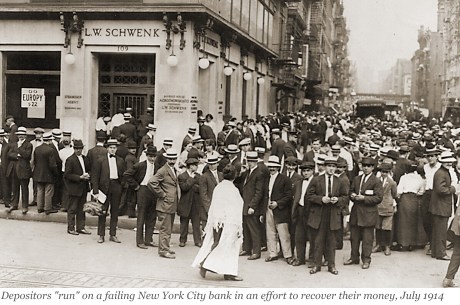
					<content type="html" xml:base="https://libertystreeteconomics.newyorkfed.org/2025/07/who-lends-to-households-and-firms/"><![CDATA[<p class="ts-blog-article-author">
    Nina Boyarchenko and Leonardo Elias</p>


<figure class="lse-featured-image">
	<img loading="lazy" decoding="async" width="460" height="288" src="https://libertystreeteconomics.newyorkfed.org/wp-content/uploads/sites/2/2025/07/LSE_2025_lends-households_boyarchenko_460.webp?w=460" class="cover-image asset-image img-responsive wp-post-image" alt="Decorative illustration of bank building with columns in bright green on a dark green background with dots and globe around it and lights streaming out." srcset="https://libertystreeteconomics.newyorkfed.org/wp-content/uploads/sites/2/2025/07/LSE_2025_lends-households_boyarchenko_460.webp 920w, https://libertystreeteconomics.newyorkfed.org/wp-content/uploads/sites/2/2025/07/LSE_2025_lends-households_boyarchenko_460.webp?resize=460,288 460w, https://libertystreeteconomics.newyorkfed.org/wp-content/uploads/sites/2/2025/07/LSE_2025_lends-households_boyarchenko_460.webp?resize=768,481 768w" sizes="auto, (max-width: 460px) 100vw, 460px" /></figure>


<p>The financial sector in the U.S. economy is deeply interconnected. In our <a href="https://libertystreeteconomics.newyorkfed.org/2025/05/who-finances-real-sector-lenders/" target="_blank" rel="noreferrer noopener">previous post</a>, we showed that incorporating information about this network of financial claims leads to a substantial reassessment of which financial sectors are ultimately financing the lending to the real sector as a whole (households plus nonfinancial firms). In this post, we delve deeper into the differences between the composition of lending to households and nonfinancial firms in terms of direct lending as well as the patterns of “adjusted lending” that we compute by accounting for the network of claims financial subsectors have on each other.</p>



<div style="height:15px" aria-hidden="true" class="wp-block-spacer"></div>


<hr class="wp-block-separator has-alpha-channel-opacity"/>


<div style="height:15px" aria-hidden="true" class="wp-block-spacer"></div>


<div class="wp-block-columns is-layout-flex wp-container-core-columns-is-layout-28f84493 wp-block-columns-is-layout-flex">
<div class="wp-block-column is-layout-flow wp-block-column-is-layout-flow" style="flex-basis:33.33%">
<p class="is-style-disclaimer"><strong>Author Brief</strong><br>&#8220;Our study focuses on trying to understand whether who the lender is matters for future real outcomes following credit booms.” </p>


<p class="is-style-disclaimer">-Nina Boyarchenko, coauthor</p>
</div>


<div class="wp-block-column is-layout-flow wp-block-column-is-layout-flow" style="flex-basis:66.66%">
<div
  style="position: relative; display: block; max-width: 388px;">
  <div
    style="padding-top: 56.25%;">
    <iframe
      src="https://players.brightcove.net/62612260001/ZvrDIQ1n6X_default/index.html?videoId=6374534396112"
      allowfullscreen=""
      allow="encrypted-media"
      style="position: absolute; top: 0px; right: 0px; bottom: 0px; left: 0px; width: 100%; height: 100%;"></iframe>
  </div>
</div>
</div>
</div>


<div style="height:10px" aria-hidden="true" class="wp-block-spacer"></div>


<hr class="wp-block-separator has-alpha-channel-opacity"/>


<div style="height:15px" aria-hidden="true" class="wp-block-spacer"></div>


<h4 class="wp-block-heading"><strong>Direct Lending to Households and to Nonfinancial Firms</strong></h4>


<p>As in our previous post, we start by exploring how the composition of lending to the real sector has evolved over time with a focus on the differences between lending to households and lending to nonfinancial firms.</p>


<p>The chart below plots the shares of lending to the household sector. The chart highlights the growing importance of government-sponsored enterprises (GSEs) and the corresponding decrease in shares of lending by banks. While banks accounted for over 50 percent of direct lending to households at the beginning of our sample (1955), that share has decreased to around 30 percent. Direct lending by banks has been replaced largely by lending by GSEs. As the chart below shows, this substitution started in the 1970s, accelerated around 1980, and stabilized following the global financial crisis (GFC).</p>
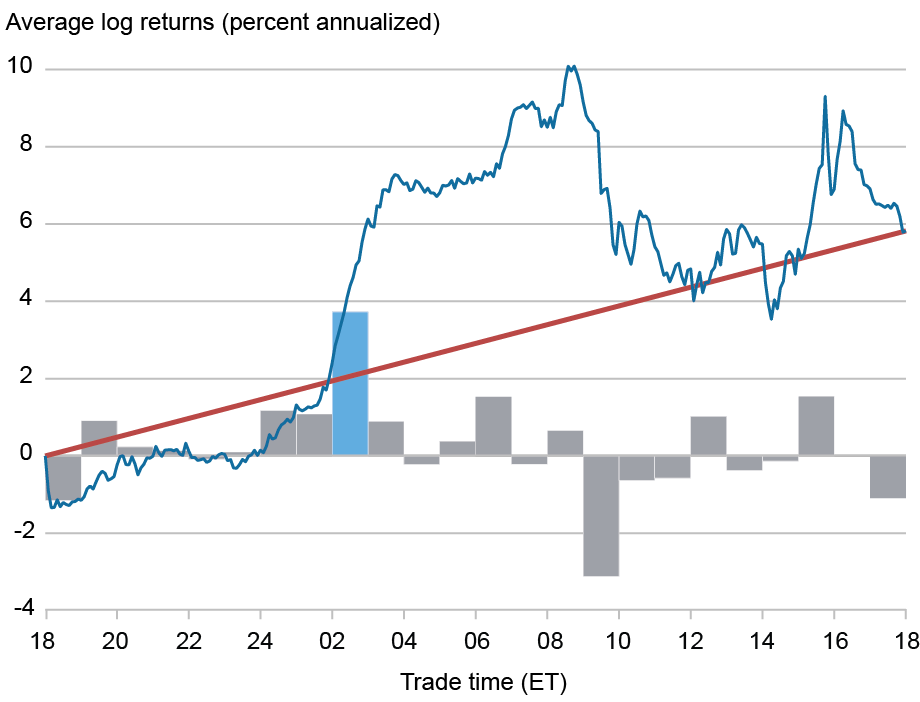


<div style="height:15px" aria-hidden="true" class="wp-block-spacer"></div>


<div class="wp-block-group frbny-chart-container"><div class="wp-block-group__inner-container is-layout-constrained wp-block-group-is-layout-constrained">
<p class="is-style-title">The Importance of Banks as a Lender to the Household Sector Has Declined over Time</p>


<figure class="wp-block-image size-full"><img loading="lazy" decoding="async" width="920" height="604" src="https://libertystreeteconomics.newyorkfed.org/wp-content/uploads/sites/2/2025/06/LSE_2025_lends-households_boyarchenko_ch1.png" alt="Area chart tracing credit given to households in percent (vertical axis) from 1955 through 2025 (horizontal axis) from the following lenders: government (dark green), firms (dark gold), banks (light blue), mutual funds (light green), pension funds (medium green), foreign (dark blue), households (and nonprofit institutions serving households) (gray), government-sponsored entities (light gold), central bank (light red), insurance companies (medium gold), other financial institutions (red); loans from government-sponsored enterprises have grown since 1955 while those from banks have decreased. " class="wp-image-35672" srcset="https://libertystreeteconomics.newyorkfed.org/wp-content/uploads/sites/2/2025/06/LSE_2025_lends-households_boyarchenko_ch1.png 920w, https://libertystreeteconomics.newyorkfed.org/wp-content/uploads/sites/2/2025/06/LSE_2025_lends-households_boyarchenko_ch1.png?resize=460,302 460w, https://libertystreeteconomics.newyorkfed.org/wp-content/uploads/sites/2/2025/06/LSE_2025_lends-households_boyarchenko_ch1.png?resize=768,504 768w, https://libertystreeteconomics.newyorkfed.org/wp-content/uploads/sites/2/2025/06/LSE_2025_lends-households_boyarchenko_ch1.png?resize=439,288 439w" sizes="auto, (max-width: 920px) 100vw, 920px" /><figcaption class="wp-element-caption">Source: Federal Reserve Board of Governors, “Enhanced Financial Accounts.”<br>Notes: The chart shows direct credit to the household sector by lender sector, in percentages. “Gvt” refers to the government sector, “firms” to nonfinancial business, “banks” to monetary financial institutions, “MF” to mutual funds, “PF” to pension funds, “foreign” to the rest of the world, “HH” to households (and nonprofit institutions serving households), “GSE” to government-sponsored enterprises, “CB” to the central bank, “Ins” to insurance companies, and “OFIs” to other financial institutions.</figcaption></figure>
</div></div>


<div style="height:15px" aria-hidden="true" class="wp-block-spacer"></div>


<p>Turning to lending to nonfinancial firms, the chart below shows a drastically different time-series pattern. While banks have never been as dominant a player in lending to firms as they are in lending to households (they accounted for around 30 percent at the beginning of the sample), their share has remained relatively stable over time. That is, we do not observe the large contraction in the share of lending by banks that we observe in the share of lending by banks to households.</p>


<p>Instead, we observe substitution away from lending by insurance companies and pension funds. While these two sectors accounted for around 40 percent of total lending to nonfinancial firms in 1955, their share has declined to around 20 percent in the last seventy years. This decrease has been picked up largely by the foreign sector. Other financial institutions (OFIs) increased their market share leading up to the GFC but have since declined in importance. GSEs and mutual funds have also seen an increase in their market share.</p>


<div style="height:15px" aria-hidden="true" class="wp-block-spacer"></div>


<div class="wp-block-group frbny-chart-container"><div class="wp-block-group__inner-container is-layout-constrained wp-block-group-is-layout-constrained">
<p class="is-style-title">The Importance of the Foreign Sector as a Lender to Nonfinancial Firms Has Grown</p>


<figure class="wp-block-image size-full"><img loading="lazy" decoding="async" width="920" height="604" src="https://libertystreeteconomics.newyorkfed.org/wp-content/uploads/sites/2/2025/06/LSE_2025_lends-households_boyarchenko_ch2.png" alt="Area chart tracking credit to nonfinancial firms in percent (vertical axis) from 1955 through 2025 (horizontal axis) from the following lenders: government (dark green), firms (dark gold), banks (light blue), mutual funds (light green), pension funds (medium green), foreign (dark blue), households (and nonprofit institutions serving households) (gray), government-sponsored enterprises (light gold), central bank (light red), insurance companies (medium gold), other financial institutions (red); compared to lending to households, banks have remained relatively more stable, while lending by insurance companies and pension funds have declined for lending to nonfinancial firms. " class="wp-image-35674" srcset="https://libertystreeteconomics.newyorkfed.org/wp-content/uploads/sites/2/2025/06/LSE_2025_lends-households_boyarchenko_ch2.png 920w, https://libertystreeteconomics.newyorkfed.org/wp-content/uploads/sites/2/2025/06/LSE_2025_lends-households_boyarchenko_ch2.png?resize=460,302 460w, https://libertystreeteconomics.newyorkfed.org/wp-content/uploads/sites/2/2025/06/LSE_2025_lends-households_boyarchenko_ch2.png?resize=768,504 768w, https://libertystreeteconomics.newyorkfed.org/wp-content/uploads/sites/2/2025/06/LSE_2025_lends-households_boyarchenko_ch2.png?resize=439,288 439w" sizes="auto, (max-width: 920px) 100vw, 920px" /><figcaption class="wp-element-caption">Source: Federal Reserve Board of Governors, “Enhanced Financial Accounts.”<br>Notes: The chart shows direct credit to nonfinancial firms by lender sector, in percentages. “Gvt” refers to the government sector, “firms” to nonfinancial business, “banks” to monetary financial institutions, “MF” to mutual funds, “PF” to pension funds, “foreign” to the rest of the world, “HH” to households (and nonprofit institutions serving households), “GSE” to government-sponsored enterprises, “CB” to the central bank, “Ins” to insurance companies, and “OFIs” to other financial institutions.&nbsp;&nbsp;</figcaption></figure>
</div></div>


<div style="height:15px" aria-hidden="true" class="wp-block-spacer"></div>


<h4 class="wp-block-heading"><strong>Adjusted Lending to Households and Firms</strong></h4>


<p>In our previous post, we showed how using information on the network of intrafinancial sector claims can be used to compute “adjusted lending” by each financial sector. That is, the lending by a sector that accounts for both its direct lending but also lending that occurs through other intermediaries. In this section we show adjusted lending to households and firms and discuss how it differs from the patterns of direct lending discussed above.</p>


<p>Starting with adjusted lending to households, the chart below shows a much smaller increase in lending by GSEs and a corresponding smaller decline in lending by banks than what direct lending would suggest (see the first chart of this post). This is explained by the fact that banks lend to households “through GSEs.”</p>


<p>It is also worth noting the increase in importance of the foreign sector and of pension funds in terms of adjusted lending. This suggests that both the foreign sector and pension funds have been increasing their share in this market by providing lending to households through other domestic financial sectors.</p>


<div style="height:15px" aria-hidden="true" class="wp-block-spacer"></div>


<div class="wp-block-group frbny-chart-container"><div class="wp-block-group__inner-container is-layout-constrained wp-block-group-is-layout-constrained">
<p class="is-style-title">GSEs Lending to Households Is Largely Financed by Other Financial Sectors</p>


<figure class="wp-block-image size-full"><img loading="lazy" decoding="async" width="920" height="604" src="https://libertystreeteconomics.newyorkfed.org/wp-content/uploads/sites/2/2025/06/LSE_2025_lends-households_boyarchenko_ch3.png" alt="Area chart tracking adjusted lending to the household sector in percent (vertical axis) from 1955 through 2025 (horizontal axis) from the following lenders: government (dark green), firms (dark gold), banks (light blue), mutual funds (light green), pension funds (medium green), foreign (dark blue), households (and nonprofit institutions serving households) (gray), government-sponsored enterprises (light gold), central bank (light red), insurance companies (medium gold), other financial institutions (red); the chart shows a much smaller increase in lending by GSEs and a corresponding smaller decline in lending by banks than what direct lending would suggest.  " class="wp-image-35675" srcset="https://libertystreeteconomics.newyorkfed.org/wp-content/uploads/sites/2/2025/06/LSE_2025_lends-households_boyarchenko_ch3.png 920w, https://libertystreeteconomics.newyorkfed.org/wp-content/uploads/sites/2/2025/06/LSE_2025_lends-households_boyarchenko_ch3.png?resize=460,302 460w, https://libertystreeteconomics.newyorkfed.org/wp-content/uploads/sites/2/2025/06/LSE_2025_lends-households_boyarchenko_ch3.png?resize=768,504 768w, https://libertystreeteconomics.newyorkfed.org/wp-content/uploads/sites/2/2025/06/LSE_2025_lends-households_boyarchenko_ch3.png?resize=439,288 439w" sizes="auto, (max-width: 920px) 100vw, 920px" /><figcaption class="wp-element-caption">Source: Federal Reserve Board of Governors, “Enhanced Financial Accounts.”<br>Notes: The chart shows adjusted credit to the household sector by lender sector, in percentages. “Gvt” refers to the government sector, “firms” to nonfinancial business, “banks” to monetary financial institutions, “MF” to mutual funds, “PF” to pension funds, “foreign” to the rest of the world, “HH” to households (and nonprofit institutions serving households), “GSE” to government-sponsored enterprises, “CB” to the central bank, “Ins” to insurance companies, and “OFIs” to other financial institutions.</figcaption></figure>
</div></div>


<div style="height:15px" aria-hidden="true" class="wp-block-spacer"></div>


<p>To more easily compare shares of adjusted lending versus shares of direct lending, the chart below plots the difference between the two shares for each sector (negative values indicate that shares of adjusted lending are smaller than direct lending shares).&nbsp;The chart confirms the discussion above, the share of lending to households by GSEs dramatically decreases once we account for the fact that they are, to a large extent, simply intermediating bank lending to households.</p>


<div style="height:15px" aria-hidden="true" class="wp-block-spacer"></div>


<div class="wp-block-group frbny-chart-container"><div class="wp-block-group__inner-container is-layout-constrained wp-block-group-is-layout-constrained">
<p class="is-style-title">Adjusted Lending to Households Is Substantially Lower for GSEs and Higher for the Foreign Sector than Their Direct Lending</p>


<figure class="wp-block-image size-full"><img loading="lazy" decoding="async" width="920" height="607" src="https://libertystreeteconomics.newyorkfed.org/wp-content/uploads/sites/2/2025/06/LSE_2025_lends-households_boyarchenko_ch4.png" alt="Line chart tracking net adjusted credit to households in percent (vertical axis) from 1955 through 2025 (horizontal axis) for government sponsored enterprises (light gold), central bank (light red), insurance companies (medium gold), other financial institutions (dark red), banks (light blue), mutual funds (light green), pension funds (medium green), and foreign (dark blue); the share of lending to households by GSEs dramatically decreases and foreign institutions increases after adjustment. " class="wp-image-35676" srcset="https://libertystreeteconomics.newyorkfed.org/wp-content/uploads/sites/2/2025/06/LSE_2025_lends-households_boyarchenko_ch4.png 920w, https://libertystreeteconomics.newyorkfed.org/wp-content/uploads/sites/2/2025/06/LSE_2025_lends-households_boyarchenko_ch4.png?resize=460,304 460w, https://libertystreeteconomics.newyorkfed.org/wp-content/uploads/sites/2/2025/06/LSE_2025_lends-households_boyarchenko_ch4.png?resize=768,507 768w, https://libertystreeteconomics.newyorkfed.org/wp-content/uploads/sites/2/2025/06/LSE_2025_lends-households_boyarchenko_ch4.png?resize=437,288 437w" sizes="auto, (max-width: 920px) 100vw, 920px" /><figcaption class="wp-element-caption">Source: Federal Reserve Board of Governors, “Enhanced Financial Accounts.”<br>Notes: The chart shows net adjusted credit to the household sector by financial sector, in percentages. “Banks” refers to monetary financial institutions, “MF” to mutual funds, “PF” to pension funds, “foreign” to the rest of the world, “GSE” to government-sponsored enterprises, “CB” to the central bank, “Ins” to insurance companies, and “OFIs” to other financial institutions.<br>.</figcaption></figure>
</div></div>


<div style="height:15px" aria-hidden="true" class="wp-block-spacer"></div>


<p>We then turn to adjusted lending to nonfinancial firms. The chart below shows the shares of adjusted lending by each sector are relatively similar to the shares of direct lending observed in the second chart of this post. This suggests that “indirect lending” through other financial intermediaries is less prevalent in lending to nonfinancial firms than it is in lending to households (at least on net). This finding is consistent with the view that firms can more easily raise funds directly from their ultimate lenders while household borrowing requires more intermediation.</p>


<p>While the differences between direct and adjusted lending to firms are less pronounced, two results are worth noting. First, unlike the case of household lending, banks’ share of lending on an adjusted basis is lower than their share of direct lending. This suggests that banks are intermediating lending by other parts of the financial system to households.</p>


<p>Second, the largest reallocation we observe is by pension funds, who seem to be, rather than lending directly to firms, lending indirectly by financing sectors that then lend to firms.</p>


<div style="height:15px" aria-hidden="true" class="wp-block-spacer"></div>


<div class="wp-block-group frbny-chart-container"><div class="wp-block-group__inner-container is-layout-constrained wp-block-group-is-layout-constrained">
<p class="is-style-title">Pension Funds Still Finance a Substantial Fraction of Indirect Lending to Firms</p>


<figure class="wp-block-image size-full"><img loading="lazy" decoding="async" width="920" height="604" src="https://libertystreeteconomics.newyorkfed.org/wp-content/uploads/sites/2/2025/06/LSE_2025_lends-households_boyarchenko_ch5.png" alt="Area chart tracking credit to nonfinancial firms in percent (vertical axis) from 1955 through 2025 (horizontal axis) from the following lenders: government (dark green), firms (dark gold), banks (light blue), mutual funds (light green), pension funds (medium green), foreign (dark blue), households (and nonprofit institutions serving households) (gray), government-sponsored enterprises (light gold), central bank (light red), insurance companies (medium gold), other financial institutions (red); this chart shows the shares of adjusted lending by each sector are relatively similar to the shares of direct lending observed in the second chart. " class="wp-image-35677" srcset="https://libertystreeteconomics.newyorkfed.org/wp-content/uploads/sites/2/2025/06/LSE_2025_lends-households_boyarchenko_ch5.png 920w, https://libertystreeteconomics.newyorkfed.org/wp-content/uploads/sites/2/2025/06/LSE_2025_lends-households_boyarchenko_ch5.png?resize=460,302 460w, https://libertystreeteconomics.newyorkfed.org/wp-content/uploads/sites/2/2025/06/LSE_2025_lends-households_boyarchenko_ch5.png?resize=768,504 768w, https://libertystreeteconomics.newyorkfed.org/wp-content/uploads/sites/2/2025/06/LSE_2025_lends-households_boyarchenko_ch5.png?resize=439,288 439w" sizes="auto, (max-width: 920px) 100vw, 920px" /><figcaption class="wp-element-caption">Source: Federal Reserve Board of Governors, “Enhanced Financial Accounts.”<br>Notes: The chart shows adjusted credit to nonfinancial firms by lender sector, in percentages. “Gvt” refers to the government sector, “firms” to nonfinancial business, “banks” to monetary financial institutions, “MF” to mutual funds, “PF” to pension funds, “foreign” to the rest of the world, “HH” to households (and nonprofit institutions serving households), “GSE” to government-sponsored enterprises, “CB” to the central bank, “Ins” to insurance companies, and “OFIs” to other financial institutions.</figcaption></figure>
</div></div>


<div style="height:15px" aria-hidden="true" class="wp-block-spacer"></div>


<p>As in the case of household lending discussed above, plotting “net adjusted lending” allows us to more easily compare the differences between adjusted and direct lending. The negative values for GSEs, OFIs, and banks indicate that they are, to some extent, intermediating other sectors’ lending to firms. On the other hand, the positive values for the foreign sector and, more importantly, for pension funds, indicate that they lend more to firms than what their direct lending would suggest. That is, the foreign sector and pension funds rely on other sectors to intermediate their lending to firms.</p>


<div style="height:15px" aria-hidden="true" class="wp-block-spacer"></div>


<div class="wp-block-group frbny-chart-container"><div class="wp-block-group__inner-container is-layout-constrained wp-block-group-is-layout-constrained">
<p class="is-style-title">Adjusted Lending to Firms Is Larger for Pension Funds and Lower for GSEs, OFIs, and Banks than Their Direct Lending</p>


<figure class="wp-block-image size-full"><img loading="lazy" decoding="async" width="920" height="607" src="https://libertystreeteconomics.newyorkfed.org/wp-content/uploads/sites/2/2025/06/LSE_2025_lends-households_boyarchenko_ch6.png" alt="Line chart tracking net adjusted credit to nonfinancial firms in percent (vertical axis) from 1955 through 2025 (horizontal axis) for government sponsored enterprises (light gold), central bank (light red), insurance companies (medium gold), other financial institutions (dark red), banks (light blue), mutual funds (light green), pension funds (medium green), and foreign (dark blue); the positive values for the foreign sector and for pension funds indicate that they lend more to firms than what their direct lending would suggest. " class="wp-image-35678" srcset="https://libertystreeteconomics.newyorkfed.org/wp-content/uploads/sites/2/2025/06/LSE_2025_lends-households_boyarchenko_ch6.png 920w, https://libertystreeteconomics.newyorkfed.org/wp-content/uploads/sites/2/2025/06/LSE_2025_lends-households_boyarchenko_ch6.png?resize=460,304 460w, https://libertystreeteconomics.newyorkfed.org/wp-content/uploads/sites/2/2025/06/LSE_2025_lends-households_boyarchenko_ch6.png?resize=768,507 768w, https://libertystreeteconomics.newyorkfed.org/wp-content/uploads/sites/2/2025/06/LSE_2025_lends-households_boyarchenko_ch6.png?resize=437,288 437w" sizes="auto, (max-width: 920px) 100vw, 920px" /><figcaption class="wp-element-caption">Source: Federal Reserve Board of Governors, “Enhanced Financial Accounts.”<br>Notes: The chart shows net adjusted credit to the household sector by financial sector, in percentages. “Banks” refers to monetary financial institutions, “MF” to mutual funds, “PF” to pension funds, “foreign” to the rest of the world, “GSE” to government-sponsored enterprises, “CB” to the central bank, “Ins” to insurance companies, and “OFIs” to other financial institutions.</figcaption></figure>
</div></div>


<div style="height:15px" aria-hidden="true" class="wp-block-spacer"></div>


<h4 class="wp-block-heading"><strong>Wrapping Up</strong></h4>


<p>The financial sector in the U.S. economy is deeply interconnected. Incorporating information about this network of financial claims leads to a substantial reallocation of the accounting of lending to the real sector but it has different implications for household credit and corporate credit, suggesting that the need for intermediation is different in these two markets.</p>


<p>In a previous <a href="https://libertystreeteconomics.newyorkfed.org/2024/08/the-disparate-outcomes-of-bank-and-nonbank-financed-private-credit-expansions/" target="_blank" rel="noreferrer noopener">post</a>, as well as in our <a href="https://www.newyorkfed.org/research/staff_reports/sr1111" target="_blank" rel="noreferrer noopener">staff report</a>, we document that who finances a credit boom to the real sector is an important determinant of future macroeconomic outcomes. The results in this post suggest that one potential channel for why bank and nonbank expansions in credit lead to different outcomes is the underlying network of financial interconnections that is ultimately lending to households and firms.</p>


<div style="height:15px" aria-hidden="true" class="wp-block-spacer"></div>


<div class="wp-block-media-text alignwide" style="grid-template-columns:15% auto"><figure class="wp-block-media-text__media"><img loading="lazy" decoding="async" width="90" height="90" src="https://libertystreeteconomics.newyorkfed.org/wp-content/uploads/sites/2/2023/01/boyarchenko_nina.jpg" alt="Portrait of Nina Boyarchenko" class="wp-image-20720 size-full" srcset="https://libertystreeteconomics.newyorkfed.org/wp-content/uploads/sites/2/2023/01/boyarchenko_nina.jpg 90w, https://libertystreeteconomics.newyorkfed.org/wp-content/uploads/sites/2/2023/01/boyarchenko_nina.jpg?resize=45,45 45w" sizes="auto, (max-width: 90px) 100vw, 90px" /></figure><div class="wp-block-media-text__content">
<p class="is-style-bio-contact has-large-font-size"><a href="https://www.newyorkfed.org/research/economists/boyarchenko">Nina Boyarchenko</a> is a financial research advisor in the Federal Reserve Bank of New York’s Research and Statistics Group.</p>
</div></div>


<div class="wp-block-media-text alignwide" style="grid-template-columns:15% auto"><figure class="wp-block-media-text__media"><img loading="lazy" decoding="async" width="210" height="210" src="https://libertystreeteconomics.newyorkfed.org/wp-content/uploads/sites/2/2022/06/elias_leonardo.jpg?w=210" alt="Photo: portrait of Leonardo Elias" class="wp-image-16694 size-full" srcset="https://libertystreeteconomics.newyorkfed.org/wp-content/uploads/sites/2/2022/06/elias_leonardo.jpg 210w, https://libertystreeteconomics.newyorkfed.org/wp-content/uploads/sites/2/2022/06/elias_leonardo.jpg?resize=45,45 45w" sizes="auto, (max-width: 210px) 100vw, 210px" /></figure><div class="wp-block-media-text__content">
<p class="is-style-bio-contact has-large-font-size"><a href="https://www.newyorkfed.org/research/economists/elias" target="_blank" rel="noreferrer noopener">Leonardo Elias</a> is a financial research economist in the Federal Reserve Bank of New York’s Research and Statistics Group. </p>
</div></div>


<div class="cite-container">
    <p class="is-style-disclaimer">
        <strong>How to cite this post:</strong><br/>
        Nina Boyarchenko and Leonardo Elias, &#8220;Who Lends to Households and Firms?,&#8221; Federal Reserve Bank of New York <em>Liberty Street Economics</em>, July 14, 2025, https://libertystreeteconomics.newyorkfed.org/2025/07/who-lends-to-households-and-firms/
    <span>BibTeX: <a href="#bibtex" onClick="_toggle_bibtex63()">View</a> | <button class="bibtex-save">Download</button></span>
    </p>

    <script>
        function _toggle_bibtex63(){
            let el = document.getElementById('bibtex63');
            el.style.display = el.style.display === 'none' ? '' : 'none';
        }
    </script>
    <div id="bibtex63" class="bibtex" style="display:none;">
    <pre><code> 
@article{NinaBoyarchenkoandLeonardoElias2025,
    author={Nina Boyarchenko and Leonardo Elias},
    title={Who Lends to Households and Firms?},
    journal={Liberty Street Economics},
    note={Liberty Street Economics Blog},
    number={July 14},
    year={2025},
    url={https://libertystreeteconomics.newyorkfed.org/2025/07/who-lends-to-households-and-firms/}
}</code></pre>
    </div>

</div>

<div class="frbny-related">
	<p class="frbny-related__label">You may also be interested in:</p>


<div class="frbny-related__item">
<figure class="wp-block-image size-medium"><img decoding="async" src="https://libertystreeteconomics.newyorkfed.org/wp-content/uploads/sites/2/2025/04/LSE_2025_who-finances-lenders_boyarchenko_460.jpg?w=460" alt="Decorative Image: Internet Banking Technology concept"/></figure>
<p><a href="https://libertystreeteconomics.newyorkfed.org/2025/05/who-finances-real-sector-lenders/">Who Finances Real Sector Lenders?</a></p></div>


<div class="frbny-related__item">
<figure class="wp-block-image size-medium"><img decoding="async" src="https://libertystreeteconomics.newyorkfed.org/wp-content/uploads/sites/2/2024/08/LSE_2024_disparate-credit-expansions_boyarchenko_460.jpg?w=460" alt=""/></figure>
<p><a href="https://libertystreeteconomics.newyorkfed.org/2024/08/the-disparate-outcomes-of-bank-and-nonbank-financed-private-credit-expansions/">The Disparate Outcomes of Bank‑ and Nonbank‑Financed Private Credit Expansions</a></p></div>


<div class="frbny-related__item">
<figure class="wp-block-image size-medium"><img loading="lazy" decoding="async" height="288" width="460" src="https://libertystreeteconomics.newyorkfed.org/wp-content/uploads/sites/2/2023/01/LSE_2023_staff-report_graphic.png?w=460" alt="Image of Staff Reports cover" class="wp-image-20191" srcset="https://libertystreeteconomics.newyorkfed.org/wp-content/uploads/sites/2/2023/01/LSE_2023_staff-report_graphic.png 920w, https://libertystreeteconomics.newyorkfed.org/wp-content/uploads/sites/2/2023/01/LSE_2023_staff-report_graphic.png?resize=460,288 460w, https://libertystreeteconomics.newyorkfed.org/wp-content/uploads/sites/2/2023/01/LSE_2023_staff-report_graphic.png?resize=768,481 768w" sizes="auto, (max-width: 460px) 100vw, 460px" /></figure>
<p><a href="https://www.newyorkfed.org/research/staff_reports/sr1111">Financing Private Credit</a></p></div>

</div>


<div>
<div style="height:24px" aria-hidden="true" class="wp-block-spacer"></div>


<hr class="wp-block-separator has-alpha-channel-opacity"/>


<p class="is-style-disclaimer"><strong>Disclaimer</strong><br>The views expressed in this post are those of the author(s) and do not necessarily reflect the position of the Federal Reserve Bank of New York or the Federal Reserve System. Any errors or omissions are the responsibility of the author(s).</p>
</div>
]]></content>
		
			</entry>
		<entry>
		<author>
			<name>Kristian Blickle, Jian Li, Xu Lu, and Yiming Ma</name>
					</author>

		<title type="html"><![CDATA[The Rise in Deposit Flightiness and Its Implications for Financial Stability]]></title>
		<link rel="alternate" type="text/html" href="https://libertystreeteconomics.newyorkfed.org/2025/07/the-rise-in-deposit-flightiness-and-its-implications-for-financial-stability/" />

		<id>https://libertystreeteconomics.newyorkfed.org/?p=36086</id>
		<updated>2025-07-08T19:45:00Z</updated>
		<published>2025-07-10T11:00:00Z</published>
		<category scheme="https://libertystreeteconomics.newyorkfed.org/" term="Banks" /><category scheme="https://libertystreeteconomics.newyorkfed.org/" term="Financial Institutions" /><category scheme="https://libertystreeteconomics.newyorkfed.org/" term="Liquidity" /><category scheme="https://libertystreeteconomics.newyorkfed.org/" term="Monetary Policy" />
		<summary type="html"><![CDATA[Deposits are often perceived as a stable funding source for banks. However, the risk of deposits rapidly leaving banks—known as deposit flightiness—has come under <a href="https://pages.stern.nyu.edu/~pschnabl/research/DSSW.pdf">increased scrutiny</a> following the <a href="https://papers.ssrn.com/sol3/papers.cfm?abstract_id=4412256">failures</a> of Silicon Valley Bank and other <a href="https://papers.ssrn.com/sol3/papers.cfm?abstract_id=4387676">regional banks</a> in March 2023. In a <a href="https://papers.ssrn.com/sol3/papers.cfm?abstract_id=4873784">new paper</a>, we show that deposit flightiness is not constant over time.  In particular, flightiness reached historic highs after expansions in bank reserves associated with rounds of quantitative easing (QE). We argue that this elevated deposit flightiness may amplify the banking sector’s response to subsequent monetary policy rate hikes, highlighting a link between the Federal Reserve’s balance sheet and conventional monetary policy.]]></summary>

					<content type="html" xml:base="https://libertystreeteconomics.newyorkfed.org/2025/07/the-rise-in-deposit-flightiness-and-its-implications-for-financial-stability/"><![CDATA[<p class="ts-blog-article-author">
    Kristian Blickle, Jian Li, Xu Lu, and Yiming Ma</p>


<figure class="lse-featured-image">
	<img loading="lazy" decoding="async" width="460" height="288" src="https://libertystreeteconomics.newyorkfed.org/wp-content/uploads/sites/2/2025/07/LSE_2025_deposit-flightness_blickle_460.png?w=460" class="cover-image asset-image img-responsive wp-post-image" alt="Photo: Dollar paper airplane on blue background" srcset="https://libertystreeteconomics.newyorkfed.org/wp-content/uploads/sites/2/2025/07/LSE_2025_deposit-flightness_blickle_460.png 920w, https://libertystreeteconomics.newyorkfed.org/wp-content/uploads/sites/2/2025/07/LSE_2025_deposit-flightness_blickle_460.png?resize=460,288 460w, https://libertystreeteconomics.newyorkfed.org/wp-content/uploads/sites/2/2025/07/LSE_2025_deposit-flightness_blickle_460.png?resize=768,481 768w" sizes="auto, (max-width: 460px) 100vw, 460px" /></figure>


<p>Deposits are often perceived as a stable funding source for banks. However, the risk of deposits rapidly leaving banks—known as deposit flightiness—has come under <a href="https://pages.stern.nyu.edu/~pschnabl/research/DSSW.pdf">increased scrutiny</a> following the <a href="https://papers.ssrn.com/sol3/papers.cfm?abstract_id=4412256">failures</a> of Silicon Valley Bank and other <a href="https://papers.ssrn.com/sol3/papers.cfm?abstract_id=4387676">regional banks</a> in March 2023. In a <a href="https://papers.ssrn.com/sol3/papers.cfm?abstract_id=4873784">new paper</a>, we show that deposit flightiness is not constant over time.  In particular, flightiness reached historic highs after expansions in bank reserves associated with rounds of quantitative easing (QE). We argue that this elevated deposit flightiness may amplify the banking sector’s response to subsequent monetary policy rate hikes, highlighting a link between the Federal Reserve’s balance sheet and conventional monetary policy.</p>


<h4 class="wp-block-heading"><strong>How Deposit Flightiness Has Changed Over Time</strong></h4>


<p>Existing research on deposit stability has focused on differences across deposit types. For example, wholesale and uninsured deposits have long been recognized as <a href="https://papers.ssrn.com/sol3/papers.cfm?abstract_id=2642946">more prone to flight</a> than retail and insured deposits. Our findings suggest that aggregate deposit flightiness also varies significantly over time.</p>


<p>To measure deposit flightiness, we examine how responsive depositors are to changes in deposit rates. Specifically, we estimate how much deposit flows into a bank change when the bank raises its deposit rate by 1 percentage point. As shown in the chart below, deposit flow sensitivity has fluctuated considerably over the past two decades. Depositors’ flow sensitivity increased following the 2008 financial crisis, declined in the mid-2010s, but rose sharply after the onset of the COVID-19 crisis. By early 2022, deposit flow sensitivity had reached record highs, meaning deposits were more likely than ever to respond to changes in interest rates just before the Federal Reserve began its rate hiking cycle.</p>


<div style="height:15px" aria-hidden="true" class="wp-block-spacer"></div>


<div class="wp-block-group frbny-chart-container"><div class="wp-block-group__inner-container is-layout-constrained wp-block-group-is-layout-constrained">
<p class="is-style-title">Flow Sensitivity Rose Sharply Following Recent QE</p>


<figure class="wp-block-image size-full is-resized"><img loading="lazy" decoding="async" width="460" height="342" src="https://libertystreeteconomics.newyorkfed.org/wp-content/uploads/sites/2/2025/07/LSE_2025_deposit-flightness_blickle_ch1.png" alt="Line chart depicting flow sensitivity (vertical axis) from 2000 to 2025 (horizontal axis) for the point estimate (solid blue) and 90% confidence interval (dashed blue); first (left to right) red vertical line marks the outbreak of COVID-19 in March 2020, second red vertical marks the end of recent quantitative easing; flow sensitivity increased following the 2008 financial crisis, declined in the mid-2010s, but rose sharply after the onset of the COVID-19 crisis. " class="wp-image-36088" style="width:460px;height:auto" srcset="https://libertystreeteconomics.newyorkfed.org/wp-content/uploads/sites/2/2025/07/LSE_2025_deposit-flightness_blickle_ch1.png 460w, https://libertystreeteconomics.newyorkfed.org/wp-content/uploads/sites/2/2025/07/LSE_2025_deposit-flightness_blickle_ch1.png?resize=387,288 387w" sizes="auto, (max-width: 460px) 100vw, 460px" /><figcaption class="wp-element-caption">Source: Authors’ calculations.<br>Notes: The chart illustrates the sensitivity of deposit flows to deposit rates in U.S. banks between 2000 and 2024. Dotted lines depict the 90% confidence interval of the flow sensitivity estimates. The outbreak of COVID-19 in March 2020 is marked by a vertical red line. The second line marks the end of the recent quantitative easing (QE) episode.</figcaption></figure>
</div></div>


<div style="height:15px" aria-hidden="true" class="wp-block-spacer"></div>


<p>The non-Federal Reserve System authors of this work have access to anonymized deposit account-level data from a third-party data vendor that aggregates information from 1,500 depository institutions. We find very similar dynamics in investor-level deposit flow sensitivity with this highly granular data on individual depositors’ bank accounts. This account-level data also reveals that depositors who are more sensitive in moving deposits across their accounts at different banks also more readily transfer funds between their bank accounts and alternative investments, including nonbank financial institutions (NBFIs) like money market funds.</p>


<h4 class="wp-block-heading"><strong>What Explains the Variation in Deposit Flightiness?</strong></h4>


<p>To understand the variation in deposit flightiness over time, we first note that not all deposits are equally stable. Some depositors that prioritize the safety and the payment convenience of deposits tend to keep their funds in banks regardless of interest rate changes or market fluctuations. Other depositors are less attached to bank deposits and more readily move their money at the first sign of better returns elsewhere. We show that at any given time, the investors who choose to hold bank deposits are less sensitive to interest rates than those who opt for alternative investments, such as money market funds. We further show that, when deposits flow into the banking system, they tend to be more rate-sensitive than the existing depositor base, making the overall deposit base more flighty.</p>


<h4 class="wp-block-heading"><strong>The Role of Quantitative Easing</strong></h4>


<p>Over the past two decades, QE has <a href="https://bfi.uchicago.edu/wp-content/uploads/2022/01/BFI_WP_2022-19.pdf">significantly increased</a> the level of bank deposits by injecting reserves into the banking system. We show that periods of rising reserves closely coincide with increases in deposit flightiness (see chart below).</p>


<div style="height:15px" aria-hidden="true" class="wp-block-spacer"></div>


<div class="wp-block-group frbny-chart-container"><div class="wp-block-group__inner-container is-layout-constrained wp-block-group-is-layout-constrained">
<p class="is-style-title">Deposit Sensitivity Increased After Reserve Expansion</p>


<figure class="wp-block-image size-full"><img loading="lazy" decoding="async" width="460" height="342" src="https://libertystreeteconomics.newyorkfed.org/wp-content/uploads/sites/2/2025/07/LSE_2025_deposit-flightness_blickle_ch2.png" alt="Line chart depicting deposit flow sensitivity (left vertical axis) and reserve supply in billions of U.S. dollars (right vertical axis) from 2000 to 2025 (horizontal axis) for the point estimate (solid blue), 90% confidence interval (dashed blue), and total reserves (gold); red vertical line marks the outbreak of COVID-19 in March 2020; periods of rising reserves closely coincide with increases in deposit flightiness. " class="wp-image-36089" srcset="https://libertystreeteconomics.newyorkfed.org/wp-content/uploads/sites/2/2025/07/LSE_2025_deposit-flightness_blickle_ch2.png 460w, https://libertystreeteconomics.newyorkfed.org/wp-content/uploads/sites/2/2025/07/LSE_2025_deposit-flightness_blickle_ch2.png?resize=387,288 387w" sizes="auto, (max-width: 460px) 100vw, 460px" /><figcaption class="wp-element-caption">Source: Authors’ calculations.<br>Notes: The chart illustrates the sensitivity of deposit flows to deposit rates in U.S. banks (left axis) imposed on the amount of Federal Reserve reserves (right axis) between 2000 and 2024. Dotted lines depict the 90% confidence interval of our flow sensitivity estimates. The outbreak of COVID-19 in March 2020 is marked by a vertical red line.</figcaption></figure>
</div></div>


<div style="height:15px" aria-hidden="true" class="wp-block-spacer"></div>


<p>Why does QE lead to more flighty deposits? The key mechanism is that deposits created through reserve expansions disproportionately attract depositors who are more sensitive to interest rate changes than the existing depositors in the banking system (consider retail depositors vs. hedge funds that are brought in by the expansion of reserves). The influx of more rate-sensitive deposits raises the aggregate average flightiness of the deposit base. In other words, the marginal depositor has become flightier.</p>


<p>Using supervisory data on large U.S. banks, we further examine how depositor composition changed during and after the COVID-19 crisis. The next chart shows that deposits from nonfinancial corporations grew significantly more than retail deposits as reserves expanded from early 2018 to late 2021. These corporate deposits, which tend to be more volatile than retail deposits, subsequently declined at a faster rate once reserve balances started to shrink and interest rates began rising in 2022. The disproportionate growth and subsequent decline of corporate (as well as the highly volatile NBFI) deposits support the idea that changes in deposit composition over time play a crucial role in driving the dynamics of aggregate deposit flightiness.</p>


<div style="height:15px" aria-hidden="true" class="wp-block-spacer"></div>


<div class="wp-block-group frbny-chart-container"><div class="wp-block-group__inner-container is-layout-constrained wp-block-group-is-layout-constrained">
<p class="is-style-title">Deposit Composition over Time</p>


<figure class="wp-block-image size-full"><img loading="lazy" decoding="async" width="460" height="358" src="https://libertystreeteconomics.newyorkfed.org/wp-content/uploads/sites/2/2025/07/LSE_2025_deposit-flightness_blickle_ch3.png" alt="Line chart tracking level of bank deposits (vertical axis) from 2018 through 2024 (horizontal axis) for retail (light blue), nonfinancial corporate (red), nonbank financial entities (gold), small business (dark blue), and banks (gray); deposits from non-financial corporations grew significantly more than retail deposits as reserves expanded from early 2018 to late 2021. " class="wp-image-36090" srcset="https://libertystreeteconomics.newyorkfed.org/wp-content/uploads/sites/2/2025/07/LSE_2025_deposit-flightness_blickle_ch3.png 460w, https://libertystreeteconomics.newyorkfed.org/wp-content/uploads/sites/2/2025/07/LSE_2025_deposit-flightness_blickle_ch3.png?resize=370,288 370w" sizes="auto, (max-width: 460px) 100vw, 460px" /><figcaption class="wp-element-caption">Source: Authors’ calculations.<br>Notes: The chart illustrates monthly deposit levels by depositor type at large U.S. banks (indexed to January 2020). Depositor types are broken down into retail, NBFI, bank, large corporations, and small businesses based on Federal Reserve reporting requirements in Form 2052a.</figcaption></figure>
</div></div>


<div style="height:15px" aria-hidden="true" class="wp-block-spacer"></div>


<h4 class="wp-block-heading"><strong>Implications for Monetary Policy and Financial Stability</strong></h4>


<p>Our findings indicate that deposit composition and flightiness are not static but instead evolve in response to central bank policies. In particular, we uncover a novel interdependence between conventional and unconventional monetary policy: if policy rate hikes occur during periods when reserves and deposits are higher following QE, then the risk of deposit flight may be enhanced—how much depends on the way banks manage the risk and invest their assets. This interdependence between deposit flight risk and QE arises because the entities that provide much of the funds during QE-related deposit expansions tend to be more rate sensitive, amplifying the risk that these new depositors leave en masse to seek higher returns in response to subsequent rate hikes.</p>


<div class="wp-block-media-text alignwide" style="grid-template-columns:15% auto"><figure class="wp-block-media-text__media"><img loading="lazy" decoding="async" width="90" height="90" src="https://libertystreeteconomics.newyorkfed.org/wp-content/uploads/sites/2/2022/05/blickle_kristian.jpg" alt="Photo: portrait of Kristian Blickle" class="wp-image-16190 size-full" srcset="https://libertystreeteconomics.newyorkfed.org/wp-content/uploads/sites/2/2022/05/blickle_kristian.jpg 90w, https://libertystreeteconomics.newyorkfed.org/wp-content/uploads/sites/2/2022/05/blickle_kristian.jpg?resize=45,45 45w" sizes="auto, (max-width: 90px) 100vw, 90px" /></figure><div class="wp-block-media-text__content">
<p class="is-style-bio-contact has-large-font-size"><a href="https://www.newyorkfed.org/research/economists/blickle">Kristian Blickle</a> is a financial research advisor in the Federal Reserve Bank of New York’s Research and Statistics Group.</p>
</div></div>


<p class="is-style-bio-contact">Jian Li is an assistant professor of business at Columbia Business School.&nbsp;</p>


<p class="is-style-bio-contact">Xu Lu is an assistant professor of finance and business economics in the Michael G. Foster School of Business at University of Washington.</p>


<p class="is-style-bio-contact">Yiming Ma is an associate professor of business at Columbia Business School.&nbsp;</p>


<div class="cite-container">
    <p class="is-style-disclaimer">
        <strong>How to cite this post:</strong><br/>
        Kristian Blickle, Jian Li, Xu Lu, and Yiming Ma, &#8220;The Rise in Deposit Flightiness and Its Implications for Financial Stability,&#8221; Federal Reserve Bank of New York <em>Liberty Street Economics</em>, July 10, 2025, https://libertystreeteconomics.newyorkfed.org/2025/07/the-rise-in-deposit-flightiness-and-its-implications-for-financial-stability/
    <span>BibTeX: <a href="#bibtex" onClick="_toggle_bibtex64()">View</a> | <button class="bibtex-save">Download</button></span>
    </p>

    <script>
        function _toggle_bibtex64(){
            let el = document.getElementById('bibtex64');
            el.style.display = el.style.display === 'none' ? '' : 'none';
        }
    </script>
    <div id="bibtex64" class="bibtex" style="display:none;">
    <pre><code> 
@article{KristianBlickle,JianLi,XuLu,andYimingMa2025,
    author={Kristian Blickle, Jian Li, Xu Lu, and Yiming Ma},
    title={The Rise in Deposit Flightiness and Its Implications for Financial Stability},
    journal={Liberty Street Economics},
    note={Liberty Street Economics Blog},
    number={July 10},
    year={2025},
    url={https://libertystreeteconomics.newyorkfed.org/2025/07/the-rise-in-deposit-flightiness-and-its-implications-for-financial-stability/}
}</code></pre>
    </div>

</div>

<div class="frbny-related">
	<p class="frbny-related__label">You may also be interested in:</p>


<div class="frbny-related__item">
<figure class="wp-block-image size-medium"><img decoding="async" src="https://libertystreeteconomics.newyorkfed.org/wp-content/uploads/sites/2/2022/02/LSE_2022_banking-panic_luck_460.jpg?w=460" alt="Photo: Depositors clamor to withdraw their savings from a bank in Berlin, 13 July 1931"/></figure>
<p><a href="https://libertystreeteconomics.newyorkfed.org/2022/02/how-un-informed-are-depositors-in-a-banking-panic-a-lesson-from-history/">How (Un‑)Informed Are Depositors in a Banking Panic? A Lesson from History</a></p></div>


<div class="frbny-related__item">
<figure class="wp-block-image size-medium"><img decoding="async" src="https://libertystreeteconomics.newyorkfed.org/wp-content/uploads/sites/2/2024/03/LSE_2024_march-deposits_plosser_460.jpg?w=460" alt="Photo: Man depositing check by phone while sitting at a table in a restaurant"/></figure>
<p><a href="https://libertystreeteconomics.newyorkfed.org/2024/03/deposits-and-the-march-2023-banking-crisis-a-retrospective/">Deposits and the March 2023 Banking Crisis—A Retrospective</a></p></div>


<div class="frbny-related__item">
<figure class="wp-block-image size-medium"><img decoding="async" src="https://libertystreeteconomics.newyorkfed.org/wp-content/uploads/sites/2/2023/05/LSE_2023_outflows_plosser_460_b.jpg?w=460" alt="decorative photo: image of the outside of a silicon valley bank building."/></figure>
<p><a href="https://libertystreeteconomics.newyorkfed.org/2023/05/bank-funding-during-the-current-monetary-policy-tightening-cycle/">Bank Funding during the Current Monetary Policy Tightening Cycle</a></p></div>

</div>


<div>
<div style="height:24px" aria-hidden="true" class="wp-block-spacer"></div>


<hr class="wp-block-separator has-alpha-channel-opacity"/>


<p class="is-style-disclaimer"><strong>Disclaimer</strong><br>The views expressed in this post are those of the author(s) and do not necessarily reflect the position of the Federal Reserve Bank of New York or the Federal Reserve System. Any errors or omissions are the responsibility of the author(s).</p>
</div>
]]></content>
		
			</entry>
		<entry>
		<author>
			<name>Ellen Correia Golay, Maximilian Dunn, Michael J. Fleming, Peter Johansson, Isabel Krogh, Or Shachar, and Joshua Younger</name>
					</author>

		<title type="html"><![CDATA[The Fed’s Treasury Purchase Prices During the Pandemic]]></title>
		<link rel="alternate" type="text/html" href="https://libertystreeteconomics.newyorkfed.org/2025/07/the-feds-treasury-purchase-prices-during-the-pandemic/" />

		<id>https://libertystreeteconomics.newyorkfed.org/?p=35492</id>
		<updated>2025-07-23T21:24:34Z</updated>
		<published>2025-07-08T11:00:00Z</published>
		<category scheme="https://libertystreeteconomics.newyorkfed.org/" term="Financial Institutions" /><category scheme="https://libertystreeteconomics.newyorkfed.org/" term="Financial Markets" /><category scheme="https://libertystreeteconomics.newyorkfed.org/" term="Treasury" />
		<summary type="html"><![CDATA[In March 2020, the Federal Reserve commenced purchases of U.S. Treasury securities to address the market disruptions caused by the pandemic. This post assesses the execution quality of those purchases by comparing the Fed’s purchase prices to contemporaneous market prices. Although <a href="https://www.sciencedirect.com/science/article/pii/S0304405X18300436">past work</a> has considered this question in the context of earlier asset purchases, the market dysfunction spurred by the pandemic means that execution quality at that time may have differed. Indeed, we find that the Fed’s execution quality was unusually good in 2020 in that the Fed bought Treasuries at prices appreciably lower than prevailing market offer prices.]]></summary>

					<content type="html" xml:base="https://libertystreeteconomics.newyorkfed.org/2025/07/the-feds-treasury-purchase-prices-during-the-pandemic/"><![CDATA[<p class="ts-blog-article-author">
    Ellen Correia Golay, Maximilian Dunn, Michael J. Fleming, Peter Johansson, Isabel Krogh, Or Shachar, and Joshua Younger</p>


<figure class="lse-featured-image">
	<img loading="lazy" decoding="async" width="460" height="288" src="https://libertystreeteconomics.newyorkfed.org/wp-content/uploads/sites/2/2024/12/LSE_2025_stigma-post-GFC_cipriani_460.jpg?w=460" class="cover-image asset-image img-responsive wp-post-image" alt="Close up photo of the Federal Reserve building&#039;s name carved in the stone at the top of the pillars." srcset="https://libertystreeteconomics.newyorkfed.org/wp-content/uploads/sites/2/2024/12/LSE_2025_stigma-post-GFC_cipriani_460.jpg 920w, https://libertystreeteconomics.newyorkfed.org/wp-content/uploads/sites/2/2024/12/LSE_2025_stigma-post-GFC_cipriani_460.jpg?resize=460,288 460w, https://libertystreeteconomics.newyorkfed.org/wp-content/uploads/sites/2/2024/12/LSE_2025_stigma-post-GFC_cipriani_460.jpg?resize=768,481 768w" sizes="auto, (max-width: 460px) 100vw, 460px" /></figure>


<p>In March 2020, the Federal Reserve commenced purchases of U.S. Treasury securities to address the market disruptions caused by the pandemic. This post assesses the execution quality of those purchases by comparing the Fed’s purchase prices to contemporaneous market prices. Although <a href="https://www.sciencedirect.com/science/article/pii/S0304405X18300436">past work</a> has considered this question in the context of earlier asset purchases, the market dysfunction spurred by the pandemic means that execution quality at that time may have differed. Indeed, we find that the Fed’s execution quality was unusually good in 2020 in that the Fed bought Treasuries at prices appreciably lower than prevailing market offer prices.</p>


<h4 class="wp-block-heading"><strong>The Fed’s Market Functioning Purchases</strong></h4>


<p>The COVID-19 pandemic triggered massive customer selling of Treasuries in March 2020 amid the so-called <a href="https://www.newyorkfed.org/research/epr/2023/epr_2023_dash-for-cash_barone">dash-for-cash</a>, overwhelming dealers’ capacity to intermediate flows and contributing to a marked deterioration of market functioning. The Fed took numerous steps to address the disruptions, including the launch of <a href="https://www.newyorkfed.org/research/epr/2022/epr_2022_MFP_fleming">market functioning purchases</a> of Treasuries and other securities. The purchases were unprecedented in their speed and scale with nearly $2 trillion of notes and bonds purchased under the program in 2020 alone, as shown below, and differed from earlier purchases in their focus on addressing market dysfunction.</p>


<div class="wp-block-group frbny-chart-container"><div class="wp-block-group__inner-container is-layout-constrained wp-block-group-is-layout-constrained">
<p class="is-style-title">Market Functioning Purchases Dwarfed Earlier Program Purchases</p>


<figure class="wp-block-table has-frozen-first-column"><table class="has-fixed-layout"><tbody><tr><td><strong>Program</strong></td><td><strong>Operation Dates</strong></td><td class="has-text-align-center" data-align="center"><strong>Number of Operations</strong></td><td class="has-text-align-left" data-align="left"><strong>Amount Purchased</strong></td></tr><tr><td>LSAPs—<br>first round</td><td>Mar. 23, 2009—Oct. 29, 2009</td><td class="has-text-align-center" data-align="center">91</td><td class="has-text-align-left" data-align="left">$396 bn</td></tr><tr><td>LSAPs—<br>second round</td><td>Nov. 4, 2010—Sep. 19, 2011</td><td class="has-text-align-center" data-align="center">145</td><td class="has-text-align-left" data-align="left">$792 bn</td></tr><tr><td>Maturity extension program</td><td>Sep. 23, 2011—Dec. 28, 2012</td><td class="has-text-align-center" data-align="center">204</td><td class="has-text-align-left" data-align="left">$648 bn</td></tr><tr><td>LSAPs—<br>third round</td><td>Jan. 3, 2013—Oct. 27, 2014</td><td class="has-text-align-center" data-align="center">342</td><td class="has-text-align-left" data-align="left">$766 bn</td></tr><tr><td>Market functioning purchases</td><td>Mar. 13, 2020—Dec. 23, 2020</td><td class="has-text-align-center" data-align="center">264</td><td class="has-text-align-left" data-align="left">$1,969 bn</td></tr></tbody></table><figcaption class="wp-element-caption">Source: Authors’ calculations, based on data from the Federal Reserve Bank of New York.<br>Notes: The table reports operation dates and statistics for various Federal Reserve asset purchase programs. Amount purchased indicates the total quantity of U.S. Treasury notes and bonds purchased across all operations and is measured in billions of dollars, par value. Market functioning purchases continued into 2022, but statistics here are limited to 2020 purchases. LSAPs = Large-scale asset purchases.</figcaption></figure>
</div></div>


<p>The market functioning purchases were conducted like other Fed security purchases as multi-price, multi-security auctions. The New York Fed’s primary dealers are eligible to participate in such operations, submitting offers for their customers as well as themselves. Propositions are evaluated based on their proximity to prevailing market prices at the close of auction and relative-value measures. More details can be found in <a href="https://www.newyorkfed.org/markets/treasury-reinvestments-purchases-faq-200315">FAQs: Treasury Outright Operations</a>.</p>


<div style="height:15px" aria-hidden="true" class="wp-block-spacer"></div>


<h4 class="wp-block-heading"><strong>Importance of Execution Quality</strong></h4>


<p>Although not the primary goal of Fed operations, the operations’ execution quality is of general interest because the Fed remits its excess earnings to the U.S. Treasury—after providing for operating expenses, payment of dividends, and the amount necessary to maintain surplus<a>.</a> It follows that every dollar the Fed saves when buying Treasury securities benefits taxpayers by one dollar. Since the Fed purchased $2 trillion in Treasury notes and bonds in 2020 alone, a savings of 15 cents per $100 of securities purchased would translate to a taxpayer benefit of $3 billion.</p>


<p>Execution quality also matters because it may reflect market conditions. Highly variable proposition prices across dealers could indicate uncertainty as to market prices. Operation purchase prices worse than market could suggest a high price impact from the Fed’s trades or that the dealers are not offering the Fed competitive prices. Conversely, purchase prices better than market might indicate a low price impact from the Fed’s trades or preferences of certain dealers to sell securities that are not reflected in market prices. Of note, operation results were used during the pandemic to help gauge market functioning and make decisions about future Fed purchases as discussed in <a href="https://www.newyorkfed.org/medialibrary/media/markets/omo/omo2020-pdf.pdf">this open market operations report</a>.</p>


<h4 class="wp-block-heading"><strong>Measuring Execution Quality</strong></h4>


<p>We measure execution quality for a given transaction by comparing the Fed’s purchase price to the prevailing market price of the associated security at the close of the operation in which the transaction took place. Details on individual transactions, including the amount traded and price, are released with a two-year lag and can be found <a href="https://www.newyorkfed.org/markets/omo_transaction_data">here</a>. Market prices are obtained from the New York Fed’s pricing database, which includes information from various pricing providers.</p>


<p>A stylized example of our approach is shown in the diagram below. In the example, the prevailing market bid and offer prices of a security included in a purchase operation are $98 and $99, respectively, per $100 par. It follows that the market midpoint price is $98.50. In the example, the Fed purchases the security at a price of $98.75, between the market offer and midpoint prices (consistent with what actually happened in 2020). We calculate the spread to market offer as -$0.25 and the spread to market midpoint as $0.25. The difference between the spreads equals $0.50, or one-half of the $1 market bid-offer spread at the time.</p>


<div class="wp-block-group frbny-chart-container"><div class="wp-block-group__inner-container is-layout-constrained wp-block-group-is-layout-constrained">
<figure class="wp-block-image size-full"><img loading="lazy" decoding="async" width="1700" height="670" src="https://libertystreeteconomics.newyorkfed.org/wp-content/uploads/sites/2/2025/05/calculating-spreads-ss_v2.png" alt="" class="wp-image-35991" srcset="https://libertystreeteconomics.newyorkfed.org/wp-content/uploads/sites/2/2025/05/calculating-spreads-ss_v2.png 1700w, https://libertystreeteconomics.newyorkfed.org/wp-content/uploads/sites/2/2025/05/calculating-spreads-ss_v2.png?resize=460,181 460w, https://libertystreeteconomics.newyorkfed.org/wp-content/uploads/sites/2/2025/05/calculating-spreads-ss_v2.png?resize=768,303 768w, https://libertystreeteconomics.newyorkfed.org/wp-content/uploads/sites/2/2025/05/calculating-spreads-ss_v2.png?resize=1536,605 1536w" sizes="auto, (max-width: 1700px) 100vw, 1700px" /><figcaption class="wp-element-caption">Note: The diagram provides a stylized example of how we evaluate the execution quality of the Federal Reserve’s Treasury security purchases by comparing the Fed’s purchase prices to prevailing market prices.</figcaption></figure>
</div></div>


<div style="height:15px" aria-hidden="true" class="wp-block-spacer"></div>


<h4 class="wp-block-heading"><strong>Execution Quality Varies Across Purchase Programs</strong>&nbsp;</h4>


<p>The chart below plots average spreads to offer and spreads to midpoint across asset purchase programs. The blue bars show that the Fed has typically bought Treasury notes and bonds at prices close to the prevailing market offer price, on average, but that it bought securities at appreciably lower prices during the 2020 market functioning purchases. On average, the Fed bought securities at prices more than 4½ 32nds of a point cheaper than prevailing market offer prices (a point equals one percent of par), which corresponds to nearly 15 cents per $100 par.&nbsp;</p>


<div style="height:15px" aria-hidden="true" class="wp-block-spacer"></div>


<div class="wp-block-group frbny-chart-container"><div class="wp-block-group__inner-container is-layout-constrained wp-block-group-is-layout-constrained">
<p class="is-style-title">Execution Quality of Market Functioning Purchases Was Especially Good </p>


<figure class="wp-block-image size-full"><img loading="lazy" decoding="async" width="1917" height="1310" src="https://libertystreeteconomics.newyorkfed.org/wp-content/uploads/sites/2/2025/05/LSE_2025_fed-purchase-prices-fleming_chart-1.png" alt="Bar chart tracking spreads to offer (blue) and spreads to midpoint (red) by 32nds of a point (vertical axis) for (left to right, horizontal axis) LSAPs – first round, LSAPs – second round, maturity extension program, LSAPs – third round, and market functioning purchases; on average, the Fed bought securities at prices more than 4½ 32nds of a point cheaper than prevailing market offer prices. " class="wp-image-35830" srcset="https://libertystreeteconomics.newyorkfed.org/wp-content/uploads/sites/2/2025/05/LSE_2025_fed-purchase-prices-fleming_chart-1.png 1917w, https://libertystreeteconomics.newyorkfed.org/wp-content/uploads/sites/2/2025/05/LSE_2025_fed-purchase-prices-fleming_chart-1.png?resize=460,314 460w, https://libertystreeteconomics.newyorkfed.org/wp-content/uploads/sites/2/2025/05/LSE_2025_fed-purchase-prices-fleming_chart-1.png?resize=768,525 768w, https://libertystreeteconomics.newyorkfed.org/wp-content/uploads/sites/2/2025/05/LSE_2025_fed-purchase-prices-fleming_chart-1.png?resize=421,288 421w, https://libertystreeteconomics.newyorkfed.org/wp-content/uploads/sites/2/2025/05/LSE_2025_fed-purchase-prices-fleming_chart-1.png?resize=1536,1050 1536w" sizes="auto, (max-width: 1917px) 100vw, 1917px" /><figcaption class="wp-element-caption">Source: Authors’ calculations, based on data from the Federal Reserve Bank of New York.<br>Notes: The chart plots the average volume-weighted spread between the Federal Reserve’s purchase price and the prevailing market offer or midpoint price for U.S. Treasury notes and bonds purchased in each of the indicated purchase programs. Negative values indicate purchase prices lower than market prices. Spread to midpoint is not reported for the first rounds of LSAPs due to data limitations. Market functioning purchases are limited to purchases in 2020. LSAPs = large-scale asset purchases.</figcaption></figure>
</div></div>


<div style="height:15px" aria-hidden="true" class="wp-block-spacer"></div>


<p>The red bars, in contrast, show that on average the Fed has typically bought securities at prices somewhat worse than the midpoints between the prevailing market bid and offer prices. This was also the case with the 2020 market functioning purchases. Importantly, the only difference between the results represented by the blue and red bars is the market reference price, be it offer price (blue bars) or midpoint price (red bars). It follows that the large differences between the blue and red bars for the 2020 purchases reflect the unusually wide bid-ask spreads in the market at the time.&nbsp;</p>


<p>To delve into the execution quality of the market functioning purchases, the next chart plots the spread measures at a weekly frequency for 2020 only. The blue line shows that the Fed bought Treasury notes and bonds at prices well below prevailing market offer prices in March 2020 especially, when market dysfunction was at its worst and bid-ask spreads were at their widest. At a weekly level, these differences between Fed purchase prices and market offer prices reached 17 32nds of a point, on average, or more than 50 cents per $100 par. The shaded gray area shows that the Fed’s weekly purchases ramped up just as the spreads to offer prices widened and then moderated as the spreads normalized. The red line shows that the Fed’s purchase prices remained relatively close to market midpoint prices even in March 2020 when bid-ask spreads were at their widest.&nbsp;</p>


<div style="height:15px" aria-hidden="true" class="wp-block-spacer"></div>


<div class="wp-block-group frbny-chart-container"><div class="wp-block-group__inner-container is-layout-constrained wp-block-group-is-layout-constrained">
<p class="is-style-title">Execution Quality Was at Its Best in March 2020 </p>


<figure class="wp-block-image size-full"><img loading="lazy" decoding="async" width="1917" height="1270" src="https://libertystreeteconomics.newyorkfed.org/wp-content/uploads/sites/2/2025/05/LSE_2025_fed-purchase-prices-fleming_chart-2-2.png" alt="Line and area chart plotting quantity purchased (gray area), spreads to offer (blue), and spreads to midpoint (red) by 32nds of a point (left vertical axis) and billions of dollars (right vertical axis) for 2020 by month (horizontal axis, January through December, left to right); the spread to midpoint shows that the Fed’s purchase prices remained relatively close to market midpoint prices. " class="wp-image-35879" srcset="https://libertystreeteconomics.newyorkfed.org/wp-content/uploads/sites/2/2025/05/LSE_2025_fed-purchase-prices-fleming_chart-2-2.png 1917w, https://libertystreeteconomics.newyorkfed.org/wp-content/uploads/sites/2/2025/05/LSE_2025_fed-purchase-prices-fleming_chart-2-2.png?resize=460,305 460w, https://libertystreeteconomics.newyorkfed.org/wp-content/uploads/sites/2/2025/05/LSE_2025_fed-purchase-prices-fleming_chart-2-2.png?resize=768,509 768w, https://libertystreeteconomics.newyorkfed.org/wp-content/uploads/sites/2/2025/05/LSE_2025_fed-purchase-prices-fleming_chart-2-2.png?resize=435,288 435w, https://libertystreeteconomics.newyorkfed.org/wp-content/uploads/sites/2/2025/05/LSE_2025_fed-purchase-prices-fleming_chart-2-2.png?resize=1536,1018 1536w" sizes="auto, (max-width: 1917px) 100vw, 1917px" /><figcaption class="wp-element-caption">Source: Authors’ calculations, based on data from the Federal Reserve Bank of New York.<br>Notes: The chart plots the average volume-weighted spread between the Federal Reserve’s purchase price and the prevailing market offer or midpoint price as well as the quantity of the Federal Reserve’s purchases for U.S. Treasury notes and bonds purchased each week in 2020. Negative values indicate purchase prices lower than market prices.</figcaption></figure>
</div></div>


<div style="height:15px" aria-hidden="true" class="wp-block-spacer"></div>


<p>The chart below shows how the execution quality of the Fed’s 2020 market functioning purchases differed across maturity buckets. Spreads to offer prices were especially large for long duration securities, averaging nearly 20 32nds of a point for the 20-30 year sector. Spreads to midpoint prices were close to zero across sectors. It follows that bid-ask spreads were appreciably wider for the long duration securities as one would expect. The findings add to the earlier evidence that the Fed was able to transact at prices close to the midpoints between the prevailing bid and offer prices despite the wide bid-ask spreads at the time.&nbsp;</p>


<div style="height:15px" aria-hidden="true" class="wp-block-spacer"></div>


<div class="wp-block-group frbny-chart-container"><div class="wp-block-group__inner-container is-layout-constrained wp-block-group-is-layout-constrained">
<p class="is-style-title">Execution Quality Was Best for Longer-Term Securities in Price Terms </p>


<figure class="wp-block-image size-full"><img loading="lazy" decoding="async" width="1917" height="1355" src="https://libertystreeteconomics.newyorkfed.org/wp-content/uploads/sites/2/2025/05/LSE_2025_fed-purchase-prices-fleming_chart-3.png" alt="Bar chart tracking spreads to offer (blue) and spreads to midpoint (red) by 32nds of a point (vertical axis) for U.S. dollar amounts (left to right, top horizontal axis) $699 billion, $459 billion, $334 billion, $198 billion, and $280 billion, and years to maturity (left to right, bottom horizontal axis) 0 to 2.25, 2.25 to 4.5, 4.5 to 7, 7 to 20, and 20 to 30 years; spreads to offer prices were especially high for long duration securities. " class="wp-image-35832" srcset="https://libertystreeteconomics.newyorkfed.org/wp-content/uploads/sites/2/2025/05/LSE_2025_fed-purchase-prices-fleming_chart-3.png 1917w, https://libertystreeteconomics.newyorkfed.org/wp-content/uploads/sites/2/2025/05/LSE_2025_fed-purchase-prices-fleming_chart-3.png?resize=460,325 460w, https://libertystreeteconomics.newyorkfed.org/wp-content/uploads/sites/2/2025/05/LSE_2025_fed-purchase-prices-fleming_chart-3.png?resize=768,543 768w, https://libertystreeteconomics.newyorkfed.org/wp-content/uploads/sites/2/2025/05/LSE_2025_fed-purchase-prices-fleming_chart-3.png?resize=407,288 407w, https://libertystreeteconomics.newyorkfed.org/wp-content/uploads/sites/2/2025/05/LSE_2025_fed-purchase-prices-fleming_chart-3.png?resize=1536,1086 1536w" sizes="auto, (max-width: 1917px) 100vw, 1917px" /><figcaption class="wp-element-caption">Source: Authors’ calculations, based on data from the Federal Reserve Bank of New York.<br>Notes: The chart plots the average volume-weighted spread between the Federal Reserve’s purchase price and the prevailing market offer or midpoint price by maturity sector for the 2020 market functioning purchases of U.S. Treasury notes and bonds. Negative values indicate purchase prices lower than market prices. Numbers above the bars indicate total purchase amounts in that sector in billions of dollars, par value.</figcaption></figure>
</div></div>


<div style="height:15px" aria-hidden="true" class="wp-block-spacer"></div>


<h4 class="wp-block-heading"><strong>Yields vs. Prices</strong>&nbsp;</h4>


<p>Our analysis is mostly conducted in terms of prices, but the results generally hold qualitatively when done in terms of yields. That is, the Fed bought securities at especially attractive yields relative to offer yields during the 2020 market functioning purchases and in March 2020 in particular. Not surprisingly, the one difference in results concerns the comparison of execution quality by sector. In terms of yields, Fed purchases were unusually good in the shortest maturity sector, with purchase yields differing from prevailing market offer yields by 8 basis points on average, versus 1½ &#8211; 2½ basis points in the other sectors. That said, Fed purchase yields were close to the midpoints between prevailing market bid and offer yields across sectors, on average, again suggesting that differences in spreads to offers may have largely reflected differences in market bid-ask spreads.&nbsp;</p>


<div style="height:15px" aria-hidden="true" class="wp-block-spacer"></div>


<div class="wp-block-group frbny-chart-container"><div class="wp-block-group__inner-container is-layout-constrained wp-block-group-is-layout-constrained">
<p class="is-style-title">Execution Quality Was Best for Shorter-Term Securities in Yield Terms </p>


<figure class="wp-block-image size-full"><img loading="lazy" decoding="async" width="1917" height="1355" src="https://libertystreeteconomics.newyorkfed.org/wp-content/uploads/sites/2/2025/05/LSE_2025_fed-purchase-prices-fleming_chart-4.png" alt="Bar chart tracking spreads to offer (blue) and spreads to midpoint (red) by basis points (vertical axis) for U.S. dollar amounts (left to right, top horizontal axis) $699 billion, $459 billion, $334 billion, $198 billion, and $280 billion, and years to maturity (left to right, bottom horizontal axis) 0 to 2.25, 2.25 to 4.5, 4.5 to 7, 7 to 20, and 20 to 30 years; in terms of yields, Fed purchases were unusually good in the shortest maturity sector. " class="wp-image-35833" srcset="https://libertystreeteconomics.newyorkfed.org/wp-content/uploads/sites/2/2025/05/LSE_2025_fed-purchase-prices-fleming_chart-4.png 1917w, https://libertystreeteconomics.newyorkfed.org/wp-content/uploads/sites/2/2025/05/LSE_2025_fed-purchase-prices-fleming_chart-4.png?resize=460,325 460w, https://libertystreeteconomics.newyorkfed.org/wp-content/uploads/sites/2/2025/05/LSE_2025_fed-purchase-prices-fleming_chart-4.png?resize=768,543 768w, https://libertystreeteconomics.newyorkfed.org/wp-content/uploads/sites/2/2025/05/LSE_2025_fed-purchase-prices-fleming_chart-4.png?resize=407,288 407w, https://libertystreeteconomics.newyorkfed.org/wp-content/uploads/sites/2/2025/05/LSE_2025_fed-purchase-prices-fleming_chart-4.png?resize=1536,1086 1536w" sizes="auto, (max-width: 1917px) 100vw, 1917px" /><figcaption class="wp-element-caption">Source: Authors’ calculations, based on data from the Federal Reserve Bank of New York.<br>Notes: The chart plots the average volume-weighted spread between the Federal Reserve’s purchase yield and the prevailing market offer or midpoint yield by maturity sector for the 2020 market functioning purchases of U.S. Treasury notes and bonds. Positive values indicate purchase yields higher than market yields (that is, purchase prices lower than market prices). The y-axis is inverted so that bars dipping below the x-axis indicate savings to the Federal Reserve as with the preceding charts. Numbers above the bars indicate total purchase amounts in that sector in billions of dollars, par value. </figcaption></figure>
</div></div>


<div style="height:15px" aria-hidden="true" class="wp-block-spacer"></div>


<h4 class="wp-block-heading"><strong>Interpreting Our Findings</strong> </h4>


<p>How do we explain our findings that the Fed was able to buy Treasuries during the pandemic at prices lower than prevailing market offer prices? One possibility is that the Fed generally transacts at prices close to midpoint prices, with the differences from market offer prices only being meaningful and easily discernible when bid-ask spreads are wide as they were during the pandemic. Trading with the Fed may expose dealers to less information risk than trading with customers, because dealers know that the Fed’s trades do not convey information about future trading flows or other expectations given the Fed’s protocol of announcing its trading plans and rationale in advance. </p>


<p>Another possibility is that there was something unique about the pandemic that led dealers to offer especially attractive prices to the Fed. Many investors sold Treasuries to raise cash quickly amid the dash for cash of March 2020. Dealers offset many of the sales, but had high holdings going into the pandemic, as shown in <a href="https://www.newyorkfed.org/research/epr/2022/epr_2022_MFP_fleming" target="_blank" rel="noreferrer noopener">this <em>Economic Policy Review</em> article</a>, and had limited capacity to absorb the selling pressure amidst high volatility and <a href="https://libertystreeteconomics.newyorkfed.org/2020/05/treasury-market-liquidity-and-the-federal-reserve-during-the-covid-19-pandemic/" target="_blank" rel="noreferrer noopener">poor liquidity</a> (see <a href="https://www.newyorkfed.org/research/staff_reports/sr1070" target="_blank" rel="noreferrer noopener">also this Staff Report</a>). Dealers may have hence been eager to sell Treasuries, but the question then arises as to why their inclination to sell would not have been reflected in market prices. </p>


<p>A possible explanation is that there was variation in dealers’ preferences to sell particular Treasuries, reflecting differences in their intermediation activities and hence inventories. Market prices may have reflected consensus views across dealers, with the Fed’s operations providing an opportunity for certain dealers to offload particular securities at prices that were both better than the dealers could find elsewhere amidst the wide bid-ask spreads, but still cheaper than the contemporaneous market prices. In normal times, by contrast, the market mechanism may efficiently reallocate securities across dealers so that any given dealer’s inclination to sell is roughly reflective of the market overall. How dealer characteristics may have affected the competitiveness of dealer offers during the Fed’s market functioning purchases is a promising area for future work.&nbsp;</p>


<p> A final consideration is that market price information was likely less reliable during the pandemic. Observed bid and offer prices are generally indicative for most Treasury securities and hence not necessarily reflective of the exact prices that customers pay. Indicative prices may have been less reliable in 2020 when market functioning was poor so that our estimates overstate or understate the prices the Fed paid relative to market prices. Another promising area of future work is to compare the Fed’s purchase prices to those of others around the same time to gauge whether, and the extent to which, the Fed’s execution quality surpassed that of other customers.&nbsp;</p>


<div style="height:15px" aria-hidden="true" class="wp-block-spacer"></div>


<div class="wp-block-media-text" style="grid-template-columns:15% auto"><figure class="wp-block-media-text__media"><img loading="lazy" decoding="async" width="880" height="947" src="https://libertystreeteconomics.newyorkfed.org/wp-content/uploads/sites/2/2025/05/ellen-correia-golay.jpg?w=268" alt="" class="wp-image-35840 size-full" srcset="https://libertystreeteconomics.newyorkfed.org/wp-content/uploads/sites/2/2025/05/ellen-correia-golay.jpg 880w, https://libertystreeteconomics.newyorkfed.org/wp-content/uploads/sites/2/2025/05/ellen-correia-golay.jpg?resize=460,495 460w, https://libertystreeteconomics.newyorkfed.org/wp-content/uploads/sites/2/2025/05/ellen-correia-golay.jpg?resize=768,826 768w, https://libertystreeteconomics.newyorkfed.org/wp-content/uploads/sites/2/2025/05/ellen-correia-golay.jpg?resize=268,288 268w" sizes="auto, (max-width: 880px) 100vw, 880px" /></figure><div class="wp-block-media-text__content">
<p class="is-style-bio-contact">Ellen Correia Golay is a capital markets trading advisor in the Federal Reserve Bank of New York’s Markets Group.</p>
</div></div>


<div class="wp-block-media-text" style="grid-template-columns:15% auto"><figure class="wp-block-media-text__media"><img loading="lazy" decoding="async" width="797" height="797" src="https://libertystreeteconomics.newyorkfed.org/wp-content/uploads/sites/2/2025/05/LSE_Maximilian-Dunn.jpg?w=288" alt="" class="wp-image-35835 size-full" srcset="https://libertystreeteconomics.newyorkfed.org/wp-content/uploads/sites/2/2025/05/LSE_Maximilian-Dunn.jpg 797w, https://libertystreeteconomics.newyorkfed.org/wp-content/uploads/sites/2/2025/05/LSE_Maximilian-Dunn.jpg?resize=45,45 45w, https://libertystreeteconomics.newyorkfed.org/wp-content/uploads/sites/2/2025/05/LSE_Maximilian-Dunn.jpg?resize=460,460 460w, https://libertystreeteconomics.newyorkfed.org/wp-content/uploads/sites/2/2025/05/LSE_Maximilian-Dunn.jpg?resize=768,768 768w, https://libertystreeteconomics.newyorkfed.org/wp-content/uploads/sites/2/2025/05/LSE_Maximilian-Dunn.jpg?resize=288,288 288w" sizes="auto, (max-width: 797px) 100vw, 797px" /></figure><div class="wp-block-media-text__content">
<p class="is-style-bio-contact">Maximilian Dunn is a capital markets trading principal in the Federal Reserve Bank of New York’s Markets Group.</p>
</div></div>


<div class="wp-block-media-text" style="grid-template-columns:15% auto"><figure class="wp-block-media-text__media"><img loading="lazy" decoding="async" width="3384" height="3384" src="https://libertystreeteconomics.newyorkfed.org/wp-content/uploads/sites/2/2024/08/fleming-michael_90x90.jpg?w=288" alt="Portrait: Photo of Michael Fleming" class="wp-image-31071 size-full" srcset="https://libertystreeteconomics.newyorkfed.org/wp-content/uploads/sites/2/2024/08/fleming-michael_90x90.jpg 3384w, https://libertystreeteconomics.newyorkfed.org/wp-content/uploads/sites/2/2024/08/fleming-michael_90x90.jpg?resize=45,45 45w, https://libertystreeteconomics.newyorkfed.org/wp-content/uploads/sites/2/2024/08/fleming-michael_90x90.jpg?resize=460,460 460w, https://libertystreeteconomics.newyorkfed.org/wp-content/uploads/sites/2/2024/08/fleming-michael_90x90.jpg?resize=768,768 768w, https://libertystreeteconomics.newyorkfed.org/wp-content/uploads/sites/2/2024/08/fleming-michael_90x90.jpg?resize=288,288 288w, https://libertystreeteconomics.newyorkfed.org/wp-content/uploads/sites/2/2024/08/fleming-michael_90x90.jpg?resize=1536,1536 1536w, https://libertystreeteconomics.newyorkfed.org/wp-content/uploads/sites/2/2024/08/fleming-michael_90x90.jpg?resize=2048,2048 2048w" sizes="auto, (max-width: 3384px) 100vw, 3384px" /></figure><div class="wp-block-media-text__content">
<p class="is-style-bio-contact"><a href="https://www.newyorkfed.org/research/economists/fleming" target="_blank" rel="noreferrer noopener">Michael J. Fleming</a> is head of Capital Markets in the Federal Reserve Bank of New York’s Research and Statistics Group. </p>
</div></div>


<div class="wp-block-media-text" style="grid-template-columns:15% auto"><figure class="wp-block-media-text__media"><img loading="lazy" decoding="async" width="468" height="468" src="https://libertystreeteconomics.newyorkfed.org/wp-content/uploads/sites/2/2025/05/LSE_Peter-Johansson.png?w=288" alt="" class="wp-image-35834 size-full" srcset="https://libertystreeteconomics.newyorkfed.org/wp-content/uploads/sites/2/2025/05/LSE_Peter-Johansson.png 468w, https://libertystreeteconomics.newyorkfed.org/wp-content/uploads/sites/2/2025/05/LSE_Peter-Johansson.png?resize=45,45 45w, https://libertystreeteconomics.newyorkfed.org/wp-content/uploads/sites/2/2025/05/LSE_Peter-Johansson.png?resize=460,460 460w, https://libertystreeteconomics.newyorkfed.org/wp-content/uploads/sites/2/2025/05/LSE_Peter-Johansson.png?resize=288,288 288w" sizes="auto, (max-width: 468px) 100vw, 468px" /></figure><div class="wp-block-media-text__content">
<p class="is-style-bio-contact">Peter Johansson is a capital markets trading principal in the Federal Reserve Bank of New York’s Markets Group.</p>
</div></div>


<div class="wp-block-media-text" style="grid-template-columns:15% auto"><figure class="wp-block-media-text__media"><img loading="lazy" decoding="async" width="1573" height="1573" src="https://libertystreeteconomics.newyorkfed.org/wp-content/uploads/sites/2/2024/02/Krogh-Isabel.jpg?w=288" alt="" class="wp-image-28186 size-full" srcset="https://libertystreeteconomics.newyorkfed.org/wp-content/uploads/sites/2/2024/02/Krogh-Isabel.jpg 1573w, https://libertystreeteconomics.newyorkfed.org/wp-content/uploads/sites/2/2024/02/Krogh-Isabel.jpg?resize=45,45 45w, https://libertystreeteconomics.newyorkfed.org/wp-content/uploads/sites/2/2024/02/Krogh-Isabel.jpg?resize=460,460 460w, https://libertystreeteconomics.newyorkfed.org/wp-content/uploads/sites/2/2024/02/Krogh-Isabel.jpg?resize=768,768 768w, https://libertystreeteconomics.newyorkfed.org/wp-content/uploads/sites/2/2024/02/Krogh-Isabel.jpg?resize=288,288 288w, https://libertystreeteconomics.newyorkfed.org/wp-content/uploads/sites/2/2024/02/Krogh-Isabel.jpg?resize=1536,1536 1536w" sizes="auto, (max-width: 1573px) 100vw, 1573px" /></figure><div class="wp-block-media-text__content">
<p class="is-style-bio-contact">At the time this post was written, Isabel Krogh was a research analyst in the Federal Reserve Bank of New York’s Research and Statistics Group. She is currently pursuing a master’s degree in financial mathematics at the University of Chicago.</p>
</div></div>


<div class="wp-block-media-text alignwide" style="grid-template-columns:15% auto"><figure class="wp-block-media-text__media"><img loading="lazy" decoding="async" width="90" height="90" src="https://libertystreeteconomics.newyorkfed.org/wp-content/uploads/sites/2/2022/06/shachar_or.jpg" alt="Photo: portrait of Or Shachar" class="wp-image-16630 size-full" srcset="https://libertystreeteconomics.newyorkfed.org/wp-content/uploads/sites/2/2022/06/shachar_or.jpg 90w, https://libertystreeteconomics.newyorkfed.org/wp-content/uploads/sites/2/2022/06/shachar_or.jpg?resize=45,45 45w" sizes="auto, (max-width: 90px) 100vw, 90px" /></figure><div class="wp-block-media-text__content">
<p class="is-style-bio-contact has-large-font-size"><a href="https://www.newyorkfed.org/research/economists/shachar">Or Shachar</a> is a financial research advisor in the Federal Reserve Bank of New York’s Research and Statistics Group.</p>
</div></div>


<div class="wp-block-media-text" style="grid-template-columns:15% auto"><figure class="wp-block-media-text__media"><img loading="lazy" decoding="async" width="324" height="323" src="https://libertystreeteconomics.newyorkfed.org/wp-content/uploads/sites/2/2023/05/younger_joshua-1.jpg?w=289" alt="" class="wp-image-22830 size-full" srcset="https://libertystreeteconomics.newyorkfed.org/wp-content/uploads/sites/2/2023/05/younger_joshua-1.jpg 324w, https://libertystreeteconomics.newyorkfed.org/wp-content/uploads/sites/2/2023/05/younger_joshua-1.jpg?resize=45,45 45w, https://libertystreeteconomics.newyorkfed.org/wp-content/uploads/sites/2/2023/05/younger_joshua-1.jpg?resize=289,288 289w" sizes="auto, (max-width: 324px) 100vw, 324px" /></figure><div class="wp-block-media-text__content">
<p class="is-style-bio-contact">At the time this post was written, Joshua Younger was an advisor in the Federal Reserve Bank of New York’s Markets Group.</p>
</div></div>


<div class="cite-container">
    <p class="is-style-disclaimer">
        <strong>How to cite this post:</strong><br/>
        Ellen Correia Golay, Maximilian Dunn, Michael J. Fleming, Peter Johansson, Isabel Krogh, Or Shachar, and Joshua Younger, &#8220;The Fed’s Treasury Purchase Prices During the Pandemic,&#8221; Federal Reserve Bank of New York <em>Liberty Street Economics</em>, July 8, 2025, https://libertystreeteconomics.newyorkfed.org/2025/07/the-feds-treasury-purchase-prices-during-the-pandemic/
    <span>BibTeX: <a href="#bibtex" onClick="_toggle_bibtex65()">View</a> | <button class="bibtex-save">Download</button></span>
    </p>

    <script>
        function _toggle_bibtex65(){
            let el = document.getElementById('bibtex65');
            el.style.display = el.style.display === 'none' ? '' : 'none';
        }
    </script>
    <div id="bibtex65" class="bibtex" style="display:none;">
    <pre><code> 
@article{EllenCorreiaGolay,MaximilianDunn,MichaelJ.Fleming,Peter Johansson,IsabelKrogh,OrShachar,andJoshuaYounger2025,
    author={Ellen Correia Golay, Maximilian Dunn, Michael J. Fleming, Peter Johansson, Isabel Krogh, Or Shachar, and Joshua Younger},
    title={The Fed’s Treasury Purchase Prices During the Pandemic},
    journal={Liberty Street Economics},
    note={Liberty Street Economics Blog},
    number={July 8},
    year={2025},
    url={https://libertystreeteconomics.newyorkfed.org/2025/07/the-feds-treasury-purchase-prices-during-the-pandemic/}
}</code></pre>
    </div>

</div>

<div class="frbny-related">
	<p class="frbny-related__label">You may also be interested in:</p>


<div class="frbny-related__item">
<figure class="wp-block-image size-medium"><img loading="lazy" decoding="async" height="288" width="460" src="https://libertystreeteconomics.newyorkfed.org/wp-content/uploads/sites/2/2023/01/LSE_2023-EPR_graphic.png?w=460" alt="Economic Policy Review" class="wp-image-20200" srcset="https://libertystreeteconomics.newyorkfed.org/wp-content/uploads/sites/2/2023/01/LSE_2023-EPR_graphic.png 920w, https://libertystreeteconomics.newyorkfed.org/wp-content/uploads/sites/2/2023/01/LSE_2023-EPR_graphic.png?resize=460,288 460w, https://libertystreeteconomics.newyorkfed.org/wp-content/uploads/sites/2/2023/01/LSE_2023-EPR_graphic.png?resize=768,481 768w" sizes="auto, (max-width: 460px) 100vw, 460px" /></figure>
<p><a href="http://The Global Dash for Cash: Why Sovereign Bond Market Functioning Varied across Jurisdictions in March 2020">The Global Dash for Cash: Why Sovereign Bond Market Functioning Varied across Jurisdictions in March 2020</a></p></div>


<div class="frbny-related__item">
<figure class="wp-block-image size-medium"><img loading="lazy" decoding="async" height="288" width="460" src="https://libertystreeteconomics.newyorkfed.org/wp-content/uploads/sites/2/2023/01/LSE_2023-EPR_graphic.png?w=460" alt="Economic Policy Review" class="wp-image-20200" srcset="https://libertystreeteconomics.newyorkfed.org/wp-content/uploads/sites/2/2023/01/LSE_2023-EPR_graphic.png 920w, https://libertystreeteconomics.newyorkfed.org/wp-content/uploads/sites/2/2023/01/LSE_2023-EPR_graphic.png?resize=460,288 460w, https://libertystreeteconomics.newyorkfed.org/wp-content/uploads/sites/2/2023/01/LSE_2023-EPR_graphic.png?resize=768,481 768w" sizes="auto, (max-width: 460px) 100vw, 460px" /></figure>
<p><a href="http://The Federal Reserve’s Market Functioning Purchases">The Federal Reserve’s Market Functioning Purchases</a></p></div>


<div class="frbny-related__item">
<figure class="wp-block-image size-medium"><img decoding="async" src="https://libertystreeteconomics.newyorkfed.org/wp-content/uploads/sites/2/2020/05/6a01348793456c970c0263ec219ccc200c-500wi.jpg?w=460" alt=""/></figure>
<p><a href="https://libertystreeteconomics.newyorkfed.org/2020/05/treasury-market-liquidity-and-the-federal-reserve-during-the-covid-19-pandemic/">Treasury Market Liquidity and the Federal Reserve during the COVID‑19 Pandemic</a></p></div>

</div>


<div>
<div style="height:24px" aria-hidden="true" class="wp-block-spacer"></div>


<hr class="wp-block-separator has-alpha-channel-opacity"/>


<p class="is-style-disclaimer"><strong>Disclaimer</strong><br>The views expressed in this post are those of the author(s) and do not necessarily reflect the position of the Federal Reserve Bank of New York or the Federal Reserve System. Any errors or omissions are the responsibility of the author(s).</p>
</div>


<p></p>
]]></content>
		
			</entry>
		<entry>
		<author>
			<name>Sophia Cho, Thomas M. Mertens, and John C. Williams</name>
					</author>

		<title type="html"><![CDATA[The Zero Lower Bound Remains a Medium&#8209;Term Risk]]></title>
		<link rel="alternate" type="text/html" href="https://libertystreeteconomics.newyorkfed.org/2025/07/the-zero-lower-bound-remains-a-medium-term-risk/" />

		<id>https://libertystreeteconomics.newyorkfed.org/?p=35948</id>
		<updated>2025-07-07T17:00:48Z</updated>
		<published>2025-07-07T17:00:00Z</published>
		<category scheme="https://libertystreeteconomics.newyorkfed.org/" term="Fed Funds" /><category scheme="https://libertystreeteconomics.newyorkfed.org/" term="Financial Markets" /><category scheme="https://libertystreeteconomics.newyorkfed.org/" term="Monetary Policy" />
		<summary type="html"><![CDATA[Interest rates have fluctuated significantly over time. After a period of high inflation in the late 1970s and early 1980s, interest rates entered a decline that lasted for nearly four decades. The federal funds rate—the primary tool for monetary policy in the United States—followed this trend, while also varying with cycles of economic recessions and expansions. ]]></summary>

					<content type="html" xml:base="https://libertystreeteconomics.newyorkfed.org/2025/07/the-zero-lower-bound-remains-a-medium-term-risk/"><![CDATA[<p class="ts-blog-article-author">
    Sophia Cho, Thomas M. Mertens, and John C. Williams</p>


<figure class="lse-featured-image">
	<img loading="lazy" decoding="async" width="460" height="288" src="https://libertystreeteconomics.newyorkfed.org/wp-content/uploads/sites/2/2025/07/LSE_2025_zero-lower-bond_williams_460.png?w=460" class="cover-image asset-image img-responsive wp-post-image" alt="Photo: Planning and strategy financial portfolio and assets manager analyzing . Financial and banking - stock photography" srcset="https://libertystreeteconomics.newyorkfed.org/wp-content/uploads/sites/2/2025/07/LSE_2025_zero-lower-bond_williams_460.png 920w, https://libertystreeteconomics.newyorkfed.org/wp-content/uploads/sites/2/2025/07/LSE_2025_zero-lower-bond_williams_460.png?resize=460,288 460w, https://libertystreeteconomics.newyorkfed.org/wp-content/uploads/sites/2/2025/07/LSE_2025_zero-lower-bond_williams_460.png?resize=768,481 768w" sizes="auto, (max-width: 460px) 100vw, 460px" /></figure>


<p>Interest rates have fluctuated significantly over time. After a period of high inflation in the late 1970s and early 1980s, interest rates entered a decline that lasted for nearly four decades. The federal funds rate—the primary tool for monetary policy in the United States—followed this trend, while also varying with cycles of economic recessions and expansions. </p>


<p>By the late 1990s, interest rates had declined to the point that researchers began discussing concerns about hitting the zero lower bound (ZLB)—meaning the policy rate could not fall further to stimulate the economy if needed. However, it was not until December 2008, at the height of the Great Recession, that the bottom of the target range for the federal funds rate reached the ZLB, where it remained until December 2015. After about four years of higher rates, the federal funds rate dropped to the ZLB again to ease economic conditions at the start of the COVID-19 pandemic. In response to a surge in inflation, the Federal Open Market Committee lifted the federal funds rate in March 2022 and has since kept it a sizable distance above the ZLB.</p>


<p>This post examines to what extent markets are concerned that policy might return to being constrained by the ZLB at some future date. We use financial market prices to study how changes in the outlook for interest rates and the uncertainty surrounding that outlook affect the perceived risk of returning to the ZLB. Our approach relies on the forward-looking nature of asset prices, which reflect both medium-term cyclical developments and longer-run structural factors that shape the future path and uncertainty of interest rates (see, for example, <a href="https://www.frbsf.org/research-and-insights/publications/economic-letter/2014/05/financial-market-outlook-inflation-derivatives/">Bauer and Christensen 2014</a> and <a href="https://www.frbsf.org/research-and-insights/publications/economic-letter/2019/09/zero-lower-bound-risk-according-to-option-prices/">Bauer and Mertens 2019</a>).</p>


<h4 class="wp-block-heading">Uncertain Interest Rates</h4>


<p>Our analysis focuses on interest rate derivatives tied to the future evolution of a key short-term interest rate, either LIBOR or SOFR. SOFR tends to comove closely with the federal funds rate, and other short-term interest rates tend to move in tandem with it. SOFR has replaced LIBOR as the primary benchmark short-term rate in U.S. financial markets, and a wide range of SOFR-based interest rate derivatives are traded. Among these derivatives are futures and swaps that allow us to extract the expected path of LIBOR through the end of 2021 and of SOFR since 2022 at various forecast horizons as well as interest rate caps, which can be priced as a portfolio of options and reflect the uncertainty surrounding the expected path.</p>


<p>We use these financial market prices to estimate perceived probability distributions for future short-term interest rates on each trading day. Our methodology follows <a href="https://www.aeaweb.org/articles?id=10.1257/aer.20181461">Mertens and Williams (2021)</a>, where the expected level and uncertainty of future interest rates are captured through a normal distribution. We impose the ZLB by truncating the distribution such that otherwise negative realizations of future interest rates appear as zero. Note that we do not adjust the distributions for risk premiums that investors might demand as compensation for taking on risk.</p>


<p>The chart below shows the baseline estimated probability distribution of seven-year-ahead short-term interest rates on May 27, 2025 (gold curve), along with two hypothetical distributions (blue and red curves), represented by their densities. The dashed lines represent the portions of the underlying normal distributions that would result in negative interest rates and are thus truncated at zero in our estimates. The probability of reaching the ZLB in our baseline estimated distribution therefore coincides with the probability of negative interest rates in the underlying distributions. We refer to this probability as the ZLB risk. On May 27, seven-year-ahead ZLB risk stood at about 9&nbsp;percent.</p>


<div style="height:15px" aria-hidden="true" class="wp-block-spacer"></div>


<div class="wp-block-group frbny-chart-container"><div class="wp-block-group__inner-container is-layout-constrained wp-block-group-is-layout-constrained">
<p class="is-style-title">Effect of Expected Interest Rates and Uncertainty on ZLB Risk</p>


<figure class="wp-block-image size-full"><img loading="lazy" decoding="async" width="920" height="719" src="https://libertystreeteconomics.newyorkfed.org/wp-content/uploads/sites/2/2025/06/LSE_2025_zero-lower-bond_williams_ch1.png" alt="Line chart tracking baseline estimated probability distribution of short-term interest rates (gold) and two hypothetical distributions for lower expected level of interest rates (blue) and higher uncertainty (red) by density (y-axis axis) and percent (x-axis); zero lower bound (ZLB) is marked by a vertical line, dashed lines represent negative interest rates; the hypothetical distributions are calibrated such that they imply the same ZLB risk, demonstrating that ZLB risk rises with either a decrease in the expected level of interest rates or an increase in uncertainty.  " class="wp-image-35962" srcset="https://libertystreeteconomics.newyorkfed.org/wp-content/uploads/sites/2/2025/06/LSE_2025_zero-lower-bond_williams_ch1.png 920w, https://libertystreeteconomics.newyorkfed.org/wp-content/uploads/sites/2/2025/06/LSE_2025_zero-lower-bond_williams_ch1.png?resize=460,360 460w, https://libertystreeteconomics.newyorkfed.org/wp-content/uploads/sites/2/2025/06/LSE_2025_zero-lower-bond_williams_ch1.png?resize=768,600 768w, https://libertystreeteconomics.newyorkfed.org/wp-content/uploads/sites/2/2025/06/LSE_2025_zero-lower-bond_williams_ch1.png?resize=369,288 369w" sizes="auto, (max-width: 920px) 100vw, 920px" /><figcaption class="wp-element-caption">Source: Bloomberg and authors’ calculations.<br>Note: Baseline distribution is calibrated to seven-year-ahead interest rate projections on May 27, 2025. In this calibration, the shifts in the expected interest rate level and uncertainty lead to the same increase in ZLB risk.</figcaption></figure>
</div></div>


<div style="height:15px" aria-hidden="true" class="wp-block-spacer"></div>


<p>To demonstrate how ZLB risk responds to changes in the expected level of interest rates and uncertainty, we vary the baseline distribution through two hypothetical scenarios. The blue hypothetical distribution has a lower expected level of interest rates, captured by the average of the distribution, but the same amount of uncertainty, captured by the variance across the distribution. In this case, the distribution retains its exact shape and shifts to the left. As a result, the likelihood that interest rates get truncated at zero increases, raising ZLB risk. The red hypothetical distribution keeps the same expected level but reflects a higher amount of uncertainty. As a result, the distribution curve widens, again increasing the likelihood of interest rates reaching the ZLB, similar to the results in <a href="https://www.newyorkfed.org/research/staff_reports/sr1011">Bok, Mertens, and Williams (2025)</a>. The hypothetical distributions are calibrated such that they imply the same ZLB risk. In summary, the chart demonstrates that ZLB risk rises with either a decrease in the expected level of interest rates or an increase in uncertainty.</p>


<h4 class="wp-block-heading">ZLB Risk Over Time</h4>


<p>We use price data for derivatives from January 2, 2007, to May 27, 2025, to construct a daily time series of ZLB risk for a range of forecast horizons. The next chart shows seven-year-ahead ZLB risk, along with the corresponding expected level of interest rates and uncertainty, using 20‑day moving averages of the daily time series.</p>


<div style="height:15px" aria-hidden="true" class="wp-block-spacer"></div>


<div class="wp-block-group frbny-chart-container"><div class="wp-block-group__inner-container is-layout-constrained wp-block-group-is-layout-constrained">
<p class="is-style-title">Expected Level of Interest Rates, Uncertainty, and ZLB Risk</p>


<figure class="wp-block-image size-large"><img loading="lazy" decoding="async" height="288" width="460" src="https://libertystreeteconomics.newyorkfed.org/wp-content/uploads/sites/2/2025/06/LSE_2025_zero-lower-bond_williams_ch2.png?w=460" alt="Line chart tracking the seven-year ahead zero lower bound (ZLB) risk (gold, right axis), expected level of interest rates (blue, left axis), and uncertainty (red, left axis) by percent (vertical axis) from 2007 through 2025 (horizontal axis); current seven-year ahead ZLB risk is comparable to 2018, even though the expected interest rate is higher, reflecting that uncertainty is higher now than in 2018. " class="wp-image-35964" srcset="https://libertystreeteconomics.newyorkfed.org/wp-content/uploads/sites/2/2025/06/LSE_2025_zero-lower-bond_williams_ch2.png 920w, https://libertystreeteconomics.newyorkfed.org/wp-content/uploads/sites/2/2025/06/LSE_2025_zero-lower-bond_williams_ch2.png?resize=460,288 460w, https://libertystreeteconomics.newyorkfed.org/wp-content/uploads/sites/2/2025/06/LSE_2025_zero-lower-bond_williams_ch2.png?resize=768,482 768w" sizes="auto, (max-width: 460px) 100vw, 460px" /><figcaption class="wp-element-caption">Source: Bloomberg and authors’ calculations.<br>Note: Estimates are based on market prices as of May 27, 2025, and reflect 20-day moving averages of seven-year-ahead interest rate projections.</figcaption></figure>
</div></div>


<div style="height:15px" aria-hidden="true" class="wp-block-spacer"></div>


<p>The expected level of interest rates has changed over time, tracking movements in the federal funds rate. It declined steadily from about 6&nbsp;percent in 2007 to around 1 percent after the onset of the COVID-19 pandemic. Since then, it has gradually increased, hovering around 3–4&nbsp;percent since 2023. Uncertainty has also fluctuated, typically rising during periods of economic stress or major shifts in monetary policy. Uncertainty spiked following the Great Recession and the COVID-19 pandemic and has remained elevated since.</p>


<p>The expected level of interest rates and uncertainty surrounding it tend to comove positively, as seen in the above chart, with a correlation of 0.64. Theoretically, this comovement has ambiguous implications for ZLB risk: While a higher expected interest rate level decreases the probability of reaching the ZLB, a higher uncertainty increases it. Empirically, shifts in the expected level of interest rates appear to be the primary driver of changes in ZLB risk. Currently, seven-year-ahead ZLB risk is comparable to that observed in 2018, even though the expected interest rate level is higher. This reflects that uncertainty is higher today than it was in 2018.</p>


<h4 class="wp-block-heading">Drivers of ZLB Risk </h4>


<p>The chart below confirms that the expected level of interest rates is a key driver of variation in ZLB risk over time. The chart shows a scatterplot of the seven-year-ahead expected level of interest rates on the horizontal axis and the corresponding ZLB risk on the vertical axis, using monthly averages from January 2007 to May 2025. The downward curve in the data shows that the relationship is strongly negative and nonlinear: As the expected level declines, ZLB risk rises—particularly sharply for expected levels below 2&nbsp;percent on the left side of the chart.</p>


<div style="height:15px" aria-hidden="true" class="wp-block-spacer"></div>


<div class="wp-block-group frbny-chart-container"><div class="wp-block-group__inner-container is-layout-constrained wp-block-group-is-layout-constrained">
<p class="is-style-title">Expected Level versus ZLB Risk: January 2007 to May 2025</p>


<figure class="wp-block-image size-large"><img loading="lazy" decoding="async" height="274" width="460" src="https://libertystreeteconomics.newyorkfed.org/wp-content/uploads/sites/2/2025/06/LSE_2025_zero-lower-bond_williams_ch3.png?w=460" alt="Scatterplot tracking zero lower bound (ZLB) risk in percent (vertical axis) by expected interest rate level in percent (0 to 7, horizontal axis) from January 2007 to May 2025; the downward curve in the data shows that the relationship is strongly negative and nonlinear. " class="wp-image-35965" srcset="https://libertystreeteconomics.newyorkfed.org/wp-content/uploads/sites/2/2025/06/LSE_2025_zero-lower-bond_williams_ch3.png 920w, https://libertystreeteconomics.newyorkfed.org/wp-content/uploads/sites/2/2025/06/LSE_2025_zero-lower-bond_williams_ch3.png?resize=460,274 460w, https://libertystreeteconomics.newyorkfed.org/wp-content/uploads/sites/2/2025/06/LSE_2025_zero-lower-bond_williams_ch3.png?resize=768,457 768w" sizes="auto, (max-width: 460px) 100vw, 460px" /><figcaption class="wp-element-caption">Source: Bloomberg and authors’ calculations.<br>Note: Estimates reflect monthly averages of seven-year-ahead interest rate projections. Red dot represents May 2025 data.</figcaption></figure>
</div></div>


<div style="height:15px" aria-hidden="true" class="wp-block-spacer"></div>


<p> This nonlinearity arises naturally from the truncated distribution. With interest rates limited to not fall below zero, the probability of reaching the ZLB in the future rises rapidly as the expected level approaches 0&nbsp;percent. Conversely, as expected rates rise to higher levels, the probability of being at the ZLB slowly approaches zero.</p>


<p>The red dot in the chart represents the most recent reading in our data set from May 27, 2025, with a seven-year-ahead expected level of about 4&nbsp;percent and a ZLB risk of about 9&nbsp;percent. This is consistent with the historical relationship, as the red dot lies directly on the curve.</p>


<h4 class="wp-block-heading">The Term Structure of ZLB Risk</h4>


<p>The next chart shows the term structures of ZLB risk, the expected level of interest rates, and uncertainty across forecast horizons ranging from 2 to 10 years, reported on May 27, 2025. The term structure of ZLB risk refers to the probability of being constrained by the ZLB at the end of each forecast horizon.</p>


<div style="height:15px" aria-hidden="true" class="wp-block-spacer"></div>


<div class="wp-block-group frbny-chart-container"><div class="wp-block-group__inner-container is-layout-constrained wp-block-group-is-layout-constrained">
<p class="is-style-title">Term Structures of ZLB Risk, Expected Level, and Uncertainty</p>


<figure class="wp-block-image size-full"><img loading="lazy" decoding="async" width="460" height="340" src="https://libertystreeteconomics.newyorkfed.org/wp-content/uploads/sites/2/2025/07/LSE_2025_zero-lower-bond_williams_ch4_6687f5.png" alt="" class="wp-image-36084" srcset="https://libertystreeteconomics.newyorkfed.org/wp-content/uploads/sites/2/2025/07/LSE_2025_zero-lower-bond_williams_ch4_6687f5.png 460w, https://libertystreeteconomics.newyorkfed.org/wp-content/uploads/sites/2/2025/07/LSE_2025_zero-lower-bond_williams_ch4_6687f5.png?resize=390,288 390w" sizes="auto, (max-width: 460px) 100vw, 460px" /><figcaption class="wp-element-caption">Source: Bloomberg and authors’ calculations based on May 27, 2025, data.</figcaption></figure>
</div></div>


<div style="height:15px" aria-hidden="true" class="wp-block-spacer"></div>


<p>The recent term structures of ZLB risk and uncertainty in the chart reflect a broadly representative pattern. When the current interest rate is well above the ZLB, the term structure of ZLB risk tends to be upward-sloping, meaning that the probability of being constrained by the ZLB mostly increases with the length of the forecast horizon. Similarly, the term structure of uncertainty is upward-sloping, meaning that longer-horizon interest rate forecasts are less precise than shorter-horizon forecasts. As the first chart in this post demonstrated, this increase in uncertainty raises ZLB risk. Current market pricing differs somewhat in that the expected level of interest rates is roughly constant across forecast horizons. At times when policy is already at the ZLB, near-term ZLB risk might be elevated to a degree that the term structure becomes downward-sloping.</p>


<p>With an expected level of interest rates around 3–4&nbsp;percent, the perceived risk of returning to the ZLB over the next two years is about 1&nbsp;percent. This risk increases to about 9&nbsp;percent at the seven-year horizon and remains at similar levels over longer horizons. To put the current term structure into context, medium- to long-term ZLB risk is currently at the lower end of the range observed over the past fifteen years. The last time seven-year-ahead ZLB risk reached a similar level was in 2018. But the composition of ZLB risk has changed since then: While the expected level of interest rates at the seven-year horizon is about a full percentage point higher than in 2018, the current considerably elevated uncertainty offsets it and results in a comparable likelihood of reaching the ZLB. Updates related to the term structure of ZLB risk and the time series for different horizons are available on the San Francisco Fed’s <a href="https://www.frbsf.org/research-and-insights/data-and-indicators/zero-lower-bound-probabilities-at-different-time-horizons/">Zero Lower Bound Probabilities</a> data page.</p>


<h4 class="wp-block-heading">Conclusion</h4>


<p>Financial market derivatives provide real-time forward-looking measures of the perceived risk of reaching the zero lower bound in the future. This ZLB risk tends to fall with higher expected levels of interest rates and tends to rise with interest rate uncertainty. Compared with the past decade, current data show that expected levels of future interest rates are high. Nevertheless, ZLB risk remains significant over the medium to long term, similar to levels observed in 2018, due to recent elevated uncertainty.</p>


<div class="wp-block-media-text" style="grid-template-columns:15% auto"><figure class="wp-block-media-text__media"><img loading="lazy" decoding="async" width="90" height="90" src="https://libertystreeteconomics.newyorkfed.org/wp-content/uploads/sites/2/2025/02/Sophia-Choz-90x90-1.jpg?w=90" alt="Portrait of Sophia Cho" class="wp-image-33960 size-full" srcset="https://libertystreeteconomics.newyorkfed.org/wp-content/uploads/sites/2/2025/02/Sophia-Choz-90x90-1.jpg 90w, https://libertystreeteconomics.newyorkfed.org/wp-content/uploads/sites/2/2025/02/Sophia-Choz-90x90-1.jpg?resize=45,45 45w" sizes="auto, (max-width: 90px) 100vw, 90px" /></figure><div class="wp-block-media-text__content">
<p class="is-style-bio-contact">Sophia Cho is a research analyst in the Federal Reserve Bank of New York’s Research and Statistics Group.</p>
</div></div>


<div class="wp-block-media-text" style="grid-template-columns:15% auto"><figure class="wp-block-media-text__media"><img loading="lazy" decoding="async" width="370" height="372" src="https://libertystreeteconomics.newyorkfed.org/wp-content/uploads/sites/2/2025/06/Thomas_Mertens.png?w=286" alt="" class="wp-image-35975 size-full" srcset="https://libertystreeteconomics.newyorkfed.org/wp-content/uploads/sites/2/2025/06/Thomas_Mertens.png 370w, https://libertystreeteconomics.newyorkfed.org/wp-content/uploads/sites/2/2025/06/Thomas_Mertens.png?resize=45,45 45w, https://libertystreeteconomics.newyorkfed.org/wp-content/uploads/sites/2/2025/06/Thomas_Mertens.png?resize=286,288 286w" sizes="auto, (max-width: 370px) 100vw, 370px" /></figure><div class="wp-block-media-text__content">
<p class="is-style-bio-contact">Thomas M. Mertens is a vice president in the Economic Research Department of the Federal Reserve Bank of San Francisco.</p>
</div></div>


<div class="wp-block-media-text alignwide" style="grid-template-columns:15% auto"><figure class="wp-block-media-text__media"><img loading="lazy" decoding="async" width="90" height="90" src="https://libertystreeteconomics.newyorkfed.org/wp-content/uploads/sites/2/2022/05/williams_john.jpg?w=90" alt="Photo: portrait of John Williams" class="wp-image-16241 size-full" srcset="https://libertystreeteconomics.newyorkfed.org/wp-content/uploads/sites/2/2022/05/williams_john.jpg 90w, https://libertystreeteconomics.newyorkfed.org/wp-content/uploads/sites/2/2022/05/williams_john.jpg?resize=45,45 45w" sizes="auto, (max-width: 90px) 100vw, 90px" /></figure><div class="wp-block-media-text__content">
<p class="is-style-bio-contact has-large-font-size"><a href="https://www.newyorkfed.org/research/economists/williams" target="_blank" rel="noreferrer noopener">John C. Williams</a> is the president and chief executive officer of the Federal Reserve Bank of New York. &nbsp;</p>
</div></div>


<p><em>Published concurrently as </em><a href="https://www.frbsf.org/research-and-insights/publications/economic-letter/2025/07/zero-lower-bound-remains-medium-term-risk/"><em>FRBSF Economic Letter </em>2025-16</a><em>, Federal Reserve Bank of San Francisco. </em></p>


<div class="cite-container">
    <p class="is-style-disclaimer">
        <strong>How to cite this post:</strong><br/>
        Sophia Cho, Thomas M. Mertens, and John C. Williams, &#8220;The Zero Lower Bound Remains a Medium&#8209;Term Risk,&#8221; Federal Reserve Bank of New York <em>Liberty Street Economics</em>, July 7, 2025, https://libertystreeteconomics.newyorkfed.org/2025/07/the-zero-lower-bound-remains-a-medium-term-risk/
    <span>BibTeX: <a href="#bibtex" onClick="_toggle_bibtex66()">View</a> | <button class="bibtex-save">Download</button></span>
    </p>

    <script>
        function _toggle_bibtex66(){
            let el = document.getElementById('bibtex66');
            el.style.display = el.style.display === 'none' ? '' : 'none';
        }
    </script>
    <div id="bibtex66" class="bibtex" style="display:none;">
    <pre><code> 
@article{SophiaCho,ThomasM.Mertens,andJohnC.Williams2025,
    author={Sophia Cho, Thomas M. Mertens, and John C. Williams},
    title={The Zero Lower Bound Remains a Medium&#8209;Term Risk},
    journal={Liberty Street Economics},
    note={Liberty Street Economics Blog},
    number={July 7},
    year={2025},
    url={https://libertystreeteconomics.newyorkfed.org/2025/07/the-zero-lower-bound-remains-a-medium-term-risk/}
}</code></pre>
    </div>

</div>

<div class="frbny-related">
	<p class="frbny-related__label">You may also be interested in:</p>


<div class="frbny-related__item">
<figure class="wp-block-image size-medium"><img loading="lazy" decoding="async" height="288" width="460" src="https://libertystreeteconomics.newyorkfed.org/wp-content/uploads/sites/2/2023/01/LSE_2023_staff-report_graphic.png?w=460" alt="Image of Staff Reports cover" class="wp-image-20191" srcset="https://libertystreeteconomics.newyorkfed.org/wp-content/uploads/sites/2/2023/01/LSE_2023_staff-report_graphic.png 920w, https://libertystreeteconomics.newyorkfed.org/wp-content/uploads/sites/2/2023/01/LSE_2023_staff-report_graphic.png?resize=460,288 460w, https://libertystreeteconomics.newyorkfed.org/wp-content/uploads/sites/2/2023/01/LSE_2023_staff-report_graphic.png?resize=768,481 768w" sizes="auto, (max-width: 460px) 100vw, 460px" /></figure>
<p><a href="https://www.newyorkfed.org/research/staff_reports/sr865?_ppp=f75e6fee28">What to Expect from the Lower Bound on Interest Rates: Evidence from Derivatives Prices</a></p></div>


<div class="frbny-related__item">
<figure class="wp-block-image size-medium"><img loading="lazy" decoding="async" height="288" width="460" src="https://libertystreeteconomics.newyorkfed.org/wp-content/uploads/sites/2/2023/01/LSE_2023_staff-report_graphic.png?w=460" alt="Image of Staff Reports cover" class="wp-image-20191" srcset="https://libertystreeteconomics.newyorkfed.org/wp-content/uploads/sites/2/2023/01/LSE_2023_staff-report_graphic.png 920w, https://libertystreeteconomics.newyorkfed.org/wp-content/uploads/sites/2/2023/01/LSE_2023_staff-report_graphic.png?resize=460,288 460w, https://libertystreeteconomics.newyorkfed.org/wp-content/uploads/sites/2/2023/01/LSE_2023_staff-report_graphic.png?resize=768,481 768w" sizes="auto, (max-width: 460px) 100vw, 460px" /></figure>
<p><a href="https://www.newyorkfed.org/research/staff_reports/sr1011">Macroeconomic Drivers and the Pricing of Uncertainty, Inflation, and Bonds</a></p></div>


<div class="frbny-related__item">
<figure class="wp-block-image size-medium"><img loading="lazy" decoding="async" height="288" width="460" src="https://libertystreeteconomics.newyorkfed.org/wp-content/uploads/sites/2/2023/01/LSE_2023_staff-report_graphic.png?w=460" alt="Image of Staff Reports cover" class="wp-image-20191" srcset="https://libertystreeteconomics.newyorkfed.org/wp-content/uploads/sites/2/2023/01/LSE_2023_staff-report_graphic.png 920w, https://libertystreeteconomics.newyorkfed.org/wp-content/uploads/sites/2/2023/01/LSE_2023_staff-report_graphic.png?resize=460,288 460w, https://libertystreeteconomics.newyorkfed.org/wp-content/uploads/sites/2/2023/01/LSE_2023_staff-report_graphic.png?resize=768,481 768w" sizes="auto, (max-width: 460px) 100vw, 460px" /></figure>
<p><a href="https://www.newyorkfed.org/research/staff_reports/sr887">Tying Down the Anchor: Monetary Policy Rules and the Lower Bound on Interest Rates</a></p></div>

</div>


<div>
<div style="height:24px" aria-hidden="true" class="wp-block-spacer"></div>


<hr class="wp-block-separator has-alpha-channel-opacity"/>


<p class="is-style-disclaimer"><strong>Disclaimer</strong><br>The views expressed in this post are those of the author(s) and do not necessarily reflect the position of the Federal Reserve Bank of New York, the Federal Reserve Bank of San&nbsp;Francisco, or the Board of Governors of the Federal Reserve System. Any errors or omissions are the responsibility of the author(s).</p>
</div>
]]></content>
		
			</entry>
		<entry>
		<author>
			<name>Matteo Crosignani and Martin Hiti</name>
					</author>

		<title type="html"><![CDATA[New Dataset Maps Losses from Natural Disasters to the County Level]]></title>
		<link rel="alternate" type="text/html" href="https://libertystreeteconomics.newyorkfed.org/2025/07/new-dataset-maps-losses-from-natural-disasters-to-the-county-level/" />

		<id>https://libertystreeteconomics.newyorkfed.org/?p=35582</id>
		<updated>2025-07-01T10:29:52Z</updated>
		<published>2025-07-01T14:00:00Z</published>
		<category scheme="https://libertystreeteconomics.newyorkfed.org/" term="Systemic Risk" />
		<summary type="html"><![CDATA[The Federal Reserve's mission and regional structure ask that it always work to better understand local and regional economic activity. This requires gauging the economic impact of localized events, including natural disasters. Despite the economic significance of natural disasters—flowing often from their human toll—there are currently no publicly available data on the damages they cause in the United States at the <em>county level</em>.]]></summary>

					<content type="html" xml:base="https://libertystreeteconomics.newyorkfed.org/2025/07/new-dataset-maps-losses-from-natural-disasters-to-the-county-level/"><![CDATA[<p class="ts-blog-article-author">
    Matteo Crosignani and Martin Hiti</p>


<figure class="lse-featured-image">
	<img loading="lazy" decoding="async" width="460" height="286" src="https://libertystreeteconomics.newyorkfed.org/wp-content/uploads/sites/2/2025/07/LSE_2025_natural-disasters_crosignani_460_873315.png?w=460" class="cover-image asset-image img-responsive wp-post-image" alt="Photo: a four-panel picture of people cleaning up after natural disasters: fire, hurricane, tornado, and flood." srcset="https://libertystreeteconomics.newyorkfed.org/wp-content/uploads/sites/2/2025/07/LSE_2025_natural-disasters_crosignani_460_873315.png 920w, https://libertystreeteconomics.newyorkfed.org/wp-content/uploads/sites/2/2025/07/LSE_2025_natural-disasters_crosignani_460_873315.png?resize=460,286 460w, https://libertystreeteconomics.newyorkfed.org/wp-content/uploads/sites/2/2025/07/LSE_2025_natural-disasters_crosignani_460_873315.png?resize=768,477 768w" sizes="auto, (max-width: 460px) 100vw, 460px" /></figure>


<p>The Federal Reserve&#8217;s mission and regional structure ask that it always work to better understand local and regional economic activity. This requires gauging the economic impact of localized events, including natural disasters. Despite the economic significance of natural disasters—flowing often from their human toll—there are currently no publicly available data on the damages they cause in the United States at the <em>county level</em>.</p>


<p>This post, based on a related <a href="https://newyorkfed.org/research/staff_reports/sr1156">Staff Report</a>, introduces<em> </em><a href="https://newyorkfed.org/research/policy/natural-disaster-losses/#interactive">Losses from Natural Disasters</a>: the first publicly available comprehensive dataset on county-level damages, injuries, and fatalities from natural disasters in the U.S. This dataset—also accessible through an interactive map—can be easily matched with data on economic activity and banking networks to help businesses and households prepare for and respond to natural disasters. Further, because the dataset allows for county-level analysis, it can help policymakers understand local economic conditions following natural disasters.&nbsp;</p>


<div style="height:15px" aria-hidden="true" class="wp-block-spacer"></div>


<div class="wp-block-group frbny-chart-container"><div class="wp-block-group__inner-container is-layout-constrained wp-block-group-is-layout-constrained">
<p class="is-style-title">Damages from Floods, Hurricanes, and Coastal Disasters&nbsp;</p>


<figure class="wp-block-image size-full"><img loading="lazy" decoding="async" width="1917" height="1375" src="https://libertystreeteconomics.newyorkfed.org/wp-content/uploads/sites/2/2025/06/LSE_2025_natural-disasters_crosignani_ch1.png" alt="Heat map of the United States depicting county-level damages from floods, hurricanes, and coastal disasters between 1996 and 2023, inflation-adjusted to 2023 dollars; legend from left to right: zero damages (white), over zero to 1.3 million (light gold), over 1.3 million to 7 million (medium gold), over 7 million to 35 million (dark gold), over 35 million to 570 million (medium red), over 570 million (dark red). " class="wp-image-35591" srcset="https://libertystreeteconomics.newyorkfed.org/wp-content/uploads/sites/2/2025/06/LSE_2025_natural-disasters_crosignani_ch1.png 1917w, https://libertystreeteconomics.newyorkfed.org/wp-content/uploads/sites/2/2025/06/LSE_2025_natural-disasters_crosignani_ch1.png?resize=460,330 460w, https://libertystreeteconomics.newyorkfed.org/wp-content/uploads/sites/2/2025/06/LSE_2025_natural-disasters_crosignani_ch1.png?resize=768,551 768w, https://libertystreeteconomics.newyorkfed.org/wp-content/uploads/sites/2/2025/06/LSE_2025_natural-disasters_crosignani_ch1.png?resize=402,288 402w, https://libertystreeteconomics.newyorkfed.org/wp-content/uploads/sites/2/2025/06/LSE_2025_natural-disasters_crosignani_ch1.png?resize=1536,1102 1536w" sizes="auto, (max-width: 1917px) 100vw, 1917px" /><figcaption class="wp-element-caption">Sources: NOAA; U.S. Census Bureau.<br>Notes: This heat map shows total cumulative county-level damages from floods, hurricanes, and coastal disasters between 1996 and 2023. Coastal disasters include coastal flooding, storm surge/tide, high surf, astronomical low tide, and rip current. Damages are inflation-adjusted to December 2023 dollars using the CPI.</figcaption></figure>
</div></div>


<div style="height:15px" aria-hidden="true" class="wp-block-spacer"></div>


<div class="wp-block-group frbny-chart-container"><div class="wp-block-group__inner-container is-layout-constrained wp-block-group-is-layout-constrained">
<p class="is-style-title">Damages from Wildfires&nbsp;</p>


<figure class="wp-block-image size-full"><img loading="lazy" decoding="async" width="1917" height="1375" src="https://libertystreeteconomics.newyorkfed.org/wp-content/uploads/sites/2/2025/06/LSE_2025_natural-disasters_crosignani_ch2.png" alt="Heat map of the United States depicting county-level damages from wildfires between 1996 and 2023, inflation-adjusted to 2023 dollars; legend from left to right: zero damages (white), over zero to 0.3 million (light gold), over 0.3 million to .31 million (medium gold), over .31 million to 2.2 million (dark gold), over 2.2 million to 56 million (medium red), over 56 million (dark red).  " class="wp-image-35593" srcset="https://libertystreeteconomics.newyorkfed.org/wp-content/uploads/sites/2/2025/06/LSE_2025_natural-disasters_crosignani_ch2.png 1917w, https://libertystreeteconomics.newyorkfed.org/wp-content/uploads/sites/2/2025/06/LSE_2025_natural-disasters_crosignani_ch2.png?resize=460,330 460w, https://libertystreeteconomics.newyorkfed.org/wp-content/uploads/sites/2/2025/06/LSE_2025_natural-disasters_crosignani_ch2.png?resize=768,551 768w, https://libertystreeteconomics.newyorkfed.org/wp-content/uploads/sites/2/2025/06/LSE_2025_natural-disasters_crosignani_ch2.png?resize=402,288 402w, https://libertystreeteconomics.newyorkfed.org/wp-content/uploads/sites/2/2025/06/LSE_2025_natural-disasters_crosignani_ch2.png?resize=1536,1102 1536w" sizes="auto, (max-width: 1917px) 100vw, 1917px" /><figcaption class="wp-element-caption">Sources: NOAA; U.S. Census Bureau.&nbsp;<br>Notes: This heat map shows total cumulative county-level damages from wildfires between 1996 and 2023. Damages are inflation-adjusted to December 2023 dollars using the CPI.&nbsp;</figcaption></figure>
</div></div>


<div style="height:15px" aria-hidden="true" class="wp-block-spacer"></div>


<h4 class="wp-block-heading"><strong>A Preview of the Data</strong>&nbsp;</h4>


<p>The <a href="https://newyorkfed.org/research/policy/natural-disaster-losses/#interactive">Losses from Natural Disasters dataset</a> currently covers the period from January 1996 to December 2023 and will be updated twice a year. For each natural disaster, the data show county-level property and crop damages, injuries, and fatalities, as well as the start and end dates of each weather event. Disasters are grouped into twelve categories. The two maps above show, for example, the cumulative damages from “floods, hurricanes, and coastal disasters” (top) and “wildfires” (bottom) from January 1996 to December 2023. The damages displayed are inflation-adjusted to December 2023 dollars (the <a href="https://newyorkfed.org/research/policy/natural-disaster-losses/#interactive">Losses from Natural Disasters<em> </em>dataset</a> also reports nominal amounts). These maps document that Florida, the Southeast, and parts of the East Coast have suffered the most from floods, hurricanes, and coastal disasters, while the West has been particularly affected by wildfires.&nbsp;</p>


<h4 class="wp-block-heading"><strong>Our Methodology for Mapping Damages to Counties</strong>&nbsp;</h4>


<p>The <a href="https://newyorkfed.org/research/policy/natural-disaster-losses/#interactive">Losses from Natural Disasters dataset </a>is based on the estimates in the <a href="https://www.ncdc.noaa.gov/stormevents/" target="_blank">Storm Events Database (SED)</a>, an official publication of the National Oceanic and Atmospheric Administration (NOAA). Nearly 40 percent of the observations in this dataset are for geographical units based on meteorological science (termed “zones”), such as a valley spanning multiple counties or a coastal portion of a county. We combine geographical tools with data on the spatial distribution of population, housing stock, and economic activity to redistribute the official NOAA data at the county level.&nbsp;</p>


<p>The figure below shows the logic behind our methodology. Consider the example of Mason, Thurston, and Lewis counties in Washington State. The official SED data report damages (in addition to injuries and fatalities) for “Zone 504,” namely a geographical area intersecting the three counties, as indicated by the green area in the left panel. We overlay census block group borders (light gray lines in the right panel) to apportion damages for Zone 504 to each of the three constituent counties using census block group-level data on population, employment, income, housing stock, and geographical area (the dataset includes several weighting schemes, granting more flexibility to users).&nbsp;&nbsp;</p>


<div style="height:15px" aria-hidden="true" class="wp-block-spacer"></div>


<div class="wp-block-group frbny-chart-container"><div class="wp-block-group__inner-container is-layout-constrained wp-block-group-is-layout-constrained">
<p class="is-style-title">Our Methodology at Work: The Case of Mason, Thurston, and Lewis Counties in WA&nbsp;</p>


<figure class="wp-block-image size-large"><img loading="lazy" decoding="async" height="258" width="460" src="https://libertystreeteconomics.newyorkfed.org/wp-content/uploads/sites/2/2025/06/LSE_2025_natural-disasters_crosignani_ch3.png?w=460" alt="Map chart with two panels depicting how the authors redistribute data from the National Oceanic and Atmospheric Administration (NOAA) at the county level; left panel depicts Zone 504 as indicated by the Storm Event Database, which intersects three counties: Mason, Thurston, and Lewis; right panel depicts zone-county intersection of Zone 504-Mason (green), Zone 504-Thurston (gold), and Zone 504-Lewis (blue); damages are apportioned according to census block-level data on population, income, housing stock, and geographical area. " class="wp-image-35595" srcset="https://libertystreeteconomics.newyorkfed.org/wp-content/uploads/sites/2/2025/06/LSE_2025_natural-disasters_crosignani_ch3.png 1917w, https://libertystreeteconomics.newyorkfed.org/wp-content/uploads/sites/2/2025/06/LSE_2025_natural-disasters_crosignani_ch3.png?resize=460,258 460w, https://libertystreeteconomics.newyorkfed.org/wp-content/uploads/sites/2/2025/06/LSE_2025_natural-disasters_crosignani_ch3.png?resize=768,431 768w, https://libertystreeteconomics.newyorkfed.org/wp-content/uploads/sites/2/2025/06/LSE_2025_natural-disasters_crosignani_ch3.png?resize=1536,861 1536w" sizes="auto, (max-width: 460px) 100vw, 460px" /><figcaption class="wp-element-caption">Sources: NOAA; U.S. Census Bureau.&nbsp;<br>Notes: This figure shows an example of crosswalk construction for Zone 504 in Washington State. The left panel shows the zone overlaid onto the counties of Mason, Thurston, and Lewis. The right panel overlays census block groups onto the zone-county subunits.</figcaption></figure>
</div></div>


<div style="height:15px" aria-hidden="true" class="wp-block-spacer"></div>


<p>In this example, the weighting schemes based on population and economic activity assign a high weight (around 0.8) to Thurston, recognizing that this county contains the city of Olympia, which is likely to suffer sizable losses in a natural disaster. Note that a “naïve” equal weighting scheme (commonly used in the academic literature) assigns a weight of one-third to each of the three counties, leading to potentially imprecise estimates of the economic impact of disasters.&nbsp;</p>


<h4 class="wp-block-heading"><strong>Precise Estimates for Severe Disasters</strong>&nbsp;</h4>


<p>The chart below suggests, in a more systematic way, that our methodology leads to more precise estimates for severe disasters relative to alternative methods. Specifically, we compare estimates obtained using naïve equal weights to estimates obtained using weights based on the spatial distribution of population. The scatter plot documents that disaster-county-level observations associated with more severe disasters (as measured by log damages on the x-axis) tend to have a larger absolute difference between population-weighted and equal-weighted damages (relative distance metric on the y-axis). In other words, our dataset is particularly helpful for estimating damages from severe disasters. This incremental precision is consistent with urban areas being more likely to incur substantial damages and several types of severe disasters (hurricanes and wildfires, for example) being reported at the zone level by NOAA.&nbsp;&nbsp;</p>


<div style="height:15px" aria-hidden="true" class="wp-block-spacer"></div>


<div class="wp-block-group frbny-chart-container"><div class="wp-block-group__inner-container is-layout-constrained wp-block-group-is-layout-constrained">
<p class="is-style-title">Damage Estimates Are More Precise for Severe Disasters&nbsp;</p>


<figure class="wp-block-image size-full"><img loading="lazy" decoding="async" width="1917" height="1250" src="https://libertystreeteconomics.newyorkfed.org/wp-content/uploads/sites/2/2025/06/LSE_2025_natural-disasters_crosignani_ch4.png" alt="Scatter plot depicting a relative distance metric, or the absolute difference between population-weighted and equal-weighted damages (vertical axis) by log damages (horizontal axis) for natural disasters from 1996 to 2023; plot documents that county-level observations are more precise for estimating damages from severe disasters.  " class="wp-image-35596" srcset="https://libertystreeteconomics.newyorkfed.org/wp-content/uploads/sites/2/2025/06/LSE_2025_natural-disasters_crosignani_ch4.png 1917w, https://libertystreeteconomics.newyorkfed.org/wp-content/uploads/sites/2/2025/06/LSE_2025_natural-disasters_crosignani_ch4.png?resize=460,300 460w, https://libertystreeteconomics.newyorkfed.org/wp-content/uploads/sites/2/2025/06/LSE_2025_natural-disasters_crosignani_ch4.png?resize=768,501 768w, https://libertystreeteconomics.newyorkfed.org/wp-content/uploads/sites/2/2025/06/LSE_2025_natural-disasters_crosignani_ch4.png?resize=442,288 442w, https://libertystreeteconomics.newyorkfed.org/wp-content/uploads/sites/2/2025/06/LSE_2025_natural-disasters_crosignani_ch4.png?resize=1536,1002 1536w" sizes="auto, (max-width: 1917px) 100vw, 1917px" /><figcaption class="wp-element-caption">Sources: NOAA; U.S. Census Bureau.&nbsp;<br>Notes: This chart shows a binscatter plot of episode-county-level observations, following the methodology of <a href="https://www.aeaweb.org/articles?id=10.1257/aer.20221576" target="_blank" rel="noreferrer noopener">Cattaneo et al. (2024)</a>. The x-axis is the log of episode damages. The y-axis is a relative distance metric, defined as the absolute difference between population-weighted and equal-weighted damages, divided by equal-weighted damages. The sample includes all episode-county observations with non-zero damages from 1996 to 2023.</figcaption></figure>
</div></div>


<div style="height:15px" aria-hidden="true" class="wp-block-spacer"></div>


<h4 class="wp-block-heading"><strong>Three Observations About the Economic and Human Costs from Natural Disasters</strong>&nbsp;</h4>


<p>The <a href="https://newyorkfed.org/research/staff_reports/sr1156">Staff Report</a> presents three observations, based on our data, about the economic and human costs from natural disasters between 1996 and 2023 in the U.S.&nbsp;&nbsp;</p>


<p><strong>(1) The impact of disasters is skewed: a small share of disasters is responsible for most damages, injuries, and fatalities.</strong> For example, the median per capita damages for a county hit by a disaster is $5, while damages at the 90<sup>th</sup> and 99<sup>th</sup> percentiles are $188 and $4,356, respectively. This skewness is particularly pronounced in the distribution of the economic costs of hurricanes, coastal disasters, and droughts, and in the distribution of the human costs of tornadoes and floods.&nbsp;</p>


<p><strong>(2) There is a negative relationship between frequency and severity of damages across disaster types.</strong> In other words, more destructive disasters tend to occur less frequently than relatively mild ones. Droughts, hurricanes/tropical storms, and coastal disasters are particularly severe, with average per capita damages of $1,493, $1,240, and $974, respectively. However, these types of disasters are relatively rare, with each affecting less than 5 percent of county-year observations from 1996 to 2023. In contrast, winds and floods occur frequently, with each affecting more than 37 percent of county-year observations. Fortunately, these types of disasters tend to be less severe, causing average per capita damages of $23 and $153, respectively.&nbsp;</p>


<div style="height:15px" aria-hidden="true" class="wp-block-spacer"></div>


<p class="is-style-title">Frequency and Severity Are Negatively Correlated Across Disaster Types</p>


<div class="wp-block-group frbny-chart-container"><div class="wp-block-group__inner-container is-layout-constrained wp-block-group-is-layout-constrained">
<figure class="wp-block-image size-full"><img loading="lazy" decoding="async" width="920" height="600" src="https://libertystreeteconomics.newyorkfed.org/wp-content/uploads/sites/2/2025/07/LSE_2025_natural-disasters_crosignani_ch5_ac9866.png" alt="Scatter plot tracking severity of damage of natural disasters between 1996 and 2023 in the U.S. (vertical axis) against the frequency of these natural disasters (horizontal axis); more destructive disasters such as droughts, hurricanes, and coastal disasters tend to occur less frequently than milder ones. " class="wp-image-35872" srcset="https://libertystreeteconomics.newyorkfed.org/wp-content/uploads/sites/2/2025/07/LSE_2025_natural-disasters_crosignani_ch5_ac9866.png 920w, https://libertystreeteconomics.newyorkfed.org/wp-content/uploads/sites/2/2025/07/LSE_2025_natural-disasters_crosignani_ch5_ac9866.png?resize=460,300 460w, https://libertystreeteconomics.newyorkfed.org/wp-content/uploads/sites/2/2025/07/LSE_2025_natural-disasters_crosignani_ch5_ac9866.png?resize=768,501 768w, https://libertystreeteconomics.newyorkfed.org/wp-content/uploads/sites/2/2025/07/LSE_2025_natural-disasters_crosignani_ch5_ac9866.png?resize=442,288 442w" sizes="auto, (max-width: 920px) 100vw, 920px" /><figcaption class="wp-element-caption">Sources: NOAA; U.S. Census Bureau.&nbsp;<br>Notes: This chart shows a scatter plot with the frequency of disasters (number of county-years with non-zero damages) on the x-axis and the severity of disasters (average damages conditional on non-zero damages) on the y-axis from 1996 to 2023. Each point represents a specific disaster type.</figcaption></figure>
</div></div>


<div style="height:15px" aria-hidden="true" class="wp-block-spacer"></div>


<p><strong>(3) The severity of disaster types has shifted over time.</strong> Hurricanes/tropical storms, floods, and coastal disasters have become increasingly damaging, while droughts and wildfires have become less severe. In particular, average per capita damages (in December 2023 dollars) from hurricanes/tropical storms have more than tripled, rising from $573 in the 1996-2004 period to $1,727 in the 2014-2023 period. Over the same timeframe, average per capita damages from coastal disasters have increased approximately tenfold, and damages from floods have nearly doubled. In contrast, droughts and wildfires have experienced significant declines in severity, with average per capita damages falling by 79 percent and 43 percent, respectively.&nbsp;</p>


<h4 class="wp-block-heading"><strong>Final Thoughts</strong>&nbsp;</h4>


<p>In this post, we introduce<em> </em>Losses from Natural Disasters<em>—</em>a new, comprehensive dataset on county-level damages, injuries, and fatalities from natural disasters in the U.S. Our data are publicly available on a <a href="https://newyorkfed.org/research/policy/natural-disaster-losses/#interactive">dedicated webpage</a>, which we will update twice a year. Losses from Natural Disasters can be linked to other administrative data in order to better assess local economic conditions after natural disasters, thus supporting the Federal Reserve’s mission. &nbsp;</p>


<div class="wp-block-media-text alignwide" style="grid-template-columns:15% auto"><figure class="wp-block-media-text__media"><img loading="lazy" decoding="async" width="90" height="90" src="https://libertystreeteconomics.newyorkfed.org/wp-content/uploads/sites/2/2022/12/crosignani_matteo.jpg" alt="Portrait: Photo of Matteo Crosignani" class="wp-image-19938 size-full" srcset="https://libertystreeteconomics.newyorkfed.org/wp-content/uploads/sites/2/2022/12/crosignani_matteo.jpg 90w, https://libertystreeteconomics.newyorkfed.org/wp-content/uploads/sites/2/2022/12/crosignani_matteo.jpg?resize=45,45 45w" sizes="auto, (max-width: 90px) 100vw, 90px" /></figure><div class="wp-block-media-text__content">
<p class="is-style-bio-contact has-large-font-size"><a href="https://www.newyorkfed.org/research/economists/crosignani" target="_blank" rel="noreferrer noopener">Matteo Crosignani</a> is a financial research advisor in the Federal Reserve Bank of New York’s Research and Statistics Group. </p>
</div></div>


<div class="wp-block-media-text" style="grid-template-columns:15% auto"><figure class="wp-block-media-text__media"><img loading="lazy" decoding="async" width="600" height="600" src="https://libertystreeteconomics.newyorkfed.org/wp-content/uploads/sites/2/2024/09/hiti_martin.jpg?w=288" alt="" class="wp-image-31827 size-full" srcset="https://libertystreeteconomics.newyorkfed.org/wp-content/uploads/sites/2/2024/09/hiti_martin.jpg 600w, https://libertystreeteconomics.newyorkfed.org/wp-content/uploads/sites/2/2024/09/hiti_martin.jpg?resize=45,45 45w, https://libertystreeteconomics.newyorkfed.org/wp-content/uploads/sites/2/2024/09/hiti_martin.jpg?resize=460,460 460w, https://libertystreeteconomics.newyorkfed.org/wp-content/uploads/sites/2/2024/09/hiti_martin.jpg?resize=288,288 288w" sizes="auto, (max-width: 600px) 100vw, 600px" /></figure><div class="wp-block-media-text__content">
<p class="is-style-bio-contact">Martin Hiti is a research analyst in the Federal Reserve Bank of New York&#8217;s Research and Statistics Group.</p>
</div></div>


<div class="cite-container">
    <p class="is-style-disclaimer">
        <strong>How to cite this post:</strong><br/>
        Matteo Crosignani and Martin Hiti, &#8220;New Dataset Maps Losses from Natural Disasters to the County Level,&#8221; Federal Reserve Bank of New York <em>Liberty Street Economics</em>, July 1, 2025, https://libertystreeteconomics.newyorkfed.org/2025/07/new-dataset-maps-losses-from-natural-disasters-to-the-county-level/
    <span>BibTeX: <a href="#bibtex" onClick="_toggle_bibtex67()">View</a> | <button class="bibtex-save">Download</button></span>
    </p>

    <script>
        function _toggle_bibtex67(){
            let el = document.getElementById('bibtex67');
            el.style.display = el.style.display === 'none' ? '' : 'none';
        }
    </script>
    <div id="bibtex67" class="bibtex" style="display:none;">
    <pre><code> 
@article{MatteoCrosignaniandMartinHiti2025,
    author={Matteo Crosignani and Martin Hiti},
    title={New Dataset Maps Losses from Natural Disasters to the County Level},
    journal={Liberty Street Economics},
    note={Liberty Street Economics Blog},
    number={July 1},
    year={2025},
    url={https://libertystreeteconomics.newyorkfed.org/2025/07/new-dataset-maps-losses-from-natural-disasters-to-the-county-level/}
}</code></pre>
    </div>

</div>

<div class="frbny-related">
	<p class="frbny-related__label">You may also be interested in:</p>


<div class="frbny-related__item">
<figure class="wp-block-image size-medium"><img decoding="async" src="https://libertystreeteconomics.newyorkfed.org/wp-content/uploads/sites/2/2023/06/LSE_2023_soft-CRFS_lee_460.jpg?w=460" alt="Decorative image: hand holding mobile device with cyber risk icon image overlay."/></figure>
<p><a href="https://libertystreeteconomics.newyorkfed.org/2023/06/2023-state-of-the-field-conference-on-cyber-risk-to-financial-stability/">2023 State‑of‑the‑Field Conference on Cyber Risk to Financial Stability</a></p></div>


<div class="frbny-related__item">
<figure class="wp-block-image size-medium"><img decoding="async" src="https://libertystreeteconomics.newyorkfed.org/wp-content/uploads/sites/2/2021/06/6a01348793456c970c026bded9f7e0200c-500wi.jpg?w=460" alt="Cyberattacks and Supply Chain Disruptions"/></figure>
<p><a href="https://libertystreeteconomics.newyorkfed.org/2021/06/cyberattacks-and-supply-chain-disruptions/">Cyberattacks and Supply Chain Disruptions</a></p></div>


<div class="frbny-related__item">
<figure class="wp-block-image size-medium"><img decoding="async" src="https://libertystreeteconomics.newyorkfed.org/wp-content/uploads/sites/2/2020/09/6a01348793456c970c026bde96bb35200c-500wi.jpg?w=460" alt=""/></figure>
<p><a href="https://libertystreeteconomics.newyorkfed.org/2020/09/did-too-big-to-fail-reforms-work-globally/">Did Too‑Big‑To‑Fail Reforms Work Globally?</a></p></div>

</div>


<div>
<div style="height:24px" aria-hidden="true" class="wp-block-spacer"></div>


<hr class="wp-block-separator has-alpha-channel-opacity"/>


<p class="is-style-disclaimer"><strong>Disclaimer</strong><br>The views expressed in this post are those of the author(s) and do not necessarily reflect the position of the Federal Reserve Bank of New York or the Federal Reserve System. Any errors or omissions are the responsibility of the author(s).</p>
</div>
]]></content>
		
			</entry>
		<entry>
		<author>
			<name>Stefan Avdjiev and Linda S. Goldberg</name>
					</author>

		<title type="html"><![CDATA[Financial Intermediaries and the Changing Risk Sensitivity of Global Liquidity Flows]]></title>
		<link rel="alternate" type="text/html" href="https://libertystreeteconomics.newyorkfed.org/2025/06/financial-intermediaries-and-the-changing-risk-sensitivity-of-global-liquidity-flows/" />

		<id>https://libertystreeteconomics.newyorkfed.org/?p=35505</id>
		<updated>2025-06-20T18:15:30Z</updated>
		<published>2025-06-26T11:00:00Z</published>
		<category scheme="https://libertystreeteconomics.newyorkfed.org/" term="Bank Capital" /><category scheme="https://libertystreeteconomics.newyorkfed.org/" term="Banks" /><category scheme="https://libertystreeteconomics.newyorkfed.org/" term="International Economics" /><category scheme="https://libertystreeteconomics.newyorkfed.org/" term="Nonbank (NBFI)" />
		<summary type="html"><![CDATA[Global risk conditions, along with monetary policy in major advanced economies, have historically been major drivers of cross-border capital flows and the global financial cycle. So what happens to these flows when risk sentiment changes? In this post, we examine how the sensitivity to risk of global financial flows changed following the global financial crisis (GFC). We find that while the risk sensitivity of cross-border bank loans (CBL) was lower following the GFC, that of international debt securities (IDS) remained the same as before the GFC. Moreover, the changes in risk sensitivities of these flows were related to balance sheet constraints of financial institutions that were intermediating these flows.]]></summary>

					<content type="html" xml:base="https://libertystreeteconomics.newyorkfed.org/2025/06/financial-intermediaries-and-the-changing-risk-sensitivity-of-global-liquidity-flows/"><![CDATA[<p class="ts-blog-article-author">
    Stefan Avdjiev and Linda S. Goldberg</p>


<figure class="lse-featured-image">
	<img loading="lazy" decoding="async" width="460" height="288" src="https://libertystreeteconomics.newyorkfed.org/wp-content/uploads/sites/2/2025/06/LSE_2025_global-liquidity_goldberg_460.jpg?w=460" class="cover-image asset-image img-responsive wp-post-image" alt="Decorative Photo: Money transfer. Global Currency. Stock Exchange. Stock vector illustration" srcset="https://libertystreeteconomics.newyorkfed.org/wp-content/uploads/sites/2/2025/06/LSE_2025_global-liquidity_goldberg_460.jpg 920w, https://libertystreeteconomics.newyorkfed.org/wp-content/uploads/sites/2/2025/06/LSE_2025_global-liquidity_goldberg_460.jpg?resize=460,288 460w, https://libertystreeteconomics.newyorkfed.org/wp-content/uploads/sites/2/2025/06/LSE_2025_global-liquidity_goldberg_460.jpg?resize=768,481 768w" sizes="auto, (max-width: 460px) 100vw, 460px" /></figure>


<p>Global risk conditions, along with monetary policy in major advanced economies, have historically been major drivers of cross-border capital flows and the global financial cycle. So what happens to these flows when risk sentiment changes? In this post, we examine how the sensitivity to risk of global financial flows changed following the global financial crisis (GFC). We find that while the risk sensitivity of cross-border bank loans (CBL) was lower following the GFC, that of international debt securities (IDS) remained the same as before the GFC. Moreover, the changes in risk sensitivities of these flows were related to balance sheet constraints of financial institutions that were intermediating these flows.</p>


<h4 class="wp-block-heading"><strong>Time Variation in the Risk Sensitivity of Global Liquidity Flows</strong></h4>


<p>Following the GFC, the composition of aggregate global liquidity (AGL)—defined as the sum of CBL and IDS—changed considerably. Riskier borrowers migrated from CBL to IDS markets, likely driven by changes in bank regulation after the GFC. In particular, global banks became more tightly regulated, increasing their risk-absorbing capacity while also raising their balance sheet cost of providing risky loans. Concurrently, nonbank financial institutions (NBFIs) increased their credit intermediation, particularly in IDS markets.</p>


<p>How did these changes affect the risk sensitivity of AGL after the GFC? In <a href="https://www.newyorkfed.org/research/staff_reports/sr1149">Avdjiev, Gambacorta, Goldberg, and Schiaffi (2025)</a>, we find a marked decline in the magnitude of the global liquidity response to adverse risk conditions relative to earlier patterns. We further show that global liquidity flows depend on the characteristics of the financial institutions intermediating them as well as on the composition of flows (in other words, CBL versus IDS).&nbsp;&nbsp;</p>


<p>Our empirical investigation uses quarterly data (from Q1:2000 to Q1:2024) for sixty-one borrowing countries that are split into two groups: “other advanced economies” (OAE), excluding countries viewed as safe havens, and emerging market economies (EMEs). We also distinguish between borrower sectors (bank and nonbank). As measures of risk, we use the Chicago Board Options Exchange&#8217;s CBOE Volatility Index, or VIX, a well-known index that indicates market expectations of stock price volatility.</p>


<p>We document extensive time variation in the risk sensitivities of AGL and its main components, from the perspective of borrowers. The evolution of the global risk sensitivities displays considerable heterogeneity across several dimensions, such as flow type, borrowing country, and borrowing sector, as shown in the chart below. The sensitivity of CBL to global risk was significantly negative before the GFC but became statistically insignificant after the GFC, suggesting a decline in its risk sensitivity. The global risk sensitivity of IDS issued by OAE residents (upper right panel) was insignificant throughout the entire period we examine. In contrast, the global risk sensitivity of IDS issued by EME borrowers (lower right panel) declined slightly but remained considerably elevated.</p>


<div style="height:15px" aria-hidden="true" class="wp-block-spacer"></div>


<div class="wp-block-group frbny-chart-container"><div class="wp-block-group__inner-container is-layout-constrained wp-block-group-is-layout-constrained">
<p class="is-style-title">Post-GFC Evolution of Risk Sensitivity Compared with Pre-GFC</p>


<figure class="wp-block-image size-full"><img loading="lazy" decoding="async" width="918" height="1670" src="https://libertystreeteconomics.newyorkfed.org/wp-content/uploads/sites/2/2025/06/LSE_2025_global-liquidity_goldberg_ch1_023031.png" alt="Four line charts tracking risk sensitivity (vertical axis) from 2013 through 2023 (horizontal axis), plotting the estimate (light blue) and 90 percent confidence intervals (dashed gray); top left panel tracks cross-border bank loans (CBL) to other advanced economies (OAEs), top right panel tracks international debt securities (IDS) to OAEs, bottom left panel tracks CBL to emerging market economies (EMEs), bottom right panel tracks IDS to EMEs; global risk sensitivities over time display considerable heterogeneity across flow type, borrowing country, and borrowing sector. " class="wp-image-35628" srcset="https://libertystreeteconomics.newyorkfed.org/wp-content/uploads/sites/2/2025/06/LSE_2025_global-liquidity_goldberg_ch1_023031.png 918w, https://libertystreeteconomics.newyorkfed.org/wp-content/uploads/sites/2/2025/06/LSE_2025_global-liquidity_goldberg_ch1_023031.png?resize=460,837 460w, https://libertystreeteconomics.newyorkfed.org/wp-content/uploads/sites/2/2025/06/LSE_2025_global-liquidity_goldberg_ch1_023031.png?resize=768,1397 768w, https://libertystreeteconomics.newyorkfed.org/wp-content/uploads/sites/2/2025/06/LSE_2025_global-liquidity_goldberg_ch1_023031.png?resize=158,288 158w, https://libertystreeteconomics.newyorkfed.org/wp-content/uploads/sites/2/2025/06/LSE_2025_global-liquidity_goldberg_ch1_023031.png?resize=844,1536 844w" sizes="auto, (max-width: 918px) 100vw, 918px" /><figcaption class="wp-element-caption">Source: Avdjiev, Gambacorta, Goldberg, and Schiaffi (2025). Authors’ calculations using data from the Bank for International Settlements: Locational Banking Statistics, International Debt Securities Statistics, and Consolidated Banking Statistics.<br>Notes: For each quarter <em>t</em>, the four panels of the chart show the evolution in the risk sensitivity since 2009:Q1 (and its 90 percent confidence interval), using the Chicago Board Options Exchange&#8217;s CBOE Volatility Index (VIX) as the measure of risk obtained by estimating the model with a sample from 2000:Q1 up to quarter <em>t</em>, with a break in 2009:Q1. The dashed red line indicates the estimated average risk sensitivity before 2009:Q1. CBL is cross-border bank loans. IDS is international debt securities. The top two panels show advanced economies (OAEs; excluding safe havens), all borrowing sectors; the bottom two panels show emerging market economies (EMEs), all borrowing sectors. Units are the effect of a one-unit change in the logarithm of VIX on the growth rate of cross-border loans, international debt securities, or of the aggregated liquidity positions from the borrowing country perspective.</figcaption></figure>
</div></div>


<div style="height:15px" aria-hidden="true" class="wp-block-spacer"></div>


<h4 class="wp-block-heading"><strong>What Drives Time Variation in Risk Sensitivities?</strong></h4>


<p>The risk sensitivity of global liquidity flows is likely to be stronger when financial intermediaries are more leveraged or need more capital and consequently face greater balance sheet constraints. In the case of cross-border lending, this is because bank capital acts as a buffer against shocks and dampens the impact of spikes in global risk aversion on bank lending. Similarly, if NBFIs are highly leveraged, they have smaller buffers against contingencies, and as a result, financing through IDS becomes more sensitive to fluctuations in global risk aversion.</p>


<p>The different risk sensitivities of CBL and IDS flows may be explained by borrowers migrating from CBL to IDS markets. As banks move away from serving riskier borrowers, the average riskiness of CBL borrowers is likely to decline. Meanwhile, the overall risk sensitivity of IDS issuance could also decline if the borrowers that migrate from CBL to IDS markets are less risky than pre-existing IDS issuers.</p>


<p>Results from our empirical tests confirm that the risk sensitivities of global liquidity are indeed related to the tightness of the balance-sheet constraints faced by internationally active banks and NBFIs and to the migration of risky borrowers between CBL and IDS markets. Higher bank capitalization levels are associated with lower risk sensitivity of CBL flows. And migration of financial flows to IDS has reduced the risk sensitivity of both CBL and IDS flows. Finally, responses to risk depend on specific exposures to NBFI types by country and time, as these types have very different leverage profiles. Indeed, we find that the post-GFC migration of borrowers from CBL to IDS markets was associated with lower global risk sensitivities of global liquidity flows, especially for EME borrowers.</p>


<p>Our results emphasize the importance of bank capital and NBFI leverage. We find that increasing the capitalization levels of lending banks by one standard deviation more than fully offsets the negative impact of global risk on AGL flows to OAE borrowers and decreases its impact on EME borrowers by roughly two-thirds. In addition, decreasing the leverage of NBFIs by one standard deviation reduces the global risk sensitivity of AGL flows by 60 percent for OAE borrowers and by 30 percent for EME borrowers. Finally, a one standard deviation increase in the IDS share reduces the global risk sensitivities of AGL flows by 25 percent for OAE borrowers and by 20&nbsp;percent for EME borrowers.</p>


<h4 class="wp-block-heading"><strong>Final Words</strong></h4>


<p>Our evidence shows that the post-GFC shifts in the composition of the main global liquidity components (cross-border bank loans and international bonds) and the tightness of the balance sheet constraints faced by financial institutions providing this financing are important drivers of the magnitude of global liquidity responses to risk conditions. These drivers evolved against the backdrop of tighter bank regulations and the still relatively loose regulatory framework for nonbank financial institutions.</p>


<p>An important implication of our findings is that some of the post-GFC dampening in the global risk sensitivity of aggregate global liquidity flows could reverse depending on the evolution of the balance sheet constraints faced by the financial institutions intermediating these flows. &nbsp;</p>


<div style="height:15px" aria-hidden="true" class="wp-block-spacer"></div>


<p class="is-style-bio-contact">Stefan Avdjiev is head of international finance in the Bank for International Settlements’ Monetary and Economic Department.</p>


<div class="wp-block-media-text alignwide" style="grid-template-columns:15% auto"><figure class="wp-block-media-text__media"><img loading="lazy" decoding="async" width="78" height="78" src="https://libertystreeteconomics.newyorkfed.org/wp-content/uploads/sites/2/2024/01/goldberg-linda_90x90-1.jpg?w=78" alt="Portrait: Photo of Linda S. Goldberg" class="wp-image-27906 size-full" srcset="https://libertystreeteconomics.newyorkfed.org/wp-content/uploads/sites/2/2024/01/goldberg-linda_90x90-1.jpg 78w, https://libertystreeteconomics.newyorkfed.org/wp-content/uploads/sites/2/2024/01/goldberg-linda_90x90-1.jpg?resize=45,45 45w" sizes="auto, (max-width: 78px) 100vw, 78px" /></figure><div class="wp-block-media-text__content">
<p class="is-style-bio-contact has-large-font-size"><a href="https://www.newyorkfed.org/research/economists/goldberg" target="_blank" rel="noreferrer noopener">Linda S. Goldberg</a> is a financial research advisor in the Federal Reserve Bank of New York’s Research and Statistics Group.</p>
</div></div>


<div style="height:0px" aria-hidden="true" class="wp-block-spacer"></div>


<div class="cite-container">
    <p class="is-style-disclaimer">
        <strong>How to cite this post:</strong><br/>
        Stefan Avdjiev and Linda S. Goldberg, &#8220;Financial Intermediaries and the Changing Risk Sensitivity of Global Liquidity Flows,&#8221; Federal Reserve Bank of New York <em>Liberty Street Economics</em>, June 26, 2025, https://libertystreeteconomics.newyorkfed.org/2025/06/financial-intermediaries-and-the-changing-risk-sensitivity-of-global-liquidity-flows/
    <span>BibTeX: <a href="#bibtex" onClick="_toggle_bibtex68()">View</a> | <button class="bibtex-save">Download</button></span>
    </p>

    <script>
        function _toggle_bibtex68(){
            let el = document.getElementById('bibtex68');
            el.style.display = el.style.display === 'none' ? '' : 'none';
        }
    </script>
    <div id="bibtex68" class="bibtex" style="display:none;">
    <pre><code> 
@article{StefanAvdjievandLindaS.Goldberg2025,
    author={Stefan Avdjiev and Linda S. Goldberg},
    title={Financial Intermediaries and the Changing Risk Sensitivity of Global Liquidity Flows},
    journal={Liberty Street Economics},
    note={Liberty Street Economics Blog},
    number={June 26},
    year={2025},
    url={https://libertystreeteconomics.newyorkfed.org/2025/06/financial-intermediaries-and-the-changing-risk-sensitivity-of-global-liquidity-flows/}
}</code></pre>
    </div>

</div>


<div style="height:15px" aria-hidden="true" class="wp-block-spacer"></div>


<div class="frbny-related">
	<p class="frbny-related__label">You may also be interested in:</p>


<div class="frbny-related__item">
<figure class="wp-block-image size-medium"><img loading="lazy" decoding="async" height="288" width="460" src="https://libertystreeteconomics.newyorkfed.org/wp-content/uploads/sites/2/2023/01/LSE_2023_staff-report_graphic.png?w=460" alt="Image of Staff Reports cover" class="wp-image-20191" srcset="https://libertystreeteconomics.newyorkfed.org/wp-content/uploads/sites/2/2023/01/LSE_2023_staff-report_graphic.png 920w, https://libertystreeteconomics.newyorkfed.org/wp-content/uploads/sites/2/2023/01/LSE_2023_staff-report_graphic.png?resize=460,288 460w, https://libertystreeteconomics.newyorkfed.org/wp-content/uploads/sites/2/2023/01/LSE_2023_staff-report_graphic.png?resize=768,481 768w" sizes="auto, (max-width: 460px) 100vw, 460px" /></figure>
<p><a href="https://www.newyorkfed.org/research/staff_reports/sr1149">The Risk Sensitivity of Global Liquidity Flows: Heterogeneity, Evolution, and Drivers</a></p></div>


<div class="frbny-related__item">
<figure class="wp-block-image size-medium"><img decoding="async" src="https://libertystreeteconomics.newyorkfed.org/wp-content/uploads/sites/2/2023/12/LSE_2023_trade-uncertainty_digiovanni_460.jpg?w=460" alt="two cargo ships loaded with shipping containers on a calm sea."/></figure>
<p><a href="https://libertystreeteconomics.newyorkfed.org/2023/12/does-trade-uncertainty-affect-bank-lending/">Does Trade Uncertainty Affect Bank Lending?</a></p></div>


<div class="frbny-related__item"><p></p></div>

</div>


<div>
<div style="height:24px" aria-hidden="true" class="wp-block-spacer"></div>


<hr class="wp-block-separator has-alpha-channel-opacity"/>


<p class="is-style-disclaimer"><strong>Disclaimer</strong><br>The views expressed in this post are those of the author(s) and do not necessarily reflect the position of the Federal Reserve Bank of New York or the Federal Reserve System. Any errors or omissions are the responsibility of the author(s).</p>
</div>
]]></content>
		
			</entry>
		<entry>
		<author>
			<name>Gara Afonso, Marco Cipriani, JC Martinez, and Matthew Plosser</name>
					</author>

		<title type="html"><![CDATA[Reserves and Where to Find Them]]></title>
		<link rel="alternate" type="text/html" href="https://libertystreeteconomics.newyorkfed.org/2025/06/reserves-and-where-to-find-them/" />

		<id>https://libertystreeteconomics.newyorkfed.org/?p=35647</id>
		<updated>2025-06-18T16:45:44Z</updated>
		<published>2025-06-23T11:00:00Z</published>
		<category scheme="https://libertystreeteconomics.newyorkfed.org/" term="Banks" /><category scheme="https://libertystreeteconomics.newyorkfed.org/" term="Monetary Policy" />
		<summary type="html"><![CDATA[Banks use central bank reserves for a multitude of purposes including making payments, managing intraday liquidity outflows, and meeting regulatory and internal liquidity requirements. Data on aggregate reserves for the U.S. banking system are <a href="https://fred.stlouisfed.org/series/WRESBAL" target="_blank" rel="noreferrer noopener">readily accessible</a>, but information on the holdings of individual banks is confidential. This makes it difficult to investigate important questions like: “Which types of banks hold reserves?” “How concentrated are they?” and “Does the distribution change over time or in response to significant events?” In this post, we summarize how non-confidential data can be used to answer these questions by providing publicly available proxies for bank-level reserves.  ]]></summary>

					<content type="html" xml:base="https://libertystreeteconomics.newyorkfed.org/2025/06/reserves-and-where-to-find-them/"><![CDATA[<p class="ts-blog-article-author">
    Gara Afonso, Marco Cipriani, JC Martinez, and Matthew Plosser</p>


<figure class="lse-featured-image">
	<img loading="lazy" decoding="async" width="460" height="288" src="https://libertystreeteconomics.newyorkfed.org/wp-content/uploads/sites/2/2025/06/LSE_2025_reserves-public-data_afonso_460.jpg?w=460" class="cover-image asset-image img-responsive wp-post-image" alt="Decorative Photo: Stacks of Hundred Dollar Bills Securely Stored in a Steel Safe for Bank Reserves Concept" srcset="https://libertystreeteconomics.newyorkfed.org/wp-content/uploads/sites/2/2025/06/LSE_2025_reserves-public-data_afonso_460.jpg 920w, https://libertystreeteconomics.newyorkfed.org/wp-content/uploads/sites/2/2025/06/LSE_2025_reserves-public-data_afonso_460.jpg?resize=460,288 460w, https://libertystreeteconomics.newyorkfed.org/wp-content/uploads/sites/2/2025/06/LSE_2025_reserves-public-data_afonso_460.jpg?resize=768,481 768w" sizes="auto, (max-width: 460px) 100vw, 460px" /></figure>


<p>Banks use central bank reserves for a multitude of purposes including making payments, managing intraday liquidity outflows, and meeting regulatory and internal liquidity requirements. Data on aggregate reserves for the U.S. banking system are <a href="https://fred.stlouisfed.org/series/WRESBAL" target="_blank" rel="noreferrer noopener">readily accessible</a>, but information on the holdings of individual banks is confidential. This makes it difficult to investigate important questions like: “Which types of banks hold reserves?” “How concentrated are they?” and “Does the distribution change over time or in response to significant events?” In this post, we summarize how non-confidential data can be used to answer these questions by providing publicly available proxies for bank-level reserves.  </p>


<h4 class="wp-block-heading"><strong>Who Holds Reserves?</strong>&nbsp;</h4>


<p>In the U.S., central bank reserves are held by U.S. banks, domestic branches of foreign banking organizations (henceforth, branches of FBOs), and credit unions. Most reserve balances are held by U.S. banks, 57 percent of reserves on average since 2013, whereas branches of FBOs are the second-largest holders with 38 percent of reserves. Credit unions hold a small fraction of reserve balances, less than 5&nbsp;percent on average; given their contribution, we do not consider them in the remainder of this&nbsp;post.&nbsp;</p>


<h4 class="wp-block-heading"><strong>Bank-Level Data</strong></h4>


<p>Publicly available proxies for bank-specific reserves are sourced from regulatory filings. Each quarter, U.S. banks file a Call Report (forms FFIEC <a href="https://www.ffiec.gov/resources/reporting-forms/ffiec031">031</a>, <a href="https://www.ffiec.gov/resources/reporting-forms/ffiec041">041</a>, and <a href="https://www.ffiec.gov/resources/reporting-forms/ffiec051">051</a>) with the Federal Deposit Insurance Corporation (FDIC). The Call Report contains detailed financial information on the financial condition of banks. In the Call Report, two items on the balance sheet (Schedules RC and RC-A) contain information on reserve holdings: item 1.b. “Interest-bearing balances” (RCON/RCFD 0071); and item 4. “Balances due from Federal Reserve Banks” (RCON/RCFD 0090). However, neither item is a perfect measure of reserve balances. Interest-bearing balances (IBB) includes certificates of deposit not held for trading. Balances due from Federal Reserve Banks (Balances Due) is a more precise measure, but the field is only required for banks with total assets of $300 million or&nbsp;more.&nbsp;&nbsp;</p>


<p>To assess which series captures overall reserves better, the chart below compares end-of-quarter aggregate reserves for U.S. banks using internal Federal Reserve data with the two series from the Call Report. The chart clearly shows that, in aggregate, Balances Due (0090) is a closer match to internal data than IBB (0071). As expected, IBB materially <em>overestimates</em> reserves as it includes a broader category of assets whereas Balances Due slightly underestimates aggregate reserves.&nbsp;</p>


<div style="height:15px" aria-hidden="true" class="wp-block-spacer"></div>


<div class="wp-block-group frbny-chart-container"><div class="wp-block-group__inner-container is-layout-constrained wp-block-group-is-layout-constrained">
<p class="is-style-title">Balances Due Closely Tracks Reserves of U.S. Banks</p>


<figure class="wp-block-image size-full"><img loading="lazy" decoding="async" width="1883" height="1410" src="https://libertystreeteconomics.newyorkfed.org/wp-content/uploads/sites/2/2025/06/LSE_2025_reserves-public-data_afonso_ch1.png" alt="" class="wp-image-35659" srcset="https://libertystreeteconomics.newyorkfed.org/wp-content/uploads/sites/2/2025/06/LSE_2025_reserves-public-data_afonso_ch1.png 1883w, https://libertystreeteconomics.newyorkfed.org/wp-content/uploads/sites/2/2025/06/LSE_2025_reserves-public-data_afonso_ch1.png?resize=460,344 460w, https://libertystreeteconomics.newyorkfed.org/wp-content/uploads/sites/2/2025/06/LSE_2025_reserves-public-data_afonso_ch1.png?resize=768,575 768w, https://libertystreeteconomics.newyorkfed.org/wp-content/uploads/sites/2/2025/06/LSE_2025_reserves-public-data_afonso_ch1.png?resize=385,288 385w, https://libertystreeteconomics.newyorkfed.org/wp-content/uploads/sites/2/2025/06/LSE_2025_reserves-public-data_afonso_ch1.png?resize=1536,1150 1536w" sizes="auto, (max-width: 1883px) 100vw, 1883px" /><figcaption class="wp-element-caption">Sources: Call Report (FFIEC 031, 041, and 051), Internal Federal Reserve accounting records.</figcaption></figure>
</div></div>


<div style="height:15px" aria-hidden="true" class="wp-block-spacer"></div>


<p>Some banks are missing the superior proxy for reserves, Balances Due, either because they have less than $300 million in assets or because the reserves are held by a correspondent bank on the bank’s behalf. The chart below illustrates that for those banks that do not report Balances Due (73&nbsp;percent of banks representing 5.5 percent of bank assets), the vast majority are below the $300m cut-off.&nbsp;&nbsp;</p>


<div style="height:15px" aria-hidden="true" class="wp-block-spacer"></div>


<div class="wp-block-group frbny-chart-container"><div class="wp-block-group__inner-container is-layout-constrained wp-block-group-is-layout-constrained">
<p class="is-style-title">Balances Due Is Not Available for Small U.S. Banks</p>


<figure class="wp-block-image size-full"><img loading="lazy" decoding="async" width="1887" height="1481" src="https://libertystreeteconomics.newyorkfed.org/wp-content/uploads/sites/2/2025/06/LSE_2025_reserves-public-data_afonso_ch2.png" alt="" class="wp-image-35660" srcset="https://libertystreeteconomics.newyorkfed.org/wp-content/uploads/sites/2/2025/06/LSE_2025_reserves-public-data_afonso_ch2.png 1887w, https://libertystreeteconomics.newyorkfed.org/wp-content/uploads/sites/2/2025/06/LSE_2025_reserves-public-data_afonso_ch2.png?resize=460,361 460w, https://libertystreeteconomics.newyorkfed.org/wp-content/uploads/sites/2/2025/06/LSE_2025_reserves-public-data_afonso_ch2.png?resize=768,603 768w, https://libertystreeteconomics.newyorkfed.org/wp-content/uploads/sites/2/2025/06/LSE_2025_reserves-public-data_afonso_ch2.png?resize=367,288 367w, https://libertystreeteconomics.newyorkfed.org/wp-content/uploads/sites/2/2025/06/LSE_2025_reserves-public-data_afonso_ch2.png?resize=1536,1206 1536w" sizes="auto, (max-width: 1887px) 100vw, 1887px" /><figcaption class="wp-element-caption">Sources: Call Report (FFIEC 031, 041, and 051) and authors&#8217; calculations.</figcaption></figure>
</div></div>


<div style="height:15px" aria-hidden="true" class="wp-block-spacer"></div>


<p>As a result, in the aggregate, using 0090 will <em>underestimate</em> reserves held, particularly for the smallest institutions.&nbsp; For smaller banks that are not required to report Balances Due, IBB provides a close approximation of actual reserve holdings; for this reason, we recommend using RCON 0071 when RCON 0090 is not available (see chart below).&nbsp;</p>


<div style="height:15px" aria-hidden="true" class="wp-block-spacer"></div>


<div class="wp-block-group frbny-chart-container"><div class="wp-block-group__inner-container is-layout-constrained wp-block-group-is-layout-constrained">
<p class="is-style-title">IBB Tends to Overestimate Reserves, but Remains a Reasonable Proxy</p>


<figure class="wp-block-image size-full"><img loading="lazy" decoding="async" width="1877" height="1469" src="https://libertystreeteconomics.newyorkfed.org/wp-content/uploads/sites/2/2025/06/LSE_2025_reserves-public-data_afonso_ch3.png" alt="" class="wp-image-35661" srcset="https://libertystreeteconomics.newyorkfed.org/wp-content/uploads/sites/2/2025/06/LSE_2025_reserves-public-data_afonso_ch3.png 1877w, https://libertystreeteconomics.newyorkfed.org/wp-content/uploads/sites/2/2025/06/LSE_2025_reserves-public-data_afonso_ch3.png?resize=460,360 460w, https://libertystreeteconomics.newyorkfed.org/wp-content/uploads/sites/2/2025/06/LSE_2025_reserves-public-data_afonso_ch3.png?resize=768,601 768w, https://libertystreeteconomics.newyorkfed.org/wp-content/uploads/sites/2/2025/06/LSE_2025_reserves-public-data_afonso_ch3.png?resize=368,288 368w, https://libertystreeteconomics.newyorkfed.org/wp-content/uploads/sites/2/2025/06/LSE_2025_reserves-public-data_afonso_ch3.png?resize=1536,1202 1536w" sizes="auto, (max-width: 1877px) 100vw, 1877px" /><figcaption class="wp-element-caption">Sources: Call Report (FFIEC 031, 041, and 051), Internal Federal Reserve accounting records.</figcaption></figure>
</div></div>


<div style="height:15px" aria-hidden="true" class="wp-block-spacer"></div>


<h4 class="wp-block-heading"><strong>Branches of Foreign Banking Organizations</strong> </h4>


<p>Branches of FBOs file form <a href="https://www.ffiec.gov/resources/reporting-forms/ffiec002">FFIEC 002</a> quarterly. Again, two items contain information on reserves, analogous to the reports for U.S. banks: item 5. “Interest-bearing balances due from depository institutions” (RCFD 3381) in Schedule K; and item 5. “Balances due from Federal Reserve Banks” (RCFD 0090) in Schedule A. Similar to U.S. banks, the chart below shows that Balances Due is a much closer match to the internal data.&nbsp;&nbsp;</p>


<div style="height:15px" aria-hidden="true" class="wp-block-spacer"></div>


<div class="wp-block-group frbny-chart-container"><div class="wp-block-group__inner-container is-layout-constrained wp-block-group-is-layout-constrained">
<p class="is-style-title">Balances Due Closely Tracks Reserves of FBO Branches</p>


<figure class="wp-block-image size-full"><img loading="lazy" decoding="async" width="1882" height="1410" src="https://libertystreeteconomics.newyorkfed.org/wp-content/uploads/sites/2/2025/06/LSE_2025_reserves-public-data_afonso_ch4.png" alt="" class="wp-image-35662" srcset="https://libertystreeteconomics.newyorkfed.org/wp-content/uploads/sites/2/2025/06/LSE_2025_reserves-public-data_afonso_ch4.png 1882w, https://libertystreeteconomics.newyorkfed.org/wp-content/uploads/sites/2/2025/06/LSE_2025_reserves-public-data_afonso_ch4.png?resize=460,345 460w, https://libertystreeteconomics.newyorkfed.org/wp-content/uploads/sites/2/2025/06/LSE_2025_reserves-public-data_afonso_ch4.png?resize=768,575 768w, https://libertystreeteconomics.newyorkfed.org/wp-content/uploads/sites/2/2025/06/LSE_2025_reserves-public-data_afonso_ch4.png?resize=384,288 384w, https://libertystreeteconomics.newyorkfed.org/wp-content/uploads/sites/2/2025/06/LSE_2025_reserves-public-data_afonso_ch4.png?resize=1536,1151 1536w" sizes="auto, (max-width: 1882px) 100vw, 1882px" /><figcaption class="wp-element-caption">Sources: FFIEC 002, Internal Federal Reserve accounting records.&nbsp;</figcaption></figure>
</div></div>


<div style="height:15px" aria-hidden="true" class="wp-block-spacer"></div>


<p>One limitation of using quarterly data as a proxy is that it masks fluctuations in reserves within the quarter. This is especially pronounced for foreign banks. The chart below compares daily reserves held by branches of FBOs to the proxies generated using public filings. Reserve levels at these institutions fall at the end of the quarter, hence the public data does not reveal the average balance of reserves for these banks. On average, reserve levels at branches of FBOs are 20 percent lower at quarter end than their average level on all other days.</p>


<div style="height:15px" aria-hidden="true" class="wp-block-spacer"></div>


<div class="wp-block-group frbny-chart-container"><div class="wp-block-group__inner-container is-layout-constrained wp-block-group-is-layout-constrained">
<p class="is-style-title">Reserves of FBO Branches Drop on Quarter Ends</p>


<figure class="wp-block-image size-full"><img loading="lazy" decoding="async" width="1881" height="1410" src="https://libertystreeteconomics.newyorkfed.org/wp-content/uploads/sites/2/2025/06/LSE_2025_reserves-public-data_afonso_ch5.png" alt="" class="wp-image-35663" srcset="https://libertystreeteconomics.newyorkfed.org/wp-content/uploads/sites/2/2025/06/LSE_2025_reserves-public-data_afonso_ch5.png 1881w, https://libertystreeteconomics.newyorkfed.org/wp-content/uploads/sites/2/2025/06/LSE_2025_reserves-public-data_afonso_ch5.png?resize=460,345 460w, https://libertystreeteconomics.newyorkfed.org/wp-content/uploads/sites/2/2025/06/LSE_2025_reserves-public-data_afonso_ch5.png?resize=768,576 768w, https://libertystreeteconomics.newyorkfed.org/wp-content/uploads/sites/2/2025/06/LSE_2025_reserves-public-data_afonso_ch5.png?resize=384,288 384w, https://libertystreeteconomics.newyorkfed.org/wp-content/uploads/sites/2/2025/06/LSE_2025_reserves-public-data_afonso_ch5.png?resize=1536,1151 1536w" sizes="auto, (max-width: 1881px) 100vw, 1881px" /><figcaption class="wp-element-caption">Sources: FFIEC 002, Internal Federal Reserve accounting records.</figcaption></figure>
</div></div>


<div style="height:15px" aria-hidden="true" class="wp-block-spacer"></div>


<h4 class="wp-block-heading is-style-title"><strong>How Does It Perform?</strong></h4>


<p>Using our preferred proxies for reserves—Balances Due when available and IBB when Balances Due is not reported—we can validate our proxies relative to internal data. At the aggregate level, we closely reproduce aggregate reserves held by U.S. banks and branches of FBOs. The average difference between these two series is 1.4 percent of internal reserves, reflecting the slight overestimate of reserves from smaller banks that rely on IBB as a proxy. Looking to individual banks, the median absolute error expressed as a percentage of bank assets is 3.1&nbsp;percent for U.S. banks with less than $300m in assets, 0.4 percent for U.S. banks with more than $300m in assets, and 0.0002 percent for branches of FBOs.&nbsp;</p>


<h4 class="wp-block-heading"><strong>Conclusion</strong></h4>


<p>This post explains how to construct quarterly, bank-specific reserve balance data from publicly available regulatory filings. This enables researchers without access to confidential reserves data to investigate questions about individual institutions’ reserve holdings and their impact on money markets, which cannot be addressed with public, aggregate reserves data. Use of public filings comes with two caveats. First, the proxy for small U.S. banks will on average overestimate their reserves, although there are small banks whose reserves are underestimated. Second, domestic branches of foreign banks tend to lower their reserves at quarter end, hence their average reserve levels over the quarter are in fact higher than what can be inferred from public data.&nbsp;</p>


<div class="wp-block-media-text alignwide" style="grid-template-columns:15% auto"><figure class="wp-block-media-text__media"><img loading="lazy" decoding="async" width="3101" height="3101" src="https://libertystreeteconomics.newyorkfed.org/wp-content/uploads/sites/2/2024/08/Afonso-Gara_90x90.jpg?w=288" alt="Portrait: Photo of Gara Afonso" class="wp-image-31062 size-full" srcset="https://libertystreeteconomics.newyorkfed.org/wp-content/uploads/sites/2/2024/08/Afonso-Gara_90x90.jpg 3101w, https://libertystreeteconomics.newyorkfed.org/wp-content/uploads/sites/2/2024/08/Afonso-Gara_90x90.jpg?resize=45,45 45w, https://libertystreeteconomics.newyorkfed.org/wp-content/uploads/sites/2/2024/08/Afonso-Gara_90x90.jpg?resize=460,460 460w, https://libertystreeteconomics.newyorkfed.org/wp-content/uploads/sites/2/2024/08/Afonso-Gara_90x90.jpg?resize=768,768 768w, https://libertystreeteconomics.newyorkfed.org/wp-content/uploads/sites/2/2024/08/Afonso-Gara_90x90.jpg?resize=288,288 288w, https://libertystreeteconomics.newyorkfed.org/wp-content/uploads/sites/2/2024/08/Afonso-Gara_90x90.jpg?resize=1536,1536 1536w, https://libertystreeteconomics.newyorkfed.org/wp-content/uploads/sites/2/2024/08/Afonso-Gara_90x90.jpg?resize=2048,2048 2048w" sizes="auto, (max-width: 3101px) 100vw, 3101px" /></figure><div class="wp-block-media-text__content">
<p class="is-style-bio-contact has-large-font-size"><a href="https://www.newyorkfed.org/research/economists/afonso" target="_blank" rel="noreferrer noopener">Gara Afonso</a> is a financial research advisor in the Federal Reserve Bank of New York’s Research and Statistics Group.</p>
</div></div>


<div class="wp-block-media-text alignwide" style="grid-template-columns:15% auto"><figure class="wp-block-media-text__media"><img loading="lazy" decoding="async" width="90" height="90" src="https://libertystreeteconomics.newyorkfed.org/wp-content/uploads/sites/2/2022/04/cipriani_marco-1.jpg?w=90" alt="Photo: portrait of Marco Cipriani" class="wp-image-15458 size-full" srcset="https://libertystreeteconomics.newyorkfed.org/wp-content/uploads/sites/2/2022/04/cipriani_marco-1.jpg 90w, https://libertystreeteconomics.newyorkfed.org/wp-content/uploads/sites/2/2022/04/cipriani_marco-1.jpg?resize=45,45 45w" sizes="auto, (max-width: 90px) 100vw, 90px" /></figure><div class="wp-block-media-text__content">
<p class="is-style-bio-contact has-large-font-size"><a href="https://www.newyorkfed.org/research/economists/cipriani" target="_blank" rel="noreferrer noopener">Marco Cipriani</a> is head of Money and Payments Studies in the Federal Reserve Bank of New York’s Research and Statistics Group.  </p>
</div></div>


<div class="wp-block-media-text" style="grid-template-columns:15% auto"><figure class="wp-block-media-text__media"><img loading="lazy" decoding="async" width="600" height="600" src="https://libertystreeteconomics.newyorkfed.org/wp-content/uploads/sites/2/2024/08/Martinez_JC.jpg?w=288" alt="" class="wp-image-31312 size-full" srcset="https://libertystreeteconomics.newyorkfed.org/wp-content/uploads/sites/2/2024/08/Martinez_JC.jpg 600w, https://libertystreeteconomics.newyorkfed.org/wp-content/uploads/sites/2/2024/08/Martinez_JC.jpg?resize=45,45 45w, https://libertystreeteconomics.newyorkfed.org/wp-content/uploads/sites/2/2024/08/Martinez_JC.jpg?resize=460,460 460w, https://libertystreeteconomics.newyorkfed.org/wp-content/uploads/sites/2/2024/08/Martinez_JC.jpg?resize=288,288 288w" sizes="auto, (max-width: 600px) 100vw, 600px" /></figure><div class="wp-block-media-text__content">
<p class="is-style-bio-contact">JC Martinez is a research analyst in the Federal Reserve Bank of New York&#8217;s Research and Statistic&#8217;s Group.</p>
</div></div>


<div class="wp-block-media-text alignwide" style="grid-template-columns:15% auto"><figure class="wp-block-media-text__media"><img loading="lazy" decoding="async" width="90" height="90" src="https://libertystreeteconomics.newyorkfed.org/wp-content/uploads/sites/2/2022/06/plosser_matthew.jpg?w=90" alt="Photo: portrait of Matthew Plosser" class="wp-image-16708 size-full" srcset="https://libertystreeteconomics.newyorkfed.org/wp-content/uploads/sites/2/2022/06/plosser_matthew.jpg 90w, https://libertystreeteconomics.newyorkfed.org/wp-content/uploads/sites/2/2022/06/plosser_matthew.jpg?resize=45,45 45w" sizes="auto, (max-width: 90px) 100vw, 90px" /></figure><div class="wp-block-media-text__content">
<p class="is-style-bio-contact has-large-font-size">Matthew Plosser is a financial research advisor in the Federal Reserve Bank of New York’s Research and Statistics Group. </p>


</div></div>


<div class="cite-container">
    <p class="is-style-disclaimer">
        <strong>How to cite this post:</strong><br/>
        Gara Afonso, Marco Cipriani, JC Martinez, and Matthew Plosser, &#8220;Reserves and Where to Find Them,&#8221; Federal Reserve Bank of New York <em>Liberty Street Economics</em>, June 23, 2025, https://libertystreeteconomics.newyorkfed.org/2025/06/reserves-and-where-to-find-them/
    <span>BibTeX: <a href="#bibtex" onClick="_toggle_bibtex69()">View</a> | <button class="bibtex-save">Download</button></span>
    </p>

    <script>
        function _toggle_bibtex69(){
            let el = document.getElementById('bibtex69');
            el.style.display = el.style.display === 'none' ? '' : 'none';
        }
    </script>
    <div id="bibtex69" class="bibtex" style="display:none;">
    <pre><code> 
@article{GaraAfonso,MarcoCipriani,JCMartinez,andMatthewPlosser2025,
    author={Gara Afonso, Marco Cipriani, JC Martinez, and Matthew Plosser},
    title={Reserves and Where to Find Them},
    journal={Liberty Street Economics},
    note={Liberty Street Economics Blog},
    number={June 23},
    year={2025},
    url={https://libertystreeteconomics.newyorkfed.org/2025/06/reserves-and-where-to-find-them/}
}</code></pre>
    </div>

</div>

<div class="frbny-related">
	<p class="frbny-related__label">You may also be interested in:</p>


<div class="frbny-related__item">
<figure class="wp-block-image size-medium"><img loading="lazy" decoding="async" height="288" width="460" src="https://libertystreeteconomics.newyorkfed.org/wp-content/uploads/sites/2/2024/10/RDE_2024_elasticity-main-revise_afonso_460.jpg?w=460" alt="Decorative image: Man pulling an orange rubber band, holding a rubber band ball" class="wp-image-32359" srcset="https://libertystreeteconomics.newyorkfed.org/wp-content/uploads/sites/2/2024/10/RDE_2024_elasticity-main-revise_afonso_460.jpg 920w, https://libertystreeteconomics.newyorkfed.org/wp-content/uploads/sites/2/2024/10/RDE_2024_elasticity-main-revise_afonso_460.jpg?resize=460,288 460w, https://libertystreeteconomics.newyorkfed.org/wp-content/uploads/sites/2/2024/10/RDE_2024_elasticity-main-revise_afonso_460.jpg?resize=768,481 768w" sizes="auto, (max-width: 460px) 100vw, 460px" /></figure>
<p><a href="https://www.newyorkfed.org/research/reserve-demand-elasticity/#overview">Reserve Demand Elasticity</a></p></div>


<div class="frbny-related__item">
<figure class="wp-block-image size-medium"><img decoding="async" src="https://libertystreeteconomics.newyorkfed.org/wp-content/uploads/sites/2/2024/08/LSE_2024_complimentary-indicators_afonso_460.jpg?w=460" alt="Decorative Photo: Image of the Board of Governors of the Federal Reserve System."/></figure>
<p><a href="https://libertystreeteconomics.newyorkfed.org/2024/08/a-new-set-of-indicators-of-reserve-ampleness/">­­A New Set of Indicators of Reserve Ampleness</a></p></div>


<div class="frbny-related__item">
<figure class="wp-block-image size-medium"><img decoding="async" src="https://libertystreeteconomics.newyorkfed.org/wp-content/uploads/sites/2/2024/08/LSE_2024_ample-reserves_laspada_460.jpg?w=460" alt="Decorative Photo: Image of the Board of Governors of the Federal Reserve System."/></figure>
<p><a href="https://libertystreeteconomics.newyorkfed.org/2024/08/when-are-central-bank-reserves-ample/">When Are Central Bank Reserves Ample?&nbsp;&nbsp;</a></p></div>

</div>


<div>
<div style="height:24px" aria-hidden="true" class="wp-block-spacer"></div>


<hr class="wp-block-separator has-alpha-channel-opacity"/>


<p class="is-style-disclaimer"><strong>Disclaimer</strong><br>The views expressed in this post are those of the author(s) and do not necessarily reflect the position of the Federal Reserve Bank of New York or the Federal Reserve System. Any errors or omissions are the responsibility of the author(s).</p>
</div>
]]></content>
		
			</entry>
		<entry>
		<author>
			<name>Marco Del Negro, Ibrahima Diagne, Pranay Gundam, Donggyu Lee, and Brian Pacula</name>
					</author>

		<title type="html"><![CDATA[The New York Fed DSGE Model Forecast—June 2025]]></title>
		<link rel="alternate" type="text/html" href="https://libertystreeteconomics.newyorkfed.org/2025/06/the-new-york-fed-dsge-model-forecast-june-2025/" />

		<id>https://libertystreeteconomics.newyorkfed.org/?p=35637</id>
		<updated>2025-06-19T00:01:53Z</updated>
		<published>2025-06-20T13:00:00Z</published>
		<category scheme="https://libertystreeteconomics.newyorkfed.org/" term="DSGE" />
		<summary type="html"><![CDATA[This post presents an update of the economic forecasts generated by the Federal Reserve Bank of New York’s dynamic stochastic general equilibrium (DSGE) model. We describe our forecast and its change since <a href="https://libertystreeteconomics.newyorkfed.org/2025/03/the-new-york-fed-dsge-model-forecast-march-2025/" target="_blank" rel="noreferrer noopener">March 2025</a>. To summarize, the model points to a marked weakening in real GDP growth across the forecast horizon (with downward revisions relative to March), driven by weaker-than-expected Q1 data and the anticipated effects of tariff-related markup shocks. The core PCE inflation forecast has been revised significantly higher in the near term, with moderate upward adjustments in later years, reflecting persistent cost pressures. The real natural rate of interest has been revised slightly downward across the forecast horizon, reflecting weaker economic fundamentals.]]></summary>

					<content type="html" xml:base="https://libertystreeteconomics.newyorkfed.org/2025/06/the-new-york-fed-dsge-model-forecast-june-2025/"><![CDATA[<p class="ts-blog-article-author">
    Marco Del Negro, Ibrahima Diagne, Pranay Gundam, Donggyu Lee, and Brian Pacula</p>


<figure class="lse-featured-image">
	<img loading="lazy" decoding="async" width="460" height="288" src="https://libertystreeteconomics.newyorkfed.org/wp-content/uploads/sites/2/2023/03/LSE_dsge-photo2_460.jpg?w=460" class="cover-image asset-image img-responsive wp-post-image" alt="decorative illustration: chart and stock prices background." srcset="https://libertystreeteconomics.newyorkfed.org/wp-content/uploads/sites/2/2023/03/LSE_dsge-photo2_460.jpg 920w, https://libertystreeteconomics.newyorkfed.org/wp-content/uploads/sites/2/2023/03/LSE_dsge-photo2_460.jpg?resize=460,288 460w, https://libertystreeteconomics.newyorkfed.org/wp-content/uploads/sites/2/2023/03/LSE_dsge-photo2_460.jpg?resize=768,481 768w" sizes="auto, (max-width: 460px) 100vw, 460px" /></figure>


<p>This post presents an update of the economic forecasts generated by the Federal Reserve Bank of New York’s dynamic stochastic general equilibrium (DSGE) model. We describe our forecast and its change since <a href="https://libertystreeteconomics.newyorkfed.org/2025/03/the-new-york-fed-dsge-model-forecast-march-2025/" target="_blank" rel="noreferrer noopener">March 2025</a>. To summarize, the model points to a marked weakening in real GDP growth across the forecast horizon (with downward revisions relative to March), driven by weaker-than-expected Q1 data and the anticipated effects of tariff-related markup shocks. The core PCE inflation forecast has been revised significantly higher in the near term, with moderate upward adjustments in later years, reflecting persistent cost pressures. The real natural rate of interest has been revised slightly downward across the forecast horizon, reflecting weaker economic fundamentals.</p>


<p><em>Note: The DSGE model forecast is not an official New York Fed forecast, but only an input to the Research staff’s overall forecasting process. For more information about the model and variables discussed here, see this <a href="https://www.newyorkfed.org/research/policy/dsge#/overview" target="_blank" rel="noreferrer noopener">DSGE model Q &amp; A</a>.</em></p>


<h4 class="wp-block-heading">Forecasts</h4>


<p>The New York Fed DSGE model forecasts use data released through 2025:Q1, augmented for 2025:Q2 with the median forecasts for real GDP growth, core PCE inflation, and 2025 (Q4/Q4) expected core PCE inflation from the May release of the Philadelphia Fed <a href="https://www.philadelphiafed.org/surveys-and-data/real-time-data-research/spf-q1-2025" target="_blank" rel="noreferrer noopener">Survey of Professional Forecasters</a> (SPF), as well as the yields on 10-year Treasury securities and Baa-rated corporate bonds based on 2025:Q2 averages up to May 27th. Starting in 2021:Q4, the expected federal funds rate between one and six quarters into the future is restricted to equal the corresponding median point forecast from the latest available <a href="https://www.newyorkfed.org/markets/market-intelligence/survey-of-market-expectations" target="_blank" rel="noreferrer noopener">Survey of Market Expectations</a> (SME) in the corresponding quarter. For the current projection, this is the May SME. </p>


<p>In order to incorporate the effects of tariffs on the economy, we augmented the model with one- and two-period anticipated cost-push shocks. These shocks capture the fact that households and firms learn in the current quarter (2025:Q2) that tariffs may hit the economy in the remainder of 2025 (tariffs that hit the economy in Q2 are already captured by contemporaneous cost-push shocks). The size of these shocks is informed by the fact that we add another observable to the model—expected core PCE inflation for 2025 (Q4/Q4)—which we take from the SPF. We also allow for anticipated shocks to be present in the next quarter (2025:Q3) in order to accommodate the possibility of future additional announcements, which could lead to either higher or lower tariffs.&nbsp;&nbsp;</p>


<p>Mostly as a consequence of the effect of future tariffs, but also because growth in 2025:Q1 was lower than the model had predicted, the forecast is notably more pessimistic than it was in the last quarter. Output growth is lower than predicted in March for 2025 (0.3 versus 1.2 percent) as well as for the rest of the forecast horizon (0.1 versus 1.0 percent for 2026, and 1.0 versus 1.5 percent for 2027). The probability of a recession, defined as four-quarter output growth falling below -1.0 percent over the next four quarters, has risen to 46 percent from 33 percent in March. The output gap is expected to be more negative throughout the forecast horizon than in March, with the exception of the current year, where potential output has fallen by the same amount as actual output.&nbsp;&nbsp;</p>


<p>Not surprisingly, core PCE inflation is expected to be higher relative to what was projected in March in 2025 (3.4 versus 1.9 percent, where the 3.4 figure essentially comes from the SPF projections) and 2026 (2.1 versus 1.6 percent), but is unchanged at 1.6 percent in 2027, partly as a result of the weakness in the economy. Uncertainty about both output growth and inflation is very high, especially in 2025 and early 2026.&nbsp;</p>


<p>In terms of assessing the monetary policy stance, the model’s predictions for the short-run real natural rate of interest (r*) have decreased a bit relative to March (2.2, 1.7, and 1.3 percent, respectively in 2025, 2026, and 2027 versus 2.4, 2.0, and 1.6 percent in the March forecast). The model’s expectations for the policy rate have not changed much in nominal terms, but because of the higher expected inflation, the real rate is expected to be lower, especially in the current year, so that the policy stance is effectively more accommodative according to the model than it was in March.&nbsp;</p>


<div style="height:15px" aria-hidden="true" class="wp-block-spacer"></div>


<p class="is-style-title">Forecast Comparison</p>


<figure class="wp-block-table is-style-regular has-frozen-first-column"><table><thead><tr><th>Forecast Period</th><th class="has-text-align-center" data-align="center" colspan="2">2025</th><th class="has-text-align-center" data-align="center" colspan="2">2026</th><th class="has-text-align-center" data-align="center" colspan="2">2027</th><th class="has-text-align-center" data-align="center" colspan="2">2028</th></tr></thead><tbody><tr><td><strong>Date&nbsp;of&nbsp;Forecast</strong></td><td class="has-text-align-center" data-align="center"><strong>Jun</strong> <strong>25</strong></td><td class="has-text-align-center" data-align="center"><strong>Mar</strong> <strong>25</strong></td><td class="has-text-align-center" data-align="center"><strong>Jun</strong> <strong>25</strong></td><td class="has-text-align-center" data-align="center"><strong>Mar</strong> <strong>25</strong></td><td class="has-text-align-center" data-align="center"><strong>Jun</strong> <strong>25</strong></td><td class="has-text-align-center" data-align="center"><strong>Mar</strong> <strong>25</strong></td><td class="has-text-align-center" data-align="center"><strong>Jun</strong> <strong>25</strong></td><td class="has-text-align-center" data-align="center"><strong>Mar</strong> <strong>25</strong></td></tr><tr><td><strong>GDP&nbsp;growth<br>(Q4/Q4)</strong></td><td class="has-text-align-center" data-align="center">0.3<br>&nbsp;(-3.4,&nbsp;3.9)&nbsp;</td><td class="has-text-align-center" data-align="center">1.2<br>&nbsp;(-3.0,&nbsp;5.5)&nbsp;</td><td class="has-text-align-center" data-align="center">0.1<br>&nbsp;(-5.5,&nbsp;5.8)&nbsp;</td><td class="has-text-align-center" data-align="center">1.0<br>&nbsp;(-4.2,&nbsp;6.3)&nbsp;</td><td class="has-text-align-center" data-align="center">1.0<br>&nbsp;(-4.4,&nbsp;6.4)&nbsp;</td><td class="has-text-align-center" data-align="center">1.5<br>&nbsp;(-4.0,&nbsp;6.9)&nbsp;</td><td class="has-text-align-center" data-align="center">1.7<br>&nbsp;(-4.0,&nbsp;7.3)&nbsp;</td><td class="has-text-align-center" data-align="center">2.0<br>&nbsp;(-3.7,&nbsp;7.6)&nbsp;</td></tr><tr><td><strong>Core&nbsp;PCE&nbsp;inflation<br>(Q4/Q4)</strong></td><td class="has-text-align-center" data-align="center">3.4<br>&nbsp;(1.2,&nbsp;5.5)&nbsp;</td><td class="has-text-align-center" data-align="center">1.9<br>&nbsp;(1.3,&nbsp;2.5)&nbsp;</td><td class="has-text-align-center" data-align="center">2.1<br>&nbsp;(-0.0,&nbsp;4.1)&nbsp;</td><td class="has-text-align-center" data-align="center">1.6<br>&nbsp;(0.7,&nbsp;2.4)&nbsp;</td><td class="has-text-align-center" data-align="center">1.6<br>&nbsp;(0.3,&nbsp;2.9)&nbsp;</td><td class="has-text-align-center" data-align="center">1.6<br>&nbsp;(0.6,&nbsp;2.6)&nbsp;</td><td class="has-text-align-center" data-align="center">1.6<br>&nbsp;(0.2,&nbsp;3.0)&nbsp;</td><td class="has-text-align-center" data-align="center">1.7<br>&nbsp;(0.6,&nbsp;2.7)&nbsp;</td></tr><tr><td><strong>Real&nbsp;natural&nbsp;rate&nbsp;of&nbsp;interest<br>(Q4)</strong></td><td class="has-text-align-center" data-align="center">2.2<br>&nbsp;(0.9,&nbsp;3.5)&nbsp;</td><td class="has-text-align-center" data-align="center">2.4<br>&nbsp;(1.1,&nbsp;3.7)&nbsp;</td><td class="has-text-align-center" data-align="center">1.7<br>&nbsp;(0.2,&nbsp;3.2)&nbsp;</td><td class="has-text-align-center" data-align="center">2.0<br>&nbsp;(0.5,&nbsp;3.5)&nbsp;</td><td class="has-text-align-center" data-align="center">1.3<br>&nbsp;(-0.3,&nbsp;2.9)&nbsp;</td><td class="has-text-align-center" data-align="center">1.6<br>&nbsp;(0.1,&nbsp;3.2)&nbsp;</td><td class="has-text-align-center" data-align="center">1.0<br>&nbsp;(-0.6,&nbsp;2.7)&nbsp;</td><td class="has-text-align-center" data-align="center">1.4<br>&nbsp;(-0.3,&nbsp;3.1)&nbsp;</td></tr></tr></tbody></table><figcaption>Source: Authors’ calculations. <br>Notes: This table lists the forecasts of output growth, core PCE inflation, and the real natural rate of interest from the June 2025 and March 2025 forecasts. The numbers outside parentheses are the mean forecasts, and the numbers in parentheses are the 68 percent bands.</figcaption></figure>


<div style="height:15px" aria-hidden="true" class="wp-block-spacer"></div>


<div class="wp-block-group frbny-chart-container"><div class="wp-block-group__inner-container is-layout-constrained wp-block-group-is-layout-constrained">
<p class="is-style-title">Forecasts of Output Growth</p>


<figure class="wp-block-image size-full"><a href="https://www.newyorkfed.org/research/policy/dsge#/interactive"><img loading="lazy" decoding="async" width="1917" height="2418" src="https://libertystreeteconomics.newyorkfed.org/wp-content/uploads/sites/2/2025/06/LSE_2025_DSGE_jun_delnegro_ch1.png" alt="two charts tracking forecasts of output growth, 2019 - 2028; top chart depicts fourth quarter percentage change: black line shows actual data, 2019 - 2024, red line shows model forecast, 2024 - 2028, and shaded areas mark forecast uncertainty at 50, 60, 70, 80, and 90% probability levels; bottom chart depicts quarter-to-quarter annualized percentage change: black line shows actual data, 2019 - 2024, blue line shows current forecast, 2024 - 2028, and gray line shows June 2024 forecast, 2024 – 2028 " class="wp-image-35687" srcset="https://libertystreeteconomics.newyorkfed.org/wp-content/uploads/sites/2/2025/06/LSE_2025_DSGE_jun_delnegro_ch1.png 1917w, https://libertystreeteconomics.newyorkfed.org/wp-content/uploads/sites/2/2025/06/LSE_2025_DSGE_jun_delnegro_ch1.png?resize=460,580 460w, https://libertystreeteconomics.newyorkfed.org/wp-content/uploads/sites/2/2025/06/LSE_2025_DSGE_jun_delnegro_ch1.png?resize=768,969 768w, https://libertystreeteconomics.newyorkfed.org/wp-content/uploads/sites/2/2025/06/LSE_2025_DSGE_jun_delnegro_ch1.png?resize=228,288 228w, https://libertystreeteconomics.newyorkfed.org/wp-content/uploads/sites/2/2025/06/LSE_2025_DSGE_jun_delnegro_ch1.png?resize=1218,1536 1218w, https://libertystreeteconomics.newyorkfed.org/wp-content/uploads/sites/2/2025/06/LSE_2025_DSGE_jun_delnegro_ch1.png?resize=1624,2048 1624w" sizes="auto, (max-width: 1917px) 100vw, 1917px" /></a><figcaption class="wp-element-caption">Source: Authors&#8217; calculations.<br>Notes: These two panels depict output growth. In the top panel, the black line indicates actual data and the red line shows the model forecasts. The shaded areas mark the uncertainty associated with our forecasts at 50, 60, 70, 80, and 90 percent probability intervals. In the bottom panel, the blue line shows the current forecast (quarter-to-quarter, annualized), and the gray line shows the March 2025 forecast.</figcaption></figure>
</div></div>


<div style="height:15px" aria-hidden="true" class="wp-block-spacer"></div>


<div class="wp-block-group frbny-chart-container"><div class="wp-block-group__inner-container is-layout-constrained wp-block-group-is-layout-constrained">
<p class="is-style-title">Forecasts of Inflation</p>


<figure class="wp-block-image size-full"><a href="https://www.newyorkfed.org/research/policy/dsge#/interactive"><img loading="lazy" decoding="async" width="1917" height="2662" src="https://libertystreeteconomics.newyorkfed.org/wp-content/uploads/sites/2/2025/06/LSE_2025_DSGE_jun_delnegro_ch2.png" alt="two charts tracking inflation forecasts, 2019 - 2028; top chart depicts four-quarter annualized percentage change in core PCE inflation: black line shows actual data, 2019 - 2024, red line shows model forecast, 2024 - 2028, and shaded areas mark forecast uncertainty at 50, 60, 70, 80, and 90% probability levels; bottom chart depicts quarter-to-quarter annualized percentage change in core PCE inflation; black line shows actual data, 2019 - 2024, blue line shows current forecast, 2024 - 2028, and gray line shows June 2024 forecast, 2024 – 2028 " class="wp-image-35688" srcset="https://libertystreeteconomics.newyorkfed.org/wp-content/uploads/sites/2/2025/06/LSE_2025_DSGE_jun_delnegro_ch2.png 1917w, https://libertystreeteconomics.newyorkfed.org/wp-content/uploads/sites/2/2025/06/LSE_2025_DSGE_jun_delnegro_ch2.png?resize=460,639 460w, https://libertystreeteconomics.newyorkfed.org/wp-content/uploads/sites/2/2025/06/LSE_2025_DSGE_jun_delnegro_ch2.png?resize=768,1066 768w, https://libertystreeteconomics.newyorkfed.org/wp-content/uploads/sites/2/2025/06/LSE_2025_DSGE_jun_delnegro_ch2.png?resize=207,288 207w, https://libertystreeteconomics.newyorkfed.org/wp-content/uploads/sites/2/2025/06/LSE_2025_DSGE_jun_delnegro_ch2.png?resize=1106,1536 1106w, https://libertystreeteconomics.newyorkfed.org/wp-content/uploads/sites/2/2025/06/LSE_2025_DSGE_jun_delnegro_ch2.png?resize=1475,2048 1475w" sizes="auto, (max-width: 1917px) 100vw, 1917px" /></a><figcaption class="wp-element-caption">Source: Authors’ calculations.<br>Notes: These two panels depict core personal consumption expenditures (PCE) inflation. In the top panel, the black line indicates actual data and the red line shows the model forecasts. The shaded areas mark the uncertainty associated with our forecasts at 50, 60, 70, 80, and 90 percent probability intervals. In the bottom panel, the blue line shows the current forecast (quarter-to-quarter, annualized), and the gray line shows the March 2025 forecast.</figcaption></figure>
</div></div>


<div style="height:15px" aria-hidden="true" class="wp-block-spacer"></div>


<div class="wp-block-group frbny-chart-container"><div class="wp-block-group__inner-container is-layout-constrained wp-block-group-is-layout-constrained">
<p class="is-style-title">Real Natural Rate of Interest</p>


<figure class="wp-block-image size-full"><a href="https://www.newyorkfed.org/research/policy/dsge#/interactive"><img loading="lazy" decoding="async" width="1917" height="1231" src="https://libertystreeteconomics.newyorkfed.org/wp-content/uploads/sites/2/2025/06/LSE_2025_DSGE_jun_delnegro_ch3.png" alt="line and band chart tracking real natural rate of interest; black line shows the model’s mean estimate of the real natural rate of interest, 2019 - 2024, red line shows model forecast, 2024 - 2028, and shaded areas mark forecast uncertainty at 50, 60, 70, 80, and 90% probability levels " class="wp-image-35689" srcset="https://libertystreeteconomics.newyorkfed.org/wp-content/uploads/sites/2/2025/06/LSE_2025_DSGE_jun_delnegro_ch3.png 1917w, https://libertystreeteconomics.newyorkfed.org/wp-content/uploads/sites/2/2025/06/LSE_2025_DSGE_jun_delnegro_ch3.png?resize=460,295 460w, https://libertystreeteconomics.newyorkfed.org/wp-content/uploads/sites/2/2025/06/LSE_2025_DSGE_jun_delnegro_ch3.png?resize=768,493 768w, https://libertystreeteconomics.newyorkfed.org/wp-content/uploads/sites/2/2025/06/LSE_2025_DSGE_jun_delnegro_ch3.png?resize=448,288 448w, https://libertystreeteconomics.newyorkfed.org/wp-content/uploads/sites/2/2025/06/LSE_2025_DSGE_jun_delnegro_ch3.png?resize=1536,986 1536w" sizes="auto, (max-width: 1917px) 100vw, 1917px" /></a><figcaption class="wp-element-caption">Source: Authors’ calculations.<br>Notes: The black line shows the model’s mean estimate of the real natural rate of interest; the red line shows the model forecast of the real natural rate. The shaded area marks the uncertainty associated with the forecasts at 50, 60, 70, 80, and 90 percent probability intervals.</figcaption></figure>
</div></div>


<div style="height:15px" aria-hidden="true" class="wp-block-spacer"></div>


<div class="wp-block-media-text alignwide" style="grid-template-columns:15% auto"><figure class="wp-block-media-text__media"><img loading="lazy" decoding="async" width="90" height="90" src="https://libertystreeteconomics.newyorkfed.org/wp-content/uploads/sites/2/2022/12/delnegro_marco.jpg" alt="Photo of Marco Del Negro" class="wp-image-19984 size-full" srcset="https://libertystreeteconomics.newyorkfed.org/wp-content/uploads/sites/2/2022/12/delnegro_marco.jpg 90w, https://libertystreeteconomics.newyorkfed.org/wp-content/uploads/sites/2/2022/12/delnegro_marco.jpg?resize=45,45 45w" sizes="auto, (max-width: 90px) 100vw, 90px" /></figure><div class="wp-block-media-text__content">
<p class="is-style-bio-contact has-large-font-size"><a href="https://www.newyorkfed.org/research/economists/delnegro" target="_blank" rel="noreferrer noopener">Marco Del Negro</a> is an economic research advisor in the Federal Reserve Bank of New York’s Research and Statistics Group.</p>
</div></div>


<div class="wp-block-media-text" style="grid-template-columns:15% auto"><figure class="wp-block-media-text__media"><img loading="lazy" decoding="async" width="250" height="250" src="https://libertystreeteconomics.newyorkfed.org/wp-content/uploads/sites/2/2024/09/diagne_ibrahima.jpg?w=250" alt="" class="wp-image-31873 size-full" srcset="https://libertystreeteconomics.newyorkfed.org/wp-content/uploads/sites/2/2024/09/diagne_ibrahima.jpg 250w, https://libertystreeteconomics.newyorkfed.org/wp-content/uploads/sites/2/2024/09/diagne_ibrahima.jpg?resize=45,45 45w" sizes="auto, (max-width: 250px) 100vw, 250px" /></figure><div class="wp-block-media-text__content">
<p class="is-style-bio-contact">Ibrahima Diagne is a research analyst in the Federal Reserve Bank of New York&#8217;s Research and Statistics Group.</p>
</div></div>


<div class="wp-block-media-text" style="grid-template-columns:15% auto"><figure class="wp-block-media-text__media"><img loading="lazy" decoding="async" width="600" height="600" src="https://libertystreeteconomics.newyorkfed.org/wp-content/uploads/sites/2/2023/09/gundam_pranay.jpg?w=288" alt="photo: portrait of Pranay Gundam" class="wp-image-24848 size-full" srcset="https://libertystreeteconomics.newyorkfed.org/wp-content/uploads/sites/2/2023/09/gundam_pranay.jpg 600w, https://libertystreeteconomics.newyorkfed.org/wp-content/uploads/sites/2/2023/09/gundam_pranay.jpg?resize=45,45 45w, https://libertystreeteconomics.newyorkfed.org/wp-content/uploads/sites/2/2023/09/gundam_pranay.jpg?resize=460,460 460w, https://libertystreeteconomics.newyorkfed.org/wp-content/uploads/sites/2/2023/09/gundam_pranay.jpg?resize=288,288 288w" sizes="auto, (max-width: 600px) 100vw, 600px" /></figure><div class="wp-block-media-text__content">
<p class="is-style-bio-contact">Pranay Gundam is a research analyst in the Federal Reserve Bank of New York&#8217;s Research and Statistics Group.</p>
</div></div>


<div class="wp-block-media-text alignwide" style="grid-template-columns:15% auto"><figure class="wp-block-media-text__media"><img loading="lazy" decoding="async" width="90" height="90" src="https://libertystreeteconomics.newyorkfed.org/wp-content/uploads/sites/2/2022/06/lee_donggyu.jpg" alt="Photo: portrait of Donggyu Lee" class="wp-image-16804 size-full" srcset="https://libertystreeteconomics.newyorkfed.org/wp-content/uploads/sites/2/2022/06/lee_donggyu.jpg 90w, https://libertystreeteconomics.newyorkfed.org/wp-content/uploads/sites/2/2022/06/lee_donggyu.jpg?resize=45,45 45w" sizes="auto, (max-width: 90px) 100vw, 90px" /></figure><div class="wp-block-media-text__content">
<p class="is-style-bio-contact"><a href="https://www.newyorkfed.org/research/economists/dlee">Donggyu Lee</a> is a research economist in the Federal Reserve Bank of New York’s Research and Statistics Group.</p>
</div></div>


<div class="wp-block-media-text" style="grid-template-columns:15% auto"><figure class="wp-block-media-text__media"><img loading="lazy" decoding="async" width="600" height="600" src="https://libertystreeteconomics.newyorkfed.org/wp-content/uploads/sites/2/2023/09/pacula_brian.jpg?w=288" alt="" class="wp-image-24849 size-full" srcset="https://libertystreeteconomics.newyorkfed.org/wp-content/uploads/sites/2/2023/09/pacula_brian.jpg 600w, https://libertystreeteconomics.newyorkfed.org/wp-content/uploads/sites/2/2023/09/pacula_brian.jpg?resize=45,45 45w, https://libertystreeteconomics.newyorkfed.org/wp-content/uploads/sites/2/2023/09/pacula_brian.jpg?resize=460,460 460w, https://libertystreeteconomics.newyorkfed.org/wp-content/uploads/sites/2/2023/09/pacula_brian.jpg?resize=288,288 288w" sizes="auto, (max-width: 600px) 100vw, 600px" /></figure><div class="wp-block-media-text__content">
<p class="is-style-bio-contact">Brian Pacula is a research analyst in the Federal Reserve Bank of New York&#8217;s Research and Statistics Group.</p>
</div></div>


<div class="cite-container">
    <p class="is-style-disclaimer">
        <strong>How to cite this post:</strong><br/>
        Marco Del Negro, Ibrahima Diagne, Pranay Gundam, Donggyu Lee, and Brian Pacula, &#8220;The New York Fed DSGE Model Forecast—June 2025,&#8221; Federal Reserve Bank of New York <em>Liberty Street Economics</em>, June 20, 2025, https://libertystreeteconomics.newyorkfed.org/2025/06/the-new-york-fed-dsge-model-forecast-june-2025/
    <span>BibTeX: <a href="#bibtex" onClick="_toggle_bibtex70()">View</a> | <button class="bibtex-save">Download</button></span>
    </p>

    <script>
        function _toggle_bibtex70(){
            let el = document.getElementById('bibtex70');
            el.style.display = el.style.display === 'none' ? '' : 'none';
        }
    </script>
    <div id="bibtex70" class="bibtex" style="display:none;">
    <pre><code> 
@article{MarcoDelNegro,IbrahimaDiagne,PranayGundam,DonggyuLee,andBrianPacula2025,
    author={Marco Del Negro, Ibrahima Diagne, Pranay Gundam, Donggyu Lee, and Brian Pacula},
    title={The New York Fed DSGE Model Forecast—June 2025},
    journal={Liberty Street Economics},
    note={Liberty Street Economics Blog},
    number={June 20},
    year={2025},
    url={https://libertystreeteconomics.newyorkfed.org/2025/06/the-new-york-fed-dsge-model-forecast-june-2025/}
}</code></pre>
    </div>

</div>

<div class="frbny-related">
	<p class="frbny-related__label">You may also be interested in:</p>


<div class="frbny-related__item">
<figure class="wp-block-image size-medium"><img decoding="async" src="https://libertystreeteconomics.newyorkfed.org/wp-content/uploads/sites/2/2023/03/LSE_2022_DSGE-3_delnegro_460.jpg?w=460" alt="decorative photo of line and bar chart over data"/></figure>
<p><a href="https://libertystreeteconomics.newyorkfed.org/2025/03/the-new-york-fed-dsge-model-forecast-march-2025/">The New York Fed DSGE Model Forecast—March 2025</a></p></div>


<div class="frbny-related__item">
<figure class="wp-block-image size-medium"><img decoding="async" src="https://libertystreeteconomics.newyorkfed.org/wp-content/uploads/sites/2/2023/03/LSE_dsge-photo4_460.jpg?w=460" alt="decorative illustration: chart and stock prices background."/></figure>
<p><a href="https://libertystreeteconomics.newyorkfed.org/2024/12/the-new-york-fed-dsge-model-forecast-december-2024/">The New York Fed DSGE Model Forecast—December 2024</a></p></div>


<div class="frbny-related__item">
<figure class="wp-block-image size-medium"><img decoding="async" src="https://libertystreeteconomics.newyorkfed.org/wp-content/uploads/sites/2/2023/03/LSE_dsge-photo3_460.jpg?w=460" alt="decorative photo of line and bar chart over data"/></figure>
<p><a href="https://libertystreeteconomics.newyorkfed.org/2024/09/the-new-york-fed-dsge-model-forecast-september-2024/">The New York Fed DSGE Model Forecast—September 2024</a></p></div>

</div>


<div>
<div style="height:24px" aria-hidden="true" class="wp-block-spacer"></div>


<hr class="wp-block-separator has-alpha-channel-opacity"/>


<p class="is-style-disclaimer"><strong>Disclaimer</strong><br>The views expressed in this post are those of the author(s) and do not necessarily reflect the position of the Federal Reserve Bank of New York or the Federal Reserve System. Any errors or omissions are the responsibility of the author(s).</p>
</div>
]]></content>
		
			</entry>
		<entry>
		<author>
			<name>Jaison R. Abel, Richard Deitz, Sebastian Heise, Ben Hyman, and Nick Montalbano</name>
					</author>

		<title type="html"><![CDATA[Are Businesses Absorbing the Tariffs or Passing Them On to Their Customers?]]></title>
		<link rel="alternate" type="text/html" href="https://libertystreeteconomics.newyorkfed.org/2025/06/are-businesses-absorbing-the-tariffs-or-passing-them-on-to-their-customers/" />

		<id>https://libertystreeteconomics.newyorkfed.org/?p=35474</id>
		<updated>2025-06-03T17:51:00Z</updated>
		<published>2025-06-04T14:00:00Z</published>
		<category scheme="https://libertystreeteconomics.newyorkfed.org/" term="Regional Analysis" /><category scheme="https://libertystreeteconomics.newyorkfed.org/" term="Tariffs" />
		<summary type="html"><![CDATA[U.S. import tariffs increased to historically high rates in recent months, raising the costs of many imported inputs businesses use. Businesses subject to these higher costs have been faced with difficult and complex decisions about whether to absorb the tariffs through lower profits, raise their prices to recover the higher costs, or some combination of both. These decisions are influenced by the degree of competition in the marketplace, potential customer reactions, and the ability to maintain profit margins, among other factors. Our <a href="https://www.newyorkfed.org/survey/business_leaders/Supplemental_Survey_Report" target="_blank" rel="noreferrer noopener">May survey</a> of businesses in the New York–Northern New Jersey region asked firms about the tariffs they faced, recent changes in the cost of imported goods, and whether they were passing on tariff-induced cost increases to their customers. Results indicate most businesses passed on at least some of the higher tariffs to their customers, with nearly a third of manufacturers and about 45 percent of service firms fully passing along all tariff-induced cost increases by raising their prices.]]></summary>

					<content type="html" xml:base="https://libertystreeteconomics.newyorkfed.org/2025/06/are-businesses-absorbing-the-tariffs-or-passing-them-on-to-their-customers/"><![CDATA[<p class="ts-blog-article-author">
    Jaison R. Abel, Richard Deitz, Sebastian Heise, Ben Hyman, and Nick Montalbano</p>


<figure class="lse-featured-image">
	<img loading="lazy" decoding="async" width="460" height="288" src="https://libertystreeteconomics.newyorkfed.org/wp-content/uploads/sites/2/2025/06/LSE_2025_Tariff-pass-through_Dietz_460.jpg?w=460" class="cover-image asset-image img-responsive wp-post-image" alt="Decorative Photo: Assembly of a steam turbine rotor in a plant workshop." srcset="https://libertystreeteconomics.newyorkfed.org/wp-content/uploads/sites/2/2025/06/LSE_2025_Tariff-pass-through_Dietz_460.jpg 920w, https://libertystreeteconomics.newyorkfed.org/wp-content/uploads/sites/2/2025/06/LSE_2025_Tariff-pass-through_Dietz_460.jpg?resize=460,288 460w, https://libertystreeteconomics.newyorkfed.org/wp-content/uploads/sites/2/2025/06/LSE_2025_Tariff-pass-through_Dietz_460.jpg?resize=768,481 768w" sizes="auto, (max-width: 460px) 100vw, 460px" /></figure>


<p>U.S. import tariffs increased to historically high rates in recent months, raising the costs of many imported inputs businesses use. Businesses subject to these higher costs have been faced with difficult and complex decisions about whether to absorb the tariffs through lower profits, raise their prices to recover the higher costs, or some combination of both. These decisions are influenced by the degree of competition in the marketplace, potential customer reactions, and the ability to maintain profit margins, among other factors. Our <a href="https://www.newyorkfed.org/survey/business_leaders/Supplemental_Survey_Report" target="_blank" rel="noreferrer noopener">May survey</a> of businesses in the New York–Northern New Jersey region asked firms about the tariffs they faced, recent changes in the cost of imported goods, and whether they were passing on tariff-induced cost increases to their customers. Results indicate most businesses passed on at least some of the higher tariffs to their customers, with nearly a third of manufacturers and about 45 percent of service firms fully passing along all tariff-induced cost increases by raising their prices.</p>


<h4 class="wp-block-heading">Have Businesses Passed Through the Tariffs?</h4>


<p>Many businesses in the region have been exposed to higher tariffs. Indeed, about 90&nbsp;percent of manufacturers and about three-quarters of service firms in our surveys import some goods, with the average imported input share among all firms at around 30&nbsp;percent. Our survey was in the field between May 2 and May 9, before tariff hikes on goods from China were reduced from 145&nbsp;percent to 30&nbsp;percent, and before any of the court decisions around tariffs at the end of May. At the time of our survey, manufacturers estimated that the average tariff rate they paid across all imported goods across all countries was 35&nbsp;percent (a roughly 25&nbsp;percentage point increase from six months ago) and service firms reported an estimated average tariff rate of 26&nbsp;percent (a 17&nbsp;percentage point increase from six months ago), in line with <a href="https://budgetlab.yale.edu/research/where-we-stand-fiscal-economic-and-distributional-effects-all-us-tariffs-enacted-2025-through-april" target="_blank" rel="noreferrer noopener">other estimates</a> of the <a href="https://www.imf.org/en/Publications/WEO/Issues/2025/04/22/world-economic-outlook-april-2025" target="_blank" rel="noreferrer noopener">average effective tariff rate</a> facing U.S. firms at that time. As a result of the higher tariffs, manufacturers indicated that the cost of their tariffed goods had increased by an average of about 20&nbsp;percent over the past six months, while service firms reported a roughly 15&nbsp;percent average cost increase. While these figures are quite close to the increases in the firms’ average tariff rates,&nbsp;firms’ costs of tariffed goods may not have increased by as much as the tariffs in part because importers may have switched towards suppliers in other countries or in the United States; foreign suppliers may also have lowered their prices to help offset the tariffs.</p>


<p>As shown in the chart below, about three-quarters of businesses facing tariff-induced cost increases in both the manufacturing and service sectors passed along at least some of these higher costs to their customers by raising prices. Almost a third of manufacturers and about 45&nbsp;percent of service firms reported fully passing along all tariff-related cost increases, while 45&nbsp;percent of manufacturers and a third of service firms said they passed along some but not all of the cost increase. At the other end of the spectrum, roughly a quarter of both types of firms said they absorbed all tariff-related cost increases and were not raising their prices. This pattern is consistent with <a href="https://www.newyorkfed.org/research/staff_reports/sr1062" target="_blank" rel="noreferrer noopener">other research</a> using business surveys showing that in response to a hypothetical 5&nbsp;percent cost increase, about a quarter of firms would fully pass through this cost increase into higher prices, while another quarter of firms would not change prices at all.</p>


<div style="height:15px" aria-hidden="true" class="wp-block-spacer"></div>


<p class="is-style-title">Most Businesses Passed Through Some or All of the Tariffs</p>


<figure class="wdg-c3-chart wdg-c3-chart--bar" data-type="bar">
	<div class="wdg-c3-chart__labels">
		<p class="wdg-c3-chart__label wdg-c3-chart__label--1">Share of businesses</p>
	</div>
	<script type="application/json">{"padding":{"auto":false,"left":22},"axis":{"rotated":false,"x":{"show":true,"type":"category","localtime":true,"tick":{"centered":false,"culling":false,"fit":true,"outer":true,"multiline":false,"multilineMax":0},"label":{"text":"Pass-through rate","position":"outer-center"},"categories":["0%","1% - 25%","26% - 50%","51% - 75%","76% - 99%","100%"]},"y":{"show":true,"inner":false,"type":"linear","inverted":false,"tick":{"centered":false,"culling":false,"values":["0","10","20","30","40","50"]},"padding":{"top":3,"bottom":0},"primary":"","secondary":"","label":{"text":"","position":"outer-middle"},"max":50,"min":0},"y2":{"show":false,"inner":false,"type":"linear","inverted":false,"padding":{"top":3},"label":{"text":"","position":"outer-middle"}}},"chartLabel":"Share of businesses","color":{"pattern":["#046C9D","#D0993C","#9FA1A8","#656D76","#8FC3EA","#0D96D4","#B1812C"]},"interaction":{"enabled":true},"point":{"show":false},"data":{"groups":[],"labels":false,"type":"bar","order":"desc","selection":{"enabled":false,"grouped":true,"multiple":true,"draggable":true},"x":"","rows":[["Manufacturers","Service firms"],["25","23"],["11","10"],["14","13"],["11","4"],["9","5"],["31","45"]]},"legend":{"show":true,"position":"bottom"},"tooltip":{"show":true,"grouped":true},"grid":{"x":{"show":false,"lines":[],"type":"indexed","stroke":""},"y":{"show":true,"lines":[],"type":"linear","stroke":""}},"regions":[],"zoom":false,"subchart":false,"download":true,"downloadText":"Download chart","downloadName":"chart","trend":{"show":false,"label":"Trend"}}</script>
	<figcaption class="c3-chart__caption">Source: Federal Reserve Bank of New York, Regional Business Surveys, May 2025.<br>Note: Figures are based on businesses that reported an increase in the cost of their imported goods owing to tariffs over the past six months.</figcaption>
</figure>


<div style="height:15px" aria-hidden="true" class="wp-block-spacer"></div>


<p>We also asked firms that raised their prices due to tariffs how quickly they did so, as shown in the chart below. Price increases happened rapidly: over half of both manufacturers and service firms said they raised prices within a month of experiencing tariff-related cost increases—many within a day or week. Another quarter indicated they had raised prices (or planned to do so) within one to three months of such cost increases, while few were waiting longer than three months.</p>


<div style="height:15px" aria-hidden="true" class="wp-block-spacer"></div>


<p class="is-style-title">Tariff-Induced Price Increases Happened Quickly</p>


<figure class="wdg-c3-chart wdg-c3-chart--bar" data-type="bar">
	<div class="wdg-c3-chart__labels">
		<p class="wdg-c3-chart__label wdg-c3-chart__label--1">Share of businesses</p>
	</div>
	<script type="application/json">{"padding":{"auto":false,"left":22,"right":35},"axis":{"rotated":false,"x":{"show":true,"type":"category","localtime":true,"tick":{"centered":false,"culling":false,"fit":true,"outer":true,"multiline":false,"multilineMax":0,"rotate":14},"label":{"text":"Time to pass along cost increases","position":"outer-center"},"categories":["A day","A week","A month","1-3 months","3-6 months","6-12 months","12+ months"]},"y":{"show":true,"inner":false,"type":"linear","inverted":false,"tick":{"centered":false,"culling":false,"values":["0","10","20","30","5","15","25"]},"padding":{"top":3,"bottom":0},"primary":"","secondary":"","label":{"text":"","position":"outer-middle"},"max":30,"min":0},"y2":{"show":false,"inner":false,"type":"linear","inverted":false,"padding":{"top":3},"label":{"text":"","position":"outer-middle"}}},"chartLabel":"Share of businesses","color":{"pattern":["#046C9D","#D0993C","#9FA1A8","#656D76","#8FC3EA","#0D96D4","#B1812C"]},"interaction":{"enabled":true},"point":{"show":false},"data":{"groups":[],"labels":false,"type":"bar","order":"desc","selection":{"enabled":false,"grouped":true,"multiple":true,"draggable":true},"x":"","rows":[["Manufacturers","Service firms"],["15","25"],["21","14"],["25","18"],["27","25"],["10","8"],["2","5"],["0","5"]]},"legend":{"show":true,"position":"bottom"},"tooltip":{"show":true,"grouped":true},"grid":{"x":{"show":false,"lines":[],"type":"indexed","stroke":""},"y":{"show":true,"lines":[],"type":"linear","stroke":""}},"regions":[],"zoom":false,"subchart":false,"download":true,"downloadText":"Download chart","downloadName":"chart","trend":{"show":false,"label":"Trend"}}</script>
	<figcaption class="c3-chart__caption">Source: Federal Reserve Bank of New York, Regional Business Surveys, May 2025.<br>Note: Figures are based on businesses that reported an increase in the cost of their imported goods owing to tariffs over the past six months.</figcaption>
</figure>


<div style="height:20px" aria-hidden="true" class="wp-block-spacer"></div>


<h4 class="wp-block-heading">How Have Higher Tariffs Affected Businesses?</h4>


<p>We asked businesses that imported goods how they were adjusting their operations in response to higher tariffs. For each potential margin of adjustment, the chart below shows how businesses responded over the past six months, and if they saw any change to their bottom lines. The share of businesses reporting an increase or decrease in each adjustment margin is shown in blue and gold, respectively. Higher tariffs have affected businesses in a number of different ways.</p>


<div style="height:10px" aria-hidden="true" class="wp-block-spacer"></div>


<div class="wp-block-group frbny-chart-container"><div class="wp-block-group__inner-container is-layout-constrained wp-block-group-is-layout-constrained">
<p class="is-style-title">Businesses Have Adjusted to Higher Tariffs in Many Ways</p>


<figure class="wp-block-image size-full"><img loading="lazy" decoding="async" width="920" height="1081" src="https://libertystreeteconomics.newyorkfed.org/wp-content/uploads/sites/2/2025/05/LSE_2025_tariff-pass-throug_deitz_ch3.png" alt="Bar chart tracking how manufacturers (left) and service firms (right) have adjusted to higher tariffs; responses (vertical axis) are plotted against percent of business (horizontal axis) responding that they have, 1) decreased somewhat (gold), 2) decreased strongly (dark gold), 3) increased somewhat (light blue), or 4) increased strongly (medium blue). For each response; roughly half of businesses reported raising prices of goods that were directly subject to tariffs.   " class="wp-image-35501" srcset="https://libertystreeteconomics.newyorkfed.org/wp-content/uploads/sites/2/2025/05/LSE_2025_tariff-pass-throug_deitz_ch3.png 920w, https://libertystreeteconomics.newyorkfed.org/wp-content/uploads/sites/2/2025/05/LSE_2025_tariff-pass-throug_deitz_ch3.png?resize=460,541 460w, https://libertystreeteconomics.newyorkfed.org/wp-content/uploads/sites/2/2025/05/LSE_2025_tariff-pass-throug_deitz_ch3.png?resize=768,902 768w, https://libertystreeteconomics.newyorkfed.org/wp-content/uploads/sites/2/2025/05/LSE_2025_tariff-pass-throug_deitz_ch3.png?resize=245,288 245w" sizes="auto, (max-width: 920px) 100vw, 920px" /><figcaption class="wp-element-caption">Source: Federal Reserve Bank of New York, Regional Business Surveys, May 2025.<br>Note: Figures are based on businesses that reported using imported goods as inputs.</figcaption></figure>


<div style="height:15px" aria-hidden="true" class="wp-block-spacer"></div>


<p>Consistent with textbook economics, tariffs generally resulted in higher prices to customers. Indeed, roughly half of businesses reported raising prices of goods directly subject to tariffs. Interestingly, a significant share of businesses also reported raising the selling prices of their goods and services unaffected by tariffs. Many businesses indicated they increased prices to cover other rising costs such as wages and insurance, though it is possible that in some cases, businesses were taking advantage of an escalating pricing environment to increase prices. For example, something similar happened in 2018-19 as firms <a href="https://www.aeaweb.org/articles?id=10.1257/aer.20190611" target="_blank" rel="noreferrer noopener">increased their prices on dryers</a> when tariffs rose on washing machines from China, even though dryers were not subject to tariffs.</p>


<p>Higher tariffs also affected where businesses sourced their inputs as well as inventory levels. As might be expected, a significant share of businesses reported an increase in goods purchased from within the United States, and a similar share reported a decline in goods they imported. Just under a third of both manufacturers and service firms reported increasing their inventory levels, in part to get ahead of rising tariffs and to build some inventory buffer against potential supply shortages. On the flip side, about 15&nbsp;percent of businesses reported declining inventories, likely drawn down to meet demand as some customers moved purchases forward to build their own inventories and get ahead of any tariff-related price increases or supply shortages.</p>


<p>There were some signs that the sharp and rapid increase in tariffs affected employment levels and capital investments. Adjustments to headcounts were fairly modest but slightly tilted toward a small reduction among both manufacturers and service firms. On balance, manufacturers reported little net change in capital spending in the United States due to rising tariffs, with 13 percent of manufacturers increasing investment compared to 10 percent decreasing investment. Capital spending fell noticeably in the service sector with nearly a quarter of service firms decreasing investment compared to just 5 percent increasing investment. All in all, almost half of businesses reported a decrease in their bottom lines, though a small share saw a boost as some businesses have been protected by tariffs—particularly those that produce items domestically that compete with tariffed goods from abroad.</p>


<h4 class="wp-block-heading">Businesses Are Highly Uncertain about Tariffs</h4>


<p>While our survey suggests that three-quarters of firms that saw tariff-induced cost increases were passing on at least some of these cost increases to their customers, businesses found it difficult to determine exactly what tariffs they were paying. While input cost increases were common, how much of the increase was from tariffs was not always transparent when businesses purchased imported goods. Thus, some of what we estimate as tariff pass-through may include other forms of cost increases.</p>


<p>Looking ahead, businesses expressed considerable uncertainty about the future path of tariffs. Indeed, in early May, about half of service firms expected tariffs to move higher in the next six months and about a third expected tariffs to decline. Among manufacturers, about a third expected tariffs to increase over the next six months, while more than half expected them to decline. Many businesses expressed difficulty making decisions and determining the appropriate pricing strategies under such heightened uncertainty.</p>


<div class="chart-download"><div class="chart-download__wrap"><button class="chart-download__toggle accordionButton">Download Charts Data</button><div class="chart-download__content accordionContent">
<a class="chart-download__link" href="https://libertystreeteconomics.newyorkfed.org/wp-content/uploads/sites/2/2025/06/LSE-2025-Tariff-Pass-Through_Chart-Data_e9c675.xlsx"><span class="chart-download__link-text">Chart Data</span><span class="chart-download__link-label">EXCEL</span></a>
</div></div></div>


<div class="wp-block-media-text alignwide" style="grid-template-columns:15% auto"><figure class="wp-block-media-text__media"><img loading="lazy" decoding="async" width="90" height="90" src="https://libertystreeteconomics.newyorkfed.org/wp-content/uploads/sites/2/2022/05/abel_jaison.jpg?w=90" alt="Photo: portrait of Jaison Abel" class="wp-image-16092 size-full" srcset="https://libertystreeteconomics.newyorkfed.org/wp-content/uploads/sites/2/2022/05/abel_jaison.jpg 90w, https://libertystreeteconomics.newyorkfed.org/wp-content/uploads/sites/2/2022/05/abel_jaison.jpg?resize=45,45 45w" sizes="auto, (max-width: 90px) 100vw, 90px" /></figure><div class="wp-block-media-text__content">
<p class="is-style-bio-contact has-large-font-size"><a href="https://www.newyorkfed.org/research/economists/abel" target="_blank" rel="noreferrer noopener">Jaison R. Abel</a> is head of Microeconomics in the Federal Reserve Bank of New York’s Research and Statistics Group.</p>
</div></div>


<div class="wp-block-media-text alignwide" style="grid-template-columns:15% auto"><figure class="wp-block-media-text__media"><img loading="lazy" decoding="async" width="90" height="90" src="https://libertystreeteconomics.newyorkfed.org/wp-content/uploads/sites/2/2022/12/deitz_richard.jpg" alt="" class="wp-image-19955 size-full" srcset="https://libertystreeteconomics.newyorkfed.org/wp-content/uploads/sites/2/2022/12/deitz_richard.jpg 90w, https://libertystreeteconomics.newyorkfed.org/wp-content/uploads/sites/2/2022/12/deitz_richard.jpg?resize=45,45 45w" sizes="auto, (max-width: 90px) 100vw, 90px" /></figure><div class="wp-block-media-text__content">
<p class="is-style-bio-contact has-large-font-size"><a href="https://www.newyorkfed.org/research/economists/deitz" target="_blank" rel="noreferrer noopener">Richard Deitz</a> is an economic policy advisor in the Federal Reserve Bank of New York’s Research and Statistics Group.</p>
</div></div>


<div class="wp-block-media-text alignwide" style="grid-template-columns:15% auto"><figure class="wp-block-media-text__media"><img loading="lazy" decoding="async" width="90" height="90" src="https://libertystreeteconomics.newyorkfed.org/wp-content/uploads/sites/2/2022/12/heise_sebastian.jpg" alt="Photo of Sebastian Heise" class="wp-image-19953 size-full" srcset="https://libertystreeteconomics.newyorkfed.org/wp-content/uploads/sites/2/2022/12/heise_sebastian.jpg 90w, https://libertystreeteconomics.newyorkfed.org/wp-content/uploads/sites/2/2022/12/heise_sebastian.jpg?resize=45,45 45w" sizes="auto, (max-width: 90px) 100vw, 90px" /></figure><div class="wp-block-media-text__content">
<p class="is-style-bio-contact has-large-font-size"><a href="https://www.newyorkfed.org/research/economists/heise" target="_blank" rel="noreferrer noopener">Sebastian Heise</a> is a research economist in the Federal Reserve Bank of New York’s Research and Statistics Group. </p>
</div></div>


<div class="wp-block-media-text alignwide" style="grid-template-columns:15% auto"><figure class="wp-block-media-text__media"><img loading="lazy" decoding="async" width="90" height="90" src="https://libertystreeteconomics.newyorkfed.org/wp-content/uploads/sites/2/2022/04/hyman_ben.jpg?w=90" alt="Photo: portrait of Ben Hyman" class="wp-image-15569 size-full" srcset="https://libertystreeteconomics.newyorkfed.org/wp-content/uploads/sites/2/2022/04/hyman_ben.jpg 90w, https://libertystreeteconomics.newyorkfed.org/wp-content/uploads/sites/2/2022/04/hyman_ben.jpg?resize=45,45 45w" sizes="auto, (max-width: 90px) 100vw, 90px" /></figure><div class="wp-block-media-text__content">
<p class="is-style-bio-contact has-large-font-size">Ben Hyman is a research economist in the Federal Reserve Bank of New York’s Research and Statistics Group.  </p>
</div></div>


<div class="wp-block-media-text" style="grid-template-columns:15% auto"><figure class="wp-block-media-text__media"><img loading="lazy" decoding="async" width="1200" height="1200" src="https://libertystreeteconomics.newyorkfed.org/wp-content/uploads/sites/2/2025/05/Nick-Montalbano.jpg?w=288" alt="" class="wp-image-35508 size-full" srcset="https://libertystreeteconomics.newyorkfed.org/wp-content/uploads/sites/2/2025/05/Nick-Montalbano.jpg 1200w, https://libertystreeteconomics.newyorkfed.org/wp-content/uploads/sites/2/2025/05/Nick-Montalbano.jpg?resize=45,45 45w, https://libertystreeteconomics.newyorkfed.org/wp-content/uploads/sites/2/2025/05/Nick-Montalbano.jpg?resize=460,460 460w, https://libertystreeteconomics.newyorkfed.org/wp-content/uploads/sites/2/2025/05/Nick-Montalbano.jpg?resize=768,768 768w, https://libertystreeteconomics.newyorkfed.org/wp-content/uploads/sites/2/2025/05/Nick-Montalbano.jpg?resize=288,288 288w" sizes="auto, (max-width: 1200px) 100vw, 1200px" /></figure><div class="wp-block-media-text__content">
<p class="is-style-bio-contact">Nick Montalbano is a data analytics specialist in the Federal Reserve Bank of New York’s Research and Statistics Group.</p>
</div></div>
</div></div>


<p class="is-style-bio-contact"></p>


<div class="cite-container">
    <p class="is-style-disclaimer">
        <strong>How to cite this post:</strong><br/>
        Jaison R. Abel, Richard Deitz, Sebastian Heise, Ben Hyman, and Nick Montalbano, &#8220;Are Businesses Absorbing the Tariffs or Passing Them On to Their Customers?,&#8221; Federal Reserve Bank of New York <em>Liberty Street Economics</em>, June 4, 2025, https://libertystreeteconomics.newyorkfed.org/2025/06/are-businesses-absorbing-the-tariffs-or-passing-them-on-to-their-customers/
    <span>BibTeX: <a href="#bibtex" onClick="_toggle_bibtex71()">View</a> | <button class="bibtex-save">Download</button></span>
    </p>

    <script>
        function _toggle_bibtex71(){
            let el = document.getElementById('bibtex71');
            el.style.display = el.style.display === 'none' ? '' : 'none';
        }
    </script>
    <div id="bibtex71" class="bibtex" style="display:none;">
    <pre><code> 
@article{JaisonR.Abel,RichardDeitz,SebastianHeise,BenHyman,andNickMontalbano2025,
    author={Jaison R. Abel, Richard Deitz, Sebastian Heise, Ben Hyman, and Nick Montalbano},
    title={Are Businesses Absorbing the Tariffs or Passing Them On to Their Customers?},
    journal={Liberty Street Economics},
    note={Liberty Street Economics Blog},
    number={June 4},
    year={2025},
    url={https://libertystreeteconomics.newyorkfed.org/2025/06/are-businesses-absorbing-the-tariffs-or-passing-them-on-to-their-customers/}
}</code></pre>
    </div>

</div>

<div class="frbny-related">
	<p class="frbny-related__label">You may also be interested in:</p>


<div class="frbny-related__item">
<figure class="wp-block-image size-medium"><img loading="lazy" decoding="async" height="276" width="460" src="https://libertystreeteconomics.newyorkfed.org/wp-content/uploads/sites/2/2024/08/Special-Topics-related-reading-graphic.jpg?w=460" alt="" class="wp-image-31286" srcset="https://libertystreeteconomics.newyorkfed.org/wp-content/uploads/sites/2/2024/08/Special-Topics-related-reading-graphic.jpg 1200w, https://libertystreeteconomics.newyorkfed.org/wp-content/uploads/sites/2/2024/08/Special-Topics-related-reading-graphic.jpg?resize=460,276 460w, https://libertystreeteconomics.newyorkfed.org/wp-content/uploads/sites/2/2024/08/Special-Topics-related-reading-graphic.jpg?resize=768,461 768w" sizes="auto, (max-width: 460px) 100vw, 460px" /></figure>
<p><a href="https://www.newyorkfed.org/survey/business_leaders/Supplemental_Survey_Report">Regional Business Surveys (formerly Supplemental Survey Report)</a></p></div>


<div class="frbny-related__item">
<figure class="wp-block-image size-medium"><img loading="lazy" decoding="async" height="276" width="460" src="https://libertystreeteconomics.newyorkfed.org/wp-content/uploads/sites/2/2024/08/ESMS-related-reading-graphic.jpg?w=460" alt="" class="wp-image-31288" srcset="https://libertystreeteconomics.newyorkfed.org/wp-content/uploads/sites/2/2024/08/ESMS-related-reading-graphic.jpg 3125w, https://libertystreeteconomics.newyorkfed.org/wp-content/uploads/sites/2/2024/08/ESMS-related-reading-graphic.jpg?resize=460,276 460w, https://libertystreeteconomics.newyorkfed.org/wp-content/uploads/sites/2/2024/08/ESMS-related-reading-graphic.jpg?resize=768,461 768w, https://libertystreeteconomics.newyorkfed.org/wp-content/uploads/sites/2/2024/08/ESMS-related-reading-graphic.jpg?resize=1536,922 1536w, https://libertystreeteconomics.newyorkfed.org/wp-content/uploads/sites/2/2024/08/ESMS-related-reading-graphic.jpg?resize=2048,1229 2048w" sizes="auto, (max-width: 460px) 100vw, 460px" /></figure>
<p><a href="https://www.newyorkfed.org/survey/empire/empiresurvey_overview.html">Empire State Manufacturing Survey</a></p></div>


<div class="frbny-related__item">
<figure class="wp-block-image size-medium"><img loading="lazy" decoding="async" height="276" width="460" src="https://libertystreeteconomics.newyorkfed.org/wp-content/uploads/sites/2/2024/08/BLS-related-reading-graphic.jpg?w=460" alt="" class="wp-image-31287" srcset="https://libertystreeteconomics.newyorkfed.org/wp-content/uploads/sites/2/2024/08/BLS-related-reading-graphic.jpg 3125w, https://libertystreeteconomics.newyorkfed.org/wp-content/uploads/sites/2/2024/08/BLS-related-reading-graphic.jpg?resize=460,276 460w, https://libertystreeteconomics.newyorkfed.org/wp-content/uploads/sites/2/2024/08/BLS-related-reading-graphic.jpg?resize=768,461 768w, https://libertystreeteconomics.newyorkfed.org/wp-content/uploads/sites/2/2024/08/BLS-related-reading-graphic.jpg?resize=1536,922 1536w, https://libertystreeteconomics.newyorkfed.org/wp-content/uploads/sites/2/2024/08/BLS-related-reading-graphic.jpg?resize=2048,1229 2048w" sizes="auto, (max-width: 460px) 100vw, 460px" /></figure>
<p><a href="https://www.newyorkfed.org/survey/business_leaders/bls_overview">Business Leaders Survey</a></p></div>


<div class="frbny-related__item">
<figure class="wp-block-image size-medium"><img loading="lazy" decoding="async" height="288" width="460" src="https://libertystreeteconomics.newyorkfed.org/wp-content/uploads/sites/2/2023/01/LSE_2023_staff-report_graphic.png?w=460" alt="Image of Staff Reports cover" class="wp-image-20191" srcset="https://libertystreeteconomics.newyorkfed.org/wp-content/uploads/sites/2/2023/01/LSE_2023_staff-report_graphic.png 920w, https://libertystreeteconomics.newyorkfed.org/wp-content/uploads/sites/2/2023/01/LSE_2023_staff-report_graphic.png?resize=460,288 460w, https://libertystreeteconomics.newyorkfed.org/wp-content/uploads/sites/2/2023/01/LSE_2023_staff-report_graphic.png?resize=768,481 768w" sizes="auto, (max-width: 460px) 100vw, 460px" /></figure>
<p><a href="http://www.newyorkfed.org/research/staff_reports/sr1062">Estimates of Cost-Price Passthrough from Business Survey Data</a></p></div>

</div>


<div>
<div style="height:24px" aria-hidden="true" class="wp-block-spacer"></div>


<hr class="wp-block-separator has-alpha-channel-opacity"/>


<p class="is-style-disclaimer"><strong>Disclaimer</strong><br>The views expressed in this post are those of the author(s) and do not necessarily reflect the position of the Federal Reserve Bank of New York or the Federal Reserve System. Any errors or omissions are the responsibility of the author(s).</p>
</div>
]]></content>
		
			</entry>
		<entry>
		<author>
			<name>Richard Audoly and Roshie Xing</name>
					</author>

		<title type="html"><![CDATA[How Much Does Immigration Data Explain the Employment&#8209;Gap Puzzle?]]></title>
		<link rel="alternate" type="text/html" href="https://libertystreeteconomics.newyorkfed.org/2025/06/how-much-does-immigration-data-explain-the-employment-gap-puzzle/" />

		<id>https://libertystreeteconomics.newyorkfed.org/?p=35007</id>
		<updated>2025-06-02T21:56:00Z</updated>
		<published>2025-06-02T11:00:00Z</published>
		<category scheme="https://libertystreeteconomics.newyorkfed.org/" term="Employment" /><category scheme="https://libertystreeteconomics.newyorkfed.org/" term="Labor Market" />
		<summary type="html"><![CDATA[A puzzling feature of official U.S. employment statistics in recent years has been the increase in the gap between the nonfarm payroll and household employment numbers. This discrepancy is not trivial. From the end of 2021 though the end of 2024, net job gains in the payroll survey were 3.6 million larger than in the household survey. In this <em>Liberty Street Economics</em> post, we investigate one potential explanation for the emergence of this gap: a sharp rise in undocumented immigration during the post-COVID period that would be differentially reflected in the two surveys. We leverage industry-level data to study the relationship between our estimate of employment of likely undocumented migrants and the payroll-household employment gap. These data suggest that factors besides undocumented immigration likely contributed to the emergence of the gap between the two measures of U.S. employment.]]></summary>

					<content type="html" xml:base="https://libertystreeteconomics.newyorkfed.org/2025/06/how-much-does-immigration-data-explain-the-employment-gap-puzzle/"><![CDATA[<p class="ts-blog-article-author">
    Richard Audoly and Roshie Xing</p>


<figure class="lse-featured-image">
	<img loading="lazy" decoding="async" width="460" height="288" src="https://libertystreeteconomics.newyorkfed.org/wp-content/uploads/sites/2/2025/05/LSE_2025_employment-gap_audoley_460.jpg?w=460" class="cover-image asset-image img-responsive wp-post-image" alt="Photo: Immigrant cook working alone in a kitchen" srcset="https://libertystreeteconomics.newyorkfed.org/wp-content/uploads/sites/2/2025/05/LSE_2025_employment-gap_audoley_460.jpg 920w, https://libertystreeteconomics.newyorkfed.org/wp-content/uploads/sites/2/2025/05/LSE_2025_employment-gap_audoley_460.jpg?resize=460,288 460w, https://libertystreeteconomics.newyorkfed.org/wp-content/uploads/sites/2/2025/05/LSE_2025_employment-gap_audoley_460.jpg?resize=768,481 768w" sizes="auto, (max-width: 460px) 100vw, 460px" /></figure>


<p>A puzzling feature of official U.S. employment statistics in recent years has been the increase in the gap between the nonfarm payroll and household employment numbers. This discrepancy is not trivial. From the end of 2021 though the end of 2024, net job gains in the payroll survey were 3.6 million larger than in the household survey. In this <em>Liberty Street Economics</em> post, we investigate one potential explanation for the emergence of this gap: a sharp rise in undocumented immigration during the post-COVID period that would be differentially reflected in the two surveys. We leverage industry-level data to study the relationship between our estimate of employment of likely undocumented migrants and the payroll-household employment gap. These data suggest that factors besides undocumented immigration likely contributed to the emergence of the gap between the two measures of U.S. employment.</p>


<h4 class="wp-block-heading"><strong>The Payroll-Household Employment Gap</strong></h4>


<p>The Bureau of Labor Statistics measures employment in the United States through two monthly surveys. Nonfarm payroll employment is measured from the Current Employment Statistics (CES) survey of businesses and government agencies. The CES is commonly known as the establishment (“payroll”) survey. Household employment is measured via the Current Population Survey (CPS) of U.S. households, which is also known as the “household” survey.</p>


<p>The chart below shows the employment gains in the two surveys. To highlight the evolution of the payroll-household employment gap, we express job creation relative to December 2021. Despite <a href="https://www.bls.gov/web/empsit/ces_cps_trends.htm" target="_blank" rel="noreferrer noopener">the methodological differences underlying the two surveys</a>, the aggregate employment numbers tended to move in tandem prior to 2022. Both surveys imply that on net, roughly 4 million jobs were created between 2017 and 2022. But a sizable gap between the two employment estimates opens after 2022, with the establishment survey reporting 3.6&nbsp;million more jobs than in the household survey as of December&nbsp;2024.</p>


<div style="height:15px" aria-hidden="true" class="wp-block-spacer"></div>


<div class="wp-block-group frbny-chart-container"><div class="wp-block-group__inner-container is-layout-constrained wp-block-group-is-layout-constrained">
<p class="is-style-title">Payroll and Household Employment Gains Started to Diverge in 2023</p>


<figure class="wp-block-image size-full"><img loading="lazy" decoding="async" width="1917" height="1248" src="https://libertystreeteconomics.newyorkfed.org/wp-content/uploads/sites/2/2025/05/LSE_2025_employment-gap_audoley_ch1.png" alt="Line chart tracking employment gains relative to December 2021 in thousands (vertical axis) for payroll (blue) and household (red) surveys from 2017 through 2025 (horizontal axis); a sizable gap opens between the two surveys after 2022." class="wp-image-35028" srcset="https://libertystreeteconomics.newyorkfed.org/wp-content/uploads/sites/2/2025/05/LSE_2025_employment-gap_audoley_ch1.png 1917w, https://libertystreeteconomics.newyorkfed.org/wp-content/uploads/sites/2/2025/05/LSE_2025_employment-gap_audoley_ch1.png?resize=460,299 460w, https://libertystreeteconomics.newyorkfed.org/wp-content/uploads/sites/2/2025/05/LSE_2025_employment-gap_audoley_ch1.png?resize=768,500 768w, https://libertystreeteconomics.newyorkfed.org/wp-content/uploads/sites/2/2025/05/LSE_2025_employment-gap_audoley_ch1.png?resize=442,288 442w, https://libertystreeteconomics.newyorkfed.org/wp-content/uploads/sites/2/2025/05/LSE_2025_employment-gap_audoley_ch1.png?resize=1536,1000 1536w" sizes="auto, (max-width: 1917px) 100vw, 1917px" /><figcaption class="wp-element-caption">Sources: Bureau of Labor Statistics; authors’ calculations.</figcaption></figure>
</div></div>


<div style="height:15px" aria-hidden="true" class="wp-block-spacer"></div>


<p>Another striking feature of the employment numbers is the jump in household employment in January 2025, which closes the payroll-household gap by 2.1&nbsp;million or 58.6&nbsp;percent. This jump comes from updated population estimates from the Census Bureau, which are not applied retroactively. Put differently, the aggregate employment numbers in January 2025 are constructed with the latest population estimates, while the December 2024 numbers are derived <a href="https://www.bls.gov/web/empsit/cps-pop-control-adjustments.pdf" target="_blank" rel="noreferrer noopener">from the previous estimates</a>. As explained in <a href="https://www.census.gov/newsroom/blogs/random-samplings/2024/12/international-migration-population-estimates.html" target="_blank" rel="noreferrer noopener">a recent note by the Census Bureau</a>, the updated population estimates reflect in part substantial adjustments for net international migration. So, could it be that the increase in undocumented immigration during the post-COVID period is better captured in payroll employment than in household employment? And could it account for part of the gap between the two surveys? &nbsp;</p>


<h4 class="wp-block-heading"><strong>Analyzing Undocumented Immigration</strong></h4>


<p>An obvious challenge for studying the role of undocumented immigration is that this group of respondents is difficult to track in government surveys. To make progress, we follow the procedure described in <a href="https://gborjas.scholars.harvard.edu/sites/g/files/omnuum4696/files/gborjas/files/labourecon2020.pdf" target="_blank" rel="noreferrer noopener">a recent paper by Borjas and Cassidy</a> and impute the number of likely undocumented immigrants from the annual American Community Survey (ACS) Public Use Microdata Sample. In short, this approach starts from the group of survey respondents who are currently not naturalized citizens and uses a set of simple rules based on the information collected in the ACS to identify which of them are likely to be in the U.S. legally. Do they work in occupations that require a license? Are they married to an American citizen? Those left after all rules are applied are categorized as likely undocumented migrants. Since the ACS has information on the person’s labor force status, we can further obtain an estimate of the number of likely undocumented migrants who are employed.</p>


<p>The evolution of the net employment gains of our measure of undocumented immigrants is shown below. Over the period 2021-23, the number of undocumented migrants who are employed increased by 1.72&nbsp;million. In 2023, the latest ACS year available, our estimates imply that there were 8.65&nbsp;million undocumented migrants in employment, or 5.2&nbsp;percent of the U.S. total. Although there is considerable uncertainty around these numbers, at first glance, the 1.72&nbsp;million increase is within the same range as the payroll-household employment gap of 2.12&nbsp;million over the same period. So, the link between undocumented immigration and the employment gap seems plausible.</p>


<div style="height:15px" aria-hidden="true" class="wp-block-spacer"></div>


<div class="wp-block-group frbny-chart-container"><div class="wp-block-group__inner-container is-layout-constrained wp-block-group-is-layout-constrained">
<p class="is-style-title">Our Estimate of Undocumented Immigrants Who Are Employed Also Increased Between 2021 and 2023</p>


<figure class="wp-block-image size-full"><img loading="lazy" decoding="async" width="1917" height="1250" src="https://libertystreeteconomics.newyorkfed.org/wp-content/uploads/sites/2/2025/05/LSE_2025_employment-gap_audoley_ch2.png" alt="Line chart tracking likely undocumented immigrants relative to 2021 in thousands (vertical axis) from 2016 through 2023 (horizontal axis); chart shows a 1.72 million increase from 2021-2023 that fits within the same range as the payroll-household employment gap in the same period." class="wp-image-35030" srcset="https://libertystreeteconomics.newyorkfed.org/wp-content/uploads/sites/2/2025/05/LSE_2025_employment-gap_audoley_ch2.png 1917w, https://libertystreeteconomics.newyorkfed.org/wp-content/uploads/sites/2/2025/05/LSE_2025_employment-gap_audoley_ch2.png?resize=460,300 460w, https://libertystreeteconomics.newyorkfed.org/wp-content/uploads/sites/2/2025/05/LSE_2025_employment-gap_audoley_ch2.png?resize=768,501 768w, https://libertystreeteconomics.newyorkfed.org/wp-content/uploads/sites/2/2025/05/LSE_2025_employment-gap_audoley_ch2.png?resize=442,288 442w, https://libertystreeteconomics.newyorkfed.org/wp-content/uploads/sites/2/2025/05/LSE_2025_employment-gap_audoley_ch2.png?resize=1536,1002 1536w" sizes="auto, (max-width: 1917px) 100vw, 1917px" /><figcaption class="wp-element-caption">Sources: American Community Survey; authors’ calculations.</figcaption></figure>


<div style="height:45px" aria-hidden="true" class="wp-block-spacer"></div>


<h4 class="wp-block-heading"><strong>Leveraging Industry-Level Variation</strong></h4>


<p>To investigate the link between the payroll-household gap and undocumented immigration more closely, we turn to industry-level data and ask: Are the industries that exhibit the largest increase in the payroll-household gap the same as those with the largest employment gains of likely undocumented migrants? The chart below shows the change in the payroll-household employment gap for thirteen key sectors since December 2021. The aggregate change in the gap over the period between December 2021 and December 2024, shown at the top of the figure, is primarily driven by changes in the payroll-household employment gap in the leisure and hospitality and education and health services sectors.</p>


<div style="height:15px" aria-hidden="true" class="wp-block-spacer"></div>


<div class="wp-block-group frbny-chart-container"><div class="wp-block-group__inner-container is-layout-constrained wp-block-group-is-layout-constrained">
<p class="is-style-title">The Aggregate Change in the Payroll-Household Employment Gap Is Primarily Driven by Changes in the Leisure and Hospitality and Education and Health Sectors</p>


<figure class="wp-block-image size-full"><img loading="lazy" decoding="async" width="1917" height="1624" src="https://libertystreeteconomics.newyorkfed.org/wp-content/uploads/sites/2/2025/05/LSE_2025_employment-gap_audoley_ch3.png" alt="Bar chart tracking the change in the payroll-household employment gap from December 2021 through December 2024 in thousands (horizontal axis) for various industries, from biggest increase to biggest losses from top to bottom (vertical axis); top increases are in the leisure and hospitality and the education and health services industries." class="wp-image-35031" srcset="https://libertystreeteconomics.newyorkfed.org/wp-content/uploads/sites/2/2025/05/LSE_2025_employment-gap_audoley_ch3.png 1917w, https://libertystreeteconomics.newyorkfed.org/wp-content/uploads/sites/2/2025/05/LSE_2025_employment-gap_audoley_ch3.png?resize=460,390 460w, https://libertystreeteconomics.newyorkfed.org/wp-content/uploads/sites/2/2025/05/LSE_2025_employment-gap_audoley_ch3.png?resize=768,651 768w, https://libertystreeteconomics.newyorkfed.org/wp-content/uploads/sites/2/2025/05/LSE_2025_employment-gap_audoley_ch3.png?resize=340,288 340w, https://libertystreeteconomics.newyorkfed.org/wp-content/uploads/sites/2/2025/05/LSE_2025_employment-gap_audoley_ch3.png?resize=1536,1301 1536w" sizes="auto, (max-width: 1917px) 100vw, 1917px" /><figcaption class="wp-element-caption">Sources: Bureau of Labor Statistics; American Community Survey; authors’ calculations.<br>Notes: Industries are determined using NAICS two-digit codes. Seasonal adjustment of household employment was made by the authors. The numbers do not exactly sum up to the aggregate payroll-household employment gap.</figcaption></figure>


<div style="height:15px" aria-hidden="true" class="wp-block-spacer"></div>


<p>We next formally investigate the relationship between changes in the employment of undocumented migrants at the industry level—derived from the ACS—and changes in the payroll-household employment gap. Although this is not a causal relationship, looking at the evolution of the gap does net out any industry-level time trends, since those should show up in both sets of employment numbers. As shown in the chart below, there is limited support for the role of undocumented immigration as a likely explanation for the divergence between the two employment surveys. The relationship is weakly increasing but not statistically significant. To read the chart, look at the top point for leisure and hospitality, with the employment gap up roughly 1.5&nbsp;million and the increase in our estimate of undocumented workers up around 0.25&nbsp;million. The next four largest contributors to the gap have only modest increases in undocumented migrant employment, while construction is the one industry with similar increases. Some key industries also clearly do not support the undocumented immigration explanation. For instance, professional and business services saw a large increase in the employment of undocumented migrants while its contribution to the overall payroll-household gap was limited.</p>


<div style="height:15px" aria-hidden="true" class="wp-block-spacer"></div>


<div class="wp-block-group frbny-chart-container"><div class="wp-block-group__inner-container is-layout-constrained wp-block-group-is-layout-constrained">
<p class="is-style-title">There Is a Positive but Weak Relationship Between the Employment of Undocumented Migrants and the Employment Gap</p>


<figure class="wp-block-image size-full"><img loading="lazy" decoding="async" width="1917" height="1311" src="https://libertystreeteconomics.newyorkfed.org/wp-content/uploads/sites/2/2025/05/LSE_2025_employment-gap_audoley_ch4_d1e729.png" alt="Point and line chart plotting the December 2021 – December 2024 change in employment gap in thousands (vertical axis) against the 2021-2023 change in employment of likely undocumented migrants in thousands (horizontal axis); the chart shows a positive but weak and not statistically significant increase." class="wp-image-35033" srcset="https://libertystreeteconomics.newyorkfed.org/wp-content/uploads/sites/2/2025/05/LSE_2025_employment-gap_audoley_ch4_d1e729.png 1917w, https://libertystreeteconomics.newyorkfed.org/wp-content/uploads/sites/2/2025/05/LSE_2025_employment-gap_audoley_ch4_d1e729.png?resize=460,315 460w, https://libertystreeteconomics.newyorkfed.org/wp-content/uploads/sites/2/2025/05/LSE_2025_employment-gap_audoley_ch4_d1e729.png?resize=768,525 768w, https://libertystreeteconomics.newyorkfed.org/wp-content/uploads/sites/2/2025/05/LSE_2025_employment-gap_audoley_ch4_d1e729.png?resize=421,288 421w, https://libertystreeteconomics.newyorkfed.org/wp-content/uploads/sites/2/2025/05/LSE_2025_employment-gap_audoley_ch4_d1e729.png?resize=1536,1050 1536w" sizes="auto, (max-width: 1917px) 100vw, 1917px" /><figcaption class="wp-element-caption">Sources: Bureau of Labor Statistics; American Community Survey; authors’ calculations.<br>Notes: The estimated coefficient on the line of best fit is 0.892 (standard error of 1.44). Public administration is not in the above plot, as employment in this sector is used to identify individuals who are likely not undocumented migrants.</figcaption></figure>


<div style="height:15px" aria-hidden="true" class="wp-block-spacer"></div>


<p>We acknowledge that the absence of a statistical relationship might be driven by measurement error, and specifically by the imputation procedure we use to derive the number of employed undocumented migrants in the ACS. But robustness checks confirm our main finding. For instance, we obtain similar results when using variation in employed undocumented immigrants at the state level. More broadly, our analysis suggests that factors other than undocumented immigration are likely to be behind the payroll-household employment gap.</p>
</div></div>


<div class="wp-block-media-text alignwide" style="grid-template-columns:15% auto"><figure class="wp-block-media-text__media"><img loading="lazy" decoding="async" width="90" height="90" src="https://libertystreeteconomics.newyorkfed.org/wp-content/uploads/sites/2/2022/12/audoly_richard.jpg" alt="" class="wp-image-19957 size-full" srcset="https://libertystreeteconomics.newyorkfed.org/wp-content/uploads/sites/2/2022/12/audoly_richard.jpg 90w, https://libertystreeteconomics.newyorkfed.org/wp-content/uploads/sites/2/2022/12/audoly_richard.jpg?resize=45,45 45w" sizes="auto, (max-width: 90px) 100vw, 90px" /></figure><div class="wp-block-media-text__content">
<p class="is-style-bio-contact"><a href="https://www.newyorkfed.org/research/economists/audoly">Richard Audoly</a> is a research economist in the Federal Reserve Bank of New York&#8217;s Research and Statistics Group.</p>
</div></div>
</div></div>
</div></div>


<div class="wp-block-media-text" style="grid-template-columns:15% auto"><figure class="wp-block-media-text__media"><img loading="lazy" decoding="async" width="600" height="600" src="https://libertystreeteconomics.newyorkfed.org/wp-content/uploads/sites/2/2024/08/xing_roshie.jpg?w=288" alt="" class="wp-image-31132 size-full" srcset="https://libertystreeteconomics.newyorkfed.org/wp-content/uploads/sites/2/2024/08/xing_roshie.jpg 600w, https://libertystreeteconomics.newyorkfed.org/wp-content/uploads/sites/2/2024/08/xing_roshie.jpg?resize=45,45 45w, https://libertystreeteconomics.newyorkfed.org/wp-content/uploads/sites/2/2024/08/xing_roshie.jpg?resize=460,460 460w, https://libertystreeteconomics.newyorkfed.org/wp-content/uploads/sites/2/2024/08/xing_roshie.jpg?resize=288,288 288w" sizes="auto, (max-width: 600px) 100vw, 600px" /></figure><div class="wp-block-media-text__content">
<p class="is-style-bio-contact">Roshie Xing is a research analyst in the Federal Reserve Bank of New York’s Research and Statistics Group.</p>
</div></div>


<p class="is-style-bio-contact"></p>


<div class="cite-container">
    <p class="is-style-disclaimer">
        <strong>How to cite this post:</strong><br/>
        Richard Audoly and Roshie Xing, &#8220;How Much Does Immigration Data Explain the Employment&#8209;Gap Puzzle?,&#8221; Federal Reserve Bank of New York <em>Liberty Street Economics</em>, June 2, 2025, https://libertystreeteconomics.newyorkfed.org/2025/06/how-much-does-immigration-data-explain-the-employment-gap-puzzle/
    <span>BibTeX: <a href="#bibtex" onClick="_toggle_bibtex72()">View</a> | <button class="bibtex-save">Download</button></span>
    </p>

    <script>
        function _toggle_bibtex72(){
            let el = document.getElementById('bibtex72');
            el.style.display = el.style.display === 'none' ? '' : 'none';
        }
    </script>
    <div id="bibtex72" class="bibtex" style="display:none;">
    <pre><code> 
@article{RichardAudolyandRoshieXing2025,
    author={Richard Audoly and Roshie Xing},
    title={How Much Does Immigration Data Explain the Employment&#8209;Gap Puzzle?},
    journal={Liberty Street Economics},
    note={Liberty Street Economics Blog},
    number={June 2},
    year={2025},
    url={https://libertystreeteconomics.newyorkfed.org/2025/06/how-much-does-immigration-data-explain-the-employment-gap-puzzle/}
}</code></pre>
    </div>

</div>

<div class="frbny-related">
	<p class="frbny-related__label">You may also be interested in:</p>


<div class="frbny-related__item">
<figure class="wp-block-image size-medium"><img decoding="async" src="https://libertystreeteconomics.newyorkfed.org/wp-content/uploads/sites/2/2024/08/LSE_2024_anatomy-of-labor_topa_460_1acc65.jpg?w=460" alt="Decorative photo: Nurse taking a women's blood pressure at home."/></figure>
<p><a href="https://libertystreeteconomics.newyorkfed.org/2024/08/the-anatomy-of-labor-demand-pre-and-post-covid/">The Anatomy of Labor Demand Pre‑ and Post‑COVID</a></p></div>


<div class="frbny-related__item">
<figure class="wp-block-image size-medium"><img decoding="async" src="https://libertystreeteconomics.newyorkfed.org/wp-content/uploads/sites/2/2019/05/6a01348793456c970c0240a487cd44200d-500wi.jpg?w=460" alt=""/></figure>
<p><a href="https://libertystreeteconomics.newyorkfed.org/2019/05/how-has-germanys-economy-been-affected-by-the-recent-surge-in-immigration/">How Has Germany’s Economy Been Affected by the Recent Surge in Immigration?</a></p></div>


<div class="frbny-related__item"><p></p></div>

</div>


<div>
<div style="height:24px" aria-hidden="true" class="wp-block-spacer"></div>


<hr class="wp-block-separator has-alpha-channel-opacity"/>


<p class="is-style-disclaimer"><strong>Disclaimer</strong><br>The views expressed in this post are those of the author(s) and do not necessarily reflect the position of the Federal Reserve Bank of New York or the Federal Reserve System. Any errors or omissions are the responsibility of the author(s).</p>
</div>
]]></content>
		
			</entry>
		<entry>
		<author>
			<name>Richard Crump and Nikolay Gospodinov</name>
					</author>

		<title type="html"><![CDATA[How Uncertain Is the Estimated Probability of a Future Recession? ]]></title>
		<link rel="alternate" type="text/html" href="https://libertystreeteconomics.newyorkfed.org/2025/05/how-uncertain-is-the-estimated-probability-of-a-future-recession/" />

		<id>https://libertystreeteconomics.newyorkfed.org/?p=35430</id>
		<updated>2025-05-28T19:09:48Z</updated>
		<published>2025-05-29T11:00:00Z</published>
		<category scheme="https://libertystreeteconomics.newyorkfed.org/" term="Macroeconomics" />
		<summary type="html"><![CDATA[Since World War II, the U.S. economy has experienced twelve recessions—one every sixty-four months, on average. Though infrequent, these contractions can cause considerable pain and disruption, with the unemployment rate rising by at least 2.5 percentage points in each of the past four recessions. Given the consequences of an economic downturn, businesses and households are perennially interested in the near-term probability of a recession. In this post, we describe our research on a related issue: how much uncertainty is there around recession probability estimates from economic models? ]]></summary>

					<content type="html" xml:base="https://libertystreeteconomics.newyorkfed.org/2025/05/how-uncertain-is-the-estimated-probability-of-a-future-recession/"><![CDATA[<p class="ts-blog-article-author">
    Richard Crump and Nikolay Gospodinov</p>


<figure class="lse-featured-image">
	<img loading="lazy" decoding="async" width="460" height="288" src="https://libertystreeteconomics.newyorkfed.org/wp-content/uploads/sites/2/2025/05/LSE_2025_recession-probability_crump_460.jpg?w=460" class="cover-image asset-image img-responsive wp-post-image" alt="Decorative Photo: Conceptual image of a directional sign with arrow in all directions and one red one standing out from the rest" srcset="https://libertystreeteconomics.newyorkfed.org/wp-content/uploads/sites/2/2025/05/LSE_2025_recession-probability_crump_460.jpg 920w, https://libertystreeteconomics.newyorkfed.org/wp-content/uploads/sites/2/2025/05/LSE_2025_recession-probability_crump_460.jpg?resize=460,288 460w, https://libertystreeteconomics.newyorkfed.org/wp-content/uploads/sites/2/2025/05/LSE_2025_recession-probability_crump_460.jpg?resize=768,481 768w" sizes="auto, (max-width: 460px) 100vw, 460px" /></figure>


<p>Since World War II, the U.S. economy has experienced twelve recessions—one every sixty-four months, on average. Though infrequent, these contractions can cause considerable pain and disruption, with the unemployment rate rising by at least 2.5 percentage points in each of the past four recessions. Given the consequences of an economic downturn, businesses and households are perennially interested in the near-term probability of a recession. In this post, we describe our research on a related issue: how much uncertainty is there around recession probability estimates from economic models? </p>


<p>In the United States, a number of predictive models for recessions rely on information from the term structure of interest rates based on Treasury bonds. In particular, the term spread—the difference between a long-maturity yield and a short-maturity yield—has had an unparalleled track record of predicting U.S. recessions since the 1950s. The chart below shows the time series of the <a href="https://fred.stlouisfed.org/series/GS10" target="_blank" rel="noreferrer noopener">ten-year yield</a> less the <a href="https://fred.stlouisfed.org/series/GS1" target="_blank" rel="noreferrer noopener">one-year yield</a> over this period. The grey bars in the chart denote <a href="https://www.nber.org/research/data/us-business-cycle-expansions-and-contractions" target="_blank" rel="noreferrer noopener">NBER-defined recessions</a>. We can clearly observe that this measure of the term spread declines below zero (horizontal red line in graph) before every recession and only rarely takes on these levels without a subsequent recession.</p>


<div style="height:15px" aria-hidden="true" class="wp-block-spacer"></div>


<div class="wp-block-group frbny-chart-container"><div class="wp-block-group__inner-container is-layout-constrained wp-block-group-is-layout-constrained">
<p class="is-style-title">The Term Spread over the Past Seventy Years&nbsp;</p>


<figure class="wp-block-image size-full"><img loading="lazy" decoding="async" width="1917" height="1250" src="https://libertystreeteconomics.newyorkfed.org/wp-content/uploads/sites/2/2025/05/LSE_2025_recession-probability_crump_ch1_f6d30f.png" alt="Line chart tracking the difference between the ten-year yield and the one-year yield, or term spread, in percent (vertical axis) from 1950 through 2025 (horizontal axis); gray bars indicate recessions; the term spread declines below zero before every recession. " class="wp-image-35433" srcset="https://libertystreeteconomics.newyorkfed.org/wp-content/uploads/sites/2/2025/05/LSE_2025_recession-probability_crump_ch1_f6d30f.png 1917w, https://libertystreeteconomics.newyorkfed.org/wp-content/uploads/sites/2/2025/05/LSE_2025_recession-probability_crump_ch1_f6d30f.png?resize=460,300 460w, https://libertystreeteconomics.newyorkfed.org/wp-content/uploads/sites/2/2025/05/LSE_2025_recession-probability_crump_ch1_f6d30f.png?resize=768,501 768w, https://libertystreeteconomics.newyorkfed.org/wp-content/uploads/sites/2/2025/05/LSE_2025_recession-probability_crump_ch1_f6d30f.png?resize=442,288 442w, https://libertystreeteconomics.newyorkfed.org/wp-content/uploads/sites/2/2025/05/LSE_2025_recession-probability_crump_ch1_f6d30f.png?resize=1536,1002 1536w" sizes="auto, (max-width: 1917px) 100vw, 1917px" /><figcaption class="wp-element-caption">Source: Board of Governors of the Federal Reserve.</figcaption></figure>
</div></div>


<div style="height:15px" aria-hidden="true" class="wp-block-spacer"></div>


<p>The standard way to formalize this observation (see, for example, the New York Fed’s <a href="https://www.newyorkfed.org/research/capital_markets/ycfaq#/interactive" target="_blank" rel="noreferrer noopener">Yield Curve as a Leading Indicator</a>) is through an estimate of a relation of the form&nbsp;</p>


<figure class="wp-block-image size-large"><img loading="lazy" decoding="async" height="45" width="460" src="https://libertystreeteconomics.newyorkfed.org/wp-content/uploads/sites/2/2025/05/recessionProbability_Equation.png?w=460" alt="" class="wp-image-35443" srcset="https://libertystreeteconomics.newyorkfed.org/wp-content/uploads/sites/2/2025/05/recessionProbability_Equation.png 718w, https://libertystreeteconomics.newyorkfed.org/wp-content/uploads/sites/2/2025/05/recessionProbability_Equation.png?resize=460,45 460w" sizes="auto, (max-width: 460px) 100vw, 460px" /></figure>


<p>where<img loading="lazy" decoding="async" width="23" height="20" class="wp-image-35448" style="width: 23px;" src="https://libertystreeteconomics.newyorkfed.org/wp-content/uploads/sites/2/2025/05/recessionProbability_Alpha1.png" alt=""> and <img loading="lazy" decoding="async" width="19" height="24" class="wp-image-35449" style="width: 19px;" src="https://libertystreeteconomics.newyorkfed.org/wp-content/uploads/sites/2/2025/05/recessionProbability_Beta1.png" alt=""> are numbers estimated from the data and <img loading="lazy" decoding="async" width="25" height="20" class="wp-image-35450" style="width: 25px;" src="https://libertystreeteconomics.newyorkfed.org/wp-content/uploads/sites/2/2025/05/recessionProbability_Function1.png" alt=""> is a specific choice of function that maps any value to a new value between zero and one.&nbsp;&nbsp;</p>


<p>The next chart shows the probability of a U.S. recession starting within a year over the more recent sample from 1972 to 2025. We choose this sample period because of the availability of <a href="https://www.federalreserve.gov/econres/feds/the-us-treasury-yield-curve-1961-to-the-present.htm" target="_blank" rel="noreferrer noopener">data for the full term structure of interest rates</a>. As shown, the estimated probability of a near-term recession rises comfortably above 50 percent in the run-up to each recession, exhibiting the forecasting power of the term spread. It should be noted that this estimate is not an official New York Fed forecast. &nbsp;Moreover, it’s important to remember that this is just an <em>estimate </em>of the probability of recession from one model. All estimates have a certain degree of uncertainty surrounding them. In this case, the infrequency of recessions exacerbates that uncertainty. But then how uncertain are these estimates—and how can we quantify this uncertainty?&nbsp;</p>


<div style="height:15px" aria-hidden="true" class="wp-block-spacer"></div>


<div class="wp-block-group frbny-chart-container"><div class="wp-block-group__inner-container is-layout-constrained wp-block-group-is-layout-constrained">
<p class="is-style-title">Estimated Recession Probabilities Have Exceeded 50 Percent Leading into Past Recessions&nbsp;</p>


<figure class="wp-block-image size-full"><img loading="lazy" decoding="async" width="1917" height="1250" src="https://libertystreeteconomics.newyorkfed.org/wp-content/uploads/sites/2/2025/05/LSE_2025_recession-probability_crump_ch2.png" alt="Line chart tracking the estimated probability of a U.S. recession starting within a year based on the term spread (vertical axis) from 1972 to 2025 (horizontal axis); gray bars indicate recessions; estimated probabilities of near-term recessions rise above 50% in the run-up to each recession. " class="wp-image-35434" srcset="https://libertystreeteconomics.newyorkfed.org/wp-content/uploads/sites/2/2025/05/LSE_2025_recession-probability_crump_ch2.png 1917w, https://libertystreeteconomics.newyorkfed.org/wp-content/uploads/sites/2/2025/05/LSE_2025_recession-probability_crump_ch2.png?resize=460,300 460w, https://libertystreeteconomics.newyorkfed.org/wp-content/uploads/sites/2/2025/05/LSE_2025_recession-probability_crump_ch2.png?resize=768,501 768w, https://libertystreeteconomics.newyorkfed.org/wp-content/uploads/sites/2/2025/05/LSE_2025_recession-probability_crump_ch2.png?resize=442,288 442w, https://libertystreeteconomics.newyorkfed.org/wp-content/uploads/sites/2/2025/05/LSE_2025_recession-probability_crump_ch2.png?resize=1536,1002 1536w" sizes="auto, (max-width: 1917px) 100vw, 1917px" /><figcaption class="wp-element-caption">Sources: Board of Governors of the Federal Reserve; authors&#8217; calculations.</figcaption></figure>
</div></div>


<div style="height:15px" aria-hidden="true" class="wp-block-spacer"></div>


<p>In a <a href="https://academic.oup.com/rfs/article/38/2/381/7904672" target="_blank" rel="noreferrer noopener">recent</a> <a href="https://www.newyorkfed.org/research/staff_reports/sr884.html" target="_blank" rel="noreferrer noopener">paper</a>, we introduce a new way to capture uncertainty when working with yield curve data. In particular, we introduce a special method to reshuffle the data (a rotated “block bootstrap” in statistics jargon) in order to generate alternative paths of yields that mimic the properties of observed yields over the sample period. Our approach does not take a stand on how the data were generated (that is, on which model is “correct”) and uses economic relationships and identities to reshuffle the data in an internally consistent manner that preserves the structure across different yield maturities. This enables our procedure to be robust to the changing structure of the economy and financial markets through the signals coming from the term structure of interest rates.&nbsp;&nbsp;</p>


<p>The chart below shows the actual data in the top panel, along with a single alternative “bootstrap draw” in the bottom panel. As we can see, the key features of yields are replicated in the bottom plot even if these alternative values may be very far from the values that we actually observe. This includes the “factor structure”—a reference to the joint co-movement across yields—which is reflected in the sedimentary rock-like pattern in the data. In this alternative state of the world, the highest interest rates occurred in the late 1980s and the average level of interest rates at the end of the sample is more than 1 percentage point lower than the actual level of interest rates.&nbsp;</p>


<div style="height:15px" aria-hidden="true" class="wp-block-spacer"></div>


<div class="wp-block-group frbny-chart-container"><div class="wp-block-group__inner-container is-layout-constrained wp-block-group-is-layout-constrained">
<p class="is-style-title">Key Features of the Actual Term Structure of Interest Rates&#8230;</p>


<figure class="wp-block-image size-full"><img loading="lazy" decoding="async" width="1917" height="1250" src="https://libertystreeteconomics.newyorkfed.org/wp-content/uploads/sites/2/2025/05/LSE_2025_recession-probability_crump_ch3_927acb.png" alt="top panel of two line charts tracking the actual data in percent (vertical axes) from 1970 to 2025 (horizontal axes);" class="wp-image-35437" srcset="https://libertystreeteconomics.newyorkfed.org/wp-content/uploads/sites/2/2025/05/LSE_2025_recession-probability_crump_ch3_927acb.png 1917w, https://libertystreeteconomics.newyorkfed.org/wp-content/uploads/sites/2/2025/05/LSE_2025_recession-probability_crump_ch3_927acb.png?resize=460,300 460w, https://libertystreeteconomics.newyorkfed.org/wp-content/uploads/sites/2/2025/05/LSE_2025_recession-probability_crump_ch3_927acb.png?resize=768,501 768w, https://libertystreeteconomics.newyorkfed.org/wp-content/uploads/sites/2/2025/05/LSE_2025_recession-probability_crump_ch3_927acb.png?resize=442,288 442w, https://libertystreeteconomics.newyorkfed.org/wp-content/uploads/sites/2/2025/05/LSE_2025_recession-probability_crump_ch3_927acb.png?resize=1536,1002 1536w" sizes="auto, (max-width: 1917px) 100vw, 1917px" /></figure>
</div></div>


<div class="wp-block-group frbny-chart-container"><div class="wp-block-group__inner-container is-layout-constrained wp-block-group-is-layout-constrained">
<p class="is-style-title">&nbsp;&#8230;Are Replicated in Each Bootstrapped Sample&nbsp;</p>


<figure class="wp-block-image size-full"><img loading="lazy" decoding="async" width="1917" height="1250" src="https://libertystreeteconomics.newyorkfed.org/wp-content/uploads/sites/2/2025/05/LSE_2025_recession-probability_crump_ch4_9b8ef0.png" alt="Bottom panel of a two panel chart --showing the single alternative &quot;bootstrap draw&quot; in which the key features of the yields are replicated from the actual data in the top chart. " class="wp-image-35438" srcset="https://libertystreeteconomics.newyorkfed.org/wp-content/uploads/sites/2/2025/05/LSE_2025_recession-probability_crump_ch4_9b8ef0.png 1917w, https://libertystreeteconomics.newyorkfed.org/wp-content/uploads/sites/2/2025/05/LSE_2025_recession-probability_crump_ch4_9b8ef0.png?resize=460,300 460w, https://libertystreeteconomics.newyorkfed.org/wp-content/uploads/sites/2/2025/05/LSE_2025_recession-probability_crump_ch4_9b8ef0.png?resize=768,501 768w, https://libertystreeteconomics.newyorkfed.org/wp-content/uploads/sites/2/2025/05/LSE_2025_recession-probability_crump_ch4_9b8ef0.png?resize=442,288 442w, https://libertystreeteconomics.newyorkfed.org/wp-content/uploads/sites/2/2025/05/LSE_2025_recession-probability_crump_ch4_9b8ef0.png?resize=1536,1002 1536w" sizes="auto, (max-width: 1917px) 100vw, 1917px" /><figcaption class="wp-element-caption">Sources: Board of Governors of the Federal Reserve; authors&#8217; calculations.</figcaption></figure>
</div></div>


<div style="height:15px" aria-hidden="true" class="wp-block-spacer"></div>


<p>Our method enables us to generate many of these alternative paths (along with alternative paths for real output growth) and re-estimate the probability of a recession starting within one year a number of times. The chart below shows how 68 percent of the estimates of this probability move around with 999 of these estimated paths (see <a href="https://academic.oup.com/rfs/article/38/2/381/7904672" target="_blank" rel="noreferrer noopener">Section 3.3 in the paper</a> for full details). We can first observe that the bands (light blue shading) around the estimated probability (solid blue line) can be quite wide and tend to narrow when the estimated probability is higher. At the end of the sample—April 15, 2025—the estimated probability is about 51 percent, with a 68 percent confidence interval of 39 to 64 percent, which is denoted by the horizontal red lines. </p>


<div style="height:15px" aria-hidden="true" class="wp-block-spacer"></div>


<div class="wp-block-group frbny-chart-container"><div class="wp-block-group__inner-container is-layout-constrained wp-block-group-is-layout-constrained">
<p class="is-style-title">There Is Considerable Uncertainty about the Estimated Probability of Recession</p>


<figure class="wp-block-image size-full"><img loading="lazy" decoding="async" width="1917" height="1250" src="https://libertystreeteconomics.newyorkfed.org/wp-content/uploads/sites/2/2025/05/LSE_2025_recession-probability_crump_ch5.png" alt="Line chart tracking the re-estimated probability of a recession (vertical axis) from 1970 to 2025 (horizontal axis) using the authors’ method to reshuffle the data in a manner that preserves the structure across different yield maturities; blue line represents estimated probability, blue shading represents the bands around the estimated probability; horizontal solid red line and surrounding two dashed red lines represent confidence level of 39 to 64 percent; gray bars indicate recessions; the authors’ method shows more uncertainty about the estimated probability of a recession. " class="wp-image-35439" srcset="https://libertystreeteconomics.newyorkfed.org/wp-content/uploads/sites/2/2025/05/LSE_2025_recession-probability_crump_ch5.png 1917w, https://libertystreeteconomics.newyorkfed.org/wp-content/uploads/sites/2/2025/05/LSE_2025_recession-probability_crump_ch5.png?resize=460,300 460w, https://libertystreeteconomics.newyorkfed.org/wp-content/uploads/sites/2/2025/05/LSE_2025_recession-probability_crump_ch5.png?resize=768,501 768w, https://libertystreeteconomics.newyorkfed.org/wp-content/uploads/sites/2/2025/05/LSE_2025_recession-probability_crump_ch5.png?resize=442,288 442w, https://libertystreeteconomics.newyorkfed.org/wp-content/uploads/sites/2/2025/05/LSE_2025_recession-probability_crump_ch5.png?resize=1536,1002 1536w" sizes="auto, (max-width: 1917px) 100vw, 1917px" /><figcaption class="wp-element-caption">Sources: Board of Governors of the Federal Reserve; authors&#8217; calculations.</figcaption></figure>
</div></div>


<div style="height:15px" aria-hidden="true" class="wp-block-spacer"></div>


<p>In our paper, we also estimate a modified model &nbsp;that, along with the term spread, includes as a predictor the deviation of the three-month yield from its three-year moving average (see also <a href="https://www.federalreserve.gov/econres/feds/the-yield-curve-and-predicting-recessions.htm" target="_blank" rel="noreferrer noopener">Wright, 2006</a>). This extra predictor provides additional information about recent economic and financial activity through the lens of the yield curve. In particular, it provides information about whether movements in the term spread are primarily driven by movements in the longer-maturity yield or the short-maturity yield. The new specification adds this predictor (“Dev”) as:&nbsp;</p>


<figure class="wp-block-image size-large"><img loading="lazy" decoding="async" height="33" width="460" src="https://libertystreeteconomics.newyorkfed.org/wp-content/uploads/sites/2/2025/05/recessionProbability_Equation2.png?w=460" alt="" class="wp-image-35447" srcset="https://libertystreeteconomics.newyorkfed.org/wp-content/uploads/sites/2/2025/05/recessionProbability_Equation2.png 849w, https://libertystreeteconomics.newyorkfed.org/wp-content/uploads/sites/2/2025/05/recessionProbability_Equation2.png?resize=460,33 460w, https://libertystreeteconomics.newyorkfed.org/wp-content/uploads/sites/2/2025/05/recessionProbability_Equation2.png?resize=768,55 768w" sizes="auto, (max-width: 460px) 100vw, 460px" /></figure>


<p>The chart below shows the estimated probability from the modified model (solid blue line) along with a quantification of uncertainty (light blue shading). For this model we can observe that around past recessions the estimated probability is higher than that produced by the simpler model. The modified model’s current estimated probability is 75 percent with a 68 percent confidence interval of 67 to 82 percent (shown with horizontal red lines). This estimate—which, again, is not an official New York Fed forecast—is down from an estimate of 83 percent about eighteen months ago but remains high by historical standards. Furthermore, the degree of uncertainty is currently below the historical average. </p>


<div style="height:15px" aria-hidden="true" class="wp-block-spacer"></div>


<div class="wp-block-group frbny-chart-container"><div class="wp-block-group__inner-container is-layout-constrained wp-block-group-is-layout-constrained">
<p class="is-style-title">Uncertainty about the Current Probability of Recession Is Lower than the Historical Norm&nbsp;</p>


<figure class="wp-block-image size-full"><img loading="lazy" decoding="async" width="1917" height="1250" src="https://libertystreeteconomics.newyorkfed.org/wp-content/uploads/sites/2/2025/05/LSE_2025_recession-probability_crump_ch6.png" alt="" class="wp-image-35440" srcset="https://libertystreeteconomics.newyorkfed.org/wp-content/uploads/sites/2/2025/05/LSE_2025_recession-probability_crump_ch6.png 1917w, https://libertystreeteconomics.newyorkfed.org/wp-content/uploads/sites/2/2025/05/LSE_2025_recession-probability_crump_ch6.png?resize=460,300 460w, https://libertystreeteconomics.newyorkfed.org/wp-content/uploads/sites/2/2025/05/LSE_2025_recession-probability_crump_ch6.png?resize=768,501 768w, https://libertystreeteconomics.newyorkfed.org/wp-content/uploads/sites/2/2025/05/LSE_2025_recession-probability_crump_ch6.png?resize=442,288 442w, https://libertystreeteconomics.newyorkfed.org/wp-content/uploads/sites/2/2025/05/LSE_2025_recession-probability_crump_ch6.png?resize=1536,1002 1536w" sizes="auto, (max-width: 1917px) 100vw, 1917px" /><figcaption class="wp-element-caption">Sources: Board of Governors of the Federal Reserve; authors&#8217; calculations.</figcaption></figure>
</div></div>


<div class="wp-block-media-text alignwide" style="grid-template-columns:15% auto"><figure class="wp-block-media-text__media"><img loading="lazy" decoding="async" width="90" height="90" src="https://libertystreeteconomics.newyorkfed.org/wp-content/uploads/sites/2/2022/06/crump_richard.jpg" alt="Photo: Portrait of Richard K. Crump" class="wp-image-16628 size-full" srcset="https://libertystreeteconomics.newyorkfed.org/wp-content/uploads/sites/2/2022/06/crump_richard.jpg 90w, https://libertystreeteconomics.newyorkfed.org/wp-content/uploads/sites/2/2022/06/crump_richard.jpg?resize=45,45 45w" sizes="auto, (max-width: 90px) 100vw, 90px" /></figure><div class="wp-block-media-text__content">
<p class="is-style-bio-contact has-large-font-size"><a href="https://www.newyorkfed.org/research/economists/crump">Richard K. Crump</a> is a financial research advisor in the Federal Reserve Bank of New York’s Research and Statistics Group.</p>
</div></div>


<p class="is-style-bio-contact">Nikolay Gospodinov&nbsp;is a research economist and senior adviser on the financial markets team in the research department at the Federal Reserve Bank of Atlanta.</p>


<div class="cite-container">
    <p class="is-style-disclaimer">
        <strong>How to cite this post:</strong><br/>
        Richard Crump and Nikolay Gospodinov, &#8220;How Uncertain Is the Estimated Probability of a Future Recession? ,&#8221; Federal Reserve Bank of New York <em>Liberty Street Economics</em>, May 29, 2025, https://libertystreeteconomics.newyorkfed.org/2025/05/how-uncertain-is-the-estimated-probability-of-a-future-recession/
    <span>BibTeX: <a href="#bibtex" onClick="_toggle_bibtex73()">View</a> | <button class="bibtex-save">Download</button></span>
    </p>

    <script>
        function _toggle_bibtex73(){
            let el = document.getElementById('bibtex73');
            el.style.display = el.style.display === 'none' ? '' : 'none';
        }
    </script>
    <div id="bibtex73" class="bibtex" style="display:none;">
    <pre><code> 
@article{RichardCrumpandNikolayGospodinov2025,
    author={Richard Crump and Nikolay Gospodinov},
    title={How Uncertain Is the Estimated Probability of a Future Recession? },
    journal={Liberty Street Economics},
    note={Liberty Street Economics Blog},
    number={May 29},
    year={2025},
    url={https://libertystreeteconomics.newyorkfed.org/2025/05/how-uncertain-is-the-estimated-probability-of-a-future-recession/}
}</code></pre>
    </div>

</div>

<div class="frbny-related">
	<p class="frbny-related__label">You may also be interested in:</p>


<div class="frbny-related__item">
<figure class="wp-block-image size-medium"><img decoding="async" src="https://libertystreeteconomics.newyorkfed.org/wp-content/uploads/sites/2/2024/08/LSE_2024_forecasting-uncertainty_delnegro_460.jpg?w=460" alt="Decorative Image: Life directions. Making a big decision. Choice."/></figure>
<p><a href="https://libertystreeteconomics.newyorkfed.org/2024/09/can-professional-forecasters-predict-uncertain-times/">Can Professional Forecasters Predict Uncertain Times?</a></p></div>


<div class="frbny-related__item">
<figure class="wp-block-image size-medium"><img decoding="async" src="https://libertystreeteconomics.newyorkfed.org/wp-content/uploads/sites/2/2024/08/LSE_2024_overconfidence_delnegro_460.jpg?w=460" alt="Decorative Image: Businessman looking field for investment."/></figure>
<p><a href="https://libertystreeteconomics.newyorkfed.org/2024/09/are-professional-forecasters-overconfident/">Are Professional Forecasters Overconfident?&nbsp;</a></p></div>


<div class="frbny-related__item">
<figure class="wp-block-image size-medium"><img decoding="async" src="https://libertystreeteconomics.newyorkfed.org/wp-content/uploads/sites/2/2023/02/LSE_2023_outlook-at-risk_boyarchenko_460-1.jpg?w=460" alt="Decorative image:"/></figure>
<p><a href="https://libertystreeteconomics.newyorkfed.org/2023/02/what-is-outlook-at-risk/">What Is “Outlook‑at‑Risk?”</a></p></div>

</div>


<div>
<div style="height:24px" aria-hidden="true" class="wp-block-spacer"></div>


<hr class="wp-block-separator has-alpha-channel-opacity"/>


<p class="is-style-disclaimer"><strong>Disclaimer</strong><br>The views expressed in this post are those of the author(s) and do not necessarily reflect the position of the Federal Reserve Bank of New York or the Federal Reserve System. Any errors or omissions are the responsibility of the author(s).</p>
</div>
]]></content>
		
			</entry>
		<entry>
		<author>
			<name>Gabriel Leonard, Donald Morgan, and Wilbert van der Klaauw</name>
					</author>

		<title type="html"><![CDATA[Who’s Paying Those Overdraft Fees?]]></title>
		<link rel="alternate" type="text/html" href="https://libertystreeteconomics.newyorkfed.org/2025/05/whos-paying-those-overdraft-fees/" />

		<id>https://libertystreeteconomics.newyorkfed.org/?p=35282</id>
		<updated>2025-05-27T20:55:09Z</updated>
		<published>2025-05-28T11:00:00Z</published>
		<category scheme="https://libertystreeteconomics.newyorkfed.org/" term="Banks" /><category scheme="https://libertystreeteconomics.newyorkfed.org/" term="Credit" /><category scheme="https://libertystreeteconomics.newyorkfed.org/" term="Household Finance" />
		<summary type="html"><![CDATA[One criticism of overdraft credit is that the fees seem borne disproportionately by <a href="https://www.responsiblelending.org/media/statement-ally-bank-ending-overdraft-fees#:~:text=The%20evidence%20is%20clear%20that%20overdraft%20fees,bank%20account%20%E2%80%93%20something%20diametrically%20opposed%20to">low-income, Black, and Hispanic households</a>. To investigate this concern, we surveyed around 1,000 households about their overdraft activity. Like critics, we find that these groups do tend to overdraft more often. However, when we control for respondents’ credit scores along with their socioeconomic characteristics, we discover that <em>only</em> their credit score predicts overdraft activity. While it’s not altogether surprising that credit constrained households overdrew more often, it’s noteworthy that socioeconomic characteristics did not help in predicting overdrafts. This more textured picture of overdraft activity helps inform the ongoing debate about overdraft credit and its users.]]></summary>

					<content type="html" xml:base="https://libertystreeteconomics.newyorkfed.org/2025/05/whos-paying-those-overdraft-fees/"><![CDATA[<p class="ts-blog-article-author">
    Gabriel Leonard, Donald Morgan, and Wilbert van der Klaauw</p>


<figure class="lse-featured-image">
	<img loading="lazy" decoding="async" width="460" height="288" src="https://libertystreeteconomics.newyorkfed.org/wp-content/uploads/sites/2/2025/05/LSE_2025_who-overdrafts_morgan_460.jpg?w=460" class="cover-image asset-image img-responsive wp-post-image" alt="Personal social credit score. Machine Learning analytics identify person technology,Artificial intelligence no privacy security camera technology concept. Software ui analytics and recognition people." srcset="https://libertystreeteconomics.newyorkfed.org/wp-content/uploads/sites/2/2025/05/LSE_2025_who-overdrafts_morgan_460.jpg 920w, https://libertystreeteconomics.newyorkfed.org/wp-content/uploads/sites/2/2025/05/LSE_2025_who-overdrafts_morgan_460.jpg?resize=460,288 460w, https://libertystreeteconomics.newyorkfed.org/wp-content/uploads/sites/2/2025/05/LSE_2025_who-overdrafts_morgan_460.jpg?resize=768,481 768w" sizes="auto, (max-width: 460px) 100vw, 460px" /></figure>


<p>One criticism of overdraft credit is that the fees seem borne disproportionately by <a href="https://www.responsiblelending.org/media/statement-ally-bank-ending-overdraft-fees#:~:text=The%20evidence%20is%20clear%20that%20overdraft%20fees,bank%20account%20%E2%80%93%20something%20diametrically%20opposed%20to">low-income, Black, and Hispanic households</a>. To investigate this concern, we surveyed around 1,000 households about their overdraft activity. Like critics, we find that these groups do tend to overdraft more often. However, when we control for respondents’ credit scores along with their socioeconomic characteristics, we discover that <em>only</em> their credit score predicts overdraft activity. While it’s not altogether surprising that credit constrained households overdrew more often, it’s noteworthy that socioeconomic characteristics did not help in predicting overdrafts. This more textured picture of overdraft activity helps inform the ongoing debate about overdraft credit and its users.</p>


<h4 class="wp-block-heading">Background</h4>


<p>Our overdraft data come from questions we added to the New York Fed’s <a href="https://www.newyorkfed.org/microeconomics/sce#/">Survey of Consumer Expectations</a> conducted in February 2023. The SCE is an online survey of a nationally representative sample of roughly 1,100 U.S. household heads. We collected around 1,000 responses, with slightly more or less depending on the question. Respondents without a checking account, or who didn’t know if they had overdrawn their account, or whose financial institution did not offer overdraft credit, about 11 percent in total, were omitted from the analysis. &nbsp;</p>


<p>The chart below shows how often respondents said they had overdrawn their account in the previous twelve months. Nearly 80 percent reported zero overdrafts, with the remainder overdrawing with the frequency indicated. Given this distribution, we measure overdraft activity in two ways: first, by whether respondents ever overdrew, and second, by how frequently they overdrew, provided they ever did so. Overdraft frequency, the second measure, equals the weighted average number of overdrafts across the midpoints of the (non-zero) ranges below. <em>&nbsp;&nbsp;</em>&nbsp;&nbsp;&nbsp;&nbsp;&nbsp;&nbsp;&nbsp;&nbsp;&nbsp;&nbsp;&nbsp;&nbsp;&nbsp;&nbsp;&nbsp; </p>


<div style="height:10px" aria-hidden="true" class="wp-block-spacer"></div>


<div class="wp-block-group frbny-chart-container"><div class="wp-block-group__inner-container is-layout-constrained wp-block-group-is-layout-constrained">
<p class="is-style-title">Share of Respondents by Overdraft Frequency</p>


<figure class="wp-block-image size-full"><img loading="lazy" decoding="async" width="920" height="600" src="https://libertystreeteconomics.newyorkfed.org/wp-content/uploads/sites/2/2025/05/LSE_2025_Who-overdrafts_Morgan_ch1.png" alt="Bar chart tracking how often respondents said they overdrafted their account in the last year by percent (vertical axis) based on the number of overdrafts reported, from 0 to more than 10 (horizontal axis); 80% of respondents reported zero overdrafts, with the remaining respondents distributed from 1-3 to more than 10 overdrafts." class="wp-image-35396" srcset="https://libertystreeteconomics.newyorkfed.org/wp-content/uploads/sites/2/2025/05/LSE_2025_Who-overdrafts_Morgan_ch1.png 920w, https://libertystreeteconomics.newyorkfed.org/wp-content/uploads/sites/2/2025/05/LSE_2025_Who-overdrafts_Morgan_ch1.png?resize=460,300 460w, https://libertystreeteconomics.newyorkfed.org/wp-content/uploads/sites/2/2025/05/LSE_2025_Who-overdrafts_Morgan_ch1.png?resize=768,501 768w, https://libertystreeteconomics.newyorkfed.org/wp-content/uploads/sites/2/2025/05/LSE_2025_Who-overdrafts_Morgan_ch1.png?resize=442,288 442w" sizes="auto, (max-width: 920px) 100vw, 920px" /><figcaption class="wp-element-caption">Source: New York Fed Survey of Consumer Expectations, February 2023.<br>Note: The chart shows the shares of respondents reporting overdraft frequency in the intervals indicated.</figcaption></figure>
</div></div>


<div style="height:15px" aria-hidden="true" class="wp-block-spacer"></div>


<p>Below we look at how respondents’ overdraft activity relates to their income, education, race, and credit score. We first study the individual (bivariate) relationships, and then the joint relationship, where we take all into account.</p>


<h4 class="wp-block-heading">Income</h4>


<p>We start by looking at how overdraft activity varies across respondent income. Lower-income households are usually found to be the most frequent overdrafters, but the chart below shows that the relationship depends on the overdraft measure; while the share of respondents that ever overdrafted tends to decline with household income, among those who overdraft, overdraft frequency is higher for respondents with incomes between $30,000 and $100,000 than for respondents with income under $30,000.</p>


<div style="height:10px" aria-hidden="true" class="wp-block-spacer"></div>


<div class="wp-block-group frbny-chart-container"><div class="wp-block-group__inner-container is-layout-constrained wp-block-group-is-layout-constrained">
<p class="is-style-title">Lower-Income Households Are the Most Likely Overdrafters, but Not the Most Frequent</p>


<figure class="wp-block-image size-full"><img loading="lazy" decoding="async" width="920" height="665" src="https://libertystreeteconomics.newyorkfed.org/wp-content/uploads/sites/2/2025/05/LSE_2025_Who-overdrafts_Morgan_ch2.png" alt="Bar chart tracking the mean number of overdrafts for respondents who ever overdrafted (left vertical axis) by weighted mean number of non-zero overdrafts (blue bars) and percentage of those who ever overdrafted at all (red bars, right vertical axis) for household incomes from under $30K to over $150K (horizontal axis); among those who overdraft, frequency is higher for those with incomes between $30K to $100K than for those with incomes under $30K." class="wp-image-35397" srcset="https://libertystreeteconomics.newyorkfed.org/wp-content/uploads/sites/2/2025/05/LSE_2025_Who-overdrafts_Morgan_ch2.png 920w, https://libertystreeteconomics.newyorkfed.org/wp-content/uploads/sites/2/2025/05/LSE_2025_Who-overdrafts_Morgan_ch2.png?resize=460,333 460w, https://libertystreeteconomics.newyorkfed.org/wp-content/uploads/sites/2/2025/05/LSE_2025_Who-overdrafts_Morgan_ch2.png?resize=768,555 768w, https://libertystreeteconomics.newyorkfed.org/wp-content/uploads/sites/2/2025/05/LSE_2025_Who-overdrafts_Morgan_ch2.png?resize=398,288 398w" sizes="auto, (max-width: 920px) 100vw, 920px" /><figcaption class="wp-element-caption">Source: New York Fed Survey of Consumer Expectations, February 2023.<br>Notes: The red bars show the share of respondents in each income category who ever overdrafted over the past year (right scale). The blue bars show the mean number of overdrafts among respondents who ever overdrafted (left scale). The latter measure equals the weighted average number of overdrafts using the midpoints of the ranges shown in the first chart above.</figcaption></figure>
</div></div>


<div style="height:15px" aria-hidden="true" class="wp-block-spacer"></div>


<h4 class="wp-block-heading">Education</h4>


<p>The chart below shows that overdraft activity also tends to vary by education, but here again, the relationship depends on the overdraft measure. The probability of ever overdrawing declines with educational attainment but not so with overdraft frequency; among those who overdraft, households with a high school diploma or less were the least frequent overdrafters while those with graduate or professional degrees were the most frequent.</p>


<div style="height:10px" aria-hidden="true" class="wp-block-spacer"></div>


<div class="wp-block-group frbny-chart-container"><div class="wp-block-group__inner-container is-layout-constrained wp-block-group-is-layout-constrained">
<p class="is-style-title">Overdraft Activity by Education</p>


<figure class="wp-block-image size-full"><img loading="lazy" decoding="async" width="920" height="701" src="https://libertystreeteconomics.newyorkfed.org/wp-content/uploads/sites/2/2025/05/LSE_2025_Who-overdrafts_Morgan_ch3.png" alt="Bar chart tracking the mean number of overdrafts for respondents who ever overdrafted (left vertical axis) by weighted mean number of non-zero overdrafts (blue bars) and percentage of those who ever overdrafted at all (red bars, right vertical axis) by completed education, from high school or less to graduate or professional (horizontal axis); accounting for the weighted mean number of those who overdraft, those with a high school education or less were the least frequent overdrafters and the graduate/professional degree holders were the most frequent." class="wp-image-35398" srcset="https://libertystreeteconomics.newyorkfed.org/wp-content/uploads/sites/2/2025/05/LSE_2025_Who-overdrafts_Morgan_ch3.png 920w, https://libertystreeteconomics.newyorkfed.org/wp-content/uploads/sites/2/2025/05/LSE_2025_Who-overdrafts_Morgan_ch3.png?resize=460,351 460w, https://libertystreeteconomics.newyorkfed.org/wp-content/uploads/sites/2/2025/05/LSE_2025_Who-overdrafts_Morgan_ch3.png?resize=768,585 768w, https://libertystreeteconomics.newyorkfed.org/wp-content/uploads/sites/2/2025/05/LSE_2025_Who-overdrafts_Morgan_ch3.png?resize=378,288 378w" sizes="auto, (max-width: 920px) 100vw, 920px" /><figcaption class="wp-element-caption">Source: New York Fed Survey of Consumer Expectations, February 2023.<br>Notes: The red bars show the share of respondents in each education category who ever overdrafted over the past year (right scale). The blue bars show the mean number of overdrafts among respondents who ever overdrafted (left scale). The latter measure equals the weighted average number of overdrafts using the midpoints of the ranges shown in the first chart above.</figcaption></figure>
</div></div>


<div style="height:15px" aria-hidden="true" class="wp-block-spacer"></div>


<h4 class="wp-block-heading">Race</h4>


<p>Overdraft frequency also appears to vary by race, as the chart below shows. Black and Hispanic respondents were the most likely to have overdrawn in the previous year. By contrast, Asian respondents were the least likely to ever overdraw, but those who did, overdrew more frequently.</p>


<div style="height:10px" aria-hidden="true" class="wp-block-spacer"></div>


<div class="wp-block-group frbny-chart-container"><div class="wp-block-group__inner-container is-layout-constrained wp-block-group-is-layout-constrained">
<p class="is-style-title">Overdraft Activity by Race</p>


<figure class="wp-block-image size-full"><img loading="lazy" decoding="async" width="920" height="667" src="https://libertystreeteconomics.newyorkfed.org/wp-content/uploads/sites/2/2025/05/LSE_2025_Who-overdrafts_Morgan_ch4.png" alt="Bar chart tracking the mean number of overdrafts for respondents who ever overdrafted (left vertical axis) by weighted mean number of non-zero overdrafts (blue bars) and percentage of those who ever overdrafted at all (red bars, right vertical axis) by race (horizontal axis), left to right: Asian, Black, Hispanic, White, and other; while Asians were the least likely to ever overdraw, those who did so overdrafted more frequently. " class="wp-image-35400" srcset="https://libertystreeteconomics.newyorkfed.org/wp-content/uploads/sites/2/2025/05/LSE_2025_Who-overdrafts_Morgan_ch4.png 920w, https://libertystreeteconomics.newyorkfed.org/wp-content/uploads/sites/2/2025/05/LSE_2025_Who-overdrafts_Morgan_ch4.png?resize=460,334 460w, https://libertystreeteconomics.newyorkfed.org/wp-content/uploads/sites/2/2025/05/LSE_2025_Who-overdrafts_Morgan_ch4.png?resize=768,557 768w, https://libertystreeteconomics.newyorkfed.org/wp-content/uploads/sites/2/2025/05/LSE_2025_Who-overdrafts_Morgan_ch4.png?resize=397,288 397w" sizes="auto, (max-width: 920px) 100vw, 920px" /><figcaption class="wp-element-caption">Source: New York Fed Survey of Consumer Expectations, February 2023.<br>Notes: The red bars show the share of respondents in each race category who ever overdrafted over the past year (right scale). The blue bars show the mean number of overdrafts among respondents who ever overdrafted (left scale). The latter measure equals the weighted average number of overdrafts using the midpoints of ranges in the first chart above. “Asian,” “Black,” and “White” comprise respondents who identified as such and who did not identify as Hispanic. “Hispanic” includes any respondent who indicated as such. “Other” includes Native Americans and Pacific Islanders.</figcaption></figure>
</div></div>


<div style="height:15px" aria-hidden="true" class="wp-block-spacer"></div>


<h4 class="wp-block-heading">Credit Score</h4>


<p>Because some <a href="https://www.pewtrusts.org/en/research-and-analysis/articles/2018/03/21/millions-use-bank-overdrafts-as-credit">depositors expressly use overdrafts as credit,</a> it’s natural to explore how overdraft activity varies with credit score. The chart below shows that respondents with lower (self-reported) credit scores are substantially more likely to have ever overdrawn; those with scores below 620 were three and a half times more likely to ever overdraw than respondents with scores above 720. Note that <a href="https://www.experian.com/blogs/ask-experian/does-an-overdraft-affect-your-credit-score/">overdrafts do not affect credit scores</a> (unless depositors don’t repay), so it is unlikely that high overdrafts explain low credit scores. Overdraft frequency also tends to decline with higher credit scores, but only up to the middle range of scores (680-719).</p>


<div style="height:10px" aria-hidden="true" class="wp-block-spacer"></div>


<div class="wp-block-group frbny-chart-container"><div class="wp-block-group__inner-container is-layout-constrained wp-block-group-is-layout-constrained">
<p class="is-style-title">Respondents with Lower Credit Scores Overdraw More Often</p>


<figure class="wp-block-image size-full"><img loading="lazy" decoding="async" width="920" height="665" src="https://libertystreeteconomics.newyorkfed.org/wp-content/uploads/sites/2/2025/05/LSE_2025_Who-overdrafts_Morgan_ch5.png" alt="Bar chart tracking the mean number of overdrafts for respondents who ever overdrafted (left vertical axis) by weighted mean number of non-zero overdrafts (blue bars) and percentage of those who ever overdrafted at all (red bars, right vertical axis) by credit score, from less than 620 through over 760 (horizontal axis); those with scores less than 620 were substantially more likely to have ever overdrafted." class="wp-image-35401" srcset="https://libertystreeteconomics.newyorkfed.org/wp-content/uploads/sites/2/2025/05/LSE_2025_Who-overdrafts_Morgan_ch5.png 920w, https://libertystreeteconomics.newyorkfed.org/wp-content/uploads/sites/2/2025/05/LSE_2025_Who-overdrafts_Morgan_ch5.png?resize=460,333 460w, https://libertystreeteconomics.newyorkfed.org/wp-content/uploads/sites/2/2025/05/LSE_2025_Who-overdrafts_Morgan_ch5.png?resize=768,555 768w, https://libertystreeteconomics.newyorkfed.org/wp-content/uploads/sites/2/2025/05/LSE_2025_Who-overdrafts_Morgan_ch5.png?resize=398,288 398w" sizes="auto, (max-width: 920px) 100vw, 920px" /><figcaption class="wp-element-caption">Source: New York Fed Survey of Consumer Expectations, February 2023.<br>Notes: The red bars show the share of respondents in each credit score category who ever overdrafted over the past year (right scale). The blue bars show the mean number of overdrafts among respondents who ever overdrafted (left scale). The latter measure equals the weighted average number of overdrafts using the midpoints of ranges in the first chart above.</figcaption></figure>
</div></div>


<div style="height:15px" aria-hidden="true" class="wp-block-spacer"></div>


<h4 class="wp-block-heading">Putting It All Together</h4>


<p>We’ve found that overdraft activity correlates with several socioeconomic characteristics, consistent with critics’ concerns. However, some characteristics may themselves be correlated, making it difficult to resolve which really matter. To get a more robust picture, we estimated two equations showing how each overdraft measure differs across characteristics, holding all others constant. The chart below summarizes the results. The circle corresponding to each characteristic shows the estimated difference in overdraft activity for each respondent category, relative to the baseline (see chart notes). The line through the circle shows the 90 percent confidence interval; if the line includes zero, the difference is not significantly different from zero.</p>


<div style="height:10px" aria-hidden="true" class="wp-block-spacer"></div>


<div class="wp-block-group frbny-chart-container"><div class="wp-block-group__inner-container is-layout-constrained wp-block-group-is-layout-constrained">
<p class="is-style-title">Credit Scores Are Better Predictors of Overdrafts Than Socioeconomics</p>


<figure class="wp-block-image size-full"><img loading="lazy" decoding="async" width="920" height="770" src="https://libertystreeteconomics.newyorkfed.org/wp-content/uploads/sites/2/2025/05/morgan_who-over-draft_chart-6.png" alt="Dot chart tracking the percentage of respondents who ever overdrafted at all (red, left) by probability of overdrafting (horizontal axis) and average overdrafts if the respondent ever overdrafted (blue, right) by number of overdrafts (horizontal axis) for all factors measured in article (vertical axis); lines through the circles are 90 percent confidence bands based on robust standard errors; left chart shows that those with credit scores under 620 were over 50% more likely to overdraw than those with scores over 760." class="wp-image-35419" srcset="https://libertystreeteconomics.newyorkfed.org/wp-content/uploads/sites/2/2025/05/morgan_who-over-draft_chart-6.png 920w, https://libertystreeteconomics.newyorkfed.org/wp-content/uploads/sites/2/2025/05/morgan_who-over-draft_chart-6.png?resize=460,385 460w, https://libertystreeteconomics.newyorkfed.org/wp-content/uploads/sites/2/2025/05/morgan_who-over-draft_chart-6.png?resize=768,643 768w, https://libertystreeteconomics.newyorkfed.org/wp-content/uploads/sites/2/2025/05/morgan_who-over-draft_chart-6.png?resize=344,288 344w" sizes="auto, (max-width: 920px) 100vw, 920px" /><figcaption class="wp-element-caption">Source: New York Fed Survey of Consumer Expectations, February 2023.<br>Notes: The circles in each panel show how each overdraft measure differs for each income, race, credit score, and education category indicated. The differences are relative to the following baselines: income &gt; $150,000; whites; graduate and professional degree; credit score &gt; 760. These estimates are based on regressions of each overdraft measure on all categories simultaneously. The lines through the circles are 90 percent confidence bands based on robust standard errors.</figcaption></figure>
</div></div>


<div style="height:15px" aria-hidden="true" class="wp-block-spacer"></div>


<p>The left panel shows that only respondents’ credit score is significant in predicting whether they ever overdrew. Those with scores below 620 were over 50 percent more likely to ever overdraw than those with scores above 760 (right panel). Given their credit score, respondents’ income, race, and education do not predict whether they ever overdrew. In particular, Black, Hispanic, or low-income respondents were not significantly more likely to overdraw than white or high-income respondents with similar credit scores.</p>


<p>Credit scores are also the main predictor of overdraft frequency, as seen in the right panel. Income and race are both insignificant in predicting overdraft frequency. Education is insignificant as well, with one (surprising) exception; among those who overdraft, respondents with only a high school degree or less overdrew significantly less frequently than those with professional or graduate degrees and similar credit scores.</p>


<h4 class="wp-block-heading"><strong>Takeaways</strong></h4>


<p>Our findings add nuance to the claim that overdraft fees are borne disproportionately by low-income and certain minority households. It would be more precise to say that overdraft fees are paid disproportionately by more credit constrained individuals, some of whom happen to be lower-income, Black, or Hispanic. In other words, credit risk, not socioeconomics, is the primary predictor of overdrafts.</p>


<div class="wp-block-media-text" style="grid-template-columns:15% auto"><figure class="wp-block-media-text__media"><img loading="lazy" decoding="async" width="180" height="180" src="https://libertystreeteconomics.newyorkfed.org/wp-content/uploads/sites/2/2025/05/gabriel-leonard_photo.jpg" alt="" class="wp-image-35403 size-full" srcset="https://libertystreeteconomics.newyorkfed.org/wp-content/uploads/sites/2/2025/05/gabriel-leonard_photo.jpg 180w, https://libertystreeteconomics.newyorkfed.org/wp-content/uploads/sites/2/2025/05/gabriel-leonard_photo.jpg?resize=45,45 45w" sizes="auto, (max-width: 180px) 100vw, 180px" /></figure><div class="wp-block-media-text__content">
<p class="is-style-bio-contact">Gabriel Leonard is a research analyst in the Federal Reserve Bank of New York’s Research and Statistics Group.</p>
</div></div>


<div class="wp-block-media-text alignwide" style="grid-template-columns:15% auto"><figure class="wp-block-media-text__media"><img loading="lazy" decoding="async" width="90" height="90" src="https://libertystreeteconomics.newyorkfed.org/wp-content/uploads/sites/2/2025/02/morgan-donald_90x90.jpg" alt="Portrait of Donald P. Morgan" class="wp-image-35826 size-full" srcset="https://libertystreeteconomics.newyorkfed.org/wp-content/uploads/sites/2/2025/02/morgan-donald_90x90.jpg 90w, https://libertystreeteconomics.newyorkfed.org/wp-content/uploads/sites/2/2025/02/morgan-donald_90x90.jpg?resize=45,45 45w" sizes="auto, (max-width: 90px) 100vw, 90px" /></figure><div class="wp-block-media-text__content">
<p class="is-style-bio-contact has-large-font-size">Donald P. Morgan is a financial research advisor in the Federal Reserve Bank of New York’s Research and Statistics Group. </p>
</div></div>


<div class="wp-block-media-text alignwide" style="grid-template-columns:15% auto"><figure class="wp-block-media-text__media"><img loading="lazy" decoding="async" width="128" height="127" src="https://libertystreeteconomics.newyorkfed.org/wp-content/uploads/sites/2/2022/05/vanderklaauw_wilbert-1.jpg?w=128" alt="Photo: portrait of Wilbert Van der Klaauw" class="wp-image-16240 size-full" srcset="https://libertystreeteconomics.newyorkfed.org/wp-content/uploads/sites/2/2022/05/vanderklaauw_wilbert-1.jpg 128w, https://libertystreeteconomics.newyorkfed.org/wp-content/uploads/sites/2/2022/05/vanderklaauw_wilbert-1.jpg?resize=45,45 45w" sizes="auto, (max-width: 128px) 100vw, 128px" /></figure><div class="wp-block-media-text__content">
<p class="is-style-bio-contact has-large-font-size"><a href="https://www.newyorkfed.org/research/economists/vanderklaauw" target="_blank" rel="noreferrer noopener">Wilbert van der Klaauw</a> is an economic research advisor in the Federal Reserve Bank of New York’s Research and Statistics Group.</p>
</div></div>


<div class="cite-container">
    <p class="is-style-disclaimer">
        <strong>How to cite this post:</strong><br/>
        Gabriel Leonard, Donald Morgan, and Wilbert van der Klaauw, &#8220;Who’s Paying Those Overdraft Fees?,&#8221; Federal Reserve Bank of New York <em>Liberty Street Economics</em>, May 28, 2025, https://libertystreeteconomics.newyorkfed.org/2025/05/whos-paying-those-overdraft-fees/
    <span>BibTeX: <a href="#bibtex" onClick="_toggle_bibtex74()">View</a> | <button class="bibtex-save">Download</button></span>
    </p>

    <script>
        function _toggle_bibtex74(){
            let el = document.getElementById('bibtex74');
            el.style.display = el.style.display === 'none' ? '' : 'none';
        }
    </script>
    <div id="bibtex74" class="bibtex" style="display:none;">
    <pre><code> 
@article{GabrielLeonard,DonaldMorgan,andWilbertvanderKlaauw2025,
    author={Gabriel Leonard, Donald Morgan, and Wilbert van der Klaauw},
    title={Who’s Paying Those Overdraft Fees?},
    journal={Liberty Street Economics},
    note={Liberty Street Economics Blog},
    number={May 28},
    year={2025},
    url={https://libertystreeteconomics.newyorkfed.org/2025/05/whos-paying-those-overdraft-fees/}
}</code></pre>
    </div>

</div>

<div class="frbny-related">
	<p class="frbny-related__label">You may also be interested in:</p>


<div class="frbny-related__item">
<figure class="wp-block-image size-medium"><img decoding="async" src="https://libertystreeteconomics.newyorkfed.org/wp-content/uploads/sites/2/2024/03/LSE_2024_overdraft_morgan_460.jpg?w=460" alt="Photo illustration: tennis ball bouncing with a dotted line showing the bounce on a blue background."/></figure>
<p><a href="https://libertystreeteconomics.newyorkfed.org/2024/04/learning-by-bouncing-overdraft-experience-and-salience/">Learning by Bouncing: Overdraft Experience and Salience</a></p></div>


<div class="frbny-related__item">
<figure class="wp-block-image size-medium"><img decoding="async" src="https://libertystreeteconomics.newyorkfed.org/wp-content/uploads/sites/2/2021/06/6a01348793456c970c026bdedc2721200c-500wi.jpg?w=460" alt="Hold the Check: Overdrafts, Fee Caps, and Financial Inclusion"/></figure>
<p><a href="https://libertystreeteconomics.newyorkfed.org/2021/06/hold-the-check-overdrafts-fee-caps-and-financial-inclusion/">Hold the Check: Overdrafts, Fee Caps, and Financial Inclusion</a></p></div>


<div class="frbny-related__item">
<figure class="wp-block-image size-medium"><img loading="lazy" decoding="async" height="288" width="460" src="https://libertystreeteconomics.newyorkfed.org/wp-content/uploads/sites/2/2023/01/LSE_2023_staff-report_graphic.png?w=460" alt="Image of Staff Reports cover" class="wp-image-20191" srcset="https://libertystreeteconomics.newyorkfed.org/wp-content/uploads/sites/2/2023/01/LSE_2023_staff-report_graphic.png 920w, https://libertystreeteconomics.newyorkfed.org/wp-content/uploads/sites/2/2023/01/LSE_2023_staff-report_graphic.png?resize=460,288 460w, https://libertystreeteconomics.newyorkfed.org/wp-content/uploads/sites/2/2023/01/LSE_2023_staff-report_graphic.png?resize=768,481 768w" sizes="auto, (max-width: 460px) 100vw, 460px" /></figure>
<p><a href="https://www.newyorkfed.org/research/staff_reports/sr973">Who Pays the Price? Overdraft Fee Ceilings and the Unbanked</a></p></div>

</div>


<div>
<div style="height:24px" aria-hidden="true" class="wp-block-spacer"></div>


<hr class="wp-block-separator has-alpha-channel-opacity"/>


<p class="is-style-disclaimer"><strong>Disclaimer</strong><br>The views expressed in this post are those of the author(s) and do not necessarily reflect the position of the Federal Reserve Bank of New York or the Federal Reserve System. Any errors or omissions are the responsibility of the author(s).</p>
</div>
]]></content>
		
			</entry>
		<entry>
		<author>
			<name>Nicola Cetorelli, Gonzalo Cisternas, and Asani Sarkar</name>
					</author>

		<title type="html"><![CDATA[Nonbanks and Banks: Alone or Together?]]></title>
		<link rel="alternate" type="text/html" href="https://libertystreeteconomics.newyorkfed.org/2025/05/nonbanks-and-banks-alone-or-together/" />

		<id>https://libertystreeteconomics.newyorkfed.org/?p=35155</id>
		<updated>2025-05-16T21:03:17Z</updated>
		<published>2025-05-21T11:00:00Z</published>
		<category scheme="https://libertystreeteconomics.newyorkfed.org/" term="Banks" /><category scheme="https://libertystreeteconomics.newyorkfed.org/" term="Nonbank (NBFI)" />
		<summary type="html"><![CDATA[Nonbank financial institutions (NBFIs) constitute a variety of entities—fintech companies, mutual funds, hedge funds, insurance companies, private debt providers, special purpose vehicles, among others—that have become important providers of financial intermediation services worldwide. But what is the essence of nonbank financial intermediation? Does it have any inherent advantages, and how does it interact with that performed by banks? In this <em>Liberty Street Economics </em>post, which is based on our recent <a href="https://www.newyorkfed.org/research/staff_reports/sr1145" target="_blank" rel="noreferrer noopener">staff report</a>, we provide a model-based survey of recent literature on nonbank intermediation, with an emphasis on how it competes, or cooperates, with traditional banks.]]></summary>

					<content type="html" xml:base="https://libertystreeteconomics.newyorkfed.org/2025/05/nonbanks-and-banks-alone-or-together/"><![CDATA[<p class="ts-blog-article-author">
    Nicola Cetorelli, Gonzalo Cisternas, and Asani Sarkar</p>


<figure class="lse-featured-image">
	<img loading="lazy" decoding="async" width="460" height="288" src="https://libertystreeteconomics.newyorkfed.org/wp-content/uploads/sites/2/2025/05/LSE_2025_nonbanks-andbanks_cisterns_460.jpg?w=460" class="cover-image asset-image img-responsive wp-post-image" alt="Photo: Picture of a bank building." srcset="https://libertystreeteconomics.newyorkfed.org/wp-content/uploads/sites/2/2025/05/LSE_2025_nonbanks-andbanks_cisterns_460.jpg 920w, https://libertystreeteconomics.newyorkfed.org/wp-content/uploads/sites/2/2025/05/LSE_2025_nonbanks-andbanks_cisterns_460.jpg?resize=460,288 460w, https://libertystreeteconomics.newyorkfed.org/wp-content/uploads/sites/2/2025/05/LSE_2025_nonbanks-andbanks_cisterns_460.jpg?resize=768,481 768w" sizes="auto, (max-width: 460px) 100vw, 460px" /></figure>


<p>Nonbank financial institutions (NBFIs) constitute a variety of entities—fintech companies, mutual funds, hedge funds, insurance companies, private debt providers, special purpose vehicles, among others—that have become important providers of financial intermediation services worldwide. But what is the essence of nonbank financial intermediation? Does it have any inherent advantages, and how does it interact with that performed by banks? In this <em>Liberty Street Economics </em>post, which is based on our recent <a href="https://www.newyorkfed.org/research/staff_reports/sr1145" target="_blank" rel="noreferrer noopener">staff report</a>, we provide a model-based survey of recent literature on nonbank intermediation, with an emphasis on how it competes, or cooperates, with traditional banks.</p>


<h4 class="wp-block-heading"><strong>The Entity Versus Functional Approaches to Financial Intermediation</strong></h4>


<p>The traditional perspective to examining financial intermediation consists of grouping entities (for example, banks, broker-dealers, and finance companies) into “sectors” that are assumed to carry on similar types of activities over time. Such an <em>entity approach</em> takes the institution or legal form of entity as the primitive object of study to then evaluate how these organizations operate.&nbsp; This approach is less useful in modern times as the boundaries between organizational entities and activities are increasingly fluid. For example, modern banks are increasingly engaged in a variety of services usually perceived as “nonbank” activities, such as underwriting loans, warehousing and servicing the loans, and providing insurance. Likewise, nonbank entities have been engaging in bank-type strategies: for example, private credit firms lend to corporations, and money market fund deposits are available on–demand (similar to uninsured deposits).</p>


<p>Instead, the <em>functional perspective</em> considers “economic functions”—such as providing safe assets and managing incentives—as the more appropriate unit of analysis. Indeed, <a href="https://www.jstor.org/stable/pdf/3665532.pdf" target="_blank" rel="noreferrer noopener">Merton (1995)</a> argues that such economic functions—which fulfill a basic economic need—tend to be more stable, with the observed entities simply reflecting the best institutional structures to carry out those functions under given economic conditions. This view is permeating regulatory domains, too, precisely in the context of NBFIs performing activities like those carried out by other, more regulated entities.</p>


<h4 class="wp-block-heading"><strong>A Model-Based Survey Using the Functional Approach</strong></h4>


<p>In a <a href="https://www.newyorkfed.org/research/staff_reports/sr1145" target="_blank" rel="noreferrer noopener">recent paper</a>, we operationalize the functional approach to better understand the nature of NBFI activities. We do this through developing a <em>model-based survey</em> on NBFIs. Concretely, we first integrate different theories about nonbanks under a common economic modeling toolkit. Then, without taking a predetermined stance on entities, we let the model “speak” as to the best ways to provide certain services valued in an economy.</p>


<p>This approach provides a more holistic view of the NBFI ecosystem: it allows us to better understand which needs these intermediaries fulfill; whether they compete or cooperate with banks in the process; and what have been the key drivers behind their emergence. And this is done without “hard wiring” into the model specific results about desired entities, since the intermediaries organically self-select—through competitive forces or contractual arrangements—into different methods for providing the fundamental financial functions that economic agents demand. The figure below illustrates our approach, depicting a “core game tree” at the center that constitutes our basic laboratory of analysis and is specialized into specific functions (the intermediate layer), such as safety, transference, and incentives. After obtaining equilibrium strategies for providing a function, we connect them with entities in practice (the outer layer).</p>


<div style="height:15px" aria-hidden="true" class="wp-block-spacer"></div>


<div class="wp-block-group frbny-chart-container"><div class="wp-block-group__inner-container is-layout-constrained wp-block-group-is-layout-constrained">
<p class="is-style-title">From Intermediation Functions to Strategies and Then Entities</p>


<figure class="wp-block-image size-full"><img loading="lazy" decoding="async" width="1917" height="1142" src="https://libertystreeteconomics.newyorkfed.org/wp-content/uploads/sites/2/2025/05/LSE_2025_nonbanks-andbanks_cisterns.png" alt="Schematic chart illustrating the authors’ holistic view of the nonbank financial institution (NBFI) ecosystem; at the center is their “core game tree,” or basic laboratory of analysis; the intermediate layer outward consists of NBFIs’ specific functions (clockwise from the top): safety, incentives, and transference; the outer layer depicts the strategies for each function and the entities associated with them: mutual funds, SPVs, and banks for safety; banks, private credit, and venture capital for incentives; and banks, fintech lenders, and digital assets for transference. " class="wp-image-35158" srcset="https://libertystreeteconomics.newyorkfed.org/wp-content/uploads/sites/2/2025/05/LSE_2025_nonbanks-andbanks_cisterns.png 1917w, https://libertystreeteconomics.newyorkfed.org/wp-content/uploads/sites/2/2025/05/LSE_2025_nonbanks-andbanks_cisterns.png?resize=460,274 460w, https://libertystreeteconomics.newyorkfed.org/wp-content/uploads/sites/2/2025/05/LSE_2025_nonbanks-andbanks_cisterns.png?resize=768,458 768w, https://libertystreeteconomics.newyorkfed.org/wp-content/uploads/sites/2/2025/05/LSE_2025_nonbanks-andbanks_cisterns.png?resize=1536,915 1536w" sizes="auto, (max-width: 1917px) 100vw, 1917px" /></figure>
</div></div>


<p>One question that we ask is how macroeconomic conditions affect the rise and decay of financial strategies linked to NBFIs. We study two important cases: special purpose vehicles (SPVs) issuing securitized products as a method to provide safe assets and private credit companies lending to risky borrowers that must be incentivized to repay.&nbsp;</p>


<h4 class="wp-block-heading"><strong>Securitization</strong></h4>


<p>The way through which securitization creates safe claims is by pooling many related assets to eliminate their idiosyncratic risk, and then <a href="https://www.investopedia.com/terms/t/tranches.asp#:~:text=A%20tranche%20is%20a%20common,or%20a%20mortgage%2Dbacked%20security." target="_blank" rel="noreferrer noopener">tranching</a> (that is, segmenting) the resulting payouts to provide payment schedules that differ in their risk. Importantly, the payments of the senior (and safest) part of the resulting security can be nontrivial due to the diversification at play: they constitute a minimum return, assuring a guaranteed payment to investors in the senior tranche.</p>


<p>We compare this strategy to “mutual fund-like” strategies featuring claims that, to provide a safe attractive payment, rely on the possibility of liquidating the underlying assets before these mature. &nbsp;Thus, this strategy offers an “early escape” from adverse scenarios that will be realized in the future, whereas securitization offers minimum payouts precisely linked to those adverse states.</p>


<p>This distinction implies that the type of <em>macroeconomic uncertainty</em> matters for the profitability of each. In an “upside economy,” the outlook is such that there can be meaningful growth even during less favorable scenarios, which enables securitization to generate high payoffs through pooling and tranching. On the other hand, if pessimistic news about some assets arrives at an interim date, the likelihood of growth becomes lower than originally expected, thereby creating a motive to sell. But because of the downgrade, the resale value of such individual assets is low: the safety premium commanded by an early liquidation strategy then falls short of that provided by securitization.</p>


<p>Conversely, if the economy suffers more pronounced and persistent downsides, a mutual fund strategy can dominate securitization for two reasons. First, the latter provides a lower safety premium due to the less favorable economic outlook. Second, if bad and good states are not distinguishable early on when news about individual assets arrive, the resale value of individual assets need not be too low (because such values also price the possibility of being in good, but slowly unfolding, states of the economy).</p>


<h4 class="wp-block-heading"><strong>Private Credit</strong></h4>


<p>Whereas the previous example featured two strategies competing for dominance in the “market for safety,” our second application to private credit has more of a cooperative flavor. Here, we show how intermediaries that differ in their funding structure—say, those with low funding costs resembling banks and others that look like nonbanks—can establish mutually beneficial contractual arrangements; in this scenario, banks lend funds to nonbanks so that the latter offer credit in segments that banks find too costly to serve, just as <a href="https://libertystreeteconomics.newyorkfed.org/2024/06/nonbanks-are-growing-but-their-growth-is-heavily-supported-by-banks/" target="_blank" rel="noreferrer noopener">banks are doing now in lending to private credit firms</a>. Indeed, a high-cost funding structure can carry a strategic advantage: the threat of discontinuing credit to underperforming borrowers becomes more credible, thus inducing better behavior by the borrowers.</p>


<p>In high-interest-rate environments, if nonbanks find it unattractive to lend due to their high funding costs, banks can offer funds to nonbanks (by extending credit lines, for example) at a lower rate. This transaction is profitable for both parties: nonbanks are able to lend to risky borrowers for a profit—and part of their income returns to banks in the form of interest payments. As nonbanks’ funding costs increase with rising interest rates, cooperative arrangements between banks and nonbanks are more likely to emerge. Conversely, as rates fall and the gap between bank and nonbank funding costs shrinks, nonbanks will rely less on banks and competition will be fiercer (but only partially, because each intermediary can specialize in sectors with different risk levels).</p>


<h4 class="wp-block-heading"><strong>Final Words</strong></h4>


<p>In this post, we discussed a <a href="https://www.newyorkfed.org/research/staff_reports/sr1145" target="_blank" rel="noreferrer noopener">recent survey</a> on NBFIs that helps illuminate how they might optimally specialize vis-à-vis banks and made applications to special purpose vehicles and private debt provision. Our approach starts with economic functions that fulfill fundamental needs of households and then derives intermediation strategies that best provide these functions. This exercise allows us to better understand the key drivers behind the emergence of NBFIs and how they compete or cooperate with banks.</p>


<div class="wp-block-media-text alignwide" style="grid-template-columns:15% auto"><figure class="wp-block-media-text__media"><img loading="lazy" decoding="async" width="90" height="90" src="https://libertystreeteconomics.newyorkfed.org/wp-content/uploads/sites/2/2025/02/cetorelli_nicola_90x90.jpg" alt="Portrait of Nicola Cetorelli" class="wp-image-35769 size-full" srcset="https://libertystreeteconomics.newyorkfed.org/wp-content/uploads/sites/2/2025/02/cetorelli_nicola_90x90.jpg 90w, https://libertystreeteconomics.newyorkfed.org/wp-content/uploads/sites/2/2025/02/cetorelli_nicola_90x90.jpg?resize=45,45 45w" sizes="auto, (max-width: 90px) 100vw, 90px" /></figure><div class="wp-block-media-text__content">
<p class="is-style-bio-contact has-large-font-size"><a href="https://www.newyorkfed.org/research/economists/cetorelli" target="_blank" rel="noreferrer noopener">Nicola Cetorelli</a> is head of Financial Intermediation in the Federal Reserve Bank of New York’s Research and Statistics Group.&nbsp;</p>
</div></div>


<div class="wp-block-media-text alignwide" style="grid-template-columns:15% auto"><figure class="wp-block-media-text__media"><img loading="lazy" decoding="async" width="90" height="90" src="https://libertystreeteconomics.newyorkfed.org/wp-content/uploads/sites/2/2022/06/cisternas_gonzalo.jpg?w=90" alt="Photo: portrait of Gonzalo Cisternas" class="wp-image-16686 size-full" srcset="https://libertystreeteconomics.newyorkfed.org/wp-content/uploads/sites/2/2022/06/cisternas_gonzalo.jpg 90w, https://libertystreeteconomics.newyorkfed.org/wp-content/uploads/sites/2/2022/06/cisternas_gonzalo.jpg?resize=45,45 45w" sizes="auto, (max-width: 90px) 100vw, 90px" /></figure><div class="wp-block-media-text__content">
<p class="is-style-bio-contact has-large-font-size"><a href="https://www.newyorkfed.org/research/economists/cisternas" target="_blank" rel="noreferrer noopener">Gonzalo Cisternas</a> is a financial research advisor in the Federal Reserve Bank of New York’s Research and Statistics Group.&nbsp;&nbsp;</p>
</div></div>


<div class="wp-block-media-text alignwide" style="grid-template-columns:15% auto"><figure class="wp-block-media-text__media"><img loading="lazy" decoding="async" width="90" height="90" src="https://libertystreeteconomics.newyorkfed.org/wp-content/uploads/sites/2/2025/02/sakar-asani_90x90.png" alt="Portrait of Asani Sarkar" class="wp-image-35775 size-full" srcset="https://libertystreeteconomics.newyorkfed.org/wp-content/uploads/sites/2/2025/02/sakar-asani_90x90.png 90w, https://libertystreeteconomics.newyorkfed.org/wp-content/uploads/sites/2/2025/02/sakar-asani_90x90.png?resize=45,45 45w" sizes="auto, (max-width: 90px) 100vw, 90px" /></figure><div class="wp-block-media-text__content">
<p class="is-style-bio-contact has-large-font-size"><a href="https://www.newyorkfed.org/research/economists/sarkar">Asani Sarkar</a> is a financial research advisor in the Federal Reserve Bank of New York’s Research and Statistics Group.</p>
</div></div>


<div class="cite-container">
    <p class="is-style-disclaimer">
        <strong>How to cite this post:</strong><br/>
        Nicola Cetorelli, Gonzalo Cisternas, and Asani Sarkar, &#8220;Nonbanks and Banks: Alone or Together?,&#8221; Federal Reserve Bank of New York <em>Liberty Street Economics</em>, May 21, 2025, https://libertystreeteconomics.newyorkfed.org/2025/05/nonbanks-and-banks-alone-or-together/
    <span>BibTeX: <a href="#bibtex" onClick="_toggle_bibtex75()">View</a> | <button class="bibtex-save">Download</button></span>
    </p>

    <script>
        function _toggle_bibtex75(){
            let el = document.getElementById('bibtex75');
            el.style.display = el.style.display === 'none' ? '' : 'none';
        }
    </script>
    <div id="bibtex75" class="bibtex" style="display:none;">
    <pre><code> 
@article{NicolaCetorelli,GonzaloCisternas,andAsaniSarkar2025,
    author={Nicola Cetorelli, Gonzalo Cisternas, and Asani Sarkar},
    title={Nonbanks and Banks: Alone or Together?},
    journal={Liberty Street Economics},
    note={Liberty Street Economics Blog},
    number={May 21},
    year={2025},
    url={https://libertystreeteconomics.newyorkfed.org/2025/05/nonbanks-and-banks-alone-or-together/}
}</code></pre>
    </div>

</div>

<div class="frbny-related">
	<p class="frbny-related__label">You may also be interested in:</p>


<div class="frbny-related__item">
<figure class="wp-block-image size-medium"><img decoding="async" src="https://libertystreeteconomics.newyorkfed.org/wp-content/uploads/sites/2/2024/06/LSE_NBFI_2_cetorelli_460.jpg?w=460" alt="Decorative image: View of high rise glass building and dark steel in London"/></figure>
<p><a href="https://libertystreeteconomics.newyorkfed.org/2024/06/banks-and-nonbanks-are-not-separate-but-interwoven/">Banks and Nonbanks Are Not Separate, but Interwoven</a></p></div>


<div class="frbny-related__item">
<figure class="wp-block-image size-medium"><img decoding="async" src="https://libertystreeteconomics.newyorkfed.org/wp-content/uploads/sites/2/2024/06/LSE_NBFI_1_cetorelli_460.jpg?w=460" alt="Decorative image: View of high rise glass building and dark steel in London"/></figure>
<p><a href="https://libertystreeteconomics.newyorkfed.org/2024/06/nonbanks-are-growing-but-their-growth-is-heavily-supported-by-banks/">Nonbanks Are Growing but Their Growth Is Heavily Supported by Banks</a></p></div>


<div class="frbny-related__item">
<figure class="wp-block-image size-medium"><img loading="lazy" decoding="async" height="288" width="460" src="https://libertystreeteconomics.newyorkfed.org/wp-content/uploads/sites/2/2023/01/LSE_2023_staff-report_graphic.png?w=460" alt="Image of Staff Reports cover" class="wp-image-20191" srcset="https://libertystreeteconomics.newyorkfed.org/wp-content/uploads/sites/2/2023/01/LSE_2023_staff-report_graphic.png 920w, https://libertystreeteconomics.newyorkfed.org/wp-content/uploads/sites/2/2023/01/LSE_2023_staff-report_graphic.png?resize=460,288 460w, https://libertystreeteconomics.newyorkfed.org/wp-content/uploads/sites/2/2023/01/LSE_2023_staff-report_graphic.png?resize=768,481 768w" sizes="auto, (max-width: 460px) 100vw, 460px" /></figure>
<p><a href="https://www.newyorkfed.org/research/staff_reports/sr1145">Coexistence of Banks and Non-Banks: Intermediation Functions and Strategies</a></p></div>

</div>


<div>
<div style="height:24px" aria-hidden="true" class="wp-block-spacer"></div>


<hr class="wp-block-separator has-alpha-channel-opacity"/>


<p class="is-style-disclaimer"><strong>Disclaimer</strong><br>The views expressed in this post are those of the author(s) and do not necessarily reflect the position of the Federal Reserve Bank of New York or the Federal Reserve System. Any errors or omissions are the responsibility of the author(s).</p>
</div>
]]></content>
		
			</entry>
		<entry>
		<author>
			<name>Thomas Klitgaard</name>
					</author>

		<title type="html"><![CDATA[Why Does the U.S. Always Run a Trade Deficit?]]></title>
		<link rel="alternate" type="text/html" href="https://libertystreeteconomics.newyorkfed.org/2025/05/why-does-the-u-s-always-run-a-trade-deficit/" />

		<id>https://libertystreeteconomics.newyorkfed.org/?p=35323</id>
		<updated>2025-05-19T19:27:41Z</updated>
		<published>2025-05-20T11:00:00Z</published>
		<category scheme="https://libertystreeteconomics.newyorkfed.org/" term="International Economics" />
		<summary type="html"><![CDATA[The obvious answer to the question of why the United States runs a trade deficit is that its export sales have not kept up with its demand for imports. A less obvious answer is that the imbalance reflects a macroeconomic phenomenon. Using national accounting, one can show deficits are also due to a persistent shortfall in domestic saving that requires funds from abroad to finance domestic investment spending. Reducing the trade imbalance therefore requires both more exports relative to imports and a narrowing of the gap between saving and investment spending.]]></summary>

					<content type="html" xml:base="https://libertystreeteconomics.newyorkfed.org/2025/05/why-does-the-u-s-always-run-a-trade-deficit/"><![CDATA[<p class="ts-blog-article-author">
    Thomas Klitgaard</p>


<figure class="lse-featured-image">
	<img loading="lazy" decoding="async" width="460" height="288" src="https://libertystreeteconomics.newyorkfed.org/wp-content/uploads/sites/2/2025/05/LSE_2025_trade-deficit_Klitgaard_460.jpg?w=460" class="cover-image asset-image img-responsive wp-post-image" alt="Photo: Shipping container in the middle of the ocean." srcset="https://libertystreeteconomics.newyorkfed.org/wp-content/uploads/sites/2/2025/05/LSE_2025_trade-deficit_Klitgaard_460.jpg 920w, https://libertystreeteconomics.newyorkfed.org/wp-content/uploads/sites/2/2025/05/LSE_2025_trade-deficit_Klitgaard_460.jpg?resize=460,288 460w, https://libertystreeteconomics.newyorkfed.org/wp-content/uploads/sites/2/2025/05/LSE_2025_trade-deficit_Klitgaard_460.jpg?resize=768,481 768w" sizes="auto, (max-width: 460px) 100vw, 460px" /></figure>


<p>The obvious answer to the question of why the United States runs a trade deficit is that its export sales have not kept up with its demand for imports. A less obvious answer is that the imbalance reflects a macroeconomic phenomenon. Using national accounting, one can show deficits are also due to a persistent shortfall in domestic saving that requires funds from abroad to finance domestic investment spending. Reducing the trade imbalance therefore requires both more exports relative to imports and a narrowing of the gap between saving and investment spending.</p>


<h4 class="wp-block-heading"><strong>Grounded by Accounting</strong></h4>


<p>To give some intuition for why the trade deficit is equal to the gap between saving and investment spending, assume the U.S. economy is closed to the rest of the world. That is, there are no imports or exports. Spending is either on the consumption of goods and services or investment spending on equipment, structures, and intellectual property products. Income is allocated to either consumption or to saving by households, businesses, and government. In a closed economy, spending equals income—that is, the sum of consumption and saving equals the sum of consumption and investment spending.</p>


<p class="has-text-align-center"><em>Spending (Consumption + Investment Spending) = </em><br><em>Income (Consumption + Saving)&nbsp;&nbsp;&nbsp;&nbsp;&nbsp;&nbsp;</em>&nbsp;&nbsp;&nbsp;&nbsp;&nbsp;&nbsp;</p>


<p>Because consumption drops out on both sides of the equation, investment spending equals domestic saving in the economy. This makes sense: the funds available to invest in productive projects have to come from domestic savers.</p>


<p>Opening up the economy to external borrowing or lending allows domestic saving and investment spending to diverge. In the case of the United States, the economy borrows from the rest of the world because domestic saving is insufficient to fully finance investment spending.</p>


<p class="has-text-align-center"><em>Investment Spending = Domestic Saving + Foreign Saving (through net financial inflows)</em></p>


<p>So how is the saving gap connected to international trade? If imports and exports are equal, then the revenue earned from exports matches the spending on imports. If export revenues don’t cover imports, then a country has to offer up IOUs. These come in the form of foreign funds buying domestic assets instead of U.S. exports.</p>


<p class="has-text-align-center"><em>Imports = Exports + Net sales of U.S. assets (net financial inflows)</em></p>


<p>Note that these inflows are fungible, so they might initially be used to buy U.S. government bonds, but that frees up other funds to finance the building of homes and the outfitting of factories. (There are financial flows out of the United States to buy foreign assets, so the net of these flows equals U.S. borrowing.)</p>


<p>The key insight is that the amount of U.S. borrowing is the same whether viewed as the difference between saving and investment spending or between exports and imports. It is what it is, and it has to be the same value in both calculations, diverging only because of statistical discrepancies.</p>


<h4 class="wp-block-heading"><strong>What the Data Say</strong></h4>


<p>The chart below shows gross U.S. saving and investment spending since 2000, with both calculated as shares of nominal GDP to make the values comparable across time. From 2000 to 2007, the gap widened as investment spending as a share of GDP dipped and then recovered while the saving share failed to fully recover. The gap contracted with the global financial crisis in 2008 as investment spending fell by more than saving, and then narrowed further as saving staged a stronger recovery. More recently, saving dipped during the pandemic and has stayed low in the aftermath while investment spending as a share of GDP has been stable over the whole period.</p>


<div style="height:15px" aria-hidden="true" class="wp-block-spacer"></div>


<p class="is-style-title">Saving Has Been Persistently Less Than Investment Spending</p>


<figure class="wdg-c3-chart wdg-c3-chart--line" data-type="line">
	<div class="wdg-c3-chart__labels">
		<p class="wdg-c3-chart__label wdg-c3-chart__label--1">Share of GDP (percent)</p>
	</div>
	<script type="application/json">{"padding":{"auto":false,"left":22,"right":10},"data":{"groups":[],"labels":false,"type":"line","order":"desc","selection":{"enabled":false,"grouped":true,"multiple":true,"draggable":true},"x":" ","xFormat":"%m\/%d\/%Y","rows":[[" ","Investment spending","Saving"],["1\/31\/2000","23.7","20.7"],["1\/31\/2001","22.2","19.6"],["1\/31\/2002","21.7","18.3"],["1\/31\/2003","21.7","17.4"],["1\/31\/2004","22.7","17.7"],["1\/31\/2005","23.4","18.1"],["1\/31\/2006","23.5","19.1"],["1\/31\/2007","22.6","17.4"],["1\/31\/2008","21","15"],["1\/31\/2009","17.8","13.8"],["1\/31\/2010","18.7","15.3"],["1\/31\/2011","19","16.2"],["1\/31\/2012","20","18.3"],["1\/31\/2013","20.4","18.5"],["1\/31\/2014","20.9","19.6"],["1\/31\/2015","21.4","19.6"],["1\/31\/2016","20.9","18.5"],["1\/31\/2017","21.2","18.9"],["1\/31\/2018","21.6","19.1"],["1\/31\/2019","21.7","19.3"],["1\/31\/2020","21.4","18.2"],["1\/31\/2021","21.3","17.6"],["1\/31\/2022","21.9","18.3"],["1\/31\/2023","21.5","17.4"],["1\/31\/2024","21.7","17.3"]]},"axis":{"rotated":false,"x":{"show":true,"type":"timeseries","localtime":true,"tick":{"centered":false,"culling":false,"fit":true,"outer":true,"multiline":false,"multilineMax":0,"format":"%Y","values":["1\/31\/2000","1\/31\/2004","1\/31\/2008","1\/31\/2012","1\/31\/2016","1\/31\/2020","1\/31\/2024"]},"label":{"text":"","position":"outer-center"},"format":"%Y-%m-%d"},"y":{"show":true,"inner":false,"type":"linear","inverted":false,"tick":{"centered":false,"culling":false,"values":["0","5","10","15","20","25","30"]},"padding":{"top":3,"bottom":0},"primary":"","secondary":[],"label":{"text":"","position":"outer-middle"},"max":30,"min":0},"y2":{"show":false,"inner":false,"type":"linear","inverted":false,"padding":{"top":3},"label":{"text":"","position":"outer-middle"},"tick":{"values":["0","5","10","15","20","25","30"]},"max":30,"min":0}},"chartLabel":"Share of GDP (percent)","chartLabel2":"","color":{"pattern":["#61AEE1","#B84645","#B1812C","#046C9D","#9FA1A8","#DCB56E"]},"interaction":{"enabled":true},"point":{"show":false},"legend":{"show":true,"position":"bottom"},"tooltip":{"show":true,"grouped":true},"grid":{"x":{"show":false,"lines":[],"type":"indexed","stroke":""},"y":{"show":true,"lines":[],"type":"linear","stroke":""}},"regions":[],"zoom":false,"subchart":false,"download":true,"downloadText":"Download chart","downloadName":"chart","trend":{"show":false,"label":"Trend"}}</script>
	<figcaption class="c3-chart__caption">Source: Bureau of Economic Analysis.<br>Note: The saving gap differs from the current account balance because of statistical discrepancies. </figcaption>
</figure>


<div style="height:15px" aria-hidden="true" class="wp-block-spacer"></div>


<p>The chart below breaks out household, business, and government saving. (Saving is the difference between income and expenses, with expenses not including investment spending.) Business saving is the most stable, dropping with the financial crisis and rebounding to above its pre-crisis level, then staying near there ever since. Household saving as a share of GDP held up well during the financial crisis, then moved above its pre-crisis level until the pandemic, when it jumped as a result of government transfers and restrictions on consumer spending. It has since stayed below its pre-pandemic level, in part due to consumers <a href="https://libertystreeteconomics.newyorkfed.org/2023/10/spending-down-pandemic-savings-is-an-only-in-the-u-s-phenomenon/">spending down</a> the unusually high amount of saving accumulated in the 2020-21 period. Notice that total saving is more stable than the individual components because of offsetting movements, particularly between household and government saving.</p>


<div style="height:15px" aria-hidden="true" class="wp-block-spacer"></div>


<p class="is-style-title">Household and Government Saving Often Offset Each Other</p>


<figure class="wdg-c3-chart wdg-c3-chart--line" data-type="line">
	<div class="wdg-c3-chart__labels">
		<p class="wdg-c3-chart__label wdg-c3-chart__label--1">Share of GDP (percent)</p>
	</div>
	<script type="application/json">{"padding":{"auto":false,"left":26,"right":10},"data":{"groups":[],"labels":false,"type":"line","order":"desc","selection":{"enabled":false,"grouped":true,"multiple":true,"draggable":true},"x":" ","xFormat":"%m\/%d\/%Y","rows":[[" ","Business","Household","Government"],["1\/31\/2000","11.6","5.3","3.9"],["1\/31\/2001","12.1","5.8","1.7"],["1\/31\/2002","13.2","6.5","-1.4"],["1\/31\/2003","13.4","6.3","-2.4"],["1\/31\/2004","13.4","6.0","-1.8"],["1\/31\/2005","14.1","4.3","-0.4"],["1\/31\/2006","13.8","4.8","0.5"],["1\/31\/2007","12.7","4.6","0.1"],["1\/31\/2008","12.0","5.8","-2.8"],["1\/31\/2009","14.6","7.1","-7.9"],["1\/31\/2010","16.0","7.1","-7.8"],["1\/31\/2011","15.3","7.6","-6.6"],["1\/31\/2012","15.1","8.5","-5.3"],["1\/31\/2013","14.6","6.2","-2.3"],["1\/31\/2014","14.6","6.7","-1.8"],["1\/31\/2015","14.0","7.0","-1.4"],["1\/31\/2016","13.8","6.7","-2.0"],["1\/31\/2017","13.9","7.1","-2.1"],["1\/31\/2018","14.0","7.7","-2.6"],["1\/31\/2019","14.0","8.3","-3.0"],["1\/31\/2020","13.9","15.5","-11.1"],["1\/31\/2021","13.9","11.9","-8.2"],["1\/31\/2022","13.8","5.3","-0.8"],["1\/31\/2023","14.2","6.6","-3.4"],["1\/31\/2024","14.7","6.4","-3.7"]]},"axis":{"rotated":false,"x":{"show":true,"type":"timeseries","localtime":true,"tick":{"centered":false,"culling":false,"fit":true,"outer":true,"multiline":false,"multilineMax":0,"format":"%Y","values":["1\/31\/2000","1\/31\/2004","1\/31\/2008","1\/31\/2012","1\/31\/2016","1\/31\/2020","1\/31\/2024"]},"label":{"text":"","position":"outer-center"},"format":"%Y-%m-%d"},"y":{"show":true,"inner":false,"type":"linear","inverted":false,"tick":{"centered":false,"culling":false},"padding":{"top":3,"bottom":0},"primary":"","secondary":"","label":{"text":"","position":"outer-middle"},"max":20,"min":-15},"y2":{"show":false,"inner":false,"type":"linear","inverted":false,"padding":{"top":3},"label":{"text":"","position":"outer-middle"}}},"chartLabel":"Share of GDP (percent)","color":{"pattern":["#61AEE1","#B84645","#B1812C","#046C9D","#9FA1A8","#DCB56E"]},"interaction":{"enabled":true},"point":{"show":false},"legend":{"show":true,"position":"bottom"},"tooltip":{"show":true,"grouped":true},"grid":{"x":{"show":false,"lines":[],"type":"indexed","stroke":""},"y":{"show":true,"lines":[],"type":"linear","stroke":""}},"regions":[],"zoom":false,"subchart":false,"download":true,"downloadText":"Download chart","downloadName":"chart","trend":{"show":false,"label":"Trend"}}</script>
	<figcaption class="c3-chart__caption">Source: Bureau of Economic Analysis.</figcaption>
</figure>


<div style="height:30px" aria-hidden="true" class="wp-block-spacer"></div>


<h4 class="wp-block-heading"><strong>Macro versus Micro</strong></h4>


<p>The saving gap framework helps clarify what trade policies can and can’t do. For example, a free-trade agreement encourages exports, and an industrial policy can foster a re-shoring of production to replace imports. Such policies influence the size and composition of cross-border trade, but the <em>difference</em> between imports and exports is only affected if these policies also change the gap between domestic saving and investment spending.</p>


<p>The chart below illustrates how focusing on imports and exports can be misleading. In 2011, the U.S. trade deficit in petroleum products reached $330 billion. The overall trade deficit, measured by the current account, was $455 billion, so oil accounted for roughly 75&nbsp;percent of the entire deficit. Surely the deficit would shrink if the United States wasn’t dependent on imported oil. As it turned out, a dramatic increase in domestic oil output caused the oil deficit to disappear by 2019. Nevertheless, the overall deficit grew to $441&nbsp;billion, consistent with a wider saving gap.</p>


<div style="height:15px" aria-hidden="true" class="wp-block-spacer"></div>


<p class="is-style-title">The Overall Trade Balance Is Not Tied to Specific Items</p>


<figure class="wdg-c3-chart wdg-c3-chart--line" data-type="line">
	<div class="wdg-c3-chart__labels">
		<p class="wdg-c3-chart__label wdg-c3-chart__label--1">Share of GDP (percent)</p>
	</div>
	<script type="application/json">{"padding":{"auto":false,"left":29},"data":{"groups":[],"labels":false,"type":"line","order":"desc","selection":{"enabled":false,"grouped":true,"multiple":true,"draggable":true},"x":" ","xFormat":"%m\/%d\/%Y","rows":[[" ","Oil","Total"],["1\/31\/2000","-1.1","-3.9"],["1\/31\/2001","-0.9","-3.7"],["1\/31\/2002","-0.9","-4.2"],["1\/31\/2003","-1.1","-4.6"],["1\/31\/2004","-1.4","-5.2"],["1\/31\/2005","-1.8","-5.7"],["1\/31\/2006","-2","-5.9"],["1\/31\/2007","-2","-5.1"],["1\/31\/2008","-2.6","-4.7"],["1\/31\/2009","-1.4","-2.6"],["1\/31\/2010","-1.8","-2.9"],["1\/31\/2011","-2.1","-2.9"],["1\/31\/2012","-1.8","-2.6"],["1\/31\/2013","-1.4","-2"],["1\/31\/2014","-1.1","-2.1"],["1\/31\/2015","-0.5","-2.2"],["1\/31\/2016","-0.3","-2.1"],["1\/31\/2017","-0.3","-1.9"],["1\/31\/2018","-0.2","-2.1"],["1\/31\/2019","-0.1","-2.1"],["1\/31\/2020","0.1","-2.8"],["1\/31\/2021","0","-3.7"],["1\/31\/2022","0.1","-3.9"],["1\/31\/2023","0.1","-3.3"],["1\/31\/2024","0.2","-3.9"]]},"axis":{"rotated":false,"x":{"show":true,"type":"timeseries","localtime":true,"tick":{"centered":false,"culling":false,"fit":true,"outer":true,"multiline":false,"multilineMax":0,"format":"%Y","values":["1\/31\/2000","1\/31\/2004","1\/31\/2008","1\/31\/2012","1\/31\/2016","1\/31\/2020","1\/31\/2024"]},"label":{"text":"","position":"outer-center"},"format":"%Y-%m-%d"},"y":{"show":true,"inner":false,"type":"linear","inverted":false,"tick":{"centered":false,"culling":false},"padding":{"top":3,"bottom":0},"primary":"","secondary":"","label":{"text":"","position":"outer-middle"},"max":1,"min":-6},"y2":{"show":false,"inner":false,"type":"linear","inverted":false,"padding":{"top":3},"label":{"text":"","position":"outer-middle"}}},"chartLabel":"Share of GDP (percent)","color":{"pattern":["#61AEE1","#B84645","#B1812C","#046C9D","#9FA1A8","#DCB56E"]},"interaction":{"enabled":true},"point":{"show":false},"legend":{"show":true,"position":"bottom"},"tooltip":{"show":true,"grouped":true},"grid":{"x":{"show":false,"lines":[],"type":"indexed","stroke":""},"y":{"show":true,"lines":[],"type":"linear","stroke":""}},"regions":[],"zoom":false,"subchart":false,"download":true,"downloadText":"Download chart","downloadName":"chart","trend":{"show":false,"label":"Trend"}}</script>
	<figcaption class="c3-chart__caption">Source: Bureau of Economic Analysis.<br>Notes: Oil is petroleum and petroleum products. Total is the current account balance.</figcaption>
</figure>


<div style="height:30px" aria-hidden="true" class="wp-block-spacer"></div>


<h4 class="wp-block-heading"><strong>Debating Trade Deficits</strong></h4>


<p>An argument against running a trade deficit is that it requires U.S. assets that would otherwise have been held domestically to be sold to foreign investors. As a consequence, income generated by these assets flows out of the country instead of going to domestic investors.</p>


<p>The saving gap perspective tells a contrary story. Investment spending would have been lower if not for the United States being able to borrow from the rest of the world. One can <a href="https://fraser.stlouisfed.org/title/current-issues-economics-finance-6879/viewing-current-account-deficit-a-capital-inflow-627898">argue </a>that this funding raised the economy’s productive capacity from what it would have been otherwise.</p>


<p>Finally, achieving the goal of a smaller trade deficit will likely be painful, since it requires a recalibration of domestic savings and investment. <a href="https://Studies">Studies</a> <a href="https://www.nber.org/system/files/working_papers/w11823/w11823.pdf">have found</a> that episodes of substantial reductions in trade deficits were typically facilitated initially by lower investment spending and subsequently through higher saving, as was the case with the improvement in the U.S. current account during the 2008 recession and its aftermath.</p>


<div class="wp-block-media-text alignwide" style="grid-template-columns:15% auto"><figure class="wp-block-media-text__media"><img loading="lazy" decoding="async" width="90" height="90" src="https://libertystreeteconomics.newyorkfed.org/wp-content/uploads/sites/2/2022/03/klitgaard_tom.jpg?w=90" alt="Photo: portrait of Thomas Klitgaard" class="wp-image-15299 size-full" srcset="https://libertystreeteconomics.newyorkfed.org/wp-content/uploads/sites/2/2022/03/klitgaard_tom.jpg 90w, https://libertystreeteconomics.newyorkfed.org/wp-content/uploads/sites/2/2022/03/klitgaard_tom.jpg?resize=45,45 45w" sizes="auto, (max-width: 90px) 100vw, 90px" /></figure><div class="wp-block-media-text__content">
<p class="is-style-bio-contact has-large-font-size"><a href="https://www.newyorkfed.org/research/economists/klitgaard" target="_blank" rel="noreferrer noopener">Thomas Klitgaard</a> is an economic policy advisor in the Federal Reserve Bank of New York’s Research and Statistics Group.</p>
</div></div>


<div class="cite-container">
    <p class="is-style-disclaimer">
        <strong>How to cite this post:</strong><br/>
        Thomas Klitgaard, &#8220;Why Does the U.S. Always Run a Trade Deficit?,&#8221; Federal Reserve Bank of New York <em>Liberty Street Economics</em>, May 20, 2025, https://libertystreeteconomics.newyorkfed.org/2025/05/why-does-the-u-s-always-run-a-trade-deficit/
    <span>BibTeX: <a href="#bibtex" onClick="_toggle_bibtex76()">View</a> | <button class="bibtex-save">Download</button></span>
    </p>

    <script>
        function _toggle_bibtex76(){
            let el = document.getElementById('bibtex76');
            el.style.display = el.style.display === 'none' ? '' : 'none';
        }
    </script>
    <div id="bibtex76" class="bibtex" style="display:none;">
    <pre><code> 
@article{ThomasKlitgaard2025,
    author={Thomas Klitgaard},
    title={Why Does the U.S. Always Run a Trade Deficit?},
    journal={Liberty Street Economics},
    note={Liberty Street Economics Blog},
    number={May 20},
    year={2025},
    url={https://libertystreeteconomics.newyorkfed.org/2025/05/why-does-the-u-s-always-run-a-trade-deficit/}
}</code></pre>
    </div>

</div>

<div class="frbny-related">
	<p class="frbny-related__label">You may also be interested in:</p>


<div class="frbny-related__item">
<figure class="wp-block-image size-medium"><img decoding="async" src="https://libertystreeteconomics.newyorkfed.org/wp-content/uploads/sites/2/2023/10/LSE_2023_excess-savings_klitgaard_460-1.jpg?w=460" alt="Customers leave store with their purchased items. (Photo by Joshua Lott/Getty Images)"/></figure>
<p><a href="https://libertystreeteconomics.newyorkfed.org/2023/10/spending-down-pandemic-savings-is-an-only-in-the-u-s-phenomenon/">Spending Down Pandemic Savings Is an “Only‑in‑the‑U.S.” Phenomenon</a></p></div>


<div class="frbny-related__item">
<figure class="wp-block-image size-medium"><img decoding="async" src="https://libertystreeteconomics.newyorkfed.org/wp-content/uploads/sites/2/2021/05/6a01348793456c970c0278802ac983200d-500wi.jpg?w=460" alt=""/></figure>
<p><a href="https://libertystreeteconomics.newyorkfed.org/2021/05/is-the-united-states-relying-on-foreign-investors-to-finance-its-bigger-budget-deficit/">Is the United States Relying on Foreign Investors to Finance Its Bigger Budget Deficit?</a></p></div>


<div class="frbny-related__item">
<figure class="wp-block-image size-medium"><img decoding="async" src="https://libertystreeteconomics.newyorkfed.org/wp-content/uploads/sites/2/2021/04/6a01348793456c970c0263e99dc9ca200b-500wi.jpg?w=460" alt=""/></figure>
<p><a href="https://libertystreeteconomics.newyorkfed.org/2021/04/what-is-behind-the-global-jump-in-personal-saving-during-the-pandemic/">What Is behind the Global Jump in Personal Saving during the Pandemic?</a></p></div>

</div>


<div>
<div style="height:24px" aria-hidden="true" class="wp-block-spacer"></div>


<hr class="wp-block-separator has-alpha-channel-opacity"/>


<p class="is-style-disclaimer"><strong>Disclaimer</strong><br>The views expressed in this post are those of the author(s) and do not necessarily reflect the position of the Federal Reserve Bank of New York or the Federal Reserve System. Any errors or omissions are the responsibility of the author(s).</p>
</div>
]]></content>
		
			</entry>
		<entry>
		<author>
			<name>Rajashri Chakrabarti, Thu Pham, Beckett Pierce, and Maxim Pinkovskiy</name>
					</author>

		<title type="html"><![CDATA[The College Economy: Educational Differences in Labor Market Outcomes]]></title>
		<link rel="alternate" type="text/html" href="https://libertystreeteconomics.newyorkfed.org/2025/05/the-college-economy-educational-differences-in-labor-market-outcomes/" />

		<id>https://libertystreeteconomics.newyorkfed.org/?p=35038</id>
		<updated>2025-05-14T16:11:57Z</updated>
		<published>2025-05-15T11:00:00Z</published>
		<category scheme="https://libertystreeteconomics.newyorkfed.org/" term="Education" /><category scheme="https://libertystreeteconomics.newyorkfed.org/" term="Employment" /><category scheme="https://libertystreeteconomics.newyorkfed.org/" term="Labor Market" />
		<summary type="html"><![CDATA[It is intuitive that workers with higher levels of education tend to earn more than workers with less education. However, it is also true that workers with more education are much more likely to be employed, and this employment advantage of education has, if anything, grown in recent years. In this post, we document profound differences in labor market outcomes by educational attainment. Drawing on the <a href="https://www.newyorkfed.org/research/economic-heterogeneity-indicators" target="_blank" rel="noreferrer noopener">Economic Heterogeneity Indicators</a>, we find that the gap in employment rates between workers who have completed college and workers who have not is 12 percentage points—which is larger than the employment gaps between workers of different races/ethnicities or between men and women—and is wider than the pre-pandemic gap. Moreover, most of this gap and its recent movements are driven by differences in labor force participation rates rather than by differences in unemployment rates. Fostering higher labor force participation of workers without a college degree thus would be quite helpful in promoting maximum employment.<br>]]></summary>

					<content type="html" xml:base="https://libertystreeteconomics.newyorkfed.org/2025/05/the-college-economy-educational-differences-in-labor-market-outcomes/"><![CDATA[<p class="ts-blog-article-author">
    Rajashri Chakrabarti, Thu Pham, Beckett Pierce, and Maxim Pinkovskiy</p>


<figure class="lse-featured-image">
	<img loading="lazy" decoding="async" width="460" height="288" src="https://libertystreeteconomics.newyorkfed.org/wp-content/uploads/sites/2/2025/05/LSE_2025_college-economy_chakrabarti_460.jpg?w=460" class="cover-image asset-image img-responsive wp-post-image" alt="Photo: Split screen of Two women working, the first is a Housekeeper cleaning a hotel room. The second is thinking, laptop and typing businesswoman, bank consultant or working on research report, project or solution. Computer, administration analysis and professional person reading online account data." srcset="https://libertystreeteconomics.newyorkfed.org/wp-content/uploads/sites/2/2025/05/LSE_2025_college-economy_chakrabarti_460.jpg 920w, https://libertystreeteconomics.newyorkfed.org/wp-content/uploads/sites/2/2025/05/LSE_2025_college-economy_chakrabarti_460.jpg?resize=460,288 460w, https://libertystreeteconomics.newyorkfed.org/wp-content/uploads/sites/2/2025/05/LSE_2025_college-economy_chakrabarti_460.jpg?resize=768,481 768w" sizes="auto, (max-width: 460px) 100vw, 460px" /></figure>


<p>It is intuitive that workers with higher levels of education tend to earn more than workers with less education. However, it is also true that workers with more education are much more likely to be employed, and this employment advantage of education has, if anything, grown in recent years. In this post, we document profound differences in labor market outcomes by educational attainment. Drawing on the <a href="https://www.newyorkfed.org/research/economic-heterogeneity-indicators" target="_blank" rel="noreferrer noopener">Economic Heterogeneity Indicators</a>, we find that the gap in employment rates between workers who have completed college and workers who have not is 12 percentage points—which is larger than the employment gaps between workers of different races/ethnicities or between men and women—and is wider than the pre-pandemic gap. Moreover, most of this gap and its recent movements are driven by differences in labor force participation rates rather than by differences in unemployment rates. Fostering higher labor force participation of workers without a college degree thus would be quite helpful in promoting maximum employment.</p>


<p class="is-style-title">The Education Employment-to-Population Premium Is&nbsp;Large and Higher than in the Pre-Pandemic Period</p>


<figure class="wdg-c3-chart wdg-c3-chart--line" data-type="line">
	<div class="wdg-c3-chart__labels">
		<p class="wdg-c3-chart__label wdg-c3-chart__label--1">EPOP (Percent)</p>
	</div>
	<script type="application/json">{"padding":{"auto":false,"left":27},"data":{"groups":[],"labels":false,"type":"line","order":"desc","selection":{"enabled":false,"grouped":true,"multiple":true,"draggable":true},"x":"date","xFormat":"%m\/%d\/%Y","rows":[["date","Less than high school","High school","Some college","College","Overall"],["1\/1\/2019","62.1","74.3","80","86.5","79.5"],["2\/1\/2019","62","74.4","80.1","86.6","79.6"],["3\/1\/2019","62","74.7","80.1","86.7","79.7"],["4\/1\/2019","62.1","74.9","80.2","86.7","79.8"],["5\/1\/2019","62.5","75","80.5","86.7","79.9"],["6\/1\/2019","62.8","74.9","80.8","86.8","80"],["7\/1\/2019","63.2","74.6","81","86.7","79.9"],["8\/1\/2019","63.3","74.5","80.9","86.7","79.9"],["9\/1\/2019","63.5","74.6","80.7","86.7","80"],["10\/1\/2019","63.3","74.8","80.7","87","80.2"],["11\/1\/2019","63.1","74.9","80.4","87.2","80.2"],["12\/1\/2019","63.1","74.8","80.3","87.1","80.2"],["1\/1\/2020","62.7","74.8","80.3","87.2","80.2"],["2\/1\/2020","62.7","75","80.2","87.2","80.2"],["3\/1\/2020","61.8","74.8","79.9","87","80"],["4\/1\/2020","57.5","70.3","76","84.5","76.6"],["5\/1\/2020","53.5","66.2","72.9","82.4","73.6"],["6\/1\/2020","51.3","63.5","71.1","81.1","71.8"],["7\/1\/2020","53.2","65.6","72.8","81.9","73.2"],["8\/1\/2020","55.4","67.1","74.3","82.7","74.6"],["9\/1\/2020","56","67.8","74.6","83","74.9"],["10\/1\/2020","57.2","68.3","75","83.6","75.4"],["11\/1\/2020","57.8","68.5","75","83.7","75.4"],["12\/1\/2020","58.5","68.6","75.3","84.1","75.7"],["1\/1\/2021","58.5","68.5","75.3","84.3","75.9"],["2\/1\/2021","58.1","68.8","75.7","84.7","76.2"],["3\/1\/2021","58","69.2","76","84.9","76.5"],["4\/1\/2021","57.8","69.8","76.3","85.2","76.8"],["5\/1\/2021","58.2","70.1","76.5","85.5","77.1"],["6\/1\/2021","58.3","70.5","76.6","85.9","77.3"],["7\/1\/2021","59.1","70.9","76.9","86.1","77.6"],["8\/1\/2021","59.6","71.1","77.1","86.1","77.8"],["9\/1\/2021","60.3","71.2","77.4","86.1","78"],["10\/1\/2021","60.5","71.4","77.6","86","78.1"],["11\/1\/2021","60.9","71.7","78","86.1","78.3"],["12\/1\/2021","61.4","71.9","78.3","86.4","78.6"],["1\/1\/2022","61","72.3","78.6","86.6","78.9"],["2\/1\/2022","61.5","72.6","78.8","86.8","79.1"],["3\/1\/2022","61.9","73.3","79.2","86.9","79.5"],["4\/1\/2022","62.5","73.6","79.7","87.2","79.8"],["5\/1\/2022","62.4","74","80","87.4","80.1"],["6\/1\/2022","62.4","74","80.2","87.4","80.1"],["7\/1\/2022","62.3","74","80","87.4","80.1"],["8\/1\/2022","61.8","74","79.8","87.4","80.1"],["9\/1\/2022","61.9","74","79.5","87.3","80.1"],["10\/1\/2022","62.2","73.9","79.5","87.3","80"],["11\/1\/2022","62.9","73.6","79.5","87.1","79.9"],["12\/1\/2022","63","73.5","79.4","87.2","79.9"],["1\/1\/2023","63.3","73.4","79.8","87.1","80"],["2\/1\/2023","63.6","73.8","80","87.2","80.2"],["3\/1\/2023","63.9","73.9","80.4","87.4","80.4"],["4\/1\/2023","64.3","74.3","80.5","87.6","80.7"],["5\/1\/2023","64.4","74.6","80.6","87.7","80.8"],["6\/1\/2023","64.6","74.7","80.7","87.7","80.9"],["7\/1\/2023","64.5","74.7","80.6","87.7","80.9"],["8\/1\/2023","64.5","74.5","80.7","87.8","80.8"],["9\/1\/2023","64.2","74.4","80.7","87.7","80.8"],["10\/1\/2023","63.9","74.4","80.6","87.7","80.7"],["11\/1\/2023","63.7","74.6","80.5","87.7","80.7"],["12\/1\/2023","63.6","74.7","80.4","87.6","80.7"],["1\/1\/2024","63.4","74.6","80.3","87.6","80.6"],["2\/1\/2024","62.8","74.7","80.4","87.5","80.6"],["3\/1\/2024","63","74.8","80.4","87.5","80.6"],["4\/1\/2024","63.6","74.7","80.6","87.4","80.7"],["5\/1\/2024","64.4","74.4","80.6","87.6","80.8"],["6\/1\/2024","64.9","74.3","80.6","87.7","80.8"],["7\/1\/2024","64.9","74.3","80.6","87.7","80.9"],["8\/1\/2024","64.6","74.4","80.5","87.7","80.8"],["9\/1\/2024","64","74.2","80.9","87.7","80.8"],["10\/1\/2024","63.7","74.4","80.7","87.7","80.8"],["11\/1\/2024","63.4","74.3","80.6","87.6","80.6"],["12\/1\/2024","63.5","74.4","80.2","87.5","80.5"],["1\/1\/2025","63.7","74.4","80","87.5","80.5"],["2\/1\/2025","64","74.4","80.1","87.4","80.6"],["3\/1\/2025","64.3","74.2","80.1","87.3","80.6"]]},"tooltip":{"show":true,"grouped":true,"format":{"title":"m YYYY"}},"axis":{"rotated":false,"x":{"show":true,"type":"timeseries","localtime":true,"tick":{"centered":false,"culling":false,"fit":true,"outer":true,"multiline":false,"multilineMax":0,"values":["01\/01\/2020","01\/01\/2022","01\/01\/2024"],"format":"%Y"},"label":{"text":"","position":"outer-center"},"format":"%Y-%m-%d"},"y":{"show":true,"inner":false,"type":"linear","inverted":false,"tick":{"centered":false,"culling":false,"values":["50","60","70","80","90","40","100"]},"padding":{"top":3,"bottom":0},"primary":"","secondary":"","label":{"text":"","position":"outer-middle"},"max":100,"min":40},"y2":{"show":false,"inner":false,"type":"linear","inverted":false,"padding":{"top":3},"label":{"text":"","position":"outer-middle"}}},"regions":[{"axis":"x","start":"02\/01\/2020","end":"04\/01\/2020","class":""}],"chartLabel":"EPOP (Percent)","color":{"pattern":["#61AEE1","#B84645","#B1812C","#046C9D","#9FA1A8","#DCB56E"]},"interaction":{"enabled":true},"point":{"show":false},"legend":{"show":true,"position":"bottom"},"grid":{"x":{"show":false,"lines":[],"type":"indexed","stroke":""},"y":{"show":true,"lines":[],"type":"linear","stroke":""}},"zoom":false,"subchart":false,"download":true,"downloadText":"Download chart","downloadName":"chart","trend":{"show":false,"label":"Trend"}}</script>
</figure>


<figure class="wdg-c3-chart wdg-c3-chart--line" data-type="line">
	<div class="wdg-c3-chart__labels">
		<p class="wdg-c3-chart__label wdg-c3-chart__label--1">Percent</p>
	</div>
	<script type="application/json">{"size":{"height":""},"padding":{"auto":false,"left":20},"data":{"groups":[],"labels":false,"type":"line","order":"desc","selection":{"enabled":false,"grouped":true,"multiple":true,"draggable":true},"x":"Date","xFormat":"%m\/%d\/%Y","rows":[["Date","College employment premium"],["1\/1\/2019","11.5"],["2\/1\/2019","11.6"],["3\/1\/2019","11.5"],["4\/1\/2019","11.5"],["5\/1\/2019","11.2"],["6\/1\/2019","11.2"],["7\/1\/2019","11.1"],["8\/1\/2019","11.1"],["9\/1\/2019","11.1"],["10\/1\/2019","11.2"],["11\/1\/2019","11.5"],["12\/1\/2019","11.6"],["1\/1\/2020","11.7"],["2\/1\/2020","11.6"],["3\/1\/2020","11.8"],["4\/1\/2020","13.4"],["5\/1\/2020","14.9"],["6\/1\/2020","15.9"],["7\/1\/2020","14.8"],["8\/1\/2020","14.0"],["9\/1\/2020","13.7"],["10\/1\/2020","13.8"],["11\/1\/2020","14.0"],["12\/1\/2020","14.0"],["1\/1\/2021","14.3"],["2\/1\/2021","14.4"],["3\/1\/2021","14.3"],["4\/1\/2021","14.2"],["5\/1\/2021","14.3"],["6\/1\/2021","14.4"],["7\/1\/2021","14.3"],["8\/1\/2021","14.0"],["9\/1\/2021","13.7"],["10\/1\/2021","13.4"],["11\/1\/2021","13.1"],["12\/1\/2021","13.1"],["1\/1\/2022","13.1"],["2\/1\/2022","13.0"],["3\/1\/2022","12.7"],["4\/1\/2022","12.6"],["5\/1\/2022","12.6"],["6\/1\/2022","12.5"],["7\/1\/2022","12.5"],["8\/1\/2022","12.5"],["9\/1\/2022","12.5"],["10\/1\/2022","12.5"],["11\/1\/2022","12.5"],["12\/1\/2022","12.5"],["1\/1\/2023","12.3"],["2\/1\/2023","12.1"],["3\/1\/2023","12.1"],["4\/1\/2023","12.0"],["5\/1\/2023","11.9"],["6\/1\/2023","11.8"],["7\/1\/2023","11.9"],["8\/1\/2023","12.0"],["9\/1\/2023","12.0"],["10\/1\/2023","12.0"],["11\/1\/2023","12.1"],["12\/1\/2023","12.0"],["1\/1\/2024","12.1"],["2\/1\/2024","12.0"],["3\/1\/2024","11.9"],["4\/1\/2024","11.7"],["5\/1\/2024","11.8"],["6\/1\/2024","12.0"],["7\/1\/2024","12.0"],["8\/1\/2024","12.0"],["9\/1\/2024","12.1"],["10\/1\/2024","12.1"],["11\/1\/2024","12.1"],["12\/1\/2024","12.1"],["1\/1\/2025","12.2"],["2\/1\/2025","12.1"],["3\/1\/2025","11.9"]]},"tooltip":{"show":true,"grouped":true,"format":{"title":"m YYYY"}},"axis":{"rotated":false,"x":{"show":true,"type":"timeseries","localtime":true,"tick":{"centered":false,"culling":false,"fit":true,"outer":true,"multiline":false,"multilineMax":0,"values":["01\/01\/2020","01\/01\/2022","01\/01\/2024"],"format":"%Y"},"label":{"text":"","position":"outer-center"},"format":"%Y-%m-%d"},"y":{"show":true,"inner":false,"type":"linear","inverted":false,"tick":{"centered":false,"culling":false},"padding":{"top":3,"bottom":0},"primary":"","secondary":"","label":{"text":"","position":"outer-middle"},"min":10,"max":17},"y2":{"show":false,"inner":false,"type":"linear","inverted":false,"padding":{"top":3},"label":{"text":"","position":"outer-middle"}}},"regions":[{"axis":"x","start":"02\/01\/2020","end":"04\/01\/2020","class":""}],"chartLabel":"Percent","color":{"pattern":["#61AEE1","#B84645","#B1812C","#046C9D","#9FA1A8","#DCB56E"]},"interaction":{"enabled":true},"point":{"show":false},"legend":{"show":true,"position":"bottom"},"grid":{"x":{"show":false,"lines":[],"type":"indexed","stroke":""},"y":{"show":true,"lines":[],"type":"linear","stroke":""}},"zoom":false,"subchart":false,"download":true,"downloadText":"Download chart","downloadName":"chart","trend":{"show":false,"label":"Trend"}}</script>
	<figcaption class="c3-chart__caption"> Sources: U.S. Census Bureau/BLS &#8211; Current Population Survey (CPS) microdata; authors’ calculations, three-month moving averages. The CPS covers the civilian noninstitutional population, which excludes active-duty members of the U.S. armed forces and people confined to, or living in, institutions or facilities.<br>Notes: Shaded region indicates the COVID-19 recession. The college premium is the employment of workers with a bachelor’s degree minus the employment of workers without one.</figcaption>
</figure>


<div style="height:15px" aria-hidden="true" class="wp-block-spacer"></div>


<p>The top panel of the chart above presents the evolution of employment rates for workers aged 25-54 without a high school diploma (“Less than high school”), those with a high school diploma but no college attainment (“High school”), those who have studied in college but did not complete a bachelor’s degree (“Some college”), and those with a bachelor&#8217;s degree (“College”). The overall average employment rate is the gray line. The chart displays wide disparities between these workers’ employment rates. Although workers who have some college attainment but no bachelor’s degree have a very similar employment rate to the national average, workers with a bachelor’s degree have an employment rate that is about 7&nbsp;percentage points higher. In contrast, workers who have only completed high school and workers who have not completed high school have much lower employment rates. Additionally, the employment rate of workers who did not complete high school has declined since its most recent high in June 2024 by nearly 0.7&nbsp;percentage points, while the employment rate for the other education groups have experienced smaller declines or have been stable.&nbsp;</p>


<p>The bottom panel shows the notable difference in employment rates between workers who have completed a bachelor’s degree and workers who have not. In March 2025, the college employment premium was 11.9&nbsp;percentage points, wider than the gender employment gap (around 11&nbsp;percentage points) and the employment gap between Black and white men (around 7.6 percentage points). Additionally, the college employment premium has widened some from the pre-pandemic premium (0.2&nbsp;percentage points above its January 2020 level). Although this is a small widening, it is remarkable in light of the much larger narrowings of the racial and gender employment gaps since the pre-pandemic period.</p>


<p>The college employment <a href="https://www.newyorkfed.org/medialibrary/Research/Interactives/Data/economic-heterogeneity-indicators/downloads/EHI-National-EMPLOYMENT.pdf?sc_lang=en&amp;hash=79D2BA7E0540CACC67E543DAC64AB147" target="_blank" rel="noreferrer noopener">premia</a> are both very large and not fully intuitive. Although workers with more educational attainment would be expected to command <a href="https://libertystreeteconomics.newyorkfed.org/2019/06/despite-rising-costs-college-is-still-a-good-investment/" target="_blank" rel="noreferrer noopener">higher</a> earnings, it does not follow that workers with less educational attainment should be less likely to have a job, given the employment opportunities that do not require advanced education. It is also striking that greater educational attainment at already high levels is associated with higher employment; the employment gap between workers who complete a bachelor&#8217;s degree and workers who have some college education, but do not complete a degree, is larger than the Black-white employment gap for men, which is one of the wider demographic employment gaps. &nbsp;</p>


<p>Moreover, it is remarkable that while the last five years have seen compressions of employment gaps by gender and relative stability of these gaps by race/ethnicity, the college employment premium has widened instead. One potential explanation behind this pattern is the increased role of work-from-home in the post-pandemic labor market. Remote work opportunities are relatively absent in jobs typically occupied by lower-educated workers. Jobs in industries not requiring advanced education, such as construction, and leisure and hospitality, often require their workers’ physical labor, and hence their in-person presence. Meanwhile, the gender gap decreased with increased remote work possibilities that made it easier for women to better balance child/elder care with work.&nbsp;</p>


<div style="height:15px" aria-hidden="true" class="wp-block-spacer"></div>


<p class="is-style-title">Labor Force Participation and Unemployment&nbsp;Rate Premia by Education&nbsp;</p>


<figure class="wdg-c3-chart wdg-c3-chart--line" data-type="line">
	<div class="wdg-c3-chart__labels">
		<p class="wdg-c3-chart__label wdg-c3-chart__label--1">Percent</p>
	</div>
	<script type="application/json">{"padding":{"auto":false,"left":21},"data":{"groups":[],"labels":false,"type":"line","order":"desc","selection":{"enabled":false,"grouped":true,"multiple":true,"draggable":true},"x":"Date","xFormat":"%m\/%d\/%Y","rows":[["Date","College LFP premium"],["1\/1\/2019","10.1"],["2\/1\/2019","10.1"],["3\/1\/2019","10.1"],["4\/1\/2019","10.1"],["5\/1\/2019","10.0"],["6\/1\/2019","10.1"],["7\/1\/2019","9.9"],["8\/1\/2019","9.9"],["9\/1\/2019","9.8"],["10\/1\/2019","10.0"],["11\/1\/2019","10.2"],["12\/1\/2019","10.2"],["1\/1\/2020","10.2"],["2\/1\/2020","10.1"],["3\/1\/2020","10.2"],["4\/1\/2020","10.8"],["5\/1\/2020","11.0"],["6\/1\/2020","11.1"],["7\/1\/2020","10.6"],["8\/1\/2020","10.7"],["9\/1\/2020","10.7"],["10\/1\/2020","11.1"],["11\/1\/2020","11.3"],["12\/1\/2020","11.4"],["1\/1\/2021","11.6"],["2\/1\/2021","11.6"],["3\/1\/2021","11.8"],["4\/1\/2021","11.8"],["5\/1\/2021","11.8"],["6\/1\/2021","11.8"],["7\/1\/2021","11.6"],["8\/1\/2021","11.5"],["9\/1\/2021","11.3"],["10\/1\/2021","11.0"],["11\/1\/2021","10.9"],["12\/1\/2021","11.0"],["1\/1\/2022","11.2"],["2\/1\/2022","11.2"],["3\/1\/2022","11.0"],["4\/1\/2022","10.9"],["5\/1\/2022","11.0"],["6\/1\/2022","11.1"],["7\/1\/2022","11.2"],["8\/1\/2022","11.1"],["9\/1\/2022","11.1"],["10\/1\/2022","11.0"],["11\/1\/2022","11.0"],["12\/1\/2022","11.0"],["1\/1\/2023","11.0"],["2\/1\/2023","10.8"],["3\/1\/2023","10.8"],["4\/1\/2023","10.7"],["5\/1\/2023","10.6"],["6\/1\/2023","10.4"],["7\/1\/2023","10.5"],["8\/1\/2023","10.6"],["9\/1\/2023","10.7"],["10\/1\/2023","10.7"],["11\/1\/2023","10.6"],["12\/1\/2023","10.6"],["1\/1\/2024","10.6"],["2\/1\/2024","10.5"],["3\/1\/2024","10.3"],["4\/1\/2024","10.2"],["5\/1\/2024","10.3"],["6\/1\/2024","10.5"],["7\/1\/2024","10.4"],["8\/1\/2024","10.5"],["9\/1\/2024","10.6"],["10\/1\/2024","10.8"],["11\/1\/2024","10.8"],["12\/1\/2024","10.8"],["1\/1\/2025","10.7"],["2\/1\/2025","10.6"],["3\/1\/2025","10.6"]]},"tooltip":{"show":true,"grouped":true,"format":{"title":"m YYYY"}},"axis":{"rotated":false,"x":{"show":true,"type":"timeseries","localtime":true,"tick":{"centered":false,"culling":false,"fit":true,"outer":true,"multiline":false,"multilineMax":0,"format":"%Y","values":["01\/01\/2020","01\/01\/2022","01\/01\/2024"]},"label":{"text":"","position":"outer-center"},"format":"%Y-%m-%d"},"y":{"show":true,"inner":false,"type":"linear","inverted":false,"tick":{"centered":false,"culling":false,"values":["9","10","11","12","13","14","8"]},"padding":{"top":3,"bottom":0},"primary":"","secondary":"","label":{"text":"","position":"outer-middle"},"max":12,"min":8},"y2":{"show":false,"inner":false,"type":"linear","inverted":false,"padding":{"top":3},"label":{"text":"","position":"outer-middle"},"max":12,"min":8}},"regions":[{"axis":"x","start":"02\/01\/2020","end":"04\/01\/2020","class":""}],"chartLabel":"Percent","color":{"pattern":["#61AEE1","#B84645","#B1812C","#046C9D","#9FA1A8","#DCB56E"]},"interaction":{"enabled":true},"point":{"show":false},"legend":{"show":true,"position":"bottom"},"grid":{"x":{"show":false,"lines":[],"type":"indexed","stroke":""},"y":{"show":true,"lines":[],"type":"linear","stroke":""}},"zoom":false,"subchart":false,"download":true,"downloadText":"Download chart","downloadName":"chart","trend":{"show":false,"label":"Trend"}}</script>
</figure>


<figure class="wdg-c3-chart wdg-c3-chart--line" data-type="line">
	<div class="wdg-c3-chart__labels">
		<p class="wdg-c3-chart__label wdg-c3-chart__label--1">Percent</p>
	</div>
	<script type="application/json">{"padding":{"auto":false,"left":20},"data":{"groups":[],"labels":false,"type":"line","order":"desc","selection":{"enabled":false,"grouped":true,"multiple":true,"draggable":true},"x":"Date","xFormat":"%m\/%d\/%Y","rows":[["Date","College UR premium"],["1\/1\/2019","-2.1"],["2\/1\/2019","-2.1"],["3\/1\/2019","-2.1"],["4\/1\/2019","-2"],["5\/1\/2019","-1.8"],["6\/1\/2019","-1.6"],["7\/1\/2019","-1.6"],["8\/1\/2019","-1.7"],["9\/1\/2019","-1.8"],["10\/1\/2019","-1.8"],["11\/1\/2019","-2"],["12\/1\/2019","-2"],["1\/1\/2020","-2.2"],["2\/1\/2020","-2.1"],["3\/1\/2020","-2.2"],["4\/1\/2020","-4.1"],["5\/1\/2020","-6"],["6\/1\/2020","-7.3"],["7\/1\/2020","-6.3"],["8\/1\/2020","-5"],["9\/1\/2020","-4.6"],["10\/1\/2020","-4.2"],["11\/1\/2020","-4.1"],["12\/1\/2020","-4.1"],["1\/1\/2021","-4.1"],["2\/1\/2021","-4.2"],["3\/1\/2021","-3.8"],["4\/1\/2021","-3.7"],["5\/1\/2021","-3.7"],["6\/1\/2021","-3.9"],["7\/1\/2021","-3.9"],["8\/1\/2021","-3.7"],["9\/1\/2021","-3.6"],["10\/1\/2021","-3.4"],["11\/1\/2021","-3.3"],["12\/1\/2021","-3"],["1\/1\/2022","-2.8"],["2\/1\/2022","-2.6"],["3\/1\/2022","-2.5"],["4\/1\/2022","-2.3"],["5\/1\/2022","-2.2"],["6\/1\/2022","-2"],["7\/1\/2022","-2"],["8\/1\/2022","-2.1"],["9\/1\/2022","-2.2"],["10\/1\/2022","-2.3"],["11\/1\/2022","-2.2"],["12\/1\/2022","-2.1"],["1\/1\/2023","-2"],["2\/1\/2023","-1.9"],["3\/1\/2023","-1.9"],["4\/1\/2023","-2"],["5\/1\/2023","-1.9"],["6\/1\/2023","-2.1"],["7\/1\/2023","-2"],["8\/1\/2023","-2"],["9\/1\/2023","-1.9"],["10\/1\/2023","-2"],["11\/1\/2023","-2.1"],["12\/1\/2023","-2.1"],["1\/1\/2024","-2.2"],["2\/1\/2024","-2.2"],["3\/1\/2024","-2.3"],["4\/1\/2024","-2.2"],["5\/1\/2024","-2.2"],["6\/1\/2024","-2.1"],["7\/1\/2024","-2.3"],["8\/1\/2024","-2.2"],["9\/1\/2024","-2.2"],["10\/1\/2024","-1.9"],["11\/1\/2024","-2"],["12\/1\/2024","-2"],["1\/1\/2025","-2.2"],["2\/1\/2025","-2.1"],["3\/1\/2025","-2"]]},"tooltip":{"show":true,"grouped":true,"format":{"title":"m YYYY"}},"axis":{"rotated":false,"x":{"show":true,"type":"timeseries","localtime":true,"tick":{"centered":false,"culling":false,"fit":true,"outer":true,"multiline":false,"multilineMax":0,"format":"%Y","values":["01\/01\/2020","01\/01\/2022","01\/01\/2024"]},"label":{"text":"","position":"outer-center"},"format":"%Y-%m-%d"},"y":{"show":true,"inner":false,"type":"linear","inverted":false,"tick":{"centered":false,"culling":false},"padding":{"top":3,"bottom":0},"primary":"","secondary":"","label":{"text":"","position":"outer-middle"},"max":0,"min":-8},"y2":{"show":false,"inner":false,"type":"linear","inverted":false,"padding":{"top":3},"label":{"text":"","position":"outer-middle"}}},"regions":[{"axis":"x","start":"02\/01\/2020","end":"04\/01\/2020","class":""}],"chartLabel":"Percent","color":{"pattern":["#61AEE1","#B84645","#B1812C","#046C9D","#9FA1A8","#DCB56E"]},"interaction":{"enabled":true},"point":{"show":false},"legend":{"show":true,"position":"bottom"},"grid":{"x":{"show":false,"lines":[],"type":"indexed","stroke":""},"y":{"show":true,"lines":[],"type":"linear","stroke":""}},"zoom":false,"subchart":false,"download":true,"downloadText":"Download chart","downloadName":"chart","trend":{"show":false,"label":"Trend"}}</script>
	<figcaption class="c3-chart__caption">Sources: U.S. Census Bureau/BLS &#8211; Current Population Survey (CPS) microdata; authors’ calculations, three-month moving averages. The CPS covers the civilian noninstitutional population, which excludes active-duty members of the U.S. armed forces and people confined to, or living in, institutions or facilities. <br>Notes: Restricted to prime-age individuals (25-54). Shaded region indicates the COVID-19 recession. The college gap is the unemployment rate of workers with a bachelor’s degree minus the unemployment rate of workers without one. </figcaption>
</figure>


<div style="height:30px" aria-hidden="true" class="wp-block-spacer"></div>


<h4 class="wp-block-heading is-style-title">Education Employment Gaps Mainly Accounted for by Labor Force Participation Gaps&nbsp;</h4>


<p>Do the (a) large employment gaps across educational attainment levels and (b) their widening come from workers with less education trying to find work but not being successful? Or do they come from workers with less education becoming “discouraged” and not participating as extensively in the labor market? The panels in the chart above show that the answer is decisively the latter. The bottom panel shows that college-educated workers were 2 percentage points less likely to be unemployed than non-college-educated workers. Although being 2&nbsp;percentage points more likely to be unemployed is significant in an economy in which the unemployment rate is around 4 percent, the measure accounts for only a small fraction of the double-digit employment gap between workers who completed college and workers who did not. &nbsp;</p>


<p>In contrast, the college labor force participation premium shown in the top panel of the above chart has risen since the pandemic, standing at 10.6&nbsp;percentage points in March 2025. Therefore, the overwhelming share of the college employment premium derives from workers with lower levels of educational attainment being less likely to participate in the labor force than workers with higher levels of educational attainment. Similarly, the widening of the college labor force participation premium accounts for nearly all of the widening of the college employment premium since the pre-pandemic period (January 2020), and since the recent trough in the college employment premium (April 2024).&nbsp;</p>


<p>It is not surprising that workers with higher levels of education typically earn more. However, it is also the case that less educated workers are not as likely to find gainful employment, with employment disparities between workers of different education levels exceeding racial, ethnic, and gender employment gaps. Overwhelmingly, less educated workers are “discouraged” workers rather than workers actively looking for a job but unable to find one. Employment disparities between more and less educated workers have grown in the past five years (in stark contrast to gender and racial/ethnic gaps) and show no sign of closing. We will continue monitoring educational and other disparities in the labor market in subsequent issues of the <a href="https://www.newyorkfed.org/research/economic-heterogeneity-indicators" target="_blank" rel="noreferrer noopener">Economic Heterogeneity Indicators</a>.&nbsp;</p>


<div class="wp-block-media-text alignwide" style="grid-template-columns:15% auto"><figure class="wp-block-media-text__media"><img loading="lazy" decoding="async" width="90" height="90" src="https://libertystreeteconomics.newyorkfed.org/wp-content/uploads/sites/2/2023/01/chakrabarti_raji.jpg" alt="Portrait of Rajashri Chakrabarti " class="wp-image-20717 size-full" srcset="https://libertystreeteconomics.newyorkfed.org/wp-content/uploads/sites/2/2023/01/chakrabarti_raji.jpg 90w, https://libertystreeteconomics.newyorkfed.org/wp-content/uploads/sites/2/2023/01/chakrabarti_raji.jpg?resize=45,45 45w" sizes="auto, (max-width: 90px) 100vw, 90px" /></figure><div class="wp-block-media-text__content">
<p class="is-style-bio-contact has-large-font-size"><a href="https://www.newyorkfed.org/research/economists/chakrabarti" target="_blank" rel="noreferrer noopener">Rajashri Chakrabarti</a> is an economic research advisor in the Federal Reserve Bank of New York’s Research and Statistics Group.  </p>
</div></div>


<div class="wp-block-media-text" style="grid-template-columns:15% auto"><figure class="wp-block-media-text__media"><img loading="lazy" decoding="async" width="1200" height="1200" src="https://libertystreeteconomics.newyorkfed.org/wp-content/uploads/sites/2/2025/05/thu-pham.jpg?w=288" alt="" class="wp-image-35130 size-full" srcset="https://libertystreeteconomics.newyorkfed.org/wp-content/uploads/sites/2/2025/05/thu-pham.jpg 1200w, https://libertystreeteconomics.newyorkfed.org/wp-content/uploads/sites/2/2025/05/thu-pham.jpg?resize=45,45 45w, https://libertystreeteconomics.newyorkfed.org/wp-content/uploads/sites/2/2025/05/thu-pham.jpg?resize=460,460 460w, https://libertystreeteconomics.newyorkfed.org/wp-content/uploads/sites/2/2025/05/thu-pham.jpg?resize=768,768 768w, https://libertystreeteconomics.newyorkfed.org/wp-content/uploads/sites/2/2025/05/thu-pham.jpg?resize=288,288 288w" sizes="auto, (max-width: 1200px) 100vw, 1200px" /></figure><div class="wp-block-media-text__content">
<p class="is-style-bio-contact">Thu Pham is a research analyst in the Federal Reserve Bank of New York’s Research and Statistics Group.</p>
</div></div>


<div class="wp-block-media-text" style="grid-template-columns:15% auto"><figure class="wp-block-media-text__media"><img loading="lazy" decoding="async" width="600" height="600" src="https://libertystreeteconomics.newyorkfed.org/wp-content/uploads/sites/2/2025/05/beckett-pierce.jpg?w=288" alt="" class="wp-image-35131 size-full" srcset="https://libertystreeteconomics.newyorkfed.org/wp-content/uploads/sites/2/2025/05/beckett-pierce.jpg 600w, https://libertystreeteconomics.newyorkfed.org/wp-content/uploads/sites/2/2025/05/beckett-pierce.jpg?resize=45,45 45w, https://libertystreeteconomics.newyorkfed.org/wp-content/uploads/sites/2/2025/05/beckett-pierce.jpg?resize=460,460 460w, https://libertystreeteconomics.newyorkfed.org/wp-content/uploads/sites/2/2025/05/beckett-pierce.jpg?resize=288,288 288w" sizes="auto, (max-width: 600px) 100vw, 600px" /></figure><div class="wp-block-media-text__content">
<p class="is-style-bio-contact">Beckett Pierce is a research analyst in the Federal Reserve Bank of New York’s Research and Statistics Group.</p>
</div></div>


<div class="wp-block-media-text alignwide" style="grid-template-columns:15% auto"><figure class="wp-block-media-text__media"><img loading="lazy" decoding="async" width="90" height="90" src="https://libertystreeteconomics.newyorkfed.org/wp-content/uploads/sites/2/2021/07/pinkovskiy_maxim.jpg?w=90" alt="Photo: portrait of Maxim Pinkovskiy" class="wp-image-11385 size-full" srcset="https://libertystreeteconomics.newyorkfed.org/wp-content/uploads/sites/2/2021/07/pinkovskiy_maxim.jpg 90w, https://libertystreeteconomics.newyorkfed.org/wp-content/uploads/sites/2/2021/07/pinkovskiy_maxim.jpg?resize=45,45 45w" sizes="auto, (max-width: 90px) 100vw, 90px" /></figure><div class="wp-block-media-text__content">
<p class="is-style-bio-contact has-large-font-size"><a href="https://www.newyorkfed.org/research/economists/pinkovskiy" target="_blank" rel="noreferrer noopener">Maxim Pinkovskiy</a> is an economic research advisor in the Federal Reserve Bank of New York’s Research and Statistics Group.</p>
</div></div>


<div class="frbny-related">
	<p class="frbny-related__label">You may also be interested in:</p>


<div class="frbny-related__item">
<figure class="wp-block-image size-large is-style-default"><img loading="lazy" decoding="async" height="288" width="460" src="https://libertystreeteconomics.newyorkfed.org/wp-content/uploads/sites/2/2025/05/RES_economic-heterogeneity_460_7c0c3c.jpg?w=460" alt="" class="wp-image-35143" srcset="https://libertystreeteconomics.newyorkfed.org/wp-content/uploads/sites/2/2025/05/RES_economic-heterogeneity_460_7c0c3c.jpg 920w, https://libertystreeteconomics.newyorkfed.org/wp-content/uploads/sites/2/2025/05/RES_economic-heterogeneity_460_7c0c3c.jpg?resize=460,288 460w, https://libertystreeteconomics.newyorkfed.org/wp-content/uploads/sites/2/2025/05/RES_economic-heterogeneity_460_7c0c3c.jpg?resize=768,481 768w" sizes="auto, (max-width: 460px) 100vw, 460px" /></figure>
<p><br><a href="https://www.newyorkfed.org/research/economic-heterogeneity-indicators">Economic Heterogeneity Indicators</a></p></div>


<div class="frbny-related__item"><p></p></div>


<div class="frbny-related__item"><p></p></div>

</div>


<div class="cite-container">
    <p class="is-style-disclaimer">
        <strong>How to cite this post:</strong><br/>
        Rajashri Chakrabarti, Thu Pham, Beckett Pierce, and Maxim Pinkovskiy, &#8220;The College Economy: Educational Differences in Labor Market Outcomes,&#8221; Federal Reserve Bank of New York <em>Liberty Street Economics</em>, May 15, 2025, https://libertystreeteconomics.newyorkfed.org/2025/05/the-college-economy-educational-differences-in-labor-market-outcomes/
    <span>BibTeX: <a href="#bibtex" onClick="_toggle_bibtex77()">View</a> | <button class="bibtex-save">Download</button></span>
    </p>

    <script>
        function _toggle_bibtex77(){
            let el = document.getElementById('bibtex77');
            el.style.display = el.style.display === 'none' ? '' : 'none';
        }
    </script>
    <div id="bibtex77" class="bibtex" style="display:none;">
    <pre><code> 
@article{RajashriChakrabarti,ThuPham,BeckettPierce,andMaxim Pinkovskiy2025,
    author={Rajashri Chakrabarti, Thu Pham, Beckett Pierce, and Maxim Pinkovskiy},
    title={The College Economy: Educational Differences in Labor Market Outcomes},
    journal={Liberty Street Economics},
    note={Liberty Street Economics Blog},
    number={May 15},
    year={2025},
    url={https://libertystreeteconomics.newyorkfed.org/2025/05/the-college-economy-educational-differences-in-labor-market-outcomes/}
}</code></pre>
    </div>

</div>


<div>
<div style="height:24px" aria-hidden="true" class="wp-block-spacer"></div>


<hr class="wp-block-separator has-alpha-channel-opacity"/>


<p class="is-style-disclaimer"><strong>Disclaimer</strong><br>The views expressed in this post are those of the author(s) and do not necessarily reflect the position of the Federal Reserve Bank of New York or the Federal Reserve System. Any errors or omissions are the responsibility of the author(s).</p>
</div>
]]></content>
		
					<link rel="replies" type="text/html" href="https://libertystreeteconomics.newyorkfed.org/2025/05/the-college-economy-educational-differences-in-labor-market-outcomes/#comments" thr:count="1" />
			<link rel="replies" type="application/atom+xml" href="https://libertystreeteconomics.newyorkfed.org/2025/05/the-college-economy-educational-differences-in-labor-market-outcomes/feed/atom/" thr:count="1" />
			<thr:total>1</thr:total>
			</entry>
		<entry>
		<author>
			<name>Andrew F. Haughwout, Donghoon Lee, Daniel Mangrum, Joelle Scally, and Wilbert van der Klaauw</name>
					</author>

		<title type="html"><![CDATA[Student Loan Delinquencies Are Back, and Credit Scores Take a Tumble ]]></title>
		<link rel="alternate" type="text/html" href="https://libertystreeteconomics.newyorkfed.org/2025/05/student-loan-delinquencies-are-back-and-credit-scores-take-a-tumble/" />

		<id>https://libertystreeteconomics.newyorkfed.org/?p=35164</id>
		<updated>2025-06-30T15:59:04Z</updated>
		<published>2025-05-13T15:00:00Z</published>
		<category scheme="https://libertystreeteconomics.newyorkfed.org/" term="Credit" /><category scheme="https://libertystreeteconomics.newyorkfed.org/" term="Education" /><category scheme="https://libertystreeteconomics.newyorkfed.org/" term="Student Loans" />
		<summary type="html"><![CDATA[This morning, the <a href="https://nyfed.org/cmd" target="_blank" rel="noreferrer noopener">Center for Microeconomic Data</a> at the New York Fed released the <a href="https://www.newyorkfed.org/microeconomics/hhdc/background.html" target="_blank" rel="noreferrer noopener"><em>Quarterly Report on Household Debt and Credit</em></a> updated through the first quarter of 2025. Over the first quarter, overall household debt rose by $167 billion. An increase of $199 billion in mortgage balances and modest increases in home equity lines of credit (HELOC) and student loans were offset by declines in auto loans and credit card debt of $13 billion and $29 billion, respectively. The decline in credit card balances is a typical seasonal pattern associated with consumers paying down holiday spending from the fourth quarter, but the auto loan decline was atypical, the first such decline since the third quarter of 2020. The rates at which auto loans and credit cards became seriously delinquent improved slightly, while mortgage and HELOC transition rates edged up but remained low. However, the delinquency rate for student loans stands out: it surged from below 1 percent to nearly 8 percent, as the pause on reporting delinquent federal student loans ended. In this post, we focus on student loan delinquency, including which borrowers are past due and what it might mean for their access to credit.]]></summary>

					<content type="html" xml:base="https://libertystreeteconomics.newyorkfed.org/2025/05/student-loan-delinquencies-are-back-and-credit-scores-take-a-tumble/"><![CDATA[<p class="ts-blog-article-author">
    Andrew F. Haughwout, Donghoon Lee, Daniel Mangrum, Joelle Scally, and Wilbert van der Klaauw</p>


<figure class="lse-featured-image">
	<img loading="lazy" decoding="async" width="460" height="288" src="https://libertystreeteconomics.newyorkfed.org/wp-content/uploads/sites/2/2025/05/LSE_2025_student-loan-dq_mangrum_460.jpg?w=460" class="cover-image asset-image img-responsive wp-post-image" alt="" srcset="https://libertystreeteconomics.newyorkfed.org/wp-content/uploads/sites/2/2025/05/LSE_2025_student-loan-dq_mangrum_460.jpg 920w, https://libertystreeteconomics.newyorkfed.org/wp-content/uploads/sites/2/2025/05/LSE_2025_student-loan-dq_mangrum_460.jpg?resize=460,288 460w, https://libertystreeteconomics.newyorkfed.org/wp-content/uploads/sites/2/2025/05/LSE_2025_student-loan-dq_mangrum_460.jpg?resize=768,481 768w" sizes="auto, (max-width: 460px) 100vw, 460px" /></figure>


<p>This morning, the <a href="https://nyfed.org/cmd" target="_blank" rel="noreferrer noopener">Center for Microeconomic Data</a> at the New York Fed released the <a href="https://www.newyorkfed.org/microeconomics/hhdc/background.html" target="_blank" rel="noreferrer noopener"><em>Quarterly Report on Household Debt and Credit</em></a> updated through the first quarter of 2025. Over the first quarter, overall household debt rose by $167 billion. An increase of $199 billion in mortgage balances and modest increases in home equity lines of credit (HELOC) and student loans were offset by declines in auto loans and credit card debt of $13 billion and $29 billion, respectively. The decline in credit card balances is a typical seasonal pattern associated with consumers paying down holiday spending from the fourth quarter, but the auto loan decline was atypical, the first such decline since the third quarter of 2020. The rates at which auto loans and credit cards became seriously delinquent improved slightly, while mortgage and HELOC transition rates edged up but remained low. However, the delinquency rate for student loans stands out: it surged from below 1 percent to nearly 8 percent, as the pause on reporting delinquent federal student loans ended. In this post, we focus on student loan delinquency, including which borrowers are past due and what it might mean for their access to credit.</p>


<h4 class="wp-block-heading"><strong>How Many Borrowers Are Behind on Student Loan Payments?</strong></h4>


<p>Payments on federal student loans were paused for forty-three months, beginning at the start of the pandemic in 2020 and lasting through September 2023. During this time, the delinquency rate on student loans fell to less than 1 percent. After the resumption of payments, a one-year on-ramp was instituted which prevented negative remarks of missed payments from being reported to credit bureaus. That on-ramp expired in October 2024 and delinquencies began appearing on credit reports during the first quarter of 2025.</p>


<p>In this post, we deviate from the typical delinquency rate reported in the <em>Quarterly Report </em>(page 12)<em>,</em> which shows the share of outstanding student loan <em>balances</em> that were at least ninety days past due at the end of the first quarter. Instead, we focus on a <em>borrower</em> delinquency rate by computing the share of student loan borrowers with at least one student loan reported as past due or in default. [Technical note: This analysis and the <em>Quarterly Report</em> use the New York Fed Consumer Credit Panel (CCP), a representative panel of anonymized credit reports from Equifax. Defaulted loans are removed from credit reports after seven years, so we can only account for defaulted loans that still appear on credit reports. The loans still appearing on credit reports make up roughly 1.7 million of the 5.3 million defaulted borrowers. Additionally, federal defaulted loans were transitioning back to delinquent status at the end of the first quarter, but not all loans were marked delinquent by the end of March. For this analysis, we consider all defaulted loans in the CCP as past due regardless of reporting status.]</p>


<p>The chart below shows the borrower delinquency rate in the first quarter of 2020 and the first quarter of 2025. We split borrowers into three categories. In blue, we show the share of borrowers who had a loan ninety or more days past due or in default, which was 13.7 percent, or nearly six million borrowers, this quarter, as compared to 14.4 percent in the first quarter of 2020. The remaining borrowers are split into whether they had a payment due (in gold) or whether they had no payment due (in gray). Student loans are unique in that in any given quarter, a large share of student loan borrowers is not required to make payments, and thus cannot go delinquent. These are borrowers who are not yet in the repayment cycle of their loans (that is, they are in deferment, forbearance, or are currently enrolled in school) or are enrolled in a repayment plan that may require zero-dollar monthly payments.</p>


<p>At the end of the first quarter, more than <a href="https://studentaid.gov/sites/default/files/fsawg/datacenter/library/PortfoliobyLoanStatus.xls" target="_blank" rel="noreferrer noopener">twenty million federal borrowers were not in repayment</a> and <a href="https://studentaid.gov/sites/default/files/fsawg/datacenter/library/idr-portfolio-by-scheduled-monthly-payment-amount.xlsx" target="_blank" rel="noreferrer noopener">five million federal borrowers had a zero dollar monthly payment</a>. In the next set of bars, we show the borrower delinquency rate after removing borrowers without a payment due (henceforth, the conditional borrower delinquency rate). Among borrowers who were required to make payments, nearly one in four student loan borrowers (23.7&nbsp;percent) were behind on their student loans in the first quarter of 2025.</p>


<div style="height:15px" aria-hidden="true" class="wp-block-spacer"></div>


<p class="is-style-title">Fewer Student Loan Borrowers Are in Repayment, but a Higher Share Is Delinquent &nbsp;</p>


<figure class="wdg-c3-chart wdg-c3-chart--bar" data-type="bar">
	<div class="wdg-c3-chart__labels">
		<p class="wdg-c3-chart__label wdg-c3-chart__label--1">Share of borrowers (percent)</p>
		<p class="wdg-c3-chart__label wdg-c3-chart__label--2">       </p>
	</div>
	<script type="application/json">{"padding":{"auto":false,"left":28},"data":{"groups":[["Past due","Current, payment due","No payment due"]],"labels":false,"type":"bar","order":"","selection":{"enabled":false,"grouped":true,"multiple":true,"draggable":true},"x":"","rows":[["Past due","Current, payment due","No payment due"],["14.4","50.6","35.1"],["13.7","44.1","42.2"],[null,null,null],["22.1","77.9",null],["23.7","76.3",null]]},"chartLabel":"Share of borrowers (percent)","chartLabel2":"       ","color":{"pattern":["#046C9D","#D0993C","#9FA1A8","#656D76","#8FC3EA","#0D96D4","#B1812C"]},"interaction":{"enabled":true},"point":{"show":false},"legend":{"show":true,"position":"bottom"},"tooltip":{"show":true,"grouped":true},"axis":{"rotated":false,"x":{"show":true,"type":"category","localtime":true,"tick":{"centered":false,"culling":false,"fit":true,"outer":true,"multiline":false,"multilineMax":0},"label":{"text":"","position":"outer-center"},"categories":["2020:Q1","2025:Q1","","2020:Q1","2025:Q1"]},"y":{"show":true,"inner":false,"type":"linear","inverted":false,"tick":{"centered":false,"culling":false},"padding":{"top":3,"bottom":0},"primary":"","secondary":"","label":{"text":"","position":"outer-middle"}},"y2":{"show":false,"inner":false,"type":"linear","inverted":false,"padding":{"top":3,"bottom":0},"label":{"text":"","position":"outer-middle"}}},"grid":{"x":{"show":false,"lines":[],"type":"indexed","stroke":""},"y":{"show":true,"lines":[],"type":"linear","stroke":""}},"regions":[],"zoom":false,"subchart":false,"download":true,"downloadText":"Download chart","downloadName":"chart","trend":{"show":false,"label":"Trend"}}</script>
	<figcaption class="c3-chart__caption">Sources: New York Fed Consumer Credit Panel/Equifax; author’s calculations.<br>Notes: The chart shows the share of student loan borrowers in three bins. The blue area represents the share of borrowers with delinquent or defaulted student loans. The gold area represents the share of borrowers who have a scheduled monthly payment due and are not past due on any student loan. The gray area represents borrowers with no monthly payment due across their student loans. The data represents 44.6 million student loan borrowers in the first quarter of 2020 and 43.7 million in the first quarter of 2025.</figcaption>
</figure>


<div style="height:15px" aria-hidden="true" class="wp-block-spacer"></div>


<p>The map below shows how this conditional borrower delinquency rate varies across states. Seven states have a conditional, borrower-level delinquency rate above 30&nbsp;percent: Mississippi (44.6&nbsp;percent), Alabama (34.1&nbsp;percent), West Virginia (34.0&nbsp;percent), Kentucky (33.6&nbsp;percent), Oklahoma (33.6&nbsp;percent), Arkansas (33.5&nbsp;percent), and Louisiana (31.8&nbsp;percent). Meanwhile, only five states have rates below 15&nbsp;percent: Illinois (13.7&nbsp;percent), Massachusetts (14.0&nbsp;percent), Connecticut (14.5&nbsp;percent), Vermont (14.7&nbsp;percent), and New Hampshire (14.8&nbsp;percent).</p>


<div style="height:15px" aria-hidden="true" class="wp-block-spacer"></div>


<div class="wp-block-group frbny-chart-container"><div class="wp-block-group__inner-container is-layout-constrained wp-block-group-is-layout-constrained">
<p class="is-style-title">The Highest Rates of Student Loan Delinquency Are Concentrated in the South</p>


<figure class="wp-block-image size-full"><img loading="lazy" decoding="async" width="920" height="637" src="https://libertystreeteconomics.newyorkfed.org/wp-content/uploads/sites/2/2025/05/LSE_2025_student-loan-dq_mangrum_map.png" alt="Map of U.S. depicting states with share of borrowers with past due payments: less than 15% (light gold), 15%-19.9% (medium gold), 20%-24.9% (pink), 25%-29.9% (medium red), 30% or more (dark red); map shows highest delinquency concentration is in the South. " class="wp-image-35256" srcset="https://libertystreeteconomics.newyorkfed.org/wp-content/uploads/sites/2/2025/05/LSE_2025_student-loan-dq_mangrum_map.png 920w, https://libertystreeteconomics.newyorkfed.org/wp-content/uploads/sites/2/2025/05/LSE_2025_student-loan-dq_mangrum_map.png?resize=460,319 460w, https://libertystreeteconomics.newyorkfed.org/wp-content/uploads/sites/2/2025/05/LSE_2025_student-loan-dq_mangrum_map.png?resize=768,532 768w, https://libertystreeteconomics.newyorkfed.org/wp-content/uploads/sites/2/2025/05/LSE_2025_student-loan-dq_mangrum_map.png?resize=416,288 416w" sizes="auto, (max-width: 920px) 100vw, 920px" /><figcaption class="wp-element-caption">Sources: New York Fed Consumer Credit Panel/Equifax; author’s calculations.<br>Note: The map shows the share of borrowers within each state that have at least one student loan that is ninety or more days past due or in default as a share of the borrowers in each state with at least one student loan in repayment.</figcaption></figure>
</div></div>


<div style="height:10px" aria-hidden="true" class="wp-block-spacer"></div>


<h4 class="wp-block-heading"><strong>Who Fell Delinquent on Student Loans?</strong></h4>


<p>Next, we explore who fell delinquent on their student loans by age. Even after conditioning on those with a payment due, the borrower delinquency rate is lowest for those under 30. For each age group over 40, at least one in four student loan borrowers was more than ninety days past due on their payments in the first quarter of 2025. This pattern suggests an aging of the delinquent population of student loan borrowers, as the average age of a delinquent borrower increased from 38.6 to 40.4. </p>


<div style="height:15px" aria-hidden="true" class="wp-block-spacer"></div>


<p class="is-style-title">More Than a Quarter of Student Loan Borrowers over 40 with a Payment Due Are Delinquent<br></p>


<figure class="wdg-c3-chart wdg-c3-chart--bar" data-type="bar">
	<div class="wdg-c3-chart__labels">
		<p class="wdg-c3-chart__label wdg-c3-chart__label--1">Percent of borrowers with payment due that are past due</p>
	</div>
	<script type="application/json">{"padding":{"auto":false,"left":23},"axis":{"rotated":false,"x":{"show":true,"type":"category","localtime":true,"tick":{"centered":false,"culling":false,"fit":true,"outer":true,"multiline":false,"multilineMax":0},"label":{"text":"Age","position":"outer-center"},"categories":["18-29","30-39","40-49","50-59","60+"]},"y":{"show":true,"inner":false,"type":"linear","inverted":false,"tick":{"centered":false,"culling":false,"values":["5","0","10","15","20","25","30"]},"padding":{"top":3,"bottom":0},"primary":"","secondary":"","label":{"text":"","position":"outer-middle"},"max":30,"min":0},"y2":{"show":false,"inner":false,"type":"linear","inverted":false,"padding":{"top":3},"label":{"text":"","position":"outer-middle"}}},"chartLabel":"Percent of borrowers with payment due that are past due","color":{"pattern":["#046C9D","#D0993C","#9FA1A8","#656D76","#8FC3EA","#0D96D4","#B1812C"]},"interaction":{"enabled":true},"point":{"show":false},"data":{"groups":[],"labels":false,"type":"bar","order":"desc","selection":{"enabled":false,"grouped":true,"multiple":true,"draggable":true},"x":"","rows":[["2020:Q1","2025:Q1"],["15.1","13.7"],["17.1","22.9"],["21.3","28.4"],["21.4","25.9"],["19.8","25"]]},"legend":{"show":true,"position":"bottom"},"tooltip":{"show":true,"grouped":true},"grid":{"x":{"show":false,"lines":[],"type":"indexed","stroke":""},"y":{"show":true,"lines":[],"type":"linear","stroke":""}},"regions":[],"zoom":false,"subchart":false,"download":true,"downloadText":"Download chart","downloadName":"chart","trend":{"show":false,"label":"Trend"}}</script>
	<figcaption class="c3-chart__caption">Sources: New York Fed Consumer Credit Panel/Equifax; author’s calculations.<br>Notes: The chart reports the student loan delinquency rate separated by age groups for those with a payment due. The blue bars show each age group’s conditional delinquency rate in the first quarter of 2020 and the gold bars show the rate in the first quarter of 2025.</figcaption>
</figure>


<div style="height:15px" aria-hidden="true" class="wp-block-spacer"></div>


<p>Lastly, the table below breaks out the percentages of student loan borrowers who were newly delinquent in the first quarter of 2025 by the borrower’s credit score in the fourth quarter of 2024 (credit scores are Equifax Risk Score 3.0). More than half of the newly delinquent borrowers already had subprime credit scores. For these borrowers, the new delinquencies are unlikely to materially affect their access to credit since they had scores for which they would likely not be approved for new credit. However, 2.4 million of the newly delinquent had scores above 620 and many would have qualified for new auto, mortgage, and credit cards before these delinquencies were reported. These borrowers saw substantial declines in their credit standing in the first quarter and will now face steeper borrowing costs or denial for new credit. In total, more than 2.2 million student loan borrowers who became newly delinquent saw their credit scores drop more than 100 points and more than one million saw drops of at least 150 points.</p>


<div style="height:15px" aria-hidden="true" class="wp-block-spacer"></div>


<p class="is-style-title">Almost Half of Newly Past Due Face Damage to Previous Credit Access</p>


<figure class="wp-block-table wp-block-csv-table has-first-col-align-left has-header-align-left has-cell-align-left has-caption-align-left has-frozen-first-column">	<table class="">
					<thead>
				<tr>
																		<th>﻿Credit score group</th>
													<th>Count (millions)</th>
													<th>Share of newly delinquent population</th>
													<th>Average credit score change </th>
															</tr>
			</thead>
							<tbody>
									<tr>
													<td>Less than 620</td>
													<td>3.2</td>
													<td>56.6%</td>
													<td>-74</td>
											</tr>
									<tr>
													<td>620 &#8211; 719</td>
													<td>2</td>
													<td>35.9%</td>
													<td>-140</td>
											</tr>
									<tr>
													<td>Greater than 720</td>
													<td>0.4</td>
													<td>7.5%</td>
													<td>-177</td>
											</tr>
							</tbody>
					</table>
<figcaption>Sources: New York Fed Consumer Credit Panel/Equifax; author’s calculations.<br>Notes: The table shows data for student loan borrowers that were current on their student loans in the fourth quarter of 2024 but had at least one student loan that was ninety or more days past due in the first quarter of 2025, broken out by categories of credit scores from the fourth quarter of 2024. Additionally, we report the average change in credit score for each credit score group from 2024:Q4 to 2025:Q1. Credit scores are Equifax Risk Score 3.0. Borrowers whose loans were defaulted but not yet reported as past due at the end of 2025:Q1 are included in the counts and the percentages of the newly delinquent but are not figured into the average credit score change.</figcaption></figure>


<div style="height:15px" aria-hidden="true" class="wp-block-spacer"></div>


<h4 class="wp-block-heading"><strong>What Is in Store for Past Due Borrowers?</strong></h4>


<p>After a five-year hiatus, student loan delinquency has returned to the pre-pandemic “normal” with more than 10 percent of balances and roughly six million borrowers either past due or in default. The ramifications of student loan delinquency are severe. The U.S. Department of Education, in concert with the U.S. Treasury, <a href="https://www.ed.gov/about/news/press-release/us-department-of-education-begin-federal-student-loan-collections-other-actions-help-borrowers-get-back-repayment" target="_blank" rel="noreferrer noopener">began collection efforts for defaulted loans in May</a>, which includes the garnishment of wages, tax returns, and Social Security payments. Additionally, millions of borrowers face steep declines in their credit standing which will increase borrowing costs or seriously limit their access to credit like mortgages and auto loans. It is unclear whether these penalties will spill over into payment difficulties in other credit products, but we will continue to monitor this space in the coming months.</p>


<div class="chart-download"><div class="chart-download__wrap"><button class="chart-download__toggle accordionButton">Download Charts Data</button><div class="chart-download__content accordionContent">
<a class="chart-download__link" href="https://libertystreeteconomics.newyorkfed.org/wp-content/uploads/sites/2/2025/05/LSE_2025Q1_MangrumDQ_data.xlsx"><span class="chart-download__link-text">Chart Data</span><span class="chart-download__link-label">EXCEL</span></a>
</div></div></div>


<div style="height:15px" aria-hidden="true" class="wp-block-spacer"></div>


<div class="wp-block-media-text alignwide" style="grid-template-columns:15% auto"><figure class="wp-block-media-text__media"><img loading="lazy" decoding="async" width="90" height="90" src="https://libertystreeteconomics.newyorkfed.org/wp-content/uploads/sites/2/2025/02/haughwout_andrew_90x90.jpg" alt="Portrait of Andrew F. Haughwout" class="wp-image-35766 size-full" srcset="https://libertystreeteconomics.newyorkfed.org/wp-content/uploads/sites/2/2025/02/haughwout_andrew_90x90.jpg 90w, https://libertystreeteconomics.newyorkfed.org/wp-content/uploads/sites/2/2025/02/haughwout_andrew_90x90.jpg?resize=45,45 45w" sizes="auto, (max-width: 90px) 100vw, 90px" /></figure><div class="wp-block-media-text__content">
<p class="is-style-bio-contact has-large-font-size"><a href="https://www.newyorkfed.org/research/economists/haughwout" target="_blank" rel="noreferrer noopener">Andrew F. Haughwout</a> is deputy research director in the Federal Reserve Bank of New York’s Research and Statistics Group.&nbsp;</p>
</div></div>


<div class="wp-block-media-text alignwide" style="grid-template-columns:15% auto"><figure class="wp-block-media-text__media"><img loading="lazy" decoding="async" width="90" height="90" src="https://libertystreeteconomics.newyorkfed.org/wp-content/uploads/sites/2/2023/01/lee_donghoon.jpg" alt="Portrait of Donghoon Lee" class="wp-image-20721 size-full" srcset="https://libertystreeteconomics.newyorkfed.org/wp-content/uploads/sites/2/2023/01/lee_donghoon.jpg 90w, https://libertystreeteconomics.newyorkfed.org/wp-content/uploads/sites/2/2023/01/lee_donghoon.jpg?resize=45,45 45w" sizes="auto, (max-width: 90px) 100vw, 90px" /></figure><div class="wp-block-media-text__content">
<p class="is-style-bio-contact has-large-font-size"><a href="https://www.newyorkfed.org/research/economists/lee" target="_blank" rel="noreferrer noopener">Donghoon Lee</a> is an economic research advisor in the Federal Reserve Bank of New York’s Research and Statistics Group.</p>
</div></div>


<div class="wp-block-media-text alignwide" style="grid-template-columns:15% auto"><figure class="wp-block-media-text__media"><img loading="lazy" decoding="async" width="91" height="90" src="https://libertystreeteconomics.newyorkfed.org/wp-content/uploads/sites/2/2022/05/Daniel-Mangrum-90-x-90.png?w=91" alt="Photo: portrait of Daniel Mangrum" class="wp-image-16003 size-full" srcset="https://libertystreeteconomics.newyorkfed.org/wp-content/uploads/sites/2/2022/05/Daniel-Mangrum-90-x-90.png 91w, https://libertystreeteconomics.newyorkfed.org/wp-content/uploads/sites/2/2022/05/Daniel-Mangrum-90-x-90.png?resize=45,45 45w" sizes="auto, (max-width: 91px) 100vw, 91px" /></figure><div class="wp-block-media-text__content">
<p class="is-style-bio-contact"><a href="https://www.newyorkfed.org/research/economists/mangrum" target="_blank" rel="noreferrer noopener">Daniel Mangrum</a> is a research economist in the Federal Reserve Bank of New York’s Research and Statistics Group.</p>
</div></div>


<div class="wp-block-media-text alignwide" style="grid-template-columns:15% auto"><figure class="wp-block-media-text__media"><img loading="lazy" decoding="async" width="90" height="90" src="https://libertystreeteconomics.newyorkfed.org/wp-content/uploads/sites/2/2022/05/scally_joelle.jpg?w=90" alt="Photo: portrait of Joelle Scally" class="wp-image-16004 size-full" srcset="https://libertystreeteconomics.newyorkfed.org/wp-content/uploads/sites/2/2022/05/scally_joelle.jpg 90w, https://libertystreeteconomics.newyorkfed.org/wp-content/uploads/sites/2/2022/05/scally_joelle.jpg?resize=45,45 45w" sizes="auto, (max-width: 90px) 100vw, 90px" /></figure><div class="wp-block-media-text__content">
<p class="is-style-bio-contact has-large-font-size"><a href="https://www.newyorkfed.org/research/economists/Scally">Joelle Scally</a> is an economic policy advisor in the Federal Reserve Bank of New York’s Research and Statistics Group.</p>
</div></div>


<div class="wp-block-media-text alignwide" style="grid-template-columns:15% auto"><figure class="wp-block-media-text__media"><img loading="lazy" decoding="async" width="128" height="127" src="https://libertystreeteconomics.newyorkfed.org/wp-content/uploads/sites/2/2022/05/vanderklaauw_wilbert-1.jpg?w=128" alt="Photo: portrait of Wilbert Van der Klaauw" class="wp-image-16240 size-full" srcset="https://libertystreeteconomics.newyorkfed.org/wp-content/uploads/sites/2/2022/05/vanderklaauw_wilbert-1.jpg 128w, https://libertystreeteconomics.newyorkfed.org/wp-content/uploads/sites/2/2022/05/vanderklaauw_wilbert-1.jpg?resize=45,45 45w" sizes="auto, (max-width: 128px) 100vw, 128px" /></figure><div class="wp-block-media-text__content">
<p class="is-style-bio-contact has-large-font-size"><a href="https://www.newyorkfed.org/research/economists/vanderklaauw" target="_blank" rel="noreferrer noopener">Wilbert van der Klaauw</a> is an economic research advisor in the Federal Reserve Bank of New York’s Research and Statistics Group.</p>
</div></div>


<div class="cite-container">
    <p class="is-style-disclaimer">
        <strong>How to cite this post:</strong><br/>
        Andrew F. Haughwout, Donghoon Lee, Daniel Mangrum, Joelle Scally, and Wilbert van der Klaauw, &#8220;Student Loan Delinquencies Are Back, and Credit Scores Take a Tumble ,&#8221; Federal Reserve Bank of New York <em>Liberty Street Economics</em>, May 13, 2025, https://libertystreeteconomics.newyorkfed.org/2025/05/student-loan-delinquencies-are-back-and-credit-scores-take-a-tumble/
    <span>BibTeX: <a href="#bibtex" onClick="_toggle_bibtex78()">View</a> | <button class="bibtex-save">Download</button></span>
    </p>

    <script>
        function _toggle_bibtex78(){
            let el = document.getElementById('bibtex78');
            el.style.display = el.style.display === 'none' ? '' : 'none';
        }
    </script>
    <div id="bibtex78" class="bibtex" style="display:none;">
    <pre><code> 
@article{AndrewF.Haughwout,DonghoonLee,DanielMangrum,JoelleScally,andWilbertvanderKlaauw2025,
    author={Andrew F. Haughwout, Donghoon Lee, Daniel Mangrum, Joelle Scally, and Wilbert van der Klaauw},
    title={Student Loan Delinquencies Are Back, and Credit Scores Take a Tumble },
    journal={Liberty Street Economics},
    note={Liberty Street Economics Blog},
    number={May 13},
    year={2025},
    url={https://libertystreeteconomics.newyorkfed.org/2025/05/student-loan-delinquencies-are-back-and-credit-scores-take-a-tumble/}
}</code></pre>
    </div>

</div>

<div class="frbny-related">
	<p class="frbny-related__label">You may also be interested in:</p>


<div class="frbny-related__item">
<figure class="wp-block-image size-medium"><img decoding="async" src="https://libertystreeteconomics.newyorkfed.org/wp-content/uploads/sites/2/2025/03/LSE_2025_credit-score-impacts_mangrum_460.png?w=460" alt="Decorative photo: Young Male Decorative photo: Student In Graduation Gown holding a student loan invoice as the rolled up degree"/></figure>
<p><a href="https://libertystreeteconomics.newyorkfed.org/2025/03/credit-score-impacts-from-past-due-student-loan-payments/">Credit Score Impacts from Past Due Student Loan Payments</a></p></div>


<div class="frbny-related__item">
<figure class="wp-block-image size-medium"><img decoding="async" src="https://libertystreeteconomics.newyorkfed.org/wp-content/uploads/sites/2/2025/03/LSE_2025_student-loan-balance-repay_mangrum_460.png?w=460" alt="Decorative image: Back of the head image of a young adult with dollar sign bling hanging from the tassle of graduation cap"/></figure>
<p><a href="https://libertystreeteconomics.newyorkfed.org/2025/03/student-loan-balance-and-repayment-trends-since-the-pandemic-disruption/">Student Loan Balance and Repayment Trends Since the Pandemic Disruption</a></p></div>


<div class="frbny-related__item">
<figure class="wp-block-image size-medium"><img loading="lazy" decoding="async" height="288" width="460" src="https://libertystreeteconomics.newyorkfed.org/wp-content/uploads/sites/2/2025/03/LSE_2025_student-loan-update-2025-excel-download_599713.png?w=460" alt="" class="wp-image-34452" srcset="https://libertystreeteconomics.newyorkfed.org/wp-content/uploads/sites/2/2025/03/LSE_2025_student-loan-update-2025-excel-download_599713.png 920w, https://libertystreeteconomics.newyorkfed.org/wp-content/uploads/sites/2/2025/03/LSE_2025_student-loan-update-2025-excel-download_599713.png?resize=460,288 460w, https://libertystreeteconomics.newyorkfed.org/wp-content/uploads/sites/2/2025/03/LSE_2025_student-loan-update-2025-excel-download_599713.png?resize=768,481 768w" sizes="auto, (max-width: 460px) 100vw, 460px" /></figure>
<p><a href="https://newyorkfed.org/medialibrary/Interactives/householdcredit/data/xls/Student-loan-update-2025-Mangrum">2025 Student Loan Update</a></p></div>

</div>


<div>
<div style="height:24px" aria-hidden="true" class="wp-block-spacer"></div>


<hr class="wp-block-separator has-alpha-channel-opacity"/>


<p class="is-style-disclaimer"><strong>Disclaimer</strong><br>The views expressed in this post are those of the author(s) and do not necessarily reflect the position of the Federal Reserve Bank of New York or the Federal Reserve System. Any errors or omissions are the responsibility of the author(s).</p>
</div>
]]></content>
		
					<link rel="replies" type="text/html" href="https://libertystreeteconomics.newyorkfed.org/2025/05/student-loan-delinquencies-are-back-and-credit-scores-take-a-tumble/#comments" thr:count="2" />
			<link rel="replies" type="application/atom+xml" href="https://libertystreeteconomics.newyorkfed.org/2025/05/student-loan-delinquencies-are-back-and-credit-scores-take-a-tumble/feed/atom/" thr:count="2" />
			<thr:total>2</thr:total>
			</entry>
		<entry>
		<author>
			<name>Nina Boyarchenko, Hyuntae Choi, and Leonardo Elias</name>
					</author>

		<title type="html"><![CDATA[Who Finances Real Sector Lenders?]]></title>
		<link rel="alternate" type="text/html" href="https://libertystreeteconomics.newyorkfed.org/2025/05/who-finances-real-sector-lenders/" />

		<id>https://libertystreeteconomics.newyorkfed.org/?p=34968</id>
		<updated>2025-05-09T14:49:56Z</updated>
		<published>2025-05-12T11:00:00Z</published>
		<category scheme="https://libertystreeteconomics.newyorkfed.org/" term="Banks" /><category scheme="https://libertystreeteconomics.newyorkfed.org/" term="Credit" /><category scheme="https://libertystreeteconomics.newyorkfed.org/" term="Nonbank (NBFI)" />
		<summary type="html"><![CDATA[The modern financial system is complex, with funding flowing not just from the financial sector to the real sector but within the financial sector through an intricate network of financial claims. While much of our work focuses on understanding the end result of these flows—credit provided to the real sector—we explore in this post how accounting for interlinkages across the financial sector changes our perception of who finances credit to the real sector.]]></summary>

					<content type="html" xml:base="https://libertystreeteconomics.newyorkfed.org/2025/05/who-finances-real-sector-lenders/"><![CDATA[<p class="ts-blog-article-author">
    Nina Boyarchenko, Hyuntae Choi, and Leonardo Elias</p>


<figure class="lse-featured-image">
	<img loading="lazy" decoding="async" width="460" height="288" src="https://libertystreeteconomics.newyorkfed.org/wp-content/uploads/sites/2/2025/04/LSE_2025_who-finances-lenders_boyarchenko_460.jpg?w=460" class="cover-image asset-image img-responsive wp-post-image" alt="Decorative Image: Internet Banking Technology concept" srcset="https://libertystreeteconomics.newyorkfed.org/wp-content/uploads/sites/2/2025/04/LSE_2025_who-finances-lenders_boyarchenko_460.jpg 920w, https://libertystreeteconomics.newyorkfed.org/wp-content/uploads/sites/2/2025/04/LSE_2025_who-finances-lenders_boyarchenko_460.jpg?resize=460,288 460w, https://libertystreeteconomics.newyorkfed.org/wp-content/uploads/sites/2/2025/04/LSE_2025_who-finances-lenders_boyarchenko_460.jpg?resize=768,481 768w" sizes="auto, (max-width: 460px) 100vw, 460px" /></figure>


<p>The modern financial system is complex, with funding flowing not just from the financial sector to the real sector but within the financial sector through an intricate network of financial claims. While much of our work focuses on understanding the end result of these flows—credit provided to the real sector—we explore in this post how accounting for interlinkages across the financial sector changes our perception of who finances credit to the real sector.</p>


<h4 class="wp-block-heading"><strong>Direct Lending to the Real Sector</strong></h4>


<p>We begin by examining how the composition of direct lenders to the real sector in the U.S. has evolved over time. To do so, we rely on the novel issuer-to-holder (“From-Who-to-Whom”) data from the enhanced financial accounts of the U.S. We define the real sector as the sum of the household and nonfinancial business sectors, and credit as the sum of all types of debt securities and loans (including mortgages). We consider broad categories of financial institutions: monetary financial institutions (or banks), insurance companies, mutual funds, pension funds, government-sponsored enterprises (GSEs), the central bank, and other financial institutions (OFIs).</p>


<p>The chart below plots the shares of lending to the real sector, highlighting the well-documented decline in the role of banks as direct lenders to the real sector (from 45 percent in Q1:1955 to 33 percent in Q2:2024). In the lead-up to the global financial crisis (GFC), this decline in the bank share was offset by three sectors: GSEs, OFIs, and the foreign sector. However, while the role of OFIs has since reverted to historical levels, contributions from the GSEs and the foreign sector have continued to increase.</p>


<div style="height:15px" aria-hidden="true" class="wp-block-spacer"></div>


<div class="wp-block-group frbny-chart-container"><div class="wp-block-group__inner-container is-layout-constrained wp-block-group-is-layout-constrained">
<p class="is-style-title">Importance of Banks as a Lender to the Real Sector Has Declined over Time</p>


<figure class="wp-block-image size-full is-resized"><img loading="lazy" decoding="async" width="1917" height="1260" src="https://libertystreeteconomics.newyorkfed.org/wp-content/uploads/sites/2/2025/04/LSE_2025_who-finances-lenders_boyarchenko_ch1.png" alt="" class="wp-image-35010" style="width:460px;height:auto" srcset="https://libertystreeteconomics.newyorkfed.org/wp-content/uploads/sites/2/2025/04/LSE_2025_who-finances-lenders_boyarchenko_ch1.png 1917w, https://libertystreeteconomics.newyorkfed.org/wp-content/uploads/sites/2/2025/04/LSE_2025_who-finances-lenders_boyarchenko_ch1.png?resize=460,302 460w, https://libertystreeteconomics.newyorkfed.org/wp-content/uploads/sites/2/2025/04/LSE_2025_who-finances-lenders_boyarchenko_ch1.png?resize=768,505 768w, https://libertystreeteconomics.newyorkfed.org/wp-content/uploads/sites/2/2025/04/LSE_2025_who-finances-lenders_boyarchenko_ch1.png?resize=438,288 438w, https://libertystreeteconomics.newyorkfed.org/wp-content/uploads/sites/2/2025/04/LSE_2025_who-finances-lenders_boyarchenko_ch1.png?resize=1536,1010 1536w" sizes="auto, (max-width: 1917px) 100vw, 1917px" /><figcaption class="wp-element-caption">Source: Federal Reserve Board of Governors, “Enhanced Financial Accounts.”<br>Notes: The chart shows credit to the real sector by lender sector, in percentages. “Gvt” refers to the government sector, “Firms” to nonfinancial business, “Banks” to monetary financial institutions, “MF” to mutual funds, “PF” to pension funds, “Foreign” to the rest of the world, “HH” to households (and nonprofit institutions serving households), “GSE” to government-sponsored enterprises, “CB” to the central bank, “Ins” to insurance companies, and “OFIs” to other financial institutions.&nbsp;</figcaption></figure>
</div></div>


<p>&nbsp;</p>


<h4 class="wp-block-heading"><strong>Tracing the Network of Financial Interconnectedness</strong></h4>


<p>In our <a href="https://libertystreeteconomics.newyorkfed.org/2024/08/the-disparate-outcomes-of-bank-and-nonbank-financed-private-credit-expansions/">previous post</a>, we argued that who finances real credit has consequences for subsequent real outcomes. In that context, properly capturing the ultimate lenders to the real sector is paramount. In other words, we need to move beyond measuring only direct lending to the real sector and, instead, consider the role of the network of interlinkages between different parts of the financial sector in channeling funding entering the financial system into real credit.</p>


<p>To illustrate the concept of financial sector interlinkages, the next chart decomposes total assets of the banking sector in the U.S. into financial claims issued by other financial sectors, as well as the foreign sector, government, and the real sectors.</p>


<div style="height:15px" aria-hidden="true" class="wp-block-spacer"></div>


<div class="wp-block-group frbny-chart-container"><div class="wp-block-group__inner-container is-layout-constrained wp-block-group-is-layout-constrained">
<p class="is-style-title">Banks Hold Claims on Other Financial Sectors</p>


<figure class="wp-block-image size-full"><img loading="lazy" decoding="async" width="1917" height="1259" src="https://libertystreeteconomics.newyorkfed.org/wp-content/uploads/sites/2/2025/04/LSE_2025_who-finances-lenders_boyarchenko_ch2.png" alt="" class="wp-image-35012" srcset="https://libertystreeteconomics.newyorkfed.org/wp-content/uploads/sites/2/2025/04/LSE_2025_who-finances-lenders_boyarchenko_ch2.png 1917w, https://libertystreeteconomics.newyorkfed.org/wp-content/uploads/sites/2/2025/04/LSE_2025_who-finances-lenders_boyarchenko_ch2.png?resize=460,302 460w, https://libertystreeteconomics.newyorkfed.org/wp-content/uploads/sites/2/2025/04/LSE_2025_who-finances-lenders_boyarchenko_ch2.png?resize=768,504 768w, https://libertystreeteconomics.newyorkfed.org/wp-content/uploads/sites/2/2025/04/LSE_2025_who-finances-lenders_boyarchenko_ch2.png?resize=439,288 439w, https://libertystreeteconomics.newyorkfed.org/wp-content/uploads/sites/2/2025/04/LSE_2025_who-finances-lenders_boyarchenko_ch2.png?resize=1536,1009 1536w" sizes="auto, (max-width: 1917px) 100vw, 1917px" /><figcaption class="wp-element-caption">Source: Federal Reserve Board of Governors, “Enhanced Financial Accounts.”<br>Notes: The chart shows claims issued by each sector and held by banks as a share of total bank assets, in percentages. “Gvt” refers to the government sector, “Firms” to nonfinancial business, “Banks” to monetary financial institutions, “MF” to mutual funds, “PF” to pension funds, “Foreign” to the rest of the world, “HH” to households (and nonprofit institutions serving households), “GSE” to government-sponsored enterprises, “CB” to the central bank, “Ins” to insurance companies, and “OFIs” to other financial institutions.</figcaption></figure>
</div></div>


<p>While the first chart in this post shows that banks are a declining direct source of credit to the real sector of the economy (households and nonfinancial firms), the chart above shows that financial instruments issued by the real sector are a declining fraction of bank total assets. Instead, a greater portion of bank balance sheets is allocated to claims issued by the GSEs and foreign entities. Furthermore, the expansion in OFIs as a source of credit to the real sector in the run-up to the GFC and its subsequent decline is also mirrored in the share of bank assets allocated to OFI claims. Instead, a substantial fraction of bank assets after the GFC are allocated to central bank reserves (claims on the central bank).</p>


<p>The composition of financial sector liabilities—that is, which sectors hold claims issued by a given part of the financial sector—provides a complementary view to that provided by the composition of assets. The next chart illustrates this idea using the liabilities of the GSEs.</p>


<div style="height:15px" aria-hidden="true" class="wp-block-spacer"></div>


<div class="wp-block-group frbny-chart-container"><div class="wp-block-group__inner-container is-layout-constrained wp-block-group-is-layout-constrained">
<p class="is-style-title">GSEs Are Largely Financed by Other Financial Sectors</p>


<figure class="wp-block-image size-full"><img loading="lazy" decoding="async" width="1917" height="1259" src="https://libertystreeteconomics.newyorkfed.org/wp-content/uploads/sites/2/2025/04/LSE_2025_who-finances-lenders_boyarchenko_ch3.png" alt="" class="wp-image-35013" srcset="https://libertystreeteconomics.newyorkfed.org/wp-content/uploads/sites/2/2025/04/LSE_2025_who-finances-lenders_boyarchenko_ch3.png 1917w, https://libertystreeteconomics.newyorkfed.org/wp-content/uploads/sites/2/2025/04/LSE_2025_who-finances-lenders_boyarchenko_ch3.png?resize=460,302 460w, https://libertystreeteconomics.newyorkfed.org/wp-content/uploads/sites/2/2025/04/LSE_2025_who-finances-lenders_boyarchenko_ch3.png?resize=768,504 768w, https://libertystreeteconomics.newyorkfed.org/wp-content/uploads/sites/2/2025/04/LSE_2025_who-finances-lenders_boyarchenko_ch3.png?resize=439,288 439w, https://libertystreeteconomics.newyorkfed.org/wp-content/uploads/sites/2/2025/04/LSE_2025_who-finances-lenders_boyarchenko_ch3.png?resize=1536,1009 1536w" sizes="auto, (max-width: 1917px) 100vw, 1917px" /><figcaption class="wp-element-caption">Source: Federal Reserve Board of Governors, “Enhanced Financial Accounts.”<br>Notes: The chart shows holdings of government-sponsored enterprise (GSE) liabilities by each sector as a share of total GSE liabilities, in percentages. “Gvt” refers to the government sector, “Firms” to nonfinancial business, “Banks” to monetary financial institutions, “MF” to mutual funds, “PF” to pension funds, “Foreign” to the rest of the world, “HH” to households (and nonprofit institutions serving households), “GSE” to government-sponsored enterprises, “CB” to the central bank, “Ins” to insurance companies, and “OFIs” to other financial institutions.</figcaption></figure>
</div></div>


<p></p>


<p>The chart shows that the importance of banks as a source of financing for GSEs declined steadily in the run-up to the GFC, with nonbank financial institutions and especially the foreign sector expanding their financing of GSEs. The share of GSE financing provided by banks has recovered since its nadir at the start of the GFC but still represents a much smaller fraction than it did at the start of the sample.</p>


<p>More generally, claims issued by one part of the financial sector and held by a different part of the financial sector create a network of interlinkages within the financial system. The next chart visualizes this network of interlinkages as of Q1:2007, with the sectors that are providers of financing on the left and the sectors that are receiving financing on the right. The chart shows that, on the eve of the GFC, the biggest user of financing was the OFI sector, with a substantial portion of financing provided by the foreign sector.</p>


<div style="height:15px" aria-hidden="true" class="wp-block-spacer"></div>


<div class="wp-block-group frbny-chart-container"><div class="wp-block-group__inner-container is-layout-constrained wp-block-group-is-layout-constrained">
<p class="is-style-title">Complex Financial Sector Interlinkages in Q1:2007</p>


<figure class="wp-block-image size-full"><img loading="lazy" decoding="async" width="1917" height="2137" src="https://libertystreeteconomics.newyorkfed.org/wp-content/uploads/sites/2/2025/04/LSE_2025_who-finances-lenders_boyarchenko_ch4.png" alt="" class="wp-image-35014" srcset="https://libertystreeteconomics.newyorkfed.org/wp-content/uploads/sites/2/2025/04/LSE_2025_who-finances-lenders_boyarchenko_ch4.png 1917w, https://libertystreeteconomics.newyorkfed.org/wp-content/uploads/sites/2/2025/04/LSE_2025_who-finances-lenders_boyarchenko_ch4.png?resize=460,513 460w, https://libertystreeteconomics.newyorkfed.org/wp-content/uploads/sites/2/2025/04/LSE_2025_who-finances-lenders_boyarchenko_ch4.png?resize=768,856 768w, https://libertystreeteconomics.newyorkfed.org/wp-content/uploads/sites/2/2025/04/LSE_2025_who-finances-lenders_boyarchenko_ch4.png?resize=258,288 258w, https://libertystreeteconomics.newyorkfed.org/wp-content/uploads/sites/2/2025/04/LSE_2025_who-finances-lenders_boyarchenko_ch4.png?resize=1378,1536 1378w, https://libertystreeteconomics.newyorkfed.org/wp-content/uploads/sites/2/2025/04/LSE_2025_who-finances-lenders_boyarchenko_ch4.png?resize=1837,2048 1837w" sizes="auto, (max-width: 1917px) 100vw, 1917px" /><figcaption class="wp-element-caption">Source: Federal Reserve Board of Governors, “Enhanced Financial Accounts.”<br>Notes: The chart shows the network of financial sectors’ claims on each other, in trillions. “Banks” refers to monetary financial institutions, “MF” to mutual funds, “PF” to pension funds, “Foreign” to the rest of the world, “GSE” to government-sponsored enterprises, “CB” to the central bank, “Ins” to insurance companies, and “OFIs” to other financial institutions.</figcaption></figure>
</div></div>


<p>In contrast, OFIs were substantially smaller in Q2:2024 (not shown). While the foreign sector was still a large source of financing for OFIs, it also invested a comparable amount in mutual funds and the banking sector. Comparing interlinkages between Q1:2007 and Q2:2024 shows that the complexity of funds flowing within the financial sector has only increased over time.&nbsp;</p>


<h4 class="wp-block-heading"><strong>Accounting for Indirect Lending</strong></h4>


<p>While the discussion above highlights the interlinkages within the financial sector, it does not address the question of who the ultimate lender to the real sector is. We now use the information on financial sector interlinkages in each quarter to attribute real credit to the ultimate lender, rather than to the direct lender as we did in the first chart of this post.</p>


<p>More specifically, since total assets must equal total liabilities for each sector, we decompose each sector’s assets into those financed by other financial sectors—reflecting the financial sector interlinkages we discussed above—and those financed through other sources:</p>


<figure class="wp-block-image size-full"><img loading="lazy" decoding="async" width="1720" height="160" src="https://libertystreeteconomics.newyorkfed.org/wp-content/uploads/sites/2/2025/04/fm_1.png" alt="" class="wp-image-35017" srcset="https://libertystreeteconomics.newyorkfed.org/wp-content/uploads/sites/2/2025/04/fm_1.png 1720w, https://libertystreeteconomics.newyorkfed.org/wp-content/uploads/sites/2/2025/04/fm_1.png?resize=460,43 460w, https://libertystreeteconomics.newyorkfed.org/wp-content/uploads/sites/2/2025/04/fm_1.png?resize=768,71 768w, https://libertystreeteconomics.newyorkfed.org/wp-content/uploads/sites/2/2025/04/fm_1.png?resize=1536,143 1536w" sizes="auto, (max-width: 1720px) 100vw, 1720px" /></figure>


<p>While we abstract here from the details of the network representation, if we express the financing that one sector provides to another as a fraction of total assets of the lender sector, the mathematical expression capturing these interlinkages is</p>


<div class="wp-block-image">
<figure class="aligncenter size-full"><img loading="lazy" decoding="async" width="1720" height="188" src="https://libertystreeteconomics.newyorkfed.org/wp-content/uploads/sites/2/2025/04/fm_2.png" alt="" class="wp-image-35018" srcset="https://libertystreeteconomics.newyorkfed.org/wp-content/uploads/sites/2/2025/04/fm_2.png 1720w, https://libertystreeteconomics.newyorkfed.org/wp-content/uploads/sites/2/2025/04/fm_2.png?resize=460,50 460w, https://libertystreeteconomics.newyorkfed.org/wp-content/uploads/sites/2/2025/04/fm_2.png?resize=768,84 768w, https://libertystreeteconomics.newyorkfed.org/wp-content/uploads/sites/2/2025/04/fm_2.png?resize=1536,168 1536w" sizes="auto, (max-width: 1720px) 100vw, 1720px" /></figure>
</div>


<p>In matrix form, we thus have</p>


<div class="wp-block-image">
<figure class="aligncenter size-full"><img loading="lazy" decoding="async" width="1720" height="72" src="https://libertystreeteconomics.newyorkfed.org/wp-content/uploads/sites/2/2025/04/fm_3.png" alt="" class="wp-image-35019" srcset="https://libertystreeteconomics.newyorkfed.org/wp-content/uploads/sites/2/2025/04/fm_3.png 1720w, https://libertystreeteconomics.newyorkfed.org/wp-content/uploads/sites/2/2025/04/fm_3.png?resize=460,19 460w, https://libertystreeteconomics.newyorkfed.org/wp-content/uploads/sites/2/2025/04/fm_3.png?resize=768,32 768w, https://libertystreeteconomics.newyorkfed.org/wp-content/uploads/sites/2/2025/04/fm_3.png?resize=1536,64 1536w" sizes="auto, (max-width: 1720px) 100vw, 1720px" /></figure>
</div>


<p>The real credit ultimately financed by the foreign sources <em>O</em><sub><em>t</em></sub> can thus be written as</p>


<div class="wp-block-image">
<figure class="aligncenter size-full"><img loading="lazy" decoding="async" width="1719" height="110" src="https://libertystreeteconomics.newyorkfed.org/wp-content/uploads/sites/2/2025/04/fm_4.png" alt="" class="wp-image-35020" srcset="https://libertystreeteconomics.newyorkfed.org/wp-content/uploads/sites/2/2025/04/fm_4.png 1719w, https://libertystreeteconomics.newyorkfed.org/wp-content/uploads/sites/2/2025/04/fm_4.png?resize=460,29 460w, https://libertystreeteconomics.newyorkfed.org/wp-content/uploads/sites/2/2025/04/fm_4.png?resize=768,49 768w, https://libertystreeteconomics.newyorkfed.org/wp-content/uploads/sites/2/2025/04/fm_4.png?resize=1536,98 1536w" sizes="auto, (max-width: 1719px) 100vw, 1719px" /></figure>
</div>


<p>where <em>w</em><sub><em>i,t</em> </sub>is the share of each sector’s assets allocated to providing real credit.<br><br></p>


<p>The next chart plots the composition of lenders to the real sector once we account for financial sector interlinkages using the above procedure.</p>


<div style="height:15px" aria-hidden="true" class="wp-block-spacer"></div>


<div class="wp-block-group frbny-chart-container"><div class="wp-block-group__inner-container is-layout-constrained wp-block-group-is-layout-constrained">
<p class="is-style-title">Adjusted Lending to the Real Sector by Insurance Companies, Mutual Funds, Pension Funds, and the Foreign Sector Is Substantially Higher Than Their Direct Lending</p>


<figure class="wp-block-image size-full"><img loading="lazy" decoding="async" width="1917" height="1259" src="https://libertystreeteconomics.newyorkfed.org/wp-content/uploads/sites/2/2025/04/LSE_2025_who-finances-lenders_boyarchenko_ch5.png" alt="" class="wp-image-35015" srcset="https://libertystreeteconomics.newyorkfed.org/wp-content/uploads/sites/2/2025/04/LSE_2025_who-finances-lenders_boyarchenko_ch5.png 1917w, https://libertystreeteconomics.newyorkfed.org/wp-content/uploads/sites/2/2025/04/LSE_2025_who-finances-lenders_boyarchenko_ch5.png?resize=460,302 460w, https://libertystreeteconomics.newyorkfed.org/wp-content/uploads/sites/2/2025/04/LSE_2025_who-finances-lenders_boyarchenko_ch5.png?resize=768,504 768w, https://libertystreeteconomics.newyorkfed.org/wp-content/uploads/sites/2/2025/04/LSE_2025_who-finances-lenders_boyarchenko_ch5.png?resize=439,288 439w, https://libertystreeteconomics.newyorkfed.org/wp-content/uploads/sites/2/2025/04/LSE_2025_who-finances-lenders_boyarchenko_ch5.png?resize=1536,1009 1536w" sizes="auto, (max-width: 1917px) 100vw, 1917px" /><figcaption class="wp-element-caption">Source: Federal Reserve Board of Governors, “Enhanced Financial Accounts.”<br>Notes: The chart shows the share of real sector direct borrowing and adjusted borrowing by financial sector, in percentages. “Gvt” refers to the government sector, “Firms” to nonfinancial business, “Banks” to monetary financial institutions, “MF” to mutual funds, “PF” to pension funds, “Foreign” to the rest of the world, “HH” to households (and nonprofit institutions serving households), “GSE” to government-sponsored enterprises, “CB” to the central bank, “Ins” to insurance companies, and “OFIs” to other financial institutions.</figcaption></figure>
</div></div>


<p>Comparing this chart to the direct lending chart discussed previously, we see striking differences between direct lending and adjusted real sector lending. While GSEs are a major source of direct real sector lending (over 25 percent as of Q2:2024), they only account for around 7 percent of the adjusted real sector lending. As we saw in the network charts above, GSEs are primarily financed by other financial sectors, so that a relatively small fraction of GSEs’ lending to the real sector is financed outside of the financial sector. Similarly, the adjusted share of credit provided by OFIs is only half of the direct lending share (5&nbsp;percent and 10 percent, respectively). In contrast, the adjusted share of real credit is higher than the direct share for the foreign sector, pension funds, mutual funds, and insurance companies. That is, these sectors are providing financing to sectors that lend directly to the real economy.</p>


<p>The chart below plots the difference between the adjusted and the direct credit shares for each financial sector, with values below zero indicating that the adjusted share is smaller than the direct share. We see that while the difference between adjusted and direct shares for GSEs stabilized at around -20 percent after the GFC, the importance of the foreign sector as a source of credit to the real sector has continued to grow.</p>


<div style="height:15px" aria-hidden="true" class="wp-block-spacer"></div>


<div class="wp-block-group frbny-chart-container"><div class="wp-block-group__inner-container is-layout-constrained wp-block-group-is-layout-constrained">
<p class="is-style-title">Adjusted Lending to the Real Sector by GSEs and OFIs Is Substantially Lower Than Their Direct Lending</p>


<figure class="wp-block-image size-full"><img loading="lazy" decoding="async" width="1917" height="1338" src="https://libertystreeteconomics.newyorkfed.org/wp-content/uploads/sites/2/2025/04/LSE_2025_who-finances-lenders_boyarchenko_ch6.png" alt="" class="wp-image-35016" srcset="https://libertystreeteconomics.newyorkfed.org/wp-content/uploads/sites/2/2025/04/LSE_2025_who-finances-lenders_boyarchenko_ch6.png 1917w, https://libertystreeteconomics.newyorkfed.org/wp-content/uploads/sites/2/2025/04/LSE_2025_who-finances-lenders_boyarchenko_ch6.png?resize=460,321 460w, https://libertystreeteconomics.newyorkfed.org/wp-content/uploads/sites/2/2025/04/LSE_2025_who-finances-lenders_boyarchenko_ch6.png?resize=768,536 768w, https://libertystreeteconomics.newyorkfed.org/wp-content/uploads/sites/2/2025/04/LSE_2025_who-finances-lenders_boyarchenko_ch6.png?resize=413,288 413w, https://libertystreeteconomics.newyorkfed.org/wp-content/uploads/sites/2/2025/04/LSE_2025_who-finances-lenders_boyarchenko_ch6.png?resize=1536,1072 1536w" sizes="auto, (max-width: 1917px) 100vw, 1917px" /><figcaption class="wp-element-caption">Source: Federal Reserve Board of Governors, “Enhanced Financial Accounts.”<br>Notes: The chart shows net adjusted credit to the real sector by financial sector, in percentages. “Banks” refers to monetary financial institutions, “MF” to mutual funds, “PF” to pension funds, “Foreign” to the rest of the world, “GSE” to government-sponsored enterprises, “CB” to the central bank, “Ins” to insurance companies, and “OFIs” to other financial institutions.</figcaption></figure>
</div></div>


<h4 class="wp-block-heading"><strong>Wrapping Up</strong></h4>


<p>The financial sector in the U.S. economy is deeply interconnected. Incorporating information about this network of financial claims leads to a substantial reallocation of the accounting of lending to the real sector. While the financial stability implications of direct lending may be different from those of lending intermediated through other parts of the financial system, our results highlight a different picture of exposures to risks originating in the real sector.</p>


<div style="height:15px" aria-hidden="true" class="wp-block-spacer"></div>


<div class="wp-block-media-text alignwide" style="grid-template-columns:15% auto"><figure class="wp-block-media-text__media"><img loading="lazy" decoding="async" width="90" height="90" src="https://libertystreeteconomics.newyorkfed.org/wp-content/uploads/sites/2/2023/01/boyarchenko_nina.jpg" alt="Portrait of Nina Boyarchenko" class="wp-image-20720 size-full" srcset="https://libertystreeteconomics.newyorkfed.org/wp-content/uploads/sites/2/2023/01/boyarchenko_nina.jpg 90w, https://libertystreeteconomics.newyorkfed.org/wp-content/uploads/sites/2/2023/01/boyarchenko_nina.jpg?resize=45,45 45w" sizes="auto, (max-width: 90px) 100vw, 90px" /></figure><div class="wp-block-media-text__content">
<p class="is-style-bio-contact has-large-font-size"><a href="https://www.newyorkfed.org/research/economists/boyarchenko">Nina Boyarchenko</a> is a financial research advisor in the Federal Reserve Bank of New York’s Research and Statistics Group.</p>
</div></div>


<div class="wp-block-media-text" style="grid-template-columns:15% auto"><figure class="wp-block-media-text__media"><img loading="lazy" decoding="async" width="1200" height="1200" src="https://libertystreeteconomics.newyorkfed.org/wp-content/uploads/sites/2/2025/04/choi_hyuntae.jpg?w=288" alt="" class="wp-image-35023 size-full" srcset="https://libertystreeteconomics.newyorkfed.org/wp-content/uploads/sites/2/2025/04/choi_hyuntae.jpg 1200w, https://libertystreeteconomics.newyorkfed.org/wp-content/uploads/sites/2/2025/04/choi_hyuntae.jpg?resize=45,45 45w, https://libertystreeteconomics.newyorkfed.org/wp-content/uploads/sites/2/2025/04/choi_hyuntae.jpg?resize=460,460 460w, https://libertystreeteconomics.newyorkfed.org/wp-content/uploads/sites/2/2025/04/choi_hyuntae.jpg?resize=768,768 768w, https://libertystreeteconomics.newyorkfed.org/wp-content/uploads/sites/2/2025/04/choi_hyuntae.jpg?resize=288,288 288w" sizes="auto, (max-width: 1200px) 100vw, 1200px" /></figure><div class="wp-block-media-text__content">
<p class="is-style-bio-contact">Hyuntae Choi is a research analyst in the Federal Reserve Bank of New York’s Research and Statistics Group.</p>
</div></div>


<div class="wp-block-media-text alignwide" style="grid-template-columns:15% auto"><figure class="wp-block-media-text__media"><img loading="lazy" decoding="async" width="210" height="210" src="https://libertystreeteconomics.newyorkfed.org/wp-content/uploads/sites/2/2022/06/elias_leonardo.jpg?w=210" alt="Photo: portrait of Leonardo Elias" class="wp-image-16694 size-full" srcset="https://libertystreeteconomics.newyorkfed.org/wp-content/uploads/sites/2/2022/06/elias_leonardo.jpg 210w, https://libertystreeteconomics.newyorkfed.org/wp-content/uploads/sites/2/2022/06/elias_leonardo.jpg?resize=45,45 45w" sizes="auto, (max-width: 210px) 100vw, 210px" /></figure><div class="wp-block-media-text__content">
<p class="is-style-bio-contact has-large-font-size"><a href="https://www.newyorkfed.org/research/economists/elias" target="_blank" rel="noreferrer noopener">Leonardo Elias</a> is a financial research economist in the Federal Reserve Bank of New York’s Research and Statistics Group. </p>
</div></div>


<div class="cite-container">
    <p class="is-style-disclaimer">
        <strong>How to cite this post:</strong><br/>
        Nina Boyarchenko, Hyuntae Choi, and Leonardo Elias, &#8220;Who Finances Real Sector Lenders?,&#8221; Federal Reserve Bank of New York <em>Liberty Street Economics</em>, May 12, 2025, https://libertystreeteconomics.newyorkfed.org/2025/05/who-finances-real-sector-lenders/
    <span>BibTeX: <a href="#bibtex" onClick="_toggle_bibtex79()">View</a> | <button class="bibtex-save">Download</button></span>
    </p>

    <script>
        function _toggle_bibtex79(){
            let el = document.getElementById('bibtex79');
            el.style.display = el.style.display === 'none' ? '' : 'none';
        }
    </script>
    <div id="bibtex79" class="bibtex" style="display:none;">
    <pre><code> 
@article{NinaBoyarchenko,HyuntaeChoi,andLeonardoElias2025,
    author={Nina Boyarchenko, Hyuntae Choi, and Leonardo Elias},
    title={Who Finances Real Sector Lenders?},
    journal={Liberty Street Economics},
    note={Liberty Street Economics Blog},
    number={May 12},
    year={2025},
    url={https://libertystreeteconomics.newyorkfed.org/2025/05/who-finances-real-sector-lenders/}
}</code></pre>
    </div>

</div>

<div class="frbny-related">
	<p class="frbny-related__label">You may also be interested in:</p>


<div class="frbny-related__item">
<figure class="wp-block-image size-medium"><img decoding="async" src="https://libertystreeteconomics.newyorkfed.org/wp-content/uploads/sites/2/2024/08/LSE_2024_disparate-credit-expansions_boyarchenko_460.jpg?w=460" alt=""/></figure>
<p><a href="https://libertystreeteconomics.newyorkfed.org/2024/08/the-disparate-outcomes-of-bank-and-nonbank-financed-private-credit-expansions/">The Disparate Outcomes of Bank‑ and Nonbank‑Financed Private Credit Expansions</a></p></div>


<div class="frbny-related__item">
<figure class="wp-block-image size-medium"><img decoding="async" src="https://libertystreeteconomics.newyorkfed.org/wp-content/uploads/sites/2/2024/05/LSE_2024_landscape-corp-credit_elias_460.jpg?w=460" alt="Photo: upward looking at tall glass skyscrapers that are corporate offices against a blue sky."/></figure>
<p><a href="https://libertystreeteconomics.newyorkfed.org/2024/05/the-changing-landscape-of-corporate-credit/">The Changing Landscape of Corporate Credit</a></p></div>


<div class="frbny-related__item">
<figure class="wp-block-image size-medium"><img loading="lazy" decoding="async" height="288" width="460" src="https://libertystreeteconomics.newyorkfed.org/wp-content/uploads/sites/2/2023/01/LSE_2023_staff-report_graphic.png?w=460" alt="Image of Staff Reports cover" class="wp-image-20191" srcset="https://libertystreeteconomics.newyorkfed.org/wp-content/uploads/sites/2/2023/01/LSE_2023_staff-report_graphic.png 920w, https://libertystreeteconomics.newyorkfed.org/wp-content/uploads/sites/2/2023/01/LSE_2023_staff-report_graphic.png?resize=460,288 460w, https://libertystreeteconomics.newyorkfed.org/wp-content/uploads/sites/2/2023/01/LSE_2023_staff-report_graphic.png?resize=768,481 768w" sizes="auto, (max-width: 460px) 100vw, 460px" /></figure>
<p><a href="https://www.newyorkfed.org/research/staff_reports/sr1111">Financing Private Credit</a></p></div>

</div>


<div>
<div style="height:24px" aria-hidden="true" class="wp-block-spacer"></div>


<hr class="wp-block-separator has-alpha-channel-opacity"/>


<p class="is-style-disclaimer"><strong>Disclaimer</strong><br>The views expressed in this post are those of the author(s) and do not necessarily reflect the position of the Federal Reserve Bank of New York or the Federal Reserve System. Any errors or omissions are the responsibility of the author(s).</p>
</div>
]]></content>
		
			</entry>
		<entry>
		<author>
			<name>Jeffrey B. Dawson and Hunter L. Clark</name>
					</author>

		<title type="html"><![CDATA[Gauging the Strength of China’s Economy in Uncertain Times]]></title>
		<link rel="alternate" type="text/html" href="https://libertystreeteconomics.newyorkfed.org/2025/04/gauging-the-strength-of-chinas-economy-in-uncertain-times/" />

		<id>https://libertystreeteconomics.newyorkfed.org/?p=34882</id>
		<updated>2025-04-30T21:29:01Z</updated>
		<published>2025-04-24T11:00:00Z</published>
		<category scheme="https://libertystreeteconomics.newyorkfed.org/" term="International Economics" /><category scheme="https://libertystreeteconomics.newyorkfed.org/" term="Tariffs" />
		<summary type="html"><![CDATA[Amid increasing pressure on the Chinese economy from China’s trade conflict with the U.S., assessing the strength of the Chinese economy will be an important watch point. In this post, we provide an update on China’s recent economic performance and policy changes. While China is likely to counter growth headwinds from the escalating trade tensions with additional policy stimulus, the country’s complex fiscal dynamics and the varying interpretations of the strength of its economic growth made judgments of the efficacy of China’s policy response challenging even in a more predictable environment. In this respect, we argue that aggregate credit is a simple and effective measure to gauge policy stimulus in China. At present, China’s “credit impulse”—the change in the flow of new aggregate credit to the economy relative to GDP—appears likely sufficient to allow it to muddle through with steady but not strong growth over the next year despite the intensifying trade conflict. ]]></summary>

					<content type="html" xml:base="https://libertystreeteconomics.newyorkfed.org/2025/04/gauging-the-strength-of-chinas-economy-in-uncertain-times/"><![CDATA[<p class="ts-blog-article-author">
    Jeffrey B. Dawson and Hunter L. Clark</p>


<figure class="lse-featured-image">
	<img loading="lazy" decoding="async" width="460" height="288" src="https://libertystreeteconomics.newyorkfed.org/wp-content/uploads/sites/2/2025/04/LSE_2025_China-policy-stimulus_Clark_460.png?w=460" class="cover-image asset-image img-responsive wp-post-image" alt="People walking on Nanjing Road, Shanghai, China" srcset="https://libertystreeteconomics.newyorkfed.org/wp-content/uploads/sites/2/2025/04/LSE_2025_China-policy-stimulus_Clark_460.png 920w, https://libertystreeteconomics.newyorkfed.org/wp-content/uploads/sites/2/2025/04/LSE_2025_China-policy-stimulus_Clark_460.png?resize=460,288 460w, https://libertystreeteconomics.newyorkfed.org/wp-content/uploads/sites/2/2025/04/LSE_2025_China-policy-stimulus_Clark_460.png?resize=768,481 768w" sizes="auto, (max-width: 460px) 100vw, 460px" /></figure>


<p>Amid increasing pressure on the Chinese economy from China’s trade conflict with the U.S., assessing the strength of the Chinese economy will be an important watch point. In this post, we provide an update on China’s recent economic performance and policy changes. While China is likely to counter growth headwinds from the escalating trade tensions with additional policy stimulus, the country’s complex fiscal dynamics and the varying interpretations of the strength of its economic growth made judgments of the efficacy of China’s policy response challenging even in a more predictable environment. In this respect, we argue that aggregate credit is a simple and effective measure to gauge policy stimulus in China. At present, China’s “credit impulse”—the change in the flow of new aggregate credit to the economy relative to GDP—appears likely sufficient to allow it to muddle through with steady but not strong growth over the next year despite the intensifying trade conflict. </p>


<h4 class="wp-block-heading">China’s Recent Economic Headwinds</h4>


<p>China’s economy has faced major headwinds since the beginning of 2020. Its <a href="https://libertystreeteconomics.newyorkfed.org/2022/06/does-chinas-zero-covid-strategy-mean-zero-economic-growth/">pandemic-related lockdowns</a> were the most protracted among major economies globally. Yet the most severe constraint on growth has been the collapse of the country’s property sector. This crisis had its beginnings in the summer of 2020 when Chinese authorities tightened borrowing requirements on property developers, which precipitated a default by a major developer (<a href="https://www.nytimes.com/2021/09/21/business/china-evergrande-bailout.html">Evergrande</a>) about a year later. Financial strains subsequently spread to a large swath of other developers, with attendant spillovers to creditors, suppliers, local governments, and households.</p>


<p>The downturn in the property sector—a sector that had contributed roughly one-quarter of GDP—has been severe, as illustrated in the chart below. Total sales and starts of new property construction have fallen by 60 percent and 70 percent, respectively, while the total floor area of active construction has fallen by 20 percent. Property prices, notwithstanding artificial support by government price controls, have fallen by a cumulative 16 percent.</p>


<div style="height:15px" aria-hidden="true" class="wp-block-spacer"></div>


<div class="wp-block-group frbny-chart-container"><div class="wp-block-group__inner-container is-layout-constrained wp-block-group-is-layout-constrained">
<p class="is-style-title">China&#8217;s Property Sector Has Collapsed</p>


<figure class="wp-block-image size-large"><img loading="lazy" decoding="async" height="288" width="442" src="https://libertystreeteconomics.newyorkfed.org/wp-content/uploads/sites/2/2025/04/LSE_2025_China-policy-stimulus_Clark_ch1.png?w=442" alt="Bar chart tracking percentage declines since 2021 (vertical axis) in China’s property sector (horizontal axis) for (left to right) sales, starts, construction, and existing home prices; chart shows declines across the board." class="wp-image-34921" srcset="https://libertystreeteconomics.newyorkfed.org/wp-content/uploads/sites/2/2025/04/LSE_2025_China-policy-stimulus_Clark_ch1.png 920w, https://libertystreeteconomics.newyorkfed.org/wp-content/uploads/sites/2/2025/04/LSE_2025_China-policy-stimulus_Clark_ch1.png?resize=460,300 460w, https://libertystreeteconomics.newyorkfed.org/wp-content/uploads/sites/2/2025/04/LSE_2025_China-policy-stimulus_Clark_ch1.png?resize=768,501 768w, https://libertystreeteconomics.newyorkfed.org/wp-content/uploads/sites/2/2025/04/LSE_2025_China-policy-stimulus_Clark_ch1.png?resize=442,288 442w" sizes="auto, (max-width: 442px) 100vw, 442px" /><figcaption class="wp-element-caption">Source: China National Bureau of Statistics via CEIC.<br>Notes: Sales, starts, and construction reflect the percent change in floor volume since December 2021. Prices are estimated from an index constructed by averaging the month-to-month percent changes of secondary market prices in major cities.</figcaption></figure>
</div></div>


<div style="height:15px" aria-hidden="true" class="wp-block-spacer"></div>


<h4 class="wp-block-heading">Economic Stimulus Has Been Modestly Effective</h4>


<p>China responded to its economic downturn with forceful, albeit intermittent, stimulus. Policy stimulus started to ramp up around the time of Evergrande’s collapse in 2021 and included the full array of China’s policy toolkit. Among others, this included cuts to interest rates and banks’ required reserve ratios, increases in central government expenditures, loosening of macroprudential restrictions on home purchases, and an acceleration of industrial and credit policies to increase investment in industry and associated infrastructures. Beginning last September, the government doubled down on stimulus with a set of unprecedented and coordinated policy actions. Of note, in December the official characterization of China’s monetary-policy stance was changed from “prudent” to “moderately loose”—the first change in this language since the global financial crisis.</p>


<p>There is little consensus among analysts on how China’s economy has responded to this stimulus, in part reflecting long-standing <a href="https://libertystreeteconomics.newyorkfed.org/2017/04/is-chinese-growth-overstated/">skepticism</a> over the accuracy of China’s economic statistics. Some <a href="https://www.ft.com/content/f9870c2a-a4cf-4875-b224-b3ebdd592a0c">commentary</a> in the financial press paints a pessimistic picture—that China’s GDP has stagnated or even contracted—while the official picture and data show an economy where growth has averaged 4.5 percent over the past three years. Our view straddles these two sides: we think China’s economy has performed reasonably well <em>despite</em> the crisis in the property sector, but not as strongly as portrayed in official growth statistics.</p>


<p>As the left panel of the chart below shows, growth of real fixed asset investment reached multiyear highs by early 2023 despite a sharp contraction in real estate investment. This growth was supported by investment in manufacturing and infrastructure. These policies have made China less reliant on imports of manufactured goods even as its exports have remained strong, contributing to a surge in its merchandise trade surplus to nearly $1 trillion. The right panel of the chart compares China’s official GDP growth with an alternative estimate that incorporates a wide range of monthly data, using the method discussed in this <a href="https://www.newyorkfed.org/research/epr/2020/epr_2020_china-sparse-pls_groen.html">paper</a>. Both growth rates are benchmarked to the month of Evergrande’s initial default in 2021. This suggests alternative growth was likely slower than that shown in official statistics but not nearly as weak as claimed by more pessimistic assessments of China’s economy. The indicators in both panels also illustrate how the growth impulse appeared to sputter over the course of 2024, which triggered the expansion of stimulus toward the end of last year.</p>


<div class="wp-block-columns is-layout-flex wp-container-core-columns-is-layout-28f84493 wp-block-columns-is-layout-flex">
<div class="wp-block-column is-layout-flow wp-block-column-is-layout-flow">
<div class="wp-block-group frbny-chart-container"><div class="wp-block-group__inner-container is-layout-constrained wp-block-group-is-layout-constrained">
<p class="is-style-title">Investment Has Been Supported by Manufacturing and Infrastructure</p>


<figure class="wp-block-image size-full"><img loading="lazy" decoding="async" width="461" height="600" src="https://libertystreeteconomics.newyorkfed.org/wp-content/uploads/sites/2/2025/04/LSE_2025_China-policy-stimulus_clark_ch2@2x.png" alt="Left panel of a two-panel line chart; tracks investment percentage (vertical axis) for total (light blue), real estate (red), manufacturing (dark gold), and infrastructure (dark blue) from 2015 through 2024 (horizontal axis); shows real fixed asset investment reaching multiyear highs by early 2023." class="wp-image-34946" srcset="https://libertystreeteconomics.newyorkfed.org/wp-content/uploads/sites/2/2025/04/LSE_2025_China-policy-stimulus_clark_ch2@2x.png 461w, https://libertystreeteconomics.newyorkfed.org/wp-content/uploads/sites/2/2025/04/LSE_2025_China-policy-stimulus_clark_ch2@2x.png?resize=221,288 221w" sizes="auto, (max-width: 461px) 100vw, 461px" /><figcaption class="wp-element-caption">Sources: China National Bureau of Statistics via CEIC; authors&#8217; calculations.<br>Notes: Real fixed-asset investment is calculated using nominal investment and a deflator estimated by the authors. The chart shows the twelve-month percent change calculated from the official year-to-date twelve-month percent change.</figcaption></figure>
</div></div>
</div>


<div class="wp-block-column is-layout-flow wp-block-column-is-layout-flow">
<div class="wp-block-group frbny-chart-container"><div class="wp-block-group__inner-container is-layout-constrained wp-block-group-is-layout-constrained">
<p class="is-style-title">GDP Growth Has Been Moderately Slower Than Reported</p>


<figure class="wp-block-image size-full"><img loading="lazy" decoding="async" width="460" height="600" src="https://libertystreeteconomics.newyorkfed.org/wp-content/uploads/sites/2/2025/04/LSE_2025_China-policy-stimulus_Clark_ch3_d3d8cc.png" alt="Right panel of a two-panel line chart; tracks GDP growth by percentage (vertical axis) for alternative growth (gray) and official growth (light gold) from 2021 through 2024 (horizontal axis); compares China’s official GDP growth with an alternative estimate." class="wp-image-34943" srcset="https://libertystreeteconomics.newyorkfed.org/wp-content/uploads/sites/2/2025/04/LSE_2025_China-policy-stimulus_Clark_ch3_d3d8cc.png 460w, https://libertystreeteconomics.newyorkfed.org/wp-content/uploads/sites/2/2025/04/LSE_2025_China-policy-stimulus_Clark_ch3_d3d8cc.png?resize=221,288 221w" sizes="auto, (max-width: 460px) 100vw, 460px" /><figcaption class="wp-element-caption">Sources: China National Bureau of Statistics via CEIC; authors&#8217; calculations.<br>Notes: The vertical axis shows the twelve-month percent change. Alternative growth is estimated using the method described in &#8220;Alternative Indicators for Chinese Economic Activity Using Sparse PLS Regression,&#8221; Jan J. J. Groen and Michael B. Nattinger, Federal Reserve Bank of New York <a href="https://www.newyorkfed.org/research/epr/2020/epr_2020_china-sparse-pls_groen.html"><em>Economic Policy Review</em> 26, no. 4</a>, October 2020.</figcaption></figure>
</div></div>
</div>
</div>


<h4 class="wp-block-heading">What Is Holding the Economy Back?</h4>


<p>China has muddled through a property crisis, but why hasn’t growth been stronger given the degree of stimulus? We argue that, while weak household consumption, increases in loss-making “zombie” firms and bad bank debt, and policy missteps in addressing the property crisis have all weighed on growth, the primar<del>il</del>y contributor has been the limitations on the country’s <a href="https://documents1.worldbank.org/curated/en/771101542638116256/pdf/132195-Concept-Measurement-and-Policy-Implications.pdf"><em>fiscal space</em></a>—the room in China’s general government budget to conduct fiscal policy without jeopardizing fiscal or financial stability.</p>


<p>Assessment of fiscal space in China is difficult because the nation’s fiscal accounts are among the <a href="https://internationalbudget.org/wp-content/uploads/rankings-charts-OBS-2023.pdf">least transparent</a> in the world and its institutional framework is complex. Fiscal and monetary policies in China are tightly linked via “quasi-fiscal operations.” Quasi-fiscal refers to activities performed by financial and nonfinancial entities (such as banks, nonbank financial institutions, and government-affiliated or -owned enterprises) that serve a fiscal purpose. Fiscal policy in China is also extraordinarily decentralized, with more than four-fifths of general government expenditure responsibilities at the local level. This implies that assessments of the fiscal stance must focus on the consolidated <em>general</em> government, including the central, provincial, and sub-provincial levels (“local government”). Financing for local governments is highly reliant on opaque third-party entities, referred to as “local government financing vehicles” (LGFVs), and local government land sales.</p>


<p>Since 2014, the International Monetary Fund (IMF) has published annual estimates of “augmented” fiscal data that essentially attempt to account for these types of issues. The <a href="https://www.imf.org/en/Publications/CR/Issues/2024/08/01/Peoples-Republic-of-China-2024-Article-IV-Consultation-Press-Release-Staff-Report-and-552803">IMF’s figures</a> for 2023 show augmented local government debt as high as 93 percent of GDP, an increase of approximately 60 percentage points of GDP over the past ten years. The chart below plots the IMF’s estimate of the local government fiscal deficits (in the dashed red line) that have caused this increase in debt. These deficits have averaged an extremely large 10 percent of GDP.</p>


<div style="height:15px" aria-hidden="true" class="wp-block-spacer"></div>


<div class="wp-block-group frbny-chart-container"><div class="wp-block-group__inner-container is-layout-constrained wp-block-group-is-layout-constrained">
<p class="is-style-title">Local Governments Face Tightening Budget Constraints</p>


<figure class="wp-block-image size-full"><img loading="lazy" decoding="async" width="920" height="584" src="https://libertystreeteconomics.newyorkfed.org/wp-content/uploads/sites/2/2025/04/LSE_2025_Clark-policy-stimulus_Clark_ch4.png" alt="Line chart tracking local government debt in China by percent (vertical axis) for the official deficit (blue), off-balance sheet local government deficit (red), and IMF augmented local government deficit (red dashed) from 2014 through 2024 (horizontal axis); the chart shows increasing official deficits even with modest declines in local deficits. " class="wp-image-34922" srcset="https://libertystreeteconomics.newyorkfed.org/wp-content/uploads/sites/2/2025/04/LSE_2025_Clark-policy-stimulus_Clark_ch4.png 920w, https://libertystreeteconomics.newyorkfed.org/wp-content/uploads/sites/2/2025/04/LSE_2025_Clark-policy-stimulus_Clark_ch4.png?resize=460,292 460w, https://libertystreeteconomics.newyorkfed.org/wp-content/uploads/sites/2/2025/04/LSE_2025_Clark-policy-stimulus_Clark_ch4.png?resize=768,488 768w, https://libertystreeteconomics.newyorkfed.org/wp-content/uploads/sites/2/2025/04/LSE_2025_Clark-policy-stimulus_Clark_ch4.png?resize=454,288 454w" sizes="auto, (max-width: 920px) 100vw, 920px" /><figcaption class="wp-element-caption">Source: China Ministry of Finance via CEIC; IMF Article IV documents; authors&#8217; calculations.<br>Notes: Official deficit is from published general public balances and fund balances. Local government (LG) data is from IMF Article IV documents: off-balance-sheet LG deficit is calculated from the change in LG implicit debt, while augmented LG deficit is calculated from the change in implicit and explicit debt. </figcaption></figure>
</div></div>


<div style="height:15px" aria-hidden="true" class="wp-block-spacer"></div>


<p>While China’s government does not agree with the IMF’s numbers, it has recognized the severity of the fiscal situation at the local level and has started restructuring some of the LGFV debt and reining in new borrowing by these entities. At the same time, the government has moved more borrowing to official channels, as indicated by the path of the blue line in the chart above. This has shown increasing deficits even as large, local government deficits have declined modestly. On net, these policies have produced an on-again, off-again tightening of fiscal policy at the local level. While desirable from a fiscal sustainability perspective, this tightening has impaired the ability of policy stimulus to sustain growth.</p>


<h4 class="wp-block-heading">Watch Credit to Understand the Growth Path</h4>


<p>These complexities in China’s policy framework make it difficult to monitor the true stance of policy. In this context, we focus on the growth of aggregate credit as a simple rule of thumb that captures the quasi-fiscal nature of fiscal and monetary policy in China. For aggregate credit, we use China’s official measure of broad credit, which includes shadow finance, but we strip out equity issuance and loan write-offs. A useful metric in this regard is the credit impulse, which can be combined&nbsp;with more widely followed metrics such as growth rates of aggregate credit or bank loans. As highlighted in the chart below, the credit impulse has shown smaller increases than during previous credit cycles, reflecting the authorities’ more cautious stance on local government borrowing, a reluctance to return to the “<a href="https://www.reuters.com/business/autos-transportation/china-extends-tax-exemption-electric-cars-state-media-says-2022-07-29/">flood style</a>” credit expansion of past cycles and growing financing constraints in the banking sector. The credit impulse dipped modestly into negative territory in late 2024 and appears to be turning up again through the first quarter of 2025. The impulse appears likely to continue to increase this year given the magnitude of the trade conflict at present.</p>


<div style="height:15px" aria-hidden="true" class="wp-block-spacer"></div>


<div class="wp-block-group frbny-chart-container"><div class="wp-block-group__inner-container is-layout-constrained wp-block-group-is-layout-constrained">
<p class="is-style-title">China Uses Credit Policy to Manage Growth</p>


<figure class="wp-block-image size-full"><img loading="lazy" decoding="async" width="920" height="612" src="https://libertystreeteconomics.newyorkfed.org/wp-content/uploads/sites/2/2025/04/LSE_2025_China-policy-stimulus_Clark_ch5_35f7e1.png" alt="Line chart tracking aggregate credit in percent (left and right vertical axes) for aggregate credit growth (blue, left scale) and aggregate credit impulse (red, right scale); aggregate credit impulse has shown smaller increases, reflecting a more cautious stance on local government borrowing." class="wp-image-34952" srcset="https://libertystreeteconomics.newyorkfed.org/wp-content/uploads/sites/2/2025/04/LSE_2025_China-policy-stimulus_Clark_ch5_35f7e1.png 920w, https://libertystreeteconomics.newyorkfed.org/wp-content/uploads/sites/2/2025/04/LSE_2025_China-policy-stimulus_Clark_ch5_35f7e1.png?resize=460,306 460w, https://libertystreeteconomics.newyorkfed.org/wp-content/uploads/sites/2/2025/04/LSE_2025_China-policy-stimulus_Clark_ch5_35f7e1.png?resize=768,511 768w, https://libertystreeteconomics.newyorkfed.org/wp-content/uploads/sites/2/2025/04/LSE_2025_China-policy-stimulus_Clark_ch5_35f7e1.png?resize=433,288 433w" sizes="auto, (max-width: 920px) 100vw, 920px" /><figcaption class="wp-element-caption">Sources: People&#8217;s Bank of China vie CEIC; authors&#8217; calculations.<br>Notes: Aggregate credit (also known as &#8220;total social finance&#8221;) is a broad measure of credit that includes bank loans, central and local government bonds, and various measures of shadow finance. The chart shows the twelve-month change.    </figcaption></figure>
</div></div>


<div style="height:15px" aria-hidden="true" class="wp-block-spacer"></div>


<p>Credit growth has a strong relationship to China’s economic growth. The left panel of the chart below shows the response of China’s GDP growth to a one percentage point of GDP credit impulse, as measured by the alternative indicator shown in the earlier chart. This chart highlights how credit impulses, typically, have driven positive responses to GDP growth in China. This is not surprising given the large role of credit in the economy. Moreover, these credit impulses have also had <a href="https://libertystreeteconomics.newyorkfed.org/2024/03/what-if-china-manufactures-a-sugar-high/">significant spillovers</a> historically to global trade, commodity, and foreign exchange markets—reflecting China’s size in the global economy.</p>


<div style="height:15px" aria-hidden="true" class="wp-block-spacer"></div>


<div class="wp-block-columns is-layout-flex wp-container-core-columns-is-layout-28f84493 wp-block-columns-is-layout-flex">
<div class="wp-block-column is-layout-flow wp-block-column-is-layout-flow">
<div class="wp-block-group frbny-chart-container"><div class="wp-block-group__inner-container is-layout-constrained wp-block-group-is-layout-constrained">
<p class="is-style-title">Credit Impulse Boosts GDP Growth</p>


<figure class="wp-block-image size-full"><img loading="lazy" decoding="async" width="460" height="600" src="https://libertystreeteconomics.newyorkfed.org/wp-content/uploads/sites/2/2025/04/LSE_China-policy-stimulus_Clark_ch6.png" alt="Left panel of a two-panel chart; a line/area chart measuring China’s GDP growth response to a one-percent GDP credit impulse for 12-month percent changes (vertical axis) against number of months following the stimulus (horizontal axis)." class="wp-image-34924" srcset="https://libertystreeteconomics.newyorkfed.org/wp-content/uploads/sites/2/2025/04/LSE_China-policy-stimulus_Clark_ch6.png 460w, https://libertystreeteconomics.newyorkfed.org/wp-content/uploads/sites/2/2025/04/LSE_China-policy-stimulus_Clark_ch6.png?resize=221,288 221w" sizes="auto, (max-width: 460px) 100vw, 460px" /><figcaption class="wp-element-caption">Source: Authors&#8217; calculations.<br>Notes: The chart shows the local projections impulse response from a 1 percent of GDP aggregate credit (TSF) stimulus on China&#8217;s GDP. The vertical axis shows twelve-month percent changes and the horizontal axis shows the number of months following the stimulus.</figcaption></figure>
</div></div>
</div>


<div class="wp-block-column is-layout-flow wp-block-column-is-layout-flow">
<div class="wp-block-group frbny-chart-container"><div class="wp-block-group__inner-container is-layout-constrained wp-block-group-is-layout-constrained">
<p class="is-style-title">&#8220;Moderately Loose&#8221; Monetary Policy Could Boost the Credit <br>Impulse Substantially</p>


<figure class="wp-block-image size-full"><img loading="lazy" decoding="async" width="460" height="600" src="https://libertystreeteconomics.newyorkfed.org/wp-content/uploads/sites/2/2025/04/LSE_China-policy-stimulus_Clark_ch7@2x.png" alt="Right panel of a two-panel chart; a line chart portraying the potential effect of a “moderately loose” monetary policy, measuring aggregate credit growth (blue, left scale) and aggregate credit impulse (gold, right scale) by percent (vertical axes) from 2020 to 2025 (horizontal axis); shows that the credit impulses could boost GDP growth by 0.5 to 1 percentage point." class="wp-image-34956" srcset="https://libertystreeteconomics.newyorkfed.org/wp-content/uploads/sites/2/2025/04/LSE_China-policy-stimulus_Clark_ch7@2x.png 460w, https://libertystreeteconomics.newyorkfed.org/wp-content/uploads/sites/2/2025/04/LSE_China-policy-stimulus_Clark_ch7@2x.png?resize=221,288 221w" sizes="auto, (max-width: 460px) 100vw, 460px" /><figcaption class="wp-element-caption">Sources: People&#8217;s Bank via CEIC; authors&#8217; calculations.<br>Note: The hypothetical scenario for the aggregate credit impulse assumes that monthly credit growth returns to 2023 levels.</figcaption></figure>
</div></div>
</div>
</div>


<h4 class="wp-block-heading">Additional Considerations</h4>


<p>Expectations are that Chinese authorities will continue to adjust stimulus policies to maintain a relatively stable economic growth trajectory in the face of heightened and fluid trade tensions. The right panel in the chart above illustrates what likely would happen to the credit impulse if the shift to “moderately loose” monetary policy corresponded with monthly aggregate credit growth returning just to the moderately stimulative levels of 2023. The resulting credit impulse would be substantial, boosting GDP growth by 0.5 to 1 percentage point, holding all else equal. While plausible, this would only perpetuate China’s decades-long overreliance on industrial-led growth at the expense of a shift toward greater focus on consumption highlighted in a recent <em>Liberty Street Economics </em><a href="https://libertystreeteconomics.newyorkfed.org/2024/11/why-investment-led-growth-lowers-chinese-living-standards/">post</a><em>. </em>&nbsp;</p>


<hr class="wp-block-separator has-alpha-channel-opacity"/>


<p><a id="_msocom_1"></a></p>


<div class="wp-block-media-text alignwide" style="grid-template-columns:15% auto"><figure class="wp-block-media-text__media"><img loading="lazy" decoding="async" width="90" height="90" src="https://libertystreeteconomics.newyorkfed.org/wp-content/uploads/sites/2/2022/06/dawson_jeff.jpg?w=90" alt="Photo: portrait of Jeff Dawson" class="wp-image-16688 size-full" srcset="https://libertystreeteconomics.newyorkfed.org/wp-content/uploads/sites/2/2022/06/dawson_jeff.jpg 90w, https://libertystreeteconomics.newyorkfed.org/wp-content/uploads/sites/2/2022/06/dawson_jeff.jpg?resize=45,45 45w" sizes="auto, (max-width: 90px) 100vw, 90px" /></figure><div class="wp-block-media-text__content">
<p class="is-style-bio-contact has-large-font-size"><a href="https://www.newyorkfed.org/research/economists/dawson" target="_blank" rel="noreferrer noopener">Jeffrey B. Dawson</a> is an economic policy advisor in the Federal Reserve Bank of New York’s Research and Statistics Group.</p>
</div></div>


<div class="wp-block-media-text alignwide" style="grid-template-columns:15% auto"><figure class="wp-block-media-text__media"><img loading="lazy" decoding="async" width="3151" height="3151" src="https://libertystreeteconomics.newyorkfed.org/wp-content/uploads/sites/2/2024/08/clark-hunter_90x90_a2a804.jpg?w=288" alt="Portrait: Photo of Hunter L. Clark" class="wp-image-31069 size-full" srcset="https://libertystreeteconomics.newyorkfed.org/wp-content/uploads/sites/2/2024/08/clark-hunter_90x90_a2a804.jpg 3151w, https://libertystreeteconomics.newyorkfed.org/wp-content/uploads/sites/2/2024/08/clark-hunter_90x90_a2a804.jpg?resize=45,45 45w, https://libertystreeteconomics.newyorkfed.org/wp-content/uploads/sites/2/2024/08/clark-hunter_90x90_a2a804.jpg?resize=460,460 460w, https://libertystreeteconomics.newyorkfed.org/wp-content/uploads/sites/2/2024/08/clark-hunter_90x90_a2a804.jpg?resize=768,768 768w, https://libertystreeteconomics.newyorkfed.org/wp-content/uploads/sites/2/2024/08/clark-hunter_90x90_a2a804.jpg?resize=288,288 288w, https://libertystreeteconomics.newyorkfed.org/wp-content/uploads/sites/2/2024/08/clark-hunter_90x90_a2a804.jpg?resize=1536,1536 1536w, https://libertystreeteconomics.newyorkfed.org/wp-content/uploads/sites/2/2024/08/clark-hunter_90x90_a2a804.jpg?resize=2048,2048 2048w" sizes="auto, (max-width: 3151px) 100vw, 3151px" /></figure><div class="wp-block-media-text__content">
<p class="is-style-bio-contact has-large-font-size"><a href="https://www.newyorkfed.org/research/economists/clark" target="_blank" rel="noreferrer noopener">Hunter L. Clark</a> is an economic policy advisor in the Federal Reserve Bank of New York’s Research and Statistics Group. </p>
</div></div>


<p><a id="_msocom_2"></a></p>


<div class="cite-container">
    <p class="is-style-disclaimer">
        <strong>How to cite this post:</strong><br/>
        Jeffrey B. Dawson and Hunter L. Clark, &#8220;Gauging the Strength of China’s Economy in Uncertain Times,&#8221; Federal Reserve Bank of New York <em>Liberty Street Economics</em>, April 24, 2025, https://libertystreeteconomics.newyorkfed.org/2025/04/gauging-the-strength-of-chinas-economy-in-uncertain-times/
    <span>BibTeX: <a href="#bibtex" onClick="_toggle_bibtex80()">View</a> | <button class="bibtex-save">Download</button></span>
    </p>

    <script>
        function _toggle_bibtex80(){
            let el = document.getElementById('bibtex80');
            el.style.display = el.style.display === 'none' ? '' : 'none';
        }
    </script>
    <div id="bibtex80" class="bibtex" style="display:none;">
    <pre><code> 
@article{JeffreyB.DawsonandHunterL.Clark2025,
    author={Jeffrey B. Dawson and Hunter L. Clark},
    title={Gauging the Strength of China’s Economy in Uncertain Times},
    journal={Liberty Street Economics},
    note={Liberty Street Economics Blog},
    number={April 24},
    year={2025},
    url={https://libertystreeteconomics.newyorkfed.org/2025/04/gauging-the-strength-of-chinas-economy-in-uncertain-times/}
}</code></pre>
    </div>

</div>

<div class="frbny-related">
	<p class="frbny-related__label">You may also be interested in:</p>


<div class="frbny-related__item">
<figure class="wp-block-image size-medium"><img decoding="async" src="https://libertystreeteconomics.newyorkfed.org/wp-content/uploads/sites/2/2022/06/LSE_2022_china-zero-COVID_clark_460.jpg?w=460" alt="Asian Woman looking through window with mask"/></figure>
<p><a href="https://libertystreeteconomics.newyorkfed.org/2022/06/does-chinas-zero-covid-strategy-mean-zero-economic-growth/">Does China’s Zero Covid Strategy Mean Zero Economic Growth?</a></p></div>


<div class="frbny-related__item">
<figure class="wp-block-image size-medium"><img decoding="async" src="https://libertystreeteconomics.newyorkfed.org/wp-content/uploads/sites/2/2017/04/6a01348793456c970c01bb099263e7970d-500wi.gif" alt=""/></figure>
<p><a href="https://libertystreeteconomics.newyorkfed.org/2017/04/is-chinese-growth-overstated/">Is Chinese Growth Overstated?</a></p></div>


<div class="frbny-related__item">
<figure class="wp-block-image size-medium"><img decoding="async" src="https://libertystreeteconomics.newyorkfed.org/wp-content/uploads/sites/2/2024/11/LSE_2024_china-overinvestment_higgins_460.jpg?w=460" alt="Photo of busy shopping street in Shanghai China at night."/></figure>
<p><a href="https://libertystreeteconomics.newyorkfed.org/2024/11/why-investment-led-growth-lowers-chinese-living-standards/">Why Investment‑Led Growth Lowers Chinese Living Standards</a></p></div>

</div>


<div>
<div style="height:24px" aria-hidden="true" class="wp-block-spacer"></div>


<hr class="wp-block-separator has-alpha-channel-opacity"/>


<p class="is-style-disclaimer"><strong>Disclaimer</strong><br>The views expressed in this post are those of the author(s) and do not necessarily reflect the position of the Federal Reserve Bank of New York or the Federal Reserve System. Any errors or omissions are the responsibility of the author(s).</p>
</div>
]]></content>
		
			</entry>
		<entry>
		<author>
			<name>Kenechukwu Anadu, Pablo D. Azar, Marco Cipriani, Thomas M. Eisenbach, Catherine Huang, Mattia Landoni, Gabriele La Spada, Marco Macchiavelli, Antoine Malfroy-Camine, and J. Christina Wang</name>
					</author>

		<title type="html"><![CDATA[Stablecoins and Crypto Shocks: An Update]]></title>
		<link rel="alternate" type="text/html" href="https://libertystreeteconomics.newyorkfed.org/2025/04/stablecoins-and-crypto-shocks-an-update/" />

		<id>https://libertystreeteconomics.newyorkfed.org/?p=34861</id>
		<updated>2025-06-30T16:27:56Z</updated>
		<published>2025-04-23T11:00:00Z</published>
		<category scheme="https://libertystreeteconomics.newyorkfed.org/" term="Cryptocurrencies" /><category scheme="https://libertystreeteconomics.newyorkfed.org/" term="Financial Markets" />
		<summary type="html"><![CDATA[Stablecoins are crypto assets whose value is pegged to that of a fiat currency, usually the U.S. dollar. In our <a href="https://libertystreeteconomics.newyorkfed.org/2023/07/runs-on-stablecoins/" target="_blank" rel="noreferrer noopener">first <em>Liberty Street Economics</em> post</a>, we described the rapid growth of stablecoins, the different types of stablecoin arrangements, and the May 2022 run on TerraUSD, the fourth largest stablecoin at the time. In a <a href="https://libertystreeteconomics.newyorkfed.org/2024/03/stablecoins-and-crypto-shocks/" target="_blank" rel="noreferrer noopener">subsequent post</a>, we estimated the impact of large declines in the price of bitcoin on cumulative net flows into stablecoins and showed the existence of flight-to-safety dynamics similar to those observed in money market mutual funds during periods of stress. In this post, we document the growth of stablecoins since 2019, including the evolution of the reported collateral backing major stablecoins. Then, we estimate the impact on the stablecoin industry of large bitcoin price increases that occurred between 2021 and 2025.   ]]></summary>

					<content type="html" xml:base="https://libertystreeteconomics.newyorkfed.org/2025/04/stablecoins-and-crypto-shocks-an-update/"><![CDATA[<p class="ts-blog-article-author">
    Kenechukwu Anadu, Pablo D. Azar, Marco Cipriani, Thomas M. Eisenbach, Catherine Huang, Mattia Landoni, Gabriele La Spada, Marco Macchiavelli, Antoine Malfroy-Camine, and J. Christina Wang</p>


<figure class="lse-featured-image">
	<img loading="lazy" decoding="async" width="460" height="288" src="https://libertystreeteconomics.newyorkfed.org/wp-content/uploads/sites/2/2025/04/LSE_2025_stablecoins-crypto_laspada_460.jpg?w=460" class="cover-image asset-image img-responsive wp-post-image" alt="Photo of USD Coin price ticker with up arrows on +2.6% 22.4." srcset="https://libertystreeteconomics.newyorkfed.org/wp-content/uploads/sites/2/2025/04/LSE_2025_stablecoins-crypto_laspada_460.jpg 920w, https://libertystreeteconomics.newyorkfed.org/wp-content/uploads/sites/2/2025/04/LSE_2025_stablecoins-crypto_laspada_460.jpg?resize=460,288 460w, https://libertystreeteconomics.newyorkfed.org/wp-content/uploads/sites/2/2025/04/LSE_2025_stablecoins-crypto_laspada_460.jpg?resize=768,481 768w" sizes="auto, (max-width: 460px) 100vw, 460px" /></figure>


<p>Stablecoins are crypto assets whose value is pegged to that of a fiat currency, usually the U.S. dollar. In our <a href="https://libertystreeteconomics.newyorkfed.org/2023/07/runs-on-stablecoins/" target="_blank" rel="noreferrer noopener">first <em>Liberty Street Economics</em> post</a>, we described the rapid growth of stablecoins, the different types of stablecoin arrangements, and the May 2022 run on TerraUSD, the fourth largest stablecoin at the time. In a <a href="https://libertystreeteconomics.newyorkfed.org/2024/03/stablecoins-and-crypto-shocks/" target="_blank" rel="noreferrer noopener">subsequent post</a>, we estimated the impact of large declines in the price of bitcoin on cumulative net flows into stablecoins and showed the existence of flight-to-safety dynamics similar to those observed in money market mutual funds during periods of stress. In this post, we document the growth of stablecoins since 2019, including the evolution of the reported collateral backing major stablecoins. Then, we estimate the impact on the stablecoin industry of large bitcoin price increases that occurred between 2021 and 2025.   </p>


<h4 class="wp-block-heading">Recent Growth and Collateral Composition of Stablecoins</h4>


<p>As mentioned in our <a href="https://libertystreeteconomics.newyorkfed.org/2023/07/runs-on-stablecoins/" target="_blank" rel="noreferrer noopener">previous post</a>, stablecoins can be distinguished by the type of collateral backing their value. The largest category of stablecoin arrangements are financial asset-backed stablecoins, which reportedly back their tokens with traditional financial assets, such as U.S. Treasury securities and commercial paper. Other types of stablecoins include crypto-backed stablecoins, which are backed by other crypto-assets (such as Ether), and algorithmic stablecoins, which are not backed by collateral but rather maintain their peg using algorithms that adjust the relative supply of different crypto tokens.  </p>


<p>As of March 2025, the market capitalization of stablecoins stood at $232&nbsp;billion, up forty-five times since December 2019 (see chart below). Over this period, the stablecoin industry has remained highly concentrated: the two largest issuers, Tether and USDCoin, currently account for about 86 percent of total stablecoin market capitalization, relatively unchanged from 2019.</p>


<div style="height:15px" aria-hidden="true" class="wp-block-spacer"></div>


<p class="is-style-title">Stablecoin Market Capitalization</p>


<figure class="wp-block-image size-large"><img loading="lazy" decoding="async" height="288" width="453" src="https://libertystreeteconomics.newyorkfed.org/wp-content/uploads/sites/2/2025/04/LSE_2025_stablecoins-crypto_laspada_ch1.png?w=453" alt="Two-panel charts tracking stablecoin market capitalization from 2019 through 2025 (horizontal axis) for Tether (dark blue), USDC (gold), and other (gray); left panel shows stablecoin market capitalization in billions of U.S. dollars (vertical axis) and right chart shows percentage of assets sold (vertical axis); Tether and USDC together account for 86% of market capitalization for a total amount of $232 billion in 2025. " class="wp-image-34877" srcset="https://libertystreeteconomics.newyorkfed.org/wp-content/uploads/sites/2/2025/04/LSE_2025_stablecoins-crypto_laspada_ch1.png 1917w, https://libertystreeteconomics.newyorkfed.org/wp-content/uploads/sites/2/2025/04/LSE_2025_stablecoins-crypto_laspada_ch1.png?resize=460,292 460w, https://libertystreeteconomics.newyorkfed.org/wp-content/uploads/sites/2/2025/04/LSE_2025_stablecoins-crypto_laspada_ch1.png?resize=768,488 768w, https://libertystreeteconomics.newyorkfed.org/wp-content/uploads/sites/2/2025/04/LSE_2025_stablecoins-crypto_laspada_ch1.png?resize=453,288 453w, https://libertystreeteconomics.newyorkfed.org/wp-content/uploads/sites/2/2025/04/LSE_2025_stablecoins-crypto_laspada_ch1.png?resize=1536,976 1536w" sizes="auto, (max-width: 453px) 100vw, 453px" /><figcaption class="wp-element-caption">Source: CoinGecko.</figcaption></figure>


<div style="height:15px" aria-hidden="true" class="wp-block-spacer"></div>


<p>Moreover, the reported composition of collateral backing stablecoins has evolved noticeably since 2022. The chart below shows the collateral composition of the four largest stablecoin issuers. The collateral of Binance-Peg (BUSD), Pax Dollar (USDP), and USDCoin (USDC) has shifted from U.S. Treasury securities to reverse repurchase agreements and cash; the collateral of Tether (USDT) has shifted from assets with credit risk, such as commercial paper and certificates of deposit, to U.S. Treasury securities. Nevertheless, as of December 2024, Tether, the largest stablecoin issuer, still <a href="https://tether.to/en/transparency/?tab=reports" target="_blank" rel="noreferrer noopener">reportedly holds 18</a>&nbsp;<a href="https://tether.to/en/transparency/?tab=reports" target="_blank" rel="noreferrer noopener">percent</a> of its reserves in less liquid and riskier assets, such as other non-stablecoin crypto assets and loans.&nbsp;</p>


<div style="height:15px" aria-hidden="true" class="wp-block-spacer"></div>


<p class="is-style-title">Collateral Composition of Stablecoins</p>


<figure class="wp-block-image size-full"><img loading="lazy" decoding="async" width="1917" height="1274" src="https://libertystreeteconomics.newyorkfed.org/wp-content/uploads/sites/2/2025/04/LSE_2025_stablecoins-crypto_laspada_ch2.png" alt="Four area charts tracking the share of stablecoin user collateral backing (vertical axis) from 2022 to 2024 (horizontal axis) for U.S. Treasury (light blue), agencies (dark blue), reverse repurchase, or Rev. Repo (green), cash (medium blue), CP (commercial paper), CDs (certificates of deposit), and TDs (term deposits) (light gray), MMF (money market funds) (light green), and other (dark gray); the four charts from left to right are for the following stablecoins: BUSD (Binance-Peg), USDP (Pax Dollar), USDC (USDCoin), and USDT (Tether); chart shows collateral is shifting from assets with credit risk to U.S. Treasury securities. " class="wp-image-34879" srcset="https://libertystreeteconomics.newyorkfed.org/wp-content/uploads/sites/2/2025/04/LSE_2025_stablecoins-crypto_laspada_ch2.png 1917w, https://libertystreeteconomics.newyorkfed.org/wp-content/uploads/sites/2/2025/04/LSE_2025_stablecoins-crypto_laspada_ch2.png?resize=460,306 460w, https://libertystreeteconomics.newyorkfed.org/wp-content/uploads/sites/2/2025/04/LSE_2025_stablecoins-crypto_laspada_ch2.png?resize=768,510 768w, https://libertystreeteconomics.newyorkfed.org/wp-content/uploads/sites/2/2025/04/LSE_2025_stablecoins-crypto_laspada_ch2.png?resize=433,288 433w, https://libertystreeteconomics.newyorkfed.org/wp-content/uploads/sites/2/2025/04/LSE_2025_stablecoins-crypto_laspada_ch2.png?resize=1536,1021 1536w" sizes="auto, (max-width: 1917px) 100vw, 1917px" /><figcaption class="wp-element-caption">Source: The data are collected from the stablecoin issuers’ voluntary disclosures.<br>Notes: BUSD is Binance-Peg, USDP is Pax Dollar, USDC is USDCoin, and USDT is Tether. MMFs stand for money market funds. CP, CDs, and TDs stand for, respectively, commercial paper, certificates of deposits, and term deposits. Rev. repos refer to reverse repurchase agreements.</figcaption></figure>


<div style="height:15px" aria-hidden="true" class="wp-block-spacer"></div>


<h4 class="wp-block-heading is-style-title">Stablecoins’ Reactions to Market-Wide Price Shocks</h4>


<p>Having studied the impact of negative bitcoin price shocks on the net flows to stablecoins in “<a href="https://libertystreeteconomics.newyorkfed.org/2024/03/stablecoins-and-crypto-shocks/%22%20HYPERLINK%20%22https://libertystreeteconomics.newyorkfed.org/2024/03/stablecoins-and-crypto-shocks/" target="_blank" rel="noreferrer noopener">Stablecoins and Crypto Shocks</a>,” we now study the impact of positive bitcoin price shocks. &nbsp;More specifically, using data from January 2021 through January 2025, we estimate how investors in each type of stablecoin reacted to large bitcoin price increases (defined as days in the top 5 percent of bitcoin’s daily return distribution). Our estimates, reported in the chart below, show that capital flows into all stablecoins, regardless of the riskiness of their reported collateral, over the days following large increases in bitcoin prices. However, stablecoins that are perceived to be riskier (that is, offshore asset-backed, crypto-backed, and algorithmic) experience larger inflows than those that are perceived to be less risky (that is, U.S.-based asset-backed), with inflows into the latter group being barely statistically significant. In other words, the risk-on environment represented by extreme increases in bitcoin price tends to benefit riskier stablecoins more. &nbsp;</p>


<p>This finding mirrors, to some extent, our previous finding about periods of extreme negative bitcoin price shocks, following which riskier stablecoins experience net outflows, while those perceived as less risky experience net inflows.&nbsp;&nbsp;</p>


<div style="height:15px" aria-hidden="true" class="wp-block-spacer"></div>


<p class="is-style-title">Impulse Response Functions for Various Types of Stablecoins to Positive Bitcoin Price Shocks</p>


<figure class="wp-block-image size-full"><img loading="lazy" decoding="async" width="1917" height="3157" src="https://libertystreeteconomics.newyorkfed.org/wp-content/uploads/sites/2/2025/04/LSE_2025_stablecoins-crypto_laspada_ch3.png" alt="Four line charts tracking the impulse response (blue line) to stablecoins’ reactions to positive bitcoin price shocks by cumulative percent change (vertical axis) from one day before to eight days after the price shock (horizontal axis); the charts are for U.S. based (top left), offshore (top right), crypto-backed (bottom left), and algorithmic (bottom right) stablecoins; charts show that capital flows into all stablecoins over the days following large increases in bitcoin prices, regardless of the riskiness of their reported collateral. " class="wp-image-34880" srcset="https://libertystreeteconomics.newyorkfed.org/wp-content/uploads/sites/2/2025/04/LSE_2025_stablecoins-crypto_laspada_ch3.png 1917w, https://libertystreeteconomics.newyorkfed.org/wp-content/uploads/sites/2/2025/04/LSE_2025_stablecoins-crypto_laspada_ch3.png?resize=460,758 460w, https://libertystreeteconomics.newyorkfed.org/wp-content/uploads/sites/2/2025/04/LSE_2025_stablecoins-crypto_laspada_ch3.png?resize=768,1265 768w, https://libertystreeteconomics.newyorkfed.org/wp-content/uploads/sites/2/2025/04/LSE_2025_stablecoins-crypto_laspada_ch3.png?resize=175,288 175w, https://libertystreeteconomics.newyorkfed.org/wp-content/uploads/sites/2/2025/04/LSE_2025_stablecoins-crypto_laspada_ch3.png?resize=933,1536 933w, https://libertystreeteconomics.newyorkfed.org/wp-content/uploads/sites/2/2025/04/LSE_2025_stablecoins-crypto_laspada_ch3.png?resize=1244,2048 1244w" sizes="auto, (max-width: 1917px) 100vw, 1917px" /><figcaption class="wp-element-caption">Sources: CoinGecko and authors’ calculations.&nbsp;<br>Notes: Stablecoin net inflows following large positive shocks to bitcoin price. The impulse response functions are estimated using local projections.&nbsp;The red lines represent confidence bands around the estimates (solid: 95%; dashed: 99%).&nbsp;</figcaption></figure>


<div style="height:15px" aria-hidden="true" class="wp-block-spacer"></div>


<h4 class="wp-block-heading">Conclusion</h4>


<p>Taken together with <a href="https://libertystreeteconomics.newyorkfed.org/2024/03/stablecoins-and-crypto-shocks/" target="_blank" rel="noreferrer noopener">our previous findings</a>, our new results indicate that the demand for stablecoins grows along with the demand for non-stablecoin crypto assets (as proxied by bitcoins). This pattern could become more entrenched if stablecoins are used to provide leverage and facilitate trading in and out of other non-stablecoin crypto assets. Thus, on especially positive days for the crypto-asset ecosystem, as indicated by extreme returns to bitcoin price, we observe a rising tide that lifts all boats. On negative days, the opposite dynamic combines with flights to safety to produce the more nuanced pattern that we reported in our previous study. In other words, the demand for stablecoins appears to be tied to activity levels in the broader crypto ecosystem.&nbsp;</p>


<p></p>


<p><em>(The authors thank Sean Baker and Johannes Wasner for excellent research assistance.</em>)&nbsp;</p>


<p class="is-style-bio-contact">Kenechukwu Anadu<strong>&nbsp;</strong>is&nbsp;a vice president in the Federal Reserve Bank of Boston’s Supervision, Regulation, and Credit Department.</p>


<div class="wp-block-media-text alignwide" style="grid-template-columns:15% auto"><figure class="wp-block-media-text__media"><img loading="lazy" decoding="async" width="90" height="90" src="https://libertystreeteconomics.newyorkfed.org/wp-content/uploads/sites/2/2021/09/azar_pablo.jpg?w=90" alt="Photo: portrait of Pablo Azar" class="wp-image-12001 size-full" srcset="https://libertystreeteconomics.newyorkfed.org/wp-content/uploads/sites/2/2021/09/azar_pablo.jpg 90w, https://libertystreeteconomics.newyorkfed.org/wp-content/uploads/sites/2/2021/09/azar_pablo.jpg?resize=45,45 45w" sizes="auto, (max-width: 90px) 100vw, 90px" /></figure><div class="wp-block-media-text__content">
<p class="is-style-bio-contact has-large-font-size"><a href="https://www.newyorkfed.org/research/economists/azar" target="_blank" rel="noreferrer noopener">Pablo Azar</a> is a financial research economist in the Federal Reserve Bank of New York’s Research and Statistics Group.</p>
</div></div>


<div class="wp-block-media-text alignwide" style="grid-template-columns:15% auto"><figure class="wp-block-media-text__media"><img loading="lazy" decoding="async" width="90" height="90" src="https://libertystreeteconomics.newyorkfed.org/wp-content/uploads/sites/2/2022/04/cipriani_marco-1.jpg?w=90" alt="Photo: portrait of Marco Cipriani" class="wp-image-15458 size-full" srcset="https://libertystreeteconomics.newyorkfed.org/wp-content/uploads/sites/2/2022/04/cipriani_marco-1.jpg 90w, https://libertystreeteconomics.newyorkfed.org/wp-content/uploads/sites/2/2022/04/cipriani_marco-1.jpg?resize=45,45 45w" sizes="auto, (max-width: 90px) 100vw, 90px" /></figure><div class="wp-block-media-text__content">
<p class="is-style-bio-contact has-large-font-size"><a href="https://www.newyorkfed.org/research/economists/cipriani" target="_blank" rel="noreferrer noopener">Marco Cipriani</a> is head of Money and Payments Studies in the Federal Reserve Bank of New York’s Research and Statistics Group.  </p>
</div></div>


<div class="wp-block-media-text alignwide" style="grid-template-columns:15% auto"><figure class="wp-block-media-text__media"><img loading="lazy" decoding="async" width="90" height="90" src="https://libertystreeteconomics.newyorkfed.org/wp-content/uploads/sites/2/2022/12/eisenbach_thomas.jpg" alt="Portrait: Photo of Thomas M. Eisenbach" class="wp-image-19943 size-full" srcset="https://libertystreeteconomics.newyorkfed.org/wp-content/uploads/sites/2/2022/12/eisenbach_thomas.jpg 90w, https://libertystreeteconomics.newyorkfed.org/wp-content/uploads/sites/2/2022/12/eisenbach_thomas.jpg?resize=45,45 45w" sizes="auto, (max-width: 90px) 100vw, 90px" /></figure><div class="wp-block-media-text__content">
<p class="is-style-bio-contact has-large-font-size"><a href="https://www.newyorkfed.org/research/economists/eisenbach" target="_blank" rel="noreferrer noopener">Thomas M. Eisenbach</a> is a financial research advisor in the Federal Reserve Bank of New York’s Research and Statistics Group.</p>
</div></div>


<p class="is-style-bio-contact">Catherine Huang<strong>&nbsp;</strong>served as a research analyst at the Federal Reserve Bank of New York and is a Ph.D. candidate in Business Economics at Harvard University.</p>


<p class="is-style-bio-contact">Mattia Landoni<strong>&nbsp;</strong>is a senior financial economist in the Federal Reserve Bank of Boston’s Supervision, Regulation, and Credit Department.</p>


<div class="wp-block-media-text" style="grid-template-columns:15% auto"><figure class="wp-block-media-text__media"><img loading="lazy" decoding="async" width="1772" height="1772" src="https://libertystreeteconomics.newyorkfed.org/wp-content/uploads/sites/2/2022/12/laspada_gabriele.jpg?w=288" alt="portrait of Gabriele La Spada" class="wp-image-19973 size-full" srcset="https://libertystreeteconomics.newyorkfed.org/wp-content/uploads/sites/2/2022/12/laspada_gabriele.jpg 1772w, https://libertystreeteconomics.newyorkfed.org/wp-content/uploads/sites/2/2022/12/laspada_gabriele.jpg?resize=45,45 45w, https://libertystreeteconomics.newyorkfed.org/wp-content/uploads/sites/2/2022/12/laspada_gabriele.jpg?resize=460,460 460w, https://libertystreeteconomics.newyorkfed.org/wp-content/uploads/sites/2/2022/12/laspada_gabriele.jpg?resize=768,768 768w, https://libertystreeteconomics.newyorkfed.org/wp-content/uploads/sites/2/2022/12/laspada_gabriele.jpg?resize=288,288 288w, https://libertystreeteconomics.newyorkfed.org/wp-content/uploads/sites/2/2022/12/laspada_gabriele.jpg?resize=1536,1536 1536w" sizes="auto, (max-width: 1772px) 100vw, 1772px" /></figure><div class="wp-block-media-text__content">
<p class="is-style-bio-contact"><a href="https://www.newyorkfed.org/research/economists/laspada" target="_blank" rel="noreferrer noopener">Gabriele La Spada</a> is a financial research advisor in the Federal Reserve Bank of New York’s Research and Statistics Group.   </p>
</div></div>


<p class="is-style-bio-contact">Marco Macchiavelli is an assistant professor of finance at the University of Massachusetts Amherst.</p>


<p class="is-style-bio-contact">Antoine Malfroy-Camine<strong>&nbsp;</strong>is a senior risk analyst in the Federal Reserve Bank of Boston’s Supervision, Regulation, and Credit Department.</p>


<p class="is-style-bio-contact">J. Christina Wang<strong>&nbsp;</strong>is a principal economist and policy advisor in the Federal Reserve Bank of Boston’s Research Department.</p>


<div class="cite-container">
    <p class="is-style-disclaimer">
        <strong>How to cite this post:</strong><br/>
        Kenechukwu Anadu, Pablo D. Azar, Marco Cipriani, Thomas M. Eisenbach, Catherine Huang, Mattia Landoni, Gabriele La Spada, Marco Macchiavelli, Antoine Malfroy-Camine, and J. Christina Wang, &#8220;Stablecoins and Crypto Shocks: An Update,&#8221; Federal Reserve Bank of New York <em>Liberty Street Economics</em>, April 23, 2025, https://libertystreeteconomics.newyorkfed.org/2025/04/stablecoins-and-crypto-shocks-an-update/
    <span>BibTeX: <a href="#bibtex" onClick="_toggle_bibtex81()">View</a> | <button class="bibtex-save">Download</button></span>
    </p>

    <script>
        function _toggle_bibtex81(){
            let el = document.getElementById('bibtex81');
            el.style.display = el.style.display === 'none' ? '' : 'none';
        }
    </script>
    <div id="bibtex81" class="bibtex" style="display:none;">
    <pre><code> 
@article{KenechukwuAnadu,PabloD.Azar,MarcoCipriani,ThomasM.Eisenbach,CatherineHuang,MattiaLandoni,GabrieleLaSpada,MarcoMacchiavelli,AntoineMalfroy-Camine,andJ.ChristinaWang2025,
    author={Kenechukwu Anadu, Pablo D. Azar, Marco Cipriani, Thomas M. Eisenbach, Catherine Huang, Mattia Landoni, Gabriele La Spada, Marco Macchiavelli, Antoine Malfroy-Camine, and J. Christina Wang},
    title={Stablecoins and Crypto Shocks: An Update},
    journal={Liberty Street Economics},
    note={Liberty Street Economics Blog},
    number={April 23},
    year={2025},
    url={https://libertystreeteconomics.newyorkfed.org/2025/04/stablecoins-and-crypto-shocks-an-update/}
}</code></pre>
    </div>

</div>

<div class="frbny-related">
	<p class="frbny-related__label">You may also be interested in:</p>


<div class="frbny-related__item">
<figure class="wp-block-image size-medium"><img decoding="async" src="https://libertystreeteconomics.newyorkfed.org/wp-content/uploads/sites/2/2024/03/LSE_2024_run-stablecoins2_cipriani_460.jpg?w=460" alt="Decorative photo of computer board with &quot;stable coin&quot; letters embedded."/></figure>
<p><a href="https://libertystreeteconomics.newyorkfed.org/2024/03/stablecoins-and-crypto-shocks/">Stablecoins and Crypto Shocks</a></p></div>


<div class="frbny-related__item">
<figure class="wp-block-image size-medium"><img decoding="async" src="https://libertystreeteconomics.newyorkfed.org/wp-content/uploads/sites/2/2023/07/LSE_2022_stable-coins_azar_920_x_576.jpg?w=460" alt="Decorative image; list of bitcoins with chart overlay"/></figure>
<p><a href="https://libertystreeteconomics.newyorkfed.org/2023/07/runs-on-stablecoins/">Runs on Stablecoins</a></p></div>


<div class="frbny-related__item"><p></p></div>

</div>


<div>
<div style="height:24px" aria-hidden="true" class="wp-block-spacer"></div>


<hr class="wp-block-separator has-alpha-channel-opacity"/>


<p class="is-style-disclaimer"><strong>Disclaimer</strong><br>The views expressed in this post are those of the author(s) and do not necessarily reflect the position of the Federal Reserve Bank of New York or the Federal Reserve System. Any errors or omissions are the responsibility of the author(s).</p>
</div>
]]></content>
		
			</entry>
		<entry>
		<author>
			<name>Pablo D. Azar, Adrian G. Casillas, and Maryam Farboodi</name>
					</author>

		<title type="html"><![CDATA[The Origins of Market Power in DeFi]]></title>
		<link rel="alternate" type="text/html" href="https://libertystreeteconomics.newyorkfed.org/2025/04/the-origins-of-market-power-in-defi/" />

		<id>https://libertystreeteconomics.newyorkfed.org/?p=32645</id>
		<updated>2025-04-21T11:55:10Z</updated>
		<published>2025-04-21T11:00:00Z</published>
		<category scheme="https://libertystreeteconomics.newyorkfed.org/" term="Cryptocurrencies" /><category scheme="https://libertystreeteconomics.newyorkfed.org/" term="Financial Intermediation" />
		<summary type="html"><![CDATA[In our previous <em>Liberty Street Economics</em> <a href="https://libertystreeteconomics.newyorkfed.org/2024/08/the-defi-intermediation-chain/" target="_blank" rel="noreferrer noopener">post</a>, we introduced the decentralized finance (DeFi) intermediation chain and explained how various players have emerged as key intermediaries in the Ethereum ecosystem. In this post, we summarize the empirical results in our new <a href="https://www.newyorkfed.org/medialibrary/media/research/staff_reports/sr1102.pdf?sc_lang=en" target="_blank" rel="noreferrer noopener"><em>Staff Report</em></a> that explains how the need for transaction privacy across the DeFi intermediation chain gives rise to intermediaries’ market power.  ]]></summary>

					<content type="html" xml:base="https://libertystreeteconomics.newyorkfed.org/2025/04/the-origins-of-market-power-in-defi/"><![CDATA[<p class="ts-blog-article-author">
    Pablo D. Azar, Adrian G. Casillas, and Maryam Farboodi</p>


<figure class="lse-featured-image">
	<img loading="lazy" decoding="async" width="460" height="288" src="https://libertystreeteconomics.newyorkfed.org/wp-content/uploads/sites/2/2025/04/LSE_2025_origins-of-market-power_azar-460.png?w=460" class="cover-image asset-image img-responsive wp-post-image" alt="Photoillustration of blockchain in colors of blue." srcset="https://libertystreeteconomics.newyorkfed.org/wp-content/uploads/sites/2/2025/04/LSE_2025_origins-of-market-power_azar-460.png 920w, https://libertystreeteconomics.newyorkfed.org/wp-content/uploads/sites/2/2025/04/LSE_2025_origins-of-market-power_azar-460.png?resize=460,288 460w, https://libertystreeteconomics.newyorkfed.org/wp-content/uploads/sites/2/2025/04/LSE_2025_origins-of-market-power_azar-460.png?resize=768,481 768w" sizes="auto, (max-width: 460px) 100vw, 460px" /></figure>


<p>In our previous <em>Liberty Street Economics</em> <a href="https://libertystreeteconomics.newyorkfed.org/2024/08/the-defi-intermediation-chain/" target="_blank" rel="noreferrer noopener">post</a>, we introduced the decentralized finance (DeFi) intermediation chain and explained how various players have emerged as key intermediaries in the Ethereum ecosystem. In this post, we summarize the empirical results in our new <a href="https://www.newyorkfed.org/medialibrary/media/research/staff_reports/sr1102.pdf?sc_lang=en" target="_blank" rel="noreferrer noopener"><em>Staff Report</em></a> that explains how the need for transaction privacy across the DeFi intermediation chain gives rise to intermediaries’ market power.  </p>


<h4 class="wp-block-heading">A Window into Ethereum&#8217;s Inner Workings&nbsp;</h4>


<p>We collect data from September 2022 (when Ethereum switched to a <a href="https://ethereum.org/en/developers/docs/consensus-mechanisms/pos/">proof-of-stake</a> consensus algorithm) to September 2024. Our data covers over 5,326,069 blocks added to the Ethereum blockchain. For each block, we track who built it, who proposed it, how much revenue it generated, how this revenue is split between builders and proposers, and which transactions are public or private. This comprehensive dataset enables us to map out the relationships between different players in the Ethereum ecosystem and understand the economic incentives at play.&nbsp;</p>


<p>Our main goal is to understand how access to private transactions affects a block builder&#8217;s share of profits. Private transactions often represent valuable arbitrage opportunities that builders want to keep secret until the block is added to the chain. If builders with access to more valuable private transactions can consistently capture a larger share of profits, it suggests that information asymmetry among block builders plays a crucial role in the distribution of profits between intermediaries.&nbsp;</p>


<p>Measuring this effect isn&#8217;t straightforward due to the complex dynamics of the Ethereum network. Block builders make several decisions simultaneously: which private and public transactions to include, and how much of the resulting profit to share with proposers. Additionally, other factors such as the overall block revenue and existing relationships between builders and proposers could influence profit sharing.&nbsp;</p>


<p>These interconnected decisions make it challenging to disentangle cause and effect. Does a builder get a larger profit share because they included valuable private transactions, or do they include more private transactions because they know they can negotiate a better profit share?&nbsp;</p>


<h4 class="wp-block-heading">Crises and Hacks: Our Natural Experiments&nbsp;</h4>


<p>To overcome these challenges, we employ a technique known as instrumental variable analysis, which leverages natural experiments. A natural experiment occurs when an external event creates variation in the variables we&#8217;re studying, without being directly caused by the outcome we&#8217;re investigating. This approach enables us to observe the effects of changes in a system when we don’t have the ability to randomly assign treatments, and is particularly valuable when studying complex, real-world phenomena like financial markets.&nbsp;</p>


<p>In our study, we identify two types of unexpected events that serve as instruments: crypto protocol hacks and major crypto market crises (like the run on Silicon Valley Bank and the FTX bankruptcy). These events affect transaction patterns on the Ethereum network in predictable ways, but crucially, they are not caused by changes in the profit-sharing between builders and proposers.&nbsp;&nbsp;</p>


<p>The chart below shows a time series of daily Ethereum revenue, with crypto crises highlighted in yellow, and selected hacks highlighted in green. It illustrates that revenue tends to spike during these unexpected events, leading to a large amount of profit that needs to be split between block builders and proposers.&nbsp;</p>


<div style="height:18px" aria-hidden="true" class="wp-block-spacer"></div>


<p class="is-style-title">Aggregate Block Revenue at a Daily Level</p>


<figure class="wp-block-image size-full is-resized"><img loading="lazy" decoding="async" width="921" height="623" src="https://libertystreeteconomics.newyorkfed.org/wp-content/uploads/sites/2/2024/11/LSE_2025_origins-of-market-power_azar-ch1.png" alt="Line chart tracking daily Ethereum revenue (vertical axis) from September 2022 through September 2024 (horizontal axis); unexpected events are highlighted in yellow (crypto protocol hacks) and green (selected hacks); these unexpected events tend to correspond to revenue hikes. " class="wp-image-33201" style="width:460px;height:auto" srcset="https://libertystreeteconomics.newyorkfed.org/wp-content/uploads/sites/2/2024/11/LSE_2025_origins-of-market-power_azar-ch1.png 921w, https://libertystreeteconomics.newyorkfed.org/wp-content/uploads/sites/2/2024/11/LSE_2025_origins-of-market-power_azar-ch1.png?resize=460,311 460w, https://libertystreeteconomics.newyorkfed.org/wp-content/uploads/sites/2/2024/11/LSE_2025_origins-of-market-power_azar-ch1.png?resize=768,520 768w, https://libertystreeteconomics.newyorkfed.org/wp-content/uploads/sites/2/2024/11/LSE_2025_origins-of-market-power_azar-ch1.png?resize=426,288 426w" sizes="auto, (max-width: 921px) 100vw, 921px" /><figcaption class="wp-element-caption">Source: Dune Analytics.<br>Note: This chart shows daily Ethereum revenue after the switch to proof of stake. Days with crypto crises are highlighted in yellow, and days with hacks are highlighted in green</figcaption></figure>


<div style="height:18px" aria-hidden="true" class="wp-block-spacer"></div>


<p>Although both event types tend to raise revenue, our key insight is that they affect the proportion of public and private transactions in the block in different ways. Crises typically increase both public and private transactions as users rush to move their assets or capitalize on market volatility. Hacks, on the other hand, tend to create more opportunities for private, insider-type transactions as those with early knowledge of the hack attempt to protect their assets or exploit the situation. Because hacks tend to have more private information, they will lead to a larger profit share for the builder, who is the only one with access to this information.&nbsp;</p>


<p>The key advantage of this approach is that these events cause changes in transaction patterns that are not caused by the strategic decisions made by builders and proposers regarding profit-sharing. This independence allows us to use these events as instruments to more accurately measure how changes in private transaction value affect builder profits. By analyzing the network&#8217;s response to these external shocks, we can draw more reliable conclusions about the causal relationship between access to private transactions and a builder&#8217;s ability to capture profits in the DeFi ecosystem, while controlling for other factors that might influence profit-sharing decisions.&nbsp;</p>


<h4 class="wp-block-heading">The Power of Private Information</h4>


<p>Using our instrumental variable approach, we uncover compelling evidence that private information shapes the profit sharing along the DeFi intermediation chain. Our analysis reveals a strong positive relationship between the value of private transactions in a block and the builder&#8217;s share of profits. Quantitatively, we estimate that a 1 percent increase in the value of private transactions leads to a 0.57&nbsp;percent increase in the builder&#8217;s share of profits.&nbsp;</p>


<p>This result suggests that block builders derive significant market power from their ability to attract and include valuable private transactions. Builders who consistently access profitable private arbitrage opportunities or other high-value private transactions can leverage this information to capture a larger share of block revenue.&nbsp;</p>


<p>Importantly, when controlling for private transaction value, we find that higher overall block revenue actually decreases the builder&#8217;s profit share and increases the proposer&#8217;s share. This indicates that public transactions, accessible to all builders, do not contribute to a builder&#8217;s market power even when they are highly profitable. Rather, it is the exclusive access to private transactions that provides builders with a competitive edge in negotiations with proposers.&nbsp;</p>


<p>These results paint a picture of a DeFi ecosystem where information asymmetry plays a crucial role in determining economic outcomes. Block builders who can position themselves as gatekeepers of valuable private information can extract higher rents from the system. This dynamic creates incentives for builders to invest in technologies and relationships that give them better access to private transactions, potentially leading to further concentration of market power.&nbsp;</p>


<h4 class="wp-block-heading">Why DeFi Centralization Matters Beyond Crypto</h4>


<p>Our findings reveal a paradox in DeFi: despite its decentralized technology, the ecosystem shows significant centralization tendencies. This matters not just for crypto enthusiasts, but increasingly for the broader financial world.&nbsp;</p>


<p>The key reason is the growing interconnection between DeFi and traditional finance. As large financial institutions enter the DeFi space through vehicles like Ethereum exchange-traded funds (ETFs), they may become participants in the DeFi intermediation chain. These institutions, with their resources and potential access to private information, could further concentrate market power within DeFi.&nbsp;</p>


<p>This development creates a new channel for interaction between decentralized and traditional financial systems. If a few key players dominate critical functions in DeFi due to their information advantage, it could introduce new dynamics similar to those in traditional finance. These key DeFi players could potentially influence the broader financial system, affecting even those who have never directly interacted with crypto or DeFi.&nbsp;</p>


<p>For policymakers and regulators, understanding these dynamics is important for effective oversight that balances innovation with financial stability. For the general public, awareness of these trends provides insight into evolving financial systems that may indirectly impact traditional financial services. As DeFi and traditional finance become more intertwined, the implications of this centralization extend to the broader financial landscape, potentially affecting a wide range of participants in the modern economy.&nbsp;</p>


<div class="wp-block-media-text alignwide" style="grid-template-columns:15% auto"><figure class="wp-block-media-text__media"><img loading="lazy" decoding="async" width="90" height="90" src="https://libertystreeteconomics.newyorkfed.org/wp-content/uploads/sites/2/2021/09/azar_pablo.jpg?w=90" alt="Photo: portrait of Pablo Azar" class="wp-image-12001 size-full" srcset="https://libertystreeteconomics.newyorkfed.org/wp-content/uploads/sites/2/2021/09/azar_pablo.jpg 90w, https://libertystreeteconomics.newyorkfed.org/wp-content/uploads/sites/2/2021/09/azar_pablo.jpg?resize=45,45 45w" sizes="auto, (max-width: 90px) 100vw, 90px" /></figure><div class="wp-block-media-text__content">
<p class="is-style-bio-contact has-large-font-size"><a href="https://www.newyorkfed.org/research/economists/azar" target="_blank" rel="noreferrer noopener">Pablo Azar</a> is a financial research economist in Money and Payments Studies in the Federal Reserve Bank of New York’s Research and Statistics Group.</p>
</div></div>


<p class="is-style-bio-contact">Adrian G. Casillas is a technical associate at the MIT Sloan School of Management.</p>


<p class="is-style-bio-contact">Maryam Farboodi is the<em>&nbsp;</em>Jon D. Gruber Career Development Associate Professor<em>&nbsp;</em>and an associate professor of finance at the MIT Sloan School of Management.</p>


<p>&nbsp;</p>


<div class="cite-container">
    <p class="is-style-disclaimer">
        <strong>How to cite this post:</strong><br/>
        Pablo D. Azar, Adrian G. Casillas, and Maryam Farboodi, &#8220;The Origins of Market Power in DeFi,&#8221; Federal Reserve Bank of New York <em>Liberty Street Economics</em>, April 21, 2025, https://libertystreeteconomics.newyorkfed.org/2025/04/the-origins-of-market-power-in-defi/
    <span>BibTeX: <a href="#bibtex" onClick="_toggle_bibtex82()">View</a> | <button class="bibtex-save">Download</button></span>
    </p>

    <script>
        function _toggle_bibtex82(){
            let el = document.getElementById('bibtex82');
            el.style.display = el.style.display === 'none' ? '' : 'none';
        }
    </script>
    <div id="bibtex82" class="bibtex" style="display:none;">
    <pre><code> 
@article{PabloD.Azar,AdrianG.Casillas,andMaryamFarboodi2025,
    author={Pablo D. Azar, Adrian G. Casillas, and Maryam Farboodi},
    title={The Origins of Market Power in DeFi},
    journal={Liberty Street Economics},
    note={Liberty Street Economics Blog},
    number={April 21},
    year={2025},
    url={https://libertystreeteconomics.newyorkfed.org/2025/04/the-origins-of-market-power-in-defi/}
}</code></pre>
    </div>

</div>

<div class="frbny-related">
	<p class="frbny-related__label">You may also be interested in:</p>


<div class="frbny-related__item">
<figure class="wp-block-image size-medium"><img decoding="async" src="https://libertystreeteconomics.newyorkfed.org/wp-content/uploads/sites/2/2024/08/LSE_2024_crypto-intermediation_azar_460.jpg?w=460" alt="Digital photo illustration of block chain with 000s and 111s."/></figure>
<p><a href="https://libertystreeteconomics.newyorkfed.org/2024/08/the-defi-intermediation-chain/">The DeFi Intermediation Chain</a></p></div>


<div class="frbny-related__item">
<figure class="wp-block-image size-medium"><img loading="lazy" decoding="async" height="288" width="460" src="https://libertystreeteconomics.newyorkfed.org/wp-content/uploads/sites/2/2023/01/LSE_2023_staff-report_graphic.png?w=460" alt="Staff Reports" class="wp-image-20191" srcset="https://libertystreeteconomics.newyorkfed.org/wp-content/uploads/sites/2/2023/01/LSE_2023_staff-report_graphic.png 920w, https://libertystreeteconomics.newyorkfed.org/wp-content/uploads/sites/2/2023/01/LSE_2023_staff-report_graphic.png?resize=460,288 460w, https://libertystreeteconomics.newyorkfed.org/wp-content/uploads/sites/2/2023/01/LSE_2023_staff-report_graphic.png?resize=768,481 768w" sizes="auto, (max-width: 460px) 100vw, 460px" /></figure>
<p><a href="https://www.newyorkfed.org/research/staff_reports/sr1102.html">Information and Market Poer in DeFi Intermediation</a></p></div>


<div class="frbny-related__item"><p></p></div>

</div>


<div>
<div style="height:24px" aria-hidden="true" class="wp-block-spacer"></div>


<hr class="wp-block-separator has-alpha-channel-opacity"/>


<p class="is-style-disclaimer"><strong>Disclaimer</strong><br>The views expressed in this post are those of the author(s) and do not necessarily reflect the position of the Federal Reserve Bank of New York or the Federal Reserve System. Any errors or omissions are the responsibility of the author(s).</p>
</div>
]]></content>
		
			</entry>
		<entry>
		<author>
			<name>Jaison R. Abel and Richard Deitz</name>
					</author>

		<title type="html"><![CDATA[When College Might Not Be Worth It]]></title>
		<link rel="alternate" type="text/html" href="https://libertystreeteconomics.newyorkfed.org/2025/04/when-college-might-not-be-worth-it/" />

		<id>https://libertystreeteconomics.newyorkfed.org/?p=34560</id>
		<updated>2025-04-15T12:55:07Z</updated>
		<published>2025-04-16T13:01:00Z</published>
		<category scheme="https://libertystreeteconomics.newyorkfed.org/" term="Education" /><category scheme="https://libertystreeteconomics.newyorkfed.org/" term="Human Capital" />
		<summary type="html"><![CDATA[In our <a href="https://libertystreeteconomics.newyorkfed.org/2025/04/is-college-still-worth-it/">last post</a>, we showed that the economic benefits of a college degree still far outweigh the costs for the typical graduate, with a healthy and consistent return of 12 to 13 percent over the past few decades. But there are many circumstances under which college graduates do not earn such a high return. Some colleges are much more expensive than average, and financial aid is not guaranteed no matter which college a student attends. In addition, the potentially high cost of living on campus was not factored into our estimates. Some students also may take five or six years to finish their degrees, which can significantly increase costs. Further, our calculations were based on median wages over a working life, but half of college graduates earn less than the median. Indeed, even when paying average costs, we find that a college degree does not appear to have paid off for at least a quarter of college graduates in recent decades. In this post, we consider when college might not be worth it and explore differences in the return to college by major.]]></summary>

					<content type="html" xml:base="https://libertystreeteconomics.newyorkfed.org/2025/04/when-college-might-not-be-worth-it/"><![CDATA[<p class="ts-blog-article-author">
    Jaison R. Abel and Richard Deitz</p>


<figure class="lse-featured-image">
	<img loading="lazy" decoding="async" width="460" height="288" src="https://libertystreeteconomics.newyorkfed.org/wp-content/uploads/sites/2/2025/04/LSE_2025_college-worth-it_pt2_dietz_460.jpg?w=460" class="cover-image asset-image img-responsive wp-post-image" alt="Two young college students, woman and man, working on an engineering project together at a table." srcset="https://libertystreeteconomics.newyorkfed.org/wp-content/uploads/sites/2/2025/04/LSE_2025_college-worth-it_pt2_dietz_460.jpg 920w, https://libertystreeteconomics.newyorkfed.org/wp-content/uploads/sites/2/2025/04/LSE_2025_college-worth-it_pt2_dietz_460.jpg?resize=460,288 460w, https://libertystreeteconomics.newyorkfed.org/wp-content/uploads/sites/2/2025/04/LSE_2025_college-worth-it_pt2_dietz_460.jpg?resize=768,481 768w" sizes="auto, (max-width: 460px) 100vw, 460px" /></figure>


<p>In our <a href="https://libertystreeteconomics.newyorkfed.org/2025/04/is-college-still-worth-it/">last post</a>, we showed that the economic benefits of a college degree still far outweigh the costs for the typical graduate, with a healthy and consistent return of 12 to 13 percent over the past few decades. But there are many circumstances under which college graduates do not earn such a high return. Some colleges are much more expensive than average, and financial aid is not guaranteed no matter which college a student attends. In addition, the potentially high cost of living on campus was not factored into our estimates. Some students also may take five or six years to finish their degrees, which can significantly increase costs. Further, our calculations were based on median wages over a working life, but half of college graduates earn less than the median. Indeed, even when paying average costs, we find that a college degree does not appear to have paid off for at least a quarter of college graduates in recent decades. In this post, we consider when college might not be worth it and explore differences in the return to college by major.</p>


<h4 class="wp-block-heading">College Is Still Worth It Even with Higher Out-of-Pocket Costs</h4>


<p>While the average student pays about $30,000 out of pocket for four years of college, there are many circumstances under which someone would pay significantly more. We consider some of these circumstances in the chart below. In each case, we consider differences in direct costs only.</p>


<div style="height:15px" aria-hidden="true" class="wp-block-spacer"></div>


<div class="wp-block-group frbny-chart-container"><div class="wp-block-group__inner-container is-layout-constrained wp-block-group-is-layout-constrained">
<p class="is-style-title">What If You Pay Higher &#8220;Out of Pocket&#8221; Costs for College?</p>


<figure class="wp-block-image size-full"><img loading="lazy" decoding="async" width="920" height="588" src="https://libertystreeteconomics.newyorkfed.org/wp-content/uploads/sites/2/2025/03/LSE_2025_college-not-worth-it_pt2_deitz_ch1_4861a0.png" alt="Bar chart comparing the direct cost (light blue), opportunity cost (dark blue) and return (gray) in U.S. dollars (vertical axis) for four scenarios (horizontal axis, left to right): baseline, room &amp; board wedge or more expensive school, no aid, and no aid with room &amp; board wedge or more expensive school; the three scenarios to the right of the baseline have increasingly higher costs and lower returns." class="wp-image-34624" srcset="https://libertystreeteconomics.newyorkfed.org/wp-content/uploads/sites/2/2025/03/LSE_2025_college-not-worth-it_pt2_deitz_ch1_4861a0.png 920w, https://libertystreeteconomics.newyorkfed.org/wp-content/uploads/sites/2/2025/03/LSE_2025_college-not-worth-it_pt2_deitz_ch1_4861a0.png?resize=460,294 460w, https://libertystreeteconomics.newyorkfed.org/wp-content/uploads/sites/2/2025/03/LSE_2025_college-not-worth-it_pt2_deitz_ch1_4861a0.png?resize=768,491 768w, https://libertystreeteconomics.newyorkfed.org/wp-content/uploads/sites/2/2025/03/LSE_2025_college-not-worth-it_pt2_deitz_ch1_4861a0.png?resize=451,288 451w" sizes="auto, (max-width: 920px) 100vw, 920px" /><figcaption class="wp-element-caption">Sources: U.S. Census Bureau and Bureau of Labor Statistics, Current Population Survey March Supplement (IPUMS); the College Board; U.S. Department of Education, National Center for Education Statistics.</figcaption></figure>
</div></div>


<div style="height:15px" aria-hidden="true" class="wp-block-spacer"></div>


<p>We first consider the potentially higher cost of living on campus compared to, say, living nearby off campus, by adding half the <a href="https://nces.ed.gov/programs/digest/d23/tables/dt23_330.40.asp">average on-campus room and board cost</a>, which bumps the total cost from $180,000 to $207,000. Factoring in the extra costs associated with this room and board wedge, the return drops to about 11 percent. This extra cost and the associated return are comparable to attending a more expensive school that is roughly twice the average price. Our next scenario is for a student who does not receive any financial aid and pays the average sticker price of college. Such a student would pay about $85,000 for four years of school (increasing total costs to $235,000) and the return would fall to roughly 10 percent. And, in a third scenario, for a student who doesn’t receive aid and either pays higher costs associated with living on campus or attends a more expensive school, the total cost increases to $262,000 and the return falls to about 9 percent. Under all of these higher direct cost scenarios, the return remains above the threshold for a good investment, though clearly less so than for the typical student paying the average net price.</p>


<h4 class="wp-block-heading">Taking Longer to Finish Significantly Reduces the Return to College</h4>


<p>While most students finish their bachelor’s degrees in four years, many take longer. It turns out that taking an extra year or two to finish school adds considerably to the cost, in large part because of higher opportunity costs. As we have <a href="https://libertystreeteconomics.newyorkfed.org/2014/09/staying-in-college-longer-than-four-years-costs-more-than-you-might-think/">shown</a> before, in addition to the direct cost of paying for an extra one or two years of college out-of-pocket, there is an extra cost in the form of wages that one could have earned with a college degree had one graduated in four years. Also, entering the job market a year or two late damages a worker’s lifetime earnings profile. In addition to giving up one or two years of college-level earnings while in school longer, students miss out on a year or two of experience and the extra push that gives their wages over their working life. Indeed, the total cost of college increases from $180,000 to $272,000 when students graduate in five years and to $364,000 if it takes six years to graduate. The impact of these higher costs on the return to college is shown in the chart below.</p>


<div style="height:15px" aria-hidden="true" class="wp-block-spacer"></div>


<div class="wp-block-group frbny-chart-container"><div class="wp-block-group__inner-container is-layout-constrained wp-block-group-is-layout-constrained">
<p class="is-style-title">Taking Longer to Finish College Costs More Than You Might Think</p>


<figure class="wp-block-image size-full"><img loading="lazy" decoding="async" width="920" height="560" src="https://libertystreeteconomics.newyorkfed.org/wp-content/uploads/sites/2/2025/03/LSE_2025_college-not-worth-it_pt2_deitz_ch2.png" alt="Bar chart comparing the direct cost (light blue), opportunity cost (dark blue) and return (gray) in U.S. dollars (vertical axis) for amount of time it takes to finish college: (horizontal axis, left to right) baseline (four years), five years, and six years; five- and six-year scenarios have increasingly higher costs and lower returns." class="wp-image-34596" srcset="https://libertystreeteconomics.newyorkfed.org/wp-content/uploads/sites/2/2025/03/LSE_2025_college-not-worth-it_pt2_deitz_ch2.png 920w, https://libertystreeteconomics.newyorkfed.org/wp-content/uploads/sites/2/2025/03/LSE_2025_college-not-worth-it_pt2_deitz_ch2.png?resize=460,280 460w, https://libertystreeteconomics.newyorkfed.org/wp-content/uploads/sites/2/2025/03/LSE_2025_college-not-worth-it_pt2_deitz_ch2.png?resize=768,467 768w" sizes="auto, (max-width: 920px) 100vw, 920px" /><figcaption class="wp-element-caption">Sources: U.S. Census Bureau and Bureau of Labor Statistics, Current Population Survey March Supplement (IPUMS); the College Board; U.S. Department of Education, National Center for Education Statistics.</figcaption></figure>
</div></div>


<p>All in all, we estimate that taking five years to complete college pushes the median rate of return down to about 9 percent and taking six years pushes it down to 7 percent. While these figures suggest college remains a solid investment even if it takes longer to finish, one extra year reduces the return by about a quarter and two extra years pushes it down by more than 40 percent.</p>


<h4 class="wp-block-heading">College Does Not Pay Off for Everyone</h4>


<p>While our baseline estimates focus on the median college graduate, by definition, half of graduates are earning a lower return. Indeed, in the chart below we plot composition-adjusted wages for the 25th&nbsp;percentile of college wage earners compared to the median high school graduate over the past several decades. There is very little difference between the two groups, with an annual college wage premium of well under $10,000. Under our baseline cost scenario, we estimate a 2.6&nbsp;percent rate of return for the 25th percentile of college graduates in 2024, making college a questionable investment for this group. As we’ve <a href="https://libertystreeteconomics.newyorkfed.org/2014/09/college-may-not-pay-off-for-everyone/">shown before</a>, for at least a quarter of college graduates, college does not appear to pay off.</p>


<div style="height:15px" aria-hidden="true" class="wp-block-spacer"></div>


<div class="wp-block-group frbny-chart-container"><div class="wp-block-group__inner-container is-layout-constrained wp-block-group-is-layout-constrained">
<p class="is-style-title">A Quarter of College Graduates See Little Benefit </p>


<figure class="wp-block-image size-full"><img loading="lazy" decoding="async" width="920" height="550" src="https://libertystreeteconomics.newyorkfed.org/wp-content/uploads/sites/2/2025/03/LSE_2025_college-not-worth-it_pt2_deitz_ch3.png" alt="Bar and line chart tracking 25th percentile college wage premium (dark blue bars), 25th percentile college wages (light blue line), and median high school wages (red line) in U.S. dollars (vertical axis) from 1970 through 2024 (horizontal axis); throughout the sample, there is very little difference between 25th percentile college wages and median high school wages." class="wp-image-34598" srcset="https://libertystreeteconomics.newyorkfed.org/wp-content/uploads/sites/2/2025/03/LSE_2025_college-not-worth-it_pt2_deitz_ch3.png 920w, https://libertystreeteconomics.newyorkfed.org/wp-content/uploads/sites/2/2025/03/LSE_2025_college-not-worth-it_pt2_deitz_ch3.png?resize=460,275 460w, https://libertystreeteconomics.newyorkfed.org/wp-content/uploads/sites/2/2025/03/LSE_2025_college-not-worth-it_pt2_deitz_ch3.png?resize=768,459 768w" sizes="auto, (max-width: 920px) 100vw, 920px" /><figcaption class="wp-element-caption">Source: U.S. Census Bureau and Bureau of Labor Statistics, Current Population Survey March Supplement (IPUMS); U.S. Bureau of Labor Statistics, Consumer Price Index.<br>Note: Amounts are expressed in 2024 dollars.</figcaption></figure>
</div></div>


<div style="height:15px" aria-hidden="true" class="wp-block-spacer"></div>


<p>Of course, there are many non-economic factors influencing why people choose their job after college, so some in the bottom 25 percent of college wage earners could be making choices based on other considerations. For these people, a payoff calculation may not be particularly relevant. All in all, however, there are some choices that can increase the likelihood of making college worth it.</p>


<h4 class="wp-block-heading">Your Major Matters</h4>


<p>College students can choose their majors, and graduates in some majors tend to earn <a href="https://www.newyorkfed.org/research/college-labor-market#--:explore:outcomes-by-major">higher wages</a> than others. Below, we show the return to college for twelve major groupings. For each major, we calculate the median college life-cycle wage premium relative to the median high school graduate and hold the average net price constant across majors.</p>


<div style="height:15px" aria-hidden="true" class="wp-block-spacer"></div>


<div class="wp-block-group frbny-chart-container"><div class="wp-block-group__inner-container is-layout-constrained wp-block-group-is-layout-constrained">
<p class="is-style-title">Median Return to College Differs by Major</p>


<figure class="wp-block-image size-full"><img loading="lazy" decoding="async" width="920" height="662" src="https://libertystreeteconomics.newyorkfed.org/wp-content/uploads/sites/2/2025/03/LSE_2025_college-not-worth-it_pt2_deitz_ch4.png" alt="Bar chart tracking median return to college in percent (horizontal axis) by college major (vertical axis); chart shows a decreasing return from top to bottom, with engineering, math/computers, and business/economics on top and liberal arts, leisure/hospitality, and education on the bottom." class="wp-image-34597" srcset="https://libertystreeteconomics.newyorkfed.org/wp-content/uploads/sites/2/2025/03/LSE_2025_college-not-worth-it_pt2_deitz_ch4.png 920w, https://libertystreeteconomics.newyorkfed.org/wp-content/uploads/sites/2/2025/03/LSE_2025_college-not-worth-it_pt2_deitz_ch4.png?resize=460,331 460w, https://libertystreeteconomics.newyorkfed.org/wp-content/uploads/sites/2/2025/03/LSE_2025_college-not-worth-it_pt2_deitz_ch4.png?resize=768,553 768w, https://libertystreeteconomics.newyorkfed.org/wp-content/uploads/sites/2/2025/03/LSE_2025_college-not-worth-it_pt2_deitz_ch4.png?resize=400,288 400w" sizes="auto, (max-width: 920px) 100vw, 920px" /><figcaption class="wp-element-caption">Sources: U.S. Census Bureau, 2023 American Community Survey (IPUMS); the College Board; U.S. Department of Education, National Center for Education Statistics.</figcaption></figure>
</div></div>


<div style="height:15px" aria-hidden="true" class="wp-block-spacer"></div>


<p>Consistent with our <a href="https://www.newyorkfed.org/research/current_issues/ci20-3.html">earlier research</a> and other <a href="https://journals.sagepub.com/stoken/default+domain/W9MBX7ZGK8FKK86JZ3Z9/full">recent work</a>, we find that the return varies considerably across majors, though college is a sound investment for the typical student in most majors. Majors providing technical training—that is, quantitative and analytical skills—earn the highest return, including engineering, math and computers, and business and economics. Health sciences majors also earn an above-average return. At the other end of the spectrum, those majoring in fine arts, liberal arts, and leisure and hospitality earn relatively low returns. Returns are especially low for education majors, though it should be noted that annual wages for this group typically reflect teacher salaries for a nine-month school year.</p>


<h4 class="wp-block-heading">Conclusions</h4>


<p>While expensive schools and on-campus living may seem to make college a risky bet, our estimates suggest that even a relatively high-cost college education tends to yield a healthy return for the typical graduate. Taking five or six years to complete a degree also still generally pays off. However, as many as a quarter of college graduates appear to end up in relatively low-paying jobs, and for them, a college degree may not be worth it, at least in terms of the economic payoff. What are some of the things that affect where graduates end up in the earnings distribution? While some of it may come down to choices people make for the jobs they wish to have, one significant consideration is college major, something over which students have direct control. Indeed, majors such as engineering, math and computers, business and economics, and health sciences tend to earn returns well above average.</p>


<div class="chart-download"><div class="chart-download__wrap"><button class="chart-download__toggle accordionButton">Download Data</button><div class="chart-download__content accordionContent">
<a class="chart-download__link" href="https://libertystreeteconomics.newyorkfed.org/wp-content/uploads/sites/2/2025/04/LSE_2025_CollegeNotWorthIt_data.xlsx"><span class="chart-download__link-text">Chart Data</span><span class="chart-download__link-label">EXCEL</span></a>
</div></div></div>


<div style="height:15px" aria-hidden="true" class="wp-block-spacer"></div>


<div class="wp-block-media-text alignwide" style="grid-template-columns:15% auto"><figure class="wp-block-media-text__media"><img loading="lazy" decoding="async" width="90" height="90" src="https://libertystreeteconomics.newyorkfed.org/wp-content/uploads/sites/2/2022/05/abel_jaison.jpg?w=90" alt="Photo: portrait of Jaison Abel" class="wp-image-16092 size-full" srcset="https://libertystreeteconomics.newyorkfed.org/wp-content/uploads/sites/2/2022/05/abel_jaison.jpg 90w, https://libertystreeteconomics.newyorkfed.org/wp-content/uploads/sites/2/2022/05/abel_jaison.jpg?resize=45,45 45w" sizes="auto, (max-width: 90px) 100vw, 90px" /></figure><div class="wp-block-media-text__content">
<p class="is-style-bio-contact has-large-font-size"><a href="https://www.newyorkfed.org/research/economists/abel" target="_blank" rel="noreferrer noopener">Jaison R. Abel</a> is head of Microeconomics in the Federal Reserve Bank of New York’s Research and Statistics Group.</p>
</div></div>


<div class="wp-block-media-text alignwide" style="grid-template-columns:15% auto"><figure class="wp-block-media-text__media"><img loading="lazy" decoding="async" width="90" height="90" src="https://libertystreeteconomics.newyorkfed.org/wp-content/uploads/sites/2/2022/12/deitz_richard.jpg" alt="" class="wp-image-19955 size-full" srcset="https://libertystreeteconomics.newyorkfed.org/wp-content/uploads/sites/2/2022/12/deitz_richard.jpg 90w, https://libertystreeteconomics.newyorkfed.org/wp-content/uploads/sites/2/2022/12/deitz_richard.jpg?resize=45,45 45w" sizes="auto, (max-width: 90px) 100vw, 90px" /></figure><div class="wp-block-media-text__content">
<p class="is-style-bio-contact has-large-font-size"><a href="https://www.newyorkfed.org/research/economists/deitz" target="_blank" rel="noreferrer noopener">Richard Deitz</a> is an economic policy advisor in the Federal Reserve Bank of New York’s Research and Statistics Group.</p>
</div></div>


<div class="cite-container">
    <p class="is-style-disclaimer">
        <strong>How to cite this post:</strong><br/>
        Jaison R. Abel and Richard Deitz, &#8220;When College Might Not Be Worth It,&#8221; Federal Reserve Bank of New York <em>Liberty Street Economics</em>, April 16, 2025, https://libertystreeteconomics.newyorkfed.org/2025/04/when-college-might-not-be-worth-it/
    <span>BibTeX: <a href="#bibtex" onClick="_toggle_bibtex83()">View</a> | <button class="bibtex-save">Download</button></span>
    </p>

    <script>
        function _toggle_bibtex83(){
            let el = document.getElementById('bibtex83');
            el.style.display = el.style.display === 'none' ? '' : 'none';
        }
    </script>
    <div id="bibtex83" class="bibtex" style="display:none;">
    <pre><code> 
@article{JaisonR.AbelandRichardDeitz2025,
    author={Jaison R. Abel and Richard Deitz},
    title={When College Might Not Be Worth It},
    journal={Liberty Street Economics},
    note={Liberty Street Economics Blog},
    number={April 16},
    year={2025},
    url={https://libertystreeteconomics.newyorkfed.org/2025/04/when-college-might-not-be-worth-it/}
}</code></pre>
    </div>

</div>

<div class="frbny-related">
	<p class="frbny-related__label">You may also be interested in:</p>


<div class="frbny-related__item">
<figure class="wp-block-image size-medium"><img loading="lazy" decoding="async" height="288" width="460" src="https://libertystreeteconomics.newyorkfed.org/wp-content/uploads/sites/2/2025/04/LSE_2025_college-worth-it_pt1_dietz_460.jpg?w=460" alt="Photoillustration of a college student in the foreground with a backpack. His back is to the viewer. He walking toward a campus building with other students in the distance." class="wp-image-34836" srcset="https://libertystreeteconomics.newyorkfed.org/wp-content/uploads/sites/2/2025/04/LSE_2025_college-worth-it_pt1_dietz_460.jpg 920w, https://libertystreeteconomics.newyorkfed.org/wp-content/uploads/sites/2/2025/04/LSE_2025_college-worth-it_pt1_dietz_460.jpg?resize=460,288 460w, https://libertystreeteconomics.newyorkfed.org/wp-content/uploads/sites/2/2025/04/LSE_2025_college-worth-it_pt1_dietz_460.jpg?resize=768,481 768w" sizes="auto, (max-width: 460px) 100vw, 460px" /></figure>
<p><a href="https://libertystreeteconomics.newyorkfed.org/2025/04/is-college-still-worth-it/">Is College Still Worth It?</a></p></div>


<div class="frbny-related__item">
<figure class="wp-block-image size-full"><img loading="lazy" decoding="async" width="460" height="288" src="https://libertystreeteconomics.newyorkfed.org/wp-content/uploads/sites/2/2025/03/Related-reading_college-1.jpg" alt="" class="wp-image-34603"/></figure>
<p><a href="https://libertystreeteconomics.newyorkfed.org/2014/09/staying-in-college-longer-than-four-years-costs-more-than-you-might-think/">Staying in College Longer Than Four Years Costs More Than You Might Think</a></p></div>


<div class="frbny-related__item">
<figure class="wp-block-image size-full"><img loading="lazy" decoding="async" width="460" height="288" src="https://libertystreeteconomics.newyorkfed.org/wp-content/uploads/sites/2/2025/03/Related-reading_college-2.jpg" alt="" class="wp-image-34604"/></figure>
<p><a href="https://libertystreeteconomics.newyorkfed.org/2014/09/college-may-not-pay-off-for-everyone/">College May Not Pay Off for Everyone</a></p></div>

</div>


<div>
<div style="height:24px" aria-hidden="true" class="wp-block-spacer"></div>


<hr class="wp-block-separator has-alpha-channel-opacity"/>


<p class="is-style-disclaimer"><strong>Disclaimer</strong><br>The views expressed in this post are those of the author(s) and do not necessarily reflect the position of the Federal Reserve Bank of New York or the Federal Reserve System. Any errors or omissions are the responsibility of the author(s).</p>
</div>


<p></p>
]]></content>
		
					<link rel="replies" type="text/html" href="https://libertystreeteconomics.newyorkfed.org/2025/04/when-college-might-not-be-worth-it/#comments" thr:count="4" />
			<link rel="replies" type="application/atom+xml" href="https://libertystreeteconomics.newyorkfed.org/2025/04/when-college-might-not-be-worth-it/feed/atom/" thr:count="4" />
			<thr:total>4</thr:total>
			</entry>
		<entry>
		<author>
			<name>Jaison R. Abel and Richard Deitz</name>
					</author>

		<title type="html"><![CDATA[Is College Still Worth It?]]></title>
		<link rel="alternate" type="text/html" href="https://libertystreeteconomics.newyorkfed.org/2025/04/is-college-still-worth-it/" />

		<id>https://libertystreeteconomics.newyorkfed.org/?p=34558</id>
		<updated>2025-04-15T12:46:41Z</updated>
		<published>2025-04-16T13:00:00Z</published>
		<category scheme="https://libertystreeteconomics.newyorkfed.org/" term="Education" /><category scheme="https://libertystreeteconomics.newyorkfed.org/" term="Human Capital" />
		<summary type="html"><![CDATA[A college degree was once viewed as a surefire ticket to a good job and a clear pathway for upward mobility. However, concerns about the <a href="https://www.forbes.com/sites/robertfarrington/2024/08/26/more-parents-are-saving-for-college-but-worry-about-rising-costs/">rising cost of college</a> and the <a href="https://www.cnn.com/2025/01/26/economy/job-market-recent-grads-colleges/index.html">struggles of recent college graduates</a> to find good jobs have led many Americans to <a href="https://news.gallup.com/poll/646880/confidence-higher-education-closely-divided.aspx">lose confidence</a> in higher education. This shift in sentiment has become even more widespread since the pandemic, as opportunities and wages have grown for those without a degree as labor markets strengthened. Indeed, <a href="https://www.pewresearch.org/social-trends/2024/05/23/is-college-worth-it-2/">many have been left wondering</a> whether college is still worth it. In a two-part blog series, we offer an economic perspective on the value of a college degree, updating our previous <a href="https://www.newyorkfed.org/research/current_issues/ci20-3.html">research</a> and <a href="https://libertystreeteconomics.newyorkfed.org/2019/06/despite-rising-costs-college-is-still-a-good-investment/">analysis</a>. This first post examines the costs, benefits, and return for the typical college graduate. We estimate the return to college at 12.5 percent, a rate well above the threshold for a sound investment. Our <a href="https://libertystreeteconomics.newyorkfed.org/2025/04/when-college-might-not-be-worth-it/">second post</a> looks beyond the typical graduate and finds a college degree might not be worth it for at least a quarter of college graduates. ]]></summary>

					<content type="html" xml:base="https://libertystreeteconomics.newyorkfed.org/2025/04/is-college-still-worth-it/"><![CDATA[<p class="ts-blog-article-author">
    Jaison R. Abel and Richard Deitz</p>


<figure class="lse-featured-image">
	<img loading="lazy" decoding="async" width="460" height="288" src="https://libertystreeteconomics.newyorkfed.org/wp-content/uploads/sites/2/2025/04/LSE_2025_college-worth-it_pt1_dietz_460.jpg?w=460" class="cover-image asset-image img-responsive wp-post-image" alt="Photoillustration of a college student in the foreground with a backpack. His back is to the viewer. He walking toward a campus building with other students in the distance." srcset="https://libertystreeteconomics.newyorkfed.org/wp-content/uploads/sites/2/2025/04/LSE_2025_college-worth-it_pt1_dietz_460.jpg 920w, https://libertystreeteconomics.newyorkfed.org/wp-content/uploads/sites/2/2025/04/LSE_2025_college-worth-it_pt1_dietz_460.jpg?resize=460,288 460w, https://libertystreeteconomics.newyorkfed.org/wp-content/uploads/sites/2/2025/04/LSE_2025_college-worth-it_pt1_dietz_460.jpg?resize=768,481 768w" sizes="auto, (max-width: 460px) 100vw, 460px" /></figure>


<p>A college degree was once viewed as a surefire ticket to a good job and a clear pathway for upward mobility. However, concerns about the <a href="https://www.forbes.com/sites/robertfarrington/2024/08/26/more-parents-are-saving-for-college-but-worry-about-rising-costs/">rising cost of college</a> and the <a href="https://www.cnn.com/2025/01/26/economy/job-market-recent-grads-colleges/index.html">struggles of recent college graduates</a> to find good jobs have led many Americans to <a href="https://news.gallup.com/poll/646880/confidence-higher-education-closely-divided.aspx">lose confidence</a> in higher education. This shift in sentiment has become even more widespread since the pandemic, as opportunities and wages have grown for those without a degree as labor markets strengthened. Indeed, <a href="https://www.pewresearch.org/social-trends/2024/05/23/is-college-worth-it-2/">many have been left wondering</a> whether college is still worth it. In a two-part blog series, we offer an economic perspective on the value of a college degree, updating our previous <a href="https://www.newyorkfed.org/research/current_issues/ci20-3.html">research</a> and <a href="https://libertystreeteconomics.newyorkfed.org/2019/06/despite-rising-costs-college-is-still-a-good-investment/">analysis</a>. This first post examines the costs, benefits, and return for the typical college graduate. We estimate the return to college at 12.5 percent, a rate well above the threshold for a sound investment. Our <a href="https://libertystreeteconomics.newyorkfed.org/2025/04/when-college-might-not-be-worth-it/">second post</a> looks beyond the typical graduate and finds a college degree might not be worth it for at least a quarter of college graduates. </p>


<h4 class="wp-block-heading">Despite Doubts, College Still Provides a Healthy Return</h4>


<p>To weigh the upfront costs of college against the lifetime benefits, we calculate the internal rate of return—a measure investors commonly use to gauge the profitability of different investments. We follow the <a href="https://www.newyorkfed.org/research/current_issues/ci20-3.html">methodology</a> used in our previous studies, with one important exception. Rather than using standard regression methods to estimate lifetime earnings profiles for the <em>average</em> graduate, we utilize a quantile regression method to estimate earnings profiles and the rate of return for the <em>median</em> graduate. Because averages can be pulled up by particularly high wage earners, the median provides an estimate more in line with what the “typical” graduate could expect. Indeed, the rates of return we estimate here are generally a bit lower than our previous estimates based on averages. The chart below plots our estimates of the return to college for the median graduate since 1970.</p>


<div style="height:15px" aria-hidden="true" class="wp-block-spacer"></div>


<div class="wp-block-group frbny-chart-container"><div class="wp-block-group__inner-container is-layout-constrained wp-block-group-is-layout-constrained">
<p class="is-style-title">The Return to College Remains Significant</p>


<figure class="wp-block-image size-full"><img loading="lazy" decoding="async" width="920" height="550" src="https://libertystreeteconomics.newyorkfed.org/wp-content/uploads/sites/2/2025/03/LSE_2025_college-worth-it_pt1_deitz_ch1.png" alt="Line chart tracking the return to college (vertical axis) from 1970 through 2024 (horizontal axis); the rate of return rose above 12% in the early 90s and has held between 12 and 13 percent for the past three decades." class="wp-image-34588" srcset="https://libertystreeteconomics.newyorkfed.org/wp-content/uploads/sites/2/2025/03/LSE_2025_college-worth-it_pt1_deitz_ch1.png 920w, https://libertystreeteconomics.newyorkfed.org/wp-content/uploads/sites/2/2025/03/LSE_2025_college-worth-it_pt1_deitz_ch1.png?resize=460,275 460w, https://libertystreeteconomics.newyorkfed.org/wp-content/uploads/sites/2/2025/03/LSE_2025_college-worth-it_pt1_deitz_ch1.png?resize=768,459 768w" sizes="auto, (max-width: 920px) 100vw, 920px" /><figcaption class="wp-element-caption">Sources: U.S. Census Bureau and Bureau of Labor Statistics, Current Population Survey March Supplement (IPUMS); the College Board; U.S. Department of Education, National Center for Education Statistics.<br>Note: Shaded areas indicate periods designated as recessions by the National Bureau of Economic Research.</figcaption></figure>
</div></div>


<div style="height:15px" aria-hidden="true" class="wp-block-spacer"></div>


<p>After rising significantly in the 1980s and early 1990s, the return to college has held between 12 and 13 percent for the past three decades and was 12.5 percent in 2024—easily exceeding the threshold for a sound investment. Indeed, by comparison, the stock market has provided a long-term return of about 8 percent and bonds have returned around 4 percent. So, why has the return to college remained so high? It’s because while&nbsp;the cost of college has continued to rise, so have the benefits.</p>


<h4 class="wp-block-heading">The Cost of College Continues to Rise, but Not for the Reason You Might Think</h4>


<p>The <a href="https://libertystreeteconomics.newyorkfed.org/2019/06/the-cost-of-college-continues-to-climb/">economic costs of college</a> include direct “out of pocket” costs as well as opportunity costs. Direct costs include tuition, fees, books, and supplies but do not include room and board, as those costs must be incurred whether one attends college or not. (However, room and board may be more expensive on campus, an issue we explore in our next post). The opportunity cost of college is the value of what one must give up while attending college, which essentially translates into forgone wages that could have been earned by working instead of attending school.</p>


<p>To measure the direct costs of college, we use data from the <a href="https://nces.ed.gov/programs/digest/d21/tables/dt21_330.10.asp">National Center for Education Statistics</a> as well as <a href="https://research.collegeboard.org/media/pdf/Trends-in-College-Pricing-and-Student-Aid-2024-ADA.pdf">the College Board</a>. We estimate the “net price” of college by subtracting various forms of grant aid received by the average student from the “sticker price” of college (median direct cost measures are not available). Indeed, while the average published tuition at four-year colleges (public and private combined) was around $21,000 per year in 2024, the average student received nearly $15,000 in grants and other forms of aid from federal and state governments and the colleges themselves, as well as tax benefits. Taking this financial aid into consideration, the average net price of college, assuming it takes four years to earn a degree, totaled about $30,000 in 2024, as shown in the chart below. Indeed, after increasing through the mid-2010s, the direct out-of-pocket costs of college have come down as tuition has actually been <a href="https://apnews.com/article/college-tuition-cost-5e69acffa7ae11300123df028eac5321">falling</a>&nbsp;in recent years after adjusting for inflation.</p>


<div style="height:15px" aria-hidden="true" class="wp-block-spacer"></div>


<div class="wp-block-group frbny-chart-container"><div class="wp-block-group__inner-container is-layout-constrained wp-block-group-is-layout-constrained">
<p class="is-style-title">Direct &#8220;Out of Pocket&#8221; Costs of College Have Fallen, but Opportunity Costs Have Risen</p>


<figure class="wp-block-image size-full"><img loading="lazy" decoding="async" width="920" height="540" src="https://libertystreeteconomics.newyorkfed.org/wp-content/uploads/sites/2/2025/03/LSE_2025_college-worth-it_pt1_deitz_ch2.png" alt="Line chart tracking the total cost (dark blue), opportunity cost (red), and direct cost (gold) of college in U.S. dollars (vertical axis) from 1970 through 2024 (horizontal axis); the direct cost of college has fallen in recent years after adjusting for inflation, while the opportunity costs have continued to rise." class="wp-image-34589" srcset="https://libertystreeteconomics.newyorkfed.org/wp-content/uploads/sites/2/2025/03/LSE_2025_college-worth-it_pt1_deitz_ch2.png 920w, https://libertystreeteconomics.newyorkfed.org/wp-content/uploads/sites/2/2025/03/LSE_2025_college-worth-it_pt1_deitz_ch2.png?resize=460,270 460w, https://libertystreeteconomics.newyorkfed.org/wp-content/uploads/sites/2/2025/03/LSE_2025_college-worth-it_pt1_deitz_ch2.png?resize=768,451 768w" sizes="auto, (max-width: 920px) 100vw, 920px" /><figcaption class="wp-element-caption">Sources: U.S. Census Bureau and Bureau of Labor Statistics, Current Population Survey March Supplement (IPUMS); U.S. Bureau of Labor Statistics, Consumer Price Index; the College Board; U.S. Department of Education, National Center for Education Statistics.<br>Notes: Shaded areas indicate periods designated as recessions by the National Bureau of Economic Research. Amounts are expressed in 2024 dollars.</figcaption></figure>
</div></div>


<div style="height:15px" aria-hidden="true" class="wp-block-spacer"></div>


<p>Opportunity costs, however, have been rising—more than offsetting the decline in direct costs. To estimate the opportunity cost of college, we use the median wage earned by a high school graduate during the first four years of employment—a figure totaling $150,000 in 2024, dwarfing direct costs. Opportunity costs have generally been rising since the late 1990s, including the years before and after the pandemic when tight labor market conditions boosted the real wages of those without a college degree. Adding together direct costs and opportunity costs over four years yields the average total cost of a college degree, which increased from around $140,000 in the late 1990s to $180,000 in 2024.</p>


<h4 class="wp-block-heading">The Benefits of College Remain Substantial</h4>


<p>College graduates earn a substantial wage premium in the labor market compared to those with only a high school diploma, and <a href="https://www.nber.org/papers/w31373">this premium tends to grow over one’s career</a>. Below we plot the median annual wages of college graduates compared to those with only a high school diploma, adjusted for inflation and demographic differences between the two groups. In recent years, the median college graduate with just a bachelor’s degree earned about $80,000, compared to $47,000 for the median worker with only a high school diploma. This means a typical college graduate earned a premium of over $32,000 per year, or about 68 percent—near its all-time high.</p>


<div style="height:15px" aria-hidden="true" class="wp-block-spacer"></div>


<div class="wp-block-group frbny-chart-container"><div class="wp-block-group__inner-container is-layout-constrained wp-block-group-is-layout-constrained">
<p class="is-style-title">The College Wage Premium Remains Near Its All-Time High</p>


<figure class="wp-block-image size-full"><img loading="lazy" decoding="async" width="920" height="604" src="https://libertystreeteconomics.newyorkfed.org/wp-content/uploads/sites/2/2025/04/LSE_2025_college-worth-it_pt1_deitz_ch3.png" alt="Line and bar chart tracking the college wage premium (blue bars), median college wage (gold line), and median high school wage (red line) from 1970 through 2024; college graduates have maintained a consistently higher median wage, which has trended upward for the past three decades." class="wp-image-34805" srcset="https://libertystreeteconomics.newyorkfed.org/wp-content/uploads/sites/2/2025/04/LSE_2025_college-worth-it_pt1_deitz_ch3.png 920w, https://libertystreeteconomics.newyorkfed.org/wp-content/uploads/sites/2/2025/04/LSE_2025_college-worth-it_pt1_deitz_ch3.png?resize=460,302 460w, https://libertystreeteconomics.newyorkfed.org/wp-content/uploads/sites/2/2025/04/LSE_2025_college-worth-it_pt1_deitz_ch3.png?resize=768,504 768w, https://libertystreeteconomics.newyorkfed.org/wp-content/uploads/sites/2/2025/04/LSE_2025_college-worth-it_pt1_deitz_ch3.png?resize=439,288 439w" sizes="auto, (max-width: 920px) 100vw, 920px" /><figcaption class="wp-element-caption">Sources: U.S. Census Bureau and Bureau of Labor Statistics, Current Population Survey March Supplement (IPUMS); U.S. Bureau of Labor Statistics, Consumer Price Index.<br>Notes: Shaded areas indicate periods designated as recessions by the National Bureau of Economic Research. Amounts are expressed in 2024 dollars.</figcaption></figure>
</div></div>
</div></div>


<div style="height:15px" aria-hidden="true" class="wp-block-spacer"></div>


<p>Real wages for both groups have generally been rising over the past decade, as tight labor markets benefited high school graduates <em>and</em> college graduates. Indeed, median wages for college graduates increased more, rising 7 percent compared to 5 percent for high school graduates. This increase was a noteworthy change for high school graduates, who saw their median wages stagnate from 1994 to 2014, though it represented a continuing trend for college graduates, whose wages have been trending upward for three decades.</p>


<p>With the annual college wage premium at more than $30,000, it is easy to see why the return to college remains so substantial. Over an entire working life of more than forty years, such a premium adds up to a benefit well in excess of the costs.</p>


<h4 class="wp-block-heading">Yes, College Is Still Worth It &#8230; At Least, for Most People</h4>


<p>The typical college graduate earns a return that easily surpasses the benchmark for a sound investment. That said, there are a number of caveats to keep in mind with our back-of-the-envelope calculations. First, some of what we estimate as the benefit to college may not be a consequence of the knowledge and skills acquired while in school but rather could reflect innate abilities possessed by those who complete college. However, a number of <a href="https://www.annualreviews.org/content/journals/10.1146/annurev-economics-080614-115510">studies</a> that attempt to <a href="https://www.journals.uchicago.edu/doi/10.1086/676661?mobileUi=0">correct for this possibility</a> find a similar return. In part, this is likely because in today’s labor market a college degree continues to serve as a <a href="https://www.nber.org/papers/w31373">gateway to professional occupations</a> that offer better opportunities for wage growth over the life cycle. It is also important to keep in mind that our estimates apply to college graduates; those who start college but do not complete a degree incur at least some of the costs but enjoy far fewer benefits. And, importantly, our estimates are for the typical graduate paying the average costs over four years of school and earning the median college wage upon completion. But with half of college graduates earning a return below the median, and some paying higher costs, is college worth it for everyone? Find out in our <a href="https://libertystreeteconomics.newyorkfed.org/2025/04/when-college-might-not-be-worth-it/">next post</a>.</p>


<div class="chart-download"><div class="chart-download__wrap"><button class="chart-download__toggle accordionButton">Download Data</button><div class="chart-download__content accordionContent">
<a class="chart-download__link" href="https://libertystreeteconomics.newyorkfed.org/wp-content/uploads/sites/2/2025/04/LSE_2025_IsCollegeWorthIt_Data.xlsx"><span class="chart-download__link-text">Chart Data</span><span class="chart-download__link-label">EXCEL</span></a>
</div></div></div>


<div style="height:15px" aria-hidden="true" class="wp-block-spacer"></div>


<div class="wp-block-media-text alignwide" style="grid-template-columns:15% auto"><figure class="wp-block-media-text__media"><img loading="lazy" decoding="async" width="90" height="90" src="https://libertystreeteconomics.newyorkfed.org/wp-content/uploads/sites/2/2022/05/abel_jaison.jpg?w=90" alt="Photo: portrait of Jaison Abel" class="wp-image-16092 size-full" srcset="https://libertystreeteconomics.newyorkfed.org/wp-content/uploads/sites/2/2022/05/abel_jaison.jpg 90w, https://libertystreeteconomics.newyorkfed.org/wp-content/uploads/sites/2/2022/05/abel_jaison.jpg?resize=45,45 45w" sizes="auto, (max-width: 90px) 100vw, 90px" /></figure><div class="wp-block-media-text__content">
<p class="is-style-bio-contact has-large-font-size"><a href="https://www.newyorkfed.org/research/economists/abel" target="_blank" rel="noreferrer noopener">Jaison R. Abel</a> is head of Microeconomics in the Federal Reserve Bank of New York’s Research and Statistics Group.</p>
</div></div>


<div class="wp-block-media-text alignwide" style="grid-template-columns:15% auto"><figure class="wp-block-media-text__media"><img loading="lazy" decoding="async" width="90" height="90" src="https://libertystreeteconomics.newyorkfed.org/wp-content/uploads/sites/2/2022/12/deitz_richard.jpg" alt="" class="wp-image-19955 size-full" srcset="https://libertystreeteconomics.newyorkfed.org/wp-content/uploads/sites/2/2022/12/deitz_richard.jpg 90w, https://libertystreeteconomics.newyorkfed.org/wp-content/uploads/sites/2/2022/12/deitz_richard.jpg?resize=45,45 45w" sizes="auto, (max-width: 90px) 100vw, 90px" /></figure><div class="wp-block-media-text__content">
<p class="is-style-bio-contact has-large-font-size"><a href="https://www.newyorkfed.org/research/economists/deitz" target="_blank" rel="noreferrer noopener">Richard Deitz</a> is an economic policy advisor in the Federal Reserve Bank of New York’s Research and Statistics Group.</p>
</div></div>


<div class="cite-container">
    <p class="is-style-disclaimer">
        <strong>How to cite this post:</strong><br/>
        Jaison R. Abel and Richard Deitz, &#8220;Is College Still Worth It?,&#8221; Federal Reserve Bank of New York <em>Liberty Street Economics</em>, April 16, 2025, https://libertystreeteconomics.newyorkfed.org/2025/04/is-college-still-worth-it/
    <span>BibTeX: <a href="#bibtex" onClick="_toggle_bibtex84()">View</a> | <button class="bibtex-save">Download</button></span>
    </p>

    <script>
        function _toggle_bibtex84(){
            let el = document.getElementById('bibtex84');
            el.style.display = el.style.display === 'none' ? '' : 'none';
        }
    </script>
    <div id="bibtex84" class="bibtex" style="display:none;">
    <pre><code> 
@article{JaisonR.AbelandRichardDeitz2025,
    author={Jaison R. Abel and Richard Deitz},
    title={Is College Still Worth It?},
    journal={Liberty Street Economics},
    note={Liberty Street Economics Blog},
    number={April 16},
    year={2025},
    url={https://libertystreeteconomics.newyorkfed.org/2025/04/is-college-still-worth-it/}
}</code></pre>
    </div>

</div>

<div class="frbny-related">
	<p class="frbny-related__label">You may also be interested in:</p>


<div class="frbny-related__item">
<figure class="wp-block-image size-medium"><img loading="lazy" decoding="async" height="288" width="460" src="https://libertystreeteconomics.newyorkfed.org/wp-content/uploads/sites/2/2025/04/LSE_2025_college-worth-it_pt2_dietz_460.jpg?w=460" alt="Two young college students, woman and man, working on an engineering project together at a table." class="wp-image-34838" srcset="https://libertystreeteconomics.newyorkfed.org/wp-content/uploads/sites/2/2025/04/LSE_2025_college-worth-it_pt2_dietz_460.jpg 920w, https://libertystreeteconomics.newyorkfed.org/wp-content/uploads/sites/2/2025/04/LSE_2025_college-worth-it_pt2_dietz_460.jpg?resize=460,288 460w, https://libertystreeteconomics.newyorkfed.org/wp-content/uploads/sites/2/2025/04/LSE_2025_college-worth-it_pt2_dietz_460.jpg?resize=768,481 768w" sizes="auto, (max-width: 460px) 100vw, 460px" /></figure>
<p><a href="https://libertystreeteconomics.newyorkfed.org/2025/04/when-college-might-not-be-worth-it/">When College Might Not Be Worth It</a></p></div>


<div class="frbny-related__item">
<figure class="wp-block-image size-medium"><img decoding="async" src="https://libertystreeteconomics.newyorkfed.org/wp-content/uploads/sites/2/2019/06/6a01348793456c970c0240a48af725200d-500wi.jpg?w=460" alt=""/></figure>
<p><a href="https://libertystreeteconomics.newyorkfed.org/2019/06/despite-rising-costs-college-is-still-a-good-investment/">Despite Rising Costs, College Is Still a Good Investment</a></p></div>


<div class="frbny-related__item">
<figure class="wp-block-image size-medium"><img decoding="async" src="https://libertystreeteconomics.newyorkfed.org/wp-content/uploads/sites/2/2019/06/6a01348793456c970c0240a4af7282200b-500wi.jpg?w=460" alt=""/></figure>
<p><a href="https://libertystreeteconomics.newyorkfed.org/2019/06/the-cost-of-college-continues-to-climb/">The Cost of College Continues to Climb</a></p></div>

</div>


<hr class="wp-block-separator has-alpha-channel-opacity"/>


<p><a id="_msocom_1"></a></p>


<p><a id="_msocom_2"></a></p>


<p><a id="_msocom_3"></a></p>


<p><a id="_msocom_4"></a></p>


<p><a id="_msocom_5"></a></p>


<div>
<div style="height:24px" aria-hidden="true" class="wp-block-spacer"></div>


<p class="is-style-disclaimer"><strong>Disclaimer</strong><br>The views expressed in this post are those of the author(s) and do not necessarily reflect the position of the Federal Reserve Bank of New York or the Federal Reserve System. Any errors or omissions are the responsibility of the author(s).</p>


<hr class="wp-block-separator has-alpha-channel-opacity"/>
</div>
]]></content>
		
					<link rel="replies" type="text/html" href="https://libertystreeteconomics.newyorkfed.org/2025/04/is-college-still-worth-it/#comments" thr:count="8" />
			<link rel="replies" type="application/atom+xml" href="https://libertystreeteconomics.newyorkfed.org/2025/04/is-college-still-worth-it/feed/atom/" thr:count="8" />
			<thr:total>8</thr:total>
			</entry>
		<entry>
		<author>
			<name>Matthew Higgins and Thomas Klitgaard</name>
					</author>

		<title type="html"><![CDATA[Will Peak Demand Roil Global Oil Markets? ]]></title>
		<link rel="alternate" type="text/html" href="https://libertystreeteconomics.newyorkfed.org/2025/04/will-peak-demand-roil-global-oil-markets/" />

		<id>https://libertystreeteconomics.newyorkfed.org/?p=34743</id>
		<updated>2025-06-30T19:42:39Z</updated>
		<published>2025-04-14T11:00:00Z</published>
		<category scheme="https://libertystreeteconomics.newyorkfed.org/" term="International Economics" />
		<summary type="html"><![CDATA[“Peak oil”—the notion that the depletion of accessible petroleum deposits would soon lead to declining global oil output and an upward trend in prices—was widely debated in the late 1990s and early 2000s. Proponents of the peak supply thesis turned out to be wrong, given the introduction of fracking and other new extraction methods. Now the notion of peak oil is back, but in reverse form, with global<em> demand</em> set to flatten and then fade amid growing use of EVs and other low-carbon technologies. The arrival of “peak demand” would turn global oil markets into a zero-sum game: Supply growth in one region or field would simply push down prices, driving out higher-cost producers elsewhere. A key question is how U.S. producers would adapt to the new market environment. ]]></summary>

					<content type="html" xml:base="https://libertystreeteconomics.newyorkfed.org/2025/04/will-peak-demand-roil-global-oil-markets/"><![CDATA[<p class="ts-blog-article-author">
    Matthew Higgins and Thomas Klitgaard</p>


<figure class="lse-featured-image">
	<img loading="lazy" decoding="async" width="460" height="288" src="https://libertystreeteconomics.newyorkfed.org/wp-content/uploads/sites/2/2025/04/LSE_2025_peak-oil_klitgaard_460.png?w=460" class="cover-image asset-image img-responsive wp-post-image" alt="Photo illustration of oil barrels stored in a warehouse. AI generated." srcset="https://libertystreeteconomics.newyorkfed.org/wp-content/uploads/sites/2/2025/04/LSE_2025_peak-oil_klitgaard_460.png 920w, https://libertystreeteconomics.newyorkfed.org/wp-content/uploads/sites/2/2025/04/LSE_2025_peak-oil_klitgaard_460.png?resize=460,288 460w, https://libertystreeteconomics.newyorkfed.org/wp-content/uploads/sites/2/2025/04/LSE_2025_peak-oil_klitgaard_460.png?resize=768,481 768w" sizes="auto, (max-width: 460px) 100vw, 460px" /></figure>


<p>“Peak oil”—the notion that the depletion of accessible petroleum deposits would soon lead to declining global oil output and an upward trend in prices—was widely debated in the late 1990s and early 2000s. Proponents of the peak supply thesis turned out to be wrong, given the introduction of fracking and other new extraction methods. Now the notion of peak oil is back, but in reverse form, with global<em> demand</em> set to flatten and then fade amid growing use of EVs and other low-carbon technologies. The arrival of “peak demand” would turn global oil markets into a zero-sum game: Supply growth in one region or field would simply push down prices, driving out higher-cost producers elsewhere. A key question is how U.S. producers would adapt to the new market environment. </p>


<h4 class="wp-block-heading"><strong>The Peak Oil Debate</strong>&nbsp;</h4>


<p>U.S. crude oil output fell at an average annual rate of 2 percent during the 1990s. In 1998, a <em>Scientific American</em> article, “<a href="https://www.scientificamerican.com/article/the-end-of-cheap-oil/" target="_blank" rel="noreferrer noopener">The End of Cheap Oil</a>,” predicted that the decline would extend to global production by 2010. The argument was based on the tendency for a region’s rate of extraction to taper off after half of conventional reserves had been extracted. The implication was that global economic growth would soon face a major headwind from higher oil prices.&nbsp;&nbsp;</p>


<p>In early 2012, a <em>Nature</em> article (“<a href="https://www.nature.com/articles/481433a" target="_blank" rel="noreferrer noopener">Oil&#8217;s Tipping Point Has Passed</a>”) revisited the peak oil argument, noting that oil production gains since 2005 had been modest and prices had moved much higher. Indeed, real oil prices (in today’s dollars) averaged $140/barrel (bl) in 2008, and after a brief dip during the global financial crisis, moved past $150/bl in 2011. The authors’ verdict: “Production is now ‘inelastic,’ unable to respond to rising demand.” In short, peak oil was around the corner.&nbsp;</p>


<div style="height:5px" aria-hidden="true" class="wp-block-spacer"></div>


<div class="wp-block-group frbny-chart-container"><div class="wp-block-group__inner-container is-layout-constrained wp-block-group-is-layout-constrained">
<p class="is-style-title">Global Oil Production Stalled in 2005 despite High Oil Prices&nbsp;</p>


<figure class="wp-block-image size-full"><img loading="lazy" decoding="async" width="920" height="685" src="https://libertystreeteconomics.newyorkfed.org/wp-content/uploads/sites/2/2025/04/LSE_2025_peak-oil_klitgaard_ch1.png" alt="Line chart tracking global petroleum production (light blue) by millions of barrels per day (left vertical axis) and real price per barrel (red) by 2024 U.S. dollars per barrel (right vertical axis) from 1998 through 2024 (horizontal axis); petroleum production leveled out in 2005, even as oil prices grew much higher." class="wp-image-34758" srcset="https://libertystreeteconomics.newyorkfed.org/wp-content/uploads/sites/2/2025/04/LSE_2025_peak-oil_klitgaard_ch1.png 920w, https://libertystreeteconomics.newyorkfed.org/wp-content/uploads/sites/2/2025/04/LSE_2025_peak-oil_klitgaard_ch1.png?resize=460,343 460w, https://libertystreeteconomics.newyorkfed.org/wp-content/uploads/sites/2/2025/04/LSE_2025_peak-oil_klitgaard_ch1.png?resize=768,572 768w, https://libertystreeteconomics.newyorkfed.org/wp-content/uploads/sites/2/2025/04/LSE_2025_peak-oil_klitgaard_ch1.png?resize=387,288 387w" sizes="auto, (max-width: 920px) 100vw, 920px" /><figcaption class="wp-element-caption">Sources: U.S. Energy Information Administration; U.S. Bureau of Labor Statistics.<br>Notes: Data are three-month moving averages. Nominal oil prices (Brent) are deflated by the U.S. CPI, with the CPI value for 2024 set at 1.</figcaption></figure>
</div></div>


<div style="height:5px" aria-hidden="true" class="wp-block-spacer"></div>


<p>What the authors did not fully appreciate was that the U.S. fracking revolution was already underway.&nbsp;&nbsp;</p>


<h4 class="wp-block-heading"><strong>Enter the Fracking Revolution&nbsp;</strong>&nbsp;</h4>


<p>Fracking (short for hydraulic fracturing) allows oil producers to access deposits embedded in rock formations—so called “tight oil.” Fracking also allows expanded access to “wet gas” deposits— deposits that can be processed into natural gas liquids (NGLs) such as ethane, propane, and butane. This technology is typically more expensive than conventional drilling, and the move to higher prices after the early 2000s helped to make it viable.&nbsp;</p>


<p>The success of the new suite of technologies was striking. After falling to a fifty-year low in the mid-2000s, U.S. oil production increased by roughly 0.5 million barrels per day (mb/d) in 2009, 2010, and 2011. But it was in 2012 that U.S. oil production really took off. From 2012 to 2019, U.S. production increased by 8.4 mb/d—an average of 1.2 mb/d per year (see the chart below). Production of crude oil from conventional sources increased only marginally.&nbsp;</p>


<div style="height:15px" aria-hidden="true" class="wp-block-spacer"></div>


<p class="is-style-title">U.S. Production Accounts for Essentially All the Gains in Global Extraction since 2012&nbsp;</p>


<figure class="wp-block-image size-large"><img loading="lazy" decoding="async" height="288" width="423" src="https://libertystreeteconomics.newyorkfed.org/wp-content/uploads/sites/2/2025/04/LSE_2025_peak-oil_klitgaard_ch2.png?w=423" alt="Line chart tracking cumulative change in petroleum production (vertical axis) for the U.S. (light blue), Russia (red), other countries (gold), and OPEC (dark blue) from 2012 through 2024; U.S. oil production greatly increased starting in 2012 after the introduction of fracking. " class="wp-image-34816" srcset="https://libertystreeteconomics.newyorkfed.org/wp-content/uploads/sites/2/2025/04/LSE_2025_peak-oil_klitgaard_ch2.png 920w, https://libertystreeteconomics.newyorkfed.org/wp-content/uploads/sites/2/2025/04/LSE_2025_peak-oil_klitgaard_ch2.png?resize=460,313 460w, https://libertystreeteconomics.newyorkfed.org/wp-content/uploads/sites/2/2025/04/LSE_2025_peak-oil_klitgaard_ch2.png?resize=768,523 768w, https://libertystreeteconomics.newyorkfed.org/wp-content/uploads/sites/2/2025/04/LSE_2025_peak-oil_klitgaard_ch2.png?resize=423,288 423w" sizes="auto, (max-width: 423px) 100vw, 423px" /><figcaption class="wp-element-caption">Sources: U.S. Energy Information Administration.<br>Notes: Petroleum, as defined here, includes crude oil, natural gas liquids, processing gains, and biofuels.</figcaption></figure>


<div style="height:15px" aria-hidden="true" class="wp-block-spacer"></div>


<p>U.S. production gains are all the more notable given developments worldwide, with production elsewhere increasing by only 1.1 mb/d over the period.&nbsp;&nbsp;&nbsp;&nbsp;</p>


<p>The upward trend in U.S. production continued despite the sharp and largely sustained drop in oil prices that took hold in late 2014. The price shock forced dramatic technology-driven <a href="https://libertystreeteconomics.newyorkfed.org/2022/08/the-disconnect-between-productivity-and-profits-in-u-s-oil-and-gas-extraction/" target="_blank" rel="noreferrer noopener">productivity gains</a> that allowed U.S. production growth to continue to move higher. According to <a href="https://www.bls.gov/productivity/tables/">data</a> from the Bureau of Labor Statistics (BLS), total factor productivity—the output that can be produced given fixed inputs—increased by 52 percent in the oil and gas extraction sector from 2012 to 2019.&nbsp;</p>


<p>Recent global production gains have been even more one-sided. U.S. production has increased by 3.2 mb/d since 2019. Production in the rest of the world combined has fallen by 0.7 mb/d, with declines in both Russia and the OPEC countries.&nbsp;&nbsp;&nbsp;</p>


<h4 class="wp-block-heading">From Peak Supply to Peak Demand&nbsp;</h4>


<p>Peak oil theorists argued that scarcity of accessible resources would drive a decline in oil supply. Instead, there are signs that peak oil will be driven by the demand side of the market.&nbsp;&nbsp;</p>


<p>The chart below shows cumulative changes in global liquid fuel consumption since 2012, broken down into the United States, OECD countries apart from the U.S. (essentially, other high-income countries), China, and the rest of the world.&nbsp;&nbsp;</p>


<div style="height:15px" aria-hidden="true" class="wp-block-spacer"></div>


<p class="is-style-title">Emerging Economies Account for All Recent Oil Demand Growth&nbsp;</p>


<figure class="wp-block-image size-large"><img loading="lazy" decoding="async" height="288" width="423" src="https://libertystreeteconomics.newyorkfed.org/wp-content/uploads/sites/2/2025/04/LSE_2025_peak-oil_klitgaard_ch3.png?w=423" alt="Line chart tracking cumulative change in petroleum consumption (vertical axis) from 2012 through 2024 (horizontal axis) for the U.S. (light blue), China (red), other emerging market economies or EMEs (gold), and OECD countries excluding the U.S. (dark blue); demand in China and other EMEs has outpaced the U.S. and other OECD countries overall starting from 2012, but has leveled off since 2024." class="wp-image-34817" srcset="https://libertystreeteconomics.newyorkfed.org/wp-content/uploads/sites/2/2025/04/LSE_2025_peak-oil_klitgaard_ch3.png 920w, https://libertystreeteconomics.newyorkfed.org/wp-content/uploads/sites/2/2025/04/LSE_2025_peak-oil_klitgaard_ch3.png?resize=460,313 460w, https://libertystreeteconomics.newyorkfed.org/wp-content/uploads/sites/2/2025/04/LSE_2025_peak-oil_klitgaard_ch3.png?resize=768,523 768w, https://libertystreeteconomics.newyorkfed.org/wp-content/uploads/sites/2/2025/04/LSE_2025_peak-oil_klitgaard_ch3.png?resize=423,288 423w" sizes="auto, (max-width: 423px) 100vw, 423px" /><figcaption class="wp-element-caption">Sources: U.S. Energy Information Administration.<br>Notes: Petroleum, as defined here, includes crude oil, natural gas liquids, processing gains, and biofuels.</figcaption></figure>


<div style="height:15px" aria-hidden="true" class="wp-block-spacer"></div>


<p>U.S. consumption grew by 2 mb/d over 2012–19 but fell back during the pandemic. Since 2021, consumption has flatlined at just below its pre-pandemic level. Consumption in OECD countries outside the United State was stagnating even prior to the pandemic. Since then, consumption has stayed about 2 mb/d below its earlier level. All told, oil consumption in high-income countries has not increased since 2012.&nbsp;&nbsp;</p>


<p>The story is different in emerging market economies (EMEs). Oil consumption in China rose by almost 4 mb/d from 2012 to 2019, and by roughly another 2 mb/d from 2019 to 2024. Consumption in emerging economies outside China saw similar gains over the two periods, a large dip during the pandemic notwithstanding. But there are signs that EME demand growth is slowing. Chinese consumption grew at a 4.8 percent annual pace over 2012-19, but at only a 3.1 percent pace over 2019-24, with only a modest gain in 2024. Consumption in other EMEs grew at a 1.7 percent pace over 2012-19, but has grown at just a 1.0 percent pace since then. </p>


<p>How do we know that the slowing trend reflects weak demand growth rather than constraints on supply?&nbsp; Prices hold the key. Real oil prices today are lower than in 2019. They would be rising instead if supply were straining to keep up with demand. OPEC’s high spare capacity, estimated by the U.S. <a href="https://www.eia.gov/outlooks/steo/" target="_blank" rel="noreferrer noopener">Energy Information Administration</a> (EIA) to be around 4 mb/d, indicates that more oil is available if the market wants it.&nbsp;&nbsp;</p>


<p>Some leading international and industry groups believe that oil consumption is set to peak. The <a href="https://www.iea.org/reports/world-energy-outlook-2024" target="_blank" rel="noreferrer noopener">International Energy Agency</a>’s (IEA) baseline scenario has global oil consumption peaking by 2030 and falling about 2 percent below current levels by 2035. <a href="https://www.bp.com/en/global/corporate/energy-economics/energy-outlook.html" target="_blank" rel="noreferrer noopener">British Petroleum</a>’s (BP) baseline also has global consumption flattening around 2030 and falling by 2035.&nbsp;&nbsp;</p>


<p>IEA and BP identify the electrification of transportation as the main driver of the projected peak in oil consumption. (Alternative energy generation and gains in energy efficiency are also important.)  Sales of electric vehicles (battery-powered and plug-in hybrids) were negligible before the pandemic. By 2024, however, sales had reached 10 million units in China (44 percent of total sales), 3 million in Europe (23 percent), and 1.6 million in the U.S. (10 percent). The IEA’s <a href="https://iea.blob.core.windows.net/assets/a9e3544b-0b12-4e15-b407-65f5c8ce1b5f/GlobalEVOutlook2024.pdf" target="_blank" rel="noreferrer noopener">Global EV Outlook</a> projects that increased EV penetration will displace nearly 5 mb/d in oil consumption growth from 2024 to 2030. For comparison, global oil consumption increased by only 3 mb/d over the past six years.  </p>


<p>To be sure, not all analysts expect oil demand to decline. The EIA’s “Reference Case” from its <a href="https://www.eia.gov/outlooks/ieo/" target="_blank" rel="noreferrer noopener">International Energy Outlook 2023</a> has global petroleum consumption growing at a steady annual pace of 0.7 percent through 2050. In essence, the EIA sees no structural break in oil use, with consumption rising in line with its historical connection with global GDP growth. </p>


<h4 class="wp-block-heading"><strong>Global Oil Markets as a Zero-Sum Game</strong>&nbsp;</h4>


<p>The arrival of peak demand would turn global oil markets into a zero-sum game. Supply growth in one region or field would simply push down prices by enough to cause offsetting declines elsewhere, with the highest-cost producers being pushed out of the market. This is not to suggest that oil prices will simply trend lower going forward. Geopolitical developments, OPEC supply decisions, and business cycle dynamics will continue to generate price swings. There is also a limit to how far prices can fall. Liquid fuel consumption will remain substantial in the years ahead under all plausible scenarios, and prices will have to remain high enough to induce the needed supply. But the basic point remains:&nbsp; A shift from rising consumption to flat or declining demand would weigh on prices.&nbsp;&nbsp;</p>


<p>How might U.S. producers fare in such a market environment? According to the <a href="https://www.dallasfed.org/research/surveys/des/2025/2501#tab-questions" target="_blank" rel="noreferrer noopener">Dallas Fed Energy Survey</a>, U.S. firms need an average WTI oil price of $61 to $70 a barrel to profitably drill a new well, depending on the location. This range is close to <a href="https://www.rystadenergy.com/news/upstream-breakeven-shale-oil-inflation" target="_blank" rel="noreferrer noopener">analyst estimates</a> of breakeven costs for foreign locations outside the Middle East, but more than twice as high as estimated breakeven costs in that region. Producers outside the Middle East could be vulnerable given future price declines.&nbsp;&nbsp;</p>


<p>Events following the oil price crash of late 2014 provide grounds for cautious optimism about the outlook for U.S. oil producers. U.S. production initially flat-lined, but then returned to growth, despite only a partial price recovery, because of the robust productivity gains mentioned above. (See the second chart for details.) Productivity growth in the U.S. oil sector has been strong in the post-pandemic period, even if not as strong as in that pre-pandemic period. If these gains can continue, the U.S. industry will be in a better position to weather future market shakeouts.&nbsp;</p>


<div class="wp-block-media-text alignwide" style="grid-template-columns:15% auto"><figure class="wp-block-media-text__media"><img loading="lazy" decoding="async" width="90" height="90" src="https://libertystreeteconomics.newyorkfed.org/wp-content/uploads/sites/2/2025/02/higgins_matthew_90x90.png" alt="Portrait of Matthew Higgins" class="wp-image-35771 size-full" srcset="https://libertystreeteconomics.newyorkfed.org/wp-content/uploads/sites/2/2025/02/higgins_matthew_90x90.png 90w, https://libertystreeteconomics.newyorkfed.org/wp-content/uploads/sites/2/2025/02/higgins_matthew_90x90.png?resize=45,45 45w" sizes="auto, (max-width: 90px) 100vw, 90px" /></figure><div class="wp-block-media-text__content">
<p class="is-style-bio-contact has-large-font-size"><a href="https://www.newyorkfed.org/research/economists/higgins" target="_blank" rel="noreferrer noopener">Matthew Higgins</a> is an economic policy advisor in the Federal Reserve Bank of New York’s Research and Statistics Group.</p>
</div></div>


<div class="wp-block-media-text alignwide" style="grid-template-columns:15% auto"><figure class="wp-block-media-text__media"><img loading="lazy" decoding="async" width="90" height="90" src="https://libertystreeteconomics.newyorkfed.org/wp-content/uploads/sites/2/2022/03/klitgaard_tom.jpg?w=90" alt="Photo: portrait of Thomas Klitgaard" class="wp-image-15299 size-full" srcset="https://libertystreeteconomics.newyorkfed.org/wp-content/uploads/sites/2/2022/03/klitgaard_tom.jpg 90w, https://libertystreeteconomics.newyorkfed.org/wp-content/uploads/sites/2/2022/03/klitgaard_tom.jpg?resize=45,45 45w" sizes="auto, (max-width: 90px) 100vw, 90px" /></figure><div class="wp-block-media-text__content">
<p class="is-style-bio-contact has-large-font-size"><a href="https://www.newyorkfed.org/research/economists/klitgaard" target="_blank" rel="noreferrer noopener">Thomas Klitgaard</a> is an economic policy advisor in the Federal Reserve Bank of New York’s Research and Statistics Group.</p>
</div></div>


<div class="cite-container">
    <p class="is-style-disclaimer">
        <strong>How to cite this post:</strong><br/>
        Matthew Higgins and Thomas Klitgaard, &#8220;Will Peak Demand Roil Global Oil Markets? ,&#8221; Federal Reserve Bank of New York <em>Liberty Street Economics</em>, April 14, 2025, https://libertystreeteconomics.newyorkfed.org/2025/04/will-peak-demand-roil-global-oil-markets/
    <span>BibTeX: <a href="#bibtex" onClick="_toggle_bibtex85()">View</a> | <button class="bibtex-save">Download</button></span>
    </p>

    <script>
        function _toggle_bibtex85(){
            let el = document.getElementById('bibtex85');
            el.style.display = el.style.display === 'none' ? '' : 'none';
        }
    </script>
    <div id="bibtex85" class="bibtex" style="display:none;">
    <pre><code> 
@article{MatthewHigginsandThomasKlitgaard2025,
    author={Matthew Higgins and Thomas Klitgaard},
    title={Will Peak Demand Roil Global Oil Markets? },
    journal={Liberty Street Economics},
    note={Liberty Street Economics Blog},
    number={April 14},
    year={2025},
    url={https://libertystreeteconomics.newyorkfed.org/2025/04/will-peak-demand-roil-global-oil-markets/}
}</code></pre>
    </div>

</div>

<div class="frbny-related">
	<p class="frbny-related__label">You may also be interested in:</p>


<div class="frbny-related__item">
<figure class="wp-block-image size-medium"><img decoding="async" src="https://libertystreeteconomics.newyorkfed.org/wp-content/uploads/sites/2/2024/02/LSE_2024_china-BEV_klitgaard_460.jpg?w=460" alt="Decorative image: photo of woman charging an electric car"/></figure>
<p><a href="https://libertystreeteconomics.newyorkfed.org/2024/02/can-electric-cars-power-chinas-growth/">Can Electric Cars Power China’s Growth?</a></p></div>


<div class="frbny-related__item">
<figure class="wp-block-image size-medium"><img decoding="async" src="https://libertystreeteconomics.newyorkfed.org/wp-content/uploads/sites/2/2025/02/LSE_2025_China-trade-war_clark_460.jpg?w=460" alt="Photo: Workers assembly of notebook computer at a factory in Hefei city,Anhui Province,China."/></figure>
<p><a href="https://libertystreeteconomics.newyorkfed.org/2025/02/u-s-imports-from-china-have-fallen-by-less-than-u-s-data-indicate/">U.S. Imports from China Have Fallen by Less Than U.S. Data Indicate</a></p></div>


<div class="frbny-related__item">
<figure class="wp-block-image size-medium"><img decoding="async" src="https://libertystreeteconomics.newyorkfed.org/wp-content/uploads/sites/2/2025/03/LSE_2025_firms-inflation-expect_deitz_460_8d69f4.jpg?w=460" alt="Photo of a car mechanic handing a woman customer a card reader in order to have her pay with credit card. She is placing her credit card on the reader."/></figure>
<p><a href="https://libertystreeteconomics.newyorkfed.org/2025/03/firms-inflation-expectations-have-picked-up/">Firms’ Inflation Expectations Have Picked Up</a></p></div>

</div>


<div>
<div style="height:24px" aria-hidden="true" class="wp-block-spacer"></div>


<hr class="wp-block-separator has-alpha-channel-opacity"/>


<p class="is-style-disclaimer"><strong>Disclaimer</strong><br>The views expressed in this post are those of the author(s) and do not necessarily reflect the position of the Federal Reserve Bank of New York or the Federal Reserve System. Any errors or omissions are the responsibility of the author(s).</p>
</div>
]]></content>
		
			</entry>
		<entry>
		<author>
			<name>Joseph Delehanty, Gizem Kosar, and Wilbert van der Klaauw</name>
					</author>

		<title type="html"><![CDATA[Recent Shifts Seen in Consumers&#8217; Public Policy Expectations]]></title>
		<link rel="alternate" type="text/html" href="https://libertystreeteconomics.newyorkfed.org/2025/04/recent-shifts-seen-in-consumers-public-policy-expectations/" />

		<id>https://libertystreeteconomics.newyorkfed.org/?p=34627</id>
		<updated>2025-04-10T20:46:48Z</updated>
		<published>2025-04-11T11:00:00Z</published>
		<category scheme="https://libertystreeteconomics.newyorkfed.org/" term="Expectations" /><category scheme="https://libertystreeteconomics.newyorkfed.org/" term="Fiscal Policy" /><category scheme="https://libertystreeteconomics.newyorkfed.org/" term="Household Finance" /><category scheme="https://libertystreeteconomics.newyorkfed.org/" term="Inflation" /><category scheme="https://libertystreeteconomics.newyorkfed.org/" term="Student Loans" />
		<summary type="html"><![CDATA[In this post we examine changes in households’ beliefs following the release of the December 2024 <a href="https://www.newyorkfed.org/microeconomics/sce/public-policy#/">SCE Public Policy Survey</a>, finding large shifts in consumer expectations about future changes in fiscal policy. Households assign higher likelihoods to a variety of tax cuts and to reductions in a range of transfer programs, while they assign lower likelihoods to tax hikes and expansions in entitlement programs. We do not find these sharp changes translate into meaningful shifts in median households’ near-term expectations about the evolution of the overall economy, nor do they appear to have significantly affected median near-term expectations about the household’s own income and spending growth.]]></summary>

					<content type="html" xml:base="https://libertystreeteconomics.newyorkfed.org/2025/04/recent-shifts-seen-in-consumers-public-policy-expectations/"><![CDATA[<p class="ts-blog-article-author">
    Joseph Delehanty, Gizem Kosar, and Wilbert van der Klaauw</p>


<figure class="lse-featured-image">
	<img loading="lazy" decoding="async" width="460" height="288" src="https://libertystreeteconomics.newyorkfed.org/wp-content/uploads/sites/2/2025/04/LSE_2025_Public-policy-expectation_Kosar_460.png?w=460" class="cover-image asset-image img-responsive wp-post-image" alt="Photo: U.S. individual income tax forms 1040 and schedule c." srcset="https://libertystreeteconomics.newyorkfed.org/wp-content/uploads/sites/2/2025/04/LSE_2025_Public-policy-expectation_Kosar_460.png 920w, https://libertystreeteconomics.newyorkfed.org/wp-content/uploads/sites/2/2025/04/LSE_2025_Public-policy-expectation_Kosar_460.png?resize=460,288 460w, https://libertystreeteconomics.newyorkfed.org/wp-content/uploads/sites/2/2025/04/LSE_2025_Public-policy-expectation_Kosar_460.png?resize=768,481 768w" sizes="auto, (max-width: 460px) 100vw, 460px" /></figure>


<p>In this post we examine changes in households’ beliefs following the release of the December 2024 <a href="https://www.newyorkfed.org/microeconomics/sce/public-policy#/">SCE Public Policy Survey</a>, finding large shifts in consumer expectations about future changes in fiscal policy. Households assign higher likelihoods to a variety of tax cuts and to reductions in a range of transfer programs, while they assign lower likelihoods to tax hikes and expansions in entitlement programs. We do not find these sharp changes translate into meaningful shifts in median households’ near-term expectations about the evolution of the overall economy, nor do they appear to have significantly affected median near-term expectations about the household’s own income and spending growth.</p>


<p>Households’ expectations about future economic developments play a key role in influencing their decisions and actions as consumers and workers, which in turn drive observed macroeconomic changes. A research area of growing interest is to study how expectations are formed and influenced by households’ experiences and major events. For example, election outcomes may affect consumer expectations for different reasons. They may influence beliefs about the economic and social policies a winning party is likely to implement and the effects of those policies, ranging from fiscal, trade, regulatory and immigration policies, on personal and macroeconomic outcomes. This outcome, and the associated removal of uncertainty about who will win, could also influence consumer optimism and emotions, and these effects are likely to depend in part on whether the person voted for the winning party.</p>


<h4 class="wp-block-heading is-style-title"><strong>Recent Shifts in Public Policy Expectations</strong></h4>


<p class="is-style-default">We begin with an investigation into changes in consumer beliefs by directly examining households’ beliefs about future public policy changes. To do so, we draw on unique data collected in December 2024 from the <a href="https://www.newyorkfed.org/microeconomics/sce/public-policy#/">SCE Public Policy Survey</a> on their expectations for future changes in a wide range of government policies, including changes in tax rates and in the generosity of social programs. These data have been collected every four months since November 2015. We find dramatic shifts in consumers’ views about future tax and entitlement programs post-November 2024. The left panel of the chart below shows that the average probability survey participants assign to an increase, decrease, and no change in the income tax rate for the highest income bracket. The average perceived likelihood of a decrease in the income tax rate for the highest income bracket increased from 14.9 percent in August to 40.3 percent in December, the highest reading since April 2017. At the same time, the average probability of an increase in the income tax rate for the highest income bracket decreased from 40.6 percent in August to 19.4 percent in December, the lowest reading since April 2018. This shift is similar to that <a href="https://libertystreeteconomics.newyorkfed.org/2017/12/political-polarization-in-consumer-expectation/" target="_blank" rel="noreferrer noopener">observed</a> in 2016 and is opposite in direction to the change in 2020.</p>


<p class="is-style-default">The right panel of the chart shows a similar increase in expectations of a future cut in the capital gains tax. The average perceived likelihood of a cut in the capital gains tax increased from 10.7&nbsp;percent in August to 29.3&nbsp;percent in December, the highest reading since April&nbsp;2017. Meanwhile, the average likelihood assigned to an increase in the capital gains tax decreased from 37.1&nbsp;percent in August to 22.6&nbsp;percent in December. Interestingly, respondents continue to assign close to a 50 percent chance to the capital gains tax rate remaining unchanged over the next year. As shown <a href="https://www.newyorkfed.org/microeconomics/sce/public-policy#/" target="_blank" rel="noreferrer noopener">here</a>, we find qualitatively similar shifts in expectations about other future tax changes: Respondents’ average likelihoods of decreases in the gasoline tax, the payroll tax, and the average income tax rate all increased sharply in December, while the average likelihood of increases in these taxes all decreased. The average probability assigned to an increase in the gasoline tax reached a new series low (since November 2015).</p>


<div style="height:15px" aria-hidden="true" class="wp-block-spacer"></div>


<div class="wp-block-group frbny-chart-container"><div class="wp-block-group__inner-container is-layout-constrained wp-block-group-is-layout-constrained">
<p class="is-style-title">Consumers Report Increased Likelihood of Future Tax Cuts</p>


<figure class="wp-block-image size-full"><img loading="lazy" decoding="async" width="920" height="717" src="https://libertystreeteconomics.newyorkfed.org/wp-content/uploads/sites/2/2025/04/LSE_2025_public-policy-expectation_Kosar_ch1.png" alt="Two line charts tracking consumers’ expectations for future tax cuts; left chart tracks year-ahead change in tax rate for top bracket and the right chart tracks year-ahead change in capital gains tax rate; both charts measure percent of respondents (vertical axis) from November 2016 through November 2024 (horizontal axis) predicting a decrease (light blue), no change (red), and increase (gold) in taxes; respondents’ expectations for a decrease in tax rates jumped after November 2016 and Novemner 2024. " class="wp-image-34646" srcset="https://libertystreeteconomics.newyorkfed.org/wp-content/uploads/sites/2/2025/04/LSE_2025_public-policy-expectation_Kosar_ch1.png 920w, https://libertystreeteconomics.newyorkfed.org/wp-content/uploads/sites/2/2025/04/LSE_2025_public-policy-expectation_Kosar_ch1.png?resize=460,359 460w, https://libertystreeteconomics.newyorkfed.org/wp-content/uploads/sites/2/2025/04/LSE_2025_public-policy-expectation_Kosar_ch1.png?resize=768,599 768w, https://libertystreeteconomics.newyorkfed.org/wp-content/uploads/sites/2/2025/04/LSE_2025_public-policy-expectation_Kosar_ch1.png?resize=370,288 370w" sizes="auto, (max-width: 920px) 100vw, 920px" /><figcaption class="wp-element-caption">Source: New York Fed SCE Public Policy Survey.<br>Notes: The left panel shows the average probability respondents assign to a decrease, no change, and an increase in the tax on the highest income bracket over the next twelve months. The right panel shows these average probabilities for the expected change in the capital gains tax rate. Vertical dashed lines correspond to November 2016, November 2020, and November 2024, respectively.</figcaption></figure>
</div></div>


<div style="height:15px" aria-hidden="true" class="wp-block-spacer"></div>


<p>The large post-November-2024 movement in expectations of future tax changes are accompanied by large shifts in expectations regarding future changes in entitlement programs. Generally, we see a move away from expectations of a future expansion toward expectations of future cuts in assistance programs. The left panel of the chart below shows such an increase in the average likelihood of a reduction in welfare benefits over the next year. The average perceived likelihood of a decline in federal welfare benefits increased from 13.8&nbsp;percent in August to 40.8&nbsp;percent in December, the highest reading since April 2017. The right panel of the chart shows a similar shift toward expectations of a reduction in federal student debt relief, increasing from an average likelihood of 14.8&nbsp;percent in August to 39.8&nbsp;percent in December, the highest reading since the start of the series in November&nbsp;2015. We <a href="https://www.newyorkfed.org/microeconomics/sce/public-policy#/" target="_blank" rel="noreferrer noopener">see</a> very similar patterns for expected year-ahead changes in other entitlement programs, including social security benefits, unemployment benefits, housing assistance, paid parental leave, preschool education, federal student aid, and Medicare.</p>


<div style="height:15px" aria-hidden="true" class="wp-block-spacer"></div>


<div class="wp-block-group frbny-chart-container"><div class="wp-block-group__inner-container is-layout-constrained wp-block-group-is-layout-constrained">
<p class="is-style-title">Consumers Increasingly Expect Future Cuts in Federal Assistance Programs</p>


<figure class="wp-block-image size-full"><img loading="lazy" decoding="async" width="920" height="717" src="https://libertystreeteconomics.newyorkfed.org/wp-content/uploads/sites/2/2025/04/LSE_2025_public-policy-expectation_Kosar_ch2.png" alt="Two line charts tracking consumers’ expectations for future cuts in federal assistance programs; left chart tracks year-ahead change in federal welfare benefits and the right chart tracks year-ahead change in student debt forgiveness; both charts measure percent of respondents (vertical axis) from November 2016 through November 2024 (horizontal axis) predicting a decrease (light blue), no change (red), and increase (gold) in federal entitlement programs; both charts show steep increases toward expectations of future cuts after November 2024. " class="wp-image-34647" srcset="https://libertystreeteconomics.newyorkfed.org/wp-content/uploads/sites/2/2025/04/LSE_2025_public-policy-expectation_Kosar_ch2.png 920w, https://libertystreeteconomics.newyorkfed.org/wp-content/uploads/sites/2/2025/04/LSE_2025_public-policy-expectation_Kosar_ch2.png?resize=460,359 460w, https://libertystreeteconomics.newyorkfed.org/wp-content/uploads/sites/2/2025/04/LSE_2025_public-policy-expectation_Kosar_ch2.png?resize=768,599 768w, https://libertystreeteconomics.newyorkfed.org/wp-content/uploads/sites/2/2025/04/LSE_2025_public-policy-expectation_Kosar_ch2.png?resize=370,288 370w" sizes="auto, (max-width: 920px) 100vw, 920px" /><figcaption class="wp-element-caption">Source: New York Fed SCE Public Policy Survey.<br>Notes: The left panel shows the average probability respondents assign to a decrease, no change, and an increase in federal welfare benefits over the next twelve months. The right panel shows these average probabilities for the expected change in federal student debt forgiveness. Vertical dashed lines correspond to November 2016, November 2020, and November 2024, respectively.</figcaption></figure>


<div style="height:15px" aria-hidden="true" class="wp-block-spacer"></div>


<p>Consistent with the shift in beliefs regarding future public policy changes, in our monthly core <a href="http://nyfed.org/SCE">Survey of Consumer Expectations (SCE)</a>, we find reductions in the average expected growth in year-ahead taxes respondents expect to pay (keeping income fixed) and in government debt. The median change in taxes respondents expect to have to pay twelve months from now (including federal, state and local income, property, and sales taxes), if their total household income were to stay the same as now, shows a clear shift down of 1&nbsp;percentage point to 3.0&nbsp;percent. Meanwhile the median expected increase in U.S. government debt over the next twelve months fell from around 8.5&nbsp;percent in October to 5.9&nbsp;percent in December.</p>


<h4 class="wp-block-heading"><strong>How About Expectations for the Overall Economy and Household Finances?</strong></h4>


<p>In contrast, when considering a set of broader expectations regarding the overall economy, we see little evidence in our monthly core SCE of a meaningful shift in beliefs. More specifically, we see no or relatively small changes in expectations regarding future inflation, and changes in home prices, interest rates, and stock prices. The left panel of the chart below shows median inflation expectations over the one-year, three-year, and five-year horizons. We have seen little movement in these expectations in the December 2024 to February 2025 timeframe. The right panel of the chart similarly shows relatively stable home price growth expectations.</p>


<div style="height:15px" aria-hidden="true" class="wp-block-spacer"></div>


<div class="wp-block-group frbny-chart-container"><div class="wp-block-group__inner-container is-layout-constrained wp-block-group-is-layout-constrained">
<p class="is-style-title">Consumers’ Outlook on the Aggregate Economy Has Been Stable</p>


<figure class="wp-block-image size-full"><img loading="lazy" decoding="async" width="920" height="759" src="https://libertystreeteconomics.newyorkfed.org/wp-content/uploads/sites/2/2025/04/LSE_2025_public-policy-expectation_Kosar_ch3.png" alt="Two line charts; left chart tracks median expected rate of inflation in percent (vertical axis) from November 2016 through November 2024 (horizontal axis) for one year ahead (light blue), three years ahead (red), and five years ahead (gold); right chart tracks median expected home price change in percent (vertical axis) from November 2016 through November 2024 (horizontal axis); both chart show no or relatively small changes in expectations in these years. " class="wp-image-34648" srcset="https://libertystreeteconomics.newyorkfed.org/wp-content/uploads/sites/2/2025/04/LSE_2025_public-policy-expectation_Kosar_ch3.png 920w, https://libertystreeteconomics.newyorkfed.org/wp-content/uploads/sites/2/2025/04/LSE_2025_public-policy-expectation_Kosar_ch3.png?resize=460,380 460w, https://libertystreeteconomics.newyorkfed.org/wp-content/uploads/sites/2/2025/04/LSE_2025_public-policy-expectation_Kosar_ch3.png?resize=768,634 768w, https://libertystreeteconomics.newyorkfed.org/wp-content/uploads/sites/2/2025/04/LSE_2025_public-policy-expectation_Kosar_ch3.png?resize=349,288 349w" sizes="auto, (max-width: 920px) 100vw, 920px" /><figcaption class="wp-element-caption">Source: New York Fed Survey of Consumer Expectations.<br>Notes: The left panel shows the median expected rate of inflation at the one-year-, three-year-, and five-year-ahead horizons. The right panel shows the median expected change in U.S. home prices over the next twelve months. Vertical dashed lines correspond to November 2016, November 2020, and November 2024, respectively.</figcaption></figure>


<div style="height:15px" aria-hidden="true" class="wp-block-spacer"></div>


<p>We also see little evidence of meaningful shifts in a range of economic outcomes and behaviors related to respondents’ own households. The chart below shows relative stability in median year-ahead household income growth expectations (left panel) and median expected year-ahead household spending growth (right panel). The latter has been gradually tending down over the past year as indicated by the fitted trendline. Similarly, <a href="https://www.newyorkfed.org/microeconomics/sce#/earnexp-1" target="_blank" rel="noreferrer noopener">thus far in the core survey we have seen</a> little change in median year-ahead earnings growth expectations.</p>


<div style="height:15px" aria-hidden="true" class="wp-block-spacer"></div>


<div class="wp-block-group frbny-chart-container"><div class="wp-block-group__inner-container is-layout-constrained wp-block-group-is-layout-constrained">
<p class="is-style-title">Consumers’ Near-Term Expectations About Their Own Economic Outcomes Have Remained Steady</p>


<figure class="wp-block-image size-full"><img loading="lazy" decoding="async" width="920" height="659" src="https://libertystreeteconomics.newyorkfed.org/wp-content/uploads/sites/2/2025/04/LSE_2025_public-policy-expectation_Kosar_ch4.png" alt="Two line charts; left chart tracks median expected household income growth by percent (vertical axis) from November 2016 through November 2024 (horizontal axis); right chart tracks median expected household spending growth by percent (vertical axis) from November 2016 through November 2024 (horizontal axis); orange lines show fitted linear trends estimated over the 12 months preceding November 2024; both charts show relative stability in these years. " class="wp-image-34649" srcset="https://libertystreeteconomics.newyorkfed.org/wp-content/uploads/sites/2/2025/04/LSE_2025_public-policy-expectation_Kosar_ch4.png 920w, https://libertystreeteconomics.newyorkfed.org/wp-content/uploads/sites/2/2025/04/LSE_2025_public-policy-expectation_Kosar_ch4.png?resize=460,330 460w, https://libertystreeteconomics.newyorkfed.org/wp-content/uploads/sites/2/2025/04/LSE_2025_public-policy-expectation_Kosar_ch4.png?resize=768,550 768w, https://libertystreeteconomics.newyorkfed.org/wp-content/uploads/sites/2/2025/04/LSE_2025_public-policy-expectation_Kosar_ch4.png?resize=402,288 402w" sizes="auto, (max-width: 920px) 100vw, 920px" /><figcaption class="wp-element-caption">Source: New York Fed Survey of Consumer Expectations.<br>Notes: The left panel shows the median expected growth rate in household income over the next twelve months. The right panel shows the median expected growth rate in household spending over the next twelve months. Vertical dashed lines correspond to November 2016, November 2020, and November 2024, respectively. The orange lines show the fitted linear trends in both series estimated over the twelve months preceding November 2024.</figcaption></figure>
</div></div>


<div style="height:15px" aria-hidden="true" class="wp-block-spacer"></div>


<h4 class="wp-block-heading"><strong>Wrapping Up</strong></h4>


<p>We find large shifts in consumer expectations about future public policy changes in recent months. Households on average assign higher likelihoods to a variety of tax cuts and to reductions in a range of assistance and social insurance programs. Despite these sharp changes in government policy beliefs, we have not seen significant changes in expectations on aggregate economic outcomes, nor changes in median near-term expectations of households&#8217; own income and spending. Stay tuned for the next release of the SCE Public Policy Survey in May 2025.</p>


<div style="height:15px" aria-hidden="true" class="wp-block-spacer"></div>
</div></div>
</div></div>


<div class="wp-block-media-text" style="grid-template-columns:15% auto"><figure class="wp-block-media-text__media"><img loading="lazy" decoding="async" width="600" height="600" src="https://libertystreeteconomics.newyorkfed.org/wp-content/uploads/sites/2/2025/04/joseph-delehanty.jpg?w=288" alt="" class="wp-image-34650 size-full" srcset="https://libertystreeteconomics.newyorkfed.org/wp-content/uploads/sites/2/2025/04/joseph-delehanty.jpg 600w, https://libertystreeteconomics.newyorkfed.org/wp-content/uploads/sites/2/2025/04/joseph-delehanty.jpg?resize=45,45 45w, https://libertystreeteconomics.newyorkfed.org/wp-content/uploads/sites/2/2025/04/joseph-delehanty.jpg?resize=460,460 460w, https://libertystreeteconomics.newyorkfed.org/wp-content/uploads/sites/2/2025/04/joseph-delehanty.jpg?resize=288,288 288w" sizes="auto, (max-width: 600px) 100vw, 600px" /></figure><div class="wp-block-media-text__content">
<p class="is-style-bio-contact">Joseph Delehanty is a research analyst in the Federal Reserve Bank of New York’s Research and Statistics Group.</p>
</div></div>


<div class="wp-block-media-text alignwide" style="grid-template-columns:15% auto"><figure class="wp-block-media-text__media"><img loading="lazy" decoding="async" width="90" height="90" src="https://libertystreeteconomics.newyorkfed.org/wp-content/uploads/sites/2/2026/02/kosar-gizem_90x90.jpg?w=90" alt="Photo: portrait of Gizem Kosar" class="wp-image-39920 size-full" srcset="https://libertystreeteconomics.newyorkfed.org/wp-content/uploads/sites/2/2026/02/kosar-gizem_90x90.jpg 90w, https://libertystreeteconomics.newyorkfed.org/wp-content/uploads/sites/2/2026/02/kosar-gizem_90x90.jpg?resize=45,45 45w" sizes="auto, (max-width: 90px) 100vw, 90px" /></figure><div class="wp-block-media-text__content">
<p class="is-style-bio-contact has-large-font-size"><a href="https://www.newyorkfed.org/research/economists/kosar" target="_blank" rel="noreferrer noopener">Gizem Kosar</a> is an economic research advisor in the Federal Reserve Bank of New York’s Research and Statistics Group.</p>
</div></div>


<div class="wp-block-media-text alignwide" style="grid-template-columns:15% auto"><figure class="wp-block-media-text__media"><img loading="lazy" decoding="async" width="128" height="127" src="https://libertystreeteconomics.newyorkfed.org/wp-content/uploads/sites/2/2022/05/vanderklaauw_wilbert-1.jpg?w=128" alt="Photo: portrait of Wilbert Van der Klaauw" class="wp-image-16240 size-full" srcset="https://libertystreeteconomics.newyorkfed.org/wp-content/uploads/sites/2/2022/05/vanderklaauw_wilbert-1.jpg 128w, https://libertystreeteconomics.newyorkfed.org/wp-content/uploads/sites/2/2022/05/vanderklaauw_wilbert-1.jpg?resize=45,45 45w" sizes="auto, (max-width: 128px) 100vw, 128px" /></figure><div class="wp-block-media-text__content">
<p class="is-style-bio-contact has-large-font-size"><a href="https://www.newyorkfed.org/research/economists/vanderklaauw" target="_blank" rel="noreferrer noopener">Wilbert van der Klaauw</a> is an economic research advisor in the Federal Reserve Bank of New York’s Research and Statistics Group.</p>
</div></div>


<div class="cite-container">
    <p class="is-style-disclaimer">
        <strong>How to cite this post:</strong><br/>
        Joseph Delehanty, Gizem Kosar, and Wilbert van der Klaauw, &#8220;Recent Shifts Seen in Consumers&#8217; Public Policy Expectations,&#8221; Federal Reserve Bank of New York <em>Liberty Street Economics</em>, April 11, 2025, https://libertystreeteconomics.newyorkfed.org/2025/04/recent-shifts-seen-in-consumers-public-policy-expectations/
    <span>BibTeX: <a href="#bibtex" onClick="_toggle_bibtex86()">View</a> | <button class="bibtex-save">Download</button></span>
    </p>

    <script>
        function _toggle_bibtex86(){
            let el = document.getElementById('bibtex86');
            el.style.display = el.style.display === 'none' ? '' : 'none';
        }
    </script>
    <div id="bibtex86" class="bibtex" style="display:none;">
    <pre><code> 
@article{JosephDelehanty,GizemKosar,andWilbertvanderKlaauw2025,
    author={Joseph Delehanty, Gizem Kosar, and Wilbert van der Klaauw},
    title={Recent Shifts Seen in Consumers&#8217; Public Policy Expectations},
    journal={Liberty Street Economics},
    note={Liberty Street Economics Blog},
    number={April 11},
    year={2025},
    url={https://libertystreeteconomics.newyorkfed.org/2025/04/recent-shifts-seen-in-consumers-public-policy-expectations/}
}</code></pre>
    </div>

</div>

<div class="frbny-related">
	<p class="frbny-related__label">You may also be interested in:</p>


<div class="frbny-related__item"><p></p></div>


<div class="frbny-related__item">
<figure class="wp-block-image size-medium"><img loading="lazy" decoding="async" height="242" width="460" src="https://libertystreeteconomics.newyorkfed.org/wp-content/uploads/sites/2/2023/08/CMD-main-tab-feature-image.jpg?w=460" alt="Decorative illustration with medium blue and dark blue panels reading Federal Reserve Bank of New York at the top on light blue panel; red horizontal rule under it. Followed by Center for Microeconomic Data on dark blue panel below." class="wp-image-24267" srcset="https://libertystreeteconomics.newyorkfed.org/wp-content/uploads/sites/2/2023/08/CMD-main-tab-feature-image.jpg 2133w, https://libertystreeteconomics.newyorkfed.org/wp-content/uploads/sites/2/2023/08/CMD-main-tab-feature-image.jpg?resize=460,242 460w, https://libertystreeteconomics.newyorkfed.org/wp-content/uploads/sites/2/2023/08/CMD-main-tab-feature-image.jpg?resize=768,403 768w, https://libertystreeteconomics.newyorkfed.org/wp-content/uploads/sites/2/2023/08/CMD-main-tab-feature-image.jpg?resize=1536,807 1536w, https://libertystreeteconomics.newyorkfed.org/wp-content/uploads/sites/2/2023/08/CMD-main-tab-feature-image.jpg?resize=2048,1075 2048w" sizes="auto, (max-width: 460px) 100vw, 460px" /></figure>
<p><a href="https://www.newyorkfed.org/microeconomics/sce/public-policy#/">SCE Public Policy Survey</a></p></div>


<div class="frbny-related__item">
<figure class="wp-block-image size-medium"><img decoding="async" src="https://libertystreeteconomics.newyorkfed.org/wp-content/uploads/sites/2/2017/12/6a01348793456c970c01b8d2c79605970c-500wi.jpg?w=460" alt=""/></figure>
<p><a href="https://libertystreeteconomics.newyorkfed.org/2017/12/political-polarization-in-consumer-expectation/">Political Polarization in Consumer Expectations</a></p></div>

</div>


<div>
<div style="height:24px" aria-hidden="true" class="wp-block-spacer"></div>


<hr class="wp-block-separator has-alpha-channel-opacity"/>


<p class="is-style-disclaimer"><strong>Disclaimer</strong><br>The views expressed in this post are those of the author(s) and do not necessarily reflect the position of the Federal Reserve Bank of New York or the Federal Reserve System. Any errors or omissions are the responsibility of the author(s).</p>
</div>
]]></content>
		
			</entry>
		<entry>
		<author>
			<name>Sushant Acharya, Ozge Akinci, Silvia Miranda-Agrippino, and Paolo A. Pesenti</name>
					</author>

		<title type="html"><![CDATA[Monetary Policy Spillovers and the Role of the Dollar]]></title>
		<link rel="alternate" type="text/html" href="https://libertystreeteconomics.newyorkfed.org/2025/04/monetary-policy-spillovers-and-the-role-of-the-dollar/" />

		<id>https://libertystreeteconomics.newyorkfed.org/?p=34187</id>
		<updated>2025-07-01T21:28:56Z</updated>
		<published>2025-04-07T11:02:00Z</published>
		<category scheme="https://libertystreeteconomics.newyorkfed.org/" term="International Economics" />
		<summary type="html"><![CDATA[In the literature on monetary policy spillovers considered in the two previous posts, countries that would otherwise operate independently are connected to one another through bilateral trade relationships, and it is assumed that there are no frictions in currency, financial, and asset markets. But what if we introduce a number of real-world complexities, such as a dominant global currency and tight linkages across international capital markets? Given these additional factors, is it still possible to draw generalized conclusions about international policy spillovers—and can we still think of them as a fundamentally bilateral phenomenon? In our third and final post, we explore these questions by focusing on two key elements in the determination of international policy spillovers: the U.S. dollar and the Global Financial Cycle. ]]></summary>

					<content type="html" xml:base="https://libertystreeteconomics.newyorkfed.org/2025/04/monetary-policy-spillovers-and-the-role-of-the-dollar/"><![CDATA[<p class="ts-blog-article-author">
    Sushant Acharya, Ozge Akinci, Silvia Miranda-Agrippino, and Paolo A. Pesenti</p>


<figure class="lse-featured-image">
	<img loading="lazy" decoding="async" width="460" height="288" src="https://libertystreeteconomics.newyorkfed.org/wp-content/uploads/sites/2/2025/04/LSE_2025_spillover3_460.png?w=460" class="cover-image asset-image img-responsive wp-post-image" alt="Digital image of world map with currency symbols above it and several dotted lines from one area of the map to another. dark green tone." srcset="https://libertystreeteconomics.newyorkfed.org/wp-content/uploads/sites/2/2025/04/LSE_2025_spillover3_460.png 920w, https://libertystreeteconomics.newyorkfed.org/wp-content/uploads/sites/2/2025/04/LSE_2025_spillover3_460.png?resize=460,288 460w, https://libertystreeteconomics.newyorkfed.org/wp-content/uploads/sites/2/2025/04/LSE_2025_spillover3_460.png?resize=768,481 768w" sizes="auto, (max-width: 460px) 100vw, 460px" /></figure>


<p>In the literature on monetary policy spillovers considered in the two previous posts, countries that would otherwise operate independently are connected to one another through bilateral trade relationships, and it is assumed that there are no frictions in currency, financial, and asset markets. But what if we introduce a number of real-world complexities, such as a dominant global currency and tight linkages across international capital markets? Given these additional factors, is it still possible to draw generalized conclusions about international policy spillovers—and can we still think of them as a fundamentally bilateral phenomenon? In our third and final post, we explore these questions by focusing on two key elements in the determination of international policy spillovers: the U.S. dollar and the Global Financial Cycle. </p>


<h4 class="wp-block-heading"><strong>The Primacy of the U.S. Dollar</strong>&nbsp;</h4>


<p>The empirical evidence on the centrality of the U.S. dollar is overwhelming. Other than being the local currency of the largest national economy, the U.S. dollar is chosen by many other countries as a reserve currency and is the dominant denomination currency when it comes to international investments and global banking. It is also the dominant currency in international trade. &nbsp;</p>


<p>This does not just reflect the large footprint of the United States in global commerce. In fact, countries price their external goods and services trade in U.S. dollars even when the United States is not involved in the bilateral exchange. Similar dynamics operate in the context of international financial transactions. The centrality of the U.S. dollar means that countries will be exposed to shocks that alter the dollar’s value, even if those countries do not engage in direct bilateral relationships with the U.S. In turn, this opens up the potential for shocks that originate in the U.S. to be especially pervasive in the determination of global spillovers.&nbsp;</p>


<h4 class="wp-block-heading"><strong>Understanding the Global Financial Cycle</strong>&nbsp;</h4>


<p>An additional crucial piece of the puzzle is what has become known as the Global Financial Cycle. In a nutshell, this term refers to the large comovement that characterizes global financial aggregates. A convenient way of summarizing the correlation among variables is to look at how much of this common variation can be explained by single factors. Intuitively, if one needs nearly as many factors as variables, then the degree of comovement is fairly low. If, on the other hand, a few or even a single factor can explain a large chunk of the common variation among different variables, then the notion that they comove to a large extent cannot be easily discarded.&nbsp;</p>


<p>Evidence of these comovements has been documented across a variety of financial aggregates, including asset prices, capital flows, and credit. In particular, a few striking patterns have emerged. First, looking at international risk asset prices—including equity prices traded worldwide, commodity prices, and corporate bonds–it is possible to account for up to 25 percent of the variation in global asset prices using just one factor. Similarly, up to a fifth of the variation in gross capital flows worldwide is captured by just one <a href="https://www.sciencedirect.com/science/article/abs/pii/S1573440422000089" target="_blank" rel="noreferrer noopener">factor</a>. Second, these two factors that summarize the comovements in asset prices and capital flows are remarkably similar. Third, these two factors correlate strongly with measures of global risk (e.g., VIX). Taken together, these empirical facts suggest not only that financial prices and quantities tend to dance largely to the same tune, but also that variations in risk perceptions can lead to large swings in global asset prices and capital flows.  </p>


<h4 class="wp-block-heading"><strong>Global Policy Shocks</strong>&nbsp;</h4>


<p>In the context of global policy spillovers, the existence of a Global Financial Cycle matters because it creates an additional channel for the international transmission of shocks that again does not depend on the existence of bilateral relations. If a monetary policy shift in one country can affect the global cycle, all countries that are exposed to it will be affected as well, in a manner that is proportional to their exposure, and regardless of their bilateral relations. The centrality of the U.S. dollar and more broadly of the U.S. economy within the international monetary and financial system thus confer a special role to U.S. policy shocks when it comes to studying international policy spillovers.&nbsp;&nbsp;</p>


<p>The chart below summarizes the main features of the international transmission of U.S. policy shocks. The responses are scaled to a shock that raises the policy rate by 100 basis points. In this scenario, together with cooling domestic conditions, a contractionary shift in U.S. monetary policy generates important global spillovers. Global financial conditions tighten materially. Global asset prices and global capital flows—as summarized by their respective common factors—decline, and the VIX spikes. Commodity prices also go down. These effects have been confirmed in numerous related studies, across different samples and using a range of data and estimation techniques. In short, there is strong empirical evidence confirming U.S. monetary policy as a driver of the Global Financial Cycle.&nbsp;</p>


<div class="wp-block-group frbny-chart-container"><div class="wp-block-group__inner-container is-layout-constrained wp-block-group-is-layout-constrained">
<p class="is-style-title">Response of Some Global Variables to a U.S. Monetary Policy Tightening&nbsp;&nbsp;</p>


<figure class="wp-block-image size-full"><img loading="lazy" decoding="async" width="920" height="1077" src="https://libertystreeteconomics.newyorkfed.org/wp-content/uploads/sites/2/2025/03/LSE_2025_spillover-pt3_akinci_021081.png" alt="Four line and area charts tracking the responses of global variables to U.S. monetary policy tightening by percentage points (vertical axis) from 0 to 24 months after the tightening (horizontal axis) for median (dark blue line), 68% confidence interval (light blue area), and 90% confidence interval (medium blue area); top left chart is for GFC factor asset prices, top right chart is for GFC factor capital flows, bottom left chart is for commodity price index, and bottom right chart is for VIX index; all charts show global effects after a U.S. contractionary shift." class="wp-image-34247" srcset="https://libertystreeteconomics.newyorkfed.org/wp-content/uploads/sites/2/2025/03/LSE_2025_spillover-pt3_akinci_021081.png 920w, https://libertystreeteconomics.newyorkfed.org/wp-content/uploads/sites/2/2025/03/LSE_2025_spillover-pt3_akinci_021081.png?resize=460,539 460w, https://libertystreeteconomics.newyorkfed.org/wp-content/uploads/sites/2/2025/03/LSE_2025_spillover-pt3_akinci_021081.png?resize=768,899 768w, https://libertystreeteconomics.newyorkfed.org/wp-content/uploads/sites/2/2025/03/LSE_2025_spillover-pt3_akinci_021081.png?resize=246,288 246w" sizes="auto, (max-width: 920px) 100vw, 920px" /><figcaption class="wp-element-caption">Source:<em> </em>Miranda-Agrippino and Rey (2022),<em> </em>&#8220;<a href="https://www.sciencedirect.com/science/article/pii/S1573440422000089">The Global Financial Cycle</a><em>,&#8221; Handbook of International Economics</em>. <br>Note: The chart reports the response of a selection of global financial variables to a U.S. monetary policy tightening normalized to increase the one-year rate by 100 basis points.</figcaption></figure>
</div></div>


<h4 class="wp-block-heading"><strong>Varied Effects across Countries</strong>&nbsp;</h4>


<p>The movements in the U.S. dollar and global financial conditions induced by shifts in U.S. monetary policy do not mean that all countries will react in the same way or to the same extent. For example, flexible exchange rate regimes help to mitigate the effects of adverse spillovers, owing to the mechanisms discussed in the previous posts, even if they cannot completely offset them. At the same time, emerging markets (EMs) tend to be especially exposed to these large swings in financial conditions and global risk aversion. In particular, they tend to be hit by both a contraction in capital inflows and a surge of capital outflows, as well as a rise in credit spreads. A large literature that uses more granular data is able to further explore the effects of U.S. policy shocks on foreign credit origination, on banking activity and liquidity provision, and on borrowing and financing costs.&nbsp;</p>


<h4 class="wp-block-heading"><strong>Modeling Feedback Effects in Emerging Markets</strong>&nbsp;</h4>


<p>In our recent <a href="https://academic.oup.com/rfs/article/37/2/309/7318229?login=true" target="_blank" rel="noreferrer noopener">research</a>, we developed a model with cross-border financial linkages that provides theoretical foundations for these empirical findings. Our model departs from the models discussed in the previous posts of this series in two main ways: First, the presence of financial constraints for EM foreign currency borrowers in the international financial markets drives three-way feedback effects, which we call the financial channel of spillovers. This channel works to greatly enhance the effect of U.S. policy hikes on domestic spending in EMs, via amplified fluctuations in investment spending. Second, the presence of a dominant currency (the U.S. dollar) in trade invoicing dampens the expenditure-switching effects analyzed in the first post and modifies the heterogeneity channels considered in the second post. Overall, financial channels and dominant-currency effects together imply a sizable hit to EM activity from a tightening of U.S. monetary policy, consistent with the empirical evidence presented above.&nbsp;</p>


<p>How does this three-way feedback mechanism work in our framework? A tightening of U.S. monetary policy triggers losses in EM borrowers&#8217; balance sheets. Given the presence of some balance sheet mismatch on the part of EM banks (as their assets are denominated in local currency, while some of their debt is in dollars), the local currency depreciation triggered by the tightening raises the real burden of the dollar-denominated debt, reducing banks&#8217; net worth. Weaker local balance sheets then initiate powerful feedback effects. The local lending spread increases as a result, making credit more expensive for local borrowers, triggering declines in investment spending and in the price of capital (or Tobin&#8217;s Q), and ultimately slowing activity. These developments then feed back into borrowers&#8217; financial positions, weakening them further. These feedback effects operating through domestic conditions are well known in the literature and are usually referred to as the “financial accelerator” following the influential work of <a href="https://www.sciencedirect.com/science/article/pii/S157400489910034X" target="_blank" rel="noreferrer noopener">Bernanke-Gertler-Gilchrist</a>. </p>


<h4 class="wp-block-heading"><strong>External Feedback Effects and the Financial Accelerator</strong>&nbsp;</h4>


<p>Our model adds a second set of feedback effects, based on the interaction between balance sheets and external conditions, that amplifies the domestic-based financial accelerator. A weakening of local balance sheets widens the uncovered interest parity premium on the local currency, which is accommodated via a depreciation of the latter against the dollar. Because local balance sheets are partly mismatched, a weaker local currency then feeds into balance sheet health, further weakening it, and once again initiating both rounds of feedback. The end result is a sharply amplified decline in local investment spending, asset prices, exchange rates, and ultimately GDP (through a large contraction in investment demand).&nbsp;&nbsp;</p>


<p>In conclusion, given the strength of the feedback mechanisms considered above, the amount of amplification of U.S. monetary shocks is considerable even with a relatively modest degree of balance sheet mismatch. Notably, this is the case even though the majority of debt for the typical borrower (both in the model and according to available data for the universe of EMs) is denominated in local currency.</p>


<p><strong><em>Revisit the <a href="https://libertystreeteconomics.newyorkfed.org/2025/04/monetary-policy-spillovers-in-the-global-economy">first</a> and <a href="https://libertystreeteconomics.newyorkfed.org/2025/04/how-household-saving-affects-monetary-policy-spillovers">second posts</a> in the series.</em></strong></p>


<p class="is-style-bio-contact">Sushant Acharya&nbsp;is an associate professor of economics at the University of Melbourne</p>


<div class="wp-block-media-text alignwide" style="grid-template-columns:15% auto"><figure class="wp-block-media-text__media"><img loading="lazy" decoding="async" width="90" height="90" src="https://libertystreeteconomics.newyorkfed.org/wp-content/uploads/sites/2/2022/12/akinci_ozge.jpg" alt="Portrait: Photo of Ozge Akinci" class="wp-image-19970 size-full" srcset="https://libertystreeteconomics.newyorkfed.org/wp-content/uploads/sites/2/2022/12/akinci_ozge.jpg 90w, https://libertystreeteconomics.newyorkfed.org/wp-content/uploads/sites/2/2022/12/akinci_ozge.jpg?resize=45,45 45w" sizes="auto, (max-width: 90px) 100vw, 90px" /></figure><div class="wp-block-media-text__content">
<p class="is-style-bio-contact has-large-font-size"><a href="https://www.newyorkfed.org/research/economists/akinci" target="_blank" rel="noreferrer noopener">Ozge Akinci</a> is head of International Studies in the Federal Reserve Bank of New York’s Research and Statistics Group.</p>
</div></div>


<div class="wp-block-media-text" style="grid-template-columns:15% auto"><figure class="wp-block-media-text__media"><img loading="lazy" decoding="async" width="427" height="427" src="https://libertystreeteconomics.newyorkfed.org/wp-content/uploads/sites/2/2023/12/miranda-agrippino_silvia.jpg?w=288" alt="Portrait: Photo of Silvia Miranda-Agrippino" class="wp-image-27095 size-full" srcset="https://libertystreeteconomics.newyorkfed.org/wp-content/uploads/sites/2/2023/12/miranda-agrippino_silvia.jpg 427w, https://libertystreeteconomics.newyorkfed.org/wp-content/uploads/sites/2/2023/12/miranda-agrippino_silvia.jpg?resize=45,45 45w, https://libertystreeteconomics.newyorkfed.org/wp-content/uploads/sites/2/2023/12/miranda-agrippino_silvia.jpg?resize=288,288 288w" sizes="auto, (max-width: 427px) 100vw, 427px" /></figure><div class="wp-block-media-text__content">
<p class="is-style-bio-contact">Silvia Miranda-Agrippino is a research economist in the Federal Reserve Bank of New York’s Research and Statistics Group. </p>
</div></div>


<div class="wp-block-media-text alignwide" style="grid-template-columns:15% auto"><figure class="wp-block-media-text__media"><img loading="lazy" decoding="async" width="90" height="90" src="https://libertystreeteconomics.newyorkfed.org/wp-content/uploads/sites/2/2025/02/pesenti_paolo_90x90.png" alt="Portrait of Paolo Pesenti" class="wp-image-35777 size-full" srcset="https://libertystreeteconomics.newyorkfed.org/wp-content/uploads/sites/2/2025/02/pesenti_paolo_90x90.png 90w, https://libertystreeteconomics.newyorkfed.org/wp-content/uploads/sites/2/2025/02/pesenti_paolo_90x90.png?resize=45,45 45w" sizes="auto, (max-width: 90px) 100vw, 90px" /></figure><div class="wp-block-media-text__content">
<p class="is-style-bio-contact has-large-font-size"><a href="https://www.newyorkfed.org/research/economists/pesenti" target="_blank" rel="noreferrer noopener">Paolo Pesenti</a> is director of monetary policy in the Federal Reserve Bank of New York’s Research and Statistics Group.  &nbsp;</p>
</div></div>


<div class="cite-container">
    <p class="is-style-disclaimer">
        <strong>How to cite this post:</strong><br/>
        Sushant Acharya, Ozge Akinci, Silvia Miranda-Agrippino, and Paolo A. Pesenti, &#8220;Monetary Policy Spillovers and the Role of the Dollar,&#8221; Federal Reserve Bank of New York <em>Liberty Street Economics</em>, April 7, 2025, https://libertystreeteconomics.newyorkfed.org/2025/04/monetary-policy-spillovers-and-the-role-of-the-dollar/
    <span>BibTeX: <a href="#bibtex" onClick="_toggle_bibtex87()">View</a> | <button class="bibtex-save">Download</button></span>
    </p>

    <script>
        function _toggle_bibtex87(){
            let el = document.getElementById('bibtex87');
            el.style.display = el.style.display === 'none' ? '' : 'none';
        }
    </script>
    <div id="bibtex87" class="bibtex" style="display:none;">
    <pre><code> 
@article{SushantAcharya,OzgeAkinci,SilviaMiranda-Agrippino,andPaoloA.Pesenti2025,
    author={Sushant Acharya, Ozge Akinci, Silvia Miranda-Agrippino, and Paolo A. Pesenti},
    title={Monetary Policy Spillovers and the Role of the Dollar},
    journal={Liberty Street Economics},
    note={Liberty Street Economics Blog},
    number={April 7},
    year={2025},
    url={https://libertystreeteconomics.newyorkfed.org/2025/04/monetary-policy-spillovers-and-the-role-of-the-dollar/}
}</code></pre>
    </div>

</div>

<div class="frbny-related">
	<p class="frbny-related__label">You may also be interested in:</p>


<div class="frbny-related__item">
<figure class="wp-block-image size-medium"><img decoding="async" src="https://libertystreeteconomics.newyorkfed.org/wp-content/uploads/sites/2/2023/02/LSE_2023_imperial-dollar_akinci_460.jpg?w=460" alt="Decorative: Large dollar sign with circles around it superimposed over an image of a city and world map."/></figure>
<p><a href="https://libertystreeteconomics.newyorkfed.org/2023/03/the-dollars-imperial-circle/">The Dollar’s Imperial Circle</a></p></div>


<div class="frbny-related__item">
<figure class="wp-block-image size-medium"><img decoding="async" src="https://libertystreeteconomics.newyorkfed.org/wp-content/uploads/sites/2/2024/05/LSE_2024_understanding-dollar_goldberg_460.jpg?w=460" alt="Close-up of a 20-dollar banknote (figuring president Jackson) and a gold bullion"/></figure>
<p><a href="https://libertystreeteconomics.newyorkfed.org/2024/05/taking-stock-dollar-assets-gold-and-official-foreign-exchange-reserves/">Taking Stock: Dollar Assets, Gold, and Official Foreign Exchange Reserves</a></p></div>


<div class="frbny-related__item">
<figure class="wp-block-image size-medium"><img decoding="async" src="https://libertystreeteconomics.newyorkfed.org/wp-content/uploads/sites/2/2024/01/LSE_2024_FXE-25-years_goldberg_460.jpg?w=460" alt="Decorative photo of a currency exchange board with prices listed."/></figure>
<p><a href="https://libertystreeteconomics.newyorkfed.org/2024/01/towards-increasing-complexity-the-evolution-of-the-fx-market/">Towards Increasing Complexity: The Evolution of the FX Market</a></p></div>

</div>


<div>
<div style="height:24px" aria-hidden="true" class="wp-block-spacer"></div>


<hr class="wp-block-separator has-alpha-channel-opacity"/>


<p class="is-style-disclaimer"><strong>Disclaimer</strong><br>The views expressed in this post are those of the author(s) and do not necessarily reflect the position of the Federal Reserve Bank of New York or the Federal Reserve System. Any errors or omissions are the responsibility of the author(s).</p>
</div>
]]></content>
		
			</entry>
		<entry>
		<author>
			<name>Sushant Acharya, Ozge Akinci, Silvia Miranda-Agrippino, and Paolo A. Pesenti</name>
					</author>

		<title type="html"><![CDATA[How Household Saving Affects Monetary Policy Spillovers]]></title>
		<link rel="alternate" type="text/html" href="https://libertystreeteconomics.newyorkfed.org/2025/04/how-household-saving-affects-monetary-policy-spillovers/" />

		<id>https://libertystreeteconomics.newyorkfed.org/?p=34185</id>
		<updated>2025-04-04T16:28:19Z</updated>
		<published>2025-04-07T11:01:00Z</published>
		<category scheme="https://libertystreeteconomics.newyorkfed.org/" term="International Economics" />
		<summary type="html"><![CDATA[As covered in the <a href="https://libertystreeteconomics.newyorkfed.org/2025/04/monetary-policy-spillovers-in-the-global-economy">first post </a>in this series, the international transmission of monetary policy shocks features positive output spillovers when the so-called <em>expenditure-switching effect</em> is sufficiently large. Departing from textbook analysis, this post zooms in on the implications of differences across market participants with respect to their consumption preferences and ability to insure against income risk. The key message is that these features can, at least theoretically, change the impact of spillovers from positive to negative as well as alter their overall magnitude. These aspects of the international transmission mechanism are especially relevant when addressing spillovers from advanced to emerging economies.]]></summary>

					<content type="html" xml:base="https://libertystreeteconomics.newyorkfed.org/2025/04/how-household-saving-affects-monetary-policy-spillovers/"><![CDATA[<p class="ts-blog-article-author">
    Sushant Acharya, Ozge Akinci, Silvia Miranda-Agrippino, and Paolo A. Pesenti</p>


<figure class="lse-featured-image">
	<img loading="lazy" decoding="async" width="460" height="288" src="https://libertystreeteconomics.newyorkfed.org/wp-content/uploads/sites/2/2025/04/LSE_2025_spillover2_460.png?w=460" class="cover-image asset-image img-responsive wp-post-image" alt="Digital image of world map with currency symbols above it and several dotted lines from one area of the map to another. dark turquoise tone." srcset="https://libertystreeteconomics.newyorkfed.org/wp-content/uploads/sites/2/2025/04/LSE_2025_spillover2_460.png 920w, https://libertystreeteconomics.newyorkfed.org/wp-content/uploads/sites/2/2025/04/LSE_2025_spillover2_460.png?resize=460,288 460w, https://libertystreeteconomics.newyorkfed.org/wp-content/uploads/sites/2/2025/04/LSE_2025_spillover2_460.png?resize=768,481 768w" sizes="auto, (max-width: 460px) 100vw, 460px" /></figure>


<p>As covered in the <a href="https://libertystreeteconomics.newyorkfed.org/2025/04/monetary-policy-spillovers-in-the-global-economy">first post </a>in this series, the international transmission of monetary policy shocks features positive output spillovers when the so-called <em>expenditure-switching effect</em> is sufficiently large. Departing from textbook analysis, this post zooms in on the implications of differences across market participants with respect to their consumption preferences and ability to insure against income risk. The key message is that these features can, at least theoretically, change the impact of spillovers from positive to negative as well as alter their overall magnitude. These aspects of the international transmission mechanism are especially relevant when addressing spillovers from advanced to emerging economies.</p>


<h4 class="wp-block-heading"><strong>Incorporating Household Heterogeneity</strong>&nbsp;</h4>


<p>Let’s return to the thought experiment considered in the initial post. The working assumption is that interest rates abroad are temporarily higher than domestic rates. Other things being equal, this increases demand for assets denominated in the foreign currency and results in an initial depreciation of the real exchange rate in the home country followed by its appreciation over time. Real interest rates increase in both countries: in particular, the expected real exchange rate appreciation increases the real interest rate in the home economy and dampens the hike of its foreign equivalent. As considered in the previous post, the intertemporal-substitution channel and the expenditure-switching channel are now operational, with offsetting effects in the domestic economy according to the textbook model of spillovers.&nbsp;&nbsp;&nbsp;&nbsp;&nbsp;&nbsp;&nbsp;&nbsp;&nbsp;&nbsp;&nbsp;</p>


<p>Now, relative to the traditional models discussed earlier, we bring centerstage the rather obvious fact that households can differ from one another in terms of their marginal propensities to consume (MPC) out of their lifetime incomes. In other words, in each country access to asset and credit markets can differ across agents. Some households are able to borrow and save to smooth their consumption over time. Other households are unable to access financial markets, and they are forced to support their consumption spending by relying exclusively on their after-tax disposable incomes. The latter set of households—let’s call them <em>hand-to-mouth</em> (HtM) agents—have high MPCs (essentially equal to 1), while households with unconstrained access to capital markets display lower MPCs.&nbsp;&nbsp;</p>


<h4 class="wp-block-heading"><strong>The Real-Income Channel</strong>&nbsp;</h4>


<p>The key point for our assessment of spillovers is that the consumption behaviors of HtM and unconstrained home-country households differ in relation to their exposure to changes in the real exchange rate. When the exchange rate depreciates, all home-country households’ incomes fall in real terms as their purchasing power shrinks. But HtM households cannot access credit markets, so that the income fall translates into a one-to-one decline in consumption demand. In contrast, consumption by unconstrained agents is more insulated against the decline of purchasing power as their consumption depends on their lifetime income–not their current income. The presence of HtM households generates a non-standard channel of international transmission, a <em>real-income</em> channel that affects spillovers independently of the intertemporal-substitution channel. In fact, due to the real-income channel, home-country HtM households reduce their demand for domestic goods even though the intertemporal-substitution channel is not operational for this class of agents.&nbsp;&nbsp;</p>


<p>There is more. If nominal rigidities are in place and wages are sticky, the change in demand for domestic and foreign goods triggers a change in output. In turn, a change in output further modifies the current income of households. For HtM households with an MPC of 1, the change in income translates into a one-to-one change in consumption, leading to a textbook <em>Keynesian multiplier</em> effect similar to the one considered in the traditional Mundell-Fleming-Dornbusch paradigm.&nbsp;&nbsp;</p>


<p>In sum, the real-income and Keynesian multiplier effects, combined with the intertemporal-substitution channel, all contribute to a comprehensive expenditure-changing spillover effect on output (when the foreign country sneezes, the home country catches a cold). Our analysis suggests that for empirically relevant parameters, this is not enough to offset the expenditure-switching effect (increased foreign consumption of home goods). In other words, the <em>sign </em>of international spillovers is not affected by heterogeneity in MPCs. However, the <em>size </em>of spillovers can very much change as a function of the share of HtM agents in the economy. In fact, a higher fraction of HtM households—as is likely found in emerging market economies—tends to amplify the spillovers of a monetary tightening originating abroad.&nbsp;&nbsp;</p>


<h4 class="wp-block-heading"><strong>Income Risk and the Precautionary Savings Channel</strong>&nbsp;</h4>


<p>Next, we can consider a different dimension of agents’ heterogeneity and study what happens when households worldwide face uninsurable idiosyncratic income risk. What we mean by this is that at any point in time households face uncertainty about their future income. There is no insurance mechanism for unlucky agents facing adverse circumstances to be compensated through a transfer from agents facing favorable states of nature and higher incomes (note that the presence of such insurance market is the assumption underlying models featuring symmetric <em>representative agents</em>). Importantly, and realistically, income risk does change during the different stages of a business cycle, depending on the outlook for aggregate real activity: specifically, income risk is countercyclical (higher during a recession and lower during an expansion).&nbsp;&nbsp;</p>


<p>How does the analysis of spillovers change in a world with uninsurable income risk? In addition to the standard intertemporal-substitution and expenditure-switching channels, a different driver is now in play, a <em>precautionary savings</em> channel that captures the effect of a change in consumption risk following the policy shock. When households expect higher income risk in the future, they reduce their current spending and increase their desired level of savings. This reduced spending via the precautionary savings channel has the potential to affect international policy spillovers both qualitatively and quantitatively.&nbsp;&nbsp;</p>


<p>The precautionary savings channel involves two separate but interdependent dimensions. First, for a given level of income risk, how much consumption risk a household faces depends on the expected future path of real interest rates. To see how, consider what happens when workers temporarily lose their job. Without any current income, their households have two choices: reduce spending or borrow against future income to maintain their level of spending. The decision largely depends on the cost of borrowing. When real interest rates are expected to be low, households can borrow cheaply and maintain previous levels of spending until new employment is found. However, if real interest rates are expected to be high, it is too costly to borrow and the households choose to cut spending until a new source of income is secured. We refer to this as the self-insurance channel: a higher path of real interest rates makes it harder for households to <em>self-insure,</em> resulting in a higher passthrough of income risk to consumption risk. Thus, a contractionary monetary policy shock in the foreign economy increases consumption risk in the world economy, leading to reduced spending and hence lower GDP globally.&nbsp;</p>


<p>The other dimension of the precautionary savings channel is related to the idea that workers face a greater probability of becoming unemployed during recessions than during expansions, implying that households face greater income risk in recessions. If households expect the economy to enter a downturn, they reduce their spending and increase their desired level of precautionary savings. This reduction in spending further lowers output and makes the downturn more severe. Lower output abroad due to tighter monetary policy causes foreign households to cut back on their spending via the income risk channel. Importantly, foreign households not only cut back on purchases of domestic goods but also buy fewer imported goods. As a result, the decline in spending in the foreign economy due to tighter monetary policy can potentially be felt in the rest of the world, resulting in lower GDP worldwide.&nbsp;</p>


<p>The bottom line is that while the benchmark model features positive output spillovers when the expenditure-switching effect is sufficiently large, the precautionary savings channel can, at least theoretically, flip the sign of spillovers from positive to negative.&nbsp;</p>


<p><strong><em>Read the <a href="https://libertystreeteconomics.newyorkfed.org/2025/04/monetary-policy-spillovers-and-the-role-of-the-dollar">final post </a>in the series.</em></strong></p>


<p class="is-style-bio-contact">Sushant Acharya is an associate professor of economics at the University of Melbourne.</p>


<div class="wp-block-media-text alignwide" style="grid-template-columns:15% auto"><figure class="wp-block-media-text__media"><img loading="lazy" decoding="async" width="90" height="90" src="https://libertystreeteconomics.newyorkfed.org/wp-content/uploads/sites/2/2022/12/akinci_ozge.jpg" alt="Portrait: Photo of Ozge Akinci" class="wp-image-19970 size-full" srcset="https://libertystreeteconomics.newyorkfed.org/wp-content/uploads/sites/2/2022/12/akinci_ozge.jpg 90w, https://libertystreeteconomics.newyorkfed.org/wp-content/uploads/sites/2/2022/12/akinci_ozge.jpg?resize=45,45 45w" sizes="auto, (max-width: 90px) 100vw, 90px" /></figure><div class="wp-block-media-text__content">
<p class="is-style-bio-contact has-large-font-size"><a href="https://www.newyorkfed.org/research/economists/akinci" target="_blank" rel="noreferrer noopener">Ozge Akinci</a> is head of International Studies in the Federal Reserve Bank of New York’s Research and Statistics Group.</p>
</div></div>


<div class="wp-block-media-text" style="grid-template-columns:15% auto"><figure class="wp-block-media-text__media"><img loading="lazy" decoding="async" width="427" height="427" src="https://libertystreeteconomics.newyorkfed.org/wp-content/uploads/sites/2/2023/12/miranda-agrippino_silvia.jpg?w=288" alt="Portrait: Photo of Silvia Miranda-Agrippino" class="wp-image-27095 size-full" srcset="https://libertystreeteconomics.newyorkfed.org/wp-content/uploads/sites/2/2023/12/miranda-agrippino_silvia.jpg 427w, https://libertystreeteconomics.newyorkfed.org/wp-content/uploads/sites/2/2023/12/miranda-agrippino_silvia.jpg?resize=45,45 45w, https://libertystreeteconomics.newyorkfed.org/wp-content/uploads/sites/2/2023/12/miranda-agrippino_silvia.jpg?resize=288,288 288w" sizes="auto, (max-width: 427px) 100vw, 427px" /></figure><div class="wp-block-media-text__content">
<p class="is-style-bio-contact">Silvia Miranda-Agrippino is a research economist in the Federal Reserve Bank of New York’s Research and Statistics Group. </p>
</div></div>


<div class="wp-block-media-text alignwide" style="grid-template-columns:15% auto"><figure class="wp-block-media-text__media"><img loading="lazy" decoding="async" width="90" height="90" src="https://libertystreeteconomics.newyorkfed.org/wp-content/uploads/sites/2/2025/02/pesenti_paolo_90x90.png" alt="Portrait of Paolo Pesenti" class="wp-image-35777 size-full" srcset="https://libertystreeteconomics.newyorkfed.org/wp-content/uploads/sites/2/2025/02/pesenti_paolo_90x90.png 90w, https://libertystreeteconomics.newyorkfed.org/wp-content/uploads/sites/2/2025/02/pesenti_paolo_90x90.png?resize=45,45 45w" sizes="auto, (max-width: 90px) 100vw, 90px" /></figure><div class="wp-block-media-text__content">
<p class="is-style-bio-contact has-large-font-size"><a href="https://www.newyorkfed.org/research/economists/pesenti" target="_blank" rel="noreferrer noopener">Paolo Pesenti</a> is director of monetary policy in the Federal Reserve Bank of New York’s Research and Statistics Group.  &nbsp;</p>
</div></div>


<div class="cite-container">
    <p class="is-style-disclaimer">
        <strong>How to cite this post:</strong><br/>
        Sushant Acharya, Ozge Akinci, Silvia Miranda-Agrippino, and Paolo A. Pesenti, &#8220;How Household Saving Affects Monetary Policy Spillovers,&#8221; Federal Reserve Bank of New York <em>Liberty Street Economics</em>, April 7, 2025, https://libertystreeteconomics.newyorkfed.org/2025/04/how-household-saving-affects-monetary-policy-spillovers/
    <span>BibTeX: <a href="#bibtex" onClick="_toggle_bibtex88()">View</a> | <button class="bibtex-save">Download</button></span>
    </p>

    <script>
        function _toggle_bibtex88(){
            let el = document.getElementById('bibtex88');
            el.style.display = el.style.display === 'none' ? '' : 'none';
        }
    </script>
    <div id="bibtex88" class="bibtex" style="display:none;">
    <pre><code> 
@article{SushantAcharya,OzgeAkinci,SilviaMiranda-Agrippino,andPaoloA.Pesenti2025,
    author={Sushant Acharya, Ozge Akinci, Silvia Miranda-Agrippino, and Paolo A. Pesenti},
    title={How Household Saving Affects Monetary Policy Spillovers},
    journal={Liberty Street Economics},
    note={Liberty Street Economics Blog},
    number={April 7},
    year={2025},
    url={https://libertystreeteconomics.newyorkfed.org/2025/04/how-household-saving-affects-monetary-policy-spillovers/}
}</code></pre>
    </div>

</div>

<div class="frbny-related">
	<p class="frbny-related__label">You may also be interested in:</p>


<div class="frbny-related__item">
<figure class="wp-block-image size-medium"><img decoding="async" src="https://libertystreeteconomics.newyorkfed.org/wp-content/uploads/sites/2/2025/02/LSE_2025_HDC-autos_scally_460_b42d35.jpg?w=460" alt="photo of traffic with cars stretching into the distance."/></figure>
<p><a href="https://libertystreeteconomics.newyorkfed.org/2025/02/breaking-down-auto-loan-performance/">Breaking Down Auto Loan Performance</a></p></div>


<div class="frbny-related__item">
<figure class="wp-block-image size-medium"><img decoding="async" src="https://libertystreeteconomics.newyorkfed.org/wp-content/uploads/sites/2/2024/07/LSE_2024_HANK-aggressive-inflation_delnegro_460.jpg?w=460" alt="decorative photo: curled up shopping receipt with the word price at that top."/></figure>
<p><a href="https://libertystreeteconomics.newyorkfed.org/2024/07/on-the-distributional-consequences-of-responding-aggressively-to-inflation/">On the Distributional Consequences of Responding Aggressively to Inflation</a></p></div>


<div class="frbny-related__item">
<figure class="wp-block-image size-medium"><img decoding="async" src="https://libertystreeteconomics.newyorkfed.org/wp-content/uploads/sites/2/2023/12/LSE_2023_December_inequality_crosignani_920.jpg?w=460" alt="Illustration: Economic Inequality - Credit Access: What affects lending disparities? gold background with ill of a bank building and four people of different races. arrows showing a circular motion between them."/></figure>
<p><a href="https://libertystreeteconomics.newyorkfed.org/2024/01/an-overlooked-factor-in-banks-lending-to-minorities/">An Overlooked Factor in Banks’ Lending to Minorities</a></p></div>

</div>


<div>
<div style="height:24px" aria-hidden="true" class="wp-block-spacer"></div>


<hr class="wp-block-separator has-alpha-channel-opacity"/>


<p class="is-style-disclaimer"><strong>Disclaimer</strong><br>The views expressed in this post are those of the author(s) and do not necessarily reflect the position of the Federal Reserve Bank of New York or the Federal Reserve System. Any errors or omissions are the responsibility of the author(s).</p>
</div>
]]></content>
		
			</entry>
		<entry>
		<author>
			<name>Sushant Acharya, Ozge Akinci, Silvia Miranda-Agrippino, and Paolo A. Pesenti</name>
					</author>

		<title type="html"><![CDATA[Monetary Policy Spillovers in the Global Economy]]></title>
		<link rel="alternate" type="text/html" href="https://libertystreeteconomics.newyorkfed.org/2025/04/monetary-policy-spillovers-in-the-global-economy/" />

		<id>https://libertystreeteconomics.newyorkfed.org/?p=34183</id>
		<updated>2025-07-01T21:14:12Z</updated>
		<published>2025-04-07T11:00:00Z</published>
		<category scheme="https://libertystreeteconomics.newyorkfed.org/" term="International Economics" />
		<summary type="html"><![CDATA[Understanding cross-border interdependencies and inspecting the international transmission mechanism of policy shocks is the <em>raison d'être</em> of open-economy macroeconomics as an intellectual discipline. The relevance for the policy debate is pervasive: over and over in the history of the international monetary system national policymakers have pointed at—and voiced concerns about—the effects of policy actions undertaken in foreign countries on the outlook and financial conditions in their own domestic economies. The most recent example involves the spillovers of tighter monetary policies aimed at addressing the inflationary spikes associated with the COVID-19 pandemic. In this three-part series, we provide a non-technical introduction to the multifaceted literature on global spillovers, building in particular on our own research. This post introduces the subject and offers an overview of the classic transmission channels.]]></summary>

					<content type="html" xml:base="https://libertystreeteconomics.newyorkfed.org/2025/04/monetary-policy-spillovers-in-the-global-economy/"><![CDATA[<p class="ts-blog-article-author">
    Sushant Acharya, Ozge Akinci, Silvia Miranda-Agrippino, and Paolo A. Pesenti</p>


<figure class="lse-featured-image">
	<img loading="lazy" decoding="async" width="460" height="288" src="https://libertystreeteconomics.newyorkfed.org/wp-content/uploads/sites/2/2025/04/LSE_2025_spillover1_460.png?w=460" class="cover-image asset-image img-responsive wp-post-image" alt="Digital image of world map with currency symbols above it and several dotted lines from one area of the map to another. dark blue tone." srcset="https://libertystreeteconomics.newyorkfed.org/wp-content/uploads/sites/2/2025/04/LSE_2025_spillover1_460.png 920w, https://libertystreeteconomics.newyorkfed.org/wp-content/uploads/sites/2/2025/04/LSE_2025_spillover1_460.png?resize=460,288 460w, https://libertystreeteconomics.newyorkfed.org/wp-content/uploads/sites/2/2025/04/LSE_2025_spillover1_460.png?resize=768,481 768w" sizes="auto, (max-width: 460px) 100vw, 460px" /></figure>


<p>Understanding cross-border interdependencies and inspecting the international transmission mechanism of policy shocks is the <em>raison d&#8217;être</em> of open-economy macroeconomics as an intellectual discipline. The relevance for the policy debate is pervasive: over and over in the history of the international monetary system national policymakers have pointed at—and voiced concerns about—the effects of policy actions undertaken in foreign countries on the outlook and financial conditions in their own domestic economies. The most recent example involves the spillovers of tighter monetary policies aimed at addressing the inflationary spikes associated with the COVID-19 pandemic. In this three-part series, we provide a non-technical introduction to the multifaceted literature on global spillovers, building in particular on our own research. This post introduces the subject and offers an overview of the classic transmission channels.</p>


<h4 class="wp-block-heading"><strong>Spillovers in Theory</strong>&nbsp;</h4>


<p>Like most results in macroeconomics, the analysis of international spillovers is subject to a litany of caveats. Policy actions in one country can have welcome effects on the economies of its trading partners, by stimulating demand or curbing inflation. But they can also be potential sources of disruption and instability by inducing unwarranted capital inflows or outflows, spurring adverse currency fluctuations, and weighing on labor and product market conditions through their effects on terms of trade and net exports.&nbsp;&nbsp;</p>


<p>Concerns about the negative <em>beggar-thy-neighbor</em> effects of foreign policy developments have been particularly emphasized in emerging market economies, where a sizable fraction of households and firms have imperfect access to credit and financial markets, constraining their ability to reap the benefits of effective insurance opportunities against employment, income, and consumption risks related to foreign shocks. On net, the assessment of the size <em>and</em> sign of policy interdependencies has been—and remains—a point of controversy within the evergreen debate over the costs and benefits of flexible exchange rate regimes and policy coordination.  </p>


<h4 class="wp-block-heading"><strong>Expenditure Effects</strong>&nbsp;</h4>


<p>A natural starting point to study the trade-offs associated with international spillovers is the textbook dichotomy between the so-called <em>expenditure-switching</em> and <em>expenditure-changing </em>effects emphasized in the classic Mundell-Fleming-Dornbusch theoretical paradigm in open-economy macroeconomics. Consider a simple thought experiment focused on the effects of a tighter monetary policy in a foreign country—say, an unanticipated hike in the interest rate controlled by its central bank—on the domestic economy. We will refer to the domestic economy as the <em>home</em> country and to the economy abroad as the <em>foreign</em> country.  </p>


<p>Other things being equal, the higher interest rates prevailing abroad likely cause the home country’s exchange rate to depreciate vis-à-vis the foreign economy, as agents worldwide move funds into foreign-currency assets that carry higher yields. A weaker exchange rate in turn makes foreign goods and services more expensive from the vantage point of home-country consumers. Their rational response is to reallocate their expenditures toward (cheaper) domestic goods and reduce demand for (more expensive) imported goods. In parallel, home-country goods will be cheaper from the vantage point of foreign consumers, whose exchange rate has strengthened, and thus world demand moves from foreign-country to home-country goods. This is, in a nutshell, the <em>expenditure-switching effect</em>. If one visualizes global demand as a pie split into two slices—domestic output and foreign output—then the expenditure-switching effect associated with a monetary tightening abroad reduces the slice of foreign output and increases the slice of domestic output.&nbsp;&nbsp;</p>


<p>At the same time, the higher interest rates abroad curtail foreign incomes and generally create an incentive to postpone spending today and save more—that is, to substitute intertemporally between current and future consumption. But this implies that current global demand for all kind of goods and services, both domestic and foreign, shrinks. In terms of our global-demand-as-pie metaphor, the size of the whole pie is now smaller thanks to the monetary tightening in the foreign country. This is the essence of the <em>expenditure-changing effect </em>associated with the intertemporal substitution channel. </p>


<h4 class="wp-block-heading"><strong>Spillovers in Practice</strong>&nbsp;</h4>


<p>Now the million-dollar question is: what happens to the actual size of world demand for home-country output? That is, is the size of the home country’s slice of the global pie bigger or smaller? Does a monetary contraction abroad increase or shrink home-country output? Is the international transmission of the policy shock positive or negative? The simple answer is: it depends. In practice, the relative size of the expenditure-switching and expenditure-changing effects can change over time and across countries. It has been argued that the two effects may pretty much offset each other, hinting that international spillovers are on average quite negligible.&nbsp;</p>


<p>Of course, this is not the end of the story. Far from it. Even at a very preliminary level, the list of variables affecting the assessment of global spillovers is interminable: country size, degree of openness, biases in consumer preferences, lags and frictions in the transmission mechanism, technological and institutional characteristics of labor and product markets, business cycle conditions, constraints on the international mobility of goods and services, and so on.&nbsp;&nbsp;</p>


<h4 class="wp-block-heading"><strong>Additional Factors</strong>&nbsp;</h4>


<p>However, two broad analytical dimensions that are typically overlooked in more traditional models are especially important for further theoretical and empirical investigations. One possibility is to acknowledge the obvious fact that economic agents have different propensities to consume out of their incomes and wealth, and that not all market participants face effective insurance opportunities to diversify risks to their employment and incomes over the business cycle. A parallel possibility is to pay closer attention to the role of financial markets and frictions. We will explore the details of both options in the next two posts in this series.&nbsp;&nbsp;</p>


<p><strong><em>Read the <a href="https://libertystreeteconomics.newyorkfed.org/2025/04/how-household-saving-affects-monetary-policy-spillovers">next post</a> in the series.</em></strong></p>


<p class="is-style-bio-contact">Sushant Acharya&nbsp;is an associate professor of economics at the University of Melbourne.</p>


<div class="wp-block-media-text alignwide" style="grid-template-columns:15% auto"><figure class="wp-block-media-text__media"><img loading="lazy" decoding="async" width="90" height="90" src="https://libertystreeteconomics.newyorkfed.org/wp-content/uploads/sites/2/2022/12/akinci_ozge.jpg" alt="Portrait: Photo of Ozge Akinci" class="wp-image-19970 size-full" srcset="https://libertystreeteconomics.newyorkfed.org/wp-content/uploads/sites/2/2022/12/akinci_ozge.jpg 90w, https://libertystreeteconomics.newyorkfed.org/wp-content/uploads/sites/2/2022/12/akinci_ozge.jpg?resize=45,45 45w" sizes="auto, (max-width: 90px) 100vw, 90px" /></figure><div class="wp-block-media-text__content">
<p class="is-style-bio-contact has-large-font-size"><a href="https://www.newyorkfed.org/research/economists/akinci" target="_blank" rel="noreferrer noopener">Ozge Akinci</a> is head of International Studies in the Federal Reserve Bank of New York’s Research and Statistics Group.</p>
</div></div>


<div class="wp-block-media-text" style="grid-template-columns:15% auto"><figure class="wp-block-media-text__media"><img loading="lazy" decoding="async" width="427" height="427" src="https://libertystreeteconomics.newyorkfed.org/wp-content/uploads/sites/2/2023/12/miranda-agrippino_silvia.jpg?w=288" alt="Portrait: Photo of Silvia Miranda-Agrippino" class="wp-image-27095 size-full" srcset="https://libertystreeteconomics.newyorkfed.org/wp-content/uploads/sites/2/2023/12/miranda-agrippino_silvia.jpg 427w, https://libertystreeteconomics.newyorkfed.org/wp-content/uploads/sites/2/2023/12/miranda-agrippino_silvia.jpg?resize=45,45 45w, https://libertystreeteconomics.newyorkfed.org/wp-content/uploads/sites/2/2023/12/miranda-agrippino_silvia.jpg?resize=288,288 288w" sizes="auto, (max-width: 427px) 100vw, 427px" /></figure><div class="wp-block-media-text__content">
<p class="is-style-bio-contact">Silvia Miranda-Agrippino is a research economist in the Federal Reserve Bank of New York’s Research and Statistics Group. </p>
</div></div>


<div class="wp-block-media-text alignwide" style="grid-template-columns:15% auto"><figure class="wp-block-media-text__media"><img loading="lazy" decoding="async" width="90" height="90" src="https://libertystreeteconomics.newyorkfed.org/wp-content/uploads/sites/2/2025/02/pesenti_paolo_90x90.png" alt="Portrait of Paolo Pesenti" class="wp-image-35777 size-full" srcset="https://libertystreeteconomics.newyorkfed.org/wp-content/uploads/sites/2/2025/02/pesenti_paolo_90x90.png 90w, https://libertystreeteconomics.newyorkfed.org/wp-content/uploads/sites/2/2025/02/pesenti_paolo_90x90.png?resize=45,45 45w" sizes="auto, (max-width: 90px) 100vw, 90px" /></figure><div class="wp-block-media-text__content">
<p class="is-style-bio-contact has-large-font-size"><a href="https://www.newyorkfed.org/research/economists/pesenti" target="_blank" rel="noreferrer noopener">Paolo Pesenti</a> is director of monetary policy in the Federal Reserve Bank of New York’s Research and Statistics Group.  &nbsp;</p>
</div></div>


<div class="cite-container">
    <p class="is-style-disclaimer">
        <strong>How to cite this post:</strong><br/>
        Sushant Acharya, Ozge Akinci, Silvia Miranda-Agrippino, and Paolo A. Pesenti, &#8220;Monetary Policy Spillovers in the Global Economy,&#8221; Federal Reserve Bank of New York <em>Liberty Street Economics</em>, April 7, 2025, https://libertystreeteconomics.newyorkfed.org/2025/04/monetary-policy-spillovers-in-the-global-economy/
    <span>BibTeX: <a href="#bibtex" onClick="_toggle_bibtex89()">View</a> | <button class="bibtex-save">Download</button></span>
    </p>

    <script>
        function _toggle_bibtex89(){
            let el = document.getElementById('bibtex89');
            el.style.display = el.style.display === 'none' ? '' : 'none';
        }
    </script>
    <div id="bibtex89" class="bibtex" style="display:none;">
    <pre><code> 
@article{SushantAcharya,OzgeAkinci,SilviaMiranda-Agrippino,andPaoloA.Pesenti2025,
    author={Sushant Acharya, Ozge Akinci, Silvia Miranda-Agrippino, and Paolo A. Pesenti},
    title={Monetary Policy Spillovers in the Global Economy},
    journal={Liberty Street Economics},
    note={Liberty Street Economics Blog},
    number={April 7},
    year={2025},
    url={https://libertystreeteconomics.newyorkfed.org/2025/04/monetary-policy-spillovers-in-the-global-economy/}
}</code></pre>
    </div>

</div>

<div class="frbny-related">
	<p class="frbny-related__label">You may also be interested in:</p>


<div class="frbny-related__item">
<figure class="wp-block-image size-medium"><img decoding="async" src="https://libertystreeteconomics.newyorkfed.org/wp-content/uploads/sites/2/2025/02/LSE_2025_comparing-apples_williams_460.jpg?w=460" alt="Photo of two apples on a seesaw that is horizontally stable; one is red with two bright green leaves sticking up off the stem; the other is a green apple with stem and no leaves. On a light green background."/></figure>
<p><a href="https://libertystreeteconomics.newyorkfed.org/2025/03/comparing-apples-to-apples-synthetic-real-time-estimates-of-r-star/">Comparing Apples to Apples: “Synthetic Real‑Time” Estimates of R‑Star</a></p></div>


<div class="frbny-related__item">
<figure class="wp-block-image size-medium"><img decoding="async" src="https://libertystreeteconomics.newyorkfed.org/wp-content/uploads/sites/2/2025/02/LSE_2025_supply-demand-drivers-2-of-2_akinci_460.jpg?w=460" alt="decorative illustration of shopping cart with globe inside."/></figure>
<p><a href="https://libertystreeteconomics.newyorkfed.org/2025/02/supply-and-demand-drivers-of-global-inflation-trends/">Supply and Demand Drivers of Global Inflation Trends</a></p></div>


<div class="frbny-related__item">
<figure class="wp-block-image size-medium"><img decoding="async" src="https://libertystreeteconomics.newyorkfed.org/wp-content/uploads/sites/2/2024/03/LSE_2024_china-crash_akinci_460.jpg?w=460" alt="Photo: Construction site of three tall building towers with threes crane"/></figure>
<p><a href="https://libertystreeteconomics.newyorkfed.org/2024/03/what-happens-to-u-s-activity-and-inflation-if-chinas-property-sector-leads-to-a-crisis/">What Happens to U.S. Activity and Inflation if China’s Property Sector Leads to a Crisis?</a></p></div>

</div>


<div>
<div style="height:24px" aria-hidden="true" class="wp-block-spacer"></div>


<hr class="wp-block-separator has-alpha-channel-opacity"/>


<p class="is-style-disclaimer"><strong>Disclaimer</strong><br>The views expressed in this post are those of the author(s) and do not necessarily reflect the position of the Federal Reserve Bank of New York or the Federal Reserve System. Any errors or omissions are the responsibility of the author(s).</p>
</div>
]]></content>
		
			</entry>
		<entry>
		<author>
			<name>Itamar Drechsler, Hyeyoon Jung, Weiyu Peng, Dominik Supera, and Guanyu Zhou</name>
					</author>

		<title type="html"><![CDATA[Why Are Credit Card Rates So High?]]></title>
		<link rel="alternate" type="text/html" href="https://libertystreeteconomics.newyorkfed.org/2025/03/why-are-credit-card-rates-so-high/" />

		<id>https://libertystreeteconomics.newyorkfed.org/?p=34462</id>
		<updated>2025-10-16T14:04:15Z</updated>
		<published>2025-03-31T11:00:00Z</published>
		<category scheme="https://libertystreeteconomics.newyorkfed.org/" term="Banks" /><category scheme="https://libertystreeteconomics.newyorkfed.org/" term="Credit" /><category scheme="https://libertystreeteconomics.newyorkfed.org/" term="Household Finance" />
		<summary type="html"><![CDATA[Credit cards play a crucial role in U.S. consumer finance, with 74 percent of adults having at least one. They serve as the main method of payment for most individuals, accounting for 70 percent of retail spending. They are also the primary source of unsecured borrowing, with 60 percent of accounts carrying a balance from one month to the next. Surprisingly, credit card interest rates are very high, averaging 23 percent annually in 2023. Indeed, their rates are far higher than the rates on any other major type of loan or bond. Why are credit card rates so high? In our recent <a href="https://www.newyorkfed.org/research/staff_reports/sr1143" target="_blank" rel="noreferrer noopener">research paper</a>, we address this question using granular account-level data on 330 million monthly credit card accounts. ]]></summary>

					<content type="html" xml:base="https://libertystreeteconomics.newyorkfed.org/2025/03/why-are-credit-card-rates-so-high/"><![CDATA[<p class="ts-blog-article-author">
    Itamar Drechsler, Hyeyoon Jung, Weiyu Peng, Dominik Supera, and Guanyu Zhou</p>


<p><em>Editor’s note: The second chart in this post has been updated to reflect the revised analysis presented in the research paper—</em><a href="https://www.newyorkfed.org/research/staff_reports/sr1143"><em>Staff Report No.</em> <em>1143</em></a><em> (October 16, 2025, 10:00 am)</em>.</p>


<figure class="lse-featured-image">
	<img loading="lazy" decoding="async" width="460" height="288" src="https://libertystreeteconomics.newyorkfed.org/wp-content/uploads/sites/2/2025/03/LSE_2025_why-credit-card_jung_460.jpg?w=460" class="cover-image asset-image img-responsive wp-post-image" alt="Decorative image: Close up of a card payment being made between a man and a waiter in a cafe." srcset="https://libertystreeteconomics.newyorkfed.org/wp-content/uploads/sites/2/2025/03/LSE_2025_why-credit-card_jung_460.jpg 920w, https://libertystreeteconomics.newyorkfed.org/wp-content/uploads/sites/2/2025/03/LSE_2025_why-credit-card_jung_460.jpg?resize=460,288 460w, https://libertystreeteconomics.newyorkfed.org/wp-content/uploads/sites/2/2025/03/LSE_2025_why-credit-card_jung_460.jpg?resize=768,481 768w" sizes="auto, (max-width: 460px) 100vw, 460px" /></figure>


<p>Credit cards play a crucial role in U.S. consumer finance, with 74 percent of adults having at least one. They serve as the main method of payment for most individuals, accounting for 70 percent of retail spending. They are also the primary source of unsecured borrowing, with 60 percent of accounts carrying a balance from one month to the next. Surprisingly, credit card interest rates are very high, averaging 23 percent annually in 2023. Indeed, their rates are far higher than the rates on any other major type of loan or bond. Why are credit card rates so high? In our recent <a href="https://www.newyorkfed.org/research/staff_reports/sr1143" target="_blank" rel="noreferrer noopener">research paper</a>, we address this question using granular account-level data on 330 million monthly credit card accounts. </p>


<h4 class="wp-block-heading"><strong>Credit Card Interest Rates</strong>&nbsp;</h4>


<p class="is-style-default">The vast majority of credit cards have variable rates, where the quoted annual percentage rate (APR) is a fixed spread over the federal funds rate (FFR). Therefore, to understand credit card pricing, our analysis focuses on the effective interest rate spread (effective APR-FFR). Importantly, this spread is determined at account origination and typically remains unchanged throughout the account’s lifetime—a norm since the passage of the<a href="https://www.ftc.gov/legal-library/browse/statutes/credit-card-accountability-responsibility-disclosure-act-2009-credit-card-act"> Credit Card Accountability Responsibility and Disclosure (CARD) Act of 2009</a>. This means that in setting the interest spread on a card at the time of origination, banks must price in the account’s default risk over its entire lifetime. To capture this, we track the return to lending to accounts over their lifetime by grouping them into portfolios based on their credit score <em>at</em>&nbsp;<em>origination.</em> This novel approach allows us to conduct a comprehensive analysis of the returns to credit card lending.&nbsp;&nbsp;</p>


<p>Based on our analysis of the Y-14M data reported by banks, we find that the interest rate spread is high across <em>all</em> FICO scores. Over our sample, the average interest <em>spread</em> is 14.5 percent, and ranges from 21&nbsp;percent for borrowers with a low FICO score of 600, to 7.22 percent for those with the highest score of 850. It is striking that the spread exceeds 7&nbsp;percent for even the lowest credit-risk borrowers (see the chart, “Credit Card Interest Rate Spread by FICO at Origination,” below). We investigate four hypotheses of the factors driving these high spreads. Each is under its own heading below.</p>


<div style="height:15px" aria-hidden="true" class="wp-block-spacer"></div>


<p class="is-style-title">Credit Card Interest Rate Spread by FICO at Origination</p>


<figure class="wp-block-image size-full"><img loading="lazy" decoding="async" width="1878" height="1232" src="https://libertystreeteconomics.newyorkfed.org/wp-content/uploads/sites/2/2025/03/LSE_2025_why-credit-card_jung_ch1.png" alt="Line chart tracking interest income spread rate (vertical axis) for borrowers with FICO scores from 600 through 850 (horizontal axis); the interest spread rate is high across all FICO scores, exceeding 7 percent for the highest FICO scores." class="wp-image-34496" srcset="https://libertystreeteconomics.newyorkfed.org/wp-content/uploads/sites/2/2025/03/LSE_2025_why-credit-card_jung_ch1.png 1878w, https://libertystreeteconomics.newyorkfed.org/wp-content/uploads/sites/2/2025/03/LSE_2025_why-credit-card_jung_ch1.png?resize=460,302 460w, https://libertystreeteconomics.newyorkfed.org/wp-content/uploads/sites/2/2025/03/LSE_2025_why-credit-card_jung_ch1.png?resize=768,504 768w, https://libertystreeteconomics.newyorkfed.org/wp-content/uploads/sites/2/2025/03/LSE_2025_why-credit-card_jung_ch1.png?resize=439,288 439w, https://libertystreeteconomics.newyorkfed.org/wp-content/uploads/sites/2/2025/03/LSE_2025_why-credit-card_jung_ch1.png?resize=1536,1008 1536w" sizes="auto, (max-width: 1878px) 100vw, 1878px" /><figcaption class="wp-element-caption">Source: FR Y-14.&nbsp;<br>Notes: This chart shows the average effective interest rate spread paid by borrowing accounts within each FICO score bin at origination minus the fed funds rate. The sample is restricted to observations where the account is classified as a borrower, which is defined as an account that either revolves a balance or is charged off in a given month. The effective interest rate spread is calculated as the reported finance charge divided by the borrower’s Average Daily Balance (ADB) then subtracting the federal funds rate. All rates are annualized. Average is weighted by ADB of borrowers in a FICO bin.&nbsp;</figcaption></figure>


<div style="height:15px" aria-hidden="true" class="wp-block-spacer"></div>


<h4 class="wp-block-heading is-style-title"><strong>High Interest Rates to Compensate for Default Losses?</strong>&nbsp;</h4>


<p>Credit card lending is unsecured, exposing banks to significant risk of credit losses. On average, 53&nbsp;percent of banks’ annual default losses are due to credit card lending. Our first hypothesis posits that the high credit card interest spreads are compensation for expected default losses. To test this, we compare the interest rate spreads to net charge-off rates (net of recoveries) for credit card accounts. We find that net charge-off rates are indeed high—reaching 9.3 percent annually for borrowers with a low FICO score of 600 at origination and decreasing to 1.3 percent for those with a score of 850. However, the net charge-off rates cannot explain most of the interest spread: on average, credit card borrowers pay a spread of 8.8&nbsp;percent over their average default losses.&nbsp;</p>


<h4 class="wp-block-heading"><strong>High Interest Rates to Recoup High Reward Expenses?</strong>&nbsp;</h4>


<p>Many credit cards offer rewards to incentivize usage, providing cash, airline miles, or points that can be redeemed for various benefits. These rewards, typically a percentage of purchase volume, have become a significant expense for banks. In 2023 alone, the six largest card banks spent a staggering $67.9 billion on rewards. This leads to our second hypothesis: High interest rates are necessary to recoup the high cost of rewards. However, our analysis shows this is not the case. Rewards expenses are more than fully covered by banks’ interchange income—fees collected from merchants based on purchase volume. On average, interchange income amounts to 1.82 percent of purchase volume, while rewards expenses are 1.57 percent.</p>


<h4 class="wp-block-heading"><strong>Operating Costs and Market Power</strong>&nbsp;</h4>


<p>The third hypothesis is that high interest rates stem from credit card banks having pricing power given their retail-oriented business. Our findings support this hypothesis and suggest that credit card banks incur large costs to attain this pricing power.&nbsp;&nbsp;</p>


<p>We find that credit card operations have exceptionally high operating expenses—4-5 percent of dollar <em>balances</em> annually. These costs account for about half of default-adjusted APR spreads (interest rate spreads minus net charge-off rates).&nbsp;</p>


<p>Marketing costs are a major component of these expenses. Credit card banks spend an average of 1‑2&nbsp;percent of assets annually on marketing—10 times the proportion spent by other banks. Consequently, the largest credit card banks rank among the world’s top marketers, with budgets comparable to consumer giants like Nike and Coca-Cola.&nbsp;&nbsp;</p>


<p>Moreover, we show that banks with higher operating expenses charge substantially higher interest spreads to their borrowers for a given FICO score (see chart below) and earn substantially higher gross margins. This suggests that credit card banks have significant pricing power, which they attain by incurring large operating expenses.&nbsp;</p>


<div style="height:15px" aria-hidden="true" class="wp-block-spacer"></div>


<p class="is-style-title">Interest Spread and Operating Expenses&nbsp;</p>


<figure class="wp-block-image size-full"><img loading="lazy" decoding="async" width="920" height="619" src="https://libertystreeteconomics.newyorkfed.org/wp-content/uploads/sites/2/2025/03/LSE_2025_why-credit-card_jung-ch2_updated.png" alt="LSE_2025_why-credit-card_jung-ch2_updated" class="wp-image-37950" srcset="https://libertystreeteconomics.newyorkfed.org/wp-content/uploads/sites/2/2025/03/LSE_2025_why-credit-card_jung-ch2_updated.png 920w, https://libertystreeteconomics.newyorkfed.org/wp-content/uploads/sites/2/2025/03/LSE_2025_why-credit-card_jung-ch2_updated.png?resize=460,310 460w, https://libertystreeteconomics.newyorkfed.org/wp-content/uploads/sites/2/2025/03/LSE_2025_why-credit-card_jung-ch2_updated.png?resize=768,517 768w, https://libertystreeteconomics.newyorkfed.org/wp-content/uploads/sites/2/2025/03/LSE_2025_why-credit-card_jung-ch2_updated.png?resize=428,288 428w" sizes="auto, (max-width: 920px) 100vw, 920px" /><figcaption class="wp-element-caption">Source: FR Y-14.&nbsp;&nbsp;<br>Notes: This chart presents a binned scatter plot of borrowers’ interest spreads against operating expense rates at the bank-FICO bin level. Borrower interest spread is calculated as total finance charges minus interest expenses across all borrower observations within a bank-origination FICO bin, divided by the total ADB in that bin. Operating expense rate is the total operating expense divided by the total cycle-ending balance, measured at the bank-month level and averaged over the sample period. The fitted line is from regressing borrower’s interest spread rate on the operating expense rate with origination FICO fixed effect. The regression is weighted using borrower’s ADB as analytic weights.&nbsp;&nbsp;</figcaption></figure>


<div style="height:15px" aria-hidden="true" class="wp-block-spacer"></div>


<h4 class="wp-block-heading"><strong>Non-Diversifiable Default Risk in Bad Times</strong>&nbsp;</h4>


<p>The fourth hypothesis is that credit card rates price in a large default risk premium, because credit card default risk is undiversifiable, and the default losses are high during economic downturns. Our findings also support this hypothesis.&nbsp;&nbsp;</p>


<p>We show that the return on assets (ROA) earned by credit card banks—after accounting for all income and expenses—strongly decreases in accounts’ FICO scores (see chart below). This suggests that credit card rates price in a default risk premium.&nbsp;</p>


<div style="height:15px" aria-hidden="true" class="wp-block-spacer"></div>


<p class="is-style-title">Return on Assets by FICO Score at Origination</p>


<figure class="wp-block-image size-full"><img loading="lazy" decoding="async" width="1888" height="1415" src="https://libertystreeteconomics.newyorkfed.org/wp-content/uploads/sites/2/2025/03/LSE_2025_why-credit-card_jung-ch3.png" alt="Area and line chart with areas tracking share of lifetime average daily balances (left vertical axis) by FICO score at account origination (horizontal axis) for interest income (light blue), credit loss (dark blue), non-interest income (red), non-interest expense (gray), interest expense (dark brown) and operating expense (light brown); black line represents return on assets (right vertical axis); return on assets strongly decrease as origination FICO scores increase." class="wp-image-34499" srcset="https://libertystreeteconomics.newyorkfed.org/wp-content/uploads/sites/2/2025/03/LSE_2025_why-credit-card_jung-ch3.png 1888w, https://libertystreeteconomics.newyorkfed.org/wp-content/uploads/sites/2/2025/03/LSE_2025_why-credit-card_jung-ch3.png?resize=460,345 460w, https://libertystreeteconomics.newyorkfed.org/wp-content/uploads/sites/2/2025/03/LSE_2025_why-credit-card_jung-ch3.png?resize=768,576 768w, https://libertystreeteconomics.newyorkfed.org/wp-content/uploads/sites/2/2025/03/LSE_2025_why-credit-card_jung-ch3.png?resize=384,288 384w, https://libertystreeteconomics.newyorkfed.org/wp-content/uploads/sites/2/2025/03/LSE_2025_why-credit-card_jung-ch3.png?resize=1536,1151 1536w" sizes="auto, (max-width: 1888px) 100vw, 1888px" /><figcaption class="wp-element-caption">Source: FR Y-14.&nbsp;<br>Notes: This chart presents all income and expense components (all on the left y-axis) along with return on assets (ROA) (on the right y-axis) for borrowers, grouped by FICO scores at account origination. Income is plotted as a positive quantity, while losses and expenses are negative. For each origination FICO bin, we compute the cumulative lifetime dollar amount of each component across all accounts in the bin over the entire sample period, then divide it by their cumulative Average Daily Balance (ADB). ROA (net margin) is defined as interest spread minus net charge-offs, plus net interchange income (interchange minus rewards), plus the fee income rate, minus the operating expense rate and other non-operating expenses. All rates are annualized.&nbsp;</figcaption></figure>


<div style="height:15px" aria-hidden="true" class="wp-block-spacer"></div>


<p>Additionally, we find that charge-offs across different FICO score portfolios tend to move together, increasing during economic downturns. This co-movement suggests that charge-off risk has a common component that cannot be diversified within the credit card market.&nbsp;&nbsp;</p>


<p>Moreover, credit card charge-off rates are highly correlated with default rates on banks’ other loans as well as on corporate bonds (see chart below). This further underscores that default risk of credit card lending is undiversifiable across other lending markets and therefore requires compensation for risk.&nbsp;&nbsp;&nbsp;</p>


<div style="height:15px" aria-hidden="true" class="wp-block-spacer"></div>


<p class="is-style-title">Charge-off Rates and Default Rates on Various Loans and Corporate Bonds</p>


<p class="has-text-align-center">(a) Bank Loans</p>


<figure class="wp-block-image size-full"><img loading="lazy" decoding="async" width="1851" height="1244" src="https://libertystreeteconomics.newyorkfed.org/wp-content/uploads/sites/2/2025/03/LSE_2025_why-credit-card_jung-ch4a.png" alt="Top half of two vertically stacked line charts; top chart tracks charge-off rate (vertical axis) for credit card loans (light blue), residential mortgages (dark blue), other consumer loans (red), commercial mortgages (gray), C&amp;I loans (dark brown), and U.S. corporate bonds (light brown) from 1985 through 2025." class="wp-image-34500" srcset="https://libertystreeteconomics.newyorkfed.org/wp-content/uploads/sites/2/2025/03/LSE_2025_why-credit-card_jung-ch4a.png 1851w, https://libertystreeteconomics.newyorkfed.org/wp-content/uploads/sites/2/2025/03/LSE_2025_why-credit-card_jung-ch4a.png?resize=460,309 460w, https://libertystreeteconomics.newyorkfed.org/wp-content/uploads/sites/2/2025/03/LSE_2025_why-credit-card_jung-ch4a.png?resize=768,516 768w, https://libertystreeteconomics.newyorkfed.org/wp-content/uploads/sites/2/2025/03/LSE_2025_why-credit-card_jung-ch4a.png?resize=429,288 429w, https://libertystreeteconomics.newyorkfed.org/wp-content/uploads/sites/2/2025/03/LSE_2025_why-credit-card_jung-ch4a.png?resize=1536,1032 1536w" sizes="auto, (max-width: 1851px) 100vw, 1851px" /></figure>


<div style="height:10px" aria-hidden="true" class="wp-block-spacer"></div>


<p class="has-text-align-center">(b) Credit Cards and Corporate Bonds</p>


<figure class="wp-block-image size-full"><img loading="lazy" decoding="async" width="1896" height="1234" src="https://libertystreeteconomics.newyorkfed.org/wp-content/uploads/sites/2/2025/03/LSE_2025_why-credit-card_jung-ch4b.png" alt="Bottom half of two vertically stacked line charts; bottom chart tracks default rate (vertical axis) for charge-off rate on credit card loans (light blue) and U.S. speculative grade corporate default rate (red) from 1985 through 2025; chart shows a correlation between credit card charge-off rates and default rates on banks’ other loans and corporate bonds." class="wp-image-34501" srcset="https://libertystreeteconomics.newyorkfed.org/wp-content/uploads/sites/2/2025/03/LSE_2025_why-credit-card_jung-ch4b.png 1896w, https://libertystreeteconomics.newyorkfed.org/wp-content/uploads/sites/2/2025/03/LSE_2025_why-credit-card_jung-ch4b.png?resize=460,299 460w, https://libertystreeteconomics.newyorkfed.org/wp-content/uploads/sites/2/2025/03/LSE_2025_why-credit-card_jung-ch4b.png?resize=768,500 768w, https://libertystreeteconomics.newyorkfed.org/wp-content/uploads/sites/2/2025/03/LSE_2025_why-credit-card_jung-ch4b.png?resize=443,288 443w, https://libertystreeteconomics.newyorkfed.org/wp-content/uploads/sites/2/2025/03/LSE_2025_why-credit-card_jung-ch4b.png?resize=1536,1000 1536w" sizes="auto, (max-width: 1896px) 100vw, 1896px" /><figcaption class="wp-element-caption">Sources: Panel (a), Federal Reserve Bank of St. Louis, FRED database, Panel (b) FRED and Standard &amp; Poor’s.&nbsp;&nbsp;&nbsp;<br>Notes: This chart presents the time series of charge-off rates for various types of loans and corporate bonds. Panel (a) displays the net charge-off rates for credit cards, other consumer loans, commercial and industrial (C&amp;I) loans, single-family residential mortgages, and commercial real estate loans, sourced from FRED. The U.S. corporate bond default rate is obtained from Standard &amp; Poor’s (S&amp;P), which reports the number of issuers that defaulted in a given period divided by the total number of issuers at the beginning of that period. We assume 40 percent recovery rate for U.S. corporate bonds. Panel (b) highlights the comparison between the U.S. speculative-grade corporate bond default rate and the credit card charge-off rate. &nbsp;</figcaption></figure>


<div style="height:15px" aria-hidden="true" class="wp-block-spacer"></div>


<h4 class="wp-block-heading is-style-title">Estimating the Default Risk Premium&nbsp;</h4>


<p>We formally test the default risk premium hypothesis using the standard factor-risk pricing approach of <a href="https://www.jstor.org/stable/1831028" target="_blank" rel="noreferrer noopener">Fama and MacBeth (1973)</a>. To measure systemic default risk, we track monthly changes in the charge-off rate for the overall credit card lending market. Then, we estimate how sensitive different credit card FICO portfolios are to this risk by regressing their charge-off rate changes on the systemic default risk. The results in the chart below show that higher FICO portfolios have significantly lower exposure to default risk (lower beta) and the relationship is strongly linear.</p>


<div style="height:15px" aria-hidden="true" class="wp-block-spacer"></div>


<p class="is-style-title">Charge-off Rate and Betas Across FICO Scores at Origination</p>


<figure class="wp-block-image size-full"><img loading="lazy" decoding="async" width="1903" height="1231" src="https://libertystreeteconomics.newyorkfed.org/wp-content/uploads/sites/2/2025/03/LSE_2025_why-credit-card_jung-ch5.png" alt="Line chart tracking charge-off rate (left vertical axis, light blue) and the estimates of risk exposure, beta (right vertical axis, red) for FICO origination scores from 600 to 850 (horizontal axis); chart shows that higher FICO scores have significantly lower exposure to default risk." class="wp-image-34502" srcset="https://libertystreeteconomics.newyorkfed.org/wp-content/uploads/sites/2/2025/03/LSE_2025_why-credit-card_jung-ch5.png 1903w, https://libertystreeteconomics.newyorkfed.org/wp-content/uploads/sites/2/2025/03/LSE_2025_why-credit-card_jung-ch5.png?resize=460,298 460w, https://libertystreeteconomics.newyorkfed.org/wp-content/uploads/sites/2/2025/03/LSE_2025_why-credit-card_jung-ch5.png?resize=768,497 768w, https://libertystreeteconomics.newyorkfed.org/wp-content/uploads/sites/2/2025/03/LSE_2025_why-credit-card_jung-ch5.png?resize=445,288 445w, https://libertystreeteconomics.newyorkfed.org/wp-content/uploads/sites/2/2025/03/LSE_2025_why-credit-card_jung-ch5.png?resize=1536,994 1536w" sizes="auto, (max-width: 1903px) 100vw, 1903px" /><figcaption class="wp-element-caption">Source: FR Y-14.&nbsp;&nbsp;<br>Notes: This chart plots the estimates of the risk exposure, beta, for each origination FICO bin (red line, right y-axis) and their actual charge-off rate (blue line, left y-axis). For each FICO bin, we estimate its beta to systematic default risk by regressing the change in its monthly charge-off rate on the change in the charge-off rate of the aggregate credit card portfolio.</figcaption></figure>


<div style="height:15px" aria-hidden="true" class="wp-block-spacer"></div>


<p>Next, we estimate the compensation for exposure to the systemic default risk, that is, default risk premium, by regressing portfolios’ ROAs on their charge-off betas. The slope of this regression represents the default risk premium, and we find that charge-off beta carries a highly significant risk premium of 5.3 percent per year.&nbsp; Furthermore, the model’s fitted ROAs align closely with the actual ROAs across all FICO scores. This indicates that exposure to aggregate default risk can fully explain the relationship between ROA and FICO score shown above in the chart “Return on Assets by FICO Score at Origination.”&nbsp;&nbsp;&nbsp;</p>


<p>The regression intercept, estimated at 2.41 percent, represents the hypothetical return on lending to a borrower that has no systemic default risk. This closely aligns with the 2.57 percent ROA banks earn on transactors—accounts that pay balances in full each month and pose no default risk.&nbsp;&nbsp;</p>


<p>In our <a href="https://www.newyorkfed.org/research/staff_reports/sr1143" target="_blank" rel="noreferrer noopener">paper</a>, we also compare the estimated risk premium to that in the corporate bond market. In addition, we provide an “alpha” estimate, quantifying how much higher the default-adjusted ROA of credit card lending is compared to the overall banking sector.&nbsp;</p>


<h4 class="wp-block-heading"><strong>Concluding Remarks</strong>&nbsp;</h4>


<p>Credit card interest rates are significantly higher than those of other major loan or bond products. While high default losses contribute, they do not fully explain the magnitude of card interest rates. Our findings suggest that the high rates reflect compensation for default risk that cannot be diversified away, either within the credit card market or across other lending markets in downturns. Additionally, our results indicate that credit card banks have significant pricing power, which they achieve by incurring large operating expenses.&nbsp;</p>


<div style="height:15px" aria-hidden="true" class="wp-block-spacer"></div>


<p class="is-style-bio-contact">Itamar Drechsler is a professor of finance at the Wharton School of the University of Pennsylvania.&nbsp;</p>


<div class="wp-block-media-text alignwide" style="grid-template-columns:15% auto"><figure class="wp-block-media-text__media"><img loading="lazy" decoding="async" width="90" height="90" src="https://libertystreeteconomics.newyorkfed.org/wp-content/uploads/sites/2/2022/06/jung_hyeyoon.png?w=90" alt="Photo: portrait of Hyeyoon Jung" class="wp-image-16698 size-full" srcset="https://libertystreeteconomics.newyorkfed.org/wp-content/uploads/sites/2/2022/06/jung_hyeyoon.png 90w, https://libertystreeteconomics.newyorkfed.org/wp-content/uploads/sites/2/2022/06/jung_hyeyoon.png?resize=45,45 45w" sizes="auto, (max-width: 90px) 100vw, 90px" /></figure><div class="wp-block-media-text__content">
<p class="is-style-bio-contact has-large-font-size"><a href="https://www.newyorkfed.org/research/economists/jung" target="_blank" rel="noreferrer noopener">Hyeyoon Jung</a> is a financial research economist in the Federal Reserve Bank of New York’s Research and Statistics Group.  </p>
</div></div>


<p class="is-style-bio-contact">Weiyu Peng is a finance Ph.D. candidate at the Wharton School of the University of Pennsylvania.</p>


<p class="is-style-bio-contact">Dominik Supera is an assistant professor of finance at the Columbia Business School.&nbsp;</p>


<p class="is-style-bio-contact">Guanyu Zhou is a finance Ph.D. candidate at the Wharton School of the University of Pennsylvania.&nbsp;</p>


<div class="cite-container">
    <p class="is-style-disclaimer">
        <strong>How to cite this post:</strong><br/>
        Itamar Drechsler, Hyeyoon Jung, Weiyu Peng, Dominik Supera, and Guanyu Zhou, &#8220;Why Are Credit Card Rates So High?,&#8221; Federal Reserve Bank of New York <em>Liberty Street Economics</em>, March 31, 2025, https://libertystreeteconomics.newyorkfed.org/2025/03/why-are-credit-card-rates-so-high/
    <span>BibTeX: <a href="#bibtex" onClick="_toggle_bibtex90()">View</a> | <button class="bibtex-save">Download</button></span>
    </p>

    <script>
        function _toggle_bibtex90(){
            let el = document.getElementById('bibtex90');
            el.style.display = el.style.display === 'none' ? '' : 'none';
        }
    </script>
    <div id="bibtex90" class="bibtex" style="display:none;">
    <pre><code> 
@article{ItamarDrechsler,HyeyoonJung,WeiyuPeng,DominikSupera,andGuanyuZhou2025,
    author={Itamar Drechsler, Hyeyoon Jung, Weiyu Peng, Dominik Supera, and Guanyu Zhou},
    title={Why Are Credit Card Rates So High?},
    journal={Liberty Street Economics},
    note={Liberty Street Economics Blog},
    number={March 31},
    year={2025},
    url={https://libertystreeteconomics.newyorkfed.org/2025/03/why-are-credit-card-rates-so-high/}
}</code></pre>
    </div>

</div>

<div class="frbny-related">
	<p class="frbny-related__label">You may also be interested in:</p>


<div class="frbny-related__item">
<figure class="wp-block-image size-medium"><img loading="lazy" decoding="async" height="288" width="460" src="https://libertystreeteconomics.newyorkfed.org/wp-content/uploads/sites/2/2023/01/LSE_2023_staff-report_graphic.png?w=460" alt="Image of Staff Reports cover" class="wp-image-20191" srcset="https://libertystreeteconomics.newyorkfed.org/wp-content/uploads/sites/2/2023/01/LSE_2023_staff-report_graphic.png 920w, https://libertystreeteconomics.newyorkfed.org/wp-content/uploads/sites/2/2023/01/LSE_2023_staff-report_graphic.png?resize=460,288 460w, https://libertystreeteconomics.newyorkfed.org/wp-content/uploads/sites/2/2023/01/LSE_2023_staff-report_graphic.png?resize=768,481 768w" sizes="auto, (max-width: 460px) 100vw, 460px" /></figure>
<p><a href="https://www.newyorkfed.org/research/staff_reports/sr1143">Credit Card Banking</a></p></div>


<div class="frbny-related__item"><p></p></div>


<div class="frbny-related__item"><p></p></div>

</div>


<div>
<div style="height:24px" aria-hidden="true" class="wp-block-spacer"></div>


<hr class="wp-block-separator has-alpha-channel-opacity"/>


<p class="is-style-disclaimer"><strong>Disclaimer</strong><br>The views expressed in this post are those of the author(s) and do not necessarily reflect the position of the Federal Reserve Bank of New York or the Federal Reserve System. Any errors or omissions are the responsibility of the author(s).</p>
</div>


<p></p>
]]></content>
		
			</entry>
		<entry>
		<author>
			<name>Jon Durfee, Michael Junho Lee, Joseph Torregrossa, and Sarah Yu Wang</name>
					</author>

		<title type="html"><![CDATA[Interoperability of Blockchain Systems and the Future of Payments]]></title>
		<link rel="alternate" type="text/html" href="https://libertystreeteconomics.newyorkfed.org/2025/03/interoperability-of-blockchain-systems-and-the-future-of-payments/" />

		<id>https://libertystreeteconomics.newyorkfed.org/?p=34164</id>
		<updated>2025-03-26T19:25:21Z</updated>
		<published>2025-03-27T11:01:00Z</published>
		<category scheme="https://libertystreeteconomics.newyorkfed.org/" term="Cryptocurrencies" />
		<summary type="html"><![CDATA[In a <a href="https://libertystreeteconomics.newyorkfed.org/2025/03/an-interoperability-framework-for-payment-systems/">previous post</a>, we introduced a three-pillar framework for interoperability of payment systems and discussed how technological, legal, and economic factors contribute to achieve interoperability and aid in the “singleness of money”—that payments and exchange are not subject to volatility in the value of the money itself—in the context of legacy systems. In this post, we use the framework to characterize the interoperability of blockchain systems and propose a methodology for evaluating interoperability. We show evidence of limited interoperability and draw insights for the future of payment systems. ]]></summary>

					<content type="html" xml:base="https://libertystreeteconomics.newyorkfed.org/2025/03/interoperability-of-blockchain-systems-and-the-future-of-payments/"><![CDATA[<p class="ts-blog-article-author">
    Jon Durfee, Michael Junho Lee, Joseph Torregrossa, and Sarah Yu Wang</p>


<figure class="lse-featured-image">
	<img loading="lazy" decoding="async" width="460" height="288" src="https://libertystreeteconomics.newyorkfed.org/wp-content/uploads/sites/2/2025/03/LSE-2025_interoperability_p2_lee_460.png?w=460" class="cover-image asset-image img-responsive wp-post-image" alt="Decorative image: blockchain with spokes including cryptocurrency, mobile $, buy/sell icons. Cryptocurrency fintech theme with big city lights at night." srcset="https://libertystreeteconomics.newyorkfed.org/wp-content/uploads/sites/2/2025/03/LSE-2025_interoperability_p2_lee_460.png 920w, https://libertystreeteconomics.newyorkfed.org/wp-content/uploads/sites/2/2025/03/LSE-2025_interoperability_p2_lee_460.png?resize=460,288 460w, https://libertystreeteconomics.newyorkfed.org/wp-content/uploads/sites/2/2025/03/LSE-2025_interoperability_p2_lee_460.png?resize=768,481 768w" sizes="auto, (max-width: 460px) 100vw, 460px" /></figure>


<p>In a <a href="https://libertystreeteconomics.newyorkfed.org/2025/03/an-interoperability-framework-for-payment-systems/">previous post</a>, we introduced a three-pillar framework for interoperability of payment systems and discussed how technological, legal, and economic factors contribute to achieve interoperability and aid in the “singleness of money”—that payments and exchange are not subject to volatility in the value of the money itself—in the context of legacy systems. In this post, we use the framework to characterize the interoperability of blockchain systems and propose a methodology for evaluating interoperability. We show evidence of limited interoperability and draw insights for the future of payment systems. </p>


<h4 class="wp-block-heading"><strong>Interoperability in Blockchain Systems</strong>&nbsp;</h4>


<div style="height:20px" aria-hidden="true" class="wp-block-spacer"></div>


<ul class="wp-block-list">
<li><strong>Technical Pillar: </strong>The <a href="https://libertystreeteconomics.newyorkfed.org/2023/08/what-makes-cryptocurrencies-different/">open nature of blockchain systems </a>is sometimes misconstrued as natively enabling interoperability.&nbsp;Each blockchain (for example, Bitcoin or Ethereum) is a separate system that requires services and protocols to be developed in order for data and value to be transferred between systems. Although there are efforts to coordinate on standards (for example, see <a href="https://cosmos.network/">Cosmos</a>), architectures vary across prominent blockchains and require substantial work.<br><br>Demand for exchanging crypto assets resulted in the proliferation of models of interoperability. In the earliest and most popular model, a centralized entity custodies users’ crypto assets and represents ownership on accounts for users on its private system. Trades on the private system are recorded and allow users to withdraw crypto assets according to their holdings. This approach, however, requires users to trust centralized entities to properly manage custodied assets, and is thus susceptible to mismanagement and fraud, as witnessed in the case of <a href="https://www.investopedia.com/terms/m/mt-gox.asp">Mt. Gox</a> or <a href="https://www.forbes.com/sites/darreonnadavis/2023/06/02/what-happened-to-ftx-the-crypto-exchange-funds-collapse-explained/">FTX</a>.<br><br>On-chain solutions involve holding pools of assets in their native blockchain systems and issuing representations of those assets in separate non-native systems. A prominent example is <a href="https://wbtc.network/assets/wrapped-tokens-whitepaper.pdf">wrapped Bitcoin</a> (wBTC), which is the representation of bitcoin on other blockchain systems. These services allow claims associated with bitcoin to be exchanged with tokens issued on a separate system. However, these arrangements still require nontraditional custodial arrangements with varying levels of trust in technical code and lie outside the traditional regulatory perimeter.<br><br>Bridges, another on-chain solution of interoperability, allow users to represent and transfer assets belonging in one system through another system using programmable capabilities that require users to trust technical code. For example, a bridge could allow claims of Ethereum-issued tokens, such as USDC, to be represented on different systems. A bridge can send USDC to an escrow wallet in Ethereum and subsequently issue an equivalent representative USDC amount on another blockchain. This approach reduces the need for an active intermediary but exposes users to the bridge developer and to other novel operational risks. Bridges have been shown to be susceptible to technical risks resulting in hacks and stolen funds. In 2023, a hacker stole $320 million worth of Wormhole Ethereum (WeETH) by exploiting a vulnerability in the Wormhole bridge code.</li>
</ul>


<div style="height:16px" aria-hidden="true" class="wp-block-spacer"></div>


<ul class="wp-block-list">
<li><strong>Legal Pillar:</strong> Crypto assets are also characterized by a lower degree of legal interoperability, owing to the uncertainty regarding their treatment within the legal and regulatory environment. Unlike legacy systems, crypto asset systems introduce two headwinds to achieving a high degree of legal certainty.<br><br>First, the law underpinning these systems is still under development, so the rights and obligations of the parties can be opaque or uncertain. Interoperation through the models outlined above introduces another layer of uncertainty because mechanisms like nontraditional custodial arrangements and the issuance of representative tokens may signal that the rights of holders have changed—perhaps unexpectedly from a user’s standpoint. For example, the holder may have a contractual right against an intermediary instead of a property right in an underlying asset. Each arrangement would need to be analyzed individually to determine whether that is the case.<br><br>Second, all or nearly all of these systems fall outside a regulatory perimeter that would require participants to develop, among other things, sound operational and risk management frameworks. The lack of sound operational and risk management frameworks could increase the likelihood of exceptions arising that undermine the expectations of users. In turn, this failure could compound other risks, including legal risks. These latent risks can be particularly problematic for consumers, who are far less likely than a more sophisticated party to take steps to mitigate or be prepared to take on these risks.</li>
</ul>


<div style="height:16px" aria-hidden="true" class="wp-block-spacer"></div>


<ul class="wp-block-list">
<li><strong>Economic Pillar:</strong> An important design feature of open blockchain systems is accessibility. Anyone is allowed to develop solutions to improve interoperability, and hence economic opportunities drive the development of services that facilitate transfer. Consequently, the provision of services, such as standardization between blockchains on consensus mechanisms (which could substantially improve interoperability), are lagging relative to more profitable functions such as trade.<br><br>An uncertain legal and regulatory environment, along with bespoke operational and pseudo-anonymous identity frameworks, can sometimes limit the reliability of such services. Since interoperability is intermediated by entities or protocols with differing degrees of trust requirements, and a clear-cut division of liabilities and enforcement is lacking, solutions requiring some form of custodial layer have <a href="https://www.cnbc.com/2024/07/05/mt-gox-begins-repaying-bitcoin-to-creditors-a-decade-on-from-collapse.html">led to losses by users without clear recourse</a>. In other words, traditional forces that strengthen incentives of service providers to develop sound operations are absent.<br><br>More fundamentally, the lack of a single entity or organization that promotes functioning of cross-chain interoperability contributes to the erosion of “singleness.” For example, segmentation between various cryptocurrency trading venues has prompted a cottage industry of arbitrageurs. Frictions, however, have led to the same crypto assets trading at different prices in different venues, as documented by <a href="https://www.sciencedirect.com/science/article/pii/S0304405X19301746">Makarov and Schoar (2020)</a>. This indicates a lack of interoperability across these venues, something that a central authority that organized central clearing could potentially address.&nbsp;</li>
</ul>


<p></p>


<h4 class="wp-block-heading"><strong>Symptoms of Limited Interoperability</strong></h4>


<p>A key tenet of financial economics is the Law of One Price (LOOP). LOOP posits that two assets of identical value should be traded at equal prices. Divergence in prices should draw self-interested traders to buy and sell both claims for profit, and hence, in well-functioning markets, persistence arbitrage opportunities should not exist. Indeed, studies have documented remarkable price efficiency across markets, often pushing toward the physical constraints of <a href="https://onlinelibrary.wiley.com/doi/pdf/10.1111/jofi.12969">speed</a>. By the same token, divergence in prices between two seemingly identical claims implies frictions. An important consideration in the context of blockchain systems is the technical constraints to synchronizing activity across two platforms.</p>


<p>Stablecoins are good candidates for studying interoperability across blockchains because they are nonspeculative by design. Using stablecoins and bridged stablecoins, we examine the price relation between native and bridged USDC and USDT, stablecoins issued by Circle and Tether on multiple blockchains and bridges including Arbitrum, Avalanche, Base, BNB Smart Chain, Cronos, Linea, Polygon, PulseChain, Scroll, and Wormhole. In principle, a bridged representation of an asset (“bridged asset”) represents value that is identical to the original asset.&nbsp;&nbsp;</p>


<p>We provide evidence of limited interoperability by showing the divergence of prices of tokens represented on different platforms. The chart below shows the average of the price correlations between native and bridged stablecoins for the first quarter through the third quarter of 2024.</p>


<div class="wp-block-group frbny-chart-container"><div class="wp-block-group__inner-container is-layout-constrained wp-block-group-is-layout-constrained">
<p class="is-style-title">Hourly Prices Between Stablecoins and Their Bridged Versions Consistently Diverge over Time</p>


<figure class="wp-block-image size-large"><img loading="lazy" decoding="async" height="288" width="406" src="https://libertystreeteconomics.newyorkfed.org/wp-content/uploads/sites/2/2025/03/LSE-2025_interoperability_p2_lee_ch1.png?w=406" alt="" class="wp-image-34179" srcset="https://libertystreeteconomics.newyorkfed.org/wp-content/uploads/sites/2/2025/03/LSE-2025_interoperability_p2_lee_ch1.png 920w, https://libertystreeteconomics.newyorkfed.org/wp-content/uploads/sites/2/2025/03/LSE-2025_interoperability_p2_lee_ch1.png?resize=460,326 460w, https://libertystreeteconomics.newyorkfed.org/wp-content/uploads/sites/2/2025/03/LSE-2025_interoperability_p2_lee_ch1.png?resize=768,544 768w, https://libertystreeteconomics.newyorkfed.org/wp-content/uploads/sites/2/2025/03/LSE-2025_interoperability_p2_lee_ch1.png?resize=406,288 406w" sizes="auto, (max-width: 406px) 100vw, 406px" /><figcaption class="wp-element-caption">Sources: CoinGecko; authors&#8217; calculations.<br>Notes: The chart shows the price correlation between stablecoins and bridged stablecoins. The sample is the first quarter through the third quarter of 2024.<br></figcaption></figure>
</div></div>


<p>A higher degree of interoperability in blockchain systems would allow traders to compress any divergence in prices between stablecoins and their bridged representations and push the correlation between the two tokens closer to one. Instead, we find consistently low correlations throughout the sample, with an average correlation of 0.381. Over the sample, the average price correlation also fluctuates, with a high of 0.531 in early May, a low of 0.266 in late August, and an associated standard deviation of 0.057. Correlations also vary significantly across blockchains, as indicated by the wide confidence bounds. Overall, the surprisingly high price variation across blockchains of stablecoins, which are intended to represent $1, points to broad violations in the singleness of money that are not observed for bank deposits. This suggests that limited interoperability contributes to price variation across stablecoins.</p>


<h4 class="wp-block-heading"><strong>Interoperability Lessons for Future Payment Systems</strong>&nbsp;</h4>


<p>While blockchain systems explore interesting and innovative technological means to facilitate interoperability, connecting multiple blockchain systems to enable crypto assets (or their representations) to move across them, without developing the sound legal and institutional environments, could lead to <em>lower </em>interoperability and revive issues of singleness not present with more traditional forms of money.</p>


<p>Currently, various central banks and consortiums are conducting research and experiments geared toward reimagining the global payments architecture. A significant motivation is the potential to develop the technical capabilities and legal frameworks that facilitate interoperability, building on insights from technological innovations in crypto asset systems, and in particular, the tokenization of assets and related activities. The new payments architecture may take a variety of forms, such as a <a href="https://www.bis.org/about/bisih/topics/fmis/agora.htm">unified ledger concept</a> or private initiatives such as the <a href="https://www.sifma.org/resources/news/press-releases/members-of-the-u-s-financial-sector-demonstrate-feasibility-of-multi-asset-and-cross-network-settlement-using-shared-ledger-technology/">Regulated Settlement Network </a>(RSN).&nbsp;&nbsp;</p>


<div style="height:12px" aria-hidden="true" class="wp-block-spacer"></div>


<div class="wp-block-media-text" style="grid-template-columns:16% auto"><figure class="wp-block-media-text__media"><img loading="lazy" decoding="async" width="90" height="90" src="https://libertystreeteconomics.newyorkfed.org/wp-content/uploads/sites/2/2024/09/JD_headshot_retouched_90px-1.jpg?w=90" alt="Portrait of Jon Durfee" class="wp-image-33165 size-full" srcset="https://libertystreeteconomics.newyorkfed.org/wp-content/uploads/sites/2/2024/09/JD_headshot_retouched_90px-1.jpg 90w, https://libertystreeteconomics.newyorkfed.org/wp-content/uploads/sites/2/2024/09/JD_headshot_retouched_90px-1.jpg?resize=45,45 45w" sizes="auto, (max-width: 90px) 100vw, 90px" /></figure><div class="wp-block-media-text__content">
<p class="is-style-bio-contact">Jon Durfee is a product manager in the Federal Reserve Bank of New York’s New York Innovation Center.</p>
</div></div>


<div class="wp-block-media-text alignwide" style="grid-template-columns:15% auto"><figure class="wp-block-media-text__media"><img loading="lazy" decoding="async" width="90" height="90" src="https://libertystreeteconomics.newyorkfed.org/wp-content/uploads/sites/2/2025/02/lee-michael-junho_90x90.jpg" alt="" class="wp-image-36136 size-full" srcset="https://libertystreeteconomics.newyorkfed.org/wp-content/uploads/sites/2/2025/02/lee-michael-junho_90x90.jpg 90w, https://libertystreeteconomics.newyorkfed.org/wp-content/uploads/sites/2/2025/02/lee-michael-junho_90x90.jpg?resize=45,45 45w" sizes="auto, (max-width: 90px) 100vw, 90px" /></figure><div class="wp-block-media-text__content">
<p class="is-style-bio-contact has-large-font-size"><a href="https://www.newyorkfed.org/research/economists/mlee" target="_blank" rel="noreferrer noopener">Michael Junho Lee</a> is a financial research economist in the Federal Reserve Bank of New York’s Research and Statistics Group.  &nbsp;</p>
</div></div>


<div class="wp-block-media-text" style="grid-template-columns:15% auto"><figure class="wp-block-media-text__media"><img loading="lazy" decoding="async" width="1005" height="1005" src="https://libertystreeteconomics.newyorkfed.org/wp-content/uploads/sites/2/2022/01/Joe-Torregrossa.jpg?w=288" alt="" class="wp-image-14301 size-full" srcset="https://libertystreeteconomics.newyorkfed.org/wp-content/uploads/sites/2/2022/01/Joe-Torregrossa.jpg 1005w, https://libertystreeteconomics.newyorkfed.org/wp-content/uploads/sites/2/2022/01/Joe-Torregrossa.jpg?resize=45,45 45w, https://libertystreeteconomics.newyorkfed.org/wp-content/uploads/sites/2/2022/01/Joe-Torregrossa.jpg?resize=460,460 460w, https://libertystreeteconomics.newyorkfed.org/wp-content/uploads/sites/2/2022/01/Joe-Torregrossa.jpg?resize=768,768 768w, https://libertystreeteconomics.newyorkfed.org/wp-content/uploads/sites/2/2022/01/Joe-Torregrossa.jpg?resize=288,288 288w" sizes="auto, (max-width: 1005px) 100vw, 1005px" /></figure><div class="wp-block-media-text__content">
<p class="is-style-bio-contact">Joseph Torregrossa is an associate general counsel in the Federal Reserve Bank of New York&#8217;s Legal Group.</p>
</div></div>


<div class="wp-block-media-text" style="grid-template-columns:15% auto"><figure class="wp-block-media-text__media"><img loading="lazy" decoding="async" width="1200" height="1200" src="https://libertystreeteconomics.newyorkfed.org/wp-content/uploads/sites/2/2024/10/wang_sarah.jpg?w=288" alt="Image of Sarah Yu Wang" class="wp-image-32216 size-full" srcset="https://libertystreeteconomics.newyorkfed.org/wp-content/uploads/sites/2/2024/10/wang_sarah.jpg 1200w, https://libertystreeteconomics.newyorkfed.org/wp-content/uploads/sites/2/2024/10/wang_sarah.jpg?resize=45,45 45w, https://libertystreeteconomics.newyorkfed.org/wp-content/uploads/sites/2/2024/10/wang_sarah.jpg?resize=460,460 460w, https://libertystreeteconomics.newyorkfed.org/wp-content/uploads/sites/2/2024/10/wang_sarah.jpg?resize=768,768 768w, https://libertystreeteconomics.newyorkfed.org/wp-content/uploads/sites/2/2024/10/wang_sarah.jpg?resize=288,288 288w" sizes="auto, (max-width: 1200px) 100vw, 1200px" /></figure><div class="wp-block-media-text__content">
<p class="is-style-bio-contact">Sarah Yu Wang is a research analyst in the Federal Reserve Bank of New York&#8217;s Research and Statistics Group.</p>
</div></div>


<p></p>


<div class="cite-container">
    <p class="is-style-disclaimer">
        <strong>How to cite this post:</strong><br/>
        Jon Durfee, Michael Junho Lee, Joseph Torregrossa, and Sarah Yu Wang, &#8220;Interoperability of Blockchain Systems and the Future of Payments,&#8221; Federal Reserve Bank of New York <em>Liberty Street Economics</em>, March 27, 2025, https://libertystreeteconomics.newyorkfed.org/2025/03/interoperability-of-blockchain-systems-and-the-future-of-payments/
    <span>BibTeX: <a href="#bibtex" onClick="_toggle_bibtex91()">View</a> | <button class="bibtex-save">Download</button></span>
    </p>

    <script>
        function _toggle_bibtex91(){
            let el = document.getElementById('bibtex91');
            el.style.display = el.style.display === 'none' ? '' : 'none';
        }
    </script>
    <div id="bibtex91" class="bibtex" style="display:none;">
    <pre><code> 
@article{JonDurfee,MichaelJunhoLee,JosephTorregrossa,andSarah Yu Wang2025,
    author={Jon Durfee, Michael Junho Lee, Joseph Torregrossa, and Sarah Yu Wang},
    title={Interoperability of Blockchain Systems and the Future of Payments},
    journal={Liberty Street Economics},
    note={Liberty Street Economics Blog},
    number={March 27},
    year={2025},
    url={https://libertystreeteconomics.newyorkfed.org/2025/03/interoperability-of-blockchain-systems-and-the-future-of-payments/}
}</code></pre>
    </div>

</div>

<div class="frbny-related">
	<p class="frbny-related__label">You may also be interested in:</p>


<div class="frbny-related__item">
<figure class="wp-block-image size-medium"><img loading="lazy" decoding="async" height="288" width="460" src="https://libertystreeteconomics.newyorkfed.org/wp-content/uploads/sites/2/2025/03/LSE_2025_central-banks-interoperability_lee_460.png?w=460" alt="" class="wp-image-34524" srcset="https://libertystreeteconomics.newyorkfed.org/wp-content/uploads/sites/2/2025/03/LSE_2025_central-banks-interoperability_lee_460.png 920w, https://libertystreeteconomics.newyorkfed.org/wp-content/uploads/sites/2/2025/03/LSE_2025_central-banks-interoperability_lee_460.png?resize=460,288 460w, https://libertystreeteconomics.newyorkfed.org/wp-content/uploads/sites/2/2025/03/LSE_2025_central-banks-interoperability_lee_460.png?resize=768,481 768w" sizes="auto, (max-width: 460px) 100vw, 460px" /></figure>
<p><a href="https://libertystreeteconomics.newyorkfed.org/2025/03/an-interoperability-framework-for-payment-systems/">An Interoperability Framework for Payment Systems</a></p></div>


<div class="frbny-related__item">
<figure class="wp-block-image size-medium"><img decoding="async" src="https://libertystreeteconomics.newyorkfed.org/wp-content/uploads/sites/2/2023/08/LSE_2023_cryptocurr-diff_460_martin.jpg?w=460" alt="Decorative photo: B for Bitcoin symbol on dark blue background with 0s and 1s floating and lines connected to dots to imply network."/></figure>
<p><a href="https://libertystreeteconomics.newyorkfed.org/2023/08/what-makes-cryptocurrencies-different/">What Makes Cryptocurrencies Different?</a></p></div>


<div class="frbny-related__item"><p></p></div>

</div>


<div>
<div style="height:24px" aria-hidden="true" class="wp-block-spacer"></div>


<hr class="wp-block-separator has-alpha-channel-opacity"/>


<p class="is-style-disclaimer"><strong>Disclaimer</strong><br>The views expressed in this post are those of the author(s) and do not necessarily reflect the position of the Federal Reserve Bank of New York or the Federal Reserve System. Any errors or omissions are the responsibility of the author(s).</p>
</div>
]]></content>
		
			</entry>
		<entry>
		<author>
			<name>Jon Durfee, Michael Junho Lee, and Joseph Torregrossa</name>
					</author>

		<title type="html"><![CDATA[An Interoperability Framework for Payment Systems]]></title>
		<link rel="alternate" type="text/html" href="https://libertystreeteconomics.newyorkfed.org/2025/03/an-interoperability-framework-for-payment-systems/" />

		<id>https://libertystreeteconomics.newyorkfed.org/?p=31775</id>
		<updated>2025-03-27T13:19:17Z</updated>
		<published>2025-03-27T11:00:00Z</published>
		<category scheme="https://libertystreeteconomics.newyorkfed.org/" term="Central Bank" />
		<summary type="html"><![CDATA[Novel payment systems based on blockchain networks promise to redesign financial architecture, but a notable concern about these systems is whether they can be made interoperable. This concern stems from the concept of the “singleness of money”—that payments and exchange are not subject to volatility in the value of the money itself. Volatility and speculation can arise from the payment medium, which may have speculative characteristics, or from frictions that undermine the ability of one or more payments systems to interoperate. In this two-part series, we outline a framework for analyzing payment system interoperability, apply it to traditional and emerging financial architectures, and relate it to the ability of the payment systems to maintain singleness of money.]]></summary>

					<content type="html" xml:base="https://libertystreeteconomics.newyorkfed.org/2025/03/an-interoperability-framework-for-payment-systems/"><![CDATA[<p class="ts-blog-article-author">
    Jon Durfee, Michael Junho Lee, and Joseph Torregrossa</p>


<figure class="lse-featured-image">
	<img loading="lazy" decoding="async" width="460" height="288" src="https://libertystreeteconomics.newyorkfed.org/wp-content/uploads/sites/2/2025/03/LSE_2025_central-banks-interoperability_lee_460.png?w=460" class="cover-image asset-image img-responsive wp-post-image" alt="Decorative image: blockchain with spokes including cryptocurrency, mobile $, buy/sell icons. Cryptocurrency fintech theme with big city lights at night." srcset="https://libertystreeteconomics.newyorkfed.org/wp-content/uploads/sites/2/2025/03/LSE_2025_central-banks-interoperability_lee_460.png 920w, https://libertystreeteconomics.newyorkfed.org/wp-content/uploads/sites/2/2025/03/LSE_2025_central-banks-interoperability_lee_460.png?resize=460,288 460w, https://libertystreeteconomics.newyorkfed.org/wp-content/uploads/sites/2/2025/03/LSE_2025_central-banks-interoperability_lee_460.png?resize=768,481 768w" sizes="auto, (max-width: 460px) 100vw, 460px" /></figure>


<p>Novel payment systems based on blockchain networks promise to redesign financial architecture, but a notable concern about these systems is whether they can be made interoperable. This concern stems from the concept of the “singleness of money”—that payments and exchange are not subject to volatility in the value of the money itself. Volatility and speculation can arise from the payment medium, which may have speculative characteristics, or from frictions that undermine the ability of one or more payments systems to interoperate. In this two-part series, we outline a framework for analyzing payment system interoperability, apply it to traditional and emerging financial architectures, and relate it to the ability of the payment systems to maintain singleness of money.</p>


<h4 class="wp-block-heading"><strong>What Is Payments System Interoperability, and Why Do Central Banks Care?</strong></h4>


<p>For purposes of our posts, we define payments system interoperability as the ability for users belonging to one system to exchange information and value with those belonging to another system. The degree of interoperability is affected by the level of friction involved with settling transactions across more than one payment system.</p>


<p>One reason central banks care about interoperability is that it supports the singleness of money. It does so by bolstering economic forces that ensure that representations of identical claims across multiple systems, including commercial bank money, are treated at par.</p>


<h4 class="wp-block-heading"><strong>The Pillars of Interoperability: A Framework</strong></h4>


<p>Interoperation between payments systems can be complex, and the degree to which interoperability is achieved varies according to the satisfaction of multiple pillars that we broadly divide into legal, technological, and economic considerations.</p>


<ul class="wp-block-list">
<li><strong>Legal Pillar:</strong> Ideally, the rules governing payment systems that seek to interoperate are uniform, so that users can transact across systems with a high degree of certainty and consistency. Statutes and regulations underpinning payments across multiple systems should not conflict in such a way that the rights and obligations of parties vary unexpectedly solely because completing a payment requires more than one system. System rules and other contracts can supplement underlying law and help to navigate differences in underlying statutory or regulatory schemes. In practice, however, the rules of connected systems may be different, and if so, parties need to consider whether differences in applicable statutes, regulations, or terms governing a payment as it moves across payments systems creates uncertainty or inconsistencies that result in material risk.</li>
</ul>


<ul class="wp-block-list">
<li><strong>Technical Pillar: </strong>The technical design of a network and the level at which different systems share a common technical component or set of standards can dictate the level of interoperability a network may achieve. Technical interoperability takes many practical forms, including data standardization, common clearing/settlement protocols, and synchronized communication between systems. Examples of standards that support interoperability include messaging standards, such as <a href="https://www.iso20022.org/">ISO 20022</a>, and token issuance standards like <a href="https://ethereum.org/en/developers/docs/standards/tokens/erc-20/">ERC 20</a>.</li>
</ul>


<ul class="wp-block-list">
<li><strong>Economic Pillar:</strong> Legal and technological choices imply different costs to users. Economic incentives determine how effectively financial and technological service providers facilitate interoperability given the legal and technological environment. These incentives consequently drive adoption and coordination (for example, in the case of <a href="https://www.sciencedirect.com/science/article/pii/S0167624523000537">mobile payments</a>). In particular, the nature of frictions, the parties harmed by the lack of interoperability, and the ability to monetize interoperability can affect the likelihood of private solutions emerging to develop and implement interoperability.</li>
</ul>


<div style="height:23px" aria-hidden="true" class="wp-block-spacer"></div>


<h4 class="wp-block-heading"><strong>Payment System Evolution, and Interoperability in Traditional Payment Systems</strong></h4>


<p>The banking system in the United States offers a useful example for outlining considerations for interoperability. Banks can be viewed as private payment providers that maintain balances that can be transferred to effect payments in commercial bank money. Payments between customers of a single bank can be executed and settled internally. However, payments between banks require a third party, such as a payment system, to act as a hub. Payment system operators must effectively manage volatility arising from credit and/or liquidity risk.</p>


<p>The Federal Reserve Banks were created, at least in part, to reduce volatility and inefficiencies in the U.S. payment system by performing clearing and settlement functions. The Reserve Banks’ introduction into the payment system in the early twentieth century was accompanied by a statutory mandate to clear checks handled by Reserve Banks and drawn on depository institutions at par.</p>


<p>This mandate, along with the Reserve Banks’ authority to handle checks drawn on any bank or trust company and settle in central bank money, reduced the need for complex correspondent bank clearing and settlement arrangements that had introduced volatility into the system. Although the Reserve Banks’ intervention in the check collection system is not typically characterized as an effort to interoperate, it was designed to cure many of the same problems—the need to efficiently exchange instruments, to stabilize value, and to connect disparate networks. Importantly, from the standpoint of households and firms, the Federal Reserve solidified the singleness of money issued across all depository institutions.</p>


<p>The central role of Reserve Banks in settling and clearing checks evolved with the advent of electronic systems, first through the support of nationwide outgoing government payments via a series of regional automated clearinghouses (ACH) operating sites, and soon after through linkage of Federal Reserve and private-sector clearinghouse sites to establish nationwide reach for commercial payments. These arrangements were the precursor to the Reserve Banks’ current system, the FedACH® Service. The Reserve Banks continue to interoperate in a truer sense than check collection in several respects—namely, because they connect depository institutions that are FedACH participants, they exchange messages and other information with their private-sector counterpart, The Clearing House’s (TCH) Electronic Payment Network (EPN), and they settle for participants in both systems.</p>


<h4 class="wp-block-heading"><strong>Applying the Interoperability Framework to ACH Systems</strong></h4>


<p>For the FedACH Service and EPN to interoperate, the two system operators need to manage the operational complexities of the arrangement. Their effort also creates a broad network of users and simplifies the user experience. Payers like employers, through their payroll providers and banks, can reach nearly every person with a U.S. dollar bank account without the need to join multiple networks.</p>


<ul class="wp-block-list">
<li><strong>Legal Pillar: </strong>From a legal standpoint, interoperation between the FedACH Service and EPN carries with it a high degree of consistency and certainty. The two services are governed by a common set of core statutory, regulatory, and contractual rules that provide a foundation for interoperation. In particular, transactions through both systems are governed by rules set forth by <a href="https://www.nacha.org/">Nacha</a> (an industry-setting body for ACH payments); commercial credit items handled in both systems are subject to the Uniform Commercial Code’s Article 4A; consumer rights associated with transactions handled by either system will not vary; and the bank participants in both systems are subject to similar chartering, licensing, and regulatory schemes.&nbsp;&nbsp;</li>
</ul>


<ul class="wp-block-list">
<li><strong>Technical Pillar: </strong>The FedACH Service and EPN interoperate on a technical level, enabling banks participating in one network to send payment instructions to banks participating in the other network. We provide an illustrative example of the technical interoperation between the FedACH Service and EPN in the chart below.<br><br>A high degree of technical connectivity between these ACH operators is supported by numerous key components, such as operating rules, guidelines, and standard messaging formats for ACH services, which are set by Nacha. These components provide a high level of consistency across ACH operators. They also provide participants with a means to process and settle payments in central bank and commercial bank money, helping to avoid frictions or volatilities that could arise from less efficient networks.</li>
</ul>


<div style="height:15px" aria-hidden="true" class="wp-block-spacer"></div>


<p class="is-style-title">How Do the FedACh Service and EPN Interoperate?</p>


<figure class="wp-block-image size-full is-resized"><img loading="lazy" decoding="async" width="920" height="723" src="https://libertystreeteconomics.newyorkfed.org/wp-content/uploads/sites/2/2024/09/LSE_2024_central-banks-interoperability_lee_ch1-1.png" alt="" class="wp-image-34302" style="width:460px;height:auto" srcset="https://libertystreeteconomics.newyorkfed.org/wp-content/uploads/sites/2/2024/09/LSE_2024_central-banks-interoperability_lee_ch1-1.png 920w, https://libertystreeteconomics.newyorkfed.org/wp-content/uploads/sites/2/2024/09/LSE_2024_central-banks-interoperability_lee_ch1-1.png?resize=460,362 460w, https://libertystreeteconomics.newyorkfed.org/wp-content/uploads/sites/2/2024/09/LSE_2024_central-banks-interoperability_lee_ch1-1.png?resize=768,604 768w, https://libertystreeteconomics.newyorkfed.org/wp-content/uploads/sites/2/2024/09/LSE_2024_central-banks-interoperability_lee_ch1-1.png?resize=366,288 366w" sizes="auto, (max-width: 920px) 100vw, 920px" /></figure>


<p class="is-style-caption">Source: Federal Reserve Bank of New York.</p>


<div style="height:15px" aria-hidden="true" class="wp-block-spacer"></div>


<ul class="wp-block-list">
<li><strong>Economic Pillar:</strong> The Federal Reserve spearheaded the initiative to achieve interoperability between Reserve Bank systems and regional ACH associations. The Fed had strong incentives to connect disparate systems with the goal of broadening the reach of the ACH network and enhancing payment functionality of the current FedACH Service. In the current state, EPN maintains a smaller customer base than the FedACH Service but serves some of the largest institutions that represent TCH’s owner base. Interoperability between the two networks creates value for the entire banking system, including for smaller banks that may prefer the Reserve Banks as a service provider over one owned by their larger competitors.<br><br>From the end-user perspective, an ACH system that fully connects the banking system helps to preserve the singleness of money in the era of electronic payments. The Federal Reserve helped achieve this by interoperating with its private sector competitors, consistent with the <a href="https://www.federalreserve.gov/paymentsystems/pfs_principles.htm">requirements of the Monetary Control Act of 1980</a>, which established cost-recovery expectations for Federal Reserve services, in part to avoid crowding out private-sector innovation. This model, which continues to mold the Fed’s implementation of ACH payments today, helps foster competition and private innovation while reducing payment frictions that might deteriorate the singleness of money.</li>
</ul>


<div style="height:23px" aria-hidden="true" class="wp-block-spacer"></div>


<h4 class="wp-block-heading"><strong>Summing Up</strong></h4>


<p>In the case of commercial bank money, payment system interoperability works in the background so that consumers can make payments without concern for the underlying banking network and arrangements between payment systems. Payers like employers can reach nearly every person without the need to join multiple networks. In this way, interoperability ultimately contributes to supporting the singleness of money. A culmination of legal, technical, and economic factors determines the level of interoperability. We explore interoperability of blockchains and its impact on the singleness of money in our <a href="https://libertystreeteconomics.newyorkfed.org/2025/03/interoperability-of-blockchain-systems-and-the-future-of-payments/">next post</a>. </p>


<div style="height:23px" aria-hidden="true" class="wp-block-spacer"></div>


<p class="is-style-bio-contact"></p>


<div class="wp-block-media-text" style="grid-template-columns:15% auto"><figure class="wp-block-media-text__media"><img loading="lazy" decoding="async" width="90" height="90" src="https://libertystreeteconomics.newyorkfed.org/wp-content/uploads/sites/2/2024/09/JD_headshot_retouched_90px-1.jpg" alt="" class="wp-image-33165 size-full" srcset="https://libertystreeteconomics.newyorkfed.org/wp-content/uploads/sites/2/2024/09/JD_headshot_retouched_90px-1.jpg 90w, https://libertystreeteconomics.newyorkfed.org/wp-content/uploads/sites/2/2024/09/JD_headshot_retouched_90px-1.jpg?resize=45,45 45w" sizes="auto, (max-width: 90px) 100vw, 90px" /></figure><div class="wp-block-media-text__content">
<p class="is-style-bio-contact">Jon Durfee is a product manager in the Federal Reserve Bank of New York&#8217;s New York Innovation Center.</p>
</div></div>


<div class="wp-block-media-text alignwide" style="grid-template-columns:15% auto"><figure class="wp-block-media-text__media"><img loading="lazy" decoding="async" width="90" height="90" src="https://libertystreeteconomics.newyorkfed.org/wp-content/uploads/sites/2/2021/11/lee_michael-1.jpg?w=90" alt="Photo: portrait of Michael Junho Lee" class="wp-image-12761 size-full" srcset="https://libertystreeteconomics.newyorkfed.org/wp-content/uploads/sites/2/2021/11/lee_michael-1.jpg 90w, https://libertystreeteconomics.newyorkfed.org/wp-content/uploads/sites/2/2021/11/lee_michael-1.jpg?resize=45,45 45w" sizes="auto, (max-width: 90px) 100vw, 90px" /></figure><div class="wp-block-media-text__content">
<p class="is-style-bio-contact has-large-font-size"><a href="https://www.newyorkfed.org/research/economists/mlee" target="_blank" rel="noreferrer noopener">Michael Junho Lee</a> is a financial research economist in Money and Payments Studies in the Federal Reserve Bank of New York’s Research and Statistics Group.  &nbsp;</p>
</div></div>


<div class="wp-block-media-text" style="grid-template-columns:15% auto"><figure class="wp-block-media-text__media"><img loading="lazy" decoding="async" width="1005" height="1005" src="https://libertystreeteconomics.newyorkfed.org/wp-content/uploads/sites/2/2022/01/Joe-Torregrossa.jpg?w=288" alt="" class="wp-image-14301 size-full" srcset="https://libertystreeteconomics.newyorkfed.org/wp-content/uploads/sites/2/2022/01/Joe-Torregrossa.jpg 1005w, https://libertystreeteconomics.newyorkfed.org/wp-content/uploads/sites/2/2022/01/Joe-Torregrossa.jpg?resize=45,45 45w, https://libertystreeteconomics.newyorkfed.org/wp-content/uploads/sites/2/2022/01/Joe-Torregrossa.jpg?resize=460,460 460w, https://libertystreeteconomics.newyorkfed.org/wp-content/uploads/sites/2/2022/01/Joe-Torregrossa.jpg?resize=768,768 768w, https://libertystreeteconomics.newyorkfed.org/wp-content/uploads/sites/2/2022/01/Joe-Torregrossa.jpg?resize=288,288 288w" sizes="auto, (max-width: 1005px) 100vw, 1005px" /></figure><div class="wp-block-media-text__content">
<p class="is-style-bio-contact">Joseph Torregrossa is an associate general counsel in the Federal Reserve Bank of New York&#8217;s Legal Group.</p>
</div></div>


<p class="is-style-bio-contact"></p>


<div style="height:23px" aria-hidden="true" class="wp-block-spacer"></div>


<div class="cite-container">
    <p class="is-style-disclaimer">
        <strong>How to cite this post:</strong><br/>
        Jon Durfee, Michael Junho Lee, and Joseph Torregrossa, &#8220;An Interoperability Framework for Payment Systems,&#8221; Federal Reserve Bank of New York <em>Liberty Street Economics</em>, March 27, 2025, https://libertystreeteconomics.newyorkfed.org/2025/03/an-interoperability-framework-for-payment-systems/
    <span>BibTeX: <a href="#bibtex" onClick="_toggle_bibtex92()">View</a> | <button class="bibtex-save">Download</button></span>
    </p>

    <script>
        function _toggle_bibtex92(){
            let el = document.getElementById('bibtex92');
            el.style.display = el.style.display === 'none' ? '' : 'none';
        }
    </script>
    <div id="bibtex92" class="bibtex" style="display:none;">
    <pre><code> 
@article{JonDurfee,MichaelJunhoLee,andJosephTorregrossa2025,
    author={Jon Durfee, Michael Junho Lee, and Joseph Torregrossa},
    title={An Interoperability Framework for Payment Systems},
    journal={Liberty Street Economics},
    note={Liberty Street Economics Blog},
    number={March 27},
    year={2025},
    url={https://libertystreeteconomics.newyorkfed.org/2025/03/an-interoperability-framework-for-payment-systems/}
}</code></pre>
    </div>

</div>

<div class="frbny-related">
	<p class="frbny-related__label">You may also be interested in:</p>


<div class="frbny-related__item">
<figure class="wp-block-image size-medium"><img loading="lazy" decoding="async" height="288" width="460" src="https://libertystreeteconomics.newyorkfed.org/wp-content/uploads/sites/2/2025/03/LSE-2025_interoperability_p2_lee_460.png?w=460" alt="Decorative image: blockchain with spokes including cryptocurrency, mobile $, buy/sell icons. Cryptocurrency fintech theme with big city lights at night." class="wp-image-34526" srcset="https://libertystreeteconomics.newyorkfed.org/wp-content/uploads/sites/2/2025/03/LSE-2025_interoperability_p2_lee_460.png 920w, https://libertystreeteconomics.newyorkfed.org/wp-content/uploads/sites/2/2025/03/LSE-2025_interoperability_p2_lee_460.png?resize=460,288 460w, https://libertystreeteconomics.newyorkfed.org/wp-content/uploads/sites/2/2025/03/LSE-2025_interoperability_p2_lee_460.png?resize=768,481 768w" sizes="auto, (max-width: 460px) 100vw, 460px" /></figure>
<p><a href="https://libertystreeteconomics.newyorkfed.org/2025/03/interoperability-of-blockchain-systems-and-the-future-of-payments/">Interoperability of Blockchain Systems and the Future of Payments</a></p></div>


<div class="frbny-related__item">
<figure class="wp-block-image size-medium"><img decoding="async" src="https://libertystreeteconomics.newyorkfed.org/wp-content/uploads/sites/2/2023/08/LSE_2023_cryptocurr-diff_460_martin.jpg?w=460" alt="Decorative photo: B for Bitcoin symbol on dark blue background with 0s and 1s floating and lines connected to dots to imply network."/></figure>
<p><a href="https://libertystreeteconomics.newyorkfed.org/2023/08/what-makes-cryptocurrencies-different/">What Makes Cryptocurrencies Different?</a></p></div>


<div class="frbny-related__item">
<figure class="wp-block-image size-medium"><img decoding="async" src="https://libertystreeteconomics.newyorkfed.org/wp-content/uploads/sites/2/2021/06/6a01348793456c970c027880321351200d-500wi.jpg?w=460" alt="Central Banks and Digital Currencies"/></figure>
<p><a href="https://libertystreeteconomics.newyorkfed.org/2021/06/central-banks-and-digital-currencies/">Central Banks and Digital Currencies</a></p></div>

</div>


<div>
<div style="height:24px" aria-hidden="true" class="wp-block-spacer"></div>


<hr class="wp-block-separator has-alpha-channel-opacity"/>


<p class="is-style-disclaimer"><strong>Disclaimer</strong><br>The views expressed in this post are those of the author(s) and do not necessarily reflect the position of the Federal Reserve Bank of New York or the Federal Reserve System. Any errors or omissions are the responsibility of the author(s).</p>
</div>


<p></p>
]]></content>
		
			</entry>
		<entry>
		<author>
			<name>Daniel Mangrum and Crystal Wang</name>
					</author>

		<title type="html"><![CDATA[Credit Score Impacts from Past Due Student Loan Payments]]></title>
		<link rel="alternate" type="text/html" href="https://libertystreeteconomics.newyorkfed.org/2025/03/credit-score-impacts-from-past-due-student-loan-payments/" />

		<id>https://libertystreeteconomics.newyorkfed.org/?p=34228</id>
		<updated>2025-12-03T17:37:33Z</updated>
		<published>2025-03-26T14:01:00Z</published>
		<category scheme="https://libertystreeteconomics.newyorkfed.org/" term="Household Finance" /><category scheme="https://libertystreeteconomics.newyorkfed.org/" term="Student Loans" />
		<summary type="html"><![CDATA[In our <a href="https://libertystreeteconomics.newyorkfed.org/2025/03/student-loan-balance-and-repayment-trends-since-the-pandemic-disruption/">companion post</a>, we highlighted how the pandemic and subsequent policy actions disrupted trends in the growth of student loan balances, the pace of repayment, and the classification of delinquent loans. In this post, we discuss how these changes affected the credit scores of student loan borrowers and how the return of negative reporting of past due balances will impact the credit standing of student loan borrowers. We estimate that more than nine million student loan borrowers will face significant drops in credit score once delinquencies appear on credit reports in the first half of 2025. ]]></summary>

					<content type="html" xml:base="https://libertystreeteconomics.newyorkfed.org/2025/03/credit-score-impacts-from-past-due-student-loan-payments/"><![CDATA[<p class="ts-blog-article-author">
    Daniel Mangrum and Crystal Wang</p>


<figure class="lse-featured-image">
	<img loading="lazy" decoding="async" width="460" height="288" src="https://libertystreeteconomics.newyorkfed.org/wp-content/uploads/sites/2/2025/03/LSE_2025_credit-score-impacts_mangrum_460.png?w=460" class="cover-image asset-image img-responsive wp-post-image" alt="Decorative photo: Young Male Decorative photo: Student In Graduation Gown holding a student loan invoice as the rolled up degree" srcset="https://libertystreeteconomics.newyorkfed.org/wp-content/uploads/sites/2/2025/03/LSE_2025_credit-score-impacts_mangrum_460.png 920w, https://libertystreeteconomics.newyorkfed.org/wp-content/uploads/sites/2/2025/03/LSE_2025_credit-score-impacts_mangrum_460.png?resize=460,288 460w, https://libertystreeteconomics.newyorkfed.org/wp-content/uploads/sites/2/2025/03/LSE_2025_credit-score-impacts_mangrum_460.png?resize=768,481 768w" sizes="auto, (max-width: 460px) 100vw, 460px" /></figure>


<p>In our <a href="https://libertystreeteconomics.newyorkfed.org/2025/03/student-loan-balance-and-repayment-trends-since-the-pandemic-disruption/">companion post</a>, we highlighted how the pandemic and subsequent policy actions disrupted trends in the growth of student loan balances, the pace of repayment, and the classification of delinquent loans. In this post, we discuss how these changes affected the credit scores of student loan borrowers and how the return of negative reporting of past due balances will impact the credit standing of student loan borrowers. We estimate that more than nine million student loan borrowers will face significant drops in credit score once delinquencies appear on credit reports in the first half of 2025. </p>


<p>We begin by discussing how the pandemic forbearance improved the credit scores of delinquent and defaulted borrowers. Next, we attempt to benchmark the potential stock of delinquencies that will be appearing on credit reports during the first quarter of 2025. Lastly, we look back to the period prior to the pandemic to gauge the impact that a new student loan delinquency has on a borrower’s credit score. For this analysis, we use the <a href="https://www.newyorkfed.org/research/staff_reports/sr479" target="_blank" rel="noreferrer noopener">New York Fed Consumer Credit Panel (CCP)</a> which is a nationally representative sample of credit reports from Equifax.</p>


<h4 class="wp-block-heading">The Credit Score Impact of the Pandemic Forbearance</h4>


<p>The pandemic forbearance on federal student loans naturally had a rather large impact on credit scores for affected borrowers. Page 8 of the <a href="https://newyorkfed.org/medialibrary/Interactives/householdcredit/data/xls/Student-loan-update-2025-Mangrum">Student Loan Update</a> shows an 11-point increase in median credit scores for student loan borrowers from the end of 2019 to the end of 2020; however, these increases were particularly large for borrowers who had a previous delinquency. The chart below shows the median Equifax Risk Score among borrowers with a student loan in the first quarter of 2019, separately for those who had a delinquency in 2019 (gold line), those in default in 2019 (green line), and those who were current throughout 2019 (blue line) (note the initial fall for the gold line is driven by borrowers in that group falling delinquent in 2019).</p>


<p>The 2020 forbearance marked all delinquent (but not defaulted) loans as current, causing a jump of 74&nbsp;points, from 501 to 575, in the median score between 2019:Q4 and 2020:Q4 for those borrowers who were previously delinquent but not defaulted. Since then, scores continued to rise for previously delinquent borrowers (as their negative remarks aged) while scores for previously current borrowers remained relatively flat.</p>


<p>Defaulted borrowers saw a gradual rise in credit scores as their negative marks aged and as some borrowers voluntarily rehabilitated their defaulted loans. However, in the fourth quarter of 2022, the <a href="https://fsapartners.ed.gov/sites/default/files/2022-08/FreshStartFactSheet.pdf" target="_blank" rel="noreferrer noopener">Fresh Start program</a> marked all defaulted loans as current, increasing the median score for those with a default in 2019 by 44 points, from 564 in 2022:Q1 to 608 in 2023:Q1. By the end of 2024, those borrowers with loans in delinquency or in default saw scores that were 103 and 72 points higher, respectively, than at the end of 2019. While these score increases are sizable, they were not large enough for the median score to escape subprime standing. In the overall student loan borrower population, Page 6 of the Student Loan Update shows that the share of borrowers with subprime credit scores (less than 620) decreased from 36.3&nbsp;percent in 2019 to 28.3 percent in 2024. </p>


<div class="wp-block-group frbny-chart-container"><div class="wp-block-group__inner-container is-layout-constrained wp-block-group-is-layout-constrained">
<p class="is-style-title">Previously Delinquent Borrowers Saw Large Credit Score Gains During the Student Loan Forbearance</p>


<figure class="wp-block-image size-large"><img loading="lazy" decoding="async" height="280" width="460" src="https://libertystreeteconomics.newyorkfed.org/wp-content/uploads/sites/2/2025/03/LSE_2025_credit-score-impacts_mangrum_ch1.png?w=460" alt="Line chart tracking median credit scores (vertical axis) of student loan borrowers who were current in 2019 (light blue), delinquent in 2019 (gold), and defaulted in 2019 (green) from 2019 through 2024 by quarter (horizontal axis); chart shows a rise in credit scores for delinquent and defaulted borrowers after the pandemic forbearance on federal student loans." class="wp-image-34378" srcset="https://libertystreeteconomics.newyorkfed.org/wp-content/uploads/sites/2/2025/03/LSE_2025_credit-score-impacts_mangrum_ch1.png 920w, https://libertystreeteconomics.newyorkfed.org/wp-content/uploads/sites/2/2025/03/LSE_2025_credit-score-impacts_mangrum_ch1.png?resize=460,280 460w, https://libertystreeteconomics.newyorkfed.org/wp-content/uploads/sites/2/2025/03/LSE_2025_credit-score-impacts_mangrum_ch1.png?resize=768,467 768w" sizes="auto, (max-width: 460px) 100vw, 460px" /><figcaption class="wp-element-caption">Sources: New York Fed Consumer Credit Panel/Equifax; author’s calculations.&nbsp;<br>Notes: The chart above plots the median credit score for three groups of student loan borrowers who had outstanding balances in 2019:Q1. The blue line shows the median credit score for borrowers whose student loans were current in every quarter of 2019. The gold line shows the same statistic for borrowers with at least one delinquent (but no defaulted) student loan during at least one quarter in 2019. The green line represents borrowers with at least one defaulted student loan in 2019. Credit scores are Equifax Risk Score 3.0.</figcaption></figure>
</div></div>


<h4 class="wp-block-heading"><strong>The Shadow Delinquency Rate of Student Loans</strong></h4>


<p>Delinquencies will hit credit reports over a rolling window as borrowers with missed payments advance beyond 90 days past due. As such, the 2025:Q1 <a href="https://www.newyorkfed.org/microeconomics/hhdc/background.html" target="_blank" rel="noreferrer noopener"><em>Quarterly Report on Household Debt and Credit</em></a> will likely reveal a significant uptick in the delinquency rate for student loans, but the size of this increase is difficult to pin down. In advance of this release, we attempt to estimate the scope of delinquent student loans at the end of the on-ramp by combining the most recent data (as of September 30, 2024) from Federal Student Aid (FSA) with data from the CCP from the same time.</p>


<p>We estimate a “shadow delinquency rate” by summing the total volume of loans not owned by the federal government that were 30 or more days past due from the CCP with the total volume of loans 30 or more days delinquent from FSA in each quarter. Additionally, we manually flag federal student loans serviced by the defaulted loan servicer as past due beginning when payments resumed since these loans will also report as past due. We then divide the total estimated volume of delinquent debt from these sources by the total outstanding student loan balance from the CCP to compute the share of balances more than 30 days past due.</p>


<p>The chart below shows the shadow delinquency rate since the beginning of 2018. Prior to the pandemic forbearance, the series reached a high of 14.8&nbsp;percent in the second quarter of 2018 and hovered near 14 percent throughout 2019. As discussed above, the delinquency rate fell at the start of the pandemic as loans were cured and due to the Fresh Start program. After payments resumed, the volume of past due federal loans quickly returned to pre-pandemic levels and reached a new high of 15.6&nbsp;percent by the end of the on-ramp period, with more than $250 billion in delinquent debt held by 9.7 million borrowers.</p>


<div class="wp-block-group frbny-chart-container"><div class="wp-block-group__inner-container is-layout-constrained wp-block-group-is-layout-constrained">
<p class="is-style-title">A Larger Share of Student Loan Balances Was Past Due After the On-Ramp than Before the Pandemic Forbearance</p>


<figure class="wp-block-image size-large"><img loading="lazy" decoding="async" height="288" width="442" src="https://libertystreeteconomics.newyorkfed.org/wp-content/uploads/sites/2/2025/03/LSE_2025_credit-score-impacts_mangrum_ch2.png?w=442" alt="Line chart tracking share of student loan balances over 30 days past due by percent (vertical axis) from 2017 through 2024 by quarter (horizontal axis); dashed line shows the delinquent debt dropping due to the education department’s resetting of past due balances back to current during the on-ramp period, and then increasing and hitting a high of 15.6 percent by the on-ramp period’s end." class="wp-image-34379" srcset="https://libertystreeteconomics.newyorkfed.org/wp-content/uploads/sites/2/2025/03/LSE_2025_credit-score-impacts_mangrum_ch2.png 920w, https://libertystreeteconomics.newyorkfed.org/wp-content/uploads/sites/2/2025/03/LSE_2025_credit-score-impacts_mangrum_ch2.png?resize=460,300 460w, https://libertystreeteconomics.newyorkfed.org/wp-content/uploads/sites/2/2025/03/LSE_2025_credit-score-impacts_mangrum_ch2.png?resize=768,501 768w, https://libertystreeteconomics.newyorkfed.org/wp-content/uploads/sites/2/2025/03/LSE_2025_credit-score-impacts_mangrum_ch2.png?resize=442,288 442w" sizes="auto, (max-width: 442px) 100vw, 442px" /><figcaption class="wp-element-caption">Sources: New York Fed Consumer Credit Panel/Equifax; Federal Student Aid, author’s calculations.<br>Notes: The chart above represents the share of student loan balances more than 30 days past due. The “shadow delinquency rate” is computed by combining federal defaulted and non-federal delinquent loans from the CCP with federal delinquent loans from FSA (since delinquent federal loans were not reported to credit bureaus during the on-ramp). The volume of delinquent debt from FSA dropped in 2024:Q2 (as shown by the dashed line) due to the way the Education Department was resetting the status of past due loans back to current during the on-ramp. After borrowers exceeded 90 days past due, loans were reset back to current status.</figcaption></figure>
</div></div>


<p>Of course, the scale of past due loans may have shifted since the end of the on-ramp. Borrowers who were past due could have cured by the end of the first quarter, and other borrowers have likely since fallen delinquent. Additionally, several court cases affect the payment status of borrowers. Applications for Income-Driven Repayment (IDR) plans <a href="https://www.nytimes.com/2025/02/28/business/student-loan-repayment-plans.html" target="_blank" rel="noreferrer noopener">are suspended </a>and borrowers enrolled in the <a href="https://www.nasfaa.org/news-item/35688/Court_Ruling_Affirms_Blocking_of_SAVE_Plan_While_Next_Steps_for_the_Program_Remain_Uncertain" target="_blank" rel="noreferrer noopener">SAVE Plan</a> are in forbearance due to federal litigation of the SAVE Plan. As a result, borrowers cannot enroll in IDR plans that might make monthly payments more affordable while other borrowers in the SAVE plan cannot fall delinquent while in forbearance. The net impact of these factors is ambiguous but should be clarified when FSA releases new data updated through the end of 2024 and when we release the 2025:Q1 Quarterly Report on Household Debt and Credit.</p>


<h4 class="wp-block-heading">The Credit Score Impacts of a New Student Loan Delinquency</h4>


<p>According to these numbers, it is reasonable to expect student loan delinquency to surpass pre-pandemic levels when new delinquencies hit credit reports. Although some of these borrowers may be able to cure their delinquencies—either through making up missed payments or by entering an administrative forbearance with their loan servicers—the damage to their credit standing will have already been done and will remain on their credit reports for seven years. Using data from 2016 to 2019, we estimate the credit score impact of a new reporting of a 90 (or more) days past due student loan delinquency by borrower credit score band prior to the delinquency. The table below depicts those estimates, revealing those with superprime credit scores (760 or higher) before the delinquency saw average credit score declines of 171&nbsp;points associated with a new delinquency and those with subprime credit scores (led than 620) saw average declines of 87 points.  </p>


<p class="is-style-title">A New Student Loan Delinquency Can Reduce Credit Scores by More than 150 Points </p>


<figure class="wp-block-table has-frozen-first-column"><table class="has-fixed-layout"><tbody><tr><td><strong>Credit Score Before New Delinquency</strong></td><td><strong>Average Credit Score Change Associated </strong><br><strong>with New Student Loan Delinquency</strong></td></tr><tr><td>Less than 620</td><td>-87</td></tr><tr><td>620-659</td><td>-143</td></tr><tr><td>660-719</td><td>-165</td></tr><tr><td>720-759</td><td>-165</td></tr><tr><td>760 or higher</td><td>-171</td></tr></tbody></table><figcaption class="wp-element-caption">Sources: New York Fed Consumer Credit Panel/Equifax; author’s calculations. <br>Notes: The table above shows the average change in credit score for borrowers the quarter after they experienced a new delinquency of 90 or more days past due. We limit the sample to borrowers who experienced such an event between 2016:Q1 and 2019:Q4 and isolate to only borrowers’ first such event. We then compute the average change in credit score separately by credit score bands in the quarter before the delinquency first appears on the credit report. Credit scores are Equifax Risk Score 3.0.</figcaption></figure>


<p>Given these estimates, we expect to see more than nine million student loan borrowers face substantial declines in credit standing over the first quarter of 2025. The aggregate impact on overall credit access due to these declines in credit scores will depend on the previous credit standing of those with past due loans. If missed payments come largely from those with lower scores, the aggregate impact will be smaller because those with low credit scores will see smaller declines and already have relatively limited credit access. However, if prime and superprime borrowers fell behind on student loan payments, the aggregate drop in credit standing among student loan borrowers could be much larger. This would result in reduced credit limits, higher interest rates for new loans, and overall lower credit access. Over the coming months, we will continue to monitor the state of student loan delinquency as new data become available.</p>


<div class="chart-download"><div class="chart-download__wrap"><button class="chart-download__toggle accordionButton">Download Charts Data</button><div class="chart-download__content accordionContent">
<a class="chart-download__link" href="https://libertystreeteconomics.newyorkfed.org/wp-content/uploads/sites/2/2025/03/LSE_2025_credit-score-impacts-mangrum-data.xlsx"><span class="chart-download__link-text">Chart Data</span><span class="chart-download__link-label">EXCEL</span></a>
</div></div></div>


<div class="wp-block-media-text alignwide" style="grid-template-columns:15% auto"><figure class="wp-block-media-text__media"><img loading="lazy" decoding="async" width="91" height="90" src="https://libertystreeteconomics.newyorkfed.org/wp-content/uploads/sites/2/2022/05/Daniel-Mangrum-90-x-90.png?w=91" alt="Photo: portrait of Daniel Mangrum" class="wp-image-16003 size-full" srcset="https://libertystreeteconomics.newyorkfed.org/wp-content/uploads/sites/2/2022/05/Daniel-Mangrum-90-x-90.png 91w, https://libertystreeteconomics.newyorkfed.org/wp-content/uploads/sites/2/2022/05/Daniel-Mangrum-90-x-90.png?resize=45,45 45w" sizes="auto, (max-width: 91px) 100vw, 91px" /></figure><div class="wp-block-media-text__content">
<p class="is-style-bio-contact"><a href="https://www.newyorkfed.org/research/economists/mangrum" target="_blank" rel="noreferrer noopener">Daniel Mangrum</a> is a research economist in the Federal Reserve Bank of New York’s Research and Statistics Group.</p>
</div></div>


<div class="wp-block-media-text" style="grid-template-columns:15% auto"><figure class="wp-block-media-text__media"><img loading="lazy" decoding="async" width="90" height="90" src="https://libertystreeteconomics.newyorkfed.org/wp-content/uploads/sites/2/2022/08/wang_crystal.jpg?w=90" alt="Photo: portrait of Crystal Wang, research analyst" class="wp-image-17824 size-full" srcset="https://libertystreeteconomics.newyorkfed.org/wp-content/uploads/sites/2/2022/08/wang_crystal.jpg 90w, https://libertystreeteconomics.newyorkfed.org/wp-content/uploads/sites/2/2022/08/wang_crystal.jpg?resize=45,45 45w" sizes="auto, (max-width: 90px) 100vw, 90px" /></figure><div class="wp-block-media-text__content">
<p class="is-style-bio-contact">Crystal Wang is a research analyst in the Federal Reserve Bank of New York’s Research and Statistics Group.</p>
</div></div>


<div class="cite-container">
    <p class="is-style-disclaimer">
        <strong>How to cite this post:</strong><br/>
        Daniel Mangrum and Crystal Wang, &#8220;Credit Score Impacts from Past Due Student Loan Payments,&#8221; Federal Reserve Bank of New York <em>Liberty Street Economics</em>, March 26, 2025, https://libertystreeteconomics.newyorkfed.org/2025/03/credit-score-impacts-from-past-due-student-loan-payments/
    <span>BibTeX: <a href="#bibtex" onClick="_toggle_bibtex93()">View</a> | <button class="bibtex-save">Download</button></span>
    </p>

    <script>
        function _toggle_bibtex93(){
            let el = document.getElementById('bibtex93');
            el.style.display = el.style.display === 'none' ? '' : 'none';
        }
    </script>
    <div id="bibtex93" class="bibtex" style="display:none;">
    <pre><code> 
@article{DanielMangrumandCrystalWang2025,
    author={Daniel Mangrum and Crystal Wang},
    title={Credit Score Impacts from Past Due Student Loan Payments},
    journal={Liberty Street Economics},
    note={Liberty Street Economics Blog},
    number={March 26},
    year={2025},
    url={https://libertystreeteconomics.newyorkfed.org/2025/03/credit-score-impacts-from-past-due-student-loan-payments/}
}</code></pre>
    </div>

</div>

<div class="frbny-related">
	<p class="frbny-related__label">You may also be interested in:</p>


<div class="frbny-related__item">
<figure class="wp-block-image size-medium"><img loading="lazy" decoding="async" height="288" width="460" src="https://libertystreeteconomics.newyorkfed.org/wp-content/uploads/sites/2/2025/03/LSE_2025_student-loan-balance-repay_mangrum_460.png?w=460" alt="Decorative image: Back of the head image of a young adult with dollar sign bling hanging from the tassle of graduation cap" class="wp-image-34407" srcset="https://libertystreeteconomics.newyorkfed.org/wp-content/uploads/sites/2/2025/03/LSE_2025_student-loan-balance-repay_mangrum_460.png 920w, https://libertystreeteconomics.newyorkfed.org/wp-content/uploads/sites/2/2025/03/LSE_2025_student-loan-balance-repay_mangrum_460.png?resize=460,288 460w, https://libertystreeteconomics.newyorkfed.org/wp-content/uploads/sites/2/2025/03/LSE_2025_student-loan-balance-repay_mangrum_460.png?resize=768,481 768w" sizes="auto, (max-width: 460px) 100vw, 460px" /></figure>
<p><a href="https://libertystreeteconomics.newyorkfed.org/2025/03/student-loan-balance-and-repayment-trends-since-the-pandemic-disruption/">Student Loan Balance and Repayment Trends Since the Pandemic Disruption</a></p></div>


<div class="frbny-related__item">
<figure class="wp-block-image size-medium"><img loading="lazy" decoding="async" height="288" width="460" src="https://libertystreeteconomics.newyorkfed.org/wp-content/uploads/sites/2/2025/03/LSE_2025_student-loan-update-2025-excel-download_599713.png?w=460" alt="" class="wp-image-34452" srcset="https://libertystreeteconomics.newyorkfed.org/wp-content/uploads/sites/2/2025/03/LSE_2025_student-loan-update-2025-excel-download_599713.png 920w, https://libertystreeteconomics.newyorkfed.org/wp-content/uploads/sites/2/2025/03/LSE_2025_student-loan-update-2025-excel-download_599713.png?resize=460,288 460w, https://libertystreeteconomics.newyorkfed.org/wp-content/uploads/sites/2/2025/03/LSE_2025_student-loan-update-2025-excel-download_599713.png?resize=768,481 768w" sizes="auto, (max-width: 460px) 100vw, 460px" /></figure>
<p><a href="https://newyorkfed.org/medialibrary/Interactives/householdcredit/data/xls/Student-loan-update-2025-Mangrum">2025 Student Loan Update</a></p></div>


<div class="frbny-related__item"><p></p></div>

</div>


<div>
<div style="height:24px" aria-hidden="true" class="wp-block-spacer"></div>


<hr class="wp-block-separator has-alpha-channel-opacity"/>


<p class="is-style-disclaimer"><strong>Disclaimer</strong><br>The views expressed in this post are those of the author(s) and do not necessarily reflect the position of the Federal Reserve Bank of New York or the Federal Reserve System. Any errors or omissions are the responsibility of the author(s).</p>
</div>
]]></content>
		
					<link rel="replies" type="text/html" href="https://libertystreeteconomics.newyorkfed.org/2025/03/credit-score-impacts-from-past-due-student-loan-payments/#comments" thr:count="7" />
			<link rel="replies" type="application/atom+xml" href="https://libertystreeteconomics.newyorkfed.org/2025/03/credit-score-impacts-from-past-due-student-loan-payments/feed/atom/" thr:count="7" />
			<thr:total>7</thr:total>
			</entry>
		<entry>
		<author>
			<name>Daniel Mangrum and Crystal Wang</name>
					</author>

		<title type="html"><![CDATA[Student Loan Balance and Repayment Trends Since the Pandemic Disruption]]></title>
		<link rel="alternate" type="text/html" href="https://libertystreeteconomics.newyorkfed.org/2025/03/student-loan-balance-and-repayment-trends-since-the-pandemic-disruption/" />

		<id>https://libertystreeteconomics.newyorkfed.org/?p=34198</id>
		<updated>2025-12-03T16:59:48Z</updated>
		<published>2025-03-26T14:00:00Z</published>
		<category scheme="https://libertystreeteconomics.newyorkfed.org/" term="Household Finance" /><category scheme="https://libertystreeteconomics.newyorkfed.org/" term="Student Loans" />
		<summary type="html"><![CDATA[This month marks five years since the start of the COVID-19 pandemic, after which subsequent policy responses upended most trends underlying student loans in the U.S. Beginning in March 2020, executive and legislative actions suspended student loan payments and the accumulation of interest for loans owned by the federal government. In addition, federal actions marked all past due and defaulted federal student loans as current, driving the delinquency rate on student loans below 1 percent by November 2022. Payments on federal student loans resumed in October 2023 after forty-three months of suspension. This post is the first of two highlighting trends in balances, repayment, and delinquency for student loans since the beginning of the COVID-19 pandemic and how trends may shift without pandemic supports.]]></summary>

					<content type="html" xml:base="https://libertystreeteconomics.newyorkfed.org/2025/03/student-loan-balance-and-repayment-trends-since-the-pandemic-disruption/"><![CDATA[<p class="ts-blog-article-author">
    Daniel Mangrum and Crystal Wang</p>


<figure class="lse-featured-image">
	<img loading="lazy" decoding="async" width="460" height="288" src="https://libertystreeteconomics.newyorkfed.org/wp-content/uploads/sites/2/2025/03/LSE_2025_student-loan-balance-repay_mangrum_460.png?w=460" class="cover-image asset-image img-responsive wp-post-image" alt="Decorative image: Back of the head image of a young adult with dollar sign bling hanging from the tassle of graduation cap" srcset="https://libertystreeteconomics.newyorkfed.org/wp-content/uploads/sites/2/2025/03/LSE_2025_student-loan-balance-repay_mangrum_460.png 920w, https://libertystreeteconomics.newyorkfed.org/wp-content/uploads/sites/2/2025/03/LSE_2025_student-loan-balance-repay_mangrum_460.png?resize=460,288 460w, https://libertystreeteconomics.newyorkfed.org/wp-content/uploads/sites/2/2025/03/LSE_2025_student-loan-balance-repay_mangrum_460.png?resize=768,481 768w" sizes="auto, (max-width: 460px) 100vw, 460px" /></figure>


<p>This month marks five years since the start of the COVID-19 pandemic, after which subsequent policy responses upended most trends underlying student loans in the U.S. Beginning in March 2020, executive and legislative actions suspended student loan payments and the accumulation of interest for loans owned by the federal government. In addition, federal actions marked all past due and defaulted federal student loans as current, driving the delinquency rate on student loans below 1 percent by November 2022. Payments on federal student loans resumed in October 2023 after forty-three months of suspension. This post is the first of two highlighting trends in balances, repayment, and delinquency for student loans since the beginning of the COVID-19 pandemic and how trends may shift without pandemic supports.</p>


<p>Both posts highlight findings from the <a href="https://newyorkfed.org/medialibrary/Interactives/householdcredit/data/xls/Student-loan-update-2025-Mangrum" target="_blank" rel="noreferrer noopener">2025 Student Loan Update</a>, released today by the New York Fed’s Center for Microeconomic Data. In this post, we discuss how the policy responses due to the pandemic disrupted long-term trends in the growth of balances, the pace of repayment, and flow into delinquency. In the second post, we discuss how the resumption of payments and the return of negative credit reporting will adversely affect the credit standing of millions of student loan borrowers.&nbsp;</p>


<h4 class="wp-block-heading"><strong>The Evolution of Student Loan Balances During the Pandemic</strong> &nbsp;</h4>


<p>We begin by discussing trends in student loan balances since 2020 compared to the decade prior to the pandemic. The chart below comes from the Student Loan Update, which is computed using the <a href="https://www.newyorkfed.org/research/staff_reports/sr479" target="_blank" rel="noreferrer noopener">New York Fed Consumer Credit Panel</a>, a nationally representative sample of credit reports from Equifax. The chart shows total student loan balances in the last quarter of each year since 2004. After decades of strong growth in balances, the average annual growth rate for student loans stalled to 1.4&nbsp;percent between 2020 and 2024 during the administrative forbearance period. The stall in the growth of balances was driven by several factors. The interest waiver dampened the growth in balances by removing the accumulation of interest for existing loans. Expanded and existing forgiveness programs <a href="https://www.nasfaa.org/news-item/35444/Biden_Administration_Announces_Final_Student_Loan_Debt_Relief_Approvals" target="_blank" rel="noreferrer noopener">erased nearly $190 billion in balances for more than 5 million borrowers</a> since 2021.&nbsp; And <a href="https://fortune.com/2023/03/09/american-skipping-college-huge-numbers-pandemic-turned-them-off-education/" target="_blank" rel="noreferrer noopener">reduced enrollment</a> moderated the origination of student loans for new students. These factors combined to flatten the growth in aggregate balances even as the payment suspension put upward pressure on the growth in balances. &nbsp;</p>


<div class="wp-block-group frbny-chart-container"><div class="wp-block-group__inner-container is-layout-constrained wp-block-group-is-layout-constrained">
<p class="is-style-title">Growth in Outstanding Student Loans Slowed Considerably After 2020</p>


<figure class="wp-block-image size-large"><img loading="lazy" decoding="async" height="288" width="442" src="https://libertystreeteconomics.newyorkfed.org/wp-content/uploads/sites/2/2025/03/LSE_2025_student-loan-balance-repy_mangrum_ch1_3e1f80.png?w=442" alt="Bar chart tracking loan balances in billions of dollars (vertical axis) from 2004 through 2024 (horizontal axis); balance growth slowed after 2020. 

 " class="wp-image-34423" srcset="https://libertystreeteconomics.newyorkfed.org/wp-content/uploads/sites/2/2025/03/LSE_2025_student-loan-balance-repy_mangrum_ch1_3e1f80.png 920w, https://libertystreeteconomics.newyorkfed.org/wp-content/uploads/sites/2/2025/03/LSE_2025_student-loan-balance-repy_mangrum_ch1_3e1f80.png?resize=460,300 460w, https://libertystreeteconomics.newyorkfed.org/wp-content/uploads/sites/2/2025/03/LSE_2025_student-loan-balance-repy_mangrum_ch1_3e1f80.png?resize=768,501 768w, https://libertystreeteconomics.newyorkfed.org/wp-content/uploads/sites/2/2025/03/LSE_2025_student-loan-balance-repy_mangrum_ch1_3e1f80.png?resize=442,288 442w" sizes="auto, (max-width: 442px) 100vw, 442px" /><figcaption class="wp-element-caption">Source: New York Fed Consumer Credit Panel/Equifax; author’s calculations.<br>Notes: Each bar above plots the total outstanding student loan balance at the end of each year. Percentage point increase labels above each bar denote the annual growth rate in total outstanding student loans from the previous year.</figcaption></figure>
</div></div>


<h4 class="wp-block-heading is-style-title">The Disruption and Reversion of Repayment Trends due to the Pandemic Forbearance&nbsp;</h4>


<p>The chart below, derived from Page 4 of the Student Loan Update, separates borrowers into four payment status categories: 1) those with loans that are all current and whose balance declined during the previous year, 2) those with loans that are all current and whose balance was the same or higher compared to a year prior, 3) those with at least one student loan more than 90 days past due, and 4) those in default. During the pandemic forbearance when payments weren’t required, the share of borrowers with flat or growing balances saw a sharp increase from 47.9&nbsp;percent in 2019 to a peak of 72.7 percent in 2022, while the share of those with declining balances saw a corresponding decrease.&nbsp;&nbsp;</p>


<p>Since the resumption of federal student loan interest and payments in fall 2023, a larger share of borrowers had decreased balances, either by making payments or through various <a href="https://bidenwhitehouse.archives.gov/briefing-room/statements-releases/2025/01/13/statement-from-president-joe-biden-on-approving-student-debt-cancellation-for-over-5-million-americans/" target="_blank" rel="noreferrer noopener">federal student loan forgiveness provisions</a>. However, the share that have not reduced their balance remained elevated in 2024 at 63.2 percent. This elevated rate of flat or growing loans is likely driven by a combination of non-payment and to the large number of borrowers in administrative forbearance due to <a href="https://www.nasfaa.org/news-item/35688/Court_Ruling_Affirms_Blocking_of_SAVE_Plan_While_Next_Steps_for_the_Program_Remain_Uncertain" target="_blank" rel="noreferrer noopener">litigation over the SAVE repayment plan</a>. Borrowers in the flat or growing balance category are disproportionately likely to have had a prior delinquency: 35.4 percent of individuals with flat or growing student loan balances in 2024 had a pre-pandemic delinquency compared to 19.8 percent of individuals with decreasing balances. &nbsp;</p>


<div class="wp-block-group frbny-chart-container"><div class="wp-block-group__inner-container is-layout-constrained wp-block-group-is-layout-constrained">
<p class="is-style-title">The Share of Borrowers with Growing or Stagnant Balances Remains Elevated Despite Resumption of Payments</p>


<figure class="wp-block-image size-large"><img loading="lazy" decoding="async" height="288" width="425" src="https://libertystreeteconomics.newyorkfed.org/wp-content/uploads/sites/2/2025/03/LSE_2025_student-loan-balance-repay_mangrum_ch2.png?w=425" alt="Line chart tracking the percentage of student loan borrowers (vertical axis) with loan balances that are current and the same or higher (light blue), current and balance lower (green), delinquent (gold), and in default (gray); the share that hadn’t reduced their balance remained elevated in 2024 at 63.2 percent. 
" class="wp-image-34384" srcset="https://libertystreeteconomics.newyorkfed.org/wp-content/uploads/sites/2/2025/03/LSE_2025_student-loan-balance-repay_mangrum_ch2.png 920w, https://libertystreeteconomics.newyorkfed.org/wp-content/uploads/sites/2/2025/03/LSE_2025_student-loan-balance-repay_mangrum_ch2.png?resize=460,312 460w, https://libertystreeteconomics.newyorkfed.org/wp-content/uploads/sites/2/2025/03/LSE_2025_student-loan-balance-repay_mangrum_ch2.png?resize=768,521 768w, https://libertystreeteconomics.newyorkfed.org/wp-content/uploads/sites/2/2025/03/LSE_2025_student-loan-balance-repay_mangrum_ch2.png?resize=425,288 425w" sizes="auto, (max-width: 425px) 100vw, 425px" /><figcaption class="wp-element-caption">Sources: New York Fed Consumer Credit Panel/Equifax; author’s calculations.<br>Note: The chart above breaks the total number of student loan borrowers in each year into four categories and plots the share of borrowers in each category. A borrower is represented by the green line in a particular quarter if all their student loans are current and the total outstanding balance declined over the previous year (including borrowers who ended with a zero balance). A borrower is represented by the blue line in a particular quarter if all their student loans are current, but the total outstanding balance increased or remained flat over the previous year (including borrowers who previously had a zero balance but originated loans in that year). A borrower is represented by the gold line if any of their student loans are 90 or more days past due but not in default. A borrower is represented by the gray line if they have at least one defaulted student loan.</figcaption></figure>
</div></div>


<h4 class="wp-block-heading">The Mass Curing of Delinquency and Default via Forbearance</h4>


<p>Additionally, the chart above shows that trends in delinquency and default were also disrupted after 2020. In the fourth quarter of 2004, only 9.4&nbsp;percent of student loan borrowers had a student loan that was seriously delinquent or in default. This number reached its peak of 17.6&nbsp;percent in 2012 and remained above 14 percent until the 2020 pandemic forbearance and the <a href="https://fsapartners.ed.gov/sites/default/files/2022-08/FreshStartFactSheet.pdf" target="_blank" rel="noreferrer noopener">Fresh Start program</a> eradicated delinquencies and defaults, respectively, for federally owned loans. As of the end of 2024, the share of delinquent or defaulted borrowers was 1.0&nbsp;percent, composed only of borrowers holding private student loans or legacy federal loans owned by commercial lenders.</p>


<p>It is unclear whether these trends will revert to pre-pandemic levels now that supports have ended. Interest accrual on federal student loans resumed in August 2023 which will put upward pressure on aggregate balances. Required payments on federal student loans resumed in September 2023 which should put downward pressure on the growth in balances, but the Biden Administration created an <a href="https://www.gao.gov/products/b-335516" target="_blank" rel="noreferrer noopener">on‑ramp</a> for borrowers so that missed federal student loan payments would not adversely impact credit scores for one year. So, the strength of this downward pressure will depend on the number of borrowers making payments and the size of those payments. In the chart below, we update a chart from <a href="https://libertystreeteconomics.newyorkfed.org/2023/10/borrower-expectations-for-the-return-of-student-loan-repayment/%22%20/h%20HYPERLINK%20%22https://libertystreeteconomics.newyorkfed.org/2023/10/borrower-expectations-for-the-return-of-student-loan-repayment/" target="_blank" rel="noreferrer noopener">a previous <em>Liberty Street Economics</em> post</a> showing monthly deposits for the Education Department at the U.S. Treasury, which are predominately student loan payments. The chart shows steadily increasing monthly deposits since the end of the on-ramp that are beginning to approach pre‑pandemic levels.&nbsp;</p>


<div class="wp-block-group frbny-chart-container"><div class="wp-block-group__inner-container is-layout-constrained wp-block-group-is-layout-constrained">
<p class="is-style-title">Monthly Deposits at Treasury Suggest Student Loan Payments Are Approaching Pre-Pandemic Levels&nbsp;</p>


<figure class="wp-block-image size-large"><img loading="lazy" decoding="async" height="264" width="460" src="https://libertystreeteconomics.newyorkfed.org/wp-content/uploads/sites/2/2025/03/LSE_2025_student-loan-balance-repay_mangrum_ch3.png?w=460" alt="Chart tracking monthly deposits at the U.S. Treasury education department in millions of dollars (vertical axis) by quarter from 2018 through 2025 (horizontal axis); the chart shows steadily increasing monthly deposits since the end of the on-ramp that are beginning to approach pre-pandemic levels. " class="wp-image-34385" srcset="https://libertystreeteconomics.newyorkfed.org/wp-content/uploads/sites/2/2025/03/LSE_2025_student-loan-balance-repay_mangrum_ch3.png 920w, https://libertystreeteconomics.newyorkfed.org/wp-content/uploads/sites/2/2025/03/LSE_2025_student-loan-balance-repay_mangrum_ch3.png?resize=460,264 460w, https://libertystreeteconomics.newyorkfed.org/wp-content/uploads/sites/2/2025/03/LSE_2025_student-loan-balance-repay_mangrum_ch3.png?resize=768,441 768w" sizes="auto, (max-width: 460px) 100vw, 460px" /><figcaption class="wp-element-caption">Source: U.S. Department of Treasury.</figcaption></figure>
</div></div>


<p>The on-ramp protecting student loan borrowers from negative credit reporting ended in September 2024 but since it takes at least 90 days of missed student loan payments to be reported delinquent, adverse credit reporting for delinquent federal student loans is only now beginning to appear on credit reports. In our <a href="https://libertystreeteconomics.newyorkfed.org/2025/03/credit-score-impacts-from-past-due-student-loan-payments/">companion post</a>, we explore how the pandemic forbearance impacted the credit scores of student loan borrowers and how the return of adverse credit reporting will affect student loan borrowers.</p>


<div class="chart-download"><div class="chart-download__wrap"><button class="chart-download__toggle accordionButton">Download Charts Data</button><div class="chart-download__content accordionContent">
<a class="chart-download__link" href="https://libertystreeteconomics.newyorkfed.org/wp-content/uploads/sites/2/2025/03/LSE_2025_Student-loan-balance-repay-mangrum-data.xlsx"><span class="chart-download__link-text">Chart Data</span><span class="chart-download__link-label">EXCEL</span></a>
</div></div></div>


<div class="wp-block-media-text alignwide" style="grid-template-columns:15% auto"><figure class="wp-block-media-text__media"><img loading="lazy" decoding="async" width="91" height="90" src="https://libertystreeteconomics.newyorkfed.org/wp-content/uploads/sites/2/2022/05/Daniel-Mangrum-90-x-90.png?w=91" alt="Photo: portrait of Daniel Mangrum" class="wp-image-16003 size-full" srcset="https://libertystreeteconomics.newyorkfed.org/wp-content/uploads/sites/2/2022/05/Daniel-Mangrum-90-x-90.png 91w, https://libertystreeteconomics.newyorkfed.org/wp-content/uploads/sites/2/2022/05/Daniel-Mangrum-90-x-90.png?resize=45,45 45w" sizes="auto, (max-width: 91px) 100vw, 91px" /></figure><div class="wp-block-media-text__content">
<p class="is-style-bio-contact"><a href="https://www.newyorkfed.org/research/economists/mangrum" target="_blank" rel="noreferrer noopener">Daniel Mangrum</a> is a research economist in the Federal Reserve Bank of New York’s Research and Statistics Group.</p>
</div></div>


<div class="wp-block-media-text" style="grid-template-columns:15% auto"><figure class="wp-block-media-text__media"><img loading="lazy" decoding="async" width="90" height="90" src="https://libertystreeteconomics.newyorkfed.org/wp-content/uploads/sites/2/2022/08/wang_crystal.jpg?w=90" alt="Photo: portrait of Crystal Wang, research analyst" class="wp-image-17824 size-full" srcset="https://libertystreeteconomics.newyorkfed.org/wp-content/uploads/sites/2/2022/08/wang_crystal.jpg 90w, https://libertystreeteconomics.newyorkfed.org/wp-content/uploads/sites/2/2022/08/wang_crystal.jpg?resize=45,45 45w" sizes="auto, (max-width: 90px) 100vw, 90px" /></figure><div class="wp-block-media-text__content">
<p class="is-style-bio-contact">Crystal Wang is a research analyst in the Federal Reserve Bank of New York’s Research and Statistics Group.</p>
</div></div>


<div class="cite-container">
    <p class="is-style-disclaimer">
        <strong>How to cite this post:</strong><br/>
        Daniel Mangrum and Crystal Wang, &#8220;Student Loan Balance and Repayment Trends Since the Pandemic Disruption,&#8221; Federal Reserve Bank of New York <em>Liberty Street Economics</em>, March 26, 2025, https://libertystreeteconomics.newyorkfed.org/2025/03/student-loan-balance-and-repayment-trends-since-the-pandemic-disruption/
    <span>BibTeX: <a href="#bibtex" onClick="_toggle_bibtex94()">View</a> | <button class="bibtex-save">Download</button></span>
    </p>

    <script>
        function _toggle_bibtex94(){
            let el = document.getElementById('bibtex94');
            el.style.display = el.style.display === 'none' ? '' : 'none';
        }
    </script>
    <div id="bibtex94" class="bibtex" style="display:none;">
    <pre><code> 
@article{DanielMangrumandCrystalWang2025,
    author={Daniel Mangrum and Crystal Wang},
    title={Student Loan Balance and Repayment Trends Since the Pandemic Disruption},
    journal={Liberty Street Economics},
    note={Liberty Street Economics Blog},
    number={March 26},
    year={2025},
    url={https://libertystreeteconomics.newyorkfed.org/2025/03/student-loan-balance-and-repayment-trends-since-the-pandemic-disruption/}
}</code></pre>
    </div>

</div>

<div class="frbny-related">
	<p class="frbny-related__label">You may also be interested in:</p>


<div class="frbny-related__item">
<figure class="wp-block-image size-medium"><img loading="lazy" decoding="async" height="288" width="460" src="https://libertystreeteconomics.newyorkfed.org/wp-content/uploads/sites/2/2025/03/LSE_2025_credit-score-impacts_mangrum_460.png?w=460" alt="Decorative photo: Young Male Decorative photo: Student In Graduation Gown holding a student loan invoice as the rolled up degree" class="wp-image-34408" srcset="https://libertystreeteconomics.newyorkfed.org/wp-content/uploads/sites/2/2025/03/LSE_2025_credit-score-impacts_mangrum_460.png 920w, https://libertystreeteconomics.newyorkfed.org/wp-content/uploads/sites/2/2025/03/LSE_2025_credit-score-impacts_mangrum_460.png?resize=460,288 460w, https://libertystreeteconomics.newyorkfed.org/wp-content/uploads/sites/2/2025/03/LSE_2025_credit-score-impacts_mangrum_460.png?resize=768,481 768w" sizes="auto, (max-width: 460px) 100vw, 460px" /></figure>
<p><a href="https://libertystreeteconomics.newyorkfed.org/2025/03/credit-score-impacts-from-past-due-student-loan-payments/">Credit Score Impacts from Past Due Student Loan Payments</a></p></div>


<div class="frbny-related__item">
<figure class="wp-block-image size-medium"><img loading="lazy" decoding="async" height="288" width="460" src="https://libertystreeteconomics.newyorkfed.org/wp-content/uploads/sites/2/2025/03/LSE_2025_student-loan-update-2025-excel-download.png?w=460" alt="" class="wp-image-34448" srcset="https://libertystreeteconomics.newyorkfed.org/wp-content/uploads/sites/2/2025/03/LSE_2025_student-loan-update-2025-excel-download.png 920w, https://libertystreeteconomics.newyorkfed.org/wp-content/uploads/sites/2/2025/03/LSE_2025_student-loan-update-2025-excel-download.png?resize=460,288 460w, https://libertystreeteconomics.newyorkfed.org/wp-content/uploads/sites/2/2025/03/LSE_2025_student-loan-update-2025-excel-download.png?resize=768,481 768w" sizes="auto, (max-width: 460px) 100vw, 460px" /></figure>
<p><a href="https://newyorkfed.org/medialibrary/Interactives/householdcredit/data/xls/Student-loan-update-2025-Mangrum">2025 Student Loan Update</a></p></div>


<div class="frbny-related__item">
<figure class="wp-block-image size-medium"><img decoding="async" src="https://libertystreeteconomics.newyorkfed.org/wp-content/uploads/sites/2/2023/10/LSE_2023_October_inequality_mangrum_460.jpg?w=460" alt="Illustration: Headline Student Loans - Will borrowers continue to spend? Red background with illustration of a student pushing a full shopping cart."/></figure>
<p><a href="https://libertystreeteconomics.newyorkfed.org/2023/10/borrower-expectations-for-the-return-of-student-loan-repayment/">Borrower Expectations for the Return of Student Loan Repayment</a></p></div>

</div>


<div>
<div style="height:24px" aria-hidden="true" class="wp-block-spacer"></div>


<hr class="wp-block-separator has-alpha-channel-opacity"/>


<p class="is-style-disclaimer"><strong>Disclaimer</strong><br>The views expressed in this post are those of the author(s) and do not necessarily reflect the position of the Federal Reserve Bank of New York or the Federal Reserve System. Any errors or omissions are the responsibility of the author(s).</p>
</div>
]]></content>
		
			</entry>
		<entry>
		<author>
			<name>Marco Del Negro, Ibrahima Diagne, Pranay Gundam, Donggyu Lee, and Brian Pacula </name>
					</author>

		<title type="html"><![CDATA[The New York Fed DSGE Model Forecast—March 2025]]></title>
		<link rel="alternate" type="text/html" href="https://libertystreeteconomics.newyorkfed.org/2025/03/the-new-york-fed-dsge-model-forecast-march-2025/" />

		<id>https://libertystreeteconomics.newyorkfed.org/?p=34225</id>
		<updated>2025-04-01T17:07:32Z</updated>
		<published>2025-03-21T13:00:00Z</published>
		<category scheme="https://libertystreeteconomics.newyorkfed.org/" term="DSGE" />
		<summary type="html"><![CDATA[This post presents an update of the economic forecasts generated by the Federal Reserve Bank of New York’s dynamic stochastic general equilibrium (DSGE) model. We describe very briefly our forecast and its change since <a href="https://libertystreeteconomics.newyorkfed.org/2024/12/the-new-york-fed-dsge-model-forecast-december-2024/" target="_blank" rel="noreferrer noopener">December 2024</a>. As usual, we wish to remind our readers that the DSGE model forecast is not an official New York Fed forecast, but only an input to the Research staff’s overall forecasting process. For more information about the model and variables discussed here, see our <a href="https://www.newyorkfed.org/research/policy/dsge#/overview" target="_blank" rel="noreferrer noopener">DSGE model Q &#38; A</a>.]]></summary>

					<content type="html" xml:base="https://libertystreeteconomics.newyorkfed.org/2025/03/the-new-york-fed-dsge-model-forecast-march-2025/"><![CDATA[<p class="ts-blog-article-author">
    Marco Del Negro, Ibrahima Diagne, Pranay Gundam, Donggyu Lee, and Brian Pacula </p>


<figure class="lse-featured-image">
	<img loading="lazy" decoding="async" width="460" height="288" src="https://libertystreeteconomics.newyorkfed.org/wp-content/uploads/sites/2/2023/03/LSE_2022_DSGE-3_delnegro_460.jpg?w=460" class="cover-image asset-image img-responsive wp-post-image" alt="decorative photo of line and bar chart over data" srcset="https://libertystreeteconomics.newyorkfed.org/wp-content/uploads/sites/2/2023/03/LSE_2022_DSGE-3_delnegro_460.jpg 920w, https://libertystreeteconomics.newyorkfed.org/wp-content/uploads/sites/2/2023/03/LSE_2022_DSGE-3_delnegro_460.jpg?resize=460,288 460w, https://libertystreeteconomics.newyorkfed.org/wp-content/uploads/sites/2/2023/03/LSE_2022_DSGE-3_delnegro_460.jpg?resize=768,481 768w" sizes="auto, (max-width: 460px) 100vw, 460px" /></figure>


<p>This post presents an update of the economic forecasts generated by the Federal Reserve Bank of New York’s dynamic stochastic general equilibrium (DSGE) model. We describe very briefly our forecast and its change since <a href="https://libertystreeteconomics.newyorkfed.org/2024/12/the-new-york-fed-dsge-model-forecast-december-2024/" target="_blank" rel="noreferrer noopener">December 2024</a>. As usual, we wish to remind our readers that the DSGE model forecast is not an official New York Fed forecast, but only an input to the Research staff’s overall forecasting process. For more information about the model and variables discussed here, see our <a href="https://www.newyorkfed.org/research/policy/dsge#/overview" target="_blank" rel="noreferrer noopener">DSGE model Q &amp; A</a>.</p>


<p>The New York Fed model forecasts use data released through 2024:Q4, augmented for 2025:Q1 with the median forecasts for real GDP growth and core PCE inflation from the February release of the Philadelphia Fed <a href="https://www.philadelphiafed.org/surveys-and-data/real-time-data-research/spf-q1-2025" target="_blank" rel="noreferrer noopener">Survey of Professional Forecasters</a> (SPF), as well as the yields on 10-year Treasury securities and Baa-rated corporate bonds based on 2025:Q1 averages up to February 28. Starting in 2021:Q4, the expected federal funds rate (FFR) between one and six quarters into the future is restricted to equal the corresponding median point forecast from the latest available Survey of Market Expectations in the corresponding quarter. For the current projection, this is the <a href="https://www.newyorkfed.org/medialibrary/media/markets/survey/2025/jan-2025-sme-results.pdf">January Survey of Market Expectations</a>. </p>


<p>Output growth in the fourth quarter of 2024 was lower than the SPF had predicted in November—and therefore lower than the DSGE forecast, since the model used the SPF projection as a nowcast. In addition, the current SPF nowcast for GDP growth in Q1 is also lower than the DSGE prediction in December. The model attributes these forecast misses mainly to two factors: more restrictive monetary policy relative to expectations in December (recall that the forecasts were made before the December FOMC meeting) and cost-push shocks. These factors result in lower output growth projections for 2025 relative to December (1.2 versus 1.7 percent) but slightly higher growth in 2026 and 2027 (1.0 and 1.5 percent versus 0.4 and 0.9 percent, respectively) as the effect of the shocks on the level of economic activity is transitory. The probability of a recession, defined as four-quarter output growth falling below -1 percent over the next four quarters, has gone back up to 33 percent after decreasing to 24 percent in December.&nbsp;</p>


<p>In terms of assessing the policy stance, the model’s predictions for the short-run real natural rate of interest (r*) have increased relative to December (currently 2.4, 2.0, and 1.6 percent for 2025, 2026, and 2027, up from 2.1, 1.8, and 1.5 percent previously). The model’s projections for the policy rate have increased just as much as, if not more than, those for r*, especially for 2025, so that the monetary policy stance is effectively more restrictive, according to the model, than it was in December.&nbsp;</p>


<p>Core PCE inflation is expected to be higher in early 2025 relative to what was projected in December, mostly as the result of the aforementioned cost-push shocks, but lower for the rest of the year and thereafter, as the economy is expected to be weaker. As a result, inflation forecasts are the same as in December for 2025, but slightly lower for 2026 and 2027 (1.6 and 1.6 percent versus 1.8 and 1.9 percent in December, respectively). Note that the impact of tariffs is not incorporated into the DSGE model projections.&nbsp;</p>


<p class="is-style-title">Forecast Comparison</p>


<figure class="wp-block-table is-style-regular has-frozen-first-column"><table><thead><tr><th>Forecast Period</th><th class="has-text-align-center" data-align="center" colspan="2">2025</th><th class="has-text-align-center" data-align="center" colspan="2">2026</th><th class="has-text-align-center" data-align="center" colspan="2">2027</th><th class="has-text-align-center" data-align="center" colspan="2">2028</th></tr></thead><tbody><tr><td><strong>Date&nbsp;of&nbsp;Forecast</strong></td><td class="has-text-align-center" data-align="center"><strong>Mar</strong> <strong>25</strong></td><td class="has-text-align-center" data-align="center"><strong>Dec</strong> <strong>24</strong></td><td class="has-text-align-center" data-align="center"><strong>Mar</strong> <strong>25</strong></td><td class="has-text-align-center" data-align="center"><strong>Dec</strong> <strong>24</strong></td><td class="has-text-align-center" data-align="center"><strong>Mar</strong> <strong>25</strong></td><td class="has-text-align-center" data-align="center"><strong>Dec</strong> <strong>24</strong></td><td class="has-text-align-center" data-align="center"><strong>Mar</strong> <strong>25</strong></td><td class="has-text-align-center" data-align="center"><strong>Dec</strong> <strong>24</strong></td></tr><tr><td><strong>GDP&nbsp;growth<br>(Q4/Q4)</strong></td><td class="has-text-align-center" data-align="center">1.2<br>&nbsp;(-3.0,&nbsp;5.5)&nbsp;</td><td class="has-text-align-center" data-align="center">1.7<br>&nbsp;(-3.4,&nbsp;6.9)&nbsp;</td><td class="has-text-align-center" data-align="center">1.0<br>&nbsp;(-4.2,&nbsp;6.3)&nbsp;</td><td class="has-text-align-center" data-align="center">0.4<br>&nbsp;(-4.7,&nbsp;5.4)&nbsp;</td><td class="has-text-align-center" data-align="center">1.5<br>&nbsp;(-4.0,&nbsp;6.9)&nbsp;</td><td class="has-text-align-center" data-align="center">0.9<br>&nbsp;(-4.6,&nbsp;6.2)&nbsp;</td><td class="has-text-align-center" data-align="center">1.9<br>&nbsp;(-3.7,&nbsp;7.5)&nbsp;</td><td class="has-text-align-center" data-align="center">1.4<br>&nbsp;(-4.3,&nbsp;7.1)&nbsp;</td></tr><tr><td><strong>Core&nbsp;PCE&nbsp;inflation<br>(Q4/Q4)</strong></td><td class="has-text-align-center" data-align="center">1.9<br>&nbsp;(1.3,&nbsp;2.5)&nbsp;</td><td class="has-text-align-center" data-align="center">1.9<br>&nbsp;(1.2,&nbsp;2.6)&nbsp;</td><td class="has-text-align-center" data-align="center">1.6<br>&nbsp;(0.7,&nbsp;2.4)&nbsp;</td><td class="has-text-align-center" data-align="center">1.8<br>&nbsp;(0.9,&nbsp;2.7)&nbsp;</td><td class="has-text-align-center" data-align="center">1.6<br>&nbsp;(0.6,&nbsp;2.6)&nbsp;</td><td class="has-text-align-center" data-align="center">1.9<br>&nbsp;(0.8,&nbsp;2.9)&nbsp;</td><td class="has-text-align-center" data-align="center">1.7<br>&nbsp;(0.6,&nbsp;2.7)&nbsp;</td><td class="has-text-align-center" data-align="center">1.9<br>&nbsp;(0.8,&nbsp;3.0)&nbsp;</td></tr><tr><td><strong>Real&nbsp;natural&nbsp;rate&nbsp;of&nbsp;interest<br>(Q4)</strong></td><td class="has-text-align-center" data-align="center">2.4<br>&nbsp;(1.1,&nbsp;3.7)&nbsp;</td><td class="has-text-align-center" data-align="center">2.1<br>&nbsp;(0.7,&nbsp;3.5)&nbsp;</td><td class="has-text-align-center" data-align="center">2.0<br>&nbsp;(0.5,&nbsp;3.5)&nbsp;</td><td class="has-text-align-center" data-align="center">1.8<br>&nbsp;(0.2,&nbsp;3.3)&nbsp;</td><td class="has-text-align-center" data-align="center">1.6<br>&nbsp;(0.1,&nbsp;3.2)&nbsp;</td><td class="has-text-align-center" data-align="center">1.5<br>&nbsp;(-0.1,&nbsp;3.1)&nbsp;</td><td class="has-text-align-center" data-align="center">1.4<br>&nbsp;(-0.3,&nbsp;3.1)&nbsp;</td><td class="has-text-align-center" data-align="center">1.3<br>&nbsp;(-0.4,&nbsp;3.0)&nbsp;</td></tr></tr></tbody></table><figcaption>Source: Authors’ calculations. <br>Notes: This table lists the forecasts of output growth, core PCE inflation, and the real natural rate of interest from the March 2025 and December 2024 forecasts. The numbers outside parentheses are the mean forecasts, and the numbers in parentheses are the 68 percent bands.</figcaption></figure>


<div class="wp-block-group frbny-chart-container"><div class="wp-block-group__inner-container is-layout-constrained wp-block-group-is-layout-constrained">
<p class="is-style-title">Forecasts of Output Growth</p>


<figure class="wp-block-image size-full"><a href="https://www.newyorkfed.org/research/policy/dsge#/interactive"><img loading="lazy" decoding="async" width="920" height="1095" src="https://libertystreeteconomics.newyorkfed.org/wp-content/uploads/sites/2/2025/03/LSE_2025_DSGE_mar_delnegro_ch1.png" alt="two charts tracking forecasts of output growth, 2019 - 2028; top chart depicts fourth quarter percentage change: black line shows actual data, 2019 - 2024, red line shows model forecast, 2024 - 2028, and shaded areas mark forecast uncertainty at 50, 60, 70, 80, and 90% probability levels; bottom chart depicts quarter-to-quarter annualized percentage change: black line shows actual data, 2019 - 2024, blue line shows current forecast, 2024 - 2028, and gray line shows June 2024 forecast, 2024 - 2028 " class="wp-image-34266" srcset="https://libertystreeteconomics.newyorkfed.org/wp-content/uploads/sites/2/2025/03/LSE_2025_DSGE_mar_delnegro_ch1.png 920w, https://libertystreeteconomics.newyorkfed.org/wp-content/uploads/sites/2/2025/03/LSE_2025_DSGE_mar_delnegro_ch1.png?resize=460,548 460w, https://libertystreeteconomics.newyorkfed.org/wp-content/uploads/sites/2/2025/03/LSE_2025_DSGE_mar_delnegro_ch1.png?resize=768,914 768w, https://libertystreeteconomics.newyorkfed.org/wp-content/uploads/sites/2/2025/03/LSE_2025_DSGE_mar_delnegro_ch1.png?resize=242,288 242w" sizes="auto, (max-width: 920px) 100vw, 920px" /></a><figcaption class="wp-element-caption">Source: Authors&#8217; calculations.<br>Notes: These two panels depict output growth. In the top panel, the black line indicates actual data and the red line shows the model forecasts. The shaded areas mark the uncertainty associated with our forecasts at 50, 60, 70, 80, and 90 percent probability intervals. In the bottom panel, the blue line shows the current forecast (quarter-to-quarter, annualized), and the gray line shows the December 2024 forecast.</figcaption></figure>
</div></div>


<div class="wp-block-group frbny-chart-container"><div class="wp-block-group__inner-container is-layout-constrained wp-block-group-is-layout-constrained">
<p class="is-style-title">Forecasts of Inflation</p>


<figure class="wp-block-image size-full"><a href="https://www.newyorkfed.org/research/policy/dsge#/interactive"><img loading="lazy" decoding="async" width="920" height="1053" src="https://libertystreeteconomics.newyorkfed.org/wp-content/uploads/sites/2/2025/03/LSE_2025_DSGE_mar_delnegro_ch2.png" alt="two charts tracking inflation forecasts, 2019 - 2028; top chart depicts four-quarter annualized percentage change in core PCE inflation: black line shows actual data, 2019 - 2024, red line shows model forecast, 2024 - 2028, and shaded areas mark forecast uncertainty at 50, 60, 70, 80, and 90% probability levels; bottom chart depicts quarter-to-quarter annualized percentage change in core PCE inflation; black line shows actual data, 2019 - 2024, blue line shows current forecast, 2024 - 2028, and gray line shows June 2024 forecast, 2024 - 2028 " class="wp-image-34267" srcset="https://libertystreeteconomics.newyorkfed.org/wp-content/uploads/sites/2/2025/03/LSE_2025_DSGE_mar_delnegro_ch2.png 920w, https://libertystreeteconomics.newyorkfed.org/wp-content/uploads/sites/2/2025/03/LSE_2025_DSGE_mar_delnegro_ch2.png?resize=460,527 460w, https://libertystreeteconomics.newyorkfed.org/wp-content/uploads/sites/2/2025/03/LSE_2025_DSGE_mar_delnegro_ch2.png?resize=768,879 768w, https://libertystreeteconomics.newyorkfed.org/wp-content/uploads/sites/2/2025/03/LSE_2025_DSGE_mar_delnegro_ch2.png?resize=252,288 252w" sizes="auto, (max-width: 920px) 100vw, 920px" /></a><figcaption class="wp-element-caption">Source: Authors&#8217; calculations.<br>Notes: These two panels depict core personal consumption expenditures (PCE) inflation. In the top panel, the black line indicates actual data and the red line shows the model forecasts. The shaded areas mark the uncertainty associated with our forecasts at 50, 60, 70, 80, and 90 percent probability intervals. In the bottom panel, the blue line shows the current forecast (quarter-to-quarter, annualized), and the gray line shows the December 2024 forecast.</figcaption></figure>


<div style="height:2px" aria-hidden="true" class="wp-block-spacer"></div>


<p class="is-style-title">Real Natural Rate of Interest</p>


<figure class="wp-block-image size-large"><a href="https://www.newyorkfed.org/research/policy/dsge#/interactive"><img loading="lazy" decoding="async" height="288" width="448" src="https://libertystreeteconomics.newyorkfed.org/wp-content/uploads/sites/2/2025/03/LSE_2025_DSGE_mar_delnegro_ch3.png?w=448" alt="line and band chart tracking real natural rate of interest; black line shows the model’s mean estimate of the real natural rate of interest, 2019 - 2024, red line shows model forecast, 2024 - 2028, and shaded areas mark forecast uncertainty at 50, 60, 70, 80, and 90% probability levels " class="wp-image-34268" srcset="https://libertystreeteconomics.newyorkfed.org/wp-content/uploads/sites/2/2025/03/LSE_2025_DSGE_mar_delnegro_ch3.png 920w, https://libertystreeteconomics.newyorkfed.org/wp-content/uploads/sites/2/2025/03/LSE_2025_DSGE_mar_delnegro_ch3.png?resize=460,296 460w, https://libertystreeteconomics.newyorkfed.org/wp-content/uploads/sites/2/2025/03/LSE_2025_DSGE_mar_delnegro_ch3.png?resize=768,493 768w, https://libertystreeteconomics.newyorkfed.org/wp-content/uploads/sites/2/2025/03/LSE_2025_DSGE_mar_delnegro_ch3.png?resize=448,288 448w" sizes="auto, (max-width: 448px) 100vw, 448px" /></a><figcaption class="wp-element-caption">Source: Authors&#8217; calculations.<br>Notes: The black line shows the model’s mean estimate of the real natural rate of interest; the red line shows the model forecast of the real natural rate. The shaded area marks the uncertainty associated with the forecasts at 50, 60, 70, 80, and 90 percent probability intervals.<br></figcaption></figure>
</div></div>


<div class="wp-block-media-text alignwide" style="grid-template-columns:15% auto"><figure class="wp-block-media-text__media"><img loading="lazy" decoding="async" width="90" height="90" src="https://libertystreeteconomics.newyorkfed.org/wp-content/uploads/sites/2/2022/12/delnegro_marco.jpg" alt="Photo of Marco Del Negro" class="wp-image-19984 size-full" srcset="https://libertystreeteconomics.newyorkfed.org/wp-content/uploads/sites/2/2022/12/delnegro_marco.jpg 90w, https://libertystreeteconomics.newyorkfed.org/wp-content/uploads/sites/2/2022/12/delnegro_marco.jpg?resize=45,45 45w" sizes="auto, (max-width: 90px) 100vw, 90px" /></figure><div class="wp-block-media-text__content">
<p class="is-style-bio-contact has-large-font-size"><a href="https://www.newyorkfed.org/research/economists/delnegro" target="_blank" rel="noreferrer noopener">Marco Del Negro</a> is an economic research advisor in the Federal Reserve Bank of New York’s Research and Statistics Group.</p>
</div></div>


<div class="wp-block-media-text" style="grid-template-columns:16% auto"><figure class="wp-block-media-text__media"><img loading="lazy" decoding="async" width="250" height="250" src="https://libertystreeteconomics.newyorkfed.org/wp-content/uploads/sites/2/2024/09/diagne_ibrahima.jpg?w=250" alt="" class="wp-image-31873 size-full" srcset="https://libertystreeteconomics.newyorkfed.org/wp-content/uploads/sites/2/2024/09/diagne_ibrahima.jpg 250w, https://libertystreeteconomics.newyorkfed.org/wp-content/uploads/sites/2/2024/09/diagne_ibrahima.jpg?resize=45,45 45w" sizes="auto, (max-width: 250px) 100vw, 250px" /></figure><div class="wp-block-media-text__content">
<p class="is-style-bio-contact">Ibrahima Diagne is a research analyst in the Federal Reserve Bank of New York’s Research and Statistics Group.</p>
</div></div>


<div class="wp-block-media-text" style="grid-template-columns:16% auto"><figure class="wp-block-media-text__media"><img loading="lazy" decoding="async" width="600" height="600" src="https://libertystreeteconomics.newyorkfed.org/wp-content/uploads/sites/2/2023/09/gundam_pranay.jpg?w=288" alt="photo: portrait of Pranay Gundam" class="wp-image-24848 size-full" srcset="https://libertystreeteconomics.newyorkfed.org/wp-content/uploads/sites/2/2023/09/gundam_pranay.jpg 600w, https://libertystreeteconomics.newyorkfed.org/wp-content/uploads/sites/2/2023/09/gundam_pranay.jpg?resize=45,45 45w, https://libertystreeteconomics.newyorkfed.org/wp-content/uploads/sites/2/2023/09/gundam_pranay.jpg?resize=460,460 460w, https://libertystreeteconomics.newyorkfed.org/wp-content/uploads/sites/2/2023/09/gundam_pranay.jpg?resize=288,288 288w" sizes="auto, (max-width: 600px) 100vw, 600px" /></figure><div class="wp-block-media-text__content">
<p class="is-style-bio-contact">Pranay Gundam is a research analyst in the Federal Reserve Bank of New York&#8217;s Research and Statistics Group.</p>
</div></div>


<div class="wp-block-media-text alignwide" style="grid-template-columns:15% auto"><figure class="wp-block-media-text__media"><img loading="lazy" decoding="async" width="90" height="90" src="https://libertystreeteconomics.newyorkfed.org/wp-content/uploads/sites/2/2022/06/lee_donggyu.jpg" alt="Photo: portrait of Donggyu Lee" class="wp-image-16804 size-full" srcset="https://libertystreeteconomics.newyorkfed.org/wp-content/uploads/sites/2/2022/06/lee_donggyu.jpg 90w, https://libertystreeteconomics.newyorkfed.org/wp-content/uploads/sites/2/2022/06/lee_donggyu.jpg?resize=45,45 45w" sizes="auto, (max-width: 90px) 100vw, 90px" /></figure><div class="wp-block-media-text__content">
<p class="is-style-bio-contact"><a href="https://www.newyorkfed.org/research/economists/dlee">Donggyu Lee</a> is a research economist in the Federal Reserve Bank of New York’s Research and Statistics Group.</p>
</div></div>


<div class="wp-block-media-text" style="grid-template-columns:16% auto"><figure class="wp-block-media-text__media"><img loading="lazy" decoding="async" width="600" height="600" src="https://libertystreeteconomics.newyorkfed.org/wp-content/uploads/sites/2/2023/09/pacula_brian.jpg?w=288" alt="" class="wp-image-24849 size-full" srcset="https://libertystreeteconomics.newyorkfed.org/wp-content/uploads/sites/2/2023/09/pacula_brian.jpg 600w, https://libertystreeteconomics.newyorkfed.org/wp-content/uploads/sites/2/2023/09/pacula_brian.jpg?resize=45,45 45w, https://libertystreeteconomics.newyorkfed.org/wp-content/uploads/sites/2/2023/09/pacula_brian.jpg?resize=460,460 460w, https://libertystreeteconomics.newyorkfed.org/wp-content/uploads/sites/2/2023/09/pacula_brian.jpg?resize=288,288 288w" sizes="auto, (max-width: 600px) 100vw, 600px" /></figure><div class="wp-block-media-text__content">
<p class="is-style-bio-contact">Brian Pacula is a research analyst in the Federal Reserve Bank of New York’s Research and Statistics Group.</p>
</div></div>


<div class="cite-container">
    <p class="is-style-disclaimer">
        <strong>How to cite this post:</strong><br/>
        Marco Del Negro, Ibrahima Diagne, Pranay Gundam, Donggyu Lee, and Brian Pacula , &#8220;The New York Fed DSGE Model Forecast—March 2025,&#8221; Federal Reserve Bank of New York <em>Liberty Street Economics</em>, March 21, 2025, https://libertystreeteconomics.newyorkfed.org/2025/03/the-new-york-fed-dsge-model-forecast-march-2025/
    <span>BibTeX: <a href="#bibtex" onClick="_toggle_bibtex95()">View</a> | <button class="bibtex-save">Download</button></span>
    </p>

    <script>
        function _toggle_bibtex95(){
            let el = document.getElementById('bibtex95');
            el.style.display = el.style.display === 'none' ? '' : 'none';
        }
    </script>
    <div id="bibtex95" class="bibtex" style="display:none;">
    <pre><code> 
@article{MarcoDelNegro,IbrahimaDiagne,PranayGundam,DonggyuLee,andBrianPacula 2025,
    author={Marco Del Negro, Ibrahima Diagne, Pranay Gundam, Donggyu Lee, and Brian Pacula },
    title={The New York Fed DSGE Model Forecast—March 2025},
    journal={Liberty Street Economics},
    note={Liberty Street Economics Blog},
    number={March 21},
    year={2025},
    url={https://libertystreeteconomics.newyorkfed.org/2025/03/the-new-york-fed-dsge-model-forecast-march-2025/}
}</code></pre>
    </div>

</div>

<div class="frbny-related">
	<p class="frbny-related__label">You may also be interested in:</p>


<div class="frbny-related__item">
<figure class="wp-block-image size-medium"><img decoding="async" src="https://libertystreeteconomics.newyorkfed.org/wp-content/uploads/sites/2/2023/03/LSE_dsge-photo4_460.jpg?w=460" alt="decorative illustration: chart and stock prices background."/></figure>
<p><a href="https://libertystreeteconomics.newyorkfed.org/2024/12/the-new-york-fed-dsge-model-forecast-december-2024/">The New York Fed DSGE Model Forecast—December 2024</a></p></div>


<div class="frbny-related__item">
<figure class="wp-block-image size-medium"><img decoding="async" src="https://libertystreeteconomics.newyorkfed.org/wp-content/uploads/sites/2/2023/03/LSE_dsge-photo3_460.jpg?w=460" alt="decorative photo of line and bar chart over data"/></figure>
<p><a href="https://libertystreeteconomics.newyorkfed.org/2024/09/the-new-york-fed-dsge-model-forecast-september-2024/">The New York Fed DSGE Model Forecast—September 2024</a></p></div>


<div class="frbny-related__item">
<figure class="wp-block-image size-medium"><img decoding="async" src="https://libertystreeteconomics.newyorkfed.org/wp-content/uploads/sites/2/2024/06/LSE_dsge-photo2_460.jpg?w=460" alt="decorative illustration: chart and stock prices background."/></figure>
<p><a href="https://libertystreeteconomics.newyorkfed.org/2024/06/the-new-york-fed-dsge-model-forecast-june-2024/">The New York Fed DSGE Model Forecast—June 2024</a></p></div>

</div>


<div>
<div style="height:24px" aria-hidden="true" class="wp-block-spacer"></div>


<hr class="wp-block-separator has-alpha-channel-opacity"/>


<p class="is-style-disclaimer"><strong>Disclaimer</strong><br>The views expressed in this post are those of the author(s) and do not necessarily reflect the position of the Federal Reserve Bank of New York or the Federal Reserve System. Any errors or omissions are the responsibility of the author(s).</p>
</div>


<p></p>
]]></content>
		
			</entry>
		<entry>
		<author>
			<name>Jacob Conway, Natalia Fischl-Lanzoni, and Matthew Plosser</name>
					</author>

		<title type="html"><![CDATA[When the Household Pie Shrinks, Who Gets Their Slice?]]></title>
		<link rel="alternate" type="text/html" href="https://libertystreeteconomics.newyorkfed.org/2025/03/when-the-household-pie-shrinks-who-gets-their-slice/" />

		<id>https://libertystreeteconomics.newyorkfed.org/?p=33382</id>
		<updated>2025-03-25T21:56:00Z</updated>
		<published>2025-03-06T12:00:00Z</published>
		<category scheme="https://libertystreeteconomics.newyorkfed.org/" term="Credit" /><category scheme="https://libertystreeteconomics.newyorkfed.org/" term="Household Finance" />
		<summary type="html"><![CDATA[When households face budgetary constraints, they may encounter bills and debts that they cannot pay. Unlike corporate credit, which typically includes cross-default triggers, households can be delinquent on a specific debt without repercussions from their other lenders. Hence, households can choose which creditors are paid. Analyzing these choices helps economists and investors better understand the strategic incentives of households and the risks of certain classes of credit.]]></summary>

					<content type="html" xml:base="https://libertystreeteconomics.newyorkfed.org/2025/03/when-the-household-pie-shrinks-who-gets-their-slice/"><![CDATA[<p class="ts-blog-article-author">
    Jacob Conway, Natalia Fischl-Lanzoni, and Matthew Plosser</p>


<figure class="lse-featured-image">
	<img loading="lazy" decoding="async" width="460" height="288" src="https://libertystreeteconomics.newyorkfed.org/wp-content/uploads/sites/2/2025/03/LSE_2025_default-priorities_plosser_460.png?w=460" class="cover-image asset-image img-responsive wp-post-image" alt="Image: Write some checks to make payments for household expenses" srcset="https://libertystreeteconomics.newyorkfed.org/wp-content/uploads/sites/2/2025/03/LSE_2025_default-priorities_plosser_460.png 1841w, https://libertystreeteconomics.newyorkfed.org/wp-content/uploads/sites/2/2025/03/LSE_2025_default-priorities_plosser_460.png?resize=460,288 460w, https://libertystreeteconomics.newyorkfed.org/wp-content/uploads/sites/2/2025/03/LSE_2025_default-priorities_plosser_460.png?resize=768,481 768w, https://libertystreeteconomics.newyorkfed.org/wp-content/uploads/sites/2/2025/03/LSE_2025_default-priorities_plosser_460.png?resize=1536,961 1536w" sizes="auto, (max-width: 460px) 100vw, 460px" /></figure>


<p>When households face budgetary constraints, they may encounter bills and debts that they cannot pay. Unlike corporate credit, which typically includes cross-default triggers, households can be delinquent on a specific debt without repercussions from their other lenders. Hence, households can choose which creditors are paid. Analyzing these choices helps economists and investors better understand the strategic incentives of households and the risks of certain classes of credit.</p>


<p>In light of the recent rising trends in <a href="https://libertystreeteconomics.newyorkfed.org/2023/11/credit-card-delinquencies-continue-to-rise-who-is-missing-payments/" target="_blank" rel="noreferrer noopener">consumer delinquencies</a>, we are revisiting <a href="https://libertystreeteconomics.newyorkfed.org/2017/03/when-debts-compete-which-wins/" target="_blank" rel="noreferrer noopener">a prior<em> Liberty Street</em> <em>Economics</em> post</a> on the payment priorities of households. A key distinction from the typical analysis of defaults is our focus on not <em>whether</em> households default, but if they do, <em>which</em> credits they choose to forgo. To do so, we use data from the New&nbsp;York Fed <a href="https://www.newyorkfed.org/research/staff_reports/sr479">Consumer Credit Panel</a> / Equifax (CCP) to identify households with multiple debts and their delinquency patterns, enabling us to construct a “head-to-head conflict” among different types of debt. In other words, if a consumer chooses to repay all of their auto loans while defaulting on their consumer debt, that would constitute a win for auto loans over consumer debt. We exclude student debt from the analysis due to complications from <a href="https://libertystreeteconomics.newyorkfed.org/2022/03/student-loan-repayment-during-the-pandemic-forbearance/" target="_blank" rel="noreferrer noopener">student debt payment freezes</a>.</p>


<div style="height:15px" aria-hidden="true" class="wp-block-spacer"></div>


<div class="wp-block-group frbny-chart-container"><div class="wp-block-group__inner-container is-layout-constrained wp-block-group-is-layout-constrained">
<p class="is-style-title">Delinquency Rate by Loan Type</p>


<figure class="wdg-c3-chart wdg-c3-chart--line" data-type="line">
	<div class="wdg-c3-chart__labels">
		<p class="wdg-c3-chart__label wdg-c3-chart__label--1">Percent</p>
	</div>
	<script type="application/json">{"padding":{"auto":false,"right":10,"left":23},"data":{"groups":[],"labels":false,"type":"line","order":"desc","selection":{"enabled":false,"grouped":true,"multiple":true,"draggable":true},"x":"date","xFormat":"%m\/%d\/%Y","rows":[["date","Auto loan","Mortgage","Credit cards"],["1\/1\/1999","4.21","1.70","5.81"],["4\/1\/1999","3.86","1.60","5.73"],["7\/1\/1999","3.72","1.57","5.55"],["10\/1\/1999","4.03","1.61","5.32"],["1\/1\/2000","3.38","1.61","5.66"],["4\/1\/2000","3.95","1.54","5.67"],["7\/1\/2000","3.89","1.51","5.59"],["10\/1\/2000","4.02","1.53","5.47"],["1\/1\/2001","4.28","1.86","5.31"],["4\/1\/2001","3.92","1.89","5.97"],["7\/1\/2001","4.18","1.89","6.08"],["10\/1\/2001","4.35","1.94","6.32"],["1\/1\/2002","4.79","2.12","6.51"],["4\/1\/2002","4.67","2.02","6.47"],["7\/1\/2002","4.60","1.96","6.79"],["10\/1\/2002","4.57","1.96","6.86"],["1\/1\/2003","4.66","1.98","6.77"],["4\/1\/2003","4.67","2.01","6.78"],["7\/1\/2003","4.54","1.97","6.66"],["10\/1\/2003","4.62","1.93","7.53"],["1\/1\/2004","4.66","1.77","7.30"],["4\/1\/2004","4.55","1.70","6.97"],["7\/1\/2004","4.61","1.68","7.16"],["10\/1\/2004","5.18","1.84","7.08"],["1\/1\/2005","5.07","1.75","6.94"],["4\/1\/2005","4.64","1.70","5.95"],["7\/1\/2005","4.96","1.78","5.77"],["10\/1\/2005","5.06","1.79","5.69"],["1\/1\/2006","5.07","1.65","5.59"],["4\/1\/2006","4.99","1.60","5.52"],["7\/1\/2006","5.29","1.49","5.65"],["10\/1\/2006","5.38","1.65","6.09"],["1\/1\/2007","5.34","1.77","5.90"],["4\/1\/2007","5.34","1.85","5.35"],["7\/1\/2007","5.64","2.15","5.44"],["10\/1\/2007","5.99","2.44","5.47"],["1\/1\/2008","6.15","2.85","5.48"],["4\/1\/2008","6.36","3.09","5.40"],["7\/1\/2008","6.52","3.39","4.97"],["10\/1\/2008","6.94","3.90","5.62"],["1\/1\/2009","7.36","4.57","5.90"],["4\/1\/2009","7.55","5.05","5.83"],["7\/1\/2009","7.74","5.38","6.19"],["10\/1\/2009","8.16","5.94","6.28"],["1\/1\/2010","8.37","6.13","6.48"],["4\/1\/2010","8.28","6.00","6.37"],["7\/1\/2010","8.50","5.92","6.35"],["10\/1\/2010","9.01","5.97","6.74"],["1\/1\/2011","8.88","5.93","6.57"],["4\/1\/2011","8.94","5.81","5.82"],["7\/1\/2011","8.92","5.68","5.71"],["10\/1\/2011","8.52","5.81","5.72"],["1\/1\/2012","8.18","5.84","5.76"],["4\/1\/2012","7.85","5.82","5.62"],["7\/1\/2012","7.99","5.39","5.43"],["10\/1\/2012","7.64","5.20","5.56"],["1\/1\/2013","7.56","5.01","5.43"],["4\/1\/2013","7.30","4.86","5.31"],["7\/1\/2013","7.13","4.56","5.36"],["10\/1\/2013","7.11","4.24","5.23"],["1\/1\/2014","7.01","4.09","4.76"],["4\/1\/2014","6.91","3.82","4.54"],["7\/1\/2014","6.66","3.70","4.48"],["10\/1\/2014","7.19","3.72","4.54"],["1\/1\/2015","6.96","3.53","4.62"],["4\/1\/2015","7.07","3.18","4.41"],["7\/1\/2015","6.98","2.95","4.59"],["10\/1\/2015","6.91","3.07","4.89"],["1\/1\/2016","7.02","2.91","4.54"],["4\/1\/2016","6.89","2.60","4.14"],["7\/1\/2016","6.99","2.44","4.22"],["10\/1\/2016","7.17","2.27","4.34"],["1\/1\/2017","7.04","2.24","4.44"],["4\/1\/2017","7.09","2.09","4.43"],["7\/1\/2017","7.13","1.95","4.53"],["10\/1\/2017","7.13","1.84","4.46"],["1\/1\/2018","7.39","1.73","4.59"],["4\/1\/2018","7.26","1.60","4.49"],["7\/1\/2018","7.35","1.53","4.64"],["10\/1\/2018","7.57","1.54","4.71"],["1\/1\/2019","7.89","1.49","4.90"],["4\/1\/2019","7.88","1.34","4.88"],["7\/1\/2019","8.07","1.38","4.92"],["10\/1\/2019","8.40","1.43","5.03"],["1\/1\/2020","8.59","1.39","5.30"],["4\/1\/2020","8.46","1.19","5.36"],["7\/1\/2020","8.16","1.15","5.20"],["10\/1\/2020","8.10","1.12","5.22"],["1\/1\/2021","8.11","1.07","5.15"],["4\/1\/2021","7.69","0.96","4.80"],["7\/1\/2021","7.30","0.94","4.69"],["10\/1\/2021","7.27","0.94","4.83"],["1\/1\/2022","7.27","0.94","4.91"],["4\/1\/2022","7.11","0.90","4.99"],["7\/1\/2022","7.17","0.84","5.01"],["10\/1\/2022","6.94","0.90","5.50"],["1\/1\/2023","7.02","0.89","5.70"],["4\/1\/2023","6.98","0.91","5.63"],["7\/1\/2023","6.97","0.91","6.13"],["10\/1\/2023","7.25","0.97","6.39"],["1\/1\/2024","7.40","0.98","6.71"],["4\/1\/2024","7.42","0.96","6.77"],["7\/1\/2024","7.54","1.09","6.93"]]},"tooltip":{"show":true,"grouped":true,"format":{"title":"m YYYY"}},"axis":{"rotated":false,"x":{"show":true,"type":"timeseries","localtime":true,"tick":{"centered":false,"culling":false,"fit":true,"outer":true,"multiline":false,"multilineMax":0,"values":["01\/01\/1999","01\/01\/2023","01\/01\/2003","01\/01\/2007","01\/01\/2011","01\/01\/2015","01\/01\/2019"],"format":"%Y"},"label":{"text":"","position":"outer-center"},"format":"%Y-%m-%d"},"y":{"show":true,"inner":false,"type":"linear","inverted":false,"tick":{"centered":false,"culling":false},"padding":{"top":3,"bottom":0},"primary":"","secondary":"","label":{"text":"","position":"outer-middle"},"max":10,"min":0},"y2":{"show":false,"inner":false,"type":"linear","inverted":false,"padding":{"top":3},"label":{"text":"","position":"outer-middle"}}},"chartLabel":"Percent","color":{"pattern":["#61AEE1","#B84645","#B1812C","#046C9D","#9FA1A8","#DCB56E"]},"interaction":{"enabled":true},"point":{"show":false},"legend":{"show":true,"position":"bottom"},"grid":{"x":{"show":false,"lines":[],"type":"indexed","stroke":""},"y":{"show":true,"lines":[],"type":"linear","stroke":""}},"regions":[],"zoom":false,"subchart":false,"download":true,"downloadText":"Download chart","downloadName":"chart","trend":{"show":false,"label":"Trend"}}</script>
	<figcaption class="c3-chart__caption">Sources: New York Fed Consumer Credit Panel / Equifax; authors’ calculations.<br><br></figcaption>
</figure>
</div></div>


<div style="height:15px" aria-hidden="true" class="wp-block-spacer"></div>


<p>Within our sample of multi-credit households, we can see the recent upward trend in credit card defaults. However, we can also see that mortgage defaults have been declining since 2010 and auto loan defaults since 2020. So, even as credit card delinquencies have turned upward, other categories of credit look relatively healthy.&nbsp;&nbsp;</p>


<p>Using this sample of borrowers, we explore debt prioritization for households with multiple types of credit. The chart below illustrates the prioritization of debts over time: a high number means consumers are more likely to repay the loan on time, and a low number means they choose to be delinquent on that debt category.</p>


<div style="height:15px" aria-hidden="true" class="wp-block-spacer"></div>


<div class="wp-block-group frbny-chart-container"><div class="wp-block-group__inner-container is-layout-constrained wp-block-group-is-layout-constrained">
<p class="is-style-title">Debt Prioritization over Time</p>


<figure class="wdg-c3-chart wdg-c3-chart--line" data-type="line">
	<div class="wdg-c3-chart__labels">
		<p class="wdg-c3-chart__label wdg-c3-chart__label--1">Prioritization rating</p>
	</div>
	<script type="application/json">{"padding":{"auto":false,"left":35,"right":10},"data":{"groups":[],"labels":false,"type":"line","order":"desc","selection":{"enabled":false,"grouped":true,"multiple":true,"draggable":true},"x":"date","xFormat":"%m\/%d\/%Y","rows":[["date","Auto loan","Mortgage","Credit cards"],["1\/1\/1999","0.87","0.70","-1.57"],["4\/1\/1999","0.87","0.67","-1.54"],["7\/1\/1999","0.87","0.68","-1.55"],["10\/1\/1999","0.81","0.68","-1.49"],["1\/1\/2000","0.90","0.67","-1.57"],["4\/1\/2000","0.79","0.82","-1.60"],["7\/1\/2000","0.79","0.82","-1.61"],["10\/1\/2000","0.74","0.80","-1.54"],["1\/1\/2001","0.78","0.74","-1.52"],["4\/1\/2001","0.84","0.79","-1.63"],["7\/1\/2001","0.88","0.77","-1.65"],["10\/1\/2001","0.82","0.87","-1.69"],["1\/1\/2002","0.80","0.80","-1.59"],["4\/1\/2002","0.78","0.82","-1.61"],["7\/1\/2002","0.82","0.85","-1.67"],["10\/1\/2002","0.82","0.87","-1.69"],["1\/1\/2003","0.81","0.86","-1.67"],["4\/1\/2003","0.77","0.93","-1.70"],["7\/1\/2003","0.78","0.91","-1.69"],["10\/1\/2003","0.83","0.97","-1.79"],["1\/1\/2004","0.77","1.01","-1.78"],["4\/1\/2004","0.75","1.02","-1.77"],["7\/1\/2004","0.77","0.97","-1.74"],["10\/1\/2004","0.74","0.94","-1.68"],["1\/1\/2005","0.70","0.95","-1.65"],["4\/1\/2005","0.71","0.87","-1.57"],["7\/1\/2005","0.66","0.79","-1.45"],["10\/1\/2005","0.63","0.81","-1.44"],["1\/1\/2006","0.62","0.80","-1.43"],["4\/1\/2006","0.60","0.81","-1.40"],["7\/1\/2006","0.56","0.88","-1.44"],["10\/1\/2006","0.64","0.84","-1.48"],["1\/1\/2007","0.62","0.76","-1.38"],["4\/1\/2007","0.65","0.68","-1.33"],["7\/1\/2007","0.66","0.64","-1.30"],["10\/1\/2007","0.71","0.49","-1.20"],["1\/1\/2008","0.75","0.40","-1.15"],["4\/1\/2008","0.79","0.36","-1.16"],["7\/1\/2008","0.75","0.27","-1.02"],["10\/1\/2008","0.82","0.16","-0.98"],["1\/1\/2009","0.89","0.05","-0.94"],["4\/1\/2009","0.90","-0.03","-0.87"],["7\/1\/2009","0.92","-0.08","-0.84"],["10\/1\/2009","0.93","-0.12","-0.82"],["1\/1\/2010","0.95","-0.12","-0.82"],["4\/1\/2010","0.92","-0.11","-0.82"],["7\/1\/2010","0.89","-0.07","-0.82"],["10\/1\/2010","0.85","-0.03","-0.83"],["1\/1\/2011","0.86","-0.03","-0.82"],["4\/1\/2011","0.76","0.00","-0.76"],["7\/1\/2011","0.72","0.02","-0.74"],["10\/1\/2011","0.76","-0.02","-0.74"],["1\/1\/2012","0.79","-0.05","-0.74"],["4\/1\/2012","0.81","-0.07","-0.73"],["7\/1\/2012","0.76","-0.03","-0.73"],["10\/1\/2012","0.79","0.01","-0.80"],["1\/1\/2013","0.76","0.04","-0.80"],["4\/1\/2013","0.75","0.05","-0.81"],["7\/1\/2013","0.73","0.10","-0.83"],["10\/1\/2013","0.73","0.12","-0.85"],["1\/1\/2014","0.70","0.12","-0.82"],["4\/1\/2014","0.65","0.18","-0.82"],["7\/1\/2014","0.65","0.18","-0.82"],["10\/1\/2014","0.59","0.22","-0.81"],["1\/1\/2015","0.54","0.29","-0.83"],["4\/1\/2015","0.46","0.35","-0.81"],["7\/1\/2015","0.47","0.39","-0.86"],["10\/1\/2015","0.53","0.33","-0.85"],["1\/1\/2016","0.48","0.37","-0.85"],["4\/1\/2016","0.41","0.37","-0.79"],["7\/1\/2016","0.40","0.43","-0.83"],["10\/1\/2016","0.38","0.48","-0.87"],["1\/1\/2017","0.39","0.49","-0.88"],["4\/1\/2017","0.34","0.58","-0.92"],["7\/1\/2017","0.34","0.62","-0.97"],["10\/1\/2017","0.32","0.62","-0.94"],["1\/1\/2018","0.29","0.67","-0.96"],["4\/1\/2018","0.23","0.76","-0.99"],["7\/1\/2018","0.21","0.80","-1.01"],["10\/1\/2018","0.22","0.79","-1.00"],["1\/1\/2019","0.18","0.84","-1.02"],["4\/1\/2019","0.12","0.94","-1.06"],["7\/1\/2019","0.14","0.93","-1.07"],["10\/1\/2019","0.11","0.94","-1.06"],["1\/1\/2020","0.10","0.98","-1.08"],["4\/1\/2020","0.03","1.09","-1.12"],["7\/1\/2020","0.01","1.13","-1.14"],["10\/1\/2020","0.00","1.14","-1.15"],["1\/1\/2021","-0.02","1.17","-1.15"],["4\/1\/2021","-0.04","1.15","-1.10"],["7\/1\/2021","-0.01","1.12","-1.11"],["10\/1\/2021","0.02","1.10","-1.12"],["1\/1\/2022","0.05","1.10","-1.15"],["4\/1\/2022","0.06","1.10","-1.16"],["7\/1\/2022","0.08","1.11","-1.19"],["10\/1\/2022","0.21","1.02","-1.23"],["1\/1\/2023","0.25","1.04","-1.29"],["4\/1\/2023","0.25","1.04","-1.29"],["7\/1\/2023","0.28","1.09","-1.37"],["10\/1\/2023","0.29","1.09","-1.39"],["1\/1\/2024","0.29","1.12","-1.41"],["4\/1\/2024","0.25","1.19","-1.44"],["7\/1\/2024","0.31","1.12","-1.43"]]},"tooltip":{"show":true,"grouped":true,"format":{"title":"m YYYY"}},"axis":{"rotated":false,"x":{"show":true,"type":"timeseries","localtime":true,"tick":{"centered":false,"culling":false,"fit":true,"outer":true,"multiline":false,"multilineMax":0,"values":["01\/01\/1999","01\/01\/2003","01\/01\/2007","01\/01\/2011","01\/01\/2015","01\/01\/2019","01\/01\/2023"],"format":"%Y"},"label":{"text":"","position":"outer-center"},"format":"%Y-%m-%d"},"y":{"show":true,"inner":false,"type":"linear","inverted":false,"tick":{"centered":false,"culling":false,"values":["1.5","1.0","0.5","0","-1.0","-1.5","-2.0","-0.5"]},"padding":{"top":3,"bottom":0},"primary":"","secondary":"","label":{"text":"","position":"outer-middle"},"max":1.5,"min":-2},"y2":{"show":false,"inner":false,"type":"linear","inverted":false,"padding":{"top":3},"label":{"text":"","position":"outer-middle"}}},"chartLabel":"Prioritization rating","color":{"pattern":["#61AEE1","#B84645","#B1812C","#046C9D","#9FA1A8","#DCB56E"]},"interaction":{"enabled":true},"point":{"show":false},"legend":{"show":true,"position":"bottom"},"grid":{"x":{"show":false,"lines":[],"type":"indexed","stroke":""},"y":{"show":true,"lines":[],"type":"linear","stroke":""}},"regions":[],"zoom":false,"subchart":false,"download":true,"downloadText":"Download chart","downloadName":"chart","trend":{"show":false,"label":"Trend"}}</script>
	<figcaption class="c3-chart__caption">Sources: New York Fed Consumer Credit Panel / Equifax; authors’ calculations.</figcaption>
</figure>
</div></div>


<div style="height:15px" aria-hidden="true" class="wp-block-spacer"></div>


<p>Recently, we explored the <a href="https://libertystreeteconomics.newyorkfed.org/2021/03/who-pays-what-first-debt-prioritization-during-the-covid-pandemic/" target="_blank" rel="noreferrer noopener">decline in priority for auto debt</a> going into the COVID-19 pandemic. However, we can see auto debt prioritization has been rising since 2020. One explanation for this may be that following COVID the <a href="https://libertystreeteconomics.newyorkfed.org/2024/02/auto-loan-delinquency-revs-up-as-car-prices-stress-budgets/" target="_blank" rel="noreferrer noopener">price of cars has surged</a>, thereby incentivizing consumers to stay current on these loans, although further analysis is warranted around auto debt. Here, we investigate the increased prominence of mortgage prioritization relative to both credit card and automobile loans. Since 2011, we have seen a steady rise in the mortgage prioritization rate, reaching a peak in 2020 and remaining elevated relative to credit card and auto.&nbsp;&nbsp;</p>


<h4 class="wp-block-heading"><strong>Mortgage Prioritization</strong>&nbsp;</h4>


<p><a href="https://libertystreeteconomics.newyorkfed.org/2021/03/who-pays-what-first-debt-prioritization-during-the-covid-pandemic/" target="_blank" rel="noreferrer noopener">In an earlier post</a>, we noted that mortgage prioritization was correlated with housing price declines during the Global Financial Crisis (GFC). The idea is that the lower the equity value is in a home, the less there is an incentive to stay current on the mortgage. Since our last post in March of 2021, housing prices have continued to rise. Moreover, interest rates have also risen. Given that many households financed mortgages at low-fixed rates, the value of mortgage debt has declined–further increasing the equity value of homes. A simple discounting model where the present value (PV) of a payment (C) is lower the higher the discount rate (r), PV = C/(1+r), illustrates that a fixed payment has a lower present value as rates rise.&nbsp;</p>


<div style="height:15px" aria-hidden="true" class="wp-block-spacer"></div>


<div class="wp-block-group frbny-chart-container"><div class="wp-block-group__inner-container is-layout-constrained wp-block-group-is-layout-constrained">
<p class="is-style-title">Housing Prices and Mortgage Rates</p>


<figure class="wdg-c3-chart wdg-c3-chart--line" data-type="line">
	<div class="wdg-c3-chart__labels">
		<p class="wdg-c3-chart__label wdg-c3-chart__label--1">U.S. dollars</p>
		<p class="wdg-c3-chart__label wdg-c3-chart__label--2">Percent</p>
	</div>
	<script type="application/json">{"padding":{"auto":false,"right":23,"left":50},"data":{"groups":[],"labels":false,"type":"line","order":"desc","selection":{"enabled":false,"grouped":true,"multiple":true,"draggable":true},"x":"date","xFormat":"%m\/%d\/%Y","rows":[["date","30-Yr Fixed Rate Avg Mortgage (right y-axis)","US HVI (Zillow)"],["1\/1\/2000","8.21","121618.12"],["2\/1\/2000","8.33","121832.08"],["3\/1\/2000","8.24","122097.43"],["4\/1\/2000","8.15","122666.55"],["5\/1\/2000","8.52","123321.54"],["6\/1\/2000","8.29","124023.78"],["7\/1\/2000","8.15","124767.58"],["8\/1\/2000","8.03","125570.45"],["9\/1\/2000","7.91","126405.57"],["10\/1\/2000","7.80","127243.88"],["11\/1\/2000","7.75","128078.17"],["12\/1\/2000","7.38","128913.59"],["1\/1\/2001","7.03","129680.45"],["2\/1\/2001","7.05","130359.59"],["3\/1\/2001","6.95","131014.64"],["4\/1\/2001","7.08","131722.89"],["5\/1\/2001","7.15","132487.20"],["6\/1\/2001","7.16","133271.36"],["7\/1\/2001","7.13","134078.24"],["8\/1\/2001","6.95","134921.18"],["9\/1\/2001","6.82","135771.65"],["10\/1\/2001","6.62","136618.46"],["11\/1\/2001","6.66","137407.73"],["12\/1\/2001","7.07","138147.68"],["1\/1\/2002","7.00","138802.11"],["2\/1\/2002","6.89","139428.05"],["3\/1\/2002","7.01","140066.17"],["4\/1\/2002","6.99","140760.42"],["5\/1\/2002","6.81","141527.23"],["6\/1\/2002","6.65","142357.85"],["7\/1\/2002","6.49","143268.44"],["8\/1\/2002","6.29","144240.65"],["9\/1\/2002","6.09","145225.80"],["10\/1\/2002","6.11","146209.46"],["11\/1\/2002","6.07","147146.32"],["12\/1\/2002","6.05","148058.38"],["1\/1\/2003","5.92","148883.76"],["2\/1\/2003","5.84","149673.52"],["3\/1\/2003","5.75","150462.85"],["4\/1\/2003","5.81","151322.19"],["5\/1\/2003","5.48","152267.68"],["6\/1\/2003","5.23","153248.54"],["7\/1\/2003","5.63","154280.75"],["8\/1\/2003","6.26","155377.05"],["9\/1\/2003","6.15","156537.11"],["10\/1\/2003","5.95","157707.73"],["11\/1\/2003","5.93","158796.27"],["12\/1\/2003","5.88","159819.87"],["1\/1\/2004","5.71","160797.16"],["2\/1\/2004","5.64","161841.22"],["3\/1\/2004","5.45","162993.08"],["4\/1\/2004","5.83","164280.76"],["5\/1\/2004","6.27","165730.75"],["6\/1\/2004","6.29","167309.84"],["7\/1\/2004","6.06","169011.47"],["8\/1\/2004","5.87","170737.57"],["9\/1\/2004","5.75","172441.82"],["10\/1\/2004","5.72","174074.98"],["11\/1\/2004","5.73","175607.81"],["12\/1\/2004","5.75","177117.96"],["1\/1\/2005","5.71","178579.14"],["2\/1\/2005","5.63","180069.92"],["3\/1\/2005","5.93","181607.78"],["4\/1\/2005","5.86","183340.23"],["5\/1\/2005","5.72","185180.60"],["6\/1\/2005","5.58","187108.22"],["7\/1\/2005","5.70","189050.20"],["8\/1\/2005","5.82","191014.51"],["9\/1\/2005","5.77","192946.24"],["10\/1\/2005","6.07","194775.85"],["11\/1\/2005","6.33","196446.10"],["12\/1\/2005","6.27","197955.25"],["1\/1\/2006","6.15","199247.61"],["2\/1\/2006","6.25","200447.81"],["3\/1\/2006","6.32","201656.67"],["4\/1\/2006","6.51","202955.55"],["5\/1\/2006","6.60","204237.55"],["6\/1\/2006","6.68","205368.27"],["7\/1\/2006","6.76","206254.17"],["8\/1\/2006","6.52","206935.74"],["9\/1\/2006","6.40","207382.01"],["10\/1\/2006","6.36","207697.17"],["11\/1\/2006","6.24","207862.34"],["12\/1\/2006","6.14","207962.00"],["1\/1\/2007","6.22","207998.85"],["2\/1\/2007","6.29","208038.07"],["3\/1\/2007","6.16","208066.37"],["4\/1\/2007","6.18","208095.18"],["5\/1\/2007","6.26","208003.36"],["6\/1\/2007","6.66","207739.54"],["7\/1\/2007","6.70","207249.46"],["8\/1\/2007","6.57","206670.63"],["9\/1\/2007","6.38","205979.29"],["10\/1\/2007","6.38","205236.73"],["11\/1\/2007","6.21","204345.31"],["12\/1\/2007","6.10","203404.73"],["1\/1\/2008","5.76","202325.55"],["2\/1\/2008","5.92","201136.84"],["3\/1\/2008","5.97","199800.39"],["4\/1\/2008","5.92","198357.68"],["5\/1\/2008","6.04","196857.27"],["6\/1\/2008","6.32","195279.16"],["7\/1\/2008","6.43","193599.80"],["8\/1\/2008","6.48","191737.48"],["9\/1\/2008","6.04","189853.09"],["10\/1\/2008","6.20","188013.77"],["11\/1\/2008","6.09","186213.91"],["12\/1\/2008","5.29","184430.09"],["1\/1\/2009","5.05","182689.81"],["2\/1\/2009","5.13","181205.91"],["3\/1\/2009","5.00","179845.01"],["4\/1\/2009","4.81","178562.48"],["5\/1\/2009","4.86","177265.69"],["6\/1\/2009","5.42","176044.16"],["7\/1\/2009","5.22","174937.84"],["8\/1\/2009","5.19","173914.48"],["9\/1\/2009","5.06","172974.23"],["10\/1\/2009","4.95","172206.01"],["11\/1\/2009","4.88","171772.37"],["12\/1\/2009","4.93","171577.98"],["1\/1\/2010","5.03","171514.65"],["2\/1\/2010","4.99","171445.31"],["3\/1\/2010","4.97","171441.85"],["4\/1\/2010","5.10","171544.92"],["5\/1\/2010","4.89","171604.53"],["6\/1\/2010","4.74","171463.00"],["7\/1\/2010","4.56","170927.39"],["8\/1\/2010","4.43","170136.08"],["9\/1\/2010","4.35","169155.15"],["10\/1\/2010","4.23","168141.10"],["11\/1\/2010","4.30","167111.64"],["12\/1\/2010","4.71","166153.60"],["1\/1\/2011","4.76","165266.33"],["2\/1\/2011","4.95","164444.42"],["3\/1\/2011","4.84","163661.74"],["4\/1\/2011","4.84","162843.12"],["5\/1\/2011","4.64","161980.72"],["6\/1\/2011","4.51","161135.74"],["7\/1\/2011","4.55","160423.29"],["8\/1\/2011","4.27","159824.66"],["9\/1\/2011","4.11","159310.96"],["10\/1\/2011","4.07","158805.62"],["11\/1\/2011","3.99","158375.96"],["12\/1\/2011","3.96","158002.71"],["1\/1\/2012","3.92","157775.07"],["2\/1\/2012","3.89","157756.61"],["3\/1\/2012","3.95","157966.28"],["4\/1\/2012","3.91","158324.13"],["5\/1\/2012","3.80","158762.37"],["6\/1\/2012","3.68","159287.01"],["7\/1\/2012","3.55","159859.56"],["8\/1\/2012","3.60","160350.42"],["9\/1\/2012","3.50","160911.08"],["10\/1\/2012","3.38","161516.98"],["11\/1\/2012","3.35","162240.81"],["12\/1\/2012","3.35","162998.14"],["1\/1\/2013","3.41","163866.91"],["2\/1\/2013","3.53","164800.19"],["3\/1\/2013","3.57","165774.16"],["4\/1\/2013","3.45","166834.10"],["5\/1\/2013","3.54","168072.98"],["6\/1\/2013","4.07","169449.09"],["7\/1\/2013","4.37","170696.90"],["8\/1\/2013","4.46","171913.19"],["9\/1\/2013","4.49","173023.62"],["10\/1\/2013","4.19","174255.08"],["11\/1\/2013","4.26","175262.90"],["12\/1\/2013","4.46","176185.49"],["1\/1\/2014","4.43","176990.55"],["2\/1\/2014","4.30","177849.58"],["3\/1\/2014","4.34","178716.66"],["4\/1\/2014","4.34","179587.02"],["5\/1\/2014","4.19","180581.09"],["6\/1\/2014","4.16","181462.33"],["7\/1\/2014","4.13","182327.89"],["8\/1\/2014","4.12","182990.61"],["9\/1\/2014","4.16","183611.69"],["10\/1\/2014","4.04","184021.23"],["11\/1\/2014","4.00","184555.91"],["12\/1\/2014","3.86","185209.82"],["1\/1\/2015","3.67","186014.93"],["2\/1\/2015","3.71","186816.31"],["3\/1\/2015","3.77","187630.52"],["4\/1\/2015","3.67","188520.79"],["5\/1\/2015","3.84","189502.90"],["6\/1\/2015","3.98","190446.10"],["7\/1\/2015","4.05","191420.69"],["8\/1\/2015","3.91","192442.90"],["9\/1\/2015","3.89","193573.22"],["10\/1\/2015","3.80","194761.17"],["11\/1\/2015","3.94","195828.19"],["12\/1\/2015","3.96","196889.96"],["1\/1\/2016","3.87","198034.23"],["2\/1\/2016","3.66","199173.14"],["3\/1\/2016","3.69","200020.58"],["4\/1\/2016","3.61","200795.41"],["5\/1\/2016","3.60","201574.01"],["6\/1\/2016","3.57","202522.43"],["7\/1\/2016","3.44","203244.20"],["8\/1\/2016","3.44","203922.80"],["9\/1\/2016","3.46","204667.10"],["10\/1\/2016","3.47","205604.96"],["11\/1\/2016","3.77","206643.35"],["12\/1\/2016","4.20","207739.92"],["1\/1\/2017","4.15","208837.91"],["2\/1\/2017","4.17","209987.10"],["3\/1\/2017","4.20","211170.32"],["4\/1\/2017","4.05","212455.94"],["5\/1\/2017","4.01","213600.08"],["6\/1\/2017","3.90","214672.31"],["7\/1\/2017","3.97","215586.51"],["8\/1\/2017","3.88","216523.37"],["9\/1\/2017","3.81","217498.79"],["10\/1\/2017","3.90","218611.94"],["11\/1\/2017","3.92","219811.61"],["12\/1\/2017","3.95","221067.09"],["1\/1\/2018","4.03","222309.14"],["2\/1\/2018","4.33","223515.18"],["3\/1\/2018","4.44","224910.29"],["4\/1\/2018","4.47","226180.59"],["5\/1\/2018","4.59","227414.59"],["6\/1\/2018","4.57","228310.04"],["7\/1\/2018","4.53","229444.33"],["8\/1\/2018","4.55","230532.08"],["9\/1\/2018","4.63","231632.86"],["10\/1\/2018","4.83","232389.78"],["11\/1\/2018","4.87","233150.54"],["12\/1\/2018","4.64","233963.55"],["1\/1\/2019","4.46","234944.24"],["2\/1\/2019","4.37","236082.43"],["3\/1\/2019","4.27","237285.12"],["4\/1\/2019","4.14","238357.81"],["5\/1\/2019","4.07","239157.53"],["6\/1\/2019","3.80","239860.29"],["7\/1\/2019","3.77","240507.32"],["8\/1\/2019","3.62","241218.48"],["9\/1\/2019","3.61","241844.89"],["10\/1\/2019","3.69","242717.37"],["11\/1\/2019","3.70","243904.76"],["12\/1\/2019","3.72","245300.98"],["1\/1\/2020","3.62","246838.36"],["2\/1\/2020","3.47","248340.80"],["3\/1\/2020","3.45","249903.80"],["4\/1\/2020","3.31","251242.12"],["5\/1\/2020","3.23","251995.43"],["6\/1\/2020","3.16","252419.52"],["7\/1\/2020","3.02","253099.75"],["8\/1\/2020","2.94","254729.89"],["9\/1\/2020","2.89","257529.65"],["10\/1\/2020","2.83","260949.56"],["11\/1\/2020","2.77","264817.36"],["12\/1\/2020","2.68","268587.00"],["1\/1\/2021","2.74","272212.53"],["2\/1\/2021","2.81","275918.59"],["3\/1\/2021","3.08","279787.01"],["4\/1\/2021","3.06","284017.83"],["5\/1\/2021","2.96","288711.32"],["6\/1\/2021","2.98","293759.04"],["7\/1\/2021","2.87","298289.94"],["8\/1\/2021","2.84","301509.79"],["9\/1\/2021","2.90","303475.00"],["10\/1\/2021","3.07","305401.13"],["11\/1\/2021","3.07","308012.34"],["12\/1\/2021","3.10","311230.48"],["1\/1\/2022","3.45","315657.89"],["2\/1\/2022","3.76","320960.60"],["3\/1\/2022","4.17","327195.19"],["4\/1\/2022","4.98","333426.35"],["5\/1\/2022","5.23","338994.53"],["6\/1\/2022","5.52","343648.89"],["7\/1\/2022","5.41","346094.83"],["8\/1\/2022","5.22","346467.14"],["9\/1\/2022","6.11","345195.96"],["10\/1\/2022","6.90","343973.59"],["11\/1\/2022","6.81","342969.96"],["12\/1\/2022","6.36","342058.43"],["1\/1\/2023","6.27","340863.84"],["2\/1\/2023","6.26","339990.80"],["3\/1\/2023","6.54","339929.10"],["4\/1\/2023","6.34","340896.80"],["5\/1\/2023","6.43","342528.21"],["6\/1\/2023","6.71","344472.53"],["7\/1\/2023","6.84","346226.46"],["8\/1\/2023","7.07","347854.03"],["9\/1\/2023","7.20","349083.66"],["10\/1\/2023","7.62","350003.81"],["11\/1\/2023","7.44","350655.65"],["12\/1\/2023","6.82","351088.24"],["1\/1\/2024","6.64","351518.72"],["2\/1\/2024","6.78","352307.61"],["3\/1\/2024","6.82","353841.83"],["4\/1\/2024","6.99","355689.14"],["5\/1\/2024","7.06","357116.08"],["6\/1\/2024","6.92","357675.01"],["7\/1\/2024","6.85","357822.35"],["8\/1\/2024","6.50","358064.56"],["9\/1\/2024","6.18","358513.02"],["10\/1\/2024","6.43","359098.76"]]},"axis":{"rotated":false,"x":{"show":true,"type":"timeseries","localtime":true,"tick":{"centered":false,"culling":false,"fit":true,"outer":true,"multiline":false,"multilineMax":0,"format":"%Y","values":["01\/01\/1999","01\/01\/2003","01\/01\/2007","01\/01\/2011","01\/01\/2015","01\/01\/2019","01\/01\/2023"]},"label":{"text":"","position":"outer-center"},"format":"%Y-%m-%d"},"y":{"show":true,"inner":false,"type":"linear","inverted":false,"tick":{"centered":false,"culling":false},"padding":{"top":3,"bottom":0},"primary":"","secondary":["30-Yr Fixed Rate Avg Mortgage (right y-axis)"],"label":{"text":"","position":"outer-middle"},"max":350000,"min":100000},"y2":{"show":false,"inner":false,"type":"linear","inverted":false,"padding":{"top":3},"label":{"text":"","position":"outer-middle"},"max":10,"min":2}},"chartLabel":"U.S. dollars","chartLabel2":"Percent","color":{"pattern":["#61AEE1","#B84645","#B1812C","#046C9D","#9FA1A8","#DCB56E"]},"interaction":{"enabled":true},"point":{"show":false},"legend":{"show":true,"position":"bottom"},"tooltip":{"show":true,"grouped":true},"grid":{"x":{"show":false,"lines":[],"type":"indexed","stroke":""},"y":{"show":true,"lines":[],"type":"linear","stroke":""}},"regions":[],"zoom":false,"subchart":false,"download":true,"downloadText":"Download chart","downloadName":"chart","trend":{"show":false,"label":"Trend"}}</script>
	<figcaption class="c3-chart__caption">Sources: Zillow; Ginnie Mae. </figcaption>
</figure>
</div></div>


<div style="height:15px" aria-hidden="true" class="wp-block-spacer"></div>


<p>The chart above illustrates the trends in the Zillow Home Value Index as well as the average 30-year mortgage. Both have risen since the GFC, suggesting that households have more equity in their homes and that the present value of the debt has declined. In tandem, these factors could push households to want to avoid foreclosure and maintain the net worth they have in their house.&nbsp;&nbsp;</p>


<p>If households prioritize mortgage debt because they recognize that the equity value in their homes has risen, we should see that this increase in prioritization is greater in areas with greater home price appreciation. It should also be greater for loans issued at lower interest rates. We examine both of these channels by calculating debt prioritization rates on subsamples of consumers with different home equity price changes and mortgage rates.&nbsp;</p>


<h4 class="wp-block-heading"><strong>The Role of Home Prices</strong>&nbsp;</h4>


<p>First, we examine if areas with greater price appreciation prioritize mortgages more than other areas. We determine the change in home value from 2016 to 2024 using zip-code level price indices from Zillow. If the consumer does not have a corresponding Zillow zip-code index, we use the state level housing index. We calculate the change in the housing index from 2016 to 2024 at the consumer’s address, split our sample into terciles based on this change, and calculate prioritizations on these subsamples. This enables us to compare prioritization rates for those who saw the largest increase in their home equity and those who saw a comparatively smaller increase.&nbsp;</p>


<div style="height:15px" aria-hidden="true" class="wp-block-spacer"></div>


<div class="wp-block-group frbny-chart-container"><div class="wp-block-group__inner-container is-layout-constrained wp-block-group-is-layout-constrained">
<p class="is-style-title">Mortgage Rating Prioritization by Change in HVI Terciles</p>


<figure class="wdg-c3-chart wdg-c3-chart--line" data-type="line">
	<div class="wdg-c3-chart__labels">
		<p class="wdg-c3-chart__label wdg-c3-chart__label--1">Prioritization rating</p>
	</div>
	<script type="application/json">{"padding":{"auto":false,"right":10,"left":25},"data":{"groups":[],"labels":false,"type":"line","order":"desc","selection":{"enabled":false,"grouped":true,"multiple":true,"draggable":true},"x":"date","xFormat":"%m\/%d\/%Y","rows":[["date","HVI Change Tercile 1","HVI Change Tercile 2","HVI Change Tercile 3"],["1\/1\/2016","0.49","0.60","0.64"],["4\/1\/2016","0.46","0.57","0.61"],["7\/1\/2016","0.50","0.61","0.65"],["10\/1\/2016","0.52","0.63","0.75"],["1\/1\/2017","0.54","0.64","0.75"],["4\/1\/2017","0.67","0.79","0.74"],["7\/1\/2017","0.70","0.90","0.78"],["10\/1\/2017","0.71","0.85","0.79"],["1\/1\/2018","0.75","0.85","0.84"],["4\/1\/2018","0.85","0.91","0.99"],["7\/1\/2018","0.92","0.98","1.03"],["10\/1\/2018","0.82","0.98","1.05"],["1\/1\/2019","0.84","0.99","1.19"],["4\/1\/2019","1.02","1.01","1.27"],["7\/1\/2019","1.03","1.10","1.17"],["10\/1\/2019","1.01","1.06","1.17"],["1\/1\/2020","0.96","1.12","1.20"],["4\/1\/2020","1.06","1.19","1.42"],["7\/1\/2020","1.04","1.12","1.40"],["10\/1\/2020","1.11","1.15","1.37"],["1\/1\/2021","1.04","1.23","1.34"],["4\/1\/2021","0.94","1.24","1.32"],["7\/1\/2021","0.89","1.24","1.31"],["10\/1\/2021","0.86","1.24","1.30"],["1\/1\/2022","0.84","1.26","1.20"],["4\/1\/2022","0.79","1.16","1.26"],["7\/1\/2022","0.82","1.15","1.24"],["10\/1\/2022","0.80","1.04","1.36"],["1\/1\/2023","0.89","1.09","1.38"],["4\/1\/2023","0.86","0.94","1.28"],["7\/1\/2023","0.99","1.01","1.12"],["10\/1\/2023","0.96","1.11","1.21"],["1\/1\/2024","0.94","1.14","1.12"],["4\/1\/2024","1.05","1.10","1.15"],["7\/1\/2024","1.13","1.02","1.26"]]},"tooltip":{"show":true,"grouped":true,"format":{"title":"m YYYY"}},"axis":{"rotated":false,"x":{"show":true,"type":"timeseries","localtime":true,"tick":{"centered":false,"culling":false,"fit":true,"outer":true,"multiline":false,"multilineMax":0,"format":"%Y","values":["01\/01\/2016","01\/01\/2020","01\/01\/2024","01\/01\/2018","01\/01\/2022"]},"label":{"text":"","position":"outer-center"},"format":"%Y-%m-%d"},"y":{"show":true,"inner":false,"type":"linear","inverted":false,"tick":{"centered":false,"culling":false,"values":["1.6","1.4","1.2","1.0","0.8","0.6","0.4"]},"padding":{"top":3,"bottom":0},"primary":"","secondary":"","label":{"text":"","position":"outer-middle"},"max":1.6,"min":0.4},"y2":{"show":false,"inner":false,"type":"linear","inverted":false,"padding":{"top":3},"label":{"text":"","position":"outer-middle"}}},"chartLabel":"Prioritization rating","color":{"pattern":["#61AEE1","#B84645","#B1812C","#046C9D","#9FA1A8","#DCB56E"]},"interaction":{"enabled":true},"point":{"show":false},"legend":{"show":true,"position":"bottom"},"grid":{"x":{"show":false,"lines":[],"type":"indexed","stroke":""},"y":{"show":true,"lines":[],"type":"linear","stroke":""}},"regions":[],"zoom":false,"subchart":false,"download":true,"downloadText":"Download chart","downloadName":"chart","trend":{"show":false,"label":"Trend"}}</script>
	<figcaption class="c3-chart__caption">Sources: New York Fed Consumer Credit Panel / Equifax; authors’ calculations.</figcaption>
</figure>
</div></div>


<div style="height:15px" aria-hidden="true" class="wp-block-spacer"></div>


<p>The chart above compares the three terciles. The lowest tercile saw a house price return of roughly 37&nbsp;percent over the period 2016 to 2024, whereas the highest tercile saw home prices increase by twice that amount (75 percent). We can see that the mortgage prioritization rate was higher in areas that experienced greater home price appreciation, particularly following 2020 when prices grew even faster and the gaps between terciles expanded. Finally, we see a convergence between the three terciles and a slight drop in the prioritization rate for all of them in 2024. Nevertheless, the prioritization increases with the degree of home price appreciation.&nbsp;</p>


<h4 class="wp-block-heading"><strong>The Role of Mortgage Rates</strong>&nbsp;</h4>


<p>Next, we examine prioritization rates by terciles of the 30-year fixed rate mortgage based on the date of the mortgage origination. We identify the date the mortgage was originated through the CCP dataset. Again, we divide our dataset into terciles based on the average 30-year fixed rate mortgage as of the financing date. Tercile 3 corresponds to mortgages that were taken out when rates were <em>higher</em> (5.7&nbsp;percent on average). Tercile 1 are mortgages that were originated when rates were lower (3.3 percent). The middle tercile had an average rate of 4&nbsp;percent. If households prioritize repayment when their rate is lower, we expect to see that the 1st tercile prioritizes mortgages more. The opportunity cost of defaulting and having to take out a more expensive mortgage is greater for them than consumers who already have a higher rate.&nbsp;&nbsp;</p>


<p>Before describing the results, this analysis requires several caveats. First, it may be that borrowers with high mortgage rates are different on multiple dimensions. For instance, borrowers with persistently higher rates may be less sophisticated or riskier than their peers with lower rates. Also, as mortgage delinquencies become exceedingly rare, it is difficult to distinguish prioritization rates as the likelihood of default for each category is so low.&nbsp;</p>


<div style="height:15px" aria-hidden="true" class="wp-block-spacer"></div>


<div class="wp-block-group frbny-chart-container"><div class="wp-block-group__inner-container is-layout-constrained wp-block-group-is-layout-constrained">
<p class="is-style-title">Mortgage Prioritization by 30-yr Fixed Rate Tercile</p>


<figure class="wdg-c3-chart wdg-c3-chart--line" data-type="line">
	<div class="wdg-c3-chart__labels">
		<p class="wdg-c3-chart__label wdg-c3-chart__label--1">Prioritization rating</p>
	</div>
	<script type="application/json">{"padding":{"auto":false,"right":10,"left":25},"data":{"groups":[],"labels":false,"type":"line","order":"desc","selection":{"enabled":false,"grouped":true,"multiple":true,"draggable":true},"x":"date","xFormat":"%m\/%d\/%Y","rows":[["date","Mtg Rate Tercile 1","Mtg Rate Tercile 2","Mtg Rate Tercile 3"],["1\/1\/2016","0.94","1.10","0.46"],["4\/1\/2016","0.84","1.00","0.45"],["7\/1\/2016","1.07","0.97","0.48"],["10\/1\/2016","1.11","1.02","0.51"],["1\/1\/2017","1.09","1.05","0.50"],["4\/1\/2017","1.23","1.16","0.63"],["7\/1\/2017","1.26","1.32","0.67"],["10\/1\/2017","1.12","1.26","0.65"],["1\/1\/2018","1.15","1.05","0.76"],["4\/1\/2018","1.29","1.37","0.83"],["7\/1\/2018","1.41","1.40","0.85"],["10\/1\/2018","1.22","1.26","0.79"],["1\/1\/2019","1.22","1.29","0.88"],["4\/1\/2019","1.35","1.28","0.98"],["7\/1\/2019","1.35","1.32","0.99"],["10\/1\/2019","1.24","1.27","0.99"],["1\/1\/2020","1.17","1.29","0.95"],["4\/1\/2020","1.35","1.39","1.14"],["7\/1\/2020","1.65","1.30","1.06"],["10\/1\/2020","1.37","1.35","1.10"],["1\/1\/2021","1.49","1.44","1.08"],["4\/1\/2021","1.40","1.40","1.10"],["7\/1\/2021","1.33","1.41","1.07"],["10\/1\/2021","1.29","1.45","1.05"],["1\/1\/2022","1.32","1.35","1.01"],["4\/1\/2022","1.24","1.14","1.05"],["7\/1\/2022","1.30","1.07","1.13"],["10\/1\/2022","1.36","1.02","1.04"],["1\/1\/2023","1.24","1.22","1.11"],["4\/1\/2023","1.05","0.99","1.17"],["7\/1\/2023","1.16","1.16","1.07"],["10\/1\/2023","1.20","1.36","1.03"],["1\/1\/2024","1.15","1.19","1.05"],["4\/1\/2024","1.24","1.13","1.07"],["7\/1\/2024","1.27","1.05","1.21"]]},"tooltip":{"show":true,"grouped":true,"format":{"title":"m YYYY"}},"axis":{"rotated":false,"x":{"show":true,"type":"timeseries","localtime":true,"tick":{"centered":false,"culling":false,"fit":true,"outer":true,"multiline":false,"multilineMax":0,"format":"%Y","values":["01\/01\/2016","01\/01\/2018","01\/01\/2020","01\/01\/2022","01\/01\/2024"]},"label":{"text":"","position":"outer-center"},"format":"%Y-%m-%d"},"y":{"show":true,"inner":false,"type":"linear","inverted":false,"tick":{"centered":false,"culling":false,"values":["2.0","1.5","1.0","0.5","0"]},"padding":{"top":3,"bottom":0},"primary":"","secondary":"","label":{"text":"","position":"outer-middle"},"max":2,"min":0},"y2":{"show":false,"inner":false,"type":"linear","inverted":false,"padding":{"top":3},"label":{"text":"","position":"outer-middle"}}},"chartLabel":"Prioritization rating","color":{"pattern":["#61AEE1","#B84645","#B1812C","#046C9D","#9FA1A8","#DCB56E"]},"interaction":{"enabled":true},"point":{"show":false},"legend":{"show":true,"position":"bottom"},"grid":{"x":{"show":false,"lines":[],"type":"indexed","stroke":""},"y":{"show":true,"lines":[],"type":"linear","stroke":""}},"regions":[],"zoom":false,"subchart":false,"download":true,"downloadText":"Download chart","downloadName":"chart","trend":{"show":false,"label":"Trend"}}</script>
	<figcaption class="c3-chart__caption">Sources: New York Fed Consumer Credit Panel /Equifax; authors’ calculations.</figcaption>
</figure>
</div></div>


<p>&nbsp;</p>


<p>In the chart above, we see higher prioritization rates for the first and second terciles (those with the lowest interest rates) through 2016-22. The differences then tend to converge in the latter half of the sample when interest rates rise. Hence, there is not material evidence that households that pay lower rates increased their prioritization relative to households with higher rates. This may be due to the paucity of delinquencies overall during the final years of the sample (as shown in the first chart). Rather, the persistent differences in mortgage priority in a low-rate environment suggest that high-rate borrowers may in fact be fundamentally different than borrowers with low rates.</p>


<h4 class="wp-block-heading"><strong>Summing Up</strong>&nbsp;</h4>


<p>We find that prioritization behavior suggests that households are increasingly emphasizing their auto loan and mortgage payments. Along with greater financial stress, this continuing shift in prioritization could contribute to rising credit card delinquencies. We investigate several reasons for the return to prominence of mortgage debt. First, home equity values are higher, and when there is equity value in a home, default is more costly. Second, interest rates are such that most households face a greater loss of value if they default or refinance their home. We find evidence that suggests home values and low mortgage rates are related to the high priority given to mortgage payments. However, there may be other unobserved factors related to differences in home owners that also contribute to consumers prioritizing these debts.&nbsp;&nbsp;</p>


<div class="chart-download"><div class="chart-download__wrap"><button class="chart-download__toggle accordionButton">Download Charts Data</button><div class="chart-download__content accordionContent">
<a class="chart-download__link" href="https://libertystreeteconomics.newyorkfed.org/wp-content/uploads/sites/2/2025/03/LSE_2025_default-priorities-plosser_data.xlsx"><span class="chart-download__link-text">Chart Data</span><span class="chart-download__link-label">EXCEL</span></a>
</div></div></div>


<p class="is-style-bio-contact">Jacob Conway is an assistant professor of economics at the University of Chicago Booth School of Business.</p>


<p class="is-style-bio-contact">Natalia Fischl-Lanzoni is a research assistant at FutureTech and a masters student at NYU Courant, studying computer science.</p>


<div class="wp-block-media-text alignwide" style="grid-template-columns:15% auto"><figure class="wp-block-media-text__media"><img loading="lazy" decoding="async" width="90" height="90" src="https://libertystreeteconomics.newyorkfed.org/wp-content/uploads/sites/2/2022/06/plosser_matthew.jpg?w=90" alt="Photo: portrait of Matthew Plosser" class="wp-image-16708 size-full" srcset="https://libertystreeteconomics.newyorkfed.org/wp-content/uploads/sites/2/2022/06/plosser_matthew.jpg 90w, https://libertystreeteconomics.newyorkfed.org/wp-content/uploads/sites/2/2022/06/plosser_matthew.jpg?resize=45,45 45w" sizes="auto, (max-width: 90px) 100vw, 90px" /></figure><div class="wp-block-media-text__content">
<p class="is-style-bio-contact has-large-font-size">Matthew Plosser is a financial research advisor in the Federal Reserve Bank of New York’s Research and Statistics Group. </p>


</div></div>


<div class="cite-container">
    <p class="is-style-disclaimer">
        <strong>How to cite this post:</strong><br/>
        Jacob Conway, Natalia Fischl-Lanzoni, and Matthew Plosser, &#8220;When the Household Pie Shrinks, Who Gets Their Slice?,&#8221; Federal Reserve Bank of New York <em>Liberty Street Economics</em>, March 6, 2025, https://libertystreeteconomics.newyorkfed.org/2025/03/when-the-household-pie-shrinks-who-gets-their-slice/
    <span>BibTeX: <a href="#bibtex" onClick="_toggle_bibtex96()">View</a> | <button class="bibtex-save">Download</button></span>
    </p>

    <script>
        function _toggle_bibtex96(){
            let el = document.getElementById('bibtex96');
            el.style.display = el.style.display === 'none' ? '' : 'none';
        }
    </script>
    <div id="bibtex96" class="bibtex" style="display:none;">
    <pre><code> 
@article{JacobConway,NataliaFischl-Lanzoni,andMatthewPlosser2025,
    author={Jacob Conway, Natalia Fischl-Lanzoni, and Matthew Plosser},
    title={When the Household Pie Shrinks, Who Gets Their Slice?},
    journal={Liberty Street Economics},
    note={Liberty Street Economics Blog},
    number={March 6},
    year={2025},
    url={https://libertystreeteconomics.newyorkfed.org/2025/03/when-the-household-pie-shrinks-who-gets-their-slice/}
}</code></pre>
    </div>

</div>

<div class="frbny-related">
	<p class="frbny-related__label">You may also be interested in:</p>


<div class="frbny-related__item">
<figure class="wp-block-image size-medium"><img decoding="async" src="https://libertystreeteconomics.newyorkfed.org/wp-content/uploads/sites/2/2017/03/6a01348793456c970c01b7c8db65b6970b-500wi.jpg" alt=""/></figure>
<p><a href="https://libertystreeteconomics.newyorkfed.org/2017/03/when-debts-compete-which-wins/">When Debts Compete, Which Wins?</a></p></div>


<div class="frbny-related__item">
<figure class="wp-block-image size-medium"><img decoding="async" src="https://libertystreeteconomics.newyorkfed.org/wp-content/uploads/sites/2/2024/02/LSE_2024_HDC_scally_460.jpg?w=460" alt="Decorative image: Woman receiving the keys to a car from a car dealership."/></figure>
<p><a href="https://libertystreeteconomics.newyorkfed.org/2024/02/auto-loan-delinquency-revs-up-as-car-prices-stress-budgets/">Auto Loan Delinquency Revs Up as Car Prices Stress Budgets</a></p></div>


<div class="frbny-related__item">
<figure class="wp-block-image size-medium"><img decoding="async" src="https://libertystreeteconomics.newyorkfed.org/wp-content/uploads/sites/2/2021/03/6a01348793456c970c0263e9994c2c200b-500wi.jpg?w=460" alt=""/></figure>
<p><a href="https://libertystreeteconomics.newyorkfed.org/2021/03/who-pays-what-first-debt-prioritization-during-the-covid-pandemic/">Who Pays What First? Debt Prioritization during the COVID Pandemic</a></p></div>

</div>


<div>
<div style="height:24px" aria-hidden="true" class="wp-block-spacer"></div>


<hr class="wp-block-separator has-alpha-channel-opacity"/>


<p class="is-style-disclaimer"><strong>Disclaimer</strong><br>The views expressed in this post are those of the author(s) and do not necessarily reflect the position of the Federal Reserve Bank of New York or the Federal Reserve System. Any errors or omissions are the responsibility of the author(s).</p>
</div>
]]></content>
		
			</entry>
		<entry>
		<author>
			<name>Jaison R. Abel, Richard Deitz, and Ben Hyman</name>
					</author>

		<title type="html"><![CDATA[Firms’ Inflation Expectations Have Picked Up]]></title>
		<link rel="alternate" type="text/html" href="https://libertystreeteconomics.newyorkfed.org/2025/03/firms-inflation-expectations-have-picked-up/" />

		<id>https://libertystreeteconomics.newyorkfed.org/?p=34089</id>
		<updated>2025-03-05T16:01:03Z</updated>
		<published>2025-03-05T14:00:00Z</published>
		<category scheme="https://libertystreeteconomics.newyorkfed.org/" term="Inflation" /><category scheme="https://libertystreeteconomics.newyorkfed.org/" term="Regional Analysis" /><category scheme="https://libertystreeteconomics.newyorkfed.org/" term="Tariffs" />
		<summary type="html"><![CDATA[After a period of particularly high inflation following the pandemic recession, <a href="https://libertystreeteconomics.newyorkfed.org/2024/02/businesses-see-inflationary-pressures-moderating/">inflationary pressures have been moderating</a> the past few years. Indeed, the inflation rate as measured by the consumer price index has come down from a peak of 9.1 percent in the summer of 2022 to <a href="https://www.bls.gov/news.release/pdf/cpi.pdf">3 percent</a> at the beginning of 2025. The New York Fed asked regional businesses about their own cost and price increases in February, as well as their expectations for future inflation. Service firms reported that business cost and selling price increases continued to moderate through 2024, while manufacturing firms reported some pickup in cost increases but not price increases. Looking ahead, firms expect both cost and price increases to move higher in 2025. Moreover, year-ahead inflation expectations have risen from 3 percent last year at this time to 3.5 among manufacturing firms and 4 percent among service firms, though longer-term inflation expectations remain anchored at around 3 percent.]]></summary>

					<content type="html" xml:base="https://libertystreeteconomics.newyorkfed.org/2025/03/firms-inflation-expectations-have-picked-up/"><![CDATA[<p class="ts-blog-article-author">
    Jaison R. Abel, Richard Deitz, and Ben Hyman</p>


<p></p>


<div class="ts-editors-note">
	<p>Editors note: Since this post was published, we clarified language in the first paragraph about year-ahead expectations for manufacturing and service firms in the 2025 survey. We also corrected the y-axis range of Chart 2. (March 5, 11 a.m.)</p>
</div>


<figure class="lse-featured-image">
	<img loading="lazy" decoding="async" width="460" height="288" src="https://libertystreeteconomics.newyorkfed.org/wp-content/uploads/sites/2/2025/03/LSE_2025_firms-inflation-expect_deitz_460_8d69f4.jpg?w=460" class="cover-image asset-image img-responsive wp-post-image" alt="Photo of a car mechanic handing a woman customer a card reader in order to have her pay with credit card. She is placing her credit card on the reader." srcset="https://libertystreeteconomics.newyorkfed.org/wp-content/uploads/sites/2/2025/03/LSE_2025_firms-inflation-expect_deitz_460_8d69f4.jpg 920w, https://libertystreeteconomics.newyorkfed.org/wp-content/uploads/sites/2/2025/03/LSE_2025_firms-inflation-expect_deitz_460_8d69f4.jpg?resize=460,288 460w, https://libertystreeteconomics.newyorkfed.org/wp-content/uploads/sites/2/2025/03/LSE_2025_firms-inflation-expect_deitz_460_8d69f4.jpg?resize=768,481 768w" sizes="auto, (max-width: 460px) 100vw, 460px" /></figure>


<p>After a period of particularly high inflation following the pandemic recession, <a href="https://libertystreeteconomics.newyorkfed.org/2024/02/businesses-see-inflationary-pressures-moderating/">inflationary pressures have been moderating</a> the past few years. Indeed, the inflation rate as measured by the consumer price index has come down from a peak of 9.1 percent in the summer of 2022 to <a href="https://www.bls.gov/news.release/pdf/cpi.pdf">3 percent</a> at the beginning of 2025. The New York Fed asked regional businesses about their own cost and price increases in February, as well as their expectations for future inflation. Service firms reported that business cost and selling price increases continued to moderate through 2024, while manufacturing firms reported some pickup in cost increases but not price increases. Looking ahead, firms expect both cost and price increases to move higher in 2025. Moreover, year-ahead inflation expectations have risen from 3 percent last year at this time to 3.5 among manufacturing firms and 4 percent among service firms, though longer-term inflation expectations remain anchored at around 3 percent.</p>


<h4 class="wp-block-heading"><strong>Business Costs Have Come Down, but That Trend Is Expected to Reverse</strong></h4>


<p>To gauge cost and price increases for regional businesses, the New York Fed’s February regional business surveys asked firms in the New York-Northern New Jersey region about past and expected changes in their business costs and selling prices, questions which we have also asked in <a href="https://www.newyorkfed.org/survey/business_leaders/Supplemental_Survey_Report">prior years</a>. The average annual cost increases reported over the past year in this year’s survey—covering cost increases in 2024—as well as in prior years’ surveys, are shown in the chart below.</p>


<div style="height:15px" aria-hidden="true" class="wp-block-spacer"></div>


<div class="wp-block-group frbny-chart-container"><div class="wp-block-group__inner-container is-layout-constrained wp-block-group-is-layout-constrained">
<p class="is-style-title">Cost Increases Are Expected to Pick Up</p>


<figure class="wp-block-image size-large is-resized"><img loading="lazy" decoding="async" height="288" width="453" src="https://libertystreeteconomics.newyorkfed.org/wp-content/uploads/sites/2/2025/03/LSE_2025_firms-inflation-expect_deitz_ch1.png?w=453" alt="Bar chart tracking expected cost increases by percent (vertical axis) from 2022 to expected results for 2025 (horizontal axis) for service firms (left set of bars) and manufacturing firms (right set of bars); both service and manufacturing firms expect higher costs in 2025, with more significant increases expected in manufacturing. " class="wp-image-34091" style="width:460px;height:auto" srcset="https://libertystreeteconomics.newyorkfed.org/wp-content/uploads/sites/2/2025/03/LSE_2025_firms-inflation-expect_deitz_ch1.png 1882w, https://libertystreeteconomics.newyorkfed.org/wp-content/uploads/sites/2/2025/03/LSE_2025_firms-inflation-expect_deitz_ch1.png?resize=460,292 460w, https://libertystreeteconomics.newyorkfed.org/wp-content/uploads/sites/2/2025/03/LSE_2025_firms-inflation-expect_deitz_ch1.png?resize=768,488 768w, https://libertystreeteconomics.newyorkfed.org/wp-content/uploads/sites/2/2025/03/LSE_2025_firms-inflation-expect_deitz_ch1.png?resize=453,288 453w, https://libertystreeteconomics.newyorkfed.org/wp-content/uploads/sites/2/2025/03/LSE_2025_firms-inflation-expect_deitz_ch1.png?resize=1536,976 1536w" sizes="auto, (max-width: 453px) 100vw, 453px" /><figcaption class="wp-element-caption">Sources: Federal Reserve Bank of New York, Supplemental Surveys, February 2024 and December 2022; Federal Reserve Bank of New York, Regional Business Surveys, February 2025. <br>Note: These averages represent a trimmed mean (the highest 5 percent and the lowest 5 percent of responses are excluded). </figcaption></figure>
</div></div>


<div style="height:15px" aria-hidden="true" class="wp-block-spacer"></div>


<p>The average cost increase for service firms came down from 11 percent in 2022 to 6.1 percent in 2023 and fell further to 5.1 percent in 2024. For manufacturing firms, the average cost increase slowed from 5.3 percent in 2022 to 3.7 percent in 2023 but picked up to 4.8 percent in 2024. Indeed, there were significant cost increases for a number of inputs over the course of 2024 reported by manufacturing firms, including metals such as aluminum and copper, electricity and freight costs, as well as coffee and chocolate among food producers. Looking ahead, firms expect more significant cost increases in 2025. On average, service firms expect costs to rise at a 5.7 percent pace, while manufacturing firms expect cost increases to rise 2.5 percentage points to 7.3 percent.</p>


<h4 class="wp-block-heading"><strong>Imported Inputs Related to Higher Cost Expectations</strong></h4>


<p>This year’s surveys were in the field from February 3 to 12, a period during which several tariff announcements were made and then paused, with many firms reporting that they were uncertain but concerned about tariffs and their impact on costs. Indeed, higher cost expectations were related to the import share of firms’ inputs—a measure of potential exposure to tariffs. About 82 percent of service firms and 86 percent of manufacturing firms in the survey reported some use of imported inputs, which speaks to the globally integrated nature of firms in the U.S. economy. Below we present a <a href="https://www.newyorkfed.org/medialibrary/media/research/staff_reports/sr881.pdf">binscatter visualization</a> which plots the relationship between the share of inputs that firms import and expected cost increases in the year ahead.</p>


<div style="height:15px" aria-hidden="true" class="wp-block-spacer"></div>


<div class="wp-block-group frbny-chart-container"><div class="wp-block-group__inner-container is-layout-constrained wp-block-group-is-layout-constrained">
<p class="is-style-title">Expected Cost Increases Are Higher Among Firms That Import More</p>


<figure class="wp-block-image size-large is-resized"><img loading="lazy" decoding="async" height="288" width="456" src="https://libertystreeteconomics.newyorkfed.org/wp-content/uploads/sites/2/2025/03/LSE_2025_firms-inflation-expect_deitz_ch2_d31581.png?w=456" alt="" class="wp-image-34153" style="width:460px;height:auto" srcset="https://libertystreeteconomics.newyorkfed.org/wp-content/uploads/sites/2/2025/03/LSE_2025_firms-inflation-expect_deitz_ch2_d31581.png 918w, https://libertystreeteconomics.newyorkfed.org/wp-content/uploads/sites/2/2025/03/LSE_2025_firms-inflation-expect_deitz_ch2_d31581.png?resize=460,291 460w, https://libertystreeteconomics.newyorkfed.org/wp-content/uploads/sites/2/2025/03/LSE_2025_firms-inflation-expect_deitz_ch2_d31581.png?resize=768,485 768w, https://libertystreeteconomics.newyorkfed.org/wp-content/uploads/sites/2/2025/03/LSE_2025_firms-inflation-expect_deitz_ch2_d31581.png?resize=456,288 456w" sizes="auto, (max-width: 456px) 100vw, 456px" /><figcaption class="wp-element-caption">Source: Federal Reserve Bank of New York, Regional Business Surveys, February 2025.</figcaption></figure>
</div></div>


<div style="height:15px" aria-hidden="true" class="wp-block-spacer"></div>


<p>A binscatter is essentially a scatterplot, where instead of plotting each individual response, responses are grouped into bins based on import share, and then plotted against the corresponding average expected cost increase for each bin. (For more on the methodology, see “<a href="https://www.newyorkfed.org/medialibrary/media/research/staff_reports/sr881.pdf">On Binscatter</a>” in <em>Staff Reports</em>; published also as <a href="https://www.aeaweb.org/articles?id=10.1257/aer.20221576">Cattaneo et al. [2024]</a>). The chart shows a positive relationship, meaning that firms with a higher import share expect steeper cost increases in the year ahead. Indeed, the chart indicates that expected cost increases for those with no imports would be about 5 percent, while those who import all of their inputs would expect cost increases of around 9 percent.</p>


<h4 class="wp-block-heading"><strong>Selling Price Increases Also Expected to Pick Up</strong></h4>


<p>Parallel to cost increases, the chart below shows average annual price increases reported over the past year. Among service firms, the average annual price increase moved lower in both 2023 and 2024 but is expected to rise from about 4 percent to about 5 percent over the next year. Among manufacturing firms, the average annual reported price increase was 3.2 percent in both 2023 and 2024, but price increases are expected to rise by over 2 percentage points to 5.4 percent in 2025.</p>


<div style="height:15px" aria-hidden="true" class="wp-block-spacer"></div>


<div class="wp-block-group frbny-chart-container"><div class="wp-block-group__inner-container is-layout-constrained wp-block-group-is-layout-constrained">
<p class="is-style-title">Price Increases Are Also Expected to Pick Up</p>


<figure class="wp-block-image size-large is-resized"><img loading="lazy" decoding="async" height="288" width="455" src="https://libertystreeteconomics.newyorkfed.org/wp-content/uploads/sites/2/2025/03/LSE_2025_firms-inflation-expect_deitz_ch3.png?w=455" alt="Bar chart tracking price increases by percent (vertical axis) from 2022 to expected results for 2025 (horizontal axis) for service firms (left set of bars) and manufacturing firms (right set of bars); similar to the cost increases chart above, both service and manufacturing firms expect higher prices in 2025, with more significant increases expected in manufacturing. 

 " class="wp-image-34094" style="width:460px;height:auto" srcset="https://libertystreeteconomics.newyorkfed.org/wp-content/uploads/sites/2/2025/03/LSE_2025_firms-inflation-expect_deitz_ch3.png 1888w, https://libertystreeteconomics.newyorkfed.org/wp-content/uploads/sites/2/2025/03/LSE_2025_firms-inflation-expect_deitz_ch3.png?resize=460,291 460w, https://libertystreeteconomics.newyorkfed.org/wp-content/uploads/sites/2/2025/03/LSE_2025_firms-inflation-expect_deitz_ch3.png?resize=768,486 768w, https://libertystreeteconomics.newyorkfed.org/wp-content/uploads/sites/2/2025/03/LSE_2025_firms-inflation-expect_deitz_ch3.png?resize=455,288 455w, https://libertystreeteconomics.newyorkfed.org/wp-content/uploads/sites/2/2025/03/LSE_2025_firms-inflation-expect_deitz_ch3.png?resize=1536,972 1536w" sizes="auto, (max-width: 455px) 100vw, 455px" /><figcaption class="wp-element-caption">Sources: Federal Reserve Bank of New York, Supplemental Surveys, February 2024 and December 2022; Federal Reserve Bank of New York, Regional Business Surveys, February 2025.<a href="Sources: New York Fed, Supplemental Surveys, February 2024 and December 2022; New York Fed Regional Business Firms Special Topics Survey, February 2025."> </a><br>Note: These averages represent a trimmed mean (the highest 5 percent and the lowest 5 percent of responses are excluded).</figcaption></figure>
</div></div>


<div style="height:15px" aria-hidden="true" class="wp-block-spacer"></div>


<h4 class="wp-block-heading"><strong>Higher Inflation Expected in the Year Ahead</strong></h4>


<p>With higher cost and price increases expected in the year ahead, expectations for overall inflation in the economy have also picked up relative to what was expected last year at this time, as shown in the chart below. Median year-ahead firm inflation expectations (based on the CPI) climbed from 3 percent in last February’s survey to 4 percent among service firms in this year’s survey, and from 3 percent to 3.5 percent among manufacturing firms, both of which are higher than the CPI inflation rate of <a href="https://www.bls.gov/news.release/pdf/cpi.pdf">3 percent reported in January</a>. Longer-run inflation expectations at both the three-year and five-year horizons in our business surveys have remained anchored at 3 percent, both this year and last year. An increase in year-ahead inflation expectations in February has also been reported among consumers in both the <a href="http://www.sca.isr.umich.edu/">University of Michigan’s Survey of Consumers</a> and the <a href="https://www.conference-board.org/topics/consumer-confidence">Conference Board</a>. The <a href="https://www.newyorkfed.org/microeconomics/sce#/">New York Fed’s Survey of Consumer Expectations</a> will report its February data in early March but inflation expectations had generally held steady through January 2025.</p>


<div style="height:15px" aria-hidden="true" class="wp-block-spacer"></div>


<div class="wp-block-group frbny-chart-container"><div class="wp-block-group__inner-container is-layout-constrained wp-block-group-is-layout-constrained">
<p class="is-style-title">Year-Ahead Inflation Expectations Have Risen, but Longer Horizons Are Anchored</p>


<figure class="wp-block-image size-large"><img loading="lazy" decoding="async" height="281" width="460" src="https://libertystreeteconomics.newyorkfed.org/wp-content/uploads/sites/2/2025/03/LSE_2025_firms-inflation-expect_deitz_ch4_b07f68.png?w=460" alt="" class="wp-image-34130" srcset="https://libertystreeteconomics.newyorkfed.org/wp-content/uploads/sites/2/2025/03/LSE_2025_firms-inflation-expect_deitz_ch4_b07f68.png 920w, https://libertystreeteconomics.newyorkfed.org/wp-content/uploads/sites/2/2025/03/LSE_2025_firms-inflation-expect_deitz_ch4_b07f68.png?resize=460,281 460w, https://libertystreeteconomics.newyorkfed.org/wp-content/uploads/sites/2/2025/03/LSE_2025_firms-inflation-expect_deitz_ch4_b07f68.png?resize=768,468 768w" sizes="auto, (max-width: 460px) 100vw, 460px" /><figcaption class="wp-element-caption">Sources: Federal Reserve Bank of New York, Supplemental Surveys, February 2024 and December 2022; Federal Reserve Bank of New York, Regional Business Surveys, February 2025.<a href="Sources: New York Fed, Supplemental Surveys, February 2024 and December 2022; New York Fed Regional Business Firms Special Topics Survey, February 2025."> </a></figcaption></figure>
</div></div>


<div style="height:15px" aria-hidden="true" class="wp-block-spacer"></div>


<h4 class="wp-block-heading"><strong>Temporary or Persistent?</strong></h4>


<p>Overall, our February business surveys showed a pickup in cost and price expectations for 2025, as well as year-ahead inflation expectations. Tariffs were clearly on the mind of many businesses. However, longer-term firm inflation expectations remained anchored at 3 percent, the same as firms were expecting last year at this time. More survey data on inflation expectations in the months ahead will help clarify whether higher expectations are just temporary or more persistent.</p>


<p><a href="https://libertystreeteconomics.newyorkfed.org/wp-content/uploads/sites/2/2025/03/2025_02_Regional-Business-Surveys-Special-Topics.xlsx">Chart Data and Full Survey Results</a> <img loading="lazy" decoding="async" width="36" height="15" class="wp-image-15235" style="width: 36px;" src="https://libertystreeteconomics.newyorkfed.org/wp-content/uploads/sites/2/2022/03/excel.gif" alt="excel icon"></p>


<div class="wp-block-media-text alignwide" style="grid-template-columns:15% auto"><figure class="wp-block-media-text__media"><img loading="lazy" decoding="async" width="90" height="90" src="https://libertystreeteconomics.newyorkfed.org/wp-content/uploads/sites/2/2022/05/abel_jaison.jpg?w=90" alt="Photo: portrait of Jaison Abel" class="wp-image-16092 size-full" srcset="https://libertystreeteconomics.newyorkfed.org/wp-content/uploads/sites/2/2022/05/abel_jaison.jpg 90w, https://libertystreeteconomics.newyorkfed.org/wp-content/uploads/sites/2/2022/05/abel_jaison.jpg?resize=45,45 45w" sizes="auto, (max-width: 90px) 100vw, 90px" /></figure><div class="wp-block-media-text__content">
<p class="is-style-bio-contact has-large-font-size"><a href="https://www.newyorkfed.org/research/economists/abel" target="_blank" rel="noreferrer noopener">Jaison R. Abel</a> is head of Microeconomics in the Federal Reserve Bank of New York’s Research and Statistics Group.</p>
</div></div>


<div class="wp-block-media-text alignwide" style="grid-template-columns:15% auto"><figure class="wp-block-media-text__media"><img loading="lazy" decoding="async" width="90" height="90" src="https://libertystreeteconomics.newyorkfed.org/wp-content/uploads/sites/2/2022/12/deitz_richard.jpg" alt="" class="wp-image-19955 size-full" srcset="https://libertystreeteconomics.newyorkfed.org/wp-content/uploads/sites/2/2022/12/deitz_richard.jpg 90w, https://libertystreeteconomics.newyorkfed.org/wp-content/uploads/sites/2/2022/12/deitz_richard.jpg?resize=45,45 45w" sizes="auto, (max-width: 90px) 100vw, 90px" /></figure><div class="wp-block-media-text__content">
<p class="is-style-bio-contact has-large-font-size"><a href="https://www.newyorkfed.org/research/economists/deitz" target="_blank" rel="noreferrer noopener">Richard Deitz</a> is an economic policy advisor in the Federal Reserve Bank of New York’s Research and Statistics Group.</p>
</div></div>


<div class="wp-block-media-text alignwide" style="grid-template-columns:15% auto"><figure class="wp-block-media-text__media"><img loading="lazy" decoding="async" width="90" height="90" src="https://libertystreeteconomics.newyorkfed.org/wp-content/uploads/sites/2/2022/04/hyman_ben.jpg?w=90" alt="Photo: portrait of Ben Hyman" class="wp-image-15569 size-full" srcset="https://libertystreeteconomics.newyorkfed.org/wp-content/uploads/sites/2/2022/04/hyman_ben.jpg 90w, https://libertystreeteconomics.newyorkfed.org/wp-content/uploads/sites/2/2022/04/hyman_ben.jpg?resize=45,45 45w" sizes="auto, (max-width: 90px) 100vw, 90px" /></figure><div class="wp-block-media-text__content">
<p class="is-style-bio-contact has-large-font-size">Ben Hyman is a research economist in the Federal Reserve Bank of New York’s Research and Statistics Group.  </p>
</div></div>


<div class="cite-container">
    <p class="is-style-disclaimer">
        <strong>How to cite this post:</strong><br/>
        Jaison R. Abel, Richard Deitz, and Ben Hyman, &#8220;Firms’ Inflation Expectations Have Picked Up,&#8221; Federal Reserve Bank of New York <em>Liberty Street Economics</em>, March 5, 2025, https://libertystreeteconomics.newyorkfed.org/2025/03/firms-inflation-expectations-have-picked-up/
    <span>BibTeX: <a href="#bibtex" onClick="_toggle_bibtex97()">View</a> | <button class="bibtex-save">Download</button></span>
    </p>

    <script>
        function _toggle_bibtex97(){
            let el = document.getElementById('bibtex97');
            el.style.display = el.style.display === 'none' ? '' : 'none';
        }
    </script>
    <div id="bibtex97" class="bibtex" style="display:none;">
    <pre><code> 
@article{JaisonR.Abel,RichardDeitz,andBenHyman2025,
    author={Jaison R. Abel, Richard Deitz, and Ben Hyman},
    title={Firms’ Inflation Expectations Have Picked Up},
    journal={Liberty Street Economics},
    note={Liberty Street Economics Blog},
    number={March 5},
    year={2025},
    url={https://libertystreeteconomics.newyorkfed.org/2025/03/firms-inflation-expectations-have-picked-up/}
}</code></pre>
    </div>

</div>

<div class="frbny-related">
	<p class="frbny-related__label">You may also be interested in:</p>


<div class="frbny-related__item">
<figure class="wp-block-image size-medium"><img decoding="async" src="https://libertystreeteconomics.newyorkfed.org/wp-content/uploads/sites/2/2024/02/LSE_2024_supplemental-survey_deitz_460.jpg?w=460" alt=""/></figure>
<p><a href="https://libertystreeteconomics.newyorkfed.org/2024/02/businesses-see-inflationary-pressures-moderating/">Businesses See Inflationary Pressures Moderating</a></p></div>


<div class="frbny-related__item">
<figure class="wp-block-image size-medium"><img loading="lazy" decoding="async" height="276" width="460" src="https://libertystreeteconomics.newyorkfed.org/wp-content/uploads/sites/2/2024/08/Special-Topics-related-reading-graphic.jpg?w=460" alt="" class="wp-image-31286" srcset="https://libertystreeteconomics.newyorkfed.org/wp-content/uploads/sites/2/2024/08/Special-Topics-related-reading-graphic.jpg 1200w, https://libertystreeteconomics.newyorkfed.org/wp-content/uploads/sites/2/2024/08/Special-Topics-related-reading-graphic.jpg?resize=460,276 460w, https://libertystreeteconomics.newyorkfed.org/wp-content/uploads/sites/2/2024/08/Special-Topics-related-reading-graphic.jpg?resize=768,461 768w" sizes="auto, (max-width: 460px) 100vw, 460px" /></figure>
<p><a href="https://www.newyorkfed.org/survey/business_leaders/Supplemental_Survey_Report">Regional Business Surveys (formerly Supplemental Survey Report)</a> </p></div>


<div class="frbny-related__item">
<figure class="wp-block-image size-medium"><img loading="lazy" decoding="async" height="276" width="460" src="https://libertystreeteconomics.newyorkfed.org/wp-content/uploads/sites/2/2024/08/ESMS-related-reading-graphic.jpg?w=460" alt="" class="wp-image-31288" srcset="https://libertystreeteconomics.newyorkfed.org/wp-content/uploads/sites/2/2024/08/ESMS-related-reading-graphic.jpg 3125w, https://libertystreeteconomics.newyorkfed.org/wp-content/uploads/sites/2/2024/08/ESMS-related-reading-graphic.jpg?resize=460,276 460w, https://libertystreeteconomics.newyorkfed.org/wp-content/uploads/sites/2/2024/08/ESMS-related-reading-graphic.jpg?resize=768,461 768w, https://libertystreeteconomics.newyorkfed.org/wp-content/uploads/sites/2/2024/08/ESMS-related-reading-graphic.jpg?resize=1536,922 1536w, https://libertystreeteconomics.newyorkfed.org/wp-content/uploads/sites/2/2024/08/ESMS-related-reading-graphic.jpg?resize=2048,1229 2048w" sizes="auto, (max-width: 460px) 100vw, 460px" /></figure>
<p><a href="https://www.newyorkfed.org/survey/empire/empiresurvey_overview.html">Empire State Manufacturing Survey</a></p></div>


<div class="frbny-related__item">
<figure class="wp-block-image size-medium"><img loading="lazy" decoding="async" height="276" width="460" src="https://libertystreeteconomics.newyorkfed.org/wp-content/uploads/sites/2/2024/08/BLS-related-reading-graphic.jpg?w=460" alt="" class="wp-image-31287" srcset="https://libertystreeteconomics.newyorkfed.org/wp-content/uploads/sites/2/2024/08/BLS-related-reading-graphic.jpg 3125w, https://libertystreeteconomics.newyorkfed.org/wp-content/uploads/sites/2/2024/08/BLS-related-reading-graphic.jpg?resize=460,276 460w, https://libertystreeteconomics.newyorkfed.org/wp-content/uploads/sites/2/2024/08/BLS-related-reading-graphic.jpg?resize=768,461 768w, https://libertystreeteconomics.newyorkfed.org/wp-content/uploads/sites/2/2024/08/BLS-related-reading-graphic.jpg?resize=1536,922 1536w, https://libertystreeteconomics.newyorkfed.org/wp-content/uploads/sites/2/2024/08/BLS-related-reading-graphic.jpg?resize=2048,1229 2048w" sizes="auto, (max-width: 460px) 100vw, 460px" /></figure>
<p><a href="https://www.newyorkfed.org/survey/business_leaders/bls_overview">Business Leaders Survey</a></p></div>

</div>


<div>
<div style="height:24px" aria-hidden="true" class="wp-block-spacer"></div>


<hr class="wp-block-separator has-alpha-channel-opacity"/>


<p class="is-style-disclaimer"><strong>Disclaimer</strong><br>The views expressed in this post are those of the author(s) and do not necessarily reflect the position of the Federal Reserve Bank of New York or the Federal Reserve System. Any errors or omissions are the responsibility of the author(s).</p>
</div>
]]></content>
		
			</entry>
		<entry>
		<author>
			<name>Sophia Cho and John C. Williams</name>
					</author>

		<title type="html"><![CDATA[Comparing Apples to Apples: “Synthetic Real‑Time” Estimates of R‑Star]]></title>
		<link rel="alternate" type="text/html" href="https://libertystreeteconomics.newyorkfed.org/2025/03/comparing-apples-to-apples-synthetic-real-time-estimates-of-r-star/" />

		<id>https://libertystreeteconomics.newyorkfed.org/?p=33983</id>
		<updated>2025-03-03T17:09:10Z</updated>
		<published>2025-03-03T19:00:00Z</published>
		<category scheme="https://libertystreeteconomics.newyorkfed.org/" term="Inflation" /><category scheme="https://libertystreeteconomics.newyorkfed.org/" term="Macroeconomics" />
		<summary type="html"><![CDATA[Estimates of the natural rate of interest, commonly called “r-star,” garner a great deal of attention among economists, central bankers, and financial market participants. The natural interest rate is the real (inflation-adjusted) interest rate expected to prevail when supply and demand in the economy are in balance and inflation is stable. The natural rate cannot be measured directly but must be inferred from other data. When assessing estimates of r-star, it is important to distinguish between real-time estimates and retrospective estimates. Real-time estimates answer the question: “What is the value of r-star based on the information available at the time?” Meanwhile, retrospective estimates answer the question: “What was r-star at some point in the past, based on the information available today?” Although the latter question may be of historical interest, the former question is typically more relevant in practice, whether in financial markets or central banks. Thus, given their different nature, comparing real-time and retrospective estimates is like comparing apples to oranges. In this <em>Liberty Street Economics</em> post, we address this issue by creating new “synthetic real-time” estimates of r-star in the U.S. for the <a href="https://www.federalreserve.gov/pubs/feds/2001/200156/200156pap.pdf?_ppp=f0ccfb463e">Laubach-Williams (2003)</a> and <a href="https://www.frbsf.org/wp-content/uploads/wp2016-11.pdf?_ppp=f0ccfb463e">Holston-Laubach-Williams (2017)</a> models, using vintage datasets. These estimates enable apples-to-apples comparisons of the behavior of real-time r-star estimates over the past quarter century.]]></summary>

					<content type="html" xml:base="https://libertystreeteconomics.newyorkfed.org/2025/03/comparing-apples-to-apples-synthetic-real-time-estimates-of-r-star/"><![CDATA[<p class="ts-blog-article-author">
    Sophia Cho and John C. Williams</p>


<figure class="lse-featured-image">
	<img loading="lazy" decoding="async" width="460" height="288" src="https://libertystreeteconomics.newyorkfed.org/wp-content/uploads/sites/2/2025/02/LSE_2025_comparing-apples_williams_460.jpg?w=460" class="cover-image asset-image img-responsive wp-post-image" alt="Photo of two apples on a seesaw that is horizontally stable; one is red with two bright green leaves sticking up off the stem; the other is a green apple with stem and no leaves. On a light green background." srcset="https://libertystreeteconomics.newyorkfed.org/wp-content/uploads/sites/2/2025/02/LSE_2025_comparing-apples_williams_460.jpg 920w, https://libertystreeteconomics.newyorkfed.org/wp-content/uploads/sites/2/2025/02/LSE_2025_comparing-apples_williams_460.jpg?resize=460,288 460w, https://libertystreeteconomics.newyorkfed.org/wp-content/uploads/sites/2/2025/02/LSE_2025_comparing-apples_williams_460.jpg?resize=768,481 768w" sizes="auto, (max-width: 460px) 100vw, 460px" /></figure>


<p>Estimates of the natural rate of interest, commonly called “r-star,” garner a great deal of attention among economists, central bankers, and financial market participants. The natural interest rate is the real (inflation-adjusted) interest rate expected to prevail when supply and demand in the economy are in balance and inflation is stable. The natural rate cannot be measured directly but must be inferred from other data. When assessing estimates of r-star, it is important to distinguish between real-time estimates and retrospective estimates. Real-time estimates answer the question: “What is the value of r-star based on the information available at the time?” Meanwhile, retrospective estimates answer the question: “What was r-star at some point in the past, based on the information available today?” Although the latter question may be of historical interest, the former question is typically more relevant in practice, whether in financial markets or central banks. Thus, given their different nature, comparing real-time and retrospective estimates is like comparing apples to oranges. In this <em>Liberty Street Economics</em> post, we address this issue by creating new “synthetic real-time” estimates of r-star in the U.S. for the <a href="https://www.federalreserve.gov/pubs/feds/2001/200156/200156pap.pdf?_ppp=f0ccfb463e">Laubach-Williams (2003)</a> and <a href="https://www.frbsf.org/wp-content/uploads/wp2016-11.pdf?_ppp=f0ccfb463e">Holston-Laubach-Williams (2017)</a> models, using vintage datasets. These estimates enable apples-to-apples comparisons of the behavior of real-time r-star estimates over the past quarter century.</p>


<h4 class="wp-block-heading">Some History</h4>


<p>One advantage of the Laubach-Williams (LW) and Holston-Laubach-Williams (HLW) models is their long-standing use. Real-time estimates for the LW model are available on the New York Fed’s&nbsp;<a href="https://www.newyorkfed.org/research/policy/rstar?_ppp=f0ccfb463e">website</a>&nbsp;from the first quarter of 2005 onward, with a reporting gap from the third quarter of 2020 to the third quarter of 2022 due to the COVID-19 pandemic. During this period, publication of estimates was paused as the extreme volatility in economic data was at odds with the underlying structure of the models (<a href="https://www.newyorkfed.org/research/staff_reports/sr1063.html?_ppp=f0ccfb463e">Holston, Laubach, and Williams 2023</a>). Real-time estimates for the HLW model are available from the fourth quarter of 2015 onward, with the same pandemic-related reporting gap.</p>


<p>The specifications and estimation methodologies of these models, which were unchanged during pre-pandemic years, were modified to take into account the effects of the COVID-19 pandemic. Specifically, for estimates covering the first two quarters of 2020, both models were modified to incorporate the effects of pandemic-related closures (<a href="https://www.newyorkfed.org/medialibrary/media/research/policy/rstar/LW_HLW_COVID_note?_ppp=f0ccfb463e">HLW 2020</a>). When publication of estimates resumed with data for the fourth quarter of 2022, modified versions of the models were used that accounted for pandemic-related closures and the extreme volatility in economic data (<a href="https://www.newyorkfed.org/medialibrary/media/research/staff_reports/sr1063.pdf?sc_lang=en&amp;_ppp=f0ccfb463e">HLW 2023</a>). Since then, the specifications and methodologies of both models have remained unchanged.</p>


<h4 class="wp-block-heading"><strong>Creating Synthetic Real-Time Estimates</strong></h4>


<p>To extend real-time estimates back to the mid-1990s and to fill in the pandemic-related reporting gap, we constructed “synthetic real-time” estimates for the HLW and LW models, using real-time vintages of U.S. data as closely as possible. We refer to these estimates as “synthetic real-time” because we apply estimation methods that did not yet exist to past real-time data. This contrasts with fully real-time estimates, which were produced at the same time as the real-time data.</p>


<p>For the HLW model, we use real-time data for real GDP and the price index for personal consumption expenditures excluding food and energy (“core inflation”) available on the Philadelphia Fed’s&nbsp;<a href="https://www.philadelphiafed.org/surveys-and-data/real-time-data-research?_ppp=f0ccfb463e">real-time data website</a>. When these data are unavailable, we rely on the St. Louis Fed’s&nbsp;<a href="https://alfred.stlouisfed.org/?_ppp=f0ccfb463e">ALFRED real-time database</a>. To be consistent with the usual practice of publishing real-time estimates for the HLW model, we use data from the second release of the National Income and Product Accounts from the Bureau of Economic Analysis. Real-time data are available starting from the fourth quarter of 1995. Since federal funds rate data is not revised retroactively, we use currently available data for this series.</p>


<p>For the LW model, we use the same data sources for real GDP and core inflation as the HLW model. Additionally, the LW model incorporates data on imported oil prices and non-oil imported goods prices, which are not provided on public real-time databases. For these series, we rely instead on internal archives of vintage data where available. We have only a few vintages of non-oil imported goods prices before 2005, with the earliest dating back to mid-2001. In cases where real-time data is unavailable, we use the closest available vintage. The resulting estimates of r-star are not very sensitive to changes in the specific vintages of import prices used.</p>


<p>To construct synthetic real-time estimates before 2020, we use the standard pre-pandemic versions of the HLW and LW models. For estimates covering the pandemic-related reporting gap, we use the modified versions of these models. In all cases, we use the model code available on the New York Fed’s&nbsp;<a href="https://www.newyorkfed.org/research/policy/rstar?_ppp=f0ccfb463e">website</a>. Note that the two versions of each model yield nearly identical estimates of r-star for the pre-pandemic period (<a href="https://www.newyorkfed.org/medialibrary/media/research/staff_reports/sr1063.pdf?sc_lang=en&amp;_ppp=f0ccfb463e">HLW 2023</a>).</p>


<h4 class="wp-block-heading"><strong>Properties of HLW Real-Time Estimates of R-Star</strong></h4>


<p>As illustrated in the chart below, synthetic real-time estimates from the HLW model reveal two episodes of large movements in r-star:&nbsp;a&nbsp;1-3/4&nbsp;percentage point rise and subsequent reversal during the productivity boom of the late 1990s and early 2000s and a&nbsp;sharp&nbsp;1-1/2&nbsp;percentage point decline following the global financial crisis and Great Recession. In between these two episodes, real-time estimates of r-star are remarkably stable, at around 2-1/4&nbsp;percent during the mid-2000s and ½&nbsp;percent during the 2010s. The blue line in the chart presents a consistent history of HLW real-time estimates of r-star by combining the existing published real-time and synthetic real-time estimates. The red line depicts the corresponding four-quarter moving average of these combined estimates, smoothing quarter-to-quarter variation.</p>


<div style="height:15px" aria-hidden="true" class="wp-block-spacer"></div>


<div class="wp-block-group frbny-chart-container"><div class="wp-block-group__inner-container is-layout-constrained wp-block-group-is-layout-constrained">
<p class="is-style-title">HLW Real-Time Estimates of R-Star</p>


<figure class="wdg-c3-chart wdg-c3-chart--line" data-type="line">
	<div class="wdg-c3-chart__labels">
		<p class="wdg-c3-chart__label wdg-c3-chart__label--1">Percent</p>
	</div>
	<script type="application/json">{"data":{"groups":[],"labels":false,"type":"line","order":"desc","selection":{"enabled":false,"grouped":true,"multiple":true,"draggable":true},"x":"Date","xFormat":"%m\/%d\/%Y","rows":[["Date","Quarterly Estimate","Four-Quarter Moving Average"],["10\/1\/1995","1.79",null],["1\/1\/1996","1.81",null],["4\/1\/1996","2.05",null],["7\/1\/1996","2.06","1.93"],["10\/1\/1996","2.28","2.05"],["1\/1\/1997","2.75","2.28"],["4\/1\/1997","2.73","2.45"],["7\/1\/1997","2.60","2.59"],["10\/1\/1997","2.64","2.68"],["1\/1\/1998","2.84","2.71"],["4\/1\/1998","2.91","2.75"],["7\/1\/1998","2.99","2.85"],["10\/1\/1998","3.22","2.99"],["1\/1\/1999","3.26","3.09"],["4\/1\/1999","3.26","3.18"],["7\/1\/1999","3.39","3.28"],["10\/1\/1999","3.74","3.41"],["1\/1\/2000","3.80","3.55"],["4\/1\/2000","3.84","3.69"],["7\/1\/2000","3.71","3.77"],["10\/1\/2000","3.58","3.73"],["1\/1\/2001","3.72","3.71"],["4\/1\/2001","3.17","3.55"],["7\/1\/2001","2.79","3.32"],["10\/1\/2001","3.08","3.19"],["1\/1\/2002","2.98","3.00"],["4\/1\/2002","2.70","2.89"],["7\/1\/2002","2.73","2.87"],["10\/1\/2002","2.40","2.70"],["1\/1\/2003","2.09","2.48"],["4\/1\/2003","2.01","2.31"],["7\/1\/2003","2.49","2.25"],["10\/1\/2003","2.21","2.20"],["1\/1\/2004","2.45","2.29"],["4\/1\/2004","2.37","2.38"],["7\/1\/2004","2.16","2.30"],["10\/1\/2004","2.27","2.31"],["1\/1\/2005","2.38","2.29"],["4\/1\/2005","2.18","2.25"],["7\/1\/2005","2.11","2.23"],["10\/1\/2005","2.14","2.20"],["1\/1\/2006","2.33","2.19"],["4\/1\/2006","2.45","2.25"],["7\/1\/2006","2.34","2.31"],["10\/1\/2006","2.23","2.33"],["1\/1\/2007","2.19","2.30"],["4\/1\/2007","2.01","2.19"],["7\/1\/2007","2.22","2.16"],["10\/1\/2007","2.32","2.18"],["1\/1\/2008","2.17","2.18"],["4\/1\/2008","2.20","2.23"],["7\/1\/2008","2.07","2.19"],["10\/1\/2008","1.17","1.90"],["1\/1\/2009","0.84","1.57"],["4\/1\/2009","0.68","1.19"],["7\/1\/2009","0.77","0.87"],["10\/1\/2009","1.06","0.84"],["1\/1\/2010","0.84","0.84"],["4\/1\/2010","0.73","0.85"],["7\/1\/2010","0.64","0.82"],["10\/1\/2010","0.53","0.69"],["1\/1\/2011","0.65","0.64"],["4\/1\/2011","0.58","0.60"],["7\/1\/2011","0.65","0.60"],["10\/1\/2011","0.62","0.62"],["1\/1\/2012","0.67","0.63"],["4\/1\/2012","0.59","0.63"],["7\/1\/2012","0.48","0.59"],["10\/1\/2012","0.31","0.51"],["1\/1\/2013","0.38","0.44"],["4\/1\/2013","0.38","0.39"],["7\/1\/2013","0.53","0.40"],["10\/1\/2013","0.52","0.45"],["1\/1\/2014","0.42","0.46"],["4\/1\/2014","0.63","0.53"],["7\/1\/2014","0.61","0.55"],["10\/1\/2014","0.54","0.55"],["1\/1\/2015","0.32","0.52"],["4\/1\/2015","0.52","0.50"],["7\/1\/2015","0.45","0.46"],["10\/1\/2015","0.40","0.42"],["1\/1\/2016","0.46","0.46"],["4\/1\/2016","0.42","0.43"],["7\/1\/2016","0.46","0.44"],["10\/1\/2016","0.36","0.42"],["1\/1\/2017","0.43","0.42"],["4\/1\/2017","0.27","0.38"],["7\/1\/2017","0.35","0.35"],["10\/1\/2017","0.45","0.38"],["1\/1\/2018","0.57","0.41"],["4\/1\/2018","0.61","0.49"],["7\/1\/2018","0.56","0.55"],["10\/1\/2018","0.56","0.58"],["1\/1\/2019","0.42","0.54"],["4\/1\/2019","0.51","0.51"],["7\/1\/2019","0.61","0.53"],["10\/1\/2019","0.49","0.51"],["1\/1\/2020","0.53","0.54"],["4\/1\/2020","0.03","0.42"],["7\/1\/2020","0.97","0.50"],["10\/1\/2020","1.03","0.64"],["1\/1\/2021","1.25","0.82"],["4\/1\/2021","1.12","1.09"],["7\/1\/2021","1.09","1.12"],["10\/1\/2021","1.22","1.17"],["1\/1\/2022","1.11","1.13"],["4\/1\/2022","0.96","1.09"],["7\/1\/2022","0.93","1.05"],["10\/1\/2022","0.70","0.93"],["1\/1\/2023","0.58","0.79"],["4\/1\/2023","0.57","0.69"],["7\/1\/2023","0.88","0.68"],["10\/1\/2023","0.73","0.69"],["1\/1\/2024","0.70","0.72"],["4\/1\/2024","0.74","0.76"],["7\/1\/2024","0.78","0.74"],["10\/1\/2024","0.80","0.75"]]},"tooltip":{"show":true,"grouped":true,"format":{"title":""}},"axis":{"rotated":false,"x":{"show":true,"type":"timeseries","localtime":true,"tick":{"centered":false,"culling":false,"fit":true,"outer":true,"multiline":false,"multilineMax":0,"format":"%Y:$QQ","values":["1\/1\/1995","1\/1\/2000","1\/1\/2005","1\/1\/2010","1\/1\/2015","1\/1\/2020","1\/1\/2025"]},"label":{"text":"","position":"outer-center"},"format":"%Y-%m-%d"},"y":{"show":true,"inner":false,"type":"linear","inverted":false,"tick":{"centered":false,"culling":false,"values":["4.5","4.0","3.5","3.0","2.5","2.0","1.5","1.0","0.5","0.0","-0.5"]},"padding":{"top":3,"bottom":0},"primary":"","secondary":"","label":{"text":"","position":"outer-middle"},"max":4.5,"min":-0.5},"y2":{"show":false,"inner":false,"type":"linear","inverted":false,"padding":{"top":3},"label":{"text":"","position":"outer-middle"}}},"chartLabel":"Percent","padding":{"auto":true},"color":{"pattern":["#61AEE1","#B84645","#B1812C","#046C9D","#9FA1A8","#DCB56E"]},"interaction":{"enabled":true},"point":{"show":false},"legend":{"show":true,"position":"bottom"},"grid":{"x":{"show":false,"lines":[],"type":"indexed","stroke":""},"y":{"show":true,"lines":[],"type":"linear","stroke":""}},"regions":[],"zoom":false,"subchart":false,"download":true,"downloadText":"Download chart","downloadName":"chart","trend":{"show":false,"label":"Trend"}}</script>
	<figcaption class="c3-chart__caption">Source: Authors’ calculations.<br>Note: This chart plots the combined published real-time and synthetic real-time estimates of r-star from the Holston-Laubach-Williams (HLW) model.</figcaption>
</figure>
</div></div>


<div style="height:15px" aria-hidden="true" class="wp-block-spacer"></div>


<p>During the COVID-19 pandemic and its aftermath, HLW real-time estimates of r-star rose to a little above&nbsp;1&nbsp;percent before falling back to about ¾&nbsp;percent, with a net increase of only a quarter of a percentage point from 2019 to 2024. Excluding the temporary bulge from late 2020 to early 2022, when the economy was subject to extreme pandemic-related volatility, these real-time estimates of r-star have remained below&nbsp;1&nbsp;percent since 2010.</p>


<p>In the HLW and LW models, r-star is determined by the trend growth rate of GDP as well as a second, unobserved factor, called “<em>z</em>,” which encapsulates the effects of all other determinants of r-star beyond trend growth. Although not specified in these models, the determinants of&nbsp;<em>z</em>&nbsp;may include demographics, the relative demand for safe assets like Treasury securities, and government indebtedness, all of which affect the global demand and supply for savings.</p>


<p>Changes in real-time estimates of trend growth explain most of the persistent movements in HLW real-time estimates of r-star from the mid-1990s to 2011. The chart below shows HLW real-time estimates of trend growth, which closely tracked estimates of r-star over this period.</p>


<div style="height:15px" aria-hidden="true" class="wp-block-spacer"></div>


<div class="wp-block-group frbny-chart-container"><div class="wp-block-group__inner-container is-layout-constrained wp-block-group-is-layout-constrained">
<p class="is-style-title">HLW Real-Time Estimates of Trend Growth</p>


<figure class="wdg-c3-chart wdg-c3-chart--line" data-type="line">
	<div class="wdg-c3-chart__labels">
		<p class="wdg-c3-chart__label wdg-c3-chart__label--1">Percent</p>
	</div>
	<script type="application/json">{"data":{"groups":[],"labels":false,"type":"line","order":"desc","selection":{"enabled":false,"grouped":true,"multiple":true,"draggable":true},"x":"Date","xFormat":"%m\/%d\/%Y","rows":[["Date","Quarterly Estimate","Four-Quarter Moving Average"],["10\/1\/1995","1.95",null],["1\/1\/1996","2.06",null],["4\/1\/1996","2.32",null],["7\/1\/1996","2.35","2.17"],["10\/1\/1996","2.50","2.31"],["1\/1\/1997","2.79","2.49"],["4\/1\/1997","2.81","2.62"],["7\/1\/1997","2.84","2.74"],["10\/1\/1997","2.93","2.85"],["1\/1\/1998","3.09","2.92"],["4\/1\/1998","3.21","3.02"],["7\/1\/1998","3.32","3.14"],["10\/1\/1998","3.53","3.29"],["1\/1\/1999","3.56","3.41"],["4\/1\/1999","3.45","3.46"],["7\/1\/1999","3.69","3.56"],["10\/1\/1999","3.85","3.64"],["1\/1\/2000","3.92","3.72"],["4\/1\/2000","3.98","3.86"],["7\/1\/2000","3.91","3.91"],["10\/1\/2000","3.79","3.90"],["1\/1\/2001","3.72","3.85"],["4\/1\/2001","3.44","3.71"],["7\/1\/2001","3.24","3.55"],["10\/1\/2001","3.10","3.37"],["1\/1\/2002","3.23","3.25"],["4\/1\/2002","2.81","3.09"],["7\/1\/2002","2.76","2.98"],["10\/1\/2002","2.58","2.85"],["1\/1\/2003","2.46","2.65"],["4\/1\/2003","2.39","2.55"],["7\/1\/2003","2.62","2.51"],["10\/1\/2003","2.64","2.53"],["1\/1\/2004","2.62","2.57"],["4\/1\/2004","2.52","2.60"],["7\/1\/2004","2.59","2.59"],["10\/1\/2004","2.59","2.58"],["1\/1\/2005","2.58","2.57"],["4\/1\/2005","2.48","2.56"],["7\/1\/2005","2.58","2.56"],["10\/1\/2005","2.51","2.54"],["1\/1\/2006","2.70","2.57"],["4\/1\/2006","2.64","2.61"],["7\/1\/2006","2.66","2.63"],["10\/1\/2006","2.70","2.68"],["1\/1\/2007","2.67","2.67"],["4\/1\/2007","2.70","2.68"],["7\/1\/2007","2.85","2.73"],["10\/1\/2007","2.73","2.74"],["1\/1\/2008","2.69","2.74"],["4\/1\/2008","2.67","2.73"],["7\/1\/2008","2.44","2.63"],["10\/1\/2008","2.00","2.45"],["1\/1\/2009","1.64","2.19"],["4\/1\/2009","1.52","1.90"],["7\/1\/2009","1.59","1.69"],["10\/1\/2009","1.69","1.61"],["1\/1\/2010","1.65","1.61"],["4\/1\/2010","1.45","1.59"],["7\/1\/2010","1.43","1.55"],["10\/1\/2010","1.44","1.49"],["1\/1\/2011","1.35","1.42"],["4\/1\/2011","1.04","1.31"],["7\/1\/2011","1.06","1.22"],["10\/1\/2011","1.14","1.15"],["1\/1\/2012","1.08","1.08"],["4\/1\/2012","1.09","1.10"],["7\/1\/2012","1.15","1.12"],["10\/1\/2012","1.07","1.10"],["1\/1\/2013","1.12","1.11"],["4\/1\/2013","1.27","1.15"],["7\/1\/2013","1.35","1.20"],["10\/1\/2013","1.39","1.28"],["1\/1\/2014","1.43","1.36"],["4\/1\/2014","1.44","1.40"],["7\/1\/2014","1.47","1.43"],["10\/1\/2014","1.52","1.46"],["1\/1\/2015","1.50","1.48"],["4\/1\/2015","1.51","1.50"],["7\/1\/2015","1.54","1.52"],["10\/1\/2015","1.52","1.52"],["1\/1\/2016","1.47","1.51"],["4\/1\/2016","1.49","1.51"],["7\/1\/2016","1.56","1.51"],["10\/1\/2016","1.60","1.53"],["1\/1\/2017","1.57","1.55"],["4\/1\/2017","1.69","1.60"],["7\/1\/2017","1.74","1.65"],["10\/1\/2017","1.76","1.69"],["1\/1\/2018","1.78","1.74"],["4\/1\/2018","1.93","1.80"],["7\/1\/2018","2.00","1.87"],["10\/1\/2018","2.02","1.93"],["1\/1\/2019","2.08","2.01"],["4\/1\/2019","2.09","2.05"],["7\/1\/2019","2.11","2.08"],["10\/1\/2019","2.15","2.11"],["1\/1\/2020","2.15","2.13"],["4\/1\/2020","2.36","2.20"],["7\/1\/2020","2.37","2.26"],["10\/1\/2020","2.40","2.32"],["1\/1\/2021","2.50","2.41"],["4\/1\/2021","2.31","2.40"],["7\/1\/2021","2.25","2.37"],["10\/1\/2021","2.39","2.36"],["1\/1\/2022","2.24","2.30"],["4\/1\/2022","2.05","2.23"],["7\/1\/2022","2.01","2.17"],["10\/1\/2022","1.83","2.04"],["1\/1\/2023","1.73","1.91"],["4\/1\/2023","1.87","1.86"],["7\/1\/2023","2.39","1.96"],["10\/1\/2023","2.40","2.10"],["1\/1\/2024","2.24","2.23"],["4\/1\/2024","2.32","2.34"],["7\/1\/2024","2.46","2.36"],["10\/1\/2024","2.45","2.37"]]},"axis":{"rotated":false,"x":{"show":true,"type":"timeseries","localtime":true,"tick":{"centered":false,"culling":false,"fit":true,"outer":true,"multiline":false,"multilineMax":0,"format":"%Y:$QQ","values":["1\/1\/1995","1\/1\/2000","1\/1\/2005","1\/1\/2010","1\/1\/2015","1\/1\/2020","1\/1\/2025"]},"label":{"text":"","position":"outer-center"},"format":"%Y-%m-%d"},"y":{"show":true,"inner":false,"type":"linear","inverted":false,"tick":{"centered":false,"culling":false,"values":["4.5","4.0","3.5","3.0","2.5","2.0","1.5","1.0","0.5","0.0","-0.5"]},"padding":{"top":3,"bottom":0},"primary":"","secondary":"","label":{"text":"","position":"outer-middle"},"max":4.5,"min":-0.5},"y2":{"show":false,"inner":false,"type":"linear","inverted":false,"padding":{"top":3},"label":{"text":"","position":"outer-middle"}}},"chartLabel":"Percent","padding":{"auto":true},"color":{"pattern":["#61AEE1","#B84645","#B1812C","#046C9D","#9FA1A8","#DCB56E"]},"interaction":{"enabled":true},"point":{"show":false},"legend":{"show":true,"position":"bottom"},"tooltip":{"show":true,"grouped":true},"grid":{"x":{"show":false,"lines":[],"type":"indexed","stroke":""},"y":{"show":true,"lines":[],"type":"linear","stroke":""}},"regions":[],"zoom":false,"subchart":false,"download":true,"downloadText":"Download chart","downloadName":"chart","trend":{"show":false,"label":"Trend"}}</script>
	<figcaption class="c3-chart__caption">Source: Authors’ calculations.<br>Note: This chart plots real-time estimates of the trend growth rate of GDP from the Holston-Laubach-Williams (HLW) model.</figcaption>
</figure>
</div></div>


<div style="height:15px" aria-hidden="true" class="wp-block-spacer"></div>


<p>Since 2012, estimates of trend growth have gradually increased, but other determinants have exerted increasing downward pressure on&nbsp;r-star. The chart below shows HLW real-time estimates of&nbsp;<em>z</em>, which held steady from the mid-1990s to mid-2000s.</p>


<div style="height:15px" aria-hidden="true" class="wp-block-spacer"></div>


<div class="wp-block-group frbny-chart-container"><div class="wp-block-group__inner-container is-layout-constrained wp-block-group-is-layout-constrained">
<p class="is-style-title">HLW Real-Time Estimates of <em>Z</em></p>


<figure class="wdg-c3-chart wdg-c3-chart--line" data-type="line">
	<div class="wdg-c3-chart__labels">
		<p class="wdg-c3-chart__label wdg-c3-chart__label--1">Percent</p>
	</div>
	<script type="application/json">{"data":{"groups":[],"labels":false,"type":"line","order":"desc","selection":{"enabled":false,"grouped":true,"multiple":true,"draggable":true},"x":"Date","xFormat":"%m\/%d\/%Y","rows":[["Date","Quarterly Estimate","Four-Quarter Moving Average"],["10\/1\/1995","-0.17",null],["1\/1\/1996","-0.25",null],["4\/1\/1996","-0.27",null],["7\/1\/1996","-0.29","-0.24"],["10\/1\/1996","-0.23","-0.26"],["1\/1\/1997","-0.05","-0.21"],["4\/1\/1997","-0.08","-0.16"],["7\/1\/1997","-0.24","-0.15"],["10\/1\/1997","-0.29","-0.16"],["1\/1\/1998","-0.24","-0.21"],["4\/1\/1998","-0.30","-0.27"],["7\/1\/1998","-0.34","-0.29"],["10\/1\/1998","-0.31","-0.30"],["1\/1\/1999","-0.30","-0.31"],["4\/1\/1999","-0.19","-0.28"],["7\/1\/1999","-0.29","-0.27"],["10\/1\/1999","-0.11","-0.22"],["1\/1\/2000","-0.12","-0.18"],["4\/1\/2000","-0.14","-0.16"],["7\/1\/2000","-0.19","-0.14"],["10\/1\/2000","-0.21","-0.16"],["1\/1\/2001","0.00","-0.13"],["4\/1\/2001","-0.27","-0.17"],["7\/1\/2001","-0.44","-0.23"],["10\/1\/2001","-0.02","-0.18"],["1\/1\/2002","-0.26","-0.25"],["4\/1\/2002","-0.10","-0.21"],["7\/1\/2002","-0.03","-0.10"],["10\/1\/2002","-0.19","-0.15"],["1\/1\/2003","-0.37","-0.17"],["4\/1\/2003","-0.38","-0.24"],["7\/1\/2003","-0.13","-0.27"],["10\/1\/2003","-0.43","-0.33"],["1\/1\/2004","-0.17","-0.28"],["4\/1\/2004","-0.15","-0.22"],["7\/1\/2004","-0.43","-0.30"],["10\/1\/2004","-0.31","-0.27"],["1\/1\/2005","-0.21","-0.28"],["4\/1\/2005","-0.30","-0.31"],["7\/1\/2005","-0.47","-0.32"],["10\/1\/2005","-0.37","-0.34"],["1\/1\/2006","-0.38","-0.38"],["4\/1\/2006","-0.19","-0.35"],["7\/1\/2006","-0.32","-0.32"],["10\/1\/2006","-0.47","-0.34"],["1\/1\/2007","-0.48","-0.37"],["4\/1\/2007","-0.70","-0.50"],["7\/1\/2007","-0.63","-0.57"],["10\/1\/2007","-0.40","-0.55"],["1\/1\/2008","-0.52","-0.56"],["4\/1\/2008","-0.48","-0.51"],["7\/1\/2008","-0.37","-0.44"],["10\/1\/2008","-0.83","-0.55"],["1\/1\/2009","-0.80","-0.62"],["4\/1\/2009","-0.84","-0.71"],["7\/1\/2009","-0.81","-0.82"],["10\/1\/2009","-0.63","-0.77"],["1\/1\/2010","-0.81","-0.77"],["4\/1\/2010","-0.72","-0.74"],["7\/1\/2010","-0.79","-0.74"],["10\/1\/2010","-0.90","-0.80"],["1\/1\/2011","-0.71","-0.78"],["4\/1\/2011","-0.46","-0.71"],["7\/1\/2011","-0.41","-0.62"],["10\/1\/2011","-0.52","-0.52"],["1\/1\/2012","-0.41","-0.45"],["4\/1\/2012","-0.50","-0.46"],["7\/1\/2012","-0.67","-0.53"],["10\/1\/2012","-0.76","-0.59"],["1\/1\/2013","-0.75","-0.67"],["4\/1\/2013","-0.89","-0.77"],["7\/1\/2013","-0.82","-0.80"],["10\/1\/2013","-0.87","-0.83"],["1\/1\/2014","-1.01","-0.90"],["4\/1\/2014","-0.81","-0.88"],["7\/1\/2014","-0.86","-0.89"],["10\/1\/2014","-0.98","-0.91"],["1\/1\/2015","-1.17","-0.96"],["4\/1\/2015","-0.99","-1.00"],["7\/1\/2015","-1.09","-1.06"],["10\/1\/2015","-1.12","-1.09"],["1\/1\/2016","-1.01","-1.05"],["4\/1\/2016","-1.06","-1.07"],["7\/1\/2016","-1.10","-1.07"],["10\/1\/2016","-1.25","-1.11"],["1\/1\/2017","-1.13","-1.14"],["4\/1\/2017","-1.41","-1.22"],["7\/1\/2017","-1.40","-1.30"],["10\/1\/2017","-1.31","-1.31"],["1\/1\/2018","-1.21","-1.33"],["4\/1\/2018","-1.31","-1.31"],["7\/1\/2018","-1.44","-1.32"],["10\/1\/2018","-1.46","-1.36"],["1\/1\/2019","-1.66","-1.47"],["4\/1\/2019","-1.58","-1.53"],["7\/1\/2019","-1.50","-1.55"],["10\/1\/2019","-1.67","-1.60"],["1\/1\/2020","-1.62","-1.59"],["4\/1\/2020","-2.33","-1.78"],["7\/1\/2020","-1.79","-1.85"],["10\/1\/2020","-1.79","-1.88"],["1\/1\/2021","-1.66","-1.89"],["4\/1\/2021","-1.52","-1.69"],["7\/1\/2021","-1.46","-1.61"],["10\/1\/2021","-1.54","-1.55"],["1\/1\/2022","-1.45","-1.49"],["4\/1\/2022","-1.35","-1.45"],["7\/1\/2022","-1.34","-1.42"],["10\/1\/2022","-1.37","-1.38"],["1\/1\/2023","-1.38","-1.36"],["4\/1\/2023","-1.55","-1.41"],["7\/1\/2023","-1.79","-1.52"],["10\/1\/2023","-1.93","-1.66"],["1\/1\/2024","-1.82","-1.77"],["4\/1\/2024","-1.83","-1.84"],["7\/1\/2024","-1.93","-1.88"],["10\/1\/2024","-1.90","-1.87"]]},"tooltip":{"show":true,"grouped":true,"format":{"title":""}},"axis":{"rotated":false,"x":{"show":true,"type":"timeseries","localtime":true,"tick":{"centered":false,"culling":false,"fit":true,"outer":true,"multiline":false,"multilineMax":0,"format":"%Y:$QQ","values":["1\/1\/1995","1\/1\/2000","1\/1\/2005","1\/1\/2010","1\/1\/2015","1\/1\/2020","1\/1\/2025"]},"label":{"text":"","position":"outer-center"},"format":"%Y-%m-%d"},"y":{"show":true,"inner":false,"type":"linear","inverted":false,"tick":{"centered":false,"culling":false,"values":["0.5","0.0","-0.5","-1.0","-1.5","-2.0","-2.5"]},"padding":{"top":3,"bottom":0},"primary":"","secondary":"","label":{"text":"","position":"outer-middle"},"max":0.5,"min":-2.5},"y2":{"show":false,"inner":false,"type":"linear","inverted":false,"padding":{"top":3},"label":{"text":"","position":"outer-middle"}}},"chartLabel":"Percent","padding":{"auto":true},"color":{"pattern":["#61AEE1","#B84645","#B1812C","#046C9D","#9FA1A8","#DCB56E"]},"interaction":{"enabled":true},"point":{"show":false},"legend":{"show":true,"position":"bottom"},"grid":{"x":{"show":false,"lines":[],"type":"indexed","stroke":""},"y":{"show":true,"lines":[],"type":"linear","stroke":""}},"regions":[],"zoom":false,"subchart":false,"download":true,"downloadText":"Download chart","downloadName":"chart","trend":{"show":false,"label":"Trend"}}</script>
	<figcaption class="c3-chart__caption">Source: Authors’ calculations.<br>Note: This chart plots real-time estimates of “<em>z</em>,” which encapsulates the effects of all other determinants of r-star beyond trend growth, from the Holston-Laubach-Williams (HLW) model.</figcaption>
</figure>
</div></div>


<div style="height:15px" aria-hidden="true" class="wp-block-spacer"></div>


<p>From 2012 to 2019, estimates of&nbsp;<em>z</em>&nbsp;trended lower, offsetting the rise in estimates of trend growth. This pattern of rising estimates of trend growth and declining estimates of&nbsp;<em>z</em>&nbsp;has continued since the onset of the pandemic. The net effect is that the most recent estimate of r-star is slightly above estimates from 2019.</p>


<h4 class="wp-block-heading"><strong>Properties of LW Real-Time Estimates of R-Star</strong></h4>


<p>Real-time estimates of r-star from the LW model display patterns similar to those from the HLW model. The chart below presents the combined published real-time and synthetic real-time estimates of r-star from the LW model. </p>


<div style="height:15px" aria-hidden="true" class="wp-block-spacer"></div>


<div class="wp-block-group frbny-chart-container"><div class="wp-block-group__inner-container is-layout-constrained wp-block-group-is-layout-constrained">
<p class="is-style-title">LW Real-Time Estimates of R-Star</p>


<figure class="wdg-c3-chart wdg-c3-chart--line" data-type="line">
	<div class="wdg-c3-chart__labels">
		<p class="wdg-c3-chart__label wdg-c3-chart__label--1">Percent</p>
	</div>
	<script type="application/json">{"padding":{"auto":false,"right":35,"left":45},"data":{"groups":[],"labels":false,"type":"line","order":"desc","selection":{"enabled":false,"grouped":true,"multiple":true,"draggable":true},"x":"Date","xFormat":"%m\/%d\/%Y","rows":[["Date","Quarterly Estimate","Four-Quarter Moving Average"],["1\/1\/1997","1.84",null],["4\/1\/1997","1.95",null],["7\/1\/1997","1.81",null],["10\/1\/1997","1.81","1.85"],["1\/1\/1998","2.04","1.90"],["4\/1\/1998","2.30","1.99"],["7\/1\/1998","2.45","2.15"],["10\/1\/1998","2.71","2.37"],["1\/1\/1999","2.78","2.56"],["4\/1\/1999","3.00","2.74"],["7\/1\/1999","2.69","2.80"],["10\/1\/1999","3.05","2.88"],["1\/1\/2000","3.42","3.04"],["4\/1\/2000","3.44","3.15"],["7\/1\/2000","3.28","3.30"],["10\/1\/2000","3.11","3.31"],["1\/1\/2001","3.44","3.32"],["4\/1\/2001","2.97","3.20"],["7\/1\/2001","2.61","3.03"],["10\/1\/2001","3.16","3.05"],["1\/1\/2002","3.09","2.96"],["4\/1\/2002","2.99","2.97"],["7\/1\/2002","2.95","3.05"],["10\/1\/2002","2.62","2.92"],["1\/1\/2003","2.28","2.71"],["4\/1\/2003","2.12","2.49"],["7\/1\/2003","2.60","2.40"],["10\/1\/2003","2.20","2.30"],["1\/1\/2004","2.45","2.35"],["4\/1\/2004","2.42","2.42"],["7\/1\/2004","2.09","2.29"],["10\/1\/2004","2.17","2.28"],["1\/1\/2005","2.22","2.22"],["4\/1\/2005","2.23","2.18"],["7\/1\/2005","2.08","2.17"],["10\/1\/2005","2.08","2.15"],["1\/1\/2006","2.26","2.16"],["4\/1\/2006","2.39","2.20"],["7\/1\/2006","2.26","2.25"],["10\/1\/2006","2.14","2.26"],["1\/1\/2007","2.24","2.26"],["4\/1\/2007","1.99","2.16"],["7\/1\/2007","2.14","2.13"],["10\/1\/2007","2.14","2.13"],["1\/1\/2008","1.99","2.07"],["4\/1\/2008","1.78","2.01"],["7\/1\/2008","1.74","1.91"],["10\/1\/2008","1.06","1.64"],["1\/1\/2009","1.14","1.43"],["4\/1\/2009","1.09","1.26"],["7\/1\/2009","1.00","1.07"],["10\/1\/2009","1.25","1.12"],["1\/1\/2010","0.84","1.05"],["4\/1\/2010","0.73","0.95"],["7\/1\/2010","0.51","0.83"],["10\/1\/2010","0.27","0.59"],["1\/1\/2011","0.23","0.44"],["4\/1\/2011","0.11","0.28"],["7\/1\/2011","0.22","0.21"],["10\/1\/2011","0.09","0.16"],["1\/1\/2012","0.27","0.17"],["4\/1\/2012","0.04","0.15"],["7\/1\/2012","-0.10","0.07"],["10\/1\/2012","-0.37","-0.04"],["1\/1\/2013","-0.34","-0.19"],["4\/1\/2013","-0.40","-0.31"],["7\/1\/2013","-0.13","-0.31"],["10\/1\/2013","-0.18","-0.26"],["1\/1\/2014","-0.35","-0.27"],["4\/1\/2014","-0.07","-0.18"],["7\/1\/2014","-0.07","-0.17"],["10\/1\/2014","-0.17","-0.17"],["1\/1\/2015","-0.39","-0.17"],["4\/1\/2015","0.01","-0.16"],["7\/1\/2015","-0.09","-0.16"],["10\/1\/2015","-0.10","-0.14"],["1\/1\/2016","0.19","0.00"],["4\/1\/2016","0.18","0.05"],["7\/1\/2016","0.22","0.12"],["10\/1\/2016","0.03","0.15"],["1\/1\/2017","0.06","0.12"],["4\/1\/2017","-0.22","0.02"],["7\/1\/2017","-0.09","-0.05"],["10\/1\/2017","0.05","-0.05"],["1\/1\/2018","0.14","-0.03"],["4\/1\/2018","0.87","0.24"],["7\/1\/2018","0.82","0.47"],["10\/1\/2018","0.81","0.66"],["1\/1\/2019","0.65","0.79"],["4\/1\/2019","0.83","0.78"],["7\/1\/2019","0.94","0.81"],["10\/1\/2019","0.80","0.80"],["1\/1\/2020","0.84","0.85"],["4\/1\/2020","0.36","0.74"],["7\/1\/2020","1.54","0.89"],["10\/1\/2020","1.59","1.08"],["1\/1\/2021","1.76","1.31"],["4\/1\/2021","1.63","1.63"],["7\/1\/2021","1.58","1.64"],["10\/1\/2021","1.80","1.69"],["1\/1\/2022","1.62","1.66"],["4\/1\/2022","1.37","1.59"],["7\/1\/2022","1.33","1.53"],["10\/1\/2022","1.16","1.37"],["1\/1\/2023","1.14","1.25"],["4\/1\/2023","1.14","1.19"],["7\/1\/2023","1.19","1.16"],["10\/1\/2023","1.12","1.15"],["1\/1\/2024","1.18","1.16"],["4\/1\/2024","1.22","1.18"],["7\/1\/2024","1.26","1.19"],["10\/1\/2024","1.31","1.24"]]},"axis":{"rotated":false,"x":{"show":true,"type":"timeseries","localtime":true,"tick":{"centered":false,"culling":false,"fit":true,"outer":true,"multiline":false,"multilineMax":0,"format":"%Y:$QQ","values":["1\/1\/1995","1\/1\/2000","1\/1\/2005","1\/1\/2010","1\/1\/2015","1\/1\/2020","1\/1\/2025"]},"label":{"text":"","position":"outer-center"},"format":"%Y-%m-%d","padding":[]},"y":{"show":true,"inner":false,"type":"linear","inverted":false,"tick":{"centered":false,"culling":false,"values":["4.5","4.0","3.5","3.0","2.5","2.0","1.5","1.0","0.5","0.0","-0.5"]},"padding":{"top":3,"bottom":0},"primary":"","secondary":"","label":{"text":"","position":"outer-middle"},"max":4.5,"min":-0.5},"y2":{"show":false,"inner":false,"type":"linear","inverted":false,"padding":{"top":3},"label":{"text":"","position":"outer-middle"}}},"chartLabel":"Percent","color":{"pattern":["#61AEE1","#B84645","#B1812C","#046C9D","#9FA1A8","#DCB56E"]},"interaction":{"enabled":true},"point":{"show":false},"legend":{"show":true,"position":"bottom"},"tooltip":{"show":true,"grouped":true},"grid":{"x":{"show":false,"lines":[],"type":"indexed","stroke":""},"y":{"show":true,"lines":[],"type":"linear","stroke":""}},"regions":[],"zoom":false,"subchart":false,"download":true,"downloadText":"Download chart","downloadName":"chart","trend":{"show":false,"label":"Trend"}}</script>
	<figcaption class="c3-chart__caption">Source: Authors’ calculations.<br>Note: This chart plots the combined published real-time and synthetic real-time estimates of r-star from the Laubach-Williams (LW) model.</figcaption>
</figure>
</div></div>


<div style="height:25px" aria-hidden="true" class="wp-block-spacer"></div>


<p>LW estimates from 2024 are about half a&nbsp;percentage point greater than LW estimates from 2019. These estimates exhibit the same pattern as HLW estimates of a temporary rise following the pandemic, which is partially reversed.</p>


<h4 class="wp-block-heading"><strong>Conclusion</strong></h4>


<p>In this post, we constructed synthetic real-time estimates of r-star in the U.S. dating back to the mid-1990s, using the HLW and LW models. Combined with the published real-time estimates, these synthetic real-time estimates provide a more comprehensive history of apples-to-apples comparisons across time and across other real-time measures of r-star.</p>


<p><em>Note: Estimates of r-star and related variables from the LW and HLW models are published quarterly. The most recent estimates for 2024:Q4 were released on February 28 for the LW model; estimates for the HLW model post today. Visit </em><strong><a href="https://www.newyorkfed.org/research/policy/rstar">Measuring the Natural Rate of Interest</a></strong><em> for more information and additional release dates.</em></p>


<p></p>


<div class="chart-download"><div class="chart-download__wrap"><button class="chart-download__toggle accordionButton">Download Charts Data</button><div class="chart-download__content accordionContent">
<a class="chart-download__link" href="https://libertystreeteconomics.newyorkfed.org/wp-content/uploads/sites/2/2025/03/LSE_2025_ChoWilliams_ComparingApplestoApples_data.xlsx"><span class="chart-download__link-text">Chart Data</span><span class="chart-download__link-label">EXCEL</span></a>
</div></div></div>


<div class="wp-block-media-text" style="grid-template-columns:15% auto"><figure class="wp-block-media-text__media"><img loading="lazy" decoding="async" width="90" height="90" src="https://libertystreeteconomics.newyorkfed.org/wp-content/uploads/sites/2/2025/02/Sophia-Choz-90x90-1.jpg?w=90" alt="Portrait of Sophia Cho" class="wp-image-33960 size-full" srcset="https://libertystreeteconomics.newyorkfed.org/wp-content/uploads/sites/2/2025/02/Sophia-Choz-90x90-1.jpg 90w, https://libertystreeteconomics.newyorkfed.org/wp-content/uploads/sites/2/2025/02/Sophia-Choz-90x90-1.jpg?resize=45,45 45w" sizes="auto, (max-width: 90px) 100vw, 90px" /></figure><div class="wp-block-media-text__content">
<p class="is-style-bio-contact">Sophia Cho is a research analyst in the Federal Reserve Bank of New York’s Research and Statistics Group.</p>
</div></div>


<div class="wp-block-media-text alignwide" style="grid-template-columns:15% auto"><figure class="wp-block-media-text__media"><img loading="lazy" decoding="async" width="90" height="90" src="https://libertystreeteconomics.newyorkfed.org/wp-content/uploads/sites/2/2022/05/williams_john.jpg?w=90" alt="Photo: portrait of John Williams" class="wp-image-16241 size-full" srcset="https://libertystreeteconomics.newyorkfed.org/wp-content/uploads/sites/2/2022/05/williams_john.jpg 90w, https://libertystreeteconomics.newyorkfed.org/wp-content/uploads/sites/2/2022/05/williams_john.jpg?resize=45,45 45w" sizes="auto, (max-width: 90px) 100vw, 90px" /></figure><div class="wp-block-media-text__content">
<p class="is-style-bio-contact has-large-font-size"><a href="https://www.newyorkfed.org/research/economists/williams" target="_blank" rel="noreferrer noopener">John C. Williams</a> is the president and chief executive officer of the Federal Reserve Bank of New York. &nbsp;</p>
</div></div>


<div style="height:15px" aria-hidden="true" class="wp-block-spacer"></div>


<div class="cite-container">
    <p class="is-style-disclaimer">
        <strong>How to cite this post:</strong><br/>
        Sophia Cho and John C. Williams, &#8220;Comparing Apples to Apples: “Synthetic Real‑Time” Estimates of R‑Star,&#8221; Federal Reserve Bank of New York <em>Liberty Street Economics</em>, March 3, 2025, https://libertystreeteconomics.newyorkfed.org/2025/03/comparing-apples-to-apples-synthetic-real-time-estimates-of-r-star/
    <span>BibTeX: <a href="#bibtex" onClick="_toggle_bibtex98()">View</a> | <button class="bibtex-save">Download</button></span>
    </p>

    <script>
        function _toggle_bibtex98(){
            let el = document.getElementById('bibtex98');
            el.style.display = el.style.display === 'none' ? '' : 'none';
        }
    </script>
    <div id="bibtex98" class="bibtex" style="display:none;">
    <pre><code> 
@article{SophiaChoandJohnC.Williams2025,
    author={Sophia Cho and John C. Williams},
    title={Comparing Apples to Apples: “Synthetic Real‑Time” Estimates of R‑Star},
    journal={Liberty Street Economics},
    note={Liberty Street Economics Blog},
    number={March 3},
    year={2025},
    url={https://libertystreeteconomics.newyorkfed.org/2025/03/comparing-apples-to-apples-synthetic-real-time-estimates-of-r-star/}
}</code></pre>
    </div>

</div>

<div class="frbny-related">
	<p class="frbny-related__label">You may also be interested in:</p>


<div class="frbny-related__item">
<figure class="wp-block-image size-large"><img loading="lazy" decoding="async" height="288" width="460" src="https://libertystreeteconomics.newyorkfed.org/wp-content/uploads/sites/2/2025/03/r-star-product-image.png?w=460" alt="" class="wp-image-34001" srcset="https://libertystreeteconomics.newyorkfed.org/wp-content/uploads/sites/2/2025/03/r-star-product-image.png 920w, https://libertystreeteconomics.newyorkfed.org/wp-content/uploads/sites/2/2025/03/r-star-product-image.png?resize=460,288 460w, https://libertystreeteconomics.newyorkfed.org/wp-content/uploads/sites/2/2025/03/r-star-product-image.png?resize=768,481 768w" sizes="auto, (max-width: 460px) 100vw, 460px" /></figure>
<p><a href="https://www.newyorkfed.org/research/policy/rstar">Measuring the Natural Rate of Interest </a></p></div>


<div class="frbny-related__item">
<figure class="wp-block-image size-medium"><img loading="lazy" decoding="async" height="288" width="460" src="https://libertystreeteconomics.newyorkfed.org/wp-content/uploads/sites/2/2023/01/LSE_2023_staff-report_graphic.png?w=460" alt="Image of Staff Reports cover" class="wp-image-20191" srcset="https://libertystreeteconomics.newyorkfed.org/wp-content/uploads/sites/2/2023/01/LSE_2023_staff-report_graphic.png 920w, https://libertystreeteconomics.newyorkfed.org/wp-content/uploads/sites/2/2023/01/LSE_2023_staff-report_graphic.png?resize=460,288 460w, https://libertystreeteconomics.newyorkfed.org/wp-content/uploads/sites/2/2023/01/LSE_2023_staff-report_graphic.png?resize=768,481 768w" sizes="auto, (max-width: 460px) 100vw, 460px" /></figure>
<p><a href="https://www.newyorkfed.org/research/staff_reports/sr1063?_ppp=f0ccfb463e">Measuring the Natural Rate of Interest after COVID-19</a></p></div>


<div class="frbny-related__item"><p></p></div>

</div>


<div>
<div style="height:24px" aria-hidden="true" class="wp-block-spacer"></div>


<hr class="wp-block-separator has-alpha-channel-opacity"/>


<p class="is-style-disclaimer"><strong>Disclaimer</strong><br>The views expressed in this post are those of the author(s) and do not necessarily reflect the position of the Federal Reserve Bank of New York or the Federal Reserve System. Any errors or omissions are the responsibility of the author(s).</p>
</div>
]]></content>
		
			</entry>
		<entry>
		<author>
			<name></name>
					</author>

		<title type="html"><![CDATA[Kartik Athreya on His First Year as Research Director of the New York Fed]]></title>
		<link rel="alternate" type="text/html" href="https://libertystreeteconomics.newyorkfed.org/2025/02/kartik-athreya-on-his-first-year-as-research-director-of-the-new-york-fed/" />

		<id>https://libertystreeteconomics.newyorkfed.org/?p=33756</id>
		<updated>2025-02-27T17:33:08Z</updated>
		<published>2025-02-28T12:00:00Z</published>
		<category scheme="https://libertystreeteconomics.newyorkfed.org/" term="Central Bank" /><category scheme="https://libertystreeteconomics.newyorkfed.org/" term="Hey, Economist!" />
		<summary type="html"><![CDATA[A year has passed since Kartik Athreya became director of research at the New York Fed. To get some perspective on his experience thus far, we caught up with Kartik and asked about his views on economics, the role of Research at the Bank, and his take on a few of the hot topics of the day.]]></summary>

					<content type="html" xml:base="https://libertystreeteconomics.newyorkfed.org/2025/02/kartik-athreya-on-his-first-year-as-research-director-of-the-new-york-fed/"><![CDATA[
<figure class="lse-featured-image">
	<img loading="lazy" decoding="async" width="460" height="288" src="https://libertystreeteconomics.newyorkfed.org/wp-content/uploads/sites/2/2025/02/LSE_anniversary_kartik_460_70aeb2.jpg?w=460" class="cover-image asset-image img-responsive wp-post-image" alt="" srcset="https://libertystreeteconomics.newyorkfed.org/wp-content/uploads/sites/2/2025/02/LSE_anniversary_kartik_460_70aeb2.jpg 920w, https://libertystreeteconomics.newyorkfed.org/wp-content/uploads/sites/2/2025/02/LSE_anniversary_kartik_460_70aeb2.jpg?resize=460,288 460w, https://libertystreeteconomics.newyorkfed.org/wp-content/uploads/sites/2/2025/02/LSE_anniversary_kartik_460_70aeb2.jpg?resize=768,481 768w" sizes="auto, (max-width: 460px) 100vw, 460px" /></figure>


<p>A year has passed since Kartik Athreya became director of research at the New York Fed. To get some perspective on his experience thus far, we caught up with Kartik and asked about his views on economics, the role of Research at the Bank, and his take on a few of the hot topics of the day.</p>


<h4 class="wp-block-heading"><strong>Q: You joined the Bank from the Richmond Fed. In what ways, if any, </strong><strong>does the role of an economist at the New York Fed differ from that of other economists in the Federal Reserve System?</strong></h4>


<p>Overall, I think the roles are similar, though the size of the Research Group here allows us to have more (and deeper) areas of specialization. We have a great deal of strength in financial market function—from money markets onward—and we combine that with the broad strengths we have in covering the nonfinancial economy in which we all live and on which our well-being ultimately depends. One aspect of being at the New York Fed that I think stands out is our acceptance of the reality that in any economic crisis, our place in the economy means we drop everything to firefight. All economists working here get that.</p>


<h4 class="wp-block-heading"><strong>Q: Over the past year, the </strong><a href="https://libertystreeteconomics.newyorkfed.org/2024/12/every-dollar-counts-the-top-5-liberty-street-economics-posts-of-2024/"><strong>most read posts</strong></a><strong> on <em>Liberty Street Economics </em>underscored that many consumers are feeling financial stress. What has stood out for you about the research coming out of the New&nbsp;York Fed since you joined the Bank?</strong></h4>


<p>One of the fairly unique things about the Research Group is that we’ve long maintained a focus on the consumer’s pocketbook. We do this in many ways, perhaps most visibly with our <a href="https://www.newyorkfed.org/microeconomics/hhdc">Household Debt and Credit Report</a>, which has tracked the increases in household borrowing and delinquency rates that have taken place over the past few years. As we put the pandemic more firmly in the rearview mirror, we saw that fiscal policy support to households was wound down, and we also saw Federal Reserve policy that tightened rates starting in 2022 and has kept them above longer-run levels since. Consistent with these policy changes, the labor market now looks to be operating more like its longer-term norms, which changes what consumers can expect if they lose their current job or want to search for a new one.</p>


<p>For consumers living paycheck to paycheck, all of this has meant paying much more attention to spending. And even for those further away from the economic edge, these changes in the consumer environment have not gone unnoticed. Our team has monitored this shift in perceptions and behaviors through our <a href="https://www.newyorkfed.org/microeconomics/sce/household-spending#/">SCE Household Spending Survey</a>, conveying our findings on <em>Liberty Street Economics</em> and the <a href="https://www.newyorkfed.org/microeconomics">Center for Microeconomic Data</a>.</p>


<h4 class="wp-block-heading"><strong>Q: A few notable topics have been covered in-depth on <em>Liberty Street Economics</em> since you joined the Bank. What has particularly resonated with you?</strong></h4>


<p>A mega-theme, if you will, of the last year has been understanding the extent to which the reductions in inflation we have already seen can be expected to land inflation back at or near the Federal Reserve’s 2&nbsp;percent target. This past year, <em>Liberty Street Economics </em>gave this topic—core to our mission, of course—a lot of attention. To me, two aspects of this work are worth noting.&nbsp;</p>


<p>First, my colleagues have been thinking about the connection between wages that are being paid in the marketplace and inflation in the prices of things we buy, which we target as a part of the Fed’s mandate. Intuitively, if we see <a href="https://libertystreeteconomics.newyorkfed.org/2024/03/will-the-moderation-in-wage-growth-continue/">wages moving up</a> very rapidly but don’t see more fundamental forces supporting that rise, we may have concerns that the wage increases will pass through to price inflation. Part of this is assessing how “tight” the labor market itself is, something that a <a href="https://libertystreeteconomics.newyorkfed.org/2024/10/a-new-indicator-of-labor-market-tightness-for-predicting-wage-inflation/">new measure</a> we introduced recently via <em>Liberty Street</em> <em>Economics</em> does quite well.</p>


<p>A second, and perhaps very familiar, aspect of inflation management is assessing consumers’ expectations for the future. After all, if everyone (or even most of us) expected inflation to be higher in the future than it is today, then those of us naming prices for the things we sell will respond. If you’re a business this is easy to see of course, but it may include us as workers. We are sellers, if you will, of our labor time, and <a href="https://libertystreeteconomics.newyorkfed.org/2024/08/an-update-on-the-reservation-wages-in-the-sce-labor-market-survey/">might seek higher wages.</a></p>


<p>For the Federal Reserve, then, we must work to ensure that expectations are always in a place consistent with our target. But expectations live in peoples’ heads, so we have to extract them from market prices, or, more directly,<em> ask</em> them what those expectations are. And the asking is a very special operation we do here at the New York Fed, through the <a href="https://www.newyorkfed.org/microeconomics/sce#/">Survey of Consumer Expectations</a><em>.</em></p>


<h4 class="wp-block-heading"><strong>Q: We’re approaching the fifth anniversary of the start of the COVID lockdowns in March 2020. What are some ways the Research Group has responded during this period?</strong></h4>


<p>One of the things we do at the New York Fed is develop metrics that summarize how specific parts of the economy are doing, one example being the <a href="https://www.newyorkfed.org/research/policy/cmdi#/overview">Corporate Bond Market Distress Index</a>.</p>


<p>We’ve also debuted two indicators: <a href="https://www.newyorkfed.org/research/policy/mct#--:overview">Multivariate Core Trend (MCT) Inflation</a> and <a href="https://www.newyorkfed.org/research/reserve-demand-elasticity/#overview">Reserve Demand Elasticity (RDE)</a>. The MCT is emblematic of measures that try to get at the “true” state of the economy—here, inflation—when we are stuck with measures that are “noisy” or imperfect. My colleagues proposed a new—and they argue, better—way to gauge what inflation is, “really.” Indeed, monetary policy will always face this problem of “signal extraction,” and we are at the leading edge of how best to deal with it. The other offering is our newest. It is the RDE, which provides highly up-to-date information on the “scarcity” of reserves—a form of central bank money that is key to our implementation of monetary policy. This product would not have been needed in the <a href="https://libertystreeteconomics.newyorkfed.org/2022/01/how-the-federal-reserves-monetary-policy-implementation-framework-has-evolved/">old way we implemented monetary policy</a>. But when times change, so do we—kudos to my colleagues for creating this new tool. One great aspect of it is that it will help the Federal Reserve ensure the smooth functioning of money markets, which further aids in how we communicate the stance and path of policy.</p>


<h4 class="wp-block-heading"><strong>Q: What can you share about any new projects or areas of research that are emerging for the Research Group?&nbsp;&nbsp; &nbsp;</strong></h4>


<p>Our strength in survey work is very exciting for me. Let me be selfish and relay something I am personally involved in: With my colleagues in Research, we are investigating how to better assess the degree to which consumers understand the credit contracts they are in. This is exciting for me because I’ve never used surveys in my own work, so I am learning the complexities of that way of learning about the world. At a department level, there is of course a ton of cool work ongoing, way more than I can highlight while being fair to my colleagues. I invite people to spend time on our <a href="https://www.newyorkfed.org/research">main research site</a>, and of course, on <em>Liberty Street Economics</em>! This is an amazing place.</p>


<div class="wp-block-media-text alignwide" style="grid-template-columns:15% auto"><figure class="wp-block-media-text__media"><img loading="lazy" decoding="async" width="90" height="90" src="https://libertystreeteconomics.newyorkfed.org/wp-content/uploads/sites/2/2024/08/Athreya-Kartik_90x90.jpg" alt="Portrait: Photo of Kartik B. Athreya" class="wp-image-31144 size-full" srcset="https://libertystreeteconomics.newyorkfed.org/wp-content/uploads/sites/2/2024/08/Athreya-Kartik_90x90.jpg 90w, https://libertystreeteconomics.newyorkfed.org/wp-content/uploads/sites/2/2024/08/Athreya-Kartik_90x90.jpg?resize=45,45 45w" sizes="auto, (max-width: 90px) 100vw, 90px" /></figure><div class="wp-block-media-text__content">
<p class="is-style-bio-contact has-large-font-size"><a href="https://www.newyorkfed.org/research/economists/athreya" target="_blank" rel="noreferrer noopener">Kartik B. Athreya</a> is the director of research and head of the Research and Statistics Group at the Federal Reserve Bank of New York.</p>
</div></div>


<div class="cite-container">
    <p class="is-style-disclaimer">
        <strong>How to cite this post:</strong><br/>
         &#8220;Kartik Athreya on His First Year as Research Director of the New York Fed,&#8221; Federal Reserve Bank of New York <em>Liberty Street Economics</em>, February 28, 2025, https://libertystreeteconomics.newyorkfed.org/2025/02/kartik-athreya-on-his-first-year-as-research-director-of-the-new-york-fed/
    <span>BibTeX: <a href="#bibtex" onClick="_toggle_bibtex99()">View</a> | <button class="bibtex-save">Download</button></span>
    </p>

    <script>
        function _toggle_bibtex99(){
            let el = document.getElementById('bibtex99');
            el.style.display = el.style.display === 'none' ? '' : 'none';
        }
    </script>
    <div id="bibtex99" class="bibtex" style="display:none;">
    <pre><code> 
@article{2025,
    
    title={Kartik Athreya on His First Year as Research Director of the New York Fed},
    journal={Liberty Street Economics},
    note={Liberty Street Economics Blog},
    number={February 28},
    year={2025},
    url={https://libertystreeteconomics.newyorkfed.org/2025/02/kartik-athreya-on-his-first-year-as-research-director-of-the-new-york-fed/}
}</code></pre>
    </div>

</div>

<div class="frbny-related">
	<p class="frbny-related__label">You may also be interested in:</p>


<div class="frbny-related__item">
<figure class="wp-block-image size-medium"><img decoding="async" src="https://libertystreeteconomics.newyorkfed.org/wp-content/uploads/sites/2/2024/12/LSE_2024-top-5-hero_2.gif?w=460" alt=""/></figure>
<p><a href="https://libertystreeteconomics.newyorkfed.org/2024/12/every-dollar-counts-the-top-5-liberty-street-economics-posts-of-2024/">Every Dollar Counts: The Top 5 Liberty Street Economics Posts of 2024</a></p></div>


<div class="frbny-related__item">
<figure class="wp-block-image size-medium"><img decoding="async" src="https://libertystreeteconomics.newyorkfed.org/wp-content/uploads/sites/2/2024/10/LSE_2024_labor-market-slack_pearce_460.jpg?w=460" alt="Job candidates standing in line, waiting for their turn to be interviewed for a new position at a corporate company. Shallow field of view."/></figure>
<p><a href="https://libertystreeteconomics.newyorkfed.org/2024/10/a-new-indicator-of-labor-market-tightness-for-predicting-wage-inflation/">A New Indicator of Labor Market Tightness for Predicting Wage Inflation</a></p></div>


<div class="frbny-related__item">
<figure class="wp-block-image size-medium"><img decoding="async" src="https://libertystreeteconomics.newyorkfed.org/wp-content/uploads/sites/2/2024/03/LSE_2024_wage-inflation_audoly_460.jpg?w=460" alt="Photo of women in an electronics Factory Worker in Blue Work Coat and Protective Glasses is Assembling Smartphones with Screwdriver. High Tech Factory Facility with more Employees in the Background."/></figure>
<p><a href="https://libertystreeteconomics.newyorkfed.org/2024/03/will-the-moderation-in-wage-growth-continue/">Will the Moderation in Wage Growth Continue?&nbsp;&nbsp;</a></p></div>


<div class="frbny-related__item">
<figure class="wp-block-image size-medium"><img loading="lazy" decoding="async" height="288" width="460" src="https://libertystreeteconomics.newyorkfed.org/wp-content/uploads/sites/2/2025/02/PhD-recruiting-video-image_f568be.png?w=460" alt="" class="wp-image-34012" srcset="https://libertystreeteconomics.newyorkfed.org/wp-content/uploads/sites/2/2025/02/PhD-recruiting-video-image_f568be.png 920w, https://libertystreeteconomics.newyorkfed.org/wp-content/uploads/sites/2/2025/02/PhD-recruiting-video-image_f568be.png?resize=460,288 460w, https://libertystreeteconomics.newyorkfed.org/wp-content/uploads/sites/2/2025/02/PhD-recruiting-video-image_f568be.png?resize=768,481 768w" sizes="auto, (max-width: 460px) 100vw, 460px" /></figure>
<p><a href="https://bcove.video/41z8eFr" target="_blank" rel="noreferrer noopener">Video: Joining the New York Fed as a Research Economist</a></p></div>

</div>


<div>
<div style="height:24px" aria-hidden="true" class="wp-block-spacer"></div>


<hr class="wp-block-separator has-alpha-channel-opacity"/>


<p class="is-style-disclaimer"><strong>Disclaimer</strong><br>The views expressed in this post are those of the author(s) and do not necessarily reflect the position of the Federal Reserve Bank of New York or the Federal Reserve System. Any errors or omissions are the responsibility of the author(s).</p>
</div>


<p></p>
]]></content>
		
			</entry>
		<entry>
		<author>
			<name>Ozge Akinci, Martin Almuzara, Silvia Miranda-Agrippino, Ramya Nallamotu, Argia Sbordone, Greg Simitian, and William Zeng</name>
					</author>

		<title type="html"><![CDATA[Supply and Demand Drivers of Global Inflation Trends]]></title>
		<link rel="alternate" type="text/html" href="https://libertystreeteconomics.newyorkfed.org/2025/02/supply-and-demand-drivers-of-global-inflation-trends/" />

		<id>https://libertystreeteconomics.newyorkfed.org/?p=33807</id>
		<updated>2025-02-28T16:09:33Z</updated>
		<published>2025-02-27T14:01:00Z</published>
		<category scheme="https://libertystreeteconomics.newyorkfed.org/" term="Inflation" /><category scheme="https://libertystreeteconomics.newyorkfed.org/" term="International Economics" /><category scheme="https://libertystreeteconomics.newyorkfed.org/" term="Macroeconomics" />
		<summary type="html"><![CDATA[Our <a href="https://libertystreeteconomics.newyorkfed.org/2025/02/global-trends-in-u-s-inflation-dynamics/">previous post</a> identified strong global components in the slow-moving and persistent dynamics of headline consumer price index (CPI) inflation in the U.S. and abroad. We labeled these global components as the Global Inflation Trend (GIT), the Core Goods Global Inflation Trend (CG-GIT) and the Food &#38; Energy Global Inflation Trend (FE-GIT). In this post we offer a narrative of the drivers of these global inflation trends in terms of shocks that induce a trade-off for monetary policy, versus those that do not. We show that most of the surge in the persistent component of inflation across countries is accounted for by global supply shocks—that is, shocks that induce a trade-off for central banks between their objectives of output and inflation stabilization. Global demand shocks have become more prevalent since 2022. However, had central banks tried to fully offset the inflationary pressures due to sustained demand, this would have resulted in a much more severe global economic contraction.]]></summary>

					<content type="html" xml:base="https://libertystreeteconomics.newyorkfed.org/2025/02/supply-and-demand-drivers-of-global-inflation-trends/"><![CDATA[<p class="ts-blog-article-author">
    Ozge Akinci, Martin Almuzara, Silvia Miranda-Agrippino, Ramya Nallamotu, Argia Sbordone, Greg Simitian, and William Zeng</p>


<figure class="lse-featured-image">
	<img loading="lazy" decoding="async" width="460" height="288" src="https://libertystreeteconomics.newyorkfed.org/wp-content/uploads/sites/2/2025/02/LSE_2025_supply-demand-drivers-2-of-2_akinci_460.jpg?w=460" class="cover-image asset-image img-responsive wp-post-image" alt="decorative illustration of shopping cart with globe inside." srcset="https://libertystreeteconomics.newyorkfed.org/wp-content/uploads/sites/2/2025/02/LSE_2025_supply-demand-drivers-2-of-2_akinci_460.jpg 920w, https://libertystreeteconomics.newyorkfed.org/wp-content/uploads/sites/2/2025/02/LSE_2025_supply-demand-drivers-2-of-2_akinci_460.jpg?resize=460,288 460w, https://libertystreeteconomics.newyorkfed.org/wp-content/uploads/sites/2/2025/02/LSE_2025_supply-demand-drivers-2-of-2_akinci_460.jpg?resize=768,481 768w" sizes="auto, (max-width: 460px) 100vw, 460px" /></figure>


<p>Our <a href="https://libertystreeteconomics.newyorkfed.org/2025/02/global-trends-in-u-s-inflation-dynamics/">previous post</a> identified strong global components in the slow-moving and persistent dynamics of headline consumer price index (CPI) inflation in the U.S. and abroad. We labeled these global components as the Global Inflation Trend (GIT), the Core Goods Global Inflation Trend (CG-GIT) and the Food &amp; Energy Global Inflation Trend (FE-GIT). In this post we offer a narrative of the drivers of these global inflation trends in terms of shocks that induce a trade-off for monetary policy, versus those that do not. We show that most of the surge in the persistent component of inflation across countries is accounted for by global supply shocks—that is, shocks that induce a trade-off for central banks between their objectives of output and inflation stabilization. Global demand shocks have become more prevalent since 2022. However, had central banks tried to fully offset the inflationary pressures due to sustained demand, this would have resulted in a much more severe global economic contraction.</p>


<h4 class="wp-block-heading"><strong>Drivers of Global Inflation Trends: Supply and Demand Shocks</strong></h4>


<p>The source of global inflation trends can be traced to alternative and non-mutually exclusive factors. The common trends may be the result of correlated or global shocks: the COVID-19 pandemic, or the synchronized tightening of monetary policy in response to the generalized rise in inflation would be such examples. At the same time, common trends may be due to spillovers from shocks that originate in countries that have a large global footprint, either because of their dominant role in the international financial system, or because of their dominant role in driving international trade flows within global supply chains, or both. The financial crisis of 2008 could be an example of the latter. In our <a href="https://libertystreeteconomics.newyorkfed.org/2025/02/global-trends-in-u-s-inflation-dynamics/">previous post</a>, we abstracted from the ultimate determinants and thought of the estimated trends as merely a reduced-form tool to summarize the degree of common variation across inflation rates.</p>


<p>In this post, we go a step further and try to disentangle those determinants, distinguishing shocks that induce a trade-off for monetary policy, versus those that do not, over the post-pandemic sample. Trade-off inducing shocks make prices and output move in opposite directions, thus creating a scenario where central banks must choose between keeping inflation stable at the cost of large swings in output, and vice versa. This is the case of supply shocks. Conversely, shocks that lead to prices and output moving in the same direction, and therefore do not induce such trade-off, are more easily accommodated by monetary policy. This is because monetary policy, too, operates via the demand side of the economy.</p>


<p>For this exercise we adopt a structural vector autoregression (<a href="https://www.nber.org/system/files/working_papers/w32859/w32859.pdf">VAR</a>) approach, where we combine our estimated global inflation trends with indicators of <a href="https://www.aeaweb.org/articles?id=10.1257/aer.20151569">global economic activity</a> and the New York Fed’s Global Supply Chain Pressure Index (<a href="https://www.newyorkfed.org/research/policy/gscpi#/overview">GSCPI</a>). To disentangle demand and supply factors in the post-pandemic period we exploit the co-movement among the model’s variables: we assume that adverse supply shocks put pressure on global supply chains and on inflation but decrease global output. Conversely, adverse demand shocks drag down both output and inflation, and release pressure on global supply chains, in accordance with our earlier characterization of these two main drivers.</p>


<p>The panel chart below reports the decomposition of the three variables in the VAR in terms of the identified shocks since January 2020, and in deviation from the model’s forecast as of December 2019 (the dashed line). The model’s forecast represents a useful benchmark as it tracks the evolution of the variables absent any shocks. The bulk of the variation in the GIT (the far right panel) is accounted for by global supply shocks—which in our definition encompass both energy and non-energy supply shocks—until the beginning of 2023. On the other hand, depressed global demand pushed down the GIT in 2020 but has been a relatively minor contributor from 2021 to 2023. Since then, strong global demand can fully account for the sideways movements in the GIT. Our simple decomposition implies that the stall in inflation deceleration in the U.S. and abroad since mid-2023 is due to too strong global demand—that is, to shocks that monetary policy can potentially fully offset.</p>


<div style="height:24px" aria-hidden="true" class="wp-block-spacer"></div>


<p class="is-style-title">Supply Shocks Drove the Global Inflation Trend Up During the Post-Pandemic Surge</p>


<figure class="wp-block-image size-large"><img loading="lazy" decoding="async" height="249" width="460" src="https://libertystreeteconomics.newyorkfed.org/wp-content/uploads/sites/2/2025/02/LSE_2025_supply-demand-drivers-2_akinci_ch1.png?w=460" alt=" The three-panel chart illustrates the contribution of supply and demand shocks to trends for global industrial production (left), supply chain pressure (middle), and the global inflation trend (right) over the 2020-24 period relative to December 2019. In each subplot, the dashed line is the VAR-based forecast for these variables as of December 2019. The black line with markers denotes actual realizations in deviation from that forecast. The bars show the contribution of the identified shocks: supply (red), demand (blue), and unlabeled shocks (gray). The gold line with markers in each subplot illustrates a counterfactual of what would have happened to the path for these variables if policymakers had responded in a way that fully offset the contribution of demand shocks that emerged since mid-2021. " class="wp-image-33821" srcset="https://libertystreeteconomics.newyorkfed.org/wp-content/uploads/sites/2/2025/02/LSE_2025_supply-demand-drivers-2_akinci_ch1.png 920w, https://libertystreeteconomics.newyorkfed.org/wp-content/uploads/sites/2/2025/02/LSE_2025_supply-demand-drivers-2_akinci_ch1.png?resize=460,249 460w, https://libertystreeteconomics.newyorkfed.org/wp-content/uploads/sites/2/2025/02/LSE_2025_supply-demand-drivers-2_akinci_ch1.png?resize=768,416 768w" sizes="auto, (max-width: 460px) 100vw, 460px" /><figcaption class="wp-element-caption">Source: Authors’ estimates.<br>Notes: In each subplot, the line with markers denotes actual realizations in deviation from 2019:12. The dashed line is the VAR-based forecast as of 2019:12. The bars show the contribution of the identified shocks. Gray bars are for unlabeled shocks. VAR estimation sample 1997:10-2024:10. We thank Giorgio Primiceri for sharing the code to produce the figure.</figcaption></figure>


<div style="height:24px" aria-hidden="true" class="wp-block-spacer"></div>


<p>An interesting question is therefore what would have happened if central banks had responded forcefully enough to fully offset the contribution of demand shocks that emerged since mid-2021. The answer to this counterfactual question is the gold line in the panels above. The&nbsp;counterfactual shows that under this scenario, the path for global output would have been perceptively and persistently lower, with endpoint shortfall more than twice the size of where it sits now relative to the forecast, and much more severe in 2022 and 2023. However, the gain in terms of inflation reduction would have been rather modest.</p>


<p>In the next chart, we perform the same decomposition for the international trends in the tradable goods sectors. The top panels in the chart use the same definition of supply and demand shocks used above. The bottom two panels further decompose supply shocks into energy and non-energy supply shocks.</p>


<div style="height:24px" aria-hidden="true" class="wp-block-spacer"></div>


<p class="is-style-title">Supply Shocks Drove Inflation Up During the Post-Pandemic Surge</p>


<figure class="wp-block-image size-full is-resized"><img loading="lazy" decoding="async" width="1840" height="2496" src="https://libertystreeteconomics.newyorkfed.org/wp-content/uploads/sites/2/2025/02/LSE_2025_supply-demand-drivers-2_akinci_ch2_e07341.png" alt="The four-panel chart illustrates the contribution of supply and demand shocks to international trends in tradable goods sectors over the 2020-24 period relative to December 2019. The top row of subplots covers the decomposition of supply and demand shocks (defined in the same manner as for Ch. 1) for core goods (top left) and food &amp; energy (top right). The bottom row further breaks out the relative contribution of energy and non-energy supply shocks for core goods (bottom left) and food &amp; energy (bottom right). In the top row, the bars show the contribution of the identified shocks: supply (red), demand (blue), and unlabeled shocks (gray). In the bottom row, the bars show the contribution of the identified shocks: global demand (light blue), energy supply (dark blue), and non-energy supply (gold). In each subplot, the dashed line is the VAR-based forecast as of December 2019. The black line with markers denotes the realized deviation from that forecast. " class="wp-image-33825" style="width:459px;height:auto" srcset="https://libertystreeteconomics.newyorkfed.org/wp-content/uploads/sites/2/2025/02/LSE_2025_supply-demand-drivers-2_akinci_ch2_e07341.png 1840w, https://libertystreeteconomics.newyorkfed.org/wp-content/uploads/sites/2/2025/02/LSE_2025_supply-demand-drivers-2_akinci_ch2_e07341.png?resize=460,624 460w, https://libertystreeteconomics.newyorkfed.org/wp-content/uploads/sites/2/2025/02/LSE_2025_supply-demand-drivers-2_akinci_ch2_e07341.png?resize=768,1042 768w, https://libertystreeteconomics.newyorkfed.org/wp-content/uploads/sites/2/2025/02/LSE_2025_supply-demand-drivers-2_akinci_ch2_e07341.png?resize=212,288 212w, https://libertystreeteconomics.newyorkfed.org/wp-content/uploads/sites/2/2025/02/LSE_2025_supply-demand-drivers-2_akinci_ch2_e07341.png?resize=1132,1536 1132w, https://libertystreeteconomics.newyorkfed.org/wp-content/uploads/sites/2/2025/02/LSE_2025_supply-demand-drivers-2_akinci_ch2_e07341.png?resize=1510,2048 1510w" sizes="auto, (max-width: 1840px) 100vw, 1840px" /><figcaption class="wp-element-caption">Source: Authors’ estimates.<br>Notes: In each subplot, the line with markers denotes actual realizations in deviation from 2019:12. The dashed line is the VAR-based forecast as of 2019:12. The bars show the contribution of the identified shocks. Gray bars are for unlabeled shocks. VAR estimation sample 1997:10-2024:10. Non-energy supply shocks impose a core goods inflation/output trade-off and raise global supply chain pressures. Energy prices in this case co-move positively with global output. Conversely, energy shocks impose a trade-off between global output and both inflation trends.</figcaption></figure>


<div style="height:24px" aria-hidden="true" class="wp-block-spacer"></div>


<p>The charts show that supply shocks have been the major contributing factor also for the evolution of core goods and food &amp; energy global inflation trends. Looking at core goods (upper left panel), global demand is responsible for the small 2020 drag in its global trend (CG-GIT). The contribution of global demand turns positive thereafter, but it is decisively second-order relative to the effects of global supply shocks that are responsible for both the steep increase in 2021 and the subsequent sharp decline in early 2022. Favorable supply conditions also account for the decline across 2023-24. However, it is a nascent pickup in global demand that seems to be pushing this trend up in the latest months of 2024. Turning to the charts in the bottom row, energy and non-energy supply shocks contribute roughly in equal measure to the core goods trend, and always in the same direction (left panel). The account is slightly different for the global trend in food &amp; energy inflation (FE-GIT). Here energy and non-energy shocks push inflation in opposite directions until the end of 2022, when energy shocks finally ease and markedly push down the global trend.</p>


<h4 class="wp-block-heading">Conclusion</h4>


<p>To summarize, our analysis highlights that most of the movements we saw in the global factors since the onset of the pandemic were due to adverse changes to supply conditions. These shocks imply a stark trade-off for monetary policy since maintaining price stability is costly in terms of economic activity. Since mid-2023, however, the disinflation has stalled because of elevated global demand. While no trade-off is present in this case, the unprecedented adverse supply shocks that have hit most economies since the pandemic mean that even if central banks had committed to fully offset demand shocks, they would have achieved a relatively modest reduction in global inflation, but at the cost of a very large contraction in global growth.</p>


<div class="wp-block-media-text alignwide" style="grid-template-columns:15% auto"><figure class="wp-block-media-text__media"><img loading="lazy" decoding="async" width="90" height="90" src="https://libertystreeteconomics.newyorkfed.org/wp-content/uploads/sites/2/2022/12/akinci_ozge.jpg" alt="Portrait: Photo of Ozge Akinci" class="wp-image-19970 size-full" srcset="https://libertystreeteconomics.newyorkfed.org/wp-content/uploads/sites/2/2022/12/akinci_ozge.jpg 90w, https://libertystreeteconomics.newyorkfed.org/wp-content/uploads/sites/2/2022/12/akinci_ozge.jpg?resize=45,45 45w" sizes="auto, (max-width: 90px) 100vw, 90px" /></figure><div class="wp-block-media-text__content">
<p class="is-style-bio-contact has-large-font-size"><a href="https://www.newyorkfed.org/research/economists/akinci" target="_blank" rel="noreferrer noopener">Ozge Akinci</a> is head of International Studies in the Federal Reserve Bank of New York’s Research and Statistics Group.</p>
</div></div>


<div class="wp-block-media-text alignwide" style="grid-template-columns:15% auto"><figure class="wp-block-media-text__media"><img loading="lazy" decoding="async" width="90" height="90" src="https://libertystreeteconomics.newyorkfed.org/wp-content/uploads/sites/2/2022/12/almuzara_martin-1.jpg" alt="" class="wp-image-19980 size-full" srcset="https://libertystreeteconomics.newyorkfed.org/wp-content/uploads/sites/2/2022/12/almuzara_martin-1.jpg 90w, https://libertystreeteconomics.newyorkfed.org/wp-content/uploads/sites/2/2022/12/almuzara_martin-1.jpg?resize=45,45 45w" sizes="auto, (max-width: 90px) 100vw, 90px" /></figure><div class="wp-block-media-text__content">
<p class="is-style-bio-contact has-large-font-size"><a href="https://www.newyorkfed.org/research/economists/almuzara" target="_blank" rel="noreferrer noopener">Martín Almuzara </a>is a research economist in the Federal Reserve Bank of New York’s Research and Statistics Group.</p>
</div></div>


<div class="wp-block-media-text" style="grid-template-columns:15% auto"><figure class="wp-block-media-text__media"><img loading="lazy" decoding="async" width="427" height="427" src="https://libertystreeteconomics.newyorkfed.org/wp-content/uploads/sites/2/2023/12/miranda-agrippino_silvia.jpg?w=288" alt="Portrait: Photo of Silvia Miranda-Agrippino" class="wp-image-27095 size-full" srcset="https://libertystreeteconomics.newyorkfed.org/wp-content/uploads/sites/2/2023/12/miranda-agrippino_silvia.jpg 427w, https://libertystreeteconomics.newyorkfed.org/wp-content/uploads/sites/2/2023/12/miranda-agrippino_silvia.jpg?resize=45,45 45w, https://libertystreeteconomics.newyorkfed.org/wp-content/uploads/sites/2/2023/12/miranda-agrippino_silvia.jpg?resize=288,288 288w" sizes="auto, (max-width: 427px) 100vw, 427px" /></figure><div class="wp-block-media-text__content">
<p class="is-style-bio-contact">Silvia Miranda-Agrippino is a research economist in the Federal Reserve Bank of New York’s Research and Statistics Group. </p>
</div></div>


<div class="wp-block-media-text" style="grid-template-columns:15% auto"><figure class="wp-block-media-text__media"><img loading="lazy" decoding="async" width="2761" height="2761" src="https://libertystreeteconomics.newyorkfed.org/wp-content/uploads/sites/2/2022/12/nallamotu-ramya_90x90-1.jpg?w=288" alt="" class="wp-image-19629 size-full" srcset="https://libertystreeteconomics.newyorkfed.org/wp-content/uploads/sites/2/2022/12/nallamotu-ramya_90x90-1.jpg 2761w, https://libertystreeteconomics.newyorkfed.org/wp-content/uploads/sites/2/2022/12/nallamotu-ramya_90x90-1.jpg?resize=45,45 45w, https://libertystreeteconomics.newyorkfed.org/wp-content/uploads/sites/2/2022/12/nallamotu-ramya_90x90-1.jpg?resize=460,460 460w, https://libertystreeteconomics.newyorkfed.org/wp-content/uploads/sites/2/2022/12/nallamotu-ramya_90x90-1.jpg?resize=768,768 768w, https://libertystreeteconomics.newyorkfed.org/wp-content/uploads/sites/2/2022/12/nallamotu-ramya_90x90-1.jpg?resize=288,288 288w, https://libertystreeteconomics.newyorkfed.org/wp-content/uploads/sites/2/2022/12/nallamotu-ramya_90x90-1.jpg?resize=1536,1536 1536w, https://libertystreeteconomics.newyorkfed.org/wp-content/uploads/sites/2/2022/12/nallamotu-ramya_90x90-1.jpg?resize=2048,2048 2048w" sizes="auto, (max-width: 2761px) 100vw, 2761px" /></figure><div class="wp-block-media-text__content">
<p class="is-style-bio-contact">Ramya Nallamotu is a research analyst in Macroeconomic and Monetary Studies in the Federal Reserve Bank of New York’s Research and Statistics Group.</p>
</div></div>


<div class="wp-block-media-text alignwide" style="grid-template-columns:15% auto"><figure class="wp-block-media-text__media"><img loading="lazy" decoding="async" width="90" height="90" src="https://libertystreeteconomics.newyorkfed.org/wp-content/uploads/sites/2/2023/02/sbordone-argia.jpg" alt="Portrait of Argia Sbordone" class="wp-image-20794 size-full" srcset="https://libertystreeteconomics.newyorkfed.org/wp-content/uploads/sites/2/2023/02/sbordone-argia.jpg 90w, https://libertystreeteconomics.newyorkfed.org/wp-content/uploads/sites/2/2023/02/sbordone-argia.jpg?resize=45,45 45w" sizes="auto, (max-width: 90px) 100vw, 90px" /></figure><div class="wp-block-media-text__content">
<p class="is-style-bio-contact has-large-font-size">Argia Sbordone is head of Macroeconomic and Monetary Studies in the Federal Reserve Bank of New York’s Research and Statistics Group.  </p>
</div></div>


<div class="wp-block-media-text" style="grid-template-columns:15% auto"><figure class="wp-block-media-text__media"><img loading="lazy" decoding="async" width="1200" height="1200" src="https://libertystreeteconomics.newyorkfed.org/wp-content/uploads/sites/2/2025/02/simitian-gregory.jpg?w=288" alt="" class="wp-image-33847 size-full" srcset="https://libertystreeteconomics.newyorkfed.org/wp-content/uploads/sites/2/2025/02/simitian-gregory.jpg 1200w, https://libertystreeteconomics.newyorkfed.org/wp-content/uploads/sites/2/2025/02/simitian-gregory.jpg?resize=45,45 45w, https://libertystreeteconomics.newyorkfed.org/wp-content/uploads/sites/2/2025/02/simitian-gregory.jpg?resize=460,460 460w, https://libertystreeteconomics.newyorkfed.org/wp-content/uploads/sites/2/2025/02/simitian-gregory.jpg?resize=768,768 768w, https://libertystreeteconomics.newyorkfed.org/wp-content/uploads/sites/2/2025/02/simitian-gregory.jpg?resize=288,288 288w" sizes="auto, (max-width: 1200px) 100vw, 1200px" /></figure><div class="wp-block-media-text__content">
<p class="is-style-bio-contact">Greg Simitian is a research analyst in International Studies in the Federal Reserve Bank of New York’s Research and Statistics Group.</p>
</div></div>


<div class="wp-block-media-text" style="grid-template-columns:15% auto"><figure class="wp-block-media-text__media"><img loading="lazy" decoding="async" width="1200" height="1200" src="https://libertystreeteconomics.newyorkfed.org/wp-content/uploads/sites/2/2025/02/zeng-william.jpg?w=288" alt="" class="wp-image-33846 size-full" srcset="https://libertystreeteconomics.newyorkfed.org/wp-content/uploads/sites/2/2025/02/zeng-william.jpg 1200w, https://libertystreeteconomics.newyorkfed.org/wp-content/uploads/sites/2/2025/02/zeng-william.jpg?resize=45,45 45w, https://libertystreeteconomics.newyorkfed.org/wp-content/uploads/sites/2/2025/02/zeng-william.jpg?resize=460,460 460w, https://libertystreeteconomics.newyorkfed.org/wp-content/uploads/sites/2/2025/02/zeng-william.jpg?resize=768,768 768w, https://libertystreeteconomics.newyorkfed.org/wp-content/uploads/sites/2/2025/02/zeng-william.jpg?resize=288,288 288w" sizes="auto, (max-width: 1200px) 100vw, 1200px" /></figure><div class="wp-block-media-text__content">
<p class="is-style-bio-contact">William Zeng is a research analyst in International Studies in the Federal Reserve Bank of New York’s Research and Statistics Group.</p>
</div></div>


<p class="is-style-bio-contact"></p>


<div class="cite-container">
    <p class="is-style-disclaimer">
        <strong>How to cite this post:</strong><br/>
        Ozge Akinci, Martin Almuzara, Silvia Miranda-Agrippino, Ramya Nallamotu, Argia Sbordone, Greg Simitian, and William Zeng, &#8220;Supply and Demand Drivers of Global Inflation Trends,&#8221; Federal Reserve Bank of New York <em>Liberty Street Economics</em>, February 27, 2025, https://libertystreeteconomics.newyorkfed.org/2025/02/supply-and-demand-drivers-of-global-inflation-trends/
    <span>BibTeX: <a href="#bibtex" onClick="_toggle_bibtex100()">View</a> | <button class="bibtex-save">Download</button></span>
    </p>

    <script>
        function _toggle_bibtex100(){
            let el = document.getElementById('bibtex100');
            el.style.display = el.style.display === 'none' ? '' : 'none';
        }
    </script>
    <div id="bibtex100" class="bibtex" style="display:none;">
    <pre><code> 
@article{OzgeAkinci,MartinAlmuzara,SilviaMiranda-Agrippino,RamyaNallamotu,ArgiaSbordone,GregSimitian,andWilliamZeng2025,
    author={Ozge Akinci, Martin Almuzara, Silvia Miranda-Agrippino, Ramya Nallamotu, Argia Sbordone, Greg Simitian, and William Zeng},
    title={Supply and Demand Drivers of Global Inflation Trends},
    journal={Liberty Street Economics},
    note={Liberty Street Economics Blog},
    number={February 27},
    year={2025},
    url={https://libertystreeteconomics.newyorkfed.org/2025/02/supply-and-demand-drivers-of-global-inflation-trends/}
}</code></pre>
    </div>

</div>

<div class="frbny-related">
	<p class="frbny-related__label">You may also be interested in:</p>


<div class="frbny-related__item"><p></p></div>


<div class="frbny-related__item">
<figure class="wp-block-image size-medium"><img decoding="async" src="https://libertystreeteconomics.newyorkfed.org/wp-content/uploads/sites/2/2024/05/LSE_2024_global-inflation_almuzara_460.jpg?w=460" alt="Photo: Globe on a graph"/></figure>
<p><a href="https://libertystreeteconomics.newyorkfed.org/2024/05/is-the-recent-inflationary-spike-a-global-phenomenon/">Is the Recent Inflationary Spike a Global Phenomenon?&nbsp;&nbsp;</a></p></div>


<div class="frbny-related__item">
<figure class="wp-block-image size-medium"><img decoding="async" src="https://libertystreeteconomics.newyorkfed.org/wp-content/uploads/sites/2/2023/07/MCT_2023_main-image_460.jpg?w=460" alt=""/></figure>
<p><a href="https://libertystreeteconomics.newyorkfed.org/2023/07/where-is-inflation-persistence-coming-from/">Where Is Inflation Persistence Coming From?</a></p></div>


<div>
<div style="height:24px" aria-hidden="true" class="wp-block-spacer"></div>


<hr class="wp-block-separator has-alpha-channel-opacity"/>


<p class="is-style-disclaimer"><strong>Disclaimer</strong><br>The views expressed in this post are those of the author(s) and do not necessarily reflect the position of the Federal Reserve Bank of New York or the Federal Reserve System. Any errors or omissions are the responsibility of the author(s).</p>
</div>

</div>
]]></content>
		
			</entry>
	</feed>