<?xml version="1.0" encoding="UTF-8"?>
<feed xmlns="http://www.w3.org/2005/Atom" xmlns:dc="http://purl.org/dc/elements/1.1/">
  <author>
    <name>Sigfrid Lundberg</name>
  </author>
  <title>Sigfrid Lundberg's Stuff</title>
  <id>http://sigfrid-lundberg.se/files.atom</id>
  <link rel="self" href="https://feeds.feedburner.com/SigfridLundbergsStuff?format=xml"/>
  <updated>2022-12-02T12:52:03+01:00</updated>
  <entry>
  <author>
    <name>Sigfrid Lundberg</name>
  </author>
  <title>The Copenhagen cholera epidemic 1853 in contemporary
Danish newspaper prose: Some back-of-an-envelope calculations</title>
  <link href="https://sigfrid-lundberg.se/entries/2022/12/cholera/"/>
  <summary>Inspired by the fact that we were all hiding away from the
  Covid-19 2020 – 2021, I wanted to take a closer look at some other
  epidemic. My hope was to find patterns of change in lan- guage use
  mirroring sentiments and attitudes expressed in words, bigrams and
  trigrams and frequency distributions. I started to write this May
  2020 and completed it about two years later.</summary>
  <content type="xhtml">
    <div xmlns="http://www.w3.org/1999/xhtml">
      <p>A tentative analysis of how the cholera epidemic 1853 is covered
      in contemporary Danish newspapers. Words related to the
      epidemics increases rapidly in frequency at the outbreaks, but
      decreases much more slowly. Obviously the public was not
      prepared for the appearance, but the discussions of the outbreak
      continues several years after. The temporal distribution of
      trigrams containing locations (likec holerainplace name) and
      temporal info (lik ec holera er,harorhavde, i.e., is, has and
      had follo wed by some word, often an adjective) follow the
      outbreak as well.</p>
      <p>
        <a href="https://raw.githubusercontent.com/siglun/traces-of-historical-plagues/master/bar_diagram.pdf">PDF file</a><br/>
        <a href="https://github.com/siglun/traces-of-historical-plagues">github project</a> 
      </p>
    </div>
  </content>
  <dc:date>2022</dc:date>
  <category label="essays" term="Essays"/>
  <category label="stories" term="Stories"/>
  <category label="media" term="Media"/>
  <updated>2022-12-02T12:52:03+01:00</updated>
  <id>https://sigfrid-lundberg.se/entries/2022/12/cholera/</id>
</entry>
  <entry><author>
    <name>Sigfrid Lundberg</name>
    </author><title>Sex, death and sonnets</title>
    <link href="https://sigfrid-lundberg.se/entries/2022/11/sonnets/"/>
    <summary>A note on how to analyse poetry encoded in Text Encoding Initiative XML</summary>
    <content type="xhtml">
      <div xmlns="http://www.w3.org/1999/xhtml"><!--  shit comes below --><h1 class="title">Sex, death and sonnets<br/>Musings of a software developer</h1><p class="author">Sigfrid Lundberg<br/>slu@kb.dk<br/>Digital Transformation<br/>Royal Danish Library<br/>Post box 2149<br/>1016 Copenhagen K<br/>Denmark<br/></p><blockquote class="abstract"><h3>Abstract</h3>
	<p>This note discusses how software can recognize sonnets, by
	analysis of text length, strophe structure and number of syllables
	per line. It also makes a simple content analysis based on
	word frequency analyses.</p>
        <p>The results clearly shows that simple Unix™ for Poets
        analyses combines seamlessly with TEI markup and XML technologies.</p>
      </blockquote>
      
        <h2>Introduction</h2>

        <p>If there are any sonnets, do they rhyme and what are they about?</p>

        <p>I have since many years been a great fan of the tutorial <em>Unix™ for Poets</em> by <a href="#kennethchurch">Kenneth Ward Church.</a>
        This note is an investigation of what can be done with a corpus of literary text with very simple tools similar to the ones described by Church in his tutorial.
        I do not claim that there is anything novel or even significant in
        this text. Being a scientist, I think like a scientist and don't
        expect any deep literary theory here.</p>


        <h2>Finding poems</h2>

        <p>The ADL text corpus contains <a href="#adlcorpus">literary texts.</a>
        Since the texts are encoded according to the <a href="#teiguidelines">TEI guidelines</a> it is easy to find poetry in those files.
        Typically a piece of poetry is encoded as <a href="#tei-ref-lg">lines within line groups</a>.
        More often than not the line groups are embedded in <kbd>&lt;div&gt; ... &lt;/div&gt;</kbd> elements.</p>

        <p>A poem may look like this in the source.
        The poem is by <a href="#sophus">Sophus Michaëlis (1883).</a></p>

        <pre>
&lt;div decls="#biblid68251"&gt;
   &lt;head&gt;Jeg elsker —&lt;/head&gt;
   &lt;lg&gt;
      &lt;l&gt;Jeg elsker Himlens høje Harmoni,&lt;/l&gt;
      &lt;l&gt;dens Purpurblomst, som blaaner i det Fjærne,&lt;/l&gt;
      &lt;l&gt;den Fred, som risler ned fra Nattens Stjerne,&lt;/l&gt;
      &lt;l&gt;det Glimt af Gud, der glider mig forbi;&lt;/l&gt;
   &lt;/lg&gt;
    &lt;lg&gt;
      &lt;l&gt;og Evighedens tavse Melodi,&lt;/l&gt;
      &lt;l&gt;de svundne Slægters kaldende Orkester,&lt;/l&gt;
      &lt;l&gt;et Tonehav om en usynlig Mester,&lt;/l&gt;
      &lt;l&gt;en Klang af Gud, der bruser mig forbi;&lt;/l&gt;
   &lt;/lg&gt;
   &lt;lg&gt;
      &lt;l&gt;en magisk Magt fra Hjertets mørke Celle,&lt;/l&gt;
      &lt;l&gt;de stærke Længsler, som mod Lyset vælde,&lt;/l&gt;
      &lt;l&gt;Naturens evigunge Fantasi;&lt;/l&gt;
   &lt;/lg&gt;
   &lt;lg&gt;
      &lt;l&gt;det Liv, der spirer midt i selve Døden,&lt;/l&gt;
      &lt;l&gt;den Sol, der stiger midt i Aftenrøden,&lt;/l&gt;
      &lt;l&gt;— o Glimt af Gud, der glider mig forbi!&lt;/l&gt;
   &lt;/lg&gt;
   &lt;p&gt;
      &lt;date&gt;12. Septbr. 1893.&lt;/date&gt;
   &lt;/p&gt;
&lt;/div&gt;
</pre>
        
        <p>The default name space is declared as
        xmlns="http://www.tei-c.org/ns/1.0", which we in following refer to
        with the namespace prefix 't'.</p>

        <p>The poem comprises four line groups with four, four, three
        and three lines. That is a very common strophe structure
        (according to the <a href="#sonnets">Sonnets</a> article
        in Wikipedia), at least in Scandinavia. It is not always like
        that, but they all contain 14 lines.</p>

        <p>Shakespeare wrote often his 14 lines typographically in one
        strophe, whereas Francesco Petrarca wrote them in two strophes
        with eight and six lines, respectively (again see article
        <a href="#sonnets">Sonnets</a> in Wikipedia).</p>

        <p>To be more precise, a sonnet has one more characteristics
        than having 14 lines, the lines should be in <a href="#pentameter">iambic pentameter.</a></p>


        <h2>Finding sonnets</h2>

        <p>You can easily find all poems in the corpus based on a
        XPATH query like:</p>

        <pre> 
        //t:div[t:lg and @decls]
        </pre>

        <p>We can use that query in XSLT like this:</p>

        <pre> 
        &lt;xsl:for-each select="//t:div[t:lg and @decls]"&gt;
           &lt;xsl:if test="count(.//t:lg/t:l)=14"&gt;
              &lt;!-- script's got to do what a script's got to do --&gt;
           &lt;/xsl:if&gt;
        &lt;/xsl:for-each&gt;
        </pre>

        <p>So we iterate over all <kbd>&lt;div&gt;...&lt;/div&gt;</kbd>s having
        line groups inside and have a `@decls` attribute containing a
        reference to metadata in the TEI header.
        The latter is not universal, but we use it in ADL and that attribute is only set on pieces that a cataloger has designated as a <em>work.</em>
        The decisions as to what is a work was based on the experience of what library patrons ask for at the information desk.
        I have implemented this using the shell script <a href="https://github.com/siglun/danish-sonnets/blob/main/find_sonnet_candidates.sh">find_sonnet_candidates.sh</a> and a transform <a href="https://github.com/siglun/danish-sonnets/blob/main/sonnet_candidate.xsl">sonnet_candidate.xsl</a>.
        Finally, we don't do anything unless there are 14 lines of poetry.</p>

        <p>This transformation creates a long, <a href="https://github.com/siglun/danish-sonnets/blob/main/sonnet_candidates.xml">sonnet_candidates.xml</a>, table with data about
        the sonnet candidates it finds.</p>


        <h2>Approximately pentametric</h2>

        <p>Finding <kbd> &lt;div&gt;...&lt;/div&gt;</kbd>s having 14 lines of poetry isn't good
        enough. We are expecting iambic pentameter, don't we? To actually analyse
        the texts for their rythmical properties is beyond me, but we could
        make an approximation.</p>

        <p>Iambic verse consists of feet with two syllables, i.e. if there are
        five feet per line we could say that iambic verse has approximately 10
        vowels per line. It is an approximation since a iamb should have the
        stress on the second syllable (due to ignorance I ignore the musical
        aspect of this; we will include false positives since lines of poetry
        with five feet must not be <strong>iambic.</strong></p>

        <p>Any way, this script calculates the average number of
        vowels per line in poems with 14 lines:</p>

        <pre> 
        &lt;xsl:variable name="vowel_numbers" as="xs:integer *"&gt;
           &lt;xsl:for-each select=".//t:lg/t:l"&gt;
              &lt;xsl:variable name="vowels"&gt;
                 &lt;xsl:value-of select="replace(.,'[^iyeæøauoå]','')"/&gt;
              &lt;/xsl:variable&gt;
              &lt;xsl:value-of select="string-length($vowels)"/&gt;
           &lt;/xsl:for-each&gt;
        &lt;/xsl:variable&gt;
        &lt;xsl:value-of select="format-number(sum($vowel_numbers) div 14, '#.####')"/&gt;
        </pre>

        <p>We use the replace function and a regular expression to
        remove everything in each line except the vowels. Then we
        measure the string length which should equal the number of
        vowels per line and add them together for all lines in the
        poem. Finally we divide that sum with 14 and get the average
        number of vowels per line.</p>

        <p>For a sonnet it would be about 10,
        <a href="#hendecasyllable">or occasionally a little more.</a>
        Danish is a language rich in diftons,
        which could be another reason for lines deviating from the expected 10 vowels.
        In the Michaëlis poem quoted above it is 10.4.</p>


        <h2>Strophe structure</h2>

        <p>You can write a lot of nice poetry with 14 lines.
        Like Gustaf Munch-Petersen's <a href="https://tekster.kb.dk/text/adl-texts-munp1-shoot-workid62017">en borgers livshymne</a> with one strophe with one line,
        then three strophes with four lines and finally a single line.
        The number of syllables per line seem to decrease towards the end.
        Gustaf was a modernist. There are no fixed structures and very few rhymes i his poetry.</p>

        <p>You can easily find out the strophe structure for each poem:</p>
        <pre> 
        &lt;xsl:variable name="lines_per_strophe" as="xs:integer *"&gt;
           &lt;xsl:for-each select=".//t:lg[t:l]"&gt;
              &lt;xsl:value-of select="count(t:l)"/&gt;
           &lt;/xsl:for-each&gt;
        &lt;/xsl:variable&gt;
        &lt;xsl:value-of select="$lines_per_strophe"/&gt;
        </pre>

        <p>That is, iterate over the line groups in a poem, and count the lines
        in each of them.</p>

        <p>I have summarized these data about all poems in ADL with 14lines.
        There are 243 of them (there might be more, but then they have erroneous markup).</p>

        <p>You find these sonnet candidates in a table here <a href="https://github.com/siglun/danish-sonnets/blob/main/sonnet_candidates.xml">sonnet_candidates.xml.</a>
        Please, find an extract from it below.</p>

        <table>
          <h2>sonnet candidates</h2>
          <tr> 
            <th>File name (link to source)</th>
            <th>Title (link to view)</th>
            <th>xml:id</th>
            <th>metadata reference</th>
            <th>Strophe structure</th>
            <th>average number of vowels per line</th>
          </tr>
          <tr>
            <td>
              <a href="https://github.com/kb-dk/public-adl-text-sources/blob/master/texts/aarestrup07val.xml">./aarestrup07val.xml</a>
            </td>
            <td>
              <a href="https://tekster.kb.dk/text/adl-texts-aarestrup07val-shoot-workid73888">Jeg havde faaet Brev fra dig, Nanette</a>
            </td>
            <td>workid73888</td>
            <td>#biblid73888</td>
            <td>4 4 3 3</td>
            <td>11.0</td>
          </tr>
          <tr>
            <td>
              <a href="https://github.com/kb-dk/public-adl-text-sources/blob/master/texts/aarestrup07val.xml">./aarestrup07val.xml</a>
            </td>
            <td>
              <a href="https://tekster.kb.dk/text/adl-texts-aarestrup07val-shoot-workid75376">Tag dette Kys, og tusind til, du Søde ...</a>
            </td>
            <td>workid75376</td>
            <td>#biblid75376</td>
            <td>4 4 3 3</td>
            <td>11.0714</td>
          </tr>
          <tr>
            <td>
          <a href="https://github.com/kb-dk/public-adl-text-sources/blob/master/texts/aarestrup07val.xml">./aarestrup07val.xml</a>
            </td>
            <td>
            <a href="https://tekster.kb.dk/text/adl-texts-aarestrup07val-shoot-workid76444">Sonet</a> 
            </td>
            <td>workid76444</td>
            <td>#biblid76444</td>
            <td>4 4 3 3</td>
            <td>11.5</td>
          </tr>
          <tr><td><a href="https://github.com/kb-dk/public-adl-text-sources/blob/master/texts/./brorson03grval.xml">./brorson03grval.xml</a></td>
          <td><a href="https://tekster.kb.dk/text/adl-texts-brorson03grval-shoot-workid76607">1.</a></td>
          <td>workid76607</td>
          <td>#biblid76607</td>
          <td>14</td>
          <td>8.7143</td>
          </tr>
          <tr>
            <td>
          <a href="https://github.com/kb-dk/public-adl-text-sources/blob/master/texts/claussen07val.xml">./claussen07val.xml</a>
            </td>
            <td>
            <a href="https://tekster.kb.dk/text/adl-texts-claussen07val-shoot-workid63580">SKUMRING</a>
            </td>
            <td>workid63580</td>
            <td>#biblid63580</td>
            <td>14</td>
            <td>10.8571</td>
          </tr>
          <tr>
            <td>
              <a href="https://github.com/kb-dk/public-adl-text-sources/blob/master/texts/claussen07val.xml">./claussen07val.xml</a>
            </td>
            <td>
              <a href="https://tekster.kb.dk/text/adl-texts-claussen07val-shoot-workid66036">TAAGE OG REGNDAGE</a>
            </td>
            <td>workid66036</td>
            <td>#biblid66036</td>
            <td>4 4 3 3</td>
            <td>13.9286</td>
          </tr>
          <tr>
            <td>
              <a href="https://github.com/kb-dk/public-adl-text-sources/blob/master/texts/claussen07val.xml">./claussen07val.xml</a>
            </td>
            <td>
          <a href="https://tekster.kb.dk/text/adl-texts-claussen07val-shoot-workid66131">MAANENS TUNGSIND</a>
            </td>
            <td>workid66131</td>
            <td>#biblid66131</td>
            <td>4 4 3 3</td>
            <td>13.8571</td>
          </tr>
          <tr>
            <td>
              <a href="https://github.com/kb-dk/public-adl-text-sources/blob/master/texts/jacobjp08val.xml">./jacobjp08val.xml</a>
            </td>
            <td><a href="https://tekster.kb.dk/text/adl-texts-jacobjp08val-shoot-workid63094">I Seraillets Have</a></td>
            <td>workid63094</td>
            <td>#biblid63094</td>
            <td>14</td>
            <td>6.7143</td>
          </tr>

        </table>

        <p>Sophus Claussen's first poem may or may not be a sonnet,
        Brorson's poem is not. All of those with strophe structure 4
        4 3 3 are definitely sonnets, as implied by strophe
        structure and the "approximately pentametric" number of
        vowels per line (and, by the way, Aarestrup often points out
        that he is actually writing sonnets in text or titles).</p>


        <h2>Then we have the rhymes</h2>

        <p>Beauty is in the eye of the beholder, says Shakespeare. I believe that
        he is right. Then, however, I would like to add that the rhymes and
        meters of poetry (like the pentameter) is in the ear of listener. It
        is time consuming to read houndreds of poems aloud and figure out the
        rhyme structure. So an approximate idea of the rhymes could be have
        comparing the verse line endings.</p>

        <p>This is error prone, though. Consider this <a href="https://tekster.kb.dk/text/adl-texts-moeller01val-shoot-workid62307">sonnet by P.M. Møller</a>.</p>

        <div id="">

          <p><small>SONET</small></p>

          <p>
            Den Svend, som Tabet af sin elskte frister,<br/>
            Vildfremmed vanker om blandt Jordens Hytter;<br/>
            Med Haab han efter Kirkeklokken lytter,<br/>
            Som lover ham igen, hvad her han mister.<br/>
          </p>

          <p>
            Men næppe han med en usalig bytter,<br/>
            Hvis Hjerte, stedse koldt for Elskov, brister,<br/>
            Som sig uelsket gennem Livet lister,<br/>
          Hans Armod kun mod Tabet ham beskytter.<br/></p>

          <p>
            Til Livets Gaade rent han savner Nøglen,<br/>
            Hver Livets Blomst i Hjærtets Vinter fryser,<br/>
            Han gaar omkring med underlige Fagter.<br/>
          </p>

          <p>
            Ræd, Spøgelser han ser, naar Solen lyser,<br/>
            Modløs og syg, foragtet han foragter<br/>
            Det skønne Liv som tom og ussel Gøglen.<br/>
          </p>
        </div>

        <p>The the last syllable of the eight first lines are the same '-ter'. If
        you use some script to compare the endings you'll only find single
        syllable rhymes and miss double syllable ones rhymes. I.e., you can
        erroneously categorize feminine rhymes (with two syllables) as
        masculine ones (with one syllable). (Sorry, I don't know a
        politically correct vocabulary for these concepts.)</p>

        <p>In order to understand what we hear when reading, we have to consider
        '-ister' and '-ytter'. I.e., it starts with rhyme structure 'abbabaab'
        not 'aaaaaaaa'. Furthermore, it continues 'cdedec'.</p>

        <p>I have written a set of scripts that traverse the
        <a href="https://github.com/siglun/danish-sonnets/blob/main/sonnet_candidates.xml">sonnet_candidates.xml</a>
        table.
        Transform that file using <a href="https://github.com/siglun/danish-sonnets/blob/main/iterate_the_rhyming.xsl">iterate_the_rhyming.xsl</a>
        selects poems with 14 lines and strophe structure 4 4 3 3.
        It generates a shell script which when executed pipes the content through other scripts that retrieve content,
        remove punctuation and finally detags them.
        The actual text is then piped through a perl script that
        analyse the endings according to the silly and flawed method described
        above.</p>

        <p>It works, sort of, until it doesn't. For poems with 4
        4 3 3 strophe structure, you can find the result in <a href="https://github.com/siglun/danish-sonnets/blob/main/rhymes_3chars.text">rhymes_3chars.text</a> and <a href="https://github.com/siglun/danish-sonnets/blob/main/rhymes_2chars.text">rhymes_2chars.text</a> for three
        and two letter rhymes, respectively. Run </p>

        <pre> 
        grep -P '^[a-q]{14}' rhymes_3chars.text   | sort | uniq -c | sort -rn
        </pre>

        <p>to get a list of rhyme structure and their frequencies. The rhyme
        structures that occur more than twice are:</p>

        <pre>
        6 abbaabbacdecde
        5 abbaabbacdcdcd
        4 abcaadeafgghii
        4 abbaabbacdcede
        3 abcaadeafghgig
        </pre>

        <p>This silly algorithm does actually give two of the most common rhyme structure
        for sonnets, but misses a lot of order in the remaining chaos:</p>

        <pre>abbaabbacdcdcd</pre>

        <p>and</p>

        <pre>abbaabbacdecde</pre>

        <p>So while it may fail more often than it succeeds, the successes give
        results that are reasonable.</p>

        <p>The rhyme structure abbaabbacdecde is one is the most
        common ones found.  Also it is one of the socalled Petrarchan
        rhyme schemes (<a href="#everysonnet">Eberhart, 2018</a>).</p>


        <h2>What are the sonnets about?</h2>

        <p>Any piece of art is meant to be consumed by humans. Poems should
        ideally be understood when read aloud and listened to. By humans.</p>

        <p>The cliché says that art and literature is about what it means to be
        human. Could we therefore hypothesize that the sonnets address this
        from the point of view of dead Danish male poets who wrote sonnets
        some 100 – 200 years ago?</p>

        <p>Assume that, at least as a first approximation, the words chosen by
        poets mirror those subjects. For instance, if being human implies
        lethality, we could, on a statistical level hypothesize that words like
        "mourning", "grief", "death", "grave", etc appear in the sonnet corpus
        more than in a random sample of text. The opposites would also be
        expected: Concepts related to "love", "birth", "compassion" belong
        to the sphere of being human.</p>

        <p>I have detagged the poems with 14 lines and strophe structure 4 4 3 3,
        tokenized their texts and calculated the word frequencies. As a matter
        of fact, I've done that in two ways:</p>

        <p>(i) The first being doing a classical tokenization followed by 
        piping the stuff through</p>

        <pre> 
        sort | uniq -c | sort -n
        </pre>

        <p>such that I get a list of the 4781 Danish words that are used in our
        sonnet sample, sorted by their frequencies.</p>

        <p>(ii) The second way is the same, but I do it twice, once for each
        sonnet such that I get a list of words for each sonnet. Then I repeat
        that for the concatenated lists for all sonnets.</p>

        <p>This means that I get </p>

        <ul>
          <li>one list of word frequencies in the entire sample and </li>
          <li>a second list giving not of the number of occurences of each word, but the number of sonnets the word occurs in.</li>
        </ul>

        <p>There are 160 sonnets in the selection, and the most frequent word occurs in all of them.
        These are the fifteen most commont word measured by the <a href="https://github.com/siglun/danish-sonnets/blob/main/poem_frequencies.text">number of sonnets they occur in</a>.
        Number of poems in the left column.</p>

        <pre> 
        75 du
        76 sig
        82 er
        85 jeg
        86 det
        89 for
        94 den
        101 paa
        104 en
        105 af
        106 til
        119 som
        122 med
        150 i
        160 og
        </pre>

        <p>and this is the list of the same thing,
        but measured as the grand total <a href="https://github.com/siglun/danish-sonnets/blob/main/frequencies.text">occurrence of the words in the corpus</a>.
        Number of words in corpus in left column.</p>

        <pre> 
        109 min
        130 for
        144 du
        148 er
        155 paa
        164 til
        167 det
        169 den
        173 af
        206 en
        217 med
        229 som
        246 jeg
        382 i
        588 og
        </pre>

        <p>As you can see this corroborates the established observation that the
        most frequent words in a corpus hardly ever describes the subject
        matter of texts (the words are conjunctions, pronouns,
        prepositions and the like). The distribution of the number of sonnets
        the words appear in:</p>

        <div id="">
          <img src="https://github.com/siglun/danish-sonnets/raw/main/distro.png"/>
        </div>

        <p>The distribution shows number of words graphed against
        number of sonnets.  There are 3304 words occurring in just one
        sonnet. The leftmost, and highest, point on the graph has the
        coordinate (1,3304).</p>
         
        <p>There is just one word appearing in all 160 sonnets. It is
        'og' meaning 'and' correspoding to the rightmost point on the
        graph which has the coordinate (160,1). As a rule of thumb the
        most common words are all conjunctions, next to them comes
        prepositions and after those come pronomina.</p>

        <p>The <a href="https://github.com/siglun/danish-sonnets/blob/main/distribution.text">distribution.text</a>
        is generated from <a href="https://github.com/siglun/danish-sonnets/blob/main/poem_frequencies.text">poem_frequencies.text</a>
        using (the line has been folded)</p>

        <pre> 
        sed 's/\ [a-z]*$//' poem_frequencies.text | sort | uniq -c | 
        sort -n -k 2 &gt; distribution.text
        </pre>

        <p>See above. Column 1 is plotted against column 2.</p>

        <p>In this particular corpus, it seems that <strong>aboutishness</strong> start at words occuring in about 25% of the sonnets, or less.
        I.e., words occuring in 40 sonnets, or fewer.</p>

        <p>In what follows,
        I have simply used the utility <kbd>grep</kbd> find words and derivates in the file <a href="https://github.com/siglun/danish-sonnets/blob/main/poem_frequencies.text">poem_frequencies.text</a> mentioned above.</p>

        <p>As example we have death, dead and lethal etc (basically
        words containing <em>død</em>) in a number of
        sonnets. In the left column the number of sonnets containing
        the word. These appear in about 7% of the sonnets.</p>

        <pre> 
        1 dødehavet
        1 dødeklokker
        1 dødelige
        1 dødeliges
        1 dødningvuggeqvad
        1 dødsberedthed
        1 glemselsdøden
        1 udødeliges
        2 dødes
        5 dødens
        9 død
        9 døden
        11 døde
        </pre>

        <p>There are interesting derivatives and compound words on the list.
        Like <em>dødsberedthed</em> meaning preparedness for death.
        <em>Glemselsdøden</em> refers, I believe, to the death or disappearance due
        to the disappearance of traces or memories of someone who belonged to generations.</p>

        <p>Love (elskov) is not as popular as death (about 5% of the sonnets).</p>

        <pre> 
        1 elskoven
        1 elskovsbrev
        1 elskovsbrevet
        2 elskovsild
        6 elskovs
        7 elskov
        </pre>

        <p><em>elskovsild</em> means the fire of
        love. <em>elskovsbrev</em> has to be love
        letter. <em>women (kvinde)</em> are not as
        popular as love</p>

        <pre> 
        1 dobbeltkvinde
        1 kvindens
        1 kvindetække
        4 kvinder
        </pre>

        <p>Men more than women, and in particular words implying bravery and male virtues</p>

        <pre> 
        1 baadsmandstrille
        1 dobbeltmand
        1 ejermand
        1 manddom
        1 manddomstrods
        1 manden
        2 mand
        2 manddoms
        5 mandens
        </pre>


        <p>Remember that these sonnets are by men.
        mandom implies a man's existence as a grownup man.
        Originally,
        in <a href="#oldnorse">old norse</a>,
        mand meant,
        just as in Old English,
        human.
        That, however, was when it was doubtful if women were actually human.
        Baadsmandstrille is a derivative of baadsmand (boatswain) which is another name for a sailor or petty officer.
        A baadsmandstrille is presumably a song sung by sailors.</p>

        <p>Graves occur, for some reason, less than deaths</p>

        <pre> 
        1 begravet
        1 graven
        1 gravene
        1 gravhøi
        1 indgraves
        3 grav
        3 grave
        4 gravens
        </pre>

        <p>indgraves is most likely a kind of <em>homonym</em>, if you look up that sonnet it is
        clear that it means engrave. There both the verb in past tense
        begravet (buried) from begrave (as in bury) and grav (as in
        grave) and gravhøi (tumulus).</p>


        <h2>Conclusions</h2>

        <p>I think I could go on studying this for quite some
        time. However, I have to conclude this here, before the actual
        conclusions. There are interesting things to find here,
        though.
        Some of them are possible to study using simple methods,
        such as those described by <a href="#kennethchurch">Kenneth Ward Church</a>
        in his
        <em>Unix™ for Poets</em>.</p>

        <p>The preliminary result from my armchair text processing exercise supports the
        notion that life was already in early modern Europe about sex, death
        and rock n'roll. Since rock wasn't there just yet, people had to be
        content with sonnets for the time being.</p>


        <h2>References</h2>
        <p id="kennethchurch"><span class="biblAuthor">Church, Kenneth Ward</span>,
      [date unknown].
      <em>Unix™ for Poets</em>. <a href="https://web.stanford.edu/class/cs124/kwc-unix-for-poets.pdf">https://web.stanford.edu/class/cs124/kwc-unix-for-poets.pdf</a></p><p id="adlcorpus"><span class="biblAuthor">Det Kgl. Bibliotek</span>,  and <span class="biblAuthor">Det Danske Sprog- og Litteraturselskab</span>,
      2000 - 2022.
      <em>The ADL text corpus</em>. <a href="https://github.com/kb-dk/public-adl-text-sources">https://github.com/kb-dk/public-adl-text-sources</a></p><p id="everysonnet"><span class="biblAuthor">Eberhart, Larry</span>,
      2018.
      Italian or Petrarchan Sonnet. In: <em>Every Sonnet: The sonnet forms database</em>. <a href="https://poetscollective.org/everysonnet/tag/abbaabbacdecde/#post-119">https://poetscollective.org/everysonnet/tag/abbaabbacdecde/#post-119</a></p><p id="hendecasyllable"> Hendecasyllable. In: <em>Wikipedia</em>. <a href="https://en.wikipedia.org/wiki/Hendecasyllable">https://en.wikipedia.org/wiki/Hendecasyllable</a></p><p id="pentameter"> Iambic pentameter. In: <em>Wikipedia</em>. <a href="https://en.wikipedia.org/wiki/Iambic_pentameter">https://en.wikipedia.org/wiki/Iambic_pentameter</a></p><p id="sophus"><span class="biblAuthor">Michaëlis, Sophus</span>,
      1883.
      Jeg elsker —. In: <em>Solblomster</em>. <a href="https://tekster.kb.dk/text/adl-texts-michs_03-shoot-workid68251">https://tekster.kb.dk/text/adl-texts-michs_03-shoot-workid68251</a></p><p id="oldnorse"> Old Norse. In: <em>Wikipedia</em>. <a href="https://en.wikipedia.org/wiki/Old_Norse">https://en.wikipedia.org/wiki/Old_Norse</a></p><p id="sonnets"> Sonnet. In: <em>Wikipedia</em>. <a href="https://en.wikipedia.org/wiki/Sonnet">https://en.wikipedia.org/wiki/Sonnet</a></p><p id="teiguidelines"><span class="biblAuthor">The TEI Consortium</span>,
      2022.
      <em>TEI P5: Guidelines for Electronic Text Encoding and Interchange</em>. <a href="https://tei-c.org/release/doc/tei-p5-doc/en/html/index.html">https://tei-c.org/release/doc/tei-p5-doc/en/html/index.html</a></p><p id="tei-ref-lg"><span class="biblAuthor">The TEI Consortium</span>,
      2022.
      Passages of Verse or Drama. In: <em>TEI P5: Guidelines for Electronic Text Encoding and Interchange</em>. <a href="https://tei-c.org/release/doc/tei-p5-doc/en/html/CO.html#CODV">https://tei-c.org/release/doc/tei-p5-doc/en/html/CO.html#CODV</a></p>
      

    </div>
  </content>
  <dc:date>2022</dc:date>
  <category label="literature" term="Literature"/>
  <category label="poetry" term="Poetry"/>
  <category label="essays" term="Essays"/>
  <updated>2022-11-22T10:13:05+01:00</updated>
  <id>https://sigfrid-lundberg.se/entries/2022/11/sonnets/</id>
</entry>
  <entry>
  <author>
    <name>Sigfrid Lundberg</name>
  </author>
  <title>Between the market and the arts</title>
  <link href="https://sigfrid-lundberg.se/entries/2014/11/artmarkets/"/>
  <summary>
    A discussion of photography as an art form, and its relation to the art markets.
  </summary>
  <content type="xhtml">
    <div xmlns="http://www.w3.org/1999/xhtml">

      <div style="width:50%;float:right;margin:1%;">
	<a href="https://www.flickr.com/photos/sigfridlundberg/15774812515" title="Between Realities">
	  <img src="https://farm6.staticflickr.com/5613/15774812515_529ac95fdc_c.jpg" width="100%" alt="Between Realities"/></a>
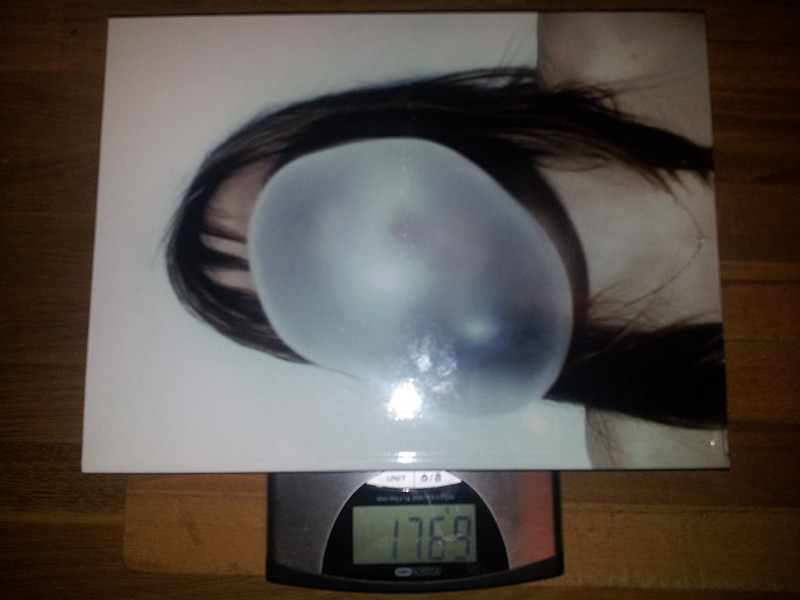
	<p><small>Between Realities. 1769 gram photography. The cover
	is covered by a bubble gum bubble.</small></p>
      </div>

      <p>November 2014 I started to write this text after having seen
      the exhibition <em>Between realities</em> at Dunkers. For
      various reasons I never completed it. Then came, spring 2017, I felt
      that I had to polish it a little, and publish it. It was my
      reading of Charlotte Cotton's <em>The Photograph as Contemporary
      Art,</em> a text I have difficulties to really appreciate, which
      triggered me to continue. It never happened, though.</p>

      <p>19 August 2014 marked the 175th anniversary of the art of
      photography. At least if we see the release of <a href="https://en.wikipedia.org/wiki/Daguerreotype#Invention">Daguerre's
      patent</a> as the starting point of photography. Of those 175
      years, about 50 were good years for photojournalism. <a href="https://en.wikipedia.org/wiki/Photojournalism#Golden_age">Its
      Golden Age started in the 1930s</a>.</p>

      <div style="width:50%;float:left;margin:1%;">
	<a title="" href="/entries/2014/11/artmarkets/bubble_in_the_art_market_22.png">
	  <img src="/entries/2014/11/artmarkets/bubble_in_the_art_market_22.png" alt="Sales volume of paintings in different segments" width="100%"/>
	</a>
	<p>
	  <small>Figure 1. The number of sales of paintings recorded at major auction
	  houses from year 1970 to 2013. The four graphs represents four
	  segments. These are from top to bottom graph year 2000: (1)
	  Impressionism and modern (solid curve), (2) post worldwar 2 and
	  contemporary (short dashed), (3) American (long dashed) and (4)
	  Latin American (long and short dashed). For more precises
	  definitions of the categories please refer to Kräussl <em>et
	  al.</em> (2014).</small>
	</p>
      </div>

      <blockquote>
	<p>The 'Golden Age of Photojournalism' is often considered to be roughly
	the 1930s through the 1950s. It was made possible by the
	development of the commercial 35mm Leica camera in 1925, and the first
	flash bulbs between 1927 and 1930 that allowed the journalist true
	flexibility in taking pictures.</p>
      </blockquote>


      <p>The glossy magazines continued another 20 years, though. <a href="https://en.wikipedia.org/wiki/Photojournalism#Decline">But
      then</a>:</p>

      <blockquote>
	<p>The Golden Age of Photojournalism ended in the 1970s when many
	photo-magazines ceased publication. They found that they could not
	compete with other media for advertising revenue to sustain their
	large circulations and high costs.</p>
      </blockquote>

      <p>Those other media were in many parts of the commercial
      television. Interestingly, now thirty years after the demise of the
      photo-magazines we see how the daily newspapers are losing advertising
      revenue since advertising is now moving to the Internet.</p>

      <p>It is also interesting to note that the genre started because of one
      technical innovation, and that it in its current form started to decline
      because of two other changed the viability business models of the press:
      television and the Internet.</p>

      <div style="width:50%;float:right;margin:1%;">
	<a href="https://www.flickr.com/photos/sigfridlundberg/12971021693" title="L1007144_v1 by Sigfrid  Lundberg, on Flickr">
	  <img src="https://farm8.staticflickr.com/7304/12971021693_8c859c16c1_c.jpg" width="100%" alt="L1007144_v1"/></a>
	  <p>
	    <small>
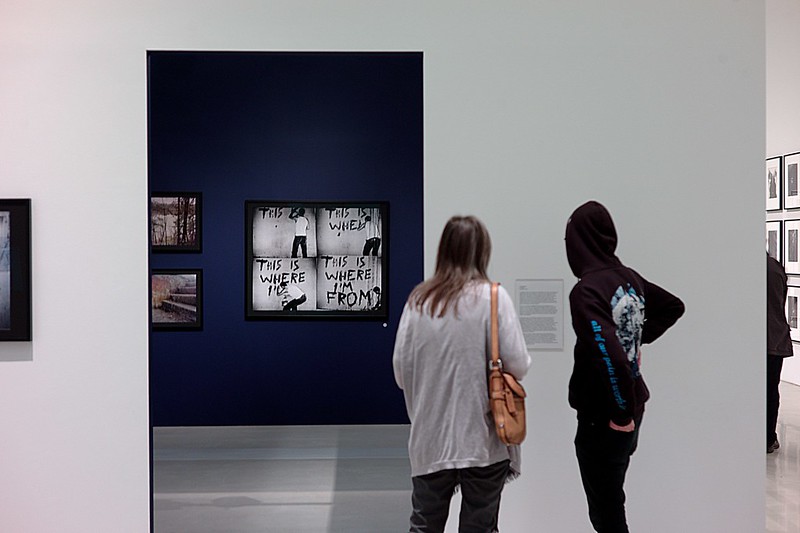
	      From <q>A WAY OF LIFE</q>.<br/>
	      This is<br/>
	      This is where<br/>
	      This is where I<br/>
	      This is where I'm from<br/>
	      Hommage à J.H. Engström
	  </small>
	  </p>
      </div>

      <h3>The Photograph as Contemporary Art</h3>

      <p>Be that as it may, but the curators has recently been even
      more inclined to summarize their stories of Swedish photography
      in a number of retrospective exhibitions here in Sweden. There
      have also been group exhibitions following some threads from the
      past into the present. Less than half a year ago there was one
      opening at Moderna Malmö which has now moved the Stockholm head
      office, entitled <em>A WAY OF LIFE: Swedish photography from
      Christer Strömholm until Today</em>.</p>
      
      <p>The whole idea of this uncompleted entry is to correlate the
      demise of the glossy magazine with rise of photography as an art
      form, and how the prices of photography follows the ones in art
      into the hypothetical bubbles of the western economies.</p>

      <p>As usual the reality isn't as easy to grasp as you believe
      when you start formulating the hypotheses.</p>

      <h3>Addendum</h3>
      
      <p>A lot of things distracted me: Someone didn't want to share
      their data, and I got bought a new computer going from SUSE to
      Ubuntu forced me to migrate my environment, and when that was
      done there was no energy left for what is importan: Writing and
      making photographs. My attention was drawn in other directions,
      the most important one was the social media <a href="https://twitter.com/sigfridlundberg">notably twitter</a>
      which didn't require a whole computer and permitted me to sit
      and participate in the global exchange of fast food like content.</p>

      
      <div style="width:50%;float:left;margin:1%;">
	<a href="https://www.flickr.com/photos/sigfridlundberg/15154883253" title="L1011113_v1 by Sigfrid  Lundberg, on Flickr"><img src="https://farm6.staticflickr.com/5615/15154883253_2c6d33e2b4_c.jpg" width="100%" alt="L1011113_v1"/></a>
      </div>

      <h3>References</h3>

      <p id="kristoffer-louise-niclas">Kristoffer Arvidsson, Louise Wolthers &amp; Niclas Östlind (editors),
      2014. <em>Between realities. Photography in Sweden 1970–2000</em>
      Bokförlaget Arena, Lund 2014.</p>

      <p>Charlotte Cotton, <em>The Photograph as Contemporary
      Art</em>, Thames &amp; Hudson, 2014.</p>

      <p>A. E. Scorcu &amp; R. Zanola, 2011.  "<b><a href="https://ideas.repec.org/p/rim/rimwps/36_11.html">Survival in the
      Cultural Market: The Case of Temporary Exhibitions</a></b>," <em><a href="https://ideas.repec.org/s/rim/rimwps.html">Working Paper Series</a></em>
      36_11, The Rimini Centre for Economic Analysis.</p>

      <p>Kenneth Wieand, Jeff Donaldson &amp; Socorro Quintero, 1998.  "<b><a href="https://ideas.repec.org/a/mfj/journl/v2y1998i3p167-187.html">Are
      Real Assets Priced Internationally? Evidence from the Art
      Market</a></b>," <em><a href="https://ideas.repec.org/s/mfj/journl.html">Multinational Finance
      Journal</a></em>, vol. 2(3), pages 167-187,
      September.</p>

      <p>Nandini Srivastava &amp; Stephen Satchell, 2012.  "<b><a href="https://ideas.repec.org/p/bbk/bbkefp/1209.html">Are There Bubbles
      in the Art Market? The Detection of Bubbles when Fair Value is
      Unobservable</a></b>," <a href="https://ideas.repec.org/s/bbk/bbkefp.html"><em>Birkbeck Working Papers
      in Economics and Finance</em></a> 1209, Birkbeck, Department of Economics,
      Mathematics &amp; Statistics.</p>

      <p>Roman Kräussl, Thorsten Lehnert &amp; Nicolas Martelin, 2014.
      "<b><a href="http://ideas.repec.org/p/crf/wpaper/14-07.html">Is 
      there a Bubble in the Art Market?</a></b>,"
      <a href="http://ideas.repec.org/s/crf/wpaper.html"><em>LSF Research Working
      Paper Series</em></a> 
      14-07, Luxembourg School of Finance, University of Luxembourg.</p>

      <p>Jeffrey Pompe, 1996.
      <a href="https://www.jstor.org/stable/1061182">An Investment Flash:
      The Rate of Return for Photographs</a>.
      <em>Southern Economic Journal</em>, Vol. 63, No. 2, pp. 488-495</p>


    </div>
  </content>
  <dc:date>2014</dc:date>
  <category label="art" term="Art"/>
  <category label="photography" term="Photography"/>
  <category label="economics" term="Economics"/>
  <category label="essays" term="Essays"/>
  <updated>2018-04-27T10:19:33+01:00</updated>
  <id>https://sigfrid-lundberg.se/entries/2014/11/artmarkets/</id>
  <!-- $Id$ -->
</entry>
  <entry>
  <author>
    <name>Sigfrid Lundberg</name>
  </author>

  <title>Are the Ways of Seeing Francesca Woodman and Edith Gowin the
  same?</title>
  <link href="https://sigfrid-lundberg.se/entries/2015/10/francesca/"/>

  <summary>Francesca Woodman's work is on exhibition in Stockholm. I look at
  her photography, and felt that I had to reread parts of John Berger's <cite>Ways
  of seeing</cite>.</summary>

  <content type="xhtml">
    <div xmlns="http://www.w3.org/1999/xhtml">

      <div style="margin: +1%; width:45%;float:left;">

	<a data-flickr-embed="true" href="https://www.flickr.com/photos/sigfridlundberg/21376316183/in/dateposted/" title="In the background are two of Francesca Woodman's     Caryatids. There are a large sample of photobooks about     Francesca on the table in the foreground">
	  <img src="https://farm6.staticflickr.com/5671/21376316183_216f52d8ee_z.jpg" width="100%" alt="L1014105_v1"/></a>
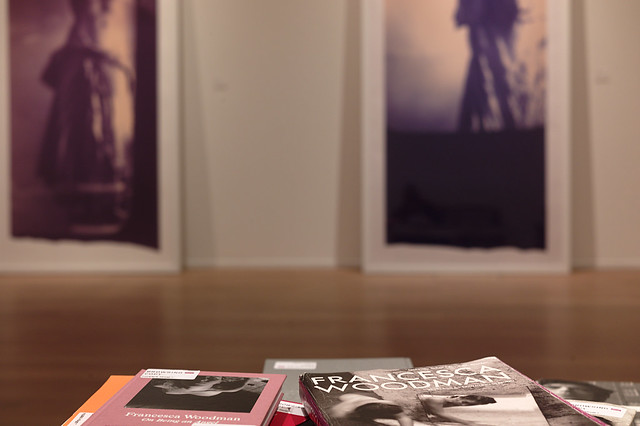
	  <p><small>In the background are two of Francesca Woodman's
		  Caryatids. There are a large sample of photobooks about
		  Francesca on the table in the foreground</small></p>

      </div>


      <p>Francesca Woodman took her life 1981 at 22 years of age. By then she
      had become a serious, hardworking and very good artistic
      photographer. She had started her exploration of art photography when
      she was 13. When considering these early works, we are talking of the
      serious endeavour of a precocious, talented teenager, not a child's
      play.</p>

      <p>Much of her work is self portraiture, and often she portrays herself
      undraped. There are several female photographers who have earned
      well-deserved fame for (among other things) photographing naked humans,
      such as Imogen Cunningham and Ruth Bernard. They both depicted naked
      women, but as far as I know, neither Cunningham nor Bernard turned their
      cameras towards themselves; with or without clothes.</p>

      <p>Francesca Woodman's work is on exhibition, entitled <cite>On being an
      Angle</cite> at Moderna Museet, Stockholm.  According to Anna Tellgren,
      the curator, the reason why Woodman used herself as model was just
      practical<a href="#note0"><sup>1</sup></a>. She was there herself when
      she needed one, at a lower cost than the alternatives and there
      would never be any problems with model release contracts.</p>

      <p>However, I am sure there is more to than that. There were brilliant
      contemporaries, like Cindy Sherman, who started similar projects late
      1970ties. Photographers that have since become important players on the
      photography scene. The interest in self-portraiture has increased
      through the decades. It is now a fairly common genre and I think it is
      more common among women than men.</p>

      <p>This text is about my attempt to understand that difference between
      the sexes.</p>

      <div style="margin: +1%; width:500;float:right;">
	<iframe src="https://player.vimeo.com/video/113375054" width="500" height="281" frameborder="0" webkitallowfullscreen="webkitallowfullscreen" mozallowfullscreen="mozallowfullscreen" allowfullscreen="allowfullscreen">
	  <!-- iframe -->
	</iframe> 
	<p>
	  <small>
	    <a href="https://vimeo.com/113375054">Emmett Gowin</a> from 
	    <a href="https://vimeo.com/landscapestories">Landscape Stories</a> on 
	    <a href="https://vimeo.com">Vimeo</a>.
	  </small>
	</p>
      </div>

      <p>The only things I know about Edith Gowin is that she is a beautiful
      woman and that her husband is photographer Emmet Gowin. He is a well
      known photographer who earned some of his fame for portraits of his
      often scantily clad wife. The two have now celebrated their golden
      wedding anniversary since several years. In the interviews you find of
      them (for example on YouTube) they seem to be still today a loving
      couple. It might be that Emmet don't take as many photographs
      of Edith now as he did 40-50 years ago.</p>

      <p>Other husbands and photographers take photos of their wives. Some go
      far artistically such as Alfred Stieglitz' (1864-1946) portraits
      of Georgia O'Keeffe (1887-1986). They arose from an intense love story,
      marriage and a long relationship. <sup><a href="#note1">2</a></sup>
      Edward Weston shot countless of nudes, of which, according to Robert
      Adams, most are fairly uninteresting:</p>

      <blockquote>
	<p><em>With the exception of two full length nudes of Tina Modotti and
	five of Charis Wilson in the Oceano dunes (not many, considering the
	number of nudes Weston took), the pictures that supposedly resulted
	from Weston's love for his subjects are relative to the rest of his
	life's work, unsuccessful; they are cold to the point of being
	dead.</em> <a href="#note2"><sup>3</sup></a></p>
      </blockquote>

      <p>These photos are to be found on many web sites. Suitable searches in
      Google images:</p>
      
      <ul>
	<li>Edward Westons <a href="https://goo.gl/dGVnjY">portraits of Charis
	Wilson</a></li>
	<li>His photos of <a href="https://goo.gl/W6BvZm">Tina
	Modotti</a></li>
	<li><a href="https://goo.gl/p4jJhA">Alfred Stieglitz' of Georgia
	O'Keeffe</a></li>
      </ul>

      <p>Many photos by much lesser artists than Weston deserve even less
      praise.  It might be that most such pictures shouldn't really have been
      taken.</p>

      <p>One of the best, earliest and still extremely influential theoretical
      analyses of the nude in western art is in <cite>Ways of seeing</cite> by
      John Berger<sup><a href="#note3">4</a></sup>. His arguments can be
      summarized in contrasting statements. For example:</p>

      <table>
	<tr>
	  <td>Men survey</td>
	  <td><kbd> </kbd></td>
	  <td>Women are the surveyed</td>
	  <td><kbd> </kbd></td>
	  <td>p. 46</td>
	</tr>
	<tr>
	  <td>Men act</td>
	  <td><kbd> </kbd></td>
	  <td>Women appear</td>
	  <td><kbd> </kbd></td>
	  <td>p. 47</td>
	</tr>
	<tr>
	  <td>Men look at women.</td>
	  <td><kbd> </kbd></td>
	  <td>Women watch themselves being looked at.</td>
	  <td><kbd> </kbd></td>
	  <td>p. 47</td>
	</tr>
	<tr>
	  <td>To be naked is to be oneself</td>
	  <td><kbd> </kbd></td>
	  <td>To be nude is to be seen as naked by others and yet not
	  recognized for oneself</td>
	  <td><kbd> </kbd></td>
	  <td>p. 54</td>
	</tr>
      </table>

      <p>Berger argues that to be naked is to be without disguise, and to be
      nude is to be on display, to carry ones nakedness as a disguise. To be
      disguised without clothes is like being condemned to never be naked. In
      the western nude cliche, the model is there, on display, disguised in he
      nakedness for the pleasures of the male viewer.</p>

      <p>I could go on giving examples of contrasts from Berger's
      treatment. What interests me, though, is how can we discuss Woodman's
      self portraiture in the light of Berger's contrasting statements.</p>

      <p>Then we have Edith and Emmet Gowin, and those seven out of houndreds
      nudes by Weston that Robert Adams felt was OK. Interestingly Berger
      talks of <q>hundreds of thousands</q> of nude oil paintings (and perhaps
      millions of photographs) that fit the cliche he describes and a few
      houndreds exceptions that do not. Berger describes them in terms of the
      strength of the painter's vision:</p>

      <blockquote>
	<p>
	  <em>In each case the painter's personal vision of the particular
	  women he is painting is so strong that it makes no allowance for the
	  spectator. The painter's vision binds the woman to him so they
	  become as inseparable as couples in stone. The spectator can witness
	  their relationship - but he can do no more: he is forced to
	  recognize himself as the outsider he is. <strong>He cannot deceive
	  himself into believing that she is naked for him.</strong></em> [my
	  emphasis]
	</p>
      </blockquote>

      <p>I think John Berger's description of these <q>exceptional</q>
      paintings fits Emmet's photos of Edith as well. The two did this
      together, and they love each other and both of them engage in this game
      for two. You are allowed to see some of what they did, but it wasn't for
      you. If she looks into the lens, then she is looking into Emmet's eyes,
      not yours.</p>

      <p>What about Francesca Woodman? She had, being a young woman, watched
      herself being looked at. Indeed, she did that in the darkroom as
      well. She could evaluate to what extent she succeded. She had complete
      control and could be nude or naked depending on what she'd like a given
      day or what her artistic goals were for a given work. What we see is
      fiction, she can decide that she is there for the spectator.</p>

      <p>Emmet is a documentary photographer; in an interview Edith describes
      how he asks her to stay where she was until he came back with his
      camera. Emmet is looking at her, but she doesn't mind. Woodman the
      photographer does not have wait for Francesca the model to do something
      worth shooting.</p>

      <p>It is easier for her to make strong statements about being watching
      herself being looked at. Emmet could never do that.</p>


      <div>
	<h3>Foot notes</h3>
	<ol>

	  <li id="note0">
	    Segestam, Göran, 2015. 
	    <a href="https://www.fotosidan.se/cldoc/podd/podd-kultforklarad-angel-fascinerar-alltjamt.htm">Poddradio:
	    Kultförklarad ängel fascinerar alltjämt. Fotosidan, Stockholm.</a>
	  </li>

	  <li id="note1"><a href="https://www.npr.org/2011/07/21/138467808/stieglitz-and-okeeffe-their-love-and-life-in-letters">Stieglitz And O'Keeffe: Their Love And Life In Letters</a></li>

	  <li id="note2">Adams, Robert, 1994. <em>Why people photograph.</em> Aperture Foundation,
	  New York.</li>

	  <li id="note3">Berger, John, 1972. <em>Ways of Seeing</em>. Penguin Books
	  ltd. London.</li>


	</ol>
      </div>
    </div>
  </content>
  <dc:date>2015</dc:date>
  <category label="photography" term="Photography"/>
  <updated>2015-10-08T22:11:51+01:00</updated>
  <id>https://sigfrid-lundberg.se/entries/2015/10/francesca/</id>
</entry>
  <entry>
  <author>
    <name>Sigfrid Lundberg</name>
  </author>
  <title>Landskrona fotofestival 2015</title>
  <link href="https://sigfrid-lundberg.se/entries/2015/08/fotofestival/"/>
  <summary>Fotofestivalen i Landskrona har seglat upp som en fixstjärna på den
  nordiska fotohimlen. Jag har varit där tre år i rad nu. Håller den
  måttet? Har den växtverk?</summary>
  <content type="xhtml">
    <div xmlns="http://www.w3.org/1999/xhtml">


      <div style="margin: +1%; width:45%;float:left;">
	<a href="https://www.flickr.com/photos/sigfridlundberg/20165936123" title="Corinne Vionnet's last slide. She had the last presentation at the International Seminar, Landskrona Photo">
	  <img src="https://farm1.staticflickr.com/698/20165936123_2cc3947975_z.jpg" width="95%" alt=""/>
	</a>
      </div>

      <p>Fotofestivalen i Landskrona har seglat upp som en fixstjärna på den
      nordiska fotohimlen. Jag har varit där tre år i rad nu. Håller den
      måttet? Har den växtverk?</p>

      <p>Två hela dagar har lagt på årets upplaga. Jag är inte på något sätt
      besviken, men det känns som om det var mer liv och rörelse 2013 och 2014
      än 2015. Å andra sidan var jag tre hela dagar i fjol. Svårt att säga,
      kanske man implementerade sitt koncept bättre tidigare om åren än nu.</p>

      <p>Fredagen ägnade jag åt det internationella symposiet och söndagen åt
      halva fotoboksdagen och resten åt utställningarna. Alltså har jag ägnat
      för mycket tid åt prat och tyckande än åt <em>das Ding an
      sich</em>. Kanske ett misstag. Kan i så fall inte göra det ogjort.</p>

      <h3>Utställningarna</h3>

      <p>Fotofestivalen 2015 lyckades samla ihop utställare från när och
      fjärran. För många för att lista dem, och jag kan inte kommentera mer än
      en bråkdel av dem. Lars Tunbjörks utställning <em>Vinter</em> i stadens
      rådhus är en given höjdpunkt. Duane Michals, Boris Mikhailov och Maja
      Forslund i Konsthallen.</p>

      <p>Duane Michals gav mig festivalens bästa skratt med serien
      <q><em>How photography lost its verginity on the way to the
      bank</em></q> (ja, det skall vara <strong>verginity</strong>: <a href="https://www.urbandictionary.com/define.php?term=verginity">The
      state or condition of being a vergin, i.e. one who has never had
      sex with a complete retard</a>). I denna ingick den fantastiska
      bilden <em>A <a href="https://goo.gl/Nr8nGQ">Gursky Gherkin</a>
      is Just a Very Large Pickle</em> och bilderna med samlingsnamnet
      <em>Who is <a href="https://goo.gl/BaP1mq">Sidney
      Sherman</a></em>.</p>

      <div style="width:420px; height:315px; float:right;">
	<iframe width="420px" height="315px" src="https://www.youtube.com/embed/cpwykSn6_F4" frameborder="0" allowfullscreen="allowfullscreen">
	  <!-- empty -->
	</iframe>
      </div>

      <p>En definitiv höjdpunkt var utställningen med tjeckisk fotografi, och
      i synnerhet Jindřich Štreit.</p>

      <h3>Fotografins förvandling</h3>

      <p>Temat var Metamorphosis of Photography och det hela modererades av Marc Prüst (curator och
      bildredaktör) och hade fyra talare</p>

      <ul>
	<li>Michael Famighetti (Aperture Photography Magazine) diskuterade
	olika aspekter där literaturen och texten är relaterade till
	fotografin och bilden,</li>
	<li>Andrea Holzherr (Magnum Photos) diskuterade dokumentär fotografi
	och sanning,</li>
	<li>moderatorn själv höll en presentation om propaganda och fotografi
	i Nordkorea</li>
	<li>Slutligen Corinne Vionnet (bildkonstnär).</li>
      </ul>


      <p>Alla fyra hade intressanta ting att säga. Programmet beskriver
      Holzherr presentation så här:</p> 

      <blockquote>
	<p><em>Photo journalism has undergone fundamental changes in recent
	years. How does Magnum relate to that?  The notion that pictures show
	reality can no longer be taken for granted.</em></p>
      </blockquote>

      <p>Det är uppenbart korrekt att såväl bildjournalistikens som
      dokumentärfotografiets vilkor ändrats drastiskt de senaste 10
      åren. Under själva temat och frågan ligger även något annat: Jag
      är faktiskt väldigt trött på de <em>postmodernas</em> beskrivning av
      dokumentärfotografin. Jag känner inte till någon dokumentärfotograf som
      gör gällande att deras form av fotografi producerar bilder vars relation
      till verkligheten är direkt och okomplicerad. Det är en slags ganska låg
      retorisk teknik att beskriva motståndarens inställning och sedan
      kritisera den. (Jämför, t ex: Kristoffer Arvidsson, Louise Wolthers
      &amp; Niclas Östlind (editors), 2014. <em>Between realities. Photography
      in Sweden 1970–2000</em> Bokförlaget Arena, Lund 2014).</p>

      <p>Andrea Holzherr gav en glimrande beskrivning av hur både samtida och
      historiska fotografer hanterat autenticitet och sanning i relation till
      ämnen som klass, ojämlikhet och krig och konflikt. Slutligen
      konstaterade hon att hon inte kände någon annan teknik att beskriva
      verkligheten som uppenbart ger ett sannare resultat.</p>

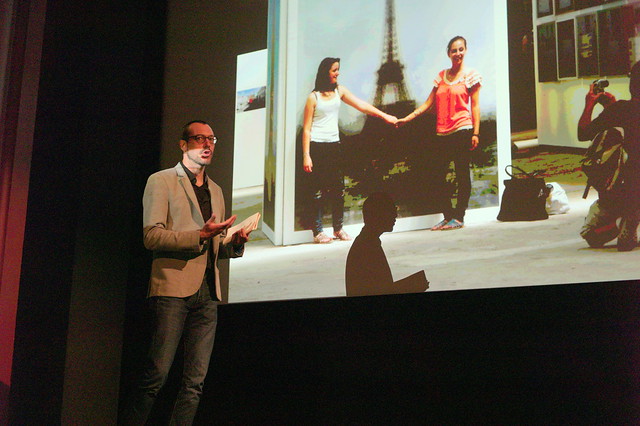
      <p>Corinne Vionnets presentation var nog den mest intressanta. Hon
      utgick från turistiska arketyper eller troféer, det som Susan Sontag
      kallar <q>tourist's photographic trophies</q>. De flesta människor
      känner till platser och byggnader som Lutande tornet, Taj Mahal,
      Goldengatebron, Eiffeltornet osv. Utifrån turistbilder från Google
      images syntetiserade hon drömlika bilder som var och en bestod av 100
      enskilda objekt. Alla av typen <q>Min flickvän vid framför
      Eiffeltornet.</q></p>

      <h3>Fotoboken</h3>

      <p>Lieko Shiga, Mishka Henner och Tony Cairns och Kalev Erickson från
      Archive of Modern Conflict, London, presenterade med Lars Mogensen som
      moderator. Åter igen var alla presentationerna bra och väldigt
      intressanta. Intressantast var dock den av Lieko Shiga.</p>

      <p>Shiga är utpräglat dokumentär och undersökande fotograf. Hon bosatte
      sig i en liten by på stranden mot Stilla havet i Sendai-provinsen i
      norra Japan runt 2008.</p>

      <p>Hon blev byns officiella fotografiska krönikör och arbetade med allt
      visuellt där. Hon driver ett antal projekt bland byns tre-fyrahundra
      invånare och deras liv som fiskare och bönder. Allt fick ett abrupt slut
      med Tōhoku-jordbävningen och den följande Tsunamin utplånade hela
      samhället.  Den japanska staten har bedömt riskerna för en upprepning av
      katastrofen för stora och förbjudit permanent boende där.</p>

      <p>Shiga samlade bilder och fotoalbum som blivit begravda bland alla
      rasmassor. Dessa fragment av minnen samt Shigas egen dokumentation
      ligger till grund för hennes bok Rasen kaigan (Spiral Shore).</p>

      <h3>Slutligen</h3>

      <p>Håller den måttet? Det tycker jag! Har den växtverk? Kanske. Min
      känsla är att det var betydligt mindre folk i år än de två tidigare,
      fast i år har man mer tid på sig. Har du inte varit där ännu, åk dit!</p>

    </div>
  </content>
  <dc:date>2015</dc:date>
  <category label="photography" term="Photography"/>
  <updated>2015-08-24T21:26:38+01:00</updated>
  <id>https://sigfrid-lundberg.se/entries/2015/08/fotofestival/</id>
</entry>
  <entry>
  <author>
    <name>Sigfrid Lundberg</name>
  </author>
  <title>Gerillautställning</title>
  <link href="https://sigfrid-lundberg.se/entries/2015/05/exhibits/"/>
  <summary>Lördagen den 23 maj, 13:00-16:00, Katarina Bangata 25, Södermalm, Stockholm</summary>
  <content type="xhtml">
    <div xmlns="http://www.w3.org/1999/xhtml">

      <div style="margin:+1%; width:560;height:315;float:left;">
	<iframe width="560" height="315" src="https://www.youtube.com/embed/V4fbPx8yBgg" frameborder="0" allowfullscreen="allowfullscreen">
	  <!-- a comment -->
	</iframe>
      </div>

      <p>Lördagen den 23 maj, 13:00-16:00, Katarina Bangata 25, Södermalm,
      Stockholm Se Mickes <a href="http://mickebergphoto3.blogspot.se/2015/05/lordag-23-13-1600-katarina-bangata-25.html">blogg</a></p>

      <br clear="both"/>      
      <div style="margin: +1%; width:45%;float:left;">
	<a href="https://www.flickr.com/photos/sigfridlundberg/17812801578" title="P1000234 by Sigfrid  Lundberg, on Flickr"><img src="https://c2.staticflickr.com/6/5457/17812801578_10a1ce2a57_z.jpg" width="100%" alt="P1000234"/></a>
	<br clear="both"/>      
	<a href="https://www.flickr.com/photos/sigfridlundberg/17814404119" title="P1000235 by Sigfrid  Lundberg, on Flickr"><img src="https://c2.staticflickr.com/6/5466/17814404119_0a83a90e13_z.jpg" width="100%" alt="P1000235"/></a>
      </div>

      <p>Vi samlades vid tiotiden och fikade, sedan drog vi vidare och hängde
      våra alster på det plank Micke valt ut oss baserad på sin
      lokalkännedom! Det började med vackert väder, men sedan höll evenemanget
      på att helt regna bort.</p>

      <br clear="both"/>      

      <div>
	<p>När vi öppnade utställningen klockan ett tittade solen
	fram, och höll sig framme till tills det var dags att stänga butiken
	klockan 16:00. Bilderna i min del av utställningen är ett litet urval
	ur mitt <a href="https://sigfrid-lundberg.se/entries/2015/03/averylongday/">pendlarprojekt</a>.</p>

	<div style="margin: +1%; width:45%;float:right;">
	  <a href="https://www.flickr.com/photos/sigfridlundberg/15200216155" title="L1010287_v1 by Sigfrid  Lundberg, on Flickr">
	    <img src="https://c2.staticflickr.com/6/5584/15200216155_2f9c0a339d_z.jpg" width="100%" alt="L1010287_v1"/>
	  </a>
	</div>
	<p><strong>07:30:43</strong></p>

	<br clear="both"/>
	<div style="margin: +1%; width:45%;float:left;">
	  <a href="https://www.flickr.com/photos/sigfridlundberg/8391777099" title="L1001282_v2 by Sigfrid  Lundberg, on Flickr">
	    <img src="https://c1.staticflickr.com/9/8368/8391777099_335655e14c_z.jpg" width="100%" alt="L1001282_v2"/>
	  </a>
	</div>
	<p><strong>15:41:47</strong></p>

	<br clear="both"/>
	<div style="margin: +1%; width:45%;float:right;">
	  <a href="https://www.flickr.com/photos/sigfridlundberg/5576639565" title="P3306017.tif by Sigfrid  Lundberg, on Flickr">
	    <img src="https://c2.staticflickr.com/6/5190/5576639565_956564ca1b_z.jpg" width="100%" alt="P3306017.tif"/>
	  </a>
	</div>
	<p><strong>16:40:36</strong></p>

	<br clear="both"/>
	<div style="margin: +1%; width:45%;float:left;">
	  <a href="https://www.flickr.com/photos/sigfridlundberg/16353831405" title="L1011826 by Sigfrid  Lundberg, on Flickr">
	    <img src="https://c2.staticflickr.com/8/7330/16353831405_ca3f57d084_z.jpg" width="100%" alt="L1011826"/>
	  </a>
	</div>
	<p><strong>16:56:22</strong></p>

	<br clear="both"/>
	<div style="margin: +1%; width:45%;float:right;">
	  <a href="https://www.flickr.com/photos/sigfridlundberg/9688540376" title="L1004583_v3 by Sigfrid  Lundberg, on Flickr"><img src="https://c2.staticflickr.com/6/5474/9688540376_2f6883af82_z.jpg" width="100%" alt="L1004583_v3"/></a>
	</div>
	<p><strong>17:10:55</strong></p>

	<br clear="both"/>
	<div style="margin: +1%; width:45%;float:left;">
	  <a href="https://www.flickr.com/photos/sigfridlundberg/5570621256" title="P3255831.tif by Sigfrid  Lundberg, on Flickr">
	    <img src="https://c2.staticflickr.com/6/5030/5570621256_d313f77431_z.jpg" width="100%" alt="P3255831.tif"/>
	  </a>
	</div>
	<p><strong>18:19:08</strong></p>

	<br clear="both"/>
	<div style="margin: +1%; width:45%;float:right;">
	  <a href="https://www.flickr.com/photos/sigfridlundberg/10931496015" title="L1005623_v1 by Sigfrid  Lundberg, on Flickr">
	    <img src="https://c2.staticflickr.com/8/7300/10931496015_96726f1b66_z.jpg" width="100%" alt="L1005623_v1"/>
	  </a>
	</div>
	<p><strong>19:03:39</strong></p>
      </div>
    </div>
  </content>
  <dc:date>2015</dc:date>
  <category label="photography" term="Photography"/>
  <updated>2015-05-23T17:30:40+01:00</updated>
  <id>https://www.sigfrid-lundberg.se/entries/2015/05/exhibits/</id>
</entry>
  <entry>
  <author>
    <name>Sigfrid Lundberg</name>
  </author>
  <title>The Times They Are a-Changin'</title>
  <link href="https://sigfrid-lundberg.se/entries/2015/05/witt/"/>
  <summary>Knausgård går till rasande attack på Cyklopernas Land och
  Witt-Brattström Har inte tid att hyckla mer</summary>
  <content type="xhtml">
    <div xmlns="http://www.w3.org/1999/xhtml">

      <div style="margin: +1%; width:60%;float:right;">
	<a href="https://www.flickr.com/photos/sigfridlundberg/12010506654" title="L1006450_v1 by Sigfrid  Lundberg, on Flickr"><img src="https://c2.staticflickr.com/4/3698/12010506654_9248ac88cf_z.jpg" width="100%" alt="L1006450_v1"/></a>
      </div>

      <p>Karl Ove Knausgård går till rasande attack på <a href="https://www.dn.se/kultur-noje/kulturdebatt/karl-ove-knausgards-rasande-attack-pa-sverige/">Cyklopernas
      Land</a> och Ebba Witt-Brattström <a href="https://www.etc.se/kultur-noje/ebba-witt-brattstrom-jag-har-inte-tid-att-hyckla-mer">har
      inte tid att hyckla mer</a>.</p>

      <p>Ingen av de två tillhör de författare som jag brukar läsa. Jag har
      inte läst något i boklängd av någon av dem. Kommer sannolikt inte göra
      det heller. En reflektion:</p>

      <p>Ebba är nästan femton år äldre än Karl. Karl skulle kunna vara
      sladdbarn i Ebbas familj, och kanske teoretiskt en av hennes söner. Jag är bara
      några år yngre än Ebba, och har upplevt en del av det som hon talar om,
      menar jag. För allt det hon talar om handlar faktiskt inte om gender
      eller manligt-kvinnligt eller manlig homo-socialitet. Utan faktiskt om
      ålder.</p>

      <blockquote><q>Kvinnliga genier haussas lyser upp och slocknar, blir
      stjärnor utan stjärnbilder. Det är därför jag kämpar för
      kulturkvinnan. Hela hennes kulturella bagage. Du måste ha hela
      stjärnbilden</q>, säger <a href="https://www.etc.se/kultur-noje/ebba-witt-brattstrom-jag-har-inte-tid-att-hyckla-mer">Ebba
      Witt-Brattström</a>.</blockquote>

      <p>Om du varit en stjärna, eller faktiskt fortfarande är en, så bör du
      veta vid ungefär sextio års ålder om din genialitet kommer att markeras av
      en stjärnbild eller ej. Även en supernova brinner ut och blir till en
      vit dvärg eller ett svart hål. Jag tvivlar inte ögonblick på att många
      fler kvinnor än män <em>inte</em> får en egen konstellation i patriarkatets
      homosociala zodiak, vars kärna ofta utgörs av <a href="https://en.wikipedia.org/wiki/Old_boy_network">the old-boys
      network</a>.</p>

      <p>Om man är en <em>loser</em>, så är man det, oavsett kön, och många
      winners får ingen plats i zodiaken, och det gäller även män. När man
      nått åldern kring de sextio inser man att de professurer man inte fått,
      lär man inte få heller. Det gäller sannolikt även de stolar man inte
      fått i akademier och lärda samfund.</p>

      <p>Samtidigt kan man säga de sanningar man inte tordes tidigare. Det
      förefaller vara just det Ebba håller på med, och hon förtjänar all
      respekt för det även om alla sanningarna kanske inte upplevs som sådana
      av <em>alla</em> andra.</p>

    </div>
  </content>
  <dc:date>2015</dc:date>
  <category label="ageing" term="Ageing"/>
  <updated>2015-05-22T13:33:50+01:00</updated>
  <id>https://sigfrid-lundberg.se/entries/2015/05/witt/</id>
</entry>
  <entry>
  <author>
    <name>Sigfrid Lundberg</name>
  </author>
  <title>Om sökmaskiner och spindlar</title>
  <link href="https://sigfrid-lundberg.se/entries/2015/05/spidering/"/>
  <summary>År 1995 är ett märkesår för mig. Det är då jag bestämmer mig för
  att byta karriär till Internet och programmering.</summary>
  <content type="xhtml">
    <div xmlns="http://www.w3.org/1999/xhtml">
      <div style="margin: +1%; width:45%;float:right;">
	<a href="https://www.flickr.com/photos/sigfridlundberg/15390269980" title="L1010913_v1 by Sigfrid  Lundberg, on Flickr">
	<img src="https://c2.staticflickr.com/4/3937/15390269980_5c874ce69a_z.jpg" width="100%" alt="L1010913_v1"/>
	</a>
	<p><small>Ett engelskt begrepp för indexering av Internet är
	<q>Spidering</q>. Roboten liknades vid en spindel i nätet.</small></p>
      </div>
      <p>År 1995 är ett märkesår för mig. Det är då jag bestämmer mig för att
      byta karriär till Internet och programmering. Jag gick från akademisk
      forskning till Lunds universitetsbiblioteks forsknings- och
      utvecklingsavdelning som kallade sig NetLab. Mitt specialområde blev
      snabbt metadata, sökmaskiner och Internethöstning.</p>

      <p>Vid den tidpunkten kunde man inte söka på "ål AND öl" i Lycos eller
      Webcrawler, som var de enda sökmaskinerna där ute. Europeiska bokstäver
      fungerade helt enkelt inte i de Nordamerikanskt inskränkta
      sökmaskinerna. <em><q>l: too short for searching</q></em></p>

      <p>1996 släppte vi en public service sökrobot. <em><q>NWI -- En nordisk
      söktjänst för World Wide Web</q></em> (läs vår <a href="https://sigfrid-lundberg.se/1996/nwi/nwi.pdf">press release från
      det året</a>).</p>
      
      <blockquote>
	Vi beräknar att den svensk WWW omfattar nästan 600 000 dokument. I
	skrivande stund (den 9 maj 1996) innehåller vår svenska databas 427
	901 "länkar", av vilka 268 170 är indexerade, dvs vi vet vad nästan
	hälften av alla WWW-sidor i Sverige handlar om och känner till nästan
	tre fjärdedelar av dem. Antalet kända servrar är 4 387. NWIs robot
	arbetar för närvarande kontinuerligt med att kartlägga svensk WWW, för
	att hinna bli färdig innan den färdiga tjänsten skall presenteras
	senare i sommar. Roboten kopierar dokument över nätverket, läser
	igenom dem och söker upp och sparar nyckelinformation i
	texten. Programmet klarar i dag av att hantera ungefär 15 000 dokument
	per dygn. Siffran är dock normalt lägre på grund av väntetider på
	nätet, maskinbelasting och dylikt.
      </blockquote>

      <p>Jag misstänker att jag grovt underskattade den svenska webbens
      storlek, kanske med en faktor två, men nog inte en faktor tio.</p>

      <p>Det blev dock inte NWI som blev först med att klara av europeiska
      tecken, utan Digital Equipment's sökmaskin AltaVista som kom bara några
      veckor före vår. Vi var dock nästan två år <em>före</em> Google. Under
      de två åren hade vi åtminstone till att börja ett visst försprång genom
      att vi inderexade lokala servrar djupare än just AltaVista.</p>

      <p>Ett intressant sammanträffande. Anders Ardö och jag själv publicerade
      våra erfarenheter i ett paper i 7th International Worldwide Web
      Conference: <a href="https://sigfrid-lundberg.se/1998/www7/">A
      regional distributed WWW search and indexing service</a>.</p>

      <p>Vid <em>samma</em> konferens publicerar Sergey Brin och Lawrence Page
      <a href="http://infolab.stanford.edu/~backrub/google.html">The Anatomy
      of a Large-Scale Hypertextual Web Search Engine</a>.</p>

      <p>Det är enda gången jag var i samma volym som Google. I efterhand
      känns det som ödets ironi. Vi slutade med web indexing eftersom vi inte
      hade varken hade budget för fler hårddiskar eller kunde undvara personal
      för mer centrala uppgifter för biblioteket. Vi fortsatte några projekt
      ytterligare en tid, Safari och Studera.nu för högskoleverket.</p>

      <p>Vad vi kanske inte förstod förrän efteråt var att vi hade testat idén
      att driva reklamfri Internetsökning som public service i regi av ett
      konsortium av bibliotek. Det föreföll vara logiskt. Biblioteken skall
      förse medborgarna med information. I praktiken fanns det ingen bärande
      affärsmodell.</p>

    </div>
  </content>
  <dc:date>2015</dc:date>
  <category label="webindexing" term="Web indexing"/>
  <updated>2015-05-17T13:38:39+01:00</updated>
  <id>https://sigfrid-lundberg.se/entries/2015/05/spidering/</id>
</entry>
  <entry>
  <author>
    <name>Sigfrid Lundberg</name>
  </author>
  <title>Vägmärken</title>
  <link href="https://sigfrid-lundberg.se/entries/2015/05/markings/"/>
  <summary>Min Far fick Vägmärken i femtioårspresent för nästan exakt femtio
  år sedan. Jag läser den just nu, och har faktiskt följt mig av och till ett
  par år nu.</summary>
  <content type="xhtml">
    <div xmlns="http://www.w3.org/1999/xhtml">
      <div style="margin: +1%; width:45%;float:right;">
	<a href="https://www.flickr.com/photos/sigfridlundberg/17568169791" title="P1000173 by Sigfrid  Lundberg, on Flickr">
	  <img src="https://c2.staticflickr.com/6/5464/17568169791_c22faa6c9c_z.jpg" width="100%" alt="P1000173"/>
	</a>
      </div>

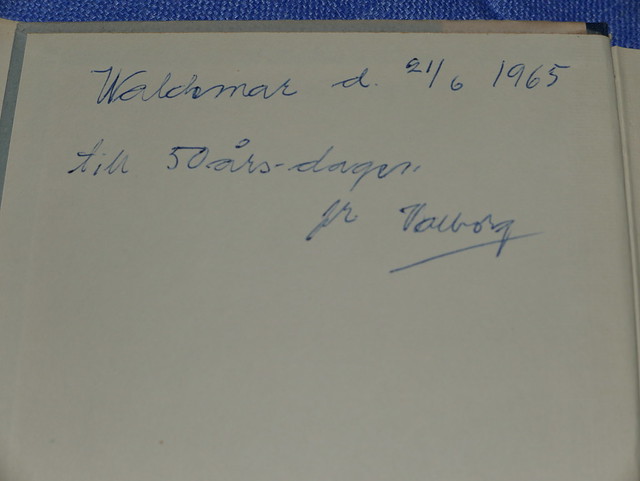
      <p>Min Far fick Dag Hammarskjölds <em>Vägmärken</em><sup><a href="#not1">1</a></sup> i femtioårspresent för nästan exakt femtio år
      sedan. Den har stod på hyllan hemma, och jag började läsa i den då för
      länge sedan. Nu har jag återvänt till den igen. Den har faktiskt följt
      mig av och till ett par år nu. Jag är djupt fängslad av Hammarskjölds
      samtal med sig själv och sin Gud; de kräver tanke och skall smältas
      långsamt.</p>

      <p>Jag är ateist. Eller så har jag brukat beskriva mig, men jag skall
      villigt erkänna att den Gud Hammarskjöld talar med är väldigt olik den
      jag inte tror på. Den tionde april 1958 skriver han:</p>

      <blockquote>
	<p>Först i människan har den skapande utvecklingen nått den punkt där
	verkligheten möter sig själv i dom och val. Utanför människan är den
	varken ond eller god.</p>
	<p>Först när du stiger ned i dig själv upplever du därför, i mötet med
	den Andre, godheten såsom i den yttersta verkligheten - enad och
	levande, <em>i</em> honom och <em>genom</em> dig. <sup><a href="#not2">2</a></sup></p>
      </blockquote>

      <p>Den skapande utvecklingen innersta natur är irrelevant för
      Hammarskjöld. Mitt intryck är att den gärna får vara evolution genom
      naturligt urval i ett universum som expanderat med ljusets hastighet
      sedan the big bang. Eller inte. Hammarskjöld kunde inte bry sig
      mindre. Andligheten finns i att fatta rätt beslut bland alla de fria val
      människan ställs inför längs sin väg. Gud finns i den Andre och i den
      yttersta verkligheten.</p>

      <div style="margin: +1%; width:45%;float:left;">
	<a href="https://www.flickr.com/photos/sigfridlundberg/17380454958" title="P1000174 by Sigfrid  Lundberg, on Flickr">
	<img src="https://c2.staticflickr.com/8/7752/17380454958_d06fb31431_z.jpg" width="100%" alt="P1000174"/>
	</a>
      </div>

      <p>För min del har jag valt icke-tron för att slippa tro nå't alls, och
      för att slippa tro det som Svenssons tror, och, slutligen, kanske för
      att skilja mig från alla dem som jag trodde var mängden. För att
      apostrofera Ulf Peder Olrogs <em>Filosofisk dixieland</em>. Min icke-tro
      formades som en del av tonårsrevolten, tillsammans med
      ungdomsrevolten. Om Svensson gifter sig kyrkligt, så kan inte jag tro på
      Gud.</p>

      <p>Far fick boken av Tant Valborg. De var fostersyskon, Valborg och
      Waldemar, min far. Min Farfar, Sigurd, dog 1918 i spanska sjukan när Far
      var tre år gammal. Jag lär aldrig få veta varför, men efter faderns
      bortgång flyttade Waldemar från Stockholm till sin farbror Torsten,
      kyrkoherde i Glimåkra som hade fyra fosterbarn i ett annars barnlöst
      äktenskap. Det var min far, faster, tant Valborg och en pojke jag inte
      har något minne av alls.</p>

      <p>Farbror Torsten dog redan 1939, så honom har jag aldrig träffat. Det
      hängde bilder av honom på väggen hemma. En man med små stålbågade
      brillor och yvig vit kalufs och stora polisonger. Han var inte helt olik
      Henrik Ibsen. Jag tänker mig honom som en sträng och allvarlig bildad
      herre, inte olik biskopen i Ingmar Bergmans Fanny och Alexander. Jag
      tror att Far blev agad som barn, men det förekom aldrig i mitt
      barndomshem. Strängt taget bidrog kyrkoherden säkert till min ateism,
      genom de attityder han grundlagt hos min far.</p>

      <p>Vi är alla ensamma. Hur mycket släkt och hur många vänner vi än omger
      oss med så går vi ensamma. Instängda i våra kroppar, utelämnade åt vår
      fria vilja och vår egen och andras domar över oss. Den 29 juli frågar
      han: <q>Gav du mig denna olösliga ensamhet för att jag lättare skulle
      kunna ge dig allt?</q><sup><a href="#not3">3</a></sup>, dagen efter
      citatet ovan. Lindrade samtalet med Gud ensamheten?</p>

      <blockquote>
	<p>Ge mig något att dö för -!<br/>
	    Die Maurern stehen<br/>
	    sprachlos und kalt, die Fahnen<br/>
	    klirren im Winde<br/>
	Icke detta gör ensamheten till en pina:<br/>
	att ingen finns som delar min börda,<br/>
	men detta:<br/>
	att jag har endast min egen börda att bära.<sup><a href="#not4">4</a></sup></p>
      </blockquote>

      <p>Gav honom Gud en börda att bära? Var inte Förenta Nationerna
      tillräckligt tunga? En sista: <q>Så skall världen varje morgon skapas på
      nytt, <em>förlåten</em> - i dig, av dig.</q><sup><a href="#not5">5</a></sup></p>


      <h3>Noter</h3>
      <ol>
	<li id="not1">Hammarskjöld, Dag. <em>Vägmärken</em>,
	Stockholm. Bonniers förlag, 1963.</li>
	<li id="not2">Hammarskjöld, op. cit., s. 132</li>
	<li id="not3">Hammarskjöld, op. cit., s. 132</li>
	<li id="not4">Hammarskjöld, op. cit., s. 70</li>
	<li id="not5">Hammarskjöld, op. cit., s. 130</li>
      </ol>

    </div>
  </content>
  <dc:date>2015</dc:date>
  <category label="religion" term="Religion"/>
  <category label="essays" term="Essays"/>
  <category label="spirituality" term="Spirituality"/>
  <updated>2015-05-12T20:49:26+01:00</updated>
  <id>https://sigfrid-lundberg.se/entries/2015/05/markings/</id>
</entry>
  <entry>
  <author>
    <name>Sigfrid Lundberg</name>
  </author>
  <title>At the end of the day there's another day dawning</title>
  <link href="https://sigfrid-lundberg.se/entries/2015/03/averylongday/"/>
  <summary>From the life of a trans-national commuter</summary>
  <content type="xhtml">
    <div xmlns="http://www.w3.org/1999/xhtml">

      <div style="margin: +1%; text-align: center; width:560;float:left;">
	<iframe width="560" height="315" src="https://www.youtube.com/embed/Evjc5Q-xNWs" frameborder="0" allowfullscreen="allowfullscreen">
	  <!-- a comment -->
	</iframe>
      </div>

      <p>I am making an effort to complete my commuting photoproject. (That
      does not mean that I intend to stop commuting, just that I will no
      longer regard that as a photoproject.) The product will be a short
      documentary film; the video clip you see here is a prototype. I am also
      considering making an attempt at publishing the stuff as a book.</p>

      <p>The video consists of about 50 still images and three videoclips.</p>

    </div>
  </content>
  <dc:date>2015</dc:date>
  <category label="photography" term="Photography"/>
  <category label="video" term="Video"/>
  <updated>2015-04-20T19:32:29+01:00</updated>
  <id>https://sigfrid-lundberg.se/entries/2015/03/averylongday/</id>
</entry>
  <entry>
  <author>
    <name>Sigfrid Lundberg</name>
  </author>
  <title>Gonna make a sentimental journey
  to renew old memories</title>
  <link href="https://sigfrid-lundberg.se/entries/2015/04/memories/"/>
  <summary>För trettiofem år sen reste vi till Grekland, Gertrud och jag. Vi
  var yngre då än vårt yngsta barn är nu. I veckan som gick återvände
  vi. Trettiofem år är lång tid, mer än halva mitt liv, om trettiofem år är
  vi sannolikt döda.</summary>

  <content type="xhtml">
    <div xmlns="http://www.w3.org/1999/xhtml">

      <div style="margin: +1%; width:45%;float:right;">
	<a href="https://www.flickr.com/photos/sigfridlundberg/17050347292" title="L1012513 by Sigfrid  Lundberg, on Flickr"><img src="https://farm8.staticflickr.com/7638/17050347292_3184ccd2b2_z.jpg" width="100%" alt="L1012513"/></a>
      </div>

      <p>För trettiofem år sen reste vi till Grekland, Gertrud och jag. Vi var
      yngre då än vårt yngsta barn är idag. Trettiofem år är lång tid, mer än
      halva mitt liv. Förra veckan var vi där igen.</p>

      <blockquote>Gonna take a sentimental journey<br/>
      Gonna set my heart at ease<br/>
      Gonna make a sentimental journey<br/>
      To renew old memories. (<a href="https://en.wikipedia.org/wiki/Sentimental_Journey_%28song%29">Sentimental
    Journey</a>)</blockquote>

      <p>Om jag blir lika gammal som min far, så är trettiofem år återstoden
      av mitt liv. Kanske jag reser tillbaka till Grekland igen, men i så fall
      blir det nog inte till Aten. Det är många andra vägar som vi vill gå
      tillsammans, Gertrud och jag.</p>

      <p>Jag hade kamera med mig då också. Tri-X PAN, 400 ASA. Jag satte min
      nya nya digitala kamera på Black &amp; White. Kändes bra så.</p>

      <p>Det finns en del negativ kvar från resan i en pärm. Inte så många,
      dock. Det som gör resan speciell är att min gamla Nikon F hamnade i
      ryggsäcken efter att jag förlorat min fina Gossen exponeringsmätare uppe
      på Mount Lycabettos. Det tog mig månader att få tag på en likadan, bättre
      begagnad. Samtidigt började jag forskarstudier och det fanns så lite tid
      över för en systemkamera och manuell ljusmätning. Det blev slutet på
      mitt ambitiösa intresse för fotografi så som jag odlat det under tio års
      tid, från tidiga tonår tills dess att Gertrud och jag besteg
      Lycabettos.</p>

      <br style="clear: both;"/>

      <div style="margin: +1%; width:45%;float:left;">
	<a href="https://www.flickr.com/photos/sigfridlundberg/16825692887" title="L1012494 by Sigfrid  Lundberg, on Flickr">
	  <img src="https://farm9.staticflickr.com/8716/16825692887_b5137f831d_z.jpg" width="100%" alt="L1012494"/></a>
      </div>

      <p>Även om jag hade haft ljusmätaren i behåll var min kamera av en typ
      som krävde självutlösare och stativ om man skall ta självporträtt. Det
      var inte därför som vi aldrig tog någon selfie med Parthenon i
      bakgrunden. Man gjorde helt enkelt inte så då.</p>

      <p>Däremot skrev vi en resedagbok med en blå kulpenna av märket BIC. På
      vitt papper i en skrivbok med ljust blåa linjer och likaledes blå pärmar
      av kartong. Jag skrev två-tre dagar, Gertrud skrev tio-tolv.</p>

      <br style="clear: both;"/>

      <div style="margin: +1%; width:45%;float:right;">
	<a href="https://www.flickr.com/photos/sigfridlundberg/17025720456" title="L1012643_v1 by Sigfrid  Lundberg, on Flickr">
	  <img src="https://farm8.staticflickr.com/7682/17025720456_0e5f2f2396_z.jpg" width="100%" alt="L1012643_v1"/></a>
      </div>

      <p>Vi hade med oss ett limstift, och klistrade in biljetter och
      krognotor. Grekisk sallad och en halv flaska Demestica för oss båda. 100
      drachmer. Några kronor bara. Vi drack Ouzo på balkongen och älskade i
      den subtropiska natten tills dess sömnen skiljde oss åt. På morgonen
      förenades vi igen; unga svettiga kroppar glider lätt mot varandra i
      augustihettan.</p>

      <p>Vi klättrade inte upp på Lycabettos förra veckan.</p>

      <br style="clear: both;"/>

      <div style="margin: +1%; width:33%;float:left;">
	<a href="https://www.flickr.com/photos/sigfridlundberg/16864271800" title="L1012551 by Sigfrid  Lundberg, on Flickr"><img src="https://farm8.staticflickr.com/7674/16864271800_5d8a6e04a6_z.jpg" width="100%" alt="L1012551"/></a>
      </div>

      <p>Minnet är allt vi har kvar från den tid som flytt. Det formar sig
      till både trauma och berättelser. Det man inte erinrar sig eller
      berättar om och om igen för andra riskerar man förlora. Framtiden
      handlar om drömmar, farhågor, fruktan och förhoppningar.</p>

      <p>Under min Mors sista två-tre år talade vi med varandra per telefon
      dagligen. Dagligen frågade hon mig om min bror, svärdöttrarna och
      barnbarnen. En dialog som upprepades och blev till en besvärjelse för
      att hålla kvar berättelsen om familjen, och henne själv.</p>

      <p>Det första man förlorar är berättelsens disposition, därefter blir
      den osammanhängande och utan röd tråd.</p>

      <p>Vår resedagbok innehåller saker vi minns eller kan erinra oss. Vi har
      förmodligen hållit dem vid liv genom att vi återkommit till dem i
      berättelser och samtal. Som uppsättningen av Aiskylos' tragedi Orestien
      vi såg på Epidaurosteatern med Melina Mercouri i rollen som
      Klytaimnestra.</p>

      <p>De saker vi inte minns, verkar vara händelser vi <em>båda</em> har
      glömt. Turen i Korintkanalen i skymningen med kanallyktorna glimmande
      längs med sidorna finns inte i vårt medvetande, fastän den borde ha haft
      goda förutsättningar att bli hur romantisk som helst. Kanske var det
      just det som var felet.</p>

      <p>Hur stor andel av alla selfies överlever den förväntade livslängden
      för en smartphone?</p>

      <br style="clear: both;"/>

      <div style="margin: +1%; width:33%;float:right;">
	<a href="https://www.flickr.com/photos/sigfridlundberg/16865585969" title="L1012554 by Sigfrid  Lundberg, on Flickr"><img src="https://farm8.staticflickr.com/7666/16865585969_fd0689f2a8_z.jpg" width="100%" alt="L1012554"/></a>
      </div>

      <p>Det går bussar från Aten till Kap Sunion. Vi har inte kunna
      fastställa hur ofta de går. Somliga sa att de går en gång per timma,
      andra att det är varannan. Vi väntade och väntade, och trodde snart mer
      på jultomten än bussen till Attikas sydspets.</p>

      <p>För trettiofem år sedan tog vi den bussen från Egypt square. Förra
      veckan tog vi den från Filellinon street.</p>

      <p>Andra har skrivit bättre om platsens och Poseidontemplets
      skönhet. Lord Byron</p>

      <blockquote>Place me on Sunium's marbled steep,<br/>
      Where nothing, save the waves and I,<br/>
      May hear our mutual murmurs sweep;<br/>
      There, swan-like, let me sing and die</blockquote>

      <p>... och Hjalmar Gullbergs <em>Vid Kap Sunion:</em></p>

      <blockquote>Detta är havet, ungdomskällan,<br/>
      Venus’ vagga och Sapfos grav.<br/>
      Spegelblankare såg du sällan<br/>
      Medelhavet, havens hav.</blockquote>

      <blockquote><h2>...</h2></blockquote>

      <blockquote>Ej mer jublas det här och klagas<br/>
      inför havsgudens altarbord.<br/>
      Nio pelare blott är hans sagas<br/>
      ännu bevarade minnesord.</blockquote>

      <blockquote>Måtte det verk du i människors vimmel<br/>
      skapar från morgon till aftonglöd,<br/>
      stå som en lyra mot tidens himmel,<br/>
      sedan du själv och din gud är död!</blockquote>

    </div>
  </content>
  <dc:date>2015</dc:date>
  <category label="souvenir" term="Souvenir"/>
  <category label="photography" term="Photography"/>
  <category label="essays" term="Essays"/>
  <updated>2015-04-06T18:46:30+01:00</updated>
  <id>https://www.sigfrid-lundberg.se/entries/2015/04/memories/</id>
</entry>
  <entry>
  <author>
    <name>Sigfrid Lundberg</name>
  </author>
  <title>Varför blir det såhär?</title>
  <link href="https://sigfrid-lundberg.se/entries/2015/03/tiden/"/>
  <summary>Hörde på nyheterna idag att USA nu är nästan självförsörjande på
  energi, och att det begåtts två nya mord i Biskopsgården.</summary>
  <content type="xhtml">
    <div xmlns="http://www.w3.org/1999/xhtml">
      <div style="margin: +1%; width:45%;float:left;">
	<a href="https://www.flickr.com/photos/sigfridlundberg/16891295265" title="L1012392 by Sigfrid  Lundberg, on Flickr">
	  <img src="https://farm8.staticflickr.com/7605/16891295265_a2c5de6086_z.jpg" width="100%" alt="L1012392"/></a>
	  <p>
	    <small>Fyra böcker som beskriver tidsandan. Naomi Klein skrev två av
	    dem: <em>The Shock Doctrine and This Changes Everything:
	    Capitalism vs. The Climate</em>.  Richard G. Wilkinson skrev <em>The spirit
	    level</em> och Thomas Piketty <em>Capital in the Twenty-First
	    Century</em>.</small>
	  </p>
      </div>

      <p>Hörde på nyheterna idag att USA nu är nästan självförsörjande på
      energi, och att det begåtts två nya mord i Biskopsgården.</p>

      <p>Vad har dessa två nyheter att göra med varandra? Ytligt sett
      ingenting, men där finns en underström: Vi har problem. Det är uppenbart
      att utvecklingen i världen leder mot ökande klasskillnader och en
      långsiktig förändring av världens klimat.</p>

      <p>Det har varit uppenbart ganska länge att reserverna av olja och gas
      inte varit ändlös. Faktum är att prognosen har bara gett oss decennier
      av fortsatt rovdrift, men nu ändras tidsperspektiven. Den nya oljerushen
      baserad på utvinning ur oljesand har framställts som att vi kan
      fortsätta det fossila samhället i sekler framöver. Det stämmer så till
      vida att vi kan producera växthusgaser under flera hundra år
      framöver.</p>

      <p>Nyheten implicerar: Business as usual.</p>

      <br style="clear:both;"/>

      <div style="margin: +1%; width:45%;float:right;">
	<a href="https://www.flickr.com/photos/sigfridlundberg/15778029158" title="L1011360_v1 by Sigfrid  Lundberg, on Flickr">
	<img src="https://farm9.staticflickr.com/8651/15778029158_4fc45969d2_z.jpg" width="100%" alt="L1011360_v1"/></a>

	<p><small>Nästan all marknadsföring syftar till att göra oss till
	individer, inte till solidariska medlemmar av något något
	kollektiv.</small></p>

      </div>

      <p>Under den senaste månaden har <a href="https://www.mynewsdesk.com/se/orebro_kommun/pressreleases/klimatsmart-vardag-fortsaetter-2015-med-utmaningen-en-koepfri-maanad-1123135">Örebro
      kommun</a> vållat stor debatt genom att införa en köpfri månad under ledning av
      Krist- och Socialdemokrater därstädes. Läs till exempel <a href="https://www.aftonbladet.se/kultur/a/zL9RGK/vill-stoppa-kopfri-dag">Jon Weman på
      Aftonbladet</a> som också citerar <a href="https://en.wikipedia.org/wiki/Brave_New_World">Brave New World</a>
      (1932) av <a href="https://en.wikiquote.org/wiki/Aldous_Huxley">Aldous
      Huxley</a>, <a href="https://en.wikiquote.org/wiki/Brave_New_World#Chapter_3">Kapitel 3
      </a></p>
      <blockquote>
      <em>Ending is better than mending. The more stitches, the less
      riches.</em>
      </blockquote>

      <p>Och vad har nu detta med morden i Biskopsgården att göra?
      Tja. Gängstriderna har med konkurrens mellan olika (visserligen
      kriminella) affärsverksamheter att göra. I en tid när alla uppmuntras
      till att bli entreprenörer, när rikedom är framgångsmätaren, varför
      skall vi då inte förvänta oss ökad konkurrens bland gängen?</p>

      <p>Nästan all marknadsföring syftar till att göra oss till individer,
      inte till solidariska medlemmar av något något kollektiv. Minns <q><a href="https://www.lorealparisusa.com/about-loreal-paris/because-youre-worth-it.aspx">Because
      You're Worth it</a></q>.
</p>

      <div style="margin: +1%; width:45%;float:left;">
        <a class="twitter-timeline" href="https://twitter.com/hashtag/biskopsgaarden" data-widget-id="579601206689038336">#biskopsgaarden Tweets</a>
        <script>!function(d,s,id){var js,fjs=d.getElementsByTagName(s)[0],p=/^http:/.test(d.location)?'http':'https';if(!d.getElementById(id)){js=d.createElement(s);js.id=id;js.src=p+"://platform.twitter.com/widgets.js";fjs.parentNode.insertBefore(js,fjs);}}(document,"script","twitter-wjs");</script>
      </div>


    </div>
  </content>
  <dc:date>2015</dc:date>
  <category label="zeitgeist" term="Zeitgeist"/>
  <category label="essays" term="Essays"/>
  <updated>2015-03-22T10:07:55+01:00</updated>
  <id>https://sigfrid-lundberg.se/entries/2015/03/tiden/</id>
</entry>
  <entry>
  <author>
    <name>Sigfrid Lundberg</name>
  </author>
  <title>On the availability of stout</title>
  <link href="https://sigfrid-lundberg.se/entries/2015/03/patrick/"/>
  <summary>On my way home today I realized that something essential was
  missing. The stout.</summary>
  <content type="xhtml">
    <div xmlns="http://www.w3.org/1999/xhtml">
      <div style="margin: +1%; width:45%;float:left;">
	<a href="https://www.flickr.com/photos/sigfridlundberg/16821399106" title="India Pale Ale">
	  <img src="https://farm9.staticflickr.com/8642/16821399106_3c4a1c0454_z.jpg" width="100%" alt="India Pale Ale"/>
	</a>

	<p><small>OK, this isn't a stout. I it's an India Pale Ale</small></p>
      </div>

      <p>On my way home today I realized that something essential was missing.</p>

      <p>The stout.</p>

      <p>The real Irish one. Not an ordinary Swedish porter, or even an
      Imperial Stout from from Amager Bryghus.</p>

      <p>The temporal circumstances wouldn't permit a pub; possibly just about
      an off licence.</p>

      <p>I won't ask you the obvious question today: How many bottles of
      Guinness do you think were available on the-off-licence-on-my-way-home.
      I acquired a bottle of Imperial Stout. By the way, it was from Amager
      Bryghus. Not bad at all.</p>

      <p>Happy St Patrick's day!</p>

      <p>Cheers!</p>
    </div>
  </content>
  <dc:date>2015</dc:date>
  <category label="photography" term="Photography"/>
  <category label="fooddrink" term="Food and drink"/>
  <updated>2015-03-17T20:44:27+01:00</updated>
  <id>https://sigfrid-lundberg.se/entries/2015/03/patrick/</id>
</entry>
  <entry>
  <author>
    <name>Sigfrid Lundberg</name>
  </author>
  <title>Too many buses, too many passengers</title>
  <link href="https://sigfrid-lundberg.se/entries/2015/02/congestion/"/>

  <summary>Inspired by the envy percieved when seeing all buses
  go with high frequency, except those lines I'm using</summary>

  <content type="xhtml">
    <div xmlns="http://www.w3.org/1999/xhtml">

      <blockquote><em>In public transport, bus bunching, clumping, convoying, or
      platooning refers to a group of two or more transit vehicles (such as
      buses or trains), which were scheduled to be evenly spaced running along
      the same route, instead running in the same location at the same time.
      This occurs when at least one of the vehicles is unable to keep to its
      schedule and therefore ends up in the same location as one or more other
      vehicles of the same route at the same time.</em> (Wikipedia article: <a href="https://en.wikipedia.org/wiki/Bus_bunching">Bus
      bunching</a>)</blockquote>

      <div style="margin: +1%; width:45%;float:left;">
	<a href="https://www.flickr.com/photos/sigfridlundberg/16257004660" title="L1011996 by Sigfrid  Lundberg, on Flickr">
	  <img src="https://farm8.staticflickr.com/7318/16257004660_86a5d2aec1_z.jpg" style="width:100%;" alt="L1011996"/>
	</a>
      </div>

      <p>Two route 9A buses standing in the way for each other outside
      Copenhagen Central.</p>

      <p>The A-buses are meant to go so often that no schedule is needed. The
      most frequent one is 5A. One morning last week there were five vehicles
      in at the bus station outside Copenhagen C (OK, I counted both
      northbound and southbound buses). Suppose that many 5A passengers
      elsewhere had to wait long for their transport.</p>

      <br style="clear:both;"/>

      <div style="margin: +1%; width:45%;float:right;">
	<a href="https://www.flickr.com/photos/sigfridlundberg/16256699368" title="L1011844_v1 by Sigfrid  Lundberg, on Flickr">
	  <img src="https://farm9.staticflickr.com/8652/16256699368_83f3440d0a_z.jpg" style="width:100%;" alt="L1011844_v1"/>
	</a>
      </div>

      <p>Two route 3 buses are about to arrive at the Lund C bus stop in one
      minute.</p>

      <p>In Lund, routes 3 and 6 are following very tight schedules. This
      evening the former shows exactly the same symptom as the Copenhagen A
      routes.</p>

      <br style="clear:both;"/>

      <div style="margin: +1%; width:45%;float:left;">
	<a href="https://www.flickr.com/photos/sigfridlundberg/16442630961" title="L1011985 by Sigfrid  Lundberg, on Flickr">
	  <img src="https://farm8.staticflickr.com/7353/16442630961_8b2ef0b46d_z.jpg" style="width:100%;" alt="L1011985"/>
	</a>
      </div>

      <p>The opposite is true for route 1 in Lund. This is how crowded it can
      be. No fun to wait for fifteen minutes and then not get a seat.</p>

    </div>

  </content>

  <dc:date>2015</dc:date>
  <category label="photography" term="Photography"/>
  <updated>2015-02-09T19:20:51+01:00</updated>
  <id>https://sigfrid-lundberg.se/entries/2015/02/congestion/</id>
</entry>
  <entry>
  <author>
    <name>Sigfrid Lundberg</name>
  </author>
  <title>Same but different</title>
  <link href="https://sigfrid-lundberg.se/entries/2015/02/samebutdifferent/"/>
  <summary>Two photos with similar composition but very different subject</summary>
  <content type="xhtml">
    <div xmlns="http://www.w3.org/1999/xhtml">
      <div style="margin: +1%; width:45%;float:left;">
	<a href="https://www.flickr.com/photos/sigfridlundberg/16265386337" title="L1011895_v1 by Sigfrid  Lundberg, on Flickr">
	<img src="https://farm8.staticflickr.com/7341/16265386337_8ea677021a_z.jpg" style="width:100%;" alt="L1011895_v1"/>
	</a>
      </div>
      <div style="margin: +1%; width:45%;float:left;">
	<a href="https://www.flickr.com/photos/sigfridlundberg/7471495318" title="R0014554.JPG by Sigfrid  Lundberg, on Flickr">
	  <img src="https://farm9.staticflickr.com/8008/7471495318_7c7e91d687_z.jpg" style="width:100%;" alt="R0014554.JPG"/>
      </a>
      </div>
      <br style="clear:both;"/>

      <p>In all Lucky Luke stories, the cowboy jumps Jolly Jumper and rides
      towards the sunset. He could, for instance, ride along Christian's
      Brygge, pass Ny Kredit and Marriott hotel, Copenhagen, continue straight
      ahead on Kalvebod Brygge towards the sunset.</p>

      <p>I doubt that he would be able to convince Jolly Jumper to climb a hot
      air balloon gondola, and dissappear over the sedimentation dam at Lund
      sewage treatment plant.</p>

      <p>However, the photos have something round in the upper right
      corner. The sun over Copenhagen or a balloon in Lund. The similarity
      doesn't end there, though. The is a tree lined dirt road going from
      right to left in Lund, and a bridge in Copenhagen. The is a small
      vessel, the harbour bus, in Copenhagen and a water fowl in Lund.</p>

      <p>Almost all elements are present in both photos. Including air
      pollution in Copenhagen and water pollution in Lund.</p>

    </div>
  </content>
  <dc:date>2015</dc:date>
  <category label="photography" term="Photography"/>
  <updated>2015-02-05T19:13:51+01:00</updated>
  <id>https://sigfrid-lundberg.se/entries/2015/02/samebutdifferent/</id>
</entry>
  <entry>
  <author>
    <name>Sigfrid Lundberg</name>
  </author>
  <title>Movable type and the typographer's last words</title>
  <link href="https://sigfrid-lundberg.se/entries/2015/01/movabletype/"/>
  <summary>Equipment from my fathers workshop.</summary>
  <content type="xhtml">
    <div xmlns="http://www.w3.org/1999/xhtml">

      <div style="margin: +1%; width:45%;float:left;">
	<a href="https://www.flickr.com/photos/sigfridlundberg/6061372765" title="A as in Ariella">
	  <img src="https://farm7.staticflickr.com/6082/6061372765_1faea33ed8_z.jpg" style="width:100%;" alt="A as in Ariella"/>
	</a>
	<p><small>Capital A in the font Ariella 36p.  Ariella was used for
	printing flyers and stuff.</small></p>
      </div>

      <p>Waldermar Lundberg, my father, was born 1915. He was a printer and
      typographer and established a small workshop around 1947. The images
      here show some of the equipment he kept after his retirement 1975. He
      continued to work with printing and bookbinding until his death
      2007.</p>

      <br style="clear:both;"/>

      <div style="margin: +1%; width:45%;float:right;">
	<a href="https://www.flickr.com/photos/sigfridlundberg/6061968168" title="Berling Antikva. Semi-bold."><img src="https://farm7.staticflickr.com/6081/6061968168_675848600d_z.jpg" style="width:100%;" alt="Berling Antikva. Semi-bold."/></a>
	<p><small>The top case contains Garamond 10p, the rest is Berling 12p
	up to 24p in step of four.</small></p>
      </div>

      <p>All types were stored in rack cabinets like this. My father had a
      fairly complete set of Berling Antiqua, designed by <a href="https://en.wikipedia.org/wiki/Karl-Erik_Forsberg">Karl-Erik
      Forsberg</a> (1914-1995) in the 1950s and produced by <a href="https://en.wikipedia.org/wiki/Berling_Type_Foundry">Berling type
      foundry</a> here in Lund until 1980, when the company ended its more
      than 170 years in the graphical industry. The Berling Type Foundry was
      established in Copenhagen 1750 and continued its business there until
      1783. It was then reestablished in Lund 1837.</p>

      <p>Hand composing is significantly more complicated than typing touch on
      a computer or type writer. It is more like it than you would expect,
      though. You have to know where the types are, and they are <em>not</em>
      in alphabetical order. Think of a QWERTY keyboard, but you have a large
      number of different space keys. Width equal to the width of l, n and m
      is just a start. There were spaces thin as paper. Think of the work to
      compose whole books having justified margins!</p>

      <p>I worked several summers mid 1960s decomposing matrixes in the composing
      room, and I even did some smaller composing jobs. I think I could do it
      again.</p>

      <br style="clear:both;"/>

      <div style="margin: +1%; width:45%;float:left;">
	<a href="https://www.flickr.com/photos/sigfridlundberg/6061385949" title="Movable type"><img src="https://farm7.staticflickr.com/6088/6061385949_0267486e98_z.jpg" style="width:100%;" alt="Movable type"/></a>
      </div>

      <p>Type pieces for large print were stored in cases like this, standing
      in rows between wooden ribs. This case could be well be the home for
      Ariella 36p.</p>

      <br style="clear:both;"/>

      <div style="margin: +1%; width:45%;float:right;">
	<a href="https://www.flickr.com/photos/sigfridlundberg/6061501777" title="Printing presses"><img src="https://farm7.staticflickr.com/6076/6061501777_381f9242a3_z.jpg" style="width:100%;" alt="Printing presses"/></a>
      </div>

      <p>Prior to his retirement, my father had ten to 15 employees and an at
      times flourishing business. During a period in the mid 1960s he was the
      second largest Swedish printer of time cards, and he had also a not
      insignificant portion of the Norwegian market.</p>

      <p>After his retirement he worked in this basement workshop for about
      thirty years. He had various printing presses, including a fairly large
      modern offset press during a brief period. He kept these two old vintage
      tabletop printing presses until his death. He inherited one from a
      colleague and the other had been in his possession since the 1940s.</p>

      <p>My brother, Torsten, and I donated one of them and a rack
      cabinet to a local museum. The rest of the equipment went to a
      young talented graphical designer <a href="https://www.facebook.com/markus.sjoborg">Markus
      Sjöborg</a> who has a small business in Malmö. He makes good use
      of this and other equipment he finds out there.</p>


      <br style="clear:both;"/>

      <div style="margin: +1%; width:45%;float:left;">
	<a href="https://www.flickr.com/photos/sigfridlundberg/6061535459" title="The Typographer's Last Words"><img src="https://farm7.staticflickr.com/6078/6061535459_2a1c67343c_z.jpg" style="width:100%;" alt="The Typographer's Last     Words"/></a>
      </div>

      <p>This matrix is for printing a text on a book spine in one of the
      printing presses. They are the last words typeset by my father.</p>

    </div>
  </content>
  <dc:date>2015</dc:date>
  <category label="typography" term="Typography"/>
  <category label="photography" term="Photography"/>
  <updated>2015-01-14T19:16:46+01:00</updated>
  <id>https://sigfrid-lundberg.se/entries/2015/01/movabletype/</id>
</entry>
  <entry>
  <author>
    <name>Sigfrid Lundberg</name>
  </author>
  <title>De sociala medierna och min fotografi</title>
  <link href="https://sigfrid-lundberg.se/entries/2015/01/quantity/"/>
  <summary>65 månader har jag varit medlem av Flickr. Under den tiden har jag
  publicerat 2728 bilder. Det är ungefär 10% av det jag fotar och i genomsnitt
  1 bild per dag. Till vilken glädje? I skrivande stund rapporterar Flickr
  ungefär 4000 tittar per dygn.</summary>
  <content type="xhtml">
    <div xmlns="http://www.w3.org/1999/xhtml">

      <div style="margin: +1%; width:45%;float:left;">
	<a href="https://www.flickr.com/photos/sigfridlundberg/6593715495" title="Latte">
	  <img src="https://farm8.staticflickr.com/7024/6593715495_47dd14bcbf_z.jpg" width="100%" alt="Latte"/></a>
      </div>

      <p>Det här med sociala medier blir liksom ett vanemässigt beteende. Kanske
      inte som att röka eller supa men mer som ett manér eller en
      ätstörning. Spelberoende.</p>

      <p>De sociala medier är mitt sätt att publicera fotografi. Jag använder
      Flickr, Twitter och Facebook för ändamålet. Jag har frågat mig dagligen:
      Skall jag lägga upp en bild? Vilken bild? Street eller Landscape eller
      Portrait?</p>

      <p>Dagligen kollar man: Hur många rosa stjärnor, hjärtan eller tummen
      upp får man. Har någon bild blivit viral. Hur många kikar?</p>

      <p>Nu har jag lekt den där leken i fem år. Jag har medvetet valt bort
      att försöka mig på att komma med på utställningar, eller att publicera
      böcker. Några få bilder tryckta, och massor som blivit lånade till web
      sajts runtom är allt jag kan lägga på vinstkontot. Inga
      pengar. Samtidigt är det en dyr hoppy. Många av oss amatörfotografer
      fastnar i <a href="https://www.theinspiredeye.net/cameras/gear-acquisition-syndrome/">Gear
      Acquisition Syndrome (GAS)</a>.</p>

      <h3>Volym</h3>

      <p>Hur mycket fotograferar jag? Hur mycket gallrar jag? Hur mycket visar jag
      för andra?</p>

      <div style="margin: +1%; width:45%;float:right;">
	<table style="width:90%;">
	  <caption style="font-weight: bold;">Tittstatistik i Flickr 10/1 2015</caption>
  	  <tr>
	    <td> 
	    </td>
	    <td style="text-align:right;">Klockan 10 idag</td>
	    <td style="text-align:right;">Igår</td>
 	    <td style="text-align:right;">Totalt</td>
	  </tr>
  	  <tr>
	    <td>Foton och video</td>
	    <td style="text-align:right;">595</td>
 	    <td style="text-align:right;">3967</td>
 	    <td style="text-align:right;">1833624</td>
	  </tr>
	  <tr>
	    <td>Bildflöde</td>
	    <td style="text-align:right;">114</td>
 	    <td style="text-align:right;">247</td>
 	    <td style="text-align:right;">41746</td>
	  </tr>
	  <tr>
	    <td>Album</td>
	    <td style="text-align:right;">37</td>
 	    <td style="text-align:right;">72</td>
 	    <td style="text-align:right;">24504</td>
	  </tr>
	  <tr>
	    <td>Samlingar</td>
	    <td style="text-align:right;">0</td>
 	    <td style="text-align:right;">1</td>
 	    <td style="text-align:right;">87</td>
	  </tr>
	  <tr>
 	    <td>Gallerier</td>
 	    <td style="text-align:right;">0</td>
 	    <td style="text-align:right;">1</td>
 	    <td style="text-align:right;">50</td>
	  </tr>
	  <tr>
	    <td colspan="4">
	      <hr style="width:100%;"/>
	    </td>
	  </tr>
	  <tr>
	    <td>Totalt</td>
	    <td style="text-align:right;">746</td>
 	    <td style="text-align:right;">4288</td>
 	    <td style="text-align:right;">1900011</td>
	  </tr>
	</table>
      </div>

      <p>Mitt viktigaste sätt att publicera är via Flickr. Där hade jag 3133
      bilder i början av december i fjol; nu har jag 2728 kvar. Jag har tagit
      bort ungefär 10% av dem för få bort den värsta skiten. Det skulle
      behövas ytterligare gallring men jag orkar inte.</p>

      <p>Skattningar av hur mycket jag fotograferar och hur mycket jag gallrar
      kan se ut så här: Jag räknade på detta i november i fjol. Senaste
      sparade råfilen (från kameran jag köpte i oktober 2012) hade då
      löpnummer 11238 vilket innebär 312 exponeringar per månad. Jag hade då
      kvar 3390 filer av den typen. Jag sparar alltså med andra ord ungefär
      30% av det jag fotar.</p>

      <p>Det är lite jobbigt att beräkna hur stor andel av vad jag sparar som
      jag visar för andra, t ex via Flickr. Jag gitter inte räkna på det för
      de 63 månader jag varit medlem av Flickr. För oktober månad 2014 ligger
      det 117 råfiler på min dator och jag har lagt upp 37 bilder på Flickr
      under samma månad. Igen c:a 30%. Slutprodukten blir 0.3*0.3=0.09. Mellan
      tummen och pekfingret: Jag publicerar 1 bild av 10 med hastigheten
      ungefär en bild per dag. I skrivande stund rapporterar Flickr ungefär
      4000 tittar per dygn.</p>

    </div>
  </content>
  <dc:date>2015</dc:date>
  <category label="flickr" term="Flickr"/>
  <category label="photography" term="Photography"/>
  <updated>2015-01-10T09:50:12+01:00</updated>
  <id>https://www.sigfrid-lundberg.se/entries/2015/01/quantity/</id>
</entry>
  <entry>
  <author>
    <name>Sigfrid Lundberg</name>
  </author>
  <title>Camera Lucida and a tale of two mothers</title>
  <link href="https://sigfrid-lundberg.se/entries/2014/11/cameralucida/"/>
  <summary>I've read Roland Barthes' book Camera Lucida</summary>
  <content type="xhtml">
    <div xmlns="http://www.w3.org/1999/xhtml">

      <div style="margin: +1%; width:45%;float:right;">
	<a href="https://www.flickr.com/photos/sigfridlundberg/7253867456" title="By Sigfrid  Lundberg, on Flickr">
	  <img src="https://farm9.staticflickr.com/8149/7253867456_93f69a7595_c.jpg" width="100%" alt="R0013883.JPG"/>
	</a>
	<p><small>The ubiquitous photographers tried to capture whatever
	decisive moments they could experience outside Tivoli, Copenhagen, May
	2012.</small></p>
      </div>

      <p><em><a href="#barthes">Camera Lucida</a></em> is Roland Barthes'
      thoughts about photographs and our memories. In particular the
      photographs he had of his mother after her death 1977. The book was
      published 1980.</p>

      <p>It is just 120 pages, a short book. In chapter 47 (out of 48 brief
      texts) he concludes:</p>

      <blockquote>
	<q>The <em>noeme</em> [i.e., the essence] of photography is simple,
	banal; no depth: ‘That has been.’ I know our critics: What,
	a whole book (even a short one) to discover something I knew at first
	glance?</q>
      </blockquote>

      <p>Barthes is trying to pinpoint the essence of the photograph, not
      necessarily the essence of photography. He arrives at the conclusion that a
      photograph is basically an indication that its subject has existed and
      the photographer was there to see it. All those people who take
      photographs everywhere basically tells everyone that they've been there
      and they have seen <em>it</em> whatever that was.</p>

      <p>I think that he is basically correct. Most photographs taken are
      snaps, and the popularity of Instagram and Snapchat are further proof of
      that. In the very last chapter he says something really surprising:</p>

      <blockquote>
	<q>Photography can in fact be an art: when there is no longer any
	madness in it, when its <em>noeme</em> is forgotten and when
	consequently its essence no longer acts on me</q>
      </blockquote>


      <div style="margin: +1%; width:45%;float:left;">
	<a href="https://en.wikipedia.org/wiki/Lewis_Powell_%28conspirator%29" title="Lewis Powell (conspirator)">
	  <img style="width:100%;" src="https://upload.wikimedia.org/wikipedia/commons/f/fa/Lewis_Payne.jpg" alt="Lewis Powell (conspirator)"/>
	</a>
	<p><small>Lewis Powell, portrait by Alexander Gardner from 1865. Roland
	Barthes' caption under this photograph reads: <em><q>He is dead, and
	he is going to die.</q></em> We look into the eyes of a young handsome
	man, awaiting his execution. It is a defiant gaze though. Filled with
	arrogance he is looking over your right shoulder.</small></p>
      </div>

      <p>Basically, Roland Barthes seem to say that art photography is
      boring. That is a very sweeping conclusion, and an extremely subjective
      one. The artsy photo is pure <em>studium</em>, not
      <em>punctum</em>. The former means that the cognitive effect of an image
      is that one looks at it and perhaps learns something from it, whereas the
      <em>punctum</em> implies an area which pricks, or triggers a minor shock or
      surprise.</p>

      <p><a href="#koestler">Arthur Koestler (1964)</a> worked on a unified
      theory of human creativity. One of his points is somehow related to
      Barthes' dichotomy. Koestler proposes that human creativity has three
      domains named after their cognitive effects, <strong>haha</strong>,
      <strong>aha</strong> and <strong>ah</strong>. They correspond to
      creativity within humour, discovery and the arts, respectively. Put
      another way: These are the three ways anything can be awesome. There are
      hardly any other ways, if you ask me.</p>

      <p>Following Barthes' ways of reasoning, I'd say that it is obvious that
      <em>punctum</em> could contain elements of <strong>haha</strong> or
      <strong>aha</strong> or both. Just by the sound of it, I feel that an
      <strong>ah</strong> is more related to the sublime; the great or the
      beautiful. Something Barthes would regard, at its best, as a good
      <em>studium</em>. I doubt that Barthes would voluntarily place a
      <em>punctum</em> into a one of Alfred Stieglitz' nudes of Georgia
      O'Keeffe or any Ansel Adams' landscapes.</p>

      <div style="margin: +1%; width:45%;float:right;">
	<a href="/entries/2014/11/cameralucida/2013-03-24_18.02.32.jpg" title="My mother teaches me riding my bike">
	  <img src="https://sigfrid-lundberg.se/entries/2014/11/cameralucida/2013-03-24_18.02.32.jpg" width="100%" alt="My mother teaches me riding my bike"/>
	</a>
	<p><small>I believe my mother taught me to ride my bike 1962. I was
	six years old then. At the time I had grey trousers and suspenders, and I had some
	hair that stood on end and defied any attempt to tame it with a
	comb. The bicycle was green, and I loved it in spite of the fact that
	it was a little bit too high. To me the <em>punctum</em> is the
	perfect shadow.</small></p>
      </div>

      <p style="clear:left;">Barthes concludes, in chapter 23:</p>

      <blockquote>
	<q>Last thing about the <em>punctum</em>: whether or not it is
	triggered, it is an addition: it is what I add to the photograph and
	<em>what is nonetheless already there.</em></q>
      </blockquote>

      <p>Hence the photographer must do something interesting, or there won't
      be any <em>punctum</em>, but it is the viewer that put it into place in
      the image. The <em>punctum</em> is in the eyes of the beholder.</p>

      <p>There are a quite a few interesting image examples in Barthes' book,
      like the portraits by Richard Avedon of William Casby (<a href="https://bit.ly/1vPYIo8">Born a slave</a> from 1963) and by
      Alexander Gardner of Lewis Powell (also known as Lewis Payne) from
      1865. Apart from the fact both are very high quality portraits, there is
      an interesting connection between them. Powell attempted to murder US
      Secretary of State William H. Seward. He was one of four conspirators
      hanged for participation in the assassination of Abraham Lincoln. This
      was after the end of that civil war which gave the freedom to Casby.</p>

      <p>You know that Powell is dead, and you know that he knew that he was
      going to die, perhaps that same day the photo was taken. This fact alone
      makes me place a <em>punctum</em> on his hands with the handcuffs and
      another on his eyes. It is me that place it, but it was Gardner who made
      it possible.</p>

      <p>Is the portrait of Powell interesting on its own right? Is his
      attitude, posture and handcuffs enough? He is waiting for the gallow. We
      are all curious about the end of the story. Somehow he knew something
      rest of us don't. Not yet.</p>

      <div style="margin: +1%; width:45%;float:right;">
	<a href="https://www.flickr.com/photos/sigfridlundberg/7949605842" title="R0015684_v3 by Sigfrid  Lundberg, on Flickr">
	  <img src="https://farm9.staticflickr.com/8446/7949605842_47dc999d2f_c.jpg" width="100%" alt="R0015684_v3"/>
	</a>
	<p><small>A mother's hands. The very same hands that held me when I
	learned to ride my bike. My mother died two years ago, at 99 years and
	six months of age. I came an hour and a half too late, and could only
	say farewell after she had gone.</small></p>
      </div>

      <p>Perhaps one third of <em>Camera Lucida</em> is about Roland Barthes
      mother, and his quest for a photo that could carry his memories of
      her. He should recognize her <q>essential identity, the genius of the
      beloved face.</q></p>

      <p>He goes into some detail on how he searched for a nice photo of that
      face. At last he found one, a photo of her as a five year old child
      where she is standing together with her brother on a wooden bridge in a
      conservatory, a winter garden. He then writes:</p>

      <blockquote>
	<q>I had understood that henceforth I must interrogate the evidence of
	Photography, not from the viewpoint of pleasure, but in relation to
	what we romantically call life and death.</q>
      </blockquote>

      <p>Then he adds that just couldn't reproduce the winter garden photo. It
      was too personal, and no one else would be able to place a punctum in
      it. <em>Camera Lucida</em> was Barthes last book. He died himself a few weeks
      after its publication from injuries sustained from being run over by a
      laundry van (<a href="#dillon">Dillon, 2011</a>).</p>

      <div style="margin: +1%; width:45%;float:left;">
	<a href="https://www.flickr.com/photos/sigfridlundberg/14652372562" title="A morning"><img src="https://farm6.staticflickr.com/5585/14652372562_7eb99750c7_c.jpg" width="100%" alt="A morning"/></a>
	<p><small>A beloved's face a morning in July 2014.</small></p>
      </div>

      <p>For me it was impossible to read <em>Camera Lucida</em> without
      thinking about mother, my own mother. We came to her a few hours after
      her death, and the nurses had arranged her nicely. Everything was
      calm. Her hands clasped over a book of psalms and a bouquet of Pinocchio
      roses from her garden.</p>

      <p><q>The photograph should be more interesting or more beautiful than
      what was photographed</q> said Garry Winogrand (<a href="#winogrand">Diamonstein, 1982</a>) in an interview a year or so
      after Barthes death. The interview is entirely unrelated to Barthes, but
      isn't Winogrand's thinking still similar to Barthes' <em>punctum</em>?
      If so, isn't it the same as saying that the photo is in one of
      Koestler's creative domains?</p>

      <h3 style="clear:left;">References</h3>

      <p id="barthes">Barthes, Roland, 1980. <em>Camera Lucida</em>. Vintage
      UK, Random House UK. London 2000.</p>

      <p id="winogrand">Diamonstein, Barbara, 1981–1982. 
      <a href="https://www.jnevins.com/garywinograndreading.htm"><em>Visions and Images:
      American Photographers on Photography. Interviews with
      photographers.</em></a> Rizoli: New York</p>

      <p id="dillon">Dillon, Brian, 2011.<a href="https://www.theguardian.com/books/2011/mar/26/roland-barthes-camera-lucida-rereading">Rereading:
      Camera Lucida by Roland Barthes</a>, <em>The Guardian</em></p>

      <p id="koestler">Koestler, Arthur, 1980. The Art of Discovery and the
      Discoveries of Art. In: <em>Bricks to Babel</em>. Hutchinson &amp;
      Company (Publishers) Ltd. London 1980. Reprinted from Arthur Koestler,
      1964. <a href="https://en.wikipedia.org/wiki/The_Act_of_Creation">The Act
      of Creation</a>.</p>

    </div>
  </content>
  <dc:date>2014</dc:date>
  <category label="mothers" term="Mothers"/>
  <category label="photography" term="Photography"/>
  <category label="essays" term="Essays"/>
  <updated>2014-11-08T14:18:26+01:00</updated>
  <id>https://sigfrid-lundberg.se/entries/2014/11/cameralucida/</id>
</entry>
  <entry>
  <author>
    <name>Sigfrid Lundberg</name>
  </author>
  <title>I Rock &amp; hatt</title>
  <link href="https://sigfrid-lundberg.se/entries/2014/10/bus/"/>
  <summary>
    När jag ville ha jeans, långt hår och i övrigt se ut som en medlem
    av The Beatles, då såg min far ut nästan precis så här.
  </summary>
  <content type="xhtml">
    <div xmlns="http://www.w3.org/1999/xhtml">
      <div style="margin: +1%; width:33%;float:right;">
<a href="https://www.flickr.com/photos/sigfridlundberg/8391777099" title="Modet utvecklas inte"><img src="https://farm9.staticflickr.com/8368/8391777099_335655e14c_z.jpg" width="100%" alt="Modet utvecklas inte"/></a>
	<p>
	  <small>
	    När jag ville ha jeans, långt hår och i övrigt se ut som en medlem
	    av <em>The Beatles</em>, då såg min far ut nästan precis så här.
	  </small>
	</p>
      </div>

      <p>När jag ville ha jeans, långt hår och i övrigt se ut som en medlem av
      <em>The Beatles</em>, då hade min far knälång rock och en liten sportig
      filthatt i tweed.</p>

      <p>När jag var sjutton var jag på många sätt full av tillförsikt. Vi var
      medvetna om vad som var fel. Det var många miljöproblem, sur nederbörd,
      DDT, PCB och kvicksilverbetat utsäde. Det var krig i Vietnam och svält i
      Biafra, men vi var medvetna och visste vad som behövde göras. Efter en
      socialistisk omdaning av samhället skulle allt bli mycket bättre. Det
      var var inte många som fortfarande trodde på det 1980, och när så
      Sovjetunionen föll tio år senare var antalet sörjande försumbart.</p>

      <p>Sedan kom en generation unga smarta människor som anammade en ny
      radikalism baserad på individuell frihet. De var precis lika övertygade
      om att det skulle leda till en bättre värld, som vi var tjugo år
      tidigare att den internationella solidariteten skulle göra jobbet. Varje
      aktör på marknaden skulle dra sitt strå till stacken. Genom att var och
      en fattar kloka beslut och väl utnyttjar sin valfrihet, kommer också
      samhället som helhet blir bättre.</p>

      <div style="margin: +1%; width:40%;float:left;">
	<a href="https://www.flickr.com/photos/sigfridlundberg/12010506654" title="The Times They Are a-Changin'">
	  <img src="https://farm4.staticflickr.com/3698/12010506654_9248ac88cf_z.jpg" width="100%" alt="The Times They Are a-Changin'"/>
	</a>
	<p>
	  <small>The Times They Are a-Changin'</small>
	</p>
      </div>

      <p>Avregleringarna och valfriheten löste inte heller problemen vi
      upplevde 1970. Tron att en fri marknad med hjälp av <a href="https://en.wikipedia.org/wiki/Invisible_hand">Den Osynliga
      Handen</a> leder allting rätt är ungefär lika naiv som att allt blir
      bättre efter revolutionen. Ytterst är problemet att det aldrig har
      funnits någon fri marknad utanför Adam Smiths idévärld och de klassiska
      nationekonomernas matematiska modeller. Marknadsliberalismen är precis
      som historiematerialismen en <a href="https://en.wikipedia.org/wiki/The_Poverty_of_Historicism">historicism</a>.</p>

      <h3>Blodpropp och diskbråck</h3>

      <p>Jag mötte Sven idag när jag väntade på bussen. Han haltade och såg ut
      att inte må så bra. En blodprop i ena benet, och disbråck. Sven blir
      säkert helt återställd, men ändå. Han är inte mycket äldre än jag, och
      har flera år kvar till pension. Varje gång man hör en sådan historia
      blir man påmind om vart man är på väg.</p>

      <p>En kliché ur schlagerhistorien:</p>

      <blockquote>
	<em>När vi, böjda av år,<br/>
	mot det okända går<br/>
	följa kommande släkten väl i våra spår.</em>
      </blockquote>

      <p>Vi tar fart, och riktar in vår utveckling mot ökande tillväxt och
      global klimatförändring.</p>

    </div>
  </content>
  <dc:date>2014</dc:date>
  <category label="ageing" term="Ageing"/>
  <category label="essays" term="Essayes"/>
  <updated>2014-10-27T08:01:23+01:00</updated>
  <id>https://sigfrid-lundberg.se/entries/2014/10/bus/</id>
  <!-- $Id$ -->
</entry>
  <entry>
  <author>
    <name>Sigfrid Lundberg</name>
  </author>
  <title>Ack Sverige, Du Sköna</title>
  <link href="https://sigfrid-lundberg.se/entries/2014/10/wallin/"/>
  <summary>Nu har jag läst Wallins bok Ack Sverige, Du Sköna</summary>
  <content type="xhtml">
    <div xmlns="http://www.w3.org/1999/xhtml">
      <div style="margin: +1%; width:50%;float:right;">
	<a href="/entries/2014/10/wallin/wallin.jpg" title="Elisabeth Ohlson Wallin. &quot;Ack Sverige, Du Sköna&quot; Karneval Förlag. Stockholm 2014">
	  <img src="/entries/2014/10/wallin/wallin.jpg" width="100%" alt="Elisabeth Ohlson Wallin. &quot;Ack Sverige, Du Sköna&quot; Karneval Förlag. Stockholm 2014"/>
	</a>
	<p><small>Elisabeth Ohlson Wallin. <em><a href="https://www.karnevalforlag.se/bocker/ack-sverige-du-skona/">Ack Sverige, Du Sköna</a></em>.
	Karneval Förlag. Stockholm 2014</small></p>
      </div>

      <p>Nu har jag läst Elisabeth Ohlson Wallins bok <em>Ack Sverige, Du
      Sköna</em>. Boken lanserades med hjälp av en en utställning på Galleri
      Kontrast i Stockholm. Jag var där i helgen som gick, och fann
      boken. Utställningen var slut sedan ett bra tag så den missade jag. Nu
      har jag boken.  Hannah Goldstein och Göran Segeholm såg utställningen,
      men missade boken. Lyssna på deras podd: <a href="http://bildradion.se/2014/09/03/avsnitt-87-elisabeth-ohlson-wallin-vad-ar-det-vi-inte-fattar/">Elisabeth
      Ohlson Wallin – Vad är det vi missar?</a></p>

      <p>Alla gillar inte allt. Man behöver inte tycka om Wallins böcker eller
      utställningar, och jag skall inte uttala mig om hennes tidigare
      arbete. Det enda av det jag känner var hennes kontroversiella bildserie <a href="https://sv.wikipedia.org/wiki/Ecce_Homo_%28utst%C3%A4llning%29">Ecce
      Homo</a> som visades i Uppsala domkyrka 1998.</p>

      <p>Goldstein och Segeholm noterar Wallins kändisskap, och antyder att
      hon genom det kommer alltför lätt undan med bilder vars tajming och
      komposition nästan är amatörmässig och som är fyllda av emotionella
      klichéer. Som när människor passerar romska tiggare utan att visa ett
      uns av empati.</p>

      <p>Boken handlar om just de dilemma som präglar vår tid. De fattigare
      blir fattigare, utslagningen ökar. Människor bryter upp och försöker
      finna sitt uppehälle någon annan stans.</p>

      <p>Folk från Irak, Syrien, Ukraina, Somalia, Rumänien, Bulgarien söker
      möjligheter för värdigare liv. Undan klimatförändringar, krig, fattigdom
      och rasism.</p>

      <div style="margin: +1%; width:50%;float:left;">
	<a href="/entries/2014/10/wallin/accordeoniste.jpg" title="L'Accordeoniste">
	  <img src="/entries/2014/10/wallin/accordeoniste.jpg" width="100%" alt="L'Accordeoniste"/>
	</a>
	<p><small>L'Accordeoniste. Romsk gatumusiker i Lund, hösten 2014.</small></p>
      </div>

      <p>Solidaritet och klassmedvetande bryter samman till följd av att vi
      utsätts för stenhård propaganda om att vi alla är medelklass och bör
      unna oss en resa till Thailand om sommaren och en ny iPhone. Den romske
      hemlöse tiggaren kommer nog att hänga här länge än, eftersom hen nog
      inte kan skaffa bröd till familjen på så många andra sätt.</p>

      <p>Överallt försöker de människor som långsamt är på väg neråt på det
      sluttande planet försvara vad de upplever som sina rättmätiga
      privilegier genom att sparka neråt.</p>

      <p>Och visst vill vi kunna fortsätta med armoteringsfria bolån?</p>

      <p>Jag tycker att Wallins bok är helt glimrande, och den handlar helt
      enkelt om dessa förändringarna i samhället. Hennes fotografi är helt
      ändamålsenlig, och hon gör det dokumentär- och gatufotografer bör
      göra. Hon har samlat ett omfattande material och koncentrerat sig på
      projektet under flera års tid.</p>

      <p>Många bilder är väldigt bra. Jag såg aldrig någon med dålig tajming,
      men många som fångade ett avgörande ögonblick.  Sverige har gott om bra
      fotografer, men hur många av dem vågar sig på dessa brännande samtida
      problem?</p>

      <p>Så, om det är något Goldstein och Segeholm missat, så är att tiden
      ändrats.</p>

    </div>
  </content>
  <dc:date>2014</dc:date>
  <category label="photography" term="Photography"/>
  <category label="essays" term="Essays"/>
  <category label="art" term="Art"/>
  <updated>2014-10-21T16:58:54+01:00</updated>
  <id>https://sigfrid-lundberg.se/entries/2014/10/wallin/</id>
  <!--
      $Revision$
      $Id$
  -->
</entry>
  <entry>
  <author>
    <name>Sigfrid Lundberg</name>
  </author>
  <title>Questions after twenty years on the web</title>
  <link href="https://sigfrid-lundberg.se/entries/2014/09/language/"/>
  <summary>I have had this site since 1995, but the oldest parts are in fact
  from 1994, which makes twenty years of presence on the web. There are a lot
  of thoughts around this. For example, should I keep the site or through it
  away? If I keep it, should I stick to having English as its main language?</summary>
  <content type="xhtml">
    <div xmlns="http://www.w3.org/1999/xhtml">

      <div style="margin: +1%; width:50%;float:right;">
	<a href="/entries/2014/09/language/readers_according_to_google_analytics.png" title="Readers by contry, according to google analytics.">
	  <img src="/entries/2014/09/language/readers_according_to_google_analytics.png" width="100%" alt="Readers by contry, according to google analytics."/>
	</a>
	<p><small>Figure 1. My largest readership comes from Sweden. However,
	the total number of readers from the rest of the world exceeds my
	Swedish readership. So, I suppose it might still be worthwhile for me
	to write in English.</small></p>
      </div>

      <p>I have had this site since 1995, but the oldest parts are in fact
      from 1994, which makes twenty years of personal presence on the web. I have
      thought about this for a while. For example, should I keep the site
      or just through it away and save a couple of hundred SEK per month?</p>

      <p>I've discussed <a href="/entries/2009/06/why/">why</a> before. After
      that, I decide to keep it several times a year. Whenever I pay the bill
      to my service provider.</p>

      <p>At times I just don't care about the site. I'm up to something
      else. If people have problem with my material not being up-to-date,
      that's their problem.  I don't care</p>

      <p>Although I only periodically care for the stuff I keep here, I've
      thought about if I</p>

      <ol style="margin:+0.5em; list-style-type: lower-roman;">
	<li>should continue with my current hosting and my own (home
	brewed) software.</li>
	<li>should stick to English as its main language, or
	return to my mother tongue Swedish?</li>
      </ol>

      <p>However, now I feel that there are things that is more easy to
      discuss in my native language, and many of my readers should find my
      material more accessible. After all, Swedes are the largest single
      nationality visiting my site. However the total number of readers from
      the rest of the world exceeds my Swedish readership (Figure 1).</p>

      <p>In short, expect more material in Swedish, but I will continue write
      in English whenever I expect that it is worthwhile.</p>

      <p>This means that you shouldn't really expect any significant changes
      here..., and don't ask me why I use several hundred words for telling
      you why I won't make any substantial change.</p>

    </div>
  </content>
  <dc:date>2014</dc:date>
  <category label="colophon" term="Colophon"/>
  <category label="internet" term="Internet"/>
  <updated>2014-09-14T15:35:22+01:00</updated>
  <id>https://www.sigfrid-lundberg.se/entries/2014/09/language/</id>
</entry>
  <entry>
  <author>
    <name>Sigfrid Lundberg</name>
  </author>
  <title>Granite is hard</title>
  <link href="https://sigfrid-lundberg.se/entries/2014/09/granite/"/>
  <summary>He sat on his knees and started to penetrate the tiles with hammer
  and chisel</summary>
  <content type="xhtml">
    <div xmlns="http://www.w3.org/1999/xhtml">
      <div style="width: 50%;margin:0.5em;float:left;">
	<a href="https://www.flickr.com/photos/sigfridlundberg/14938683049" title="L1009950_v1 by Sigfrid  Lundberg, on Flickr">
	  <img src="https://farm6.staticflickr.com/5596/14938683049_3e40d5cdf0_z.jpg" width="100%" alt="L1009950_v1"/>
	</a>
      </div>
      <p>He sat on his knees and started to penetrate the tiles with hammer
      and chisel. I pulled my camera and just before I pressed the shutter, he
      stretched his back.</p>
      <p> He noticed me taking the photograph.<br/>
      <q>It is hard!</q> he said.<br/>
      <q>What kind of stone is it?</q> I asked.<br/>
      <q>Granite</q> said he.<br/>
      Then he bent down and continued to penetrate the stone.</p>

      <br style="clear:both;"/>

      <div style="width: 50%;margin:0.5em;float:right;">
	<a href="https://www.flickr.com/photos/sigfridlundberg/14943862449" title="L1010183_v1 by Sigfrid  Lundberg, on Flickr">
	  <img src="https://farm6.staticflickr.com/5587/14943862449_d9ed891eef_z.jpg" width="100%" alt="L1010183_v1"/></a>
      </div>

      <p>Today I decided to return and have a look.  New nice
      tiles. Slightly more gray. Don't know what he was up to.</p>

      <p>None of my business, anyway.</p>

    </div>
  </content>
  <dc:date>2014</dc:date>
  <category label="essays" term="Essays"/>
  <category label="images" term="Images"/>
  <category label="photography" term="Photography"/>
  <updated>2014-09-03T17:42:47+01:00</updated>
  <id>https://www.sigfrid-lundberg.se/entries/2014/09/granite/</id>
</entry>
  <entry>
  <author>
    <name>Sigfrid Lundberg</name>
  </author>
  <title>With a full frame sensor my lenses become wider</title>
  <link href="https://sigfrid-lundberg.se/entries/2013/06/evenwider/"/>
  <summary>This is an addendum to my earlier review of the 15mm Super-Wide
  Heliar lens</summary>
  <content type="xhtml">
    <div xmlns="http://www.w3.org/1999/xhtml">
      <div style="width: 50%;margin:0.5em;float:left;">
	<a href="https://www.flickr.com/photos/sigfridlundberg/9049172247/" title="L1003361_v1 by Sigfrid Lundberg, on Flickr">
	  <img src="https://farm8.staticflickr.com/7458/9049172247_cbbc45da4a_z.jpg" width="100%" alt="L1003361_v1"/>
	</a>
      </div>
      <p>I've written some portraits of the lenses I've been using most. One
      of them is the <a href="../../../2012/07/heliar/">Super wide Heliar 15mm
      f/4.5</a>. As a matter of fact I don't use it as much as before. Mainly
      because it has become much more wide angle than it used to be. On a full
      frame sensor it becomes <em>super wide</em>. Never before I've been able
      to capture the whole cathedral, and more.</p>

      <p>Some of its deficiencies become more obvious, as well. Not that they
      are that important when stopping down a few steps, and some people are
      applying special post-processing tools to get that the vignetting in the
      corner.</p>

      <p>Anyway, that lens which used to be mounted continuously three years
      ago is now living a calm life on a shelf.</p> 
    </div>
  </content>
  <dc:date>2013</dc:date>
  <category label="images" term="Images"/>
  <category label="lenses" term="Lenses"/>
  <category label="photography" term="Photography"/>
  <updated>2013-09-09T20:38:33+01:00</updated>
  <id>https://sigfrid-lundberg.se/entries/2013/06/evenwider/</id>
</entry>
  <entry>
  <author>
    <name>Sigfrid Lundberg</name>
  </author>
  <title>Biogon T* 2,8/25 ZM: Portrait of a lens</title>
  <link href="https://sigfrid-lundberg.se/entries/2012/07/biogon/"/>

  <summary>This is one of the very sharpest lenses made by mankind.</summary>

  <content type="xhtml">
    <div xmlns="http://www.w3.org/1999/xhtml">

      <p>This is one of the very sharpest lenses made by mankind. Its
      resolution at aperture f/4, <q>400 lp/mm, corresponds to the maximum
      resolution theoretically possible at f/4; in other words it represents
      the calculated 'diffraction limited' performance at this aperture.</q>
      says <a href="https://lavidaleica.com/content/zeiss-biogon-t-2825-zm">La
      Vida Leica</a> in its review of the lens. To put this in another way:
      Physics prohibits the construction of a lens with hight resolution
      power!</p>

      <p>Before I walked away to buy
      it I did read a handful of other reviews, including, ones by <a href="https://www.stevehuffphoto.com/2009/11/18/the-zeiss-zm-25-2-8-biogon-lens-review/">Steve
      Huff</a> and <a href="https://diglloyd.com/articles/LeicaM/LeicaM-ZeissZM25f2_8.html">diglloyd</a>. <a href="https://www.flickriver.com/photos/sigfridlundberg/tags/25mmf28zmbiogon/">You
      find my shots taken with Biogon T* 2,8/25 ZM here</a>. Below you find a
      random sample from my personal favourites.</p>

      <div style="text-align:center;width: 90%;margin:0.5em;">

<a href="https://www.flickr.com/photos/sigfridlundberg/8035898497/" title="R0015982 by Sigfrid Lundberg, on Flickr"><img src="https://farm9.staticflickr.com/8032/8035898497_5cc4beda85_b.jpg" width="100%" alt="R0015982"/></a>
      </div>

      <div style="text-align:center;width: 90%;margin:0.5em;">
<a href="https://www.flickr.com/photos/sigfridlundberg/6571287883/" title="1324849879643 by Sigfrid Lundberg, on Flickr"><img src="https://farm8.staticflickr.com/7167/6571287883_72d19397ae_b.jpg" width="100%" alt="1324849879643"/></a>
      </div>

      <div style="text-align:center;width: 90%;margin:0.5em;">
<a href="https://www.flickr.com/photos/sigfridlundberg/6990077336/" title="R0013542_cropped.jpeg by Sigfrid Lundberg, on Flickr"><img src="https://farm8.staticflickr.com/7226/6990077336_2ecee13c3b_b.jpg" width="100%" alt="R0013542_cropped.jpeg"/></a>
      </div>

      <div style="text-align:center;width: 90%;margin:0.5em;">
<a href="https://www.flickr.com/photos/sigfridlundberg/6816064741/" title="R0011921.JPG by Sigfrid Lundberg, on Flickr"><img src="https://farm8.staticflickr.com/7001/6816064741_46efb6d80b_b.jpg" width="100%" alt="R0011921.JPG"/></a>
      </div>

      <div style="text-align:center;width: 90%;margin:0.5em;">
<a href="https://www.flickr.com/photos/sigfridlundberg/7008725017/" title="R0012784.JPG by Sigfrid Lundberg, on Flickr"><img src="https://farm8.staticflickr.com/7093/7008725017_140e65ba11_b.jpg" width="100%" alt="R0012784.JPG"/></a>
      </div>

      <div style="text-align:center;width: 90%;margin:0.5em;">
<a href="https://www.flickr.com/photos/sigfridlundberg/6874163265/" title="R0012105.JPG by Sigfrid Lundberg, on Flickr"><img src="https://farm8.staticflickr.com/7064/6874163265_4483a10f31_b.jpg" width="100%" alt="R0012105.JPG"/></a>
      </div>

      <div style="width: 100%;margin:0.5em;">
      <a href="https://www.flickr.com/photos/sigfridlundberg/7367779798/" title="R0014283.JPG by Sigfrid Lundberg, on Flickr"><img src="https://farm6.staticflickr.com/5239/7367779798_74abd492a7_b.jpg" width="100%" alt="R0014283.JPG"/></a>
      </div>

    </div>
  </content>
  <dc:date>2012</dc:date>
  <category label="images" term="Images"/>
  <category label="lenses" term="Lenses"/>
  <category label="photography" term="Photography"/>
  <updated>2012-11-18T12:53:56+01:00</updated>
  <id>https://sigfrid-lundberg.se/entries/2012/07/biogon/</id>
</entry>
  <entry>
  <author>
    <name>Sigfrid Lundberg</name>
  </author>
  <title>Zeiss ZM 50mm f1.5 C-Sonnar: Portrait of a lens </title>
  <link href="https://sigfrid-lundberg.se/entries/2012/07/sonnar/"/>

  <summary>The 50mm Sonnar f1.5 is a transplant from the Contax rangefinder
  world. A real classic there. Also, it is indeed a personality with a
  focus shift.</summary>

  <content type="xhtml">
    <div xmlns="http://www.w3.org/1999/xhtml">
      <p>The 50mm Sonnar f1.5 is a transplant from the Zeiss Contax rangefinder
      world. A real classic there. Also, it is indeed a personality with a
      focus shift, which isn't a bug but a feature.</p>

      <p>There are a number of people who have reviewed this lens. Some of
      them have really strong opinions.</p>

      <ul>
	<li><a href="https://lavidaleica.com/content/zeiss-c-sonnar-t-1550-zm">Zeiss C
	Sonnar T* 1,5/50 ZM</a>. In: LaVidaLeica <a href="http://lavidaleica.com/content/zeiss-zm-lenses">Zeiss ZM
	Lenses</a></li>

	<li>Ken Rockwell <a href="https://www.kenrockwell.com/zeiss/zm/50mm-f15.htm">Zeiss 50mm
	f/1.5 Sonnar T* ZM</a></li>

	<li>Michael Reichmann &amp; Nick Devlin, <a href="https://luminous-landscape.com/zeiss-m-mount-lenses/">Zeiss M-Mount Lenses: Three New Lenses From a Master Lens Maker</a>
	(Luminous Landscape)</li>

	<li>Mikael Törnwall, <a href="https://luminous-landscape.com/zeiss-sonnar-50mm/">The
	Lens People Love to Hate</a>, Luminous Landscape.</li>

      </ul>
      <div style="width: 50%;margin:0.5em;float:left;">
	<a href="https://www.flickr.com/photos/sigfridlundberg/8118256044/" title="L1000031_v1 by Sigfrid Lundberg, on Flickr">
	<img src="https://farm9.staticflickr.com/8465/8118256044_2669944c92_z.jpg" width="100%" alt="L1000031_v1"/>
	</a>
	<p><small>Figure 1. A study in depth of field of the Sonnar 50mm Sonnar
	lens. It is shot with my Leica M-E, so it is possible to focus this
	lens with a M-mount rangefinder.</small></p>
      </div>

      <p>The engineering behind this lens is so well described in the
      LaVidaLeica review:</p>

      <blockquote>
	<p><em>When it comes to performance, the Sonnar is almost like having two
	distinct lenses. Wide open at f/1.5, the lens is well-known for the
	"Sonnar look." Very hard to define, but one you'll know when you see
	it. The bokeh is unique and the rapid transition from in- to
	out-of-focus regions makes the depth of field appear thinner than you
	might expect. Some unfairly call the lens "soft" wide open, but that's
	not entirely true. The central region is sharp and well defined, but
	due to curvature of field - the corners and edges soften up from the
	center. This makes for dramatic separation of your subject from the
	background. As you stop down, especially from f/2.8-4 and down - the
	lens sharpens up across the field quite rapidly and approaches the
	level of modern lenses. This is the behavior that fans of this lens
	really enjoy.</em></p>
      </blockquote>

      <p>Nick Devlin says</p>

      <blockquote>
	<p><em>Unfortunately, in over a hundred frames I could only produce one
	sharp(ish) frame at f1.5. Fearing user-error, I went to the extreme of
	fixing my M8 on a tripod in broad daylight, focusing the lens with the
	absolute maximum precision I could muster on a subject 10’ away, and
	firing comparison frames on the self-timer. The results were still
	mushy.</em></p>
      </blockquote>

      <p>I like my Sonnar. Indeed I love it. I've used it more than any other
      since I acquired it. So my conclusions is close to LaVidaLeica. I've got
      two very good lenses, with very different qualities. And I claim that I
      can predictably get very sharp images with the lens wide open. (Figure
      1).</p>

      <p>Below you find images taken with the aperture open or even wide
      open. You'll see the Sonnar bokeh, but there are also shots taken with
      the lens stopped down to aperture 5.6 or 8 or even 11. That is street or
      landscape photography, where there is need for the background to be an
      integrated part of the composition.</p>

      <div style="text-align:center;width: 98%;margin:0.5em;">
	<a href="https://www.flickr.com/photos/sigfridlundberg/6801858135/" title="R0011816.JPG by Sigfrid Lundberg, on Flickr"><img src="https://farm8.staticflickr.com/7156/6801858135_1379682223_z.jpg" width="95%" alt="R0011816.JPG"/></a>
      </div>

      <div style="text-align:center;width: 98%;margin:0.5em;">
<a href="https://www.flickr.com/photos/sigfridlundberg/7216211102/" title="R0013804.JPG by Sigfrid Lundberg, on Flickr"><img src="https://farm8.staticflickr.com/7091/7216211102_b94bd7ab1a_z.jpg" width="95%" alt="R0013804.JPG"/></a>
      </div>
      <div style="text-align:center;width: 98%;margin:0.5em;">
<a href="https://www.flickr.com/photos/sigfridlundberg/7120696831/" title="R0013381.tif by Sigfrid Lundberg, on Flickr"><img src="https://farm8.staticflickr.com/7121/7120696831_86a34162e3_z.jpg" width="95%" alt="R0013381.tif"/></a>
      </div>
      <div style="text-align:center;width: 98%;margin:0.5em;">
<a href="https://www.flickr.com/photos/sigfridlundberg/7471495318/" title="R0014554.JPG by Sigfrid Lundberg, on Flickr"><img src="https://farm9.staticflickr.com/8008/7471495318_7c7e91d687_z.jpg" width="95%" alt="R0014554.JPG"/></a>
      </div>
      <div style="text-align:center;width: 98%;margin:0.5em;">
<a href="https://www.flickr.com/photos/sigfridlundberg/6989488143/" title="R0012542.tif by Sigfrid Lundberg, on Flickr"><img src="https://farm8.staticflickr.com/7057/6989488143_43c81f9475_z.jpg" width="95%" alt="R0012542.tif"/></a>
      </div>
      <div style="text-align:center;width: 98%;margin:0.5em;">
<a href="https://www.flickr.com/photos/sigfridlundberg/8031968363/" title="R0012078_v2 by Sigfrid Lundberg, on Flickr"><img src="https://farm9.staticflickr.com/8038/8031968363_88388b036e_z.jpg" width="95%" alt="R0012078_v2"/></a>
      </div>
      <div style="text-align:center;width: 98%;margin:0.5em;">
<a href="https://www.flickr.com/photos/sigfridlundberg/6968881204/" title="R0013332.tif by Sigfrid Lundberg, on Flickr"><img src="https://farm8.staticflickr.com/7080/6968881204_f216063617_z.jpg" width="95%" alt="R0013332.tif"/></a>
      </div>
      <div style="text-align:center;width: 98%;margin:0.5em;">
<a href="https://www.flickr.com/photos/sigfridlundberg/8138748910/" title="L1000190_v1 by Sigfrid Lundberg, on Flickr"><img src="https://farm9.staticflickr.com/8055/8138748910_cf23e49bc6_z.jpg" width="95%" alt="L1000190_v1"/></a>
      </div>

    </div>

  </content>

  <dc:date>2012</dc:date>
  <category label="images" term="Images"/>
  <category label="lenses" term="Lenses"/>
  <category label="photography" term="Photography"/>
  <updated>2012-11-18T12:53:39+01:00</updated>
  <id>https://sigfrid-lundberg.se/entries/2012/07/sonnar/</id>
</entry>
  <entry>
  <author>
    <name>Sigfrid Lundberg</name>
  </author>
  <title>Voigtländer 15mm f/4.5 Super Wide Heliar: A portrait of a lens</title>
  <link href="https://sigfrid-lundberg.se/entries/2012/07/heliar/"/>

  <summary>Super-wide Heliar was the first M Mount lens I bought. I have used
  it extensively, in particular on my Olympus E-P2. But I still use it over and
over again.</summary>

  <content type="xhtml">
    <div xmlns="http://www.w3.org/1999/xhtml">

      <p>Super-wide Heliar was the first M Mount lens I bought. I have used it
      extensively, in particular on my Olympus E-P2.</p>

      <p>Ken Rockwell says <q>Although wonderful on film, this lens is awful
      on the LEICA M9 because its rear nodal point is too close to the
      sensor.</q> I cannot check this, because I don't own a M. There are
      quite a few people who use the lens on digital Leicas, and Ken is the
      only one that complains. The distance to the sensor must be the same on my cameras, but the problem might be less with smaller sensor.</p>

      <p>When acquiring my current
      body, the Ricoh GXR M, it all of a sudden became more super wide than it
      used to. The reason for that is that the GXR has an APS-C sensor and the
      PEN a μ4/3.</p>

      <p>This triggerd my decision to buy the <a href="/entries/2012/07/biogon/">Zeiss Biogon T* 2,8/25 ZM</a>, which
      made me has made me less inclined to mount my Heliar.  Still, it is a
      much wider lens and the two have so different personalities. Here are my
      <a href="https://www.flickriver.com/photos/sigfridlundberg/tags/heliar15mmf45/">
      most interesting shots taken with Heliar</a>. Find below a more personal
      sample.</p>

      <div style="width: 95%;margin:0.5em;">
      <a href="https://www.flickr.com/photos/sigfridlundberg/5570621256/" title="P3255831.tif by Sigfrid Lundberg, on Flickr"><img src="https://farm6.staticflickr.com/5030/5570621256_d313f77431_z.jpg" width="100%" alt="P3255831.tif"/></a>
      </div>

      <div style="width: 95%;margin:0.5em;">
	<a href="https://www.flickr.com/photos/sigfridlundberg/7433953100/" title="R0014480.JPG by Sigfrid Lundberg, on Flickr">
	  <img src="https://farm6.staticflickr.com/5275/7433953100_814581e2dc_z.jpg" width="100%" alt="R0014480.JPG"/>
	</a>
      </div>

      <div style="width: 95%;margin:0.5em;">
<a href="https://www.flickr.com/photos/sigfridlundberg/6137358256/" title="P9019607.tif by Sigfrid Lundberg, on Flickr"><img src="https://farm7.staticflickr.com/6207/6137358256_f535bbce2a_z.jpg" width="100%" alt="P9019607.tif"/></a>
      </div>

      <div style="width: 95%;margin:0.5em;">
<a href="https://www.flickr.com/photos/sigfridlundberg/5126351059/" title="PA262588_cropped.JPG by Sigfrid Lundberg, on Flickr"><img src="https://farm2.staticflickr.com/1137/5126351059_f65319c19e_z.jpg" width="100%" alt="PA262588_cropped.JPG"/></a>
      </div>

      <div style="width: 95%;margin:0.5em;">
<a href="https://www.flickr.com/photos/sigfridlundberg/5277928790/" title="PC203490_bw.JPG by Sigfrid Lundberg, on Flickr"><img src="https://farm6.staticflickr.com/5243/5277928790_cd84ac5999_z.jpg" width="100%" alt="PC203490_bw.JPG"/></a>
      </div>

      <div style="width: 95%;margin:0.5em;">
      <a href="https://www.flickr.com/photos/sigfridlundberg/5653788545/" title="P4256929.tif by Sigfrid Lundberg, on Flickr"><img src="https://farm6.staticflickr.com/5023/5653788545_6a0644d287_z.jpg" width="100%" alt="P4256929.tif"/></a>
      </div>

      <div style="width: 95%;margin:0.5em;">
<a href="https://www.flickr.com/photos/sigfridlundberg/6026180944/" title="P7278952.tiff by Sigfrid Lundberg, on Flickr"><img src="https://farm7.staticflickr.com/6075/6026180944_57f3b7cced_z.jpg" width="100%" alt="P7278952.tiff"/></a>
      </div>

      <div style="width: 95%;margin:0.5em;">
<a href="https://www.flickr.com/photos/sigfridlundberg/5663617115/" title="P4277145.tif by Sigfrid Lundberg, on Flickr"><img src="https://farm6.staticflickr.com/5070/5663617115_59d213b290_z.jpg" width="100%" alt="P4277145.tif"/></a>
      </div>

    </div>
  </content>
  <dc:date>2012</dc:date>
  <category label="images" term="Images"/>
  <category label="lenses" term="Lenses"/>
  <category label="photography" term="Photography"/>
  <updated>2012-11-18T12:53:24+01:00</updated>
  <id>https://sigfrid-lundberg.se/entries/2012/07/heliar/</id>
</entry>
  <entry>
  <author>
    <name>Sigfrid Lundberg</name>
  </author>
  <title>On colour</title>
  <link href="https://sigfrid-lundberg.se/entries/2012/05/colour/"/>
  <summary>When a subject contains vidid colours, I invariably transform the
  photo to black and white. If there are few I usually preserve colour. Unless
  there is special conditions that make me feel that colour is important. For
  instance, when the image contain vivid colours.</summary>
  <content type="xhtml">
    <div xmlns="http://www.w3.org/1999/xhtml">

      <div style="width:40%;float:left;margin:0.5em;">
	<a href="https://www.flickr.com/photos/sigfridlundberg/7190868512/" title="R0013726.jpeg by Sigfrid Lundberg, on Flickr"><img src="https://farm8.staticflickr.com/7224/7190868512_c6193e1dc5_b.jpg" style="width:100%" alt="R0013726.jpeg"/></a>
      </div>

      <p>There is a story connected to this photo, shown here in both colour
      and black and white. I visited the opening of a new exhibition at <a href="https://martinbrydergallery.se/">Martin Bryder Gallery</a>. While
      having a good time, I saw the dog and that this child started to climb
      the stair. I pulled the camera and shot this image. The whole process is
      more or less automatic. I didn't even realize that she were all clad in
      red until I did the processing.</p>
      
      <p>The story is both related to how I shoot and the workings of my camera.</p>

      <div style="width:40%;float:right;margin:0.5em;">
<a href="https://www.flickr.com/photos/sigfridlundberg/7190551648/" title="R0013726.tif by Sigfrid Lundberg, on Flickr"><img src="https://farm6.staticflickr.com/5340/7190551648_99ec620940_n.jpg" style="width:100%" alt="R0013726.tif"/></a>
      </div>

      <p>I have some standard settings, actually one per lens I use
      regularly. The Ricoh GXR allows me to store them as named
      configurations. So when I switch on my camera, it set on ISO 400. For
      every shot it stores a raw file (in colour) and one JPG in B&amp;W. The
      camera is set on aperture preset (A). The focus ring should be turned to
      infinity and the aperture set on 5.6.</p>

      <p>When I switch on the camera, everything is predictable.</p>

      <p>The things I see and think of are related to timing, such as actions
      and juxtapositions and composition. That is geometry, pull-in lines, 
      point of view and perspective. Then there are surfaces and texture,
      reflections and shadows and depth of field. These are the basics of
      photography, still difficult to master.</p>
      
      <p>Note that colours just don't enter my photography. I don't see them
      in my viewfinder, nor in live view. I saw the dog and the girl
      before pulling the camera, still I don't remember that she was a young
      lady in red.</p>

      <p>Colours are just too complicated.</p> 

      <p>I don't understand them. And I have no time to think about them while
      shooting.</p>

      <p>By the way. Of the few comments I got on this one on Flickr, all of
      those who mentioned the colour problem found that the B&amp;W was the
      one they like the most.</p>

      <br style="clear:both;"/>

      <h2>Landscapes</h2>

      <div style="width:60%;float:left;margin:0.5em;">      
	<a href="https://www.flickr.com/photos/sigfridlundberg/7094244841/" title="R0013060.tif by Sigfrid Lundberg, on Flickr"><img src="https://farm6.staticflickr.com/5348/7094244841_1fedcdd238.jpg" width="100%" alt="R0013060.tif"/></a>
      </div>

      <p>In landscape photography you have plenty of time. I do often shoot
      landscape in colour. In particular when it is fog, rain or snow. I.e.,
      good photo weather.</p>

      <div style="width:60%;float:right;margin:0.5em;">      
	<a href="https://www.flickr.com/photos/sigfridlundberg/6907242632/" title="R0013060.JPG by Sigfrid Lundberg, on Flickr"><img src="https://farm8.staticflickr.com/7067/6907242632_43583b8224.jpg" width="100%" alt="R0013060.JPG"/></a>
      </div>

      <p>But snow is often increasing the contrast, and that can accentuated
      by making black &amp; white. As in this example.</p>

      <br style="clear:both;"/>

      <h2>Flowers</h2>

      <div style="width:40%;float:left;margin:0.5em;">
	<a href="https://www.flickr.com/photos/sigfridlundberg/7187484844/" title="R0013720.tif by Sigfrid Lundberg, on Flickr"><img src="https://farm8.staticflickr.com/7103/7187484844_0636b0f241.jpg" width="100%" alt="R0013720.tif"/></a>
      </div>

      <p>The comments in Flickr about these two versions of the same flower
      shots two said that they liked the black and white better than the
      colour one.</p>


      <br style="clear:both;"/>

      <h2>A general rule</h2>

      <p>When a subject contains vidid colours, I invariably transform the
      photo to black and white. If there are few I usually preserve
      colour. Unless there is special conditions that make me feel that the
      colours are important. For instance, when the subject contains vivid
      colours.</p>

    </div>
  </content>
  <dc:date>2012</dc:date>
  <category label="flickr" term="Flickr"/>
  <category label="photography" term="Photography"/>
  <category label="images" term="Images"/>
  <updated>2012-05-14T20:49:32+01:00</updated>
  <id>https://sigfrid-lundberg.se/entries/2012/05/colour/</id>
</entry>
  <entry>
  <author>
    <name>Sigfrid Lundberg</name>
  </author>
  <title>Creative Commons and Dutch Elm Disease</title>
  <link href="https://sigfrid-lundberg.se/entries/2012/05/elmdisease/"/>
  <summary>A story about some dead trees, a walk with friends in Skåne and a
  natural reserve outside Bristol, UK.</summary>
  <content type="xhtml">
    <div xmlns="http://www.w3.org/1999/xhtml">
      <p>
	<a href="https://www.flickr.com/photos/sigfridlundberg/5660543200/" title="P4256945.ORF by Sigfrid Lundberg, on Flickr">
	  <img src="https://farm6.staticflickr.com/5262/5660543200_3495ab74ae_z.jpg" width="100%" alt="P4256945.ORF"/>
	</a>
      </p>
      <p>I've been an active amateur photographer many years, but more so
      since I about three years acquired a digital system camera and started
      to <a href="https://www.flickr.com/photos/sigfridlundberg/">share my
      images on Flickr</a>. Besides the actual publication of your photos,
      there is an ongoing conversation on images and photography on Flickr
      which usually means that photographers visits each others streams and
      comment. Today I got the following comment:</p>

      <blockquote>Hi Sigfrid, Thanks for licensing this powerful image under
      Creative Commons. Dutch elm disease wreaked similar havoc here in the
      UK. We have used the image on a community blog about an open space,
      called Clifton and Durham Downs, here in Bristol. You can see the image
      and accompanying story here:<br/>
      <a href="https://www.thedowns150.org.uk/2011/12/dutch-elm-disease/">www.thedowns150.org.uk/2011/12/dutch-elm-disease/</a></blockquote>

      <p>I haven't got any comment that made me sad on Flickr, but hardly any
      that made me more glad than the one above.</p>

      <p>My photos are used all over the place, and it makes me happy when I
      see them used for commendable purposes. They even appear on less
      worthwhile sites as well, but that is another story. But this is the
      first time someone actually thanked me for licensing my photos under a
      CC license.</p>

    </div>
  </content>
  <dc:date>2012</dc:date>
  <category label="flickr" term="Flickr"/>
  <category label="creativecommons" term="Creative Commons"/>
  <category label="photography" term="Photography"/>
  <updated>2012-05-08T19:18:41+01:00</updated>
  <id>https://sigfrid-lundberg.se/entries/2012/05/elmdisease/</id>
</entry>
  <entry>
  <author>
    <name>Sigfrid Lundberg</name>
  </author>
  <title>Sigfrid intervjuad av Kristina</title>
  <link href="https://sigfrid-lundberg.se/entries/2012/02/interview/"/>
  <summary>Kristina Alexandersson är en aktiv person i allt som handlar om
  Internet, lärande och öppet innehåll. I dag publicerade hon en intervju med
  mig på CreativeCommons svenska sajt.</summary>
  <content type="xhtml">
    <div xmlns="http://www.w3.org/1999/xhtml">
      <p>
	Min goda Flickrkontakt <a href="http://www.kristinaalexanderson.se/">Kristina Alexandersson</a>
	har publicerat en intervju med mig <em><a href="https://www.creativecommons.se/2012/02/02/creative-commons-ar-mitt-satt-att-gora-mitt-tidsfordriv-lite-nyttigt/">Creative
	Commons är mitt sätt att göra mitt tidsfördriv lite nyttigt</a></em>. 
      </p>

      <p>Kristina uttrycker sig så översvallande att jag rodnar upp till
      öronen. Ni skall veta hon är en utomordentligt skicklig fotograf
      själv. Titta in på hennes <a href="https://www.flickr.com/photos/kalexanderson/">fotoström</a>. Man
      kan uttrycka väldigt många tankar med hjälp av stilleben.</p>
    </div>
  </content>
  <dc:date>2012</dc:date>
  <category label="photography" term="Photography"/>
  <category label="opencontent" term="Open Content"/>
  <updated>2012-02-02T21:36:43+01:00</updated>
  <id>https://sigfrid-lundberg.se/entries/2012/02/interview/</id>
</entry>
  <entry>
  <author>
    <name>Sigfrid Lundberg</name>
  </author>
  <title>Shooting M mount</title>
  <link href="https://sigfrid-lundberg.se/entries/2012/01/gxrm/"/>
  <summary>I have been shooting M mount since November last year.</summary>
  <content type="xhtml">
    <div xmlns="http://www.w3.org/1999/xhtml">

      <div style="float: left; width: 240px; margin-left: 0.2em; margin-right: 0.5em;">
	<a href="https://www.flickr.com/photos/sigfridlundberg/6340958317/" title="100% M by Sigfrid Lundberg, on Flickr">
	  <img src="https://farm7.staticflickr.com/6229/6340958317_9c8b262e6c_m.jpg" width="240" height="180" alt="100% M"/>
	</a>

	<p><small>Figure 1. Some of my current photographic equipment. All of
	it is Leica M-mount. None of it is from Leitz/Leica.</small></p>

      </div>

      <p>
	The Leica brand is so strong that it influences peoples' secret
	wishes. Many buy cameras that look or work alike. This is the Leica
	envy. I too suffer from it. Last year I did something about it. Since
	November last year I've been shooting M mount (See Figure 1). I have
	no <strong>real</strong> Leica stuff. I could possibly afford it but
	then I would have to sacrifice a lot from the other parts in my life
	to get a marginal improvement of my kit.  I've lost all my interest in
	the rangefinder technology, but I admire the lenses. There are high
	quality alternatives to Leica glass. I own lenses from Voigtländer,
	Zeiss and Minolta.
      </p>

      <p>
	I acquired the Ricoh GXR Mount A12, also known as GXR-M. That body has
	some advantages. It is M mount, i.e., I can use these lenses without
	adapter. It is optimized for use together with manual lenses. For
	instance, Ashwin Rao <a href="https://www.stevehuffphoto.com/2011/09/28/the-ricoh-gxr-a12-m-mount-module-review-by-ashwin-rao/">describes
	how he is able to do manual focus</a> fast enough for sports
	photography. That impressed me, and it the factor that settled the
	issue for me. Focus peaking have become even more important for me
	since my eye sight has deteriorated since I ordered it.
      </p>

      <div style="float: right; width: 240px; margin-left: 0.2em; margin-right: 0.5em;">

	<a href="https://www.flickr.com/photos/sigfridlundberg/6398818559/" title="20111125_001.jpg by Sigfrid Lundberg, on Flickr">
	  <img src="https://farm8.staticflickr.com/7003/6398818559_c72bb06b70_m.jpg" width="240" height="180" alt="20111125_001.jpg"/>
	</a>
	<p><small>Figure 2. I can use Nikon F glass as efficiently as Leica M
	lenses.</small></p>
      </div>

      <p>
	It also has really good image quality.  <a href="https://www.luminous-landscape.com/essays/ricoh_lens_mount_a12.shtml" rel="nofollow">Sean Reid</a> was the one who convinced me that
	anti-aliasing filters are detrimental for image quality.
	Finally, the user interface is very well thought out. See <a href="https://www.luminous-landscape.com/reviews/cameras/ricoh_gxr_a12_field_report.shtml">Luminous Landscape's The field report</a>.
      </p>

      <p>
	The GXR-M is a true exchangeable lens camera. You mount whatever you
	have, possibly using an adapter. I have a Nikon F to Leica M adapter
	(Figure 2). I works nicely, even at infinity for the lenses I've
	tested.
      </p>
 

    </div>
  </content>

  <dc:date>2012</dc:date>
  <category label="images" term="Images"/>
  <category label="photography" term="Photography"/> 
  <category label="hardware" term="Hardware"/>
  <updated>2012-01-18T19:22:19+01:00</updated>
  <id>https://sigfrid-lundberg.se/entries/2012/01/gxrm/</id>
</entry>
  <entry>
  <author>
    <name>Sigfrid Lundberg</name>
  </author>
  <title>Costs and benefits of standards</title>
  <link href="https://sigfrid-lundberg.se/entries/2011/09/standards/"/>
  <summary>The Library communities have been more prone to accept and create
  standards than most other communities. Here I try to list costs and benifits
  for this.</summary>
  <content type="xhtml">
    <div xmlns="http://www.w3.org/1999/xhtml">

      <p>For about fifteen years I've been active with both the creation and
      implementations of standards. I've been an evangelist for good metadata,
      good text encoding and sound internet standards. Good standards do
      help. In the library world we have the MARC bibliographic record as a
      prime example. Without such a standard it would have been much more
      difficult to establish the computerized library catalog as we know
      it. That concept has been the basis for a small but not insignificant
      branch of the software industry.</p>

      <p>The uniform acceptance of the MARC format makes it possible to
      exchange records on a global scale across systems from different
      vendors. To the success we have to add the Z39.50 protocol for
      bibliorgraphic search and information retrieval, which has enabled us to
      cross-search virtually any library OPACS.</p>

      <p>All this is indeed useful. But to prove that we've saved money is
      hard. The bibliographic records are created and maintained in workflows
      that are supported by sets of complicated cataloging rules. The
      bibliographic processes requires trained staff, often with academic
      education.</p>

      <p>
	Now Library of Congress has finally reached the following conclusion:
	<q style="font-style:italic;">Recognizing that Z39.2/MARC are no longer fit for the purpose, work
	with the library and other interested communities to specify and
	implement a carrier for bibliographic information that is capable of
	representing the full range of data of interest to libraries, and of
	facilitating the exchange of such data both within the library
	community and with related communities.</q>
	<a href="https://www.loc.gov/bibframe/">
	  A Bibliographic Framework for the Digital Age
	</a>
      </p>

      <p>I sincerely think that this will lead to lesser costs for OPAC
      software. Noone knows if this will benefit the libraries or just
      increase the revenues of the software houses that will implement the
      next generation of library catalogs.</p>

      <p>I doubt that RDA will be cheaper to use than AACR2.</p>

    </div>
  </content>
  <dc:date>2011</dc:date>
  <category label="metadata" term="Metadata"/>
  <category label="metadataprocessing" term="Metadata processing"/>
  <category label="thelibrary" term="The Library"/>  
  <updated>2011-09-16T06:44:59+01:00</updated>
  <id>https://sigfrid-lundberg.se/entries/2011/09/standards/</id>
  <!-- $Id$ -->
</entry>
  <entry>
  <author>
    <name>Sigfrid Lundberg</name>
  </author>
  <title>A neighbour, almost</title>
  <link href="https://sigfrid-lundberg.se/entries/2011/05/gustav/"/>
  <summary>I've made a new acquaintance, Gustav Holmberg, a history of science
  scholar with a deep interest in photography. He has started a small series
  with portraits of cameras he meets on the streets of the world.</summary>
  <content type="xhtml">
    <div xmlns="http://www.w3.org/1999/xhtml">
      <p>I met Gustav Holmberg, a history of science scholar who also has a
      deep interest in photography, at the butcher's shop. He was gazing
      intently at my camera, well perhaps not the camera, but at my CV
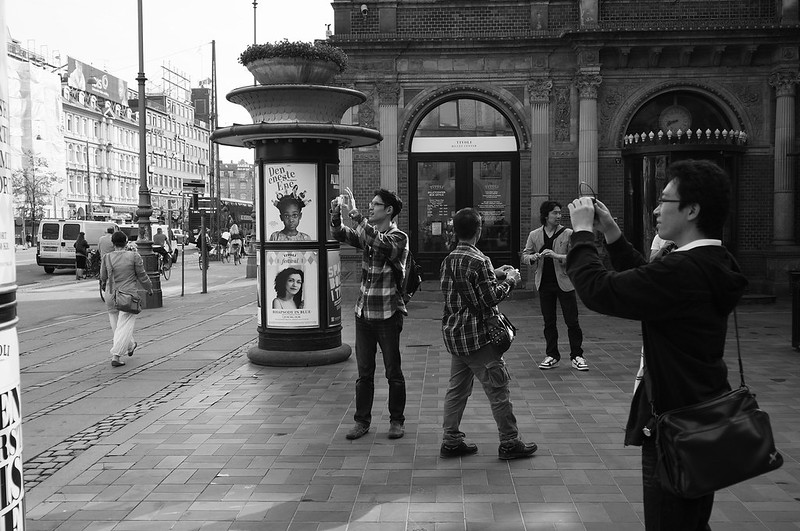
      Super-Wide Heliaf 15mm/4.5. This lens is obviously one of those that he
      would be interested to fit on his Leica M3. Now he has started his own
      series with camera portraits like the one in <a href="https://tokyocamerastyle.com/">Tokyo Camera Style</a>. See his Lund
      Camera Style (Now gone).</p>
    </div>
  </content>
  <dc:date>2011</dc:date>
  <category label="photography" term="Photography"/>
  <category label="hardware" term="Hardware"/>
  <category label="neighbours" term="Neighbours"/>
  <updated>2011-05-24T06:48:57+01:00</updated>
  <id>https://sigfrid-lundberg.se/entries/2011/05/gustav/</id>
</entry>
  <entry>
  <author>
    <name>Sigfrid Lundberg</name>
  </author>
  <title>On focusing on the essentials</title>
  <link href="https://sigfrid-lundberg.se/entries/2011/05/focus/"/>
  <summary>I acquired a socalled mirrorless interchangable lens camera in
  August last year. Since than I have used it exclusively with manual focus
  vintage lenses. Here I discuss my experience blending old and new imaging
  technologies.</summary>
  <content type="xhtml">
    <div xmlns="http://www.w3.org/1999/xhtml">

      <p>Photography is visual storyteling, among other things. The stories I
      want to tell isn't about photographic equipment but about us human
      beings, our environments, emotions and about our time inasmuch as one
      can learn anything about that from what I see in my own life.</p>

      <div style="float: left; width: 240px; margin-left: 0.2em; margin-right: 0.5em;">
	<a href="https://www.flickr.com/photos/sigfridlundberg/5584797428/" title="Four lenses and a camera by Sigfrid Lundberg, on Flickr">
	  <img src="https://farm6.static.flickr.com/5178/5584797428_26d8d7b5dd_m.jpg" width="240" height="180" alt="Four lenses and a camera"/>
	</a>
	<p>
	  <small>
	    Figure 1. 
	    This is what I carry with me in terms of photographic
	    equipment. Gadgets from left to right (links takes you to my
	    corresponding Flickriver sets).

	    (1) <a href="https://www.flickriver.com/photos/sigfridlundberg/tags/nikkorpcauto105mmf25/">Nikkor-PC Auto 105mm f/2.5</a>,

	    (2) Voigtlander F Mount to micro four thirds adaptor

	    (3) Olympus PEN E-P2 with <a href="https://www.flickriver.com/photos/sigfridlundberg/tags/mrokkor40mmf2/">M-Rokkor
	    40mm f/2.0</a> mounted using a Leica M to micro four thirds
	    adaptor

	    (4) <a href="https://www.flickriver.com/photos/sigfridlundberg/tags/nikkoroauto12f35mm/">Nikkor-O
	    Auto 35mm f/2.0</a> and finally

	    (5) <a href="https://www.flickriver.com/photos/sigfridlundberg/tags/heliar15mm45/">Voigtländer
	    Heliar 15mm f/4.5</a>.
	  </small>
	</p>

      </div>

      <p>Equipment should really be unimportant. <a href="https://en.wikipedia.org/wiki/Ernst_Haas">Ernst Haas</a> is
      reported to have made the following remark on the question which camera
      brand is best: <q><em>All of them can record what you are seeing.  But,
      you have to SEE.</em></q> (Quoted from Ken Rockwell's <a href="https://www.kenrockwell.com/tech/notcamera.htm"><em>Your Camera
      Doesn't Matter</em></a>. He claims that the anecdote comes from Murad
      Saÿen. Anyway, Rockwell's essay on photographic quality is brilliant.)</p>

      <p>However, it is the equipment that give me the means for telling those
      stories. A camera consists of a lens and a body. Today a body is
      obsolete in two or three years time and their longevity is decreasing
      and will approach that of a mobile phone. The lens is a serious matter
      for me, and I cannot stand the idea to acquire new lenses just because
      I've bought a new body.</p>

      <p>About a month after I had bought my new digital system camera I
      decided that I wanted to use my old Nikon lenses, and that I wanted to
      get a small but useful collection of manual prime lenses (Figure 1).</p>

      <p>There are issues with using manual lenses. One of them is that you
      have to focus. Manually. This entry is about focusing. I illustrate it
      with examples from my own photography, which may not be perfectly sharp.</p>

      <p>Thom Hogan has written about using manual lenses on micro four third
      bodies. His conclusions are:</p>

      <div style="float: right; width: 240px; margin-left: 0.2em; margin-right: 0.5em;">
	<a href="https://www.flickr.com/photos/sigfridlundberg/5547406852/" title="P3215641.jpeg by Sigfrid Lundberg, on Flickr"><img src="https://farm6.static.flickr.com/5296/5547406852_a510b32eda_m.jpg" width="240" height="192" alt="P3215641.jpeg"/></a>
	<p>
	  <small>Figure 2. The first out-door beer in the spring is most likely the best
	  beer under the sun. Street photography using Voigtländer
	  Super-Wide Heliar 15mm f/4.5.</small>
	</p>
      </div>

      <blockquote>
	<em>My personal take is that manual focus really only works well in
	two situations: where you have a stationary subject and time; and when
	you use depth of field and a preset focus distance (ala Henri
	Cartier-Bresson's shooting style).</em>
	(Thom Hogan)
      </blockquote>

      <p>I have no problems with Henri Cartier-Bresson's shooting style. I use
      that all the time. I mount my 15mm Heliar using a Leica M adaptor and
      at aperture 8 I have a depth of field from less than a meter to
      infinity (Figure 2).</p>

      <p>The Flickr group <em>Decisive Moment</em> devoted to street
      photography in Cartier-Bresson's style. The guidelines states, among
      other things that</p>

      <blockquote>
	<em>There should be a Background that contributes to the overall
	composition. In most cases this Background is in focus.</em> <a href="https://www.flickr.com/groups/decisivemoment/">Decisive
	Moment</a>.
      </blockquote>

      <div style="float: left; width: 240px; margin-left: 0.2em; margin-right: 0.5em;">
	<a href="https://www.flickr.com/photos/sigfridlundberg/5148714650/" title="PB052824.JPG by Sigfrid Lundberg, on Flickr">
	<img src="https://farm5.static.flickr.com/4053/5148714650_22dcf55b4d_m.jpg" width="240" height="180" alt="PB052824.JPG"/></a>
	<p>
	  <small>Figure 3. My Nikkor-O Auto 35mm f/2.0 and the 40mm M-Rokkor coexists
	  because they occupy slightly different ecological niches. Nikkor-O
	  has a closest range at about 30cm is it is an almost macro
	  lens. At aperture 2 and 2.8 it has a very nice bokeh.</small>
	</p>
      </div>

      <p>So, what was enforced by necessity, the level of technological
      development between 1930-1960 has become an artitistic characteristic of
      a genre. However, the Henri Cartier-Bresson shooting style is more or
      less implemented in hardware in all point and shoot compact
      cameras. Mobile cameras have a very large depth of field, since the very
      small sensor gives you a standard lens with a small focal length.</p>

      <div style="float: right; width: 185px; margin-left: 0.2em; margin-right: 0.5em;">
	<a href="https://www.flickr.com/photos/sigfridlundberg/5661809924/" title="P4267104.tif by Sigfrid Lundberg, on Flickr"><img src="https://farm6.static.flickr.com/5190/5661809924_f3288fdd53_m.jpg" width="185" alt="P4267104.tif"/></a>
	<p><small>Figure 4. Pas de Quatre. M-Rokkor 40mm f/2.0</small></p>
      </div>

      <p>I have a need for being able to take photos of small
      things. Obviously a macro lens would have been ideal, but I have not yet
      been able to acquire one of those. However, my two Nikon F mount lenses
      are both <q>almost macro</q>. The 35mm lens allows me to focus on
      objects as close as about 25cm (Figure 3).</p>

      <div style="float: left; width: 185px; margin-left: 0.2em; margin-right: 0.5em;">
	<a href="https://www.flickr.com/photos/sigfridlundberg/5649487689/" title="P4246901.tif by Sigfrid Lundberg, on Flickr"><img src="https://farm6.static.flickr.com/5101/5649487689_3f18728706_m.jpg" width="185" height="240" alt="P4246901.tif"/></a>
	<p><small>Figure 5. The knob on my roller blinds. My bedroom window is
	dirty.</small></p>
      </div>


      <p>To focus swiftly on a moving insect or something as close as 25cm
      with a paperthin DOF is difficult. I have tried it, but not very much. A
      preset focus distance won't help very much.</p>

      <p>On the street you can choose a stage where you expect a subject may
      appear. You can focus on something on adjust the DOF and wait. Press the
      shutter in the decisive moment. This is preset focus, mentioned by
      Hogan.</p>

      <p>With my 35mm (Figure 3), 40mm (Figure 4 &amp; 5) and 105mm lenses
      (Figure 6) I have to focus and do so accurately. The four people on
      Figure 4 is a very good example on a shot with preset focus. I focused
      on the door behind the people when I saw them approaching, and got two
      shots while they passed each other.</p>

      <p>Then we have the knob on my roller blinds (Figure 5). The knob is
      sharp. You can find it in the lower right corner of the image. The dirt
      on the window is in focus as well. I took photo just because I wanted to
      demonstrate how you can control the focusing of a manual lens. I've
      tried in vain to repeat that with an auto-focus lens.</p>

      <p>There are three issues for me here. (i) The feeling of the lens when
      you use it, (ii) You're ability to control the depth of field and (iii)
      the attitude that photographic equipment is some kind of electronic
      consumer equipment stuff, rather than means for artistic creation.</p>

      <p>Manual focus lenses permit me to focus on the essentials. What I can
      see. Not on what the camera designers think I would like to focus on. When
      I fail, I cannot blame it on anyone else.</p>

      <div style="width: 100%; margin-left: 0.2em; margin-right: 0.5em;">
	<div style="float: left; width: 75%; margin-left: 0.2em; margin-right: 0.5em;">
	  <a href="https://www.flickr.com/photos/sigfridlundberg/5689583652/" title="P5047285_bw.tif by Sigfrid Lundberg, on Flickr"><img src="https://farm6.static.flickr.com/5110/5689583652_81c1107618.jpg" width="100%" alt="P5047285_bw.tif"/></a>
	</div>

	<p style="float: left; width: 20%;"><small>Figure 6. Two pair of
	shoes. Nikkor-PC Auto 105mm f/2.5. Of the lenses discussed here, this
	is the hardest one to focus. But this is a point-focus-shoot capture,
	one of those where manual focus lenses are useless according to
	Hogan.</small></p>

	<p style="float: left; width: 20%;"><small>You have to practice for
	months to do this fast. I'm not there yet and estimate that I succeed
	on less than half of the images I capture with this lens.</small></p>

      </div>

    </div>
  </content>
  <dc:date>2011</dc:date>
  <category label="images" term="Images"/>
  <category label="photography" term="Photography"/>
  <category label="hardware" term="Hardware"/>
  <updated>2011-05-07T10:44:19+01:00</updated>
  <id>https://sigfrid-lundberg.se/entries/2011/05/focus/</id>
  <!-- $Id$ -->
</entry>
  <entry>
  <author>
    <name>Sigfrid Lundberg</name>
  </author>
  <title>A Leica lens from Minolta?</title>
  <link href="https://sigfrid-lundberg.se/entries/2011/04/rokkor/"/>
  <summary>The M Rokkor lenses were produced by Minolta for their excellent
  rangefinder camera Minolta CLE. I aquired one of them, the 40mm f2.0, for
  use with my Olympus E-P2.</summary>
  <content type="xhtml">
    <div xmlns="http://www.w3.org/1999/xhtml">
       <div style="float: right; width: 50%; margin-left: 0.2em; margin-right: 0.5em;">
	 <a href="https://www.flickr.com/photos/sigfridlundberg/5496533284/" title="Minolta M-Rokkor 40mm f/2.0 by Sigfrid Lundberg, on Flickr">
	   <img src="https://farm6.static.flickr.com/5259/5496533284_b6846740e7_b.jpg" alt="Minolta M-Rokkor 40mm f/2.0" style="width:100%"/>
	 </a>
	 <p>
	   <small>Minolta M-Rokkor 40mm f/2.0 mounted on an Olympus Digital
	   Pen (E-P2).</small>
	 </p>
       </div>

       <p>The rangefinder camera <a href="https://en.wikipedia.org/wiki/Leica_CL">Leica CL</a> (also known
       as Leica Minolta CL) appeared 1973 as a joint venture between Leitz and
       Minolta. The collaboration did not last long, and the next version of
       this product was called Minolta CLE. without carrying a "Leica" or a
       Leitz logo.</p>

       <blockquote>
	 <em>
	   The Minolta CLE was introduced 1980. Yet, father Leitz makes haste
	   very slowly.  Until the introduction of the Leica M7 in 2001, the
	   CLE remained for 21 years the most technologically advanced Leica M
	   mount camera ever produced.  Not bad, for a Minolta.  Most CLE
	   owners consider it one of the best cameras they have ever owned.
	 </em>
	 <a href="https://www.cameraquest.com/cle.htm">Stephen Gandy,
	 CameraQuest</a>
       </blockquote>

       <div style="float: left; width: 50%; margin-left: 0.2em; margin-right: 0.5em;">
	 <a href="https://www.flickr.com/photos/sigfridlundberg/5674707921/" title="P4307205.ORF by Sigfrid Lundberg, on Flickr">
	   <img src="https://farm6.static.flickr.com/5143/5674707921_1ffd141bab_b.jpg" style="width:100%" alt="P4307205.ORF"/>
	 </a>
	 <p><small>Dandelions shot with M Rokkor 30 April 2011. The aperture was 2.8,
	 so the background became blurred.</small></p>
       </div>

       <div style="float: right; width: 50%; margin-left: 0.2em; margin-right: 0.5em;">
	 <a href="https://sigfrid-lundberg.se/entries/2011/04/rokkor/P4116371_v1.JPG" title="Gammel strand">
	 <img src="https://sigfrid-lundberg.se/entries/2011/04/rokkor/P4116371_v1.JPG" style="width:100%" alt="Gammel strand"/></a>
	 <p>
	   <small>Gammel strand from Højbro. Holmens' canal, Copenhagen.</small>
	 </p>
       </div>

       <p>The M Rokkor lenses were produced by Minolta for this excellent camera.
       I've recently aquired one of them, the 40mm f2.0, for use with my
       Olympus E-P2. On 35mm film leica M mount camera that lens is a standard
       (or <q>normal</q>) lens, albeit a bit more shorter than normal. On my micro
       four thirds camera it becomes a short telephoto lens, with a focal length
       suitable for portrait and landscape photography</p>

       <div style="float: left; width: 50%; margin-left: 0.2em; margin-right: 0.5em;">
	 <a href="https://www.flickr.com/photos/sigfridlundberg/5516412953/" title="P3105155.tif by Sigfrid Lundberg, on Flickr"><img src="https://farm6.static.flickr.com/5176/5516412953_71eb5bdedb_b.jpg" style="width:100%" alt="P3105155.tif"/></a>
	 <p>
	   <small>The antiquarian bookstore is closed at night.</small>
	 </p>
       </div>

       <p>I'm not going to review the lens. Instead I'll refer to the
       following rather personal statement, again from Stephen Gandy:</p>

       <blockquote>
	 <em>The 40/2 lenses for the CL or CLE are among the sharpest lenses I
	 have ever used.</em> 
	 <a href="https://www.cameraquest.com/cle.htm#Minolta%20CL%20and%20CLE%20Lenses">Stephen
	 Gandy, CameraQuest</a>
       </blockquote>

       <p>There are a lot of useful and interesting information to gather
       about rangefinder technologies; Stephen Gandy has a lot less info left
       to gather than most of us.</p>

       <p>I love this lens. Here <a href="https://www.flickriver.com/photos/sigfridlundberg/tags/mrokkor40mmf2/">you
       can see some photos</a> taken with it in Flickriver.</p>


    </div>
  </content>
  <dc:date>2011</dc:date>
  <category label="images" term="Images"/>
  <category label="lenses" term="Lenses"/>
  <category label="photography" term="Photography"/>
  <category label="hardware" term="Hardware"/>
  <updated>2011-05-03T08:30:52+01:00</updated>
  <id>https://sigfrid-lundberg.se/entries/2011/04/rokkor/</id>
</entry>
  <entry>
  <author>
    <name>Sigfrid Lundberg</name>
  </author>
  <title>I have smoked a cigarr together with The Book Thief</title>
  <link href="https://sigfrid-lundberg.se/entries/2011/01/thief/"/>
  <summary>This is the story about the one and only book thief I've met</summary>
  <content type="xhtml">
    <div xmlns="http://www.w3.org/1999/xhtml">

      <p>Around 2003 I began the political foot work to establish <a href="https://web.archive.org/web/*/http://www.ediffah.org/">Ediffah</a>,
      a project aiming at establishing an union catalog for archival
      collections at the larger Swedish research libraries. As usual
      when you're up to something like that you have to talk to and
      visit the right people.</p>

      <div style="width:500px;float:right;margin-left:0.5em; margin-right:0.2em;">
	<a href="https://www.flickr.com/photos/sigfridlundberg/5351656340/" title="P1133870_adjusted.JPG by Sigfrid Lundberg, on Flickr">
	<img src="https://farm6.static.flickr.com/5283/5351656340_18ece5cce0.jpg" style="width:100%;" alt="P1133870_adjusted.JPG"/>
	</a>
      </div>

      <p>One of the right people, in this case, was the Head of Manuscript and
      Rare books collections at the <a href="https://www.kb.se/in-english.html/">National Library of Sweden</a>
      (KB). Let's call him John, since that is what he is called in the TV
      series that came up recently on Swedish National Television.</p>

      <p>I met John in his office at KB. He had a light grey tailored suit, a
      white shirt and a thick tie with broad stripes in white and dark and
      light blue. His suit jacket hang on his chair. What I remember most was
      the very whiteness of his shirt, and how he mixed intellectual
      brilliance with arrogance. Intellectuals are common in the library
      communities, but John was an odd fowl with his shirt and his
      arrogance.</p>

      <p>We met two more times, both times were project meetings within
      Ediffah. A handful archivists and manuscript curators from the National
      Archives and the largest research libraries. John and one other member
      of the group had both earned their doctorates at a the same department
      of Uppsala University. The two former colleagues apparently hated each
      other, but John was the only one of the two who showed it.</p>

      <h3>Arrest and death</h3>

      <p>One morning in December 2004, the unravelling of large scale book theft
      was the leading news items on radio and our daily paper. The value of
      the stolen material amounted to tens of millions SEK. By lunch the
      identity of the thief had reached all research libraries in the
      nation.</p>

      <div style="width:380px;float:left;margin-left:0.2em; margin-right:0.5em;">
	<a href="https://www.expressen.se/nyheter/har-bodde-boktjuven/">
	  <img src="https://static.cdn-expressen.se/images/cb/e1/cbe1e076ac70c3337432209c57c0471e/375@60.jpg" alt="Here lived the book thief" style="width:375px;"/>
	</a>
      </div>

      <p>A friend of mine, Birgitta Lindholm, curator of manuscripts at Lund
      university library, told me her story of that morning. All libraries
      with something like a manuscript collection participate in a
      collaboration and their responsible curators meet regularly. They should
      have a meeting this day. She picked up a paper at the airport and
      started to read about the theft. And how one of the leaders at the
      library had been arrested.</p>

      <p>All curators appeared at the meeting. Except John. They took for
      granted that he was needed in his office that morning. After his
      confession and after the police had all what it has to do in a case like
      this, John was released while waiting for his trial. Three days later he
      ended his life in a most dramatic way.</p>

      <p>I once smoked a cigarr with John.</p>

    </div>
  </content>
  <dc:date>2011</dc:date>
  <category label="thelibrary" term="The Library"/>
  <category label="stories" term="Stories"/>
  <updated>2011-01-12T07:59:21+01:00</updated>
  <id>https://sigfrid-lundberg.se/entries/2011/01/thief/</id>
  <!-- $Id$ -->
</entry>
  <entry>
  <author>
    <name>Sigfrid Lundberg</name>
  </author>
  <title>A tale of two lenses</title>
  <link href="https://sigfrid-lundberg.se/entries/2010/12/twolenses/"/>
  <summary>Here I discuss two lenses. Both are very new. I've owned them less
  than three months, and they represent recent developments from the
  respective companies building them. But appart from that they differ in
  almost all aspects. Even in the very idea behind their existence.</summary>
  <content type="xhtml">
    <div xmlns="http://www.w3.org/1999/xhtml">

      <p>Here I discuss two lenses. Both are very new. I've owned them less
      than three months, and they represent recent developments from the
      respective companies building them. But appart from that they differ in
      almost all aspects. Even in the very idea behind their existence.</p>

      <h3>Superwide Heliar 15mm F4.5</h3>

      <p>Heliar is produced by Cosina Voigtländer. There is no company having
      that name, though. Cosina is a Japanese company building cameras and
      camera lenses. Voigtländer is one of the very old brands in German
      optical industries. It is Johann Christoph Voigtländer founded the
      company 1756 long before Louis Daguerre invented the photographic
      process.</p>

      <div style="float: left; width: 500px; margin-left: 0.2em; margin-right: 0.5em;">
	<a href="https://www.flickr.com/photos/sigfridlundberg/5224148878/" title="PC013081.JPG by Sigfrid Lundberg, on Flickr">
	<img src="https://farm6.static.flickr.com/5242/5224148878_e461521268.jpg" alt="PC013081.JPG"/>
	</a>
	<p><small>Copenhagen harbour. Photo taken from the office of the
	development team at Royal Library using the Cosina Voigländer
	Superwide Heliar 15mm F4.5.</small></p>
      </div>

      <p><a href="https://en.wikipedia.org/wiki/Cosina">Cosina</a>, on the
      other hand, was founded 1959 during the Japanese industrial expansion
      after the second world war. The company have made very little for sale
      under its own brand but much more producing lenses and bodies for sale
      under brands like Nikon, Contax, Zeiss and now most recently
      Voigtländer. While Cosina builds, for instance, Zeiss Ikon cameras
      designed by the German Company, Cosina has leased and controls
      Voigtländer brand. The products sold as Voigtländer are interesting,
      such as lenses bodies for the Nikon S, Contax and Leica M systems. You
      can actually get a modern lens produced for a camera system that Nikon
      discontinued 1965.</p>

      <p>I can very much symphasize with those ideas. Cosina is designing and
      marketing new stuff in a more of 50 years tradition. And a lot of people
      wants their products, but, yes, the products addresses various niche
      markets.</p>

      <p>The Superwide Heliar is a Leica M mount lens. I bought it because I
      wanted a classical wideangle lens and because it has got <a href="https://www.kenrockwell.com/voigtlander/15mm-m.htm">wonderful
      reviews</a>. One that allows me to set focus at 3 meter, and aperture 8
      and then be able to expect that just about everything from <a href="https://www.flickr.com/photos/36853098@N06/5108217890">one meter to
      infinity is within focus</a>.  It works. Heliar is exectly that kind of
      lens. Excellent for <a href="https://www.flickr.com/photos/sigfridlundberg/5024127214/">candid
      street photography</a> where you are not able to focus at all. Such a
      lens is wonderful for capturing a lot at the same time, such as <a href="https://www.flickr.com/photos/sigfridlundberg/5126351059">a lot of
      water</a> or a lot of <a href="https://www.flickr.com/photos/sigfridlundberg/5068063027/">just
      about anything, such as trees</a>. The wideangle lens captures it
      all. For some reason, there always seem to be even more of the stuff on
      your photo. More water or more trees.</p>

      <div style="clear: both;">

      </div>

      <h3>M.Zuiko Digital 14-42mm F3.5-5.6</h3>

      <p>I cannot mount the Superwide Heliar on my Micro Four Thirds (MFT)
      camera without an adaptor. The M.Zuiko lens came with the camera. MFT is
      its native language as it was designed to be the kit lens, and I suppose
      that such a thing has to be as good as ever possible at a minimum
      cost. This lens is one of the basic sales arguments for the body as well
      as further investments. It has <a href="https://www.lenstip.com/235.1-Lens_review-Olympus_M.Zuiko_Digital_14-42_mm_f_3.5-5.6_ED__Introduction.html">got
      good reviews</a>, and I think that it deserves it.</p>

      <!-- div style="float: right; width: 500px; margin-left: 0.2em; margin-right: 0.5em;">
	<a href="https://www.flickr.com/photos/sigfridlundberg/5221326078/" title="PB303056.JPG by Sigfrid Lundberg, on Flickr">
	<img src="https://farm5.static.flickr.com/4108/5221326078_f3de2cbcae.jpg" alt="PB303056.JPG"/>
	</a>

	<p><small>Copenhagen harbour. Photo taken from the office of the
	development team at Royal Library using the 
	M.Zuiko Digital 14-42mm F3.5-5.6</small></p>
      </div -->

      <p>Other sale arguments involves ease of use, rapid autofocus good zoom and
      whatever.</p>

      <p>The zoom starts at 14mm. It is actually wider than the Heliar. The
      snag is that when I mount a zoom I mentally adjust myself to zooming. I
      use the zoom as an aid for composing, basically for cropping. What I'm
      not doing is mentally to have both a wideangle and a short telephoto
      mounted and that I am able to choose between a shallow and a deep depth
      of field. Here we come to the point that is crucial to me. Fixed focal
      length manual lenses make me aware of the lens.</p>

      <h3>Consciousness</h3>

      <p>I don't like this lens because I feel that I'm not aware of what's
      going when I use it. It is not the zoom, it is not the automatic
      focussing but rather the fact that the zoom goes from wideangle to
      telephoto. I think that sort of loose the awareness of what kind of lens
      I'm using. The new M.Zuiko <a href="https://www.dpreview.com/reviews/olympus-m-14-150-4-5p6-o20">14-150mm</a>
      would be a nightmare for me, but I think I would love the new <a href="https://www.flickr.com/photos/74082557@N00/4945742928">75-300mm</a>
      one and similarly I think I would like <a href="https://www.dpreview.com/reviews/olympus-m-9-18-4-5p6-o20">the
      9-18mm</a>.</p>

      <p>I think a lens need an identity. Heliar has got the wideangle niche
      in my heart.</p>

    </div>
  </content>
  <dc:date>2010</dc:date>
  <category label="images" term="Images"/>
  <category label="hardware" term="Hardware"/>
  <updated>2010-12-02T20:05:18+01:00</updated>
  <id>https://sigfrid-lundberg.se/entries/2010/12/twolenses/</id>
  <!-- $Id$ -->
</entry>
  <entry>
  <author>
    <name>Sigfrid Lundberg</name>
  </author>
  <title>On patience and bus stops</title>
  <link href="https://sigfrid-lundberg.se/entries/2010/11/patience/"/>
  <summary>Waiting at a bus stop can learn us something significant about
  human nature</summary>
  <content type="xhtml">
    <div xmlns="http://www.w3.org/1999/xhtml">

      <p>Waiting is not for everyone. I'm good at it, though. Brilliant, if I
      may say so myself. I've practiced. I'm particularly good at waiting
      for public transports. Such as waiting for trains. Or buses.</p>

      <p><q style="font-style:italic;">Patience</q>, states <a href="http://books.google.com/books?id=q2cJAAAAQAAJ&amp;dq=%22art%20of%20waiting%22&amp;pg=PA119&amp;ci=134%2C1267%2C380%2C131&amp;source=bookclip">The
      Mirror</a> (Saturday 19, 1825), <q style="font-style:italic;">is the art
      of waiting.</q> That's true, for sure. But then the editor continues: <q style="font-style:italic;">Time passes quickly with him who hopes for
      days and lives for the morrow. Hope has such efficacy that it can lead
      us to the end of life through an agreeable path and even beyond life
      itself.</q> Interesting concept. The hopeful ones are those who believe
      that the bus will come and pick them up before they die. Or least such
      that they arrive home before dinner.</p>

      <p>I think that the The Mirror is wrong. Patience comes from the
      erroneous conviction that time spent waiting is an investment or an
      asset of some kind. The really patient person is the one who after
      waiting for (say) a quarter of an hour, dismisses the option to take a
      cab or walk, because he feels that he will then somehow loose the time
      he'd investmented in waiting. You've heard it, haven't you: <q>Let's
      wait five minutes more.</q></p>

      <p>Mind you, it's even worse than that, since it takes just twenty
      minutes to walk.</p>

    </div>
  </content>
  <dc:date>2010</dc:date>
  <category label="essays" term="Essays"/>
  <updated>2010-11-28T22:32:50+01:00</updated>
  <id>https://sigfrid-lundberg.se/entries/2010/11/patience/</id>
  <!-- $Id$ -->
</entry>
  <entry>
  <author>
    <name>Sigfrid Lundberg</name>
  </author>
  <title>Peer review and request for comments</title>
  <link href="https://sigfrid-lundberg.se/entries/2010/11/rfc/"/>
  <summary>Laurent Romary and myself have authored an RFC. That means a
  Request For Comments. I now understand why.</summary>
  <content type="xhtml">
    <div xmlns="http://www.w3.org/1999/xhtml">
      <p><a href="https://sigfrid-lundberg.se/entries/2010/03/appteixml/">Earlier
      this year</a> Laurent Romary and myself authored an Internet Draft,
      which is the first step towards a Request For Comments (RFC). Now the
      text has been trough the review process and we have made all the
      revisions required. So, finally it has been approved by the <a href="https://www.iesg.org">IESG</a>'s review process. I do now
      understand the RFC concept.</p>

      <p>Internet was created by people connected to the <a href="https://en.wikipedia.org/wiki/Darpanet">DARPA net</a> family of
      projects with the first serious experimental work starting around
      1968. The people who did it were affiliated to various US universities
      and a few companies capable mean, you send your idea on how Internet can
      be made better to your fellow researches in ARPA net.</p>

      <p>It seems that these people communicated their findings by storing and
      circulating them as oddly formatted text files on the very
      infrastructure that were the subject for their research. And now more
      than forty years later there still is this mix of individuals from
      academic and corporate research environments from all over the
      world. Friendly geeks who want that the Internet should be good place
      for its users. So, when you submit a draft you <em>do</em> get the
      comments you requested. You get a lot of them and in our case they were
      all constructive and friendly. The process is <a href="https://datatracker.ietf.org/doc/draft-lundberg-app-tei-xml/">open</a></p>

      <p>That's why its called an RFC and thats why they Internets
      standardization procedures works so well.</p>

    </div>
  </content>
  <dc:date>2010</dc:date>
  <category label="internet" term="Internet"/>
  <updated>2010-11-25T18:31:04+01:00</updated>
  <id>https://sigfrid-lundberg.se/entries/2010/11/rfc/</id>
  <!-- $Id$ -->
</entry>
  <entry>
  <author>
    <name>Sigfrid Lundberg</name>
  </author>
  <title>Portrait of a lens: NIKKOR-O Auto 1:2 f=35mm</title>
  <link href="https://sigfrid-lundberg.se/entries/2010/10/nikkor35mm/"/>
  <summary>Portrait of a lens I've kept since I was a teenager.</summary>
  <content type="xhtml">
    <div xmlns="http://www.w3.org/1999/xhtml">
      <p>This is a portrait of a lens I've kept since I was a teenager. You
      can see it in <a href="https://sigfrid-lundberg.se/entries/2010/08/m43/#nikkorO">an
      earlier entry</a>. There are quite a few web sites from Nikon F
      aficionados, such as Richard de Stoutz' <a href="https://www.destoutz.ch/nikon-f.html">Nikon F Collection &amp;
      Typology</a> who owns an almost <a href="https://www.destoutz.ch/lenses_wideangle_35mm_f2.html">complete
      series of the lens</a> and experienced professional users such as <a href="http://www.naturfotograf.com/lens_surv.html">Bjørn
      Rørslett</a>. who owns <q>some 100 lenses</q> and give ratings a lot of
      them, including Nikon F <a href="http://www.naturfotograf.com/lens_wide.html">wide angle
      ones</a>. This particular lens gets rating 5 for for traditional use
      with film and 4 otherwise. 5 is the highest rating and means:</p>

      <div style="float: right; width: 45%;margin-left:0.2em; margin-right:0.5em;">
	<a href="https://www.flickr.com/photos/sigfridlundberg/4993393887/" title="Brugmansia suaveolens by Sigfrid Lundberg, on Flickr">
	  <img src="https://farm5.static.flickr.com/4103/4993393887_55eba5d46b_b.jpg" style="width:100%" alt="Brugmansia suaveolens"/>
	</a>
	<p>
	  <small>I took this photo of Angel's trumpet, <em>Brugmansia
	  suaveolens</em>, in the garden of Ny Carlsberg Glyptotek. This plant
	  is as beautyful as it is extremely poisonous.</small>
	</p>
      </div>

      <blockquote>
	<p><em>Excellent. Use such lenses as often as possible and let other
	people wonder about the quality you can achieve with them.</em></p>
      </blockquote>


      <p>The rating 4 means <q>Very good, quality results can be
      expected. Such lenses can safely be applied to professional
      photography.</q> I leave it to Bjørn, Richard and others to achieve the
      quality people will wonder about. A lens is an artist's tool, and the
      quality of the result depends on his or her skills.</p>

      <p>Be that as it may; a survey on <a href="https://www.ebay.com">eBay</a>
      shows that you can get one of these for between $20 and $100, depending
      on whether the previous owners have used it <q>as often as possible</q>
      or not. If you're lucky and get it from someone who didn't understand
      just how good this lens is, then it is a bargain. Promise.</p>

      <div style="float: left; width: 45%;margin-left:0.2em; margin-right:0.5em;">
	<a href="https://www.flickr.com/photos/sigfridlundberg/5100556782/" title="PA202467.JPG by Sigfrid Lundberg, on Flickr">
	  <img src="https://farm2.static.flickr.com/1080/5100556782_2e8b7b4b79_b.jpg" style="width:100%" alt="PA202467.JPG"/>
	</a>
	<p>
	  <small>The bar in The Old Bull's pub in Lund. Taken hand-held late
	  in the evening, with the aperture wide open.</small>
	</p>

      </div>

      <p>Initially, I found it extremely hard to focus this lens. The first
      time I felt that I got almost right was when I took the photo the
      Angel's trumpet. The lens has a minimum distance of less than 30cm so you
      can use it for macro photography. And as you can see, it has a nice <a href="https://en.wikipedia.org/wiki/Bokeh">bokeh</a> with the aperture
      wide open.</p>

      <div style="float: right; width: 45%;margin-left:0.2em; margin-right:0.5em;">
	<a href="https://www.flickr.com/photos/sigfridlundberg/5100557280/" title="PA202470.JPG by Sigfrid Lundberg, on Flickr">
	<img src="https://farm2.static.flickr.com/1372/5100557280_e968de7710_b.jpg" style="width:100%" alt="PA202470.JPG"/>
	</a>
	<p>
	  <small>Taken hand-held on my way home from the Old Bull. The lens is
	  wide open and it is night and the first winter mix is falling.</small>
	</p>
      </div>

      <p>The lens is fast, if not ultra-fast. I mean it isn't <a href="https://www.adorama.com/lc50095mn.html">Noctilux 50mm f0.95 at
      $10,000</a>, Voigtlander Nokton 50mm f1.1 or even any of all the f1.4
      around.</p>

      <p>The speed of the lens makes the depth of field quite small, and that
      does actually make it easier to focus. Just focus wide open¸ and then
      lessen aperture to something where your target is sharp. Then you get
      nice images for around $50.</p>
      
      <div style="clear: both;">
	<a style="float: left; width: 45%;margin-left:0.2em; margin-right:0.5em;" href="https://www.flickr.com/photos/sigfridlundberg/5105205147/" title="PA212483.JPG by Sigfrid Lundberg, on Flickr">
	  <img src="https://farm2.static.flickr.com/1260/5105205147_d00a9d8e66.jpg" style="width:100%" alt="PA212483.JPG"/>
	</a>
	<p>
	  <small>This is an early morning in my life as an <a href="/entries/2009/07/commuting/">international
	  commuter</a>. It happens now and then that the train from Lund to
	  Copenhagen is cancelled from Malmö. Then you have to wait for the
	  next train from Lund to Malmö and spend twenty minutes
	  philosophizing around this special case of the <a href="https://en.wikipedia.org/wiki/Theodice_problem">theodicé
	  problem</a>: How can there exist a good God, when I could have
	  stayed in another twenty minutes in bed.</small>
	</p>
	<p>
	  <small>Since you cannot go to bed you can just as well just look
	  across the channel, towards the old city of Malmö. Which is, quite
	  nice. Why not take a photograph of it?</small>
	</p>
      </div>
    </div>
  </content>
  <dc:date>2010</dc:date>
  <category label="images" term="Images"/>
  <category label="hardware" term="Hardware"/>
  <category label="lenses" term="Lenses"/>
  <category label="photography" term="Photography"/>
  <updated>2010-10-29T09:44:52+01:00</updated>
  <id>https://sigfrid-lundberg.se/entries/2010/10/nikkor35mm/</id>
  <!-- $Id$ -->
</entry>
  <entry>
  <author>
    <name>Sigfrid Lundberg</name>
  </author>
  <title>Newsagent predictions</title>
  <link href="https://sigfrid-lundberg.se/entries/2010/08/glossy/"/>
  <summary>According to Wikipedia, a newsagent is the owner of a newsagent's
  shop (or news stand in US English). The stock in his or her shop contains
  items that are expected to interest the market.</summary>
  <content type="xhtml">
    <div xmlns="http://www.w3.org/1999/xhtml">
      <p>According to Wikipedia, a newsagent is the owner of a newsagent's
      shop (or news stand in US English). The stock in his or her shop
      contains items that are expected to interest the market. Earlier this
      year I realized that some of my <a href="https://sigfrid-lundberg.se/entries/2010/04/perl/">experience</a>
      indeed were regarded as useful in more glossy contexts.</p>

      <div style="float:right;width:45%;margin-right:0.5em;margin-left:0.5em;">
	<a rel="viewer" href="https://sigfrid-lundberg.se/entries/2010/08/glossy/20100831_004.jpg">
          <img id="img1" src="https://sigfrid-lundberg.se/entries/2010/08/glossy/20100831_004.jpg " width="100%" alt="Linux Format PHP Coding"/>
        </a>
      </div>

      <p>All of a sudden Knoppix Admin and Linux Format PHP coding is Glossy.</p>

      <div style="clear: both;">
	<pre>
	</pre>
      </div>

      <div style="float:left;width:45%;margin-right:0.5em;margin-left:0.5em;">
	<a rel="viewer" href="https://sigfrid-lundberg.se/entries/2010/08/glossy/20100831_005.jpg">
          <img id="img2" src="https://sigfrid-lundberg.se/entries/2010/08/glossy/20100831_005.jpg " width="100%" alt="Users &amp; Developers want to Master Linux Now"/>
        </a>
      </div>

      <p>Users &amp; Developers want to Master Linux Now</p>

      <div style="clear: both;">
	<pre>
	</pre>
      </div>

      <div style="float:right;width:45%;margin-right:0.5em;margin-left:0.5em;">
	<a rel="viewer" href="https://sigfrid-lundberg.se/entries/2010/08/glossy/20100831_006.jpg">
          <img id="img3" src="https://sigfrid-lundberg.se/entries/2010/08/glossy/20100831_006.jpg " width="100%" alt="Hidden away, there is a magazine for Office 2010"/>
        </a>
      </div>
      <p>Hidden away, there is a magazine for Office 2010</p>

    </div>
  </content>
  <dc:date>2010</dc:date>
  <category label="media" term="Media"/>
  <category label="software" term="Software"/>
  <category label="images" term="Images"/>
  <updated>2010-08-31T08:13:20+01:00</updated>
  <id>https://sigfrid-lundberg.se/entries/2010/08/glossy/</id>
</entry>
  <entry>
  <author>
    <name>Sigfrid Lundberg</name>
  </author>
  <title>I ditched my SLR, my camera phone but not my lenses</title>
  <link href="https://sigfrid-lundberg.se/entries/2010/08/m43/"/>
  <summary>I've bought a new camera. And I'm now a very enthusiastic owner of
  one of the new EVIL cameras, an Olympus E-P2.</summary>
  <content type="xhtml">
    <div xmlns="http://www.w3.org/1999/xhtml">

      <p>I have just recently bought a new digital camera, one of the new
      Electronic Viewfinder Interchangable Lens (EVIL) ones. Actually one that
      embodies all the <a href="https://www.wired.com/2010/01/five-reasons-you-should-ditch-your-dslr/">5
      Reasons to Ditch Your Digital SLR</a>. It is an Olympus PEN E-P 2, 
      a second generation <a href="https://en.wikipedia.org/wiki/Micro_Four_Thirds_system">Micro Four
      Thirds</a> camera.</p>

      <div style="float:left;width:370px;margin-right:0.5em;margin-left:0.5em;">
	<a href="https://sigfrid-lundberg.se/entries/2010/08/m43/CIMG1545.JPG">
	  <img src="https://sigfrid-lundberg.se/entries/2010/08/m43/camera_familly_annotated.jpg" width="100%" alt="Camera equipment"/>
	</a>
	<small>
	  <p>Figure 1. My two two cameras with accessories. The equipment on
	  the image are:</p>
	  <ol>
	    <li>Zuiko Digital 14-42mm F3.5-5.6</li>
	    <li>Olympus PEN E-P 2 body</li>
	    <li>Voigtländer Nikon F mount to Micro 4/3 adapter</li>
	    <li>Nikon Macro Extension Tube</li>
	    <li>Nikon F body with serial number in 656* number, implying that
	    it was <a href="https://www.destoutz.ch/typ_production_data_f.html">Aug 1964
	    to DEc 1964</a></li>
	    <li>Nikon lens hood</li>
	    <li><a href="https://www.destoutz.ch/lens_35mm_f2_690117.html">NIKKOR-O
	    Auto 1:2 f=35mm</a></li>
	    <li><a href="https://www.destoutz.ch/lens_135mm_f3.5_959014.html">NIKKOR-Q Auto 1:3.5 f=135mm</a></li>
	    <li>Nikon Macro Fold Bellow</li>
	    <li>Original package for the bellow</li>
	  </ol>
	  <p>I also have an early <a href="http://www.mir.com.my/rb/photography/hardwares/classics/michaeliu/cameras/nikonf/ffinders/fmeterprism.htm#phftn">Nikon
	  Photomic viewfinder</a>, but is lives somewhere in a cupboard
	  together with my <a href="https://www.flickr.com/photos/anssipuisto/4059736964/">Gossen
	  Variosix light meter</a>. Nikon F, configured in the image, is
	  capable of flash synchronization. That is the <em>only</em>
	  electronics it has.
	  </p>
	</small>
      </div>

      <h3>How I ditched my SLR</h3>

      <p>One could say that I've ditched my SLR, but that I did very long
      ago.</p>

      <p>I've been interested in photography since I was a teenager. My father
      was a printer and he had a workshop where I worked during summer
      holidays. When I was thirteen or fourteen I used my savings together
      with some extra support from my parents to by a Nikon F single-lens
      reflex camera. This must have been 1969-70. I still keep this treasure,
      but the configuration has improved. The original 50 mm F1.4 lens was
      replaced with a 35mm wide angle and a 135m tele lens. My Nikon stuff are
      items number 4-10 in Figure 1.</p>

      <p>During the mid eighties I lost my interest in photography, but it was
      (kind of) revitalized when our two children were born 1988-89. That lead
      to the acquisition of an easy to use 35mm compact camera, which could be
      carried a pocket and swiftly pulled out to document the various
      milestones in the kids development.</p>

      <p>More recently my wife and myself decided, I'd say less than five
      years ago, that the time was ripe to buy a digital camera. A bit later
      still we acquired smarter phones. The digital camera was actually a
      really good one. I used it to take the snap shot in Figure 1. The phone
      caused a new development I hadn't expected.</p>

      <div style="float:right;width:364px;margin-right:0.5em;margin-left:0.5em;">
	<a href="https://sigfrid-lundberg.se/entries/2010/08/m43/20100710_040_smaller.jpg">
	  <img src="https://sigfrid-lundberg.se/entries/2010/08/m43/20100710_040_smaller.jpg" width="100%" alt="Glumslöv &amp; Alabodarna, Skåne, Sweden"/>

	</a>

	<p>
	  <small>Figure 2. A summer view. This is one of the really beautiful
	  <a href="http://maps.google.com/maps?hl=en&amp;q=Glumsl%C3%B6v,+Sweden&amp;ie=UTF8&amp;cd=1&amp;geocode=FUioVQMdCGLDAA&amp;split=0&amp;sll=37.0625,-95.677068&amp;sspn=23.875,57.630033&amp;hq=&amp;hnear=Glumsl%C3%B6v,+Landskrona,+Sk%C3%A5ne,+Sweden&amp;ll=55.929202,12.790146&amp;spn=0.019907,0.055189&amp;t=h&amp;z=14">places
	  along the Strait of Øresund</a>. I think myself that this is a nice
	  picture taken with my <a href="https://sigfrid-lundberg.se/entries/2010/05/n900/">mobile
	  phone</a>. It is nice from almost all perspective except the
	  technical ones. I blame on the digital zoom, but excuses cannot
	  change the fact that the poor image quality masks all the other
	  qualities of the image.</small>
	</p>

      </div>

      <h3>How I ditched my camera phone</h3>

      <p>Once I has a serious interest in photography. I lost that. I have
      still all darkroom equipment in a few cardboard boxes in the
      basement.</p>

      <p>The phone changed everything. I continuously carried around (what I
      used to regard as a) decent camera. All the images I've recently <a href="https://sigfrid-lundberg.se/subjects/images/">put on this site</a>
      are taken with my phone. I started to think of image composition rules
      again.</p>
      
      <p>Now, web images are one thing. High resolution things you can print
      large copies to put on your wall is something else. Now, I copied some
      images to an USB stick had the local photo store enlarge them to
      20x30cm. Figure 2 was one of the images. When I did this, I hadn't
      looked at the image in any other way than in the phone's viewer.</p>

      <div id="nikkorO" style="float:left;width:364px;margin-right:0.5em;margin-left:0.5em;">
	<a href="https://sigfrid-lundberg.se/entries/2010/08/m43/20100819_001_smaller.jpg">
	  <img src="https://sigfrid-lundberg.se/entries/2010/08/m43/20100819_001_smaller.jpg" width="100%" alt="My Olympus PEN, equiped with the NIKKOR-O      Auto 1:2 f=35mm"/>

	</a>

	<p>
	  <small>Figure 3. My Olympus PEN, equiped with the NIKKOR-O Auto 1:2
	  f=35mm using the Voigtländer adapter. See Figure 1 for the details
	  on the various items.</small>
	</p>

      </div>

      <p>I just cannot tell how disappointed I was with the result. This,
      however, coincided with me something else. I brought all my
      photographical chemicals to the deposit for environmentally hazardous
      chemicals.</p>

      <h3>Micro four thirds</h3>

      <p>I felt that I somehow had lost a way to express myself. I became
      obsessed with the thought of a really good camera which I could carry
      around without any effort. I found the Olympus PEN in the local Photo
      Store. It is a real beauty, with the right feeling. I suppose it is all
      plastic, but it doesn't feel like it.</p>

      <p>The decisive point was all the communities where people mentioned all
      the wonderful lenses they are able to put on these cameras. That is a
      virtue of standardization.</p>

      <div style="float:right;width:364px;margin-right:0.5em;margin-left:0.5em;">

	<p style="float:right;">(a)</p>
	<a href="https://sigfrid-lundberg.se/entries/2010/08/m43/P8180368_detail.jpg">
	  <img src="https://sigfrid-lundberg.se/entries/2010/08/m43/P8180368_detail_smaller.jpg" width="364px" alt="My Olympus PEN, equiped with the NIKKOR-O Auto 1:2 f=35mm"/>

	</a>

	<p style="float:right;">(b)</p>
	<a href="https://sigfrid-lundberg.se/entries/2010/08/m43/P8180369_detail.jpg">
	  <img src="https://sigfrid-lundberg.se/entries/2010/08/m43/P8180369_detail_smaller.jpg" width="364px" alt="My Olympus PEN, equiped with the NIKKOR-O Auto 1:2 f=35mm"/>

	</a>

	<p>
	  <small>Figure 4. Now I have again controll. These two details are my
	  Nikon F body photographed with the configuration you see in Figure
	  2. In (a) I have at least tried to focus on <q>Nikon</q>, whereas in
	  (b) the focus is on <q>3.5</q> on the 135mm lens.</small>
	</p>

      </div>

      <p>However, there are not that many different kinds of lenses available,
      but there are a <a href="https://www.cameraquest.com/adp_micro_43.htm">large number of
      adapters</a>. Leica, Nikon and all other kinds of lenses are now used
      successfully and there are people whose interest in photography seems to
      boil down to find obscure lenses to fit on their micro 4/3 shooters. For
      instance, there are a lot of C-mount
      video and cinematic lenses available. One example is the <a href="https://www.flickr.com/photos/coyanis/4337508202/">P. Angenieux
      25mm/f0.95</a> from the early sixties and originally a professional cine
      lens.</p>

      <p>Believe me, eBay has got an entirely new segment of lens
      collectors.</p>

      <h3>My NIKKOR lenses</h3>

      <p>I suppose that you've already realized that when you put a vintage
      SLR lens on a modern digital camera there are things you loose. You use
      them with fixed aperture and the camera choose the exposure. This is
      better than what I'm used to. I don't need to bring use my <a href="https://www.flickr.com/photos/anssipuisto/4059736964/">Gossen
      Variosix light meter</a>. Also, you have to focus manually.</p>

      <p>The interesting effect of the m4/3 architecture is that my NIKKOR-O
      35mm, which used to be my wide angle lens back in the seventies, is now
      a short telephoto lens. It is the equivalent of a 70mm lens and ideal
      for landscapes and portraits.</p>

      <p>In addition, its maximum aperture 2.0 is
      much better than what you get today in the kit zoom lens of an ordinary
      DSLR. With the wide aperture that lens gives me the possibilty to focus
      on a just a part of an image leave an unsharp back- or forground (Figure
      4).</p>

      <div style="float:left;width:364px;margin-right:0.5em;margin-left:0.5em;">
	<a href="https://sigfrid-lundberg.se/entries/2010/08/m43/P8230492.JPG">
	  <img src="https://sigfrid-lundberg.se/entries/2010/08/m43/P8230492_smaller.JPG" width="364px" alt="A fountain in Central Park, Lund, Sweden"/>

	</a>
	<p><small>Figure 5. A fountain in Central Park, Lund, Sweden. An early
	morning, taken with the Olympus PEN kit zoom Zuiko Digital 14-42mm
	F3.5-5.6, which is really nice lens. The camera as it is delivered is
	really good, even without vintage equipment.</small></p>
      </div>

      <p>My NIKKOR-Q 135mm 1:3.5 is also capable collecting more light than
      most modern zoom lenses. When I bought it, this was regarded as a poor
      lens in this respect. On the other hand, I wouldn't even dream of a zoom
      at the time. The 135mm lens is more difficult to use than the 35mm
      one. It is heavier, naturally, than the other lenses and it is not that
      easy to focus. To increase the success rate, I'm considering to bring my
      tripod, but then the equipment isn't that portable anymore.</p>

      <h3>The Olympus lens</h3>

      <p>I don't have more than the original Zuiko Digital kit lens (See
      Figure 5). It is a very nice and light lense and with it, the e-p2 is
      almost as light as any compact camera.</p>

    </div>
  </content>
  <dc:date>2010</dc:date>
  <category label="hardware" term="Hardware"/>
  <category label="images" term="Images"/>
  <updated>2010-08-29T14:18:28+01:00</updated>
  <id>https://www.sigfrid-lundberg.se/entries/2010/08/m43/</id>
  <!-- $Id$ -->
</entry>
  <entry>
  <author>
    <name>Sigfrid Lundberg</name>
  </author>
  <title>Do you hate XML?</title> 
  <link href="https://sigfrid-lundberg.se/entries/2010/07/hate_xml/"/>
  <summary>Does developers really dislike XML? If they do, why and how much</summary>
  <content type="xhtml">
    <div xmlns="http://www.w3.org/1999/xhtml">

      <p>I've spent much of the last fifteen years working on problems related
      to interoperability, portability and longevity of data, and in
      particular metadata in a library context. During these years I've been
      working a lot with XML.</p>

      <p>Early on I evangelized about XML with the fervour of a taleban. I
      suppose that I contributed to the four or five years of XML hype that
      started at the turn of the century and culminated 2004 - 2005
      (cf. Figure 1, and Edd Dumbill's <a href="https://www.xml.com/pub/a/2004/11/03/deviant.html">How Do I Hate
      Thee?</a>). Since then I've become more moderate, but still embrace XML
      as the preferred tool for the modeling of data.</p>

      <div style="float:left;width:65%;margin-right:0.5em;margin-left:0.5em;">
	<a href="https://sigfrid-lundberg.se/entries/2010/07/hate_xml/hate_xml.png">
	  <img src="https://sigfrid-lundberg.se/entries/2010/07/hate_xml/hate_xml.png" width="100%" alt="Hate XML web pages"/>
	</a>
	<p>
	  <small>Figure 1. The number of web pages appearing per year
	  containing the phrase <strong><q>hate XML</q></strong>. There is a
	  steep increase in occurrence a few year after the Applied XML
	  Developer's Conference 2004. After that it seems to level
	  off.</small>
	</p>
	<p>
	  <small>The data points represents hits pooled for two year periods
	  graphed against the first of January the second year in each
	  period.</small>
	</p>
	<p>
	  <small>Because of the way Google works, the date searches mostly
	  hits blog entries and other syndicated material, where publication
	  date and other metadata are known. The earliest occurrence is from
	  2001.</small>
	</p>
      </div>

      <p>Once you have grasped a technology you cannot keep up strong
      emotions, at least not positive ones. You see both the shortcomings and
      the advantages. Possibly you can become more negative as time goes
      by. Or that is my personal experience. I think that our relations to our
      technologies is a bit like human relations. There is an early period
      when you fall in love. Then if you're lucky there is a long period of
      friendship and love of another deeper kind that may last much
      longer.</p>

      <p>Already year 2000 a friend of mine described his relation to XML as
      <q>angle bracket fatigue</q>, which I suppose is to be understood as
      <q>I hate typing XML, since its syntax is just terrible</q>.</p>

      <div style="float:right;width:65%;margin-right:0.5em;margin-left:0.5em;">
	<a href="https://sigfrid-lundberg.se/entries/2010/07/hate_xml/report_hate_xml.png">
	  <img src="https://sigfrid-lundberg.se/entries/2010/07/hate_xml/report_hate_xml.png" width="100%" alt="Search interest for &quot;hate xml&quot; in Google 2004-2010"/></a>
	<p>
	  <small>Figure 2. Search interest in Google for the term
	  <strong><q>hate XML</q></strong>. There are hardly any connection
	  between the change in occurrence of the <q>hate XML</q>-emotions and
	  search interest. People seem search for the term a few years after they
	  wrote about it.</small>
	</p>
      </div>

      <h3><q>Developers hate XML</q></h3>

      <p>Year 2004, <a href="https://sellsbrothers.com/">sellsbrothers.com</a> convened an
      <a href="https://sellsbrothers.com/public/conference/oldindex9.htm">Applied
      XML Developer's Conference</a>. I cannot recollect that I heard of that
      conference at the time, but there was one contribution which got quite
      some attention around in the blogosphere. It was by Chris Anderson (AKA
      <a href="http://www.simplegeek.com/">SimpleGeek</a>) who gave the
      presentation <q>Developers Hate XML</q>. I haven't found the slides on
      the net. However, <a href="https://jeff-barr.com/">Jeff Barr</a>
      summarizes as follows</p>

      <blockquote>
	<em>Chris’s big beef with XML is that XML must be processed in
	isolation, using special purpose tools and languages such as XSLT. In
	order to use these special things, <strong>developers must become
	domain experts</strong></em> [my emphasis] <em>in a rich and complex
	space that is essentially unrelated to the application itself.</em>
      </blockquote>

      <p>I think Chris (and Jeff) points out something important here. Many
      developers are interested in programming and computing, but not
      necessarily application areas. To parse and make something meaningful
      out of, say, bibliographical records or encoded text requires that you
      are actually interested in those areas. The same is true for fluid
      mechanics and natural language processing. Interest in partial
      differential equations and linguistics, respectively, will help.</p>

      <p>I cannot see any difference here between XML and SQL in this
      respect. Any tools for object-relational modeling is subject to the same
      problems. The developers that do the modeling has to become domain
      experts. This is fairly obvious for XML and less so for SQL. While few
      people form large scale standardization efforts for XML schemas, they
      hardly do so for RDBMS Schemas. </p>

      <p>What XML technologies provide that RDBMSs don't is an interoperable
      transfer syntax. Which I suppose is the reason why most XML in the world
      is stored in, well, RDBMSs.</p>

      <h3>On hatred</h3> 

      <p>I cannot recall that I've ever written somewhere that I hate someone
      or even something.  I feel that hatred is emotional and irrational. It
      may be a difference between languages and cultures, though; it can also
      be a question of semantic inflation.</p>

      <p>When we Scandinavians say that we hate something, we mean it.  I'm
      not sure that that's the case in the Anglo-American sphere, and I'm not
      even certain that's the case for young Scandinavians.  However, when
      you're a middle-aged academic and intellectual, you may not think it's
      appropriate to hate. Or, at least, you may not think that it's
      appropriate to describe your dislikes and annoyances as hatred.</p>

      <p>I have tried, a lot, to find out what people think about technologies
      such as XML, SQL, noSQL etc. Here both love and hatred are used as code
      words. People hate (or love) XML the same way they love (or hate) bebop,
      pop or hip hop music. Not the way they love their children, wife or
      mother.</p>

    </div> 
  </content>
  <dc:date>2010</dc:date>
  <category label="xmltechnologies" term="XML technologies"/>
  <updated>2010-07-29T16:34:22+01:00</updated>
  <id>https://sigfrid-lundberg.se/entries/2010/07/hate_xml/</id>
  <!-- $Id$ -->
</entry>
  <entry>
  <author>
    <name>Sigfrid Lundberg</name>
  </author>
  <title>Skirmishes along the boarder of the PC</title>
  <link href="https://sigfrid-lundberg.se/entries/2010/06/frontiers/"/>
  <summary>The PC was defined by IBM and Microsoft. Who defines it
  today? Who defines the boarder?</summary>
  <content type="xhtml">
    <div xmlns="http://www.w3.org/1999/xhtml">

      <p><q>Tablets, eReaders, Smartbooks: You Name the Device and It’s News
      at Computex</q> <a href="http://blogs.arm.com/arm-events/tablets-ereaders-smartbooks-you-name-the-device-and-its-news-at-computex/">writes
      Katie Morgan</a> of Advanced Risc Machines (ARM). You may not know about
      it, but just as Intel rules the desktop, the British chip design
      company's ARM Architecture rules the pockets.</p>

      <p>According to Wikipedia, 90%+ of all embedded devices and an even
      higher proportion of mobile devices are designed around the ARM
      Architecture.  There's.a fair chance that both your phone, your wireless
      router and your fridge are all ARM systems.</p>

      <p>Most new gadgets appear first at, and most of them
      are based on <a href="https://en.wikipedia.org/wiki/ARM_architecture">the
      ARM architecture</a>.</p>

      <h3>The chip territories</h3>

      <p>The mobiles and the tablets are currently given prominent positions
      in the news feeds, and as I write this entry one of them is more often
      than not top news item in Google News' Sci/Tech section. It is usually about
      Apple's iPhone or iPad, both of which, by the way, like the Android
      systems, are ARM.</p>

      <p>Intel has tried to establish itself in this area, but have not been
      able to get an increased market share by winning customers from ARM. The
      tablet is a new market segment, and the race has started to gain control
      over this as yet unchartered land. The chip Intel tries to market is the
      Atom processor which, of course, is x86. See, for instence:
      
	<a href="http://tech.fortune.cnn.com/2010/06/08/arm-intel-living-room/?section=magazines_fortune">ARM
	and Intel's new battleground: the living room</a>

      </p>

      <h3>Software frontiers</h3>

      <p>At basic academic levels there's differences. Frontiers. Different
      academic traditions expressing themselves in people's pockets.</p>

      <p>For those who don't know the history of the Unixes, it is well worth
      to know that Linux is a reverse engineered variant of the AT&amp;T
      System V Unix originally by Linus Torvalds who at the time lived in
      Helsinki. There is also a free Unix coming from the Berkeley Software
      Distribution BSD Unix. BSD and Linux come with very different open
      source licenses.</p>

      <p>Google's Android and Chromium are both Linux platforms (hence
      Helsinki and Stanford Universities), whereas iPhone OS is a
      redecorated Berkeley Unix with a Mach kernel. Yes, it is a Mach kernel,
      Mack as in the speed of sound, not Mac as in Macintosh. These gadgets
      are somehow affiliated to University of California and Carnegie Mellon
      University. It shouldn't surprice you that Steve Wozniak got his
      training in computer science and electric engineering at Berkeley.</p>

      <p>Whenever there are conflicts, people form alliances, sometimes new and
      entirely unexpected:</p>

      <ul>
	<li>
	  <p>

	    <q>The good news is that we finally have an operating system to
	    unite behind. Android is an operating system that has gained a
	    tremendous amount of momentum all over the world</q>

	    [...]

	    <q>Android has become the fastest growing mobile operating system
	    in the world and, in fact, it has surpassed the iPhone in terms of
	    growth and in terms of users</q>,

	    said 

	    <a href="http://www.computerworld.com/s/article/9177518/Nvidia_CEO_Hardware_makers_uniting_behind_Android_for_tablets">Jen-Hsun Huang</a>,
	     president and CEO at Nvidia
	  </p>
	</li>

	<li>
	  <p>
	    <q>Global leaders Intel Corporation and Nokia merge Moblin and
	    Maemo to create MeeGo, a Linux-based software platform that will
	    support multiple hardware architectures across the broadest range
	    of device segments, including pocketable mobile computers,
	    netbooks, tablets, mediaphones, connected TVs and in-vehicle
	    infotainment systems.</q> [...]

	    <q>MeeGo will be hosted by the Linux Foundation and governed using
	    the best practices of the open source development model.</q>

	    <a href="https://www.intel.com/pressroom/archive/releases/2010/20100215corp.htm">intel.com</a></p>

	    <p><a href="http://meego.org/meego-v1-0-core-software-platform-netbook-user-experience-project-release/">Just
	    recently Meego 1.0 was released</a>. A lot of creative work focus
	    on Meego, and it seem to gain impetus, there are aleady quite
	    discussions around it and even a positive review in <a href="http://arstechnica.com/open-source/reviews/2010/05/hands-on-meego-for-netbooks-picks-up-where-moblin-left-off.ars">ArsTechnica</a>,
	    where you can find a <a href="http://arstechnica.com/open-source/news/2010/06/meego-linux-platform-gains-allies-at-computex.ars">discussion
	    of the prospects of the system</a>.</p>

	</li>

	<li>
	  <p>
	    This is very hardware oriented alliance, formalized as a not for profit company. Its mission is so.interesting, so I just had to quote the whole list:
	    <ul>
	      <li>ARM, Freescale, IBM, Samsung, ST-Ericsson and Texas
	      Instruments have created the not-for-profit company, Linaro,
	      committed to providing new resources and industry alignment for
	      open source software developers using Linux on the world’s most
	      sophisticated semiconductor System-on-Chips (SoCs).</li>

	      <li> Linaro will invest resources in open source projects that
	      can then be used by Linux-based distributions such as Android,
	      LiMo, MeeGo, Ubuntu and webOS.</li>

	      <li> Linaro will provide a stable and optimized base for
	      distributions and developers by creating new releases of
	      optimized tools, kernel and middleware software validated for a
	      wide range of SoCs, every six months.</li>

	      <li> Linaro's base of software and tools will be applicable to a
	      wide range of markets, helping reduce time-to-market for
	      products such as smart phones, tablets, digital televisions,
	      automotive entertainment and enterprise equipment.</li>

	      <li> Linaro's first software and tools release is due out in
	      November 2010, and will provide optimizations for the latest
	      range of ARM® Cortex™-A family of processors.</li>
	    </ul>
	  </p>
	  <p>From <a href="http://www.linaro.org/arm-freescale-ibm-samsung-st-ericsson-and-texas-instruments-form-new-company-to-speed-the-rollout-of-linux-based-devices/">linaro.org</a>. Obviously,
	  Linaro's mission is to ensure that there will be a Linux kernels and
	  device drivers for a large number of mobile platforms. See the point
	  here? All of a sudden it will be as easy to install Ubuntu Linux on
	  a smart phone as it is on a standard PC today.</p>

	</li>

      </ul>

      <p>Anyone perceiving a pattern? There are many companies out there that
      right now who see opportunities for innovation and business. Quite a few
      of them would very much like to see one or more of the actors Google,
      Apple and Microsoft dwindle. Furthermore, there are some that wouldn't
      mind a bit less influence of <em>either</em> Intel or AMD.</p>

      <h3>The PC and the Tablet</h3>

      <p>I read and write mail, manage my calendars, surf and do some of my
      wordprocessing with my <a href="https://sigfrid-lundberg.se/entries/2010/05/n900/">tablet</a>.
      That is, I want a hand-held gadget which enables me to be creative
      anywhere anytime.  This is pin-points one of questions most important
      questions: Why do we buy gadgets for computing in the first place?</p>

      <p>The vendors have obviously radically different views on the future of
      computing. Recently Steve Jobs claimed that the PC as we know it is like
      an old truck and that the future belongs to the tablets. Steve Ballmer
      participated in the same conference and disputed these claims. He seemed
      to be convinced that the desktop PC will continue to be the workstation
      for a foreseeable future. <a href="http://blogs.computerworld.com/16252/were_ballmer_ozzie_in_denial_at_d">Read
      more about what the blogosphere is saying about D</a></p>

      <p><q>The PC as we know it will continue to morph,</q> he said. <q>The
      real question is what are you going to push.</q> In Microsoft’s case,
      the answer is more installations of Windows. <q>To a man
      with a hammer everything looks like a nail; we have a hammer,</q> <a href="http://bits.blogs.nytimes.com/2010/06/03/ballmer-the-pc-will-continue-to-thrive/">Mr. Ballmer
      joked</a>. The problem is, it isn't funny.</p>

    </div>
  </content>
  <dc:date>2010</dc:date>
  <category label="hardware" term="Hardware"/>
  <category label="software" term="Software"/>
  <updated>2010-06-15T20:10:15+01:00</updated>
  <id>https://sigfrid-lundberg.se/entries/2010/06/frontiers/</id>
  <!-- $Id$ -->
</entry>
  <entry>
  <author>
    <name>Sigfrid Lundberg</name>
  </author>
  <title>Focus on the resources</title>
  <link href="https://sigfrid-lundberg.se/entries/2010/05/resourcecentric/"/>
  <summary>Having had a web site for about 15 years, I start to wonder why I
  keep it in the first place.</summary>
  <content type="xhtml">
    <div xmlns="http://www.w3.org/1999/xhtml">

      <p>I've posted entries here under the heading <a href="https://sigfrid-lundberg.se/entries/2010/04/readings/">Readings on
      Digital Objects</a>. This text will, I hope, <strong>not</strong> be the
      last posting in that series, but you should not expect many more in the
      near future.</p>

      <p>Scholars as well as the general public consume digital objects en
      mass. The range of digital genres on the menu is broad, covering
      everything between Worlds of Warcraft and Shakespeare's Sonnets. An
      object delivered on the net via a library (in the broadest sense of that
      word) is a Digital Library Object. Those who have followed this series
      have realized that the research on what kind of data such an object
      should contain has been going on for more than a decade and possibly
      almost two.</p>

      <p>From a very early stage, the vision within the library communities
      has been to move the library to the Internet and particularly to the
      Web. The trend to establish a presence <q>where the users are</q> has
      been hysterical at times with libraries spending staff manpower on
      engagement in Second Life and Facebook.</p>

      <h3>Towards a resource centric view</h3>

      <p>Otherwise, the tactic has been the creation of repositories. We do
      now see now a shift from the repository as the gravitational center
      towards the objects, the resources, themselves. There should be no need
      to <strong>go to the</strong> digital library and search in what is
      basically hidden web. Rather the content should be on the Worldwide Web
      and available in the mainstream search engines.</p>

      <p>Lagoze et al. (2008) use this shift of emphasis as justification for
      proposal of the new standard OAI-ORE. They formulate the new trend in a
      very clear way:</p>

      <blockquote>
	<em>
	  <p>It [the OAI-ORE standard] also reflects a recognition of the
	  position of digital libraries vis-à-vis the Web that sometimes seem
	  to co-exist in a curiously parallel conceptual and architectural
	  space.</p>

	  <p>We exist in a world where information is synonymous not with
	  'library' but with the Web and the applications that are rooted in
	  it. In this world, the Web Architecture is the lingua franca for
	  information interoperability, and applications such as most digital
	  libraries must exist within the capabilities and constraints of that
	  Web Architecture.</p>
	</em>
      </blockquote>

      <p>Implementors of digital library objects have often successfully put
      the library collections on the web. They are also successfully
      disseminating simple bibliographical metadata (for example using
      OAI). Libraries have, however, been less successful as regards putting
      the objects on the Web (Lagoze, op. cit.)</p>

      <h3>XML &amp; SODA</h3>

      <p>Another point of failure is that we have yet been incapable of
      producing interoperable objects. Or, as McDonough (2008) puts it:</p>

      <blockquote>
	<em>
	  <p>Hence XML's similarity to a rope. Like a rope, it is
	  extraordinarily flexible; unfortunately, just as with rope, that
	  flexibility makes it all too easy to hang yourself.</p>
	</em>
      </blockquote>

      <p>Maly and Nelson (1999) make distinctions between Dumb and Smart
      Objects and Dumb and Smart Archives, leading to four architectures
      DODA, SODA, DOSA and SOSA. Ever since, object oriented developers have
      concentrated on the SODA model (Smart Objects in a Dumb archive. Fedora
      is intended as an implementation of that.</p>

      <p>I think it is time to give attention to the DODA architecture. Then
      the all inferencing and intelligence is deferred to an independent
      indexing agent which behaves more or less like an Internet search engine
      through clever indexing and automatic text analysis.</p>

      <h3>References</h3>

      <p id="lagozeetal">Lagoze, Carl, Herbert Van de Sompel, Michael
      L. Nelson, Simeon Warner, Robert Sanderson and Pete Johnston,
      2008. Object Re-Use &amp; Exchange: A Resource-Centric
      Approach. <em>Arxiv preprint.</em> <a href="https://arxiv.org/abs/0804.2273v1">https://arxiv.org/abs/0804.2273v1</a></p>

      <p id="malyetal">Maly, Kurt and Michael L. Nelson, 1999. Smart Objects,
      Dumb Archives — A User-Centric, Layered Digital Library
      Framework. <em>D-Lib Magazine.</em> Vol. 5(3). <a href="https://www.dlib.org/dlib/march99/maly/03maly.html">https://www.dlib.org/dlib/march99/maly/03maly.html</a></p>

      <p id="mcdonough">McDonough, Jerome, 2008. “Structural Metadata and the
      Social Limitation of Interoperability: A Sociotechnical View of XML and
      Digital Library Standards Development.” Presented at Balisage: The
      Markup Conference 2008, Montréal, Canada, August 12 - 15, 2008. In
      Proceedings of Balisage: The Markup Conference 2008. <em>Balisage Series
      on Markup Technologies</em>, vol. 1 (2008). <a href="https://www.balisage.net/Proceedings/vol1/html/McDonough01/BalisageVol1-McDonough01.html">doi:10.4242/BalisageVol1.McDonough01</a>.</p>

    </div>
  </content>
  <dc:date>2010</dc:date>
  <category label="digitalobjects" term="Digital Object"/>
  <category label="objectstores" term="Digital Object Stores"/>
  <updated>2010-05-24T13:44:08+01:00</updated>
  <id>https://sigfrid-lundberg.se/entries/2010/05/resourcecentric/</id>
</entry>
  <entry>
  <author>
    <name>Sigfrid Lundberg</name>
  </author>
  <title>Readings on digital objects: An annotated URIography</title>
  <link href="https://sigfrid-lundberg.se/entries/2010/04/readings/"/>
  <summary>I have a long list of articles to read on digital objects, how to
  model them etc. This page is for keeping track of my progress</summary>
  <content type="xhtml">
    <div xmlns="http://www.w3.org/1999/xhtml">
      <p>I've spent many hours searching for articles, standards and texts on
      digital objects, and how to model, store and deliver them. This entry is
      for measuring my progress.</p>

      <p>The articles are grouped with respect to the theme I feel they
      belong.</p>

      <ul>
	<li>
	  digital object store
	  <ul>

	    <li id="kahnframework">Robert Kahn, Robert Wilensky, 2006. <a href="https://sigfrid-lundberg.se/entries/2010/04/kahnframework/">A
	    framework for distributed digital object services</a></li>

	    <li id="lagozeetalfedora2005">Carl Lagoze, Sandy Payette, Edwin
	    Shin and Chris Wilper, 2005.  <a href="https://sigfrid-lundberg.se/entries/2010/04/fedora/">Fedora:
	    an architecture for complex objects and their
	    relationships.</a></li>

	    <li id="centric">Maly, Kurt and Michael L. Nelson, 1999. <a href="https://sigfrid-lundberg.se/entries/2010/05/resourcecentric/">
	    Smart Objects, Dumb Archives — A User-Centric, Layered Digital
	    Library Framework.</a></li>

	    <li id="centric">McDonough, Jerome, 2008. <a href="https://sigfrid-lundberg.se/entries/2010/05/resourcecentric/">“Structural
	    Metadata and the Social Limitation of Interoperability: A
	    Sociotechnical View of XML and Digital Library Standards
	    Development.”


</a></li>


	  </ul>

	</li>
	<li>
	  the theory of text &amp; text modelling
	  <ul>

	    <li>Dino Buzzetti, 2002. <a href="https://sigfrid-lundberg.se/entries/2010/04/buzzetti/">Digital Representation and the Text</a>
	    Model.
	    </li>

	    <li>Helena Francke, 2008. <a href="https://sigfrid-lundberg.se/entries/2010/04/darcitecture/">Towards
	    an Architectural Document Analysis</a></li>

	  </ul>

	</li>

	<li>
	  Navigation &amp; annotation

	  <ul>

	    <li>M. Nottingham &amp; R. Sayre, 2005. <a href="https://sigfrid-lundberg.se/entries/2010/04/atomlink/#atomnavigation">The Atom Syndication Format</a></li>

	    <li>J. Snell, 2006. <a href="https://sigfrid-lundberg.se/entries/2010/04/atomlink/#atomannotations">Atom Threading Extensions</a></li>

	    <li>National Library of Australia. <a href="https://sigfrid-lundberg.se/entries/2010/05/next/">On the meaning of next</a></li>

	  </ul>

	</li>

	<li>
	  reading habits
	  <ul>
	    <li>Nicholas Carr, 2008. <a href="https://sigfrid-lundberg.se/entries/2010/04/gstupid/">Is
	    Google Making Us Stupid?  What the Internet is doing to our
	    brains.</a></li>
	  </ul>

	</li>

      </ul>

    </div>
  </content>
  <dc:date>2010</dc:date>
  <category label="digitalcollections" term="Digital collections"/>
  <category label="digitalobjects" term="Digital objects"/>
  <updated>2010-05-23T22:23:46+01:00</updated>
  <id>https://sigfrid-lundberg.se/entries/2010/04/readings/</id>
  <!-- $Id$ -->
</entry>
  <entry>
  <author>
    <name>Sigfrid Lundberg</name>
  </author>
  <title>On my life as being connected</title>
  <link href="https://sigfrid-lundberg.se/entries/2010/05/connected/"/>
  <summary>The new smartphone/tablet computer intervenes in my life, sometimes
  annoying me, but more often my wife and other people</summary>
  <content type="xhtml">
    <div xmlns="http://www.w3.org/1999/xhtml">

      <p>Thursday morning. A clock went off in the bedroom. Very early. It was
      the calendar prompting me to attend a whole day event. The tablet
      synchronizes calendar entries from my outlook calendar. Very nifty, I'd
      say. <q>What was that?</q> my wife asked. <q>Oh, it was just my
      calendar,</q> I answered. <q>The standard 18
      hrs</q></p>

      <p>Yesterday she heard a pling from my left pocket. <q>An SMS?</q> she
      enquired. <q>Nope, an e-mail!</q> said I. <q>The alerts differ.</q></p>

      <p>I stand in the kitchen, by the stove, cooking.  I write while waiting
      for something to get ready, typing with frenzy on my tablet. <q>What are
      you up to?</q> asks she. <q>I'm just writing a text on my life as being
      connected.</q></p>

    </div>
  </content>
  <dc:date>2010</dc:date>
  <category label="stories" term="Stories"/>
  <updated>2010-05-10T21:29:45+01:00</updated>
  <id>https://sigfrid-lundberg.se/entries/2010/05/connected/</id>
</entry>
  <entry>
  <author>
    <name>Sigfrid Lundberg</name>
  </author>
  <title>Bell's Books</title>
  <link href="https://sigfrid-lundberg.se/entries/2010/04/bells/"/>
  <summary>I bought three books at Bell's Books, 536 Emerson Street, Palo
  Alto</summary>
  <content type="xhtml">
    <div xmlns="http://www.w3.org/1999/xhtml">

      <p>I bought three books (Fig. 1) at <a href="https://www.bellsbooks.com/">Bell's Books</a>, 536 Emerson Street,
      Palo Alto. This is a large, well kept (mostly antiquarian) bookshop with
      knowledgeable staff. I can recommend it wholeheartedly.</p>

      <div style="float:right;width:60%;margin:0.5em;">
	<a href="https://sigfrid-lundberg.se/entries/2010/04/bells/20100509_001.jpg" alt="Three books acquired at Bell's Books, Palo Alto"><img width="100%" src="https://sigfrid-lundberg.se/entries/2010/04/bells/smaller20100509_001.jpg" alt="Three books acquired at Bell's Books, Palo Alto"/></a>
	<p><small>Fig. 1. I bought (from left to right) Wallace Stegner's
	<em>Little live things</em>, <em>The man who loved books too much</em>
	by Allison Hoover Bartlett and <em>A hole in the water</em> by Mae
	Briskin.</small></p>
	<p><small>I bought Stegner based on the first sentence in the book,
	Briskin because I like the title and Hoover Bartlett's book because
	I've actually met a book thief.</small></p>
      </div>

      <p>How do people choose the books they read? In spite of the fact that
      I'm a very digital person, I choose a lot of the books I read based on
      the cover, typography, the feeling when you hold it and even their
      smell. Mostly, however, I choose certain authors, or read a bit in the
      beginning of the text, or the back cover. And yes, I read a lot of
      pocket books, as well.</p>

      <p>Of the three books, I've as yet only read Hoover Bartlett's on the
      Californian book thief.</p>

      <p>I've actually met a large scale book thief. The one operating at the
      Swedish Nation Library, and who dramatically ended his life in a gas
      explosion. Now he'll <a href="https://www.svd.se/boktjuvens-dubbelliv-blir-film">become
      film</a>. We were in the same project group when we were building <a href="https://web.archive.org/web/20120114223338/http://www.ediffah.org/">Ediffah</a>.</p>

    </div>
  </content>
  <dc:date>2010</dc:date>
  <category label="stories" term="Stories"/>
  <updated>2010-05-10T21:29:22+01:00</updated>
  <id>https://sigfrid-lundberg.se/entries/2010/04/bells/</id>
  <!-- $Id$ -->
</entry>
  <entry>
  <author>
    <name>Sigfrid Lundberg</name>
  </author>
  <title>Will the tablets change the world?</title>
  <link href="https://sigfrid-lundberg.se/entries/2010/05/tabletsagain/"/>
  <summary>I have previously discussed the impact of the tablet computer, an
  in particular iPad, and described how I've acqired one myself. Here I give
  some further pointers on the subject.</summary>
  <content type="xhtml">
    <div xmlns="http://www.w3.org/1999/xhtml">

      <p>I have previously discussed the impact of the <a href="https://sigfrid-lundberg.se/entries/2010/02/ibooook/">tablet
      computer</a> and described how I've <a href="https://sigfrid-lundberg.se/entries/2010/05/n900/">acqired one
      myself</a>. Here I give some further pointers on the subject.</p>

      <p>Wired Magazine dedicated the cover and quite a few of its April issue
      to the appearance of the iPad. Here's two quotes:</p>

      <blockquote><em>[The iPad] will remake both book publishing and
      Hollywood, because it creates a transmedia that conflates books and
      video. You get TV you read, books you watch, movies you touch.</em>
      (<a href="http://www.wired.com/magazine/2010/03/ff_tablet_essays#kelly">Kevin
      Kelly</a>)</blockquote>

      <p>and</p>

      <blockquote><em>For decades, futurists have dreamed of the “universal
      book”: a handheld reading device that would give you instant access to
      every book in the Library of Congress. In the tablet era, it’s no longer
      technology holding us back from realizing that vision; it’s the
      copyright holders.</em> <a href="http://www.wired.com/magazine/2010/03/ff_tablet_essays#johnson">Steven
      Johnson, 2010</a></blockquote>


      <p>I found this snippet on the effect of tablets on higher education:</p>

      <blockquote><em>Personally, I think that the current version of the iPad
      is the ultimate personal entertainment device, but one that has been
      designed for an ulterior purpose.  I believe the iPad is destined to
      become the first device/platform to make significant headway in the
      education space — particularly in higher education.</em> (Evan
      Schnittman).</blockquote>

    </div>
  </content>
  <dc:date>2010</dc:date>
  <category label="hardware" term="Hardware"/>
  <category label="media" term="Media"/>
  <updated>2010-05-09T21:50:53+01:00</updated>
  <id>https://sigfrid-lundberg.se/entries/2010/05/tabletsagain/</id>
  <!-- $Id$ -->
</entry>
  <entry>
  <author>
    <name>Sigfrid Lundberg</name>
  </author>
  <title>Thinking about tulips dropping their petals</title>
  <link href="https://sigfrid-lundberg.se/entries/2010/05/tulips/"/>
  <summary>The spring is advances. April's weather has been staying, but
  nevertheless the Thinker's Tulips have dropped their petals.</summary>
  <content type="xhtml">

    <div xmlns="http://www.w3.org/1999/xhtml">
      <div style="float:right;width:60%;margin:0.5em;">
	<a href="https://sigfrid-lundberg.se/entries/2010/05/tulips/20100503_001.jpg" title="A phone for an old nerd?"><img src="https://sigfrid-lundberg.se/entries/2010/05/tulips/smaller20100503_001.jpg" alt="Tulips drop their petals"/></a>
      </div>

      <p>The spring is advances. April's weather has been staying, but
      nevertheless the Thinker's Tulips drop their petals.</p>

      <ul>
	<li><a href="https://sigfrid-lundberg.se/entries/2010/03/thinking/">Thinking about snow and ice</a></li>
	<li><a href="https://sigfrid-lundberg.se/entries/2010/04/thinkerinthespring/">Thinking about tulip blossom</a></li>
      </ul>

    </div>
  </content>
  <dc:date>2010</dc:date>
  <category label="images" term="Images"/>
  <updated>2010-05-06T22:05:15+01:00</updated>
  <id>https://sigfrid-lundberg.se/entries/2010/05/tulips/</id>
</entry>
  <entry>
  <author>
    <name>Sigfrid Lundberg</name>
  </author>
  <title>On the meaning of next</title>
  <link href="https://sigfrid-lundberg.se/entries/2010/05/next/"/>
  <summary>Nearest in place, degree, quality, rank, right or relation; having
  no similar object intervening</summary>
  <content type="xhtml">
    <div xmlns="http://www.w3.org/1999/xhtml">
      <p>The previous object is something that came or occurred before the
      one at hand. The <a href="https://sigfrid-lundberg.se/entries/2010/04/atomlink/">previous
      installment</a> of my digital object series addressed the vocabulary
      used in the Atom link tag describing relations between
      URI's.</p>

      <p>Next means the nearest in place, degree, quality, rank, right or
      relation; having no similar object intervening. For page <em>n</em> the
      previous is page <em>n</em>-1 and the next is <em>n</em>+1. I haven't
      made up my mind about the next installment in this series.</p>

      <p>In the previous installment we discussed <kbd>up</kbd>,
      <kbd>first</kbd>, <kbd>previous</kbd>, <kbd>next</kbd> and
      <kbd>last</kbd>. Now we discuss the meaning of <kdb>next</kdb>. The next
      what? A vocabulary may be helpful:</p>

      <p>The National Library of Australia. <em>Australian METS Profile
      TYPE attribute vocabulary.  Version 1.0</em>
      <a href="https://www.nla.gov.au/standards/type-attribute-vocabulary">https://www.nla.gov.au/standards/type-attribute-vocabulary</a></p>

      <p>This list gives terms that can be used to describe content
      structure. The vocabulary is organized for the use in conjunc with <a href="https://www.loc.gov/standards/mets/">Metadata Encoding and
      Transmission Standard</a> (METS). Using this approach permits
      Australians to write stuff like:</p>

      <pre>

&lt;structMap TYPE="logical"&gt;
   &lt;div TYPE="newspaper"&gt;
      &lt;div TYPE="issue"&gt;
         &lt;div TYPE="edition"&gt;
	    &lt;div TYPE="supplement"&gt;
	       &lt;div TYPE="section"&gt;
	          &lt;div TYPE="article"&gt;
		     &lt;div TYPE="article part"&gt;

      </pre>

      <p>Having your content organized like this makes sense. All of a sudden
      you know the meaning of next.</p>

      <p>This entry is part of my series <a href="https://sigfrid-lundberg.se/entries/2010/04/readings/">Readings on
      digital objects</a></p>

    </div>
  </content>
  <dc:date>2010</dc:date>
  <category label="metadataprocessing" term="Metadata processing"/>
  <category label="digitalobjects" term="Digital objects"/>
  <updated>2010-05-05T14:47:36+01:00</updated>
  <id>https://sigfrid-lundberg.se/entries/2010/05/next/</id>
  <!-- $Id$ -->
</entry>
  <entry>
  <author>
    <name>Sigfrid Lundberg</name>
  </author>
  <title>A phone for elderly hackers?</title>
  <link href="https://sigfrid-lundberg.se/entries/2010/05/n900/"/>
  <summary>The young and smart people people have smart phones. But what phone
  should an old hacker choose. My answer is Nokia N900. The only snag is that
  this gadget isn't really a phone.</summary>
  <content type="xhtml">
    <div xmlns="http://www.w3.org/1999/xhtml">

      <p>I've been looking with envy on all people around with flashy smart
      phones. All these iPhones and Androids. My problem has been: Should I
      aquire a phone capable of computing or a computer capable of
      phoning.</p>

      <p>I'm an open source - open access kind of person. I just cannot buy
      any i* gadget. Apple's business model is clever, but I need a device I
      can understand. I've been UNIX man for more than twenty years and to buy
      something without a shell would be unthinkable. On the other hand I'm
      using my computer for the same reasons as every one else. I.e., mostly
      surfing and communication. Which would be the same as a mobile internet
      device (a MID).</p>

      <p>In spite of the fact that I had settled that my next phone should be
      an Android one, the fate wanted that I should run into Nokia N900. This
      gadget weighs more than twice as much as an iPhone but you i think you
      should compare it with an iPad rather than with a cell phone. It is
      actually easier to send an email than to make phone call.</p>

      <p>Nokia doesn't market the thing as a phone but as very mobile
      computer. Yes, I do know that iPad has a screen which is (perhaps) six
      times as large as the one on N900. But I have checked out my entire web
      site from my CVS repository and I'm able to run the entire rebuild
      machinery. This is a computer that allows creativity.</p>

      <p>I did try to install emacs and nxml mode but that wasn't
      trivial. The OS is called <a href="http://maemo.org/">Maemo</a>,
      which is a Debian based Linux maintained by a community
      sponsored by Nokia. The development is promising since Nokia and
      Intel are joining forces and are merging forces. Their
      respective mobile OSes will merge into Meego maintained by Linux
      foundation.</p>

      <div style="float:right;width:60%;margin:0.5em;">
	<a href="https://sigfrid-lundberg.se/entries/2010/05/n900/20100504446.jpg" title="A phone for an old nerd?"><img src="https://sigfrid-lundberg.se/entries/2010/05/n900/smaller20100504446.jpg" alt="A phone for an old nerd?"/></a>
	<p><small>The N900 is about as large as a state of the art smart
	phone, a bit larger when the keyboard is slid open. It is twice a
	thick as an iPhone, and when carried in your pocket it will
	bulge.</small></p>
      </div>


      <h3>Does it work?</h3>

      <p>Well. This is a very good little tablet computer.</p>

      <ul>
	<li>Web</li>
	<li>Mail using POP and IMAP</li>
	<li>SMS and other messaging</li>
	<li>Voice phoning using 3G and Skype</li>
	<li>Calendar</li>
	<li>Synchonizing with Outlook</li>
	<li>Wifi and mobile internet</li>
	<li>GPS and supporting software</li>
	<li>Camera and images with geodata</li>
	<li>And much more</li>
      </ul>

      <p>... just works. Sometimes things aren't really as intuitive as you
      wanted. Or, perhaps, the intuition of the designers were not the one you
      expected but that is common, isn't it?</p>

      <h3>A phone for an olde UNIX hacker</h3>


      <p>There's a lot of other software. OpenOffice.org is here and then
      there is the whole lot of UNIX utilities. I can plot my data using
      Gnuplot and edit perl script with VI.</p>

      <p>So what about the screen and keyboard?</p>

      <p>The buttons on this thing are smaller than on my phone. You operate
      with your thumbs, and it does work. The suite supplied by Nokia uses
      some clever T9 like algorithm for guessing what you're typing which
      minimises the typing.</p>

      <p>The thing will keep you connected 24/7. The thing has 3D graphics,
      and should you like a shoot'em: DOOM is ported!</p>

    </div>
  </content>
  <dc:date>2010</dc:date>
  <category label="hardware" term="Hardware"/>
  <category label="reviews" term="Reviews"/>
  <updated>2010-05-05T07:53:56+01:00</updated>
  <id>https://sigfrid-lundberg.se/entries/2010/05/n900/</id>
  <!-- $Id$ -->
</entry>
  <entry>
  <author>
    <name>Sigfrid Lundberg</name>
  </author>
  <title>Atom contains all you need to annotate &amp; navigate</title>
  <link href="https://sigfrid-lundberg.se/entries/2010/04/atomlink/"/>
  <summary>Atom syndication format contains everything you need to build 
  good annotation and navigation systems</summary>
  <content type="xhtml">
    <div xmlns="http://www.w3.org/1999/xhtml">

      <h3 id="atomnavigation">Navigate</h3>

      <p>M. Nottingham &amp; R. Sayre, 2005. The Atom Syndication Format
      <a href="https://datatracker.ietf.org/doc/html/rfc4287">https://datatracker.ietf.org/doc/html/rfc4287</a></p>


      <p>The RFC 4287 specifies the Atom syndication format and states the
      following about</p>

      <blockquote cite="https://datatracker.ietf.org/doc/html/rfc4287#section-4.2.7">
	<em>[t]he "atom:link" element [which] defines a reference from an entry or
	feed to a Web resource.  This specification assigns no meaning to the
	content (if any) of this element.</em> (<a href="https://datatracker.ietf.org/doc/html/rfc4287#section-4.2.7">Section 4.2.7</a>)
      </blockquote>

      <p>The reference mentioned is given in the <kbd>href</kbd>
      attribute. The RFC does, clearly, not assign any semantics to the
      relation embodied by the tag. However, it continues discussing the
      <kbd>rel</kbd> attribute (those of you who know the elements of
      &lt;html:link/&gt; realizes that the two tags are very similar):</p>

      <blockquote>
	<em>atom:link elements MAY have a "rel" attribute that indicates the
	link relation type.  If the "rel" attribute is not present, the link
	element MUST be interpreted as if the link relation type is
	"alternate". [...] If a name is given, implementations MUST consider
	the link relation type equivalent to the same name registered within
	the IANA </em> (<a href="https://datatracker.ietf.org/doc/html/rfc4287#section-4.2.7.2">Section
	4.2.7.2</a>)
      </blockquote>

      <p>The semantics of the relations are thus from a controlled list which
      is has an international maintenance agency, IANA. In a moment I'll
      discuss that list, but before I'll mention a few more useful attributes
      of the atom:link element: <kbd>title</kbd> and <kbd>hreflang</kbd>. The
      former <q>conveys human-readable information about the link</q> and the
      latter <q>describes the language of the resource pointed to by the href
      attribute</q>.</p>

      <p>Now, the vocabulary to be used for the <kbd>rel</kbd> attribute is
      maintained by <a href="https://www.iana.org/">Internet Assigned Numbers
      Authority</a> (IANA) and published in the document <a href="https://www.iana.org/assignments/link-relations/link-relations.xhtml">Atom Link Relations</a>. Each entry on this list has to be documented (which
      is usually done in an RFC). Here are obvious ones, such as:</p>

      <ul>
	<li><kbd>up</kbd></li>
	<li><kbd>first</kbd></li>
	<li><kbd>previous</kbd></li>
	<li><kbd>next</kbd></li>
	<li><kbd>last</kbd></li>
      </ul>

      <p>Hence, here you have anything you need for navigating just about any
      content that may be modelled as a tree. And much more.</p>

      <h3 id="atomannotations">Annotate</h3>

      <p>J. Snell, 2006. Atom Threading Extensions
      <a href="https://datatracker.ietf.org/doc/html/rfc4685">https://datatracker.ietf.org/doc/html/rfc4685</a></p>

      <p>The Atom infrastructure for comments, discussions and annotations is
      described in RFC4685. The mechanism is simple:</p>

      <blockquote cite="https://datatracker.ietf.org/doc/html/rfc4685#section-3">
	<em>The "in-reply-to" element is used to indicate that an entry is a
	response to another resource.  The element MUST contain a "ref"
	attribute identifying the resource that is being responded to.</em>
	(<a href="https://datatracker.ietf.org/doc/html/rfc4685#section-3">RFC 4685,
	Section 3</a>)
      </blockquote>

      <p>The <kbd>ref</kbd> 
      <q cite="https://datatracker.ietf.org/doc/html/rfc4685#section-3">attribute specifies
      the persistent, universally unique identifier of the resource being
      responded to</q>. In practice it will refer to the content of the
      <kbd>id</kbd> element of the annotated research, which is described in
      <a href="https://datatracker.ietf.org/doc/html/rfc4685#section-3">RFC 4287</a>.</p>

      <p>So, you just add a reply-to link to your entry, and the entry has
      become an annotation. The rest is programming. <strong>;-)</strong></p>

      <hr/>
      <p>This entry is part of my series <a href="https://sigfrid-lundberg.se/entries/2010/04/readings/">Readings on
      digital objects</a></p>

    </div>
  </content>
  <dc:date>2010</dc:date>
  <category label="digitalobjects" term="Digital objects"/>
  <category label="xws" term="XML web services"/>
  <updated>2010-04-28T16:46:25+01:00</updated>
  <id>https://www.sigfrid-lundberg.se/entries/2010/04/atomlink/</id>
  <!-- $Id$ -->
</entry>
  <entry>
  <author>
    <name>Sigfrid Lundberg</name>
  </author>
  <title>Fedora</title>
  <link href="https://sigfrid-lundberg.se/entries/2010/04/fedora/"/>
  <summary>Carl Lagoze, Sandy Payette, Edwin Shin and Chris Wilper,
  2005. Fedora: an architecture for complex objects and their
  relationships</summary>
  <content type="xhtml">
    <div xmlns="http://www.w3.org/1999/xhtml">

      <p>Carl Lagoze, Sandy Payette, Edwin Shin and Chris Wilper, 2005.
      Fedora: an architecture for complex objects and their
      relationships. <em>International Journal on Digital Libraries</em>. <a href="https://arxiv.org/ftp/cs/papers/0501/0501012.pdf">https://arxiv.org/ftp/cs/papers/0501/0501012.pdf</a></p>

      <p>This entry should have been about the paper mentioned above. It is
      only remotely related to it, I'm afraid.</p>

      <p>We are about to start implementing Fedora here at the Royal Library;
      our <a href="https://sigfrid-lundberg.se/entries/2010/03/stanford/">journey to
      Stanford</a> was about about that. The decision has been discussed at
      length and I think that it is wise, because when you build a
      repository of digital objects you need a uniform environment for
      metadata processing.</p>

      <p>Here I'm going to discuss XML processing, not metadata
      processing. Some may think Fedora isn't a tool for XML
      processing. However, it is often used that way.</p>

      <p>One caveat, the thoughts here are the opinions of one who have not
      yet used the package. However</p>

      <ol>
	<li>I have read the writings by Carl Lagoze et al. and also</li>
	<li>the information on the Fedora Commons web site.</li>
	<li>In addition I've had quite a few conversations with people
	involved with Fedora, including Carl himself at the turn of the
	century when he was very much involved in the project.</li>
      </ol>

      <p>So if you are willing to consider my predilections, read on. From my
      view, the use of Fedora is connected with some pitfalls. They are as
      dangerous as they are easy to circumvent.</p>

      <h3>Stale XML technology stack</h3>

      <p>In my view Fedora is basically JAXP &amp; Web technologies built on
      top of standards such as WSDL, SOAP &amp; XSD. It is not even a little
      <em>anno dazumal</em>, to me it is very much the obvious technology
      stack of year 2001. Today it is REST not SOAP, RelaxNG not XSD. Also we
      have now XQuery and other technologies that were just not invented
      <em>anno dazumal</em>.</p>

      <p>Since Fedora Commons 3.0 the entire Fedora API should be available
      through REST. <a href="https://cafe.elharo.com/xml/relax-wins/">XSD still
      sucks</a> (<a href="https://www.tbray.org/ongoing/When/200x/2006/11/27/Choose-Relax">read
      this as well</a>), but I can live with it.</p>

      <h3>Poorly standardized container format</h3>

      <p>All objects in Fedora are ingested by formulating your data in <a href="https://wiki.lyrasis.org/display/FEDORA34/Introduction+to+FOXML">Fedora
      Object XML</a> (FOXML), which is the format used internally in
      Fedora. Tim Bray (editor of the spec of XML 1.0) gives the following
      advice to anyone designing mark-up languages:</p>

      <blockquote cite="http://www.pdfpower.com/XML2005Proceedings/ship/175/xml2005.PDF"><em>Accept
      that there will be a clash between the model-centric and syntax-centric
      world-views, but bear in mind that successful XML-based languages
      support the use of multiple software implementations that cannot be
      expected to share a data model.</em> (<a href="http://www.pdfpower.com/XML2005Proceedings/ship/175/xml2005.PDF">Tim
      Bray, 2005</a>) </blockquote>

      <p>Seen from this perspective FOXML is not a good idea, being a typical
      object-oriented serialization used in one single implementation only,
      with one single datamodel. FOXML is poorly documented and usually used
      as a container for home brewed mixture of XML or RDF. That is, it has
      all characteristics of a loser language.</p>

      <p>Now, here I here we have to put this into perspective. If we look
      upon FOXML as <em>just</em> a serialized object and not as <em>the
      document format that will preserve our valuable data for posterity</em>,
      then FOXML is just another internal data format used inside a piece of
      software. Then I can live with FOXML. Indeed people invent such XML
      languages all the time to get their job done, and in comparison with
      those, then FOXML isn't that bad. In an object store with multiple
      document types this is almost the only way to do it, unless you've got
      an XML database.</p>

      <h3>Performance problems</h3>

      <p>The FOXML is usually indexed using a RDF triple store. However, the
      indexing process is computationally demanding and many implementors
      switch off this feature. A popular complement (or even replacement) is to
      index the data using <a href="https://solr.apache.org/">Solr</a>,
      which is a high performance search and retrieval engine based on
      Apache Lucene.</p>

      <p>I can live with the indexing in Lucene or Solr. They are good.</p>

      <h3>In conclusion</h3>

      <p>I haven't even mentioned all the object oriented bindings. However,
      bindings can never be better than what they bind to. And that is FOXML
      and it sucks. It is just a poor quality language in comparison with TEI,
      DIDL, METS, MODS and ATOM.  It is good enough for a lot of purposes,
      though. Such as presenting the content of a METS file. You can do
      wonders with Fedora. But remember FOXML can never
      <strong>replace</strong> METS even if the Fedora people are better at
      UML. The METS community is better at XML.</p>

      <p>This entry is part of my series <a href="https://sigfrid-lundberg.se/entries/2010/04/readings/">Readings on
      digital objects</a></p>

    </div>
  </content>
  <dc:date>2010</dc:date>
  <category label="metadataprocessing" term="Metadata processing"/>
  <category label="digitalobjects" term="Digital objects"/>
  <updated>2010-04-21T22:08:37+01:00</updated>
  <id>https://sigfrid-lundberg.se/entries/2010/04/fedora/</id>
</entry>
  <entry>
  <author>
    <name>Sigfrid Lundberg</name>
  </author>
  <title>Holberg, the Thinker and the Tulips</title>
  <link rel="self" href="https://sigfrid-lundberg.se/entries/2010/04/thinkerinthespring/"/>
  <summary>Two statues, one in Copenhagen and one in Bergen</summary>
  <content type="xhtml">
    <div xmlns="http://www.w3.org/1999/xhtml">

      <div style="float:left;width:50%;margin-right:0.5em;margin-left:0.5em;">
	<a title="Thinking about tulips" href="https://sigfrid-lundberg.se/entries/2010/04/thinkerinthespring/20100408380.jpg"><img src="https://sigfrid-lundberg.se/entries/2010/04/thinkerinthespring/20100408380.jpg" width="100%" alt="Thinking about tulips"/></a>
      </div>
      
      <p>I took this image 8 April and <a href="/entries/2010/03/thinking/" title="The thinker       2010-02-18">another earlier in February</a>. The difference in weather
      is dramatic, it is 49 days between the two images.</p>

      <p>There is one odd thing about the tulips surrounding the
      April Thinker. They are extremely early. I haven't seen any tulips as
      early in Skåne or Zealand.</p>

      <div style="clear:both;margin-bottom:0.5em;">

      </div>

      <div style="float:right;width:50%;margin-right:0.5em;margin-left:0.5em;">
	<a title="Ludvig Holberg" href="https://sigfrid-lundberg.se/entries/2010/04/thinkerinthespring/20100409384.jpg"><img src="https://sigfrid-lundberg.se/entries/2010/04/thinkerinthespring/smaller20100409384.jpg" width="100%" alt="Ludvig Holberg"/></a>
      </div>

	<p><a href="https://en.wikipedia.org/wiki/Ludvig_Holberg">Ludvig
	Holberg</a> on the main square in down-town Bergen, a wonderful city
	by a very Norwegian fjord beneath some Norwegian mountains. I took
	this snapshot when I visited <a href="https://digital.uni.no/">Uni
	Digital</a></p>

	<p>I wanted Ludvig, the square and the mountain on the same
	image. Ludvig isn't as sharp has he could have been. Sorry for
	that. The camera in my phone focused on the background.</p>

	<p>Ludvig Holberg was born here, but his academic career is connected
	to the university of Copenhagen. The <a href="https://www.uib.no/">University of Bergen</a> and <a href="https://dsl.dk/">Det Danske Sprog- og Litteraturselskab</a> are
	now producing a new critical edition of Holbergs collected work. <a href="https://digital.uni.no/">Uni Digital</a> delivers the technology
	and then plan is that we, The Royal Library, Copenhagen, and
	the University Library, Bergen,  share the burden of hosting the
	system.</p>


    </div>
  </content>
  <dc:date>2010</dc:date>
  <category label="images" term="Images"/>
  <updated>2010-04-20T21:48:00+01:00</updated>
  <id>https://sigfrid-lundberg.se/entries/2010/04/thinkerinthespring/</id>
  <!-- $Id$ -->
</entry>
  <entry>
  <author>
    <name>Sigfrid Lundberg</name>
  </author>
  <title>Does hypertext promote extractive interaction rather than
  immersive?</title>
  <link href="https://sigfrid-lundberg.se/entries/2010/04/extractive/"/>
  <summary>Extractive and immersive are two forms of interactivity. This note
  claims that the digital library services have successfully implemented
  facilities for extractive media consumption but that it is very difficult to
  help users in the immersive pattern.</summary>
  <content type="xhtml">
    <div xmlns="http://www.w3.org/1999/xhtml">

      <p>There is an academic genre often referred to as <em>New Media
      Research</em>. To what extent this pursuit really deserve the lable
      research I won't go into here. I usually find contributions from this
      area utterly boring. The <a href="https://sigfrid-lundberg.se/entries/2009/08/diglib/">digital
      revolution ended 1998</a> and hence all new the media are old by now,
      and that includes Twitter and Facebook. Period.</p>

      <p>In addition I find almost all comparisons between old and new medias
      tedious, inasmuchas that I seldom learn something new reading
      them. Similarly, any text starting with claims such that the ICT area is
      under rapid development will remain only partly read. Usually only the
      very first part. Unless the first few sentences contain something
      interesting <strong>and</strong> something that's new to me. Like the <a href="https://sigfrid-lundberg.se/entries/2010/04/gstupid/">article by
      Nicholas Carr I mentioned the other day</a>. Carr argues that we
      nowadays have difficulties immerse in really long texts, which to
      correspond to changes in mentality.</p>

      <p>I picked up two adjectives describing people's media consumption
      patterns: <em>Extractive</em> and <em>immersive</em>. The dichotomy
      seems to come from a paper by <a href="https://en.wikipedia.org/wiki/Peter_Lunenfeld">Peter Lunefeld</a>,
      who, is a student of interactive media, computer games etc. You'll find
      the two adjectives in connection with nouns as "navigation",
      "interaction" or gerunds like "<a href="https://web.archive.org/web/20100326142206/http://www.blackplasticglasses.com/2010/03/23/digital-reading/">reading</a>". As
      far as reading is concerned, I'll add <a href="https://academic.oup.com/camqtly/article-abstract/34/3/285/399525">
      this paper</a> to my reading list. It analyzes the consequences of a
      spread of extractive reading behaviours from a language pedagogy
      perspective.</p>

      <p>What worries Carr is a shift from immersive to extractive reading and
      its psychological or even neurological consequences. I do both, a
      lot. On a personal level I can vividly recall my reading of the last
      volume in <a href="https://stieglarsson.com/millennium-trilogy/">Stieg
      Larsson's Millenium Trilogy</a>. I just read one page more many houndred
      times that night, until the alarm went off, and I stumbled to the
      shower, the breakfeast and off to work trying to look as if I was able
      to do something useful. Such as coding new interfaces for media
      consumption.</p>

      <p>Does the digital revolution make people less able to immerse in books
      like Donald Knuth's <em><a href="https://en.wikipedia.org/wiki/The_Art_of_Computer_Programming">The
      Art of Computer Programming</a></em> with about 650 pages per volume?
      Seven volumes are planned but three have yet to appear. Fascicle four
      was printed as recent as 2005. You need to able to immerse in books like
      that to devise search algorithms, so we may get into trouble with the
      next generation global search engines.</p>

    </div>
  </content>
  <dc:date>2010</dc:date>
  <category label="essays" term="Essays"/>
  <updated>2010-04-20T07:50:37+01:00</updated>
  <id>https://sigfrid-lundberg.se/entries/2010/04/extractive/</id>
  <!-- $Id$ -->
</entry>
  <entry>
  <author>
    <name>Sigfrid Lundberg</name>
  </author>
  <title>Is Google Making us Stupid?</title>
  <link href="https://sigfrid-lundberg.se/entries/2010/04/gstupid/"/>
  <summary>Having had a web site for about 15 years, I start to wonder why I
  keep it in the first place.</summary>
  <content type="xhtml">
    <div xmlns="http://www.w3.org/1999/xhtml">

      <p>Nicholas Carr, 2008. Is Google Making Us Stupid?  What the Internet
      is doing to our brains. <em>The Atlantic Magazine</em>.  <a href="https://www.theatlantic.com/magazine/archive/2008/07/is-google-making-us-stupid/306868/">https://www.theatlantic.com/magazine/archive/2008/07/is-google-making-us-stupid/306868/</a></p>

      <blockquote cite="https://www.theatlantic.com/magazine/archive/2008/07/is-google-making-us-stupid/306868/"><em>Over
      the past few years I’ve had an uncomfortable sense that someone, or
      something, has been tinkering with my brain, remapping the neural
      circuitry, reprogramming the memory. My mind isn’t going—so far as I can
      tell—but it’s changing.</em></blockquote>

      <p>writes Nicholas Carr, and continues a bit further down:</p>

      <blockquote cite="https://www.theatlantic.com/magazine/archive/2008/07/is-google-making-us-stupid/306868/"><em>Immersing
      myself in a book or a lengthy article used to be easy. My mind would get
      caught up in the narrative or the turns of the argument, and I’d spend
      hours strolling through long stretches of prose. That’s rarely the case
      anymore. Now my concentration often starts to drift after two or three
      pages. I get fidgety, lose the thread, begin looking for something else
      to do. I feel as if I’m always dragging my wayward brain back to the
      text. The deep reading that used to come naturally has become a
      struggle.</em></blockquote>

      <p>I first read this article in a printed Swedish translation. It was
      about a year and a half ago. Months later I found the original and
      started to read that. Initially I did not realize that I was actually
      rereading it, but for some reason I then returned to the translation and
      could establish the connection between. It was when I started to follow
      Carr's arguments in some detail that I recognized the article.</p>

      <p>Texts on the Internet are generally brief. I don't say that Fyodor
      Mikhaylovich Dostoyevsky's texts somehow become more condensed in
      digital editions, but most digital texts are entries shorter than this
      one and they are shorter than articles in printed newspapers and
      magazines. We have accustomed ourselves to brevity and and perceive
      difficulties when reading longer texts. This is just the symptoms;
      Nicholas Carr reviews the evidence and I'm convinced. Our media
      consumption habits are changing, and he even manages to convince me that
      this affects the brain itself.</p>

      <p>Does it matter? Nicholas Carr does not even try to answer that
      question. It might be that the Internet brain has acclimatized itself to
      the new information environment, and that is neither good or bad. He
      mentions <q><em>Plato’s Phaedrus,</em> [in which] <em>Socrates
      bemoaned the development of writing. He feared that, as people came to
      rely on the written word as a substitute for the knowledge they used to
      carry inside their heads, they would, in the words of one of the
      dialogue’s characters, 'cease to exercise their memory and become
      forgetful.'</em> </q></p>

      <p>Then, through history, this bemoaning has been repeated at each step
      when media production and consumption passes through a new period of
      rapid development.</p>

      <p>Carr claims that Socrates was right: People's memory deteriorated
      when they no longer had to memorize Homer's <em>Iliad</em> and
      <em>Odyssey</em>. He also claims that for each of these historic changes
      the benefits have exceeded the drawbacks.</p>

      <p>We don't know if this will be the case this time, though.</p>

      <p>This entry is part of my series <a href="https://sigfrid-lundberg.se/entries/2010/04/readings/">Readings on
      digital objects</a></p>

    </div>
  </content>
  <dc:date>2010</dc:date>
  <category label="digitalobjects" term="Digital objects"/>
  <category label="internet" term="Internet"/>
  <updated>2010-04-14T17:09:23+01:00</updated>
  <id>https://sigfrid-lundberg.se/entries/2010/04/gstupid/</id>
  <!-- $Id$ -->
</entry>
  <entry>
  <author>
    <name>Sigfrid Lundberg</name>
  </author>
  <title>Towards an Architectural Document
      Analysis</title>
  <link href="https://sigfrid-lundberg.se/entries/2010/04/darcitecture/"/>
  <summary>Helena Francke, 2008. Towards an Architectural Document
      Analysis. Journal of Information Architecture</summary>
  <content type="xhtml">
    <div xmlns="http://www.w3.org/1999/xhtml">

      <p>Helena Francke, 2008. Towards an Architectural Document
      Analysis. <em>Journal of Information Architecture</em>, 1(1).
      <a href="https://journalofia.org/volume1/issue1/03-francke/jofia-0101-03-francke.pdf">https://journalofia.org/volume1/issue1/03-francke/jofia-0101-03-francke.pdf</a></p>

      <div style="float:right;width:50%;margin:0.5em;">
	<table style="border:1px solid black;width:100%;">
	  <tr>
	    <th style="border:0;">
	      <dl style="margin:0;">
		<dt>Document Architecture</dt>
	      </dl>
	    </th>
	    <th style="border:0;">
	      <dl style="margin:0;">
		<dt>Information Architecture</dt>
	      </dl>
	    </th>
	  </tr>
	  <tr>
	    <td style="border:0;">
	      <dl style="margin:0;">
		<dt>logical structures</dt>
	      </dl>
	    </td>
	    <td style="border:0;">
	      <dl style="margin:0;">
		<dt>organisation system</dt>
	      </dl>
	    </td>
	  </tr>
	  <tr>
	    <td style="border:0;">
	      <dl style="margin:0;">
		<dt>layout structures</dt>
	      </dl>
	    </td>
	    <td style="border:0;">
	      <dl style="margin:0;">
		<dt>organisation schemes</dt>
	      </dl>
	    </td>
	  </tr>
	  <tr>
	    <td style="border:0;">
	      <dl style="margin:0;">
		<dt>content structures</dt>
	      </dl>
	    </td>
	    <td style="border:0;">
	      <dl style="margin:0;">
		<dt>organisation structures</dt>
	      </dl>
	    </td>
	  </tr>
	  <tr>
	    <td style="border:0;">
	      <dl style="margin:0;">
		<dt>file structures</dt>
		<dd>browsing</dd>
		<dd>searching</dd>
		<dd>labelling</dd>
	      </dl>
	    </td>
	    <td style="border:0;">
	      <dl style="margin:0;">
		<dt>navigation</dt>
		<dd>browsing</dd>
		<dd>searching</dd>
		<dd>labelling</dd>
	      </dl>
	    </td>
	  </tr>
	</table>

	<p>
	  <small>Fig. 1. Information architecture level categories compared
	  with document architecture ones, as Helena Franke presents them. The
	  term <q>labelling</q> refers to how subjects or segments are
	  referred to in the navigation system. In the case of navigation
	  inside a document the labels are, I presume, equal to the chapter
	  and section headers.</small>
	</p>

      </div>

      <p>This is a paper with a very simple take home message, which I
      reformulate here in my own words (Helena Franke might not agree): When a
      document, be it a book or an article or whatever is transformed to web
      content its content and expression (I've decided to adopt <a href="https://sigfrid-lundberg.se/entries/2010/04/buzzetti/">Buzzetti's
      terminology</a>) become a part of a web site's information architecture,
      or perhaps an extension of it. The usability of a digital text, does
      depend its literary and scientific quality, but also very much on how
      well the information is represented.</p>

      <p>Now, this might be obvious for those who consume media on the net,
      but unfortunately it is not obvious for many of those who produce
      digital editions on the same net, which is the reason I have waste so much
      HTML markup on this subject area.</p>

      <div style="clear:both;">

      </div>

      <p>This entry is part of my series <a href="https://sigfrid-lundberg.se/entries/2010/04/readings/">Readings on
      digital objects</a></p>


    </div>
  </content>
  <dc:date>2010</dc:date>
  <category label="structuralwebdesign" term="Structural web design"/>
  <category label="digitalobjects" term="Digital objects"/>
  <updated>2010-04-12T18:34:52+01:00</updated>
  <id>https://sigfrid-lundberg.se/entries/2010/04/darcitecture/</id>
  <!-- $Id$ -->
</entry>
  <entry>
  <author>
    <name>Sigfrid Lundberg</name>
  </author>
  <title>Pathologically Eclectic Rubbish Lister</title>
  <link href="https://sigfrid-lundberg.se/entries/2010/04/perl/"/>
  <summary>For many years I wrote most of my code in the Perl programming
  language. Now I've been a exclusively java programmers for five years</summary>
  <content type="xhtml">
    <div xmlns="http://www.w3.org/1999/xhtml">

      <div style="float:left;width:50%;margin-right:0.5em;margin-left:0.5em;">
	<a href="https://sigfrid-lundberg.se/entries/2010/04/perl/20100407379.jpg"><img src="https://sigfrid-lundberg.se/entries/2010/04/perl/smaller20100407379.jpg" width="100%" alt="Pathologically Eclectic Rubbish Lister"/></a>
      </div>

      <p>The Perl programming language was created by Larry Wall, who declared
      that the name was an abbreviation of <q>Pathologically Eclectic Rubbish
      Lister</q>, or possibly <q>Practical Extraction and Report
      Language</q>. I've used it a lot and I'm not ashamed of it. And I still
      use it. In spite of the fact that some people say it's dying. However,
      now when I'm more or less completetly converted to JAVA, we are actually
      discussing to switch part of our development to Ruby on Rails.</p>

      
    </div>
  </content>
  <dc:date>2010</dc:date>

  <category label="images" term="Images"/>
  <category label="programming" term="Programming"/>

  <updated>2010-04-11T11:46:48+01:00</updated>
  <id>https://www.sigfrid-lundberg.se/entries/2010/04/perl/</id>
  <!-- $Id$ -->
</entry>
  <entry>
  <author>
    <name>Sigfrid Lundberg</name>
  </author>
  <title>Digital Representation and the Text Model</title>
  <link href="https://sigfrid-lundberg.se/entries/2010/04/buzzetti/"/>
  <summary>Dino Buzzetti, 2002. Digital Representation and the Text Model. New
  Literary History, 33(1), p. 61-88.</summary>
  <content type="xhtml">
    <div xmlns="http://www.w3.org/1999/xhtml">

      <p>Dino Buzzetti, 2002. Digital Representation and the Text Model.<em>New
      Literary History</em>, 33(1), p. 61-88.  <a href="https://www.jstor.org/stable/20057710">https://www.jstor.org/stable/20057710</a></p>

      <p>I found this article by searching for <q>Ordered Hierarchy of
      Content Objects</q> (OHCO) in Google Scholar.</p>

      <p>The study and use of the theory and methodologies of text is either
      very practical, i.e., deployed by people attempting to use it for
      producing digital editions or text collections. It can also be extremely
      theoretical, i.e., it is used by people proving that it is impossible to
      represent text using such crude technologies such strongly embedded
      markup languages, such as Text Encoding Initiative (TEI) XML.</p>

      <p>It should not suprise you that the people discussing OHCO belong to
      the latter category. It is those who perceive problems that need to name
      them. And regardless of how many elements and attributes are added to
      the TEI, it is limited by the fact that it is XML.</p>

      <h3>Bumblebees and the theory of text</h3>

      <p>I am writing code for my living. I spend most of my time on practical
      problems. I'm about as interested in the intricacies of the theory of
      text as I am in flight mechanics theories proving that bumblebees are
      unable to fly.</p>

      <p>However, if you want a really good discussion about text, you have to
      turn to these contributions. They are written by people that are just as
      smart as the students of flight mechanics. Recently they managed to
      prove that bumblebees can fly which required more sofisticated
      mathematics and data. That is, it required new knowledge.</p>

      <p>Buzzetti's contribution is a classic in the area. It was published
      2002, but that version is a translation. The original was published in
      Italian 1999. That means that it was written somewhere in the interval
      1997-1999. That is, he might have started his research before XML
      even was a recommendation. Most of the tools we use today where not
      even on the drawing board. When he offers criticism against markup
      languages, he talks exclusively about SGML, the precursor of XML -- the
      much extended subset of SGML.</p>

      <h3>The Map isn't the Landscape</h3>

      <p>Anything which somehow depicts something else can be said to be a
      model, like a globe is a model of the earth. Buzetti focus two aspects
      of any model of a text.</p>

      <ol>
	<li>the information represented</li>
	<li>the represention of the information</li>
      </ol>

      <p>The first aspect is called the <em>content</em> of the text, whereas
      the second is referred to as an <em>expression</em> of it. For example,
      assume that you want to preserve a MS Word document. One way would be to
      <q>print</q> it to a file and transform that to a (i) high resolution
      bitmap as a (say) tif or jpeg2000. You could also export it as (ii)
      ASCII text. The former would be an expression of the text and the latter
      would be its content.</p>

      <p>The conventional wisdom says that we have two aspects of a text, its
      form and its content. Buzzetti doesn't mention this dichotomy at
      all. Rather, he says that an expression as well as the content may have
      a <em>form</em> and a <em>substance</em>. In his parlance, an
      <em>edition</em> is the set of the various contents and expressions
      available that can be linked to a work. The edition may then represented
      by <em>interpretations</em>.</p>

      <h3>Embedded vs. external encoding</h3>

      <p>Buzzetti is very much against the use of SGML. I will not go into his
      discussion of the lack of datamodels connected to the the markup, since
      the explosive development of XML technologies make that part of his
      criticism obsolete. The Document Object Model API supported by all major
      programming languages is just one of many answers to that critique.</p>

      <p>Buzzetti makes a distinction between strong and weak embedded
      markup. Languages that embed marks both at the beginning and at the end
      of character sequences inside a text are strongly embedded. Those that
      mark onsets are weakly embedded. Buzzetti is against strong embedding,
      but claims that text encoding ideally should be done without any
      embedded markup. By using that you blur the distincion between the
      form of substance.</p>

      <p>The ideal form of text encoding is to store the offsets, string
      lengths and corresponding semantics externally. Doing encoding this way
      you may support as many overlapping hierarchies of content objects your
      heart may desire. No hierarchy need to be given more importance all of
      them are are equal.</p>

      <h3>Buzzetti is right, but...</h3>

      <p>TEI doesn't do things this way. It isn't because Buzzetti isn't
      right. I'm sure he is. Those who did text encoding thought that SGML was
      good enough. Now we think that XML is OK and practical to use.</p>

      <p>The designers of TEI choose to give a priority to the logical
      structure of the texts we are encoding. That is, since we are allowed to
      have one single hierarchy, we use it for encoding the
      <em>content</em>. I.e., the chapters, sections, paragraphs and
      phrases. We don't use it for pages, lines and characters which belong to
      the <em>expression</em>. We regard the page and line breaks as points in
      the character stream and add empty tags for them. These empty tags are
      called <em>milestones</em>. If we accept some computational difficulties
      we can encode a lot using this machinery, including insertions and
      deletions of text across (for example) paragraphs.</p>

      <p>But, yes, our encoded text is an expression of the content, and we
      have limited the range possible interpretations of the text.</p>

      <p>This entry is part of my series <a href="https://sigfrid-lundberg.se/entries/2010/04/readings/">Readings on
      digital objects</a></p>

    </div>
  </content>
  <dc:date>2010</dc:date>
  <category label="textencoding" term="Text encoding"/>
  <category label="digitalobjects" term="Digital objects"/>
  <updated>2010-04-11T11:46:37+01:00</updated>
  <id>https://sigfrid-lundberg.se/entries/2010/04/buzzetti/</id>
  <!-- $Id$ -->
</entry>
  <entry>
  <author>
    <name>Sigfrid Lundberg</name>
  </author>
  <title>A framework for distributed digital object services</title>
  <link href="https://sigfrid-lundberg.se/entries/2010/04/kahnframework/"/>
  <summary>Robert Kahn and Robert Wilensky, 2006. A framework for distributed
  digital object services</summary>
  <content type="xhtml">
    <div xmlns="http://www.w3.org/1999/xhtml">

       <p id="kahnframework">
	 Robert Kahn and Robert Wilensky, 2006. A framework for distributed
	 digital object services, <em>International Journal on Digital
	 Libraries</em> 6(2), pp. 115-123, <a href="https://doi.info/topics/2006_05_02_Kahn_Framework.pdf">https://doi.info/topics/2006_05_02_Kahn_Framework.pdf</a>
       </p>

       <p>This is not really a scientific paper, or it does not look
       like one. Rather, it is a document written, maintained and used
       1993-1995 internally within the CSTR project (Computer Science
       Technical Reports).  The text has since influenced the development, and
       was finally published in a special issue on <a href="https://dl.acm.org/toc/ijdl/2006/6/2">complex
       digital objects</a> of <em>International Journal on Digital
       Libraries</em>. I ensure you that you'll find more references to that
       issue here in the weeks to come.</p>

       <p>The importance of the CSTR project cannot be overestimated. In many
       ways it lead forward to initiatives such as DCMI and OAI, and indeed
       the establishment of digital libraries research as a discipline on its
       own right.</p>

       <p>Having written this, I have to confess that I've already lost the
       interest to discuss it further.</p>

       <p>This entry is part of my series <a href="https://sigfrid-lundberg.se/entries/2010/04/readings/">Readings on
       digital objects</a></p>


    </div>
  </content>
  <dc:date>2010</dc:date>
  <category label="digitalobjects" term="Digital objects"/>
  <category label="objectstores" term="Digital object stores"/>
  <updated>2010-04-07T21:52:25+01:00</updated>
  <id>https://sigfrid-lundberg.se/entries/2010/04/kahnframework/</id>
</entry>
  <entry>
  <author>
    <name>Sigfrid Lundberg</name>
  </author>
  <title>Recycled Votive Guitar on the Compost</title>
  <link href="https://sigfrid-lundberg.se/entries/2010/04/votives/"/>
  <summary>A view of a cemetary</summary>
  <content type="xhtml">
    <div xmlns="http://www.w3.org/1999/xhtml">

      <div style="float:right;width:60%;margin:0.5em;">
	<a href="https://sigfrid-lundberg.se/entries/2010/04/votives/20100403362.jpg" title="Recycled Votive Guitar on the Compost">
	  <img src="https://sigfrid-lundberg.se/entries/2010/04/votives/smaller20100403362.jpg" alt="Recycled Votive Guitar on the Compost"/>
	</a>
      </div>

      <p>I found this guitar at the cemetary where my father is buried.  The
      instrument has been lying for a month or so on a grave together with
      reefs and other more traditional votives. Now it has been moved to the
      compost. For dust thou art, and unto dust shalt thou return.</p>


    </div>
  </content>
  <dc:date>2010</dc:date>
  <category label="images" term="Images"/>
  <updated>2010-04-06T21:20:36+01:00</updated>
  <id>https://sigfrid-lundberg.se/entries/2010/04/votives/</id>
  <!-- $Id$ -->
</entry>
  <entry>
  <author>
    <name>Sigfrid Lundberg</name>
  </author>
  <title>A Safari among Subscription Libraries</title>
  <link href="https://sigfrid-lundberg.se/entries/2010/04/subscriptions/"/>
  <summary>I have been a subscriber to O'Reilly's Safari services for quite
  some years now. Recently I upgraded the subscription such that I get access
  to the entire stock without limitations.</summary>
  <content type="xhtml">
    <div xmlns="http://www.w3.org/1999/xhtml">

      <p>The <a href="https://www.londonlibrary.co.uk/">London Library</a> is
      an <a href="https://en.wikipedia.org/wiki/Subscription_library">independent
      subscription library</a>. In the UK there are quite a few libraries of
      this kind left, in spite of the fact that it is more or less an
      anachronism. There are enough of them to organize themselves in an <a href="https://www.independentlibraries.co.uk/">Association of Independent
      Libraries</a>. The London Library is the largest member of the
      organization, and it is also the one with the highest membership fee.</p>

      <p><a href="https://www.oreilly.com/">O'Reilly</a>, the book
      publishling company, has an online subscription library (It had
      when I wrote this. It is closed now.), perhaps mainly aimed at
      technical people like myself. I've had a personal subscription
      for quite some time, and I recently I upgraded the subscription
      such that I have unlimited access to the entire stock. The fee
      is $53.74 (including VAT 25%). That's $656.88 per annum which is
      £398.60. This is an interesting figure, since the annual
      membership fee for The London Library is £395.00.</p>

      <p>I let Safari describe itself in a quotation from its top page:</p>

      <blockquote>
	<em>Online access to books, videos, and tutorials from Peachpit, New
	Riders, Adobe Press, O'Reilly, lynda.com and others.</em><sup><a href="#notesafari">1</a></sup>
      </blockquote>

      <p>The London Library takes a more intellectual stance on its home
      page:</p>

      <blockquote>
	<em>The London Library has long played a central role in the
	intellectual life of the nation, serving generations of readers and
	writers throughout the country - and beyond - by lending material from
	its remarkable collections, and by providing a rare literary refuge in
	the heart of the capital. Membership is open to all.</em><sup><a href="#notell">2</a></sup>
      </blockquote>

      <h3>Is a comparison relevant?</h3>

      <p>The London Library has a very differen <q cite="https://www.londonlibrary.co.uk/join/faqs">subject range
      [which] is mainly within the humanities, and the collection is
      particularly strong in history, literature (including fiction),
      biography, art, philosophy, religion and related fields</q><sup><a href="#note1">3</a></sup>. The library aquires both books and
      periodicals, and has similar services as a university library when it
      comes to electronic journals and access to databases.</p>

      <p>The Safari Subscription Library is aiming at another audience, but
      appart from that the two has basically the same business model. They
      gather media and provide access to paying customers. Safari does not
      help you if you're about to write your thesis in computer science,
      whereas The London Library would do that for a serious student of
      history.</p>

      <p>The obvious difference between the two on the one hand and the public
      library system on the other is the funding. The London Library is a
      charity, but otherwise it is as dependent on its customers as is
      Safari. Besides, both offers subscription schemes for public libraries
      and other businesses. Last but not least, both of them supply
      quality.</p>

      <p>So, yes, the comparison is meaningful. In particular, it is
      interesting to see how a surviving speciemen of the precursors of
      the modern library is so very much like what could possibly be what may
      come after.</p>

      <h3>Notes</h3>
      
      <ol>
	<li id="notell">The London Library, <a href="https://www.londonlibrary.co.uk/">https://www.londonlibrary.co.uk/</a></li>
	<li id="notesafari">Safari Books Online, <a href="https://en.wikipedia.org/wiki/O%27Reilly_Media#O'Reilly_Online_Learning_(formerly_Safari_Books_Online)">https://en.wikipedia.org/wiki/O%27Reilly_Media#O'Reilly_Online_Learning_(formerly_Safari_Books_Online)</a></li>
	<li id="note1">Frequently asked questions, <a href="https://www.londonlibrary.co.uk/join/faqs">https://www.londonlibrary.co.uk/join/faqs</a></li>
      </ol>

    </div>
  </content>
  <dc:date>2010</dc:date>
  <category label="thelibrary" term="The Library"/>
  <updated>2010-04-06T16:49:48+01:00</updated>
  <id>https://sigfrid-lundberg.se/entries/2010/04/subscriptions/</id>
  <!-- $Id$ -->
</entry>
  <entry>
  <author>
    <name>Sigfrid Lundberg</name>
  </author>
  <title>George Smiley and libraries</title>
  <link href="https://sigfrid-lundberg.se/entries/2010/04/smiley/"/>
  <summary>I'm an ardent John le Carré reader. In particular I'm very fond of
  the books about George Smiley.</summary>
  <content type="xhtml">
    <div xmlns="http://www.w3.org/1999/xhtml">
      <p>Year 1986 is special since it is the year I spent as a PosDoc in
      London. During that year I ran into John le Carré's books. Some of my
      spare time, quite a few weekends actually, I spent as a literary tourist
      in London.</p>

      <p>I bought and read a handful of le Carré's books.
      In particular, those about the old spy master <a href="https://en.wikipedia.org/wiki/George_Smiley">George Smiley</a> and
      of those, it is in particular the <a href="https://en.wikipedia.org/wiki/George_Smiley#The_Karla_trilogy">The
      Karla Trilogy</a> I like the most. George Smiley is an academic,
      germanist and a spy. During the thirties he had operated under cover in
      Germany and during the World War II he ran networks in Germany, Sweden
      and Switzerland. If you are to believe the Wikipedia article about
      him. I've just recently had a very nice time enjoying <a href="https://www.bbc.co.uk/radio4/features/smiley-season/">BBC's Smiley Season</a> and rereading <em>The Secret Pilgrim</em>.  </p>

      <p>The trilogy consists of <em><a href="https://en.wikipedia.org/wiki/Tinker,_Tailor,_Soldier,_Spy">Tinker
      Tailor Soldier Spy</a></em> (1974) which tells the story on how Smiley
      tracks down a Soviet mole inside British intelligence, 

      <em><a href="https://en.wikipedia.org/wiki/The_Honourable_Schoolboy">The
      Honourable Schoolboy</a></em> (1977) on how he restores the "Circus" to
      something that looks like an intelligence service

      and finally <em><a href="https://en.wikipedia.org/wiki/Smiley%27s_People">Smiley's
      People</a></em> (1979) on how he finally forces his old Soviet adversary
      with code name Karla to defect.</p>

      <div style="float:right;width:40%;margin-left:0.5em;margin-right:0.5em;">
	<a href="https://www.londonlibrary.co.uk/about-us/inside-the-library" title="The reading room at the London Library">

	  <img src="https://www.londonlibrary.co.uk/images/CHARLOTTE/NEW_WEBSITE_IMAGES/readingforinside.jpg" width="100%" alt="The reading room at the London Library"/>
	</a>
	<p><small>The reading room at the London Library. It is hard to tell
	whether the window is a sash-window, or if there are trees
	outside.</small></p>
      </div>

      <p>The first and the last of the three books have in common that George
      is called in from his retirement. An important part of Smiley's
      character is his involvement in various scholarly pursuits, like the
      writing of a monograph about the bard Opitz.  In <em>Smiley's
      people</em> George</p>

      <blockquote>
	[...] <em>was toiling obliviously, with whatever conviction he could
	muster, at his habitual desk in the London Library in St James's
	Square, with two spindly trees to look at through the sash-window of
	the reading room [...] for at the time he was writing a monograph on
	the bard Opitz and trying loyally to distinguish true passion from the
	literary convention of the period.</em><sup><a href="#londonlib">1</a></sup>
      </blockquote>

      <p>Passion is not a characteristic of George, but his work requires not
      only borrowed books, but also scholarly journals, and the library
      reminds him of expired loans:</p>

      <blockquote>
	<em>What was due?</em> German Life and Letters? Philology? Philology
	<em>he decided; it was already overdue. Putting on the hall light he
	stooped and peered through his post.</em><sup><a href="#whatisdue">2</a></sup>
      </blockquote>

      <p>From what I can tell from the <a href="https://londonlibrary.primo.exlibrisgroup.com/discovery/search?vid=44LON_INST:LondonLib">London Library's catalogue</a>,
      it has <a href="https://londonlibrary.primo.exlibrisgroup.com/permalink/44LON_INST/1uiem0o/alma990001961930206436"><em>German Life and Letters</em></a> in its holdings since 1936, but I didn't find any
      not any journal called <em>Philology</em> there.</p>

      <p>The London Library is an UK Registered Charity and a <a href="https://www.londonlibrary.co.uk/join/join-online">membership
      lending library</a>. The staff were at the time not particularly
      interested in showing the reading room for literary tourists. I think
      that this <a href="https://www.londonlibrary.co.uk/about-us/public-tours-events">may
      have changed somewhat</a>. Some day I will go to London visit the London
      Library and look through the window in the reading room. Maybe there are
      still two trees outside the sash-window. I suppose that they must have
      grown since the seventies, though.</p>

      <h3>Notes</h3>

      <ol>
	<li id="londonlib">le Carré, John, 1979. <em>Smiley's People</em> <a href="https://books.google.se/books?id=ulCI06GVpBQC&amp;lpg=PT33&amp;ots=72k4fUSmg8&amp;dq=with%20two%20%22spindly%20trees%20to%20look%20at%20through%20the%20sash-window%20of%20the%20reading%20room%22&amp;pg=PT33#v=onepage&amp;q=with%20two%20%22spindly%20trees%20to%20look%20at%20through%20the%20sash-window%20of%20the%20reading%20room%22&amp;f=false">Google Books</a></li>

	<li id="whatisdue">le Carré, John, 1974. <em>Tinker, Tailor, Soldier, Spy</em> <a href="https://books.google.se/books?id=_MYoaNw6sKEC&amp;lpg=PT31&amp;ots=iNp3YSrGr2&amp;dq=What%20was%20due%3F%20German%20Life%20and%20Letters%3F%20Philology%3F%20Philology%20he%20decided%3B%20it%20was%20already%20overdue.%20Putting%20on%20the%20hall%20light%20he%20stooped%20and%20peered%20through%20his%20post&amp;pg=PT31#v=onepage&amp;q=What%20was%20due?%20German%20Life%20and%20Letters?%20Philology?%20Philology%20he%20decided;%20it%20was%20already%20overdue.%20Putting%20on%20the%20hall%20light%20he%20stooped%20and%20peered%20through%20his%20post&amp;f=false">Google Books</a></li>

      </ol>

    </div>
  </content>
  <dc:date>2010</dc:date>
  <category label="essays" term="Essays"/>
  <category label="musiclanglit" term="Music, language &amp; literature"/>
  <updated>2010-04-05T13:36:09+01:00</updated>
  <id>https://sigfrid-lundberg.se/entries/2010/04/smiley/</id>
  <!-- $Id$ -->
</entry>
  <entry>
  <author>
    <name>Sigfrid Lundberg</name>
  </author>
  <title>A new line in the list</title>
  <link href="https://sigfrid-lundberg.se/entries/2010/03/appteixml/"/>
  <summary>I've spent half of this week writing an Internet draft</summary>
  <content type="xhtml">
    <div xmlns="http://www.w3.org/1999/xhtml">

      <p>If you're involved in what goes on on the Net at a technical level
      then you will at some stage run into acronyms asuch ISOC, IESG and
      IETF. They are, respectively, short for <a href="https://www.internetsociety.org/">Internet Society</a>, <a href="https://www.ietf.org/about/groups/iesg/">Internet Engineering Steering Group</a>
      and <a href="https://www.ietf.org/">Internet Engineering Task
      Force</a>.</p>

      <p>Even if industry has contributed a lot to the development of Internet
      it has done so through these organizations. Furthermore, the Net as we
      know it with its standards, traditions and concepts comes from
      Academia. Internet grew out of a research project financed by the US
      Navy, which supported research at US universities such as University of
      California at Berkeley.</p>

      <p>These organizations keep track of their histories. Indeed the best
      Internet history comes from the IETF in <a href="https://datatracker.ietf.org/doc/html/rfc2235">Request For Comments
      2235</a>.</p>

      <h3>IANA</h3>

      <p>There is another important entity on the Internet. The <a href="https://www.iana.org">Internet Assigned Numbers Authority</a>
      (IANA). This organization has in its care the <em>Internet Root
      Zone</em>, that is it owns the name server that rules them all.</p>

      <p>IANA is also keeping track of <strong>the list</strong> of MIME <a href="https://www.iana.org/assignments/media-types/media-types.xhtml">media types</a>. To
      explain the significance of this list, you have to think about all those
      times when you've failed to open some file sent to you with
      e-mail. That's what happens when the sender's message header contains an
      erroneous MIME media type.</p>

      <p>Laurent Romary and myself have spent quite some time this week
      writing an Internet draft.  The purpose of that draft is to add a single
      line on the list of media types, containing the string <a href="https://www.iana.org/assignments/media-types/application/tei+xml">application/tei+xml</a>.</p>

    </div>
  </content>
  <dc:date>2010</dc:date>
  <category label="internet" term="Internet"/>
  <updated>2010-03-29T17:42:00+01:00</updated>
  <id>https://sigfrid-lundberg.se/entries/2010/03/appteixml/</id>
  <!-- $Id$ -->
</entry>
  <entry>
  <author>
    <name>Sigfrid Lundberg</name>
  </author>
  <title>The syndication of style &amp; layout</title>
  <link href="https://sigfrid-lundberg.se/entries/2010/03/syndication/"/>
  <summary>Quite a few and perhaps a majority of my readers seldom visits my
  site. This entry is about the problems of syndication and how you are
  limited by the styling and layout on the site where your material is
  presented.</summary>
  <content type="xhtml">
    <div xmlns="http://www.w3.org/1999/xhtml">

      <p>The most frequently retrieved document from this site is my <a href="https://feeds.feedburner.com/SigfridLundbergsStuff?format=xml">syndication feed</a>. I can tell that from the otherwise lousy statistics provided
      by my ISP. I also use <a href="https://marketingplatform.google.com/about/analytics/">Google
      Analytics</a>, and the crude statistics from <a href="https://en.wikipedia.org/wiki/FeedBurner">FeedBurner</a>. Analytics
      doesn't tell me anything about the use of the feed, since I cannot embed
      javascript in a feed. Only Googlebot (I use it as a Google Sitemap) and
      Feedburner accesses the feed directly. The rest of you get the feed via
      Feedburner.</p>

      <p>Feedburner keeps a cache, and refreshes that every 30 minutes. The
      feed is retrieved around 250 times a week, and I would have expected
      2*24*7=336 hits on the feed. Note that 250 includes Googlebot. Since
      I've no direct access to the Apache log files I cannot tell how the file
      is retrieved. If I was Google I would add an
      <kbd>If-Modified-Since</kbd> header to my GET request and looked for a
      Status 304 (not modified) in the response. Then I could get away with a
      much lower access frequency and gain throughput. This would explain the
      slightly lower access rate than expected.</p>

      <p>My estimate is that about five to ten persons visits my site daily
      and that two or three of them read something. Furthermore, between ten
      and fifteen readers follow me using the feed. In particular the use
      stats for the feed is hard to evaluate.</p>

      <h3>Headless Layout &amp; Absolute Links</h3>

      <p>All the entries on this site are written directly in Atom using nxml
      mode for Emacs. The <a href="https://sigfrid-lundberg.se/entries/2009/07/colophon/">site is
      generated</a> from this source using a number of different scripts, the
      bulk of it written in XSLT. The source file for this entry is <a href="https://sigfrid-lundberg.se/entries/2010/03/syndication/syndication.atom">here</a>.
      There are two things you have to think about when you write and design
      your content for syndication:</p>

      <ol>
	<li>Your content will be rendered in sites which isn't yours: You
	cannot use relative URIs, and a lot of your javascript won't
	work.</li>

	<li>You have to manage without the
	<kbd>&lt;head&gt;...&lt;/head&gt;</kbd> and everything you normally
	would put there which implies that you can not use
	<kbd>&lt;style&gt;...&lt;/style&gt;</kbd> elements and that you are
	unable to define CSS classes.</li>
      </ol>

      <p>The problem with javascript manifests itself differently.<a href="https://web.archive.org/web/20100408123201/http://www.grazr.com/">grazr.com</a> has a nice category browser, which
      can be used on some of <a href="https://sigfrid-lundberg.se/entries/2009/07/opml/">KB's
      data</a>. It seases to work at least when stuff is syndicated on Google
      Hompepage.</p>

      <div style="float:left;width:60%;margin:0.5em;">
	<a href="https://sigfrid-lundberg.se/entries/2010/03/syndication/screenshot.png" title="Entry on Google Homepage">
	  <img src="https://sigfrid-lundberg.se/entries/2010/03/syndication/screenshot.png" width="100%" alt="Entry on Google Homepage"/>
	</a>
	<p><small>Fig. 1. My <a href="https://sigfrid-lundberg.se/entries/2010/03/stanford/">previous
	entry</a> as it appears on my iGoogle Homepage. Note that all the
	captions appear next to the first two images, not as they should
	adjacent to each corresponding one. This is Google Chrome but it looks
	the same in Firefox.</small></p>
      </div>


      <p>When I write these entries I preview them using the server I run on
      my laptop. Making the links absolute is the last thing I do before
      publishing to the web. I forget this now and then, and I won't see that
      before it has been through feedburner and reached google and
      bloglines. The rebuild-run-debug cycle is long for syndicated
      content.</p>

      <p>There might be problems with the feed readers' HTML support. I'm
      currently only the online ones, iGoogle and Bloglines, so the html
      shouldn't theoretically not be a problem on them, but still there
      is.</p>

      <p>One is that (for instance) Google defines stuff in its CSS which
      changes the behaviour of tags in a way such that my content does not
      look as intended. The <kbd>&lt;kbd&gt;...&lt;kbd&gt;</kbd> (keyboard)
      didn't work the last time I checked. The other problem is that (for
      instance) Google actually edits my markup. It seems that in my previous
      entry, the one about stanford, Google stripped the <kbd>&lt;br
      clear="all"/&gt;</kbd> elements from its attribute
      (<kbd>clear="all"</kbd>) and that CSS redefines the break tag in some
      way or another (see Fig. 1).</p>

      <h3>An experiment</h3>

      <p>Please bear with me. Below you find the content from my previous
      entry. In this version I'm employing some other methods for achieving a
      break. I indicate in the text which method I use.</p>

      <div style="float:left;width:60%;margin:0.5em;">
	<a href="https://sigfrid-lundberg.se/entries/2010/03/stanford/20100322315.jpg" title="Garden in Palo Alto">
	  <img src="https://sigfrid-lundberg.se/entries/2010/03/stanford/smaller20100322315.jpg" alt="Garden in Palo Alto"/>
	</a>
      </div>

      <p>A lovely garden somewhere between our hotel and the Meyer Library at
      Stanford University. Break is the original <kbd>&lt;br
      clear="all"/&gt;</kbd>. Predicted behaviour: No break will be
      generated in Google.</p>

      <br clear="all"/>

      <div style="float:right;width:60%;margin:0.5em;">
	<a href="https://sigfrid-lundberg.se/entries/2010/03/stanford/20100322318.jpg" title="Rodin at Stanford">
	  <img src="https://sigfrid-lundberg.se/entries/2010/03/stanford/smaller20100322318.jpg" alt="Rodin at Stanford" width="100%"/>
	</a>
      </div>

      <p>Gustave Rodin at Stanford University. You may want to compare this
      with <a href="https://sigfrid-lundberg.se/entries/2010/03/thinking/">the
      Rodin in Copenhagen.</a> Break is using CSS <kbd>&lt;br
      style="clear:both;"/&gt;</kbd> Predicted behaviour: Will not generate a
      break if Google strips all attributes on &lt;br/&gt; and generate one if
      it just strips clear</p>

      <br style="clear:both;"/>

      <div style="float:left;width:60%;margin:0.5em;">
	<a href="https://sigfrid-lundberg.se/entries/2010/03/stanford/20100322320.jpg" title="Graffiti?">
	  <img src="https://sigfrid-lundberg.se/entries/2010/03/stanford/smaller20100322320.jpg" alt="Graffiti?" width="100%"/>
	</a>
      </div>

      <p>A nice graffiti, or is it al fresco? And what is the difference?
      Break is using an empty <kbd>&lt;div
      style="clear:both;"&gt;...&lt;/div&gt;</kbd>. Predicted behaviour: Will
      generate a break in Google.</p>

      <div style="clear:both;">
      </div>

      <div style="float:right;width:60%;margin:0.5em;">
	<a href="https://sigfrid-lundberg.se/entries/2010/03/stanford/20100322322.jpg">
	  <img src="https://sigfrid-lundberg.se/entries/2010/03/stanford/smaller20100322322.jpg" width="100%"/>
	</a>
      </div>
      
      <p>Science against an evilgelical religion. Break is again a <kbd>&lt;br
      style="clear:both;"/&gt;</kbd></p>

      <br style="clear:both;"/>

      <div style="float:left;width:60%;margin:0.5em;">
	<a href="https://sigfrid-lundberg.se/entries/2010/03/stanford/20100323325.jpg">
	  <img src="https://sigfrid-lundberg.se/entries/2010/03/stanford/smaller20100323325.jpg" width="100%"/>
	</a>
      </div>

      <p>The Papua New Guinea Sculpture Park. <kbd>&lt;br
      clear="all"/&gt;</kbd> as before</p>

      <br clear="all"/>

      <div style="float:right;width:60%;margin:0.5em;">
	<a href="https://sigfrid-lundberg.se/entries/2010/03/stanford/20100323329.jpg">
	  <img src="https://sigfrid-lundberg.se/entries/2010/03/stanford/smaller20100323329.jpg" width="100%"/>
	</a>
      </div>

      <p>The view from my hotel room.</p>

    </div>
  </content>
  <dc:date>2010</dc:date>
  <category label="structuralwebdesign" term="Structural web design"/>
  <updated>2010-03-28T20:53:31+01:00</updated>
  <id>https://sigfrid-lundberg.se/entries/2010/03/syndication/</id>
  <!-- $Id$ -->
</entry>
  <entry>
  <author>
    <name>Sigfrid Lundberg</name>
  </author>
  <title>Stanford</title>
  <link href="https://sigfrid-lundberg.se/entries/2010/03/stanford/"/>
  <summary>I've never been to California before. Now I'm here late in March
  after an unusually harsh Scandinavian winter</summary>
  <content type="xhtml">
    <div xmlns="http://www.w3.org/1999/xhtml">

      <p>Jacob Larsen, Eld Zierau and myself are participating in the <a href="https://library.stanford.edu/projects/ldcx/2010-conference">LibDevConX Meeting at Stanford,
      23-25 March 2010</a> (See also <a href="https://www.flickr.com/photos/rtennant/4457544717/">Roy Tennant's
      Photostream</a>). I will return to this here. However, I've as yet
      little to report. I have to think a bit before I write. While I do that,
      you may enjoy my first visual impressions from Palo Alto and
      Stanford..</p>

      <div style="float:left;width:60%;margin:0.5em;">
	<a href="https://sigfrid-lundberg.se/entries/2010/03/stanford/20100322315.jpg" title="Garden in Palo Alto">
	  <img src="https://sigfrid-lundberg.se/entries/2010/03/stanford/smaller20100322315.jpg" alt="Garden in Palo Alto"/>
	</a>
      </div>

      <p>A lovely garden somewhere between our hotel and the Meyer Library at
      Stanford University.</p>

      <div style="clear:both;">
	
      </div>


      <div style="float:right;width:60%;margin:0.5em;">
	<a href="https://sigfrid-lundberg.se/entries/2010/03/stanford/20100322318.jpg" title="Rodin at Stanford">
	  <img src="https://sigfrid-lundberg.se/entries/2010/03/stanford/smaller20100322318.jpg" alt="Rodin at Stanford" width="100%"/>
	</a>
      </div>

      <p>Gustave Rodin at Stanford University. You may want to compare this
      with <a href="https://sigfrid-lundberg.se/entries/2010/03/thinking/">the
      Rodin in Copenhagen.</a></p>

      <div style="clear:both;">
      </div>

      <div style="float:left;width:60%;margin:0.5em;">
	<a href="https://sigfrid-lundberg.se/entries/2010/03/stanford/20100322320.jpg" title="Graffiti?">
	  <img src="https://sigfrid-lundberg.se/entries/2010/03/stanford/smaller20100322320.jpg" alt="Graffiti?" width="100%"/>
	</a>
      </div>

      <p>A nice graffiti, or is it al fresco? And what is the difference</p>

      <div style="clear:both;">
      </div>

      <div style="float:right;width:60%;margin:0.5em;">
	<a href="https://sigfrid-lundberg.se/entries/2010/03/stanford/20100322322.jpg">
	  <img src="https://sigfrid-lundberg.se/entries/2010/03/stanford/smaller20100322322.jpg" width="100%"/>
	</a>
      </div>
      
      <p>Science against an evilgelical religion.</p>

      <div style="clear:both;">
      </div>

      <div style="float:left;width:60%;margin:0.5em;">
	<a href="https://sigfrid-lundberg.se/entries/2010/03/stanford/20100323325.jpg">
	  <img src="https://sigfrid-lundberg.se/entries/2010/03/stanford/smaller20100323325.jpg" width="100%"/>
	</a>
      </div>

      <p>The Papua New Guinea Sculpture Park.</p>

      <div style="clear:both;">
	
      </div>

      <div style="float:right;width:60%;margin:0.5em;">
	<a href="https://sigfrid-lundberg.se/entries/2010/03/stanford/20100323329.jpg">
	  <img src="https://sigfrid-lundberg.se/entries/2010/03/stanford/smaller20100323329.jpg" width="100%"/>
	</a>
      </div>

      <p>The view from my hotel room.</p>

    </div>
  </content>
  <dc:date>2010</dc:date>
  <category label="images" term="Images"/>
  <updated>2010-03-28T13:23:50+01:00</updated>
  <id>https://sigfrid-lundberg.se/entries/2010/03/stanford/</id>
  <!-- $Id$ -->
</entry>
  <entry>
  <author>
    <name>Sigfrid Lundberg</name>
  </author>
  <title>On indexing of XML using XSLT</title>
  <link href="https://sigfrid-lundberg.se/entries/2010/03/xslt_indexer/"/>
  <summary>One of my really deep interests is the indexing of complex XML
  content. Please find here the home page of one my software projects,
  xslt_indexer</summary>
  <content type="xhtml">
    <div xmlns="http://www.w3.org/1999/xhtml">
      <p>Back in July last year, I promised that I should return to how <a href="https://sigfrid-lundberg.se/entries/2009/07/xslt_extensions/">xslt
      extensions</a> could be used to index arbitrary XML documents.</p>

      <p><kbd>xslt_indexer</kbd> is a JAVA application that I wrote a few
      years ago. It is used in some applications, such as the <a href="https://www.kb.dk/permalink/2006/poma/info/en/frontpage.htm">Guaman
      Poma Web Site</a>.</p>

      <p>The search engine is Apache Lucene, and the indexing engine is based
      on Xalan Java. The principle is that you use xslt to create and save
      lucene documents, and you can use xslt constructs to insert text into
      arbitrary fields in the lucene documents.</p>

      <p>Please find here</p>
      <ul>
	<li><a href="https://sigfrid-lundberg.se/entries/2010/03/xslt_indexer/xslt_indexer.tar.gz">xslt_indexer.tar.gz</a></li>
	<li><a href="https://sigfrid-lundberg.se/entries/2010/03/xslt_indexer/docs/sjauiga_indexer.html">The manual</a></li>
	<li><a href="https://sigfrid-lundberg.se/entries/2010/03/xslt_indexer/javadoc/">The javadocs</a></li>
      </ul>

      <p>Beware though that this is work in progress, although the rate of
      progress is very low. I've put it online mostly for the purpose of
      publishing the idea. The error handling is virtually absent.</p>

    </div>
  </content>
  <dc:date>2010</dc:date>
  <category label="xmlprocessing" term="XML Processing"/>
  <updated>2010-03-18T07:39:00+01:00</updated>
  <id>https://sigfrid-lundberg.se/entries/2010/03/xslt_indexer/</id>
  <!-- $Id$ -->
</entry>
  <entry>
  <author>
    <name>Sigfrid Lundberg</name>
  </author>
  <title>Modelling identifers?</title>
  <link href="https://sigfrid-lundberg.se/entries/2010/03/pilin/"/>
  <summary>Nick Nicholas, Nigel Ward and Kerry Blinco helps obscuring the
  digital identifiers concept</summary>
  <content type="xhtml">
    <div xmlns="http://www.w3.org/1999/xhtml">

      <p>Nick Nicholas, Nigel Ward and Kerry Blinco Abstract presents
      discusses at length in the article <a href="http://www.ariadne.ac.uk/issue62/nicholas-et-al/">Modelling of
      Digital Identifiers</a>.</p>

      <p>About eighty percent of the paper presents a taxonomy of possible
      identifiers. I hope that the authors enjoyed the intellectual exercise
      writing it.</p>

      <p>The remaining twenty percent disputes the current usage of URIs for
      identification, and in particular the use of HTTP URIs that can easily
      be dereferenced.</p>

      <p>I want to make one thing clear. What interests me is hypertext
      linking. In my world I am working with resources that are overlapping
      hierarchies of content objects, where the access point or anchor is to
      be decided by the user and not the service provider.</p>

      <p>Nicholas et al. are interested in something else. I cannot understand
      why they find these other things are useful. To me they are just
      boring.</p>

    </div>
  </content>
  <dc:date>2010</dc:date>
  <category label="structuralwebdesign" term="Structural web design"/>
  <category label="internet" term="Internet"/>
  <updated>2010-03-17T16:35:12+01:00</updated>
  <id>https://sigfrid-lundberg.se/entries/2010/03/pilin/</id>
</entry>
  <entry>
  <author>
    <name>Sigfrid Lundberg</name>
  </author>
  <title>Blomgrens noter och mina</title>
  <link href="https://sigfrid-lundberg.se/entries/2010/03/danceminuette/"/>
  <content type="xhtml">
    <div xmlns="http://www.w3.org/1999/xhtml">

      <p>Detta är slutrapporten för ett misslyckat projekt från 2003.</p>

      <p>Tankarna på projektet grundlades när jag (några år tidigare och
      av misstag) införlivade CDn <a href="https://web.archive.org/web/20061029013104/http://www.hurv.com/svenska/frames/frame-holder.htm">Dance Minuets
      1731-1801</a> av Anders Rosén och Ulf Störling i mina samlingar.  I det
      lilla informativa häftet skriver Anders: <q>En polska låter aldrig
      vackrare än som avslutning till en menuett då kontrasten framhäver
      egenarten i båda danserna.</q> Detta slog an en sträng i mitt sinne.
      Jag skulle lära mig att spela menuett!  Varje menuett skulle skulle jag
      avsluta med en passande polska.  Eftersom jag kanske är mer
      tidig-musik-nörd än spelman borde detta passa mig bra.  Ty, som Anders
      Rosén skriver, <q>under en tid vid mitten av 1700-talet ingick
      t.o.m. danserna och melodierna en symbios, så att det ibland var svårt
      avgöra var den ena slutar och den andra tar vid</q>.</p>

      <div style="width:66%;float:left;margin-left:0.5em;margin-right:0.5em;">
	<a href="https://sigfrid-lundberg.se/entries/2010/03/danceminuette/blomgren_menuette.png" title="Menuett efter Johan Eric Blomgren">
	  <img src="https://sigfrid-lundberg.se/entries/2010/03/danceminuette/blomgren_menuette.png" alt="Menuett efter Johan Eric Blomgren" style="width:100%;"/>
	</a>
	<p><small>Menuett från Blomgrens arkiv vid Sveriges Visarkiv</small></p>
      </div>

      <p>Den största enskilda bidragsgivaren till låtarna i häftet var Johan
      Eric Blomgren, född 1757.  För att sätta in Blomgren i musikhistoriens
      kronologi kan det kanske vara intressant att notera att Johan Eric
      föddes bara sju år efter J.S. Bachs död, och därmed var han också ett år
      yngre än Wolfgang Amadeus Mozart. Förmodligen hade man på den skånska
      landsbygden knappt hunnit märka att barocken var på väg att ge vika för
      klassicismen.  Blomgren, som är välkänd för de som intresserar sig för
      gammal skånsk musik, var verksam som organist och fiolspelman i
      Hässlunda. I samlingarna efter Blomgren finns en avskrift av Wolfgangs
      pappas lärobok i violinspel.</p>

      <p>Jag började alltså sommaren med en CD, ett nothäfte jag likaledes
      förvärvat från skivbolaget Hurv och Skånedelen av svenska låtar.  Den
      sistnämnda eftersom Roséns och Störlings CD och nothäfte bara innehöll
      menuetter, polskorna fick jag plocka från annat håll.  Men juli månad
      gick all världens väg utan att jag lärde mig en enda av Blogrens
      menuetter.  Det tog emot, och jag ville gärna para ihop stycken innan
      jag tog itu med själva instuderingen.</p>

      <p>Under semestern gjorde familjen och jag själv en tur till Stockholm,
      och jag beslöt mig för att sätta mig en dag på Svenskt Visarkiv för att
      se om Blomgren själv kunde ge mig en ledtråd.  Tanken var att man kanske
      kunde hitta kommentarer eller någon sorts struktur i nothäftena som
      belyste frågan om hur Johan Eric Blomgren valde att spela sina
      låtar.</p>

      <h3>Hur organiserar en spelman sina noter?</h3>

      <p>Min egen notsamling är i en förfärlig röra.  Det jag spelar mest är
      svensk folkmusik, men även en del danser från renässansen och
      barocken.</p>

      <p>I mina hyllor har några jag några pärmar och mappar med
      fotostatkopior med noter, vilka kommer från olika tider i mitt liv.  En
      mapp från sjuttiotalet med progg.  En tjock pärm från åttiotalet finns
      massor av visor och slagdängor efter titel; i den är <em>all</em>
      folkmusik samlad under <strong>F</strong>.</p>

      <p>Mot slutet av åttiotalet kom våra barn...  och då kom det inte fler
      kopior.  På hyllan står det i stället några böcker med barnvisor.</p>

      <p>Noterna jag samlat under de senaste femton åren ligger lösa i högar
      och mappar. De är ordnade i enlighet med ett intrikat system som
      uppkommer efter efter hur ofta jag spelar dem. Jag plockar ut den sökta
      låten ur högarna -- om jag nu hittar den -- och lägger tillbaka den
      överst.</p>

      <p>Jag har frågat runt bland vänner:</p>

      <p><q>Jag spelar inte så mycket efter noter</q>, sa en duktig spelman
      jag känner.</p>

      <p>Efter viss övertalning medgav han, motvilligt, att han faktiskt hade
      en notsamling.  Han hade en del dalalåtar från en kurs han gått i
      Malung. De låg för sig.  De skånska låtar för sig.  Inom varje
      ursprungskategori låg de sorterade efter dans.</p>

      <p>Åter till Blomgren.  Hur organiserade Johan Eric sin samling?
      Visarkivet har en mapp med häften efter honom och hans söner och andra
      släktingar. De äldsta är efter honom själv, men i några ser man byten av
      handstil.  Den äldsta är ett relativt tunt häfte med beteckningen Ma13a.
      Omslaget förkunnar:</p>

      <h3 style="text-align:center;"><em>Note-Bok Till Violin<br/>
      J.E. Blomgren Näslunda 1781</em></h3>

      <p>med en vacker, jämn och sirlig piktur.  Han hade inte någon kartong,
      utan lade samman flera lite tjockare ark papper som han sydde ihop runt
      kanterna med ett ganska kraftigt snöre.  Häftet innehåller nio låtar,
      varav sju menuetter.  I början och slutet hade han skrivit ner
      polonesser.  Det här häftet sticker ut genom ett större format än de
      övriga.  Låtarna är bara skrivna på en sida.  Pappret är tunt och hade
      han skrivit på båda sidorna hade bläcket trängt genom, och låtarna
      blivit svårlästa.</p>

      <p>Johan Eric linjerade förmodligen sina notblad själv.  Hur han gjorde
      kan jag bara gissa.  Alla notlinjer är perfekt parallella, och om han
      darrade med handen märks det på alla fem notstrecken.  Han måste haft
      ett pennskaft för fem spetsar och dragit alla linjerna på en gång.  En
      penna som inte är så olik en gaffel, alltså.</p>

      <p>Notarken är vikta på mitten och fastsydda i ryggen på den handgjorda
      pärmen. Han måste alltså ha linjerat halva arket på framsidan, och på
      vänt på det och linjerat andra halvan på andra sidan.  I det färdiga
      häftet skev han bara på högersidorna.  Allting tyder på att det var ett
      häfte som han ville visa upp med glädje, inte någon anteckningsbok han
      spontant skrev i när han lärt sig något nytt.</p>

      <p>Johan Eric hade sådan nothäften också.  Ett av dem liknade mina
      pärmar och mappar från sjuttio- och åttiotalen.  Det innehöll allmänt
      och blandat: <em>God save the King</em> och åtskilliga andra stycken
      stycken okända för mig. Låtarnas namn är på engelska, tyska och franska.
      Kanske är det slagdängor från 1700-talets sista årtionden.  En låt med
      titeln <q>Tune requiring double tounge</q> antyder att han kopierat ur
      en lärobok för träblåsare.</p>

      <p>Jag har en massa fotokopier av låtar jag aldrig lärde mig. Det kostar
      så lite att kopiera, men det tar betydligt mera tid att skriva. Bläck
      och papper kostar, och man måste linjera arken själv. Jag tror inte
      Johan Eric skrev av låtar som han inte trodde att han ville spela. Å
      tror jag att han hade mer tålamod än jag.</p>

    </div>
  </content>

  <dc:date>2010</dc:date>
  <category label="musiclanglit" term="Music, language &amp; literature"/>
  <updated>2010-03-14T21:31:02+01:00</updated>
  <id>https://sigfrid-lundberg.se/entries/2010/03/danceminuette/</id>
  <!-- $Id$ -->
</entry>
  <entry>
  <author>
    <name>Sigfrid Lundberg</name>
  </author>
  <title>Idempotency and HTTP methods</title>
  <link href="https://sigfrid-lundberg.se/entries/2010/03/modactions/"/>
  <summary>Idempotency is actually the feature of HTTP that makes Worldwide
  Web</summary>
  <content type="xhtml">
    <div xmlns="http://www.w3.org/1999/xhtml">

      <p>I've been working with the <a href="https://en.wikipedia.org/wiki/Representational_State_Transfer">REST
      paradigm for years</a>. Or that is what I've claimed. But really, what
      I've been delivering is really GETful web services. These are services
      delivering all services using GET-requests, which good if you're
      actually just delivering content. But REST the architecture behind the
      IT revolution. And central in the WWW is HTTP and there in the midst
      you'll find the HTTP methods.</p>

      <div style="float:right;width:33%;margin-left:0.5em;margin-right:0.5em;margin-bottom:0.5em;">
	<table style="width:100%;">
	  <caption>Tab. 1. The methods defined in HTTP 1.1. Safe methods
	  should not take any other action than retrieval. An idempotent
	  method is one that has the same side effects if it is applied
	  <em>n</em> times (<em>n</em>&gt;0), as when it it is applied
	  once.</caption>

	  <tr>
	    <th>Method</th>
	    <th>safe</th>
	    <th>idempotent</th>
	  </tr>

	  <tr>
	    <td>HEAD</td>
	    <td>Yes</td>
	    <td>Yes</td>
	  </tr>

	  <tr>
	    <td>GET</td>
	    <td>Yes</td>
	    <td>Yes</td>
	  </tr>

	  <tr>
	    <td>DELETE</td>
	    <td>No</td>
	    <td>Yes</td>
	  </tr>

	  <tr>
	    <td>PUT</td>
	    <td>No</td>
	    <td>Yes</td>
	  </tr>

	  <tr>
	    <td>POST</td>
	    <td>No</td>
	    <td>No</td>
	  </tr>

	  <tr>
	    <td>TRACE</td>
	    <td/>
	    <td/>
	  </tr>

	  <tr>
	    <td>OPTIONS</td>
	    <td/>
	    <td/>
	  </tr>

	</table>
      </div>

      <p>You can do a lot using REST and the set of <a href="https://www.w3.org/Protocols/rfc2616/rfc2616-sec9.html">methods
      defined for HTTP 1.1</a>. I've put the method in Tab. 1. I'd like to
      dwell on the idempotency concept as applied to computing. I <a href="https://en.wikipedia.org/wiki/Idempotence#In_computing">quote
      directly from Wikipedia</a>:</p>

      <blockquote style="font-style:italic;">
	<p style="margin-left:+5%;">In computer science, the term idempotent
	is used to describe methods or subroutine calls that can safely be
	called multiple times, as invoking the procedure a single time or
	multiple times has the same result; i.e., after any number of method
	calls all variables have the same value as they did after the first
	call.</p>


	<p style="margin-left:+5%;">This is a very useful property in many
	situations: It means that an operation can be repeated or retried as
	often as necessary without causing unintended effects. If the
	operation were non-idempotent, it would be necessary to keep track of
	whether it was already performed or not, which complicates many
	algorithms.</p>
      </blockquote>

      <p>Let us make the <a href="https://www.theguardian.com/science/blog/2009/aug/14/hans-christian-rsted-birthday">gedanken
      experiment</a> that the retrieval methods, GET and HEAD, in HTTP where
      <strong>not idempotent in exactly this sense</strong>. Lean back, close
      your eyes and meditate over the problem: <em>Which sequence of pages
      would be necessary to retrieve <strong>today</strong> in order to get
      the original <a href="https://www.nature.com/articles/171737a0">DNA</a>
      structure.</em></p>

      <p>To put it in another way: Idempotency is the feature of HTTP ensuring
      that you receive predictable content when you dereference an URI, rather
      than a my personalized version of, say, Watson &amp; Crick.</p>

    </div>
  </content>
  <dc:date>2010</dc:date>
  <category label="internet" term="Internet"/>
  <updated>2010-03-13T08:45:44+01:00</updated>
  <id>https://sigfrid-lundberg.se/entries/2010/03/modactions/</id>
</entry>
  <entry>
  <author>
    <name>Sigfrid Lundberg</name>
  </author>
  <title>Drugs and OpenAccess</title>
  <link href="https://sigfrid-lundberg.se/entries/2010/03/chemistry/"/>
  <summary>In a recent article Theresa Velden &amp; Carl Lagoze (Communicating
  chemistry, Nature Chemistry 1, 673-678 (2009)) discusses how tradition and
  attitudes concerning IPR affect data sharing and how that in turn affects
  scientists propensities to use web 2.0 tools and web of data
  technologies.</summary>
  <content type="xhtml">
    <div xmlns="http://www.w3.org/1999/xhtml">

      <p>In a recent article Theresa Velden &amp; Carl Lagoze
      <em>Communicating chemistry</em>, <a href="https://www.nature.com/articles/nchem.448">Nature
      Chemistry 1, 673-678 (2009)</a> discusses how traditions and attitudes
      concerning IPR affect data sharing and how that in turn affects
      scientists propensities to use web 2.0 tools and web of data
      technologies.</p>

      <p>They address the problem why chemists, as opposed to (say) physicists
      and molecular biologists are late adopters of Web 2.0 and
      OpenAccess. These two are entirely different entities. The former is a
      set of technologies and the second is a business model for the
      publishing industry. Nevertheless, they are related.</p>

      <h3>Chemistry is a bit different</h3>

      <p>Chemical and pharmaceutical industry are large employers of
      chemists. Velden &amp; Lagoze mentions that ACS has 155000
      members. Of them <a href="https://pubsapp.acs.org/cen/acsnews/87/8710salary.html">
      62% works within industry</a>. As a comparison, American
      Physical Society has <a href="https://www.aps.org/publications/apsnews/200902/loader.cfm?csModule=security/getfile&amp;pageid=159887">47189
      members (year 2009)</a> but only about <a href="http://www.pas.rochester.edu/urpas/summary_of_aps_report_on_physicists_in_industry">20%
      of them work within industry</a>. On the other hand, the same US
      source claims that 56% of all physics PhDs worked in
      industry. </p>

      <p>I don't think that the proportion of chemists working within industry
      is high compared with people having training in engineering or computer
      science. However, chemistry should be compared with the other sciences
      not with engineering. Here chemistry appears to be a bit different in
      comparison with physics or earth and life sciences.</p>

      <p>Chemistry is the science where a the largest proportion of all
      researchers just consume scientific publication, but not contribute. It
      should, conclude Velden &amp; Lagoze, not conclude anyone that IPR
      thinking and secrecy more common within chemistry than elsewhere.</p>

      <p>Chemistry has fewer OpenAccess journals than most other part of
      science, and chemists are less interested in social media kind of
      e-science than are most other branches.</p>

      <h3>Infrastructure</h3>

      <p>In spite of this, there are some really interesting developments
      coming from chemistry. Velden &amp; Lagoze mentions</p>

      <blockquote><em>a standardized chemical mark-up language, a computable
      identifier for organic molecules (the IUPAC international chemical
      identifier, or InChI), open-source tools for the manipulation and
      management of chemical information6, and the use of free, hosted Web 2.0
      services to support 'open-notebook science'</em></blockquote>

      <p><a href="https://www.slideshare.net/jcbradley/scholar2scholar-presentation">This
      open lab notebook</a> is interesting. It is fascinating to see how an
      e-science infrastructure makes use of off-the shelf wiki and blog
      software and combine these with storage in Google apps and communicates
      via syndication feeds.</p>

    </div>
  </content>
  <dc:date>2010</dc:date>
  <category label="escience" term="eScience"/>
  <updated>2010-03-10T21:05:18+01:00</updated>
  <id>https://sigfrid-lundberg.se/entries/2010/03/chemistry/</id>
  <!-- $Id$ -->
</entry>
  <entry>
  <author>
    <name>Sigfrid Lundberg</name>
  </author>
  <title>Thinking when the spring is approaching</title>
  <link href="https://sigfrid-lundberg.se/entries/2010/03/thinking/"/>
  <summary>Winter is just the worst part of the year. Where approaching the
  end of it.</summary>
  <content type="xhtml">
    <div xmlns="http://www.w3.org/1999/xhtml">

      <div style="float:right;width:33%;margin-right:0.5em;margin-left:0.5em;">
	<a href="https://sigfrid-lundberg.se/entries/2010/03/thinking/20100218231.jpg" title="The Thinker"><img src="https://sigfrid-lundberg.se/entries/2010/03/thinking/smaller20100218231.jpg" alt="The Thinker" width="100%"/></a>
	<p>
	  <small>Fig. 1. There is no doubt what the thinker has been thinking
	  about this winter. Or that is what I think.</small>
	</p>
      </div>

     <p>It has been a long and harsh winter here in Scandinavia. I am one of
     those who hate the cold darkness which characterizes my part of the
     world. Many of us have been thinking about the weather (Fig. 1).</p>

     <p>Since christmas I've been involved two projects, one of which is
     currently approaching deliverable. Unfortunately it has been delayed but
     on the other hand I've got the opportunity to learn <a href="https://sigfrid-lundberg.se/entries/2010/03/aformwithajoin/" title="A Form with a Join">Xforms</a>. I think that both the library and
     myself will benefit from it.</p>

     <div style="float:left;width:33%;margin-right:0.75em;margin-left:0.5em;">
       <a href="https://sigfrid-lundberg.se/entries/2010/03/thinking/20100130216.jpg" title="Public Transport Burdened by Ice">
	 <img src="https://sigfrid-lundberg.se/entries/2010/03/thinking/smaller20100130216.jpg" width="100%" alt="Public Transport Burdened by Ice"/>
       </a>
       <p><small>Fig. 2. All public transport has had far too much
       problems. And far too few trains has carried too many passengers, and
       too much ice.</small></p>
     </div>

     <p>The other project, a redesign of our Digital Object Management System
     (DOMS), is approaching a journey to Stanford together with some good
     colleagues.</p>

     <p>Those of us who <a href="https://sigfrid-lundberg.se/entries/2009/07/commuting/">commute</a>
     has had problems during the winter (Fig. 2). Regardless of how we travel,
     most of us look forward to the spring (Fig. 3).</p>

      <div style="float:right;width:45%;margin-right:0.5em;margin-left:0.5em;">
	<a href="https://sigfrid-lundberg.se/entries/2010/03/thinking/20100207227.jpg" title="Socially unacceptable vehicle in snow"><img src="https://sigfrid-lundberg.se/entries/2010/03/thinking/smaller20100207227.jpg" alt="Socially unacceptable vehicle in snow" width="100%"/></a>

	<p><small>Fig. 3. But so has all Socially Unacceptable Vehicles. This
	vehicle is buried. In snow. The owner looks forward to spring. So do
	I.</small></p>
      </div>

      <h2>New projects</h2>

      <p>I have two really stimulating projects which will keep me occupied
      for the better part of the coming year. The most important one for me is
      that I've been given the opportunity to spend one quarter of my time on
      basic research into digital library objects.</p>

      <p>The idea is to start from the <a href="http://mirror.dlib.org/dlib/march99/maly/03maly.html">Smart
      Object Dumb Archive</a> (SODA) model. It is an old model, but there are
      not many alternatives.  There are a number of new approaches that look
      very much like SODA, such as the successful <a href="http://www.idpf.org/">.epub format</a> and the formats used within
      <a href="http://www.upnp.org/">Universal Plug and Play</a>. UPnP
      distributes both metadata and digital objects such as music and film
      within a local area network.</p>

      <p>The second project is still just planning but here I will contribute
      to a new critical edition of Ludvig Holbergs collected work.</p>

    </div>
  </content>
  <dc:date>2010</dc:date>
  <category label="essays" term="Essays"/>
  <category label="images" term="Images"/>
  <updated>2010-03-09T07:28:40+01:00</updated>
  <id>https://sigfrid-lundberg.se/entries/2010/03/thinking/</id>
  <!-- $Id$ -->
</entry>
  <entry>
  <author>
    <name>Sigfrid Lundberg</name>
  </author>
  <title>Solar energy</title>
  <link href="https://sigfrid-lundberg.se/entries/2010/03/solarenergy/"/>
  <summary>White reflects radiation from the sun to a larger degree than do
  other colours</summary>
  <content type="xhtml">
    <div xmlns="http://www.w3.org/1999/xhtml">

      <div style="float:left;width:50%;margin-right:0.5em;margin-left:0.5em;">
	<a href="https://sigfrid-lundberg.se/entries/2010/03/solarenergy/20100307269.jpg"><img src="https://sigfrid-lundberg.se/entries/2010/03/solarenergy/smaller20100307269.jpg" alt="Solar energy" width="100%"/></a>
	
      </div>

      <p>White reflects radiation from the sun to a larger degree than do
      other colours. The small leaf, seems like oak, is absorbing enough
      energy to cause a local increase in temperature, which in turn has
      caused the melting of some snow.</p>

    </div>
  </content>
  <dc:date>2010</dc:date>
  <category label="images" term="Images"/>
  <updated>2010-03-08T21:31:33+01:00</updated>
  <id>https://sigfrid-lundberg.se/entries/2010/03/solarenergy/</id>
  <!-- $Id$ -->
</entry>
  <entry>
  <author>
    <name>Sigfrid Lundberg</name>
  </author>
  <title>Bourne Again Shell</title>
  <link href="https://sigfrid-lundberg.se/entries/2010/03/bash/"/>
  <summary>The Bourne Again Shell is a prominent part of my life. Dark moments
  I've felt that I'm obsoleted by modern technologies, but all of a sudden I
  realised that I'm as modern as smarphone users</summary>
  <content type="xhtml">
    <div xmlns="http://www.w3.org/1999/xhtml">

      <div style="float:left;width:50%;margin-right:0.5em;margin-left:0.5em;">
	<a href="https://sigfrid-lundberg.se/entries/2010/03/bash/20100226247.jpg"><img src="https://sigfrid-lundberg.se/entries/2010/03/bash/smaller20100226247.jpg" width="100%" alt="Bourne Again Shell"/></a>
      </div>

      <p>The Bourne Again Shell is a prominent part of my life. Dark moments
      I've felt that I'm obsoleted by modern technologies, but all of a sudden
      I realised that I'm as modern as smarphone users.</p>


    </div>
  </content>
  <dc:date>2010</dc:date>
  <category label="images" term="Images"/>
  <category label="programming" term="Programming"/>
  <updated>2010-03-08T21:31:11+01:00</updated>
  <id>https://sigfrid-lundberg.se/entries/2010/03/bash/</id>
</entry>
  <entry>
  <author>
    <name>Sigfrid Lundberg</name>
  </author>
  <title>A form with a join</title>
  <link href="https://sigfrid-lundberg.se/entries/2010/03/aformwithajoin/"/>
  <summary>A form is a document, or part of one, that can be used for the
  entry of data. A join is a construct in query languages such SQL. A join
  allows you to lookup data in one part of a database based on a query in an
  other part. Joins are very general, and may appear in other contexts. Such
  as the XML forms language.</summary>
  <content type="xhtml">
    <div xmlns="http://www.w3.org/1999/xhtml">

      <p>A <strong>form</strong> is a document, or a part of one, that can be
      used for the entry of data. A <strong>join</strong> is a construct in
      query languages such SQL. A join allows you to lookup data in one part
      of a database based on a query in an other part. Joins are general, and
      may appear in other contexts than SQL. Such as XQuery, XSLT and XML
      forms language, XForms. I've recently written my first extensive
      application in that language. It required a larger effort than I had
      expected.</p>

      <p>Having worked with XML processing for more than ten years, I had
      thought that I would easily be able to relate to a new XML technology by
      extrapolating from my earlier experiences. This has hitherto been the
      case. For instance, learning Xerces in java when I've used dom4j in java
      and XML::LibXML in perl was a piece of cake. If you have used the
      venerable Expat callback based parser, the idea behind SAX or Stream API
      for XML (StaX) are quite obvious.</p>

      <p>One could expect that if you know XML technologies and HTML forms you
      would easily grasp XForms. Having realised that this wasn't the case I
      thought that having learned XPath and XSLT I would easily grasp
      XForms. That was true, but only partly. A small part.</p>

      <h3>UI and Events</h3>

      <p>An XForm script, just as an XSLT one, can read XML documents and act
      upon them. The result is very different. XSLT generates another
      document, usually an XML one. The XForm generates a form, a graphical
      user interface. And it is usually one that can be used for editing
      XML. A user interface is event driven, an there are a whole lot of <a href="https://en.wikipedia.org/wiki/DOM_events">events to keep track
      of</a>.</p>

      <div style="float: right; width:50%;">
      <pre>
&lt;data&gt; 
  &lt;lookup&gt;
    &lt;values xml:id="id1"&gt;
      &lt;value&gt;one a&lt;/value&gt;
      &lt;value&gt;one b&lt;/value&gt;
      &lt;value&gt;one c&lt;/value&gt; 
    &lt;/values&gt;
    &lt;values xml:id="id2"&gt; 
      &lt;value&gt;two a&lt;/value&gt;
      &lt;value&gt;two b&lt;/value&gt; 
      &lt;value&gt;two c&lt;/value&gt;
    &lt;/values&gt; 
    &lt;values xml:id="id3"&gt;
      &lt;value&gt;three&lt;/value&gt; 
    &lt;/values&gt;
  &lt;/lookup&gt; 
  &lt;keys&gt; 
    &lt;key lookup="id1"&gt;first&lt;/key&gt; 
    &lt;key lookup="id2"&gt;second&lt;/key&gt;
    &lt;key lookup="id3"&gt;third&lt;/key&gt;
  &lt;/keys&gt; 
&lt;/data&gt;
      </pre>

      <p><small>Fig. 1. An XML snippet where there is a list of keys that via
      a reference (a so-called IDREF) in an attribute called lookup refer to
      nodes in another part of the document. The references are anchored using
      xml:id attributes. The relation between the keys and the values is one
      to many.</small></p>

      </div>


      <p>What is a brilliant feature in XSLT might not work at all in a GUI,
      so if you're a lover of the functional programming style recursive
      processing in XSLT you'll be disappointed. XForms isn't XML transformed
      into forms, it is language for writing GUIs for XML.</p>

      <p>Typically one can write really nifty GUIs in XForms. You'll find a
      lot of examples online, for instance by following links from the <a href="https://en.wikipedia.org/wiki/XForms">Wikipedia article</a>.  There
      are various implementations, server side ones as well as those running
      client side. I opted for the one implemented as a <a href="https://addons.mozilla.org/en-US/firefox/addon/824">Firefox
      plug-in</a>.</p>

      <h3>Joins and XML documents</h3>

      <p>My project is about editing quite complicated documents, namely
      really heavy beasts in <a href="https://music-encoding.org/">Music Encoding
      Initiative XML</a>. We are building a MEI application while the inititive
      are revising the specification and, among other things, move from a DTD
      to <a href="https://relaxng.org/">RelaxNG</a>. A wise move.</p>

      <p>I might return to the project itself at a later stage, but here I
      want to tell you about XForms itself. And about joins. Consider the
      fragment in Fig. 1. If you want to be able to edit the values in the
      vicinity of the keys, you may need <a href="https://sigfrid-lundberg.se/entries/2010/03/aformwithajoin/a_form_with_a_join.xml">a
      form like this</a> (requires XForms in your browser). The essential code
      performing the join can be studied in Fig. 2.</p>

      <div>
	<pre>
      &lt;xf:group ref="instance('data-instance')/keys"&gt;
          &lt;xf:repeat nodeset="key"
        	  id="lookup-keys-loop"&gt;
               &lt;!-- do things with each key --&gt;
               &lt;xf:repeat 
                       nodeset="instance('data-instance')/lookup/
                       values[<span style="color:red;">@xml:id = current()/@lookup</span>]/value"
                       id="value-loop"&gt;
               &lt;!-- do things with value group --&gt;
               &lt;/xf:repeat&gt;
          &lt;/xf:repeat&gt;
       &lt;/xf:group&gt;
	</pre>

	<p style="margin-left:+5%;margin-right:+5%;"><small>Fig. 2. XForms
	snippet that loops around all key elements and for each of them make
	the lookup. That is, here we have the join in red colour. xf is short
	for the XForms namespace, which is http://www.w3.org/2002/xforms. Note
	that this code works inside a single document that looks like the one
	in Fig. 1. You cannot edit a database this way.</small></p>

      </div>


      <div style="float: left; width:50%;">
	 <pre>
   select
      last_name,
      department_name
   from
      employees e 
   left outer join 
      departments d
   on
      e.department_id=d.department_id;
	 </pre>

	 <p><small>Fig. 3. The SQL
	 equivalent to the XForms code in Fig. 2. The SQL assumes that there
	 is a table called employees and another called departments, and that
	 employees table contains department_id as a foreign key. This setup
	 is similar with the key-values (based on IDREF &amp; ID) arrangements
	 in Fig. 1-2.</small></p>

       </div>

       <p>The core is the XPath function <kbd style="font-family:courier;">current()</kbd> which returns the current
       context node. This construct can then be combined with input fields,
       text areas etc. The corresponding SQL code could look as in Fig. 3.</p>


       <h3>Get the last inserted ID</h3>

       <p><em><q>It's the same old story, but it's new to me.</q></em>
       Whenever you use a RDBMS, you will sooner or later ask the question: Is
       there a way to <a href="https://www.google.com/search?hl=en&amp;q=%22get+the+last+inserted+id%22&amp;aq=f&amp;aqi=g-m1&amp;aql=&amp;oq=">get
       the last inserted ID</a>? This, if any, is indeed a SQL FAQ.</p>

       <p>That is, you'll inserted a line in a table, and now you want to use
       this ID as a foreign key in another table. That is you want to create
       data that can be retrieved using a join. All SQL dialects and APIs
       provide facilities for this.</p>

       <p>Unfortunately, you don't have such functions in neither XForms nor
       XSLT. In XSLT that is no big deal; you <a href="https://sigfrid-lundberg.se/entries/2009/07/xslt_extensions/">can
       program anything</a> in that language. It is worse in XForms. Fig. 4
       shows shows an XForms trigger that executes a number of actions. It
       inserts two nodes, one containing an IDREF and the other the
       corresponding ID (like inserting both a department and an employee in
       the SQL setup in Fig. 3).</p>

       <p>The IDREF/ID values are created on the fly using XPath
       functions. The problem turned out to be to get hold of the value again
       for the second insert.</p>

       <div>
	 <pre>
&lt;xf:trigger&gt;
  &lt;xf:label&gt;Add key and value&lt;/xf:label&gt;
  &lt;xf:action ev:event="DOMActivate"&gt;
    &lt;xf:insert nodeset="key"
	 at="last()"
	 position="after" 
	 origin="instance('empty-instance')/keys/key"/&gt;
    &lt;xf:setvalue ev:event="DOMActivate"
	 ref="key[last()]/@lookup" 
	 value="concat('id',digest(string(random(true)), 'MD5', 'hex'))"/&gt;
    &lt;xf:insert nodeset="instance('data-instance')/lookup/values"
	 at="last()" 
	 position="after" 
	 origin="instance('empty-instance')/lookup/values"/&gt;
    &lt;xf:setvalue ev:event="DOMActivate"
	 ref="instance('data-instance')/lookup/values[last()]/@xml:id"
	 value="instance('data-instance')/keys/key[last()]/@lookup"/&gt;
  &lt;/xf:action&gt;
&lt;/xf:trigger&gt;
	 </pre>
	 <p style="margin-left:+5%;margin-right:+5%;"><small>Fig. 4. XForms
	 code that inserts two elements in a document of the kind shown in
	 Fig. 1. The key element contains an IDREF (the attribute lookup)
	 which points the corresponding xml:id among the values. The form
	 operates by copying nodes from an empty instance and inserting them
	 into the data-instance, i.e., the instance being edited by the
	 user. The last setvalue contains the solution to the SQL FAQ:
	 <strong>How do I get the last inserted ID</strong></small></p>
       </div>

       <h3>Take home message</h3>

       <p>I've learned a lot of XForms and some new XPath functions. The code
       I needed in the Music Encoding initiative example was much more
       complicated than the trigger in Fig. 4.</p>

       <p>The very reason for writing this was that I used more than a week on
       this join and the corresponding ID/IDREF thing. I hadn't expected
       that complexity.</p>

       <p>But having been through this, I don't think there is any format that
       cannot be edited using XForms 1.1. It is a pity that virtually all text
       books and tutorials out there is XForms 1.0 and six or seven years
       old. This is a very good technology that deserves a breakthrough.</p>


     </div>
  </content>
  <dc:date>2010</dc:date>
  <category label="xmlprocessing" term="XML processing"/>
  <category label="metadataprocessing" term="Metadata processing"/>
  <updated>2010-03-05T18:11:43+01:00</updated>
  <id>https://sigfrid-lundberg.se/entries/2010/03/aformwithajoin/</id>
  <!-- $Id$ -->
</entry>
  <entry>
  <author>
    <name>Sigfrid Lundberg</name>
  </author>
  <title>Why you need a persistence strategy</title>
  <link href="https://sigfrid-lundberg.se/entries/2010/02/youdontneed/"/>
  <summary>Here I go through some of the arguments why you need to implement a
  persistence strategy. We also conclude that the hypertext link is the single
  thing that makes the Worldwide web to a web. Hence it is a serious thing. If
  you're working within the digital library world you should be devoted to the
  hypertext link.</summary>
  <content type="xhtml">
    <div xmlns="http://www.w3.org/1999/xhtml">

      <p>Alma Mater (the university that saw me mature from a teenager to a Ph
      D) has a web site. It used to implement a graphical profile which stated
      that all links should be listed at the end of a document. The
      documentation actually also claimed that hypertext links inside text
      bodies was poor usability. This is just plain bullshit. The hypertext
      link is the the single thing that makes the Worldwide web to a web. If
      some usability expert dislikes Wikipedia I bet it isn't because of all
      the hypertext links.</p>

      <p>Libraries have over the centuries provided experiences and
      information. Scholars have read and <a href="https://sigfrid-lundberg.se/entries/2009/08/quotations/">quoted the
      material we offer</a>. This has changed. <strong>Today the most
      important challenge for libraries today is to provide anchors for
      hypertext links.</strong></p>

      <p>Libraries who think that mission is accomplished when they've solved
      the problem of efficient document delivery belong to the past. You have
      to provide means for patrons to link to the arbitrary anchors in
      hypertexts, to polygons in images or time segments in video
      recordings.</p>

      <p>Document delivery is important. You cannot use documents unless they
      are delivered. Neither can you create arbitrary hypertext links into
      it. However, it is the fact that you are not done when your patron has
      the document in his or her browser which is the single most important
      reason why URN:NBN, DOI or HANDLEs are obsolete.</p>

      <p>It isn't you who should link to your documents. It is the library
      patrons who should do that. If they want to link to page five, they
      should be able to do so, and the link created should be as persistent as
      any German URN:NBN.</p>

      <p>And then. If you're not convinced:</p>

      <h3>1. I need PID to connect documents to archived copies</h3>

      <p>The problem is that people don't use PIDs in their texts, since they
      never see them. They follow links, are redirected by the resolver and
      link to what they get. When you remove your original hypertext anchor,
      many of your digital patrons links will rot.</p>

      <p>The truth is that you don't need to use PIDs for this. If you use
      HTTP as intended you redirect your users when moving documents to the
      archive. Users will never suffer. If you use PIDs they'll experience the
      404.</p>

      <h3>2. The DOI system is very good. It works</h3>

      <p>Yes, it works but it is not good. It is as bad as any other redirect
      based PID system. It works though, but that is because the consortium
      forces its members to care about links. That is very
      <strong>good</strong>, but the DOI system isn't.</p>

      <p>The truth is that you don't need DOIs for that. You need a link
      management policy.</p>

      <h3>3. PID's work when people change their domains. Cool URIs don't</h3>

      <p>Not really. Since people don't use PIDs in their documents, this
      doesn't help here either -- see point 1 above.</p>

      <p>The truth is that you should not change your domain. It is not
      regarded good practice among people who care about content. However, if
      you have to, use redirects (Moved permanently, status 301).</p>

      <p>If you have to change, keep the old one for a very long time. Someone
      may buy using your brand for selling porn or something else you don't
      approve.</p>

    </div>
  </content>
  <dc:date>2010</dc:date>
  <category label="structuralwebdesign" term="Structural web design"/>
  <category label="internet" term="Internet"/>
  <updated>2010-02-25T18:37:29+01:00</updated>
  <id>https://sigfrid-lundberg.se/entries/2010/02/youdontneed/</id>

  <!-- $Id$ -->
</entry>
  <entry>
  <author>
    <name>Sigfrid Lundberg</name>
  </author>
  <title>The URN:NBN is dead and resurrection is meaningless</title>
  <link href="https://sigfrid-lundberg.se/entries/2010/02/persid/"/>
  <summary>I'm one of those who try to base all decisions on facts. Politics
  belong to the strategic field, and in that field the only thing I can offer
  is advice.</summary>
  <content type="xhtml">
    <div xmlns="http://www.w3.org/1999/xhtml">
      <p>I'm one of those who try to base all decisions on facts. Politics
      belong to the strategic field, and in that field the only thing I can
      offer is advice.</p>

      <p>As a scientist and a software developer I've repeatedly
      considered the problems related to addressing on the
      Internet. I've written at length about <a href="https://sigfrid-lundberg.se/2003/urnar_och_digitala_bibliotek">URNs
      and digital libraries</a> and <a href="https://sigfrid-lundberg.se/entries/2009/08/cooluris/">Cool
      URIs</a>. I'm going to continue to do that, because there are
      people in the library communities who just fail to understand
      that the URN stuff is a complete waste of time and money on
      something which is to little benefit and that may, in my view,
      be potentially harmful. Most recently it is the <a href="http://www.surffoundation.nl/wiki/display/persid/Partners">PersID
      project</a> [that was dead July 10 2021 when I checked all links
      on my site, and it wasn't on archive.org].</p>

      <p><strong>Please don't pull resources from scarce library budgets in
      support for an idea which died six or seven years ago!</strong></p>

      <h3>Single points of failure</h3>

      <p>The success of Internet is due to the fact that there are very few
      single points of failure. The same is true for the Worldwide web and the
      protocols that support it. The URN:NBN systems require HTTP based
      resolution services. <strong>That introduces such single points of
      failures.</strong></p>

      <h3>URN:NBN systems are lying</h3>

      <p>The <strong>H</strong>yper<strong>T</strong>ext
      <strong>T</strong>ransfer <strong>P</strong>rotocol provide means for
      servers to inform software clients that a resource has been moved. This
      is called redirection and comes in two shapes: Moved permanently and
      Moved temporarily. The redirects should be used for exactly what the
      protocol says. Anything else is abuse of the intention of the
      protocol.</p>

      <p>Unfortunately redirects is the perhaps most abused part of the HTTP
      protocol, and URN:NBN resolvers and similar systems are the worst
      culprits. They are permanently sending temporary redirects. <strong>That
      is, they are lying.</strong></p>

      <h3>It is always best to tell the truth</h3>

      <blockquote cite="https://www.w3.org/Provider/Style/URI">
	What makes a cool URI?<br/>
	A cool URI is one which does not change.<br/>
	What sorts of URI change?<br/>
	<em>URIs don't change: people change them.</em>
      </blockquote>

      <p>wrote <a href="https://www.w3.org/Provider/Style/URI">Tim
      Berners-Lee</a> 1998. He knows what he's talking about, because he
      actually invented the Worldwide web.</p>

      <p>The take-home message of his essay is that if you have things you
      care of, you should assign URIs to them that are such that you will be
      able to maintain for years to come.</p>

      <p><strong>If you change the URI, then you don't care enough.</strong>
      And you have definitely not put enough intellectual effort into the
      dissemination of your resources. To put it another way: You have not
      considered the fact that your URI structure is a part your application
      and essential to the reusability of your date. To invent a special
      infrastructure, such as URN:NBN for this is to hide away these basic
      facts.</p>

      <h3>The interactive semantic web requires cool URIs</h3>

      <p>Things have changed a lot since 1998. It was only Tim Berners-Lee and
      others in the working groups of w3.org and IETF that could forsee Web
      2.0 and Web 3.0. You can recognize many of the pioneers from the fact
      that they usually claim that nothing has changed. And they're right,
      nothing technical has changed since 1998, other than that peoples
      understanding of what can be achieved using the web can do has gone from
      version 1.0 to 2.0 and is now on its way to version 3.0.</p>

      <p>Those who argue that we should go for URN:NBN have not understood.</p>

      <p>As a matter of fact, I'd say that they never understood the release
      version 0.9. I'm sorry.</p>

      <p><strong>In the web of data, the aspects of a resource that are worth
      persistent identification is in the hand of its users, since it is the
      users who do the linking.</strong></p>

      <p>Why on earth should we assign a URN:NBN to Romeo &amp; Juliet, if the
      users want to quote the balcony scene?</p>

      <p>Why on earth should you assign a URN:NBN to an article, when I want
      to address Figure 3?</p>

      <p>User annotation need a persistent annotation anchor, and that could
      be a part of an image.</p>

      <p>Yes, we need persistence. But please, not technology advised by
      people who never understood web 0.9</p>


    </div>
  </content>
  <dc:date>2010</dc:date>
  <category label="structuralwebdesign" term="Structural web design"/>
  <category label="internet" term="Internet"/>
  <updated>2010-02-23T07:31:22+01:00</updated>
  <id>https://sigfrid-lundberg.se/entries/2010/02/persid/</id>
  <!-- $Id$ -->
</entry>
  <entry>
  <author>
    <name>Sigfrid Lundberg</name>
  </author>
  <title>Podcast: Mor minns</title>
  <link href="https://sigfrid-lundberg.se/entries/2010/02/mor_minns/"/>
  <summary>Min mor har tre år kvar till 100. Jag menar att hon är en helt
  fantastisk kvinna, med ett knivskarpt intellekt. Hon fick aldrig gå mer än
  sju år i skolan som barn, men i 60-årsåldern tog hon i princip
  gymnasiekompetens. I denna serie läser hon dikter och berättar ur minnet
  eftersom hon är nästan blind.</summary>
  <content type="xhtml">
    <div xmlns="http://www.w3.org/1999/xhtml">

      <p>Syster Lundberg föddes den 27 februari 1913 och hon är min mor. Jag
      menar att hon är en helt fantastisk kvinna, med ett knivskarpt
      intellekt. Hon fick aldrig gå mer än sju år i skolan som barn, men i
      60-årsåldern tog hon i princip gymnasiekompetens.</p>

      <p>I denna serie läser hon dikter och berättar ur minnet eftersom hon är
      nästan blind. Det är inte helt lätt att få henne att berätta, men gamla
      psalmer är lättare.</p>

      <div>
	<ul>
	  <li>Använd <a href="itpc://sigfrid-lundberg.se/podcasts/mor_minns/mor_minns.rss">iTunes</a></li>

	  <li><label for="podcast"><a href="https://sigfrid-lundberg.se/podcasts/mor_minns/mor_minns.rss">XML/RSS-flöde</a></label>
        <input id="podcast" title="Länk till RSS-flöde" size="31" value="https://sigfrid-lundberg.se/podcasts/mor_minns/mor_minns.rss" onclick="this.focus();this.select();" type="text"/></li>
	</ul>

      </div>

      <div style="float:right;width:40%;margin:0.5em;">
	<img src="https://sigfrid-lundberg.se/galleri/200902-200904/smaller/cimg1154.jpg" style="width:100%;" alt="Syster Lundberg, snart 97"/>
      </div>


      <h3 id="haerenkaellarinner">I. Här en källa rinner</h3>

      <p>Sannolikt ur <a href="http://runeberg.org/sondag/0086.html">Svensk
      söndagsskolsångbok för hem, skolor och barngudstjänster</a></p>

      <p><a href="http://storage.sigfrid-lundberg.se/sound/dikten_haer_en_kaella_rinner.mp3">http://storage.sigfrid-lundberg.se/sound/dikten_haer_en_kaella_rinner.mp3</a>
      (938 KB)</p>

      <h3 id="nydag">II. Ny Dag/Fåglarna som bådar gryningen flyger</h3>

      <p>Dikten Ny Dag är egentligen en sång ur en kantat av Anita Nathorst
      (text) och Oskar Lindberg (musik), skriven till Fredrika Bremer
      Förbundets 50-årsfest 1934 och publicerad i <a href="http://www.ub.gu.se/kvinn/digtid/06/1934/hertha1934_4.pdf">förbundets
      tidsskrift Herta</a>. Mor var med och sjöng den i Husmodersföreningens
      kör någon gång på 60-talet.</p>

      <blockquote>
	<p>De fåglar, som bådar gryningen,<br/>
	flyger med lätta slag.<br/>
	Skall deras mjuka vingar<br/>
	nås av en klarare morgondag?</p>

	<p>Vi har gått vilse i hårda år.<br/>
	Vågar vi ana en mjukare vår,<br/>
	räcka varandra händerna<br/>
	tvärs över haven och länderna?<br/>
	Vågar vi, mitt i vårt ödes strid,<br/>
	-- stanna och lyssna och lysa den frid<br/>
	världen behöver och langtar till<br/>
	mer än den anar och vet och vill?<br/>
	Makt -- är den eld, som förtär oss,<br/>
	Kärlek -- är guden, som bär oss.</p>
      </blockquote>

      <p><a href="http://storage.sigfrid-lundberg.se/sound/dikten_faaglarna_flyger.mp3">http://storage.sigfrid-lundberg.se/sound/dikten_faaglarna_flyger.mp3</a>
 (938 KB)</p>

      <h3 id="denvaen">III. Var är den vän som överallt jag söker?</h3>

      <p>En av Johan Olof Wallin vackraste psalmer. <a href="http://runeberg.org/psalmbok/1932/0325.html">Svenska Psalmboken
      481</a></p>

      <p><a href="http://storage.sigfrid-lundberg.se/sound/dikten_hur_skon.mp3">http://storage.sigfrid-lundberg.se/sound/dikten_hur_skon.mp3</a> 
      (894 KB)</p>

    </div>
  </content>
  <dc:date>2010</dc:date>
  <category label="essays" term="Essays"/>
  <updated>2010-02-21T17:07:10+01:00</updated>
  <id>https://sigfrid-lundberg.se/entries/2010/02/mor_minns/</id>
  <!-- $Id$ -->
</entry>
  <entry>
  <author>
    <name>Sigfrid Lundberg</name>
  </author>
  <title>The proliferation of redundant meaning</title>
  <link href="https://sigfrid-lundberg.se/entries/2010/02/semanticdrift/"/>
  <summary>I first used the term semantic drift about 10 years ago. It was a
  real danger then, it still is but the proliferation of synonymous
  vocabularies is worse still.</summary>
  <content type="xhtml">
    <div xmlns="http://www.w3.org/1999/xhtml">

      <div style="float:left;width:60%;margin:0.5em;">
	<a href="https://sigfrid-lundberg.se/entries/2010/02/semanticdrift/graph.png">
	  <img src="https://sigfrid-lundberg.se/entries/2010/02/semanticdrift/graph.png" style="width:100%;" alt="frequency occurrences of the term 'semantic drift'"/>
	</a>
	<p><small>Fig. 1. The usage of the term <q>semantic drift</q> in web
	documents. Note the logarithmic scale on the Y-axis: There is a
	tenfold increase between 2007 and 2008. By the first of January 2010
	there had appeared 19600. These use of the term in the context of
	semantic web is not very common. For instance, <q>semantic drift</q>
	and <q>semantic web</q> <a href="https://www.google.com/search?hl=en&amp;q=%22semantic+drift%22+%22semantic+web%22&amp;aq=f&amp;aqi=&amp;oq=">827
	hits</a> whereas the latter on its own yields more than three
	millions hits.</small></p>

	<p><small>The increase in popularity occurs in bursts. It seems to me
	that the term get a new meaning in each burst, but I've only looked at
	a small number of texts.</small></p>

      </div>

      <p>You hear a term, and you may think that it sounds cool and therefore
      you import it into your active vocabulary. About ten or twelve years ago
      <q>semantic drift</q> was such a term for me. <q>Semantic change, also
      known as semantic shift or semantic progression describes the evolution
      of word usage</q> (<a href="https://en.wikipedia.org/wiki/Semantic_drift">Wikipedia</a>).</p>

      <p>I'm an evolutionary biologist by training, for me <em>genetic</em>
      drift and evolution through natural (Darwinian) selection have
      <em>two</em> different meanings -- drift is the evolution which is due
      to random change which arise, mainly but not exclusively, through
      mutation between <em>synonymous</em> genes -- they differ but the effect
      is the same.</p>

      <p>I used the term <q>semantic drift</q> <a href="https://lists.w3.org/Archives/Public/www-rdf-interest/2000Oct/0121.html">publicly
      year 2000</a>. I used it for a couple of years, but I don't think I've
      used it since 2003. The term has since then gained some popularity in
      many communities (see Fig. 1). From what I've found out, the term first
      appeared in a metadata or semantic web context in an <a href="http://www.dlib.org/dlib/July95/07weibel.html">article by Stuart
      Weibel 1995</a>.</p>

      <div style="float:right;width:180px;margin:0.5em;">
	<img src="https://sigfrid-lundberg.se/2000/delft/dumb_down.gif" alt="dumb down" width="178px" height="238px"/>
	<p><small>Fig. 2. The so-called dumb down principle. The only way to
	cope with the semantic diversity.</small></p>
      </div>

      <p>The discussion I adhere to above (the hitherto only documented
      occation where I mention semantic drift) was on w3.org's RDF mailing
      list, and was about the meaning of the metadata element title. More
      precisely, we were discussing what it meant that the DC title changed
      name space URI between version 1.0 (<a href="http://purl.org/dc/elements/1.0/title">http://purl.org/dc/elements/1.0/title</a>)
      and version 1.1, (i.e., <a href="http://purl.org/dc/elements/1.1/title">http://purl.org/dc/elements/1.1/title</a>)?</p>

      <p>There was a reader of DCMI documents who didn't understand why we did
      that change. In retrospect I think we didn't understand that either
      ourselves. We had made a mistake and we couldn't really acknowledge
      that.</p>

      <p>This is the history behind the version number 1.1 in DC. At the time
      I presented a study of meta-tags in around 5 million HTML documents
      during my life as search engineer <a href="https://sigfrid-lundberg.se/2000/delft/examples/metadata_statistics.html">1996-2000</a>. This
      was the time when I felt the need for Fig. 2. I drew it for illustrating
      what I was doing when I was handling metadata. The reason for using dumb
      down is that even if your service you're building is equipped with an
      advanced search form, you won't be able to sell it to a customer who
      claim that usability is important if it contains more than around ten
      fields.</p>

      <p>I have recently been thinking about these issues, frightened
      by dbpedia.org's vocabularies. See for instance <a href="https://dbpedia.org/page/August_Strindberg">August
      Strindberg's entry</a>. <a href="https://dbpedia.org/page/Inferno_(Strindberg_novel)">Inferno</a>
      is one of his works. From what I can tell, dbpedia.org is mainly
      using their own vocabularies, and <a href="https://xmlns.com/foaf/spec/">foaf</a>. I cannot find
      dc:creator as a property of Inferno, instead they use <a href="https://dbpedia.org/ontology/author">dbpedia-owl:author</a>. I
      hope they had a nice time defining their ontologies. I, however,
      feel that I need my funnel (Fig. 2) more than ever.</p>


    </div>
  </content>
  <dc:date>2010</dc:date>
  <category label="internet" term="Internet"/>
  <category label="metadata" term="Metadata"/>
  <updated>2010-02-21T09:52:02+01:00</updated>
  <id>https://sigfrid-lundberg.se/entries/2010/02/semanticdrift/</id>

  <!-- $Id$ -->
</entry>
  <entry>
  <author>
    <name>Sigfrid Lundberg</name>
  </author>
  <title>Amazon, Adobe &amp; Apple</title>
  <link href="https://sigfrid-lundberg.se/entries/2010/02/ibooook/"/>
  <summary>My attitude towards eBooks has always been negative. Why should we lock content into proprietary formats. The sitution has changed.</summary>
  <content type="xhtml">
    <div xmlns="http://www.w3.org/1999/xhtml">

      <p>Three reflexions inspired by the three</p>

      <h3>I</h3>

      <p>Adobe has grown from being the owner of postscript and the electronic
      font foundry of the 1990's. It is still going strong on the traditional
      markets but have a lot of inpact on just about anything related to media
      consumption and production.</p>

      <p>Apple don't support flash. Apple don't support the *.epub copy
      protection promoted by Adobe.</p>

      <div style="float: left;width:70%;text-align:center;">

	<script type="text/javascript" src="https://ssl.gstatic.com/trends_nrtr/2578_RC02/embed_loader.js">
	  //
	</script>
	
	<script type="text/javascript">
	  //<!--
	  trends.embed.renderExploreWidget("TIMESERIES", {"comparisonItem":[{"keyword":"tablet pc","geo":"","time":"2004-01-01 2021-07-10"}],"category":0,"property":""}, {"exploreQuery":"date=all&q=tablet%20pc","guestPath":"https://trends.google.com:443/trends/embed/"});
	  //-->
	</script>

	<p><small>Fig. 1. The search interest for "tablet pc" in Google. It has
	been declining until very recently :-)</small></p>
	
      </div>

      <h3>II</h3>

      <p>Amazon thinks that eBooks should be cheap, say $9.99. Just as Apple
      thinks that 99 cent is OK for a track. Publishers in general and
      MacMillan in particular doesn't like that and suggests $14.99.</p>

      <p>Apple likes that.</p> 

      <p>Torrent users doesn't like that.</p> 

      <h3>III</h3>

      <p>I don't think that iPad will have any effect on eBook prices in the
      long run. However, the tablet PC will, finally, gain in popularity. And
      so will eBooks.</p>

      <p>The eBooks will make 40 year old books a commercial asset, which will further
      decrease the libraries market share.</p>

    </div>
  </content>
  <dc:date>2010</dc:date>
  <category label="internet" term="Internet"/>
  <updated>2010-02-17T20:16:45+01:00</updated>
  <id>https://sigfrid-lundberg.se/entries/2010/02/ibooook/</id>
  <!-- $Id$ -->
</entry>
  <entry>
  <author>
    <name>Sigfrid Lundberg</name>
  </author>
  <title>An Irish Stew</title>
  <link href="https://sigfrid-lundberg.se/entries/2010/01/crossroad/"/>
  <summary>Is Internet at a crossroad?</summary>
  <content type="xhtml">
    <div xmlns="http://www.w3.org/1999/xhtml">

      <p>An earlier version of this entry had the title: <em>Social media,
      Google adwords and the curation of digital refuse</em>. However, it
      would be misleading call this document a version of the text I planned
      to write.</p>

      <p>I just couldn't get the various threads in place and write a single
      text with a neat take home message. Instead, the result is a relatively
      shallow annotated URIography, rather than a deep analysis of some
      current trends in the evolution of the Internet and the western
      societies. Sorry.</p>
      
      <h3>Power Sites</h3>

      <p>A site which <q cite="https://www.tbray.org/ongoing/When/201x/2010/01/19/Power-Web-Site">is
      designed as the primary Web property for a person, place, or thing is a
      power site</q>, <a href="https://www.tbray.org/ongoing/When/201x/2010/01/19/Power-Web-Site">says
      Tim Bray</a>, <q>if the person, place, or thing has a Wikipedia entry
      but, in popular search engines, the site ranks above that Wikipedia
      entry.</q></p>

      <p>Tim Bray's own blog is a power site, my stuff isn't. I have no
      Wikipedia entry ;-). Power sites are assets these days, if you put
      adverts on the, that is.</p>


      <h3>Power Universities and Researchers</h3>

      <p>Lorcan Dempsey, whose blog is also a Power Site, discusses a number
      of social technology sites <a href="https://www.lorcandempsey.net/orweblog/reputation-enhancement/">for research
      information</a>, complete with friends and ranking etc.</p>

      <p>I <strong>like</strong> facebook for scientific papers. Do you
      <strong>like</strong> too?.</p>

      <p>The <a href="https://blog.ouseful.info/">Ouseful blog</a>
      discusses <a href="https://blog.ouseful.info/2010/02/13/virtual-revolution-google-economics/">google
      economics and page ranks</a>, while <a href="https://www.timeshighereducation.com/news/world-university-rankings-2010/408908.article?sectioncode=26&amp;storycode=408908&amp;navcode=105">The
      Times Higher Education</a> has ranked universities for years. That is a
      not enough, obviously, since <a href="https://clarivate.com/webofsciencegroup/globalprofilesproject/">Thomson
      Reuters</a> and <a href="https://web.archive.org/web/20110423052351/http://informatics.indiana.edu/scholmet09/announcement.html">NSF
      follow suit.</a>.</p>

      <h3>Content farming</h3>

      <p>During the year 2009 we saw the advent of the <a href="https://web.archive.org/web/20100324212306/http://www.readwriteweb.com/archives/content_farms_impact.php">content
      farms</a>. It is fairly easy to rapidly aggregate content by archiving
      mailing lists, RSS feeds etc. Adding Google Ads you get a business model
      as well. There's good reason to be worried, in particular for Google. A
      few other voices:

      <a href="https://web.archive.org/web/20100105110431/http://www.readwriteweb.com/archives/how_google_can_combat_content_farms.php">Combat
      content farms</a>, <a href="https://techcrunch.com/2009/12/13/the-end-of-hand-crafted-content/?guccounter=1/">The
      rise of fast food content is upon us, and it’s going to get ugly</a> and
      <a href="https://buzzmachine.com/2009/12/14/content-farms-v-curating-farmers/">curating
      farmers</a>.</p>

      <h3>Books and parasites</h3>

      <p>To my knowledge, Jacob Nielsen was the first to describe the <a href="https://www.nngroup.com/articles/search-engines-as-leeches-on-the-web/">parasitic
      nature of the search engine's business model</a>. The dilemma is that
      without the search engine, noone would find your pages and with the
      search engine noone will click on ads on your pages. More recently there
      has been discussions on how people will be able to survive as
      journalists and authors on a market where content farms and real news
      sites generate about as much revenue. See Charles Stross' <a href="https://www.antipope.org/charlie/blog-static/2010/01/the-monetization-paradox-or-wh.html">The
      monetization paradox (or why Google is not my friend)</a>.
      </p>

      <h3>Pointless babble</h3>

      <p>Tim O'Reilly &amp; Sarah Milstein have written <a href="https://www.oreilly.com/library/view/the-twitter-book/9780596804077/">The Twitter Book</a>. I
      haven't read it, but then I have to confess I'm no Twitter Power
      user. I'm not even a user.</p>

      <p>Bill Heil and Mikolaj Piskorski <a href="https://hbr.org/2009/06/new-twitter-research-men-follo">describe
      recent results from their research on Twitter</a>. They are really
      interesting and some of them are surprising, such as that the top 10% of
      prolific Twitter users accounted for over 90% of the tweets. These
      numbers are very much more aggregated than for social internet sites in
      general, where the top 10% accounts for about 30% of the activity. The
      same study shows that men follows men to a very large extent, and also
      that woman follows men more than other women but that they are more
      <q>equal</q> in their preferences. (see also <a href="https://web.archive.org/web/20110417213810/http://www.businessweek.com/innovate/NussbaumOnDesign/archives/2009/06/twitter_hype_or_social_media_ignorance_harvard_business_school_blows_it.html">twitter
      hype or</a>, businessweek.com).</p>

      <p>One study shows that many <q>people still perceive Twitter as just
      mindless babble of people telling you what they are doing
      minute-by-minute</q> and that the tweets is written in <q>self-promotion
      with very few folks actually paying attention</q> (<a href="https://web.archive.org/web/20110809100740/http://www.pearanalytics.com/blog/2009/twitter-study-reveals-interesting-results-40-percent-pointless-babble/">Pointless babble</a>)</p>

      <h3>There is a single theme</h3>

      <p>I feel that there is a single theme in all this. There are problems
      here. There are needs for business models and new methods for
      monetization. We need that as well, we in the library business. Perhaps
      a public service model could make a difference?</p>


    </div>
  </content>
  <dc:date>2010</dc:date>
  <category label="internet" term="Internet"/>
  <published>2010-01-29T21:23:40+01:00</published>
  <updated>2010-02-14T18:07:24+01:00</updated>
  <id>https://sigfrid-lundberg.se/entries/2010/01/crossroad/</id>
  <!-- $Id$ -->
</entry>
  <entry>
  <author>
    <name>Sigfrid Lundberg</name>
  </author>
  <title>Reflections on a Library at Dusk</title>
  <link href="https://sigfrid-lundberg.se/entries/2010/01/dusk/"/>
  <summary>During my soon five years at The Royal Library, I've seen its
  exterior in all kinds of weather conditions. Here I give you some images
  showing the spectacular black granite fasade at dusk.</summary>
  <content type="xhtml">
    <div xmlns="http://www.w3.org/1999/xhtml">
      <div style="margin: 0.5em; float: left; width:40%;">
	<a href="https://sigfrid-lundberg.se/galleri/200908-200912/smaller/20091201108.jpg" border="0" title="library at dusk">
	  <img src="https://sigfrid-lundberg.se/galleri/200908-200912/smaller/20091201108.jpg" width="100%" alt="library at dusk"/>
	</a>
      </div>

      <p>This is The Royal Library, Copenhagen, also known as The Black
      Diamond.  I've seen its exterior in all kinds of weather conditions
      during the five years I've been working there. I'll give you some images
      showing the spectacular black granite fasade at dusk.</p>

      <p>I have taken all of them with my mobile, from the stop of bus
      66. While waiting for the bus, I can see the library if I turn towards
      the east. Towards the south I can see the harbour, which is a strait
      separating the island of Amager from Copenhagen. Here you'll recognize
      the reflections of the water in the harbour. You can also see the
      Langebro bridge and the large Ny Kredit building. These are structures
      situated west from the library, behind my back.</p>

      <div style="margin: 0.5em; float: right; width:40%;">
	<a href="https://sigfrid-lundberg.se/entries/2010/01/dusk/20100120204.jpg" title="rush hour reflected in a library">
	  <img src="https://sigfrid-lundberg.se/entries/2010/01/dusk/20100120204.jpg" width="100%" alt="rush hour reflected in a library"/>
	</a>
      </div>

      <p>There is a red dot in the black granite. It is the reflections of the
      back light of a car driving westwards from the bus stop towards the
      bridge. If you look really careful you'll see a green traffic light
      mirror itself close the the red dot.</p>

      <div style="margin: 0.5em; float: left; width:40%;">
	<a href="https://sigfrid-lundberg.se/galleri/200908-200912/smaller/20091130106.jpg" border="0" title="library under the rainbow">
	  <img src="https://sigfrid-lundberg.se/galleri/200908-200912/smaller/20091130106.jpg" width="100%" alt="library under the rainbow"/>
	</a>
      </div>


      <p>I've been really fascinated by these reflections for some time
      now. Here is another image which is cropped to show the traffic. There
      is red traffic lights just outside the library, and green at the
      Langebro bridge. You can see a distinct green dot in the black
      granite. There's quite a few eastbound cars taking the opportunity to
      mirror themselves in the black granite while waiting.</p>

      <h2>Somewhere under the rainbow</h2>

      <p>A classical rainbow contains most visible colours. This one, however,
      is taken at dusk. Hence there is more red in it than you're used to. To
      be honest, this image is taken east of the bus stop. You see, I had to
      position myself such that the pot of gold should be found by Our
      Saviour's Church. If you look carefully, you should be able to see the
      tip of its cork screw shaped tower just where the rain bow hits the
      ground.</p>


    </div>
  </content>
  <dc:date>2010</dc:date>
  <category label="essays" term="Essays"/>
  <published>2010-01-27T18:33:06+01:00</published>
  <updated>2010-01-28T08:06:52+01:00</updated>
  <id>https://sigfrid-lundberg.se/entries/2010/01/dusk/</id>
  <!-- $Id$ -->
</entry>
  <entry>
  <author>
    <name>Sigfrid Lundberg</name>
  </author>
  <title>On being an international commuter</title>
  <link href="https://sigfrid-lundberg.se/entries/2009/07/commuting/"/>
  <summary>The last four years I've spent more than two hours a day on
  trains. And usually, but not always less than three. Furthermore, I go from
  one nation to another and participate in the in the digital dissemination of
  cultural heritage of a country which isn't my own.</summary>
  <content type="xhtml">
    <div xmlns="http://www.w3.org/1999/xhtml">

      <p>In both Lund and Copenhagen there are a lot of people riding
      bicycles. They behave very differently, however, and their spatial
      distribution is different. In Copenhagen the riders have a much more
      aggregated distribution. They ride at high speed in squadrons, somewhat
      like Mongolian cavalry. Before their mounted assaults on the pedestrians
      on H.C. Andersens Boulevard, their prime target, the Copenhagen bicycle
      riders congregate at any of the many traffic lights in the area.</p>

      <p>In Lund, where the traffic lights are more scarce, there are few
      natural meeting points. Hence, bicycle riders in Lund are forced to
      operate in much smaller units, or even solitarily. Great speed and
      bravery is nevertheless needed, as Lund's bicycle riders are well known
      for their suicidal attacks upon much larger four-wheeled vehicles.</p>

      <p>Normally I leave home and mount my bike ten past seven in the
      morning. That gives me ample time to patrol the area between my home and
      the railway station before I have to catch the 07.39 train from Lund to
      Copenhagen. That trip is uneventful, except for occasional encounters
      with an increasing number of power walking young ladies. The power
      walkers stride along in a frenzy, their eyes fixed on a point far
      way. Neither their faces nor their eyes reveal any emotion whatsoever.
      They don't seem to like walking. I think that they are all in a
      hurry home for a shower and a nice slow breakfast.</p>

      <p>I haven't yet seen any power walkers striding along H.C. Andersens
      Boulevard or elsewhere in central Copenhagen, but I reckon it is due to
      the successful operations of the bicycle riders.</p>

      <h2>A parking place</h2>

      <img src="https://sigfrid-lundberg.se/galleri/200907-200907/smaller/cimg1352.jpg" style="margin-left:0.5em;float:left;margin-right:0.5em;" alt="Secure locking is essential"/>

      <p>I have one serious problem. That is to find a secure parking place
      for my bike at the railway station. A lot of people who park there have
      lost their vehicles. There are stories about thieves coming there with
      lorries, bringing loads of bicycles for export to Poland. I've recently
      acquired a new bike, since my previous one was stolen. Apart from
      finding a parking place, the temporal bottle-neck is to lock the
      thing. I've got two really solid locks, and try to park where I can use
      one of them for locking the bike to the iron structure provided by the
      local council for the benefit for of paranoid bicycle owners (see the
      image).</p>

      <p>I've been told that bicycle theft is very common in Copenhagen. And
      that the shortage of parking places is a real problem as well, in
      particular around the Central Station. I take the bus, or walk carefully
      avoiding HC Andersen's Boulevard.</p>

      <h2>Two cultures</h2>

      <p>Swedes &amp; Danes are cousins. Both tribes are viking
      grandchildren. So are off course the Icelanders and Norwegians, but it
      is only the Icelanders who have kept their old language. The rest of us
      has diverged, but still there has been some force that has kept us
      together linguistically as well as culturally. I've been told that
      people from Algeria cannot talk to people from Egypt, in spite of the
      fact that they all speak Arabic. Now, I speak Swedish and my colleagues
      all speak Danish. And we can all laugh at a good joke.</p>

      <p>I won't say that language doesn't pose any problems, but none I can't
      live with. Collaborative writing is a problem, though. My Danish is a
      joke, like the speech of the Swedish chef in the Muppet
      show. Collaborative writing is worst, since that forces colleagues to
      translate my gibberish. I usually write documentation in English, and
      everything else in Swedish. Both will be understood.</p>

      <p>Many Danes think that Swedes are formal, moralistic and more prone to
      bureaucracy than Danes. This is because in Sweden everything that make
      life worth living, such as tobacco, alcohol and visiting prostitutes,
      are either prohibited, restricted or somehow controlled by the
      government. More recently, some Danes have been accusing us for being
      afflicted by some unhealthy psychological disorder making us inclined to
      deny any problems concerning immigration and integration. I cannot
      understand why; just wait a year and we will also have a solid racist
      representation in our parliament, as in Denmark.</p>

      <p>Many Swedes who have little personal experience of Denmark actually
      believe that everything that makes life worth-while is more free in
      Denmark and that it is a much more cosy place. All Swedish commuters
      I've talked to about the cultural differences between Danes and Swedes
      tell a story which is quite the opposite from the Danish self image. The
      amount of bureaucracy is less in Sweden and the Danish society is more
      hierarchical. On the other hand, I think it is true that we Swedes are a
      moralistic lot, at least when it comes to life in Denmark.</p>

      <p>One thing that surprises me is our ever ongoing discussions on
      responsibility. People here say "this is not our job" more often than in
      Sweden. Delegation of responsibilities is more widespread in Sweden than
      in Denmark. As a consequence leaders in Denmark are extremely busy. We
      also have an endless number of committees in Denmark, which I think is a
      surrogate for responsible people. That is, when no individual takes
      responsibility, it has to unwillingly be shared by committees.</p>

      <h2>A slightly more endless number of shorter meetings</h2>

      <p>When I started my work, the Danish meeting culture was a relief. In
      both countries there will be an agenda for a meeting. The difference is
      that in Denmark we allocate a fixed amount of time, and the meeting ends
      regardless whether we've been through the agenda or not. It felt as if I
      had finally escaped from the country of endless meetings. Indeed I
      had. I had come to the country of an endless number of meetings.</p>

      <p>When I think of it, the number of meetings seemed endless in Sweden
      too, but the number of meetings is more endless in Denmark.</p>

      <p>If the Vatican had been situated in Copenhagen, I doubt that they had
      ever been able to elect a new pope. The College of Cardinals would
      declare that the meeting is over before they reached that point on the
      agenda. It is, sometimes, an advantage to lock in committees and tell
      them that they'll get lunch when they completed their task.</p>

      <p>After seven hours and twenty-four minutes I'm free to return to my
      home country, half an hour for lunch included. In Sweden we work eight
      hours, and that excludes half an hour for lunch. And if you're in a
      meeting you'll almost certainly miss it anyway.</p>

      <h2>Then comes the afternoon</h2>

      <img src="https://sigfrid-lundberg.se/galleri/200907-200907/smaller/cimg1348.jpg" style="margin-left:0.5em;float:right;margin-right:0.5em;" alt="Secure locking is essential"/>

      <p>In the afternoon I take the train back home. I embark the train and
      sit there reading something, or possibly writing texts like this one. I
      sit there passively being transported. Then I disembark. All of a sudden
      I'm standing on a platform at Lund Central, having the strange feeling
      that I cannot recall what happened on the train. I cannot even recall
      what I thought about while on the train. This frightens me. "I Think
      Therefore I Exist", Descartes wrote. The central question for me in my
      life as a commuter is: Do I really exist while I'm on the train.</p>

      <p>Ordinary people exist twenty-four hours a day. It's a gift. Is this
      true for us commuters? I doubt that this is so. I suppose that we
      commuters live, on the average, as long as other people when the length
      of our lives is measured in years, but much less if we measure longevity
      in hours.</p>

      <p>When I return to my bike I usually find that some other bicycle
      riders have lent their bikes on mine, and usually artfully intertwined
      their handlebars with the wires of my handlebar gear and brake (see
      image). It is a nuisance, but I regard it as a helpful defense measure
      against bicycle theft. I thank my fellow bicycle riders and again unlock
      my two solid locks. I don't envy those who commute to Lund from
      elsewhere keeping a bike at Lund Central in order to save time --
      they'll arrive late to their meetings and miss their their lunches.</p>

      <p>In the evening I again patrol the area between Lund Central and my
      home. The trip is as uneventful as the one in the morning, but the power
      walking young ladies has been replaced by much older female dog owners,
      strolling leisurely through the city on their way towards the parks. I
      suppose power walkers don't like dogs.</p>
      
    </div>
  </content>
  <dc:date>2009</dc:date>
  <category label="essays" term="Essays"/>
  <published>2009-07-27T14:26:00+01:00</published>
  <updated>2009-12-10T08:25:37+01:00</updated>
  <id>https://sigfrid-lundberg.se/entries/2009/07/commuting/</id>
  <!-- $Id$ -->
</entry>
  <entry>
  <author>
    <name>Sigfrid Lundberg</name>
  </author>
  <title>Fifteen polar bears and one architecture</title>
  <link href="https://sigfrid-lundberg.se/entries/2009/11/kbmetadta/"/>
  <summary>Today I gave a presentation on our metadata work. My experience of
  that turned out to be about images.</summary>
  <content type="xhtml">
    <div xmlns="http://www.w3.org/1999/xhtml">

      <p>Today I gave a presentation on our metadata work. It was meant to be
      about METS and MODS, but it became more of a justification for our work
      than about. As usual I had <a href="https://sigfrid-lundberg.se/2009/nov30/presentation.xml">too many
      slides</a>. My main idea was to use google images instead of slides, but
      then I had to add some slides anyway because the navigation overhead was
      too high and I had difficulties to remember which images to click on.</p>

      <p>The google searches are interesting. The visual result sets give you
      an overview very different from the text search. The visual search
      engines (see, for example <a href="http://www.search-cube.com/">Search
      Cube</a>) base their navigation on some kind of canned screen dumps.
      That's nice but it isn't the images produced by the author, but an image
      of the text.</p>

      <p>Please find below an annotated list of links to searches I like:</p>

      <div style="float: left; width: 50%; margin-left:0.5em;margin-right:0.5em;">
	<a href="https://www.w3.org/TR/webarch/" title="Architecture of the worldwide web"><img src="https://www.w3.org/2001/tag/2004/webarch-20041021/uri-res-rep.png" width="90%" border="0" alt="URI &amp; representations &amp; resources"/></a>
	<p><small>Figure 1</small></p>

      </div>

      <h2><a href="https://images.google.com/images?gbv=2&amp;hl=en&amp;um=1&amp;sa=1&amp;q=architecture+of+the+worldwide+web&amp;aq=f&amp;oq=&amp;aqi=&amp;start=0">Architecture of the worldwide web</a></h2>

      <p>First hit is Figure 1, from <a href="http://www.w3.org/TR/webarch/">the appropriate W3
      recommendation</a>. Then there are fifteen polar bears belonging to the
      cover of <q>Information Architecture for the World Wide Web</q>, <a href="https://www.oreilly.com/library/view/information-architecture-for/1565922824/">a title
      that I think I should read</a> when I get the opportunity.</p>

      <h2><a href="https://images.google.com/images?gbv=2&amp;hl=en&amp;sa=1&amp;q=library+catalog&amp;aq=f&amp;oq=&amp;aqi=g1&amp;start=0">Library
      catalog</a></h2>

      <p>This one isn't as spectacular as the architecture, but it
      gives you an idea on what people know and believe they know when it
      comes to what libraries and cataloging is about.</p>

      <div style="float: right; width: 50%; margin-left:0.5em;margin-right:0.5em;">
	<a href="http://infomotions.com/musings/ngc/" title="Eric Lease Morgan's musings on next generation catalog">
	  <img src="http://infomotions.com/musings/ngc/ngo.gif" width="100%" border="0" alt="Eric Lease Morgan's musings on next generation catalog"/>
	  </a>
	  <p><small>Figure 2. Eric Lease Morgan's musing on the Next
	  Generation Opac</small></p>

      </div>

      <p>There is a wonderful image (Figure 2) showing what we were all
      thinking about around 2006. When I think of it, we still are. The range
      of protocols to support, and the list of metadata formats are the
      same. The ideas doesn't change that fast.</p>

      <h2><a href="https://images.google.com/images?gbv=2&amp;hl=en&amp;q=circulation+desk&amp;sa=N&amp;start=0&amp;ndsp=20">Circulation desk</a></h2>

      <p>All libraries I know have a circulation desk. Searching for it in
      Google images yields 978000 hits. Adding quotation marks reduces the
      number to 34400. None of them are particularly interesting, except
      perhaps the one at <a href="https://www.flickr.com/photos/army_arch/2691906687/">Doheny
      Library</a>.</p>

      <p>My fascination is more due to fact that they are all there, all these
      desks. I mean, how interesting is a circulation desk?</p>

      <div style="float: right; width: 50%; margin-left:0.5em;margin-right:0.5em;">
	<a href="https://web.archive.org/web/20101111130421/http://library.web.cern.ch/library/Webzine/10/papers/1/">
	  <img src="https://web.archive.org/web/20101117093845im_/http://library.web.cern.ch/library/Webzine/10/papers/1/figure3.jpg" width="90%" border="0" alt="Works, expressions, manifestations and relations"/>
	</a>

	<p><small>Figure 3. Knut Hegna (2004) <q>Using FRBR</q></small></p>

      </div>

      <h2><a href="https://images.google.com/images?hl=en&amp;source=hp&amp;q=work+expression+manifestation+item&amp;gbv=2&amp;aq=f&amp;oq=&amp;aqi=">work expression manifestation item</a></h2>

      <p>This one hard core information science. <em>Work</em> is the
      ontological work, before it is expressed in a manuscript. The platonic
      blog entry, before it hits the web.</p>

      <p>There are other hard core ones, such as <a href="https://images.google.com/images?gbv=2&amp;hl=en&amp;sa=1&amp;q=collect+preserve+organize+provide+access&amp;aq=f&amp;oq=&amp;aqi=&amp;start=0">collect
      preserve organize provide access</a>. As a <a href="https://www.google.com/search?gbv=2&amp;hl=en&amp;q=collect%20preserve%20organize%20provide%20access&amp;ie=UTF-8&amp;sa=N&amp;tab=iw&amp;start=0">web
      search</a>, it yields hits mainly in library &amp; archive mission
      statements.</p>


    </div>
  </content>
  <dc:date>2009</dc:date>
  <category label="metadata" term="Metadata"/>
  <updated>2009-12-01T07:30:21+01:00</updated>
  <published>2009-11-30T16:47:21+01:00</published>
  <id>https://sigfrid-lundberg.se/entries/2009/11/kbmetadta/</id>
</entry>
  <entry>
  <author>
    <name>Sigfrid Lundberg</name>
  </author>
  <title>The specification and the TODO-list</title>
  <link href="https://sigfrid-lundberg.se/entries/2009/10/programming/"/>
  <summary>Through the web, a software vendor and a service provider could all
  of a sudden compete on the same market. The software vendor use the
  traditional specification, but a service implies software which is in
  continuous development. Strictly speaking, there are no projects anymore,
  just different activities. No specifications anymore, but TODO lists
  containing incidents, bugs and requests for features ranked by
  importance.</summary>
  <content type="xhtml">
    <div xmlns="http://www.w3.org/1999/xhtml">

      <p>People within any profession or trade should continuously be involved
      in discussions of quality. I describe my profession as <em>web
      developer</em> and my trade as <em>digital libraries</em>. These areas
      are no exception.</p>

      <p>Like many web developers I spend a better part of my day on coding
      and other activities related to software development. But so do people
      involved in non-linear oscillation simulators. The web is an
      <em>application area</em>, but like non-linear systems it is also an
      area of research on its own right, and so is digital library
      research.</p>

      <p>There is more to digital libraries than just software
      development. There are all research concerning resource description, and
      how it relates to usability. There are also extensive standardization
      work going on. Now, how much digital library knowledge would a
      programmer need to know in order to build a good service?</p>

      <h2>The specification and the TODO-list</h2>

      <p>In theory nothing. If the specification is good enough, then the
      product should be good enough and this could, again in theory, ensured
      by unit tests.</p>

      <p>The problems here are, first, the quality of the specification, and,
      secondly, the <a href="https://sigfrid-lundberg.se/entries/2009/11/twocultures/">Two
      Cultures</a> (developers and editorial staff do not always understand
      each other).  The two problems are related to each other.</p>

      <p>The specification is a part of the agreement between the programmer
      and his or her customer. The work is completed when everything in the
      spec is in place. Programmer's need to know when they can send the
      bill.</p>

      <p>We who write software, we're a kind of mathematical people. We will
      feel secure if we know that the axioms are in place, that the theorems
      are there as well, and that the deductions are correct.</p>

      <p>For instance, if a piece of software is intended to assist an
      aircraft both at take-off and landing, then the specification should say
      so. Even if we thus kind of state the obvious, or if could imagine that
      there is no space in the sky for all planes that wouldn't be able to
      land.</p>

      <h2>The web and software as services</h2>

      <p>The web changed this. Not entirely but to a very large
      extent. There's a fundamental difference between being a vendor and
      being a service provider. The service provider try to get more users all
      the time which calls for continuous development.</p>

      <p>Through the web, a software vendor and a service provider could all
      of a sudden compete on the same market. The software vendor use the
      traditional specification, but a service implies software which is in
      continuous development. Strictly speaking, there are no projects
      anymore, just different activities. No specifications anymore, but TODO
      lists containing incidents, bugs and requests for features ranked by
      importance.</p>

      <p>And there is a continuous need for innovation.</p>


    </div>
  </content>
  <dc:date>2009</dc:date>
  <category label="programming" term="Programming"/>
  <updated>2009-11-01T15:39:44+01:00</updated>
  <published>2009-10-28T08:19:08+01:00</published>
  <id>https://sigfrid-lundberg.se/entries/2009/10/programming/</id>
  <!-- $Id$ -->
</entry>
  <entry>
  <author>
    <name>Sigfrid Lundberg</name>
  </author>
  <title>The two Cultures</title>
  <link href="https://sigfrid-lundberg.se/entries/2009/11/twocultures/"/>
  <summary>Do you know the second law of thermodynamics?</summary>
  <content type="xhtml">
    <div xmlns="http://www.w3.org/1999/xhtml">

      <p> C.P. Snow quoted G.H. Hardy</p>

      <blockquote style="font-style:italic;font-size:98%;">
	<p>“I remember G. H. Hardy once remarking to me in mild puzzlement,
	some time in the 1930s, Have you noticed how the word "intellectual"
	is used nowadays? There seems to be a new definition which certainly
	doesn't include Rutherford or Eddington or Dirac or Adrian or me? It
	does seem rather odd, don't y'know. (<a href="https://en.wikipedia.org/wiki/The_Two_Cultures#C._P._Snow_quotations">C. P. Snow</a>)”</p>
      </blockquote>

      <p>in his book <em>The Two Cultures</em>. Another one:</p>

      <blockquote style="font-style:italic;font-size:98%;">
	<p>“A good many times I have been present at gatherings of people who,
	by the standards of the traditional culture, are thought highly
	educated and who have with considerable gusto been expressing their
	incredulity at the illiteracy of scientists.”</p>

	<p>“Once or twice I have been provoked and have asked the company how
	many of them could describe the Second Law of Thermodynamics. The
	response was cold: it was also negative.”</p>

	<p>“Yet I was asking something which is the scientific equivalent of:
	Have you read a work of Shakespeare’s?”</p>
      </blockquote>

      <p>C.P. Snows book appeared <a href="https://thetech.com/2009/05/12/shu-v129-n26">fifty years</a> ago. I've
      studied science and technology for a better part of my life, and I've no
      idea how many times I've got remarks like “that's a technical
      detail.” It has happened this year.</p>

      <p>Do you know what a markup language is? You may, or may not know the
      answer, but I suppose it's still more important to read Shakespeare if
      you're to be regarded as an educated person.</p>

      <p>I do know the laws of thermodynamics, and I've read more than one
      work by Shakespeare. However, we software developers usually don't write
      like <a href="https://en.wikipedia.org/wiki/Shakespeare_(programming_language)">Shakespeare</a>. We
      may be good hackers anyway.</p>


    </div>
  </content>
  <dc:date>2009</dc:date>
  <category label="programming" term="Programming"/>
  <updated>2009-11-01T15:31:26+01:00</updated>
  <id>https://sigfrid-lundberg.se/entries/2009/11/twocultures/</id>
  <!-- $Id$ -->
</entry>
  <entry>
  <author>
    <name>Sigfrid Lundberg</name>
  </author>
  <title>What about the HECS platforms?</title>
  <link href="https://sigfrid-lundberg.se/entries/2009/10/webdevelopment/"/>
  <summary>I've used fortran, pascal, C, perl, php and java in addition to
  more specialized tools such as SQL and XSLT. There is currently a lot of
  discussions on what platform will be the next winner.</summary>
  <content type="xhtml">
    <div xmlns="http://www.w3.org/1999/xhtml">

      <p>Anyone who has stayed in the same business for some years, have seen
      the recurrent changes in fashion. You'll also experience how people try
      to sell you the <a href="https://en.wikipedia.org/wiki/Little_black_dress">little black
      dress</a> as something new. People invent a lot of things. Some of them
      are not that innovative. Some ideas required further development before
      they could take off. Some ideas were right, but the time wasn't.</p>

      <p>The <a href="https://www.tbray.org/ongoing/When/200x/2009/10/14/OOW-Take-aways#p-2">legacy</a>
      is something that is accumululating behind you. What someone (usually
      someone else) acquired or developed. You don't like the legacy, in
      particular not its documentation, but you have to maintain it.</p>

      <p>Once upon a time just about every script on the internet was written
      in the PERL programming language. Then just about every introductory
      programming course choose java as the prime example of an OO
      language. Just about any project should have some object oriented
      modelling, and J2EE was the name of the game. There were noone available
      for the legacy.</p>

      <h2>The HECS platforms</h2>

      <p>Then things happen again. PHP had been there all along. Many of the
      largest sites hade been using it for years for front-end work. The
      back-end could be written in JAVA but C, C++, perl and python are
      used. For newer sites there are languages like <a href="https://www.haskell.org/">Haskell</a> and <a href="https://www.erlang.org/">Erlang</a>, H and E in HECS. The remaining
      characters are C as in <a href="https://clojure.org/">Clojure</a> and S
      for <a href="https://www.scala-lang.org/">Scala</a></p>

      <p>Mankind is stratified into those who are early adopters and those
      that are more hesitant. Some of the early adopters buy the little black
      dress over and over again. In a sense I belong to the hesitant ones;
      novelty per se does not add to my interest. On the other hand I can get
      very enthusiastic to learn about ideas and technologies that I find
      elegant and new <em>to me</em>. One such idea, which is a true design
      classic, is functional programming. It isn't strictly speaking new to
      me. I've studied the Scheme programming language, and I'm using
      XSLT and Xquery.</p>

      <p>I'm very impressed by the elegance of the Haskell programming
      language, and the community that has been built around it. <a href="http://hackage.haskell.org/">Hackage</a> is Haskell's answer to
      PERL's <a href="http://cpan.org/">cpan</a>, PHP's <a href="http://pear.php.net/">PEAR</a> and Python's <a href="http://pypi.python.org/pypi">pypi</a>. The Haskell developers
      seems to be most advanced when it comes to building an open-source
      community. I do believe that Erlang is the platform which has the best
      track record; it has been used in Ericsson's Open Telecom Platform, for
      building ATM switches, <a href="http://couchdb.apache.org/">couchDB</a>
      -- a modern cloud computing classic.</p>

      <p>Still, I'm going for Haskell. I want a language which isn't using any
      virtual machine. The <a href="https://wiki.haskell.org/Referential_transparency">referential
      transparency</a> (purity) is just a wonderful idea. I want something
      really new and elegant, such as a little black dress.</p>


    </div>
  </content>
  <dc:date>2009</dc:date>
  <category label="programming" term="Programming"/>
  <updated>2009-10-17T17:50:56+01:00</updated>
  <id>https://sigfrid-lundberg.se/entries/2009/10/webdevelopment/</id>
</entry>
  <entry>
  <author>
    <name>Sigfrid Lundberg</name>
  </author>
  <title>Aggravated autumn depression</title>
  <link href="https://sigfrid-lundberg.se/entries/2009/10/nicotine/"/>
  <summary>I've felt miserable for a month, at least. Here is the
  explanation...</summary>
  <content type="xhtml">
    <div xmlns="http://www.w3.org/1999/xhtml">

      <p>The last few weeks I've not felt as good as I used to. As a matter of
      fact I've been really miserable.</p>

      <p>It started in August. You see, when I am about to complete any
      substantial <a href="https://sigfrid-lundberg.se/entries/2009/07/opml/">piece of
      work or project</a>, I looked forward to the delivery with certain level
      of <a href="https://en.wikipedia.org/wiki/Separation_anxiety_disorder">separation
      anxiety</a>. And then, after all deliverables are completed and a new
      <a href="https://sigfrid-lundberg.se/entries/2009/08/opensearch/">service
      is in place</a>, I get a <a href="https://en.wikipedia.org/wiki/Postpartum_depression">postpartum
      depression</a>.</p>

      <p>This autumn all this was aggravated by severe <a href="https://medlineplus.gov/ency/article/000953.htm">nicotine
      withdrawal</a> symptoms. I'd say, don't even try giving up <a href="https://www.youtube.com/watch?v=SA7ljAYX6kE">wet snuff</a>, unless
      you've prepared yourself for a passage through hell.</p>


    </div>
  </content>
  <dc:date>2009</dc:date>
  <category label="aboutme" term="About me"/>
  <updated>2009-10-15T07:56:59+01:00</updated>
  <id>https://sigfrid-lundberg.se/entries/2009/10/nicotine/</id>
</entry>
  <entry>
  <author>
    <name>Sigfrid Lundberg</name>
  </author>
  <title>Syndication and Simple REST XML web services in a library context</title>
  <link href="https://sigfrid-lundberg.se/entries/2009/08/opensearch/"/>
  <summary>Some time ago I demonstrated our navigation services. In that entry
  I promised to tell you more about these services when they are are more
  mature. Here is the story on the architecture of some of our new
  digitization services.</summary>
  <content type="xhtml">
    <div xmlns="http://www.w3.org/1999/xhtml">

      <h1>a tonne of broken links below! to mend them would be a project on its own.</h1>
      
      <p>Some time ago I discussed our architecture for <a href="https://sigfrid-lundberg.se/entries/2009/07/opml/">presenting some
      of our digitized material</a>. We use a combination of <a href="http://www.opml.org/">opml</a> and <a href="https://web.archive.org/web/20120121170137/http://www.opensearch.org/Home">OpenSearch</a> for letting our users
      search and navigate our <a href="http://www5.kb.dk/editions/any/2009/jul/editions/en/">Digital
      Editions</a>.  Opml is used for dissemination of the subject structure
      and for hierarchical tables of contents. Result set navigation is using
      open search. The system could be described as having two major
      architectural components, the database layer (<a href="#fig1">Fig. 1</a>) and the presentation layer (<a href="#fig2">Fig. 2</a>).</p>

      <div style="float: left; width: 70%; margin-left:0.5em;margin-right:0.5em;" id="fig1">
	<a href="https://sigfrid-lundberg.se/entries/2009/08/opensearch/architecture.png">
	  <img src="https://sigfrid-lundberg.se/entries/2009/08/opensearch/architecture.png" width="100%" alt="Fig. 1." border="0"/>
	</a>
	<p>
	  <small>Fig. 1. Database layer. The export controller pulls data out
	  of our Cumulous Digital Asset Management system, normalizes them to
	  a single syntactical and semantical system, namely <a href="https://www.loc.gov/standards/mods/">Metadata Object
	  Description Schema (MODS)</a>. From that format it is further
	  transformed into RSS 2.0 and Dublin Core. Finally these metadata
	  objects are stored in our Oracle as XML fragments.</small>

	  <small>The normalization rules are implemented as a set of XSLT
	  scripts with a supporting set of xpath functions implemented in
	  java.</small>
	</p>
      </div>

      <h2>Metadata processing</h2>

      <p>A couple of weeks ago, I accidentally searched the Web for "metadata
      processing". "Google suggest" invites you to that kind of
      serendipity. I've previously not been able to give a name to the
      discipline of one of my main areas of expertise; here we go. It's
      metadata processing. This phrase yields <a href="http://www.google.com/search?hl=en&amp;q=%22metadata+processing%22&amp;btnG=Search">about
      10.600 hits</a> in a Google search, which makes it a smaller disciplin
      than <a href="http://www.google.com/search?hl=en&amp;q=%22sewage+processing%22&amp;btnG=Search">sewage
      processing</a>.</p>

      <p>The database layer is all about metadata processing. Our <a href="http://www.canto.com/">Cumulus</a> installation contains a
      multitude of metadata fields invented by people for particular purposes
      in the past. The main objective has been to get a job done and images
      into a database, not out on the web in an efficient way and not to get
      the metadata across to other services.</p>


      <div style="float: right; width: 60%; margin-left:0.5em;margin-right:0.5em;" id="fig2">
	<a href="https://sigfrid-lundberg.se/entries/2009/08/opensearch/architecture2.png">
	  <img src="https://sigfrid-lundberg.se/entries/2009/08/opensearch/architecture2.png" width="100%" alt="Fig. 2." border="0"/>
	</a>
	<p>
	  <small>Fig. 2. Presentation layer. The presentation layer is really
	  two layers, one Web service layer and one user step further away a
	  graphical user interface which we refer to as an OpenSearch
	  gateway. This is because OpenSearch is its main communication
	  protocol with the web service layer.</small>
	</p>
      </div>

      <p>In this project our goal was to be able to present this material in a
      single framework, using a homogenous metadata profile. The metadata core
      is built around Metadata Object Description Schema (MODS). The Export
      controller (<a href="#fig1">Fig. 1</a>) consists of two loosely
      connected components; the Exporter and the Digester. The former
      basically dumps data from Cumulus using its <a href="https://web.archive.org/web/20100103175948/http://www.canto.com/en/docs/documentation/PDF_JCR_ReadMe_750_Z.pdf">java
      API</a>, the latter basically transforms those data into a range of XML
      fragment formats described in <a href="#tab1">Table 1</a>.</p>

      <p>The basic idea is to avoid any stage where we have to generate XML
      from scratch later on in the process; processing of semi-manufactured
      XML objects is computationally much cheaper than the generation of new
      ones.</p>

      <h2>Web services</h2>

      <p>The web service layer (<a href="#fig2">Fig. 2</a>) does search and
      retrieval and operates basically by retrieving the XML fragments
      generated by the Digester (see above). The design goal has been to
      minimize the cost of XML processing here to a minimum. For the
      processing that occur there we use the <a href="https://web.archive.org/web/20110725183926/http://stax.codehaus.org/Home">Streaming API for XML (StAX)</a>
      (JSR-173). StAX is standard from java sdk 1.6. It wasn't trivial to get
      it running for java 5.</p>

      <p>When you just want to make modest stream editing of XML,
      this is an excellent tool. I doubt that you can ever get an as fast DOM
      based XML tool, so whenever possible use this. There are a few cases
      where we were forced to introduced XML and XSLT for more extensive
      editing, but in general here we use ligh-weight XML technology. We
      access Oracle through <a href="http://www.hibernate.org/">Hibernate</a>,
      which was a pleasure when the mappings were in place -- but it is a
      nightmare to make the hibernate mappings if you're a beginner.</p>

      <p>OpenSearch is my favourate XML protocol for searching, since it is
      much easier to use than <a href="https://www.loc.gov/standards/sru/">SRU</a>.  You can direct test
      an OpenSearch implementation on <a>on a9.com</a>[dead]. You paste the URI
      of an opensearch description into their form and you'll then get back an
      interpretation of your data and a search form. <a>Please
      try it!</a>[dead link]. Don't search for the suggested search term esbjerg, try
      something like "Adam".</p>

      <p>The OAI service is already running, and for the first time our
      library catalog can retrieve and import bibliographical records from our
      digitization services automatically.</p>


      <div style="width: 90%; margin-left:0.5em;margin-right:0.5em;" id="tab1">
	<table>
	  <caption>Table 1. Various formats used for dissemination and
	  syndication of our data through the various XML web services mentioned
	  in <a href="#fig2">Fig. 2</a>.</caption>
	  <tr>
	    <th style="border:none;" border="0">function</th>
	    <th style="border:none;" border="0">format</th>
	    <th style="border:none;" border="0">example service</th>
	  </tr>
	  <tr>
	    <td style="border:none;" border="0">dissemination of metadata</td>
	    <td style="border:none;" border="0"><a href="http://www.loc.gov/standards/mods/">MODS</a>, oai_dc via 
	    <a href="http://www.openarchives.org">OAI</a></td>
	    <td style="border:none;" border="0">
	      <a href="http://www.kb.dk/cop/oai?verb=GetRecord&amp;identifier=oai:kb.dk:Samlingsbilleder/100&amp;metadataPrefix=oai_dc">http://www.kb.dk/cop/oai?verb=GetRecord&amp;identifier=oai:kb.dk:Samlingsbilleder/100&amp;metadataPrefix=oai_dc</a>
	    </td>
	  </tr>
	  <tr>
	    <td style="border:none;" border="0">syndication and search</td>
	    <td style="border:none;" border="0"><a href="http://cyber.law.harvard.edu/rss/rss.html">RSS 2.0</a> and <a href="http://www.opensearch.org/">opensearch</a></td>
	    <td style="border:none;" border="0"><a class="feed-link" type="application/rss+xml" href="http://www.kb.dk/images/billed/2008/sep/kistebilleder/en/?query=Adam*&amp;itemsPerPage=40">http://www.kb.dk/images/billed/2008/sep/kistebilleder/en/?query=Adam*&amp;itemsPerPage=40</a></td>
	  </tr>
	  <tr>
	    <td style="border:none;" border="0">subject navigation</td>
	    <td style="border:none;" border="0">opml</td>
	    <td style="border:none;" border="0">
	      <a href="http://www.kb.dk/cop/navigation/images/billed/2008/sep/kistebilleder">http://www.kb.dk/cop/navigation/images/billed/2008/sep/kistebilleder</a>
	    </td>
	  </tr>
	  <tr>
	    <td style="border:none;" border="0">content navigation (via tables
	    of contents)</td>
	    <td style="border:none;" border="0">opml</td>
	    <td style="border:none;" border="0">no edition available yet</td>
	  </tr>
	  <tr>
	    <td style="border:none;" border="0">REST Web service description<br/>
	    Rudimentary collection level description</td>
	    <td style="border:none;" border="0"><a href="http://www.opensearch.org/Specifications/OpenSearch/1.1#OpenSearch_description_document">OpenSearchDescription</a></td>
	    <td style="border:none;" border="0"><a href="http://www.kb.dk/cop/description/images/billed/2008/sep/kistebilleder">http://www.kb.dk/cop/description/images/billed/2008/sep/kistebilleder</a>
	    </td>
	  </tr>

	  <tr>
	    <td style="border:none;" border="0">Configuration service</td>
	    <td style="border:none;" border="0"><a href="http://java.sun.com/j2se/1.5.0/docs/api/java/util/Properties.html">Java
	    properties in XML</a>. See also <a href="http://java.sun.com/dtd/properties.dtd">the DTD</a>.</td>
	    <td style="border:none;" border="0"><a href="http://www.kb.dk/cop/configuration/images/billed/2008/sep/kistebilleder">http://www.kb.dk/cop/configuration/images/billed/2008/sep/kistebilleder</a></td>


	  </tr>


	</table>
      </div>

      <h2>Presentation layer</h2>

      <p>The part of the system which users will actually see and use is best
      described as a mash-up engine. The basis is yet-another template
      system. I think that it is fair guess that each major web development
      platform already has more of those than they need. My problem was that I
      needed a recursive one.</p>

      <p>The template is a XML document with include statements in certain
      places. The engine then retrieves data from the web services, transform
      the them and put the product in place with the XML DOM api. There will
      now be new include statements, which were the product of the previous
      set of data inserted. There are usually a handful of recursions before
      the page is ready for delivery. We have two skins or templates running,
      <a href="http://www.kb.dk/images/billed/2008/maj/danmarksbilleder/">Danmarksbilleder</a> [dead]
      and Default used for the services mentioned above. Apart from different
      look and feel, Danmarksbilleder uses an older version of the database
      and another set of web services. See my previous <a href="https://sigfrid-lundberg.se/entries/2009/07/opml/">posting</a>.</p>

      <p>There are currently no plans to make new HTML skins. However, I'm
      about to write one that generates Metadata Encoding and Transmission
      Standard (METS) documents. But that's another story.</p>


    </div>
  </content>
  <dc:date>2009</dc:date>
  <category label="xws" term="XML web services"/>
  <category label="metadataprocessing" term="Metadata processing"/>
  <updated>2009-09-27T12:23:52+01:00</updated>
  <published>2009-09-23T18:03:30+01:00</published>
  <id>https://sigfrid-lundberg.se/entries/2009/08/opensearch/</id>
  <!-- $Id$ -->
</entry>
  <entry>
  <author>
    <name>Sigfrid Lundberg</name>
  </author>
  <title>Att tjäna den demokratiska kulturnationens minne</title>
  <link href="https://sigfrid-lundberg.se/entries/2009/09/msb/"/>
  <summary>Jag har arbetat med att programmera digitala bibliotek i ungefär 15
  år. När jag läser debatten om biblioteket i Sydsvenskan känner jag att jag
  borde säga något. Jag vet inte i vilken utsträckning mitt perspektiv kommer
  att kännas relevant för alla de som känner sig kallade att yttra sig, men
  jag har en hel del erfarenheter som nog de flesta andra saknar.</summary>
  <content type="xhtml">
    <div xmlns="http://www.w3.org/1999/xhtml">

      <p>Det har varit en lång debatt om vad biblioteket är till för i
      Sydsvenskan, nu senast av Per Svensson: <a href="https://www.sydsvenskan.se/2009-09-19/viva-las-vegas">Viva
      Läs Vegas</a>. Här kommer min version av varför jag tycker vi behöver
      bibliotek.</p>

      <p>Biblioteket bygger på två principer. När jag säger biblioteket menar
      jag inget särskilt bibliotek, vare sig Library of Congress, Umberto Ecos
      klosterbibliotek i <q>Rosens namn</q> eller för den delen Malmö
      Stadsbibliotek, utan biblioteket som idé. Jag syftar på alla bibliotek i
      kollektiv singularis. För att över huvud taget förstå varför det finns
      bibliotek, måste man ta hänsyn till de två prinicperna.</p>

      <p>Den första principen är att det är lönsamt för de som läser och
      studerar att dela böcker. Böcker har varit sällsynta, dyrbara och
      platskrävande. Under en stor del av den civiliserade mänsklighetens
      historia har det funnits bibliotek som den boksynte gärna tagit en omväg
      för att kunna besöka. Den andra principen är att man gjort ett undantag
      i upphovsrätten som gör just denna delning möjlig i en
      marknadsekonomi. Författare får en viss ersättning per utlån.</p>

      <p>Förnyarna i biblioteksdebatten ser säkert denna inledning som
      ytterligt konservativ. <em>À la bon heur.</em> Det enda sättet att få en
      träff på i princip enbart mission statements för större Nordamerikanska
      bibliotek är att söka på <a href="https://www.google.com/search?hl=en&amp;q=collect+preserve+organize+provide+access&amp;start=0&amp;sa=N">collect
      preserve organize provide access</a> i Google. Det smyger sig in en del
      arkiv i träffmängden, med det är flest bibliotek.</p>

      <h2>Public service search engines</h2>

      <p>Jag har arbetat med att programmera digitala bibliotek i ungefär 15
      år. Jag startade min första webbserver 1994 och började arbeta
      professionellt med forskning &amp; utveckling på
      digitalabiblioteksområdet mindre än ett år senare. Mitt personliga mål
      har hela tiden varit att <em>inte</em> arbeta med problem vars lösning
      går att köpa, att hela tiden ligga vid någon front. Under nittiotalet
      låg biblioteken faktiskt i framkant i IT-utvecklingen. Vi arbetade med
      att testa var gränserna går. Vårt arbetsområde var information. Böckerna
      var bara en källa. Vid NetLab vid Lunds universitet arbetade vi med att
      bygga sökrobotar och såg det som en naturlig uppgift för oss att
      organisera hela Internet enligt public service-principen. När vi började
      arbetet kunde sökmaskinen Lycos, som hade monopol just då, inte indexera
      dokument med europeiska tecken.</p>

      <p>Ödet ville att vi skulle släppa Nordiskt Webbindex månaden efter Alta
      Vista släppte sin sökmaskin. De kunde, precis som vi, faktiskt söka på
      <em>ål and öl</em>, och att <a href="https://sigfrid-lundberg.se/1998/www7/">vi skulle presentera
      oss</a> vid the <a href="https://dl.acm.org/doi/proceedings/10.5555/297805">Seventh International
      Worldwide Web Conference 1998</a>, samma konferens där två unga
      studenter från Kalifornien, <a href="http://infolab.stanford.edu/~backrub/google.html">Lawrence Page och Sergey
      Brin</a>, presenterade en ny sökmaskin som de kallade Google.</p>

      <p>Jag ägnade mig åt att sälja insamling, bevarande, organisering och
      tillgängliggörande av Internet ytterligare något år, sedan fick andra ta
      över. Det finns ingen som vill finansiera organisering av informationen
      på Internet enligt public service-modellen. Jag programmerar fortfarande
      digitala bibliotek, men det är en annan historia.</p>

      <h2>Biblioteket i Chris Anderson's värld</h2>

      <p>Som biblioteksperson tillhör jag den minoritet som <em>aldrig</em>
      arbetat med annat än digital library R&amp;D. Som sådan kan jag inte
      förstå varför inte Chris Andersons böcker <em>The Long Tail</em> och
      <em>Free</em> inte nämnts en enda gång i Sydsvenskan. Åtminstone inte i
      de artiklar som jag har läst.</p>

      <p>Det traditionella biblioteket är inklämt mellan Akademibokhandeln, å
      ena sidan, och Amazoogle å den andra. Google har som uttalat mål att
      organisera <a href="https://www.wired.co.uk/article/the-unstoppable-google">all  information
      i världen</a>.</p>

      <p>Boklådorna säljer hitlistornas material, och Amazoogle distribuerar
      resten.</p>

      <p>Information väger ingenting längre, den är inte dyr och tar inte så
      mycket plats. Inte ens fysiska böcker är dyrbara att lagra om man har
      ett magasin långt ute in the middle of nowhere. Med rätt logistik
      fungerar det ändå.  25% av Amazon's försäljning är titlar som ligger
      utanför deras 100,000 toppsäljare. De har ett helt nätverk av
      antikvariat bakom sig för att kunna tillfredsställa de mest esoteriska
      önskemål. Vad Malmö Stadsbibliotek betraktar som hyllvärmare är big
      business för Amazoogle.</p>

      <p>I massdigitaliseringens årtionde är de utgallrade böckerna
      hårdvaluta.</p>

      <h2>En demokratisk kulturnations minne</h2>

      <p>Skall vi ha hus med böcker? Det inte är uppenbart att vi behöver
      sådana hus. Problemet är likartat som när René Descartes betvivlade sin
      egen existens. Det gäller att hitta en punkt där vi kan nysta upp 
      den härva av argument vi sett för Biblioteket. Det finns
      faktiskt en sak som bara bibliotek gör, och det är att bevara
      kulturnationens minne. OK, Malmö Stadsbibliotek slänger en del. Men tro
      mig, de skulle inte slänga sista examplaret av en titel, om den råkade
      finnas i samlingarna där.</p>

      <p>Små som stora bibliotek samlar och bevarar. Det finns lokalsamlingar
      ute vid folkbiblioteken. De stora nationalbiblioteken gör sådant som att
      bevara Worldwide Web. Det görs vid Kungl. Biblioteket i Humlegården och
      vi gör det vid Det Konglige Bibliotek i København.</p>

      <p>Allt detta samlande utgör den demokratiska kulturnationens minne. Vi
      kan inte överlåta denna uppgift till någon annan. Vare sig till
      Akademibokhandeln eller Amazoogle. Inte ens till <a href="https://archive.org">Internet Archive</a>. Om vi börjar vid
      denna punkt kan vi förstå att vi faktiskt inte skulle klara oss utan
      biblioteken.</p>

      <p>Varje kommun, region och nation måste samla, bevara, organisera och
      tillgängliggöra. Den som inte gör det kommer att förlora en viktig del
      av sig själv. Minnet. Vi måste tillhandahålla unikt material via webben
      i våra digitala bibliotek, vi måste ha en rent fysisk infrastruktur i
      form av läsesalar där studenter tentamensläser och raggar. Varje
      målgrupp måste ha sina faciliteter.</p>

      <p>Ja, och så kan vi bygga vidare. Och då har vi snart mentalt byggt ett
      hus med böcker, och dessutom insett att vi behöver det. Även om somliga
      köper sina Stieg Larsson och Camilla Läckberg på ICA, och sin De
      Consolatione Philosophie via amazon.com.</p>

      <p>Problemet är närmast när vi inom biblioteksväsendet börjar skämmas
      för att vi faktiskt tjänar den demokratiska kulturnationens
      minne.</p>

    </div>
  </content>
  <dc:date>2009</dc:date>
  <category label="thelibrary" term="The Library"/>
  <category label="internet" term="Internet"/>
  <updated>2009-09-20T15:55:13+01:00</updated>
  <id>https://sigfrid-lundberg.se/entries/2009/09/msb/</id>
</entry>
  <entry>
  <author>
    <name>Sigfrid Lundberg</name>
  </author>
  <title>Twelve weeks</title>
  <link href="https://sigfrid-lundberg.se/entries/2009/09/twelveweeks/"/>
  <summary>It is twelve weeks since i refurbished and redecorated this
  site. It is time for an evaluation...</summary>
  <content type="xhtml">
    <div xmlns="http://www.w3.org/1999/xhtml">


      <p>It is about twelve weeks since i refurbished and redecorated this
      site. It is time for an evaluation. I do ask myself more or less daily
      if I can continue to say that this is worthwhile? My answer has been yes
      so far. I also ask myself if I do a good enough job, and to that my
      answer has been: Yes, I believe that some of my entries are good
      enough.</p>


      <div style="float: left; width: 50%; margin-left:0.5em;margin-right:0.5em;">

	<a href="https://sigfrid-lundberg.se/entries/2009/09/twelveweeks/usage.pdf">
	  <img src="https://sigfrid-lundberg.se/entries/2009/09/twelveweeks/usage.png" alt="About 12 weeks usage statistics for my site." width="100%" border="0"/>
	</a>

	<p>
	  <small>Figure 1. Average number of visits per week for my site
	  sigfrid-lundberg.se (in blue) and the average time (in seconds)
	  people stay there (in red). Week 1 in the graph is the starting June
	  14, 2009. The last week is August 23 to 29.</small>
	</p>
      </div>

      <p>The number of visitors has been growing steadily from only a few
      individual visitors per week, to about two dozen. But on the other hand
      the time spend reading have declined dramatically (Figure 1). I do have
      a handful of visitors staying for a couple of minutes reading my weekly
      entry. This is easy to tell from the google statistics. I have no graphs
      on this, but distribution of time spent per visit is bimodal. A majority
      stays less than ten seconds, very few stay for a minute but a larger
      minority stay for three to five minutes, perhaps reading one entry and
      skimming another.</p>

      <p>My most successful entry is <a href="https://sigfrid-lundberg.se/entries/2009/08/trends/">On Divorce and
      Unemployment Benefit Societies</a>. I do think it deserves it, but the
      key to its success is that I wrote a comment on Google Research Blog, <a href="https://web.archive.org/web/20091102074956/http://googleresearch.blogspot.com/2009/07/posted-by-hal-varian-chief-economist.html">the
      place</a> that inspired me to write in the first place. Just yesterday I
      got 26 visitors through that blog entry.</p>

      <p>That entry was also the one that took most time to write, followed by
      my text <a href="https://sigfrid-lundberg.se/entries/2009/07/commuting/">On being an
      international commuter</a> where the actual wordsmithing took an awful
      amount of time. Two people has told me that they thought it was funny.</p>

      <h2>Subject matters</h2>

      <p>I've mentioned earlier that I started all this by adding categories
      to all material that existed here before (mind you, this site is fifteen
      years old). I've hardly used any of them. Why should I. I'd rather not
      wright anything about harvesting or Z39.50. (I've done both the last
      three years, but these topics doesn't interest me anymore.)</p>

      <p>I suppose I should figure out a new system to categorize my material,
      but then why should I?</p>

      <h2>It does take time</h2>

      <p>All this writing takes time, and energy. I feel that I have to
      publish something every week. I mostly use the time I spend on train
      between Lund and Copenhagen, but I also use several hours on evenings
      and weekends on this. You cannot start a project which is time consuming
      without side effects. I read less novels and literature just for the fun
      of it. I've hardly touched my flute and <a href="https://sigfrid-lundberg.se/images/Degeberga_duo.shtml" title="me       and my son Erik cooking porridge while playing a polska">recorders</a>
      during this period.</p>

      <p>I've read somewhere that it takes about half a year to establish a
      blog, and I suppose that's about it. I won't write about web statistics
      until then.</p>


    </div>
  </content>
  <dc:date>2009</dc:date>
  <category label="essays" term="Essays"/>
  <updated>2009-09-05T13:10:12+01:00</updated>
  <published>2009-09-01T17:42:45+01:00</published>
  <id>https://sigfrid-lundberg.se/entries/2009/09/twelveweeks/</id>
  <!-- $Id$ -->
</entry>
  <entry>
  <author>
    <name>Sigfrid Lundberg</name>
  </author>
  <title>The predigital library</title>
  <link href="https://sigfrid-lundberg.se/entries/2009/08/diglib/"/>
  <summary>What is the strategic goal for a library web site? Could it be to
  put the library on the web, or is it basically to the library's resources
  visible to users anywhere on the globe?</summary>
  <content type="xhtml">
    <div xmlns="http://www.w3.org/1999/xhtml">

      <p><q cite="https://web.media.mit.edu/~nicholas/Wired/WIRED6-12.html">The
      digital revolution is over</q> wrote <a href="https://web.media.mit.edu/~nicholas/Wired/WIRED6-12.html">Nicholas
      Negroponte already 1998</a>. According to <a href="https://escherman.wordpress.com/2008/03/12/the-digital-revolution-is-over-nicholas-negroponte-in-1998/">one
      source</a>, whose credibility I have not evaluated, Douglas Adams once
      described Nicholas Negroponte as someone who <q cite="https://escherman.wordpress.com/2008/03/12/the-digital-revolution-is-over-nicholas-negroponte-in-1998/">writes
      about the future with the authority of someone who has spent a great
      deal of time there.</q> The declaration of victory for the digital
      appeared in Negroponte's last regular column in the Wired Magazine. He
      might've thougth: <em>We've won, and now is time for giving one lap top
      to every child on the globe.</em> That would indeed consolidate the
      victory.</p>

      <p style="text-align:center;">
	<br/>*
      </p>

      <p>After the digital revolution, it was natural for the library
      community to create a vision of moving <em>The Library</em> onto the
      Internet. The libraries were rising new buildings all over the globe
      called digital libraries. One particularly good one is <a href="https://cdlib.org/">California Digital Library</a>. CDL was
      founded 1997, i.e., the year before the digital revolution ended. The
      CDL web site is very typical in many ways. In particular its home
      page. It starts with a corporate site, and on it there is a list of
      services <q>powered by CDL</q>. For example:
      <a href="https://calisphere.org/">Calisphere</a>,

      <a href="https://publishing.cdlib.org/ucpressebooks/">eScholarship
      Editions</a>,

      <a href="https://escholarship.org/#home_repository">eScholarship
      Repository</a>,

      <a href="https://www.marktwainproject.org/homepage.html">Mark Twain Project
      Online</a> 

      and 

      <a href="https://oac.cdlib.org/">Online Archive of California
      (OAC)</a>.
      </p>

      <p>There is much more available. I just took those from the top
      page. Most of these services are brilliant, they about the best you can
      find from any library on the globe.</p>

      <p>We see here the main method of moving the library to the Internet:
      The creation of repositories. Just as we have structured the library
      into collections, the major ones may have seperate reading rooms, the
      digital library is split into seperate services. The information
      resources from California Digital Library are spread over many,
      different domains. I'm not critizing my colleagues over there. Rather
      I'm just stating a fact that more or less all digital libraries -- even
      the best ones -- are suffering from the same problems, of which the most
      important one is that <strong>all of us are building a new repository
      whenever we start a new project</strong>.</p>

      <p style="text-align:center;">
	<br/>*
      </p>

      <p>We see now a shift from the repository is the gravitational center
      for the digital library towards the resources themselves. There should
      be no need to go to the digital library, its content should be on the
      Web. There is no need to move the library to Facebook to be where the
      users are. It is sufficient to have the library resources on the Web --
      which isn't the same as having the library there.</p>

      <p>Carl Lagoze et al. uses this shift as a justification for proposing
      the new standard OAI-ORE. When discussing the differences between the
      old OAI-PMH and the new OAI-ORE, they formulate the trend in a very
      clear way:</p>

      <blockquote style="margin-left:+5%;font-style:italic;" cite="http://arxiv.org/abs/0804.2273v1">

	<p>It <span style="font-style:normal;">[OAI-ORE]</span> also reflects
	a recognition of the position of digital libraries vis-à-vis the Web
	that sometimes seem to co-exist in a curiously parallel conceptual and
	architectural space.</p>

	<p>We exist in a world where information is synonymous not with
	<q>library</q> but with the Web and the applications that are rooted
	in it. In this world, the Web Architecture is the lingua franca for
	information interoperability, and applications such as most digital
	libraries must exist within the capabilities and constraints of that
	Web Architecture. Because of the virtual hegemony of Web browsers as
	an information access tool and Google as a discovery tool, failure to
	heed to Web Architecture principles, and therefore requiring somewhat
	special treatment by these <q>monopoly applications</q> (which is
	rarely if ever granted), effectively means falling into an information
	black hole.</p>
	<p style="text-align:right;font-style:normal"><a href="http://arxiv.org/abs/0804.2273v1">http://arxiv.org/abs/0804.2273v1</a></p>
      </blockquote>

    </div>
  </content>
  <dc:date>2009</dc:date>
  <category label="structuralwebdesign" term="Structural web design"/>
  <updated>2009-08-31T07:41:21+01:00</updated>
  <id>https://sigfrid-lundberg.se/entries/2009/08/diglib/</id>
</entry>
  <entry>
  <author>
    <name>Sigfrid Lundberg</name>
  </author>
  <title>What is a book, and does it matter?</title>
  <link href="https://sigfrid-lundberg.se/entries/2009/08/whatisabook/"/>
  <summary>Lorcan Dempsey of OCLC research, is involved in among lots of
  things, statistical analyses of media use. In that work they are forced to
  make operational definitions of the 'book'.</summary>
  <content type="xhtml">
    <div xmlns="http://www.w3.org/1999/xhtml">
      <p>Lorcan Dempsey of OCLC research, is involved in among lots of
      things, statistical analyses of media use. In that work he and
      his colleagues are forced to make som operational definitions of
      the 'book'. Definitions that inspired Lorcan to make some <a href="https://www.lorcandempsey.net/orweblog/on-books-again/">interesting
      reflections on books</a>.</p>

      <p>I once had a chat with a book historian. Her view is was that a book
      is defined by its binding. The binding is the most important part of a
      book. Without it, it's just a pile of paper.</p>

      <p>My answer was as follows: Assume that an author is writing a
      book. While working on it there is a mansuscript -- which is a computer
      file. After a year or so, the book is completed and is accepted for
      publication.</p>

      <p>In my view it is now a book. After all <em>the book has been accepted
      for publication</em>. When you send it to the printers workshop, then I
      suppose it is manuscript. On the other hand, when you download the thing
      from <a href="https://www.amazon.com/">amazon.com</a> to your kindle,
      then it's a book.</p>
    </div>
  </content>
  <dc:date>2009</dc:date>
  <category label="essays" term="Essays"/>
  <category label="media" term="Media"/>
  <updated>2009-08-26T08:09:45+01:00</updated>
  <published>2009-08-26T07:51:07+01:00</published>
  <id>https://sigfrid-lundberg.se/entries/2009/08/whatisabook/</id>
  <!-- $Id$ -->
</entry>
  <entry>
  <author>
    <name>Sigfrid Lundberg</name>
  </author>
  <title>Five years that formed the digital library as we know it:
  1997-2001</title>
  <link href="https://sigfrid-lundberg.se/entries/2009/08/threeyears/"/>
  <summary>It appeared to me that many the standards and technologies
  underpinning the digital library as we know it were formed during five years
  around the turn of the century.</summary>
  <content type="xhtml">
    <div xmlns="http://www.w3.org/1999/xhtml">

      <p>I sat there looking up references for a text. Then I realized that
      there were these five years, 1997-2001. They were decisive for the
      coming nine to ten years digital library development. For the fun of I
      looked up some events that occured during these five years</p>

      <table border="0" style="border:none;">
	<tr style="border:none;">
	  <td style="border:none;"><strong>year</strong></td>
	  <td style="border:none;"><strong>event</strong></td>
	</tr>
	<tr style="border:none;">
	  <td style="border:none;">February 1998</td>
	  <td style="border:none;"><a href="https://www.w3.org/TR/1998/REC-xml-19980210">XML became
	  recommendation</a></td>
	</tr>
	<tr style="border:none;">
	  <td style="border:none;">1998</td>
	  <td style="border:none;"><a href="https://www.ietf.org/rfc/rfc2413.txt">Dublin Core
	  Metadata for Resource Discovery published as RFC 2413</a></td>
	</tr>
	<tr style="border:none;">
	  <td style="border:none;">1998</td>
	  <td style="border:none;"><a href="https://www.loc.gov/ead/tglib1998/index.html">Encoded
	  Archival Description tag lib published</a></td>
	</tr>
	<tr style="border:none;">
	  <td style="border:none;">January 1999</td>
	  <td style="border:none;"><a href="https://tei-c.org/about/history/#TEI-TEI-C">the University
	  of Virginia and the University of Bergen (Norway) </a> proposes the
	  formation of TEI consortium.</td>
	</tr>
	<tr style="border:none;">
	  <td style="border:none;">22 February 1999</td>
	  <td style="border:none;"><a href="https://www.w3.org/TR/1999/REC-rdf-syntax-19990222/">RDF
	  model and Syntax</a> specification appeared</td>
	</tr>
	<tr style="border:none;">
	  <td style="border:none;"> 16 November 1999</td>
	  <td style="border:none;">
	    <a href="https://www.w3.org/TR/1999/REC-xslt-19991116">XSL
	    Transformations (XSLT) Version 1.0 W3C Recommendation</a>
	  </td>
	</tr>
	<tr style="border:none;">
	  <td style="border:none;">January 2001</td>
	  <td style="border:none;"><a href="https://www.openarchives.org/OAI/1.0/openarchivesprotocol.htm">OAI-PMH
	  version 1.0</a></td>
	</tr>
	<tr style="border:none;">
	  <td style="border:none;">February, 2001</td>
	  <td style="border:none;">The development of <a href="https://www.loc.gov/standards/mets/">METS</a> <a href="https://web.archive.org/web/20090410233611/http://www.lib.berkeley.edu/digicoll/bestpractices/mets_history.html">starts</a></td>
	</tr>
      </table>

      <p>Almost all of these events were triggered by XML. If I remember
      correctly, We released <a href="https://web.archive.org/web/20170625133439/http://laurentius.ub.lu.se/">S:t
      Laurentius Digital Manuscript Library</a> 2001 which included my first
      serious XSLT scripting, but before that I made some serious work using
      perl and the expat XML parser.</p>

    </div>
  </content>
  <dc:date>2009</dc:date>
  <category label="metadata" term="Metadata"/>
  <updated>2009-08-24T21:09:02+01:00</updated>
  <id>https://sigfrid-lundberg.se/entries/2009/08/threeyears/</id>
</entry>
  <entry>
  <author>
    <name>Sigfrid Lundberg</name>
  </author>
  <title>A quotation is much more than an extract</title>
  <link href="https://sigfrid-lundberg.se/entries/2009/08/quotations/"/>
  <summary>In my last entry, on cool URIs, I discussed the identification of
  documents. The conclusion from that is that people in the library world are
  obsessed by being able to find documents. I take that more serious than most
  other library folk. I'd say that it is our mission to help our patrons find
  a single word in a text, a rectangle in an image and so forth. The time is
  gone when we could tell users: The answer to your question might be in any
  of the books on that shelf.</summary>
  <content type="xhtml">
    <div xmlns="http://www.w3.org/1999/xhtml">

      <p><em>'We quote,'</em> <a href="https://books.google.com/books?id=duUQAAAAYAAJ&amp;pg=PA54&amp;ci=164%2C315%2C723%2C168&amp;source=bookclip">writes Isaac
      D'Israeli</a>, <em>'to save proving what has been demonstrated, referring
      to where the proofs may be found.'</em> How much wisdom isn't embedded
      in this single line! If we did not quote, then we had to explore or
      invent everything anew ourselves. We do need methods of referring our
      readers to the source. Worldwide web provides eminent facilities for
      this, such as the hypertext link.</p>

      <p>With a quote we can make our lives as writers more comfortable. We
      can, as D'Israeli continues, <em>'screen ourselves from the odium of
      doubtful opinions, which the world would not willingly accept from
      ourselves'</em>. How wonderful! I can thus market ideas that noone would
      find credible when coming from me, or refer to ones that I would not
      myself dare to publicize. The actual stylistic use of referencing belong
      to the art of writing, which is distinct from the art of hypertext.</p>

      <p>Google books provide writers with exellent facilities for hypertext
      linking. For instance, you can cut a piece of text and put into your own
      page. Like this:</p>

      <blockquote><a title="Quotation like much better things has its abuses One may quote till one compiles." href="https://books.google.com/books?id=duUQAAAAYAAJ&amp;pg=PA54&amp;ci=150%2C1240%2C753%2C64&amp;source=bookclip" style="margin-left:10%;text-align:center;">
      <img src="https://books.google.com/books?id=duUQAAAAYAAJ&amp;pg=PA54&amp;img=1&amp;zoom=3&amp;hl=en&amp;sig=ACfU3U18wMKXLnxI-TBSM7IJ4VUTCz8bhQ&amp;ci=150%2C1240%2C753%2C64&amp;edge=0" border="0" alt="Quotation, like much better things, has its abuses. One may quote till one compiles."/>
      </a></blockquote>

      <p>There are dangers of quoting, as D'Israeli makes clear. When you you
      cut and paste too much, you're no longer authoring. You're
      compiling.</p>

      <h2>The annotation anchor</h2>

      <p>If you've followed my links above you've seen how one can link to a
      page in a text, how we can highlight an area in an image and also quote
      by cutting a snippet out of an image. The single points, areas or ranges
      in an object which can be used for referencing is in my world called
      <a href="https://scholar.google.se/scholar?q=%22annotation+anchor%22&amp;hl=en&amp;btnG=S%C3%B6k">annotation anchor</a>s.</p>

      <p>In text we anchor a reference by using a unique sequence of tokens.
      In this particular text, <em>unique sequence of tokens</em> could have
      served the purpose, if I hadn't it repeated here. The position of a
      footnote could have been persistently anchored just by that sequence. In
      hypertext, we typically use mark-up for the purpose. There is a drawback
      in that, a user can only anchor his or her reference in the predefined
      positions. However, if the text is completely tokenized each single word
      is available for the purpose (see <a href="#ps">below</a>). </p>

      <h2>Persistence</h2>

      <p>Any user interface for searching and navigating parts of an object
      requires new thinking when it comes to persistence policies.  The
      libraries' HTTP hostile resolution procedures fails utterly. There is
      also much less research in the area <a href="https://scholar.google.se/scholar?q=%22annotation+anchor%22+persistence&amp;hl=en&amp;btnG=Sök">persistence
      and annotation anchors</a>.</p>

      <p>Very competent search and navigation systems, such as the <a href="https://xtf.cdlib.org/">eXtensible Text
      Framework</a> (XTF) from California Digital Library, allow users to
      search, navigate and link to arbitrary parts of a document. XTF is used
      to deliver the following document: <a href="http://ark.cdlib.org/ark:/13030/ft8r29p2ss">http://ark.cdlib.org/ark:/13030/ft8r29p2ss</a>.</p>

      <p>Now, here we have <em>extremely good</em> facilities for navigation
      and search, facilities that goes far beyond what can be delivered by
      Google. But, alas, the <a href="https://escholarship.org/uc/item/3bg2w3vs">ark based</a> persistent
      identification layer isn't used for those facilities, and any linking or
      quotations or references pointing into the document might die
      with this particular implementation.</p>

      <p>The PI people lives with ideal of delivering documents, in the same
      way as they were delivered at the lending counter 25 years ago.</p>

      <h2>Linked data</h2>

      <p>I don't think anyone involved in current web development has escaped
      the linked data bandwagon. Linked data and the semantic web is believed
      by many to become the core of Web 3.0. Tim Berners-Lee <a href="https://www.w3.org/DesignIssues/LinkedData.html">lists four
      characteristics</a> of the web of data.</p>

      <em>
	<ol>
	  <li>Use URIs as names for things</li> 
	  <li>Use HTTP URIs so that people can look up those names.</li>
	  <li>When someone looks up a URI, provide useful information, using the
	  standards (RDF, SPARQL)</li>
	  <li>Include links to other URIs. so that they can discover more
	  things.</li>
	</ol>
      </em>

      <p>Anyone who wants to jump the bandwagon by means anything else on than
      than good old cool URIs does so at his or her own risk, and I
      won't. For, <a href="https://books.google.com/books?id=duUQAAAAYAAJ&amp;pg=PA59&amp;ci=137%2C351%2C711%2C137&amp;source=bookclip">as
      D'Israeli puts it,</a> <em>'the art of quotation requires more delicacy
      in the practice than those conceive, who can see nothing more in a
      quotation than an extract.'</em></p>

      <h2 id="ps">PS</h2>

      <p>If you're interested in experimenting with mark-up based anchors,
      I'll give you a <a href="https://sigfrid-lundberg.se/entries/2009/08/quotations/add-id.xsl">XSLT-script</a>
      which basically copies a XML document but while doing so it adds an id
      attribute to every element in your document. I find this extremely
      useful. You can extend it to <a href="http://exslt.org/str/functions/tokenize/">tokenize text</a> and
      add anchors on individual words.</p>

      <p>I use such a script when creating search and navigation systems
      involving XML text. Beware though that a document type may use the
      generic xml:id attribute. Also, a DTD or schema may have another name
      for id attribute and also it may not be permissible on all elements.</p>

    </div>
  </content>
  <dc:date>2009</dc:date>
  <category label="structuralwebdesign" term="Structural web design"/>
  <updated>2009-08-21T21:13:49+01:00</updated>
  <published>2009-08-17T22:37:28+01:00</published>
  <id>https://sigfrid-lundberg.se/entries/2009/08/quotations/</id>
  <!-- $Id$ -->
</entry>
  <entry>
  <author>
    <name>Sigfrid Lundberg</name>
  </author>
  <title>Forgive me, Father, for I have sinned... I have moved a
  document</title>
  <link href="https://sigfrid-lundberg.se/entries/2009/08/cooluris/"/>
  <summary>The initiatives behind the persistent linking is trying to change
  the status of old documents. From 404 to 200. We've had some success with
  books and journals using ISBN and ISSN numbers. Why not try to copy this to
  the web? But, alas!, library people have in general too little understanding
  of the Worldwide Web. In particular those who advocate persistent
  identifiers.</summary>
  <content type="xhtml">
    <div xmlns="http://www.w3.org/1999/xhtml">

      <p>This comes to you as an afterthought. I killed other peoples' links
      when <a href="https://sigfrid-lundberg.se/entries/2009/08/features/">I
      last week moved a document</a>. I've felt guilt for this for a week
      now.</p>

      <p>Status 404 is a pain in the arse. You've found that link.  Apparently
      it contained some vital information for you. And then it's gone...
      We've all seen this. And since the end of the last century there have
      been people working on it, many of them coming to from the library world
      where I belong as well. The Germans seem to be most ardent. Followed by
      the Finnish and us Swedes.</p>

      <p>I full well understand people who try do something against URI rot.
      Mind you, I've spent six years of my life maintaining harvesting robots.
      However, I've hated URNs intensely since the end of the last century
      when I realized that people who hardly knew anything about HTTP,
      hypertext and markup commissioned technical solutions, such as URNs and
      URN resolvers as futile fixes to human and organizational problems.</p>

      <p>Those who know me also know that I have very strong emotions about
      persistence. These emotions started long before I had read Tim
      Berners-Lee's brilliant paper <a href="https://www.w3.org/Provider/Style/URI">Cool URIs don't
      change</a>. Tim did get one thing wrong in that paper: <em>URI's never
      ever change, people move (or remove) the documents.</em></p>

      <p>Once you've formulated a URI, it will exist until the end of
      networked information as we know it (or until the end of the world,
      whichever happens first).</p>

      <p>By the end of the nineties, the <a href="https://web.archive.org/web/20091012101121/http://www.kansalliskirjasto.fi/extra/muut/meta/">Nordic Metadata
      Project</a> had commissioned a technical solution where we in the Nordic
      Web index should identify all pages with DCMI metadata and in particular
      those that where using encoding scheme URN for identifier.</p>

      <p>As a matter of fact, I found a couple of thousands such &lt;meta&gt;
      tags searching my databases. The only snag was that they all appeared on
      two sites. <a href="http://www.runeberg.org/">Project Runeberg</a> had a
      very neat collection with digitized books, each with a unique URN
      embedded in the cover page, and then <kbd>isPartOf</kbd> elements for
      each chapter.</p>

      <p><a href="https://web.archive.org/web/20100412113400/http://aronsson.se/">Lars Aronsson</a>, the main architect
      behind Project Runeberg, had made his homework. However, most of the
      DCMI identifiers with encoding scheme URN were found on the web site of
      the <a href="https://www.kb.se/">Swedish National Library</a>. The only
      snag here was that all of them contained the same value.</p>

      <p>I worked for a couple of weeks with this, but result was useless
      because of the incompetence of the very people who marketed these ideas
      in Sweden. For some years to come, I sat on many meetings listening to
      them talking about the status of URN:NBN in Sweden, and for each time I
      heard about it my anger increased.</p>
      <div>
	(a) <a href="pict01.png"><img src="pict01.png" alt="urn:nbn:de:gbv:7-isbn-90-6984-508-3-8"/></a>
	<br/>
	(b) <a href="pict02_v1.jpg"><img src="pict02_v1.jpg" width="100%" alt="URN:NBN Resolver für Deutschland und Schweiz"/></a>
	<p>Figure 1. I added this July 13, 2021. Screenshots of (a) urn:nbn:de:gbv:7-isbn-90-6984-508-3-8 (b) Diese URN ist nicht auflösbar.</p>
      </div>
      
      <p>One document colleagues have wanted to discuss with me the last few
      years has the following URI:</p>

      <pre>
	<a href="http://nbn-resolving.de/urn:nbn:de:gbv:7-isbn-90-6984-508-3-8">http://nbn-resolving.de/urn:nbn:de:gbv:7-isbn-90-6984-508-3-8</a>
      </pre>

      <p>It leads to Hans-Werner Hilse and Jochen Kothe, 2006.
      <em>Implementing Persistent Identifiers</em>, published by <a href="https://www.cerl.org/">Consortium of European Research Libraries,
      London</a> and <a href="https://web.archive.org/web/20051231231612/http://www.knaw.nl/ecpa/">European Commission on
      Preservation and Access</a>. It is still available on the net (as of July 2021), but the URN:NBN is broken and cannot be resolved (See Figure 1.)</p>


      <p>Sending a HTTP HEAD request to the URI above yields the following
      response:</p>

      <pre>
	HEAD <a href="http://nbn-resolving.de/urn:nbn:de:gbv:7-isbn-90-6984-508-3-8">http://nbn-resolving.de/urn:nbn:de:gbv:7- ...-8</a> --&gt; 302 Found
	HEAD <a href="http://resolver.sub.uni-goettingen.de/purl/?isbn-90-6984-508-3">http://resolver ... 508-3</a> --&gt; 307 Temporary Redirect
	HEAD <a href="http://webdoc.sub.gwdg.de/edoc/ah/2006/hilse_kothe/urn%3Anbn%3Ade%3Agbv%3A7-isbn-90-6984-508-3-8.pdf">http://webdoc.sub. ...3-8.pdf</a> --&gt; 200 OK
	Connection: close
	Date: Sat, 15 Aug 2009 11:16:15 GMT
	Accept-Ranges: bytes
	ETag: "7499f564-92b7f-f0dca280"
	Server: Apache
	Content-Length: 600959
	Content-Type: application/pdf
	Last-Modified: Tue, 12 Dec 2006 15:28:58 GMT
	Client-Date: Sat, 15 Aug 2009 11:16:01 GMT
	Client-Peer: 134.76.9.3:80
	Client-Response-Num: 1
      </pre>

      <p>Obviously people in Germany love maintaining resolution
      services. First there is this global one at DNB, Deutsche
      Nationalbibliothek, and then the local one at Göttingen.</p>

      <p>It does not help them very much, though. I've been through <a href="http://www.google.com/search?hl=en&amp;q=link%3Anbn-resolving.de%2Furn%3Anbn%3Ade%3Agbv%3A7-isbn-90-6984-508-3-8&amp;btnG=Search">all
      links pointing to this booklet</a>. Only four out of fifteen points to
      the canonical source. To put this another way: Whenever Gesellschaft für
      wissenschaftliche Datenverarbeitung moves their documents, three quarter
      of the links pointing to them are gone.</p>

      <p>I have tried for hours to find any document in Google Scholar with a
      reference pointing to the Finnish URN:NBN resolver. If there are any,
      I ensure you that they never appear in papers with any impact.</p>

      <p>The money spent on maintaining the resolvers doesn't help. A complete
      waste of both time and Euros if you ask me. The PI is a dead concept,
      promoted by organizations who fail to learn from experience. It is
      completely incompatible with modern thinking on web technologies, and in
      particular semantic web and annotation and navigation of complex digital
      resources. Sorry, I felt the anger boiling up inside me again.</p>

      <p>Forgive me, Father, for I have sinned... I have moved a document.</p>

    </div>
  </content>
  <dc:date>2009</dc:date>
  <category label="structuralwebdesign" term="Structural web design"/>
  <updated>2009-08-15T14:11:54+01:00</updated>
  <id>https://sigfrid-lundberg.se/entries/2009/08/cooluris/</id>
</entry>
  <entry>
  <author>
    <name>Sigfrid Lundberg</name>
  </author>
  <title>Changed URI for my feed, and a forum for discussions</title>
  <link href="https://sigfrid-lundberg.se/entries/2009/08/features/"/>
  <summary>Having actively maintained my site for some, I've decided make a
  few changes...</summary>
  <content type="xhtml">
    <div xmlns="http://www.w3.org/1999/xhtml">
      <p>Dear Reader!</p>

      <p>I've got <a href="http://feeds.feedburner.com/SigfridLundbergsStuff?format=xml">a
      new URI</a> for my ATOM feed. I appologize for the inconvenience. This
      entry will be the only one available at the original one. Feed burner
      provides so many advantages that I cannot ignore them. Just click on the
      link above and subscribe, and you'll get my scribbles as usual. However,
      I've got another new feature as well.</p>

      <p>The really substantial responses I've got on this site I got from my
      <a href="https://sigfrid-lundberg.se/images/jacob.shtml">colleague
      Jacob</a> and <a href="https://sigfrid-lundberg.se/images/Gertrud_berger.shtml">my wife
      Gertrud</a></p>

      <p>Both agree that my note on <a href="https://sigfrid-lundberg.se/entries/2009/07/commuting/">commuting
      is brilliant</a>. I'm grateful for that, but as far I can tell from the
      download stats, they are the only ones who like it. Then Jacob told me I
      ought to have a forum for discussions in relation to my scribbles. Well,
      then... I've added one of those nifty javascript based ones, <a href="http://disqus.com/">disqus.com</a>. Then Gertrud said: You'll
      never find the time to moderate that. We'll see. [I have since removed the forum. Noone used it]</p>

      <p>I guess it's more likely that it will be yet another of those
      pathetic empty discussion things on the net.</p>

    </div>
  </content>
  <dc:date>2009</dc:date>
  <category label="colophon" term="Colophon"/>
  <updated>2009-08-11T08:15:39+01:00</updated>
  <published>2009-08-11T07:23:23+01:00</published>
  <id>https://sigfrid-lundberg.se/entries/2009/08/features/</id>
  <!-- $Id$ -->
</entry>
  <entry>
  <author>
    <name>Sigfrid Lundberg</name>
  </author>
  <title>On Divorce and Unemployment Benefit Societies</title>
  <link href="https://sigfrid-lundberg.se/entries/2009/08/trends/"/>
  <summary>Here I analyse of some data retrieved from Google Insight
  Search. This little study is inspired by the study performed by Hyunyoung
  Choi &amp; Hal Varian, Google Research, were they were able to show that it
  is possible to make short-term forcasts of economic behavours using search
  statistics.</summary>
  <content type="xhtml">
    <div xmlns="http://www.w3.org/1999/xhtml">

      <p>Hyunyoung Choi &amp; Hal Varian, Google Research, have claimed that
      it is possible to make <a href="https://web.archive.org/web/20091102074956/http://googleresearch.blogspot.com/2009/07/posted-by-hal-varian-chief-economist.html">short
      term economic forcasts</a> using analysis of search terms entered into
      the Google search engine. In particular, they have shown that there is a
      positive correlation between the search interest for terms related to
      the filing for unemployment benefits and the number of people who
      actually file for unemployment benefits. This number has previously been
      shown to be a very good predictor of a future increase in
      unemployment.</p>

      <p>The search interest for terms in the <a href="https://trends.google.com/trends/?geo=SE#cat=706&amp;geo=US&amp;cmpt=q">Welfare
      &amp; Unemployment category</a> appear to be a predictor of the number
      of people filing for benefits. I read these papers &amp; blog entries
      with great interest. The search data are easily accessible. You retrieve
      them through a search form, and you can get them in CSV, so they can be
      loaded into your favorite statistics program via excel or any
      work-alike.</p>

      <div style="float: left; width: 50%; margin-left:0.5em;margin-right:0.5em;">
	<a href="https://sigfrid-lundberg.se/entries/2009/08/trends/kassa_series.png">
	  <img src="https://sigfrid-lundberg.se/entries/2009/08/trends/kassa_series.png" width="100%" alt="Fig. 1."/>
	</a>
	<p>
	  <small>Fig. 1. Time series for search interest for the Swedish term
	  "a kassa" (in red) and the corresponding Danish "a kasse" (in green)
	  with the same meaning.</small>
	</p>
      </div>

      <p>Having read Choi &amp; Varian's brilliant <a href="https://static.googleusercontent.com/media/research.google.com/en//archive/papers/initialclaimsUS.pdf">little
      paper</a> (well, I'm neither economist nor statistician, but I think
      it's good), I just had to test this data source myself.</p>

      <p>My idea was to track down effects of the recession on everyday life
      and changes in peoples views of things. It is indeed easy to find such
      correlations. <a href="https://trends.google.com/trends/explore?date=all&amp;q=john%20maynard%20keynes">John
      Maynard Keynes</a> has experienced a formidable revival during the last
      six months or so. I had expected to see some shift in interest, where
      Karl Marx should gain Adam Smith would loose. <a href="https://trends.google.com/trends/explore?date=all&amp;q=%2Fm%2F048cl,%2Fm%2F0tfc">I think that there is such a trend as well.</a>.</p>

      <h2>Cross country correlation</h2>

      <p>In Denmark and Sweden we have to become members in a unemployment
      benefit society, i.e., we have to pay for an insurance policy against
      unemployment in order to get a sizeable unemployment allowance. There is
      a governmental dole as well, but that one is really so diminutive that
      it will hardly keep you from the street. Hence, we hardly get any
      benefit or allowance as some kind of charity from the other tax
      payers. You have to pay in advance through your membership in an
      <strong>a kass<em>a</em></strong> in Sweden or an <strong>a
      kass<em>e</em></strong> in Denmark.</p>

      <div style="float: right; width: 50%; margin-left:0.5em;margin-right:0.5em;">
	<a href="https://sigfrid-lundberg.se/entries/2009/08/trends/kassa.png">
	  <img src="https://sigfrid-lundberg.se/entries/2009/08/trends/kassa.png" width="100%" alt="Fig. 2."/>
	</a>

	<p>
	  <small>Fig. 2. The search interest for the Danish search term 'a
	  kasse' (y axis) plotted against the corresponding Swedish 'a kassa'
	  the same week. The green line represent the least square fit. There
	  is quite some scatter but the positive correlation is highly
	  significant (n=177, t=4.252 and P<sup>***</sup>&lt;0.00004,
	  two-tailed).</small>
	</p>

      </div>

      <p>Now, these two words does not appear in any other language, and I can
      safely look up the <a href="https://trends.google.com/trends/explore?date=all&amp;q=a-kassa,a-kasse">search
      interest</a> in Google Insight for Search and be fairly sure that these
      terms are not used elsewhere. The result is depicted in Fig. 1. Note
      that for a better part of 2004 one or both columns were zero. I've
      regarded those as missing values and removed them. The same was true for
      a few datapoints representing the future. I have plotted the data as
      delivered, and it seems to me that Google applies some kind smoothing
      such as a spline function. Their graphs are much smoother than mine.</p>

      <p>It seemed to me that major peaks appeared at the same time in both
      countries. To test this I made a linear regression and correlation
      analysis. The correlation is indeed highly significant, which would
      indicate that Swedes and Danes start looking for an unemployment benefit
      society during the same periods in time. Makes sense to me. The two
      countries' economies are tightly coupled and both depend on the same
      global market.</p>

      <div style="float: left; width: 50%; margin-left:0.5em;margin-right:0.5em;">
	<a href="https://sigfrid-lundberg.se/entries/2009/08/trends/divorce-da-series.png">
	  <img src="https://sigfrid-lundberg.se/entries/2009/08/trends/divorce-da-series.png" width="100%" alt="Fig. 3."/>
	</a>
	<p>
	  <small>Fig. 3. Search interest for the terms 'a kasse' and
	  'skilsmisse', i.e., unemployment benefit society' and 'divorce',
	  respectively in Danish.</small>
	</p>
      </div>

      <p>From what I can see, this correlation is OK theoretically. For all
      practical purposes we can regard the Swedish and Danish as taken from
      distinct populations, the only factor they have in common is time, and
      information in media about the international economic development (which
      off course include the development in the neighboring countries).</p>

      <h2>Until death do us part</h2>

      <p>The day after I had convinced myself that the Danes and Swedes
      recognize the risk for being made redundant at the same time, I read in
      a Danish news paper that the rise in unemployment was leading to an
      increase in divorce rate in Denmark. Most people can end their life
      without help of Internet.</p>

      <p>Ending a marriage is a bit more difficult. To divorce you must get in
      contact with a lawyer and applicable authorities. You need to fill in
      and sign a lot of forms. All this is something that require information,
      which users expect to find on the Internet.</p>

      <table border="0" width="40%" style="border:none;float:left;margin-left:0.5em;margin-right:0.5em;">

	<caption style="border:none;background:white;border-bottom:solid  thin;">Table 1. Top ten divorce related searches in Google,
	worldwide</caption>

	<tr style="border:none;background:white;">
	  <th style="border:none;background:white;">Term</th>
	  <th style="border:none;background:white;text-align: right;">Search interest</th>
	</tr>
	<tr style="border:none;">
	  <td style="border:none;">divorce law</td>
	  <td style="border:none;text-align: right;">100</td>
	</tr>
	<tr>
	  <td style="border:none;">how to divorce</td>
	  <td style="border:none;text-align: right;">85</td>
	</tr>
	<tr style="border:none;">
	  <td style="border:none;">divorce records</td>
	  <td style="border:none;text-align: right;">85</td>
	</tr>
	<tr style="border:none;">
	  <td style="border:none"> divorce court</td>
	  <td style="border:none;text-align: right;">80</td>
	</tr>
	<tr style="border:none;">
	  <td style="border:none;">divorce laws</td>
	  <td style="border:none;text-align: right;">75</td>
	</tr>
	<tr style="border:none;">
	  <td style="border:none;">divorce lawyers</td>
	  <td style="border:none;text-align: right;">50</td>
	</tr>
	<tr style="border:none;">
	  <td style="border:none;">jon and kate</td>
	  <td style="border:none;text-align: right;">45</td>
	</tr>
	<tr style="border:none;">
	  <td style="border:none;">divorce rate</td>
	  <td style="border:none;text-align: right;">45</td>
	</tr>
	<tr style="border:none;">
	  <td style="border:none;">divorce papers</td>
	  <td style="border:none;text-align: right;">45</td>
	</tr>
	<tr style="border:none;">
	  <td style="border:none;">divorce lawyer</td>
	  <td style="border:none;text-align: right;">45</td>
	</tr>
      </table>
      <br style="clear:both"/>
      <p>Table 1 shows Google's top ten list for divorce oriented search
      terms. Jon and Kate are obviously a reality TV series in the US, so this
      one reflects a voracious appetite for gossip rather than a need for
      information.</p>

      <p>Then there is a group of users who are interested in statistics, such
      as divorce rate. This won't help you to get a divorce and is purely
      factual. The same true for divorce law, but here we reach the border
      line between pure fact and pure HOWTO. It is good to know the law if you
      need a divorce, isn't it?</p>

      <p>All in all, I'd say that more than half of
      these terms are searches aiming at divorce HOWTO documents. The same is
      true for Scandinavian search terms.</p>

      <div style="float: right; width: 50%; margin-left:0.5em;margin-right:0.5em;">
	<a href="/entries/2009/08/trends/divorce-da.png">
	  <img src="https://sigfrid-lundberg.se/entries/2009/08/trends/divorce-da.png" width="100%" alt="Fig. 4."/>
	</a>
	<p>
	  <small>Fig. 4. Correlation analysis between search interest for
	  "skilsmisse" (divorce) and "a kasse" (unemployment benefit society)
	  in Denmark. There is a weak but significant positive correlation
	  r=0.162793, n=194, t=2.28622, P<sup>*</sup>&lt;0.05 (two-tailed test).</small>
	</p>

      </div>

      <p>These considerations make it interesting enough to attempt the method
      I used for correlation above, but now for "divorce" and "unemployment
      benefit society" within each of the two countries. The Danish statistics
      is in Fig. 3-4 and the Swedish in Fig. 5-6.</p>

      <p>Danish search interest for unemployment benefit societies seemed
      lower than in Sweden (Fig. 1). Also, the Danish search interest for
      divorce "skilsmisse" is higher than for unemployment benefit societies
      "a kasse" (Fig. 3), whereas in Sweden the reverse is true. We Swedes are
      search less for "skilsmässa" than we do for "a kassa" (Fig. 4).</p>

      <p>These correlations, if real, have not, for me at least, any obvious
      interpretation. A few <a href="https://en.wiktionary.org/wiki/factoid">factoids</a> as a
      background. I list them without references -- this is not a scientific
      report, but a blog entry. They my recollections from radio news and the
      daily newspapers:</p>

      <div style="float: left; width: 50%; margin-left:0.5em;margin-right:0.5em;">
	<a href="https://sigfrid-lundberg.se/entries/2009/08/trends/divorce-sv-series.png">
	  <img src="https://sigfrid-lundberg.se/entries/2009/08/trends/divorce-sv-series.png" width="100%" alt="Fig. 5."/>
	</a>
	<p>
	  <small>Fig. 5. Search interest for the terms 'a kasse' and
	  'skilsmisse', i.e., unemployment benefit society' and 'divorce',
	  respectively in Swedish.</small>
	</p>

      </div>

      <p><strong>i.</strong> Denmark had a lower unemployment before the
      current recession than had Sweden. This is still true. We have
      good reasons to look for a good unemployment benefit society.</p>

      <p><strong>ii.</strong> In Sweden the unemployment is biased such as it
      affects larger degree affects males than females. This is due to the
      crisis within the automobile industries we imported from the other side
      of the Atlantic.</p>

      <p><strong>iii.</strong> The Danish divorce rate 2.92 per 1000
      inhabitants) is higher than the one in Sweden (2.24). <a href="https://en.wikipedia.org/wiki/Divorce_demography">Both figures from
      2004</a>.</p>

      <p>It could be possible to understand the different correlations in Figs
      4 and 6 in the light of these three factoids. It would help if there is
      an asymmetry between males and females, such that the latter are a bit
      more mercyful towards their unhappy unemployed spouses than are the
      former. I.e., if Swedish women think somewhat like: <em>Well, I want to
      leave the bastard, but I don't have to do it this week when he's so
      miserable. I'll search for "skilsmässa" in Google later on.</em></p>

      <div style="float: right; width: 50%; margin-left:0.5em;margin-right:0.5em;">
	<a href="https://sigfrid-lundberg.se/entries/2009/08/trends/divorce-sv.png">
	  <img src="https://sigfrid-lundberg.se/entries/2009/08/trends/divorce-sv.png" width="100%" alt="Fig. 6."/>
	</a>
	<p>
	  <small>Fig. 6. Correlation analysis between search interest for
	  "skilsmässa" (divorce) and "a kassa" (unemployment benefit society)
	  in Sweden. There is a significant negative correlation r=-0.30391, n=241,
	  t=-4.93168, P<sup>***</sup>&lt;0.0000 (two-tailed test).</small>
	</p>

      </div>

      <h2>Concluding remarks</h2>

      <p>First and formost I wish to point out that the analyses in this blog
      entry are made by someone who has forgotten most, if not all, the theory
      behind statistical inference. I've not performed any serious statistical
      analysis for more than fifteen years. In addition the fact that my
      knowledge about statistical inference has decayed to below a statistics
      101 level, I've never worked with proper time series analysis. I fear that
      not any of my tests here would hold a critical analysis by a
      professional. To make sense, the divorce analysis require some kind of
      time lag. You don't become member of an unemployment benefit society the
      same week your spouse get fed up with you because of your bad
      unemployment temper. The latter comes later.</p>

      <p>Anyway, the purpose of this note wasn't to make a really serious
      analysis <em>per se</em>, but to explore Google's claims that one could
      use search data for serious work. I think they are right. These data are
      available for free; you can test an idea in a few days and then decide
      what more experimental &amp; survey kind of data you'll need to make a
      test your hypotheses.</p>

      <h2>PS</h2>

      <p>There are more to say about this.</p>

      <p>Unemployment is no fun. The fact that unemployment can break marriges
      doesn't worry me too much. However, some people <a href="https://web.archive.org/web/20090720040903/http://www.businessweekly.co.uk/2009071635221/academia-and-research/rise-in-unemployment-linked-to-suicide-rate.html">cannot
      live with unemployment</a>. That is much worse.</p>

      <p>Obviously there are companies out there subscribing to terms related
      to suicide, depression, drug abuse, alcoholism and the like as
      adwords. A superficial look at the ads appearing in relations to such
      searches doesn't convince me that people who search for help this way
      necessarily get the best professional help available.</p>

      <p>There is a lot to do in this area. There are a many of governmental
      and charitable organizations that do great work. Serious mental problems
      should not be treated by quacks, and the subscription to adwords related
      to such terms should, in my view, not be available to just anyone. I'm
      not even sure that I think it is a good idea that pharmaceutical
      industries should sell their drugs this way.</p>

    </div>
  </content>
  <dc:date>2009</dc:date>
  <category label="essays" term="Essays"/>
  <updated>2009-08-10T08:47:07+01:00</updated>
  <published>2009-08-04T17:58:28+01:00</published>
  <id>https://sigfrid-lundberg.se/entries/2009/08/trends/</id>
  <!-- $Id$ -->
</entry>
  <entry>
  <author>
    <name>Sigfrid Lundberg</name>
  </author>
  <title>What does Free mean for The Library</title>
  <link href="https://sigfrid-lundberg.se/entries/2009/07/blogging/"/>
  <summary>Blogging is out, and the new trend is to tweet in
  Twitters. Syndication is out as well, since Google steals your content and
  you cannot make money on journalism. How can we survive when all media are
  free?</summary>
  <content type="xhtml">
    <div xmlns="http://www.w3.org/1999/xhtml">

      <p>Chris Anderson's book has finally appeared. The new one,
      <em>Free</em>, much discussed already before it was printed, and, off
      course, much hyped in the <a href="http://www.wired.com">Wired
      magazine</a>. I've just ordered it from Amazon, but I've been walking
      around thinking about Internet business models, open access and the
      like. I've also <a href="https://sigfrid-lundberg.se/2004/biblioteket/">written at length
      about this</a> (in Swedish, I'm afraid).</p>

      <p>How is <em>Free</em> related to the situation for <em>The
      Library</em>?  Well...  I'd say: in just about any way you may
      imagine. However, let me start at an entirely different angle. Blog and
      Wiki software were at the time the first easy ways to really take
      advantage of the new medium based on hypertext, a simple protocol and a
      global network.  Through additions such as syndication and pings
      (notifications that new content have appeared) and automatic
      cross-linking (based on pings) to enable discussions across blogs, it
      goes beyond hypertext.</p>

      <h2>Built for interaction and transactions</h2>

      <p>This gave us basically a new medium built for transaction and human
      interaction.</p>

      <p>When a blog really takes off, the traffic generated is enough for
      letting the ads pay your rent and buy milk for your kids. Obviously some
      quality is required or it won't take off in the first place. (Quality
      which is in the eye of the beholder). Content which is hard to get
      elsewhere. That is what gives the attention needed for the transactions
      to take place.</p>

      <p>Blogging is cheap. You write about what's around you that you
      know. You benefit from from the transaction and attention economy which
      feeds the Internet. Syndication, aggregation and harvesting will move
      you're content around, and you'll mostly benefit from it.</p>

      <h2>Syndication, harvesting and leeches</h2>

      <p>On the other hand, much of the user's navigation will take place
      elsewhere, and many user's will not be exposed to your ads but Google's.
      This lead to Jakob Nielsen's out-cry where he labelled them as <a href="https://www.nngroup.com/articles/search-engines-as-leeches-on-the-web/">leeches</a>
      already a few years ago.</p>

      <p><a href="https://www.nybooks.com/contributors/michael-massing/">Michael Massing</a>
      discusses this and other issues in a <a href="https://www.nybooks.com/articles/2009/08/13/the-news-about-the-internet/">recent article</a> in The
      New York Review of Books. He quotes David Simon's statement in a
      testimony in front of the US Senate:</p>
      
      <blockquote>[Internet] <em>leeches... reporting from mainstream news
      publications, whereupon aggregating web-sites and bloggers contribute
      little more than repetition, commentary and froth. Meanwhile, readers
      acquire news from the aggregators and abandon its point of origin—namely
      the newspapers themselves. In short, the parasite is slowly killing the
      host.</em></blockquote>

      <p>There is a problem deep in this statement. It assumes that there
      would be no news without the traditional media. Since the traditional
      media are on the decline, We can be almost certain that this is not the
      case. Massing continues:</p>

      <blockquote>... <em>such statements seem as outdated as they are
      defensive. Over the past few months alone, a remarkable amount of
      original, exciting, and creative (if also chaotic and maddening)
      material has appeared on the Internet. The practice of journalism, far
      from being leeched by the Web, is being reinvented there, with a variety
      of fascinating experiments in the gathering, presentation, and delivery
      of news. And unless the editors and executives at our top papers begin
      to take note, they will hasten their own demise.</em></blockquote>

      <p>Do we really need these big media institutions? What use do we have
      for Reuters, CNN, AFP etc. They are good to have, but I'd say we could
      do without them. For example, the notion that we cannot get proper
      information from distant places without having expensive foreign
      correspondents travelling there seems extremely arrogant to me, on the
      verge of being racist.</p>

      <h2>Adaption and struggle for existence</h2>

      <p>This is not to say that we don't need journalism. Indeed we do. But
      as Massing states, it is currently reinventing itself on the Internet. A
      new one which has adapted itself to the medium. One which is part of the
      transaction &amp; interaction based technology and economy.</p>

      <p>Now, let us return to <em>The Library</em>.</p>

      <p>The business model <em>The Library</em> is based upon is the idea
      that it will save money to share media. It started with scholars sharing
      papyrus scrolls two thousand years ago. Continued with libraries within
      monastic societies during the middle age, where books were extremely
      valuable assets. Then, today, we're licensing electronic material which
      is meant to save money as an alternative to pay per view.</p>

      <p>Those who invented <em>The Library</em> had clearly in mind
      collections of stuff that were not <em>Free</em>. Stuff that are scarce
      and only legal to copy for fair use. Produced by organizations that
      think that Google is stealing their content.</p>

      <p>In Chris Anderson's world, and in Google's, the value of information
      is declining. Material which is <em>Free</em> or open access have the
      price corresponding to a zero marginal cost of producing one additional
      copy.</p>

      <p>Who will fund each University library's fumbling and overlapping
      attempts to collect, preserve, organize and provide access to virtually
      the same digital resources through very similar integrated library
      systems? And do these resources belong at <em>The Library</em> at all if
      they are <em>Free</em>?</p>

      <p>I leave these questions as an exercise to the reader (hint: think
      about the economics of blogging). And end this by quoting Google CEO <a href="https://www.wired.co.uk/article/the-unstoppable-google">Eric Schmidt</a></p>

      <blockquote>
	<em>“We don’t have a big picture. We don’t have a five-year plan, we
	don’t have a two-year plan, we don’t have a one-year plan. We have a
	mission and a strategy, and the mission is… you know, [to organise]
	all the world’s information. And the strategy is to do it through
	innovation. It doesn’t bother us if something doesn’t work. Because we
	understand that something else will work.”</em>
      </blockquote>

    </div>
  </content>
  <dc:date>2009</dc:date>
  <category label="media" term="Media"/>
  <category label="thelibrary" term="The Library"/>
  <category label="internet" term="Internet"/>
  <updated>2009-08-03T17:57:08+01:00</updated>
  <published>2009-07-31T07:48:53+01:00</published>
  <id>https://sigfrid-lundberg.se/entries/2009/07/blogging/</id>
  <!-- $Id$ -->
</entry>
  <entry>
  <author>
    <name>Sigfrid Lundberg</name>
  </author>
  <title>Wagging the long tail</title>
  <link href="https://sigfrid-lundberg.se/entries/2009/07/indexing_philosophy/"/>
  <summary>The problem with providing an OK Amazoogle experience is that we
  might fail in providing advanced services to patrons that have special
  needs.</summary>
  <content type="xhtml">
    <div xmlns="http://www.w3.org/1999/xhtml">

      <p>By and large we in the library world have, finally, accepted the
      reality. We do no longer regard the online catalogue's poor usability as
      an <a href="https://en.wikipedia.org/wiki/Information_literacy">information
      literacy problem</a>. As such, there was a remedy: User education. The
      roots of education are bitter, but the fruit is sweet. The path towards
      mastering the online catalogue is like a very long session in the
      gym. You feel better the day after tomorrow.</p>

      <p>After (rougly) 2003, there was a general acceptance that the our
      patrons deserved an easier to use interface, and the concept of the
      integrated library system was born. The <a href="https://en.wikipedia.org/wiki/Online_public_access_catalog#Next-generation_catalogs">new
      kind of system</a> [obviously, a next generation system 2009 is obsolete 2021] as I correct links in these documents] should be so easy to use that new generations used to
      <a href="https://www.lorcandempsey.net/orweblog/the-sound-of-words-amazoogle-and-googlezon/">Amazoogle and
      Googlezon</a> should not be frustrated by the complications of the
      typical scanlists generated by the library opac upon the entering of a
      long and complicated query in <a href="https://de.wikipedia.org/wiki/Common_Command_Language">CCL</a>.</p>

      <p>The user preferences have been known for a long time. For instance,
      all users of the <a href="https://www.tbray.org/ongoing/When/200x/2003/06/17/SearchUsers">Open
      Text search engine</a> used the simple form, except those that
      didn't. They used the advanced one, and they amounted to about 0.5% of
      the grand total. Such users belong to the tip of some <a href="https://longtail.typepad.com/">long tail</a>, and they do know what
      they want to know, but knowing that might not help if we cannot
      deliver.</p>

      <p>I heard a story from a librarian at The Royal Library. A student
      appeared at the information desk at one of our reading rooms requesting
      a list of contemporary Japanese literature translated into Danish for
      some paper in translation studies. Our nice ILS <a href="https://web.archive.org/web/20101017131031/http://www.exlibrisgroup.com/category/PrimoOverview">Primo</a>
      provides an OK Amazoogle experience. But, well... An user hostile
      boolean fielded search in the rusty old OPAC did the job.</p>

      <p>The good news is that the advanced search form is much cheaper to
      build than simple one. That one is still the real challange. Even for
      Google.</p>

    </div>
  </content>
  <dc:date>2009</dc:date>
  <category label="opac" term="Library catalogues"/>
  <updated>2009-07-29T18:01:56+01:00</updated>
  <published>2009-07-29T08:49:23+01:00</published>
  <id>https://sigfrid-lundberg.se/entries/2009/07/indexing_philosophy/</id>
  <!-- $Id$ -->
</entry>
  <entry>
  <author>
    <name>Sigfrid Lundberg</name>
  </author>
  <title>Why I love XSLT extension functions</title>
  <link href="https://sigfrid-lundberg.se/entries/2009/07/xslt_extensions/"/>
  <summary>xslt extensions allow you to define xpath functions and extension
  elements. That makes it easy for you to perform tasks within xslt that are
  just only theoretically possible to do.</summary>
  <content type="xhtml">
    <div xmlns="http://www.w3.org/1999/xhtml">

      <p>I started learning XSLT eight years ago. At the time, it was a fresh
      technology, and there was also intense discussions on the extensibility
      of the language. Since then xslt 1.1 has disappeared down the drains,
      xpath 2.0 &amp; xquery 1.0 appeared on the market. The former of these
      has had a slow start. The latter, however, has gained acceptance,
      however a bit reluctant.</p>

      <p>The stuff I want to discuss here is the writing of extension
      functions. This is regarded as an evil habit in some parts of the XML
      processing communities, but it is supported by most implementations. It
      is not to be recommended if you're producing a stand-alone application,
      but in many cases you're xslt code is an integrated part of an
      application. Most of my code is of this kind; in particular I'm writing
      xslt for xalan running in a JAVA environment. Now, why should I refrain
      from using regex, just because xalan does not support this package? I
      cannot see why. And nobody would ask me to write ANSI SQL in spite of
      the fact that we use Oracle.</p>

      <p>Now, it has been proven mathematically that xslt is a <a href="https://web.archive.org/web/20090217155545/http://www.ibm.com/developerworks/library/x-xalanextensions.html">Turing
      complete</a> programming language. That means that it is possible to
      program <strong>anything</strong> which is possible to program with such
      a language. I.e., you have theoretically the same possibilities as in
      JAVA and C++. That doesn't mean that it is practical do do so. It is, in
      my view, much easier to traverse a XML tree in XSLT than in (say) JAVA,
      whereas it is much easier to connect to a database or implement a XSLT
      processor using a conventional programming language.</p>

      <p>It is here the XSLT extension functions become really useful. You can
      pass data from XSLT to your own functions written in your favourite
      programming lanuguage. I use this for tasks like indexing XML
      documents. When traversing a document, you select text and pass it to
      you're function which pass it to your indexing API. One big advantage is
      that the same software can index heterogenous collections of XML
      documents just by using different XSLT scripts. They are easy to write
      and you can a new document type without recompilation of you're indexing
      software.</p>

      <p>This ability of a fullblown functional programming language (mind
      you, its Turing complete) to interface both with a host program and from
      scripts inside it call other functions in other languages is
      powerful. This, in combination that it is really good for what it is
      designed for has made it an object for extreme affection from
      me. Besides I'll return to examples of using XSLT for indexing complex
      XML objects.</p>

    </div>
  </content>
  <dc:date>2009</dc:date>
  <category label="xmlprocessing" term="XML processing"/>
  <updated>2009-07-21T18:01:19+01:00</updated>
  <id>https://sigfrid-lundberg.se/entries/2009/07/xslt_extensions/</id>
  <!-- $Id$ -->
</entry>
  <entry>
  <author>
    <name>Sigfrid Lundberg</name>
  </author>
  <title>The description and encoding of structure</title>
  <link href="https://sigfrid-lundberg.se/entries/2009/07/structure/"/>
  <summary>Much metadata is fairly stright forward. A book does have a title
  and an author. That's usually no big deal. We've been able to handle that
  for centuries. A digital book has chapters, and everything you might want to
  know may be in chapter two on page seventyfive. Or someone may tell you the
  solution to your problems after a quarter of an hour in some video on
  YouTube. Now, how do we cope with this?</summary>
  <content type="xhtml">
    <div xmlns="http://www.w3.org/1999/xhtml">

      <p>Many things in life can best be represented as trees. Indeed, life
      itself is a tree of various life forms. We have the animal and plant
      kingdoms, and these main categories are further sub-divided into phylae,
      classes, genera. The animal kingdom is divided into invertebrates and
      vertebrates. The latter include amphibians, reptiles, birds and
      mammals. Human knowledge is also depicted as a tree.</p>

      <p>A lot of other things are trees. Hence, philosophers, mathematicins
      and computer scientists have put quite an effort into the modelling
      stuff as trees. Within library &amp; information science we have used
      the term classification systems for centuries, I suppose, and more
      recently we have started to talk about ontologies and knowledge
      organization. There are a lot of theory and a plethora of standards in
      this area. Systems like <a href="https://en.wikipedia.org/wiki/Topic_Maps">topic maps</a> (see also
      <a href="https://www.topicmaps.org/">topicmaps.org</a>) and more recently
      Simple Knowledge Organization System <a href="https://www.w3.org/2004/02/skos/">SKOS</a>) are available for those
      who need a standard for knowledge organization.</p>

      <p>On a very down to earth level, I tend to think of controlled
      vocabularies as filters and navigators. The latter are trees and may
      contain many terms arranged into a tree of arbitrary depth. The filters
      are lists of controlled terms, which may be whereabout in the tree we
      are. Think of Yahoo Directory. You can browse into <a href="https://web.archive.org/web/20120616063005/http://dir.yahoo.com/Regional/Countries/Italy/Regions/Tuscany/">Tuscany</a>
      and get a very long list of resources. Then there is a menu at the top
      where you can choose between "Business and Shopping", "Entertainment and
      Arts", "Recreation and Sports", "Travel and Transportation" and so
      forth. These are broader categorizations that apply to Firenze as well
      as Siena or New York city or any place you may want to visit. We in the
      Web business call them <em>filters</em> or <em>facets</em>.</p>

      <h2>Recognizing and recalling</h2>

      <p>From a user perspective, you have to take into account that there are
      two cognitive processes involved when using services which like Yahoo
      Directory employ navigators and filters. The first process is more
      fundamental, and is by nurture and possibly nature a part of the human
      mind: This is to say: Ah Tuscany, that is a part of Italy, isn't
      it. It's like distinguishing between a wasp and a bumble bee. On an
      evolutionary time-scale we've benefitted from being able to say, this is
      edible this is not, or this one has a sting and is likely to use
      it. This is to recognize something when you see it.</p>

      <p>The opposite is a much more difficult cognitive process: I want to
      know something about Tuscany: Ok, I then start by clicking on Italy. You
      have to connect Italy with Tuscany, not only recognize the word Tuscany
      when you see it. This makes it more difficult to find Tuscany given
      Italy than Italy given Tuscany (in Yahoo it's in the bread crumb
      path). Remembering might not be trivial. To know in advance things like
      "frogs are amphibians" and that "diabetes is an endocrinological
      disorder". On the other hand, to perform successful searching in Google
      is even more demanding, in spite of google suggest and spell checking
      tools that have improved the search comfort for many users.</p>

      <h2>Ordered Hierarchies of Content Objects</h2>

      <p>There are structures that are inside a resource, and that require
      navigation as well. As a first approximation we can assume that all
      digital resources, such as electronic books, are trees as well. In the
      theory of text this model is called OHCO (ordered hierarchy of content
      objects). That view has been questioned, and it is for instance claimed
      that any ordinary text consists of many, <a href="https://cds.library.brown.edu/resources/stg/monographs/ohco.html">overlapping
      hierarchies</a>. I just love overlapping hierarchies. They are great
      fun.</p>

      <p>Anyway, if you search the scientific literature on the theory of
      text, you'll find everything you want to know about post-structuralistic
      deconstruction of the OHCO model. Theoretically, I can understand the
      problems. But for me they are purely academical.</p>

      <p>If you instead search Google books for some real content, <a href="http://books.google.com/books?spell=1&amp;q=nightingale+lark+balcony&amp;as_brr=1">nightingale
      lark balcony</a> you'll find Romeo &amp; Juliet in her bed room. Scene V
      in Act III of Romeo and Juliet, on page <a href="http://books.google.com/books?id=09qTVKsjwSwC&amp;lpg=PA190&amp;dq=nightingale%20lark%20balcony&amp;as_brr=1&amp;pg=PA189">189</a>,

      <a href="http://books.google.com/books?id=H_EjAAAAMAAJ&amp;dq=nightingale%20lark%20balcony&amp;as_brr=1&amp;pg=PA160">160</a>
      and a lot of other page numbers, dependent on which edition. In the
      world according to me, you may have a lot of hierarchies and they may
      overlap, and OHCO may be false. But if you want to be able to address
      content in a more clever way than the one chosen by Google books, then
      you cannot do without a content model that looks like, well, very much
      like a tree.</p>

    </div>
  </content>
  <dc:date>2009</dc:date>
  <category label="structuralwebdesign" term="Structural web design"/>
  <category label="metadata" term="Metadata"/>
  <updated>2009-07-21T17:10:49+01:00</updated>
  <id>https://sigfrid-lundberg.se/entries/2009/07/structure/</id>
  <!-- $Id$ -->
</entry>
  <entry>
  <author>
    <name>Sigfrid Lundberg</name>
  </author>
  <title>Will the research libraries play a role in e-science</title>
  <link href="https://sigfrid-lundberg.se/entries/2009/07/escience/"/>
  <summary>I was asked to participate in an e-science pilot project.  The work
  in the project has been food for thought for me. Will libraries be a part of
  a future eScience infrastructure?</summary>
  <content type="xhtml">
    <div xmlns="http://www.w3.org/1999/xhtml">
      
      <p>I was asked to participate in an e-science pilot project. The pilot
      is directed towards social science, and its main goal is to find out
      what we could do in the area. Should libraries play a role in a future
      eScience infrastructure? If yes, what could we do for our patrons in
      this area?</p>

      <p>That the answer should be yes to the first question is obvious for
      anyone responsible for the strategic development of any research library
      around the globe, but the second question is clearly more difficult to
      answer.</p>

      <p>Libraries have, traditionally, been occupied with four activities:
      They collect, preserve, organize and provide access to
      information. Indeed a <a href="https://www.google.com/search?hl=en&amp;q=collect+preserve+organize+%22provide+access%22&amp;btnG=Search">search</a>
      for these four terms in Google seem to yield a search very focussed on
      mission statements for Northern American research libraries. <em>It
      isn't farfetched to conclude that we could extend this role to include
      research data in digital form</em></p>

      <h2>A happy hypertextual symbiosis</h2>

      <p>In my vision, our role may not end here. The task should involve an
      infrastructure permitting the our existing information (published in the
      form of books, journals and whatever) live in a happy hypertextual
      symbiosis with the research data it is based on.</p>

      <p>In this ecosystem of data and models scientists should be able to
      combine old stuff in new ways just and continue building the human
      knowledge by submitting new data. Every piece of data need to be
      possible to address, for the purpose of annotation as well as for
      retrieval. Every piece of data, any point in a diagram need an
      identifier. And it has to be a URI.</p>

      <p>No single organization will be able to afford to build the
      infrastructure needed by any research community. The good news is that
      no single organization need to build it. The web of data, which has to
      be the eScience infrastructure, will almost certainly be the Worldwide
      web. Nothing less, nothing more.</p>

      <p>This is the vision of <a href="https://www.w3.org/DesignIssues/LinkedData.html">linked data</a>
      and the semantic web, rephrased in the context of scientific
      information.</p>

      <p>By tradition libraries are aimed for some local community. In
      particular, the are funded by some local authority for that
      purpose. Hence they build collections suitable for that community.
      This local focus is a problem when everything else is Worldwide.</p>


      <p>The idea of the web of data as a foundation for an eScience is a good
      idea, and most likely the only one that will work. Indeed it is so
      obvious ones that any actor within the business of scientific
      information are about to adopt it; publishers, learned societies and
      libraries alike. However there are others that are interested. Google
      eScience doesn't sound too exotic to me.</p>

      <p>Google eScience is not a threat, per se. The web of data need data
      feeds. We can provide that. The problem is our local scope, and in
      particular the focus on a local community. But that boils down to the
      local funding.</p>


    </div>
  </content>
  <dc:date>2009</dc:date>
  <category label="escience" term="eScience"/>
  <updated>2009-07-15T14:53:45+01:00</updated>
  <id>https://sigfrid-lundberg.se/entries/2009/07/escience/</id>
</entry>
  <entry>
  <author>
    <name>Sigfrid Lundberg</name>
  </author>
  <title>The predator rests on its prey</title>
  <link href="https://sigfrid-lundberg.se/entries/2009/07/victory/"/>
  <summary>I've seen this image before. An excavator has demolished a
  building, and has then proudly been parked on top of the remnants.</summary>
  <content type="xhtml">
    <div xmlns="http://www.w3.org/1999/xhtml">
      <div style="float: left;margin-left: 3px;margin-right:3px;">
	<img src="https://sigfrid-lundberg.se/galleri/200907-200907/smaller/cimg1345.jpg" alt="an excavator on top of a demolished building"/>
      </div>

      <p>Is this <a href="https://en.wikipedia.org/wiki/Smaug">Smaug</a>
      resting on a pile of gold? Or a predator resting after a victorius
      battle with a powerful prey?</p>

      <p>Obviously neither. But I've seen this image before. An excavator has
      demolished a building, and has then proudly been parked on top of the
      remnants. The building was a petrol station from the sixties. I'll not
      miss it; it was an ugly building. The shop inside it was
      poor. That's not the point.</p>

      <p> The point is just <strong>why this gesture of aggression</strong>?
      Why is the excavator always parked on top of the remnants? Is it a
      gesture of triumph? Has the present once again earned a victory over the
      past?  It is the choice of parking place which is the question.</p>

    </div>
  </content>
  <dc:date>2009</dc:date>
  <category label="essays" term="Essays"/>
  <updated>2009-07-13T10:46:29+01:00</updated>
  <id>https://sigfrid-lundberg.se/entries/2009/07/victory/</id>
  <!--
      $Id$
  -->
</entry>
  <entry>
  <author>
    <name>Sigfrid Lundberg</name>
  </author>
  <title>XML on the web, Client Side XSLT and Google</title>
  <link href="https://sigfrid-lundberg.se/entries/2009/07/client_side_xslt/"/>
  <summary>The market has forced the major browser manufacturers to converge
  on standards. But why are the search engines lagging behind? Browsers are
  capable of AJAX and advanced XML processing, but the search engines are
  still basically just removing tags and presenting raw text extracts.</summary>
  <content type="xhtml">
    <div xmlns="http://www.w3.org/1999/xhtml">

      <p>The market has forced the major browser manufacturers to converge on
      standards. Microsoft cannot afford to produce a browser that won't work
      on google apps, and the Linux based netbooks and netboxes make a
      difference. If <a href="https://en.wikipedia.org/wiki/Software_as_a_service">software is a
      service</a>, what is the client? Obviously the web client, the
      browser. But why are the search engines lagging behind?  Browsers are
      capable of AJAX and advanced XML processing, but the search engines are
      still basically just removing tags and presenting raw text extracts.</p>

      <p>I have quite a few documents on this site that are written in raw
      XML, such as the <a href="/2008/dighum/digital_humanities.xml">Digital
      Humanities Infrastructures</a> position paper from last year. Since it
      is about digital humanities and text encoding, I wrote it in <a href="https://www.tei-c.org/">TEI</a> XML. The paper is presented using
      client side XSLT. Just view source on that note, and you'll see my
      markup. The document is a blatant show-off; it is written in nerdcore
      vanity. At the top you'll see</p>

      <pre>
	&lt;?xml version="1.0" encoding="UTF-8" ?&gt;
	&lt;?xml-stylesheet href="render.xsl" type="text/xsl" ?&gt;
      </pre>

      <p>The <kbd>xml-stylesheet</kbd> processing instruction is read by your
      browsser, which then retrieves the stylesheet <a href="/2008/dighum/render.xsl">render.xsl</a>. Without any further ado
      it is then transformed into html, rendered using the CSS indicated by my
      XSLT script for you to read. You can even inspect the resulting html
      using <a href="https://getfirebug.com/">firebug</a>, if you've got a
      modern installation.</p>

      <h2>What does Google do when indexing XML?</h2>

      <p>There is almost certainly a range of XML formats that is actually
      interpreted by Google. Which formats, well we don't know but in practice
      can hardly expect anything more exotic than common syndication formats
      (such as RSS and ATOM ), <a href="https://developers.google.com/search/docs/advanced/structured-data/intro-structured-data?visit_id=637617879822425792-817531875&amp;hl=en&amp;rd=1">microformats
      and RDFa</a>. I have noticed that Google has been doing OAI harvesting
      for many years, most likely for the benefit of <a href="https://scholar.google.com/">Scholar</a>.</p>

      <p>One could envisage a number of viable indexing strategies for a
      general search engine for a document like my Digital Infrastructure
      Nerdcore Vanity paper. One would be to execute a global regex search and
      replace "&lt;[^&gt;]+&gt;" with "" (which basically means: remove
      anything between angle brackets, or remove all tags).</p>

      <p>This would yield a "detagged incipit", which in this case is "Digital
      Humanities Infrastructures 2008-06-12 Digital Humanities Infrastructures
      Sigfrid Lundberg"</p> 

      <p>Another strategy would be to use the style sheet provided by the nerd
      publishing this paper. That would yield the "transformed incipit", which
      for this document is (using the HTML body only) "Digital Humanities
      Infrastructures Sigfrid Lundberg". In using the transform, Google would
      then be able to use its usual HTML indexing techniques. For instance it
      would understand the title, and be able parse all hypertext links.</p>

      <p>I made the search <a href="https://www.google.com/search?hl=en&amp;q=digital+humanities+infrastructure+sigfrid+lundberg&amp;btnG=Search">digital
      humanities infrastructure +lundberg</a> and the results looks like
      "<strong>Digital Humanities Infrastructures 2008-06-12 Digital
      Humanities ...</strong> - Jun 5 ... Digital Humanities Infrastructures
      Sigfrid Lundberg slu@kb.dk Digital"</p>

      <p>The machine is actually using a detagged incipit as the title, which
      is what I think it uses for PDF. This is very far from the ideas in
      <a href="https://www.w3.org/TR/grddl/">Gleaning Resource Descriptions
      from Dialects of Languages (GRDDL)</a> where providers of documents
      actually provide XSLT for the benefit of robots that could use that to
      extract descriptions in RDF.</p>

    </div>
  </content>
  <dc:date>2009</dc:date>
  <category label="structuralwebdesign" term="Structural web design"/>
  <updated>2009-07-11T21:51:48+01:00</updated>
  <id>https://sigfrid-lundberg.se/entries/2009/07/client_side_xslt/</id>
</entry>
  <entry>
  <author>
    <name>Sigfrid Lundberg</name>
  </author>
  <title>OpenSearch, RSS and OPML as XML Webservices for information
  retrieval</title>
  <link href="https://sigfrid-lundberg.se/entries/2009/07/opml/"/>
  <summary>At the Royal Library we have been working with the building of an
  infrastructure for publishing of digitized material. It is collections of
  digital images, usually with very little textual content to go with it. It
  is quite a challenge to build workflows satisfying the needs of technical
  staff running the scanners, the librararian and editorial staff doing the
  cataloging and the needs for crosswalking metadata from the OPAC and at the
  same time be able to syndicate the material in other services adhering to
  different standards.</summary>
  <content type="xhtml">
    <div xmlns="http://www.w3.org/1999/xhtml">

      <p>At the <a href="https://www.kb.dk/">Royal Library</a> we have been
      working with the building of an infrastructure for publishing of
      digitized material. It is collections of digital images, usually with
      very little textual content to go with it.</p>

      <p>The cataloging of the images has been made by library staff using the
      image database system Cumulus from <a href="https://www.canto.com/">Canto</a>.  Cumulus is designed as digital
      asset management system for people within graphical industry. Canto is
      producing an advanced Web user interface, but it is rather poor as
      regards dissemination of the collections on the web. For example, images
      published that way never ever appear in Google Images. Syndication of
      our content has not been possible, since the system have been lacking
      any concept of standardized metadata, which is essential for all
      collaboration between institutions in the library communities.</p>

      
      <div style="float: left;margin-left:5px;margin-right:5px;"><s>
	<div style="height:350px;width:300px;">
	  <a href="http://static.grazr.com/gzpanel.html?view=s&amp;file=http://www.kb.dk/opml_category_service/danmarksbilleder/?opml_mode=shallow&amp;subject=8">
	    <img alt="Grazr" src="http://static.grazr.com/images/grazrbadge.png" style="border:none"/>
	  </a>
	  <script defer="defer" type="text/javascript" src="http://static.grazr.com/gzloader.js?view=s&amp;file=http://www.kb.dk/opml_category_service/danmarksbilleder/?opml_mode=shallow&amp;subject=8">
	  </script>
	</div></s>
      </div>

      <p>To take advantage of the relative ease of use for the people handling
      the images, but still be able to provide access to our collections on
      the Internet we have an entirely new web interface. For performace
      reasons, we decided that it should <em>not</em> access the cumulus
      database directly, but a mirror in our Oracle DB. Furthermore we wanted
      a REST XML web service layer.</p>

      <p>The latter goal was achieved by using two syndication services, built
      on top of Oracle. The two services were written as JAVA servlets, and
      supported Outline Processor Markup Language (<a href="http://web.archive.org/web/20071019150004/http://opml.org/">OPML</a>) and <a href="http://www.opensearch.org">OpenSearch</a>, together with RSS. The
      rationale for the latter choice of standard was that we wanted
      mainstream Internet Standards rather than typical library standards such
      as <a href="http://www.loc.gov/standards/sru/">SRU</a>. OpenSearch is
      promoted by <a href="http://a9.com">A9</a>, a subsidiary of <a href="http://www.amazon.com">Amazon</a> and there are at least pledges
      of support from other big players such as Google and Yahoo.</p>

      <p>OPML was not an as obvious choice. However, OpenSearch is basically a
      Syndication protocol and as such OPML is a candidate since its most
      common usage is to provide subject structured access to feeds. An early
      version of the system is available on our web site, the first version
      was released for about a year ago. Our technology choices makes it
      stright forward to syndicate the content. The gadget on this page is an
      example of this. It is a gadget showing the OPML and RSS from the first
      collection of images released in this way, <a href="http://www.kb.dk/images/billed/2008/maj/danmarksbilleder/">Danmarksbilleder</a>,
      a collection of historical images from a few Danish cities. The widget
      itself is "The Original Feed Widget" a nifty thing coming from <a href="http://grazr.com">grazr.com</a>. You can make one of your own by
      filling in the URI <a href="http://www.kb.dk/opml_category_service/danmarksbilleder/?opml_mode=shallow&amp;subject=8">http://www.kb.dk/opml_category_service/danmarksbilleder/?opml_mode=shallow&amp;subject=8</a>
      in the form on grazr.com.</p>

      <p>The use of truly simple de facto Internet standards is one
      advantage. But we needed a way to build traditional web contents on top
      of our two web services. Sites as <a href="http://www.kb.dk/images/billed/2008/maj/danmarksbilleder/">Danmarksbilleder</a>
      mentioned above, and its "cousins" <a href="http://www.kb.dk/images/billed/2008/sep/kistebilleder/">Kistebilleder</a>,
      <a href="http://www.kb.dk/images/billed/2008/sep/daellsvarehus/">Daells
      varehus</a> and <a href="http://www.kb.dk/images/billed/2008/sep/partiprogrammer/">Partiprogrammer</a>. All
      these are actually delivered by one single servlet, which is most
      appropriately described as a mashup-engine.</p>

      <p>The engine is written in-house, and supports multiple skins (as seen
      in the examples above -- <a href="http://www.kb.dk/images/billed/2008/maj/danmarksbilleder/">Danmarksbilleder</a> differs from <a href="http://www.kb.dk/images/billed/2008/sep/kistebilleder/">Kistebilleder</a>).</p>

      <p>In this application a skin is a XML document, which consists of the
      lay-out for the html page (it is little more than the HTML). Appart from
      html tags it also contain &lt;kb:include/&gt; tags identified by they id
      attribute. Each kb:include tag corresponds to a REST XML web service and
      is connected to a XSLT script via configuration file. The mashup engine
      reads the skin at initialization, and upon a request it retrieves the
      required OPML or RSS, transforms the content, pastes these fragments
      into the skin DOM tree and finally delivers the content to the
      client.</p>

      <p>The mashup engine is not very well written. I can do better. Also the
      current set of services requires an Oracle schema per collection
      disseminated which is wasteful. We've haven't got the time yet to fix
      the first problem, but the second problem is about to be solved since we
      have a second generation of web services in the pipe-line for release
      real soon. In this application we've just one single Oracle database for
      all editions served. I will give you a report on that one when it is
      online.</p>


    </div>
  </content>
  <dc:date>2009</dc:date>
  <category label="xmlprocessing" term="XML processing"/>
  <category label="colophon" term="Colophon"/>
  <updated>2009-07-09T18:44:44+01:00</updated>
  <id>https://sigfrid-lundberg.se/entries/2009/07/opml/</id>
</entry>
  <entry>
  <author>
    <name>Sigfrid Lundberg</name>
  </author>
  <title>About this site</title>
  <link href="https://sigfrid-lundberg.se/entries/2009/07/colophon/"/>
  <summary>I'm a terrible nerd. To use software like content management
  systems or blog software is unthinkable for me. There are many ways to build
  a site like this. I have chosen one that maximizes the use of angle
  brackets.</summary>
  <content type="xhtml">
    <div xmlns="http://www.w3.org/1999/xhtml">

      <p>I'm a terrible nerd. To use software like content management systems
      or blog software for building my web site is unthinkable for me.</p>

      <p>I have a substantial collection of old stuff written for various
      purposes in very different formats; it is a must to be able to integrate
      that material into the site. Some of this material are hard-core XML
      documents in text encoding initiative or docbook XML. There are also
      documents in legacy formats, such as RTF and (GNU) troff. I'm still
      using troff for production of new texts, usually via transform from XML
      using XSLT. The more recent XML documents are using client side XSLT for
      viewing.</p>

      <p>This material is growing. I see it as an extension of my CV, but some
      of it could be interesting for users since it is general documentation
      for how to solve certain kinds of problems. I also wanted to seemlessly
      integrate other, more lightweight, material. Like this article</p>

      <h3>Requirements</h3>

      <p>As I mentioned <a href="/entries/2009/06/why/">the other day</a>, I
      wanted a new navigation system. There are two requirements on that: (i)
      it should be easy to follow for users and (ii) the pages in it should be
      good landing pages for search engines. I felt that there was a need for
      more text that would generate hits in search engines without out being
      irrelevant for users and misrepresent the content. Finally I wanted the
      site to be somewhat like a blog. In spite of the improved look and feel
      I also wanted that all the material already published on the site should
      retain the current URIs.</p>

      <p>The old site was just plain files, I did no scripting whatsoever on
      that site. I couldn't, however, possibly manage a navigation system a
      manually, so some scripting had to be involved in generating the
      site.</p>

      <h3>Metadata and XML processing</h3>

      <p>To generate the navigation system, I have catalog all existing
      'static' material. In particular I had to index manually using keywords
      or "tags". I decided what material to include and wrote manually a
      single monolithic metadata file in XML using using <a href="/entries/2009/06/atom/">the atom syndication format</a>.</p>

      <p>Having this file it was easy to write a xslt tranform that generated
      the browse by year and subject menues appearing in the left column on
      most pages (that took 61 lines). Then there is another xslt transform
      aggregating the title, summary and link data into menus, such as the one
      in <a href="/subjects/xmlprocessing/">XML processing</a>. This took
      about 200 lines of xslt.</p>

      <p>Now, these two xslt scripts take into account only the older kind of
      static material. I also wanted a new kind of bloggish 'dynamic'
      material. I needed to integrate the two kinds of material in a single
      structure. Just as I wrote the metadata for the older set of material in
      Atom feed document, I write the bloggish kind of stuff in Atom entry
      documents. They live in a file system <kbd>/entries</kbd> under the
      document root.</p>

      <p>To integrate the two I have a nifty little perl script that does two
      things. It reads the Atom feed for the and parses it into a Document
      Object Model (DOM) object. Then it traverses the <kbd>/entries</kbd>
      file system, parses each entry. First it drops a transform into html of
      each entry. The entry itself is entered into the global DOM, which is
      finally printed into a complete Atom feed. This took 65 lines of perl
      and 84 lines of xslt.</p>

      <p>To get a blog style home page I had to sort the entire set inversely
      in temporal order, print the most recent entry on the home page and
      finally print a few pointers to more recent entries. These tasks took
      another 250 lines of xslt. In addition I have a utility which generates
      the <kbd>/entries</kbd> directories and prints a skeleton entry, which
      generates another 100 lines of perl which generates the skeleton using
      XML DOM.</p>

      <p>It takes less than a second to rebuild the entire site. Before the
      refurbishment, I used to copy all files to my server. In order to
      implement incremental update, I've created a CVS repository on my
      server. Now I check in everything using CVS after building and testing,
      and then I publish my stuff by checking out in the servers document
      root. This will scale up to a some thousand blog entries. Then I'll
      ingest my entries in Oracle Berkeley DB XML and replace most xslt with
      XML Query.</p>

      <p>Or I'll do that anyway, for the fun of it.</p>

    </div>
  </content>
  <dc:date>2009</dc:date>
  <category label="structuralwebdesign" term="Structural web design"/>
  <category label="colophon" term="Colophon"/>
  <updated>2009-07-06T18:16:27+01:00</updated>
  <id>https://www.sigfrid-lundberg.se/entries/2009/07/colophon/</id>
</entry>
  <entry>
  <author>
    <name>Sigfrid Lundberg</name>
  </author>
  <title>Min mor</title>
  <link href="https://sigfrid-lundberg.se/entries/2009/06/mor/"/>
  <summary>Min mor var 43 år gammal när hon födde mig 1956. Alltså föddes hon
  själv 1913, året innan första världskriget bröt ut. Nu är hon 96, och lever,
  som hon säger, på lånad tid. Tid, det är något som hon tar på största
  allvar. Vi talas vid per telefon varje dag. Hon ringer 20.10, nästan
  exakt. Det blir alltid ett trevligt samtal.</summary>
  <content type="xhtml">
    <div xmlns="http://www.w3.org/1999/xhtml">

      <p>Min mor var 43 år gammal när hon födde mig 1956. Alltså föddes hon
      själv 1913, året innan första världskriget bröt ut. Nu är hon 96, och
      lever, som hon säger, på lånad tid. Tid, det är något som hon tar på
      största allvar. Vi talas vid per telefon varje dag. Hon ringer 20.10,
      nästan exakt. Det blir alltid ett trevligt samtal.</p>
      
      <p style="margin-left:0.5em;float:left;">
	<img src="https://sigfrid-lundberg.se/galleri/200902-200904/smaller/cimg1150.jpg" alt="Mor i dörrent"/>
      </p>

      <p>När det är dags att säga godnatt, återkomer hon ständigt till att man
      måste vara tacksam för varje dag som gått, och att "i morgon är det en
      ny dag". Visst har Mor rätt! Det är faktiskt inte är självklart att man
      får leva hela nästa dag. Har man hunnit med ett långt liv, så är man
      mer medveten om den saken än vad vi, yngre människor, är.</p>

      <p>Jag tänker på det ibland, att hon har varit med om en stor del av
      1900-talet, och hur hon kan tala om arbetslösheten på 30-talet, om
      Krügerkraschen 1931. Då var hon en fager ung kvinna 18 år gammal. Mor
      har varit folkpensionär under i princip hela mitt yrkesverksamma liv,
      hon föddes innan ryska revolutionen och lever faktiskt fortfarande.  Hon
      arbetar fortfarande i trädgården. "Ni behöver inte vara rädda, jag kan
      inte trilla när jag sitter på marken," berättade hon nyligen.</p>

      <p>I mars i år fick hon höra på radion om SEBs nyemission nu i mars
      månad tog hon rollatorn ner till Handelsbanken. Som folkpensionär tjänar
      hon 7000 kronor i månaden, så för att köpa de femhundra hennes innehav
      berättigade henne till, fick hon höja sin checkkontokredit. Vi fick 200
      aktier var, jag och min bror. Det var för sina barns skull hon köpte
      aktierna på lånade pengar.</p>

      <h2>En ny påminnelse om vår dödlighet</h2>

      <p>I dag när vi talades vid berättade hon om gravstenen. Min far dog i
      september i fjol 93 år och tre månader gammal, men det är först nu som
      vi fått gravstenen på plats, och Mor är lycklig för det. Den är i lite
      mer äldre stil, hög och smal, inte så där bred och låg som många
      gravstenar är numera. Jag har inte sett den själv ännu, men mor säger
      att den är vacker. Huggen i grå granit från Östra Göinge, i trakten
      kring Glimåkra, där Far växte upp. Texten är i Garamond, stilen som Far
      tyckte bäst om, jämte Berling Antikva. Far var boktryckare och vi har
      nog åtskilliga hundra kilo Berling Antikva i källaren efter honom.</p>

      <p>Mor ser illa. Hon har både grå starr och gula fläcken och kan inte
      läsa inte tidningen längre. Men lyssnar hon på radio det gör hon. Jag
      tror att hon sitter där i köket och lyssnar mest hela dagen. Inte missar
      hon en nyhetssänding om hon kan undvika det. Ekot och i synnerhet
      ekonomiekot är viktigt. Radioföljetongen och radioteatern är hennes enda
      intag av skönlitteratur nuförtiden.</p>

      <p>Mor började skolan 1920. Det var inte så ovanligt på den tiden att
      flickornas utbildning försummades på bekostnad av gossarnas. För hennes
      del blev det aldrig mer än sexårig folkskola. Istället läste hon in
      nästan stora delar av en gymnasiekompetens på KOMvux mot slutet av
      60-talet och början av 70-talet. Det blev dock inte moderna språk eller
      matematik, för det var hennes förkunskaper för klena.</p>

      <p>Dagligen diskuterar vi utvecklingen i världen, och hon berättar annat
      som hon har hört på radion. Mor har stor tillit till att Barack Obama
      och hoppas på fred i mellersta östern. Nu senast har hon talat en del om
      PO Enquists som går som radioföljetong just nu, med författaren själv
      som uppläsare.</p>

      <h2>En kopp kaffe</h2>

      <p>Vi åker hem till mor var eller varannan helg, jag och min bror. Vi
      byts om för att hon skall få besök oftare.</p>

      <p>När jag är hos henne äter vi lunch tillsammans. Sedan lyssnar vi på
      lunchekot medan vi tar en kopp kaffe på maten. Sedan stänger vi av
      radion och går igenom posten, mest fönsterkuvert. Nästan varje gång ber
      hon mig att läsa jag högt ur tidningen. Börsnoteringarna för hennes
      aktier och dödsannonserna måste jag läsa varje gång vi träffas.</p>

      <p>Så är det i livet. När man är ung funderar man kanske inte så mycket
      över det, men det är ju så att man umgås väldigt mycket med människor
      som är som man själv är. Unga umgås med unga, småbarnsfamiljer med
      varandra och de diskuterar barn. När man kommer upp i medelåldern
      diskuterar man barn, barnbarn och sjuka föräldrar. När blir gammal
      gammal läser man dödsannonserna. När man är så gammal som Mor är det
      få kvar av hennes vänner att läsa om där.</p>

      <p>Efter kaffet språkar om allt möjligt. Ofta går vi en promenad, men
      oftast tycker hon bättre att gå uppför än nerför. Rollatorn rullar för
      fort och det är lätt att hon inte hinner med den i nerförsbacke.</p>

      <p>Mor tycker om poesi. Hon kan en hel massa dikter och psalmverser
      utantill som hon gärnar citerar när det passar. Hon har tränat yoga
      sedan hon fyllde 60, och hon tränar varje dag. Jag tror också att hon
      dagligen läser alla de dikter och psalmer hon kan utantill, och i
      synnerhet JO Wallins:</p>

      <blockquote>
	<em>Ack, när så mycket skönt i varje åder<br/>
	av skapelsen och livet sig förråder,<br/>
	hur skön då måste själva källan vara,<br/>
	den evigt klara</em>
      </blockquote>

      <p>Fast hon kan minst fem verser till.</p>

    </div>
  </content>
  <dc:date>2009</dc:date>
  <category label="essays" term="Essays"/>
  <updated>2009-06-28T23:33:00+01:00</updated>
  <id>https://sigfrid-lundberg.se/entries/2009/06/mor/</id>
</entry>
  <entry>
  <author>
    <name>Sigfrid Lundberg</name>
    <uri>http://www.sigfrid-lundberg.se/</uri>
  </author>
  <title>My first serious experience with ATOM</title>
  <link href="https://sigfrid-lundberg.se/entries/2009/06/atom/"/>
  <summary>You don't really understand a document format until you've manually
  encoded some documents, and written the software to parse and use it for
  something useful. This somewhat refurbished version of my web site is to a
  large extent built upon the ATOM syndication format, and here I discuss my
  experience.</summary>
  <content type="xhtml">
    <div xmlns="http://www.w3.org/1999/xhtml">

      <p>The <a href="https://datatracker.ietf.org/doc/html/rfc4287">ATOM syndication
      format</a> has been around for almost five years. In comparison with the
      diverse fauna kept in the menagerie abbreviated to the three character
      acronym RSS, ATOM is a well kept standard and much more useful as
      well.</p>

      <p>Now, I've used ATOM before refurbishing my personal web site, but I
      haven't used <em>seriously</em>. That is, I haven't manually encoded a
      sizeable amount of text in it, validated the result, and then written
      software using the data. ATOM is the fundament for this site, since the
      data used for generating the navigation system is encoded that way. I
      may return to that later on.</p>

      <h2>Designed for success</h2>

      <p>Tim Bray lists and provide a thorough discussion of a number of
      characteristics shared by successful mark-up languages (see his article
      <a href="http://web.archive.org/web/20070126140434/www.idealliance.org/proceedings/xml05/ship/175/xml2005.HTML">On
      Language Creation</a>). The list of success critera includes items such
      as extensibility, clever but not too extensive use of XML name spaces,
      the posibility of implementing the language using many, widely different,
      datamodels. From Bray's perspective, ATOM seems designed for success. I
      don't know the statistics concerning syndication format popularity, but
      if ATOM isn't yet the leader, it will become sooner or later. Possibly
      in RDF disguise.</p>

      <p>From a modelling point of view there is a few, annoying
      inconsistencies. Let us, for example, compare the <kbd>&lt;author&gt;</kbd>
      element with the <kbd>&lt;title&gt;</kbd> element. A resource may have an
      author, then the author may have a number of properties, such as a name,
      an email address and a home page. The <kbd>author</kbd> for this note is
      encoded as:</p>

      <pre>
  &lt;author&gt;
    &lt;name&gt;Sigfrid Lundberg&lt;/name&gt;
    &lt;uri&gt;https://sigfrid-lundberg.se/&lt;/uri&gt;
  &lt;/author&gt;
      </pre>

      <p>This is, in my view, a sign of good content modelling when it comes
      to metadata. A resource may have a title. A title may have different
      components, for example main title and sub-title. The main and sub parts
      are properties of the title, not of the resource. The authors of the
      ATOM spec did not see that way. A feed may have both. This is annoying
      for semantic puristic nerd like me. Entries, however, may not have
      sub-titles at all, which in my view is an inconsistency as well.</p>

      <p>The biggest flaw is the encoding of category data. A resource belongs
      to a category, i.e., this membership is a property of the resource. The
      category may have an identifier and a name, and this name is different
      depending to language. However, ATOM forces me to use the following
      construct</p>

      <pre>
  &lt;category xml:lang="en" label="structuralwebdesign" term="Structural web design" /&gt;
  &lt;category xml:lang="sv" label="structuralwebdesign" term="Structurell webbdesign" /&gt;
      </pre>

      <p>which in my view is less than excellent. I would have preferred
      something like</p>

      <pre>
  &lt;category label="structuralwebdesign"&gt;
    &lt;name xml:lang="en"&gt;Structural web design&lt;/name&gt;
    &lt;name xml:lang="sv"&gt;Strukturell webbdesign&lt;/name&gt;
  &lt;/category&gt;
      </pre>

      <p>These are shortcomings, but I can live with them. But expect changes
      in this area. The semantic web is here already, and with <a href="https://www.w3.org/2004/02/skos/">SKOS</a> becoming a de facto
      standard on the internet, the syntactic communities will have to come up
      with something more clever for categorization of syndicated web
      resources.</p>

    </div>
  </content>
  <dc:date>2009</dc:date>
  <category label="structuralwebdesign" term="Structural web design"/>
  <category term="Metadata" label="metadata"/>
  <updated>2009-06-27T17:35:00+01:00</updated>
  <id>https://sigfrid-lundberg.se/entries/2009/06/atom/</id>
</entry>
  <entry>
  <author>
    <name>Sigfrid Lundberg</name>
  </author>
  <title>Why do I keep this site?</title>
  <link href="https://sigfrid-lundberg.se/entries/2009/06/why/"/>
  <summary>Having had a web site for about 15 years, I start to wonder why I
  keep it in the first place.</summary>
  <content type="xhtml">
    <div xmlns="http://www.w3.org/1999/xhtml">

      <p>A week or two ago I registered this site with Google Analytics. My
      Internet supply provider's statics is virtually useless. Then I've spent
      quite some time cutting and pasting the javascript into my olde
      stuff.</p>

      <p>I haven't cared about this site for about four years and as far as I
      can tell now, this place is hit by a one or two people per day, each of
      which stay less than a minute. Why they come I don't know, and Google
      Analytics won't tell me yet.</p>

      <p>Now, I didn't expect anything else. I use the site as a store for old
      documentation, of which just a few things could possibly be valuable for
      students of Internet history. Most likely, though, they hardly even
      deserve a footnote in the posterity.</p>

      <h3>The origins</h3>

      <p>I started this site autumn 1995. The oldest documents still in the
      public collection is from <a href="/1996">1996</a>. Now, started isn't
      really the right word. I never <em>planned</em> to build a web site
      with old documents. Basically, I started a web server on a development
      machine and devoted an area for project documentation and reports. I
      could then drop a piece of text there and send the URI to my colleagues
      or customers. That is how it started.</p>

      <p>This worked well to begin with, but about five years later the
      rudimentary structure per project was lost. I then made a backup copy,
      and created a structure by year, and copied stuff from the old site into
      it. This is the way it is now.</p>

      <p>I started the current site <a href="/2005">2005</a>, when I left Lund
      university for a new job in Copenhagen. I felt that I just couldn't let
      this material just disappear.</p>

      <p>The site contains quite a few archived files. Counting them gives 241
      HTML files, 21 pdf, 84 xml and so forth. Of these I regard 37 as
      publications of some kind, in the sense that there are links to them
      that may be reached from the home page. It is still just a sample, the
      raw collection contains 2452 HTML files.</p>

      <p>I have no idea if I have benefited from the site, or if the material
      has been useful for someone else. For a few years, notably <a href="/2002">2002</a>, <a href="/2003">2003</a> and <a href="/2004">2004</a>, I did have an idea that I should make an active
      effort to maintain a web site. Some of the best texts are from that
      period.</p>

      <h3>Publish or let it perish?</h3>

      <p>I earn my livelihood as a developer for the Worldwide Web. But this
      site is not a part of what I do for my living. So, should I have it
      available here or let it perish?</p>

      <p>I pay my ISP 250 SEK per month for this, which include a Linux shell
      prompt available via secure shell and some storage. The storage side of
      it is no big deal; I have already a number of USB hard disks around. I
      have also <kbd>*.zip</kbd> and <kbd>*.tar.gz</kbd> files as attachment
      on my gmail account, which provides huge storage and good value for
      money in comparison with what I get from my ISP. But then, 250 SEK is no
      big deal either.</p>

      <p>So I'll keep it, for the time being. I don't think my stuff
      contribute very much to the digital refuse spread over the net. I've
      added an <a href="https://datatracker.ietf.org/doc/html/rfc4287">ATOM syndication
      feed</a> for the garbage I decided to keep, a subject browsing based on
      the ATOM categories. Finally I've added some texts from the last few
      years. These are basically of the same kind as the rest of my
      stuff. Reports and papers written for some specific purpose and
      republished here entirely out of context.</p>

    </div>
  </content>
  <dc:date>2009</dc:date>
  <category label="structuralwebdesign" term="Structural web design"/>
  <updated>2009-06-27T12:18:00+01:00</updated>
  <id>https://sigfrid-lundberg.se/feed/why.xml</id>
</entry>
  <entry>
    <title>List of publications by Sigfrid Lundberg
    </title>
    <link href="https://sigfrid-lundberg.se/2009/cv/publications.html"/>
    <summary>Both peer reviewed articles, other articles and some
    presentations</summary>
    <dc:date>2009</dc:date>
    <updated>2009-06-09T23:57:00+01:00</updated>
    <category term="About me" label="aboutme"/>
    <id>https://sigfrid-lundberg.se/2009/cv/publications.html</id>
  </entry>
  <entry>
    <title>Kortfattat Curriculum Vitae: Sigfrid Lundberg</title>
    <link href="https://sigfrid-lundberg.se/2009/cv/cv_sv.xml"/>
    <category term="About me" label="aboutme"/>
    <summary>Ett CV är väldigt tråkigt att skriva</summary>
    <dc:date>2009</dc:date>
    <updated>2009-06-09T23:54:00+01:00</updated>
    <id>https://sigfrid-lundberg.se/2009/cv/cv_sv.xml</id>
  </entry>
  <entry>
    <title>ADL i CLARIN-DK WP5</title>
    <author>
      <name>Sigfrid Lundberg</name>
    </author>
    <link href="https://sigfrid-lundberg.se/2008/clarin_adl/"/>
    <summary>En presentation jag höll om Arkiv før dansk litteratur (ADL)</summary>
    <category term="XML processing" label="xmlprocessing"/>
    <category term="Text encoding" label="textencoding"/>
    <category term="Digital humanities" label="ehumanities"/>
    <category term="Music, language &amp; literature" label="musiclanglit"/>
    <dc:date>2008</dc:date>
    <updated>2009-06-09T23:42:00+01:00</updated>
    <id>https://sigfrid-lundberg.se/2008/clarin_adl/</id>
  </entry>
  <entry>
    <title>Digital Humanities Infrastructures</title>
    <author>
      <name>Sigfrid Lundberg</name>
    </author>
    <link href="https://sigfrid-lundberg.se/2008/dighum/digital_humanities.xml"/>
    <summary>This note discusses different initiatives as regards providing
    access to resources and tools aimed at researchers within the
    humanities. Since the general breakthrough of search services like Google,
    annotation and bookmarking services like del.icio.us and the like, the
    attitudes towards the application of computing within the humanities has
    changed. In addition, the concept of e-science has contributed to make
    scholars positive to apply computing to various problems within the
    humanities.  Following a discussion started around year 2000, we propose
    that it is possible to formalize many humanities computing tasks as
    pipelines between XML processing steps.</summary>
    <category term="XML processing" label="xmlprocessing"/>
    <category term="Text encoding" label="textencoding"/>
    <category term="Digital humanities" label="ehumanities"/>
    <dc:date>2008</dc:date>
    <updated>2009-06-09T23:42:00+01:00</updated>
    <id>https://sigfrid-lundberg.se/2008/dighum/digital_humanities.xml</id>
  </entry>
  <entry>
    <title>Usage of digital resources with respect to method of publishing</title>
    <author>
      <name>Sigfrid Lundberg</name>
    </author>
    <link href="https://sigfrid-lundberg.se/2007/hidden_web/usage_vs_dissemination_method.html"/>
    <summary>I compared the usage of Digital material in relation to whether
    the material was hidden away in the the library opac or published on our
    web site. The result was as expected a disappointment for those who regard
    the Library catalogue as an important vehicle for dissemination of digital
    material</summary>
    <category term="The Library" label="thelibrary"/>
    <category term="Library catalogues" label="opac"/>
    <category term="Digital libraries" label="digitallibraries"/>
    <category term="Internet" label="internet"/>
    <category term="Structural web design" label="structuralwebdesign"/>
    <dc:date>2007</dc:date>
    <updated>2009-06-09T23:14:00+01:00</updated>
    <id>https://sigfrid-lundberg.se/2007/hidden_web/</id>
  </entry>
  <entry>

    <title>What do our users expect from the search field on our top
    page?</title>
    <author>
      <name>Sigfrid Lundberg</name>
    </author>
    <link href="https://sigfrid-lundberg.se/2007/search-statistics/user-expectations.html"/>
    <summary>What can deduced by analyses of the search terms entered into the
    search field on the home page of a large modern library? Could we possibly
    regard this form as the digital library´s information desk, and the
    queries as the request from its patrons? If we do that, what could we then
    learn about the quality of service?  In this note we do just that. We
    regard the terms entered into the form as manifestation of our patrons
    needs and in order to find out what they need, we have performed a
    preliminary text mining exercise. We hope that this will help us designing
    a new search facility that will better answer the needs of our
    users.</summary>
    <category term="Web indexing" label="webindexing"/>
    <category term="Harvesting" label="harvesting"/>
    <category term="Library catalogues" label="opac"/>
    <category term="Structural web design" label="structuralwebdesign"/>
    <dc:date>2007</dc:date>
    <updated>2009-06-09T23:31:00+01:00</updated>
    <id>https://sigfrid-lundberg.se/2007/search-statistics/</id>
  </entry>
  <entry>
    <title>Konkurrerar Google framgångsrikt med biblioteken?</title>
    <author>
      <name>Sigfrid Lundberg</name>
    </author>
    <link href="https://sigfrid-lundberg.se/2006/google/google-vs-thelibrary.html"/>
    <summary>En diskussion om Bibliotekets förhållande till sökmaskinen
    Google</summary>
    <category term="The Library" label="thelibrary"/>
    <category term="Digital libraries" label="digitallibraries"/>
    <category term="Internet" label="internet"/>
    <dc:date>2006</dc:date>
    <updated>2009-06-09T23:14:00+01:00</updated>
    <id>https://sigfrid-lundberg.se/2006/google/google-vs-thelibrary.html</id>
  </entry>
  <entry>
    <title>Ediffah</title>
    <author>
      <name>Sigfrid Lundberg</name>
    </author>
    <link href="https://sigfrid-lundberg.se/2005/Oct_28/"/>
    <summary>En superkort presentation om Ediffah, hållen vid
    Ediffahprojektets avslutning på Kungl. Biblioteket i Stockholm den 28
    oktober 2005</summary>
    <category term="Metadata" label="metadata"/>
    <category term="Archival description" label="archivaldescription"/>
    <dc:date>2005</dc:date>
    <updated>2009-06-09T22:06:00+01:00</updated>
    <id>https://sigfrid-lundberg.se/2005/Oct_28/</id>
  </entry>
  <entry>
    <title>Digitala biblioteket</title>
    <author>
      <name>Sigfrid Lundberg</name>
    </author>
    <summary>En föreläsning om Internets historia, Det Digitala Biblioteket
    och Bibliotekets historia.</summary>
    <link href="https://sigfrid-lundberg.se/2005/bivil-digitala-bibliotek/"/>
    <dc:date>2005</dc:date>
    <updated>2009-06-09T22:06:00+01:00</updated>
    <category term="Digital libraries" label="digitallibraries"/>
    <category term="Internet" label="internet"/>
    <id>https://sigfrid-lundberg.se/2005/bivil-digitala-bibliotek/</id>
  </entry>
  <entry>
    <title>Digital preservation and digitization at Lund University (and
    elsewhere in Sweden)</title>
    <author>
      <name>Sigfrid Lundberg</name>
    </author>
    <link href="https://sigfrid-lundberg.se/2005/digital-preservation/"/>
    <summary>Notes to presentation held in Lund 7 June 2005. The audience was
    a group of people from China</summary>
    <category term="Digital preservation" label="preservation"/>    
    <category term="Digitization" label="digitization"/>
    <category term="Digital collections" label="digitalcollections"/>
    <dc:date>2005</dc:date>
    <updated>2009-06-09T22:06:00+01:00</updated>
    <id>https://sigfrid-lundberg.se/2005/digital-preservation/</id>
  </entry>
  <entry>
    <title>Ediffah – En digital infrastruktur för forskningsbibliotekens
    arkiv- och handskriftssamlingar</title>
    <link href="https://sigfrid-lundberg.se/2004/arkiv_bibliotek/"/>
    <author>
      <name>Sigfrid Lundberg</name>
    </author>
    <summary>Projektet syftar till att göra det möjligt att att skapa skapa
    allmänt tillgängliga kataloger och arkivbeskrivningar över bibliotekens
    handskriftssamlingar och personarkiv. Systemet skall vara enkelt, och
    innehålla ett arbetsflöde sådant att posterna som genereras också med
    automatik kan återfinnas i Nationella arkivdatabasen NAD, vårt
    gemensamma bibliotekssystem LIBRIS, såväl som i lokala
    databaser.</summary>
    <dc:date>2004</dc:date>
    <category term="Archival description" label="archivaldescription"/>
    <category term="Metadata" label="metadata"/>
    <category term="XML processing" label="xmlprocessing"/>
    <updated>2009-06-09T20:36:00+01:00</updated>
    <id>https://sigfrid-lundberg.se/2004/arkiv_bibliotek/</id>
  </entry>
  <entry>
    <title>Vad händer med biblioteket när dess samlingar finns överallt och
    ingen särskild stans?</title>
    <author>
      <name>Sigfrid Lundberg</name>
    </author>
    <link href="https://sigfrid-lundberg.se/2004/biblioteket/"/>
    <summary>Biblioteken existerar för att det finns användare som är beredda
    att betala för deras tjänster. Visserligen betalar man i regel via
    skattesedeln och inte med sitt betalkortet, men principen är densamma.
    Under vilka förutsättningar är användarna, eller deras valda
    representanter, redo att betala för bibliotekens tjänster? Går det att
    finansiera lokalt bibliotek när biblioteksresurserna finns överallt och
    ingen särskild stans? Vilken kommun eller vilket universitet kan
    finansiera ett bibliotek som bara har en katalog, men inga samlingar? Och
    när allt kommer omkring, vem vill ha samlingar och varför? De är ju dyra
    och tar plats.</summary>
    <dc:date>2004</dc:date>
    <category term="The Library" label="thelibrary"/>
    <category term="Digital libraries" label="digitallibraries"/>
    <category term="Internet" label="internet"/>
    <updated>2009-06-09T21:01:00+01:00</updated>
    <id>https://sigfrid-lundberg.se/2004/biblioteket/</id>
  </entry>
  <entry>
    <title>Vad en bra samling av digital text bör kunna</title>
    <author>
      <name>Sigfrid Lundberg</name>
    </author>
    <link href="https://sigfrid-lundberg.se/2004/digitalisering/position.pdf"/>
    <summary>En diskussion av vilka funktioner ett bra textarkiv bör, och vad
    digitalisering bör innebära.</summary>
    <category term="Digital libraries" label="digitallibraries"/>
    <category term="Metadata" label="metadata"/>
    <category term="Digital collections" label="digitalcollections"/>
    <dc:date>2004</dc:date>
    <updated>2009-06-09T21:10:00+01:00</updated>
    <id>https://sigfrid-lundberg.se/2004/digitalisering/position.pdf</id>
  </entry>
  <entry>
    <title>Digitalisering i Lund</title>
    <author>
      <name>Sigfrid Lundberg</name>
    </author>
    <summary>En presentation om digitalisering och digitalt bevarande i
    Lund. Jag tror att jag höll den vid ett stort möte på Kungl. Biblioteket i
    Stockholm.</summary>
    <link href="https://sigfrid-lundberg.se/2004/digitalisering/presentation_04-11-04.html"/>
    <category term="Digital preservation" label="preservation"/>
    <category term="Digitization" label="digitization"/>
    <dc:date>2004</dc:date>
    <updated>2009-06-09T21:45:00+01:00</updated>
    <id>https://sigfrid-lundberg.se/2004/digitalisering/presentation_04-11-04.html</id>
  </entry>
  <entry>
    <title>Metadata makes the world going round - en orientering om användning
    av Metadata och XML</title>
    <author>
      <name>Sara Kjellberg</name>
    </author>
    <author>
      <name>Sigfrid Lundberg</name>
    </author>
    <link href="https://sigfrid-lundberg.se/2004/metadata_makes_the_world/"/>
    <summary>Sara Kjellberg och jag höll ett antal kurser om metadata
    o. XML. detta är vår presentation. Vi höll det inom ramen för BTJs
    kursutbud.</summary>
    <category term="XML processing" label="xmlprocessing"/>
    <category term="Metadata" label="metadata"/>
    <dc:date>2004</dc:date>
    <updated>2009-06-09T21:58:00+01:00</updated>
    <id>https://sigfrid-lundberg.se/2004/metadata_makes_the_world/</id>
  </entry>
  <entry>
    <title>Vilken arkitektur ger ett nav i ett nätverk?  Om
    KB-utredningen</title>
    <author>
      <name>Sigfrid Lundberg</name>
    </author>
    <link href="https://sigfrid-lundberg.se/2004/navet/navet.html"/>
    <summary>En recension av KB-utredningen, SOU 2003:129</summary>
    <category term="The Library" label="thelibrary"/>
    <category term="Reviews" label="reviews"/>
    <dc:date>2004</dc:date>
    <updated>2009-06-09T22:06:00+01:00</updated>
    <id>https://sigfrid-lundberg.se/2004/navet/navet.html</id>
  </entry>
  <entry>
    <title>Zornmedaljens baksida</title>
    <author>
      <name>Sigfrid Lundberg</name>
    </author>
    <summary>En diskussion av Zornmärket och
    riksspelmannainstitutionen och dess roll i svensk folkmusik</summary>
    <link href="https://sigfrid-lundberg.se/2004/zorn_etc/"/>
    <category term="Music, language &amp; literature" label="musiclanglit"/>
    <dc:date>2004</dc:date>
    <updated>2009-06-09T22:06:00+01:00</updated>
    <id>https://sigfrid-lundberg.se/2004/zorn_etc/</id>
  </entry>
  <entry>
    <title>Implementering av OAI-PMH i ett bibliotekssystem -- Några ord på
    vägen</title>
    <link href="https://sigfrid-lundberg.se/2003/axiell-oai/oai-opac.pdf"/>
    <summary>Syftet med denna text är att ge lite kött på benen om vad OAI-PMH
    är, vad det kan användas till och hur det skulle kunna integreras i ett
    bibliotekssystem. Det är inte en ersättning för andra dokument utan skall
    ses som några ord på vägen för organisationer som planerar att eller är i
    färd med att implementera OAI-PMH. Texten skrevs på uppdrag av
    https://www.axiell.com/se/ </summary>
    <updated>2009-06-09T08:08:00+01:00</updated>
    <dc:date>2003</dc:date>
    <category term="Harvesting" label="harvesting"/>
    <category term="Metadata" label="metadata"/>
    <category term="Library catalogues" label="opac"/>
    <id>https://sigfrid-lundberg.se/2003/axiell-oai/oai-opac.pdf</id>
  </entry>
  <entry>
    <title>Teknisk samverkan mellan svenska ämnesportaler - Test och
    utvärdering av portalprogramvaran TKL</title>
    <author>
      <name>Colm Doyle</name>
    </author>
    <author>
      <name>Jörgen Eriksson</name>
    </author>
    <author>
      <name>Sigfrid Lundberg</name>
    </author>
    <author>
      <name>Tomas Schönthal</name>
    </author>
    <summary>En utvärdering av digital library produkten Keystone DLS (TKL)</summary>
    <link href="https://sigfrid-lundberg.se/2003/def-test/"/>
    <updated>2009-06-09T08:23:00+01:00</updated>
    <dc:date>2003</dc:date>
    <category term="Digital collections" label="digitalcollections"/>
    <category term="Metadata" label="metadata"/>
    <category term="Reviews" label="reviews"/>
    <category term="XML processing" label="xmlprocessing"/>
    <id>https://sigfrid-lundberg.se/2003/def-test/</id>
  </entry>
  <entry>
    <title>Vad är ett PEK?</title>
    <author>
      <name>Sigfrid Lundberg</name>
    </author>
    <summary>Här rapporterar jag en konvergent språklig utveckling mellan
    forskare och internerna på Långholmen. I båda kategorierna används ordet
    "pek" för att beskriva en kommunikation, bland akademiker var det på
    1980-talet slang för "uppsats" och på Långholmen var det en text som
    skickades med linbana längs med fängelsemurarna.</summary>
    <link href="https://sigfrid-lundberg.se/2003/pek/"/>
    <dc:date>2003</dc:date>
    <updated>2009-06-09T20:25:00+01:00</updated>
    <category term="Music, language &amp; literature" label="musiclanglit"/>
    <id>https://sigfrid-lundberg.se/2003/pek/</id>
  </entry>
  <entry>
    <title>Pesistent länkning och digitala bibliotek</title>
    <author>
      <name>Sigfrid Lundberg</name>
    </author>
    <summary>Åtskillig uppmärksamhet har nyligen riktats mot problemen
    förknippade med att uppnå en stabilare webb. Det konstateras, helt
    korrekt, att mängder med dokument bara försvinner från sina ursprungliga
    platser. Vad skall man då göra åt saken? Vad är det för grundläggande
    designproblem som gör att organisationer vilka underhåller länksamlingar
    av olika slag tvingas bära en allt tyngre börda?</summary>
    <link href="https://sigfrid-lundberg.se/2003/urnar_och_digitala_bibliotek/"/>
    <dc:date>2003</dc:date>
    <updated>2009-06-09T20:36:00+01:00</updated>
    <category term="Digital libraries" label="digitallibraries"/>
    <category term="Metadata" label="metadata"/>
    <id>https://sigfrid-lundberg.se/2003/urnar_och_digitala_bibliotek/</id>
  </entry>
  <entry>
    <title>Lecture notes: S:t Laurentius Digital Manuscript Library</title>
    <author>
      <name>Sigfrid Lundberg</name>
    </author>
    <link href="https://sigfrid-lundberg.se/2002/DRH2002/toc.html"/>
    <summary>In this lecture, I discussed the
    experiences gained by the development of a specific service, which, using
    a collection of detailed XML descriptions, provides its users access to a
    collection of digitized medieval manuscripts.  Secondly, I discussed the
    database used from the point of view of both retrieval of the intellectual
    content (the texts) of these manuscripts and of the retrieval of the
    manuscripts as unique entities. Finally, I turned to the possibilities for
    searching a collection of complex XML documents using a full text
    retrieval engine used together with the Z39.50 information retrieval
    protocol.</summary>
    <dc:date>2002</dc:date>
    <category term="XML processing" label="xmlprocessing"/>
    <category term="Metadata" label="metadata"/>
    <category term="Digital humanities" label="ehumanities"/>
    <category term="Digitization" label="digitization"/>
    <updated>2009-06-11T00:06:00+01:00</updated>
    <id>https://sigfrid-lundberg.se/2002/DRH2002/toc.html</id>
  </entry>
  <entry>
    <title>S:t Laurentius Digital Manuscript Library: An excursion along the
    border between resource discovery and resource description</title>
    <author>
      <name>Sigfrid Lundberg</name>
    </author>
    <link href="https://sigfrid-lundberg.se/2002/Laurentius/laurentius.pdf"/>
    <summary>This note has three aims. First it discusses the experiences
    gained by the development of a specific service, which, using a collection
    of detailed XML descriptions, provides its users access to a collection
    of digitized medieval manuscripts.  Secondly, it discusses the database
    used from the point of view of both retrieval of the intellectual content
    (the texts) of these manuscripts and of the retrieval of the manuscripts
    as unique entities. Finally, it explores the possibilities for searching
    a collection of complex XML documents using a full text retrieval engine
    used together with the Z39.50 information retrieval protocol.</summary>
    <dc:date>2002</dc:date>
    <category term="XML processing" label="xmlprocessing"/>
    <category term="Text encoding" label="textencoding"/>
    <category term="Metadata" label="metadata"/>
    <category term="Digital humanities" label="ehumanities"/>
    <category term="Digitization" label="digitization"/>
    <updated>2009-06-11T00:19:00+01:00</updated>
    <id>https://sigfrid-lundberg.se/2002/Laurentius/laurentius.pdf</id>
  </entry>
  <entry>
    <title>Förslag till policy för digitaliseringsprojekt inom Lunds
    Universitets Bibliotek</title>
    <author>
      <name>Sigfrid Lundberg</name>
    </author>
    <link href="https://sigfrid-lundberg.se/2002/DigitaliseringsPolicy/digitaliserings_policy.pdf"/>
    <summary>Digital arkivering är att bereda serverplats för information om
    oss, vår tid och vår historia för våra barn och deras efterkommande. Detta
    dokument beskriver förutsättningarna för digitalisering, lagring och
    arkivering samt elektronisk publicering av olika samlingar inom Lunds
    universitet och dess bibliotek. Särskild vikt läggs vid att utveckla en
    nansieringsmodell för lagring, tillgängliggörande och bevarande.</summary>
    <dc:date>2002</dc:date>
    <category term="Digitization" label="digitization"/>
    <category term="Digital collections" label="digitalcollections"/>
    <updated>2009-06-11T00:18:00+01:00</updated>
    <id>https://sigfrid-lundberg.se/2002/DigitaliseringsPolicy/digitaliserings_policy.pdf</id>
  </entry>
  <entry>
    <title>The Metadata model in Scripta Academica Lundensis</title>
    <author>
      <name>Colm Doyle</name>
    </author>
    <author>
      <name>Jörgen Eriksson</name>
    </author>
    <author>
      <name>Sara Kjellberg</name>
    </author>
    <author>
      <name>Sigfrid Lundberg</name>
    </author>
    <author>
      <name>Tomas Schönthal</name>
    </author>
    <link href="https://sigfrid-lundberg.se/2002/Scripta/"/>
    <summary>This document specifies the metadata once used in the Lund university
    dissertation database.</summary>
    <category term="Digital collections" label="digitalcollections"/>
    <category term="XML processing" label="xmlprocessing"/>
    <category term="Metadata" label="metadata"/>
    <dc:date>2002</dc:date>
    <updated>2009-06-12T00:20:00+01:00</updated>
    <id>https://sigfrid-lundberg.se/2002/Scripta/</id>
  </entry>
  <entry>
    <title>XML -- en mjuk start för biblioteksfolk Mitt ständigt ofärdiga
    undervisningsmaterial (...och en del annat)</title>
    <link href="https://sigfrid-lundberg.se/2003/XMLforLibrarians/"/>

    <summary>Denna text syftar till att ge en överblick över vissa områden av
    det digitala biblioteksområdet vilka är stadda i snabb utveckling. En
    utveckling som i hög grad katalyseras av utvecklingen av olika
    tillämpningar av eXtensible Markup Language, XML, som i år fyller fem år.
    Utöver användningen av XML inom det digitala biblioteksväsendet ges en
    överblick över modernt tänkande när det gäller metadata, hur XML kan
    tänkas påverka hur vi tar del av, och hanterar elektroniska texter både i
    form av digitalt bevarande och publicering av t ex
    forskningsrapporter.</summary>

    <category term="XML processing" label="xmlprocessing"/>
    <category term="Text encoding" label="textencoding"/>
    <category term="Metadata" label="metadata"/>
    <dc:date>2002</dc:date>
    <updated>2006-06-11T00:21:00+01:00</updated>
    <id>https://sigfrid-lundberg.se/2003/XMLforLibrarians/</id>
  </entry>
  <entry>
    <title>Technical description of the Studera.Nu search engine Harvesting
    policies, maintenance and software used</title>
    <author>
      <name>Sigfrid Lundberg</name>
    </author>
    <link href="https://sigfrid-lundberg.se/2001/studera.nu/documentation/studera.pdf"/>
    <summary>This is a description of the Studera.NU search engine in the very
    first version. The search engine carries focused information, all of which is
    indexed manually by content providers. The indexing information is
    embedded into web pages using meta tags, and the service is built using a
    harvesting robot.  This article documents the functions of the search
    engine Studera.NU, its robot, search software etc. It aims at providing
    necessary background information both for staff involved in system
    management and future developers. A second aim is to give pinpoint areas
    for future developments of the service.</summary>
    <category term="Web indexing" label="webindexing"/>
    <category term="Harvesting" label="harvesting"/>
    <category term="Metadata" label="metadata"/>
    <dc:date>2001</dc:date>
    <updated>2009-06-09T00:18:00+01:00</updated>
    <id>https://sigfrid-lundberg.se/2001/studera.nu/documentation/studera.pdf</id>
  </entry>
  <entry>
    <title>Metadata harvesting</title>
    <author>
      <name>Sigfrid Lundberg</name>
    </author>
    <link href="https://sigfrid-lundberg.se/2000/delft/"/>
    <summary>This is unfortunately unpublished, but it presents most one of
    the most extensive datasets on the content of HTML embedded metadata which
    I collected while working with the Nordic Webindex.</summary>
    <category term="Web indexing" label="webindexing"/>
    <category term="Harvesting" label="harvesting"/>
    <category term="Metadata" label="metadata"/>
    <category term="Z39.50" label="z3950"/>
    <dc:date>2000</dc:date>
    <updated>2006-06-09T15:11:00+01:00</updated>
    <id>https://sigfrid-lundberg.se/2000/delft/</id>
  </entry>
  <entry>
    <title>The Noble Art of Being Indexed or the Webmaster's Guide to
    Harvesting Robots</title>
    <author>
      <name>Sigfrid Lundberg</name>
    </author>
    <author>
      <name>Lars Nooden</name>
    </author>
    <link href="https://sigfrid-lundberg.se/1999/web_masters_guide/"/>
    <summary>As the title indicates, this is a note on how to be indexed by
    search engines. It is obsolete. Please note that it does not contain
    anything about search engine optimization in the modern evil
    sense. Instead it pinpoints what harvesting robots did understand, and what
    they didn't at the turn of the last century.</summary>
    <category term="Web indexing" label="webindexing"/>
    <category term="Metadata" label="metadata"/>
    <category term="Structural web design" label="structuralwebdesign"/>
    <dc:date>1999</dc:date>
    <updated>2006-06-09T00:11:00+01:00</updated>
    <id>https://sigfrid-lundberg.se/1999/web_masters_guide/</id>
  </entry>
  <entry>
    <title>NWI II, An Enhanced Nordic Web index: Final report</title>
    <author><name>Anders Ardö</name></author>
    <author><name>Allan Arvidson</name></author>
    <author><name>Sebastian Hammer</name></author>
    <author><name>Kenneth Holmlund</name></author>
    <author><name>Sigfrid Lundberg</name></author>
    <link href="https://sigfrid-lundberg.se/1998/nwi2/"/>
    <summary>The Nordic Web Index (NWI) project is a collaborative effort
    across the Nordic countries, aiming at providing a free Worldwide Web
    search service to the general public in the countries involved. NWI has
    been fruitful for several reasons: First and foremost we are today
    providing access to databases covering the WWW in four of the Nordic
    countries and, as of September 1998, five service points in six languages
    Denmark, Finland, Sweden, Norway and Iceland.</summary>
    <category term="Web indexing" label="webindexing"/>
    <category term="Harvesting" label="harvesting"/>
    <category term="Metadata" label="metadata"/>
    <category term="Z39.50" label="z3950"/>
    <dc:date>1998</dc:date>
    <updated>2006-06-08T00:08:00+01:00</updated>
    <id>https://sigfrid-lundberg.se/1998/nwi2/</id>
  </entry>
  <entry>
    <title>En arkitektur för ett distribuerat system för spridning av
    forskningsinformation</title>
    <link href="https://sigfrid-lundberg.se/1998/safari/cris.pdf"/>
    <summary>Arkitekturen för ett nätverk av tjänster för spridning av
    forskningsinformation beskrivs. Nätverket tillåter distribuerat underhåll
    av såväl data som metadata. Till nätverket kan anslutas såväl
    bibliografiska databaser som helt WWWbaserade metadataberikade
    tjänster. Metadataproduktionen följer standarden Dublin Core. De förra
    typerna av tjänster inkorporeras i nätverket genom interoperabilitet på
    sökprotokollsnivå, medan metadata och fulltext från de senare göres
    sökbara genom en WWWrobot.  Kommunikation inom nätverket utnyttjar
    standardiserade Internet protokoll som HTTP, och för
    informationsåtervinning Z39.50</summary>
    <category term="Web indexing" label="webindexing"/>
    <category term="Harvesting" label="harvesting"/>
    <category term="Metadata" label="metadata"/>
    <category term="Z39.50" label="z3950"/>
    <dc:date>1998</dc:date>
    <updated>2006-06-08T00:10:00+01:00</updated>
    <id>https://sigfrid-lundberg.se/1998/safari/cris.pdf</id>
  </entry>
  <entry>
    <title>A regional distributed WWW search and indexing service - the DESIRE
    way</title>
    <link href="https://sigfrid-lundberg.se/1998/www7/"/>
    <summary>In an attempt to implement a regional search engine we have
    created an open, metadata aware system for distributed, collaborative
    WWW-indexing. The system has three main components: a harvester (for
    collecting information), a database (for making the collection
    searchable), and a user interface (for making the information
    available). All components can be distributed across networked computers,
    thus supporting scalability. The system is metadata aware and thus allows
    searches on several fields including title, document author, and
    URL. Nordic Web Index (NWI) is an application using this system to create
    a regional Nordic web-indexing service. NWI is built using five
    collaborating service points within the Nordic countries. The NWI
    databases can be used to build additional services. Services today include
    special metadata databases, multimedia databases, and statistics about the
    Nordic Web.</summary>
    <category term="Web indexing" label="webindexing"/>
    <category term="Harvesting" label="harvesting"/>
    <category term="Metadata" label="metadata"/>
    <category term="Z39.50" label="z3950"/>
    <dc:date>1998</dc:date>
    <updated>2008-06-08T00:10:00+01:00</updated>
    <id>https://sigfrid-lundberg.se/1998/www7/</id>
  </entry>
  <entry>
    <title>A proposal for metadata formats for use in the Swedish Enviro-Net</title>
    <author>
      <name>Sigfrid Lundberg</name>
    </author>
    <link href="https://sigfrid-lundberg.se/1997/SMN_metadata/smn_metadata.pdf"/>
    <summary>This paper outlines a combination of the Dublin Core metadata
    embedded in HTML metadata tags and the GILS Z39.50 profile used for
    information retrieval. It is a combination would solve the distributed
    indexing, search and retrieval problems within a network of environmental
    authorities. The Swedish Enviro-Net lived for a few years at the end of
    1990ties.</summary>
    <category term="Web indexing" label="webindexing"/>
    <category term="Metadata" label="metadata"/>
    <category term="Z39.50" label="z3950"/>
    <dc:date>1997</dc:date>
    <updated>2006-06-08T00:04:00+01:00</updated>
    <id>https://sigfrid-lundberg.se/1997/SMN_metadata/smn_metadata.pdf</id>
  </entry>
  <entry>
    <title>Kulturnät Sverige</title>
    <author>
      <name>Sigfrid Lundberg</name>
    </author>
    <link href="https://sigfrid-lundberg.se/1997/kultur_naet_sverige/"/>
    <summary>En recension av IT i kulturens tjänst, SOU 1997:14 som i mina
    ögon vid den tidpunkten var en fullständigt överflödig utredning. Här
    fanns alla möjligheter att börja arbeta för en konvergens när det gäller
    beskrivningsstandard och protokoll för informationsretrieval mellan olika
    grenar av kultursektorn. En tjock bok som ledde fram till en numera
    nerlagd ämnesportal.</summary>
    <dc:date>1997</dc:date>
    <updated>2009-06-08T00:05:00+01:00</updated>
    <category term="Digital collections" label="digitalcollections"/>
    <category term="Reviews" label="reviews"/>
    <id>https://sigfrid-lundberg.se/1997/kultur_naet_sverige/</id>
  </entry>
  <entry>
    <title>The Kulturarw3 archiving format</title>
    <author>
      <name>Sigfrid Lundberg, Lund University</name>
    </author>
    <author>
      <name>Allan Arvidson, The Royal Library</name>
    </author>
    <link href="https://sigfrid-lundberg.se/1998/KulturArw3/archive-format-1.rtf"/>
    <summary>This note describes a file format intended for the joint storage of
    objects retrieved from the World Wide Web and various kinds of meta
    information on those objects. The information includes the HTTP response
    header but may also contain information needed for version control etc
    within the archive. Kulturarw3 project proposes an archiving record format
    based on open standards, namely that objects are stored as HTTP MIME
    multpart/mixed messages (cf. RFC2068 and RFC1521 respectively).</summary>
    <dc:date>1997</dc:date>
    <updated>2006-06-08T00:07:00+01:00</updated>
    <category term="Digital preservation" label="preservation"/>
    <category term="Harvesting" label="harvesting"/>
    <id>https://sigfrid-lundberg.se/1998/KulturArw3/archive-format-1.rtf</id>
  </entry>
  <entry>
    <title>NWI — En nordisk söktjänst för World Wide Web</title>
    <author>
      <name>Sigfrid Lundberg</name>
    </author>
    <author>
      <name>Anders Ardö</name>
    </author>
    <link href="https://sigfrid-lundberg.se/1996/nwi/press_release.html"/>
    <summary>Ett konsortium av nordiska forskningsbibliotek och nätverksorgan
    presenterar Nordiskt Webindex, en nordisk söktjänst utvecklad i norden för
    en nordisk publik. I dag finns en experimentell tjänst offentligt
    tillgänglig på nätet på URL http://nwi.ub2.lu.se.</summary>
    <category term="Web indexing" label="webindexing"/>
    <category term="Harvesting" label="harvesting"/>
    <dc:date>1996</dc:date>
    <updated>2006-06-08T00:03:00+01:00</updated>
    <id>https://sigfrid-lundberg.se/1996/nwi/nwi.pdf</id>
  </entry>
</feed>