<?xml version="1.0" encoding="utf-8"?>
<feed xmlns="http://www.w3.org/2005/Atom">
    <title>Year of No Flying</title>
    <link rel="alternate" type="text/html" href="http://www.yearofnoflying.com/" />
    <link rel="self" type="application/atom+xml" href="http://www.yearofnoflying.com/atom.xml" />
    <id>tag:www.yearofnoflying.com,2009-09-02://6</id>
    <updated>2018-12-08T14:48:39Z</updated>
    <subtitle>Exploring climate change, transportation, and Planet Earth</subtitle>
    <generator uri="http://www.sixapart.com/movabletype/">Movable Type Pro 4.25</generator>

<entry>
    <title>Our year of no flying</title>
    <link rel="alternate" type="text/html" href="http://www.yearofnoflying.com/2012/06/our-year-of-no-flying.html" />
    <id>tag:www.yearofnoflying.com,2012://6.283</id>

    <published>2012-06-07T13:09:07Z</published>
    <updated>2018-12-08T14:48:39Z</updated>

    <summary>From 2009-2010, we tried to get around the world aviation-free, while interviewing about sixty climate, environmental, and transportation activists in a dozen countries. We blogged about the whole journey, and what we learned along the way. Taken together, these posts...</summary>
    <author>
        <name>Anirvan Chatterjee</name>
        <uri>http://www.chatterjee.net/</uri>
    </author>
    
        <category term="Aviation and climate" scheme="http://www.sixapart.com/ns/types#category" />
    
    
    <content type="html" xml:lang="en-us" xml:base="http://www.yearofnoflying.com/">
        <![CDATA[<p>From 2009-2010, we tried to get around the world aviation-free, while interviewing about sixty climate, environmental, and transportation activists in a dozen countries.</p>

<p>We blogged about the whole journey, and what we learned along the way. Taken together, these posts tell the story of a specific moment in global climate activism.</p><p><span style="font-size: 1em;">Here are some of our favorite posts from the Year of No Flying:</span></p>

<ol><li><a href="http://www.yearofnoflying.com/2009/07/last-flight.html">Why we attempted the Year of No Flying</a><br /></li><li><a href="http://www.yearofnoflying.com/2009/10/crossing-the-pacific-by-container-ship.html" style="font-size: 1em;">Crossing the Pacific Ocean by container ship</a><br /></li><li><a href="http://www.yearofnoflying.com/2009/12/vietnam-young-green-activists.html">The young climate activists of Vietnam</a><br /></li><li><a href="http://www.yearofnoflying.com/2010/01/train-travel.html">Taking the train through Asia</a><br /></li><li><a href="http://www.yearofnoflying.com/2010/03/bangladesh-climate-ground-zero.html">Six things we learned about climate change in Bangladesh</a><br /></li><li><a href="http://www.yearofnoflying.com/2010/01/tourism-industrial-complex.html">Inside the resistance to the tourism industrial complex</a><br /></li><li><a href="http://www.yearofnoflying.com/2010/05/trans-siberian-discoveries.html">The Trans-Siberian route from China to Ukraine</a><br /></li><li><a href="http://www.yearofnoflying.com/2010/06/ukrainian-women-environmental-justice.html">How the mothers of Chernobyl built an environmental movement</a><br /></li><li><a href="http://www.yearofnoflying.com/2010/07/turkey-nuclear-dams-climate-change.html">Fighting nuclear, dams, and climate change in Turkey</a><br /></li><li><a href="http://www.yearofnoflying.com/2010/07/ramble-in-rome.html">An eight-hour alternative walking tour of Rome</a><br /></li><li><a href="http://www.yearofnoflying.com/2010/08/tempelhof-death-of-an-airport-birth-of-a-park.html">How Germans turned a dead airport into a park</a><br /></li><li><a href="http://www.yearofnoflying.com/2010/09/business-case-against-business-travel.html" style="font-size: 1em;">The business case against business travel</a></li><li><a href="http://www.yearofnoflying.com/2010/08/battle-of-heathrow-climate-victory.html">The victory against the 3rd runway at Heathrow</a><br /></li><li><a href="http://www.yearofnoflying.com/2010/09/degrees-of-separation-london-climate-justice.html">London's web of climate justice activism</a><br /></li><li><a href="http://www.yearofnoflying.com/2010/12/ending-our-year-starting-anew.html">How we ended the Year of No Flying</a></li></ol><div>--<a href="https://www.chatterjee.net/">Anirvan</a> and <a href="http://www.barnali.com/">Barnali</a></div>]]>
        
    </content>
</entry>

<entry>
    <title>Japanese citizens standing up to nuclear power</title>
    <link rel="alternate" type="text/html" href="http://www.yearofnoflying.com/2011/03/japan-anti-nuclear.html" />
    <id>tag:www.yearofnoflying.com,2011://6.254</id>

    <published>2011-03-17T07:19:49Z</published>
    <updated>2011-03-17T07:49:54Z</updated>

    <summary>We&apos;re shaken up about the earthquake and nuclear crisis in Japan. A little over a year ago, we got off a container ship to spend a month in Japan, where we documented part of the No Nukes Festa, a huge...</summary>
    <author>
        <name>Anirvan Chatterjee</name>
        <uri>http://www.chatterjee.net/</uri>
    </author>
    
        <category term="Japan" scheme="http://www.sixapart.com/ns/types#category" />
    
    
    <content type="html" xml:lang="en-us" xml:base="http://www.yearofnoflying.com/">
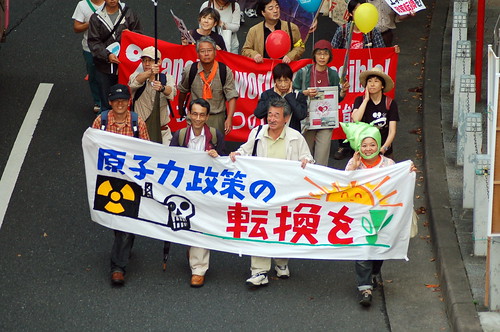
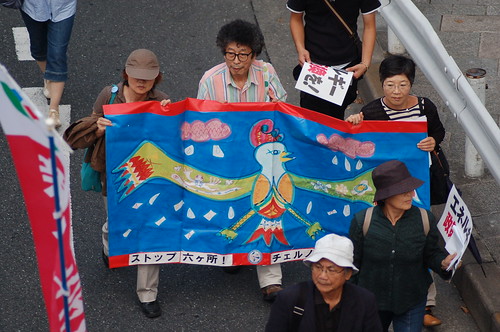
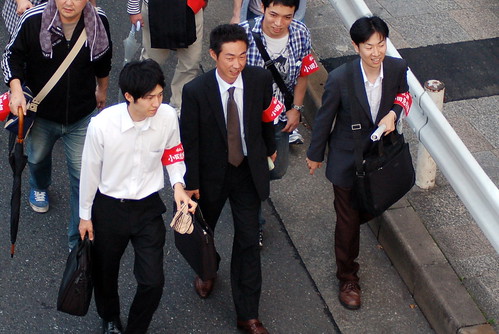
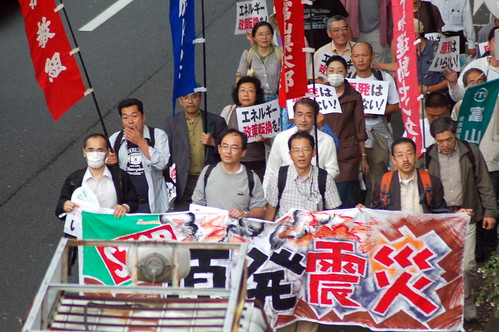
        <![CDATA[<p>We're shaken up about the earthquake and nuclear crisis in Japan. A little over a year ago, we got off a container ship to spend a month in Japan, where we documented part of the <a href="http://www.nishoren.org/en/?p=444">No Nukes Festa</a>, a huge event <a href="http://martinjapan.blogspot.com/2009/10/no-nukes-festa-in-tokyo.html">protesting Japan's use of nuclear power</a>. Sponsors included groups like the <a href="http://cnic.jp/english/">Citizen's Nuclear Information Center</a>, which warned of earthquake and tsunami risks.</p>

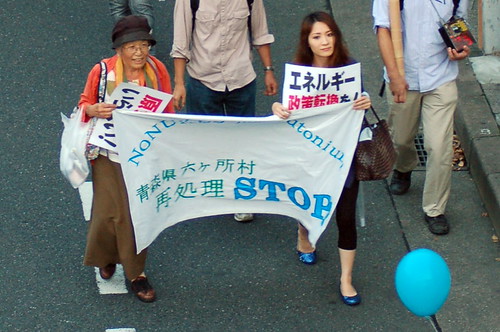
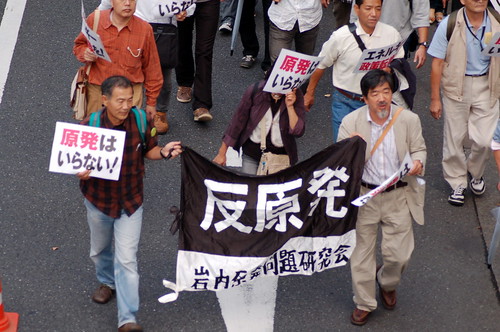
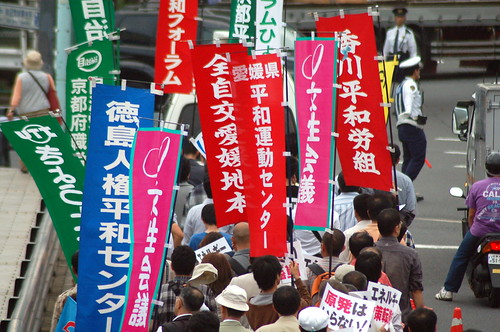
<p>In light of the <a href="http://en.wikipedia.org/wiki/2011_Japanese_nuclear_incidents">nuclear accidents</a> of the past several days, we thought we would share some of our photos of Japanese citizens standing up for environmental health and against nuclear energy policy. (Can't see the images? <a href="http://www.flickr.com/photos/anirvan/sets/72157622507598200/show/">Click here.</a>)</p>

<p align="center"><a href="http://www.flickr.com/photos/anirvan/3976880437/" title="Green and global poverty groups march together by anirvan, on Flickr"><img src="http://farm3.static.flickr.com/2652/3976880437_3dd1b7bc0e.jpg" alt="Green and global poverty groups march together" width="500" height="332" /></a></p>

<p align="center"><a href="http://www.flickr.com/photos/anirvan/3976878965/" title="The bird by anirvan, on Flickr"><img src="http://farm3.static.flickr.com/2520/3976878965_86f771d7be.jpg" alt="The bird" width="500" height="332" /></a></p>

<p align="center"><a href="http://www.flickr.com/photos/anirvan/3977644752/" title="Anti-nuclear salarymen by anirvan, on Flickr"><img src="http://farm3.static.flickr.com/2456/3977644752_5d3dcf5629.jpg" alt="Anti-nuclear salarymen" width="500" height="334" /></a></p>

<p align="center"><a href="http://www.flickr.com/photos/anirvan/3976876475/" title="Stop by anirvan, on Flickr"><img src="http://farm3.static.flickr.com/2438/3976876475_0f81f8a726.jpg" alt="Stop" width="500" height="333" /></a></p>

<p align="center"><a href="http://www.flickr.com/photos/anirvan/3977645406/" title="Multigenerational anti-nuclear activists by anirvan, on Flickr"><img src="http://farm3.static.flickr.com/2552/3977645406_5643937da1.jpg" alt="Multigenerational anti-nuclear activists" width="500" height="332" /></a></p>

<p align="center"><a href="http://www.flickr.com/photos/anirvan/3976878479/" title="Black and white by anirvan, on Flickr"><img src="http://farm3.static.flickr.com/2581/3976878479_b44e7bc5c0.jpg" alt="Black and white" width="500" height="332" /></a></p>

<p align="center"><a href="http://www.flickr.com/photos/anirvan/3976876127/" title="Colorful signs by anirvan, on Flickr"><img src="http://farm3.static.flickr.com/2582/3976876127_fbb3b79ed3.jpg" alt="Colorful signs" width="500" height="332" /></a></p>

<p>(With much love to our friends in Japan, and to all who work for environmental health.)</p>]]>
        
    </content>
</entry>

<entry>
    <title>Tackling U.S. aviation emissions in the courts</title>
    <link rel="alternate" type="text/html" href="http://www.yearofnoflying.com/2011/02/tackling-us-aviation-emissions-in-the-courts.html" />
    <id>tag:www.yearofnoflying.com,2011://6.251</id>

    <published>2011-02-14T01:49:40Z</published>
    <updated>2011-02-14T09:47:22Z</updated>

    <summary>With national U.S. climate legislation failed, and Republicans running away from market-based solutions, the onus is on the Environmental Protection Agency (EPA) to develop national greenhouse gas standards. After the Supreme Court ruled in 2007 that the EPA must regulate...</summary>
    <author>
        <name>Anirvan Chatterjee</name>
        <uri>http://www.chatterjee.net/</uri>
    </author>
    
        <category term="Aviation and climate" scheme="http://www.sixapart.com/ns/types#category" />
    
        <category term="United States" scheme="http://www.sixapart.com/ns/types#category" />
    
    
    <content type="html" xml:lang="en-us" xml:base="http://www.yearofnoflying.com/">
        <![CDATA[<p>With national U.S. climate legislation failed, and Republicans <a href="http://www.grist.org/article/2010-10-22-gop-changes-tune-on-cap-and-trade-reagan">running</a> <a href="http://www.politico.com/news/stories/1210/46699_Page3.html">away</a> from market-based solutions, the onus is on the Environmental Protection Agency (EPA) to develop national greenhouse gas standards. After the Supreme Court ruled in 2007 that the <a href="http://en.wikipedia.org/wiki/Massachusetts_v._Environmental_Protection_Agency">EPA must regulate dangerous greenhouse gases as a pollutant</a>, <strong>environmental NGOs asked the EPA to start setting standards on dangerous mobile emissions from ships and planes, as explicitly required by the Clean Air Act</strong>. But after two and a half years of inaction, five frustrated NGOs <a href="http://earthjustice.org/our_work/cases/2010/global-warming-and-ships-aircraft-and-non-road-vehicles-engines#clients">turned to the courts</a> to get the EPA to follow the law:</p>

<span class="mt-enclosure mt-enclosure-image" style="display: inline;"><img alt="Sarah Burt, Earthjustice" src="http://www.yearofnoflying.com/2011/02/13/Sarah-Burt-Earthjustice.jpg" class="mt-image-right" style="float: right; margin: 0pt 0pt 20px 20px;" width="150" height="175" /></span>

<p>We talked to <a href="http://earthjustice.org/about/staff/sarah-burt">Sarah Burt</a> from public interest environmental law firm <a href="http://earthjustice.org/">Earthjustice</a> about her <a href="http://earthjustice.org/our_work/cases/2010/global-warming-and-ships-aircraft-and-non-road-vehicles-engines">work on the case</a> on behalf of <a href="http://earthjustice.org/our_work/cases/2010/global-warming-and-ships-aircraft-and-non-road-vehicles-engines#clients">clients</a> like Friends of the Earth and the Center for Biological Diversity. Burt describes the case:</p>

<ol>
<li>The Supreme Court has ruled that greenhouse gases are indeed pollutants under the Clean Air Act<b></b></li><li>The Clean Air Act says that <b>if aviation emissions endanger public health then they must be regulated</b></li>
<li>The EPA agrees that greenhouse gases threaten public health</li><li>Given that aviation is a a major source of greenhouse gas emissions, this should trigger an obligation to take action under the Clean Air Act<br /></li>
<strong></strong>
</ol>

<p>She later pulls out a copy of the text of Clean Air Act to show us exactly what it says about aircraft emission standards: "The Administrator shall...issue proposed emission standards applicable to the emission of any air pollutant from...aircraft engines 
which...contributes to...air pollution which may reasonably be anticipated 
to endanger public health or welfare." (U.S. Clean Air Act, <a href="http://www.epa.gov/oar/caa/title2.html#iib">Section 231</a>)</p>

<p>According to Earthjustice's petition, in 2008, marine vessels entering U.S. ports accounted for 4.4 percent of domestic mobile source greenhouse gas emissions, while <strong>aircraft accounts for 3% of the total domestic greenhouse gas inventory</strong>; net impacts may be much greater due to aviation-induced ozone, contrail, and cirrus formation.</p>

<p>How has the EPA reacted to the suit? Burt reports mixed signals, though <strong>the government's certainly fighting back</strong>. As for now, the case isn't moving. "The government moved to dismiss 3 of the 4 claims. We opposed. We're waiting for a decision from the judge."</p>

<p>Burt's realistic about the complications. "Under Lisa Jackson, the EPA's been good on dealing with emissions from cars and power plants. But shipping and aircraft are different, because they're international, and a variety of international agreements may be involved." She tracks international work in fora like the International Maritime Organization (IMO) and the International Civil Aviation Organization (ICAO), which regulate global shipping and aviation, respectively. <strong>She's frustrated at the inaction at an international level</strong>. "Nothing happened at the IMO meeting leading up to Copenhagen...nations like India and China blocked a deal at the IMO, but if you were to exclude all developing nations from a deal, that would exclude most ships, since 70% of all ships are flagged to developing nations."</p>

<p>What about aviation regulation at the ICAO? "<strong>The ICAO has been even worse than the IMO</strong>," she laughs, describing ICAO's history of inaction on greenhouse gases. "At least the IMO has more input from civil society." We checked back in after the <a href="http://www.yearofnoflying.com/2010/10/montreal-2010-climate-conference.html">2010 ICAO assembly in Montreal</a>, which resulted in what struck us as a toothless greenwashed agreement. "The ICAO agreement is important generally but it doesn't change things [around the lawsuit]...The agreement is not a standard -- they are aiming to have some metrics that could then become a standards by 2013 but from what I hear at ICAO it is likely to codify business as usual rather than putting in place a standards that would actually reduce emissions...EPA has a duty to put in place a standard that complies with the requirements of the Clean Air Act -- a business-as-usual standard wouldn't accomplish this. So bottom line is that while the ICAO agreement is a step forward, it does not (yet) replace strong regional action."</p>

<p>Earthjustice is arguing that the US has the authority to regulate environmental health impacts of US-flagged ships and aircraft, as well as those that land within the US. But that battle's also getting waged outside the courtroom. "<strong>The airline industry is very good at controlling the message</strong>," she says. "Shipping agencies aren't nearly as proactive. Airlines say they're going under, and that any attempt to regulate will kill the industry." But airlines aren't the only players. Burt walked us through some of the groups doing lobbying work on the issue:</p>

<ul>
<li>Individual airlines</li>
<li>The <a href="http://en.wikipedia.org/wiki/International_Air_Transport_Association">International Air Transport Association</a> and the <a href="http://en.wikipedia.org/wiki/Air_Transport_Association">Air Transport Association of America</a></li>
<li>Manufacturers (e.g. Boeing)</li>
<li><a href="http://en.wikipedia.org/wiki/National_Business_Aviation_Association">National Business Aviation Association</a> (e.g. FedEx)</li>
<li><a href="http://en.wikipedia.org/wiki/American_Institute_of_Aeronautics_and_Astronautics">American Institute of Aeronautics and Astronautics</a></li>
<li>General Aviation Manufacturers' Association (e.g. Boeing)</li>
</ul>

<p>We asked Burt what she could do if she had a thousand more people to support her work. "It wouldn't take a thousand," she says. Just getting a handful of high-profile people to start talking about this issue would do wonders. She points at Richard Branson as one of the few highly-visible people in the industry talking about these issues. "To some extent," she adds, "<strong>the solution needs to be technically driven</strong>. Stimulus spending support transportation alternatives is a help...there's room for reduction in the U.S, but we need the alternatives. The US is different from the EU -- they can travel by rail."</p>

<p>Sarah Burt isn't trying to remake the world. <strong>She just wants the government to follow the law, and for industry to do its job.</strong> We ask her about best case scenarios a few years out, and she suggests a mandatory emissions cap. with reductions achieved via improvements in aircraft design, alternative fuels, improved routing and navigation systems -- most of which are ideas industry is batting around as well. "We're ready for a big efficiency step-up," she says. The clock is ticking, and Sarah Burt is waiting.</p>

<hr>

<p><a href="http://www.greenaironline.com/news.php?viewStory=842"><img alt="Earthjustice logo" src="http://www.yearofnoflying.com/2011/02/13/Earthjustice_logo_200x46.gif" class="mt-image-right" style="float: right; clear: both; margin: 0pt 0pt 20px 20px;" width="200" height="46" /></a>Read more:</p>

<ul>
<li><a href="http://earthjustice.org/our_work/cases/2010/global-warming-and-ships-aircraft-and-non-road-vehicles-engines">Earthjustice's summary</a><a href="http://earthjustice.org/our_work/cases/2010/global-warming-and-ships-aircraft-and-non-road-vehicles-engines"> of the case</a></li>
<li><a href="http://earthjustice.org/library/legal_docs/mobile-source-ghg-petitions-complaint-10-06-11-final.pdf">Text of the legal complaint (PDF)</a></li>
<li><a href="http://earthjustice.org/news/press/2010/coalition-challenges-epa-over-pollution-from-ships-aircraft-and-nonroad-engines">Press release</a></li><li><a href="http://www.greenaironline.com/news.php?viewStory=842">Coverage in <cite>GreenAir</cite></a></li>
</ul>]]>
        

    </content>
</entry>

<entry>
    <title>Year in reading: around the world in 92 books</title>
    <link rel="alternate" type="text/html" href="http://www.yearofnoflying.com/2011/01/year-in-reading.html" />
    <id>tag:www.yearofnoflying.com,2011://6.250</id>

    <published>2011-01-09T01:50:09Z</published>
    <updated>2011-01-09T18:48:38Z</updated>

    <summary>Barnali and I are both big readers, and were worried about the prospect of spending a year on the road without books to read. We need not have worried. Thanks to ebook libraries, bookstores carrying English titles, hostel exchanges, and...</summary>
    <author>
        <name>Anirvan Chatterjee</name>
        <uri>http://www.chatterjee.net/</uri>
    </author>
    
    
    <content type="html" xml:lang="en-us" xml:base="http://www.yearofnoflying.com/">
        <![CDATA[<p>Barnali and I are both big readers, and were worried about the prospect of spending a year on the road without books to read. We need not have worried. Thanks to ebook libraries, bookstores carrying English titles, hostel exchanges, and friends' libraries, I was able to read <a href="http://www.chatterjee.net/reading/">92 books during our year on the road</a>, just a bit less than average.</p>

<p><a href="http://openlibrary.org/works/OL2636675W/Gravity%27s_Rainbow"><img src="http://covers.openlibrary.org/b/id/100548-S.jpg" alt="" style="height: 58px; float: right; clear: right; margin: 0pt 0pt 15px 15px;" /></a> We started our journey by sea aboard a container ship to Japan leaving from the Port of Seattle. Hours before we boarded, we discovered Left Bank Books, possibly my favorite bookstore discovery of the year. I bought a copy of <a href="http://en.wikipedia.org/wiki/Gravity%27s_Rainbow"><cite>Gravity's Rainbow</cite> by Thomas Pynchon</a>, which I'd tried to read in college, but had quickly given up on. With ten days of ship time ahead (and a decade of reading experience since my last attempt), I figured this would be the right time to give it another try. I failed, managing to slog through most of the book, but finally giving up, defeated by armies of characters, impenetrable prose, and painfully disjoint narrative. Next time, give me a <cite>Satanic Verses</cite> instead. I finished the journey reading Mishima and Ishiguro's more conventional narratives.</p>

<p><a href="http://openlibrary.org/books/OL24584496M/Tokyo_Zero"><img src="http://covers.openlibrary.org/b/id/6677869-S.jpg" alt="" style="height: 58px; float: right; clear: right; margin: 0pt 0pt 15px 15px;" /></a>As soon as we arrived in Tokyo, I couldn't help but notice that a large percentage of subway riders seemed to read on their phones. Inspired, I went online and started downloading public domain and Creative Commons books from ManyBooks.net, and putting them on my Palm Treo. I felt like a local with my phone held aloft, reading <a href="http://marchorne.wordpress.com/tokyo-zero/"><cite>Tokyo Zero: My Tokyo Death Cult</cite> by Mark Horne</a>, a thriller about a secret society trying to gas the Tokyo subway (while actually riding the Tokyo subway). But I started feeling the itch for "real" (i.e. print) books and tracked down a bookstore that carried English books. While on the road, weight, space, and cost were paramount, so I bought the densest trade paperback I could find, the wonderful thousand-page fantasy novel <a href="http://www.jonathanstrange.com/"><cite>Jonathan Strange and Mr. Norrell</cite> by Susanna Clarke</a>. I later picked up a copy of an English translation of <a href="http://en.wikipedia.org/wiki/Oishinbo"><cite>Oishinbo A La Carte</cite></a>, a manga about a Japanese food journalist; Charlie had told me about <cite>Oishinbo</cite> years ago, and it was just as good as he'd described. Both Barnali and I ended up substantially deepening our understanding of the ins and outs of Japanese food culture from the fun and readable anthology. I'll never look at chopstick etiquette the same way again.<br /></p>

<p><a href="http://openlibrary.org/works/OL5732697W/First_They_Killed_My_Father"><img src="http://covers.openlibrary.org/b/id/22940-S.jpg" alt="" style="height: 58px; float: right; clear: right; margin: 0pt 0pt 15px 15px;" /></a> From Japan, we sailed to China by ferry, to Vietnam by train, and by bus to Cambodia, where I did something I never thought I could bring myself to do: buy pirated books. I've spent a decade working in the book industry, and while I'm a critic of copyright maximalism, I'm still a boy scout at heart; I don't pirate music, movies, or books (even when nobody's looking). But reader, I succumbed. On the opposite side of the planet, starved of reading material, and surrounded by references to the depradations of the Pol Pot regime, I ended up buying pirated copies of <a href="http://www.loungung.com/acorn.php?page=books&amp;book=FTKMF"><cite>First They Killed My Father </cite> by Luong Ung</a> and <a href="http://en.wikipedia.org/wiki/Fran%C3%A7ois_Bizot"><cite>The Gate</cite> by François Bizot</a>, memoirs of the Cambodian genocide, which helped bring past events startlingly to life as we visited genocide sites and killing fields. We left these and most of the other books we purchased on the road at hostel book exchanges, where travelers were welcome to leave their read books and take new ones.</p>

<p><a href="http://openlibrary.org/books/OL12180843M/Thai_Touch"><img src="http://covers.openlibrary.org/b/id/3028939-S.jpg" alt="" style="height: 58px; float: right; clear: right; margin: 0pt 0pt 15px 15px;" /></a> We proceeded from Cambodia on to Thailand, where I read the worst book of the trip, <a href="http://www.amazon.com/dp/1887521690" rel="nofollow"><cite>Thai Touch</cite> by Richard Rubacher</a>, an atrocious expat memoir. From there by plane to India (<a href="http://www.yearofnoflying.com/2010/04/flying.html">the most difficult decision of our trip</a>), where we spent over a month, seeing family. Barnali, her brother, and I traveled by train around South India. I ended up reading several Creative Commons ebooks on my phone. I was sitting in Bangalore reading <a href="http://craphound.com/makers/"><cite>Makers</cite> by Cory Doctorow</a>, the newest novel by one of favorite writers, about entrepreneurship and hackery in the post-post-industrial American economy. On the night trains, after the lights would go out, I'd slip under my sheets and read free books on my backlit phone, as India clattered by outside. My favorite discovery was <a href="http://manybooks.net/titles/mchughmother08McHugh_Mothers.html"><cite>Mothers and Other Monsters</cite>  by Maureen F. McHugh</a>, her collection of thoughtful character-driven specfic short stories. I typically buy a handful of books on every trip to India to take home, but were prevented from doing so because of the limited weight we could carry on our backs (though we did pick up a copy of <cite><a href="http://microcredit-book.blogspot.com/">Micro Credit Myth Manufactured: Unveiling Appropriation of Surplus Value and an Icon</a></cite> in Dhaka).<br /></p>

<p><a href="http://openlibrary.org/books/OL24357160M/The_Girl_Who_Played_With_Fire"><img src="http://covers.openlibrary.org/b/id/6583137-S.jpg" alt="" style="height: 58px; float: right; clear: right; margin: 0pt 0pt 15px 15px;" /></a> By the time we got to Beijing to board the Trans-Siberian Express, we were equipped with a small bag of books, including several volumes of world history to help us put all that we were seeing into context. But we'd also bought a copy of <a href="http://en.wikipedia.org/wiki/The_Girl_Who_Played_with_Fire"><cite>The Girl Who Played With Fire</cite> by Stieg Larsson</a>, the second volume of the trilogy which, oddly enough, we'd never heard of. We'd been on the road for so long that we had no idea of what kind of a publishing phenomenon Larsson's mysteries had become; all I knew was that the book was long, had a great cover, and intriguing jacket copy. We were hooked. We both read the book during our five-day journey across China, Mongolia, and Russia, and looked forward to reading the remaining books when we got a chance.</p>

<p><a href="http://openlibrary.org/works/OL41815W/Eat_Pray_Love"><img src="http://covers.openlibrary.org/b/id/400601-S.jpg" alt="" style="height: 58px; float: right; clear: right; margin: 0pt 0pt 15px 15px;" /></a> It was cold in Russia, so we veered southwest, spending a few days in Odessa, and then on to blessed sunny Turkey, aboard a ferry full of travelers unable to fly, grounded by the Icelandic volcano. We picked up a copy of ode-to-therapy-by-travel <a href="http://en.wikipedia.org/wiki/Eat,_Pray,_Love"><cite>Eat, Pray, Love</cite> by Elizabeth Gilbert</a> at a hostel, which we read, and took turns alternately ripping apart and damning with faint praise. Gilbert wrote so well, and yet the thought of finding transcendence and love on a budget and schedule just seemed so terribly shlocky. By this point in time, we'd been blogging about our trip and the climate action movements we'd been meeting on the way for eight months straight, and we knew fully well how much work went into finding a string of experiences that would have the narrative cohesion to read well in print, and how much power a writer has in shaping that narrative of true events. It felt like we were being led along a flimsy plotline by a narrator we couldn't bear to dislike. This wasn't one of our favorite books of the trip, though it may have been the one that spurred the most discussion.</p>

<p><a href="http://openlibrary.org/works/OL3951520W/Middlesex"><img src="http://covers.openlibrary.org/b/id/181754-S.jpg" alt="" style="height: 58px; float: right; clear: right; margin: 0pt 0pt 15px 15px;" /></a> Our blood quickened as we made our way through Western European capitals, discovering climate movements addressing familiar challenges as we enjoyed staying with bookish friends. In Rome we read <a href="http://en.wikipedia.org/wiki/Middlesex_%28novel"><cite>Middlesex</cite> by Jeffrey Eugenides</a>, in Berlin 
<a href="http://en.wikipedia.org/wiki/The_Women_%28novel"><cite>The Women</cite> by T.C. Boyle</a>), in Paris <a href="http://en.wikipedia.org/wiki/Perfume_%28novel"><cite>Perfume</cite> by Patrick Süskind</a>, and in London, <a href="http://www.guardian.co.uk/books/2009/apr/18/chowringhee-sankar-book-review"><cite>Chowringhee</cite> by Sankar</a>, which we enjoyed discussing at Indraneel's book club. I raced through 28 books while in Western Europe, thanks to easy access to English books at bookstores and in friends' bookshelves. So many books around! It felt like home.</p>

<p><a href="http://openlibrary.org/works/OL675774W/The_Year_of_the_Flood"><img src="http://covers.openlibrary.org/b/id/6304106-S.jpg" alt="" style="height: 58px; float: right; clear: right; margin: 0pt 0pt 15px 15px;" /></a> We took a container ship back westwards the Atlantic, where I spent a large chunk of time going through notes, writing about the three weeks of interviews we'd done in London. The only book I finished was <a href="http://en.wikipedia.org/wiki/The_Year_of_the_Flood"><cite>The Year of the Flood</cite> by Margaret Atwood</a> (again, we'd accidentally bought an interesting book without having read the prequel). We arrived after two weeks at sea, spent some time with friends and family in central Pennsylvania and Boston, and took the train back to the San Francisco Bay Area via New York and Chicago. I loved the past year, but it took coming back for me to realize how much I'd missed being in a place full of English-language books to read, from libraries, bookstores, and in friends' generous bookshelves.</p>

<p>Ironically, most of the books I did over the past year were American or British. It's only now that we're home, with easy access to translated materials, large nonfiction collections, and no backpack weight or space restrictions to worry about, that we're getting a chance to read what we'd wanted to all along -- books from and about the places we went. Another wonderful year of reading awaits.</p>]]>
        
    </content>
</entry>

<entry>
    <title>Year in tech: what to bring on a world trip</title>
    <link rel="alternate" type="text/html" href="http://www.yearofnoflying.com/2011/01/year-in-tech.html" />
    <id>tag:www.yearofnoflying.com,2011://6.248</id>

    <published>2011-01-03T15:45:00Z</published>
    <updated>2011-01-01T08:36:05Z</updated>

    <summary> What tech gear do you bring with you if you&apos;re spending a year backpacking around the world? We&apos;re not gadget-heads, but about 20% of the weight we carried with us consisted of gadgets of one sort another -- camera,...</summary>
    <author>
        <name>Anirvan Chatterjee</name>
        <uri>http://www.chatterjee.net/</uri>
    </author>
    
        <category term="Tourism" scheme="http://www.sixapart.com/ns/types#category" />
    
    
    <content type="html" xml:lang="en-us" xml:base="http://www.yearofnoflying.com/">
        <![CDATA[<p><a href="http://www.flickr.com/photos/joshlewis/491784858/"><img src="http://farm1.static.flickr.com/221/491784858_a43668eba9_s.jpg" title="4 GB?!? by Josh Lewis, used under CC" alt="" style="height: 75px; width: 75px; float: right; clear: right; margin: 0pt 0pt 20px 20px;" /></a> What tech gear do you bring with you if you're spending a year backpacking around the world? We're not gadget-heads, but about 20% of the weight we carried with us consisted of gadgets of one sort another -- camera, laptops, cell phones, power adapters. As we started planning gear for our trip, we had four concerns in mind:</p>

<ol>
<li>Weight: Every extra ounce we took would further strain our backs</li>
<li>Loss: We might have things lost or stolen, so we preferred cheap gear we could keep hidden, and replace if needed</li>
<li>Cost: We wanted to save money, reusing things we owned whenever possible</li>
<li>Resilience: Things would break or get stolen, so backup capacity was important</li>
</ol>

<p>Here's what we brought, and why.</p>

<h4>Photos</h4>

<p><a href="http://www.flickr.com/photos/paulmoody/380727935/"><img src="http://farm1.static.flickr.com/148/380727935_ccc67e8b9a_s.jpg" title="my Nikon D50 by Paul Moody, used under CC" alt="" style="height: 75px; width: 75px; float: right; clear: right; margin: 0pt 0pt 20px 20px;" /></a> As we were planning our trip, we decided to try to avoid buying souvenirs, and focus on taking pictures. Barnali likes taking photos, and she owns a <a href="http://en.wikipedia.org/wiki/Nikon_D50">Nikon D50 digital SLR</a>. It's an SLR, and therefore heavy and visible, but if we didn't use it now, then when? We also brought with us her second lens, a lovely (and large) zoom lens. We knew we'd be taking a <em>lot</em> of photos, so we bought eight 2-gigabyte memory cards (the largest size her camera can take) as primary storage, and decided to back them up to a laptop with 160 gigabytes of hard drive space. On the computer, we managed the photos with <a href="http://en.wikipedia.org/wiki/Picasa">Google Picasa</a>, which we synced online with a private Google Picasa Web Albums account, paying $50 for 200 gigabytes of online storage.</p>

<p>We've been uploading photos to Facebook and to our Flickr accounts. <a href="http://www.flickr.com/photos/barnali/collections/72157622494574432/">Check out some of our favorite photos on Flickr.</a></p>

<h4>Laptops and WiFi</h4>

<p><a href="http://www.flickr.com/photos/irisheyes/2183031957/"><img src="http://farm3.static.flickr.com/2414/2183031957_a0765a099d_s.jpg" title="Asus Eee PC 701 Video by Irish Typepad, used under CC" alt="" style="height: 75px; width: 75px; float: right; clear: right; margin: 0pt 0pt 20px 20px;" /></a> We've spent a year coordinating interviews, meeting people, processing photos, and blogging while on the road. Netbooks, the new wave of cheap little laptops, have been our salvation. I had with me my <a href="http://www.newegg.com/Product/Product.aspx?Item=N82E16834220246">Asus Eee 701</a>, about the size and weight of a hardcover book. I'd bought it for about $300 in mid-2008, and have since used it on several trips. It has only 4 gigabytes of hard drive space, but it runs Linux, Firefox, a text editor, and my beloved Unix shell. What more could a boy want?</p>

<p><a href="http://www.flickr.com/photos/dexfamily/3286932305/"><img src="http://farm4.static.flickr.com/3194/3286932305_2781ac0257_s.jpg" title="Asus Eee PC by Dexter Panganiban, used under CC" alt="" style="height: 75px; width: 75px; float: right; clear: right; margin: 0pt 0pt 20px 20px;" /></a>  Barnali has an older Mac laptop at home, but we decided to go with something cheaper and hardier for the trip, so we bought a refurbished <a href="http://www.amazon.com/dp/B001GIPSAW">Asus Eee PC 904HA</a> running Windows XP for $300. Her netbook was much heavier than mine, but also had more memory, a larger screen, and 40 times more hard drive space (160 gigabytes to my 4).</p>

<p><a href="http://www.flickr.com/photos/ambuj/345356294/"><img src="http://farm1.static.flickr.com/140/345356294_b0464e1203_s.jpg" title="USB Flash Drive by Ambuj Saxena, used under CC" alt="" style="height: 75px; width: 75px; float: right; clear: right; margin: 0pt 0pt 20px 20px;" /></a> We each used our own laptops for email, writing, and web work, but used mine when we needed a light computer to take in our day pack, and Barnali's for Skype and photo management. Having two different computers was incredibly helpful. Barnali could run Windows software that I couldn't, and I could safely read data from USB keychains that we'd taken to Windows virus-laden cybercafes. It helped that Asus is a major global brand; when Barnali's laptop screen broke in Thailand, we got a replacement from the local Asus service center in less than 24 hours.</p>

<p><a href="http://www.flickr.com/photos/palagret/211289845/"><img src="http://farm1.static.flickr.com/88/211289845_34ce604957_s.jpg" title="wi-fi by Palagret, used under CC" alt="" style="height: 75px; width: 75px; float: right; clear: right; margin: 0pt 0pt 20px 20px;" /></a> Internet access was nearly ubiquitous wherever we went. Though it would sometimes consist of a PC in a hostel lobby or a cybercafe down the street, we were almost always able to get WiFi in our hostel/hotel rooms. But on occasion, we got a wired Ethernet connection in our room, which could connect to only one of our computers. This was irritating, because it meant only one of could be online at a time, negating the advantages of having two laptops, and meaning we couldn't always finish our work in parallel. We took care of this problem in Vietnam, by spending $100 on a brand-new <a href="http://www.apple.com/airportexpress/">Apple AirPort Express</a>, a tiny portable WiFi base station. We'd plug the Ethernet port into the AirPort Express, and voila, instant wireless. I wish we'd known about this before, so we could have bought a used one at home, instead of needing to buy one on the road.</p>

<h5>Software tools</h5>

<p><a href="http://www.flickr.com/photos/kengz/262875283/"><img src="http://farm1.static.flickr.com/83/262875283_ca33f09edd_s.jpg" title="Firefox Logo" alt="" style="height: 75px; width: 75px; float: right; clear: right; margin: 0pt 0pt 20px 20px;" /></a> The four most useful pieces of software we had running on our computers were:</p>

<ul>
<li>Picasa -- we prefer iPhoto, but came to appreciate Picasa's strengths as a photo manager</li>
<li>Firefox with the <a href="http://readitlaterlist.com/">Read It Later</a> extension to store content offline -- we could save articles, blog posts, web pages of interest, and read it offline</li>
<li>Gmail's offline support -- it was incredibly useful to have emailed phone numbers, directions, and content available offline anytime</li>
<li>Skype -- for phone calls, much cheaper than any other source; we particularly enjoyed video chats with our parents</li>
</ul>

<h4>Mobile phones</h4>

<p>Phones were probably the most complicated part of our planning, in part because phones do so much more than make phone calls. We wanted to make calls, but also to manage schedules, store contacts, manage lists, run software, and listen to music and podcasts.</p>

<p><a href="http://www.flickr.com/photos/mailcone/2342122430/"><img src="http://farm3.static.flickr.com/2096/2342122430_b48074accd_s.jpg" title="FX_P1040720 by JiaKai Say, used under CC" alt="" style="height: 75px; width: 75px; float: right; clear: right; margin: 0pt 0pt 20px 20px;" /></a> At home, we do all this with our <a href="http://en.wikipedia.org/wiki/Treo_680">Palm Treo</a> and <a href="http://en.wikipedia.org/wiki/Palm_Centro">Centro</a> smartphones, running on the AT&amp;T network. AT&amp;T has a remarkable international roaming network, but it's also expensive. If we were going to make calls and send texts from abroad all year, we'd need a cheaper solution. A New York Times story led us to <a href="http://www.maxroam.com/">MaxRoam</a>, a company that sells international roaming SIM cards offering coverage around the world at nearly half the price of AT&amp;T -- exactly what we needed. The only downside? MaxRoam SIM cards use a complicated callback mechanism to make calls, which won't work with our Palms, so we had to buy cheap used multi-band GSM Nokia phones to use with MaxRoam.</p>

<p><a href="http://www.flickr.com/photos/sarchi/218308708/"><img src="http://farm1.static.flickr.com/98/218308708_1de7bfe762_s.jpg" title="new nokia old by Peter Harris, used under CC" alt="" style="height: 75px; width: 75px; float: right; clear: right; margin: 0pt 0pt 20px 20px;" /></a> The end result? We used the Nokia/MaxRoam phones for phone and SMS, but brought along our Palms (with the phone turned off) for organizer, music, software, ebooks; if we ever had problems with Nokia/MaxRoam, we could always fall back to Palm/AT&amp;T. The best part of all this was that our new generic Nokia phones were quite unexceptional and used by people of all classes the world over; that meant we would never look out of place by having a flashy phone, helping attract a little less attention.</p>

<p>(There were further twists. We didn't want to lose any important calls on our home cell phones, so we had calls redirect to our new MaxRoam phone numbers. Call redirection worked fine, but apparently SMSes don't get redirected, so we'd turn on the AT&amp;T phone every once in a while, just to see if we'd missed any important texts. Even worse, we spent a month in Japan, where ordinary GSM phones don't work, so we borrowed a Japan-compatible phone from my dad, returning it to him when we met up a few months later.)</p>

<h5>Mobile phone content</h5>

<p><a href="http://www.flickr.com/photos/padday/3219058521/"><img src="http://farm4.static.flickr.com/3374/3219058521_43b6643fb2_s.jpg" title="Mobile email commuting by Paul Adams, used under CC" alt="" style="height: 75px; width: 75px; float: right; clear: right; margin: 0pt 0pt 20px 20px;" /></a> Before we left, we loaded up our Palm phones with favorite music, podcasts, and free ebooks to keep us occupied over the coming months. When we arrived in Tokyo, I was inspired by the prevalence of reading on mobile devices during dead time on the subway, and ended up reading dozens of free ebooks from <a href="http://www.manybooks.net/">ManyBooks.net</a> over the course of the year. Barnali installed a podcatcher, <a href="http://juicereceiver.sourceforge.net/">Juice</a>, on her computer, which she used to keep up with favorite shows like <em>This American Life</em> and <em>Wait, Wait, Don't Tell Me</em>.</p>

<p><a href="http://www.flickr.com/photos/fred_dela/2285253737/"><img src="http://farm3.static.flickr.com/2166/2285253737_c23f7d26f2_s.jpg" title="Encadré (Jardim Botânico, Rio de Janeiro) by Frédéric della Faille, used under CC" alt="" style="height: 75px; width: 75px; float: right; clear: right; margin: 0pt 0pt 20px 20px;" /></a> More practically we were also traveling with <a href="http://www.tripsteps.com/ebook/">an offline dump</a> of the entire <a href="http://wikitravel.org/">WikiTravel</a> website. Having all of WikiTravel in our pockets ensured that we had some basic documentation for virtually everywhere we went, regardless of whether or not we had a relevant paper guidebook. It was a great comfort, highly recommended for other long-distance travelers.</p>

<p><a href="http://www.flickr.com/photos/moriza/96724309/"><img src="http://farm1.static.flickr.com/12/96724309_985b8acd3f_s.jpg" title="On the platform, reading by Mo Riza, used under CC" alt="" style="height: 75px; width: 75px; float: right; clear: right; margin: 0pt 0pt 20px 20px;" /></a> But my most delightful download all year was a wonderful free software package called <a href="http://metro.nanika.net/">Métro</a>, a multiplatform offline transit planner with support for dozens of world cities. We installed it on our Palms, and had instant directions between transit stops in places like Moscow, London, and Paris, saving us time and aggravation with paper schedules.</p>

<h4>Everything else</h4>

<p><a href="http://www.flickr.com/photos/metalriot/4257409019/"><img src="http://farm5.static.flickr.com/4020/4257409019_f200c50999_s.jpg" title="Ring a Day 8/365 by Thomasin Durgin, used under CC" alt="" style="height: 75px; width: 75px; float: right; clear: right; margin: 0pt 0pt 20px 20px;" /></a> Power was a universal problem. We brought three <a href="http://us.kensington.com/html/5519.html">international plug adapters</a> with us, allowing us to plug our American gear into a wide variety of outlets. In India, we picked up a small power strip, which we used for a few months; it was a relief to be able to charge multiple devices at once. Sadly, perhaps coincidentally, the power strip also seemed to destroy some of our chargers; we had a Palm charger fry on the Trans-Siberian express, and a laptop charger die in Germany. We'd brought backup chargers, so while neither was a calamity, they were still irritations.</p>

<p><a href="http://www.flickr.com/photos/itsallaboutmich/446084326/"><img src="http://farm1.static.flickr.com/220/446084326_03616c988c_s.jpg" title="Open up and say AHHHH!!!!! by Michelle Brea, used under CC" alt="" style="height: 75px; width: 75px; float: right; clear: right; margin: 0pt 0pt 20px 20px;" /></a> About a week before we left on our trip, I spent about $40 on a <a href="http://www.amazon.com/gp/product/B001JQLHSI/">small pocket-sized translator device</a>. You could select any of a few hundred common travel phrases, and it would speak and spell the translation in about a dozen world languages. We didn't need it as much as I expected, but it was nice to have in places like China, Japan, Russia, and Turkey. In the far East, I found that playing a recording of "where is the subway?" was much more clear than my mangled attempt at the local language. The device was small enough that it spent the whole year inside my day pack.</p>

<p><a href="http://www.flickr.com/photos/taritm/4872701799/"><img src="http://farm5.static.flickr.com/4137/4872701799_2285f9930c_s.jpg" title="Day 217 - Close shave by TiggerT, used under CC" alt="" style="height: 75px; width: 75px; float: right; clear: right; margin: 0pt 0pt 20px 20px;" /></a> And finally, there were convenience gadgets from home. I carried my electric shaver, a nice convenience to make my morning routine a little bit faster. Barnali had left a small hair dryer in India, which we picked up midway into our trip. We could have done without our personal care gadgets, but they were small luxuries, injecting a little comfort into our travels.</p>

<h4>What we would (and wouldn't) do differently</h4>

<p><a href="http://www.flickr.com/photos/williamhook/4742233935/"><img src="http://farm5.static.flickr.com/4136/4742233935_4d4b534fa0_s.jpg" title="iPhone 4 - Home Screen by William Hook, used under CC" alt="" style="height: 75px; width: 75px; float: right; clear: right; margin: 0pt 0pt 20px 20px;" /></a> We'd planned the technology for our trip around the lowest common denominator, looking for things that wouldn't make us look like targets or stand out too much. But having made defensive choices, we didn't think to bring a very easily portable WiFi device that we could have used to access the widely-available free WiFi networks in Japan and Western Europe. If I had to do it all over again, I would have considered replacing our phones with WiFi-capable MaxRoam-compatible smartphones (preferably with reasonable web browsers, cameras, video, and GPS).</p>

<p><a href="http://www.flickr.com/photos/darrenhester/3997106787/"><img src="http://farm3.static.flickr.com/2508/3997106787_cf3ed00f66_s.jpg" title="Power Plug by Darren Hester, used under CC" alt="" style="height: 75px; width: 75px; float: right; clear: right; margin: 0pt 0pt 20px 20px;" /></a> Having access to power in the absence of power outlets would have allowed us to work on our laptops during more long train and bus journeys. Barnali had to do it all over again, she would have tried to bring an external battery device, to store extra backup juice for laptop and cell phones.</p>

<p>Reading this, it feels like all we did all year was fiddle with tech gadgets, but the point of technology planning is to remove stress. Careful planning helped ensure that we'd be able to take pictures, call home from anywhere in the world, and write on the road, without fear of single points of failure, so we could actually enjoy our trip instead of worrying about spiraling costs or things falling apart.</p>]]>
        

    </content>
</entry>

<entry>
    <title>Ending our year, starting anew</title>
    <link rel="alternate" type="text/html" href="http://www.yearofnoflying.com/2010/12/ending-our-year-starting-anew.html" />
    <id>tag:www.yearofnoflying.com,2010://6.249</id>

    <published>2010-12-31T19:59:59Z</published>
    <updated>2011-01-01T07:24:24Z</updated>

    <summary> Our Year of No Flying has come to an end. Our container ship brought us from Europe back to the East Coast of the United States, where we traveled by bus and train to see family and friends in...</summary>
    <author>
        <name>Anirvan Chatterjee</name>
        <uri>http://www.chatterjee.net/</uri>
    </author>
    
        <category term="Aviation and climate" scheme="http://www.sixapart.com/ns/types#category" />
    
        <category term="Trains and buses" scheme="http://www.sixapart.com/ns/types#category" />
    
        <category term="United States" scheme="http://www.sixapart.com/ns/types#category" />
    
    
    <content type="html" xml:lang="en-us" xml:base="http://www.yearofnoflying.com/">
        <![CDATA[<span class="mt-enclosure mt-enclosure-image" style="display: inline;"><img alt="" title="very rough trip route" src="http://www.yearofnoflying.com/2010/12/31/Year%20of%20No%20Flying%20trip%20route%20approximate.jpg" class="mt-image-center" style="text-align: center; display: block; margin: 0pt auto 20px;" width="500" height="150" /></span>

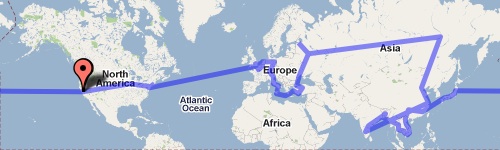
<p>Our Year of No Flying has come to an end. Our container ship brought us from Europe back to the East Coast of the United States, where we traveled by bus and train to see family and friends in central Pennsylvania, New York, Boston, and Chicago, before crossing the continent on Amtrak's amazing <a href="http://en.wikipedia.org/wiki/California_Zephyr">California Zephyr</a> train line. <b>We had a front row seat to some of the most stunning landscapes in the United States</b>, passing through Illinois, Iowa, Nebraska, Colorado, Utah, Nevada, and California. We were surprised when our train arrived early. Charlie met at the train station and drove us home to Berkeley. And then back to reality, learning to live again without a backpack on one's back, a money belt in one's pants, and our perpetual questions: "how are we getting there? who can we talk to? who's writing the blog post?"</p>

<p>As soon as we got home, we started <b>volunteering on the <a href="http://www.stopdirtyenergyprop.com/index.php">No on Prop 23 campaign</a></b>, hoping to defeat an oil industry-funded effort to shut down California's landmark 2006 climate change legislation. (Anirvan even popped up in an <a href="http://www.youtube.com/watch?v=9RrQPnteowg">anti-Prop 23 ad</a>.) The good guys won, and California, the world's 8th largest economy and 12th largest emitter, is now on track to <a href="http://www.arb.ca.gov/cc/cc.htm">roll out carbon caps in 2012</a>.</p>

<p>We knew our year of no flying had <em>really</em> ended when we subsequently got back on a plane and <b>flew to India for Barnali's brother's wedding</b>. For all the talk about the climate impacts of aviation, here we were spewing the climate equivalent of driving a car for two years. Love miles had gotten the best of us again.</p>

<p>We felt a twinge of discomfort at the airport as we removed our belts, shoes, jackets, phones, laptops, and liquids; it's as if Big Aviation had been conspiring to make us feel as unwelcome as possible, and indeed, the introduction of the new <a href="http://en.wikipedia.org/wiki/Backscatter_X-ray">backscatter X-ray</a> <a href="http://en.wikipedia.org/wiki/Full_body_scanner">full-body scanners</a> and associated security groping techniques had led to a full-fledged <b>libertarian-tinged American anti-aviation movement</b>, calling for <a href="http://wewontfly.com/">boycotts of flying</a>, <a href="http://www.shutdowntheairports.com/">airport shutdowns</a>, and even <a href="http://www.meetup.com/National-Boycott-of-Airline-Travel-2011/">years of no flying</a>. Activists against the aviation security complex fought back, <a href="http://twitter.com/search?q=%23wontfly">networking online</a>, organizing a <a href="http://www.google.com/search?q=tsa+%22national+opt+out+day%22&amp;hl=en&amp;tbs=tl:1,tll:2010/11,tlh:2010/11,tl_num:100">national day of action</a>, <a href="http://www.washingtonpost.com/wp-dyn/content/article/2010/12/31/AR2010123100617.html">taking off their clothes</a>. The general media message? Pesky protesters <a href="http://abcnews.go.com/US/national-opt-day-bust-security-delays-thanksgiving-travelers/story?id=12237056">fail to slow down the aviation machine</a>; all's well with the world, and the issue's no longer worth covering (despite significant public unease and <a href="http://www.npr.org/assets/news/2010/05/17/concern.pdf">significant questions about radiation health impacts</a>).<br /></p>

<p>Thankfully, we were neither groped nor had naked photos of us taken as we took our flight to India; on a plane full of folks heading to India and the Middle East, for once, the color of our skin wasn't enough to place us in the likely-terrorist camp. Our Emirates flight flew over Iran, which we may never have the chance to visit; our inflight displays showed historic Tehran below us as a tiny blip, as <b>we passed overhead without getting the chance to explore what was below</b>. The wedding was wonderful, and we loved the week-long family celebration of the happy occasion. We'd vowed to ourselves to cut short-haul air travel, so we were delighted that our family chose to use trains instead of planes to get from one end of the country to the other.</p>

<p>We've spent the past year thinking about climate and aviation, travel and tourism, justice and pleasure. It's been a minor revelation to us that this doesn't have to end when we come home, that it's something we can incorporate into our everyday lives even after our once-in-a-lifetime year-long project ends. <b>We're going to keep interviewing people who inspire us and sharing stories we encounter</b> in the weeks and months ahead, focusing on our own wonderful crazy nation for a change. Thanks for following us!</p>

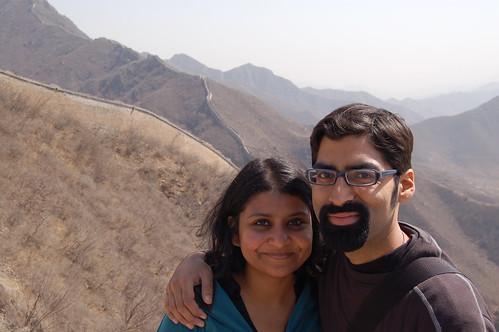
<p align="center"><a href="http://www.flickr.com/photos/barnali/4476236049/"><img src="http://farm3.static.flickr.com/2770/4476236049_5b8bae1d06.jpg" title="Anirvan and Barnali at the Great Wall of China" alt="" style="height: 333px; width: 500px;" /></a></p>]]>
        

    </content>
</entry>

<entry>
    <title>Tourism 2023: Postcards from the future</title>
    <link rel="alternate" type="text/html" href="http://www.yearofnoflying.com/2010/10/tourism-2023-postcards-from-the-future.html" />
    <id>tag:www.yearofnoflying.com,2010://6.245</id>

    <published>2010-10-27T01:16:28Z</published>
    <updated>2010-10-26T20:01:36Z</updated>

    <summary> You don&apos;t have to be an &quot;environmentalist&quot; to start thinking about climate change -- just realistic. The British tourism industry is trying to come to grips with how climate impacts will affect their business, and the products they&apos;re selling;...</summary>
    <author>
        <name>Barnali</name>
        
    </author>
    
        <category term="Tourism" scheme="http://www.sixapart.com/ns/types#category" />
    
        <category term="United Kingdom" scheme="http://www.sixapart.com/ns/types#category" />
    
    
    <content type="html" xml:lang="en-us" xml:base="http://www.yearofnoflying.com/">
        <![CDATA[<form class="mt-enclosure mt-enclosure-image" style="display: inline;" contenteditable="false"><img alt="Tourism 2023 carbon clampdown postcard" src="http://www.yearofnoflying.com/2010/10/26/Tourism_2023_carbon_clampdown_postcard-1.jpg" class="mt-image-center" style="text-align: center; display: block; margin: 0pt auto 20px;" height="430" width="500" /></form>

<p>You don't have to be an "environmentalist" to start thinking about climate change -- just realistic. <strong>The British tourism industry is trying to come to grips with how climate impacts will affect their business, and the products they're selling</strong>; the results are fascinating. While in London, we met Vicky Murray from the Forum for the Future, who worked with partners like British Airways, Carnival UK, and Thomas Cook to produce <a href="http://www.forumforthefuture.org/library/tourism-2023">Tourism 2023</a>, a report on possible futures for the British travel and tourism industry. It breaks the possibilities down into four scenarios of the world their customers will be traveling in, and how energy and emissions policy will affect them. According to <a href="http://www.kpmg.com/Global/en/IssuesAndInsights/ArticlesPublications/Documents/Climate-changes-your-business.pdf">KPMG research</a>, the tourism sector is one of those least prepared for climate change and among those most commercially exposed to the physical risks it presents. "Climate change will have dramatic impacts on how, where and when (and even if) people travel, and will reshape the industry over time."</p>

<p>Murray, a primary author of the Tourism 2023 report, described how "there were a lot of environmental campaigns that were going on, but not enough work being done in the solutions space." The Forum for the Future works with industries to develop scenarios to help understand the kind of futures they want, and how to get there. She faced initial resistance. <strong>"The tourism industry is short term focussed, they couldn't see that it [tourism futures planning] was all about protecting their product."</strong> That resistance eventually wore down, and mainstream tourism industry partners started coming on board to participate in the industry-wide futures planning process.</p>

<h3>Constructing scenarios</h3>


<p>Why think about tourism in 2023? "In 2008, 2023 was 15 years into the future, just far enough to not feel like science fiction and be ignored but further than the 3-5 year time span that people are generally able to think about." The report took 18 months to develop and was put together by a diverse group of futurists and sustainability experts including historians, transportation planners, sustainable accounting professionals, and environmental consultants working with industry partners. "The four scenarios have been constructed to be plausible. They are not meant to predict the most likely outcomes for 2023 nor represent favourable or unfavourable futures. Instead, <strong>they offer a set of possible futures and provide a challenge to the industry</strong>, each with their own risks and opportunities. They are tools that industry bodies can use to assess current strategies and come up with new ones that will be fit for a range of futures. " The two axes of scenario construction were the two major uncertainties of the future--will the economy, politics, technology and energy costs enable or inhibit travel and whether the sensitivity of consumers to the environmental impacts of their travel make it more attractive or less attractive.</p>

<h3>Scenario 1: Boom and Burst</h3>

<p>We really enjoyed the use of fictional "postcards sent back home" to give a flavor of life for British tourists under each scenario. For example:</p>

<blockquote>
  <p>"Dear Mum, Sorry to send you another postcard this year, but this trip really has been eye-opening. You were right, the supermarket did pick a great itinerary for me, but Manila is not how it looked in the video brochure--it's a lot more crowded. Still, I got my teeth done more cheaply than I could have in the UK and now I have tried remote working I see why you think a second home abroad might be fun! See you next week in Brazil! - Love, David"</p>
</blockquote>

<ul>
<li><p>All is well in the world but it's not clear for how long. Technological fixes like the use of algae-based fuels for planes and carbon scrubbers that clean the air as we fly have allowed travel to continue and grow.</p></li>
<li><p>The spread of broadband has allowed UK citizens to work from anywhere so binge flying is common and many have second homes.</p></li>
<li><p>The high prices of oil have made low carbon travel alternatives an economic necessity, so all modes of travel are seeing growth. Kazakhstan transit railway opened to link China to Iran and the Caspian sea. Russia has begun work on the world's longest tunnel that will connect to Alaska and accommodate a high speed train line, gas pipelines and fiber optic cables.</p></li>
<li><p>This travel boom has led to overcrowded destinations and upped the demand for more land to be opened up to the industry. There is now a paved road to Mt. Everest's base camp complete with vending machines.</p></li>
</ul>

<h3>Scenario 2: Divided Disquiet</h3>

<p>Perhaps the worst possible outcome for the tourism industry:</p>

<blockquote>
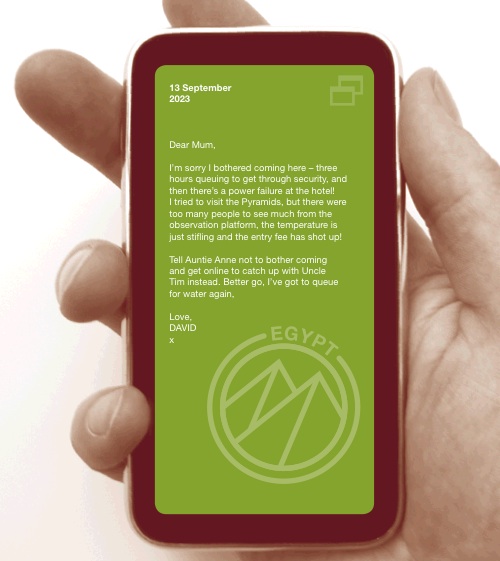
  <p>"Dear Mum, I'm sorry I bothered coming here--three hours queuing to get through security, and then there is a power failure at the hotel. I tried to visit the Pyramids, but there were too many people to see much from the observation platform, the temperature is stifling and the entry fee has shot up. Tell Auntie Anna not to bother coming and get online to catch up with Uncle Tim instead. Better go, I have to queue for water again, x Love David."</p>
</blockquote>

<ul>
<li><p>In this dystopian scenario, the world is a dangerous place to live in, let alone travel. Countries have not taken any action to combat climate change and the business as usual approach has resulted in increased conflict over resources leaving the world divided into "protectionist blocs". Conflict over basic necessities like water and food and extreme and unpredictable weather conditions have caused massive instability. In one incident, the Caribbean islands were battered by a series of storms that wrecked hotels and disrupted food supplies, leading to rioting and trapping British tourists.</p></li>
<li><p>Tourists are not welcome especially in destinations that are unable to bear the added pressure from tourism. The mayoral candidate of an affected European town promised to limit the number of tourists where as other places have completely banned tourism and are focussed on a post-tourist development model.</p></li>
<li><p>Having seen the impacts, tourists are now more aware of the social and environmental impacts of their travel and demand more ethical choices.</p></li>
<li><p>Telepresence technologies for the home are able to beam friends and family right into the living room. People are surprised at their ability to live apart longer without that extra flight thanks to these technologies.</p></li>
</ul>

<h3>Scenario 3: Price and Privilege</h3>

<p>A glimpse into a world trying to live without aviation:</p>

<p>"Dear Mum, You just won't believe it: There has been a heat wave here and they have asked us to stay indoors! There's no way I am doing that though--I have been saving for far too long to let freak weather get in the way of this holiday! The journey down was really easy and the beds were surprisingly comfy -- even great-grandad would get a good night's sleep! The coach stopped at loads of cool hubs on the way. My favourite was an interactive science museum we pulled into on the way out of Madrid. Bit crowded but really cool. Hope the holiday saving account for next year is going well. Love, David"</p>

<ul>
<li><p>Rising oil prices have ensured that flying is once again only for the rich and famous and the tourism industry is focussed on a small elite that is still able to afford travel. A boat from London to New York is cheaper than flying for the first time since 1969 and people who want to take that special flight have to save for years.</p></li>
<li><p>Overland travel is the mass market option. Coach hubs have been set up along major routes and compete with each other by offering parklands, meals, rest zones. The roads are where the new tourist destinations like theme parks, gaming zones and museums have pop up.</p></li>
<li><p>Low carbon holidays are now the norm since they are also the cheapest.</p></li>
<li><p>Demonstrations and petitions in several cities worldwide over the "right to fly," while "Tourism workers across the Mediterranean region unite in mass protests against poor wages and working conditions as a result of cost pressures."</p></li>
</ul>

<h3>Scenario 4: Carbon Clampdown</h3>

<p>Perhaps the most equitable, if not the most fun:</p>

<blockquote>
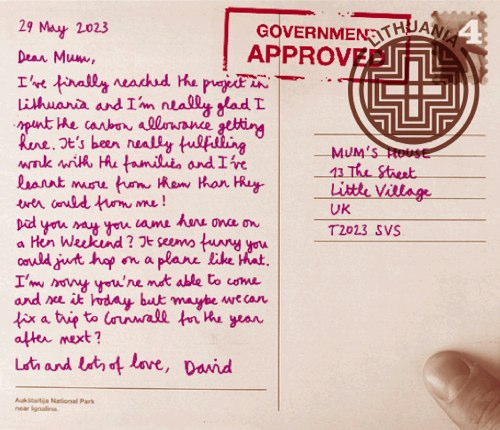
  <p>"Dear Mum, I have finally reached the project in Lithuania and I am really glad I spent the carbon allowance getting here. It's been really fulfilling work with the families and I have learnt more from them than they ever could from me. Did you say you came here once on a Hen weekend? It seems funny that you could just hop on a plane like that. I am sorry you're not able to come see it today but maybe we can fix a trip to Cornwall for the year after next? Lots and lots of love, David."</p>
</blockquote>

<ul>
<li><p>The most promising of the scenarios. The public are clamoring for tough action on environmental issues, tradable carbon quotas are in place.</p></li>
<li><p>People are making holiday choices that are more ethical while staying within their carbon budget. Carbon labeling is now required for holiday packages and for holiday-makers it is among their top selection criteria.</p></li>
<li><p>Vacationing locally is on the rise and travel companies offer two week vacations in your own home where they help you discover your city and neighborhood.</p></li>
<li><p>There is pressure on tourism to be a more ethical business. Leading travel firm goes bust after massive boycott coordinated by social networks over its environmental policy.</p></li>
</ul>

<h3>Building our own scenarios</h3>

<p>Having been tourists the last year, we found ourselves constantly questioning the contradictions of travel. Yes, it made us more aware of the world, opened our ways to different realities and we enjoyed almost every moment of it. But at what cost? Most of us are now able to fly to the most fragile places--if we don't see it, we won't want to save it, but can we ever save it from the tons of carbon already emitted by us in getting there. The more you see, the less there is to see.</p>

<p>We need to adapt to reality; British travel companies are taking these visions of the future, and using them to think about how to prepare for the future. But the clock's already ticking. The full story behind the "Carbon Clampdown" scenario has President Obama rallying the world to take action at the Copenhagen climate conference in December 2009 -- and we know that certainly didn't happen. The further along we go without large-scale coordinated action to limit catastrophic climate change, the more likely the worst scenarios become. It'll take all of our strength and courage to bring our own best scenarios to life.</p>

<span class="mt-enclosure mt-enclosure-image" style="display: inline;"><img alt="Tourism 2023 postcard Egypt" src="http://www.yearofnoflying.com/2010/10/26/Tourism_2023_postcard_egypt.jpg" class="mt-image-center" style="text-align: center; display: block; margin: 0pt auto 20px;" height="561" width="500" /></span>]]>
        

    </content>
</entry>

<entry>
    <title>Montreal 2010: The biggest climate conference you&apos;ve never heard of</title>
    <link rel="alternate" type="text/html" href="http://www.yearofnoflying.com/2010/10/montreal-2010-climate-conference.html" />
    <id>tag:www.yearofnoflying.com,2010://6.246</id>

    <published>2010-10-15T00:51:55Z</published>
    <updated>2011-05-03T16:41:03Z</updated>

    <summary>The world watched last year&apos;s climate talks in Copenhagen with hope and trepidation. We spent the past two weeks following the ICAO Assembly, the aviation sector&apos;s climate talks in Montreal with equal anticipation. Unlike Copenhagen, there was little coverage, and...</summary>
    <author>
        <name>Anirvan Chatterjee</name>
        <uri>http://www.chatterjee.net/</uri>
    </author>
    
        <category term="Aviation and climate" scheme="http://www.sixapart.com/ns/types#category" />
    
        <category term="China" scheme="http://www.sixapart.com/ns/types#category" />
    
        <category term="United Kingdom" scheme="http://www.sixapart.com/ns/types#category" />
    
        <category term="United States" scheme="http://www.sixapart.com/ns/types#category" />
    
    
    <content type="html" xml:lang="en-us" xml:base="http://www.yearofnoflying.com/">
        <![CDATA[<form class="mt-enclosure mt-enclosure-image" style="display: inline;" contenteditable="false"><img alt="ICAO logo" src="http://www.yearofnoflying.com/2010/10/14/Logo_ICAO.jpg" class="mt-image-right" style="float: right; margin: 0pt 0pt 20px 20px;" height="210" width="250" /></form><p>The world watched last year's climate talks in Copenhagen with hope and trepidation. We spent the past two weeks following the <a href="http://www.icao.int/Assembly37/">ICAO Assembly</a>, the aviation sector's climate talks in Montreal with equal anticipation. Unlike Copenhagen, there was little coverage, and very limited civil society participation. And now that it's over, despite <a href="http://www.state.gov/r/pa/prs/ps/2010/10/149246.htm">most</a> <a href="http://www.iata.org/pressroom/pr/Pages/2010-10-08-01.aspx">parties</a> <a href="http://www.euractiv.com/en/climate-environment/eu-sees-aviation-deal-green-light-emissions-trading-news-498688">calling</a> <a href="http://news.xinhuanet.com/english2010/business/2010-10/09/c_13549128.htm">it</a> <a href="http://www.airlines.org/News/Releases/Pages/News_05-11-10.aspx">a</a> <a href="http://www.ens-newswire.com/ens/oct2010/2010-10-13-02.html">success</a>, we have to conclude that it's bad news.</p>

<p>Civil aviation generates <a href="http://aef.org.uk/?p=479">4.9% of the total human impact on the climate</a>, but it's not addressed under global climate deals. Instead, the plan was for the global aviation industry to come up with its own sector-specific climate plan, managed by the UN's <a href="http://www.icao.int/">International Civil Aviation Organization (ICAO)</a>. The ICAO spent the next <em>decade</em> opposing mandatory policies to reduce industry emissions. But Montreal was supposed to change all that...</p>

<h3><u>So what happened in Montreal?</u></h3>

<p>ICAO member states meet once every three years to set policy, and were feeling pressure to make a deal--any deal---at the just-concluded Sep-Oct 2010 Assembly in Montreal. Why the stress? Policymakers wanted to deliver something before the COP16 climate talks in December 2010, while the aviation industry was pushing for a single (weak) global deal to avert the EU's plans to include aviation emissions within its <a href="http://en.wikipedia.org/wiki/European_Union_Emission_Trading_Scheme">emissions trading system</a> starting 2012.</p>

<p>The debate centered around two major issues: developing nations were adamant about the right to grow, and airlines demanded a global deal to avert a patchwork of local emissions policies like the ones starting up in Europe. It took <a href="http://www.icao.int/icao/en/assembl/a37/wp/wp402_en.pdf">two weeks of wrangling to come up with an agreement</a>.</p>

<p>The final resolution:</p><ul><li>Asks for 2% annual improvements to average fuel efficiency until 2020, and "aspires" to further 2% improvements thereafter</li><li>Allows aircraft CO<sub>2</sub> to <i>grow without limits</i> until 2020; industry will "strive" to stick to 2020 CO<sub>2</sub> levels thereafter (but may be able to buy carbon offsets to make up the difference)</li><li>Exempts small nations that generate under 1% of international aviation activity</li><li>Partly acknowledges regional market-based policies, and sets up plans to develop a global market-based solution that includes offsets</li><li>Asks the ICAO to collect data, study the problem, and work to support possible solutions like improved routing systems and alternative fuels</li></ul>

<h3><u>How did the players fare?</u></h3>

<p><strong>Humanity</strong> needs massive reductions (e.g. 80+%) in greenhouse gas emissions by 2050 to maintain life on the planet as we know it; environmentalists expect the aviation industry to do its part with big long-term cuts, in line with the scale of overall reductions.<strong></strong></p>

<p><i><strong></strong></i><i>Outcome: </i><i><strong></strong><a href="http://www.transportenvironment.org/News/2010/10/Statement-on-the-outcome-of-the-International-Civil-Aviation-Organisation-ICAO-Assembly/">Humanity lost.</a> A commitment to <em>increase</em> emissions is precisely the opposite of the substantial reductions needed to maintain human life on the planet as we know it.</i></p>

<p>The <strong>global airline industry</strong>, represented by the <a href="http://www.iata.org/">IATA</a>, were pushing a proposal to have <em>unlimited</em> aviation CO<sub>2</sub> growth for another decade in return for a modest mandated 1.5% annual efficiency improvements; if the industry spewed more than 50% of 2020 levels by 2050, they wanted to be able to buy carbon offsets.</p>

<p><i><strong></strong></i><i>Outcome: Airlines did well. Efficiency requirements are higher than preferred, but the carbon caps are even weaker than the ones they themselves had proposed.</i></p>

<p>The <strong>European Union</strong> has been far ahead of other regions on the issue, by requiring that airlines buy auctioned carbon emission permits, just like every other European climate-polluting industry; they were willing to drop that plan if ICAO came up with an acceptable global alternative.</p>

<p><i><strong></strong></i><i>Outcome: The EU left <a href="http://www.euractiv.com/en/climate-environment/eu-sees-aviation-deal-green-light-emissions-trading-news-498688">feeling</a> like they have some backing for their right to limit aviation CO<sub>2</sub>, even though the <a href="http://www.transportenvironment.org/News/2010/10/Statement-on-the-outcome-of-the-International-Civil-Aviation-Organisation-ICAO-Assembly/">effectiveness of their regulations have been slashed</a>.</i></p>

<p>The <strong>U.S. and other developed nations</strong> have generally avoided the issue, though in theory, most are OK  with having a global market-based carbon trading system for planes. (In practice, the U.S. and Canada have been condemning Europe's green aviation laws.)<strong></strong></p><p><i><strong></strong>Outcome: The U.S. and other developed nations preserved the ability to have air emissions grow without bound till 2020, and reasonable growth thereafter.</i></p>

<p><strong>China, India</strong>, and other major developing nations have fast-growing aviation markets, and hope to grow without environmental regulations. They're also nervous that if they sign an aviation deal, it might pressure them to sign a binding deal for overall emissions (which they've been fighting against).</p>

<p><i><strong></strong>Outcome: China hates the agreement, because it may commit them to potential reductions in growth; one representative literally called it <a href="http://www.transportenvironment.org/News/2010/10/Statement-on-the-outcome-of-the-International-Civil-Aviation-Organisation-ICAO-Assembly/">an attack on Chinese human rights</a>.</i></p>

<p>Most <strong>developing nations</strong> are wary of signing deals limiting their ability to develop, and support the principle of Common but Differentiated Responsibilities, i.e. the biggest climate polluters have the strongest reduction requirements, while low-carbon developing nations are allowed to grow.</p>

<p><i><strong></strong>Outcome: Developing nations got an exemption if their flights are less than 1% of the global total, <a href="http://www.greenaironline.com/news.php?viewStory=950">exempting</a> all but about 15-25 of 190 nations.</i></p>

<p><strong>Aircraft manufacturers</strong> are often in favor of efficiency requirements, since that's an excuse to sell pricy new planes. (But not <em>too</em> efficient -- the average fuel efficiency improvement of new aircraft since 2000 has been basically flat.)</p>

<p><i><strong></strong></i><i>Outcome: Aircraft manufacturers face a stronger efficiency mandate than expected, but it's still cause to sell more planes.</i></p>

<h3><u>So what does this mean?</u></h3>

<blockquote>
  <p>"[A] cap at 2020 emissions levels essentially locks in business as usual and allows another decade of increasing emissions" --Sarah Burt, Earthjustice (<a href="http://www.ens-newswire.com/ens/oct2010/2010-10-13-02.html">via</a>)</p>
</blockquote>

<p>The deal is greenwash. Most participants are happy with the outcome -- even though it doesn't set any meaningful standards to <em>reduce</em> aviation growth. Planning to increase emissions less quickly isn't the same as making the major reductions we need to preserve life as we know it. This deal will likely be trotted out as a sign of hope at the upcoming Cancun climate talks; it isn't.</p>

<blockquote>
  <p>"The Assembly represented a race to the bottom to reach consensus at almost any cost, followed by a descent into farce as many countries distanced themselves from various aspects of the resolution. ICAO's irrelevance grows along with emissions from the world's most energy and carbon intensive form of transport." --Bill Hemmings, Transport &amp; Environment (<a href="http://www.greenaironline.com/news.php?viewStory=950">via</a>)</p>
</blockquote>

<p>This is also a moment for us to realize how much more transparency and participation we need. Hundreds of millions of people followed the Copenhagen international climate talks in some way; the Montreal aviation climate talks were probably followed only by thousands, mostly from industry or government. Public pressure works--without it, Europe wouldn't have been as far ahead on its aviation policies. If aviation is 4.9% of the climate crisis, we need to devote a proportionate amount of our efforts to taking on the aviation technocrats and lobbyists pretending to fight a fire as they keep adding kindling.</p>

<hr>

<h3><u>Read more...</u></h3>

<p>Analysis from aviation/environment watchdogs:</p>

<ul>
<li><a href="http://www.aef.org.uk/?p=1118">Aviation Environment Federation's response to the final outcome</a></li>
<li><a href="http://www.transportenvironment.org/News/2010/10/Statement-on-the-outcome-of-the-International-Civil-Aviation-Organisation-ICAO-Assembly/">Transport &amp; Environment's response to the final outcome</a></li>
<li><a href="http://www.transportenvironment.org/Publications/prep_hand_out/lid/606">"Grounded: How ICAO failed to tackle aviation and climate change" report</a></li>
</ul>

<p>Coverage of the proceedings from Green Air Online:</p>

<ul><li>Sep 27: <a href="http://www.greenaironline.com/news.php?viewStory=933">States fail to agree on ambitious goals before assembly</a></li>
<li>Sep 28: <a href="http://www.greenaironline.com/news.php?viewStory=934">ICAO President says reaching goals will be difficult</a></li>
<li>Oct 4: <a href="http://www.greenaironline.com/news.php?viewStory=938">Working group set up as a last attempt for a deal</a></li><li>Oct 11: <a href="http://www.greenaironline.com/news.php?viewStory=948">Details on what's in the resolution</a></li>
<li>Oct 12: <a href="http://www.greenaironline.com/news.php?viewStory=949">Aviation industry PR people are happy</a></li>
<li>Oct 12: <a href="http://www.greenaironline.com/news.php?viewStory=950">Problems with the exceptions for small states</a>
</li></ul>

<p>Text of the resolution, and more details of the discussion:</p><ul><li><a href="http://www.icao.int/icao/en/assembl/a37/wp/wp402_en.pdf">ICAO Assembly debate minutes, and resolution text</a></li></ul><p>Background on aviation and climate change:</p>
<ul><li><a href="http://www.aef.org.uk/">Aviation Environment Federation</a></li><li><a href="http://www.groundedflight.org/">Grounded Flight</a></li>
</ul>]]>
        
    </content>
</entry>

<entry>
    <title>Degrees of separation: London&apos;s web of climate justice</title>
    <link rel="alternate" type="text/html" href="http://www.yearofnoflying.com/2010/09/degrees-of-separation-london-climate-justice.html" />
    <id>tag:www.yearofnoflying.com,2010://6.243</id>

    <published>2010-09-11T06:57:49Z</published>
    <updated>2010-09-11T05:59:39Z</updated>

    <summary> We spent three weeks in London, wandering around town, exploring museums, meeting old friends, cheering on a band, trying to help friends move. We also tried to explore Britain&apos;s rich movements around aviation and climate. We discovered a tightly-knit...</summary>
    <author>
        <name>Anirvan Chatterjee</name>
        <uri>http://www.chatterjee.net/</uri>
    </author>
    
        <category term="Aviation and climate" scheme="http://www.sixapart.com/ns/types#category" />
    
        <category term="Climate activism" scheme="http://www.sixapart.com/ns/types#category" />
    
        <category term="Green communicators" scheme="http://www.sixapart.com/ns/types#category" />
    
        <category term="United Kingdom" scheme="http://www.sixapart.com/ns/types#category" />
    
    
    <content type="html" xml:lang="en-us" xml:base="http://www.yearofnoflying.com/">
        <![CDATA[<span class="mt-enclosure mt-enclosure-image" style="display: inline;"><img alt="London faces" src="http://www.yearofnoflying.com/2010/09/10/london_faces.jpg" class="mt-image-center" style="text-align: center; display: block; margin: 0pt auto 20px;" height="50" width="500" /></span>

<p>We spent three weeks in London, wandering around town, exploring museums, meeting old friends, cheering on a band, trying to help friends move. We also tried to explore Britain's rich movements around aviation and climate. We discovered a tightly-knit web of green activist energy, each thread leading to another. Here's what we found.</p>

<a href="http://www.flickr.com/photos/barnali/4844583401/"><img src="http://farm5.static.flickr.com/4111/4844583401_7c749b882d_t.jpg" title="Dan Glass of Plane Stupid and Climate 9" alt="" style="height: 100px; width: 67px; float: right; margin: 0pt 0pt 20px 20px;" /></a>

<p><strong>DAN GLASS, CLIMATE 9:</strong> Dan Glass is a bundle of energy, and an amazing connector; within minutes of meeting us, he had his cell phone out, scheduling meetings with people we should talk to. We knew him as the Plane Stupid member who'd superglued himself to the Prime Minister to protest the expansion of Heathrow, but he was currently doing environmental justice work in Glasgow, and asking us about Oakland's young environmental justice organizing. <strong>On March 3rd, 2009, <a href="http://www.climate9.com/climate9-biographies/">Dan and eight others</a> <a href="http://www.climate9.com/about/direct-action/">occupied the runway at Aberdeen airport</a> to protest its expansion to serve a <a href="http://www.trippinguptrump.com/">Donald Trump golf course</a>, as well as plans to massively increase Scottish aviation emissions in spite of climate laws.</strong> The result? A high-profile court case where they argued that citizens have a duty to stop dangerous climate change. It was the first time in Scotland that evidence of the climate threat and aviation emissions had been presented by climate experts to a jury. We talked about the <a href="http://www.climate9.com/statements-of-support/">support they'd been getting</a>, from Scotland to Kenya, India to America, from environmentalists, religious leaders, lay people of all stripes. (Me? I was particularly happy to see support from anti-racist groups, Bhopal activists, and the <a href="http://www.climate9.com/statements-of-support/">Muslim Council of Scotland</a>, which based their support in Islamic legal theory.) We talked about aviation, organizing strategies, the American scene, and then our time ran out, because he had another meeting to attend -- would we like to sit in? <em>And then we learned about Vedanta...</em></p>

<a href="http://www.flickr.com/photos/barnali/4844595233/"><img src="http://farm5.static.flickr.com/4083/4844595233_f9430f5954_t.jpg" title="Protest against Vedanta PLC in London" alt="" style="height: 100px; width: 67px; float: right; margin: 0pt 0pt 20px 20px;" /></a> 

<p><strong>FOIL VEDANTA:</strong> Without quite meaning to, we found ourselves in a meeting planning a protest against Vedanta corporation, a British mining company on the rampage mining for bauxite and refining aluminum in <i>adivasi</i> tribal communities in Orissa, India. They'd killed over a hundred locals, displaced over a thousand, caused tremendous environmental damage, while receiving support from the British government. <strong>Vedanta would hold its annual general meeting in London, and though impacted communities couldn't attend, we could</strong>; the Church of England had already divested, and further pressure was needed. Planning the protest came together quickly. That night, we went online to try to verify what we'd heard; it was even worse than we'd thought. The protest erupted two weeks later, about sixty of us outside their shareholders' meeting in swanky Westminster. We were there with Amrit Wilson and other new friends from the <a href="http://www.southasiasolidarity.org/">South Asia Solidarity Group</a>. Bianca Jagger <a href="http://www.huffingtonpost.com/bianca-jagger/a-landmark-victory-for-in_b_692857.html">was there</a> too, as were folks from <a href="http://climatecamp.org.uk/">Climate Camp</a>, <a href="http://www.actionaid.org.uk/">ActionAid</a> and <a href="http://www.survivalinternational.org/">Survival International</a>, whose members dressed up as blue characters from <cite>Avatar</cite>, drawing attention to exploited tribal communities. The costumes were a hit. We chanted and leafletted, while India-based anti-Vedanta author and activist Samarendra Das managed to get into the facility. We checked the papers the next day; the <a href="http://www.thecommentfactory.com/battling-vedanta-resources-in-london-3446/">protest</a> was in the <a href="http://www.hindustantimes.com/Orissa-mining-stir-reaches-London/Article1-579436.aspx">international</a> <a href="http://www.guardian.co.uk/business/2010/jul/28/vedanta-criticism-mine-orissa-india-tribal-people">news</a>, with more buzz around divestment; it was a good day's work.</p>

<a href="http://www.flickr.com/photos/barnali/4978548172/"><img src="http://farm5.static.flickr.com/4089/4978548172_3e14be43a6_s.jpg" title="Ed Gillespie" alt="" style="height: 75px; width: 75px; float: right; margin: 0pt 0pt 20px 20px;" /></a> 

<p><strong>ED GILLESPIE:</strong> Ed's part of the club. He's flown only once since 2003, and did a year-long trip around the world with his girlfriend two years back, writing about it in the <cite>Guardian</cite>. We'd connected online, and had to meet up when we visited London. We met Ed at his office at sustainability communications consultancy Futerra. We swapped stories about the joys (and occassional stresses) of traveling by rail, ferry and cargo ship around the world. Ed's brought his passion for lower-carbon travel back home. "The politicians say we can't cut back on flights, but we have loads of valid alternatives, particularly for short-haul travel." But as we've discovered over the past year, air connections are often easier to look up and book, which is why Ed's invested in flight-free travel planning tools, and working on a book on the subject. <strong>Idealogy only goes so far. "We've gone from a time when flying was seen as a high-status behavior to a low-status behavior, like RyanAir. The trick is to make the alternatives aspirational, like Eurostar."</strong> He sees great promise in curbing business flights, something Futerra does heavily; he points us to Cisco's suggested third-meeting rule, where the first two meetings are done in person, and subsequent meetings virtually, to achieve time, cost, and carbon savings. What was it like coming back after a year off? "I felt so liberated and free traveling with just one bag. Coming back was a jolt, sitting in front of a computer fifty hours a week -- I'd get all fidgety, wanted to explode." But his work's been rich and fascinating, and drawn him back in. We can only hope we'll have the same experience.</p>

<a href="http://www.flickr.com/photos/barnali/4845208640/"><img src="http://farm5.static.flickr.com/4090/4845208640_f26c560cd6_t.jpg" title="Kevin Smith from Climate Camp and Platform" alt="" style="height: 67px; width: 100px; float: right; margin: 0pt 0pt 20px 20px;" /></a> 

<p><strong>KEVIN SMITH, CLIMATE CAMP:</strong> I interviewed Kevin about his work with Climate Camp and Platform, and then suddenly started seeing him everywhere we went: walking to the Foil Vedanta protest with a smile, and taking charge at the SmartMeme event. When we met up, he was busy getting ready for Climate Camp 2010, the fifth annual climate justice movement-building meetup. Climate Camp has been an important part of the story of the <a href="http://www.yearofnoflying.com/2010/08/battle-of-heathrow-climate-victory.html">Battle of Heathrow</a>; aviation direct action organizers met up at Climate Camp 2006, and Climate Camp 2007 was held at Heathrow. The 2010 camp targeted RBS bank, a <a href="http://climatecamp.org.uk/actions/edinburgh-2010/why-rbs">major funder</a> of dirty oil, coal, and mining companies, from the <a href="http://en.wikipedia.org/wiki/Athabasca_oil_sands">Alberta tar sands</a> in Canada, to Vedanta's mining atrocities in India. (Which is why Climate Campers were at the Vedanta protest.) The rub? RBS is 83% taxpayer-owned, meaning British taxpayers are directly funding some of the biggest climate-killing projects in the world. <b>To Kevin, what distinguishes Climate Camp from other climate action groups and movements is that it's "not about the politics of demand. We're not here to make explicit demands of the government or RBS," but to help a thousand seeds bloom, doing movement-building work. </b>We talk about the media. It's difficult, because "movement politics is not about individuals. Profiling individual can sometimes be OK, but we work hard to make sure there are no particular faces associated with Climate Camp." And indeed, it sounds like a space for everyone. <em>And indeed, in a few days time, <a href="http://www.wisdominnature.org.uk/Action/Events/events2010/Bio_Muzammal_Hussain.htm">Muzammal Hussain</a> was telling us about participating in Climate Camp...</em></p>

<a href="http://www.flickr.com/photos/smartmeme/3746764102/"><img src="http://farm4.static.flickr.com/3444/3746764102_1db957c726_s.jpg" title=" PTP-34 by smart meme" alt="" style="height: 75px; width: 75px; float: right; margin: 0pt 0pt 20px 20px;" /></a> 

<p><strong>SMARTMEME:</strong> One of the odder parts of our time in London was <a href="http://smartmeme.org/blog/?p=211">attending a training</a> on using story-based strategy in developing social change campaigns. The presenter? San Francisco-based Patrick Reinsborough, from an outfit called <a href="http://www.smartmeme.org/">SmartMeme</a>. The material? Newly published in a <a href="https://secure.pmpress.org/index.php?l=product_detail&amp;p=199">book by Oakland-based PM Press</a>, a publisher we love. <b>Sometimes you have to travel thousands of miles to discover what you have at home.</b> Both Dan Glass and Kevin Smith had suggested we come, and we saw folks from Platform, as well as Samarendra Das from the Foil Vedanta campaign -- it felt like a reunion. It was nice being in a room full of British activists, and realize that they were inspired (and sometimes befuddled) by Americans, just as we were by them. Patrick walked us through their narrative analysis framework, and broke us up for small group exercises. We left the class inspired, playing with ideas for future projects.</p>

<a href="http://www.flickr.com/photos/barnali/4845205854/"><img src="http://farm5.static.flickr.com/4086/4845205854_1dd1931bd9_t.jpg" title="Muzammal Hussain of WIN" alt="" style="height: 67px; width: 100px; float: right; margin: 0pt 0pt 20px 20px;" /></a> 

<p><strong>MUZAMMAL HUSSAIN, WISDOM IN NATURE:</strong> Muzammal Hussain sees angles. He's a founding member of Brighton-based Muslim ecology group <a href="http://www.wisdominnature.org.uk/">Wisdom in Nature</a> (WIN), and spends time discussing issues like <a href="http://www.wisdominnature.org.uk/Resources/reading.htm">Islam, GMOs, and climate change</a> in both Muslim and environmental spaces. There's an <a href="http://society.guardian.co.uk/societyguardian/story/0,7843,1653345,00.html">emerging UK green Muslim scene</a>, with groups like WIN, <a href="http://www.ifees.org.uk/">IFEES</a>, various campus groups, a self-described "first green mosque" in London, and even an international <a href="http://en.wikipedia.org/wiki/Muslim_Seven_Year_Action_Plan_on_Climate_Change">Muslim Seven Year Action Plan on Climate Change</a>. For Hussain, a <a href="http://en.wikipedia.org/wiki/Permaculture">permaculture</a> student and advocate, it's all about systems; while he appreciates the symbolic power of green Islamic movements, he's pushing them to go deeper, empowering lay people while also "challeng[ing] people's comforts, the framework by which we gain our pleasure." WIN is an attempt to build a non-hierarchical space for learning and organizing, and action. It wasn't obvious that Hussain, a British Pakistan doctor of psychiatry, would choose Muslim spaces as a base. he described some of the challenges of working in the community, ranging from the disconnect between some community members' inner spiritual lives and the outside world, to organizational barriers to working at mosques. <b>And yet so much promise...he described a recent talk in a Shia space, where some audience members connected issues of resource consumption with their concern over non-materialism, while others (primarily women) connected with the concern over the kind of world they'd be leaving for future generations.</b> We identified with Hussain's efforts at working in and outside the community, and attempts to integrate a wide range of influences, Gandhi and Greens, anarchist spaces and Palestine solidarity movements.</p>
]]>
        

    </content>
</entry>

<entry>
    <title>The business case against business travel</title>
    <link rel="alternate" type="text/html" href="http://www.yearofnoflying.com/2010/09/business-case-against-business-travel.html" />
    <id>tag:www.yearofnoflying.com,2010://6.242</id>

    <published>2010-09-06T17:43:14Z</published>
    <updated>2010-09-06T15:46:52Z</updated>

    <summary> The battle against dirty aviation takes many forms. While community groups and direct action activists focus on environmental and community impacts, British businesses in the midst of a recession are reevaluating aviation, from an economic angle. Flying employees around...</summary>
    <author>
        <name>Barnali</name>
        
    </author>
    
        <category term="Aviation and climate" scheme="http://www.sixapart.com/ns/types#category" />
    
        <category term="Trains and buses" scheme="http://www.sixapart.com/ns/types#category" />
    
        <category term="United Kingdom" scheme="http://www.sixapart.com/ns/types#category" />
    
    
    <content type="html" xml:lang="en-us" xml:base="http://www.yearofnoflying.com/">
        <![CDATA[<form class="mt-enclosure mt-enclosure-image" style="display: inline;" contenteditable="false"><img alt="" src="http://www.yearofnoflying.com/2010/09/06/wwf_one_in_five.png" class="mt-image-right" style="float: right; margin: 0pt 0pt 20px 20px;" height="111" width="214" /></form>

<p>The battle against dirty aviation takes many forms. While community groups and direct action activists focus on environmental and community impacts, <strong>British businesses in the midst of a recession are reevaluating aviation, from an economic angle</strong>. Flying employees around costs money, takes people out of the office, and decreases productive time, at a time when rail, video conferencing, and web conferencing are becoming even better alternatives. We were at an AirportWatch coalition meeting when we bumped into Jean Leston, Transport Policy Officer at <a href="http://www.wwf.org.uk/">WWF-UK</a>, which is working to get the message out via its <a href="http://www.wwf.org.uk/how_you_can_help/get_your_business_involved/one_in_five_challenge/">One in Five Challenge</a>. According to a WWF-UK report, <a href="http://www.wwf.org.uk/what_we_do/campaigning/one_planet_mobility/new_report__travelling_light/">89% of the UK's largest public companies already expect to fly less</a> over the next decade. That's a great place to build.</p>

<form class="mt-enclosure mt-enclosure-image" style="display: inline;" contenteditable="false"><img alt="Jean Leston" src="http://www.yearofnoflying.com/2010/09/06/jean_leston.jpg" class="mt-image-right" style="float: right; margin: 0pt 0pt 20px 20px;" height="150" width="111" /></form>

<p><strong>THE CASE FOR REDUCTION:</strong> Launched in 2009, WWF's One in Five Challenge team works with organizations to help them cut one out of every five business flights within five years. According to coordinator Jean Leston, <strong>"for public service [i.e. non-manufacturing] companies, CO2 from flights can be more than 50% of their total emissions."</strong> According to Tim Johnson of the AEF, "Price Waterhouse Cooper's annual travel budget is $200 million--it's obviously important for them to produce value for money." The potential for cutting both costs and carbon emissions are enormous. WWF-UK <a href="http://www.wwf.org.uk/excessbaggage/">found</a> that 90% of British government flights are domestic, and it could save £300M (about US$450 million) and cut emissions by 60,000 metric tons over three years by replacing domestic flights with alternatives. Per WWF, "If all European companies cut their [air] business travel by 20%, it would save 22 million tonnes of CO2, equivalent to taking one third of the UK's cars off the road."</p>

<p><strong>GETTING COMPANIES ON BOARD:</strong> WWF decided to focus on a small number of high-profile companies they view as industry thought leaders. <strong>Participants include British Telecom, Capgemini, Marks &amp; Spencer, Vodafone, and the Scottish Environmental Protection Agency.</strong> The success of these high profile institutions may signal a new way of doing business, and hopefully encourage others to reevaluate their own policies. Leston told us that she sometimes met some initial resistance from companies over certain aspects of the challenge. Some companies would have preferred a 20% reduction per employee, instead of a fixed company-wide cap (regardless of employee growth). Some also wondered whether they could use carbon offseting. WWF stood firm on both grounds; to be part of the program, companies had to make <em>real</em> cuts in the their overall flying--no cheating allowed.</p>

<p><strong>ALTERNATIVES:</strong> UK meeting planners are increasingly turning to audio, video, and web conferencing technologies as an alternative to packing employees in metal tubes hurtling through the sky. Consulting companies are particularly sensitive to these issues. <b>Our favorite new business practice was the "rule of two" -- meeting business partners in person the first two times to establish trust, and online thereafter.</b> When in-person meetings are unavoidable, WWF-UK recommends trains as a lower-carbon higher-productivity alternative to flying: you can often be online during the whole trip, and don't have to deal with lengthy security and boarding procedures.</p>

<p><strong>CHANGING CORPORATE CULTURE:</strong> Committing to reducing flights is the easy part. Following through is where the hard work begins. WWF-UK does its part by providing a green travel planning toolkit, access to an online tracking system, workshops, and consulting. Implementation takes cooperation from many departments; HR departments retrain employees of new ways of working, while IT departments focus on technology alternatives. The goal is to ensure that cuts are locked into the system, rather than being set up as one-offs. Policies and programs were easier to put into place if there was support from the top. Leston described how the most difficult part of the process is often the cultural shift necessary to accept reductions and adopt alternatives. <strong>Flying for business trips is still seen as a prestige issue</strong>; in most companies, 80% of the flights are taken by 20% of the people. Johnson told us how <strong>KPMG had to work with top employees to convince them that they are not valued based on how much time they spent in planes</strong>. Leston found that older employees sometimes enjoyed the jetsetting lifestyle, while younger employees with families were happiest about air travel reductions; work-life balance improvements are often a major benefit of the process. And yet face to face meetings are still seen as critical to running a business. The emerging leaner, greener business culture means getting comfortable with doing more business using audio, video and web conferencing technologies. Learning to build acceptance of aviation alternatives into everyday business culture is also a kind of future-proofing in what WWF-UK calls a "carbon-constrained world," where aviation is too costly, environmentally and economically, to be a viable option.</p>

<p><strong>MAKING THE MARK:</strong> Participants go through an auditing process. Those that achieve the target reductions receive the ultimate prize: major cost savings, as well as the right to use a snazzy One in Five Challenge logo featuring the WWF panda. <b>British Telecom, will be the first company to receive the award, achieving a stunning <a href="http://www.btplc.com/Thegroup/BlogEngine/post/WWF-One-in-Five-Challenge-e28093-A-high-flying-campaign-to-reduce-aviation-emissions.aspx">23% reduction</a> in the first year alone</b>, by using their own videoconferencing systems. Other participants are making solid progress toward the five year reduction goal. The One in Five Challenge seems like it would be a great fit for technophilic American companies. Though WWF USA hasn't taken it on yet, there's nothing stopping us from pushing for smart reductions in aviation use in our own workplaces today; the cost and environmental savings are their own reward.</p>
]]>
        

    </content>
</entry>

<entry>
    <title>The global battle over aviation emissions</title>
    <link rel="alternate" type="text/html" href="http://www.yearofnoflying.com/2010/09/global-battle-over-aviation-emissions.html" />
    <id>tag:www.yearofnoflying.com,2010://6.241</id>

    <published>2010-09-02T17:14:56Z</published>
    <updated>2010-09-02T16:15:21Z</updated>

    <summary> As we explored the British movements around aviation and climate change, we were struck by the critical role played by data and policy work. Behind every slogan, every flyer, every policy idea was the work of dedicated aviation policy...</summary>
    <author>
        <name>Anirvan Chatterjee</name>
        <uri>http://www.chatterjee.net/</uri>
    </author>
    
        <category term="Aviation and climate" scheme="http://www.sixapart.com/ns/types#category" />
    
        <category term="United Kingdom" scheme="http://www.sixapart.com/ns/types#category" />
    
        <category term="United States" scheme="http://www.sixapart.com/ns/types#category" />
    
    
    <content type="html" xml:lang="en-us" xml:base="http://www.yearofnoflying.com/">
        <![CDATA[<p align="center"><a href="http://www.flickr.com/photos/kubina/1918612508/"><img src="http://farm3.static.flickr.com/2023/1918612508_7426c3e66f.jpg" title="Contrail by Jeff Kubina, used under CC" style="height: 213px; width: 500px;" /></a></p>

<p>As we explored the British movements around aviation and climate change, we were struck by the critical role played by data and policy work. Behind every slogan, every flyer, every policy idea was the work of dedicated aviation policy researchers, working to counter industry spin. <strong>The nerve center of British aviation/climate research is a group called the Aviation Environment Federation (AEF), a remarkable group simultaneously able to work at the UN level, while continuing to support neighbors disturbed by airport noise.</strong> We sat down with AEF Director Tim Johnson about his work.</p>

<h4>Playing the global game</h4>

<p><a href="http://www.flickr.com/photos/barnali/4845207104/"><img src="http://farm5.static.flickr.com/4132/4845207104_0845bbff62_t.jpg" title="Tim Johnson of AEF" style="height: 67px; width: 100px; float: right; margin: 0pt 0pt 20px 20px;" /></a> Johnson explained to us some of the dynamics around regulating aviation emissions at the international level. While aviation is one of the fastest-growing sources of greenhouse gases, neither the Kyoto Protocol nor subsequent agreements like the Copenhagen Accord address it. <strong>Right now, the ball's been thrown into the court of the <a href="http://www.icao.int/">International Civil Aviation Authority</a> (ICAO), the UN agency managing the sector.</strong> The ICAO's working to have policy on aviation and climate change ready for its <a href="http://icaopressroom.wordpress.com/2010/08/31/media-advisory/">37th triennial Assembly</a>, which runs September 28 to October 10. According to the AEF, this "may include targets for emissions reductions, measures to achieve these cuts, and protections for developing countries."</p>

<p>There's a tremendous amount of jostling going on over the fall ICAO resolution. On one side are international environmental NGOs, organized as the <a href="http://www.icsa-aviation.org/">International Coalition for Sustainable Aviation</a> (ICSA). On the other side is the aviation industry, trying to get away with a 0% emissions reduction target for 2020. <strong>But it's 19 different national governments that call the shots.</strong> The European Union wants to build on its Emissions Trading System, while the Americans are closer to the industry position. Mexico, Japan, and Singapore lean toward the American position, and the EU may fall back to it as well. But, as Johnson tells us, "<strong>Brazil, China, India, and Saudi Arabia are some of the biggest stumbling blocks.</strong> They can't be influenced. What they're worried about is, if there had been an acceptable deal at COP15, that would be fine, but if they agree to a sectoral deal, then they may be pressured to agree to a larger deal." The AEF will be representing the environmental NGOs in the process, and we'll be looking forward to hearing their updates.</p>

<h4>America, land of lawsuits and technology</h4>

<p>We asked Tim Johnson about the situation in the U.S. As he shared stories, it felt like the American dialogue over aviation emissions is best captured by two lawsuits he described.</p>

<p>The first lawsuit was filed by the good guys. <strong>Several US NGOs recently <a href="http://www.earthjustice.org/news/press/2010/coalition-challenges-epa-over-pollution-from-ships-aircraft-and-nonroad-engines">sued the government</a>, charging that the EPA hasn't been regulating aviation for greenhouse gases emissions as required by the Clean Air Act; the EPA welcomed the lawsuit.</strong> There may be a bit of a turf war in progress: the industry-friendly <a href="http://www.faa.gov/">FAA</a> has primary regulatory authority over aviation environmental issues, which the EPA may want want more of a voice. Johnson is excited about the prospect of victory; if the lawsuit succeeds, and the EPA's right to regulate aviation emissions is upheld, "it would be the catalyst for an important debate."</p>

<p>The second lawsuit was filed against the European Union by United, Continental, and American airlines, and the Air Transport Association of America. <strong>The American airlines are fighting Europe's ability to tackle carbon emissions from foreign aircraft visiting Europe.</strong> The AEF <a href="http://www.aef.org.uk/?p=1067">joined the case</a> on behalf of the European Union, along with American NGOs <a href="http://www.edf.org/pressrelease.cfm?contentID=11078">EDF</a>, <a href="http://www.earthjustice.org/news/press/2010/environmental-groups-defend-european-efforts-to-reduce-aircraft-emissions?selectname=/about/offices">Earthjustice</a>, and the <a href="http://www.biologicaldiversity.org/">Center for Biological Diversity</a>, as well as European partners <a href="http://www.wwf.org.uk/">WWF-UK</a> and <a href="http://www.transportenvironment.org/">Transport &amp; Environment</a>. While American environmental groups are worried that if the American airlines succeed in escaping European environmental regulations, it may hamper Americans' ability to impose environmental regulations on domestic and foreign airlines in their own airspace.</p>

<p>As Johnson describes it, American NGOs working on the aviation emissions issue tend to be more technology-focused, "not trying to get reductions, just cleaner, leaner aviation"; for example, he points us to the work of US-based groups like the <a href="http://www.theicct.org/">International Council on Clean Transportation</a>. And perhaps this is practical; if climate regulations are stalled in the U.S., better technology may indeed may play a part in the solution, he suggests. What the US does have, however, are local groups responding to airport noise issues; the <a href="http://www.saviation-noise.org/">N.O.I.S.E.</a> network for example, is made up largely of city and government officials concerned about noise impacts, often working behind the scenes, inside the system.</p>

<h4>Aviation taxes</h4>

<p>An advisory group was set up after COP15, charged with exploring how to raise $100 billion in climate funding. Among the options are an international tax on aviation. Tim Johnson's been following the debate closely, and isn't keen on one leading idea, a small flat surcharge per ticket. He'd much rather see a per-flight tax, or one linked to fuel usage, to better approximate true environmental costs. Linking to fuel would work well, he tells us, because it's a simpler market-based system. Challenges remain. Should residents of small island states, for example, pay the same kinds of surcharges? While different carve-outs are being discusses, it's important to remember, he tells us, that <strong>129 countries are collectively responsible for just 2.5% of aviation emissions</strong>.</p>

<h4>The other side</h4>

<p>We asked Tim Johnson and John Stewart (AirportWatch) about some of the industry lobbies they found themselves campaigning against. They mentioned industry public campaigns <a href="http://en.wikipedia.org/wiki/Flying_Matters">Flying Matters</a> and <a href="http://en.wikipedia.org/w/index.php?title=Lobbying_in_the_United_Kingdom&amp;oldid=381477628#Freedom_to_Fly">Freedom to Fly</a>, and trade associations <a href="http://www.iata.org/">IATA</a> (Geneva), the US-based <a href="http://www.airlines.org/%20the%20%5BAir%20Transport%20Action%20Group%5D%28http://www.atag.org/">Air Transport Association</a> (ATAG), which brings together a wide variety of players. <strong>John described how ATAG were "ferocious" lobbyists, so much so that they even had the time and resources to lobby Caroline Lucas, head of the British Green Party.</strong> "If they're lobbying even the Greens, you know they're working hard." As for specific companies, it wasn't only the airlines; companies like GE were quite strong as well.</p>

<hr>

<h4>Our favorite reports</h4>

<p>If everything you knew about airports came from reading airport expansion proposals, you could be forgiven for thinking of them as the backbone of the British economy, a magical creator of jobs, stewards of the environment, and purveyor of all that is good and wholesome in the world. The folks at <a href="http://www.airportwatch.org.uk/">AirportWatch</a> feel differently. As an organization made up of local airport watchdog groups, they come across the same kind of grandiose promises made over and over by airport operators. John Stewart from AirportWatch described to us how critical it was for anti-expansion campaigners to have their own research available, and pointed us to some of the research he found most useful during the Battle of Heathrow. Here are his recommendations, and some of our other favorites found on AEF's website:</p>

<ul>
<li>"<a href="http://www.hacan.org.uk/resources/reports/4504.final.report.pdf">The Economics of Heathrow Expansion</a>" (CE Delft, 2008) <br />
Absolutely decimates the analysis that the aviation industry used to make the case that expansion is good for the economy. Argues for fully internalizing aviation's environment costs.</li>
<li><a href="http://www.airportwatch.org.uk/downloads/Airport_jobs_false_hopes_cruel_hoax_March2009_AEF.pdf">"Airport Jobs: False Hopes, Cruel Hoax"</a> (Brandon Sewill, Aviation Environment Federation, 2009) <br />
Shows how UK airports don't <em>create</em> jobs, but actually export them. Aviation employment <em>dropped</em> while air passengers rose 30%. The UK has a significant measurable tourism deficit, meaning more Britons take leisure trips abroad than foreigners taking leisure trips to the UK. Large subsidies for aviation are supposed to help the economy, but may accelerate the loss of 860,000 British jobs lost by 2030.</li>
<li><a href="http://www.neweconomics.org/publications/grounded">"Grounded: A New Approach to Evaluating Runway 3"</a> (New Economics Foundation, 2010) <br />
A fascinating use of Social Return on Investment (SROI) analysis to evaluate the impacts of construction of a third runway at Heathrow. Uses the UK Department for Transport's own economic models, but updated with current carbon costs, and adding in valuations of community noise, air quality, and blight impacts. The result: instead of creating economic value, the project generates a net social cost of -£5 billion.</li>
<li><a href="http://www.aef.org.uk/uploads/AirPollVol.pdf">"Air Pollution from Airports Revealed by Volcanic Ash Cloud"</a> (Environmental Research Group, King's College, 2010) <br />
Two London researchers measured air pollution levels at Heathrow and Gatwick airports at normal periods, and during the period when the Icelandic volcano shut down flights. Pollution levels near both airports literally dropped to zero.</li>
<li><a href="http://ni.wwf.org.uk/wwf_articles.cfm?unewsid=3976">"Excess Baggage: The Case for Reducing Government Flying"</a> (WWF, 2010) <br />
Shows how the UK government could save over £300 million and about 60,000 tons of carbon over the next 3 years by banning 'unnecessary' business flights, 90% of which are domestic</li>
</ul>
]]>
        

    </content>
</entry>

<entry>
    <title>Plane Stupid: Standing up to the aviation industry</title>
    <link rel="alternate" type="text/html" href="http://www.yearofnoflying.com/2010/08/plane-stupid-standing-up-to-aviation-industry.html" />
    <id>tag:www.yearofnoflying.com,2010://6.240</id>

    <published>2010-08-31T13:29:16Z</published>
    <updated>2010-08-30T16:31:10Z</updated>

    <summary> Pretend the world&apos;s scientists have informed us that climate change is the greatest threat to human civilization, and that the clock is ticking. Pretend your government has laws on the books commiting it to an 80% carbon reduction by...</summary>
    <author>
        <name>Anirvan Chatterjee</name>
        <uri>http://www.chatterjee.net/</uri>
    </author>
    
        <category term="Aviation and climate" scheme="http://www.sixapart.com/ns/types#category" />
    
        <category term="Climate activism" scheme="http://www.sixapart.com/ns/types#category" />
    
    
    <content type="html" xml:lang="en-us" xml:base="http://www.yearofnoflying.com/">
        <![CDATA[<p align="middle"><a href="http://www.flickr.com/photos/planestupid/3637387973/"><img src="http://farm4.static.flickr.com/3309/3637387973_eb0856de54.jpg" title="BAA HQ / No Third Runway by Plane Stupid, used under CC" style="height: 333px; width: 500px;" /></a> </p>

<p>Pretend the world's scientists have informed us that climate change is the greatest threat to human civilization, and that the clock is ticking. Pretend your government has laws on the books commiting it to an 80% carbon reduction by 2050, but the fastest-growing source of dangerous pollution refuses to slow down. <em>What would you do?</em></p>

<blockquote>
  <p>"Climate change is the greatest threat to civilization, and aviation is the greatest threat in the UK, and direct action is a reasonable tactic." -Josh Moos</p>
</blockquote>

<p><a href="http://www.flickr.com/photos/planestupid/3565823495/"><img src="http://farm4.static.flickr.com/3336/3565823495_99e96d3a07_t.jpg" title="I'm with Plane Stupid by Plane Stupid, used under CC" style="height: 75px; width: 100px; float: right; margin: 0pt 0pt 20px 20px;" /></a> As we started learning about the links between aviation and the climate emergency, one name kept coming up over and over in the British media: <strong><a href="http://www.planestupid.com/">Plane Stupid</a>, a gang of merry direct action pranksters using direct action (civil disobedience) tactics to help curb the growth of airports and aviation, Britain's fastest-growing source of greenhouse gas emissions</strong>. They've often managed to single-handedly keep the issue alive in the public eye, putting themselves at risk shutting down taxiways, hanging cheeky banners off Parliament, and performing billboard modifications since 2005.</p>

<p><a href="http://www.flickr.com/photos/planestupid/4342658443/"><img src="http://farm3.static.flickr.com/2726/4342658443_cf254a26e1_t.jpg" title="Visiting the nearby wildlife spots by Plane Stupid, used under CC" style="height: 67px; width: 100px; float: right; margin: 0pt 0pt 20px 20px;" /></a> <strong>JOINING UP:</strong> We interviewed Plane Stupid activists Josh Moos, Dan Glass, and Lily Kember, as well as long-time collaborator John Stewart. All three struck as deeply thoughtful and responsible. Josh was learning about climate change while a university student, when he learned about Plane Stupid. He did his first action at the East Midlands airport, for which he was fined by the courts. Dan, the president of his university student body, organized a benefit for him, and subsequently got involved himself. Lily described to us how she felt a moral imperative to take action after seeing the impacts first-hand at <a href="http://www.climatecamp.org.uk/actions/heathrow-2007">Climate Camp 2007</a> in Heathrow.</p>

<p><a href="http://www.flickr.com/photos/planestupid/3637393069/"><img src="http://farm4.static.flickr.com/3658/3637393069_5ca462e93d_t.jpg" title="Rich posing by Plane Stupid, used under CC" style="height: 100px; width: 67px; float: right; margin: 0pt 0pt 20px 20px;" /></a> <strong>OPERATION TRUTH-TELLING:</strong> The conservative <cite>Sunday Times</cite> published leaked documents showing how the Department for Transport colluded with Heathrow's operator BAA to prepare for a supposedly-neutral public consultation on expanding Heathrow, even creating a joint "rogues list" of people and institutions opposed to expansion. At the end of the consultation period, with 89% of public comments opposing expansion, <strong>five Plane Stupid members climbed onto the roof of the Parliament building to unveil a giant banner saying "BAA Headquarters" to graphically highlight the not-so-secret links between the government and aviation industry officials,</strong> in a way no amount of impassioned letters to the editor could.</p>

<blockquote>
  <p>"Plane Stupid was equally sceptical of the motives of a lot of the media but attempted to use it, even out-smart it, to get its point across and influence opinion." -John Stewart</p>
</blockquote>

<p><a href="http://www.flickr.com/photos/barnali/4844586067/"><img src="http://farm5.static.flickr.com/4089/4844586067_a62722521f_t.jpg" title="Josh Moos of Plane Stupid" style="height: 67px; width: 100px; float: right; margin: 0pt 0pt 20px 20px;" /></a> <strong>MEDIA:</strong> Some direct action activists are suspicious of the mainstream media. <strong>Plane Stupid embraces the media, carefully designing actions for maximum mainstream media impact. Love them or hate them, the press can't seem to get enough of them. "</strong>The activist community sees Plane Stupid as media babies, the ones who do interviews, rather than spitting in their faces," explains Josh. "The media is just playing a game, just like you're playing a game." The stakes can be high. "Papers call you a terrorist, and you end up fighting the untrue narrative, instead of telling your own." Lily described being personally attacked in the press when she was the spokesperson for the <a href="http://www.planestupid.com/content/plane-stupid-shuts-stansted-airport">Stansted Airport action</a>. But Plane Stupid continues to attract attention, and have been featured in unlikely outlets like Time Out and Vogue UK, even as they're subjected to <a href="http://www.guardian.co.uk/world/2009/may/01/tilly-gifford-campaigner-police-undercover">police infiltration</a>.</p>

<p><a href="http://www.flickr.com/photos/barnali/4844583401/"><img src="http://farm5.static.flickr.com/4111/4844583401_7c749b882d_t.jpg" title="Dan Glass of Plane Stupid and Climate 9" style="height: 100px; width: 67px; float: right; margin: 0pt 0pt 20px 20px;" /></a> <strong>OPERATION SUPERGLUE:</strong> At the end of his life, Dan Glass may still be best known as the guy who superglued himself to the Prime Minister at an awards ceremony. He described the backstory, how at the height of the campaign to prevent the expansion of Heathrow, <strong>he was invited to receive an award for his work in aviation-impacted communities from the very man responsible for the problem</strong>. Dan dabbed glue on his hands during Gordon Brown's speech, and stuck himself to the Prime Minister's sleeve, telling him "Do not worry, this is a non-violent protest...We cannot shake away climate change like you can just shake away my arm. We can beat climate change, but this is not going to happen by planning the world's largest international airport at Heathrow." He got a round of applause. The incident got tremendous attention as a wacky news item in the papers, draw attention to an issue thousands of campaigners were working on.</p>

<blockquote>
  <p>"Stop short flights, stop expansion, help workers move to greener industries." -Dan Glass</p>
</blockquote>

<p><a href="http://www.flickr.com/photos/planestupid/3967561384/"><img src="http://farm4.static.flickr.com/3464/3967561384_6fbd6b195c_t.jpg" title="Oblivious by Plane Stupid, used under CC" style="height: 69px; width: 100px; float: right; margin: 0pt 0pt 20px 20px;" /></a>  <strong>TARGETS:</strong> In 2010, campaigners scored a huge win when plans to expand Heathrow were finally shut down for good by the new government. "It's strange," Dan laughs, "to have [Conservative Prime Minister] David Cameron agree with us." <strong>But for Plane Stupid, winning the Battle of Heathrow was the first step of a much larger campaign to bring aviation down to earth.</strong> For Josh, the focus is on regional airports, which have their own unsustainable expansion plans, from <a href="http://www.planestupid.com/blogs/2010/05/25/manchester-plane-stupid-occupy-manchester-airport">Manchester Airport</a> (which wants to <a href="http://www.planestupid.com/blogs/2010/03/9/manchester-airport-be-big-heathrow">expand to the size of Heathrow</a>) to London City Airport (which wants to <a href="http://www.planestupid.com/blogs/2010/04/12/gla-tell-us-why-expanding-city-airport-rubbish-idea">double</a>, maybe even <a href="http://www.planestupid.com/blogs/2010/04/27/red-bull-shit-movie">teaming up with Red Bull</a>). <strong>Josh lists three goals for the future: an end to domestic short-haul flights, a ban on aviation advertising, and a just transition for those working in the aviation industry.</strong> He's particularly concerned about the labor angle. "The workers in the aviation industry are not the enemy...we need a just transition so we don't see thousands of people unemployed by our success." He cites Plane Stupid's support for BA workers' campaigns, as well as emerging labor-led campaigns for a million climate jobs.</p>

<p><a href="http://www.flickr.com/photos/planestupid/3327773635/"><img src="http://farm4.static.flickr.com/3399/3327773635_cc7fa54b8e_t.jpg" title="In the spotlight by Plane Stupid, used under CC" style="height: 100px; width: 75px; float: right; margin: 0pt 0pt 20px 20px;" /></a> <strong>OPERATION STANSTED:</strong> In 2008, while the Climate Act was being passed, the operators of London's Stansted airport unveiled huge expansion plans: a second terminal, four hotels, and twice as many parking spots as Heathrow. Local residents group <a href="http://www.stopstanstedexpansion.com/">Stop Stansted Expansion</a> described the plans as "going beyond environmental vandalism and being tantamount to a declaration of war on the local community and global environment." That December, <strong>Plane Stupid led a group of over 100 in the dead of night to occupy the taxiway at Stansted, the biggest airport occupation in UK history</strong>. This was the first time that they'd ever meaningfully inconvenienced passengers. It wasn't an easy decision, but the stakes had never been higher. Young people, with support from sympathetic scientists, were willing to stand up to stop climate change, and the aviation industry was on notice. (After years of campaigning, the Stansted expansion plans were permanently dropped in 2010.)</p>

<blockquote>
  <p>"How do you make a pariah of the aviation industry?" -Dan Glass</p>
</blockquote>

<p><a href="http://www.flickr.com/photos/planestupid/4567245399/"><img src="http://farm5.static.flickr.com/4059/4567245399_31af0a227c_t.jpg" title="Bristol - pasting em up by Plane Stupid, used under CC" style="height: 75px; width: 100px; float: right; margin: 0pt 0pt 20px 20px;" /></a> <strong>SUBVERTISING:</strong> Why end advertising for aviation? Says Josh, "The aviation industry always says 'we supply because there's a demand.' If there's inherent demand, why do they need to advertise? It's everywhere, on the tube, on the buses." Ads for tobacco products are <a href="http://en.wikipedia.org/w/index.php?title=Tobacco_advertising&amp;oldid=381333754#United_Kingdom">banned</a> in the UK; <b>Plane Stupid contends that aviation is equally unhealthy to society, but until it's illegal, they're working to make air travel ads uncool</b>, in traditional culture jammer style. They just ran a <a href="http://www.planestupid.com/blogs/2010/03/25/plane-stupid-issues-48hr-subvertising-challenge">48-hour contest</a> for the best enhancement of aviation ads. There were a variety of <a href="http://www.planestupid.com/blogs/2010/04/30/sticker-frenzy-national-results-now-48-hrs-subvertising">entries</a>, but my favorites include the <a href="http://www.flickr.com/photos/planestupid/4551700464/">enhanced government travel warning</a> and the audacious <a href="http://www.flickr.com/photos/planestupid/4545694856/">addition of a line of truth-in-advertising</a> to a large Cathay Pacific billboard in London: "Great service. Great people. Great fares. More emissions." The group offers <a href="http://www.planestupid.com/blogs/2010/02/28/sticker-fun-plane-stupid">sticker templates</a> for the interested.</p>

<blockquote>
  <p>"The community has been impacted so long. They need to be able to resist future threats." -Lily Kember</p>
</blockquote>

<p><a href="http://www.flickr.com/photos/barnali/4845204922/"><img src="http://farm5.static.flickr.com/4110/4845204922_fa13dfeef9_t.jpg" title="Lily Kember of Plance Stupid and Transition Heathrow" style="height: 67px; width: 100px; float: right; margin: 0pt 0pt 20px 20px;" /></a> <strong>GOING LOCAL:</strong> We appreciated the fact that Plane Stupid members do more than swoop in for high-profile <a href="http://www.planestupid.com/actions">actions</a>. We talked to Lily Kember, the media spokesperson for the Stansted action. As the most visible figure, she was subjected to harsh personal attacks in the media. Though happy with the results, she was relieved to be out of the spotlight, so she could focus her energy on Plane Stupid's <strong><a href="http://www.planestupid.com/resident">"Adopt A Resident<b>"</b></a></strong><b>, </b><strong><b>program, in which direct action activists paired up with 
individual residents fighting </b>to save their homes from the expansion of 
Heathrow</strong>. Activists pledged to help residents defend their homes; some even moved into the area, ran film screenings, organized a barn dance. "It was one of the best things we did, seeing the impact it had on people in the community," Lily remembers. Writes John Stewart, "The activists were welcomed into a community which had become worn down by nearly ten years of struggle... they were not on their own". Lily told us about  <a href="http://www.transitionheathrow.com/">Transition Heathrow</a>'s <a href="http://www.transitionheathrow.com/grow-heathrow">Grow Heathrow</a> project, a squatted community garden worked on by half newcomer activists, half residents. Since March, they've cleaned up and transformed half an acre of an abandoned derelict World War II era market garden, now growing everything from blueberries to bok choy, with seeds and plants donated by the community. The goal? To provide fresh food and become a community hub. They've run permaculture courses, participated in community festivals, and just ran their biggest event yet, a three-course banquet for over 65 garden volunteers and friends, made with food grown on the property, topped off with elderflower champagne. The activists moved to Sipson for political reasons, but some have stayed on in a community where for many long-time residents, moving away when Heathrow attacked never an option. Says Lily, smiling, "suddenly I'm waving to people as I bike around." It's a good feeling. (Grow Heathrow is under threat; find out <a href="http://www.transitionheathrow.com/eviction-2">how to help</a>.)</p><a href="http://www.flickr.com/photos/planestupid/3401627022/"><img src="http://farm4.static.flickr.com/3618/3401627022_c698e1b1f2_t.jpg" title="Adopt a resident group shot by Plane Stupid, used under CC" style="height: 65px; width: 100px; float: right; margin: 0pt 0pt 20px 20px;" /></a> Plane Stupid works within a larger context, where they're providing edge and visibility to the struggles of thousands of people. It's refreshing to see direct action groups so visibly building accountability to those for whom they struggle. There's still very little awareness of the climate impacts of aviation in the U.S; perhaps we need some Plane Stupidity of our own.

<hr>

<p>Learn more:</p>

<ul>
<li><a href="http://www.planestupid.com/">Plane Stupid</a></li>
<li><a href="http://just-do-it.org.uk/">"Just Do It" documentary</a></li>
<li><a href="http://www.climatecamp.org.uk/">Camp for Climate Action</a></li>
<li><a href="http://www.transitionheathrow.com/">Transition Heathrow</a></li>
</ul>

<p align="middle"><a href="http://www.flickr.com/photos/planestupid/3327742887/"><img src="http://farm4.static.flickr.com/3348/3327742887_5bca2c0fdf.jpg" title="Please do something! by Plane Stupid, used under CC" style="height: 375px; width: 500px;" /></a></p>]]>
        

    </content>
</entry>

<entry>
    <title>The Battle of Heathrow: The story of a climate victory against runaway aviation</title>
    <link rel="alternate" type="text/html" href="http://www.yearofnoflying.com/2010/08/battle-of-heathrow-climate-victory.html" />
    <id>tag:www.yearofnoflying.com,2010://6.239</id>

    <published>2010-08-28T13:33:00Z</published>
    <updated>2010-08-28T17:14:55Z</updated>

    <summary> The Battle of Heathrow was a decade-long campaign to prevent the massive expansion of Heathrow airport. Initially started by local homeowners worried about local impacts, it eventually grew into a struggle over the future of British climate policy. Near...</summary>
    <author>
        <name>Anirvan Chatterjee</name>
        <uri>http://www.chatterjee.net/</uri>
    </author>
    
        <category term="Aviation and climate" scheme="http://www.sixapart.com/ns/types#category" />
    
        <category term="Climate activism" scheme="http://www.sixapart.com/ns/types#category" />
    
        <category term="United Kingdom" scheme="http://www.sixapart.com/ns/types#category" />
    
    
    <content type="html" xml:lang="en-us" xml:base="http://www.yearofnoflying.com/">
        <![CDATA[<p align="middle"><a href="http://www.flickr.com/photos/nmec/2741368345/"><img src="http://farm4.static.flickr.com/3208/2741368345_5e3a9f63c7.jpg" title="Photo by Jono Warren. Speakers at the Stop Heathrow Expansion Conference. From Left: John McDonnall Labour MP for Hayes and Harlington, NoTRAG Vice-Chair Christine Taylor, Anna Jones a Greenpeace representative, Leo Murray Plane Stupid Spokesman, John Stewart Chair of HACAN and Baroness Jenny Tonge." style="height: 332px; width: 500px;" /></a></p>

<p>The <strong>Battle of Heathrow</strong> was a decade-long campaign to prevent the massive expansion of Heathrow airport. <strong>Initially started by local homeowners worried about local impacts, it eventually grew into a struggle over the future of British climate policy.</strong> Near the heart of the struggle was John Stewart, the chair of AirportWatch, who helped hold together a diverse coalition working on the issue. In 2008, the <cite>Independent</cite> called him <a href="http://www.independent.co.uk/news/people/profiles/john-stewart-a-oneman-ecoindustry-958712.html">Britain's most effective environmentalist</a>. We got the chance to interview Stewart for several hours at the beginning of our time in London. He was still delighted about the Heathrow victory, and excited to share the story with us, along with a draft of his exciting new <a href="http://www.hacan.org.uk/resources/reports/how.the.heathrow.campaign.was.won.pdf">history of the campaign</a>.</p>

<p><a href="http://www.flickr.com/photos/jamescridland/2374321483/"><img src="http://farm4.static.flickr.com/3295/2374321483_45dec3c7e8_t.jpg" title="Heathrow Terminal 5 tube station sign by James Cridland, used under CC" style="height: 75px; width: 100px; float: right; margin: 0pt 0pt 20px 20px;" /></a>  <strong>THE SITUATION:</strong> Heathrow Airport is the busiest airport in Europe. In 2002, the <strong>Labour government expressed interest in further expanding Heathrow by building a third runway and sixth terminal</strong>, part of a national airport expansion strategy developed with aviation industry lobbyists. Stewart told us that Department for Transport civil servants were very strongly biased in favor of airline industry lobbyists (and against alternatives like rail, as well as the needs of impacted communities). Former aviation minister Chris Mullin wrote that "the demands of the aviation industry are insatiable" and "the relationship between the airlines and the Department is too cosy." As the idea continued percolating in government circles, the Department ran a public consultation period from November 2007 to February 2008, with a decision to be made afterwards.</p>

<p><a href="http://www.flickr.com/photos/planestupid/3631892981/"><img src="http://farm3.static.flickr.com/2069/3631892981_ea045d82fe_t.jpg" title="Aviation industry conference by Plane Stupid, used under CC" style="height: 75px; width: 100px; float: right; margin: 0pt 0pt 20px 20px;" /></a><a href="http://www.flickr.com/photos/planestupid/3631892981/"></a> <strong>THE THREAT:</strong> Various constituencies were opposed to the third runway, including communities whose homes would be destroyed in the expansion, and London residents fed up of ever-increasing airport noise. But the planned expansion was particularly critical for climate activists:</p>

<ul>
<li><a href="http://www.flickr.com/photos/planestupid/3631892981/">Aviation contributed about </a><a href="http://www.aef.org.uk/?p=1018">11%</a> of the UK's total greenhouse gases in 2008</li>
<li>Aviation is the <a href="http://www.aef.org.uk/downloads/UKAviationcontributiontoCO2emissions.doc">fastest-growing</a> source of UK greenhouse gas emissions: aviation emissions had doubled since 1990, while emissions from all other activities had fallen 9%</li>
<li>The UK's 2008 Climate Change Bill required 80% emissions cuts by 2050, but there was no way to hit that target if you kept increasing aviation (per one analysis, at current growth rates, aviation would use up half of Britain's planned national 2050 carbon budget)</li>
<li>The expansion would most benefit the 10% of "binge flyers" who take 5 or more international flights a year, while most harming international climate-impacted communities</li>
</ul>

<p><a href="http://www.flickr.com/photos/barnali/4844585255/"><img src="http://farm5.static.flickr.com/4147/4844585255_f3d0249742_t.jpg" title="John Stewart, HACAN/AirportWatch" style="height: 67px; width: 100px; float: right; margin: 0pt 0pt 20px 20px;" /></a> <strong>THE TEAM:</strong> John Stewart and Sarah Clayton helped build and manage a broad new national coalition called <a href="http://www.airportwatch.org.uk/">AirportWatch</a>, made up of groups with a total membership of 6 million people, working on issues ranging from noise to global justice to bird protection. He described how to counter the aviation industry, "we had to build the biggest coalition against airport expansion ever seen." <strong>Stewart credits AirportWatch's loose nature and big tent as major assets.</strong> In 2007, Heathrow operator BAA handed tried to get an injunction banning AirportWatch members from coming to the Heathrow area; they had no idea they were targeting 6 million people, and the resulting court proceedings were a free PR coup for AirportWatch. Members agreed on their opposition to a third runway, but sometimes not much else. "The critical thing was for members to meet each other as individuals, to eat together, know each other as people, not organizations." He points to the example of Hounslow Councillor Barbara Reid, a "pretty traditional Conservative" from an impacted community who was able to work well both with her party, as well as with young climate activists. Members were willing to work together with unity of purpose, with a diversity of tactics. (Not that it was always easy; for example, many elected officials were particularly squeamish about coordinating with groups engaged in civil disobedience, but the coalition held together.)</p>

<p><a href="http://www.flickr.com/photos/greenpeaceuk/2366134485/"><img src="http://farm4.static.flickr.com/3255/2366134485_7377f36339_t.jpg" title="Flash mobbing by Greenpeace UK" style="height: 67px; width: 100px; float: right; margin: 0pt 0pt 20px 20px;" /></a>  <strong>STEP 1: FOCUS ON THE LOCAL:</strong> The expansion of Heathrow would <a href="http://www.nytimes.com/2008/02/29/world/europe/29heathrow.html">destroy</a> the village of <a href="http://en.wikipedia.org/wiki/Sipson">Sipson</a>, a community of 3,000 people located south of Heathrow. The threat of community destruction and forced relocation galvanized many residents. Residents of Sipson and nearby communities formed the <strong><a href="http://www.notrag.org/">No Third Runway Action Group</a></strong> (NoTRAG) to fight for their homes. <strong>Community members had their futures held hostage by the sudden threat of Heathrow expansion.</strong> As the most immediate victims of any Heathrow expansion, NoTRAG members were on the frontlines of the campaign, building up organizing capacity with support from coalition partners. Simultaneously, London residents whose homes were exposed to tremendous (and ever-increasing) airplane noise were organized as <strong><a href="http://www.hacan.org.uk/">HACAN ClearSkies</a></strong>. John Stewart came out of that camp; as Heathrow air traffic grew, he had planes flying over his South London home as frequently as every 90 seconds. Member-supported HACAN paid Stewart's salary, and helped drive the Heathrow coalition. Local activists were tremendously effective in winning the support of local political leaders; NoTRAG was supported directly by the London Borough of Hillingdon, while local authorities provided the use of town halls for meetings.</p>

<p><a href="http://www.flickr.com/photos/planestupid/3637387973/"><img src="http://farm4.static.flickr.com/3309/3637387973_eb0856de54_t.jpg" title="Plane stupid protestors climb the Parliament building, unfurling a banner reading ''BAA HQ / No Third Runway'; photo by Plane Stupid, used under CC" style="height: 67px; width: 100px; float: right; margin: 0pt 0pt 20px 20px;" /></a>  <strong>STEP 2: CREATIVE GREEN ACTION:</strong> Environmental direct action played an important role in the Heathrow struggle, most prominently via <strong><a href="http://www.planestupid.com/">Plane Stupid</a></strong>, a network of media-savvy anti-aviation direct action pranksters. Plane Stupid regularly made headlines, through "serious" actions like occupying runways, as well as media-bait like an activist supergluing himself to the Prime Minister's jacket at an awards ceremony, telling him "we cannot shake away climate change like you can just shake away my arm." The anti-expansion direct action movement grew at <strong>Climate Camp</strong>; Climate Camp 2007 was held right outside Heathrow in threatened Sipson, frightening BAA. Greenpeace was very involved behind the scenes; their high-profile <a href="http://www.airplot.org.uk/">"Airplot"</a> program gave away fractional ownership of land on the runway site to 90,000 people, a media-friendly protest and potential legal maneuver to slow down forcible land acquisition. <strong>Work with impacted communities was a hallmark of the direct action movements.</strong> Several Plane Stupid members moved to Sipson, while activists from around the country later participated in an <a href="http://www.planestupid.com/category/blog-tags/adopt-resident">"Adopt A Resident"</a> program. Seeds of Change and Plane Stupid later did action trainings with community members, who went on to do several actions of their own, including at a major London aviation conference. 600 people later participated in a safe legal flash mob, wearing red "Stop Airport Expansion" t-shirts inside Heathrow airport.</p>

<p><a href="http://www.flickr.com/photos/rene_ehrhardt/2488059144/"><img src="http://farm4.static.flickr.com/3203/2488059144_4c86bb5a61_t.jpg" title="Few Pounds by Rene Ehrhardt, used under CC" style="height: 67px; width: 100px; float: right; margin: 0pt 0pt 20px 20px;" /></a> <strong>STEP 3: CHALLENGE THE ECONOMICS:</strong> It was pretty clear which step John Stewart was most excited about; "for the first time, we challenged their economic arguments." The case for expanding Heathrow was based on discounting social costs and inflating job creation estimates. HACAN took a risk by commissioning respected Dutch economic consultants CE Delft to write an independent report on "<a href="http://www.hacan.org.uk/resources/reports/4504.final.report.pdf">The Economics of Heathrow Expansion</a>." <strong>The gamble paid off: the resulting report was critical of the report that the Department for Transport was using, and concluded that businesses would <em>not</em> leave if a third runway weren't built.</strong> HACAN launched it in London's financial center, and it was written about positively in leading financial papers. Other reports <a href="http://www.airportwatch.org.uk/downloads/Airport_jobs_false_hopes_cruel_hoax_March2009_AEF.pdf">disproved job creation claims</a>, and used social ROI analysis to show how instead of helping the economy, a third runway would <a href="http://www.neweconomics.org/publications/grounded"><em>cost</em> Britain a net £5-£7.5 billion</a>. Credibly challenging the economics of expanding Heathrow helped divide business and union support for the project, and drew attention from sectors that wouldn't normally be swayed by demands from treehuggers or NIMBYs.</p>

<p><a href="http://www.flickr.com/photos/nmec/2742206056/"><img src="http://farm3.static.flickr.com/2351/2742206056_55be401578_t.jpg" title=" Photo by Jono Warren. John McDonnall Labour MP for Hayes and Harlington, talks to a congregation of local residents about opposing the possible future expansion of Heathrow Airport." style="height: 66px; width: 100px; float: right; margin: 0pt 0pt 20px 20px;" /></a> <strong>STEP 4: GET POLITICAL:</strong> While the Labour government was pushing the third runway from the top down, local campaigners were doing extensive lobbying to win the support of elected officials, building a cross-party group of MPs and local officials opposed to the expansion of Heathrow. The campaign won the support of numerous local government agencies, several members of the London General Assembly, and in 2008, all four major candidates for London mayor. Labour was divided, while the Greens and Liberal Democrats were both very supportive of the campaign. Several AirportWatch coalition members were active Conservatives, and helped push the campaign within the party, as it worked to develop policy platforms. <strong>But it still came as a big surprise when the Conservatives announced if elected, it would end plans to expand Heathrow, while investing in high speed rail instead.</strong> Conservative leader David Cameron even sponsored a tree on the Greenpeace Airplot.</p>

<p><a href="http://www.flickr.com/photos/hillingdon/4464859486/"><img src="http://farm5.static.flickr.com/4063/4464859486_ed5af6ebac_t.jpg" title="High Court ruling on Heathrow expansion 26 March 2010 by Greenpeace, posted by Hillingdon Council on Flickr" style="height: 67px; width: 100px; float: right; margin: 0pt 0pt 20px 20px;" /></a> <strong>VICTORY!</strong> As 2010 rolled around, campaigners <a href="http://www.planestupid.com/blogs/2010/03/26/high-court-heathrow-expansion-untenable-law-or-common-sense">won</a> a major court decision challenging the basis for the Labour government's Heathrow plans. The elections were coming up in May, and it was clear that opposition to the third runway was stronger than ever; NoTRAG polled local candidates for the House of Commons, and found <a href="http://www.notrag.org/pollofcandidates.php">82 of 85 responding candidates</a> opposed the Heathrow expansion. Labour lost the election. The day after the new Conservative-Lib Dem government was formed, it formally put an end to the expansion of Heathrow and the other London airports, ending a decade of struggle.</p>

<p>Massive high-profile wins are so rare. Sadly, we left London too soon to attend the massive victory party planned for August 28. John Stewart invited us to an AirportWatch meeting, where we saw how much work is still left -- ending national airport growth, curbing noise issues, building better alternatives. Campaigners are still <a href="http://www.campaigncc.org/aviation">dreaming big</a>. But this victory is still sweet, and we know organizers are savoring the moment.</p>

<hr>

<p>Timeline:</p>

<ul>
<li>1997: British airport watch groups begin coordinating</li>
<li>1999: Govt. publishes flawed <cite>The Contribution of Aviation to the UK Economy</cite> report</li>
<li>2000: AirportWatch coalition formed</li>
<li>2002: Govt. discusses third runway plans; local counter-campaigns begin</li>
<li>2003: Govt. Air Transport White Paper plans tripling of air passengers by 2030</li>
<li>2005: NoTRAG gets active defending community; local politicians pay attention</li>
<li>2006: Green direct action activists organize at Climate Camp; Plane Stupid takes off</li>
<li>2007: Heathrow Climate Camp; public consultation period on expansion begins</li>
<li>2008: Meetings, reports, direct action during consultation period; Climate Change Act sets CO2 targets; support from Conservatives</li>
<li>2009: Govt. decides to allow expansion plans; responses: legal challenge, Airplot, direct action, cross-party organizing</li>
<li>2010: Court finds govt. decision flawed; final victory with Conservative-Lib Dem election win</li>
</ul>

<hr>

<p>Want to learn more?</p>

<p>Read John Stewart's excellent Heathrow campaign history <a href="http://www.hacan.org.uk/resources/reports/how.the.heathrow.campaign.was.won.pdf">"Victory Against All the Odds"</a>, and check out the websites of some of the major campaign participants:</p>

<ul>
<li><a href="http://www.airportwatch.org.uk/">AirportWatch</a></li>
<li><a href="http://www.notrag.org/">NoTRAG</a></li>
<li><a href="http://www.hacan.org.uk/">HACAN</a></li>
<li><a href="http://www.planestupid.com/">Plane Stupid</a></li>
<li><a href="http://www.climatecamp.org.uk/">Climate Camp</a></li>
<li><a href="http://www.greenpeace.org.uk/">Greenpeace UK</a></li>
<li><a href="http://www.enoughsenough.org/">Enough is Enough</a></li>
</ul>

]]>
        

    </content>
</entry>

<entry>
    <title>Uncovering aviation struggles in airport-skeptical Britain</title>
    <link rel="alternate" type="text/html" href="http://www.yearofnoflying.com/2010/08/uncovering-aviation-struggles-in-airport-skeptical-britain.html" />
    <id>tag:www.yearofnoflying.com,2010://6.238</id>

    <published>2010-08-26T20:01:24Z</published>
    <updated>2010-08-26T19:02:57Z</updated>

    <summary> I&apos;m writing this on day three of a two-week journey from Europe back to the United States. We had lunch with the captain (mushroom soup, salad, Sri Lankan curry), enjoyed the sun on the upper deck, and returned to...</summary>
    <author>
        <name>Anirvan Chatterjee</name>
        <uri>http://www.chatterjee.net/</uri>
    </author>
    
        <category term="Aviation and climate" scheme="http://www.sixapart.com/ns/types#category" />
    
        <category term="United Kingdom" scheme="http://www.sixapart.com/ns/types#category" />
    
    
    <content type="html" xml:lang="en-us" xml:base="http://www.yearofnoflying.com/">
        <![CDATA[<span class="mt-enclosure mt-enclosure-image" style="display: inline;"><img title="Vote Volcano graffiti, via Plane Stupid (http://www.flickr.com/photos/planestupid/4551030059/)" src="http://www.yearofnoflying.com/2010/08/26/vote_volcano.jpg" class="mt-image-center" style="text-align: center; display: block; margin: 0pt auto 20px;" height="329" width="375" /></span>

<p>I'm writing this on day three of a two-week journey from Europe back to the United States. We had lunch with the captain (mushroom soup, salad, Sri Lankan curry), enjoyed the sun on the upper deck, and returned to our room, me on my laptop, Barnali curled up with a copy of <em>The Girl Who Kicked the Hornet's Nest</em>, quietly humming a song. Who knew that time aboard a container ship could feel like such a luxurious experience? This is what slow travel feels like. And it's one of a wide range of responses to the fact that aviation as we know it is dangerously unsustainable.</p>

<p>Our flight-free trip was inspired in large part by work being done in the UK. The British environmental and policy community have managed to inject the issue of the massive climate impacts of aviation* into the general public discussion, to the point where it's a matter of mainstream political and ethical debate. We wanted to know more.</p>

<p>But then something amazing happened right before we arrived in London.</p>

<p><strong>Against all odds, the British climate/aviation community won the Battle of Heathrow.</strong></p>

<p>For the past decade, a grassroots coalition has been fighting a planned major expansion of Heathrow Airport, which, if completed, would have busted Britain's national carbon budget. It was a classic David vs. Goliath fight. On one side were resident groups, environmental NGOs, green direct action groups, and everyday concerned citizens. On the other, the Labor government, airport authorities, business groups, and airlines.</p>

<p>How did the Davids alter the course of public and business debate? How did neighbors and environmentalists convince a Conservative Prime Minister to take on the aviation Goliaths, and permanently halt plans to build a 3rd runway at Heathrow? We did about a dozen interviews to uncover this story, and that of the various movements taking on the massive climate impacts of aviation.</p>

<p><b>We'll be posting the stories in about six parts over the coming weeks.</b> We left London feeling incredibly inspired; we hope you'll be as well.</p>

<p>At home, we feel like the only ones we know talking about this issue. There was such a tremendous sense of relief being in a place where these questions are part of mainstream policy discussions. We're not crazy, we'd tell ourselves. A majority of Britons <a href="http://www.aef.org.uk/?p=182">support</a> curbing aviation growth. They've figured out something very important here, and more people need to know.</p>

<p><b>*</b> The facts are clear. Flying is <a href="http://www.icsa-aviation.org/issues">responsible</a> for about 5% of human impact on the climate -- and at current rates, emissions will <em>quadruple</em> by 2050. But flying remains an elite activity; roughly 95% of the people on the planet have never flown. There's no debate on the scale of the impacts; the aviation industry acknowledges them as well, and even <a href="http://www.enviro.aero/WhatCanYouDo.aspx">recommends trains</a> on their own website.</p>
]]>
        

    </content>
</entry>

<entry>
    <title>Our journey across the Atlantic by cargo ship</title>
    <link rel="alternate" type="text/html" href="http://www.yearofnoflying.com/2010/08/our-journey-across-the-atlantic-by-cargo-ship.html" />
    <id>tag:www.yearofnoflying.com,2010://6.237</id>

    <published>2010-08-25T05:24:26Z</published>
    <updated>2010-08-25T06:06:10Z</updated>

    <summary> We&apos;ve safely crossed the Atlantic by container ship (barring a 24-hour engine repair at sea). We had hoped to find passage from London to New York, but the closest we could find was a booking on a ship from...</summary>
    <author>
        <name>Barnali</name>
        
    </author>
    
        <category term="Atlantic Ocean" scheme="http://www.sixapart.com/ns/types#category" />
    
        <category term="Freighters and ferries" scheme="http://www.sixapart.com/ns/types#category" />
    
    
    <content type="html" xml:lang="en-us" xml:base="http://www.yearofnoflying.com/">
        <![CDATA[<p align="center"><a href="http://www.flickr.com/photos/barnali/4925101860/"><img src="http://farm5.static.flickr.com/4114/4925101860_e1dcce9286.jpg" title="Sunset at Antwerp port" style="height: 333px; width: 500px;" /></a></p>

<p>We've safely crossed the Atlantic by container ship (barring a 24-hour engine repair at sea). We had hoped to find passage from London to New York, but the closest we could find was a booking on a ship from Liverpool, England to Chester, Pennsylvania. We ended up spending two weeks aboard the <a href="http://www.vesseltracker.com/en/Ships/Bonavia-9064334.html">MV Bonavia</a>, a German cargo ship flying a Liberian flag, on a trip that was surprisingly different from <a href="http://www.yearofnoflying.com/2009/10/crossing-the-pacific-by-container-ship.html">the journey across the Pacific that kicked off our trip</a>.</p>

<p><a href="http://www.flickr.com/photos/barnali/4924509587/"><img src="http://farm5.static.flickr.com/4095/4924509587_483389d3e3_s.jpg" title="Leaving behind the gate at the port of Antwerp" style="height: 75px; width: 75px; float: right; margin: 0pt 0pt 20px 20px;" /></a><strong>Leaving Antwerp:</strong> Freighter travel requires flexibility. Our ship was was delayed by a week due to repairs, and we were warned that it might even skip the Liverpool stop to stay on schedule. It would apparently be safest to board at the previous stop in Antwerp, which is we started our long journey west from England by heading to Belgium. We took the Eurostar from London across the English Channel, spent a night in Brussels, and took a 30 minute train ride to Antwerp. We took a taxi from the station to the marine police office to complete immigration proceedings and boarded the ship that evening. The next evening the captain knocked on our door, inviting us to watch the ship maneuver out of port, passing through a tiny gate, and then a series of locks. The lights around the port started to come on, and the machinery looked like a mini cityscape. It was magical to behold.</p>

<p><a href="http://www.flickr.com/photos/barnali/4925129008/"><img src="http://farm5.static.flickr.com/4097/4925129008_52767a3660_s.jpg" title="Our room aboard the MV Bonavia" style="height: 75px; width: 75px; float: right; margin: 0pt 0pt 20px 20px;" /></a> <strong>Life on board:</strong>: The MV Bonavia was smaller and older than the MV Hanjin Madrid, the container ship that had carried us from the US to Japan at the start of our trip. There was no elevator, and the exterior decks were small. Our large wood-paneled room was right below the bridge, making it easy for us to run up to the bridge and upper deck every day, investigating the map, staring out at the water. We were starting a 14-day journey back home and we had come prepared. Anirvan spent time writing about the inspiring anti-aviation activists we had met in London. I sorted through photos and gorged on books good and bad, reading almost a book a day. We listened to missed episodes of favorite radio shows from back home: <a href="http://www.thisamericanlife.org/">This American Life</a>, <a href="http://www.themoth.org/podcast">The Moth</a>, and <a href="http://www.npr.org/templates/story/story.php?storyId=35">Wait, Wait, Don't Tell Me</a>. We enjoyed the days when we <a href="http://www.chatterjee.net/weblog/2009/09/25-hours-a-day-6-days-a-week.html">got an extra hour</a> as we crossed time zones. Spending time was not an problem.</p>

<p><a href="http://www.flickr.com/photos/barnali/4925112650/"><img src="http://farm5.static.flickr.com/4074/4925112650_1c74bdeee8_s.jpg" title="Ship cook and steward" style="height: 75px; width: 75px; float: right; margin: 0pt 0pt 20px 20px;" /></a> <strong>Crew:</strong> What the new ship lacked in style and size it made up in soul. The crew of about twenty was a mix of Croatian, Polish, Lithuanian, Filipino, and Sri Lankan. They were incredibly cheerful; the Filipino steward and Sri Lankan cook always had particularly big smiles on their faces. Meal times were mostly silent on our previous ship, but here, we managed to have conversations with the Lithuanian captain and a friendly Filipino officer on topics ranging from the future of digital media to Filipino entrepreneurship. Though there were rumors that another passenger might join us in Liverpool, she never turned up, and we ended up being the only two passengers on the ship.</p>

<p><a href="http://www.flickr.com/photos/barnali/4924518399/"><img src="http://farm5.static.flickr.com/4122/4924518399_ce146b1e6b_s.jpg" title="Lunch on board: salad, Sri Lankan rice, papadum" style="height: 75px; width: 75px; float: right; margin: 0pt 0pt 20px 20px;" /></a><strong>Food:</strong> An unexpected benefit of having several Sri Lankan crew members was a Sri Lankan food option at every meal! I had not expected to see any spices on this trip, let alone <a href="http://en.wikipedia.org/wiki/Papadum">papadum</a> (lentil cracker, popular in South Asia). One day we even had a dried fish curry. After a few days, we had figured out a way to ask for only vegetarian food without appearing to be fussy or strange, a task made easier by the fact that the Sri Lankan food was mostly veg; we'd been warned several times that cargo ships don't accommodate special diets. But one day I just had to try the ox-tail, apparently a common dish on ships; the verdict: strange-looking, but flavorful. We decided to skip breakfast everyday. Not only were the breakfast timings too early for us, but we couldn't possibly manage to eat three full sailor-sized meals when our primary physical activity was climbing the six floors down to the mess. It helped that we had brought some fruit, crackers, juice, and Belgian chocolate with us, to fill in the rare hungry gaps between mealtimes.</p>

<p><a href="http://www.flickr.com/photos/barnali/4924520029/"><img src="http://farm5.static.flickr.com/4134/4924520029_4cac53f81c_s.jpg" title="Container skyscraper" style="height: 75px; width: 75px; float: right; margin: 0pt 0pt 20px 20px;" /></a><strong>Weathering the storm:</strong> We weren't sure our ship would actually make it. There was the one week delay for repairs, and an unexpected extra day spent at Antwerp, before we docked at Liverpool. We left Liverpool on schedule, but when we woke up the next morning, we found that the ship had stopped. Apparently a cylinder liner needed replacement, and it was a 24-hour job. That night there were strong winds and they hit the ship hard as she drifted on the ocean. With the engines turned off, it should have been a quiet night, but it felt like a small earthquake was hitting the ship every ten minutes. Finally at 4:00 AM, the ship roared back to life, moving at high speeds to make up for lost time, making me sick. But that lasted only a day, and was nothing that sleep and toast couldn't cure. In the days that followed, the ship made its way steadily across the Atlantic, arriving in Chester, Pennsylvania only four hours behind schedule.</p>

<p><a href="http://www.flickr.com/photos/barnali/4925120008/"><img src="http://farm5.static.flickr.com/4076/4925120008_17c483ebe9_s.jpg" title="Dolphins" style="height: 75px; width: 75px; float: right; margin: 0pt 0pt 20px 20px;" /></a><strong>Dolphins!</strong> We watched the ocean mostly from our windows and the bridge deck. On the twelfth day, we decided to head to the prow and hang out in the sun. We were there for almost an hour, talking about our year, and our life back in Berkeley. The ocean was glimmering in the sun and we both felt in awe of the experience of being on the ship. Birds glided on the ocean. And I thought aloud, "if only I could see dolphins, my trip would be perfect." Dolphin sightings are apparently quite common, but only if you are spending a lot of time on deck or on the bridge. And then suddenly there were two dolphins jumping next to the ship; they were beautiful, and I didn't quite know whether to stare at them or photograph them. It was everything that I'd hoped to see. Ten minutes later, two more dolphins appeared. They disappeared under the ship and we ran across to find them on the other side, by which point in time we realized that we'd run into an entire school of dolphins, leaping up from everywhere and playing at the front of the ship for several minutes. It was breathtakingly beautiful, a moment we will cherish forever.</p>

<p align="center"><a href="http://www.flickr.com/photos/barnali/4924520029/"><img src="http://farm5.static.flickr.com/4134/4924520029_4cac53f81c.jpg" title="Sunset at Antwerp port" style="height: 333px; width: 500px;" /></a></p>

<hr>

<p>Related slideshow: <a href="http://www.flickr.com/photos/barnali/sets/72157624676534637/show.">Life aboard a transatlantic freighter: from Antwerp to Chester</a></p>

<p>Related post: <a href="http://www.yearofnoflying.com/2009/10/crossing-the-pacific-by-container-ship.html">Across the Pacific by container ship, from Seattle to Japan</a></p>]]>
        

    </content>
</entry>

</feed>