<?xml version="1.0" encoding="UTF-8"?>
<feed xmlns="http://www.w3.org/2005/Atom">
    <title>Click Nippon</title>
    <link rel="alternate" type="text/html" href="https://www.tjf.or.jp/clicknippon/en/" />
    <link rel="self" type="application/atom+xml" href="https://www.tjf.or.jp/clicknippon/en/atom.xml" />
    <id>tag:www.tjf.or.jp,2012-10-31:/clicknippon/en//13</id>
    <updated>2021-03-30T07:26:41Z</updated>
    <subtitle>The Japan Forum (TJF) aims at promoting mutual understanding among elementary and secondary school students by supporting foreign language education and education for intercultural understanding.</subtitle>
    <generator uri="http://www.sixapart.com/movabletype/">Movable Type Pro</generator>

<entry>
    <title>Mr. Shingo Usami and His Short Film, &quot;RICEBALLS&quot; - Class Ideas</title>
    <link rel="alternate" type="text/html" href="https://www.tjf.or.jp/clicknippon/en/activity/wadai/01/mr-shingo-usami-and-his-short-film-riceballs.php" />
    <id>tag:www.tjf.or.jp,2021:/clicknippon/en/activity//16.2180</id>

    <published>2021-03-30T05:07:47Z</published>
    <updated>2021-03-30T07:26:41Z</updated>

    <summary>What to prepare Handout Procedure 1. Que...</summary>
    <author>
        <name>TJF</name>
        
    </author>
    
        <category term="Communication" scheme="http://www.sixapart.com/ns/types#category" />
    
        <category term="Connection" scheme="http://www.sixapart.com/ns/types#category" />
    
        <category term="Food" scheme="http://www.sixapart.com/ns/types#category" />
    
        <category term="Link with Other Subjects" scheme="http://www.sixapart.com/ns/types#category" />
    
        <category term="Self, Family, and Friends" scheme="http://www.sixapart.com/ns/types#category" />
    
        <category term="Social Environment" scheme="http://www.sixapart.com/ns/types#category" />
    
    
    <content type="html" xml:lang="ja" xml:base="https://www.tjf.or.jp/clicknippon/en/activity/">
        <![CDATA[<h5>What to prepare</h5>
<ul>
<li><a href="https://www.tjf.or.jp/clicknippon/en/activity/uploads/2021/03/handout_202103.pdf" target="_blank" rel="noopener">Handout</a></li>
</ul>
<h3>Procedure</h3>
<p>1. Questions to help students' comprehension</p>
<p>a) Name three places where Shingo has lived.</p>
<p>b) When did Shingo become an actor?</p>
<p>c) What kind of works has Shingo acted in?</p>
<p>d) What is the Japanese word for "rice balls"?</p>
<p>e) What do you know about the film "RICEBALLS"?</p>
<p>f) Why did Shingo decide to make his own film?</p>
<p><br />2. Discussion points</p>
<p>g)「いつ、はいゆうさんになりましたか」The interviewer uses "san" after the word for "actor" (はいゆう). What kind of feeling does this express?How is it different compared to「いつ、はいゆうになりましたか」?</p>
<p>h) Shingo says,「ステレオタイプをくずしていきたいです」. What kind of "stereotyping" do you think he wants to destroy?</p>
<p>i) Have you ever experienced stereotyping? How did you feel?</p>
<p>j) Have you ever seen rice balls? Where did you see them? How did they look? <br />Have you eaten rice balls? When and where did you eat them? What kind of rice balls were they? Who made them?</p>
<p>k) Is there any food in your country/culture that resembles rice balls? What is it? How does it resemble rice balls?</p>
<p>l) Let's think about "aizuchi." The interviewer uses several aizuchi. Pick out all the aizuchi used in the interview. How do you think these affect the conversation? Are there any similar phrases you use in your language?</p>
<p><br />3. Creative tasks</p>
<p>m) Group work: Let's make Shingo's profile<br />Write down the information you learned about Shingo on Post-its (one piece of information on each Post-it). Stick the Post-its onto A4 paper.</p>
<p>n) Do you have any questions for Shingo? Write an email to Shingo in Japanese saying as much as you can. In your email, include the following: greeting, brief self-introduction, questions, message to him, and closing remark.</p>
<p>o) Your original rice ball<br />Shingo says,「いろいろなオリジナルのおにぎりをつくります」.<br />If you were to make an original rice ball, what kind of rice ball would you make? Draw a picture of it and add explanations about its size, contents (what's inside), flavor, etc. <br />Do you think your rice ball expresses your originality? How?</p>
<p>p) Do some research on rice balls--their history, variations, how to make them, and so on. Do you want to try making rice balls yourself? It would be fun to make them with your family and friends.</p>]]>
        
    </content>
</entry>

<entry>
    <title>Let&apos;s Think about Happiness on Earth - Class Ideas</title>
    <link rel="alternate" type="text/html" href="https://www.tjf.or.jp/clicknippon/en/activity/wadai/01/lets-think-about-happiness-on-earth.php" />
    <id>tag:www.tjf.or.jp,2021:/clicknippon/en/activity//16.2175</id>

    <published>2021-02-15T07:22:37Z</published>
    <updated>2021-02-16T06:22:09Z</updated>

    <summary>What to prepare Part3 worksheets Handout...</summary>
    <author>
        <name>TJF</name>
        
    </author>
    
        <category term="Communication" scheme="http://www.sixapart.com/ns/types#category" />
    
        <category term="Connection" scheme="http://www.sixapart.com/ns/types#category" />
    
        <category term="Link with Other Subjects" scheme="http://www.sixapart.com/ns/types#category" />
    
        <category term="Link with Outside of Classroom" scheme="http://www.sixapart.com/ns/types#category" />
    
        <category term="Nature and the Environment" scheme="http://www.sixapart.com/ns/types#category" />
    
        <category term="Self, Family, and Friends" scheme="http://www.sixapart.com/ns/types#category" />
    
        <category term="Social Environment" scheme="http://www.sixapart.com/ns/types#category" />
    
        <category term="Take Action" scheme="http://www.sixapart.com/ns/types#category" />
    
    
    <content type="html" xml:lang="ja" xml:base="https://www.tjf.or.jp/clicknippon/en/activity/">
        <![CDATA[<h5>What to prepare</h5>
<ul>
<li><a href="https://www.tjf.or.jp/clicknippon/en/activity/uploads/2021/02/Part3worksheets_202102.pdf" target="_blank" rel="noopener">Part3 worksheets</a></li>
<li><a href="https://www.tjf.or.jp/clicknippon/en/activity/uploads/2021/02/handout_202102.pdf" target="_blank" rel="noopener">Handout</a></li>
</ul>
<h3>Procedure</h3>
<p>Ufufu! Let's design charity T-shirts.<br />Before starting to design their T-shirt, students can learn what kind of laugh Ufufu is in Part 1. Also, some other onomatopoeias for laughter will be introduced in Part 1.<br />Students can do Part 2 after Part 1, or they can learn more about onomatopoeia with the activities in <a href="https://www.tjf.or.jp/clicknippon/en/activity/uploads/2021/02/Part3worksheets_202102.pdf" target="_blank" rel="noopener">the worksheets.</a></p>
<p><strong>[Part 1]</strong> What is "ufufu"?</p>
<p>•"Ufufu" is one of the onomatopoeias which express a type of laughter. What kind of laughter do you think it is? <br />In pairs, show your "ufufu" laugh to each other. <br />In a group, decide on your group's "ufufu" laugh and show it to the class.</p>
<p>• How would you describe or express this type of laugh in your language? When we type ウフフin Japanese, some emoji appear, such as (*´艸`*) and (´∀｀*)ｳﾌﾌ</p>
<p>• What kind of feeling do you think it expresses?</p>
<p>• There are many onomatopoeias in Japanese to describe different types of laughter. <br />アハハ　　ha ha ha <br />エへへ　　he he he　<br />ウフフ　　a gentle laugh to express joy, often with something secretive in mind<br />ギャハハ　a loud, bursting laugh<br />ゲラゲラ　to laugh out loud (a guffaw)<br />ニコニコ　smiling</p>
<div><img src="https://www.tjf.or.jp/clicknippon/ja/common/asset/note_icon.gif" alt="Note" width="24" height="19" align="absmiddle" /> <strong>Note</strong><br />Find more activities about onomatopoeias in the <a href="https://www.tjf.or.jp/clicknippon/en/activity/uploads/2021/02/Part3worksheets_202102.pdf" target="_blank" rel="noopener">Part 3 worksheets</a></div>
<p><br /><strong>[Part 2]</strong> Wishing for the happiness of people around the world, let's think of a design that can make people give an "ufufu" laugh.</p>
<p>Step 1 What are the keys to happiness for people around the world? What does a bright future for the Earth mean to you? How do you envisage such a place? Discuss in a group.</p>
<div><img src="https://www.tjf.or.jp/clicknippon/ja/common/asset/note_icon.gif" alt="Note" width="24" height="19" align="absmiddle" /> <strong>Note</strong><br />The discussion may lead students to explore various social and environmental issues. Even if the issues seem global and distant, the students can still be encouraged to connect. They can feel motivated by believing their small contributions will make a difference globally.</div>
<p>Social and environmental issues students might discuss include the following:<br />• A society where everyone lives in harmony（さべつやいじめがありません。etc.）<br />• A peaceful world（せんそうがありません。etc.）<br />• A clean environment without pollution, where society coexists with nature （木をうえます。ポイ捨てをしません。etc.）<br />• A society where animal welfare is well managed（すてねこや、すていぬがいません。やまやもりのどうぶつをたいせつにします。etc.）<br />• A society where all resources are valued（だれも、もったいないことをしません。etc.）</p>
<p>Step 2 Decide on a theme and design for a T-shirt. Draw or paint your design on A4 paper (using coloring pens, pencils, watercolors, etc.)</p>
<p>Step 3 Write your design title and your message in your notebook. (Students could be encouraged to write these in Japanese in advanced classes.)<br /><a href="https://www.tjf.or.jp/clicknippon/en/activity/uploads/2021/02/handout_202102.pdf" target="_blank" rel="noopener">See the handout for useful vocabulary.</a></p>
<p>Step 4 Present your picture, design title, and message to the class. If you wear a plain T-shirt and hold your picture in front of you, it will look as if your picture is the design of the T-shirt.</p>
<div><img src="https://www.tjf.or.jp/clicknippon/ja/common/asset/note_icon.gif" alt="Note" width="24" height="19" align="absmiddle" /> <strong>Note</strong><br />For reference, find pictures by children from around the world at KIDS ART GALLERY <a href="https://www.kidsearthfund.jp/" target="_blank" rel="noopener">https://www.kidsearthfund.jp/</a></div>
<p><br /><strong>[Part 3]</strong> <a href="https://www.tjf.or.jp/clicknippon/en/activity/uploads/2021/02/Part3worksheets_202102.pdf" target="_blank" rel="noopener">Activities centered around onomatopoeias</a></p>
<p><br /><strong>[Part 4]</strong> Enrichment/Extension work using the photography book "Where Children Sleep"<br />"Where Children Sleep" is a photo book by James Mollison, a photographer who was born in Kenya and raised in England. This photo book presents children's portraits and stories, and photographs of the places where they sleep. Students can see that not all children sleep in a room with a bed. This photo book will help students think about inequity within and among societies around the world. Even within one country, there are diverse social environments and disparities in wealth. This photo book will provide students with opportunities to think about inequity and children's rights. It will be our great pleasure if these activities deliver opportunities for students to begin thinking about how they may respond.</p>
<p>21 selected children's photos and précis of their stories <br /><a href="https://www.mic.com/articles/75173/21-images-of-where-children-sleep-around-the-world-paints-a-powerful-picture-of-inequality" target="_blank" rel="noopener">https://www.mic.com/articles/75173/21-images-of-where-children-sleep-around-the-world-paints-a-powerful-picture-of-inequality</a></p>
<p>12 selected children's photos and slightly detailed précis of their stories<br /><a href="https://www.motherjones.com/media/2012/11/kids-bedrooms-james-mollison/" target="_blank" rel="noopener">https://www.motherjones.com/media/2012/11/kids-bedrooms-james-mollison/</a>　</p>
<p>The above sites are convenient for showing the photos to the class onscreen. However, the full story of each child is very important, and these are only available in the published photo book. For the full effect, the use of the published photo book is recommended. The book is written in English, so it will make a great resource, not only for this lesson but also for the entire school.</p>
<p>Information about the published photo book "Where Children Sleep"<br /><a href="https://www.worldofbooks.com/en-au/books/james-mollison/where-children-sleep/9781905712168?gclid=CjwKCAiAjeSABhAPEiwAqfxURW6xKF-oq-qopAHJGorpJIpF0Au78sypbaanN9LVGlfogCyJSnhkwRoCQ7sQAvD_BwE#GOR003648320" target="_blank" rel="noopener">https://www.worldofbooks.com/en-au/books/james-mollison/where-children-sleep/9781905712168?gclid=CjwKCAiAjeSABhAPEiwAqfxURW6xKF-oq-qopAHJGorpJIpF0Au78sypbaanN9LVGlfogCyJSnhkwRoCQ7sQAvD_BwE#GOR003648320</a>　</p>
<p><strong><br />Activity A</strong> <br />Look at the photos and read the information about each child. Can you answer the questions about them?<br />• お名前は何と言いますか。<br />• 何才ですか。<br />• どこに住んでいますか。<br />• その子の部屋・空間に何がありますか。<br />• ほかにどんなことがわかりましたか。</p>
<p><br /><strong>Activity B</strong><br />1) Which child left the most powerful impression on you? Why? Share your thoughts with your classmates.</p>
<p>2) What makes that child live life as described? Research the circumstances that child is in. What kind of issues are affecting this child?</p>
<p>3) Make a poster or fact sheets with the findings of your research. Display your posters and fact sheets in your classroom. What kind of issues can you see? Share your thoughts about what problems our world has, how your country is involved in these problems, and what you can do to respond.</p>
<p><br /><strong>Activity C</strong> <br />1) Imagine you are the child whom you selected in Activity B. Write a diary from his/her point of view. What kinds of things have happened to this child, and what kinds of needs does he/she have?</p>
<div><img src="https://www.tjf.or.jp/clicknippon/ja/common/asset/note_icon.gif" alt="Note" width="24" height="19" align="absmiddle" /> <strong>Note</strong><br />Students could be encouraged to write this in Japanese in advanced classes.</div>
<p>2) What kind of world do you think this child wants to be in? Draw or paint a world in which this child lives happily. Write a brief explanation of your picture.</p>
<div><img src="https://www.tjf.or.jp/clicknippon/ja/common/asset/note_icon.gif" alt="Note" width="24" height="19" align="absmiddle" /> <strong>Note</strong><br />This activity can be connected to Part 2 (T-shirt design).</div>
<p>3) What can we do in order to realize the world you envisioned in your picture? Discuss.</p>
<p><br /><strong>Activity D</strong><br />Do you think children who seem to be living a rich lifestyle are happy? What is real happiness? Do you think being surrounded by possessions means being happy?</p>
<p>Websites about "Where Children Sleep"<br /><a href="https://www.jamesmollison.com/wcs-exhibitions" target="_blank" rel="noopener">https://www.jamesmollison.com/wcs-exhibitions</a><br /><a href="https://www.jamesmollison.com/wherechildrensleep.php" target="_blank" rel="noopener">https://www.jamesmollison.com/wherechildrensleep.php</a></p>
<p></p>]]>
        
    </content>
</entry>

<entry>
    <title>Never Give Up On Your Dream - Class Ideas</title>
    <link rel="alternate" type="text/html" href="https://www.tjf.or.jp/clicknippon/en/activity/wadai/01/never-give-up-your-dream.php" />
    <id>tag:www.tjf.or.jp,2021:/clicknippon/en/activity//16.2170</id>

    <published>2021-01-14T01:05:18Z</published>
    <updated>2021-01-20T02:21:38Z</updated>

    <summary>What to prepare Handout Procedure 1. Que...</summary>
    <author>
        <name>TJF</name>
        
    </author>
    
        <category term="Communication" scheme="http://www.sixapart.com/ns/types#category" />
    
        <category term="Connection" scheme="http://www.sixapart.com/ns/types#category" />
    
        <category term="Self, Family, and Friends" scheme="http://www.sixapart.com/ns/types#category" />
    
        <category term="Social Environment" scheme="http://www.sixapart.com/ns/types#category" />
    
        <category term="Social Life" scheme="http://www.sixapart.com/ns/types#category" />
    
    
    <content type="html" xml:lang="ja" xml:base="https://www.tjf.or.jp/clicknippon/en/activity/">
        <![CDATA[<h5>What to prepare</h5>
<ul>
<li><a href="https://www.tjf.or.jp/clicknippon/en/activity/uploads/2021/01/handout_202101.pdf" target="_blank" rel="noopener">Handout</a></li>
</ul>
<h3>Procedure</h3>
<p>1. Questions to help students' comprehension</p>
<p>a) How did Yummi's family influence her career choice?</p>
<p>b) What was the reaction of Yummi's parents when she said she wanted to become a singer? How did Yummi respond?</p>
<p>c) Explain how things went when Yummi's debut was decided?</p>
<p>d) What things does Yummi say are necessary or important in order to become a singer? List them.</p>
<p>e) What does Yummi want to do in the future?</p>
<p>f) What is Yummi's message to you/readers?</p>
<p><br />2. Discussion points</p>
<p>g) How can we tell that Yummi's determination to become a singer has been strong since she was very young?</p>
<p>h)「『歌手になりたい』と言った時、両親はすごく反対した」 Why do you think her parents were against her career choice? Discuss.</p>
<p>i) Yummi adds さん after job titles (e.g. スタッフさん、エンジニアさん、スタイリストさん、ヘアメイクさん. Why do you think she adds さん? How different would it sound if she did not do this?</p>
<p>j) Have you ever wanted to do something but your parents said no? Did you try to do it despite your parents' objection, or did you stop doing it even though you still wanted to? Share your experience with your classmates.</p>
<p>k) Look at your answers for question D. Do you think these things are effective for other professions? Discuss whether they are effective for the professions your group members are interested in pursuing.</p>
<p><br />3. Creative tasks</p>
<p>l)「2004年、20才になる前の日には、歌手になることをあきらめようと思ったの。でも、次の日、3月23日誕生日に電話がかかってきて、デビューが決まったの」<br />When her debut was decided, Yummi called her parents to tell them the news. Write this conversation between Yummi and her parents.</p>
<p>m) You are an exchange student in Japan. The career advisor at school has asked your class to write your plans for the future. What do you want to be? What steps do you plan to follow in order to realize your dream? Fill in the form provided at the end of the abridged article.</p>]]>
        
    </content>
</entry>

<entry>
    <title>Interview Your Friends - Class Ideas</title>
    <link rel="alternate" type="text/html" href="https://www.tjf.or.jp/clicknippon/en/activity/wadai/01/interview-your-friends.php" />
    <id>tag:www.tjf.or.jp,2020:/clicknippon/en/activity//16.2166</id>

    <published>2020-12-15T05:51:44Z</published>
    <updated>2020-12-16T01:07:49Z</updated>

    <summary>What to prepare Handout Procedure 1. Dec...</summary>
    <author>
        <name>TJF</name>
        
    </author>
    
        <category term="Communication" scheme="http://www.sixapart.com/ns/types#category" />
    
        <category term="ICT Literacy" scheme="http://www.sixapart.com/ns/types#category" />
    
        <category term="Link with Other Subjects" scheme="http://www.sixapart.com/ns/types#category" />
    
        <category term="Self, Family, and Friends" scheme="http://www.sixapart.com/ns/types#category" />
    
        <category term="Spare Time and Sports" scheme="http://www.sixapart.com/ns/types#category" />
    
        <category term="Words" scheme="http://www.sixapart.com/ns/types#category" />
    
    
    <content type="html" xml:lang="ja" xml:base="https://www.tjf.or.jp/clicknippon/en/activity/">
        <![CDATA[<h5>What to prepare</h5>
<ul>
<li><a href="https://www.tjf.or.jp/clicknippon/en/activity/uploads/2020/12/handout_202012.pdf" target="_blank" rel="noopener">Handout</a></li>
</ul>
<h3>Procedure</h3>
<p>1. Decide on the topic.</p>
<p><br />2. Go through the important points that make a successful interview. (For details, refer to the handout.)<br />・Flow of the interview and useful expressions<br />・Important interview skills</p>
<p><br />3. Establish the groups and decide the roles.<br />Groups of three (interviewer, interviewee, and audio/video recordist) or pair work.</p>
<p><br />4. Write down questions individually or as a group (try to think up at least 8 questions for each interview). Get the questions checked and practice asking them.</p>
<p><br />5. Start the interview. It is important for the interviewer to take notes of key points even if the interview is recorded. Take notes when you do not fully understand the answer or when new questions come to mind.</p>
<p><br />6. Write an interview article, or edit the recording to make the final product.</p>
<p><br />7. Present to the class.</p>
<p><br />8. Write down your thoughts and findings (discoveries) after the interview, and share with your classmates.</p>
<p><br />It is recommended to try another interview with different members on a different topic after the reflection, as it appears that students develop their learning even further by applying their reflections in practice.</p>
<p>Being interviewed often makes us think about things we have never considered before, and leads us to a rediscovery or new recognition of ourselves. Also, it is a chance for the interviewer to notice things about themselves that they didn't notice before by comparing the interviewee's answers to their own. This activity may become an opportunity to help students get to know each other better and find their identity, especially for advanced and heritage (background) language students.</p>]]>
        
    </content>
</entry>

<entry>
    <title>Tomo&apos;s University Life - Class Ideas</title>
    <link rel="alternate" type="text/html" href="https://www.tjf.or.jp/clicknippon/en/activity/wadai/01/tomos-university-life.php" />
    <id>tag:www.tjf.or.jp,2020:/clicknippon/en/activity//16.2162</id>

    <published>2020-11-17T04:22:14Z</published>
    <updated>2020-11-18T01:05:43Z</updated>

    <summary>What to prepare Handout Procedure 1. Que...</summary>
    <author>
        <name>TJF</name>
        
    </author>
    
        <category term="Connection" scheme="http://www.sixapart.com/ns/types#category" />
    
        <category term="Exchange" scheme="http://www.sixapart.com/ns/types#category" />
    
        <category term="School Life" scheme="http://www.sixapart.com/ns/types#category" />
    
        <category term="Self, Family, and Friends" scheme="http://www.sixapart.com/ns/types#category" />
    
        <category term="Social Environment" scheme="http://www.sixapart.com/ns/types#category" />
    
        <category term="Social Life" scheme="http://www.sixapart.com/ns/types#category" />
    
        <category term="Spare Time and Sports" scheme="http://www.sixapart.com/ns/types#category" />
    
        <category term="Take Action" scheme="http://www.sixapart.com/ns/types#category" />
    
    
    <content type="html" xml:lang="ja" xml:base="https://www.tjf.or.jp/clicknippon/en/activity/">
        <![CDATA[<h5>What to prepare</h5>
<ul>
<li><a href="https://www.tjf.or.jp/clicknippon/en/activity/uploads/2020/11/handout_202011.pdf" target="_blank" rel="noopener">Handout</a></li>
</ul>
<h3>Procedure</h3>
<p>1. Questions to help students' comprehension</p>
<p>a) What are the three clubs that Tomo takes part in?</p>
<p>b) What kinds of activities do they do in each club?</p>
<p>c) Explain why Tomo joined "105." How does his reason relate to his own experience?</p>
<p>d) Why does Tomo enjoy working at Yuzuriha? What does he find interesting about it?</p>
<p>e) What kind of sport is bottle cap baseball?</p>
<p><br />2. Discussion points</p>
<p>f) Describe Tomo's lifestyle at the beginning of his university days. Why did it end up like that?</p>
<p>g) Tomo says「あの時の自分はバカでした」. When is 「あの時」? What do you think he came to realize through his reflection?</p>
<p>h) What do you think Tomo is learning through his three club activities? What influences do these club activities have on Tomo's university life? If Tomo hadn't joined these activities, how different would his university life be?</p>
<p>i) If you were to join one of the three activities, which one would you choose? Why? Share your ideas with your classmates.</p>
<p><br />3. Creative tasks</p>
<p>j) You have just started to study at Tomo's university as an exchange student. You want to know about the club activities and part-time jobs available to students. You met Tomo at a "105" event for the first time today. Create a dialogue in which you ask Tomo for advice on various things.</p>
<p>k) You are an exchange student at Tomo's university, and you meet him through "105." You want to recommend Tomo to be the chairperson of the executive committee of the university festival. Write a recommendation letter to the committee explaining why Tomo is suitable as the chairperson.</p>
<p>l) You are an exchange student at Tomo's university. You want to join one of the following three club activities: 105, Yuzuriha​, or bottle cap baseball. Write an email to Tomo to express your interest. Include a brief self-introduction and your reasons for wanting to join the club activity. Refer to the following websites if you wish:</p>
<ul>
<li><a href="https://ynu-isc-room105.jimdofree.com/" target="_blank" rel="noopener">https://ynu-isc-room105.jimdofree.com/</a></li>
<li><a href="https://tabelog.com/kanagawa/A1401/A140302/14037755/" target="_blank" rel="noopener">https://tabelog.com/kanagawa/A1401/A140302/14037755/</a></li>
<li><a href="https://twitter.com/cafebaryuzuriha" target="_blank" rel="noopener">https://twitter.com/cafebaryuzuriha</a></li>
<li><a href="https://soundsonbeach.wixsite.com/-site" target="_blank" rel="noopener">https://soundsonbeach.wixsite.com/-site</a></li>
<li><a href="https://twitter.com/beach_sounds/status/1169512371108233216" target="_blank" rel="noopener">https://twitter.com/beach_sounds/status/1169512371108233216</a></li>
</ul>
<p>m) Watch the videos of bottle cap throwing techniques. Did you feel there were aspects that were culturally Japanese? <br />Try bottle cap throwing yourself. How did you like it? Share your thoughts with your classmates.</p>
<ul>
<li><a href="https://www.youtube.com/watch?v=uLjBrDtfVPc" target="_blank" rel="noopener">https://www.youtube.com/watch?v=uLjBrDtfVPc</a>　(7種類のキャップ投げ 7 techniques)</li>
<li><a href="https://www.youtube.com/watch?v=LBXv5BiRXfs" target="_blank" rel="noopener">https://www.youtube.com/watch?v=LBXv5BiRXfs</a>　(キャップ投げ講座 完全版 How to throw a bottle cap)</li>
<li><a href="https://www.youtube.com/watch?v=ivrQGuL3n7U&amp;t=15s" target="_blank" rel="noopener">https://www.youtube.com/watch?v=ivrQGuL3n7U&amp;t=15s</a>　(キャップ投げ神業 Bottle Cap Flick Trick Shots | Kamiwaza Trick Shots)</li>
</ul>]]>
        
    </content>
</entry>

<entry>
    <title>Living Freely outside Japan - Class Ideas</title>
    <link rel="alternate" type="text/html" href="https://www.tjf.or.jp/clicknippon/en/activity/wadai/01/living-freely-outside-japan.php" />
    <id>tag:www.tjf.or.jp,2020:/clicknippon/en/activity//16.2158</id>

    <published>2020-10-19T06:44:25Z</published>
    <updated>2020-10-21T04:30:55Z</updated>

    <summary>What to prepare Handout Procedure　 1. Qu...</summary>
    <author>
        <name>TJF</name>
        
    </author>
    
        <category term="Connection" scheme="http://www.sixapart.com/ns/types#category" />
    
        <category term="Link with Outside of Classroom" scheme="http://www.sixapart.com/ns/types#category" />
    
        <category term="Self, Family, and Friends" scheme="http://www.sixapart.com/ns/types#category" />
    
        <category term="Social Environment" scheme="http://www.sixapart.com/ns/types#category" />
    
        <category term="Social Life" scheme="http://www.sixapart.com/ns/types#category" />
    
        <category term="Take Action" scheme="http://www.sixapart.com/ns/types#category" />
    
    
    <content type="html" xml:lang="ja" xml:base="https://www.tjf.or.jp/clicknippon/en/activity/">
        <![CDATA[<h5>What to prepare</h5>
<ul>
<li><a href="https://www.tjf.or.jp/clicknippon/en/activity/uploads/2020/10/handout_202010.pdf" target="_blank" rel="noopener">Handout</a></li>
</ul>
<h3>Procedure　</h3>
<p>1. Questions to help students' comprehension of the abridged article</p>
<p>a) Explain Mr. Miyake's experience in junior high school.</p>
<p>b) How did he feel when he graduated from university?</p>
<p>c) Why did he start a rock band?</p>
<p>d) Read the underlined sentence (*d). How did Mr. Miyake feel when his band broke up? Choose the most appropriate one from below.</p>
<p style="padding-left: 40px;">I. I need to find a job in Japan. That's the only way I can survive.</p>
<p style="padding-left: 40px;">II. It's no good for me to stay in Japan. I would be pulled back into the world where I was bullied and there's no freedom. I can't stay in Japan.</p>
<p style="padding-left: 40px;">III. I have to form another band in Japan as soon as possible. I need to express my freedom through music. That's all I can do.</p>
<p style="text-align: left;">e) Explain the situation that Mr. Miyake was in when he decided to go to Davao City．</p>
<p style="text-align: left;">f) What did Mr. Miyake do in Davao City?</p>
<p style="text-align: left;"><br />2. Discussion points</p>
<p>g) Do you think Mr. Miyake is a positive influence in Davao City? Why do you think so?</p>
<p>h) Mr. Miyake says that, in a sense, he was running away by going overseas. Do you think he was running away from his problems? Discuss with your classmates. Give reasons for your opinion.</p>
<p><br />3. Creative tasks</p>
<p>i) Work in pairs. Imagine the graduates from Mr. Miyake's university are talking about his lessons and his company in Davao City. Create the dialogue.</p>
<p>j) In a group, come up with words that describe Mr. Miyake. Then write a sentence for each word to explain why you think so, as in the example below.<br />クリエイティブな人：<br />クリエイティブな人だと思います。日本語の授業で、ギターをひいたり、ラジオドラマを作ったりしたからです。</p>
<p><br />■Extended class activities<br />Study the Seven Skills of Resilience below. Then discuss the points that follow.</p>
<table border="1" style="border-collapse: collapse; width: 100%;">
<tbody>
<tr>
<td style="width: 100%;">
<p>1: Cultivate a Belief in Your Ability to Cope.　自分は、なんとかできる力があると信じる。</p>
<p>2: Stay Connected With Sources of Support.　助けてくれる人たちとつながる。</p>
<p>3: Talk About What You're Going Through.　何がおこっているか、どんな気持ちかを話す。</p>
<p>4: Be Helpful to Others.　ほかの人たちの助けになること、やくに立つことをする。</p>
<p>5: Activate Positive Emotion.　積極的にポジティブな気持ちを持つ。</p>
<p>6: Cultivate an Attitude of Survivorship.　まけない、という気持ちを育てる。</p>
<p>7: Seek Meaning.　今おこっていることの意味を考える。<br />(Source: <a href="https://www.psychologytoday.com/us/blog/lifespan-perspectives/202003/seven-skills-resilience" target="_blank" rel="noopener">https://www.psychologytoday.com/us/blog/lifespan-perspectives/202003/seven-skills-resilience</a>)</p>
</td>
</tr>
</tbody>
</table>
<p>a) Discuss which skills Mr. Miyake used to become the successful figure he is today. When did he use the skills? Which actions shows those skills?</p>
<p>b) Have you ever used any of the resilience skills above? Did you use any skills other than the above? Share your experience with your classmates.</p>
<p>c) Number 4 in the above list is "Be Helpful to Others." In a group, discuss how you can be helpful to others. Think of several situations where you can help friends or family members, and take action as a group or individually. <br />Then write a summary of your experience. Include the following points:</p>
<ul>
<li>What was the situation? Example: てん校生（a transfer student） がクラスに入って来ました。かれはベトナム人です。英語があまりわかりません。だから、いつも一人でランチを食べています。</li>
<li>What did you do? Example:私たちは、かれといっしょにランチを食べて、やさしい英語で話しました。</li>
<li>How did you feel about helping the person? Example: うれしかったです。かれはとてもうれしそうだったからです。かれは、おもしろい人です。私たちにかんたんなベトナム語を教えてくれました。</li>
<li>How did your feelings change before and after helping the person? Example: はじめは、ちょっとはずかしかったです。でも話してよかったです。ほかの人たちの助けになることは、そんなにむずかしくないと思いました。まただれかの力になりたいと思います。</li>
</ul>]]>
        
    </content>
</entry>

<entry>
    <title>【Online Teaching Support】Worksheets for Online Learning: Helping people during a pandemic - Editor's Blog</title>
    <link rel="alternate" type="text/html" href="https://www.tjf.or.jp/clicknippon/en/henblo/online-teaching-supportworksheets-for-online-learning-helping-people-during-a-pandemic.php" />
    <id>tag:www.tjf.or.jp,2020:/clicknippon/en/henblo//20.2154</id>

    <published>2020-09-15T05:21:02Z</published>
    <updated>2020-09-15T05:43:59Z</updated>

    <summary>In this issue, we will highlight two ind...</summary>
    <author>
        <name>TJF</name>
        
    </author>
    
    
    <content type="html" xml:lang="ja" xml:base="https://www.tjf.or.jp/clicknippon/en/henblo/">
        <![CDATA[<p>In this issue, we will highlight two individuals who are helping society in their own unique ways: Mr. Murase, a ramen shop owner, and Noi Tatsuzaki, a high school student.<br />For a Tokimeki Shuzaiki project, a group of students from Canterbury University interviewed Mr. Murase and wrote an article based on the interview. The article is available at <a href="https://www.tjf.or.jp/tokimeki/canterbury/2020/07/16/1874/" target="_blank" rel="noopener">https://www.tjf.or.jp/tokimeki/canterbury/2020/07/16/1874/</a>. <br />In Section A, students will read the abridged article about Mr. Murase, and in Section B, they will watch a video of Ms. Tatsuzaki (<a href="https://www.youtube.com/watch?v=lPPNLfo_yso" target="_blank" rel="noopener">https://www.youtube.com/watch?v=lPPNLfo_yso</a>). Students will also be invited to explore the qualities of people who are taking timely actions to help society during the difficult time of the pandemic.</p>
<p>The activities will cover the following topics:<br />• Food<br />• Current issues <br />• Technology<br />• Future plans and aspirations<br />• Our society<br />• Significant people</p>
<p>Students will also have an opportunity to develop:<br />• Viewing skills<br />• Intercultural language learning</p>
<p><br />Worksheets can be downloaded from the link below.</p>
<p>・<a href="https://www.tjf.or.jp/clicknippon/en/henblo/uploads/2020/09/word_202009.docx" target="_blank" rel="noopener">Word</a><br />・<a href="https://www.tjf.or.jp/clicknippon/en/henblo/uploads/2020/09/pdf_202009.pdf" target="_blank" rel="noopener">PDF</a></p>
<p>Answers for Section B</p>
<p>・<a href="https://www.tjf.or.jp/clicknippon/en/henblo/uploads/2020/09/pdf_202009_Answers%20of%20Section%20B.pdf" target="_blank" rel="noopener">PDF</a></p>]]>
        
    </content>
</entry>

<entry>
    <title>【Online Teaching Support】Worksheets for Online Learning: Mottainai Baasan and Furoshiki - Editor's Blog</title>
    <link rel="alternate" type="text/html" href="https://www.tjf.or.jp/clicknippon/en/henblo/online-teaching-supportworksheets-on-the-topic-of-mottainai-and-furoshiki.php" />
    <id>tag:www.tjf.or.jp,2020:/clicknippon/en/henblo//20.2150</id>

    <published>2020-08-12T06:25:27Z</published>
    <updated>2020-08-18T07:49:26Z</updated>

    <summary>The picture book series Mottainai Baasan...</summary>
    <author>
        <name>TJF</name>
        
    </author>
    
    
    <content type="html" xml:lang="ja" xml:base="https://www.tjf.or.jp/clicknippon/en/henblo/">
        <![CDATA[<p>The picture book series Mottainai Baasan, published in 2004, is a best seller that has sold over one million copies. It has been published serially in magazines and also translated into several languages. In June of this year, the Mottainai Baasan anime series debuted on YouTube.</p>
<p>• <a href="https://www.youtube.com/watch?v=KdKr-JSMJP4&amp;list=PLK6k_jC4_34BPKf4fuRFFQbfDVtDVXw1j&amp;index=2" target="_blank" rel="noopener noreferrer">https://www.youtube.com/watch?v=KdKr-JSMJP4&amp;list=PLK6k_jC4_34BPKf4fuRFFQbfDVtDVXw1j&amp;index=2</a>　(Official)</p>
<p>• <a href="https://www.youtube.com/watch?v=M184dGeiDks" target="_blank" rel="noopener noreferrer">https://www.youtube.com/watch?v=M184dGeiDks</a>　(​"Let's​ Eat with​ Gratitude​")</p>
<p>• <a href="https://www.youtube.com/watch?v=d5YtwYeULis&amp;list=PLK6k_jC4_34BPKf4fuRFFQbfDVtDVXw1j&amp;index=5&amp;t=0s" target="_blank" rel="noopener noreferrer">https://www.youtube.com/watch?v=d5YtwYeULis&amp;list=PLK6k_jC4_34BPKf4fuRFFQbfDVtDVXw1j&amp;index=5&amp;t=0s</a>　(​"Goes to the ​River​​")</p>
<p>Mottainai Baasan appears out of nowhere when we are doing something wasteful, and shows us how to change our habits. In this issue, we introduce activities around the Mottainai Baasan anime series and the contents of "eco-friendly living" from the Takarabako archives, aiming to provide opportunities for students to think about and discuss what they can do to help the environment. <br />Worksheets for three different levels are available.</p>
<p>Takarabako<br /><a href="https://www.tjf.or.jp/clicknippon/en/archive/docs/TB20_E.pdf" target="_blank" rel="noopener noreferrer">https://www.tjf.or.jp/clicknippon/en/archive/docs/TB20_E.pdf</a>　(English)</p>
<p> </p>
<p>The activities will cover the following skills:<br />• Sustainability - Global issues<br />• Viewing skills<br />• ICLL <br />• Cross curriculum (dance, art, music, math, food and nutrients, hydrologic cycle)</p>
<p>Worksheets can be downloaded from the link below.</p>
<p>☆for primary<br />・<a href="https://www.tjf.or.jp/clicknippon/en/henblo/uploads/2020/08/word_202008primary.docx" target="_blank" rel="noopener noreferrer">Word</a><br />・<a href="https://www.tjf.or.jp/clicknippon/en/henblo/uploads/2020/08/pdf_202008primary.pdf" target="_blank" rel="noopener noreferrer">PDF</a></p>
<p>☆for junior<br />・<a href="https://www.tjf.or.jp/clicknippon/en/henblo/uploads/2020/08/word_202008junior.docx" target="_blank" rel="noopener noreferrer">Word</a><br />・<a href="https://www.tjf.or.jp/clicknippon/en/henblo/uploads/2020/08/pdf_202008junior.pdf" target="_blank" rel="noopener noreferrer">PDF</a></p>
<p>☆for senior<br />・<a href="https://www.tjf.or.jp/clicknippon/en/henblo/uploads/2020/08/word_202008senior.docx" target="_blank" rel="noopener noreferrer">Word</a><br />・<a href="https://www.tjf.or.jp/clicknippon/en/henblo/uploads/2020/08/pdf_202008senior.pdf" target="_blank" rel="noopener noreferrer">PDF</a></p>]]>
        
    </content>
</entry>

<entry>
    <title>Immigrating from Japan to New Zealand（for heritage） - Class Ideas</title>
    <link rel="alternate" type="text/html" href="https://www.tjf.or.jp/clicknippon/en/activity/wadai/01/post-83.php" />
    <id>tag:www.tjf.or.jp,2020:/clicknippon/en/activity//16.2146</id>

    <published>2020-07-16T04:32:20Z</published>
    <updated>2020-07-16T06:20:26Z</updated>

    <summary>What to prepare Handout Procedure 1. Que...</summary>
    <author>
        <name>encreatemiyake</name>
        
    </author>
    
        <category term="Connection" scheme="http://www.sixapart.com/ns/types#category" />
    
        <category term="Global Issues" scheme="http://www.sixapart.com/ns/types#category" />
    
        <category term="Self, Family, and Friends" scheme="http://www.sixapart.com/ns/types#category" />
    
        <category term="Social Environment" scheme="http://www.sixapart.com/ns/types#category" />
    
    
    <content type="html" xml:lang="ja" xml:base="https://www.tjf.or.jp/clicknippon/en/activity/">
        <![CDATA[<h5>What to prepare</h5>
<ul>
<li><a href="https://www.tjf.or.jp/clicknippon/ja/activity/uploads/2020/07/handout_20200714-2.pdf" target="_blank" rel="noopener noreferrer">Handout</a></li>
</ul>
<h3>Procedure</h3>
<p>1. Questions about the article<br />a) Where is Mr. Shimizu from?</p>
<p>b) When did Mr. Shimizu come to New Zealand (NZ) for the first time?</p>
<p>c) Why did he choose Christchurch?</p>
<p>d) Mr. Shimizu says料理はあまり好きではなかったです<br />Explain how Mr. Shimizu gained cooking skills despite not liking cooking when he was young. What was his future dream when he was young?</p>
<p>e) What did Mr. Shimizu want to learn from New Zealanders' lifestyle?</p>
<p>f) だから、生活は大きく変わったと思います<br />How did Mr. Shimizu's life change in NZ? Explain what made the change possible.</p>
<p>g) どうして日本から出たいと思ったのですか。そして、どうしてNZを選んだのですか。How would Mr. Shimizu answer these questions? Answer in Japanese.</p>
<p>h) Explain the difficulties Mr. Shimizu had in NZ.</p>
<p>i) Do you think Mr. Shimizu spoke sufficient English before coming to NZ? Why do you think so?　</p>
<p>j) Summarize his advice to those who want to immigrate to NZ.</p>
<p>2. Discussion/Research/Debate<br />k) Interview your parents. <br />・ Find out why they left Japan and why they chose the country you live in now. Report your findings to the class. What are the most common reasons? What are the most unique reasons?<br />・ Ask them what the biggest challenge they faced after immigration was. <br />・ Ask them what advice they would give to Japanese people who want to immigrate to your country. Are there any similarities to the advice given by Mr. Shimizu?</p>
<p>l) Research how many immigrants come to your country each year. List the top 5 countries they come from.</p>
<p>m) Discussion: Do you think the number of immigrants to your country will increase in the future? Why or why not?</p>
<p>n) Discussion: What services and laws do you think are important to make a multicultural society run harmoniously for both immigrants and locally-born residents?</p>
<p>o) Debate: 移住者が多いほど社会は豊かになる。The more immigrants there are, the better it is for society. Agree or disagree.<br />Suggested reference: <br />OECD IMPROVING WELL-BEING IN NEW ZEALAND THROUGH MIGRATION - ECONOMICS DEPARTMENT WORKING PAPERS No. 1566 <a href="http://www.oecd.org/officialdocuments/publicdisplaydocumentpdf/?cote=ECO/WKP(2019)35&amp;docLanguage=En" target="_blank" rel="noopener noreferrer">http://www.oecd.org/officialdocuments/publicdisplaydocumentpdf/?cote=ECO/WKP(2019)35&amp;docLanguage=En</a></p>]]>
        
    </content>
</entry>

<entry>
    <title>Immigrating from Japan to New Zealand（for senior） - Class Ideas</title>
    <link rel="alternate" type="text/html" href="https://www.tjf.or.jp/clicknippon/en/activity/wadai/01/post-82.php" />
    <id>tag:www.tjf.or.jp,2020:/clicknippon/en/activity//16.2145</id>

    <published>2020-07-16T03:46:41Z</published>
    <updated>2020-07-21T00:23:56Z</updated>

    <summary>What to prepare Handout Procedure 【Secti...</summary>
    <author>
        <name>encreatemiyake</name>
        
    </author>
    
        <category term="Connection" scheme="http://www.sixapart.com/ns/types#category" />
    
        <category term="Self, Family, and Friends" scheme="http://www.sixapart.com/ns/types#category" />
    
        <category term="Social Environment" scheme="http://www.sixapart.com/ns/types#category" />
    
    
    <content type="html" xml:lang="ja" xml:base="https://www.tjf.or.jp/clicknippon/en/activity/">
        <![CDATA[<h5>What to prepare</h5>
<ul>
<li><a href="https://www.tjf.or.jp/clicknippon/ja/activity/uploads/2020/07/handout_20200714.pdf" target="_blank" rel="noopener noreferrer">Handout</a></li>
</ul>
<h3>Procedure</h3>
<p>【Section A】 Activities based on the abridged article<br />1. Questions about the article<br />a) Where is Mr. Shimizu from?<br />b) When did Mr. Shimizu come to New Zealand for the first time?<br />c) When Mr. Shimizu was young, what did he want to become? <br />d) Why did Mr. Shimizu start working at the supermarket?<br />e) While working at the supermarket, what kind of knowledge and skills did Mr. Shimizu gain that made it possible for him to open a restaurant in Christchurch?</p>
<br />
<p>【Section B】 Activities about occupations</p>
<h5>Top 10 occupations desired by high school students in Japan</h5>
<table>
<tbody>
<tr>
<td></td>
<td>男子がなりたい職業</td>
<td>女子がなりたい職業</td>
</tr>
<tr>
<td>1</td>
<td>IT関係・プログラマー</td>
<td>公務員（警察官・消防士など）</td>
</tr>
<tr>
<td>2</td>
<td>エンジニア</td>
<td>看護師</td>
</tr>
<tr>
<td>3</td>
<td>ゲームクリエーター</td>
<td>俳優・声優</td>
</tr>
<tr>
<td>4</td>
<td>公務員（警察官・消防士など）</td>
<td>教師</td>
</tr>
<tr>
<td>5</td>
<td>学者・研究者</td>
<td>インラストレーター・アニメーター</td>
</tr>
<tr>
<td>6</td>
<td>パイロット・運転手</td>
<td>保育士</td>
</tr>
<tr>
<td>7</td>
<td>教師</td>
<td>カウンセラー</td>
</tr>
<tr>
<td>8</td>
<td>会社員</td>
<td>デザイナー</td>
</tr>
<tr>
<td>9</td>
<td>プロスポーツ選手</td>
<td>学者・研究者</td>
</tr>
<tr>
<td>10</td>
<td>ユーチューバー</td>
<td>会社員</td>
</tr>
</tbody>
</table>
<p><a href="https://shingakunet.com/journal/column/40223/" target="_blank" rel="noopener noreferrer">https://shingakunet.com/journal/column/40223/</a><br /><a href="https://www.kurume-it.ac.jp/style/popularity-occupation" target="_blank" rel="noopener noreferrer">https://www.kurume-it.ac.jp/style/popularity-occupation</a><br />a) 下の職業名を、日本のトップ10リストを見ながら、日本語で書いてください。</p>
<table>
<tbody>
<tr>
<td width="25%">Programmer</td>
<td width="25%"></td>
<td width="25%">Nurse</td>
<td width="25%"></td>
</tr>
<tr>
<td>Engineer</td>
<td></td>
<td>Public servant</td>
<td></td>
</tr>
<tr>
<td>Video game developer</td>
<td></td>
<td>Police officer</td>
<td></td>
</tr>
<tr>
<td>Pilot</td>
<td></td>
<td>Firefighter</td>
<td></td>
</tr>
<tr>
<td>YouTuber</td>
<td></td>
<td>Scholar</td>
<td></td>
</tr>
<tr>
<td>Illustrator</td>
<td></td>
<td>Researcher</td>
<td></td>
</tr>
<tr>
<td>Animator</td>
<td></td>
<td>Teacher</td>
<td></td>
</tr>
<tr>
<td>Counselor</td>
<td></td>
<td>Office worker</td>
<td></td>
</tr>
<tr>
<td>Designer</td>
<td></td>
<td>Actor</td>
<td></td>
</tr>
<tr>
<td>IT-related</td>
<td></td>
<td>Voice actor</td>
<td></td>
</tr>
<tr>
<td>Professional athelete</td>
<td></td>
<td>Childcare worker</td>
<td></td>
</tr>
</tbody>
</table>
<p>b) Why do many Japanese high school students want to be a 公務員(public servant, including police officers and firefighters)? Here are some answers given by Japanese students. Match the Japanese to its English equivalent.</p>
<style>
table.post-82 th,
table.post-82 td{
    border:none;
    vertical-align: top;
}
</style>
<table class="post-82" width="100%">
<tbody>
<tr>
<td width="35%">A.安定しているからです。</td>
<td>1.Having experienced an earthquake,I wanted to do a job in which I could save people's lives.</td>
</tr>
<tr>
<td>B.社会の役に立ちたいからです</td>
<td>2.Because it offers stability(lit.Because it is stable.)</td>
</tr>
<tr>
<td>C.地震を経験して、人の命を助ける仕事をしたいと思ったからです。</td>
<td>3.Because I want to be helpful to society.</td>
</tr>
</tbody>
</table>
<p>c) What is your aspiration for the future? With your partner, create a dialogue using the questions in the sample below. </p>
<p>Q: 将来、何になりたいですか。</p>
<p>A: 私は、将来、医者になりたいです。</p>
<p>Q: そうですか。どうして医者になりたいんですか。</p>
<p>A: 母が病気の時、お医者さんは大切な仕事だと思ったんです。だから、医者になるのは、むずかしいですけれど、しっかり勉強したいと思います。</p>
<p>Q: なるほど。がんばってくださいね。</p>
<p>d) What are the most popular occupations among your classmates? Collect data and make a Top 10 list in Japanese. (Use your dictionary skills where necessary.) Compare your list with the Top 10 list by Japanese students. Do you notice any similarities or differences?</p>
<br />
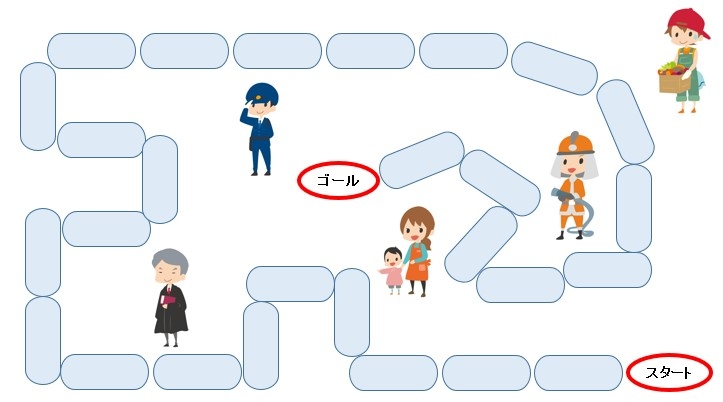
<p>【Section C】 Activities for students to think about life's milestones<br />Group work: Create a 人生ゲーム (Game of Life) in Japanese.<br />Think of ups and downs that someone might experience while trying to achieve skills and successes in life. Each member of the group writes a couple of clues and their point values in Japanese. <br />Examples:<br />e.g.<br />・ 高校をそつぎょうできた（+ 100ポイント） <br />・ 日本食のレストランでアルバイトを始(はじ)めた（+ 150ポイント）<br />・ 会社のしけんをうけたけれど、おちてしまった（－200ポイント）<br />See an example at <a href="https://www.takaratomy.co.jp/products/jinsei/50th/project/index.html" target="_blank" rel="noopener noreferrer">https://www.takaratomy.co.jp/products/jinsei/50th/project/index.html</a><br />Each member writes in their clues and points on the game board prepared by the teacher. (Below is a sample game board. Adjust the size and the number of boxes accordingly.)<br />Alternatively, the teacher or the group leader collects the clues and values from each member and puts them together on the game board. This game can also be created online.</p>
<p><a href="https://www.tjf.or.jp/clicknippon/ja/activity/uploads/2020/07/20200714_Senior.jpg"><img alt="20200714_Senior.jpg" src="https://www.tjf.or.jp/clicknippon/ja/activity/assets_c/2020/07/20200714_Senior-thumb-800x445-4119.jpg" class="mt-image-none" height="445" width="800" /></a></p>]]>
        
    </content>
</entry>

<entry>
    <title>【Online Teaching Support】Report from a teacher in Australia - Editor's Blog</title>
    <link rel="alternate" type="text/html" href="https://www.tjf.or.jp/clicknippon/en/henblo/online-teaching-supportreport-from-a-teacher-in-australia.php" />
    <id>tag:www.tjf.or.jp,2020:/clicknippon/en/henblo//20.2142</id>

    <published>2020-07-14T05:15:40Z</published>
    <updated>2020-07-14T05:17:55Z</updated>

    <summary>Report from a teacher in Ballarat, Austr...</summary>
    <author>
        <name>TJF</name>
        
    </author>
    
    
    <content type="html" xml:lang="ja" xml:base="https://www.tjf.or.jp/clicknippon/en/henblo/">
        <![CDATA[<p>Report from a teacher in Ballarat, Australia</p>
<p>Our seven-week online mode for senior students started at the end of March and finished at the end of May. Our middle (grades 9 and 10) and junior (grades 7 and 8) students had nine weeks of online instruction. Generally, online learning and teaching worked well for our students in the senior classes. Attendance rates for my classes were more than 90 percent. Senior students, who are more motivated and have stronger IT skills, did not show much stress as a result of remote learning and made very good progress. It seemed to me that they worked harder and learned faster remotely than in the classroom, where there are more distractions.</p>
<p>I had some concerns with junior and middle classes. The attendance rates for junior classes were slightly lower, and some students did not submit any work for six weeks. These students will be contacted by their mentor teachers, and their parents will also be informed. Online learning is not for everyone. We need to intervene immediately when a student cannot manage in the online learning environment.</p>
<p>One of the challenges we faced was managing teachers' and students' workloads. This involved preparing weekly planners with meaningful and engaging activities and providing clear instructions for students to follow. It also involved the creation of online assignments on learning systems such as Google Classroom or MS Teams and the screencasts commonly done by some teachers. I chose to meet students regularly in teleconference rooms and teach online with Google Slides or MS OneNote.</p>
<p>A significant amount of time was spent on planning, creating, and running classes, as well as on marking. We endeavored to make our weekly planners very thorough and detailed, with clear learning intentions and goals to be achieved, but also tried to keep our lessons well-balanced and engaging. We had to learn new apps to create a variety of interactive games so that students would remain engaged and not become bored with one style of online game. Experimenting with new interactive quizzes was fun for us, but also very time-consuming. I think all the students appreciated our efforts.</p>
<p>We had to be mindful of not talking for too long when meeting in the teleconference rooms so that the students had enough time to learn new concepts and complete their assigned work during class time. Students submitted their work regularly using either Google Classroom or Microsoft OneNote. We regularly marked their work and provided feedback.</p>
<p>Overall, we feel that we embraced online learning, and that the experience went smoothly because we are exposed to multiple platforms at our school. Junior teachers may have different perspectives and experiences, as their students may not have had the same level of IT skills as the more senior students.</p>
<p>It was very clear to me that all the students missed their school and missed meeting and working with their friends. They all appreciated face-to-face teaching, even those who are reluctant to participate in class. We all discovered that schools are not just places for academic learning.</p>]]>
        
    </content>
</entry>

<entry>
    <title>【Online Teaching Support】Worksheets for Online Learning: Future Plans and Immigration - Editor's Blog</title>
    <link rel="alternate" type="text/html" href="https://www.tjf.or.jp/clicknippon/en/henblo/online-teaching-supportworksheets-for-online-learning-future-plans-and-immigration.php" />
    <id>tag:www.tjf.or.jp,2020:/clicknippon/en/henblo//20.2141</id>

    <published>2020-07-14T04:58:26Z</published>
    <updated>2020-07-14T05:05:54Z</updated>

    <summary>Click Nippon introduces activities focus...</summary>
    <author>
        <name>TJF</name>
        
    </author>
    
    
    <content type="html" xml:lang="ja" xml:base="https://www.tjf.or.jp/clicknippon/en/henblo/">
        <![CDATA[<p>Click Nippon introduces activities focused on future plans and immigration.<br /> <br />A group of students from Canterbury University interviewed Mr. Shimizu, the owner and chef at Sakimoto, a Japanese restaurant in Christchurch, New Zealand. (Tokimeki Shuzaiki: <a href="https://www.tjf.or.jp/tokimeki/canterbury/2019/12/04/1501/" target="_blank" rel="noopener noreferrer">https://www.tjf.or.jp/tokimeki/canterbury/2019/12/04/1501/</a>)</p>
<p>In the senior high school level, students read the abridged interview article and the list of the top 10 occupations desired by high school students in Japan, and talk about their own aspirations. Students are invited to make their own 人生 (じんせい) ゲーム (Game of Life) in Japanese.<br />In the heritage, or background, level, students read the abridged interview article and participate in class activities on the topic of immigration, which relates to global issues and Japanese identity. The activities include interviewing parents, doing research, and engaging in discussions on the topic of immigration. <br />Through these activities, we will cover the topics of aspirations, career, future plans, global issues, and Japanese identity.</p>
<p>Worksheets can be downloaded from the link below.</p>
<p>☆for senior<br />・<a href="https://www.tjf.or.jp/clicknippon/en/henblo/uploads/2020/07/word_20200715senior.docx">Word</a><br />・<a href="https://www.tjf.or.jp/clicknippon/en/henblo/uploads/2020/07/pdf_20200715senior.pdf" target="_blank" rel="noopener noreferrer">PDF</a></p>
<p>☆for heritage<br />・<a href="https://www.tjf.or.jp/clicknippon/en/henblo/uploads/2020/07/word_20200715heritage.docx">Word</a><br />・<a href="https://www.tjf.or.jp/clicknippon/en/henblo/uploads/2020/07/pdf_20200715heritage.pdf" target="_blank" rel="noopener noreferrer">PDF</a></p>]]>
        
    </content>
</entry>

<entry>
    <title>【Online Teaching Support】Report from a teacher in Japan - Editor's Blog</title>
    <link rel="alternate" type="text/html" href="https://www.tjf.or.jp/clicknippon/en/henblo/online-teaching-supportreport-from-a-teacher-in-japan.php" />
    <id>tag:www.tjf.or.jp,2020:/clicknippon/en/henblo//20.2138</id>

    <published>2020-06-16T07:43:35Z</published>
    <updated>2020-06-16T07:45:54Z</updated>

    <summary>Report from a teacher in Japan I am conc...</summary>
    <author>
        <name>TJF</name>
        
    </author>
    
    
    <content type="html" xml:lang="ja" xml:base="https://www.tjf.or.jp/clicknippon/en/henblo/">
        <![CDATA[<p>Report from a teacher in Japan</p>
<p>I am concerned about how to improve the participation rate in my online lessons. Some students attend every lesson and take part in activities enthusiastically. I think some activities are going well: for example, listening practice between students, matching sentences and images, and reorganizing sentences into the correct order. <br />I am also interested to know what arrangements reopened schools have made to organize their students' attendance.</p>
<p>Please tell us about your teaching during the pandemic. Send us your information using the URL below. Answers are optional and can be brief.</p>
<p><a href="https://docs.google.com/forms/d/e/1FAIpQLSeNCzUPAmPFbac6Put9F2o30Tuu5IXFKBU1uefSf5vhGzw11Q/viewform">https://docs.google.com/forms/d/e/1FAIpQLSeNCzUPAmPFbac6Put9F2o30Tuu5IXFKBU1uefSf5vhGzw11Q/viewform</a></p>
<p>We look forward to sharing our ideas and experience in this way.</p>]]>
        
    </content>
</entry>

<entry>
    <title>【Online Teaching Support】Worksheets for Online Learning: Masks and Hand Washing - Editor's Blog</title>
    <link rel="alternate" type="text/html" href="https://www.tjf.or.jp/clicknippon/en/henblo/online-teaching-supportworksheets-for-online-learning-masks-and-hand-washing.php" />
    <id>tag:www.tjf.or.jp,2020:/clicknippon/en/henblo//20.2137</id>

    <published>2020-06-16T07:30:15Z</published>
    <updated>2020-06-17T00:30:08Z</updated>

    <summary>Click Nippon introduces activities focus...</summary>
    <author>
        <name>TJF</name>
        
    </author>
    
    
    <content type="html" xml:lang="ja" xml:base="https://www.tjf.or.jp/clicknippon/en/henblo/">
        <![CDATA[<p>Click Nippon introduces activities focused on making masks and hand washing. Wearing a handmade mask does not completely protect us from dust or viruses, but it helps to prevent the spread of infection. (<a href="https://sonaeru.jp/goods/handiwork/groceries/g-11/" target="_blank" rel="noopener noreferrer">https://sonaeru.jp/goods/handiwork/groceries/g-11/</a>)</p>
<p>The worksheets have been designed so that students can work independently. Teachers can easily make changes to suit their students. There are three levels available: primary, junior high, and senior high. In the primary and junior-high levels, students are invited to make a simple mask and learn an effective way of washing their hands by viewing a video. They will also create a bilingual poster about hand washing. The senior-high level includes an abridged article about Japanese masks originally written by students from Tokyo International University based on their interview with an expert on masks. The students also have an opportunity to learn some Japanese onomatopoeias.<br /> <br />Through these activities, we will cover viewing skills, creative thinking, literacy, and cross-curriculum priorities.</p>
<p>Worksheets can be downloaded from the link below.</p>
<p>☆for primary<br />・<a href="https://www.tjf.or.jp/clicknippon/en/henblo/uploads/2020/06/word_20200618primary.docx">Word</a><br />・<a href="https://www.tjf.or.jp/clicknippon/en/henblo/uploads/2020/06/pdf_20200618primary.pdf" target="_blank" rel="noopener noreferrer">PDF</a></p>
<p>☆for junior<br />・<a href="https://www.tjf.or.jp/clicknippon/en/henblo/uploads/2020/06/word_20200618junior.docx">Word</a><br />・<a href="https://www.tjf.or.jp/clicknippon/en/henblo/uploads/2020/06/pdf_20200618junior.pdf" target="_blank" rel="noopener noreferrer">PDF</a></p>
<p>☆for senior<br />・<a href="https://www.tjf.or.jp/clicknippon/en/henblo/uploads/2020/06/word_20200618senior.docx">Word</a><br />・<a href="https://www.tjf.or.jp/clicknippon/en/henblo/uploads/2020/06/pdf_20200618senior.pdf" target="_blank" rel="noopener noreferrer">PDF</a></p>]]>
        
    </content>
</entry>

<entry>
    <title>【Online Teaching Support】Report from a teacher in New Zealand - Editor's Blog</title>
    <link rel="alternate" type="text/html" href="https://www.tjf.or.jp/clicknippon/en/henblo/online-teaching-supportreport-from-a-teacher-in-new-zealand.php" />
    <id>tag:www.tjf.or.jp,2020:/clicknippon/en/henblo//20.2134</id>

    <published>2020-05-25T01:09:49Z</published>
    <updated>2020-05-25T01:18:19Z</updated>

    <summary>Report from a teacher in Christchurch, N...</summary>
    <author>
        <name>TJF</name>
        
    </author>
    
    
    <content type="html" xml:lang="ja" xml:base="https://www.tjf.or.jp/clicknippon/en/henblo/">
        <![CDATA[<p>Report from a teacher in Christchurch, NZ</p>
<p>I think the most challenging thing about online lessons is teaching without monitoring the students' reaction. I used the following method to overcome this. I made videos of explanations and sent them to the students in advance. In the live lessons, we reviewed the explanation briefly, then students would play games or work on interactive activities in small groups. I also used that time to answer student's individual questions.<br />There was a wide variety in students' responses. A half of the class attended every live lesson and completed all the tasks, one third of the class didn't do much, and 2 or 3 students in the class of 25 had little response. I think this is in a way unavoidable because every student has a different environment and circumstance at home.<br />Examples of successful activities were bingo and kanji practice using Jamboard. I tried not to make the lessons too serious, because I wanted my students to feel that the live lesson was a place for them to see friends and to play together.</p>]]>
        
    </content>
</entry>

</feed>