<?xml version="1.0" encoding="UTF-8"?>
<feed xmlns="//www.w3.org/2005/Atom">
    <title>currybetdotnet</title>
    <link rel="alternate" type="text/html" href="//www.currybet.net/" />
    <link rel="self" type="application/atom+xml" href="//www.currybet.net/feedburner2010.xml" />
    <id>tag:www.currybet.net,2010-06-21://2</id>
    <updated>2013-02-03T23:00:43Z</updated>
    <subtitle>Martin Belam&apos;s blog about information architecture, journalism, and digital media</subtitle>
    <generator uri="//www.sixapart.com/movabletype/">Movable Type 5.02</generator>


<entry>
    <title>“It’s the end…but the moment has been prepared for…”</title>
    <link rel="alternate" type="text/html" href="//www.currybet.net/cbet_blog/2013/02/the-final-blog-post.php" />
    <id>tag:www.currybet.net,2013://2.3611</id>

    <published>2013-02-01T21:09:33Z</published>
    <updated>2013-02-03T23:00:43Z</updated>

    <summary>After ten years, this is the last blog post on currybetdotnet.</summary>
    <author>
        <name>Martin Belam</name>
        <uri>http://www.currybet.net/about.php</uri>
    </author>
    
        <category term="Blogging" scheme="//www.sixapart.com/ns/types#category" />
    
    
    <content type="html" xml:lang="en" xml:base="//www.currybet.net/">
        <![CDATA[<p>After ten years, this is the last blog post on currybetdotnet.</p>

<!-- rebuild one -->

<p>It started on Christmas Eve ten years ago, with &ldquo;<a href="//www.currybet.net/cbet_blog/2002/12/danny-sullivan-interview---and.php">Danny Sullivan interview - and Google’s Xmas turkey</a>&rdquo;, and has survived <a href="//www.currybet.net/cbet_blog/2010/02/fixing-the-ia-of-an-ias-blog-p.php">several re-designs</a>, <a href="http://www.currybet.net/cbet_blog/2006/01/currybetdotnet-archive-restore.php">server crashes</a>, <a href="http://www.currybet.net/cbet_blog/2006/09/new-job-with-sony-in-austria.php">country moves</a> and <a href="http://www.currybet.net/cbet_blog/2005/11/---im-leaving-the-bbc.php">job</a> <a href="http://www.currybet.net/cbet_blog/2012/04/leaving-the-guardian.php">changes</a>.</p>

<p>It&rsquo;s the end&hellip;but the moment has been prepared for&hellip;</p>

<p>I&rsquo;ll be blogging about much the same sort of stuff over on <a href="//martinbelam.com/">a new site</a>, just with some neater templates, Wordpress behind the scenes, and no need to worry as an information architect about why <a href="//www.currybet.net/cbet_blog/flickr/">Flickr</a> and <a href="http://www.currybet.net/cbet_blog/tour-de-france/">Tour de France</a> ended up as categories on here, yet the <a href="https://www.google.co.uk/#hl=en&safe=off&tbo=d&output=search&sclient=psy-ab&q=site:currybet.net+%22financial+times%22&oq=site:currybet.net+%22financial+times%22&gs_l=hp.3...1071.8003.0.8234.35.35.0.0.0.0.175.2542.33j2.35.0.les%3B..0.0...1c.1.2.hp.uVsfGGAQyrk&pbx=1&bav=on.2,or.r_gc.r_pw.r_cp.r_qf.&bvm=bv.41867550,d.d2k&fp=bbcfab0fc51ad70f&biw=1334&bih=671">Financial Times</a> and <a href="https://www.google.co.uk/#hl=en&safe=off&tbo=d&sclient=psy-ab&q=site:currybet.net+%22twitter%22&oq=site:currybet.net+%22twitter%22&gs_l=hp.3...16778.18967.1.19033.7.7.0.0.0.1.126.440.5j1.6.0.les%3B..0.0...1c.1.2.hp.icZ0249pn0U&pbx=1&bav=on.2,or.r_gc.r_pw.r_cp.r_qf.&bvm=bv.41867550,d.d2k&fp=bbcfab0fc51ad70f&biw=1334&bih=671">Twitter</a> didn&rsquo;t.</p>

<p>So, come join me over on <a href="//martinbelam.com/">martinbelam.com</a>&hellip;</p>

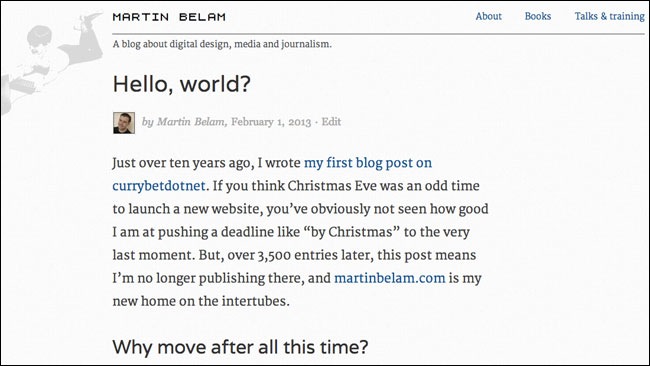
<div align="center">
	<a href="//martinbelam.com/"><img src="//www.currybet.net/images/blog2013/01/hello_world_martinbelamcom_650.jpg" width="650" height="366" alt="My new website martinbelam.com" border="0"></a>
<p class="caption">My new website is waiting for you: <a href="//martinbelam.com/">martinbelam.com</a></p>
</div>]]>
        
    </content>
</entry>


<entry>
    <title>What can news organisations like news.com.au learn from the BBC’s approach to online voting fraud?</title>
    <link rel="alternate" type="text/html" href="//www.currybet.net/cbet_blog/2013/01/news-voting-fraud.php" />
    <id>tag:www.currybet.net,2013://2.3610</id>

    <published>2013-01-29T11:05:10Z</published>
    <updated>2013-01-29T11:16:22Z</updated>

    <summary>
	When systems fail and embarrass a news organisation, the temptation is always to blame the technology or the programmers. But no computer forces editors to commission content based on flawed sources.
</summary>
    <author>
        <name>Martin Belam</name>
        <uri>http://www.currybet.net/about.php</uri>
    </author>
    
        <category term="BBC" scheme="//www.sixapart.com/ns/types#category" />
    
        <category term="Media" scheme="//www.sixapart.com/ns/types#category" />
    
        <category term="Voting" scheme="//www.sixapart.com/ns/types#category" />
    
    
    <content type="html" xml:lang="en" xml:base="//www.currybet.net/">
        <![CDATA[<p class="standfirst">
	When systems fail and embarrass a news organisation, the temptation is always to blame the technology or the programmers. But no computer <em>forces</em> editors to commission content based on flawed sources.
</p>

<p>I got a reminder of the voting systems I used to work on at the BBC when <a href="https://twitter.com/neilthackray">Neil Thackray of The Media Briefing</a> tweeted a link to this blog post from October &mdash; &ldquo;<a href="//www.ubermotive.com/?p=68">The Ubermotive Guide to Media Influence</a>&rdquo;</p>

<p>In it a &ldquo;hacker&rdquo; describes how they were able to influence the editorial content of <a href="//news.com.au">news.com.au</a> by posting <em>a lot</em> of fake votes into online polls that the site was running. To demonstrate how much they&rsquo;d compromised the system, they even took to deliberately dead-locking polls on 50%-50%. Nobody at the company noticed anything was amiss until it was picked up by Reddit, and the manipulated polls were being referenced in stories, and forming the basis for commissioning.</p>

<p>Flashback to the mid-2000s, and my producer role at the BBC for &ldquo;Online Voting&rdquo;. Central &ldquo;New Media&rdquo;, where I worked, had a system called <code>polling.pl</code>. Written in Perl, an admin panel allowed site producers to set up &ldquo;self-service&rdquo; votes. The system worked well enough, but didn&rsquo;t handle high load terribly well, and it wasn&rsquo;t very hard for determined users to &ldquo;vote stuff&rdquo;.</p>

<p>Factual &amp; Learning meanwhile had a system called <code>log2results</code>. This burnt the casting of a vote into the server logs, and a harvester script came along and counted them later. It also analysed votes for odd patterns. It was hard to influence the outcome of a vote, but this system couldn&rsquo;t display dynamic counts back to the user.</p>

<p>News Online naturally had their own system as well. It handled load really well, but couldn&rsquo;t, for architectural reasons, be served on pages aways from the <code>news.bbc.co.uk</code> sub-domain. It also had a fatal flaw &mdash; if two votes were submitted at <em>exactly</em> the same time, the counter would sometimes reset to zero. This used to annoy programme makers and journalists <em>a lot</em>.</p>

<p>For a good few months I was on the fool&rsquo;s errand of trying to reconcile these three systems into a single requirements set and technical spec for one &uuml;ber-arching-pan-BBC solution that would scale, be dynamic, self-service to set up, and difficult to stuff with spoof votes. And which would keep three technical and editorial departments with three very different cultures happy that it was better than <em>their</em> system which it was replacing. And possibly shower users with glitter and unicorns into the bargain&hellip;</p>

<p>In the course of it, I learned an awful lot about the length that people will go to fixing relatively meaningless online votes.</p>
	
<p>Now I always tried to be clear at the BBC that online votes should be for <em>fun</em> and not serious matters, but that didn&rsquo;t stop a myriad of producers around the BBC using them inappropriately. I&rsquo;d be the person making the awkward phone call to some BBC local radio website saying &ldquo;You really shouldn&rsquo;t be running a competition with a prize worth &pound;1,000 being awarded to an individual on the basis of an easily spoofed online vote that only has 52 votes.&rdquo;</p>

<p>The vote that was targeted the most in my time there was <a href="//www.currybet.net/cbet_blog/2004/12/todays-listeners-lord.php">the Today programme&rsquo;s &ldquo;Listener&rsquo;s Lord&rdquo; poll</a>. A fringe candidate had unswerving online loyalty, and we uncovered what seemed like a whole university campus computer network repeatedly voting for them. The beauty of the <code>log2results</code> approach was that you could order the counting script to discount anything that matched a particular behaviour, and remove those votes from the final score. The people trying to manipulate the vote got no feedback that the results of their efforts weren&rsquo;t being counted, so never felt the need to change their attack strategy.</p>

<p>But all that was the mid-2000s, and news organisations have had an awful lot of time to get their heads around the validity of online votes since then. The BBC had, and still has, a strict set of editorial guidelines. <a href="//www.bbc.co.uk/guidelines/editorialguidelines/page/guidelines-politics-practices-opinion/#phone-text-and-online-votes-and-other-straw-p">The current text states that</a>:</p>

<blockquote>&ldquo;&lsquo;Straw polls&rsquo; - including phone, text and online votes - have no statistical or numerical value.
<br /><br />
	They can be an effective form of interaction with the audience, illustrating a debate, but they should only be used with an explicit reference making it clear to audiences that they are self-selecting and not representative or scientific. Such votes cannot normally be said even to represent the audience for the programme or website, they only represent those who chose to participate. This applies even when there is a large response.
<br /><br />
	They should not be referred to in our output as a &lsquo;poll&rsquo;. The term &lsquo;straw poll&rsquo; itself is widely misunderstood and should normally be avoided in output.&rdquo;</blockquote>
	
<p>For me, that is what has gone wrong with the process at news.com.au, and it is a set of guidelines that any news organisation would do well to adopt.</p><p>Although people will look at the technical details, and blame the website security and the programmers, in the end it is the editorial decision to take the numbers at face value, and to commission content on the back of this kind of vote that has been their downfall.</p>]]>
        
    </content>
</entry>


<entry>
    <title>Vine - social networking’s newest “Minimum Viable Product”?</title>
    <link rel="alternate" type="text/html" href="//www.currybet.net/cbet_blog/2013/01/vine-minimum-viable-product.php" />
    <id>tag:www.currybet.net,2013://2.3609</id>

    <published>2013-01-28T14:58:16Z</published>
    <updated>2013-01-28T15:01:46Z</updated>

    <summary><![CDATA[
Is video-loop sharing app Vine the most high-profile experiment yet with the concept of the &ldquo;Minimum Viable Product&rdquo;?	
]]></summary>
    <author>
        <name>Martin Belam</name>
        <uri>http://www.currybet.net/about.php</uri>
    </author>
    
        <category term="Social media" scheme="//www.sixapart.com/ns/types#category" />
    
    
    <content type="html" xml:lang="en" xml:base="//www.currybet.net/">
        <![CDATA[<p class="standfirst">
Is video-loop sharing app Vine the most high-profile experiment yet with the concept of the &ldquo;Minimum Viable Product&rdquo;?	
</p>

<p>When <a href="https://twitter.com/reneritchie">Rene Ritchie</a> <a href="//www.imore.com/twitters-new-vine-has-potential-needs-lot-work-its-usable">reviewed Vine for iMore</a>, he said &ldquo;For now, Vine is interesting but nowhere nearly fully cooked yet. I won&rsquo;t be spending any time with it until 1.x or 2.0 is released.&rdquo;</p>

<p>And if you look at Twitter, you can see a lot of feature requests for things that it <em>could</em> be able to do. People want to crop and zoom, to re-edit, to see the final cut without sharing, to access movie clips or still images from their previously saved photos, and to try out the app on platforms other than iOS.</p>

<p>The team behind Vine <em>could</em> have spent any amount of time building out those features. But what they do have is a core product that allows you to quickly create an account on the service, shoot some video, and then share it. And that is the very definition of the &ldquo;<a href="//www.svpg.com/minimum-viable-product/">Minimum Viable Product</a>&rdquo;.</p>

<p>At the moment they are getting tons of real-use data about how frequently people use the app, what videos they shoot, and what, out of that long shopping list of things that <em>could</em> be added to the app, are the most requested. That data tells them a lot more than they could have gathered in focus groups or lab test settings where people might have theorised about the features they&rsquo;d want to use in a <em>hypothetical app</em> they couldn&rsquo;t really play with.</p>

<p>A word of caution though.</p><p>With websites I&rsquo;m a big fan of build, release, learn, iterate, because every time you visit a website, you are using the latest version. This is trickier to pull off in free apps. Often you only get a few seconds to impress someone on their first run before they dismiss you as not having been worth downloading. And the friction in getting people to update apps to the latest version as you add new features is high.</p>

<p>And as <a href="https://twitter.com/GuardianJoanna/status/295894344232210433">the #vineporn incident shows</a>, maybe they were ill-advised to leave out of the MVP scope the use case: &ldquo;As an editor, it should not be possible for me to select as an editor&rsquo;s pick a clip marked as sensitive content, or tagged with #NSFW.&rdquo;</p>]]>
        
    </content>
</entry>


<entry>
    <title>If you can’t see the point of Vine, maybe that’s because you only see the output?</title>
    <link rel="alternate" type="text/html" href="//www.currybet.net/cbet_blog/2013/01/the-point-of-vine.php" />
    <id>tag:www.currybet.net,2013://2.3608</id>

    <published>2013-01-28T09:49:15Z</published>
    <updated>2013-01-28T09:58:31Z</updated>

    <summary><![CDATA[
	There is already a lot of grumbling on the net that new video-loop sharing app Vine is &lsquo;pointless&rsquo;. Perhpas the point isn&rsquo;t necessarily the output alone&hellip;?
]]></summary>
    <author>
        <name>Martin Belam</name>
        <uri>http://www.currybet.net/about.php</uri>
    </author>
    
        <category term="Social media" scheme="//www.sixapart.com/ns/types#category" />
    
    
    <content type="html" xml:lang="en" xml:base="//www.currybet.net/">
        <![CDATA[<p class="standfirst">
	There is already a lot of grumbling on the net that new video-loop sharing app Vine is &lsquo;pointless&rsquo;. Perhaps the point isn&rsquo;t necessarily the output alone&hellip;?
</p>

<p>I was joking on Twitter that we&rsquo;ll shortly see a glut of blog posts entitled things like &ldquo;7 ways <a href="https://itunes.apple.com/app/vine-make-a-scene/id592447445">Vine</a> can improve the SEO of content marketing for your brand&rdquo; and &ldquo;How journalists can use Vine&rdquo;. Almost exactly like <a href="//www.currybet.net/cbet_blog/2012/02/pinterest.php">my collection of Pinterest blog titles from a year ago</a>.</p>

<p>But what I&rsquo;ve actually noticed is a rather snobby, dismissive tone in quite a few tweets.</p><p>It makes me wonder if the old elitism you got from journalists about the huddled masses is re-surfacing as first-world social media adopters disparage anything from newbies.</p><p>I&rsquo;ve seen people say they&rsquo;ve looked at <a href="//vinepeek.com">Vinepeek</a> and &ldquo;it&rsquo;s all crap.&rdquo; I do rather wonder, if you are looking at a bunch of random short video clips that weren&rsquo;t directly shared with you, and they don&rsquo;t meet your content expectations, whether the problem might not be your expectations, not the service?</p>

<p>And when did we get to the point where everything had to be so brutally utilitarian on the web?</p>

<blockquote>
	&ldquo;I don&rsquo;t like Vine and I don&rsquo;t see a purpose for it.&rdquo; &mdash; <a href="https://twitter.com/DanHowe/status/295785599372255233">@DanHowe</a>
	<br /><br />
	&ldquo;I don't &lsquo;get&rsquo; the purpose of Vine.&rdquo; &mdash; <a href="https://twitter.com/benlakey/status/295783052657967104">@benlakey</a>
	<br /><br />
	&ldquo;I&rsquo;m not sure I get the purpose of Vine, what is it?&rdquo; &mdash; <a href="https://twitter.com/rkehte/status/295735751340081153">@rkehte</a>
</blockquote>

<p>I&rsquo;m 99% convinced that anyone who thinks Vine is &ldquo;pointless&rdquo; hasn&rsquo;t spent any time with a three year old.</p>

<p>At the moment I don&rsquo;t think my three year old conceives there can be anything funnier in the world than watching <a href="//vine.co/v/b5xzLFzpFJx?fb_action_ids=10151404709700708&fb_action_types=vine-app%3Apost&fb_source=aggregation&fb_aggregation_id=288381481237582">jump-cut videos of herself pulling faces</a>. And I <em>know</em> there is very little more fun in the world than watching your kids really cracking themselves up over the silliest thing.</p>

<p>You know, it may well turn out that Vine isn&rsquo;t sustainable, and that a free six second looping video app isn&rsquo;t the future of social media, isn&rsquo;t a &ldquo;great&rdquo; idea, can&rsquo;t save journalism or reinvent advertising. But hey, you know what, I spent about forty minutes having tremendous fun with it over the weekend making short video clips <em>with</em> my daughter, and that&rsquo;s good enough for me.</p>
	
<p>If you can&rsquo;t see the point of Vine, maybe that&rsquo;s because you only see the output, not the fun had in making them?</p>
]]>
        
    </content>
</entry>


<entry>
    <title>You can’t please all the commenters all of the time</title>
    <link rel="alternate" type="text/html" href="//www.currybet.net/cbet_blog/2013/01/you-cant-please-all-the-commenters.php" />
    <id>tag:www.currybet.net,2013://2.3607</id>

    <published>2013-01-25T13:31:22Z</published>
    <updated>2013-01-25T13:39:22Z</updated>

    <summary><![CDATA[The Guardian swapped flat comment threads for ‘nested’ ones. The Manchester Evening News swapped ‘nested’ for flat. Guess what happened next&hellip;]]></summary>
    <author>
        <name>Martin Belam</name>
        <uri>http://www.currybet.net/about.php</uri>
    </author>
    
        <category term="Social media" scheme="//www.sixapart.com/ns/types#category" />
    
        <category term="The Guardian" scheme="//www.sixapart.com/ns/types#category" />
    
    
    <content type="html" xml:lang="en" xml:base="//www.currybet.net/">
        <![CDATA[<p class="standfirst">The Guardian swapped flat comment threads for ‘nested’ ones. The Manchester Evening News swapped ‘nested’ for flat. Guess what happened next&hellip;</p>

<p>I&rsquo;ve blogged a couple of times about <a href="//www.guardian.co.uk/commentisfree/2012/dec/23/switch-nesting-system-comment-threads">the Guardian&rsquo;s bruising experience with introducing threaded comments onto their website</a>, a move which has sparked continuing howls of protest amongst the community.</p>

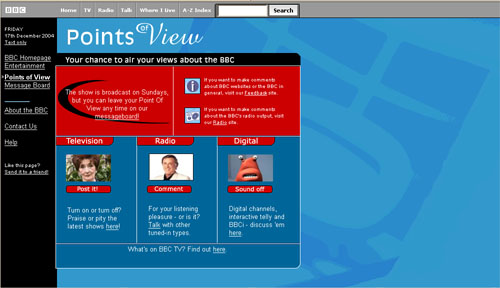
<p>Having previously been involved in a project to move the BBC&rsquo;s Points Of View message board <em>from</em> threaded <em>to</em> flat, I also know how much frustration <em>that</em> caused for regular users. They mourned &ldquo;Ol&rsquo; blue&rdquo; &mdash; as they lovingly referred to the previous format &mdash; for many months after the switch.</p>

<div align="center">
<img src="//www.currybet.net/images/blog/20041217pov.jpg" alt="Screengrab of the old BBC Points of View message board homepage" border="0" />
</div>

<p>My own take is that opposition or love of nested or threaded comments is a religious issue &mdash; akin to top-posting/bottom-posting in emails. Not only are you fully committed to your preference, you simply can&rsquo;t see any justification for doing it the other way. </p>

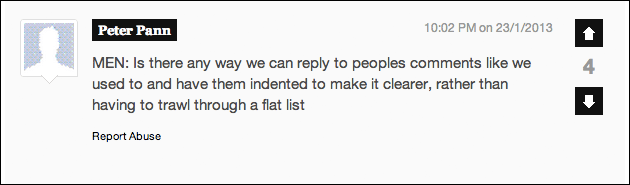
<p>So I was gently amused this week when <a href="//www.manchestereveningnews.co.uk/news/greater-manchester-news/welcome-to-the-new-look-manchester-evening-1234307?utm_source=feedburner&utm_medium=feed&utm_campaign=Feed%3A+menews+(Manchester+Evening+News+-+RSS+Feed)">one of the first responses to the Manchester Evening News redesign</a> was, guess what&hellip;</p>

<blockquote>&ldquo;Is there any way we can reply to peoples comments like we used to and have them indented to make it clearer, rather than having to trawl through a flat list&rdquo;</blockquote>

<div align="center">
	<img src="//www.currybet.net/images/blog2013/01/men_threaded_complaint.png" width="630" height="185" alt="Manchester Evening News comment complaint">
</div>]]>
        
    </content>
</entry>


<entry>
    <title>How Facebook comments do/don’t increase/decrease* trolling for news websites [*Delete as applicable]</title>
    <link rel="alternate" type="text/html" href="//www.currybet.net/cbet_blog/2013/01/facebook-comments-trolling.php" />
    <id>tag:www.currybet.net,2013://2.3606</id>

    <published>2013-01-24T18:04:35Z</published>
    <updated>2013-01-24T18:19:05Z</updated>

    <summary><![CDATA[
Whether news sites should or shouldn&rsquo;t use the Facebook comment plug-in or Facebook identity seems to have been a recurring theme in the last few days.	
]]></summary>
    <author>
        <name>Martin Belam</name>
        <uri>http://www.currybet.net/about.php</uri>
    </author>
    
        <category term="Facebook" scheme="//www.sixapart.com/ns/types#category" />
    
        <category term="Media" scheme="//www.sixapart.com/ns/types#category" />
    
        <category term="Newspapers" scheme="//www.sixapart.com/ns/types#category" />
    
    
    <content type="html" xml:lang="en" xml:base="//www.currybet.net/">
        <![CDATA[<p class="standfirst">
Whether news sites should or shouldn&rsquo;t use the Facebook comment plug-in or Facebook identity seems to have been a recurring theme in the last few days.	
</p>


<p>The <a href="//www.niemanlab.org/2013/01/not-a-good-24-hours-for-facebook-comments/">Nieman Journalism Lab called it a &ldquo;movement&rdquo;</a>, which seems quite a grand term for two sites announcing similar but different things on the same day, but both <a href="//www.politico.com/blogs/media/2013/01/comments-made-easier-154891.html">Politico</a> and <a href="http://techcrunch.com/2013/01/22/we-want-you-back/">TechCrunch</a> are opting to move their commenting systems away from Facebook. At the very same time, waves were being created in the UK as the <a href="http://www.manchestereveningnews.co.uk/news/greater-manchester-news/welcome-to-the-new-look-manchester-evening-1234307?utm_source=feedburner&utm_medium=feed&utm_campaign=Feed%3A+menews+(Manchester+Evening+News+-+RSS+Feed)">newly-relaunched Manchester Evening News</a> shifted to <a href="http://www.guardian.co.uk/uk/the-northerner/2013/jan/18/manchester-evening-news-facebook-accounts">a commenting system that required users to have a Facebook account</a>. At the heart of all this is the old canard &mdash; would forcing users to comment with something closer to their real identity reduce instances of trolling?</p>

<p>It seems to me that what Politico and TechCrunch have in common is a stubborn belief that the quality of debate underneath their articles would improve <em>if only they could find the right commenting platform</em>.</p><p>At Politico, <a href="//www.politico.com/blogs/media/2013/01/comments-made-easier-154891.html">Dylan Byers is putting his faith in technology</a>:</p>

<blockquote>&ldquo;Disqus gives you the ability to up-vote and down-vote comments and thread responses. By default, high quality comments will filter to the top, and poor quality ones will not show up on the page.&rdquo;</blockquote>

<p>A view immediately debunked in the first comment left on the piece, where Adrian Lowe pointed out:</p>

<blockquote>&ldquo;That’s if people actually vote for them. And if people are trolling in voting, then low quality comments will be seen at the top. So, &lsquo;by default&rsquo; high quality comments will not necessarily rise to the top.&rdquo;</blockquote>

<p>You only have to look at the green and red arrows on the MailOnline site to see how sometimes it is the scum that rises, not the cream.</p>

<p>TechCrunch&rsquo;s attitude to their below-the-line contributors was made clear by the image they chose to accompany their announcement: &ldquo;<a href="//techcrunch.com/2013/01/22/we-want-you-back/">I miss you asshole</a>&rdquo;</p>

<p>They seem to be ascribing the behaviour of their users to the platform they employ, not to the way they are goaded into commenting by the articles they write. As my ex-colleague <a href="https://twitter.com/megpickard">Meg Pickard</a> says:</p>

<blockquote>&ldquo;If you write a provocative article, you can expect people to be provoked.&rdquo;</blockquote>


<p>The Manchester Evening News move is in the opposite direction, hoping that a shift <em>to</em> using Facebook identity will improve the commenting experience on the site. There&rsquo;s no doubt that restricting people to <em>only</em> using Facebook identities will exclude some users, but David Higgerson wrote an eloquent personal blog post about the shift: &ldquo;<a href="//davidhiggerson.wordpress.com/2013/01/17/much-ado-about-facebook/">Much ado about Facebook</a>&rdquo;.</p>

<blockquote>&ldquo;Most of the people who have complained&hellip;seem to come from a starting point that news websites should allow free-for-all comments on all stories, and that the &lsquo;community&rsquo; can say what it likes under any name it likes. I don&rsquo;t see it like that.&rdquo;</blockquote>

<p>My own experience with using the Facebook comments plug-in under news content was within <a href="//www.currybet.net/cbet_blog/2012/12/guardian-facebook-rise-fail.php">the Guardian Facebook app</a>. I had rather hoped that by opening two commenting threads underneath each article &mdash; one on Facebook, and one on the Guardian site &mdash; we&rsquo;d be able to prove once and for all whether one or other led to better interaction. In the end, it appeared that actually the tone set early on in a comment thread looked like it influenced comments much more than anything intrinsic about the format or identity system used.</p>

<p>There&rsquo;s no doubt that software design and features <em>do</em> influence community behaviours, but not as much as decent community management and personal engagement from journalists does. In 2011 my friend <a href="https://twitter.com/newsmary">Mary Hamilton</a> wrote <a href="//maryhamilton.co.uk/2011/09/if-you-don%E2%80%99t-want-to-talk-to-people-turn-your-comments-off/">a very thorough blog post</a> looking at the responsibility of news organisations to not just provide a commenting space, but to also participate and join in that space:</p>

<blockquote>&ldquo;If you don&rsquo;t set examples of good behaviour, or reward [commenters], or empower the regular visitors to police their community by telling them the rules, your community will make its own rules, and chances are you won&rsquo;t like them.&rdquo;</blockquote>

<p>She described switching tech platforms in search of an answer to bad community problems as akin to &ldquo;laying Astroturf over an unkempt, unmaintained garden because you don&rsquo;t like the colour of the wildflowers.&rdquo;</p><p>She also said:</p>

<blockquote>&ldquo;The news industry can&rsquo;t simply automate away its duty to respond to users. Small publishers and bloggers for the most part understand this, and &mdash; more crucially &mdash; so do our users. These are human beings at the other end of the internet, talking in our spaces, and we need to start treating them that way.&rdquo;</blockquote>

<p>Still, the golden rule of newspaper website comment systems is &ldquo;<a href="//www.currybet.net/cbet_blog/2011/09/news-websites-comments-golden-rule.php">Don&rsquo;t be a dick</a>&rdquo; &mdash; and <em>no</em> technology choice can enforce that.</p>

<p><br /><br /><br /><em>Full disclosure: I used to work at the Guardian, and worked directly with Facebook whilst I was there. I currently provide some design and consultancy services to Trinity Mirror who publish the Manchester Evening News.</em></p>]]>
        
    </content>
</entry>


<entry>
    <title>In “censoring” Fawlty Towers, the BBC is only following Ofcom’s lead on what viewers find unacceptable</title>
    <link rel="alternate" type="text/html" href="//www.currybet.net/cbet_blog/2013/01/bbc-fawlty-towers.php" />
    <id>tag:www.currybet.net,2013://2.3605</id>

    <published>2013-01-23T22:51:50Z</published>
    <updated>2013-01-23T23:01:36Z</updated>

    <summary><![CDATA[The BBC is under fire for editing an episode of &ldquo;Fawlty Towers&rdquo; to remove racist language. Given the proximity of the BBC finding itself on the front pages of the tabloids for not editing a ten year old episode of the Tweenies that they had broadcast loads of times before without comment or criticism, you can see why there might have been heightened awareness of potential offence embedded in repeat showings. Especially if audience research has only recently said that this language was unacceptable when broadcast.]]></summary>
    <author>
        <name>Martin Belam</name>
        <uri>http://www.currybet.net/about.php</uri>
    </author>
    
        <category term="BBC" scheme="//www.sixapart.com/ns/types#category" />
    
        <category term="Media" scheme="//www.sixapart.com/ns/types#category" />
    
        <category term="Television" scheme="//www.sixapart.com/ns/types#category" />
    
    
    <content type="html" xml:lang="en" xml:base="//www.currybet.net/">
        <![CDATA[<p>The BBC is under fire for <a href="//www.guardian.co.uk/tv-and-radio/tvandradioblog/2013/jan/23/fawlty-towers-isnt-racist-major-gowen-is">editing an episode of &ldquo;Fawlty Towers&rdquo; to remove racist language</a>. Given that the BBC just found itself on the front pages of tabloids for <a href="//www.currybet.net/cbet_blog/2013/01/bbc-tweenies-savile.php"><em>not</em> editing an old episode of the Tweenies</a> shown loads of times before without comment or criticism, you can see why there <em>might</em> have been heightened awareness of potential offence embedded in repeat showings.</p>

<p>Debates like this often fall into political and ideological lines though, with the BBC accused of censorship and rewriting history. It is much more illuminating to look at the impact racist language has with Licence Fee payers and viewers.</p>

<p>It is only a couple of years ago that Ofcom commissioned and published <a href="//stakeholders.ofcom.org.uk/binaries/research/tv-research/offensive-lang.pdf">research into the public&rsquo;s reaction to offensive language on television and radio</a>.</p>

<p>As much as people can argue that a Fawlty Towers edit is against the artistic integrity of the work, is political correctness gone mad, or simply just over-cautiousness by the BBC, public opinion on &ldquo;potentially discriminatory&rdquo; language was quite clear clear in the Ofcom study:</p>

<blockquote>&ldquo;Overall, most potentially offensive words were not seen to be unacceptable in principle, as context was a key factor in determining whether language was seen as generally acceptable or unacceptable. The exception to this was some potentially discriminatory language (particularly &lsquo;Paki&rsquo;, &lsquo;nigger&rsquo; and &lsquo;spastic&rsquo;) which some participants considered unacceptable in any context.&rdquo;</blockquote>

<p>I suspect there will be acres of comment columns and green ink spilled on the issue in the next couple of days, but it seems that in this case, the BBC has opted not to broadcast <em>pre-watershed</em> one of the <em>only</em> three words that fall into this category with the viewing public. It was surely the right decision.</p>]]>
        
    </content>
</entry>


<entry>
    <title>“If we don’t understand the financial system, we aren’t doing our jobs as journalists” - Chris Taggart of OpenCorporates at Hack/Hacks London</title>
    <link rel="alternate" type="text/html" href="//www.currybet.net/cbet_blog/2013/01/hacks-hackers-chris-taggart.php" />
    <id>tag:www.currybet.net,2013://2.3604</id>

    <published>2013-01-23T10:19:50Z</published>
    <updated>2013-01-23T10:23:57Z</updated>

    <summary><![CDATA[The latest Hacks/Hackers London meet-up was crammed with talks from people at Bloomberg, Thomson Reuters and the Financial Times. Striking a rather different organisational note at the end of the evening was Chris Taggart. I&rsquo;ve previously seen Chris talk about OpenlyLocal, but this talk was about another open data project &mdash; OpenCorporates. Here are my notes&hellip;]]></summary>
    <author>
        <name>Martin Belam</name>
        <uri>http://www.currybet.net/about.php</uri>
    </author>
    
        <category term="Data Journalism" scheme="//www.sixapart.com/ns/types#category" />
    
        <category term="Hacks/Hackers" scheme="//www.sixapart.com/ns/types#category" />
    
    
    <content type="html" xml:lang="en" xml:base="//www.currybet.net/">
        <![CDATA[<p>The latest <a href="//meetuplondon.hackshackers.com/">Hacks/Hackers London</a> meet-up was crammed with talks from people at <a href="//www.currybet.net/cbet_blog/2013/01/hacks-hackers-marianne-bouchart.php">Bloomberg</a>, <a href="http://www.currybet.net/cbet_blog/2013/01/hacks-hackers-sam-arnold-forster.php">Thomson</a> <a href="http://www.currybet.net/cbet_blog/2013/01/hacks-hackers-himanshu-ojha.php">Reuters</a> and <a href="http://www.currybet.net/cbet_blog/2013/01/data-journalism-not-the-job-of.php">the Financial Times</a>. Striking a rather different organisational note at the end of the evening was <a href="https://twitter.com/CountCulture">Chris Taggart</a>. I&rsquo;ve previously seen <a href="http://www.currybet.net/cbet_blog/2011/05/futureeverything-data-journalism.php#taggart">Chris talk about OpenlyLocal</a>, but this talk was about another open data project &mdash; <a href="http://opencorporates.com/">OpenCorporates</a>.</p>

<a name="chris"></a><h2>&ldquo;OpenCorporates&rdquo; - Chris Taggart</h2>

<p>Perhaps the first thing to say about Chris&rsquo;s talk is that it provoked a strong reaction on Twitter:</p>

<blockquote>&ldquo;My mind is blown by opencorporate. I've thought of about 15 stories in as many minutes.&rdquo; - <a href="https://twitter.com/petenew/status/291657182322249729">Peter Newlands on Twitter</a></blockquote>

<blockquote>&ldquo;Chris from opencorporate is gonna turn me into a journalist if he's not careful&rdquo; - <a href="https://twitter.com/schizdazzle/status/291657756409208832">@schizdazzle on Twitter</a></blockquote>

<p>In the glitzy surroundings of the Bloomberg office, and following talks from three of the behemoths of financial data and journalism, Chris opened by saying that compared to some of their offerings &ldquo;There is nothing to see here. This is just a toy.&rdquo;</p>

<p>This was disingenuous at best. Chris explained that OpenCorporates.com has the a simple, but huge, goal: An entry for every company that exists as a legal entity in the world. That is no small undertaking, and the database has grown from 3 million companies to 50 million in the space of a couple of years.</p>

<p>The site gathers the data through a mixture of means, both fair and foul. Where there is the opportunity to do so, as in Norway and New Zealand, they have used APIs and data dumps from the official bodies registering countries in various territories. Where there isn&rsquo;t, they&rsquo;ve had to rely on screen-scraping the data.</p>

<p>One of the questions this revelation sparked from the floor was about how much &ldquo;bad data&rdquo; gets into the system. Chris said that they design to scrapers to try and throw alerts and warnings when they can&rsquo;t parse data, rather than scrape junk into the system. He also said that often, when people complain about erroneous data on OpenCorporates, the error is in the source material, not the way that OpenCorporates has integrated it.</p>

<p>Chris outlined the main purposes of OpenCorporates. Firstly it acts as a place where every legal entity it knows about has a unique and permanent ID and URL. Here is my business, <a href="//opencorporates.com/companies/gb/08082754">Emblem Digital Consulting Ltd</a>. It can also help &ldquo;clean&rdquo; and reconcile data by illustrating the different instances of <a href="//opencorporates.com/companies?utf8=%E2%9C%93&q=Tesco+Mobile&commit=Search">Tesco Mobile</a>, or clarifying whether <a href="http://opencorporates.com/companies/gb/08256787">Microsoft-UK Ltd</a> is actually the same legal entity as <a href="http://opencorporates.com/companies/gb/01624297">Microsoft Ltd</a> in the UK. (It isn&rsquo;t)</p>

<p>It also offers journalists a powerful ability to search cross-jurisdiction. Chris illustrated this with an example showing how Mitt Romney&rsquo;s corporate holdings could only be unravelled by tracking branches of the companies he was active in through the states that had stronger measures around disclosing information.</p>

<p>The site acts as a hub to aggregate additional data like health and safety violations or county court judgements against a company or company directors. And finally, it is becoming a platform itself, with an API providing developers and external businesses the opportunity to build their own products and services off the back of the data.</p>

<p>Chris explained why he thought what they were doing was important. &ldquo;We are not about hardcore professionals, we are for people who don&rsquo;t have access to all that data, NGOs and journalists in smaller organisations&rdquo; he said.</p><p>When Lehman Brothers was dissolved, it was thought they owned around 300 subsidiary legal entities. A more thorough post-mortem audit revealed over two thousand. &ldquo;These companies aren&rsquo;t doing this for fun, they are doing it to gain advantage and profit&rdquo; Chris said.</p>
	
<p>&ldquo;The whole of the last ten years has shown us how important this information is. If we don&rsquo;t understand what they are doing in the financial systems, then we aren&rsquo;t doing our jobs as journalists.&rdquo;</p>

<a name="next"></a><h2>Next&hellip;</h2>

<p>A big thank you to <a href="https://twitter.com/GuardianJoanna">Joanna Geary</a> and <a href="https://twitter.com/Maid_Marianne">Marianne Bouchart</a> for putting the night together. You can join the <a href="//meetuplondon.hackshackers.com/">Hacks/Hackers London meet-up group</a> to get the details of the next evening&hellip;</p>
]]>
        
    </content>
</entry>


<entry>
    <title><![CDATA[“Data Journalism: not the job of one department” - Emily Cadman &amp; Martin Stabe at Hacks/Hackers London]]></title>
    <link rel="alternate" type="text/html" href="//www.currybet.net/cbet_blog/2013/01/data-journalism-not-the-job-of.php" />
    <id>tag:www.currybet.net,2013://2.3603</id>

    <published>2013-01-23T09:55:10Z</published>
    <updated>2013-01-23T10:00:24Z</updated>

    <summary><![CDATA[I&rsquo;ve been publishing my notes from the talks at the newly revived Hacks/Hackers London meet-up. Representing the Financial Times on the evening were Emily Cadman &amp; Martin Stabe. Here are my notes&hellip;]]></summary>
    <author>
        <name>Martin Belam</name>
        <uri>http://www.currybet.net/about.php</uri>
    </author>
    
        <category term="Data Journalism" scheme="//www.sixapart.com/ns/types#category" />
    
        <category term="Hacks/Hackers" scheme="//www.sixapart.com/ns/types#category" />
    
    
    <content type="html" xml:lang="en" xml:base="//www.currybet.net/">
        <![CDATA[<p>I&rsquo;ve been publishing my notes from the talks at the newly revived <a href="//meetuplondon.hackshackers.com/">Hacks/Hackers London</a> meet-up. So far I&rsquo;ve written up what was said by Bloomberg&rsquo;s <a href="//www.currybet.net/cbet_blog/2013/01/hacks-hackers-marianne-bouchart.php">Marianne Bouchart</a>, plus <a href="http://www.currybet.net/cbet_blog/2013/01/hacks-hackers-sam-arnold-forster.php">Sam Arnold-Forster</a> and <a href="http://www.currybet.net/cbet_blog/2013/01/hacks-hackers-himanshu-ojha.php">Himanshu Ojha</a> of Thomson Reuters. Representing the Financial Times on the evening were Emily Cadman &amp; Martin Stabe.</p>

<a name="emily"></a><h2>&ldquo;Data Journalism: not the job of one department&rdquo; - Emily Cadman &amp; Martin Stabe from the FT</h2>

<p><a href="https://twitter.com/ecadman">Emily Cadman</a> started by making the point that nobody at the FT <em>has</em> the job title &ldquo;data journalist&rdquo;. Their projects are made up of small multi-disciplined teams that include people from a variety of desks with a variety of skills. Often, she said, they are the bunch of people who go to the pub together, as that is where some of the best ideas get discussed. A typical ad hoc project team might feature a subject specialist reporter, an interactive journalist, an interactive designer (using HTML5/CSS/JS), and an interactive developer for the trickier back-end bits.</p> 

<p>Emily said the team are strategically placed near the main news desk so that they can overhear what is going on and suggest new ways of telling a particular story. This also means they sometimes pop up and kill stories, when they know the numbers aren&rsquo;t going to support the narrative being discussed.</p>

<p><a href="https://twitter.com/martinstabe">Martin Stabe</a> channeled <a href="//journalistsresource.org/reference/research/research-chat-steve-doig-data-journalism-social-science-deadline">Steve Doig saying</a> that data journalism is &ldquo;Social science done on deadline&rdquo;. Doing a great bit of data journalism was about &ldquo;taking a hypothesis, taking the data, then proving or disproving it.&rdquo;</p>

<p>Sometimes you get an advantage. Martin explained how the FT have struck a deal with the government to get a more detailed breakdown of GCSE results than anybody else and were now able to provide a richer analysis, which gives them a &ldquo;seemingly endless stream of stories.&rdquo;</p>

<p>Martin talked about the shift to using technologies like HTML5 and JavaScript in their interactives, moving towards integration with their web apps which are, he said, &ldquo;<a href="//www.currybet.net/cbet_blog/2012/02/hacks-hackers-steve-pinches-ft.php">famously not iOS</a>.&rdquo;</p>

<p>He also showed some of the financial calculators that form part of the <a href="//www.ft.com/lex">Lex</a> service. He explained that often the knowledge and insight that allows the FT to give great advice is &ldquo;trapped in Excel spreadsheets on a reporter&rsquo;s desktop.&rdquo; The interactive he showed was very simple, essentially using JavaScript to emulate spreadsheet formulas.</p>

<p>A big recurring theme of Emily and Martin&rsquo;s presentation was the relationship between journalists and programmers. Emily was adamant on the subject.</p>

<blockquote>&ldquo;Do we try and make developers into journalists? Do we try and make journalists into developers? I don&rsquo;t think either approach works&rdquo;</blockquote> 

<p>She put it beautifully.</p>

<p>She said it had taken her a decade to become a good journalist. She could now devote a couple of years to becoming &ldquo;a mediocre programmer at best&rdquo;. What you need, she said, was a journalist who could &ldquo;talk geek&rdquo;, and a developer who cared about story-telling.</p>

<p>I have to say, <a href="//www.currybet.net/cbet_blog/2010/01/working-at-the-guardian.php">in my time at the Guardian</a>, one of the things that made it good to work there was constantly dealing with developers who had chosen to be there precisely because they <em>were</em> interested in journalism and story-telling. I do think news organisations genuinely under-estimate that in their tech teams. Getting journalists interested in tech is the <em>way</em> harder side of the equation.</p>

<p>I&rsquo;ve written on the subject of <a href="//www.currybet.net/cbet_blog/2010/05/do-journalists-need-to-learn-t.php">whether journalists</a> (<a href="//www.currybet.net/cbet_blog/2011/04/will-we-all-have-to-code.php">and indeed UXers</a>) <a href="http://www.currybet.net/cbet_blog/2010/05/do-journalists-need-to-learn-t.php">need to code</a>. My argument is similar to Emily&rsquo;s, and I wouldn&rsquo;t expect people to be running up their own web apps. However, I think that if you are involved in digital media and you don&rsquo;t at least have a <em>curiosity</em> to explore a bit of HTML, CSS and JavaScript, you are probably in the wrong job. If nothing else, learning some of the basics stops you asking embarrassing questions when talking to the techies.</p>

<a name="next"></a><h2>Next&hellip;</h2>

<p>The final presentation of the night was from Chris Taggart talking about his project &mdash; OpenCorporates. I&rsquo;ll have my notes from that next.</p>
]]>
        
    </content>
</entry>


<entry>
    <title>Will the BBC’s Tweenies Jimmy Savile blunder usher in a new, expensive, era of ‘repeats compliance’?</title>
    <link rel="alternate" type="text/html" href="//www.currybet.net/cbet_blog/2013/01/bbc-tweenies-savile.php" />
    <id>tag:www.currybet.net,2013://2.3602</id>

    <published>2013-01-20T21:45:18Z</published>
    <updated>2013-01-21T09:11:41Z</updated>

    <summary><![CDATA[
The BBC&rsquo;s blunder in repeating an episode of the Tweenies this morning that featured a Jimmy Savile reference will no doubt usher in a review of the controls around selecting which children&rsquo;s programmes to repeat. Was it avoidable?	
]]></summary>
    <author>
        <name>Martin Belam</name>
        <uri>http://www.currybet.net/about.php</uri>
    </author>
    
        <category term="BBC" scheme="//www.sixapart.com/ns/types#category" />
    
        <category term="Television" scheme="//www.sixapart.com/ns/types#category" />
    
    
    <content type="html" xml:lang="en" xml:base="//www.currybet.net/">
        <![CDATA[<p class="standfirst">
The BBC&rsquo;s blunder in repeating an episode of the Tweenies this morning that featured a Jimmy Savile reference will no doubt usher in a review of the controls around selecting which children&rsquo;s programmes to repeat. Was it avoidable?	
</p>


<blockquote>&ldquo;New figures reveal that the BBC is wasting hundreds of thousands of pounds of Licence Fee payers&rsquo; money on an army of so-called &lsquo;repeat compliance officers&rsquo; who are paid to do nothing but sit around and watch old television programmes all day. Barmy BBC bosses claim the process is needed for every single show being repeated on television, even if it has already been repeated several times before. Rent-a-quote MP blah-de-blah said etc etc etc&hellip;&rdquo; &mdash; A newspaper near you soon</blockquote>

<p>No, nobody has <em>actually</em> written that yet, but following today&rsquo;s BBC cock-up when a decade old Tweenies episode that featured a Jimmy Savile impression aired on CBeebies, I can very easily imagine a situation where that becomes the case. There are around 390 episodes of the Tweenies &mdash; you&rsquo;ve got to have been pretty unlucky to have unwittingly scheduled &ldquo;Favourite Songs&rdquo; just a few days after the police published their report into Savile&rsquo;s crimes.</p>

<p>Should the BBC have avoided transmitting it? I genuinely can&rsquo;t believe that anybody watches shows like this for compliance issues before scheduling them. I imagine slates of episodes of shows like In The Night Garden, Teletubbies and the Tweenies get added to the CBeebies schedule with barely a thought for their content. What could possibly have been controversial about them, especially if they&rsquo;ve been on a constant loop of repeats for several years? And I doubt the metadata attached to them goes down to enough scene-by-scene detail to have listed the controversial bit</p>

<p>However, there <em>was</em> maybe a clue that perhaps should have raised a flag at CBeebies HQ.</p>

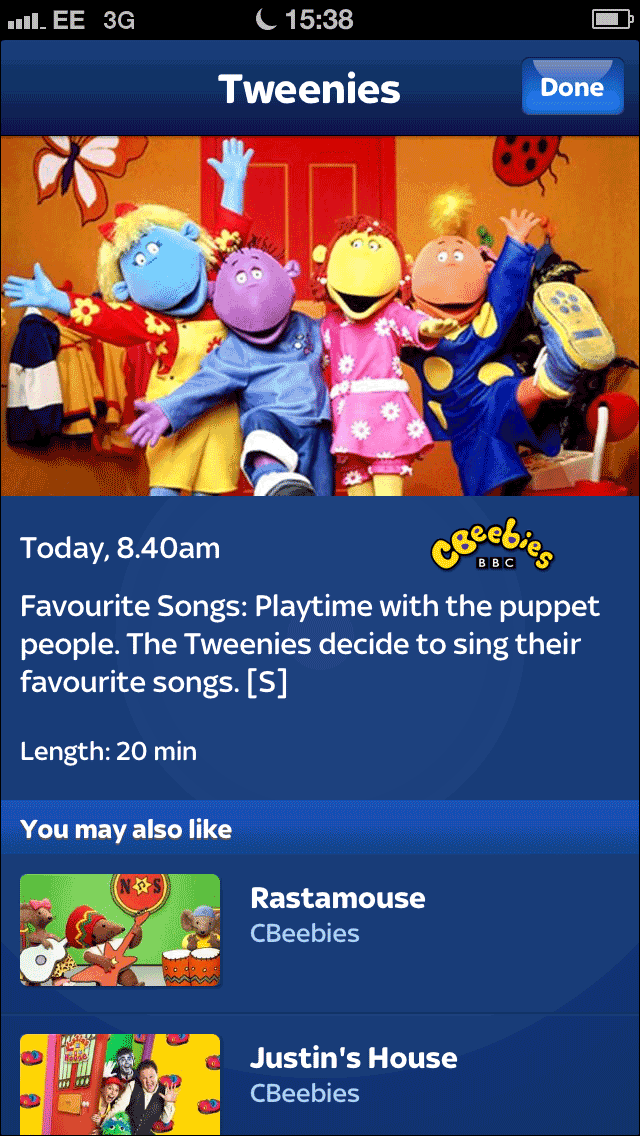
<p>The electronic TV guide listing for this morning&rsquo;s episode on Sky simply stated:</p>

<blockquote>&ldquo;Favourite songs: Playtime with the puppet people. The Tweenies decide to sing their favourite songs [S]&rdquo;</blockquote>

<div align="center">
<img src="//www.currybet.net/images/blog2013/01/tweenies_sky_listing.png" width="640" height="1136" alt="Tweenies listing in the Sky+ iPhone app">
<p class="caption">Tweenies listing as it appeared in the Sky+ iPhone app</p>
</div>

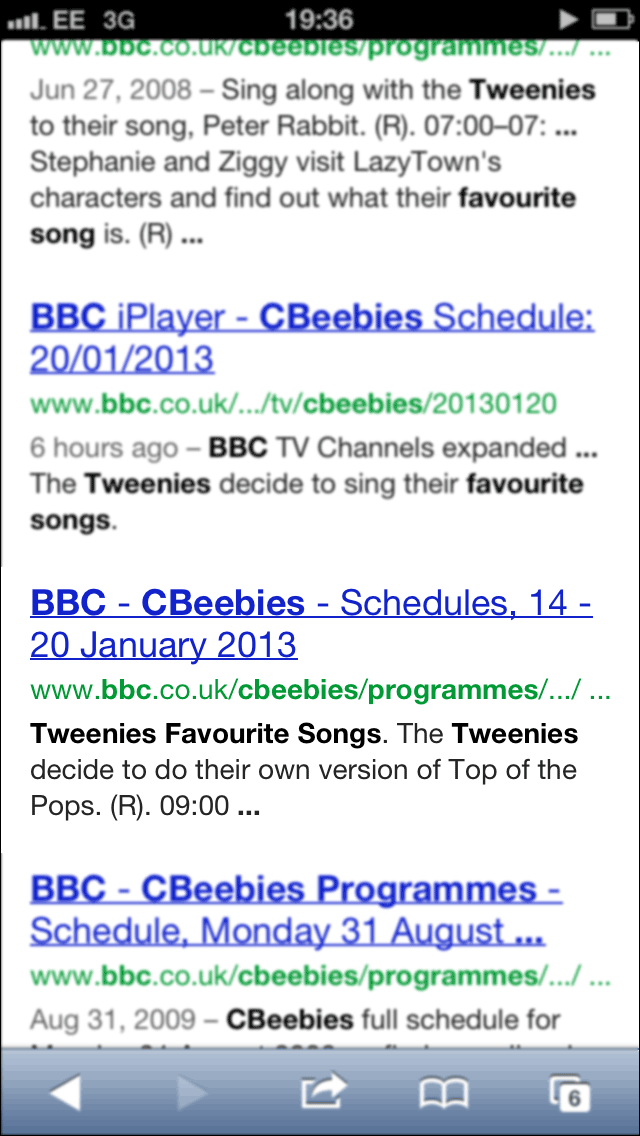
<p>The BBC advance listing on their own website appears to have been more descriptive, as Google has indexed a specific mention of “Top of the Pops”:</p>

<div align="center">
	<img src="//www.currybet.net/images/blog2013/01/google_listing.png" width="640" height="1136" alt="Google Listing">	
<p class="caption">BBC listing for the programme captured in Google&rsquo;s index</p>
</div>

<p>I do wonder if that explicit mention in the programme details shouldn’t have warranted a closer inspection?</p>

<div align="center">
	<img src="//www.currybet.net/images/blog2013/01/sun_tweenie_outrage.jpg" width="559" height="318" alt="The Tweenie story on the Sun website">
<br /><br />	<img src="//www.currybet.net/images/blog2013/01/sun_front_page.jpg" width="650" height="840" alt="Sun Front Page">
	<br /><br />
	<img src="//www.currybet.net/images/blog2013/01/star_tweenie_outrage.jpg" width="650" height="832" alt="The Tweenie story makes the Star’s front page">
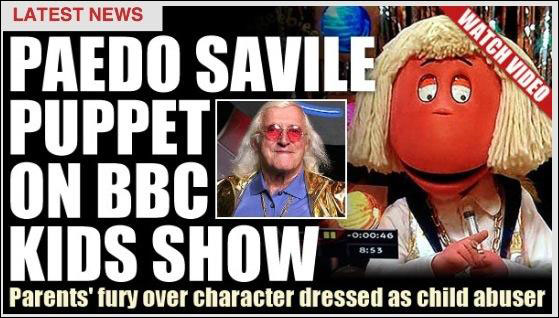
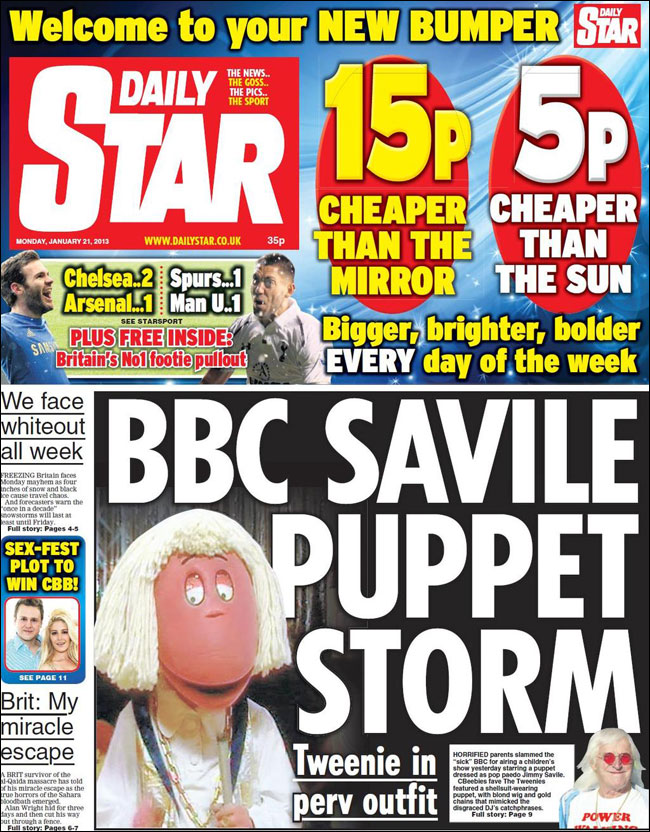
<p class="caption">Coverage of the story on The Sun website and front page (top) and the Daily Star front page (bottom)</p>
</div>
]]>
        
    </content>
</entry>


<entry>
    <title>The Times survey their subscribers. Digital only subscribers need not apply.</title>
    <link rel="alternate" type="text/html" href="//www.currybet.net/cbet_blog/2013/01/times-survey.php" />
    <id>tag:www.currybet.net,2013://2.3601</id>

    <published>2013-01-19T23:24:05Z</published>
    <updated>2013-01-23T10:26:40Z</updated>

    <summary><![CDATA[
The Times is surveying subscribers in order to &ldquo;improve the products and services we offer to our customers&rdquo;. They&rsquo;ve designed the survey in a way that excludes digital customers.	
]]></summary>
    <author>
        <name>Martin Belam</name>
        <uri>http://www.currybet.net/about.php</uri>
    </author>
    
        <category term="Media" scheme="//www.sixapart.com/ns/types#category" />
    
        <category term="Newspapers" scheme="//www.sixapart.com/ns/types#category" />
    
        <category term="The Times" scheme="//www.sixapart.com/ns/types#category" />
    
    
    <content type="html" xml:lang="en" xml:base="//www.currybet.net/">
        <![CDATA[<p class="standfirst">
The Times is surveying subscribers in order to &ldquo;improve the products and services we offer to our customers&rdquo;. They&rsquo;ve designed the survey in a way that excludes digital customers.	
</p>

<blockquote>&ldquo;As a valued subscriber, your opinions are very important to us.&rdquo;</blockquote>

<p>So said the marketing survey email I got at the weekend from the Times and the Sunday Times. I&rsquo;ve been a digital subscriber since the website went behind the paywall.</p>

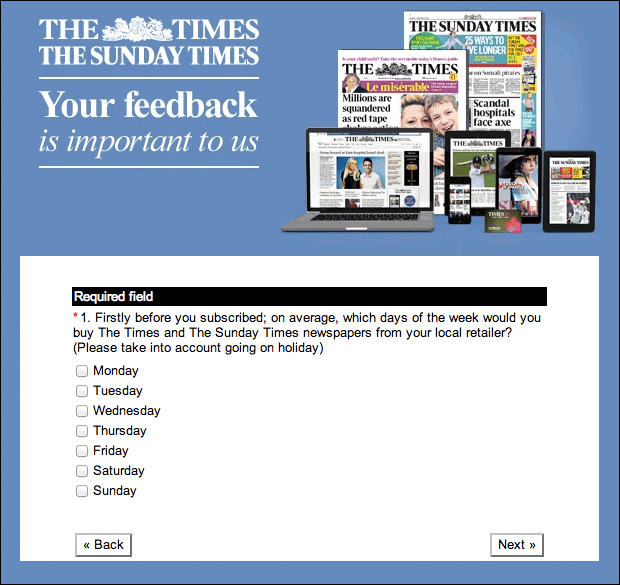
<p>The first question in the survey?</p>

<blockquote>&ldquo;Firstly before you subscribed; on average, which days of the week would you buy The Times and The Sunday Times newspapers from your local retailer? (Please take into account going on holiday)&rdquo;</blockquote>

<p>There are seven options: Monday, Tuesday, Wednesday, Thursday, Friday, Saturday, Sunday.</p><p>It is a compulsory question, with no &ldquo;none&rdquo; answer.</p><p>I <em>never</em> used to buy the paper in print, I&rsquo;ve <em>only</em> ever subscribed digitally. I can&rsquo;t answer the question. I can&rsquo;t reach the rest of the survey.</p>

<p>That doesn&rsquo;t make me feel like their marketing department value their digital only subscribers. It makes me feel that they can&rsquo;t believe their digital product range would ever attract people who hadn&rsquo;t previously purchased the paper.</p>

<div align="center">
	<img src="//www.currybet.net/images/blog2013/01/times_survey.png" width="620" height="585" alt="The flawed Times survey">
</div>

<a name="response"></a><p><strong>UPDATED 23/1/2013</strong>: A spokesperson for the Times contacted me about this post, and said:</p><blockquote>&ldquo;The first question should have &lsquo;never&rsquo; as an option but didn&rsquo;t. Fortunately the majority of subscribers who completed the survey did buy a paper at some stage and we have had over 29k responses, of which about 39% were digital subscribers. We will discount the question in case it is skewed. Despite that, the survey has yielded us useful feedback from our users&rdquo;</blockquote>]]>
        
    </content>
</entry>


<entry>
    <title>“Data + Other data + People = Readable story” - Himanshu Ojha at Hacks/Hackers London</title>
    <link rel="alternate" type="text/html" href="//www.currybet.net/cbet_blog/2013/01/hacks-hackers-himanshu-ojha.php" />
    <id>tag:www.currybet.net,2013://2.3600</id>

    <published>2013-01-18T17:48:34Z</published>
    <updated>2013-01-18T17:59:20Z</updated>

    <summary><![CDATA[Hacks/Hackers London returned this week, with an evening of talks about financial and data journalism. Himanshu Ojha is a data journalist  at Thomson Reuters, and was talking about the story behind &ldquo;The Unequal State of America&rdquo;. Here are my notes&hellip;]]></summary>
    <author>
        <name>Martin Belam</name>
        <uri>http://www.currybet.net/about.php</uri>
    </author>
    
        <category term="Data Journalism" scheme="//www.sixapart.com/ns/types#category" />
    
        <category term="Hacks/Hackers" scheme="//www.sixapart.com/ns/types#category" />
    
    
    <content type="html" xml:lang="en" xml:base="//www.currybet.net/">
        <![CDATA[<p><a href="//meetuplondon.hackshackers.com/">Hacks/Hackers London</a> returned this week, with an evening of talks about financial and data journalism. I&rsquo;ve already posted <a href="//www.currybet.net/cbet_blog/2013/01/hacks-hackers-marianne-bouchart.php">notes from Marianne Bouchart&rsquo;s </a> and <a href="http://www.currybet.net/cbet_blog/2013/01/hacks-hackers-sam-arnold-forster.php">Sam Arnold-Forster</a>&rsquo;s talks. Next up was <a href="https://twitter.com/h_ojha">Himanshu Ojha</a>, who like Sam Arnold-Forster, works at Thomson Reuters. He was talking about the story behind &ldquo;<a href="http://www.reuters.com/subjects/income-inequality">The Unequal State of America</a>&rdquo;.</p>

<a name="himanshu"></a><h2>&ldquo;Data + Other data + People = Readable story&rdquo; - Himanshu Ojha</h2>

<p>Himanshu described himself as &ldquo;a journalist who had come to data&rdquo;, rather than someone who had always done data journalism. His major project for the last few months had been a Reuters series entitled &ldquo;<a href="//www.reuters.com/subjects/income-inequality">The Unequal State of America</a>&rdquo;. Himanshu said he worked on it for several months &ldquo;up until it was released.&rdquo;</p><p>I rather liked that &ldquo;released&rdquo; metaphor for features, almost like &ldquo;releasing&rdquo; an album or DVD. It also echoed in my mind the way <a href="//www.currybet.net/cbet_blog/2012/12/newsrewired-bobbie-johnson.php">Bobbie Johnson talked about Matter at news:rewired</a>, treating each story like an individual project.</p>

<p>Himanshu Ojha said that framing the &ldquo;Unequal State&rdquo; series had been hard &mdash; they knew they wanted it to be about inequality and data-driven, but trying to discover new angles had taken some time. He spent a little time talking about the behind-the-scenes tools he had used, which was actually the less-than-glamorous workhorse of Excel. &ldquo;Lots of large Excel spreadsheets&rdquo; as Himanshu put it. In the end, with over 50 million rows of data, they also employed <a href="//www.microsoft.com/sqlserver/">SQL Server</a> and <a href="//www-01.ibm.com/software/uk/analytics/spss/">SPSS</a>, although Himanshu was quite clear that the coding part of the project wasn&rsquo;t his &mdash; he was the story-teller.</p>

<p>He had a rather lovely equation for data journalism. One piece of data makes a dinner party anecdote. Two data sources combined can make a story. But it is &ldquo;Data + Other data + People = Readable story&rdquo;. I do worry that in the rush to have trendy infographics and &ldquo;me too&rdquo; data journalism, people are tempted to make visualisations out of any data they can get their hands on, rather than focus on telling a good story.</p>

<p>Several years ago at one of our London IA meet-ups, <a href="//www.currybet.net/cbet_blog/2009/11/london-ia-mini-4-max-gadney--.php">Max Gadney talked about how designers can easily fall into this trap too</a>. Often having to do work at the bidding of someone else&rsquo;s business requirements, when left to their own devices, he argued, designers could latch on to data as something they could &ldquo;design with&rdquo;, without building a compelling narrative.</p>

<p>There were three key things that Himanshu wanted people to take away from the talk. He argued that &ldquo;getting lost in the weeds&rdquo; where you end up obsessing over the minutiae of the detail of a data journalism story is a necessary part of the process, but only for a short period of time. Treat it like &ldquo;a holiday fling&rdquo; &mdash; brief and intense. He said that during this project he had even been dreaming about &ldquo;margins of error&rdquo;.</p>

<p>Secondly, he suggested befriending experts in the field you are telling the story about, in his case sociologists and academics. Show them your work <em>before you publish it</em>. You will almost certainly have made mistakes, since in a data-driven story &ldquo;there are so many moving parts.&rdquo;</p>

<p>Finally, allow more time than you think you&rsquo;ll need for checking, and re-checking. The &ldquo;dirty secret&rdquo; of data journalism, he said, is that &ldquo;if you want to do a good long piece, you&rsquo;ve got to spend a long time on it.&rdquo;</p>


<a name="next"></a><h2>Next&hellip;</h2>

<p>Another organisation being represented at Hacks/Hacks London was the FT. Next up I&rsquo;ll have my notes from the talk by Emily Cadman &amp; Martin Stabe&hellip;</p>


]]>
        
    </content>
</entry>


<entry>
    <title>“Financial Graphics at Thomson Reuters” - Sam Arnold-Forster at Hacks/Hackers London</title>
    <link rel="alternate" type="text/html" href="//www.currybet.net/cbet_blog/2013/01/hacks-hackers-sam-arnold-forster.php" />
    <id>tag:www.currybet.net,2013://2.3599</id>

    <published>2013-01-17T22:21:01Z</published>
    <updated>2013-01-20T22:02:42Z</updated>

    <summary><![CDATA[Last night was the first Hacks/Hackers London after a break, and it was jam-packed with talks about financial and data journalism. The second slot was taken by people from Thomson Reuters, opening with Sam Arnold-Forster talking about &ldquo;Financial graphics&rdquo;. Here, as ever, are my notes&hellip;]]></summary>
    <author>
        <name>Martin Belam</name>
        <uri>http://www.currybet.net/about.php</uri>
    </author>
    
        <category term="Data Journalism" scheme="//www.sixapart.com/ns/types#category" />
    
        <category term="Hacks/Hackers" scheme="//www.sixapart.com/ns/types#category" />
    
        <category term="Media" scheme="//www.sixapart.com/ns/types#category" />
    
    
    <content type="html" xml:lang="en" xml:base="//www.currybet.net/">
        <![CDATA[<p>Last night was the first <a href="//meetuplondon.hackshackers.com/">Hacks/Hackers London</a> after a break, and it was jam-packed with talks about financial and data journalism. I&rsquo;ve already posted <a href="//www.currybet.net/cbet_blog/2013/01/hacks-hackers-marianne-bouchart.php">my notes from Marianne Bouchart&rsquo;s opening talk</a>. The second slot was taken by people from Thomson Reuters, opening with Sam Arnold-Forster.</p>

<a name="sam"></a><h2>&ldquo;Financial Graphics at Thomson Reuters&rdquo; by Sam Arnold-Forster</h2>

<p>Sam&rsquo;s talk had a focus on the production of graphics, starting with the simple &ldquo;flat graphics&rdquo; similar to those that a newspaper might have in print, to those which involve more interactivity.</p>

<p>He said that a key thing was to focus on simplicity, and abstract out the under-lying story from the data with minimal styling. He said it was important for financial graphics to try and make <em>at the most</em> two points. I was impressed with the crisp simplicity of the designs Sam showed.</p>

<p>Often, Sam said, at the big companies people obsess about having the data and the tools and the technology, but a lot of what they do at the front-end is HTML5/CSS/JavaScript, and anybody can do that.</p>

<p>He explained that the focus on data visualisation was creating an interesting blur in some of the Thomson Reuters products. <a href="//thomsonreuters.com/products_services/financial/financial_products/a-z/datastream/">Datastream</a>, for example, is a subscription product. However, within the interface is a tweet button, and my understanding was that if someone makes a chart and tweets a link from inside the product, clicking that link gives a glimpse to non-subscribers into the previously closed and paywalled world of the Datastream server.</p>

<p>Sam Arnold-Forster says that infographics and visualisations need to be planned as part of the news cycle. As well as encouraging graphics journalists to go to news planning meetings, at Thomson Reuters they are encouraged to form good peer-to-peer relationships with journalists out in the field and in the bureaus. That way if the reporter gets a data-driven story, they have a point of contact to get it translated into graphics.</p>

<p>One question from the floor directed at Sam suggested that all of the graphics had seemed pretty traditional, and wondered if there was a reluctance amongst subscribers for new formats. Sam explained that the customers are generally time-poor and under pressure, so they wanted to use graphics that could help easily tell a story in one picture, rather than have the journalists write the words.</p>

<p>Sam Arnold-Forster did say that he thought more interactive elements &ldquo;changed the relationship between the producer and the customer&rdquo; as it had become more direct. Sam did then go on to say that they didn&rsquo;t really have a measure of success. They have anecdotal evidence that someone emails and says &ldquo;I really liked that. That was useful. That helped me with my job.&rdquo;</p>

<p>It struck me that this summed up a problem with the news industry at the moment. No offence to Sam, whose work looked excellent, but here was a news organisation that was all about <em>measuring</em> the success of other companies&rsquo; business plans and performance, yet it couldn&rsquo;t seem to reliably measure the effectiveness of its own content.</p>

<a name="next"></a><h2>Next&hellip;</h2>

<p>Also on the Hacks/Hackers London bill was another Thomson Reuters speaker &mdash; Himanshu Ojha &mdash; who was telling the incredibly interesting story behind &ldquo;The Unequal State of America&rdquo;. I&rsquo;ll have <a href="//www.currybet.net/cbet_blog/2013/01/hacks-hackers-himanshu-ojha.php">my notes from that next&hellip;</a></p>
]]>
        
    </content>
</entry>


<entry>
    <title>“All Bloomberg journalism is data journalism” - Marianne Bouchart at Hacks/Hackers London</title>
    <link rel="alternate" type="text/html" href="//www.currybet.net/cbet_blog/2013/01/hacks-hackers-marianne-bouchart.php" />
    <id>tag:www.currybet.net,2013://2.3598</id>

    <published>2013-01-17T20:23:27Z</published>
    <updated>2013-01-20T22:00:51Z</updated>

    <summary><![CDATA[After a lengthy hiatus, Hacks/Hackers London was back this week with a data journalism themed evening. First up was Marianne Bouchart from hosts Bloomberg, whose plush offices gave the whole evening a rather different feel to the usual dingy pub basement. Here are my notes&hellip;]]></summary>
    <author>
        <name>Martin Belam</name>
        <uri>http://www.currybet.net/about.php</uri>
    </author>
    
        <category term="Data Journalism" scheme="//www.sixapart.com/ns/types#category" />
    
        <category term="Hacks/Hackers" scheme="//www.sixapart.com/ns/types#category" />
    
        <category term="Journalism" scheme="//www.sixapart.com/ns/types#category" />
    
    
    <content type="html" xml:lang="en" xml:base="//www.currybet.net/">
        <![CDATA[<p>After a lengthy hiatus, <a href="//meetuplondon.hackshackers.com/">Hacks/Hackers London</a> was back this week with a data journalism themed evening. First up was <a href="https://twitter.com/Maid_Marianne">Marianne Bouchart</a> from hosts <a href="//www.bloomberg.com/">Bloomberg</a>, whose plush offices gave the whole evening a rather different feel to the usual dingy pub basement.</p>

<a name="marianne"></a><h2>&ldquo;All Bloomberg journalism is data journalism&rdquo; - Marianne Bouchart</h2>

<p>Marianne started with an overview of the company and the impressive array of data sources they use &mdash; some 11,200 of them &mdash; from brokers to banks to researchers to analytics companies.</p>

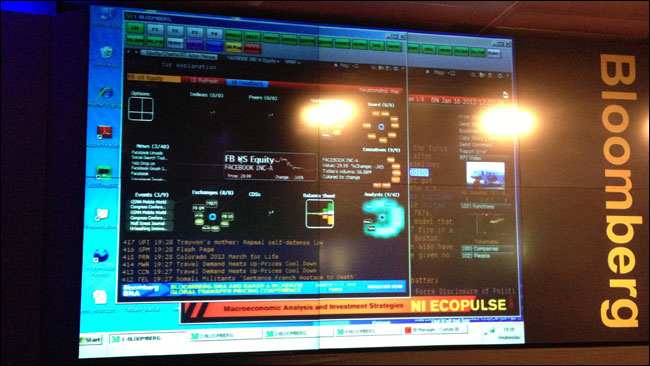
<p>She took the room through a walk-through of the Bloomberg data terminal that subscribers and Bloomberg journalists use. To anyone of an earlier vintage it is pleasingly reminiscent of MS-DOS and CEEFAX &mdash; all monospaced type on a black screen, which a host of functionality that all has to be launched from a command line.</p>

<div align="center">
	<img src="//www.currybet.net/images/blog2013/01/bloomberg_demo.jpg" width="650" height="366" alt="Bloomberg terminal demo">
<p class="caption">Marianne&rsquo;s demo of the Bloomberg terminal</p>
</div>

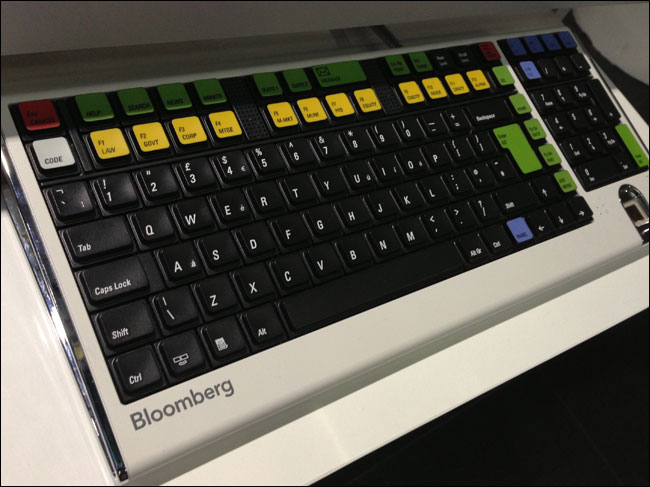
<p>From a UX perspective, it is entirely alien to anything you might design as a modern mainstream information service, but it really does the job. Once, when I was meant to be observing Andrew Sparrow live blogging at Parliament, I ended up mesmerised watching a journalist next to him hammering away at the Bloomberg terminal in the same office. Although the learning curve is steep, the keyboard shortcuts on the custom hardware, and dense information display help people get their jobs done.</p>

<div align="center">
	<img src="//www.currybet.net/images/blog2013/01/bloomberg_keyboard.jpg" width="650" height="487" alt="The Bloomberg terminal custom keyboard">
<p class="caption">The Bloomberg terminal custom keyboard</p>
</div>

<p>A Bloomberg journalist in the audience explained that the screen was optimised for long periods of use, pointing out that programmers often favour working on screens with a black display background for their code rather than the brightly-lit white screens often used on the web. As Marianne said, the roots of the system are three decades old, and she &ldquo;wouldn&rsquo;t want it any other way.&rdquo;</p>

<p><a href="//www.bloomberg.com/professional/">Bloomberg&rsquo;s Professional terminal service</a> is around $2,000 per month, and they have over 300,000 subscribers. They&rsquo;ve gradually thrown more and more data and news sources into it to keep the user hooked &mdash; during Marianne&rsquo;s demo I noticed racing results and the latest soccer scores flashing through the news ticker.</p>

<p>Marianne was illustrating how the terminal could be used with rather more serious data, looking at the ability to map global market shares in goods like cars, or zoom in to a particular ship&rsquo;s location to find out more about it.</p>

<p>Bloomberg journalists are able to create maps and charts and data views within the terminal, and then hyperlink to them from within stories. The data can also then power charts and tables on the Bloomberg website.</p>

<p>All Bloomberg journalism, Marianne said, is data journalism. She explained that everyone will tell you &ldquo;now is the time for data visualisation&rdquo;, and she said that Bloomberg are committed to taking their place in this world, with an increased use of data-visualisation and interactive graphics on their site.</p>

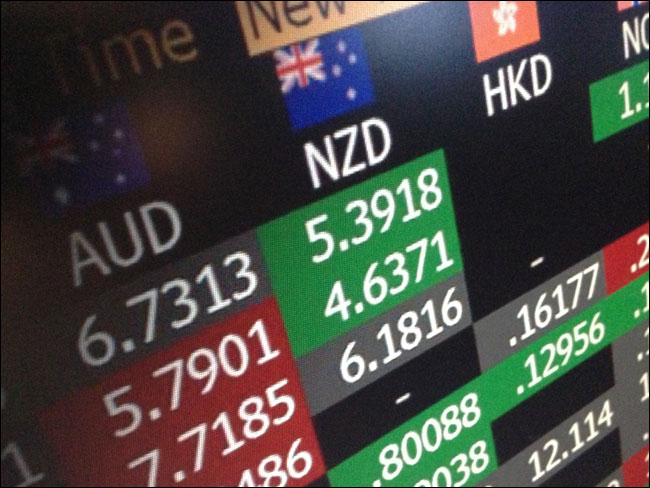
<div align="center">
	<img src="//www.currybet.net/images/blog2013/01/bloomberg_data.jpg" width="650" height="488" alt="Bloomberg terminal demo data up close">
<p class="caption">Bloomberg terminal demo data up close</p>
</div>

<a name="next"></a><h2>Next&hellip;</h2>

<p>In a break from the usual format, Hacks/Hackers London had four talks, rather than the usual two. Next up I&rsquo;ll have my notes on two talks given by speakers from Thomson Reuters &mdash; <a href="//www.currybet.net/cbet_blog/2013/01/hacks-hackers-sam-arnold-forster.php">Sam Arnold-Forster</a> and <a href="//www.currybet.net/cbet_blog/2013/01/hacks-hackers-himanshu-ojha.php">Himanshu Ojha</a>.</p> 

]]>
        
    </content>
</entry>


<entry>
    <title>Was the Guardian right to open comments on their Vauxhall helicopter crash live blog?</title>
    <link rel="alternate" type="text/html" href="//www.currybet.net/cbet_blog/2013/01/guardian-comments-helicopter-crash-live-blog.php" />
    <id>tag:www.currybet.net,2013://2.3597</id>

    <published>2013-01-17T09:42:57Z</published>
    <updated>2013-01-17T09:47:38Z</updated>

    <summary><![CDATA[The Guardian&rsquo;s website has been no stranger to controversy over the last couple of weeks, and yesterday was no exception, with the decision to have comments open on the live blog of the unfolding reporting of the helicopter crash in London.]]></summary>
    <author>
        <name>Martin Belam</name>
        <uri>http://www.currybet.net/about.php</uri>
    </author>
    
        <category term="London" scheme="//www.sixapart.com/ns/types#category" />
    
        <category term="Media" scheme="//www.sixapart.com/ns/types#category" />
    
        <category term="Newspapers" scheme="//www.sixapart.com/ns/types#category" />
    
        <category term="Social media" scheme="//www.sixapart.com/ns/types#category" />
    
        <category term="The Guardian" scheme="//www.sixapart.com/ns/types#category" />
    
        <category term="Web" scheme="//www.sixapart.com/ns/types#category" />
    
    
    <content type="html" xml:lang="en" xml:base="//www.currybet.net/">
        <![CDATA[


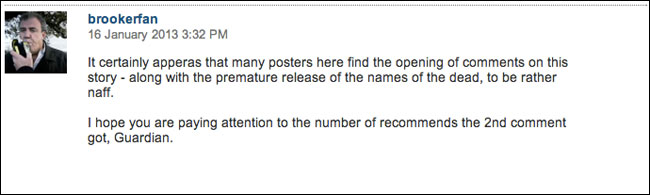
<p>The Guardian&rsquo;s website has been <a href="//www.currybet.net/cbet_blog/2013/01/to-the-memory-hole-with-julie-burchill.php">no stranger to controversy over the last couple of weeks</a>, and yesterday was no exception, with the decision to have comments open on <a href="//www.guardian.co.uk/uk/2013/jan/16/helicopter-crash-in-vauxhall-live-updates">the live blog of the unfolding reporting of the helicopter crash in London</a>.</p>

<a name="rubberneck"></a><h2>Electronic rubber-necking</h2>

<p>A lot of comments questioned why comments were enabled on the story, some calling it &ldquo;<a href="//discussion.guardian.co.uk/comment-permalink/20650169">electronic rubber necking</a>&rdquo;:</p>

<blockquote>&ldquo;Seems a bit wrong to have comments/idle speculation turned on for a fatal incident that is just unfolding.&rdquo; - <a href="//discussion.guardian.co.uk/comment-permalink/20649606">Polymorph</a></blockquote>

<blockquote>&ldquo;If you want to reign in speculation why not switch off the comments on this piece &mdash; utterly inappropriate. Sometimes the Grauniad&rsquo;s web folks really beggar belief.&rdquo; - <a href="//discussion.guardian.co.uk/comment-permalink/20650499">WitNit</a></blockquote>

<p>Another issue was users posting comments in poor taste, and a lot of comments were moderated off.</p><p>I have some sympathy with news organisations here.</p><p>If I build a wall, and someone comes along and spray-paints something offensive over it, and someone else pisses up it, is it <em>my</em> fault for building the wall? Or <em>their</em> personal responsibility not to behave anti-sociably? Nobody <em>compels</em> people to go on to a breaking news story that involved people being killed and try and be funny. They do that because they personally have a lack of empathy.</p>


<div align="center">
	<img src="//www.currybet.net/images/blog2013/01/gdn_no_comments.jpg" width="650" height="195" alt="A user asking for comments to be switched off">
</div>


<a name="liveblog"></a><h2>The live blog question</h2>

<p>Some people posting comments were aggravated at the Guardian reporting it via a live blog:</p>


<blockquote>&ldquo;The Wall Street Journal have <a href="//online.wsj.com/article/SB10001424127887323468604578245042233426354.html?mod=WSJEurope_hpp_LEFTTopStories">a salient take on the accident</a> and even the owners. Anyone wanting some decent journalism can find it here&hellip;Oh yes, not a single fucking hashtag or twitter comment to be found.&rdquo; - <a href="//discussion.guardian.co.uk/comment-permalink/20653799">andyljus</a></blockquote>

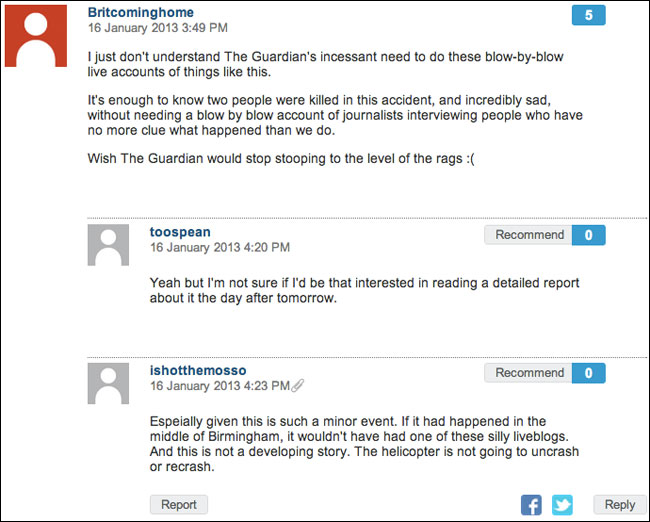
<blockquote>&ldquo;I just don't understand The Guardian&rsquo;s incessant need to do these blow-by-blow live accounts of things like this.&rdquo; - <a href="//discussion.guardian.co.uk/comment-permalink/20661469">Britcominghome</a></blockquote>


<blockquote>&ldquo;I for one am glad that there is live text on this incident. I wouldn&rsquo;t be able to think straight without regular updates every minute. It is certainly a vast improvement over the days when one just read detailed and comprehensively thought-through news reports some time after the incident.&rdquo; - <a href="//discussion.guardian.co.uk/comment-permalink/20652331">TheRealElPolloDiablo</a></blockquote>


<p>I still personally think that there are two problems here. No news organisation has yet seemed to have cracked the design problem of conveying to users that &ldquo;this is the live blog of a developing situation &mdash; the 500 word write-up will be along later as usual.&rdquo; </p>

<p><a href="//discussion.guardian.co.uk/comment-permalink/20662532">As one commenter put it</a>, to someone complaining about the live blog format: &ldquo;Yeah but I&rsquo;m not sure if I&rsquo;d be that interested in reading a detailed report about it the day after tomorrow.&rdquo;</p>

<p>The label &ldquo;live blog&rdquo; itself is still problematic, in my opinion. I&rsquo;d like to see news organisations try labels like &ldquo;Unfolding story&rdquo; or &ldquo;Reporting in progress&rdquo;, giving a stronger sign-post that incrementally updating a breaking news story as information arrives is <em>not</em> the same as sitting down in front of the X-Factor on a Saturday night to write a simultaneous TV review.</p>

<div align="center">
	<img src="//www.currybet.net/images/blog2013/01/gdn_anti_live_blog.jpg" width="650" height="522" alt="Anti-Live Blog poster on the Guardian website">

</div>

<a name="eyewitness"></a><h2>Securing eyewitness testimony</h2>

<p>However, there was a very good journalistic reason for opening comments. With the incident happening in a densely populated part of the capital, there was a good chance of capturing a lot of <a href="//discussion.guardian.co.uk/comment-permalink/20650365">eyewitness accounts in the comments</a>. Other websites like the BBC achieve this with an email form, but the comment system underneath live blogs is a direct way of getting content in front of other users straight away. With a guiding hand from a community host &mdash; in this case <a href="//www.guardian.co.uk/discussion/user/id/3315170">James Walsh</a> &mdash; flagging up that kind of content, it added colour and vibrancy to the story-telling.</p>

<a name="direct"></a><h2>Direct interaction with the journalists</h2>

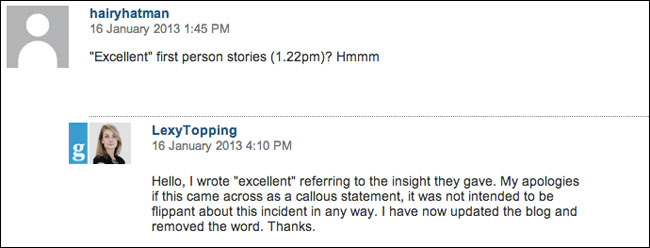
<p>Having comments open also provided a direct feedback loop with the journalists reporting on the story. When users pointed out that reporters had seemed carelessly excited about getting some &ldquo;excellent&rdquo; stories, <a href="//www.guardian.co.uk/profile/alexandratopping">Alexandra Topping</a> was able to <a href="//discussion.guardian.co.uk/comment-permalink/20662118">jump straight into the comment thread</a> with an apology and point out that a correction had made.</p>

<div align="center">
	<img src="//www.currybet.net/images/blog2013/01/gdn_lexytopping.jpg" width="650" height="248" alt="The Guardian&rsquo;s Lexytopping in the comments">
</div>

<a name="cumbria"></a><h2>This wasn&rsquo;t Cumbria</h2>

<p>The Guardian learnt a hard lesson when it was severely criticised for having <a href="//discussion.guardian.co.uk/comment-permalink/5772388">comments open on a live blog</a> whilst the 2011 Cumbrian shooting spree was still in progress. I think the difference here was that <em>the incident itself was over</em>, it was the details that were coming through, whereas during the shooting the criticism was that people were speculating about the whereabouts of a gunman still on the loose.</p>

<a name="right"></a><h2>The right decision</h2>

<p>The gathering of additional eye-witness accounts and some corrective information about the location and buildings involved added to the newsgathering process. Moderators were very swiftly deleting inappropriate comments, and both journalists and community staff were on-hand in the threads to reply directly with users. On balance, I think the Guardian&rsquo;s newsroom and community teams made the right call yesterday. </p>


<p class="disclosure"><em>Full disclosure: I previously worked at the Guardian, and used to design elements of both the live blog and the commenting system.</em></p>]]>
        
    </content>
</entry>


</feed>