<?xml version="1.0" encoding="UTF-8" standalone="no"?><feed xmlns="http://www.w3.org/2005/Atom" xmlns:opensearch="http://a9.com/-/spec/opensearch/1.1/" xmlns:s="http://jadedpixel.com/-/spec/shopify" xml:lang="en">
  <id>https://www.wisebond.com/blogs/epoxy-blog.atom</id>
  <link href="https://www.wisebond.com/blogs/epoxy-blog" rel="alternate" type="text/html"/>
  <link href="https://www.wisebond.com/blogs/epoxy-blog.atom" rel="self" type="application/atom+xml"/>
  <title>WiseBond® - The WiseBond® Epoxy Blog</title>
  <updated>2025-01-28T15:38:57-05:00</updated>
  <author>
    <name>WiseBond®</name>
  </author>
  <xhtml:meta content="noindex" name="robots" xmlns:xhtml="http://www.w3.org/1999/xhtml"/><entry>
    <id>https://www.wisebond.com/blogs/epoxy-blog/yellow-epoxy-mystery-solved-a-cautionary-tail</id>
    <published>2025-01-28T15:38:57-05:00</published>
    <updated>2025-01-28T15:51:20-05:00</updated>
    <link href="https://www.wisebond.com/blogs/epoxy-blog/yellow-epoxy-mystery-solved-a-cautionary-tail" rel="alternate" type="text/html"/>
    <title>Epoxy Mystery Solved: A Cautionary Tail</title>
    <author>
      <name>Roderick Kabel</name>
    </author>
    <summary type="html">
      <![CDATA[<p>Recently, a customer reached out to us with an intriguing issue: their epoxy project had turned yellow – in 3 days after pouring! As always, we began our inquiry by reviewing every pertinent detail—from mixing and pouring techniques to the workshop environment, air temperature, and curing conditions.</p><p><a class="read-more" href="https://www.wisebond.com/blogs/epoxy-blog/yellow-epoxy-mystery-solved-a-cautionary-tail">More</a></p>]]>
    </summary>
    <content type="html">
      <![CDATA[<p class="MsoNormal"><span>By Roderick Kabel</span></p>
<p class="MsoNormal">At WiseBond<sup>®</sup>, we take immense pride in our customer service. Every email, chat, and phone call is personally answered with care and attention. Over the years, we’ve encountered numerous customer stories—some heartwarming, others challenging—and we’ve always strived to get to the root of their problems, solve mysteries, and provide effective solutions.</p>
<p class="MsoNormal">This case underscores why we prioritize personalized service and in-depth problem-solving. At WiseBond<sup>®</sup>, we’re not just here to sell products—we’re here to ensure your projects succeed. Whether it’s troubleshooting, providing advice, or sharing insights, we’re always ready to go the extra mile for our customers.</p>
<p class="MsoNormal"><b>The Case of the Yellowing Epoxy</b></p>
<p class="MsoNormal">Recently, a customer reached out to us with an intriguing issue: their epoxy project had turned yellow – in 3 days after pouring! As always, we began our inquiry by reviewing every pertinent detail—from mixing and pouring techniques to the workshop environment, air temperature, and curing conditions.</p>
<p class="MsoNormal">The project in question was truly one-of-a-kind: a series of custom stair treads made from stainless steel with “S”-shaped whimsical, deep-pour epoxy cavities, all finished with tabletop epoxy. Each tread had been meticulously handmade and welded from stainless steel.</p>
<ul type="disc" style="margin-top: 0in;">
<li style="mso-list: l0 level1 lfo4; tab-stops: list .5in;" class="MsoNormal">
<b>Step 1: Deep Pour Epoxy:</b> The customer poured deep-pour epoxy into “S”-shaped cavities on each tread and allowed it to cure. This stage went smoothly.</li>
<li style="mso-list: l0 level1 lfo4; tab-stops: list .5in;" class="MsoNormal">
<b>Step 2: Tabletop Epoxy Flood Coat:</b> The next step was leveling off the 1/8" deep-pour sections with tabletop epoxy and flooding the entire tread surface.</li>
</ul>
<p class="MsoNormal">After completing the pour, the customer closed the shop, leaving it heated to ensure proper curing in the chilly, snow-laden upper Northeast. Three days later, they returned to inspect their work, only to find a startling result: the epoxy had turned yellow over the stainless steel and green over the blue-tinted deep-pour cavities.</p>
<p class="MsoNormal"><b>A "Bad Batch" of Epoxy?</b></p>
<p class="MsoNormal">Initially, the customer—a seasoned epoxy user with eight years of experience—assumed the issue was a defective batch. To test this theory, they mixed a small sample of the same tabletop epoxy and observed it yellowing within hours in their workshop.</p>
<p class="MsoNormal"><img alt="" src="https://cdn.shopify.com/s/files/1/0095/3303/0505/files/epoxy-drips.jpg?v=1738096606"></p>
<blockquote>
<p class="MsoNormal">Above image of table top epoxy drips from flood coat pour.</p>
</blockquote>
<p class="MsoNormal"><img alt="" src="https://cdn.shopify.com/s/files/1/0095/3303/0505/files/epoxy-test.jpg?v=1738096620"></p>
<blockquote>
<p class="MsoNormal">Above image of customer test over a white board yellowed within hours.</p>
</blockquote>
<p class="MsoNormal">But at WiseBond<sup>®</sup>, we’re confident in the quality of our products. We don’t have “bad batches.” So, we dug deeper.</p>
<p class="MsoNormal"><b>Uncovering the Root Cause</b></p>
<p class="MsoNormal">As we analyzed the customer’s photos, one image stood out. It showed a stair tread partially sanded, revealing clear epoxy beneath the yellowed surface. This discovery ruled out a systemic issue with the epoxy itself. The yellowing was a surface phenomenon, pointing to an environmental factor.</p>
<div style="text-align: left;"><img style="float: none;" alt="" src="https://cdn.shopify.com/s/files/1/0095/3303/0505/files/epoxy-s-shape-mold_480x480.jpg?v=1738006985"></div>
<p class="MsoNormal">We began asking additional questions about the workshop environment:</p>
<ul type="disc" style="margin-top: 0in;">
<li style="mso-list: l1 level1 lfo5; tab-stops: list .5in;" class="MsoNormal">Were cleaning agents with high VOCs or solvents used?</li>
<li style="mso-list: l1 level1 lfo5; tab-stops: list .5in;" class="MsoNormal">Could animal byproducts from nearby kennels be a factor?</li>
</ul>
<p class="MsoNormal">Then, we noticed a propane heater in the background of one of the photos. This detail triggered a breakthrough in our investigation. We’d previously heard reports from floor epoxy installers that propane heaters could cause epoxy to yellow. The pieces of the puzzle finally fell into place.</p>
<p class="MsoNormal"><b>How Propane Heaters Cause Yellowing</b></p>
<p class="MsoNormal">Propane heaters emit carbon dioxide (CO2), trace amounts of carbon monoxide (CO) if ventilation is poor, and nitrogen oxides (NOx), which are known to chemically interact with epoxy surfaces. These emissions can cause yellowing, particularly when epoxy is curing. While the heater kept the workspace warm, its byproducts had an unintended consequence on the epoxy. It is very important to have fresh air circulating over the surface during drying.</p>
<p class="MsoNormal"><img alt="" src="https://cdn.shopify.com/s/files/1/0095/3303/0505/files/epoxy-mix-cup.jpg?v=1738096677"></p>
<blockquote>
<p class="MsoNormal">Above image of table top epoxy showing the top surface yellowing.</p>
</blockquote>
<p class="MsoNormal"><b>Solving the Mystery?</b></p>
<p class="MsoNormal">We understand that in cold climates propane (and natural gas) heaters can be a necessity. We aren’t advising our customers or anyone for that matter not to use propane heaters in their workshops. Our goal is to offer an educational view of a problem we helped a customer solve. <b></b></p>
<p class="MsoNormal"><b>How Propane Heaters Contribute to Epoxy Yellowing</b></p>
<p class="MsoNormal">Propane heaters are commonly used to warm work environments during colder months. When burned correctly, propane primarily emits carbon dioxide (CO2), with trace amounts of carbon monoxide (CO) if ventilation is insufficient, and nitrogen oxides (NOx), which are known contributors to smog formation. Additionally, propane combustion produces very low levels of particulate matter and sulfur oxides. While these emissions might seem harmless at first glance, they can have a significant impact on epoxy resin surfaces.</p>
<ul type="disc" style="margin-top: 0in;">
<li style="mso-list: l3 level1 lfo1; tab-stops: list .5in;" class="MsoNormal">
<b>Nitrogen Oxides (NOx):</b> These trace emissions can react with the components of epoxy resin, particularly when exposed to heat, leading to chemical changes that cause yellowing. NOx is also a reactive compound that can affect the curing process, altering the resin’s color and clarity.</li>
<li style="mso-list: l3 level1 lfo1; tab-stops: list .5in;" class="MsoNormal">
<b>Carbon Dioxide (CO2):</b> High concentrations of CO2 can create a localized environment where oxidative processes accelerate. This oxidative stress can speed up the breakdown of epoxy’s molecular structure, resulting in discoloration.</li>
<li style="mso-list: l3 level1 lfo1; tab-stops: list .5in;" class="MsoNormal">
<b>Particulate Matter:</b> While propane heaters produce low levels of particulates, any airborne impurities can settle on uncured or partially cured epoxy, contributing to surface imperfections and discoloration.</li>
</ul>
<p class="MsoNormal"><b>Differentiating Yellowing from Epoxy Blush</b></p>
<p class="MsoNormal">It is crucial to distinguish between yellowing caused by propane heater emissions and a phenomenon known as “epoxy blush.” Epoxy blush occurs when a high-humidity environment interacts with amines in the resin, forming a cloudy, waxy layer. Yellowing caused by propane heaters, on the other hand, is the result of chemical interactions with emissions and is permanent unless addressed by sanding and recoating.</p>
<p class="MsoNormal"><b>Safety Implications of Using Propane Heaters</b></p>
<p class="MsoNormal">If a propane heater’s emissions are significant enough to discolor epoxy resin, the work environment may not be safe for prolonged human occupancy. Inadequate ventilation can lead to a build-up of CO and NOx, posing serious health risks:</p>
<ul type="disc" style="margin-top: 0in;">
<li style="mso-list: l4 level1 lfo2; tab-stops: list .5in;" class="MsoNormal">
<b>Carbon Monoxide Poisoning:</b> Even trace amounts of CO can accumulate in poorly ventilated spaces, causing headaches, dizziness, and, in severe cases, life-threatening conditions.</li>
<li style="mso-list: l4 level1 lfo2; tab-stops: list .5in;" class="MsoNormal">
<b>Respiratory Issues:</b> Prolonged exposure to NOx and particulates can irritate the respiratory system, leading to long-term health problems.</li>
</ul>
<p class="MsoNormal">To ensure a safe and resin-friendly workspace, always prioritize proper ventilation when using propane heaters. Consider alternative heating options, such as electric space heaters, which do not emit combustion byproducts.</p>
<p class="MsoNormal"><b>Tips for Avoiding Epoxy Yellowing</b></p>
<ol type="1" start="1" style="margin-top: 0in;">
<li style="mso-list: l2 level1 lfo3; tab-stops: list .5in;" class="MsoNormal">
<b>Maintain Proper Ventilation:</b> Ensure that any combustion heater is vented to the outside, reducing the concentration of harmful emissions in the workspace.</li>
<li style="mso-list: l2 level1 lfo3; tab-stops: list .5in;" class="MsoNormal">
<b>Choose the Right Heater:</b> Opt for electric or infrared heaters that do not produce emissions, minimizing the risk of yellowing and health hazards.</li>
<li style="mso-list: l2 level1 lfo3; tab-stops: list .5in;" class="MsoNormal">
<b>Monitor Temperature and Humidity:</b> Keep the work area’s temperature and humidity levels stable, as fluctuations can also negatively impact the curing process.</li>
<li style="mso-list: l2 level1 lfo3; tab-stops: list .5in;" class="MsoNormal">
<b>Use High-Quality Epoxy:</b> Some epoxy formulations are more resistant to environmental factors, including NOx and CO2 exposure.</li>
<li style="mso-list: l2 level1 lfo3; tab-stops: list .5in;" class="MsoNormal">
<b>Seal the Workspace:</b> Minimize the entry of external pollutants by using air filters and sealing gaps in windows and doors.</li>
</ol>
<p class="MsoNormal"><b>Conclusion</b></p>
<p class="MsoNormal">The yellowing of epoxy resin caused by propane heaters highlights the importance of understanding the interplay between environmental factors and material properties. Beyond aesthetics, this issue serves as a reminder to prioritize safe working conditions. By making informed choices about heating and ventilation, you can protect both the quality of your epoxy projects and the health of everyone in the workspace.</p>]]>
    </content>
  </entry>
  <entry>
    <id>https://www.wisebond.com/blogs/epoxy-blog/exploring-the-science-behind-epoxy-encased-live-ammunition-discharge</id>
    <published>2024-04-10T10:40:09-04:00</published>
    <updated>2024-04-11T09:48:36-04:00</updated>
    <link href="https://www.wisebond.com/blogs/epoxy-blog/exploring-the-science-behind-epoxy-encased-live-ammunition-discharge" rel="alternate" type="text/html"/>
    <title>Exploring the Science Behind Epoxy Encased Live Ammunition Discharge</title>
    <author>
      <name>Roderick Kabel</name>
    </author>
    <summary type="html">
      <![CDATA[<p data-mce-fragment="1">Subsequent examination of the display cases revealed that four ammunition rounds detonated within the epoxy casting, including two 10mm rounds, one .380acp, and one 9mm round, while others remained inert.</p><p><a class="read-more" href="https://www.wisebond.com/blogs/epoxy-blog/exploring-the-science-behind-epoxy-encased-live-ammunition-discharge">More</a></p>]]>
    </summary>
    <content type="html">
      <![CDATA[<p data-mce-fragment="1"><span>By Roderick Kabel</span></p>
<p data-mce-fragment="1">In recent times, the internet has been abuzz with awe-inspiring images of river tables adorned with various ammunition casings encased within epoxy. While most creators opt for empty brass casings to achieve this aesthetic, some dare to incorporate "live" ammunition, believing it enhances the visual appeal and wow-factor. However, the potential dangers associated with live rounds submerged in epoxy have largely remained unexplored.</p>
<p data-mce-fragment="1">At WiseBond®, safety is paramount. We advocate for the removal of primers or gunpowder (dummy rounds) before encapsulating ammunition in epoxy, as a precautionary measure to mitigate risks. Not only does this practice ensure the safety of the creator and those around the finished project, but it also maintains the project's allure without compromising on safety.</p>
<p data-mce-fragment="1"><img alt="" src="https://cdn.shopify.com/s/files/1/0095/3303/0505/files/epoxy-ammo-display_bc62168f-d300-49e7-a004-fcede91d0ce7_480x480.jpg?v=1712843172"></p>
<p data-mce-fragment="1">A recent incident involving one of our WiseBond® influencers, a seasoned epoxy artisan, emphasizes the risks associated with live ammunition. Commissioned to craft display cases for an ammunition manufacturer, the influencer encountered a catastrophic event following an epoxy pour conducted in the evening. Fortunately, the incident occurred in the influencer's absence, sparing them from potential harm.</p>
<p data-mce-fragment="1">Subsequent examination of the display cases revealed that four ammunition rounds detonated within the epoxy casting, including two 10mm rounds, one .380acp, and one 9mm round, while others remained inert.</p>
<p data-mce-fragment="1"><img alt="" src="https://cdn.shopify.com/s/files/1/0095/3303/0505/files/epoxy-encasings-after-3_6139f132-6e79-4f27-a0dc-d37fcdf9a05a_480x480.jpg?v=1712843172"></p>
<p data-mce-fragment="1">This alarming discovery prompted a comprehensive investigation here at WiseBond® into the underlying causes. The fact that four rounds detonated out of numerous other rounds, is ONE too many!</p>
<p data-mce-fragment="1">Our initial speculation centered on the possibility of epoxy-induced pressure triggering primer ignition during the exothermic cooldown phase as the epoxy begins to shrink. However, further analysis revealed that primer ignition necessitates direct impact from a firing pin, a condition not met in this scenario.</p>
<p data-mce-fragment="1"><img alt="" src="https://cdn.shopify.com/s/files/1/0095/3303/0505/files/epoxy-encasings-after-2_dca31088-11e7-472f-b433-e641f43998bf_480x480.jpg?v=1712843173"></p>
<p data-mce-fragment="1">The discussion then shifted to the possibility of ammunition self-igniting due to ambient heat. While ammunition may "cook off" when exposed to high temperatures, such as those generated by a fire. Typically, gunpowder requires temperatures between 801–867 °F to ignite.</p>
<p data-mce-fragment="1">Contrary to popular belief, the interior of a vehicle does not reach temperatures conducive to ammunition cooking off, as evidenced by veterans' experiences in hot desert climates.</p>
<p data-mce-fragment="1">It's important to note that ammunition in hot vehicles and even when stored in boxes, there is air circulation, whether active or passive, which helps to cool the primer, preventing ignition. It's crucial to recognize that deep pour epoxy does not contain air pockets, thus eliminating any cooling effect on the primer.</p>
<p data-mce-fragment="1"><img alt="" src="https://cdn.shopify.com/s/files/1/0095/3303/0505/files/epoxy-encasings-1_15fd94f7-0723-4efd-b22d-70b305099b96_480x480.jpg?v=1712843172"></p>
<p data-mce-fragment="1">Central to our investigation is an understanding of the mechanics of a primer, comprising essential components such as the primer cup, primer mixture (an “impact sensitive explosive”), protective foil paper, and anvil. The primer's function hinges on the compression of the primer cup, which, upon impact, ignites the primer mixture compound and initiates the firing sequence.</p>
<p data-mce-fragment="1"><img src="https://cdn.shopify.com/s/files/1/0095/3303/0505/files/primers_480x480.jpg?v=1712761866" alt=""></p>
<p data-mce-fragment="1">Considering the ignition point of the primer mixture is a much lower threshold than gunpowder, the exothermic reaction of epoxy can potentially provide sufficient heat to ignite. Primer mixture compound used in most modern primers is called DDNP (diazodinitrophenol). Depending on the exact composition of the primer compound, temps above 150F can be enough to cause it to detonate. The exothermic reaction of epoxy can generate temperatures ranging from 140-165 °F, well within the range necessary for the primer mixture to ignite.</p>
<p data-mce-fragment="1"><img alt="" src="https://cdn.shopify.com/s/files/1/0095/3303/0505/files/exploded-casings_480x480.jpg?v=1712761866"></p>
<p data-mce-fragment="1">In summary, our final conclusion hinges on the lack of air within the epoxy, heightening the potential for ignition. Without air to dissipate heat and cool the primer, the primer mixture was able to reach a temperature conducive to ignition during the exothermic reaction of the epoxy. This resulted in ignition, leading to the expulsion of the bullet encased within the epoxy.</p>
<p data-mce-fragment="1">Special thanks to Cody over at Shadow Systems based in Plano, Texas, for assisting us with a greater understanding of ammunition and primers. Shadow Systems is a Made in America designer and manufacturer of premium firearms and firearms parts. Please give them a look at www.shadowsystemscorp.com and their YouTube channel @ShadowSystemsCorp.</p>]]>
    </content>
  </entry>
  <entry>
    <id>https://www.wisebond.com/blogs/epoxy-blog/heat-resistance-of-wisebond-epoxy</id>
    <published>2022-04-29T14:51:49-04:00</published>
    <updated>2022-04-29T15:07:31-04:00</updated>
    <link href="https://www.wisebond.com/blogs/epoxy-blog/heat-resistance-of-wisebond-epoxy" rel="alternate" type="text/html"/>
    <title>What is the heat resistance of WiseBond® Epoxy?</title>
    <author>
      <name>Roderick Kabel</name>
    </author>
    <summary type="html">
      <![CDATA[<span>Heat deflection is when an indirect heat source raises the temperature of the epoxy enough to cause a warp or slight dent from an object. Heat deflection has a temperature limit that usually occurs at the 100°F to 130°F temperature range. Heat resistance is a temperature limit where a direct heat source makes the epoxy actually melt, sag or droop and is permanently damaged. This range can start around 300°F up to 600°F.</span><p><a class="read-more" href="https://www.wisebond.com/blogs/epoxy-blog/heat-resistance-of-wisebond-epoxy">More</a></p>]]>
    </summary>
    <content type="html">
      <![CDATA[<p>By Roderick Kabel</p>
<p><strong>Customer question:</strong> “I know other epoxy companies say they have heat resistance up to 600°F. What is the heat resistance of your epoxy?”</p>
<p><strong>Answer:</strong> We’ll, simply put, WiseBond has tested our epoxy for heat deflection up to 120°F before we saw distortion.</p>
<p>This is a question we get every week. We see it plastered all over the internet as well. We see tons of epoxy enthusiasts toss around this-and-that brand has a heat resistance that will stave off the surface of the sun. Folks, this is where confusion breeds and the nonsense resides.</p>
<p>The fundamentals of epoxy exposed to heat is plain and simple. Don’t do it. Protect your epoxy at all times. Especially keep it away from high heat and open flames! Treat your epoxy table, bar top or countertop as if it were Italian granite or marble – or the likes of.</p>
<p>Let’s be honest, epoxy isn’t cheap. So why would anyone place anything hot on it? Use hot pads and coasters and keep the kids’ Hot Wheels off it!</p>
<p>Let’s look at what heat resistance and heat deflection really are. It’s pretty simple.</p>
<p>Heat deflection is when an indirect heat source raises the temperature of the epoxy enough to cause a warp or slight dent from an object. Heat deflection has a temperature limit that usually occurs at the 100°F to 130°F temperature range.</p>
<p>For example, a hot coffee cup could leave a ring or the hot sun through a window might allow a fingernail to dent the epoxy. The epoxy gets soft but most likely will return to normal once it cools down.</p>
<p>Heat resistance is a temperature limit where a direct heat source makes the epoxy actually melt, sag or droop and is permanently damaged. This range can start around 300°F up to 600°F.</p>
<p>The above definitions are extremely incorrectly referenced by epoxy users in social media and worse, by unprincipled marketing departments with their advertising and rhetoric.</p>
<p>Heat resistance and deflection claims are one of the biggest issues we struggle with here at WiseBond®. We’ve all seen epoxy brands squirt lighter fluid on epoxy, set it on fire and it doesn’t melt or catch fire. We’ve similarly seen 500°F hot cooking pans placed on epoxy for 20 seconds and there is no distortion. Duh!</p>
<p>The point here is this, when epoxy users’ reference and seek to purchase epoxy with a high “heat resistant”, what they are looking for is an epoxy that will not dent, melt, get tacky, or droop. And that’s fine and completely understandable. But not realistic.</p>
<p>To which, we have to ask, “What in the world are you planning on doing to your epoxy table or countertop? JESH!”</p>
<p>This mindset isn’t realistic because the two definitions have been greatly melded together and that has created a huge quagmire for epoxy brands like us who don’t exaggerate the truth.</p>
<p>So, what does this mean for your epoxy purchase? First off, understand that realistically most all epoxy brands have a heat deflection ranging from 100°F to 130°F and a heat resistance somewhere between 400°F/500°F. Claims otherwise are just plain BS.</p>
<p>Our WiseBond® heat resistance is 400°F/500°F and our heat deflection is 120°F.</p>
<p>Choose wisely!</p>]]>
    </content>
  </entry>
  <entry>
    <id>https://www.wisebond.com/blogs/epoxy-blog/how-to-epoxy-bar-top-rail-trim</id>
    <published>2022-03-31T11:48:24-04:00</published>
    <updated>2023-03-09T09:00:06-05:00</updated>
    <link href="https://www.wisebond.com/blogs/epoxy-blog/how-to-epoxy-bar-top-rail-trim" rel="alternate" type="text/html"/>
    <title>How To Epoxy Bar Top Rail Trim</title>
    <author>
      <name>Roderick Kabel</name>
    </author>
    <summary type="html">
      <![CDATA[<span>Every bar top is different and has its own uniqueness when it comes to size, style, and shape. Some bar tops have simple to complex rail trim, and some don’t have a rail at all. Which is fine. The love and beauty of a bar is in the eyes of the beholder.</span><p><a class="read-more" href="https://www.wisebond.com/blogs/epoxy-blog/how-to-epoxy-bar-top-rail-trim">More</a></p>]]>
    </summary>
    <content type="html">
      <![CDATA[<p>By Roderick Kabel</p>
<p>Every bar top is different and has its own uniqueness when it comes to size, style, and shape. Some bar tops have simple to complex rail trim, and some don’t have a rail at all. Which is fine. The love and beauty of a bar is in the eyes of the beholder.</p>
<p>This post will focus on how to pour WiseBond® Bar and Table Top epoxy on a bar top with raised rail trim and a spill guard.</p>
<p>Typically, we deal with the sides and edges of a bar top or table after we pour the flood coat over the flat surface.  As per, we simply push the epoxy flood coat from the surface to roll and flow over the sides and edges. But in this situation, the raised bar railing should be dealt with first.</p>
<p>First if you already haven’t done this, check for gaps between the bar surface and the rail trim. If it is not water tight, epoxy will run through. Use painter's tape on the underside which can be pulled off once the epoxy is cured. You can also use a silicone caulk on the underside to fill any gaps however the silicone most likely will not come off after the pour. <br> <br> As always, let’s be sure to seal the entire bar top and rail with 1-3 seal coats. Again, all wood species have different porosity and a proper seal coat is key to a bubble free epoxy! Here is a link and refresher course on how to apply a seal coat. <a href="https://youtu.be/bi2jjqw9WT4">https://youtu.be/bi2jjqw9WT4</a></p>
<p>Now it’s time to figure out how much bar top epoxy will be needed. Use our online calculator to determine the amount of epoxy you will need, and add 1 extra WiseBond® Bar and Table Top epoxy kit. This should ensure you have plenty of epoxy. It’s called a “flood coat” for a reason, you know! <a href="https://www.wisebond.com/pages/wisebond-epoxy-calculator">https://www.wisebond.com/pages/wisebond-epoxy-calculator</a><br> <br> Because sanding upside down is a huge pain, be sure to put painter's tape on the underside of the bar rail trim outside edge. This will catch epoxy drips and you can easily remove drips by peeling off the tape. An easy method to do this is to use a wide tape pressed onto the underside with a 1/4" overhang. Burnish the tape with your finger or a flat edge of some sort and then with a new, sharp razor blade, trim off the overhang flush with the rail trim bottom edge. (This works great for any table to remove epoxy drips!)<br> <br> Mix your WiseBond® table top epoxy using the proper 1:1 ratio using a clear bucket with measurements. With a rubber gloved hand, dip your fingers in the epoxy and “wet” (slather) all of the rail trim in a smooth thin layer. This will guarantee a smooth flow of epoxy during the flood coat over the bar top rail trim.<br> <br> Once the bar top trim is wet, grab your bucket of epoxy. Starting at one end of the bar, move your way all along the bar slowly pouring (don't drizzle) epoxy in an appropriate “flooding” thickness all along the trim. The epoxy will flow nicely since the trim is already wet. This will apply a smooth coat of epoxy all along the trim.<br> <br> NOTE: Yes, because there may be vertical portions on the rail trim, the epoxy will run thin. If you want thicker epoxy on the trim, you will need to let the first bar rail pour cure, and then do another pour as a second coat. If you do this, the second pour can be completed as soon as the first epoxy coat is at a hard sticky tack. It doesn't need to be fully hard. (Cover the bar rail trim to prevent dust contamination while the first coat cures.)<br> <br> After the rail trim pour is to your liking, obviously there will be run-off of epoxy onto the top of the bar surface, which is fine. It won't be much. If you feel the run-off is too thick at the vertical edge where the trim and bar surface meet - while the epoxy is still wet - just spread the extra epoxy in a thin layer away from the area onto the flat surface of the bar.</p>
<p>If you choose to allow the rail trim epoxy to cure or you want to pour the bar top surface while the rail trim is still wet, it is totally your decision.</p>
<p>At this junction it is also the perfect time to embed any sort of memorabilia or objects on the bar surface if you so choose. If you do, be sure to secure any object tightly and flat to the bar surface. Epoxy works very well. Furthermore, you will want said objects to cure before pouring the bar top surface.<br> <br> Now let’s pour the bar top flood coat onto the bar surface. Typically, an 1/8" of an inch thickness is sufficient. This final pour will cover any epoxy you’ve spread out and the epoxy will self-level seamlessly up to the trim nicely.</p>
<p>However, BE CAREFUL that you don’t dribble and drip epoxy over the bar rail trim! <br> <br> As for the bar top spill guards, treat it the same way as above but in a miniature version.<br> <br> Lastly, always drape the bar with plastic as a covering to prevent dust and dirt from contaminating the epoxy and trashing your bad-ass bar top.</p>
<p>Cheers!</p>]]>
    </content>
  </entry>
  <entry>
    <id>https://www.wisebond.com/blogs/epoxy-blog/cracked-epoxy-river-table-miter-joints</id>
    <published>2020-10-07T14:26:26-04:00</published>
    <updated>2022-03-31T11:47:22-04:00</updated>
    <link href="https://www.wisebond.com/blogs/epoxy-blog/cracked-epoxy-river-table-miter-joints" rel="alternate" type="text/html"/>
    <title>Cracked epoxy river table miter joints</title>
    <author>
      <name>Roderick Kabel</name>
    </author>
    <summary type="html">
      <![CDATA[<p>This post will be focused on epoxy river tables with preformed miter joint corners built into the mold/frame. We will not address the many proper and different ways to cut and secure miter joints, that’s totally a personal preference to each of you. What we will discuss are a little physics and geometry regarding concrete, which coincidently correlates closely to the pouring and cure of preformed epoxy miter joints.</p><p><a class="read-more" href="https://www.wisebond.com/blogs/epoxy-blog/cracked-epoxy-river-table-miter-joints">More</a></p>]]>
    </summary>
    <content type="html">
      <![CDATA[<p style="font-weight: 400;">Measures to reduce the risks</p>
<p style="font-weight: 400;">By Roderick Kabel</p>
<p style="font-weight: 400;">With any piece of wood and with any type of wooden construction project incorporating a miter joint, there are a number of factors to consider. First and foremost, any wooden miter joint must be tight, as seamless as possible and each miter cut properly secured to the other.</p>
<p style="font-weight: 400;">This post will be focused on epoxy river tables with preformed miter joint corners built into the mold/frame. We will not address the many proper and different ways to cut and secure miter joints, that’s totally a personal preference to each of you.</p>
<p style="font-weight: 400;">What we will discuss are a little physics and geometry regarding concrete, which coincidently correlates closely to the pouring and cure of preformed epoxy miter joints.</p>
<p style="font-weight: 400;">In the world of concrete there are 5 sayings:</p>
<ul>
<li style="font-weight: 400;">
<span></span>Concrete will get hard</li>
<li style="font-weight: 400;">
<span></span>Concrete will turn color</li>
<li style="font-weight: 400;">
<span></span>Concrete won’t catch fire</li>
<li style="font-weight: 400;">
<span></span>Concrete will not get stolen</li>
<li style="font-weight: 400;">
<span></span>Concrete will crack</li>
</ul>
<p style="font-weight: 400;">Four out of the above five aspects are true when it comes to epoxy. (Some jerk could actually steal your epoxy table…)</p>
<p style="font-weight: 400;">There is a known problem encountered when pouring concrete around what is called a “re-entrant” corner. Re-entrant corners are sharp angled inside and/or outside encircling walls or barriers. A re-entrant corner creates extreme tensile stress concentration at the corners. As the concrete cures, it tries to linearly shrink and move in two directions at right angles to each other.</p>
<p style="font-weight: 400;">In simple terms, concrete (and epoxy) can crack from factors such as the stress from its curing, shrinkage, thickness, settling, expansion, contraction, and pressure pushing back from its surrounding environment. Cracks can also occur as the result of temperature differences and changes, as well as curling tensile stresses in the top and bottom of the slab – building up in the first few hours after the pour – which are additive to the right-angle linear tensile stress and shrinkage.</p>
<p style="font-weight: 400;">The combination of these tensile stresses try to rip concrete apart, starting at the corner. As the tensile strength of the concrete is exceeded, cracks form diagonally at approximately 135-degrees from each edge of a 90-degree corner. As further shrinkage and curling occur over time, the crack widens and lengthens.</p>
<p style="font-weight: 400;">Sound familiar?</p>
<p style="font-weight: 400;">Epoxy bar tops, countertops and tables also utilize re-entrant corners in the form of preformed miter joints. This isn’t uncommon but the possibility of a crack at the miter joint is high, much like that in concrete. Hence, our correlation between concrete re-entrant corners and an epoxy thick pour miter joint.  </p>
<p style="font-weight: 400;">Whereas cracking in concrete around a re-entrant corner can be managed and prevented with proper geometric joint sawing, we epoxy table builders do not have this luxury. We can’t and wouldn’t make stress relief cuts in our tables.</p>
<p style="font-weight: 400;">As such, our goal for solid epoxy around a wood slab miter joint doesn’t have many resolutions to prevent cracking. So, what do we do?</p>
<p style="font-weight: 400;">Adding a simple rounded nose to a miter joint may be a good solution. Geometry wise, if you consider the typical "point" a miter joint creates, it can be sharp and hard. The pressure of curing epoxy pushing on a 1-2mm miter joint point, will act like a giant scratch awl. (Envision an emergency window breaker for escaping a car.) This creates more than adequate pressure back against the epoxy in its final stages of cure hardening to make the epoxy crack.</p>
<p style="font-weight: 400;">If the miter joint point is slightly rounded over nose (10mm), the intensifying pressure from the epoxy will have improved displacement, lessening stress and the chances for a crack.</p>
<p style="font-weight: 400;">We believe this simple detail is the savior when we see successful epoxy pours with preformed miter joints. Additionally, assisting successful outcomes come from proper fastening and securing of the wood slabs to themselves, and to the frame, preventing the wood from moving. Which, moving wood slabs only exacerbates the issue. If the wood slab miter joint isn’t secured tightly at the seam and it is allowed to open up, this will also compound the overall stress on the epoxy.</p>
<p style="font-weight: 400;">Another very large hurdle is the physical moving of the entire table. Unless you are able to pour the miter joint corner on site, the unstable physics of moving a finished form/table - avoiding road bumps from your shop to the install location - tends to lean heavily towards the probability of epoxy cracking during travel.</p>
<p style="font-weight: 400;">To avoid epoxy miter corner cracks altogether we suggest building your deep pour river bar/countertop completely straight in your shop or on location. Then miter cut the table top at your preferred turn angle (90-degrees), and splice together properly at the installation site. </p>
<p style="font-weight: 400;">There can be a lot of money wrapped up in epoxy tables, bars and countertops. Use every precaution possible to ensure the best results possible for you and your customer.</p>]]>
    </content>
  </entry>
  <entry>
    <id>https://www.wisebond.com/blogs/epoxy-blog/embedding-items-within-epoxy</id>
    <published>2020-08-21T11:28:00-04:00</published>
    <updated>2022-03-31T11:46:31-04:00</updated>
    <link href="https://www.wisebond.com/blogs/epoxy-blog/embedding-items-within-epoxy" rel="alternate" type="text/html"/>
    <title>Embedding Items Within Epoxy</title>
    <author>
      <name>Roderick Kabel</name>
    </author>
    <summary type="html">
      <![CDATA[<span>Embedding and encapsulating objects, whatever they might be, offers a unique way of showcasing exciting uses of epoxy. Depending on what materials or objects you plan to encase, there are different steps to be taken that should guarantee the optimal outcome.</span><p><a class="read-more" href="https://www.wisebond.com/blogs/epoxy-blog/embedding-items-within-epoxy">More</a></p>]]>
    </summary>
    <content type="html">
      <![CDATA[<p style="font-weight: 400;"><strong>By Roderick Kabel</strong></p>
<p style="font-weight: 400;"><strong></strong>A popular epoxy technique is to encapsulate objects within it. Either sentimental memorabilia, everyday objects such as rocks, bottle caps, photos, coins, deceased bugs, figurines, or even… bullets. Yikes!</p>
<p style="font-weight: 400;">Embedding and encapsulating objects, whatever they might be, offers a unique way of showcasing exciting uses of epoxy. Depending on what materials or objects you plan to encase, there are different steps to be taken that should guarantee the optimal outcome.</p>
<p style="font-weight: 400;">In no particular order, objects can be encased in either blocks of epoxy or incorporated with wood such as river tables or bars and countertops. </p>
<p style="font-weight: 400;">When pouring and embedding objects in a river table, start off by creating a bottom “sacrificial layer”. Pour a layer of Table Top epoxy about 1/8” to 1/4” thick that will protect your embedded items from sanding and leveling equipment you will use on the underside of the table. Once that layer is tacky or hard to the touch, you can start adding the items you want to embed on top of that epoxy layer before moving forward. But that step depends on the item(s) that you’re casting. You may even want to pour additional thinner layers to create a level of epoxy that will suspend your objects at a particular height in the final deep pour.</p>
<p style="font-weight: 400;">NOTE: Both WiseBond™ Deep Pour epoxy and Bar &amp; Table Top epoxy will blend and bond perfectly without issue.</p>
<p style="font-weight: 400;">For lightweight, thin items that the epoxy could soak through, such as newspaper, photos, or magazine clippings, you’ll want to coat them with Table Top epoxy, Quick Set epoxy or use a mixture of white glue and water to seal them before arranging them in the river. Some say to use hairspray to seal with but we cannot guarantee that it will.</p>
<p style="font-weight: 400;">You’ll also want to secure your arranged items in place with epoxy. We prefer using Table Top epoxy, Quick Set epoxy because it will blend seamless with the deep pour epoxy. Some glues and hot melt glue tend to be amber or yellow and could be seem in the final cure. Securing the items will hold them to the river table so they will not float away during the encapsulating deep pour. </p>
<p style="font-weight: 400;">While you don’t necessarily have to secure heavier items such as rocks, tools, etc., you still need to coat your items with Quick Set or Table Top epoxy to “wet” and seal out surface air bubbles on your<span> </span>objects. Other troublesome bubbles can come from pockets of air that get trapped inside the items. You may need to consider filling holes and voids in your items with epoxy to avoid bubbles escaping during the final pour and cure.</p>
<p style="font-weight: 400;">Object casting is a little different than embedding items in a river table. For this, you’ll have to create a base and a mold/barrier for the casting epoxy. Whether you use wood, plastic food containers, plexiglass, or some sort of pre-made mold, it’s your preference. </p>
<p style="font-weight: 400;">Our WiseBond ™ Deep Pour™ epoxy will easily cast solid blocks of epoxy up to 6” x 6”. Maybe larger. Whatever the size of your mold is, always be sure to seal any wood or base material that may be on the bottom of the mold as well as seal the object(s) to be embedded with epoxy. This is again to avoid bubbles from leaching out of your objects during the final encasing thick epoxy pour.</p>
<p style="font-weight: 400;">Keep in mind that larger object pours like this will have a lot of epoxy mass and can overheat. We suggest placing a fan next to the mold to keep it cool and not let it overheat during the exothermic reaction.</p>
<p style="font-weight: 400;"> As you would during any pour, be sure you’re measuring and mixing the epoxy correctly to avoid any epoxy exotherm and curing problems. Click here for more information on measuring and mixing correctly. (Hyperlink: <a href="https://www.wisebond.com/blogs/epoxy-blog/the-importance-of-mixing-epoxy-correctly" data-saferedirecturl="https://www.google.com/url?q=https://www.wisebond.com/blogs/epoxy-blog/the-importance-of-mixing-epoxy-correctly&amp;source=gmail&amp;ust=1598107586562000&amp;usg=AFQjCNEknBu6lINggHhYqWL7VNGsR6D06g">https://www.wisebond.com/blogs/epoxy-blog/the-importance-of-mixing-epoxy-correctly</a> )</p>
<p style="font-weight: 400;">Here are some of the most popular items we’ve seen encased in epoxy, and some tips on how to do it:</p>
<ul>
<li style="font-weight: 400;">Flowers or leaves – Any flowers, flower petals, or leaves must be dried prior to being exposed to epoxy. If any moisture remains the plant will turn brown or moldy within the epoxy. You can press the foliage between two sheets of a napkin and place them inside or under a heavy book for five days to dry. You will want to use glue wash (hairspray?) or a thin layer of epoxy to prevent bubbles and to secure the foliage in arrangement if you’re pouring anything thicker than a drink coaster.</li>
<li style="font-weight: 400;">Photographs, magazine, or newspaper clippings (paper products) – Again, you’ll want to add a thin layer of watered-down white glue encompassing the magazine or newspaper clipping(s) before exposing them to epoxy. Once that’s been done, secure the items with epoxy before arranging them.</li>
<li style="font-weight: 400;">Seashells and bottle caps – These are light enough that they need to be secured with epoxy for sure. These items can also harbor pockets of air so be sure to fill voids with epoxy prior to pouring thick. </li>
<li style="font-weight: 400;">Rocks – Depending on how big or heavy the rocks are, you may not need to secure them in epoxy. You will still need to coat them in a thin layer of epoxy to avoid surface air bubbles before a larger pour.</li>
<li style="font-weight: 400;">Gun bullets – WiseBond™ does not condone or recommend using live bullets in epoxy. Although gunpowder ignites at 801–867 °F and epoxy typically only reaches 150 °F to 175 °F, we recommend pulling the bullet round out of the casing, emptying the gunpowder, and then replacing the round in the casing to avoid any potential hazards. The choice is up to the epoxy artist, but empty casings are a safer alternative.</li>
<li style="font-weight: 400;">Gun bullet casings – The empty bullet casings will be hollow and will cause a problem with air bubbles. We suggest filling the casings with epoxy to avoid air bubbles and give them some weight </li>
</ul>
<p style="font-weight: 400;"> </p>
<p style="font-weight: 400;"><strong>Photo courtesy: James LeClear</strong></p>]]>
    </content>
  </entry>
  <entry>
    <id>https://www.wisebond.com/blogs/epoxy-blog/how-does-humidity-affect-curing-epoxy</id>
    <published>2020-07-16T09:57:00-04:00</published>
    <updated>2022-03-31T11:46:07-04:00</updated>
    <link href="https://www.wisebond.com/blogs/epoxy-blog/how-does-humidity-affect-curing-epoxy" rel="alternate" type="text/html"/>
    <title>How Does Humidity Affect Curing Epoxy?</title>
    <author>
      <name>Roderick Kabel</name>
    </author>
    <summary type="html">
      <![CDATA[<span>Epoxy needs to be kept in a very specific environment throughout the curing process to achieve a flawless pour. Understanding humidity is key to getting your epoxy mixture to cure. Humidity is the amount of water vapor in the air at any given time. So, how can issues with humidity be avoided.</span><p><a class="read-more" href="https://www.wisebond.com/blogs/epoxy-blog/how-does-humidity-affect-curing-epoxy">More</a></p>]]>
    </summary>
    <content type="html">
      <![CDATA[<p><b class="colored">by Roderick Kabel</b></p>
<p><b class="colored"></b>When we see epoxy blushing or excessive bubbles in cured epoxy, some of the first questions we ask are: What was the air temperature? Was it humid during your project cure? What was the humidity level?<br><br>Blushing is a sticky, oily, or waxy appearance on the surface layer of cured epoxy caused by added moisture from humidity. Changing temperatures can also cause similar issues with condensation, so keeping the temperature level consistent throughout the entire curing process is also an important factor.</p>
<div class="visible-xs text-center">
<a href="#readmore">▼ Keep Reading ▼</a><br><hr>
</div>
<div class="col-md-4 col-xs-12 text-center" style="float: right;">
<h3>Get Yours!</h3>
<div id="product-component-1594908430735"></div>
<script type="text/javascript">// <![CDATA[
(function () {
  var scriptURL = 'https://sdks.shopifycdn.com/buy-button/latest/buy-button-storefront.min.js';
  if (window.ShopifyBuy) {
    if (window.ShopifyBuy.UI) {
      ShopifyBuyInit();
    } else {
      loadScript();
    }
  } else {
    loadScript();
  }
  function loadScript() {
    var script = document.createElement('script');
    script.async = true;
    script.src = scriptURL;
    (document.getElementsByTagName('head')[0] || document.getElementsByTagName('body')[0]).appendChild(script);
    script.onload = ShopifyBuyInit;
  }
  function ShopifyBuyInit() {
    var client = ShopifyBuy.buildClient({
      domain: 'wisebond.myshopify.com',
      storefrontAccessToken: '148cb79425c98ba559d046592d484dc8',
    });
    ShopifyBuy.UI.onReady(client).then(function (ui) {
      ui.createComponent('product', {
        id: '4738271379561',
        node: document.getElementById('product-component-1594908430735'),
        moneyFormat: '%24%7B%7Bamount%7D%7D',
        options: {
  "product": {
    "styles": {
      "product": {
        "@media (min-width: 601px)": {
          "max-width": "calc(25% - 20px)",
          "margin-left": "20px",
          "margin-bottom": "50px"
        }
      },
      "title": {
        "font-family": "Montserrat, sans-serif",
        "color": "#585858"
      },
      "button": {
        "font-family": "Avant Garde, sans-serif",
        "font-size": "18px",
        "padding-top": "17px",
        "padding-bottom": "17px",
        ":hover": {
          "background-color": "#d25117"
        },
        "background-color": "#e95a19",
        ":focus": {
          "background-color": "#d25117"
        },
        "border-radius": "0px",
        "padding-left": "38px",
        "padding-right": "38px"
      },
      "quantityInput": {
        "font-size": "18px",
        "padding-top": "17px",
        "padding-bottom": "17px"
      },
      "price": {
        "font-family": "Montserrat, sans-serif",
        "font-weight": "bold",
        "color": "#e95a19"
      },
      "compareAt": {
        "font-family": "Montserrat, sans-serif",
        "font-weight": "bold",
        "color": "#e95a19"
      },
      "unitPrice": {
        "font-family": "Montserrat, sans-serif",
        "font-weight": "bold",
        "color": "#e95a19"
      }
    },
    "buttonDestination": "modal",
    "contents": {
      "options": false
    },
    "text": {
      "button": "View product"
    },
    "googleFonts": [
      "Montserrat"
    ]
  },
  "productSet": {
    "styles": {
      "products": {
        "@media (min-width: 601px)": {
          "margin-left": "-20px"
        }
      }
    }
  },
  "modalProduct": {
    "contents": {
      "img": false,
      "imgWithCarousel": true,
      "button": false,
      "buttonWithQuantity": true
    },
    "styles": {
      "product": {
        "@media (min-width: 601px)": {
          "max-width": "100%",
          "margin-left": "0px",
          "margin-bottom": "0px"
        }
      },
      "button": {
        "font-family": "Avant Garde, sans-serif",
        "font-size": "18px",
        "padding-top": "17px",
        "padding-bottom": "17px",
        ":hover": {
          "background-color": "#d25117"
        },
        "background-color": "#e95a19",
        ":focus": {
          "background-color": "#d25117"
        },
        "border-radius": "0px",
        "padding-left": "38px",
        "padding-right": "38px"
      },
      "quantityInput": {
        "font-size": "18px",
        "padding-top": "17px",
        "padding-bottom": "17px"
      },
      "title": {
        "font-family": "Montserrat, sans-serif",
        "color": "#fc4f00"
      },
      "price": {
        "font-family": "Montserrat, sans-serif",
        "font-weight": "bold",
        "font-size": "26px",
        "color": "#000000"
      },
      "compareAt": {
        "font-family": "Montserrat, sans-serif",
        "font-weight": "bold",
        "font-size": "22.099999999999998px",
        "color": "#000000"
      },
      "unitPrice": {
        "font-family": "Montserrat, sans-serif",
        "font-weight": "bold",
        "font-size": "22.099999999999998px",
        "color": "#000000"
      },
      "description": {
        "font-family": "Montserrat, sans-serif",
        "color": "#585858"
      }
    },
    "googleFonts": [
      "Montserrat"
    ],
    "text": {
      "button": "Add to cart"
    }
  },
  "cart": {
    "styles": {
      "button": {
        "font-family": "Avant Garde, sans-serif",
        "font-size": "18px",
        "padding-top": "17px",
        "padding-bottom": "17px",
        ":hover": {
          "background-color": "#d25117"
        },
        "background-color": "#e95a19",
        ":focus": {
          "background-color": "#d25117"
        },
        "border-radius": "0px"
      }
    },
    "text": {
      "total": "Subtotal",
      "button": "Checkout"
    }
  },
  "toggle": {
    "styles": {
      "toggle": {
        "font-family": "Avant Garde, sans-serif",
        "background-color": "#e95a19",
        ":hover": {
          "background-color": "#d25117"
        },
        ":focus": {
          "background-color": "#d25117"
        }
      },
      "count": {
        "font-size": "18px"
      }
    }
  }
},
      });
    });
  }
})();
// ]]]]><![CDATA[></script>
<br><br>
</div>
<a name="readmore"></a>
<p>Epoxy needs to be kept in a very specific environment throughout the curing process to achieve a flawless pour. Understanding humidity is key to getting your epoxy mixture to cure. Humidity is the amount of water vapor in the air at any given time. So, how can issues with humidity be avoided.</p>
<p>Epoxies will cure in the presence of moisture brought on by humidity, but in the instance of using table top or the casting epoxy, moisture from humidity will make epoxy cure cloudy and lose clarity (blushing). In addition, the moisture in the air can also cause the epoxy to foam or cause an extreme reaction and cure too quickly.<br><br>Suggested humidity levels should be below 85%, ideally between 50-60%, throughout the full cure cycle, and the suggested temperature range for curing epoxy is between 70-80F. It’s important to keep in those ranges throughout the pour and cure. Don’t think once you leave the room you can turn up the air or open a window, because it will hurt your project.</p>
<p>Typically, we don’t see moisture problems until the epoxy cures, so it’s crucial to keep track of your levels as you pour and start the curing process to achieve a clear finish.<br><br>So, what can be done to prevent curing issues in a hot or humid climate? Here are some tips:</p>
<ul>
<li> Be sure to have a properly working A/C system blowing into the workplace to help control humidity.</li>
<li>Always have fans blowing near your project throughout the cure.</li>
<li>Avoid bringing in outside air as much as possible by keeping doors and windows closed</li>
<li>To reduce humidity, you can cool the room down. However, that could lead to a longer cure time.</li>
</ul>
<p>High summer temperatures most often bring with them high humidity, and keeping the temperature and humidity level consistent throughout an entire pour and cure can make a huge difference in the final product.</p>
<style><!--
#product-component-1594908430735 {max-width:100%!important;}
--></style>]]>
    </content>
  </entry>
  <entry>
    <id>https://www.wisebond.com/blogs/epoxy-blog/the-importance-of-mixing-epoxy-correctly</id>
    <published>2020-06-30T10:32:00-04:00</published>
    <updated>2022-03-31T11:39:20-04:00</updated>
    <link href="https://www.wisebond.com/blogs/epoxy-blog/the-importance-of-mixing-epoxy-correctly" rel="alternate" type="text/html"/>
    <title>The Importance of Mixing Epoxy Correctly</title>
    <author>
      <name>Roderick Kabel</name>
    </author>
    <summary type="html">
      <![CDATA[<p>Improperly mixing epoxy is the #1 problem people face. If epoxy is not properly mixed there can and will be serious problems during the cure. If mixing ratios are slightly off, this can cause a hot spot. This can set off a chain reaction that can cause drastic cracking. Or, the epoxy just won’t cure hard at all. Either way, this is a hard lesson to learn.</p><p><a class="read-more" href="https://www.wisebond.com/blogs/epoxy-blog/the-importance-of-mixing-epoxy-correctly">More</a></p>]]>
    </summary>
    <content type="html">
      <![CDATA[<p><b class="colored">By Roderick Kabel</b></p>
<p><b class="colored"></b>Epoxy ratio mixing 101 – The proper measuring and mixing of epoxy and perspective ratios. This is a step that sometimes gets glossed over, but it’s important to know how to do it right for a flawless final epoxy project. </p>
<p style="font-weight: 400;">Epoxy kits such as WiseBond™ kits come with a resin (A) and a hardener (B). Epoxy, whether a 1:1, 2:1, or another ratio, should be precisely measured like a recipe in the kitchen. WiseBond™ sells a 2:1 ratio DEEP POUR™, a 1:1 ratio Bar &amp; Table Top epoxy, and a 1:1 ratio Quick Set epoxy. </p>
<p style="font-weight: 400;">A 2:1 ratio means 2 parts of A resin, and 1 part of B hardener are mixed together. A 1:1 ratio means 1 part of A resin and 1 part of B hardener are mixed together. These specific ratios mixed together create a very specific chemical reaction (a molecular handshake) which causes the combined epoxy cure solid. A hard epoxy cure is 100% dependent on properly measuring and mixing epoxy.</p>
<p style="font-weight: 400;">Improperly mixing epoxy is the #1 problem people face. The best method to measure epoxy is by using a clear measuring container with measurements and ratios printed on the outside of the container. </p>
<p style="font-weight: 400;">The issue at heart is an assumption on the user’s part. Epoxy users assume that the amount of epoxy in the A and B jugs are accurate enough to mix by. This is true however, getting all of the epoxy out of the jugs is very difficult.</p>
<p style="font-weight: 400;">Simply put, the viscosity of epoxy is such that A and B sides drain differently from the jugs and this makes the act of pouring from the jugs and not measuring, a no-no.</p>
<p style="font-weight: 400;">We always advocate to NEVER just pour both A and B into the mixing container without measuring proper ratios. Always follow the 1:1 or 2:1 ratio measurement listed on the epoxy kit containers. Be sure to measure by volume, not by weight.</p>
<p style="font-weight: 400;">Keep in mind that mixing containers have many different measurements and ratios imprinted on the side of the container. Most any paint store or big box outlet will have these to easily purchase.</p>
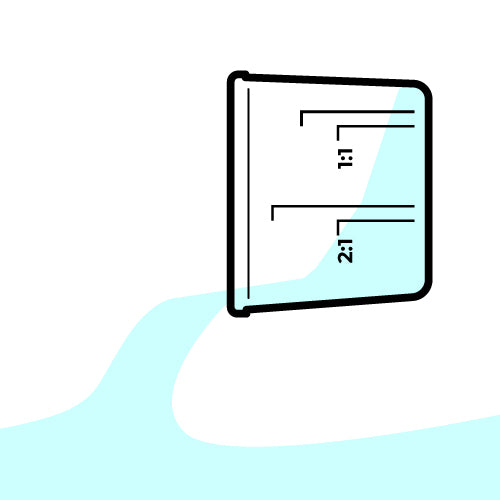
<p style="font-weight: 400; float: right;">If your epoxy project requires more epoxy than the chosen mixing container can hold, simply mix in smaller batches, then dump each batch into a larger, clean holding bucket for final mixing.<br><br>After each smaller batch is mixed, completely scrape down the container sides and bottom and continue with your next batch in the same container. (Cheap rubber spatulas work great!) After all your epoxy is in your larger holding bucket, give it another mix for a few minutes to assure everything in cohesive before pouring.</p>
<h3>Why is this so important?</h3>
<p style="font-weight: 400;">If epoxy is not properly mixed there can and will be serious problems during the cure. If mixing ratios are slightly off, this can cause a hot spot. A hot spot is when there is unmixed A-side or B-side floating around in the final pour. This can initiate a premature exothermic reaction too early in the cure time, and set off a chain reaction that can cause drastic cracking. Or, the epoxy just won’t cure hard at all. Either way, this is a hard lesson to learn.</p>
<h4>MIXING EPOXY RESINS<br><br><br>
</h4>
<div id="mixTiles" class="clearfix mar-bottom-20">
<div class="col-md-2 col-xs-4"><img src="https://cdn.shopify.com/s/files/1/0095/3303/0505/files/inst01.jpg"></div>
<div class="col-md-2 col-xs-4"><img src="https://cdn.shopify.com/s/files/1/0095/3303/0505/files/inst02.jpg"></div>
<div class="col-md-2 col-xs-4"><img src="https://cdn.shopify.com/s/files/1/0095/3303/0505/files/inst03.jpg"></div>
<div class="col-md-2 col-xs-4"><img src="https://cdn.shopify.com/s/files/1/0095/3303/0505/files/inst04.jpg"></div>
<div class="col-md-2 col-xs-4"><img src="https://cdn.shopify.com/s/files/1/0095/3303/0505/files/inst03.jpg"></div>
<div class="col-md-2 col-xs-4"><img src="https://cdn.shopify.com/s/files/1/0095/3303/0505/files/inst05.jpg"></div>
</div>
<ul>
<li style="font-weight: 400;">
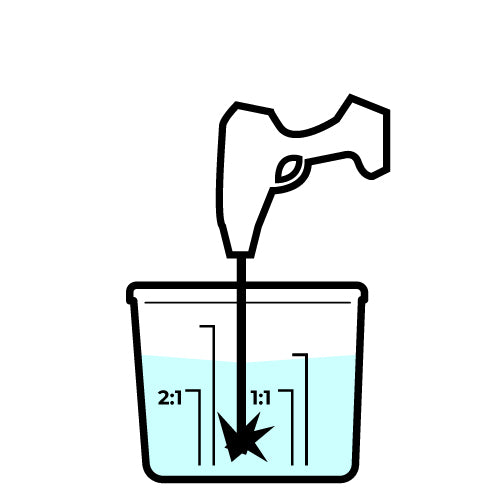
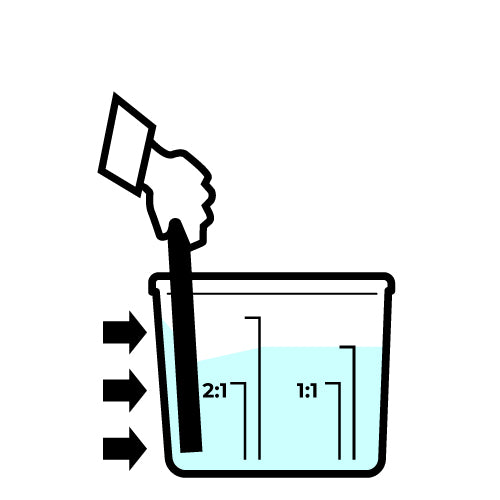
<span></span>After the two parts are poured at the correct ratio, mix them together thoroughly for a full 6 - 8 minutes for 2:1 and 3-5 minutes for Table Top epoxy. Use a clean mixing stick or paddle on a drill, mix longer for larger quantities.<br><br>
</li>
<li style="font-weight: 400;">
<span></span>Be sure to scrape the sides, corners, and bottom of the container several times during mixing. This will ensure that all the A resin and B hardener are thoroughly mixed.<br><br>
</li>
<li style="font-weight: 400;">Add any colorants at this point and mix until you've acheived the desired saturation.<br><br>
</li>
<li style="font-weight: 400;">
<span></span>If the mixture doesn't have a single consistency (streaks or swirls remain) continue mixing until fully blended and a homogenous mixture appears.<br><br>
</li>
<li style="font-weight: 400;">
<span></span>Begin pouring the epoxy immediately. The larger the quantity of mixed epoxy in the mixing container, the faster the pot-life and working time are.</li>
</ul>
<style><!--
#mixTiles img {max-width:100%!important;}
--></style>
<h4>SAFETY</h4>
<p style="font-weight: 400;">Make sure to have the proper PPE, tools and safety equipment for using and handling epoxy resins.</p>
<ul>
<li style="font-weight: 400;">
<span></span>Eye Protection</li>
<li style="font-weight: 400;">
<span></span>Reusable Rubber Gloves or Disposable Latex</li>
<li style="font-weight: 400;">
<span></span>Clean Mixing Cups with Measurements</li>
<li style="font-weight: 400;">
<span></span>Clean Mixing Sticks and or Paddles</li>
<li style="font-weight: 400;">
<span></span>Rubber Spatula(s)</li>
</ul>]]>
    </content>
  </entry>
  <entry>
    <id>https://www.wisebond.com/blogs/epoxy-blog/is-epoxy-food-safe</id>
    <published>2020-06-29T11:41:00-04:00</published>
    <updated>2023-10-17T09:16:29-04:00</updated>
    <link href="https://www.wisebond.com/blogs/epoxy-blog/is-epoxy-food-safe" rel="alternate" type="text/html"/>
    <title>Is Epoxy Food Safe?</title>
    <author>
      <name>Roderick Kabel</name>
    </author>
    <summary type="html">
      <![CDATA[<p>The question when asked, is communicated as food touching a cured and hardened epoxy surface, right? However there are too many variables and for-instances where any food could come in contact with hard cured epoxy.</p>
<p>For instance, would you eat scrambled eggs off an epoxy surface? Yuk. How about making a peanut butter and jelly sandwich where the bread touches the epoxy? Maybe. Would you cut raw meat on epoxy? Nope!</p><p><a class="read-more" href="https://www.wisebond.com/blogs/epoxy-blog/is-epoxy-food-safe">More</a></p>]]>
    </summary>
    <content type="html">
      <![CDATA[<p><b class="colored">By Roderick Kabel</b></p>
<p><b class="colored"></b>We are asked the question more than once a week and there seems to be quite a bit of confusion out on the internet. In this article we will help to clarify a few things around this topic - even though we are not chemists or experts – a few guidelines to follow will help us all out.</p>
<p>We understand people’s worries about food contact with epoxy and their need to know for practical purposes. When considering our market, deep pour and table top epoxy, epoxy contact with food is a normal, everyday occurrence. The bottom line here is this; epoxy is two liquid components that are each made from chemicals; and then mixed together to create a completely new solid substance which is absent most of the initial liquid formula compounds - after a full cure. Though, the takeaway word here is “chemicals.”</p>
<p>Here is an excerpt taken from Wikipedia: “Epoxy is either any of the basic components or the cured end products of epoxy resins, as well as a colloquial name for the epoxide functional group.[1] Epoxy resins, also known as polyepoxides, are a class of reactive prepolymers and polymers which contain epoxide groups.</p>
<p>Epoxy resins may be reacted (cross-linked) either with themselves through catalytic homopolymerisation, or with a wide range of co-reactants including polyfunctional amines, acids (and acid anhydrides), phenols, alcohols and thiols (usually called mercaptans). These co-reactants are often referred to as hardeners or curatives, and the cross-linking reaction is commonly referred to as curing.”</p>
<p>Would anyone knowingly ingest any of these chemicals in liquid or cured form either directly or indirectly? No, they wouldn’t.</p>
<p>But that’s not the question, is it? The question when asked, is communicated as food touching a cured and hardened epoxy surface, right? However there are too many variables and for-instances where any food could come in contact with hard cured epoxy.</p>
<p>For instance, would you eat scrambled eggs off an epoxy surface? Yuk. How about making a peanut butter and jelly sandwich where the bread touches the epoxy? Maybe. Would you cut raw meat on epoxy? Nope!</p>
<img alt="" src="//cdn.shopify.com/s/files/1/0095/3303/0505/files/FDA-logo.jpg?v=1570560096" style="float: right;">
<p>What’s more frightening is the other form of this question. “Is epoxy ‘Food Grade’?” And herein lays the real problem. These two seemingly innocent food and epoxy questions are frequently interchanged and they are two very different things. Just ask the FDA.</p>
<p>Keep in mind “Food Grade” epoxy is formulated as such that its raw material chemical make-up is not harmful as well as the cured epoxy not being harmful. Furthermore, manufacturers must go through expensive and extensive testing with the FDA to be certified as a “Food Grade” epoxy.</p>
<p>The FDA’s Title 21, Volume 3 report shows that food safe epoxy does indeed exist. Even though epoxy is generally not connected with a specific setting in the kitchen, several brands claim their epoxy is formulated with FDA approved raw materials. This means that certain epoxies are safe for both direct and indirect contact with food, as regulated by the FDA. These epoxies "comply" with CFR 175.300 and are ideal for bonding and sealing food contact equipment, utensils and appliances.</p>
<p>Nevertheless, the problem here is a distortion of information, kind of like the telephone game we all played in grade school where the message told, got all jumbled by the time it reached the last person.</p>
<p>All over the World Wide Web and from peer to peer, epoxy newbies, experts and even manufacturers are blurring the lines. Newbies always ask if epoxy is Food Safe; experts say yes, because they tend to rely on their epoxy brand’s “food safe” literature. Then, there are the epoxy manufacturers whom have created a loop hole by leaning on and referencing the FDA and their Code of Federal Regulations Title 21.</p>
<p><a href="https://www.accessdata.fda.gov/scripts/cdrh/cfdocs/cfcfr/CFRSearch.cfm?fr=175.300" title="https://www.accessdata.fda.gov/scripts/cdrh/cfdocs/cfcfr/CFRSearch.cfm?fr=175.300" target="_blank">https://www.accessdata.fda.gov/</a></p>
<p>So what’s the answer? The simple answer here is, yes, epoxy is generally safe around food because it is an inert plastic when properly mixed and cured. However that’s not necessarily a reassuring answer because again, the answer depends completely on what the epoxy will be used in, or on a finished project surface, and how will any said foods actually come in contact with the epoxy.</p>
<p>The prospects for using epoxy for contact with food, has increased immensely. Many individuals are using epoxy for table tops, bar tops, counters, cutting boards, charcuterie, serving trays, drink tumblers, and many others.</p>
<p>Our view is this: WiseBond<sup>®</sup> Epoxies are 100% solids and VOC-Free. Once epoxy is mixed properly according to the instructions and fully cured for 30 days, it is an inert plastic. It is not antimicrobial. Epoxy is not safe to ingest (liquid or cured). Do not cut on or prepare raw food on epoxy surfaces.</p>
<p>SAFETY: Products "WiseBond<sup>®</sup> Deep Pour 2” Epoxy: Part A and B, and WiseBond<sup>®</sup> Bar &amp; Table Top Epoxy: Part A and B", are resinous polymeric coatings. These resinous polymeric coatings have been tested by an independent Testing, Inspection and Certification laboratory for conformity to Food and Drug Administration (FDA) standards as required by USFDA 21 CFR 175.300 Condition E from Table 2. Tested epoxy passed the CFR extraction testing under the conditions of use that were requested. The products were found to be in compliance with the US Food and Drug Administration regulation, 21 CFR 175.300, Condition E, for surfaces in contact with food at room temperature. Other conditions of use or variations in application of the resin for the specific application would potentially require follow up testing.</p>
<p>NOTE: The above statement refers to “clear” epoxy only. Adding any type of colorant to either epoxy, alters the epoxy formula and it will no longer conform to the USFDA 21 CFR 175.300 tested results.</p>
<p>You may email info@wisebond.com for additional full information and testing.</p>
<p>Okay, you say… that’s all fine and dandy but you still want to put food on your epoxy countertop. Well, let’s look a little deeper into the make-up of epoxy.</p>
<p style="float: left;"><img alt="" src="//cdn.shopify.com/s/files/1/0095/3303/0505/files/Bisphenol_A_medium.png?v=1570560583" style="float: left; margin-right: 15px;">A key compound of epoxy is the ingredient Bisphenol A (BPA) or Bisphenol F (BPF). Over 60 percent of all epoxies contain or have large amounts of Bisphenol A. Bisphenol A is an industrial chemical and has been around since the 1960’s to create polycarbonate plastics and epoxy resins. Polycarbonate plastics are often used in containers that store food and beverages, such as water bottles and beverage can linings.</p>
<p>In 1997, adverse effects of low-dose BPA exposure in laboratory animals were first discovered. Studies began finding possible connections to health issues caused by exposure to BPA during reproduction, pregnancy and during embryo development.</p>
<p>In 2003, U.S. consumption of BPA was 856,000 tons, 72% of which used to make polycarbonate plastic and 21% going into epoxy resins. In the U.S., less than 5% of the BPA produced is used in food contact applications, but remains in the canned food industry and printing applications such as sales receipts.</p>
<p>As of 2014, research and debates are ongoing as to whether BPA should be banned or not. The CDC reported that BPA detectable levels were found in 93% of 2517 urine samples from people six years and older.</p>
<p>In 2015, OEHHA (California Office of Environmental Health Hazard Assessment) listed Bisphenol A as a carcinogen to their Proposition 65 list because it can harm the female reproductive system, including effects on ovaries and eggs.</p>
<p>On April 1, 2016, the California Code of Regulations, operated by the OEHHA, filed an Emergency Action to amend section 25603.3 Title 27 warnings for exposures to Bisphenol A from canned and bottled foods and beverages.</p>
<p><a href="https://oehha.ca.gov/proposition-65/crnr/supplemental-finding-emergency-emergency-action-amend-section-256033-title-27" title="https://oehha.ca.gov/proposition-65/" target="_blank">https://oehha.ca.gov/proposition-65/</a></p>
<p>OEHHA determined that it could not develop a safe harbor level for oral exposures to BPA and realized that businesses would take inconsistent approaches to compliance. Inconsistent warnings in general, would confuse citizens on a topic of vital importance to them — food safety. Consumers needed to have clear choices between food and beverage products in BPA-containing and BPA-free packaging.</p>
<p>There was evidence that between 66% and 90% of canned foods contain varying levels of BPA. Given the long shelf life of these types of products, some of them were likely manufactured prior to the listing of BPA in 2015. The only viable way to provide warnings for these products, absent the emergency regulation, is with shelf signs and point-of-purchase signs. Once these older products are no longer in the stream of commerce, OEHHA expects many newer products requiring warnings will have them on the product label as required by the FDA. The effects of BPA are still under review by the FDA however.</p>
<p>On the other hand, these specific levels of BPA are extremely low when used in canned beverages and bottled foods in comparison to the large volumes of epoxy used for art crafts and epoxy table making.</p>
<p>Studies on BPA have found it to be harmful to health, but there is no way to get around the fact that many epoxies on the market are formulated from it. Until a viable new solution is developed and marketed, we all need to be as informed as possible.  </p>
<p>The difference between epoxy brands lies primarily in what the epoxy is intended for. Some individuals use epoxy for coating oil paintings, aircraft adhesives, or to coat the inside of one’s boat. Therefore, the epoxy used in these situations does not have to be food safe/grade. Conversely, individuals using epoxy in applications where food can be, and will be in contact with epoxy must understand the risks of not using an FDA certified food safe or food grade epoxy.</p>
<p>Carefully following instructions during the curing process dramatically decreases the adverse effects of incorrect proportioning and will ensure that the epoxy used is at its highest quality.</p>
<p>Epoxy, when cured, is generally “food safe” for incidental, short-term contact with food, and epoxy is also not always “food grade.” Two very different distinctions. It is solely up to you, the epoxy user, to evaluate the practicality of your epoxy usage and application when in contact with food.</p>]]>
    </content>
  </entry>
  <entry>
    <id>https://www.wisebond.com/blogs/epoxy-blog/air-bubbles-in-epoxy-where-do-they-come-from</id>
    <published>2020-05-08T19:30:00-04:00</published>
    <updated>2022-03-31T11:45:29-04:00</updated>
    <link href="https://www.wisebond.com/blogs/epoxy-blog/air-bubbles-in-epoxy-where-do-they-come-from" rel="alternate" type="text/html"/>
    <title>Air bubbles in epoxy. Where do they come from?</title>
    <author>
      <name>Roderick Kabel</name>
    </author>
    <summary type="html">
      <![CDATA[<span>So where do air bubbles come from in deep pour and table top epoxy? It comes from you, the user, 100% of the time. Sorry to say, but this is true. By either hyperdrive mixing or improper wood sealing (or not at all), the epoxy “brand” is not to blame.</span><p><a class="read-more" href="https://www.wisebond.com/blogs/epoxy-blog/air-bubbles-in-epoxy-where-do-they-come-from">More</a></p>]]>
    </summary>
    <content type="html">
      <![CDATA[<p><b class="colored">By Roderick Kabel</b></p>
<p><b class="colored"></b>Many people using epoxy ask each other if this-or-that brand has a problem with air bubbles. It seems like there are a lot of problems out there with air bubbles in deep pour and in table top epoxy.</p>
<p style="font-weight: 400;">Here’s the long and short of it; inherently, epoxy containers (jugs) are filled by the (a) manufacturer and when it arrives at your doorstep, the epoxy has zero air bubbles. This holds true for every epoxy brand on the market.</p>
<p style="font-weight: 400;">So where do air bubbles come from in deep pour and table top epoxy? It comes from you, the user, 100% of the time. Sorry to say, but this is true. By either hyperdrive mixing or improper wood sealing (or not at all), the epoxy “brand” is not to blame.</p>
<p style="font-weight: 400;">The most common mistake made by users is mixing the two parts of epoxy too fast. Mixing epoxy is not rocket science but it does take a degree of patience and effort to get it right. Epoxy, weather a 1:1, 2:1 or other ratio, is like a cooking recipe. And just like any cooking recipe, mixing, folding, and whipping make the difference between a mousse, a macaron, and whipped cream.</p>
<p style="font-weight: 400;">Likewise, the utensil used to mix epoxy is just as important. There are times when a mixing stick is needed and times when a cordless drill with a paddle is needed.</p>
<p style="font-weight: 400;">Mainly though, most air bubble problems in epoxy come from the manner in which the epoxy was mixed. Was the epoxy mixed gently or whipped into a frenzy turning it cloudy white?</p>
<p style="font-weight: 400;">Key factors to a good recipe:</p>
<ul>
<li style="font-weight: 400;">
<span></span>Always take the time to measure the epoxy A and B sides with a bucket/container that has measurements printed on the side</li>
<li style="font-weight: 400;">
<span></span>Begin mixing the resin and hardener slowly and keep an eye on how much air is getting into the epoxy. If you are getting lots of bubbles, you are going too fast</li>
<li style="font-weight: 400;">
<span></span>Use a slow speed on your drill and paddle. Turn the drill on reverse, this will not allow the mixing paddle to trap air bubbles in between the blades</li>
<li style="font-weight: 400;">
<span></span>Scrape down the sides of the mixing bucket with a paint stick. This gets any of the unmixed A or B side incorporated</li>
<li style="font-weight: 400;">
<span></span>After mixing for the appropriate time frame, pour the epoxy into a fresh clean bucket and mix again for a few minutes. This is insurance that all of the A and B sides are fully mixed</li>
</ul>
<p style="font-weight: 400;">Remember, whipping cream is for yummy desserts. Not epoxy projects.</p>
<p style="font-weight: 400;">“Ya okay fine, but I mixed properly!”</p>
<p style="font-weight: 400;">Great! You mixed properly, did all the things right but are still seeing air bubbles coming from your epoxy after the pour, right? </p>
<p style="font-weight: 400;">At this point there are a few things to consider. Is the wood slab or table top seal coated? Is the live edge sealed? Are bubbles coming from underneath the wood slab, and rolling up the live-edge? Is the table surface porous allowing air to vent?</p>
<p style="font-weight: 400;">These types of air bubbles are most commonly caused from off-gassing that naturally occur from wood, and porous table top substrate materials. Wood and table surfaces must be sealed appropriately with epoxy. We suggest the WiseBond™ Quick Set Seal for this.  </p>
<p style="font-weight: 400;">Likewise, any object to be embedded in epoxy should have voids filled with epoxy (if applicable) and objects must be “wetted” with epoxy prior to thick pouring. This eliminates the possibility of air escaping object voids and the wetting eliminates trapped surface air on the object, preventing micro bubbles.</p>
<p style="font-weight: 400;"><span>With all of this in mind, we've specifically engineered WiseBond™ epoxy to have the optimal consistency to allow for bubble release. Our epoxy’s makeup is thin enough so that bubbles that form in the epoxy, can't effectively hold their spherical shape. They therefore basically break up and rise to the surface where they can then easily be torched away.   </span></p>]]>
    </content>
  </entry>
  <entry>
    <id>https://www.wisebond.com/blogs/epoxy-blog/mica-powder-sinking</id>
    <published>2020-04-10T10:33:00-04:00</published>
    <updated>2022-03-31T11:39:57-04:00</updated>
    <link href="https://www.wisebond.com/blogs/epoxy-blog/mica-powder-sinking" rel="alternate" type="text/html"/>
    <title>Mica Powder Drop Out</title>
    <author>
      <name>Roderick Kabel</name>
    </author>
    <summary type="html">
      <![CDATA[<span>Many people ask us why mica powder sometimes sinks to the bottom of epoxy. The short answer is that all mica powder will sink to a degree no matter what. All mica powder brands are different and unique and with that, all mica powders are not made equally.</span><p><a class="read-more" href="https://www.wisebond.com/blogs/epoxy-blog/mica-powder-sinking">More</a></p>]]>
    </summary>
    <content type="html">
      <![CDATA[<p><b class="colored">By Roderick Kabel</b></p>
<p><b class="colored"></b>Many people ask us why mica powder sometimes sinks to the bottom of epoxy. The short answer is that all mica powder will sink to a degree no matter what. All mica powder brands are different and unique and with that, all mica powders are not made equally.</p>
<p style="font-weight: 400;">There are a number of issues going on here and we will try to explain and offer a remedy.</p>
<p style="font-weight: 400;">In general, epoxy cure times are relevant and depending on environmental conditions, epoxy curing can be fast or slow. Here’s why it matters.</p>
<p style="font-weight: 400;">Epoxy has an A-side and a B-side and each has its own individual viscosity, or thickness. When the two are mixed, a whole new viscosity is created and is susceptible to variations of temperature, humidity and mass in any specific environment. As epoxy moves into its exothermic reaction it begins to gel, thicken, and heat begins to increase.</p>
<p style="font-weight: 400;">As the epoxy gels the viscosity also decreases whereas an object – of any size – may flow through it at a slower rate. Imagine if you dropped a marble in a glass of water and did the same thing with a marble and a glass of honey. Which glass would allow the marble to hit the bottom fastest?</p>
<p style="font-weight: 400;">Mica powder mixed in epoxy uses the same principle as the marble example. Mica powder is made from very fine particles of mica, a natural stone mineral. Even at a tiny microscopic size, mica powder particles are subject to gravity and viscosity.</p>
<p style="font-weight: 400;">Particle size is especially important not only for color composition when it comes to pigments. Particle size dictates the luster and reflection of a mica powder. Mica powder is measured by microns (µm) and the higher particle size means more sparkle but less coverage.</p>
<table>
<tbody>
<tr>
<th>Particle Size</th>
<th>Effect</th>
<th>Hiding Power</th>
</tr>
<tr align="center">
<td><span> 1-25 µm </span></td>
<td>Satin</td>
<td>Good</td>
</tr>
<tr align="center">
<td><span>10-60 µm</span></td>
<td>Luster</td>
<td>Medium</td>
</tr>
<tr align="center">
<td><span>10-125 µm</span></td>
<td>Shimmer</td>
<td>Low</td>
</tr>
<tr align="center">
<td><span>20-150 µm</span></td>
<td>Sparkling</td>
<td>Very Low</td>
</tr>
<tr align="center">
<td><span>45-500 µm</span></td>
<td>Glitter</td>
<td>Transparent</td>
</tr>
</tbody>
</table>
<p> </p>
<p style="font-weight: 400;">The issue with mica powders sinking is this; Because deep pour epoxy can be poured at 2 inches (or more) in a single pour, the formula must allow for a slow exotherm. A slower exotherm means the deep pour epoxy formula also has a lower viscosity which takes longer to gel. This means mica powder particles do not readily suspend in the epoxy and tend to sink.</p>
<p style="font-weight: 400;">Many epoxy users are pouring general use or marine epoxy and are accustomed to thinner pouring formulas that have a faster exotherm and gel time. This quicker exotherm and gel time makes mica suspend faster, sure, but the tradeoff is that these epoxy brands crack, shrink and often, smoke. General use and marine epoxy tinted with mica powder will never produce the beautiful billowing, swirling and patterns that naturally occur from a well-managed deep pour exotherm.</p>
<p style="font-weight: 400; text-align: center;"><img alt="" src="//cdn.shopify.com/s/files/1/0095/3303/0505/files/exotherm.png?v=1586550368" style="display: block; margin-left: auto; margin-right: auto; float: none;"></p>
<p>Many users mix the mica powder in immediately after mixing the A Resin and B Hardener together and have great results. When working with heavier colorant particles or for a project where maximum particle suspension is required, many professional users allow the mixed epoxy to sit in the mixing bucket for up to 2-4 hours (depending on environment) before adding mica.</p>
<p style="font-weight: 400;">Waiting<span> </span>after initial A&amp;B mixing<span> </span>allows the epoxy to begin gelling which<span> </span>helps to suspend<span> </span>the mica powder particles in the epoxy as the viscosity continues to decrease. Once mica is added and thoroughly mixed, it’s a waiting game to find the sweet spot to pour, and get perfect mica particle suspension.<span> </span>Furthermore, the more mica powder that is mixed in the epoxy, the better the chances for a more impregnated final tint to the epoxy.</p>
<p style="font-weight: 400;">Since this is only a suggestion, we can't say exactly when the correct time is to mix the mica powder into the epoxy. Some users may want to mix early into the gel time and some may want to wait a little longer. With that in mind, if heat begins to rise from the epoxy, the exotherm has begun and the natural billowing may not be as robust as it should be. Always try to mix the colorant in prior to any heat buildup.</p>
<p style="font-weight: 400;">A shorter wait for gelling should allow for the exothermic reaction to produce the natural billowing. A longer wait time may allow you to make your own patterns with a stir stick.</p>
<p style="font-weight: 400;">Test, test, test.</p>
<p style="font-weight: 400;">As for bubbles introduced into the epoxy gel time during mixing, our epoxy is very good at releasing air. Plus, the mica powder will hide any internal bubbles in the epoxy. Using a torch to burst bubbles throughout the cure is always recommended for a bubble free, smooth surface.</p>
<p style="font-weight: 400;">Keep in mind, different mica powder brands have different particle sizes. This is very important as well to be sure micas suspend correctly for your project. Always check the mica powder particle size when purchasing from any brand.</p>
<p style="font-weight: 400;">Mica powders available for purchase from WiseBond™ have a particle size ranging from 10-60 µm to 10-100 µm.</p>
<p style="font-weight: 400;">NOTE: Glow-in-the-dark powder will sink much more than mica powder. We do not recommend deep pour epoxy be tinted with Glow-in-the-dark powder because these particles are larger and heavier than mica powder. Glow-in-the-dark powder works best with Table Top Epoxy projects and thin pouring.</p>
<p style="font-weight: 400;">When using Glow-in-the-dark powder in any epoxy, the same mixing is suggested as above.</p>
<p style="font-weight: 400;">What we have explained is far from an exact science and testing is ALWAYS suggested prior to adding any colorant into epoxy for a final project.</p>
<div id=":2r.hw" class="fkp8p">
<div id=":5v.mw" class="tk TmwRj Sn GjkoZd">
<div id=":5v.ma" class="Tn">
<div class="KL">
<div class="PD IF">
<div id=":5v.co" class="JL"></div>
</div>
</div>
</div>
<div class="TR"></div>
</div>
</div>]]>
    </content>
  </entry>
  <entry>
    <id>https://www.wisebond.com/blogs/epoxy-blog/epoxy-on-countertops-the-finish-of-choice</id>
    <published>2020-03-13T15:15:00-04:00</published>
    <updated>2022-03-31T11:44:32-04:00</updated>
    <link href="https://www.wisebond.com/blogs/epoxy-blog/epoxy-on-countertops-the-finish-of-choice" rel="alternate" type="text/html"/>
    <title>Epoxy on Countertops – The Finish of Choice</title>
    <author>
      <name>Roderick Kabel</name>
    </author>
    <summary type="html">
      <![CDATA[<span>Epoxy is an incredibly versatile product that has found its way into almost every area of our modern homes. It is increasingly being used as a highly protective and beautiful finish for countertops. Either as a gloss flood coating over tables and countertops or tinted with multiple colors for artistic features or even faux granite and marble effects.</span><p><a class="read-more" href="https://www.wisebond.com/blogs/epoxy-blog/epoxy-on-countertops-the-finish-of-choice">More</a></p>]]>
    </summary>
    <content type="html">
      <![CDATA[<p>By Roderick Kabel</p>
<p>Epoxy is an incredibly versatile product that has found its way into almost every area of our modern homes. It is increasingly being used as a highly protective and beautiful finish for countertops. Either as a gloss flood coating over tables and countertops or tinted with multiple colors for artistic features or even faux granite and marble effects.</p>
<p>There are many good reasons for this, including durability, strength, scratch-resistance (although not scratch “resistant”) and the products ability to be applied over most surfaces used in the construction of countertops and tables today.</p>
<p>Epoxy will perform well over wood, glass, ceramic, stone aggregate, cement, and most metals. However, before you start applying epoxy over, make sure you are using the correct epoxy product for the job. We recommend <a href="https://www.wisebond.com/collections/bar-table-top-countertop-epoxy-resin" title="1:1 Ratio Epoxy Resin for Bar Tabletops and Countertops">WiseBond® Bar and Tabletop Epoxy</a> for river tables and countertops.</p>
<div id="collection-component-1584365499240"></div>
<h3>What is the best epoxy to use for countertops?</h3>
<p>There are many types of table and countertop epoxy on the market, but to get the best, long-lasting finish on your countertop, make sure the product you choose has the following characteristics:</p>
<ul>
<li>
<strong>Project specific epoxy.</strong> Not all epoxy is the same and not all epoxy works for bars, table tops and countertops. Using a construction grade or marine grade epoxy may not offer the benefits of an epoxy specially formulated for tables and countertops. Although most epoxy is made from similar raw materials, not all epoxy is not universal. Construction and marine grade epoxy have a different pot life and working time which most likely will not suit the specific table and countertop application.</li>
<li>
<strong>Self-leveling.</strong> The description is self-explanatory. While most epoxy will flow out and be self-leveling, you just want to be sure that the product you choose has this benefit on the label. In the process of pouring the epoxy over your countertop you will be able to spread it out with the proper notched spreader tool ensuring that you get a smooth even surface with each application.</li>
<li>
<strong>Viscosity.</strong> Viscosity is something many people do not take into account. Why is it important? A low viscosity epoxy is what allows the epoxy to self-level and flow over the sides of a table or countertop. However, if the viscosity is too low, it will run off like water and not have the correct thickness. Epoxy for tables and countertops should be viscus such as honey. It should provide for a 1/8” final thickness when troweled with a 1/4” notched spreader over the surface. An epoxy such as the WiseBond® Bar &amp; Table Top epoxy has the appropriate viscosity and will cure properly at the desired 1/8” thickness.</li>
<li>
<strong>Heat resistant.</strong> Most epoxy has a heat-resistant temperature limit which can be deceiving from brand to brand. Don’t be fooled by any epoxy brand touting incredibly high heat-resistant temperatures. Always use caution and treat your epoxy surface with care. Most all epoxy brands such as the WiseBond® brand will withstand 120F. Which is a very hot cup of coffee. If your countertop is intended to be used in the kitchen, it is recommended that hot pads be used underneath all pots and pans to protect your countertop. While the finish may take some incidental heat, it is not intended to resist the normal temperature range of cooking equipment heated on the stovetop or in the oven. Epoxy is also not fireproof.</li>
<li>
<strong>Scratch-resistant.</strong> Epoxy is strong, durable and beautiful. Epoxy surfaces do offer a mild scratch resistance but it is NOT 100% scratch-resistant. If you try to scratch it, it will scratch. A full 30 day cure time will offer a scratch resistance capable of handling most every day activities.</li>
<li>
<strong>Epoxy quantities.</strong> The amount of epoxy you will need will depend upon the size of the project you are undertaking. Many home improvement centers will only carry quarts of epoxy and that can put you in a bind if you need a gallon or more. The issue is usable working time once the epoxy has been mixed (there are usually two parts (A-side and B-side) that are blended before using). If you don’t have enough epoxy to cover your entire table or countertop at one time, you will end up with visible break lines or runs where one pour stopped and another started. The WiseBond.com website has a very useful calculator to estimate your needed usage.</li>
</ul>
<h3>
<br>How long will the epoxy finish last?</h3>
<p>One of the reasons that epoxy is so popular in the market place is because of its durability. It is frequently used as the finish on bar tops which are incredibly rough environments. While epoxy will last for years, it is susceptible to yellowing if exposed to a great deal of UV light. WiseBond® Bar and Tabletop Epoxy is specifically designed with UV inhibitors to make sure your beautiful glossy finish stays that way for years to come.</p>
<p>Epoxy should last a lifetime if maintained properly. Always clean up spills and stains can be removed with an acetone-based nail polish remover. Surface cleaning with a non-streaking glass cleaner should be fine.</p>
<p>Epoxy is not inherently “antimicrobial” in the sense that it will kill bacteria. However, the surface of epoxy and the structure of the tight cured molecules will not allow bacteria that is present to grow. Always clean the epoxy surface with a branded cleaner that kills bacteria.</p>
<p>Bar and countertop epoxy can also be buffed with an electric drill or polisher using a polishing paste or liquid to bring back the shine or take out small scratches. Be sure to understand how to polish properly otherwise you could damage the surface or make it dull and cloudy.</p>
<script type="text/javascript">// <![CDATA[
(function () {
  var scriptURL = 'https://sdks.shopifycdn.com/buy-button/latest/buy-button-storefront.min.js';
  if (window.ShopifyBuy) {
    if (window.ShopifyBuy.UI) {
      ShopifyBuyInit();
    } else {
      loadScript();
    }
  } else {
    loadScript();
  }
  function loadScript() {
    var script = document.createElement('script');
    script.async = true;
    script.src = scriptURL;
    (document.getElementsByTagName('head')[0] || document.getElementsByTagName('body')[0]).appendChild(script);
    script.onload = ShopifyBuyInit;
  }
  function ShopifyBuyInit() {
    var client = ShopifyBuy.buildClient({
      domain: 'wisebond.myshopify.com',
      storefrontAccessToken: '148cb79425c98ba559d046592d484dc8',
    });
    ShopifyBuy.UI.onReady(client).then(function (ui) {
      ui.createComponent('collection', {
        id: '156928344169',
        node: document.getElementById('collection-component-1584365499240'),
        moneyFormat: '%24%7B%7Bamount%7D%7D',
        options: {
  "product": {
    "styles": {
      "product": {
        "@media (min-width: 601px)": {
          "max-width": "calc(25% - 20px)",
          "margin-left": "20px",
          "margin-bottom": "50px",
          "width": "calc(25% - 20px)"
        },
        "img": {
          "height": "calc(100% - 15px)",
          "position": "absolute",
          "left": "0",
          "right": "0",
          "top": "0"
        },
        "imgWrapper": {
          "padding-top": "calc(75% + 15px)",
          "position": "relative",
          "height": "0"
        }
      },
      "title": {
        "font-family": "Montserrat, sans-serif",
        "font-size": "14px",
        "color": "#585858"
      },
      "button": {
        "font-family": "Montserrat, sans-serif",
        "font-size": "18px",
        "padding-top": "17px",
        "padding-bottom": "17px",
        ":hover": {
          "background-color": "#d25117"
        },
        "background-color": "#e95a19",
        ":focus": {
          "background-color": "#d25117"
        },
        "border-radius": "0px",
        "padding-left": "100px",
        "padding-right": "100px"
      },
      "quantityInput": {
        "font-size": "18px",
        "padding-top": "17px",
        "padding-bottom": "17px"
      },
      "price": {
        "font-family": "Montserrat, sans-serif",
        "font-weight": "bold",
        "font-size": "26px",
        "color": "#e95a19"
      },
      "compareAt": {
        "font-family": "Montserrat, sans-serif",
        "font-weight": "bold",
        "font-size": "22.099999999999998px",
        "color": "#e95a19"
      },
      "unitPrice": {
        "font-family": "Montserrat, sans-serif",
        "font-weight": "bold",
        "font-size": "22.099999999999998px",
        "color": "#e95a19"
      }
    },
    "buttonDestination": "modal",
    "contents": {
      "options": false
    },
    "text": {
      "button": "Buy"
    },
    "googleFonts": [
      "Montserrat"
    ]
  },
  "productSet": {
    "styles": {
      "products": {
        "@media (min-width: 601px)": {
          "margin-left": "-20px"
        }
      }
    }
  },
  "modalProduct": {
    "contents": {
      "img": false,
      "imgWithCarousel": true,
      "button": false,
      "buttonWithQuantity": true
    },
    "styles": {
      "product": {
        "@media (min-width: 601px)": {
          "max-width": "100%",
          "margin-left": "0px",
          "margin-bottom": "0px"
        }
      },
      "button": {
        "font-family": "Montserrat",
        "font-size": "18px",
        "padding-top": "17px",
        "padding-bottom": "17px",
        ":hover": {
          "background-color": "#d25117"
        },
        "background-color": "#e95a19",
        ":focus": {
          "background-color": "#d25117"
        },
        "border-radius": "0px",
        "padding-left": "100px",
        "padding-right": "100px"
      },
      "quantityInput": {
        "font-size": "18px",
        "padding-top": "17px",
        "padding-bottom": "17px"
      },
      "title": {
        "font-family": "Montserrat, sans-serif",
        "color": "#fc4f00"
      },
      "price": {
        "font-family": "Montserrat, sans-serif",
        "font-weight": "bold",
        "font-size": "26px",
        "color": "#000000"
      },
      "compareAt": {
        "font-family": "Montserrat, sans-serif",
        "font-weight": "bold",
        "font-size": "22.099999999999998px",
        "color": "#000000"
      },
      "unitPrice": {
        "font-family": "Montserrat, sans-serif",
        "font-weight": "bold",
        "font-size": "22.099999999999998px",
        "color": "#000000"
      },
      "description": {
        "font-family": "Montserrat, sans-serif",
        "color": "#585858"
      }
    },
    "googleFonts": [
      "Montserrat"
    ],
    "text": {
      "button": "Add to cart"
    }
  },
  "cart": {
    "styles": {
      "button": {
        "font-family": "Montserrat",
        "font-size": "18px",
        "padding-top": "17px",
        "padding-bottom": "17px",
        ":hover": {
          "background-color": "#d25117"
        },
        "background-color": "#e95a19",
        ":focus": {
          "background-color": "#d25117"
        },
        "border-radius": "0px"
      }
    },
    "text": {
      "total": "Subtotal",
      "button": "Checkout"
    }
  },
  "toggle": {
    "styles": {
      "toggle": {
        "font-family": "Montserrat",
        "background-color": "#e95a19",
        ":hover": {
          "background-color": "#d25117"
        },
        ":focus": {
          "background-color": "#d25117"
        }
      },
      "count": {
        "font-size": "18px"
      }
    }
  }
},
      });
    });
  }
})();
// ]]]]><![CDATA[></script>]]>
    </content>
  </entry>
  <entry>
    <id>https://www.wisebond.com/blogs/epoxy-blog/what-happens-if-my-epoxy-freezes-during-delivery</id>
    <published>2019-11-13T12:27:00-05:00</published>
    <updated>2024-02-02T11:16:56-05:00</updated>
    <link href="https://www.wisebond.com/blogs/epoxy-blog/what-happens-if-my-epoxy-freezes-during-delivery" rel="alternate" type="text/html"/>
    <title>What happens if my epoxy freezes/crystals during delivery?</title>
    <author>
      <name>Roderick Kabel</name>
    </author>
    <summary type="html">
      <![CDATA[<span>Submerge the entire bottle(s) of resin in a tub of hot water (120F) up to about mid-handle area only. This extra hot water bath heat will cause the epoxy crystals to slowly break up and return to </span><span>its </span><span>clear liquid state. Now you can carry on using your epoxy for your river table project or </span><span>flood </span><span>coat.</span><p><a class="read-more" href="https://www.wisebond.com/blogs/epoxy-blog/what-happens-if-my-epoxy-freezes-during-delivery">More</a></p>]]>
    </summary>
    <content type="html">
      <![CDATA[<p><span>By Roderick Kabel</span></p>
<p><span>As the seasons begin to change and get cooler, it’s the perfect time to tackle those big epoxy projects that you've been planning to get to all year. It’s nice to stay inside the workshop where it's warm away from the sub-zero temperatures.</span><br><br><span>However, when your portion of the country begins to feel the grip of Old Man Winter and transitions into freezing temperatures, epoxy delivery could be held up by the weather. Your order could go from a warm warehouse to sitting in a UPS truck somewhere on I-80 in Iowa.</span><br><br><span>Ideally, epoxy should be kept as far away from the cold as possible but with all of the holiday craziness, winter storms, and shipping schedules, we all can't always be home to grab our UPS deliveries. This means your epoxy order may end up sitting outside in the cold, whether we like it or not.</span></p>
<p>The issue here is when epoxy goes from warm to cold and visa versa in a relatively quick manner. Consider how your epoxy order might pass through all sorts of different climates during its trip to you.</p>
<p>In this situation, two things can happen. Most often we hear from customers who see white crystals or a white sludge in the epoxy jugs.</p>
<p>This is due to the molecules bonding together naturally when they condense in the frigid temperatures. When this happens, it may appear cloudy all over or you may see clumps of particles floating in the liquid epoxy resin or hardener, even after it returns to room temperature.</p>
<p>Or the epoxy is frozen in the jugs because it was left outside and very cold weather. Although both your resin and hardener seem unusable, it's very easy to return them to a usable liquid state.</p>
<p><span>Initially in either case, you should simply bring your epoxy inside and let it warm up to room temperature slowly. Most often as the epoxy temperature warms up, your epoxy will return to normal and it will work fine without any adverse effects. Remember, optimum working temperature is between 70 F and 85 F.</span><br><br><span>Submerge the entire bottle(s) of resin in a tub of hot water (120F) up to about mid-handle area only. (Do not fully submerge. The temperature difference from outside the bottle to internal could draw water into the container around the lid.) This extra hot water bath heat will cause the epoxy crystals to slowly break up and return to its clear liquid state. Now you can carry on using your epoxy for your river table project or flood coat.</span></p>
<p><span class="im">NOTE: Allow the liquid epoxy A&amp;B containers to cool back to room temperature before using. Otherwise an overly warm/hot mixture will prematurely cure and cause drastic results during the exothern.<br><br>That's it, simple as that. We hope this helps to set your mind at ease about getting your epoxy delivered in the winter months and helps you keep your project schedules on-track through the holidays and beyond.  <br><br></span><strong>What not to do:</strong><br><br><span>We have heard that placing epoxy bottles in a black garbage bag and setting them in the sun, will thaw them. Typically the sun is not a good option and may only prolong the thawing process.</span><br><br><span>Likewise, heating the epoxy material in a microwave is not recommended because, well, it’s epoxy and microwaves should be used for heating chili dogs.</span></p>]]>
    </content>
  </entry>
  <entry>
    <id>https://www.wisebond.com/blogs/epoxy-blog/jl-custom-guitars-bluegill-epoxy-guitar</id>
    <published>2019-10-19T08:52:00-04:00</published>
    <updated>2020-03-03T16:24:14-05:00</updated>
    <link href="https://www.wisebond.com/blogs/epoxy-blog/jl-custom-guitars-bluegill-epoxy-guitar" rel="alternate" type="text/html"/>
    <title>WiseBond Epoxy Guitar with Real Fish</title>
    <author>
      <name>Roderick Kabel</name>
    </author>
    <summary type="html">
      <![CDATA[Blue gill Classic T style guitar by <a href="https://www.facebook.com/JLCustomGuitar/" target="_blank" rel="noopener noreferrer">JL Custom Guitars</a>.<br>
<ul>
<li><span>Buckeye Burl/WiseBond™ epoxy resin body</span></li>
<li><span>Flame maple neck</span></li>
<li>
<a class="profileLink" title="Andrew Robertson" href="https://www.facebook.com/geckoguydrew?__tn__=K-R&amp;eid=ARD9nySKlrooDY5Dd7tUf84VW1xms85Jmkvgia17fSj7G03tR5NEPfg0a5Ow-f0ZYOlaWKNwFSYaEVH9&amp;fref=mentions&amp;__xts__%5B0%5D=68.ARDUPi4AlyIEb4gJfZn7_gFLyAAzd9wOWTcLc0Ec0XN90VURIxdkx4yWI23OnG7AIEXzSOuzaCwMaKOiGU5We_kp3upDaDH3nOHmCqaJVjjZpJh-uFO_8Mi0cHGZ78mpxxoF55K2iuvy-o-KMFtWJit-9tGewTge5yTiJPeVPywfP3k7dPTo_2Pnk7Gkebsl3_xfsbXAEgT72U74QV-OztcXqnt9x1q9aCMllzGLOaDV8zyw5vsmAiCc_93VbPcMuCeyttZJba6kEK7q1tlx0fr7YmMVQco_Oz_XAEf7lNIg1EHhxv6h2gVl7154Amvzz2XQgkYa9Vl2r6fq_lbYhso" data-hovercard="/ajax/hovercard/user.php?id=513617929&amp;extragetparams=%7B%22__tn__%22%3A%22%2CdK-R-R%22%2C%22eid%22%3A%22ARD9nySKlrooDY5Dd7tUf84VW1xms85Jmkvgia17fSj7G03tR5NEPfg0a5Ow-f0ZYOlaWKNwFSYaEVH9%22%2C%22fref%22%3A%22mentions%22%7D" data-hovercard-prefer-more-content-show="1">Andrew Robertson</a><span> Custom wound pickups</span>
</li>
<li>
<a class="profileLink" href="https://www.facebook.com/920dcustom/?__tn__=K-R&amp;eid=ARAPGt8IQetBcGetXMMW5l2hnWWhKnB-G42lKfptRQrobwffVSyFUThdFw63O61EnvTeMtfsBYn4T58W&amp;fref=mentions&amp;__xts__%5B0%5D=68.ARDUPi4AlyIEb4gJfZn7_gFLyAAzd9wOWTcLc0Ec0XN90VURIxdkx4yWI23OnG7AIEXzSOuzaCwMaKOiGU5We_kp3upDaDH3nOHmCqaJVjjZpJh-uFO_8Mi0cHGZ78mpxxoF55K2iuvy-o-KMFtWJit-9tGewTge5yTiJPeVPywfP3k7dPTo_2Pnk7Gkebsl3_xfsbXAEgT72U74QV-OztcXqnt9x1q9aCMllzGLOaDV8zyw5vsmAiCc_93VbPcMuCeyttZJba6kEK7q1tlx0fr7YmMVQco_Oz_XAEf7lNIg1EHhxv6h2gVl7154Amvzz2XQgkYa9Vl2r6fq_lbYhso" data-hovercard="/ajax/hovercard/page.php?id=237198079685018&amp;extragetparams=%7B%22__tn__%22%3A%22%2CdK-R-R%22%2C%22eid%22%3A%22ARAPGt8IQetBcGetXMMW5l2hnWWhKnB-G42lKfptRQrobwffVSyFUThdFw63O61EnvTeMtfsBYn4T58W%22%2C%22fref%22%3A%22mentions%22%7D" data-hovercard-prefer-more-content-show="1">920D Custom</a><span> wiring harnesses</span>
</li>
<li><span class="text_exposed_show">Texas Custom Smooth play bridge</span></li>
<li><span class="text_exposed_show">Hipshot locking tuners</span></li>
</ul><p><a class="read-more" href="https://www.wisebond.com/blogs/epoxy-blog/jl-custom-guitars-bluegill-epoxy-guitar">More</a></p>]]>
    </summary>
    <content type="html">
      <![CDATA[<p><span>Blue gill Classic T style guitar by </span>JL Custom Guitars using our <a href="https://www.wisebond.com/collections/epoxy-resin-kits/products/deep-pour-river-table-epoxy-resin-kit">DEEP POUR epoxy</a> formula.</p>
<ul>
<li><span>Buckeye Burl/WiseBond™ DEEP POUR epoxy resin body</span></li>
<li><span>Flame maple neck</span></li>
<li>
<a class="profileLink" title="Andrew Robertson" href="https://www.facebook.com/geckoguydrew?__tn__=K-R&amp;eid=ARD9nySKlrooDY5Dd7tUf84VW1xms85Jmkvgia17fSj7G03tR5NEPfg0a5Ow-f0ZYOlaWKNwFSYaEVH9&amp;fref=mentions&amp;__xts__%5B0%5D=68.ARDUPi4AlyIEb4gJfZn7_gFLyAAzd9wOWTcLc0Ec0XN90VURIxdkx4yWI23OnG7AIEXzSOuzaCwMaKOiGU5We_kp3upDaDH3nOHmCqaJVjjZpJh-uFO_8Mi0cHGZ78mpxxoF55K2iuvy-o-KMFtWJit-9tGewTge5yTiJPeVPywfP3k7dPTo_2Pnk7Gkebsl3_xfsbXAEgT72U74QV-OztcXqnt9x1q9aCMllzGLOaDV8zyw5vsmAiCc_93VbPcMuCeyttZJba6kEK7q1tlx0fr7YmMVQco_Oz_XAEf7lNIg1EHhxv6h2gVl7154Amvzz2XQgkYa9Vl2r6fq_lbYhso" data-hovercard="/ajax/hovercard/user.php?id=513617929&amp;extragetparams=%7B%22__tn__%22%3A%22%2CdK-R-R%22%2C%22eid%22%3A%22ARD9nySKlrooDY5Dd7tUf84VW1xms85Jmkvgia17fSj7G03tR5NEPfg0a5Ow-f0ZYOlaWKNwFSYaEVH9%22%2C%22fref%22%3A%22mentions%22%7D" data-hovercard-prefer-more-content-show="1">Andrew Robertson</a><span> Custom wound pickups</span>
</li>
<li>
<a class="profileLink" href="https://www.facebook.com/920dcustom/?__tn__=K-R&amp;eid=ARAPGt8IQetBcGetXMMW5l2hnWWhKnB-G42lKfptRQrobwffVSyFUThdFw63O61EnvTeMtfsBYn4T58W&amp;fref=mentions&amp;__xts__%5B0%5D=68.ARDUPi4AlyIEb4gJfZn7_gFLyAAzd9wOWTcLc0Ec0XN90VURIxdkx4yWI23OnG7AIEXzSOuzaCwMaKOiGU5We_kp3upDaDH3nOHmCqaJVjjZpJh-uFO_8Mi0cHGZ78mpxxoF55K2iuvy-o-KMFtWJit-9tGewTge5yTiJPeVPywfP3k7dPTo_2Pnk7Gkebsl3_xfsbXAEgT72U74QV-OztcXqnt9x1q9aCMllzGLOaDV8zyw5vsmAiCc_93VbPcMuCeyttZJba6kEK7q1tlx0fr7YmMVQco_Oz_XAEf7lNIg1EHhxv6h2gVl7154Amvzz2XQgkYa9Vl2r6fq_lbYhso" data-hovercard="/ajax/hovercard/page.php?id=237198079685018&amp;extragetparams=%7B%22__tn__%22%3A%22%2CdK-R-R%22%2C%22eid%22%3A%22ARAPGt8IQetBcGetXMMW5l2hnWWhKnB-G42lKfptRQrobwffVSyFUThdFw63O61EnvTeMtfsBYn4T58W%22%2C%22fref%22%3A%22mentions%22%7D" data-hovercard-prefer-more-content-show="1">920D Custom</a><span> wiring harnesses</span>
</li>
<li><span class="text_exposed_show">Texas Custom Smooth play bridge</span></li>
<li><span class="text_exposed_show">Hipshot locking tuners</span></li>
</ul>
<p> </p>
<p><img src="//cdn.shopify.com/s/files/1/0095/3303/0505/files/75237512_673043179770518_6053047777057832960_n_1024x1024.jpg?v=1574170820" alt="Bluegill Epoxy Guitar" style="display: block; margin-left: auto; margin-right: auto;"></p>
<p><img src="//cdn.shopify.com/s/files/1/0095/3303/0505/files/70767660_219439069039773_1772824901434603327_n_1024x1024.jpg?v=1574170857" alt="Bluegill Custom Guitar Encased Epoxy WiseBond" style="display: block; margin-left: auto; margin-right: auto;"></p>
<p><img src="//cdn.shopify.com/s/files/1/0095/3303/0505/files/67525696_2128914790744118_2946229366326591500_n_1024x1024.jpg?v=1574170918" alt="" style="display: block; margin-left: auto; margin-right: auto;"></p>
<p><img src="//cdn.shopify.com/s/files/1/0095/3303/0505/files/75233487_673043109770525_7460740251967815680_n_1024x1024.jpg?v=1574171197" alt="" style="display: block; margin-left: auto; margin-right: auto;"></p>
<p><img src="//cdn.shopify.com/s/files/1/0095/3303/0505/files/72655189_673042973103872_3275941156327784448_n_1024x1024.jpg?v=1574171235" alt="Bluegill fish encased in epoxy guitar using WiseBond DEEP POUR" style="display: block; margin-left: auto; margin-right: auto;"></p>
<p><img src="//cdn.shopify.com/s/files/1/0095/3303/0505/files/73381218_673043069770529_3644187825470963712_n_293c6768-e415-4383-afb0-42936800e935_1024x1024.jpg?v=1574171309" alt="WiseBond DEEP POUR Epoxy Encapsulated Fish Bluegill Taxidermy" style="display: block; margin-left: auto; margin-right: auto;"></p>
<p><img src="//cdn.shopify.com/s/files/1/0095/3303/0505/files/jl-custom-guitars_large.jpg?v=1574171413" alt="JL Custom Guitars" style="display: block; margin-left: auto; margin-right: auto;"></p>
<p style="text-align: center;">See more photos and get the full story on <a href="https://www.facebook.com/JLCustomGuitar/posts/673045803103589?__xts__%5B0%5D=68.ARDUPi4AlyIEb4gJfZn7_gFLyAAzd9wOWTcLc0Ec0XN90VURIxdkx4yWI23OnG7AIEXzSOuzaCwMaKOiGU5We_kp3upDaDH3nOHmCqaJVjjZpJh-uFO_8Mi0cHGZ78mpxxoF55K2iuvy-o-KMFtWJit-9tGewTge5yTiJPeVPywfP3k7dPTo_2Pnk7Gkebsl3_xfsbXAEgT72U74QV-OztcXqnt9x1q9aCMllzGLOaDV8zyw5vsmAiCc_93VbPcMuCeyttZJba6kEK7q1tlx0fr7YmMVQco_Oz_XAEf7lNIg1EHhxv6h2gVl7154Amvzz2XQgkYa9Vl2r6fq_lbYhso&amp;__tn__=-R" target="_blank" rel="noopener noreferrer">JL Custom Guitar's Facebook Page</a></p>]]>
    </content>
  </entry>
  <entry>
    <id>https://www.wisebond.com/blogs/epoxy-blog/creating-marble-countertop-effects-with-epoxy</id>
    <published>2019-10-15T13:39:00-04:00</published>
    <updated>2019-10-15T13:40:30-04:00</updated>
    <link href="https://www.wisebond.com/blogs/epoxy-blog/creating-marble-countertop-effects-with-epoxy" rel="alternate" type="text/html"/>
    <title>Creating Marble Countertop Effects with Epoxy</title>
    <author>
      <name>Roderick Kabel</name>
    </author>
    <summary type="html">
      <![CDATA[<span>Create stunning counter tops using our Bar &amp; Table Top Epoxy. Here is a video of a table we just finished that looks just like Carrara marble. The possibilities are truly endless. Let your imagination run wild! </span><p><a class="read-more" href="https://www.wisebond.com/blogs/epoxy-blog/creating-marble-countertop-effects-with-epoxy">More</a></p>]]>
    </summary>
    <content type="html">
      <![CDATA[<p>Create <strong>stunning counter tops</strong> using our <a href="https://www.wisebond.com/collections/epoxy-resin-kits/products/bar-and-table-top-gloss-epoxy-resin-kit">Bar &amp; Table Top Epoxy</a>. Here is a video of a table we just finished that looks just like <strong>Carrara marble</strong>. The possibilities are truly endless. <iframe width="560" height="315" src="https://www.youtube.com/embed/Izw8kH8saEs" frameborder="0" allow="accelerometer; autoplay; encrypted-media; gyroscope; picture-in-picture" allowfullscreen=""></iframe></p>]]>
    </content>
  </entry>
  <entry>
    <id>https://www.wisebond.com/blogs/epoxy-blog/exotherm-pot-life-and-gel-time</id>
    <published>2019-07-26T11:31:00-04:00</published>
    <updated>2022-03-31T11:43:25-04:00</updated>
    <link href="https://www.wisebond.com/blogs/epoxy-blog/exotherm-pot-life-and-gel-time" rel="alternate" type="text/html"/>
    <title>Exotherm, Pot Life and Gel Time</title>
    <author>
      <name>Roderick Kabel</name>
    </author>
    <summary type="html">
      <![CDATA[<span>The chemical cross-linking between mixed epoxy resin and hardener molecules as it cures will generate heat. This heat is called the exothermic reaction. Pot Life is the time you have after mixing epoxy to the relative time you have to pour the epoxy. Gel Time is the heating of epoxy and observing when it starts to become stringy, or gel-like, though not quite fully cured.</span><p><a class="read-more" href="https://www.wisebond.com/blogs/epoxy-blog/exotherm-pot-life-and-gel-time">More</a></p>]]>
    </summary>
    <content type="html">
      <![CDATA[<p>By Roderick Kabel</p>
<p>Exotherm, Pot Life, Gel Time, oh, my! What are these things and why they matter to your epoxy pouring can be complicated. Let’s take a look at them and see if we can make some sense out of this mumbo-jumbo.</p>
<p>The chemical cross-linking between mixed epoxy resin and hardener molecules as it cures will generate heat. This heat is called the exothermic reaction and when this heat cannot escape, it builds up, causing the mixed epoxy to cure faster. Epoxy cures faster at higher temperatures.</p>
<p>Epoxy curing faster because of heat produces even more heat, even faster. This runaway train is why possibly a gallon of epoxy mixed all at once could turn solid in 5 minutes, maybe quicker. The resulting massive buildup of heat could cause the curing epoxy to crack because the top and bottom of the epoxy have different temperatures.</p>
<p>The chemical bond between epoxy resin and hardener is the mechanism that causes heat buildup. When epoxy is mixed and contained in a thick mass, it takes longer to cure. When epoxy is applied as a thin film, the thin film does not build heat due to low mass. This means the temperature through the thickness of the epoxy thin film is close to the ambient temperature.</p>
<p>Sometimes, pouring a large mass of epoxy all at once, blended in a mass large enough, could reach temperatures up to 400°F. This is hot enough to at least soften or even melt plastic. Likewise, such a   heat level could even damage the vessel the epoxy is poured into. Severe cracking throughout the thickness of cured epoxy could also happen. And if the epoxy isn’t supported properly, it could fall away. Epoxy shrinkage due to heat is another factor that can add substantial stresses to the structure the epoxy is attached to.</p>
<p>Controlling exothermic reaction is next to impossible but there are ways to manage it. First, estimate how much mixed epoxy you will use for your project in a certain amount of time. Don’t mix too much if you don’t need to. Variables that affect your epoxy quantity calculation include temperature, hardener speed, volume, fillers used, surface area, and the insulating property of the substrate the epoxy is exposed to. </p>
<p>“Uncontrolled exotherm’ this uncontrolled heat build-up of mixed epoxy. Epoxy heating out of control can smoke, foam, and give off dangerous vapors. It can even produce enough heat to melt the container or cause nearby items to catch fire. It’s crucial to understand epoxy’s exothermic curing reaction and follow the instructions in this article very closely if you are planning to fill a large area with thick casting of epoxy.</p>
<p>Pot Life vs. Get Time</p>
<p>When mixing larger batches of resin and hardener the amount of time that elapses before the epoxy starts to thicken/harden in the container, is very important. As the exothermic reaction starts to build, the “Pot Life” of the epoxy quickly shortens. Pot Life is the time you have after mixing epoxy to the relative time you have to pour the epoxy; to the time the epoxy becomes incapable of performing/providing a desired outcome. An increase of 10°F above the average 77°F will usually shorten the pot-life by 5 minutes.</p>
<p>The term “Pot Life” is often used interchangeably with the term “Gel Time,” although there are differences. Both terms are used to describe the thickening of an epoxy (viscosity) after it is mixed. Pot Life is defined as the amount of time it takes for an initial mixed viscosity to double, or quadruple. Gel Time (more of a technical lab term) is measured and tested at elevated temperatures and is determined by heating the epoxy and observing when it starts to become stringy, or gel-like, though not quite fully cured.</p>
<p>If you are using a larger amount of resin, simply use a smaller size mixing cup, mix multiple, smaller batches as you go, the length of Pot Life will vary. Likewise, working in a cooler environment will help to increase the Pot Life and not allow the exothermic reaction to get out of control. Cooler shop temperatures and cooling the poured epoxy itself (use a fan) will slow the cure and help control the epoxy’s heat buildup (exothermic reaction).</p>]]>
    </content>
  </entry>
</feed>